EP4407424A1 - Information processing device and program - Google Patents
Information processing device and program Download PDFInfo
- Publication number
- EP4407424A1 EP4407424A1 EP22872594.1A EP22872594A EP4407424A1 EP 4407424 A1 EP4407424 A1 EP 4407424A1 EP 22872594 A EP22872594 A EP 22872594A EP 4407424 A1 EP4407424 A1 EP 4407424A1
- Authority
- EP
- European Patent Office
- Prior art keywords
- index
- indices
- display
- information processing
- processing device
- Prior art date
- Legal status (The legal status is an assumption and is not a legal conclusion. Google has not performed a legal analysis and makes no representation as to the accuracy of the status listed.)
- Pending
Links
Images





Classifications
-
- G—PHYSICS
- G06—COMPUTING OR CALCULATING; COUNTING
- G06F—ELECTRIC DIGITAL DATA PROCESSING
- G06F3/00—Input arrangements for transferring data to be processed into a form capable of being handled by the computer; Output arrangements for transferring data from processing unit to output unit, e.g. interface arrangements
- G06F3/01—Input arrangements or combined input and output arrangements for interaction between user and computer
- G06F3/048—Interaction techniques based on graphical user interfaces [GUI]
- G06F3/0481—Interaction techniques based on graphical user interfaces [GUI] based on specific properties of the displayed interaction object or a metaphor-based environment, e.g. interaction with desktop elements like windows or icons, or assisted by a cursor's changing behaviour or appearance
- G06F3/0482—Interaction with lists of selectable items, e.g. menus
-
- G—PHYSICS
- G06—COMPUTING OR CALCULATING; COUNTING
- G06F—ELECTRIC DIGITAL DATA PROCESSING
- G06F3/00—Input arrangements for transferring data to be processed into a form capable of being handled by the computer; Output arrangements for transferring data from processing unit to output unit, e.g. interface arrangements
- G06F3/01—Input arrangements or combined input and output arrangements for interaction between user and computer
- G06F3/048—Interaction techniques based on graphical user interfaces [GUI]
- G06F3/0487—Interaction techniques based on graphical user interfaces [GUI] using specific features provided by the input device, e.g. functions controlled by the rotation of a mouse with dual sensing arrangements, or of the nature of the input device, e.g. tap gestures based on pressure sensed by a digitiser
- G06F3/0488—Interaction techniques based on graphical user interfaces [GUI] using specific features provided by the input device, e.g. functions controlled by the rotation of a mouse with dual sensing arrangements, or of the nature of the input device, e.g. tap gestures based on pressure sensed by a digitiser using a touch-screen or digitiser, e.g. input of commands through traced gestures
- G06F3/04886—Interaction techniques based on graphical user interfaces [GUI] using specific features provided by the input device, e.g. functions controlled by the rotation of a mouse with dual sensing arrangements, or of the nature of the input device, e.g. tap gestures based on pressure sensed by a digitiser using a touch-screen or digitiser, e.g. input of commands through traced gestures by partitioning the display area of the touch-screen or the surface of the digitising tablet into independently controllable areas, e.g. virtual keyboards or menus
Definitions
- the present disclosure relates to an information processing device and a program.
- JP-A Japanese Patent Application Laid-Open ( JP-A) No. 2013-88833 discloses an information processing device including: a storage unit configured to store a database; a display unit configured to provide with a list display area where a list of data registered in the database is displayed and an index display area where an index of the database is displayed; an operation unit configured to receive a user's operation; and a control unit configured to display a partial list of data registered in the database in the list display area and display the index in the index display area, and when receiving a selection operation for any index displayed in the index display area, display a list of data corresponding to the selected index in the list display area, wherein the control unit is configured not to display an index corresponding to data not registered in the database in the index display area among preset indices.
- An object of the present disclosure is to provide an information processing device and a program, each of which is capable of selecting, even if a selected location is outside of a display range of the second index, the second index without having to select the first index again.
- An information processing device includes a processor, wherein the processor is configured to: display first indices of a database stored in a storage unit, in a first direction of a display area of a display unit; display, upon detecting a user's selection operation for a first index, second indices, corresponding to the first index, in a straight line in a second direction intersecting or parallel to the first index; and determine that a second index is selected in a case in which it is detected that a second index display area displaying the second index has been selected, and also in a case in which it is detected that a selection area set other than the second index display area has been selected.
- the processor is further configured to provide the selection area for each of the second indices.
- the processor is further configured to determine that, in a case in which a divided selection area has been selected, the second index corresponding to the divided selection area is selected, the divided selection area being an area into which the selection area is divided in a direction intersecting the second direction for each of the second indices.
- selection for second indices at both ends among the plurality of second indices enables detection of an area up to ends of display areas facing divided selection areas corresponding to other adjacent second indices as corresponding divided selection areas.
- the processor is further configured to display the second indices in a predetermined order starting from a first index side.
- the processor is further configured to select whether to display the first index at a right end of the display area and display the second indices to the left of the first index, or alternatively, display the first index at a left end of the display area and display the second indices to the right of the first index.
- the processor is further configured to determine that, even before the second index is displayed, the second index is selected in a case in which the second index display area, in which the second index is to be displayed, is selected.
- the processor is further configured to display the second index in a case in which a predetermined condition is satisfied.
- the predetermined condition is that selection of one of the first indices is held for a predetermined time.
- the predetermined condition is selecting one of the first indices and then sliding to the second index display area in which the second indices are displayed.
- the processor is further configured to display, in a case in which another first index is selected after the second indices are displayed, second indices corresponding to the other first index regardless of the predetermined condition.
- the processor is further configured to: display a third index associated with the second index in any one or both of directions intersecting the second direction of the second index in a state in which the second index is selected.
- the processor is further configured to display a third index associated with the second index in any one or both of directions intersecting the second direction of the second index in a case in which selection of the second index is held for a predetermined time.
- the database is an address book in which destination information is registered.
- the first index is a character in a sequence "A" of the Japanese syllabary chart
- the second index is a character in a row of the Japanese syllabary chart, corresponding to the character previously selected from the sequence "A”.
- a program according to a sixteenth aspect of the invention is a program causing a computer to execute processing, the processing comprising: displaying first indices of a database stored in a storage unit, in a first direction of a display area of a display unit; displaying, upon detecting a user's selection operation for a first index, second indices, corresponding to the first index, in a straight line in a second direction intersecting or parallel to the first index; and determining that a second index is selected in a case in which it is detected that a second index display area displaying the second index has been selected, and also in a case in which it is detected that a selection area set other than the second index display area has been selected.
- the second index can be selected without having to select the first index again.
- the second index can be selected by selecting the selection area provided for each second index.
- the second index can be selected by selecting selection areas above and below the second index display area.
- the selection of the second index can be detected over the display area of the display unit as compared with a case where the selection of the second index is detected only in the second index display area in the first direction.
- a moving distance from the selected first index to the second index to be selected can be shortened.
- display locations of the first index and the second index can be changed.
- the second index can be more quickly selected as compared with a case where the second index can be selected only after the second index is displayed.
- the second index can be prevented from being displayed only by that the first index has been selected.
- the ninth aspect it is possible to perform setting such that a user is required to perform a predetermined operation in order to display the second index.
- the tenth aspect it is possible to set so that a user is required to perform a predetermined operation in order to display the second index.
- the second index can be displayed without waiting until the predetermined condition for displaying the second index is satisfied.
- data desired by the user can be accessed rather than accessing the data via the second index.
- the thirteenth aspect it is possible to prevent the third index not intended by the user from being displayed, in contrast to a case where it is not required that the selection of the second index is held for the predetermined time.
- the destination of the second index can be selected without having to select the destination of the first index again.
- the row in the Japanese syllabary chart can be selected without having to select the index from the sequence "A" in the Japanese syllabary chart again.
- the sixteenth aspect it is possible to provide a program capable of selecting, even if a selected location is outside of a display range of the second index, the second index without having to select the first index again.
- Fig. 1 is a block diagram illustrating a hardware configuration of an image forming device 20 which is one example of the information processing device according to the present embodiment.
- the image forming device 20 has functions of, for example, printout, photocopy and facsimile (FAX).
- FAX facsimile
- One example of the information processing device is not limited to the image forming device. For example, it may be a telephone, facsimile machine or smartphone.
- the image forming device 20 includes a CPU 21 (one example of a processor), a ROM 22, a RAM 23, a storage 24, an input unit 25, a display unit 26, a document reading unit 27, an image forming unit 28, and a communication I/F 29.
- the respective components are communicatively connected to each other via a bus.
- the CPU 21 is a central processing unit, and executes various programs and controls each unit. That is, the CPU 21 reads a program from the ROM 22 or the storage 24, and executes the program using the RAM 23 as a work area. The CPU 21 performs control of each of the components above and various types of arithmetic processing according to the program recorded in the ROM 22 or the storage 24. In the present embodiment, the program is stored in the ROM 22 or the storage 24.
- the ROM 22 stores various programs and various data.
- the RAM 23 serves as a work area and temporarily stores programs or data.
- the storage 24 includes, for example, an HDD or an SSD, and stores various programs including an operating system and various data.
- an address book in which destination information is registered is stored in the storage 24.
- the destination information includes, for example, a destination, telephone number and a FAX number for each destination, email address, and control number of a folder in the storage 24 for storing data captured using a scanner function of the image forming device 20.
- An initial letter of a name registered as a destination when a telephone number is enrolled in the address book serves as an index (first index 40, second index 50, and third index 60) which is a heading of the address book.
- the address book is one example of the database. However, one example of the database is not limited to the address book.
- the input unit 25 includes a pointing device such as a mouse and a keyboard, and is used to perform various inputs.
- the input unit 25 is used, for example, when selecting any destination from the address book.
- the display unit 26, which is a touchscreen, functions as the input unit 25.
- the display unit 26 is, for example, a liquid crystal display.
- the display unit 26 displays various types of information under the control of the CPU 21.
- the display unit 26 also functions as the input unit 25 as it is a touchscreen.
- the document reading unit 27 receives documents one by one placed on a paper feed tray of an automatic feeder (not illustrated) provided in an upper portion of the image forming device 20, and optically scans the received documents to obtain image information. Alternatively, the document reading unit 27 optically reads a document placed on a scanning glass and obtains image information.
- the image information of the document scanned by the document reading unit 27 is printed by the image forming unit 28 to be described later or transmitted to another image forming device having a facsimile function by the communication I/F 29 to be described later.
- the image forming unit 28 forms, in other words, prints, an image based on the image information obtained by scanning by the document reading unit 27 on a recording medium such as paper.
- the communication I/F 29 has a function of connecting the image forming device 20 to a public line and transmitting/receiving the image information obtained by scanning by the document reading unit 27 to/from another image forming device having a facsimile function.
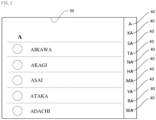
- Fig. 2 is one example of display of an initial screen in a case where the CPU 21 of the image forming device 20 displays the address book on the display unit 26.
- first indices 40 are vertically displayed at the right end of a display area 30 of the display unit 26.
- a vertical direction is one example of the first direction.
- the first indices 40 are characters on a sequence "A" in the Japanese syllabary chart.
- the plurality of first indices 40, "A”, “KA”, “SA”, “TA”, “NA”, “HA”, “MA”, “YA”, “RA” and “WA” are displayed. Destination information registered in the address book is displayed in the order of Japanese syllabary in the display area 30 of the display unit 26.
- such a first index may not be displayed.
- "NA" may not be displayed as the first index 40.
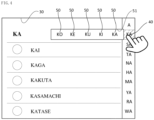
- Fig. 3 is one display example in a case where the user selects "KA" among the first indices 40 in the state shown in Fig. 2 , that is, touches with a fingertip. A location touched by a fingertip is indicated by hatching in all the drawings.
- the first index 40 which is selected among the first indices 40 is determined by coordinates on a vertical axis of the display area 30 of the display unit 26.
- the predetermined condition herein is that, for example, selection of one of the first indices 40 is held for a predetermined time, that is, long press.
- the second indices 50 corresponding to the first index 40 "KA” are displayed in a straight line in a left direction intersecting the first index 40 "KA” as illustrated in Fig. 4 .
- the user's long press can prevent other second indices 50 from being unintentionally displayed.
- this configuration does not impair visibility of the destination information which would have been hidden behind the second indices 50 if the second indices 50 had been displayed before long press.
- the left direction is one example of the second direction.
- the second indices 50 are characters in a row of the Japanese syllabary chart corresponding to characters in the sequence "A", one example of the first index 40.
- the first index 40 is "KA”
- the second indices 50 displayed are “KA”, “KI”, “KU”, “KE” and “KO”, characters belonging to the sequence "KA”.
- the second indices 50 are displayed in a predetermined order from a side of the first index 40. That is, the characters are displayed in the order of "KA”, “KI”, “KU”, “KE” and “KO”, which is the order of characters in the sequence "KA", from the right side (the side of the first index 40) to the left side.
- such a second index may not be displayed.
- "KU” may not be displayed as the second index 50.
- the same index as the selected first index 40 (“KA” in the example shown in Fig. 4 ) is also displayed as the second index 50, however the invention is not limited thereto.
- the same index as the first index 40 (“KA” in the example shown in Fig. 4 ) may not be displayed as the second index 50, and only the second indices 50 displayed may be "KI", "KU", “KE” and "KO", except for "KA”.
- Fig. 5 is one example of display in a case where the user slides the finger touching the display unit 26 in the left direction in which the second indices 50 are displayed for the selected first index 40 "KA” as shown in Fig. 4 , and selects a second index display area 51 in which "KI” is displayed among the second indices 50. That is, by selecting the second index display area 51 in which each second index 50 is displayed, the second index 40 corresponding to the second index display area 51 is selected. Therefore, among the destination information registered in the address book, the destination information starting from "KI” is displayed in the display area 30 of the display unit 26.
- the second index 50 which is selected among the second indices 50 is determined by coordinates on a horizontal axis of the display area 30 of the display unit 26.
- the CPU 21 of the image forming device 20 determines that the second index 50 is selected not only in a case where it is detected that the second index display area 51 in which the second index 50 is displayed is selected, but also in a case where it is detected that a selection area 52 set outside the second index display area 51 is selected. More specifically, the selection area 52 is provided for each of the second indices 50. An area obtained by dividing the selection area 52 for each of the second indices 50 in the vertical direction that is a direction intersecting the horizontal direction, which is the display direction of the second index 50, is referred to a divided selection area 53. In a case where the divided selection area 53 is selected, it is determined that the second index 50 corresponding to the divided selection area 53 is selected.
- Fig. 6 is a diagram illustrating the divided selection area 53.
- the display area 30 other than the second index display area 51 in which the second index 50 is displayed corresponds to the selection area 52.
- the selection area 52 is divided into divided selection areas 53 divided in the vertical direction by a boundary line 54 for each corresponding second index 50 in the second index display area 51. That is, even in a case where the user touches upper and lower areas of the second index display area 51 with the fingertip, the second index display area 51 can be selected. For example, even in a case where a lower area of the second index display area 51 where "KI" is displayed is touched by the fingertip as illustrated in Fig.
- the CPU 21 of the image forming device 20 determines that, even before the second index 50 is displayed, the second index 50 is selected in a case where an area in which such a second index 50 is to be displayed is selected. That is, as illustrated in Fig. 7 , when "KA" is selected from the first indices 40, even before the predetermined condition for displaying the second index 50 is satisfied, for example, even before the second index 50 is displayed, i.e. the first index 40 is long-pressed, it is determined that the second index 50 corresponding to the location touched by the user's fingertip is selected, and the destination information to the second index 50 is displayed. In the example of Fig. 7 , the second index 50 is not displayed yet, but since the divided selection area 53 corresponding to "KI" among the second indices 50 is touched, it is considered that "KI” is selected from the second indices 50.
- Selection for second indices 50 at both ends out of the second indices 50 enables detection of an area up to ends of display areas facing divided selection areas 53 corresponding to other adjacent second indices 50 as corresponding divided selection areas 53, not only the areas above and below the second index display area 51.
- "KA” the second index 50 at the right end out of the second indices 50, has a corresponding divided selection area 53 as an area up to an end of a display area facing the divided selection area 53 corresponding to "KI”, the second index 50 adjacent from the right end of the display area 30 of the display unit 26.
- the second index 50 at the left end out of the second indices 50 has a corresponding divided selection area 53 as an area up to an end of a display area facing the divided selection area 53 corresponding to "KE", the second index 50 adjacent from the left end of the display area 30 of the display unit 26. That is, second indices 50 at both ends out of the second indices 50 have wider divided selection areas 53 than the other second indices 50.
- the displayed second index is maintained as it is.
- the CPU 21 of the image forming device 20 displays, in a case where another first index 40 is displayed after the second indices 50 are displayed, second indices 50 corresponding to another first index 40 regardless of the predetermined condition. That is, in a case where the user slides the finger downward from the state in which the second indices 50 are displayed by long-pressing the first index 40 "KA” as illustrated in Fig. 4 and selects "SA” as another first index 40, the second indices 50, "SA", “SHI”, “SU”,” “SE” and “SO”, corresponding to the first index 40 "SA” are displayed even without satisfying long press that is the predetermined condition, as illustrated in Fig. 8 .
- the second index 50 is displayed without waiting until the predetermined condition is satisfied. Furthermore, the invention is not limited to a case where second indices 50 corresponding to another first index 40 are displayed regardless of the predetermined condition in a case where another first index 40 is displayed after the second indices 50 are displayed. Once the second indices 50 are displayed, even if the user slides the finger to another first index 40, the displayed second index 50 may be maintained and the second indices 50 corresponding to the first index 40 to which the user's finger moves may not be displayed.
- the CPU 21 of the image forming device 20 displays a third index 60 associated with the second index 50, which is selected among the second indices 50, in any one or both of upward and downward directions of the selected second index 50.
- the third index 60 is, for example, a character with dakuten (voiced sound) or handakuten (devoiced sound) for the second index 50.
- GI which is a voiced sound for "KI”
- the user slides the finger upward from the state in which "KI" is selected to select "GI”.
- the third index 60 "GI” may be displayed on the lower side of the second index 50. In a case where the second index 50 for which the third index 60 is not registered is selected, the third index 60 is not displayed. In a case where the second index 50 has the third indices 60, for example, in a case where the second index 50 is "HA", "BA” which is a voiced sound for "HA” is displayed on the upper side and "PA” which is a devoiced sound for "HA” is displayed on the lower side as the third index 60.
- the CPU 21 of the image forming device 20 may display the third index 60 in any one or both of upward and downward directions of the second index 50, in a case where the selection for the second index 50 is held for a predetermined time, that is, the second index 50 is long-pressed. Displaying the third index 60 not indented by the user can be prevented under the condition of long press for the third index 60.
- the predetermined condition for displaying the second indices 50 may be selecting one of the first indices 40 and then sliding to the second index display area 51 in which the second indices 50 are displayed.
- the second indices 50 may be displayed by the user sliding the finger selecting one of the first indices 40 toward the second index display area 51. The user's sliding can prevent the second indices 50 from being unintentionally displayed. It is also possible to display the second indices 50 more quickly than when the first index 40 is long-pressed as described above.
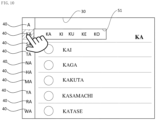
- plural first indices 40 may be displayed at the left end of the display area 30 of the display unit 26.
- the second indices 50 are displayed in a straight line rightward from the first index 40.
- the user may make it selectable whether to display the first index 40 at the right end of the display area 30 and the second indices 50 to the left of the first index 40, or alternatively, display the first index 40 at the left end of the display area 30 and the second indices 50 to the right of the first index 40. Display is made according to user's preference.
- the selection of whether to display the second indices 50 on the left or right side of the display area 30 may be determined by the language setting of the image forming device 20. That is, in a case where a right-to-left (RTL) language is set, the second indices 50 may be displayed at the left end of the display area 30. Accordingly, the second indices 50 are displayed in a direction easy for the user to read.
- RTL right-to-left
- the first index 40 is displayed at the right or left end of the display area 30 of the display unit 26 in the vertical direction, and the second indices 50 are displayed in the horizontal direction of the display area 30 of the display unit 26, but the invention is not limited thereto.
- the first index 40 may be displayed in the horizontal direction at the upper or lower end of the display area 30 of the display unit 26, and the second indices 50 may be displayed in the vertical direction.
- the first index 40 is displayed in vertical direction of the display area 30 of the display unit 26, and the second indices 50 are displayed in the horizontal direction of the display area 30 of the display unit 26, intersecting the vertical direction, but the invention is not limited thereto.
- the first index 40 and the second indices 50 may be displayed in parallel.
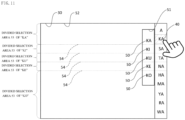
- each of the second indices 50, "KA”, “KI”, “KU”, “KE” and “KO” corresponding to the first index 40 "KA” is displayed in the vertical direction in parallel with the first index 40 on the left side of the first index 40.
- an area obtained by dividing the selection area 52 for each of the second indices 50 in the horizontal direction that is a direction intersecting the vertical direction, which is the display direction of the second index 50, is referred to a divided selection area 53.
- the first index 40 may be displayed in the horizontal direction at the upper or lower end of the display area of the display unit 26, the second indices 50 are displayed in the vertical direction.
- the first indices 40 and the second indices may be alphabets.
- the first indices 40 are "A”, “D", “G”, “J”, “M”, “P”, “S”, “V” and “Z”
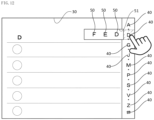
- the second indices 50 are "D", "E” and “F", characters between the first indices "D” and "G”.
- a character with an accent symbol may be displayed as the third index 60.
- Alphabets displayed as the first indices 40 may be set by the user from among 26 alphabets.
- first indices 40 and the second indices 50 may be other than characters on the Japanese syllabary chart or alphabets, for example, numbers or symbols.
- the user may perform an operation with, for example, a line-of-sight, gesture or mouse.
- the display of the second indices is maintained as it is, and it is determined that the second index 50 corresponding to the selected divided selection area 53 is selected among the displayed second indices 50 (see Fig. 6 ), but the invention is not limited thereto.
- the display of the displayed second index 50 is switched to the display of the second index 50 corresponding to the first index 40 at the selected coordinates on the vertical axis of the display area 30 of the display unit 26. Then, it may be determined that the second index 50, displayed by switching, is selected.
- "KI” is selected among the second indices 50, but in the example illustrated in Fig. 13 , "HI” is selected. That is, in a case where the divided selection area 53 other than the second index display area 51 is selected after the second indices 50 are displayed and the selected divided selection area 53 is the second index display area 51 of the second indices 40 corresponding to another first index 40, it is determined that the second index 50 corresponding to another first index 40 is selected.
- the first index 40 which is selected among the first indices 40 is determined by coordinates on the vertical axis of the display area 30 of the display unit 26.
- the program may be provided in a form of being recorded in a recording medium such as a compact disk read only memory (CD-ROM), a digital versatile disk read only memory (DVD-ROM), or a universal serial bus (USB) memory.
- the program may be downloaded from an external device via a network.
- the processor refers to a processor in a broad sense, and includes a general-purpose processor (for example, central processing unit [CPU]) or a dedicated processor (for example, graphics processing unit [GPU], application specific integrated circuit [ASIC], field programmable gate array [FPGA] or programmable logic device).
- a general-purpose processor for example, central processing unit [CPU]
- a dedicated processor for example, graphics processing unit [GPU], application specific integrated circuit [ASIC], field programmable gate array [FPGA] or programmable logic device.
- the operation of the processor in the embodiment above may be performed not only by one processor but also by multiple processors existing at physically separated positions in cooperation.
- the order of each operation of the processor is not limited to the order described in each embodiment described above, and may be appropriately changed.
Landscapes
- Engineering & Computer Science (AREA)
- General Engineering & Computer Science (AREA)
- Theoretical Computer Science (AREA)
- Human Computer Interaction (AREA)
- Physics & Mathematics (AREA)
- General Physics & Mathematics (AREA)
- User Interface Of Digital Computer (AREA)
Abstract
Description
- The present disclosure relates to an information processing device and a program.
- Japanese Patent Application Laid-Open (
JP-A) No. 2013-88833 - There is a method of displaying an index of data registered in a database in a display area of a display unit and allowing a user to access the data via selection of the index. Since a space where the index can be displayed is limited, another method is proposed in which a second index is displayed based on a first index after the first index is selected. To select such a second index, it is necessary to select a desired second index by moving a selected location along a display direction of the second index in the state where the first index is selected. However, when the selected location is outside of a display range of the second index, a user has to select the first index again.
- An object of the present disclosure is to provide an information processing device and a program, each of which is capable of selecting, even if a selected location is outside of a display range of the second index, the second index without having to select the first index again.
- An information processing device according to a first aspect of the present invention includes a processor, wherein the processor is configured to: display first indices of a database stored in a storage unit, in a first direction of a display area of a display unit;
display, upon detecting a user's selection operation for a first index, second indices, corresponding to the first index, in a straight line in a second direction intersecting or parallel to the first index; and determine that a second index is selected in a case in which it is detected that a second index display area displaying the second index has been selected, and also in a case in which it is detected that a selection area set other than the second index display area has been selected. - In the information processing device according to a second aspect of the invention, the processor is further configured to provide the selection area for each of the second indices.
- In the information processing device according to a third aspect of the invention, the processor is further configured to determine that, in a case in which a divided selection area has been selected, the second index corresponding to the divided selection area is selected, the divided selection area being an area into which the selection area is divided in a direction intersecting the second direction for each of the second indices.
- In the information processing device according to a fourth aspect of the invention, selection for second indices at both ends among the plurality of second indices enables detection of an area up to ends of display areas facing divided selection areas corresponding to other adjacent second indices as corresponding divided selection areas.
- In the information processing device according to a fifth aspect of the invention, the processor is further configured to display the second indices in a predetermined order starting from a first index side.
- In the information processing device according to a sixth aspect of the invention, the processor is further configured to select whether to display the first index at a right end of the display area and display the second indices to the left of the first index, or alternatively, display the first index at a left end of the display area and display the second indices to the right of the first index.
- In the information processing device according to a seventh aspect of the invention, the processor is further configured to determine that, even before the second index is displayed, the second index is selected in a case in which the second index display area, in which the second index is to be displayed, is selected.
- In the information processing device according to an eighth aspect of the invention, the processor is further configured to display the second index in a case in which a predetermined condition is satisfied.
- In the information processing device according to a ninth aspect of the invention, the predetermined condition is that selection of one of the first indices is held for a predetermined time.
- In the information processing device according to a tenth aspect of the invention, the predetermined condition is selecting one of the first indices and then sliding to the second index display area in which the second indices are displayed.
- In the information processing device according to an eleventh aspect of the invention, the processor is further configured to display, in a case in which another first index is selected after the second indices are displayed, second indices corresponding to the other first index regardless of the predetermined condition.
- In the information processing device according to a twelfth aspect of the invention, the processor is further configured to:
display a third index associated with the second index in any one or both of directions intersecting the second direction of the second index in a state in which the second index is selected. - In the information processing device according to a thirteenth aspect of the invention, the processor is further configured to display a third index associated with the second index in any one or both of directions intersecting the second direction of the second index in a case in which selection of the second index is held for a predetermined time.
- In the information processing device according to a fourteenth aspect of the invention, the database is an address book in which destination information is registered.
- In the information processing device according to a fifteenth aspect of the invention, the first index is a character in a sequence "A" of the Japanese syllabary chart, and the second index is a character in a row of the Japanese syllabary chart, corresponding to the character previously selected from the sequence "A".
- A program according to a sixteenth aspect of the invention is a program causing a computer to execute processing, the processing comprising: displaying first indices of a database stored in a storage unit, in a first direction of a display area of a display unit; displaying, upon detecting a user's selection operation for a first index, second indices, corresponding to the first index, in a straight line in a second direction intersecting or parallel to the first index; and determining that a second index is selected in a case in which it is detected that a second index display area displaying the second index has been selected, and also in a case in which it is detected that a selection area set other than the second index display area has been selected. Advantageous Effects of Invention
- According to the first aspect, even if a selected location is outside of a display range of the second index, the second index can be selected without having to select the first index again.
- According to the second aspect, the second index can be selected by selecting the selection area provided for each second index.
- According to the third aspect, the second index can be selected by selecting selection areas above and below the second index display area.
- According to the fourth aspect, the selection of the second index can be detected over the display area of the display unit as compared with a case where the selection of the second index is detected only in the second index display area in the first direction.
- According to the fifth aspect, as compared with a case where the second index is displayed from the opposite side of the selected first index, a moving distance from the selected first index to the second index to be selected can be shortened.
- According to the sixth aspect, display locations of the first index and the second index can be changed.
- According to the seventh aspect, the second index can be more quickly selected as compared with a case where the second index can be selected only after the second index is displayed.
- According to the eighth aspect, the second index can be prevented from being displayed only by that the first index has been selected.
- According to the ninth aspect, it is possible to perform setting such that a user is required to perform a predetermined operation in order to display the second index.
- According to the tenth aspect, it is possible to set so that a user is required to perform a predetermined operation in order to display the second index.
- According to the eleventh aspect, the second index can be displayed without waiting until the predetermined condition for displaying the second index is satisfied.
- According to the twelfth aspect, data desired by the user can be accessed rather than accessing the data via the second index.
- According to the thirteenth aspect, it is possible to prevent the third index not intended by the user from being displayed, in contrast to a case where it is not required that the selection of the second index is held for the predetermined time.
- According to the fourteenth aspect, even if a selected location is outside of a display range of the destination of the second index, the destination of the second index can be selected without having to select the destination of the first index again.
- According to the fifteenth aspect, even if a selected location is outside of a display range of the row in the Japanese syllabary chart, the row in the Japanese syllabary chart can be selected without having to select the index from the sequence "A" in the Japanese syllabary chart again.
- According to the sixteenth aspect, it is possible to provide a program capable of selecting, even if a selected location is outside of a display range of the second index, the second index without having to select the first index again.
-
-
Fig. 1 shows a schematic block diagram of an image forming device according to an embodiment. -
Fig. 2 shows a diagram illustrating one example of display on a display unit of the image forming device according to the embodiment. -
Fig. 3 shows a diagram illustrating one example of display subsequent toFig. 2 on the display unit of the image forming device according to the embodiment. -
Fig. 4 shows a diagram illustrating one example of display subsequent toFig. 3 on the display unit of the image forming device according to the embodiment. -
Fig. 5 shows a diagram illustrating one example of display subsequent toFig. 4 on the display unit of the image forming device according to the embodiment. -
Fig. 6 shows a diagram illustrating a divided selection area according to the embodiment. -
Fig. 7 shows a diagram illustrating selection of the divided selection area according to the embodiment. -
Fig. 8 shows a diagram illustrating one display example of a second index according to the embodiment. -
Fig. 9 shows a diagram illustrating one display example of a third index according to the embodiment. -
Fig. 10 shows a diagram illustrating another example of display on the display unit of the image forming device according to the embodiment. -
Fig. 11 shows a diagram illustrating another example of display on the display unit of the image forming device according to the embodiment. -
Fig. 12 shows a diagram illustrating another example of display on the display unit of the image forming device according to the embodiment. -
Fig. 13 shows a diagram illustrating another display example of the second index according to the embodiment. - One example of an embodiment of the disclosure will be described below with reference to the drawings. In the drawings, the same or equivalent components and portions are denoted by the same reference numerals. Furthermore, dimensional ratios in the drawings are exaggerated for better understanding and may differ from the actual ratios.
-
Fig. 1 is a block diagram illustrating a hardware configuration of animage forming device 20 which is one example of the information processing device according to the present embodiment. Theimage forming device 20 has functions of, for example, printout, photocopy and facsimile (FAX). One example of the information processing device is not limited to the image forming device. For example, it may be a telephone, facsimile machine or smartphone. - As illustrated in
Fig. 1 , theimage forming device 20 includes a CPU 21 (one example of a processor), aROM 22, aRAM 23, astorage 24, aninput unit 25, adisplay unit 26, adocument reading unit 27, animage forming unit 28, and a communication I/F 29. The respective components are communicatively connected to each other via a bus. - The
CPU 21 is a central processing unit, and executes various programs and controls each unit. That is, theCPU 21 reads a program from theROM 22 or thestorage 24, and executes the program using theRAM 23 as a work area. TheCPU 21 performs control of each of the components above and various types of arithmetic processing according to the program recorded in theROM 22 or thestorage 24. In the present embodiment, the program is stored in theROM 22 or thestorage 24. - The
ROM 22 stores various programs and various data. TheRAM 23 serves as a work area and temporarily stores programs or data. Thestorage 24 includes, for example, an HDD or an SSD, and stores various programs including an operating system and various data. - In the present embodiment, an address book in which destination information is registered is stored in the
storage 24. The destination information includes, for example, a destination, telephone number and a FAX number for each destination, email address, and control number of a folder in thestorage 24 for storing data captured using a scanner function of theimage forming device 20. An initial letter of a name registered as a destination when a telephone number is enrolled in the address book serves as an index (first index 40,second index 50, and third index 60) which is a heading of the address book. The address book is one example of the database. However, one example of the database is not limited to the address book. - The
input unit 25 includes a pointing device such as a mouse and a keyboard, and is used to perform various inputs. Theinput unit 25 is used, for example, when selecting any destination from the address book. In the present embodiment, thedisplay unit 26, which is a touchscreen, functions as theinput unit 25. - The
display unit 26 is, for example, a liquid crystal display. Thedisplay unit 26 displays various types of information under the control of theCPU 21. Furthermore, thedisplay unit 26 also functions as theinput unit 25 as it is a touchscreen. - The
document reading unit 27 receives documents one by one placed on a paper feed tray of an automatic feeder (not illustrated) provided in an upper portion of theimage forming device 20, and optically scans the received documents to obtain image information. Alternatively, thedocument reading unit 27 optically reads a document placed on a scanning glass and obtains image information. - The image information of the document scanned by the
document reading unit 27 is printed by theimage forming unit 28 to be described later or transmitted to another image forming device having a facsimile function by the communication I/F 29 to be described later. - The
image forming unit 28 forms, in other words, prints, an image based on the image information obtained by scanning by thedocument reading unit 27 on a recording medium such as paper. - The communication I/
F 29 has a function of connecting theimage forming device 20 to a public line and transmitting/receiving the image information obtained by scanning by thedocument reading unit 27 to/from another image forming device having a facsimile function. - Display of the address book and the operation for the index of the present embodiment will be described with reference to
Figs. 2 to 9 . -
Fig. 2 is one example of display of an initial screen in a case where theCPU 21 of theimage forming device 20 displays the address book on thedisplay unit 26. - As illustrated in
Fig. 2 , pluralfirst indices 40 are vertically displayed at the right end of adisplay area 30 of thedisplay unit 26. A vertical direction is one example of the first direction. In the present embodiment, thefirst indices 40 are characters on a sequence "A" in the Japanese syllabary chart. As illustrated inFig. 2 , the plurality offirst indices 40, "A", "KA", "SA", "TA", "NA", "HA", "MA", "YA", "RA" and "WA" are displayed. Destination information registered in the address book is displayed in the order of Japanese syllabary in thedisplay area 30 of thedisplay unit 26. In a case where there is thefirst index 40 that is not registered among thefirst indices 40 in the address book, such a first index may not be displayed. For example, in a case where the destination information corresponding to a sequence "NA", that is, the destination information starting from "NA", "NI", "NU", "NE" or "NO" is not registered in the address book, "NA" may not be displayed as thefirst index 40. -
Fig. 3 is one display example in a case where the user selects "KA" among thefirst indices 40 in the state shown inFig. 2 , that is, touches with a fingertip. A location touched by a fingertip is indicated by hatching in all the drawings. Thefirst index 40 which is selected among thefirst indices 40 is determined by coordinates on a vertical axis of thedisplay area 30 of thedisplay unit 26. - As illustrated in
Fig. 3 , since "KA" is selected as thefirst index 40, information of destinations starting from "KA" is displayed in thedisplay area 30 of thedisplay unit 26. Thesecond index 50 is then displayed by satisfying a predetermined condition. Indices that cannot be displayed as thefirst indices 40 are displayed as the second indices. The predetermined condition herein is that, for example, selection of one of thefirst indices 40 is held for a predetermined time, that is, long press. Specifically, when the user holds the selection of "KA" as thefirst index 40 for the predetermined time, that is, long-presses "KA", thesecond indices 50 corresponding to thefirst index 40 "KA", are displayed in a straight line in a left direction intersecting thefirst index 40 "KA" as illustrated inFig. 4 . The user's long press can prevent othersecond indices 50 from being unintentionally displayed. Furthermore, this configuration does not impair visibility of the destination information which would have been hidden behind thesecond indices 50 if thesecond indices 50 had been displayed before long press. The left direction is one example of the second direction. In the present embodiment, thesecond indices 50 are characters in a row of the Japanese syllabary chart corresponding to characters in the sequence "A", one example of thefirst index 40. As illustrated inFig. 4 , in a case where thefirst index 40 is "KA", thesecond indices 50 displayed are "KA", "KI", "KU", "KE" and "KO", characters belonging to the sequence "KA". Thesecond indices 50 are displayed in a predetermined order from a side of thefirst index 40. That is, the characters are displayed in the order of "KA", "KI", "KU", "KE" and "KO", which is the order of characters in the sequence "KA", from the right side (the side of the first index 40) to the left side. In a case where there is thesecond index 50 that is not registered among thesecond indices 50 in the address book, such a second index may not be displayed. For example, in a case where the destination information starting from "KU" is not registered in the address book, "KU" may not be displayed as thesecond index 50. In the present embodiment, the same index as the selected first index 40 ("KA" in the example shown inFig. 4 ) is also displayed as thesecond index 50, however the invention is not limited thereto. For example, the same index as the first index 40 ("KA" in the example shown inFig. 4 ) may not be displayed as thesecond index 50, and only thesecond indices 50 displayed may be "KI", "KU", "KE" and "KO", except for "KA". -
Fig. 5 is one example of display in a case where the user slides the finger touching thedisplay unit 26 in the left direction in which thesecond indices 50 are displayed for the selectedfirst index 40 "KA" as shown inFig. 4 , and selects a secondindex display area 51 in which "KI" is displayed among thesecond indices 50. That is, by selecting the secondindex display area 51 in which eachsecond index 50 is displayed, thesecond index 40 corresponding to the secondindex display area 51 is selected. Therefore, among the destination information registered in the address book, the destination information starting from "KI" is displayed in thedisplay area 30 of thedisplay unit 26. Thesecond index 50 which is selected among thesecond indices 50 is determined by coordinates on a horizontal axis of thedisplay area 30 of thedisplay unit 26. - The
CPU 21 of theimage forming device 20 determines that thesecond index 50 is selected not only in a case where it is detected that the secondindex display area 51 in which thesecond index 50 is displayed is selected, but also in a case where it is detected that aselection area 52 set outside the secondindex display area 51 is selected. More specifically, theselection area 52 is provided for each of thesecond indices 50. An area obtained by dividing theselection area 52 for each of thesecond indices 50 in the vertical direction that is a direction intersecting the horizontal direction, which is the display direction of thesecond index 50, is referred to a dividedselection area 53. In a case where the dividedselection area 53 is selected, it is determined that thesecond index 50 corresponding to the dividedselection area 53 is selected. - The divided
selection area 53 will be described with reference toFig. 6. Fig. 6 is a diagram illustrating the dividedselection area 53. As illustrated inFig. 6 , in thedisplay area 30 of thedisplay unit 26, thedisplay area 30 other than the secondindex display area 51 in which thesecond index 50 is displayed corresponds to theselection area 52. Theselection area 52 is divided into dividedselection areas 53 divided in the vertical direction by aboundary line 54 for each correspondingsecond index 50 in the secondindex display area 51. That is, even in a case where the user touches upper and lower areas of the secondindex display area 51 with the fingertip, the secondindex display area 51 can be selected. For example, even in a case where a lower area of the secondindex display area 51 where "KI" is displayed is touched by the fingertip as illustrated inFig. 6 , "KI" is selected. That is, in a case where the finger moves to a location outside the secondindex display area 51 where thesecond index 50 is displayed after thesecond index 50 is displayed, the displayedsecond index 50 generally disappears. The finger may often move to a location outside the secondindex display area 51. In such a case, it is necessary to select thefirst index 40 again, causing the poor user experience. According to the present embodiment, it is not necessary to select thefirst index 40 again. Furthermore, this configuration enables determination of the location touched by the user's fingertip based on only the coordinates of the horizontal axis of the display area in thedisplay unit 26, and the processing load can be reduced as compared with the determination including the coordinates of the vertical axis. - The
CPU 21 of theimage forming device 20 determines that, even before thesecond index 50 is displayed, thesecond index 50 is selected in a case where an area in which such asecond index 50 is to be displayed is selected. That is, as illustrated inFig. 7 , when "KA" is selected from thefirst indices 40, even before the predetermined condition for displaying thesecond index 50 is satisfied, for example, even before thesecond index 50 is displayed, i.e. thefirst index 40 is long-pressed, it is determined that thesecond index 50 corresponding to the location touched by the user's fingertip is selected, and the destination information to thesecond index 50 is displayed. In the example ofFig. 7 , thesecond index 50 is not displayed yet, but since the dividedselection area 53 corresponding to "KI" among thesecond indices 50 is touched, it is considered that "KI" is selected from thesecond indices 50. - Selection for
second indices 50 at both ends out of thesecond indices 50 enables detection of an area up to ends of display areas facing dividedselection areas 53 corresponding to other adjacentsecond indices 50 as corresponding dividedselection areas 53, not only the areas above and below the secondindex display area 51. Specifically, as illustrated inFig. 6 , "KA", thesecond index 50 at the right end out of thesecond indices 50, has a corresponding dividedselection area 53 as an area up to an end of a display area facing the dividedselection area 53 corresponding to "KI", thesecond index 50 adjacent from the right end of thedisplay area 30 of thedisplay unit 26. Furthermore, "KO", thesecond index 50 at the left end out of thesecond indices 50, has a corresponding dividedselection area 53 as an area up to an end of a display area facing the dividedselection area 53 corresponding to "KE", thesecond index 50 adjacent from the left end of thedisplay area 30 of thedisplay unit 26. That is,second indices 50 at both ends out of thesecond indices 50 have wider dividedselection areas 53 than the othersecond indices 50. - That is, even in a case where the finger moves to a location outside the second
index display area 51 where the second index is displayed after the second index is displayed, the displayed second index is maintained as it is. - The
CPU 21 of theimage forming device 20 displays, in a case where anotherfirst index 40 is displayed after thesecond indices 50 are displayed,second indices 50 corresponding to anotherfirst index 40 regardless of the predetermined condition. That is, in a case where the user slides the finger downward from the state in which thesecond indices 50 are displayed by long-pressing thefirst index 40 "KA" as illustrated inFig. 4 and selects "SA" as anotherfirst index 40, thesecond indices 50, "SA", "SHI", "SU"," "SE" and "SO", corresponding to thefirst index 40 "SA" are displayed even without satisfying long press that is the predetermined condition, as illustrated inFig. 8 . Accordingly, even in a case where thefirst index 40 is selected again, thesecond index 50 is displayed without waiting until the predetermined condition is satisfied. Furthermore, the invention is not limited to a case wheresecond indices 50 corresponding to anotherfirst index 40 are displayed regardless of the predetermined condition in a case where anotherfirst index 40 is displayed after thesecond indices 50 are displayed. Once thesecond indices 50 are displayed, even if the user slides the finger to anotherfirst index 40, the displayedsecond index 50 may be maintained and thesecond indices 50 corresponding to thefirst index 40 to which the user's finger moves may not be displayed. - The
CPU 21 of theimage forming device 20 displays athird index 60 associated with thesecond index 50, which is selected among thesecond indices 50, in any one or both of upward and downward directions of the selectedsecond index 50. In the present embodiment, thethird index 60 is, for example, a character with dakuten (voiced sound) or handakuten (devoiced sound) for thesecond index 50. For example, as illustrated inFig. 9 , in a case where "KI" is selected among thesecond indices 50, "GI", which is a voiced sound for "KI", is displayed as thethird index 60 on the upper side of "KI". The user slides the finger upward from the state in which "KI" is selected to select "GI". Thethird index 60 "GI" may be displayed on the lower side of thesecond index 50. In a case where thesecond index 50 for which thethird index 60 is not registered is selected, thethird index 60 is not displayed. In a case where thesecond index 50 has thethird indices 60, for example, in a case where thesecond index 50 is "HA", "BA" which is a voiced sound for "HA" is displayed on the upper side and "PA" which is a devoiced sound for "HA" is displayed on the lower side as thethird index 60. By accessing the destination information via thethird index 60, it is easier to access the destination information desired by the user than accessing the destination information via thesecond index 50. TheCPU 21 of theimage forming device 20 may display thethird index 60 in any one or both of upward and downward directions of thesecond index 50, in a case where the selection for thesecond index 50 is held for a predetermined time, that is, thesecond index 50 is long-pressed. Displaying thethird index 60 not indented by the user can be prevented under the condition of long press for thethird index 60. - The disclosure is not limited to the embodiment above, and various modifications and applications can be made without departing from the gist of the disclosure.
- Although not illustrated, the predetermined condition for displaying the
second indices 50 may be selecting one of thefirst indices 40 and then sliding to the secondindex display area 51 in which thesecond indices 50 are displayed. Specifically, thesecond indices 50 may be displayed by the user sliding the finger selecting one of thefirst indices 40 toward the secondindex display area 51. The user's sliding can prevent thesecond indices 50 from being unintentionally displayed. It is also possible to display thesecond indices 50 more quickly than when thefirst index 40 is long-pressed as described above. - As illustrated in
Fig. 10 , pluralfirst indices 40 may be displayed at the left end of thedisplay area 30 of thedisplay unit 26. In this case, thesecond indices 50 are displayed in a straight line rightward from thefirst index 40. The user may make it selectable whether to display thefirst index 40 at the right end of thedisplay area 30 and thesecond indices 50 to the left of thefirst index 40, or alternatively, display thefirst index 40 at the left end of thedisplay area 30 and thesecond indices 50 to the right of thefirst index 40. Display is made according to user's preference. In particular, it is possible to select to display thefirst index 40 at the right end in a case where the user is right-handed and select to display thefirst index 40 at the left end in a case where the user is left-handed so as not to hide thedisplay area 30 in which the destination information is displayed by the operating finger. - The selection of whether to display the
second indices 50 on the left or right side of thedisplay area 30 may be determined by the language setting of theimage forming device 20. That is, in a case where a right-to-left (RTL) language is set, thesecond indices 50 may be displayed at the left end of thedisplay area 30. Accordingly, thesecond indices 50 are displayed in a direction easy for the user to read. - In the present embodiment above, the
first index 40 is displayed at the right or left end of thedisplay area 30 of thedisplay unit 26 in the vertical direction, and thesecond indices 50 are displayed in the horizontal direction of thedisplay area 30 of thedisplay unit 26, but the invention is not limited thereto. For example, although not illustrated, thefirst index 40 may be displayed in the horizontal direction at the upper or lower end of thedisplay area 30 of thedisplay unit 26, and thesecond indices 50 may be displayed in the vertical direction. - In the present embodiment above, the
first index 40 is displayed in vertical direction of thedisplay area 30 of thedisplay unit 26, and thesecond indices 50 are displayed in the horizontal direction of thedisplay area 30 of thedisplay unit 26, intersecting the vertical direction, but the invention is not limited thereto. For example, as illustrated inFig. 11 , thefirst index 40 and thesecond indices 50 may be displayed in parallel. Specifically, in a case where "KA" is selected among thefirst indices 40 displayed in the vertical direction, each of thesecond indices 50, "KA", "KI", "KU", "KE" and "KO" corresponding to thefirst index 40 "KA" is displayed in the vertical direction in parallel with thefirst index 40 on the left side of thefirst index 40. In a case where thefirst index 40 and thesecond indices 50 are displayed in parallel, an area obtained by dividing theselection area 52 for each of thesecond indices 50 in the horizontal direction that is a direction intersecting the vertical direction, which is the display direction of thesecond index 50, is referred to a dividedselection area 53. Further, in a case where thefirst index 40 may be displayed in the horizontal direction at the upper or lower end of the display area of thedisplay unit 26, thesecond indices 50 are displayed in the vertical direction. - As illustrated in
Fig. 12 , thefirst indices 40 and the second indices may be alphabets. In this case, if all the alphabets are displayed in the vertical direction of thedisplay area 30, the alphabets become too small, and thus are omitted at predetermined intervals and displayed as thefirst indices 40. Then, the omitted indices are displayed as thesecond indices 50. For example, as illustrated inFig. 12 , thefirst indices 40 are "A", "D", "G", "J", "M", "P", "S", "V" and "Z", and thesecond indices 50 are "D", "E" and "F", characters between the first indices "D" and "G". Furthermore, in a case where thefirst indices 40 and the second indices are alphabets, a character with an accent symbol may be displayed as thethird index 60. Alphabets displayed as thefirst indices 40 may be set by the user from among 26 alphabets. - Although not illustrated, the
first indices 40 and thesecond indices 50 may be other than characters on the Japanese syllabary chart or alphabets, for example, numbers or symbols. - Furthermore, in addition to a case where the user touches and operates the
display area 30 of thedisplay unit 26 with a fingertip, the user may perform an operation with, for example, a line-of-sight, gesture or mouse. - In the present embodiment above, in a case where the
second indices 50 are displayed after thefirst index 40 is selected and the dividedselection area 53 other than the secondindex display area 51 is selected, the display of the second indices is maintained as it is, and it is determined that thesecond index 50 corresponding to the selected dividedselection area 53 is selected among the displayed second indices 50 (seeFig. 6 ), but the invention is not limited thereto. In a case where the dividedselection area 53 other than the secondindex display area 51 is selected, the display of the displayedsecond index 50 is switched to the display of thesecond index 50 corresponding to thefirst index 40 at the selected coordinates on the vertical axis of thedisplay area 30 of thedisplay unit 26. Then, it may be determined that thesecond index 50, displayed by switching, is selected. Specifically, as illustrated inFig. 13 , in a case where the user moves the finger from the state in which thesecond indices 50, "KA", "KI", "KU", "KE" and "KO", corresponding to thefirst index 40 "KA" are displayed to select the secondindex display area 51 corresponding to anotherfirst index 40, for example, "HA", the displayedsecond indices 50, "KA", "KI", "KU", "KE" and "KO", corresponding to thefirst index 40 "KA" disappear, and thesecond indices 50, "HA", "HI", "HU", "HE" and "HO", corresponding to thefirst index 40 "HA" are displayed. Then, it is determined that the dividedselection area 53, in this example, thesecond index 50 "HI" is selected. In the example illustrated inFig. 6 , "KI" is selected among thesecond indices 50, but in the example illustrated inFig. 13 , "HI" is selected. That is, in a case where the dividedselection area 53 other than the secondindex display area 51 is selected after thesecond indices 50 are displayed and the selected dividedselection area 53 is the secondindex display area 51 of thesecond indices 40 corresponding to anotherfirst index 40, it is determined that thesecond index 50 corresponding to anotherfirst index 40 is selected. Thefirst index 40 which is selected among thefirst indices 40 is determined by coordinates on the vertical axis of thedisplay area 30 of thedisplay unit 26. - In the embodiments above, the aspect in which the program is stored (installed) in advance in the ROM or the storage has been described, but the invention is not limited thereto. The program may be provided in a form of being recorded in a recording medium such as a compact disk read only memory (CD-ROM), a digital versatile disk read only memory (DVD-ROM), or a universal serial bus (USB) memory. The program may be downloaded from an external device via a network.
- Furthermore, in the embodiments above, the processor refers to a processor in a broad sense, and includes a general-purpose processor (for example, central processing unit [CPU]) or a dedicated processor (for example, graphics processing unit [GPU], application specific integrated circuit [ASIC], field programmable gate array [FPGA] or programmable logic device).
- The operation of the processor in the embodiment above may be performed not only by one processor but also by multiple processors existing at physically separated positions in cooperation. The order of each operation of the processor is not limited to the order described in each embodiment described above, and may be appropriately changed.
- The disclosure of
Japanese Patent Application No. 2021-153035 filed on September 21, 2021 - All documents, patent applications, and technical standards described in this specification are incorporated herein by reference to the same extent as if each individual document, patent application, and technical standard were specifically and individually indicated to be incorporated by reference.
Claims (16)
- An information processing device, comprising:a processor,wherein the processor is configured to:display a plurality of first indices of a database stored in a storage unit, in a first direction of a display area of a display unit;display, upon detecting a user's selection operation for a first index, a plurality of second indices, corresponding to the first index, in a straight line in a second direction intersecting or parallel to the first index; anddetermine that a second index is selected in a case in which it is detected that a second index display area displaying the second index has been selected, and also in a case in which it is detected that a selection area set other than the second index display area has been selected.
- The information processing device according to claim 1, wherein the processor is further configured to:
provide the selection area for each of the plurality of second indices. - The information processing device according to claim 1 or 2, wherein the processor is further configured to:
determine that, in a case in which a divided selection area has been selected, the second index corresponding to the divided selection area is selected, the divided selection area being an area into which the selection area is divided in a direction intersecting the second direction for each of the second indices. - The information processing device according to claim 3, wherein selection for second indices at both ends among the plurality of second indices enables detection of an area up to ends of display areas facing divided selection areas corresponding to other adjacent second indices as corresponding divided selection areas.
- The information processing device according to any one of claims 2 to 4, wherein the processor is further configured to:
display the plurality of second indices in a predetermined order starting from a first index side. - The information processing device according to any one of claims 1 to 5, wherein the processor is further configured to:be selectable whether todisplay the first index at a right end of the display area and display the second indices to the left of the first index, or alternatively,display the first index at a left end of the display area and display the second indices to the right of the first index.
- The information processing device according to any one of claims 1 to 6, wherein the processor is further configured to:
determine that, even before the second index is displayed, the second index is selected in a case in which the second index display area, in which the second index is to be displayed, is selected. - The information processing device according to any one of claims 1 to 7, wherein the processor is further configured to:
display the second index in a case in which a predetermined condition is satisfied. - The information processing device according to claim 8, wherein the predetermined condition is that selection of one of the first indices is held for a predetermined time.
- The information processing device according to claim 8, wherein the predetermined condition is selecting one of the first indices and then sliding to the second index display area in which the second indices are displayed.
- The information processing device according to any one of claims 8 to 10, wherein the processor is further configured to:
display, in a case in which another first index is selected after the second indices are displayed, second indices corresponding to the other first index regardless of the predetermined condition. - The information processing device according to any one of claims 1 to 11, wherein the processor is further configured to:
display a third index associated with the second index in any one or both of directions intersecting the second direction of the second index in a state in which the second index is selected. - The information processing device according to any one of claims 1 to 11, wherein the processor is further configured to:
display a third index associated with the second index in any one or both of directions intersecting the second direction of the second index in a case in which selection of the second index is held for a predetermined time. - The information processing device according to any one of claims 1 to 13, wherein the database is an address book in which destination information is registered.
- The information processing device according to any one of claims 1 to 14, wherein:the first index is a character in a sequence "A" of the Japanese syllabary chart, andthe second index is a character in a row of the Japanese syllabary chart, corresponding to the character previously selected from the sequence "A".
- A program causing a computer to execute processing, the processing comprising:displaying a plurality of first indices of a database stored in a storage unit, in a first direction of a display area of a display unit;displaying, upon detecting a user's selection operation for a first index, a plurality of second indices, corresponding to the first index, in a straight line in a second direction intersecting or parallel to the first index; anddetermining that a second index is selected in a case in which it is detected that a second index display area displaying the second index has been selected, and also in a case in which it is detected that a selection area set other than the second index display area has been selected.
Applications Claiming Priority (2)
| Application Number | Priority Date | Filing Date | Title |
|---|---|---|---|
| JP2021153035A JP7743242B2 (en) | 2021-09-21 | 2021-09-21 | Information processing device and program |
| PCT/JP2022/030794 WO2023047838A1 (en) | 2021-09-21 | 2022-08-12 | Information processing device and program |
Publications (2)
| Publication Number | Publication Date |
|---|---|
| EP4407424A1 true EP4407424A1 (en) | 2024-07-31 |
| EP4407424A4 EP4407424A4 (en) | 2024-12-25 |
Family
ID=85719405
Family Applications (1)
| Application Number | Title | Priority Date | Filing Date |
|---|---|---|---|
| EP22872594.1A Pending EP4407424A4 (en) | 2021-09-21 | 2022-08-12 | INFORMATION PROCESSING DEVICE AND PROGRAM |
Country Status (5)
| Country | Link |
|---|---|
| US (1) | US20240377924A1 (en) |
| EP (1) | EP4407424A4 (en) |
| JP (1) | JP7743242B2 (en) |
| CN (1) | CN117916702A (en) |
| WO (1) | WO2023047838A1 (en) |
Family Cites Families (24)
| Publication number | Priority date | Publication date | Assignee | Title |
|---|---|---|---|---|
| JP3606498B2 (en) * | 1996-04-26 | 2005-01-05 | 三菱電機株式会社 | Portable information terminal device |
| US6636244B1 (en) * | 1999-09-13 | 2003-10-21 | International Business Machines Corporation | Pointing device selection method |
| JP2003076478A (en) * | 2001-08-31 | 2003-03-14 | Hitachi Ltd | Character input means |
| JP2003330942A (en) * | 2002-05-10 | 2003-11-21 | Minolta Co Ltd | Digital data retrieval device |
| JP2004038896A (en) * | 2002-06-28 | 2004-02-05 | Clarion Co Ltd | Display control means |
| GB0417953D0 (en) * | 2004-08-12 | 2004-09-15 | Ibm | A method and apparatus for searching data |
| US7530030B2 (en) * | 2004-11-24 | 2009-05-05 | Microsoft Corporation | Facilitating target acquisition by expanding targets |
| JP2007300565A (en) * | 2006-05-03 | 2007-11-15 | Sony Computer Entertainment Inc | Multimedia reproduction device, and menu screen display method |
| JP2009211663A (en) * | 2008-03-06 | 2009-09-17 | Nissan Motor Co Ltd | Display controller and item display method |
| US8253705B2 (en) * | 2009-05-08 | 2012-08-28 | Research In Motion Limited | Target zones for menu items on a touch-sensitive display |
| KR101620874B1 (en) * | 2009-05-19 | 2016-05-13 | 삼성전자주식회사 | Searching Method of a List And Portable Device using the same |
| JP2012123475A (en) * | 2010-12-06 | 2012-06-28 | Fujitsu Ten Ltd | Information processor and display method |
| JP5652652B2 (en) * | 2010-12-27 | 2015-01-14 | ソニー株式会社 | Display control apparatus and method |
| JP2012247833A (en) * | 2011-05-25 | 2012-12-13 | Pioneer Electronic Corp | Information processing apparatus and method, and computer program |
| JP5754340B2 (en) | 2011-10-13 | 2015-07-29 | コニカミノルタ株式会社 | Information processing device |
| KR102107491B1 (en) * | 2012-08-27 | 2020-05-07 | 삼성전자주식회사 | List scroll bar control method and mobile apparatus |
| CN103810166A (en) * | 2012-11-06 | 2014-05-21 | 腾讯科技(深圳)有限公司 | Method for looking up contact person in address book and electronic terminal |
| EP2908236A1 (en) * | 2014-02-13 | 2015-08-19 | Samsung Electronics Co., Ltd | Electronic device and index display method thereof |
| US9965141B2 (en) * | 2014-06-06 | 2018-05-08 | Apple Inc. | Movable selection indicators for region or point selection on a user interface |
| KR20160029510A (en) * | 2014-09-05 | 2016-03-15 | 삼성전자주식회사 | Method for processing index and apparatus for the same |
| KR102345343B1 (en) * | 2014-12-12 | 2021-12-30 | 엘지전자 주식회사 | The Apparatus and Method for Portable Device displaying index information |
| JP2017173959A (en) * | 2016-03-22 | 2017-09-28 | 富士ゼロックス株式会社 | Information processing device |
| JP7293746B2 (en) * | 2019-03-14 | 2023-06-20 | 富士フイルムビジネスイノベーション株式会社 | Information processing device and program |
| JP7501074B2 (en) | 2020-03-18 | 2024-06-18 | 三菱電機株式会社 | lighting equipment |
-
2021
- 2021-09-21 JP JP2021153035A patent/JP7743242B2/en active Active
-
2022
- 2022-08-12 CN CN202280059839.5A patent/CN117916702A/en active Pending
- 2022-08-12 US US18/689,079 patent/US20240377924A1/en active Pending
- 2022-08-12 EP EP22872594.1A patent/EP4407424A4/en active Pending
- 2022-08-12 WO PCT/JP2022/030794 patent/WO2023047838A1/en not_active Ceased
Also Published As
| Publication number | Publication date |
|---|---|
| EP4407424A4 (en) | 2024-12-25 |
| WO2023047838A1 (en) | 2023-03-30 |
| US20240377924A1 (en) | 2024-11-14 |
| JP7743242B2 (en) | 2025-09-24 |
| JP2023044918A (en) | 2023-04-03 |
| CN117916702A (en) | 2024-04-19 |
Similar Documents
| Publication | Publication Date | Title |
|---|---|---|
| US10579246B2 (en) | Information device and computer-readable storage medium for computer program | |
| JP5925024B2 (en) | Display control apparatus, display control method, and program | |
| US9013721B2 (en) | Image forming apparatus, non-transitory computer-readable recording medium for storing image forming program, and image forming method | |
| CN105007388B (en) | Touch control panel device and image processing system | |
| US20130031516A1 (en) | Image processing apparatus having touch panel | |
| US20170208193A1 (en) | Electronic apparatus and control program thereof | |
| US20170147168A1 (en) | Image processing apparatus | |
| EP2226706A1 (en) | Information processing device and information processing method | |
| KR102123238B1 (en) | Information processing apparatus, method for controlling information processing apparatus, and storage medium | |
| JP2013088833A (en) | Information processor | |
| CN103916558B (en) | Electronic Apparatus And Display Method | |
| JP2017182154A (en) | Display operation apparatus and operation instruction receiving program | |
| EP4407424A1 (en) | Information processing device and program | |
| JP6322086B2 (en) | Display control device, display device, program, recording medium | |
| US20170359474A1 (en) | Image forming apparatus, display control method, and storage medium | |
| JP7683218B2 (en) | PROGRAM AND INFORMATION PROCESSING APPARATUS | |
| JP6372116B2 (en) | Display processing apparatus, screen display method, and computer program | |
| JP2023110335A (en) | Display device | |
| JP6617448B2 (en) | Mobile terminal and program | |
| US20060206499A1 (en) | Document managing apparatus | |
| US20240310993A1 (en) | Non-transitory computer readable medium, information display system, and information processing method | |
| US12561053B2 (en) | Information processing device and information processing program | |
| JP6485579B2 (en) | Display processing apparatus, screen display method, and computer program | |
| JP2017151896A (en) | Method, apparatus, and program for controlling display | |
| JP4460179B2 (en) | Facsimile machine and multifunction machine |
Legal Events
| Date | Code | Title | Description |
|---|---|---|---|
| STAA | Information on the status of an ep patent application or granted ep patent |
Free format text: STATUS: THE INTERNATIONAL PUBLICATION HAS BEEN MADE |
|
| PUAI | Public reference made under article 153(3) epc to a published international application that has entered the european phase |
Free format text: ORIGINAL CODE: 0009012 |
|
| STAA | Information on the status of an ep patent application or granted ep patent |
Free format text: STATUS: REQUEST FOR EXAMINATION WAS MADE |
|
| 17P | Request for examination filed |
Effective date: 20240308 |
|
| AK | Designated contracting states |
Kind code of ref document: A1 Designated state(s): AL AT BE BG CH CY CZ DE DK EE ES FI FR GB GR HR HU IE IS IT LI LT LU LV MC MK MT NL NO PL PT RO RS SE SI SK SM TR |
|
| A4 | Supplementary search report drawn up and despatched |
Effective date: 20241126 |
|
| DAV | Request for validation of the european patent (deleted) | ||
| DAX | Request for extension of the european patent (deleted) | ||
| RIC1 | Information provided on ipc code assigned before grant |
Ipc: G06F 3/04886 20220101ALI20241120BHEP Ipc: G06F 3/0482 20130101AFI20241120BHEP |