EP4407146B1 - Gasturbinenmotor - Google Patents
Gasturbinenmotor Download PDFInfo
- Publication number
- EP4407146B1 EP4407146B1 EP24150021.4A EP24150021A EP4407146B1 EP 4407146 B1 EP4407146 B1 EP 4407146B1 EP 24150021 A EP24150021 A EP 24150021A EP 4407146 B1 EP4407146 B1 EP 4407146B1
- Authority
- EP
- European Patent Office
- Prior art keywords
- outlet guide
- bypass duct
- guide vane
- wall
- span
- Prior art date
- Legal status (The legal status is an assumption and is not a legal conclusion. Google has not performed a legal analysis and makes no representation as to the accuracy of the status listed.)
- Active
Links
Images

Classifications
-
- F—MECHANICAL ENGINEERING; LIGHTING; HEATING; WEAPONS; BLASTING
- F01—MACHINES OR ENGINES IN GENERAL; ENGINE PLANTS IN GENERAL; STEAM ENGINES
- F01D—NON-POSITIVE DISPLACEMENT MACHINES OR ENGINES, e.g. STEAM TURBINES
- F01D5/00—Blades; Blade-carrying members; Heating, heat-insulating, cooling or antivibration means on the blades or the members
- F01D5/12—Blades
- F01D5/14—Form or construction
- F01D5/141—Shape, i.e. outer, aerodynamic form
-
- F—MECHANICAL ENGINEERING; LIGHTING; HEATING; WEAPONS; BLASTING
- F01—MACHINES OR ENGINES IN GENERAL; ENGINE PLANTS IN GENERAL; STEAM ENGINES
- F01D—NON-POSITIVE DISPLACEMENT MACHINES OR ENGINES, e.g. STEAM TURBINES
- F01D5/00—Blades; Blade-carrying members; Heating, heat-insulating, cooling or antivibration means on the blades or the members
- F01D5/12—Blades
- F01D5/14—Form or construction
- F01D5/141—Shape, i.e. outer, aerodynamic form
- F01D5/145—Means for influencing boundary layers or secondary circulations
-
- F—MECHANICAL ENGINEERING; LIGHTING; HEATING; WEAPONS; BLASTING
- F02—COMBUSTION ENGINES; HOT-GAS OR COMBUSTION-PRODUCT ENGINE PLANTS
- F02K—JET-PROPULSION PLANTS
- F02K3/00—Plants including a gas turbine driving a compressor or a ducted fan
- F02K3/02—Plants including a gas turbine driving a compressor or a ducted fan in which part of the working fluid by-passes the turbine and combustion chamber
- F02K3/04—Plants including a gas turbine driving a compressor or a ducted fan in which part of the working fluid by-passes the turbine and combustion chamber the plant including ducted fans, i.e. fans with high volume, low pressure outputs, for augmenting the jet thrust, e.g. of double-flow type
- F02K3/06—Plants including a gas turbine driving a compressor or a ducted fan in which part of the working fluid by-passes the turbine and combustion chamber the plant including ducted fans, i.e. fans with high volume, low pressure outputs, for augmenting the jet thrust, e.g. of double-flow type with front fan
-
- F—MECHANICAL ENGINEERING; LIGHTING; HEATING; WEAPONS; BLASTING
- F04—POSITIVE - DISPLACEMENT MACHINES FOR LIQUIDS; PUMPS FOR LIQUIDS OR ELASTIC FLUIDS
- F04D—NON-POSITIVE-DISPLACEMENT PUMPS
- F04D29/00—Details, component parts, or accessories
- F04D29/40—Casings; Connections of working fluid
- F04D29/52—Casings; Connections of working fluid for axial pumps
- F04D29/54—Fluid-guiding means, e.g. diffusers
- F04D29/541—Specially adapted for elastic fluid pumps
- F04D29/542—Bladed diffusers
- F04D29/544—Blade shapes
-
- F—MECHANICAL ENGINEERING; LIGHTING; HEATING; WEAPONS; BLASTING
- F01—MACHINES OR ENGINES IN GENERAL; ENGINE PLANTS IN GENERAL; STEAM ENGINES
- F01D—NON-POSITIVE DISPLACEMENT MACHINES OR ENGINES, e.g. STEAM TURBINES
- F01D9/00—Stators
- F01D9/02—Nozzles; Nozzle boxes; Stator blades; Guide conduits, e.g. individual nozzles
- F01D9/04—Nozzles; Nozzle boxes; Stator blades; Guide conduits, e.g. individual nozzles forming ring or sector
- F01D9/041—Nozzles; Nozzle boxes; Stator blades; Guide conduits, e.g. individual nozzles forming ring or sector using blades
Definitions
- the present invention relates to a gas turbine engine.
- US 2017/314562 relates to a propulsor for a gas turbine engine including a case including a duct disposed along an axis to define a flow path.
- a rotor includes a row of propulsor blades extending in a generally radial direction outwardly from a hub, the hub rotatable about the axis such that the propulsor blades deliver airflow into the flow path.
- a row of guide vanes are situated in the flow path.
- At least two of the guide vanes extend in the generally radial direction between inner and outer surfaces of the duct, extends in a chordwise direction between a first leading edge and a first trailing edge to define a vane chord dimension (VCD) at a first span position of the corresponding guide vane, and defines a vane circumferential pitch (VCP) at the first span position of the corresponding guide vane and an adjacent one of the guide vanes.
- the row of guide vanes has a vane solidity (VR) defined as VCD/VCP, the vane solidity (VR) being equal to or less than 1.43.
- US 10352331 relates to an airfoil of a turbine engine including pressure and suction sides and extending in a radial direction from a 0 percent span position to a 100 percent span position.
- the airfoil has a relationship between a camber angle and span position that defines a curve with the camber angle having a positive slope from 0 percent span to 100 percent span.
- a gas turbine engine for an aircraft comprising:
- the span length is the length of the span of the respective outlet guide vane between the bypass duct inner wall and the bypass duct outer wall.
- a point at 0% of the span length corresponds to a radially innermost part of the outlet guide vane at the bypass duct inner wall and a point at 100% of the span length corresponds to a radially outermost part of the outlet guide vane at the bypass duct outer wall.
- a true chord length for a given cross-section is the distance along a camber line (which would typically be a curved line) between a leading edge and a trailing edge of an aerofoil in that cross-section. Accordingly, the true chord length would typically be the length of a curved line. Note that this is different to what might conventionally be referred to as the chord length, which would be the length of a straight line drawn between the leading edge and the trailing edge of the aerofoil in that cross-section.
- Reference to a cross-section through the outlet guide vane at a given percentage along the aerofoil span (or a given percentage span position) in the present disclosure may mean a section through the aerofoil in a plane defined by:
- the space-chord ratio of the at least one outlet guide vane is less than 0.71, 0.7, 0.69, 0.68, 0.67, 0.66, 0.65, 0.64, 0.63, 0.62, 0.61, or 0.6.
- the space-chord ratio of the at least one outlet guide vane is less than 0.79, 0.78, 0.77, 0.76, 0.75, 0.74, 0.73, 0.72, 0.71, or 0.7.
- the space-chord ratio of the at least one outlet guide vane is more than 0.4, or more than 0.41, 0.42, 0.43, 0.44, 0.45, 0.46, 0.47, 0.48, 0.49, or 0.5. It may be that at 70% of the span length from the bypass duct inner wall, the space-chord ratio of the at least one outlet guide vane is more than 0.48, or more than 0.49, 0.50, 0.51, 0.52, 0.53, 0.54, 0.55, 0.56, 0.57, 0.58, 0.59 or 0.6.
- the space-chord ratio (s/c) of the at least one outlet guide vane, at a point from 50% to 70% of the span length from the bypass duct inner wall, is less than or equal to 0.65 + 0.60 * (span height - 0.5) where the span height is the proportion of the span length from the bypass duct inner wall at said point. For example, at a point 65% of the span length from the bypass duct inner wall, the span height would be equal to 0.65 and the space-chord ratio would be equal to or less than 0.74.
- the space-chord ratio (s/c) of the at least one outlet guide vane, at a point from 50% to 70% of the span length from the bypass duct inner wall is less than or equal to x + 0.60 * (span height - 0.5), where x is 0.64, 0.63, 0.62, 0.61, 0.6, 0.59, 0.58, 0.57, 0.56, or 0.55 and the span height is the proportion of the span length from the bypass duct inner wall at said point.
- the space-chord ratio of at least one outlet guide vane at 70% of the span length from the bypass duct inner wall is at least 1.21 times and/or less than 1.45 times greater than the space-chord ratio of the respective outlet guide vane at 50% of the span length from the bypass duct inner wall.
- the at least one outlet guide vane comprises each and every outlet guide vane of the plurality of outlet guide vanes of the outlet guide vane assembly in the bypass duct.
- the space-chord ratio of the at least one outlet guide vane, at a point from 50% to 70% of the span length from the bypass duct inner wall is less than 0.71, 0.70, 0.69, 0.68, 0.67, 0.66, 0.65, 0.64, 0.63, 0.62, 0.61, or 0.6.
- every point from 50% to 70% of the span length of the at least one outlet guide vane from the bypass duct inner wall has a space-chord ratio of less than 0.79. It may be that every point from 50% to 70% of the span length of the at least one outlet guide vane from the bypass duct inner wall has a space-chord ratio of less than 0.78, 0.77, 0.76, 0.75, 0.74, 0.73, 0.72, 0.71 or 0.7.
- the space-chord ratio of the at least one outlet guide vane, at a point from 50% to 70% of the span length from the bypass duct inner wall is more than 0.4, 0.41, 0.42, 0.43, 0.43, 0.44, 0.45, 0.46, 0.47, 0.48, 0.49, or 0.5.
- the space-chord ratio of the at least one outlet guide vane, at every point from 50% to 70% of the span length from the bypass duct inner wall is more than 0.4, 0.41, 0.42, 0.43, 0.43, 0.44, 0.45, 0.46, 0.47, 0.48, 0.49, or 0.5.
- the space-chord ratio of at least one outlet guide vane, at a point from 50% to 70% of the span length from the bypass duct inner wall may be in the range of from 0.4 to 0.72, or from 0.5 to 0.72.
- the space-chord ratio of at least one outlet guide vane, at every point from 50% to 70% of the span length from the bypass duct inner wall may be in the range of from 0.4 to 0.79, or from 0.5 to 0.79.
- the space-chord ratio of the at least one outlet guide vane, at a point from 50% to 65% of the span length from the bypass duct inner wall is less than 0.72, 0.71, 0.70, 0.69, 0.68, 0.67, 0.66, 0.65, 0.64, 0.63, 0.62, 0.61, or 0.6.
- the space-chord ratio of the at least one outlet guide vane, at every point from 50% to 65% of the span length from the bypass duct inner wall is less than 0.72, 0.71, 0.70, 0.69, 0.68, 0.67, 0.66, 0.65, 0.64, 0.63, 0.62, 0.61, or 0.6.
- the space-chord ratio of the at least one outlet guide vane, at a point from 50% to 65% of the span length from the bypass duct inner wall is more than 0.4, 0.42, 0.44, 0.46, 0.48, 0.50, 0.52, or 0.54. It may be that the space-chord ratio of the at least one outlet guide vane, at every point from 50% to 65% of the span length from the bypass duct inner wall, is more than 0.4, 0.42, 0.44, 0.46, 0.48, 0.50, 0.52, or 0.54.
- the space-chord ratio of at least one outlet guide vane, at a point from 50% to 65% of the span length from the bypass duct inner wall may be in the range of from 0.4 to 0.72, or from 0.5 to 0.72.
- the space-chord ratio of at least one outlet guide vane, at every point from 50% to 65% of the span length from the bypass duct inner wall may be in the range of from 0.4 to 0.72, or from 0.5 to 0.72.
- the space-chord ratio of the at least one outlet guide vane, at a point from 65% to 70% of the span length from the bypass duct inner wall is less than 0.79, 0.78, 0.77, 0.76, 0.75, 0.74, 0.73, 0.72, 0.71, or 0.7.
- the space-chord ratio of the at least one outlet guide vane, at every point from 65% to 70% of the span length from the bypass duct inner wall is less than 0.79, 0.78, 0.77, 0.76, 0.75, 0.74, 0.73, 0.72, 0.71, or 0.7.
- the space-chord ratio of the at least one outlet guide vane, at a point from 65% to 70% of the span length from the bypass duct inner wall is more than 0.54, 0.56, 0.58, 0.60, 0.62, 0.64, or 0.66.
- the space-chord ratio of the at least one outlet guide vane, at every point from 65% to 70% of the span length from the bypass duct inner wall is more than 0.54, 0.56, 0.58, 0.60, 0.62, 0.64, or 0.66.
- the space-chord ratio of at least one outlet guide vane, at a point from 65% to 70% of the span length from the bypass duct inner wall may be in the range of from 0.54 to 0.79, or from 0.66 to 0.79.
- the space-chord ratio of at least one outlet guide vane, at every point from 65% to 70% of the span length from the bypass duct inner wall may be in the range of from 0.54 to 0.79, or from 0.66 to 0.79.
- the space-chord ratio (s/c) of the at least one outlet guide vane, at a point from 50% to 70% of the span length from the bypass duct inner wall is less than or equal to 0.65 + 0.60 * (span height - 0.5) where the span height is defined as a proportion of the span length from the bypass duct inner wall at said point. For example, at a point 60% of the span length from the bypass duct inner wall, the span height would be 0.6 and the space-chord ratio would be equal or less than 0.71.
- the space-chord ratio (s/c) of the at least one outlet guide vane, at a point from 50-70% of the span length from the bypass duct inner wall is less than or equal to x + 0.60 * (span height - 0.5), where x is 0.64, 0.63, 0.62, 0.61, 0.6, 0.59, 0.58, 0.57, 0.56, or 0.55 and the span height is the proportion of the span length from the bypass duct inner wall at said point.
- the at least one outlet guide vane comprises each and every outlet guide vane of the plurality of outlet guide vanes of the outlet guide vane assembly in the bypass duct.
- a gas turbine engine for an aircraft comprising:
- the space-chord ratio of at least one outlet guide vane at 70% of the span length from the bypass duct inner wall is at least 1.22, 1.23, 1.24, 1.25, 1.26, 1.27, 1.28, 1.29, or 1.30 times greater than the space-chord ratio of the respective outlet guide vane at 50% of the span length from the bypass duct inner wall, It may be that at 70% of the span length from the bypass duct inner wall, the space-chord ratio of the at least one outlet guide vane is less than 1.44, 1.43, 1.42, 1.41, 1.40, 1.39, 1.38, 1.37, 1.36, or 1.35 times greater than the space-chord ratio of the respective outlet guide vane at 50% of the span length from the bypass duct inner wall.
- the space-chord ratio of the at least one outlet guide vane is less than 0.79, 0.78, 0.77, 0.76, 0.75, 0.74, 0.73, 0.72, 0.71, or 0.7.
- the space-chord ratio of the at least one outlet guide vane at 50% of the span length from the bypass duct inner wall is less than 0.72, preferably less than 0.70, more preferably less than 0.65.
- the space-chord ratio (s/c) of the at least one outlet guide vane, at a point from 50% to 70% of the span length from the bypass duct inner wall is less than or equal to 0.65 + 0.60 * (span height - 0.5) where the span height is defined as the proportion of the span length from the bypass duct inner wall at said point. For example, at a point 65% of the span length from the bypass duct inner wall, the span height would be 0.65 and the space-chord ratio would be equal or less than 0.74.
- the space-chord ratio (s/c) of the at least one outlet guide vane, at a point from 50-70% of the span length from the bypass duct inner wall is less than or equal to x + 0.60 * (span height - 0.5), where x is 0.64, 0.63, 0.62, 0.61, 0.6, 0.59, 0.58, 0.57, 0.56, or 0.55 and the span height is the proportion of the span length from the bypass duct inner wall at said point.
- the at least one outlet guide vane comprises a majority of outlet guide vanes of the plurality of outlet guide vanes of the outlet guide vane assembly in the bypass duct.
- the at least one outlet guide vane comprises each and every outlet guide vane of the plurality of outlet guide vanes of the outlet guide vane assembly in the bypass duct.
- the gas turbine engine is in accordance with any of the first, second or third aspect, and it may be that the gas turbine engine further comprises a gearbox configured to receive an input from the core shaft and output drive to the fan so as to drive the fan at a lower rotational speed than the core shaft.
- the gearbox may have a gear ratio in a range of from 3 to 4.2, or in the range of from 3.1 to 4.2, or in the range of from 3.2 to 4.0.
- the gas turbine engine is in accordance with any of the first, second or third aspect, and it may be that the turbine is a first turbine, the compressor is a first compressor, and the core shaft is a first core shaft;
- the fan may have a diameter in a range of from 210 cm to 380 cm, or in a range of from 215 cm to 380 cm, or in a range of from 240 cm to 380 cm, or in a range of from 300 cm to 370 cm, or in a range of from 330 cm to 360 cm.
- the outlet guide vane assembly may be located axially between the fan and a bifurcation located in the bypass duct.
- the bifurcation may have a leading edge and a trailing edge and the outlet guide vane assembly may be located axially between the fan and bifurcation trailing edge, or between the fan and the bifurcation leading edge.
- Such a gas turbine engine may comprise an engine core comprising a turbine, a combustor, a compressor, and a core shaft connecting the turbine to the compressor.
- a gas turbine engine may comprise a fan (having fan blades) located upstream of the engine core.
- the gas turbine engine may comprise a gearbox that receives an input from the core shaft and outputs drive to the fan so as to drive the fan at a lower rotational speed than the core shaft.
- the input to the gearbox may be directly from the core shaft, or indirectly from the core shaft, for example via a spur shaft and/or gear.
- the core shaft may rigidly connect the turbine and the compressor, such that the turbine and compressor rotate at the same speed (with the fan rotating at a lower speed).
- the gas turbine engine as described and/or claimed herein may have any suitable general architecture.
- the gas turbine engine may have any desired number of shafts that connect turbines and compressors, for example one, two or three shafts.
- the turbine connected to the core shaft may be a first turbine
- the compressor connected to the core shaft may be a first compressor
- the core shaft may be a first core shaft.
- the engine core may further comprise a second turbine, a second compressor, and a second core shaft connecting the second turbine to the second compressor.
- the second turbine, second compressor, and second core shaft may be arranged to rotate at a higher rotational speed than the first core shaft.
- the gearbox may be arranged to be driven by the core shaft that is configured to rotate (for example in use) at the lowest rotational speed (for example the first core shaft in the example above).
- the gearbox may be arranged to be driven only by the core shaft that is configured to rotate (for example in use) at the lowest rotational speed (for example only by the first core shaft, and not the second core shaft, in the example above).
- the gearbox may be arranged to be driven by any one or more shafts, for example the first and/or second shafts in the example above.
- the gearbox may be a reduction gearbox (in that the output to the fan is a lower rotational rate than the input from the core shaft). Any type of gearbox may be used.
- the gearbox may be a "planetary” or “star” gearbox, as described in more detail elsewhere herein.
- the gearbox may have any desired reduction ratio (defined as the rotational speed of the input shaft divided by the rotational speed of the output shaft), for example greater than 2.5, for example in the range of from 3 to 4.2, or 3.2 to 3.8, for example on the order of or at least 3, 3.1, 3.2, 3.3, 3.4, 3.5, 3.6, 3.7, 3.8, 3.9, 4, 4.1 or 4.2.
- the gear ratio may be, for example, between any two of the values in the previous sentence.
- the gearbox may be a "star” gearbox having a ratio in the range of from 3.1 or 3.2 to 3.8. In some arrangements, the gear ratio may be outside these ranges.
- each compressor may comprise any number of stages, for example multiple stages.
- Each stage may comprise a row of rotor blades and a row of stator vanes, which may be variable stator vanes (in that their angle of incidence may be variable).
- the row of rotor blades and the row of stator vanes may be axially offset from each other.
- each turbine may comprise any number of stages, for example multiple stages.
- Each stage may comprise a row of rotor blades and a row of stator vanes.
- the row of rotor blades and the row of stator vanes may be axially offset from each other.
- Each fan blade may be defined as having a radial span extending from a root (or hub) at a radially inner gas-washed location, or 0% span position, to a tip at a 100% span position.
- the ratio of the radius of the fan blade at the hub to the radius of the fan blade at the tip may be less than (or on the order of) any of: 0.4, 0.39, 0.38, 0.37, 0.36, 0.35, 0.34, 0.33, 0.32, 0.31, 0.3, 0.29, 0.28, 0.27, 0.26, or 0.25.
- the ratio of the radius of the fan blade at the hub to the radius of the fan blade at the tip may be in an inclusive range bounded by any two of the values in the previous sentence (i.e.
- the radius of the fan may be measured between the engine centreline and the tip of a fan blade at its leading edge.
- the fan diameter (which may simply be twice the radius of the fan) may be greater than (or on the order of) any of: 210 cm, 220 cm, 230 cm, 240 cm, 250 cm (around 100 inches), 260 cm, 270 cm (around 105 inches), 280 cm (around 110 inches), 290 cm (around 115 inches), 300 cm (around 120 inches), 310 cm, 320 cm (around 125 inches), 330 cm (around 130 inches), 340 cm (around 135 inches), 350 cm, 360 cm (around 140 inches), 370 cm (around 145 inches), 380 cm (around 150 inches), 390 cm (around 155 inches), 400 cm, 410 cm (around 160 inches) or 420 cm (around 165 inches).
- the fan diameter may be in an inclusive range bounded by any two of the values in the previous sentence (i.e. the values may form upper or lower bounds), for example in the range of from 210 cm to 240 cm, or 250 cm to 280 cm, or 320 cm to 380 cm.
- the rotational speed of the fan at cruise conditions for an engine having a fan diameter in the range of from 210 cm to 300 cm may be in the range of from 1700 rpm to 2800, for example in the range of from 1700 rpm to 2700 rpm, or in the range of from 1700 rpm to 2600 rpm, or in the range of from 1800 rpm to 2300 rpm, for example in the range of from 1900 rpm to 2100 rpm.
- the rotational speed of the fan at cruise conditions for an engine having a fan diameter in the range of from 330 cm to 380 cm may be in the range of from 1200 rpm to 2000 rpm, for example in the range of from 1300 rpm to 1800 rpm, for example in the range of from 1400 rpm to 1800 rpm.
- the fan In use of the gas turbine engine, the fan (with associated fan blades) rotates about a rotational axis. This rotation results in the tip of the fan blade moving with a velocity U tip .
- the work done by the fan blades 13 on the flow results in an enthalpy rise dH of the flow.
- a fan tip loading may be defined as dH/U tip 2 , where dH is the enthalpy rise (for example the 1-D average enthalpy rise) across the fan and U tip is the (translational) velocity of the fan tip, for example at the leading edge of the tip (which may be defined as fan tip radius at leading edge multiplied by angular speed).
- the fan tip loading at cruise conditions may be greater than (or on the order of) any of: 0.28, 0.29, 0.30, 0.31, 0.32, 0.33, 0.34, 0.35, 0.36, 0.37, 0.38, 0.39 or 0.4 (all values being dimensionless).
- the fan tip loading may be in an inclusive range bounded by any two of the values in the previous sentence (i.e. the values may form upper or lower bounds), for example in the range of from 0.28 to 0.31, or 0.29 to 0.3.
- Gas turbine engines in accordance with the present disclosure may have any desired bypass ratio, where the bypass ratio is defined as the ratio of the mass flow rate of the flow through the bypass duct to the mass flow rate of the flow through the core at cruise conditions.
- the bypass ratio may be greater than (or on the order of) any of the following: 10, 10.5, 11, 11.5, 12, 12.5, 13, 13.5, 14, 14.5, 15, 15.5, 16, 16.5, 17, 17.5, 18, 18.5, 19, 19.5 or 20.
- the bypass ratio may be in an inclusive range bounded by any two of the values in the previous sentence (i.e. the values may form upper or lower bounds), for example in the range of form 12 to 16, 13 to 15, or 13 to 14.
- the bypass duct may be substantially annular.
- the bypass duct may be radially outside the core engine.
- the radially outer surface of the bypass duct may be defined by a nacelle and/or a fan case.
- the overall pressure ratio of a gas turbine engine as described and/or claimed herein may be defined as the ratio of the stagnation pressure upstream of the fan to the stagnation pressure at the exit of the highest pressure compressor (before entry into the combustor).
- the overall pressure ratio of a gas turbine engine as described and/or claimed herein at cruise may be greater than (or on the order of) any of the following: 35, 40, 45, 50, 55, 60, 65, 70, 75.
- the overall pressure ratio may be in an inclusive range bounded by any two of the values in the previous sentence (i.e. the values may form upper or lower bounds), for example in the range of from 50 to 70.
- Specific thrust of an engine may be defined as the net thrust of the engine divided by the total mass flow through the engine. At cruise conditions, the specific thrust of an engine described and/or claimed herein may be less than (or on the order of) any of the following: 110 Nkg -1 s, 105 Nkg -1 s, 100 Nkg -1 s, 95 Nkg -1 s, 90 Nkg -1 s, 85 Nkg -1 s or 80 Nkg -1 s.
- the specific thrust may be in an inclusive range bounded by any two of the values in the previous sentence (i.e. the values may form upper or lower bounds), for example in the range of from 80 Nkg -1 s to 100 Nkg -1 s, or 85 Nkg -1 s to 95 Nkg -1 s.
- Such engines may be particularly efficient in comparison with conventional gas turbine engines.
- a gas turbine engine as described and/or claimed herein may have any desired maximum thrust.
- a gas turbine as described and/or claimed herein may be capable of producing a maximum thrust of at least (or on the order of) any of the following: 130kN, 135kN, 140kN, 145kN, 150kN, 155kN, 160kN, 170kN, 180kN, 190kN, 200kN, 250kN, 300kN, 350kN, 400kN, 450kN, 500kN, or 550kN.
- the maximum thrust may be in an inclusive range bounded by any two of the values in the previous sentence (i.e. the values may form upper or lower bounds).
- a gas turbine as described and/or claimed herein may be capable of producing a maximum thrust in the range of from 155kN to 170kN, 330kN to 420 kN, or 350kN to 400kN.
- the thrust referred to above may be the maximum net thrust at standard atmospheric conditions at sea level plus 15 degrees C (ambient pressure 101.3kPa, temperature 30 degrees C), with the engine static.
- the temperature of the flow at the entry to the high pressure turbine may be particularly high.
- This temperature which may be referred to as TET
- TET may be measured at the exit to the combustor, for example immediately upstream of the first turbine vane, which itself may be referred to as a nozzle guide vane.
- the TET may be at least (or on the order of) any of the following: 1400K, 1450K, 1500K, 1520K, 1530K, 1540K, 1550K, 1600K or 1650K.
- the TET at cruise may be in an inclusive range bounded by any two of the values in the previous sentence (i.e. the values may form upper or lower bounds), for example 1530K to 1600K.
- a fan blade and/or aerofoil portion of a fan blade described and/or claimed herein may be manufactured from any suitable material or combination of materials.
- at least a part of the fan blade and/or aerofoil may be manufactured at least in part from a composite, for example a metal matrix composite and/or an organic matrix composite, such as carbon fibre.
- at least a part of the fan blade and/or aerofoil may be manufactured at least in part from a metal, such as a titanium based metal or an aluminium based material (such as an aluminium-lithium alloy) or a steel based material.
- the fan blade may comprise at least two regions manufactured using different materials.
- a fan as described and/or claimed herein may comprise a central portion, from which the fan blades may extend, for example in a radial direction.
- the fan blades may be attached to the central portion in any desired manner.
- each fan blade may comprise a fixture which may engage a corresponding slot in the hub (or disc).
- a fixture may be in the form of a dovetail that may slot into and/or engage a corresponding slot in the hub/disc in order to fix the fan blade to the hub/disc.
- the fan blades maybe formed integrally with a central portion. Such an arrangement may be referred to as a bladed disc or a bladed ring.
- any suitable method may be used to manufacture such a bladed disc or bladed ring.
- at least a part of the fan blades may be machined from a block and/or at least part of the fan blades may be attached to the hub/disc by welding, such as linear friction welding.
- variable area nozzle may allow the exit area of the bypass duct to be varied in use.
- the general principles of the present disclosure may apply to engines with or without a VAN.
- the fan of a gas turbine as described and/or claimed herein may have any desired number of fan blades, for example 14, 16, 18, 20, 22, 24 or 26 fan blades.
- cruise conditions have the conventional meaning and would be readily understood by the skilled person.
- the skilled person would immediately recognise cruise conditions to mean the operating point of the engine at mid-cruise of a given mission (which may be referred to in the industry as the "economic mission") of an aircraft to which the gas turbine engine is designed to be attached.
- mid-cruise is the point in an aircraft flight cycle at which 50% of the total fuel that is burned between top of climb and start of descent has been burned (which may be approximated by the midpoint - in terms of time and/or distance - between top of climb and start of descent).
- Cruise conditions thus define an operating point of the gas turbine engine that provides a thrust that would ensure steady state operation (i.e.
- cruise conditions are defined as the operating point of the engine that provides a specified thrust (required to provide - in combination with any other engines on the aircraft - steady state operation of the aircraft to which it is designed to be attached at a given mid-cruise Mach Number) at the mid-cruise atmospheric conditions (defined by the International Standard Atmosphere according to ISO 2533 at the mid-cruise altitude).
- the mid-cruise thrust, atmospheric conditions and Mach Number are known, and thus the operating point of the engine at cruise conditions is clearly defined.
- the forward speed at the cruise condition may be any point in the range of from Mach 0.7 to 0.9, for example 0.75 to 0.85, for example 0.76 to 0.84, for example 0.77 to 0.83, for example 0.78 to 0.82, for example 0.79 to 0.81, for example on the order of Mach 0.8, on the order of Mach 0.85 or in the range of from 0.8 to 0.85. Any single speed within these ranges may be part of the cruise condition. For some aircraft, the cruise conditions may be outside these ranges, for example below Mach 0.7 or above Mach 0.9.
- the cruise conditions may correspond to standard atmospheric conditions (according to the International Standard Atmosphere, ISA) at an altitude that is in the range of from 10000m to 15000m, for example in the range of from 10000m to 12000m, for example in the range of from 10400m to 11600m (around 38000 ft), for example in the range of from 10500m to 11500m, for example in the range of from 10600m to 11400m, for example in the range of from 10700m (around 35000 ft) to 11300m, for example in the range of from 10800m to 11200m, for example in the range of from 10900m to 11100m, for example on the order of 11000m.
- the cruise conditions may correspond to standard atmospheric conditions at any given altitude in these ranges.
- the cruise conditions may correspond to a forward Mach number of 0.8 and standard atmospheric conditions (according to the International Standard Atmosphere) at an altitude of 35000ft (10668m).
- the engine may provide a known required net thrust level.
- the known required net thrust level is, of course, dependent on the engine and its intended application and may be, for example, a value in the range of from 20kN to 40kN.
- the cruise conditions may correspond to a forward Mach number of 0.85 and standard atmospheric conditions (according to the International Standard Atmosphere) at an altitude of 38000ft (11582m).
- the engine may provide a known required net thrust level.
- the known required net thrust level is, of course, dependent on the engine and its intended application and may be, for example, a value in the range of from 35kN to 65kN.
- a gas turbine engine described and/or claimed herein may operate at the cruise conditions defined elsewhere herein.
- cruise conditions may be determined by the cruise conditions (for example the mid-cruise conditions) of an aircraft to which at least one (for example 2 or 4) gas turbine engine may be mounted in order to provide propulsive thrust.
- an aircraft comprising a gas turbine engine as described and/or claimed herein.
- the aircraft according to this aspect is the aircraft for which the gas turbine engine has been designed to be attached. Accordingly, the cruise conditions according to this aspect correspond to the mid-cruise of the aircraft, as defined elsewhere herein.
- a method of operating a gas turbine engine as described and/or claimed herein may be at the cruise conditions as defined elsewhere herein (for example in terms of the thrust, atmospheric conditions and Mach Number).
- a method of operating an aircraft comprising a gas turbine engine as described and/or claimed herein.
- the operation according to this aspect may include (or may be) operation at the mid-cruise of the aircraft, as defined elsewhere herein.
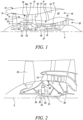
- Figure 1 illustrates a gas turbine engine 10 having a principal rotational axis 9.
- the engine 10 comprises an air intake 12 and a propulsive fan 23, comprising a plurality of blades, that generates two airflows: a core airflow A and a bypass airflow B.
- the gas turbine engine 10 comprises a core 11 that receives the core airflow A downstream of the fan.
- the engine core 11 comprises, in axial flow series, a low pressure compressor 14, a high-pressure compressor 15, combustion equipment 16, a high-pressure turbine 17, a low pressure turbine 19 and a core exhaust nozzle 20.
- a nacelle 21 surrounds the gas turbine engine 10 and defines a bypass exhaust nozzle 18.
- An outlet guide vane assembly 46 is located in the bypass duct 22, and comprises a plurality of outlet guide vanes 46a, which are distributed circumferentially within the bypass duct 22.
- Each outlet guide vane 46a extends radially between the bypass duct inner wall 42 and the bypass duct outer wall 44, along a span, and at least partially axially from a leading edge 48 to a trailing edge 50.
- the length of the outlet guide vane 46a along the span i.e., between the bypass duct inner wall 42 and the bypass duct outer wall 44) is referred to herein as the span length.
- a bifurcation 49 (e.g., a flow splitter) is disposed in the bypass duct 22 downstream of the outlet guide vane assembly 46, such that the outlet guide vane assembly 46 is disposed axially between the fan 23 and the bifurcation 49.
- the bifurcation 49 has a leading edge and a trailing edge and the outlet guide vane assembly 46 is disposed axially between the fan 23 and the bifurcation leading edge. In other embodiments, the outlet guide vane assembly 46 is disposed axially between the fan 23 and the bifurcation trailing edge.
- the bifurcation 49 may be an upper bifurcation; the engine 10 may further comprise a lower bifurcation arranged in the bypass duct 22 downstream of the outlet guide vane assembly 46 and radially opposite to the upper bifurcation 49.
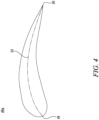
- Figure 4 shows a cross-sectional view of an outlet guide vane 46a at a particular point along its span.
- a true chord length of the outlet guide vane 46a, for a given cross-section at a point along the span length, is the distance along a camber line 52 (which would typically be a curved line) between the leading edge 48 and the trailing edge 50 in that cross-section. Accordingly, the true chord length would typically be the length of a curved line. Note that this is different to what might conventionally be referred to as the chord length, which would be the length of a straight line drawn between the leading edge and the trailing edge in that cross-section.
- each outlet guide vane 46a along the span length is designed to reduce peak surface Mach numbers, without the need to increase the span length.
- the cross-sectional geometry of each outlet guide vane is defined in relation to its space-chord ratio (s/c), which varies along its span.
- a profile of space-chord ratio (s/c) against percentage of span length from the bypass duct inner wall 42 may be substantially identical for each outlet guide vane 46a in the outlet guide vane assembly 46.
- a plurality of outlet guide vanes in the outlet guide vane assembly 46 may comprise an identical profile, and a few outlet guide vanes may comprise alternative profiles for providing additional support, for accommodating other support structures in the bypass duct 22, or for different camber standards (including directing the flow around the bifurcation(s) 49 whilst limiting incidence onto the vanes).
- the space-chord ratio (s/c) is defined by an average spacing of outlet guide vanes 46a at a respective span height divided by the true chord length of the respective outlet guide vane 46a at the respective span height.
- the average spacing of outlet guide vanes at the respective span height is defined as the circumference of the bypass duct at the respective span height (2 ⁇ r, where r is the radius at the respective span height from the centre of the gas turbine engine 10 (i.e., the principal rotational axis 9)) divided by the number of outlet guide vanes (Nv). Therefore, the space-chord ratio at a respective span height is defined as 2 ⁇ r / Nv.
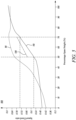
- Figure 5 shows a chart 100 of space-chord ratio (s/c) against percentage height along the span length from the bypass duct inner wall 42. For example, at 40% of the span length from the bypass duct inner wall 42, the percentage height is 40%.
- a first plot 90 shows a relationship between the space-chord ratio and the percentage height of a previously considered outlet guide vane.
- a second plot 110 (shown in a solid line) is a first example relationship between the space-chord ratio and the percentage height of an outlet guide vane 46a according to the invention. It can be seen that the space-chord ratio between approximately 50-70% of the span length is lower than the space-chord ratio of the previously considered design.
- the space-chord ratio at 50% of the span length from the bypass duct inner wall is approximately 0.57, and that the space-chord ratio at 70% of the span length from the bypass duct inner wall is approximately 0.74. It can be seen that every point between 50-70% of the span length, the space-chord ratio is less than 0.74 in this example.
- the applicant has found more broadly that having a space-chord ratio of less than 0.72 at 50% of the span length and/or of less than 0.79 at 70% of the span length reduces the peak Mach number of flow in use. Without being bound by theory, the applicant believes that this is due to the lift force being distributed over a larger surface area. The applicant has found that there is a trade-off between (i) added weight for each outlet guide vane 46a (due to increasing the chord length locally) and increased losses over the outlet guide vanes against (ii) reduced peak Mach numbers when reducing the space-chord ratio between 50-70% of the span length.
- the space-chord ratio at 50% of the span length may therefore be less than 0.71, 0.70, 0.69, 0.68, 0.67, 0.66 or 0.65, or even lower.
- the space-chord ratio at 50% of the span height may be larger than 0.4, 0.41, 0.42, 0.43, 0.44, or 0.45 or higher.
- the space-chord ratio at 70% of the span length may therefore be less than 0.78, 0.77, 0.76, 0.75, 0.74, 0.73, or 0.72, or even lower.
- the space-chord ratio at 70% of the span length may be larger than 0.48, 0.49, 0.5, 0.51, 0.52, 0.53, 0.54, or 0.55 or higher.
- the space-chord ratio of at least one point between 50% and 70% of the span length less than 0.72 also reduces the peak Mach number of flow, in use.
- the space-chord ratio anywhere between 50% and 70% of the span length may be less than 0.71, 0.70, 0.69, 0.68, 0.67, 0.66 or 0.65, or even lower. It may be that the space-chord ratio of the at least one outlet guide vane, at a point from 55% to 70% of the span length from the bypass duct inner wall 42, is less than 0.72, 0.71, 0.70, or 0.69 or even lower.
- each and every point between 50-70% of the span length from the bypass duct inner wall 42 may have a space-chord ratio less than 0.79, or less than 0.78, 0.77, 0.76, 0.75 or 0.74 or even lower. It may be that the space-chord ratio of the at least one outlet guide vane, at a point from 50% to 65% of the span length from the bypass duct inner wall 42, is less than 0.72, 0.71, 0.70, or 0.69 or even lower. In some examples, each and every point between 50% and 65% of the span length from the bypass duct inner wall 42 may have a space-chord ratio less than 0.72, or less than 0.71, 0.70, 0.69, 0.68 or 0.67 or even lower.
- the space-chord ratio of at least one point between 65% and 70% of the span length from the bypass duct inner wall 42 is less than 0.79, 0.78, 0.77, 0.76, 0.75, 0.74, 0.73, 0.72, 0.71, or 0.7.
- the space-chord ratio anywhere between 65% and 70% of the span length from the bypass duct inner wall is less than 0.79, 0.78, 0.77, 0.76, 0.75, 0.74, 0.73, 0.72, 0.71, or 0.7.
- the space-chord ratio (s/c) of the at least one outlet guide vane, at a point from 50-70% of the span length from the bypass duct inner wall is less than or equal to x + 0.60 * (span height - 0.5), where x is 0.64, 0.63, 0.62, 0.61, 0.6, or 0.59 or even lower.
- x 0.64, 0.63, 0.62, 0.61, 0.6, or 0.59 or even lower.
- having a space-chord ratio at 70% of the span length from the bypass duct inner wall 42 which is at least 1.21 times and/or less than 1.45 times greater than the space-chord ratio at 50% of the span length from the bypass duct inner wall 42 reduces the peak Mach number of flow, in use.
- the space-chord ratio at 70% may be a factor of 1.22, 1.23, 1.24, 1.25, 1.26, 1.27, 1.28 or even higher, larger than the space-chord ratio at 50% of the span length.
- the space-chord ratio at 70% of the span length from the bypass duct inner wall 42 is 1.30 times greater than the space-chord ratio at 50% of the span length from the bypass duct inner wall 42.
- the space-chord ratio at 70% of the span length of the outlet guide vane may be less than 1.45, 1.44, 1.43, 1.42, 1.41, 1.40, 1.39 times greater than the space-chord ratio of the respective outlet guide vane at 50% of the span length from the bypass duct inner wall 42.
- the core airflow A is accelerated and compressed by the low pressure compressor 14 and directed into the high pressure compressor 15 where further compression takes place.
- the compressed air exhausted from the high pressure compressor 15 is directed into the combustion equipment 16 where it is mixed with fuel and the mixture is combusted.
- the resultant hot combustion products then expand through, and thereby drive, the high pressure and low pressure turbines 17, 19 before being exhausted through the nozzle 20 to provide some propulsive thrust.
- the high pressure turbine 17 drives the high pressure compressor 15 by a suitable second core shaft 27.
- the fan 23 generally provides the majority of the propulsive thrust.
- the epicyclic gearbox 30 is a reduction gearbox.
- the low pressure turbine 19 drives the core shaft 26, which is coupled to a sun wheel, or sun gear, 28 of the epicyclic gear arrangement 30.
- a sun wheel, or sun gear, 28 of the epicyclic gear arrangement 30 Radially outwardly of the sun gear 28 and intermeshing therewith is a plurality of planet gears 32 that are coupled together by a planet carrier 34.
- the planet carrier 34 constrains the planet gears 32 to precess around the sun gear 28 in synchronicity whilst enabling each planet gear 32 to rotate about its own axis.
- the planet carrier 34 is coupled via linkages 36 to the fan 23 in order to drive its rotation about the engine axis 9.
- an annulus or ring gear 38 Radially outwardly of the planet gears 32 and intermeshing therewith is an annulus or ring gear 38 that is coupled, via linkages 40, to a stationary supporting structure 24.
- low pressure turbine and “low pressure compressor” as used herein may be taken to mean the lowest pressure turbine stages and lowest pressure compressor stages (i.e. not including the fan 23) respectively and/or the turbine and compressor stages that are connected together by the core shaft 26 with the lowest rotational speed in the engine (i.e. not including the gearbox output shaft that drives the fan 23).
- the "low pressure turbine” and “low pressure compressor” referred to herein may alternatively be known as the “intermediate pressure turbine” and “intermediate pressure compressor”. Where such alternative nomenclature is used, the fan 23 may be referred to as a first, or lowest pressure, compression stage.
- the epicyclic gearbox 30 is shown by way of example in greater detail in Figure 3 .
- Each of the sun gear 28, planet gears 32 and ring gear 38 comprise teeth about their periphery to intermesh with the other gears. However, for clarity only exemplary portions of the teeth are illustrated in Figure 3 .
- Practical applications of a planetary epicyclic gearbox 30 generally comprise at least three planet gears 32.
- the epicyclic gearbox 30 illustrated by way of example in Figures 2 and 3 is of the planetary type, in that the planet carrier 34 is coupled to an output shaft via linkages 36, with the ring gear 38 fixed.
- the epicyclic gearbox 30 may be a star arrangement, in which the planet carrier 34 is held fixed, with the ring (or annulus) gear 38 allowed to rotate. In such an arrangement the fan 23 is driven by the ring gear 38.
- the gearbox 30 may be a differential gearbox in which the ring gear 38 and the planet carrier 34 are both allowed to rotate.
- any suitable arrangement may be used for locating the gearbox 30 in the engine 10 and/or for connecting the gearbox 30 to the engine 10.
- the connections (such as the linkages 36, 40 in the Figure 2 example) between the gearbox 30 and other parts of the engine 10 (such as the input shaft 26, the output shaft and the fixed structure 24) may have any desired degree of stiffness or flexibility.
- any suitable arrangement of the bearings between rotating and stationary parts of the engine may be used, and the disclosure is not limited to the exemplary arrangement of Figure 2 .
- the gearbox 30 has a star arrangement (described above)
- the skilled person would readily understand that the arrangement of output and support linkages and bearing locations would typically be different to that shown by way of example in Figure 2 .
- the present invention extends to a gas turbine engine having any arrangement of gearbox styles (for example star or planetary), support structures, input and output shaft arrangement, and bearing locations.
- gearbox styles for example star or planetary
- support structures for example star or planetary
- input and output shaft arrangement for example star or planetary
- bearing locations for example star or planetary
- the gearbox may drive additional and/or alternative components (e.g. the intermediate pressure compressor and/or a booster compressor).
- additional and/or alternative components e.g. the intermediate pressure compressor and/or a booster compressor.
- gas turbine engines to which the present disclosure may be applied may have alternative configurations.
- such engines may have an alternative number of compressors and/or turbines and/or an alternative number of interconnecting shafts.
- the gas turbine engine shown in Figure 1 has a split flow nozzle 18, 20 meaning that the flow through the bypass duct 22 has its own nozzle 18 that is separate to and radially outside the core engine nozzle 20.
- this is not limiting, and any aspect of the present disclosure may also apply to engines in which the flow through the bypass duct 22 and the flow through the core 11 are mixed, or combined, before (or upstream of) a single nozzle, which may be referred to as a mixed flow nozzle.
- One or both nozzles may have a fixed or variable area. Whilst the described example relates to a turbofan engine, the disclosure may apply, for example, to any type of gas turbine engine. In some arrangements, the gas turbine engine 10 may not comprise a gearbox 30.
- the geometry of the gas turbine engine 10, and components thereof, is defined by a conventional axis system, comprising an axial direction (which is aligned with the rotational axis 9), a radial direction (in the bottom-to-top direction in Figure 1 ), and a circumferential direction (perpendicular to the page in the Figure 1 view).
- the axial, radial and circumferential directions are mutually perpendicular.
Landscapes
- Engineering & Computer Science (AREA)
- Mechanical Engineering (AREA)
- General Engineering & Computer Science (AREA)
- Physics & Mathematics (AREA)
- Fluid Mechanics (AREA)
- Geometry (AREA)
- Chemical & Material Sciences (AREA)
- Combustion & Propulsion (AREA)
- Structures Of Non-Positive Displacement Pumps (AREA)
Claims (10)
- Gasturbinenmotor (10) für ein Luftfahrzeug, umfassend:einen Motorkern (11), der eine Turbine (19), einen Verdichter (14) und eine Kernwelle (26), welche die Turbine mit dem Verdichter verbindet, umfasst;ein Gebläse (23), das sich stromaufwärts des Motorkerns (11) befindet, wobei das Gebläse (23) eine Vielzahl von Gebläseschaufeln umfasst; undeinen Umgehungskanal (22), der durch eine Umgehungskanalinnenwand (42) und eine Umgehungskanalaußenwand (44) begrenzt ist und sich radial außerhalb vom Motorkern (11) und stromabwärts des Gebläses (23) befindet; undeine Auslassleitschaufelbaugruppe (46), die sich innerhalb des Umgehungskanals (22) befindet und eine Vielzahl von Auslassleitschaufeln (46a) umfasst, die umlaufend innerhalb des Umgehungskanals (22) verteilt ist, wobei sich jede Auslassleitschaufel (46a) radial entlang einer Spanne zwischen der Umgehungskanalinnenwand (42) und der Umgehungskanalaußenwand (44) erstreckt,dadurch gekennzeichnet, dassein Raumsehnenverhältnis (s/c) von zumindest einer Auslassleitschaufel (46a) bei 50 % der Spannlänge von der Umgehungskanalinnenwand (42) weniger als 0,72 ist,wobei das Raumsehnenverhältnis (s/c) durch einen durchschnittlichen Abstand von Auslassleitschaufeln (46a) bei einer jeweiligen Spannhöhe geteilt durch eine wahre Sehnenlänge der jeweiligen Auslassleitschaufel (46a) bei der jeweiligen Spannhöhe definiert ist, wobei der durchschnittliche Abstand der Auslassleitschaufeln (46a) bei der jeweiligen Spannhöhe als der Umfang des Umgehungskanals (22) bei der jeweiligen Spannhöhe (2πr, wobei r der Radius bei der jeweiligen Spannhöhe von einer Hauptdrehachse (9) des Gasturbinenmotors ist) geteilt durch die Anzahl an Auslassleitschaufeln (NV), (2πr / NV), definiert ist undwobei ein Raumsehnenverhältnis (s/c) der zumindest einen Auslassleitschaufel (46a) an einem Punkt von 50 % bis 70 % der Spannlänge von der Umgehungskanalinnenwand (42) weniger als
 wobei die Spannhöhe als ein Anteil der Spannlänge von der Umgehungskanalinnenwand (42) an dem Punkt definiert ist.
 - Gasturbinenmotor nach Anspruch 1, wobei das Raumsehnenverhältnis (s/c) der zumindest einen Auslassleitschaufel (46a) bei 50 % der Spannlänge von der Umgehungskanalinnenwand mehr als 0,4 ist.
- Gasturbinenmotor nach einem der vorhergehenden Ansprüche, wobei das Raumsehnenverhältnis der zumindest einen Auslassleitschaufel (46a) bei 70 % der Spannlänge von der Umgehungskanalinnenwand (42) mehr als 0,48 ist.
- Gasturbinenmotor nach einem der vorhergehenden Ansprüche, wobei ein Raumsehnenverhältnis (s/c) von zumindest einer Auslassleitschaufel (46a) bei 70 % der Spannlänge von der Umgehungskanalinnenwand (42) zumindest 1,21-mal und/oder weniger als 1,45-mal größer als das Raumsehnenverhältnis (s/c) der jeweiligen Auslassleitschaufel (46a) bei 50 % der Spannlänge von der Umgehungskanalinnenwand (42) ist.
- Gasturbinenmotor nach einem der vorhergehenden Ansprüche, wobei die zumindest eine Auslassleitschaufel (46a) jede einzelne Auslassleitschaufel (46a) aus der Vielzahl von Auslassleitschaufeln (46a) der Auslassleitschaufelbaugruppe (46) in dem Umgehungskanal (22) umfasst.
- Gasturbinenmotor nach einem der vorhergehenden Ansprüche, ferner umfassend: ein Getriebe (30), das konfiguriert ist, um eine Eingabe von der Kernwelle (26) zu empfangen und Antrieb an das Gebläse (23) auszugeben, um das Gebläse (23) bei einer niedrigeren Drehzahl als die Kernwelle (26) anzutreiben.
- Gasturbinenmotor nach dem vorhergehenden Anspruch, wobei das Getriebe (30) ein Übersetzungsverhältnis in einem Bereich von 3 bis 4,2 aufweist.
- Gasturbinenmotor nach einem der vorhergehenden Ansprüche, wobei:die Turbine eine erste Turbine (19) ist, der Verdichter ein erster Verdichter (14) ist und die Kernwelle eine erste Kernwelle (26) ist;der Motorkern ferner eine zweite Turbine (17), einen zweiten Verdichter (15) und eine zweite Kernwelle (27), welche die zweite Turbine (17) mit dem zweiten Verdichter (15) verbindet, umfasst; unddie zweite Turbine (17), der zweite Verdichter (15) und die zweite Kernwelle (27) angeordnet sind, um sich bei einer höheren Drehzahl als die erste Kernwelle (26) zu drehen.
- Gasturbinenmotor nach einem der vorhergehenden Ansprüche, wobei:
sich die Auslassleitschaufelbaugruppe (46) axial zwischen dem Gebläse (23) und einer Gabelung (49) befindet, die sich in dem Umgehungskanal (22) befindet. - Gasturbinenmotor nach dem vorhergehenden Anspruch, wobei das Gebläse (23) einen Gebläsedurchmesser in einem Bereich von 210 cm bis 380 cm aufweist.
Applications Claiming Priority (1)
| Application Number | Priority Date | Filing Date | Title |
|---|---|---|---|
| GBGB2301166.1A GB202301166D0 (en) | 2023-01-27 | 2023-01-27 | A gas turbine engine |
Publications (2)
| Publication Number | Publication Date |
|---|---|
| EP4407146A1 EP4407146A1 (de) | 2024-07-31 |
| EP4407146B1 true EP4407146B1 (de) | 2025-04-30 |
Family
ID=85476568
Family Applications (1)
| Application Number | Title | Priority Date | Filing Date |
|---|---|---|---|
| EP24150021.4A Active EP4407146B1 (de) | 2023-01-27 | 2024-01-02 | Gasturbinenmotor |
Country Status (3)
| Country | Link |
|---|---|
| US (1) | US12497894B2 (de) |
| EP (1) | EP4407146B1 (de) |
| GB (1) | GB202301166D0 (de) |
Families Citing this family (1)
| Publication number | Priority date | Publication date | Assignee | Title |
|---|---|---|---|---|
| US12509988B2 (en) | 2024-06-14 | 2025-12-30 | Pratt & Whitney Canada Corp. | Turbine engine airfoil |
Family Cites Families (11)
| Publication number | Priority date | Publication date | Assignee | Title |
|---|---|---|---|---|
| US7374403B2 (en) * | 2005-04-07 | 2008-05-20 | General Electric Company | Low solidity turbofan |
| EP3108116B1 (de) * | 2014-02-19 | 2024-01-17 | RTX Corporation | Gasturbinenmotor |
| US10046424B2 (en) * | 2014-08-28 | 2018-08-14 | Honeywell International Inc. | Rotors with stall margin and efficiency optimization and methods for improving gas turbine engine performance therewith |
| US10196932B2 (en) | 2015-12-08 | 2019-02-05 | General Electric Company | OGV heat exchangers networked in parallel and serial flow |
| US20170314562A1 (en) * | 2016-04-29 | 2017-11-02 | United Technologies Corporation | Efficient low pressure ratio propulsor stage for gas turbine engines |
| EP3569817B1 (de) * | 2018-05-14 | 2020-10-14 | ArianeGroup GmbH | Leitschaufelanordnung zur verwendung in einer turbine |
| GB201812875D0 (en) * | 2018-08-08 | 2018-09-19 | Rolls Royce Plc | Gas turbine engine mounting arrangement |
| GB201915015D0 (en) * | 2019-10-17 | 2019-12-04 | Rolls Royce Plc | Gas turbine engine |
| IT202000005146A1 (it) * | 2020-03-11 | 2021-09-11 | Ge Avio Srl | Motore a turbina con profilo aerodinamico avente alta accelerazione e bassa curva di paletta |
| US11781506B2 (en) * | 2020-06-03 | 2023-10-10 | Rtx Corporation | Splitter and guide vane arrangement for gas turbine engines |
| US11480063B1 (en) * | 2021-09-27 | 2022-10-25 | General Electric Company | Gas turbine engine with inlet pre-swirl features |
-
2023
- 2023-01-27 GB GBGB2301166.1A patent/GB202301166D0/en not_active Ceased
-
2024
- 2024-01-02 EP EP24150021.4A patent/EP4407146B1/de active Active
- 2024-01-08 US US18/406,296 patent/US12497894B2/en active Active
Also Published As
| Publication number | Publication date |
|---|---|
| US20240337218A1 (en) | 2024-10-10 |
| GB202301166D0 (en) | 2023-03-15 |
| EP4407146A1 (de) | 2024-07-31 |
| US12497894B2 (en) | 2025-12-16 |
Similar Documents
| Publication | Publication Date | Title |
|---|---|---|
| US10844721B2 (en) | Gas turbine engine for an aircraft | |
| US10436035B1 (en) | Fan design | |
| US11199196B2 (en) | Geared turbofan engine | |
| US10641182B1 (en) | Gas turbine engine and method of operating gas turbine engine to provide propulsion according to jet velocity ratio | |
| EP3885553A1 (de) | Gasturbinentriebwerk mit hohem druckverhältnis | |
| US12258910B2 (en) | Geared gas turbine engine | |
| EP3564518A1 (de) | Mit einem gitter versehene entnahmevorrichtung | |
| EP3594447A1 (de) | Gasturbinenmotoraustrittsleitschaufeln | |
| US11994075B2 (en) | Geared gas turbine engine | |
| US11732603B2 (en) | Ice crystal protection for a gas turbine engine | |
| EP3660271B1 (de) | Fanschaufelhalteanordnung | |
| EP3683431A1 (de) | Hochbelasteter einlasskanal in einem getriebeturbofan | |
| EP3647576A1 (de) | Gasturbinentriebwerk | |
| EP4407146B1 (de) | Gasturbinenmotor | |
| US20210222632A1 (en) | Gas turbine engine | |
| EP3613948B1 (de) | Bläserschaufel | |
| US11181042B2 (en) | Aircraft engine operability | |
| US11359493B2 (en) | Low speed fan up camber | |
| GB2588955A (en) | A turbomachine blade |
Legal Events
| Date | Code | Title | Description |
|---|---|---|---|
| PUAI | Public reference made under article 153(3) epc to a published international application that has entered the european phase |
Free format text: ORIGINAL CODE: 0009012 |
|
| STAA | Information on the status of an ep patent application or granted ep patent |
Free format text: STATUS: THE APPLICATION HAS BEEN PUBLISHED |
|
| AK | Designated contracting states |
Kind code of ref document: A1 Designated state(s): AL AT BE BG CH CY CZ DE DK EE ES FI FR GB GR HR HU IE IS IT LI LT LU LV MC ME MK MT NL NO PL PT RO RS SE SI SK SM TR |
|
| STAA | Information on the status of an ep patent application or granted ep patent |
Free format text: STATUS: REQUEST FOR EXAMINATION WAS MADE |
|
| 17P | Request for examination filed |
Effective date: 20241119 |
|
| RBV | Designated contracting states (corrected) |
Designated state(s): AL AT BE BG CH CY CZ DE DK EE ES FI FR GB GR HR HU IE IS IT LI LT LU LV MC ME MK MT NL NO PL PT RO RS SE SI SK SM TR |
|
| GRAP | Despatch of communication of intention to grant a patent |
Free format text: ORIGINAL CODE: EPIDOSNIGR1 |
|
| STAA | Information on the status of an ep patent application or granted ep patent |
Free format text: STATUS: GRANT OF PATENT IS INTENDED |
|
| RIC1 | Information provided on ipc code assigned before grant |
Ipc: F04D 29/54 20060101ALI20250130BHEP Ipc: F02K 3/06 20060101ALI20250130BHEP Ipc: F01D 9/04 20060101ALI20250130BHEP Ipc: F01D 5/14 20060101AFI20250130BHEP |
|
| GRAS | Grant fee paid |
Free format text: ORIGINAL CODE: EPIDOSNIGR3 |
|
| GRAA | (expected) grant |
Free format text: ORIGINAL CODE: 0009210 |
|
| STAA | Information on the status of an ep patent application or granted ep patent |
Free format text: STATUS: THE PATENT HAS BEEN GRANTED |
|
| INTG | Intention to grant announced |
Effective date: 20250303 |
|
| P01 | Opt-out of the competence of the unified patent court (upc) registered |
Free format text: CASE NUMBER: APP_10721/2025 Effective date: 20250304 |
|
| AK | Designated contracting states |
Kind code of ref document: B1 Designated state(s): AL AT BE BG CH CY CZ DE DK EE ES FI FR GB GR HR HU IE IS IT LI LT LU LV MC ME MK MT NL NO PL PT RO RS SE SI SK SM TR |
|
| REG | Reference to a national code |
Ref country code: CH Ref legal event code: EP Ref country code: GB Ref legal event code: FG4D |
|
| REG | Reference to a national code |
Ref country code: DE Ref legal event code: R096 Ref document number: 602024000082 Country of ref document: DE |
|
| REG | Reference to a national code |
Ref country code: IE Ref legal event code: FG4D |
|
| REG | Reference to a national code |
Ref country code: NL Ref legal event code: MP Effective date: 20250430 |
|
| REG | Reference to a national code |
Ref country code: AT Ref legal event code: MK05 Ref document number: 1790184 Country of ref document: AT Kind code of ref document: T Effective date: 20250430 |
|
| PG25 | Lapsed in a contracting state [announced via postgrant information from national office to epo] |
Ref country code: FI Free format text: LAPSE BECAUSE OF FAILURE TO SUBMIT A TRANSLATION OF THE DESCRIPTION OR TO PAY THE FEE WITHIN THE PRESCRIBED TIME-LIMIT Effective date: 20250430 Ref country code: ES Free format text: LAPSE BECAUSE OF FAILURE TO SUBMIT A TRANSLATION OF THE DESCRIPTION OR TO PAY THE FEE WITHIN THE PRESCRIBED TIME-LIMIT Effective date: 20250430 Ref country code: PT Free format text: LAPSE BECAUSE OF FAILURE TO SUBMIT A TRANSLATION OF THE DESCRIPTION OR TO PAY THE FEE WITHIN THE PRESCRIBED TIME-LIMIT Effective date: 20250901 |
|
| REG | Reference to a national code |
Ref country code: LT Ref legal event code: MG9D |
|
| PG25 | Lapsed in a contracting state [announced via postgrant information from national office to epo] |
Ref country code: NO Free format text: LAPSE BECAUSE OF FAILURE TO SUBMIT A TRANSLATION OF THE DESCRIPTION OR TO PAY THE FEE WITHIN THE PRESCRIBED TIME-LIMIT Effective date: 20250730 Ref country code: GR Free format text: LAPSE BECAUSE OF FAILURE TO SUBMIT A TRANSLATION OF THE DESCRIPTION OR TO PAY THE FEE WITHIN THE PRESCRIBED TIME-LIMIT Effective date: 20250731 |
|
| PG25 | Lapsed in a contracting state [announced via postgrant information from national office to epo] |
Ref country code: NL Free format text: LAPSE BECAUSE OF FAILURE TO SUBMIT A TRANSLATION OF THE DESCRIPTION OR TO PAY THE FEE WITHIN THE PRESCRIBED TIME-LIMIT Effective date: 20250430 Ref country code: PL Free format text: LAPSE BECAUSE OF FAILURE TO SUBMIT A TRANSLATION OF THE DESCRIPTION OR TO PAY THE FEE WITHIN THE PRESCRIBED TIME-LIMIT Effective date: 20250430 |
|
| PG25 | Lapsed in a contracting state [announced via postgrant information from national office to epo] |
Ref country code: BG Free format text: LAPSE BECAUSE OF FAILURE TO SUBMIT A TRANSLATION OF THE DESCRIPTION OR TO PAY THE FEE WITHIN THE PRESCRIBED TIME-LIMIT Effective date: 20250430 |
|
| PG25 | Lapsed in a contracting state [announced via postgrant information from national office to epo] |
Ref country code: HR Free format text: LAPSE BECAUSE OF FAILURE TO SUBMIT A TRANSLATION OF THE DESCRIPTION OR TO PAY THE FEE WITHIN THE PRESCRIBED TIME-LIMIT Effective date: 20250430 |
|
| PG25 | Lapsed in a contracting state [announced via postgrant information from national office to epo] |
Ref country code: AT Free format text: LAPSE BECAUSE OF FAILURE TO SUBMIT A TRANSLATION OF THE DESCRIPTION OR TO PAY THE FEE WITHIN THE PRESCRIBED TIME-LIMIT Effective date: 20250430 |
|
| PG25 | Lapsed in a contracting state [announced via postgrant information from national office to epo] |
Ref country code: RS Free format text: LAPSE BECAUSE OF FAILURE TO SUBMIT A TRANSLATION OF THE DESCRIPTION OR TO PAY THE FEE WITHIN THE PRESCRIBED TIME-LIMIT Effective date: 20250731 |
|
| PG25 | Lapsed in a contracting state [announced via postgrant information from national office to epo] |
Ref country code: IS Free format text: LAPSE BECAUSE OF FAILURE TO SUBMIT A TRANSLATION OF THE DESCRIPTION OR TO PAY THE FEE WITHIN THE PRESCRIBED TIME-LIMIT Effective date: 20250830 |
|
| PG25 | Lapsed in a contracting state [announced via postgrant information from national office to epo] |
Ref country code: LV Free format text: LAPSE BECAUSE OF FAILURE TO SUBMIT A TRANSLATION OF THE DESCRIPTION OR TO PAY THE FEE WITHIN THE PRESCRIBED TIME-LIMIT Effective date: 20250430 |
|
| PG25 | Lapsed in a contracting state [announced via postgrant information from national office to epo] |
Ref country code: SM Free format text: LAPSE BECAUSE OF FAILURE TO SUBMIT A TRANSLATION OF THE DESCRIPTION OR TO PAY THE FEE WITHIN THE PRESCRIBED TIME-LIMIT Effective date: 20250430 Ref country code: DK Free format text: LAPSE BECAUSE OF FAILURE TO SUBMIT A TRANSLATION OF THE DESCRIPTION OR TO PAY THE FEE WITHIN THE PRESCRIBED TIME-LIMIT Effective date: 20250430 |
|
| PG25 | Lapsed in a contracting state [announced via postgrant information from national office to epo] |
Ref country code: CZ Free format text: LAPSE BECAUSE OF FAILURE TO SUBMIT A TRANSLATION OF THE DESCRIPTION OR TO PAY THE FEE WITHIN THE PRESCRIBED TIME-LIMIT Effective date: 20250430 |
|
| PG25 | Lapsed in a contracting state [announced via postgrant information from national office to epo] |
Ref country code: EE Free format text: LAPSE BECAUSE OF FAILURE TO SUBMIT A TRANSLATION OF THE DESCRIPTION OR TO PAY THE FEE WITHIN THE PRESCRIBED TIME-LIMIT Effective date: 20250430 |
|
| PG25 | Lapsed in a contracting state [announced via postgrant information from national office to epo] |
Ref country code: SK Free format text: LAPSE BECAUSE OF FAILURE TO SUBMIT A TRANSLATION OF THE DESCRIPTION OR TO PAY THE FEE WITHIN THE PRESCRIBED TIME-LIMIT Effective date: 20250430 |
|
| PG25 | Lapsed in a contracting state [announced via postgrant information from national office to epo] |
Ref country code: IT Free format text: LAPSE BECAUSE OF FAILURE TO SUBMIT A TRANSLATION OF THE DESCRIPTION OR TO PAY THE FEE WITHIN THE PRESCRIBED TIME-LIMIT Effective date: 20250430 |
|
| PLBI | Opposition filed |
Free format text: ORIGINAL CODE: 0009260 |
|
| REG | Reference to a national code |
Ref country code: CH Ref legal event code: L10 Free format text: ST27 STATUS EVENT CODE: U-0-0-L10-L00 (AS PROVIDED BY THE NATIONAL OFFICE) Effective date: 20260211 |
|
| PLAX | Notice of opposition and request to file observation + time limit sent |
Free format text: ORIGINAL CODE: EPIDOSNOBS2 |