EP4406794A1 - Verfahren und vorrichtung zur trajektorienplanung für ein fahrzeug und fahrzeug - Google Patents
Verfahren und vorrichtung zur trajektorienplanung für ein fahrzeug und fahrzeug Download PDFInfo
- Publication number
- EP4406794A1 EP4406794A1 EP21961649.7A EP21961649A EP4406794A1 EP 4406794 A1 EP4406794 A1 EP 4406794A1 EP 21961649 A EP21961649 A EP 21961649A EP 4406794 A1 EP4406794 A1 EP 4406794A1
- Authority
- EP
- European Patent Office
- Prior art keywords
- vehicle
- obstacle
- track
- predicted track
- cost value
- Prior art date
- Legal status (The legal status is an assumption and is not a legal conclusion. Google has not performed a legal analysis and makes no representation as to the accuracy of the status listed.)
- Pending
Links
- 238000000034 method Methods 0.000 title claims abstract description 72
- 230000003993 interaction Effects 0.000 claims abstract description 74
- 230000001133 acceleration Effects 0.000 claims description 51
- 238000013507 mapping Methods 0.000 claims description 51
- 230000015654 memory Effects 0.000 claims description 45
- 238000005070 sampling Methods 0.000 claims description 40
- 238000011156 evaluation Methods 0.000 claims description 28
- 238000012545 processing Methods 0.000 claims description 21
- 238000004590 computer program Methods 0.000 claims description 13
- 230000008569 process Effects 0.000 description 14
- 238000010586 diagram Methods 0.000 description 12
- 230000006870 function Effects 0.000 description 11
- 230000036461 convulsion Effects 0.000 description 10
- 230000008859 change Effects 0.000 description 9
- 241000283070 Equus zebra Species 0.000 description 8
- 230000006399 behavior Effects 0.000 description 7
- 238000004891 communication Methods 0.000 description 7
- 230000002441 reversible effect Effects 0.000 description 5
- 230000001360 synchronised effect Effects 0.000 description 5
- 238000006073 displacement reaction Methods 0.000 description 4
- 238000005516 engineering process Methods 0.000 description 4
- 230000003068 static effect Effects 0.000 description 4
- 230000008878 coupling Effects 0.000 description 3
- 238000010168 coupling process Methods 0.000 description 3
- 238000005859 coupling reaction Methods 0.000 description 3
- 230000007613 environmental effect Effects 0.000 description 3
- 230000002123 temporal effect Effects 0.000 description 3
- 230000009471 action Effects 0.000 description 2
- 230000007774 longterm Effects 0.000 description 2
- 239000004065 semiconductor Substances 0.000 description 2
- 239000007787 solid Substances 0.000 description 2
- 206010039203 Road traffic accident Diseases 0.000 description 1
- 238000004364 calculation method Methods 0.000 description 1
- 238000013500 data storage Methods 0.000 description 1
- 230000004069 differentiation Effects 0.000 description 1
- 238000007726 management method Methods 0.000 description 1
- 238000010295 mobile communication Methods 0.000 description 1
- 230000003287 optical effect Effects 0.000 description 1
- 239000013307 optical fiber Substances 0.000 description 1
Images


Classifications
-
- B—PERFORMING OPERATIONS; TRANSPORTING
- B60—VEHICLES IN GENERAL
- B60W—CONJOINT CONTROL OF VEHICLE SUB-UNITS OF DIFFERENT TYPE OR DIFFERENT FUNCTION; CONTROL SYSTEMS SPECIALLY ADAPTED FOR HYBRID VEHICLES; ROAD VEHICLE DRIVE CONTROL SYSTEMS FOR PURPOSES NOT RELATED TO THE CONTROL OF A PARTICULAR SUB-UNIT
- B60W30/00—Purposes of road vehicle drive control systems not related to the control of a particular sub-unit, e.g. of systems using conjoint control of vehicle sub-units
- B60W30/08—Active safety systems predicting or avoiding probable or impending collision or attempting to minimise its consequences
-
- B—PERFORMING OPERATIONS; TRANSPORTING
- B60—VEHICLES IN GENERAL
- B60W—CONJOINT CONTROL OF VEHICLE SUB-UNITS OF DIFFERENT TYPE OR DIFFERENT FUNCTION; CONTROL SYSTEMS SPECIALLY ADAPTED FOR HYBRID VEHICLES; ROAD VEHICLE DRIVE CONTROL SYSTEMS FOR PURPOSES NOT RELATED TO THE CONTROL OF A PARTICULAR SUB-UNIT
- B60W60/00—Drive control systems specially adapted for autonomous road vehicles
- B60W60/001—Planning or execution of driving tasks
- B60W60/0011—Planning or execution of driving tasks involving control alternatives for a single driving scenario, e.g. planning several paths to avoid obstacles
-
- G—PHYSICS
- G08—SIGNALLING
- G08G—TRAFFIC CONTROL SYSTEMS
- G08G1/00—Traffic control systems for road vehicles
- G08G1/16—Anti-collision systems
- G08G1/161—Decentralised systems, e.g. inter-vehicle communication
- G08G1/163—Decentralised systems, e.g. inter-vehicle communication involving continuous checking
-
- G—PHYSICS
- G08—SIGNALLING
- G08G—TRAFFIC CONTROL SYSTEMS
- G08G1/00—Traffic control systems for road vehicles
- G08G1/16—Anti-collision systems
- G08G1/166—Anti-collision systems for active traffic, e.g. moving vehicles, pedestrians, bikes
Definitions
- This application relates to the field of intelligent driving technologies, and in particular, to a vehicle track planning method and apparatus, and a vehicle.
- a self-driving system is comprising three modules based on functions: a sensing module, a planning module, and a control module.
- the sensing module is configured to obtain environmental information of the vehicle.
- the planning module needs to make a corresponding decision based on the obtained environmental information, and plan a collision-free drivable track.
- the control module is configured to control an executor to execute a planning result.
- the planning module the following factors need to be considered from the perspective of safety for the planned drivable track: One is that the planned track meets dynamic and kinematic constraints of the ego-vehicle, and the other is that the planned track does not collide with another obstacle, including a static obstacle and a moving obstacle.
- the industry proposes a responsibility-sensitive safety model for self-driving, and converts an idea and a concept of safe driving of drivers into a corresponding mathematical formula, to help divide responsibility of a traffic accident.
- the responsibility-sensitive safety model checks whether the planning result is safe. If the responsibility-sensitive safety model checks that the planning result is not safe, the planning module is returned for recalculation.
- the responsibility-sensitive safety model plans a traveling track based on an assumption that the another vehicle takes the radical action. As a result, a behavior of the ego-vehicle tends to be conservative, and comfort of a user for self-driving experience is not good enough.
- This application provides a vehicle track planning method and apparatus, and a vehicle, so as to improve comfort of self-driving experience while ensuring traveling safety of the vehicle.
- an embodiment of this application provides a vehicle track planning method, and the method includes: A vehicle track planning apparatus obtains a first predicted track of an obstacle, when the obstacle is a game target, generates a feasible track cluster of the obstacle based on the first predicted track and information about a scenario of interaction between the obstacle and a vehicle, selects a second predicted track from the feasible track cluster, where a cost value of the second predicted track is greater than a preset threshold, generates a spatial-temporal constraint of the vehicle based on the second predicted track; and plans a traveling track of the vehicle based on the spatial-temporal constraint of the vehicle.
- the vehicle track planning apparatus may generate, based on the first predicted track of the obstacle and the information about the scenario of interaction between the obstacle and the vehicle, the feasible track cluster that can safely travel for the obstacle, then generate the spatial-temporal constraint of the vehicle based on the second predicted track whose cost value is greater than the preset threshold and that is selected from the feasible track cluster, and plan the traveling track of the vehicle based on the spatial-temporal constraint, so that the ego-vehicle can be as comfortable as possible on a premise that safe traveling is maintained. This improves comfort of self-driving experience of a first vehicle while traveling safety of the first vehicle is ensured.
- the generating a feasible track cluster of the obstacle based on the first predicted track and information about a scenario of interaction between the obstacle and a vehicle includes: separately performing horizontal offset sampling and vertical acceleration sampling based on the first predicted track, the information about the interaction scenario, and a sampling limitation constraint, to obtain sampled data; and generating the feasible track cluster of the obstacle based on the sampled data.
- a series of feasible tracks that the obstacle may travel in the future may be obtained through the horizontal offset sampling and the vertical acceleration sampling.
- the method before the selecting a second predicted track from the feasible track cluster, the method further includes: determining, based on the information about the interaction scenario and a mapping relationship set corresponding to the information about the interaction scenario, a cost value of each evaluation dimension corresponding to each candidate predicted track in the feasible track cluster, where the mapping relationship set includes at least one mapping relationship, and each mapping relationship includes a mapping relationship between a preset evaluation dimension and a preset cost value; and determining a cost value of each candidate predicted track based on the cost value of each evaluation dimension corresponding to each candidate predicted track in the feasible track cluster.
- the candidate predicted track in the feasible track cluster may be evaluated from a plurality of evaluation dimensions, so that the track planning apparatus can determine the cost value of the candidate predicted track.
- mapping relationship set corresponding to the information about the interaction scenario meets at least one of the following:
- the generating a spatial-temporal constraint of the vehicle based on the second predicted track includes: generating, in a Frenet coordinate system based on the second predicted track, a first occupation area of the obstacle on an expected traveling path of the vehicle, and generating a horizontal offset constraint and a curvature radius constraint based on the first occupation area; and generating, in an ST coordinate system based on the second predicted track, a second occupation area of the obstacle on the expected traveling path of the vehicle, and generating a speed constraint, an acceleration constraint, and an accelerated acceleration constraint based on the second occupation area.
- a physical problem can be converted into a mathematical problem, so that the spatial-temporal constraint of the vehicle generated based on the second predicted track is converted into a mathematically solvable problem.
- the method further includes: when the obstacle is a non-game target, generating a spatial-temporal constraint of the vehicle based on the first predicted track; and planning a traveling track of the vehicle based on the spatial-temporal constraint of the vehicle.
- the spatial-temporal constraint of the vehicle is generated based on the first predicted track of the obstacle, to plan the traveling track of the vehicle, so as to ensure traveling safety of the vehicle.
- an embodiment of this application further provides a track planning apparatus.
- the electronic device includes modules/units that perform the method according to any one of the first aspect and the possible designs of the first aspect. These modules/units may be implemented by hardware, or may be implemented by hardware by executing corresponding software.
- the track planning apparatus includes an obtaining unit and a processing unit.
- the obtaining unit is configured to obtain a first predicted track of a target obstacle.
- the processing unit is configured to: when the obstacle is a game target, generate a feasible track cluster of the obstacle based on the first predicted track and information about a scenario of interaction between the obstacle and a vehicle; select a second predicted track from the feasible track cluster, where a cost value of the second predicted track is greater than a preset threshold; generate a spatial-temporal constraint of the vehicle based on the second predicted track; and plan a traveling track of the vehicle based on the spatial-temporal constraint of the vehicle.
- the processing unit is specifically configured to: separately perform horizontal offset sampling and vertical acceleration sampling based on the first predicted track, the information about the interaction scenario, and a sampling limitation constraint, to obtain sampled data; and generate the feasible track cluster of the obstacle based on the sampled data.
- the processing unit is further configured to: determine, based on the information about the interaction scenario and a mapping relationship set corresponding to the information about the interaction scenario, a cost value of each evaluation dimension corresponding to each candidate predicted track in the feasible track cluster, where the mapping relationship set includes at least one mapping relationship, and each mapping relationship includes a mapping relationship between a preset evaluation dimension and a preset cost value; and determine a cost value of each candidate predicted track based on the cost value of each evaluation dimension corresponding to each candidate predicted track in the feasible track cluster.
- the mapping relationship set corresponding to the information about the interaction scenario meets at least one of the following: in the interaction scenario, a right of way of the obstacle is higher than a right of way of the vehicle, and a higher right of way of the obstacle indicates a larger cost value of a right of way corresponding to the candidate predicted track; in the interaction scenario, a passability of the obstacle is higher than a passability of the vehicle, and a higher passability of the obstacle indicates a larger cost value of a passability corresponding to the candidate predicted track; in the interaction scenario, safety of the obstacle is higher than safety of the vehicle, and higher safety of the obstacle indicates a larger cost value of safety corresponding to the candidate predicted track; in the interaction scenario, comfort of the obstacle is higher than comfort of the vehicle, and higher comfort of the obstacle indicates a larger cost value of comfort corresponding to the candidate predicted track; in the interaction scenario, a lower degree of attention of the obstacle on the vehicle indicates a larger cost value of attention corresponding to the candidate predicted track; a lower changeability of a target type to
- the processing unit is specifically configured to: generate, in an SL coordinate system based on the second predicted track, a first occupation area of the obstacle on an expected traveling path of the vehicle, and generate a horizontal offset constraint and a curvature radius constraint based on the first occupation area; and generate, in an ST coordinate system based on the second predicted track, a second occupation area of the obstacle on the expected traveling path of the vehicle, and generate a speed constraint, an acceleration constraint, and an accelerated acceleration constraint based on the second occupation area.
- the processing unit is further configured to: when the obstacle is a non-game target, generate a spatial-temporal constraint of the vehicle based on the first predicted track; and plan a traveling track of the vehicle based on the spatial-temporal constraint of the vehicle.
- an embodiment of this application further provides a track planning apparatus.
- the track planning apparatus includes a processor and a memory.
- the memory is configured to store computer-executable instructions.
- the processor executes the computer-executable instructions in the memory to perform, by using a hardware resource in the track planning apparatus, the operation steps of the method according to any one of the first aspect or the possible designs of the first aspect.
- an embodiment of this application provides a computer-readable storage medium.
- the computer-readable storage medium includes computer instructions.
- the vehicle-mounted device is enabled to perform the technical solution in any one of the first aspect of embodiments of this application or the possible designs of the first aspect.
- an embodiment of this application provides a program product, including instructions.
- the program product is run on a vehicle-mounted device, the vehicle-mounted device is enabled to perform the technical solution in any one of the first aspect of embodiments of this application or the possible designs of the first aspect.
- a chip system may include a processor.
- the processor is coupled to a memory, and may be configured to perform the method according to any one of the first aspect and the possible implementations of the first aspect.
- the chip system further includes a memory.
- the memory is configured to store a computer program (which may also be referred to as code or instructions).
- the processor is configured to invoke a computer program from the memory and run the computer program, so that a device on which the chip system is installed is enabled to perform the method according to any one of the first aspect or the possible implementations of the first aspect.
- the foregoing track planning apparatus may be a chip.
- An input circuit may be an input pin.
- An output circuit may be an output pin.
- a processing circuit may be a transistor, a gate circuit, a trigger, any logic circuit, or the like.
- An input signal received by the input circuit may be received and input by, for example, but not limited to, a receiver, a signal output by the output circuit may be output to, for example, but not limited to, a transmitter and transmitted by the transmitter, and the input circuit and the output circuit may be a same circuit, where the circuit is used as the input circuit and the output circuit at different moments.
- Specific implementations of the processor and the various circuits are not limited in embodiments of this application.
- the character "/" generally indicates an “or” relationship between the associated objects.
- At least one means one or more.
- At least two means two or more.
- At least one means any one, or a similar expression thereof indicates any combination of the items, and includes a singular item (piece) or any combination of plural items (pieces).
- a vehicle may communicate with another object based on a vehicle-to-everything (for example, vehicle-to-everything (V2X)) wireless communication technology.
- V2X vehicle-to-everything
- communication between the vehicle and another object may be implemented based on a vehicle-to-vehicle (for example, vehicle-to-vehicle (V2V)) wireless communication technology.
- the communication between the vehicle and another object may be performed based on Wi-Fi (wireless fidelity), a fifth generation (5th generation, 5G) mobile communication technology, long term evolution (long term evolution, LTE), or the like.
- Wi-Fi wireless fidelity
- 5G fifth generation
- LTE long term evolution
- a driving automation classification standard proposed by the Society of Automotive Engineers International includes six levels: L0 to L5. From L0 to L2, a driver support system can provide some support functions for a driver. However, regardless of whether driver support functions of the vehicle are enabled, the driver needs to drive the vehicle in person, constantly monitor these driver support functions provided by the driver support system, and turn, brake, or accelerate as required to ensure safety. Differences between support functions of the levels L0 to L2 are as follows: L0 is driving-free automation, and support functions of L0 are limited to providing an alarm and instant assistance. Support functions of L1 are to provide the driver with support in steering or braking/acceleration.
- L2 The support functions of L2 are to provide the driver with support in steering and braking/acceleration.
- L3 is semi-self-driving.
- a self-driving system may complete some driving tasks, and may also monitor a driving environment in some cases. However, the driver needs to be prepared to re-obtain a driving control right at any time. For example, when a function sends a request, the driver needs to perform driving.
- L4 is highly-self-driving.
- the self-driving system can complete driving tasks and monitor a driving environment in specific environments and under specific conditions.
- L5 is fully-self-driving.
- the self-driving system can complete all driving tasks under all conditions.
- the solution in embodiments of this application may be applied to a vehicle whose self-driving capability reaches L2 or higher. Details are not described below.
- any vehicle may restrict track planning of the vehicle by sensing a traveling track of a surrounding vehicle in a preset time period, to improving safety.
- a safety factor that needs to be considered by a planning module is converted into optimizing a constraint in the problem, that is, a planned track needs to meet the following:
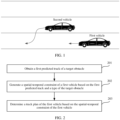
- the scenario includes a first vehicle and a second vehicle located in a right front of the first vehicle.
- the first vehicle performs track planning.
- the first vehicle is a vehicle having a partial or full self-driving capability.
- the first vehicle may be a vehicle of L2 or higher in the foregoing driving automation classification standard
- the second vehicle may be a vehicle, a semi-motor vehicle, a motorcycle, or the like of any level of L0 to L5 in the foregoing driving automation classification standard.
- the first vehicle may obtain vehicle information of the second vehicle based on a sensor of the ego-vehicle, for example, a camera, a lidar, a millimeter-wave radar, or a global navigation satellite system (Global Navigation Satellite System, GNSS).
- the vehicle information of the second vehicle may include but is not limited to information such as a geographical position, a traveling speed, a traveling direction, and indicator light information of the second vehicle.
- the first vehicle may predict a first predicted track of the second vehicle with reference to the vehicle information of the second vehicle and current road information. Then, the first vehicle generates a spatial-temporal constraint of the first vehicle based on the predicted track of the second vehicle and whether the second vehicle allocates sufficient attention to the first vehicle. For example, when the second vehicle shown in FIG.
- the second vehicle needs to allocate sufficient attention to the first vehicle to avoid collision with the first vehicle.
- the first vehicle may generate a feasible track cluster that may ensure the second vehicle based on the interaction information, and then select a second predicted track with a large cost value for the second vehicle from the feasible track cluster.
- the second predicted track with a large cost value for the second vehicle may also be understood as a track with low comfort for the second vehicle in the feasible track cluster.
- the first vehicle generates the spatial-temporal constraint of the first vehicle based on the second predicted track, so that the first vehicle plans a track of the first vehicle based on the spatial-temporal constraint. In this way, comfort of self-driving experience of the first vehicle can be improved while traveling safety of the first vehicle is ensured.
- an embodiment of this application provides a vehicle track planning method.
- the method may be performed by a track planning apparatus in a first vehicle.
- the following uses an example in which the track planning apparatus in the first vehicle performs the method for description.
- the method includes the following steps.
- Step 201 The track planning apparatus of the first vehicle obtains a first predicted track of an obstacle.
- the obstacle may include a vehicle, a pedestrian, or another object, and the another object is, for example, a roadblock.
- the first vehicle may obtain vehicle information of the second vehicle based on a sensor of the ego-vehicle, such as a camera, a lidar, a millimeter-wave radar, or a GNSS.
- vehicle information of the second vehicle may include but is not limited to information such as a geographical position, a traveling speed, a traveling direction, and indicator light information of the second vehicle.
- the first vehicle may further obtain surrounding traffic indication information, such as traffic light information and traffic sign information.
- the first vehicle may predict a first predicted track of the second vehicle with reference to information such as the vehicle information of the second vehicle, current road information, and the traffic indication information.
- Step 202 The track planning apparatus generates a spatial-temporal constraint of the first vehicle based on the first predicted track and a type of the obstacle.
- the type of the obstacle may include two types: an obstacle that allocates sufficient attention to the first vehicle or an obstacle that does not allocate sufficient attention to the first vehicle.
- the second vehicle when there is an interaction process between the second vehicle (another vehicle) and the first vehicle (the ego-vehicle), for example, there is a track crossing or a traveling intention consistency, in a subsequent traveling process of the second vehicle (regardless of whether the second vehicle has a self-driving capability), the second vehicle needs to pay attention (by a driver or a self-driving system) to existence of the first vehicle to avoid collision with the first vehicle.
- a traveling track of the second vehicle is usually affected by a traveling track of the first vehicle. In this case, the second vehicle needs to allocate sufficient attention to the first vehicle.
- a type of the second vehicle is the obstacle that allocates sufficient attention to the first vehicle, and the second vehicle is a game target.
- the second vehicle does not need to pay attention to existence of the first vehicle, and the traveling track of the second vehicle is not affected by the traveling track of the first vehicle.
- the second vehicle does not need to allocate sufficient attention to the first vehicle.
- the type of the second vehicle is the obstacle that does not allocate sufficient attention to the first vehicle, and the second vehicle is a non-game target.
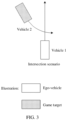
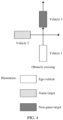
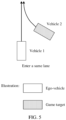
- a vehicle 1 is a first vehicle (that is, an ego-vehicle). Obstacles such as a vehicle 2 that is shown in FIG. 3 and that turns left at an intersection, a vehicle 2 that is shown in FIG. 4 and that crosses an intersection, a vehicle 2 that is shown in FIG. 5 and that enters a same lane with the vehicle 1, an oncoming vehicle 2 shown in FIG. 6 during narrow lane passing, and a vehicle 2 that is shown in FIG. 7 and that is behind the vehicle 1 and enters a vehicle flow have a track conflict or an intention conflict with the first vehicle.
- Behaviors of these obstacles change due to a driving behavior of the first vehicle. Therefore, these obstacles need to allocate sufficient attention to existence of the first vehicle to avoid collision with the first vehicle, and are all game targets.
- Behaviors of obstacles such as a vehicle 3 that is shown in FIG. 4 and that travels in front of the vehicle 1 in a lane in which the vehicle 1 is located, a static vehicle (namely, a vehicle 3) that is shown in FIG. 6 and that is on a roadside, and a vehicle 3 that is shown in FIG. 7 and that is in front of the vehicle 1 and enters a vehicle flow, do not change due to the behavior of the first vehicle.
- These obstacles do not need to allocate sufficient attention to the first vehicle, and are all non-game targets.
- the foregoing step 202 has a plurality of possible implementations.
- the following provides specific descriptions by using the following possible implementation a1 and possible implementation a2.
- step 202 if the type of the obstacle is the non-game target, that is, sufficient attention does not need to be allocated to the obstacle of the first vehicle, the track planning apparatus generates the spatial-temporal constraint of the first vehicle based on the first predicted track.
- the track planning apparatus generates, in a Frenet coordinate system based on the first predicted track, a first occupation area of the obstacle on an expected traveling path of the vehicle, and generates a horizontal offset constraint and a curvature radius constraint based on the first occupation area, namely, a spatial constraint in the spatial-temporal constraint. Then, the track planning apparatus generates, in an ST coordinate system based on the first predicted track, a second occupation area of the obstacle on the expected traveling path of the first vehicle, and generates a speed constraint, an acceleration constraint, and an accelerated acceleration constraint based on the second occupation area, namely, a temporal constraint in the spatial-temporal constraint.
- the following describes a spatial constraint used for horizontal path planning.
- Horizontal path planning based on the Frenet coordinate system is used as an example.
- a road center line is used as a reference line
- a direction of the first vehicle along the reference line is referred to as a vertical direction, namely, an S coordinate
- a normal direction of the reference line is an L coordinate
- a distance between a projected point of a position of the first vehicle on the reference line and a position of the first vehicle is a horizontal offset displacement
- a curve distance between a start point of the first vehicle and the projection point is vertical displacement. Because the first vehicle continuously travels along the reference line, the horizontal displacement L of the vehicle constantly changes with the vertical displacement S.
- the horizontal path planning may be performed by using the following boundary constraint. l low ⁇ l s ⁇ l up k low ⁇ k s ⁇ k up
- l ( s ) is a horizontal offset constraint of a path, and a maximum horizontal offset that can travel along an S-axis may be obtained through calculation based on a maximum steering wheel angle and a maximum steering wheel rotation speed that correspond to the ego-vehicle at different vehicle speeds and a boundary of the road.
- Table 1 shows an example of a correspondence between the vehicle speed and a maximum front wheel rotation angle and a maximum front wheel rotation speed.
- Table 1 Vehicle speed (km/h) 20 30 40 50 100 Maximum front wheel angle rad 0.56 0.15 0.096 0.074 0.022 Maximum front wheel speed rad/s 0.285 0.233 0.116 0.07 0.06
- a center line of the lane A is a reference line
- a point on the reference line is used as an original point.
- a distance from the original point to a first lane solid line on a left side of the reference line or a road boundary or an obstacle that is not crossed may be set to l low
- a distance from the original point to the first lane solid line on a right side of the reference line or an obstacle that is not crossed may be set to l up .
- k(s) is a curvature radius constraint of the path, to ensure that a curvature of each point on the path meets a minimum turning radius limitation of the vehicle.
- k ( s ) is related to physical parameters (such as a turning limit and a vehicle type), a motion status, and friction of a road surface.
- a horizontal axis T is a time axis
- a vertical axis S is a direction along an expected traveling path (namely, a reference line) of the first vehicle.
- a parallel quadrilateral area in the ST graph is an occupation area that is on the expected traveling path of the first vehicle (the ego-vehicle) and that is generated based on a predicted track of an obstacle (another vehicle)
- a curve is a speed planning curve of the first vehicle.
- v ( t ), a ( t ), and jerk ( t ) are respectively upper and lower bound constraints of a speed, an acceleration, and an accelerated acceleration allowed by the first vehicle.
- v(t) is related to various factors such as a current road speed limit (for example, a maximum speed limited by a highway is 120 km/h), and an environmental risk speed limit (for example, a speed limit at a school gate is 30 km/h, and a maximum speed limited by a highway is 60 km/h when visibility is within 200 m in fog weather).
- v(t) When the first vehicle moves forward, v(t) is a positive value, and when the first vehicle is reversed, v ( t ) is a negative value.
- the first vehicle travels on an urban road
- v min is 0, and v max is a maximum speed limit of the urban road.
- the highway v min may be 60 km/h
- v max may be 120 km/h.
- a ( t ) is an acceleration
- a ( t ) is a positive value when the vehicle accelerates
- a ( t ) is a negative value when the vehicle decelerates.
- a min may be -4 m/s 2
- a max may be 3 m/s 2 .
- jerk ( t ) is a derivative of acceleration to time, and represents a change rate of the acceleration.
- a value of jerk(t) is related to the current speed and the acceleration.
- a value of jerk ( t ) may be a positive number, and represents that a larger value indicates a larger acceleration; or a value of jerk(t) may be a negative number, and represents that a larger value indicates a smaller acceleration.
- jerk min may be -10 m/s 3
- jerk max may be 1.5 m/s 3 .
- the speed of the first vehicle is limited between v min and v max , so that the vehicle speed is neither too low nor too high.
- the acceleration of the first vehicle is limited between a min and a max , so that the acceleration does not exceed a maximum acceleration capability of the first vehicle.
- the accelerated acceleration of the first vehicle is limited between jerk min and jerk max , so that the acceleration of the first vehicle does not change violently. Therefore, the traveling track of the first vehicle is planned based on the spatial-temporal constraint of the first vehicle. This can ensure traveling safety of the vehicle, and improve comfort of self-driving experience.
- the planned traveling track of the first vehicle may meet the foregoing executable criterion.
- the track planning apparatus may generate a series of candidate predicted tracks, also be referred to as a feasible track cluster, for the obstacle to travel in the future based on the first predicted track of the obstacle (the first predicted track may be understood as a track with a maximum future travel probability of the obstacle) and information about a scenario of interaction between the obstacle and the first vehicle. Then, a track that has a large cost value for the obstacle is selected from the feasible track cluster as a second predicted track, and the second predicted track may be understood as a track that has low comfort for the obstacle in the feasible track cluster.
- an occupation area of the obstacle is generated based on the second predicted track
- the spatial-temporal constraint of the first vehicle is determined based on the occupation area of the obstacle
- the traveling track of the first vehicle is planned based on the spatial-temporal constraint of the first vehicle.
- the planned traveling track of the first vehicle enables the first vehicle to be as comfortable as possible on a premise that safe traveling is maintained.
- the track planning apparatus may perform horizontal offset sampling and vertical acceleration sampling based on the first predicted track, so as to generate a series of candidate predicted tracks that the obstacle may travel in the future, namely, the feasible track cluster.
- a sampling limitation constraint may be set.
- the sampling limitation constraint may include a sampling limitation constraint corresponding to the horizontal offset sampling and a sampling limitation constraint corresponding to the vertical acceleration sampling.
- the sampling limitation constraint corresponding to the horizontal offset sampling includes but is not limited to information such as a road boundary, a vehicle speed, and whether the scenario is an intersection scenario.
- the sampling limitation constraint corresponding to the vertical acceleration sampling includes but is not limited to information such as an accelerated acceleration constraint, an acceleration constraint, a speed constraint, and different target types.
- the track planning apparatus may separately perform the horizontal offset sampling and the vertical acceleration sampling based on the first predicted track, information about a scenario of interaction between the obstacle and the vehicle, and the sampling limitation constraint, to obtain sampled data, generate, based on the sampled data, at least one candidate predicted track on which the obstacle may travel in the future, and determine, from the at least one candidate predicted track on which the obstacle may travel in the future, a candidate predicted track that has a large cost value for the obstacle as a second predicted track of the obstacle.
- the horizontal offset sampling and the vertical acceleration sampling are separately performed based on the first predicted track of another vehicle to obtain the sampled data shown in FIG. 11 .
- a first row indicates that a series of accelerations used for the vertical acceleration sampling are separately accelerations
- a first column indicates that horizontal offset distances used for the horizontal offset sampling are separately -3 to 3 m.
- An ellipsis in each grid represents coordinates of a plurality of track points and speed information of another vehicle that are obtained by sampling by using an acceleration and a horizontal offset distance.
- the vertical acceleration sampling is performed by using an acceleration of -4 m/s 2
- the horizontal offset sampling is performed by using a horizontal offset distance of 3 m, to obtain coordinates of a plurality of track points of another vehicle and speed information of another vehicle at each track point, and the coordinates and the speed information is stored in a grid in a second row and a second column.
- a series of feasible track clusters that is, at least one candidate predicted track on which another vehicle may travel in the future, are generated based on data that is in the sampled data and whose horizontal offset meets a range of -1 to 1 m and whose vertical acceleration meets a range of -3 to 0 m/s 2 .
- three candidate predicted tracks are planned in FIG. 11 .
- the track planning apparatus may evaluate each candidate predicted track from a plurality of evaluation dimensions, to obtain a cost value of each candidate predicted track, and then determine, from at least one candidate predicted track that may be traveled in the future, a candidate predicted track whose cost value of an obstacle is greater than a cost threshold as the second predicted track, so that the first vehicle generates the spatial-temporal constraint of the first vehicle based on the second predicted track.
- the track planning apparatus may further store a mapping relationship set, or the track planning apparatus obtains a mapping relationship set from another storage device of the first vehicle.
- the mapping relationship set includes at least one mapping relationship, and each mapping relationship includes a mapping relationship between a preset evaluation dimension and a preset cost value. For example, it is assumed that there are seven preset evaluation dimensions: a right of way, a passability, safety, comfort, attention, a target type, and a target profile. In this case, the mapping relationship set includes seven mapping relationships. Each evaluation dimension is described below, and details are not described herein again.
- information about each interaction scenario may correspond to one mapping relationship set.
- the track planning apparatus may determine, based on information about a scenario of interaction between the obstacle and the first vehicle and a mapping relationship set corresponding to the information about the interaction scenario, the cost value of each evaluation dimension corresponding to each candidate predicted track in the at least one candidate predicted track. Then, for each candidate predicted track, a cost value of the candidate predicted track may be determined based on the cost value of each evaluation dimension corresponding to the candidate predicted track.
- the mapping relationship set corresponding to the information about the scenario of interaction between the first vehicle and the obstacle includes the foregoing seven mapping relationships.
- the track planning apparatus evaluates each candidate predicted track based on the information about the interaction scenario in dimensions such as the right of way, the passability, the safety, the comfort, the attention, the target type, and the target profile. Different weights are set for different dimensions. For each candidate predicted track, weighted summation is performed on cost values corresponding to evaluation dimensions, to obtain the cost value of each candidate predicted track.
- x i is a cost value of different evaluation dimensions, and the value ranges from 0 to 1.
- w i is a weight value of a corresponding dimension.
- a weight value of an evaluation dimension is a relative importance degree of the evaluation dimension in overall evaluation, and may be any value.
- a value of w i ranges from 0 to 1.
- a specific value of w i is not limited herein.
- a weight of the comfort is 0.3 to 0.4.
- trajectory cost is a final cost value of each candidate predicted track.
- the track planning apparatus determines the second predicted track from candidate predicted tracks whose cost values are greater than the cost value threshold in the at least one candidate predicted track. For example, a candidate predicted track with a maximum cost value is determined from the candidate predicted tracks whose cost values are greater than the cost threshold as the second predicted track, and the candidate predicted track with the maximum cost value may be understood as a candidate predicted track that is of the at least one candidate predicted track and that has lowest comfort for the obstacle. For another example, N candidate predicted tracks with large cost values are determined from the candidate predicted tracks whose cost values are greater than the cost threshold, where N is an integer greater than 1, and then one candidate predicted track is selected from the N candidate predicted tracks as the second predicted track.
- Non-intersection scenario rule zebra crossing > straight lane > lane change > reverse straight > crossing > free entrance.
- a right of way of the obstacle is high; or if the first vehicle goes straight, and the obstacle turns left, a right of way of the first vehicle is high.
- the obstacle In a scenario of interaction between the obstacle and the first vehicle, when the right of way of the obstacle is higher than the right of way of the first vehicle, and the right of way of the obstacle is higher, the obstacle is more likely to maintain a current state. In other words, a larger deviation between a sampled candidate predicted track and an initial first predicted track indicates a larger cost value of the right of way corresponding to the candidate predicted track.
- Non-intersection scenario rule straight lane > lane change > reverse straight > crossing > free entrance.
- the first vehicle has a high passability.
- the passability of the obstacle is higher than that of the first vehicle, and higher passability of the obstacle indicates a higher cost value of the passability corresponding to the candidate predicted track.
- Safety indicating safety of an interaction process between the first vehicle and the obstacle. For example, a distance greater than a specific threshold is always maintained in the interaction process between the first vehicle and the obstacle. In this case, safety is high. For another example, a collision occurs in the interaction process between the first vehicle and the obstacle. In this case, safety is the lowest. The higher the safety of the obstacle is, the more likely the obstacle is to maintain the current state. Examples of safety levels in different scenarios are as follows:
- Non-intersection scenario rule crossing > straight lane > lane change > reverse straight > free entrance.
- safety of the obstacle is higher than safety of the first vehicle, and higher safety of the obstacle indicates a higher cost value of the safety corresponding to the candidate predicted track.
- Comfort The comfort may be represented by a jerk value. A larger jerk indicates poorer comfort. The higher the comfort of the obstacle is, the more likely the obstacle is to maintain the current state. In different scenarios, comfort can be further classified into horizontal and vertical comfort. The following is an example of comfort in different scenarios:
- Non-intersection scenario rule Horizontal: lane change > free entrance > reverse straight > straight lane ⁇ crossing.
- comfort of the obstacle is higher than comfort of the first vehicle, and higher comfort of the obstacle indicates a larger cost value of comfort corresponding to the candidate predicted track.
- a track is evaluated based on a degree of attention of the obstacle on the first vehicle.
- the lower degree of attention of the obstacle on the first vehicle is, the more likely the obstacle is to maintain the current state.
- a lower degree of attention of the obstacle on the first vehicle indicates a large cost value of attention corresponding to the candidate predicted track.
- Obstacle type The track is evaluated based on a changeability of the obstacle type. The lower the changeability of the obstacle type is, the more likely the obstacle is to maintain the current state.
- the following table lists a comparison rule of cost values of different target types.
- the changeability may be understood as being capable of changing a current motion state.
- a child is incapable of changing a current motion state, and the child has a low changeability and a corresponding cost value is large.
- a small vehicle has a high changeability and a corresponding cost value is small.
- a lower changeability of a target type to which the obstacle belongs indicates a larger value of the target type corresponding to the candidate predicted track.
- Obstacle profile A track is evaluated based on the obstacle profile. The more dangerous the obstacle profile is, the more likely the obstacle is to maintain the current state. The following is an example of the rule: Danger > radical > normal > conservative.
- the obstacle profile may be determined based on status management of the obstacle in a life cycle. For example, if the obstacle is an intelligent vehicle, the obstacle profile may be determined based on a behavior of the intelligent vehicle. For example, the intelligent vehicle needs to turn left. If the intelligent vehicle forcibly turns left on a straight lane and is inserted into a left-turn lane, the obstacle profile may be considered as dangerous. In some other examples, the profile may alternatively be determined based on a behavior of the intelligent vehicle, a type of the intelligent vehicle, a type of a driver, and what the driver is currently doing. The type of the smart vehicle may be, for example, a sports car or a home car. A more dangerous target profile of the obstacle indicates a larger cost value of a target profile corresponding to the candidate predicted track.
- the track planning apparatus After the second predicted track of the obstacle is determined, the track planning apparatus generates the spatial-temporal constraint of the first vehicle based on the second predicted track, to convert a physical problem into a mathematical problem.
- the first occupation area of the obstacle on the expected traveling path of the first vehicle is generated in the Frenet coordinate system based on the second predicted track, and the horizontal offset constraint and the curvature radius constraint, namely, the spatial constraint in the spatial-temporal constraint, are generated based on the first occupation area.
- the track planning apparatus generates, in the ST coordinate system based on the second predicted track, the second occupation area of the obstacle on the expected traveling path of the first vehicle, and generates the speed constraint, the acceleration constraint, and the accelerated acceleration constraint based on the second occupation area, namely, the temporal constraint in the spatial-temporal constraint.
- the spatial-temporal constraint of the first vehicle based on the second predicted track refer to related content of generating the spatial-temporal constraint of the first vehicle based on the first predicted track in the foregoing possible implementation a1. Details are not described herein again.
- Step 203 Determine a track plan of the first vehicle based on the spatial-temporal constraint of the first vehicle.
- the track planning apparatus may plan the traveling track of the first vehicle based on the spatial-temporal constraint of the first vehicle that is generated based on the first predicted track.
- the track planning apparatus may plan the traveling track of the first vehicle based on the spatial-temporal constraint of the first vehicle that is generated based on the second predicted track.
- the obstacle is classified into the non-game target and the game target based on whether the obstacle allocates sufficient attention to the ego-vehicle (that is, the first vehicle) and whether the obstacle interacts with the ego-vehicle.
- the obstacle does not interact with the ego-vehicle, and the spatial-temporal constraint of the ego-vehicle is generated based on the first predicted track of the obstacle.
- the obstacle interacts with the ego-vehicle, and the feasible track cluster (namely, at least one candidate predicted track) of the obstacle is generated based on the interaction scenario, then, the spatial-temporal constraint of the ego-vehicle is generated based on a feasible track (namely, the foregoing second predicted track) that is selected from the feasible track cluster and that has a large value for the obstacle.
- the planned track of the ego-vehicle can be as comfortable as possible on a premise that safe traveling is maintained.
- FIG. 12 is a schematic diagram of a track planning apparatus according to an embodiment of this application.
- the track planning apparatus 1200 may implement steps performed by the track planning apparatus in the foregoing method embodiments.
- the track planning apparatus may include an obtaining unit 1201 and a processing unit 1202.
- the obtaining unit 1201 is configured to obtain a first predicted track of an obstacle.
- the processing unit 1202 is configured to: when the obstacle is a game target, generate a feasible track cluster of the obstacle based on the first predicted track and information about a scenario of interaction between the obstacle and a vehicle; select a second predicted track from the feasible track cluster, where a cost value of the second predicted track is greater than a preset threshold; and generate a spatial-temporal constraint of the vehicle based on the second predicted track, where the spatial-temporal constraint of the vehicle is used by the vehicle to plan a traveling track of the ego-vehicle.
- the processing unit 1202 is specifically configured to: separately perform horizontal offset sampling and vertical acceleration sampling based on the first predicted track, the information about the interaction scenario, and a sampling limitation constraint, to obtain sampled data; and generate the feasible track cluster of the obstacle based on the sampled data.
- processing unit 1202 is further configured to:
- mapping relationship set corresponding to the information about the interaction scenario meets at least one of the following:
- the processing unit 1202 is specifically configured to: generate, in an SL coordinate system based on the second predicted track, a first occupation area of the obstacle on an expected traveling path of the vehicle, and generate a horizontal offset constraint and a curvature radius constraint based on the first occupation area; and generate, in an ST coordinate system based on the second predicted track, a second occupation area of the obstacle on the expected traveling path of the vehicle, and generate a speed constraint, an acceleration constraint, and an accelerated acceleration constraint based on the second occupation area.
- the processing unit 1202 is further configured to: when the obstacle is a non-game target, generate a spatial-temporal constraint of the vehicle based on the first predicted track, where the spatial-temporal constraint of the vehicle is used by the vehicle to plan a traveling track of the ego-vehicle.
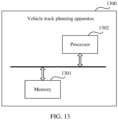
- FIG. 13 is a schematic diagram of a structure of a track planning apparatus according to an embodiment of this application.
- a track planning apparatus 1300 may include a memory 1301 and a processor 1302, and may further include a bus system.
- the processor 1302 and the memory 1301 may be connected through the bus system.
- the processor 1302 may be a chip.
- the processor 1302 may be a field programmable gate array (field programmable gate array, FPGA), an application-specific integrated circuit (application-specific integrated circuit, ASIC), a system on a chip (system on a chip, SoC), a central processing unit (central processing unit, CPU), a network processor (network processor, NP), a digital signal processor (digital signal processor, DSP), a micro controller unit (micro controller unit, MCU), a programmable logic device (programmable logic device, PLD), or another integrated chip.
- field programmable gate array field programmable gate array
- ASIC application-specific integrated circuit
- SoC system on a chip
- CPU central processing unit
- network processor network processor
- DSP digital signal processor
- micro controller unit micro controller unit
- MCU programmable logic device
- PLD programmable logic device
- each step of the foregoing method may be completed by using an integrated logic circuit of hardware in the processor 1302 or an instruction in a form of software.
- the steps of the method disclosed with reference to embodiments of this application may be directly performed by a hardware processor, or may be performed by using a combination of hardware in the processor 1302 and a software module.
- the software module may be located in a mature storage medium in the art, for example, a random access memory, a flash memory, a read-only memory, a programmable read-only memory, an electrically erasable programmable memory, or a register.
- the storage medium is located in the memory 1301, and the processor 1302 reads information in the memory 1301 and completes the steps in the foregoing methods in combination with hardware of the processor.
- the processor 1302 in this embodiment of this application may be an integrated circuit chip, and has a signal processing capability.
- the steps in the foregoing method embodiments can be implemented by a hardware integrated logical circuit in the processor, or by using instructions in a form of software.
- the processor may be a general-purpose processor, a digital signal processor (DSP), an application-specific integrated circuit (ASIC), a field programmable gate array (FPGA) or another programmable logic device, a discrete gate or a transistor logic device, or a discrete hardware component.
- DSP digital signal processor
- ASIC application-specific integrated circuit
- FPGA field programmable gate array
- the processor may implement or perform the methods, steps, and logical block diagrams that are disclosed in embodiments of this application.
- the general-purpose processor may be a microprocessor, or the processor may be any conventional processor or the like. Steps of the methods disclosed with reference to embodiments of this application may be directly executed and completed by a hardware decoding processor, or may be executed and completed by using a combination of hardware and software modules in the decoding processor.
- the software module may be located in a mature storage medium in the art, for example, a random access memory, a flash memory, a read-only memory, a programmable read-only memory, an electrically erasable programmable memory, or a register.
- the storage medium is located in the memory, and the processor reads information in the memory and completes the steps in the foregoing methods in combination with hardware of the processor.
- the memory 1301 in this embodiment of this application may be a volatile memory or a nonvolatile memory, or may include a volatile memory and a nonvolatile memory.
- the nonvolatile memory may be a read-only memory (read-only memory, ROM), a programmable read-only memory (programmable ROM, PROM), an erasable programmable read-only memory (erasable PROM, EPROM), an electrically erasable programmable read-only memory (electrically EPROM, EEPROM), or a flash memory.
- the volatile memory may be a random access memory (random access memory, RAM), used as an external cache.
- RAMs may be used, for example, a static random access memory (static RAM, SRAM), a dynamic random access memory (dynamic RAM, DRAM), a synchronous dynamic random access memory (synchronous DRAM, SDRAM), a double data rate synchronous dynamic random access memory (double data rate SDRAM, DDR SDRAM), an enhanced synchronous dynamic random access memory (enhanced SDRAM, ESDRAM), a synchronous link dynamic random access memory (synchlink DRAM, SLDRAM), and a direct rambus random access memory (direct rambus RAM, DR RAM).
- static random access memory static random access memory
- DRAM dynamic random access memory
- DRAM dynamic random access memory
- SDRAM synchronous dynamic random access memory
- double data rate SDRAM double data rate SDRAM
- DDR SDRAM double data rate SDRAM
- ESDRAM enhanced synchronous dynamic random access memory
- SLDRAM synchronous link dynamic random access memory
- direct rambus RAM direct rambus RAM
- This application further provides a vehicle, and the vehicle may include the foregoing track planning apparatus.
- the vehicle may be the first vehicle in this application.
- this application further provides a computer program product.
- the computer program product includes computer program code or instructions.
- the computer program code or the instructions is/are run on a computer, the computer is enabled to perform the method according to any one of the foregoing method embodiments.
- this application further provides a computer-readable storage medium.
- the computer-readable medium stores program code.
- the program code When the program code is run on a computer, the computer is enabled to perform the method in any one of the foregoing method embodiments.
- this application further provides a chip system.
- the chip system may include a processor.
- the processor is coupled to the memory, and may be configured to perform the method in any one of the foregoing method embodiments.
- the chip system further includes a memory.
- the memory is configured to store a computer program (which may also be referred to as code or instructions).
- the processor is configured to invoke the computer program from the memory and run the computer program, so that a device on which the chip system is installed performs the method in any one of the foregoing method embodiments.
- All or some of the foregoing embodiments may be implemented by using software, hardware, firmware, or any other combination thereof.
- the foregoing embodiments may be implemented completely or partially in a form of a computer program product.
- the compute program product includes one or more computer instructions.
- the computer may be a general-purpose computer, a dedicated computer, a computer network, or other programmable apparatuses.
- the computer instructions may be stored in a computer-readable storage medium or may be transmitted from a computer-readable storage medium to another computer-readable storage medium.
- the computer instructions may be transmitted from a website, computer, server, or data center to another website, computer, server, or data center in a wired (for example, a coaxial cable, an optical fiber, or a digital subscriber line (DSL)) or wireless (for example, infrared, radio, or microwave) manner.
- the computer-readable storage medium may be any usable medium accessible by a computer, or a data storage device, such as a server or a data center, integrating one or more usable media.
- the usable medium may be a magnetic medium (for example, a floppy disk, a hard disk, or a magnetic tape), an optical medium (for example, a DVD), or a semiconductor medium.
- the semiconductor medium may be a solid state drive (solid state drive, SSD).
- the disclosed system, apparatus, and method may be implemented in other manners.
- the described apparatus embodiment is merely an example.
- division into the units is merely logical function division and may be other division during actual implementation.
- a plurality of units or components may be combined or integrated into another system, or some features may be ignored or not performed.
- the displayed or discussed mutual couplings or direct couplings or communication connections may be implemented by using some interfaces.
- the indirect couplings or communication connections between the apparatuses or units may be implemented in electronic, mechanical, or other forms.
- the units described as separate parts may or may not be physically separate, and parts displayed as units may or may not be physical units, may be located in one position, or may be distributed on a plurality of network units. Some or all of the units may be selected based on actual requirements to achieve the objectives of the technical solutions of this application.
Landscapes
- Engineering & Computer Science (AREA)
- Physics & Mathematics (AREA)
- General Physics & Mathematics (AREA)
- Automation & Control Theory (AREA)
- Transportation (AREA)
- Mechanical Engineering (AREA)
- Human Computer Interaction (AREA)
- Traffic Control Systems (AREA)
Applications Claiming Priority (1)
| Application Number | Priority Date | Filing Date | Title |
|---|---|---|---|
| PCT/CN2021/126059 WO2023070258A1 (zh) | 2021-10-25 | 2021-10-25 | 一种车辆的轨迹规划方法、装置及车辆 |
Publications (2)
| Publication Number | Publication Date |
|---|---|
| EP4406794A1 true EP4406794A1 (de) | 2024-07-31 |
| EP4406794A4 EP4406794A4 (de) | 2024-12-11 |
Family
ID=86159905
Family Applications (1)
| Application Number | Title | Priority Date | Filing Date |
|---|---|---|---|
| EP21961649.7A Pending EP4406794A4 (de) | 2021-10-25 | 2021-10-25 | Verfahren und vorrichtung zur trajektorienplanung für ein fahrzeug und fahrzeug |
Country Status (3)
| Country | Link |
|---|---|
| EP (1) | EP4406794A4 (de) |
| CN (1) | CN116457853A (de) |
| WO (1) | WO2023070258A1 (de) |
Families Citing this family (15)
| Publication number | Priority date | Publication date | Assignee | Title |
|---|---|---|---|---|
| CN116513187B (zh) * | 2023-05-23 | 2025-08-26 | 一汽解放汽车有限公司 | 车辆换道控制方法、装置、电子设备及存储介质 |
| CN116540745B (zh) * | 2023-07-05 | 2023-09-12 | 新石器慧通(北京)科技有限公司 | 轨迹规划方法和装置、无人车和存储介质 |
| CN116572994B (zh) * | 2023-07-10 | 2023-09-22 | 之江实验室 | 一种车辆速度规划方法、装置及计算机可读介质 |
| CN116798252A (zh) * | 2023-08-10 | 2023-09-22 | 中国科学技术大学 | 无人驾驶车辆的路权探测方法及系统 |
| CN116734882B (zh) * | 2023-08-14 | 2023-11-24 | 禾昆科技(北京)有限公司 | 车辆路径规划方法、装置、电子设备和计算机可读介质 |
| CN117429448B (zh) * | 2023-10-24 | 2024-10-25 | 北京易航远智科技有限公司 | 障碍物未来占据空间的预测方法、装置、电子设备及介质 |
| CN117141474B (zh) * | 2023-10-30 | 2024-01-30 | 深圳海星智驾科技有限公司 | 障碍物轨迹预测方法、装置、车辆控制器、系统及车辆 |
| CN117622215B (zh) * | 2023-11-30 | 2025-09-26 | 驭势科技(北京)有限公司 | 与逆向障碍物交互的决策方法、装置、电子设备和介质 |
| CN117755302B (zh) * | 2023-12-25 | 2025-11-21 | 驭势科技(北京)有限公司 | 换道决策方法、装置、电子设备和存储介质 |
| CN117636270B (zh) * | 2024-01-23 | 2024-04-09 | 南京理工大学 | 基于单目摄像头的车辆抢道事件识别方法及设备 |
| CN117873120B (zh) * | 2024-03-13 | 2024-05-28 | 中国民用航空总局第二研究所 | 机场无人驾驶设备的状态控制方法、装置、设备及介质 |
| CN117885764B (zh) * | 2024-03-14 | 2024-06-21 | 中国第一汽车股份有限公司 | 车辆的轨迹规划方法、装置、车辆及存储介质 |
| CN120121075B (zh) * | 2025-04-23 | 2025-09-23 | 新石器慧通(北京)科技有限公司 | 轨迹规划的方法、装置、电子设备、及自动驾驶车辆 |
| CN120363949B (zh) * | 2025-06-26 | 2025-09-02 | 浙江吉利控股集团有限公司 | 一种会车轨迹预测方法、装置、电子设备、车辆及产品 |
| CN120910933B (zh) * | 2025-09-24 | 2025-12-12 | 东软睿驰汽车技术(沈阳)有限公司 | 一种车辆轨迹生成方法及相关装置 |
Family Cites Families (10)
| Publication number | Priority date | Publication date | Assignee | Title |
|---|---|---|---|---|
| CN106527452B (zh) * | 2016-12-30 | 2019-11-05 | 广州汽车集团股份有限公司 | 一种无人驾驶汽车遇障时运动路径规划方法及系统 |
| CN107168305B (zh) * | 2017-04-01 | 2020-03-17 | 西安交通大学 | 路口场景下基于Bezier和VFH的无人车轨迹规划方法 |
| CN109213134B (zh) * | 2017-07-03 | 2020-04-28 | 百度在线网络技术(北京)有限公司 | 生成自动驾驶策略的方法和装置 |
| CN109204311B (zh) * | 2017-07-04 | 2021-06-01 | 华为技术有限公司 | 一种汽车速度控制方法和装置 |
| DE102018109883A1 (de) * | 2018-04-24 | 2018-12-20 | Continental Teves Ag & Co. Ohg | Verfahren und Vorrichtung zum kooperativen Abstimmen von zukünftigen Fahrmanövern eines Fahrzeugs mit Fremdmanövern zumindest eines Fremdfahrzeugs |
| CN111965968A (zh) * | 2019-05-20 | 2020-11-20 | 华为技术有限公司 | 一种切换控制方法、系统及装置 |
| CN110362096B (zh) * | 2019-08-13 | 2021-05-18 | 东北大学 | 一种基于局部最优性的无人驾驶车辆动态轨迹规划方法 |
| CN110674723B (zh) * | 2019-09-19 | 2022-07-15 | 北京三快在线科技有限公司 | 一种确定无人驾驶车辆行驶轨迹的方法及装置 |
| US11390300B2 (en) * | 2019-10-18 | 2022-07-19 | Uatc, Llc | Method for using lateral motion to optimize trajectories for autonomous vehicles |
| US20210114625A1 (en) * | 2019-10-18 | 2021-04-22 | WeRide Corp. | System and method for autonomous collision avoidance |
-
2021
- 2021-10-25 EP EP21961649.7A patent/EP4406794A4/de active Pending
- 2021-10-25 WO PCT/CN2021/126059 patent/WO2023070258A1/zh not_active Ceased
- 2021-10-25 CN CN202180057306.9A patent/CN116457853A/zh active Pending
Also Published As
| Publication number | Publication date |
|---|---|
| EP4406794A4 (de) | 2024-12-11 |
| WO2023070258A1 (zh) | 2023-05-04 |
| CN116457853A (zh) | 2023-07-18 |
Similar Documents
| Publication | Publication Date | Title |
|---|---|---|
| EP4406794A1 (de) | Verfahren und vorrichtung zur trajektorienplanung für ein fahrzeug und fahrzeug | |
| JP7289760B2 (ja) | 電子制御装置 | |
| EP4261092B1 (de) | Steuerungsverfahren, zugehörige vorrichtung und computerlesbares speichermedium | |
| US10235881B2 (en) | Autonomous operation capability configuration for a vehicle | |
| US20200258380A1 (en) | Control system and control method for interaction-based long-term determination of trajectories for motor vehicles | |
| CN112590778B (zh) | 车辆控制的方法、装置、控制器和智能汽车 | |
| EP3886073A1 (de) | Kollaboratives sicherheitsfahrmodell (sdm) für autonome fahrzeuge | |
| US11377120B1 (en) | Autonomous vehicle control based on risk-based interactions | |
| US12233856B2 (en) | Vehicle control method | |
| US20220227391A1 (en) | Systems and methods for scenario dependent trajectory scoring | |
| US20230256999A1 (en) | Simulation of imminent crash to minimize damage involving an autonomous vehicle | |
| US12565202B2 (en) | Intelligent driving method and vehicle to which method is applied | |
| US20230391333A1 (en) | Processing method, processing system, and storage medium | |
| CN113561977A (zh) | 车辆自适应巡航控制方法、装置、设备和存储介质 | |
| CN114030486A (zh) | 动态障碍物的轨迹预测方法、装置、电子设备和存储介质 | |
| US12566434B2 (en) | Processing device, processing method, processing system, storage medium | |
| US20230053243A1 (en) | Hybrid Performance Critic for Planning Module's Parameter Tuning in Autonomous Driving Vehicles | |
| US12583476B2 (en) | Method for controlling an autonomous vehicle | |
| US12548442B2 (en) | Processing device, processing method, processing system, and storage medium | |
| JP7662636B2 (ja) | 知覚誤差モデル | |
| CN119329512A (zh) | 一种车辆预警方法、装置、电子设备、存储介质和程序产品 | |
| CN116009533B (zh) | 一种无人驾驶车辆路径切换方法、装置、系统和介质 | |
| CN116552513A (zh) | 确定车辆行驶的危险视野的方法、行驶的控制方法及车辆 | |
| CN117789523B (zh) | 行驶轨迹生成方法、装置、存储介质与电子设备 | |
| KR20250048775A (ko) | 정보 처리 장치, 방법 및 프로그램 |
Legal Events
| Date | Code | Title | Description |
|---|---|---|---|
| STAA | Information on the status of an ep patent application or granted ep patent |
Free format text: STATUS: THE INTERNATIONAL PUBLICATION HAS BEEN MADE |
|
| PUAI | Public reference made under article 153(3) epc to a published international application that has entered the european phase |
Free format text: ORIGINAL CODE: 0009012 |
|
| STAA | Information on the status of an ep patent application or granted ep patent |
Free format text: STATUS: REQUEST FOR EXAMINATION WAS MADE |
|
| 17P | Request for examination filed |
Effective date: 20240422 |
|
| AK | Designated contracting states |
Kind code of ref document: A1 Designated state(s): AL AT BE BG CH CY CZ DE DK EE ES FI FR GB GR HR HU IE IS IT LI LT LU LV MC MK MT NL NO PL PT RO RS SE SI SK SM TR |
|
| A4 | Supplementary search report drawn up and despatched |
Effective date: 20241108 |
|
| RIC1 | Information provided on ipc code assigned before grant |
Ipc: G08G 1/16 20060101ALI20241104BHEP Ipc: B60W 30/08 20120101AFI20241104BHEP |
|
| RAP1 | Party data changed (applicant data changed or rights of an application transferred) |
Owner name: SHENZHEN YINWANG INTELLIGENTTECHNOLOGIES CO., LTD. |
|
| DAV | Request for validation of the european patent (deleted) | ||
| DAX | Request for extension of the european patent (deleted) |