EP4406773A1 - Ev advanced cooling device - Google Patents
Ev advanced cooling device Download PDFInfo
- Publication number
- EP4406773A1 EP4406773A1 EP23153509.7A EP23153509A EP4406773A1 EP 4406773 A1 EP4406773 A1 EP 4406773A1 EP 23153509 A EP23153509 A EP 23153509A EP 4406773 A1 EP4406773 A1 EP 4406773A1
- Authority
- EP
- European Patent Office
- Prior art keywords
- charging
- cooling
- socket
- power link
- cooling arrangement
- Prior art date
- Legal status (The legal status is an assumption and is not a legal conclusion. Google has not performed a legal analysis and makes no representation as to the accuracy of the status listed.)
- Withdrawn
Links
Images



Classifications
-
- H—ELECTRICITY
- H05—ELECTRIC TECHNIQUES NOT OTHERWISE PROVIDED FOR
- H05K—PRINTED CIRCUITS; CASINGS OR CONSTRUCTIONAL DETAILS OF ELECTRIC APPARATUS; MANUFACTURE OF ASSEMBLAGES OF ELECTRICAL COMPONENTS
- H05K7/00—Constructional details common to different types of electric apparatus
- H05K7/20—Modifications to facilitate cooling, ventilating, or heating
- H05K7/20845—Modifications to facilitate cooling, ventilating, or heating for automotive electronic casings
-
- B—PERFORMING OPERATIONS; TRANSPORTING
- B60—VEHICLES IN GENERAL
- B60L—PROPULSION OF ELECTRICALLY-PROPELLED VEHICLES; SUPPLYING ELECTRIC POWER FOR AUXILIARY EQUIPMENT OF ELECTRICALLY-PROPELLED VEHICLES; ELECTRODYNAMIC BRAKE SYSTEMS FOR VEHICLES IN GENERAL; MAGNETIC SUSPENSION OR LEVITATION FOR VEHICLES; MONITORING OPERATING VARIABLES OF ELECTRICALLY-PROPELLED VEHICLES; ELECTRIC SAFETY DEVICES FOR ELECTRICALLY-PROPELLED VEHICLES
- B60L53/00—Methods of charging batteries, specially adapted for electric vehicles; Charging stations or on-board charging equipment therefor; Exchange of energy storage elements in electric vehicles
- B60L53/10—Methods of charging batteries, specially adapted for electric vehicles; Charging stations or on-board charging equipment therefor; Exchange of energy storage elements in electric vehicles characterised by the energy transfer between the charging station and the vehicle
- B60L53/14—Conductive energy transfer
- B60L53/16—Connectors, e.g. plugs or sockets, specially adapted for charging electric vehicles
-
- B—PERFORMING OPERATIONS; TRANSPORTING
- B60—VEHICLES IN GENERAL
- B60L—PROPULSION OF ELECTRICALLY-PROPELLED VEHICLES; SUPPLYING ELECTRIC POWER FOR AUXILIARY EQUIPMENT OF ELECTRICALLY-PROPELLED VEHICLES; ELECTRODYNAMIC BRAKE SYSTEMS FOR VEHICLES IN GENERAL; MAGNETIC SUSPENSION OR LEVITATION FOR VEHICLES; MONITORING OPERATING VARIABLES OF ELECTRICALLY-PROPELLED VEHICLES; ELECTRIC SAFETY DEVICES FOR ELECTRICALLY-PROPELLED VEHICLES
- B60L53/00—Methods of charging batteries, specially adapted for electric vehicles; Charging stations or on-board charging equipment therefor; Exchange of energy storage elements in electric vehicles
- B60L53/10—Methods of charging batteries, specially adapted for electric vehicles; Charging stations or on-board charging equipment therefor; Exchange of energy storage elements in electric vehicles characterised by the energy transfer between the charging station and the vehicle
- B60L53/14—Conductive energy transfer
- B60L53/18—Cables specially adapted for charging electric vehicles
-
- B—PERFORMING OPERATIONS; TRANSPORTING
- B60—VEHICLES IN GENERAL
- B60L—PROPULSION OF ELECTRICALLY-PROPELLED VEHICLES; SUPPLYING ELECTRIC POWER FOR AUXILIARY EQUIPMENT OF ELECTRICALLY-PROPELLED VEHICLES; ELECTRODYNAMIC BRAKE SYSTEMS FOR VEHICLES IN GENERAL; MAGNETIC SUSPENSION OR LEVITATION FOR VEHICLES; MONITORING OPERATING VARIABLES OF ELECTRICALLY-PROPELLED VEHICLES; ELECTRIC SAFETY DEVICES FOR ELECTRICALLY-PROPELLED VEHICLES
- B60L53/00—Methods of charging batteries, specially adapted for electric vehicles; Charging stations or on-board charging equipment therefor; Exchange of energy storage elements in electric vehicles
- B60L53/30—Constructional details of charging stations
- B60L53/302—Cooling of charging equipment
-
- H—ELECTRICITY
- H01—ELECTRIC ELEMENTS
- H01R—ELECTRICALLY-CONDUCTIVE CONNECTIONS; STRUCTURAL ASSOCIATIONS OF A PLURALITY OF MUTUALLY-INSULATED ELECTRICAL CONNECTING ELEMENTS; COUPLING DEVICES; CURRENT COLLECTORS
- H01R13/00—Details of coupling devices of the kinds covered by groups H01R12/70 or H01R24/00 - H01R33/00
- H01R13/46—Bases; Cases
- H01R13/502—Bases; Cases composed of different pieces
-
- Y—GENERAL TAGGING OF NEW TECHNOLOGICAL DEVELOPMENTS; GENERAL TAGGING OF CROSS-SECTIONAL TECHNOLOGIES SPANNING OVER SEVERAL SECTIONS OF THE IPC; TECHNICAL SUBJECTS COVERED BY FORMER USPC CROSS-REFERENCE ART COLLECTIONS [XRACs] AND DIGESTS
- Y02—TECHNOLOGIES OR APPLICATIONS FOR MITIGATION OR ADAPTATION AGAINST CLIMATE CHANGE
- Y02T—CLIMATE CHANGE MITIGATION TECHNOLOGIES RELATED TO TRANSPORTATION
- Y02T10/00—Road transport of goods or passengers
- Y02T10/60—Other road transportation technologies with climate change mitigation effect
- Y02T10/70—Energy storage systems for electromobility, e.g. batteries
-
- Y—GENERAL TAGGING OF NEW TECHNOLOGICAL DEVELOPMENTS; GENERAL TAGGING OF CROSS-SECTIONAL TECHNOLOGIES SPANNING OVER SEVERAL SECTIONS OF THE IPC; TECHNICAL SUBJECTS COVERED BY FORMER USPC CROSS-REFERENCE ART COLLECTIONS [XRACs] AND DIGESTS
- Y02—TECHNOLOGIES OR APPLICATIONS FOR MITIGATION OR ADAPTATION AGAINST CLIMATE CHANGE
- Y02T—CLIMATE CHANGE MITIGATION TECHNOLOGIES RELATED TO TRANSPORTATION
- Y02T10/00—Road transport of goods or passengers
- Y02T10/60—Other road transportation technologies with climate change mitigation effect
- Y02T10/7072—Electromobility specific charging systems or methods for batteries, ultracapacitors, supercapacitors or double-layer capacitors
Definitions
- the invention relates to the field of charging devices for electric vehicles (EV), particularly for cooling parts, e.g. cables, of charging devices.
- EV electric vehicles
- the invention further relates to a use.
- One aspect relates to a cooling arrangement configured for being arranged between a charging connector of an electric vehicle charging system and a charging socket of an electric vehicle, the cooling arrangement comprising: a power link, which is electrically and thermally conductive, configured for being arranged between a charging contact of the charging connector and a socket contact of the charging socket, wherein the power link is thermally connected to a cooling unit.
- the cooling arrangement configured for being arranged in a region of a plug, particularly between a charging connector of an electric vehicle charging system and a charging socket of an electric vehicle. Analyses have shown that in such a region, caused by high currents, higher temperatures may arise during charging the electric vehicle (EV). The higher temperatures may arise, e.g., due to transitions resistances of the plus itself - i.e. between the so-called charging connector of the electric vehicle charging system and the so-called charging socket of an electric vehicle -, or due to transitions resistances of crimping. Regardless the number of pins of the charging connector, the conductors need to be crimped to the contacts, whose size may be fixed, e.g. by standards, for a given DC connector type. The contact resistance introduced by the electrical contacts may be a strong contributor to the overall thermal resistance of the system. In addition, the crimps on the side of the connector and car inlet may have an important contribution. High resistance under high current means high electric power losses, therefore high temperatures.
- High temperatures of the charging connector may not only reduce the maximum current through the cables, because the cables' resistance is increased at higher temperatures. High temperatures of the charging connector may also have a risk to harm persons who handle the charging connector. This is also a reason for some legal and other regulations concerning these parts. For instance, standards like IEC 62196 series or UL 2251 limit the maximum temperature of the electrical contacts, which should not exceed by 50°C the ambient temperature during charging, and must not exceed 90°C in any case, to avoid any possible damage of the cable interface and of the car socket. As regards the temperature of graspable and touchable parts, the standards, e.g.
- IEC:2010 guide 117 claim that the maximum permissible temperature of parts of connectors or cable that can be grasped during normal operation shall not exceed 60°C, while for non-metal parts that may be touched but not grasped the permissible temperature is up to 85°C.
- the cooling arrangement leads, when arranged between the charging connector and the charging socket, advantageously not only to a reduction of the temperature of the plugs - and, thus, of the handle -, but additionally to a reduction of the temperature of neighbouring current conducting parts of a charging device, for example of crimping regions.
- the cooling arrangement may be implemented as part of the charging connector, as part of the charging socket, and/or as a "box" of its own.
- the cooling arrangement may be called an Advanced Cooling Device (ACD).
- ACD Advanced Cooling Device
- the cooling arrangement may enable higher charging currents than the maximum feasible and/or allowed currents without this cooling arrangement.
- the cooling arrangement realized by a power link, which may be positioned in a central region of the cooling arrangement.
- the power link is of a material that is electrically and thermally conductive, for instance copper or the like.
- the power link is configured for being arranged between a charging contact of the charging connector and a socket contact of the charging socket.
- the power link may, depending on the standard of the charging connector, be implemented as a plurality of parts, for example one power link for each high-current conducting wire of a charging cable, e.g. for each DC+ and DC-wire of a DC charger.
- the power link may have, on one end, a male part for connecting to the charging connector and, on another end, a female part for connecting to the charging socket.
- the power link is thermally connected to the cooling unit.
- the power link may have any form, but may be preferably plane, to have a broadest possible contact to the cooling unit.
- the power link's core may be selected for cooling units of other optimized forms.
- the power link comprises or consists of metal, particularly of copper, aluminium, and/or an alloy comprising at least one of these metals. These materials are advantageously highly electrically and thermally conductive, thus both causing lower temperatures for current flowing through the power link and providing a good thermal connection to the cooling unit.
- a coupling component is arranged between the power link and the cooling unit, the coupling component comprising an electrically isolating and thermally conductive material.
- a material may comprise ceramics, e.g. Al 2 O 3 , TiC, WC, ZrO 2 , AIN, SiC, or similar, preferably AIN and Al 2 O 3 , because of a high thermal conductivity and cost efficiency.
- Further examples may comprise plastics that are electrically insulating and Also thermally conductive, however in many cases with an order of magnitude lower thermal conductivity compared to ceramics.
- Al 2 O 3 has an value of about 30 W/mK, and plastics about 0.2 W/mK.
- the coupling component may comprise one or more layers.
- the coupling component may contribute to a good isolation between different power links, thus preventing a short and keeping the cooling arrangement small.
- the coupling component may contribute to a thermal balance between the parts of the cooling arrangement, thus reducing a thermal stress of these parts.
- the charging connector is connected to the power link either via a female socket or via a male pin, and/or the charging socket is connected to the power link either via a male pin or via a female socket.
- the charging connector may support and/or may be compatible to standards like CHAdeMO, GB/T, CCS - Type 1, CCS - Type 2, MCS, and/or other standards. Non-standard (proprietary) solutions may be supported as well.
- the charging connector may be applied not only to a charging device for electric vehicles, but also to devices where high currents may lead to similar restrictions as explained above.
- the charging connector may comprise a plurality of pins, depending on the connector.
- the contacts of the female socket and/or the male pin may be coated, e.g. for a higher electric and/or thermal conductivity.
- the coating may include gold, silver, palladium, nickel, other highly conducting materials and/or an alloy of these materials.
- the cooling arrangement may further comprise a housing for covering at least the power link and the cooling unit and, optionally, a charging interface configured for coupling the charging connector, and/or a socket interface configured for coupling the charging socket.
- an integrated solution for a charging connector may include only the charging interface and may, e.g., be part of the charging connector and/or the charging handle.
- Another example may be an integrated solution for an electric vehicle that may include only the socket interface, thus being part of the EV.
- Another solution may be a "box" of its own, i.e. the cooling arrangement's parts arranged in the housing.
- the charging interface and/or the socket interface may - at least partially - be covered by the housing.
- the cooling arrangement may be called an Advanced Cooling Device (ACD).
- ACD Advanced Cooling Device
- the ACD may be compatible to standards, e.g. the ones listed above, or to a proprietary solution.
- the cooling effect of the cooling unit is achieved by dissipating heat through a finned surface and/or a heat pipe via natural air convection.
- This may be realized by a collector block with embedded heat pipes that collects the heat from the DC power link, dissipating through a finned surface via natural convection.
- This design may be similar to a Javelin connector. In this case, no fans are used hence no battery is needed, However, the cooling capabilities of this embodiment may be limited.
- the cooling effect of the cooling unit is achieved by a combined heat pipe-forced convection cooling.
- This embodiment may have similarities with a high-end CPU cooling that has a high-power dissipation capability.
- combined heat pipe-forced convection cooling methods are well established and a lot of suppliers are available.
- a collector block with embedded heat pipes may be used for cooling.
- the collector block collects the heat from the DC power link, and dissipates it through a finned surface with a fan.
- the fan may be driven by a battery and/or by other power sources.
- the device may be fed by an embedded battery, and for integrated solutions the low voltage power may be provided by a hosting unit.
- the cooling effect of the cooling unit is achieved by a forced air convection combined with an advanced heat sink.
- a forced air convection combined with an advanced heat sink.
- so-called 3D vapor chamber technology may be used for an enhanced cooling effect.
- Vapor chambers and heat pipes may be combined, creating a closed vapor chamber system.
- the warmed liquid is dissipated up through the fin assembly of the cooler.
- a coolant fluid e.g. a flow
- a coolant fluid may be used to extract heat from the substrate with an enhanced global heat transfer coefficient.
- high heat rejections may be achieved. This solution may particularly suit for automotive application since water-glycol cooling loops are already present in the vehicle.
- the cooling effect of the cooling unit is achieved by active cooling, particularly by a Peltier cell.
- active cooling particularly by a Peltier cell.
- a Peltier thermoelectric module consists of P-type and N-Type Bismuth Telluride semiconductor pellets. These are separated by ceramic substrates, which are metalized to allow the conduction of heat from the "cool” to the "hot” side of the module when connected to a dc voltage source.
- Peltier cell solution allows the power link to exchange heat with a source at a temperature below the ambient one. This kind of solution may even be feasible for cooling in very hot climate areas with severe thermal conditions.
- An aspect relates to a use of a cooling arrangement as described above and/or below for lowering a temperature of a charging contact, a socket contact, a power link and/or another current carrying part of a charging system for charging electric vehicles.
- Fig. 1 shows schematically a current output of a charging connector as function of charging time, which quantifies this effect. Particularly, Fig. 1 shows results of a boost mode at 500 A test done in ABB laboratories with a commercial 300 A nominal rating charging connector, plugged into a 90 mm 2 inlet-socket, at an ambient temperature T_ambient of about 40°C. Although Fig. 1 only shows a situation of a DC charger, an AC charger behaves in a similar way.
- the temperature T_contact_DC+ of the DC+ contact and the temperature T_contact_DC-of the DC- contact rise above 80°C.
- the temperature T_Cable_sheath of the cable sheath rises above 50°C, which makes a handling of the charging connector less agreeable.
- the current output decreases significantly, from its 500 A peak down to about 300 A, on long term. This, in effect, decreases the temperature T_cu-conductor of the conductor, but does not lead to a higher current output.
- the current output stays at about 295 A. It is clearly visible that a lower temperature at the (DC+ and DC-) contacts leads to a significantly higher current output.
- FIG. 2 shows schematically a current output of a charging connector as function of temperature, using 70 mm 2 socket inlet. Measurements are also taken at ambient temperatures of 20°C, 30°C and 40°C. The chart shows the relationship between the current output at regime condition, and the boost mode duration as well, with ambient temperature. At 40°C ambient temperature the connector can deliver continuously 250 A instead of the rated 300 A. Lower ambient temperatures may allow higher continuous current deliver, e.g. 300 A for 30°C and 350 A for 20°C.
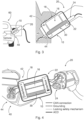
- Fig. 3 shows schematically an embodiment.
- Fig. 3 left hand shows roughly, where an ACD (Advanced Cooling Device) is intended to be positioned, i.e. between a charging socket 40 of a car or EV 60 and a charging connector 20.
- Fig. 3 right hand shows details of an embodiment of the ACD.
- the ACD is designed as a cooling arrangement 10 that comprises a housing 18.
- the housing 18 covers a power link 30 and a cooling unit 16, which is thermally connected to the power link 30.
- the power link 30 is electrically and thermally conductive, e.g. consisting of a metal.
- the power link 30 is arranged between a charging contact 24 of the charging connector 20 and a socket contact 44 of the charging socket 40.
- a coupling component 12 may be arranged between the power link 30 and the cooling unit 16.
- a charging interface 22 and a socket interface 42 is arranged in the housing 18.
- the charging interface 22 is configured for coupling the charging connector 20, and is designed similarly to the charging socket 40.
- the socket interface 42 is configured for coupling the charging socket 40.
- the cooling arrangement 10 can be plugged into the charging socket 40 of the EV, and the charging connector 20 can be plugged into the cooling arrangement 10.
- This embodiment of cooling arrangement 10 can be brought by an own of an EV, who comes for charging, and/or can be provided by service personnel that runs the charging station.
- the cooling arrangement 10 may be installed in the car 60, at a region of the charging socket 40. This embodiment may be available without a socket interface 42, and the charging interface 22 may look like an original charging socket 40 of the EV. In yet another embodiment (not shown), the cooling arrangement 10 may be installed in the charging connector 20. This embodiment may be available without a charging interface 22, and the socket interface 42 may look like an original charging connector 20. These embodiments may be called an "integrated solution"; they may be combined.
- Fig. 4 shows schematically an embodiment, e.g. the embodiment of Fig. 3 in some more details. Same reference signs as in Fig. 3 depict same of similar components.
- the ACD is shown before the charging session, i.e. not plugged yet, and the additional wires - other than DC+ and DC-, e.g. Protective Earth (PE) - are depicted in a symbolic way to show their connectivity. Further additional wires may also be "forwarded" in the ACD, e.g. communication cables, for example of a CAN bus, and/or other cables, which may not be intended to carry high currents.
- PE Protective Earth
- FIG. 5 shows schematically a systematic of embodiments.
- An ACD may either be sold to B2B (business to business) customers or to B2C customers.
- B2B customers may use an ACD as an integrated solution.
- An EV producer may install such an integrated solution within an EV 60.
- a cable producer may install an integrated solution as part of a charging connector 20.
- Charging point operators and/or service personnel that runs the charging station may lend or sell a stand-alone ACD (in a housing) for a charging session.
- B2C customers may buy a stand-alone ACD for charging sessions.
- Fig. 6 shows schematically a part of an embodiment, particularly an embodiment of a coupling component 12 and 14 that is arranged between the power link 30 and the cooling unit 16 (not shown), which is to be arranged on top of coupling component 14.
- the power link 30 may have, at its end, a female pin 32 or a male pin 34.
- the power link 30 may, at its core, be rectangular, particularly with a plane surface towards the cooling unit 16 or to the coupling component 12 and/or 14, respectively.
- the power links 30 may be separated by an electrical insulator.
- a first coupling component 12 may be designed as an electrically isolating and thermally conductive material. This coupling component may contribute to a good isolation between different power links, thus preventing a short and keeping the cooling arrangement small.
- the cooling arrangement may comprise a second coupling component 14.
- the second coupling component 14 may be designed as a high thermal conductivity layer.
- the second coupling component 14 may contribute to a thermal balance between the parts of the cooling arrangement, thus reducing a
- Fig. 7 shows schematically a part of an embodiment, particularly an embodiment of a cooling unit 16.
- a collector block with embedded heat pipes is used for cooling.
- the collector block collects the heat from the DC power link, and dissipates it through a finned surface with a fan.
- the fan may be driven by a battery and/or by other power sources.
- the device may be fed by an embedded battery, and for integrated solutions the low voltage power may be provided by a hosting unit.
- Fig. 8a and 8b show schematically a part of an embodiment, particularly an embodiment of a cooling unit 16.
- the cooling effect of the cooling unit is achieved by a forced air convection combined with an advanced heat sink.
- so-called 3D vapor chamber technology may be used for an enhanced cooling effect.
- Vapor chambers and heat pipes may be combined, creating a closed vapor chamber system.
- the warmed liquid is dissipated up through the fin assembly of the cooler.
- Fig. 8a shows a complete version of this embodiment.
- Fig. 8b shows a partly cut-off version of this embodiment.
- Fig. 9 shows schematically a part of an embodiment, particularly an embodiment of a cooling unit 16.
- the cooling effect of the cooling unit is achieved by a forced coolant fluid convection combined with an advanced heat sink.
- a coolant fluid e.g. a flow
- a coolant fluid may be used to extract heat from the substrate with an enhanced global heat transfer coefficient.
- high heat rejections may be achieved.
- This solution may particularly suit for automotive application since water-glycol cooling loops are already present in the vehicle.
- Fig. 10a and 10b show schematically a part of an embodiment, particularly an embodiment of a cooling unit 16.
- the cooling effect of the cooling unit is achieved by active cooling, particularly by a Peltier cell.
- This kind of device allows active cooling of the heat source thanks to the Seebeck effect.
- Peltier cell solution allows the power link to exchange heat with a source at a temperature below the ambient one. This kind of solution may even be feasible for cooling in very hot climate areas with severe thermal conditions.
- Fig. 10a shows the exemplary layers of such a cooling unit 16.
- the heat source (1), i.e. power link 30 transmits its heat, via a first thermal interface material (TIM), through a cold side (2) of the Peltier cell towards its hot side (3).
- the heat is further transmitted via a second TIM to a heat sink cold side (5) for being dissipated to an ambient.
- Fig. 10b shows schematically a het flux and a thermal profile of this embodiment.
Landscapes
- Engineering & Computer Science (AREA)
- Power Engineering (AREA)
- Transportation (AREA)
- Mechanical Engineering (AREA)
- Physics & Mathematics (AREA)
- Thermal Sciences (AREA)
- Microelectronics & Electronic Packaging (AREA)
- Electric Propulsion And Braking For Vehicles (AREA)
Abstract
The invention relates to the field of charging devices for electric vehicles (EV), particularly for cooling parts, e.g. cables, of charging devices. The invention relates to a cooling arrangement (10) configured for being arranged between a charging connector (20) of an electric vehicle charging system and a charging socket (40) of an electric vehicle, the cooling arrangement (10) comprising:a power link (30), which is electrically and thermally conductive, configured for being arranged between a charging contact (24) of the charging connector (20) and a socket contact (44) of the charging socket (40), wherein the power link (30) is thermally connected to a cooling unit (16).
Description
- The invention relates to the field of charging devices for electric vehicles (EV), particularly for cooling parts, e.g. cables, of charging devices. The invention further relates to a use.
- For charging electric vehicles, in at least some cases high currents flow through the cables and/or other current conducting parts of a charging device. These high currents may lead to a heating of the cables and/or to a decrease of the current output. This effect may be particularly crucial in a region of transition parts, for instance in an area of connecting plugs.
- It is an objective of the invention to provide an apparatus that allows conducting high currents, at least in some regions of current conducting parts of a charging device. This objective is achieved by the subject-matter of the independent claims. Further embodiments are evident from the dependent claims and the following description.
- One aspect relates to a cooling arrangement configured for being arranged between a charging connector of an electric vehicle charging system and a charging socket of an electric vehicle, the cooling arrangement comprising:
a power link, which is electrically and thermally conductive, configured for being arranged between a charging contact of the charging connector and a socket contact of the charging socket, wherein the power link is thermally connected to a cooling unit. - The cooling arrangement configured for being arranged in a region of a plug, particularly between a charging connector of an electric vehicle charging system and a charging socket of an electric vehicle. Analyses have shown that in such a region, caused by high currents, higher temperatures may arise during charging the electric vehicle (EV). The higher temperatures may arise, e.g., due to transitions resistances of the plus itself - i.e. between the so-called charging connector of the electric vehicle charging system and the so-called charging socket of an electric vehicle -, or due to transitions resistances of crimping. Regardless the number of pins of the charging connector, the conductors need to be crimped to the contacts, whose size may be fixed, e.g. by standards, for a given DC connector type. The contact resistance introduced by the electrical contacts may be a strong contributor to the overall thermal resistance of the system. In addition, the crimps on the side of the connector and car inlet may have an important contribution. High resistance under high current means high electric power losses, therefore high temperatures.
- High temperatures of the charging connector may not only reduce the maximum current through the cables, because the cables' resistance is increased at higher temperatures. High temperatures of the charging connector may also have a risk to harm persons who handle the charging connector. This is also a reason for some legal and other regulations concerning these parts. For instance, standards like IEC 62196 series or UL 2251 limit the maximum temperature of the electrical contacts, which should not exceed by 50°C the ambient temperature during charging, and must not exceed 90°C in any case, to avoid any possible damage of the cable interface and of the car socket. As regards the temperature of graspable and touchable parts, the standards, e.g. IEC:2010 guide 117, claim that the maximum permissible temperature of parts of connectors or cable that can be grasped during normal operation shall not exceed 60°C, while for non-metal parts that may be touched but not grasped the permissible temperature is up to 85°C.
- Hence, the cooling arrangement leads, when arranged between the charging connector and the charging socket, advantageously not only to a reduction of the temperature of the plugs - and, thus, of the handle -, but additionally to a reduction of the temperature of neighbouring current conducting parts of a charging device, for example of crimping regions. The cooling arrangement may be implemented as part of the charging connector, as part of the charging socket, and/or as a "box" of its own. The cooling arrangement may be called an Advanced Cooling Device (ACD). As a result, the cooling arrangement may enable higher charging currents than the maximum feasible and/or allowed currents without this cooling arrangement.
- The cooling arrangement realized by a power link, which may be positioned in a central region of the cooling arrangement. The power link is of a material that is electrically and thermally conductive, for instance copper or the like. The power link is configured for being arranged between a charging contact of the charging connector and a socket contact of the charging socket. The power link may, depending on the standard of the charging connector, be implemented as a plurality of parts, for example one power link for each high-current conducting wire of a charging cable, e.g. for each DC+ and DC-wire of a DC charger. The power link may have, on one end, a male part for connecting to the charging connector and, on another end, a female part for connecting to the charging socket. The power link is thermally connected to the cooling unit. Between the end parts of the power link (at its "core"), the power link may have any form, but may be preferably plane, to have a broadest possible contact to the cooling unit. Of course, for cooling units of other optimized forms, another form of the power link's core may be selected.
- In various embodiments, the power link comprises or consists of metal, particularly of copper, aluminium, and/or an alloy comprising at least one of these metals. These materials are advantageously highly electrically and thermally conductive, thus both causing lower temperatures for current flowing through the power link and providing a good thermal connection to the cooling unit.
- In various embodiments, a coupling component is arranged between the power link and the cooling unit, the coupling component comprising an electrically isolating and thermally conductive material. Examples of such a material may comprise ceramics, e.g. Al2O3, TiC, WC, ZrO2, AIN, SiC, or similar, preferably AIN and Al2O3, because of a high thermal conductivity and cost efficiency. Further examples may comprise plastics that are electrically insulating and Also thermally conductive, however in many cases with an order of magnitude lower thermal conductivity compared to ceramics. For instance. Al2O3 has an value of about 30 W/mK, and plastics about 0.2 W/mK. The coupling component may comprise one or more layers. The coupling component may contribute to a good isolation between different power links, thus preventing a short and keeping the cooling arrangement small. The coupling component may contribute to a thermal balance between the parts of the cooling arrangement, thus reducing a thermal stress of these parts.
- In various embodiments, the charging connector is connected to the power link either via a female socket or via a male pin, and/or the charging socket is connected to the power link either via a male pin or via a female socket. This may depend on the standards to be supported. The charging connector may support and/or may be compatible to standards like CHAdeMO, GB/T, CCS -
Type 1, CCS -Type 2, MCS, and/or other standards. Non-standard (proprietary) solutions may be supported as well. In at least some embodiments, the charging connector may be applied not only to a charging device for electric vehicles, but also to devices where high currents may lead to similar restrictions as explained above. The charging connector may comprise a plurality of pins, depending on the connector. - The contacts of the female socket and/or the male pin may be coated, e.g. for a higher electric and/or thermal conductivity. The coating may include gold, silver, palladium, nickel, other highly conducting materials and/or an alloy of these materials.
- In some embodiments, the cooling arrangement may further comprise a housing for covering at least the power link and the cooling unit and, optionally, a charging interface configured for coupling the charging connector, and/or a socket interface configured for coupling the charging socket.
- For instance, an integrated solution for a charging connector may include only the charging interface and may, e.g., be part of the charging connector and/or the charging handle. Another example may be an integrated solution for an electric vehicle that may include only the socket interface, thus being part of the EV. Another solution may be a "box" of its own, i.e. the cooling arrangement's parts arranged in the housing. The charging interface and/or the socket interface may - at least partially - be covered by the housing. The cooling arrangement may be called an Advanced Cooling Device (ACD). The ACD may be compatible to standards, e.g. the ones listed above, or to a proprietary solution.
- In an embodiment, the cooling effect of the cooling unit is achieved by dissipating heat through a finned surface and/or a heat pipe via natural air convection. This may be realized by a collector block with embedded heat pipes that collects the heat from the DC power link, dissipating through a finned surface via natural convection. This design may be similar to a Javelin connector. In this case, no fans are used hence no battery is needed, However, the cooling capabilities of this embodiment may be limited.
- In an embodiment, the cooling effect of the cooling unit is achieved by a combined heat pipe-forced convection cooling. This embodiment may have similarities with a high-end CPU cooling that has a high-power dissipation capability. Advantageously, combined heat pipe-forced convection cooling methods are well established and a lot of suppliers are available.
- In an embodiment, a collector block with embedded heat pipes may be used for cooling. In this case, the collector block collects the heat from the DC power link, and dissipates it through a finned surface with a fan. The fan may be driven by a battery and/or by other power sources. For example, for portable solutions, the device may be fed by an embedded battery, and for integrated solutions the low voltage power may be provided by a hosting unit.
- In an embodiment, the cooling effect of the cooling unit is achieved by a forced air convection combined with an advanced heat sink. For instance, so-called 3D vapor chamber technology may be used for an enhanced cooling effect. Vapor chambers and heat pipes may be combined, creating a closed vapor chamber system. In this solution, the warmed liquid is dissipated up through the fin assembly of the cooler.
- Additionally or as an alternative, a coolant fluid (e.g. a flow) may be used to extract heat from the substrate with an enhanced global heat transfer coefficient. Depending on the characteristics of the cooling block and of the flow, high heat rejections may be achieved. This solution may particularly suit for automotive application since water-glycol cooling loops are already present in the vehicle.
- In an embodiment, the cooling effect of the cooling unit is achieved by active cooling, particularly by a Peltier cell. This kind of device allows active cooling of the heat source thanks to the Seebeck effect. A Peltier thermoelectric module consists of P-type and N-Type Bismuth Telluride semiconductor pellets. These are separated by ceramic substrates, which are metalized to allow the conduction of heat from the "cool" to the "hot" side of the module when connected to a dc voltage source. Peltier cell solution allows the power link to exchange heat with a source at a temperature below the ambient one. This kind of solution may even be feasible for cooling in very hot climate areas with severe thermal conditions.
- An aspect relates to a use of a cooling arrangement as described above and/or below for lowering a temperature of a charging contact, a socket contact, a power link and/or another current carrying part of a charging system for charging electric vehicles.
- It should be noted that two or more embodiments described above and/or below can be combined, as far as technically feasible.
- For further clarification, the invention is described by means of embodiments shown in the figures. These embodiments are to be considered as examples only, but not as limiting.
-
- Fig. 1
- schematically a current output of a charging connector as function of charging time;
- Fig. 2
- schematically a current output of a charging connector as function of temperature;
- Fig. 3
- schematically an embodiment;
- Fig. 4
- schematically an embodiment;
- Fig. 5
- schematically a systematic of embodiments;
- Fig. 6
- schematically a part of an embodiment;
- Fig. 7
- schematically a part of an embodiment;
- Fig. 8
- schematically a part of an embodiment;
- Fig. 9
- schematically a part of an embodiment;
- Fig. 10
- schematically a part of an embodiment.
- During a charging session of an electric vehicle, high currents may flow through the cables and/or other current conducting parts of a charging device. These high currents may lead to a heating of the cables and/or to a decrease of the current output.
Fig. 1 shows schematically a current output of a charging connector as function of charging time, which quantifies this effect. Particularly,Fig. 1 shows results of a boost mode at 500 A test done in ABB laboratories with a commercial 300 A nominal rating charging connector, plugged into a 90 mm2 inlet-socket, at an ambient temperature T_ambient of about 40°C. AlthoughFig. 1 only shows a situation of a DC charger, an AC charger behaves in a similar way. As can be seen, after about 8 minutes of charging, the temperature T_contact_DC+ of the DC+ contact and the temperature T_contact_DC-of the DC- contact rise above 80°C. About 10 minutes later, also the temperature T_Cable_sheath of the cable sheath rises above 50°C, which makes a handling of the charging connector less agreeable. Furthermore, the current output decreases significantly, from its 500 A peak down to about 300 A, on long term. This, in effect, decreases the temperature T_cu-conductor of the conductor, but does not lead to a higher current output. As a result, after derating the current output stays at about 295 A. It is clearly visible that a lower temperature at the (DC+ and DC-) contacts leads to a significantly higher current output. - For evaluating an influence of an ambient temperature,
Fig. 2 shows schematically a current output of a charging connector as function of temperature, using 70 mm2 socket inlet. Measurements are also taken at ambient temperatures of 20°C, 30°C and 40°C. The chart shows the relationship between the current output at regime condition, and the boost mode duration as well, with ambient temperature. At 40°C ambient temperature the connector can deliver continuously 250 A instead of the rated 300 A. Lower ambient temperatures may allow higher continuous current deliver, e.g. 300 A for 30°C and 350 A for 20°C. -
Fig. 3 shows schematically an embodiment.Fig. 3 left hand shows roughly, where an ACD (Advanced Cooling Device) is intended to be positioned, i.e. between a chargingsocket 40 of a car orEV 60 and a chargingconnector 20.Fig. 3 right hand shows details of an embodiment of the ACD. The ACD is designed as acooling arrangement 10 that comprises ahousing 18. Thehousing 18 covers apower link 30 and acooling unit 16, which is thermally connected to thepower link 30. Thepower link 30 is electrically and thermally conductive, e.g. consisting of a metal. InFig. 3 , thepower link 30 is arranged between a chargingcontact 24 of the chargingconnector 20 and asocket contact 44 of the chargingsocket 40. In some embodiments, a coupling component 12 (not shown) may be arranged between thepower link 30 and thecooling unit 16. - In the
housing 18, further a charginginterface 22 and asocket interface 42 is arranged. The charginginterface 22 is configured for coupling the chargingconnector 20, and is designed similarly to the chargingsocket 40. Thesocket interface 42 is configured for coupling the chargingsocket 40. For charging, thecooling arrangement 10 can be plugged into the chargingsocket 40 of the EV, and the chargingconnector 20 can be plugged into thecooling arrangement 10. This embodiment of coolingarrangement 10 can be brought by an own of an EV, who comes for charging, and/or can be provided by service personnel that runs the charging station. - In another embodiment (not shown), the
cooling arrangement 10 may be installed in thecar 60, at a region of the chargingsocket 40. This embodiment may be available without asocket interface 42, and the charginginterface 22 may look like anoriginal charging socket 40 of the EV. In yet another embodiment (not shown), thecooling arrangement 10 may be installed in the chargingconnector 20. This embodiment may be available without a charginginterface 22, and thesocket interface 42 may look like anoriginal charging connector 20. These embodiments may be called an "integrated solution"; they may be combined. -
Fig. 4 shows schematically an embodiment, e.g. the embodiment ofFig. 3 in some more details. Same reference signs as inFig. 3 depict same of similar components. The ACD is shown before the charging session, i.e. not plugged yet, and the additional wires - other than DC+ and DC-, e.g. Protective Earth (PE) - are depicted in a symbolic way to show their connectivity. Further additional wires may also be "forwarded" in the ACD, e.g. communication cables, for example of a CAN bus, and/or other cables, which may not be intended to carry high currents. -
Fig. 5 shows schematically a systematic of embodiments. An ACD may either be sold to B2B (business to business) customers or to B2C customers. B2B customers may use an ACD as an integrated solution. An EV producer may install such an integrated solution within anEV 60. A cable producer may install an integrated solution as part of a chargingconnector 20. Charging point operators and/or service personnel that runs the charging station may lend or sell a stand-alone ACD (in a housing) for a charging session. B2C customers may buy a stand-alone ACD for charging sessions. -
Fig. 6 shows schematically a part of an embodiment, particularly an embodiment of acoupling component power link 30 and the cooling unit 16 (not shown), which is to be arranged on top ofcoupling component 14. Thepower link 30 may have, at its end, a female pin 32 or a male pin 34. Thepower link 30 may, at its core, be rectangular, particularly with a plane surface towards the coolingunit 16 or to thecoupling component 12 and/or 14, respectively. The power links 30 may be separated by an electrical insulator. Afirst coupling component 12 may be designed as an electrically isolating and thermally conductive material. This coupling component may contribute to a good isolation between different power links, thus preventing a short and keeping the cooling arrangement small. The cooling arrangement may comprise asecond coupling component 14. Thesecond coupling component 14 may be designed as a high thermal conductivity layer. Thesecond coupling component 14 may contribute to a thermal balance between the parts of the cooling arrangement, thus reducing a thermal stress of these parts. -
Fig. 7 shows schematically a part of an embodiment, particularly an embodiment of acooling unit 16. In this embodiment, a collector block with embedded heat pipes is used for cooling. In this case, the collector block collects the heat from the DC power link, and dissipates it through a finned surface with a fan. The fan may be driven by a battery and/or by other power sources. For example, for portable solutions, the device may be fed by an embedded battery, and for integrated solutions the low voltage power may be provided by a hosting unit. -
Fig. 8a and 8b show schematically a part of an embodiment, particularly an embodiment of acooling unit 16. In this embodiment, the cooling effect of the cooling unit is achieved by a forced air convection combined with an advanced heat sink. For instance, so-called 3D vapor chamber technology may be used for an enhanced cooling effect. Vapor chambers and heat pipes may be combined, creating a closed vapor chamber system. In this solution, the warmed liquid is dissipated up through the fin assembly of the cooler.Fig. 8a shows a complete version of this embodiment.Fig. 8b shows a partly cut-off version of this embodiment. -
Fig. 9 shows schematically a part of an embodiment, particularly an embodiment of acooling unit 16. In this embodiment, the cooling effect of the cooling unit is achieved by a forced coolant fluid convection combined with an advanced heat sink. In this solution, a coolant fluid (e.g. a flow) may be used to extract heat from the substrate with an enhanced global heat transfer coefficient. Depending on the characteristics of the cooling block and of the flow, high heat rejections may be achieved. This solution may particularly suit for automotive application since water-glycol cooling loops are already present in the vehicle. -
Fig. 10a and 10b show schematically a part of an embodiment, particularly an embodiment of acooling unit 16. In this embodiment, the cooling effect of the cooling unit is achieved by active cooling, particularly by a Peltier cell. This kind of device allows active cooling of the heat source thanks to the Seebeck effect. Peltier cell solution allows the power link to exchange heat with a source at a temperature below the ambient one. This kind of solution may even be feasible for cooling in very hot climate areas with severe thermal conditions.Fig. 10a shows the exemplary layers of such acooling unit 16. The heat source (1), i.e.power link 30 transmits its heat, via a first thermal interface material (TIM), through a cold side (2) of the Peltier cell towards its hot side (3). The heat is further transmitted via a second TIM to a heat sink cold side (5) for being dissipated to an ambient.Fig. 10b shows schematically a het flux and a thermal profile of this embodiment. -
- 10
- cooling arrangement
- 12, 14
- coupling component
- 16
- cooling unit
- 18
- housing
- 20
- charging connector
- 22
- charging interface
- 24
- charging contact
- 30
- power link
- 32
- female pin
- 34
- male pin
- 40
- charging socket
- 42
- socket interface
- 44
- socket contact
- 50
- charging cable
- 60
- car, EV
- 70
- charging station
Claims (10)
- A cooling arrangement (10) configured for being arranged between a charging connector (20) of an electric vehicle charging system and a charging socket (40) of an electric vehicle, the cooling arrangement (10) comprising:a power link (30), which is electrically and thermally conductive, configured for being arranged between a charging contact (24) of the charging connector (20) and a socket contact (44) of the charging socket (40),wherein the power link (30) is thermally connected to a cooling unit (16).
- The cooling arrangement (10) of claim 1,
wherein the power link (30) comprises or consists of metal, particularly of copper, aluminium, and/or an alloy comprising at least one of these metals. - The cooling arrangement (10) of claim 1 or 2,wherein a coupling component (12) is arranged between the power link (30) and the cooling unit (16),the coupling component (12) comprising an electrically isolating and thermally conductive material.
- The cooling arrangement (10) of any one of the preceding claims,wherein the charging connector (20) is connected to the power link (30) either via a female socket (32) or via a male pin (34), and/orthe charging socket (40) is connected to the power link (30) either via a male pin (34) or via a female socket (32).
- The cooling arrangement (10) of any one of the preceding claims, further comprising:a housing (18) for covering at least the power link (30) and the cooling unit (16) and, optionally,a charging interface (22) configured for coupling the charging connector (20), and/ora socket interface (42) configured for coupling the charging socket (40).
- The cooling arrangement (10) of any one of the preceding claims,
wherein the cooling effect of the cooling unit (16) is achieved by dissipating heat through a finned surface and/or a heat pipe via natural air convection. - The cooling arrangement (10) of any one of the preceding claims,
wherein the cooling effect of the cooling unit (16) is achieved by a combined heat pipe-forced convection cooling. - The cooling arrangement (10) of any one of the preceding claims,
wherein the cooling effect of the cooling unit (16) is achieved by a forced coolant fluid convection combined with an advanced heat sink. - The cooling arrangement (10) of any one of the preceding claims,
wherein the cooling effect of the cooling unit (16) is achieved by active cooling, particularly by a Peltier cell. - Use of a cooling arrangement (10) of any one of the preceding claims for lowering a temperature of a charging contact (24), a socket contact (44), a power link (30) and/or another current carrying part of a charging system for charging electric vehicles.
Priority Applications (3)
| Application Number | Priority Date | Filing Date | Title |
|---|---|---|---|
| EP23153509.7A EP4406773A1 (en) | 2023-01-26 | 2023-01-26 | Ev advanced cooling device |
| CN202410103319.0A CN118400945A (en) | 2023-01-26 | 2024-01-25 | EV advanced cooling equipment |
| US18/422,097 US20240253495A1 (en) | 2023-01-26 | 2024-01-25 | EV Advanced Cooling Device |
Applications Claiming Priority (1)
| Application Number | Priority Date | Filing Date | Title |
|---|---|---|---|
| EP23153509.7A EP4406773A1 (en) | 2023-01-26 | 2023-01-26 | Ev advanced cooling device |
Publications (1)
| Publication Number | Publication Date |
|---|---|
| EP4406773A1 true EP4406773A1 (en) | 2024-07-31 |
Family
ID=85122538
Family Applications (1)
| Application Number | Title | Priority Date | Filing Date |
|---|---|---|---|
| EP23153509.7A Withdrawn EP4406773A1 (en) | 2023-01-26 | 2023-01-26 | Ev advanced cooling device |
Country Status (3)
| Country | Link |
|---|---|
| US (1) | US20240253495A1 (en) |
| EP (1) | EP4406773A1 (en) |
| CN (1) | CN118400945A (en) |
Families Citing this family (1)
| Publication number | Priority date | Publication date | Assignee | Title |
|---|---|---|---|---|
| CN119078564A (en) * | 2024-08-30 | 2024-12-06 | 奇瑞新能源汽车股份有限公司 | Charging socket cooling device and vehicle |
Citations (4)
| Publication number | Priority date | Publication date | Assignee | Title |
|---|---|---|---|---|
| EP3530515A1 (en) * | 2018-02-21 | 2019-08-28 | Ningbo Geely Automobile Research & Development Co. Ltd. | A charging module |
| EP3761769A1 (en) * | 2018-04-02 | 2021-01-06 | Rocking Energy Intelligent Technology Co., Ltd. | Charging gun having excellent heat conduction and dissipation performance |
| EP3842280A1 (en) * | 2019-12-26 | 2021-06-30 | Aptiv Technologies Limited | Inlet connector with cooler |
| EP4000992A1 (en) * | 2020-11-19 | 2022-05-25 | ABB Schweiz AG | Vehicle charging station |
-
2023
- 2023-01-26 EP EP23153509.7A patent/EP4406773A1/en not_active Withdrawn
-
2024
- 2024-01-25 CN CN202410103319.0A patent/CN118400945A/en active Pending
- 2024-01-25 US US18/422,097 patent/US20240253495A1/en active Pending
Patent Citations (4)
| Publication number | Priority date | Publication date | Assignee | Title |
|---|---|---|---|---|
| EP3530515A1 (en) * | 2018-02-21 | 2019-08-28 | Ningbo Geely Automobile Research & Development Co. Ltd. | A charging module |
| EP3761769A1 (en) * | 2018-04-02 | 2021-01-06 | Rocking Energy Intelligent Technology Co., Ltd. | Charging gun having excellent heat conduction and dissipation performance |
| EP3842280A1 (en) * | 2019-12-26 | 2021-06-30 | Aptiv Technologies Limited | Inlet connector with cooler |
| EP4000992A1 (en) * | 2020-11-19 | 2022-05-25 | ABB Schweiz AG | Vehicle charging station |
Also Published As
| Publication number | Publication date |
|---|---|
| CN118400945A (en) | 2024-07-26 |
| US20240253495A1 (en) | 2024-08-01 |
Similar Documents
| Publication | Publication Date | Title |
|---|---|---|
| CN114175182B (en) | Electric vehicle charging system for charging an electric vehicle | |
| CN111585097B (en) | Electrical connector assembly with modular cooling features | |
| EP3770005B1 (en) | Electrical vehicle charging system for charging an electrical vehicle | |
| CN113451838B (en) | Terminal structure | |
| CN115552695A (en) | Cooling system for a busbar | |
| WO2019239262A1 (en) | Charging system with cooling tube | |
| JP7705545B2 (en) | Connector with semiconductor cooling device and automobile | |
| CN112055668A (en) | Protective earthing and cooling systems for charging plugs, charging plugs and charging stations for delivering power to power receivers | |
| CN114786988A (en) | Contact arrangement for a plug connection, i.e. a charging plug, comprising a cooling device | |
| US20240253495A1 (en) | EV Advanced Cooling Device | |
| WO2024260087A1 (en) | Heat dissipation structure and connection port structure having same | |
| US6621703B2 (en) | Automotive bridge rectifier assembly with thermal protection | |
| US10405460B2 (en) | Circuit breaker arrangements | |
| US20200152948A1 (en) | Battery module with actively cooled high power electrical interface | |
| US12531384B2 (en) | Thermal management for a meter collar adapter | |
| US12355201B2 (en) | Cooled inlet cold plate design for robust electrical isolation | |
| CN215379644U (en) | Connector and automobile with semiconductor cooling device | |
| WO2003056258A1 (en) | A split body peltier device for cooling and power generation applications | |
| CN115083836A (en) | Contactor with heat transfer device | |
| CN116710315A (en) | Charging inlet | |
| US20230024294A1 (en) | Battery module comprising a plurality of battery cells and method for producing such a battery module | |
| CN217935566U (en) | Converging sheet structure and photovoltaic junction box | |
| WO2022088755A1 (en) | Circuit carrying board, power distribution unit, and device | |
| CN117198813B (en) | Active heat dissipation structure of relay, high voltage distribution box and fast charging circuit | |
| CN107768935A (en) | A kind of electric connector cooling switching device |
Legal Events
| Date | Code | Title | Description |
|---|---|---|---|
| PUAI | Public reference made under article 153(3) epc to a published international application that has entered the european phase |
Free format text: ORIGINAL CODE: 0009012 |
|
| STAA | Information on the status of an ep patent application or granted ep patent |
Free format text: STATUS: THE APPLICATION HAS BEEN PUBLISHED |
|
| AK | Designated contracting states |
Kind code of ref document: A1 Designated state(s): AL AT BE BG CH CY CZ DE DK EE ES FI FR GB GR HR HU IE IS IT LI LT LU LV MC ME MK MT NL NO PL PT RO RS SE SI SK SM TR |
|
| STAA | Information on the status of an ep patent application or granted ep patent |
Free format text: STATUS: THE APPLICATION IS DEEMED TO BE WITHDRAWN |
|
| 18D | Application deemed to be withdrawn |
Effective date: 20250201 |