EP4406564A2 - Pumpensystem - Google Patents
Pumpensystem Download PDFInfo
- Publication number
- EP4406564A2 EP4406564A2 EP24175414.2A EP24175414A EP4406564A2 EP 4406564 A2 EP4406564 A2 EP 4406564A2 EP 24175414 A EP24175414 A EP 24175414A EP 4406564 A2 EP4406564 A2 EP 4406564A2
- Authority
- EP
- European Patent Office
- Prior art keywords
- kit
- expression
- breast
- functional units
- user
- Prior art date
- Legal status (The legal status is an assumption and is not a legal conclusion. Google has not performed a legal analysis and makes no representation as to the accuracy of the status listed.)
- Pending
Links
Images

Classifications
-
- A—HUMAN NECESSITIES
- A61—MEDICAL OR VETERINARY SCIENCE; HYGIENE
- A61M—DEVICES FOR INTRODUCING MEDIA INTO, OR ONTO, THE BODY; DEVICES FOR TRANSDUCING BODY MEDIA OR FOR TAKING MEDIA FROM THE BODY; DEVICES FOR PRODUCING OR ENDING SLEEP OR STUPOR
- A61M1/00—Suction or pumping devices for medical purposes; Devices for carrying-off, for treatment of, or for carrying-over, body-liquids; Drainage systems
- A61M1/06—Milking pumps
-
- A—HUMAN NECESSITIES
- A61—MEDICAL OR VETERINARY SCIENCE; HYGIENE
- A61M—DEVICES FOR INTRODUCING MEDIA INTO, OR ONTO, THE BODY; DEVICES FOR TRANSDUCING BODY MEDIA OR FOR TAKING MEDIA FROM THE BODY; DEVICES FOR PRODUCING OR ENDING SLEEP OR STUPOR
- A61M1/00—Suction or pumping devices for medical purposes; Devices for carrying-off, for treatment of, or for carrying-over, body-liquids; Drainage systems
- A61M1/06—Milking pumps
- A61M1/062—Pump accessories
- A61M1/064—Suction cups
-
- A—HUMAN NECESSITIES
- A61—MEDICAL OR VETERINARY SCIENCE; HYGIENE
- A61M—DEVICES FOR INTRODUCING MEDIA INTO, OR ONTO, THE BODY; DEVICES FOR TRANSDUCING BODY MEDIA OR FOR TAKING MEDIA FROM THE BODY; DEVICES FOR PRODUCING OR ENDING SLEEP OR STUPOR
- A61M1/00—Suction or pumping devices for medical purposes; Devices for carrying-off, for treatment of, or for carrying-over, body-liquids; Drainage systems
- A61M1/06—Milking pumps
- A61M1/069—Means for improving milking yield
- A61M1/0693—Means for improving milking yield with programmable or pre-programmed sucking patterns
-
- A—HUMAN NECESSITIES
- A61—MEDICAL OR VETERINARY SCIENCE; HYGIENE
- A61M—DEVICES FOR INTRODUCING MEDIA INTO, OR ONTO, THE BODY; DEVICES FOR TRANSDUCING BODY MEDIA OR FOR TAKING MEDIA FROM THE BODY; DEVICES FOR PRODUCING OR ENDING SLEEP OR STUPOR
- A61M1/00—Suction or pumping devices for medical purposes; Devices for carrying-off, for treatment of, or for carrying-over, body-liquids; Drainage systems
- A61M1/06—Milking pumps
- A61M1/069—Means for improving milking yield
- A61M1/0697—Means for improving milking yield having means for massaging the breast
Definitions
- This invention relates to breast pump systems, in particular with an expression kit for each breast.
- Breast pumps are used by breast feeding women to extract milk such that the extracted milk can be fed to their babies at a later time.
- the breast is placed into a funnel shaped cup and a vacuum is applied such that milk is extracted.
- the breast pump typically has two operating modes, namely a stimulation mode and an extraction mode. During the stimulation mode, the milk ejection reflex is stimulated.
- a pressure source such as a vacuum pump inside the breast pump generates a vacuum and the stimulation mode can be started.
- the vacuum pump is typically driven by an electric motor. For portable breast pumps, these motors are driven by battery power.
- Wearable breast pumps are characterized in that they can be fully worn on the user's body, allowing the user to move around freely. Some of these are small enough to fit into a user's bra.
- a motor, battery and milk container are for example integrated to form a single unit.
- US 2020/155738 discloses a wearable breast pump.
- there are two expression kits but only one has the controller or battery or pump to be used by both expression kits.
- a breast pump system comprising:
- This breast pump system makes use of two kits, but they have different functional capabilities.
- the set of functional parts is different between the two kits. In this way, the cost of the overall system can be kept to a minimum by avoiding unnecessary duplication of functions.
- the set of functional units of the first and second kit together constitute a drive system for implementing a stimulation mode for triggering the milk ejection reflex and a different expression mode.
- the set of functional units of the one of the kits e.g. the second kit
- a stimulation and expression function is in this way provided (either in one kit or distributed between the two) but stimulation is provided only at one of the kits. Better value can be achieved, as the price of the overall setup is lower.
- a stimulation and expression kit is for example combined with a collection-only or expression-only kit so that better value can be achieved.
- This may for example be possible by using the MER stimulation for one breast to trigger the MER in both breasts, because it is a hormone based trigger not specific to one breast.
- the solution remains discrete because the outer appearance (in particular the outer shape) of the two devices match. They may for example be worn in a feeding bra with the breast feeding being less obvious to a third party.
- the set of functional units of the first kit for example comprises a drive system for implementing both an expression mode and a separate stimulation mode
- the set of functional units of the second kit comprises a drive system for implementing an expression mode but no separate stimulation mode
- the drive system of the first kit comprises a system for generating a pressure waveform for use during a stimulation mode for triggering the milk ejection reflex and a different pressure waveform for use during an expression mode
- the drive system of the second kit comprises a system for generating a pressure waveform for use during an expression mode but no different pressure waveform for use during a stimulation mode for triggering the milk ejection reflex.
- These pressure waveforms are for setting a cavity pressure around the nipple and optionally a portion of the breast.
- the drive system of the first kit may comprise a system for generating a mechanical contact pressure waveform for use during a stimulation mode for triggering the milk ejection reflex.
- the stimulation involves application of a physical contact pressure with the breast.
- kits may reside in the hardware components and/or the software functionality of a controller.
- the first and second kits are designed to avoid a visually perceivable difference in size or shape, i.e. a visually matching outer shape, by having substantially matching outer designs. This means that when in use, the two kits look like a matching pair. They may have identical or mirror symmetrical outer shape. They may have approximately the same internal volume so that the volume added by wearing each kit is the same. For example, the added volume of one kit may be in the range 1.0 to 1.1 times the added volume of the other.
- the first and second kits for example have a same cup size for fitting to a feeding bra.
- the first and second kits may also have the same cup size for fitting to the mother, although it is equally possible for the two kits to have a different (internal) cup size for fitting to the mother but a same external cup size (for mothers with different sized breasts).
- the two kits for example are intended to sit with the same or similar angle relative to the vertical and project forwardly from the breast by a same or similar amount.
- the first and second kits may each have a respective set of functional units, including a different combination of one of more features selected from the list:
- Each kit is preferably attached to a respective milk collecting vessel.
- the kit and its respective milk collecting vessel preferably fit in the cup of a breast feeding bra, thus providing a discrete breast-feeding solution.
- the system for generating a pressure waveform during a stimulation mode for example comprises a valve and a controller for controlling the valve. This valve is then used in conjunction with an electric vacuum pump to provide a regulated pressure waveform.
- the system for generating a pressure waveform during an expression mode may also comprise a valve and a controller for controlling the valve.
- the control implemented by the controller will be different for the stimulation mode and for the expression mode, for example with different cyclic frequency and optionally also different maximum under-pressure level (i.e. the amount by which the pressure is below atmospheric pressure). Thus, the differences may reside in the control software.
- only one of the first and second kits has a controller for generating the pressure waveform during a stimulation mode.
- only one kit is used to stimulate the MER. This creates a hormone response which influences both breasts.
- the other kit does not need to have the functionality of the stimulation mode.
- only one of the first and second kits has a user input interface and a user output interface.
- any interaction with the user e.g. advising of battery life, giving information about milk flow etc.
- only one of the first and second kits has an ambient condition sensor. Sensing at only one location is sufficient for many ambient sensing functions.
- the ambient condition sensor is a noise sensor.
- only one of the first and second kits has a communications interface for communicating wirelessly with an external device.
- This external device may be a mobile phone which provides an interface to the user.
- the first and second kits may for example be coupled together by a wired connection so that the feedback to the user can nevertheless provide status information about both kits.
- only one of the first and second kits has an electrical pump, and the other has a mechanical system for generating a constant baseline under-pressure.
- This mechanical system for example comprises an element to be squeezed or pressed by the user to generate an under-pressure, which is then retained.
- the first and second kits may each be configurable by a user to select a desired set of functional units. This provides a modular system.
- kits may have a battery. When only one has a battery, the other may be supplied with power by a wired connection between them.
- kits for a breast pump system comprising:
- the mounting "to" the housing may be in the housing or on the outside of the housing.
- the set of functional units is for example configurable to additionally provide massaging functionality and/or local milk collection functionality.
- the set of functional units is for example selected from the list:
- the invention provides a breast pump system which has first and second kits, and they have different sets of functional units. They are described below as "expression kits" but in some examples, a kit may not have an expression function. For example, it may simply be a milk collecting vessel, or it may even simply be a part of the hardware of the other (main) kit such as a battery or controller.
- the two expression kits have shape features which are designed to provide similar appearance in use, to make the use of the breast pump system more discrete.
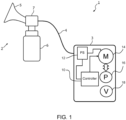
- Figure 1 shows a known breast pump system 1, comprising an expression unit 2 and a pump arrangement 3 which are connected via a tube 4.
- the pump arrangement includes various components in addition to the pump, so may be considered to be a general operating unit.
- the expression unit 2 is formed with a main body 7, a funnel 5 for receiving a breast of a user and a receptacle 6 for collecting the expressed milk.
- the funnel 5 and the receptacle 6 are connected to the main body 7.
- the main body 7 comprises a vacuum chamber.
- a flexible membrane or diaphragm is located in the vacuum chamber. The membrane prevents expressed milk from flowing into the tube 4 leading to the pump arrangement unit 3.
- the pump arrangement 3 may instead be directly mounted and connected to the main body 7.
- the membrane prevents expressed milk from flowing directly into the pump arrangement 3.
- the pump arrangement 3 comprises a controller 10, a power source 12, a motor 14 and a vacuum pump 16.
- the controller controls 10 the operation of the power source 12, motor 14 and vacuum pump 16.
- the pump arrangement 3 further comprises a vacuum release component, such as a solenoid valve 18.
- the vacuum pump applies a vacuum to the membrane located in the main body 7 so that it deforms.
- the membrane deforms to create a vacuum in the funnel 5 which in turns applies a vacuum to the breast which enables milk to be expressed.
- the breast pump system 1 is described as comprising a membrane such that the vacuum is applied indirectly to the breast, it should be understood that in an alternative embodiment, the vacuum is applied directly to the breast of a user. In this case, the breast pump system does not comprise a membrane and the vacuum created by the vacuum pump is applied directly to the breast.
- the vacuum is applied to the breast at intervals. That is, a pressure differential is applied on a cyclic basis.
- the solenoid valve is an electromechanically operated valve configured to open and close an air passage that connects to the vacuum side of the vacuum pump to ambient air such that when the solenoid valve is closed, the vacuum pump generates a vacuum in the expression unit which enables milk to be expressed from the breast of a user.
- the solenoid valve is opened, the vacuum generated by the vacuum pump is released as ambient air flows towards the vacuum or negative pressure created by the vacuum pump such that the pressure exerted on the breast of a user is partially or completely reduced.
- a top part contains the drivetrain (pump, motor, controller) and a bottom part forms the collection vessel. This enables breast pumping to be performed more discretely. Of course, other designs are possible.
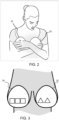
- Figure 2 shows a mother wearing two wearable breast pumps 20.
- the funnel 5 of Figure 1 is implemented as breast shield, and this breast shield is received within an outer enclosure of the wearable breast pump.
- Figure 3 shows a breast pump system comprising a first expression kit 30 and a second expression kit 32.
- Each expression kit is a wearable device, and each expression kit is fitted over a breast shield.
- the expression kits may each comprise a milk sensor for sensing milk flow and for measuring flow volume.
- the first expression kit 30 has a respective first set of functional units, represented by rectangles.
- the second expression kit 32 has a respective second set of functional units, represented by triangles.
- the sets are different although there may be some elements repeated between the sets.
- each set of functional units includes a breast shield (not shown).
- An expression kit may use electrical pumping, using an electrical pump and motor as explained above, and the pump pressure profile may be controlled by a controller in combination with a pressure regulating valve.
- a mechanical system may be used for generating a constant baseline under-pressure.
- the expression of the other breast may simply use a baseline vacuum pressure.
- controller functions may be implemented, such as the stimulation mode mentioned above and an expression mode using a different cyclic waveform.
- the controller may also be implemented with a massage mode.
- Other functional units include a user input interface for receiving user commands, a user output interface for providing status information to a user, a timer, and a communications interface for communicating wirelessly with an external device such as a mobile telephone.
- Sensors may also be used, such as a noise sensor or other ambient condition sensors.
- a noise sensor is for example used to improve discreetness of the device.
- the noise level can be reduced (with a consequent decrease in device performance) when a low environmental noise level is detected, in order to maintain discreetness in a smart manner.
- the expression kit may include a local milk collection vessel, or it may connect to a remote milk collection vessel.
- the expression kit i.e. the part located over the breast
- the expression kit may include a milk collection vessel or not.
- Milk sensing may also be used (in one or both expression kits) to provide feedback to the mother about the milk flow.
- the first set of functional units is different to the second set of functional units.
- the two expression kits have different overall functionality.
- one may be a master device with a first range of functions
- the other may be a slave device with a reduced second range of functions, wherein functions of the first device which do not need to be duplicated are not present in the second device.
- the first and second functional units however have matching outer designs.
- the two expression kits look the same shape when in use. They may have different visual (surface decoration) appearance so the user knows which is which (since they are covered by clothing in normal use), but the form factors (i.e. the shapes but allowing for a possible left-right mirror imaging) are preferably the same, or sufficiently similar that a third party seeing the two kits in use would not perceive a difference in size or shape.
- This breast pump system thus makes use of two expression kits, but they have different functional capabilities. In this way, the cost of the overall system can be kept to a minimum by avoiding unnecessary duplication of functions.
- kits may have identical shapes, or they may have mirror symmetrical outer shapes (relative to each other). Some the shape parameters which may be designed to equalize and protect discreetness are discussed further below.
- the expression only kit may still have a controller and a pressure regulating valve, but this may be a reduced functionality controller. Instead, the expression only kit may not need to implement a cyclic pressure waveform at all - it may simply implement a constant baseline vacuum. This may be achieved with a pump with no need for a pressure regulating valve, or it may even be achieved with a mechanical system.
- the controller may control a pressure regulating valve, as mentioned above, but it could instead control the drive signal to the pump motor.
- cyclic expression and stimulation modes When there are cyclic expression and stimulation modes, they for example have different cyclic frequency and different maximum under-pressure (i.e. vacuum) levels.
- the expression mode for example cycles between a baseline vacuum and a maximum vacuum (i.e. a maximum under-pressure) "Max_Vac”.
- TTV time to (maximum) vacuum
- DI time to atmosphere
- TTA time to atmosphere
- DO dwell-out time
- the maximum under-pressure may be higher, for example 350 mbar (35 kPa) and the durations may differ.
- the cycle time is generally of the order of 1 to 2 seconds.
- the stimulation mode for example has a faster frequency hence with a shorter cycle time of around 0.5 seconds, and a lower vacuum, for example a maximum under-pressure level of 150 mbar (15 kPa).
- the stimulation mode for example takes placing during an initial period of the breast pumping session (e.g. 50 seconds) and the expression mode takes place during the remainder of the breast pumping session.
- a controller may also implement a positioning mode. This may comprise intermittent application of a small under-pressure to allow the user to position the breast shield while observing the correct alignment.
- a controller may also implement a massage mode.
- Figure 4 shows an example of an implementation of the system of Figure 3 .
- a first expression kit 30 has a controller 10, battery 12, motor 14, pump 16 and pressure regulating valve 18.
- the controller 10 implements a stimulation mode and an expression mode.
- the first kit 30 also has a user interface 40 (input and output) and a sensor 42.
- a second expression kit 30 has motor 14 and pump 16, but power and control commands are received over a wired link to the first kit 30. There is only an expression mode of a constant baseline pressure so no regulating valve is present. The pump motor may, however, be controlled by the first kit to select the baseline pressure level.
- the second kit is a slimmed down version with no user interface, sensing or power supply. The wired connection does mean however that feedback to the user can nevertheless provide status information about both expression kits.
- the second kit may even have a purely mechanical system for generating a constant baseline under-pressure.
- This mechanical system for example comprises an element to be squeezed or pressed by the user to generate an under-pressure, which is then retained.
- the first and second expression kits may each be configurable by a user to select a desired set of functional units. This provides a modular system.
- the outer shapes are the same or mirror images of each other, for example by having outer shells with a design having similar form factor.
- the shells may then be used with different functional units as discussed above.
- a user then buys two or more shells and equips them with different functionality for example to achieve lower cost or for suitability in different use scenarios (e.g. home, work, car etc.).
- the first kit in particular may be used on its own.
- the functional units By enabling the functional units to be swapped between shells (which are typically mirror symmetric rather than identical), the full functionality may be fitted to the left shell or the right shell.
- the expression kit has a housing and a set of functional units for mounting to (typically in) the housing.
- the various possible functional units are explained above. At least some of the functional units are modular such that the set of functional units may be selected to implement desired combinations of functions.
- the modules may be configurable to enable stimulation and expression or stimulation and not expression (in which case the other breast may be expressing) or expression and not stimulation (in which case stimulation may be applied to the other breast).
- any of the (sixteen) possible combinations of the following functions may configurable:
- the expression kits are designed to be discrete in use, in particular so that a third party will not visually perceive the presence of the breast pump because there is no immediately obvious asymmetry between the two sides.
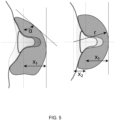
- Figure 5 shows some of the design parameters which are important for achieving a matching visual appearance.
- the left image shows a cross section through a vertical plane (a side view) and the right image shows a cross section through a horizontal plane (a top view).
- the dimension X 1 is the amount by which the front of the expression kit extends beyond the front of the breast, i.e. the added thickness.
- the front surface is generally circular with radius r.
- the dimension X 2 is the offset of the center of that circle behind the back of the nipple.
- the angle ⁇ represent a top surface angle to the vertical.
- each of these parameters may be matched, for example in each case, they may the same, or the larger of the two is in the range of 1.0 to 1.1 times the smaller of the two.
- the outer surface of each expression kit may correspond to a cup size for fitting to a feeding bra, and the cup sizes are the same.
- the added volume i.e. between the breast and the feeding bra
- the stimulation mode and the expression mode are implemented by applying a pressure waveform.
- the stimulation mode may comprise a mechanical stimulation mode by which mechanical pressure is applied to the breast (i.e. physical contact with the breast applying a force to the breast).
- the milk ejection reflex can be stimulated by this physical interaction with the breast instead of using the ambient pressure of a cavity around the breast.
- the expression mode may comprise a different mechanical pressure waveform, or it may comprise the application of a base vacuum.
- both kits are expression kits, in that they both at least perform an expression function.
- One kit may in instead only comprise a milk collection vessel, so that it passively collects milk resulting from the stimulation of the milk ejection reflex at the other breast.
- the second kit has no active expression function at all.
- Other features may be combined with the collection vessel.
- the second kit may comprise a controller, battery and passive collection vessel, and the first kit is a pump system.
- the overall system has different stimulation and expression functions. These may be divided between the two kits, for example with expression only at one side and stimulation only at the other side.
- the second kit does not need to have a milk collection function.
- the first kit may comprise a milk collection vessel container for storing milk expressed through the first kit, and the second kit may then comprise the vacuum pump and an energy storage (battery) for the vacuum pump, and a connection is provided between the first and the second kits to transport the vacuum from the pump to the second kit.
- the first kit comprises a vacuum pump and an energy storage (battery) for the vacuum pump
- the second kit comprises a milk collection vessel container for storing milk expressed through the first kit, and a connection is provided between the first and the second kits to transport the expressed milk from the first kit to the milk collection vessel of the second kit.
- the volume necessary to accommodate the components of an integrated breast pump, that are commonly contained in a single housing to be fitted under a bra on a breast are distributed over two substantially identical housings, that are each to be fitted under a bra on the two breasts of a user.
- user interface components can again be added to either of the two kit housings, and preferably added to the housing containing the electrical components.
- the expression funnel and the milk collection vessel are preferably at the same kit so there is no milk channel necessary between the two kits.
- a smaller milk collection vessel may be provided at the second kit (where the first kit is the one where milk is actively expressed) to catch any milk that may be expressed from the second breast involuntarily.
Landscapes
- Health & Medical Sciences (AREA)
- Heart & Thoracic Surgery (AREA)
- Life Sciences & Earth Sciences (AREA)
- Animal Behavior & Ethology (AREA)
- Engineering & Computer Science (AREA)
- Anesthesiology (AREA)
- Biomedical Technology (AREA)
- Hematology (AREA)
- Pediatric Medicine (AREA)
- Vascular Medicine (AREA)
- General Health & Medical Sciences (AREA)
- Public Health (AREA)
- Veterinary Medicine (AREA)
- External Artificial Organs (AREA)
- Prostheses (AREA)
- Percussion Or Vibration Massage (AREA)
Applications Claiming Priority (5)
| Application Number | Priority Date | Filing Date | Title |
|---|---|---|---|
| EP20214568.6A EP4015010A1 (de) | 2020-12-16 | 2020-12-16 | Milchpumpensystem |
| EP21202695.9A EP4015012A1 (de) | 2020-12-16 | 2021-10-14 | Milchpumpe |
| EP21202703.1A EP4029540A1 (de) | 2020-12-16 | 2021-10-14 | Milchpumpe |
| EP21823331.0A EP4262907A1 (de) | 2020-12-16 | 2021-12-16 | Milchpumpensystem |
| PCT/EP2021/086113 WO2022129290A1 (en) | 2020-12-16 | 2021-12-16 | Breast-pump system |
Related Parent Applications (1)
| Application Number | Title | Priority Date | Filing Date |
|---|---|---|---|
| EP21823331.0A Division EP4262907A1 (de) | 2020-12-16 | 2021-12-16 | Milchpumpensystem |
Publications (2)
| Publication Number | Publication Date |
|---|---|
| EP4406564A2 true EP4406564A2 (de) | 2024-07-31 |
| EP4406564A3 EP4406564A3 (de) | 2024-10-16 |
Family
ID=78827806
Family Applications (2)
| Application Number | Title | Priority Date | Filing Date |
|---|---|---|---|
| EP24175414.2A Pending EP4406564A3 (de) | 2020-12-16 | 2021-12-16 | Pumpensystem |
| EP21823331.0A Withdrawn EP4262907A1 (de) | 2020-12-16 | 2021-12-16 | Milchpumpensystem |
Family Applications After (1)
| Application Number | Title | Priority Date | Filing Date |
|---|---|---|---|
| EP21823331.0A Withdrawn EP4262907A1 (de) | 2020-12-16 | 2021-12-16 | Milchpumpensystem |
Country Status (4)
| Country | Link |
|---|---|
| US (1) | US20240050633A1 (de) |
| EP (2) | EP4406564A3 (de) |
| CN (1) | CN218774137U (de) |
| WO (1) | WO2022129290A1 (de) |
Families Citing this family (1)
| Publication number | Priority date | Publication date | Assignee | Title |
|---|---|---|---|---|
| CN222488316U (zh) * | 2023-12-29 | 2025-02-18 | 美德乐控股公司 | 吸乳泵 |
Citations (1)
| Publication number | Priority date | Publication date | Assignee | Title |
|---|---|---|---|---|
| US20200155738A1 (en) | 2014-07-22 | 2020-05-21 | Exploramed Nc7, Inc. | Breast pump system and methods |
Family Cites Families (5)
| Publication number | Priority date | Publication date | Assignee | Title |
|---|---|---|---|---|
| US7727182B2 (en) * | 2002-08-23 | 2010-06-01 | Medela Holding Ag | Manual breastpump with stimulation feature |
| EP2196230A1 (de) * | 2007-12-21 | 2010-06-16 | Koninklijke Philips Electronics N.V. | Brustpumpe zum Ausdrücken von Milch aus einer Brust |
| EP2277571A1 (de) * | 2009-07-23 | 2011-01-26 | Koninklijke Philips Electronics N.V. | Detektion einer physiologischen Reaktion bei einer Benutzerin einer Brustpumpe |
| EP3403569A1 (de) * | 2017-05-17 | 2018-11-21 | Koninklijke Philips N.V. | System zur milchspenderreflexbestimmung |
| EP3653238A1 (de) * | 2018-11-16 | 2020-05-20 | Koninklijke Philips N.V. | Erhalten einer angabe über den fettgehalt von milch |
-
2021
- 2021-12-15 CN CN202123152782.5U patent/CN218774137U/zh active Active
- 2021-12-16 US US18/266,828 patent/US20240050633A1/en active Pending
- 2021-12-16 WO PCT/EP2021/086113 patent/WO2022129290A1/en not_active Ceased
- 2021-12-16 EP EP24175414.2A patent/EP4406564A3/de active Pending
- 2021-12-16 EP EP21823331.0A patent/EP4262907A1/de not_active Withdrawn
Patent Citations (1)
| Publication number | Priority date | Publication date | Assignee | Title |
|---|---|---|---|---|
| US20200155738A1 (en) | 2014-07-22 | 2020-05-21 | Exploramed Nc7, Inc. | Breast pump system and methods |
Also Published As
| Publication number | Publication date |
|---|---|
| EP4406564A3 (de) | 2024-10-16 |
| US20240050633A1 (en) | 2024-02-15 |
| CN218774137U (zh) | 2023-03-31 |
| EP4262907A1 (de) | 2023-10-25 |
| WO2022129290A1 (en) | 2022-06-23 |
Similar Documents
| Publication | Publication Date | Title |
|---|---|---|
| CN114632204A (zh) | 泵系统 | |
| EP4015010A1 (de) | Milchpumpensystem | |
| US12433974B2 (en) | Breast pump systems and methods | |
| EP4000660A1 (de) | Brustpumpe | |
| US12016985B2 (en) | Breastmilk collection system | |
| EP4406564A2 (de) | Pumpensystem | |
| US20210244863A1 (en) | A pump arrangement, configured to be used with a double breast pump device | |
| CN217548652U (zh) | 吸乳泵 | |
| EP4011415A1 (de) | Brustpumpe | |
| EP4306143A1 (de) | System und verfahren zur milchexpression | |
| EP4452354B1 (de) | Milchpumpe | |
| CN219681295U (zh) | 吸乳泵 | |
| US20250032685A1 (en) | A breast pump | |
| EP4197567A1 (de) | Milchpumpe | |
| EP4197566A1 (de) | Milchpumpensystem | |
| CN116547033A (zh) | 母乳收集系统 |
Legal Events
| Date | Code | Title | Description |
|---|---|---|---|
| PUAI | Public reference made under article 153(3) epc to a published international application that has entered the european phase |
Free format text: ORIGINAL CODE: 0009012 |
|
| STAA | Information on the status of an ep patent application or granted ep patent |
Free format text: STATUS: THE APPLICATION HAS BEEN PUBLISHED |
|
| AC | Divisional application: reference to earlier application |
Ref document number: 4262907 Country of ref document: EP Kind code of ref document: P |
|
| AK | Designated contracting states |
Kind code of ref document: A2 Designated state(s): AL AT BE BG CH CY CZ DE DK EE ES FI FR GB GR HR HU IE IS IT LI LT LU LV MC MK MT NL NO PL PT RO RS SE SI SK SM TR |
|
| PUAL | Search report despatched |
Free format text: ORIGINAL CODE: 0009013 |
|
| AK | Designated contracting states |
Kind code of ref document: A3 Designated state(s): AL AT BE BG CH CY CZ DE DK EE ES FI FR GB GR HR HU IE IS IT LI LT LU LV MC MK MT NL NO PL PT RO RS SE SI SK SM TR |
|
| RIC1 | Information provided on ipc code assigned before grant |
Ipc: A61M 1/06 20060101AFI20240906BHEP |
|
| STAA | Information on the status of an ep patent application or granted ep patent |
Free format text: STATUS: REQUEST FOR EXAMINATION WAS MADE |
|
| 17P | Request for examination filed |
Effective date: 20250416 |