EP4404635A1 - Kommunikationsverfahren und -vorrichtung - Google Patents
Kommunikationsverfahren und -vorrichtung Download PDFInfo
- Publication number
- EP4404635A1 EP4404635A1 EP22880138.7A EP22880138A EP4404635A1 EP 4404635 A1 EP4404635 A1 EP 4404635A1 EP 22880138 A EP22880138 A EP 22880138A EP 4404635 A1 EP4404635 A1 EP 4404635A1
- Authority
- EP
- European Patent Office
- Prior art keywords
- cell
- power
- normalized power
- periodicity
- normalized
- Prior art date
- Legal status (The legal status is an assumption and is not a legal conclusion. Google has not performed a legal analysis and makes no representation as to the accuracy of the status listed.)
- Pending
Links
Images



Classifications
-
- H—ELECTRICITY
- H04—ELECTRIC COMMUNICATION TECHNIQUE
- H04W—WIRELESS COMMUNICATION NETWORKS
- H04W52/00—Power management, e.g. Transmission Power Control [TPC] or power classes
- H04W52/02—Power saving arrangements
-
- H—ELECTRICITY
- H04—ELECTRIC COMMUNICATION TECHNIQUE
- H04W—WIRELESS COMMUNICATION NETWORKS
- H04W52/00—Power management, e.g. Transmission Power Control [TPC] or power classes
- H04W52/04—Transmission power control [TPC]
- H04W52/38—TPC being performed in particular situations
- H04W52/42—TPC being performed in particular situations in systems with time, space, frequency or polarisation diversity
-
- H—ELECTRICITY
- H04—ELECTRIC COMMUNICATION TECHNIQUE
- H04W—WIRELESS COMMUNICATION NETWORKS
- H04W52/00—Power management, e.g. Transmission Power Control [TPC] or power classes
-
- H—ELECTRICITY
- H04—ELECTRIC COMMUNICATION TECHNIQUE
- H04W—WIRELESS COMMUNICATION NETWORKS
- H04W52/00—Power management, e.g. Transmission Power Control [TPC] or power classes
- H04W52/04—Transmission power control [TPC]
- H04W52/30—Transmission power control [TPC] using constraints in the total amount of available transmission power
- H04W52/34—TPC management, i.e. sharing limited amount of power among users or channels or data types, e.g. cell loading
- H04W52/343—TPC management, i.e. sharing limited amount of power among users or channels or data types, e.g. cell loading taking into account loading or congestion level
-
- H—ELECTRICITY
- H04—ELECTRIC COMMUNICATION TECHNIQUE
- H04W—WIRELESS COMMUNICATION NETWORKS
- H04W52/00—Power management, e.g. Transmission Power Control [TPC] or power classes
- H04W52/04—Transmission power control [TPC]
- H04W52/30—Transmission power control [TPC] using constraints in the total amount of available transmission power
- H04W52/34—TPC management, i.e. sharing limited amount of power among users or channels or data types, e.g. cell loading
- H04W52/346—TPC management, i.e. sharing limited amount of power among users or channels or data types, e.g. cell loading distributing total power among users or channels
-
- H—ELECTRICITY
- H04—ELECTRIC COMMUNICATION TECHNIQUE
- H04W—WIRELESS COMMUNICATION NETWORKS
- H04W52/00—Power management, e.g. Transmission Power Control [TPC] or power classes
- H04W52/04—Transmission power control [TPC]
- H04W52/30—Transmission power control [TPC] using constraints in the total amount of available transmission power
- H04W52/36—Transmission power control [TPC] using constraints in the total amount of available transmission power with a discrete range or set of values, e.g. step size, ramping or offsets
-
- H—ELECTRICITY
- H04—ELECTRIC COMMUNICATION TECHNIQUE
- H04W—WIRELESS COMMUNICATION NETWORKS
- H04W52/00—Power management, e.g. Transmission Power Control [TPC] or power classes
- H04W52/04—Transmission power control [TPC]
- H04W52/30—Transmission power control [TPC] using constraints in the total amount of available transmission power
- H04W52/36—Transmission power control [TPC] using constraints in the total amount of available transmission power with a discrete range or set of values, e.g. step size, ramping or offsets
- H04W52/367—Power values between minimum and maximum limits, e.g. dynamic range
-
- H—ELECTRICITY
- H04—ELECTRIC COMMUNICATION TECHNIQUE
- H04W—WIRELESS COMMUNICATION NETWORKS
- H04W52/00—Power management, e.g. Transmission Power Control [TPC] or power classes
- H04W52/04—Transmission power control [TPC]
- H04W52/18—TPC being performed according to specific parameters
- H04W52/22—TPC being performed according to specific parameters taking into account previous information or commands
- H04W52/225—Calculation of statistics, e.g. average or variance
-
- Y—GENERAL TAGGING OF NEW TECHNOLOGICAL DEVELOPMENTS; GENERAL TAGGING OF CROSS-SECTIONAL TECHNOLOGIES SPANNING OVER SEVERAL SECTIONS OF THE IPC; TECHNICAL SUBJECTS COVERED BY FORMER USPC CROSS-REFERENCE ART COLLECTIONS [XRACs] AND DIGESTS
- Y02—TECHNOLOGIES OR APPLICATIONS FOR MITIGATION OR ADAPTATION AGAINST CLIMATE CHANGE
- Y02D—CLIMATE CHANGE MITIGATION TECHNOLOGIES IN INFORMATION AND COMMUNICATION TECHNOLOGIES [ICT], I.E. INFORMATION AND COMMUNICATION TECHNOLOGIES AIMING AT THE REDUCTION OF THEIR OWN ENERGY USE
- Y02D30/00—Reducing energy consumption in communication networks
- Y02D30/70—Reducing energy consumption in communication networks in wireless communication networks
Definitions
- This application relates to the field of communication technologies, and in particular, to a communication method and an apparatus.
- NIR non-ionizing radiation
- EMF electromagnetic field
- ICNIRP international commission on non-ionizing radiation protection
- the protection against the NIR by the ICNIRP has a risk in a process of mobile network deployment.
- a cell power quota at each frequency is limited as a quantity of frequencies increases. This may affect coverage and network performance of each cell.
- This application provides a communication method and an apparatus, to resolve a problem that a cell power quota at each frequency for a multi-frequency cell is limited, affecting coverage and network performance of each cell.
- this application provides a communication method.
- the method may include: A network device determines first normalized power at a start moment of an n th periodicity of N periodicities, and determines total normalized power expected to be used by a plurality of cells in the n th periodicity. Then, when the total normalized power is greater than the first normalized power, the network device allocates power to each cell based on preset normalized power of each cell in the plurality of cells and the first normalized power.
- the preset normalized power is used for the power allocation, N is an integer greater than or equal to 1, and n is an integer greater than or equal to 1 and less than or equal to N.
- a cell power allocation constraint can be broken, power sharing between cells on a plurality of bands can be achieved, cell network performance can be improved, and an EMF regulatory requirement of the network device can be met.
- the network device allocates power to each cell based on a service requirement of each cell in the plurality of cells in the n th periodicity. This can meet a power requirement of each cell.
- the plurality of cells work on different bands.
- a method for the network device to determine the first normalized power at the start moment of the n th periodicity may be: The network device determines to subtract, from an initial normalized power amount, products of the plurality of cells, where each of the products is obtained by multiplying a sum of actual transmit power of each cell in first n-1 periodicities by a first coefficient of each cell. The network device determines that an obtained difference is the first normalized power.
- the initial normalized power amount is a sum of preset normalized power of the plurality of cells in the N periodicities, and the first coefficient of each cell is a ratio of an antenna gain of each cell to a power density threshold of each cell. In this way, the network device can accurately determine the first normalized power at the start moment of the n th periodicity, to allocate power of the n th periodicity to the plurality of cells based on the first normalized power.
- the initial normalized power amount can be accurately determined.
- a method for the network device to determine the total normalized power expected to be used by the plurality of cells in the n th periodicity may be: The network device multiplies a preset maximum power of each cell of the n th periodicity by the first coefficient to obtain a normalized power expected to be used by each cell in the n th periodicity. The network device determines that a sum of normalized power expected to be used by all cells in the n th periodicity is the total normalized power.
- the first coefficient is the ratio of the antenna gain of each cell to the power density threshold of each cell.
- the network device may determine the total normalized power of the plurality of cells in the n th periodicity, to subsequently allocate power of the n th periodicity to the plurality of cells with reference to the first normalized power at the start moment of the n th periodicity.
- a method for the network device to allocate the power to each cell based on the preset normalized power of each cell in the plurality of cells and the first normalized power may be: The network device divides the preset normalized power of each cell by the sum of the preset normalized power of all the cells, to obtain a power proportion of each cell. The network device multiplies the first normalized power, the power proportion of each cell, and a reciprocal of the first coefficient, to obtain the power allocated to each cell.
- the first coefficient is the ratio of the antenna gain of each cell to the power density threshold of each cell. In this way, the network device can accurately allocate the power to each cell.
- the network device determines a load amount difference between a first cell and a second cell in m periodicities before the n th periodicity.
- the load amount difference is greater than or equal to a load amount difference threshold, and a load amount of the first cell is greater than a load amount of the second cell, the network device hands over, in the n th periodicity, at least one to-be-scheduled terminal device in the first cell to the second cell.
- the m periodicities include an (n-1) th periodicity, and m is an integer greater than or equal to 1. This can improve the network performance.
- the network device determines a normalized power utilization difference between the first cell and the second cell in the m periodicities before the n th periodicity.
- the network device hands over, in the n th periodicity, at least one to-be-scheduled terminal device in the first cell to the second cell.
- the normalized power utilization of the first cell is a value obtained by dividing a product of actual transmit power of the first cell in the m periodicities and a first coefficient of the first cell by the initial normalized power amount
- the normalized power utilization of the second cell is a value obtained by dividing a product of actual transmit power of the second cell in the m periodicities and a first coefficient of the second cell by the initial normalized power amount.
- the initial normalized power amount is the sum of the preset normalized power of the plurality of cells in the N periodicities.
- the first coefficient of the first cell is a ratio of an antenna gain of the first cell to a power density threshold of the first cell
- the first coefficient of the second cell is a ratio of an antenna gain of the second cell to a power density threshold of the second cell.
- the m periodicities include an (n-1) th periodicity, and m is an integer greater than or equal to 1. This can improve the network performance.
- this application further provides a communication apparatus, and the communication apparatus has a function of implementing the network device in the foregoing first aspect or the possible implementations of the first aspect.
- the function may be implemented by hardware, or may be implemented by hardware executing corresponding software.
- the hardware or the software includes one or more modules corresponding to the function.
- a structure of the communication apparatus includes a storage unit and a processing unit. These units may perform corresponding functions of the network device in the foregoing first aspect or the possible implementations of the first aspect. For details, refer to the detailed descriptions in the method. Details are not described herein.
- a structure of the communication apparatus includes a memory and a processor, and optionally further includes a transceiver.
- the transceiver is configured to send and receive information or data, and is configured to communicate and interact with another device in a communication system.
- the processor is configured to support the communication apparatus in performing a corresponding function of the network device in the foregoing first aspect or the possible implementations of the first aspect.
- the memory is coupled to the processor, and stores program instructions and data that are necessary for the communication apparatus.
- an embodiment of this application provides a communication system, which may include the foregoing network device and the like.
- an embodiment of this application provides a computer-readable storage medium.
- the computer-readable storage medium stores program instructions, and when the program instructions are run on a computer, the computer is enabled to perform the method according to any one of the first aspect and the possible implementations of the first aspect in embodiments of this application.
- the computer-readable storage medium may be any usable medium accessible to the computer. The following provides an example but does not impose a limitation.
- the computer-readable medium may include a non-transient computer-readable medium, a random access memory (random access memory, RAM), a read-only memory (read-only memory, ROM), an electrically erasable programmable read-only memory (electrically EPROM, EEPROM), a CD-ROM or another optical disc storage, a magnetic disk storage medium or another magnetic storage device, or any other medium that can be used to carry or store expected program code in a form of instructions or a data structure and can be accessed by the computer.
- RAM random access memory
- ROM read-only memory
- EEPROM electrically erasable programmable read-only memory
- CD-ROM or another optical disc storage a magnetic disk storage medium or another magnetic storage device, or any other medium that can be used to carry or store expected program code in a form of instructions or a data structure and can be accessed by the computer.
- an embodiment of this application provides a computer program product including computer program code or instructions.
- the computer program product runs on a computer, the computer is enabled to implement the method according to any one of the foregoing first aspect or the possible implementations of the first aspect.
- this application further provides a chip.
- the chip is coupled to a memory, and is configured to read and execute program instructions stored in the memory, to implement the method according to any one of the first aspect or the possible implementations of the first aspect.
- Embodiments of this application provide a communication method and an apparatus, to resolve a problem that a cell power quota at each frequency for a multi-frequency cell is limited, and affecting coverage and network performance of each cell.
- the method and the apparatus in this application are based on a same technical concept. Because problem-resolving principles of the method and the apparatus are similar, mutual reference may be made to implementations of the apparatus and the method, and repeated parts are not described.
- At least one (type) refers to one or more (types), and “a plurality of (types)” refers to two or more than two (types).
- / represents “or”.
- a/b represents a or b.
- a remote radio unit remote radio unit, RRU
- the RRU wide-band system may include but is not limited to systems such as a time division duplex (time division duplex, TDD) system, a frequency division duplexing (frequency division duplexing, FDD) system, a long term evolution (long term evolution, LTE) system, and a new radio (new radio, NR) system.
- TDD time division duplex
- FDD frequency division duplexing
- LTE long term evolution
- new radio new radio
- FIG. 1 shows a possible architecture of a communication system to which the communication method provided in embodiments of this application is applicable.
- the communication system includes a network device and a terminal device.
- the network device is a device having a wireless transceiver function or a chip that can be disposed in the network device.
- the network device includes but is not limited to: a base station (generation NodeB, gNB), a radio network controller (radio network controller, RNC), a NodeB (NodeB, NB), a base station controller (base station controller, BSC), a base transceiver station (base transceiver station, BTS), a home base station (for example, a home evolved NodeB or a home NodeB, HNB), a baseband unit (baseband unit, BBU), an access point (access point, AP) in a wireless fidelity (wireless fidelity, Wi-Fi) system, a wireless relay node, a wireless backhaul node, a transmission point (transmission and reception point, TRP, or transmission point, TP), and the like.
- the network device may alternatively be a network node that forms a gNB or a transmission point, for example,
- a plurality of cells are deployed for the network device, and the plurality of cells may be shown as a cell 1 and a cell 2 in FIG. 1 .
- the plurality of cells work on different bands.
- the plurality of cells are co-coverage cells, or may be understood as cells that share a radio frequency module and that is served by the network device.
- the co-coverage cells refer to cells that have a same coverage angle and whose coverage ranges overlap or include each other.
- the plurality of cells may all be LTE cells, or may all be NR cells, or may be a plurality of cells in which an LTE cell and an NR cell coexist, or the plurality of cells may further include another type of cell. This is not limited in this application.
- Each cell includes at least one terminal device.
- the cell 1 includes terminal device 1
- the cell 2 includes a terminal device 2 and a terminal device 3.
- the terminal device may also be referred to as user equipment (user equipment, UE), an access terminal, a subscriber unit, a subscriber station, a mobile station, a remote station, a remote terminal, a mobile device, a user terminal, a terminal, a wireless communication device, a user agent, or a user apparatus.
- user equipment user equipment
- UE user equipment
- an access terminal a subscriber unit, a subscriber station, a mobile station, a remote station, a remote terminal, a mobile device, a user terminal, a terminal, a wireless communication device, a user agent, or a user apparatus.
- the terminal device in embodiments of this application may be a mobile phone (mobile phone), a tablet computer (tablet), a computer with a wireless transceiver function, a virtual reality (virtual reality, VR) terminal device, an augmented reality (augmented reality, AR) terminal device, a wireless terminal in industrial control (industrial control), a wireless terminal in self driving (self driving), a wireless terminal in telemedicine (telemedicine), a wireless terminal in a smart grid (smart grid), a wireless terminal in transportation safety (transportation safety), a wireless terminal in a smart city (smart city), a smart wearable device (such as smart glasses, a smart watch, or a smart headset), a wireless terminal in a smart home (smart home), or the like.
- the terminal device may alternatively be a chip, a chip module (or a chip system), or the like that can be disposed in the foregoing device.
- An application scenario is not limited in embodiments of this application.
- the terminal device having a wireless transceiver function and the chip that can be disposed in the terminal device are collectively referred to as the terminal device in this application.
- a quantity of cells corresponding to the network device and a quantity of terminal devices in each cell shown in FIG. 1 are merely examples for description. Actually, more cells and more terminal devices may be included. This is not limited in this application.
- NIR non-ionizing radiation
- EMF electromagnetic field
- ICNIRP international commission on non-ionizing radiation protection
- the protection against the NIR by the ICNIRP has a risk in a process of mobile network deployment.
- the ICNIRP specifies that an EMF of the multi-band multi-cell network device needs to satisfy the following Formula 1: ⁇ i S i / S L i ⁇ 1 where S(i) represents actual power density of a cell i, and S L (i) represents a regulatory power density requirement (that is, a power density threshold of the cell i) of a band that the cell i is on.
- a regulation requires that a sum of ratios of actual power density of all co-coverage cells of each network device to regulatory power density requirements corresponding to the cells be less than or equal to 1.
- this application provides a communication method, to improve network performance.
- FIG. 2 shows a communication method according to an embodiment of this application.
- a specific procedure of the method may include the following steps.
- Step 201 A network device determines first normalized power at a start moment of an n th periodicity in N periodicities.
- N is an integer greater than or equal to 1
- n is an integer greater than or equal to 1 and less than or equal to N.
- the first normalized power is remaining normalized power in a resource pool in an (n-1) th periodicity.
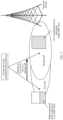
- the network device may perform power normalization calculation together with the plurality of co-coverage cells. For example, as shown in FIG. 3 , the network device jointly controls a cell 1 to a cell 4 in the plurality of co-coverage cells, that is, power of the cell 1 to the cell 4 may be normalized, to satisfy the EMF regulatory requirement. Details are as follows.
- P(i) is actual transmit power of a cell i, and is related to service load of the cell i.
- P config (i) is an average power threshold that is of the cell i and that is configured for meeting a total power density requirement of a co-coverage cell.
- G(i) is an antenna gain of the cell i, which is related to an antenna model and a frequency of the cell i, and measured in folds.
- S L (i) is a power density threshold of the cell i, also be referred to as a regulatory threshold of the cell i, which is related to the frequency of the cell i and measured in watts per square meter (W/m 2 ).
- R is a distance from a radiated position to a radiation source (that is, a network device) and measured in meters (meter, m).
- i is an index of any one of the plurality of cells, where i is an integer greater than or equal to 1.
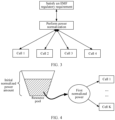
- the network device may assign preset normalized power of the plurality of cells in a period of time (that is, the N periodicities) into the resource pool, determine remaining normalized power of the resource pool in real time, and determine, based on the remaining normalized power, how to allocate power to the plurality of cells. This can implement power sharing of the plurality of cells and satisfy a specified EMF power constraint.
- the preset normalized power of each cell is a product of an average power threshold P config (i) of each cell and a first coefficient of each cell, where the first coefficient is a ratio of the antenna gain G(i) of each cell to the power density threshold S L (i) of each cell, the power density threshold of each cell is related to a band of each cell, and the average power threshold of each cell is configured for meeting the total power density requirement of the co-coverage cell.
- an initial normalized power amount of the resource pool (that is, a capacity of the resource pool) is a sum of preset normalized power of the plurality of cells in the N periodicities.
- the network device may simultaneously assign the sum of the preset normalized power of the plurality of cells in the N periodicities into the resource pool, or may dynamically assign the sum of the preset normalized power of the plurality of cells into the resource pool in real time for a plurality of times. This is not limited in this application.
- the capacity of the resource pool shown in FIG. 4 is the foregoing initial normalized power amount.
- the first normalized power at a start moment of the n th periodicity in the N periodicities is the remaining normalized power of the resource pool in the (n-1) th periodicity.
- how to allocate power to the plurality of cells (K cells are used as an example for description) in the n th periodicity is determined based on the first normalized power.
- a method for the network device to determine the first normalized power at the start moment of the n th periodicity may be: The network device determines to subtract, from the initial normalized power amount, products of the plurality of cells, where each of the products is obtained by multiplying a sum of actual transmit power of each cell in first n-1 periodicities by a first coefficient of each cell. The network device determines that an obtained difference is the first normalized power.
- the first coefficient refer to the foregoing related descriptions of the first coefficient.
- actual transmit power of each cell in a periodicity is not necessarily equal to power allocated to each cell in the periodicity, and the actual transmit power of each cell may be less than the allocated power.
- the network device may obtain the actual transmit power of each cell in a periodicity reported by the cell.
- total duration of the N periodicities may be 6 minutes or the like.
- Step 202 The network device determines total normalized power expected to be used by the plurality of cells in the n th periodicity.
- the plurality of cells work on different bands, in other words, the plurality of cells are co-coverage cells that are on a plurality of bands and that are of the network device.
- a method for the network device to determine the total normalized power expected to be used by the plurality of cells in the n th periodicity may be: The network device multiplies a preset maximum power of each cell of the n th periodicity by the first coefficient to obtain a normalized power expected to be used by each cell in the n th periodicity. The network device determines that a sum of normalized power expected to be used by all cells in the n th periodicity is the total normalized power.
- the network device when determining how to allocate power to the plurality of cells of the n th periodicity based on the first normalized power shown in FIG. 4 , the network device specifically determines, with reference to a value relationship between the first normalized power and the total normalized power, how to allocate power to the plurality of cells of the n th periodicity.
- the network device determines the value relationship between the total normalized power and the first normalized power.
- the network device allocates power to each cell based on a service requirement of each cell in the plurality of cells of the n th periodicity. In this case, in the n th periodicity, power that satisfies the service requirement of each cell may be allocated to each cell.
- the network device performs the following step 203.
- Step 203 When the total normalized power is greater than the first normalized power, the network device allocates power to each cell based on the preset normalized power of each cell and the first normalized power.
- a method for the network device to allocate the power to each cell based on the preset normalized power of each cell and the first normalized power may be: The network device divides the preset normalized power of each cell by a sum of preset normalized power of all the cells, to obtain a power proportion of each cell. Then, the network device multiplies the first normalized power, the power proportion of each cell, and a reciprocal of the first coefficient, to obtain the power allocated to each cell.
- a power proportion of the cell i is P config i ⁇ G i S L i ⁇ i P config i ⁇ G i S L i
- power allocated to the cell i is First normalized power * Power proportion ratio of the cell i ⁇ S L i G i .
- the network device may implement the optimization in at least one of the following two manners. Examples are as follows.
- the network device determines a load amount difference between a first cell and a second cell in m periodicities before the n th periodicity.
- the load amount difference is greater than or equal to a load amount difference threshold, and a load amount of the first cell is greater than a load amount of the second cell, the network device hands over, in the n th periodicity, at least one to-be-scheduled terminal device in the first cell to the second cell.
- the m periodicities include an (n-1) th periodicity, and m is an integer greater than or equal to 1.
- the load amount difference between the first cell and the second cell in the m periodicities may be a difference between weighted averages of the load amounts of the first cell and the second cell in the m periodicities. It should be understood that the foregoing is merely an example, the load amount difference may be a difference determined by using another method. This is not limited in this application.
- the load amount difference between the first cell and the second cell in the m periodicity is the load amount difference between the first cell and the second cell in the (n-1) th periodicity.
- Manner 2 The network device determines a normalized power utilization difference between the first cell and the second cell in the m periodicities before the n th periodicity.
- the network device hands over, in the n th periodicity, at least one to-be-scheduled terminal device in the first cell to the second cell.
- the normalized power utilization of the first cell is a value obtained by dividing a product of actual transmit power of the first cell in the m periodicities and a first coefficient of the first cell by the initial normalized power amount
- the normalized power utilization of the second cell is a value obtained by dividing a product of actual transmit power of the second cell in the m periodicities and a first coefficient of the second cell by the initial normalized power amount.
- the normalized power utilization difference between the first cell and the second cell in the m periodicities may be a difference between weighted averages of the normalized power utilization of the first cell and the second cell in the m periodicities. It should be understood that the foregoing is merely an example, and the normalized power utilization difference may be a difference determined by using another method. This is not limited in this application.
- the normalized power utilization difference between the first cell and the second cell in the m periodicities is the normalized power utilization difference between the first cell and the second cell in the (n-1) th periodicity.
- FIG. 5 is a schematic diagram of performing handover based on normalized power utilization.
- load amount difference threshold and the normalized power utilization difference threshold may be determined in a manner such as an optimization algorithm or artificial intelligence (artificial intelligence, AI) training. Details are not described in this application. In this application, the load amount difference threshold and the normalized power utilization difference threshold may be determined in advance by default, and may be directly used.
- an operation performed by the network device in the foregoing method may be completed by a layer-2 module such as a baseband unit (baseband unit, BBU).
- a layer-2 module such as a baseband unit (baseband unit, BBU). This is not limited in this application.
- an original power allocation constraint can be broken, power sharing between cells on a plurality of bands can be implemented, cell network performance can be improved, and an EMF regulatory requirement of the network device can be further satisfied.
- an embodiment of this application provides an example of a communication method. As shown in FIG. 6 , a specific procedure of the example may include the following steps.
- Step 601 A network device determines a sum of preset normalized power of a plurality of cells in N periodicities, and uses the determined sum as an initial normalized power amount of a resource pool (that is, a capacity of the resource pool).
- the initial normalized power amount of the resource pool is first normalized power at a start moment of a first periodicity.
- Step 602 The network device determines a sum of actual transmit power of each of the plurality of cells in first n-1 periodicities.
- Step 603 The network device performs calculation of subtracting, from the initial normalized power amount, products of the plurality of cells, where each of the products is obtained by multiplying a sum of actual transmit power of each cell in the first n-1 periodicities by a first coefficient of each cell, and determines that an obtained difference is first normalized power of a start moment of an n th periodicity.
- remaining normalized power of the resource pool in an (n-1) th periodicity may be determined in step 603.
- Step 604 The network device determines total normalized power expected to be used by the plurality of cells in the n th periodicity.
- step 604 For a specific method for implementing step 604, refer to the specific descriptions in step 202.
- Step 605 The network device determines whether the total normalized power is greater than the first normalized power. If yes, step 606 is performed. If not, step 607 is performed.
- Step 606 The network device allocates power to each cell based on preset normalized power of each cell and the first normalized power.
- the network device divides the preset normalized power of each cell by a sum of preset normalized power of all the cells, to obtain a power proportion of each cell. Then, the network device multiplies the first normalized power, the power proportion of each cell, and a reciprocal of the first coefficient, to obtain the power allocated to each cell.
- the network device multiplies the first normalized power, the power proportion of each cell, and a reciprocal of the first coefficient, to obtain the power allocated to each cell.
- Step 607 The network device allocates power to each cell based on a service requirement of each of the plurality of cells in the n th periodicity.
- power sharing between the plurality of cells can be implemented, and an EMF regulatory requirement of the network device can be satisfied.
- an embodiment of this application further provides a communication method.
- a specific procedure of the method may include the following steps.
- Step 701 A network device determines a load amount difference between a first cell and a second cell in m periodicities before an n th periodicity, where the m periodicities include an (n-1) th periodicity, and m is an integer greater than or equal to 1.
- the n th periodicity is one of the N periodicities.
- the n th periodicity is one of the N periodicities.
- the load amount difference between the first cell and the second cell in the m periodicities may be a difference between weighted averages of the load amounts of the first cell and the second cell in the m periodicities. It should be understood that the foregoing is merely an example, the load amount difference may be a difference determined by using another method. This is not limited in this application.
- the load amount difference between the first cell and the second cell in the m periodicity is the load amount difference between the first cell and the second cell in the (n-1) th periodicity.
- Step 702 When the load amount difference is greater than or equal to a load amount difference threshold, and a load amount of the first cell is greater than a load amount of the second cell, the network device hands over, in the n th periodicity, at least one to-be-scheduled terminal device in the first cell to the second cell.
- an embodiment of this application further provides another communication method.
- a specific procedure of the method may include the following steps.
- Step 801 A network device determines a normalized power utilization difference between a first cell and a second cell in m periodicities before an n th periodicity.
- Step 802 When the normalized power utilization difference is greater than or equal to a normalized power utilization difference threshold, and normalized power utilization of the first cell is greater than normalized power utilization of the second cell, the network device hands over at least one to-be-scheduled terminal device in the first cell to the second cell in the n th periodicity.
- the normalized power utilization of the first cell is a value obtained by dividing a product of actual transmit power of the first cell in the m periodicities and a first coefficient of the first cell by an initial normalized power amount
- the normalized power utilization of the second cell is a value obtained by dividing a product of actual transmit power of the second cell in the m periodicities and a first coefficient of the second cell by the initial normalized power amount.
- step 802 refers to related descriptions in the embodiment shown in FIG. 2 . Details are not described herein again.
- FIG. 7 and FIG. 8 may alternatively be combined, to jointly improve network performance by using the foregoing two methods.
- the communication apparatus 900 may include a storage unit 901 and a processing unit 902.
- the storage unit 901 is configured to store computer instructions and the like in the communication apparatus 900
- the processing unit 902 is configured to control and manage an action of the communication apparatus 900.
- the communication apparatus 900 may specifically be the network device, or a processor, a chip, a chip system, a functional module, or the like in the network device in the foregoing embodiments.
- the communication apparatus 900 when the communication apparatus 900 is configured to implement a function of the network device in the foregoing embodiments, the communication apparatus 900 may specifically include the following.
- the storage unit 901 is configured to store the computer instructions.
- the processing unit 902 is configured to invoke the computer instructions in the storage unit to: determine first normalized power at a start moment of an n th periodicity in N periodicities, where N is an integer greater than or equal to 1, n is an integer greater than or equal to and less than or equal to N; determine total normalized power expected to be used by a plurality of cells in the n th periodicity; and when the total normalized power is greater than the first normalized power, allocate power to each cell based on preset normalized power of each cell in the plurality of cells and the first normalized power, where the preset normalized power is used for the power allocation.
- the processing unit 902 when determining the first normalized power at the start moment of the n th periodicity, is specifically configured to: determine to subtract, from an initial normalized power amount, products of the plurality of cells, where each of the products is obtained by multiplying a sum of actual transmit power of each cell in first n-1 periodicities by a first coefficient of each cell, where the initial normalized power amount is a sum of preset normalized power of the plurality of cells in the N periodicities, and the first coefficient of each cell is a ratio of an antenna gain of each cell to a power density threshold of each cell; and determine that an obtained difference is the first normalized power.
- Initial normalized power amount ⁇ i P config i ⁇ G i S L i ⁇ N i is the index of any one of the plurality of cells, and i is an integer greater than or equal to 1;
- P config (i) is the average power threshold that is of the cell i and that is configured for meeting the total power density requirement of the co-coverage cell;
- G(i) is the antenna gain of the cell i;
- S L (i) is the power density threshold of the cell i.
- the processing unit 902 when determining the total normalized power expected to be used by the plurality of cells in the n th periodicity, is specifically configured to: multiply a preset maximum power of each cell of the n th periodicity by the first coefficient to obtain a normalized power expected to be used by each cell in the n th periodicity, and determine that a sum of normalized power expected to be used by all cells in the n th periodicity is the total normalized power, where the first coefficient is the ratio of the antenna gain of each cell to the power density threshold of each cell.
- the processing unit 902 is specifically configured to: divide the preset normalized power of each cell by a sum of preset normalized power of all the cells, to obtain a power proportion of each cell, and multiply the first normalized power, the power proportion of each cell, and a reciprocal of the first coefficient, to obtain the power allocated to each cell, where the first coefficient is the ratio of the antenna gain of each cell to the power density threshold of each cell.
- the processing unit 902 is further configured to: determine a load amount difference between a first cell and a second cell in m periodicities before the n th periodicity, where the m periodicities include an (n-1) th periodicity, and m is an integer greater than or equal to 1, and when the load amount difference is greater than or equal to a load amount difference threshold and a load amount of the first cell is greater than a load amount of the second cell, hand over at least one to-be-scheduled terminal device in the first cell to the second cell in the n th periodicity.
- the processing unit 902 is further configured to: determine a normalized power utilization difference between the first cell and the second cell in the m periodicities before the n th periodicity, where the m periodicities include an (n-1) th periodicity, and m is an integer greater than or equal to 1, and when the normalized power utilization difference is greater than or equal to a normalized power utilization difference threshold and normalized power utilization of the first cell is greater than normalized power utilization of the second cell, hand over at least one to-be-scheduled terminal device in the first cell to the second cell in the n th periodicity.
- the normalized power utilization of the first cell is a value obtained by dividing a product of actual transmit power of the first cell in the m periodicities and a first coefficient of the first cell by the initial normalized power amount
- the normalized power utilization of the second cell is a value obtained by dividing a product of actual transmit power of the second cell in the m periodicities and a first coefficient of the second cell by the initial normalized power amount.
- the initial normalized power amount is the sum of the preset normalized power of the plurality of cells in the N periodicities.
- the first coefficient of the first cell is a ratio of an antenna gain of the first cell to a power density threshold of the first cell
- the first coefficient of the second cell is a ratio of an antenna gain of the second cell to a power density threshold of the second cell.
- division into the units is an example, and is merely a logical function division. During actual implementation, another division manner may be used.
- Functional units in embodiments of this application may be integrated into one processing unit, or each of the units may exist alone physically, or two or more units may be integrated into one unit.
- the integrated unit may be implemented in a form of hardware, or may be implemented in a form of a software functional unit.
- the integrated unit When the integrated unit is implemented in the form of the software functional unit and sold or used as an independent product, the integrated unit may be stored in a computer-readable storage medium. Based on such an understanding, the technical solutions of this application essentially, or the part contributing to the conventional technology, or all or some of the technical solutions may be implemented in a form of a software product.
- the computer software product is stored in a storage medium and includes several instructions for instructing a computer device (which may be a personal computer, a server, or a network device) or a processor (processor) to perform all or some of the steps of the method described in embodiments of this application.
- the foregoing storage medium includes any medium that can store program code, such as a USB flash drive, a removable hard disk, a read-only memory (read-only memory, ROM), a random access memory (random access memory, RAM), a magnetic disk, or an optical disc.
- program code such as a USB flash drive, a removable hard disk, a read-only memory (read-only memory, ROM), a random access memory (random access memory, RAM), a magnetic disk, or an optical disc.
- the communication apparatus 1000 may include a memory 1001 and a processor 1002.
- the communication apparatus 1000 may further include a transceiver 1003.
- the processor 1002 may control the transceiver 1003 to receive and send information, a signal, data, or the like.
- the processor 1002 may be a central processing unit (central processing unit, CPU), a network processor (network processor, NP), or a combination of the CPU and the NP.
- the processor 1002 may further include a hardware chip.
- the hardware chip may be an application-specific integrated circuit (application-specific integrated circuit, ASIC), a programmable logic device (programmable logic device, PLD), or a combination thereof.
- the PLD may be a complex programmable logic device (complex programmable logic device, CPLD), a field programmable logic gate array (field programmable gate array, FPGA), generic array logic (generic array logic, GAL), or any combination thereof.
- the memory 1001, the processor 1002, and the transceiver 1003 are connected to each other.
- the memory 1001, the processor 1002, and the transceiver 1003 are interconnected through a bus 1004.
- the bus 1004 may be a peripheral component interconnect (Peripheral Component Interconnect, PCI) bus, an extended industry standard architecture (Extended Industry Standard Architecture, EISA) bus, or the like.
- PCI peripheral component interconnect
- EISA Extended Industry Standard Architecture
- the bus may be classified into an address bus, a data bus, a control bus, and the like. For ease of representation, only one bold line is used for representation in FIG. 10 , but this does not mean that there is only one bus or only one type of bus.
- the memory 1001 is configured to store a program and the like.
- the program may include program code, and the program code includes computer operating instructions.
- the memory 1001 may include a RAM, and may further include a non-volatile memory (non-volatile memory), for example, one or more disk memories.
- the processor 1002 executes the application program stored in the memory 1001, to implement the foregoing functions, so that a function of the communication apparatus 1000 is implemented.
- the communication apparatus 1000 may be the network device in the foregoing embodiments.
- the memory 1001 may be configured to store the computer instructions.
- the processor 1002 may implement an operation performed by the network device in the foregoing embodiments. For specific related descriptions, refer to related descriptions in the embodiments shown in FIG. 2 and FIG. 6 to FIG. 8 . Details are not described herein again.
- an embodiment of this application provides a communication system.
- the communication system may include the network device and the like in the foregoing embodiments.
- An embodiment of this application further provides a computer-readable storage medium.
- the computer-readable storage medium is configured to store a computer program.
- the computer program When the computer program is executed by a computer, the computer may implement a communication method provided in the foregoing method embodiments.
- An embodiment of this application further provides a computer program product.
- the computer program product is configured to store a computer program.
- the computer program When the computer program is executed by a computer, the computer may implement a communication method provided in the foregoing method embodiments.
- An embodiment of this application further provides a chip system.
- the chip system includes at least one processor and a communication interface.
- the communication interface is configured to send and/or receive a signal.
- the at least one processor is configured to invoke a computer program stored in at least one memory, so that the chip system can implement a communication method provided in the foregoing method embodiments.
- An embodiment of this application further provides a chip, including a processor.
- the processor is coupled to a memory, and is configured to invoke a program in the memory, so that the chip can implement a communication method provided in the foregoing method embodiments.
- An embodiment of this application further provides a chip.
- the chip is coupled to a memory, and the chip is configured to implement a communication method provided in the foregoing method embodiments.
- this application may be provided as methods, systems, or computer program products. Therefore, this application may use a form of hardware only embodiments, software only embodiments, or embodiments with a combination of software and hardware. In addition, this application may use a form of a computer program product that is implemented on one or more computer-usable storage media (including but not limited to a disk memory, a CD-ROM, an optical memory, and the like) that include computer-usable program code.
- a computer-usable storage media including but not limited to a disk memory, a CD-ROM, an optical memory, and the like
- These computer program instructions may be provided for a general-purpose computer, a dedicated computer, an embedded processor, or a processor of any other programmable data processing device to generate a machine, so that the instructions executed by a computer or a processor of another programmable data processing device generate an apparatus for implementing a specific function in one or more processes in the flowcharts and/or in one or more blocks in the block diagrams.
- These computer program instructions may be stored in a computer-readable memory that can lead the computer or another programmable data processing device to work in a specific manner, so that the instructions stored in the computer-readable memory generate an artifact that includes an instruction apparatus.
- the instruction apparatus implements a specific function in one or more processes in the flowcharts and/or in one or more blocks in the block diagrams.
- These computer program instructions may alternatively be loaded onto a computer or another programmable data processing device, so that a series of operations and steps are performed on the computer or the another programmable device, to generate computer-implemented processing. Therefore, the instructions executed on the computer or the another programmable device provide steps for implementing a specific function in one or more procedures in the flowcharts and/or in one or more blocks in the block diagrams.
Landscapes
- Engineering & Computer Science (AREA)
- Computer Networks & Wireless Communication (AREA)
- Signal Processing (AREA)
- Mobile Radio Communication Systems (AREA)
Applications Claiming Priority (2)
| Application Number | Priority Date | Filing Date | Title |
|---|---|---|---|
| CN202111201482.3A CN115988612A (zh) | 2021-10-15 | 2021-10-15 | 一种通信方法及装置 |
| PCT/CN2022/121393 WO2023061198A1 (zh) | 2021-10-15 | 2022-09-26 | 一种通信方法及装置 |
Publications (2)
| Publication Number | Publication Date |
|---|---|
| EP4404635A1 true EP4404635A1 (de) | 2024-07-24 |
| EP4404635A4 EP4404635A4 (de) | 2025-01-08 |
Family
ID=85968612
Family Applications (1)
| Application Number | Title | Priority Date | Filing Date |
|---|---|---|---|
| EP22880138.7A Pending EP4404635A4 (de) | 2021-10-15 | 2022-09-26 | Kommunikationsverfahren und -vorrichtung |
Country Status (4)
| Country | Link |
|---|---|
| US (1) | US20240259961A1 (de) |
| EP (1) | EP4404635A4 (de) |
| CN (1) | CN115988612A (de) |
| WO (1) | WO2023061198A1 (de) |
Family Cites Families (10)
| Publication number | Priority date | Publication date | Assignee | Title |
|---|---|---|---|---|
| US7295537B2 (en) * | 2003-02-24 | 2007-11-13 | Autocell Laboratories, Inc. | Method for self-adjusting power at a wireless station to reduce inter-channel interference |
| WO2009002241A1 (en) * | 2007-06-25 | 2008-12-31 | Telefonaktiebolaget Lm Ericsson (Publ) | Adaptive handover in a cellular wireless access network |
| WO2010095985A1 (en) * | 2009-02-18 | 2010-08-26 | Telefonaktiebolaget L M Ericsson (Publ) | Method and arrangement in a communication system |
| CN103841568B (zh) * | 2013-12-10 | 2017-05-17 | 大唐移动通信设备有限公司 | 一种无线网络规划方法及装置 |
| CN105101384B (zh) * | 2015-05-26 | 2019-01-25 | 上海华为技术有限公司 | 一种小区功率管理的方法及网络节点 |
| US11368926B2 (en) * | 2016-12-12 | 2022-06-21 | Qualcomm Incorporated | Reporting power limit and corresponding constraint |
| CN107295141B (zh) * | 2017-07-12 | 2020-12-15 | 惠州Tcl移动通信有限公司 | 一种降低手机辐射的方法、调制解调器及手机 |
| WO2021161264A1 (en) * | 2020-02-13 | 2021-08-19 | Telefonaktiebolaget Lm Ericsson (Publ) | Methods and nodes for simultaneous reception on backhaul and access links in iab nodes |
| WO2021220036A1 (en) * | 2020-04-29 | 2021-11-04 | Telefonaktiebolaget Lm Ericsson (Publ) | Predictive sectorized average power control |
| US11064443B1 (en) * | 2020-07-23 | 2021-07-13 | Samsung Electronics Co., Ltd. | Apparatus and method for managing the exposure to electric and magnetic fields (EMF) |
-
2021
- 2021-10-15 CN CN202111201482.3A patent/CN115988612A/zh active Pending
-
2022
- 2022-09-26 EP EP22880138.7A patent/EP4404635A4/de active Pending
- 2022-09-26 WO PCT/CN2022/121393 patent/WO2023061198A1/zh not_active Ceased
-
2024
- 2024-04-12 US US18/633,757 patent/US20240259961A1/en active Pending
Also Published As
| Publication number | Publication date |
|---|---|
| EP4404635A4 (de) | 2025-01-08 |
| CN115988612A (zh) | 2023-04-18 |
| WO2023061198A1 (zh) | 2023-04-20 |
| US20240259961A1 (en) | 2024-08-01 |
Similar Documents
| Publication | Publication Date | Title |
|---|---|---|
| US12207098B2 (en) | Spectrum resource determining method and apparatus | |
| CN108055700B (zh) | 一种上行数据传输的方法及装置 | |
| EP3364552B1 (de) | Verfahren für die zusammenarbeit zwischen vorrichtungen, strahlenbündeltrainingsverfahren und -vorrichtung | |
| EP2981117B1 (de) | Interferenzkoordinationsverfahren und gerät für systeme mit verschiedenen betriebsarten | |
| US10879976B2 (en) | Communications method and apparatus | |
| EP3592048A1 (de) | Leistungsbestimmungsverfahren, -vorrichtung und -system | |
| EP3806519B1 (de) | Kommunikationssteuerungsvorrichtung, kommunikationssteuerungsverfahren und computerprogramm | |
| US11456783B2 (en) | EIRP control method, communications apparatus, and communications system | |
| EP3035727B1 (de) | Antennenteilungsverfahren und steuerung in einem aktiven antennensystem | |
| CN111108761B (zh) | 用于无线通信的电子设备和方法以及计算机可读存储介质 | |
| EP3806553B1 (de) | Drahtloses gerät, endgerät, verfahren und computerprogramm | |
| US11284268B2 (en) | Wireless communication method and apparatus | |
| EP3554151A1 (de) | Leistungssteuerungsverfahren und -vorrichtung | |
| CN112470530A (zh) | 功率密度的调整方法、设备及存储介质 | |
| CN115173972B (zh) | Csi报告优先级确定方法及装置 | |
| EP3696993A1 (de) | Verfahren und vorrichtung zur strahlzuteilung | |
| US20240259961A1 (en) | Communication method and apparatus | |
| EP4531302A1 (de) | Systeme und verfahren zur satellitenbandzuweisung | |
| CN112203288B (zh) | Sul网络规划方法、装置、设备和存储介质 | |
| EP3182757B1 (de) | Lastverteilungsverfahren und netzwerkseitige vorrichtung in einem heterogenen netzwerk | |
| US20240097807A1 (en) | Uplink pathloss calculation in a wireless communication system | |
| WO2015084223A1 (en) | Controlling apparatus, method of allocating radio channels, program and storage medium | |
| EP4228365A1 (de) | Verfahren und vorrichtung zur planung von endgeräten | |
| WO2021098683A1 (en) | Wireless communication methods, user equipment and network device | |
| CN114339963B (zh) | 一种发射功率控制方法及装置 |
Legal Events
| Date | Code | Title | Description |
|---|---|---|---|
| STAA | Information on the status of an ep patent application or granted ep patent |
Free format text: STATUS: THE INTERNATIONAL PUBLICATION HAS BEEN MADE |
|
| PUAI | Public reference made under article 153(3) epc to a published international application that has entered the european phase |
Free format text: ORIGINAL CODE: 0009012 |
|
| STAA | Information on the status of an ep patent application or granted ep patent |
Free format text: STATUS: REQUEST FOR EXAMINATION WAS MADE |
|
| 17P | Request for examination filed |
Effective date: 20240416 |
|
| AK | Designated contracting states |
Kind code of ref document: A1 Designated state(s): AL AT BE BG CH CY CZ DE DK EE ES FI FR GB GR HR HU IE IS IT LI LT LU LV MC MK MT NL NO PL PT RO RS SE SI SK SM TR |
|
| REG | Reference to a national code |
Ref country code: DE Ref legal event code: R079 Free format text: PREVIOUS MAIN CLASS: H04W0052000000 Ipc: H04W0052100000 |
|
| A4 | Supplementary search report drawn up and despatched |
Effective date: 20241205 |
|
| RIC1 | Information provided on ipc code assigned before grant |
Ipc: H04W 52/22 20090101ALN20241129BHEP Ipc: H04W 52/34 20090101ALI20241129BHEP Ipc: H04W 52/36 20090101ALI20241129BHEP Ipc: H04W 52/10 20090101AFI20241129BHEP |
|
| DAV | Request for validation of the european patent (deleted) | ||
| DAX | Request for extension of the european patent (deleted) |