EP4404618A1 - Timerverarbeitungsverfahren und -vorrichtung und speichermedium - Google Patents
Timerverarbeitungsverfahren und -vorrichtung und speichermedium Download PDFInfo
- Publication number
- EP4404618A1 EP4404618A1 EP22868960.0A EP22868960A EP4404618A1 EP 4404618 A1 EP4404618 A1 EP 4404618A1 EP 22868960 A EP22868960 A EP 22868960A EP 4404618 A1 EP4404618 A1 EP 4404618A1
- Authority
- EP
- European Patent Office
- Prior art keywords
- pdcp
- sdus
- group
- sdu
- timer
- Prior art date
- Legal status (The legal status is an assumption and is not a legal conclusion. Google has not performed a legal analysis and makes no representation as to the accuracy of the status listed.)
- Pending
Links
Images

Classifications
-
- H—ELECTRICITY
- H04—ELECTRIC COMMUNICATION TECHNIQUE
- H04L—TRANSMISSION OF DIGITAL INFORMATION, e.g. TELEGRAPHIC COMMUNICATION
- H04L47/00—Traffic control in data switching networks
- H04L47/10—Flow control; Congestion control
- H04L47/32—Flow control; Congestion control by discarding or delaying data units, e.g. packets or frames
-
- H—ELECTRICITY
- H04—ELECTRIC COMMUNICATION TECHNIQUE
- H04L—TRANSMISSION OF DIGITAL INFORMATION, e.g. TELEGRAPHIC COMMUNICATION
- H04L47/00—Traffic control in data switching networks
- H04L47/10—Flow control; Congestion control
- H04L47/12—Avoiding congestion; Recovering from congestion
-
- H—ELECTRICITY
- H04—ELECTRIC COMMUNICATION TECHNIQUE
- H04L—TRANSMISSION OF DIGITAL INFORMATION, e.g. TELEGRAPHIC COMMUNICATION
- H04L69/00—Network arrangements, protocols or services independent of the application payload and not provided for in the other groups of this subclass
- H04L69/28—Timers or timing mechanisms used in protocols
-
- H—ELECTRICITY
- H04—ELECTRIC COMMUNICATION TECHNIQUE
- H04L—TRANSMISSION OF DIGITAL INFORMATION, e.g. TELEGRAPHIC COMMUNICATION
- H04L69/00—Network arrangements, protocols or services independent of the application payload and not provided for in the other groups of this subclass
- H04L69/30—Definitions, standards or architectural aspects of layered protocol stacks
- H04L69/32—Architecture of open systems interconnection [OSI] 7-layer type protocol stacks, e.g. the interfaces between the data link level and the physical level
- H04L69/321—Interlayer communication protocols or service data unit [SDU] definitions; Interfaces between layers
-
- H—ELECTRICITY
- H04—ELECTRIC COMMUNICATION TECHNIQUE
- H04L—TRANSMISSION OF DIGITAL INFORMATION, e.g. TELEGRAPHIC COMMUNICATION
- H04L69/00—Network arrangements, protocols or services independent of the application payload and not provided for in the other groups of this subclass
- H04L69/30—Definitions, standards or architectural aspects of layered protocol stacks
- H04L69/32—Architecture of open systems interconnection [OSI] 7-layer type protocol stacks, e.g. the interfaces between the data link level and the physical level
- H04L69/322—Intralayer communication protocols among peer entities or protocol data unit [PDU] definitions
- H04L69/324—Intralayer communication protocols among peer entities or protocol data unit [PDU] definitions in the data link layer [OSI layer 2], e.g. HDLC
-
- H—ELECTRICITY
- H04—ELECTRIC COMMUNICATION TECHNIQUE
- H04W—WIRELESS COMMUNICATION NETWORKS
- H04W28/00—Network traffic management; Network resource management
- H04W28/02—Traffic management, e.g. flow control or congestion control
- H04W28/06—Optimizing the usage of the radio link, e.g. header compression, information sizing, discarding information
Definitions
- the present disclosure relates to the field of communications and, in particular, to a timer processing method, an apparatus and a storage medium.
- some services have the requirements of low delay, high throughput and high reliability, such as eXtened reality (eXtened Reality, XR) and cloud game (Cloud Game, CG), which are one of the most important 5G media applications.
- eXtened reality eXtened Reality, XR
- Cloud Game Cloud Game
- This kind of services require large data transmission within short time, and the burst throughput thereof maybe much higher than the average throughput within the short time; meanwhile high reliability also needs to be ensured.
- XR service modeled with frame-level packets
- its service characteristic requirements are for data frames, such as requiring data frames to meet low delay.
- a user plane air interface protocol stack includes a service data adaptation protocol (Service Data Adaptation Protocol, SDAP) layer, a packet data convergence protocol (Packet Data Convergence Protocol, PDCP) layer, a radio link control (Radio Link Control, RLC) layer, a media access control (Media Access Control, MAC) layer and a physical layer (Physical Layer, PHY).
- SDAP Service Data Adaptation Protocol
- PDCP packet data convergence protocol
- RLC Radio Link Control
- Media Access Control Media Access Control
- PHY Physical Layer
- one data packet corresponds to one data frame, and each of multiple IP packets divided from one data frame is transmitted independently over the air interface, that is, one IP packet corresponds to one PDCP service data unit (Service Data Unit, SDU) after being mapped to the air interface.
- SDU Service Data Unit
- a network device configures a PDCP discard timer (discardTimer) for an uplink PDCP entity.
- PDCP discardTimer a protocol layer
- the PDCP discard timer is started for this PDCP SDU, and if this PDCP SDU is not delivered to the next protocol layer (i.e., the RLC layer) when the PDCP discard timer times out, this PDCP SDU is discarded.
- the present disclosure provides a timer processing method, an apparatus and a storage medium, for solving the problem of low efficiency of air interface resources resulted from that remaining PDCP SDUs are still being transmitted in a case that PDCP discard timers of some PDCP SDUs have timed out in a transmission process of multiple IP packets of a data frame.
- the present disclosure provides a timer processing method, where the method is applied to a terminal, and includes: determining a packet data convergence protocol (PDCP) service data unit (SDU) group, where the terminal maintains different PDCP discard timer lengths for multiple PDCP SDUs in the PDCP SDU group.
- PDCP packet data convergence protocol
- SDU service data unit
- multiple PDCP SDUs in the PDCP SDU group are used for transmitting multiple IP packets of a same data frame.
- PDCP discard timers of different PDCP SDUs in the PDCP SDU group have a same timeout time point, or timeout time intervals of PDCP discard timers of different PDCP SDUs are less than or equal to a PDCP discard timer error threshold.
- determining the PDCP SDU group includes at least one of the following:
- At least two PDCP SDUs in the PDCP SDU group arrive at a PDCP layer at different time points, and the terminal maintains different PDCP discard timer lengths for multiple PDCP SDUs in the PDCP SDU group, including any one of the following:
- the present disclosure provides a timer processing method, where the method is applied to a network device, and includes: configuring one or more PDCP discard timers corresponding to a PDCP entity for a terminal, and/or configuring a PDCP discard timer error threshold corresponding to the PDCP entity for the terminal, where the PDCP discard timer error threshold is used for constraining timeout time intervals of PDCP discard timers of different PDCP SDUs in a PDCP SDU group of the PDCP entity.
- the present disclosure provides a timer processing apparatus, applied to a terminal, where the timer processing apparatus includes a memory, a transceiver and a processor;
- multiple PDCP SDUs in the PDCP SDU group are used for transmitting multiple IP packets of a same data frame.
- PDCP discard timers of different PDCP SDUs in the PDCP SDU group have a same timeout time point, or timeout time intervals of PDCP discard timers of different PDCP SDUs are less than or equal to a PDCP discard timer error threshold.
- the processor is further adapted to perform at least one of the following operations:
- At least two PDCP SDUs in the PDCP SDU group arrive at a PDCP layer at different time points, and the terminal maintains different PDCP discard timer lengths for multiple PDCP SDUs in the PDCP SDU group, including any one of the following:
- the present disclosure provides a timer processing apparatus, applied to a network device, where the timer processing apparatus includes a memory, a transceiver and a processor;
- the present disclosure provides a timer processing apparatus, applied to a terminal, where the timer processing apparatus includes: a processing unit, adapted to determine a packet data convergence protocol (PDCP) service data unit (SDU) group, where the terminal maintains different PDCP discard timer lengths for multiple PDCP SDUs in the PDCP SDU group.
- PDCP packet data convergence protocol
- SDU service data unit
- multiple PDCP SDUs in the PDCP SDU group are used for transmitting multiple IP packets of a same data frame.
- PDCP discard timers of different PDCP SDUs in the PDCP SDU group have a same timeout time point, or timeout time intervals of PDCP discard timers of different PDCP SDUs are less than or equal to a PDCP discard timer error threshold.
- the processing unit is further adapted to perform at least one of the following operations:
- At least two PDCP SDUs in the PDCP SDU group arrive at a PDCP layer at different time points, and the terminal maintains different PDCP discard timer lengths for multiple PDCP SDUs in the PDCP SDU group, including any one of the following:
- the present disclosure provides a timer processing apparatus, applied to a network device, where the timer processing apparatus includes: a configuring unit, adapted to configure one or more PDCP discard timers corresponding to a PDCP entity for a terminal, and/or configure a PDCP discard timer error threshold corresponding to the PDCP entity for the terminal, where the PDCP discard timer error threshold is used for constraining timeout time intervals of PDCP discard timers of different PDCP SDUs in a PDCP SDU group of the PDCP entity.
- a configuring unit adapted to configure one or more PDCP discard timers corresponding to a PDCP entity for a terminal, and/or configure a PDCP discard timer error threshold corresponding to the PDCP entity for the terminal, where the PDCP discard timer error threshold is used for constraining timeout time intervals of PDCP discard timers of different PDCP SDUs in a PDCP SDU group of the PDCP entity.
- the present disclosure provides a processor-readable storage medium, and the processor-readable storage medium stores a computer program for causing a processor to execute the timer processing method described in the first aspect or the second aspect.
- the present disclosure provides a computer program product containing instructions, and when the instructions are run on a computer, the computer is caused to execute the timer processing method as described in the above first aspect or second aspect.
- the present disclosure provides a communication system, including the network device as described in any of the above and at least one terminal as described in any of the above.
- the present disclosure provides a timer processing method, an apparatus and a storage medium.
- a terminal determines a PDCP SDU group at a PDCP layer, where the terminal maintains different PDCP discard timer lengths for multiple PDCP SDUs in the PDCP SDU group.
- this method Compared with a manner of maintaining one PDCP discard timer length in a PDCP entity, this method fully considers that different PDCP SDUs may arrive at the PDCP layer at different times in a transmission process of multiple IP packets of a data frame, and by maintaining different PDCP discard timer lengths for multiple PDCP SDUs in the PDCP SDU group, it is beneficial for the terminal to adopt an appropriate PDCP discard timer length for a PDCP SDU according to the time when the PDCP SDU arrives at the PDCP layer, so as to solve the problem that the PDCP discard timer of the PDCP SDU where one IP packet in the data frame is located has timed out while other IP packets in the data frame are still being transmitted.
- “at least one” refers to one or more, and “multiple” refers to two or more.
- “And/or” describes an association relationship of associated objects, which means that there can be three relationships. For example, “A and/or B” can mean that A exists alone, A and B exist at the same time, B exists alone, where A and B may be singular or plural.
- the character “/” generally indicates that associated object before and after the character is of an “or” relationship.
- “At least one of the following items” or its similar expression refers to any combination of these items, including any combination of single item(s) or plural items.
- At least one of a, b or c can mean: a, b, c, a-b, a-c, b-c, or a-b-c, where a, b and c may be single and may also be multiple.
- applicable systems may be a global system of mobile communication (Global System of Mobile Communication, GSM) system, a code division multiple access (Code division multiple Access, CDMA) system, a wideband code division multiple access (Wideband Code Division Multiple Access, WCDMA) general packet radio service (General Packet Radio Service, GPRS) system, a long term evolution (Long Term Evolution, LTE) system, an LTE frequency division duplex (Frequency Division Duplex, FDD) system, an LTE time division duplex (Time Division Duplex, TDD) system, a long term evolution advanced (Long Term Evolution Advanced, LTE-A) system, an universal mobile telecommunication system (Universal Mobile Telecommunication System, UMTS), a worldwide interoperability for microwave access (Worldwide Interoperability for Microwave Access, WiMAX) system, a 5G new radio (NR) system, etc.
- GSM Global System of Mobile Communication
- CDMA code division multiple access
- WCDMA Wideband Code Division Multiple Access
- GPRS General Packet Radio
- a terminal involved in the embodiments of the present disclosure may refer to a device that provides voice and/or data connectivity to users, a handheld device with a wireless connection function, or other processing devices connected to a wireless modulator, etc.
- the name of the terminal may be different.
- the terminal may be called a user equipment (User Equipment, UE).
- a wireless terminal can communicate with one or more core networks (Core Networks, CNs) via a radio access network (Radio Access Network, RAN).
- Core Networks Core Networks
- RAN Radio Access Network
- the wireless terminal may be a mobile terminal, such as a mobile phone (or "cellular" phone) and a computer with the mobile terminal, such as portable, pocket-sized, handheld, computer-built or vehicle-mounted mobile apparatuses, which exchange languages and/or data with the radio access network.
- the wireless terminal may be a personal communication service (Personal Communication Service, PCS) phone, a cordless phone, a session initiated protocol (Session Initiated Protocol, SIP) phone, a wireless local loop (Wireless Local Loop, WLL) station, a personal digital assistant (Personal Digital Assistant, PDA) or other devices.
- PCS Personal Communication Service
- SIP Session Initiated Protocol
- WLL Wireless Local Loop
- PDA Personal Digital Assistant
- the wireless terminal may also be called a system, a subscriber unit (subscriber unit), a subscriber station (subscriber station), a mobile station (mobile station), a mobile (mobile), a remote station (remote station), an access point (access point), a remote terminal (remote terminal), an access terminal (access terminal), a user terminal (user terminal), a user agent (user agent), a user device (user device), which are not limited in the embodiments of the present disclosure.
- a network device involved in the embodiments of the present disclosure may be a base station, which may include multiple cells providing services for a terminal.
- a base station may also be called an access point, or may be a device in an access network that communicates with a wireless terminal through one or more sectors over an air interface, or may be called other names.
- the network device can be used for exchanging received air frames with Internet protocol (Internet Protocol, IP) packets, and act as a router between the wireless terminal and the rest of the access network, where the rest of the access network may include an Internet protocol (IP) communication network.
- IP Internet protocol
- the network device can also coordinate the attribute management for the air interface.
- the network device involved in the embodiments of the present disclosure may be a network device (Base Transceiver Station, BTS) in global system for mobile communications (Global System for Mobile communications, GSM) or code division multiple access (Code Division Multiple Access, CDMA), or a network device (NodeB) in wideband code division multiple access (Wideband Code Division Multiple Access, WCDMA), or an evolutional network device (evolutional Node B, eNB or e-NodeB) in a long term evolution (long term evolution, LTE) system, a 5G base station (gNB) in a 5G network architecture (next generation system), or a home evolved base station (Home evolved Node B, HeNB), a relay node (relay node), a home base station (femto),a pico (pico), etc., which are not limited in the embodiments of the present disclosure.
- network devices may include a centralized unit (centralized unit, CU) node and a distributed unit (distributed unit,
- One or more antennas can be used by the network device and the terminal, respectively, for multi input multi output (Multi Input Multi Output, MIMO) transmission therebetween, and the MIMO transmission may be single user MIMO (Single User MIMO, SU-MIMO) or multiple user MIMO (Multiple User MIMO, MU-MIMO). According to the shape and number of root antenna combinations, the MIMO transmission may be 2D-MIMO, 3D-MIMO, FD-MIMO or massive-MIMO, and may also be diversity transmission or precoding transmission or beamforming transmission, etc.
- MIMO Multi Input Multi Output
- MIMO transmission may be single user MIMO (Single User MIMO, SU-MIMO) or multiple user MIMO (Multiple User MIMO, MU-MIMO).
- the MIMO transmission may be 2D-MIMO, 3D-MIMO, FD-MIMO or massive-MIMO, and may also be diversity transmission or precoding transmission or beamforming transmission, etc.
- the XR service is modeled with frame-level data packets (that is, modeling based on data frames) in a 5G system.
- Each packet corresponds to one data frame (also called an XR video frame in the XR service), and each data frame can be divided into multiple IP packets.
- XR is the general name of different types of reality, and refers to all environments and human-computer interactions which combine reality and virtuality and are generated by computer technologies and devices, including representative forms such as augmented reality (Augmented Reality, AR), mixed reality (Mixed Reality, MR) and virtual reality (Virtual Reality, VR).
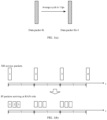
- FIG. 1(a) is an example diagram of modeling with frame-level data packets of an XR service
- FIG. 1(b) is an example diagram of an XR service data packet being mapped to multiple IP packets at an air interface of a 5G system.
- the XR service includes data packets that follow a certain probability distribution. Taking data packet K and data packet K+1 as examples, data packet K represents data frame K containing multiple IP packets, and data packet K+1 represents data frame K+1 containing multiple IP packets, where the average cycle of data frames is 1 frame per second (frame per second, fps). As shown in FIG.
- four XR service data packets are mapped to multiple IP packets respectively on a radio access network (Radio Access Network, RAN) side.
- RAN Radio Access Network
- the first XR data packet is mapped to the first three IP packets on the RAN side, where t represents time and T represents a duration.
- service characteristic requirements are for data frames.
- the service characteristic requirements for data frames are a cycle of 60fps, a data transmission rate of 10 million bits per second (Million bits per second, Mbps), a packet delay budget (Packet Delay Budget) of 30 milliseconds (ms). Therefore, the transmission rate, reliability, delay and so on of data frames are very critical for this kind of services.
- FIG. 1(c) shows an example diagram of a user plane protocol stack. As shown in FIG.
- the user plane air interface protocol stack includes multiple user plane air interface protocol layers: a service data adaptation protocol (Service Data Adaptation Protocol, SDAP) layer, a packet data convergence protocol (Packet Data Convergence Protocol, PDCP) layer, a radio link control (Radio Link Control, RLC) layer, a media access control (Media Access Control, MAC) layer and a physical layer (Physical Layer, PHY).
- SDAP Service Data Adaptation Protocol
- PDCP Packet Data Convergence Protocol
- RLC Radio Link Control
- Media Access Control Media Access Control
- PHY Physical Layer
- a network device configures one PDCP discard timer for a PDCP entity based on a packet delay budget (Packet Delay Budget, PDB) of a data radio bear (Data Radio Bear, DRB) corresponding to the PDCP entity.
- PDB Packet Delay Budget
- DRB Data Radio Bear
- the PDCP discard timer of the PDCP SDU corresponding to one IP packet may have timed out while PDCP SDUs corresponding to other IP packets are still being transmitted in a transmission process of the IP packets, which leads to the waste of air interface resources and low efficiency of air interface resources.
- the method includes: determining a PDCP SDU group, where the terminal maintains different PDCP discard timer lengths for PDCP SDUs.
- the terminal can maintain different PDCP discard timer lengths for the PDCP SDUs containing the IP packets based on the different arrival times of the IP packets, which can maintain appropriate PDBs for different PDCP SDUs, so as to solve the problem that there is a certain difference in timeout time points for different IP packets in the data frame.
- the problem that other IP packets are still being transmitted after one or more IP packets in the data frame have timed out can be solved, thereby saving air interface resources and improving air interface resource efficiency.
- the method and the apparatus are based on the same application concepts. Because the principles of solving problems by the method and the apparatus are similar, the implementation of the apparatus and the method can be referred to for each other, and the repetition will not be repeated.
- data frames in the embodiments of the present disclosure are not limited to data frames in the XR service, but may also be data frames in other services modeled with frame-level data packets.
- FIG. 2 is a schematic diagram of an application scenario provided by an embodiment of the present disclosure.
- this embodiment provides a communication system, which includes a network device 210 and terminals 220.
- This embodiment takes three terminals 320 as an example.
- a terminal 220 sends a data frame of a service (for example, an XR service) to the network device 210.
- the terminal 220 sequentially processes multiple IP packets of the data frame at multiple user plane air interface protocol layers, and then sends the same to the network device 210, thereby realizing the transmission of the data frame between the terminal 220 and the network device 210.
- a service for example, an XR service
- FIG. 3 is a flowchart of a timer processing method provided by an embodiment of the present disclosure. As shown in FIG. 3 , the method of this embodiment may include the following steps.
- a network device pre-configures one or more PDCP discard timers corresponding to a PDCP entity for a terminal, and/or configures a PDCP discard timer error threshold corresponding to the PDCP entity for the terminal.
- the network device can configure the PDCP discard timer(s) and/or the PDCP discard timer error threshold corresponding to the PDCP entity to the terminal by sending a configuration message to the terminal in advance.
- the configuring manner includes at least one of the following: the network device configures one PDCP discard timer corresponding to the PDCP entity to the terminal, the network device configures multiple PDCP discard timers corresponding to the PDCP entity to the terminal, the network device configures the PDCP discard timer error threshold corresponding to the PDCP entity to the terminal.
- the network device configuring the PDCP discard timer error threshold corresponding to the PDCP entity to the terminal may be combined with the two configuring manners of: the network device configuring one PDCP discard timer corresponding to the PDCP entity to the terminal, the network device configuring multiple PDCP discard timers corresponding to the PDCP entity to the terminal.
- the PDCP discard timer error threshold is used for constraining timeout time intervals of PDCP discard timers of multiple PDCP SDUs in the PDCP entity, especially for constraining the timeout time intervals of PDCP discard timers of different PDCP SDUs in a subsequent PDCP SDU group, so that multiple PDCP SDUs in the PDCP SDU group have similar transmission characteristics.
- the terminal determines a PDCP SDU group, where the terminal maintains different PDCP discard timer lengths for multiple PDCP SDUs in the PDCP SDU group.
- the terminal performs layer-by-layer processing on the multiple IP packets in multiple user plane air interface protocol layers of a user plane protocol stack, where the IP packets form SDAP PDUs after arriving at an SDAP layer, and the SDAP PDUs are PDCP SDUs after being delivered to a PDCP layer.
- the terminal can determine a PDCP SDU group from multiple PDCP SDUs arriving at the PDCP layer, where the PDCP SDU group includes multiple PDCP SDUs.
- the terminal can transmit data by using the PDCP SDU group based on maintaining different PDCP discard timer lengths for multiple PDCP SDUs in the PDCP SDU group.
- the terminal can maintain different PDCP discard timer lengths for multiple PDCP SDUs in the PDCP SDU group on the basis of the PDCP discard timer(s) pre-configured by the network device for the PDCP entity to which the PDCP SDU group belongs.
- the terminal can maintain a longer PDCP discard timer length for a PDCP SDU that arrives at the PDCP layer earlier and maintain a shorter PDCP discard timer length for a PDCP SDU that arrive sat the PDCP layer later, so that timeout time points of the PDCP discard timers of multiple PDCP SDUs in the PDCP SDU group are as close as possible, that is, the IP packets transmitted by multiple PDCP SDUs in the PDCP SDU group have similar transmission characteristics.
- the terminal in a case that the network device configures a PDCP discard timer error threshold corresponding to the PDCP entity for the terminal, the terminal can maintain that timeout time intervals of the PDCP discard timers of multiple PDCP SDUs in the PDCP SDU group are less than or equal to the PDCP discard timer error threshold.
- the setting of the PDCP discard timer error threshold is to reserve an error space considering that a timing process of the PDCP discard timer has a certain fault tolerance.
- the terminal can discard invalid PDCP SDUs in time after the PDCP discard timer of one PDCP SDU times out, thereby saving air interface resources and improving air interface resource efficiency; on the other hand, the terminal can transmit the corresponding PDCP SDU in time before the PDCP discard timer of the PDCP SDU in the PDCP SDU group is about to time out, so as to guarantee the transmission delay and realize the effective transmission of multiple PDCP SDUs in the PDCP SDU group.
- the network device pre-configures one or more PDCP timeout timers and/or the PDCP discard timer error threshold corresponding to the PDCP entity for the terminal, and considering that the arrival times of the PDCP SDUs in the PDCP SDU group may be different, the terminal maintains different PDCP discard timer lengths for multiple PDCP SDUs in the PDCP SDU group in the transmission process of the data frame, so that multiple PDCP SDUs in the PDCP SDU group have similar transmission characteristics.
- the effective transmission of multiple PDCP SDUs in the PDCP SDU group is realized meanwhile the PDB is ensured, thereby realizing the effective transmission of multiple IP packets in the data frame, and improving the air interface resource efficiency.
- multiple PDCP SDUs in the PDCP SDU group are used for transmitting multiple IP packets of a same data frame.
- multiple PDCP SDUs in the PDCP SDU group contain multiple IP packets of the same data frame.
- the terminal maintains different PDCP discard timer lengths for the PDCP SDUs corresponding to multiple IP packets of the same data frame, so that multiple IP packets of the same data frame have similar transmission characteristics when being transmitted at the PDCP layer, and specifically, timeout time points of the PDCP discard timers of the PDCP SDUs for transmitting the IP packets of the same data frame are close, so as to solve the problem that remaining IP packets are still being transmitted after the PDCP discard timer of the PDCP SDU where one IP packet in the same data frame is located times out.
- the timeout time points of the PDCP discard timers of different PDCP SDUs in the PDCP SDU group are the same, or the timeout time intervals of the PDCP discard timers of different PDCP SDUs in the PDCP SDU group are less than or equal to the PDCP discard timer error threshold.
- the terminal maintains different PDCP discard timer lengths for multiple PDCP SDUs in the PDCP SDU group, so that the timeout time points of the PDCP discard timers of different PDCP SDUs in the PDCP SDU group are the same, or the timeout time point intervals of the PDCP discard timers of different PDCP SDUs in the PDCP SDU group are less than or equal to the PDCP discard timer error threshold.
- the problem that the remaining IP packets are still being transmitted after the PDCP discard timer of the PDCP SDU where one IP packet in the same data frame is located times out is solved, which is beneficial for promoting the terminal to transmit the IP packets to a lower layer in time before similar timeout time points of the PDCP discard timers of multiple PDCP SDUs in the PDCP SDU group.
- possible implementations of S301 include at least one of the following.
- the terminal can determine multiple IP packets belonging to the same data frame at the SDAP layer according to the data frame labels of the IP packets or by performing deep packet parsing on the IP packets, and for the multiple IP packets belonging to the same data frame, carry the same group identifiers in the SDAP PDUs for transmitting these IP packets, and then send the SDAP PDUs to the PDCP layer.
- the terminal determines multiple PDCP SDUs with the same group identifiers based on the group identifiers carried in the PDCP SDUs and obtains the PDCP SDU group based on the multiple PDCP SDUs with the same group identifiers.
- the accuracy of the PDCP SDU group is improved by adding the same group identifiers to the SDAP PDUs for transmitting the IP packets of the same data frame and determining the PDCP SDU group based on the group identifiers at the PDCP layer.
- At least two PDCP SDUs in the PDCP SDU group arrive at the PDCP layer at different time points.
- the terminal maintains different PDCP discard timer lengths for multiple PDCP SDUs in the PDCP SDU group, so as to solve the problem that one PDCP SDU times out among the PDCP SDUs that arrive at the PDCP layer at different times and other PDCP SDUs are still being transmitted.
- the length of the PDCP discard timer is an actual timing duration of the PDCP discard timer.
- the terminal maintains different PDCP discard timer lengths for multiple PDCP SDUs in the PDCP SDU group, including at least one of the following manners.
- Manner 1 one PDCP discard timer corresponding to the PDCP entity is pre-configured for the terminal by the network device; in the PDCP SDU group, time starting points of the PDCP discard timers of all PDCP SDUs are a time point when a first PDCP SDU arrives at the PDCP layer, and timeout time points of the PDCP discard timers of all PDCP SDUs are a timeout time point of the PDCP discard timer of the first PDCP SDU.
- the first PDCP SDU refers to the PDCP SDU in the PDCP SDU group which is the first to arrive at the PDCP layer.
- the time starting points of the PDCP discard timers of the respective PDCP SDUs in the PDCP SDU group are consistent, and combining with the one PDCP discard timer corresponding to the PDCP entity configured for the terminal by the network device, the timeout time points of the PDCP discard timers of the respective PDCP SDUs in the PDCP SDU group are also consistent.
- the timeout time points of the PDCP discard timers of the respective PDCP SDUs in the PDCP SDU group are the same, which avoids a situation that the PDCP discard timer of one PDCP SDU in the PDCP SDU group times out while other PDCP SDUs are still being transmitted; meanwhile, it is beneficial for prompting the terminal to complete the transmission of the PDCP SDUs before the unified timeout time points of the PDCP discard timers, and is beneficial for realizing the effective transmission of the PDCP SDUs and improving the air interface resource efficiency while ensuring the PDB.
- FIG. 4 is an example diagram of transmission of multiple IP packets in one data frame.
- one data frame is divided into three IP packets, which are mapped to the first, second and third PDCP SDU respectively, and these three PDCP SDUs are called PDCP SDU1, PDCP SDU2 and PDCP SDU3 respectively.
- the arrival time of PDCP SDU1 (that is, the time when arriving at the PDCP layer) is T1
- the arrival time of PDCP SDU2 is T1+ ⁇ T2
- the arrival time of PDCP SDU3 is T1+ ⁇ T3.
- Timeout time points of PDCP timers of the three PDCP SDUs are all T1+Td1, where Td1 represents the PDCP discard timer length of PDCP SDU1.
- an initial value of starting timing by the PDCP discard timer of this PDCP SDU is a difference between the arrival time of this PDCP SDU and the arrival time of the first PDCP SDU, rather than starting timing from 0.
- time starting points of the PDCP discard timer of PDCP SDU1, the PDCP discard timer of PDCP SDU2 and the PDCP discard timer of PDCP SDU3 all start from 0, so an initial value of the PDCP discard timer of PDCP SDU1 is 0, an initial value of starting timing by the PDCP discard timer of PDCP SDU2 when PDCP SDU2 arrives at the PDCP layer is ⁇ T2, and an initial value of starting timing by the PDCP discard timer of PDCP SDU3 when PDCP SDU3 arrives at the PDCP layer is ⁇ T3.
- the timeout time intervals of the PDCP discard timers of different PDCP SDUs in the PDCP SDU are less than the PDCP discard timer error threshold.
- a time interval between any two of the timeout time point of the PDCP discard timer of PDCP SDU1, the timeout time point of the PDCP discard timer of PDCP SDU2 and the timeout time point of the PDCP discard timer of PDCP SDU3 is less than the PDCP discard timer error threshold, which will not be described in detail here.
- Manner 2 one PDCP discard timer corresponding to the PDCP entity is pre-configured for the terminal by the network device; in the PDCP SDU group, according to a difference between the time point when each PDCP SDU arrives at the PDCP layer and the time point when the first PDCP SDU arrives at the PDCP layer, the length of the PDCP discard timer configured by the network device is adjusted to obtain the length of the PDCP discard timer of the each PDCP SDU, where the time starting point of the PDCP discard timer of each PDCP SDU is the time point when the each PDCP SDU arrives at the PDCP layer.
- the lengths of the PDCP discard timers of the remaining PDCP SDUs except the first PDCP SDU are adjusted to the difference between the arrival times of the PDCP SDUs and the arrival time of the first PDCP SDU. Therefore, based on the one PDCP discard timer pre-configured by the network device, even if the time starting points of the PDCP discard timers of the respective PDCP SDUs in the PDCP SDU group are different, the timeout time points of the PDCP discard timers of the respective PDCP SDUs in the PDCP SDU group are consistent by adjusting the lengths of the PDCP discard timers.
- the time starting point (i.e., the initial value) of the PDCP discard timer of the first PDCP SDU is 0; the time starting points of the PDCP discard timers of the PDCP SDUs that arrive at the PDCP layer subsequently depend on the times when the PDCP SDUs arrive at the PDCP layer, but they all start timing from 0.
- the length of the PDCP discard timer of this PDCP SDU is set as the difference between the arrival time of this PDCP SDU and the arrival time of the first PDCP SDU. Referring to FIG.
- the initial values of the PDCP discard timers of PDCP SDU1, PDCP SDU2 and PDCP SDU3 are all 0 (since the arrival times of PDCP SDU1, PDCP SDU2 and PDCP SDU3 are different, timing is started from different time points actually).
- the length of the PDCP discard timer of PDCP SDU1 is Td1
- the length of the PDCP discard timer of PDCP SDU2 is Td1- ⁇ T2
- the length of the PDCP discard timer of PDCP SDU2 is Td1-DT3.
- the timeout time intervals of the PDCP discard timers of different PDCP SDUs in the PDCP SDU are less than the PDCP discard timer error threshold, which is not described in detail here.
- Manner 3 multiple PDCP discard timers with different lengths corresponding to the PDCP entity are pre-configured for the terminal by the network device; in the PDCP SDU group, one of the multiple PDCP discard timers is used in turn according to a sequence in which the PDCP SDUs arrive at the PDCP layer.
- the network device sets multiple PDCP discard timers for the PDCP entity for the terminal, and the lengths of the multiple PDCP discard timers are different.
- the terminal determines a PDCP discard timer suitable for each PDCP SDU among the multiple PDCP discard timers in order of the length of the PDCP discard timer from large to small, so that the timeout time points of the PDCP discard timers of the respective PDCP SDUs in the PDCP SDU group are consistent or the timeout time intervals are less than the PDCP discard timer error threshold.
- the network device pre-configures a group of PDCP discard timers corresponding to the PDCP entity for the terminal: PDCP discard timer 1, PDCP discard timer 2 and PDCP discard timer 3, where the length of PDCP discard timer 1, the length of PDCP discard timer 2 and the length of PDCP discard timer 3 decrease in turn.
- the terminal can determine PDCP discard timer 1 to be the PDCP discard timer of PDCU SDU1, PDCP discard timer 2 to be the PDCP discard timer of PDCP SDU2, and PDCP discard timer 3 to be the PDCP discard timer of PDCP SDU3, so that the timeout times of the PDCP discard timers of the PDCP SDUs in the PDCP SDU group are similar.
- an embodiment of the present disclosure provides a timer processing apparatus, and the timer processing apparatus in this embodiment may be a terminal.
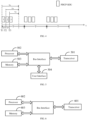
- the timer processing apparatus may include a transceiver 501, a processor 502 and a memory 503.
- the transceiver 501 is adapted to receive and transmit data under control of the processor 502.
- a bus architecture may include any number of interconnected buses and bridges, and specifically, various circuits of one or more processors represented by the processor 502 and a memory represented by the memory 503 are linked together.
- the bus architecture may also link various other circuits together, such as a peripheral device, a voltage regulator and a power management circuit, which are well known in the art and thus will not be further described here.
- a bus interface provides an interface.
- the transceiver 501 may be multiple elements, that is, including a transmitter and a receiver, providing units for communicating with various other apparatuses on transmission mediums. These transmission mediums include a wireless channel, a wired channel, an optical cable and other transmission mediums.
- the timer processing apparatus may also include a user interface 504.
- the user interface 504 may also be an interface capable of externally/internally connecting a required device, and the connected device includes, but is not limited to, a keypad, a display, a speaker, a microphone, a joystick, etc.
- the processor 502 is responsible for managing the bus architecture and general processing, and the memory 503 can store data used by the processor 502 when performing operations.
- the processor 502 may be a central processing unit (central processing unit, CPU), an application specific integrated circuit (Application Specific Integrated Circuit, ASIC), a field-programmable gate array (Field-Programmable Gate Array FPGA) or a complex programmable logic device (Complex Programmable Logic Device, CPLD), and the processor 502 may also adopt a multi-core architecture.
- CPU central processing unit
- ASIC Application Specific Integrated Circuit
- ASIC Application Specific Integrated Circuit
- FPGA Field-Programmable Gate Array FPGA
- CPLD Complex Programmable Logic Device
- the processor 502 is adapted to execute any of the methods related to the terminal provided by the embodiments of the present disclosure according to the obtained executable instructions by calling a computer program stored in the memory 503.
- the processor and the memory may also be physically separated.
- the processor 502 is adapted to execute the following operation: determining a packet data convergence protocol (PDCP) service data unit (SDU) group, where the terminal maintains different PDCP discard timer lengths for multiple PDCP SDUs in the PDCP SDU group.
- PDCP packet data convergence protocol
- SDU service data unit
- multiple PDCP SDUs in the PDCP SDU group are used for transmitting multiple IP packets of a same data frame.
- PDCP discard timers of different PDCP SDUs in the PDCP SDU group have a same timeout time point, or timeout time intervals of PDCP discard timers of different PDCP SDUs are less than or equal to a PDCP discard timer error threshold.
- the processor 502 further executes at least one of the following operations:
- At least two PDCP SDUs in the PDCP SDU group arrive at a PDCP layer at different time points, and the terminal maintains different PDCP discard timer lengths for multiple PDCP SDUs in the PDCP SDU group, including any one of the following:
- a communication apparatus includes a transceiver 601, a processor 602 and a memory 603.
- the transceiver 601 is adapted to receive and transmit data under control of the processor 602.
- a bus architecture may include any number of interconnected buses and bridges, and specifically, various circuits of one or more processors represented by the processor 602 and a memory represented by memory 603 are linked together.
- the bus architecture may also link various other circuits together, such as a peripheral device, a voltage regulator and a power management circuit, which are well known in the art and thus will not be further described here.
- a bus interface provides an interface.
- the transceiver 601 may be multiple elements, that is, including a transmitter and a receiver, providing units for communicating with various other devices on transmission mediums. These transmission mediums include a wireless channel, a wired channel, an optical cable and other transmission mediums.
- the processor 602 is responsible for managing the bus architecture and general processing, and the memory 603 can store data used by the processor 602 when performing operations.
- the processor 602 may be a CPU, an ASIC, a FPGA or a CPLD, and the processor may also adopt a multi-core architecture.
- the processor 602 is adapted to execute any of the methods related to the network device provided by the embodiments of the present disclosure according to the obtained executable instructions by calling a computer program stored in the memory 503.
- the processor and the memory may also be physically separated.
- the processor 602 is adapted to execute the following operations: configuring one or more PDCP discard timers corresponding to a PDCP entity for a terminal, and/or configuring a PDCP discard timer error threshold corresponding to the PDCP entity for the terminal, where the PDCP discard timer error threshold is used for constraining timeout time intervals of PDCP discard timers of different PDCP SDUs in a PDCP SDU group of the PDCP entity.
- an embodiment of the present disclosure further provides a timer processing apparatus, and the timer processing apparatus of this embodiment may be a terminal.
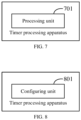
- the timer processing apparatus includes a processing unit 701.
- the processing unit 701 is adapted to determine a packet data convergence protocol (PDCP) service data unit (SDU) group, where the terminal maintains different PDCP discard timer lengths for multiple PDCP SDUs in the PDCP SDU group.
- PDCP packet data convergence protocol
- SDU service data unit
- multiple PDCP SDUs in the PDCP SDU group are used for transmitting multiple IP packets of a same data frame.
- PDCP discard timers of different PDCP SDUs in the PDCP SDU group have a same timeout time point, or timeout time intervals of PDCP discard timers of different PDCP SDUs are less than or equal to a PDCP discard timer error threshold.
- processing unit 701 is further adapted to perform at least one of the following operations:
- At least two PDCP SDUs in the PDCP SDU group arrive at a PDCP layer at different time points, and the terminal maintains different PDCP discard timer lengths for multiple PDCP SDUs in the PDCP SDU group, including any one of the following:
- the apparatus provided by the present disclosure can implement all the method steps implemented by the terminal in the above method embodiments, and can achieve the same technical effects, so the parts in this embodiment that are same as those in the method embodiments and the beneficial effects will not be detailed here.
- an embodiment of the present disclosure further provides a timer processing apparatus, and the timer processing apparatus of this embodiment may be a network device.
- the timer processing apparatus includes a configuring unit 801.
- the configuring unit 801 is adapted to configure one or more PDCP discard timers corresponding to a PDCP entity for a terminal, and/or configuring a PDCP discard timer error threshold corresponding to the PDCP entity for the terminal, where the PDCP discard timer error threshold is used for constraining timeout time intervals of PDCP discard timers of different PDCP SDUs in a PDCP SDU group of the PDCP entity.
- the apparatus provided by the present disclosure can implement all the method steps implemented by the network device in the above method embodiments, and can achieve the same technical effects, so the parts in this embodiment that are same as those in the method embodiments and the beneficial effects will not be detailed here.
- the division of units in the embodiments of the present disclosure is schematic and is only a logical function division, and there may be another division manners in actual implementations.
- the functional units in the embodiments of the present disclosure may be integrated into one processing unit, or each unit may exist physically alone, or two or more units may be integrated into one unit.
- the above integrated unit may be realized in the form of hardware, and may also be realized in the form of software functional units.
- the integrated unit can be stored in a processor-readable storage medium if the integrated unit is implemented in the form of software functional units and is sold or used as an independent product.
- the technical solution of the present disclosure in essence or the part that contributes to the prior art or all or part of the technical solution can be embodied in the form of a software product.
- the computer software product is stored in a storage medium and includes several instructions to cause a computer device (which may be a personal computer, a server, a network device, etc.) or a processor (processor) to execute all or part of the steps of the methods described in various embodiments of the present disclosure.
- the aforementioned storage medium includes: a U disk, a mobile hard disk, a read-only memory (Read-Only Memory, ROM), a random access memory (Random Access Memory, RAM), a magnetic disk, an optical disk or other mediums that can store program codes.
- an embodiment of the present disclosure provides a processor-readable storage medium, and the processor-readable storage medium stores a computer program.
- the computer program is used for causing a processor to execute any method related to the terminal provided by the embodiments of the present disclosure, so that the processor can implement all the method steps implemented by the terminal in the above method embodiments, and can achieve the same technical effects.
- the parts in this embodiment that are same as those in the method embodiments and the beneficial effects will not be detailed here.
- an embodiment of the present disclosure provides a processor-readable storage medium, and the processor-readable storage medium stores a computer program.
- the computer program is used for causing a processor to execute any of the methods related to the network device provided by the embodiments of the present disclosure, so that the processor can implement all the method steps implemented by the network device in the above method embodiments, and can achieve the same technical effects.
- the parts in this embodiment that are same as those in the method embodiments and the beneficial effects will not be detailed here.
- the processor-readable storage medium may be any available medium or data storage device that the processor can access, including but not limited to magnetic memories (such as a floppy disk, a hard disk, a magnetic tape, a magneto-optical disk (MO), etc.), optical memories (such as a CD, a DVD, a BD, an HVD, etc.), and semiconductor memories (such as a ROM, an EPROM, an EEPROM, a non-volatile memory (NAND FLASH), a solid state disk (SSD)), etc.
- magnetic memories such as a floppy disk, a hard disk, a magnetic tape, a magneto-optical disk (MO), etc.
- optical memories such as a CD, a DVD, a BD, an HVD, etc.
- semiconductor memories such as a ROM, an EPROM, an EEPROM, a non-volatile memory (NAND FLASH), a solid state disk (SSD)
- the embodiments of the present disclosure may be provided as a method, a system or a computer program product. Therefore, the present disclosure may take the form of an entire-hardware embodiment, an entire-software embodiment, or an embodiment combining software and hardware aspects. Moreover, the present disclosure may take the form of a computer program product implemented on one or more computer usable storage mediums (including but not limited to a magnetic disk storage and an optical storage, etc.) containing computer usable program codes therein.
- a computer usable storage mediums including but not limited to a magnetic disk storage and an optical storage, etc.
- These computer executable instructions may be provided to a processor of a general-purpose computer, a special-purpose computer, an embedded processor or other programmable data processing devices to produce a machine, so that the instructions executed by the processor of the computer or other programmable data processing devices produce an apparatus for implementing the functions specified in one or more flows in the flowcharts and/or in one or more blocks in the block diagrams.
- processor executable instructions may also be stored in a processor-readable memory that can guide a computer or other programmable data processing devices to work in a particular manner, so that the instructions stored in the processor-readable memory produce a manufacture including an instruction apparatus, where the instruction apparatus implements the functions specified in one or more flows in the flowcharts and/or in one or more blocks in the block diagrams.
- processor executable instructions may also be loaded onto a computer or other programmable data processing devices, so that a series of operational steps are performed on the computer or other programmable devices to produce processing implemented by the computer, and thus the instructions executed on the computer or other programmable devices provide steps for implementing the functions specified in one or more flows in the flowcharts and/or in one or more blocks in the block diagrams.
Landscapes
- Engineering & Computer Science (AREA)
- Computer Networks & Wireless Communication (AREA)
- Signal Processing (AREA)
- Computer Security & Cryptography (AREA)
- Mobile Radio Communication Systems (AREA)
Applications Claiming Priority (2)
| Application Number | Priority Date | Filing Date | Title |
|---|---|---|---|
| CN202111089526.8A CN115834742B (zh) | 2021-09-16 | 2021-09-16 | 定时器处理方法、装置及存储介质 |
| PCT/CN2022/113771 WO2023040586A1 (zh) | 2021-09-16 | 2022-08-19 | 定时器处理方法、装置及存储介质 |
Publications (2)
| Publication Number | Publication Date |
|---|---|
| EP4404618A1 true EP4404618A1 (de) | 2024-07-24 |
| EP4404618A4 EP4404618A4 (de) | 2025-01-15 |
Family
ID=85515182
Family Applications (1)
| Application Number | Title | Priority Date | Filing Date |
|---|---|---|---|
| EP22868960.0A Pending EP4404618A4 (de) | 2021-09-16 | 2022-08-19 | Timerverarbeitungsverfahren und -vorrichtung und speichermedium |
Country Status (4)
| Country | Link |
|---|---|
| US (1) | US12363047B2 (de) |
| EP (1) | EP4404618A4 (de) |
| CN (1) | CN115834742B (de) |
| WO (1) | WO2023040586A1 (de) |
Cited By (1)
| Publication number | Priority date | Publication date | Assignee | Title |
|---|---|---|---|---|
| WO2025196179A1 (en) * | 2024-03-20 | 2025-09-25 | Telefonaktiebolaget Lm Ericsson (Publ) | Packet data convergence protocol packet discarding |
Families Citing this family (7)
| Publication number | Priority date | Publication date | Assignee | Title |
|---|---|---|---|---|
| US20240032128A1 (en) * | 2021-06-07 | 2024-01-25 | Apple Inc. | Harmonized link monitoring and link recovery |
| CN117202255A (zh) * | 2022-05-31 | 2023-12-08 | 大唐移动通信设备有限公司 | 数据单元处理方法、装置及通信设备 |
| US20240121663A1 (en) * | 2022-09-29 | 2024-04-11 | Intel Corporation | Technologies to support extended reality network traffic |
| US20240275732A1 (en) * | 2023-02-14 | 2024-08-15 | Qualcomm Incorporated | Protocol-data-unit-set-based discarding or processing |
| CN118785243A (zh) * | 2023-04-07 | 2024-10-15 | 大唐移动通信设备有限公司 | 信息处理、信息传输方法、装置、终端及网络设备 |
| CN119697694A (zh) * | 2023-09-25 | 2025-03-25 | 大唐移动通信设备有限公司 | 一种拥塞控制方法、装置及可读存储介质 |
| CN120785899A (zh) * | 2024-04-01 | 2025-10-14 | 维沃移动通信有限公司 | 数据处理方法、装置、设备及存储介质 |
Family Cites Families (32)
| Publication number | Priority date | Publication date | Assignee | Title |
|---|---|---|---|---|
| CN104821865B (zh) * | 2007-10-01 | 2019-03-29 | 交互数字专利控股公司 | 用于pdcp丢弃的方法和装置 |
| CN101809970B (zh) | 2007-12-28 | 2012-10-03 | 中兴通讯股份有限公司 | 无线链路控制实体的复位方法 |
| US8325608B2 (en) * | 2008-08-07 | 2012-12-04 | Qualcomm Incorporated | Efficient packet handling for timer-based discard in a wireless communication system |
| CN101677266B (zh) * | 2008-09-19 | 2012-12-26 | 电信科学技术研究院 | 控制重排序和重复消除操作的方法、系统及装置 |
| CN102076040A (zh) | 2011-01-19 | 2011-05-25 | 新邮通信设备有限公司 | 一种切换过程中的数据转发方法和系统 |
| WO2017014523A1 (en) * | 2015-07-21 | 2017-01-26 | Lg Electronics Inc. | Method for performing uplink packet measurements in a wireless communication system and a device therefor |
| KR20170017281A (ko) * | 2015-08-06 | 2017-02-15 | 엘지전자 주식회사 | Pdcp 디스카드 타이머 제어 방법 및 그를 위한 장치 |
| EP3360366B1 (de) * | 2015-10-05 | 2020-06-17 | LG Electronics Inc. | Verfahren zur übertragung eines warteschlangenverzögerungsmessberichts in einem drahtloskommunikationssystem und vorrichtung dafür |
| CN108419275B (zh) | 2017-02-10 | 2022-01-14 | 华为技术有限公司 | 一种数据传输方法、通信设备、终端和基站 |
| WO2018195770A1 (zh) | 2017-04-25 | 2018-11-01 | Oppo广东移动通信有限公司 | 传输数据的方法和通信设备 |
| JP2020520567A (ja) * | 2017-04-28 | 2020-07-09 | テレフオンアクチーボラゲット エルエム エリクソン(パブル) | パケットデータコンバージェンスプロトコル(pdcp)の再順序付けのためのネットワークノードとその方法 |
| US10917817B2 (en) * | 2017-05-17 | 2021-02-09 | Telefonaktiebolaget Lm Ericsson (Publ) | Methods and apparatus for discarding packets in a wireless communication network |
| WO2019019025A1 (zh) | 2017-07-25 | 2019-01-31 | 北京小米移动软件有限公司 | 一种数据包丢弃方法、装置和系统 |
| CN109392012B (zh) * | 2017-08-11 | 2020-12-04 | 华为技术有限公司 | 一种数据处理方法及相关设备 |
| CN108200605B (zh) * | 2017-12-28 | 2021-09-24 | 京信网络系统股份有限公司 | 一种基站的数据传输方法和装置 |
| CN110324195B (zh) * | 2018-03-30 | 2021-01-08 | 维沃移动通信有限公司 | 一种接收方法、发送方法及通信设备 |
| EP3777306B1 (de) * | 2018-04-11 | 2025-04-23 | ZTE Corporation | Verwerfungszeitgeberbetrieb in der drahtlosen kommunikation |
| US11350483B2 (en) * | 2018-05-04 | 2022-05-31 | Lg Electronics Inc. | Method and apparatus for transmitting signals by prioritizing RLC entities in wireless communication system |
| WO2020167857A1 (en) * | 2019-02-11 | 2020-08-20 | Apple Inc. | Apparatus and method for enhanced beam recovery |
| WO2020166621A1 (ja) * | 2019-02-14 | 2020-08-20 | 京セラ株式会社 | 通信制御方法 |
| US12041487B2 (en) * | 2019-05-01 | 2024-07-16 | Apple Inc. | User equipment based packet data convergence protocol (PDCP) duplication activation and deactivation |
| WO2021031019A1 (zh) * | 2019-08-16 | 2021-02-25 | Oppo广东移动通信有限公司 | 数据包的删除方法、设备及存储介质 |
| KR20210152853A (ko) * | 2020-06-09 | 2021-12-16 | 삼성전자주식회사 | 이중접속 네트워크에서 패킷을 재전송하는 방법 및 장치 |
| KR102904461B1 (ko) * | 2020-07-31 | 2025-12-29 | 삼성전자 주식회사 | 차세대 이동 통신 시스템에서 무결성 보호 또는 검증 절차로 인한 단말 프로세싱 부하를 줄이는 방법 및 장치 |
| EP4193615A1 (de) * | 2020-08-05 | 2023-06-14 | InterDigital Patent Holdings, Inc. | Planung und trägerverwaltung von 5g-multicast-broadcast-diensten (mbs) |
| KR20220017735A (ko) * | 2020-08-05 | 2022-02-14 | 삼성전자주식회사 | 차세대 이동 통신 시스템이 지원하는 이중 접속 기술에서 복수 개의 scg 설정을 지원하는 방법 및 장치 |
| US11785501B2 (en) * | 2020-08-11 | 2023-10-10 | Qualcomm Incorporated | Techniques for timer adjustment for packet loss |
| US20240015550A1 (en) * | 2020-10-09 | 2024-01-11 | Telefonaktiebolaget Lm Ericsson (Publ) | Linked Radio-Layer and Application-Layer Measurements in a Wireless Network |
| EP4659428A4 (de) * | 2023-03-30 | 2026-04-29 | Samsung Electronics Co Ltd | Verfahren und vorrichtung für nw anzeigebasierte paketablösung in drahtlosen kommunikationssystemen |
| WO2024205374A2 (en) * | 2023-03-31 | 2024-10-03 | Samsung Electronics Co., Ltd. | Method and apparatus for congestion handling while packet discarding for extended reality in a wireless communication system |
| CN119697695A (zh) * | 2023-09-22 | 2025-03-25 | 华为技术有限公司 | 数据包递交的方法和通信装置 |
| WO2025068495A1 (en) * | 2023-09-28 | 2025-04-03 | Sony Group Corporation | Methods, communications devices, and infrastructure equipment |
-
2021
- 2021-09-16 CN CN202111089526.8A patent/CN115834742B/zh active Active
-
2022
- 2022-08-19 EP EP22868960.0A patent/EP4404618A4/de active Pending
- 2022-08-19 WO PCT/CN2022/113771 patent/WO2023040586A1/zh not_active Ceased
- 2022-08-19 US US18/686,860 patent/US12363047B2/en active Active
Cited By (1)
| Publication number | Priority date | Publication date | Assignee | Title |
|---|---|---|---|---|
| WO2025196179A1 (en) * | 2024-03-20 | 2025-09-25 | Telefonaktiebolaget Lm Ericsson (Publ) | Packet data convergence protocol packet discarding |
Also Published As
| Publication number | Publication date |
|---|---|
| US20250133030A1 (en) | 2025-04-24 |
| CN115834742B (zh) | 2024-11-22 |
| EP4404618A4 (de) | 2025-01-15 |
| WO2023040586A1 (zh) | 2023-03-23 |
| CN115834742A (zh) | 2023-03-21 |
| US12363047B2 (en) | 2025-07-15 |
Similar Documents
| Publication | Publication Date | Title |
|---|---|---|
| US12363047B2 (en) | Timer processing method, apparatus and storage medium | |
| WO2022083484A1 (zh) | 数据传输控制方法、装置及存储介质 | |
| CN108702660A (zh) | 通信方法、终端设备和网络设备 | |
| EP4383621A1 (de) | Steuersignalisierungsüberwachungsverfahren und -vorrichtung, vorrichtung und speichermedium | |
| WO2022156439A1 (zh) | 信息传输方法、装置、基站及介质 | |
| WO2022152092A1 (zh) | 数据传输控制方法和装置 | |
| EP4404670A1 (de) | Datenübertragungsverfahren und -vorrichtung sowie speichermedium | |
| EP4319014A1 (de) | Verfahren und vorrichtung zur verzögerungsreduzierung, endgerät und vorrichtung | |
| CN114731699B (zh) | 通信方法及装置 | |
| EP4664984A1 (de) | Pdu-ablösungsverfahren und -vorrichtung | |
| EP4560953A1 (de) | Verfahren und vorrichtung zum senden eines pdu-satzes und kommunikationsknoten | |
| WO2025066300A1 (zh) | 一种拥塞控制方法、装置及可读存储介质 | |
| WO2025025838A1 (zh) | 退出拥塞管理状态的方法、终端、装置及存储介质 | |
| WO2024139879A1 (zh) | 信息处理方法、传输方法、装置、终端及网络侧设备 | |
| WO2023197799A1 (zh) | 业务数据传输方法、终端、网络节点和存储介质 | |
| CN118785243A (zh) | 信息处理、信息传输方法、装置、终端及网络设备 | |
| WO2022218157A1 (zh) | 信道处理方法、装置及存储介质 | |
| EP4561030A1 (de) | Datenverarbeitungsverfahren und -vorrichtung sowie speichermedium | |
| WO2025091440A1 (en) | Discard notifying | |
| EP4694567A1 (de) | Informationsverarbeitungsverfahren und -vorrichtung sowie lesbares speichermedium | |
| CN121751363A (zh) | 信息传输方法、装置、接入网设备、终端及核心网设备 | |
| CN119893582A (zh) | 数据处理方法、终端及处理器可读存储介质 | |
| WO2019028920A1 (zh) | 一种数据传输方法及设备 | |
| CN119603722A (zh) | 信息处理方法、装置、终端及网络设备 | |
| WO2026056589A1 (zh) | 协同传输方法、设备、装置及存储介质 |
Legal Events
| Date | Code | Title | Description |
|---|---|---|---|
| STAA | Information on the status of an ep patent application or granted ep patent |
Free format text: STATUS: THE INTERNATIONAL PUBLICATION HAS BEEN MADE |
|
| PUAI | Public reference made under article 153(3) epc to a published international application that has entered the european phase |
Free format text: ORIGINAL CODE: 0009012 |
|
| STAA | Information on the status of an ep patent application or granted ep patent |
Free format text: STATUS: REQUEST FOR EXAMINATION WAS MADE |
|
| 17P | Request for examination filed |
Effective date: 20240226 |
|
| AK | Designated contracting states |
Kind code of ref document: A1 Designated state(s): AL AT BE BG CH CY CZ DE DK EE ES FI FR GB GR HR HU IE IS IT LI LT LU LV MC MK MT NL NO PL PT RO RS SE SI SK SM TR |
|
| REG | Reference to a national code |
Ref country code: DE Ref legal event code: R079 Free format text: PREVIOUS MAIN CLASS: H04W0028060000 Ipc: H04L0069321000 |
|
| DAV | Request for validation of the european patent (deleted) | ||
| DAX | Request for extension of the european patent (deleted) | ||
| A4 | Supplementary search report drawn up and despatched |
Effective date: 20241212 |
|
| RIC1 | Information provided on ipc code assigned before grant |
Ipc: H04W 28/06 20090101ALN20241206BHEP Ipc: H04L 69/28 20220101ALI20241206BHEP Ipc: H04L 69/324 20220101ALI20241206BHEP Ipc: H04L 69/321 20220101AFI20241206BHEP |