EP4404574A1 - Videoverarbeitungsverfahren und -vorrichtung sowie medium und programmprodukt - Google Patents
Videoverarbeitungsverfahren und -vorrichtung sowie medium und programmprodukt Download PDFInfo
- Publication number
- EP4404574A1 EP4404574A1 EP22871767.4A EP22871767A EP4404574A1 EP 4404574 A1 EP4404574 A1 EP 4404574A1 EP 22871767 A EP22871767 A EP 22871767A EP 4404574 A1 EP4404574 A1 EP 4404574A1
- Authority
- EP
- European Patent Office
- Prior art keywords
- text
- video
- speech
- target
- image sequence
- Prior art date
- Legal status (The legal status is an assumption and is not a legal conclusion. Google has not performed a legal analysis and makes no representation as to the accuracy of the status listed.)
- Pending
Links
Images


Classifications
-
- H—ELECTRICITY
- H04—ELECTRIC COMMUNICATION TECHNIQUE
- H04N—PICTORIAL COMMUNICATION, e.g. TELEVISION
- H04N21/00—Selective content distribution, e.g. interactive television or video on demand [VOD]
- H04N21/40—Client devices specifically adapted for the reception of or interaction with content, e.g. set-top-box [STB]; Operations thereof
- H04N21/43—Processing of content or additional data, e.g. demultiplexing additional data from a digital video stream; Elementary client operations, e.g. monitoring of home network or synchronising decoder's clock; Client middleware
- H04N21/439—Processing of audio elementary streams
- H04N21/4394—Processing of audio elementary streams involving operations for analysing the audio stream, e.g. detecting features or characteristics in audio streams
-
- G—PHYSICS
- G06—COMPUTING OR CALCULATING; COUNTING
- G06T—IMAGE DATA PROCESSING OR GENERATION, IN GENERAL
- G06T13/00—Animation
- G06T13/20—3D [Three Dimensional] animation
- G06T13/40—3D [Three Dimensional] animation of characters, e.g. humans, animals or virtual beings
-
- G—PHYSICS
- G06—COMPUTING OR CALCULATING; COUNTING
- G06T—IMAGE DATA PROCESSING OR GENERATION, IN GENERAL
- G06T5/00—Image enhancement or restoration
- G06T5/70—Denoising; Smoothing
-
- G—PHYSICS
- G06—COMPUTING OR CALCULATING; COUNTING
- G06T—IMAGE DATA PROCESSING OR GENERATION, IN GENERAL
- G06T7/00—Image analysis
- G06T7/10—Segmentation; Edge detection
- G06T7/194—Segmentation; Edge detection involving foreground-background segmentation
-
- G—PHYSICS
- G06—COMPUTING OR CALCULATING; COUNTING
- G06V—IMAGE OR VIDEO RECOGNITION OR UNDERSTANDING
- G06V10/00—Arrangements for image or video recognition or understanding
- G06V10/40—Extraction of image or video features
- G06V10/44—Local feature extraction by analysis of parts of the pattern, e.g. by detecting edges, contours, loops, corners, strokes or intersections; Connectivity analysis, e.g. of connected components
-
- G—PHYSICS
- G06—COMPUTING OR CALCULATING; COUNTING
- G06V—IMAGE OR VIDEO RECOGNITION OR UNDERSTANDING
- G06V20/00—Scenes; Scene-specific elements
- G06V20/20—Scenes; Scene-specific elements in augmented reality scenes
-
- G—PHYSICS
- G06—COMPUTING OR CALCULATING; COUNTING
- G06V—IMAGE OR VIDEO RECOGNITION OR UNDERSTANDING
- G06V40/00—Recognition of biometric, human-related or animal-related patterns in image or video data
- G06V40/10—Human or animal bodies, e.g. vehicle occupants or pedestrians; Body parts, e.g. hands
- G06V40/16—Human faces, e.g. facial parts, sketches or expressions
- G06V40/161—Detection; Localisation; Normalisation
- G06V40/165—Detection; Localisation; Normalisation using facial parts and geometric relationships
-
- G—PHYSICS
- G06—COMPUTING OR CALCULATING; COUNTING
- G06V—IMAGE OR VIDEO RECOGNITION OR UNDERSTANDING
- G06V40/00—Recognition of biometric, human-related or animal-related patterns in image or video data
- G06V40/10—Human or animal bodies, e.g. vehicle occupants or pedestrians; Body parts, e.g. hands
- G06V40/16—Human faces, e.g. facial parts, sketches or expressions
- G06V40/174—Facial expression recognition
-
- G—PHYSICS
- G06—COMPUTING OR CALCULATING; COUNTING
- G06V—IMAGE OR VIDEO RECOGNITION OR UNDERSTANDING
- G06V40/00—Recognition of biometric, human-related or animal-related patterns in image or video data
- G06V40/20—Movements or behaviour, e.g. gesture recognition
-
- G—PHYSICS
- G10—MUSICAL INSTRUMENTS; ACOUSTICS
- G10L—SPEECH ANALYSIS TECHNIQUES OR SPEECH SYNTHESIS; SPEECH RECOGNITION; SPEECH OR VOICE PROCESSING TECHNIQUES; SPEECH OR AUDIO CODING OR DECODING
- G10L13/00—Speech synthesis; Text to speech systems
- G10L13/02—Methods for producing synthetic speech; Speech synthesisers
-
- G—PHYSICS
- G10—MUSICAL INSTRUMENTS; ACOUSTICS
- G10L—SPEECH ANALYSIS TECHNIQUES OR SPEECH SYNTHESIS; SPEECH RECOGNITION; SPEECH OR VOICE PROCESSING TECHNIQUES; SPEECH OR AUDIO CODING OR DECODING
- G10L13/00—Speech synthesis; Text to speech systems
- G10L13/08—Text analysis or generation of parameters for speech synthesis out of text, e.g. grapheme to phoneme translation, prosody generation or stress or intonation determination
-
- G—PHYSICS
- G10—MUSICAL INSTRUMENTS; ACOUSTICS
- G10L—SPEECH ANALYSIS TECHNIQUES OR SPEECH SYNTHESIS; SPEECH RECOGNITION; SPEECH OR VOICE PROCESSING TECHNIQUES; SPEECH OR AUDIO CODING OR DECODING
- G10L15/00—Speech recognition
- G10L15/22—Procedures used during a speech recognition process, e.g. man-machine dialogue
-
- G—PHYSICS
- G10—MUSICAL INSTRUMENTS; ACOUSTICS
- G10L—SPEECH ANALYSIS TECHNIQUES OR SPEECH SYNTHESIS; SPEECH RECOGNITION; SPEECH OR VOICE PROCESSING TECHNIQUES; SPEECH OR AUDIO CODING OR DECODING
- G10L25/00—Speech or voice analysis techniques not restricted to a single one of groups G10L15/00 - G10L21/00
- G10L25/48—Speech or voice analysis techniques not restricted to a single one of groups G10L15/00 - G10L21/00 specially adapted for particular use
- G10L25/51—Speech or voice analysis techniques not restricted to a single one of groups G10L15/00 - G10L21/00 specially adapted for particular use for comparison or discrimination
- G10L25/57—Speech or voice analysis techniques not restricted to a single one of groups G10L15/00 - G10L21/00 specially adapted for particular use for comparison or discrimination for processing of video signals
-
- G—PHYSICS
- G11—INFORMATION STORAGE
- G11B—INFORMATION STORAGE BASED ON RELATIVE MOVEMENT BETWEEN RECORD CARRIER AND TRANSDUCER
- G11B27/00—Editing; Indexing; Addressing; Timing or synchronising; Monitoring; Measuring tape travel
- G11B27/02—Editing, e.g. varying the order of information signals recorded on, or reproduced from, record carriers
- G11B27/031—Electronic editing of digitised analogue information signals, e.g. audio or video signals
-
- H—ELECTRICITY
- H04—ELECTRIC COMMUNICATION TECHNIQUE
- H04N—PICTORIAL COMMUNICATION, e.g. TELEVISION
- H04N21/00—Selective content distribution, e.g. interactive television or video on demand [VOD]
- H04N21/20—Servers specifically adapted for the distribution of content, e.g. VOD servers; Operations thereof
- H04N21/23—Processing of content or additional data; Elementary server operations; Server middleware
- H04N21/234—Processing of video elementary streams, e.g. splicing of video streams or manipulating encoded video stream scene graphs
- H04N21/23424—Processing of video elementary streams, e.g. splicing of video streams or manipulating encoded video stream scene graphs involving splicing one content stream with another content stream, e.g. for inserting or substituting an advertisement
-
- H—ELECTRICITY
- H04—ELECTRIC COMMUNICATION TECHNIQUE
- H04N—PICTORIAL COMMUNICATION, e.g. TELEVISION
- H04N21/00—Selective content distribution, e.g. interactive television or video on demand [VOD]
- H04N21/40—Client devices specifically adapted for the reception of or interaction with content, e.g. set-top-box [STB]; Operations thereof
- H04N21/43—Processing of content or additional data, e.g. demultiplexing additional data from a digital video stream; Elementary client operations, e.g. monitoring of home network or synchronising decoder's clock; Client middleware
- H04N21/439—Processing of audio elementary streams
- H04N21/4398—Processing of audio elementary streams involving reformatting operations of audio signals
-
- H—ELECTRICITY
- H04—ELECTRIC COMMUNICATION TECHNIQUE
- H04N—PICTORIAL COMMUNICATION, e.g. TELEVISION
- H04N21/00—Selective content distribution, e.g. interactive television or video on demand [VOD]
- H04N21/40—Client devices specifically adapted for the reception of or interaction with content, e.g. set-top-box [STB]; Operations thereof
- H04N21/43—Processing of content or additional data, e.g. demultiplexing additional data from a digital video stream; Elementary client operations, e.g. monitoring of home network or synchronising decoder's clock; Client middleware
- H04N21/44—Processing of video elementary streams, e.g. splicing a video clip retrieved from local storage with an incoming video stream or rendering scenes according to encoded video stream scene graphs
- H04N21/44016—Processing of video elementary streams, e.g. splicing a video clip retrieved from local storage with an incoming video stream or rendering scenes according to encoded video stream scene graphs involving splicing one content stream with another content stream, e.g. for substituting a video clip
-
- H—ELECTRICITY
- H04—ELECTRIC COMMUNICATION TECHNIQUE
- H04N—PICTORIAL COMMUNICATION, e.g. TELEVISION
- H04N21/00—Selective content distribution, e.g. interactive television or video on demand [VOD]
- H04N21/80—Generation or processing of content or additional data by content creator independently of the distribution process; Content per se
- H04N21/83—Generation or processing of protective or descriptive data associated with content; Content structuring
- H04N21/845—Structuring of content, e.g. decomposing content into time segments
- H04N21/8456—Structuring of content, e.g. decomposing content into time segments by decomposing the content in the time domain, e.g. in time segments
-
- H—ELECTRICITY
- H04—ELECTRIC COMMUNICATION TECHNIQUE
- H04N—PICTORIAL COMMUNICATION, e.g. TELEVISION
- H04N5/00—Details of television systems
- H04N5/222—Studio circuitry; Studio devices; Studio equipment
- H04N5/262—Studio circuits, e.g. for mixing, switching-over, change of character of image, other special effects ; Cameras specially adapted for the electronic generation of special effects
- H04N5/272—Means for inserting a foreground image in a background image, i.e. inlay, outlay
-
- G—PHYSICS
- G10—MUSICAL INSTRUMENTS; ACOUSTICS
- G10L—SPEECH ANALYSIS TECHNIQUES OR SPEECH SYNTHESIS; SPEECH RECOGNITION; SPEECH OR VOICE PROCESSING TECHNIQUES; SPEECH OR AUDIO CODING OR DECODING
- G10L13/00—Speech synthesis; Text to speech systems
Definitions
- This application relates to the field of communication technologies, and in particular, to a video processing method and apparatus, a medium, and a program product.
- virtual objects can be widely applied to application scenarios such as a broadcasting scenario, a teaching scenario, a medical scenario, and a customer service scenario.
- the virtual objects usually need to express texts.
- a video corresponding to the virtual object can be generated and played.
- the video may represent the process of expressing the text by the virtual object.
- the process of generating the video usually includes: a speech generation stage and an image sequence generation stage.
- the text to speech technology is usually used in the speech generation stage.
- the image processing technique is usually used in the image sequence generation stage.
- embodiments of this application provide a video processing method and apparatus, a medium, and a program product to solve the foregoing problem or at least partially solve the foregoing problem.
- this application discloses a video processing method, which is performed in an electronic device.
- the method includes:
- this application discloses a video processing apparatus, including:
- this application discloses an apparatus for video processing, including a memory and one or more programs stored in the memory, the program, when executed by one or more processors, implementing the steps of the method.
- the embodiments of this application disclose one or more machine-readable media, storing an instruction, the instruction, when executed by one or more processors, causing an apparatus to perform the method according to one or more aspects.
- the embodiments of this application disclose a computer program product, including a computer instruction stored in a computer-readable storage medium, the computer instruction, when executed by a processor, causing the processor to perform the video processing method according to the embodiments of this application.
- a virtual object is a vivid and natural virtual object close to a real object obtained through an object-modeling technique, a motion capture technology, etc.
- the virtual object can have capabilities such as cognition, or comprehending, or expression through artificial intelligence technologies such as speech recognition and natural-language understanding.
- the virtual object specifically includes: a virtual character, or a virtual animal, or a two-dimensional cartoon object, or a three-dimensional cartoon object, etc.
- a virtual object in a broadcasting scenario, can replace, for example, a media worker for news broadcasting or game commentary, etc.
- a virtual object in a medical scenario, can replace, for example, a medical worker for medical guidance, etc.
- a virtual object may express a text.
- a text and a video corresponding to the virtual object may be generated in the embodiments of this application.
- the video may specifically include: a speech sequence corresponding to the text, and an image frame sequence corresponding to the speech sequence.
- a text of a to-be-generated video specifically includes: a template text and a variable text.
- the template text is relatively fixed or not edited, e.g., the template text is a preset text.
- the variable text is preferably an editable text.
- the variable text varies depending on preset factors such as a user input, e.g., the variable text is obtained from the user input.
- variable text is determined according to the user input.
- a corresponding variable text is determined according to a disease name included in the user input.
- a field corresponding to the variable text may specifically include: a disease name field, a food type field, an ingredient quantity field, etc. These fields may be determined according to a disease name included in a user input.
- variable text in the text according to actual application requirements.
- the specific determination manner of the variable text is not limited in the embodiments of this application.
- a corresponding complete video is usually generated for the changed complete text in a case that the variable text is changed.
- it is usually high in time cost of generating a corresponding complete video for the changed complete text, resulting in low video processing efficiency.
- the embodiments of this application provide a video processing solution.
- the solution specifically includes: acquiring a first video clip, the first video clip corresponding to a template text in a first text, and including a video subclip with a speech pause, a position of the video subclip in the first video clip corresponding to a boundary position between the template text and a variable text in the first text, and the first text including the template text and the variable text; generating a second video clip corresponding to the variable text; and combining the first video clip with the second video clip to obtain a video corresponding to the first text.
- the first video clip corresponding to the template text is combined with the second video clip corresponding to the variable text.
- the first video clip may be a pre-saved video clip.
- the second video clip corresponding to the variable text may be generated during the video processing.
- a length of the to-be-processed variable text is less than that of a complete text. Therefore, the length and the corresponding time cost of the generated video can be decreased in the embodiments of this application, and thus the video processing efficiency can be improved.
- the first video clip includes a video subclip with a speech pause.
- the speech pause here refers to a speech stop.
- a position of the video subclip in the first video clip corresponds to a boundary position between the template text and the variable text in the first text.
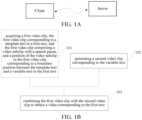
- FIG. 1A is a schematic diagram of application scenarios according to embodiments of this application.
- the client and the server are located in a wired or wireless network, and perform data interaction through the wired or wireless network.
- the client and the server may be collectively referred to as an electronic device.
- the client includes, but is not limited to: a smartphone, a tablet computer, an ebook reader, a moving picture experts group audio layer III (MP3) player, a moving picture experts group audio layer IV (MP4) player, a laptop portable computer, an on-board computer, a desktop computer, a set-top box, a smart TV, a wearable device, etc.
- the server is, for example, a hardware-independent server, a virtual server, or a server cluster, etc.
- the client corresponds to the server and is an application for providing a local service for a user.
- the client may receive a user input and provide a video corresponding to the user input.
- the video may be generated by the client or the server.
- the specific generation subject of the video is not limited in the embodiments of this application.
- the client may receive a user input and upload same to the server, so that the server generates a video corresponding to the user input.
- the server may determine a variable text according to the user input, generate a second video clip corresponding to the variable text, and combine a first video clip with the second video clip to obtain the video corresponding to the variable text and the template text.
- FIG. 1B is a flowchart for a video processing method according to this application.
- the video processing method may specifically include the following steps, and is performed by, for example, an electronic device: Step 101: Acquire a first video clip, the first video clip corresponding to a template text in a first text, and the first video clip including a video subclip with a speech pause, and a position of the video subclip in the first video clip corresponding to a boundary position between the template text and a variable text in the first text.
- the first video clip corresponding to the template text inclues a video clip for expressing the template text and a video subclip with a speech pause.
- Step 102 Generate a second video clip corresponding to the variable text.
- Step 103 Combine the first video clip with the second video clip to obtain a video corresponding to the first text.
- the video corresponding to the first text may be considered as a video representation for the first text.
- a first video clip corresponding to a template text is generated in advance.
- the first video clip includes a video subclip with a speech pause.
- the speech pause here refers to a speech stop or a temporary speech non-output.
- the video subclip with a speech pause may be considered as a video subclip without a speech.
- the video subclip is a video with a non-speech audio segment.
- the non-speech audio segment may be referred to as an audio segment without a speech voice, for example, a white noise audio of a predetermined duration equal to the duration of the video subclip.
- a position of the video subclip corresponds to a boundary position between the template text and the variable text in the first text.
- the video subclip may avoid sudden changes of the audio signals at the combining position of the first video clip and the second video clip, thereby improving the smoothness of the audio signal in the video corresponding to the first text.
- the structure of the first text in the embodiments of this application specifically includes: a template text and a variable text.
- the boundary position may be used for dividing the first text into a template text and a variable text.
- a boundary position is correspondingly present between a template text "about” and a variable text " ⁇ diabetes>”; a boundary position is correspondingly present between the variable text “ ⁇ diabetes>” and a template text "and”; a boundary position is correspondingly present between the template text "and”, and a variable text " ⁇ fruit>”; a boundary position is correspondingly present between the variable text " ⁇ fruit>” and a template text "of”; etc.
- the process of determining the first video clip includes: obtaining a target video corresponding to a template text, a preset variable text, and pause information corresponding to the boundary position; and extracting, from the target video, the first video clip.
- the preset variable text may be any variable text, or the preset variable text may be any instance of a variable text.
- the target video may be generated according to a combination of the template text and the preset variable text, and the pause information at the boundary position may be considered in the process of generating the target video.
- the pause information represents, for example, a speech pause of a predetermined duration.
- the target video may be considered as a video representation for a combination of a template text, and a preset variable text, where the pause information corresponding to the boundary position is taken into account.
- the target video may include: a preset speech (i.e., a speech part) and a preset image sequence (i.e., an image part).
- a preset speech i.e., a speech part
- a preset image sequence i.e., an image part
- the text to speech (TTS) technology can be used to convert the preset text into the preset speech.
- the preset speech may be represented as a waveform.
- the processing in the linguistic analysis stage specifically includes: text structure and language judgment, text standardization, text-to-phoneme, and prosody prediction.
- the linguistics information may be a result of the linguistic analysis stage.
- the text structure and language judgment is used for judging the language of the preset text, such as Chinese, English, Vietnamese, and Uyghur, segmenting the preset text into statements according to the grammar rules of the corresponding language, and transmitting the segmented statements to the subsequent processing modules.
- the text standardization is used for standardizing the segmented statements according to the set rules.
- the text-to-phoneme is used for determining phoneme features corresponding to the statements.
- TTS Transmission Control Protocol
- the prosody prediction can be used for determining where and how long a statement needs to be paused, which word or phrase needs to be stressed, which word needs to be unstressed, etc., so that the cadence of the voice is realized.
- the prosody prediction technology may be used to determine a prosody prediction result, and then update the prosody prediction result according to the pause information.
- the pause information is: pause information of a preset duration added between the template text "about” and the variable text " ⁇ diabetes>”
- the updating the prosody prediction result specifically includes: adding the pause information of the preset duration between phoneme features "guan” and “yu” of the template text "about”, and phoneme features "tang", "niao”, and “bing" of the variable text " ⁇ diabetes>”.
- the updated prosody prediction result is: "guan”, “yu”, “pausing for N ms", “tang”, “niao", “bing”, etc.
- N is a natural number greater than 0. A value of N is determined by a person skilled in the art according to actual application requirements.
- a preset speech meeting requirements may be obtained according to a TTS parameter.
- the TTS parameter may include: a tone color parameter.
- the tone color parameter may refer to the distinctive characteristics of the frequencies of different sounds in terms of waveforms. Different sound emitting subjects usually have different tone colors. Therefore, a speech sequence matching the tone color of a target sound emitting subject can be obtained according to the tone color parameter.
- the target sound emitting subject may be designated by a user. For example, the target sound emitting subject is a designated medical worker, etc.
- a tone color parameter of the target sound emitting subject may be obtained according to an audio of a preset length of the target sound emitting subject.
- the preset image sequence corresponding to the image part may be obtained on the basis of a virtual object image.
- a state feature may be assigned to the virtual object image to obtain the preset image sequence.
- the virtual object image may be designated by the user.
- the virtual object image is an image of a famous person, e.g. a presenter.
- the state feature may include at least one of the following features:
- An expression can express feelings and may refer to thoughts and feelings expressed on the face.
- the expression feature is usually subjected to the whole face.
- the lip feature may be specially subjected to a lip, and is relevant to a text content, a speech, a sound emitting manner, etc, and therefore can improve the naturalness where the preset image sequence is correspondingly expressed.
- the body feature may express the thoughts of a character through coordinated activities of human body parts such as a head, eyes, a neck, hands, elbows, arms, a body, a crotch, and feet so as to vividly express the feelings.
- the body feature may include: head turning, shoulder shrugging, gestures, etc., and can improve the richness where the image sequence is correspondingly expressed. For example, at least one arm hangs down naturally in a speaking state, and at least one arm rests naturally on the abdomen in a non-speaking state, etc.
- an image parameter in the process of generating an image part of the target video, may be determined according to the preset text and the pause information, the image parameter being used for representing a state feature of the virtual object; and the preset image sequence corresponding to the image part is generated according to the image parameter.
- the image parameter may include: a pause image parameter, which may be used for representing a pause state feature corresponding to the pause information.
- the pause image parameter is used for representing a state feature of the virtual object in terms of the body, the expression, etc. in a case that the virtual object stops speaking.
- the preset image sequence may include: an image sequence corresponding to the pause state feature.
- the pause state feature includes: a neutral expression, a lip-closed state, an arm-hanging state, etc.
- the preset speech and the preset image sequence may be combined with each other to obtain the corresponding target video.
- the first video clip corresponding to the template text may be extracted from the target video.
- the first video clip is extracted according to a starting position and an ending position of the preset variable text in the target video.
- a first text includes: a template text and a preset variable text. A starting position and an ending position of the preset variable text are used to locate a video clip for the preset variable text in the target video, to obtain video clip for the preset variable text. Then, the first video clip is obtain by removing the video clip for the preset variable text from the target video.
- a video clip before T1 can be captured from the target video as the first video clip corresponding to the template text "about".
- the pause information at the boundary position is taken into account in the process of generating the target video; therefore, the first video clip before T1 includes a video subclip with a speech pause.
- the video subclip can improve the smoothness of the audio signal and the continuity at the combining position in the subsequent combining process.
- a video clip between T2 and T3 can be captured from the target video as the first video clip corresponding to the template text "and".
- the template texts in the preset text are segmented by the preset variable texts into a plurality of template texts. Therefore, in a practical application, first video clips corresponding to a plurality of template texts can be respectively extracted from the target video.
- the video subclip in the first video clip includes a speech pause, and a virtual object in an image of the video subclip is in a non-speaking state. For example, the lips of the virtual object in the video subclip are closed.
- the video subclip is a subclip obtained by pausing.
- Pausing the video subclip includes:
- one acquisition manner of the first video clip may include: generating a first video according to a template text and a preset variable text; extracting the first video clip corresponding to the template text from the first video; pausing the first video clip at a boundary position.
- the first video clip may be saved, so that in a case that the variable text changes, the first video clip is combined with a second video clip corresponding to the changed variable text (hereinafter referred to as a variable text).
- variable text may be obtained according to a user input. It is to be understood that the specific determination manner of the variable text is not limited in the embodiments of this application.
- generating a second video clip corresponding to the variable text specifically includes: determining speech parameters and image parameters for a statement where the variable text is located in the first text, the image parameters being used for representing state features of a virtual object to appear in the video corresponding to the first text, and the speech parameters being used for representing parameters for text to speech; extracting, from the speech parameters and the image parameters, target speech parameters and target image parameters corresponding to the variable text; and generating, according to the target speech parameters and the target image parameters, the second video clip corresponding to the variable text.
- corresponding speech parameters and image parameters are determined by taking a statement where the variable text is located as a unit, and then target speech parameters and a target image parameters corresponding to the variable text are extracted from the speech parameters and the image parameters of the statement.
- a statement is a grammatically self-contained unit composed of a word or a syntactically related group of words expressing an assertion, question, command, wish or exclamation.
- the statement usually includes both the template text and the variable text. Adjacent parameters have correlation in speech parameters or image parameters. Therefore, the target speech parameter corresponding to the variable text, and speech parameters corresponding to the template text in the statement have a certain continuity. In other word, at the combining position of the variable text and the template text, the speech parameters of the variable text and the template text are similar or have little variation. The target image parameters corresponding to the variable text, and image parameters corresponding to the template text in the statement have a certain continuity. In other word, at the combining position of the variable text and the template text, the image parameters of the variable text and the template text are similar or have little variation. On this basis, the smoothness of the second video clip corresponding to the variable text, and a first video clip corresponding to the template text in the statement can be improved, thereby improving the smoothness at the combining position of the first video clip and the second video clip.
- the speech parameters is used for representing parameters corresponding to TTS.
- the speech parameters may include: linguistic features and/or acoustic features.
- the linguistic features may include: phoneme features.
- a phoneme is the smallest unit of speech divided according to the natural properties of speech, and is analyzed according to the pronunciation actions in a syllable.
- An action constitutes a phoneme.
- the phoneme may include: a vowel or a consonant.
- the acoustic features may be used for representing features of speech from the perspective of vocalization.
- the acoustic features may include, but is not limited to the following features:
- the speech parameter is merely an example.
- the specific speech parameter is not limited in the embodiments of this application.
- TTS may be performed on the to-be-processed variable text according to the target speech parameter so as to convert the to-be-processed variable text into a target speech.
- the image parameters may be corresponding parameters in generation of the image sequence.
- the image parameters may be used for determining state features corresponding to a virtual object, or may include: a state feature corresponding to a virtual object.
- the image parameters includes a lip feature.
- generating a second video clip corresponding to the variable text specifically includes: according to a preset image parameter of the preset variable text at the boundary position, smoothing target image parameters corresponding to the variable text so as to improve the continuity of the target image parameters and image parameters of the template text at the boundary position; and generating, according to the smoothed target image parameters, the second video clip corresponding to the variable text.
- the smoothing is performed, according to preset image parameters of the preset variable text at the boundary position, on target image parameters corresponding to the variable text.
- the preset image parameters of the preset variable text at the boundary position, and the image parameters of the template text at the boundary position have a certain continuity. Therefore, the smoothing can improve the continuity of the target image parameter and the image parameter of the template text at the boundary position. On this basis, the continuity of the second video clip corresponding to the variable text, and a first video clip corresponding to the template text in the statement can be improved, thereby improving the continuity at the combining position.
- window functions such as Hanning window may be used to perform, according to a preset image parameter, smoothing processing on a target image parameter corresponding to the to-be-processed variable text. It is to be understood that the specific smoothing processing process is not limited in the embodiments of this application.
- image parameters in the process of generating an image part of the target video, image parameters may be determined according to the preset text and the pause information.
- the preset image parameters of the preset variable text at the boundary position may be extracted from the image parameters.
- an image sequence corresponding to the video includes: a background image sequence and a moving image sequence.
- Generating a second video clip corresponding to the variable text specifically includes: generating a target moving image sequence corresponding to the variable text; determining, according to a preset background image sequence, a target background image sequence corresponding to the variable text; and overlaying each image of the target moving image sequence with a respective image of the target background image sequence to obtain the second video clip corresponding to the variable text.
- the image sequence corresponding to the video may be divided into two parts.
- the first part is: a moving image sequence, which can be used for representing a moving part in a case that the virtual object is expressing, and usually corresponds to preset parts such as a lip, eyes, and arms.
- the second part is: a background image sequence, which can be used for representing a relatively static part in a case that the virtual object is expressing, and usually corresponds to parts other than the preset parts.
- the background image sequence may be obtained by presetting.
- the preset background image sequence of a preset duration is preset, and is cyclically arranged (also referred to as cyclical occurrence) in an image sequence.
- the moving image sequence may be generated according to the target image parameters corresponding to the variable text.
- the moving image sequence may be fused with the background image sequence to obtain the image sequence.
- each of the moving image sequence is superimposed to a respective background image of the background image sequence to obtain the image sequence.
- a target background image sequence corresponding to the variable text is determined according to a preset background image sequence corresponding to the variable text.
- the matching degree between the target background image sequence and the preset background image sequence can be improved, thereby improving the matching degree and continuity between the target background image sequence corresponding to the variable text, and a background image sequence corresponding to the template text.
- background images in the target background image sequence located at the head and tail match background images in the preset background image sequence located at the head and tail.
- the head may refer to the starting position
- the tail may refer to the ending position.
- background images in the target background image sequence located at the head match background images in the preset background image sequence located at the head.
- background images in the target background image sequence located at the tail match background images in the preset background image sequence located at the tail.
- the preset background image sequence and the background image sequence corresponding to the template text match and are continuous at the boundary position. Therefore, in a case that the target background image sequence matches the preset background image sequence at the boundary position, the matching degree and continuity between the target background image sequence and the background image sequence corresponding to the template text can also be improved.
- the manner of determining a target background image sequence corresponding to the to-be-processed variable text may specifically include:
- the number of corresponding images N2 in the target moving image sequence may be determined according to speech duration information corresponding to the to-be-processed variable text.
- the speech duration information may be determined according to a speech parameter corresponding to the to-be-processed variable text, or the speech duration information may be determined according to a duration of a speech segment corresponding to the to-be-processed variable text.
- a first background image located in the middle of the preset background image sequence is removed in a case that N1 is greater than N2, so that the target background image sequence matches the preset background image sequence at the boundary position.
- the middle may be different from the head or the tail.
- the at least two removed frames of first background images are not continuously distributed in the preset background image sequence. In this way, the problem of poor continuity of the background image caused by removing continuous background images can be avoided to a certain extent.
- the number of first background images may be equal to a difference between N1 and N2.
- the information of the preset background image sequence includes: a start frame number 100 and an end frame number 125, etc.
- a value of N1 is 26.
- the number of corresponding images N2 in the target moving image sequence is 24, two frames of first background images located in the middle and discontinuous in position are removed from the preset background image sequence.
- a second background image is added to the preset background image sequence in a case that N1 is less than N2, so that the target background image sequence matches the preset background image sequence at the boundary position.
- the second background image may be derived from the preset background image sequence.
- a to-be-added second background image may be determined from the preset background image sequence.
- the preset background image sequence is determined as a first part of the target background image sequence in the forward order; and then the preset background image sequence is determined as a second part of the target background image sequence in the reverse order; next, the preset background image sequence is determined as a third part of the target background image sequence in the forward order. An end frame of the third part matches an end frame of the preset background image sequence.
- the information of the preset background image sequence includes: a start frame number 100 and an end frame number 125, etc.
- a value of N1 is 26.
- a frame number corresponding to the first part of the target background image sequence is: 100 ⁇ 125.
- a frame number corresponding to the second part of the target background image sequence is: 125->124.
- a frame number corresponding to the third part of the target background image sequence is: 124-125.
- the second background image may be derived from a background image sequence other than the preset background image sequence.
- the second background image is determined from the background image sequence following the preset background image sequence.
- the preset background image sequence is determined as a first part of the target background image sequence in the forward order; and then the background image sequence following the preset background image sequence is determined as a second part of the target background image sequence in the reverse order; next, the background image sequence following the preset background image sequence and an end frame of the preset background image sequence are determined as a third part of the target background image sequence in the reverse order.
- the end frame of the third part matches the end frame of the preset background image sequence.
- the information of the preset background image sequence includes: a start frame number 100 and an end frame number 125, etc.
- a value of N1 is 26.
- a frame number corresponding to the first part of the target background image sequence is: 100 ⁇ 125.
- a frame number corresponding to the second part of the target background image sequence is: 126->127.
- a frame number corresponding to the third part of the target background image sequence is: 127-125.
- a reverse target background image sequence is also determined.
- a corresponding determination process of the reverse target background image sequence includes: determining the preset background image sequence as a first part of the target background image sequence in the reverse order; and then determining the preset background image sequence as a second part of the target background image sequence in the forward order; and next, determining the preset background image sequence as a third part of the target background image sequence in the reverse order.
- a start frame of the third part matches a start frame of the preset background image sequence.
- the information of the preset background image sequence includes: a start frame number 100 and an end frame number 125, etc.
- a value of N1 is 26.
- a frame number corresponding to the first part of the target background image sequence is: 125 ⁇ 100.
- a frame number corresponding to the second part of the target background image sequence is: 100 ⁇ 101.
- a frame number corresponding to the third part of the target background image sequence is: 101 ⁇ 100.
- the obtained frame number of the target background image sequence is as follows: 100 ⁇ 101 ⁇ 101 ⁇ 100 ⁇ 100 ⁇ 125.
- the process of generating a second video clip corresponding to the to-be-processed variable text is introduced in detail in technical solution 1 to technical solution 3. It is to be understood that a person skilled in the art may adopt one or a combination of technical solution 1 to technical solution 3 according to actual application requirements.
- the specific process of generating a second video clip corresponding to the to-be-processed variable text is not limited in the embodiments of this application.
- the first video clip is combined with the second video clip to obtain a video corresponding to the first text.
- the first video clip may specifically include: a first speech segment.
- the second video may specifically include: a second speech segment.
- the combining the first video clip with the second video clip may specifically include: smoothing respective speech subsegments of the first speech segment and the second speech segment at a combining position; and combining the smoothed first speech segment with the smoothed second speech segment.
- the smoothing is performed on respective speech subsegments of the first speech segment and the second speech segment at a combining position, and then the smoothed first speech segment is combined with the smoothed second speech segment.
- the smoothing can improve the smoothness of the first speech segment and the second speech segment, and therefore can improve the continuity of the first video clip and the second video clip at the combining position.
- the video obtained by combining may be outputted, for example, to a user.
- a corresponding to-be-processed variable text is determined according to a disease name included in the user input.
- a video is obtained by using the method embodiment shown in FIG. 1B and is provided for the user.
- the first video clip corresponding to the template text is combined with the second video clip corresponding to the variable text.
- the first video clip may be a pre-saved video clip.
- the second video clip corresponding to the variable text may be generated during the video processing.
- a length of the variable text is less than that of a first text. Therefore, the corresponding time cost of the generated video can be decreased in the embodiments of this application, and thus the video processing efficiency can be improved.
- the first video clip is configured to include: a paused video subclip at the boundary position between the template text and the variable text.
- the pausing processing can solve the intense changes of audios or pictures at the combining position to a certain extent, and therefore can improve the smoothness and continuity at the combining position.
- FIG. 2 is a flowchart for a video processing method according to embodiments of this application.
- the method may specifically include the following steps:
- a target video is generated according to text A and corresponding pause information.
- a first video clip in the target video, preset image parameters of the preset variable texts at a boundary position, and information of preset background image sequences corresponding to the preset variable texts are saved.
- variable text may vary depending on factors such as a user input. For example, in a case that text A is changed into text B, that is, "about the items of ⁇ coronary heart disease> and ⁇ vegetable>, I'm still working on it. I think this dietary advice for ⁇ coronary heart disease> may also be helpful to you. It includes recommendations and taboos for about ⁇ 900> ingredients. Please click to view”, the variable texts include: “ ⁇ coronary heart disease>", “ ⁇ vegetable>", “ ⁇ 900>”, etc. in text B.
- a second video clip corresponding to a variable text may be generated. For example, acoustic parameters and lip features of a statement where a variable text is located are determined; and then target acoustic parameters and target lip features corresponding to the variable text are extracted from the acoustic parameters and the lip features, and a speech segment and a target image sequence corresponding to the variable text are respectively generated.
- the target image sequence may include: a target moving image sequence and a target background image sequence.
- step 206 may be used to smooth the target lip features to improve the continuity of the lip feature at a combining position.
- Step 208 may be used to generate the target background image sequence to match the target background image sequence and a preset background image sequence at the boundary position so as to improve the continuity of a background image sequence at the combining position.
- smoothing may be performed on respective speech subsegments of a first speech segment in the first video clip and a second speech segment in the second video clip at the boundary position; and then the first video clip is combined with the second video clip according to the smoothed first speech segment and the smoothed second speech segment.
- corresponding speech parameters and image parameters are determined by taking a statement where the to-be-processed variable text is located as a unit, and then target speech parameters and target image parameters corresponding to the variable text are extracted from the speech parameters and the image parameters.
- Speech parameters and image parameters corresponding to the statement have a certain continuity. Therefore, the target speech parameter and the target image parameter corresponding to the to-be-processed variable text and extracted from the speech parameter and the image parameter, and a speech parameter and an image parameter corresponding to the template text in the statement have a certain continuity.
- the continuity of the second video clip corresponding to the to-be-processed variable text, and a first video clip corresponding to the template text in the statement can be improved, thereby further improving the continuity at the combining position.
- smoothing is performed, according to preset image parameters of the preset variable text at the boundary position, on target image parameters corresponding to the variable text.
- the preset image parameter of the preset variable text at the boundary position, and the image parameter of the template text at the boundary position have a certain continuity. Therefore, the smoothing can improve the smoothness and continuity of the target image parameter and the image parameter of the template text at the boundary position. On this basis, the continuity of a combination of the second video clip corresponding to the variable text and a first video clip corresponding to the template text in the statement can be improved, thereby improving the smoothness and continuity at the combining position.
- the target background image sequence is generated according to the preset background image sequence, so that the target background image sequence matches the preset background image sequence at the boundary position to improve the continuity of the background image sequence at the combining position.
- smoothing processing is performed on respective speech subsegments of a first speech segment in the first video clip and a second speech segment in the second video clip at the boundary position;
- the smoothing processing can improve the continuity of the first speech segment and the second speech segment which are subjected to the smoothing processing, and therefore can improve the continuity of the first video clip and the second video clip at the combining position.
- FIG. 3 is a structural block diagram of a video processing apparatus according to this application.
- the apparatus may specifically include:
- the apparatus may further include:
- the generation module 302 may include:
- the generation module 302 may include:
- the first video clip may include: a first speech segment.
- the second video clip may include: a second speech segment.
- the image sequence corresponding to the video may include: a background image sequence and a moving image sequence.
- the generation module 302 may include:
- background images in the target background image sequence located at the head and tail match background images in the preset background image sequence located at the head and tail.
- the background image sequence generation module may include:
- An apparatus embodiment is basically similar to a method embodiment, and therefore is described briefly. For related parts, refer to partial descriptions in the method embodiments.
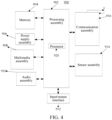
- FIG. 4 is a structural block diagram of an apparatus 900 for video processing according to an exemplary embodiment.
- the apparatus 900 is a mobile phone, a computer, a digital broadcasting terminal, a messaging device, a game console, a tablet device, a medical device, a fitness facility, a personal digital assistant, etc.
- the apparatus 900 may include one or more of the following assemblies: a processing assembly 902, a memory 904, a power supply assembly 906, a multimedia assembly 908, an audio assembly 910, an input/output (I/O) interface 912, a sensor assembly 914, and a communication assembly 916.
- the processing assembly 902 usually controls the whole operation of the apparatus 900, such as operations associated with displaying, a phone call, data communication, a camera operation, and a recording operation.
- the processing assembly 902 may include one or more processors 920 to execute instructions, to complete all or some steps of the foregoing method.
- the processing assembly 902 may include one or more modules, to facilitate an interaction between the processing assembly 902 and other assemblies.
- the processing assembly 902 includes a multimedia module, to facilitate an interaction between the multimedia assembly 908 and the processing assembly 902.
- the memory 904 is configured to store various types of data to support operations on the apparatus 900. Examples of the data include instructions, contact data, phonebook data, messages, pictures, videos, and the like of any application or method used to be operated on the apparatus 900.
- the memory 904 can be implemented by any type of volatile or non-volatile storage devices or a combination thereof, such as a static random access memory (SRAM), an electrically erasable programmable read-only memory (EEPROM), an erasable programmable read-only memory (EPROM), a programmable read-only memory (PROM), a read-only memory (ROM), a magnetic memory, a flash memory, a magnetic disc, or an optical disc.
- SRAM static random access memory
- EEPROM electrically erasable programmable read-only memory
- EPROM erasable programmable read-only memory
- PROM programmable read-only memory
- ROM read-only memory
- magnetic memory a magnetic memory
- flash memory a flash memory
- the power supply assembly 906 provides power to various assemblies of the apparatus 900.
- the power supply assembly 906 may include a power supply management system, one or more power supplies, and other assemblies associated with generating, managing and allocating power to the apparatus 900.
- the front camera and/or the rear camera may receive external multimedia data.
- Each front camera and rear camera may be a fixed optical lens system or have a focal length and an optical zooming capability.
- the audio assembly 910 is configured to output and/or input an audio signal.
- the audio assembly 910 includes a microphone (MIC), and in a case that the apparatus 900 is in an operation mode, such as a call mode, a recording mode, and a speech recognition mode, the MIC is configured to receive an external audio signal.
- the received audio signal may be further stored in the memory 904 or sent through the communication assembly 916.
- the audio assembly 910 further includes a loudspeaker, configured to output an audio signal.
- the I/O interface 912 provides an interface between the processing assembly 902 and a peripheral interface module.
- the peripheral interface module may be a keyboard, a click wheel, buttons, etc.
- the buttons may include, but not limited to: a homepage button, a volume button, a start-up button, and a locking button.
- the sensor assembly 914 includes one or more sensors, configured to provide state evaluation in each aspect to the apparatus 900.
- the sensor assembly 914 detects an opened/closed state of the apparatus 900, and relative positioning of the assembly.
- the assembly is a display and a small keyboard of the apparatus 900.
- the sensor assembly 914 further detects the position change of the apparatus 900 or one assembly of the apparatus 900, the existence or nonexistence of contact between the user and the apparatus 900, the azimuth or acceleration/deceleration of the apparatus 900, and the temperature change of the apparatus 900.
- the sensor assembly 914 may include a proximity sensor, configured to detect the existence of nearby objects without any physical contact.
- the sensor assembly 914 may further include an optical sensor, such as a CMOS or CCD image sensor, which is used in an imaging application.
- the sensor assembly 914 may further include an acceleration sensor, a gyroscope sensor, a magnetic sensor, a pressure sensor, or a temperature sensor.
- the communication assembly 916 is configured to facilitate communication between the apparatus 900 and other devices in a wired or wireless manner.
- the apparatus 900 may access a wireless network on the basis of communication standards such as WiFi, 2G, or 3G, or a combination thereof.
- the communication assembly 916 receives a broadcast signal or broadcast related information from an external broadcast management system via a broadcast channel.
- the communication assembly 916 further includes a near-field communication (NFC) module, to promote short-range communication.
- the NFC module is implemented on the basis of a radio frequency identification (RFID) technology, an infrared data association (IrDA) technology, an ultra wideband (UWB) technology, a Bluetooth (BT) technology, and other technologies.
- RFID radio frequency identification
- IrDA infrared data association
- UWB ultra wideband
- BT Bluetooth
- the apparatus 900 is implemented as one or more application-specific integrated circuit (ASIC), a digital signal processor (DSP), a digital signal processing device (DSPD), a programmable logic device (PLD), a field programmable gate array (FPGA), a controller, a micro-controller, a microprocessor or other electronic components, so as to perform the method.
- ASIC application-specific integrated circuit
- DSP digital signal processor
- DSPD digital signal processing device
- PLD programmable logic device
- FPGA field programmable gate array
- controller a micro-controller, a microprocessor or other electronic components, so as to perform the method.
- non-transitory computer readable storage medium including instructions, for example, a memory 904 including instructions.
- the foregoing instructions may be executed by a processor 920 of the apparatus 900 to complete the foregoing method.
- the non-transitory computer readable storage medium is a ROM, a random access memory (RAM), a CD-ROM, a magnetic tape, a floppy disk, an optical data storage device, etc.
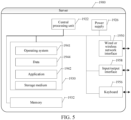
- FIG. 5 is a structural block diagram of a server according to some embodiments of this application.
- the server 1900 may vary greatly due to different configurations or performance, and may include one or more central processing units (CPUs) 1922 (for example, one or more processors) and a memory 1932, and one or more storage media 1930 (for example, one or more mass storage devices) that store application programs 1942 or data 1944.
- the memories 1932 and the storage media 1930 may be used for transient storage or permanent storage.
- a program stored in the storage medium 1930 may include one or more modules (which are not marked in the figure), and each module may include a series of instruction operations on the server.
- the CPU 1922 may be configured to communicate with the storage medium 1930, and perform, on the server 1900, a series of instruction operations in the storage medium 1930.
- the server 1900 may further include one or more power supplies 1926, one or more wired or wireless network interfaces 1950, one or more I/O interfaces 1958, one or more keyboards 1956, and/or, one or more operating systems 1941, for example, Windows ServerTM, Mac OS XTM, UnixTM, LinuxTM, and FreeBSDTM.
- a non-transitory computer readable storage medium the instruction stored in the storage medium, when executed by a processor of an apparatus (a device or a server), causing the apparatus to perform the video processing method according to the embodiments of this application.
Landscapes
- Engineering & Computer Science (AREA)
- Multimedia (AREA)
- Physics & Mathematics (AREA)
- Signal Processing (AREA)
- General Physics & Mathematics (AREA)
- Theoretical Computer Science (AREA)
- Health & Medical Sciences (AREA)
- Human Computer Interaction (AREA)
- Computational Linguistics (AREA)
- Audiology, Speech & Language Pathology (AREA)
- Acoustics & Sound (AREA)
- Computer Vision & Pattern Recognition (AREA)
- Oral & Maxillofacial Surgery (AREA)
- General Health & Medical Sciences (AREA)
- Marketing (AREA)
- Business, Economics & Management (AREA)
- Geometry (AREA)
- Psychiatry (AREA)
- Social Psychology (AREA)
- Processing Or Creating Images (AREA)
- Two-Way Televisions, Distribution Of Moving Picture Or The Like (AREA)
- Television Signal Processing For Recording (AREA)
Applications Claiming Priority (2)
| Application Number | Priority Date | Filing Date | Title |
|---|---|---|---|
| CN202111124169.4A CN113891150B (zh) | 2021-09-24 | 2021-09-24 | 一种视频处理方法、装置和介质 |
| PCT/CN2022/115722 WO2023045716A1 (zh) | 2021-09-24 | 2022-08-30 | 视频处理方法、装置、介质和程序产品 |
Publications (2)
| Publication Number | Publication Date |
|---|---|
| EP4404574A1 true EP4404574A1 (de) | 2024-07-24 |
| EP4404574A4 EP4404574A4 (de) | 2025-01-01 |
Family
ID=79006490
Family Applications (1)
| Application Number | Title | Priority Date | Filing Date |
|---|---|---|---|
| EP22871767.4A Pending EP4404574A4 (de) | 2021-09-24 | 2022-08-30 | Videoverarbeitungsverfahren und -vorrichtung sowie medium und programmprodukt |
Country Status (5)
| Country | Link |
|---|---|
| US (1) | US20240022772A1 (de) |
| EP (1) | EP4404574A4 (de) |
| JP (1) | JP7697027B2 (de) |
| CN (1) | CN113891150B (de) |
| WO (1) | WO2023045716A1 (de) |
Families Citing this family (4)
| Publication number | Priority date | Publication date | Assignee | Title |
|---|---|---|---|---|
| CN113891150B (zh) * | 2021-09-24 | 2024-10-11 | 北京搜狗科技发展有限公司 | 一种视频处理方法、装置和介质 |
| CN114707019A (zh) * | 2022-03-29 | 2022-07-05 | 北京拥抱在线科技有限公司 | 用于阅读的信息处理方法及装置 |
| CN120182437A (zh) * | 2023-12-20 | 2025-06-20 | 华为技术有限公司 | 一种数字人生成方法及相关装置 |
| WO2025258824A1 (ko) * | 2024-06-13 | 2025-12-18 | 삼성전자주식회사 | 비디오 프레임의 추가 영역을 생성하기 위한 전자 장치, 방법, 및 비일시적 컴퓨터 판독 가능 저장 매체 |
Family Cites Families (40)
| Publication number | Priority date | Publication date | Assignee | Title |
|---|---|---|---|---|
| JPH11231899A (ja) * | 1998-02-12 | 1999-08-27 | Matsushita Electric Ind Co Ltd | 音声・動画像合成装置及び音声・動画像データベース |
| US7277855B1 (en) * | 2000-06-30 | 2007-10-02 | At&T Corp. | Personalized text-to-speech services |
| WO2010045736A1 (en) * | 2008-10-22 | 2010-04-29 | Xtranormal Technology Inc. | Reduced-latency rendering for a text-to-movie system |
| CN102123252B (zh) * | 2010-01-07 | 2016-05-04 | 新奥特(北京)视频技术有限公司 | 一种图文包装应用中随动关联播出的实现方法和装置 |
| US8818175B2 (en) * | 2010-03-08 | 2014-08-26 | Vumanity Media, Inc. | Generation of composited video programming |
| US9082400B2 (en) * | 2011-05-06 | 2015-07-14 | Seyyer, Inc. | Video generation based on text |
| US20120308211A1 (en) * | 2011-06-01 | 2012-12-06 | Xerox Corporation | Asynchronous personalization of records using dynamic scripting |
| GB2503878A (en) * | 2012-07-09 | 2014-01-15 | Nds Ltd | Generating interstitial scripts for video content, based on metadata related to the video content |
| US11783524B2 (en) | 2016-02-10 | 2023-10-10 | Nitin Vats | Producing realistic talking face with expression using images text and voice |
| US10204274B2 (en) * | 2016-06-29 | 2019-02-12 | Cellular South, Inc. | Video to data |
| US10056083B2 (en) * | 2016-10-18 | 2018-08-21 | Yen4Ken, Inc. | Method and system for processing multimedia content to dynamically generate text transcript |
| US10546409B1 (en) * | 2018-08-07 | 2020-01-28 | Adobe Inc. | Animation production system |
| US10783928B2 (en) * | 2018-09-20 | 2020-09-22 | Autochartis Limited | Automated video generation from financial market analysis |
| CN109637518B (zh) * | 2018-11-07 | 2022-05-24 | 北京搜狗科技发展有限公司 | 虚拟主播实现方法及装置 |
| CN109635154B (zh) * | 2018-12-14 | 2022-11-29 | 成都索贝数码科技股份有限公司 | 一种基于文稿和新闻节目自动生成互联网图文稿件的方法 |
| US11024071B2 (en) | 2019-01-02 | 2021-06-01 | Espiritu Technologies, Llc | Method of converting phoneme transcription data into lip sync animation data for 3D animation software |
| CA3128047A1 (en) * | 2019-01-25 | 2020-07-30 | Soul Machines Limited | Real-time generation of speech animation |
| EP3921770B1 (de) * | 2019-02-05 | 2025-07-16 | Igentify Ltd. | System und verfahren zur modulation dynamischer lücken in sprache |
| CN109979457A (zh) * | 2019-05-29 | 2019-07-05 | 南京硅基智能科技有限公司 | 一种应用于智能对话机器人的千人千面的方法 |
| CN110324709A (zh) | 2019-07-24 | 2019-10-11 | 新华智云科技有限公司 | 一种视频生成的处理方法、装置、终端设备及存储介质 |
| CN110381266A (zh) * | 2019-07-31 | 2019-10-25 | 百度在线网络技术(北京)有限公司 | 一种视频生成方法、装置以及终端 |
| CN110611840B (zh) * | 2019-09-03 | 2021-11-09 | 北京奇艺世纪科技有限公司 | 一种视频生成方法、装置、电子设备及存储介质 |
| CN111508466A (zh) * | 2019-09-12 | 2020-08-07 | 马上消费金融股份有限公司 | 一种文本处理方法、装置、设备及计算机可读存储介质 |
| CN110534088A (zh) * | 2019-09-25 | 2019-12-03 | 招商局金融科技有限公司 | 语音合成方法、电子装置及存储介质 |
| US11638049B2 (en) * | 2019-10-16 | 2023-04-25 | Dish Network L.L.C. | Systems and methods for content item recognition and adaptive packet transmission |
| CN110866968B (zh) * | 2019-10-18 | 2025-02-28 | 平安科技(深圳)有限公司 | 基于神经网络生成虚拟人物视频的方法及相关设备 |
| CN111010586B (zh) * | 2019-12-19 | 2021-03-19 | 腾讯科技(深圳)有限公司 | 基于人工智能的直播方法、装置、设备及存储介质 |
| KR102267673B1 (ko) * | 2019-12-23 | 2021-06-23 | 극동대학교 산학협력단 | 사용자 체험형 동영상 컨텐츠 자동제작방법 및 시스템 |
| CN111460785B (zh) | 2020-03-31 | 2023-02-28 | 北京市商汤科技开发有限公司 | 交互对象的驱动方法、装置、设备以及存储介质 |
| US11012737B1 (en) * | 2020-04-27 | 2021-05-18 | Dish Network L.L.C. | Systems and methods for audio adaptation of content items to endpoint media devices |
| CN111652678B (zh) * | 2020-05-27 | 2023-11-14 | 腾讯科技(深圳)有限公司 | 物品信息显示方法、装置、终端、服务器及可读存储介质 |
| CN111883103B (zh) * | 2020-06-19 | 2021-12-24 | 马上消费金融股份有限公司 | 语音合成的方法及装置 |
| CN111741326B (zh) * | 2020-06-30 | 2023-08-18 | 腾讯科技(深圳)有限公司 | 视频合成方法、装置、设备及存储介质 |
| CN111885416B (zh) * | 2020-07-17 | 2022-04-12 | 北京来也网络科技有限公司 | 一种音视频的修正方法、装置、介质及计算设备 |
| CN112102448B (zh) * | 2020-09-14 | 2023-08-04 | 北京百度网讯科技有限公司 | 虚拟对象图像显示方法、装置、电子设备和存储介质 |
| CN112543342B (zh) * | 2020-11-26 | 2023-03-14 | 腾讯科技(深圳)有限公司 | 虚拟视频直播处理方法及装置、存储介质、电子设备 |
| CN113051420B (zh) * | 2021-04-15 | 2022-07-05 | 山东大学 | 一种基于文本生成视频机器人视觉人机交互方法及系统 |
| CN113111812A (zh) * | 2021-04-20 | 2021-07-13 | 深圳追一科技有限公司 | 一种嘴部动作驱动模型训练方法及组件 |
| CN113421549A (zh) * | 2021-06-30 | 2021-09-21 | 平安科技(深圳)有限公司 | 语音合成方法、装置、计算机设备及存储介质 |
| CN113891150B (zh) * | 2021-09-24 | 2024-10-11 | 北京搜狗科技发展有限公司 | 一种视频处理方法、装置和介质 |
-
2021
- 2021-09-24 CN CN202111124169.4A patent/CN113891150B/zh active Active
-
2022
- 2022-08-30 JP JP2023554305A patent/JP7697027B2/ja active Active
- 2022-08-30 WO PCT/CN2022/115722 patent/WO2023045716A1/zh not_active Ceased
- 2022-08-30 EP EP22871767.4A patent/EP4404574A4/de active Pending
-
2023
- 2023-08-04 US US18/365,296 patent/US20240022772A1/en active Pending
Also Published As
| Publication number | Publication date |
|---|---|
| CN113891150B (zh) | 2024-10-11 |
| WO2023045716A1 (zh) | 2023-03-30 |
| CN113891150A (zh) | 2022-01-04 |
| EP4404574A4 (de) | 2025-01-01 |
| US20240022772A1 (en) | 2024-01-18 |
| JP7697027B2 (ja) | 2025-06-23 |
| JP2024509873A (ja) | 2024-03-05 |
Similar Documents
| Publication | Publication Date | Title |
|---|---|---|
| EP4404574A1 (de) | Videoverarbeitungsverfahren und -vorrichtung sowie medium und programmprodukt | |
| CN107705783B (zh) | 一种语音合成方法及装置 | |
| US20200279553A1 (en) | Linguistic style matching agent | |
| CN110210310B (zh) | 一种视频处理方法、装置和用于视频处理的装置 | |
| CN113488022B (zh) | 一种语音合成方法和装置 | |
| US12314829B2 (en) | Method and apparatus for driving digital human, and electronic device | |
| CN113689879B (zh) | 实时驱动虚拟人的方法、装置、电子设备及介质 | |
| CN113409765B (zh) | 一种语音合成方法、装置和用于语音合成的装置 | |
| CN110162598B (zh) | 一种数据处理方法和装置、一种用于数据处理的装置 | |
| CN110322760B (zh) | 语音数据生成方法、装置、终端及存储介质 | |
| CN115039169A (zh) | 一种语音指令识别方法、电子设备以及非瞬态计算机可读存储介质 | |
| WO2021196645A1 (zh) | 交互对象的驱动方法、装置、设备以及存储介质 | |
| CN110148406B (zh) | 一种数据处理方法和装置、一种用于数据处理的装置 | |
| CN113794927A (zh) | 信息显示方法、装置及电子设备 | |
| CN108628819B (zh) | 处理方法和装置、用于处理的装置 | |
| WO2021232877A1 (zh) | 实时驱动虚拟人的方法、装置、电子设备及介质 | |
| CN110166844B (zh) | 一种数据处理方法和装置、一种用于数据处理的装置 | |
| CN117351123A (zh) | 交互式数字人像生成方法、装置、设备及存储介质 | |
| US12002487B2 (en) | Information processing apparatus and information processing method for selecting a character response to a user based on emotion and intimacy | |
| CN114155849A (zh) | 一种虚拟对象的处理方法、装置和介质 | |
| US20190088258A1 (en) | Voice recognition device, voice recognition method, and computer program product | |
| CN112151072A (zh) | 语音处理方法、装置和介质 | |
| CN112837668A (zh) | 一种语音处理方法、装置和用于处理语音的装置 | |
| CN116366872A (zh) | 基于中之人和人工智能的直播方法、装置及系统 | |
| CN114093341A (zh) | 数据处理方法、装置及介质 |
Legal Events
| Date | Code | Title | Description |
|---|---|---|---|
| STAA | Information on the status of an ep patent application or granted ep patent |
Free format text: STATUS: THE INTERNATIONAL PUBLICATION HAS BEEN MADE |
|
| PUAI | Public reference made under article 153(3) epc to a published international application that has entered the european phase |
Free format text: ORIGINAL CODE: 0009012 |
|
| STAA | Information on the status of an ep patent application or granted ep patent |
Free format text: STATUS: REQUEST FOR EXAMINATION WAS MADE |
|
| 17P | Request for examination filed |
Effective date: 20240419 |
|
| AK | Designated contracting states |
Kind code of ref document: A1 Designated state(s): AL AT BE BG CH CY CZ DE DK EE ES FI FR GB GR HR HU IE IS IT LI LT LU LV MC MK MT NL NO PL PT RO RS SE SI SK SM TR |
|
| REG | Reference to a national code |
Ref country code: DE Ref legal event code: R079 Free format text: PREVIOUS MAIN CLASS: H04N0021439000 Ipc: G11B0027031000 |
|
| A4 | Supplementary search report drawn up and despatched |
Effective date: 20241203 |
|
| DAV | Request for validation of the european patent (deleted) | ||
| DAX | Request for extension of the european patent (deleted) | ||
| RIC1 | Information provided on ipc code assigned before grant |
Ipc: G10L 13/00 20060101ALN20241127BHEP Ipc: H04N 21/845 20110101ALI20241127BHEP Ipc: H04N 21/234 20110101ALI20241127BHEP Ipc: G06V 40/20 20220101ALI20241127BHEP Ipc: G06V 40/16 20220101ALI20241127BHEP Ipc: G06V 20/20 20220101ALI20241127BHEP Ipc: G10L 25/57 20130101ALI20241127BHEP Ipc: G10L 21/10 20130101ALI20241127BHEP Ipc: G06T 13/40 20110101ALI20241127BHEP Ipc: G06T 13/20 20110101ALI20241127BHEP Ipc: H04N 5/272 20060101ALI20241127BHEP Ipc: G10L 13/08 20130101ALI20241127BHEP Ipc: G10L 13/02 20130101ALI20241127BHEP Ipc: H04N 21/439 20110101ALI20241127BHEP Ipc: G11B 27/28 20060101ALI20241127BHEP Ipc: G11B 27/036 20060101ALI20241127BHEP Ipc: G11B 27/031 20060101AFI20241127BHEP |