EP4404539A1 - Ressourcenplanungsverfahren, -vorrichtung und -system, -vorrichtung, -medium und -programmprodukt - Google Patents
Ressourcenplanungsverfahren, -vorrichtung und -system, -vorrichtung, -medium und -programmprodukt Download PDFInfo
- Publication number
- EP4404539A1 EP4404539A1 EP23769545.7A EP23769545A EP4404539A1 EP 4404539 A1 EP4404539 A1 EP 4404539A1 EP 23769545 A EP23769545 A EP 23769545A EP 4404539 A1 EP4404539 A1 EP 4404539A1
- Authority
- EP
- European Patent Office
- Prior art keywords
- online
- node
- lending
- offline
- transaction
- Prior art date
- Legal status (The legal status is an assumption and is not a legal conclusion. Google has not performed a legal analysis and makes no representation as to the accuracy of the status listed.)
- Pending
Links
Images


Classifications
-
- G—PHYSICS
- G06—COMPUTING OR CALCULATING; COUNTING
- G06F—ELECTRIC DIGITAL DATA PROCESSING
- G06F9/00—Arrangements for program control, e.g. control units
- G06F9/06—Arrangements for program control, e.g. control units using stored programs, i.e. using an internal store of processing equipment to receive or retain programs
- G06F9/44—Arrangements for executing specific programs
- G06F9/455—Emulation; Interpretation; Software simulation, e.g. virtualisation or emulation of application or operating system execution engines
- G06F9/45533—Hypervisors; Virtual machine monitors
- G06F9/45558—Hypervisor-specific management and integration aspects
-
- G—PHYSICS
- G06—COMPUTING OR CALCULATING; COUNTING
- G06F—ELECTRIC DIGITAL DATA PROCESSING
- G06F9/00—Arrangements for program control, e.g. control units
- G06F9/06—Arrangements for program control, e.g. control units using stored programs, i.e. using an internal store of processing equipment to receive or retain programs
- G06F9/46—Multiprogramming arrangements
- G06F9/50—Allocation of resources, e.g. of the central processing unit [CPU]
- G06F9/5005—Allocation of resources, e.g. of the central processing unit [CPU] to service a request
- G06F9/5027—Allocation of resources, e.g. of the central processing unit [CPU] to service a request the resource being a machine, e.g. CPUs, Servers, Terminals
- G06F9/5038—Allocation of resources, e.g. of the central processing unit [CPU] to service a request the resource being a machine, e.g. CPUs, Servers, Terminals considering the execution order of a plurality of tasks, e.g. taking priority or time dependency constraints into consideration
-
- G—PHYSICS
- G06—COMPUTING OR CALCULATING; COUNTING
- G06F—ELECTRIC DIGITAL DATA PROCESSING
- G06F9/00—Arrangements for program control, e.g. control units
- G06F9/06—Arrangements for program control, e.g. control units using stored programs, i.e. using an internal store of processing equipment to receive or retain programs
- G06F9/46—Multiprogramming arrangements
- G06F9/50—Allocation of resources, e.g. of the central processing unit [CPU]
- G06F9/5061—Partitioning or combining of resources
-
- G—PHYSICS
- G06—COMPUTING OR CALCULATING; COUNTING
- G06F—ELECTRIC DIGITAL DATA PROCESSING
- G06F9/00—Arrangements for program control, e.g. control units
- G06F9/06—Arrangements for program control, e.g. control units using stored programs, i.e. using an internal store of processing equipment to receive or retain programs
- G06F9/46—Multiprogramming arrangements
- G06F9/466—Transaction processing
-
- G—PHYSICS
- G06—COMPUTING OR CALCULATING; COUNTING
- G06F—ELECTRIC DIGITAL DATA PROCESSING
- G06F9/00—Arrangements for program control, e.g. control units
- G06F9/06—Arrangements for program control, e.g. control units using stored programs, i.e. using an internal store of processing equipment to receive or retain programs
- G06F9/46—Multiprogramming arrangements
- G06F9/48—Program initiating; Program switching, e.g. by interrupt
- G06F9/4806—Task transfer initiation or dispatching
- G06F9/4843—Task transfer initiation or dispatching by program, e.g. task dispatcher, supervisor, operating system
- G06F9/4881—Scheduling strategies for dispatcher, e.g. round robin, multi-level priority queues
-
- G—PHYSICS
- G06—COMPUTING OR CALCULATING; COUNTING
- G06F—ELECTRIC DIGITAL DATA PROCESSING
- G06F9/00—Arrangements for program control, e.g. control units
- G06F9/06—Arrangements for program control, e.g. control units using stored programs, i.e. using an internal store of processing equipment to receive or retain programs
- G06F9/46—Multiprogramming arrangements
- G06F9/50—Allocation of resources, e.g. of the central processing unit [CPU]
- G06F9/5005—Allocation of resources, e.g. of the central processing unit [CPU] to service a request
- G06F9/5027—Allocation of resources, e.g. of the central processing unit [CPU] to service a request the resource being a machine, e.g. CPUs, Servers, Terminals
-
- H—ELECTRICITY
- H04—ELECTRIC COMMUNICATION TECHNIQUE
- H04L—TRANSMISSION OF DIGITAL INFORMATION, e.g. TELEGRAPHIC COMMUNICATION
- H04L67/00—Network arrangements or protocols for supporting network services or applications
- H04L67/01—Protocols
- H04L67/10—Protocols in which an application is distributed across nodes in the network
-
- G—PHYSICS
- G06—COMPUTING OR CALCULATING; COUNTING
- G06F—ELECTRIC DIGITAL DATA PROCESSING
- G06F9/00—Arrangements for program control, e.g. control units
- G06F9/06—Arrangements for program control, e.g. control units using stored programs, i.e. using an internal store of processing equipment to receive or retain programs
- G06F9/44—Arrangements for executing specific programs
- G06F9/455—Emulation; Interpretation; Software simulation, e.g. virtualisation or emulation of application or operating system execution engines
- G06F9/45533—Hypervisors; Virtual machine monitors
- G06F9/45558—Hypervisor-specific management and integration aspects
- G06F2009/45595—Network integration; Enabling network access in virtual machine instances
-
- G—PHYSICS
- G06—COMPUTING OR CALCULATING; COUNTING
- G06F—ELECTRIC DIGITAL DATA PROCESSING
- G06F2209/00—Indexing scheme relating to G06F9/00
- G06F2209/50—Indexing scheme relating to G06F9/50
- G06F2209/503—Resource availability
-
- G—PHYSICS
- G06—COMPUTING OR CALCULATING; COUNTING
- G06F—ELECTRIC DIGITAL DATA PROCESSING
- G06F2209/00—Indexing scheme relating to G06F9/00
- G06F2209/50—Indexing scheme relating to G06F9/50
- G06F2209/508—Monitor
-
- G—PHYSICS
- G06—COMPUTING OR CALCULATING; COUNTING
- G06F—ELECTRIC DIGITAL DATA PROCESSING
- G06F8/00—Arrangements for software engineering
- G06F8/60—Software deployment
Definitions
- the present application relates to the computer technical field, and in particular, to a method, apparatus, system, device, medium and program product for resource scheduling.
- the online transaction system that manages online transaction and the offline system that manages offline transaction are generally independent of each other, and their resources cannot be used by each other. This might lead to an imbalance of computing resources between online and offline services, reduce the resource utilization of cloud computing technology, and limit the performance development of cloud computing.
- the present application provides a method of resource scheduling, comprising:
- the present application provides a apparatus for resource scheduling, comprising:
- the present application provides a system for resource scheduling, comprising:
- the present application provides an electronic device, comprising one or more processors, a memory and one or more programs, wherein the one or more programs are stored in the memory and executed by the one or more programs, the program comprising instructions for performing the method according to the first aspect.
- the present application provides a non-volatile computer-readable storage medium, containing a computer program which, when executed by one or more processors, causes the processor to perform the method according to the first aspect.
- the present application provides a computer program product, comprising computer program instructions which, when running on a computer, cause the computer to perform the method according to the first aspect.
- the embodiments of the present disclosure provide a solution to the above problems.
- the present application provides a source scheduling solution by lending online nodes to offline services when their resources are idle, integrating the computing resources of the originally independent online management system and offline management system.
- the idle resources of the online management system can be provided for the use of offline services of the offline management system.
- the solution ensures the mutual isolation between the online transaction of the online management system and the offline transaction of the offline management system to avoid mutual influence, thereby improving the resource utilization of the online management system and offline management system.
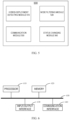
- FIG. 1 shows a schematic diagram of the resource scheduling architecture of a model of the embodiments of the present disclosure.
- the resource scheduling architecture 100 of this model may include a server 110, a terminal 120, and a network 130 that provides a communication link.
- the server 110 and the terminal 120 may be connected through a wired or wireless network 130.
- the server 110 may be an independent physical server, a server cluster or a distributed system composed of a plurality of physical servers, or may further be a cloud server that provides basic cloud computing services such as cloud services, cloud databases, cloud computing, cloud functions, cloud storage, network services, cloud communications, middleware services, domain name services, security services, CDN, and big data and artificial intelligence platforms.
- the terminal 120 may be implemented as hardware or software.
- the terminal 120 when the terminal 120 is implemented as hardware, it can be various electronic devices that have a display screen and support page display, including but not limited to smart phones, tablet computers, e-book readers, laptop computers, desktop computers, and so on.
- the terminal 120 device when the terminal 120 device is implemented as software, it can be installed in the electronic device listed above; it can be implemented as a plurality of software or software modules (such as software or software modules used to provide distributed services), or it can be implemented as a single software or software module, which is not specifically limited here.
- the method for resource scheduling can be performed by the server 110.
- the client 120 submits offline transaction and/or online transaction to the server 110, and the server 110 returns a response result to the client after processing the offline transaction and/or online transaction.
- the number of terminals, networks and servers in FIG. 1 is only for illustration and is not intended to be limiting. There may be any number of terminals, networks, and servers depending on implementation needs.
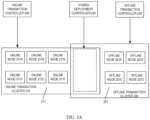
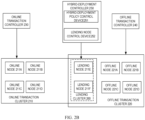
- FIGs. 2A-2B each shows a schematic principle diagram of a method for resource scheduling according to the embodiments of the present disclosure.
- an online transaction cluster 210 in the online transaction management system may include at least one online node 211, such as online nodes 211a, 211b, 211c, 211d, 211e, and 211f.
- the online node 211 is used to process online transaction submitted by a client (e.g., the client 120 in FIG. 1 ).
- Each online node 211 has a status tag with a status tag value "online” to indicate that the node can be used by online transaction. Online transaction can only be allocated to the online node 211 with a status tag value "online" for processing.
- an online node agent such as K8s kubelet
- an offline node agent such as yarn node manager
- the offline node agent can be deployed in the online node based on a copy of the online node to communicate with the online node agent to obtain the resource information of the current online node (for example, the amount of used resources, the amount of unused resources, the resource utilization rate, the total amount of resources, etc.).
- the offline node agent yarn node manager in the online node 211 can be deployed in the online management system K8s using a copy of the K8s daemonset, and communicate with the online node agent K8s kubelet to obtain the resource information of the current node.
- an online service controller 230 may allocate the online transaction submitted by the client to the online node 211 for processing.
- the number of online transactions has certain regularity, that is, the number of online transactions changes periodically.
- the online transaction is in the trough stage, such as time period T1, resources of the online node 211 become idle.
- An offline service controller 240 may allocate the offline transaction submitted by the client to the offline node 221 for processing. Since offline services often have long queuing times due to insufficient resources, they are usually not processed in a timely manner. For example, in FIG. 2A , each offline node 221 is allocated with offline transaction in the time period T1, and there are more offline services queued for processing. It can be seen that, also in the time period T1, resources of the online node 211 are idle, while there are still many offline transactions in the queue at the offline node 221.
- a hybrid-deployment controller 250 can lend part of the resources in the online node 211 to the offline transaction for processing, so that the overall computing resources of the online transaction and the offline transaction can be reasonably allocated and scheduled.
- the lending may refer to providing resources of the online node 211 to the offline transaction for use. Therefore, in some embodiments, based on the change cycle of the number of online transactions, when a predetermined time period is reached (for example, the number of online transactions is in a trough period), the idle resources in the online node 211 can be lent to offline transactions.
- the idle resources in the online node 211 can be lent to the offline transaction for use.
- the online transaction controller 230 can control the to-be-lent online transaction on the online node to be scheduled to other non-lending online nodes for processing.
- the hybrid-deployment controller 250 includes a hybrid-deployment policy control device 251 and a lending node control device 252.
- the user can configure the hybrid scheduling policy between the online node and the offline node through the hybrid-deployment policy control device 251.
- the lending node control device 252 schedules lending nodes in the online node 211 based on the configured hybrid scheduling policy.
- the hybrid scheduling policy may include: source information of the online node 211 and target information of the offline node 221. Furthermore, the hybrid scheduling policy may also include: a predetermined time period of hybrid scheduling and/or a predetermined number of lending nodes.
- the source information of the online node 211 may include at least one of: the number of the online nodes 211, the total resource amount of each online node 211, and the identification or ID of each online node 211.
- the target information of the offline node 221 may include at least one of: the number of the offline nodes 221, the total resource amount of each offline node 221, and the identification or ID of each offline node 221.
- the predetermined time period of hybrid scheduling may refer to the time when hybrid scheduling can be performed, e.g., the trough stage of the number of online transactions. Further, in some embodiments, the predetermined time period may include a plurality of trough stages. Since the number of online transactions changes periodically, the predetermined time period can be set in advance.
- the predetermined number of lending nodes may refer to the number of online nodes to be lent.
- the predetermined number of lending nodes may be m. Then, when the hybrid-deployment controller 250 lends online nodes, it lends m online nodes from the online transaction cluster 210 for offline transaction use.
- each predetermined time period can have a corresponding number of predetermined lending nodes to represent the number of online nodes that can be scheduled in the predetermined time period.
- the hybrid scheduling policy is configured with a plurality of predetermined time periods T1, T2,..., among which the number of predetermined lending nodes corresponding to the predetermined time period T1 is M1 and the number of predetermined lending nodes corresponding to the predetermined time period T2 is M2.
- the lending amount for each predetermined time period can be different.
- the number of online transactions may vary in each lending cycle. Sometimes it is very few (for example, at night), at which point more online nodes can be lent; sometimes it is more than at night but less than the peak period, at which point less online nodes may be lent to provide more flexible hybrid policies.
- the hybrid-deployment controller 250 can determine a lending node from the online nodes 211. For example, a default online node can be set as the lending node, or an online node can be randomly selected as the lending node. Further, the online nodes 211 can be ranked according to a filtering rule in the hybrid scheduling policy to filter out lending nodes.
- the filtering rule includes at least one predetermined rule.
- the predetermined rule may include a first predetermined rule, and the first predetermined rule may further include: judging whether the total resource amount of a first online node is less than that of a second online node; in response to the total resource amount of the first online node being less than that of the second online node, determining that the first online node has priority in lending over the second online node.
- the predetermined rule may further include a second predetermined rule, and the second predetermined rule may further include: judging whether the total resource amount of a third online node is less than that of a fourth online node;
- the predetermined rule may further include a third predetermined rule, and the third predetermined rule may further include: judging whether the minimum allowed disruption (Min Allowed Disruption) of a fifth online node is greater than that of a sixth online node; in response to the minimum allowed disruption of the fifth online node being greater than that of the sixth online node, determining that the fifth online node has priority in lending over the sixth online node.
- the minimum allowed disruption may refer to the minimum value in the "Disruptions Allowed" field in the online transaction of the pdb (Pod Disruption Budget) configured on the online node.
- an online node with a smaller total resource amount, less transaction on the node, and a larger minimum allowed disruption on the node can be lent in priority, so as to lend available online nodes as quickly as possible.
- the filtering rule when the filtering rule includes more than one of the predetermined rules, there is a priority between the individual rules. It should be understood that the priorities between various predetermined rules can be set in advance, which will not be limited here.
- the filtering out the lending nodes from the online node cluster according to the filtering rules comprises:
- the filtering out the lending nodes from the online node cluster according to the filtering rules comprises: judging the order of any two of the online nodes based on a first predetermined rule with a first priority among the predetermined rules;
- the filtering out the lending nodes from the online node cluster according to the filtering rules further comprises: if the order of any two nodes is not determined based on the second predetermined rule, judging the order of any two of the online nodes based on a third predetermined rule with a third priority among the predetermined rules.
- the first priority is higher than the second priority, and the second priority is higher than the third priority.
- the online node 211a is allocated with 5 online transactions
- the online node 211b is allocated with 3 online transactions
- the online node 211c is allocated with 4 online transactions
- the online node 211d is allocated with 6 online transactions
- the online node 211e is allocated with no transaction
- the online node 211f is allocated with 1 online transaction.
- the first predetermined rule with the highest priority for example, the online node with a small total resource amount is lent first
- the ranking between the online node 211a and the online node 211b can be determined according to the first predetermined rule 211b, then the ranking between the online node 211a and the online node 211b is determined; if the ranking between the online node 211a and the online node 211b cannot be determined according to the first predetermined rule (for example, when the total resource amount of the online node 211a is equal to that of the online node 211b), the second predetermined rule with the second priority is used to make the judgment, and so on, until the ranking between the online node 211a and the online node 211b is determined.
- the first predetermined rule for example, when the total resource amount of the online node 211a is equal to that of the online node 211b
- the hybrid-deployment controller 250 ranks the online nodes 211 according to the filtering rules as follows: the online node 211e, the online node 211f, the online node 221b, the online node 221c, the online node 221a, and the online node 221d.
- the hybrid-deployment controller 250 may send a first instruction to the online transaction controller 230, so that the online transaction controller 230 schedules the current online transaction on the lending node to a non-lending node among the online nodes for processing.
- the online transaction controller 230 simulates the scheduling of the current online transactions on all lending nodes to non-lending nodes to ensure that the normal processing of online transactions is not affected while lending resources. For example, if no transactions is allocated to the online node 211e, there is no need to simulate scheduling, and the 1 online transaction S at the online node 211f is scheduled to the other online node 211b. If the simulation is successful, the online transaction S at the online node 211f is scheduled to be the online node 211b.
- the flow will continue to simulate-schedule the online transaction S to the online node 211c, the online node 221a, the online node 221d, etc., until all online nodes are traversed or the simulation is successful. If the simulation is still not successful after traversing all online nodes, the actual scheduling operation of the online transaction S will not be performed. After successfully scheduling all current online transactions of all lending nodes, the online transaction controller 230 performs actual scheduling operations on all current online transactions of all lending nodes.
- the lending node control device 252 in the hybrid-deployment controller 250 can set the status tag value of the lending node from "online" to "online to offline” to indicate that the node is in the lending process from online to offline.
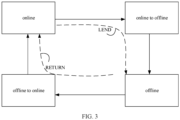
- FIG. 3 shows a schematic diagram of status label changes of online nodes according to the embodiments of the present disclosure.
- the status tag value of the lending node 211f is "online”.
- the hybrid-deployment controller 250 While the online transaction controller 230 schedules the current online transaction S for the lending node 211f, the hybrid-deployment controller 250 sets the status tag value on the lending node 211f to "online to offline", indicating that the lending node 211f is in removal of the current online transaction and is not invoked by the online transaction controller or offline transaction controller in removal of the current online transaction. After the online transaction controller 230 actually successfully schedules the current online transaction S of the lending node 211f to other online nodes, there is no online transaction on the lending node 211f. At this time, the hybrid-deployment controller 250 sets the status tag value of the lending node 211f from "online to offline” to "offline".
- the hybrid-deployment controller 250 sets the status tag value of the lending nodes 211e and 211f to "offline"
- the lending nodes 211e and 211f form a lending cluster 260, as shown in FIG. 2B .
- the offline task controller 240 may, according to the queuing order of the offline transactions, allocate the offline transactions to the lending nodes 211e and 211f with the tag status value "offline" for processing.
- the idle resources of the online management system can be well provided for the use of offline transactions of the offline management system.
- the hybrid-deployment controller 250 and the offline transaction controller 240 will return the lending nodes in the lending node cluster 260 to the online node cluster 210 for use by online transactions.
- the hybrid-deployment controller 250 may send a second instruction to the offline transaction controller 240, so that the offline transaction controller 240 removes the current offline transaction on the lending node. At the same time, as shown in FIG.
- the hybrid-deployment controller 250 sets the status tag value of the lending node from “offline” to "offline to online” to indicate that the node is in the return process from offline to online. For example, in FIG. 2B , the hybrid-deployment controller 250 may set the status tag value of the lending nodes 211e and 211f to "offline to online (offline to online)".
- the offline transaction controller 240 controls the offline transactions on the lending node to exit, or schedules them to the offline nodes 221a, 221b, 221c, and 221d in the offline node cluster 220 (for example, when the offline nodes in the offline node cluster 220 can meet the scheduled offline transaction).
- the offline transaction controller 240 may send a service removal instruction to the lending node to remove all current offline tasks of the lending node.
- the offline transaction controller 240 can further set a compulsory removal time, so that when the compulsory removal time expires, the offline transaction that has not exited on the lending node will be compulsorily removed directly.
- the hybrid-deployment controller 250 sets the status tag value of the lending node to "online", as shown in FIG. 3 . For example, when there is no offline transaction on the lending nodes 211e and 211f in FIG.
- the hybrid-deployment controller 250 sets the status tag value of the lending nodes 211e and 211f from "offline to online” to "online”. At this time, the lending nodes 211e and 211f are returned to the online node cluster 210 and become online nodes 211e and 211f, as shown in FIG. 2A . Hence, borrowed resources can be returned quickly, where the return can refer to providing the lending nodes for online transaction use.
- FIG. 4 shows a schematic flowchart of a method for resource scheduling according to the embodiments of the present disclosure.
- the method for resource scheduling may be performed by a hybrid-deployment controller (e.g., the hybrid-deployment controller 250 in FIG. 2A ).
- a method 400 for resource scheduling comprises:
- determining the lending node from the online node cluster comprises:
- the filtering out the lending node from the online node cluster according to the filtering rules comprises:
- the method 400 further comprises: when the current online transaction on the lending node is scheduled to other online node than the lending node in the online node cluster for processing, changing a status tag value of the lending node from a first status tag value (for example, "online” in FIG. 3 ) to a third status tag value (for example, “online to offline” in FIG. 3 ), the third status tag value indicating that the lending node is in removal of the current online transaction and is not invoked by the online transaction controller or the offline transaction controller.
- a first status tag value for example, "online” in FIG. 3
- a third status tag value for example, “online to offline” in FIG. 3
- the method 400 further comprises: after the current online transaction on the lending node is scheduled to the other online node for processing, changing a status tag value of the lending node from the third status tag value ( For example, "online to offline” in FIG. 3 ) to a second status tag value (for example, "offline” in FIG. 3 ).
- the method 400 further comprises: in response to a status of the online node meeting a hybrid-deployment terminating condition in a hybrid scheduling policy, changing the second status label value of the lending node (for example, "offline” in FIG. 3 ) to the first status tag value (for example, "online” in FIG. 3 ); wherein, the hybrid-deployment terminating condition is used to indicate a node status condition for terminating the hybrid scheduling of online nodes and offline nodes.
- the hybrid-deployment terminating condition may comprise exceeding the predetermined time period and/or exceeding the predetermined resource utilization rate range.
- the changing the second status tag value of the lending node to the first status tag value comprises:
- the method of the embodiments of the present application can be performed by a single apparatus, such as a computer or server.
- the method of the embodiments of the present application can also be applied in distributed scenarios and completed by a plurality of apparatuses cooperating with each other. In such a distributed scenario, one of the plurality of apparatuses may only perform one or more of the steps in the method of the embodiments of the present application, and the plurality of apparatuses will interact with each other to complete the method.
- the embodiments of the present application further provide an apparatus for resource scheduling.
- the apparatus 500 for resource scheduling comprises:
- the apparatus for resource scheduling of the above embodiments is used to implement the corresponding method for resource scheduling in any of the above embodiments applied to a terminal, with the beneficial effects of the corresponding method embodiments, which will not be repeated here.
- the embodiments of the present application further provide a system for resource scheduling system, comprising:
- system for resource scheduling further comprises: an online transaction controller (such as online transaction controller 230 in FIG. 2A / 2B ) configured for:
- system for resource scheduling further comprises: an offline transaction controller (such as the offline transaction controller 240 in FIG. 2A / 2B ) configured for:
- the present disclosure further provides an electronic device, comprising a memory, a processor, and a computer program stored in the memory and executable on the processor, the program, when executed by the processor, implementing the method for resource scheduling described in any of the above embodiments.
- FIG. 6 shows a schematic diagram of the hardware structure of an example electronic device provided by the embodiments of the present disclosure.
- the device may comprise: a processor 610, a memory 620, an input/output interface 630, a communication interface 640, and a bus 650.
- the processor 610, the memory 620, the input/output interface 630 and the communication interface 640 implement communication connections between each other within the device through the bus 650.
- the processor 610 can be implemented using a general CPU (Central Processing Unit), a microprocessor, an application specific integrated circuit (ASIC), or one or more integrated circuits, and is used to execute a related program to implement the technical solutions provided by the embodiments of this specification.
- a general CPU Central Processing Unit
- ASIC application specific integrated circuit
- the memory 620 can be implemented in the form of ROM (Read Only Memory), RAM (Random Access Memory), static storage device, dynamic storage device, etc.
- the memory 620 can store operating systems and other application programs. When the technical solutions provided by the embodiments in this specification are implemented through software or firmware, the relevant program codes are stored in the memory 620 and called and executed by the processor 610.
- the input/output interface 630 is used to connect a input/output module to realize information input and output.
- the input/output/module can be configured in the device as a component (not shown in the figure), or can be externally connected to the device to provide corresponding functions.
- Input devices can include keyboards, mice, touch screens, microphones, various sensors, etc., and output devices can include displays, speakers, vibrators, indicator lights, etc.
- the communication interface 640 is used to connect a communication module (not shown in the figure) to realize communication interaction between this device and other devices.
- the communication module can communicate in a wired way (such as USB, network cable, etc.) or a wireless way (such as mobile network, WIFI, Bluetooth, etc.).
- the bus 650 includes a path that transmits information between various components of the device (e.g., the processor 610, memory 620, input/output interface 630, and communication interface 640).
- the above device only shows the processor 610, the memory 620, the input/output interface 630, the communication interface 640 and the bus 650, the device may further include other components necessary for normal operation during specific implementation.
- the above device may only include the components necessary to implement the solutions of the embodiments in this specification, without including all the components shown in the drawings.
- the electronic device of the above embodiments is used to implement the corresponding method for resource scheduling in any of the foregoing embodiments, with the beneficial effects of the corresponding method embodiments, which will not be repeated here.
- the embodiments of the present application further provide a non-transitory computer-readable storage medium, storing computer instructions which are used for causing the computer to perform the method for resource scheduling described in any of the above embodiments.
- the above non-transitory computer-readable storage medium can be any available medium or data storage device accessible to a computer, including but not limited to magnetic memory (such as floppy disks, hard disks, tapes, magneto-optical disks (MO), etc.), optical memory (such as CD, DVD, BD, HVD, etc.), and semiconductor memory (such as ROM, EPROM, EEPROM, non-volatile memory (NAND FLASH), solid state drive (SSD)), etc.
- magnetic memory such as floppy disks, hard disks, tapes, magneto-optical disks (MO), etc.
- optical memory such as CD, DVD, BD, HVD, etc.
- semiconductor memory such as ROM, EPROM, EEPROM, non-volatile memory (NAND FLASH), solid state drive (SSD)
- the computer instructions stored in the storage medium of the above embodiments are used to cause the computer to perform the corresponding method for resource scheduling in any of the above embodiments, with the beneficial effects of the corresponding method embodiments, which will not be repeated here.
- the present disclosure further provides a computer program product, which includes a computer program.
- the computer program is executable by one or more processors such that the processors perform the method for resource scheduling.
- the processor that executes the corresponding step may belong to the corresponding execution body.
- the computer program product of the above embodiments is used to cause the processor to perform the method for resource scheduling described in any of the above embodiments, with the beneficial effects of the corresponding method embodiments, which will not be repeated here.
- DRAM dynamic RAM
Landscapes
- Engineering & Computer Science (AREA)
- Software Systems (AREA)
- Theoretical Computer Science (AREA)
- Physics & Mathematics (AREA)
- General Engineering & Computer Science (AREA)
- General Physics & Mathematics (AREA)
- Computer Networks & Wireless Communication (AREA)
- Signal Processing (AREA)
- Management, Administration, Business Operations System, And Electronic Commerce (AREA)
- Stored Programmes (AREA)
- Hardware Redundancy (AREA)
Applications Claiming Priority (2)
| Application Number | Priority Date | Filing Date | Title |
|---|---|---|---|
| CN202210248584.9A CN114629960B (zh) | 2022-03-14 | 2022-03-14 | 资源调度方法、装置、系统、设备、介质和程序产品 |
| PCT/CN2023/078231 WO2023174037A1 (zh) | 2022-03-14 | 2023-02-24 | 资源调度方法、装置、系统、设备、介质和程序产品 |
Publications (2)
| Publication Number | Publication Date |
|---|---|
| EP4404539A1 true EP4404539A1 (de) | 2024-07-24 |
| EP4404539A4 EP4404539A4 (de) | 2025-04-30 |
Family
ID=81901669
Family Applications (1)
| Application Number | Title | Priority Date | Filing Date |
|---|---|---|---|
| EP23769545.7A Pending EP4404539A4 (de) | 2022-03-14 | 2023-02-24 | Ressourcenplanungsverfahren, -vorrichtung und -system, -vorrichtung, -medium und -programmprodukt |
Country Status (4)
| Country | Link |
|---|---|
| US (1) | US12260256B2 (de) |
| EP (1) | EP4404539A4 (de) |
| CN (1) | CN114629960B (de) |
| WO (1) | WO2023174037A1 (de) |
Families Citing this family (2)
| Publication number | Priority date | Publication date | Assignee | Title |
|---|---|---|---|---|
| CN114629960B (zh) * | 2022-03-14 | 2023-09-19 | 抖音视界有限公司 | 资源调度方法、装置、系统、设备、介质和程序产品 |
| CN115904673B (zh) * | 2023-03-09 | 2023-06-27 | 华南师范大学 | 云计算资源并发调度方法、装置、系统、设备及介质 |
Family Cites Families (18)
| Publication number | Priority date | Publication date | Assignee | Title |
|---|---|---|---|---|
| JP4634548B2 (ja) * | 1997-11-04 | 2011-02-16 | ヒューレット・パッカード・カンパニー | マルチプロセッサコンピュータシステム及びその動作方法 |
| CN102317901B (zh) * | 2011-07-25 | 2013-09-11 | 华为技术有限公司 | 对象调整方法、装置及系统 |
| US10956880B2 (en) * | 2015-07-01 | 2021-03-23 | Paypal, Inc. | Mixed deployment architecture for distributed services |
| CN107968810B (zh) * | 2016-10-20 | 2021-07-27 | 阿里巴巴集团控股有限公司 | 一种服务器集群的资源调度方法、装置和系统 |
| US20180331973A1 (en) * | 2017-05-09 | 2018-11-15 | Microsoft Technology Licensing, Llc | Increasing virtual machine availability during server updates |
| US10579423B2 (en) * | 2018-04-02 | 2020-03-03 | Microsoft Technology Licensing, Llc | Resource scheduling using machine learning |
| CN110647394B (zh) * | 2018-06-27 | 2022-03-11 | 阿里巴巴集团控股有限公司 | 一种资源分配方法、装置及设备 |
| CN109412874B (zh) * | 2018-12-21 | 2021-11-02 | 腾讯科技(深圳)有限公司 | 设备资源的配置方法、装置、服务器及存储介质 |
| US11429637B2 (en) * | 2020-10-13 | 2022-08-30 | Microsoft Technology Licensing, Llc | Offline support for a database cluster |
| CN112199194B (zh) * | 2020-10-14 | 2024-04-19 | 广州虎牙科技有限公司 | 基于容器集群的资源调度方法、装置、设备和存储介质 |
| CN112269641B (zh) * | 2020-11-18 | 2023-09-15 | 网易(杭州)网络有限公司 | 一种调度方法、装置、电子设备及存储介质 |
| CN113176941A (zh) * | 2021-04-10 | 2021-07-27 | 作业帮教育科技(北京)有限公司 | 一种在/离线服务混合部署的方法、集群系统及电子设备 |
| CN113626162B (zh) | 2021-07-09 | 2024-08-23 | 西安电子科技大学 | 基于动态资源共享的数据中心任务混合部署方法及系统 |
| CN113672382B (zh) * | 2021-07-20 | 2024-03-26 | 北京达佳互联信息技术有限公司 | 一种业务资源分配方法、装置、电子设备和存储介质 |
| CN113590317B (zh) * | 2021-07-27 | 2024-07-19 | 杭州网易数之帆科技有限公司 | 离线业务的调度方法、装置、介质和计算设备 |
| CN114035941A (zh) * | 2021-10-18 | 2022-02-11 | 阿里巴巴(中国)有限公司 | 资源调度系统、方法以及计算设备 |
| CN114629960B (zh) * | 2022-03-14 | 2023-09-19 | 抖音视界有限公司 | 资源调度方法、装置、系统、设备、介质和程序产品 |
| CN116541142A (zh) * | 2023-04-21 | 2023-08-04 | 网易(杭州)网络有限公司 | 任务调度方法、装置、设备、存储介质及计算机程序产品 |
-
2022
- 2022-03-14 CN CN202210248584.9A patent/CN114629960B/zh active Active
-
2023
- 2023-02-24 WO PCT/CN2023/078231 patent/WO2023174037A1/zh not_active Ceased
- 2023-02-24 EP EP23769545.7A patent/EP4404539A4/de active Pending
-
2024
- 2024-04-16 US US18/637,364 patent/US12260256B2/en active Active
Also Published As
| Publication number | Publication date |
|---|---|
| EP4404539A4 (de) | 2025-04-30 |
| CN114629960A (zh) | 2022-06-14 |
| WO2023174037A1 (zh) | 2023-09-21 |
| US12260256B2 (en) | 2025-03-25 |
| CN114629960B (zh) | 2023-09-19 |
| WO2023174037A8 (zh) | 2024-05-02 |
| US20240264875A1 (en) | 2024-08-08 |
Similar Documents
| Publication | Publication Date | Title |
|---|---|---|
| US11507430B2 (en) | Accelerated resource allocation techniques | |
| US20190258514A1 (en) | I/O Request Scheduling Method and Apparatus | |
| US12260256B2 (en) | Hybrid resource scheduling method and system for online and offline transactions | |
| US9411649B2 (en) | Resource allocation method | |
| CN109739627B (zh) | 任务的调度方法、电子设备及介质 | |
| US10037225B2 (en) | Method and system for scheduling computing | |
| US10782999B2 (en) | Method, device, and single-tasking system for implementing multi-tasking in single-tasking system | |
| JP2018508886A (ja) | マルチプロセッサシステムにおける揮発性メモリ保守イベントのスケジューリング | |
| CN111930516B (zh) | 一种负载均衡方法及相关装置 | |
| CN111104227A (zh) | 一种K8s平台的资源控制方法、装置及相关组件 | |
| CN114968567A (zh) | 用于分配计算节点的计算资源的方法、装置和介质 | |
| JP6189545B2 (ja) | 電力消費の低減のためのネットワークアプリケーション並行スケジューリング | |
| WO2024239865A1 (zh) | 虚拟机的热迁移方法及相关设备 | |
| WO2025103006A1 (zh) | 基于服务器无感知计算的数据处理方法和电子设备 | |
| CN115794306A (zh) | 基于抢占实例的资源分配方法及装置、电子设备及介质 | |
| CN119127232A (zh) | 一种微服务模块构建方法、装置、电子设备和存储介质 | |
| CN113138909A (zh) | 负载统计方法、装置、存储介质及电子设备 | |
| CN104793985B (zh) | 一种虚拟机调度方法和管理设备 | |
| Zhang et al. | Multi-cloud containerized service scheduling optimizing computation and communication | |
| CN118535316B (zh) | 在云系统上进行云计算的方法、装置及存储介质 | |
| KR102014721B1 (ko) | 어플리케이션과 비즈니스 요구에 기반한 프로그램 가능한 지능적 스토리지 아키텍처 | |
| CN117176818A (zh) | 云原生平台的业务执行方法、执行装置和电子设备 | |
| CN120950207A (zh) | 一种任务调度方法、装置、设备、介质及产品 | |
| CN120560845A (zh) | 资源管控方法、装置、设备、存储介质及程序产品 | |
| CN121187798A (zh) | 推理方法、装置、电子设备、存储介质及程序产品 |
Legal Events
| Date | Code | Title | Description |
|---|---|---|---|
| STAA | Information on the status of an ep patent application or granted ep patent |
Free format text: STATUS: THE INTERNATIONAL PUBLICATION HAS BEEN MADE |
|
| PUAI | Public reference made under article 153(3) epc to a published international application that has entered the european phase |
Free format text: ORIGINAL CODE: 0009012 |
|
| STAA | Information on the status of an ep patent application or granted ep patent |
Free format text: STATUS: REQUEST FOR EXAMINATION WAS MADE |
|
| 17P | Request for examination filed |
Effective date: 20240416 |
|
| AK | Designated contracting states |
Kind code of ref document: A1 Designated state(s): AL AT BE BG CH CY CZ DE DK EE ES FI FR GB GR HR HU IE IS IT LI LT LU LV MC ME MK MT NL NO PL PT RO RS SE SI SK SM TR |
|
| REG | Reference to a national code |
Ref country code: DE Ref legal event code: R079 Free format text: PREVIOUS MAIN CLASS: H04L0067630000 Ipc: H04L0067100000 |
|
| A4 | Supplementary search report drawn up and despatched |
Effective date: 20250331 |
|
| RIC1 | Information provided on ipc code assigned before grant |
Ipc: G06F 8/60 20180101ALI20250325BHEP Ipc: G06F 9/50 20060101ALI20250325BHEP Ipc: G06F 9/48 20060101ALI20250325BHEP Ipc: H04L 67/10 20220101AFI20250325BHEP |
|
| DAV | Request for validation of the european patent (deleted) | ||
| DAX | Request for extension of the european patent (deleted) |