EP4404502A1 - Verfahren und vorrichtung zur implementierung von datenschutzverstärkung bei der quantenschlüsselverteilung - Google Patents
Verfahren und vorrichtung zur implementierung von datenschutzverstärkung bei der quantenschlüsselverteilung Download PDFInfo
- Publication number
- EP4404502A1 EP4404502A1 EP22868804.0A EP22868804A EP4404502A1 EP 4404502 A1 EP4404502 A1 EP 4404502A1 EP 22868804 A EP22868804 A EP 22868804A EP 4404502 A1 EP4404502 A1 EP 4404502A1
- Authority
- EP
- European Patent Office
- Prior art keywords
- key
- participant
- bit
- pool
- seed
- Prior art date
- Legal status (The legal status is an assumption and is not a legal conclusion. Google has not performed a legal analysis and makes no representation as to the accuracy of the status listed.)
- Pending
Links
Images


Classifications
-
- H—ELECTRICITY
- H04—ELECTRIC COMMUNICATION TECHNIQUE
- H04L—TRANSMISSION OF DIGITAL INFORMATION, e.g. TELEGRAPHIC COMMUNICATION
- H04L9/00—Cryptographic mechanisms or cryptographic arrangements for secret or secure communications; Network security protocols
- H04L9/08—Key distribution or management, e.g. generation, sharing or updating, of cryptographic keys or passwords
- H04L9/0816—Key establishment, i.e. cryptographic processes or cryptographic protocols whereby a shared secret becomes available to two or more parties, for subsequent use
- H04L9/0852—Quantum cryptography
-
- H—ELECTRICITY
- H04—ELECTRIC COMMUNICATION TECHNIQUE
- H04L—TRANSMISSION OF DIGITAL INFORMATION, e.g. TELEGRAPHIC COMMUNICATION
- H04L9/00—Cryptographic mechanisms or cryptographic arrangements for secret or secure communications; Network security protocols
- H04L9/08—Key distribution or management, e.g. generation, sharing or updating, of cryptographic keys or passwords
- H04L9/0816—Key establishment, i.e. cryptographic processes or cryptographic protocols whereby a shared secret becomes available to two or more parties, for subsequent use
- H04L9/0852—Quantum cryptography
- H04L9/0858—Details about key distillation or coding, e.g. reconciliation, error correction, privacy amplification, polarisation coding or phase coding
-
- H—ELECTRICITY
- H04—ELECTRIC COMMUNICATION TECHNIQUE
- H04L—TRANSMISSION OF DIGITAL INFORMATION, e.g. TELEGRAPHIC COMMUNICATION
- H04L9/00—Cryptographic mechanisms or cryptographic arrangements for secret or secure communications; Network security protocols
- H04L9/06—Cryptographic mechanisms or cryptographic arrangements for secret or secure communications; Network security protocols the encryption apparatus using shift registers or memories for block-wise or stream coding, e.g. DES systems or RC4; Hash functions; Pseudorandom sequence generators
- H04L9/0643—Hash functions, e.g. MD5, SHA, HMAC or f9 MAC
-
- H—ELECTRICITY
- H04—ELECTRIC COMMUNICATION TECHNIQUE
- H04L—TRANSMISSION OF DIGITAL INFORMATION, e.g. TELEGRAPHIC COMMUNICATION
- H04L9/00—Cryptographic mechanisms or cryptographic arrangements for secret or secure communications; Network security protocols
- H04L9/08—Key distribution or management, e.g. generation, sharing or updating, of cryptographic keys or passwords
- H04L9/0816—Key establishment, i.e. cryptographic processes or cryptographic protocols whereby a shared secret becomes available to two or more parties, for subsequent use
- H04L9/0838—Key agreement, i.e. key establishment technique in which a shared key is derived by parties as a function of information contributed by, or associated with, each of these
Definitions
- the present invention relates to the field of quantum communication, and in particular to a method and an apparatus for implementing privacy amplification in quantum key distribution.
- Quantum key distribution (QKD) technology is developed to ensure the security of communication by virtue of the properties of quantum mechanics, whereby both communicating parties can generate and share a random and secure key to encrypt and decrypt messages. It has a wide range of applications in fields such as practical cryptography, information security and national defense, as well as in various secure communication environments.
- a quantum key distribution process can usually include two sections: quantum operation and data post-processing.
- the data post-processing can further include two sections: information reconciliation and privacy amplification.
- the former is mainly used to ensure that each user holds the same key, i.e., key consistency.
- the latter is mainly used to prevent a potential eavesdropper from acquisition of key information, i.e., ensuring key security.
- the commonly used privacy amplification scheme is to acquire the final key in the sense of information-theoretic security by the method of selecting a matrix that is dual to an error correction code, and applying the matrix to a key string subjected to information reconciliation to thus shorten the key string.
- this scheme requires accumulating a sufficiently long input key string before proceeding with a single processing.
- such a privacy amplification scheme encounters problems of low efficiency and impracticability, and may also bring about the problem of error spreading during processing.
- Embodiments of the present invention provide a method and an apparatus for implementing privacy amplification in quantum key distribution.
- an initial key can be received and processed bit by bit during privacy amplification, without the accumulation of a sufficiently long input key string before processing, thereby improving the time efficiency of the processing.
- the method also solves the problem of erroneous bit spreading during privacy amplification in the existing scheme.
- a method for implementing privacy amplification in quantum key distribution wherein participants of the quantum key distribution include a first participant and a second participant, which share a first key pool including at least one key, and the method is executed on a terminal of either of the first and second participants, and includes:
- the step of determining the auxiliary string to be used in the current privacy amplification processing includes:
- the first participant and the second participant further share a Hash function library; and the first Hash function agreed with the other participant includes a first Hash function predetermined from the Hash function library.
- the preset inter-bit operation is an XOR operation.
- the number of unsecure bits in the first key is determined based on a quantum operation in the quantum key distribution.
- the step of determining the seed key from the first key pool includes: determining the seed key from the first key pool according to information that is released by the other participant and corresponds to the seed key.
- the step of determining the seed key from the first key pool further includes: releasing, to the other participant, information corresponding to the seed key.
- the first Hash function agreed with the other participant is implemented based on a Hash matrix, which is acquired by a process including:
- the method further includes: saving the second key to the first key pool.
- the first participant and the second participant sharing the first key pool includes: the first participant and the second participant each have a local backup of the first key pool; and determining the seed key from the first key pool includes: determining the seed key from the local backup of the first key pool.
- an apparatus for implementing privacy amplification in quantum key distribution wherein participants of the quantum key distribution include a first participant and a second participant, which share a first key pool including at least one key, and the apparatus is implemented on a terminal of either of the first and second participants, and includes:
- a computer-readable storage medium storing a computer program
- the computer program when executed in a computer, enables the computer to execute the method described in the first aspect.
- a computing device in a fourth aspect, includes a memory and a processor, wherein the memory stores an executable code, and the processor, when executing the executable code, implements the method described in the first aspect.
- the quantum key distribution QKD process may generally include a quantum operation stage and a data post-processing stage.
- the quantum operation stage for example, two participants (or users, for example, Alice and Bob) distribute quantum states therebetween through physical methods and measure the same to acquire initial keys.
- the quantum state may be distributed and measured in different ways.
- the initial keys held by Alice and Bob may have the following problems: first, during the distribution and measurement of the quantum state, the initial keys held by the two are not exactly the same, for example, because instruments used are not completely accurate or are affected by environmental noise; and second, the initial keys are not completely kept confidential due to the possibility of eavesdroppers (for example, Eve) who may acquire the information of the key by illegal means, during the quantum operation.
- eavesdroppers for example, Eve
- each participant needs to perform data post-processing, the stage of which may typically include two sections: information reconciliation and privacy amplification.
- an information reconciliation process may consume some existing keys shared between the participants (or say, the randomness shared between users), such that the initial keys held by Alice and Bob become completely the same; and the privacy amplification is intended to delete information possibly known by the eavesdropper in the initial keys, such that the acquired final keys are kept completely confidential to people other than the participants (or say, the final key is a key with information-theoretic security).
- FIG. 1 is a schematic diagram showing the principle of an existing method for implementing privacy amplification in quantum key distribution.
- both participants may estimate the ratio h(e p ) of information that may possibly be leaked from the initial key, then acquire the number k (which may be obtained based on nh(e p ), with n being the length of the initial key) of bits that may possibly be leaked from the initial key, and then select an error correction code based on this ratio to obtain a corresponding Hash matrix, with a row/column ratio of (n:k). Then, a dual matrix of this Hash matrix is selected as a privacy amplification matrix M' (with a row/column ratio of n:n-k).
- initial keys subjected to information reconciliation are continuously received, until the whole initial key D ⁇ with the length of n is obtained (the symbol indicates a vector, and D ⁇ is the vectorized representation of the initial key).
- the privacy amplification matrix is performed on the accumulated initial key by means of matrix multiplication to acquire a final key K ⁇ n ⁇ k with the length of n-k.
- the existing scheme has the following problems in practical use: first, in this scheme, in order to improve the ratio of the final key to the initial keys, i.e., to ensure the efficiency of privacy amplification, it is typical to accumulate a sufficient number (for example, in an order of megabit) of information-reconciliated initial keys before a single privacy amplification process. In a scenario where the initial keys are acquired at low speed or unstably, it takes a long waiting time to obtain the final key. For example, in a satellite-based quantum key distribution protocol, sufficient data need to be accumulated by means of multiple orbits of a satellite before single round of privacy amplification, since quantum signals can be transmitted only when the satellite can be "seen” through the clear atmosphere layer from a ground station.
- one round of privacy amplification will process the results of multiple rounds of information reconciliation. If there is an error in the result of one round of information reconciliation, due to the privacy amplification matrix acting on all the n bits and its linear nature in computation, the error will "spread" to all the n ⁇ k bits of output, leading to a great increase in the number of errors before the privacy amplification.
- FIG. 2 is a schematic diagram showing the principle of a method for implementing privacy amplification in quantum key distribution according to an embodiment of the present invention. As shown in FIG.
- this stream-output privacy amplification scheme is based on an existing shared key pool, in which some keys have been distributed among users in advance. It should be noted that this key pool is a shared resource that can be used in many cryptographic protocols, including an information reconciliation process. Therefore, in industry practice this key pool is usually an existing resource, rather than an additionally required resource.
- each participant may extract a certain amount of keys from the key pool, and generate the same Hash matrix M having the size of k ⁇ n (k indicates the number of bits that may possibly be leaked from the initial key, and may be determined based on a previous quantum operation process) based on the same error correction code.
- the keys consumption for generating the Hash matrix may be determined according to the specific error correction code.
- each participant may extract a seed key of another k bits from the shared key pool.
- each participant may read the information-reconciliated initial key in a stream way.
- This final key is completely kept confidential to third parties other than respective participants, or say, it is a key with information-theoretic security.
- the initial keys can be acquired in a stream way, so that the acquired initial key parts can be processed immediately, and the processing results of individual processes are then combined to obtain the final key. Hence, it is unnecessary to accumulate the whole initial keys before privacy amplification, which improves the time efficiency of processing.
- the error bit in the initial keys only affects the corresponding bit, rather than additional bits, in the final key. That is to say, error spreading is prevented.
- FIG. 3 is a flowchart of a method for implementing privacy amplification in quantum key distribution according to an embodiment of the present invention.
- Participants of the quantum key distribution include a first participant and a second participant, which share a first key pool including at least one key.
- the method is executed on a terminal of either of the first and second participants. As shown in FIG. 4 , the method at least includes the following steps:
- step 31 the auxiliary string to be used in the current privacy amplification processing is determined based on a seed key determined from a first key pool and a first Hash function agreed with the other participant.
- each participant terminal may acquire the same auxiliary string based on the same seed key and first Hash function.
- the participant terminal is not intended to exclusively refer to a terminal device of a participant for, for example, a workstation, but may refer to any computing device of the participant for performing computational processing. It includes but is not limited to a server, a workstation, a minicomputer, a mobile processing terminal or the like, and may also refer to a plurality of participant's computing devices working coordinately. Since the quantum key distribution process may include the quantum operation and the post-processing, in some embodiments, the terminals of the participants may also include a quantum-classic hybrid server, which includes a quantum processor and a classic processor. The quantum processor may be configured to execute the quantum operation, and the classic processor may be configured to execute the post-processing, i.e., privacy amplification.
- the auxiliary string may be acquired in different ways, which is not limited in the present specification.
- the auxiliary string may be acquired by the following process: determining the seed key from the first key pool, the seed key having a length determined according to the number of unsecure bits in the first key; and acquiring the auxiliary string by applying, to the seed key, the first Hash function agreed with the other participant, with the auxiliary string having a length equal to that of the first key.
- the whole quantum key distribution process generally comprises a quantum operation process and a data post-processing process, which further includes information reconciliation and privacy amplification.
- the length of the first key i.e., the number of all bits included in the first key
- the number of unsecure bits in the first key i.e., the number of bits that may be eavesdropped
- the number of unsecure bits in the first key may also be determined based on the quantum operation in the quantum key distribution.
- the first key pool may be shared in different ways.
- the individual participants may have a local backup of the first key pool, respectively.
- the individual participants may each determine a seed key from the local backup of the first key pool.
- the first Hash function may be agreed in different ways, or the agreed first Hash function may be different in various embodiments, which is not limited in the present specification.
- the individual participants may also share a Hash function library, and may predetermine the first Hash function from the Hash function library.
- the first Hash function may be implemented based on a Hash matrix, which may be acquired by the following process: determining an auxiliary key from the first key pool, and generating the Hash matrix based on the auxiliary key and an agreed error correction code, the Hash matrix having a dimension of k*n, with n being the length of the first key and k being the number of unsecure bits included in the first key.
- different error correction codes may be used, which is not limited in the present specification.
- the specific way of using the Hash matrix is to convert the seed key into a first row vector, post-multiply the hash matrix on the first row vector to obtain a second row vector, and convert the second row vector into the auxiliary string.
- the Hash matrix may be generated based on the error correction code, the number of unsecure bits, and the length of the initial key.
- the error correction code, the number of unsecure bits or other parameters may be determined depending on the actual quantum system. Due to the stability of the quantum system in actual production, these parameters may not be changed in multiple privacy amplification processes. Therefore, in some embodiments, a same Hash matrix may be used in multiple rounds of privacy amplification. In other cases, the actual quantum system may change to a certain extent in different privacy amplification processes. Therefore, in some other embodiments, these parameters may also be determined according to the worst condition of the actual system (for example, the Hash matrix may be generated based on the greatest possible number of unsecure bits). In this way, the generated Hash matrix is also made available in multiple rounds of privacy amplification.
- the first Hash function may be implemented by means of software and hardware.
- the first Hash function may be specifically implemented by a Hash circuit shared between the participants.
- step 32 at least one first bit in a first key subjected to information reconciliation is acquired in a stream way.
- the first key is a key processed by the current privacy amplification.
- the information reconciliation is a way of error correction and may ensure the agreement of keys shared by the individual participants in the quantum distribution.
- the information reconciliation process is generally completed based on a common channel, and may be eavesdropped by a third party other than the respective participants to which the key is distributed.
- the privacy amplification is a method for reducing or removing key information eavesdropped by the third party. This part of key information may be either eavesdropped during key transmission in the quantum operation stage, or acquired during information reconciliation later performed by means of the common channel. Therefore, the privacy amplification is typically performed after information reconciliation. That is to say, the first key is typically acquired by the first and second participants by means of information reconciliation.
- the first bit may be any bit in the first key.
- at least one bit in the first key is acquired in a stream way, and then may be processed in a subsequent step.
- the subsequent processing may be performed without waiting for the completion of the receiving of the whole first key.
- step 33 a preset inter-bit operation is performed between the at least one first bit and bits at corresponding positions in the auxiliary string to obtain at least one second bit for forming a privacy-amplified second key.
- a bit operation for example, XOR operation, may be performed between the several bits (first bits) in the first key as received in step 32 and the corresponding bits in the auxiliary string, to obtain several new second bits. Further, the second bits obtained from all the first bits in the first key may be combined to form the privacy-amplified final key (second key).
- the preset inter-bit operation may be preferably an XOR operation.
- the preset inter-bit operation may also be preferably an XNOR operation. The reason lies in that, when the input bits of the bit operation show an uniform distribution, the distribution of '0' and '1' in the output result acquired by executing for example the XOR or XNOR operation tends to reach 1:1.
- the at least one bit may be one bit or multiple bits.
- the preset inter-bit operation may be a bit operation agreed between the individual participants. For example, in an embodiment, the individual participants agree on a first operation, which generates a two-bit
- the individual participants may also agree on for example a second operation, which, for example, may be applied to three bits or more bits in pair.
- a second operation which, for example, may be applied to three bits or more bits in pair.
- it is to obtain an output result by selecting one from two input bit strings, changing the positions of individual bits in the selected string, and then performing XOR bit-wisely between the selected string and the other string.
- the principle of changing the positions of bits may also be pre-agreed by the individual participants. For example, for a three-bit string expressed as 'ala2a3', the result arising from changing the positions of bits may be, for example, 'a1a3a2' or 'a2a3a1' or the like as pre-agreed, in different examples.
- the final key (second key), after being obtained, may also be saved to the key pool, i.e., the first key pool, shared by the individual participants.
- FIG. 4 is a flowchart of a method for implementing privacy amplification in quantum key distribution according to another embodiment of the present invention.
- one of the participants may determine the seed key from the first key pool, and then release the information corresponding to the seed key to the other participant.
- such information may be the position of the determined seed key in the shared key pool.
- the other participant after receiving the information corresponding to the above seed key, may determine the seed key from the first key pool according to the information corresponding to the seed key.
- the individual participants may obtain the same auxiliary string respectively according to the same seed key, and then obtain the same final key, respectively.
- FIG. 4 is a flowchart of a method for implementing privacy amplification in quantum key distribution according to another embodiment of the present invention.
- an Alice-side terminal extracts a seed key from its local key pool (step 41), and then sends the position of the seed key in the key pool to, for example, a Bob-side terminal (step 43) by means of a common channel, thereby enabling the Bob side to acquire the same seed key from its local key pool according to this position (step 44). Then, the Alice-side and Bob-side terminals each acquire an auxiliary string according to their acquired seed key (steps 45 and 46, respectively). Finally, after acquiring the first key (step 47, which may correspond to step 31 in FIG. 3 ), the Alice-side and Bob-side terminals may perform a preset bit operation, for example XOR operation, on the first key and the auxiliary string, respectively, to obtain the final key (steps 49 and 48, respectively).
- a preset bit operation for example XOR operation
- the use of the method for implementing privacy amplification according to the embodiments of the present invention shows the following advantages.
- the operation may be conducted based on the initial keys acquired in a stream way to then obtain corresponding output results, thereby achieving the effect of stream output, without the accumulation of data of the initial keys.
- the auxiliary string is acquired independent of the acquisition of the initial key and may be computed separately. For example, in a scenario such as satellite-based QKD, the computation may be performed in advance by virtue of the free time unavailable for communication, which greatly improves the utilization efficiency of time.
- the granularity of each processing is one bit in the initial key, and thus, in case of an error occurring to any initial bit, the error only occurs to the bit corresponding to the erroneous initial bit, without affecting other bits.
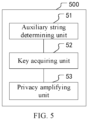
- FIG. 5 is a structural diagram of an apparatus for implementing privacy amplification in quantum key distribution according to an embodiment of the present invention.
- Participants of the quantum key distribution include a first participant and a second participant, which share a first key pool including a plurality of keys, and the apparatus is implemented on a terminal of either of the first and second participants.
- the apparatus 500 includes:
- a computer-readable medium storing a computer program is further provided.
- the computer when running, executes the method described above.
- a computing device includes a memory and a processor; the memory stores an executable code; and the processor, when executing the executable code, implements the method described above.
- the steps of the methods or algorithms described in conjunction with the embodiments disclosed herein may be implemented by using hardware, software modules executed by a processor, or a combination of the two.
- the software modules may be placed in a random-access memory (RAM), an internal memory, a read-only memory (ROM), an electric programmable ROM, an electric erasable programmable ROM, a register, a hard disk, a removable magnetic disk, a CD-ROM, or storage mediums in any other forms as commonly known in the technical field.
Landscapes
- Engineering & Computer Science (AREA)
- Computer Security & Cryptography (AREA)
- Computer Networks & Wireless Communication (AREA)
- Signal Processing (AREA)
- Physics & Mathematics (AREA)
- Electromagnetism (AREA)
- Theoretical Computer Science (AREA)
- Power Engineering (AREA)
- Storage Device Security (AREA)
Applications Claiming Priority (2)
| Application Number | Priority Date | Filing Date | Title |
|---|---|---|---|
| CN202111094031.4A CN113810175B (zh) | 2021-09-17 | 2021-09-17 | 一种用于在量子密钥分发中实现隐私放大的方法及装置 |
| PCT/CN2022/103967 WO2023040427A1 (zh) | 2021-09-17 | 2022-07-05 | 一种用于在量子密钥分发中实现隐私放大的方法及装置 |
Publications (2)
| Publication Number | Publication Date |
|---|---|
| EP4404502A1 true EP4404502A1 (de) | 2024-07-24 |
| EP4404502A4 EP4404502A4 (de) | 2025-09-17 |
Family
ID=78939723
Family Applications (1)
| Application Number | Title | Priority Date | Filing Date |
|---|---|---|---|
| EP22868804.0A Pending EP4404502A4 (de) | 2021-09-17 | 2022-07-05 | Verfahren und vorrichtung zur implementierung von datenschutzverstärkung bei der quantenschlüsselverteilung |
Country Status (4)
| Country | Link |
|---|---|
| US (1) | US12177340B2 (de) |
| EP (1) | EP4404502A4 (de) |
| CN (1) | CN113810175B (de) |
| WO (1) | WO2023040427A1 (de) |
Families Citing this family (3)
| Publication number | Priority date | Publication date | Assignee | Title |
|---|---|---|---|---|
| CN113810175B (zh) * | 2021-09-17 | 2022-11-25 | 清华大学 | 一种用于在量子密钥分发中实现隐私放大的方法及装置 |
| CN114448628B (zh) * | 2022-02-22 | 2024-01-23 | 国网上海市电力公司 | 量子噪声流加密通信方法、装置、设备及存储介质 |
| CN118555060B (zh) * | 2024-05-28 | 2025-02-11 | 无锡艾立德智能科技有限公司 | 基于量子通信的数据安全传输方法及系统 |
Family Cites Families (10)
| Publication number | Priority date | Publication date | Assignee | Title |
|---|---|---|---|---|
| US8693691B2 (en) * | 2012-05-25 | 2014-04-08 | The Johns Hopkins University | Embedded authentication protocol for quantum key distribution systems |
| CN104270247B (zh) * | 2014-05-23 | 2018-05-01 | 中国人民解放军信息工程大学 | 适用于量子密码系统的高效泛Hash函数认证方法 |
| CN105553648B (zh) * | 2014-10-30 | 2019-10-29 | 阿里巴巴集团控股有限公司 | 量子密钥分发、隐私放大及数据传输方法、装置及系统 |
| CN105071929B (zh) * | 2015-07-15 | 2018-08-28 | 清华大学 | 量子密钥分发的后处理方法 |
| CN108599934B (zh) * | 2018-04-16 | 2020-09-08 | 佛山市顺德区德雅军民融合创新研究院 | 一种用于量子密钥分发的可验安全保密增强方法 |
| US11095439B1 (en) | 2018-08-20 | 2021-08-17 | Wells Fargo Bank, N.A. | Systems and methods for centralized quantum session authentication |
| JP6926042B2 (ja) * | 2018-09-19 | 2021-08-25 | 株式会社東芝 | 鍵生成装置、鍵生成方法及びプログラム |
| CN109756329B (zh) | 2019-01-15 | 2021-08-31 | 如般量子科技有限公司 | 基于私钥池的抗量子计算共享密钥协商方法和系统 |
| CN112039657B (zh) * | 2020-07-20 | 2021-05-25 | 北京邮电大学 | 一种用于生成密钥的方法、装置、设备以及存储介质 |
| CN113810175B (zh) | 2021-09-17 | 2022-11-25 | 清华大学 | 一种用于在量子密钥分发中实现隐私放大的方法及装置 |
-
2021
- 2021-09-17 CN CN202111094031.4A patent/CN113810175B/zh active Active
-
2022
- 2022-07-05 EP EP22868804.0A patent/EP4404502A4/de active Pending
- 2022-07-05 WO PCT/CN2022/103967 patent/WO2023040427A1/zh not_active Ceased
- 2022-07-05 US US18/689,140 patent/US12177340B2/en active Active
Also Published As
| Publication number | Publication date |
|---|---|
| WO2023040427A1 (zh) | 2023-03-23 |
| US12177340B2 (en) | 2024-12-24 |
| US20240340171A1 (en) | 2024-10-10 |
| CN113810175A (zh) | 2021-12-17 |
| CN113810175B (zh) | 2022-11-25 |
| EP4404502A4 (de) | 2025-09-17 |
Similar Documents
| Publication | Publication Date | Title |
|---|---|---|
| EP4404502A1 (de) | Verfahren und vorrichtung zur implementierung von datenschutzverstärkung bei der quantenschlüsselverteilung | |
| EP3891922B1 (de) | Sichere mehrparteienerreichung und frequenzschätzung | |
| EP4002754A1 (de) | Einzelknoten-mehrpartei-verschlüsselung | |
| CN111917533B (zh) | 具有减少泄漏的区间统计量的隐私保护基准分析 | |
| JP7750744B2 (ja) | 準群演算を含む暗号化データに対して等価演算および未満演算を実行するシステムおよび方法 | |
| EP4407925A1 (de) | Verfahren und vorrichtung zur verstärkung der sicherheit eines quantenschlüsselverteilungsnetzwerks | |
| Pfister et al. | Quantifying equivocation for finite blocklength wiretap codes | |
| CN114465708B (zh) | 隐私数据处理方法及装置、系统、电子设备、存储介质 | |
| CN106027230A (zh) | 一种量子密钥分发后处理中对误码进行汉明纠错的方法 | |
| WO2023148350A1 (en) | Lattice-based cryptographic digital signature scheme utilising masking | |
| Fadel et al. | A light-weight ESalsa20 Ciphering based on 1D logistic and chebyshev chaotic maps | |
| Ye | Multi-party quantum private comparison protocol based on entanglement swapping of Bell entangled states | |
| JP6974804B2 (ja) | 秘密等号判定システム、秘密等号判定方法および秘密等号判定プログラム | |
| CN117135291A (zh) | 一种图像加密方法、系统、设备及介质 | |
| CN118353622A (zh) | 一个具有线性复杂度的多方隐私集合求并方法及系统 | |
| CN113407992B (zh) | 一种基于可信第三方的隐私数据两方安全相等测试方法 | |
| CN117155551A (zh) | 一种秘密信息的共享方法、系统、设备及存储介质 | |
| CN110011797B (zh) | 一种基于d级单粒子的量子秘密共享方法 | |
| CN113407991B (zh) | 一种基于可信第三方的隐私数据两方安全比较方法 | |
| Zhang et al. | An efficient and secure privacy-preserving federated learning via lattice-based functional encryption | |
| Block et al. | Secure computation using leaky correlations (asymptotically optimal constructions) | |
| Yang et al. | On the analysis of k-Secure t-conference key distribution scheme | |
| Nikiforov et al. | Side-channel analysis of privacy amplification in postprocessing software for a quantum key distribution system | |
| Tang et al. | A VT-code-based information reconciliation scheme for secret key generation using RSS | |
| KR101026647B1 (ko) | 통신 보안 시스템 및 그 방법과 이에 적용되는 키 유도 암호알고리즘 |
Legal Events
| Date | Code | Title | Description |
|---|---|---|---|
| STAA | Information on the status of an ep patent application or granted ep patent |
Free format text: STATUS: THE INTERNATIONAL PUBLICATION HAS BEEN MADE |
|
| PUAI | Public reference made under article 153(3) epc to a published international application that has entered the european phase |
Free format text: ORIGINAL CODE: 0009012 |
|
| STAA | Information on the status of an ep patent application or granted ep patent |
Free format text: STATUS: REQUEST FOR EXAMINATION WAS MADE |
|
| 17P | Request for examination filed |
Effective date: 20240412 |
|
| AK | Designated contracting states |
Kind code of ref document: A1 Designated state(s): AL AT BE BG CH CY CZ DE DK EE ES FI FR GB GR HR HU IE IS IT LI LT LU LV MC MK MT NL NO PL PT RO RS SE SI SK SM TR |
|
| DAV | Request for validation of the european patent (deleted) | ||
| DAX | Request for extension of the european patent (deleted) | ||
| A4 | Supplementary search report drawn up and despatched |
Effective date: 20250821 |
|
| RIC1 | Information provided on ipc code assigned before grant |
Ipc: H04L 9/06 20060101AFI20250814BHEP Ipc: H04L 9/08 20060101ALI20250814BHEP |