EP4404166A2 - Selbsttestender rohrleitungsumgebungsdetektor - Google Patents
Selbsttestender rohrleitungsumgebungsdetektor Download PDFInfo
- Publication number
- EP4404166A2 EP4404166A2 EP24180924.3A EP24180924A EP4404166A2 EP 4404166 A2 EP4404166 A2 EP 4404166A2 EP 24180924 A EP24180924 A EP 24180924A EP 4404166 A2 EP4404166 A2 EP 4404166A2
- Authority
- EP
- European Patent Office
- Prior art keywords
- self
- detector
- environment detector
- testing
- airflow
- Prior art date
- Legal status (The legal status is an assumption and is not a legal conclusion. Google has not performed a legal analysis and makes no representation as to the accuracy of the status listed.)
- Granted
Links
Images


Classifications
-
- G—PHYSICS
- G08—SIGNALLING
- G08B—SIGNALLING SYSTEMS, e.g. PERSONAL CALLING SYSTEMS; ORDER TELEGRAPHS; ALARM SYSTEMS
- G08B29/00—Checking or monitoring of signalling or alarm systems; Prevention or correction of operating errors, e.g. preventing unauthorised operation
- G08B29/02—Monitoring continuously signalling or alarm systems
-
- G—PHYSICS
- G08—SIGNALLING
- G08B—SIGNALLING SYSTEMS, e.g. PERSONAL CALLING SYSTEMS; ORDER TELEGRAPHS; ALARM SYSTEMS
- G08B29/00—Checking or monitoring of signalling or alarm systems; Prevention or correction of operating errors, e.g. preventing unauthorised operation
- G08B29/02—Monitoring continuously signalling or alarm systems
- G08B29/04—Monitoring of the detection circuits
- G08B29/043—Monitoring of the detection circuits of fire detection circuits
-
- G—PHYSICS
- G08—SIGNALLING
- G08B—SIGNALLING SYSTEMS, e.g. PERSONAL CALLING SYSTEMS; ORDER TELEGRAPHS; ALARM SYSTEMS
- G08B17/00—Fire alarms; Alarms responsive to explosion
- G08B17/10—Actuation by presence of smoke or gases, e.g. automatic alarm devices for analysing flowing fluid materials by the use of optical means
-
- G—PHYSICS
- G08—SIGNALLING
- G08B—SIGNALLING SYSTEMS, e.g. PERSONAL CALLING SYSTEMS; ORDER TELEGRAPHS; ALARM SYSTEMS
- G08B17/00—Fire alarms; Alarms responsive to explosion
- G08B17/10—Actuation by presence of smoke or gases, e.g. automatic alarm devices for analysing flowing fluid materials by the use of optical means
- G08B17/103—Actuation by presence of smoke or gases, e.g. automatic alarm devices for analysing flowing fluid materials by the use of optical means using a light emitting and receiving device
- G08B17/107—Actuation by presence of smoke or gases, e.g. automatic alarm devices for analysing flowing fluid materials by the use of optical means using a light emitting and receiving device for detecting light-scattering due to smoke
-
- G—PHYSICS
- G08—SIGNALLING
- G08B—SIGNALLING SYSTEMS, e.g. PERSONAL CALLING SYSTEMS; ORDER TELEGRAPHS; ALARM SYSTEMS
- G08B17/00—Fire alarms; Alarms responsive to explosion
- G08B17/10—Actuation by presence of smoke or gases, e.g. automatic alarm devices for analysing flowing fluid materials by the use of optical means
- G08B17/11—Actuation by presence of smoke or gases, e.g. automatic alarm devices for analysing flowing fluid materials by the use of optical means using an ionisation chamber for detecting smoke or gas
- G08B17/113—Constructional details
-
- G—PHYSICS
- G08—SIGNALLING
- G08B—SIGNALLING SYSTEMS, e.g. PERSONAL CALLING SYSTEMS; ORDER TELEGRAPHS; ALARM SYSTEMS
- G08B17/00—Fire alarms; Alarms responsive to explosion
- G08B17/10—Actuation by presence of smoke or gases, e.g. automatic alarm devices for analysing flowing fluid materials by the use of optical means
- G08B17/117—Actuation by presence of smoke or gases, e.g. automatic alarm devices for analysing flowing fluid materials by the use of optical means by using a detection device for specific gases, e.g. combustion products, produced by the fire
-
- G—PHYSICS
- G08—SIGNALLING
- G08B—SIGNALLING SYSTEMS, e.g. PERSONAL CALLING SYSTEMS; ORDER TELEGRAPHS; ALARM SYSTEMS
- G08B29/00—Checking or monitoring of signalling or alarm systems; Prevention or correction of operating errors, e.g. preventing unauthorised operation
- G08B29/12—Checking intermittently signalling or alarm systems
- G08B29/14—Checking intermittently signalling or alarm systems checking the detection circuits
- G08B29/145—Checking intermittently signalling or alarm systems checking the detection circuits of fire detection circuits
-
- F—MECHANICAL ENGINEERING; LIGHTING; HEATING; WEAPONS; BLASTING
- F24—HEATING; RANGES; VENTILATING
- F24F—AIR-CONDITIONING; AIR-HUMIDIFICATION; VENTILATION; USE OF AIR CURRENTS FOR SCREENING
- F24F11/00—Control or safety arrangements
- F24F11/30—Control or safety arrangements for purposes related to the operation of the system, e.g. for safety or monitoring
Definitions
- the present disclosure relates generally to devices, methods, and systems for self-testing duct environment detectors, such as to detect environmental elements such as smoke, carbon dioxide, or carbon monoxide.
- the way of testing duct smoke detectors commonly involves a maintenance engineer physically removing the duct housing cover and measuring the differential pressure between the inlet and outlet of the detector with a pressure measuring apparatus positioned by the engineer. Furthermore, the maintenance engineer will also carry out a functional test on the smoke detector, contained in the detector housing, by typically spraying synthetic smoke directly into the smoke sensor and thereby triggering a smoke alarm condition.
- the present disclosure relates generally to devices, methods, and systems for self-testing duct environment detectors. Specifically, the present disclosure relates to environment detectors with a self-testing function that are mounted to a duct of a building.
- One self-testing duct environment detector system includes a first portion to be mounted outside of a duct, the first portion having a detector housing with a space therein, the space having a detector with a sensing chamber and a self-testing sensing apparatus therein, wherein the self-testing sensing apparatus determines whether a rate of airflow through the detector housing or sensing chamber is above a threshold rate and a second portion and third portion each configured to extend into the duct, wherein the second portion has at least one inlet aperture formed therein and wherein the third portion has at least on outlet aperture therein.
- a self-testing duct environment detector uses a housing containing an environmental element detector and connects, through a venturi pipe system tube, into a duct.
- a duct is an elongate conduit having a space therein and is typically used in heating and ventilation systems to move air from one place to another through a building to heat, cool, or circulate air through spaces within the building.
- ducts move air from a conditioning source, such as a boiler, furnace, or air cooling unit to one or more rooms within a building, among other duct uses.
- the airflow moving through the duct and passing around the venturi tube causes a differential pressure and the air enters an upstream tube, going through the detector housing, where it flows into the environment detector and out of the detector housing, through a downstream outlet tube and back into the duct.
- a smoke detector if smoke enters the duct, then this process ensures that the smoke will enter the smoke detector where it can be detected and raise an alarm or generate a control signal.
- Another self-testing system includes an airflow monitor that, for example, uses a self-heating thermistor.
- the self-heating thermistor can be placed in the duct detector or detector housing and can periodically test the continued airflow in the detector housing, by heating up the thermistor measuring to what temperature it can heat up to, and then the rate at which the heat signal cools down over time.
- a can refer to one or more such things, while “a plurality of” something can refer to more than one such things.
- a number of components can refer to one or more components, while “a plurality of components” can refer to more than one component.
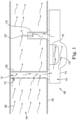
- the portions that extend into the duct are a first tube 108 and a second tube 118. Both tubes allow communication of air 106 between the space 104 within the duct and the space within the detector housing 112 through the space within the respective tube.
- the first tube 108 has a number of apertures 110 thereon that allow air to pass from the interior space 104 of the duct 102 into the interior space 111 of the tube 108.
- This air is merely a sample, as other portions of the air continue past the tube 108 and continue down the interior space 104 of the duct 102.
- This sampled air within the tube 108 travels via the interior space 111 into the interior 114 of the detector housing 112. Some or all of the air then passes through the sensing chamber 116 of the detector 115 and then out of the detector housing 112 and back into the interior of the duct 104 via the interior space 120 of the tube 118, which is the second portion of the system that extends into the duct 102.
- the movement of air, and thereby, the accomplishment of the self-testing of the system 100 relies on the airflow through the duct and a differential pressure between the inlet (holes 110) of the venturi tube 108 and the outlet of the exit tube 118 to draw air from the interior space 104 of the duct into the venturi tube 108 and thereby into the detector housing 112 and past a sensor within the detector 115.
- FIG. 2 is an illustration of a self-testing duct environment detector mounted in a duct system to be inspected with blocked inlet apertures in accordance with an embodiment of the present disclosure.
- particulate e.g., dust, debris
- FIG. 2 This blockage of the inlet apertures (shown on the side surface of the tube in this example) is represented by the X's in Figure 2 .
- Figure 3 is an illustration of a self-testing duct environment detector mounted in a duct system to be inspected having a leak in the environment detector housing surface in accordance with an embodiment of the present disclosure.
- a leak has been created in the system 300. This can happen, for example, due to tampering with the system, improper handling or sealing of the detector housing 312 by a technician, or other potential causes. Damage to the tube 308 could also create a similar issue.
- air 306 may continue to flow through apertures 310 from the interior space 304 of the duct 302 into the interior space 311 of the tube 308.
- Air continues to progress into the interior space 314 of the detector housing 312. However, rather than moving into the detector 315, the airflow exits the detector housing 312 through the hole 322. Consequently, as in the previous example, there is not enough airflow through the sensing chamber 316 of the detector 315 to get accurate readings to determine if a harmful condition exists based on concentration levels of an environmental element in the air.
- the embodiments of the present disclosure include mechanisms and processes to detect issues such as those illustrated in Figures 2 and 3 and such mechanisms and processes are discussed in more detail below.
- Figure 4 is an illustration of a self-testing duct environment detector with a particulate generator for use in accordance with an embodiment of the present disclosure.
- a test is being performed where airflow 429 below a threshold for effective sensing is entering the detector 415. This can be occurring where issues that have arisen in Figures 2 and 3 have occurred.
- the sensing chamber 416 of the detector 415 is equipped with a particulate generator 430 (e.g., aerosol/smoke) a light source (e.g., light emitting diode (LED)), and a sensor 428.
- a particulate generator 430 e.g., aerosol/smoke
- a light source e.g., light emitting diode (LED)
- a sensor 428 e.g., a light beam 426 is directed by light source 424 at a sensor 428.
- the sensor measures the amount of light received by the sensor.
- the particulate generator generates particulate 427 within the interior of the sensing chamber 416. Since there is little airflow through the chamber 416 in this example, the density of the particulate continues to increase until the generator stops generating particulate.
- the sensor 428 measures the amount of light received from the light beam 426, the amount is more than if there were no particulate 427 in the chamber due to the particles scattering light to the sensor.
- the particulate generator generates particulate 427 within the interior of the sensing chamber 416.
- the sensor 428 when the sensor 428 measures the amount of light received from the light beam 426, it can be quantified as an obscuration level, and the amount may be more than if there were no particulate 427 in the chamber, but less than if there were no airflow through the chamber.
- This obscuration level can, for example be a quantified measurement based on the data collected from the sensor 428. Several of these quantified data points can be taken over a period of time to calculate an obscuration rate over time. These types of data can be desirable for calculating a flow rate of the airflow through the detector 415 as well as the differential pressure of the detector system.
- This information can be used to determine the condition of the detector system (e.g., operable or in need of maintenance). For example, the data or calculated values created from the sensor data can be compared with values stored in memory (e.g., threshold values) to determine whether the system is operable or need of service.
- values stored in memory e.g., threshold values
- a sensed flow rate of air through a detector housing can be compared with a threshold value to determine whether the sensed value is above a threshold.
- the threshold can be a limit, determined through testing or prior data collection or can be estimated, at which a value on one side of the threshold (e.g., above or equal to) means that the airflow is sufficient for normal operation of the detector and a value on the other side of the threshold (e.g., below) indicates that the airflow may be insufficient.
- FIG. 5 is an illustration of a self-testing duct environment detector with a self-heating thermistor for use in accordance with an embodiment of the present disclosure.
- a self-heating thermistor 540 is positioned in the sensing chamber 516 of detector 515. As the airflow passes through the chamber, it will cool the heated thermistor. For example, in the top figure, the thermistor 540 is cold. In the middle figure, the thermistor is heated to a predetermined temperature 542.
- the general change in temperature of the thermistor at different times can be sensed by the thermistor and this data can be used to determine whether there is sufficient airflow flowing through the chamber 516. Further a rate of temperature change over time can be compared to rate of change values stored in memory to determine whether the rate of temperature change represents an airflow that is sufficient for operation of the self-testing duct environment detector system.
- any airflow measurement technique could be utilized.
- an ultrasonic apparatus and technique an electrochemical sensing apparatus and technique could also be utilized or a technique wherein airflow could be measured by using the dilution of gas from a gas generator, among others.
- apparatus and techniques that prove that airflow is passing through the detector (e.g., a measured quantity in feet per minute), that there is a threshold level of differential pressure, or that there is a measured threshold dilution density reduction rate (e.g., rate of change of the density of particulate sensed by the sensor in the sensing chamber over time) are all acceptable apparatus and techniques.
- One or more algorithms stored in memory and used by executable instructions executed by a processor within the environment detector can be used to take the sensed data and determine whether there is sufficient airflow within the duct (e.g., above a threshold value stored in memory) and determine if the test has passed or failed. This information can, then, be reported back through a system control panel (e.g., fire alarm system control panel at the building) and can alert the maintenance technician if the airflow is in or out of a threshold range and whether the sensor has passed or failed the functional environmental self-test indicating that the detector will detect properly during normal operation. For example, an alert message can be sent to a monitoring device, if the rate of temperature change is below the threshold value.
- a system control panel e.g., fire alarm system control panel at the building
- a self-test can be carried out in the background during its normal operation period by the airflow monitor and can initiate a fault signal back to the fire alarm control panel if it has failed to detect airflow in the duct housing.
- Such a process could form a more regular monitoring of a failure mode outside of prescribed interval system testing time periods prescribed, for example, by a local code of practice for fire system maintenance.
- self-testing can also be accomplished without setting the fire or gas safety system for the whole building into test mode. Putting the entire system into test mode increases the risk of the building experiencing a hazardous event as the system is not actively monitoring the building when in test mode.
- sensors could be used within the duct housing to measure differential pressure on the inlet and outlet tubes proving airflow.
- a first pressure can be measured on a first end of the space within the detector housing (e.g., near tube 108 in Figure 1 ) and a second pressure can be measured on a second end of the space within the detector housing (e.g., near tube 118 in Figure 1 ).
- the differential pressure could then be determined by comparing the first measured pressure and the second measured pressure (e.g., subtracting one pressure value from the other).
- an airflow monitoring sensor could be placed within the duct housing outside of the detector 515.
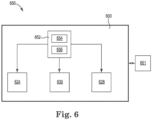
- FIG. 6 is a block diagram of a self-test function of a duct environment detector in accordance with an embodiment of the present disclosure.
- the block diagram of the self-test function 650 includes an environment detector system 600 and a monitoring device 651.
- the environment detector system 600 includes a controller (e.g., microcontroller) 652, a particulate/gas generator 630, and a sensor 628.
- controller e.g., microcontroller
- Sensor 628 can be a smoke (e.g., particulate) sensor, a carbon monoxide (CO) sensor, a carbon dioxide (CO2) sensor, or a combination of two or more thereof.
- sensor 628 can be an optical sensor such as optical scatter chamber, a gas sensor, an ionization sensor, an electrochemical sensor, or an ultrasonic sensor, among other types of sensors.
- the monitoring device 651 can be a control panel, a fire detection control system, and/or a cloud computing device of a fire alarm system.
- the monitoring device 651 can be configured to send commands to and/or receive test results from an environment detector system 600 via a wired or wireless network.
- the network can be a network relationship through which monitoring device 651 can communicate with the environment detector system 600.
- Examples of such a network relationship can include a distributed computing environment (e.g., a cloud computing environment), a wide area network (WAN) such as the Internet, a local area network (LAN), a personal area network (PAN), a campus area network (CAN), or metropolitan area network (MAN), among other types of network relationships.
- the network can include a number of servers that receive information from, and transmit information to, monitoring device 651 and the environment detector system 600 via a wired or wireless network.
- a "network” can provide a communication system that directly or indirectly links two or more computers and/or peripheral devices and allows a monitoring device to access data and/or resources on an environment detector system 600 and vice versa.
- a network can allow users to share resources on their own systems with other network users and to access information on centrally located systems or on systems that are located at remote locations.
- a network can tie a number of computing devices together to form a distributed control network (e.g., cloud).
- a network may provide connections to the Internet and/or to the networks of other entities (e.g., organizations, institutions, etc.). Users may interact with network-enabled software applications to make a network request, such as to get data. Applications may also communicate with network management software, which can interact with network hardware to transmit information between devices on the network.
- entities e.g., organizations, institutions, etc.
- network management software can interact with network hardware to transmit information between devices on the network.
- the microcontroller 652 can include a memory 654 and a processor 656.
- Memory 654 can be any type of storage medium that can be accessed by processor 656 to perform various examples of the present disclosure.
- memory 654 can be a non-transitory computer readable medium having computer readable instructions (e.g., computer program instructions) stored thereon that are executable by processor 656 to test an environment detector system 600 in accordance with the present disclosure.
- processor 656 can execute the executable instructions stored in memory 654 to generate a particular particulate density level, measure the generated particulate density level, determine an airflow rate from an external environment through the sensor 628, and transmit the determined airflow rate to the monitoring device 651.
- memory 654 can store the particulate density level (or CO or CO2 level) sufficient to trigger a response to an environmental threat from a properly operating environment detector system, the particulate density level sufficient to test a fault condition without triggering an environmental response, the threshold airflow rate to verify proper airflow through the sensor 628, and/or the particular period of time that has passed since previously conducting a self-test function (e.g., generating a particular particulate density level and measuring the generated particulate density level).
- particulate sensing it should be understood that CO and/or CO2 sensing and levels can be additionally or alternatively handled as discussed with respect to particulate sensing and levels.
- processor 656 can execute the executable instructions stored in memory 654 to generate a particulate density level, measure a rate at which the particulate density level decreases after the particulate density level has been generated, compare the measured rate at which the particulate density level decreases with a threshold rate, and determine whether the environment detector system 600 is functioning properly (e.g., requires maintenance) based on the comparison of the measured rate and the threshold rate.
- memory 654 can store the threshold rate and/or the measured rate.
- the microcontroller 652 can execute the self-test function 650 of the environment detector system 600 responsive to a particular period of time passing since previously conducting a self-test function and/or responsive to receiving a command from the monitoring device 651 to initiate a self-test.
- the microcontroller 652 can initiate generation of particulate via the particulate generator 630 to begin the self-testing process.
- the generator 630 can generate a gas (e.g., CO, CO2) for self-testing a gas detector wherein the detector tests for gas density within the sensing chamber and can determine a rate of change of gas dilution over time, among other data/calculations that can be made and utilized in embodiments of the present disclosure.
- the environment detector system 600 can include a transmitter light source 624 and a receiver photodiode 628 to measure the particulate density level.
- the monitoring device 651 can, for example, send a command to the light source to produce a light beam to measure the particulate density level.
- the environment detector system 600 can store the test result (e.g., fire response, particulate density level, rate at which the particulate density level decreases after the particulate density level has been generated, and/or airflow rate) in memory 654 and/or send the test result to the monitoring device 651. Further, the measured rate at which the particulate density level decreases can be stored in memory 654 as a threshold rate if, for example, the measured rate is the first (e.g., initial) measured rate at which the particulate density level decreases in the environment detector system 600. If the environment detector system 600 already has a threshold rate, then the measured rate can be stored in memory 654 as a subsequently measured rate at which the particulate density level decreases.
- the test result e.g., fire response, particulate density level, rate at which the particulate density level decreases after the particulate density level has been generated, and/or airflow rate
- the measured rate at which the particulate density level decreases can be stored in memory 654 as a threshold rate
- the environment detector system 600 (e.g., controller 652) can determine whether the environment detector system 600 is functioning properly based on the test result and/or the monitoring device 651 can determine whether the environment detector system 600 is functioning properly based on the test result.
- the monitoring device 651 can determine the environment detector system 600 is functioning properly responsive to the triggering of an environmental threat response and/or the airflow rate exceeding a threshold airflow rate.
- the environment detector system 600 e.g., controller 652 and/or monitoring device 651 can determine whether the environment detector system 600 is functioning properly (e.g., requires maintenance) by comparing the subsequently measured rate at which the particulate density level decreases with the threshold rate. For example, the environment detector system 600 may require maintenance when the difference between the measured rate and the threshold rate is greater than a threshold value.
- the threshold value can be set by a manufacturer, according to regulations, and/or set based on the threshold rate, for example.
- a duct detection device can be self-tested thereby reducing labor spent by engineers physically checking the devices. This can result in substantial monetary and technician hour savings.
Landscapes
- Physics & Mathematics (AREA)
- General Physics & Mathematics (AREA)
- Chemical & Material Sciences (AREA)
- Analytical Chemistry (AREA)
- Business, Economics & Management (AREA)
- Emergency Management (AREA)
- Engineering & Computer Science (AREA)
- Computer Security & Cryptography (AREA)
- Fire-Detection Mechanisms (AREA)
- Fire Alarms (AREA)
Applications Claiming Priority (2)
| Application Number | Priority Date | Filing Date | Title |
|---|---|---|---|
| US17/084,735 US11990022B2 (en) | 2020-10-30 | 2020-10-30 | Self-testing duct environment detector |
| EP21205278.1A EP3992937B1 (de) | 2020-10-30 | 2021-10-28 | Selbsttestkanalumgebungsdetektor |
Related Parent Applications (1)
| Application Number | Title | Priority Date | Filing Date |
|---|---|---|---|
| EP21205278.1A Division EP3992937B1 (de) | 2020-10-30 | 2021-10-28 | Selbsttestkanalumgebungsdetektor |
Publications (3)
| Publication Number | Publication Date |
|---|---|
| EP4404166A2 true EP4404166A2 (de) | 2024-07-24 |
| EP4404166A3 EP4404166A3 (de) | 2024-10-09 |
| EP4404166B1 EP4404166B1 (de) | 2026-04-22 |
Family
ID=78414364
Family Applications (2)
| Application Number | Title | Priority Date | Filing Date |
|---|---|---|---|
| EP24180924.3A Active EP4404166B1 (de) | 2020-10-30 | 2021-10-28 | Selbsttestender rohrleitungsumgebungsdetektor |
| EP21205278.1A Active EP3992937B1 (de) | 2020-10-30 | 2021-10-28 | Selbsttestkanalumgebungsdetektor |
Family Applications After (1)
| Application Number | Title | Priority Date | Filing Date |
|---|---|---|---|
| EP21205278.1A Active EP3992937B1 (de) | 2020-10-30 | 2021-10-28 | Selbsttestkanalumgebungsdetektor |
Country Status (3)
| Country | Link |
|---|---|
| US (2) | US11990022B2 (de) |
| EP (2) | EP4404166B1 (de) |
| CN (1) | CN114446000B (de) |
Families Citing this family (1)
| Publication number | Priority date | Publication date | Assignee | Title |
|---|---|---|---|---|
| EP4216187B1 (de) | 2022-01-24 | 2025-01-01 | Carrier Corporation | Überwachung eines ansaugdetektionssystems |
Family Cites Families (20)
| Publication number | Priority date | Publication date | Assignee | Title |
|---|---|---|---|---|
| GB9309115D0 (en) | 1993-05-04 | 1993-06-16 | No Climb Prod Ltd | Smoke testing detector sensitivity testing apparatus |
| US5818326A (en) * | 1996-07-02 | 1998-10-06 | Simplex Time Recorder Company | Early fire detection using temperature and smoke sensing |
| JP2000352575A (ja) * | 1999-06-10 | 2000-12-19 | Mitsubishi Electric Corp | 組み込み型自己テスト回路およびテスト方法 |
| AUPQ553800A0 (en) | 2000-02-10 | 2000-03-02 | Cole, Martin Terence | Improvements relating to smoke detectors particularily duct monitored smoke detectors |
| EP2273467B1 (de) | 2000-09-29 | 2014-12-24 | Tormaxx GmbH | Gaserzeuger oder Hitzeerzeuger, Rauchgaserzeuger sowie Verfahren zum Prüfen eines Gasmelders oder eines Hitzemelders |
| US7129847B2 (en) * | 2003-08-06 | 2006-10-31 | Edwards Systems Technology, Inc. | Detector with dust filter and airflow monitor |
| US7804402B2 (en) * | 2007-01-26 | 2010-09-28 | Honeywell International Inc. | Fire detectors with environmental data input |
| US8646305B2 (en) | 2009-10-26 | 2014-02-11 | Robert L. Townsend | Duct smoke detection system and method |
| EP2320397B1 (de) * | 2009-10-28 | 2012-05-23 | Honeywell International Inc. | Brandsensor und Verfahren zur Erkennung von Bränden |
| WO2011089879A1 (ja) * | 2010-01-21 | 2011-07-28 | ホーチキ株式会社 | 感知器 |
| US20130016355A1 (en) * | 2011-07-11 | 2013-01-17 | Blake Jude Landry | Systems and methods for measuring particle concentration |
| JP6438399B2 (ja) | 2012-10-16 | 2018-12-12 | ギャレット・サーマル・システムズ・リミテッドGarrett Thermal Systems Limited | 粒子検出におけるアドレス指定能力 |
| US9523623B2 (en) * | 2012-11-28 | 2016-12-20 | Corning Incorporated | Methods for testing a honeycomb filter |
| AR095272A1 (es) | 2013-03-14 | 2015-09-30 | Fisher Controls Int Llc | Pronóstico de válvula en función de análisis de laboratorio |
| US9459208B2 (en) * | 2013-10-04 | 2016-10-04 | Tyco Fire & Security Gmbh | Duct detector with remote airflow test capability |
| US9541467B2 (en) | 2014-06-10 | 2017-01-10 | Star Envirotech, Inc. | Automatic pressure-adjusting leak detecting apparatus and method |
| GB2543065A (en) * | 2015-10-06 | 2017-04-12 | Thorn Security | Smoke detector tester |
| US9959748B2 (en) * | 2016-04-01 | 2018-05-01 | Tyco Fire & Security Gmbh | Fire detection system with self-testing fire sensors |
| CN106226483B (zh) * | 2016-09-30 | 2018-06-26 | 天津大学 | 一种低成本多空气质量监测传感器标定系统 |
| CN106370575A (zh) * | 2016-10-28 | 2017-02-01 | 杭州克霾环保科技有限公司 | 一种高精度检测仪 |
-
2020
- 2020-10-30 US US17/084,735 patent/US11990022B2/en active Active
-
2021
- 2021-10-22 CN CN202111251518.9A patent/CN114446000B/zh active Active
- 2021-10-28 EP EP24180924.3A patent/EP4404166B1/de active Active
- 2021-10-28 EP EP21205278.1A patent/EP3992937B1/de active Active
-
2024
- 2024-05-21 US US18/670,158 patent/US20240346917A1/en active Pending
Also Published As
| Publication number | Publication date |
|---|---|
| EP3992937B1 (de) | 2024-07-03 |
| EP4404166A3 (de) | 2024-10-09 |
| EP4404166B1 (de) | 2026-04-22 |
| US11990022B2 (en) | 2024-05-21 |
| CN114446000B (zh) | 2024-10-11 |
| US20220139207A1 (en) | 2022-05-05 |
| US20240346917A1 (en) | 2024-10-17 |
| CN114446000A (zh) | 2022-05-06 |
| EP3992937A1 (de) | 2022-05-04 |
Similar Documents
| Publication | Publication Date | Title |
|---|---|---|
| EP3859706B1 (de) | Selbstprüfende brandmeldevorrichtung | |
| US12260740B2 (en) | Self-testing fire sensing device | |
| US11756400B2 (en) | Self-testing hazard sensing device | |
| TW201432632A (zh) | 火災偵測技術 | |
| US20240346917A1 (en) | Self-testing duct environment detector | |
| CN102054322A (zh) | 火灾传感器和火灾检测方法 | |
| EP4231265A1 (de) | Testen eines wärmedetektors einer selbsttest-gefahrenmeldevorrichtung | |
| US12436078B2 (en) | Aspirating smoke detector with test module | |
| US12283175B2 (en) | Monitoring an aerosol density level in a fire sensing device | |
| KR20260013542A (ko) | 빅데이터 취득을 통한 수소 기반 시설용 유지 관리 시스템 |
Legal Events
| Date | Code | Title | Description |
|---|---|---|---|
| PUAI | Public reference made under article 153(3) epc to a published international application that has entered the european phase |
Free format text: ORIGINAL CODE: 0009012 |
|
| STAA | Information on the status of an ep patent application or granted ep patent |
Free format text: STATUS: THE APPLICATION HAS BEEN PUBLISHED |
|
| AC | Divisional application: reference to earlier application |
Ref document number: 3992937 Country of ref document: EP Kind code of ref document: P |
|
| AK | Designated contracting states |
Kind code of ref document: A2 Designated state(s): AL AT BE BG CH CY CZ DE DK EE ES FI FR GB GR HR HU IE IS IT LI LT LU LV MC MK MT NL NO PL PT RO RS SE SI SK SM TR |
|
| PUAL | Search report despatched |
Free format text: ORIGINAL CODE: 0009013 |
|
| AK | Designated contracting states |
Kind code of ref document: A3 Designated state(s): AL AT BE BG CH CY CZ DE DK EE ES FI FR GB GR HR HU IE IS IT LI LT LU LV MC MK MT NL NO PL PT RO RS SE SI SK SM TR |
|
| RIC1 | Information provided on ipc code assigned before grant |
Ipc: G08B 17/107 20060101ALN20240903BHEP Ipc: G08B 29/14 20060101ALI20240903BHEP Ipc: G08B 29/04 20060101AFI20240903BHEP |
|
| STAA | Information on the status of an ep patent application or granted ep patent |
Free format text: STATUS: REQUEST FOR EXAMINATION WAS MADE |
|
| 17P | Request for examination filed |
Effective date: 20250325 |
|
| GRAP | Despatch of communication of intention to grant a patent |
Free format text: ORIGINAL CODE: EPIDOSNIGR1 |
|
| STAA | Information on the status of an ep patent application or granted ep patent |
Free format text: STATUS: GRANT OF PATENT IS INTENDED |
|
| RIC1 | Information provided on ipc code assigned before grant |
Ipc: G08B 29/04 20060101AFI20251118BHEP Ipc: G08B 29/14 20060101ALI20251118BHEP Ipc: G08B 17/107 20060101ALN20251118BHEP |
|
| INTG | Intention to grant announced |
Effective date: 20251212 |
|
| GRAS | Grant fee paid |
Free format text: ORIGINAL CODE: EPIDOSNIGR3 |
|
| GRAA | (expected) grant |
Free format text: ORIGINAL CODE: 0009210 |
|
| STAA | Information on the status of an ep patent application or granted ep patent |
Free format text: STATUS: THE PATENT HAS BEEN GRANTED |
|
| AC | Divisional application: reference to earlier application |
Ref document number: 3992937 Country of ref document: EP Kind code of ref document: P |
|
| AK | Designated contracting states |
Kind code of ref document: B1 Designated state(s): AL AT BE BG CH CY CZ DE DK EE ES FI FR GB GR HR HU IE IS IT LI LT LU LV MC MK MT NL NO PL PT RO RS SE SI SK SM TR |
|
| REG | Reference to a national code |
Ref country code: CH Ref legal event code: F10 Free format text: ST27 STATUS EVENT CODE: U-0-0-F10-F00 (AS PROVIDED BY THE NATIONAL OFFICE) Effective date: 20260422 Ref country code: GB Ref legal event code: FG4D |