EP4404136A1 - Interaktive 3d-annotation mit projizierten ansichten - Google Patents
Interaktive 3d-annotation mit projizierten ansichten Download PDFInfo
- Publication number
- EP4404136A1 EP4404136A1 EP23220493.3A EP23220493A EP4404136A1 EP 4404136 A1 EP4404136 A1 EP 4404136A1 EP 23220493 A EP23220493 A EP 23220493A EP 4404136 A1 EP4404136 A1 EP 4404136A1
- Authority
- EP
- European Patent Office
- Prior art keywords
- rendering
- medical image
- segmentation mask
- segmentation
- projected
- Prior art date
- Legal status (The legal status is an assumption and is not a legal conclusion. Google has not performed a legal analysis and makes no representation as to the accuracy of the status listed.)
- Pending
Links
Images




Classifications
-
- G—PHYSICS
- G06—COMPUTING OR CALCULATING; COUNTING
- G06T—IMAGE DATA PROCESSING OR GENERATION, IN GENERAL
- G06T7/00—Image analysis
- G06T7/10—Segmentation; Edge detection
- G06T7/11—Region-based segmentation
-
- G—PHYSICS
- G06—COMPUTING OR CALCULATING; COUNTING
- G06T—IMAGE DATA PROCESSING OR GENERATION, IN GENERAL
- G06T7/00—Image analysis
- G06T7/10—Segmentation; Edge detection
-
- G—PHYSICS
- G06—COMPUTING OR CALCULATING; COUNTING
- G06N—COMPUTING ARRANGEMENTS BASED ON SPECIFIC COMPUTATIONAL MODELS
- G06N20/00—Machine learning
-
- G—PHYSICS
- G06—COMPUTING OR CALCULATING; COUNTING
- G06T—IMAGE DATA PROCESSING OR GENERATION, IN GENERAL
- G06T15/00—Three-dimensional [3D] image rendering
- G06T15/08—Volume rendering
-
- G—PHYSICS
- G06—COMPUTING OR CALCULATING; COUNTING
- G06T—IMAGE DATA PROCESSING OR GENERATION, IN GENERAL
- G06T7/00—Image analysis
- G06T7/10—Segmentation; Edge detection
- G06T7/174—Segmentation; Edge detection involving the use of two or more images
-
- G—PHYSICS
- G16—INFORMATION AND COMMUNICATION TECHNOLOGY [ICT] SPECIALLY ADAPTED FOR SPECIFIC APPLICATION FIELDS
- G16H—HEALTHCARE INFORMATICS, i.e. INFORMATION AND COMMUNICATION TECHNOLOGY [ICT] SPECIALLY ADAPTED FOR THE HANDLING OR PROCESSING OF MEDICAL OR HEALTHCARE DATA
- G16H30/00—ICT specially adapted for the handling or processing of medical images
- G16H30/40—ICT specially adapted for the handling or processing of medical images for processing medical images, e.g. editing
-
- G—PHYSICS
- G06—COMPUTING OR CALCULATING; COUNTING
- G06T—IMAGE DATA PROCESSING OR GENERATION, IN GENERAL
- G06T2200/00—Indexing scheme for image data processing or generation, in general
- G06T2200/04—Indexing scheme for image data processing or generation, in general involving 3D image data
-
- G—PHYSICS
- G06—COMPUTING OR CALCULATING; COUNTING
- G06T—IMAGE DATA PROCESSING OR GENERATION, IN GENERAL
- G06T2200/00—Indexing scheme for image data processing or generation, in general
- G06T2200/24—Indexing scheme for image data processing or generation, in general involving graphical user interfaces [GUIs]
-
- G—PHYSICS
- G06—COMPUTING OR CALCULATING; COUNTING
- G06T—IMAGE DATA PROCESSING OR GENERATION, IN GENERAL
- G06T2207/00—Indexing scheme for image analysis or image enhancement
- G06T2207/10—Image acquisition modality
- G06T2207/10024—Color image
-
- G—PHYSICS
- G06—COMPUTING OR CALCULATING; COUNTING
- G06T—IMAGE DATA PROCESSING OR GENERATION, IN GENERAL
- G06T2207/00—Indexing scheme for image analysis or image enhancement
- G06T2207/10—Image acquisition modality
- G06T2207/10028—Range image; Depth image; 3D point clouds
-
- G—PHYSICS
- G06—COMPUTING OR CALCULATING; COUNTING
- G06T—IMAGE DATA PROCESSING OR GENERATION, IN GENERAL
- G06T2207/00—Indexing scheme for image analysis or image enhancement
- G06T2207/10—Image acquisition modality
- G06T2207/10072—Tomographic images
- G06T2207/10081—Computed x-ray tomography [CT]
-
- G—PHYSICS
- G06—COMPUTING OR CALCULATING; COUNTING
- G06T—IMAGE DATA PROCESSING OR GENERATION, IN GENERAL
- G06T2207/00—Indexing scheme for image analysis or image enhancement
- G06T2207/10—Image acquisition modality
- G06T2207/10072—Tomographic images
- G06T2207/10088—Magnetic resonance imaging [MRI]
-
- G—PHYSICS
- G06—COMPUTING OR CALCULATING; COUNTING
- G06T—IMAGE DATA PROCESSING OR GENERATION, IN GENERAL
- G06T2207/00—Indexing scheme for image analysis or image enhancement
- G06T2207/20—Special algorithmic details
- G06T2207/20021—Dividing image into blocks, subimages or windows
-
- G—PHYSICS
- G06—COMPUTING OR CALCULATING; COUNTING
- G06T—IMAGE DATA PROCESSING OR GENERATION, IN GENERAL
- G06T2207/00—Indexing scheme for image analysis or image enhancement
- G06T2207/20—Special algorithmic details
- G06T2207/20092—Interactive image processing based on input by user
- G06T2207/20104—Interactive definition of region of interest [ROI]
-
- G—PHYSICS
- G06—COMPUTING OR CALCULATING; COUNTING
- G06T—IMAGE DATA PROCESSING OR GENERATION, IN GENERAL
- G06T2207/00—Indexing scheme for image analysis or image enhancement
- G06T2207/30—Subject of image; Context of image processing
- G06T2207/30004—Biomedical image processing
-
- G—PHYSICS
- G06—COMPUTING OR CALCULATING; COUNTING
- G06T—IMAGE DATA PROCESSING OR GENERATION, IN GENERAL
- G06T2207/00—Indexing scheme for image analysis or image enhancement
- G06T2207/30—Subject of image; Context of image processing
- G06T2207/30004—Biomedical image processing
- G06T2207/30008—Bone
-
- G—PHYSICS
- G06—COMPUTING OR CALCULATING; COUNTING
- G06T—IMAGE DATA PROCESSING OR GENERATION, IN GENERAL
- G06T2207/00—Indexing scheme for image analysis or image enhancement
- G06T2207/30—Subject of image; Context of image processing
- G06T2207/30004—Biomedical image processing
- G06T2207/30101—Blood vessel; Artery; Vein; Vascular
-
- G—PHYSICS
- G06—COMPUTING OR CALCULATING; COUNTING
- G06T—IMAGE DATA PROCESSING OR GENERATION, IN GENERAL
- G06T2210/00—Indexing scheme for image generation or computer graphics
- G06T2210/41—Medical
Definitions
- Embodiments of the subject matter disclosed herein relate to image annotation, and more particularly to interactive 3D image segmentation.
- Clinical decisions may be derived from an analysis of a set or sets within data sources. In the radiology domain, this may typically involve analysis of regions of interest from medical image data, which may include 2D or 3D medical images, such as images of organs (kidney, liver, spleen, etc.), blood vessels, bones, and the like. Medical image analysis may be performed at the request of a referring physician for a specific purpose; this purpose may include detection, assessment, and/or monitoring the progression of anatomical abnormalities like lesions, aneurysms, atrophies, and so on.
- medical image data may include 2D or 3D medical images, such as images of organs (kidney, liver, spleen, etc.), blood vessels, bones, and the like.
- Medical image analysis may be performed at the request of a referring physician for a specific purpose; this purpose may include detection, assessment, and/or monitoring the progression of anatomical abnormalities like lesions, aneurysms, atrophies, and so on.
- data corresponding to these regions may first be accurately and robustly separated from other data. While many context specific algorithms exist to segment regions of interest within medical image data, such as organs or other rounded lesions, such algorithms may produce inaccurate results, or at least consume an inordinate amount of time to produce results, for thin or elongated anatomical features or pathological structures like vessels. Moreover, factors such as scale, noise, motion, partial voluming, and other artifacts within medical image data may hamper the accuracy and precision of segmentation algorithms.
- a method includes receiving a first segmentation input selecting a first set of pixels of a two-dimensional (2D) projected rendering, the 2D projected rendering generated from a 3D medical image dataset, retropropagating the selected first set of pixels to 3D space based on a mapping between the 2D projected rendering and the 3D medical image dataset to form a 3D segmentation mask, and saving the 3D segmentation mask in memory and/or applying the 3D segmentation mask to the 3D medical image dataset, wherein the 2D projected rendering is an intensity projection rendering.
- retropropagating the selected first set of pixels to 3D space comprises identifying one or more seed voxels in the 3D space, each seed voxel corresponding to a respective pixel of the first set of pixels; performing a 1D propagation along a ray for a selected axis starting for each seed voxel starting from the seed voxel and terminating at a slice boundary defined by the 2D projected rendering; and including each voxel along the ray in the 3D segmentation mask.
- interactive annotation of 2D projected renderings may increase speed and efficiency of 3D medical image data segmentation, thereby decreasing demanded processing power and increasing accuracy of such segmentations.
- the method may be performed at least partially on a cloud-based platform, which may decrease processing power demanded by a computing device on which the annotation is performed as well as increasing efficiency of segmentation mask generation.
- Image segmentation is a sub-domain of image processing which aims at grouping similar regions or segments of an image.
- Image segmentation may include partitioning a digital image into distinct components (in other words, partitioning the digital image into image segments, with each image segment being a collection of pixels or voxels), and may be utilized in order to simplify and/or change the representation of an image into something that is more meaningful and easier to analyze (e.g., by a referring physician).
- Image segmentation may be used in a variety of applications, including use in medical imaging.
- medical image data which may be two-dimensional (2D) or 3D
- Current tools for image segmentation for 3D medical image data are often designed to segment rounded structures like lesions or organs but struggle to (e.g., are unable to or take a considerable amount of time to) segment thin and elongated structures like vessels and/or bones because such structures are tortuous and may branch/extend through multiple slices of 3D medical image data.
- image segmentation may be done in an automated manner, based on the medical image data and the feature desired to be segmented, via e.g., a machine learning algorithm. In other examples, segmentation may be accomplished via an image analysis algorithm, in conjunction with user interaction with the medical image data.
- Machine learning or deep learning algorithms may make use of segmentations as ground truth data for training of the algorithms.
- ground truth refers to a reality that is to be modeled by a machine learning or deep learning algorithm. Generating large amounts of ground truth data in order to develop deep learning models is time consuming. Additionally, generating ground truth data for segmentation of elongated anatomical structures like blood vessels is often even more time consuming than for rounded structures or lesions because elongated structures may be thin and/or tortuous, and may branch throughout multiple slices of a 3D medical image.
- embodiments are disclosed herein to address the above-described issues and improve segmentation of elongated anatomical structures in 3D medical image data.
- the embodiments disclosed herein may utilize a 2D projected rendering of 3D medical image data, upon which a user may provide annotation inputs to indicate one or more regions of the 2D projected rendering that are to be included in a 3D segmentation mask of the 3D medical image data.
- the mask may be used to segment other medical images and/or may be stored in memory for use in training of deep or machine learning algorithms.
- a 2D preview of a segmentation mask representing the 3D segmentation mask may be provided on the 2D projected rendering, which may allow the user to confirm in real-time the accuracy and extent of the 3D segmentation mask.
- a retropropagation algorithm may be applied to propagate the annotation inputs to 3D space and generate the 3D segmentation mask.
- the 3D medical image data may be condensed to a 2D projected rendering, which may allow increased visualization of the anatomical structures within the 3D medical image data relative to standard slices of the 3D medical image data or other 2D renderings of the 3D medical image data and thus may increase speed and efficiency of user annotation to indicate the anatomical regions to include in the segmentation process.
- An annotation tool may then be used by the user (e.g., a radiologist, trained annotator, or other user) to annotate the 2D projected rendering.
- the pixels of the 2D projected rendering selected by the user via the annotation of the 2D projected rendering may be retropropagated to the 3D space of the 3D medical image data to generate a 3D segmentation mask.
- retropropagate may include back-propagating the identified structures/anatomical features (e.g., identified from the 2D projected rendering) from the 2D projected space back to the 3D space.
- the annotation provided by the user via the annotation tool may be used to generate a 2D preview of the 3D segmentation mask that may be displayed on the 2D projected rendering.
- the 2D preview may include the pixels of the 2D projected rendering selected by the user to be retropropagated to the 3D space.
- Annotation of the 2D rendering and generation of the 3D segmentation mask may be an iterative process, allowing the user to make changes to expand or reduce the 3D segmentation mask.
- the 3D segmentation mask may be saved to a memory of a computing device and optionally applied to the 3D medical image data to segment the 3D medical image data (e.g., to generate ground truth annotations or assist in clinical decision making).
- an initial segmentation mask may be used in generation of the 3D segmentation mask, wherein the initial segmentation mask is a prior mask that may be used as a template.
- An updated segmentation mask may then be generated via additional user inputs which are propagated to the 3D space of the initial segmentation mask to update the segmentation mask.
- Generation of the updated segmentation mask is based on the initial segmentation and at least one additional user input (e.g., additional annotations), and may include pre-processing of the initial segmentation (including adaptive resampling of the segmentation based on the user input from the annotation tool), and regularizing the mask update by applying a 3D low pass filter (e.g., a Gaussian filter).
- the updating of the segmentation as described above may then be continually iterated in real-time, in response to the user input.
- segmentation of thin and/or elongated structures may be performed.
- a 2D rendering such as a Maximum Intensity Projection (MIP), a Minimum Intensity Projection (MinIP), a Volume Rendering (VR), or other suitable 2D projected rendering
- MIP Maximum Intensity Projection
- MinIP Minimum Intensity Projection
- VR Volume Rendering
- segmentation of thin and/or elongated anatomical structures can be completed relatively quickly and with fewer user inputs.
- segmentations generated via the methods described herein may be stored and compiled as ground truth data for training deep learning models, which may allow for the ground truth data to be completed in a less time consuming manner than with traditional annotation methods.
- the methods herein described may increase annotation speed by allowing a user to annotate a 2D image rather than a 3D volume, may increase accuracy as less effort is needed, and may reduce frustration and/or fatigue of the user (e.g., a radiologist) performing a segmentation.
- the 3D volumes that may be segmented according to the embodiments disclosed herein may be generated by a single or multiple imaging modalities, including computed tomography (CT), Magnetic Resonance Imaging (MRI), and/or other modalities capable of generating volumetric imaging data (e.g., ultrasound). Image segmentation based on user input may then be enacted on the medical image data.
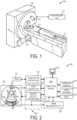
- An example imaging system that may be used to obtain 3D volumetric data for segmentation is shown in FIGS. 1-2 .
- 3D medical image data received from an example imaging system may be segmented via use of an interactive algorithm with manual input from a user (e.g., a radiologist or other annotator).
- FIG. 3 A block diagram of an example algorithm for 3D image segmentation via 2D projected rendering annotation which may be applied to the received 3D medical image data is provided in FIG. 3 .
- An example method for generating a 3D segmentation mask from annotation data of a 2D projected rendering is provided in FIG. 4 .
- Example user interfaces for viewing, annotating, and segmenting 3D image data via the methods herein described are shown in FIGS. 5 , 6 , 7A, 7B , 9 , and 10 .
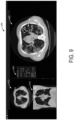
- FIG. 8 illustrates an example of a 3D binary mask (e.g., a 3D segmentation mask) outputted by a segmentation process.
- a 3D binary mask e.g., a 3D segmentation mask
- FIG. 1 illustrates an example CT system 100 configured for CT imaging.
- the CT system 100 is configured to image a subject 112 such as a patient, an inanimate object, one or more manufactured parts, and/or foreign objects such as dental implants, stents, and/or contrast agents present within the body.
- the CT system 100 includes a gantry 102, which in turn, may further include at least one x-ray source 104 configured to project a beam of x-ray radiation 106 (see FIG. 2 ) for use in imaging the subject 112 laying on a table 114.
- the x-ray source 104 is configured to project the x-ray radiation beams 106 towards a detector array 108 positioned on the opposite side of the gantry 102.
- FIG. 1 depicts only a single x-ray source 104, in certain embodiments, multiple x-ray sources and detectors may be employed to project a plurality of x-ray radiation beams 106 for acquiring projection data at different energy levels corresponding to the patient.
- the x-ray source 104 may enable dual-energy gemstone spectral imaging (GSI) by rapid peak kilovoltage (kVp) switching.
- the x-ray detector employed is a photon-counting detector which is capable of differentiating x-ray photons of different energies.
- two sets of x-ray sources and detectors are used to generate dual-energy projections, with one set at low-kVp and the other at high-kVp. It should thus be appreciated that the methods described herein may be implemented with single energy acquisition techniques as well as dual energy acquisition techniques.
- the CT system 100 further includes an image processor unit 110 configured to reconstruct images of a target volume of the subject 112 using an iterative or analytic image reconstruction method.
- the image processor unit 110 may use an analytic image reconstruction approach such as filtered back projection (FBP) to reconstruct images of a target volume of the patient.
- the image processor unit 110 may use an iterative image reconstruction approach such as advanced statistical iterative reconstruction (ASIR), conjugate gradient (CG), maximum likelihood expectation maximization (MLEM), model-based iterative reconstruction (MBIR), and so on to reconstruct images of a target volume of the subject 112.
- ASIR advanced statistical iterative reconstruction
- CG conjugate gradient
- MLEM maximum likelihood expectation maximization
- MBIR model-based iterative reconstruction
- the image processor unit 110 may use both an analytic image reconstruction approach such as FBP in addition to an iterative image reconstruction approach.
- an x-ray source projects a cone-shaped x-ray radiation beam which is collimated to lie within an X-Y-Z plane of a Cartesian coordinate system and generally referred to as an "imaging plane.”
- the x-ray radiation beam passes through an object being imaged, such as the patient or subject.
- the x-ray radiation beam after being attenuated by the object, impinges upon an array of detector elements.
- the intensity of the attenuated x-ray radiation beam received at the detector array is dependent upon the attenuation of a radiation beam by the object.
- Each detector element of the array produces a separate electrical signal that is a measurement of the x-ray beam attenuation at the detector location.
- the attenuation measurements from all the detector elements are acquired separately to produce a transmission profile.
- the x-ray source and the detector array are rotated with a gantry within the imaging plane and around the object to be imaged such that an angle at which the radiation beam intersects the object constantly changes.
- a group of x-ray radiation attenuation measurements, e.g., projection data, from the detector array at one gantry angle is referred to as a "view.”
- a "scan" of the object includes a set of views made at different gantry angles, or view angles, during one revolution of the x-ray source and detector. It is contemplated that the benefits of the methods described herein accrue to medical imaging modalities other than CT, so as used herein the term "view” is not limited to the use as described above with respect to projection data from one gantry angle.
- view is used to mean one data acquisition whenever there are multiple data acquisitions from different angles, whether from a CT, positron emission tomography (PET), or single-photon emission CT (SPECT) acquisition, and/or any other modality including modalities yet to be developed as well as combinations thereof in fused embodiments.
- PET positron emission tomography
- SPECT single-photon emission CT
- the projection data is processed to reconstruct an image that corresponds to a two-dimensional slice taken through the object or, in some examples where the projection data includes multiple views or scans, a three-dimensional rendering of the object.
- One method for reconstructing an image from a set of projection data is referred to in the art as the filtered back projection technique.
- Transmission and emission tomography reconstruction techniques also include statistical iterative methods such as maximum likelihood expectation maximization (MLEM) and ordered-subsets expectation-reconstruction techniques as well as iterative reconstruction techniques. This process converts the attenuation measurements from a scan into integers called "CT numbers" or "Hounsfield units,” which are used to control the brightness of a corresponding pixel on a display device.
- a "helical” scan may be performed.
- the patient is moved while the data for the prescribed number of slices is acquired.
- Such a system generates a single helix from a cone beam helical scan.
- the helix mapped out by the cone beam yields projection data from which images in each prescribed slice may be reconstructed.
- the phrase "reconstructing an image” is not intended to exclude embodiments of the present invention in which data representing an image is generated but a viewable image is not. Therefore, as used herein, the term “image” broadly refers to both viewable images and data representing a viewable image. However, many embodiments generate (or are configured to generate) at least one viewable image.
- FIG. 2 illustrates an example imaging system 200 similar to the CT system 100 of FIG. 1 .
- the imaging system 200 is configured for imaging a subject 204 (e.g., the subject 112 of FIG. 1 ).
- the imaging system 200 includes the detector array 108 (see FIG. 1 ).
- the detector array 108 further includes a plurality of detector elements 202 that together sense the x-ray radiation beam 106 (see FIG. 2 ) that pass through the subject 204 (such as a patient) to acquire corresponding projection data.
- the detector array 108 is fabricated in a multi-slice configuration including the plurality of rows of cells or detector elements 202. In such a configuration, one or more additional rows of the detector elements 202 are arranged in a parallel configuration for acquiring the projection data.
- the imaging system 200 is configured to traverse different angular positions around the subject 204 for acquiring desired projection data.
- the gantry 102 and the components mounted thereon may be configured to rotate about a center of rotation 206 for acquiring the projection data, for example, at different energy levels.
- the mounted components may be configured to move along a general curve rather than along a segment of a circle.
- the detector array 108 collects data of the attenuated x-ray beams.
- the data collected by the detector array 108 undergoes pre-processing and calibration to condition the data to represent the line integrals of the attenuation coefficients of the scanned subject 204.
- the processed data are commonly called projections.
- the individual detectors or detector elements 202 of the detector array 108 may include photon-counting detectors which register the interactions of individual photons into one or more energy bins. It should be appreciated that the methods described herein may also be implemented with energy-integrating detectors.
- the acquired sets of projection data may be used for basis material decomposition (BMD).
- BMD basis material decomposition
- the measured projections are converted to a set of material-density projections.
- the material-density projections may be reconstructed to form a pair or a set of material-density map or image of each respective basis material, such as bone, soft tissue, and/or contrast agent maps.
- the density maps or images may be, in turn, associated to form a volume rendering of the basis material, for example, bone, soft tissue, and/or contrast agent, in the imaged volume.
- the basis material image produced by the imaging system 200 reveals internal features of the subject 204, expressed in the densities of two basis materials.
- the density image may be displayed to show these features.
- a radiologist or physician would consider a hard copy or display of the density image to discern characteristic features of interest.
- Such features might include lesions, vessels, sizes and shapes of particular anatomies or organs, and other features that would be discernable in the image based upon the skill and knowledge of the individual practitioner.
- the imaging system 200 includes a control mechanism 208 to control movement of the components such as rotation of the gantry 102 and the operation of the x-ray source 104.
- the control mechanism 208 further includes an x-ray controller 210 configured to provide power and timing signals to the x-ray source 104.
- the control mechanism 208 includes a gantry motor controller 212 configured to control a rotational speed and/or position of the gantry 102 based on imaging requirements.
- control mechanism 208 further includes a data acquisition system (DAS) 214 configured to sample analog data received from the detector elements 202 and convert the analog data to digital signals for subsequent processing.
- the DAS 214 may be further configured to selectively aggregate analog data from a subset of the detector elements 202 into so-called macro-detectors, as described further herein.
- the data sampled and digitized by the DAS 214 is transmitted to a computer or computing device 216.
- the computing device 216 stores the data in a storage device 218.
- a hard disk drive for example, may include a hard disk drive, a floppy disk drive, a compact disk-read/write (CD-R/W) drive, a Digital Versatile Disc (DVD) drive, a flash drive, and/or a solid-state storage drive.
- the computing device 216 provides commands and parameters to one or more of the DAS 214, the x-ray controller 210, and the gantry motor controller 212 for controlling system operations such as data acquisition and/or processing.
- the computing device 216 controls system operations based on operator input.
- the computing device 216 receives the operator input, for example, including commands and/or scanning parameters via an operator console 220 operatively coupled to the computing device 216.
- the operator console 220 may include a keyboard (not shown), a mouse, and/or a touchscreen to allow the operator to specify the commands and/or scanning parameters.
- FIG. 2 illustrates only one operator console 220, more than one operator console may be coupled to the imaging system 200, for example, for inputting or outputting system parameters, requesting examinations, plotting data, and/or viewing images.
- the imaging system 200 may be coupled to multiple displays, printers, workstations, and/or similar devices located either locally or remotely, for example, within an institution or hospital, or in an entirely different location via one or more configurable wired and/or wireless networks such as the Internet and/or virtual private networks, wireless telephone networks, wireless local area networks, wired local area networks, wireless wide area networks, wired wide area networks, etc.
- the imaging system 200 either includes, or is coupled to, a picture archiving and communications system (PACS) 224.
- PACS picture archiving and communications system
- the PACS 224 is further coupled to a remote system such as a radiology department information system, hospital information system, and/or to an internal or external network (not shown) to allow operators at different locations to supply commands and parameters and/or gain access to the image data.
- the computing device 216 uses the operator-supplied and/or system-defined commands and parameters to operate a table motor controller 226, which in turn, may control a table 114 which may be a motorized table. Specifically, the table motor controller 226 may move the table 114 for appropriately positioning the subject 204 in the gantry 102 for acquiring projection data corresponding to the target volume of the subject 204.
- the DAS 214 samples and digitizes the projection data acquired by the detector elements 202. Subsequently, an image reconstructor 230 uses the sampled and digitized x-ray data to perform high-speed reconstruction.
- FIG. 2 illustrates the image reconstructor 230 as a separate entity, in certain embodiments, the image reconstructor 230 may form part of the computing device 216. Alternatively, the image reconstructor 230 may be absent from the imaging system 200 and instead the computing device 216 may perform one or more functions of the image reconstructor 230. Moreover, the image reconstructor 230 may be located locally or remotely, and may be operatively connected to the imaging system 200 using a wired or wireless network. Particularly, one example embodiment may use computing resources in a "cloud" network cluster for the image reconstructor 230.
- the image reconstructor 230 stores the images reconstructed in the storage device 218.
- the image reconstructor 230 may transmit the reconstructed images to the computing device 216 for generating useful patient information for diagnosis and evaluation.
- the computing device 216 may transmit the reconstructed images and/or the patient information to a display or display device 232 communicatively coupled to the computing device 216 and/or the image reconstructor 230.
- the reconstructed images may be transmitted from the computing device 216 or the image reconstructor 230 to the storage device 218 for short-term or long-term storage.
- computing device 216 may include the instructions in non-transitory memory, and may apply the methods described herein, at least in part, to a reconstructed image after receiving the reconstructed image from image reconstructor 230. In another embodiment, the methods and processes described herein may be distributed across image reconstructor 230 and computing device 216.
- the display 232 allows the operator to evaluate the imaged anatomy.
- the display 232 may also allow the operator to select a volume of interest (VOI) and/or request patient information, for example, via a graphical user interface (GUI) for a subsequent scan or processing.
- VI volume of interest
- GUI graphical user interface
- one or more computing devices may be configured for condensing 3D medical imaging data generated by the imaging system into a 2D projected rendering, wherein the 2D projected rendering projects certain voxels of 3D medical image data.
- the 2D projected rendering may be a MIP, a MinIP, a VR, or other suitable 2D projected rendering.
- Generating a MIP may entail projecting voxels of the 3D medical imaging data with the highest intensity value on each view throughout a volume of the 3D medical imaging data onto a 2D image (e.g., a 2D projected rendering).
- the volume herein described may include a defined thickness, e.g., a slab thickness, which is used when projecting the highest intensity voxels, wherein only voxels within that volume are considered.
- Generating a MinIP may entail projecting voxels of the 3D medical imaging data with the lowest intensity value on each view throughout a volume onto a 2D image.
- Generating a VR may entail creating a three dimensional representation of the 3D medical image data which on its own is visualized in 2D slices.
- the 2D projected rendering may be visualized by the user via the display 232 or the GUI instead of or alongside the 3D medical image data.
- the one or more computing devices may segment 3D medical imaging data generated by the imaging system, for use by the user via interaction with a display device and an operator console.
- the one or more computing devices may use an algorithm for employing annotation of a 2D projected rendering of 3D image data via user input with a 2D annotation tool such as a brush tool.
- the segmentation may be updated in response to user inputs with the 2D annotation tool.
- the user may apply the 2D annotation tool on top of the 2D projected rendering in order to annotate the 2D projected rendering to generate a 2D preview of a segmentation mask.
- the user may apply the 2D annotation tool to an initial segmentation mask in order to update or modify the segmentation mask.
- the 2D annotation tool may be configured to adjust the segmentation based on user input, such as add to a segmentation via a user input, such as a left click with a mouse, and to remove from a segmentation via a second type of user input, such as a right click with a mouse.
- the one or more computing devices may then generate a 3D segmentation mask from the 2D preview by scanning the 3D image data for "seeds" and retropropagating the seeds back into the 3D space.
- Each voxel of the 3D medical image data may be known within the 2D projected rendering, including the position of each voxel with reference to the 3D space.
- Seed voxels, as herein described, may be voxels of the 3D medical image data which have been marked into the 2D preview of the segmentation mask based on the 2D rendering annotation.
- Each seed may indicate the start of a one-dimensional (1D) propagation along a ray direction in order to populate a 3D segmentation mask that may be used to segment the 3D image data.
- the seed voxel may be the voxel with the highest intensity along the ray for a MIP.
- a ray as herein described is a single ray in a particular direction.
- the 1D propagation may be along the Z anatomical axis (Z anatomical axis being oriented cranial-caudal).
- the slab thickness of the 2D projected rendering e.g., an MIP image
- the algorithm may then regularize the 3D mask update by applying a 3D low pass filter (e.g., a Gaussian filter).
- the segmentation mask may be stored for further use, such as to segment the 3D medical image data for use in training a machine learning or deep learning algorithm, wherein the segmentation may be used as ground truth data for training.
- Speed of generation of ground truth data may be increased by use of the 2D projected rendering.
- a method incorporating 2D projected renderings into the interactive segmentation process may decrease time needed to segment structures by allowing a user to manually annotate a single 2D projection rather than multiple slices of 3D image data.
- FIG. 3 a flowchart illustrating a method 300 for segmentation of 3D medical image data is shown.
- the method 300 will be described with relation to the systems depicted in FIGS. 1-2 , but it should be understood that similar methods may be used with other systems without departing from the scope of this disclosure.
- the method 300 may be carried out via instructions stored in non-transitory memory of one or more computing devices.
- the method 300 may be carried out by a client-side computing device (e.g., the computing device 216 or a PACS workstation) as well as a set of remote servers, also referred to herein as a cloud computing system, in communication with the client-side computing device.
- a client-side computing device e.g., the computing device 216 or a PACS workstation
- a set of remote servers also referred to herein as a cloud computing system
- the cloud computing system may be a system that stores the 3D medical image data to be segmented (e.g., the PACS 224 or another image archive). Aspects of the method 300 that may be performed in the cloud computing system are indicated in FIG. 3 by dashed box 324. Aspects of the method 300 that may be performed on the computing device are indicated in FIG. 3 by dashed box 326. In other examples, the method 300 may be carried out on only one device, such as the client-side computing device.
- the method 300 includes obtaining 3D medical image data to be segmented.
- the 3D medical image data may be acquired via an imaging system (e.g., imaging system 200 of FIG. 2 ).
- the 3D medical image data may include data of anatomical features of a patient that was imaged by the imaging system.
- the 3D medical image data that is to be segmented may be selected based on user input. For example, a user may select a desired 3D medical image dataset to be segmented and may request, via a user input, that the selected 3D medical image dataset be segmented.
- the method 300 includes generating a 2D projected rendering from the 3D medical image data.
- the 2D projected rendering may be a MIP, a MinIP, or another 2D projected rendering.
- voxels of the 3D medical image data along respective rays are condensed to pixels within a 2D rendering for a given view (e.g., an axial view, among others).
- voxels of the 3D medical image data that are projected as pixels of the MIP are the voxels with the highest intensity along each ray.
- the 2D projected rendering is a MinIP
- voxels of the 3D medical image data that are projected as pixels of the MIP are the voxels with the lowest intensity.
- Each pixel within the 2D projected rendering may be known with relation to a voxel of the 3D medical image data, therefore allowing for retropropagation from the 2D projected rendering back to a dense 3D space.
- the 2D projected rendering may be displayed on a display (e.g., a display of computing device 216 or a display of a PACS workstation).
- the 2D projected rendering may be displayed as part of a GUI that includes one or more annotation tools that may be employed to define the segmentation, as explained in more detail below.
- the method 300 includes generating and/or adjusting a 2D preview of a segmentation mask via a first user input to the 2D projected rendering with a 2D annotation tool.
- the 2D preview may be a first segmentation input that selects a first set of pixels to be segmented.
- the first user input may entail a user, such as a radiologist or other annotator, manually placing the 2D annotation tool, e.g., a brush tool, on the displayed 2D projected rendering, where movement of a cursor moves the 2D annotation tool about the GUI on which the 2D projected rendering and the 2D annotation tool are displayed.
- the 2D annotation tool may be a suitable annotation tool, such as a brush tool or other tool, with which the user may define which pixels of the 2D projected rendering are to be included in the segmentation, the defined pixels being included in the 2D preview.
- the 2D annotation tool may include a highlighted region, whereby the user positions the highlighted region over a portion of the 2D projected rendering within the GUI.
- the 2D preview may be displayed within the highlighted region and may include an outline or overlay of one or more anatomical structures within the highlighted region of the 2D annotation tool.
- the 2D annotation tool may employ an algorithm to identify pixels within the highlighted region that should be included in the segmentation mask using computer vision or another suitable technique, such as identifying pixels that exhibit a specified range of intensity or attenuation values (e.g., between - 800 and 200 Hounsfield units when the 3D medical image data is obtained with a CT imaging system) within the highlighted region.
- the outline or overlay of the identified pixels within the specified range of intensity values that make up the anatomical structures to be segmented may be displayed with a first color, such as blue, in order to preview the segmentation mask.
- pixels may be selected to be part of the 2D preview manually or with another annotation tool.
- the user may accept the identified pixels by entering a second user input, such as a mouse click, the second user input being a request to segment the pixels within the 2D preview.
- method 300 includes receiving a request to segment the 3D medical image data via the user input.
- the second user input e.g., a left mouse click
- method 300 includes generating the 3D segmentation mask based on data from the 2D preview.
- This segmentation process may be a volume segmentation that identifies selected pixels within the 2D preview and retropropagates them back into the 3D space in which the 3D medical image data was acquired, as will be further described with reference to FIG. 4 .
- method 300 includes displaying within the GUI a 2D representation of the 3D segmentation mask as generated at 310. While the 2D preview of the segmentation mask may be displayed in the GUI with a first color such as blue, the 2D representation of the 3D segmentation mask following the second user input may be displayed with a second color, such as red, indicating that the structures displayed with the second color are included in the 3D segmentation mask.
- the 2D representation of the 3D segmentation mask may be displayed as an overlay on the 2D projected rendering in the GUI and/or on other views such as a 2D image of a slice of the 3D medical image data.
- method 300 includes judging whether the 3D segmentation mask is satisfactory as determined by the user. For example, the user may enter a further user input, such as selection of a "segmentation complete" menu option, to indicate that the 3D segmentation mask is satisfactory. If the 3D segmentation mask is satisfactory, method 300 proceeds to 316, which is explained in more detail below. If the 3D segmentation mask is not satisfactory, method 300 returns to 306 to adjust the 2D preview by expanding or reducing the 2D preview in order to indicate that more or less pixels may be included in the 3D segmentation mask. Thus, method 300 may be an iterative process, wherein each second user input may be a request to segment the 3D medical image data or alter the segmentation mask.
- method 300 includes saving the 3D segmentation mask to the memory of one or more of the computing devices.
- the 3D segmentation mask may be saved as part of a patient exam in an imaging archive, such as PACS 224.
- the 3D segmentation mask may be applied to the 3D medical image data to segment the 3D medical image data (e.g., generate an annotation indicating the positon of selected anatomical structures, extract voxels from the 3D medical image data corresponding to the voxels in the 3D segmentation mask, etc.).
- the 3D segmentation mask may be transmitted to one or more other computing devices.
- the saved 3D segmentation mask may be transmitted to a remote computing device to be included in a ground truth dataset that may be used as training data for machine learning or deep learning algorithms.
- FIG. 4 a flowchart illustrating a method 400 for volume segmentation, including retropropagation from a 2D preview of segmentation mask to a 3D segmentation mask, is shown.
- Method 400 may be carried out via instructions stored in non-transitory memory of a cloud computing system, such as the cloud computing system that in some examples carries out at least a portion of method 300.
- Method 400 may be part of the method 300 described in FIG. 3 , in particular the segmentation of the 3D medical image data of 308 is described in further detail in method 400.
- method 400 includes generating a 2D preview of a segmentation mask which may be performed similarly to the generation of the 2D preview of 306 of method 300.
- a 2D projected rendering may be generated from a volume of 3D medical image data, as described with reference to FIG. 3 .
- the resultant 2D projected rendering may be annotated via user input using a 2D annotation tool, which may generate a preview of a segmentation mask (e.g., where the preview includes a selected first set of pixels of the 2D projected rendering selected by the user to be included in the segmentation), as indicated at 306 of method 300 of FIG. 3 .
- the method 400 includes receiving a request to generate a 3D segmentation mask based on the 2D preview displayed within the 2D projected rendering.
- the request may be in the form of a user input (e.g., the second user input described with reference to FIG. 3 ), for example a mouse click or other suitable indication via a user input device.
- the method 400 includes computing and/or finding seed voxels within the 3D medical image data based on the 2D preview/selected pixels from the 2D projected rendering.
- the 3D medical image data may be scanned to find each seed.
- Each seed voxel may be a respective voxel of the 3D medical image data that was represented as a pixel in the 2D projected rendering and then marked/selected via user input into the 2D preview of the segmentation mask.
- Each voxel of the 3D medical image data may be mapped to a respective pixel of the 2D projected rendering such that which voxel of the 3D medical image data corresponds to which pixel of the 2D projected rendering may be known/determined.
- Each computed seed voxel may reside within a ray along a particular direction and multiple seeds are possible within a ray.
- Each identified seed voxel may have a corresponding voxel in 3D space.
- the 3D space may be initialized with the same dimensions as the 3D medical image data (e.g., same number of voxels arranged in the same number of rows/columns).
- Each seed voxel of the 3D medical image data may be marked in the corresponding voxel of the 3D space.
- the method 400 includes propagating each seed voxel of the 3D space along its associated ray.
- Propagation includes extending or spreading a single entity (e.g., a voxel) in a direction; propagation may be done in 1D and may mark which voxels are to be included in a segmentation mask.
- each seed voxel resides within a ray, wherein the ray is a vector along a selected axis of the 3D space.
- a ray direction may correspond to a Z anatomical axis (e.g., where the Z anatomical axis is cranial-caudal).
- a point of the seed voxel may be a start of a propagation, where the propagation extends in both positive and negative directions along the ray (e.g., positive towards cranial and negative towards caudal), terminating at a slice boundary defined by the 2D projected rendering.
- Propagation along the ray for each seed may generate a set of voxels to be include in a segmentation mask (e.g., the 3D segmentation mask), those voxels being retropropagated into the dense 3D space of the 3D medical image data from 2D data provided, given that the relationship between the 2D data and the 3D space is known.
- This retropropagation generates a 3D segmentation mask from the 2D data (e.g., data of the pixels of the 2D projected rendering and the 2D preview).
- retropropagation includes the transition of 2D data back into the 3D space while propagation, as herein used, includes marking seed voxels along an associated ray.
- method 400 optionally includes constraining the propagation described at 408 based on thickness (e.g., slab thickness) of the 2D projected rendering.
- the 2D projected rendering for example a MIP, may be defined with a specified thickness of the 3D medical image data that it considers.
- the 3D medical image data e.g., 3D CT image data
- the MIP may be generated from a slab volume of the 3D medical image data with a second, larger thickness, such as 15mm.
- all voxels within multiple slices of the 3D medical image data may be condensed to a single 2D projected rendering image that displays the voxels with maximum attenuation in order to display structures more fully than the thinner slices of the 3D medical image data.
- the thickness of the 2D projected rendering may be specified by a user (e.g., a radiologist or annotator) and the thickness may be used to constrain the propagation at 408, whereby propagation along the ray may occur within the chosen thickness volume.
- the thickness of the 2D projected rendering may be set to consider all slices of the 3D medical image data, and as such, the seed voxels may be propagated along an entirety of a ray and may not be constrained.
- the method 400 includes applying a 3D low pass filter to regularize the 3D segmentation mask.
- the 3D low pass filter may be a Gaussian filter or other suitable filter aimed at image denoising.
- Image denoising is a procedure in digital image processing aimed to remove noise from an image or segmentation mask.
- certain elements may alter the image and leads to errors in the segmentation mask. Such elements may include: image noise, image artifacts, and tumors/lesions/high texture, among others.
- image noise may lead to noisy segmentations, holes in the segmentation or unnatural object boundaries, image artifacts, such as e.g., beam hardening, and scattering, may mislead the algorithms and generate noisy segmentations, and tumors/lesions/high texture may bring into the image some contours and texture that are difficult to segment manually with traditional edition tools.
- Regularizing the 3D segmentation mask may reduce unwanted noise in order to provide a clearer mask.
- method 400 includes optionally applying a connectivity constraint to the 3D segmentation mask. Consistency between the 2D preview/pixels identified by the user as being included in the 3D segmentation mask and the 3D segmentation mask may be determined and, if desired, a connectivity constraint may exclude one or more voxels in the 3D segmentation mask not intended or wanted to be in the 3D segmentation mask as determined by the user. By use of connected components, voxels identified as unconnected to a chosen voxel may be excluded. The chosen voxel that begins the connectivity constraint may be defined by user input or by an automated algorithm.
- the user may place the highlighted region on a desired region of the 2D projected rendering and all pixels within the highlighted region that have an intensity value within a specified range may be selected via a user input (e.g., mouse click) to be in the 2D preview/propagated to the 3D segmentation mask.
- the user input that selects the pixels to be included in the 2D preview may also act to select a specific pixel (e.g., a pixel at the center point of the highlighted region when the user input was entered), and the specific pixel's corresponding voxel in the 3D segmentation mask may be the chosen voxel for applying the connectivity constraint.
- connected voxels may be identified and any unconnected voxels may be removed from the mask (e.g., converted from a value of 1 to a value of 0).
- Connected voxels may be voxels within the 3D segmentation mask along a ray with the same value (e.g., a value of 1) that are connected to the chosen voxel (directly or via intervening connecting voxels), where connectivity is predefined.
- 6-connectivity may be used, wherein two voxels are connected when one of six sides of a first voxel is directly adjacent to one of six sides of a second voxel.
- Connected voxels may be identified for each of six rays starting from the chosen voxel.
- a voxel having a value of 0 is identified in a ray, all voxels having a value of 1 that come after the voxel having a value of 0 along the ray direction are determined to be unconnected to the chosen voxel and removed from the mask.
- the connectivity constraint may only be applied to newly-added voxels in the mask (e.g., voxels previously added during a prior iteration of retropropagation may be ignored and left in the mask). Alternatively, if no undesired components are present, the connectivity constraint may not be applied.
- Method 300 and method 400 may both be iterative processes whereby user inputs to the 2D projected rendering may repeatedly and/or continuously trigger modification of the segmentation mask.
- each user input via the 2D annotation brush to the 2D projected rendering may be a request to perform the algorithm for volume segmentation described with reference to method 400.
- Data from segmentations performed via method 300 and method 400 and resulting segmentation masks may be saved in memory for desired downstream use, such as aiding in clinical diagnosis (whether via a clinician or computer-aided diagnosis) and/or to train machine learning or deep learning algorithms.
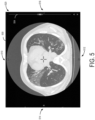
- the medical image 500 may be viewed by a user via a display of a computing device within a GUI 520.
- the view of medical image 500 shown in FIG. 5 is a single slice of a 3D medical image dataset, such as a CT image dataset, from an axial perspective. Orientation from the axial perspective is such that an anterior aspect of the patient is positioned at a top 510 of the GUI 520, a posterior aspect of the patient is positioned at a bottom 512 of the GUI 520, a right side of the patient is shown on a left side 514 of the GUI 520, and a left side of the patient is shown on a right side 516 of the GUI 520.
- the GUI 520 further includes a scroll bar 504, which may allow a user to scroll through slices of the 3D medical image dataset. Thickness of a slice of the 3D medical image 500 may be chosen prior to image acquisition. For example, a chosen slice thickness of 0.6mm may produce a 3D medical image dataset with more slices than a 3D medical image dataset with a chosen slice thickness of 2mm.
- a 2D projected rendering such as a MIP may depict the position, size, shape, and other features of the structures at multiple slices of the 3D medical image dataset as a MIP condenses multiple slices of a 3D medical image dataset into a 2D image showing the structures by projecting voxels of maximum intensity/attenuation of the 3D medical image data.
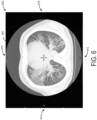
- 2D projected rendering 600 is shown.
- 2D projected rendering 600 as depicted in FIG. 6 is a MIP, condensed from data of the 3D medical image dataset as explained above with respect to FIG. 5 (e.g., the same 3D medical image dataset from which the image 500 was generated).
- 2D projected rendering 600 may be displayed via a GUI 602 (e.g., GUI 520) on a display device (e.g., display 232 of FIG. 2 ).
- GUI 602 e.g., GUI 520
- display device e.g., display 232 of FIG. 2 .
- the 2D projected rendering 600 is depicted in FIG.
- an anterior aspect of the patient is towards a top 610 of the GUI 602
- a posterior aspect of the patient is towards a bottom 612 of the GUI 602
- a right side of the patient is towards a left side 614 of the GUI 602
- a left side of the patient is towards a right side 616 of the GUI 602.
- a thickness of the 2D projected rendering 600 may be defined prior to generation from the 3D medical image.
- the thickness may be chosen by a user as desired, the largest thickness possible being an entirety of a volume of the 3D medical image dataset.
- the 2D projected rendering is a 2D image and therefore no scroll bar may be present.
- a scroll bar may be present in the GUI 602 in order to alter the thickness of the 2D projected rendering.
- the 2D projected rendering 600 does not clearly define a foreground or a background.
- the anatomical structures that are not fully visible in a single slice of corresponding 3D medical image data may be visualized more fully in the 2D projected rendering than in a single slice of the 3D medical image data (or in some cases in their entirety depending on thickness of the 2D projected rendering 600).
- a vessel of a lung which is not well visualized in a single slice of 3D medical image dataset (e.g., medical image 500 of FIG. 5 ) may be visualized more fully or, in some examples, in its entirety in the 2D projected rendering 600. Being able to visualize elongated structures more fully allows for a faster segmentation than when segmenting a 3D medical image alone.
- 2D projected rendering 700 may be displayed within a GUI on a display device (e.g., display device 232 of FIG. 2 ) prior to, during and following user annotation to a medical image.
- a display device e.g., display device 232 of FIG. 2
- FIG. 7A specifically depicts a 2D preview 710 within the 2D projected rendering 700.
- a 2D annotation tool 720 may be used to annotate the 2D projected rendering 700, the annotation including a 2D preview 710 of a segmentation mask that may be generated upon user input.
- the 2D annotation tool may identify pixels within the 2D projected rendering 700 to be included in the 2D preview.
- the 2D annotation tool 720 includes may include a highlighted region 706, though other examples are possible including a manual or automated annotation tool. In such examples in which a highlighted region is included with the 2D annotation tool, only structures within the highlighted region 706 may be included in the 2D preview 710.
- the 2D preview 710 may include an overlay (e.g., a highlight or outline) of pixels that may be included in a segmentation upon user input.
- FIG. 7B specifically depicts a 2D representation 708 of a segmentation mask overlaid on the 2D projected rendering 700.
- the segmentation mask may be the 3D segmentation mask generated as part of a volume segmentation process.
- the 2D representation 708 may be generated as a result of a user input, as described at 310 with reference to FIG. 3 .
- 2D representation 708 may be generated as a result of a user input via the 2D annotation tool 720 to segment structures identified in the 2D preview 710 of FIG. 7A .
- a second highlighted region 712 may also be included in the GUI 702 and may include a second 2D preview 714.
- a second 2D representation may be generated of the structures within the second 2D preview 714.
- the second 2D representation may be added to 2D representation 708 to generate an updated 2D representation.
- the method 400 of FIG. 4 may be employed with each of these user inputs as described with reference to FIG. 4 .
- the 2D annotation tool 720 herein described may identify regions to be segmented in any reasonable way which may include identifying pixels based on intensity value (e.g., identifying intensity values within a specified range (e.g., -800 to 200 Hounsfield units)) or other characteristic that distinguishes pixels from one another.
- the specified range may be chosen by the user or may be included as a part of an automated process or algorithm.
- the 2D annotation tool may be configured to add components to a segmentation mask as well as remove components from a segmentation mask, for example as with an eraser feature.
- the 3D binary mask 810 specifies a region of interest (ROI) 814 of a 2D projected rendering which may be included in a 3D segmentation mask.
- ROI region of interest
- a binary mask as herein described identifies pixels as either included in the ROI 814 or not included in the ROI 814. Pixels of the 3D binary mask 810 with a value of one may belong to the ROI 814 and pixels of the binary mask 810 with a value of zero may not belong to the ROI 814. Pixels that are included in the ROI 814 may be depicted as white while pixels that are not included in the ROI 814 may be depicted as black (e.g., a background).
- GUI 900 may comprise a 2D projected rendering 902, a 2D annotation tool 904, and one or more views of 3D medical image data (e.g., an axial view 912 and a coronal view 916).
- GUI 900 may be displayed on a suitable display device (e.g., display 232 of FIG. 2 ).
- 2D projected rendering 902 may be annotated with the 2D annotation tool 904 and a resulting segmentation mask may be displayed as an overlay on the 2D projected rendering 902.
- the 2D annotation tool 904 may be a brush tool, though in other examples different annotation tools are possible.
- a menu 920 for the 2D annotation tool 904 may be included in the GUI 900, in which a user may choose a mode of operation and specify parameters such as intensity value ranges for the 2D annotation tool 904.
- the mode of operation of the 2D annotation tool 904 and the parameters may affect what types of anatomical structures may be segmented, the area of the 2D projected rendering 902 that may be segmented with a single user input, and other features.
- 2D projected rendering 902 may include a highlighted region 908 of the 2D annotation tool 904, similar to highlighted region 706 of FIG. 7A . Within the highlighted region 908, a preview 906 may be overlaid on the 2D projected rendering 902. The preview 906 may show which structures have been identified by the 2D annotation tool 904 for segmentation. Additionally, in some examples, the 2D projected rendering 902 may include a 2D representation 910 of a segmentation mask. The 2D representation 910 of the segmentation mask may have been generated as a result of user input with the 2D annotation tool 904.
- the GUI 900 also comprises one or more views of the 3D medical image data that was condensed to generate the 2D projected rendering 902.
- the GUI 900 depicted in FIG. 9 specifically shows axial view 912 and coronal view 916 of the 3D medical image data.
- the axial view 912 may include a 2D representation 914 of the 3D segmentation mask, wherein the 2D representation 914 corresponds to the 2D representation 910 of the 2D projected rendering 902.
- the 2D representation 914 may depict a portion of the 3D segmentation mask that is visible from a particular slice of the 3D medical image data from an axial perspective.
- the user may scroll through slices of the 3D medical image data within axial view 912 and view the 2D representation 914 at each slice in which it is visible.
- a combination of all views of the 2D representation 914, each view being visible via a slice of the 3D medical image, may show the 3D segmentation mask in full form, the 3D segmentation mask having been generated based on a retropropagation algorithm as described with reference to FIG. 4 .
- the coronal view 916 may include a 2D representation 918 of the 3D segmentation mask, wherein the 2D representation 918 corresponds to the 2D representation 910 of the 2D projected rendering 902 as well as the 2D representation 914 of the axial view 912.
- the 2D representation 918 may depict a portion of the 3D segmentation mask that is visible from a particular slice of the 3D medical image data from a coronal perspective.
- the user may scroll through slices of the 3D medical image data within coronal view 916 and view the 2D representation 918 at each slice in which it is visible.
- a combination of all views of the 2D representation 918, each view being visible via a slice of the 3D medical image may show the 3D segmentation mask update in full form, the 3D segmentation mask update having been generated based on the retropropagation algorithm.
- a user input via the 2D annotation tool 904 may generate a 2D representation of a segmentation mask as a real time update within the 2D projected rendering.
- the 2D preview 906 as well as the 2D representations 910, 914, 918 may be a portion of the algorithm that is depicted within GUI 900 and as such may not be connected to a cloud computing platform.
- Other steps of the method 300, including the generation of the 3D segmentation mask that is represented in 2D by the 2D representations 910, 914, 918 may be a portion of the algorithm that is performed via the cloud computing platform.
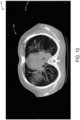
- a 2D projected rendering 1000 is shown within a GUI 1008, the 2D projected rendering 1000 including one or more overlays of 2D representations of segmentation masks.
- a first overlay 1002 may be a representation of a first segmentation mask. In the example depicted in FIG. 10 , the first overlay 1002 includes an outline of a patient's right lung from an axial perspective.
- a second overlay 1004 may be a representation of a second segmentation mask. In the example depicted in FIG. 10 , the second overlay 1004 includes an outline of the patients left lung from an axial perspective.
- a third overlay 1006 may be a representation of a third segmentation mask. In the example depicted in FIG. 10 , the third overlay 1006 is an overlay of vascular branchings within the patient's left lung.
- the third segmentation mask represented by the third overlay 1006 may be a result of a volume segmentation process such as the method described with reference to FIG. 4 .
- a scroll bar 1010 may be included in the GUI 1008.
- the scroll bar 1010 may be used to toggle between different thicknesses of the 2D projected rendering 1000.
- the scroll bar 1010 may toggle between different views, such as switching from the 2D projected rendering 1000, such as a MIP, to a multiplanar reformation (MPR) view of a corresponding 3D medical image.
- An MPR is a converted view of a 3D medical image, for example if a 3D medical image is acquired with axial cuts, an MPR view may be a converted coronal view or other suitable planar view.
- a technical effect of the herein described systems and methods for segmentation using projected views is that increased efficiency and decreased processing power may be achieved during segmentation of thin, elongated anatomical structures.
- Using a middle step of a 2D projected view allows a user to annotate a single 2D image as opposed to annotating multiple slices of 3D medical image data individually. This results in reduced time spent annotating as well as reduced frustration for the user.
- Segmentation via a retropropagation algorithm to propagate pixels from a 2D image (e.g., the 2D projected rendering) back to a 3D space in which the 3D medical image data was acquired reduces processing power demanded by the process as opposed to a segmentation process based on the 3D medical image data alone.
- Using the 2D projected rendering as a middle step in the method for generating the 3D segmentation mask may avoid potential inaccurate or failed generation processes as may occur when generating a 3D segmentation mask of thin, elongated structures from a 3D image dataset alone.
- Display of elements herein described such as the selected first set of pixels (e.g., pixels within a 2D preview), as well as display of a 2D representation of the 3D segmentation mask within a GUI may allow the user to efficiently visualize the segmentation mask along with the anatomy to which it corresponds.
- Differentiation between the selected first set of pixels and the 2D representation may be easily denoted with colors (such as cyan versus red) within the GUI, the colors of which may be visualized as separate from the image on which they are displayed (e.g., both the selected first set of pixels and the 2D representation may be displayed as overlays on the 2D projected rendering for visualization by the user).
- ground truth data for training of deep learning or machine learning models may be more quickly, efficiently, and accurately generated.
- the method for retropropagation of pixels of the 2D projected rendering back to the 3D space in which the 3D medical image dataset was obtained may provide for a more efficient and accurate segmentation process.
- more segmentation mask may be generated for a given period of time and saved to a memory for further use, therefore increasing the amount of segmentation masks available for use as ground truth data.
- the disclosure also provides support for a method executable via one or more processors, comprising: receiving a first segmentation input selecting a first set of pixels of a two-dimensional (2D) projected rendering, the 2D projected rendering generated from a 3D medical image dataset, retropropagating the selected first set of pixels to 3D space based on a mapping between the 2D projected rendering and the 3D medical image dataset to form a 3D segmentation mask, and saving the 3D segmentation mask in memory and/or applying the 3D segmentation mask to the 3D medical image dataset, wherein the 2D projected rendering is an intensity projection rendering.
- 2D projected rendering is an intensity projection rendering.
- retropropagating the selected first set of pixels to the 3D space to form the 3D segmentation mask comprises: identifying one or more seed voxels in the 3D space, each seed voxel in the 3D space corresponding to a respective pixel of the first set of pixels, for each seed voxel, performing a 1D propagation along a ray extending along a selected axis starting from the seed voxel and terminating at a slice boundary defined by the 2D projected rendering, and including each voxel along the ray in the 3D segmentation mask.
- the 2D projected rendering is a maximum intensity projection rendering, and wherein each pixel in the maximum intensity projection rendering represents a respective voxel of the 3D medical image dataset having a highest intensity value along an axis of the 3D medical image dataset.
- the 2D projected rendering is a minimum intensity projection rendering, and wherein each pixel in the minimum intensity projection rendering represents a respective voxel of the 3D medical image dataset having a lowest intensity value along an axis of the 3D medical image dataset.
- the method further comprises: applying a 3D low pass filter to the 3D segmentation mask.
- the method further comprises: excluding one or more voxels from the 3D segmentation mask identified as being unconnected to a selected voxel.
- the first segmentation input that selects the selected first set of pixels comprises a user input with an annotation tool, the annotation tool being configured to identify and/or select pixels within the 2D projected rendering, and further comprising receiving additional segmentation inputs selecting additional sets of pixels and iteratively retropropagating each additional set of pixels to the 3D space based on the mapping to update the 3D segmentation mask.
- the first segmentation input comprises placement of a cursor to position the annotation tool over a portion of the 2D projected rendering.
- retropropagation of the selected first set of pixels is triggered by a second user input, and wherein the one or more processors are part of a cloud-based platform.
- the disclosure also provides support for a method, comprising: generating a two-dimensional (2D) projected rendering from a 3D medical image dataset, wherein the 2D projected rendering includes projection of a subset of voxels of the 3D medical image dataset in order to project anatomical structures from multiple slices of the 3D medical image dataset onto a 2D image, receiving a user input on the 2D projected rendering via a 2D annotation tool to preview a segmentation mask within the 2D projected rendering, generating a 3D segmentation mask based upon the user input, and saving the 3D segmentation mask to memory.
- the method further comprises: modifying or adjusting the 3D segmentation mask via additional user inputs to the 2D projected rendering with the 2D annotation tool.
- the 2D projected rendering and the 2D annotation tool are displayed via a graphical user interface (GUI), the GUI being displayed via a display device that is communicatively coupled to a computing device.
- GUI graphical user interface
- the method further comprises: displaying a 2D representation of the 3D segmentation mask, the 2D representation being displayed as an overlay on the 2D projected rendering within the GUI.
- the 2D representation is displayed in a first color and the preview is displayed in a second color, different than the first color.
- generating the 3D segmentation mask based upon the user input comprises: identifying one or more seed voxels within the 3D medical image dataset, wherein each of the one or more seed voxels corresponds to a pixel included in the preview of the segmentation mask, mapping the one or more seed voxels to 3D space to identify one or more corresponding seed voxels in the 3D space, and performing a one-dimensional (1D) propagation along a ray for each of the one or more corresponding seed voxels to generate the 3D segmentation mask.
- the 3D medical image dataset comprises a computed tomography (CT) image dataset or a magnetic resonance imaging (MRI) image dataset
- the 2D projected rendering is a maximum intensity projection (MIP), a minimum intensity projection (MinIP), or a volume rendering (VR).
- the disclosure also provides support for a system for segmentation of 3D medical image data, comprising: a computing device communicatively coupled to a computed tomography (CT) system or a magnetic resonance imaging (MRI) system, either configured to generate 3D medical image data of a patient, the computing device configured with instructions in non-transitory memory that when executed cause the computing device to: generate a 2D projected rendering from the 3D medical image data, display the 2D projected rendering in a graphical user interface (GUI), select a region of interest (ROI) from the 2D projected rendering to generate a preview of a 3D segmentation mask, the ROI identified based on a user input received to the 2D projected rendering, retropropagate pixels included in the preview to 3D space to form the 3D segmentation mask of the 3D medical image data, regularize the 3D segmentation mask via a 3D low pass filter, and output the 3D segmentation mask of the 3D medical image data.
- CT computed tomography
- MRI magnetic resonance imaging
- the user input is applied to the 2D projected rendering via a 2D annotation tool, the 2D annotation tool being configured to identify pixels of the 2D projected rendering that are to be included in the 3D segmentation mask.
- a 2D representation of the 3D segmentation mask is displayed on the 2D projected rendering in real time as the 3D segmentation mask is generated and updated.
Landscapes
- Engineering & Computer Science (AREA)
- Theoretical Computer Science (AREA)
- Physics & Mathematics (AREA)
- General Physics & Mathematics (AREA)
- Computer Vision & Pattern Recognition (AREA)
- Health & Medical Sciences (AREA)
- Medical Informatics (AREA)
- Software Systems (AREA)
- General Health & Medical Sciences (AREA)
- Computer Graphics (AREA)
- Public Health (AREA)
- Primary Health Care (AREA)
- Epidemiology (AREA)
- Radiology & Medical Imaging (AREA)
- Nuclear Medicine, Radiotherapy & Molecular Imaging (AREA)
- Data Mining & Analysis (AREA)
- Evolutionary Computation (AREA)
- Artificial Intelligence (AREA)
- Computing Systems (AREA)
- General Engineering & Computer Science (AREA)
- Mathematical Physics (AREA)
- Apparatus For Radiation Diagnosis (AREA)
Applications Claiming Priority (1)
| Application Number | Priority Date | Filing Date | Title |
|---|---|---|---|
| US18/156,971 US12315167B2 (en) | 2023-01-19 | 2023-01-19 | 3D interactive annotation using projected views |
Publications (1)
| Publication Number | Publication Date |
|---|---|
| EP4404136A1 true EP4404136A1 (de) | 2024-07-24 |
Family
ID=89473915
Family Applications (1)
| Application Number | Title | Priority Date | Filing Date |
|---|---|---|---|
| EP23220493.3A Pending EP4404136A1 (de) | 2023-01-19 | 2023-12-28 | Interaktive 3d-annotation mit projizierten ansichten |
Country Status (3)
| Country | Link |
|---|---|
| US (1) | US12315167B2 (de) |
| EP (1) | EP4404136A1 (de) |
| CN (1) | CN118365652A (de) |
Families Citing this family (2)
| Publication number | Priority date | Publication date | Assignee | Title |
|---|---|---|---|---|
| US12315167B2 (en) * | 2023-01-19 | 2025-05-27 | GE Precision Healthcare LLC | 3D interactive annotation using projected views |
| CN118588250B (zh) * | 2024-08-06 | 2025-01-03 | 深圳市生强科技有限公司 | 数字病理切片的ai标注数据渲染方法及装置 |
Citations (3)
| Publication number | Priority date | Publication date | Assignee | Title |
|---|---|---|---|---|
| US20100316277A1 (en) * | 2009-05-08 | 2010-12-16 | Li Fan | Method, system, apparatus, and computer program product for interactive hepatic vascular and biliary system assessment |
| US20120293514A1 (en) * | 2011-05-16 | 2012-11-22 | General Electric Company | Systems and methods for segmenting three dimensional image volumes |
| US20130021372A1 (en) * | 2010-04-16 | 2013-01-24 | Koninklijke Philips Electronics N.V. | Image data segmentation |
Family Cites Families (28)
| Publication number | Priority date | Publication date | Assignee | Title |
|---|---|---|---|---|
| US7015907B2 (en) * | 2002-04-18 | 2006-03-21 | Siemens Corporate Research, Inc. | Segmentation of 3D medical structures using robust ray propagation |
| US8155405B2 (en) * | 2007-04-20 | 2012-04-10 | Siemens Aktiengsellschaft | System and method for lesion segmentation in whole body magnetic resonance images |
| US8131038B2 (en) * | 2007-08-21 | 2012-03-06 | Siemens Aktiengesellschaft | System and method for global-to-local shape matching for automatic liver segmentation in medical imaging |
| EP2377095B1 (de) | 2008-12-10 | 2016-05-25 | Koninklijke Philips N.V. | Gefässanalyse |
| JP5950619B2 (ja) * | 2011-04-06 | 2016-07-13 | キヤノン株式会社 | 情報処理装置 |
| US20140104273A1 (en) * | 2012-10-12 | 2014-04-17 | University Of Utah Research Foundation | Interactive extraction of neural structures with user-guided morphological diffusion |
| EP3050025B1 (de) * | 2013-09-24 | 2018-08-15 | General Electric Company | Verfahren zur verarbeitung von röntgenbildern einer brust |
| KR20150078845A (ko) * | 2013-12-31 | 2015-07-08 | 삼성전자주식회사 | 영상에 대한 마크-기반 상호작용을 인에이블하는 사용자 인터페이스 시스템 및 방법 |
| FR3027423B1 (fr) | 2014-10-17 | 2017-12-29 | Global Imaging On Line | Procede d'annotation d'images |
| US9990712B2 (en) * | 2015-04-08 | 2018-06-05 | Algotec Systems Ltd. | Organ detection and segmentation |
| EP3655923B1 (de) * | 2016-12-06 | 2022-06-08 | Siemens Energy, Inc. | Schwach überwachte anomaliedetektion und segmentierung bei bildern |
| US10600184B2 (en) * | 2017-01-27 | 2020-03-24 | Arterys Inc. | Automated segmentation utilizing fully convolutional networks |
| US20180247199A1 (en) * | 2017-02-24 | 2018-08-30 | Qualcomm Incorporated | Method and apparatus for multi-dimensional sequence prediction |
| US10813614B2 (en) * | 2017-05-24 | 2020-10-27 | Perkinelmer Health Sciences, Inc. | Systems and methods for automated analysis of heterotopic ossification in 3D images |
| CN107480673B (zh) * | 2017-06-30 | 2021-01-26 | 上海联影医疗科技股份有限公司 | 确定医学图像中感兴趣区域的方法、装置及图像编辑系统 |
| WO2019041262A1 (en) * | 2017-08-31 | 2019-03-07 | Shenzhen United Imaging Healthcare Co., Ltd. | SYSTEM AND METHOD FOR IMAGE SEGMENTATION |
| WO2019103912A2 (en) * | 2017-11-22 | 2019-05-31 | Arterys Inc. | Content based image retrieval for lesion analysis |
| US10867430B2 (en) * | 2018-11-19 | 2020-12-15 | Intel Corporation | Method and system of 3D reconstruction with volume-based filtering for image processing |
| US11049289B2 (en) | 2019-01-10 | 2021-06-29 | General Electric Company | Systems and methods to semi-automatically segment a 3D medical image using a real-time edge-aware brush |
| JP7846481B2 (ja) * | 2019-02-21 | 2026-04-15 | コーニンクレッカ フィリップス エヌ ヴェ | 反転データのセグメント化、レンダリングの方法及びシステム |
| US11705226B2 (en) * | 2019-09-19 | 2023-07-18 | Tempus Labs, Inc. | Data based cancer research and treatment systems and methods |
| US20210027098A1 (en) * | 2019-07-22 | 2021-01-28 | Shenzhen Malong Technologies Co., Ltd. | Weakly Supervised Image Segmentation Via Curriculum Learning |
| JP7573021B2 (ja) * | 2019-08-14 | 2024-10-24 | ジェネンテック, インコーポレイテッド | オブジェクト検出を用いて位置特定された医用画像の三次元オブジェクトセグメンテーション |
| US11205264B2 (en) * | 2019-10-15 | 2021-12-21 | GE Precision Healthcare LLC | Systems and methods for multi-label segmentation of cardiac computed tomography and angiography images using deep neural networks |
| US11227683B2 (en) * | 2020-01-23 | 2022-01-18 | GE Precision Healthcare LLC | Methods and systems for characterizing anatomical features in medical images |
| CN114764807B (zh) * | 2020-12-30 | 2025-04-25 | 上海联影医疗科技股份有限公司 | 冠脉分割方法、装置、计算机设备和存储介质 |
| US12354216B2 (en) * | 2022-09-12 | 2025-07-08 | Siemens Healthineers Ag | Systems and methods for automated rendering |
| US12315167B2 (en) * | 2023-01-19 | 2025-05-27 | GE Precision Healthcare LLC | 3D interactive annotation using projected views |
-
2023
- 2023-01-19 US US18/156,971 patent/US12315167B2/en active Active
- 2023-12-28 EP EP23220493.3A patent/EP4404136A1/de active Pending
-
2024
- 2024-01-09 CN CN202410029563.7A patent/CN118365652A/zh active Pending
Patent Citations (3)
| Publication number | Priority date | Publication date | Assignee | Title |
|---|---|---|---|---|
| US20100316277A1 (en) * | 2009-05-08 | 2010-12-16 | Li Fan | Method, system, apparatus, and computer program product for interactive hepatic vascular and biliary system assessment |
| US20130021372A1 (en) * | 2010-04-16 | 2013-01-24 | Koninklijke Philips Electronics N.V. | Image data segmentation |
| US20120293514A1 (en) * | 2011-05-16 | 2012-11-22 | General Electric Company | Systems and methods for segmenting three dimensional image volumes |
Also Published As
| Publication number | Publication date |
|---|---|
| CN118365652A (zh) | 2024-07-19 |
| US12315167B2 (en) | 2025-05-27 |
| US20240249414A1 (en) | 2024-07-25 |
Similar Documents
| Publication | Publication Date | Title |
|---|---|---|
| JP6877868B2 (ja) | 画像処理装置、画像処理方法および画像処理プログラム | |
| EP3493161B1 (de) | Übertragungsfunktionsbestimmung in der medizinischen bildgebung | |
| US7676257B2 (en) | Method and apparatus for segmenting structure in CT angiography | |
| US8077948B2 (en) | Method for editing 3D image segmentation maps | |
| CN107405126B (zh) | 检索成对的医学图像的对应结构 | |
| US12198349B2 (en) | Methods and systems for real-time image 3D segmentation regularization | |
| EP1398722A2 (de) | Rechnergestützte Verarbeitung von medizinischen Bildern | |
| US12475690B2 (en) | Simulating pathology images based on anatomy data | |
| EP4404136A1 (de) | Interaktive 3d-annotation mit projizierten ansichten | |
| US11580678B2 (en) | Systems and methods for interpolation with resolution preservation | |
| US7860331B2 (en) | Purpose-driven enhancement filtering of anatomical data | |
| US20250049400A1 (en) | Method and systems for aliasing artifact reduction in computed tomography imaging | |
| US20080080770A1 (en) | Method and system for identifying regions in an image | |
| US11337671B2 (en) | Methods and systems for improved spectral fidelity for material decomposition | |
| EP3809376A2 (de) | Systeme und verfahren zur visualisierung anatomischer strukturen | |
| US12561805B2 (en) | Methods and systems for generating dual-energy images from a single-energy imaging system based on anatomical segmentation | |
| EP4641490A2 (de) | Verfahren und systeme zur dynamischen integration von computertomografie in interventionelle röntgenbilder | |
| US20250095239A1 (en) | Methods and systems for generating dual-energy images from a single-energy imaging system | |
| US12620066B2 (en) | Systems and methods for computed tomography image denoising with a bias-reducing loss function | |
| US20220375038A1 (en) | Systems and methods for computed tomography image denoising with a bias-reducing loss function | |
| JP7639094B2 (ja) | デュアルエネルギーctデータを補間するシステム及び方法 | |
| US20250037241A1 (en) | Methods and systems for dual-energy subtraction images | |
| 김동옥 | CT Image Quality Enhancement via Deep-Learning-enabled Super-Resolution | |
| WO2021252751A1 (en) | Systems and methods for generating synthetic baseline x-ray images from computed tomography for longitudinal analysis |
Legal Events
| Date | Code | Title | Description |
|---|---|---|---|
| PUAI | Public reference made under article 153(3) epc to a published international application that has entered the european phase |
Free format text: ORIGINAL CODE: 0009012 |
|
| STAA | Information on the status of an ep patent application or granted ep patent |
Free format text: STATUS: REQUEST FOR EXAMINATION WAS MADE |
|
| 17P | Request for examination filed |
Effective date: 20231228 |
|
| AK | Designated contracting states |
Kind code of ref document: A1 Designated state(s): AL AT BE BG CH CY CZ DE DK EE ES FI FR GB GR HR HU IE IS IT LI LT LU LV MC ME MK MT NL NO PL PT RO RS SE SI SK SM TR |
|
| GRAP | Despatch of communication of intention to grant a patent |
Free format text: ORIGINAL CODE: EPIDOSNIGR1 |
|
| STAA | Information on the status of an ep patent application or granted ep patent |
Free format text: STATUS: GRANT OF PATENT IS INTENDED |
|
| INTG | Intention to grant announced |
Effective date: 20260323 |