EP4403658A1 - Valuable element recovery mehtod - Google Patents
Valuable element recovery mehtod Download PDFInfo
- Publication number
- EP4403658A1 EP4403658A1 EP22892447.8A EP22892447A EP4403658A1 EP 4403658 A1 EP4403658 A1 EP 4403658A1 EP 22892447 A EP22892447 A EP 22892447A EP 4403658 A1 EP4403658 A1 EP 4403658A1
- Authority
- EP
- European Patent Office
- Prior art keywords
- oxide
- reductant
- recovering
- iron
- valuable
- Prior art date
- Legal status (The legal status is an assumption and is not a legal conclusion. Google has not performed a legal analysis and makes no representation as to the accuracy of the status listed.)
- Pending
Links
Images
Classifications
-
- C—CHEMISTRY; METALLURGY
- C22—METALLURGY; FERROUS OR NON-FERROUS ALLOYS; TREATMENT OF ALLOYS OR NON-FERROUS METALS
- C22B—PRODUCTION AND REFINING OF METALS; PRETREATMENT OF RAW MATERIALS
- C22B7/00—Working up raw materials other than ores, e.g. scrap, to produce non-ferrous metals and compounds thereof; Methods of a general interest or applied to the winning of more than two metals
- C22B7/001—Dry processes
-
- B—PERFORMING OPERATIONS; TRANSPORTING
- B09—DISPOSAL OF SOLID WASTE; RECLAMATION OF CONTAMINATED SOIL
- B09B—DISPOSAL OF SOLID WASTE NOT OTHERWISE PROVIDED FOR
- B09B3/00—Destroying solid waste or transforming solid waste into something useful or harmless
- B09B3/40—Destroying solid waste or transforming solid waste into something useful or harmless involving thermal treatment, e.g. evaporation
-
- B—PERFORMING OPERATIONS; TRANSPORTING
- B09—DISPOSAL OF SOLID WASTE; RECLAMATION OF CONTAMINATED SOIL
- B09B—DISPOSAL OF SOLID WASTE NOT OTHERWISE PROVIDED FOR
- B09B3/00—Destroying solid waste or transforming solid waste into something useful or harmless
- B09B3/70—Chemical treatment, e.g. pH adjustment or oxidation
-
- B—PERFORMING OPERATIONS; TRANSPORTING
- B09—DISPOSAL OF SOLID WASTE; RECLAMATION OF CONTAMINATED SOIL
- B09B—DISPOSAL OF SOLID WASTE NOT OTHERWISE PROVIDED FOR
- B09B5/00—Operations not covered by a single other subclass or by a single other group in this subclass
-
- C—CHEMISTRY; METALLURGY
- C22—METALLURGY; FERROUS OR NON-FERROUS ALLOYS; TREATMENT OF ALLOYS OR NON-FERROUS METALS
- C22B—PRODUCTION AND REFINING OF METALS; PRETREATMENT OF RAW MATERIALS
- C22B23/00—Obtaining nickel or cobalt
- C22B23/02—Obtaining nickel or cobalt by dry processes
- C22B23/021—Obtaining nickel or cobalt by dry processes by reduction in solid state, e.g. by segregation processes
-
- C—CHEMISTRY; METALLURGY
- C22—METALLURGY; FERROUS OR NON-FERROUS ALLOYS; TREATMENT OF ALLOYS OR NON-FERROUS METALS
- C22B—PRODUCTION AND REFINING OF METALS; PRETREATMENT OF RAW MATERIALS
- C22B23/00—Obtaining nickel or cobalt
- C22B23/02—Obtaining nickel or cobalt by dry processes
- C22B23/023—Obtaining nickel or cobalt by dry processes with formation of ferro-nickel or ferro-cobalt
-
- C—CHEMISTRY; METALLURGY
- C22—METALLURGY; FERROUS OR NON-FERROUS ALLOYS; TREATMENT OF ALLOYS OR NON-FERROUS METALS
- C22B—PRODUCTION AND REFINING OF METALS; PRETREATMENT OF RAW MATERIALS
- C22B23/00—Obtaining nickel or cobalt
- C22B23/02—Obtaining nickel or cobalt by dry processes
- C22B23/028—Obtaining nickel or cobalt by dry processes separation of nickel from cobalt
-
- C—CHEMISTRY; METALLURGY
- C22—METALLURGY; FERROUS OR NON-FERROUS ALLOYS; TREATMENT OF ALLOYS OR NON-FERROUS METALS
- C22B—PRODUCTION AND REFINING OF METALS; PRETREATMENT OF RAW MATERIALS
- C22B47/00—Obtaining manganese
-
- C—CHEMISTRY; METALLURGY
- C22—METALLURGY; FERROUS OR NON-FERROUS ALLOYS; TREATMENT OF ALLOYS OR NON-FERROUS METALS
- C22B—PRODUCTION AND REFINING OF METALS; PRETREATMENT OF RAW MATERIALS
- C22B5/00—General methods of reducing to metals
- C22B5/02—Dry methods smelting of sulfides or formation of mattes
-
- C—CHEMISTRY; METALLURGY
- C22—METALLURGY; FERROUS OR NON-FERROUS ALLOYS; TREATMENT OF ALLOYS OR NON-FERROUS METALS
- C22B—PRODUCTION AND REFINING OF METALS; PRETREATMENT OF RAW MATERIALS
- C22B5/00—General methods of reducing to metals
- C22B5/02—Dry methods smelting of sulfides or formation of mattes
- C22B5/04—Dry methods smelting of sulfides or formation of mattes by aluminium, other metals or silicon
-
- C—CHEMISTRY; METALLURGY
- C22—METALLURGY; FERROUS OR NON-FERROUS ALLOYS; TREATMENT OF ALLOYS OR NON-FERROUS METALS
- C22B—PRODUCTION AND REFINING OF METALS; PRETREATMENT OF RAW MATERIALS
- C22B7/00—Working up raw materials other than ores, e.g. scrap, to produce non-ferrous metals and compounds thereof; Methods of a general interest or applied to the winning of more than two metals
-
- C—CHEMISTRY; METALLURGY
- C22—METALLURGY; FERROUS OR NON-FERROUS ALLOYS; TREATMENT OF ALLOYS OR NON-FERROUS METALS
- C22B—PRODUCTION AND REFINING OF METALS; PRETREATMENT OF RAW MATERIALS
- C22B7/00—Working up raw materials other than ores, e.g. scrap, to produce non-ferrous metals and compounds thereof; Methods of a general interest or applied to the winning of more than two metals
- C22B7/02—Working-up flue dust
-
- C—CHEMISTRY; METALLURGY
- C22—METALLURGY; FERROUS OR NON-FERROUS ALLOYS; TREATMENT OF ALLOYS OR NON-FERROUS METALS
- C22B—PRODUCTION AND REFINING OF METALS; PRETREATMENT OF RAW MATERIALS
- C22B7/00—Working up raw materials other than ores, e.g. scrap, to produce non-ferrous metals and compounds thereof; Methods of a general interest or applied to the winning of more than two metals
- C22B7/04—Working-up slag
-
- H—ELECTRICITY
- H01—ELECTRIC ELEMENTS
- H01M—PROCESSES OR MEANS, e.g. BATTERIES, FOR THE DIRECT CONVERSION OF CHEMICAL ENERGY INTO ELECTRICAL ENERGY
- H01M4/00—Electrodes
- H01M4/02—Electrodes composed of, or comprising, active material
- H01M4/36—Selection of substances as active materials, active masses, active liquids
- H01M4/48—Selection of substances as active materials, active masses, active liquids of inorganic oxides or hydroxides
- H01M4/52—Selection of substances as active materials, active masses, active liquids of inorganic oxides or hydroxides of nickel, cobalt or iron
- H01M4/525—Selection of substances as active materials, active masses, active liquids of inorganic oxides or hydroxides of nickel, cobalt or iron of mixed oxides or hydroxides containing iron, cobalt or nickel for inserting or intercalating light metals, e.g. LiNiO2, LiCoO2 or LiCoOxFy
-
- B—PERFORMING OPERATIONS; TRANSPORTING
- B09—DISPOSAL OF SOLID WASTE; RECLAMATION OF CONTAMINATED SOIL
- B09B—DISPOSAL OF SOLID WASTE NOT OTHERWISE PROVIDED FOR
- B09B2101/00—Type of solid waste
- B09B2101/15—Electronic waste
- B09B2101/16—Batteries
-
- H—ELECTRICITY
- H01—ELECTRIC ELEMENTS
- H01M—PROCESSES OR MEANS, e.g. BATTERIES, FOR THE DIRECT CONVERSION OF CHEMICAL ENERGY INTO ELECTRICAL ENERGY
- H01M10/00—Secondary cells; Manufacture thereof
- H01M10/54—Reclaiming serviceable parts of waste accumulators
-
- Y—GENERAL TAGGING OF NEW TECHNOLOGICAL DEVELOPMENTS; GENERAL TAGGING OF CROSS-SECTIONAL TECHNOLOGIES SPANNING OVER SEVERAL SECTIONS OF THE IPC; TECHNICAL SUBJECTS COVERED BY FORMER USPC CROSS-REFERENCE ART COLLECTIONS [XRACs] AND DIGESTS
- Y02—TECHNOLOGIES OR APPLICATIONS FOR MITIGATION OR ADAPTATION AGAINST CLIMATE CHANGE
- Y02P—CLIMATE CHANGE MITIGATION TECHNOLOGIES IN THE PRODUCTION OR PROCESSING OF GOODS
- Y02P10/00—Technologies related to metal processing
- Y02P10/20—Recycling
-
- Y—GENERAL TAGGING OF NEW TECHNOLOGICAL DEVELOPMENTS; GENERAL TAGGING OF CROSS-SECTIONAL TECHNOLOGIES SPANNING OVER SEVERAL SECTIONS OF THE IPC; TECHNICAL SUBJECTS COVERED BY FORMER USPC CROSS-REFERENCE ART COLLECTIONS [XRACs] AND DIGESTS
- Y02—TECHNOLOGIES OR APPLICATIONS FOR MITIGATION OR ADAPTATION AGAINST CLIMATE CHANGE
- Y02W—CLIMATE CHANGE MITIGATION TECHNOLOGIES RELATED TO WASTEWATER TREATMENT OR WASTE MANAGEMENT
- Y02W30/00—Technologies for solid waste management
- Y02W30/50—Reuse, recycling or recovery technologies
- Y02W30/84—Recycling of batteries or fuel cells
Definitions
- the present invention relates to a method for recovering a valuable element.
- the demand for electric vehicles with no use of fossil fuels is expected to further expand in the future from the current perspective of suppressing generation of carbon dioxide, and in association with this expectation, the demand for lithium ion batteries is also expected to further increase.
- the positive electrode material of a lithium ion battery is made from an oxide (composite oxide) containing, for example, nickel (Ni) and cobalt (Co).
- oxide composite oxide
- Ni nickel
- Co cobalt
- Metal elements such as Ni and Co are not abundantly available even on a global scale.
- a lithium ion battery is composed of a combination of a positive electrode material, a negative electrode material, a separator, and other members, and besides contains, for example, an electrolytic solution.
- the positive electrode material is separated from the lithium ion battery through this preliminary process, and valuable elements are thereafter recovered from the separated positive electrode material.
- the processes of recovering valuable elements are classified into two types, i.e., wet process of dissolving the positive electrode material in acid, followed by solvent extraction and electrolytic refining or the like, and dry process of heating the positive electrode material together with a reductant to generate valuable elements by reduction.
- Patent Literature 1 examples include a carbonaceous material such as graphite, an Al-containing substance such as metallic aluminum (Al), a Si-containing substance such as metallic silicon (Si) and FeSi.
- Patent Literature 1 JP 2021-95628 A
- the inventors of the present invention have studied and found that metallic iron and iron oxides can be used as the reductant as described below.
- the cost is lower than the case where an Al-containing substance or a Si-containing substance is used, and generation of carbon dioxide can be suppressed because no carbonaceous material is used.
- the present inventors further studied and found that, depending on the amount of reductant used, the metal (alloy) obtained through reduction of the positive electrode material (oxide) sometimes has a high proportion of Fe and a low proportion of Ni and Co being valuable elements.
- the present invention has been made in view of the foregoing and aims at providing a method for recovering a valuable element, by which method metal with a high proportion of a valuable element can be obtained.
- the present inventors found, through an earnest study, that employing the configuration described below enables the achievement of the above-mentioned object, and the invention has been completed.
- the present invention provides the following [1] to [6].
- the present invention can provide a method for recovering a valuable element, by which method metal with a high proportion of a valuable element can be obtained.
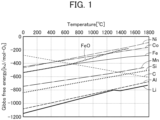
- FIG. 1 is an Ellingham diagram (standard free energy change-temperature diagram).
- the method for recovering a valuable element according to the invention includes adding a reductant to an oxide that is obtained from a lithium ion battery and that contains at least one element selected from the group consisting of nickel and cobalt, followed by heating to reduce the oxide, and the reductant contains at least one selected from the group consisting of metallic iron and iron oxides and is added in an amount of 1.3 equivalent or less.
- the present recovery method is to recover at least one element (hereinafter, also referred to as "valuable element") selected from the group consisting of nickel (Ni) and cobalt (Co) from a positive electrode material (oxide) of a lithium ion battery through the dry process.
- element hereinafter, also referred to as "valuable element” selected from the group consisting of nickel (Ni) and cobalt (Co) from a positive electrode material (oxide) of a lithium ion battery through the dry process.
- a common positive electrode material of a lithium ion battery is made from an oxide (composite oxide) such as LiNiO 2 , LiCoO 2 , or LiMnO 2 .
- LiNiO 2 and LiCoO 2 are decomposed at high temperature as expressed below, generating NiO and CoO, respectively.
- CoO -> Co+1/2O 2 : ⁇ G o 235480-71.55T [J]
- a substance having a value of the free energy change lower than the values of these standard free energy changes at any high temperature can be used as the reductant.
- substances having high reducing power such as a carbonaceous material, an Al-containing substance, and a Si-containing substance have been used as the reductant.
- the present inventors studied potential new reductant substances which are non-carbonaceous, relatively inexpensive, and abundantly present. As a result, it was found that metallic iron (Fe) and iron oxides are available.
- FIG. 1 is an Ellingham diagram (standard free energy change-temperature diagram).
- the Fe/FeO equilibrium is negative as compared to the Ni/NiO equilibrium and the Co/CoO equilibrium, and it is thus expected that reduction by use of Fe may be possible.
- the FeO/Fe 3 O 4 equilibrium is negative as compared to the Ni/NiO equilibrium but positive as compared to the Co/CoO equilibrium.
- Mn is also easily metalized.
- Fe or FeO
- C, Al, Si, or other elements contained in the conventional reductants have very low standard free energy change values.
- the reduction reaction may hardly occurs (a very small scale of reduction reaction occurs) when Fe is used.
- the present inventors conducted tests to confirm the possibility for reducing NiO and CoO by the use of Fe and iron oxides (Test Examples 1 to 8) .
- the obtained green compact was then placed in an electric resistance furnace and was heated in an argon gas atmosphere at 140°C for 3 hours.
- Phases formed in the compact having been heated were measured using an electron probe micro analyzer (EPMA) and evaluated.
- EPMA electron probe micro analyzer Table 1 below also shows the compositions of alloy phases among the formed phases.
- the reduction target in the present recovery method is an oxide containing at least one element selected from the group consisting of nickel and cobalt, and a specific example thereof is, for example, a positive electrode material of a lithium ion battery.
- a lithium ion battery is subjected to a preliminary process including removal of an electrolytic solution, and a positive electrode material (oxide) is thus obtained.
- a reductant containing at least one selected from the group consisting of metallic iron (Fe) and iron oxides is used in the present recovery method.
- the metallic iron Fe
- use may be made of, for example, scraps and granular iron used at an iron mill or the like.
- iron oxides are classified into three kinds, i.e., ferrous oxide (FeO) which may also be called Wustite, triiron tetraoxide (Fe 3 O 4 ) which may also be called magnetite, and ferric oxide (Fe 2 O 3 ) which may also be called hematite.
- FeO ferrous oxide
- Fe 3 O 4 triiron tetraoxide
- Fe 2 O 3 ferric oxide
- magnetite and hematite have the higher standard free energy changes than that of Wustite at the same temperature and sometimes have difficulty in causing reduction reaction.
- ferrous oxide (Wustite) is preferred because it easily causes reduction reaction.
- the iron oxide may be at least one of dust, scale, and sludge (hereinafter, conveniently referred to as "dusts”) that are secondarily produced in an iron making process.
- An addition amount of reductant in the present recovery method is 1.3 equivalent or less. With this amount, it is possible to obtain metal having a low proportion of Fe and a high proportion of valuable elements (Ni, Co).
- Ni when an addition amount of reductant is smaller, metal having a higher proportion of particularly Ni, among Ni and Co, can be obtained. This is presumably because, as Ni is shown at a position higher than Co in the Ellingham diagram ( FIG. 1 ), Ni is more easily metalized than Co is and is reduced by Fe (or iron oxide) earlier than Co is.
- an addition amount of reductant is preferably 1.2 equivalent or less, more preferably 1.1 equivalent or less, yet more preferably 1.0 equivalent or less, particularly preferably less than 1.0 equivalent, and most preferably 0.9 equivalent or less.
- the lower limit of an addition amount of reductant is not particularly limited.
- an addition amount of reductant is preferably 0.1 equivalent or more, more preferably 0.3 equivalent or more, and yet more preferably 0.5 equivalent or more.
- NiO and CoO An amount of reductant required to reduce the reduction target oxide, i.e., NiO and CoO is regarded as 1.0 equivalent.
- the NiO and CoO contents in an oxide i.e., the reduction target.
- the Ni and Co contents in the reduction target (oxide) are measured and are treated as the NiO and CoO contents in the reduction target (oxide).
- the Ni and Co contents are measured using an energy dispersive X-ray spectrometer (EDX).
- EDX energy dispersive X-ray spectrometer
- heating is performed with the reductant having been added to an oxide, i.e., the reduction target. Consequently, the oxide is reduced.
- the temperature for heating the oxide is not lower than 1,300°C, more preferably not lower than 1,350°C, yet more preferably not lower than 1,400°C, and particularly preferably not lower than 1,450°C, because reduction failure is easily suppressed.
- the upper limit of the heating temperature is not particularly limited and is appropriately set depending on, for example, the performance of heating equipment (furnace), while a too high heating temperature may cause an excessive cost. Therefore, the heating temperature is preferably not higher than 1,800°C, and more preferably not higher than 1,700°C.
- Preferred examples of the atmosphere when the oxide is heated include: an inert atmosphere such as nitrogen gas (N 2 ) atmosphere, and argon gas (Ar) atmosphere; and a reducing atmosphere such as carbon monoxide gas (CO) atmosphere.
- an inert atmosphere such as nitrogen gas (N 2 ) atmosphere, and argon gas (Ar) atmosphere
- a reducing atmosphere such as carbon monoxide gas (CO) atmosphere.
- the time for heating the oxide is preferably not less than 1 hour, more preferably not less than 2 hours, and yet more preferably not less than 3 hours, because reduction failure is easily suppressed.
- the upper limit of the heating time is not particularly limited. Meanwhile, a too long heating time may cause an excessive cost. Therefore, the heating time is preferably not more than 6 hours, and more preferably not more than 5 hours.
- the equipment used for heating the oxide is not particularly limited, and examples thereof include an electric furnace, a resistance furnace, a high frequency induction melting furnace, a low frequency induction melting furnace, a rotary kiln, a vertical furnace, a steelmaking furnace, and other conventionally known equipment.
- metal also referred to as “formed metal” obtained by reduction of the oxide contains, for example, iron (Fe) and valuable elements (Ni, Co).
- Fe iron
- Ni, Co valuable elements
- Such metal has a sufficient value as a material and can be used in, for example, the iron making process.
- the formed metal preferably has a low proportion of Fe and a high proportion of valuable elements (Ni, Co). With this constitution, the formed metal is more valuable as an alloy.
- the formed metal may be metal containing only one kind of valuable element among valuable elements (Ni, Co) (or, may have a higher proportion of one kind of valuable element than that of the other valuable element).
- Slag As a result of reducing the oxide (positive electrode material), aside from metal, slag may be formed in some cases.
- Slag also referred to as “formed slag" contains, for example, an oxide such as FeO.
- the formed slag can also contain an oxide of a valuable element (such as MnO) that is not included in the formed metal.
- Mn can be retained in slag, advantageously.
- a positive electrode material of a lithium ion battery was prepared.
- the lithium ion battery was subjected to the preliminary process including disassembly, discharge, and removal of an electrolytic solution, and the positive electrode material was separated.
- metallic iron (Fe) powder obtained through the atomization process and ferrous oxide (FeO) powder were prepared.
- the prepared positive electrode material was placed, to which any one of the foregoing reductants, and flux (CaO, SiO 2 ) were additionally added, and the resultant was heated.
- the positive electrode material was thus reduced.
- the heating time was three hours in every example.
- composition of the metal that was formed through reduction of the positive electrode material was determined.
- the reduction ratios (unit: mass%) of the respective metal elements, i.e., Ni, Co, and Mn were determined.
- the reduction ratio is a ratio of metal amount actually obtained with respect to the theoretical amount of metal formed through reduction reaction. For instance, the reduction ratio of 20 mol% of Co indicates that 20 mol% of Co contained in the positive electrode material was reduced and converted into metal, and the rest remained as an oxide.
- the formed metal had a low proportion of Fe and a high proportion of Ni and Co in total as compared to Comparative Examples 1 to 10 where the addition amount of the reductant was not 1.3 equivalent or less.
- the formed metal tended to have a lower proportion of Fe and a higher proportion of Ni and Co in total.
- the formed metal tended to have a higher proportion of Ni (lower proportion of Co).
Landscapes
- Engineering & Computer Science (AREA)
- Chemical & Material Sciences (AREA)
- Manufacturing & Machinery (AREA)
- Materials Engineering (AREA)
- Mechanical Engineering (AREA)
- Metallurgy (AREA)
- Organic Chemistry (AREA)
- Environmental & Geological Engineering (AREA)
- Life Sciences & Earth Sciences (AREA)
- Chemical Kinetics & Catalysis (AREA)
- General Chemical & Material Sciences (AREA)
- General Life Sciences & Earth Sciences (AREA)
- Geology (AREA)
- Electrochemistry (AREA)
- Health & Medical Sciences (AREA)
- General Health & Medical Sciences (AREA)
- Toxicology (AREA)
- Thermal Sciences (AREA)
- Physics & Mathematics (AREA)
- Inorganic Chemistry (AREA)
- Manufacture And Refinement Of Metals (AREA)
Abstract
Description
- The present invention relates to a method for recovering a valuable element.
- In recent years, the demand for lithium ion batteries have been rapidly increasing due to the spread and expansion of smartphones, personal computers, and other devices, and the spread of electric vehicles.
- In particular, the demand for electric vehicles with no use of fossil fuels is expected to further expand in the future from the current perspective of suppressing generation of carbon dioxide, and in association with this expectation, the demand for lithium ion batteries is also expected to further increase.
- Generally, the positive electrode material of a lithium ion battery is made from an oxide (composite oxide) containing, for example, nickel (Ni) and cobalt (Co).
- Metal elements such as Ni and Co are not abundantly available even on a global scale.
- Therefore, it is very advantageous to recover those metal elements (valuable elements) from the positive electrode materials of lithium ion batteries, for the purpose of effective use of resources.
- A lithium ion battery is composed of a combination of a positive electrode material, a negative electrode material, a separator, and other members, and besides contains, for example, an electrolytic solution.
- Hence, in order to recover valuable elements from the positive electrode material of a lithium ion battery, a preliminary process including removal of an electrolytic solution, pulverization, and crushing is performed prior to the recovery.
- The positive electrode material is separated from the lithium ion battery through this preliminary process, and valuable elements are thereafter recovered from the separated positive electrode material.
- The processes of recovering valuable elements are classified into two types, i.e., wet process of dissolving the positive electrode material in acid, followed by solvent extraction and electrolytic refining or the like, and dry process of heating the positive electrode material together with a reductant to generate valuable elements by reduction.
- Examples of the reductant used in the dry process (for example, Patent Literature 1) include a carbonaceous material such as graphite, an Al-containing substance such as metallic aluminum (Al), a Si-containing substance such as metallic silicon (Si) and FeSi.
- Patent Literature 1:
JP 2021-95628 A - In a case where an Al-containing substance or a Si-containing substance is used as the reductant in the dry process, slag is normally generated to thus require a slag treatment cost, and in addition, such a reductant itself is relatively expensive, thereby resulting in a high cost.
- In a case where a carbonaceous material is used as the reductant, a large amount of carbon dioxide is generated as compared to a case where another reductant is used. This may go against the current trend of suppressing generation of carbon dioxide.
- Hence, the inventors of the present invention have studied and found that metallic iron and iron oxides can be used as the reductant as described below. In this case, the cost is lower than the case where an Al-containing substance or a Si-containing substance is used, and generation of carbon dioxide can be suppressed because no carbonaceous material is used.
- Meanwhile, the present inventors further studied and found that, depending on the amount of reductant used, the metal (alloy) obtained through reduction of the positive electrode material (oxide) sometimes has a high proportion of Fe and a low proportion of Ni and Co being valuable elements.
- The present invention has been made in view of the foregoing and aims at providing a method for recovering a valuable element, by which method metal with a high proportion of a valuable element can be obtained.
- The present inventors found, through an earnest study, that employing the configuration described below enables the achievement of the above-mentioned object, and the invention has been completed.
- Specifically, the present invention provides the following [1] to [6].
- [1] A method for recovering a valuable element, the method comprising: adding a reductant to an oxide containing at least one element selected from the group consisting of nickel and cobalt, followed by heating, to thereby reduce the oxide, wherein the reductant contains at least one selected from the group consisting of metallic iron and an iron oxide, and an addition amount of the reductant is 1.3 equivalent or less.
- [2] The method for recovering a valuable element according to [1], wherein the oxide is obtained from a lithium ion battery.
- [3] The method for recovering a valuable element according to [1] or [2], wherein the iron oxide is ferrous oxide.
- [4] The method for recovering a valuable element according to any one of [1] to [3], wherein the reductant is at least one selected from the group consisting of dust, scale, sludge, and scrap.
- [5] The method for recovering a valuable element according to any one of [1] to [4], wherein temperature for heating the oxide is not lower than 1,450°C.
- [6] The method for recovering a valuable element according to any one of [1] to [5], wherein the oxide is reduced to thereby obtain metal containing iron and at least one element selected from the group consisting of nickel and cobalt.
- The present invention can provide a method for recovering a valuable element, by which method metal with a high proportion of a valuable element can be obtained.
- [
FIG. 1] FIG. 1 is an Ellingham diagram (standard free energy change-temperature diagram). - The method for recovering a valuable element according to the invention (hereinafter, also referred to as "present recovery method") includes adding a reductant to an oxide that is obtained from a lithium ion battery and that contains at least one element selected from the group consisting of nickel and cobalt, followed by heating to reduce the oxide, and the reductant contains at least one selected from the group consisting of metallic iron and iron oxides and is added in an amount of 1.3 equivalent or less.
- Generally, the present recovery method is to recover at least one element (hereinafter, also referred to as "valuable element") selected from the group consisting of nickel (Ni) and cobalt (Co) from a positive electrode material (oxide) of a lithium ion battery through the dry process.
- A common positive electrode material of a lithium ion battery is made from an oxide (composite oxide) such as LiNiO2, LiCoO2, or LiMnO2.
- From the thermodynamic point of view, in the dry process, LiNiO2 and LiCoO2 are decomposed at high temperature as expressed below, generating NiO and CoO, respectively.
2LiNiO2 -> Li2O+2NiO+1/2O2
2LiCoO2 -> Li2O+2CoO+1/2O2
- The respective standard free energy changes (ΔGo) of NiO and CoO in the decomposition reaction are expressed below.
NiO -> Ni+1/2O2: ΔGo=234900-84.68T [J]
CoO -> Co+1/2O2: ΔGo=235480-71.55T [J]
- A substance having a value of the free energy change lower than the values of these standard free energy changes at any high temperature can be used as the reductant.
- Conventionally, substances having high reducing power such as a carbonaceous material, an Al-containing substance, and a Si-containing substance have been used as the reductant.
- However, it is desired to use another reductant from the viewpoint of suppressing generation of carbonaceous dioxide and the cost.
- Hence, the present inventors studied potential new reductant substances which are non-carbonaceous, relatively inexpensive, and abundantly present. As a result, it was found that metallic iron (Fe) and iron oxides are available.
- The standard free energy change (ΔGo) in the decomposition reaction of iron oxides are expressed as follows.
FeO -> Fe+1/2O2: ΔGo=264430-64.73T [J]
Fe3O4 -> 3FeO+1/2O2: ΔGo=302370-108.15T [J]
-
FIG. 1 is an Ellingham diagram (standard free energy change-temperature diagram). - Referring to the standard free energy changes described above and the Ellingham diagram (
FIG. 1 ), the Fe/FeO equilibrium is negative as compared to the Ni/NiO equilibrium and the Co/CoO equilibrium, and it is thus expected that reduction by use of Fe may be possible. - In addition, the FeO/Fe3O4 equilibrium is negative as compared to the Ni/NiO equilibrium but positive as compared to the Co/CoO equilibrium.
- Hence, Fe is also expected to selectively reduce Ni and Co (recovering Ni as metal, while Co remaining in slag). Specifically, the following reactions are expected.
NiO+Fe -> Ni+FeO: ΔGo=-29530-19.95T [J]
CoO+Fe -> Co+FeO: ΔGo=-28950-6.82T [J]
- Metalization takes place more easily when the relevant line is situated at a higher position in the Ellingham diagram (
FIG. 1 ). - When Si or Al is used as the reductant, Mn is also easily metalized.
- By the use of Fe (or FeO) as the reductant, it can be expected that only Ni and Co are metalized while Mn is not metalized.
- In the meantime, C, Al, Si, or other elements contained in the conventional reductants have very low standard free energy change values. The reduction reaction may hardly occurs (a very small scale of reduction reaction occurs) when Fe is used.
- In view of the foregoing, the present inventors conducted tests to confirm the possibility for reducing NiO and CoO by the use of Fe and iron oxides (Test Examples 1 to 8) .
- Specifically, first, powder of each of NiO, CoO, Fe, and FeO was mixed to have the powder composition (unit: molar ratio) shown in Table 1 below, and the obtained mixture was compacted.
- The obtained green compact was then placed in an electric resistance furnace and was heated in an argon gas atmosphere at 140°C for 3 hours.
- Phases formed in the compact having been heated were measured using an electron probe micro analyzer (EPMA) and evaluated. Table 1 below also shows the compositions of alloy phases among the formed phases.
-
Table 1 Powder Composition (molar ratio) Alloy Phase Composition [mol%] NiO CoO Fe FeO Ni Co Fe Test Example 1 1 1 4 - 25.0 25.0 50.0 Test Example 2 1 1 3 - 33.4 33.3 33.3 Test Example 3 1 1 2.6 - 38.5 36.5 25.0 Test Example 4 1 1 2 - 50.0 45.0 5.0 Test Example 5 1 1 - 12 28.8 25.9 45.3 Test Example 6 1 1 - 9 37.0 29.7 33.3 Test Example 7 1 1 - 7.8 42.1 29.5 28.4 Test Example 8 1 1 - 6 52.6 31.6 15.8 - As shown in Table 1 above, in Test Examples 1 to 4 where Fe was added to NiO and CoO, NiO and CoO were reduced and melted together with an excessive portion of added Fe, and an alloy phase of Fe-Ni-Co was confirmed.
- It was also confirmed that when a smaller amount of Fe was added, a proportion of Fe in the obtained alloy decreased while a proportion of Ni and Co increased.
- In addition, also in Test Examples 5 to 8 where FeO was added to NiO and CoO, NiO and CoO were reduced, and an alloy phase of Fe-Ni-Co was confirmed. FeO was partially reduced to be converted to Fe, which was present as part of the alloy. At this time, the following reaction presumably took place.
4FeO -> Fe3O4+Fe
- It was also confirmed that when a smaller amount of FeO was added, a proportion of Fe in the obtained alloy decreased while a proportion of Ni and Co increased.
- In view of the foregoing result, it was confirmed that Fe and iron oxides can be used as the reductant.
- In addition, it was confirmed that, by reducing an amount of the reductant to be added, an alloy having a higher proportion of Ni and Co can be obtained.
- Next, the present recovery method is described below in more detail.
- The reduction target in the present recovery method is an oxide containing at least one element selected from the group consisting of nickel and cobalt, and a specific example thereof is, for example, a positive electrode material of a lithium ion battery.
- A lithium ion battery is subjected to a preliminary process including removal of an electrolytic solution, and a positive electrode material (oxide) is thus obtained.
- Because of the above-described reason, a reductant containing at least one selected from the group consisting of metallic iron (Fe) and iron oxides is used in the present recovery method.
- For the metallic iron (Fe), use may be made of, for example, scraps and granular iron used at an iron mill or the like.
- In general, iron oxides are classified into three kinds, i.e., ferrous oxide (FeO) which may also be called Wustite, triiron tetraoxide (Fe3O4) which may also be called magnetite, and ferric oxide (Fe2O3) which may also be called hematite.
- Among these, magnetite and hematite have the higher standard free energy changes than that of Wustite at the same temperature and sometimes have difficulty in causing reduction reaction.
- Therefore, among iron oxides, ferrous oxide (Wustite) is preferred because it easily causes reduction reaction.
- The iron oxide may be at least one of dust, scale, and sludge (hereinafter, conveniently referred to as "dusts") that are secondarily produced in an iron making process.
- Use of dusts as the iron oxide is preferred in view of effective utilization of by-products from an iron making process and utilization of an inexpensive iron source.
- An addition amount of reductant in the present recovery method is 1.3 equivalent or less. With this amount, it is possible to obtain metal having a low proportion of Fe and a high proportion of valuable elements (Ni, Co).
- When an addition amount of reductant is smaller, metal having a higher proportion of valuable elements (lower proportion of Fe) can be obtained. Accordingly, it is possible to avoid a situation where excessive Fe is not used as the reductant and remains in the metal.
- In addition, when an addition amount of reductant is smaller, metal having a higher proportion of particularly Ni, among Ni and Co, can be obtained. This is presumably because, as Ni is shown at a position higher than Co in the Ellingham diagram (
FIG. 1 ), Ni is more easily metalized than Co is and is reduced by Fe (or iron oxide) earlier than Co is. - Because of the above-described reasons, an addition amount of reductant is preferably 1.2 equivalent or less, more preferably 1.1 equivalent or less, yet more preferably 1.0 equivalent or less, particularly preferably less than 1.0 equivalent, and most preferably 0.9 equivalent or less.
- The lower limit of an addition amount of reductant is not particularly limited.
- From the viewpoint of suppressing reduction failure, an addition amount of reductant is preferably 0.1 equivalent or more, more preferably 0.3 equivalent or more, and yet more preferably 0.5 equivalent or more.
- An amount of reductant required to reduce the reduction target oxide, i.e., NiO and CoO is regarded as 1.0 equivalent.
- For instance, in a case where metallic iron (Fe) or ferrous oxide (FeO) is used as the reductant, reduction by use of each reductant of 1 equivalent is expressed as follows.
Fe+(NiO, CoO) -> (Ni, Co)+FeO
3FeO+(NiO, CoO) -> (Ni, Co)+Fe3O4
- For determining an addition amount of reductant, first, the NiO and CoO contents in an oxide, i.e., the reduction target.
- Specifically, the Ni and Co contents in the reduction target (oxide) are measured and are treated as the NiO and CoO contents in the reduction target (oxide).
- The Ni and Co contents are measured using an energy dispersive X-ray spectrometer (EDX).
- In the present recovery method, heating is performed with the reductant having been added to an oxide, i.e., the reduction target. Consequently, the oxide is reduced.
- In the process of heating, in addition to the reductant, CaO, SiO2 or another flux may be added.
- The temperature for heating the oxide (heating temperature) is not lower than 1,300°C, more preferably not lower than 1,350°C, yet more preferably not lower than 1,400°C, and particularly preferably not lower than 1,450°C, because reduction failure is easily suppressed.
- The upper limit of the heating temperature is not particularly limited and is appropriately set depending on, for example, the performance of heating equipment (furnace), while a too high heating temperature may cause an excessive cost. Therefore, the heating temperature is preferably not higher than 1,800°C, and more preferably not higher than 1,700°C.
- Preferred examples of the atmosphere when the oxide is heated (heating atmosphere) include: an inert atmosphere such as nitrogen gas (N2) atmosphere, and argon gas (Ar) atmosphere; and a reducing atmosphere such as carbon monoxide gas (CO) atmosphere.
- The time for heating the oxide (heating time) is preferably not less than 1 hour, more preferably not less than 2 hours, and yet more preferably not less than 3 hours, because reduction failure is easily suppressed.
- The upper limit of the heating time is not particularly limited. Meanwhile, a too long heating time may cause an excessive cost. Therefore, the heating time is preferably not more than 6 hours, and more preferably not more than 5 hours.
- The equipment used for heating the oxide is not particularly limited, and examples thereof include an electric furnace, a resistance furnace, a high frequency induction melting furnace, a low frequency induction melting furnace, a rotary kiln, a vertical furnace, a steelmaking furnace, and other conventionally known equipment.
- As a result of reducing an oxide (positive electrode material), i.e., the reduction target, metal is formed. In other words, valuable elements (Ni, Co) contained in the oxide are recovered as metal.
- In the present recovery method, metal (also referred to as "formed metal") obtained by reduction of the oxide contains, for example, iron (Fe) and valuable elements (Ni, Co). Such metal has a sufficient value as a material and can be used in, for example, the iron making process.
- The formed metal preferably has a low proportion of Fe and a high proportion of valuable elements (Ni, Co). With this constitution, the formed metal is more valuable as an alloy.
- The formed metal may be metal containing only one kind of valuable element among valuable elements (Ni, Co) (or, may have a higher proportion of one kind of valuable element than that of the other valuable element).
- As a result of reducing the oxide (positive electrode material), aside from metal, slag may be formed in some cases. Slag (also referred to as "formed slag") contains, for example, an oxide such as FeO.
- The formed slag can also contain an oxide of a valuable element (such as MnO) that is not included in the formed metal.
- In a case where an oxide containing Mn is reduced, since the Mn/MnO equilibrium is negative as compared to the Fe/FeO equilibrium and the FeO/Fe3O4 equilibrium, inclusion of Mn into the formed metal obtained by the reduction can be suppressed.
- When the wet process is performed, depending on the form of Mn, its treatment method largely varies, thereby being troublesome. In the present recovery method adopting the dry process, on the other hand, Mn can be retained in slag, advantageously.
- The invention is specifically described below with reference to Examples. However, the invention is not limited to the examples described below.
- First, a positive electrode material of a lithium ion battery was prepared.
- Specifically, the lithium ion battery was subjected to the preliminary process including disassembly, discharge, and removal of an electrolytic solution, and the positive electrode material was separated. The composition of the positive electrode material is shown in Table 2 below. As is seen from Table 2 below, the positive electrode material had a composition of Ni:Mn:Co=6:2:2 in molar ratio.
-
Table 2 Composition [mol%] Ni Co Mn Positive electrode material 60 20 20 - For the reductant, graphite (C) powder, metallic aluminum (Al) powder, and metallic silicon (Si) powder were prepared.
- As other reductants, metallic iron (Fe) powder obtained through the atomization process, and ferrous oxide (FeO) powder were prepared.
- As yet other reductants, dust powder, scale powder, and scrap powder that were generated in the iron making process were prepared.
- The respective compositions of those dust, scale, and scrap are shown in Table 3 below. "M.Fe" in Table 3 below refers to an amount of metallic Fe.
-
Table 3 Composition [mass%] M.Fe FeO SiO2 Al2O3 CaO Others Dust 0.26 63.73 6.47 3.2 13.2 13.14 Scale 13.2 71.8 0.92 0.8 0.57 12.61 Scrap 100 - - - - - - Next, in an electric furnace with a heat size scale of 50 to 80 Kg, the prepared positive electrode material was placed, to which any one of the foregoing reductants, and flux (CaO, SiO2) were additionally added, and the resultant was heated. The positive electrode material was thus reduced. The heating time was three hours in every example.
- The type of reductant used, the addition amount (unit: equivalent) of reductant, the heating temperature (unit: °C), and the heating atmosphere (Ar, N2, or CO) are shown in Table 4 below.
- The composition of the metal that was formed through reduction of the positive electrode material was determined.
- In addition, the reduction ratios (unit: mass%) of the respective metal elements, i.e., Ni, Co, and Mn were determined. The reduction ratio is a ratio of metal amount actually obtained with respect to the theoretical amount of metal formed through reduction reaction. For instance, the reduction ratio of 20 mol% of Co indicates that 20 mol% of Co contained in the positive electrode material was reduced and converted into metal, and the rest remained as an oxide.
- The results are shown in Tables 4 to 6 below.
-
Table 4 Reductant Heating temperature [°C] Heating atmosphere Composition of formed product (metal) [mol%] Reduction ratio [mol%] Type Addition Amount [equivalent] Ni Co Fe Mn Ni Co Mn IE 1 Scrap 0.8 1500 Ar 92.8 6.3 0.9 <1 99 20 <1 IE 2 Scrap 1.1 1500 Ar 67.5 21.6 10.9 <1 99 95 <1 IE 3 Scrap 1.3 1500 Ar 57.7 19.2 23.1 <1 100 100 <1 IE 4 Fe 0.8 1500 Ar 92.8 6.3 0.9 <1 99 20 <1 IE 5 Fe 1.1 1500 Ar 67.5 20.5 12.0 <1 99 90 <1 IE 6 Fe 1.3 1500 Ar 57.7 19.2 23.1 <1 100 100 <1 IE 7 FeO 0.7 1500 Ar 98.9 0.0 1.1 <1 92 0 <1 IE 8 FeO 1.1 1500 Ar 70.7 8.5 20.8 <1 97 35 <1 IE 9 FeO 1.3 1500 Ar 61.0 15.6 23.5 <1 98 75 <1 IE 10 Dust 0.7 1500 Ar 97.3 0.0 2.7 <1 90 0 <1 IE 11 Dust 1.1 1500 Ar 70.3 7.3 22.3 <1 96 30 <1 IE 12 Dust 1.3 1500 Ar 61.1 11.5 27.4 <1 97 55 <1 IE 13 Scale 0.7 1500 Ar 98.1 0.0 1.9 <1 91 0 <1 IE 14 Scale 1.1 1500 Ar 69.5 15.5 15.0 <1 97 65 <1 IE 15 Scale 1.3 1500 Ar 60.1 17.6 22.3 <1 97 85 <1 IE 16 Scrap 1.1 1450 N2 64.8 20.5 14.8 <1 95 90 <1 IE 17 Scrap 1.3 1450 N2 56.0 17.3 26.7 <1 97 90 <1 IE 18 Fe 1.1 1400 N2 62.7 18.2 19.1 <1 92 80 <1 IE 19 Fe 1.3 1400 N2 54.2 16.3 29.4 <1 94 85 <1 IE 20 FeO 1.1 1400 CO 66.7 7.4 25.9 <1 90 30 <1 IE 21 FeO 1.3 1400 CO 58.1 13.7 28.2 <1 92 65 <1 IE 22 Dust 1.1 1350 CO 66.3 6.2 27.5 <1 89 25 <1 IE 23 Dust 1.3 1350 CO 57.8 11.7 30.5 <1 91 55 <1 IE: Inventive Example -
Table 5 Reductant Heating temperature [°C] Heating atmosphere Composition of formed product (metal) [mol%] Reduction ratio [mol%] Type Addition amount [equivalent] Ni Co Fe Mn Ni Co Mn CE 1 Scrap 1.5 1500 Ar 50.0 16.7 33.3 <1 100 100 <1 CE 2 Fe 1.5 1500 Ar 50.0 16.7 33.3 <1 100 100 <1 CE 3 Fe 2.0 1500 Ar 37.5 12.5 50.0 <1 100 100 <1 CE 4 FeO 1.6 1500 Ar 51.9 15.6 32.5 <1 100 90 <1 CE 5 Dust 1.6 1500 Ar 50.7 14.8 34.5 <1 97 85 <1 CE 6 Scale 1.6 1500 Ar 50.9 16.5 32.6 <1 98 95 <1 CE 7 Scrap 1.5 1450 N2 48.5 15.8 35.7 <1 97 95 <1 CE 8 Fe 1.5 1400 N2 48.0 14.2 37.8 <1 96 85 <1 CE 9 FeO 1.6 1400 CO 49.4 14.0 36.5 <1 94 80 <1 CE 10 Dust 1.6 1350 CO 49.1 13.2 37.7 <1 93 75 <1 CE: Comparative Example -
Table 6 Reductant Heating temperature [°C] Heating atmosphere Composition of formed product (metal) [mol%] Reduction ratio [mol%] Type Addition amount [equivalent] Ni Co Mn C Al Si Ni Co Mn RE 1 C 0.8 1500 Ar 62.5 18.8 18.8 0.0 - - 83 75 75 RE 2 C 1.3 1500 Ar 44.6 13.8 13.8 27.7 - - 97 90 90 RE 3 Al 0.8 1500 Ar 65.0 20.0 15.0 - 0.0 - 87 80 60 RE 4 Al 1.3 1500 Ar 45.4 14.6 14.6 - 25.4 - 98 95 95 RE 5 Si 0.8 1500 Ar 66.3 21.3 12.5 - - 0.0 88 85 50 RE 6 Si 1.3 1500 Ar 44.6 14.6 14.6 - - 26.2 97 95 95 RE: Reference Example - As shown in Tables 4 to 5 above, in each of Inventive Examples 1 to 23 where the addition amount of reductant was 1.3 equivalent or less, the formed metal had a low proportion of Fe and a high proportion of Ni and Co in total as compared to Comparative Examples 1 to 10 where the addition amount of the reductant was not 1.3 equivalent or less.
- In this regard, reference should be made to Inventive Examples 1 to 3, for instance.
- As the addition amount of reductant was smaller, the formed metal tended to have a lower proportion of Fe and a higher proportion of Ni and Co in total.
- In addition, as the addition amount of reductant was smaller, the formed metal tended to have a higher proportion of Ni (lower proportion of Co).
- The same was true also in Inventive Examples 4 to 6, 7 to 9, 10 to 12, 13 to 15, 16 to 17, 18 to 19, 20 to 21, and 22 to 23.
Claims (6)
- A method for recovering a valuable element, the method comprising: adding a reductant to an oxide containing at least one element selected from the group consisting of nickel and cobalt, followed by heating, to thereby reduce the oxide,wherein the reductant contains at least one selected from the group consisting of metallic iron and an iron oxide, andan addition amount of the reductant is 1.3 equivalent or less.
- The method for recovering a valuable element according to claim 1, wherein the oxide is obtained from a lithium ion battery.
- The method for recovering a valuable element according to claim 1 or 2, wherein the iron oxide is ferrous oxide.
- The method for recovering a valuable element according to any one of claims 1 to 3, wherein the reductant is at least one selected from the group consisting of dust, scale, sludge, and scrap.
- The method for recovering a valuable element according to any one of claims 1 to 4, wherein temperature for heating the oxide is not lower than 1,450°C.
- The method for recovering a valuable element according to any one of claims 1 to 5, wherein the oxide is reduced to thereby obtain metal containing iron and at least one element selected from the group consisting of nickel and cobalt.
Applications Claiming Priority (3)
| Application Number | Priority Date | Filing Date | Title |
|---|---|---|---|
| JP2021184548 | 2021-11-12 | ||
| JP2022048290 | 2022-03-24 | ||
| PCT/JP2022/037084 WO2023084947A1 (en) | 2021-11-12 | 2022-10-04 | Valuable element recovery mehtod |
Publications (2)
| Publication Number | Publication Date |
|---|---|
| EP4403658A1 true EP4403658A1 (en) | 2024-07-24 |
| EP4403658A4 EP4403658A4 (en) | 2025-06-04 |
Family
ID=86335550
Family Applications (1)
| Application Number | Title | Priority Date | Filing Date |
|---|---|---|---|
| EP22892447.8A Pending EP4403658A4 (en) | 2021-11-12 | 2022-10-04 | Valuable element recovery mehtod |
Country Status (5)
| Country | Link |
|---|---|
| US (1) | US20240344172A1 (en) |
| EP (1) | EP4403658A4 (en) |
| JP (1) | JP7609274B2 (en) |
| KR (1) | KR20240065128A (en) |
| WO (1) | WO2023084947A1 (en) |
Families Citing this family (1)
| Publication number | Priority date | Publication date | Assignee | Title |
|---|---|---|---|---|
| JP7806984B1 (en) * | 2024-10-30 | 2026-01-27 | Jfeスチール株式会社 | Precursor manufacturing method and cathode material manufacturing method |
Family Cites Families (14)
| Publication number | Priority date | Publication date | Assignee | Title |
|---|---|---|---|---|
| US4036636A (en) * | 1975-12-22 | 1977-07-19 | Kennecott Copper Corporation | Pyrometallurgical process for smelting nickel and nickel-copper concentrates including slag treatment |
| JP3705498B2 (en) * | 2002-12-06 | 2005-10-12 | 三菱商事株式会社 | Method for recovering valuable metals from waste containing V, Mo and Ni |
| JP5360118B2 (en) * | 2011-04-15 | 2013-12-04 | 住友金属鉱山株式会社 | Valuable metal recovery method |
| SI3087208T1 (en) * | 2013-12-23 | 2018-03-30 | Umicore | A process for recycling lithium-ion batteries |
| JP2016037661A (en) * | 2014-08-11 | 2016-03-22 | 日本重化学工業株式会社 | Method for recovering valuable metal |
| WO2016141875A1 (en) * | 2015-03-11 | 2016-09-15 | 长沙矿冶研究院有限责任公司 | Method of recycling and processing waste battery |
| WO2017159745A1 (en) * | 2016-03-16 | 2017-09-21 | Jx金属株式会社 | Processing method for lithium ion battery scrap |
| JP7077498B2 (en) * | 2018-02-01 | 2022-05-31 | 株式会社神戸製鋼所 | Metal recovery method |
| US12027681B2 (en) * | 2018-07-12 | 2024-07-02 | Sumitomo Metal Mining Co., Ltd. | Method for recovering valuable metals from waste lithium ion batteries |
| JP7322687B2 (en) * | 2019-12-11 | 2023-08-08 | 住友金属鉱山株式会社 | Valuable metal recovery method from waste batteries |
| JP7399586B2 (en) | 2019-12-13 | 2023-12-18 | 株式会社神戸製鋼所 | Method of recovering valuable elements |
| EP4116000A4 (en) * | 2020-03-06 | 2024-04-10 | Dowa Eco-System Co., Ltd. | METHOD FOR CONCENTRATING PRECIOUS METAL CONTAINED IN LITHIUM-ION SECONDARY BATTERY |
| CN112176190A (en) * | 2020-09-17 | 2021-01-05 | 昆明理工大学 | A method for recovering cobalt copper iron from waste cobalt-containing lithium ion batteries |
| CN112877545A (en) * | 2021-01-12 | 2021-06-01 | 昆明理工大学 | Method for recycling nickel, cobalt and iron by cooperatively treating waste nickel-hydrogen batteries through nickel smelting slag |
-
2022
- 2022-10-04 US US18/701,088 patent/US20240344172A1/en active Pending
- 2022-10-04 EP EP22892447.8A patent/EP4403658A4/en active Pending
- 2022-10-04 JP JP2023527719A patent/JP7609274B2/en active Active
- 2022-10-04 KR KR1020247012113A patent/KR20240065128A/en active Pending
- 2022-10-04 WO PCT/JP2022/037084 patent/WO2023084947A1/en not_active Ceased
Also Published As
| Publication number | Publication date |
|---|---|
| JPWO2023084947A1 (en) | 2023-05-19 |
| US20240344172A1 (en) | 2024-10-17 |
| EP4403658A4 (en) | 2025-06-04 |
| WO2023084947A1 (en) | 2023-05-19 |
| KR20240065128A (en) | 2024-05-14 |
| JP7609274B2 (en) | 2025-01-07 |
Similar Documents
| Publication | Publication Date | Title |
|---|---|---|
| US20250361577A1 (en) | Valuable element recovery method and metal production method | |
| US10435770B2 (en) | Method for producing La/Ce/MM/Y base alloys, resulting alloys, and battery electrodes | |
| EP4455321A1 (en) | Valuable metal recovery alloy, valuable metal recovery composition, and method for recovering valuable metal | |
| EP4403658A1 (en) | Valuable element recovery mehtod | |
| JP3434318B2 (en) | Separation and recovery of valuable metals from used lithium secondary batteries | |
| US20120282130A1 (en) | Method for producing permanent magnet materials and resulting materials | |
| US20260024831A1 (en) | Method for recovering valuable element and method for producing metal | |
| CN111041332A (en) | Rare earth niobium-titanium-iron alloy and production method and use method thereof | |
| CN118234879A (en) | Recovery method of valuable element | |
| CN120882890A (en) | Methods for recycling valuable elements | |
| US3759695A (en) | Process for making ferrosilicon | |
| JP2001266864A (en) | Hydrogen storage alloy, alloy powder for nickel-hydrogen secondary battery negative electrode, and negative electrode for nickel-hydrogen secondary battery | |
| JP5138429B2 (en) | Hydrogen storage alloy for secondary battery | |
| JP2011021241A (en) | Hydrogen storage alloy for nickel-hydrogen secondary battery, and nickel-hydrogen secondary battery | |
| JPH0514018B2 (en) | ||
| JP7670246B2 (en) | Method for recovering valuable elements | |
| JPH10261413A (en) | Hydrogen storage alloy for secondary battery | |
| AU2019209546B2 (en) | Production of high carbon ferromanganese | |
| JPH05222474A (en) | Hydrogen storage alloy for Ni-hydrogen battery and method for producing the same | |
| JPWO2025169874A5 (en) | ||
| US3194648A (en) | Methods of obtaining metal powder from ores or oxides | |
| JPH0393158A (en) | Hydrogen storage alloy electrode | |
| CN120322302A (en) | Mixed powder for oxygen reactant and oxygen reactant using the same | |
| JPS6131176B2 (en) | ||
| JPH11213996A (en) | Hydrogen storage alloy electrode material |
Legal Events
| Date | Code | Title | Description |
|---|---|---|---|
| STAA | Information on the status of an ep patent application or granted ep patent |
Free format text: STATUS: THE INTERNATIONAL PUBLICATION HAS BEEN MADE |
|
| PUAI | Public reference made under article 153(3) epc to a published international application that has entered the european phase |
Free format text: ORIGINAL CODE: 0009012 |
|
| STAA | Information on the status of an ep patent application or granted ep patent |
Free format text: STATUS: REQUEST FOR EXAMINATION WAS MADE |
|
| 17P | Request for examination filed |
Effective date: 20240419 |
|
| AK | Designated contracting states |
Kind code of ref document: A1 Designated state(s): AL AT BE BG CH CY CZ DE DK EE ES FI FR GB GR HR HU IE IS IT LI LT LU LV MC ME MK MT NL NO PL PT RO RS SE SI SK SM TR |
|
| DAV | Request for validation of the european patent (deleted) | ||
| DAX | Request for extension of the european patent (deleted) | ||
| A4 | Supplementary search report drawn up and despatched |
Effective date: 20250508 |
|
| RIC1 | Information provided on ipc code assigned before grant |
Ipc: C22B 7/04 20060101ALI20250430BHEP Ipc: C22B 7/02 20060101ALI20250430BHEP Ipc: B09B 101/16 20220101ALI20250430BHEP Ipc: B09B 3/40 20220101ALI20250430BHEP Ipc: H01M 10/54 20060101ALI20250430BHEP Ipc: C22B 47/00 20060101ALI20250430BHEP Ipc: C22B 7/00 20060101ALI20250430BHEP Ipc: C22B 5/04 20060101ALI20250430BHEP Ipc: C22B 5/02 20060101ALI20250430BHEP Ipc: B09B 5/00 20060101ALI20250430BHEP Ipc: B09B 3/70 20220101ALI20250430BHEP Ipc: C22B 23/02 20060101AFI20250430BHEP |