EP4403208A1 - Vorrichtung zur diagnose und/oder zur unterstützung von hörfähigkeiten - Google Patents
Vorrichtung zur diagnose und/oder zur unterstützung von hörfähigkeiten Download PDFInfo
- Publication number
- EP4403208A1 EP4403208A1 EP23152013.1A EP23152013A EP4403208A1 EP 4403208 A1 EP4403208 A1 EP 4403208A1 EP 23152013 A EP23152013 A EP 23152013A EP 4403208 A1 EP4403208 A1 EP 4403208A1
- Authority
- EP
- European Patent Office
- Prior art keywords
- patient
- acoustic
- stimulation
- stimulate
- electrode
- Prior art date
- Legal status (The legal status is an assumption and is not a legal conclusion. Google has not performed a legal analysis and makes no representation as to the accuracy of the status listed.)
- Withdrawn
Links
Images

Classifications
-
- A—HUMAN NECESSITIES
- A61—MEDICAL OR VETERINARY SCIENCE; HYGIENE
- A61N—ELECTROTHERAPY; MAGNETOTHERAPY; RADIATION THERAPY; ULTRASOUND THERAPY
- A61N1/00—Electrotherapy; Circuits therefor
- A61N1/18—Applying electric currents by contact electrodes
- A61N1/32—Applying electric currents by contact electrodes alternating or intermittent currents
- A61N1/36—Applying electric currents by contact electrodes alternating or intermittent currents for stimulation
- A61N1/36036—Applying electric currents by contact electrodes alternating or intermittent currents for stimulation of the outer, middle or inner ear
-
- A—HUMAN NECESSITIES
- A61—MEDICAL OR VETERINARY SCIENCE; HYGIENE
- A61B—DIAGNOSIS; SURGERY; IDENTIFICATION
- A61B5/00—Measuring for diagnostic purposes; Identification of persons
- A61B5/12—Audiometering
- A61B5/121—Audiometering evaluating hearing capacity
- A61B5/125—Audiometering evaluating hearing capacity objective methods
-
- H—ELECTRICITY
- H04—ELECTRIC COMMUNICATION TECHNIQUE
- H04R—LOUDSPEAKERS, MICROPHONES, GRAMOPHONE PICK-UPS OR LIKE ACOUSTIC ELECTROMECHANICAL TRANSDUCERS; ELECTRIC HEARING AIDS; PUBLIC ADDRESS SYSTEMS
- H04R25/00—Electric hearing aids
- H04R25/60—Mounting or interconnection of hearing aid parts, e.g. inside tips, housings or to ossicles
- H04R25/604—Mounting or interconnection of hearing aid parts, e.g. inside tips, housings or to ossicles of acoustic or vibrational transducers
- H04R25/606—Mounting or interconnection of hearing aid parts, e.g. inside tips, housings or to ossicles of acoustic or vibrational transducers acting directly on the eardrum, the ossicles or the skull, e.g. mastoid, tooth, maxillary or mandibular bone, or mechanically stimulating the cochlea, e.g. at the oval window
-
- H—ELECTRICITY
- H04—ELECTRIC COMMUNICATION TECHNIQUE
- H04R—LOUDSPEAKERS, MICROPHONES, GRAMOPHONE PICK-UPS OR LIKE ACOUSTIC ELECTROMECHANICAL TRANSDUCERS; ELECTRIC HEARING AIDS; PUBLIC ADDRESS SYSTEMS
- H04R25/00—Electric hearing aids
- H04R25/70—Adaptation of deaf aid to hearing loss, e.g. initial electronic fitting
-
- A—HUMAN NECESSITIES
- A61—MEDICAL OR VETERINARY SCIENCE; HYGIENE
- A61N—ELECTROTHERAPY; MAGNETOTHERAPY; RADIATION THERAPY; ULTRASOUND THERAPY
- A61N1/00—Electrotherapy; Circuits therefor
- A61N1/18—Applying electric currents by contact electrodes
- A61N1/32—Applying electric currents by contact electrodes alternating or intermittent currents
- A61N1/36—Applying electric currents by contact electrodes alternating or intermittent currents for stimulation
- A61N1/3605—Implantable neurostimulators for stimulating central or peripheral nerve system
Definitions
- the invention relates to a device for diagnosis of hearing capabilities of a patient, comprising:
- the invention further relates to a device for supporting hearing capabilities of a patient comprising:
- Cochlear implants are hearing prosthetics that stimulate the auditory nerve with electrodes placed inside the cochlea. Cochlear implants are gradually being implanted in subjects retaining low-frequency residual hearing. In general, these subjects obtain large benefits in speech perception from electric acoustic stimulation, although large variability exists and some subjects do not benefit.
- Interactions may also occur at the level of the auditory nerve, a phenomenon known as electroneural stimulation (e.g. Stronks, H. C., Versnel, H., Prijs, V. F., de Groot, J. C. M..1., Grolman, W., Klis, S. F. L. (2013): “The Role of Electrophonics in Electroacoustic Stimulation of the Guinea Pig Cochlea", in Qtol. & Neurotology. 34(3), 579-587 ; Sato, M., Baumhoff, P., Tillein, J., Kral, A. (2017); "Physiological mechanisms in combined electric-acoustic stimulation", in Otol. Neurotol. 38, 215-223 ).
- electroneural stimulation e.g. Stronks, H. C., Versnel, H., Prijs, V. F., de Groot, J. C. M..1., Grolman, W., Klis, S. F
- low-frequency hearing diagnostic is extremely important and necessary to decide the best treatment by either a hearing aid or a cochlear implant.
- it is required to know the amount of residual hearing to individualize how much or how deep the electrode will be inserted in the cochlea and also to fit or program the cochlear implant and its acoustic component to amplify or not the sound in the low frequencies.
- Diagnostic of hearing loss relies exclusively on physiological or behavioural responses to acoustic only stimulation. Diagnostics of hearing loss in newborns rely on physiological objective estimates of audiometric threshold.
- Minimally invasive methods can overcome this limitation by intra-cochlear multimodal stimulation of inner ear structures with acoustic and electric stimuli and locally recording the neural responses as shown in animal experiments (e.g Batrel, C., Huet, A., Hasselmann, F., Wang, J., Desmadryl, G., Nouvian, R., et al. (2017): "Mass Potentials Recorded at the Round Window Enable the Detection of Low Spontaneous Rate Fibers in Gerbil Auditory Nerve", in PlosOne. 12. 1, e0169890 ).
- Local recording can be obtained using an inner ear probe placed dose to or minimally inserted in the cochlea during a cochlear implant surgery.
- Zeng, F. G., Tran, P., Richardson, M. et al. (2019): “Human Sensation of Transcranial Electric Stimulation", in Sci Rep 9, 15247 discloses an optimized configuration using an ear canal electrode and low-frequency sinusoids that delivered maximally approx. 1% of the transcranial current to the auditory nerve. This amount of current was sufficient to produce sound sensation even in deafened ears suggesting that frequency resonances due to neuronal intrinsic electric properties need to be explored for novel brain-computer interfaces. These approaches were conducted with no or very preliminary speech coding strategies. Moreover, these approaches tried to convey the full speech signal with all its fine structure in time, frequency and intensity dimensions through electric stimulation and could not improve the performance of intra-cochlear electric stimulation.
- Object of the present invention is to provide a diagnostic device for improved objective diagnosis of residual hearing, preferably in frequencies below 1 kHz, that is clinically applicable, and to provide a respective hearing support device to improve the heraing capabilities.
- the devices comprises an acoustic loudspeaker connectable to the control unit, wherein the device is adapted to acoustically stimulate at least one of the ear of the patient by emitting acoustic sound with the loudspeaker and to electrically stimulate at least one nerve of the patient.
- the stimulation can be provided simultaneously, in overlapping time sequences or successive, wherein effects of both electrical and acoustical stimulation occur in interacting times, i.e. having a so called simultaneous effect.
- the diagnostic device is adapted to determine the hearing capabilities of the patient as a function of acoustic masking and the related electrically stimulation. With the acoustic masking, the perception of one sound is affected by the presence of another sound provided by the acoustic stimulation.
- the diagnosis device improves the diagnostics of hearing loss with respect to currently available hearing diagnostics.
- the device allows for clinical diagnosis of low-frequency hearing loss in subjects that cannot provide a behavioural response (e.g. newborn, babies or subjects with additional disabilities). Further, the device allows monitoring residual hearing during the cochlear implant surgical procedure.
- the diagnosis device further allows to determine not only the residual hearing, but also the underlying pathophysiology.
- the acoustic masking is the prerequisite for the effectiveness of electrical stimulation to be able to determine the physiological effect on the electrical stimulation.
- This novel mechanisms can be therefore used to diagnose low frequency hearing loss using electric stimulation based on an acoustic stimulation. It is therefore proposed to use not only acoustic stimulation but also simultaneous or almost simultaneous electric stimulation during the surgical procedure to monitor residual hearing.
- the device makes use of the overlapping effect of the electric responses of acoustic masking and the electric masking caused by electric stimulation.
- this mechanism can also be used to treat or rehabiltiate hearing loss through a hearing device or auditory prosthetic.
- the hearing support device for supporting hearing capabilities further comprises an acoustic loudspeaker connectable to the control unit, wherein the device is adapted to acoustically stimulate at least one of the ear of the patient by emitting acoustic sound with loudspeaker and, simultaneously, to electrically stimulate at least one nerve of the patient.
- This treatment device based on both electric and acoustic stimulation improves speech understanding for people exposed to hearing loss by providing acoustic stimulation to their residual hearing and minimally invasive electric stimulation to cover the high frequency hearing loss.
- the invention discovered the mechanisms related to electric acoustic stimulation benefits.
- the ground-breaking nature of this invention is based on the fundamental interaction mechanisms between electric and acoustic stimulation across the auditory pathway, from the cochlea up to the auditory cortex.
- the fundamental interaction mechanisms are used to design the improved diagnostic device of hearing loss that combine (e.g. minimally invasive) electric stimulation and acoustic stimulation.
- the proposed auditory prosthetic makes use of the interaction mechanisms between acoustic and electric stimulation delivered through minimally invasive electrodes.
- the diagnostic device for low-frequency hearing combines electric and acoustic stimulation by use of e.g. minimally invasive methods to stimulate and record evoked responses from the inner ear to the cortex.
- Extra-cochlear electric stimulation is used to modulate electric acoustic interaction and, by use of the device for supporting hearing capabilities, enhance speech understanding in people suffering from hearning loss as a new treatment device for hearing loss.
- the at least one sensor element can be adapted to measure voltage responses of the patient, for example compound action potentials, auditory brainstem responses or central auditory evoked potentials.
- the voltage responses can be measured due to the provision of a minimum threshold current needed to perceive electric stimulation by acoustic masking.
- the acoustic stimulation itself does not introduce any electrical interference signals, but merely evokes nerve signals as a reaction of the patient's sensory cells, which are also stimulated by the electrical stimulation. Thus, no electrical interference is caused by the two different stimulations.
- a sensor can be adapted for connection to an electrocochleographic (ECochG), evoked compound action potential (eCAP), auditory brainstem response (ABR), auditory stady state response (ASSR), cortical auditory evoked potential (CAEP) or continuous electroencephalography unit.
- EochG electrocochleographic
- eCAP evoked compound action potential
- ABR auditory brainstem response
- ASSR auditory stady state response
- CAEP cortical auditory evoked potential
- continuous electroencephalography unit ECG
- ECG electrocochleographic
- eCAP evoked compound action potential
- ABR auditory brainstem response
- ASSR auditory stady state response
- CAEP cortical auditory evoked potential
- the loudspeaker can be provided in form of ear probe adapted for insertion into an ear channel of the patient.
- the loudspeaker can also be provided in form of a headset adapted to be placed on the outer ear of the patient.
- the headset allows the integration of the electrodes used for the electric stimulation in earpads of circum-aural or supra-aural headphones (onear headphones).
- At least one electrode of the at least one electrode which are adapted to stimulate nerves of the patient, can be adapted to be placed on the outer skin of the head of patient to stimulate a nerve arena related to the auditory sense of the patient.
- the at least one electrode can be adapted to be placed on the outer skin of the patient.
- the at least one electrode can be arranged to stimulate the vagus nerve, for example ramus auricularis.
- the electric stimulation is effective due to the provision of a minimum threshold current provided by the acoustic stimulation, which occurred simultaneously or shortly before and has not yet decayed.
- At least one electrode of the at least one electrode which is adapted to stimulate nerves of the patient, can be adapted to be placed in the inner ear of the patient, in particular in the inner channel and/or in the promontory and/or the around window niche. This allows for electric stimulation of the desired auditory nerve action potential as function pf the selection of position of the at least one stimulation electrode.
- the at least one stimulation electrode which is adapted to electrically stimulate at least one nerve related to the auditory sense of the patient, can be, for example, a ball electrode or needle electrode.
- the control unit can be adapted to electrically stimulate at least on nerve of the patient by use of the at least on electrode with unmodulated pulse-trains.
- the control unit can be adapted to acoustically stimulate at least one nerve of the patient by use of the at least one acoustic loudspeaker with a signal having a frequency of less then 2 Kilohertz, preferably of 1 Kilohertz and below.
- Figur 1 shows a schematic block diagram of a device for diagnosis of hearing capabilities.
- the diagnostic and monitoring device of hearing loss is based on electric acoustic interaction through electrodes 1 to deliver electric stimulation, e.g. non-invasive, minimally invasive or invasive electrodes 1, and an acoustic loudspeaker 2, e.g. an ear probe or headphone, to deliver acoustic stimulation simultaneously or almost simultaneously to electrically stimulation.
- electric stimulation e.g. non-invasive, minimally invasive or invasive electrodes 1
- an acoustic loudspeaker 2 e.g. an ear probe or headphone
- the acoustic stimulation with a sound causes an electrical cochlear potential in case that the patient has a residual hearing capability.
- This electrical effect to the acoustic stimulation called acoustic masking, provides a minimum threshold current required for the electrical stimulation to be effective.
- the acoustical masking is the prerequisite for the electric stimulation and should be provided shortly before the electric stimulation or simultaneously.
- the time offset between a previous acoustic stimulation and the subsequent electrical stimulation should be chosen so that the effected current has not yet decayed.
- the electrical stimulation amplifies the broad effect of acoustic masking, in case that residual hearing capabilities are present.
- the device is therefore arranged to detect the auditory nerve action potentials in response to the acoustical stimulation. The electric stimulus will be masked if residual hearing is available.
- the electric stimulation can be provided through
- Non-invasive electric stimulation will be delivered through an electrode placed in the ear canal. Electric stimulation in the ear canal results in audible sound sensations. For this reason electric stimulation in the ear canal can excite the auditory nerve as a current path exists from the ear canal to the cochlea. The effet of acoustic masking can therefore be measured if an acoustic sound is presented simutaneously or almost simultaneously to ear canal electric stimulation.
- Minimally invasive electric stimulation can be delivered through a transtympanic needle electrode with the tip of the electrode placed in the promontory. In this way more electric current will end up in the cochlea than with non-invasice electric stimulation. Electric stimulation throguh the needle electrode may provide a more accurate measurement.
- Another option is to deliver electric stimulation invasively through a cochlear implant or through additional electrodes placed in the cochlear implant. This way the electric stimulaton will elicit sound sensation more easily resulting in more precise measures of acoustic masking. However, this procedure will be more invasive and therefore not applicable for subjects that do not undergo a cochlear implant surgery.
- the diagnosis device comprises a measurement control unit 3, e.g. a personal computer or controller ( ⁇ P, ⁇ C, FPGA, ASIC etc.) connected via a first galvanic isolation element 4a to a Digital-Analog-Converter 5 providing an analog output signal under control oft he measurement control unit 3.
- the analog output signal of the Digital-Analog-Converter 5 is connected to an electric stimulation unit 6.
- the at least one stimulation electrode 1 is connectable to and driven by the electrical signal (e.g. current or voltage signal) provided at the output of the electric stimulation unit 6.
- the measurement control unit 3 is further connected via a second galvanic isolation element 4b to a sound generator 7 arranged to provide a sound signal at its output.
- the sound generator 7 can be designed in form of a frequency generator adapted to provide a periodic signal comprising one specific frequency. In another emodiment, the sound generator 7 can be adapted to provide a sound signal comprising a mix of at least two specific frequencies.
- the sound signal can be, for example, a sinus waveform having a frequency below 1 kHz.
- the sound generator 7 can also be adapted to provide a square or triangle form of the periodic signal, or the like.
- the sound generator 7 is connected to an audio amplifier 8, wherein the acoustic loudspeaker 2 is electrically connected to the output of the audio amplifier 8.
- the cochlear potentials occuring by the acoustic masking and electric stimulation can be measured by use of measurement electrodes 9 placed on the head of the patient and at least one measurement device 10a, 10b, 10b provided to analyse the electrical signals of the measurement electrodes 9.
- electrocochleograpy ECochG can be used for recording the electrical potentials generated in the inner ear and auditory nerve in response to the sound stimulation.
- the measurement device can include an electroencephalograph 10a (EEG) adapted to record an electrogram of the spontaneous electrical activity of the brain.
- EEG electroencephalograph 10a
- the measurement device can include another type of diagnostic unit 10c adapted to analyse voltage potential evoked by the electric-acoustic masking, e.g. to measure and analyse the auditory brainstem responses (ABR).
- ABR auditory brainstem responses
- the at least one measurement device 10a, 10b, 10c (or measurement unit) is triggered by the measurement control unit 3 or Digital-Analog-Converter 5 in order to synchronise the measurement and analysis of the signals provided by the measurement electrodes 9 with the electric stimulation.
- the sound generator 7 is triggered by the measurement control unit 3 or Digital-Analog-Converter 5 in order to synchronise the acoustic stimulation with the electrical stimulation.
- the acoustic stimulation is triggered before, in overlapping time interval or simultaneously to the electrical stimulation in a way, that acoustic masking is effective at the time of electric stimulation.
- the device is therefore adapted to elecit electric acoustic interaction, including acoustic masking.
- the device is adapted to use of at least one stimulation electrode 1 placed in the ear canal and/or in the promontory and/or the round window niche through transtympanic ball or needle electrodes for cochlear implant preoperative tests.
- needle or ball electrodes can be preferably used.
- additional stimulation electrodes can be embedded in the cochlear implant electrode array.
- the diagnostic device is adapted to characterize electric acoustic interaction.
- the diagnostic device can be used to assess low-frequency hearing as a way to indicate for hearing aids or cochlear implant and to monitor the status of the low-frequency residual hearing during cochlear implantation as a "cochlear analyzer".
- CAEPs central auditory evoked potentials
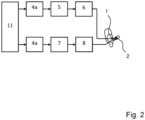
- Figur 2 shows a schematic block diagram of a device for supporting hearing capabilities. Similar to the diagnostic device described above, the hearing aid device comprises the means for electric and acoustic stimulation, but without the measurement electrodes 9 and related measurement unit 10a, 10b, 10c.
- the hearing support device comprises a control unit 11, e.g. programmed data processor, controller or signal processor ( ⁇ P, ⁇ C, FPGA, ASIC etc.) connected via a first galvanic isolation element 4a to a Digital-Analog-Converter 5 providing an analog output signal under control oft he measurement control unit 3.
- the analog output signal of the Digital-Analog-Converter 5 is connected to an electric stimulation unit 6.
- the at least one stimulation electrode 1 is connectable to and driven by the electrical signal (e.g. current or voltage signal) provided at the output of the electric stimulation unit 6.
- the control unit 11 of the hearing support device is further connected via a second galvanic isolation element 4b to a sound generator 7 arranged to provide a sound signal at ist output.
- the sound generator 7 my comprise a frequency generator adapted to provide a periodic signal comprising one specific frequency.
- the sound generator 7 can be adapted to provide a mix of a low frequency used for acoustic stimulation and an amplified sound signal provided from a microphone connected to the hearing support device to receive and amplify sound of the surrounding of the patient in a frequency range above the low-frequency range used for acoustic stimulation.
- the acoustic signal emitted by the acoustic loudspeaker 2 can be a mix of the acoustic stimulation frequency and the microphone output signal, i.e. the amplified sound of the surrounding of the patient.
- the acoustic stimulation signal can be, for example, a sinus waveform having a frequency below 1 kHz.
- the sound generator 7 can also be adapted to provide a square or triangle form of the periodic signal, or the like for the acoustic stimulation signal.
- the sound generator 7 is connected to an audio amplifier 8, wherein the acoustic loudspeaker 2 is electrically connected to the output of the audio amplifier 8.
- the device for supporting hearing capabilities of a patient can be an auditory prosthetic or hearing device which provides extra-cochlear electric stimulation and simultaneous acoustic stimulation.
- the device uses electric acoustic interaction as a means of leveraging the stimulation delivered both electrically and acoustically.
- the prosthetic or hearing device uses electric stimulation delivered non-invasively, or minimally invasively.
- an ear canal electrode or a needle electrode can be provided for electric stimulation.
- Electric stimualtion is used to transmit high frequencies and acoustic stimulation is used to transmit low frequencies.
- the acoustic masking mechanism is used to modulate and leverage the low frequency and high frequency content to minimize the interaction between both modalities.
- low-frequency is below 1 kHz and high frequency is above 1 kHz.
- the first is the use of the diagnostic device as a disgnostic tool.
- the results can be used as input parameters for characterizing a signal processor of a conventional hearing aid.
- the second option is to implement the diagnostic unit in a hearing aid, wherein the device is designed to frequently adapt the setting by diagnosted interaction mechanisms from acoustical and electrical stimulation.
- the third option is the use of the interaction mechanisms in real time to amplify or dampen noise or sharpen the audible hearing signal.
Landscapes
- Health & Medical Sciences (AREA)
- General Health & Medical Sciences (AREA)
- Otolaryngology (AREA)
- Engineering & Computer Science (AREA)
- Life Sciences & Earth Sciences (AREA)
- Physics & Mathematics (AREA)
- Acoustics & Sound (AREA)
- Animal Behavior & Ethology (AREA)
- Neurosurgery (AREA)
- Veterinary Medicine (AREA)
- Signal Processing (AREA)
- Public Health (AREA)
- Audiology, Speech & Language Pathology (AREA)
- Biomedical Technology (AREA)
- Pathology (AREA)
- Medical Informatics (AREA)
- Molecular Biology (AREA)
- Surgery (AREA)
- Heart & Thoracic Surgery (AREA)
- Biophysics (AREA)
- Multimedia (AREA)
- Nuclear Medicine, Radiotherapy & Molecular Imaging (AREA)
- Radiology & Medical Imaging (AREA)
- Prostheses (AREA)
Priority Applications (3)
| Application Number | Priority Date | Filing Date | Title |
|---|---|---|---|
| EP23152013.1A EP4403208A1 (de) | 2023-01-17 | 2023-01-17 | Vorrichtung zur diagnose und/oder zur unterstützung von hörfähigkeiten |
| PCT/EP2024/050999 WO2024153685A1 (en) | 2023-01-17 | 2024-01-17 | Device for interacting with hearing capabilities |
| EP24701169.5A EP4651936A1 (de) | 2023-01-17 | 2024-01-17 | Vorrichtung zur interaktion mit hörfähigkeiten |
Applications Claiming Priority (1)
| Application Number | Priority Date | Filing Date | Title |
|---|---|---|---|
| EP23152013.1A EP4403208A1 (de) | 2023-01-17 | 2023-01-17 | Vorrichtung zur diagnose und/oder zur unterstützung von hörfähigkeiten |
Publications (1)
| Publication Number | Publication Date |
|---|---|
| EP4403208A1 true EP4403208A1 (de) | 2024-07-24 |
Family
ID=84982562
Family Applications (2)
| Application Number | Title | Priority Date | Filing Date |
|---|---|---|---|
| EP23152013.1A Withdrawn EP4403208A1 (de) | 2023-01-17 | 2023-01-17 | Vorrichtung zur diagnose und/oder zur unterstützung von hörfähigkeiten |
| EP24701169.5A Pending EP4651936A1 (de) | 2023-01-17 | 2024-01-17 | Vorrichtung zur interaktion mit hörfähigkeiten |
Family Applications After (1)
| Application Number | Title | Priority Date | Filing Date |
|---|---|---|---|
| EP24701169.5A Pending EP4651936A1 (de) | 2023-01-17 | 2024-01-17 | Vorrichtung zur interaktion mit hörfähigkeiten |
Country Status (2)
| Country | Link |
|---|---|
| EP (2) | EP4403208A1 (de) |
| WO (1) | WO2024153685A1 (de) |
Citations (3)
| Publication number | Priority date | Publication date | Assignee | Title |
|---|---|---|---|---|
| US20160151629A1 (en) * | 2013-07-05 | 2016-06-02 | Advanced Bionics Ag | Cochlear implant system |
| US20180050202A1 (en) * | 2016-08-16 | 2018-02-22 | Peter Andrew Busby | Multimodal prescription techniques |
| US20190070412A1 (en) * | 2013-07-15 | 2019-03-07 | Oticon Medical A/S | Hearing assistance device comprising an implanted part for measuring and processing electrically evoked nerve responses |
-
2023
- 2023-01-17 EP EP23152013.1A patent/EP4403208A1/de not_active Withdrawn
-
2024
- 2024-01-17 EP EP24701169.5A patent/EP4651936A1/de active Pending
- 2024-01-17 WO PCT/EP2024/050999 patent/WO2024153685A1/en not_active Ceased
Patent Citations (3)
| Publication number | Priority date | Publication date | Assignee | Title |
|---|---|---|---|---|
| US20160151629A1 (en) * | 2013-07-05 | 2016-06-02 | Advanced Bionics Ag | Cochlear implant system |
| US20190070412A1 (en) * | 2013-07-15 | 2019-03-07 | Oticon Medical A/S | Hearing assistance device comprising an implanted part for measuring and processing electrically evoked nerve responses |
| US20180050202A1 (en) * | 2016-08-16 | 2018-02-22 | Peter Andrew Busby | Multimodal prescription techniques |
Non-Patent Citations (21)
| Title |
|---|
| BATREL, CHUET, AHASSELMANN, FWANG, JDESMADRYL, G.NOUVIAN, R ET AL.: "Mass Potentials Recorded at the Round Window Enable the Detection of Low Spontaneous Rate Fibers in Gerbil Auditory Nerve", PLOSONE, vol. 1, no. 12, 2017, pages e0169890 |
| DORMAN, M. FGIFFORD, R. HSPAHR, A., JMCKARNS, S., A: "The Benefits of Combining Acoustic and Electric Stimulation for the Recognition of Speech, Voice and Melodies", AUDIOL NEUROTOL, vol. 13, 2008, pages 105 - 112 |
| FOURCIN, A. JDOUEK, E. EMOORE, B. CROSEN, SWALLIKER, J. RHOWARD, D. MABBERTON, EFRAMPTON, S: "Speech perception with promontory stimulation", ANN N Y ACAD SCI, vol. 405, 1983, pages 280 - 94 |
| GALAMBOS, RMAKEIG, STALMACHOFF, P.J: "A 40 Hz auditory potential recorded from the human scalp", PROC NATL ACAD SEI, vol. 78, 1981, pages 2643 - 2647 |
| GIBSON, W. PMOFFAT, D. ARAMSDEN, R. T: "Clinical electrocochleography in the diagnosis and management of Meniere's disorder", AUDIOLOGY, vol. 16, 1977, pages 389 - 401 |
| GORGA, M.P., KAMINSKI, J.R., BEAUCHAINE K.A., JESTEADT, W: "Auditory brainstem responses to tone bursts in normally hearing subjects", J SPEECH HEAR RES, vol. 31, 1988, pages 87 - 97 |
| IMSIECKE, IKRUGER, BBUCHNER, ALENARZ, TNOGUEIRA, W: "Electric-Acoustic Forward Masking in CI Users with Ipsilateral Residual Hearing", HEARING RESEARCH, vol. 364, 2018, pages 25 - 37 |
| IMSIECKE, MBUCHNER, ALENARZ, TNOGUEIRA, W: "Psychoacoustic and electrophysiological electric-acoustic interaction effects in cochlear implant users with ipsilateral residual hearing", HEARING RESEARCH, vol. 386, 2020, pages 107873, Retrieved from the Internet <URL:https://doi.org/10.1016/j.heares.2019.107873> |
| JONES, R. CSTEVENS, S.LURIE, M. H: "Three Mechanisms of Hearing by Electrical Stimulation", THE JOURNAL OF THE ACOUSTICAL SOCIETY OF AMERICA, vol. 12, no. 2, 1940, pages 281 - 290 |
| KRUGER, BBUCHNER, ANOGUEIRA, W: "Simultaneous masking between electric and acoustic stimulation in CI users with residual low-frequency hearing", HEARING RESEARCH, vol. 353, 2017, pages 185 - 196, XP085185671, DOI: 10.1016/j.heares.2017.06.014 |
| LIN, F. RMETTER, E. J.O'BRIEN, R. JRESNICK, S. MZONDERMAN, A. BFERRUCCI, L: "Hearing loss and incident dementia", ARCHIVES OF NEUROLOGY, vol. 68, no. 2, 2011, pages 214 - 220 |
| MIELCZAREK MARZENA ET AL: "Excitation of the Auditory System as a Result of Non-invasive Extra-Cochlear Stimulation in Normal Subjects and Tinnitus Patients", FRONTIERS IN NEUROSCIENCE, vol. 12, 23 March 2018 (2018-03-23), CH, XP093054755, ISSN: 1662-4548, Retrieved from the Internet <URL:http://frontiersin.org/neuroscience/> DOI: 10.3389/fnins.2018.00146 * |
| SATO, M.BAUMHOFF, PKRAL, A: "CI stimulation of a hearing ear generates separate electrophonic and electroneural responses", J. NEUROSCI, vol. 36, 2016, pages 54 - 64 |
| SATO, MBAUMHOFF, PTILLEIN, JKRAL, A: "Physiological mechanisms in combined electric-acoustic stimulation", OTOL. NEUROTOL, vol. 38, 2017, pages 215 - 223 |
| STEVENS, S.SJONES, R. C: "The mechanism of hearing by electrical stimulation", J. ACOUST. SOC. AM., vol. 28, no. 10, 1939, pages 261 - 269 |
| STRONKS, H. C., VERSNEL, H., PRIJS, V. F., DE GROOT, J. C. M..1., GROLMAN, W., KLIS, S. F. L: "The Role of Electrophonics in Electroacoustic Stimulation of the Guinea Pig Cochlea", QTOL. & NEUROTOLOGY, vol. 34, no. 3, 2013, pages 579 - 587 |
| TILLEIN, JHARTMANN, RKRAL, A: "Electric-acoustic interactions in the hearing cochlea: Single fiber recordings", HEAR RES, vol. 322, 2015, pages 112 - 26, XP029149719, DOI: 10.1016/j.heares.2014.09.011 |
| VALDERRAMA, J. TTORRE, AALVAREZ, ISEGURA, J. CTHORNTON, A. RSAINZ, MVARGAS, J. L: "Automatic quality assessment and peak identification of auditory brainstem responses with fitted parametric peaks", COMPUT METHODS PROGRAMS BIOMED, vol. 114, no. 3, 2014, pages 262 - 75, XP028643872, DOI: 10.1016/j.cmpb.2014.02.015 |
| VOLLMER, MHARTMANN, RTILLEIN, J: "Neuronal responses in cat inferior colliculus to combined acoustic and electric stimulation", ADV. OTORHINOLARYNGOL, vol. 67, 2010, pages 61 - 69 |
| WENZEL, G. ISARNES, PWARNECKE, ASTOVER, TJAGER, BLESINSKI-SCHIEDAT, ALENARZ, T: "Non-penetrating round window electrode stimulation for tinnitus therapy followed by cochlear implantation", EUR ARCH OTORHINOLARYNGOL, vol. 11, no. 272, 2015, pages 3283 - 93 |
| ZENG, F. GTRAN, PRICHARDSON, M ET AL.: "Human Sensation of Transcranial Electric Stimulation", SCI REP, vol. 9, 2019, pages 15247 |
Also Published As
| Publication number | Publication date |
|---|---|
| EP4651936A1 (de) | 2025-11-26 |
| WO2024153685A1 (en) | 2024-07-25 |
Similar Documents
| Publication | Publication Date | Title |
|---|---|---|
| Van den Honert et al. | Characterization of the electrically evoked auditory brainstem response (ABR) in cats and humans | |
| Firszt et al. | Neurophysiology of cochlear implant users I: effects of stimulus current level and electrode site on the electrical ABR, MLR, and N1-P2 response | |
| Counter et al. | Hearing loss from the acoustic artifact of the coil used in extracranial magnetic stimulation | |
| Sheykholeslami et al. | Frequency sensitivity range of the saccule to bone-conducted stimuli measured by vestibular evoked myogenic potentials | |
| US6631295B2 (en) | System and method for diagnosing and/or reducing tinnitus | |
| US8065017B2 (en) | Method and apparatus for obtaining and registering an Electrical Cochlear Response (“ECR”) | |
| US9744358B2 (en) | System and method for neural cochlea stimulation | |
| Jerger et al. | Stapedius reflex to electrical stimulation in a patient with a cochlear implant | |
| CN104736096B (zh) | 使用镫骨反射测量在耳蜗植入手术期间监测听力保留 | |
| Makhdoum et al. | Intra-and interindividual correlations between auditory evoked potentials and speech perception in cochlear implant users | |
| Linnenschmidt et al. | Ontogeny of auditory brainstem responses in the bat, Phyllostomus discolor | |
| US8755895B2 (en) | Systems and methods for detecting one or more central auditory potentials | |
| Polak et al. | Evaluation of hearing and auditory nerve function by combining ABR, DPOAE and eABR tests into a single recording session | |
| Pelizzone et al. | Electrically evoked responses in cochlear implant patients | |
| Lee et al. | Magnetic stimulation allows focal activation of the mouse cochlea | |
| Morita et al. | The relationship between the intraoperative ECAP threshold and postoperative behavioral levels: the difference between postlingually deafened adults and prelingually deafened pediatric cochlear implant users | |
| Almqvist et al. | Ojective Intraoperative Method to Record Averaged Electromyographic Stapedius Muscle Reflexes in Cochlear Implant Patients: Metodo objetivo transoperatorio para el registro electromiográfico promediado de los reflejos del müAsculo estapedial en pacientes con implante coclear | |
| EP4403208A1 (de) | Vorrichtung zur diagnose und/oder zur unterstützung von hörfähigkeiten | |
| Game et al. | Electrically evoked brain stem auditory potentials | |
| Suh et al. | Electric hearing and tinnitus suppression by noninvasive ear stimulation | |
| Zhang et al. | Recovery function of the late auditory evoked potential in cochlear implant users and normal-hearing listeners | |
| Hyvärinen | Utilization of the chirp stimulus in auditory brainstem response measurements | |
| Saha et al. | Cochlear Implants: Objective Measures in Mapping | |
| Lorens et al. | New methods of deafness and partial deafness treatment | |
| Yi et al. | Analysis of changes in auditory nerve signals following simulated tinnitus for the verification of cochlear model |
Legal Events
| Date | Code | Title | Description |
|---|---|---|---|
| PUAI | Public reference made under article 153(3) epc to a published international application that has entered the european phase |
Free format text: ORIGINAL CODE: 0009012 |
|
| STAA | Information on the status of an ep patent application or granted ep patent |
Free format text: STATUS: THE APPLICATION HAS BEEN PUBLISHED |
|
| AK | Designated contracting states |
Kind code of ref document: A1 Designated state(s): AL AT BE BG CH CY CZ DE DK EE ES FI FR GB GR HR HU IE IS IT LI LT LU LV MC ME MK MT NL NO PL PT RO RS SE SI SK SM TR |
|
| STAA | Information on the status of an ep patent application or granted ep patent |
Free format text: STATUS: THE APPLICATION IS DEEMED TO BE WITHDRAWN |
|
| 18D | Application deemed to be withdrawn |
Effective date: 20250125 |