EP4402795B1 - Photovoltaische anordnung für ein tragbares solarenergiesystem - Google Patents
Photovoltaische anordnung für ein tragbares solarenergiesystem Download PDFInfo
- Publication number
- EP4402795B1 EP4402795B1 EP22773267.4A EP22773267A EP4402795B1 EP 4402795 B1 EP4402795 B1 EP 4402795B1 EP 22773267 A EP22773267 A EP 22773267A EP 4402795 B1 EP4402795 B1 EP 4402795B1
- Authority
- EP
- European Patent Office
- Prior art keywords
- articulated
- photovoltaic
- laminates
- photovoltaic assembly
- supporting structure
- Prior art date
- Legal status (The legal status is an assumption and is not a legal conclusion. Google has not performed a legal analysis and makes no representation as to the accuracy of the status listed.)
- Active
Links
Images



Classifications
-
- H—ELECTRICITY
- H10—SEMICONDUCTOR DEVICES; ELECTRIC SOLID-STATE DEVICES NOT OTHERWISE PROVIDED FOR
- H10F—INORGANIC SEMICONDUCTOR DEVICES SENSITIVE TO INFRARED RADIATION, LIGHT, ELECTROMAGNETIC RADIATION OF SHORTER WAVELENGTH OR CORPUSCULAR RADIATION
- H10F19/00—Integrated devices, or assemblies of multiple devices, comprising at least one photovoltaic cell covered by group H10F10/00, e.g. photovoltaic modules
-
- F—MECHANICAL ENGINEERING; LIGHTING; HEATING; WEAPONS; BLASTING
- F24—HEATING; RANGES; VENTILATING
- F24S—SOLAR HEAT COLLECTORS; SOLAR HEAT SYSTEMS
- F24S25/00—Arrangement of stationary mountings or supports for solar heat collector modules
- F24S25/60—Fixation means, e.g. fasteners, specially adapted for supporting solar heat collector modules
- F24S25/63—Fixation means, e.g. fasteners, specially adapted for supporting solar heat collector modules for fixing modules or their peripheral frames to supporting elements
- F24S25/632—Side connectors; Base connectors
-
- F—MECHANICAL ENGINEERING; LIGHTING; HEATING; WEAPONS; BLASTING
- F24—HEATING; RANGES; VENTILATING
- F24S—SOLAR HEAT COLLECTORS; SOLAR HEAT SYSTEMS
- F24S25/00—Arrangement of stationary mountings or supports for solar heat collector modules
- F24S25/60—Fixation means, e.g. fasteners, specially adapted for supporting solar heat collector modules
- F24S25/65—Fixation means, e.g. fasteners, specially adapted for supporting solar heat collector modules for coupling adjacent supporting elements, e.g. for connecting profiles together
-
- F—MECHANICAL ENGINEERING; LIGHTING; HEATING; WEAPONS; BLASTING
- F24—HEATING; RANGES; VENTILATING
- F24S—SOLAR HEAT COLLECTORS; SOLAR HEAT SYSTEMS
- F24S25/00—Arrangement of stationary mountings or supports for solar heat collector modules
- F24S25/60—Fixation means, e.g. fasteners, specially adapted for supporting solar heat collector modules
- F24S25/67—Fixation means, e.g. fasteners, specially adapted for supporting solar heat collector modules for coupling adjacent modules or their peripheral frames
-
- H—ELECTRICITY
- H02—GENERATION; CONVERSION OR DISTRIBUTION OF ELECTRIC POWER
- H02S—GENERATION OF ELECTRIC POWER BY CONVERSION OF INFRARED RADIATION, VISIBLE LIGHT OR ULTRAVIOLET LIGHT, e.g. USING PHOTOVOLTAIC [PV] MODULES
- H02S10/00—PV power plants; Combinations of PV energy systems with other systems for the generation of electric power
- H02S10/40—Mobile PV generator systems
-
- H—ELECTRICITY
- H02—GENERATION; CONVERSION OR DISTRIBUTION OF ELECTRIC POWER
- H02S—GENERATION OF ELECTRIC POWER BY CONVERSION OF INFRARED RADIATION, VISIBLE LIGHT OR ULTRAVIOLET LIGHT, e.g. USING PHOTOVOLTAIC [PV] MODULES
- H02S20/00—Supporting structures for PV modules
- H02S20/30—Supporting structures being movable or adjustable, e.g. for angle adjustment
-
- H—ELECTRICITY
- H02—GENERATION; CONVERSION OR DISTRIBUTION OF ELECTRIC POWER
- H02S—GENERATION OF ELECTRIC POWER BY CONVERSION OF INFRARED RADIATION, VISIBLE LIGHT OR ULTRAVIOLET LIGHT, e.g. USING PHOTOVOLTAIC [PV] MODULES
- H02S30/00—Structural details of PV modules other than those related to light conversion
- H02S30/20—Collapsible or foldable PV modules
-
- H—ELECTRICITY
- H02—GENERATION; CONVERSION OR DISTRIBUTION OF ELECTRIC POWER
- H02S—GENERATION OF ELECTRIC POWER BY CONVERSION OF INFRARED RADIATION, VISIBLE LIGHT OR ULTRAVIOLET LIGHT, e.g. USING PHOTOVOLTAIC [PV] MODULES
- H02S40/00—Components or accessories in combination with PV modules, not provided for in groups H02S10/00 - H02S30/00
- H02S40/30—Electrical components
- H02S40/36—Electrical components characterised by special electrical interconnection means between two or more PV modules, e.g. electrical module-to-module connection
-
- F—MECHANICAL ENGINEERING; LIGHTING; HEATING; WEAPONS; BLASTING
- F24—HEATING; RANGES; VENTILATING
- F24S—SOLAR HEAT COLLECTORS; SOLAR HEAT SYSTEMS
- F24S30/00—Arrangements for moving or orienting solar heat collector modules
- F24S2030/10—Special components
- F24S2030/16—Hinged elements; Pin connections
-
- Y—GENERAL TAGGING OF NEW TECHNOLOGICAL DEVELOPMENTS; GENERAL TAGGING OF CROSS-SECTIONAL TECHNOLOGIES SPANNING OVER SEVERAL SECTIONS OF THE IPC; TECHNICAL SUBJECTS COVERED BY FORMER USPC CROSS-REFERENCE ART COLLECTIONS [XRACs] AND DIGESTS
- Y02—TECHNOLOGIES OR APPLICATIONS FOR MITIGATION OR ADAPTATION AGAINST CLIMATE CHANGE
- Y02E—REDUCTION OF GREENHOUSE GAS [GHG] EMISSIONS, RELATED TO ENERGY GENERATION, TRANSMISSION OR DISTRIBUTION
- Y02E10/00—Energy generation through renewable energy sources
- Y02E10/50—Photovoltaic [PV] energy
Definitions
- the present invention relates to the field of portable solar energy systems.
- the present invention relates to the field of photovoltaic assemblies which ease the transport and installation of photovoltaic panels or laminates (photovoltaic surface without a complete peripheral frame) for a solar energy collection system.
- the invention provides a photovoltaic assembly for a portable solar system.
- Photovoltaic panels or laminates are widely used to generate electricity from sunlight. Photovoltaic panels or laminates are usually fixed on surfaces like roofs, building facades, on the ground, etc. using supporting structures, which may be known as photovoltaic mounting systems or solar module racking, among others.
- a solar panel performs the best when its surface is substantially perpendicular to the sun's rays, which change continuously over the course of the day and season.
- the supporting structures of the photovoltaic panels or laminates are also often used to orientate the photovoltaic panels or laminates in regard to solar radiation to maximize their energy production.
- Said supporting structure may be fixed, i.e., the photovoltaic panels or laminates have a fixed orientation, or may tilt, i.e., the orientation of the photovoltaic panels or laminates may vary depending on the position of the sun.
- a solar energy system typically comprises one or more photovoltaic assemblies, which typically comprise one or more photovoltaic panels or laminates and a supporting structure.
- Photovoltaic assemblies are usually installed at locations remote from its manufacturing site. Consequently, there is a need to transport the energy system components from their manufacturing site to the installation site where they will be assembled. Therefore, it is advantageous to provide a solar energy system that can be assembled in optimal conditions off-site and easily transported, as this can provide a significant cost reduction, among other benefits.
- the photovoltaic assemblies Besides being transported from the manufacturing site, or any intermediate storage site, to the location where the solar energy system is to be installed, the photovoltaic assemblies need to be mounted or installed. Consequently, it is advantageous if the photovoltaic assemblies of a solar energy system can be easily installed, as this can provide a significant time and cost reduction, an increase in worker safety, etc.
- WO 2010/098806 A1 discloses a photovoltaic assembly comprising an array of photovoltaic laminates supported on a perimetral frame formed by top and bottom beams, side beams, and intermediate beams shared between two photovoltaic laminates, and a stiffening device formed by interconnected profiles.
- the stiffening device is configured to be transitioned between an operative position, in which the stiffening device protrudes from a lower side of the photovoltaic assembly and provides support and strengthening thereto, and a folded position, in which the stiffening device is maintained in its entirety within a receiving zone defined by the perimetral frame of the photovoltaic assembly.
- Said receiving zone is disclosed to have a height of no more than 8 inches thereby facilitating transport of the photovoltaic assembly.
- GB 2543581 A discloses a single axis solar tracking assembly comprising a plurality of spine sections connected to one another by joints and an auxiliary shaft, with legs rotatably supporting the spine sections on the ground with at least one solar panel secured to a rib member connected with a bracket to the spine section.
- the joints are rotatable about a first axis so the assembly is moveable between a deployed position and a folded position where the solar panels are arranged in adjacent parallel planes and fold in a zig-zag fashion into a storage position.
- the joints are rotatable about a second axis which is perpendicular to the first axis so that one of the first or second axes is perpendicular to the solar panels.
- the auxiliary shaft may be rotatable with an electric motor and the rib members may move symmetrically using gear elements. Wheels or sleds may be provided on the legs.
- the present invention is defined in claim 1 and discloses a photovoltaic assembly for a portable solar energy system, the photovoltaic assembly comprising: a row of interconnected photovoltaic panels or laminates; a foldable stiffening and/or supporting structure comprising articulated members, the foldable stiffening and/or supporting structure being movable between a folded position, in which the articulated members are received in a receiving zone provided in the photovoltaic assembly, and an operative position, in which the foldable stiffening and/or supporting structure protrudes out from the receiving zone; and wherein the receiving zone comprises at least one intermediate region located adjacent to contiguous longitudinal side edges of adjacent photovoltaic panels or laminates, said intermediate region being configured to receive therein
- the photovoltaic panels or laminates are interconnected by at least a first connection pin parallel to major surfaces of the photovoltaic panels or laminates and perpendicular to the longitudinal side edges of the photovoltaic panels or laminates, and wherein the articulated members comprise a first articulated member having an end portion pivotally connected to said first connection pin.
- the articulated members may further comprise a second articulated member having an end portion pivotally connected to said first connection pin.
- the photovoltaic panels or laminates may be further interconnected by a second connection pin parallel to the first connection pin, and the articulated members may further comprise a third articulated member having an end portion pivotally connected to said second connection pin.
- At least one of the articulated members may define a longitudinal channel configured to receive therein at least one of the other articulated members in the folded position of the stiffening and/or supporting structure.
- the photovoltaic assembly for a portable solar energy system
- the photovoltaic assembly comprising: a row of interconnected photovoltaic panels or laminates; a foldable stiffening and/or supporting structure comprising articulated members, the foldable stiffening and/or supporting structure being movable between a folded position, in which the articulated members are received in a receiving zone provided in the photovoltaic assembly, and an operative position, in which the foldable stiffening and/or supporting structure protrudes out from the receiving zone;
- the receiving zone comprising at least one intermediate region located adjacent to contiguous longitudinal side edges of adjacent photovoltaic panels or laminates, said intermediate region being configured to receive therein in the folded position one or more of the articulated members of the stiffening and/or supporting structure
- the stiffening and/or supporting structure further comprises at least one intermediate beam arranged in at least one of the intermediate regions, each intermediate beam being joined to adjacent longitudinal side edges of the photovoltaic panels or laminates, and the at least one intermediate beam comprises
- the photovoltaic panels or laminates may have a front side and a back side, and the longitudinal channel defined by the receiving section may be open at one side of the intermediate beam corresponding to the back side of the photovoltaic panels or laminates.
- the longitudinal channel defined by the receiving section of the intermediate beam may comprise a bottom wall parallel to major surfaces of the photovoltaic panels or laminates and mutually facing side walls extending from the bottom wall.
- the support section of the intermediate beam may be formed adjacent to the bottom wall on the side opposing the receiving zone.
- the support section may be attached to the internal and to the external major surface of two adjacent photovoltaic laminates.
- the support section may comprise a T-shaped member extending from the bottom wall on the side opposing the receiving zone, said T-shaped member together with the bottom wall on the side opposing the receiving zone defining two grooves for the reception of side edges of adjacent laminates, said side edges being preferably provided with a protective cover.
- the support section may be defined by an auxiliary member attached to the bottom wall on the side opposing the receiving zone, said auxiliary member defining two grooves for the reception of side edges of adjacent laminates, said side edges being preferably provided with a protective cover.
- the support section may be defined by auxiliary members, each auxiliary member being clipped to a corresponding projection extending parallel to the bottom wall on the side opposing the receiving zone, each auxiliary member together with the corresponding projection defining a groove for the reception of the side edge of the corresponding laminate, said side edge being preferably provided with a protective cover.
- the support section may further comprise a stop between the auxiliary members for limiting their movement.
- the support section of the intermediate beam may be formed by support walls parallel to the bottom wall extending outwards from ends of the side walls farthest from the bottom wall.
- the articulated members may comprise a first articulated member having an end portion pivotally connected to the side walls of the receiving section of the intermediate beam by a first pivot pin parallel to the bottom wall.
- the articulated members may comprise a second articulated member, and the first articulated member may define a longitudinal channel which is open at one side thereof corresponding to the back side of the photovoltaic panels or laminates and configured to receive therein the second articulated member in the folded position.
- the second articulated member may have one end portion pivotally connected to the intermediate beam or to the first articulated member by a second pivot pin parallel to the first pivot pin.
- the articulated members may comprise a third articulated member, and the second articulated member may define a longitudinal channel which is open at one side which corresponds to the back side of the photovoltaic panels or laminates and configured to receive therein the third articulated member in the folded position.
- the third articulated member may have one end portion pivotally connected to the intermediate beam or to the first articulated member or to the second articulated member by a third pivot pin parallel to the bottom wall.
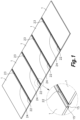
- FIG. 1 shows in a perspective view a first exemplary embodiment of a photovoltaic assembly for a portable solar energy system according to the present invention.
- the photovoltaic assembly of this exemplary embodiment comprises a row of interconnected photovoltaic panels 1.
- an intermediate region is defined between adjacent photovoltaic panels 1, which are interconnected by first 22, second 23 and third 24 connection pins.
- the photovoltaic panels 1, and in particular, the perimeter frames 15 of the photovoltaic panels 1, may be interconnected by a different number of connection pins 22, 23, 24, for example, only two.
- the first 22, second 23 and third 24 connection pins are parallel to major surfaces of the photovoltaic panels 1 and perpendicular to the longitudinal side edges of the photovoltaic panels 1.
- the photovoltaic assembly comprises five photovoltaic panels 1.
- other embodiments may comprise a different number of photovoltaic panels 1, as for example, two, three, four, six, etc, and in general any number of panels compatible with an easy transport.
- the photovoltaic panels 1 may be replaced by photovoltaic laminates 1. Although it is not considered optimal, some embodiments could comprise both photovoltaic panels 1 and photovoltaic laminates 1.
- FIG. 1 also shows a detail view of the intermediate region located adjacent to longitudinal side edges of adjacent photovoltaic panels 1 of the first exemplary embodiment of a photovoltaic assembly.
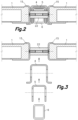
- FIG. 2 shows a section view of the intermediate region and adjacent photovoltaic panels 1 of the exemplary embodiment of a photovoltaic assembly shown in FIG. 1 .
- the first connection pin 22 that interconnects two longitudinal side edges of contiguous photovoltaic panels 1 can be seen.
- Said connection pin 22 can be connected directly to the perimeter frame 15 of the photovoltaic panel 1 or to a connection element which is attached to the perimeter frame 15 of the corresponding photovoltaic panel 1.
- the other connection pins 23, 24 In FIG. 2 the articulated members 4, 5, 6 of the stiffening and/or supporting structure 3 (see, for example, FIGS. 4 and 5 ) are depicted in the folded position wherein said articulated members 4, 5, 6 are substantially received within the intermediate region between panels 1, thus providing a very compact assembly when in its folded position, very favourable for transport.
- FIG. 3 shows an exploded section view of the exemplary embodiment of a photovoltaic assembly shown in FIGS. 1 and 2.
- FIG. 3 is similar to FIG. 2 but with the articulated members 4, 5, 6 of the stiffening and/or supporting structure 3 (see, for example, FIGS. 4 and 5 ) in an exploded configuration.
- the first articulated member 4 is pivotally connected to the first connection pin 22 at one of its ends.
- the first articulated member 4 defines a longitudinal channel configured to receive therein the second articulated member 5 in the folded position of the stiffening and/or supporting structure 3 (see FIG. 2 ).
- the first articulated member 4 has an omega shaped cross section, i.e., a cross section being U-shaped with added lateral flanges.
- the first articulated member 4 may have other cross sections.
- the second articulated member 5 defines a longitudinal channel configured to receive therein the third articulated member 6 in the folded position of the stiffening and/or supporting structure 3 (see FIG. 2 ).
- the second articulated member 5 has a U-shaped cross section.
- the second articulated member 5 may have other cross sections.
- Said third articulated member 6, in this embodiment has a rectangular cross section and, therefore, does not define a longitudinal channel.
- the third articulated member 6 may have a different cross section and may define a longitudinal channel which is open at one side thereof.
- first exemplary embodiment has been depicted with three articulated members 4, 5, 6, other embodiments may have a different number of articulated members, such as two, four, etc.
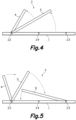
- FIGS. 4 and 5 show a profile view of a first and a second configurations, respectively, of the first exemplary embodiment of a photovoltaic assembly shown in FIG. 1 with some of the articulated members deployed.
- first and second articulated members 4, 5 have an end portion pivotally connected to the first connection pin 22, whereas the third articulated member 6 has an end portion pivotally connected to the second connection pin 24.
- the third articulated member 6 is still in its folded position, while the first and second articulated members 4, 5 are being placed in their operative position, in which they protrude from the receiving zone defined by the intermediate region between adjacent photovoltaic panels 1 (see FIG. 1 ), to provide a stiffening and/or supporting structure.
- the first, second and third articulated members 4, 5, 6 are being placed in their unfolded position.
- the third articulated member 6 is received in the intermediate region located adjacent to contiguous longitudinal side edges of adjacent photovoltaic panels 1 and the second articulated member 5 is being placed in its folded position by receiving in its longitudinal channel the third articulated member 6.
- the second articulated member 5 is received in the longitudinal channel of the first articulated member 4.
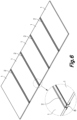
- FIG. 6 shows a perspective and a detail view of a second exemplary embodiment of a photovoltaic assembly for a portable solar energy system according to the present invention.
- the photovoltaic assembly of this second exemplary embodiment comprises intermediate beams 2 arranged in the intermediate regions located adjacent to longitudinal side edges of adjacent photovoltaic panels 1.
- Said intermediate beams comprise a receiving section 8 configured to receive therein one or more of the articulated members 4, 5, 6 in the folded position of the stiffening and/or supporting structure 3 (see, for example, FIGS. 12 to 15 ).
- the receiving section 8 comprised in the beam 2 can be seen in greater detail in the detail view also shown in FIG. 6 .
- the photovoltaic assembly comprises five photovoltaic panels 1.
- other embodiments may comprise a different number of photovoltaic panels 1, as for example, two, three, four, six, etc.
- FIG. 7 shows a section view of the second exemplary embodiment of a photovoltaic assembly shown in FIG. 6 .
- This section view shows in greater detail the receiving section 8 comprised in the intermediate beam 2 arranged in the intermediate region located adjacent to longitudinal side edges of adjacent photovoltaic panels 1 and attached to said longitudinal sided edges, e.g., by adhesive.
- the articulated members 4, 5, 6 are depicted in its folded position, i.e., received in the receiving section 8. As can be seen, in this folded position the articulated members 4, 5, 6 are substantially within the receiving section, thus providing a very compact arrangement which eases the transport of the photovoltaic assembly and increases the quantity of photovoltaic assemblies that can be placed, for example, in a transport container, thus improving its transport density.
- the first pivot pins 12, wherein the first articulated member 4 is pivotally connected at one of its ends, can also be seen in FIG. 7 , although they can be seen in greater detail in FIG. 8 .
- the first pivot pins 12 are attached to the perimeter frame 15 of the photovoltaic panel 1 at one of the ends thereof.
- FIG. 8 shows an exploded section view of the second exemplary embodiment of a photovoltaic assembly shown in FIG. 7.
- FIG. 8 is similar to FIG. 7 but with articulated members 4, 5, 6 of the stiffening and/or supporting structure 3 (see, for example, FIGS. 12 to 15 ) in an exploded configuration.
- the first articulated member 4 is pivotally connected to the first pivot pins 12.
- the pivot pin 12 comprises two separate pins, each one on opposite side faces of the intermediate beam 2.
- said pivot pin 12 may be a single longitudinal pin, similar to the one shown in FIGS. 2 and 3 .
- the first articulated member 4 defines a longitudinal channel which is open at one side thereof corresponding to the back side of the photovoltaic panel 1 and is configured to receive therein the second articulated member 5 in the folded position (see FIG. 7 ).
- the first articulated member 4 has an omega-shaped cross section, although in other embodiments said first articulated member 4 can have a different cross section, such as, U-shaped, for example.
- the intermediate beam 2 of the exemplary embodiment shown has an omega-shaped cross section, but in other embodiments said cross section can have a different shape, as long as it is suitable to comprise a receiving section for the reception therein of one or more of the articulated members 4, 5, 6 in the folded position of the stiffening and/or supporting structure 3.
- FIG. 8 also shows the longitudinal channel defined by the receiving section 8, which comprises a bottom wall 9 parallel to major surfaces of the photovoltaic panel 1 and mutually facing side walls 10 extending from said bottom wall 9.
- the intermediate beam 2 further comprises a support section 7 for supporting the longitudinal side edges of the adjacent photovoltaic panels 1.
- Said support section 7 is formed by support walls 11 parallel to the bottom wall 9 extending outwards from ends of the side walls 10 farthest, or opposite, from the bottom wall 9.
- the second articulated member 5 has one end portion pivotally connected to the first articulated member 4, although in other embodiments said articulated member 5 may be pivotally connected to the intermediate beam 2 at one of its ends.
- the second articulated member 5 lacks a longitudinal channel open at one side thereof as, in the embodiment shown, there is no further articulated member to be received therein.
- the second articulated member 5 may also comprise a longitudinal channel open at one side thereof for the reception of an articulated member of the stiffening and/or supporting structure 3.
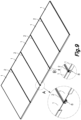
- FIG. 9 shows a perspective and two detail views of a third exemplary embodiment of a photovoltaic assembly for a portable solar energy system not forming part of the present invention.
- This third exemplary embodiment shows that the transverse side edges of the photovoltaic panels 1 can reach the intermediate beam 2, see detail view B, or can reach a position so that there is a gap from the end of the transverse side edge and the intermediate beam 2, as can be seen in detail view A.
- FIG. 10 shows a section view of a fourth exemplary embodiment of a photovoltaic assembly for a portable solar energy system not forming part of the present invention.
- Said fourth exemplary embodiment also comprises an intermediate beam 2, as the second and third exemplary embodiments previously described, but the fourth exemplary embodiment comprises a photovoltaic laminate 1 instead of photovoltaic panels as the exemplary embodiments previously described.
- the intermediate beam 2 arranged in the intermediate region located adjacent to longitudinal side edges of adjacent photovoltaic laminates 1 comprises a support section 7 for supporting the adjacent photovoltaic laminates 1 and a receiving section 8 for the reception therein of the articulated members 4, 5, 6 in the folded position of the stiffening and/or supporting structure.
- the longitudinal channel defined by the receiving section 8 comprises a bottom wall 9 parallel to major surfaces of the photovoltaic laminates 1 and mutually facing side walls 10 extending from the bottom wall.
- Said support section 7 is formed adjacent to the bottom wall 9 on the side opposing the receiving zone 8.
- the support section 7 is defined by auxiliary members 71, each auxiliary member 71 being clipped to a corresponding projection 72 extending parallel to the bottom wall 9 on the side opposing the receiving zone 8.
- the auxiliary member 71 may be permanently attached to the bottom wall 9 on the side opposing the receiving zone, for example, by a weld or a suitable glue.
- each auxiliary member 71 together with the corresponding projection 72 define a groove 73 for the reception of the side edge of the corresponding laminate 71.
- the grooves 73 are substantially C-shaped. However, in other embodiments they may have a different shape.
- the side edge of the laminate 71 is provided with a protective cover 74.
- a protective cover 74 is preferred, as it protects the laminate 1 from being damaged due to, for example, the clamping or fixing force, vibrations, etc., other embodiments may lack of such protective cover 74.
- a photovoltaic assembly according to the present invention comprises some laminates 1 with a protective cover 74 and some without it.
- the exemplary embodiment shown also comprises a stop 75 for limiting the movement of the auxiliary members 71.
- the depicted stop 75 is a separate or external part removably attached to the photovoltaic assembly. However, in other embodiments such stop 75 can be a part integral with the photovoltaic assembly.
- Other embodiments may comprise a T-shaped member extending from the bottom wall 9 on the side opposing the receiving zone 8, said T-shaped member together with said bottom wall 9 defining two grooves 73 for the reception of side edges of adjacent laminates 1.
- Each side wall 10 of this fourth exemplary embodiment comprises a pivot pin 12.
- said pivot pin 12 can be a single piece longitudinal pin, similar to the one shown in FIGS. 2 and 3 .
- FIG. 11 shows an exploded section view of the fourth exemplary embodiment of a photovoltaic assembly shown in FIG. 10 .
- FIG. 11 is similar to FIG. 10 but with the articulated members 4, 5, 6 of the stiffening and/or supporting structure 3 (see, for example, FIGS. 12 to 15 ) in an exploded configuration.
- the first articulated member 4 is pivotally connected to the first pivot pins 12 at one of its ends and defines a longitudinal channel which is open at one side thereof configured to receive therein the second articulated member 5 in the folded position of the stiffening and/or supporting structure 3.
- Said first articulated member 4 has a U-shaped cross section, although in other embodiments said cross section can have a different shape.
- the second articulated member 5 is pivotally connected to the first articulated member 4 at one of its ends and defines a longitudinal channel open at one side thereof for the reception of a third articulated member 6.
- said second articulated member 5 can be pivotally connected to the intermediate beam 2 instead of to the first articulated member 4.
- Said second articulated member 5 has a U-shaped cross section, although in other embodiments said cross section can have a different shape.
- the third articulated member 6, in this fourth exemplary embodiment, is pivotally connected at one end portion of the second articulated member 5.
- the third articulated member 5 has a closed cross section, that is to say, lacks a longitudinal channel that is open at one side thereof for the reception of an articulated member.
- a closed cross section has the advantage that the articulated member has a higher structural integrity, and therefore, can withstand higher loads than members having an open, or non-closed, cross section.
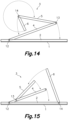
- FIGS. 12 to 15 show different configurations of the articulated members of the stiffening and/or supporting structure 3 of different exemplary embodiments of a portable solar energy system according to the present invention. Any of these stiffening and/or supporting structures 3 can be employed in the previous referred embodiments.
- FIG. 12 shows schematically a profile view of a first configuration of a fifth exemplary embodiment of a photovoltaic assembly for a portable solar energy system according to the present invention.
- a first articulated member 4 is pivotally connected at one of its ends to an intermediate beam 2 via a first pivot pin 12 and a second articulated member 5 is pivotally connected at one of its ends to the intermediate beam 2 via a second pivot pin 13.
- Said first and second pivot pins 12, 13 are located on opposite end regions of the intermediate beam 2.
- the second articulated member 5 When in the folded position of the stiffening and/or supporting structure 3, the second articulated member 5 is received on a longitudinal channel which is open at one side thereof defined by the first articulated member 4.
- FIG. 13 shows schematically a profile view of a first configuration of a sixth exemplary embodiment of a photovoltaic assembly for a portable solar energy system according to the present invention.
- a first articulated member 4 is pivotally connected to an intermediate beam 2 by means of a first pivot pin 12.
- the stiffening and/or supporting structure 3 comprises a second pivot pin 13 that pivotally connects the first articulated member 4 with the second articulated member 5.
- the first articulated member 4 further comprises a third pivot pin 14, located between the first and second pivot pins 12, 13, which connects in an articulated manner the third articulated member 6 with the first articulated member 4.
- the first articulated member 4 is received in the intermediate beam 2
- the third articulated member 6 is received in the first articulated member 4
- the second articulated member 5 is received in both the first and third articulated members 4, 6.
- FIG. 14 shows schematically a profile view of a first configuration of a sixth exemplary embodiment of a photovoltaic assembly for a portable solar energy system according to the present invention.
- the first articulated member 4 is pivotally connected to an intermediate beam 2 via a first pivot pin 12 at one end portion of said first articulated member 4.
- the first articulated member 4 is pivotally connected to a second articulated member 5 by means of a second pivot pin 13.
- the second articulated member 5 is pivotally connected to a third articulated member 6 via a third pivot pin 14.
- the first articulated member 4 is received in the intermediate beam 2
- the third articulated member 6 is received in the second articulated member 5, which is received in the first articulated member 4, in the first articulated member and in the intermediate beam 2.
- FIG. 15 shows schematically a profile view of a first configuration of a seventh exemplary embodiment of a photovoltaic assembly for a portable solar energy system according to the present invention.
- a first articulated member is pivotally connected to an intermediate beam 2 by means of a first pivot pin 12.
- Said first articulated member 4 is also pivotally connected to a second articulated member via a second pivot pin 13.
- the stiffening and/or supporting structure 3 of the seventh exemplary embodiment further comprises a third articulated member 6 pivotally connected to the intermediate beam 2 by means of a third pivot pin 14.
- part of the stiffening and/or supporting structure 3 could protrude from the receiving section 8, in particular, reinforcement elements of the stiffening and/or supporting structure 3, which in its the folded position are arranged substantially parallel to the major surfaces of the photovoltaic panels or laminates 1, may slightly protrude from the receiving section 8, but still providing a compact arrangement of the photovoltaic assembly when in its folded position.
- the present invention provides a photovoltaic assembly for a portable energy system that can be easily transported and installed, thus reducing the transport and installation costs. Moreover, the photovoltaic assembly of the present invention can also be easily uninstalled, placed in its folded position, and transported to another location where it may be needed.
Landscapes
- Engineering & Computer Science (AREA)
- Physics & Mathematics (AREA)
- Life Sciences & Earth Sciences (AREA)
- Sustainable Development (AREA)
- Sustainable Energy (AREA)
- Thermal Sciences (AREA)
- Chemical & Material Sciences (AREA)
- Combustion & Propulsion (AREA)
- Mechanical Engineering (AREA)
- General Engineering & Computer Science (AREA)
- Photovoltaic Devices (AREA)
Claims (14)
- Photovoltaische Anordnung für ein tragbares Solarenergiesystem, wobei die photovoltaische Anordnung Folgendes umfasst:eine Reihe miteinander verbundener photovoltaischer Paneele oder Laminate (1);eine faltbare Versteifungs- und/oder Stützstruktur (3), umfassend angelenkte Elemente (4, 5, 6), wobei die faltbare Versteifungs- und/oder Stützstruktur (3) zwischen einer gefalteten Position, in der die angelenkten Elemente (4, 5, 6) in einer in der photovoltaischen Anordnung vorgesehenen Aufnahmezone aufgenommen sind, und einer Betriebsposition bewegbar ist, in der die faltbare Versteifungs- und/oder Stützstruktur (3) aus der Aufnahmezone herausragt;wobei die Aufnahmezone mindestens eine Zwischenregion umfasst, die benachbart zu aneinandergrenzenden Längsseitenkanten benachbarter photovoltaischer Paneele oder Laminate (1) angeordnet ist, wobei die Zwischenregion dazu konfiguriert ist, darin in der gefalteten Position eines oder mehrere der angelenkten Elemente (4, 5, 6) der Versteifungs- und/oder Stützstruktur (3) aufzunehmen;dadurch gekennzeichnet, dass die photovoltaischen Paneele oder Laminate (1) durch mindestens einen ersten Verbindungsstift (22) parallel zu den Hauptflächen der photovoltaischen Paneele oder Laminate (1) und senkrecht zu den Längsseitenkanten der photovoltaischen Paneele oder Laminate (1) miteinander verbunden sind, und wobei die angelenkten Elemente (4, 5, 6) ein erstes angelenktes Element (4) mit einem Endabschnitt umfassen, der schwenkbar mit dem ersten Verbindungsstift (22) verbunden ist.
- Photovoltaische Anordnung nach Anspruch 1, wobei die angelenkten Elemente (4, 5, 6) ferner ein zweites angelenktes Element (5) mit einem Endabschnitt umfassen, der schwenkbar mit dem ersten Verbindungsstift (22) verbunden ist.
- Photovoltaische Anordnung nach Anspruch 1 oder 2, wobei die photovoltaischen Paneele oder Laminate (1) ferner durch mindestens einen zweiten Verbindungsstift (23) parallel zum ersten Verbindungsstift (22) miteinander verbunden sind, und wobei die angelenkten Elemente (4, 5, 6) ferner ein drittes angelenktes Element (6) mit einem Endabschnitt umfassen, der schwenkbar mit dem zweiten Verbindungsstift (23) verbunden ist.
- Photovoltaische Anordnung nach Anspruch 3, wobei mindestens eines der angelenkten Elemente (4, 5, 6) einen Längskanal definiert, der dazu konfiguriert ist, darin mindestens eines der anderen angelenkten Elemente (4, 5, 6) in der gefalteten Position der Versteifungs- und/oder Stützstruktur (3) aufzunehmen.
- Photovoltaische Anordnung für ein tragbares Solarenergiesystem, wobei die photovoltaische Anordnung Folgendes umfasst:eine Reihe miteinander verbundener photovoltaischer Paneele oder Laminate (1);eine faltbare Versteifungs- und/oder Stützstruktur (3), umfassend angelenkte Elemente (4, 5, 6), wobei die faltbare Versteifungs- und/oder Stützstruktur (3) zwischen einer gefalteten Position, in der die angelenkten Elemente (4, 5, 6) in einer in der photovoltaischen Anordnung vorgesehenen Aufnahmezone aufgenommen sind, und einer Betriebsposition bewegbar ist, in der die faltbare Versteifungs- und/oder Stützstruktur (3) aus der Aufnahmezone herausragt;wobei die Aufnahmezone mindestens eine Zwischenregion umfasst, die benachbart zu aneinandergrenzenden Längsseitenkanten benachbarter photovoltaischer Paneele oder Laminate (1) angeordnet ist, wobei die Zwischenregion dazu konfiguriert ist, darin in der gefalteten Position eines oder mehrere der angelenkten Elemente (4, 5, 6) der Versteifungs- und/oder Stützstruktur (3) aufzunehmen;dadurch gekennzeichnet, dass die Versteifungs- und/oder Stützstruktur (3)ferner mindestens einen Zwischenbalken (2) umfasst, der in mindestens einer der Zwischenregionen angeordnet ist, wobei jeder Zwischenbalken (2) mit benachbarten Längsseitenkanten der photovoltaischen Paneele oder Laminate (1) zusammengefügt ist, und dass der mindestens eine Zwischenbalken (2) einen Stützabschnitt (7), der dazu konfiguriert ist, die benachbarten Längsseitenkanten der benachbarten photovoltaischen Paneele oder Laminate (1) zu stützen, und einen Aufnahmeabschnitt (8) umfasst, der einen Längskanal definiert, der dazu konfiguriert ist, darin einen oder mehrere der angelenkten Elemente (4, 5, 6) in der gefalteten Position der Versteifungs- und/oder Stützstruktur (3) aufzunehmen, wobei der Aufnahmeabschnitt (8) des Zwischenbalkens (2) mindestens einen Teil der Aufnahmezone bereitstellt.
- Photovoltaische Anordnung nach Anspruch 5, wobei die photovoltaischen Paneele oder Laminate (1) eine Vorderseite und eine Rückseite aufweisen und der durch den Aufnahmeabschnitt (8) definierte Längskanal an einer Seite des Zwischenbalkens (2) offen ist, die der Rückseite der photovoltaischen Paneele oder Laminate (1) entspricht.
- Photovoltaische Anordnung nach Anspruch 5 oder 6, wobei der durch den Aufnahmeabschnitt (8) definierte Längskanal eine Bodenwand (9) parallel zu den Hauptflächen der photovoltaischen Paneele oder Laminate (1) und gegenseitig zugewandte Seitenwände (10) umfasst, die sich von der Bodenwand (9) aus erstrecken.
- Photovoltaische Anordnung nach Anspruch 7, wobei der Stützabschnitt (7) benachbart zur Bodenwand (9) auf der der Aufnahmezone (8) gegenüberliegenden Seite gebildet ist.
- Photovoltaische Anordnung nach Anspruch 7, wobei der Stützabschnitt (7) durch Stützwände (11) gebildet wird, die parallel zur Bodenwand (9) sind und sich von den Enden der Seitenwände (10), die am weitesten von der Bodenwand (9) entfernt sind, nach außen erstrecken.
- Photovoltaische Anordnung nach einem der Ansprüche 7 bis 9, wobei die angelenkten Elemente (4, 5, 6) ein erstes angelenktes Element (4) mit einem Endabschnitt umfassen, der schwenkbar mit den Seitenwänden (10) des Aufnahmeabschnitts (8) des Zwischenbalkens (2) durch einen ersten Schwenkstift (12) parallel zur Bodenwand (9) verbunden ist.
- Photovoltaische Anordnung nach Anspruch 10, wobei die angelenkten Elemente (4, 5, 6) ein zweites angelenktes Element (5) umfassen und das erste angelenkte Element (4) einen Längskanal definiert, der an einer Seite davon offen ist, die der Rückseite der photovoltaischen Paneele oder Laminate (1) entspricht, und dazu konfiguriert ist, darin das zweite angelenkte Element (5) in der gefalteten Position aufzunehmen.
- Photovoltaische Anordnung nach Anspruch 11, wobei das zweite angelenkte Element (5) einen Endabschnitt aufweist, der schwenkbar mit dem Zwischenbalken (2) oder dem ersten angelenkten Element (4) durch einen zweiten Schwenkstift (13) parallel zum ersten Schwenkstift (12) verbunden ist.
- Photovoltaische Anordnung nach Anspruch 11 oder 12, wobei die angelenkten Elemente (4, 5, 6) ein drittes angelenktes Element (6) umfassen und das zweite angelenkte Element (5) einen Längskanal definiert, der an einer Seite offen ist, die der Rückseite der photovoltaischen Paneele oder Laminate (1) entspricht, und dazu konfiguriert ist, darin das dritte angelenkte Element (6) in der gefalteten Position aufzunehmen.
- Photovoltaische Anordnung nach Anspruch 13, wobei das dritte angelenkte Element (6) einen Endabschnitt aufweist, der schwenkbar mit dem Zwischenbalken (2) oder dem ersten angelenkten Element (4) oder dem zweiten angelenkten Element (5) durch einen dritten Schwenkstift (14) parallel zur Bodenwand (9) verbunden ist.
Priority Applications (1)
| Application Number | Priority Date | Filing Date | Title |
|---|---|---|---|
| EP25165234.3A EP4572135A1 (de) | 2021-09-13 | 2022-09-13 | Photovoltaikanlage für eine tragbare solaranlage |
Applications Claiming Priority (2)
| Application Number | Priority Date | Filing Date | Title |
|---|---|---|---|
| EP21196429.1A EP4148984A1 (de) | 2021-09-13 | 2021-09-13 | Photovoltaische anordnung für ein tragbares solarenergiesystem |
| PCT/EP2022/075373 WO2023036998A1 (en) | 2021-09-13 | 2022-09-13 | Photovoltaic assembly for a portable solar energy system |
Related Child Applications (2)
| Application Number | Title | Priority Date | Filing Date |
|---|---|---|---|
| EP25165234.3A Division-Into EP4572135A1 (de) | 2021-09-13 | 2022-09-13 | Photovoltaikanlage für eine tragbare solaranlage |
| EP25165234.3A Division EP4572135A1 (de) | 2021-09-13 | 2022-09-13 | Photovoltaikanlage für eine tragbare solaranlage |
Publications (3)
| Publication Number | Publication Date |
|---|---|
| EP4402795A1 EP4402795A1 (de) | 2024-07-24 |
| EP4402795C0 EP4402795C0 (de) | 2025-04-30 |
| EP4402795B1 true EP4402795B1 (de) | 2025-04-30 |
Family
ID=77750078
Family Applications (3)
| Application Number | Title | Priority Date | Filing Date |
|---|---|---|---|
| EP21196429.1A Withdrawn EP4148984A1 (de) | 2021-09-13 | 2021-09-13 | Photovoltaische anordnung für ein tragbares solarenergiesystem |
| EP25165234.3A Pending EP4572135A1 (de) | 2021-09-13 | 2022-09-13 | Photovoltaikanlage für eine tragbare solaranlage |
| EP22773267.4A Active EP4402795B1 (de) | 2021-09-13 | 2022-09-13 | Photovoltaische anordnung für ein tragbares solarenergiesystem |
Family Applications Before (2)
| Application Number | Title | Priority Date | Filing Date |
|---|---|---|---|
| EP21196429.1A Withdrawn EP4148984A1 (de) | 2021-09-13 | 2021-09-13 | Photovoltaische anordnung für ein tragbares solarenergiesystem |
| EP25165234.3A Pending EP4572135A1 (de) | 2021-09-13 | 2022-09-13 | Photovoltaikanlage für eine tragbare solaranlage |
Country Status (11)
| Country | Link |
|---|---|
| US (1) | US20240396493A1 (de) |
| EP (3) | EP4148984A1 (de) |
| CN (1) | CN118140407A (de) |
| AU (1) | AU2022342371A1 (de) |
| CA (1) | CA3231380A1 (de) |
| CL (1) | CL2024000748A1 (de) |
| CO (1) | CO2024004624A2 (de) |
| ES (1) | ES3035647T3 (de) |
| MX (1) | MX2024003092A (de) |
| WO (1) | WO2023036998A1 (de) |
| ZA (1) | ZA202402485B (de) |
Families Citing this family (4)
| Publication number | Priority date | Publication date | Assignee | Title |
|---|---|---|---|---|
| CN117176021A (zh) * | 2023-05-12 | 2023-12-05 | 湖南省金为新材料科技有限公司 | 用于太阳能光伏面板的压扣式固定支撑系统 |
| WO2025250418A1 (en) * | 2024-05-31 | 2025-12-04 | Nextracker Llc | Sheet metal solar module frames |
| PL448843A1 (pl) * | 2024-06-14 | 2025-12-15 | Enson Spółka Z Ograniczoną Odpowiedzialnością | Konstrukcja do montażu paneli fotowoltaicznych na płaskich powierzchniach |
| CN118801788B (zh) * | 2024-08-23 | 2025-02-07 | 西安多点科技发展有限公司 | 一种用于固定光伏组件的拼接机构及光伏幕墙 |
Family Cites Families (3)
| Publication number | Priority date | Publication date | Assignee | Title |
|---|---|---|---|---|
| US8534007B2 (en) | 2009-02-24 | 2013-09-17 | Sunpower Corporation | Photovoltaic assemblies and methods for transporting |
| CN201820766U (zh) * | 2010-06-21 | 2011-05-04 | 鸿富锦精密工业(深圳)有限公司 | 太阳能光电板安装支架 |
| MA45330A (fr) * | 2015-10-23 | 2018-08-29 | Cep Ip Ltd | Ensemble à axe unique de suivi du soleil et procédé d'installation d'un tel ensemble à axe unique de suivi du soleil |
-
2021
- 2021-09-13 EP EP21196429.1A patent/EP4148984A1/de not_active Withdrawn
-
2022
- 2022-09-13 CN CN202280071053.5A patent/CN118140407A/zh active Pending
- 2022-09-13 AU AU2022342371A patent/AU2022342371A1/en active Pending
- 2022-09-13 ES ES22773267T patent/ES3035647T3/es active Active
- 2022-09-13 EP EP25165234.3A patent/EP4572135A1/de active Pending
- 2022-09-13 MX MX2024003092A patent/MX2024003092A/es unknown
- 2022-09-13 EP EP22773267.4A patent/EP4402795B1/de active Active
- 2022-09-13 US US18/691,577 patent/US20240396493A1/en active Pending
- 2022-09-13 WO PCT/EP2022/075373 patent/WO2023036998A1/en not_active Ceased
- 2022-09-13 CA CA3231380A patent/CA3231380A1/en active Pending
-
2024
- 2024-03-13 CL CL2024000748A patent/CL2024000748A1/es unknown
- 2024-03-27 ZA ZA2024/02485A patent/ZA202402485B/en unknown
- 2024-04-12 CO CONC2024/0004624A patent/CO2024004624A2/es unknown
Also Published As
| Publication number | Publication date |
|---|---|
| EP4402795C0 (de) | 2025-04-30 |
| US20240396493A1 (en) | 2024-11-28 |
| EP4148984A1 (de) | 2023-03-15 |
| ZA202402485B (en) | 2025-07-30 |
| CA3231380A1 (en) | 2023-03-16 |
| WO2023036998A1 (en) | 2023-03-16 |
| CN118140407A (zh) | 2024-06-04 |
| EP4402795A1 (de) | 2024-07-24 |
| AU2022342371A1 (en) | 2024-05-02 |
| MX2024003092A (es) | 2024-05-06 |
| CL2024000748A1 (es) | 2024-09-06 |
| EP4572135A1 (de) | 2025-06-18 |
| ES3035647T3 (en) | 2025-09-05 |
| CO2024004624A2 (es) | 2024-05-10 |
Similar Documents
| Publication | Publication Date | Title |
|---|---|---|
| EP4402795B1 (de) | Photovoltaische anordnung für ein tragbares solarenergiesystem | |
| US20190006983A1 (en) | Sensing, Interlocking Solar Panel System and Installation Method | |
| US20060174930A1 (en) | Solar cell array | |
| EP2699852B1 (de) | Strukturrahmen und solarkollektormodul | |
| US20090178703A1 (en) | Configurable Articulated Photovoltaic Assembly | |
| US20130206712A1 (en) | Solar Assembly Structure | |
| CN114175499B (zh) | 太阳能面板 | |
| JP5242615B2 (ja) | 太陽光発電パネル取付架台 | |
| CN101939904B (zh) | 通过缆索及压缩元件加以稳定的太阳能收集器 | |
| WO2016176439A1 (en) | Solar power systems using heliostats with stacked frames and suspended mirror panels | |
| JP2013144917A (ja) | 機能パネル支持架台 | |
| US20250202415A1 (en) | Foldable photovoltaic assembly for a portable solar energy system | |
| US20240396492A1 (en) | Assembly for a portable solar energy system | |
| CN223348600U (zh) | 折叠光伏支架 | |
| KR102851859B1 (ko) | 가로등 태양전지모듈 | |
| JP6029317B2 (ja) | 太陽電池モジュール | |
| US20240401845A1 (en) | Kit for Reflector Structure |
Legal Events
| Date | Code | Title | Description |
|---|---|---|---|
| STAA | Information on the status of an ep patent application or granted ep patent |
Free format text: STATUS: UNKNOWN |
|
| STAA | Information on the status of an ep patent application or granted ep patent |
Free format text: STATUS: THE INTERNATIONAL PUBLICATION HAS BEEN MADE |
|
| PUAI | Public reference made under article 153(3) epc to a published international application that has entered the european phase |
Free format text: ORIGINAL CODE: 0009012 |
|
| STAA | Information on the status of an ep patent application or granted ep patent |
Free format text: STATUS: REQUEST FOR EXAMINATION WAS MADE |
|
| 17P | Request for examination filed |
Effective date: 20240408 |
|
| AK | Designated contracting states |
Kind code of ref document: A1 Designated state(s): AL AT BE BG CH CY CZ DE DK EE ES FI FR GB GR HR HU IE IS IT LI LT LU LV MC MK MT NL NO PL PT RO RS SE SI SK SM TR |
|
| GRAP | Despatch of communication of intention to grant a patent |
Free format text: ORIGINAL CODE: EPIDOSNIGR1 |
|
| STAA | Information on the status of an ep patent application or granted ep patent |
Free format text: STATUS: GRANT OF PATENT IS INTENDED |
|
| DAV | Request for validation of the european patent (deleted) | ||
| DAX | Request for extension of the european patent (deleted) | ||
| INTG | Intention to grant announced |
Effective date: 20241122 |
|
| GRAS | Grant fee paid |
Free format text: ORIGINAL CODE: EPIDOSNIGR3 |
|
| GRAA | (expected) grant |
Free format text: ORIGINAL CODE: 0009210 |
|
| STAA | Information on the status of an ep patent application or granted ep patent |
Free format text: STATUS: THE PATENT HAS BEEN GRANTED |
|
| AK | Designated contracting states |
Kind code of ref document: B1 Designated state(s): AL AT BE BG CH CY CZ DE DK EE ES FI FR GB GR HR HU IE IS IT LI LT LU LV MC MK MT NL NO PL PT RO RS SE SI SK SM TR |
|
| REG | Reference to a national code |
Ref country code: CH Ref legal event code: EP Ref country code: GB Ref legal event code: FG4D |
|
| REG | Reference to a national code |
Ref country code: IE Ref legal event code: FG4D |
|
| REG | Reference to a national code |
Ref country code: DE Ref legal event code: R096 Ref document number: 602022013995 Country of ref document: DE |
|
| U01 | Request for unitary effect filed |
Effective date: 20250522 |
|
| U07 | Unitary effect registered |
Designated state(s): AT BE BG DE DK EE FI FR IT LT LU LV MT NL PT RO SE SI Effective date: 20250602 |
|
| REG | Reference to a national code |
Ref country code: ES Ref legal event code: FG2A Ref document number: 3035647 Country of ref document: ES Kind code of ref document: T3 Effective date: 20250905 |
|
| PG25 | Lapsed in a contracting state [announced via postgrant information from national office to epo] |
Ref country code: GR Free format text: LAPSE BECAUSE OF FAILURE TO SUBMIT A TRANSLATION OF THE DESCRIPTION OR TO PAY THE FEE WITHIN THE PRESCRIBED TIME-LIMIT Effective date: 20250731 Ref country code: NO Free format text: LAPSE BECAUSE OF FAILURE TO SUBMIT A TRANSLATION OF THE DESCRIPTION OR TO PAY THE FEE WITHIN THE PRESCRIBED TIME-LIMIT Effective date: 20250730 |
|
| PG25 | Lapsed in a contracting state [announced via postgrant information from national office to epo] |
Ref country code: PL Free format text: LAPSE BECAUSE OF FAILURE TO SUBMIT A TRANSLATION OF THE DESCRIPTION OR TO PAY THE FEE WITHIN THE PRESCRIBED TIME-LIMIT Effective date: 20250430 |
|
| PG25 | Lapsed in a contracting state [announced via postgrant information from national office to epo] |
Ref country code: HR Free format text: LAPSE BECAUSE OF FAILURE TO SUBMIT A TRANSLATION OF THE DESCRIPTION OR TO PAY THE FEE WITHIN THE PRESCRIBED TIME-LIMIT Effective date: 20250430 |
|
| PG25 | Lapsed in a contracting state [announced via postgrant information from national office to epo] |
Ref country code: RS Free format text: LAPSE BECAUSE OF FAILURE TO SUBMIT A TRANSLATION OF THE DESCRIPTION OR TO PAY THE FEE WITHIN THE PRESCRIBED TIME-LIMIT Effective date: 20250731 |
|
| PG25 | Lapsed in a contracting state [announced via postgrant information from national office to epo] |
Ref country code: IS Free format text: LAPSE BECAUSE OF FAILURE TO SUBMIT A TRANSLATION OF THE DESCRIPTION OR TO PAY THE FEE WITHIN THE PRESCRIBED TIME-LIMIT Effective date: 20250830 |
|
| U20 | Renewal fee for the european patent with unitary effect paid |
Year of fee payment: 4 Effective date: 20250925 |
|
| PG25 | Lapsed in a contracting state [announced via postgrant information from national office to epo] |
Ref country code: SM Free format text: LAPSE BECAUSE OF FAILURE TO SUBMIT A TRANSLATION OF THE DESCRIPTION OR TO PAY THE FEE WITHIN THE PRESCRIBED TIME-LIMIT Effective date: 20250430 |