EP4401430A1 - Wahrnehmungsdienstverarbeitungsverfahren, endgerät und netzwerkseitige vorrichtung - Google Patents
Wahrnehmungsdienstverarbeitungsverfahren, endgerät und netzwerkseitige vorrichtung Download PDFInfo
- Publication number
- EP4401430A1 EP4401430A1 EP22872057.9A EP22872057A EP4401430A1 EP 4401430 A1 EP4401430 A1 EP 4401430A1 EP 22872057 A EP22872057 A EP 22872057A EP 4401430 A1 EP4401430 A1 EP 4401430A1
- Authority
- EP
- European Patent Office
- Prior art keywords
- sensing
- service
- information
- network element
- supported
- Prior art date
- Legal status (The legal status is an assumption and is not a legal conclusion. Google has not performed a legal analysis and makes no representation as to the accuracy of the status listed.)
- Pending
Links
Images



Classifications
-
- H—ELECTRICITY
- H04—ELECTRIC COMMUNICATION TECHNIQUE
- H04W—WIRELESS COMMUNICATION NETWORKS
- H04W64/00—Locating users or terminals or network equipment for network management purposes, e.g. mobility management
- H04W64/006—Locating users or terminals or network equipment for network management purposes, e.g. mobility management with additional information processing, e.g. for direction or speed determination
-
- H—ELECTRICITY
- H04—ELECTRIC COMMUNICATION TECHNIQUE
- H04W—WIRELESS COMMUNICATION NETWORKS
- H04W4/00—Services specially adapted for wireless communication networks; Facilities therefor
- H04W4/30—Services specially adapted for particular environments, situations or purposes
- H04W4/38—Services specially adapted for particular environments, situations or purposes for collecting sensor information
-
- H—ELECTRICITY
- H04—ELECTRIC COMMUNICATION TECHNIQUE
- H04W—WIRELESS COMMUNICATION NETWORKS
- H04W24/00—Supervisory, monitoring or testing arrangements
- H04W24/02—Arrangements for optimising operational condition
-
- H—ELECTRICITY
- H04—ELECTRIC COMMUNICATION TECHNIQUE
- H04W—WIRELESS COMMUNICATION NETWORKS
- H04W4/00—Services specially adapted for wireless communication networks; Facilities therefor
- H04W4/02—Services making use of location information
-
- H—ELECTRICITY
- H04—ELECTRIC COMMUNICATION TECHNIQUE
- H04W—WIRELESS COMMUNICATION NETWORKS
- H04W4/00—Services specially adapted for wireless communication networks; Facilities therefor
- H04W4/02—Services making use of location information
- H04W4/021—Services related to particular areas, e.g. point of interest [POI] services, venue services or geofences
-
- H—ELECTRICITY
- H04—ELECTRIC COMMUNICATION TECHNIQUE
- H04W—WIRELESS COMMUNICATION NETWORKS
- H04W76/00—Connection management
- H04W76/10—Connection setup
- H04W76/14—Direct-mode setup
Definitions
- This application belongs to the technical field of communications, and in particular to a sensing service processing method, a terminal, and a network-side device.
- the 5th generation (the 5th generation, 5G) or the 6th generation (the 6th generation, 6G) wireless communication network not only provides a function of data communication transmission, but also provides a function of sensing.
- Some network architectures and service processes suitable for providing sensing services have been developed in the related art, but there are still the following problems to be solved for a sensing service scenario of a user granularity (a certain or a group of service objects (consumer UE)): how to select a sensing control function network element or a sensing device for a sensing service of a mobile service object (mobile consumer UE)?
- An embodiment of this application provides a sensing service processing method, a terminal, and a network-side device, which can solve the problems of processing a sensing service request and selecting a sensing device.
- a sensing service processing method is provided. The method is applied to a first network element and includes:
- a sensing service processing method is provided. The method is applied to a sensing control function network element and includes:
- the third sensing service request message includes at least one of the following:
- a sensing service processing method is provided. The method is applied to a sensing control function network element and includes: receiving, by a sensing control function network element, a second sensing service request message.
- the second sensing service request message includes: second sensing service description information and identification information of a target sensing device.
- a sensing service processing method is provided. The method is applied to a sensing control function network element and includes:
- a sensing service processing method is provided. The method is applied to a first network element and includes:
- a sensing service processing method is provided. The method is applied to a sensing device and includes: reporting, by a sensing device, service sensing capability information to a first network element.
- the service sensing capability information includes at least one of the following:
- a sensing service processing apparatus includes:
- a sensing service processing apparatus includes:
- the third sensing service request message includes at least one of the following:
- a sensing service processing apparatus includes: a third receiving unit, configured to receive a second sensing service request message.
- the second sensing service request message includes: second sensing service description information and identification information of a target sensing device.
- a sensing service processing apparatus includes:
- a sensing service processing apparatus includes:
- a sensing service processing apparatus includes: a first report unit, configured to report service sensing capability information to a first network element.
- the service sensing capability information includes at least one of the following:
- a terminal includes a processor, a memory, and a program or instruction stored in the memory and executable on the processor.
- the program or instruction when executed by the processor, implements steps of the sensing service processing method according to the sixth aspect.
- a terminal includes a processor and a communication interface.
- the communication interface is configured to report service sensing capability information to a first network element.
- a network-side device includes a processor, a memory, and a program or instruction stored in the memory and executable on the processor.
- the program or instruction when executed by the processor, implements steps of the sensing service processing method according to the first aspect, implements steps of the sensing service processing method according to the second aspect, implements steps of the sensing service processing method according to the third aspect, implements steps of the sensing service processing method according to the fourth aspect, implements steps of the sensing service processing method according to the fifth aspect, or implements steps of the sensing service processing method according to the sixth aspect.
- a network-side device including a processor and a communication interface.
- the communication interface is configured to receive a first sensing service request message.
- the first sensing service request message is used for requesting for performing sensing for a service for a first user equipment.
- the processor is configured to select a target sensing control function network element and/or a target sensing device according to location information of the first user equipment.
- the communication interface is configured to receive a first request message.
- the first request message is used for requesting to acquire identification information of a sensing device in a sensing serving area corresponding to a first user equipment.
- the processor is configured to determine information of a first area according to location information of the first user equipment, and acquire identification information of a candidate sensing device in the first area.
- the communication interface is further configured to transmit a first request response message.
- the first request response message carries the identification information of the candidate sensing device in the first area.
- the communication interface is configured to receive a third sensing service request message transmitted by a first network element.
- the processor is configured to select a target sensing device according to the third sensing service request message.
- the third sensing service request message includes at least one of the following: second sensing service description information; information of a first area; and identification information of a candidate sensing device in the first area.
- the communication interface is configured to receive a second sensing service request message.
- the second sensing service request message includes: second sensing service description information and identification information of a target sensing device.
- the communication interface is configured to receive a first sensing service request message.
- the first sensing service request message is used for requesting for performing sensing for a service for a first user equipment.
- the communication interface is further configured to transmit a first request message to a first network element.
- the first request message is used for requesting to acquire identification information of a sensing device in a sensing serving area corresponding to the first user equipment.
- the communication interface is further configured to receive a first request response message transmitted by the first network element, and acquire identification information of a candidate sensing device in the sensing serving area corresponding to the first user equipment.
- the processor is configured to select a target sensing device for the sensing service according to the identification information of the candidate sensing device.
- a readable storage medium stores a program or instruction.
- the program or instruction when executed by a processor, implements steps of the sensing service processing method according to the first aspect, implements steps of the sensing service processing method according to the second aspect, implements steps of the sensing service processing method according to the third aspect, implements steps of the sensing service processing method according to the fourth aspect, implements steps of the sensing service processing method according to the fifth aspect, or implements steps of the sensing service processing method according to the sixth aspect.
- a chip includes a processor and a communication interface.
- the communication interface is coupled to the processor.
- the processor is configured to execute a program or instruction to implement the sensing service processing method according to the first aspect, implement the sensing service processing method according to the second aspect, implement the sensing service processing method according to the third aspect, implement the sensing service processing method according to the fourth aspect, implement the sensing service processing method according to the fifth aspect, or implement the sensing service processing method according to the sixth aspect.
- a computer program/program product is provided.
- the computer program/program product is stored in a non-volatile storage medium.
- the program/program product is executed by at least one processor to implement the sensing service processing method according to the first aspect, implement the sensing service processing method according to the second aspect, implement the sensing service processing method according to the third aspect, implement the sensing service processing method according to the fourth aspect, implement the sensing service processing method according to the fifth aspect, or implement the sensing service processing method according to the sixth aspect.
- a first network element processes a sensing service request message, and the first network element selects a suitable sensing control function network element and/or sensing device for a sensing service of a first user equipment according to location information of the first user equipment, so as to ensure the smooth progress of a sensing service process based on a user granularity.
- first, second, and the like in the specification and claims of this application are used to distinguish similar objects and are not used to describe a particular order or priority. It should be understood that the terms so used are interchangeable where appropriate, whereby embodiments of this application can be practiced in an order other than those illustrated or described herein, and that the objects distinguished by “first” and “second” are generally one class and the number of objects is not limited. For example, there may be one or more first objects. Furthermore, “and/or” in the specification and claims represents at least one of the connected objects, and the character “/" generally represents that the associated objects are in an "or” relationship.
- LTE Long Term Evolution
- LTE-A Long Term Evolution-Advanced
- technologies described in embodiments of this application are not limited to a long term evolution (Long Term Evolution, LTE)/LTE-advanced (LTE-Advanced, LTE-A) system, and may further be applied to various wireless communication systems such as code division multiple access (Code Division Multiple Access, CDMA), time division multiple access (Time Division Multiple Access, TDMA), frequency division multiple access (Frequency Division Multiple Access, FDMA), orthogonal frequency division multiple access (Orthogonal Frequency Division Multiple Access, OFDMA), single-carrier frequency-division multiple access (Single-carrier Frequency-Division Multiple Access, SC-FDMA), and other systems.
- code division multiple access Code Division Multiple Access, CDMA
- time division multiple access Time Division Multiple Access, TDMA
- frequency division multiple access Frequency Division Multiple Access, FDMA
- OFDMA Orthogonal Frequency Division Multiple Access
- SC-FDMA single-
- system and “network” in embodiments of this application are often used interchangeably, and the described techniques may be used for both the above-mentioned systems and radio technologies and for other systems and radio technologies.
- the following description describes a new radio (New Radio, NR) system for example purposes and uses the NR term in most of the following descriptions, but these technologies may also be applied to applications other than NR system applications, such as 6th generation (6th Generation, 6G) communication systems.
- NR New Radio
- 6G 6th generation
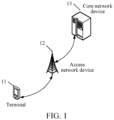
- FIG. 1 shows a block diagram of a wireless communication system to which an embodiment of this application is applicable.
- the wireless communication system includes a terminal 11, an access network device 12, and a core network device 13.
- the terminal 11 may also be referred to as a terminal device or user equipment (User Equipment, UE), and the terminal 11 may be other terminal-side devices, such as a mobile phone, a tablet personal computer (Tablet Personal Computer), a laptop computer (Laptop Computer) or a notebook computer, a palmtop computer, a netbook, an ultra-mobile personal computer (ultra-mobile personal computer, UMPC), a mobile Internet device (Mobile Internet Device, MID), a wearable device (Wearable Device) or a vehicle user equipment (VUE), and a pedestrian user equipment (PUE).
- a mobile phone a tablet personal computer (Tablet Personal Computer), a laptop computer (Laptop Computer) or a notebook computer, a palmtop computer, a netbook, an ultra-mobile personal computer (ultra-mobile personal computer, UMP
- the wearable device includes: smart watches, bracelets, headphones, glasses, and the like. It should be noted that the specific type of the terminal 11 is not limited in this embodiment of this application.
- the access network device 12 may also be referred to as a radio access network device or a radio access network (Radio Access Network, RAN).
- the access network device 12 may be a base station.
- the base station may be referred to as a node B, an evolved node B, an access point, a base transceiver station (Base Transceiver Station, BTS), a radio base station, a radio transceiver, a basic service set (Basic Service Set, BSS), an extended service set (Extended Service Set, ESS), a Node B, an evolved Node B (eNB), a home Node B, a home evolved Node B, a WLAN access point, a WiFi node, a transmitting receiving point (Transmitting Receiving Point, TRP), or some other suitable terms in the art, provided that the same technical effect is achieved, the base station is not limited to specific technical vocabulary.
- the core network device 13 may also be referred to as a core network (Core Network, CN) or a 5G core (5G core, 5GC) network.
- Core Network CN
- 5G core 5G core
- the core network device 13 may include, but is not limited to, at least one of the following: a core network node, a core network function, a mobility management entity (Mobility Management Entity, MME), an access and mobility management function (Access and Mobility Management Function, AMF), a session management function (Session Management Function, SMF), a user plane function (User Plane Function, UPF), a policy control function (Policy Control Function, PCF), a policy and charging rules function unit (Policy and Charging Rules Function, PCRF), an edge application server discovery function (Edge Application Server Discovery Function, EASDF), an application function (Application Function, AF), and the like.
- MME mobility management entity
- AMF Access and Mobility Management Function
- SMF Session Management Function
- UPF User Plane Function
- PCF Policy Control Function
- PCRF Policy and Charging Rules Function
- EASDF Application Server Discovery Function
- Application Function Application Function
- AF Application Function
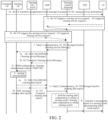
- FIG. 2 is a schematic diagram of a sensing service process in the related art. As shown in FIG. 2 , the sensing service process includes the following steps:
- step 1a and step 1b may both be an alternative relationship.
- Step 2 The SCF network element transmits Namf_Communication_N1 N2 Message Transfer (sensing service message (Sensing service Message)) to the AMF network element.
- Step 3 The AMF network element transmits the sensing service message to a sensing UE.
- Step 4 The sensing UE performs sensing measurement.
- Step 5 The sensing UE reports a measurement result.
- the sensing data report is generated according to a measurement result.
- Step 6 The AMF network element transmits the sensing data report to the SCF network element through Namf_Communication_N1 N2 Message Transfer.
- Step 7 The SCF network element calculates sensing data according to the sensing data report and obtains a sensing result.
- Step 8 The SCF network element transmits the sensing data report or a sensing result report to the AF.
- FIG. 2 shows an overall sensing service process, but the following problems still exist in the sensing service scenario for a user granularity (a certain or a group of consumer UE):
- a sensing service processing method, a terminal, and a network-side device provided by embodiments of this application are described below in detail through some embodiments and application scenarios thereof with reference to the drawings.
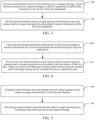
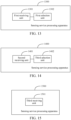
- FIG. 3 is a first schematic flowchart of a sensing service processing method according to an embodiment of this application. As shown in FIG. 3 , an execution entity of the method is a first network element.
- the first network element involved in this embodiment of this application may be an access and mobility management function AMF network element or a sensing control function SCF network element.
- a first network element is described as an AMF network element or an SCF network element, which is not limited to this application.
- Step 300 A first network element receives a first sensing service request message, where the first sensing service request message is used for requesting for performing sensing for a service for a first user equipment.
- the first user equipment UE may be an Internet of Things device, or a device used by a user (user), or the device used by the user refers to the user.
- the sensing service is carried out for the first user equipment UE, which has the following meanings: That is, a service object of the sensing service is the first UE, and the sensing service process is used for sensing and measuring one or more measurement quantities (measurement quantity).
- the measurement quantity is associated with the first UE.
- Sensing signals are transmitted, received, and measured between other peripherals of the first UE, so as to evaluate the influence of signals passing through a surrounding environment of the first UE and acquire the measurement quantity associated with the first UE.
- the first UE refers to the user (user), and transmits a sensing physical signal using a transmitting device around the user (user).
- the physical signal passes through the environment around the user and is affected by the breathing of the user (user), and reaches a signal receiving device.
- the signal receiving device performs analysis and measurement to acquire the measurement quantity of the sensing signal affected by the breathing of the user (user).
- Step 301 The first network element selects a target sensing control function network element and/or a target sensing device according to location information of the first user equipment.
- the target sensing control function network element includes a selected SCF network element.
- the target sensing device includes a selected sensing terminal device and/or sensing access network device.
- the SCF network element may include at least one of the following functions:
- the sensing device includes a sensing terminal device (Sensing UE) and/or a sensing access network device (Sensing RAN).
- Sensing UE sensing terminal device
- Sensing RAN sensing access network device
- the sensing device may include at least one of the following functions:
- the first network element determines location information of the first user equipment in response to the first sensing service request message, and selects a target sensing control function network element and/or a target sensing device according to the location information of the first user equipment and the first sensing service request message.
- a first network element processes a sensing service request message, and the first network element selects a suitable sensing control function network element and/or sensing device for a sensing service of a first user equipment according to location information of the first user equipment, so as to ensure the smooth progress of a sensing service process based on a user granularity.
- the first sensing service request message is transmitted by the AF, or by the first user equipment, or by the AF through a network exposure function (Network Exposure Function, NEF) network element.
- NEF Network Exposure Function
- the method before step 300, the method further includes the following steps: Step 0: The consumer UE may interact with the AF in an application layer for sensing task information, where the sensing task information includes identification information of the consumer UE (such as a consumer UE ID or a Consumer UE IP address) and third sensing service description information.
- the sensing task information includes identification information of the consumer UE (such as a consumer UE ID or a Consumer UE IP address) and third sensing service description information.
- the AF may determine that the consumer UE requests to execute a sensing service corresponding to the third sensing service description information.
- Step 1a The AF transmits a first sensing service request message to the first network element through the NEF network element.
- step 1a does not need to be performed by the NEF network element.
- Step 1b the consumer UE may also directly transmit the first sensing service request message to the first network element.
- the consumer UE may use an NAS message to transmit the first sensing service request message to the first network element.
- the first sensing service request message includes identification information of the first user equipment and first sensing service description information.
- the first sensing service description information includes at least one of the following:
- the first sensing service request message carries the identification information of the first user equipment and the first sensing service description information.
- the first sensing service description information is the same or different from the third sensing service description information.
- the AF actually extracts or generates the first sensing service description information according to the third sensing service description information.
- the identification information of the first user equipment refers to identification information of a service object of a sensing service, such as the consumer UE ID or the Consumer UE IP address, which is used for indicating a user equipment identifier triggering the sensing service, or explaining a user identifier corresponding to the service object of the sensing service.
- the sensing service type information is used for defining a sensing service type, which may be defined according to a sensing physical range and real-time requirements, such as Type I: Large sensing range and high real-time requirement (e.g., Delay Critical Large Scale Service (LSS)); Type II: Large sensing range and low real-time requirement (e.g., LSS); Type III: Small sensing range and high real-time requirement (e.g., Delay Critical Small Scale Service (SSS)); Type IV: Small sensing range and low real-time requirement (e.g., SSS).
- LSS Delay Critical Large Scale Service
- SSS Delay Critical Small Scale Service
- the sensing object information includes, but is not limited to, at least one of objects, equipment, people, animals, buildings, cars, environment, air quality, humidity, temperature, and a specific area (namely, a certain area).
- the measurement type (measurement type) information is used for indicating which types of measurement quantities of a sensing object are measured, including but not limited to: at least one of a location of the sensing object, a distance of the sensing object, a moving speed of the sensing object, imaging of the sensing object, a motion trajectory of the sensing object, texture analysis and material analysis of the sensing object, a shape of the sensing object, and a heartbeat of the sensing object.
- the sensing service purpose or application information corresponds to second and third columns of Table 1 respectively.
- Table 1 Wireless sensing service purpose and application Wireless sensing category Sensing service purpose Application Large-scale macroscopic sensing category Weather, air quality, etc. Meteorological, agricultural, and living services Traffic flow (intersection) and people flow (subway entrance) Smart city, intelligent transportation, and business services Animal activities, migration, etc. Animal husbandry, ecological environment protection, etc. Target tracking, ranging, velocity measurement, contour, etc. Many application scenarios of traditional radar Three-dimensional mapping Intelligent driving, navigation, and smart city Close-range refined sensing category Action posture recognition Smart interaction, games and smart home of smartphones Heartbeat/breathing, etc. Health and medical care Imaging, material detection, etc. Security check, industry, etc.
- the sensing service granularity information includes, but is not limited to, a user granularity per UE or a user group granularity per UE Group.
- the granularity information of the sensing service is the user granularity in this embodiment.
- the sensing service time information is specifically used for defining time information about execution of a sensing service, which may be absolute time information (for example, Monday, 13:00-19:00) or relative time information (for example, within the next month).
- the time information may include a start time, an end time, a duration, or the like.
- the sensing data reporting information (reporting information) is used for defining a reporting condition, a reporting time, a reporting format, and a reporting count of sensing data.
- the reporting condition may be event triggering or periodic triggering. If the reporting condition is event triggering, the reporting condition further includes event description information (for example, determining that a user enters a driving state). If the reporting condition is periodic triggering, the reporting condition further includes reporting period information (for example, every 5 minutes).
- the reporting time is used for indicating a time range needed to report sensing measurement data, and the reporting time may be consistent or inconsistent with the foregoing sensing service time.
- the reporting format is used for indicating a form in which the sensing data is reported, for example, indicating reporting in a binary/text form.
- the reporting count is used for indicating whether the reporting is performed once or repeatedly, and indicating a count of repeated reporting.
- the sensing service quality of service (QoS) requirement information includes, but is not limited to, at least one of a sensing accuracy, a sensing error, a sensing range, a sensing delay, a detection probability, and a false alarm probability.
- the sensing accuracy includes: a range resolution, an imaging resolution, a moving speed resolution, or an angle resolution.
- the sensing error includes: a range error, an imaging error, or a moving speed error.
- the first sensing service request message further includes: first sensing serving area information, where the first sensing serving area information includes absolute location range information or relative location range information corresponding to the first user equipment.
- the first sensing serving area information is used for indicating a location range or location granularity of the sensing service for the service object of the sensing service.
- the first sensing serving area information may be absolute location range information corresponding to the first user equipment.
- the first sensing serving area information includes TAI(s), cell ID(s), and/or an area ID (such as Tiananmen Square, Beijing) corresponding to the first user equipment.
- the sensing service when the granularity of a sensing service is TAI(s), it means that the sensing service is carried out within a range indicated by TAI(s).
- the granularity of a sensing service is an area ID, it means that the sensing service is carried out within a range indicated by the area ID.
- a range indicated by the plurality of pieces of information may or may not be consistent. If no, it means that the sensing service is carried out within a union range of the ranges indicated by the plurality of pieces of information.
- the first sensing serving area information may be relative location range information corresponding to the first user equipment. For example, the location of the first user equipment is within 20 meters around.
- the first sensing service request message carries the first sensing serving area information, indicating that the first sensing serving area information is designated by the AF or the first user equipment.
- the method further includes: The first network element reselects the target sensing control function network element and/or the target sensing device according to an update of the location information of the first user equipment.
- the location of the first user equipment may change continuously due to the movement thereof. Therefore, the first network element needs to track the location of the first user equipment all the time and reselect the target sensing control function network element and/or the target sensing device according to the update of the location information of the first user equipment.
- the first network element may subscribe the location information of the first user equipment to an RAN or to an LMF for tracking the location of the first user equipment.
- the AMF subscribes the location information of the consumer UE to the RAN or to the LMF for tracking the location of the consumer UE.
- the first network element selects a target sensing control function network element and/or a target sensing device according to location information of the first user equipment, including: Step 400: The first network element determines information of a first area according to the location information of the first user equipment and second sensing serving area information.
- the second sensing serving area information includes relative location range information or absolute location range information associated with the first user equipment.
- the second sensing serving area information may be the first sensing serving area information, namely, relative location range information or absolute location range information associated with the first user equipment designated by the AF or the first user equipment.
- the second sensing serving area information is generated according to the first sensing serving area information.
- the second sensing serving area information may also be default relative location range information or absolute location range information locally configured by the first network element.
- the location information of the first user equipment may be a TA, cell or another type of location of the first user equipment in the network.
- the first network element may also acquire the location information (such as GPS location information and grid location information) of the first user equipment from the LMF by using a network location service.
- location information such as GPS location information and grid location information
- the first area refers to an area of interest (area of interest, AOI).
- the first network element determines information of a first area according to the location information of the first user equipment and second sensing serving area information by the following two implementation modes:
- Step 401 The first network element selects the target sensing control function network element and/or the target sensing device according to the information of the first area, where a serving area of the target sensing control function network element and/or the target sensing device includes the entire or partial first area.
- the first network element needs to determine one or more target sensing control function network elements capable of serving the AOI and/or the target sensing device to carry out the sensing service.
- the first network element determines whether the sensing control function network element and/or the sensing device can serve the AOI according to whether a serving area (serving area) of the sensing control function network element and/or the sensing device includes the entire or partial AOI.
- a serving area of an SCF may serve the AOI, and the SCF may be used as a target sensing control function network element.
- the SCF may serve the partial AOI (other parts of the AOI may be served by other SCFs), and the one or more SCFs may be used as target sensing control function network elements.
- the first network element further needs to select one or more sensing control function network elements and/or sensing devices that can satisfy, according to at least one information in the first sensing service request message, the information.
- the AMF further needs to select one or more SCFs satisfying the information based on at least one of the following information in the first sensing service request message:
- service sensing attribute and capability information of the SCF network element may be characterized by at least one of the following: supported sensing measurement range information, supported sensing service type information, supported sensing object information, supported sensing measurement type information, supported sensing service purpose or application information, supported sensing service time information, supported sensing data reporting information, and supported sensing service quality of service (QoS) information.
- service sensing attribute and capability information is equivalent to the service sensing capability information in this application.
- the first network element selects a sensing control function network element and/or a sensing device with reference to at least one information in the first sensing service request message by the following two implementations:
- the first network element locally stores attribute and capability information of the sensing control function network element and/or the sensing device (for example, the sensing measurement range supported by the SCF, the sensing service type supported by the SCF, the sensing service Qos level supported by the SCF, and the like). Then the first network element selects the target sensing control function network element and/or the target sensing device according to the attribute and capability information of the sensing control function network element and/or the sensing device.
- the method further includes: The first network element acquires service sensing capability information of a sensing control function network element and/or a sensing device in a network.
- the network herein may be specific to the serving area (serving area) of the first network element in the network or in the second sensing serving area or in the first area.
- the first network element selects the target sensing control function network element and/or the target sensing device according to the information of the first area, including: The first network element queries the target sensing control function network element and/or the target sensing device from a network repository function network element according to the information of the first area.
- the network repository function network element is an NRF (Network Repository Function) network element.
- NRF Network Repository Function
- the NRF network element may also be replaced by other network elements with repository functions such as unified data management (Unified Data Management, UDM) and unified data repository (Unified Data Repository, UDR).
- UDM Unified Data Management
- UDR Unified Data Repository
- a query request transmitted by the first network element to the NRF carries corresponding query conditions.
- the query conditions may include at least one of the following: the information of the first area and the service sensing attribute and capability information.
- the service sensing attribute and capability information may be generated according to the sensing service description information.
- service sensing attribute and capability information is equivalent to the service sensing capability information in this application.
- the NRF returns the target sensing control function network element and/or the target sensing device to the first network element according to the query request.
- the query conditions carry AOI and service sensing QoS capability information
- the NRF returns the target sensing control function network element and/or the target sensing device satisfying the query conditions. It should be noted that this mode is suitable for the sensing control function network element and/or the sensing device registering own service sensing capability information in the NRF in advance.
- the first network element selects the target sensing control function network element and/or the target sensing device according to the information of the first area, including:
- the target sensing control function network element and/or the target sensing device have a sensing service capability matched with the sensing service, thereby ensuring the smooth progress of the sensing service process.
- the sensing service capability matched with the sensing service refers to a capability of meeting the requirements of the sensing service, that is, a capability of executing the sensing service described by the first sensing service description information.
- the first network element selects the sensing control function network element/sensing device in the first area which can satisfy the sensing service corresponding to the first sensing service description information according to the service sensing capability information of the sensing control function network element/sensing device in the network.
- the first network element determines the service sensing capability information of the sensing control function network element/sensing device in the first area according to the service sensing capability information of the sensing control function network element/sensing device in the network, and selects the sensing control function network element/sensing device with the sensing service capability matched with the sensing service corresponding to the first sensing service description information.
- the first network element needs to reselect a sensing control function network element/sensing device in a new first area that can satisfy the sensing service corresponding to the first sensing service description information as the target sensing control function network element/sensing device.
- the first network element needs to continuously track and match the sensing terminal device (sensing UE) matched with the sensing service in the first area.
- the service sensing capability information includes at least one of the following:
- the method further includes: The first network element transmits a second sensing service request message to the target sensing control function network element in a case that the first network element selects the target sensing device.
- the second sensing service request message includes: second sensing service description information and identification information of the target sensing device, where the second sensing service description information is generated according to the first sensing service description information.
- the second sensing service request message is used for requesting the target sensing control function network element to transmit sensing resource configuration information, a sensing measurement task, and sensing measurement control information to the target sensing device, thereby ensuring the smooth progress of the sensing service process.
- the second sensing service description information in the second sensing service request message is generated according to the first sensing service description information and may be the same as or different from the first sensing service description information.
- the second sensing service description information may be understood with reference to the first sensing service description information.
- the first network element is an AMF.
- the AMF selects a suitable target SCF network element for the sensing service of the first user equipment, selects a suitable target sensing device, and transmits identification information of the target sensing device to the target SCF network element, whereby the target SCF network element transmits sensing resource configuration information, a sensing measurement task, and sensing measurement control information to the target sensing device.
- the first network element needs to continuously track and match the sensing terminal device (sensing UE) matched with the sensing service in the first area, determine a new target sensing terminal device, and transmit identification information of the new target sensing terminal device to a target SCF network element, whereby the target SCF network element transmits the sensing resource configuration information, the sensing measurement task, and the sensing measurement control information to the new target sensing device, thereby ensuring the smooth progress of the sensing service process.
- the method further includes: The first network element transmits a third sensing service request message to the target sensing control function network element in a case that the first network element does not select the target sensing device.
- the third sensing service request message includes at least one of the following:
- the second sensing service description information is generated according to the first sensing service description information.
- the third sensing service request message is used for requesting the target sensing control function network element to select the target sensing device, thereby ensuring the smooth progress of the sensing service process.
- the second sensing service description information is generated according to the first sensing service description information and may be the same as or different from the first sensing service description information.
- the second sensing service description information may be understood with reference to the description of the first sensing service description information in the foregoing embodiments. The details are omitted herein.
- the third sensing service request message further includes information of the first area.
- the third sensing service request message is used for requesting the target sensing control function network element to select the target sensing device according to the information of the first area.
- the information of the first area is determined according to the location information of the first user equipment and the relative location range information or the absolute location range information (namely, the second sensing serving area information) associated with the first user equipment.
- the third sensing service request message further includes identification information of a candidate sensing device in the first area.
- the identification information of the candidate sensing device includes identification information of one or more candidate sensing devices.
- the third sensing service request message is used for requesting the target sensing control function network element to select the target sensing device based on the identification information of the candidate sensing device in the first area.
- the identification information of the candidate sensing device in the first area is identification information of all/part of sensing devices currently located in the first area determined by the first network element.
- the identification information of all/part of the sensing devices currently located in the first area is transmitted to the target sensing control function network element, whereby the target sensing control function network element selects the target sensing device for executing the sensing service.
- the identification information of the candidate sensing device includes a candidate UE ID list and/or a candidate RAN ID list.
- the candidate UE ID list is identification information of all/part of UEs located within an AOI range determined by the AMF.
- the candidate RAN ID list is identification information of all/part of RANs located within the AOI range determined by the AMF.
- the first network element is an AMF.
- the AMF selects a suitable target SCF network element for the sensing service of the first user equipment, and transmits a third sensing service request message to the target SCF network element, whereby the target SCF network element selects a target sensing device according to the third sensing service request message, and the target SCF network element transmits sensing resource configuration information, a sensing measurement task, and sensing measurement control information to the target sensing device subsequently, thereby ensuring the smooth progress of a sensing service process.
- the first network element includes an access and mobility management function AMF network element or a sensing control function SCF network element.
- the sensing device includes a sensing terminal device and/or a sensing access network device.
- FIG. 5 is a second schematic flowchart of a sensing service processing method according to an embodiment of this application. As shown in FIG. 5 , an execution entity of the method is a sensing control function SCF network element.
- Step 500 A sensing control function network element receives a third sensing service request message transmitted by a first network element.
- the sensing control function network element in this embodiment is a target sensing control function network element selected by the first network element in the foregoing embodiments.
- the third sensing service request message includes at least one of the following:
- the sensing control function network element receives the third sensing service request message transmitted by the first network element, and may obtain at least one of the second sensing service description information, the information of the first area, and the identification information of the candidate sensing device in the first area.
- the second sensing service description information is generated by the first network element according to the first sensing service description information and may be the same as or different from the first sensing service description information.
- the information of the first area is determined by the first network element according to the location information of the first user equipment and the relative location range information or the absolute location range information (namely, the second sensing serving area information) associated with the first user equipment.
- the identification information of the candidate sensing device in the first area is identification information of all/part of sensing devices currently located in the first area determined by the first network element.
- the identification information of the candidate sensing device includes a candidate UE ID list and/or a candidate RAN ID list.
- the candidate UE ID list is identification information of all/part of UEs located within an AOI range determined by the AMF.
- the candidate RAN ID list is identification information of all/part of RANs located within the AOI range determined by the AMF.
- Step 501 The sensing control function network element selects a target sensing device according to the third sensing service request message.
- the sensing control function network element selects a target sensing device according to the third sensing service request message, whereby the sensing control function network element transmits sensing resource configuration information, a sensing measurement task, and sensing measurement control information to the target sensing device subsequently, thereby ensuring the smooth progress of a sensing service process.
- the first network element includes an access and mobility management function AMF network element or a sensing control function SCF network element.
- the sensing device includes a sensing terminal device and/or a sensing access network device.
- the second sensing service description information includes at least one of the following:
- the second sensing service description information may be understood with reference to the description of the first sensing service description information in the foregoing embodiments. The details are omitted herein.
- the sensing control function network element selects a target sensing device according to the third sensing service request message, including: The sensing control function network element selects the target sensing device according to the information of the first area, where a serving area of the target sensing device includes the entire or partial first area.
- the sensing control function network element determines a sensing device currently located in the first area as the target sensing device according to location information of each sensing device (sensing UE/RAN) in a case that the information of the first area is carried in the third sensing service request message.
- the location information of each sensing device may be:
- the serving area of the target sensing device is the entire first area, indicating that the target sensing device may serve the entire AOI.
- the serving area of the target sensing device is the partial first area, indicating that the target sensing device may serve the partial AOI.
- Other parts of the AOI may be served by other sensing devices.
- the sensing control function network element selects a target sensing device according to the third sensing service request message, including: The sensing control function network element selects a sensing device with a sensing service capability matching a sensing service corresponding to the second sensing service description information as the target sensing device based on the identification information of the candidate sensing device in the first area and the second sensing service description information.
- the sensing control function network element selects the sensing device with the sensing service capability matching the sensing service corresponding to the second sensing service description information as the target sensing device from the candidate sensing device in a case that the identification information of the candidate sensing device in the first area is carried in the third sensing service request message.
- the SCF network element selects sensing UE(s) with a sensing service network capability satisfying a sensing service corresponding to the second sensing service description information from the candidate UE ID list, and/or the SF selects sensing RAN(s) with a sensing service capability satisfying the sensing service corresponding to the second sensing service description information from the candidate RAN ID list.
- the method further includes:
- the sensing control function network element acquires service sensing capability information of a sensing device in a network.
- the sensing device in the network may be all sensing UE/RANs in the entire network, or sensing UE/RANs in the partial network.
- the partial network may be limited to the first area (AOI range) or may not be limited to the first area.
- the service sensing capability information includes at least one of the following:
- the method further includes: the sensing control function network element reselects the target sensing device according to a change of the information of the first area.
- the sensing control function network element needs to reselect the target sensing device according to the changed information of the first area.
- the sensing control function network element determines a sensing device currently located in the changed first area as the target sensing device according to location information of each sensing device (sensing UE/RAN).
- the method further includes: The sensing control function network element reselects the target sensing device according to a change of the identification information of the candidate sensing device in the first area.
- the sensing UE(s) in the first area may change continuously due to own mobility. Therefore, the identification information of the candidate sensing device in the first area may change. If the identification information of the candidate sensing device in the first area changes, the sensing control function network element needs to reselect the target sensing device according to the changed identification information of the candidate sensing device in the first area
- the sensing control function network element selects a sensing device with a sensing service capability matching a sensing service corresponding to the second sensing service description information as the target sensing device according to the changed identification information of the candidate sensing device in the first area and the second sensing service description information.
- the sensing control function network element selects a target sensing device according to the third sensing service request message, whereby the sensing control function network element transmits sensing resource configuration information, a sensing measurement task, and sensing measurement control information to the target sensing device subsequently, thereby ensuring the smooth progress of a sensing service process.
- FIG. 6 is a third schematic flowchart of a sensing service processing method according to an embodiment of this application. As shown in FIG. 6 , an execution entity of the method is a sensing control function network element.
- Step 600 A sensing control function network element receives a second sensing service request message.
- the second sensing service request message includes: second sensing service description information and identification information of a target sensing device.
- sensing control function network element in this embodiment is the target sensing control function network element in the foregoing embodiments.
- the second sensing service request message is used for requesting the target sensing control function network element to transmit sensing resource configuration information, a sensing measurement task, and sensing measurement control information to the target sensing device corresponding to the identification information, thereby ensuring the smooth progress of the sensing service process.
- the second sensing service description information in the second sensing service request message is generated by the first network element according to the first sensing service description information and may be the same as or different from the first sensing service description information.
- the second sensing service description information includes at least one of the following:
- the first network element selects a target sensing control function network element and a target sensing device, and transmits a second sensing service request message to the target sensing control function network element.
- the second sensing service request message carries second sensing service description information and identification information of the target sensing device.
- the target sensing control function network element receives the second sensing service request message transmitted by the first network element, obtains the second sensing service description information and the identification information of the target sensing device, and transmits sensing resource configuration information, a sensing measurement task, and sensing measurement control information to the target sensing device corresponding to the identification information, thereby ensuring the smooth progress of the sensing service process.
- the first network element needs to continuously track and match the sensing terminal device (sensing UE) matched with the sensing service in the first area, determine a new target sensing terminal device, and transmit identification information of the new target sensing terminal device to a target SCF network element, whereby the target SCF network element transmits the sensing resource configuration information, the sensing measurement task, and the sensing measurement control information to the new target sensing device, thereby ensuring the smooth progress of the sensing service process.
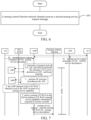
- FIG. 7 is a first schematic interaction flowchart of a sensing service processing method according to an embodiment of this application.
- the interaction flow includes the following steps:
- the sensing service description information in 1a may be the same as or different from that in step 0.
- the AF actually extracts or generates the corresponding sensing service description information in 1a according to the sensing service description information in step 0.
- the sensing service request message further includes identification information of a service object of a sensing service, such as the consumer UE ID or the Consumer UE IP address, which is used for indicating a user equipment identifier triggering the sensing service, or explaining a user identifier corresponding to the service object of the sensing service.
- identification information of a service object of a sensing service such as the consumer UE ID or the Consumer UE IP address, which is used for indicating a user equipment identifier triggering the sensing service, or explaining a user identifier corresponding to the service object of the sensing service.
- step 1a If the AF belongs to an operator trusted AF, step 1a does not need to be performed by the NEF. Or, Step 1b: The Consumer UE directly transmits the sensing service request message to the AMF.
- the content of the sensing service request message in step 1b is similar to that in step 1a.
- Step 1a and step 1b may both be an alternative relationship.
- the consumer UE may use an NAS message to transmit the sensing service request message to the AMF.
- Step 2 The AMF determines location information of the consumer UE and determines an AOI according to the location information.
- the location of a service object (consumer UE) of a sensing service may change continuously due to the movement thereof. Therefore, the AMF needs to keep track of the location of the consumer UE and determine the corresponding AOI.
- the AMF may subscribe the location of the consumer UE to an RAN or to an LMF for tracking the location of the consumer UE.
- Step 3 The AMF selects a sensing control function SCF network element according to the AOI.
- Step 4 The AMF interacts service sensing capability information with a sensing device in a network.
- the sensing device in the network here includes a sensing UE and/or a sensing RAN within an AMF serving area (AMF serving area).
- AMF serving area AMF serving area
- Trigger scenarios where the sensing UE reports own service sensing capability information to the AMF include but are not limited to at least one of the following:
- the service sensing capability information reported to the AMF by the sensing UE includes but is not limited to at least one of the following:
- Trigger scenarios where the Sensing RAN reports own service sensing capability information to the AMF include but are not limited to at least one of the following:
- the service sensing capability information reported by the sensing RAN to the AMF is similar to the above service sensing capability information of the sensing UE and will not be repeated herein.
- Step 5 The AMF selects the sensing UE/RAN in the AOI as the target sensing measurement device of the sensing service according to the sensing service request message and the capability information of the sensing UE/RAN.
- the sensing UE(s) in the AOI may change continuously due to own mobility. Therefore, the AMF needs to continuously track and match the sensing UE in the AOI matched with the sensing service. And the SCF is notified of a new sensing UE, whereby the SCF issues the sensing service control information to the new sensing UE.
- Step 6 The AMF forwards the sensing service request message to the SCF network element selected in step 3, where the sensing service request message carries the sensing service description information and the identification information of the selected sensing device (sensing UE/RAN).
- the sensing service description information transmitted here is generated by the AMF according to the sensing service description information received from the AF, and the two pieces of information may be the same or different.
- the AMF selects a suitable SCF for the sensing service of the consumer UE, and selects the sensing device. Then the AMF transmits an identifier of the sensing device to the SCF, whereby the SCF transmits sensing resource configuration information, a sensing measurement task, and sensing measurement control information to the sensing device subsequently, thereby ensuring the smooth progress of the sensing service process.
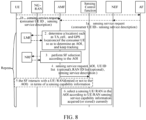
- FIG. 8 is a second schematic interaction flowchart of a sensing service processing method according to an embodiment of this application.
- the interaction flow includes the following steps:
- the sensing UE/RAN in the network may be all sensing UE/RANs in the entire network, or sensing UE/RANs in the partial network.
- the partial network may be limited to the AOI range acquired in step 4 or may not be limited thereto.
- the partial network may be a serving area (serving area) of the SCF.
- the SCF and the sensing UE/RAN within the sensing area may interact in terms of service sensing capability information.
- trigger scenarios where the sensing UE reports own service sensing capability information to the SCF include but are not limited to at least one of the following:
- the Sensing UE reports the service sensing capability information to the SCF similar to that described in step 4 of FIG. 7 .
- Trigger scenarios where the Sensing RAN reports own service sensing capability information to the SCF include but are not limited to at least one of the following:
- the service sensing capability information reported by the sensing RAN to the SCF is similar to the service sensing capability information of the sensing UE in the foregoing embodiments and will not be repeated herein.
- the AMF selects a suitable SCF for the sensing service of the consumer UE, and the SCF selects the sensing device, whereby the SCF transmits sensing resource configuration information, a sensing measurement task, and sensing measurement control information to the sensing device subsequently, thereby ensuring the smooth progress of the sensing service process.
- FIG. 9 is a fourth schematic flowchart of a sensing service processing method according to an embodiment of this application. As shown in FIG. 9 , an execution entity of the method is a sensing control function network element.
- Step 900 A sensing control function SCF network element receives a first sensing service request message, where the first sensing service request message is used for requesting for performing sensing for a service for a first user equipment.
- the first user equipment UE may be an Internet of Things device, or a device used by a user (user), or the device used by the user refers to the user.
- the sensing service is carried out for the first user equipment UE, which has the following meanings: That is, a service object of the sensing service is the first UE, and the sensing service process is used for sensing and measuring a certain measurement quantity.
- the measurement quantity is associated with the first UE.
- Sensing signals are transmitted, received, and measured between other peripherals of the first UE, so as to evaluate the influence of signals passing through a surrounding environment of the first UE and acquire the measurement quantity associated with the first UE.
- the first UE refers to the user (user), and transmits a sensing physical signal using a transmitting device around the user (user).
- the physical signal passes through the environment around the user and is affected by the breathing of the user (user), and reaches a signal receiving device.
- the signal receiving device performs analysis and measurement to acquire the measurement quantity of the sensing signal affected by the breathing of the user (user).
- the first sensing service request message is transmitted by the AF, or by the first user equipment, or by the AF through a network exposure function (Network Exposure Function, NEF) network element.
- NEF Network Exposure Function
- the method further includes the following steps: Step 0: The consumer UE may interact with the AF in an application layer for sensing task information, where the sensing task information includes identification information of the consumer UE (such as a consumer UE ID or a Consumer UE IP address) and third sensing service description information.
- the sensing task information includes identification information of the consumer UE (such as a consumer UE ID or a Consumer UE IP address) and third sensing service description information.
- the AF may determine that the consumer UE requests to execute a sensing service corresponding to the third sensing service description information.
- Step 1a The AF transmits a first sensing service request message to the SCF network element through the NEF network element.
- step 1a does not need to be performed by the NEF network element.
- Step 1b the consumer UE may also directly transmit the first sensing service request message to the SCF network element.
- the consumer UE may use an NAS message to transmit the first sensing service request message to the SCF network element.
- the first sensing service request message includes: identification information of the first user equipment and first sensing service description information.
- the first sensing service description information includes at least one of the following:
- the identification information of the first user equipment and the first sensing service description information may be described with reference to the description in the foregoing embodiments and will not be repeated herein.
- the first sensing service request message further includes: first sensing serving area information, where the first sensing serving area information includes absolute location range information or relative location range information corresponding to the first user equipment.
- the first sensing serving area information may be understood with reference to the description in the foregoing embodiments and will not be repeated herein.
- Step 901 The sensing control function network element transmits a first request message to a first network element, where the first request message is used for requesting to acquire identification information of a sensing device in a sensing serving area corresponding to the first user equipment.
- the sensing serving area corresponding to the first user equipment includes absolute location range information or relative location range information corresponding to the first user equipment.
- the sensing serving area corresponding to the first user equipment is represented by third sensing serving area information.
- the third sensing serving area information is the same as or different from the first sensing serving area information. In a case that the two pieces of information are different, the third sensing serving area information is generated by the sensing control function network element according to the first sensing serving area information.
- the third sensing serving area information may be carried in a first request message and transmitted to a first network element (such as an AMF network element) through the first request message. That is, the first request message includes: identification information (such as a consumer UE ID or a Consumer UE IP address) of the first user equipment and the third sensing serving area information.
- identification information such as a consumer UE ID or a Consumer UE IP address
- the first request message may be Namf_EventExposure_EventExposure_Subscribe.
- the third sensing serving area information is configured locally in the first network element, and neither the first sensing service request message nor the first request message carries the information.
- the sensing serving area of the consumer UE may be a relative range (such as within 20 meters of the periphery centered by the consumer UE).
- the relative range may be carried in the first request message or configured in the AMF by default.
- the first request message is used for requesting the AMF to detect a UE ID list and/or an RAN ID list within the relative range of the consumer UE.
- the sensing serving area of the consumer UE may be an absolute range (such as Tiananmen Square), and the absolute range information is carried in the first request message for instructing the AMF to provide the UE list and/or the RAN list within the absolute range at the same time when detecting the occurrence of an event that the consumer UE enters the absolute range.
- an absolute range such as Tiananmen Square
- the first network element includes an access and mobility management function AMF network element.
- the sensing device includes a sensing terminal device (sensing UE) and/or a sensing access network device (sensing RAN).
- Step 902 The sensing control function network element receives a first request response message transmitted by the first network element, and acquires identification information of a candidate sensing device in the sensing serving area corresponding to the first user equipment.
- the first network element After receiving the first request message, the first network element determines the information of the first area according to the location information of the first user equipment and the sensing serving area corresponding to the first user equipment, and acquires the identification information of the candidate sensing device in the first area.
- the identification information of the candidate sensing device includes identification information of one or more candidate sensing devices.
- the candidate sensing device in the first area may be all UE ID lists and/or RAN ID lists in the first area identified by the first network element.
- the candidate sensing device in the first area may be UE ID lists and/or RAN ID lists for carrying out sensing services in the first area identified by the first network element.
- the first network element transmits the identification information of the candidate sensing device in the sensing serving area corresponding to the first user equipment to the sensing control function network element through the first request response message.
- the AMF determines an AOI according to the location information of the consumer UE and the first sensing serving area information, and the AMF determines a UE ID list and/or an RAN ID list within the AOI.
- the AMF transmits the UE ID list and/or the RAN ID list within the AOI to the SCF.
- the AMF may transmit the UE ID list and/or the RAN ID list using a Namf_EventExposure_Notify message
- the location of the first user equipment may change continuously due to the movement thereof. Therefore, the first network element needs to track the location information of the first user equipment all the time, whereby the first area will change, and the identification information of the candidate sensing device in the sensing serving area corresponding to the first user equipment determined by the first network element changes accordingly.
- the first network element also needs to continuously track and determine identification information of a candidate sensing terminal device in the sensing serving area corresponding to the first user equipment.
- Step 903 The sensing control function network element selects a target sensing device for the sensing service according to the identification information of the candidate sensing device.
- the method further includes:
- the sensing control function network element acquires service sensing capability information of a sensing device in a network.
- the network here may be the entire or partial network.
- the partial network may be limited to the first area or may not be limited thereto.
- the partial network may be a serving area (serving area) of the sensing control function SCF network element. That is, the SCF and the sensing UE/RAN within the sensing area may interact in terms of service sensing capability information.
- the sensing control function network element selects a target sensing device for the sensing service according to the identification information of the candidate sensing device, including: The sensing control function network element selects a sensing device with a sensing service capability matching the sensing service in the candidate sensing device as the target sensing device according to the service sensing capability information of the sensing device in the network.
- the SCF network element selects sensing UE(s) with a sensing service network capability satisfying the sensing service from the candidate UE ID list, and/or the SCF network element selects sensing RAN(s) with a sensing service capability satisfying the sensing service from the candidate RAN ID list.
- the service sensing capability information includes at least one of the following:
- the service sensing capability information may be understood with reference to the description in the foregoing embodiments and will not be repeated herein.
- user equipment or AF triggers to transmit a sensing service request message.
- the sensing control function SCF network element After receiving the sensing service request message, the sensing control function SCF network element transmits identification information of a sensing device in a sensing serving area corresponding to a first user equipment to the first network element, and selects a target sensing device for the sensing service according to the identification information, whereby the sensing control function SCF network element transmits sensing resource configuration information, a sensing measurement task, and sensing measurement control information to the target sensing device subsequently, thereby ensuring the smooth progress of a sensing service process.
- FIG. 10 is a fifth schematic flowchart of a sensing service processing method according to an embodiment of this application.
- an execution entity of the method is a first network element.
- the first network element includes: an access and mobility management function AMF network element.
- the sensing device includes a sensing terminal device and/or a sensing access network device.
- the method includes the following steps:
- This embodiment is an action description of the embodiment shown in FIG. 9 , and therefore this embodiment may be understood with reference to the description in the embodiment shown in FIG. 9 and will not be repeated herein.
- the first request message includes: identification information of the first user equipment and third sensing serving area information.
- the third sensing serving area information includes absolute location range information or relative location range information corresponding to the first user equipment.
- the third sensing serving area information may be understood with reference to the foregoing embodiments and will not be repeated herein.
- the determining information of a first area according to location information of the first user equipment includes: determining the information of the first area according to the location information of the first user equipment and the third sensing serving area information.
- the first network element After receiving the first request message, the first network element determines the information of the first area according to the location information of the first user equipment and the sensing serving area corresponding to the first user equipment, and acquires the identification information of the candidate sensing device in the first area.
- the first network element transmits the identification information of the candidate sensing device in the sensing serving area corresponding to the first user equipment to the sensing control function network element through the first request response message
- the AMF determines an AOI according to the location information of the consumer UE and the third sensing serving area information, and the AMF determines a UE ID list and/or an RAN ID list within the AOI.
- the AMF transmits the UE ID list and/or the RAN ID list within the AOI to the SCF.
- the AMF may transmit the UE ID list and/or the RAN ID list using a Namf_ EventExposure_Notify message
- the location of the first user equipment may change continuously due to the movement thereof. Therefore, the first network element needs to track the location information of the first user equipment all the time, whereby the first area will change, and the identification information of the candidate sensing device in the sensing serving area corresponding to the first user equipment determined by the first network element changes accordingly.
- the first network element also needs to continuously track and determine identification information of a candidate sensing terminal device in the sensing serving area corresponding to the first user equipment.
- user equipment or AF triggers to transmit a sensing service request message.
- the sensing control function SCF network element transmits identification information of a sensing device in a sensing serving area corresponding to a first user equipment to the first network element.
- the first network element returns the identification information of the sensing device in the sensing serving area corresponding to the first user equipment, whereby the SCF network element selects a target sensing device for the sensing service according to the identification information, and the sensing control function SCF network element transmits sensing resource configuration information, a sensing measurement task, and sensing measurement control information to the target sensing device subsequently, thereby ensuring the smooth progress of a sensing service process.
- FIG. 11 is a third schematic interaction flowchart of a sensing service processing method according to an embodiment of this application. As shown in FIG. 11 , the interaction flow includes the following steps:
- the sensing service description information in 1a may be the same as or different from that in step 0.
- the AF actually extracts or generates the corresponding sensing service description information in 1a according to the sensing service description information in step 0.
- the sensing service request message further includes identification information of a service object of a sensing service, such as the consumer UE ID or the Consumer UE IP address, which is used for indicating a user equipment identifier triggering the sensing service, or explaining a user identifier corresponding to the service object of the sensing service.
- identification information of a service object of a sensing service such as the consumer UE ID or the Consumer UE IP address, which is used for indicating a user equipment identifier triggering the sensing service, or explaining a user identifier corresponding to the service object of the sensing service.
- step 1a If the AF belongs to an operator trusted AF, step 1a does not need to be performed by the NEF. Or, Step 1b: The Consumer UE directly transmits the sensing service request message to the SCF.
- the content of the sensing service request message in step 1b is similar to that in step 1a.
- Step 2 The SCF transmits a first request message to an AMF, where the first request message is used for requesting to acquire identification information of a sensing device in a sensing serving area corresponding to a first user equipment.
- Step 3 The AMF determines an AOI according to the location of a consumer UE and a serving area of a sensing service of the consumer UE, and the AMF determines identification information (UE ID list and/or RAN ID list) of a sensing device in the AOI.
- identification information UE ID list and/or RAN ID list
- Step 4 The AMF transmits the identification information (UE ID list and/or RAN ID list) of the sensing device determined in step 3 to the SCF.
- identification information UE ID list and/or RAN ID list
- the AMF may transmit the UE list and/or the RAN list using a Namf_EventExposure_Notify message
- Step 5 The SCF and the sensing UE/RAN in the network interact in terms of service sensing capability information.
- Step 6 An SF selects a sensing device matched with the sensing service from the UE ID list and/or the RAN ID list transmitted by the AMF.
- the SF selects a sensing device for a sensing service according to a sensing service request message, whereby the SF transmits sensing resource configuration information, a sensing measurement task, and sensing measurement control information to the sensing device subsequently, thereby ensuring the smooth progress of the sensing service process.
- FIG. 12 is a sixth schematic flowchart of a sensing service processing method according to an embodiment of this application.
- an execution entity of the method is a sensing device.
- the sensing device includes a sensing UE and/or a sensing RAN.
- Step 1200 A sensing device reports service sensing capability information to a first network element.
- the service sensing capability information includes at least one of the following:
- the service sensing capability information may be understood with reference to the description in the foregoing embodiments and will not be repeated herein.
- the sensing device includes a sensing terminal device and/or a sensing access network device.
- the first network element includes an access and mobility management function AMF network element or a sensing control function network element.
- a sensing device reports service sensing capability information to a first network element, including:
- the sensing device reports the service sensing capability information to the first network element in a case that a first service sensing capability information reporting trigger condition is satisfied.
- the first service sensing capability information reporting trigger condition includes:
- the first service sensing capability information reporting trigger condition includes:
- the sensing terminal device reports the service sensing capability information to the AMF network element in a case that the first service sensing capability information reporting trigger condition is satisfied.
- a sensing device reports service sensing capability information to a first network element, including:
- the sensing device reports the service sensing capability information to the first network element in a case that a second service sensing capability information reporting trigger condition is satisfied.
- the second service sensing capability information reporting trigger condition includes:
- the second service sensing capability information reporting trigger condition includes:
- the sensing access network device reports the service sensing capability information to the AMF network element in a case that the second service sensing capability information reporting trigger condition is satisfied.
- a sensing device reports service sensing capability information to a first network element, including:
- the sensing device reports the service sensing capability information to the first network element in a case that a third service sensing capability information reporting trigger condition is satisfied.
- the third service sensing capability information reporting trigger condition includes:
- the third service sensing capability information reporting trigger condition includes:
- the sensing terminal device reports the service sensing capability information to the SCF network element in a case that the third service sensing capability information reporting trigger condition is satisfied.
- a sensing device reports service sensing capability information to a first network element, including: The sensing device reports the service sensing capability information to the first network element in a case that a fourth service sensing capability information reporting trigger condition is satisfied.
- the fourth service sensing capability information reporting trigger condition includes:
- the fourth service sensing capability information reporting trigger condition includes:
- the sensing access network device reports the service sensing capability information to the SCF network element in a case that the fourth sensing service capability information reporting trigger condition is satisfied.
- a sensing device reports service sensing capability information to a first network element, whereby the first network element may select the sensing device matching a sensing service according to service sensing capability information, thereby facilitating the smooth progress of a sensing service process.
- a plurality of SCFs in the network correspond to different sensing areas or sensing service types, and a Consumer AF or a Consumer UE needs to use the first network element to assist in selecting an SCF, and use the first network element or the selected SCF to select a Sensing UE/RAN.
- the execution entity of the sensing service processing method provided by this embodiment of this application may be a sensing service processing apparatus or a control module used for executing the sensing service processing method in the sensing service processing apparatus.
- the sensing service processing apparatus provided by this embodiment of this application is explained with an example where the sensing service processing apparatus performs the sensing service processing method.
- FIG. 13 is a first schematic structure diagram of a sensing service processing apparatus according to an embodiment of this application. As shown in FIG. 13 , the sensing service processing apparatus 1300 includes:
- a first network element processes a sensing service request message, and the first network element selects a suitable sensing control function network element and/or sensing device for a sensing service of a first user equipment according to location information of the first user equipment, so as to ensure the smooth progress of a sensing service process based on a user granularity.
- the first sensing service request message includes identification information of the first user equipment and first sensing service description information.
- the first sensing service description information includes at least one of the following:
- the first sensing service request message further includes: first sensing serving area information, where the first sensing serving area information includes absolute location range information or relative location range information corresponding to the first user equipment.
- the apparatus further includes: a second selection unit, configured to reselect the target sensing control function network element and/or the target sensing device according to an update of the location information of the first user equipment.
- a second selection unit configured to reselect the target sensing control function network element and/or the target sensing device according to an update of the location information of the first user equipment.
- the first selection unit is configured to:
- the selecting the target sensing control function network element and/or the target sensing device according to the information of the first area includes: the first network element queries the target sensing control function network element and/or the target sensing device from a network repository function NRF network element according to the information of the first area.
- the apparatus further includes: a first acquisition unit, configured to acquire service sensing capability information of a sensing control function network element and/or a sensing device in a network.
- a first acquisition unit configured to acquire service sensing capability information of a sensing control function network element and/or a sensing device in a network.
- the selecting the target sensing control function network element and/or the target sensing device according to the information of the first area includes:
- the service sensing capability information includes at least one of the following:
- the apparatus further includes: a first transmitting unit, configured to transmit a second sensing service request message to the target sensing control function network element in a case that the first network element selects the target sensing device.
- a first transmitting unit configured to transmit a second sensing service request message to the target sensing control function network element in a case that the first network element selects the target sensing device.
- the second sensing service request message includes: second sensing service description information and identification information of the target sensing device, where the second sensing service description information is generated according to the first sensing service description information.
- the apparatus further includes: a second transmitting unit, configured to transmit, by the first network element, a third sensing service request message to the target sensing control function network element in a case that the first network element does not select the target sensing device.
- a second transmitting unit configured to transmit, by the first network element, a third sensing service request message to the target sensing control function network element in a case that the first network element does not select the target sensing device.
- the third sensing service request message includes at least one of the following:
- the second sensing service description information is generated according to the first sensing service description information.
- the first network element includes an access and mobility management function AMF network element or a sensing control function SCF network element.
- the sensing device includes a sensing terminal device and/or a sensing access network device.
- the sensing service processing apparatus in this embodiment of this application may be an apparatus, an apparatus or electronic device with an operating system, or a component, an integrated circuit or a chip in a core network device.
- the sensing service processing apparatus can implement all processes implemented by the embodiments shown in FIG. 3 to FIG. 4 , and achieve the same technical effect. The details are omitted herein to avoid repetition.
- FIG. 14 is a second schematic structure diagram of a sensing service processing apparatus according to an embodiment of this application. As shown in FIG. 14 , the sensing service processing apparatus 1400 includes:
- the third sensing service request message includes at least one of the following:
- the second sensing service description information includes at least one of the following:
- the third selection unit is configured to: select the target sensing device according to the information of the first area, where a serving area of the target sensing device includes the entire or partial first area.
- the third selection unit is configured to: select a sensing device with a sensing service capability matching a sensing service corresponding to the second sensing service description information as the target sensing device based on the identification information of the candidate sensing device in the first area and the second sensing service description information.
- the apparatus further includes: a second acquisition unit, configured to acquire service sensing capability information of a sensing device in a network.
- the service sensing capability information includes at least one of the following:
- the apparatus further includes: a fourth selection unit, configured to reselect the target sensing device according to a change of the information of the first area.
- a fourth selection unit configured to reselect the target sensing device according to a change of the information of the first area.
- the apparatus further includes: a fifth selection unit, configured to reselect the target sensing device according to a change of the identification information of the candidate sensing device in the first area.
- a fifth selection unit configured to reselect the target sensing device according to a change of the identification information of the candidate sensing device in the first area.
- the first network element is an access and mobility management function AMF network element.
- the sensing device includes a sensing terminal device and/or a sensing access network device.
- the sensing control function network element selects a target sensing device according to the third sensing service request message, whereby the sensing control function network element transmits sensing resource configuration information, a sensing measurement task, and sensing measurement control information to the target sensing device subsequently, thereby ensuring the smooth progress of a sensing service process.
- the sensing service processing apparatus in this embodiment of this application may be an apparatus, an apparatus or electronic device with an operating system, or a component, an integrated circuit or a chip in a core network device.
- the sensing service processing apparatus can implement all processes implemented by the embodiment shown in FIG. 5 , and achieve the same technical effect. The details are omitted herein to avoid repetition.
- FIG. 15 is a third schematic structure diagram of a sensing service processing apparatus according to an embodiment of this application.
- the sensing service processing apparatus 1500 includes: a third receiving unit 1501, configured to receive a second sensing service request message.
- the second sensing service request message includes: second sensing service description information and identification information of a target sensing device.
- the second sensing service description information includes at least one of the following:
- the sensing control function network element obtains a target sensing device selected by the first network element according to a sensing service processing message transmitted by the first network element, whereby sensing resource configuration information, a sensing measurement task, and sensing measurement control information are transmitted to the target sensing device subsequently, thereby ensuring the smooth progress of a sensing service process.
- the sensing service processing apparatus in this embodiment of this application may be an apparatus, an apparatus or electronic device with an operating system, or a component, an integrated circuit or a chip in a core network device.
- the sensing service processing apparatus can implement all processes implemented by the embodiment shown in FIG. 6 , and achieve the same technical effect. The details are omitted herein to avoid repetition.
- FIG. 16 is a fourth schematic structure diagram of a sensing service processing apparatus according to an embodiment of this application. As shown in FIG. 16 , the sensing service processing apparatus 1600 includes:
- user equipment or AF triggers to transmit a sensing service request message.
- the sensing control function SCF network element After receiving the sensing service request message, the sensing control function SCF network element transmits identification information of a sensing device in a sensing serving area corresponding to a first user equipment to the first network element, acquires the identification information of the sensing device in the sensing serving area corresponding to the first user equipment returned by the first network element, and selects a target sensing device for the sensing service according to the identification information, whereby the sensing control function SCF network element transmits sensing resource configuration information, a sensing measurement task, and sensing measurement control information to the target sensing device subsequently, thereby ensuring the smooth progress of a sensing service process.
- the apparatus further includes: a third acquisition unit, configured to acquire service sensing capability information of a sensing device in a network.
- a third acquisition unit configured to acquire service sensing capability information of a sensing device in a network.
- the sixth selection unit is configured to: select a sensing device with a sensing service capability matching the sensing service in the candidate sensing device as the target sensing device according to the service sensing capability information of the sensing device in the network.
- the service sensing capability information includes at least one of the following:
- the first request message includes: identification information of the first user equipment and third sensing serving area information.
- the third sensing serving area information includes absolute location range information or relative location range information corresponding to the first user equipment.
- the first sensing service request message includes: identification information of the first user equipment and first sensing service description information.
- the first sensing service description information includes at least one of the following:
- the first network element includes an access and mobility management function AMF network element.
- the sensing device includes a sensing terminal device and/or a sensing access network device.
- the sensing service processing apparatus in this embodiment of this application may be an apparatus, an apparatus or electronic device with an operating system, or a component, an integrated circuit or a chip in a core network device.
- the sensing service processing apparatus can implement all processes implemented by the embodiment shown in FIG. 9 , and achieve the same technical effect. The details are omitted herein to avoid repetition.
- FIG. 17 is a fifth schematic structure diagram of a sensing service processing apparatus according to an embodiment of this application. As shown in FIG. 17 , the sensing service processing apparatus 1700 includes:
- user equipment or AF triggers to transmit a sensing service request message.
- the sensing control function SCF network element transmits identification information of a sensing device in a sensing serving area corresponding to a first user equipment to the first network element.
- the first network element returns the identification information of the sensing device in the sensing serving area corresponding to the first user equipment, whereby the SCF network element selects a target sensing device for the sensing service according to the identification information, and the sensing control function SCF network element transmits sensing resource configuration information, a sensing measurement task, and sensing measurement control information to the target sensing device subsequently, thereby ensuring the smooth progress of a sensing service process.
- the first request message includes: identification information of the first user equipment and third sensing serving area information.
- the third sensing serving area information includes absolute location range information or relative location range information corresponding to the first user equipment.
- the determining information of a first area according to location information of the first user equipment includes: determining the information of the first area according to the location information of the first user equipment and the third sensing serving area information.
- the first network element includes an access and mobility management function AMF network element.
- the sensing device includes a sensing terminal device and/or a sensing access network device.
- the sensing service processing apparatus in this embodiment of this application may be an apparatus, an apparatus or electronic device with an operating system, or a component, an integrated circuit or a chip in a core network device.
- the sensing service processing apparatus can implement all processes implemented by the embodiment shown in FIG. 10 , and achieve the same technical effect. The details are omitted herein to avoid repetition.
- FIG. 18 is a sixth schematic structure diagram of a sensing service processing apparatus according to an embodiment of this application.
- the sensing service processing apparatus 1800 includes: a first report unit 1801, configured to report service sensing capability information to a first network element.
- the service sensing capability information includes at least one of the following:
- the sensing device includes a sensing terminal device and/or a sensing access network device.
- the first network element includes an access and mobility management function AMF network element or a sensing control function network element.
- the first report unit is configured to: report, by the sensing device, the service sensing capability information to the first network element in a case that a first service sensing capability information reporting trigger condition is satisfied.
- the first service sensing capability information reporting trigger condition includes:
- the sensing device initially enters a serving area of the first network element
- the first report unit is configured to: report, by the sensing device, the service sensing capability information to the first network element in a case that a second service sensing capability information reporting trigger condition is satisfied.
- the second service sensing capability information reporting trigger condition includes:
- the first report unit is configured to: report, by the sensing device, the service sensing capability information to the first network element in a case that a third service sensing capability information reporting trigger condition is satisfied.
- the third service sensing capability information reporting trigger condition includes:
- the first report unit is configured to: report, by the sensing device, the service sensing capability information to the first network element in a case that a fourth service sensing capability information reporting trigger condition is satisfied.
- the fourth service sensing capability information reporting trigger condition includes:
- the sensing service processing apparatus in this embodiment of this application may be an apparatus, an apparatus or electronic device with an operating system, or a component, an integrated circuit or a chip in a core network device.
- the sensing service processing apparatus can implement all processes implemented by the embodiment shown in FIG. 12 , and achieve the same technical effect. The details are omitted herein to avoid repetition.
- embodiments of this application further provide a communication device 1900, including a processor 1901, a memory 1902, and a program or instruction stored in the memory 1902 and executable on the processor 1901.
- a communication device 1900 including a processor 1901, a memory 1902, and a program or instruction stored in the memory 1902 and executable on the processor 1901.
- the communication device 1900 is a terminal
- the program or instruction when executed by the processor 1901, implements various processes of the foregoing embodiments of the sensing service processing method, and can achieve the same technical effect.
- the communication device 1900 is a network-side device
- the program or instruction when executed by the processor 1901, implements various processes of the foregoing embodiment of the sensing service processing method, and can achieve the same technical effect.
- the details are omitted herein to avoid repetition.
- Embodiments of this application further provide a terminal, including a processor and a communication interface.
- the communication interface is configured to report service sensing capability information to a first network element.
- the terminal embodiments correspond to the foregoing method embodiments of the sensing terminal device.
- Various implementation processes and implementation modes of the method embodiments are applicable to the terminal embodiments, and can achieve the same technical effect.
- FIG. 20 is a schematic diagram of a hardware structure of a terminal according to an embodiment of this application.
- the terminal 2000 includes, but is not limited to, at least some components such as a radio frequency unit 2001, a network module 2002, an audio output unit 2003, an input unit 2004, a sensor 2005, a display unit 2006, a user input unit 2007, an interface unit 2008, a memory 2009, and a processor 2010.
- the terminal 2000 may further include a power supply (such as a battery) for supplying power to the components.
- the power supply may be logically connected to the processor 2010 by a power management system, thereby implementing functions such as charging, discharging, and power consumption management by using the power management system.
- the terminal structure shown in FIG. 20 does not constitute a limitation on the terminal, and the terminal may include more or fewer components than shown, or combine some components, or have different component arrangements. The details are omitted herein.
- the input unit 2004 may include a graphics processing unit (Graphics Processing Unit, GPU) 20041 and a microphone 20042.
- the graphics processing unit 20041 performs processing on image data of a static picture or a video that is obtained by an image capture apparatus (for example, a camera) in a video capture mode or an image capture mode.
- the display unit 2006 may include a display panel 20061.
- the display panel 20061 may be configured by using a liquid crystal display, an organic light-emitting diode, or the like.
- the user input unit 2007 includes a touch panel 20071 and another input device 20072.
- the touch panel 20071 may also be referred to as a touch screen.
- the touch panel 20071 may include two parts: a touch detection apparatus and a touch controller.
- the another input device 20072 may include, but is not limited to, a physical keyboard, a functional key (such as a volume control key or a switch key), a track ball, a mouse, and a joystick. The details are omitted herein.
- the radio frequency unit 2001 receives downlink data from a network-side device and then transmits the downlink data to the processor 2010 for processing. In addition, uplink data is transmitted to the network-side device.
- the radio frequency unit 2001 includes, but is not limited to, an antenna, at least one amplifier, a transceiver, a coupler, a low noise amplifier, a duplexer, and the like.
- the memory 2009 may be configured to store a software program or instruction and various data.
- the memory 2009 may mainly include a program or instruction storage area and a data storage area.
- the program or instruction storage area may store an operating system, an application or instruction required by at least one function (such as a sound playback function and an image display function), and the like.
- the memory 2009 may include a high-speed random access memory and may further include a non-volatile memory.
- the non-volatile memory may be a read-only memory (Read-Only Memory, ROM), a programmable read-only memory (Programmable ROM, PROM), an erasable programmable read-only memory (Erasable PROM, EPROM), an electrically erasable programmable read-only memory (Electrically EPROM, EEPROM), or a flash memory, for example, at least one disk memory, a flash memory, or another non-volatile solid-state memory.
- ROM Read-Only Memory
- PROM programmable read-only memory
- Erasable PROM Erasable PROM
- EPROM electrically erasable programmable read-only memory
- EEPROM electrically erasable programmable read-only memory
- flash memory for example, at least one disk memory, a flash memory, or another non-volatile solid-state memory.
- the processor 2010 may include one or more processing units.
- the processor 2010 may integrate an application processor and a modem processor.
- the application processor mainly processes an operating system, a user interface, an application or instruction, and the like.
- the modem processor mainly processes wireless communication such as a baseband processor. It will be understood that the foregoing modem may either not be integrated into the processor 2010.
- the radio frequency unit 2001 is configured to report service sensing capability information to a first network element.
- the service sensing capability information includes at least one of the following:
- the radio frequency unit 2001 is further configured to: report, by the sensing device, the service sensing capability information to the first network element in a case that a first service sensing capability information reporting trigger condition is satisfied.
- the first service sensing capability information reporting trigger condition includes:
- the radio frequency unit 2001 is further configured to: report, by the sensing device, the service sensing capability information to the first network element in a case that a third service sensing capability information reporting trigger condition is satisfied.
- the third service sensing capability information reporting trigger condition includes:
- a sensing device reports service sensing capability information to a first network element, whereby the first network element may select the sensing device matching a sensing service according to service sensing capability information, thereby facilitating the smooth progress of a sensing service process.
- Embodiments of this application further provide a network-side device, including a processor and a communication interface.
- the communication interface is configured to receive a first sensing service request message.
- the first sensing service request message is used for requesting for performing sensing for a service for a first user equipment.
- the processor is configured to select a target sensing control function network element and/or a target sensing device according to location information of the first user equipment.
- the network-side device embodiments correspond to the foregoing method embodiments of the first network element.
- Various implementation processes and implementation modes of the method embodiments are applicable to the network-side device embodiments, and can achieve the same technical effect.
- Embodiments of this application further provide a network-side device, including a processor and a communication interface.
- the communication interface is configured to receive a first request message.
- the first request message is used for requesting to acquire identification information of a sensing device in a sensing serving area corresponding to a first user equipment.
- the processor is configured to determine information of a first area according to location information of the first user equipment, and acquire identification information of a candidate sensing device in the first area.
- the communication interface is further configured to transmit a first request response message.
- the first request response message carries the identification information of the candidate sensing device in the first area.
- the network-side device embodiments correspond to the foregoing method embodiments of the first network element.
- Various implementation processes and implementation modes of the method embodiments are applicable to the network-side device embodiments, and can achieve the same technical effect.
- Embodiments of this application further provide a network-side device, including a processor and a communication interface.
- the communication interface is configured to receive a third sensing service request message transmitted by a first network element.
- the processor is configured to select a target sensing device according to the third sensing service request message.
- the third sensing service request message includes at least one of the following: second sensing service description information; information of a first area; and identification information of a candidate sensing device in the first area.
- the network-side device embodiments correspond to the foregoing method embodiments of the sensing control function network element.
- Various implementation processes and implementation modes of the method embodiments are applicable to the network-side device embodiments, and can achieve the same technical effect.
- Embodiments of this application further provide a network-side device, including a processor and a communication interface.
- the communication interface is configured to receive a second sensing service request message.
- the second sensing service request message includes: second sensing service description information and identification information of a target sensing device.
- the network-side device embodiments correspond to the foregoing method embodiments of the sensing control function network element.
- Various implementation processes and implementation modes of the method embodiments are applicable to the network-side device embodiments, and can achieve the same technical effect.
- Embodiments of this application further provide a network-side device, including a processor and a communication interface.
- the communication interface is configured to receive a first sensing service request message.
- the first sensing service request message is used for requesting for performing sensing for a service for a first user equipment.
- the communication interface is further configured to transmit a first request message to a first network element.
- the first request message is used for requesting to acquire identification information of a sensing device in a sensing serving area corresponding to the first user equipment.
- the communication interface is further configured to receive a first request response message transmitted by the first network element, and acquire identification information of a candidate sensing device in the sensing serving area corresponding to the first user equipment.
- the processor is configured to select a target sensing device for the sensing service according to the identification information of the candidate sensing device.
- the network-side device embodiments correspond to the foregoing method embodiments of the sensing control function network element.
- Various implementation processes and implementation modes of the method embodiments are applicable to the network-side device embodiments, and can achieve the same technical effect.
- the network-side device 2100 includes: a processor 2101, a transceiver 2102, a memory 2103, a user interface 2104, and a bus interface.
- the network-side device 2100 further includes: a computer program stored in the memory 2103 and executable on the processor 2101.
- the computer program when executed by the processor 2101, implements the method performed by each module shown in FIG. 13 to FIG. 17 to achieve the same technical effect. The details are omitted herein to avoid repetition.
- a bus architecture may include any quantity of interconnected buses and bridges, and specifically connects together circuits that are of one or more processors represented by the processor 2101 and of a memory represented by the memory 2103.
- the bus architecture may further connect various other circuits of a peripheral, a voltage regulator, a power management circuit, and the like. This is well known in the art, and therefore, no further description is provided in this specification.
- the bus interface provides an interface.
- the transceiver 2102 may be a plurality of components, including a transmitter and a receiver, and providing units for communicating with various other apparatuses on a transmission medium.
- the user interface 2104 may be an interface capable of externally or internally connecting a required device.
- the connected device includes, but not limited to, a keypad, a display, a speaker, a microphone, and a joystick.
- the processor 2101 is responsible for the management of the bus architecture and normal processing, and the memory 2103 may store data used when the processor 2101 performs an operation.
- Embodiments of this application further provide a network-side device, including a processor and a communication interface.
- the communication interface is configured to report service sensing capability information to a first network element.
- the network-side device embodiments correspond to the foregoing method embodiments of the sensing access network device.
- Various implementation processes and implementation modes of the method embodiments are applicable to the network-side device embodiments, and can achieve the same technical effect.
- the network-side device 2200 includes: an antenna 2201, a radio frequency apparatus 2202, and a baseband apparatus 2203.
- the antenna 2201 is connected to the radio frequency apparatus 2202.
- the radio frequency apparatus 2202 receives information through the antenna 2201 and transmits the received information to the baseband apparatus 2203 for processing.
- the baseband apparatus 2203 processes information to be transmitted and transmits the information to the radio frequency apparatus 2202.
- the radio frequency apparatus 2202 processes the received information and transmits the information through the antenna 2201.
- the band processing apparatus may be located in the baseband apparatus 2203, and the method performed by the network-side device in the above embodiments may be implemented in the baseband apparatus 2203.
- the baseband apparatus 2203 includes a processor 2204 and a memory 2205.
- the baseband apparatus 2203 may, for example, include at least one baseband board.
- the baseband board is provided with a plurality of chips. As shown in FIG. 22 , one of the chips is, for example, a processor 2204, connected to the memory 2205 to invoke programs in the memory 2205 to perform a network device operation shown in the above method embodiments.
- the baseband apparatus 2203 may further include a network interface 2206 for exchanging information with the radio frequency apparatus 2202.
- the interface is, for example, a common public radio interface (common public radio interface, CPRI).
- the network-side device in this embodiment of the present invention further includes: an instruction or program stored in the memory 2205 and executable on the processor 2204.
- the processor 2204 invokes the instruction or program in the memory 2205 to implement the method performed by each module shown in FIG. 18 to achieve the same technical effect. The details are omitted herein to avoid repetition.
- Embodiments of this application further provide a readable storage medium.
- the readable storage medium stores a program or instruction.
- the program or instruction when executed by a processor, implements various processes of the foregoing embodiment of the sensing service processing method, and can achieve the same technical effect. The details are omitted herein to avoid repetition.
- the processor is a processor in the terminal described in the foregoing embodiments.
- the readable storage medium includes a computer-readable storage medium, such as a computer read-only memory (Read-Only Memory, ROM), a random access memory (Random Access Memory, RAM), a magnetic disk or an optical disk, etc.
- Embodiments of this application additionally provide a chip.
- the chip includes a processor and a communication interface.
- the communication interface is coupled to the processor.
- the processor is configured to execute a program or instruction, which implements various processes of the foregoing embodiment of the sensing service processing method and can achieve the same technical effect. The details are omitted herein to avoid repetition.
- the chip referred to in this embodiment of this application may also be referred to as a system-on-chip, a system ⁇ chip, a chip system, a system-on-a-chip, or the like.
- the computer software product is stored in a storage medium (such as a ROM/RAM, a magnetic disk, and an optical disc), and includes a plurality of instructions for enabling a terminal (which may be a mobile phone, a computer, a server, an air conditioner, or a network device) to perform the method according to the various embodiments of this application.
- a storage medium such as a ROM/RAM, a magnetic disk, and an optical disc
- a terminal which may be a mobile phone, a computer, a server, an air conditioner, or a network device
Landscapes
- Engineering & Computer Science (AREA)
- Computer Networks & Wireless Communication (AREA)
- Signal Processing (AREA)
- Mobile Radio Communication Systems (AREA)
- Telephonic Communication Services (AREA)
Applications Claiming Priority (2)
| Application Number | Priority Date | Filing Date | Title |
|---|---|---|---|
| CN202111124351.XA CN115866635A (zh) | 2021-09-24 | 2021-09-24 | 感知业务处理方法、终端及网络侧设备 |
| PCT/CN2022/120532 WO2023046012A1 (zh) | 2021-09-24 | 2022-09-22 | 感知业务处理方法、终端及网络侧设备 |
Publications (2)
| Publication Number | Publication Date |
|---|---|
| EP4401430A1 true EP4401430A1 (de) | 2024-07-17 |
| EP4401430A4 EP4401430A4 (de) | 2025-01-15 |
Family
ID=85652811
Family Applications (1)
| Application Number | Title | Priority Date | Filing Date |
|---|---|---|---|
| EP22872057.9A Pending EP4401430A4 (de) | 2021-09-24 | 2022-09-22 | Wahrnehmungsdienstverarbeitungsverfahren, endgerät und netzwerkseitige vorrichtung |
Country Status (4)
| Country | Link |
|---|---|
| US (1) | US20240236935A1 (de) |
| EP (1) | EP4401430A4 (de) |
| CN (1) | CN115866635A (de) |
| WO (1) | WO2023046012A1 (de) |
Cited By (2)
| Publication number | Priority date | Publication date | Assignee | Title |
|---|---|---|---|---|
| EP4482176A4 (de) * | 2022-02-15 | 2025-04-23 | Beijing Xiaomi Mobile Software Co., Ltd. | Erfassungsdienstverarbeitungsverfahren und -vorrichtung sowie kommunikationsvorrichtung und speichermedium |
| EP4572248A4 (de) * | 2022-08-08 | 2025-09-17 | Beijing Xiaomi Mobile Software Co Ltd | Verfahren und vorrichtung zur verwaltung von netzwerkvorrichtungen |
Families Citing this family (44)
| Publication number | Priority date | Publication date | Assignee | Title |
|---|---|---|---|---|
| CN120982151A (zh) * | 2023-03-31 | 2025-11-18 | 华为技术有限公司 | 用于实现业务的方法和通信装置 |
| CN118785228A (zh) * | 2023-04-03 | 2024-10-15 | 维沃软件技术有限公司 | 信息发送方法、信息接收方法、装置及通信设备 |
| WO2024207501A1 (zh) * | 2023-04-07 | 2024-10-10 | Oppo广东移动通信有限公司 | 感知授权方法和设备 |
| WO2024216558A1 (zh) * | 2023-04-19 | 2024-10-24 | Oppo广东移动通信有限公司 | 通信方法和设备 |
| CN118870283A (zh) * | 2023-04-21 | 2024-10-29 | 中兴通讯股份有限公司 | 一种感知方法及算力平台 |
| CN118900429A (zh) * | 2023-05-04 | 2024-11-05 | 维沃软件技术有限公司 | 数据传输方法、装置及通信设备 |
| CN118921633A (zh) * | 2023-05-06 | 2024-11-08 | 华为技术有限公司 | 感知方法和通信装置 |
| CN120113186A (zh) * | 2023-05-12 | 2025-06-06 | 北京小米移动软件有限公司 | 感知业务处理方法及其装置 |
| CN116546436B (zh) * | 2023-05-23 | 2025-11-07 | 中国电信股份有限公司广东研究院 | 目标感知方法、装置、设备、介质和程序产品 |
| CN116709236B (zh) * | 2023-05-30 | 2025-09-19 | 浪潮通信技术有限公司 | 感知数据处理方法、电子设备及存储介质 |
| WO2024243834A1 (en) * | 2023-05-30 | 2024-12-05 | Nokia Shanghai Bell Co., Ltd. | Mechanism for selecting devices for sensing objects |
| CN119095093A (zh) * | 2023-06-05 | 2024-12-06 | 华为技术有限公司 | 一种感知方法和装置 |
| CN119172790A (zh) * | 2023-06-20 | 2024-12-20 | 中兴通讯股份有限公司 | 感知业务处理方法、网络侧设备、终端及可读存储介质 |
| WO2025000156A1 (zh) * | 2023-06-25 | 2025-01-02 | 北京小米移动软件有限公司 | 感知任务处理方法及装置 |
| CN119233211A (zh) * | 2023-06-28 | 2024-12-31 | 维沃软件技术有限公司 | 通知方法、处理方法、接收方法、装置及设备 |
| WO2025010549A1 (zh) * | 2023-07-07 | 2025-01-16 | Oppo广东移动通信有限公司 | 无线通信的方法和通信设备 |
| WO2025010567A1 (en) * | 2023-07-07 | 2025-01-16 | Nokia Shanghai Bell Co., Ltd. | Sensing coverage evaluation |
| WO2025010548A1 (zh) * | 2023-07-07 | 2025-01-16 | Oppo广东移动通信有限公司 | 无线通信的方法和通信设备 |
| CN119364456A (zh) * | 2023-07-14 | 2025-01-24 | 展讯通信(上海)有限公司 | 感知业务处理方法及装置、计算机可读存储介质 |
| WO2025015610A1 (zh) * | 2023-07-20 | 2025-01-23 | 北京小米移动软件有限公司 | 终端选择方法及装置、通信设备、通信系统、存储介质 |
| CN116781231A (zh) * | 2023-07-26 | 2023-09-19 | 中国联合网络通信集团有限公司 | 感知方法、装置及存储介质 |
| CN116707742B (zh) * | 2023-07-26 | 2025-11-14 | 中国联合网络通信集团有限公司 | 感知方法、装置及存储介质 |
| WO2025020126A1 (zh) * | 2023-07-26 | 2025-01-30 | Oppo广东移动通信有限公司 | 无线通信的方法以及通信设备 |
| CN116781230B (zh) * | 2023-07-26 | 2025-11-14 | 中国联合网络通信集团有限公司 | 感知方法、装置及存储介质 |
| CN119562289A (zh) * | 2023-09-01 | 2025-03-04 | 中国电信股份有限公司技术创新中心 | 感知功能网元变更方法、装置、通信设备和存储介质 |
| CN119629664A (zh) * | 2023-09-13 | 2025-03-14 | 中兴通讯股份有限公司 | 通信感知方法、设备和计算机可读存储介质 |
| WO2025070047A1 (ja) * | 2023-09-26 | 2025-04-03 | 三菱電機株式会社 | 通信システム |
| CN119729874A (zh) * | 2023-09-28 | 2025-03-28 | 中国电信股份有限公司技术创新中心 | 感知服务方法和系统、感知功能网元、核心网和存储介质 |
| CN119729583A (zh) * | 2023-09-28 | 2025-03-28 | 华为技术有限公司 | 感知测量方法及装置 |
| CN119789049A (zh) * | 2023-10-08 | 2025-04-08 | 华为技术有限公司 | 通信方法及装置 |
| CN118828347A (zh) * | 2023-11-03 | 2024-10-22 | 中国移动通信有限公司研究院 | 感知目标与通信目标关联的方法、装置、网络设备及介质 |
| WO2025111733A1 (zh) * | 2023-11-27 | 2025-06-05 | Oppo广东移动通信有限公司 | 感知方法、网络设备和终端设备 |
| WO2025111732A1 (zh) * | 2023-11-27 | 2025-06-05 | Oppo广东移动通信有限公司 | 用于感知的方法和通信设备 |
| CN120075830A (zh) * | 2023-11-30 | 2025-05-30 | 华为技术有限公司 | 感知方法和感知装置 |
| CN120201365A (zh) * | 2023-12-22 | 2025-06-24 | 华为技术有限公司 | 一种感知测量方法及装置 |
| CN120224165A (zh) * | 2023-12-27 | 2025-06-27 | 华为技术有限公司 | 一种感知业务的编排方法以及相关装置 |
| CN120321634A (zh) * | 2024-01-12 | 2025-07-15 | 华为技术有限公司 | 感知方法、通信装置和系统 |
| WO2025148052A1 (zh) * | 2024-01-12 | 2025-07-17 | 北京小米移动软件有限公司 | 通信方法、网元、终端、通信设备、通信系统及存储介质 |
| WO2025151592A1 (en) * | 2024-01-12 | 2025-07-17 | Interdigital Patent Holdings, Inc. | Methods, architectures, apparatuses and systems for mobile initiated integrated sensing |
| WO2025011017A1 (en) * | 2024-02-01 | 2025-01-16 | Lenovo (Beijing) Limited | Service continuity in integrated sensing and communication (isac) |
| WO2025179442A1 (en) * | 2024-02-27 | 2025-09-04 | Qualcomm Incorporated | Sensing in wireless systems having a mixed radio access technology infrastructure |
| CN120676334A (zh) * | 2024-03-19 | 2025-09-19 | 维沃软件技术有限公司 | 任务处理方法、装置及通信设备 |
| CN118804035A (zh) * | 2024-03-29 | 2024-10-18 | 中国移动通信有限公司研究院 | 感知终端选择方法、感知终端的授权查询方法及网元 |
| WO2025227335A1 (zh) * | 2024-04-29 | 2025-11-06 | 北京小米移动软件有限公司 | 通信方法、网元、终端、系统、介质及计算机程序产品 |
Family Cites Families (7)
| Publication number | Priority date | Publication date | Assignee | Title |
|---|---|---|---|---|
| US9749823B2 (en) * | 2009-12-11 | 2017-08-29 | Mentis Services France | Providing city services using mobile devices and a sensor network |
| CN103546888A (zh) * | 2012-07-11 | 2014-01-29 | 华为技术有限公司 | 一种在lte系统中的感知实现方法及装置 |
| US10154048B2 (en) * | 2016-03-18 | 2018-12-11 | Qualcomm Incorporated | Methods and systems for location-based authentication using neighboring sensors |
| EP3707472A4 (de) * | 2017-11-11 | 2021-06-30 | Bringg Delivery Technologies Ltd. | Sensorbasierte ortsbestimmung und dynamische leitweglenkung |
| DE102018108538B4 (de) * | 2018-04-11 | 2024-07-18 | Audi Ag | Verfahren zur Ermittlung von Verkehrsinformationen |
| US11363427B2 (en) * | 2020-03-21 | 2022-06-14 | Trackonomy Systems, Inc. | Wireless sensor nodes for equipment monitoring |
| CN113873462A (zh) * | 2021-11-02 | 2021-12-31 | 中国联合网络通信集团有限公司 | 通信感知业务通信方法、网元、系统、设备及介质 |
-
2021
- 2021-09-24 CN CN202111124351.XA patent/CN115866635A/zh active Pending
-
2022
- 2022-09-22 WO PCT/CN2022/120532 patent/WO2023046012A1/zh not_active Ceased
- 2022-09-22 EP EP22872057.9A patent/EP4401430A4/de active Pending
-
2024
- 2024-03-22 US US18/613,726 patent/US20240236935A1/en active Pending
Cited By (2)
| Publication number | Priority date | Publication date | Assignee | Title |
|---|---|---|---|---|
| EP4482176A4 (de) * | 2022-02-15 | 2025-04-23 | Beijing Xiaomi Mobile Software Co., Ltd. | Erfassungsdienstverarbeitungsverfahren und -vorrichtung sowie kommunikationsvorrichtung und speichermedium |
| EP4572248A4 (de) * | 2022-08-08 | 2025-09-17 | Beijing Xiaomi Mobile Software Co Ltd | Verfahren und vorrichtung zur verwaltung von netzwerkvorrichtungen |
Also Published As
| Publication number | Publication date |
|---|---|
| WO2023046012A1 (zh) | 2023-03-30 |
| CN115866635A (zh) | 2023-03-28 |
| EP4401430A4 (de) | 2025-01-15 |
| US20240236935A1 (en) | 2024-07-11 |
Similar Documents
| Publication | Publication Date | Title |
|---|---|---|
| EP4401430A1 (de) | Wahrnehmungsdienstverarbeitungsverfahren, endgerät und netzwerkseitige vorrichtung | |
| US20240236911A1 (en) | Sensing Device Registration Method | |
| US11523252B2 (en) | Positioning method, terminal, and server | |
| US20240155394A1 (en) | Sensing method and apparatus, terminal, and network device | |
| US20250097752A1 (en) | Sensing terminal selection method and apparatus and communication device | |
| US12411200B2 (en) | User equipment location information reporting method, user equipment, and network device | |
| WO2022143746A1 (zh) | 非陆地网络定位方法、装置、设备及存储介质 | |
| US20240179769A1 (en) | Node selection method, terminal, and network side device | |
| WO2023179617A1 (zh) | 定位方法、装置、终端及网络侧设备 | |
| US20250024420A1 (en) | Information transmission method and network element | |
| CN116489035A (zh) | 通信网络预测方法、终端及网络侧设备 | |
| JP7624597B2 (ja) | ポジショニング方法、装置、通信機器及びネットワーク側機器 | |
| WO2023109686A1 (zh) | 参数配置方法、装置、通信设备、存储介质及系统 | |
| CN117459899A (zh) | 位置信息的获取方法、终端及网络侧设备 | |
| US20250203421A1 (en) | Information processing method and apparatus and communication device | |
| US20250071721A1 (en) | Positioning configuration information request method and apparatus, target terminal, and network side device | |
| US20250024418A1 (en) | Positioning processing method and apparatus, terminal, and network side device | |
| WO2025201253A1 (zh) | 感知辅助数据的传输方法、请求方法、终端及网络侧设备 | |
| US20250310858A1 (en) | Information interaction method and device | |
| CN118900409A (zh) | 网元查找方法、网元注册方法、装置及相关设备 | |
| CN119233300A (zh) | 感知测量方法、获取方法、装置、终端及网络侧设备 | |
| CN116867058A (zh) | 定位处理方法、装置、终端及网络侧设备 | |
| CN120917834A (zh) | 生命周期管理方法、网络设备、用户设备及通信系统 | |
| CN121013043A (zh) | 数据收集方法、通信的方法、装置及通信设备 | |
| CN117956509A (zh) | 感知处理、信息传输方法、核心网设备及终端 |
Legal Events
| Date | Code | Title | Description |
|---|---|---|---|
| STAA | Information on the status of an ep patent application or granted ep patent |
Free format text: STATUS: THE INTERNATIONAL PUBLICATION HAS BEEN MADE |
|
| PUAI | Public reference made under article 153(3) epc to a published international application that has entered the european phase |
Free format text: ORIGINAL CODE: 0009012 |
|
| STAA | Information on the status of an ep patent application or granted ep patent |
Free format text: STATUS: REQUEST FOR EXAMINATION WAS MADE |
|
| 17P | Request for examination filed |
Effective date: 20240412 |
|
| AK | Designated contracting states |
Kind code of ref document: A1 Designated state(s): AL AT BE BG CH CY CZ DE DK EE ES FI FR GB GR HR HU IE IS IT LI LT LU LV MC MK MT NL NO PL PT RO RS SE SI SK SM TR |
|
| DAV | Request for validation of the european patent (deleted) | ||
| DAX | Request for extension of the european patent (deleted) | ||
| A4 | Supplementary search report drawn up and despatched |
Effective date: 20241217 |
|
| RIC1 | Information provided on ipc code assigned before grant |
Ipc: H04W 24/02 20090101ALI20241211BHEP Ipc: H04W 4/021 20180101ALI20241211BHEP Ipc: H04W 4/02 20180101ALI20241211BHEP Ipc: H04W 4/38 20180101AFI20241211BHEP |