EP4401298A1 - Energy-harvesting device, and energy-harvesting system - Google Patents
Energy-harvesting device, and energy-harvesting system Download PDFInfo
- Publication number
- EP4401298A1 EP4401298A1 EP22867422.2A EP22867422A EP4401298A1 EP 4401298 A1 EP4401298 A1 EP 4401298A1 EP 22867422 A EP22867422 A EP 22867422A EP 4401298 A1 EP4401298 A1 EP 4401298A1
- Authority
- EP
- European Patent Office
- Prior art keywords
- thermoelectric element
- heat storage
- energy
- energy harvesting
- storage portion
- Prior art date
- Legal status (The legal status is an assumption and is not a legal conclusion. Google has not performed a legal analysis and makes no representation as to the accuracy of the status listed.)
- Pending
Links
Images



Classifications
-
- H—ELECTRICITY
- H02—GENERATION; CONVERSION OR DISTRIBUTION OF ELECTRIC POWER
- H02S—GENERATION OF ELECTRIC POWER BY CONVERSION OF INFRARED RADIATION, VISIBLE LIGHT OR ULTRAVIOLET LIGHT, e.g. USING PHOTOVOLTAIC [PV] MODULES
- H02S40/00—Components or accessories in combination with PV modules, not provided for in groups H02S10/00 - H02S30/00
- H02S40/40—Thermal components
- H02S40/44—Means to utilise heat energy, e.g. hybrid systems producing warm water and electricity at the same time
-
- H—ELECTRICITY
- H02—GENERATION; CONVERSION OR DISTRIBUTION OF ELECTRIC POWER
- H02N—ELECTRIC MACHINES NOT OTHERWISE PROVIDED FOR
- H02N11/00—Generators or motors not provided for elsewhere; Alleged perpetua mobilia obtained by electric or magnetic means
-
- H—ELECTRICITY
- H02—GENERATION; CONVERSION OR DISTRIBUTION OF ELECTRIC POWER
- H02N—ELECTRIC MACHINES NOT OTHERWISE PROVIDED FOR
- H02N11/00—Generators or motors not provided for elsewhere; Alleged perpetua mobilia obtained by electric or magnetic means
- H02N11/002—Generators
-
- H—ELECTRICITY
- H10—SEMICONDUCTOR DEVICES; ELECTRIC SOLID-STATE DEVICES NOT OTHERWISE PROVIDED FOR
- H10N—ELECTRIC SOLID-STATE DEVICES NOT OTHERWISE PROVIDED FOR
- H10N10/00—Thermoelectric devices comprising a junction of dissimilar materials, i.e. devices exhibiting Seebeck or Peltier effects
- H10N10/10—Thermoelectric devices comprising a junction of dissimilar materials, i.e. devices exhibiting Seebeck or Peltier effects operating with only the Peltier or Seebeck effects
- H10N10/13—Thermoelectric devices comprising a junction of dissimilar materials, i.e. devices exhibiting Seebeck or Peltier effects operating with only the Peltier or Seebeck effects characterised by the heat-exchanging means at the junction
-
- H—ELECTRICITY
- H10—SEMICONDUCTOR DEVICES; ELECTRIC SOLID-STATE DEVICES NOT OTHERWISE PROVIDED FOR
- H10N—ELECTRIC SOLID-STATE DEVICES NOT OTHERWISE PROVIDED FOR
- H10N10/00—Thermoelectric devices comprising a junction of dissimilar materials, i.e. devices exhibiting Seebeck or Peltier effects
- H10N10/10—Thermoelectric devices comprising a junction of dissimilar materials, i.e. devices exhibiting Seebeck or Peltier effects operating with only the Peltier or Seebeck effects
- H10N10/17—Thermoelectric devices comprising a junction of dissimilar materials, i.e. devices exhibiting Seebeck or Peltier effects operating with only the Peltier or Seebeck effects characterised by the structure or configuration of the cell or thermocouple forming the device
-
- H—ELECTRICITY
- H10—SEMICONDUCTOR DEVICES; ELECTRIC SOLID-STATE DEVICES NOT OTHERWISE PROVIDED FOR
- H10N—ELECTRIC SOLID-STATE DEVICES NOT OTHERWISE PROVIDED FOR
- H10N15/00—Thermoelectric devices without a junction of dissimilar materials; Thermomagnetic devices, e.g. using the Nernst-Ettingshausen effect
-
- H—ELECTRICITY
- H10—SEMICONDUCTOR DEVICES; ELECTRIC SOLID-STATE DEVICES NOT OTHERWISE PROVIDED FOR
- H10N—ELECTRIC SOLID-STATE DEVICES NOT OTHERWISE PROVIDED FOR
- H10N19/00—Integrated devices, or assemblies of multiple devices, comprising at least one thermoelectric or thermomagnetic element covered by groups H10N10/00 - H10N15/00
-
- Y—GENERAL TAGGING OF NEW TECHNOLOGICAL DEVELOPMENTS; GENERAL TAGGING OF CROSS-SECTIONAL TECHNOLOGIES SPANNING OVER SEVERAL SECTIONS OF THE IPC; TECHNICAL SUBJECTS COVERED BY FORMER USPC CROSS-REFERENCE ART COLLECTIONS [XRACs] AND DIGESTS
- Y02—TECHNOLOGIES OR APPLICATIONS FOR MITIGATION OR ADAPTATION AGAINST CLIMATE CHANGE
- Y02E—REDUCTION OF GREENHOUSE GAS [GHG] EMISSIONS, RELATED TO ENERGY GENERATION, TRANSMISSION OR DISTRIBUTION
- Y02E10/00—Energy generation through renewable energy sources
- Y02E10/50—Photovoltaic [PV] energy
Definitions
- the present invention relates to an energy harvesting device and an energy harvesting system that convert thermal energy into electrical energy.
- thermoelectric conversion system As a power generation device utilizing a combination of a heat storage material and a thermoelectric element, for example, the thermoelectric conversion system disclosed in Patent Document 1 has been proposed.
- thermoelectric conversion system of Patent Document 1 includes a sheet-like thermoelectric conversion device that can perform thermoelectric conversion when one end is heated, and a fixing tool that fixes the one end.
- Patent Document 1 JP 2017-69372 A
- thermoelectric element When the heat storage material is provided only at one end of the thermoelectric element as in Patent Document 1, heat generated from the heat storage material may be released to the outside without being transferred to the thermoelectric element. As a result, a decrease in the power generation amount of the thermoelectric element is a concern.
- the present invention has been made in view of the above-described problem, and it is an object of the present invention to provide an energy harvesting device and an energy harvesting system that are capable of increasing a power generation amount of a thermoelectric element.
- An energy harvesting device is an energy harvesting device that converts thermal energy into electrical energy, the energy harvesting device including a heat storage portion that stores thermal energy, a thermoelectric element that eliminates a temperature difference between electrodes when converting thermal energy into electrical energy, and an insulating portion in contact with the heat storage portion and the thermoelectric element, in which the heat storage portion has insulating properties, the thermoelectric element includes a pair of electrodes having work functions different from each other and an intermediate portion provided between the pair of electrodes, and the thermoelectric element is provided in contact with the heat storage portion and is covered by the insulating portion.
- An energy harvesting device is the energy harvesting device according to the first invention, further including a heat conduction portion in contact with the heat storage portion and the thermoelectric element and being covered by the insulating portion.
- An energy harvesting device is the energy harvesting device according to the first invention, in which the heat storage portion includes a sensible heat storage material.
- An energy harvesting device is the energy harvesting device according to the third invention, in which the heat storage portion includes an aerogel.
- An energy harvesting device is the energy harvesting device according to any one of the first to fourth inventions, in which a specific heat of the heat storage portion is larger than a specific heat of the insulating portion.
- An energy harvesting device is the energy harvesting device according to the first invention, further including a solar cell panel that converts light energy into electrical energy, in which the thermoelectric element is sandwiched between a back surface of the solar cell panel and the heat storage portion.
- An energy harvesting device is the energy harvesting device according to the sixth invention, further including a heat conduction portion provided in contact with the solar cell panel, the heat storage portion, and the thermoelectric element.
- An energy harvesting system includes the energy harvesting device according to any one of the first to seventh inventions, a solar cell panel configured to convert light energy into electrical energy, and a power generation amount measurement unit configured to measure power generation amounts of the thermoelectric element and the solar cell panel.
- An energy harvesting system is the energy harvesting system according to the eighth invention, further including a power measurement unit configured to measure power of the thermoelectric element and an estimation unit configured to estimate power generated from the solar cell panel based on a measurement result of the power measurement unit.
- thermoelectric element is provided in contact with the heat storage portion and is covered by the insulating portion.
- heat generated from the heat storage portion can be easily transferred to the thermoelectric element.
- a power generation amount of the thermoelectric element can be increased.
- the heat conduction portion is in contact with the heat storage portion and the thermoelectric element and is covered by the insulating portion.
- the heat generated from the heat storage portion can be easily transferred to the thermoelectric element via the heat conduction portion.
- the power generation amount of the thermoelectric element can be further increased.
- the heat storage portion includes the sensible heat storage material.
- the temperature range during use can be widened. With this configuration, energy harvesting suited to various applications is possible.
- the specific heat of the heat storage portion is larger than the specific heat of the insulating portion.
- thermoelectric element is sandwiched between the back surface of the solar cell panel and the heat storage portion.
- heat generated from the solar cell panel in addition to the heat storage portion can be transferred to the thermoelectric element.
- the power generation amount of the thermoelectric element can be further increased.
- the heat conduction portion is provided in contact with the solar cell panel, the heat storage portion, and the thermoelectric element.
- the heat generated from the solar cell panel can be easily transferred to the heat storage portion and the thermoelectric element.
- the heat generated from the heat storage portion can be easily transferred to the thermoelectric element via the heat conduction portion.
- the power generation amount of the thermoelectric element can be further increased.
- the power generation amount measurement unit measures the power generation amounts of the thermoelectric element and the solar cell panel.
- instability of the power generation amount in the solar cell panel can be compensated by the power generation amount of the thermoelectric element.
- a variation in the power generation amount over time can be suppressed.
- the estimation unit estimates the power generated from the solar cell based on the measurement result of the power measurement unit.
- a variation in the power generation amount caused by the temperature of the solar cell panel can be easily estimated.
- the power generation amount of the entire energy harvesting device can be further increased.
- first direction Z a height direction in which electrodes are layered
- second direction X one planar direction intersecting, i.e., orthogonal to the first direction Z
- third direction Y another planar direction intersecting, i.e., orthogonal to both the first direction Z and the second direction X
- components in each drawing are schematically illustrated to facilitate description. For example, the size of each component or ratios of sizes between components may be different from those in the drawings.
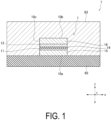
- FIG. 1 is a schematic cross-sectional view illustrating an example of an energy harvesting device 7 according to a first embodiment.
- the energy harvesting device 7 converts thermal energy into electrical energy.
- the energy harvesting device 7 outputs power to a load via wiring (not illustrated).
- the load is, for example, an electrical device.
- the load is driven by, for example, using the energy harvesting device 7 as a main power supply or an auxiliary power supply.
- the energy harvesting device 7 can be provided inside a mobile device or a self-contained sensor terminal such as an Internet of things (IoT) device or a wearable device, and can be used as an alternative to or an auxiliary of a battery.
- IoT Internet of things
- the energy harvesting device 7 can also be applied to a larger power generation device such as that for solar power generation.
- the energy harvesting device 7 includes a thermoelectric element 1 that eliminates a temperature difference between electrodes when converting thermal energy into electrical energy, a heat storage portion 65 that stores thermal energy, and an insulating portion 63 in contact with the heat storage portion 65 and the thermoelectric element 1.
- the thermoelectric element 1 includes a pair of electrodes (a first electrode 11 and a second electrode 12) having different work functions, and an intermediate portion 14 provided between the pair of electrodes 11 and 12.
- the thermoelectric element 1 may include at least one of a first substrate 15 and a second substrate 16.
- the thermoelectric element 1 converts thermal energy generated by the heat storage portion 65 into electrical energy to generate an electric current, for example.
- thermoelectric element 1 is provided in contact with the heat storage portion 65 and is covered by the insulating portion 63.
- a surface of the first substrate 15 opposite to a surface facing the first electrode 11 constitutes a first main surface 10a
- a surface of the second substrate 16 opposite to a surface facing the second electrode 12 constitutes a second main surface 10b
- a surface connecting the first main surface 10a and the second main surface 10b to each other constitutes a side surface 10c.
- the first main surface 10a is provided in contact with the heat storage portion 65, for example.
- the insulating portion 63 has insulating properties.
- the insulating portion 63 helps prevent deterioration of the thermoelectric element 1 caused by an external environment.
- Providing the insulating portion 63 in contact with the heat storage portion 65 helps prevent heat generated from the heat storage portion 65 from being released to the outside.
- the insulating portion 63 a material capable of protecting the thermoelectric element 1 from the external environment is used.
- a known material having insulating properties such as a resin
- a material having low thermal conductivity is used as the insulating portion 63, for example.
- the material having low thermal conductivity refers to a material having thermal conductivity of 10 W/(m ⁇ k) or less measured in accordance with ASTM E1530, for example.
- Examples of the material having low thermal conductivity include resins such as polyurethane, polyimide, styrene, and vinyl chloride, in addition to ceramics, tiles, and earthenware.
- the insulating portion 63 may be constituted by a plurality of layers of members made of different materials.
- the heat storage portion 65 has heat storage properties.
- the heat storage portion 65 includes a sensible heat storage material utilizing a specific heat (an amount of heat required to increase a temperature of a substance by a unit temperature) of a substance.
- the specific heat of the heat storage portion 65 is higher than a specific heat of each of the substrates 15 and 16.
- the heat stored in the heat storage portion 65 can be easily transferred to the electrodes 11 and 12 of the thermoelectric element 1.
- the specific heat of the heat storage portion 65 is higher than a specific heat of a support portion 62.
- the heat storage portion 65 can store heat for a longer period of time than the support portion 62.
- an aerogel or brick is used, for example.
- the aerogel has a nano-size porosity smaller than the mean free path of air molecules, and is made of silica, carbon, or alumina as a material.
- a material having a specific heat higher than the specific heat of glass e.g., 0.67 J/g ⁇ K at 10°C to 50°C
- a literature value may be used or a measurement result according to JIS K 7123 may be used.
- the heat storage portion 65 may include a latent heat storage material utilizing transition heat (latent heat) associated with phase change or transition of a substance.
- latent heat a known material utilizing phase conversion, such as water or sodium chloride, is used.
- the heat storage portion may include a chemical heat storage material utilizing endothermic heat generation during a chemical reaction.
- the chemical heat storage material a known material is used, for example.
- the specific heat of the heat storage portion 65 is larger than the specific heat of the insulating portion 63.
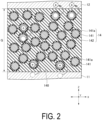
- FIG. 2 is a schematic cross-sectional view illustrating an example of the intermediate portion 14.
- the first electrode 11 and the second electrode 12 are provided facing each other.
- the first electrode 11 and the second electrode 12 have different work functions.
- the intermediate portion 14 is provided in a space 140 including a gap (gap G) between the first electrode 11 and the second electrode 12.
- the intermediate portion 14 includes nanoparticles 141 and a solid insulating layer 142.
- the nanoparticles 141 are fixed in a dispersed state in the insulating layer 142. In this case, movement of the nanoparticles 141 in the gap G is suppressed. This can help prevent the nanoparticles 141 from becoming unevenly distributed at one of the electrodes 11 and 12 over time and help prevent a decrease in the amount of electron movement. As a result, the power generation amount can be stabilized.
- the intermediate portion 14 is provided on the first electrode 11.
- the second electrode 12 is provided on the insulating layer 142.
- the power generation amount can be increased by suppressing a variation in the gap G in a plane along the second direction X and the third direction Y.
- a support portion or the like for maintaining the gap G needs to be provided.
- the variation in the gap G may increase once the support portion or the like is formed.
- the support portion or the like for maintaining the gap G need not be provided.
- a variation in the gap caused by formation accuracy of the support portion or the like can be eliminated.
- the power generation amount can be increased.
- the first electrode 11 and the second electrode 12 are separated from each other in the first direction Z.
- Each of the electrodes 11 and 12 extends in the second direction X and the third direction Y, for example, and a plurality of each of the electrodes may be provided.
- one second electrode 12 may be provided facing a plurality of the first electrodes 11 at different positions, respectively.
- one first electrode 11 may be provided facing a plurality of the second electrodes 12 at different positions, respectively.
- Materials having conductivity are used as the materials of the first electrode 11 and the second electrode 12.
- materials having different work functions are used as the materials of the first electrode 11 and the second electrode 12. Note that the same material may be used for the electrodes 11 and 12. In this case, the electrodes 11 and 12 need only have different work functions.
- each of the electrodes 11 and 12 a metal conductive material made of, for example, a single element such as iron, aluminum, or copper may be used. In addition, a metal conductive material made of, for example, an alloy of two or more elements may be used. As the material of each of the electrodes 11 and 12, for example, a non-metal conductive material may be used. Examples of the non-metal conductive material include silicon (Si: e.g., p-type Si or n-type Si) and a carbon-based material such as graphene.
- the thickness of each of the first electrode 11 and the second electrode 12 along the first direction Z is 4 nm or more and 1 ⁇ m or less, for example.
- the thickness of each of the first electrode 11 and the second electrode 12 along the first direction Z may be, for example, 4 nm or more and 50 nm or less.
- the gap G indicating the distance between the first electrode 11 and the second electrode 12 can be set as desired by changing the thickness of the insulating layer 142. Since an electric field generated between the electrodes 11 and 12 can be increased by narrowing the gap G, for example, the power generation amount of the thermoelectric element 1 can be increased. Further, the thickness of the thermoelectric element 1 along the first direction Z can be reduced by narrowing the gap G, for example.
- the gap G has a finite value of, for example, 500 ⁇ m or less.
- the gap G is, for example, 10 nm or more and 1 ⁇ m or less.
- the power generation amount may decrease due to the variation in the gap G in the plane along the second direction X and the third direction Y.
- the gap G is larger than 1 ⁇ m, the electric field generated between the electrodes 11 and 12 may be weakened.
- the gap G is preferably larger than the 200 nm and 1 ⁇ m or less.
- the intermediate portion 14 extends as a flat surface along the second direction X and the third direction Y.
- the intermediate portion 14 is provided in the space 140 formed between the electrodes 11 and 12.
- the intermediate portion 14 may be in contact with the main surfaces of the electrodes 11 and 12 that face each other, or may be in contact with the side surfaces of the electrodes 11 and 12, for example.
- the nanoparticles 141 may be dispersed in the insulating layer 142 and some of the nanoparticles 141 may be exposed from the insulating layer 142, for example.
- the particle size of the nanoparticle 141 is smaller than the gap G, for example.
- the particle size of the nanoparticle 141 is a finite value of 1/5 or less of the gap G, for example. Setting the particle size of the nanoparticle 141 to 1/5 or less of the gap G makes it easier to form the intermediate portion 14 including the nanoparticles 141 in the space 140. As a result, workability can be improved when the thermoelectric element 1 is produced.
- nanoparticles means including a plurality of particles.
- the nanoparticles 141 include particles each having a particle size of 2 nm or more and 100 nm or less, for example.
- the nanoparticles 141 may include particles each having a median size (D50) of 3 nm or more and 150 nm or less, or may include particles each having an average particle size of 3 nm or more and 150 nm or less, for example.
- the median size or average particle size can be measured by using, for example, a particle size distribution measuring instrument.
- a particle size distribution measuring instrument for example, a particle size distribution measuring instrument using a dynamic light scattering method (e.g., Zetasizer Ultra manufactured by Malvern Panalytical) may be used.
- a dynamic light scattering method e.g., Zetasizer Ultra manufactured by Malvern Panalytical
- the nanoparticles 141 contain, for example, a conductive material, and any desired material can be used according to the application.
- the nanoparticles 141 may contain one type of material, or may contain a plurality of materials according to the application.
- the value of the work function of the nanoparticles 141 may be, for example, between the value of the work function of the first electrode 11 and the value of the work function of the second electrode 12, or may be, for example, a value other than between the value of the work function of the first electrode 11 and the value of the work function of the second electrode 12, and may be selected as desired.
- Examples of the material of the nanoparticles 141 include a metal.
- the nanoparticles 141 for example, particles containing one type of material such as gold or silver, or particles of an alloy containing two or more types of materials may be used.
- the material of the nanoparticles 141 at least one type of conductive material other than gold and silver may be selected.
- the nanoparticles 141 contain a metal oxide.
- a metal oxide of at least one element selected from the group consisting of a metal and Si such as, for example, zirconia (ZrO 2 ), titania (TiO 2 ), silica (SiO 2 ), alumina (Al 2 O 3 ), iron oxide (Fe 2 O 3 or Fe 2 O 5 ), copper oxide (CuO), zinc oxide (ZnO), yttria (Y 2 O 3 ), niobium oxide (Nb 2 O 5 ), molybdenum oxide (MoOs), indium oxide (In 2 O 3 ), tin oxide (SnO 2 ), tantalum oxide (Ta 2 O 5 ), tungsten oxide (WO 3 ), lead oxide (PbO), bismuth oxide (Bi 2 O 3 ), ceria (CeO 2 ), and antimony oxide (Sb 2 O 5 , Sb 2 O 3 ) is used
- the nanoparticles 141 contain a dielectric.
- a known material is used as the nanoparticles 141 containing a dielectric.
- the nanoparticles 141 may contain a metal oxide other than a magnetic material.
- the nanoparticles 141 may contain a metal oxide representing a magnetic material
- the movement of the nanoparticles 141 may be restricted by a magnetic field caused by the environment in which the thermoelectric element 1 is installed.
- the nanoparticles 141 when the nanoparticles 141 contain a metal oxide other than a magnetic material, the nanoparticles 141 are not affected by the magnetic field caused by the external environment, which can help prevent a decrease in the power generation amount over time.
- Each of the nanoparticles 141 includes a coating film 141a on the surface.
- the thickness of the coating film 141a is a finite value of, for example, 20 nm or less.
- the coating film 141a for example, a material having a thiol group or a disulfide group is used.
- a material having a thiol group or a disulfide group is used.
- the material having the thiol group for example, alkanethiol such as dodecanethiol is used.
- the material having the disulfide group for example, alkane disulfide is used.
- the insulating layer 142 is provided between the electrodes 11 and 12 and is in contact with the electrodes 11 and 12, for example.
- the thickness of the insulating layer 142 is a finite value of, for example, 500 ⁇ m or less.
- the thickness of the insulating layer 142 affects the value of the gap G and the variation in the gap G described above. Thus, when the thickness of the insulating layer 142 is 200 nm or less, for example, this may lead to a decrease in the power generation amount caused by the variation in the gap G in the plane along the second direction X and the third direction Y.
- the thickness of the insulating layer 142 is larger than 1 ⁇ m, the electric field generated between the electrodes 11 and 12 may be weakened.
- the thickness of the insulating layer 142 is preferably larger than 200 nm and 1 ⁇ m or less.
- the insulating layer 142 may contain one type of material, or may contain a plurality of materials according to the application.
- the insulating layer 142 may have a structure in which the insulating layer 142 includes a plurality of layers containing different materials and the layers are stacked.
- the nanoparticles 141 each containing different materials may be dispersed in each layer, for example.
- the insulating layer 142 has insulating properties.
- the material used for the insulating layer 142 can be selected as appropriate as long as the material is an insulating material capable of fixing the nanoparticles 141 in a dispersed state, and an organic polymer compound is preferable.
- the insulating layer 142 contains an organic polymer compound, the insulating layer 142 can be formed to be flexible.
- the thermoelectric element 1 having a shape such as a curved shape or a bent shape according to the application can be formed.
- organic polymer compound examples include polyimide, polyamide, polyester, polycarbonate, poly(meth)acrylate, a radical polymerization-based photosetting or thermosetting resin, a photocationic polymerization-based photosetting or thermosetting resin, an epoxy resin, a copolymer containing an acrylonitrile component, polyvinyl phenol, polyvinyl alcohol, polystyrene, a novolac resin, and polyvinylidene fluoride.
- an inorganic substance may be used as the insulating layer 142.
- the inorganic substance include porous inorganic substances such as zeolite and diatomaceous earth, and cage-shaped molecules.
- the first substrate 15 and the second substrate 16 are provided sandwiching the electrodes 11 and 12 and the intermediate portion 14 and are separated from each other in the first direction Z.
- the first substrate 15 is in contact with the first electrode 11 and is separated from the second electrode 12.
- the first substrate 15 fixes the first electrode 11.
- the second substrate 16 is in contact with the second electrode 12 and is separated from the first electrode 11.
- the second substrate 16 fixes the second electrode 12.
- each of the substrates 15 and 16 along the first direction Z is, for example, 10 ⁇ m or more and 2 mm or less.
- the thickness of each of the substrates 15 and 16 can be set as desired.
- the shape of each of the substrates 15 and 16 may be, for example, a quadrangular shape such as a square or a rectangle, or a disk shape, or may be set as desired according to the application.
- a plate-shaped member having insulating properties can be used.
- a known member such as silicon, quartz, or Pyrex (registered trademark) can be used.
- a film-like member may be used.
- a known film-like member such as polyethylene terephthalate (PET), polycarbonate (PC), or polyimide may be used.
- each of the substrates 15 and 16 for example, a member having conductivity can be used, and examples thereof include iron, aluminum, copper, and an alloy of aluminum and copper.
- a conductive polymer or a semiconductor having conductivity such Si or GaN, may be used.
- wiring for connection to the electrodes 11 and 12, respectively, is not required.
- the thermoelectric element 1 may include only the first substrate 15 or may include only the second substrate 16.
- the thermoelectric element 1 may have a laminated structure (e.g., 1a, 1b, 1c, etc.) in which the first electrode 11, the intermediate portion 14, and the second electrode 12 are layered in this order without including the substrates 15 and 16, or may have a laminated structure including at least one of the substrates 15 and 16, for example.
- the thermoelectric element 1 may further include a support portion 13.
- the support portion 13 is provided between and in contact with the first substrate 15 and the second substrate 16 which are a pair of substrates or the first electrode 11 and the second electrode 12 which are a pair of electrodes.
- the support portion 13 is in contact with the first electrode 11 and the second electrode 12 in the second direction X, for example, but may be separated from the first electrode 11 and the second electrode 12.
- a material having insulating properties can be selected as the material of the support portion 13.
- the insulating material include silicon, a silicon oxide film, glass such as quartz, and an insulating resin.
- the support portion 13 may have a flexible film shape, for example, and polyethylene terephthalate (PET), polycarbonate (PC), and polyimide can be used.
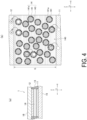
- the intermediate portion 14 of the thermoelectric element 1 may contain a solvent 143 instead of the insulating layer 142. As illustrated in FIG. 4(b) , for example, in this case, the nanoparticles 141 are dispersed in the solvent 143.
- the intermediate portion 14 is formed by filling the space 140 with the solvent 143 in which the nanoparticles 141 are dispersed, for example.
- the solvent 143 for example, a liquid having a boiling point of 60°C or higher can be used. With this configuration, even when the thermoelectric element 1 is used in an environment of room temperature (e.g., 15°C to 35°C) or higher, vaporization of the solvent 143 can be suppressed. As a result, deterioration of the thermoelectric element 1 due to vaporization of the solvent 143 can be suppressed.
- the liquid at least one of an organic solvent and water can be selected. Examples of the organic solvent include methanol, ethanol, toluene, xylene, tetradecane, and alkanethiol.
- the solvent 143 is preferably an insulating liquid having a high electric resistance value.
- thermoelectric element 1 When thermal energy is applied to the thermoelectric element 1, for example, electrons move between the first electrode 11 and the second electrode 12, and thermal energy is converted into electrical energy.
- the number of electrons moving between the first electrode 11 and the second electrode 12 depends not only on the thermal energy but also on a difference between the work function of the second electrode 12 and the work function of the first electrode 11.
- the number of electrons moving between the first electrode 11 and the second electrode 12 can be increased by, for example, increasing a work function difference between the first electrode 11 and the second electrode 12 and by decreasing the gap G.
- the amount of electrical energy generated by the thermoelectric element 1 can be increased by considering at least one of increasing the work function difference and decreasing the gap G.
- the number of electrons moving between the electrodes 11 and 12 can be increased by providing the nanoparticles 141 between the electrodes 11 and 12, which can lead to an increase in the amount of electric current.
- work function refers to the minimum energy required to extract electrons present in a solid into a vacuum.
- the work function can be measured by ultraviolet photoelectron spectroscopy (UPS), X-ray photoelectron spectroscopy (XPS), or Auger electron spectroscopy (AES), for example.
- UPS ultraviolet photoelectron spectroscopy
- XPS X-ray photoelectron spectroscopy
- AES Auger electron spectroscopy
- thermoelectric element 1 is provided in contact with the heat storage portion 65 and is covered by the insulating portion 63.
- the heat generated from the heat storage portion 65 can be easily transferred to the thermoelectric element 1.
- the power generation amount of the thermoelectric element 1 can be increased.
- the heat storage portion 65 includes the sensible heat storage material.
- the temperature range during use can be widened. With this configuration, energy harvesting suited to various applications is possible.
- the specific heat of the heat storage portion 65 is larger than the specific heat of the insulating portion 63.
- a state can be maintained in which the heat generated from the heat storage portion 65 is not easily released to the outside via the insulating portion 63.
- the power generation amount of the thermoelectric element 1 can be further increased.
- FIG. 5 is a schematic cross-sectional view illustrating an example of an energy harvesting device 7 according to a second embodiment.
- the energy harvesting device 7 according to the second embodiment further includes a heat conduction portion 20.
- the heat conduction portion 20 is in contact with the heat storage portion 65 and the thermoelectric element 1.
- the heat conduction portion 20 is covered by the insulating portion 63.
- Heat transferred from the heat storage portion 65 to the thermoelectric element 1 includes heat transferred via the heat conduction portion 20 in addition to heat directly transferred from the heat storage portion 65.
- a contact area between the heat conduction portion 20 and the thermoelectric element 1 affects the amount of heat transferred to the thermoelectric element 1.
- the contact area between the heat conduction portion 20 and the thermoelectric element 1 is desirably large to increase the power generation amount of the thermoelectric element 1.
- the contact area is larger than the contact area when the length of the heat conduction portion 20 is less than the length of the thermoelectric element 1.
- the amount of heat transferred to the thermoelectric element 1 can be increased, and the power generation amount of the thermoelectric element 1 can be increased.
- the thermal conductivity of the heat conduction portion 20 may be higher than the thermal conductivity of the substrates 15 and 16.
- the material of the substrates 15 and 16 is stainless steel (SUS)
- SUS stainless steel
- a material having a relatively higher thermal conductivity than the substrates 15 and 16 may be used for the heat conduction portion 20.
- copper having a higher thermal conductivity than the substrates 15 and 16 is used for the heat conduction portion 20.
- the thermal conductivity of the heat conduction portion 20 may be higher than the thermal conductivity of the support portion 13 to make it difficult for the heat transferred from the solar cell panel 6 to the thermoelectric element 1 to be released to the outside.
- the thermal conductivity of the heat conduction portion 20 may be higher than the thermal conductivity of at least one of the pair of the first electrode 11 and the second electrode 12.
- the heat conduction portion 20 has conductivity and is made of, for example, a metal material.
- the heat conduction portion 20 is not limited to a metal material and may be made of any material as long as the material has high conductivity.
- the material having high conductivity desirably has thermal conductivity of 10 W/(m ⁇ k) or more measured in accordance with ASTM E1530.
- a metal material such as gold, silver, copper, or aluminum may be used, and the material is preferably made of copper or aluminum.
- the heat conduction portion 20 is in contact with the heat storage portion 65 and the thermoelectric element 1 and is covered by the insulating portion 63.
- the heat generated from the heat storage portion 65 can be easily transferred to the thermoelectric element 1 via the heat conduction portion 20.
- the power generation amount of the thermoelectric element 1 can be further increased.
- FIG. 6 is a schematic cross-sectional view illustrating an example of an energy harvesting device 7 according to a third embodiment.
- the energy harvesting device 7 according to the third embodiment further includes a solar cell panel 6.
- the energy harvesting device 7 converts light energy and thermal energy into electrical energy.
- the energy harvesting device 7 includes the solar cell panel 6 that converts light energy into electrical energy, and the thermoelectric element 1 that eliminates a temperature difference between electrodes when converting thermal energy into electrical energy.
- the energy harvesting device 7 is provided, for example, on the ground or on a roof of a building, or in a site of a power generation facility.
- the energy harvesting device 7 is connected to an information processing device 75 to be described later, for example.
- the energy harvesting device 7 is connected to a known device such as a power conditioner (power conditioning system (PCS)), or a battery via, for example, wiring (not illustrated).
- PCS power conditioning system
- the energy harvesting device 7 outputs power to a load via the power conditioner or the like.
- the load is, for example, an electrical device.
- the load is driven by, for example, using the energy harvesting device 7 as a main power supply or an auxiliary power supply.
- the solar cell panel 6 converts light energy such as indoor light or solar light into electrical energy.
- the solar cell panel 6 includes a plurality of solar cells 61, a support portion 62 provided on a back surface 61a side of the plurality of solar cells 61, and a sealant 64 in contact with the support portion 62.
- the solar cell panel 6 may include a known configuration such as a protective glass or a frame (not illustrated).
- a surface of the solar cell panel 6 on a side irradiated with light such as solar light is referred to as a front surface
- a back surface 6a that is, a back surface of the support portion 62.
- the solar cell 61 is a device that absorbs light energy such as solar light and converts the light energy into electrical energy.
- a semiconductor made of silicon is used for the solar cell 61.
- a plurality of the solar cells 61 are provided separated from each other on a surface that absorbs light energy, for example. For example, when viewed from a direction from the solar cell 61 toward the support portion 62, an area of the solar cells 61 is larger than an area of the thermoelectric element 1.
- the support portion 62 is a back sheet that supports the solar cells 61 from the back surface 61a side.
- the support portion 62 reflects light energy and protects the solar cells 61 from wind and rain, and the high heat and ultraviolet rays of solar light.
- a known back sheet made of a plastic material is used as the support portion 62.
- sealant 64 a known sealing material such as ethylene vinyl acetate copolymer resin (EVA) is used.
- EVA ethylene vinyl acetate copolymer resin
- thermoelectric element 1 is sandwiched between the back surface 6a of the solar cell panel 6 and the heat storage portion 65.
- the side surface 10c of the thermoelectric element 1 is covered by the insulating portion 63.
- the thermoelectric element 1 converts, for example, thermal energy absorbed by the solar cell panel 6 into electrical energy to generate an electric current.
- the thermoelectric element 1 is connected to the solar cell panel 6 via wiring (not illustrated) in a parallel circuit, for example.
- the thermoelectric element 1 may be connected to the solar cell panel 6 via wiring (not illustrated) in a series circuit, for example.
- the first main surface 10a and the second main surface 10b of the thermoelectric element 1 are provided along the back surface 61a of the solar cell 61. In this case, a contact area between the thermoelectric element 1 and the solar cell 61 can be increased. As a result, heat transferred from the solar cell 61 to the thermoelectric element 1 increases, and the power generation amount of the thermoelectric element 1 can be increased.
- the first main surface 10a and the second main surface 10b of the thermoelectric element 1 may be provided perpendicular to the back surface 61a of the solar cell 61. In this case, heat transferred from the solar cell 61 to each of the first electrode 11 and the second electrode 12 increases as compared with a case where one of the first electrode 11 and the second electrode 12 is separated from the solar cell 61. As a result, the power generation amount in the thermoelectric element 1 can be increased.
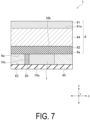
- FIG. 7 is a schematic cross-sectional view illustrating an example of an energy harvesting device 7 according to a fourth embodiment.
- the energy harvesting device 7 according to the fourth embodiment further includes the heat conduction portion 20 and the solar cell panel 6.
- the heat conduction portion 20 is provided in contact with the solar cell panel 6, the heat storage portion 65, and the thermoelectric element 1.
- the side surface 10c of the heat conduction portion 20 is covered by the insulating portion 63.
- the heat conduction portion 20 is sandwiched between the back surface 6a of the solar cell panel 6 and the heat storage portion 65.
- the heat conduction portion 20 is provided in contact with the solar cell panel 6, the heat storage portion 65, and the thermoelectric element 1.
- the heat generated from the solar cell panel 6 can be easily transferred to the heat storage portion 65 and the thermoelectric element 1.
- the heat generated from the heat storage portion 65 can be easily transferred to the thermoelectric element 1 via the heat conduction portion 20.
- the power generation amount of the thermoelectric element 1 can be further increased.
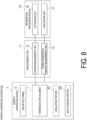
- FIG. 8 is a schematic view illustrating an example of an energy harvesting system 700 according to a fifth embodiment.
- the energy harvesting system 700 includes the energy harvesting device 7, a measurement unit 71, and an information processing device 75.
- the energy harvesting device 7 converts light energy and thermal energy into electrical energy.
- the energy harvesting device 7 includes the solar cell panel 6 that converts light energy into electrical energy, and the thermoelectric element 1 that eliminates a temperature difference between electrodes when converting thermal energy into electrical energy.
- the measurement unit 71 includes a power measurement unit 72 and a power generation amount measurement unit 73.
- the power measurement unit 72 measures power of the thermoelectric element 1.
- As the power measurement unit 72 a known unit for measuring power is used.
- the power generation amount measurement unit 73 measures the power generation amounts of the thermoelectric element 1 and the solar cell panel 6. As the power generation amount measurement unit 73, a known unit for measuring the power generation amount is used.
- the information processing device 75 is installed in a power plant, for example, and functions as a control unit in the power plant. As the information processing device 75, for example, a personal computer is used.
- the information processing device 75 includes an estimation unit 76 and an evaluation unit 77.
- the information processing device 75 may further include an input/output unit that inputs and outputs various types of information and a storage unit that stores various types of information.
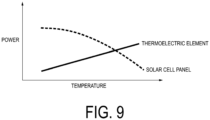
- FIG. 9 is a diagram showing an example of a relationship between temperature and power for the solar cell panel 6 and the thermoelectric element 1. As shown in FIG. 9 , when the temperature of the solar cell panel 6 increases, the power generated from the solar cell panel 6 tends to decrease. Further, when the temperature of the thermoelectric element 1 increases, the power generated from the thermoelectric element 1 tends to increase. In the information processing device 75, for example, relationships between temperature and power may be stored in advance for the solar cell panel 6 and the thermoelectric element 1.
- thermoelectric element 1 a relationship between the power generation amount of the thermoelectric element 1 and the temperature of the solar cell 61 may be stored in advance. Further, in the information processing device 75, for example, a relationship between the power of the thermoelectric element 1 and the temperature of the solar cell 61 may be stored in advance.
- the estimation unit 76 refers to, for example, the relationships between the temperature and the power for the solar cell panel 6 and the thermoelectric element 1 stored in the information processing device 75, and estimates the power generated from the solar cell 61 based on the measurement result of the power measurement unit 72. That is, the tendency of the power that varies depending on the temperature of the solar cell panel 6 can be easily estimated. Thus, for example, generation of excessive power from the solar cell panel 6 due to a decrease in the outside air temperature can be known in advance, and the solar cell panel 6 can be controlled. As a result, the power generation amount of the entire energy harvesting device 7 can be further increased.
- the evaluation unit 77 refers to, for example, the relationship between the power of the thermoelectric element 1 and the temperature of the solar cell 61 stored in the information processing device 75, and evaluates the temperature of the solar cell 61 based on the measurement result of the power measurement unit 72.
- the evaluation unit 77 refers to, for example, the relationship between the power generation amount of the thermoelectric element 1 and the temperature of the solar cell 61 stored in the information processing device 75, and evaluates the temperature of the solar cell 61 based on the measurement result of the power generation amount measurement unit 73.
- the power generation amount measurement unit 73 measures the power generation amounts of the thermoelectric element 1 and the solar cell panel 6.
- the instability of the power generation amount in the solar cell panel 6 can be compensated by the power generation amount of the thermoelectric element 1.
- a variation in the power generation amount over time can be suppressed.
- the estimation unit 76 estimates the power generated from the solar cell based on the measurement result of the power measurement unit 72.
- a variation in the power generation amount caused by the temperature of the solar cell panel can be easily estimated.
- the power generation amount of the entire energy harvesting device 7 can be further increased.
Landscapes
- Electromechanical Clocks (AREA)
- Hybrid Cells (AREA)
- Charge And Discharge Circuits For Batteries Or The Like (AREA)
Abstract
Description
- The present invention relates to an energy harvesting device and an energy harvesting system that convert thermal energy into electrical energy.
- As a power generation device utilizing a combination of a heat storage material and a thermoelectric element, for example, the thermoelectric conversion system disclosed in
Patent Document 1 has been proposed. - The thermoelectric conversion system of
Patent Document 1 includes a sheet-like thermoelectric conversion device that can perform thermoelectric conversion when one end is heated, and a fixing tool that fixes the one end. - Patent Document 1:
JP 2017-69372 A - When the heat storage material is provided only at one end of the thermoelectric element as in
Patent Document 1, heat generated from the heat storage material may be released to the outside without being transferred to the thermoelectric element. As a result, a decrease in the power generation amount of the thermoelectric element is a concern. - The present invention has been made in view of the above-described problem, and it is an object of the present invention to provide an energy harvesting device and an energy harvesting system that are capable of increasing a power generation amount of a thermoelectric element.
- An energy harvesting device according to a first invention is an energy harvesting device that converts thermal energy into electrical energy, the energy harvesting device including a heat storage portion that stores thermal energy, a thermoelectric element that eliminates a temperature difference between electrodes when converting thermal energy into electrical energy, and an insulating portion in contact with the heat storage portion and the thermoelectric element, in which the heat storage portion has insulating properties, the thermoelectric element includes a pair of electrodes having work functions different from each other and an intermediate portion provided between the pair of electrodes, and the thermoelectric element is provided in contact with the heat storage portion and is covered by the insulating portion.
- An energy harvesting device according to a second invention is the energy harvesting device according to the first invention, further including a heat conduction portion in contact with the heat storage portion and the thermoelectric element and being covered by the insulating portion.
- An energy harvesting device according to a third invention is the energy harvesting device according to the first invention, in which the heat storage portion includes a sensible heat storage material.
- An energy harvesting device according to a fourth invention is the energy harvesting device according to the third invention, in which the heat storage portion includes an aerogel.
- An energy harvesting device according to a fifth invention is the energy harvesting device according to any one of the first to fourth inventions, in which a specific heat of the heat storage portion is larger than a specific heat of the insulating portion.
- An energy harvesting device according to a sixth invention is the energy harvesting device according to the first invention, further including a solar cell panel that converts light energy into electrical energy, in which the thermoelectric element is sandwiched between a back surface of the solar cell panel and the heat storage portion.
- An energy harvesting device according to a seventh invention is the energy harvesting device according to the sixth invention, further including a heat conduction portion provided in contact with the solar cell panel, the heat storage portion, and the thermoelectric element.
- An energy harvesting system according to an eighth invention includes the energy harvesting device according to any one of the first to seventh inventions, a solar cell panel configured to convert light energy into electrical energy, and a power generation amount measurement unit configured to measure power generation amounts of the thermoelectric element and the solar cell panel.
- An energy harvesting system according to a ninth invention is the energy harvesting system according to the eighth invention, further including a power measurement unit configured to measure power of the thermoelectric element and an estimation unit configured to estimate power generated from the solar cell panel based on a measurement result of the power measurement unit.
- According to the first to ninth inventions, the thermoelectric element is provided in contact with the heat storage portion and is covered by the insulating portion. Thus, heat generated from the heat storage portion can be easily transferred to the thermoelectric element. As a result, a power generation amount of the thermoelectric element can be increased.
- In particular, according to the second invention, the heat conduction portion is in contact with the heat storage portion and the thermoelectric element and is covered by the insulating portion. Thus, the heat generated from the heat storage portion can be easily transferred to the thermoelectric element via the heat conduction portion. As a result, the power generation amount of the thermoelectric element can be further increased.
- In particular, according to the third invention, the heat storage portion includes the sensible heat storage material. Thus, as compared with a latent heat storage material, the temperature range during use can be widened. With this configuration, energy harvesting suited to various applications is possible.
- In particular, according to the fifth invention, the specific heat of the heat storage portion is larger than the specific heat of the insulating portion. Thus, a state can be maintained in which the heat generated from the heat storage portion is not easily released to the outside via the insulating portion. As a result, the power generation amount of the thermoelectric element can be further increased.
- In particular, according to the sixth invention, the thermoelectric element is sandwiched between the back surface of the solar cell panel and the heat storage portion. Thus, heat generated from the solar cell panel in addition to the heat storage portion can be transferred to the thermoelectric element. As a result, the power generation amount of the thermoelectric element can be further increased.
- In particular, according to the seventh invention, the heat conduction portion is provided in contact with the solar cell panel, the heat storage portion, and the thermoelectric element. Thus, the heat generated from the solar cell panel can be easily transferred to the heat storage portion and the thermoelectric element. In addition, the heat generated from the heat storage portion can be easily transferred to the thermoelectric element via the heat conduction portion. As a result, the power generation amount of the thermoelectric element can be further increased.
- In particular, according to the eighth invention, the power generation amount measurement unit measures the power generation amounts of the thermoelectric element and the solar cell panel. Thus, instability of the power generation amount in the solar cell panel can be compensated by the power generation amount of the thermoelectric element. As a result, a variation in the power generation amount over time can be suppressed.
- In particular, according to the ninth invention, the estimation unit estimates the power generated from the solar cell based on the measurement result of the power measurement unit. Thus, a variation in the power generation amount caused by the temperature of the solar cell panel can be easily estimated. As a result, the power generation amount of the entire energy harvesting device can be further increased.
-
-
FIG. 1 is a schematic cross-sectional view illustrating an example of an energy harvesting device according to a first embodiment. -
FIG. 2 is a schematic cross-sectional view illustrating an example of an intermediate portion. -
FIG. 3(a) is a schematic cross-sectional view illustrating a first variation of a thermoelectric element according to the first embodiment, andFIG. 3(b) is a schematic cross-sectional view illustrating a second variation of the thermoelectric element according to the first embodiment. -
FIG. 4(a) is a schematic cross-sectional view illustrating a third variation of the thermoelectric element according to the first embodiment, andFIG. 4(b) is a schematic cross-sectional view illustrating an example of an intermediate portion of the thermoelectric element inFIG. 4(a) . -
FIG. 5 is a schematic perspective view illustrating an example of an energy harvesting device according to a second embodiment. -
FIG. 6 is a schematic cross-sectional view illustrating an example of an energy harvesting device according to a third embodiment. -
FIG. 7 is a schematic cross-sectional view illustrating an example of an energy harvesting device according to a fourth embodiment. -
FIG. 8 is a schematic cross-sectional view illustrating an example of an energy harvesting system according to a fifth embodiment. -
FIG. 9 is a diagram showing an example of a relationship between temperature and power for a solar cell panel and a thermoelectric element. - Hereinafter, an example of an energy harvesting device and an energy harvesting system as an embodiment of the present invention will be described with reference to the drawings. In each drawing, a height direction in which electrodes are layered is referred to as a first direction Z, one planar direction intersecting, i.e., orthogonal to the first direction Z is referred to as a second direction X, and another planar direction intersecting, i.e., orthogonal to both the first direction Z and the second direction X is referred to as a third direction Y. In addition, the components in each drawing are schematically illustrated to facilitate description. For example, the size of each component or ratios of sizes between components may be different from those in the drawings.
-
FIG. 1 is a schematic cross-sectional view illustrating an example of anenergy harvesting device 7 according to a first embodiment. Theenergy harvesting device 7 converts thermal energy into electrical energy. Theenergy harvesting device 7 outputs power to a load via wiring (not illustrated). The load is, for example, an electrical device. The load is driven by, for example, using theenergy harvesting device 7 as a main power supply or an auxiliary power supply. Theenergy harvesting device 7 can be provided inside a mobile device or a self-contained sensor terminal such as an Internet of things (IoT) device or a wearable device, and can be used as an alternative to or an auxiliary of a battery. Theenergy harvesting device 7 can also be applied to a larger power generation device such as that for solar power generation. - The
energy harvesting device 7 includes athermoelectric element 1 that eliminates a temperature difference between electrodes when converting thermal energy into electrical energy, aheat storage portion 65 that stores thermal energy, and an insulatingportion 63 in contact with theheat storage portion 65 and thethermoelectric element 1. - As illustrated in
FIG. 1 , thethermoelectric element 1 includes a pair of electrodes (afirst electrode 11 and a second electrode 12) having different work functions, and anintermediate portion 14 provided between the pair ofelectrodes thermoelectric element 1 may include at least one of afirst substrate 15 and asecond substrate 16. Thethermoelectric element 1 converts thermal energy generated by theheat storage portion 65 into electrical energy to generate an electric current, for example. - The
thermoelectric element 1 is provided in contact with theheat storage portion 65 and is covered by the insulatingportion 63. In thethermoelectric element 1, for example, a surface of thefirst substrate 15 opposite to a surface facing thefirst electrode 11 constitutes a firstmain surface 10a, a surface of thesecond substrate 16 opposite to a surface facing thesecond electrode 12 constitutes a secondmain surface 10b, and a surface connecting the firstmain surface 10a and the secondmain surface 10b to each other constitutes aside surface 10c. In thethermoelectric element 1, the firstmain surface 10a is provided in contact with theheat storage portion 65, for example. - The insulating
portion 63 has insulating properties. The insulatingportion 63 helps prevent deterioration of thethermoelectric element 1 caused by an external environment. Providing the insulatingportion 63 in contact with theheat storage portion 65 helps prevent heat generated from theheat storage portion 65 from being released to the outside. - As the insulating
portion 63, a material capable of protecting thethermoelectric element 1 from the external environment is used. For example, a known material having insulating properties, such as a resin, is used. As the insulatingportion 63, a material having low thermal conductivity is used, for example. The material having low thermal conductivity refers to a material having thermal conductivity of 10 W/(m·k) or less measured in accordance with ASTM E1530, for example. Examples of the material having low thermal conductivity include resins such as polyurethane, polyimide, styrene, and vinyl chloride, in addition to ceramics, tiles, and earthenware. Further, the insulatingportion 63 may be constituted by a plurality of layers of members made of different materials. - The
heat storage portion 65 has heat storage properties. Theheat storage portion 65 includes a sensible heat storage material utilizing a specific heat (an amount of heat required to increase a temperature of a substance by a unit temperature) of a substance. - For example, when the
heat storage portion 65 includes the sensible heat storage material, the specific heat of theheat storage portion 65 is higher than a specific heat of each of thesubstrates heat storage portion 65 can be easily transferred to theelectrodes thermoelectric element 1. For example, the specific heat of theheat storage portion 65 is higher than a specific heat of asupport portion 62. Thus, theheat storage portion 65 can store heat for a longer period of time than thesupport portion 62. - As the sensible heat storage material, an aerogel or brick is used, for example. The aerogel has a nano-size porosity smaller than the mean free path of air molecules, and is made of silica, carbon, or alumina as a material. As the sensible heat storage material, for example, a material having a specific heat higher than the specific heat of glass (e.g., 0.67 J/g·K at 10°C to 50°C) is used. For the value of the specific heat, a literature value may be used or a measurement result according to JIS K 7123 may be used.
- The
heat storage portion 65 may include a latent heat storage material utilizing transition heat (latent heat) associated with phase change or transition of a substance. As the latent heat storage material, a known material utilizing phase conversion, such as water or sodium chloride, is used. The heat storage portion may include a chemical heat storage material utilizing endothermic heat generation during a chemical reaction. As the chemical heat storage material, a known material is used, for example. - The specific heat of the
heat storage portion 65 is larger than the specific heat of the insulatingportion 63. - Now, each component will be described in detail.
-
FIG. 2 is a schematic cross-sectional view illustrating an example of theintermediate portion 14. Thefirst electrode 11 and thesecond electrode 12 are provided facing each other. Thefirst electrode 11 and thesecond electrode 12 have different work functions. For example, as illustrated inFIG. 6 , theintermediate portion 14 is provided in aspace 140 including a gap (gap G) between thefirst electrode 11 and thesecond electrode 12. - The
intermediate portion 14 includesnanoparticles 141 and a solid insulatinglayer 142. Thenanoparticles 141 are fixed in a dispersed state in the insulatinglayer 142. In this case, movement of thenanoparticles 141 in the gap G is suppressed. This can help prevent thenanoparticles 141 from becoming unevenly distributed at one of theelectrodes - The
intermediate portion 14 is provided on thefirst electrode 11. Thesecond electrode 12 is provided on the insulatinglayer 142. In thethermoelectric element 1 that eliminates a temperature difference between electrodes when converting thermal energy into electrical energy, the power generation amount can be increased by suppressing a variation in the gap G in a plane along the second direction X and the third direction Y. Thus, when a liquid such as a solvent is used as the intermediate portion, a support portion or the like for maintaining the gap G needs to be provided. However, there is a concern that the variation in the gap G may increase once the support portion or the like is formed. In thethermoelectric element 1 according to the present embodiment, since thesecond electrode 12 is provided on the insulatinglayer 142, the support portion or the like for maintaining the gap G need not be provided. Thus, a variation in the gap caused by formation accuracy of the support portion or the like can be eliminated. As a result, the power generation amount can be increased. - As illustrated in
FIG. 1 , for example, thefirst electrode 11 and thesecond electrode 12 are separated from each other in the first direction Z. Each of theelectrodes second electrode 12 may be provided facing a plurality of thefirst electrodes 11 at different positions, respectively. In addition, for example, onefirst electrode 11 may be provided facing a plurality of thesecond electrodes 12 at different positions, respectively. - Materials having conductivity are used as the materials of the
first electrode 11 and thesecond electrode 12. For example, materials having different work functions are used as the materials of thefirst electrode 11 and thesecond electrode 12. Note that the same material may be used for theelectrodes electrodes - As the material of each of the
electrodes electrodes - The thickness of each of the
first electrode 11 and thesecond electrode 12 along the first direction Z is 4 nm or more and 1 µm or less, for example. The thickness of each of thefirst electrode 11 and thesecond electrode 12 along the first direction Z may be, for example, 4 nm or more and 50 nm or less. - The gap G indicating the distance between the
first electrode 11 and thesecond electrode 12 can be set as desired by changing the thickness of the insulatinglayer 142. Since an electric field generated between theelectrodes thermoelectric element 1 can be increased. Further, the thickness of thethermoelectric element 1 along the first direction Z can be reduced by narrowing the gap G, for example. - The gap G has a finite value of, for example, 500 µm or less. The gap G is, for example, 10 nm or more and 1 µm or less. For example, when the gap G is 200 nm or less, the power generation amount may decrease due to the variation in the gap G in the plane along the second direction X and the third direction Y. When the gap G is larger than 1 µm, the electric field generated between the
electrodes - The
intermediate portion 14 extends as a flat surface along the second direction X and the third direction Y. Theintermediate portion 14 is provided in thespace 140 formed between theelectrodes intermediate portion 14 may be in contact with the main surfaces of theelectrodes electrodes - The
nanoparticles 141 may be dispersed in the insulatinglayer 142 and some of thenanoparticles 141 may be exposed from the insulatinglayer 142, for example. The particle size of thenanoparticle 141 is smaller than the gap G, for example. The particle size of thenanoparticle 141 is a finite value of 1/5 or less of the gap G, for example. Setting the particle size of thenanoparticle 141 to 1/5 or less of the gap G makes it easier to form theintermediate portion 14 including thenanoparticles 141 in thespace 140. As a result, workability can be improved when thethermoelectric element 1 is produced. - Here, the term "nanoparticles" means including a plurality of particles. The
nanoparticles 141 include particles each having a particle size of 2 nm or more and 100 nm or less, for example. Thenanoparticles 141 may include particles each having a median size (D50) of 3 nm or more and 150 nm or less, or may include particles each having an average particle size of 3 nm or more and 150 nm or less, for example. The median size or average particle size can be measured by using, for example, a particle size distribution measuring instrument. As the particle size distribution measuring instrument, for example, a particle size distribution measuring instrument using a dynamic light scattering method (e.g., Zetasizer Ultra manufactured by Malvern Panalytical) may be used. - The
nanoparticles 141 contain, for example, a conductive material, and any desired material can be used according to the application. Thenanoparticles 141 may contain one type of material, or may contain a plurality of materials according to the application. The value of the work function of thenanoparticles 141 may be, for example, between the value of the work function of thefirst electrode 11 and the value of the work function of thesecond electrode 12, or may be, for example, a value other than between the value of the work function of thefirst electrode 11 and the value of the work function of thesecond electrode 12, and may be selected as desired. - Examples of the material of the
nanoparticles 141 include a metal. As thenanoparticles 141, for example, particles containing one type of material such as gold or silver, or particles of an alloy containing two or more types of materials may be used. As the material of thenanoparticles 141, at least one type of conductive material other than gold and silver may be selected. - The
nanoparticles 141 contain a metal oxide. As thenanoparticles 141 containing the metal oxide, a metal oxide of at least one element selected from the group consisting of a metal and Si, such as, for example, zirconia (ZrO2), titania (TiO2), silica (SiO2), alumina (Al2O3), iron oxide (Fe2O3 or Fe2O5), copper oxide (CuO), zinc oxide (ZnO), yttria (Y2O3), niobium oxide (Nb2O5), molybdenum oxide (MoOs), indium oxide (In2O3), tin oxide (SnO2), tantalum oxide (Ta2O5), tungsten oxide (WO3), lead oxide (PbO), bismuth oxide (Bi2O3), ceria (CeO2), and antimony oxide (Sb2O5, Sb2O3) is used. - The
nanoparticles 141 contain a dielectric. As thenanoparticles 141 containing a dielectric, for example, a known material is used. - The
nanoparticles 141 may contain a metal oxide other than a magnetic material. For example, when thenanoparticles 141 contain a metal oxide representing a magnetic material, the movement of thenanoparticles 141 may be restricted by a magnetic field caused by the environment in which thethermoelectric element 1 is installed. Thus, when thenanoparticles 141 contain a metal oxide other than a magnetic material, thenanoparticles 141 are not affected by the magnetic field caused by the external environment, which can help prevent a decrease in the power generation amount over time. - Each of the
nanoparticles 141 includes acoating film 141a on the surface. The thickness of thecoating film 141a is a finite value of, for example, 20 nm or less. By providing thecoating film 141a on the surface of eachnanoparticle 141, aggregation can be suppressed when the nanoparticles are dispersed in the insulatinglayer 142, for example. In addition, for example, electrons can be made more likely to move between thefirst electrode 11 and thenanoparticles 141, between the plurality ofnanoparticles 141, and between thesecond electrode 12 and thenanoparticles 141 by hopping conduction or the like. - As the
coating film 141a, for example, a material having a thiol group or a disulfide group is used. As the material having the thiol group, for example, alkanethiol such as dodecanethiol is used. As the material having the disulfide group, for example, alkane disulfide is used. - The insulating
layer 142 is provided between theelectrodes electrodes layer 142 is a finite value of, for example, 500 µm or less. The thickness of the insulatinglayer 142 affects the value of the gap G and the variation in the gap G described above. Thus, when the thickness of the insulatinglayer 142 is 200 nm or less, for example, this may lead to a decrease in the power generation amount caused by the variation in the gap G in the plane along the second direction X and the third direction Y. When the thickness of the insulatinglayer 142 is larger than 1 µm, the electric field generated between theelectrodes layer 142 is preferably larger than 200 nm and 1 µm or less. - The insulating
layer 142 may contain one type of material, or may contain a plurality of materials according to the application. The insulatinglayer 142 may have a structure in which the insulatinglayer 142 includes a plurality of layers containing different materials and the layers are stacked. When the insulatinglayer 142 includes a plurality of layers, thenanoparticles 141 each containing different materials may be dispersed in each layer, for example. - The insulating
layer 142 has insulating properties. The material used for the insulatinglayer 142 can be selected as appropriate as long as the material is an insulating material capable of fixing thenanoparticles 141 in a dispersed state, and an organic polymer compound is preferable. When the insulatinglayer 142 contains an organic polymer compound, the insulatinglayer 142 can be formed to be flexible. Thus, thethermoelectric element 1 having a shape such as a curved shape or a bent shape according to the application can be formed. - Examples of the organic polymer compound include polyimide, polyamide, polyester, polycarbonate, poly(meth)acrylate, a radical polymerization-based photosetting or thermosetting resin, a photocationic polymerization-based photosetting or thermosetting resin, an epoxy resin, a copolymer containing an acrylonitrile component, polyvinyl phenol, polyvinyl alcohol, polystyrene, a novolac resin, and polyvinylidene fluoride.
- As the insulating
layer 142, for example, an inorganic substance may be used. Examples of the inorganic substance include porous inorganic substances such as zeolite and diatomaceous earth, and cage-shaped molecules. - As illustrated in
FIG. 1 , for example, thefirst substrate 15 and thesecond substrate 16 are provided sandwiching theelectrodes intermediate portion 14 and are separated from each other in the first direction Z. For example, thefirst substrate 15 is in contact with thefirst electrode 11 and is separated from thesecond electrode 12. Thefirst substrate 15 fixes thefirst electrode 11. Thesecond substrate 16 is in contact with thesecond electrode 12 and is separated from thefirst electrode 11. Thesecond substrate 16 fixes thesecond electrode 12. - The thickness of each of the
substrates substrates substrates - As each of the
substrates substrates - As each of the
substrates substrates substrates electrodes - As illustrated in
FIG. 3(a) , for example, thethermoelectric element 1 may include only thefirst substrate 15 or may include only thesecond substrate 16. As illustrated inFIG. 3(b) , for example, thethermoelectric element 1 may have a laminated structure (e.g., 1a, 1b, 1c, etc.) in which thefirst electrode 11, theintermediate portion 14, and thesecond electrode 12 are layered in this order without including thesubstrates substrates - As illustrated in
FIG. 4(a) , for example, thethermoelectric element 1 may further include asupport portion 13. Thesupport portion 13 is provided between and in contact with thefirst substrate 15 and thesecond substrate 16 which are a pair of substrates or thefirst electrode 11 and thesecond electrode 12 which are a pair of electrodes. Thesupport portion 13 is in contact with thefirst electrode 11 and thesecond electrode 12 in the second direction X, for example, but may be separated from thefirst electrode 11 and thesecond electrode 12. - A material having insulating properties can be selected as the material of the
support portion 13. Examples of the insulating material include silicon, a silicon oxide film, glass such as quartz, and an insulating resin. In addition to the above, thesupport portion 13 may have a flexible film shape, for example, and polyethylene terephthalate (PET), polycarbonate (PC), and polyimide can be used. - The
intermediate portion 14 of thethermoelectric element 1 may contain a solvent 143 instead of the insulatinglayer 142. As illustrated inFIG. 4(b) , for example, in this case, thenanoparticles 141 are dispersed in the solvent 143. Theintermediate portion 14 is formed by filling thespace 140 with the solvent 143 in which thenanoparticles 141 are dispersed, for example. - As the solvent 143, for example, a liquid having a boiling point of 60°C or higher can be used. With this configuration, even when the
thermoelectric element 1 is used in an environment of room temperature (e.g., 15°C to 35°C) or higher, vaporization of the solvent 143 can be suppressed. As a result, deterioration of thethermoelectric element 1 due to vaporization of the solvent 143 can be suppressed. As an example of the liquid, at least one of an organic solvent and water can be selected. Examples of the organic solvent include methanol, ethanol, toluene, xylene, tetradecane, and alkanethiol. Note that the solvent 143 is preferably an insulating liquid having a high electric resistance value. - When thermal energy is applied to the
thermoelectric element 1, for example, electrons move between thefirst electrode 11 and thesecond electrode 12, and thermal energy is converted into electrical energy. The number of electrons moving between thefirst electrode 11 and thesecond electrode 12 depends not only on the thermal energy but also on a difference between the work function of thesecond electrode 12 and the work function of thefirst electrode 11. - The number of electrons moving between the
first electrode 11 and thesecond electrode 12 can be increased by, for example, increasing a work function difference between thefirst electrode 11 and thesecond electrode 12 and by decreasing the gap G. For example, the amount of electrical energy generated by thethermoelectric element 1 can be increased by considering at least one of increasing the work function difference and decreasing the gap G. Further, the number of electrons moving between theelectrodes nanoparticles 141 between theelectrodes - The term "work function" refers to the minimum energy required to extract electrons present in a solid into a vacuum. The work function can be measured by ultraviolet photoelectron spectroscopy (UPS), X-ray photoelectron spectroscopy (XPS), or Auger electron spectroscopy (AES), for example.
- According to the present embodiment, the
thermoelectric element 1 is provided in contact with theheat storage portion 65 and is covered by the insulatingportion 63. Thus, the heat generated from theheat storage portion 65 can be easily transferred to thethermoelectric element 1. As a result, the power generation amount of thethermoelectric element 1 can be increased. - According to the present embodiment, the
heat storage portion 65 includes the sensible heat storage material. Thus, as compared with a latent heat storage material, the temperature range during use can be widened. With this configuration, energy harvesting suited to various applications is possible. - According to the present embodiment, the specific heat of the
heat storage portion 65 is larger than the specific heat of the insulatingportion 63. Thus, a state can be maintained in which the heat generated from theheat storage portion 65 is not easily released to the outside via the insulatingportion 63. As a result, the power generation amount of thethermoelectric element 1 can be further increased. - Next, another embodiment will be described. Detailed description of configurations similar to those of the above-described embodiment will be omitted below.
FIG. 5 is a schematic cross-sectional view illustrating an example of anenergy harvesting device 7 according to a second embodiment. Theenergy harvesting device 7 according to the second embodiment further includes aheat conduction portion 20. - The
heat conduction portion 20 is in contact with theheat storage portion 65 and thethermoelectric element 1. Theheat conduction portion 20 is covered by the insulatingportion 63. - Heat transferred from the
heat storage portion 65 to thethermoelectric element 1 includes heat transferred via theheat conduction portion 20 in addition to heat directly transferred from theheat storage portion 65. Thus, a contact area between theheat conduction portion 20 and thethermoelectric element 1 affects the amount of heat transferred to thethermoelectric element 1. Thus, the contact area between theheat conduction portion 20 and thethermoelectric element 1 is desirably large to increase the power generation amount of thethermoelectric element 1. For example, when the length of theheat conduction portion 20 is the length of thethermoelectric element 1 or more along the third direction Y, the contact area is larger than the contact area when the length of theheat conduction portion 20 is less than the length of thethermoelectric element 1. As a result, the amount of heat transferred to thethermoelectric element 1 can be increased, and the power generation amount of thethermoelectric element 1 can be increased. - The thermal conductivity of the
heat conduction portion 20 may be higher than the thermal conductivity of thesubstrates substrates substrates heat conduction portion 20. For example, copper having a higher thermal conductivity than thesubstrates heat conduction portion 20. As a result, the heat transferred to thethermoelectric element 1 is less likely to be released to the outside, and the power generation amount of thethermoelectric element 1 can be increased. - Although not illustrated, when the
thermoelectric element 1 includes thesupport portion 13, the thermal conductivity of theheat conduction portion 20 may be higher than the thermal conductivity of thesupport portion 13 to make it difficult for the heat transferred from thesolar cell panel 6 to thethermoelectric element 1 to be released to the outside. The thermal conductivity of theheat conduction portion 20 may be higher than the thermal conductivity of at least one of the pair of thefirst electrode 11 and thesecond electrode 12. - The
heat conduction portion 20 has conductivity and is made of, for example, a metal material. Theheat conduction portion 20 is not limited to a metal material and may be made of any material as long as the material has high conductivity. The material having high conductivity desirably has thermal conductivity of 10 W/(m·k) or more measured in accordance with ASTM E1530. As the material having high conductivity, for example, a metal material such as gold, silver, copper, or aluminum may be used, and the material is preferably made of copper or aluminum. - In particular, according to the present embodiment, the
heat conduction portion 20 is in contact with theheat storage portion 65 and thethermoelectric element 1 and is covered by the insulatingportion 63. Thus, the heat generated from theheat storage portion 65 can be easily transferred to thethermoelectric element 1 via theheat conduction portion 20. As a result, the power generation amount of thethermoelectric element 1 can be further increased. -
FIG. 6 is a schematic cross-sectional view illustrating an example of anenergy harvesting device 7 according to a third embodiment. Theenergy harvesting device 7 according to the third embodiment further includes asolar cell panel 6. - The
energy harvesting device 7 converts light energy and thermal energy into electrical energy. Theenergy harvesting device 7 includes thesolar cell panel 6 that converts light energy into electrical energy, and thethermoelectric element 1 that eliminates a temperature difference between electrodes when converting thermal energy into electrical energy. - The
energy harvesting device 7 is provided, for example, on the ground or on a roof of a building, or in a site of a power generation facility. Theenergy harvesting device 7 is connected to aninformation processing device 75 to be described later, for example. Theenergy harvesting device 7 is connected to a known device such as a power conditioner (power conditioning system (PCS)), or a battery via, for example, wiring (not illustrated). Theenergy harvesting device 7 outputs power to a load via the power conditioner or the like. The load is, for example, an electrical device. The load is driven by, for example, using theenergy harvesting device 7 as a main power supply or an auxiliary power supply. - The
solar cell panel 6 converts light energy such as indoor light or solar light into electrical energy. As illustrated inFIG. 6 , thesolar cell panel 6 includes a plurality ofsolar cells 61, asupport portion 62 provided on aback surface 61a side of the plurality ofsolar cells 61, and asealant 64 in contact with thesupport portion 62. Thesolar cell panel 6 may include a known configuration such as a protective glass or a frame (not illustrated). Here, a surface of thesolar cell panel 6 on a side irradiated with light such as solar light is referred to as a front surface, and a surface opposite to the front surface is referred to as aback surface 6a (that is, a back surface of the support portion 62). - The
solar cell 61 is a device that absorbs light energy such as solar light and converts the light energy into electrical energy. For example, a semiconductor made of silicon is used for thesolar cell 61. A plurality of thesolar cells 61 are provided separated from each other on a surface that absorbs light energy, for example. For example, when viewed from a direction from thesolar cell 61 toward thesupport portion 62, an area of thesolar cells 61 is larger than an area of thethermoelectric element 1. - The
support portion 62 is a back sheet that supports thesolar cells 61 from theback surface 61a side. Thesupport portion 62 reflects light energy and protects thesolar cells 61 from wind and rain, and the high heat and ultraviolet rays of solar light. As thesupport portion 62, for example, a known back sheet made of a plastic material is used. - As the
sealant 64, a known sealing material such as ethylene vinyl acetate copolymer resin (EVA) is used. Thesealant 64 is provided between thesolar cell 61 and thesupport portion 62. - The
thermoelectric element 1 is sandwiched between theback surface 6a of thesolar cell panel 6 and theheat storage portion 65. Theside surface 10c of thethermoelectric element 1 is covered by the insulatingportion 63. Thethermoelectric element 1 converts, for example, thermal energy absorbed by thesolar cell panel 6 into electrical energy to generate an electric current. Thethermoelectric element 1 is connected to thesolar cell panel 6 via wiring (not illustrated) in a parallel circuit, for example. Thethermoelectric element 1 may be connected to thesolar cell panel 6 via wiring (not illustrated) in a series circuit, for example. - In particular, according to the present embodiment, the
thermoelectric element 1 is sandwiched between theback surface 6a of thesolar cell panel 6 and theheat storage portion 65. Thus, the heat generated from thesolar cell panel 6 in addition to theheat storage portion 65 can be transferred to thethermoelectric element 1. As a result, the power generation amount of thethermoelectric element 1 can be further increased. - The first
main surface 10a and the secondmain surface 10b of thethermoelectric element 1 are provided along theback surface 61a of thesolar cell 61. In this case, a contact area between thethermoelectric element 1 and thesolar cell 61 can be increased. As a result, heat transferred from thesolar cell 61 to thethermoelectric element 1 increases, and the power generation amount of thethermoelectric element 1 can be increased. Although not illustrated, the firstmain surface 10a and the secondmain surface 10b of thethermoelectric element 1 may be provided perpendicular to theback surface 61a of thesolar cell 61. In this case, heat transferred from thesolar cell 61 to each of thefirst electrode 11 and thesecond electrode 12 increases as compared with a case where one of thefirst electrode 11 and thesecond electrode 12 is separated from thesolar cell 61. As a result, the power generation amount in thethermoelectric element 1 can be increased. -
FIG. 7 is a schematic cross-sectional view illustrating an example of anenergy harvesting device 7 according to a fourth embodiment. Theenergy harvesting device 7 according to the fourth embodiment further includes theheat conduction portion 20 and thesolar cell panel 6. - The
heat conduction portion 20 is provided in contact with thesolar cell panel 6, theheat storage portion 65, and thethermoelectric element 1. Theside surface 10c of theheat conduction portion 20 is covered by the insulatingportion 63. Theheat conduction portion 20 is sandwiched between theback surface 6a of thesolar cell panel 6 and theheat storage portion 65. - In particular, according to the present embodiment, the
heat conduction portion 20 is provided in contact with thesolar cell panel 6, theheat storage portion 65, and thethermoelectric element 1. Thus, the heat generated from thesolar cell panel 6 can be easily transferred to theheat storage portion 65 and thethermoelectric element 1. In addition, the heat generated from theheat storage portion 65 can be easily transferred to thethermoelectric element 1 via theheat conduction portion 20. As a result, the power generation amount of thethermoelectric element 1 can be further increased. -
FIG. 8 is a schematic view illustrating an example of anenergy harvesting system 700 according to a fifth embodiment. Theenergy harvesting system 700 includes theenergy harvesting device 7, ameasurement unit 71, and aninformation processing device 75. Theenergy harvesting device 7 converts light energy and thermal energy into electrical energy. Theenergy harvesting device 7 includes thesolar cell panel 6 that converts light energy into electrical energy, and thethermoelectric element 1 that eliminates a temperature difference between electrodes when converting thermal energy into electrical energy. - The
measurement unit 71 includes apower measurement unit 72 and a power generationamount measurement unit 73. - The
power measurement unit 72 measures power of thethermoelectric element 1. As thepower measurement unit 72, a known unit for measuring power is used. - The power generation
amount measurement unit 73 measures the power generation amounts of thethermoelectric element 1 and thesolar cell panel 6. As the power generationamount measurement unit 73, a known unit for measuring the power generation amount is used. - The
information processing device 75 is installed in a power plant, for example, and functions as a control unit in the power plant. As theinformation processing device 75, for example, a personal computer is used. Theinformation processing device 75 includes anestimation unit 76 and anevaluation unit 77. Theinformation processing device 75 may further include an input/output unit that inputs and outputs various types of information and a storage unit that stores various types of information. -
FIG. 9 is a diagram showing an example of a relationship between temperature and power for thesolar cell panel 6 and thethermoelectric element 1. As shown inFIG. 9 , when the temperature of thesolar cell panel 6 increases, the power generated from thesolar cell panel 6 tends to decrease. Further, when the temperature of thethermoelectric element 1 increases, the power generated from thethermoelectric element 1 tends to increase. In theinformation processing device 75, for example, relationships between temperature and power may be stored in advance for thesolar cell panel 6 and thethermoelectric element 1. - Further, in the
information processing device 75, for example, a relationship between the power generation amount of thethermoelectric element 1 and the temperature of thesolar cell 61 may be stored in advance. Further, in theinformation processing device 75, for example, a relationship between the power of thethermoelectric element 1 and the temperature of thesolar cell 61 may be stored in advance. - The
estimation unit 76 refers to, for example, the relationships between the temperature and the power for thesolar cell panel 6 and thethermoelectric element 1 stored in theinformation processing device 75, and estimates the power generated from thesolar cell 61 based on the measurement result of thepower measurement unit 72. That is, the tendency of the power that varies depending on the temperature of thesolar cell panel 6 can be easily estimated. Thus, for example, generation of excessive power from thesolar cell panel 6 due to a decrease in the outside air temperature can be known in advance, and thesolar cell panel 6 can be controlled. As a result, the power generation amount of the entireenergy harvesting device 7 can be further increased. - The
evaluation unit 77 refers to, for example, the relationship between the power of thethermoelectric element 1 and the temperature of thesolar cell 61 stored in theinformation processing device 75, and evaluates the temperature of thesolar cell 61 based on the measurement result of thepower measurement unit 72. Theevaluation unit 77 refers to, for example, the relationship between the power generation amount of thethermoelectric element 1 and the temperature of thesolar cell 61 stored in theinformation processing device 75, and evaluates the temperature of thesolar cell 61 based on the measurement result of the power generationamount measurement unit 73. - In particular, according to the present embodiment, the power generation
amount measurement unit 73 measures the power generation amounts of thethermoelectric element 1 and thesolar cell panel 6. Thus, the instability of the power generation amount in thesolar cell panel 6 can be compensated by the power generation amount of thethermoelectric element 1. As a result, a variation in the power generation amount over time can be suppressed. - In particular, according to the present embodiment, the
estimation unit 76 estimates the power generated from the solar cell based on the measurement result of thepower measurement unit 72. Thus, a variation in the power generation amount caused by the temperature of the solar cell panel can be easily estimated. As a result, the power generation amount of the entireenergy harvesting device 7 can be further increased. - While certain embodiments have been described, these embodiments have been presented by way of example only, and are not intended to limit the scope of the invention. The novel embodiments described herein may be embodied in a variety of other forms, and various omissions, substitutions and changes may be made without departing from the spirit of the invention. These embodiments and variations are included in the scope and gist of the invention, and are included in the invention described in the claims and the scope equivalent thereto.
-
- 1 Thermoelectric element
- 10a First main surface
- 10b Second main surface
- 10c Side surface
- 11 First electrode
- 12 Second electrode
- 13 Support portion
- 14 Intermediate portion
- 140 Space
- 141 Nanoparticle
- 141a Coating film
- 142 Insulating layer
- 143 Solvent
- 15 First substrate
- 16 Second substrate
- 20 Heat conduction portion
- 6 Solar cell panel
- 6a Back surface
- 61 Solar cell
- 61a Back surface
- 62 Support portion
- 63 Insulating portion
- 64 Sealant
- 65 Heat storage portion
- 66 Protection portion
- 7 Energy harvesting device
- 71 Measurement unit
- 72 Power measurement unit
- 73 Power generation amount measurement unit
- 75 Information processing device
- 76 Estimation unit
- 77 Evaluation unit
- 700 Energy harvesting system
- Z First direction
- X Second direction
- Y Third direction
Claims (9)
- An energy harvesting device configured to convert thermal energy into electrical energy, comprising:a heat storage portion configured to store thermal energy;a thermoelectric element configured to eliminate a temperature difference between electrodes when converting thermal energy into electrical energy; andan insulating portion in contact with the heat storage portion and the thermoelectric element, whereinthe heat storage portion has insulating properties,the thermoelectric element includes a pair of electrodes having work functions different from each other, and an intermediate portion provided between the pair of electrodes, andthe thermoelectric element is provided in contact with the heat storage portion and is covered by the insulating portion.
- The energy harvesting device according to claim 1, further comprising a heat conduction portion being in contact with the heat storage portion and the thermoelectric element and being covered by the insulating portion.
- The energy harvesting device according to claim 1, wherein the heat storage portion includes a sensible heat storage material.
- The energy harvesting device according to claim 3, wherein the heat storage portion includes an aerogel.
- The energy harvesting device according to any one of claims 1 to 4, wherein a specific heat of the heat storage portion is larger than a specific heat of the insulating portion.
- The energy harvesting device according to claim 1, further comprising a solar cell panel configured to convert light energy into electrical energy, wherein
the thermoelectric element is sandwiched between a back surface of the solar cell panel and the heat storage portion. - The energy harvesting device according to claim 6, further comprising a heat conduction portion provided in contact with the solar cell panel, the heat storage portion, and the thermoelectric element.
- An energy harvesting system comprising:the energy harvesting device according to any one of claims 1 to 7;a solar cell panel configured to convert light energy into electrical energy; anda power generation amount measurement unit configured to measure power generation amounts of the thermoelectric element and the solar cell panel.
- The energy harvesting system according to claim 8, further comprising:a power measurement unit configured to measure power of the thermoelectric element, andan estimation unit configured to estimate power generated from the solar cell panel based on a measurement result of the power measurement unit.
Applications Claiming Priority (3)
| Application Number | Priority Date | Filing Date | Title |
|---|---|---|---|
| JP2021147809A JP7011361B1 (en) | 2021-09-10 | 2021-09-10 | Manufacturing method of power generation element, power generation element, power generation device, and electronic device |
| JP2021151269A JP7083202B1 (en) | 2021-09-16 | 2021-09-16 | Energy harvesting equipment and energy harvesting system |
| PCT/JP2022/033829 WO2023038101A1 (en) | 2021-09-10 | 2022-09-09 | Energy-harvesting device, and energy-harvesting system |
Publications (2)
| Publication Number | Publication Date |
|---|---|
| EP4401298A1 true EP4401298A1 (en) | 2024-07-17 |
| EP4401298A4 EP4401298A4 (en) | 2025-10-15 |
Family
ID=85506364
Family Applications (1)
| Application Number | Title | Priority Date | Filing Date |
|---|---|---|---|
| EP22867422.2A Pending EP4401298A4 (en) | 2021-09-10 | 2022-09-09 | ENERGY HARVESTING DEVICE AND ENERGY HARVESTING SYSTEM |
Country Status (5)
| Country | Link |
|---|---|
| US (1) | US20250141402A1 (en) |
| EP (1) | EP4401298A4 (en) |
| KR (1) | KR20240054351A (en) |
| CA (1) | CA3231352A1 (en) |
| WO (1) | WO2023038101A1 (en) |
Family Cites Families (9)
| Publication number | Priority date | Publication date | Assignee | Title |
|---|---|---|---|---|
| US20030221717A1 (en) * | 2002-05-30 | 2003-12-04 | Rensselaer Polytechnic Institute | Composite thermal system |
| CN101548350B (en) * | 2005-10-05 | 2015-06-03 | 托马斯·贝雷蒂茨 | Thermally Enhanced Solid State Generator |
| WO2013099321A1 (en) * | 2011-12-26 | 2013-07-04 | Nakanuma Tadashi | Thermoelectric generator |
| JP6268893B2 (en) * | 2013-10-08 | 2018-01-31 | 富士通株式会社 | Level detection device and level monitoring system |
| JP2017069372A (en) | 2015-09-30 | 2017-04-06 | 積水化学工業株式会社 | Thermoelectric conversion system |
| WO2018016073A1 (en) * | 2016-07-22 | 2018-01-25 | 富士通株式会社 | Thermoelectric conversion module, sensor module, and information processing system |
| CN110305635B (en) * | 2019-07-19 | 2020-08-14 | 天津工业大学 | Formed heat storage material and preparation method thereof |
| WO2021030487A1 (en) * | 2019-08-12 | 2021-02-18 | Sierra Nevada Corporation | Compact energy conversion device |
| JP2021077803A (en) * | 2019-11-12 | 2021-05-20 | 株式会社Gceインスティチュート | Electrode work function control method, power generation element, and power generation element manufacturing method |
-
2022
- 2022-09-09 US US18/690,854 patent/US20250141402A1/en active Pending
- 2022-09-09 EP EP22867422.2A patent/EP4401298A4/en active Pending
- 2022-09-09 KR KR1020247011170A patent/KR20240054351A/en not_active Ceased
- 2022-09-09 CA CA3231352A patent/CA3231352A1/en active Pending
- 2022-09-09 WO PCT/JP2022/033829 patent/WO2023038101A1/en not_active Ceased
Also Published As
| Publication number | Publication date |
|---|---|
| WO2023038101A1 (en) | 2023-03-16 |
| KR20240054351A (en) | 2024-04-25 |
| US20250141402A1 (en) | 2025-05-01 |
| CA3231352A1 (en) | 2023-03-16 |
| EP4401298A4 (en) | 2025-10-15 |
Similar Documents
| Publication | Publication Date | Title |
|---|---|---|
| Yuan et al. | A rolling‐mode Al/CsPbBr3 Schottky junction direct‐current triboelectric nanogenerator for harvesting mechanical and solar energy | |
| Karazhanov et al. | Electronic structure and optical properties of ZnSiO3 and Zn2SiO4 | |
| JP5031935B2 (en) | Solar cell module | |
| He et al. | Understanding TiO (2) size-dependent electron transport properties of a graphene-TiO (2) photoanode in dye-sensitized solar cells using conducting atomic force microscopy. | |
| US20210050801A1 (en) | Compact energy conversion system | |
| Terasawa et al. | Performance enhancement of PEDOT: poly (4-styrenesulfonate) actuators by using ethylene glycol | |
| EP4401298A1 (en) | Energy-harvesting device, and energy-harvesting system | |
| Prasanna et al. | Synergy unleashed: piezo–tribo hybrid harvester for sustainable power generation toward augmented and virtual reality applications | |
| Nagata et al. | Hard x-ray photoelectron spectroscopy study on band alignment at poly (3, 4-ethylenedioxythiophene): poly (styrenesulfonate)/ZnO interface | |
| Manchi et al. | Niobium‐Doped Bismuth Titanate‐Loaded PVDF‐HFP Flexible Composite Films for Self‐Powered Stair Sensing and Emergency Alert Applications via Hybrid Mechanical Energy Harvesters | |
| EP4401538A1 (en) | Power generation element, method for manufacturing power generation element, power generation device, and electronic apparatus | |
| WO2023038100A1 (en) | Environmental power generation device and environmental power generation system | |
| Briscoe et al. | Measured efficiency of a ZnO nanostructured diode piezoelectric energy harvesting device | |
| JP7083202B1 (en) | Energy harvesting equipment and energy harvesting system | |
| Allen et al. | First-principles study of group VA monolayer passivators for perovskite solar cells | |
| Zhou et al. | Transferable and flexible thermoelectric thin films based on elemental tellurium with a large power factor | |
| EP4401299A1 (en) | Power generation function-equipped secondary battery | |
| CN102257624A (en) | Thin-film solar cell with conductor track electrode | |
| EP3410503A1 (en) | Thermoelectric conversion element and thermoelectric conversion element mounting structure | |
| Javadi et al. | Ultra-low intensity UV detection using partitioned mesoporous TiO2 | |
| EP4401537A1 (en) | Method for manufacturing power generation element, power generation element, power generation device, and electronic apparatus | |
| US20180138388A1 (en) | Thermoelectric material structure | |
| Yang et al. | Using a multi-layer graphene-based emitter to improve the performance of a concentrated solar thermionic converter | |
| Gourav et al. | Identification of lead-free double halide perovskites for promising photovoltaic applications: first-principles calculations | |
| Vieira et al. | A flexible Li-ion battery with design towards electrodes electrical insulation |
Legal Events
| Date | Code | Title | Description |
|---|---|---|---|
| STAA | Information on the status of an ep patent application or granted ep patent |
Free format text: STATUS: THE INTERNATIONAL PUBLICATION HAS BEEN MADE |
|
| PUAI | Public reference made under article 153(3) epc to a published international application that has entered the european phase |
Free format text: ORIGINAL CODE: 0009012 |
|
| STAA | Information on the status of an ep patent application or granted ep patent |
Free format text: STATUS: REQUEST FOR EXAMINATION WAS MADE |
|
| 17P | Request for examination filed |
Effective date: 20240328 |
|
| AK | Designated contracting states |
Kind code of ref document: A1 Designated state(s): AL AT BE BG CH CY CZ DE DK EE ES FI FR GB GR HR HU IE IS IT LI LT LU LV MC MK MT NL NO PL PT RO RS SE SI SK SM TR |
|
| DAV | Request for validation of the european patent (deleted) | ||
| DAX | Request for extension of the european patent (deleted) | ||
| REG | Reference to a national code |
Ref country code: DE Ref legal event code: R079 Free format text: PREVIOUS MAIN CLASS: H02N0011000000 Ipc: H10N0015000000 |
|
| A4 | Supplementary search report drawn up and despatched |
Effective date: 20250912 |
|
| RIC1 | Information provided on ipc code assigned before grant |
Ipc: H10N 15/00 20230101AFI20250908BHEP Ipc: H02N 11/00 20060101ALI20250908BHEP Ipc: H02S 40/44 20140101ALI20250908BHEP Ipc: H10N 10/13 20230101ALI20250908BHEP Ipc: H10N 10/17 20230101ALI20250908BHEP |
|
| RAP3 | Party data changed (applicant data changed or rights of an application transferred) |
Owner name: ILLUMINUS INC. |