EP4401212A2 - Systems and methods for a battery protector for an electronic device - Google Patents
Systems and methods for a battery protector for an electronic device Download PDFInfo
- Publication number
- EP4401212A2 EP4401212A2 EP24175010.8A EP24175010A EP4401212A2 EP 4401212 A2 EP4401212 A2 EP 4401212A2 EP 24175010 A EP24175010 A EP 24175010A EP 4401212 A2 EP4401212 A2 EP 4401212A2
- Authority
- EP
- European Patent Office
- Prior art keywords
- protective
- battery
- rail
- protection system
- battery protection
- Prior art date
- Legal status (The legal status is an assumption and is not a legal conclusion. Google has not performed a legal analysis and makes no representation as to the accuracy of the status listed.)
- Pending
Links
Images






Classifications
-
- H—ELECTRICITY
- H01—ELECTRIC ELEMENTS
- H01M—PROCESSES OR MEANS, e.g. BATTERIES, FOR THE DIRECT CONVERSION OF CHEMICAL ENERGY INTO ELECTRICAL ENERGY
- H01M50/00—Constructional details or processes of manufacture of the non-active parts of electrochemical cells other than fuel cells, e.g. hybrid cells
- H01M50/20—Mountings; Secondary casings or frames; Racks, modules or packs; Suspension devices; Shock absorbers; Transport or carrying devices; Holders
- H01M50/202—Casings or frames around the primary casing of a single cell or a single battery
-
- H—ELECTRICITY
- H01—ELECTRIC ELEMENTS
- H01M—PROCESSES OR MEANS, e.g. BATTERIES, FOR THE DIRECT CONVERSION OF CHEMICAL ENERGY INTO ELECTRICAL ENERGY
- H01M10/00—Secondary cells; Manufacture thereof
- H01M10/42—Methods or arrangements for servicing or maintenance of secondary cells or secondary half-cells
- H01M10/425—Structural combination with electronic components, e.g. electronic circuits integrated to the outside of the casing
-
- H—ELECTRICITY
- H01—ELECTRIC ELEMENTS
- H01M—PROCESSES OR MEANS, e.g. BATTERIES, FOR THE DIRECT CONVERSION OF CHEMICAL ENERGY INTO ELECTRICAL ENERGY
- H01M50/00—Constructional details or processes of manufacture of the non-active parts of electrochemical cells other than fuel cells, e.g. hybrid cells
- H01M50/20—Mountings; Secondary casings or frames; Racks, modules or packs; Suspension devices; Shock absorbers; Transport or carrying devices; Holders
- H01M50/218—Mountings; Secondary casings or frames; Racks, modules or packs; Suspension devices; Shock absorbers; Transport or carrying devices; Holders characterised by the material
- H01M50/22—Mountings; Secondary casings or frames; Racks, modules or packs; Suspension devices; Shock absorbers; Transport or carrying devices; Holders characterised by the material of the casings or racks
- H01M50/222—Inorganic material
- H01M50/224—Metals
-
- H—ELECTRICITY
- H01—ELECTRIC ELEMENTS
- H01M—PROCESSES OR MEANS, e.g. BATTERIES, FOR THE DIRECT CONVERSION OF CHEMICAL ENERGY INTO ELECTRICAL ENERGY
- H01M50/00—Constructional details or processes of manufacture of the non-active parts of electrochemical cells other than fuel cells, e.g. hybrid cells
- H01M50/20—Mountings; Secondary casings or frames; Racks, modules or packs; Suspension devices; Shock absorbers; Transport or carrying devices; Holders
- H01M50/233—Mountings; Secondary casings or frames; Racks, modules or packs; Suspension devices; Shock absorbers; Transport or carrying devices; Holders characterised by physical properties of casings or racks, e.g. dimensions
-
- H—ELECTRICITY
- H01—ELECTRIC ELEMENTS
- H01M—PROCESSES OR MEANS, e.g. BATTERIES, FOR THE DIRECT CONVERSION OF CHEMICAL ENERGY INTO ELECTRICAL ENERGY
- H01M50/00—Constructional details or processes of manufacture of the non-active parts of electrochemical cells other than fuel cells, e.g. hybrid cells
- H01M50/20—Mountings; Secondary casings or frames; Racks, modules or packs; Suspension devices; Shock absorbers; Transport or carrying devices; Holders
- H01M50/233—Mountings; Secondary casings or frames; Racks, modules or packs; Suspension devices; Shock absorbers; Transport or carrying devices; Holders characterised by physical properties of casings or racks, e.g. dimensions
- H01M50/242—Mountings; Secondary casings or frames; Racks, modules or packs; Suspension devices; Shock absorbers; Transport or carrying devices; Holders characterised by physical properties of casings or racks, e.g. dimensions adapted for protecting batteries against vibrations, collision impact or swelling
-
- H—ELECTRICITY
- H01—ELECTRIC ELEMENTS
- H01M—PROCESSES OR MEANS, e.g. BATTERIES, FOR THE DIRECT CONVERSION OF CHEMICAL ENERGY INTO ELECTRICAL ENERGY
- H01M50/00—Constructional details or processes of manufacture of the non-active parts of electrochemical cells other than fuel cells, e.g. hybrid cells
- H01M50/20—Mountings; Secondary casings or frames; Racks, modules or packs; Suspension devices; Shock absorbers; Transport or carrying devices; Holders
- H01M50/247—Mountings; Secondary casings or frames; Racks, modules or packs; Suspension devices; Shock absorbers; Transport or carrying devices; Holders specially adapted for portable devices, e.g. mobile phones, computers, hand tools or pacemakers
-
- G—PHYSICS
- G06—COMPUTING OR CALCULATING; COUNTING
- G06Q—INFORMATION AND COMMUNICATION TECHNOLOGY [ICT] SPECIALLY ADAPTED FOR ADMINISTRATIVE, COMMERCIAL, FINANCIAL, MANAGERIAL OR SUPERVISORY PURPOSES; SYSTEMS OR METHODS SPECIALLY ADAPTED FOR ADMINISTRATIVE, COMMERCIAL, FINANCIAL, MANAGERIAL OR SUPERVISORY PURPOSES, NOT OTHERWISE PROVIDED FOR
- G06Q10/00—Administration; Management
- G06Q10/08—Logistics, e.g. warehousing, loading or distribution; Inventory or stock management
- G06Q10/083—Shipping
- G06Q10/0833—Tracking
-
- H—ELECTRICITY
- H01—ELECTRIC ELEMENTS
- H01M—PROCESSES OR MEANS, e.g. BATTERIES, FOR THE DIRECT CONVERSION OF CHEMICAL ENERGY INTO ELECTRICAL ENERGY
- H01M10/00—Secondary cells; Manufacture thereof
- H01M10/05—Accumulators with non-aqueous electrolyte
- H01M10/052—Li-accumulators
- H01M10/0525—Rocking-chair batteries, i.e. batteries with lithium insertion or intercalation in both electrodes; Lithium-ion batteries
-
- H—ELECTRICITY
- H01—ELECTRIC ELEMENTS
- H01M—PROCESSES OR MEANS, e.g. BATTERIES, FOR THE DIRECT CONVERSION OF CHEMICAL ENERGY INTO ELECTRICAL ENERGY
- H01M2220/00—Batteries for particular applications
- H01M2220/30—Batteries in portable systems, e.g. mobile phone, laptop
-
- H—ELECTRICITY
- H01—ELECTRIC ELEMENTS
- H01M—PROCESSES OR MEANS, e.g. BATTERIES, FOR THE DIRECT CONVERSION OF CHEMICAL ENERGY INTO ELECTRICAL ENERGY
- H01M50/00—Constructional details or processes of manufacture of the non-active parts of electrochemical cells other than fuel cells, e.g. hybrid cells
- H01M50/20—Mountings; Secondary casings or frames; Racks, modules or packs; Suspension devices; Shock absorbers; Transport or carrying devices; Holders
- H01M50/204—Racks, modules or packs for multiple batteries or multiple cells
- H01M50/207—Racks, modules or packs for multiple batteries or multiple cells characterised by their shape
- H01M50/213—Racks, modules or packs for multiple batteries or multiple cells characterised by their shape adapted for cells having curved cross-section, e.g. round or elliptic
-
- H—ELECTRICITY
- H01—ELECTRIC ELEMENTS
- H01M—PROCESSES OR MEANS, e.g. BATTERIES, FOR THE DIRECT CONVERSION OF CHEMICAL ENERGY INTO ELECTRICAL ENERGY
- H01M50/00—Constructional details or processes of manufacture of the non-active parts of electrochemical cells other than fuel cells, e.g. hybrid cells
- H01M50/20—Mountings; Secondary casings or frames; Racks, modules or packs; Suspension devices; Shock absorbers; Transport or carrying devices; Holders
- H01M50/233—Mountings; Secondary casings or frames; Racks, modules or packs; Suspension devices; Shock absorbers; Transport or carrying devices; Holders characterised by physical properties of casings or racks, e.g. dimensions
- H01M50/24—Mountings; Secondary casings or frames; Racks, modules or packs; Suspension devices; Shock absorbers; Transport or carrying devices; Holders characterised by physical properties of casings or racks, e.g. dimensions adapted for protecting batteries from their environment, e.g. from corrosion
-
- Y—GENERAL TAGGING OF NEW TECHNOLOGICAL DEVELOPMENTS; GENERAL TAGGING OF CROSS-SECTIONAL TECHNOLOGIES SPANNING OVER SEVERAL SECTIONS OF THE IPC; TECHNICAL SUBJECTS COVERED BY FORMER USPC CROSS-REFERENCE ART COLLECTIONS [XRACs] AND DIGESTS
- Y02—TECHNOLOGIES OR APPLICATIONS FOR MITIGATION OR ADAPTATION AGAINST CLIMATE CHANGE
- Y02E—REDUCTION OF GREENHOUSE GAS [GHG] EMISSIONS, RELATED TO ENERGY GENERATION, TRANSMISSION OR DISTRIBUTION
- Y02E60/00—Enabling technologies; Technologies with a potential or indirect contribution to GHG emissions mitigation
- Y02E60/10—Energy storage using batteries
Definitions
- the field of the disclosure relates generally to battery-powered electronic devices, and more particularly, to systems and methods for a battery protector for an electronic device.
- Portable electronics such as electronic tracking devices, typically include a battery to power electronic components within the electronics.
- the battery may be a lithium-ion battery that includes an anode, a cathode, and a separator separating the anode and the cathode.
- the electronic tracking devices may include electronic components, a receiver, and an antenna, and the battery powers the electronic components, the receiver, and the antenna to enable the electronic tracking device to track the position of the electronic tracking device.
- the separator of the battery may also be damaged, causing the anode and the cathode to contact each other. Contact between the anode and the cathode may damage the battery, the electronic tracking device, and/or other equipment near the electronic tracking device. A system for protecting the battery is needed.
- a tracking device in one aspect, includes a housing, electronics, a battery, and a battery protection system for protecting the battery.
- the electronics are disposed within the housing for tracking a position of the tracking device.
- the battery is electrically connected to the electronics.
- the battery protection system includes a protective structure defining a protective cavity, and the battery is positioned within the protective cavity.
- the protective structure prevents damage to the battery when a force of at least about 26 Newtons (N)/square millimeter (mm 2 ) to about 435 N/mm 2 is applied to the protective structure.
- a battery protection system for an electric device includes a protective structure defining a protective cavity and a battery positioned within the protective cavity.
- the protective structure prevents damage to the battery when a force of about 26 Newtons (N)/square millimeter (mm 2 ) to about 435 N/mm 2 is applied to the protective structure.
- a method of constructing an electronic device includes positioning electronics within a housing of the electric device.
- the method also includes positioning a battery within a battery protection system.
- the battery protection system includes a protective structure defining a protective cavity, and the battery is positioned within the protective cavity.
- the protective structure prevents damage to the battery when a force of about 26 Newtons (N)/square millimeter (mm 2 ) to about 435 N/mm 2 is applied to the protective structure.
- the method further includes electrically connecting the battery to the electronics.
- the method also includes positioning the battery and the battery protection system within the housing.
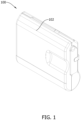
- FIG. 1 is a perspective view of an electronic device 100 including a housing 102.
- FIG. 2 is a perspective view of the electronic device 100 with a portion of the housing 102 removed.
- the electronic device 100 is a tracking device.
- the electronic device 100 is an electronic tracking device including a module or receiver 104 capable of receiving information from an electronic navigation system (not shown) and calculating a position of the electronic device on the earth based on the information received from the electronic navigation system.
- Suitable electronic navigation systems include satellite navigation systems, radio navigation systems, radar navigation systems, and any other type of navigation system that enables the electronic device 100 to operate as described herein.
- the receiver 104 is capable of receiving information from a global navigation satellite system (GNSS) and calculating a position of the electronic device on the earth based on the information received from the GNSS.
- GNSS global navigation satellite system
- Suitable GNSSs include the Global Positioning System (GPS), the GLObal NAvigation Satellite System (GLONASS), the Galileo Navigation System, the BeiDou Navigation Satellite System (BDS), and/or any other global navigation system.
- GPS Global Positioning System
- GLONASS GLObal NAvigation Satellite System
- BDS BeiDou Navigation Satellite System
- the receiver 104 may also receive information from regional navigation satellite systems such as the NAVigation with Indian Constellation (NavIC) and/or the Quasi-Zenith Satellite System (QZSS).
- NavIC NAVigation with Indian Constellation
- QZSS Quasi-Zenith Satellite System
- the electronic devices 100 described herein are attached to objects and track the location and temperature of the objects.
- the electronic device 100 tracks the location and temperature of cargo shipped from one location to another.
- the electronic device 100 may be attached to or placed in a shipping container and travels with the shipping container. As the shipping container travels, the electronic device 100 receives location information from GPS satellites, calculates the position of the shipping container, and sends the location and temperature information to a central location. Accordingly, the electronic device 100 described herein enables the shipper and/or the shipping company to electronically track shipments, improving logistics by knowing the location and condition of the monitored cargo.
- the electronic device 100 may be any electronic tracking device.
- the electronic device 100 includes a battery 106 that powers the electronic device and a battery protection system 108 that protects the battery from damage.
- the shipping container arrives at a location, the shipping container is typically removed from a larger transportation device (cargo ship, train, etc.) to a short term storage location and/or a smaller transportation device (barge, van, truck, etc.) using material moving equipment (forklifts, cranes, hoists, etc.).
- the electronic device 100 may be damaged as the shipping container is transferred between transportation devices. In some instances, the electronic device 100 may be damaged by the material moving equipment, also damaging the battery 106.
- the battery protection system 108 protects the battery 106 when the electronic device 100 is subjected to a large force such as a forklift running over the electronic device.
- the example battery 106 is a lithium ion battery including an anode including a reductant, a cathode including an oxidant, and a separator separating the anode and the cathode.
- the separator may be damaged such that the cathode and the anode contact each other, causing the oxidant and the reductant react unfavorably.
- the battery protection system 108 protects the battery 106 when the large force is applied to the electronic device 100 such that the battery protection system prevents at least one of the following: (1) damage to the battery, (2) the application of a force to the battery, (3) the battery being crushed, (4) damage to the separator, (5) the anode and the cathode contacting each other, and/or (6) the exothermic chemical reaction between the reductant and the oxidant. Accordingly, the electronic devices 100 and the battery protection systems 108 described herein enable electronic tracking of shipments while improving safety of tracking the electronic devices.
- FIG. 3 is a side view of the electronic device 100 with a portion of the housing 102 removed.
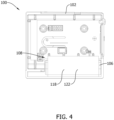
- FIG. 4 is a side view of the electronic device 100 with a portion of the housing 102 and electronic components 110 removed.
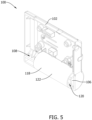
- FIG. 5 is a perspective view of the electronic device 100 with a portion of the housing 102 and electronic components 110 removed.
- the electronic device 100 includes the housing 102, the receiver 104, the battery 106, the battery protection system 108, the electronic components 110, and an antenna 112.
- the housing 102 defines a cavity 120 that contains the receiver 104, the battery 106, the battery protection system 108, the electronic components 110, and the antenna 112.
- the receiver 104, the electronic components 110, and the antenna 112 are separate components within the electronic device 100.
- the electronic components 110 include the receiver 104 and the antenna 112 such that the receiver 104, the electronic components 110, and the antenna 112 are a consolidated electronic component.
- the receiver 104 receives signals and information broadcast by GPS satellites and transmits the received information to the electronic components 110.
- the electronic components 110 perform a predetermined set of operations and calculations using the received information to determine a location of the electronic device 100.
- the electronic components 110 transmit location data to the antenna 112, and the antenna transmits the location data to a central location for tracking.
- the battery 106 provides electrical power to the receiver 104, the electronic components 110, and the antenna 112 to power the operations described herein.
- the battery 106 is electrically coupled to the receiver 104, the electronic components 110, and the antenna 112 by a pair of electrical leads 116.
- the battery protection system 108 is sized, shaped, and positioned to protect the battery 106 without interfering with the electrical leads 116.
- the battery protection system 108 is positioned away from the receiver 104 and the antenna 112 within the cavity 116 such that the battery protection system does not interfere with signals to and from the receiver 104 and the antenna 112. Additionally, in some embodiments, the battery protection system 108 may be electrically coupled to the antenna 112. Specifically, the battery protection system 108 may be a ground for the antenna 112.
- the battery protection systems 108 described herein each include at least one protective structure 118 that defines a protective cavity 120.
- the battery 106 is positioned within the protective cavity 120 to protect the battery.
- the protective structure 118 includes a protective tube 122.
- the protective tube 122 defines the protective cavity 120, and the battery 106 is positioned within the protective tube.
- the protective structure 118 includes a first protective rail 124 and a second protective rail 126.
- the first protective rail 124 is spaced from the second protective rail 126 to define the protective cavity 120 therebetween, and the battery 106 is positioned between the protective rails.
- FIG. 6 is a perspective view of the battery 106 and the battery protection system 108 of the first embodiment.
- FIG. 7 is a side view of the battery 106 and the battery protection system 108 of the first embodiment.
- FIG. 8 is an end view of the battery 106 and the battery protection system 108 of the first embodiment.
- the protective structure 118 includes the protective tube 122 that defines the protective cavity 120, and the battery 106 is positioned within the protective tube.
- the battery 106 has a substantially cylindrical shape and has a first end 128, a second end 130, a length 132, and a diameter 134.
- the battery 106 is suitably a tubular battery including an 18650 lithium-ion rechargeable battery.
- the inner diameter 142 is about 15 mm to about 20 mm, about 15 mm to about 19 mm, about 18 mm to about 19 mm, and/or about 18.92 mm.
- the outer diameter 144 is about 20 mm to about 30 mm, about 20 mm to about 25 mm, about 22 mm to about 23 mm, and/or about 22.23 mm.
- the thickness 146 is about 1 mm to about 5 mm, about 2 mm to about 4 mm, about 3 mm to about 4 mm, and/or about 3.31 mm.
- the protective tube 122 may have any length 140, inner diameter 142, outer diameter 144, and thickness 146 that enables the electronic device 100 and the battery protection systems 108 to operate as described herein.
- the first end 128 of the battery 106 extends beyond the first end 136 of the protective tube 122 a first extension distance 148 and the second end 130 of the battery extends beyond the second end 138 of the protective tube a second extension distance 150.
- the first extension distance 148 and the second extension distance 150 enables the protective tube 122 to protect the battery 106 without interfering with the electrical leads 116.
- the electrical leads 116 are attached to one of the first end 128 and the second end 130 of the battery 106. If the protective tube 122 extends beyond the first and second ends 128 and 130 of the battery 106 and a force is applied to the protective tube, the protective tube may interfere with the electrical leads 116 by pinching or physically contacting the electrical leads.
- the length 140 of the protective tube 122 relative to the length 132 of the battery 106 enables the protective tube 122 to protect the battery 106 without interfering with the electrical leads 116. Additionally, the first and second ends 136 and 138 of the protective tube 122 are rounded to reduce the likelihood that the first and second ends of the protective tube interfere with the electrical leads 116. In the illustrated embodiment, the first extension distance 148 is about 3 mm to about 4 mm or about 3.5 mm, and the second extension distance 150 is about 2 mm to about 4 mm or about 3 mm.
- the housing 102 may be arranged to protect the electrical leads 116 while enabling the protective tube 122 to protect the battery 106.
- the housing 102 may include first supports 152 that support the battery 106 but not the protective tube 122 and second supports 154 that support the protective tube but not the battery.
- the first supports 152 support the first and second ends 128 and 130 of the battery 106, maintaining a position of the battery that separates the battery from the housing 102.
- the second supports 154 support the protective tube 122, maintaining a position of the protective tube that separates the protective tube from the housing 102.
- the first supports 152 may be positioned relative to each other such that the ends 156 of the first supports define a protective tube cavity 158.
- the battery 106 and the protective tube 122 may be positioned relative to the first supports 152 such that the protective tube 122 is positioned within the protective tube cavity 158 but the battery 106 is not positioned within the protective tube cavity.
- the second supports 154 and the protective tube cavity 158 maintain the protective tube 122 in position within the housing 102.
- the supports 152 and 154 reduce the likelihood of damage to the electrical leads 116 by separating the battery 106 from the housing, reducing the likelihood of pinching or contact between the protective tube 122 and the electrical leads when a large force is applied to the housing 102 and the protective tube. Additionally, the supports 152 and 154 maintain the position of the battery 106 and the protective tube 122 within the housing 102.
- the protective tube 122 is made of high strength metal.
- the protective tube 122 is made of a high strength metal such as stainless steel, a structural aircraft streel, aluminum, and/or Structural Aircraft Tubing made with steel alloy 4130.
- the protective tubing 122 may be made of any high strength material such as titanium.
- the protective tube 122 may be made from any material that enables the battery protection system 108 to operate as described herein.
- the protective tube 122 protects the battery 106 when a large force is applied to the protective tube and the housing 102.
- the material that forms the protective tube 122, the inner and outer diameter 142 and 144, and the thickness 146 of the protective tube are designed to protect the battery 106 when a 9,000 pound fork lift runs over the electronic device 100 and the protective tube 122.
- a 9,000 pound fork lift typically exerts a force of 26 Newtons (N)/mm 2 .
- the material that forms the protective tube 122, the inner and outer diameter 142 and 144, and the thickness 146 are designed such that the protective tube has a crush strength of at least 29 N/mm 2 .
- the material that forms the protective tube 122, the inner and outer diameter 142 and 144, and the thickness 146 are designed such that the protective tube has a crush strength of about 29 N/mm 2 to about 73 N/mm 2 .
- the protective tube 122 is also designed to protect the battery 106 when a 200 pound operator stands on the electronic device 100, when a shipping container is positioned on the electronic device, and when truck runs over the electronic device.
- the material that forms the protective tube 122, the inner and outer diameter 142 and 144, and the thickness 146 of the protective tube are designed to protect the battery 106 when a force of about 0 N/mm 2 to about 435 N/mm 2 , about 26 N/mm 2 to about 435 N/mm 2 , and/or about 26 N/mm 2 .
- the protective tube 122 protects the battery 106 when a large force is applied to the electronic device 100, preventing the battery from smoking, catching on fire, and/or exploding.
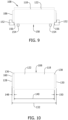
- FIG. 10 is a side view of a battery 160 and the battery protection system 108 of the second embodiment.
- FIG. 11 is an end view of the battery 106 and the battery protection system 108 of the second embodiment.
- the second embodiment is substantially similar to the first embodiment except that the battery 160 of the second embodiment is a safety battery that is larger than battery 106 because the battery 160 includes a protective circuit integrated into the battery 160.
- the battery protection system 108 of the second embodiment includes a protective tube 162 that has a larger diameter than the protective tube 122 of the first embodiment to accommodate the larger battery 160.
- an inner diameter 164 of the protective tube 162 is about 20 mm to about 25 mm, about 21 mm to about 24 mm, about 22 mm to about 23 mm, and/or about 22.1 mm.
- an outer diameter 166 of the protective tube 162 is about 25 mm to about 30 mm, about 25 mm to about 27 mm, about 25 mm to about 26 mm, and/or about 25.4 mm.
- a thickness 168 of the protective tube 162 is about 1 mm to about 5 mm, about 2 mm to about 4 mm, about 3 mm to about 4 mm, and/or about 3.33 mm.
- the protective tube 162 may have any inner diameter 164, outer diameter 166, and thickness 168 that enables the electronic device 100 and the battery protection systems 108 to operate as described herein.
- the protective tube 162 is made from similar materials as the protective tube 122.
- the protective tube 162 protects the battery 160 when a large force is applied to the protective tube and the housing 102.
- the material that forms the protective tube 162, the inner and outer diameter 164 and 166, and the thickness 168 of the protective tube are designed to protect the battery 160 when a 9,000 pound fork lift runs over the electronic device 100 and the protective tube 162.
- a 9,000 pound fork lift typically exerts a force of 26 N/mm 2 .
- the material that forms the protective tube 162, the inner and outer diameter 164 and 166, and the thickness 168 of the protective tube are designed such that the protective tube has a crush strength of at least 29 N/mm 2 .
- the material that forms the protective tube 162, the inner and outer diameter 164 and 166, and the thickness 168 of the protective tube are designed such that the protective tube has a crush strength of about 29 N/mm 2 to about 73 N/mm 2 .
- the protective tube 160 is also designed to protect the battery 160 when a 200 pound operator stands on the electronic device 100, when a shipping container is positioned on the electronic device, and when truck runs over the electronic device.
- the material that forms the protective tube 162, the inner and outer diameter 164 and 166, and the thickness 168 of the protective tube are designed to protect the battery 160 when a force of about 0 N/mm 2 to about 435 N/mm 2 , about 26 N/mm 2 to about 435 N/mm 2 , and/or about 26 N/mm 2 . Accordingly, the protective tube 162 protects the battery 160 when a large force is applied to the electronic device 100, preventing the battery from smoking, catching on fire, and/or exploding.
- FIG. 12 is a perspective view of the electronic device 100 including the battery protection system 108 of the third embodiment with a portion of the housing 102 removed.
- FIG. 13 is a perspective view of the battery 106 and the battery protection system 108 of the third embodiment.
- the protective structure 118 includes the first protective rail 124 and the second protective rail 126 spaced from the first protective rail 126 to define the protective cavity 120 therebetween, and the battery 106 is positioned between the protective rails.
- the first and second protective rails 124 and 126 each include a top rail 170, a bottom rail 172 spaced from the top rail, and pins 174 attached to the bottom rail and the top rail.
- the top rail 170, the bottom rail 172, and the pins 174 form ladder structures that are positioned on opposite sides of the battery 106 to form the protective cavity 120 and protect the battery.
- first and second protective rails 124 and 126 each include eight pins 174.
- first and second protective rails 124 and 126 may include any number of pins 174 that enable the battery protection system 108 to operate as described herein.
- Each pin 174 is a cylindrical rod having a pin length 176 and a pin diameter 178. In the illustrated embodiment, the pin diameter 178 is about 3 mm to about 3.5 mm. Additionally, the pins 174 are separated from each other by a pin separation distance 180. In the illustrated embodiment, the pin separation distance 180 between pins 174 is uniform. In alternative embodiments, the pin separation distance 180 between pins 174 is not uniform.
- the top rail 170 and the bottom rail 172 each have a rail length 182 and a rail thickness 184.
- the first and second protective rails 124 and 126 are spaced from each other a rail separation distance 186 greater than the diameter 134.
- the top rail 170, the bottom rail 172, and the pins 174 are made from similar materials as the protective tube 122.
- the first and second protective rails 124 and 126 protect the battery 106 when a large force is applied to the protective tube and the housing 102.
- the material that forms the first and second protective rails 124 and 126, the pin diameter 178, the rail thickness 184, and the number of pins 174 of the first and second protective rails are designed to protect the battery 106 when a 9,000 pound fork lift runs over the electronic device 100 and the protective tube 122 (26 N/mm 2 ).
- a 9,000 pound fork lift typically exerts a force of 26 N/mm 2 .
- the material that forms the first and second protective rails 124 and 126, the pin diameter 178, the rail thickness 184, and the number of pins 174 of the first and second protective rails are designed such that the first and second protective rails has a crush strength of at least 29 N/mm 2 . More specifically, the material that forms the first and second protective rails 124 and 126, the pin diameter 178, the rail thickness 184, and the number of pins 174 of the first and second protective rails are designed such that the first and second protective rails has a crush strength of about 29 N/mm 2 to about 73 N/mm 2 .
- first and second protective rails 124 and 126 is also designed to protect the battery 106 when a 200 pound operator stands on the electronic device 100, when a shipping container is positioned on the electronic device, and when truck runs over the electronic device. More specifically, the material that forms the first and second protective rails 124 and 126, the pin diameter 178, the rail thickness 184, and the number of pins 174 of the first and second protective rails are designed to protect the battery 106 when a force of about 0 N/mm 2 to about 435 N/mm 2 , about 26 N/mm 2 to about 435 N/mm 2 , and/or about 26 N/mm 2 . Accordingly, the first and second protective rails 124 and 126 protect the battery 106 when a large force is applied to the electronic device 100, preventing the battery from smoking, catching on fire, and/or exploding.
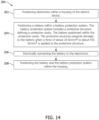
- FIG. 14 is a flow diagram of a method 200 of constructing an electronic device.
- the method 200 includes positioning 202 electronics within a housing of the electric device.
- the method 200 also includes positioning 204 a battery within a battery protection system.
- the battery protection system includes a protective structure defining a protective cavity. The battery positioned within the protective cavity.
- the protective structure prevents damage to the battery when a force of about 26 N/mm 2 to about 435 N/mm 2 is applied to the protective structure.
- the method 200 further includes electrically connecting 206 the battery to the electronics.
- the method 200 also includes positioning 208 the battery and the battery protection system within the housing.
- the protective structures are made from a high strength metal, such as high strength steel, and the shape and material of the protective structures enables the battery protection systems described herein to protect the battery when a lager force is applied to the battery protection system.
- the battery protection systems described herein protect the battery when a 9,000 pound fork lift runs over the battery and the battery protection system. Accordingly, the battery protection systems described herein protect the battery when a force of up to about 435 N/mm 2 is applied to the battery protection system.
- Example embodiments of battery protection systems for electronic devices and methods of constructing the devices are described above in detail.
- the systems and methods are not limited to the specific embodiments described herein, but rather, components of the system and methods may be used independently and separately from other components described herein.
- the battery protection systems described herein may be used in systems other than tracking devices.
Landscapes
- Chemical & Material Sciences (AREA)
- Chemical Kinetics & Catalysis (AREA)
- General Chemical & Material Sciences (AREA)
- Electrochemistry (AREA)
- Engineering & Computer Science (AREA)
- Inorganic Chemistry (AREA)
- Computer Hardware Design (AREA)
- Biophysics (AREA)
- Life Sciences & Earth Sciences (AREA)
- Microelectronics & Electronic Packaging (AREA)
- Manufacturing & Machinery (AREA)
- Battery Mounting, Suspending (AREA)
- Radar, Positioning & Navigation (AREA)
- Remote Sensing (AREA)
- Signal Processing (AREA)
- Computer Networks & Wireless Communication (AREA)
- Physics & Mathematics (AREA)
- General Physics & Mathematics (AREA)
Abstract
Description
- The field of the disclosure relates generally to battery-powered electronic devices, and more particularly, to systems and methods for a battery protector for an electronic device.
- Portable electronics, such as electronic tracking devices, typically include a battery to power electronic components within the electronics. The battery may be a lithium-ion battery that includes an anode, a cathode, and a separator separating the anode and the cathode. For example, the electronic tracking devices may include electronic components, a receiver, and an antenna, and the battery powers the electronic components, the receiver, and the antenna to enable the electronic tracking device to track the position of the electronic tracking device. However, if the electronic tracking device is damaged, the separator of the battery may also be damaged, causing the anode and the cathode to contact each other. Contact between the anode and the cathode may damage the battery, the electronic tracking device, and/or other equipment near the electronic tracking device. A system for protecting the battery is needed.
- This background section is intended to introduce the reader to various aspects of art that may be related to various aspects of the present disclosure, which are described and/or claimed below. This discussion is believed to be helpful in providing the reader with background information to facilitate a better understanding of the various aspects of the present disclosure. Accordingly, it should be understood that these statements are to be read in this light, and not as admissions of prior art.
- In one aspect, a tracking device includes a housing, electronics, a battery, and a battery protection system for protecting the battery. The electronics are disposed within the housing for tracking a position of the tracking device. The battery is electrically connected to the electronics. The battery protection system includes a protective structure defining a protective cavity, and the battery is positioned within the protective cavity. The protective structure prevents damage to the battery when a force of at least about 26 Newtons (N)/square millimeter (mm2) to about 435 N/mm2 is applied to the protective structure.
- In another aspect, a battery protection system for an electric device includes a protective structure defining a protective cavity and a battery positioned within the protective cavity. The protective structure prevents damage to the battery when a force of about 26 Newtons (N)/square millimeter (mm2) to about 435 N/mm2 is applied to the protective structure.
- In yet another aspect, a method of constructing an electronic device includes positioning electronics within a housing of the electric device. The method also includes positioning a battery within a battery protection system. The battery protection system includes a protective structure defining a protective cavity, and the battery is positioned within the protective cavity. The protective structure prevents damage to the battery when a force of about 26 Newtons (N)/square millimeter (mm2) to about 435 N/mm2 is applied to the protective structure. The method further includes electrically connecting the battery to the electronics. The method also includes positioning the battery and the battery protection system within the housing.
- Various refinements exist of the features noted in relation to the above-mentioned aspects. Further features may also be incorporated in the above-mentioned aspects as well. These refinements and additional features may exist individually or in any combination. For instance, various features discussed below in relation to any of the illustrated embodiments may be incorporated into any of the above-described aspects, alone or in any combination.
-
-
FIG. 1 is perspective view of an electronic device including a housing. -
FIG. 2 is a perspective view of the electronic device illustrated inFIG. 1 with a portion of the housing removed. -
FIG. 3 is a side view of the electronic device illustrated inFIG. 1 with a portion of the housing removed. -
FIG. 4 is a side view of the electronic device illustrated inFIG. 1 with a portion of the housing and electronic components removed. -
FIG. 5 is a perspective view of the electronic device illustrated inFIG. 1 with a portion of the housing and electronic components removed. -
FIG. 6 is a perspective view of a battery and a battery protection system illustrated inFIG. 2 . -
FIG. 7 is a side view of the battery and the battery protection system illustrated inFIG. 2 . -
FIG. 8 is an end view of the battery and the battery protection system illustrated inFIG. 2 . -
FIG. 9 is a schematic side view of battery and the battery protection system illustrated inFIG. 2 . -
FIG. 10 is a side view of another embodiment of a battery and a battery protection system illustrated inFIG. 2 . -
FIG. 11 is an end view of the battery and the battery protection system illustrated inFIG. 10 . -
FIG. 12 is a side view of yet another embodiment of a battery and a battery protection system illustrated inFIG. 2 . -
FIG. 13 is an end view of the battery and the battery protection system illustrated inFIG. 12 . -
FIG. 14 is a flow diagram of a method of constructing the electronic device illustrated inFIG. 1 . - Corresponding reference characters indicate corresponding parts throughout the drawings.
-
FIG. 1 is a perspective view of anelectronic device 100 including ahousing 102.FIG. 2 is a perspective view of theelectronic device 100 with a portion of thehousing 102 removed. In the illustrated embodiment, theelectronic device 100 is a tracking device. In this example, theelectronic device 100 is an electronic tracking device including a module orreceiver 104 capable of receiving information from an electronic navigation system (not shown) and calculating a position of the electronic device on the earth based on the information received from the electronic navigation system. Suitable electronic navigation systems include satellite navigation systems, radio navigation systems, radar navigation systems, and any other type of navigation system that enables theelectronic device 100 to operate as described herein. More specifically, thereceiver 104 is capable of receiving information from a global navigation satellite system (GNSS) and calculating a position of the electronic device on the earth based on the information received from the GNSS. Suitable GNSSs include the Global Positioning System (GPS), the GLObal NAvigation Satellite System (GLONASS), the Galileo Navigation System, the BeiDou Navigation Satellite System (BDS), and/or any other global navigation system. Additionally, thereceiver 104 may also receive information from regional navigation satellite systems such as the NAVigation with Indian Constellation (NavIC) and/or the Quasi-Zenith Satellite System (QZSS). - The
electronic devices 100 described herein are attached to objects and track the location and temperature of the objects. In this example, theelectronic device 100 tracks the location and temperature of cargo shipped from one location to another. Theelectronic device 100 may be attached to or placed in a shipping container and travels with the shipping container. As the shipping container travels, theelectronic device 100 receives location information from GPS satellites, calculates the position of the shipping container, and sends the location and temperature information to a central location. Accordingly, theelectronic device 100 described herein enables the shipper and/or the shipping company to electronically track shipments, improving logistics by knowing the location and condition of the monitored cargo. In alternative embodiments, theelectronic device 100 may be any electronic tracking device. - The
electronic device 100 includes abattery 106 that powers the electronic device and abattery protection system 108 that protects the battery from damage. When the shipping container arrives at a location, the shipping container is typically removed from a larger transportation device (cargo ship, train, etc.) to a short term storage location and/or a smaller transportation device (barge, van, truck, etc.) using material moving equipment (forklifts, cranes, hoists, etc.). Theelectronic device 100 may be damaged as the shipping container is transferred between transportation devices. In some instances, theelectronic device 100 may be damaged by the material moving equipment, also damaging thebattery 106. Thebattery protection system 108 protects thebattery 106 when theelectronic device 100 is subjected to a large force such as a forklift running over the electronic device. - The
example battery 106 is a lithium ion battery including an anode including a reductant, a cathode including an oxidant, and a separator separating the anode and the cathode. When thebattery 106 is damaged, the separator may be damaged such that the cathode and the anode contact each other, causing the oxidant and the reductant react unfavorably. Thebattery protection system 108 protects thebattery 106 when the large force is applied to theelectronic device 100 such that the battery protection system prevents at least one of the following: (1) damage to the battery, (2) the application of a force to the battery, (3) the battery being crushed, (4) damage to the separator, (5) the anode and the cathode contacting each other, and/or (6) the exothermic chemical reaction between the reductant and the oxidant. Accordingly, theelectronic devices 100 and thebattery protection systems 108 described herein enable electronic tracking of shipments while improving safety of tracking the electronic devices. -
FIG. 3 is a side view of theelectronic device 100 with a portion of thehousing 102 removed.FIG. 4 is a side view of theelectronic device 100 with a portion of thehousing 102 andelectronic components 110 removed.FIG. 5 is a perspective view of theelectronic device 100 with a portion of thehousing 102 andelectronic components 110 removed. Theelectronic device 100 includes thehousing 102, thereceiver 104, thebattery 106, thebattery protection system 108, theelectronic components 110, and anantenna 112. Thehousing 102 defines acavity 120 that contains thereceiver 104, thebattery 106, thebattery protection system 108, theelectronic components 110, and theantenna 112. In this embodiment, thereceiver 104, theelectronic components 110, and theantenna 112 are separate components within theelectronic device 100. In alternative embodiments, theelectronic components 110 include thereceiver 104 and theantenna 112 such that thereceiver 104, theelectronic components 110, and theantenna 112 are a consolidated electronic component. - The
receiver 104 receives signals and information broadcast by GPS satellites and transmits the received information to theelectronic components 110. Theelectronic components 110 perform a predetermined set of operations and calculations using the received information to determine a location of theelectronic device 100. Theelectronic components 110 transmit location data to theantenna 112, and the antenna transmits the location data to a central location for tracking. Thebattery 106 provides electrical power to thereceiver 104, theelectronic components 110, and theantenna 112 to power the operations described herein. Thebattery 106 is electrically coupled to thereceiver 104, theelectronic components 110, and theantenna 112 by a pair of electrical leads 116. As described below, thebattery protection system 108 is sized, shaped, and positioned to protect thebattery 106 without interfering with the electrical leads 116. Additionally, thebattery protection system 108 is positioned away from thereceiver 104 and theantenna 112 within thecavity 116 such that the battery protection system does not interfere with signals to and from thereceiver 104 and theantenna 112. Additionally, in some embodiments, thebattery protection system 108 may be electrically coupled to theantenna 112. Specifically, thebattery protection system 108 may be a ground for theantenna 112. - The
battery protection systems 108 described herein each include at least oneprotective structure 118 that defines aprotective cavity 120. Thebattery 106 is positioned within theprotective cavity 120 to protect the battery. In a first embodiment illustrated inFIGS. 6- 8 and a second embodiment illustrated inFIGS. 10 and11 , theprotective structure 118 includes aprotective tube 122. Theprotective tube 122 defines theprotective cavity 120, and thebattery 106 is positioned within the protective tube. In a third embodiment illustrated inFIGS. 12 and13 , theprotective structure 118 includes a firstprotective rail 124 and a secondprotective rail 126. The firstprotective rail 124 is spaced from the secondprotective rail 126 to define theprotective cavity 120 therebetween, and thebattery 106 is positioned between the protective rails. -
FIG. 6 is a perspective view of thebattery 106 and thebattery protection system 108 of the first embodiment.FIG. 7 is a side view of thebattery 106 and thebattery protection system 108 of the first embodiment.FIG. 8 is an end view of thebattery 106 and thebattery protection system 108 of the first embodiment. As discussed above, theprotective structure 118 includes theprotective tube 122 that defines theprotective cavity 120, and thebattery 106 is positioned within the protective tube. Thebattery 106 has a substantially cylindrical shape and has afirst end 128, asecond end 130, alength 132, and adiameter 134. Thebattery 106 is suitably a tubular battery including an 18650 lithium-ion rechargeable battery. In alternative embodiments, thebattery 106 may be any type of battery and may have any shape that enables theelectronic device 100 to operate as described herein. The batteryfirst end 128 and thesecond end 130 define thelength 132 therebetween. Thelength 132 is suitably in the range of about 60 millimeters (mm) to about 70 mm, about 65 mm to about 70 mm, about 68 mm to about 69 mm, and/or about 68.8 mm. Thediameter 134 is suitably in the range of about 15 mm to about 20 mm, about 15 mm to about 19 mm, about 18 mm to about 19 mm, and/or about 18.8 mm. More generally, thebattery 106 may have anylength 132 anddiameter 134 that enables theelectronic device 100 to operate as described herein. - The
protective tube 122 has a substantially tubular shape and has afirst end 136, asecond end 138, alength 140, aninner diameter 142, anouter diameter 144, and athickness 146. Thefirst end 136 and thesecond end 138 define thelength 140 therebetween, and theinner diameter 142 and theouter diameter 144 define thethickness 146 therebetween. In the illustrated embodiment, thelength 140 is about 60 millimeters (mm) to about 70 mm, about 60 mm to about 65 mm, about 62 mm to about 63 mm, and/or about 62.3 mm. In the illustrated embodiment, theinner diameter 142 is about 15 mm to about 20 mm, about 15 mm to about 19 mm, about 18 mm to about 19 mm, and/or about 18.92 mm. In the illustrated embodiment, theouter diameter 144 is about 20 mm to about 30 mm, about 20 mm to about 25 mm, about 22 mm to about 23 mm, and/or about 22.23 mm. In the illustrated embodiment, thethickness 146 is about 1 mm to about 5 mm, about 2 mm to about 4 mm, about 3 mm to about 4 mm, and/or about 3.31 mm. Theprotective tube 122 may have anylength 140,inner diameter 142,outer diameter 144, andthickness 146 that enables theelectronic device 100 and thebattery protection systems 108 to operate as described herein. - As shown in
FIG. 8 , theinner diameter 142 is greater than thediameter 134 such that thebattery 106 is positioned within theprotective cavity 120, and thelength 132 of thebattery 106 is greater than thelength 140 of theprotective tube 122. Specifically, theinner diameter 142 is greater than thediameter 134 such that thebattery 106 is positioned within theprotective cavity 120 by sliding thefirst end 128 of thebattery 106 into thesecond end 138 of theprotective tube 122 such that thefirst end 128 of thebattery 106 extends beyond thefirst end 136 of theprotective tube 122 and thesecond end 130 of the battery extends beyond thesecond end 138 of the protective tube. In the illustrated embodiment, thefirst end 128 of thebattery 106 extends beyond thefirst end 136 of the protective tube 122 afirst extension distance 148 and thesecond end 130 of the battery extends beyond thesecond end 138 of the protective tube asecond extension distance 150. Thefirst extension distance 148 and thesecond extension distance 150 enables theprotective tube 122 to protect thebattery 106 without interfering with the electrical leads 116. Specifically, theelectrical leads 116 are attached to one of thefirst end 128 and thesecond end 130 of thebattery 106. If theprotective tube 122 extends beyond the first and second ends 128 and 130 of thebattery 106 and a force is applied to the protective tube, the protective tube may interfere with theelectrical leads 116 by pinching or physically contacting the electrical leads. Thelength 140 of theprotective tube 122 relative to thelength 132 of thebattery 106 enables theprotective tube 122 to protect thebattery 106 without interfering with the electrical leads 116. Additionally, the first and second ends 136 and 138 of theprotective tube 122 are rounded to reduce the likelihood that the first and second ends of the protective tube interfere with the electrical leads 116. In the illustrated embodiment, thefirst extension distance 148 is about 3 mm to about 4 mm or about 3.5 mm, and thesecond extension distance 150 is about 2 mm to about 4 mm or about 3 mm. - Additionally, the
housing 102 may be arranged to protect theelectrical leads 116 while enabling theprotective tube 122 to protect thebattery 106. Specifically, as illustrated inFIG. 9 , thehousing 102 may includefirst supports 152 that support thebattery 106 but not theprotective tube 122 andsecond supports 154 that support the protective tube but not the battery. The first supports 152 support the first and second ends 128 and 130 of thebattery 106, maintaining a position of the battery that separates the battery from thehousing 102. The second supports 154 support theprotective tube 122, maintaining a position of the protective tube that separates the protective tube from thehousing 102. Additionally, thefirst supports 152 may be positioned relative to each other such that the ends 156 of the first supports define aprotective tube cavity 158. Thebattery 106 and theprotective tube 122 may be positioned relative to thefirst supports 152 such that theprotective tube 122 is positioned within theprotective tube cavity 158 but thebattery 106 is not positioned within the protective tube cavity. The second supports 154 and theprotective tube cavity 158 maintain theprotective tube 122 in position within thehousing 102. Thesupports electrical leads 116 by separating thebattery 106 from the housing, reducing the likelihood of pinching or contact between theprotective tube 122 and the electrical leads when a large force is applied to thehousing 102 and the protective tube. Additionally, thesupports battery 106 and theprotective tube 122 within thehousing 102. - In the illustrated embodiment, the
protective tube 122 is made of high strength metal. Specifically, theprotective tube 122 is made of a high strength metal such as stainless steel, a structural aircraft streel, aluminum, and/or Structural Aircraft Tubing made with steel alloy 4130. In alternative embodiments, theprotective tubing 122 may be made of any high strength material such as titanium. Theprotective tube 122 may be made from any material that enables thebattery protection system 108 to operate as described herein. - The
protective tube 122 protects thebattery 106 when a large force is applied to the protective tube and thehousing 102. The material that forms theprotective tube 122, the inner andouter diameter thickness 146 of the protective tube are designed to protect thebattery 106 when a 9,000 pound fork lift runs over theelectronic device 100 and theprotective tube 122. A 9,000 pound fork lift typically exerts a force of 26 Newtons (N)/mm2. Specifically, the material that forms theprotective tube 122, the inner andouter diameter thickness 146 are designed such that the protective tube has a crush strength of at least 29 N/mm2. More specifically, the material that forms theprotective tube 122, the inner andouter diameter thickness 146 are designed such that the protective tube has a crush strength of about 29 N/mm2 to about 73 N/mm2. Additionally, theprotective tube 122 is also designed to protect thebattery 106 when a 200 pound operator stands on theelectronic device 100, when a shipping container is positioned on the electronic device, and when truck runs over the electronic device. More specifically, the material that forms theprotective tube 122, the inner andouter diameter thickness 146 of the protective tube are designed to protect thebattery 106 when a force of about 0 N/mm2 to about 435 N/mm2, about 26 N/mm2 to about 435 N/mm2, and/or about 26 N/mm2. Accordingly, theprotective tube 122 protects thebattery 106 when a large force is applied to theelectronic device 100, preventing the battery from smoking, catching on fire, and/or exploding. -
FIG. 10 is a side view of abattery 160 and thebattery protection system 108 of the second embodiment.FIG. 11 is an end view of thebattery 106 and thebattery protection system 108 of the second embodiment. The second embodiment is substantially similar to the first embodiment except that thebattery 160 of the second embodiment is a safety battery that is larger thanbattery 106 because thebattery 160 includes a protective circuit integrated into thebattery 160. Thebattery protection system 108 of the second embodiment includes aprotective tube 162 that has a larger diameter than theprotective tube 122 of the first embodiment to accommodate thelarger battery 160. In the illustrated embodiment, aninner diameter 164 of theprotective tube 162 is about 20 mm to about 25 mm, about 21 mm to about 24 mm, about 22 mm to about 23 mm, and/or about 22.1 mm. In the illustrated embodiment, anouter diameter 166 of theprotective tube 162 is about 25 mm to about 30 mm, about 25 mm to about 27 mm, about 25 mm to about 26 mm, and/or about 25.4 mm. In the illustrated embodiment, athickness 168 of theprotective tube 162 is about 1 mm to about 5 mm, about 2 mm to about 4 mm, about 3 mm to about 4 mm, and/or about 3.33 mm. Theprotective tube 162 may have anyinner diameter 164,outer diameter 166, andthickness 168 that enables theelectronic device 100 and thebattery protection systems 108 to operate as described herein. - The
protective tube 162 is made from similar materials as theprotective tube 122. Theprotective tube 162 protects thebattery 160 when a large force is applied to the protective tube and thehousing 102. The material that forms theprotective tube 162, the inner andouter diameter thickness 168 of the protective tube are designed to protect thebattery 160 when a 9,000 pound fork lift runs over theelectronic device 100 and theprotective tube 162. A 9,000 pound fork lift typically exerts a force of 26 N/mm2. Specifically, the material that forms theprotective tube 162, the inner andouter diameter thickness 168 of the protective tube are designed such that the protective tube has a crush strength of at least 29 N/mm2. More specifically, the material that forms theprotective tube 162, the inner andouter diameter thickness 168 of the protective tube are designed such that the protective tube has a crush strength of about 29 N/mm2 to about 73 N/mm2. Additionally, theprotective tube 160 is also designed to protect thebattery 160 when a 200 pound operator stands on theelectronic device 100, when a shipping container is positioned on the electronic device, and when truck runs over the electronic device. More specifically, the material that forms theprotective tube 162, the inner andouter diameter thickness 168 of the protective tube are designed to protect thebattery 160 when a force of about 0 N/mm2 to about 435 N/mm2, about 26 N/mm2 to about 435 N/mm2, and/or about 26 N/mm2. Accordingly, theprotective tube 162 protects thebattery 160 when a large force is applied to theelectronic device 100, preventing the battery from smoking, catching on fire, and/or exploding. -
FIG. 12 is a perspective view of theelectronic device 100 including thebattery protection system 108 of the third embodiment with a portion of thehousing 102 removed.FIG. 13 is a perspective view of thebattery 106 and thebattery protection system 108 of the third embodiment. As discussed above, theprotective structure 118 includes the firstprotective rail 124 and the secondprotective rail 126 spaced from the firstprotective rail 126 to define theprotective cavity 120 therebetween, and thebattery 106 is positioned between the protective rails. The first and secondprotective rails top rail 170, abottom rail 172 spaced from the top rail, and pins 174 attached to the bottom rail and the top rail. Thetop rail 170, thebottom rail 172, and thepins 174 form ladder structures that are positioned on opposite sides of thebattery 106 to form theprotective cavity 120 and protect the battery. - In the illustrated embodiment, first and second
protective rails pins 174. In alternative embodiments, first and secondprotective rails pins 174 that enable thebattery protection system 108 to operate as described herein. Eachpin 174 is a cylindrical rod having apin length 176 and apin diameter 178. In the illustrated embodiment, thepin diameter 178 is about 3 mm to about 3.5 mm. Additionally, thepins 174 are separated from each other by apin separation distance 180. In the illustrated embodiment, thepin separation distance 180 betweenpins 174 is uniform. In alternative embodiments, thepin separation distance 180 betweenpins 174 is not uniform. Thetop rail 170 and thebottom rail 172 each have arail length 182 and arail thickness 184. The first and secondprotective rails rail separation distance 186 greater than thediameter 134. Thetop rail 170, thebottom rail 172, and thepins 174 are made from similar materials as theprotective tube 122. - The first and second
protective rails battery 106 when a large force is applied to the protective tube and thehousing 102. The material that forms the first and secondprotective rails pin diameter 178, therail thickness 184, and the number ofpins 174 of the first and second protective rails are designed to protect thebattery 106 when a 9,000 pound fork lift runs over theelectronic device 100 and the protective tube 122 (26 N/mm2). A 9,000 pound fork lift typically exerts a force of 26 N/mm2. Specifically, the material that forms the first and secondprotective rails pin diameter 178, therail thickness 184, and the number ofpins 174 of the first and second protective rails are designed such that the first and second protective rails has a crush strength of at least 29 N/mm2. More specifically, the material that forms the first and secondprotective rails pin diameter 178, therail thickness 184, and the number ofpins 174 of the first and second protective rails are designed such that the first and second protective rails has a crush strength of about 29 N/mm2 to about 73 N/mm2. Additionally, the first and secondprotective rails battery 106 when a 200 pound operator stands on theelectronic device 100, when a shipping container is positioned on the electronic device, and when truck runs over the electronic device. More specifically, the material that forms the first and secondprotective rails pin diameter 178, therail thickness 184, and the number ofpins 174 of the first and second protective rails are designed to protect thebattery 106 when a force of about 0 N/mm2 to about 435 N/mm2, about 26 N/mm2 to about 435 N/mm2, and/or about 26 N/mm2. Accordingly, the first and secondprotective rails battery 106 when a large force is applied to theelectronic device 100, preventing the battery from smoking, catching on fire, and/or exploding. -
FIG. 14 is a flow diagram of amethod 200 of constructing an electronic device. Themethod 200 includes positioning 202 electronics within a housing of the electric device. Themethod 200 also includes positioning 204 a battery within a battery protection system. The battery protection system includes a protective structure defining a protective cavity. The battery positioned within the protective cavity. The protective structure prevents damage to the battery when a force of about 26 N/mm2 to about 435 N/mm2 is applied to the protective structure. Themethod 200 further includes electrically connecting 206 the battery to the electronics. Themethod 200 also includes positioning 208 the battery and the battery protection system within the housing. - The battery protection systems described herein protect the battery when a force of about 0 N/mm2 to about 435 N/mm2 is applied to the battery protection system. Specifically, battery protection systems described herein include protective structures that define a protective cavity, and the battery is positioned within the protective cavity. In some embodiments, the protective structure is a protective tube, and the battery is positioned within the protective tube. In another embodiment, the protective structure includes a first protective rail and a second protective rail spaced from the first protective rail to define the protective cavity therebetween, and the battery is positioned between the protective rails. The protective structures are made from a high strength metal, such as high strength steel, and the shape and material of the protective structures enables the battery protection systems described herein to protect the battery when a lager force is applied to the battery protection system. For example, the battery protection systems described herein protect the battery when a 9,000 pound fork lift runs over the battery and the battery protection system. Accordingly, the battery protection systems described herein protect the battery when a force of up to about 435 N/mm2 is applied to the battery protection system.
- Example embodiments of battery protection systems for electronic devices and methods of constructing the devices are described above in detail. The systems and methods are not limited to the specific embodiments described herein, but rather, components of the system and methods may be used independently and separately from other components described herein. For example, the battery protection systems described herein may be used in systems other than tracking devices.
- When introducing elements of the present disclosure or the embodiment(s) thereof, the articles "a", "an", "the" and "said" are intended to mean that there are one or more of the elements. The terms "comprising," "including," "containing" and "having" are intended to be inclusive and mean that there may be additional elements other than the listed elements. The use of terms indicating a particular orientation (e.g., "top", "bottom", "side", etc.) is for convenience of description and does not require any particular orientation of the item described.
- As various changes could be made in the above constructions and methods without departing from the scope of the disclosure, it is intended that all matter contained in the above description and shown in the accompanying drawing(s) shall be interpreted as illustrative and not in a limiting sense.
The following features are included in this disclosure: - 1. A tracking device comprising:
- a housing;
- electronics disposed within the housing for tracking a position of the tracking device;
- a battery electrically connected to the electronics; and
- a battery protection system for protecting the battery, the battery protection system comprising:
a protective structure defining a protective cavity, the battery positioned within the protective cavity, wherein the protective structure prevents damage to the battery when a force of at least about 26 Newtons (N)/square millimeter (mm2) to about 435 N/mm2 is applied to the protective structure.
- 2. The tracking device of feature 1, wherein the protective structure is made of at least one of an aircraft aluminum and an aircraft steel.
- 3. The tracking device of feature 1, wherein the protective structure has a crush strength of at least 29 N/mm2.
- 4. The tracking device of feature 1, wherein the protective structure includes a protective tube defining the protective cavity.
- 5. The tracking device of feature 4, wherein the protective tube includes a cylindrical wall having an inner surface, an outer surface, and a thickness therebetween, wherein the thickness is about 3.25 millimeters (mm) to about 3.35 mm.
- 6. The tracking device of feature 4, wherein the inner surface defines an inner diameter, and the outer surface defines an outer diameter, wherein the inner diameter is about 18.5 millimeters (mm) to about 19 mm, and the outer diameter is about 22 mm to about 22.5 mm.
- 7. The tracking device of feature 4, wherein the inner surface defines an inner diameter, and the outer surface defines an outer diameter, wherein the inner diameter is about 22 millimeters (mm) to about 22.5 mm, and the outer diameter is about 25 mm to about 25.5 mm.
- 8. The tracking device of feature 1, wherein the protective structure includes:
- a first protective rail; and
- a second protective rail spaced from the first protective rail to define the protective cavity therebetween.
- 9. The tracking device of feature 8, wherein the first and second protective rails each include:
- a top rail;
- a bottom rail spaced from the top rail; and
- pins attached to the bottom rail and the top rail.
- 10. The tracking device of feature 9, wherein the first and second protective rails each include eight pins extending between the top and bottom rails.
- 11. The tracking device of feature 9, wherein the pins each include a cylindrical rod having a pin diameter of about 3 millimeters (mm) to about 3.5 mm.
- 12. A battery protection system for an electric device, the battery protection system comprising:
- a protective structure defining a protective cavity; and
- a battery positioned within the protective cavity, wherein the protective structure prevents damage to the battery when a force of about 26 Newtons (N)/square millimeter (mm2) to about 435 N/mm2 is applied to the protective structure.
- 13. The battery protection system of feature 12, wherein the protective structure includes a protective tube defining the protective cavity.
- 14. The battery protection system of feature 13, wherein the protective tube includes a cylindrical wall having an inner surface, an outer surface, and a thickness therebetween, wherein the thickness is about 3.25 millimeters (mm) to about 3.35 mm.
- 15. The battery protection system of feature 14, wherein the inner surface defines an inner diameter, and the outer surface defines an outer diameter, wherein the inner diameter is about 18.5 millimeters (mm) to about 19 mm, and the outer diameter is about 22 mm to about 22.5 mm.
- 16. The battery protection system of feature 14, wherein the inner surface defines an inner diameter, and the outer surface defines an outer diameter, wherein the inner diameter is about 22 millimeters (mm) to about 22.5 mm, and the outer diameter is about 25 mm to about 25.5 mm.
- 17. The battery protection system of feature 12, wherein the protective structure includes:
- a first protective rail; and
- a second protective rail spaced from the first protective rail to define the protective cavity therebetween.
- 18. The battery protection system of feature 17, wherein the first and second protective rails each include:
- a top rail;
- a bottom rail spaced from the top rail; and
- pins attached to the bottom rail and the top rail.
- 19. The battery protection system of feature 18, wherein the first and second protective rails each include eight pins extending between the top and bottom rails.
- 20. A method of constructing an electronic device, the method comprising:
- positioning electronics within a housing of the electric device;
- positioning a battery within a battery protection system, the battery protection system includes a protective structure defining a protective cavity, the battery positioned within the protective cavity, wherein the protective structure includes a protective tube made of a high strength metal that prevents damage to the battery when a large force is applied to the protective structure;
- electrically connecting the battery to the electronics; and
- positioning the battery and the battery protection system within the housing.
Claims (15)
- A tracking device comprising:a housing;electronics disposed within the housing for tracking a position of the tracking device;a battery electrically connected to the electronics; anda battery protection system for protecting the battery, the battery protection system comprising a protective structure comprising:a first protective rail; anda second protective rail spaced from the first protective rail to define a protective cavity therebetween, the battery positioned within the protective cavity, wherein the protective structure is configured to prevent damage to the battery when a force of at least about 26 Newtons (N)/square millimeter (mm2) to about 435 N/mm2 is applied to the protective structure.
- The tracking device of claim 1, wherein the protective structure is made of at least one of an aircraft aluminum and an aircraft steel.
- The tracking device of claim 1, wherein the protective structure has a crush strength of at least 29 N/mm2.
- The tracking device of claim 1, wherein the first and second protective rails are spaced from each other by a rail separation distance that is greater than a diameter of the battery.
- The tracking device of claim 1, wherein the first and second protective rails each include:a top rail;a bottom rail spaced from the top rail; andpins attached to the bottom rail and the top rail.
- The tracking device of claim 5, wherein the first and second protective rails each include eight pins extending between the top and bottom rails.
- The tracking device of claim 5, wherein each pin includes a cylindrical rod having a pin diameter of about 3 millimeters (mm) to about 3.5 mm.
- The tracking device of claim 5, wherein the top rail, the bottom rail, and the pins of each of the first and second protective rails form ladder structures positioned on opposite sides of the battery to form the protective cavity.
- The tracking device of claim 5, wherein the pins are separated from one another by a uniform pin separation distance.
- A battery protection system for an electronic device, the battery protection system comprising:a protective structure comprising:a first protective rail; anda second protective rail spaced from the first protective rail to define a protective cavity therebetween; anda battery positioned within the protective cavity, wherein the protective structure is configured to prevent damage to the battery when a force of about 26 Newtons (N)/square millimeter (mm2) to about 435 N/mm2 is applied to the protective structure.
- The battery protection system of claim 10, wherein the first and second protective rails each include:a top rail;a bottom rail spaced from the top rail; andpins attached to the bottom rail and the top rail.
- The battery protection system of claim 11, wherein the first and second protective rails each include eight pins extending between the top and bottom rails.
- The battery protection system of claim 10, wherein the protective structure is made of at least one of an aircraft aluminum and an aircraft steel.
- The battery protection system of claim 10, wherein the protective structure has a crush strength of at least 29 N/mm2.
- A method of constructing an electronic device, the method comprising:positioning electronics within a housing of the electronic device;positioning a battery within a battery protection system, the battery protection system including a protective structure including a first protective rail and a second protective rail spaced from the first protective rail to define a protective cavity therebetween, the battery positioned within the protective cavity, wherein the protective structure is constructed of a high strength metal that is configured to prevent damage to the battery when a force of about 26 Newtons (N)/square millimeter (mm2) to about 435 N/mm2 is applied to the protective structure;electrically connecting the battery to the electronics; andpositioning the battery and the battery protection system within the housing.
Applications Claiming Priority (3)
| Application Number | Priority Date | Filing Date | Title |
|---|---|---|---|
| US16/949,492 US20220140298A1 (en) | 2020-10-30 | 2020-10-30 | Systems and methods for a battery protector for an electronic device |
| PCT/US2021/056420 WO2022093674A1 (en) | 2020-10-30 | 2021-10-25 | Systems and methods for a battery protector for an electronic device |
| EP21811581.4A EP4205217B1 (en) | 2020-10-30 | 2021-10-25 | Systems and methods for a battery protector for an electronic device |
Related Parent Applications (2)
| Application Number | Title | Priority Date | Filing Date |
|---|---|---|---|
| EP21811581.4A Division EP4205217B1 (en) | 2020-10-30 | 2021-10-25 | Systems and methods for a battery protector for an electronic device |
| EP21811581.4A Division-Into EP4205217B1 (en) | 2020-10-30 | 2021-10-25 | Systems and methods for a battery protector for an electronic device |
Publications (2)
| Publication Number | Publication Date |
|---|---|
| EP4401212A2 true EP4401212A2 (en) | 2024-07-17 |
| EP4401212A3 EP4401212A3 (en) | 2024-10-30 |
Family
ID=78725629
Family Applications (2)
| Application Number | Title | Priority Date | Filing Date |
|---|---|---|---|
| EP24175010.8A Pending EP4401212A3 (en) | 2020-10-30 | 2021-10-25 | Systems and methods for a battery protector for an electronic device |
| EP21811581.4A Active EP4205217B1 (en) | 2020-10-30 | 2021-10-25 | Systems and methods for a battery protector for an electronic device |
Family Applications After (1)
| Application Number | Title | Priority Date | Filing Date |
|---|---|---|---|
| EP21811581.4A Active EP4205217B1 (en) | 2020-10-30 | 2021-10-25 | Systems and methods for a battery protector for an electronic device |
Country Status (4)
| Country | Link |
|---|---|
| US (1) | US20220140298A1 (en) |
| EP (2) | EP4401212A3 (en) |
| CN (1) | CN116438705A (en) |
| WO (1) | WO2022093674A1 (en) |
Family Cites Families (15)
| Publication number | Priority date | Publication date | Assignee | Title |
|---|---|---|---|---|
| JP4214172B1 (en) * | 2007-12-07 | 2009-01-28 | パナソニック株式会社 | Alkaline battery and battery pack |
| US8239169B2 (en) * | 2009-09-25 | 2012-08-07 | Gregory Timothy L | Portable computing device and method for asset management in a logistics system |
| US9224995B2 (en) * | 2010-03-06 | 2015-12-29 | Husqvarna Ab | Battery powered tool and battery pack for a battery powered tool |
| DE102011115763A1 (en) * | 2011-10-12 | 2013-04-18 | Volkswagen Aktiengesellschaft | Body structure for an electrically driven passenger vehicle |
| US9916555B2 (en) * | 2012-04-10 | 2018-03-13 | Geoforce, Inc. | Location tracking with integrated identification of cargo carrier contents and related system and method |
| US10637022B2 (en) * | 2012-10-11 | 2020-04-28 | Cadenza Innovation, Inc. | Lithium ion battery |
| JP2014154401A (en) * | 2013-02-08 | 2014-08-25 | Mitsubishi Heavy Ind Ltd | Battery module and battery unit |
| US9831482B2 (en) * | 2013-09-06 | 2017-11-28 | Johnson Controls Technology Company | Battery module lid system and method |
| CN107667442A (en) * | 2015-05-06 | 2018-02-06 | A123系统有限责任公司 | Battery crush protection system |
| DE102016214974A1 (en) * | 2016-08-11 | 2018-02-15 | Thyssenkrupp Ag | battery case |
| DE102017003140A1 (en) * | 2017-03-31 | 2018-10-04 | Dräger Safety AG & Co. KGaA | Battery housing for receiving at least one battery |
| DE102017221260A1 (en) * | 2017-11-28 | 2019-05-29 | Thyssenkrupp Ag | Battery housing for a vehicle and use |
| US10434894B2 (en) * | 2018-01-23 | 2019-10-08 | Gm Global Technology Operations Llc. | Vehicle battery pack assembly |
| CA3115337C (en) * | 2018-09-21 | 2024-05-14 | Design Science Corp. | Safe transport and storage of energy storage devices |
| DE202019101682U1 (en) * | 2019-03-25 | 2020-06-26 | Reinz-Dichtungs-Gmbh | Battery box |
-
2020
- 2020-10-30 US US16/949,492 patent/US20220140298A1/en active Pending
-
2021
- 2021-10-25 EP EP24175010.8A patent/EP4401212A3/en active Pending
- 2021-10-25 WO PCT/US2021/056420 patent/WO2022093674A1/en not_active Ceased
- 2021-10-25 CN CN202180073659.8A patent/CN116438705A/en active Pending
- 2021-10-25 EP EP21811581.4A patent/EP4205217B1/en active Active
Also Published As
| Publication number | Publication date |
|---|---|
| CN116438705A (en) | 2023-07-14 |
| EP4401212A3 (en) | 2024-10-30 |
| EP4205217B1 (en) | 2024-07-03 |
| WO2022093674A1 (en) | 2022-05-05 |
| US20220140298A1 (en) | 2022-05-05 |
| EP4205217A1 (en) | 2023-07-05 |
Similar Documents
| Publication | Publication Date | Title |
|---|---|---|
| WO2018204912A1 (en) | Pallet with tracking device | |
| US7825795B2 (en) | Container tracking system | |
| RU2648979C2 (en) | Battery system | |
| US6854406B2 (en) | Autonomous surface watercraft | |
| US9349270B1 (en) | Method and apparatus for confirming an asset is associated with a given transportation structure | |
| US9916555B2 (en) | Location tracking with integrated identification of cargo carrier contents and related system and method | |
| US20140235188A1 (en) | Power management system for aircraft container tracking device | |
| US8872723B2 (en) | Light and RF transparent enclosure for use with asset tracking device | |
| RU2445701C2 (en) | Method and device to test travel time for monitoring of time of transported small-sized shipments travel, in particular, letters and similar mail items | |
| US9013306B2 (en) | Security device | |
| CA3059174A1 (en) | Aircraft tracking method and device and method of installation | |
| US20130264382A1 (en) | System and method for remote equipment data management | |
| US20200200919A1 (en) | Luggage tracking system | |
| EP3272129B1 (en) | A communication system | |
| US20100127927A1 (en) | Method and device for identifying, locating and positioning objects in a non-equipped area | |
| US20210073729A1 (en) | Systems and methods for tracking a wood pallet using an embedded tracking device | |
| EP4401212A2 (en) | Systems and methods for a battery protector for an electronic device | |
| DE202010016831U1 (en) | Transport device and system for locating one or more transport devices | |
| US8531290B2 (en) | Electronic device and procedure for locating pieces of luggage gone astray | |
| WO2014027133A1 (en) | An integrated tracking system and method | |
| CN106274986A (en) | Vehicle monitor terminal and safety of railway traffic monitoring system | |
| EP3336781A1 (en) | Electronics assembly for wireless transmission of at least one status information | |
| CN105631635A (en) | Cargo transport monitoring device, cargo transport monitoring system, and cargo transport monitoring method | |
| CN211969774U (en) | Civil aviation ground loading container positioning device | |
| EP4575546A1 (en) | System and method for dynamic pairing between devices |
Legal Events
| Date | Code | Title | Description |
|---|---|---|---|
| PUAI | Public reference made under article 153(3) epc to a published international application that has entered the european phase |
Free format text: ORIGINAL CODE: 0009012 |
|
| STAA | Information on the status of an ep patent application or granted ep patent |
Free format text: STATUS: THE APPLICATION HAS BEEN PUBLISHED |
|
| AC | Divisional application: reference to earlier application |
Ref document number: 4205217 Country of ref document: EP Kind code of ref document: P |
|
| AK | Designated contracting states |
Kind code of ref document: A2 Designated state(s): AL AT BE BG CH CY CZ DE DK EE ES FI FR GB GR HR HU IE IS IT LI LT LU LV MC MK MT NL NO PL PT RO RS SE SI SK SM TR |
|
| REG | Reference to a national code |
Ref country code: DE Ref legal event code: R079 Free format text: PREVIOUS MAIN CLASS: H01M0050202000 Ipc: H01M0010420000 |
|
| PUAL | Search report despatched |
Free format text: ORIGINAL CODE: 0009013 |
|
| AK | Designated contracting states |
Kind code of ref document: A3 Designated state(s): AL AT BE BG CH CY CZ DE DK EE ES FI FR GB GR HR HU IE IS IT LI LT LU LV MC MK MT NL NO PL PT RO RS SE SI SK SM TR |
|
| RIC1 | Information provided on ipc code assigned before grant |
Ipc: G06Q 10/0833 20230101ALN20240920BHEP Ipc: H01M 10/0525 20100101ALN20240920BHEP Ipc: H01M 50/247 20210101ALI20240920BHEP Ipc: H01M 50/242 20210101ALI20240920BHEP Ipc: G06Q 10/08 20240101ALI20240920BHEP Ipc: H01M 50/249 20210101ALI20240920BHEP Ipc: H01M 50/24 20210101ALI20240920BHEP Ipc: H01M 50/233 20210101ALI20240920BHEP Ipc: H01M 50/224 20210101ALI20240920BHEP Ipc: H01M 50/202 20210101ALI20240920BHEP Ipc: H01M 10/42 20060101AFI20240920BHEP |
|
| STAA | Information on the status of an ep patent application or granted ep patent |
Free format text: STATUS: REQUEST FOR EXAMINATION WAS MADE |
|
| 17P | Request for examination filed |
Effective date: 20250428 |
|
| STAA | Information on the status of an ep patent application or granted ep patent |
Free format text: STATUS: EXAMINATION IS IN PROGRESS |