EP4401013A1 - Training device, prediction device, training prediction device, program, training method, prediction method, and training prediction method - Google Patents
Training device, prediction device, training prediction device, program, training method, prediction method, and training prediction method Download PDFInfo
- Publication number
- EP4401013A1 EP4401013A1 EP21961397.3A EP21961397A EP4401013A1 EP 4401013 A1 EP4401013 A1 EP 4401013A1 EP 21961397 A EP21961397 A EP 21961397A EP 4401013 A1 EP4401013 A1 EP 4401013A1
- Authority
- EP
- European Patent Office
- Prior art keywords
- congestion
- model
- past
- related information
- time point
- Prior art date
- Legal status (The legal status is an assumption and is not a legal conclusion. Google has not performed a legal analysis and makes no representation as to the accuracy of the status listed.)
- Granted
Links
Images



Classifications
-
- G—PHYSICS
- G06—COMPUTING OR CALCULATING; COUNTING
- G06Q—INFORMATION AND COMMUNICATION TECHNOLOGY [ICT] SPECIALLY ADAPTED FOR ADMINISTRATIVE, COMMERCIAL, FINANCIAL, MANAGERIAL OR SUPERVISORY PURPOSES; SYSTEMS OR METHODS SPECIALLY ADAPTED FOR ADMINISTRATIVE, COMMERCIAL, FINANCIAL, MANAGERIAL OR SUPERVISORY PURPOSES, NOT OTHERWISE PROVIDED FOR
- G06Q50/00—Information and communication technology [ICT] specially adapted for implementation of business processes of specific business sectors, e.g. utilities or tourism
- G06Q50/40—Business processes related to the transportation industry
-
- G—PHYSICS
- G06—COMPUTING OR CALCULATING; COUNTING
- G06N—COMPUTING ARRANGEMENTS BASED ON SPECIFIC COMPUTATIONAL MODELS
- G06N20/00—Machine learning
-
- G—PHYSICS
- G06—COMPUTING OR CALCULATING; COUNTING
- G06N—COMPUTING ARRANGEMENTS BASED ON SPECIFIC COMPUTATIONAL MODELS
- G06N5/00—Computing arrangements using knowledge-based models
- G06N5/02—Knowledge representation; Symbolic representation
- G06N5/022—Knowledge engineering; Knowledge acquisition
-
- G—PHYSICS
- G06—COMPUTING OR CALCULATING; COUNTING
- G06Q—INFORMATION AND COMMUNICATION TECHNOLOGY [ICT] SPECIALLY ADAPTED FOR ADMINISTRATIVE, COMMERCIAL, FINANCIAL, MANAGERIAL OR SUPERVISORY PURPOSES; SYSTEMS OR METHODS SPECIALLY ADAPTED FOR ADMINISTRATIVE, COMMERCIAL, FINANCIAL, MANAGERIAL OR SUPERVISORY PURPOSES, NOT OTHERWISE PROVIDED FOR
- G06Q10/00—Administration; Management
- G06Q10/04—Forecasting or optimisation specially adapted for administrative or management purposes, e.g. linear programming or "cutting stock problem"
-
- G—PHYSICS
- G08—SIGNALLING
- G08G—TRAFFIC CONTROL SYSTEMS
- G08G1/00—Traffic control systems for road vehicles
- G08G1/01—Detecting movement of traffic to be counted or controlled
- G08G1/0104—Measuring and analyzing of parameters relative to traffic conditions
- G08G1/0108—Measuring and analyzing of parameters relative to traffic conditions based on the source of data
- G08G1/0112—Measuring and analyzing of parameters relative to traffic conditions based on the source of data from the vehicle, e.g. floating car data [FCD]
-
- G—PHYSICS
- G08—SIGNALLING
- G08G—TRAFFIC CONTROL SYSTEMS
- G08G1/00—Traffic control systems for road vehicles
- G08G1/01—Detecting movement of traffic to be counted or controlled
- G08G1/0104—Measuring and analyzing of parameters relative to traffic conditions
- G08G1/0108—Measuring and analyzing of parameters relative to traffic conditions based on the source of data
- G08G1/0116—Measuring and analyzing of parameters relative to traffic conditions based on the source of data from roadside infrastructure, e.g. beacons
-
- G—PHYSICS
- G08—SIGNALLING
- G08G—TRAFFIC CONTROL SYSTEMS
- G08G1/00—Traffic control systems for road vehicles
- G08G1/01—Detecting movement of traffic to be counted or controlled
- G08G1/0104—Measuring and analyzing of parameters relative to traffic conditions
- G08G1/0125—Traffic data processing
- G08G1/0129—Traffic data processing for creating historical data or processing based on historical data
-
- G—PHYSICS
- G08—SIGNALLING
- G08G—TRAFFIC CONTROL SYSTEMS
- G08G1/00—Traffic control systems for road vehicles
- G08G1/01—Detecting movement of traffic to be counted or controlled
- G08G1/0104—Measuring and analyzing of parameters relative to traffic conditions
- G08G1/0125—Traffic data processing
- G08G1/0133—Traffic data processing for classifying traffic situation
-
- G—PHYSICS
- G08—SIGNALLING
- G08G—TRAFFIC CONTROL SYSTEMS
- G08G1/00—Traffic control systems for road vehicles
- G08G1/01—Detecting movement of traffic to be counted or controlled
- G08G1/0104—Measuring and analyzing of parameters relative to traffic conditions
- G08G1/0137—Measuring and analyzing of parameters relative to traffic conditions for specific applications
- G08G1/0141—Measuring and analyzing of parameters relative to traffic conditions for specific applications for traffic information dissemination
Definitions
- the disclosure relates to a learning device, a prediction device, a learning prediction device, a program, a learning method, a prediction method, and a learning prediction method.
- Patent Literature 1 discloses a means for estimating congestion levels or flow of people in places where sensors are not installed that considers the dynamic causal relationship between timetable information and sensors when the level of congestion or flow of people on a station platform or a concourse is to be estimated.
- Patent Literature 1 Japanese Patent Application No. 2013-116676
- the conventional technique only predicts and presents the current congestion level at a station or in a train car, etc., to users who are already at the station. Since the users do not know the congestion level in the future, they cannot take action to avoid future congestion. Thus, the level of satisfaction decreases for future users who are about to head to train stations, etc.
- a learning device includes: a past-congestion-area-data storage unit configured to store past congestion-area data indicating congestion-related information including a past congestion level of each of m areas (where m is an integer of two or more); a past-sensor-data storage unit configured to store past sensor data indicating values detected in the past by one or more sensors installed in n areas (where n is an integer of one or more and n ⁇ m) out of the m areas; a first-model generating unit configured to generate a first model by using the values indicated by the past sensor data as input data and using the congestion-related information indicated by the past congestion-area data as correct data, the first model being a learning model for predicting, from values detected by the one or more sensors, congestion-related information of a time point at which the one or more sensors perform detection; and a second-model generating unit configured to generate a second model by using the congestion-related information of a first time point indicated by the past congestion-area data as input data and using the congestion level in the
- a learning device includes: a past-congestion-area-data storage unit configured to store past congestion-area data indicating congestion-related information including a past congestion level of each of m areas (where m is an integer of two or more); a past-sensor-data storage unit configured to store past sensor data indicating values detected in the past by one or more sensors installed in n areas (where n is an integer of one or more and n ⁇ m) out of the m areas; a first-model generating unit configured to generate a first model by using the congestion-related information indicated by the past congestion-area data as input data and using the values indicated by the past sensor data as correct data, the first model being a learning model for predicting, from the congestion-related information, values to be detected by the one or more sensors at a time point at which the congestion-related information is acquired; a model applying unit configured to use the first model to predict, from the congestion-related information at a first time point indicated by the past congestion-area data, values to be detected by the one or more
- a prediction device includes: an acquiring unit configured to acquires values detected by one or more sensors installed in n areas (where n is an integer of one or more, and n ⁇ m) out of m areas (where m is an integer of two or more); a first predicting unit configured to use a first model to predict, from the acquired values, congestion-related information of a time point at which one or more sensors perform detection, the first model being a learning model for predicting, from values to be detected by the one or more sensors, the congestion-related information of the time point at which the one or more sensors perform detection, the first model being generated by using values indicated by past sensor data indicating the values detected in the past by the one or more sensors installed in n areas (where n is an integer of one or more and n ⁇ m) out of the m areas as input data and using the congestion-related information indicated by past congestion-area data indicating the congestion-related information including a past congestion level of each of the m areas as correct data; and a second predicting unit configured to use a first model to predict
- a prediction device includes: an acquiring unit configured to acquire values detected by one or more sensors installed in n areas (where n is an integer of one or more, and n ⁇ m) out of m areas (where m is an integer of two or more); and a prediction executing unit configured to use a second model to predict a future congestion level of any of the m areas from the acquired values, the first model being a learning model for predicting, from congestion-related information, values to be detected by the one or more sensors at a time point at which the congestion-related information is acquired, the first model being generated by using, as input data, the congestion-related information indicated by past congestion-area data indicating the congestion-related information including a past congestion level of each of the m areas and by using, as correct data, values indicated by past sensor data indicating values detected by the one or more sensors in the past, the second model being a learning model for predicting a future congestion level from the values detected by the one or more sensors, the second model being generated by using, as input data, predicted values obtained
- a learning prediction device includes: a past-congestion-area-data storage unit configured to store past congestion-area data indicating congestion-related information including a past congestion level of each of m areas (where m is an integer of two or more); a past-sensor-data storage unit configured to store past sensor data indicating values detected in the past by one or more sensors installed in n areas (where n is an integer of one or more and n ⁇ m) out of the m areas; a first-model generating unit configured to generate a first model by using the values indicated by the past sensor data as input data and using the congestion-related information indicated by the past congestion-area data as correct data, the first model being a learning model for predicting, from values detected by the one or more sensors, congestion-related information of a time point at which the one or more sensors perform detection; a second-model generating unit configured to generate a second model by using the congestion-related information of a first time point indicated by the past congestion-area data as input data and using the congestion level in the congestion-related
- a learning prediction device includes: a past-congestion-area-data storage unit configured to store past congestion-area data indicating congestion-related information including a past congestion level of each of m areas (where m is an integer of two or more); a past-sensor-data storage unit configured to store past sensor data indicating values detected in the past by one or more sensors installed in n areas (where n is an integer of one or more and n ⁇ m) out of the m areas; a first-model generating unit configured to generate a first model by using the congestion-related information indicated by the past congestion-area data as input data and using the values indicated by the past sensor data as correct data, the first model being a learning model for predicting, from the congestion-related information, values to be detected by the one or more sensors at a time point at which the congestion-related information is acquired; a first predicting unit configured to use the first model to predict, from the congestion-related information at a first time point indicated by the past congestion-area data, values to be detected by the one or more sensors
- a program that causes a computer to function as: a past-congestion-area-data storage unit configured to store past congestion-area data indicating congestion-related information including a past congestion level of each of m areas (where m is an integer of two or more); a past-sensor-data storage unit configured to store past sensor data indicating values detected in the past by one or more sensors installed in n areas (where n is an integer of one or more and n ⁇ m) out of the m areas; a first-model generating unit configured to generate a first model by using the values indicated by the past sensor data as input data and using the congestion-related information indicated by the past congestion-area data as correct data, the first model being a learning model for predicting, from values detected by the one or more sensors, congestion-related information of a time point at which the one or more sensors perform detection; and a second-model generating unit configured to generate a second model by using the congestion-related information of a first time point indicated by the past congestion-area data as input data and
- a program that causes a computer to function as: a past-congestion-area-data storage unit configured to store past congestion-area data indicating congestion-related information including a past congestion level of each of m areas (where m is an integer of two or more); a past-sensor-data storage unit configured to store past sensor data indicating values detected in the past by one or more sensors installed in n areas (where n is an integer of one or more and n ⁇ m) out of the m areas; a first-model generating unit configured to generate a first model by using the congestion-related information indicated by the past congestion-area data as input data and using the values indicated by the past sensor data as correct data, the first model being a learning model for predicting, from the congestion-related information, values to be detected by the one or more sensors at a time point at which the congestion-related information is acquired; a model applying unit configured to use the first model to predict, from the congestion-related information at a first time point indicated by the past congestion-area data, values to be
- a program that causes a computer to function as: an acquiring unit configured to acquire values detected by one or more sensors installed in n areas (where n is an integer of one or more, and n ⁇ m) out of m areas (where m is an integer of two or more); a first predicting unit configured to use a first model to predict, from the acquired values, congestion-related information of a time point at which one or more sensors perform detection, the first model being a learning model for predicting, from values to be detected by the one or more sensors, the congestion-related information of the time point at which the one or more sensors perform detection, the first model being generated by using values indicated by past sensor data indicating the values detected in the past by the one or more sensors installed in n areas (where n is an integer of one or more and n ⁇ m) out of the m areas as input data and using the congestion-related information indicated by past congestion-area data indicating the congestion-related information including a past congestion level of each of the m areas as correct data; and a
- a program that causes a computer to function as: an acquiring unit configured to acquire values detected by one or more sensors installed in n areas (where n is an integer of one or more, and n ⁇ m) out of m areas (where m is an integer of two or more); and a prediction executing unit configured to use a second model to predict a future congestion level of any of the m areas from the acquired values, the first model being a learning model for predicting, from congestion-related information, values to be detected by the one or more sensors at a time point at which the congestion-related information is acquired, the first model being generated by using, as input data, the congestion-related information indicated by past congestion-area data indicating the congestion-related information including a past congestion level of each of the m areas and by using, as correct data, values indicated by past sensor data indicating values detected by the one or more sensors in the past, the second model being a learning model for predicting a future congestion level from the values detected by the one or more sensors, the second model being generated by
- a program that causes a computer to function as: a past-congestion-area-data storage unit configured to store past congestion-area data indicating congestion-related information including a past congestion level of each of m areas (where m is an integer of two or more); a past-sensor-data storage unit configured to store past sensor data indicating values detected in the past by one or more sensors installed in n areas (where n is an integer of one or more and n ⁇ m) out of the m areas; a first-model generating unit configured to generate a first model by using the values indicated by the past sensor data as input data and using the congestion-related information indicated by the past congestion-area data as correct data, the first model being a learning model for predicting, from values detected by the one or more sensors, congestion-related information of a time point at which the one or more sensors perform detection; a second-model generating unit configured to generate a second model by using the congestion-related information of a first time point indicated by the past congestion-area data as input data and using
- a program that causes a computer to function as: a past-congestion-area-data storage unit configured to store past congestion-area data indicating congestion-related information including a past congestion level of each of m areas (where m is an integer of two or more) ; a past-sensor-data storage unit configured to store past sensor data indicating values detected in the past by one or more sensors installed in n areas (where n is an integer of one or more and n ⁇ m) out of the m areas; a first-model generating unit configured to generate a first model by using the congestion-related information indicated by the past congestion-area data as input data and using the values indicated by the past sensor data as correct data, the first model being a learning model for predicting, from the congestion-related information, values to be detected by the one or more sensors at a time point at which the congestion-related information is acquired; a first predicting unit configured to use the first model to predict, from the congestion-related information at a first time point indicated by the past congestion-area data,
- a learning method includes: generating a first model that is a learning model for predicting, from values detected by one or more sensors, congestion-related information of a time point at which the one or more sensors perform detection, the first model being generated by using values indicated by past sensor data indicating the values detected in the past by the one or more sensors installed in n areas (where n is an integer of one or more and n ⁇ m) out of m areas (where m is an integer of two or more) as input data and using the congestion-related information indicated by past congestion-area data indicating the congestion-related information including a past congestion level of each of the m areas as correct data; and generating a second model that is a learning model for predicting a future congestion level from the congestion-related information, the second model being generated by using the congestion-related information of a first time point indicated by the past congestion-area data as input data and using the congestion level in the congestion-related information of a second time point indicated by the past congestion-area data as correct data, the second time point
- a learning method includes: generating a first model by using, as input data, the congestion-related information indicated by past congestion-area data indicating the congestion-related information including a past congestion level of each of m areas (where m is an integer of two or more) and using, as correct data, values indicated by past sensor data indicating the values detected in the past by the one or more sensors installed in n areas (where n is an integer of one or more and n ⁇ m) out of the m areas, the first model being a learning model for predicting, from congestion-related information, values to be detected by one or more sensors of a time point at which the congestion-related information is acquired; using the first model to predict, from the congestion-related information at a first time point indicated by the past congestion-area data, values to be detected by the one or more sensors at the first time point; and generating a second model by using the predicted values as input data and using the congestion level in the congestion-related information of a second time point indicated by the past congestion-area data as correct data
- a prediction method includes: acquiring values detected by one or more sensors installed in n areas (where n is an integer of one or more, and n ⁇ m) out of m areas (where m is an integer of two or more); using a first model to predict, from the acquired values, congestion-related information of a time point at which one or more sensors perform detection, the first model being a learning model for predicting, from values to be detected by the one or more sensors, the congestion-related information of the time point at which the one or more sensors perform detection, the first model being generated by using values indicated by past sensor data indicating the values detected in the past by the one or more sensors installed in n areas (where n is an integer of one or more and n ⁇ m) out of the m areas as input data and using the congestion-related information indicated by past congestion-area data indicating the congestion-related information including a past congestion level of each of the m areas as correct data; and using a second model to predict, from the predicted congestion-related information, a future congestion level of any of
- a prediction method includes: acquiring values detected by one or more sensors installed in n areas (where n is an integer of one or more, and n ⁇ m) out of m areas (where m is an integer of two or more); and using a second model to predict a future congestion level of any of the m areas from the acquired values, the first model being a learning model for predicting, from congestion-related information, values to be detected by the one or more sensors at a time point at which the congestion-related information is acquired, the first model being generated by using, as input data, the congestion-related information indicated by past congestion-area data indicating the congestion-related information including a past congestion level of each of the m areas and by using, as correct data, values indicated by past sensor data indicating values detected by the one or more sensors in the past, the second model being a learning model for predicting a future congestion level from the values detected by the one or more sensors, the second model being generated by using, as input data, predicted values obtained by using a first model to predict the values
- a learning prediction method includes: generating a first model that is a learning model for predicting, from values detected by one or more sensors, congestion-related information of a time point at which the one or more sensors perform detection, the first model being generated by using values indicated by past sensor data indicating the values detected in the past by the one or more sensors installed in n areas (where n is an integer of one or more and n ⁇ m) out of m areas (where m is an integer of two or more) as input data and using the congestion-related information indicated by past congestion-area data indicating the congestion-related information including a past congestion level of each of the m areas as correct data; generating a second model that is a learning model for predicting a future congestion level from the congestion-related information, the second model being generated by using the congestion-related information of a first time point indicated by the past congestion-area data as input data and using the congestion level in the congestion-related information of a second time point as correct data, the second time point being a time point after the first time point;
- a learning prediction method include: generating a first model that is a learning model for predicting, from congestion-related information, values to be detected by one or more sensors of a time point at which the congestion-related information is acquired, the first model being generated by using, as input data, the congestion-related information indicated by past congestion-area data indicating the congestion-related information including a past congestion level of each of m areas (where m is an integer of two or more) and using, as correct data, values indicated by past sensor data indicating the values detected in the past by the one or more sensors installed in n areas (where n is an integer of one or more and n ⁇ m) out of the m areas; using the first model to predict, from the congestion-related information at a first time point indicated by the past congestion-area data, values to be detected by the one or more sensors at the first time point; generating a second model that is a learning model for predicting a future congestion level from values detected by the one or more sensors, the second model being generated by using the predicted values as input
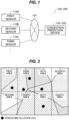
- FIG. 1 is a block diagram schematically illustrating a configuration of a congestion prediction system 100 according to the first embodiment.
- the congestion prediction system 100 includes a first sensor 110A, a second sensor 110B, a third sensor 110C, ... and a congestion prediction device 120.
- the first sensor 110A, the second sensor 110B, the third sensor 110C,... and the congestion prediction device 120 are connected to, for example, a network 101, such as the Internet, and sensor data indicating values detected by the first sensor 110A, the second sensor 110B, the third sensor 110C,... is transmitted to the congestion prediction device 120.
- a network 101 such as the Internet
- any one of the first sensor 110A, the second sensor 110B, and the third sensor 110C is referred to as a "sensor 110.”
- FIG. 1 three sensors 110 are illustrated, but it is sufficient to have at least one sensor 110.
- the sensors 110 include a congestion sensor that acquires congestion data on a symmetric space and an external sensor that acquires external data relating to a target space.
- Congestion data is, for example, imaging data captured by a camera, point cloud data indicating a point cloud detected by a laser, or infrared imaging data detected by an infrared sensor. It is assumed that congestion data is obtained by analyzing such data with the congestion prediction device 120 or another device to specify the number of people included in the congestion data.
- External data is, for example, data representing physical quantities, such as temperature, air temperature, wind speed, atmospheric pressure, or precipitation at a representative point or radio wave strengths of wireless access points within or around the target space.
- External data is not limited to data representing the above physical quantities; for example, it may be data such as special operation information of public transportation within or around the target space, or data representing the implementation status of events relating to the target space.
- FIG. 2 is a schematic diagram describing areas for which congestion is to be predicted and installation positions of the sensors 110 in the congestion prediction system 100.
- congestion is to be predicted in m areas (m is an integer of two or more).
- the sensors 110 are installed in n areas (n is an integer of one or more, and n ⁇ m).
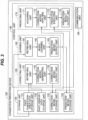
- FIG. 3 is a block diagram schematically illustrating a configuration of the congestion prediction device 120 according to the first embodiment.
- the congestion prediction device 120 includes a storage unit 130, a control unit 140, and a communication unit 180.
- the control unit 140 includes a correcting unit 150, a learning unit 160, and a predicting unit 170.
- the congestion prediction device 120 generates a model based on past congestion-area data indicating congestion-related information, such as congestion information, weather information, and event information of each area in the past, and past sensor data, which is sensor data acquired in the past by the sensors 110 installed in any of the areas, and performs prediction based on current sensor data by using the generated model.
- congestion-related information such as congestion information, weather information, and event information of each area in the past
- past sensor data which is sensor data acquired in the past by the sensors 110 installed in any of the areas
- the congestion prediction device 120 functions as a learning device that learns a learning model, a prediction device that performs prediction by using a learning model, and a learning prediction device that performs both learning and prediction.
- the storage unit 130 includes a past-congestion-area-data storage unit 131, a past-sensor-data storage unit 132, a correction-model storage unit 133, and a prediction-model storage unit 134.
- the past-congestion-area-data storage unit 131 stores past congestion-area data indicating congestion-related information, which is information relating to past congestion of each of the m areas.
- the congestion-related information includes past congestion levels of each of the m areas.
- FIG. 4 is a schematic diagram illustrating an example of past congestion-area data.
- the past congestion-area data illustrated in FIG. 4 represents congestion information, weather information, and event information of each area at each time point.
- Congestion information is information indicating the congestion level of an area.
- congestion information indicates a congestion level that is a numerical value indicating the state of congestion within an area, such as the number of people staying within the area or a congestion rank determined by a certain standard.
- congestion information should be generated from congestion data acquired by the congestion sensor.
- congestion information should be generated on the basis of information acquired by another device or information inputted by an operator.
- Weather information is information indicating the weather in an area.
- weather information is a numerical value relating to the weather in an area, such as precipitation, probability of precipitation, humidity, temperature, or wind speed within the area.
- Event information is information relating to events in an area.
- event information is a numerical value relating to events in an area, such as the number of visitors to an event held within the area or a flag indicating whether or not an event is held within the area.
- At least one of weather information and event information should be generated from the external data acquired by the external sensor.
- At least one of weather information and event information should be generated on the basis of information acquired by another device or information inputted by an operator.
- past congestion-area data provides information relating to congestion at each time point.
- the past-sensor-data storage unit 132 stores past sensor data indicating values detected in the past with one or more sensors installed in n areas out of the m areas.
- FIG. 5 is a schematic diagram illustrating an example of past sensor data.
- the past sensor data illustrated in FIG. 5 indicates values detected by the sensors 110 at each time point.
- the correction-model storage unit 133 stores a correction model, which is a learning model for predicting, from values detected by the sensors 110, congestion-related information at the time points at which the sensors 110 detect the values.
- the prediction-model storage unit 134 stores a prediction model, which is a learning model for predicting future congestion levels on the basis of the congestion-related information.
- the correcting unit 150 of the control unit 140 includes a retrieving unit 151, a correction-model generating unit 152, and a correction-model output unit 153.
- the retrieving unit 151 retrieves, from past congestion-area data and past sensor data, values that are data included in overlapping time periods. The retrieved values are given to the correction-model generating unit 152.
- the correction-model generating unit 152 functions as a first-model generating unit that generates a first model that is a learning model for predicting, from the values detected by the one or more sensors 110, congestion-related information at time points at which the one or more sensors 110 have performed detection, while using the values indicated by the past sensor data as input data and the congestion-related information indicated by the past congestion-area data as correct data.
- the correction-model generating unit 152 learns the first model by using the values of certain time points detected by the sensors 110 as input data and congestion-related information of these time points as correct data.
- the correction-model generating unit 152 uses the values retrieved by the retrieving unit 151 to generate the correction model as the first model for predicting congestion-related information from the values detected by the sensors 110.
- the generated correction model is given to the correction-model output unit 153.
- the correction-model output unit 153 stores the learning model generated by the correction-model generating unit 152 in the correction-model storage unit 133.
- the learning unit 160 of the control unit 140 includes a retrieving unit 161, a model learning unit 162, and a prediction-model output unit 163.
- the retrieving unit 161 retrieves the past congestion-area data from the past-congestion-area-data storage unit 131.
- the retrieved past congestion-area data is given to the model learning unit 162.
- the model learning unit 162 functions as a second-model generating unit that generates a second model, which is a learning model for predicting future congestion levels from the congestion-related information of past congestion-area data by using the congestion-related information of a first time point as input data and the congestion levels at a second time point, which is a time point after the first time point, as correct data.
- a second model which is a learning model for predicting future congestion levels from the congestion-related information of past congestion-area data by using the congestion-related information of a first time point as input data and the congestion levels at a second time point, which is a time point after the first time point, as correct data.
- the model learning unit 162 learns the second model by using one or more pieces of congestion-related information in one or more regions included in one or more time zones as input data and using the congestion level of one area out of the m areas at a time after the one or more time zones as correct data.
- the model learning unit 162 can learn a prediction model that can predict the congestion levels of the first area 30 minutes in the future by using the congestion-related information in all areas from 13:00 to 14:00 on one day as input data and the congestion levels indicated by the congestion information in the congestion-related information of the first area at 14:30 on the same day as correction data.
- the congestion-related information of all areas is used as input data, but it is also sufficient to use only congestion-related information of areas for which future congestion levels are to be predicted as input data, or only congestion-related information of one or more areas selected from all the areas as input data.
- the model learning unit 162 uses the past congestion-area data to generate a prediction model, or a second model, for predicting future congestion levels from the congestion-related information.
- the generated prediction model is given to the prediction-model output unit 163.
- the prediction-model output unit 163 stores the prediction model generated by the model learning unit 162 in the prediction-model storage unit 134.
- the predicting unit 170 of the control unit 140 includes an acquiring unit 171, a correction-model applying unit 172, a prediction executing unit 173, and a prediction-result output unit 174.
- the acquiring unit 171 acquires detected values from the sensors 110 via the communication unit 180. Data indicating the values acquired here is also referred to as real sensor data. The real sensor data is given to the correction-model applying unit 172.
- the correction-model applying unit 172 functions as a first predicting unit that uses the correction model to predict, from the values acquired by the acquiring unit 171, the congestion-related information of the time points at which the sensors 110 have performed detection.
- the correction-model applying unit 172 accumulates the real sensor data for a predetermined time period, inputs the accumulated real sensor data to the correction model stored in the correction-model storage unit 133, and predicts the congestion-related information of all areas during that time period.
- the congestion-related information predicted here is given to the prediction executing unit 173.
- the prediction executing unit 173 functions as a second predicting unit that uses the prediction model to predict, from the congestion-related information predicted by the correction-model applying unit 172, future congestion levels of any area out of the m areas.
- the prediction executing unit 173 accumulates the congestion-related information predicted by the correction-model applying unit 172 for a predetermined time period and uses the accumulated congestion-related information as real-time congestion area data.
- the prediction executing unit 173 then retrieves a prediction model from the prediction-model storage unit 134.
- the prediction executing unit 173 predicts a future congestion level of a target area by inputting, into the retrieved prediction model, real-time congestion-area data and a target area, which is an area of which the future congestion level is to be predicted.
- the congestion level predicted here is given to the prediction-result output unit 174.
- the prediction-result output unit 174 outputs the congestion level predicted by the prediction executing unit 173 as a prediction result.
- the prediction-result output unit 174 may output the prediction result by generating a prediction-result screen image, which is a screen image presenting the congestion level, and displaying the prediction-result screen image on a display unit (not illustrated).
- the prediction-result output unit 174 may output a prediction result by generating prediction-result information, which is information indicating the congestion level, and transmitting the prediction-result information to another device via the communication unit 180.
- the communication unit 180 performs communication through the network 101.
- the communication unit 180 receives data indicating values detected by the sensors 110.
- the above congestion prediction device 120 can be implemented by, for example, a computer 10 illustrated in FIG. 7 .
- FIG. 6 is a block diagram schematically illustrating a configuration of the computer 10.
- the computer 10 includes a processor 11, a volatile storage device 12, a nonvolatile storage device 13, and a communication device 14.
- the computer 10 incorporating the processor 11 is, for example, a personal computer, a stationary computer such as a server type computer, a portable computer such as a smartphone or a tablet computer, a microcomputer for device embedding applications, or a system-on-chip (SoC).
- a personal computer for example, a personal computer, a stationary computer such as a server type computer, a portable computer such as a smartphone or a tablet computer, a microcomputer for device embedding applications, or a system-on-chip (SoC).
- SoC system-on-chip
- the processor 11 comprehensively controls the computer 10.
- the processor 11 is a central processing unit (CPU), a field programmable gate array (FPGA), a digital signal processor (DSP), or the like.
- the processor 11 may be a single processor or a multiprocessor.
- the volatile storage device 12 is the main storage device of the computer 10.
- the volatile storage device 12 is a random access memory (RAM).
- the nonvolatile storage device 13 is an auxiliary storage device of the computer 10.
- the nonvolatile storage device 13 is a read only memory (ROM), a hard disk drive (HDD), or a solid-state drive (SSD).
- the communication device 14 is a communication interface for a network interface card (NIC) or the like.
- NIC network interface card
- the processor 11 uses the volatile storage device 12 as a work memory and operates in accordance with a computer program retrieved from the nonvolatile storage device 13 through a communication channel 15.
- the computer program may be supplied from outside the computer 10.
- the computer program may be distributed by a nonvolatile storage medium readable by the computer 10, e.g., a compact disc (CD), a digital versatile disc (DVD), or a flash memory.
- a computer program may be provided as a program product.
- the storage unit 130 of the congestion prediction device 120 illustrated in FIG. 3 can be implemented by the volatile storage device 12 or the nonvolatile storage device 13.
- the control unit 140 can be implemented by the processor 11 reading a program stored in the nonvolatile storage device 13 into the volatile storage device 12 and executing the program.
- the communication unit 180 can be implemented by the communication device 14.
- the congestion prediction device 120 may include a processing circuit such as an application specific integrated circuit (ASIC) in addition to a computer.
- the processing circuit may be a single circuit or a composite circuit.
- the congestion prediction device 120 can be implemented by processing circuitry.
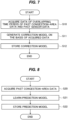
- FIG. 7 is a flow chart illustrating an example of a correction-model generation process executed by the correcting unit 150.
- the retrieving unit 151 retrieves data of overlapping time periods from the past-congestion-area-data storage unit 131 and the past-sensor-data storage unit 132 (step S10).
- the retrieved data is given to the correction-model generating unit 152.
- the correction-model generating unit 152 uses the data retrieved in step S11 to generate a correction model (step S11).
- the generated correction model is given to the correction-model output unit 153.
- a regression method such as multiple regression can be used for the correction-model generation process.
- the correction-model generating unit 152 generates a correction model by using a multiple regression equation, such as equation (1) below, as a correction model and optimizing correction coefficients ⁇ 1 to ak, which are parameters of the correction model, and a constant term ⁇ through the least squares method or the like, where value y is included in the past congestion-area data and values ⁇ 1 to k are indicated by the past sensor data.
- y ⁇ 1 ⁇ 1 + ⁇ 2 ⁇ 2 + ⁇ 3 ⁇ 3 + ... + ⁇ k ⁇ k + ⁇
- the correction-model generating unit 152 may generate a correction model by using any learning algorithm.
- the correction-model generating unit 152 may generate a model by using a machine learning algorithm such as a neural network, a support vector machine (SVM), a gradient boosting decision tree (GBDT), clustering, or reinforcement learning, in place of a known statistical method such as single regression or multiple regression.
- a machine learning algorithm such as a neural network, a support vector machine (SVM), a gradient boosting decision tree (GBDT), clustering, or reinforcement learning, in place of a known statistical method such as single regression or multiple regression.
- the correction-model output unit 153 stores the correction model in the correction-model storage unit 133 (step S12).
- FIG. 8 is a flow chart illustrating an example of a prediction-model learning process executed by the learning unit 160.
- the retrieving unit 161 retrieves past congestion-area data from the past-congestion-area-data storage unit 131 (step S20).
- the retrieved past congestion-area data is given to the model learning unit 162.
- the model learning unit 162 uses the past congestion-area data as learning data to generate a prediction model (step S21).
- the generated prediction model is given to the prediction-model output unit 163.
- the model learning unit 162 may generate a model by using any learning algorithm.
- the model learning unit 162 may generate a prediction model by using a learning algorithm such as a neural network, a support vector machine, a gradient boosting decision tree, clustering, or reinforcement learning.
- the prediction-model output unit 163 stores the prediction model in the prediction-model storage unit 134 (step S22).
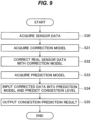
- FIG. 9 is a flow chart illustrating an example of a prediction process executed by the predicting unit 170.
- the acquiring unit 171 acquires real sensor data from the sensors 110 (step S30).
- the real sensor data is given to the correction-model applying unit 172.
- the correction-model applying unit 172 acquires the correction model from the correction-model storage unit 133 (step S31).
- the correction-model applying unit 172 then accumulates real sensor data for a predetermined time period, corrects the real sensor data by inputting the real sensor data into the correction model, and acquires real-time congestion-area data by predicting the congestion-related information (step S32).
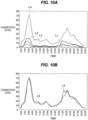
- FIGS. 10A and 10B are schematic diagrams for explaining past congestion-area data and real-time congestion-area data.
- Lines L1 to L3 in FIG. 10A indicate values detected by a sensor 110.
- Line L4 in FIG. 10A represents a congestion level included in past congestion-area data.
- Line L4 in FIG. 10B represents a congestion level included in past congestion-area data, as in FIG. 10A .
- Line L5 in FIG. 10B represents a congestion level predicted by inputting the values represented by lines L1 to L3 in FIG. 11A as real sensor data into a correction model stored in the correction-model storage unit 133.
- line L5 represents a congestion level included in the real-time congestion-area data.
- past congestion-area data is used as learning data when the correcting unit 150 learns a correction model. Then, when the predicting unit 170 performs prediction, real-time congestion-area data is generated from the real sensor data by using the correction model learned in this way, and prediction is performed by inputting the generated real-time congestion-area data into the prediction model. In this way, it is possible to take advantage of both the congestion area data that is difficult to acquire in real-time but is an accumulation of past data, and the sensor data that can be acquired in real-time but is not accumulated for all areas.
- the prediction executing unit 173 acquires a prediction model from the prediction-model storage unit 134 (step S33).
- the correction-model applying unit 172 then accumulates the congestion-related information predicted in step S32 for a predetermined time period, inputs the accumulated congestion-related information into the prediction model as real-time congestion-area data, and predicts a future congestion level in a target area, which is an area for which the prediction is performed (step S34).
- the predicted congestion level is given to the prediction-result output unit 174.
- the prediction-result output unit 174 outputs the predicted congestion level as a congestion prediction result from the congestion prediction device 120 (step S35) .
- past congestion levels of prediction target areas are learned by the model, and sensor data of the sensors 110 installed in several areas is inputted to the model, to enable prediction of future congestion levels in areas where no sensors 110 are installed. Therefore, users can take congestion avoidance actions in advance, and user satisfaction is improved.
- a congestion prediction system 200 includes a first sensor 110A, a second sensor 110B, a third sensor 110C,... and a congestion prediction device 220.
- the first sensor 110A, the second sensor 110B, the third sensor 110C,... and the congestion prediction device 220 are connected to, for example, a network 101, such as the Internet, and sensor data detected by the first sensor 110A, the second sensor 110B, the third sensor 110C,... is transmitted to the congestion prediction device 220.
- a network 101 such as the Internet
- the sensors 110 of the congestion prediction system 200 according to the second embodiment are the same as the sensors 110 of the congestion prediction system 100 according to the first embodiment.
- FIG. 11 is a block diagram schematically illustrating a configuration of the congestion prediction device 220 according to the second embodiment.
- the congestion prediction device 220 includes a storage unit 230, a control unit 240, and a communication unit 180.
- the control unit 240 includes a correcting unit 250, a learning unit 260, and a predicting unit 270.
- the communication unit 180 of the congestion prediction device 220 according to the second embodiment is the same as the communication unit 180 of the congestion prediction device 120 of the first embodiment.
- the congestion prediction device 220 of the second embodiment generates a model on the basis of past congestion-area data including information relating to congestion, such as congestion information, weather information, and event information, of each area in the past, and past sensor data, which is past sensor data provided by the sensors 110 installed in any of the areas, and uses the model to perform prediction from current sensor data.
- the congestion prediction device 220 functions as a learning device that learns a learning model, a prediction device that uses a learning model to perform prediction, and a learning prediction device that performs learning and prediction.
- the storage unit 230 includes a past-congestion-area-data storage unit 131, a past-sensor-data storage unit 132, a correction-model storage unit 233, and a prediction-model storage unit 234.
- the past-congestion-area-data storage unit 131 and the past-sensor-data storage unit 132 of the storage unit 230 according to the second embodiment are respectively the same as the past-congestion-area-data storage unit 131 and the past-sensor-data storage unit 132 of the storage unit 130 according to the first embodiment.
- the correction-model storage unit 233 stores a correction model that is a learning model for predicting, from congestion-related information, values to be detected by sensors 110 at a time point at which the congestion-related information is acquired.
- the prediction-model storage unit 234 stores a prediction model that is a learning model for predicting, from values detected by the sensors 110, future congestion levels.
- the correcting unit 250 of the control unit 240 includes a retrieving unit 151, a correction-model generating unit 252, and a correction-model output unit 153.
- the retrieving unit 151 and the correction-model output unit 153 of the correcting unit 250 according to the second embodiment are respectively the same as the retrieving unit 151 and the correction-model output unit 153 of the correcting unit 150 according to the first embodiment.
- the correction-model generating unit 252 functions as a first-model generating unit that generates a first model that is a learning model for predicting, from congestion-related information, values to be detected by one or more sensors 110 at the time point at which the congestion-related information is acquired, by using the congestion-related information indicated by past congestion-area data as input data and values indicated by past sensor data as correct data.
- the correction-model generating unit 252 uses congestion-related information of a certain time point as input data and uses the values detected by the sensors 110 at that time point as correct data, to learn the first model.
- the correction-model generating unit 252 uses the congestion-related information retrieved by the retrieving unit 151 to generate a correction model as the first model for predicting the values to be detected by the sensors 110.
- the generated correction model is given to the correction-model output unit 153.
- the learning unit 260 of the control unit 240 includes a retrieving unit 161, a model learning unit 262, a prediction-model output unit 163, and a correction-model applying unit 264.
- the retrieving unit 161 and the prediction-model output unit 163 of the learning unit 260 according to the second embodiment are respectively the same as the retrieving unit 161 and the prediction-model output unit 163 of the learning unit 260 according to the first embodiment.
- the retrieving unit 161 gives the past congestion-area data retrieved from the past-congestion-area-data storage unit 131 to the correction-model applying unit 264.
- the correction-model applying unit 264 functions as a model applying unit that uses a correction model to predict, from congestion-related information indicated by the past congestion-area data provided by the retrieving unit 161, values to be detected by the sensors 110 at the time point at which the past congestion-area data is acquired.
- Sensor data indicating the values predicted here is also referred to as predicted sensor data.
- the predicted sensor data is given to the model learning unit 162 .
- the model learning unit 262 functions as a second-model generating unit that generates a second model, which is a learning model for predicting future congestion levels from the sensor data, by using predicted sensor data of a first time point as input data and using the congestion levels included in the congestion-related information of past congestion-zone data of a second time point after the first time point as correct data.
- a second model which is a learning model for predicting future congestion levels from the sensor data, by using predicted sensor data of a first time point as input data and using the congestion levels included in the congestion-related information of past congestion-zone data of a second time point after the first time point as correct data.
- the model learning unit 262 learns the second model by using predicted sensor data in one or more time zones as input data and using the congestion level of one area out of m areas of a time point after the one or more time zones as correct data.
- the generated prediction model is given to the prediction-model output unit 163.
- the predicting unit 270 of the control unit 240 includes an acquiring unit 171, a prediction executing unit 273, and a prediction-result output unit 174.
- the acquiring unit 171 and the prediction-result output unit 174 of the predicting unit 270 according to the second embodiment are respectively the same as the acquiring unit 171 and the prediction-result output unit 174 of the predicting unit 170 according to the first embodiment.
- the acquiring unit 171 gives real sensor data, which is data indicating values acquired from the sensors 110, to the prediction executing unit 273.
- the prediction executing unit 273 functions as a second predicting unit that uses a prediction model to predict future congestion levels of any area out of the m areas from the real sensor data from the acquiring unit 171.
- the prediction executing unit 273 accumulates the real sensor data from the acquiring unit 171 for a predetermined time period and uses the accumulated real sensor data as target sensor data.
- the prediction executing unit 273 then retrieves the prediction model from the prediction-model storage unit 134.
- the prediction executing unit 273 predicts the future congestion levels of a target area by inputting, into the retrieved prediction model, target sensor data and a target area, which is an area for which future congestion levels are to be predicted.
- the congestion levels predicted here are given to the prediction-result output unit 174.
- the past congestion levels of prediction target areas are learned by a model, and sensor data of the sensors 110 installed in several areas is inputted to the model, to enable prediction of future congestion levels in areas where no sensors 110 are installed. Therefore, users can take congestion avoidance actions in advance, and user satisfaction is improved.
- the correction-model generating unit 252 can generate a correction model by using the data acquired during the time period t1.
- the correction-model applying unit 264 can then use a correction model to predict sensor data of a time period t0 during which no sensor data is acquired.
- model learning unit 262 can use the predicted sensor data to generate a prediction model.
- the load of sensor data acquisition can be reduced, and future congestion levels can be predicted, for example, by installing sensors 110 immediately before the congestion prediction device 220 is operated and by acquiring sensor data.
- the model learning unit 262 may also use sensor data of the time period t1 while learning a prediction model. In this way, the prediction accuracy can be enhanced.
- the installation cost of the sensors 110 be reduced, but the accumulation time of data to be used in prediction and the man-hours regarding data collection can also be reduced.
- the first and second embodiments are not limited to the examples described above, and the configuration of the congestion prediction devices 120 and 220, the configuration of the information stored in the storage units 130 and 230 can be implemented in various modifications without departing from the gist of the present invention.
- the present invention is not limited to the above embodiments, and the components can be modified and embodied without departing from the gist of the present invention.
- Various aspects of the invention can be formed by suitable combinations of the components disclosed in the above embodiments. For example, some components may be removed from the components described in the above embodiments. Moreover, components across different embodiments may be appropriately combined.
Landscapes
- Engineering & Computer Science (AREA)
- Physics & Mathematics (AREA)
- General Physics & Mathematics (AREA)
- Theoretical Computer Science (AREA)
- Analytical Chemistry (AREA)
- Chemical & Material Sciences (AREA)
- Business, Economics & Management (AREA)
- Strategic Management (AREA)
- Human Resources & Organizations (AREA)
- Economics (AREA)
- General Engineering & Computer Science (AREA)
- Tourism & Hospitality (AREA)
- Marketing (AREA)
- Software Systems (AREA)
- General Business, Economics & Management (AREA)
- Artificial Intelligence (AREA)
- Mathematical Physics (AREA)
- Computing Systems (AREA)
- Primary Health Care (AREA)
- Evolutionary Computation (AREA)
- General Health & Medical Sciences (AREA)
- Data Mining & Analysis (AREA)
- Health & Medical Sciences (AREA)
- Computational Linguistics (AREA)
- Operations Research (AREA)
- Quality & Reliability (AREA)
- Computer Vision & Pattern Recognition (AREA)
- Medical Informatics (AREA)
- Entrepreneurship & Innovation (AREA)
- Game Theory and Decision Science (AREA)
- Development Economics (AREA)
- Management, Administration, Business Operations System, And Electronic Commerce (AREA)
- Traffic Control Systems (AREA)
Abstract
Description
- The disclosure relates to a learning device, a prediction device, a learning prediction device, a program, a learning method, a prediction method, and a learning prediction method.
- In recent years, attempts have been made to encourage users to act to avoid congestion by predicting future congestion levels on station platforms or concourses and presenting the congestion levels. Accordingly, techniques have been proposed for estimating the congestion level or the flow of people on station platforms or concourses.
- In order to estimate the congestion level or the like, it is desirable to place sensors in all areas to be estimated. However, it is difficult to install sensors in all areas due to cost and operational difficulties.
- Accordingly,
Patent Literature 1 discloses a means for estimating congestion levels or flow of people in places where sensors are not installed that considers the dynamic causal relationship between timetable information and sensors when the level of congestion or flow of people on a station platform or a concourse is to be estimated. - Patent Literature 1:
Japanese Patent Application No. 2013-116676 - However, the conventional technique only predicts and presents the current congestion level at a station or in a train car, etc., to users who are already at the station. Since the users do not know the congestion level in the future, they cannot take action to avoid future congestion. Thus, the level of satisfaction decreases for future users who are about to head to train stations, etc.
- Accordingly, it is an object of one or more aspects of the disclosure to enable prediction of future congestion in areas where sensors are not installed.
- A learning device according to a first aspect of the disclosure includes: a past-congestion-area-data storage unit configured to store past congestion-area data indicating congestion-related information including a past congestion level of each of m areas (where m is an integer of two or more); a past-sensor-data storage unit configured to store past sensor data indicating values detected in the past by one or more sensors installed in n areas (where n is an integer of one or more and n<m) out of the m areas; a first-model generating unit configured to generate a first model by using the values indicated by the past sensor data as input data and using the congestion-related information indicated by the past congestion-area data as correct data, the first model being a learning model for predicting, from values detected by the one or more sensors, congestion-related information of a time point at which the one or more sensors perform detection; and a second-model generating unit configured to generate a second model by using the congestion-related information of a first time point indicated by the past congestion-area data as input data and using the congestion level in the congestion-related information of a second time point indicated by the past congestion-area data as correct data, the second model being a learning model for predicting a future congestion level from the congestion-related information, the second time point being a time point after the first time point.
- A learning device according to a second aspect of the disclosure includes: a past-congestion-area-data storage unit configured to store past congestion-area data indicating congestion-related information including a past congestion level of each of m areas (where m is an integer of two or more); a past-sensor-data storage unit configured to store past sensor data indicating values detected in the past by one or more sensors installed in n areas (where n is an integer of one or more and n<m) out of the m areas; a first-model generating unit configured to generate a first model by using the congestion-related information indicated by the past congestion-area data as input data and using the values indicated by the past sensor data as correct data, the first model being a learning model for predicting, from the congestion-related information, values to be detected by the one or more sensors at a time point at which the congestion-related information is acquired; a model applying unit configured to use the first model to predict, from the congestion-related information at a first time point indicated by the past congestion-area data, values to be detected by the one or more sensors at the first time point; and a second-model generating unit configured to generate a second model by using the predicted values as input data and using the congestion level in the congestion-related information of a second time point indicated by the past congestion-area data as correct data, the second model being a learning model for predicting a future congestion level from values detected by the one or more sensors, the second time point being a time point after the first time point.
- A prediction device according to a first aspect of the disclosure includes: an acquiring unit configured to acquires values detected by one or more sensors installed in n areas (where n is an integer of one or more, and n<m) out of m areas (where m is an integer of two or more); a first predicting unit configured to use a first model to predict, from the acquired values, congestion-related information of a time point at which one or more sensors perform detection, the first model being a learning model for predicting, from values to be detected by the one or more sensors, the congestion-related information of the time point at which the one or more sensors perform detection, the first model being generated by using values indicated by past sensor data indicating the values detected in the past by the one or more sensors installed in n areas (where n is an integer of one or more and n<m) out of the m areas as input data and using the congestion-related information indicated by past congestion-area data indicating the congestion-related information including a past congestion level of each of the m areas as correct data; and a second predicting unit configured to use a second model to predict, from the predicted congestion-related information, a future congestion level of any of the m areas, the second model being a learning model for predicting a future congestion level from the congestion-related information, the second model being generated by using the congestion-related information of a first time point indicated by the past congestion-area data as input data and using the congestion level in the congestion-related information of a second time point indicated by the past congestion-area data as correct data, the second time point being a time point after the first time point.
- A prediction device according to a second aspect includes: an acquiring unit configured to acquire values detected by one or more sensors installed in n areas (where n is an integer of one or more, and n<m) out of m areas (where m is an integer of two or more); and a prediction executing unit configured to use a second model to predict a future congestion level of any of the m areas from the acquired values, the first model being a learning model for predicting, from congestion-related information, values to be detected by the one or more sensors at a time point at which the congestion-related information is acquired, the first model being generated by using, as input data, the congestion-related information indicated by past congestion-area data indicating the congestion-related information including a past congestion level of each of the m areas and by using, as correct data, values indicated by past sensor data indicating values detected by the one or more sensors in the past, the second model being a learning model for predicting a future congestion level from the values detected by the one or more sensors, the second model being generated by using, as input data, predicted values obtained by using a first model to predict the values to be detected by the one or more sensors at a first time point, from congestion-related information of the first time point indicated by the past congestion-area data and by using, as correct data, a congestion level in the congestion-related information of a second time point indicated by the past congestion-area data, the second time point being a time point after the first time point.
- A learning prediction device according to a first aspect includes: a past-congestion-area-data storage unit configured to store past congestion-area data indicating congestion-related information including a past congestion level of each of m areas (where m is an integer of two or more); a past-sensor-data storage unit configured to store past sensor data indicating values detected in the past by one or more sensors installed in n areas (where n is an integer of one or more and n<m) out of the m areas; a first-model generating unit configured to generate a first model by using the values indicated by the past sensor data as input data and using the congestion-related information indicated by the past congestion-area data as correct data, the first model being a learning model for predicting, from values detected by the one or more sensors, congestion-related information of a time point at which the one or more sensors perform detection; a second-model generating unit configured to generate a second model by using the congestion-related information of a first time point indicated by the past congestion-area data as input data and using the congestion level in the congestion-related information of a second time point indicated by the past congestion-area data as correct data, the second model being a learning model for predicting a future congestion level from the congestion-related information, the second time point being a time point after the first time point; an acquiring unit configured to acquire values detected by the one or more sensors; a first predicting unit configured to use the first model to predict, from the acquired values, the congestion-related information of a time point at which the one or more sensors perform detection; and a second predicting unit configured to use the second model to predict, from the predicted congestion-related information, a future congestion level of any of the m areas.
- A learning prediction device according to a second aspect includes: a past-congestion-area-data storage unit configured to store past congestion-area data indicating congestion-related information including a past congestion level of each of m areas (where m is an integer of two or more); a past-sensor-data storage unit configured to store past sensor data indicating values detected in the past by one or more sensors installed in n areas (where n is an integer of one or more and n<m) out of the m areas; a first-model generating unit configured to generate a first model by using the congestion-related information indicated by the past congestion-area data as input data and using the values indicated by the past sensor data as correct data, the first model being a learning model for predicting, from the congestion-related information, values to be detected by the one or more sensors at a time point at which the congestion-related information is acquired; a first predicting unit configured to use the first model to predict, from the congestion-related information at a first time point indicated by the past congestion-area data, values to be detected by the one or more sensors at the first time point; a second-model generating unit configured to generate a second model by using the predicted values as input data and using the congestion level in the congestion-related information of a second time point indicated by the past congestion-area data as correct data, the second model being a learning model for predicting a future congestion level from the values detected by the one or more sensors, the second time point being a time point after the first time point; an acquiring unit configured to acquire the values detected by the one or more sensors; and a second predicting unit configured to use the second model to predict, from the acquired values, a future congestion level of any of the m areas.
- A program according to a first aspect of the disclosure that causes a computer to function as: a past-congestion-area-data storage unit configured to store past congestion-area data indicating congestion-related information including a past congestion level of each of m areas (where m is an integer of two or more); a past-sensor-data storage unit configured to store past sensor data indicating values detected in the past by one or more sensors installed in n areas (where n is an integer of one or more and n<m) out of the m areas; a first-model generating unit configured to generate a first model by using the values indicated by the past sensor data as input data and using the congestion-related information indicated by the past congestion-area data as correct data, the first model being a learning model for predicting, from values detected by the one or more sensors, congestion-related information of a time point at which the one or more sensors perform detection; and a second-model generating unit configured to generate a second model by using the congestion-related information of a first time point indicated by the past congestion-area data as input data and using the congestion level in the congestion-related information of a second time point indicated by the past congestion-area data as correct data, the second model being a learning model for predicting a future congestion level from the congestion-related information, the second time point being a time point after the first time point.
- A program according to a second aspect of the disclosure that causes a computer to function as: a past-congestion-area-data storage unit configured to store past congestion-area data indicating congestion-related information including a past congestion level of each of m areas (where m is an integer of two or more); a past-sensor-data storage unit configured to store past sensor data indicating values detected in the past by one or more sensors installed in n areas (where n is an integer of one or more and n<m) out of the m areas; a first-model generating unit configured to generate a first model by using the congestion-related information indicated by the past congestion-area data as input data and using the values indicated by the past sensor data as correct data, the first model being a learning model for predicting, from the congestion-related information, values to be detected by the one or more sensors at a time point at which the congestion-related information is acquired; a model applying unit configured to use the first model to predict, from the congestion-related information at a first time point indicated by the past congestion-area data, values to be detected by the one or more sensors at the first time point; and a second-model generating unit configured to generate a second model by using the predicted values as input data and using the congestion level in the congestion-related information of a second time point indicated by the past congestion-area data as correct data, the second model being a learning model for predicting a future congestion level from values detected by the one or more sensors, the second time point being a time point after the first time point.
- A program according to a third aspect of the disclosure that causes a computer to function as: an acquiring unit configured to acquire values detected by one or more sensors installed in n areas (where n is an integer of one or more, and n<m) out of m areas (where m is an integer of two or more); a first predicting unit configured to use a first model to predict, from the acquired values, congestion-related information of a time point at which one or more sensors perform detection, the first model being a learning model for predicting, from values to be detected by the one or more sensors, the congestion-related information of the time point at which the one or more sensors perform detection, the first model being generated by using values indicated by past sensor data indicating the values detected in the past by the one or more sensors installed in n areas (where n is an integer of one or more and n<m) out of the m areas as input data and using the congestion-related information indicated by past congestion-area data indicating the congestion-related information including a past congestion level of each of the m areas as correct data; and a second predicting unit configured to use a second model to predict, from the predicted congestion-related information, a future congestion level of any of the m areas, the second model being a learning model for predicting a future congestion level from the congestion-related information, the second model being generated by using the congestion-related information of a first time point indicated by the past congestion-area data as input data and using the congestion level in the congestion-related information of a second time point indicated by the past congestion-area data as correct data, the second time point being a time point after the first time point.
- A program according to a fourth aspect of the disclosure that causes a computer to function as: an acquiring unit configured to acquire values detected by one or more sensors installed in n areas (where n is an integer of one or more, and n<m) out of m areas (where m is an integer of two or more); and a prediction executing unit configured to use a second model to predict a future congestion level of any of the m areas from the acquired values, the first model being a learning model for predicting, from congestion-related information, values to be detected by the one or more sensors at a time point at which the congestion-related information is acquired, the first model being generated by using, as input data, the congestion-related information indicated by past congestion-area data indicating the congestion-related information including a past congestion level of each of the m areas and by using, as correct data, values indicated by past sensor data indicating values detected by the one or more sensors in the past, the second model being a learning model for predicting a future congestion level from the values detected by the one or more sensors, the second model being generated by using, as input data, predicted values obtained by using a first model to predict the values to be detected by the one or more sensors at a first time point, from congestion-related information of the first time point indicated by the past congestion-area data and by using, as correct data, a congestion level in the congestion-related information of a second time point indicated by the past congestion-area data, the second time point being a time point after the first time point.
- A program according to a fifth aspect of the disclosure that causes a computer to function as: a past-congestion-area-data storage unit configured to store past congestion-area data indicating congestion-related information including a past congestion level of each of m areas (where m is an integer of two or more); a past-sensor-data storage unit configured to store past sensor data indicating values detected in the past by one or more sensors installed in n areas (where n is an integer of one or more and n<m) out of the m areas; a first-model generating unit configured to generate a first model by using the values indicated by the past sensor data as input data and using the congestion-related information indicated by the past congestion-area data as correct data, the first model being a learning model for predicting, from values detected by the one or more sensors, congestion-related information of a time point at which the one or more sensors perform detection; a second-model generating unit configured to generate a second model by using the congestion-related information of a first time point indicated by the past congestion-area data as input data and using the congestion level in the congestion-related information of a second time point indicated by the past congestion-area data as correct data, the second model being a learning model for predicting a future congestion level from the congestion-related information, the second time point being a time point after the first time point; an acquiring unit configured to acquire the values detected by the one or more sensors; a first predicting unit configured to use the first model to predict, from the acquired values, the congestion-related information of a time point at which the one or more sensors perform detection; and a second predicting unit configured to use the second model to predict, from the predicted congestion-related information, a future congestion level of any of the m areas.
- A program according to a sixth aspect of the disclosure that causes a computer to function as: a past-congestion-area-data storage unit configured to store past congestion-area data indicating congestion-related information including a past congestion level of each of m areas (where m is an integer of two or more) ; a past-sensor-data storage unit configured to store past sensor data indicating values detected in the past by one or more sensors installed in n areas (where n is an integer of one or more and n<m) out of the m areas; a first-model generating unit configured to generate a first model by using the congestion-related information indicated by the past congestion-area data as input data and using the values indicated by the past sensor data as correct data, the first model being a learning model for predicting, from the congestion-related information, values to be detected by the one or more sensors at a time point at which the congestion-related information is acquired; a first predicting unit configured to use the first model to predict, from the congestion-related information at a first time point indicated by the past congestion-area data, values to be detected by the one or more sensors at the first time point; a second-model generating unit configured to generate a second model by using the predicted values as input data and using the congestion level in the congestion-related information of a second time point indicated by the past congestion-area data as correct data, the second model being a learning model for predicting a future congestion level from the values detected by the one or more sensors, the second time point being a time point after the first time point; an acquiring unit configured to acquire the values detected by the one or more sensors; and a second predicting unit configured to use the second model to predict, from the acquired values, a future congestion level of any of the m areas.
- A learning method according to a first aspect of the disclosure includes: generating a first model that is a learning model for predicting, from values detected by one or more sensors, congestion-related information of a time point at which the one or more sensors perform detection, the first model being generated by using values indicated by past sensor data indicating the values detected in the past by the one or more sensors installed in n areas (where n is an integer of one or more and n<m) out of m areas (where m is an integer of two or more) as input data and using the congestion-related information indicated by past congestion-area data indicating the congestion-related information including a past congestion level of each of the m areas as correct data; and generating a second model that is a learning model for predicting a future congestion level from the congestion-related information, the second model being generated by using the congestion-related information of a first time point indicated by the past congestion-area data as input data and using the congestion level in the congestion-related information of a second time point indicated by the past congestion-area data as correct data, the second time point being a time point after the first time point.
- A learning method according to a second aspect of the disclosure includes: generating a first model by using, as input data, the congestion-related information indicated by past congestion-area data indicating the congestion-related information including a past congestion level of each of m areas (where m is an integer of two or more) and using, as correct data, values indicated by past sensor data indicating the values detected in the past by the one or more sensors installed in n areas (where n is an integer of one or more and n<m) out of the m areas, the first model being a learning model for predicting, from congestion-related information, values to be detected by one or more sensors of a time point at which the congestion-related information is acquired; using the first model to predict, from the congestion-related information at a first time point indicated by the past congestion-area data, values to be detected by the one or more sensors at the first time point; and generating a second model by using the predicted values as input data and using the congestion level in the congestion-related information of a second time point indicated by the past congestion-area data as correct data, the second model being a learning model for predicting a future congestion level from values detected by the one or more sensors, the second time point being a time point after the first time point.
- A prediction method according to a first aspect includes: acquiring values detected by one or more sensors installed in n areas (where n is an integer of one or more, and n<m) out of m areas (where m is an integer of two or more); using a first model to predict, from the acquired values, congestion-related information of a time point at which one or more sensors perform detection, the first model being a learning model for predicting, from values to be detected by the one or more sensors, the congestion-related information of the time point at which the one or more sensors perform detection, the first model being generated by using values indicated by past sensor data indicating the values detected in the past by the one or more sensors installed in n areas (where n is an integer of one or more and n<m) out of the m areas as input data and using the congestion-related information indicated by past congestion-area data indicating the congestion-related information including a past congestion level of each of the m areas as correct data; and using a second model to predict, from the predicted congestion-related information, a future congestion level of any of the m areas, the second model being a learning model for predicting a future congestion level from the congestion-related information, the second model being generated by using the congestion-related information of a first time point indicated by the past congestion-area data as input data and using the congestion level in the congestion-related information of a second time point indicated by the past congestion-area data as correct data, the second time point being a time point after the first time point.
- A prediction method according to a second aspect of the disclosure includes: acquiring values detected by one or more sensors installed in n areas (where n is an integer of one or more, and n<m) out of m areas (where m is an integer of two or more); and using a second model to predict a future congestion level of any of the m areas from the acquired values, the first model being a learning model for predicting, from congestion-related information, values to be detected by the one or more sensors at a time point at which the congestion-related information is acquired, the first model being generated by using, as input data, the congestion-related information indicated by past congestion-area data indicating the congestion-related information including a past congestion level of each of the m areas and by using, as correct data, values indicated by past sensor data indicating values detected by the one or more sensors in the past, the second model being a learning model for predicting a future congestion level from the values detected by the one or more sensors, the second model being generated by using, as input data, predicted values obtained by using a first model to predict the values to be detected by the one or more sensors at a first time point, from congestion-related information of the first time point indicated by the past congestion-area data and by using, as correct data, a congestion level in the congestion-related information of a second time point indicated by the past congestion-area data, the second time point being a time point after the first time point.
- A learning prediction method according to a first aspect includes: generating a first model that is a learning model for predicting, from values detected by one or more sensors, congestion-related information of a time point at which the one or more sensors perform detection, the first model being generated by using values indicated by past sensor data indicating the values detected in the past by the one or more sensors installed in n areas (where n is an integer of one or more and n<m) out of m areas (where m is an integer of two or more) as input data and using the congestion-related information indicated by past congestion-area data indicating the congestion-related information including a past congestion level of each of the m areas as correct data; generating a second model that is a learning model for predicting a future congestion level from the congestion-related information, the second model being generated by using the congestion-related information of a first time point indicated by the past congestion-area data as input data and using the congestion level in the congestion-related information of a second time point as correct data, the second time point being a time point after the first time point; an acquiring unit configured to acquire values detected by the one or more sensors; using the first model to predict, from the acquired values, the congestion-related information of a time point at which the one or more sensors perform detection; and using the second model to predict, from the predicted congestion-related information, a future congestion level of any of the m areas.
- A learning prediction method according to a second aspect include: generating a first model that is a learning model for predicting, from congestion-related information, values to be detected by one or more sensors of a time point at which the congestion-related information is acquired, the first model being generated by using, as input data, the congestion-related information indicated by past congestion-area data indicating the congestion-related information including a past congestion level of each of m areas (where m is an integer of two or more) and using, as correct data, values indicated by past sensor data indicating the values detected in the past by the one or more sensors installed in n areas (where n is an integer of one or more and n<m) out of the m areas; using the first model to predict, from the congestion-related information at a first time point indicated by the past congestion-area data, values to be detected by the one or more sensors at the first time point; generating a second model that is a learning model for predicting a future congestion level from values detected by the one or more sensors, the second model being generated by using the predicted values as input data and using the congestion level in the congestion-related information of a second time point indicated by the past congestion-area data as correct data, the second time point being a time point after the first time point; an acquiring unit configured to acquire values detected by the one or more sensors; and
using the second model to predict, from the acquired values, a future congestion level of any of the m areas. - According to one or more aspects of the disclosure, it is possible to predict future congestion in areas where sensors are not installed.
-
-
FIG. 1 is a block diagram schematically illustrating a configuration of a congestion prediction system according to first and second embodiments. -
FIG. 2 is a schematic diagram describing areas for which congestion is to be predicted and installation positions of sensors in the congestion prediction system. -
FIG. 3 is a block diagram schematically illustrating a configuration of the congestion prediction device according to the first embodiment. -
FIG. 4 is a schematic diagram illustrating an example of past congestion-area data. -
FIG. 5 is a schematic diagram illustrating an example of past sensor data. -
FIG. 6 is a block diagram schematically illustrating a configuration of a computer. -
FIG. 7 is a flow chart illustrating an example of a correction-model generation process according to the first embodiment. -
FIG. 8 is a flow chart illustrating an example of a prediction-model learning process according to the first embodiment. -
FIG. 9 is a flow chart illustrating an example of a prediction process according to the first embodiment. -
FIGS. 10A and 10B are schematic diagrams for explaining past congestion-level data and real-time congestion-level data. -
FIG. 11 is a block diagram schematically illustrating a configuration of a congestion prediction device according to a second embodiment. -
FIG. 12 is a schematic diagram for explaining a process executed by the congestion prediction device according to the second embodiment. -
FIG. 1 is a block diagram schematically illustrating a configuration of a congestion prediction system 100 according to the first embodiment. - The congestion prediction system 100 includes a
first sensor 110A, asecond sensor 110B, athird sensor 110C, ... and acongestion prediction device 120. - The
first sensor 110A, thesecond sensor 110B, thethird sensor 110C,... and thecongestion prediction device 120 are connected to, for example, anetwork 101, such as the Internet, and sensor data indicating values detected by thefirst sensor 110A, thesecond sensor 110B, thethird sensor 110C,... is transmitted to thecongestion prediction device 120. - When there is no particular need to distinguish between the
first sensor 110A, thesecond sensor 110B, and thethird sensor 110C, any one of thefirst sensor 110A, thesecond sensor 110B, and thethird sensor 110C is referred to as a "sensor 110." - In
FIG. 1 , threesensors 110 are illustrated, but it is sufficient to have at least onesensor 110. - The
sensors 110 include a congestion sensor that acquires congestion data on a symmetric space and an external sensor that acquires external data relating to a target space. - Congestion data is, for example, imaging data captured by a camera, point cloud data indicating a point cloud detected by a laser, or infrared imaging data detected by an infrared sensor. It is assumed that congestion data is obtained by analyzing such data with the
congestion prediction device 120 or another device to specify the number of people included in the congestion data. - External data is, for example, data representing physical quantities, such as temperature, air temperature, wind speed, atmospheric pressure, or precipitation at a representative point or radio wave strengths of wireless access points within or around the target space. External data is not limited to data representing the above physical quantities; for example, it may be data such as special operation information of public transportation within or around the target space, or data representing the implementation status of events relating to the target space.
-
FIG. 2 is a schematic diagram describing areas for which congestion is to be predicted and installation positions of thesensors 110 in the congestion prediction system 100. - In the first embodiment, congestion is to be predicted in m areas (m is an integer of two or more). The
sensors 110 are installed in n areas (n is an integer of one or more, and n<m). - For example, as illustrated in
FIG. 2 , the congestion prediction system 100 predicts the congestion levels of first to eighth areas. It is ideal to provide asensor 110 in each of the first to eighth areas; however, as illustrated inFIG. 2 , it is assumed that thesensors 110 are provided only in the first, third, fifth, and sixth areas due to cost or other factors. In this example, m=8 and n=4. -
FIG. 3 is a block diagram schematically illustrating a configuration of thecongestion prediction device 120 according to the first embodiment. - The
congestion prediction device 120 includes astorage unit 130, acontrol unit 140, and acommunication unit 180. - The
control unit 140 includes a correctingunit 150, alearning unit 160, and a predictingunit 170. - The
congestion prediction device 120 generates a model based on past congestion-area data indicating congestion-related information, such as congestion information, weather information, and event information of each area in the past, and past sensor data, which is sensor data acquired in the past by thesensors 110 installed in any of the areas, and performs prediction based on current sensor data by using the generated model. - In other words, the
congestion prediction device 120 functions as a learning device that learns a learning model, a prediction device that performs prediction by using a learning model, and a learning prediction device that performs both learning and prediction. - The
storage unit 130 includes a past-congestion-area-data storage unit 131, a past-sensor-data storage unit 132, a correction-model storage unit 133, and a prediction-model storage unit 134. - The past-congestion-area-
data storage unit 131 stores past congestion-area data indicating congestion-related information, which is information relating to past congestion of each of the m areas. The congestion-related information includes past congestion levels of each of the m areas. -
FIG. 4 is a schematic diagram illustrating an example of past congestion-area data. - The past congestion-area data illustrated in
FIG. 4 represents congestion information, weather information, and event information of each area at each time point. - Congestion information is information indicating the congestion level of an area. For example, congestion information indicates a congestion level that is a numerical value indicating the state of congestion within an area, such as the number of people staying within the area or a congestion rank determined by a certain standard.
- For an area where a congestion sensor is installed, congestion information should be generated from congestion data acquired by the congestion sensor.
- For an area where no congestion sensor is installed, congestion information should be generated on the basis of information acquired by another device or information inputted by an operator.
- Weather information is information indicating the weather in an area. For example, weather information is a numerical value relating to the weather in an area, such as precipitation, probability of precipitation, humidity, temperature, or wind speed within the area.
- Event information is information relating to events in an area. For example, event information is a numerical value relating to events in an area, such as the number of visitors to an event held within the area or a flag indicating whether or not an event is held within the area.
- For a region where an external sensor is installed, at least one of weather information and event information should be generated from the external data acquired by the external sensor.
- For a region where no external sensor is installed, at least one of weather information and event information should be generated on the basis of information acquired by another device or information inputted by an operator.
- As described above, past congestion-area data provides information relating to congestion at each time point.
- Referring back to
FIG. 3 , the past-sensor-data storage unit 132 stores past sensor data indicating values detected in the past with one or more sensors installed in n areas out of the m areas. -
FIG. 5 is a schematic diagram illustrating an example of past sensor data. - The past sensor data illustrated in
FIG. 5 indicates values detected by thesensors 110 at each time point. - Referring back to
FIG. 3 , the correction-model storage unit 133 stores a correction model, which is a learning model for predicting, from values detected by thesensors 110, congestion-related information at the time points at which thesensors 110 detect the values. - The prediction-
model storage unit 134 stores a prediction model, which is a learning model for predicting future congestion levels on the basis of the congestion-related information. - The correcting
unit 150 of thecontrol unit 140 includes a retrievingunit 151, a correction-model generating unit 152, and a correction-model output unit 153. - The retrieving
unit 151 retrieves, from past congestion-area data and past sensor data, values that are data included in overlapping time periods. The retrieved values are given to the correction-model generating unit 152. - The correction-
model generating unit 152 functions as a first-model generating unit that generates a first model that is a learning model for predicting, from the values detected by the one ormore sensors 110, congestion-related information at time points at which the one ormore sensors 110 have performed detection, while using the values indicated by the past sensor data as input data and the congestion-related information indicated by the past congestion-area data as correct data. - For example, the correction-
model generating unit 152 learns the first model by using the values of certain time points detected by thesensors 110 as input data and congestion-related information of these time points as correct data. - Here, the correction-
model generating unit 152 uses the values retrieved by the retrievingunit 151 to generate the correction model as the first model for predicting congestion-related information from the values detected by thesensors 110. The generated correction model is given to the correction-model output unit 153. - The correction-
model output unit 153 stores the learning model generated by the correction-model generating unit 152 in the correction-model storage unit 133. - The
learning unit 160 of thecontrol unit 140 includes a retrievingunit 161, amodel learning unit 162, and a prediction-model output unit 163. - The retrieving
unit 161 retrieves the past congestion-area data from the past-congestion-area-data storage unit 131. The retrieved past congestion-area data is given to themodel learning unit 162. - The
model learning unit 162 functions as a second-model generating unit that generates a second model, which is a learning model for predicting future congestion levels from the congestion-related information of past congestion-area data by using the congestion-related information of a first time point as input data and the congestion levels at a second time point, which is a time point after the first time point, as correct data. - For example, the
model learning unit 162 learns the second model by using one or more pieces of congestion-related information in one or more regions included in one or more time zones as input data and using the congestion level of one area out of the m areas at a time after the one or more time zones as correct data. - Specifically, the
model learning unit 162 can learn a prediction model that can predict the congestion levels of thefirst area 30 minutes in the future by using the congestion-related information in all areas from 13:00 to 14:00 on one day as input data and the congestion levels indicated by the congestion information in the congestion-related information of the first area at 14:30 on the same day as correction data. Here, the congestion-related information of all areas is used as input data, but it is also sufficient to use only congestion-related information of areas for which future congestion levels are to be predicted as input data, or only congestion-related information of one or more areas selected from all the areas as input data. - Here, the
model learning unit 162 uses the past congestion-area data to generate a prediction model, or a second model, for predicting future congestion levels from the congestion-related information. The generated prediction model is given to the prediction-model output unit 163. - The prediction-
model output unit 163 stores the prediction model generated by themodel learning unit 162 in the prediction-model storage unit 134. - The predicting
unit 170 of thecontrol unit 140 includes an acquiringunit 171, a correction-model applying unit 172, aprediction executing unit 173, and a prediction-result output unit 174. - The acquiring
unit 171 acquires detected values from thesensors 110 via thecommunication unit 180. Data indicating the values acquired here is also referred to as real sensor data. The real sensor data is given to the correction-model applying unit 172. - The correction-
model applying unit 172 functions as a first predicting unit that uses the correction model to predict, from the values acquired by the acquiringunit 171, the congestion-related information of the time points at which thesensors 110 have performed detection. - Here, the correction-
model applying unit 172 accumulates the real sensor data for a predetermined time period, inputs the accumulated real sensor data to the correction model stored in the correction-model storage unit 133, and predicts the congestion-related information of all areas during that time period. - The congestion-related information predicted here is given to the
prediction executing unit 173. - The
prediction executing unit 173 functions as a second predicting unit that uses the prediction model to predict, from the congestion-related information predicted by the correction-model applying unit 172, future congestion levels of any area out of the m areas. - The
prediction executing unit 173 accumulates the congestion-related information predicted by the correction-model applying unit 172 for a predetermined time period and uses the accumulated congestion-related information as real-time congestion area data. - The
prediction executing unit 173 then retrieves a prediction model from the prediction-model storage unit 134. Theprediction executing unit 173 predicts a future congestion level of a target area by inputting, into the retrieved prediction model, real-time congestion-area data and a target area, which is an area of which the future congestion level is to be predicted. The congestion level predicted here is given to the prediction-result output unit 174. - The prediction-
result output unit 174 outputs the congestion level predicted by theprediction executing unit 173 as a prediction result. - For example, the prediction-
result output unit 174 may output the prediction result by generating a prediction-result screen image, which is a screen image presenting the congestion level, and displaying the prediction-result screen image on a display unit (not illustrated). - The prediction-
result output unit 174 may output a prediction result by generating prediction-result information, which is information indicating the congestion level, and transmitting the prediction-result information to another device via thecommunication unit 180. - The
communication unit 180 performs communication through thenetwork 101. - For example, the
communication unit 180 receives data indicating values detected by thesensors 110. - The above
congestion prediction device 120 can be implemented by, for example, acomputer 10 illustrated inFIG. 7 . -
FIG. 6 is a block diagram schematically illustrating a configuration of thecomputer 10. - The
computer 10 includes aprocessor 11, avolatile storage device 12, anonvolatile storage device 13, and acommunication device 14. - The
computer 10 incorporating theprocessor 11 is, for example, a personal computer, a stationary computer such as a server type computer, a portable computer such as a smartphone or a tablet computer, a microcomputer for device embedding applications, or a system-on-chip (SoC). - The
processor 11 comprehensively controls thecomputer 10. For example, theprocessor 11 is a central processing unit (CPU), a field programmable gate array (FPGA), a digital signal processor (DSP), or the like. Theprocessor 11 may be a single processor or a multiprocessor. - The
volatile storage device 12 is the main storage device of thecomputer 10. For example, thevolatile storage device 12 is a random access memory (RAM). - The
nonvolatile storage device 13 is an auxiliary storage device of thecomputer 10. For example, thenonvolatile storage device 13 is a read only memory (ROM), a hard disk drive (HDD), or a solid-state drive (SSD). - The
communication device 14 is a communication interface for a network interface card (NIC) or the like. - The
processor 11 uses thevolatile storage device 12 as a work memory and operates in accordance with a computer program retrieved from thenonvolatile storage device 13 through acommunication channel 15. The computer program may be supplied from outside thecomputer 10. Alternatively, the computer program may be distributed by a nonvolatile storage medium readable by thecomputer 10, e.g., a compact disc (CD), a digital versatile disc (DVD), or a flash memory. In other words, a computer program may be provided as a program product. - Here, the
storage unit 130 of thecongestion prediction device 120 illustrated inFIG. 3 can be implemented by thevolatile storage device 12 or thenonvolatile storage device 13. - The
control unit 140 can be implemented by theprocessor 11 reading a program stored in thenonvolatile storage device 13 into thevolatile storage device 12 and executing the program. - The
communication unit 180 can be implemented by thecommunication device 14. - The
congestion prediction device 120 may include a processing circuit such as an application specific integrated circuit (ASIC) in addition to a computer. The processing circuit may be a single circuit or a composite circuit. - In other words, the
congestion prediction device 120 can be implemented by processing circuitry. - The operation of the
congestion prediction device 120 will now be explained. -
FIG. 7 is a flow chart illustrating an example of a correction-model generation process executed by the correctingunit 150. - First, the retrieving
unit 151 retrieves data of overlapping time periods from the past-congestion-area-data storage unit 131 and the past-sensor-data storage unit 132 (step S10). The retrieved data is given to the correction-model generating unit 152. - Next, the correction-
model generating unit 152 uses the data retrieved in step S11 to generate a correction model (step S11). The generated correction model is given to the correction-model output unit 153. - Here, for example, a regression method such as multiple regression can be used for the correction-model generation process.
- Specifically, the correction-
model generating unit 152 generates a correction model by using a multiple regression equation, such as equation (1) below, as a correction model and optimizing correction coefficients α1 to ak, which are parameters of the correction model, and a constant term β through the least squares method or the like, where value y is included in the past congestion-area data and values ×1 to k are indicated by the past sensor data.
- The correction-
model generating unit 152 may generate a correction model by using any learning algorithm. For example, the correction-model generating unit 152 may generate a model by using a machine learning algorithm such as a neural network, a support vector machine (SVM), a gradient boosting decision tree (GBDT), clustering, or reinforcement learning, in place of a known statistical method such as single regression or multiple regression. - Next, the correction-
model output unit 153 stores the correction model in the correction-model storage unit 133 (step S12). -
FIG. 8 is a flow chart illustrating an example of a prediction-model learning process executed by thelearning unit 160. - First, the retrieving
unit 161 retrieves past congestion-area data from the past-congestion-area-data storage unit 131 (step S20). The retrieved past congestion-area data is given to themodel learning unit 162. - Next, the
model learning unit 162 uses the past congestion-area data as learning data to generate a prediction model (step S21). The generated prediction model is given to the prediction-model output unit 163. - Alternatively, the
model learning unit 162 may generate a model by using any learning algorithm. For example, themodel learning unit 162 may generate a prediction model by using a learning algorithm such as a neural network, a support vector machine, a gradient boosting decision tree, clustering, or reinforcement learning. - Next, the prediction-
model output unit 163 stores the prediction model in the prediction-model storage unit 134 (step S22). -
FIG. 9 is a flow chart illustrating an example of a prediction process executed by the predictingunit 170. - First, the acquiring
unit 171 acquires real sensor data from the sensors 110 (step S30). The real sensor data is given to the correction-model applying unit 172. - Next, the correction-
model applying unit 172 acquires the correction model from the correction-model storage unit 133 (step S31). - The correction-
model applying unit 172 then accumulates real sensor data for a predetermined time period, corrects the real sensor data by inputting the real sensor data into the correction model, and acquires real-time congestion-area data by predicting the congestion-related information (step S32). -
FIGS. 10A and 10B are schematic diagrams for explaining past congestion-area data and real-time congestion-area data. - Lines L1 to L3 in
FIG. 10A indicate values detected by asensor 110. - Line L4 in
FIG. 10A represents a congestion level included in past congestion-area data. - Line L4 in
FIG. 10B represents a congestion level included in past congestion-area data, as inFIG. 10A . - Line L5 in
FIG. 10B represents a congestion level predicted by inputting the values represented by lines L1 to L3 in FIG. 11A as real sensor data into a correction model stored in the correction-model storage unit 133. In other words, line L5 represents a congestion level included in the real-time congestion-area data. - Since detection in all areas by the
sensors 110 is difficult in real-time, past congestion-area data is used as learning data when the correctingunit 150 learns a correction model. Then, when the predictingunit 170 performs prediction, real-time congestion-area data is generated from the real sensor data by using the correction model learned in this way, and prediction is performed by inputting the generated real-time congestion-area data into the prediction model. In this way, it is possible to take advantage of both the congestion area data that is difficult to acquire in real-time but is an accumulation of past data, and the sensor data that can be acquired in real-time but is not accumulated for all areas. - Referring back to
FIG. 9 , theprediction executing unit 173 acquires a prediction model from the prediction-model storage unit 134 (step S33). - The correction-
model applying unit 172 then accumulates the congestion-related information predicted in step S32 for a predetermined time period, inputs the accumulated congestion-related information into the prediction model as real-time congestion-area data, and predicts a future congestion level in a target area, which is an area for which the prediction is performed (step S34). The predicted congestion level is given to the prediction-result output unit 174. - Next, the prediction-
result output unit 174 outputs the predicted congestion level as a congestion prediction result from the congestion prediction device 120 (step S35) . - As described above, according to the first embodiment, past congestion levels of prediction target areas are learned by the model, and sensor data of the
sensors 110 installed in several areas is inputted to the model, to enable prediction of future congestion levels in areas where nosensors 110 are installed. Therefore, users can take congestion avoidance actions in advance, and user satisfaction is improved. - As illustrated in
FIG. 1 , a congestion prediction system 200 according to the second embodiment includes afirst sensor 110A, asecond sensor 110B, athird sensor 110C,... and acongestion prediction device 220. - The
first sensor 110A, thesecond sensor 110B, thethird sensor 110C,... and thecongestion prediction device 220 are connected to, for example, anetwork 101, such as the Internet, and sensor data detected by thefirst sensor 110A, thesecond sensor 110B, thethird sensor 110C,... is transmitted to thecongestion prediction device 220. - The
sensors 110 of the congestion prediction system 200 according to the second embodiment are the same as thesensors 110 of the congestion prediction system 100 according to the first embodiment. -
FIG. 11 is a block diagram schematically illustrating a configuration of thecongestion prediction device 220 according to the second embodiment. - The
congestion prediction device 220 includes astorage unit 230, acontrol unit 240, and acommunication unit 180. - The
control unit 240 includes a correctingunit 250, alearning unit 260, and a predictingunit 270. - The
communication unit 180 of thecongestion prediction device 220 according to the second embodiment is the same as thecommunication unit 180 of thecongestion prediction device 120 of the first embodiment. - The
congestion prediction device 220 of the second embodiment generates a model on the basis of past congestion-area data including information relating to congestion, such as congestion information, weather information, and event information, of each area in the past, and past sensor data, which is past sensor data provided by thesensors 110 installed in any of the areas, and uses the model to perform prediction from current sensor data. - In other words, the
congestion prediction device 220 functions as a learning device that learns a learning model, a prediction device that uses a learning model to perform prediction, and a learning prediction device that performs learning and prediction. - The
storage unit 230 includes a past-congestion-area-data storage unit 131, a past-sensor-data storage unit 132, a correction-model storage unit 233, and a prediction-model storage unit 234. - The past-congestion-area-
data storage unit 131 and the past-sensor-data storage unit 132 of thestorage unit 230 according to the second embodiment are respectively the same as the past-congestion-area-data storage unit 131 and the past-sensor-data storage unit 132 of thestorage unit 130 according to the first embodiment. - The correction-
model storage unit 233 stores a correction model that is a learning model for predicting, from congestion-related information, values to be detected bysensors 110 at a time point at which the congestion-related information is acquired. - The prediction-
model storage unit 234 stores a prediction model that is a learning model for predicting, from values detected by thesensors 110, future congestion levels. - The correcting
unit 250 of thecontrol unit 240 includes a retrievingunit 151, a correction-model generating unit 252, and a correction-model output unit 153. - The retrieving
unit 151 and the correction-model output unit 153 of the correctingunit 250 according to the second embodiment are respectively the same as the retrievingunit 151 and the correction-model output unit 153 of the correctingunit 150 according to the first embodiment. - The correction-
model generating unit 252 functions as a first-model generating unit that generates a first model that is a learning model for predicting, from congestion-related information, values to be detected by one ormore sensors 110 at the time point at which the congestion-related information is acquired, by using the congestion-related information indicated by past congestion-area data as input data and values indicated by past sensor data as correct data. - For example, the correction-
model generating unit 252 uses congestion-related information of a certain time point as input data and uses the values detected by thesensors 110 at that time point as correct data, to learn the first model. - Here, the correction-
model generating unit 252 uses the congestion-related information retrieved by the retrievingunit 151 to generate a correction model as the first model for predicting the values to be detected by thesensors 110. The generated correction model is given to the correction-model output unit 153. - The
learning unit 260 of thecontrol unit 240 includes a retrievingunit 161, amodel learning unit 262, a prediction-model output unit 163, and a correction-model applying unit 264. - The retrieving
unit 161 and the prediction-model output unit 163 of thelearning unit 260 according to the second embodiment are respectively the same as the retrievingunit 161 and the prediction-model output unit 163 of thelearning unit 260 according to the first embodiment. - However, the retrieving
unit 161 according to the second embodiment gives the past congestion-area data retrieved from the past-congestion-area-data storage unit 131 to the correction-model applying unit 264. - The correction-
model applying unit 264 functions as a model applying unit that uses a correction model to predict, from congestion-related information indicated by the past congestion-area data provided by the retrievingunit 161, values to be detected by thesensors 110 at the time point at which the past congestion-area data is acquired. Sensor data indicating the values predicted here is also referred to as predicted sensor data. The predicted sensor data is given to themodel learning unit 162 . - The
model learning unit 262 functions as a second-model generating unit that generates a second model, which is a learning model for predicting future congestion levels from the sensor data, by using predicted sensor data of a first time point as input data and using the congestion levels included in the congestion-related information of past congestion-zone data of a second time point after the first time point as correct data. - For example, the
model learning unit 262 learns the second model by using predicted sensor data in one or more time zones as input data and using the congestion level of one area out of m areas of a time point after the one or more time zones as correct data. The generated prediction model is given to the prediction-model output unit 163. - The predicting
unit 270 of thecontrol unit 240 includes an acquiringunit 171, aprediction executing unit 273, and a prediction-result output unit 174. - The acquiring
unit 171 and the prediction-result output unit 174 of the predictingunit 270 according to the second embodiment are respectively the same as the acquiringunit 171 and the prediction-result output unit 174 of the predictingunit 170 according to the first embodiment. - However, the acquiring
unit 171 according to the first embodiment gives real sensor data, which is data indicating values acquired from thesensors 110, to theprediction executing unit 273. - The
prediction executing unit 273 functions as a second predicting unit that uses a prediction model to predict future congestion levels of any area out of the m areas from the real sensor data from the acquiringunit 171. - The
prediction executing unit 273 accumulates the real sensor data from the acquiringunit 171 for a predetermined time period and uses the accumulated real sensor data as target sensor data. - The
prediction executing unit 273 then retrieves the prediction model from the prediction-model storage unit 134. Theprediction executing unit 273 predicts the future congestion levels of a target area by inputting, into the retrieved prediction model, target sensor data and a target area, which is an area for which future congestion levels are to be predicted. The congestion levels predicted here are given to the prediction-result output unit 174. - As described above, according to the second embodiment, the past congestion levels of prediction target areas are learned by a model, and sensor data of the
sensors 110 installed in several areas is inputted to the model, to enable prediction of future congestion levels in areas where nosensors 110 are installed. Therefore, users can take congestion avoidance actions in advance, and user satisfaction is improved. - According to the second embodiment, for example, as illustrated in
FIG. 12 , even if the time period during which sensor data is acquired is shorter than the time period during which past congestion-area data is acquired, as long as there is a time period t1 during which both sensor data and past congestion-area data are acquired, the correction-model generating unit 252 can generate a correction model by using the data acquired during the time period t1. - The correction-
model applying unit 264 can then use a correction model to predict sensor data of a time period t0 during which no sensor data is acquired. - Thus, the
model learning unit 262 can use the predicted sensor data to generate a prediction model. - Therefore, in the second embodiment, the load of sensor data acquisition can be reduced, and future congestion levels can be predicted, for example, by installing
sensors 110 immediately before thecongestion prediction device 220 is operated and by acquiring sensor data. - The
model learning unit 262 may also use sensor data of the time period t1 while learning a prediction model. In this way, the prediction accuracy can be enhanced. - According to the first and second embodiments, not only can the installation cost of the
sensors 110 be reduced, but the accumulation time of data to be used in prediction and the man-hours regarding data collection can also be reduced. - The first and second embodiments are not limited to the examples described above, and the configuration of the
congestion prediction devices storage units - In short, the present invention is not limited to the above embodiments, and the components can be modified and embodied without departing from the gist of the present invention. Various aspects of the invention can be formed by suitable combinations of the components disclosed in the above embodiments. For example, some components may be removed from the components described in the above embodiments. Moreover, components across different embodiments may be appropriately combined.
- 100, 200 congestion prediction system; 110 sensor; 120, 220 congestion prediction device; 130, 230 storage unit; 131 past-congestion-area-data storage unit; 132 past-sensor-data storage unit; 133, 233 correction-model storage unit; 134, 234 prediction-model storage unit; 140 control unit; 150, 250 correcting unit; 151 retrieving unit; 152, 252 correction-model generating unit; 153 correction-model output unit; 160, 260 learning unit; 161 retrieving unit; 162, 262 model learning unit; 163 prediction-model output unit; 264 correction-model applying unit; 170, 270 predicting unit; 171 acquiring unit; 172 correction-model applying unit; 173,273 prediction executing unit; 174 prediction-result output unit; 180 communication unit.
Claims (19)
- A learning device comprising:a past-congestion-area-data storage unit configured to store past congestion-area data indicating congestion-related information including a past congestion level of each of m areas (where m is an integer of two or more);a past-sensor-data storage unit configured to store past sensor data indicating values detected in the past by one or more sensors installed in n areas (where n is an integer of one or more and n<m) out of the m areas;a first-model generating unit configured to generate a first model by using the values indicated by the past sensor data as input data and using the congestion-related information indicated by the past congestion-area data as correct data, the first model being a learning model for predicting, from values detected by the one or more sensors, congestion-related information of a time point at which the one or more sensors perform detection; anda second-model generating unit configured to generate a second model by using the congestion-related information of a first time point indicated by the past congestion-area data as input data and using the congestion level in the congestion-related information of a second time point indicated by the past congestion-area data as correct data, the second model being a learning model for predicting a future congestion level from the congestion-related information, the second time point being a time point after the first time point.
- A learning device comprising:a past-congestion-area-data storage unit configured to store past congestion-area data indicating congestion-related information including a past congestion level of each of m areas (where m is an integer of two or more);a past-sensor-data storage unit configured to store past sensor data indicating values detected in the past by one or more sensors installed in n areas (where n is an integer of one or more and n<m) out of the m areas;a first-model generating unit configured to generate a first model by using the congestion-related information indicated by the past congestion-area data as input data and using the values indicated by the past sensor data as correct data, the first model being a learning model for predicting, from the congestion-related information, values to be detected by the one or more sensors at a time point at which the congestion-related information is acquired;a model applying unit configured to use the first model to predict, from the congestion-related information at a first time point indicated by the past congestion-area data, values to be detected by the one or more sensors at the first time point; anda second-model generating unit configured to generate a second model by using the predicted values as input data and using the congestion level in the congestion-related information of a second time point indicated by the past congestion-area data as correct data, the second model being a learning model for predicting a future congestion level from values detected by the one or more sensors, the second time point being a time point after the first time point.
- The learning device according to claim 1 or 2, wherein,the past congestion-area data indicates the congestion-related information of respective time points, andthe past sensor data indicates the values of the respective time points.
- A prediction device comprising:an acquiring unit configured to acquire values detected by one or more sensors installed in n areas (where n is an integer of one or more, and n<m) out of m areas (where m is an integer of two or more);a first predicting unit configured to use a first model to predict, from the acquired values, congestion-related information of a time point at which one or more sensors perform detection, the first model being a learning model for predicting, from values to be detected by the one or more sensors, the congestion-related information of the time point at which the one or more sensors perform detection, the first model being generated by using values indicated by past sensor data indicating the values detected in the past by the one or more sensors installed in n areas (where n is an integer of one or more and n<m) out of the m areas as input data and using the congestion-related information indicated by past congestion-area data indicating the congestion-related information including a past congestion level of each of the m areas as correct data; anda second predicting unit configured to use a second model to predict, from the predicted congestion-related information, a future congestion level of any of the m areas, the second model being a learning model for predicting a future congestion level from the congestion-related information, the second model being generated by using the congestion-related information of a first time point indicated by the past congestion-area data as input data and using the congestion level in the congestion-related information of a second time point indicated by the past congestion-area data as correct data, the second time point being a time point after the first time point.
- A prediction device comprising:an acquiring unit configured to acquire values detected by one or more sensors installed in n areas (where n is an integer of one or more, and n<m) out of m areas (where m is an integer of two or more); anda prediction executing unit configured to use a second model to predict a future congestion level of any of the m areas from the acquired values, the first model being a learning model for predicting, from congestion-related information, values to be detected by the one or more sensors at a time point at which the congestion-related information is acquired, the first model being generated by using, as input data, the congestion-related information indicated by past congestion-area data indicating the congestion-related information including a past congestion level of each of the m areas and by using, as correct data, values indicated by past sensor data indicating values detected by the one or more sensors in the past, the second model being a learning model for predicting a future congestion level from the values detected by the one or more sensors, the second model being generated by using, as input data, predicted values obtained by using a first model to predict the values to be detected by the one or more sensors at a first time point, from congestion-related information of the first time point indicated by the past congestion-area data and by using, as correct data, a congestion level in the congestion-related information of a second time point indicated by the past congestion-area data, the second time point being a time point after the first time point.
- A learning prediction device comprising:a past-congestion-area-data storage unit configured to store past congestion-area data indicating congestion-related information including a past congestion level of each of m areas (where m is an integer of two or more);a past-sensor-data storage unit configured to store past sensor data indicating values detected in the past by one or more sensors installed in n areas (where n is an integer of one or more and n<m) out of the m areas;a first-model generating unit configured to generate a first model by using the values indicated by the past sensor data as input data and using the congestion-related information indicated by the past congestion-area data as correct data, the first model being a learning model for predicting, from values detected by the one or more sensors, congestion-related information of a time point at which the one or more sensors perform detection;a second-model generating unit configured to generate a second model by using the congestion-related information of a first time point indicated by the past congestion-area data as input data and using the congestion level in the congestion-related information of a second time point indicated by the past congestion-area data as correct data, the second model being a learning model for predicting a future congestion level from the congestion-related information, the second time point being a time point after the first time point;an acquiring unit configured to acquire values detected by the one or more sensors;a first predicting unit configured to use the first model to predict, from the acquired values, the congestion-related information of a time point at which the one or more sensors perform detection; anda second predicting unit configured to use the second model to predict, from the predicted congestion-related information, a future congestion level of any of the m areas.
- A learning prediction device comprising:a past-congestion-area-data storage unit configured to store past congestion-area data indicating congestion-related information including a past congestion level of each of m areas (where m is an integer of two or more);a past-sensor-data storage unit configured to store past sensor data indicating values detected in the past by one or more sensors installed in n areas (where n is an integer of one or more and n<m) out of the m areas;a first-model generating unit configured to generate a first model by using the congestion-related information indicated by the past congestion-area data as input data and using the values indicated by the past sensor data as correct data, the first model being a learning model for predicting, from the congestion-related information, values to be detected by the one or more sensors at a time point at which the congestion-related information is acquired;a first predicting unit configured to use the first model to predict, from the congestion-related information at a first time point indicated by the past congestion-area data, values to be detected by the one or more sensors at the first time point;a second-model generating unit configured to generate a second model by using the predicted values as input data and using the congestion level in the congestion-related information of a second time point indicated by the past congestion-area data as correct data, the second model being a learning model for predicting a future congestion level from the values detected by the one or more sensors, the second time point being a time point after the first time point;an acquiring unit configured to acquire the values detected by the one or more sensors; anda second predicting unit configured to use the second model to predict, from the acquired values, a future congestion level of any of the m areas.
- A program that causes a computer to function as:a past-congestion-area-data storage unit configured to store past congestion-area data indicating congestion-related information including a past congestion level of each of m areas (where m is an integer of two or more);a past-sensor-data storage unit configured to store past sensor data indicating values detected in the past by one or more sensors installed in n areas (where n is an integer of one or more and n<m) out of the m areas;a first-model generating unit configured to generate a first model by using the values indicated by the past sensor data as input data and using the congestion-related information indicated by the past congestion-area data as correct data, the first model being a learning model for predicting, from values detected by the one or more sensors, congestion-related information of a time point at which the one or more sensors perform detection; anda second-model generating unit configured to generate a second model by using the congestion-related information of a first time point indicated by the past congestion-area data as input data and using the congestion level in the congestion-related information of a second time point indicated by the past congestion-area data as correct data, the second model being a learning model for predicting a future congestion level from the congestion-related information, the second time point being a time point after the first time point.
- A program that causes a computer to function as:a past-congestion-area-data storage unit configured to store past congestion-area data indicating congestion-related information including a past congestion level of each of m areas (where m is an integer of two or more);a past-sensor-data storage unit configured to store past sensor data indicating values detected in the past by one or more sensors installed in n areas (where n is an integer of one or more and n<m) out of the m areas;a first-model generating unit configured to generate a first model by using the congestion-related information indicated by the past congestion-area data as input data and using the values indicated by the past sensor data as correct data, the first model being a learning model for predicting, from the congestion-related information, values to be detected by the one or more sensors at a time point at which the congestion-related information is acquired;a model applying unit configured to use the first model to predict, from the congestion-related information at a first time point indicated by the past congestion-area data, values to be detected by the one or more sensors at the first time point; anda second-model generating unit configured to generate a second model by using the predicted values as input data and using the congestion level in the congestion-related information of a second time point indicated by the past congestion-area data as correct data, the second model being a learning model for predicting a future congestion level from values detected by the one or more sensors, the second time point being a time point after the first time point.
- A program that causes a computer to function as:an acquiring unit configured to acquire values detected by one or more sensors installed in n areas (where n is an integer of one or more, and n<m) out of m areas (where m is an integer of two or more);a first predicting unit configured to use a first model to predict, from the acquired values, congestion-related information of a time point at which one or more sensors perform detection, the first model being a learning model for predicting, from values to be detected by the one or more sensors, the congestion-related information of the time point at which the one or more sensors perform detection, the first model being generated by using values indicated by past sensor data indicating the values detected in the past by the one or more sensors installed in n areas (where n is an integer of one or more and n<m) out of the m areas as input data and using the congestion-related information indicated by past congestion-area data indicating the congestion-related information including a past congestion level of each of the m areas as correct data; anda second predicting unit configured to use a second model to predict, from the predicted congestion-related information, a future congestion level of any of the m areas, the second model being a learning model for predicting a future congestion level from the congestion-related information, the second model being generated by using the congestion-related information of a first time point indicated by the past congestion-area data as input data and using the congestion level in the congestion-related information of a second time point indicated by the past congestion-area data as correct data, the second time point being a time point after the first time point.
- A program that causes a computer to function as:an acquiring unit configured to acquire values detected by one or more sensors installed in n areas (where n is an integer of one or more, and n<m) out of m areas (where m is an integer of two or more); anda prediction executing unit configured to use a second model to predict a future congestion level of any of the m areas from the acquired values, the first model being a learning model for predicting, from congestion-related information, values to be detected by the one or more sensors at a time point at which the congestion-related information is acquired, the first model being generated by using, as input data, the congestion-related information indicated by past congestion-area data indicating the congestion-related information including a past congestion level of each of the m areas and by using, as correct data, values indicated by past sensor data indicating values detected by the one or more sensors in the past, the second model being a learning model for predicting a future congestion level from the values detected by the one or more sensors, the second model being generated by using, as input data, predicted values obtained by using a first model to predict the values to be detected by the one or more sensors at a first time point, from congestion-related information of the first time point indicated by the past congestion-area data and by using, as correct data, a congestion level in the congestion-related information of a second time point indicated by the past congestion-area data, the second time point being a time point after the first time point.
- A program that causes a computer to function as:a past-congestion-area-data storage unit configured to store past congestion-area data indicating congestion-related information including a past congestion level of each of m areas (where m is an integer of two or more);a past-sensor-data storage unit configured to store past sensor data indicating values detected in the past by one or more sensors installed in n areas (where n is an integer of one or more and n<m) out of the m areas;a first-model generating unit configured to generate a first model by using the values indicated by the past sensor data as input data and using the congestion-related information indicated by the past congestion-area data as correct data, the first model being a learning model for predicting, from values detected by the one or more sensors, congestion-related information of a time point at which the one or more sensors perform detection;a second-model generating unit configured to generate a second model by using the congestion-related information of a first time point indicated by the past congestion-area data as input data and using the congestion level in the congestion-related information of a second time point indicated by the past congestion-area data as correct data, the second model being a learning model for predicting a future congestion level from the congestion-related information, the second time point being a time point after the first time point;an acquiring unit configured to acquire the values detected by the one or more sensors;a first predicting unit configured to use the first model to predict, from the acquired values, the congestion-related information of a time point at which the one or more sensors perform detection; anda second predicting unit configured to use the second model to predict, from the predicted congestion-related information, a future congestion level of any of the m areas.
- A program that causes a computer to function as:a past-congestion-area-data storage unit configured to store past congestion-area data indicating congestion-related information including a past congestion level of each of m areas (where m is an integer of two or more);a past-sensor-data storage unit configured to store past sensor data indicating values detected in the past by one or more sensors installed in n areas (where n is an integer of one or more and n<m) out of the m areas;a first-model generating unit configured to generate a first model by using the congestion-related information indicated by the past congestion-area data as input data and using the values indicated by the past sensor data as correct data, the first model being a learning model for predicting, from the congestion-related information, values to be detected by the one or more sensors at a time point at which the congestion-related information is acquired;a first predicting unit configured to use the first model to predict, from the congestion-related information at a first time point indicated by the past congestion-area data, values to be detected by the one or more sensors at the first time point;a second-model generating unit configured to generate a second model by using the predicted values as input data and using the congestion level in the congestion-related information of a second time point indicated by the past congestion-area data as correct data, the second model being a learning model for predicting a future congestion level from the values detected by the one or more sensors, the second time point being a time point after the first time point;an acquiring unit configured to acquire the values detected by the one or more sensors; anda second predicting unit configured to use the second model to predict, from the acquired values, a future congestion level of any of the m areas.
- A learning method comprising:generating a first model that is a learning model for predicting, from values detected by one or more sensors, congestion-related information of a time point at which the one or more sensors perform detection, the first model being generated by using values indicated by past sensor data indicating the values detected in the past by the one or more sensors installed in n areas (where n is an integer of one or more and n<m) out of m areas (where m is an integer of two or more) as input data and using the congestion-related information indicated by past congestion-area data indicating the congestion-related information including a past congestion level of each of the m areas as correct data; andgenerating a second model that is a learning model for predicting a future congestion level from the congestion-related information, the second model being generated by using the congestion-related information of a first time point indicated by the past congestion-area data as input data and using the congestion level in the congestion-related information of a second time point indicated by the past congestion-area data as correct data, the second time point being a time point after the first time point.
- A learning method comprising:generating a first model by using, as input data, the congestion-related information indicated by past congestion-area data indicating the congestion-related information including a past congestion level of each of m areas (where m is an integer of two or more) and using, as correct data, values indicated by past sensor data indicating the values detected in the past by the one or more sensors installed in n areas (where n is an integer of one or more and n<m) out of the m areas, the first model being a learning model for predicting, from congestion-related information, values to be detected by one or more sensors of a time point at which the congestion-related information is acquired;using the first model to predict, from the congestion-related information at a first time point indicated by the past congestion-area data, values to be detected by the one or more sensors at the first time point; andgenerating a second model by using the predicted values as input data and using the congestion level in the congestion-related information of a second time point indicated by the past congestion-area data as correct data, the second model being a learning model for predicting a future congestion level from values detected by the one or more sensors, the second time point being a time point after the first time point.
- A prediction method comprising:acquiring values detected by one or more sensors installed in n areas (where n is an integer of one or more, and n<m) out of m areas (where m is an integer of two or more);using a first model to predict, from the acquired values, congestion-related information of a time point at which one or more sensors perform detection, the first model being a learning model for predicting, from values to be detected by the one or more sensors, the congestion-related information of the time point at which the one or more sensors perform detection, the first model being generated by using values indicated by past sensor data indicating the values detected in the past by the one or more sensors installed in n areas (where n is an integer of one or more and n<m) out of the m areas as input data and using the congestion-related information indicated by past congestion-area data indicating the congestion-related information including a past congestion level of each of the m areas as correct data; andusing a second model to predict, from the predicted congestion-related information, a future congestion level of any of the m areas, the second model being a learning model for predicting a future congestion level from the congestion-related information, the second model being generated by using the congestion-related information of a first time point indicated by the past congestion-area data as input data and using the congestion level in the congestion-related information of a second time point indicated by the past congestion-area data as correct data, the second time point being a time point after the first time point.
- A prediction method comprising:acquiring values detected by one or more sensors installed in n areas (where n is an integer of one or more, and n<m) out of m areas (where m is an integer of two or more); andusing a second model to predict a future congestion level of any of the m areas from the acquired values, the first model being a learning model for predicting, from congestion-related information, values to be detected by the one or more sensors at a time point at which the congestion-related information is acquired, the first model being generated by using, as input data, the congestion-related information indicated by past congestion-area data indicating the congestion-related information including a past congestion level of each of the m areas and by using, as correct data, values indicated by past sensor data indicating values detected by the one or more sensors in the past, the second model being a learning model for predicting a future congestion level from the values detected by the one or more sensors, the second model being generated by using, as input data, predicted values obtained by using a first model to predict the values to be detected by the one or more sensors at a first time point, from congestion-related information of the first time point indicated by the past congestion-area data and by using, as correct data, a congestion level in the congestion-related information of a second time point indicated by the past congestion-area data, the second time point being a time point after the first time point.
- A learning prediction method comprising:generating a first model that is a learning model for predicting, from values detected by one or more sensors, congestion-related information of a time point at which the one or more sensors perform detection, the first model being generated by using values indicated by past sensor data indicating the values detected in the past by the one or more sensors installed in n areas (where n is an integer of one or more and n<m) out of m areas (where m is an integer of two or more) as input data and using the congestion-related information indicated by past congestion-area data indicating the congestion-related information including a past congestion level of each of the m areas as correct data;generating a second model that is a learning model for predicting a future congestion level from the congestion-related information, the second model being generated by using the congestion-related information of a first time point indicated by the past congestion-area data as input data and using the congestion level in the congestion-related information of a second time point as correct data, the second time point being a time point after the first time point;an acquiring unit configured to acquire values detected by the one or more sensors;using the first model to predict, from the acquired values, the congestion-related information of a time point at which the one or more sensors perform detection; andusing the second model to predict, from the predicted congestion-related information, a future congestion level of any of the m areas.
- A learning prediction method comprising:generating a first model that is a learning model for predicting, from congestion-related information, values to be detected by one or more sensors of a time point at which the congestion-related information is acquired, the first model being generated by using, as input data, the congestion-related information indicated by past congestion-area data indicating the congestion-related information including a past congestion level of each of m areas (where m is an integer of two or more) and using, as correct data, values indicated by past sensor data indicating the values detected in the past by the one or more sensors installed in n areas (where n is an integer of one or more and n<m) out of the m areas;using the first model to predict, from the congestion-related information at a first time point indicated by the past congestion-area data, values to be detected by the one or more sensors at the first time point;generating a second model that is a learning model for predicting a future congestion level from values detected by the one or more sensors, the second model being generated by using the predicted values as input data and using the congestion level in the congestion-related information of a second time point indicated by the past congestion-area data as correct data, the second time point being a time point after the first time point;an acquiring unit configured to acquire values detected by the one or more sensors; andusing the second model to predict, from the acquired values, a future congestion level of any of the m areas.
Applications Claiming Priority (1)
| Application Number | Priority Date | Filing Date | Title |
|---|---|---|---|
| PCT/JP2021/038860 WO2023067745A1 (en) | 2021-10-21 | 2021-10-21 | Training device, prediction device, training prediction device, program, training method, prediction method, and training prediction method |
Publications (3)
| Publication Number | Publication Date |
|---|---|
| EP4401013A1 true EP4401013A1 (en) | 2024-07-17 |
| EP4401013A4 EP4401013A4 (en) | 2024-11-06 |
| EP4401013B1 EP4401013B1 (en) | 2025-10-22 |
Family
ID=86057994
Family Applications (1)
| Application Number | Title | Priority Date | Filing Date |
|---|---|---|---|
| EP21961397.3A Active EP4401013B1 (en) | 2021-10-21 | 2021-10-21 | Training device, prediction device, training prediction device, program, training method, prediction method, and training prediction method |
Country Status (5)
| Country | Link |
|---|---|
| US (1) | US20240257289A1 (en) |
| EP (1) | EP4401013B1 (en) |
| JP (1) | JP7378688B2 (en) |
| CN (1) | CN118076959A (en) |
| WO (1) | WO2023067745A1 (en) |
Family Cites Families (5)
| Publication number | Priority date | Publication date | Assignee | Title |
|---|---|---|---|---|
| US7813870B2 (en) * | 2006-03-03 | 2010-10-12 | Inrix, Inc. | Dynamic time series prediction of future traffic conditions |
| JP4450063B2 (en) * | 2007-12-17 | 2010-04-14 | ソニー株式会社 | Information processing apparatus, information processing method, and program |
| JP5856456B2 (en) | 2011-12-02 | 2016-02-09 | 株式会社日立製作所 | Human flow prediction apparatus and method |
| RU2016100024A (en) * | 2013-06-06 | 2017-07-14 | Общество С Ограниченной Ответственностью "Яндекс" | METHOD FOR CREATING A COMPUTERIZED MODEL AND METHOD (OPTIONS) FOR DETERMINING VALUES OF DEGREE OF LOAD OF ROADS REGARDING THE GEOGRAPHICAL AREA |
| US20220414450A1 (en) * | 2021-06-28 | 2022-12-29 | Mitsubishi Electric Research Laboratories, Inc. | Distributed Multi-Task Machine Learning for Traffic Prediction |
-
2021
- 2021-10-21 CN CN202180103058.7A patent/CN118076959A/en active Pending
- 2021-10-21 WO PCT/JP2021/038860 patent/WO2023067745A1/en not_active Ceased
- 2021-10-21 JP JP2023547531A patent/JP7378688B2/en active Active
- 2021-10-21 EP EP21961397.3A patent/EP4401013B1/en active Active
-
2024
- 2024-04-15 US US18/635,337 patent/US20240257289A1/en active Pending
Also Published As
| Publication number | Publication date |
|---|---|
| CN118076959A (en) | 2024-05-24 |
| US20240257289A1 (en) | 2024-08-01 |
| JP7378688B2 (en) | 2023-11-13 |
| JPWO2023067745A1 (en) | 2023-04-27 |
| EP4401013B1 (en) | 2025-10-22 |
| WO2023067745A1 (en) | 2023-04-27 |
| EP4401013A4 (en) | 2024-11-06 |
Similar Documents
| Publication | Publication Date | Title |
|---|---|---|
| EP3940631B1 (en) | Learning device, deduction device, data generation device, learning method, and learning program | |
| US20220277225A1 (en) | Method and device for detecting anomalies, corresponding computer program and non-transitory computer-readable medium | |
| US11675641B2 (en) | Failure prediction | |
| US20200011932A1 (en) | Battery capacity fading model using deep learning | |
| US12530432B2 (en) | Model operation support system and method | |
| JP6802916B2 (en) | Demand forecaster | |
| US20150127595A1 (en) | Modeling and detection of anomaly based on prediction | |
| CN116057595B (en) | Vehicle accident prediction system, vehicle accident prediction method, storage medium, and learned model generation system | |
| CN112631240A (en) | Spacecraft fault active detection method and device | |
| US20120284211A1 (en) | Identifying abnormalities in resource usage | |
| CN110717597B (en) | Method and device for acquiring time sequence characteristics by using machine learning model | |
| JPWO2021048902A1 (en) | Learning model application system, learning model application method, and program | |
| CN114418175A (en) | Personnel management method and device, electronic equipment and storage medium | |
| JP2020101908A (en) | Traffic situation prediction device and traffic situation prediction method | |
| JP6158967B1 (en) | Environmental pollution prediction system and method | |
| US20200034708A1 (en) | Generation of data for improving determination accuracy of a classifier model | |
| JP2018147495A (en) | Prediction device, prediction method, prediction program, information processing device, information processing method, and information processing program | |
| KR102521000B1 (en) | System and method for managing plant facilities | |
| US20220368862A1 (en) | Apparatus, monitoring system, method, and computer-readable medium | |
| EP4401013A1 (en) | Training device, prediction device, training prediction device, program, training method, prediction method, and training prediction method | |
| US11527091B2 (en) | Analyzing apparatus, control method, and program | |
| US20210209489A1 (en) | Processing a classifier | |
| JP2019057056A (en) | Accident cause classification device | |
| CN110704614A (en) | Information processing method and device for predicting user group type in application | |
| US9245302B2 (en) | Accompaniment determination apparatus, accompaniment determination method, and computer readable storage medium |
Legal Events
| Date | Code | Title | Description |
|---|---|---|---|
| STAA | Information on the status of an ep patent application or granted ep patent |
Free format text: STATUS: THE INTERNATIONAL PUBLICATION HAS BEEN MADE |
|
| PUAI | Public reference made under article 153(3) epc to a published international application that has entered the european phase |
Free format text: ORIGINAL CODE: 0009012 |
|
| STAA | Information on the status of an ep patent application or granted ep patent |
Free format text: STATUS: REQUEST FOR EXAMINATION WAS MADE |
|
| 17P | Request for examination filed |
Effective date: 20240410 |
|
| AK | Designated contracting states |
Kind code of ref document: A1 Designated state(s): AL AT BE BG CH CY CZ DE DK EE ES FI FR GB GR HR HU IE IS IT LI LT LU LV MC MK MT NL NO PL PT RO RS SE SI SK SM TR |
|
| REG | Reference to a national code |
Ref country code: DE Ref legal event code: R079 Free format text: PREVIOUS MAIN CLASS: G06N0020000000 Ipc: G06Q0010040000 Ref country code: DE Ref legal event code: R079 Ref document number: 602021041087 Country of ref document: DE Free format text: PREVIOUS MAIN CLASS: G06N0020000000 Ipc: G06Q0010040000 |
|
| A4 | Supplementary search report drawn up and despatched |
Effective date: 20241007 |
|
| RIC1 | Information provided on ipc code assigned before grant |
Ipc: G06N 20/00 20190101ALI20240930BHEP Ipc: G08G 1/01 20060101ALI20240930BHEP Ipc: G06Q 50/40 20240101ALI20240930BHEP Ipc: G06Q 10/04 20230101AFI20240930BHEP |
|
| DAV | Request for validation of the european patent (deleted) | ||
| DAX | Request for extension of the european patent (deleted) | ||
| GRAP | Despatch of communication of intention to grant a patent |
Free format text: ORIGINAL CODE: EPIDOSNIGR1 |
|
| STAA | Information on the status of an ep patent application or granted ep patent |
Free format text: STATUS: GRANT OF PATENT IS INTENDED |
|
| INTG | Intention to grant announced |
Effective date: 20250513 |
|
| GRAS | Grant fee paid |
Free format text: ORIGINAL CODE: EPIDOSNIGR3 |
|
| GRAA | (expected) grant |
Free format text: ORIGINAL CODE: 0009210 |
|
| STAA | Information on the status of an ep patent application or granted ep patent |
Free format text: STATUS: THE PATENT HAS BEEN GRANTED |
|
| AK | Designated contracting states |
Kind code of ref document: B1 Designated state(s): AL AT BE BG CH CY CZ DE DK EE ES FI FR GB GR HR HU IE IS IT LI LT LU LV MC MK MT NL NO PL PT RO RS SE SI SK SM TR |
|
| REG | Reference to a national code |
Ref country code: CH Ref legal event code: F10 Free format text: ST27 STATUS EVENT CODE: U-0-0-F10-F00 (AS PROVIDED BY THE NATIONAL OFFICE) Effective date: 20251022 Ref country code: GB Ref legal event code: FG4D |
|
| REG | Reference to a national code |
Ref country code: DE Ref legal event code: R096 Ref document number: 602021041087 Country of ref document: DE |
|
| REG | Reference to a national code |
Ref country code: IE Ref legal event code: FG4D |
|
| REG | Reference to a national code |
Ref country code: NL Ref legal event code: MP Effective date: 20251022 |
|
| PG25 | Lapsed in a contracting state [announced via postgrant information from national office to epo] |
Ref country code: NL Free format text: LAPSE BECAUSE OF FAILURE TO SUBMIT A TRANSLATION OF THE DESCRIPTION OR TO PAY THE FEE WITHIN THE PRESCRIBED TIME-LIMIT Effective date: 20251022 |
|
| PG25 | Lapsed in a contracting state [announced via postgrant information from national office to epo] |
Ref country code: ES Free format text: LAPSE BECAUSE OF FAILURE TO SUBMIT A TRANSLATION OF THE DESCRIPTION OR TO PAY THE FEE WITHIN THE PRESCRIBED TIME-LIMIT Effective date: 20251022 |
|
| REG | Reference to a national code |
Ref country code: LT Ref legal event code: MG9D |
|
| PG25 | Lapsed in a contracting state [announced via postgrant information from national office to epo] |
Ref country code: NO Free format text: LAPSE BECAUSE OF FAILURE TO SUBMIT A TRANSLATION OF THE DESCRIPTION OR TO PAY THE FEE WITHIN THE PRESCRIBED TIME-LIMIT Effective date: 20260122 |
|
| PG25 | Lapsed in a contracting state [announced via postgrant information from national office to epo] |
Ref country code: HR Free format text: LAPSE BECAUSE OF FAILURE TO SUBMIT A TRANSLATION OF THE DESCRIPTION OR TO PAY THE FEE WITHIN THE PRESCRIBED TIME-LIMIT Effective date: 20251022 Ref country code: AT Free format text: LAPSE BECAUSE OF FAILURE TO SUBMIT A TRANSLATION OF THE DESCRIPTION OR TO PAY THE FEE WITHIN THE PRESCRIBED TIME-LIMIT Effective date: 20251022 Ref country code: FI Free format text: LAPSE BECAUSE OF FAILURE TO SUBMIT A TRANSLATION OF THE DESCRIPTION OR TO PAY THE FEE WITHIN THE PRESCRIBED TIME-LIMIT Effective date: 20251022 |
|
| REG | Reference to a national code |
Ref country code: AT Ref legal event code: MK05 Ref document number: 1849805 Country of ref document: AT Kind code of ref document: T Effective date: 20251022 |
|
| PG25 | Lapsed in a contracting state [announced via postgrant information from national office to epo] |
Ref country code: RS Free format text: LAPSE BECAUSE OF FAILURE TO SUBMIT A TRANSLATION OF THE DESCRIPTION OR TO PAY THE FEE WITHIN THE PRESCRIBED TIME-LIMIT Effective date: 20260122 |
|
| PG25 | Lapsed in a contracting state [announced via postgrant information from national office to epo] |
Ref country code: IS Free format text: LAPSE BECAUSE OF FAILURE TO SUBMIT A TRANSLATION OF THE DESCRIPTION OR TO PAY THE FEE WITHIN THE PRESCRIBED TIME-LIMIT Effective date: 20260222 |
|
| PG25 | Lapsed in a contracting state [announced via postgrant information from national office to epo] |
Ref country code: PT Free format text: LAPSE BECAUSE OF FAILURE TO SUBMIT A TRANSLATION OF THE DESCRIPTION OR TO PAY THE FEE WITHIN THE PRESCRIBED TIME-LIMIT Effective date: 20260223 |
|
| PG25 | Lapsed in a contracting state [announced via postgrant information from national office to epo] |
Ref country code: PL Free format text: LAPSE BECAUSE OF FAILURE TO SUBMIT A TRANSLATION OF THE DESCRIPTION OR TO PAY THE FEE WITHIN THE PRESCRIBED TIME-LIMIT Effective date: 20251022 |
|
| PG25 | Lapsed in a contracting state [announced via postgrant information from national office to epo] |
Ref country code: LV Free format text: LAPSE BECAUSE OF FAILURE TO SUBMIT A TRANSLATION OF THE DESCRIPTION OR TO PAY THE FEE WITHIN THE PRESCRIBED TIME-LIMIT Effective date: 20251022 |