EP4400699A1 - Zusatzkesselsystem für dampfeinspritzzyklusmotor - Google Patents
Zusatzkesselsystem für dampfeinspritzzyklusmotor Download PDFInfo
- Publication number
- EP4400699A1 EP4400699A1 EP24151726.7A EP24151726A EP4400699A1 EP 4400699 A1 EP4400699 A1 EP 4400699A1 EP 24151726 A EP24151726 A EP 24151726A EP 4400699 A1 EP4400699 A1 EP 4400699A1
- Authority
- EP
- European Patent Office
- Prior art keywords
- flow
- steam
- burner
- thermal energy
- core
- Prior art date
- Legal status (The legal status is an assumption and is not a legal conclusion. Google has not performed a legal analysis and makes no representation as to the accuracy of the status listed.)
- Pending
Links
- 238000010793 Steam injection (oil industry) Methods 0.000 title 1
- 239000000446 fuel Substances 0.000 claims abstract description 26
- XLYOFNOQVPJJNP-UHFFFAOYSA-N water Substances O XLYOFNOQVPJJNP-UHFFFAOYSA-N 0.000 claims abstract description 19
- 239000013589 supplement Substances 0.000 claims description 7
- 238000000034 method Methods 0.000 claims description 5
- 238000002347 injection Methods 0.000 claims description 4
- 239000007924 injection Substances 0.000 claims description 4
- 239000000203 mixture Substances 0.000 claims description 4
- 230000001131 transforming effect Effects 0.000 claims description 4
- 238000004891 communication Methods 0.000 claims description 2
- 230000004044 response Effects 0.000 claims description 2
- 230000000153 supplemental effect Effects 0.000 claims description 2
- 239000007789 gas Substances 0.000 description 43
- 238000002485 combustion reaction Methods 0.000 description 4
- 230000003068 static effect Effects 0.000 description 4
- 239000000306 component Substances 0.000 description 3
- 230000004323 axial length Effects 0.000 description 2
- 238000012546 transfer Methods 0.000 description 2
- 230000003213 activating effect Effects 0.000 description 1
- QVGXLLKOCUKJST-UHFFFAOYSA-N atomic oxygen Chemical compound [O] QVGXLLKOCUKJST-UHFFFAOYSA-N 0.000 description 1
- 230000008901 benefit Effects 0.000 description 1
- 230000008859 change Effects 0.000 description 1
- 238000006243 chemical reaction Methods 0.000 description 1
- 239000008358 core component Substances 0.000 description 1
- 238000012937 correction Methods 0.000 description 1
- 230000007423 decrease Effects 0.000 description 1
- 238000004519 manufacturing process Methods 0.000 description 1
- 238000012986 modification Methods 0.000 description 1
- 230000004048 modification Effects 0.000 description 1
- 239000001301 oxygen Substances 0.000 description 1
- 229910052760 oxygen Inorganic materials 0.000 description 1
- 230000001141 propulsive effect Effects 0.000 description 1
- 230000009467 reduction Effects 0.000 description 1
- 230000001502 supplementing effect Effects 0.000 description 1
- 230000009466 transformation Effects 0.000 description 1
Images

Classifications
-
- F—MECHANICAL ENGINEERING; LIGHTING; HEATING; WEAPONS; BLASTING
- F02—COMBUSTION ENGINES; HOT-GAS OR COMBUSTION-PRODUCT ENGINE PLANTS
- F02C—GAS-TURBINE PLANTS; AIR INTAKES FOR JET-PROPULSION PLANTS; CONTROLLING FUEL SUPPLY IN AIR-BREATHING JET-PROPULSION PLANTS
- F02C3/00—Gas-turbine plants characterised by the use of combustion products as the working fluid
- F02C3/20—Gas-turbine plants characterised by the use of combustion products as the working fluid using a special fuel, oxidant, or dilution fluid to generate the combustion products
- F02C3/30—Adding water, steam or other fluids for influencing combustion, e.g. to obtain cleaner exhaust gases
- F02C3/305—Increasing the power, speed, torque or efficiency of a gas turbine or the thrust of a turbojet engine by injecting or adding water, steam or other fluids
-
- F—MECHANICAL ENGINEERING; LIGHTING; HEATING; WEAPONS; BLASTING
- F01—MACHINES OR ENGINES IN GENERAL; ENGINE PLANTS IN GENERAL; STEAM ENGINES
- F01K—STEAM ENGINE PLANTS; STEAM ACCUMULATORS; ENGINE PLANTS NOT OTHERWISE PROVIDED FOR; ENGINES USING SPECIAL WORKING FLUIDS OR CYCLES
- F01K23/00—Plants characterised by more than one engine delivering power external to the plant, the engines being driven by different fluids
- F01K23/02—Plants characterised by more than one engine delivering power external to the plant, the engines being driven by different fluids the engine cycles being thermally coupled
- F01K23/06—Plants characterised by more than one engine delivering power external to the plant, the engines being driven by different fluids the engine cycles being thermally coupled combustion heat from one cycle heating the fluid in another cycle
- F01K23/10—Plants characterised by more than one engine delivering power external to the plant, the engines being driven by different fluids the engine cycles being thermally coupled combustion heat from one cycle heating the fluid in another cycle with exhaust fluid of one cycle heating the fluid in another cycle
-
- F—MECHANICAL ENGINEERING; LIGHTING; HEATING; WEAPONS; BLASTING
- F02—COMBUSTION ENGINES; HOT-GAS OR COMBUSTION-PRODUCT ENGINE PLANTS
- F02C—GAS-TURBINE PLANTS; AIR INTAKES FOR JET-PROPULSION PLANTS; CONTROLLING FUEL SUPPLY IN AIR-BREATHING JET-PROPULSION PLANTS
- F02C3/00—Gas-turbine plants characterised by the use of combustion products as the working fluid
- F02C3/20—Gas-turbine plants characterised by the use of combustion products as the working fluid using a special fuel, oxidant, or dilution fluid to generate the combustion products
- F02C3/30—Adding water, steam or other fluids for influencing combustion, e.g. to obtain cleaner exhaust gases
-
- F—MECHANICAL ENGINEERING; LIGHTING; HEATING; WEAPONS; BLASTING
- F02—COMBUSTION ENGINES; HOT-GAS OR COMBUSTION-PRODUCT ENGINE PLANTS
- F02C—GAS-TURBINE PLANTS; AIR INTAKES FOR JET-PROPULSION PLANTS; CONTROLLING FUEL SUPPLY IN AIR-BREATHING JET-PROPULSION PLANTS
- F02C6/00—Plural gas-turbine plants; Combinations of gas-turbine plants with other apparatus; Adaptations of gas-turbine plants for special use
- F02C6/18—Plural gas-turbine plants; Combinations of gas-turbine plants with other apparatus; Adaptations of gas-turbine plants for special use using the waste heat of gas-turbine plants outside the plants themselves, e.g. gas-turbine power heat plants
-
- F—MECHANICAL ENGINEERING; LIGHTING; HEATING; WEAPONS; BLASTING
- F01—MACHINES OR ENGINES IN GENERAL; ENGINE PLANTS IN GENERAL; STEAM ENGINES
- F01K—STEAM ENGINE PLANTS; STEAM ACCUMULATORS; ENGINE PLANTS NOT OTHERWISE PROVIDED FOR; ENGINES USING SPECIAL WORKING FLUIDS OR CYCLES
- F01K21/00—Steam engine plants not otherwise provided for
- F01K21/04—Steam engine plants not otherwise provided for using mixtures of steam and gas; Plants generating or heating steam by bringing water or steam into direct contact with hot gas
- F01K21/047—Steam engine plants not otherwise provided for using mixtures of steam and gas; Plants generating or heating steam by bringing water or steam into direct contact with hot gas having at least one combustion gas turbine
-
- F—MECHANICAL ENGINEERING; LIGHTING; HEATING; WEAPONS; BLASTING
- F02—COMBUSTION ENGINES; HOT-GAS OR COMBUSTION-PRODUCT ENGINE PLANTS
- F02C—GAS-TURBINE PLANTS; AIR INTAKES FOR JET-PROPULSION PLANTS; CONTROLLING FUEL SUPPLY IN AIR-BREATHING JET-PROPULSION PLANTS
- F02C3/00—Gas-turbine plants characterised by the use of combustion products as the working fluid
- F02C3/34—Gas-turbine plants characterised by the use of combustion products as the working fluid with recycling of part of the working fluid, i.e. semi-closed cycles with combustion products in the closed part of the cycle
-
- F—MECHANICAL ENGINEERING; LIGHTING; HEATING; WEAPONS; BLASTING
- F05—INDEXING SCHEMES RELATING TO ENGINES OR PUMPS IN VARIOUS SUBCLASSES OF CLASSES F01-F04
- F05D—INDEXING SCHEME FOR ASPECTS RELATING TO NON-POSITIVE-DISPLACEMENT MACHINES OR ENGINES, GAS-TURBINES OR JET-PROPULSION PLANTS
- F05D2220/00—Application
- F05D2220/60—Application making use of surplus or waste energy
- F05D2220/62—Application making use of surplus or waste energy with energy recovery turbines
-
- F—MECHANICAL ENGINEERING; LIGHTING; HEATING; WEAPONS; BLASTING
- F05—INDEXING SCHEMES RELATING TO ENGINES OR PUMPS IN VARIOUS SUBCLASSES OF CLASSES F01-F04
- F05D—INDEXING SCHEME FOR ASPECTS RELATING TO NON-POSITIVE-DISPLACEMENT MACHINES OR ENGINES, GAS-TURBINES OR JET-PROPULSION PLANTS
- F05D2260/00—Function
- F05D2260/20—Heat transfer, e.g. cooling
- F05D2260/211—Heat transfer, e.g. cooling by intercooling, e.g. during a compression cycle
Definitions
- a turbine engine generates a high energy exhaust gas flow with a mixture of fuel and compressed air.
- the high energy exhaust gas flow is expanded through a turbine section coupled to a compressor section. Additional gas flow can be generated by injecting steam into the core flow. Steam is generated with heat from the high energy exhaust gas flow.
- the amount of heat available in the high energy exhaust gas flow is limited and therefore limits the amount of steam available.
- Turbine engine manufacturers continue to seek improvements to engine performance including improvements to thermal, transfer and propulsive efficiencies.
- a steam injected turbine engine includes a core engine section that generates a first gas flow or a core engine section including a combustor section that generates a first gas flow, a burner where an inlet flow is mixed with fuel and ignited to generate additional thermal energy in response to a determination of a predefined operating condition that utilizes additional thermal energy, and an evaporator where thermal energy from at least the first gas flow is used to transform water into a first steam flow.
- the first steam flow is injected into a core flow through the core engine.
- the inlet flow to the burner includes the first gas flow and the burner is selectively operable to add thermal energy to the first gas flow.
- the burner is disposed aft of the core engine and forward of the evaporator.
- the steam injected turbine engine further includes a condenser where water is recovered from the first gas flow and communicated to the evaporator.
- the burner is disposed outside of a core flow path and a second evaporator is in communication with thermal energy generated by the burner for generating a second steam flow.
- the second evaporator is disposed outside of the core flow path.
- the inlet flow to the burner includes inlet air that bypasses the core engine.
- the second steam flow is combined with a first steam flow prior to injection into the core flow in the core engine.
- the core engine includes a compressor section where inlet air is compressed and communicated to a combustor where the compressed air is mixed with fuel and ignited to generate the first gas flow.
- the first steam flow is injected into the core flow at the combustor.
- a steam injected turbine engine includes a propulsor section, a core engine that includes a compressor section where inlet air is compressed and communicated to a combustor where the compressed air is mixed with fuel and ignited to generate a first gas flow, a burner where an inlet flow is mixed with fuel and ignited to generate thermal energy, and a first evaporator where thermal energy from at least the first gas flow is used to transform water into a first steam flow.
- the first steam flow is injected into a core flow through the core engine.
- the first gas flow is communicated to the burner as the inlet flow, mixed with fuel and ignited to increase thermal energy of the first gas flow that is communicated to the first evaporator.
- the burner is selectively activated to add thermal energy under conditions where thermal energy from the first gas flow alone is not sufficient to generate a desired characteristic of the first steam flow.
- the burner is disposed outside of the core engine flow.
- the inlet flow includes inlet airflow that bypasses the core engine and a second evaporator that generates a second steam flow with thermal energy that is provided by the burner.
- the second steam flow is combined with the first steam flow prior to injection into the core flow.
- the burner and the second evaporator are selectively activated to generate the second steam flow to supplement the first steam flow.
- the steam injected turbine engine further includes a condenser where water is recaptured from at least the first gas flow and communicated to at least the first evaporator.
- a method of operating a steam injected turbine engine includes generating a first gas flow in a combustor by igniting a mixture of compressed inlet air and fuel, transforming a water flow into a first steam flow in a first evaporator with thermal energy from the first gas flow, injecting the first steam flow into a core flow, determining an operating condition requiring additional steam flow; and selectively generating additional thermal energy in a burner to supplement thermal energy input into the first gas flow responsive to a determined operating condition requiring additional steam flow.
- the burner inputs the supplemental thermal energy into the first gas flow to increase a capacity of the first evaporator for transforming water into the first steam flow.
- the burner communicates thermal energy to a second evaporator for generating as second steam flow to supplement the first steam flow.
- the engine may comprise a controller for providing said determination of a predefined operating condition that utilizes additional thermal energy or requires additional steam flow, and/or for selectively activating and/or controlling operation of the burner.
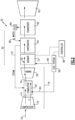
- FIG. 1 schematically illustrates a steam injected turbine engine 20 with an auxiliary boiler system 62 for selectively increasing steam generation capacity.
- Thermal energy from an exhaust gas flow 74 is used transform water into a steam flow 70.
- the steam flow 70 is injected into a core engine 18 to increase mass flow and thereby thrust.
- the injected steam flow 70 increases the amount of work that can be produced without increasing the amount of fuel utilized to generate the exhaust gas flow 74.
- Thermal energy from the exhaust gas flow 74 is limited and therefore limits the amount of steam that may be generated and injected into the core engine 18.
- a burner 72 of the boiler system 62 is selectively actuatable to generate additional thermal energy and provide for additional steam generation.
- the engine 20 includes a propulsor section 22, a compressor section 24, a combustor section 26 and the turbine section 28.
- the propulsor section 22 drives inlet airflow 16 along a bypass flow path B, while the compressor section 24 draws air in along a core flow path C where a core flow 14 is compressed and communicated to a combustor section 26.
- compressed air is mixed with fuel and ignited to generate the high energy combusted exhaust gas flow 74 that expands through the turbine section 28 where energy is extracted and utilized to drive the propulsor section 22 and the compressor section 24.
- a turbine engine including a three-spool architecture in which three spools concentrically rotate about a common axis and where a low spool enables a low-pressure turbine to drive a fan via a gearbox, an intermediate spool that enables an intermediate pressure turbine to drive a first compressor of the compressor section, and a high spool that enables a high-pressure turbine to drive a high-pressure compressor of the compressor section.
- non-concentric engine architectures with offset and/or decoupled cores could also be utilized and are within the scope and contemplation of this disclosure.
- the features of this disclosure may be applied to other engine configurations utilized to generate shaft power.
- the example engine 20 generally includes a low-speed spool 30 and a high-speed spool 32 mounted for rotation about an engine central longitudinal axis A relative to an engine static structure 36 via several bearing systems 38. It should be understood that various bearing systems 38 at various locations may alternatively or additionally be provided.
- the low-speed spool 30 generally includes an inner shaft 40 that connects a fan 42 and a low-pressure (or first) compressor section 44 to a low-pressure (or first) turbine section 46.
- the inner shaft 40 drives the propulsor section 22 through a speed change device, such as a geared architecture 48, to drive the propulsor section 22 at a lower speed than the low-speed spool 30.
- the high-speed spool 32 includes an outer shaft 50 that interconnects a high-pressure (or second) compressor section 52 and a high-pressure (or second) turbine section 54.
- the inner shaft 40 and the outer shaft 50 are concentric and rotate via the bearing systems 38 about the engine central longitudinal axis A.
- the inner shaft 40 and the outer shaft 50 may be concentric with the fan 42, this is not intended to be so limiting, and in other examples, the inner shaft 40 and the outer shaft 50 may be configured concentrically about a first longitudinal axis and the fan 42 may be configured to rotate about a second longitudinal axis that is different from the first longitudinal axis.
- other engine architectures with offset core components and sections are within the contemplation and consideration of this disclosure.
- a combustor 56 is arranged between the high-pressure compressor 52 and the high-pressure turbine 54.
- the high-pressure turbine 54 includes at least two stages to provide a double stage high-pressure turbine 54.
- the high-pressure turbine 54 includes only a single stage.
- a "high-pressure" compressor or turbine experiences a higher pressure than a corresponding "low-pressure” compressor or turbine.
- the example low-pressure turbine 46 has a pressure ratio that is greater than about 5.
- the pressure ratio of the example low-pressure turbine 46 is measured prior to an inlet of the low-pressure turbine 46 as related to the pressure measured at the outlet of the low-pressure turbine 46 prior to an exhaust nozzle.
- a mid-turbine frame 58 of the engine static structure 36 is arranged generally between the high-pressure turbine 54 and the low-pressure turbine 46.
- the mid-turbine frame 58 further supports bearing systems 38 in the turbine section 28 as well as setting airflow entering the low-pressure turbine 46.
- the core flow 78 through the core airflow path C is compressed by the low-pressure compressor 44 then by the high-pressure compressor 52, after which it is mixed with fuel and ignited in the combustor 56 to produce the high energy hot combusted gas flow 74 that is expanded through the high-pressure turbine 54 and low-pressure turbine 46.
- the mid-turbine frame 58 includes vanes 60, which are in the core airflow path and function as an inlet guide vane for the low-pressure turbine 46. Utilizing the vane 60 of the mid-turbine frame 58 as the inlet guide vane for low-pressure turbine 46 decreases the length of the low-pressure turbine 46 without increasing the axial length of the mid-turbine frame 58. Reducing or eliminating the number of vanes in the low-pressure turbine 46 shortens the axial length of the turbine section 28. Thus, the compactness of the turbine engine 20 is increased and a higher power density may be achieved.
- the disclosed turbine engine 20 in one example is a high-bypass geared aircraft engine.
- the turbine engine 20 includes a bypass ratio greater than about six (6), with an example embodiment being greater than about ten (10).
- the example geared architecture 48 is an epicyclical gear train, such as a planetary gear system, star gear system or other known gear system, with a gear reduction ratio of greater than about 2.3.
- the turbine engine 20 includes a bypass ratio greater than about ten (10:1) and the fan diameter is significantly larger than an outer diameter of the low-pressure compressor 44. It should be understood, however, that the above parameters are only exemplary of one embodiment of a turbine engine including a geared architecture and that the present disclosure is applicable to other turbine engines.
- the propulsor section 22 of the engine 20 is designed for a particular flight condition -- typically cruise at about 0.8 Mach and about 35,000 feet.
- the flight condition of 0.8 Mach and 35,000 ft., with the engine at its best fuel consumption - also known as "bucket cruise Thrust Specific Fuel Consumption ('TSFC')" - is the industry standard parameter of pound-mass (lbm) of fuel per hour being burned divided by pound-force (lbf) of thrust the engine produces at that minimum point.
- Low fan pressure ratio is the pressure ratio across the fan blade alone, without a Fan Exit Guide Vane (“FEGV”) system.
- the low fan pressure ratio as disclosed herein according to one non-limiting embodiment is less than about 1.50. In another non-limiting embodiment, the low fan pressure ratio is less than about 1.45.
- Low corrected fan tip speed is the actual fan tip speed in ft/sec divided by an industry standard temperature correction of [(Tram °R)/(518.7°R)]0.5.
- the "Low corrected fan tip speed”, as disclosed herein according to one non-limiting embodiment, is less than about 1150 ft/second.
- the example propulsor section 22 comprises in one non-limiting embodiment less than about 26 fan blades 42. In another non-limiting embodiment, the propulsor section 22 includes less than about 20 fan blades 42. Moreover, in one disclosed embodiment the low-pressure turbine 46 includes no more than about 6 turbine rotors schematically indicated at 34. In another non-limiting example embodiment, the low-pressure turbine 46 includes about 3 turbine rotors. A ratio between the number of fan blades 42 and the number of low-pressure turbine rotors is between about 3.3 and about 8.6.
- the example low-pressure turbine 46 provides the driving power to rotate the propulsor section 22 and therefore the relationship between the number of turbine rotors 34 in the low-pressure turbine 46 and the number of blades 42 in the propulsor section 22 disclose an example turbine engine 20 with increased power transfer efficiency.
- the example boiler system 62 includes the evaporator 64 and burner 72 disposed aft of the turbine section 28 along the engine longitudinal axis A.
- the burner 72 may be integrated into the static engine structure, such as within turbine exhaust case struts or other static engine structures.
- a condenser 66 aft of the evaporator 64 and forward of a nozzle 82 recovers water from the exhaust gas flow 74 for conversion into steam in the evaporator 64. Water recovered from the exhaust gas flow 66 is accumulated in a storage tank 80 and may be pressurized before being vaporized in the evaporator 64 and injected as a steam flow 70 into the core engine 18.
- the steam flow 70 is injected into the combustor 56. However, the steam flow 70 may be injected into other locations within the core engine 18 to increase mass flow and engine efficiency within the scope and contemplation of this disclosure.
- a simplified schematic view of an example boiler system 62 includes the burner 72 that receives fuel 84 from a fuel system 86.
- a controller 88 is programmed to selectively control operation of the burner 72 to add thermal energy, schematically indicated by arrow 76, into the gas flow 74 from the combustor 26.
- the controller 88 governs actuation of the burner 72 by controlling the flow of fuel 84.
- the burner 72 may be activated based on current engine operating conditions.
- the controller 88 may actuate the burner 72 to generate additional thermal energy based on an engine power setting, internal temperatures and/or pressures, ambient temperature and/or pressure, altitude of an aircraft associated with the engine 20.
- the controller 88 may activate the burner 72 according to a predefined engine operating profile such as for example, take off, climb, power control lever above a threshold position as well as any other engine operating condition included in an engine operating profile. Moreover, actuation of the burner 72 to reheat the exhaust gas flow 74 may be prompted by other engine operating criteria, such as for example, ambient conditions, aircraft operating conditions or any other aircraft or engine condition that may benefit from additional energy.
- a predefined engine operating profile such as for example, take off, climb, power control lever above a threshold position as well as any other engine operating condition included in an engine operating profile.
- actuation of the burner 72 to reheat the exhaust gas flow 74 may be prompted by other engine operating criteria, such as for example, ambient conditions, aircraft operating conditions or any other aircraft or engine condition that may benefit from additional energy.
- the burner 72 receives the gas flow 74 after it has expanded and cooled through the turbine section 28.
- the thermal energy remaining in the gas flow 74 after the turbine section 28 may be sufficient to generate a desired amount of steam flow 70 for most engine operating conditions. In such operating conditions, the burner 72 is not activated and the gas flow 74 is communicated to the evaporator 64 in the same condition as it is exhausted from the turbine section 28.
- the burner 72 is activated. Fuel 84 is mixed with the exhaust gas flow 74 and ignited to provide addition thermal energy into the gas flow 74. The added thermal energy increases the capacity of the evaporator 64 to generate steam without changing the configuration of the evaporator 64.
- the gas flow 74 with the burner 72 activated is hotter and thereby provides for the transformation of increased amounts of steam.
- the burner 72 may be deactivated once the demand for steam flow is reduced.
- the burner 72 and evaporator 64 are schematically shown separately along the engine longitudinal axis A and within the core flow path C.
- the burner 72 and evaporator 64 may be configured as a common device and may be arranged outside of the core flow path C.
- all of the gas flow 74 is routed through the burner 72 and the evaporator 64.
- the burner 72 and evaporator 64 may be arranged such that a portion of the gas flow 74 bypasses these devices.
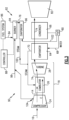
- FIG. 3 another steam injected turbine engine configuration is schematically shown and indicated at 90.
- the engine 90 includes a boiler system 92 that is disposed outside of the gas flow path between the turbine section 28 and the nozzle 82. Accordingly, the example boiler system 92 is disposed outside of the engine longitudinal axis A.
- the burner 94 receives fuel 84 from the fuel system 86 and is controlled by a controller 88.
- the controller 88 is programmed to selectively operate the burner 94 to supplement the amount of steam that is injected into the core engine 18.
- the gas flow 74 remains the same and is not altered nor reheated.
- the boiler system 92 includes a second evaporator 96 that uses heat generated in the burner 94 to generate a second steam flow 100.
- a second water flow 102 is provided from a water source, such as the example condenser 66 and/or water storage tank 80.
- a second steam flow 100 is generated and combined with the steam flow 70 generated in the evaporator 66.
- the burner 94 operates outside of the path of the gas flow 74 and therefore may use another source of airflow to support combustion.
- a portion of a bypass airflow indicated at 98 is communicated to the burner 94.
- the bypass airflow 98 is routed outside of the core engine 18 and directly to the burner 94.
- the direct routing of airflow 98 provides fresh oxygenated airflow that has not already been through a combustion cycle.
- the example airflow 98 is disclosed as bypassing the core engine 18, the airflow 98 could be bleed from a location 104 within the core engine 18. Moreover, oxygen to facilitate combustion could be provided from other systems. In one disclosed example, the location 104 is from within the compressor section 24 to provide air at a pressure corresponding to a desired operation of the burner 94. Although airflow 98 is shown by example as being drawn from the compressor section 24 and/or from a bypass flow, other sources of air to facilitate combustion in the burner 94 could be utilized and are within the contemplation of this disclosure.
- the disclosed example steam injected engine embodiments include the selectively operable boiler system for supplementing the capacity for generating steam flow within existing thermal production limits.
Landscapes
- Engineering & Computer Science (AREA)
- Chemical & Material Sciences (AREA)
- Combustion & Propulsion (AREA)
- Mechanical Engineering (AREA)
- General Engineering & Computer Science (AREA)
- Engine Equipment That Uses Special Cycles (AREA)
Applications Claiming Priority (1)
| Application Number | Priority Date | Filing Date | Title |
|---|---|---|---|
| US18/096,969 US11988137B1 (en) | 2023-01-13 | 2023-01-13 | Auxiliary boiler system for steam injection cycle engine |
Publications (1)
| Publication Number | Publication Date |
|---|---|
| EP4400699A1 true EP4400699A1 (de) | 2024-07-17 |
Family
ID=89620173
Family Applications (1)
| Application Number | Title | Priority Date | Filing Date |
|---|---|---|---|
| EP24151726.7A Pending EP4400699A1 (de) | 2023-01-13 | 2024-01-12 | Zusatzkesselsystem für dampfeinspritzzyklusmotor |
Country Status (2)
| Country | Link |
|---|---|
| US (2) | US11988137B1 (de) |
| EP (1) | EP4400699A1 (de) |
Families Citing this family (3)
| Publication number | Priority date | Publication date | Assignee | Title |
|---|---|---|---|---|
| US20250122848A1 (en) * | 2022-06-22 | 2025-04-17 | General Electric Company | Gearbox assembly with lubricant extraction volume ratio |
| US12421895B2 (en) * | 2024-02-01 | 2025-09-23 | General Electric Company | Turbine engine including a condenser system |
| US12352207B1 (en) * | 2024-03-29 | 2025-07-08 | General Electric Company | Aircraft gas turbine engine including a steam system |
Citations (3)
| Publication number | Priority date | Publication date | Assignee | Title |
|---|---|---|---|---|
| US6644011B2 (en) * | 2000-03-24 | 2003-11-11 | Cheng Power Systems, Inc. | Advanced Cheng Combined Cycle |
| US20120285175A1 (en) * | 2011-05-10 | 2012-11-15 | Rolls-Royce Plc | Steam injected gas turbine engine |
| US20130055698A1 (en) * | 2011-09-01 | 2013-03-07 | Rolls-Royce Plc | Steam injected gas turbine engine |
Family Cites Families (8)
| Publication number | Priority date | Publication date | Assignee | Title |
|---|---|---|---|---|
| US5150567A (en) | 1989-06-05 | 1992-09-29 | General Electric Company | Gas turbine powerplant |
| US6484508B2 (en) | 1998-07-24 | 2002-11-26 | General Electric Company | Methods for operating gas turbine engines |
| SE517779C2 (sv) * | 2000-11-29 | 2002-07-16 | Alstom Switzerland Ltd | Turbininrättning och metod för att driva en turbininrättning |
| JP5665621B2 (ja) * | 2011-03-25 | 2015-02-04 | 株式会社東芝 | 排熱回収ボイラおよび発電プラント |
| EP2884059B1 (de) * | 2013-12-11 | 2017-06-21 | Honeywell spol s.r.o. | Mehrstufige Abhitzekessel-Steuerung in einem Kombikraftwerk |
| US20160376909A1 (en) * | 2015-06-29 | 2016-12-29 | General Electric Company | Power generation system exhaust cooling |
| DE102021201629A1 (de) * | 2020-08-05 | 2022-02-10 | MTU Aero Engines AG | Abgasbehandlungsvorrichtung für ein flugtriebwerk |
| FI131342B1 (fi) * | 2021-11-10 | 2025-02-28 | Loeytty Ari Veli Olavi | Menetelmä ja laitteisto energiahäviöiden pienentämiseksi kaasuturbiini kombilaitoksissa |
-
2023
- 2023-01-13 US US18/096,969 patent/US11988137B1/en active Active
-
2024
- 2024-01-12 EP EP24151726.7A patent/EP4400699A1/de active Pending
- 2024-04-10 US US18/631,314 patent/US20240254915A1/en active Pending
Patent Citations (3)
| Publication number | Priority date | Publication date | Assignee | Title |
|---|---|---|---|---|
| US6644011B2 (en) * | 2000-03-24 | 2003-11-11 | Cheng Power Systems, Inc. | Advanced Cheng Combined Cycle |
| US20120285175A1 (en) * | 2011-05-10 | 2012-11-15 | Rolls-Royce Plc | Steam injected gas turbine engine |
| US20130055698A1 (en) * | 2011-09-01 | 2013-03-07 | Rolls-Royce Plc | Steam injected gas turbine engine |
Also Published As
| Publication number | Publication date |
|---|---|
| US20240254915A1 (en) | 2024-08-01 |
| US11988137B1 (en) | 2024-05-21 |
Similar Documents
| Publication | Publication Date | Title |
|---|---|---|
| EP4400699A1 (de) | Zusatzkesselsystem für dampfeinspritzzyklusmotor | |
| EP3712407A1 (de) | Bedarfsgesteuertes kraftstoffpumpsystem mit sekundärem kraftstofffluss | |
| EP3018304B1 (de) | Wärmemanagementsystem für eine gasturbine | |
| US11781490B2 (en) | Operability geared turbofan engine including compressor section variable guide vanes | |
| EP3348810B1 (de) | Injektionsgekühltes kühlluftsystem für einen gasturbinenmotor sowie eine entsprechende methode | |
| US20150247462A1 (en) | Gas turbine engine thermal management system for heat exchanger using bypass flow | |
| US12331679B2 (en) | Air recuperated engine with air reinjection | |
| US10634064B1 (en) | Accessory gearbox with superposition gearbox | |
| EP4343130A1 (de) | Dampfeinspritzender zwischenturbinenbrenner | |
| EP4339433A1 (de) | Bottoming-kreislauf zur abwärmerückgewinnung und motorkühlung | |
| EP3260685B1 (de) | Motorzapfluftsystem mit wastegate-ventil zur regelung von verdichterpumpen | |
| EP4667730A2 (de) | Rückgewinnung von turbinenmotorzapfabwärme | |
| EP3039264A1 (de) | Gasturbinenmotordiffusorkühl- und -mischanordnung | |
| EP3228844B1 (de) | Integrierte umgebungskontrolle und pufferluftsystem | |
| WO2015153171A1 (en) | Active clearance control for gas turbine engine | |
| EP2906806B1 (de) | Turbogebläsemotor mit optimierter diffusorgehäuseflanschposition | |
| EP3219959B1 (de) | Gekühlte zapf-kühlluft mit verwendung eines bestehenden wärmetauschers | |
| US12031478B2 (en) | Air bottoming cycle driven propulsor | |
| EP3179034B1 (de) | Turbinenkühlluft mit mehreren quellen |
Legal Events
| Date | Code | Title | Description |
|---|---|---|---|
| PUAI | Public reference made under article 153(3) epc to a published international application that has entered the european phase |
Free format text: ORIGINAL CODE: 0009012 |
|
| STAA | Information on the status of an ep patent application or granted ep patent |
Free format text: STATUS: THE APPLICATION HAS BEEN PUBLISHED |
|
| AK | Designated contracting states |
Kind code of ref document: A1 Designated state(s): AL AT BE BG CH CY CZ DE DK EE ES FI FR GB GR HR HU IE IS IT LI LT LU LV MC ME MK MT NL NO PL PT RO RS SE SI SK SM TR |
|
| STAA | Information on the status of an ep patent application or granted ep patent |
Free format text: STATUS: REQUEST FOR EXAMINATION WAS MADE |
|
| 17P | Request for examination filed |
Effective date: 20250117 |