EP4400210A1 - Composite comprising organometallic nanostructure powder and method for producing same - Google Patents
Composite comprising organometallic nanostructure powder and method for producing same Download PDFInfo
- Publication number
- EP4400210A1 EP4400210A1 EP22865120.4A EP22865120A EP4400210A1 EP 4400210 A1 EP4400210 A1 EP 4400210A1 EP 22865120 A EP22865120 A EP 22865120A EP 4400210 A1 EP4400210 A1 EP 4400210A1
- Authority
- EP
- European Patent Office
- Prior art keywords
- composite
- organometal
- nanostructure
- seed
- seed particles
- Prior art date
- Legal status (The legal status is an assumption and is not a legal conclusion. Google has not performed a legal analysis and makes no representation as to the accuracy of the status listed.)
- Pending
Links
- 239000002131 composite material Substances 0.000 title claims abstract description 113
- 239000002086 nanomaterial Substances 0.000 title claims abstract description 85
- 239000000843 powder Substances 0.000 title abstract description 53
- 238000004519 manufacturing process Methods 0.000 title abstract description 28
- 125000002524 organometallic group Chemical group 0.000 title 1
- 238000000034 method Methods 0.000 claims abstract description 45
- 239000002245 particle Substances 0.000 claims description 164
- OKTJSMMVPCPJKN-UHFFFAOYSA-N Carbon Chemical compound [C] OKTJSMMVPCPJKN-UHFFFAOYSA-N 0.000 claims description 76
- 239000011248 coating agent Substances 0.000 claims description 69
- 238000000576 coating method Methods 0.000 claims description 69
- 239000002002 slurry Substances 0.000 claims description 47
- 239000012530 fluid Substances 0.000 claims description 33
- 239000011230 binding agent Substances 0.000 claims description 32
- 239000004372 Polyvinyl alcohol Substances 0.000 claims description 22
- 238000009826 distribution Methods 0.000 claims description 22
- 229920002451 polyvinyl alcohol Polymers 0.000 claims description 22
- 239000007921 spray Substances 0.000 claims description 16
- 238000005507 spraying Methods 0.000 claims description 14
- 229930040373 Paraformaldehyde Natural products 0.000 claims description 6
- 239000004952 Polyamide Substances 0.000 claims description 6
- 239000001866 hydroxypropyl methyl cellulose Substances 0.000 claims description 6
- 229920003088 hydroxypropyl methyl cellulose Polymers 0.000 claims description 6
- UFVKGYZPFZQRLF-UHFFFAOYSA-N hydroxypropyl methyl cellulose Chemical compound OC1C(O)C(OC)OC(CO)C1OC1C(O)C(O)C(OC2C(C(O)C(OC3C(C(O)C(O)C(CO)O3)O)C(CO)O2)O)C(CO)O1 UFVKGYZPFZQRLF-UHFFFAOYSA-N 0.000 claims description 6
- 235000010979 hydroxypropyl methyl cellulose Nutrition 0.000 claims description 6
- 229920002037 poly(vinyl butyral) polymer Polymers 0.000 claims description 6
- 229920002647 polyamide Polymers 0.000 claims description 6
- 229920006324 polyoxymethylene Polymers 0.000 claims description 6
- 229920000036 polyvinylpyrrolidone Polymers 0.000 claims description 6
- 239000001267 polyvinylpyrrolidone Substances 0.000 claims description 6
- 235000013855 polyvinylpyrrolidone Nutrition 0.000 claims description 6
- 239000004793 Polystyrene Substances 0.000 claims description 4
- 229910003481 amorphous carbon Inorganic materials 0.000 claims description 4
- 239000006229 carbon black Substances 0.000 claims description 4
- 229910021393 carbon nanotube Inorganic materials 0.000 claims description 4
- 239000002041 carbon nanotube Substances 0.000 claims description 4
- 229910021389 graphene Inorganic materials 0.000 claims description 4
- 229910002804 graphite Inorganic materials 0.000 claims description 4
- 239000010439 graphite Substances 0.000 claims description 4
- 239000007769 metal material Substances 0.000 claims description 4
- SMEGJBVQLJJKKX-HOTMZDKISA-N [(2R,3S,4S,5R,6R)-5-acetyloxy-3,4,6-trihydroxyoxan-2-yl]methyl acetate Chemical compound CC(=O)OC[C@@H]1[C@H]([C@@H]([C@H]([C@@H](O1)O)OC(=O)C)O)O SMEGJBVQLJJKKX-HOTMZDKISA-N 0.000 claims description 3
- 229940081735 acetylcellulose Drugs 0.000 claims description 3
- 229920002301 cellulose acetate Polymers 0.000 claims description 3
- 239000004417 polycarbonate Substances 0.000 claims description 3
- 229920000515 polycarbonate Polymers 0.000 claims description 3
- -1 polyoxymethylene Polymers 0.000 claims description 3
- 239000004800 polyvinyl chloride Substances 0.000 claims description 3
- 239000012855 volatile organic compound Substances 0.000 abstract description 32
- 238000005299 abrasion Methods 0.000 abstract description 16
- 230000006866 deterioration Effects 0.000 abstract description 2
- 239000007783 nanoporous material Substances 0.000 abstract 2
- 230000000052 comparative effect Effects 0.000 description 23
- WSFSSNUMVMOOMR-UHFFFAOYSA-N Formaldehyde Chemical compound O=C WSFSSNUMVMOOMR-UHFFFAOYSA-N 0.000 description 21
- 230000000694 effects Effects 0.000 description 17
- 238000001179 sorption measurement Methods 0.000 description 13
- YXFVVABEGXRONW-UHFFFAOYSA-N Toluene Chemical compound CC1=CC=CC=C1 YXFVVABEGXRONW-UHFFFAOYSA-N 0.000 description 12
- XLYOFNOQVPJJNP-UHFFFAOYSA-N water Substances O XLYOFNOQVPJJNP-UHFFFAOYSA-N 0.000 description 9
- 238000005259 measurement Methods 0.000 description 8
- 230000000593 degrading effect Effects 0.000 description 7
- 238000005243 fluidization Methods 0.000 description 6
- 239000011148 porous material Substances 0.000 description 6
- 239000000654 additive Substances 0.000 description 5
- 230000000996 additive effect Effects 0.000 description 5
- 239000007789 gas Substances 0.000 description 5
- WYURNTSHIVDZCO-UHFFFAOYSA-N Tetrahydrofuran Chemical compound C1CCOC1 WYURNTSHIVDZCO-UHFFFAOYSA-N 0.000 description 4
- 230000008901 benefit Effects 0.000 description 4
- 238000001035 drying Methods 0.000 description 4
- 238000002156 mixing Methods 0.000 description 4
- 238000002360 preparation method Methods 0.000 description 4
- IJGRMHOSHXDMSA-UHFFFAOYSA-N Atomic nitrogen Chemical compound N#N IJGRMHOSHXDMSA-UHFFFAOYSA-N 0.000 description 3
- 230000002542 deteriorative effect Effects 0.000 description 3
- 238000005469 granulation Methods 0.000 description 3
- 230000003179 granulation Effects 0.000 description 3
- 230000003014 reinforcing effect Effects 0.000 description 3
- MCMNRKCIXSYSNV-UHFFFAOYSA-N Zirconium dioxide Chemical compound O=[Zr]=O MCMNRKCIXSYSNV-UHFFFAOYSA-N 0.000 description 2
- 239000011324 bead Substances 0.000 description 2
- 239000003054 catalyst Substances 0.000 description 2
- 239000011246 composite particle Substances 0.000 description 2
- 150000001875 compounds Chemical class 0.000 description 2
- 238000005227 gel permeation chromatography Methods 0.000 description 2
- 238000009478 high shear granulation Methods 0.000 description 2
- 229910010272 inorganic material Inorganic materials 0.000 description 2
- 239000011147 inorganic material Substances 0.000 description 2
- 239000000463 material Substances 0.000 description 2
- 238000003801 milling Methods 0.000 description 2
- 229920000620 organic polymer Polymers 0.000 description 2
- 239000008188 pellet Substances 0.000 description 2
- YLQBMQCUIZJEEH-UHFFFAOYSA-N tetrahydrofuran Natural products C=1C=COC=1 YLQBMQCUIZJEEH-UHFFFAOYSA-N 0.000 description 2
- 239000003463 adsorbent Substances 0.000 description 1
- 238000005054 agglomeration Methods 0.000 description 1
- 230000002776 aggregation Effects 0.000 description 1
- 230000000295 complement effect Effects 0.000 description 1
- 238000007906 compression Methods 0.000 description 1
- 230000006835 compression Effects 0.000 description 1
- 238000007796 conventional method Methods 0.000 description 1
- 229910001873 dinitrogen Inorganic materials 0.000 description 1
- 238000012377 drug delivery Methods 0.000 description 1
- 239000003480 eluent Substances 0.000 description 1
- 238000005516 engineering process Methods 0.000 description 1
- 230000005484 gravity Effects 0.000 description 1
- 229920000592 inorganic polymer Polymers 0.000 description 1
- 239000007788 liquid Substances 0.000 description 1
- 239000012528 membrane Substances 0.000 description 1
- 229910021645 metal ion Inorganic materials 0.000 description 1
- 239000000203 mixture Substances 0.000 description 1
- 229910052757 nitrogen Inorganic materials 0.000 description 1
- 239000013110 organic ligand Substances 0.000 description 1
- 239000011368 organic material Substances 0.000 description 1
- 230000000704 physical effect Effects 0.000 description 1
- 238000007789 sealing Methods 0.000 description 1
- 239000010409 thin film Substances 0.000 description 1
- 239000003643 water by type Substances 0.000 description 1
Images


Classifications
-
- B—PERFORMING OPERATIONS; TRANSPORTING
- B01—PHYSICAL OR CHEMICAL PROCESSES OR APPARATUS IN GENERAL
- B01J—CHEMICAL OR PHYSICAL PROCESSES, e.g. CATALYSIS OR COLLOID CHEMISTRY; THEIR RELEVANT APPARATUS
- B01J20/00—Solid sorbent compositions or filter aid compositions; Sorbents for chromatography; Processes for preparing, regenerating or reactivating thereof
- B01J20/22—Solid sorbent compositions or filter aid compositions; Sorbents for chromatography; Processes for preparing, regenerating or reactivating thereof comprising organic material
- B01J20/223—Solid sorbent compositions or filter aid compositions; Sorbents for chromatography; Processes for preparing, regenerating or reactivating thereof comprising organic material containing metals, e.g. organo-metallic compounds, coordination complexes
-
- B—PERFORMING OPERATIONS; TRANSPORTING
- B01—PHYSICAL OR CHEMICAL PROCESSES OR APPARATUS IN GENERAL
- B01D—SEPARATION
- B01D53/00—Separation of gases or vapours; Recovering vapours of volatile solvents from gases; Chemical or biological purification of waste gases, e.g. engine exhaust gases, smoke, fumes, flue gases, aerosols
- B01D53/02—Separation of gases or vapours; Recovering vapours of volatile solvents from gases; Chemical or biological purification of waste gases, e.g. engine exhaust gases, smoke, fumes, flue gases, aerosols by adsorption, e.g. preparative gas chromatography
-
- B—PERFORMING OPERATIONS; TRANSPORTING
- B01—PHYSICAL OR CHEMICAL PROCESSES OR APPARATUS IN GENERAL
- B01J—CHEMICAL OR PHYSICAL PROCESSES, e.g. CATALYSIS OR COLLOID CHEMISTRY; THEIR RELEVANT APPARATUS
- B01J20/00—Solid sorbent compositions or filter aid compositions; Sorbents for chromatography; Processes for preparing, regenerating or reactivating thereof
- B01J20/02—Solid sorbent compositions or filter aid compositions; Sorbents for chromatography; Processes for preparing, regenerating or reactivating thereof comprising inorganic material
- B01J20/20—Solid sorbent compositions or filter aid compositions; Sorbents for chromatography; Processes for preparing, regenerating or reactivating thereof comprising inorganic material comprising free carbon; comprising carbon obtained by carbonising processes
-
- B—PERFORMING OPERATIONS; TRANSPORTING
- B01—PHYSICAL OR CHEMICAL PROCESSES OR APPARATUS IN GENERAL
- B01J—CHEMICAL OR PHYSICAL PROCESSES, e.g. CATALYSIS OR COLLOID CHEMISTRY; THEIR RELEVANT APPARATUS
- B01J20/00—Solid sorbent compositions or filter aid compositions; Sorbents for chromatography; Processes for preparing, regenerating or reactivating thereof
- B01J20/22—Solid sorbent compositions or filter aid compositions; Sorbents for chromatography; Processes for preparing, regenerating or reactivating thereof comprising organic material
- B01J20/223—Solid sorbent compositions or filter aid compositions; Sorbents for chromatography; Processes for preparing, regenerating or reactivating thereof comprising organic material containing metals, e.g. organo-metallic compounds, coordination complexes
- B01J20/226—Coordination polymers, e.g. metal-organic frameworks [MOF], zeolitic imidazolate frameworks [ZIF]
-
- B—PERFORMING OPERATIONS; TRANSPORTING
- B01—PHYSICAL OR CHEMICAL PROCESSES OR APPARATUS IN GENERAL
- B01J—CHEMICAL OR PHYSICAL PROCESSES, e.g. CATALYSIS OR COLLOID CHEMISTRY; THEIR RELEVANT APPARATUS
- B01J20/00—Solid sorbent compositions or filter aid compositions; Sorbents for chromatography; Processes for preparing, regenerating or reactivating thereof
- B01J20/28—Solid sorbent compositions or filter aid compositions; Sorbents for chromatography; Processes for preparing, regenerating or reactivating thereof characterised by their form or physical properties
- B01J20/28002—Solid sorbent compositions or filter aid compositions; Sorbents for chromatography; Processes for preparing, regenerating or reactivating thereof characterised by their form or physical properties characterised by their physical properties
- B01J20/28004—Sorbent size or size distribution, e.g. particle size
-
- B—PERFORMING OPERATIONS; TRANSPORTING
- B01—PHYSICAL OR CHEMICAL PROCESSES OR APPARATUS IN GENERAL
- B01J—CHEMICAL OR PHYSICAL PROCESSES, e.g. CATALYSIS OR COLLOID CHEMISTRY; THEIR RELEVANT APPARATUS
- B01J20/00—Solid sorbent compositions or filter aid compositions; Sorbents for chromatography; Processes for preparing, regenerating or reactivating thereof
- B01J20/28—Solid sorbent compositions or filter aid compositions; Sorbents for chromatography; Processes for preparing, regenerating or reactivating thereof characterised by their form or physical properties
- B01J20/28014—Solid sorbent compositions or filter aid compositions; Sorbents for chromatography; Processes for preparing, regenerating or reactivating thereof characterised by their form or physical properties characterised by their form
- B01J20/2803—Sorbents comprising a binder, e.g. for forming aggregated, agglomerated or granulated products
-
- B—PERFORMING OPERATIONS; TRANSPORTING
- B01—PHYSICAL OR CHEMICAL PROCESSES OR APPARATUS IN GENERAL
- B01J—CHEMICAL OR PHYSICAL PROCESSES, e.g. CATALYSIS OR COLLOID CHEMISTRY; THEIR RELEVANT APPARATUS
- B01J20/00—Solid sorbent compositions or filter aid compositions; Sorbents for chromatography; Processes for preparing, regenerating or reactivating thereof
- B01J20/28—Solid sorbent compositions or filter aid compositions; Sorbents for chromatography; Processes for preparing, regenerating or reactivating thereof characterised by their form or physical properties
- B01J20/28054—Solid sorbent compositions or filter aid compositions; Sorbents for chromatography; Processes for preparing, regenerating or reactivating thereof characterised by their form or physical properties characterised by their surface properties or porosity
- B01J20/28057—Surface area, e.g. B.E.T specific surface area
-
- B—PERFORMING OPERATIONS; TRANSPORTING
- B01—PHYSICAL OR CHEMICAL PROCESSES OR APPARATUS IN GENERAL
- B01J—CHEMICAL OR PHYSICAL PROCESSES, e.g. CATALYSIS OR COLLOID CHEMISTRY; THEIR RELEVANT APPARATUS
- B01J20/00—Solid sorbent compositions or filter aid compositions; Sorbents for chromatography; Processes for preparing, regenerating or reactivating thereof
- B01J20/30—Processes for preparing, regenerating, or reactivating
- B01J20/32—Impregnating or coating ; Solid sorbent compositions obtained from processes involving impregnating or coating
- B01J20/3231—Impregnating or coating ; Solid sorbent compositions obtained from processes involving impregnating or coating characterised by the coating or impregnating layer
- B01J20/3242—Layers with a functional group, e.g. an affinity material, a ligand, a reactant or a complexing group
- B01J20/3244—Non-macromolecular compounds
- B01J20/3265—Non-macromolecular compounds with an organic functional group containing a metal, e.g. a metal affinity ligand
-
- B—PERFORMING OPERATIONS; TRANSPORTING
- B01—PHYSICAL OR CHEMICAL PROCESSES OR APPARATUS IN GENERAL
- B01J—CHEMICAL OR PHYSICAL PROCESSES, e.g. CATALYSIS OR COLLOID CHEMISTRY; THEIR RELEVANT APPARATUS
- B01J20/00—Solid sorbent compositions or filter aid compositions; Sorbents for chromatography; Processes for preparing, regenerating or reactivating thereof
- B01J20/30—Processes for preparing, regenerating, or reactivating
- B01J20/32—Impregnating or coating ; Solid sorbent compositions obtained from processes involving impregnating or coating
- B01J20/3291—Characterised by the shape of the carrier, the coating or the obtained coated product
- B01J20/3295—Coatings made of particles, nanoparticles, fibers, nanofibers
-
- B—PERFORMING OPERATIONS; TRANSPORTING
- B01—PHYSICAL OR CHEMICAL PROCESSES OR APPARATUS IN GENERAL
- B01D—SEPARATION
- B01D2253/00—Adsorbents used in seperation treatment of gases and vapours
- B01D2253/10—Inorganic adsorbents
- B01D2253/102—Carbon
-
- B—PERFORMING OPERATIONS; TRANSPORTING
- B01—PHYSICAL OR CHEMICAL PROCESSES OR APPARATUS IN GENERAL
- B01D—SEPARATION
- B01D2253/00—Adsorbents used in seperation treatment of gases and vapours
- B01D2253/25—Coated, impregnated or composite adsorbents
-
- B—PERFORMING OPERATIONS; TRANSPORTING
- B01—PHYSICAL OR CHEMICAL PROCESSES OR APPARATUS IN GENERAL
- B01D—SEPARATION
- B01D2253/00—Adsorbents used in seperation treatment of gases and vapours
- B01D2253/30—Physical properties of adsorbents
- B01D2253/302—Dimensions
- B01D2253/304—Linear dimensions, e.g. particle shape, diameter
-
- B—PERFORMING OPERATIONS; TRANSPORTING
- B01—PHYSICAL OR CHEMICAL PROCESSES OR APPARATUS IN GENERAL
- B01D—SEPARATION
- B01D2257/00—Components to be removed
- B01D2257/70—Organic compounds not provided for in groups B01D2257/00 - B01D2257/602
- B01D2257/702—Hydrocarbons
- B01D2257/7027—Aromatic hydrocarbons
-
- B—PERFORMING OPERATIONS; TRANSPORTING
- B01—PHYSICAL OR CHEMICAL PROCESSES OR APPARATUS IN GENERAL
- B01D—SEPARATION
- B01D2257/00—Components to be removed
- B01D2257/70—Organic compounds not provided for in groups B01D2257/00 - B01D2257/602
- B01D2257/708—Volatile organic compounds V.O.C.'s
-
- B—PERFORMING OPERATIONS; TRANSPORTING
- B01—PHYSICAL OR CHEMICAL PROCESSES OR APPARATUS IN GENERAL
- B01J—CHEMICAL OR PHYSICAL PROCESSES, e.g. CATALYSIS OR COLLOID CHEMISTRY; THEIR RELEVANT APPARATUS
- B01J2220/00—Aspects relating to sorbent materials
- B01J2220/40—Aspects relating to the composition of sorbent or filter aid materials
- B01J2220/46—Materials comprising a mixture of inorganic and organic materials
Definitions
- the present invention relates to a composite comprising an organometal nanostructure powder and a method for preparing same, more particularly, to a composite comprising an organometal nanostructure powder, that may maintain the properties of the organometal nanostructure powder because of auniform particle diameter size and being structurally stable, and may reduce the production amount of a fine powder without deteriorating ability to adsorb volatile organic compounds (VOC), and a method for preparing same.
- VOC volatile organic compounds
- An organometalnanostructure is an organic inorganic polymer compound formed by combining a metal ion with an organic ligand and means a crystalline compound with a porous type, including both an organic material and an inorganic material in a skeleton structure and having a pore structure with a micro size or a nano size.
- Such an organometal nanostructure has a large surface area and pores with a micro size or a nano size, and is used for capturing molecules smaller than the pore size or for separating molecules according to the size of molecules using pores, as well as used as an adsorbent, a gas-storing material, a sensor, a membrane, a functional thin film, a drug delivery material, a catalyst and a catalyst support, and accordingly, is being actively studied until now.
- the organometal nanostructure has low thermal stability and structural stability with respect to pressure, and there are problems of not maintaining the properties of an organometal nanostructure powder showing high crystallinity and porous type during converting an organometal nanostructure powder to a composite.
- problems in that technology is limited in converting an organometal nanostructure powder having an average particle diameter of 1 um to 3 um into a composite having an average particle diameter of a several tens um to mm unit.
- an organometal nanostructure powder has low mutual gathering, and a process of mixing with a binder or an additive and applying a mechanical pressure is required, but by the amount of the binder or additive added, the pores of the organometal nanostructure may be blocked, or crystallinity may be deteriorated.
- the surface area of the organometal nanostructure may be markedly reduced, ability to adsorb volatile organic compounds (VOC) may be degraded, and the production amount of a fine powder may increase due to abrasion.
- VOC volatile organic compounds
- the present invention is to solve the above-described problems and provides a composite including an organometal nanostructure powder, that may maintain the properties of an organometal nanostructure powder because of the uniform size of aparticle diameter and structural stability, may reduce the production amount of a fine powder due to abrasion without deterioration of ability to adsorb volatile organic compounds (VOC) and may reinforce manufacturing competitiveness, by adopting a method for preparing a composite by forming a coating part including an organometal nanostructure and a binder on the surface of a seed particle, and a method for preparing same.
- VOC volatile organic compounds
- the present invention provides a composite and a method for preparing same.
- Thecomposite and the method for preparing same of the present invention show excellent effects of thermal stability and structural stability with respect to pressure because of structural properties formed by an organometal nanostructure and a binder on the surface of a seed.
- the conventional properties may be maintained during converting an organometal nanostructure powder into a composite, and effects of reducing the production amount ofa fine powder due to abrasion may be achieved without deteriorating ability to adsorb volatile organic compounds (VOC).
- VOC volatile organic compounds
- effects of selectively controlling the size of the composite according to a product to be applied may be achieved by controlling the size of the seed.
- manufacturing competitiveness may be reinforced by reducing the amount used of the organometal nanostructure by introducing a method for preparing a composite by forming an organometal nanostructure only on the surface of the seed by simply mixing an organometal nanostructure and a binderin the conventional method for preparing a composite.
- a weight average molecular weight may mean a relative value on a standard polystyrene (PS) specimen through gel permeation chromatography (GPC, waters breeze) using tetrahydrofuran (THF) as an eluent.
- PS polystyrene
- GPC gel permeation chromatography
- the present invention provides a composite comprising a seed particle and a coating part formed on the seed particle, wherein the coating part comprises an organometal nanostructure and a binder, an average particle diameter of the seed particles is 150 um to 3,350 ⁇ m, andan average particle diameter of the composite is 110% to 700% with respect to the average particle diameter of the seed particles.
- an organometal nanostructure powder has low mutual gathering, and a process of mixing the organometal nanostructure powder with a binder or an additive to prepare a powder lump and applying a mechanical pressure has been required for preparing an organometal nanostructure composite.
- the binder or additive added the pores of the organometal nanostructurewere blocked, or crystallinity was deteriorated.
- the surface area of the organometal nanostructure was largely reduced, ability to adsorb volatile organic compounds (VOC) was degraded, and the production amount of a fine powder increased due to abrasion.
- the present invention introduces a seed-shell structure introducing seed particles and forming a coating part including an organometal nanostructure and a binder on the surface of the seed particle.
- the bonding force between the seed particle and the organometal nanostructure may complement the mutual gathering of an organometal nanostructure powder, and a process of injecting a binder or an additive to a process for preparing a composite and mechanically applying a pressure is not required.
- the properties of the conventional organometal nanostructure may be maintained during a process of converting the organometal nanostructure powder into a composite, and the production amount of a fine powder by abrasion may be reduced without deteriorating ability to adsorb volatile organic compounds (VOC).
- VOC volatile organic compounds
- the size of a composite could be selectively controlled according to the products to apply, and since the organometal nanostructure is formed only on the surface of the seed particle, the amount used of the organometal nanostructure may be reduced, thereby reinforcing manufacturing competitiveness.
- the type of the seed particle in the present invention may be one or more selected from the group consisting of carbon nanotube, graphene, graphite, amorphous carbon, carbon black, activated carbon, a metal material and an organometal nanostructure.
- the seed particle may be activated carbon that has excellent ability to adsorb toluene.
- the seed particle of the present invention may be spherical or pseudo-spherical.
- the pseudo-spherical means a shape generally close to spherical including a shape of which cross-section passing through the center of gravity of the seed particle is an elliptical shape, or a shape in which the surface of the seed particle is uneven, and some are protruding, and may include an elliptical shape,an oval shape, or a spherical shape,elliptical shape, andovalshape having protrusion. If the shape of the seed particle is spherical or pseudo-spherical, effects of increasing the coating amount of slurry on the surface of the seed particle may be achieved.
- an average particle diameter of the seed particles of the present invention may be 150 um to 3,350 um.
- the average particle diameter of the seed particles may be 150 ⁇ m or more,210 ⁇ m or more, 250 ⁇ m or more, 300 ⁇ m or more, 400 ⁇ m or more, 500 ⁇ m or more, 600 ⁇ m or more, 700 um or more, 800 um or more, 850 um or more, or 1,000 um or more, and 3,350 ⁇ m or less, 2,800 ⁇ m or less, 2,360 um or less, 2,000 um or less, 1,400 um or less, or 1,200 um or less. If the average particle diameter of the seed particles deviates from the range, the size of the average particle diameter of the composite finally prepared is difficult to efficiently control, and the adsorption and abrasion degree properties of the composite may be degraded.
- the average particle diameter of the seed particles may be classified according to the use of the composite finally prepared.
- a composite including seed particles having an average particle diameter of 150 um to 300 ⁇ m has advantages in adsorbing indoor VOC due to a large surface area and could be used in products related to real life such as an air cleaner, and a composite including seed particles having an average particle diameter of 850 um to 2,000 um has a large distance between particles and advantages of not forming a differential pressure, and could be mainly used in a gas mask, or the like.
- a composite including seed particles having an average particle diameter of 2,000 um to 3,350 um has advantages of strong physical properties, particularly, excellent strength, and may be used in specific environments such as an adsorption tower in the factory.
- the specific surface area per weight of the seed particles of the present invention may be 10 m 2 /g or more, 50 m 2 /g or more, 100 m 2 /g or more, 200 m 2 /g or more, 300 m 2 /g or more, or 400 m 2 /g or more and 1,000 m 2 /g or less, 900 m 2 /g or less, 800 m 2 /g or less, 700 m 2 /g or less, 600 m 2 /g or less, or 500 m 2 /g or less. If the above-described range is satisfied, effects of improving adsorption on volatile organic compounds may be achieved, while maintaining structural stability.
- the composite of the present invention may have particle size distribution such that particles having an average particle diameter of 150 um to 600 um are 80 wt% or more, preferably, have particle size distribution such that particles having an average particle diameter of 150 um to 600 um are 80 wt% or more, 85 wt% or more, 87 wt% or more, 91 wt% or more, or 95 wt% or more.
- the above-described range is satisfied, thermal stability and resistance to pressure are excellent, and effects of applying to various products may be achieved.
- a small amount of the organometal nanostructure powder is included, the production amount of a fine powder due to the abrasion of composite particles may be reduced without degrading the adsorption of volatile organic compounds, and effects of minimizing agglomerating phenomenon among composite particles may be achieved.
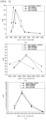
- FIG.2 shows particle size distribution of composites that may be prepared by the size of seed particles.
- FIG. 2 shows particle size distribution of a composite including seed particles having an average particle diameter of 150 um to 300 ⁇ m
- (b) shows particle size distribution of a composite including seed particles having an average particle diameter of 850 um to 2,000 um
- (c) shows particle size distribution of a composite including seed particles having an average particle diameter of 2,000 um to 3,350 um.
- the average particle diameter of the composite of the present invention may be 150 um to 3,350 um.
- the composite of the present invention may be prepared by a method of spraying a slurry including the organometal nanostructure on the surface of the seed particles through a fluid bed coating machine which will be explained later, and composites having various sizes may be prepared according to the size of the seed particles. Though seed particles having a large average particle diameter are used, a composite having a uniform average particle diameter could be prepared. That is, if the size of the seed particle could be controlled, the composite of the present invention may selectively control the size of the composite according to the product to apply, and since the organometal nanostructure is formed only on the surface of the seed particle, effects ofreinforcing manufacturing competitiveness may be achieved by reducing the amount used of the organometal nanostructure.
- the average particle diameters of the seed particles and the composite may mean arithmetic particle diameters in particle size distribution measured by a sieve shaker.
- the arithmetic particle diameter could be measured as an intensity distribution particle diameter, a volume distribution particle diameter and a number distribution particle diameter, and among them, the volume distribution particle diameter is preferably measured.
- the average particle diameters of the seed particles and the composite of the present invention may be a volume distribution particle diameter obtained by installing meshes step by step by the mesh size of 150 ⁇ m, 200 ⁇ m, 250 ⁇ m, 300 um, 425 ⁇ m, 500 ⁇ m, 600 ⁇ m, and 850 um using a sieve shaker, and measuring particle size distribution for each section.
- the composite of the present invention may have a compressive fracture strength of 2.7 N or more, 3.0 N or more, or 3.3 N or more. If the above-described range is satisfied, the crystallinity and porous properties of an organometal nanostructure included in a composite may be maintained, thermal stability and resistance to pressure may be excellent without degrading ability to adsorb volatile organic compounds when compared to the conventional composite, and effects of applying to various products may be achieved.
- the composite of the present invention may include a binder for attaching the organometal nanostructure particles from each other.
- the binder may use an organic polymer or an inorganic material, for example, one or more selected from the group consisting of polyvinyl butyral (PVB), polyvinyl alcohol (PVA), polyvinyl chloride (PVC), polycarbonate (PC), polyamide (PA), polyoxymethylene (POM), polystyrene (PS), polyvinyl pyrrolidone (PVP), hydroxypropyl methylcellulose (HPMC) and acetylcellulose, which are organic polymers.
- PVB polyvinyl butyral
- PVA polyvinyl alcohol
- PVC polyvinyl chloride
- PC polycarbonate
- PA polyamide
- POM polyoxymethylene
- PS polystyrene
- PVP polyvinyl pyrrolidone
- HPMC hydroxypropyl methylcellulose
- acetylcellulose which are organic polymers.
- the present invention may show the coating ratio of the coating part formed on the seed particle of 10% to 90%, 10% to 85%, or 40% to 80%, and the coating ratio may be calculated by Mathematical Formula 1 below.
- Coating ratio (%) ⁇ (mass of coated composite) / (mass of seed particles before coating) + (mass of organometal nanostructure before coating) ⁇ X 100(%)
- effects of reinforcing manufacturing competitiveness may be achieved by reducing the amount used of an organometal nanostructure without degrading ability to adsorb volatile organic compounds.
- the present invention provides a method for preparing a composite, comprising a step of injecting seed particles into a fluid bed coating machine and making the seed particles flow (S1) and a step of spraying a slurry comprising an organometal nanostructure and a binder onto the seed particles in flowing (S2).
- a composite including an organometal nanostructure may be prepared as a composite by a process of preparing an organometal nanostructure powder, mixing with a binder and applying a mechanical pressure.
- an organometal nanostructure may be filtered and washed, an organometal nanostructure slurry may be prepared and dried, and then, a milling process may be performed.
- the organometal nanostructure powder prepared may be mixed with a binder, a mechanical pressure may be applied, and a drying process may be performed. Accordingly, the whole process for preparing the composite is complicated, there are a lot of variables that may arise during the process, and there are problems in that the quality of the composite prepared is difficult to maintain.
- the present invention introduces a preparation method of coating a slurry including an organometal nanostructure powder and a binder on the surface of a seed particle using a fluid bed coating machine, and performing drying and granulation simultaneously.
- an organometal nanostructure slurry is prepared and dried, and though not involving a process of preparing an organometal nanostructure powder by a milling process, a granulation process could be performed using the organometal nanostructure filtered and washed. Accordingly, effects of simplifying the conventional process for preparing an organometal nanostructure powder could be achieved.
- the composite of the present invention has a seed-shell structure formed by a slurry including an organometal nanostructure and a binder on the surface of a seed particle, and because of the bonding force of the seed particle and the organometal nanostructure, the application of a mechanical pressure and a separate drying process are not required during the preparation process of the composite. Accordingly, the conventional process for converting an organometal nanostructure powder into a composite may be simplified, the crystallinity and porous properties of the organometal nanostructure included in the composite prepared could be maintained, variables that may arise during processing may be minimized, and effects of maintaining the quality of the composite prepared constant may be achieved.
- FIG. 3 is a photographic image showing the cross-section of a composite structure of a seed-shell structure prepared in practice according to a method for preparing a composite of the present invention and taken by X-RAY CT. Referring to FIG. 3 , it could be confirmed that the composite of the present invention has a seed-shell structure by forming a coating part including an organometal nanostructure with a seed particle of activated carbon as a center.
- the size of the composite has been difficult because of the preparation process of the conventional composite, but in the present invention, if the size of the seed particles could be controlled, the size of the composite may be selectively controlled according to the product to apply. Since the organometal nanostructure is formed only on the surface of the seed particle, the amount used of the organometal nanostructure could be reduced, and effects of reinforcing manufacturing competitiveness may be achieved.
- the type of the seed particles of step (S1) is not specifically limited but may be one or more selected from the group consisting of carbon nanotube, graphene, graphite, amorphous carbon, carbon black, activated carbon, a metal material and an organometal nanostructure.
- the seed particle may be activated carbon that has excellent ability to adsorb toluene.
- the seed particles of step (S1) may be a state of flow by the air flow in a fluid bed coating machine.
- step (S2) a slurry including an organometal nanostructure and a binder is sprayed on the surface of the seed particles that are in a state of flow in the fluid bed coating machine, to prepare a composite in which a coating part including an organometal nanostructure and a binder is formed on the surface of the seed particles.
- the spraying in step (S2) may be a Wurster spray method by which the spraying is conducted upwards from a bottom of the fluid bed coating machine or a Tangential spray method by which the spraying is conducted from a middle of the fluid bed coating machine to a tangential direction.
- the agglomeration of the seed particles coated may be controlled, and effects of uniformly forming the coating part including the organometal nanostructure and the binder on the surface of the seed particle may be achieved.
- the slurry may include the binder in 1 to 40 parts by weight, 1 to 20 parts by weight, or 2 to 15 parts by weight based on 100parts by weight of the organometal nanostructure. If the above-described range is satisfied, the ratio of the organometal nanostructure coated on the surface of the seed particles may increase, while minimizing the loss of the organometal nanostructure, thereby achieving improving effects of ability to adsorb volatile organic compounds.
- the binder included in the slurry may have a weight average molecular weight of 100,000 g/mol to 250,000 g/mol, 150,000 g/mol to 250,000 g/mol, or 160,000 g/mol to 210,000 g/mol. If the above-described range is satisfied, the adhesion of the organometal nanostructure may be maintained, and effects of increasing the ratio of the organometal nanostructure coated on the surface of the seed particles may be achieved.
- MIL-125(Ti) powder 74.16 g of a MIL-125(Ti) powder was prepared. Then, the MIL-125(Ti) powder and 59.33 g of polyvinyl alcohol (a solution in which 7.5 wt% of polyvinyl alcohol is dispersed in water) were mixed to prepare a slurry.
- polyvinyl alcohol a solution in which 7.5 wt% of polyvinyl alcohol is dispersed in water
- MIL-125(Ti) powder 105.88 g of a MIL-125(Ti) powder was prepared. Then, the MIL-125(Ti) powder and 84.67 g of polyvinyl alcohol (a solution in which 7.5 wt% of polyvinyl alcohol is dispersed in water) were mixed to prepare a slurry.
- polyvinyl alcohol a solution in which 7.5 wt% of polyvinyl alcohol is dispersed in water
- MIL-125(Ti) powder 300 g was prepared. Then, the MIL-125(Ti) powder and 240 g of polyvinyl alcohol (a solution in which 7.5 wt% of polyvinyl alcohol is dispersed in water) were mixed to prepare a slurry.
- a MIL-125(Ti) powder 600 g was prepared. Then, the MIL-125(Ti) powder and 480 g of polyvinyl alcohol (a solution in which 7.5 wt% of polyvinyl alcohol is dispersed in water) were mixed to prepare a slurry.
- MIL-125(Ti) powder 300 g was prepared. Then, the MIL-125(Ti) powder and 240 g of polyvinyl alcohol (a solution in which 7.5 wt% of polyvinyl alcohol is dispersed in water) were mixed to prepare a slurry.
- a MIL-125(Ti) powder 600 g was prepared. Then, the MIL-125(Ti) powder and 480 g of polyvinyl alcohol (a solution in which 7.5 wt% of polyvinyl alcohol is dispersed in water) were mixed to prepare a slurry.
- a MIL-125(Ti) powder 100 g was injected into a high shear granulating (HSG) machine. Then, a mixture solution of 50 g of water and 80 g of polyvinyl alcohol (a solution in which 7.5 wt% of polyvinyl alcohol is dispersed in water) was injected into the high shear granulation machine to mix with the MIL-125(Ti) powder. Then, a granulation process was performed for 10 minutes under the conditions of a blade of 800 rpm and a chopper of 2,500 rpm. Then, drying was performed at 90°C for 24 hours to manufacture a powder specimen.
- HSG high shear granulating
- Example 1 The activated carbon in Example 1 was used as a specimen.
- the composites prepared from Examples 1 to 6 showed markedly high ratio of obtaining particles with an average particle diameter of 150 ⁇ m to 600 ⁇ m without increasing an abrasion degree and degrading the adsorption amount of volatile organic compounds when compared to the composite of Comparative Example 1 prepared by a high shear granulation (HSG) method, and showed a lower abrasion degree and increased adsorption amount of volatile organic compounds when compared to the composite of Comparative Example 2 manufactured into a pellet shape.
- HSG high shear granulation
- the composites prepared from Examples 1 to 6 showed similar particle size distribution as the activated carbon of Comparative Example 3, but the composites prepared from Examples 1 to 6 showed lower abrasion degrees by the bonding force of a seed and a coating part in contrast to the activated carbon of Comparative Example 3.
- the composites prepared from Examples 4 and 6 showed unbreakable properties of the composites even with the increase of the pressure, but the activated carbon of Comparative Example 3 showed easily breaking phenomenon of the activated carbon according to the increase of the pressure. Accordingly, it could be confirmed that the composites prepared from Examples 4 and 6 showed excellent structural stability in contrast to the activated carbon of Comparative Example 3.
- the results could be confirmed that the composite prepared according to the method for preparing a composite according to the present invention has excellent structural stability, and particles with an average particle diameter of 150 ⁇ m to 600 ⁇ m could be obtained in a high yield without increasing a abrasion degree and degrading the adsorption amount of volatile organic compounds.
Landscapes
- Chemical & Material Sciences (AREA)
- Analytical Chemistry (AREA)
- Chemical Kinetics & Catalysis (AREA)
- Organic Chemistry (AREA)
- Inorganic Chemistry (AREA)
- Engineering & Computer Science (AREA)
- Nanotechnology (AREA)
- General Chemical & Material Sciences (AREA)
- Oil, Petroleum & Natural Gas (AREA)
- Solid-Sorbent Or Filter-Aiding Compositions (AREA)
- Crystallography & Structural Chemistry (AREA)
- Materials Engineering (AREA)
Abstract
Description
- The present application claims the benefit of priority based on
Korean Patent Application No. 10-2021-0118057, filed on September 6, 2021 - The present invention relates to a composite comprising an organometal nanostructure powder and a method for preparing same, more particularly, to a composite comprising an organometal nanostructure powder, that may maintain the properties of the organometal nanostructure powder because of auniform particle diameter size and being structurally stable, and may reduce the production amount of a fine powder without deteriorating ability to adsorb volatile organic compounds (VOC), and a method for preparing same.
- An organometalnanostructure is an organic inorganic polymer compound formed by combining a metal ion with an organic ligand and means a crystalline compound with a porous type, including both an organic material and an inorganic material in a skeleton structure and having a pore structure with a micro size or a nano size.
- Such an organometal nanostructure has a large surface area and pores with a micro size or a nano size, and is used for capturing molecules smaller than the pore size or for separating molecules according to the size of molecules using pores, as well as used as an adsorbent, a gas-storing material, a sensor, a membrane, a functional thin film, a drug delivery material, a catalyst and a catalyst support, and accordingly, is being actively studied until now.
- However, the organometal nanostructure has low thermal stability and structural stability with respect to pressure, and there are problems of not maintaining the properties of an organometal nanostructure powder showing high crystallinity and porous type during converting an organometal nanostructure powder to a composite. In addition, due to such problems, there are problems in that technology is limited in converting an organometal nanostructure powder having an average particle diameter of 1 um to 3 um into a composite having an average particle diameter of a several tens um to mm unit.
- In addition, an organometal nanostructure powder has low mutual gathering, and a process of mixing with a binder or an additive and applying a mechanical pressure is required, but by the amount of the binder or additive added, the pores of the organometal nanostructure may be blocked, or crystallinity may be deteriorated. As a result, there are problems in that the surface area of the organometal nanostructuremay be markedly reduced, ability to adsorb volatile organic compounds (VOC) may be degraded, and the production amount of a fine powder may increase due to abrasion.
- Accordingly, study on a composite maintaining the conventional properties during converting an organometal nanostructure powder into a composite, not degrading ability to adsorb volatile organic compounds (VOC), reducing the production of a fine powder due to abrasion, and including structurally stable organometal nanostructure powder, is required.
- The present invention is to solve the above-described problems and provides a composite including an organometal nanostructure powder, that may maintain the properties of an organometal nanostructure powder because of the uniform size of aparticle diameter and structural stability, may reduce the production amount of a fine powder due to abrasion without deterioration of ability to adsorb volatile organic compounds (VOC) and may reinforce manufacturing competitiveness, by adopting a method for preparing a composite by forming a coating part including an organometal nanostructure and a binder on the surface of a seed particle, and a method for preparing same.
- The present invention provides a composite and a method for preparing same.
- (1) The present invention provides acomposite comprising: a seed particle; and a coating part formed on the seed particle, wherein the coating part comprises an organometal nanostructure and a binder,an average particle diameter of the seed particles is 150 um to 3,350 µm, and an average particle diameter of the composite is 110% to 700% with respect to the average particle diameter of the seed particles.
- (2) The present invention provides the composite according to (1), wherein the seed particle comprises one or more selected from the group consisting of carbon nanotube, graphene, graphite, amorphous carbon, carbon black, activated carbon, a metal material and an organometal nanostructure.
- (3) The present invention provides the composite according to (1) or (2), wherein the seed particle is spherical or pseudo-spherical.
- (4) The present invention provides the compositeaccording to any one of (1) to (3), wherein the average particle diameter of the seed particles is 150 um to 300 µm.
- (5) The present invention provides the composite according to any one of (1) to (4), wherein the composite has particle size distribution such that particles having an average particle diameter of 150 um to 600 um are 80 wt% or more.
- (6) The present invention provides the composite according to any one of (1) to (5), wherein the average particle diameter of the composite is 150 um to 3,350 µm.
- (7) The present invention provides the composite according to any one of(1) to (6), wherein a specific surface area per weight of the seed particles is 10 m2/g or more.
- (8) The present invention provides the composite according to any one of (1) to (7), wherein the binder comprises one or more selected from the group consisting of polyvinyl butyral (PVB), polyvinyl alcohol (PVA), polyvinyl chloride (PVC), polycarbonate (PC), polyamide (PA), polyoxymethylene (POM), polystyrene (PS), polyvinyl pyrrolidone (PVP), hydroxypropyl methylcellulose (HPMC) and acetylcellulose.
- (9) The present invention provides the composite according to any one of (1) to (8), wherein the coating part has a coating ratio calculated by Mathematical Formula 1 of 10% to 90%.
Coating ratio= {(mass of coated composite) / (mass of seed particles before coating) + (mass of organometal nanostructure before coating)} X 100 (%) - (10) The present invention provides a method for preparing a composite, comprising:a step of injecting seed particles into a fluid bed coating machine and making the seed particles flow (S1); anda step of spraying a slurry comprising an organometal nanostructure and a binder onto the seed particles in flowing (S2).
- (11) The present invention provides the method for preparing a composite according to (10), whereinthe spraying of step (S2) is conducted by a Wurster spray method by which the spraying is conducted upwards from a bottom of the fluid bed coating machine or by a Tangential spray method by which the spraying is conducted from a middle of the fluid bed coating machine to a tangential direction.
- (12) The present invention provides the method for preparing a composite according to (10) or (11), wherein the slurry comprises the binder in 1 to 40 parts by weight based on 100 parts by weight of the organometal nanostructure.
- (13) The present invention provides the method for preparing a composite according to any one of (10) to (12), wherein the binder has a weight average molecular weight of 100,000 g/mol to 250,000 g/mol.
- Thecomposite and the method for preparing same of the present inventionshow excellent effects of thermal stability and structural stability with respect to pressure because of structural properties formed by an organometal nanostructure and a binder on the surface of a seed. In addition, due to the bonding force of the seed and the organometal nanostructure, the conventional properties may be maintained during converting an organometal nanostructure powder into a composite, and effects of reducing the production amount ofa fine powder due to abrasion may be achieved without deteriorating ability to adsorb volatile organic compounds (VOC). In addition, effects of selectively controlling the size of the composite according to a product to be applied may be achieved by controlling the size of the seed. In addition, manufacturing competitiveness may be reinforced by reducing the amount used of the organometal nanostructure by introducing a method for preparing a composite by forming an organometal nanostructure only on the surface of the seed by simply mixing an organometal nanostructure and a binderin the conventional method for preparing a composite.
-
-
FIG. 1 shows acompressive fracture strength of the composites of Examples 4 and 6 and the activated carbon of Comparative Example 3. -
FIG. 2 shows particle size distribution of composites that may be prepared by the size of seed particles. -
FIG. 3 is a photographic image showing the cross-section of a composite structure of a seed-shell structure prepared in practice according to a method for preparing a composite of the present invention and taken by X-RAY CT. - It will be understood that words or terms used in the description and claims of the present invention shall not be interpreted as the meaning defined in commonly used dictionaries. It will be understood that the words or terms should be interpreted as having a meaning that is consistent with their meaning in the technical idea of the invention, based on the principle that an inventor may properly define the meaning of the words to best explain the invention.
- In the present invention, a weight average molecular weight may mean a relative value on a standard polystyrene (PS) specimen through gel permeation chromatography (GPC, waters breeze) using tetrahydrofuran (THF) as an eluent.
- Hereinafter, the present invention will be explained in more detail.
- The present invention provides a composite comprising a seed particle and a coating part formed on the seed particle, wherein the coating part comprises an organometal nanostructure and a binder, an average particle diameter of the seed particles is 150 um to 3,350 µm, andan average particle diameter of the composite is 110% to 700% with respect to the average particle diameter of the seed particles.
- Generally, an organometal nanostructure powder has low mutual gathering, and a process of mixing the organometal nanostructure powder with a binder or an additive to prepare a powder lump and applying a mechanical pressure has been required for preparing an organometal nanostructure composite. However, by the amount of the binder or additive added, the pores of the organometal nanostructurewere blocked, or crystallinity was deteriorated. As a result, there were problems in that the surface area of the organometal nanostructurewas largely reduced, ability to adsorb volatile organic compounds (VOC) was degraded, and the production amount of a fine powder increased due to abrasion.
- In order to solve such problems, the present invention introduces a seed-shell structure introducing seed particles and forming a coating part including an organometal nanostructure and a binder on the surface of the seed particle. The bonding force between the seed particle and the organometal nanostructure may complement the mutual gathering of an organometal nanostructure powder, and a process of injecting a binder or an additive to a process for preparing a composite and mechanically applying a pressure is not required. As a result, the properties of the conventional organometal nanostructure may be maintained during a process of converting the organometal nanostructure powder into a composite, and the production amount of a fine powder by abrasion may be reduced without deteriorating ability to adsorb volatile organic compounds (VOC). In addition, by controlling the size of the seed particles, the size of a composite could be selectively controlled according to the products to apply, and since the organometal nanostructure is formed only on the surface of the seed particle, the amount used of the organometal nanostructure may be reduced, thereby reinforcing manufacturing competitiveness.
- According to an embodiment of the present invention, the type of the seed particle in the present invention may be one or more selected from the group consisting of carbon nanotube, graphene, graphite, amorphous carbon, carbon black, activated carbon, a metal material and an organometal nanostructure. In addition, considering that the organometal nanostructure has inferior ability to adsorb toluene among volatile organic compounds (VOC), the seed particle may be activated carbon that has excellent ability to adsorb toluene.
- In addition, according to an embodiment of the present invention, the seed particle of the present invention may be spherical or pseudo-spherical. The pseudo-spherical means a shape generally close to spherical including a shape of which cross-section passing through the center of gravity of the seed particle is an elliptical shape, or a shape in which the surface of the seed particle is uneven, and some are protruding, and may include an elliptical shape,an oval shape, or a spherical shape,elliptical shape, andovalshape having protrusion. If the shape of the seed particle is spherical or pseudo-spherical, effects of increasing the coating amount of slurry on the surface of the seed particle may be achieved.
- In addition, according to an embodiment of the present invention, an average particle diameter of the seed particles of the present invention may be 150 um to 3,350 um. Particularly, the average particle diameter of the seed particles may be 150 µm or more,210 µm or more, 250 µm or more, 300 µm or more, 400 µm or more, 500 µm or more, 600 µm or more, 700 um or more, 800 um or more, 850 um or more, or 1,000 um or more, and 3,350 µm or less, 2,800 µm or less, 2,360 um or less, 2,000 um or less, 1,400 um or less, or 1,200 um or less. If the average particle diameter of the seed particles deviates from the range, the size of the average particle diameter of the composite finally prepared is difficult to efficiently control, and the adsorption and abrasion degree properties of the composite may be degraded.
- In addition, the average particle diameter of the seed particles may be classified according to the use of the composite finally prepared. A composite including seed particles having an average particle diameter of 150 um to 300 µm, has advantages in adsorbing indoor VOC due to a large surface area and could be used in products related to real life such as an air cleaner, and a composite including seed particles having an average particle diameter of 850 um to 2,000 um has a large distance between particles and advantages of not forming a differential pressure, and could be mainly used in a gas mask, or the like. In addition, a composite including seed particles having an average particle diameter of 2,000 um to 3,350 um has advantages of strong physical properties, particularly, excellent strength, and may be used in specific environments such as an adsorption tower in the factory.
- In addition, according to an embodiment of the present invention, the specific surface area per weight of the seed particles of the present invention may be 10 m2/g or more, 50 m2/g or more, 100 m2/g or more, 200 m2/g or more, 300 m2/g or more, or 400 m2/g or more and 1,000 m2/g or less, 900 m2/g or less, 800 m2/g or less, 700 m2/g or less, 600 m2/g or less, or 500 m2/g or less. If the above-described range is satisfied, effects of improving adsorption on volatile organic compounds may be achieved, while maintaining structural stability.
- According to an embodiment of the present invention, the composite of the present invention may have particle size distribution such that particles having an average particle diameter of 150 um to 600 um are 80 wt% or more, preferably, have particle size distribution such that particles having an average particle diameter of 150 um to 600 um are 80 wt% or more, 85 wt% or more, 87 wt% or more, 91 wt% or more, or 95 wt% or more.
- If the above-described range is satisfied, thermal stability and resistance to pressure are excellent, and effects of applying to various products may be achieved. Though a small amount of the organometal nanostructure powder is included, the production amount of a fine powder due to the abrasion of composite particles may be reduced without degrading the adsorption of volatile organic compounds, and effects of minimizing agglomerating phenomenon among composite particles may be achieved.
-
FIG.2 shows particle size distribution of composites that may be prepared by the size of seed particles. Particularly, inFIG. 2 , (a) shows particle size distribution of a composite including seed particles having an average particle diameter of 150 um to 300 µm, (b) shows particle size distribution of a composite including seed particles having an average particle diameter of 850 um to 2,000 um, and (c) shows particle size distribution of a composite including seed particles having an average particle diameter of 2,000 um to 3,350 um. Referring toFIG. 2 , the average particle diameter of the composite of the present invention may be 150 um to 3,350 um. The composite of the present invention may be prepared by a method of spraying a slurry including the organometal nanostructure on the surface of the seed particles through a fluid bed coating machine which will be explained later, and composites having various sizes may be prepared according to the size of the seed particles. Though seed particles having a large average particle diameter are used, a composite having a uniform average particle diameter could be prepared. That is, if the size of the seed particle could be controlled, the composite of the present invention may selectively control the size of the composite according to the product to apply, and since the organometal nanostructure is formed only on the surface of the seed particle, effects ofreinforcing manufacturing competitiveness may be achieved by reducing the amount used of the organometal nanostructure. - In addition, the average particle diameters of the seed particles and the composite may mean arithmetic particle diameters in particle size distribution measured by a sieve shaker. The arithmetic particle diameter could be measured as an intensity distribution particle diameter, a volume distribution particle diameter and a number distribution particle diameter, and among them, the volume distribution particle diameter is preferably measured. Particularly, the average particle diameters of the seed particles and the composite of the present invention may be a volume distribution particle diameter obtained by installing meshes step by step by the mesh size of 150 µm, 200 µm, 250 µm, 300 um, 425 µm, 500 µm, 600 µm, and 850 um using a sieve shaker, and measuring particle size distribution for each section.
- In addition, the composite of the present invention may have a compressive fracture strength of 2.7 N or more, 3.0 N or more, or 3.3 N or more. If the above-described range is satisfied, the crystallinity and porous properties of an organometal nanostructure included in a composite may be maintained, thermal stability and resistance to pressure may be excellent without degrading ability to adsorb volatile organic compounds when compared to the conventional composite, and effects of applying to various products may be achieved.
- According to an embodiment of the present invention, the composite of the present invention may include a binder for attaching the organometal nanostructure particles from each other. The binder may use an organic polymer or an inorganic material, for example, one or more selected from the group consisting of polyvinyl butyral (PVB), polyvinyl alcohol (PVA), polyvinyl chloride (PVC), polycarbonate (PC), polyamide (PA), polyoxymethylene (POM), polystyrene (PS), polyvinyl pyrrolidone (PVP), hydroxypropyl methylcellulose (HPMC) and acetylcellulose, which are organic polymers.
- In addition, according to an embodiment of the present invention, the present invention may show the coating ratio of the coating part formed on the seed particle of 10% to 90%, 10% to 85%, or 40% to 80%, and the coating ratio may be calculated by Mathematical Formula 1 below.
Coating ratio (%) = {(mass of coated composite) / (mass of seed particles before coating) + (mass of organometal nanostructure before coating)} X 100(%) - If the above-described range is satisfied, effects of reinforcing manufacturing competitiveness may be achieved by reducing the amount used of an organometal nanostructure without degrading ability to adsorb volatile organic compounds.
- The present invention provides a method for preparing a composite, comprising a step of injecting seed particles into a fluid bed coating machine and making the seed particles flow (S1) and a step of spraying a slurry comprising an organometal nanostructure and a binder onto the seed particles in flowing (S2).
- Generally, a composite including an organometal nanostructure may be prepared as a composite by a process of preparing an organometal nanostructure powder, mixing with a binder and applying a mechanical pressure. In order to prepare the organometal nanostructure powder, an organometal nanostructure may be filtered and washed, an organometal nanostructure slurry may be prepared and dried, and then, a milling process may be performed. In addition, in order to prepare the composite, the organometal nanostructure powder prepared may be mixed with a binder, a mechanical pressure may be applied, and a drying process may be performed. Accordingly, the whole process for preparing the composite is complicated, there are a lot of variables that may arise during the process, and there are problems in that the quality of the composite prepared is difficult to maintain.
- In order to solve such problems, the present invention introduces a preparation method of coating a slurry including an organometal nanostructure powder and a binder on the surface of a seed particle using a fluid bed coating machine, and performing drying and granulation simultaneously. According to the preparation method of the present invention, an organometal nanostructure slurry is prepared and dried, and though not involving a process of preparing an organometal nanostructure powder by a milling process, a granulation process could be performed using the organometal nanostructure filtered and washed. Accordingly, effects of simplifying the conventional process for preparing an organometal nanostructure powder could be achieved.
- In addition, the composite of the present invention has a seed-shell structure formed by a slurry including an organometal nanostructure and a binder on the surface of a seed particle, and because of the bonding force of the seed particle and the organometal nanostructure, the application of a mechanical pressure and a separate drying process are not required during the preparation process of the composite. Accordingly, the conventional process for converting an organometal nanostructure powder into a composite may be simplified, the crystallinity and porous properties of the organometal nanostructure included in the composite prepared could be maintained, variables that may arise during processing may be minimized, and effects of maintaining the quality of the composite prepared constant may be achieved.
-
FIG. 3 is a photographic image showing the cross-section of a composite structure of a seed-shell structure prepared in practice according to a method for preparing a composite of the present invention and taken by X-RAY CT. Referring toFIG. 3 , it could be confirmed that the composite of the present invention has a seed-shell structure by forming a coating part including an organometal nanostructure with a seed particle of activated carbon as a center. - The selective control of the size of the composite has been difficult because of the preparation process of the conventional composite, but in the present invention, if the size of the seed particles could be controlled, the size of the composite may be selectively controlled according to the product to apply. Since the organometal nanostructure is formed only on the surface of the seed particle, the amount used of the organometal nanostructure could be reduced, and effects of reinforcing manufacturing competitiveness may be achieved.
- The type of the seed particles of step (S1) is not specifically limited but may be one or more selected from the group consisting of carbon nanotube, graphene, graphite, amorphous carbon, carbon black, activated carbon, a metal material and an organometal nanostructure. In addition, considering that the organometal nanostructure has inferior ability to adsorb toluene among volatile organic compounds (VOC), the seed particle may be activated carbon that has excellent ability to adsorb toluene. In addition, the seed particles of step (S1) may be a state of flow by the air flow in a fluid bed coating machine.
- In step (S2), a slurry including an organometal nanostructure and a binder is sprayed on the surface of the seed particles that are in a state of flow in the fluid bed coating machine, to prepare a composite in which a coating part including an organometal nanostructure and a binder is formed on the surface of the seed particles.
- The spraying in step (S2) may be a Wurster spray method by which the spraying is conducted upwards from a bottom of the fluid bed coating machine or a Tangential spray method by which the spraying is conducted from a middle of the fluid bed coating machine to a tangential direction. By the upward spray method through spray nozzles at the bottom of the fluid bed coating machine or the tangential direction spray method through spray nozzles at the middle, the agglomeration of the seed particles coated may be controlled, and effects of uniformly forming the coating part including the organometal nanostructure and the binder on the surface of the seed particle may be achieved.
- The slurry may include the binder in 1 to 40 parts by weight, 1 to 20 parts by weight, or 2 to 15 parts by weight based on 100parts by weight of the organometal nanostructure. If the above-described range is satisfied, the ratio of the organometal nanostructure coated on the surface of the seed particles may increase, while minimizing the loss of the organometal nanostructure, thereby achieving improving effects of ability to adsorb volatile organic compounds.
- In addition, the binder included in the slurry may have a weight average molecular weight of 100,000 g/mol to 250,000 g/mol, 150,000 g/mol to 250,000 g/mol, or 160,000 g/mol to 210,000 g/mol. If the above-described range is satisfied, the adhesion of the organometal nanostructure may be maintained, and effects of increasing the ratio of the organometal nanostructure coated on the surface of the seed particles may be achieved.
- Hereinafter, the present invention will be explained in particular through particular embodiments. However, the embodiments below are only for illustrating the present invention, and the scope of the present invention is not limited thereby.
- 74.16 g of a MIL-125(Ti) powder was prepared. Then, the MIL-125(Ti) powder and 59.33 g of polyvinyl alcohol (a solution in which 7.5 wt% of polyvinyl alcohol is dispersed in water) were mixed to prepare a slurry.
- To a fluid bed coating machine, 600 g of activated carbon was injected, and the activated carbon was made flow. Then, the slurry prepared was injected into the fluid bed coating machine, and the slurry was sprayed upwards through spray nozzles at the bottom of the fluid bed coating machine. The slurry was sprayed for 2 hours, and a sample of flowing activated carbon coated with the slurry at the surface thereof was obtained. The coated sample was fluidization dried at 80°C for 1 hour to manufacture a composite specimen.
- 105.88 g of a MIL-125(Ti) powder was prepared. Then, the MIL-125(Ti) powder and 84.67 g of polyvinyl alcohol (a solution in which 7.5 wt% of polyvinyl alcohol is dispersed in water) were mixed to prepare a slurry.
- To a fluid bed coating machine, 600 g of activated carbon was injected, and the activated carbon was made flow. Then, the slurry prepared was injected into the fluid bed coating machine, and the slurry was sprayed upwards through spray nozzles at the bottom of the fluid bed coating machine. The slurry was sprayed for 2 hours, and a sample of flowing activated carbon coated with the slurry at the surface thereof was obtained. The coated sample was fluidization dried at 80°C for 1 hour to manufacture a composite specimen.
- 300 g of a MIL-125(Ti) powder was prepared. Then, the MIL-125(Ti) powder and 240 g of polyvinyl alcohol (a solution in which 7.5 wt% of polyvinyl alcohol is dispersed in water) were mixed to prepare a slurry.
- To a fluid bed coating machine, 300 g of activated carbon was injected, and the activated carbon was made flow. Then, the slurry prepared was injected into the fluid bed coating machine, and the slurry was sprayed upwards through spray nozzles at the bottom of the fluid bed coating machine. The slurry was sprayed for 2 hours, and a sample of flowing activated carbon coated with the slurry at the surface thereof was obtained. The coated sample was fluidization dried at 80°C for 1 hour to manufacture a composite specimen.
- 600 g of a MIL-125(Ti) powder was prepared. Then, the MIL-125(Ti) powder and 480 g of polyvinyl alcohol (a solution in which 7.5 wt% of polyvinyl alcohol is dispersed in water) were mixed to prepare a slurry.
- To a fluid bed coating machine, 150 g of activated carbon was injected, and the activated carbon was made flow. Then, the slurry prepared was injected into the fluid bed coating machine, and the slurry was sprayed upwards through spray nozzles at the bottom of the fluid bed coating machine. The slurry was sprayed for 4 hours, and a sample of flowing activated carbon coated with the slurry at the surface thereof was obtained. The coated sample was fluidization dried at 80°C for 1 hour to manufacture a composite specimen.
- 300 g of a MIL-125(Ti) powder was prepared. Then, the MIL-125(Ti) powder and 240 g of polyvinyl alcohol (a solution in which 7.5 wt% of polyvinyl alcohol is dispersed in water) were mixed to prepare a slurry.
- To a fluid bed coating machine, 300 g of activated carbon was injected, and the activated carbon was made flow. Then, the slurry prepared was injected into the fluid bed coating machine, and the slurry was sprayed in a tangential direction through spray nozzles at the middle of the fluid bed coating machine. The slurry was sprayed for 2 hours, and a sample of flowing activated carbon coated with the slurry at the surface thereof was obtained. The coated sample was fluidization dried at 80°C for 1 hour to manufacture a composite specimen.
- 600 g of a MIL-125(Ti) powder was prepared. Then, the MIL-125(Ti) powder and 480 g of polyvinyl alcohol (a solution in which 7.5 wt% of polyvinyl alcohol is dispersed in water) were mixed to prepare a slurry.
- To a fluid bed coating machine, 150 g of activated carbon was injected, and the activated carbon was made flow. Then, the slurry prepared was injected into the fluid bed coating machine, and the slurry was sprayed in a tangential direction through spray nozzles at the middle of the fluid bed coating machine. The slurry was sprayed for 2 hours, and a sample of flowing activated carbon coated with the slurry at the surface thereof was obtained. The coated sample was fluidization dried at 80°C for4 hour to manufacture a composite specimen.
- 100 g of a MIL-125(Ti) powder was injected into a high shear granulating (HSG) machine. Then, a mixture solution of 50 g of water and 80 g of polyvinyl alcohol (a solution in which 7.5 wt% of polyvinyl alcohol is dispersed in water) was injected into the high shear granulation machine to mix with the MIL-125(Ti) powder. Then, a granulation process was performed for 10 minutes under the conditions of a blade of 800 rpm and a chopper of 2,500 rpm. Then, drying was performed at 90°C for 24 hours to manufacture a powder specimen.
- 100 g of a MIL-125(Ti) powder and 59.33 g of polyvinyl alcohol (a solution in which 6.0 wt% of polyvinyl alcohol is dispersed in water) were mixed to prepare a slurry. Then, the slurry prepared was injected into a syringe, melted at 220°Cand mixed to manufacture a specimen having a pellet shape with a size of 3 mm.
- The activated carbon in Example 1 was used as a specimen.
- With respect to the specimens of the Examples and Comparative Examples, particle size distribution, a coating ratio and a BET surface area were measured, and the measurement results are shown in Table 1 below.
- 1) Measurement of particle size distribution: By using a standard sieve of an ASTM standard, the particles prepared in Example 1 were classified. More particularly, after stacking standard sieves having a mesh size of 850 µm, 600 µm, 300 µm, and 150 pmone by one, all the particles prepared in Example 1 was put on the uppermost, and the resultant was set on a sieve shaker. Classification was performed for 10 minutes with an amplitude of 20, each of particles remaining between the standard sieves were taken out and weighed, percentage was calculated, and the particle size distribution of the particles was computed. In addition, by the same method, the particle size distribution of the particles prepared in Examples 2 to 6 and Comparative Examples 1 to 4 was computed.
- 2) Measurement of coating ratio: The coating ratio was calculated through the equation of "{(mass of coated composite)/(mass of seed particles before coating) + (mass of organometal nanostructure before coating)} X 100 (%)".
- 3) Measurement of BET surface area: Computation was performed from a nitrogen gas adsorption amount under a liquid nitrogen temperature (77K) using BELSORP-mino II of BEL Japan Inc.
- With respect to the specimens of the Examples and Comparative Examples, adsorption amounts of formaldehyde that is a volatile organic compound and abrasion degrees were measured by the methods below. Measurement results are shown in Table 2.
- 1) Measurement of adsorption amount of volatile organic compound: A filter including each specimen of the Examples and Comparative Examples was put in a gas bag, and 15 ppm of formaldehyde was injected thereto, followed by sealing up and standing at room temperature for 2 hours. By using a gas detector tube method (FTM-5-2: 2004), the amount of formaldehyde remaining after 2 hours in the gas bag was measured. The adsorption amount of formaldehyde was calculated by subtracting the amount of formaldehyde remaining after 2 hours in the gas bag from initial 15 ppm of formaldehyde.
- 2) Measurement of abrasion degree:Each specimen of the Examples and Comparative Examples was injected into a beads machine including two types of zirconia (Zr) balls having average particle diameters of 5 mm and 10 mm. Then, the beads machine was shaken for 10 minutes, particles passing through a standard sieve with 150 µm were taken out, a weight was measured, and a percentage was calculated.
- With respect to each specimen of Examples 4 and 6 and Comparative Example 3, a jig for compression was installed, the specimen was inserted between the jigs, a compressive force was applied in a speed of 1 mm/min to 10 mm/min from above, a load value transferred and applied by the force from above to the specimen was measured, a compressive fracture strength was measured based on the depth of moment when a pressure was 0.2 N. The compressive fracture strength was measured once more by the same method, and measurement results are shown in
FIG. 1 . - Referring to Table 1 and Table 2, it could be confirmed that in the cases of Examples 1 to 6, in which composites were prepared by injecting seed particles into a fluid bed coating machine and making the seed particles flow, and by spraying a slurry including an organometal nanostructure and a binder on the seed particles in flow, in the process for preparing a composite according to the present invention, particles with an average particle diameter of 150
pmto 600 µmcould be obtained in a high yield without increasing anabrasion degree and degrading the adsorption amount of volatile organic compounds when compared to Comparative Examples 1 to 3. - Particularly, it could be confirmed that the composites prepared from Examples 1 to 6 showed markedly high ratio of obtaining particles with an average particle diameter of 150 µm to 600 µm without increasing an abrasion degree and degrading the adsorption amount of volatile organic compounds when compared to the composite of Comparative Example 1 prepared by a high shear granulation (HSG) method, and showed a lower abrasion degree and increased adsorption amount of volatile organic compounds when compared to the composite of Comparative Example 2 manufactured into a pellet shape.
- In addition, it could be confirmed that the composites prepared from Examples 1 to 6 showed similar particle size distribution as the activated carbon of Comparative Example 3, but the composites prepared from Examples 1 to 6 showed lower abrasion degrees by the bonding force of a seed and a coating part in contrast to the activated carbon of Comparative Example 3. In addition, referring to
FIG. 1 , the composites prepared from Examples 4 and 6 showed unbreakable properties of the composites even with the increase of the pressure, but the activated carbon of Comparative Example 3 showed easily breaking phenomenon of the activated carbon according to the increase of the pressure. Accordingly, it could be confirmed that the composites prepared from Examples 4 and 6 showed excellent structural stability in contrast to the activated carbon of Comparative Example 3. - From the results, the results could be confirmed that the composite prepared according to the method for preparing a composite according to the present invention has excellent structural stability, and particles with an average particle diameter of 150 µm to 600 µm could be obtained in a high yield without increasing a abrasion degree and degrading the adsorption amount of volatile organic compounds.
| Coating ratio (%) | Particle size distribution (wt%) | BET surfac earea (m2/g) | ||||
| < 150 µm | 150-600 µm | < 600-850 µm | > 850 µm | |||
| Example 1 | 11 | 0 | 100 | 0 | 0 | 920 |
| Example 2 | 15 | 0 | 100 | 0 | 0 | 970 |
| Example 3 | 45 | 0 | 100 | 0 | 0 | 1, 017 |
| Example 4 | 74 | 0 | 100 | 0 | 0 | 1,076 |
| Example 5 | 47 | 0 | 95.30 | 4.10 | 0.60 | 1, 102 |
| Example 6 | 76 | 0 | 95.10 | 4.35 | 0.55 | 1,150 |
| Comparative Example 1 | 0 | 2.17 | 67.48 | 20.05 | 10.30 | 800 |
| Comparative Example 2 | 0 | 0 | 0 | 0 | 100 | 750 |
| Comparative Example 3 | 0 | 0 | 100 | 0 | 0 | 800 |
| Formaldehyde adsorption amount (ppm) | Abrasion degree (wt%) | |
| Example 1 | 10.2 | 7.8 |
| Example 2 | 10.1 | 7.7 |
| Example 3 | 10.3 | 7.4 |
| Example 4 | 12.1 | 7.0 |
| Example 5 | 10.1 | 6.0 |
| Example 6 | 12.2 | 5.8 |
| Comparative Example 1 | 10.2 | 7.5 |
| Comparative Example 2 | 7.5 | 9.2 |
| Comparative Example 3 | 6.5 | 14.5 |
Claims (13)
- A composite comprising: a seed particle; and a coating part formed on the seed particle, whereinthe coating part comprises an organometal nanostructure and a binder,an average particle diameter of the seed particles is 150 um to 3,350 µm, andan average particle diameterof the composite is 110% to 700% with respect to the average particle diameter of the seed particles.
- The compositeaccording to claim 1, wherein the seed particle comprises one or more selected from the group consisting of carbon nanotube, graphene, graphite, amorphous carbon, carbon black, activated carbon, a metal material and an organometal nanostructure.
- The compositeaccording to claim 1, wherein theseed particle is spherical or pseudo-spherical.
- The compositeaccording to claim 1, wherein the average particle diameter of the seed particles is 150 um to 300 µm.
- The compositeaccording to claim 1, wherein thecomposite has particle size distribution such that particles having an average particle diameter of 150pm to 600pmare 80 wt% or more.
- The compositeaccording to claim 1, wherein theaverage particle diameter of the composite is 150 um to 3,350 µm.
- The compositeaccording to claim 1, wherein a specific surface area per weight of the seed particles is 10 m2/g or more.
- The compositeaccording to claim 1, wherein the binder comprises one or more selected from the group consisting of polyvinyl butyral (PVB), polyvinyl alcohol (PVA), polyvinyl chloride (PVC), polycarbonate (PC), polyamide (PA), polyoxymethylene (POM), polystyrene (PS), polyvinyl pyrrolidone (PVP), hydroxypropyl methylcellulose (HPMC) and acetylcellulose.
- The composite according to claim 1, wherein the coating part has a coating ratio calculated by the following Mathematical Formula 1 of 10% to 90%:
Coating ratio = { (mass of coated composite)/(mass of seed particles before coating) + (mass of organometal nanostructurebefore coating)} X 100 (%) - A method for preparing a composite, the method comprising:a step of injecting seed particles into a fluid bed coating machineand making the seed particles flow(S1); anda step of spraying a slurry comprising an organometal nanostructure and a binder onto the seed particles in flowing (S2) .
- Themethod for preparing a composite according to claim 10, wherein
the spraying of step (S2) is conducted by a Wurster spray method by which the spraying is conducted upwards from a bottom of the fluid bed coating machine or by a Tangential spray method by which the spraying is conducted from a middle of the fluid bed coating machine to a tangential direction. - The method for preparing a composite according to claim 10, wherein the slurry comprises the binder in 1 to 40 parts by weight based on 100 parts by weight of the organometal nanostructure.
- The method for preparing a composite according to claim 10, wherein the binder has a weight average molecular weight of 100,000 g/mol to 250,000 g/mol.
Applications Claiming Priority (2)
| Application Number | Priority Date | Filing Date | Title |
|---|---|---|---|
| KR20210118057 | 2021-09-06 | ||
| PCT/KR2022/013285 WO2023033618A1 (en) | 2021-09-06 | 2022-09-05 | Composite comprising organometallic nanostructure powder and method for producing same |
Publications (2)
| Publication Number | Publication Date |
|---|---|
| EP4400210A1 true EP4400210A1 (en) | 2024-07-17 |
| EP4400210A4 EP4400210A4 (en) | 2025-01-08 |
Family
ID=85411491
Family Applications (1)
| Application Number | Title | Priority Date | Filing Date |
|---|---|---|---|
| EP22865120.4A Pending EP4400210A4 (en) | 2021-09-06 | 2022-09-05 | Composite comprising organometallic nanostructure powder and method for producing same |
Country Status (5)
| Country | Link |
|---|---|
| US (1) | US20240359159A1 (en) |
| EP (1) | EP4400210A4 (en) |
| KR (1) | KR20230036052A (en) |
| CN (1) | CN117693393A (en) |
| WO (1) | WO2023033618A1 (en) |
Families Citing this family (2)
| Publication number | Priority date | Publication date | Assignee | Title |
|---|---|---|---|---|
| CN117696029B (en) * | 2023-12-15 | 2026-04-03 | 西安交通大学 | A Ni(ina)2 particulate material for methane adsorption and separation and its molding and granulation method |
| WO2026049090A1 (en) * | 2024-08-29 | 2026-03-05 | 주식회사 케이비엘러먼트 | Method for modifying surface of carbon-based material using hydrophilic polymer and carbon-based material modified thereby |
Family Cites Families (13)
| Publication number | Priority date | Publication date | Assignee | Title |
|---|---|---|---|---|
| DE102004009956A1 (en) * | 2004-03-01 | 2005-09-29 | Eurofilters N.V. | Adsorbent for dust collection filter, dust collection filter and method for odor adsorption |
| KR100708331B1 (en) * | 2005-07-04 | 2007-04-17 | 최성우 | Adsorbent for Volatile Hydrocarbon Recovery and Manufacturing Method Thereof |
| US8268048B2 (en) * | 2008-10-14 | 2012-09-18 | University Of Kansas | Oxygen binding of nanoparticulate metal complexes |
| DE102010024990A1 (en) * | 2010-02-15 | 2011-08-18 | Blücher GmbH, 40699 | Adsorptive system, preferably based on agglomerate, useful in an adsorptive shaped body and a filter, comprises many adsorber particles exhibiting a first and a second particulate adsorption material and a binder support |
| KR101273877B1 (en) * | 2011-08-16 | 2013-06-25 | 한국화학연구원 | Composites comprising crystallne porous hybrid powders and a method for preparing thereof |
| JP2015140276A (en) * | 2014-01-28 | 2015-08-03 | ニッタ株式会社 | Composite particles and molded products |
| CN104226256B (en) * | 2014-08-14 | 2017-02-15 | 华南理工大学 | Spherical forming Cu base metal organic skeleton-graphene oxide composite material and preparation method of spherical forming Cu base metal organic skeleton-graphene oxide composite material |
| KR101638049B1 (en) * | 2014-09-12 | 2016-07-11 | 한국생산기술연구원 | Nanocomposites with core-shell structure comprising carbon nanoparticles and metal-organic frameworks, a preparation method thereof and a composition for absorbing gas comprising the same |
| CN107790103B (en) * | 2016-08-29 | 2020-04-14 | 中国石油化工股份有限公司 | Composite adsorption material and preparation method thereof |
| KR101939883B1 (en) * | 2016-12-12 | 2019-01-17 | 고려대학교 산학협력단 | Carbon dioxide adsorbent exhibiting improved long-term adsorption performance, and method of preparation thereof |
| US12059646B2 (en) * | 2018-12-07 | 2024-08-13 | Commonwealth Scientific And Industrial Research Organisation | Adsorption and desorption apparatus |
| CA3156417A1 (en) * | 2019-11-04 | 2021-05-14 | Ecole Nationale Superieure D'ingenieurs De Caen | Regenerable voc filters with improved selectivity and efficacy |
| KR102331737B1 (en) * | 2020-01-21 | 2021-11-26 | 영남대학교 산학협력단 | Carbon dioxide absorbing composite and method of preparing same |
-
2022
- 2022-09-05 US US18/291,831 patent/US20240359159A1/en active Pending
- 2022-09-05 EP EP22865120.4A patent/EP4400210A4/en active Pending
- 2022-09-05 KR KR1020220112191A patent/KR20230036052A/en not_active Ceased
- 2022-09-05 CN CN202280051687.4A patent/CN117693393A/en active Pending
- 2022-09-05 WO PCT/KR2022/013285 patent/WO2023033618A1/en not_active Ceased
Also Published As
| Publication number | Publication date |
|---|---|
| KR20230036052A (en) | 2023-03-14 |
| EP4400210A4 (en) | 2025-01-08 |
| US20240359159A1 (en) | 2024-10-31 |
| WO2023033618A1 (en) | 2023-03-09 |
| CN117693393A (en) | 2024-03-12 |
Similar Documents
| Publication | Publication Date | Title |
|---|---|---|
| EP4400210A1 (en) | Composite comprising organometallic nanostructure powder and method for producing same | |
| Shah et al. | Mechanical properties of shaped metal-organic frameworks | |
| DE102008058248B4 (en) | Adsorptive molded articles, process for their preparation and their use | |
| EP2379203B1 (en) | Composite adsorbent bead, process for its production, gas separation process and gas adsorption bed | |
| EP2617760A1 (en) | Amidoxime-modified polyacrylonitrile porous medium | |
| EP0316159B1 (en) | Porous composite materials and methods for preparing them | |
| JP2021523253A (en) | The method of forming the composition and the composition formed from it | |
| Liu et al. | Surface modification of a polylactic acid nanofiber membrane by zeolitic imidazolate framework-8 from secondary growth for drug delivery | |
| CN111542407B (en) | Sintered porous material with nodes and fibers of different materials having different sintering points and related preparation method and use | |
| CN108525526A (en) | A kind of preparation method of composite membrane | |
| CN117624732B (en) | Calcined kaolin modified particle with surface amphiphilicity and preparation method thereof | |
| CN114700055A (en) | Chromatography medium and chromatography device | |
| CN114072227B (en) | Crosslinked adhesive composition | |
| EP2760579B1 (en) | Self-supporting structures having adsorptive properties | |
| CN115970524A (en) | Mixed matrix membrane for gas separation and its preparation method and application | |
| KR20180115503A (en) | Method for preparing metal-organic composite of containing 4b group metal elements | |
| CN112941926B (en) | Calcium alginate-sodium polyacrylate modified composite membrane and preparation method thereof | |
| CN114668728A (en) | Konjac glucomannan and sodium alginate composite drug-loaded microsphere as well as preparation method and application thereof | |
| Xu et al. | Fabrication of hydrophobic ZIFs based composite membrane with high CO2 absorption performance | |
| CN107617426A (en) | A kind of preparation method of high adsorption capacity crystalline substance glue microsphere particle | |
| CN109535393B (en) | Preparation method of microporous organic polymer nano-microspheres and product thereof | |
| CN118126559A (en) | Sprayable ultra-black coating and forming method thereof | |
| EP1803493B9 (en) | Method for manufacturing filters | |
| EP4092069A1 (en) | Polyoxymethylene microparticles and methods of production and use thereof | |
| CN113368827A (en) | Hydrophobic activated carbon and preparation method thereof |
Legal Events
| Date | Code | Title | Description |
|---|---|---|---|
| STAA | Information on the status of an ep patent application or granted ep patent |
Free format text: STATUS: THE INTERNATIONAL PUBLICATION HAS BEEN MADE |
|
| PUAI | Public reference made under article 153(3) epc to a published international application that has entered the european phase |
Free format text: ORIGINAL CODE: 0009012 |
|
| STAA | Information on the status of an ep patent application or granted ep patent |
Free format text: STATUS: REQUEST FOR EXAMINATION WAS MADE |
|
| 17P | Request for examination filed |
Effective date: 20240119 |
|
| AK | Designated contracting states |
Kind code of ref document: A1 Designated state(s): AL AT BE BG CH CY CZ DE DK EE ES FI FR GB GR HR HU IE IS IT LI LT LU LV MC MK MT NL NO PL PT RO RS SE SI SK SM TR |
|
| REG | Reference to a national code |
Ref country code: DE Ref legal event code: R079 Free format text: PREVIOUS MAIN CLASS: B01J0020200000 Ipc: B01J0020220000 |
|
| DAV | Request for validation of the european patent (deleted) | ||
| DAX | Request for extension of the european patent (deleted) | ||
| A4 | Supplementary search report drawn up and despatched |
Effective date: 20241206 |
|
| RIC1 | Information provided on ipc code assigned before grant |
Ipc: B01D 53/04 20060101ALI20241202BHEP Ipc: B01J 20/32 20060101ALI20241202BHEP Ipc: B01J 20/28 20060101ALI20241202BHEP Ipc: B01J 20/20 20060101ALI20241202BHEP Ipc: B01J 20/22 20060101AFI20241202BHEP |