EP4398104A1 - Anrufverfahren zwischen prozessen und zugehörige vorrichtung - Google Patents
Anrufverfahren zwischen prozessen und zugehörige vorrichtung Download PDFInfo
- Publication number
- EP4398104A1 EP4398104A1 EP22885665.4A EP22885665A EP4398104A1 EP 4398104 A1 EP4398104 A1 EP 4398104A1 EP 22885665 A EP22885665 A EP 22885665A EP 4398104 A1 EP4398104 A1 EP 4398104A1
- Authority
- EP
- European Patent Office
- Prior art keywords
- function
- access permission
- kernel
- call
- permission
- Prior art date
- Legal status (The legal status is an assumption and is not a legal conclusion. Google has not performed a legal analysis and makes no representation as to the accuracy of the status listed.)
- Pending
Links
Images


Classifications
-
- G—PHYSICS
- G06—COMPUTING OR CALCULATING; COUNTING
- G06F—ELECTRIC DIGITAL DATA PROCESSING
- G06F9/00—Arrangements for program control, e.g. control units
- G06F9/06—Arrangements for program control, e.g. control units using stored programs, i.e. using an internal store of processing equipment to receive or retain programs
- G06F9/46—Multiprogramming arrangements
- G06F9/54—Interprogram communication
-
- G—PHYSICS
- G06—COMPUTING OR CALCULATING; COUNTING
- G06F—ELECTRIC DIGITAL DATA PROCESSING
- G06F9/00—Arrangements for program control, e.g. control units
- G06F9/06—Arrangements for program control, e.g. control units using stored programs, i.e. using an internal store of processing equipment to receive or retain programs
- G06F9/46—Multiprogramming arrangements
- G06F9/54—Interprogram communication
- G06F9/545—Interprogram communication where tasks reside in different layers, e.g. user- and kernel-space
-
- G—PHYSICS
- G06—COMPUTING OR CALCULATING; COUNTING
- G06F—ELECTRIC DIGITAL DATA PROCESSING
- G06F12/00—Accessing, addressing or allocating within memory systems or architectures
- G06F12/14—Protection against unauthorised use of memory or access to memory
- G06F12/1416—Protection against unauthorised use of memory or access to memory by checking the object accessibility, e.g. type of access defined by the memory independently of subject rights
- G06F12/1425—Protection against unauthorised use of memory or access to memory by checking the object accessibility, e.g. type of access defined by the memory independently of subject rights the protection being physical, e.g. cell, word, block
-
- G—PHYSICS
- G06—COMPUTING OR CALCULATING; COUNTING
- G06F—ELECTRIC DIGITAL DATA PROCESSING
- G06F12/00—Accessing, addressing or allocating within memory systems or architectures
- G06F12/14—Protection against unauthorised use of memory or access to memory
- G06F12/1416—Protection against unauthorised use of memory or access to memory by checking the object accessibility, e.g. type of access defined by the memory independently of subject rights
- G06F12/1425—Protection against unauthorised use of memory or access to memory by checking the object accessibility, e.g. type of access defined by the memory independently of subject rights the protection being physical, e.g. cell, word, block
- G06F12/1441—Protection against unauthorised use of memory or access to memory by checking the object accessibility, e.g. type of access defined by the memory independently of subject rights the protection being physical, e.g. cell, word, block for a range
-
- G—PHYSICS
- G06—COMPUTING OR CALCULATING; COUNTING
- G06F—ELECTRIC DIGITAL DATA PROCESSING
- G06F12/00—Accessing, addressing or allocating within memory systems or architectures
- G06F12/14—Protection against unauthorised use of memory or access to memory
- G06F12/1458—Protection against unauthorised use of memory or access to memory by checking the subject access rights
-
- G—PHYSICS
- G06—COMPUTING OR CALCULATING; COUNTING
- G06F—ELECTRIC DIGITAL DATA PROCESSING
- G06F12/00—Accessing, addressing or allocating within memory systems or architectures
- G06F12/14—Protection against unauthorised use of memory or access to memory
- G06F12/1458—Protection against unauthorised use of memory or access to memory by checking the subject access rights
- G06F12/1483—Protection against unauthorised use of memory or access to memory by checking the subject access rights using an access-table, e.g. matrix or list
-
- G—PHYSICS
- G06—COMPUTING OR CALCULATING; COUNTING
- G06F—ELECTRIC DIGITAL DATA PROCESSING
- G06F12/00—Accessing, addressing or allocating within memory systems or architectures
- G06F12/14—Protection against unauthorised use of memory or access to memory
- G06F12/1458—Protection against unauthorised use of memory or access to memory by checking the subject access rights
- G06F12/1491—Protection against unauthorised use of memory or access to memory by checking the subject access rights in a hierarchical protection system, e.g. privilege levels, memory rings
-
- G—PHYSICS
- G06—COMPUTING OR CALCULATING; COUNTING
- G06F—ELECTRIC DIGITAL DATA PROCESSING
- G06F2212/00—Indexing scheme relating to accessing, addressing or allocation within memory systems or architectures
- G06F2212/10—Providing a specific technical effect
- G06F2212/1008—Correctness of operation, e.g. memory ordering
-
- G—PHYSICS
- G06—COMPUTING OR CALCULATING; COUNTING
- G06F—ELECTRIC DIGITAL DATA PROCESSING
- G06F2212/00—Indexing scheme relating to accessing, addressing or allocation within memory systems or architectures
- G06F2212/10—Providing a specific technical effect
- G06F2212/1016—Performance improvement
- G06F2212/1024—Latency reduction
-
- G—PHYSICS
- G06—COMPUTING OR CALCULATING; COUNTING
- G06F—ELECTRIC DIGITAL DATA PROCESSING
- G06F2212/00—Indexing scheme relating to accessing, addressing or allocation within memory systems or architectures
- G06F2212/10—Providing a specific technical effect
- G06F2212/1052—Security improvement
Definitions
- This application relates to the field of computer security isolation technologies, and in particular, to an inter-process function calling method and a related device.
- microkernel architecture QNX, seL4, fuchsia, and the like
- system service functions such as file system, memory management, network, and driver
- Kernel mode retains only key functions (such as interrupt handling, timer function, inter-process communication (inter-process communication, IPC), and memory mapping).
- IPC inter-process communication
- a user process communicates with a system service process through IPC, to implement security isolation between processes.
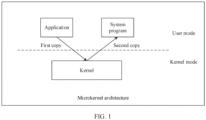
- the user process When the user process needs to call a function of the system service process, the user process sends input parameter data of the function to the system service process through IPC. In this procedure, the input parameter data is copied. Generally, the input parameter data is copied two times. At the first time, the input parameter data is copied from the user process to a kernel data segment. At the second time, the input parameter data is copied from the kernel data segment to a data segment in the system service process. In this way, the system service process runs the function based on the input parameter data.
- the method before the step in which a first process triggers a first system call according to a first function, the method further includes: The first process obtains a first task.
- the first task includes that the first process executes the second function.
- the first task may be understood as a thread.
- the first task may be understood as a first task determined based on a user operation.
- the first process is a user process or a second system service process.
- the method is used in a microkernel architecture
- the first system service process is a driver process, a network management process, or a file system management process.
- the method may be used in an IoT device.
- the thread task When the thread task is executed, there may be no need to switch between processes and copy data. This improves performance of the IoT device.
- the first process is a user process or a second system service process.
- a fourth aspect of this application provides a computer device.
- the computer device includes: a configuration unit, configured to respond to a first system call triggered by a first process, and configure a first access permission with which the first process accesses physical memory address space of a first system service process, where the physical memory address space stores a second function, the second function is a function that implements a functionality of the first system service process, and the first system call instructs a kernel to configure the first access permission; and a sending unit, configured to send indication information to the first process.
- the indication information indicates whether the first access permission is enabled, and the first access permission is used by the first process to execute the second function in the physical memory address space.
- the computer device uses a microkernel architecture.
- the first system service process is a driver process, a network management process, or a file system management process.
- the first function readable and executable for all processes in the user mode is used, so that the first process may remotely call, according to the first function, the second function stored in the physical memory address space of the first system service process. In this way, the first process executes the second function.
- context switching and data copying are not required when the first process calls the second function of the first system service process. From a mechanism logic level, this improves performance of calling the second function of the first system service process.
- the first function is needed for the first process to execute the second function, and a scenario in which the first process executes the second function is limited.
- the first process needs to execute the second function in a public area (in other words, the first function readable and executable for all processes are stored). This reduces security risks that are caused when a user unconditionally executes the second function.
- Embodiments of this application provide an inter-process function calling method and a related device, to improve efficiency with which a first process executes a function of a system service process.
- first and second are merely intended for a purpose of description, and shall not be understood as an indication or implication of relative importance or implicit indication of a quantity of indicated technical features. Therefore, a feature limited by “first” or “second” may explicitly or implicitly include one or more features. In the descriptions of embodiments of this application, unless otherwise stated, "a plurality of" means two or more than two.
- the microkernel is an operating system kernel architecture, represented by QNX, seL4, fuchsia, and the like. Most system services are run in user mode as independent processes, to implement "miniaturization" of the kernel.
- the monolithic kernel is an operating system kernel architecture, represented by Linux, Unix, and the like. All system service functions are integrated in the kernel to implement a large and comprehensive "monolithic" kernel.
- the program is a set of instructions and data.
- the program may be stored in a disk as an object file, or stored in memory address space as a segment.
- the process is a running instance of a program.
- a program is a description of instructions, data and organizational forms thereof, and a process is an instance of a running program.
- One process may have a plurality of threads concurrently, and the threads execute different tasks concurrently.
- a thread may be an actual operation unit of a process. Different threads in one process differ from each other in switching statuses. For example, a thread X of a process A is in a "switched" state, and a thread Y of the same process may be in a "non-switched” state or a "switched” state.
- a first task is described from a perspective of a process.
- a system program means a system that controls and coordinates a computer device and a peripheral device, and supports the development and running of application software.
- the system program is a set of various programs that does not require user intervention.
- An application corresponds to system software, and is a set of various programming languages that may be used by a user and programs compiled in various programming languages. Applications are divided into an application software package and a user program.
- Memory protection unit memory protection unit, MPU
- physical memory protection physical memory protection, PMP
- the MPU is a kind of hardware configured in an ARM to effectively protect system resources, and provides memory area protection.
- the MPU allows privileged software (for example, the operating system) to define areas in a memory and allocate access permissions and attributes to these areas.
- the MPU monitors transactions between a central processing unit (central processing unit, CPU) and the memory and issues an alert (triggering a fault) when an access violation is detected.
- the main purpose of the MPU is to prevent a program from accessing a memory that is not allocated to the program. This may prevent innocent errors in common programs or malware programs from affecting other processes or the operating system.
- the functions of the PMP and MPU are the same.
- the MPU is used in an ARM architecture, and the PMP is used in a risc-V architecture.
- Memory management unit memory management unit, MMU
- the MMU is mainly used to manage control lines of a virtual memory and a physical memory, and is also responsible for mapping a virtual address to a physical address and providing a memory access permission and a multitasking/multi-processing operating system of the hardware mechanism.
- the MMU provides a more powerful memory protection mechanism than the MPU.
- the MPU provides only memory area protection, and the MMU provides memory area protection and the virtual address mapping technology.
- the MMU is more complex than the MPU in terms of operation.
- the system call is a set, namely, an application interface or an application programming interface (application programming interface, API), including all system calls implemented and provided by an operating system.
- the system call is an interface between an application and a system, and may also be understood as an interface provided by a kernel for a user process.
- the kernel mode and the user mode are two working states of a central processing unit (central processing unit, CPU). If a process executes a system call to execute kernel code, the process is in kernel mode. If a process executes user code, the process is in user mode.
- the kernel mode may also be referred to as privileged mode, and the user mode may also be referred to as a non-privileged mode. The following uses the kernel mode and the user mode for description.
- EL0 indicates the user mode
- EL1 indicates the kernel mode
- ring3 indicates the user mode
- ring0 indicates the kernel mode
- an application and a system program are separately run in user mode as independent processes.
- a kernel is run in kernel mode, and the application needs to access the system program through the kernel.
- the system program cannot access physical memory address space of the application. Consequently, the microkernel architecture has poor performance.
- a user process communicates with a system service process through IPC, to implement security isolation between processes.
- the user process sends input parameter data of the function to the system service process through IPC.
- the input parameter data is copied.
- the input parameter data is copied two times. At the first time, the input parameter data is copied from the user process to a kernel data segment. At the second time, the input parameter data is copied from the kernel data segment to a data segment in the system service process. In this way, the system service process runs the function based on the input parameter data.
- this application provides an inter-process function calling method.
- a first function readable and executable for all processes in user mode is used, so that a first process may remotely call a second function stored in physical memory address space of a first system service process. In this way, the first process executes the second function.
- process switching, context switching, and data copying are not required when the second function of the first system service process is called. From a mechanism logic level, this improves performance of calling a function of the first system service process.
- a system architecture according to an embodiment of this application includes a first process, a first system service process, a user-mode public area, a kernel, and hardware.
- the first process includes a code segment and a data segment
- the first system service process includes a code segment and a data segment.
- a data segment may be understood as a concept corresponding to a code segment.
- the data segment is typically a data segment, a read-only data segment, and a block started by symbol (block started by symbol, BSS) segment.
- the read-only data segment is used to store initialized (non-zero) global variables and static local variables in a program (a first program or a first system service program).
- the starting position of the data segment is determined by using a linkage location file, and the size is automatically allocated during compilation and linking.
- the BSS segment is a memory area used to store uninitialized global and static variables in the program.
- the code segment is mapped into a read-only and executable address. This is calculated automatically by a compiler during compilation and linking.
- the code segment is usually used to store instructions executed by a program (the first program or the first system service program).
- the user-mode public area means an area in which all processes in the user mode can perform reading and execution.
- the user-mode public area includes: a call entry function module of a first system service process, a call entry function module of a system, and a public function library module.
- the call entry function module of the first system service process is used to store a call entry function corresponding to the first system service process.
- the call entry function is used to call a system to instruct a kernel to configure or cancel a permission with which the first process accesses physical memory address space of the first system service process, and is further used to call a system service function stored in the physical memory address space of the first system service process.
- the public function library module is used to provide a public function for a user-mode process.
- the public function library includes at least one of a libc library (for example, a glibc library or a musl libc library) or a posix library.
- the communication architecture may be used in platforms using a plurality of architectures, such as an Intel architecture, an ARM architecture, an AARCH64 architecture, or a Risc-V architecture.
- a plurality of architectures such as an Intel architecture, an ARM architecture, an AARCH64 architecture, or a Risc-V architecture.
- the architecture for a chip that supports a memory protection unit (MPU/PMP) and supports user mode and kernel mode, the following advantages are more obvious.
- the architecture is also suitable for a small operating system that is run based on a real address.
- the computer device may be a terminal device configured to serve a user or a cloud device.
- the terminal device may be an Internet of things (Internet of things, IoT) device, for example, including a head-mounted display (head-mounted display, HMD), where the head-mounted display may be a combination of a virtual reality (virtual reality, VR) box and a terminal, an all-in-one VR headset, a personal computer (personal computer, PC), an augmented reality (augmented reality, AR) device, a mixed reality (mixed reality, MR) device, or the like.
- IoT Internet of things
- HMD head-mounted display
- VR virtual reality
- AR augmented reality
- MR mixed reality
- the terminal device may alternatively include a smartphone (smartphone), a personal digital assistant (personal digital assistant, PDA), a tablet computer, a laptop computer (laptop computer), a personal computer (personal computer, PC), a vehicle-mounted terminal, an earphone, a smart watch, an instrument, a camera, or the like. This is not specifically limited.
- Step 301 A first process triggers a first system call according to a first function.
- the first process in this embodiment of this application may be a user process, or may be a second system service process. This is not specifically limited.
- a relationship between a first system service process and the second system service process refer to the descriptions for the architecture shown in FIG. 2 . Details are not described herein again.
- the first function in this embodiment of this application may be stored in the call entry function module of the user-mode system service process in the architecture shown in FIG. 2 , or may be stored in an area readable and executable for all processes in the user mode. Alternatively, it is understood as that the first function is a function readable and executable for all processes in the user mode.
- the first function is used to trigger the first system call and call a second function of the first system service process.
- the first system call instructs a kernel to configure a first access permission with which the first process accesses physical memory address space of the first system service process.
- the physical memory address space stores the second function.
- the second function is a function that implements a functionality of the first system service process.
- the first function is written by a developer of the first system service process.
- a developer of the first process has a read and execute permissions for the first function, but does not have a development permission.
- only the developer of the first system service process in which the first function is used to call the system service function has the development permission for the first function.
- the kernel may modify the first access permission with which the memory protection unit accesses the physical memory address space. Therefore, the first process may configure the first access permission by using the first system call according to the first function.
- the first function may alternatively be understood as a function called by an application function of the first process. That a first process triggers a first system call according to a first function may be understood as that the first process executes the application function of the first process, and the application function calls the first function to trigger the first system call.
- Step 302 The kernel responds to the first system call, and configures the first access permission with which the first process accesses the physical memory address space of the first system service process.
- the first access permission may include that the code segment and the data segment in the first system process are configured to be readable, writable, and executable.
- the kernel configures the first access permission includes: The kernel may set the code segment in the first system service process to be readable and executable, and set the data segment in the first system service process to be readable and writable.
- the code segment in the first process may be configured to be unreadable and non-executable.
- the kernel may further configure a corresponding I/O memory area in FIG. 2 to a readable and writable state, to facilitate access of an external device.
- the kernel may perform authorization on the first process (in other words, determining whether the user process has a second access permission).
- the kernel configures the first access permission if the first process has the second access permission and the first access permission is not enabled.
- the second access permission may be understood as a calling permission that is for the second function and that is set by the developer of the first system service process in a design phase.
- this manner may be understood as that the first process has the second access permission, and the kernel has enabled the first access permission.
- the indication information indicates that the first access permission is enabled.
- the communication interface 903 may be configured to receive and send data, and is configured to perform steps related to obtaining, sending, and receiving in any one of embodiments shown in FIG. 2 to FIG. 6 .
Landscapes
- Engineering & Computer Science (AREA)
- Theoretical Computer Science (AREA)
- Physics & Mathematics (AREA)
- General Engineering & Computer Science (AREA)
- General Physics & Mathematics (AREA)
- Software Systems (AREA)
- Computer Security & Cryptography (AREA)
- Mathematical Physics (AREA)
- Storage Device Security (AREA)
Applications Claiming Priority (2)
| Application Number | Priority Date | Filing Date | Title |
|---|---|---|---|
| CN202111266347.7A CN116048827B (zh) | 2021-10-28 | 2021-10-28 | 一种进程间的函数调用方法及相关设备 |
| PCT/CN2022/124739 WO2023071786A1 (zh) | 2021-10-28 | 2022-10-12 | 一种进程间的函数调用方法及相关设备 |
Publications (2)
| Publication Number | Publication Date |
|---|---|
| EP4398104A1 true EP4398104A1 (de) | 2024-07-10 |
| EP4398104A4 EP4398104A4 (de) | 2025-01-22 |
Family
ID=86127830
Family Applications (1)
| Application Number | Title | Priority Date | Filing Date |
|---|---|---|---|
| EP22885665.4A Pending EP4398104A4 (de) | 2021-10-28 | 2022-10-12 | Anrufverfahren zwischen prozessen und zugehörige vorrichtung |
Country Status (4)
| Country | Link |
|---|---|
| US (1) | US20240419517A1 (de) |
| EP (1) | EP4398104A4 (de) |
| CN (1) | CN116048827B (de) |
| WO (1) | WO2023071786A1 (de) |
Families Citing this family (2)
| Publication number | Priority date | Publication date | Assignee | Title |
|---|---|---|---|---|
| CN118034894B (zh) * | 2024-04-11 | 2024-08-13 | 浪潮云信息技术股份公司 | 操作系统内核态定时器管理方法、电子设备及存储介质 |
| CN120849149A (zh) * | 2024-04-28 | 2025-10-28 | 华为技术有限公司 | 一种系统服务的调用方法以及计算机设备 |
Family Cites Families (7)
| Publication number | Priority date | Publication date | Assignee | Title |
|---|---|---|---|---|
| CN107491355A (zh) * | 2017-08-17 | 2017-12-19 | 山东浪潮商用系统有限公司 | 一种基于共享内存的进程间功能调用方法及装置 |
| US11500699B2 (en) * | 2019-01-24 | 2022-11-15 | Hewlett Packard Enterprise Development Lp | Communication of data between virtual processes |
| CN109933441B (zh) * | 2019-02-28 | 2020-11-17 | 上海交通大学 | 微内核进程间通讯方法和系统 |
| US11029968B1 (en) * | 2019-07-31 | 2021-06-08 | Facebook Technologies, Llc | Operating system with a single kernel stack per processor |
| CN111949596A (zh) * | 2020-08-05 | 2020-11-17 | 上海交通大学 | 基于mpk技术的微内核模块间通讯方法、系统及介质 |
| CN112668008B (zh) * | 2021-01-06 | 2024-07-23 | 上海湖顶大数据科技有限公司 | 一种基于lsm来实现动态的系统调用劫持的方法 |
| CN113220469B (zh) * | 2021-03-23 | 2024-04-16 | 黑芝麻智能科技(上海)有限公司 | 进程间通信方法、装置和计算机设备和计算机可读介质 |
-
2021
- 2021-10-28 CN CN202111266347.7A patent/CN116048827B/zh active Active
-
2022
- 2022-10-12 US US18/701,532 patent/US20240419517A1/en active Pending
- 2022-10-12 EP EP22885665.4A patent/EP4398104A4/de active Pending
- 2022-10-12 WO PCT/CN2022/124739 patent/WO2023071786A1/zh not_active Ceased
Also Published As
| Publication number | Publication date |
|---|---|
| CN116048827B (zh) | 2026-02-13 |
| CN116048827A (zh) | 2023-05-02 |
| EP4398104A4 (de) | 2025-01-22 |
| US20240419517A1 (en) | 2024-12-19 |
| WO2023071786A1 (zh) | 2023-05-04 |
Similar Documents
| Publication | Publication Date | Title |
|---|---|---|
| US7941813B1 (en) | System and method for using virtual machine for driver installation sandbox | |
| US10949247B2 (en) | Systems and methods for auditing a virtual machine | |
| US9396013B2 (en) | Method for controlling a virtual machine and a virtual machine system | |
| US8589902B2 (en) | Policy description technique in UEFI firmware | |
| US20120102285A1 (en) | Providing protected access to critical memory regions | |
| CN111984263B (zh) | 在第一系统运行第二系统应用的方法、装置、设备及介质 | |
| US10545851B2 (en) | Breakpoint insertion into kernel pages | |
| EP4398104A1 (de) | Anrufverfahren zwischen prozessen und zugehörige vorrichtung | |
| EP3436947B1 (de) | Sichere fahrerplattform | |
| EP2941694B1 (de) | Fähigkeitsbasiertes gerätetreiberframework | |
| WO2014107540A1 (en) | Software interface for a hardware device | |
| CN109753347A (zh) | 一种实现驱动的系统及方法 | |
| US20230161650A1 (en) | Method and apparatus for inter-process communication, and computer storage medium | |
| CN116611053A (zh) | 可信执行环境实现方法及装置、终端设备 | |
| JP6495290B2 (ja) | Ic無線装置 | |
| Miao et al. | Design and Implementation of a Memory Protection Mechanism Adhering to the Specifications of AUTOSAR OS SC3 | |
| HK1216679A1 (zh) | 虚拟机中的页面错误注入 |
Legal Events
| Date | Code | Title | Description |
|---|---|---|---|
| STAA | Information on the status of an ep patent application or granted ep patent |
Free format text: STATUS: THE INTERNATIONAL PUBLICATION HAS BEEN MADE |
|
| PUAI | Public reference made under article 153(3) epc to a published international application that has entered the european phase |
Free format text: ORIGINAL CODE: 0009012 |
|
| STAA | Information on the status of an ep patent application or granted ep patent |
Free format text: STATUS: REQUEST FOR EXAMINATION WAS MADE |
|
| 17P | Request for examination filed |
Effective date: 20240405 |
|
| AK | Designated contracting states |
Kind code of ref document: A1 Designated state(s): AL AT BE BG CH CY CZ DE DK EE ES FI FR GB GR HR HU IE IS IT LI LT LU LV MC ME MK MT NL NO PL PT RO RS SE SI SK SM TR |
|
| A4 | Supplementary search report drawn up and despatched |
Effective date: 20250103 |
|
| RIC1 | Information provided on ipc code assigned before grant |
Ipc: G06F 12/14 20060101ALN20241219BHEP Ipc: G06F 9/54 20060101AFI20241219BHEP |
|
| DAV | Request for validation of the european patent (deleted) | ||
| DAX | Request for extension of the european patent (deleted) | ||
| GRAP | Despatch of communication of intention to grant a patent |
Free format text: ORIGINAL CODE: EPIDOSNIGR1 |
|
| STAA | Information on the status of an ep patent application or granted ep patent |
Free format text: STATUS: GRANT OF PATENT IS INTENDED |
|
| RIC1 | Information provided on ipc code assigned before grant |
Ipc: G06F 9/54 20060101AFI20251110BHEP Ipc: G06F 12/14 20060101ALN20251110BHEP |
|
| INTG | Intention to grant announced |
Effective date: 20251120 |