EP4397657A1 - Compound, method for preparing same, and single molecule and oligomer derived from same - Google Patents
Compound, method for preparing same, and single molecule and oligomer derived from same Download PDFInfo
- Publication number
- EP4397657A1 EP4397657A1 EP23740544.4A EP23740544A EP4397657A1 EP 4397657 A1 EP4397657 A1 EP 4397657A1 EP 23740544 A EP23740544 A EP 23740544A EP 4397657 A1 EP4397657 A1 EP 4397657A1
- Authority
- EP
- European Patent Office
- Prior art keywords
- compound
- chemical formula
- present specification
- exemplary embodiment
- single molecule
- Prior art date
- Legal status (The legal status is an assumption and is not a legal conclusion. Google has not performed a legal analysis and makes no representation as to the accuracy of the status listed.)
- Pending
Links
Images

Classifications
-
- C—CHEMISTRY; METALLURGY
- C07—ORGANIC CHEMISTRY
- C07D—HETEROCYCLIC COMPOUNDS
- C07D251/00—Heterocyclic compounds containing 1,3,5-triazine rings
- C07D251/02—Heterocyclic compounds containing 1,3,5-triazine rings not condensed with other rings
- C07D251/12—Heterocyclic compounds containing 1,3,5-triazine rings not condensed with other rings having three double bonds between ring members or between ring members and non-ring members
- C07D251/26—Heterocyclic compounds containing 1,3,5-triazine rings not condensed with other rings having three double bonds between ring members or between ring members and non-ring members with only hetero atoms directly attached to ring carbon atoms
- C07D251/30—Only oxygen atoms
-
- C—CHEMISTRY; METALLURGY
- C07—ORGANIC CHEMISTRY
- C07D—HETEROCYCLIC COMPOUNDS
- C07D253/00—Heterocyclic compounds containing six-membered rings having three nitrogen atoms as the only ring hetero atoms, not provided for by group C07D251/00
- C07D253/02—Heterocyclic compounds containing six-membered rings having three nitrogen atoms as the only ring hetero atoms, not provided for by group C07D251/00 not condensed with other rings
-
- C—CHEMISTRY; METALLURGY
- C07—ORGANIC CHEMISTRY
- C07D—HETEROCYCLIC COMPOUNDS
- C07D251/00—Heterocyclic compounds containing 1,3,5-triazine rings
- C07D251/02—Heterocyclic compounds containing 1,3,5-triazine rings not condensed with other rings
- C07D251/12—Heterocyclic compounds containing 1,3,5-triazine rings not condensed with other rings having three double bonds between ring members or between ring members and non-ring members
- C07D251/26—Heterocyclic compounds containing 1,3,5-triazine rings not condensed with other rings having three double bonds between ring members or between ring members and non-ring members with only hetero atoms directly attached to ring carbon atoms
- C07D251/30—Only oxygen atoms
- C07D251/34—Cyanuric or isocyanuric esters
Definitions
- Triallyl isocyanurate is useful as a cross-linking agent having excellent heat resistance and chemical resistance, and is expected to be used in a wide range of fields such as electronic materials, liquid crystals, semiconductors, and solar cells.
- triallyl isocyanurate is used as a sealing material for preventing penetration of materials such as liquids or gases into the parts.
- Another exemplary embodiment of the present specification provides a single molecule derived from the compound.
- the reaction is performed under mild conditions with minimal side reactions, so that the yield of the compound of Chemical Formula 1, which is a target compound, is increased.
- FIG. 1 is a view describing the mechanism of the method for preparing the compound of Chemical Formula 1.
- the compound of Chemical Formula 1 includes a perfluoroalkyl group including fluorine having the effects of achieving low relative permittivity and low dissipation factor, and is used as a polyfunctional monomer as a triallyl isocyanurate derivative that serves as a cross-linking agent, so that it is possible to exhibit the effects of achieving low relative permittivity, low surface energy and low dissipation factor.
- any one of X1 to X3 is and the others are an allyl group.
- X1 to X3 are each
- n is an integer from 4 to 12.
- the is any one of the following structures.
- n of the is within the above range
- compounds with various molecular weights may be prepared because the chain length of a perfluoroalkyl group is easily adjusted.
- a perfluoroalkyl group is included, it is possible to exhibit effects of achieving low refractive index, low relative permittivity, low surface energy and low dissipation factor.
- Chemical Formula 1 is any one selected from the following compounds.
- An exemplary embodiment of the present specification provides a method for preparing a compound of the following Chemical Formula 1, the method including: (s1) introducing triallyl isocyanurate, C n F 2n+1 X4, a base and a solvent and stirring the resulting mixture under nitrogen gas; and (s2) adding a radical initiator thereto and stirring the resulting mixture.
- Chemical Formula 1
- the reaction temperature in Step (s1) is 0°C to room temperature.
- the reaction conditions are not tricky but mild, and side reactions that appear as the temperature rises are suppressed, so that the yield of the compound of Chemical Formula 1, which is a final target, is increased.
- various temperature ranges may be set according to the range of n and the molecular weight of the compound of Chemical Formula 1 in Step (s1).
Landscapes
- Chemical & Material Sciences (AREA)
- Organic Chemistry (AREA)
- Organic Low-Molecular-Weight Compounds And Preparation Thereof (AREA)
Abstract
Description
- This application claims priority to and the benefit of
Korean Patent Application No. 10-2022-0006316 filed in the Korean Intellectual Property Office on January 17, 2022 - The present specification relates to a compound, a method for preparing the same, and a single molecule and an oligomer derived from the compound.
- Triallyl isocyanurate is useful as a cross-linking agent having excellent heat resistance and chemical resistance, and is expected to be used in a wide range of fields such as electronic materials, liquid crystals, semiconductors, and solar cells. For example, in printed circuit boards, that is, plate-like or film-like parts that constitute electronic circuits by fixing a large number of electronic parts such as integrated circuits, resistors, and condensers to a surface thereof and connecting the parts through wiring, triallyl isocyanurate is used as a sealing material for preventing penetration of materials such as liquids or gases into the parts.
- However, triallyl isocyanurate has high relative permittivity and high dissipation factor, so that research has been continuously conducted to reduce them.
- The present specification provides a compound, a method for preparing the same, and a single molecule and an oligomer derived from the compound.
- An exemplary embodiment of the present specification provides a compound of the following Chemical Formula 1.

- at least one of X1 to X3 is

- n is an integer from 1 to 20,

- X4 is a halogen group.
- An exemplary embodiment of the present specification provides a method for preparing a compound of the following Chemical Formula 1, the method including: (s1) putting triallyl isocyanurate, CnF2n+1X4, a base, and a solvent into a container and stirring the resulting mixture under nitrogen gas; and (s2) adding a radical initiator thereto and stirring the resulting mixture.

- at least one of X1 to X3 is

- n is an integer from 1 to 20,

- X4 is a halogen group.
- Another exemplary embodiment of the present specification provides a single molecule derived from the compound.
- Further, still another exemplary embodiment of the present specification provides an oligomer including a monomer derived from the compound.
- The compound according to an exemplary embodiment of the present specification, and a single molecule and an oligomer derived therefrom include a good release group and a structure capable of being cross-linked, so that various derivatives can be prepared.
- The compound according to an exemplary embodiment of the present specification can be used as a polyfunctional monomer to exhibit the effects of achieving low refractive index, low relative permittivity, low surface energy and low dissipation factor.
- In the method for preparing a compound according to an exemplary embodiment of the present specification, the reaction is performed under mild conditions with minimal side reactions, so that the yield of the compound of Chemical Formula 1, which is a target compound, is increased.
-
FIG. 1 is a view describing the mechanism of the method for preparing the compound of Chemical Formula 1. - Hereinafter, the present specification will be described in more detail.
- An exemplary embodiment of the present specification provides a compound of the following Chemical Formula 1.

- at least one of X1 to X3 is

- n is an integer from 1 to 20,

- X4 is a halogen group.
- The compound of Chemical Formula 1 according to an exemplary embodiment of the present specification includes a perfluoroalkyl group including fluorine having the effects of achieving low relative permittivity and low dissipation factor, and is used as a polyfunctional monomer as a triallyl isocyanurate derivative that serves as a cross-linking agent, so that it is possible to exhibit the effects of achieving low relative permittivity, low surface energy and low dissipation factor.
- According to an exemplary embodiment of the present specification, any one of X1 to X3 is

- According to an exemplary embodiment of the present specification, any two of X1 to X3 are

- According to an exemplary embodiment of the present specification, X1 to X3 are each

- According to an exemplary embodiment of the present specification, n is an integer from 4 to 12.
- According to an exemplary embodiment of the present specification, n is 4, 6 or 8.
- According to an exemplary embodiment of the present specification, X4 is an iodine group (-I).
- According to an exemplary embodiment of the present specification, the


- According to an exemplary embodiment of the present specification, when n of the

- According to an exemplary embodiment of the present specification, Chemical Formula 1 is any one selected from the following compounds.
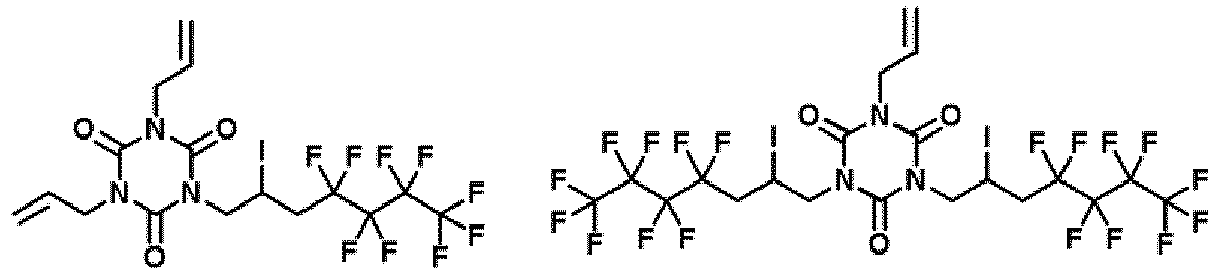


- An exemplary embodiment of the present specification provides a method for preparing a compound of the following Chemical Formula 1, the method including: (s1) introducing triallyl isocyanurate, CnF2n+1X4, a base and a solvent and stirring the resulting mixture under nitrogen gas; and (s2) adding a radical initiator thereto and stirring the resulting mixture.

- at least one of X1 to X3 is
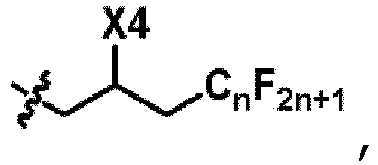
- n is an integer from 1 to 20,

- X4 is a halogen group.
- According to an exemplary embodiment of the present specification, the reaction temperature in Step (s1) is 0°C to room temperature. When the above reaction is performed within the above reaction temperature range, the reaction conditions are not tricky but mild, and side reactions that appear as the temperature rises are suppressed, so that the yield of the compound of Chemical Formula 1, which is a final target, is increased. In addition, various temperature ranges may be set according to the range of n and the molecular weight of the compound of
Chemical Formula 1 in Step (s1). - In the present specification, room temperature means 20±5°C under atmospheric pressure.
- The base according to an exemplary embodiment of the present specification may be potassium carbonate (K2CO3), sodium hydrogen carbonate (NaHCO3), potassium hydrogen carbonate (KHCO3) or any mixture thereof, but is not limited thereto, and a salt used in the related art may be used.
- According to an exemplary embodiment of the present specification, the solvent is an organic solvent.
- According to an exemplary embodiment of the present specification, the solvent is selected from among hexane, heptane, toluene, benzene, acetonitrile, dichloromethane, dichloroethane, trichloroethane, chloroform, dichloroform, nitromethane, dibromomethane, cyclopentanone, cyclohexanone, fluorobenzene, bromobenzene, chlorobenzene, xylene, mesitylene, ethylacetate or any mixture thereof, but is not limited thereto, and an organic solvent used in the related art may be used.
- According to an exemplary embodiment of the present specification, the radical initiator is a water-soluble initiator.
- According to an exemplary embodiment of the present specification, the radical initiator is any one of potassium persulfate (KPS), ammonium persulfate (APS), potassium hydrosulfite, sodium hydrosulfite, sodium persulfate, or hydrogen peroxide.
- According to an exemplary embodiment of the present specification, the reaction temperature in Step (s2) is 0°C. When Step (s2) is performed at the above reaction temperature, side reactions are suppressed, so that the yield of Chemical Formula 1, which is a final target, is increased.
- The mechanism of the preparation method according to an exemplary embodiment of the present specification is described in the following
FIG. 1 . (1) The radical initiator is dissociated under basic conditions, (2) radicals are generated, and (3) the atom transfer reaction occurs. The hydrogen of the initiator is dissociated in (3) and bonded to a halogen group (an iodine group) bonded to perfluoroalkyl, and the perfluoroalkyl becomes a radical. Thereafter, by the radical chain reaction of (4) and (5), (4) the radicalized perfluoroalkyl group and the allyl group of the triallyl isocyanurate are bonded to form a radical, and (5) the halogen group (the iodine group) bonded to the perfluoroalkyl is bonded to the radical to produce the compound of Chemical Formula 1. - In
FIG. 1 , Ka is the addition rate constant of a radical to substrate (Rf). - According to an exemplary embodiment of the present specification, a step of obtaining the compound of
Chemical Formula 1 is further included after Step (s2). - The obtaining step of the above according to an exemplary embodiment of the present specification includes:
- (s31) a quench and layer separation step;
- (s32) a drying step;
- (s33) a filtration step;
- (s34) a concentration step; and
- (s35) an obtaining step.
- According to an exemplary embodiment of the present specification, Step (s31) (quench and layer separation step) is a step of terminating the reaction by adding a reaction termination material, and separating the layers.
- According to an exemplary embodiment of the present specification, as the reaction termination material of Step (s31), distilled water, an aqueous ammonium chloride solution, an aqueous sodium hydrogen carbonate solution, an aqueous KF (saturated) solution, an aqueous HCl solution, an aqueous NaCl (saturated) solution, chloroform, dichloromethane, ethyl acetate, and the like may be used, but the reaction termination material is not limited thereto. Preferably, as the reaction termination material, an aqueous ammonium chloride solution, an aqueous sodium hydrogen carbonate solution, an aqueous NaCl solution, and ethyl acetate are used.
- In Step (s31), the order in which the reaction termination and layer separation are performed is not limited to a specific order. As an exemplary embodiment, reaction termination and layer separation may be simultaneously performed, and as another exemplary embodiment, the reaction is terminated by adding a reaction termination material, and then layers may be separated. However, the progression order is not limited to the above-described example.
- Since the radical initiator remaining after the reaction is water-soluble, the radical initiator may be dissolved in water and removed in Step (s31).
- According to an exemplary embodiment of the present specification, Step (s32) (drying step) is performed by adding a desiccant to any one layer of the material layer-separated in Step (s31). For example, when chloroform exemplified above is used as the reaction termination material, Step (s32) is performed by adding a desiccant to a chloroform layer which is a lower layer, that is, an organic layer.
- Examples of the desiccant include magnesium sulfate, sodium sulfate, and the like, but are not limited thereto. According to a preferred exemplary embodiment, the desiccant is magnesium sulfate.
- In the present specification, the desiccant is added in a sufficient amount required for typical drying in the art.
- According to an exemplary embodiment of the present specification, Step (s33)(filtration step) may be performed by a method known in the art. As a representative example, it is possible to use a method of inhaling air using an inhaler and filtering impurities including a desiccant, and the like, which are separated from a target product with a filter, or a method of removing other impurities using a solvent that does not dissolve a target product, but dissolves other impurities by utilizing the difference in solubility in a specific solvent.
- According to an exemplary embodiment of the present specification, Step (s34)(concentration step) may be performed by a method known in the art. The step may be performed by evaporating the solvent using a vacuum rotary evaporator as a representative example, but the representative example is not limited thereto.
- According to an exemplary embodiment of the present specification, additional filtration and drying steps may be added after Step (s34).
- It is possible to include a drying step before the obtaining step (s35), and the drying step is a step of drying the compound of
Chemical Formula 1. The drying step is different from Step (s32) and may be performed by a method known in the art, representative examples thereof include vacuum oven drying, spray drying, flash drying, and the like, and preferably, the compound ofChemical Formula 1 may be dried by vacuum oven drying. - According to an exemplary embodiment of the present specification, Step (s35) (obtaining step) is a step of obtaining the compound of
Chemical Formula 1 which is concentrated (dried) in Step (s34). - According to an exemplary embodiment of the present specification, in the obtaining step, Steps (s32) to (s33) may be performed three or more times, if necessary.
- According to an exemplary embodiment of the present specification, provided is a mixture including two or more of the compounds.
- According to another exemplary embodiment of the present specification, two or more compounds included in the mixture are the same as or different from each other. That is, it means that the two or more compounds are the same as or different from each other while having the structure of
Chemical Formula 1. - According to still another exemplary embodiment of the present specification, the mixture may further include a compound different from the compound of
Chemical Formula 1. - According to an exemplary embodiment of the present specification, provided is a single molecule derived from the compound.
- In the present specification, for example, the aforementioned "single molecule derived from the compound of
Chemical Formula 1" may mean a single molecule in which the allyl group of the compound ofChemical Formula 1 forms a radical and an additional substituent is introduced, a single molecule in which an additional substituent is introduced using the halogen group ofChemical Formula 1 as an electron donor, or the compound ofChemical Formula 1 itself. - According to an exemplary embodiment of the present specification, provided is an oligomer including a monomer derived from the compound.
- Those skilled in the art may understand the term "monomer" described in the present specification as a state in which a compound is polymerized to be linked to the main chain of the oligomer.
- In the present specification, for example, the "monomer derived from the compound of
Chemical Formula 1" is a repeating unit that constitutes the main chain in the polymer, and means that an allyl group of the compound ofChemical Formula 1 may form a radical to become a monomer, and a halogen group may be used as an electron donor to introduce a monomer or end group which makes up the main chain of other oligomers. - Furthermore, radicals generated by the release of the halogen group in the structure may also react with other allyl group-containing oligomers or the above monomers.
- According to an exemplary embodiment of the present specification, the oligomers may have the following structures, but is not limited thereto. Although only the case where n in
Chemical Formula 1 is 4, 6, or 8 is illustrated for the following structure, oligomers with various structures may be shown depending on the range of n inChemical Formula 1, that is, n from 1 to 20.

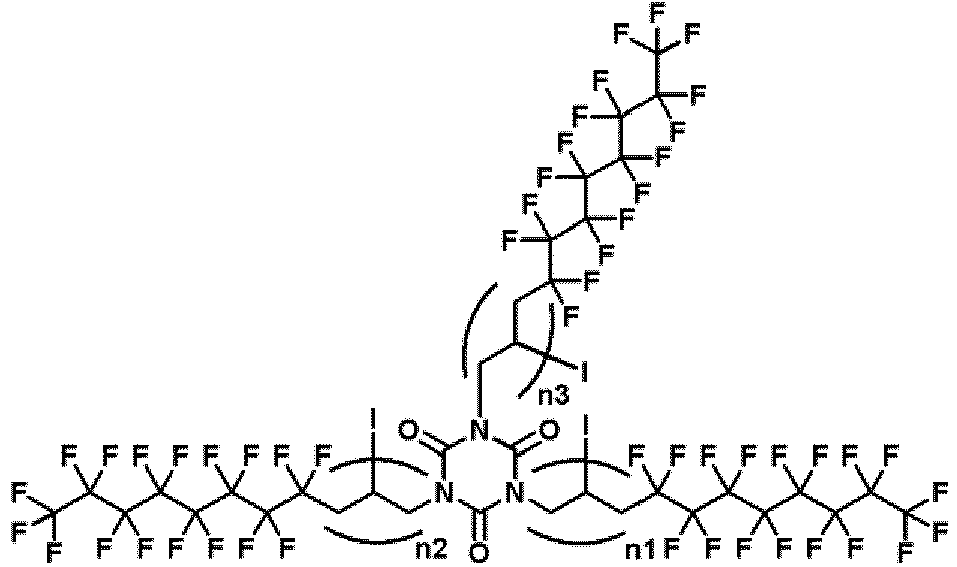


- In the structures,
n1 to n3 are each an integer of 2 or higher. - According to an exemplary embodiment of the present specification, n1 to n3 are each an integer from 2 to 10,000, preferably an integer from 2 to 5,000, more preferably an integer from 2 to 1000, and even more preferably an integer from 2 to 100.
- The compound according to an exemplary embodiment of the present specification, and a single molecule and an oligomer derived therefrom include a good release group and a structure capable of being cross-linked, so that various derivatives can be prepared.
- Hereinafter, the present specification will be described in detail with reference to Examples for specifically describing the present specification. However, the Examples according to the present specification may be modified in various forms, and it is not interpreted that the scope of the present specification is limited to the Examples described below in detail. The Examples of the present specification are provided to explain the present specification more completely to a person with ordinary skill in the art.
- After 9.9 g of triallyl isocyanurate, 0.101 g of NaHCO3 and 20.7 mL of nonafluoro-1-iodobutane were dissolved in 100 mL of water and 50 mL of acetonitrile in a 250 mL two-neck round-bottom flask and N2 bubbling was performed at room temperature for 30 minutes, Na2S2O4 was added thereto in a powder state, and then the resulting mixture was stirred at 0°C for 17 hours. Thereafter, after the aqueous layer was extracted three times with 200 mL of chloroform, the organic layer was washed with water, and the washed organic layer was dried over 10 g of MgSO4. Thereafter, filtration was performed and the solvent was evaporated to obtain 44 g of a product which was derived from perfluorobutyl iodide, and the weight ratios of Compound 1-2, Compound 1-3 and
Oligomer 1 are shown in the following Table 1 by determining the detailed composition of the product by 1H-NMR.


[Table 1] Structure Compound 1-2 Compound 1-3 Oligomer 1Weight ratio 80 to 90 1 to 10 1 to 10 - After 9.9 g of triallyl isocyanurate, 0.101 g of NaHCO3 and 10.3 mL of nonafluoro-1-iodobutane were dissolved in 100 mL of water and 50 mL of acetonitrile in a 250 mL two-neck round-bottom flask and N2 bubbling was performed at room temperature for 30 minutes, Na2S2O4 was added thereto in a powder state, and then the resulting mixture was stirred at 0°C for 17 hours. Thereafter, after the aqueous layer was extracted three times with 200 mL of chloroform, the organic layer was washed with water, and the washed organic layer was dried over 10 g of MgSO4. Thereafter, filtration was performed and the solvent was evaporated to obtain 22 g of a product which was derived from perfluorobutyl iodide, and the weight ratios of Compound 1-1, Compound 1-2 and
Oligomer 1 are shown in the following Table 2 by determining the detailed composition of the product by 1H-NMR.[Table 2] Structure Compound 1-1 Compound 1-2 Oligomer 1Weight ratio 70 to 80 10 to 20 1 to 10 -
Oligomer 1 of Examples 1 and 2 is derived from any one or more of Compounds 1-1 to 1-3, and means a product whose molecular weight exceeds that of Compound 1-3, whose molecular weight is the maximum unit as a single molecule. - After 9.97g of triallyl isocyanurate, 0.101 g of NaHCO3 and 31.7 mL of heptadecafluoro-n-octyl iodide were dissolved in 100 mL of water and 40 mL of acetonitrile in a 250 mL two-neck round-bottom flask and N2 bubbling was performed at 0°C for 30 minutes, Na2S2O4 was added thereto in a powder state, and then the resulting mixture was stirred at 0°C for 17 hours. Thereafter, after the aqueous layer was extracted three times with 200 mL of chloroform, the organic layer was washed with water, and the washed organic layer was dried over 10 g of MgSO4. Thereafter, filtration was performed and the solvent was evaporated to obtain 53 g of a product which was derived from perfluorooctyl iodide, and the weight ratios of Compound 2-2, Compound 2-3 and
Oligomer 2 are shown in the following Table 3 by determining the detailed composition of the product by 1H-NMR.


[Table 3] Structure Compound 2-2 Compound 2-3 Oligomer 2Weight ratio 10 to 20 80 to 90 1 to 10 - After 9.97g of triallyl isocyanurate, 0.101 g of NaHCO3 and 15.8 mL of heptadecafluoro-n-octyl iodide were dissolved in 100 mL of water and 40 mL of acetonitrile in a 250 mL two-neck round-bottom flask and N2 bubbling was performed at 0°C for 30 minutes, Na2S2O4 was added thereto in a powder state, and then the resulting mixture was stirred at 0°C for 17 hours. Thereafter, after the aqueous layer was extracted three times with 200 mL of chloroform, the organic layer was washed with water, and the washed organic layer was dried over 10 g of MgSO4. Thereafter, filtration was performed and the solvent was evaporated to obtain 36 g of a product from which perfluorooctyl iodide was derived, and the weight ratios of Compound 2-1, Compound 2-2 and
Oligomer 2 are shown in the following Table 4 by determining the detailed composition of the product by 1H-NMR.[Table 4] Structure Compound 2-1 Compound 2-2 Oligomer 2Weight ratio 40 to 50 40 to 50 1 to 10 -
Oligomer 2 of Examples 3 and 4 is derived from any one or more of Compounds 2-1 to 2-3, and means a product whose molecular weight exceeds that of Compound 2-3, whose molecular weight is the maximum unit as a single molecule. - The compound of
Chemical Formula 1 prepared in Tables 1 to 4 includes a perfluoroalkyl group including fluorine having the effects of achieving low relative permittivity and low dissipation factor, and is used as a polyfunctional monomer as a triallyl isocyanurate derivative that serves as a cross-linking agent, so that it is possible to exhibit the effects of achieving low refractive index, low relative permittivity, low surface energy and low dissipation factor. The compound ofChemical Formula 1 may be used for various uses. - The compound of
Chemical Formula 1 may be used as a material for circuit boards, the relative permittivity is predicted to be about Dk = 2.5 (Reference = 2.6 or higher) in a specific composition, and through the aforementioned result, it can be predicted that there is an effect of lowering the relative permittivity. - Reference: Triallyl isocyanurate
Claims (7)
- A compound of the following Chemical Formula 1:
 at least one of X1 to X3 is
 n is an integer from 1 to 20,
 X4 is a halogen group.
 - The compound of claim 1, wherein X4 is an iodine group (-I).
- The compound of claim 1, wherein the


- The compound of claim 1, wherein Chemical Formula 1 is any one selected from the following compounds:


- A method for preparing a compound of the following Chemical Formula 1, the method comprising: (s1) putting triallyl isocyanurate, CnF2n+1X4, a base, and a solvent into a container and stirring the resulting mixture under nitrogen gas; and(s2) adding a radical initiator thereto and stirring the resulting mixture:
 wherein, in Chemical Formula 1,at least one of X1 to X3 is
 n is an integer from 1 to 20,
 X4 is a halogen group.
 - A single molecule derived from the compound of any one of claims 1 to 4.
- An oligomer comprising a monomer derived from the compound of any one of claims 1 to 4.
Applications Claiming Priority (2)
| Application Number | Priority Date | Filing Date | Title |
|---|---|---|---|
| KR20220006316 | 2022-01-17 | ||
| PCT/KR2023/000790 WO2023136701A1 (en) | 2022-01-17 | 2023-01-17 | Compound, method for preparing same, and single molecule and oligomer derived from same |
Publications (2)
| Publication Number | Publication Date |
|---|---|
| EP4397657A1 true EP4397657A1 (en) | 2024-07-10 |
| EP4397657A4 EP4397657A4 (en) | 2024-12-11 |
Family
ID=87279499
Family Applications (1)
| Application Number | Title | Priority Date | Filing Date |
|---|---|---|---|
| EP23740544.4A Pending EP4397657A4 (en) | 2022-01-17 | 2023-01-17 | Compound, method for preparing same, and single molecule and oligomer derived from same |
Country Status (7)
| Country | Link |
|---|---|
| US (1) | US20240409520A1 (en) |
| EP (1) | EP4397657A4 (en) |
| JP (1) | JP7758430B2 (en) |
| KR (1) | KR102768889B1 (en) |
| CN (1) | CN118103356A (en) |
| TW (1) | TWI818855B (en) |
| WO (1) | WO2023136701A1 (en) |
Family Cites Families (20)
| Publication number | Priority date | Publication date | Assignee | Title |
|---|---|---|---|---|
| US3629255A (en) * | 1969-03-19 | 1971-12-21 | Allied Chem | Fluorocarbon esters of isocyanurate |
| FR2608154B1 (en) * | 1986-12-11 | 1989-06-02 | Charbonnages Ste Chimique | DICHLORHYDRIN OF CYANURIC ACID, ITS TRISUBSTITUTED DERIVATIVES AND THEIR PREPARATION PROCESS |
| JP2659769B2 (en) * | 1988-11-09 | 1997-09-30 | 株式会社日立製作所 | Curable resin composition, electric device and component using the composition |
| JPH11218920A (en) * | 1998-02-04 | 1999-08-10 | Tokyo Ohka Kogyo Co Ltd | Highly sensitive negative resist composition |
| JP2006036973A (en) * | 2004-07-28 | 2006-02-09 | Shin Etsu Chem Co Ltd | Fluoropolyether rubber composition and rubber product comprising cured product thereof |
| JP2007115840A (en) | 2005-10-19 | 2007-05-10 | Kyocera Corp | Wiring board and method for manufacturing wiring board |
| EP2424933B1 (en) * | 2009-05-01 | 2013-08-21 | Henkel Ireland Limited | Cyanoacrylate compositions |
| JP5447352B2 (en) * | 2010-11-25 | 2014-03-19 | 信越化学工業株式会社 | Fluorine-containing curable composition |
| EP3034528B1 (en) * | 2014-12-19 | 2017-06-21 | Evonik Degussa GmbH | Cover net systems for encapsulation films comprising urea compounds |
| JP6950869B2 (en) * | 2016-05-31 | 2021-10-13 | 日産化学株式会社 | Method for producing isocyanuric acid derivative having one hydrocarbon group |
| JP6477815B2 (en) * | 2016-09-23 | 2019-03-06 | ダイキン工業株式会社 | Water-repellent substrate |
| CN110997753B (en) | 2017-08-22 | 2022-05-31 | Agc株式会社 | Fluorine-containing ether compound, fluorine-containing ether composition, coating liquid, article, and method for producing same |
| KR102414150B1 (en) * | 2017-10-17 | 2022-06-29 | 에스케이이노베이션 주식회사 | Polymer for organic bottom anti-reflective coating, bottom anti-reflective coating composition containing the same and process for forming organic bottom anti-reflective coating using the composition |
| CN111742005B (en) * | 2018-02-09 | 2023-01-20 | 索尔维特殊聚合物意大利有限公司 | Fluoroelastomer curable compositions |
| KR102264695B1 (en) * | 2018-05-25 | 2021-06-11 | 삼성에스디아이 주식회사 | Resist underlayer composition, and method of forming patterns using the composition |
| CN111045296B (en) * | 2018-10-12 | 2024-12-27 | 康宁股份有限公司 | UV-patternable polymer blends for organic thin-film transistors |
| JP6901033B1 (en) * | 2019-08-02 | 2021-07-14 | ダイキン工業株式会社 | Fluorine-containing isocyanul compound |
| CN114402001B (en) * | 2019-09-12 | 2023-10-27 | Agc株式会社 | Method for producing fluorine-containing compound and method for producing copolymer |
| JP7613457B2 (en) * | 2020-02-14 | 2025-01-15 | Agc株式会社 | Method for producing iodine-containing compound and polymer |
| KR20220006316A (en) | 2020-07-08 | 2022-01-17 | 에스엘 주식회사 | Lamp for vehicle |
-
2023
- 2023-01-16 TW TW112101753A patent/TWI818855B/en active
- 2023-01-17 CN CN202380013991.4A patent/CN118103356A/en active Pending
- 2023-01-17 KR KR1020230006712A patent/KR102768889B1/en active Active
- 2023-01-17 US US18/706,713 patent/US20240409520A1/en active Pending
- 2023-01-17 JP JP2024522386A patent/JP7758430B2/en active Active
- 2023-01-17 EP EP23740544.4A patent/EP4397657A4/en active Pending
- 2023-01-17 WO PCT/KR2023/000790 patent/WO2023136701A1/en not_active Ceased
Also Published As
| Publication number | Publication date |
|---|---|
| CN118103356A (en) | 2024-05-28 |
| TWI818855B (en) | 2023-10-11 |
| JP2024536510A (en) | 2024-10-04 |
| KR20230111160A (en) | 2023-07-25 |
| EP4397657A4 (en) | 2024-12-11 |
| KR102768889B1 (en) | 2025-02-18 |
| JP7758430B2 (en) | 2025-10-22 |
| WO2023136701A1 (en) | 2023-07-20 |
| TW202340158A (en) | 2023-10-16 |
| US20240409520A1 (en) | 2024-12-12 |
Similar Documents
| Publication | Publication Date | Title |
|---|---|---|
| US5210341A (en) | Processes for the preparation of octafluoro-[2,2]paracyclophane | |
| KR20010082353A (en) | Method of producing derivatives of polyarylene vinylene | |
| JP4014856B2 (en) | Method for producing dihalogenated adamantane | |
| KR20040038828A (en) | Composition for porous organic film | |
| EP3413370B1 (en) | Oxygen substituted benzoclobutenes derived compositions for electronic devices | |
| EP4397657A1 (en) | Compound, method for preparing same, and single molecule and oligomer derived from same | |
| KR102065710B1 (en) | Azide-type Crosslinking Agent Having Many Crosslinking Functional Groups | |
| EP4397658A1 (en) | Compound, method for preparing same, and single molecule, oligomer and polymer derived from same | |
| JP3771302B2 (en) | Tetrafluoro- [2,2] -paracyclophane and process for producing the same | |
| US20070073019A1 (en) | Polymer and film forming composition | |
| US7652178B2 (en) | Perfluoroparacyclophane and methods of synthesis and use thereof | |
| EP1772469A2 (en) | Polymer and film forming composition | |
| EP4293006A1 (en) | Compound, method for preparing same, and single molecule and polymer derived from same | |
| US4254252A (en) | Cyclic polyformals and method for making | |
| Nielsen et al. | Synthesis of new perfluorotertiary amines containing geminal pentafluorosulfanyl, SF5, groups | |
| KR20070009545A (en) | Method for improving thermal stability of polyparaxylylene and derivative films thereof and polyparaxylylene derivatives | |
| CN108929279A (en) | A kind of fluorine-containing Aminopyrazine class compound and the preparation method and application thereof | |
| Miura et al. | Reaction of a Thioaminyl Diradical with 7, 7, 8, 8-Tetracyanoquinodimethane (TCNQ). The Formation of a Cyclophane Compound | |
| JP5095300B2 (en) | N-substituted benzimidazole ring-containing bridged alicyclic compound, N-substituted benzimidazole ring-containing polymer, thin film, and method for producing the same | |
| JP4186590B2 (en) | Aromatic polymer composition and insulating film | |
| JP2009511400A (en) | Method for continuously producing and isolating soluble preceramic oligomers and / or polymers | |
| JP2005336267A (en) | Novel compound, polymer of the compound and high dielectric material |
Legal Events
| Date | Code | Title | Description |
|---|---|---|---|
| STAA | Information on the status of an ep patent application or granted ep patent |
Free format text: STATUS: THE INTERNATIONAL PUBLICATION HAS BEEN MADE |
|
| PUAI | Public reference made under article 153(3) epc to a published international application that has entered the european phase |
Free format text: ORIGINAL CODE: 0009012 |
|
| STAA | Information on the status of an ep patent application or granted ep patent |
Free format text: STATUS: REQUEST FOR EXAMINATION WAS MADE |
|
| 17P | Request for examination filed |
Effective date: 20240402 |
|
| AK | Designated contracting states |
Kind code of ref document: A1 Designated state(s): AL AT BE BG CH CY CZ DE DK EE ES FI FR GB GR HR HU IE IS IT LI LT LU LV MC ME MK MT NL NO PL PT RO RS SE SI SK SM TR |
|
| A4 | Supplementary search report drawn up and despatched |
Effective date: 20241113 |
|
| RIC1 | Information provided on ipc code assigned before grant |
Ipc: C07D 251/34 20060101ALI20241107BHEP Ipc: C07D 251/30 20060101AFI20241107BHEP |
|
| DAV | Request for validation of the european patent (deleted) | ||
| DAX | Request for extension of the european patent (deleted) | ||
| STAA | Information on the status of an ep patent application or granted ep patent |
Free format text: STATUS: EXAMINATION IS IN PROGRESS |
|
| 17Q | First examination report despatched |
Effective date: 20250828 |