EP4397483A1 - Multilayer body, method for producing multilayer body, and tire - Google Patents
Multilayer body, method for producing multilayer body, and tire Download PDFInfo
- Publication number
- EP4397483A1 EP4397483A1 EP22864251.8A EP22864251A EP4397483A1 EP 4397483 A1 EP4397483 A1 EP 4397483A1 EP 22864251 A EP22864251 A EP 22864251A EP 4397483 A1 EP4397483 A1 EP 4397483A1
- Authority
- EP
- European Patent Office
- Prior art keywords
- layer
- multilayer body
- rubber
- cyanoacrylate
- tire
- Prior art date
- Legal status (The legal status is an assumption and is not a legal conclusion. Google has not performed a legal analysis and makes no representation as to the accuracy of the status listed.)
- Pending
Links
Images

Classifications
-
- B—PERFORMING OPERATIONS; TRANSPORTING
- B32—LAYERED PRODUCTS
- B32B—LAYERED PRODUCTS, i.e. PRODUCTS BUILT-UP OF STRATA OF FLAT OR NON-FLAT, e.g. CELLULAR OR HONEYCOMB, FORM
- B32B25/00—Layered products comprising a layer of natural or synthetic rubber
- B32B25/18—Layered products comprising a layer of natural or synthetic rubber comprising butyl or halobutyl rubber
-
- B—PERFORMING OPERATIONS; TRANSPORTING
- B32—LAYERED PRODUCTS
- B32B—LAYERED PRODUCTS, i.e. PRODUCTS BUILT-UP OF STRATA OF FLAT OR NON-FLAT, e.g. CELLULAR OR HONEYCOMB, FORM
- B32B25/00—Layered products comprising a layer of natural or synthetic rubber
- B32B25/04—Layered products comprising a layer of natural or synthetic rubber comprising rubber as the main or only constituent of a layer, which is next to another layer of the same or of a different material
- B32B25/08—Layered products comprising a layer of natural or synthetic rubber comprising rubber as the main or only constituent of a layer, which is next to another layer of the same or of a different material of synthetic resin
-
- B—PERFORMING OPERATIONS; TRANSPORTING
- B32—LAYERED PRODUCTS
- B32B—LAYERED PRODUCTS, i.e. PRODUCTS BUILT-UP OF STRATA OF FLAT OR NON-FLAT, e.g. CELLULAR OR HONEYCOMB, FORM
- B32B25/00—Layered products comprising a layer of natural or synthetic rubber
- B32B25/14—Layered products comprising a layer of natural or synthetic rubber comprising synthetic rubber copolymers
-
- B—PERFORMING OPERATIONS; TRANSPORTING
- B32—LAYERED PRODUCTS
- B32B—LAYERED PRODUCTS, i.e. PRODUCTS BUILT-UP OF STRATA OF FLAT OR NON-FLAT, e.g. CELLULAR OR HONEYCOMB, FORM
- B32B25/00—Layered products comprising a layer of natural or synthetic rubber
- B32B25/16—Layered products comprising a layer of natural or synthetic rubber comprising polydienes homopolymers or poly-halodienes homopolymers
-
- B—PERFORMING OPERATIONS; TRANSPORTING
- B32—LAYERED PRODUCTS
- B32B—LAYERED PRODUCTS, i.e. PRODUCTS BUILT-UP OF STRATA OF FLAT OR NON-FLAT, e.g. CELLULAR OR HONEYCOMB, FORM
- B32B7/00—Layered products characterised by the relation between layers; Layered products characterised by the relative orientation of features between layers, or by the relative values of a measurable parameter between layers, i.e. products comprising layers having different physical, chemical or physicochemical properties; Layered products characterised by the interconnection of layers
- B32B7/04—Interconnection of layers
- B32B7/12—Interconnection of layers using interposed adhesives or interposed materials with bonding properties
-
- B—PERFORMING OPERATIONS; TRANSPORTING
- B60—VEHICLES IN GENERAL
- B60C—VEHICLE TYRES; TYRE INFLATION; TYRE CHANGING; CONNECTING VALVES TO INFLATABLE ELASTIC BODIES IN GENERAL; DEVICES OR ARRANGEMENTS RELATED TO TYRES
- B60C1/00—Tyres characterised by the chemical composition or the physical arrangement or mixture of the composition
- B60C1/0008—Compositions of the inner liner
-
- B—PERFORMING OPERATIONS; TRANSPORTING
- B60—VEHICLES IN GENERAL
- B60C—VEHICLE TYRES; TYRE INFLATION; TYRE CHANGING; CONNECTING VALVES TO INFLATABLE ELASTIC BODIES IN GENERAL; DEVICES OR ARRANGEMENTS RELATED TO TYRES
- B60C19/00—Tyre parts or constructions not otherwise provided for
-
- B—PERFORMING OPERATIONS; TRANSPORTING
- B60—VEHICLES IN GENERAL
- B60C—VEHICLE TYRES; TYRE INFLATION; TYRE CHANGING; CONNECTING VALVES TO INFLATABLE ELASTIC BODIES IN GENERAL; DEVICES OR ARRANGEMENTS RELATED TO TYRES
- B60C5/00—Inflatable pneumatic tyres or inner tubes
- B60C5/12—Inflatable pneumatic tyres or inner tubes without separate inflatable inserts, e.g. tubeless tyres with transverse section open to the rim
- B60C5/14—Inflatable pneumatic tyres or inner tubes without separate inflatable inserts, e.g. tubeless tyres with transverse section open to the rim with impervious liner or coating on the inner wall of the tyre
-
- C—CHEMISTRY; METALLURGY
- C09—DYES; PAINTS; POLISHES; NATURAL RESINS; ADHESIVES; COMPOSITIONS NOT OTHERWISE PROVIDED FOR; APPLICATIONS OF MATERIALS NOT OTHERWISE PROVIDED FOR
- C09J—ADHESIVES; NON-MECHANICAL ASPECTS OF ADHESIVE PROCESSES IN GENERAL; ADHESIVE PROCESSES NOT PROVIDED FOR ELSEWHERE; USE OF MATERIALS AS ADHESIVES
- C09J4/00—Adhesives based on organic non-macromolecular compounds having at least one polymerisable carbon-to-carbon unsaturated bond ; adhesives, based on monomers of macromolecular compounds of groups C09J183/00 - C09J183/16
Definitions
- Patent Document 1 WO 2020/022160
- the present invention it is possible to provide a multilayer body of vulcanized rubbers, the multilayer body exhibiting excellent adhesion stability, a method for producing the multilayer body, and a tire including the multilayer body.
- the vulcanized rubber is not particularly limited, and specific examples thereof may include vulcanizates of natural rubber (NR), butadiene rubber (BR), aromatic vinyl-conjugated diene rubber, isoprene rubber (IR), acrylonitrile-butadiene rubber (NBR), butyl rubber (IIR), halogenated butyl rubber (for example, brominated butyl rubber (BIIR), chlorinated butyl rubber (CIIR)), and chloroprene rubber (CR), and the like.
- the aromatic vinyl-conjugated diene copolymer rubber may include styrene-butadiene rubber (SBR), styrene-isoprene rubber, and the like.
- the cyanoacrylate is preferably an alkyl ester of cyanoacrylic acid (alkyl cyanoacrylate).
- the content of cyanoacrylate in the cyanoacrylate-based adhesive is preferably 50 mass% or more, more preferably 70 mass% or more, and even more preferably 90 mass% or more.
- the upper limit of the content of cyanoacrylate in the cyanoacrylate-based adhesive is not particularly limited and is 100 mass%.
- the cyanoacrylate-based adhesive usually reacts with moisture in the air to be cured (polymerized).
- trichloroisocyanuric acid chlorinating agent
- chlorinating agent is preferably applied to a surface of the first layer or the second layer before bonding the first layer and the second layer using the cyanoacrylate-based adhesive.
- the trichloroisocyanuric acid has an effect of improving adhesion.
- a tire 200 illustrated in FIG. 2 includes a tread portion 12, shoulder portions 14, sidewall portions 16, and bead portions 18 as major constituent portions.
- tire inner side refers to a lower side of the tire in the tire radial direction of FIG. 2 , that is, an inner surface side of the tire facing a cavity region R that gives a predetermined internal pressure to the tire
- tire outer side refers to an upper side of the tire in FIG. 2 , that is, an outer surface side of the tire visible to a user on a side opposite to an inner circumferential surface of the tire.
- a reference sign CL of FIG. 2 denotes a tire equatorial plane.
- the tire equatorial plane CL is a plane orthogonal to the rotation axis of the tire 200 and passing through a center of a tire width of the tire 200.
- the tire 200 mainly includes a carcass layer 20, a belt layer 22, an auxiliary belt-reinforcing layer 24, bead cores 28, bead fillers 30, a tread rubber layer 32 forming the tread portion 12, sidewall rubber layers 34 forming the sidewall portions 16, rim cushion rubber layers 36, and an innerliner 42 provided on the inner circumferential surface of the tire.
- the innerliner 42 is made of vulcanized rubber.
- the carcass layer 20 extends from a portion corresponding to the tread portion 12 in the tire width direction through portions corresponding to the shoulder portions 14 and the sidewall portions 16 to the bead portions 18 to form a skeleton of the tire 200.
- the carcass layer 20 has such a configuration that reinforcing cords are arranged and coated with cord coating rubber.
- the carcass layer 20 has end portions 20e at the sidewall portions 16 by being folded back around the pair of left and right bead cores 28 from the tire inner side to the tire outer side, such that the body portion 20a and the folded back portions 20b are delimited by the bead cores 28. That is, in the present embodiment, the carcass layer 20 is provided as one layer between the pair of left and right bead portions 18.
- the number of carcass layers 20 is not limited to one layer, and may be a plurality of layers depending on the structure and application.
- the carcass layer 20 may be made of one sheet material or a plurality of sheet materials.
- the carcass layer 20 has a joint portion (splice portion).
- NR natural rubber
- SBR styrene-butadiene rubber
- BR butadiene rubber
- IR isoprene rubber
- a container 62 made of vulcanized rubber is bonded to the innerliner 42 of the tire 200 via an adhesive layer 52.
- the adhesive layer 52 is an adhesive layer made of a cured product (having a softening point of 71°C or higher) of a cyanoacrylate-based adhesive.
- a sensor 72 is housed in the container 62 made of vulcanized rubber.
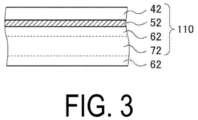
- FIG. 3 is a partially enlarged view of FIG. 1 .
- the tire 200 is a tire including a multilayer body 110 including a first layer (innerliner 42) made of vulcanized rubber, an adhesive layer 52 made of a cured product (having a softening point of 71°C or higher) of a cyanoacrylate-based adhesive, a second layer made of vulcanized rubber (part of the container 62 made of vulcanized rubber), and a sensor layer (sensor 72) including a sensor, in this order.
- a first layer innerliner 42
- an adhesive layer 52 made of a cured product (having a softening point of 71°C or higher) of a cyanoacrylate-based adhesive
- a second layer made of vulcanized rubber (part of the container 62 made of vulcanized rubber)
- sensor layer sensor 72
- the tire is preferably a pneumatic tire, and can be filled with air, inert gas such as nitrogen, or other gases.
- the vulcanized rubber described in the column of first layer in Table 1 and the vulcanized rubber described in the column of second layer in Table 1 were prepared. Note that the vulcanized rubber (second layer) holds a sensor layer including a sensor.
- the prepared vulcanized rubber (first layer) and vulcanized rubber (second layer) were bonded using an adhesive described in the column of adhesive in Table 1.
- a tire having an innerliner formed of vulcanized rubber described in the column of first layer in Table 1 was prepared.
- a container formed of vulcanized rubber (container made of vulcanized rubber) described in the column of second layer in Table 1 was prepared. Note that an electronic component including a sensor is housed in the container made of vulcanized rubber.
- Each of the obtained tires was mounted on a wheel having a rim size of 21 ⁇ 9.5J, and a running test was performed by using a drum testing machine (air pressure of 120 kPa, 102% of maximum load, running speed of 81 km/h, and running distance of 10,000 km).
- a drum testing machine air pressure of 120 kPa, 102% of maximum load, running speed of 81 km/h, and running distance of 10,000 km.
- the state of the container made of vulcanized rubber after the running test was visually confirmed, and the adhesion stability was evaluated in accordance with the following criteria.
Landscapes
- Engineering & Computer Science (AREA)
- Mechanical Engineering (AREA)
- Chemical & Material Sciences (AREA)
- Organic Chemistry (AREA)
- Tires In General (AREA)
- Adhesives Or Adhesive Processes (AREA)
- Laminated Bodies (AREA)
Abstract
Description
- The present invention relates to a multilayer body, a method for producing a multilayer body, and a tire.
- In the related art, a multilayer body in which vulcanized rubbers are bonded to each other with a cyanoacrylate-based adhesive has been known (for example, Patent Document 1).
- Patent Document 1:
WO 2020/022160 - In Patent Document 1, an innerliner of a tire and a sensor unit are bonded with a cyanoacrylate-based adhesive (instantaneous adhesive). In this case, an intermittent load is applied between the innerliner and the sensor unit due to rotation of the tire, or the like.
- The present inventors have studied a multilayer body in which vulcanized rubbers are bonded to each other with a cyanoacrylate-based adhesive, and have found that the vulcanized rubber may peel off when the intermittent load as described above is applied. That is, it has been found that the adhesion stability may become insufficient.
- Therefore, in view of the above situations, an object of the present invention is to provide a multilayer body of vulcanized rubbers, the multilayer body exhibiting excellent adhesion stability, a method for producing the multilayer body, and a tire including the multilayer body.
- As a result of intensive studies to solve the above-described problems, the present inventors have found that the use of a cyanoacrylate-based adhesive having a softening point after curing within a specific range leads to a critical improvement in adhesion stability, leading to the present invention.
- In other words, the present inventors have found that the above-described problem can be solved by the following configurations.
- (1) A multilayer body including a first layer made of vulcanized rubber, an adhesive layer made of a cured product of a cyanoacrylate-based adhesive, a second layer made of vulcanized rubber, and a sensor layer including a sensor, in this order, in which the cured product has a softening point of 71°C or higher.
- (2) The multilayer body according to (1) above, in which cyanoacrylate in the cyanoacrylate-based adhesive includes alkyl cyanoacrylate.
- (3) The multilayer body according to (1) or (2) above, in which the vulcanized rubber in the first layer is a vulcanizate of butyl rubber or halogenated butyl rubber.
- (4) The multilayer body according to any one of (1) to (3) above, in which the vulcanized rubber in the second layer is a vulcanizate of at least one selected from the group consisting of natural rubber, isoprene rubber, butadiene rubber, styrene-butadiene rubber, butyl rubber, halogenated butyl rubber, chloroprene rubber, and acrylonitrile-butadiene rubber.
- (5) A method for producing a multilayer body, the method including: obtaining the multilayer body according to any one of (1) to (4) above by bonding the first layer and the second layer holding the sensor layer using the cyanoacrylate-based adhesive.
- (6) The method for producing a multilayer body according to (5) above, in which trichloroisocyanuric acid is applied to a surface of the first layer or the second layer before bonding the first layer and the second layer using the cyanoacrylate-based adhesive.
- (7) A tire including the multilayer body according to any one of (1) to (4) above.
- As described below, according to the present invention, it is possible to provide a multilayer body of vulcanized rubbers, the multilayer body exhibiting excellent adhesion stability, a method for producing the multilayer body, and a tire including the multilayer body.
-
-
FIG. 1 is a cross-sectional view of a multilayer body of an embodiment of the present invention. -
FIG. 2 is a cross-sectional view of a tire of an embodiment of the present invention. -
FIG. 3 is a partially enlarged view ofFIG. 1 . - A multilayer body according to an embodiment of the present invention, a method for producing a multilayer body according to an embodiment of the present invention, and a tire according to an embodiment of the present invention will be described below.
- Note that in the present specification, value ranges indicated using "from ... to ..." or "of ... to ..." mean ranges including the value before "to" as a lower limit value and the value after "to" as an upper limit value.
- For each component, one type may be used alone, or a combination of two or more types may be used. Here, when two or more types for each of the components are used in combination, the content of the corresponding component refers to the total content unless otherwise specified.
- A multilayer body of the present invention includes a first layer made of vulcanized rubber, an adhesive layer made of a cured product of a cyanoacrylate-based adhesive, a second layer made of vulcanized rubber, and a sensor layer including a sensor, in this order, in which the cured product has a softening point of 71°C or higher.
- First, a multilayer body according to an embodiment of the present invention will be described with reference to the drawings.
-
FIG. 1 is a cross-sectional view of a multilayer body of an embodiment of the present invention. - A
multilayer body 100 illustrated inFIG. 1 is a multilayer body including a first layer 40 made of vulcanized rubber, an adhesive layer 50 made of a cured product (having a softening point of 71°C or higher) of a cyanoacrylate-based adhesive, a second layer 60 made of vulcanized rubber, and a sensor layer 70 including a sensor, in this order. - Each layer constituting the multilayer body according to an embodiment of the present invention will be described below.
- As described above, the multilayer body of the present invention includes the first layer made of vulcanized rubber.
- The first layer made of vulcanized rubber is not particularly limited as long as it is a layer made of vulcanized rubber (vulcanized rubber).
- The vulcanized rubber is not particularly limited, and specific examples thereof may include vulcanizates of natural rubber (NR), butadiene rubber (BR), aromatic vinyl-conjugated diene rubber, isoprene rubber (IR), acrylonitrile-butadiene rubber (NBR), butyl rubber (IIR), halogenated butyl rubber (for example, brominated butyl rubber (BIIR), chlorinated butyl rubber (CIIR)), and chloroprene rubber (CR), and the like. Examples of the aromatic vinyl-conjugated diene copolymer rubber may include styrene-butadiene rubber (SBR), styrene-isoprene rubber, and the like.
- From the perspective of achieving superior effects of the present invention, the vulcanized rubber is preferably a vulcanizate of butyl rubber or halogenated butyl rubber.
- As described above, the multilayer body of the present invention includes an adhesive layer made of a cured product of a cyanoacrylate-based adhesive. Here, the cured product has a softening point of 71°C or higher.
- The cyanoacrylate-based adhesive is an adhesive containing cyanoacrylate.
- The cyanoacrylate is not particularly limited as long as it is ester of cyanoacrylic acid.
- From the perspective of achieving superior effects of the present invention, the cyanoacrylate is preferably an alkyl ester of cyanoacrylic acid (alkyl cyanoacrylate).
- The number of carbon atoms of an alkyl group of the alkyl cyanoacrylate is not particularly limited, but from the perspective of achieving superior effects of the present invention, the number of carbon atoms is preferably 1 to 5, more preferably 1 to 3, even more preferably 1 to 2, and particularly preferably 2. That is, from the perspective of achieving superior effects of the present invention, the alkyl cyanoacrylate is preferably methyl cyanoacrylate or ethyl cyanoacrylate, and more preferably ethyl cyanoacrylate.
- From the perspective of achieving superior effects of the present invention, the content of cyanoacrylate in the cyanoacrylate-based adhesive is preferably 50 mass% or more, more preferably 70 mass% or more, and even more preferably 90 mass% or more. The upper limit of the content of cyanoacrylate in the cyanoacrylate-based adhesive is not particularly limited and is 100 mass%.
- The cyanoacrylate-based adhesive usually reacts with moisture in the air to be cured (polymerized).
- The softening point of the cured product of the cyanoacrylate-based adhesive is 71°C or higher.
- From the perspective of achieving superior effects of the present invention, the softening point of the cured product is preferably 80°C or higher, more preferably 90°C or higher, even more preferably 100°C or higher, particularly preferably 110°C or higher, and most preferably 120°C or higher. The upper limit of the softening point of the cured product is not particularly limited, but from the perspective of achieving superior effects of the present invention, the upper limit is preferably 200°C or lower, more preferably 190°C or lower, even more preferably 180°C or lower, even more preferably 170°C or lower, particularly preferably 160°C or lower, and most preferably 150°C or lower.
- Note that the softening point is a Vicat softening temperature measured in accordance with JIS K7206.
- A method for adjusting the softening point of the cured product to a desired range is not particularly limited, and examples thereof may include a method of adjusting the number of carbon atoms of the alkyl group of the alkyl cyanoacrylate, and the like.
- As described above, the multilayer body of the present invention includes the second layer made of vulcanized rubber.
- The second layer made of vulcanized rubber is not particularly limited as long as it is a layer made of vulcanized rubber (vulcanized rubber).
- Specific examples of the vulcanized rubber are the same as those of the first layer described above, but from the perspective of achieving superior effects of the present invention, the vulcanized rubber is preferably a vulcanizate of at least one selected from the group consisting of natural rubber, isoprene rubber, butadiene rubber, styrene-butadiene rubber, butyl rubber, halogenated butyl rubber, chloroprene rubber, and acrylonitrile-butadiene rubber, more preferably a vulcanizate including at least natural rubber, and even more preferably a vulcanizate of a mixture of natural rubber and butadiene rubber. When the vulcanized rubber is a vulcanizate including natural rubber, the content of the natural rubber is preferably 50 mass% or more, more preferably 70 mass% or more, and even more preferably 90 mass% or more from the perspective of achieving superior effects of the present invention.
- As described above, the multilayer body of the present invention includes the sensor layer including a sensor (detector).
- The sensor layer preferably consists of a mechanical component coated with resin or metal.
- The sensor layer preferably includes a housing and an electronic component. The housing has a hollow structure, and the electronic component is preferably housed inside of the housing.
- The electronic component is preferably configured to include a sensor for acquiring information, a transmitter, a receiver, a control circuit, a battery, and the like.
- When the multilayer body of the present invention is used for a tire, specific examples of the sensor may include a temperature sensor for measuring an internal temperature, a pressure sensor for measuring an internal pressure, a sensor for detecting a wear amount of a tread portion, and the like.
- A method for producing the multilayer body of the present invention is not particularly limited, and examples thereof may include a method of bonding the above-described first layer and the above-described second layer using the above-described cyanoacrylate-based adhesive. Here, the sensor layer is held by the second layer.
- In the above-described method, from the perspective of achieving superior effects of the present invention, trichloroisocyanuric acid (chlorinating agent) is preferably applied to a surface of the first layer or the second layer before bonding the first layer and the second layer using the cyanoacrylate-based adhesive. The trichloroisocyanuric acid has an effect of improving adhesion.
- A method for holding the sensor layer by the second layer is not particularly limited, and examples thereof may include a method of bonding the second layer and the sensor layer using an adhesive, a method of using a container made of vulcanized rubber as the second layer and housing the sensor layer (for example, an electronic component including a sensor) in the container, and the like.
- The tire according to an embodiment of the present invention is a tire including the multilayer body according to the embodiment of the present invention described above.
- The tire according to an embodiment of the present invention will be described hereinafter with reference to the drawings.
-
FIG. 2 is a cross-sectional view of a tire (pneumatic tire) of an embodiment of the present invention. - A
tire 200 illustrated inFIG. 2 includes atread portion 12,shoulder portions 14,sidewall portions 16, andbead portions 18 as major constituent portions. - Note that, in the following description, as indicated by arrows in
FIG. 2 , "tire width direction" refers to the direction parallel with a rotation axis (not illustrated) of the tire, and "tire radial direction" refers to the direction orthogonal to the rotation axis. "Tire circumferential direction" refers to the rotating direction with the rotation axis as the axis at the center of rotation. - Further, "tire inner side" refers to a lower side of the tire in the tire radial direction of
FIG. 2 , that is, an inner surface side of the tire facing a cavity region R that gives a predetermined internal pressure to the tire, and "tire outer side" refers to an upper side of the tire inFIG. 2 , that is, an outer surface side of the tire visible to a user on a side opposite to an inner circumferential surface of the tire. A reference sign CL ofFIG. 2 denotes a tire equatorial plane. The tire equatorial plane CL is a plane orthogonal to the rotation axis of thetire 200 and passing through a center of a tire width of thetire 200. - The
tire 200 mainly includes acarcass layer 20, abelt layer 22, an auxiliary belt-reinforcinglayer 24,bead cores 28,bead fillers 30, atread rubber layer 32 forming thetread portion 12, sidewall rubber layers 34 forming thesidewall portions 16, rim cushion rubber layers 36, and aninnerliner 42 provided on the inner circumferential surface of the tire. Theinnerliner 42 is made of vulcanized rubber. - In the
bead portions 18, a pair of left andright bead cores 28 functioning to fix thetire 200 to a wheel is provided, while thecarcass layer 20 is folded back around the pair ofbead cores 28. Additionally, thebead fillers 30 are also provided in thebead portions 18 in such a manner as to contact thebead cores 28. Therefore, thebead core 28 and thebead filler 30 are sandwiched by abody portion 20a and a foldedback portion 20b of thecarcass layer 20. - The
carcass layer 20 extends from a portion corresponding to thetread portion 12 in the tire width direction through portions corresponding to theshoulder portions 14 and thesidewall portions 16 to thebead portions 18 to form a skeleton of thetire 200. - The
carcass layer 20 has such a configuration that reinforcing cords are arranged and coated with cord coating rubber. Thecarcass layer 20 hasend portions 20e at thesidewall portions 16 by being folded back around the pair of left andright bead cores 28 from the tire inner side to the tire outer side, such that thebody portion 20a and the folded backportions 20b are delimited by thebead cores 28. That is, in the present embodiment, thecarcass layer 20 is provided as one layer between the pair of left andright bead portions 18. The number of carcass layers 20 is not limited to one layer, and may be a plurality of layers depending on the structure and application. - In addition, the
carcass layer 20 may be made of one sheet material or a plurality of sheet materials. When thecarcass layer 20 is made of a plurality of sheet materials, thecarcass layer 20 has a joint portion (splice portion). - Organic fiber cords of the
carcass layer 20 are formed of, for example, polyethylene terephthalate (PET), polyethylene naphthalate (PEN), rayon, nylon, or the like. - As the cord coating rubber of the
carcass layer 20, one or more types of rubber selected from natural rubber (NR), styrene-butadiene rubber (SBR), butadiene rubber (BR), and isoprene rubber (IR) are preferably used. - A
container 62 made of vulcanized rubber is bonded to theinnerliner 42 of thetire 200 via anadhesive layer 52. Theadhesive layer 52 is an adhesive layer made of a cured product (having a softening point of 71°C or higher) of a cyanoacrylate-based adhesive. In thecontainer 62 made of vulcanized rubber, asensor 72 is housed. -
FIG. 3 is a partially enlarged view ofFIG. 1 . - As illustrated in
FIGS. 2 and3 , thetire 200 is a tire including amultilayer body 110 including a first layer (innerliner 42) made of vulcanized rubber, anadhesive layer 52 made of a cured product (having a softening point of 71°C or higher) of a cyanoacrylate-based adhesive, a second layer made of vulcanized rubber (part of thecontainer 62 made of vulcanized rubber), and a sensor layer (sensor 72) including a sensor, in this order. - The tire is preferably a pneumatic tire, and can be filled with air, inert gas such as nitrogen, or other gases.
- An embodiment of the present invention will be described in further detail below by way of examples. However, an embodiment of the present invention is not limited to these examples.
- The vulcanized rubber described in the column of first layer in Table 1 and the vulcanized rubber described in the column of second layer in Table 1 were prepared. Note that the vulcanized rubber (second layer) holds a sensor layer including a sensor.
- The prepared vulcanized rubber (first layer) and vulcanized rubber (second layer) were bonded using an adhesive described in the column of adhesive in Table 1.
- In this manner, each multilayer body including the first layer made of the vulcanized rubber, the adhesive layer made of a cured product of the adhesive, the second layer made of the vulcanized rubber, and the sensor layer including the sensor, in this order, was obtained.
- For each of the obtained multilayer bodies, the second layer was peeled from the first layer by using a 90° peel test, and a failure state of the peeled surface was visually confirmed.
- The results are shown in Table 1. MF represents material failure of the vulcanized rubber and CF represents cohesive failure of the adhesive layer. MF can be said to be excellent in adhesion.
- A tire having an innerliner formed of vulcanized rubber described in the column of first layer in Table 1 was prepared. In addition, a container formed of vulcanized rubber (container made of vulcanized rubber) described in the column of second layer in Table 1 was prepared. Note that an electronic component including a sensor is housed in the container made of vulcanized rubber.
- An adhesive described in the column of adhesive in Table 1 was applied to the innerliner of the prepared tire, and the container made of vulcanized rubber was bonded thereto.
- In this way, each tire including a multilayer body including a first layer (innerliner) made of vulcanized rubber, an adhesive layer made of a cured product of an adhesive, a second layer made of vulcanized rubber (part of the container made of vulcanized rubber), and a sensor layer including a sensor (electronic component including a sensor), in this order, as illustrated in
FIGS. 2 and3 was obtained. - Each of the obtained tires was mounted on a wheel having a rim size of 21×9.5J, and a running test was performed by using a drum testing machine (air pressure of 120 kPa, 102% of maximum load, running speed of 81 km/h, and running distance of 10,000 km). The state of the container made of vulcanized rubber after the running test was visually confirmed, and the adhesion stability was evaluated in accordance with the following criteria.
- The results are shown in Table 1. From the perspective of adhesion stability, "○" or "△" is preferable, and "○" is more preferable.
- ○: Hardly any peeling between the innerliner and the container made of vulcanized rubber was observed.
- △: Slight peeling between the innerliner and the container made of vulcanized rubber was observed.
- ×: Significant peeling between the innerliner and the container made of vulcanized rubber was observed.
- In Table 1, the vulcanized rubbers described in the columns of first layer and second layer are as follows.
- BIIR: brominated butyl rubber (vulcanizate)
- IIR: butyl rubber (vulcanizate)
- NR/BR: natural rubber/butadiene rubber = 95/5 (mass ratio) (vulcanizate)
- NR/SBR: natural rubber/styrene-butadiene rubber = 40/60 (mass ratio) (vulcanizate)
- CR: chloroprene rubber (vulcanizate)
- NBR: acrylonitrile-butadiene rubber (vulcanizate)
- In Table 1, the adhesives described in the column of adhesive are as follows.
- Adhesive 1: Cyanon SR, cyanoacrylate-based adhesive (ethyl cyanoacrylate), manufactured by KOATSU GAS KOGYO CO., LTD., softening point of cured product: 145°C
- Adhesive 2: Aron Alpha Extra 2000, cyanoacrylate-based adhesive (ethyl cyanoacrylate), manufactured by TOAGOSEI CO., LTD., softening point of cured product: 145°C
- Adhesive 3: Aron Alpha 602PF, cyanoacrylate-based adhesive, manufactured by TOAGOSEI CO., LTD., softening point of cured product: 110°C
- Adhesive 4: Aron Alpha 802, cyanoacrylate-based adhesive, manufactured by TOAGOSEI CO., LTD., softening point of cured product: 60°C
- Adhesive 5: Aron Alpha 101, cyanoacrylate-based adhesive (methyl cyanoacrylate), manufactured by TOAGOSEI CO., LTD., softening point of cured product: 165°C
- Note that in Table 1, the column of softening point shows the softening point (°C) of the cured product of the adhesive.
- As can be seen from Table 1, Examples 1 to 9 in which a cyanoacrylate-based adhesive having a softening point after curing of 71°C or higher was used exhibited excellent adhesion stability as compared with Comparative Example 1 in which a cyanoacrylate-based adhesive having a softening point after curing of lower than 71°C was used. Among them, Examples 1 and 2 and Examples 4 to 8 in which a cyanoacrylate-based adhesive having a softening point after curing of 120 to 160°C was used exhibited more excellent adhesion stability.
-
- 12 Tread portion
- 14 Shoulder portion
- 16 Sidewall portion
- 18 Bead portion
- 20 Carcass layer
- 20a Body portion of
carcass layer 20 - 20b Folded back portion of
carcass layer 20 - 20e End portion of
carcass layer 20 - 22 Belt layer
- 22a Inner belt layer
- 22b Outer belt layer
- 22e End portion of
belt layer 22 - 24 Auxiliary belt-reinforcing layer
- 28 Bead core
- 30 Bead filler
- 32 Tread rubber layer
- 34 Sidewall rubber layer
- 36 Rim cushion rubber layer
- 40 First layer made of vulcanized rubber
- 42 Innerliner
- 50, 52 Adhesive layer
- 60 Second layer made of vulcanized rubber
- 62 Container made of vulcanized rubber
- 70 Sensor layer including a sensor
- 72 Electronic component including a sensor
- 100, 110 Multilayer body
- 200 Tire (pneumatic tire)
| Table 1 | Example 1 | Example 2 | Example 3 | Example 4 | Example 5 | Example 6 | Example 7 | Example 8 | Example 9 | Comparative Example 1 |
| First layer | BIIR | BIIR | BIIR | BIIR | BIIR | IIR | IIR | IIR | BIIR | BIIR |
| Adhesive | Adhesive 1 | Adhesive 2 | Adhesive 3 | Adhesive 2 | Adhesive 2 | Adhesive 2 | Adhesive 2 | Adhesive 2 | Adhesive 5 | Adhesive 4 |
| Second layer | NR/BR | NR/BR | NR/BR | NR/SBR | BIIR | NR/BR | CR | NBR | NR/BR | NR/BR |
| Softening Point (°C) | 145 | 145 | 110 | 145 | 145 | 145 | 145 | 145 | 165 | 60 |
| 90° Peel test | MF | MF | MF | MF | MF | MF | MF | MF | MF | CF |
| Tire running test | ○ | ○ | Δ | ○ | ○ | ○ | ○ | ○ | Δ | × |
Claims (7)
- A multilayer body comprising:a first layer made of vulcanized rubber;an adhesive layer made of a cured product of a cyanoacrylate-based adhesive;a second layer made of vulcanized rubber; anda sensor layer comprising a sensor, in this order,the cured product having a softening point of 71°C or higher.
- The multilayer body according to claim 1, wherein cyanoacrylate in the cyanoacrylate-based adhesive comprises alkyl cyanoacrylate.
- The multilayer body according to claim 1 or 2, wherein the vulcanized rubber in the first layer is a vulcanizate of butyl rubber or halogenated butyl rubber.
- The multilayer body according to any one of claims 1 to 3, wherein the vulcanized rubber in the second layer is a vulcanizate of at least one selected from the group consisting of natural rubber, isoprene rubber, butadiene rubber, styrene-butadiene rubber, butyl rubber, halogenated butyl rubber, chloroprene rubber, and acrylonitrile-butadiene rubber.
- A method for producing a multilayer body, the method comprising:
obtaining the multilayer body according to any one of claims 1 to 4 by bonding the first layer and the second layer holding the sensor layer using the cyanoacrylate-based adhesive. - The method for producing a multilayer body according to claim 5, wherein trichloroisocyanuric acid is applied to a surface of the first layer or the second layer before bonding the first layer and the second layer using the cyanoacrylate-based adhesive.
- A tire comprising the multilayer body according to any one of claims 1 to 4.
Applications Claiming Priority (2)
| Application Number | Priority Date | Filing Date | Title |
|---|---|---|---|
| JP2021140757A JP7436871B2 (en) | 2021-08-31 | 2021-08-31 | Laminate, method for manufacturing the laminate, and tire |
| PCT/JP2022/031035 WO2023032666A1 (en) | 2021-08-31 | 2022-08-17 | Multilayer body, method for producing multilayer body, and tire |
Publications (2)
| Publication Number | Publication Date |
|---|---|
| EP4397483A1 true EP4397483A1 (en) | 2024-07-10 |
| EP4397483A4 EP4397483A4 (en) | 2025-07-30 |
Family
ID=85411113
Family Applications (1)
| Application Number | Title | Priority Date | Filing Date |
|---|---|---|---|
| EP22864251.8A Pending EP4397483A4 (en) | 2021-08-31 | 2022-08-17 | Multilayer body, method for producing a multilayer body and tire |
Country Status (4)
| Country | Link |
|---|---|
| EP (1) | EP4397483A4 (en) |
| JP (1) | JP7436871B2 (en) |
| CN (1) | CN117881536A (en) |
| WO (1) | WO2023032666A1 (en) |
Families Citing this family (1)
| Publication number | Priority date | Publication date | Assignee | Title |
|---|---|---|---|---|
| CN121794139A (en) * | 2023-09-22 | 2026-04-03 | 横滨橡胶株式会社 | Housing with functional components and tires |
Family Cites Families (10)
| Publication number | Priority date | Publication date | Assignee | Title |
|---|---|---|---|---|
| JPH086071B2 (en) * | 1987-05-15 | 1996-01-24 | 株式会社アルファ技研 | 2-Cyanoacrylate instant adhesive composition |
| CA2828019C (en) * | 2002-02-18 | 2015-05-19 | Bridgestone Firestone North American Tire, Llc | Attachment method for tire tag |
| JP2007099048A (en) * | 2005-10-03 | 2007-04-19 | Bridgestone Corp | Pedestal for mounting electronic component and tire with pedestal |
| US8877868B2 (en) * | 2013-02-26 | 2014-11-04 | Henkel IP & Holding GmbH | Hot melt adhesive comprising cyanoacrylate curing compounds |
| US20170120681A1 (en) * | 2014-06-16 | 2017-05-04 | Bridgestone Corporation | Tire |
| EP3492289B1 (en) * | 2017-11-30 | 2021-01-06 | Hankook Tire Co., Ltd. | Container structure for attaching sensors to tires and method of manufacturing tire container structure |
| JP2019107965A (en) * | 2017-12-18 | 2019-07-04 | コンパニー ゼネラール デ エタブリッスマン ミシュラン | Tyre with noise insulation |
| WO2020022161A1 (en) * | 2018-07-24 | 2020-01-30 | 横浜ゴム株式会社 | Pneumatic tire and production method for same |
| CN112469578A (en) * | 2018-07-24 | 2021-03-09 | 横滨橡胶株式会社 | Pneumatic tire |
| JP7192433B2 (en) * | 2018-11-21 | 2022-12-20 | 横浜ゴム株式会社 | pneumatic tire |
-
2021
- 2021-08-31 JP JP2021140757A patent/JP7436871B2/en active Active
-
2022
- 2022-08-17 CN CN202280058816.2A patent/CN117881536A/en active Pending
- 2022-08-17 EP EP22864251.8A patent/EP4397483A4/en active Pending
- 2022-08-17 WO PCT/JP2022/031035 patent/WO2023032666A1/en not_active Ceased
Also Published As
| Publication number | Publication date |
|---|---|
| WO2023032666A1 (en) | 2023-03-09 |
| CN117881536A (en) | 2024-04-12 |
| EP4397483A4 (en) | 2025-07-30 |
| JP7436871B2 (en) | 2024-02-22 |
| JP2023034498A (en) | 2023-03-13 |
Similar Documents
| Publication | Publication Date | Title |
|---|---|---|
| EP1803589B1 (en) | Pneumatic tire | |
| CN103619583B (en) | The manufacture method of layered product, tire and tire | |
| KR101051563B1 (en) | Inner liner for tires and tires using same | |
| US20080093001A1 (en) | Heavy duty tire | |
| CN111868200B (en) | Sealant material composition and pneumatic tire | |
| JP5159632B2 (en) | Manufacturing method and manufacturing apparatus for tire and sheet-like tire constituent member | |
| CN104203600A (en) | Tyre with a radial or cross-ply carcass | |
| EP2878457A1 (en) | Laminate for inner liner, and tyre using same | |
| US20020066512A1 (en) | Pneumatic tire | |
| EP2623304B1 (en) | Production method for pneumatic tires | |
| EP3594025A1 (en) | Pneumatic tire | |
| EP2716473A1 (en) | Pneumatic tire | |
| JP7436871B2 (en) | Laminate, method for manufacturing the laminate, and tire | |
| EP4342691B1 (en) | Pneumatic tire | |
| JPH0550807A (en) | Pneumatic tire | |
| JP3667017B2 (en) | Pneumatic tire | |
| EP3981831B1 (en) | Sealant material composition | |
| EP3315321B1 (en) | Pneumatic tire | |
| EP4079546B1 (en) | Pneumatic tire | |
| JP3262350B2 (en) | Tubeless pneumatic tire | |
| JP7340011B2 (en) | pneumatic tire | |
| JP2020040634A (en) | tire | |
| EP3812179A1 (en) | Tire with bead reinforcement | |
| EP4470800A1 (en) | Pneumatic tire | |
| JP2025179393A (en) | tire |
Legal Events
| Date | Code | Title | Description |
|---|---|---|---|
| STAA | Information on the status of an ep patent application or granted ep patent |
Free format text: STATUS: THE INTERNATIONAL PUBLICATION HAS BEEN MADE |
|
| PUAI | Public reference made under article 153(3) epc to a published international application that has entered the european phase |
Free format text: ORIGINAL CODE: 0009012 |
|
| STAA | Information on the status of an ep patent application or granted ep patent |
Free format text: STATUS: REQUEST FOR EXAMINATION WAS MADE |
|
| 17P | Request for examination filed |
Effective date: 20240223 |
|
| AK | Designated contracting states |
Kind code of ref document: A1 Designated state(s): AL AT BE BG CH CY CZ DE DK EE ES FI FR GB GR HR HU IE IS IT LI LT LU LV MC MK MT NL NO PL PT RO RS SE SI SK SM TR |
|
| DAV | Request for validation of the european patent (deleted) | ||
| DAX | Request for extension of the european patent (deleted) | ||
| A4 | Supplementary search report drawn up and despatched |
Effective date: 20250626 |
|
| RIC1 | Information provided on ipc code assigned before grant |
Ipc: B32B 25/18 20060101AFI20250620BHEP Ipc: C09J 4/04 20060101ALI20250620BHEP Ipc: B60C 5/14 20060101ALI20250620BHEP Ipc: B60C 19/00 20060101ALI20250620BHEP Ipc: B32B 25/14 20060101ALI20250620BHEP Ipc: B32B 25/16 20060101ALI20250620BHEP |
|
| STAA | Information on the status of an ep patent application or granted ep patent |
Free format text: STATUS: EXAMINATION IS IN PROGRESS |
|
| 17Q | First examination report despatched |
Effective date: 20260129 |