EP4397451A1 - Mobiles kamerasystem mit kartesischem arm - Google Patents
Mobiles kamerasystem mit kartesischem arm Download PDFInfo
- Publication number
- EP4397451A1 EP4397451A1 EP23220835.5A EP23220835A EP4397451A1 EP 4397451 A1 EP4397451 A1 EP 4397451A1 EP 23220835 A EP23220835 A EP 23220835A EP 4397451 A1 EP4397451 A1 EP 4397451A1
- Authority
- EP
- European Patent Office
- Prior art keywords
- camera
- light source
- vehicle
- hsi
- data
- Prior art date
- Legal status (The legal status is an assumption and is not a legal conclusion. Google has not performed a legal analysis and makes no representation as to the accuracy of the status listed.)
- Pending
Links
Images




Classifications
-
- B—PERFORMING OPERATIONS; TRANSPORTING
- B25—HAND TOOLS; PORTABLE POWER-DRIVEN TOOLS; MANIPULATORS
- B25J—MANIPULATORS; CHAMBERS PROVIDED WITH MANIPULATION DEVICES
- B25J19/00—Accessories fitted to manipulators, e.g. for monitoring, for viewing; Safety devices combined with or specially adapted for use in connection with manipulators
- B25J19/02—Sensing devices
- B25J19/021—Optical sensing devices
- B25J19/023—Optical sensing devices including video camera means
-
- B—PERFORMING OPERATIONS; TRANSPORTING
- B25—HAND TOOLS; PORTABLE POWER-DRIVEN TOOLS; MANIPULATORS
- B25J—MANIPULATORS; CHAMBERS PROVIDED WITH MANIPULATION DEVICES
- B25J5/00—Manipulators mounted on wheels or on carriages
- B25J5/007—Manipulators mounted on wheels or on carriages mounted on wheels
-
- B—PERFORMING OPERATIONS; TRANSPORTING
- B25—HAND TOOLS; PORTABLE POWER-DRIVEN TOOLS; MANIPULATORS
- B25J—MANIPULATORS; CHAMBERS PROVIDED WITH MANIPULATION DEVICES
- B25J9/00—Program-controlled manipulators
- B25J9/02—Program-controlled manipulators characterised by movement of the arms, e.g. cartesian coordinate type
- B25J9/023—Cartesian coordinate type
-
- G—PHYSICS
- G03—PHOTOGRAPHY; CINEMATOGRAPHY; ANALOGOUS TECHNIQUES USING WAVES OTHER THAN OPTICAL WAVES; ELECTROGRAPHY; HOLOGRAPHY
- G03B—APPARATUS OR ARRANGEMENTS FOR TAKING PHOTOGRAPHS OR FOR PROJECTING OR VIEWING THEM; APPARATUS OR ARRANGEMENTS EMPLOYING ANALOGOUS TECHNIQUES USING WAVES OTHER THAN OPTICAL WAVES; ACCESSORIES THEREFOR
- G03B17/00—Details of cameras or camera bodies; Accessories therefor
- G03B17/02—Bodies
- G03B17/12—Bodies with means for supporting objectives, supplementary lenses, filters, masks, or turrets
-
- G—PHYSICS
- G03—PHOTOGRAPHY; CINEMATOGRAPHY; ANALOGOUS TECHNIQUES USING WAVES OTHER THAN OPTICAL WAVES; ELECTROGRAPHY; HOLOGRAPHY
- G03B—APPARATUS OR ARRANGEMENTS FOR TAKING PHOTOGRAPHS OR FOR PROJECTING OR VIEWING THEM; APPARATUS OR ARRANGEMENTS EMPLOYING ANALOGOUS TECHNIQUES USING WAVES OTHER THAN OPTICAL WAVES; ACCESSORIES THEREFOR
- G03B17/00—Details of cameras or camera bodies; Accessories therefor
- G03B17/56—Accessories
- G03B17/561—Support related camera accessories
-
- G—PHYSICS
- G05—CONTROLLING; REGULATING
- G05D—SYSTEMS FOR CONTROLLING OR REGULATING NON-ELECTRIC VARIABLES
- G05D1/00—Control of position, course, altitude or attitude of land, water, air or space vehicles, e.g. using automatic pilots
- G05D1/0088—Control of position, course, altitude or attitude of land, water, air or space vehicles, e.g. using automatic pilots characterized by the autonomous decision making process, e.g. artificial intelligence, predefined behaviours
-
- G—PHYSICS
- G05—CONTROLLING; REGULATING
- G05D—SYSTEMS FOR CONTROLLING OR REGULATING NON-ELECTRIC VARIABLES
- G05D1/00—Control of position, course, altitude or attitude of land, water, air or space vehicles, e.g. using automatic pilots
- G05D1/02—Control of position or course in two dimensions
- G05D1/021—Control of position or course in two dimensions specially adapted to land vehicles
- G05D1/0231—Control of position or course in two dimensions specially adapted to land vehicles using optical position detecting means
- G05D1/0238—Control of position or course in two dimensions specially adapted to land vehicles using optical position detecting means using obstacle or wall sensors
- G05D1/024—Control of position or course in two dimensions specially adapted to land vehicles using optical position detecting means using obstacle or wall sensors in combination with a laser
-
- G—PHYSICS
- G05—CONTROLLING; REGULATING
- G05D—SYSTEMS FOR CONTROLLING OR REGULATING NON-ELECTRIC VARIABLES
- G05D1/00—Control of position, course, altitude or attitude of land, water, air or space vehicles, e.g. using automatic pilots
- G05D1/02—Control of position or course in two dimensions
- G05D1/021—Control of position or course in two dimensions specially adapted to land vehicles
- G05D1/0276—Control of position or course in two dimensions specially adapted to land vehicles using signals provided by a source external to the vehicle
- G05D1/0278—Control of position or course in two dimensions specially adapted to land vehicles using signals provided by a source external to the vehicle using satellite positioning signals, e.g. GPS
-
- G—PHYSICS
- G06—COMPUTING OR CALCULATING; COUNTING
- G06V—IMAGE OR VIDEO RECOGNITION OR UNDERSTANDING
- G06V10/00—Arrangements for image or video recognition or understanding
- G06V10/10—Image acquisition
- G06V10/12—Details of acquisition arrangements; Constructional details thereof
- G06V10/14—Optical characteristics of the device performing the acquisition or on the illumination arrangements
- G06V10/143—Sensing or illuminating at different wavelengths
-
- G—PHYSICS
- G06—COMPUTING OR CALCULATING; COUNTING
- G06V—IMAGE OR VIDEO RECOGNITION OR UNDERSTANDING
- G06V10/00—Arrangements for image or video recognition or understanding
- G06V10/40—Extraction of image or video features
- G06V10/58—Extraction of image or video features relating to hyperspectral data
-
- G—PHYSICS
- G06—COMPUTING OR CALCULATING; COUNTING
- G06V—IMAGE OR VIDEO RECOGNITION OR UNDERSTANDING
- G06V20/00—Scenes; Scene-specific elements
- G06V20/60—Type of objects
- G06V20/68—Food, e.g. fruit or vegetables
-
- G—PHYSICS
- G06—COMPUTING OR CALCULATING; COUNTING
- G06V—IMAGE OR VIDEO RECOGNITION OR UNDERSTANDING
- G06V20/00—Scenes; Scene-specific elements
- G06V20/50—Context or environment of the image
- G06V20/56—Context or environment of the image exterior to a vehicle by using sensors mounted on the vehicle
- G06V20/58—Recognition of moving objects or obstacles, e.g. vehicles or pedestrians; Recognition of traffic objects, e.g. traffic signs, traffic lights or roads
Definitions
- the present invention relates to a cartesian arm. More specifically, the present invention relates to a cartesian arm that is able to move at least one camera along three axes.
- An apparatus includes a cartesian arm that is able to move along three axes, a first camera to generate first image data, and a second camera to generate second image data and is attached to the cartesian arm.
- the cartesian arm is operable to move the second camera along the three axes, and the second image data includes hyperspectral image data.
- the first camera can be attached to the cartesian arm.
- the first image data can include at least one of color data and depth data.
- the apparatus can further include a light source that is able to provide illumination while the second camera generates the second image data.
- the light source can emit a predetermined spectrum of light.
- the predetermined spectrum of light can be a range of about 400 nm to about 1000 nm.
- the light source can be a halogen light source.
- the light source can surrounds the second camera or can be located at only one side of the second camera.
- the light source can be connected to a light source supply by a fiber-optic cable.
- the second camera can have a fixed focus length.
- the fixed focus length can be about one foot.
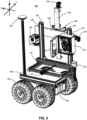
- the cartesian arm system 100 includes a base frame 110, side frames 120 and 130, a horizontal frame 140, and a vertical frame 150.
- the side frames 120 and 130 are mounted to the base frame 110, and the side frames 120 and 130 directly support the horizontal frame 140.
- the vertical frame 150 is mounted on the horizontal frame 140.
- One or more devices 160 such as one or more cameras and/or light sources, can be mounted on the vertical frame 150.
- the cartesian arm system 100 is preferably able to support a payload of about 5 kg, for example.
- the first camera 162 can be an RGB camera, a depth camera, a combined RGB camera and depth camera, a stereo camera, and the like.
- the first camera 162 is a camera that can provide both a relatively high resolution RGB image and relatively accurate depth information.
- the second camera 163 can be an HSI (hyperspectral imaging) camera, and the HSI camera can have a fixed focus length.
- the camera light source 164 can be a ring light that surrounds the second camera 163, and is preferably not mounted directly on the second camera 163 in order to prevent excessive warming of the second camera 163 from heat generated by the camera light source 164.
- the camera light source 164 can be mounted at a side of the second camera 163.
- the imaging electronics 167 are mounted on the side arm 120 and the light source supply 165 is mounted on the side arm 130 to balance the overall weight of the cartesian arm system 100 along the y-axis shown in Fig. 1 . That is, the imaging electronics 167 and the light source supply 165 are located to set a center of balance of the cartesian arm system 100 at a center portion of the base plate 190.
- the base frame motor 115, the horizontal frame motor 145, and the vertical frame motor 155 are able to move the one or more devices 160 in three separate directions or along three separate axes.
- only a portion of the one or more devices 160 can be moved by the base frame motor 115, the horizontal frame motor 145, and the vertical frame motor 155, for example, only a second camera 163 or only the second camera 163 and the camera light source 164.
- the cartesian arm system 100 can be configured to linearly move the second camera 163 along only a single axis while the second camera 163 captures an image.
- the horizontal frame motor 145 can be configured to linearly move the second camera 163 across a grape bunch while the second camera 163 captures an HSI image of the grape bunch.
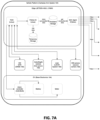
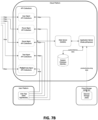
- the cloud agent can receive command and instruction data from the cloud platform (e.g., a web application on the cloud platform), and then transfer the command and instruction data to corresponding components of the vehicle platform.
- the cloud agent can transmit operation data and production data to the cloud platform.
- the cloud platform can include software components and data storage to maintain overall operation of the cloud system.
- the cloud platform preferably provides enterprise-level services with on-demand capacity, fault tolerance, and high availability (for example, AMAZON WEB SERVICES TM ).
- the cloud platform includes one or more application programming interfaces (APIs) to communicate with the vehicle platform and with the user platform.
- the APIs are protected with a high level of security and a capacity of each of the APIs can be automatically adjusted to meet computational loads.
- the user platform provides a dashboard to control the cloud system and to receive data obtained by the vehicle platform and the cloud platform.
- the dashboard can be implemented by a web-based (e.g., internet browser) application, a mobile application, a desktop application, and the like.
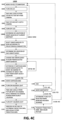
- the vehicle Upon reaching the waypoint, the vehicle is stopped, and the vehicle turns ON an LED in operation 1020. With the LED turned ON, the vehicle takes a color image (two dimensional color image) with an RGB camera in operation 1030. The vehicle can store the color image taken by the RGB camera in a local storage of the vehicle.
- the vehicle After taking the depth picture with the depth camera, the vehicle turns OFF the LED in operation 1050.
- the vehicle performs processing in operation 1060 to determine a location of one or more grape bunches within the two-dimensional color image taken in operation 1030. In other words, the color image is used to determine a location of one or more grape bunches in a two-dimensional plane. If a grape bunch location is not determined (1061: NO), the process 1000 returns to operation 1010 and the vehicle moves to a next waypoint. If a two-dimensional grape bunch location is determined (1062: YES), the vehicle then determines a three-dimensional location of the grape bunch in operation 1065 by adding depth information from the depth picture taken in operation 1040 to the two-dimensional color image taken in operation 1030.
- An artificial intelligence (Al) model can be used in operations 1060 and 1065 to identify the location of the grape bunch.
- the vehicle determines in operation 1070 if a cartesian arm of the vehicle can be manipulated to move an HSI camera (for example, second camera 163) to a predetermined distance (e.g., about one foot) from the determined three-dimensional location of the grape bunch.
- a predetermined distance e.g., about one foot
- the determined three-dimensional location of the grape bunch can be calculated based on an average depth of a plurality of grapes in the grape bunch.
- the predetermined distance can be based upon a focus length of the HSI camera (for example, about one foot), which is fixed in a preferred embodiment of the present invention.
- the cartesian arm can be manipulated by, for example, the base frame motor 115, the horizontal frame motor 145, and the vertical frame motor 155. If the cartesian arm of the vehicle cannot be manipulated to move the HSI camera to the predetermined distance from the determined location of the grape bunch (1071: NO), the process 1000 returns to operation 1010 and the vehicle moves to a next waypoint.
- the vehicle moves the cartesian arm in operation 1080 to the predetermined distance from the determined location of the grape bunch and turns ON a halogen light (for example, camera light source 164) in operation 1090.
- the halogen light emits a predetermined spectrum of light. After the halogen light has been turned ON, the vehicle takes an HSI picture with the HSI camera while manipulating the cartesian arm to pan the HSI camera across the determined location of the grape bunch in operation 1100.
- the horizontal frame motor 145 is used to pan the HSI camera in the second direction (along the y-axis) across the grape bunch while the HSI image is being taken.
- the HSI camera prior to taking the HSI image, may be heated to a predetermined temperature, or for a predetermined prior of time, which can improve stable data acquisition.
- the vehicle can store the HSI picture taken by the HSI camera in the local storage of the vehicle. Since the halogen light emits a predetermined spectrum of light to illuminate the grape bunch when the HSI camera obtains the HSI data, the HSI data is able to be processed with respect to this predetermined spectrum of light. After the HSI camera images the grape bunch, the vehicle turns OFF the halogen light in operation 1110.
- the vehicle processes an HSI picture taken by the HSI camera to determine prediction data of the grape bunch.
- the vehicle can store the HSI picture taken by the HSI camera and the prediction data in local storage(s) of the vehicle.
- the HSI picture taken by the HSI camera can be initially stored in a temporary storage (e.g., a volatile memory), and data obtained by processing the HSI picture can subsequently be stored in a persistent storage (e.g., a non-volatile memory).
- a temporary storage e.g., a volatile memory
- data obtained by processing the HSI picture can subsequently be stored in a persistent storage (e.g., a non-volatile memory).
- the processing performed in operation 1120 is described in further detail below with respect to Figs. 5 and 6 .
- the vehicle transmits the prediction data and the color picture taken by the RGB camera, for example, to a remote storage.
- the color picture is provided with the prediction data so that a user is able to visually verify the location and suitability of grape bunches identified by the prediction data.
- HSI pictures and the corresponding prediction data may have relatively large file sizes, only a portion of the prediction data or only selected HSI pictures may be transmitted, for example, to the remote storage.
- the vehicle may transmit only a portion of the color picture taken by the RGB camera, for example, to the remote storage.
- the vehicle may transmit only selected color pictures taken by the RGB camera, for example, to the remote storage.
- the vehicle can transmit some or all color pictures taken by the RGB camera separately from transmitting the prediction data. That is, the vehicle may transmit some or all color pictures taken by the RGB camera at any point between operations 1040 and 1130.
- the prediction data can be applied to some or all of the color pictures so that a bounding box or the like is included with the color picture(s) to indicate a predicted location of grape bunch(es).
- the vehicle determines if additional grape bunches are to be imaged by the HSI camera at the current waypoint. If no additional grape bunches are to be imaged at the current waypoint (1141: NO), the process 1000 proceeds to operation 1150. However, if additional grape bunches are to be imaged by the HSI camera at the current waypoint (1142: YES), the process 1000 returns to operation 1080. As an example, the process 1000 may perform a sampling of only a portion of grape bunches in a vine or vineyard (e.g., three grape bunches per grape vine).
- the vehicle determines if additional waypoints are to be traveled to by the vehicle. If no further waypoints are stored by the vehicle, able to be retrieved by the vehicle, or the like (1151: NO), the process 1000 ends at operation 1160. However, if further waypoints are stored by the vehicle, able to be retrieved by the vehicle, or the like (1152: YES), the process 1000 returns to operation 1010 and the vehicle moves to a next waypoint.
- the AI model can be used to determine a next waypoint, or waypoints can be preprogrammed according to GPS data.
- Fig. 4B shows a modified process 1000A in which only a predetermined portion of grape bunches is sampled. Detailed description of operations shown in Fig. 4B that are the same as those shown in Fig. 4A are omitted for conciseness.
- the modified process 1000A includes an operation 1005A of setting or reading a predetermined threshold of the number of grape bunches to be scanned per waypoint.
- the predetermined threshold value can be set in advance by a user, and the vehicle can read the predetermined threshold value when executing the modified process 1000A.
- the vehicle determines if the number of grape bunches scanned at the current waypoint has reached the predetermined threshold. If the number of grape bunches scanned at the current waypoint is below the predetermined threshold (1142A: YES), the process 1000A returns to operation 1080. However, if the number of grape bunches scanned at the current waypoint has reached (is not below) the predetermined threshold (1141A: NO), the process 1000A proceeds to operation 1050.
- the modified process 1000B includes an operation 1060B of determining two-dimensional locations of grape bunches at a current waypoint. However, if no grape bunch location is determined (1061: NO), the process 1000B returns to operation 1010 and the vehicle moves to a next waypoint. After determining the two-dimensional locations of grape bunches at the current waypoint in operation 1060B, the modified process 1000B then proceeds to operation 1062B to select grape bunches to be scanned from among the grape bunches corresponding to the determined two-dimensional locations.
- the grape bunches to be scanned can be selected according to various predetermined parameters, including, but not limited to, grape bunches that are least obstructed by obstacles (e.g., sticks, leaves, and the like), grape bunches that have a largest surface area facing the HSI camera, and/or grape bunches according to their color in the color picture (e.g., grape bunches that appear most ripe in the color picture).
- obstacles e.g., sticks, leaves, and the like
- grape bunches that have a largest surface area facing the HSI camera
- grape bunches e.g., grape bunches that appear most ripe in the color picture
- the process 1000B returns to 1066B and another grape bunch from the selected grape bunches is chosen for scanning by the HSI camera. If the cartesian arm of the vehicle cannot be manipulated to move the HSI camera to the predetermined distance from the determined location of any of the selected grape bunches, the modified process 1000B may return to operation 1010.
- the modified process 1000B scans and transmits data regarding each of the determined grape bunch in operations 1080 to 1130, similar to the operations described above with respect to Fig. 4A .
- the modified process 1140B determines if each of the selected grape bunches has been scanned by the HSI camera. If each of the selected grape bunches has not been scanned (1142B: NO), the modified process 1140B returns to operation 1066B and another grape bunch from the selected grape bunches is chosen for scanning by the HSI camera. However, if each of the selected grape bunches has been scanned by the HSI camera (1141A: YES), the modified process 1000B proceeds to operation 1150, which has been described above with respect to Fig. 4A .
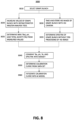
- Fig. 5 is a flowchart showing an image processing process 2000 performed according to a preferred embodiment of the present invention.
- HSI data is input in operation 2010.
- Operation 2010 in Fig. 5 can include data from operation 1100 described above with respect to Figs. 4A-4C .
- the data captured by the HSI camera is raw image data that includes all reflections and a full wavelength spectrum, and this raw image data is captured for each grape bunch, for example.
- the raw image data includes background data, for example, leaves or vines, and this background data has a spectra that is different from the spectra of the grapes of the grape bunch.
- pre-processing is performed on the raw image data.
- the raw image data is first converted to reflectance data in operation 2021.
- the reflectance data provides a meaningful measurement of the image data.
- Operation 2021 includes illumination compensation, which is performed on the reflectance data according to a white reference and a dark reference.
- the white reference can be a predetermined reference that is obtained by taking a picture with the HSI camera of a white object with known reflectance values before performing the processes shown in Figs. 4A-4C .
- the white reference can be determined for each grape bunch by including a white object with known reflectance values in each image generated by the HSI camera, for example, a rectangular-shaped white object included in a bottom portion of some or all images generated by the HSI camera. An average spectrum of the white reference can be used. Variations in the dark reference generally only introduce a negligible amount of noise, and thus a constant dark reference value can be applied.
- the corrected data generated by the reflectance processing in operation 2021 can be used to further train an Al model, for example.
- an instance segmentation model of the Instance Segmentation network can include a Mask RCNN (Region Based Convolutional Neural Network), shown in operation 2024.
- the AI based network then outputs, in operation 2025, a mask of the grape bunch alone (not including the background) for the RGB image derived from the HSI data.
- This mask can be applied to the HSI image corresponding to the HSI data to filter out the background from the grape bunch, as shown in operation 2026.
- the mask can be applied to the HSI image corresponding to the HSI data to remove any data that does not correspond to the detected grape bunch.
- the mask can be applied to generate a grape berry mask that filters out non-berry regions, such as leaves, stems, and the like.
- an HSI image of a grape bunch may include high reflectance regions that appear as white spots in the HSI image. These high reflectance regions have relatively high spectra values and can appear as white spots in the HSI image. Accordingly, in operation 2027, high reflectance spectra removal (white spot removal) is performed on the HSI data corresponding to the HSI data. To detect and then remove white spots from the HSI image, a robust algorithm known as adaptive thresholding is applied in operation 2027. The adaptive thresholding algorithm calculates the threshold values for smaller regions with respect to the surrounding regions of these smaller regions, and then the adaptive thresholding algorithm applies the calculated threshold values to detect and remove high reflectance values. Accordingly, spectra that lie outside of a range for grape detection are able to be removed from the HSI image corresponding to the HSI data.
- the PLS regressor model is able to predict one or more attributes of grapes, including Total Soluble Solids (TSS) 2051, Titratable Acidity (TA) 2052, and pH attributes 2053.
- TSS Total Soluble Solids
- TA Titratable Acidity
- pH attributes 2053 The outputs provided in operation 2050 are able to provide predictions regarding grape quality and/or ripeness. In operation 1130 of Figs. 4A-4C , these predictions (prediction data) can be transmitted with the color picture.
- Fig. 8 is a flowchart showing a process 3000 of constructing a calibration curve to train an AI model according to a preferred embodiment of the present invention.
- the process 3000 can train an AI model (for example, the PLS regressor model) by using only HSI data and empirical measurements.
- a grape bunch is selected in operation 3010.
- values of the grape bunch are measured.
- a refractometer and other analysis tools can be used to measure values of the grape bunch.
- the refractometer can be a digital Brix refractometer that is able to measure a dissolved sugar content of a liquid sample
- other analysis tools can include a single digital instrument or meter that is able to measure one or more of sulfite (SO 2 ), pH, and TA levels.
- SO 2 sulfite
- pH pH
- TA levels The refractometer and other analysis tools can respectively include receptacles that receive a sample to be measured and/or electrodes that are insertable into a sample to be measured. The sample can be titrated prior to measurement, depending upon the specific refractometer and other analysis tools used.
- the TA level can be measured in units of g/L Tartaric Acid.
- an HSI image of the grape bunch is captured with an HSI camera in operation 3030.
- spectra of the grape bunch is determined from the HSI image.
- the spectra of the grape bunch is determined without pre-processing of the HSI image, in contrast to the pre-processing performed in operation 2020 of Fig. 5 .
- the process of determining the spectra of the grape bunch in operation 3035 may include other processing, such as smoothing or determining the second derivative of the data.
- the °Bx, pH, and TA determined in operation 3025 are combined with the spectra determined in operation 3040 to provide a data set.
- a calibration curve can be determined in operation 3050.
- the calibration curve can then be integrated into an AI model (for example, the PLS regressor model), as shown in operation 3060, to train the AI model.
- the processes 1000 and 2000 described above are able to provide data identifying a wavelength that provides the most significant data regarding the imaged grape bunches.
- a cartesian arm is able to move a device, for example, a camera, along three axes.
- the three axes may correspond to an x-axis, a y-axis, and a z-axis.
- the present invention is not limited to three axes, and the cartesian arm can be implemented to move a device along any number of axes.
- the cartesian arm can be implemented to collectively move a plurality of devices, for example, a light source and a camera.
- the cartesian arm can move an HSI (hyperspectral imaging) camera, an RGB camera, a depth camera, a halogen light, and/or an LED light.
- HSI hyperspectral imaging
- the depth camera can be implemented by a LiDAR (light detection and ranging) camera or a stereo camera.
- the RGB camera and the depth camera can be both implemented by an INTEL ® REALSENSE TM LiDAR Camera L515.
- the HSI camera can be a Pika L made by RESONON.
- the HSI camera can include a lens implemented by a SCHNEIDER-KREUZNACH XENOPLAN 1.4/17-0903.
- the halogen light can be implemented by a THORLABS OSL2IR or a THORLABS FRI61F50.
- the refractometer to measure the Brix can be a MILWAUKEE MA871 DIGITAL BRIX REFRACTOMETER, and other analysis tools can include a VINMETRICA SC-300 SO2 & pH/TA WINE ANALYZER.
- the processes and operations described herein are preferably performed at night so that a varying spectrum of light from the sun, which can vary according to weather conditions and the like, does not influence the predetermined spectrum of light emitted by the halogen light.
Landscapes
- Engineering & Computer Science (AREA)
- Physics & Mathematics (AREA)
- General Physics & Mathematics (AREA)
- Multimedia (AREA)
- Theoretical Computer Science (AREA)
- Radar, Positioning & Navigation (AREA)
- Remote Sensing (AREA)
- Automation & Control Theory (AREA)
- Aviation & Aerospace Engineering (AREA)
- Robotics (AREA)
- Mechanical Engineering (AREA)
- Spectroscopy & Molecular Physics (AREA)
- Artificial Intelligence (AREA)
- Electromagnetism (AREA)
- Optics & Photonics (AREA)
- Evolutionary Computation (AREA)
- Game Theory and Decision Science (AREA)
- Medical Informatics (AREA)
- Business, Economics & Management (AREA)
- Health & Medical Sciences (AREA)
- Image Analysis (AREA)
- Optical Radar Systems And Details Thereof (AREA)
- Spectrometry And Color Measurement (AREA)
- Investigating Or Analysing Materials By Optical Means (AREA)
- Accessories Of Cameras (AREA)
- Studio Devices (AREA)
- Image Processing (AREA)
Applications Claiming Priority (1)
| Application Number | Priority Date | Filing Date | Title |
|---|---|---|---|
| US18/093,525 US20240233302A1 (en) | 2023-01-05 | 2023-01-05 | Mobile camera system including cartesian arm |
Publications (1)
| Publication Number | Publication Date |
|---|---|
| EP4397451A1 true EP4397451A1 (de) | 2024-07-10 |
Family
ID=89428835
Family Applications (1)
| Application Number | Title | Priority Date | Filing Date |
|---|---|---|---|
| EP23220835.5A Pending EP4397451A1 (de) | 2023-01-05 | 2023-12-29 | Mobiles kamerasystem mit kartesischem arm |
Country Status (4)
| Country | Link |
|---|---|
| US (1) | US20240233302A1 (de) |
| EP (1) | EP4397451A1 (de) |
| JP (1) | JP2024118426A (de) |
| AU (1) | AU2023278016A1 (de) |
Cited By (1)
| Publication number | Priority date | Publication date | Assignee | Title |
|---|---|---|---|---|
| EP4687107A1 (de) * | 2024-07-30 | 2026-02-04 | Kubota Corporation | Landwirtschaftliches system |
Families Citing this family (1)
| Publication number | Priority date | Publication date | Assignee | Title |
|---|---|---|---|---|
| US12430737B1 (en) * | 2025-02-07 | 2025-09-30 | Kubota Corporation | Agricultural system |
Citations (12)
| Publication number | Priority date | Publication date | Assignee | Title |
|---|---|---|---|---|
| US8014569B2 (en) | 2006-10-30 | 2011-09-06 | The Regents Of The University Of California | Method and apparatus for performing qualitative and quantitative analysis of produce (fruit, vegetables) using spatially structured illumination |
| CN107094429A (zh) * | 2017-07-03 | 2017-08-29 | 彭紫薇 | 一种多轴水果采摘机器人 |
| US9922261B2 (en) | 2015-04-16 | 2018-03-20 | Regents Of The University Of Minnesota | Robotic surveying of fruit plants |
| US10408748B2 (en) | 2017-01-26 | 2019-09-10 | ClariFruit | System and method for evaluating fruits and vegetables |
| ES2795499A1 (es) | 2019-05-21 | 2020-11-23 | Ambling Ingenieria Y Servicios S L | Método y sistema mejorados para la determinación de características de frutos mediante imágenes hiperespectrales |
| US10885675B1 (en) | 2012-12-19 | 2021-01-05 | Alan Shulman | Analysis of biology by measurement of relative wide spectral bands of reflected light and fluoresce light |
| US20210311011A1 (en) | 2018-10-30 | 2021-10-07 | Teakorigin Inc. | Techniques for scoring food specimens, and related methods and apparatus |
| CN113752249A (zh) * | 2020-06-02 | 2021-12-07 | 艾格赛尔工业公司 | 选择和采收果实的自动化方法和实施该方法的机械设备 |
| US20220078972A1 (en) * | 2019-01-24 | 2022-03-17 | Ceres Innovation, Llc | Harvester with automated targeting capabilities |
| WO2022126276A1 (en) * | 2020-12-18 | 2022-06-23 | Terramera, Inc. | Systems and methods for hyperspectral imaging of plants |
| CN114830915A (zh) * | 2022-04-13 | 2022-08-02 | 华南农业大学 | 基于激光雷达导航的荔枝视觉采摘机器人及其实现方法 |
| EP4039419A1 (de) * | 2021-02-05 | 2022-08-10 | Tortuga Agricultural Technologies, Inc. | Robotisches erntesystem |
Family Cites Families (5)
| Publication number | Priority date | Publication date | Assignee | Title |
|---|---|---|---|---|
| US9648254B2 (en) * | 2014-03-21 | 2017-05-09 | Hypermed Imaging, Inc. | Compact light sensor |
| US10462972B2 (en) * | 2016-09-15 | 2019-11-05 | Harvestmoore, L.L.C. | Methods for automated pruning and harvesting of fruit plants utilizing a graphic processor unit |
| WO2020076616A1 (en) * | 2018-10-08 | 2020-04-16 | Advanced Farm Technologies, Inc. | Autonomous crop harvester |
| EP3873190A4 (de) * | 2018-10-29 | 2022-07-27 | Ffrobotics Ltd. | Robotische obsterntemaschine mit obstpaarpflückenden und hybriden motorisierten pneumatischen roboterarmen |
| US10949986B1 (en) * | 2020-05-12 | 2021-03-16 | Proprio, Inc. | Methods and systems for imaging a scene, such as a medical scene, and tracking objects within the scene |
-
2023
- 2023-01-05 US US18/093,525 patent/US20240233302A1/en active Pending
- 2023-12-05 AU AU2023278016A patent/AU2023278016A1/en active Pending
- 2023-12-29 EP EP23220835.5A patent/EP4397451A1/de active Pending
-
2024
- 2024-01-05 JP JP2024000559A patent/JP2024118426A/ja active Pending
Patent Citations (12)
| Publication number | Priority date | Publication date | Assignee | Title |
|---|---|---|---|---|
| US8014569B2 (en) | 2006-10-30 | 2011-09-06 | The Regents Of The University Of California | Method and apparatus for performing qualitative and quantitative analysis of produce (fruit, vegetables) using spatially structured illumination |
| US10885675B1 (en) | 2012-12-19 | 2021-01-05 | Alan Shulman | Analysis of biology by measurement of relative wide spectral bands of reflected light and fluoresce light |
| US9922261B2 (en) | 2015-04-16 | 2018-03-20 | Regents Of The University Of Minnesota | Robotic surveying of fruit plants |
| US10408748B2 (en) | 2017-01-26 | 2019-09-10 | ClariFruit | System and method for evaluating fruits and vegetables |
| CN107094429A (zh) * | 2017-07-03 | 2017-08-29 | 彭紫薇 | 一种多轴水果采摘机器人 |
| US20210311011A1 (en) | 2018-10-30 | 2021-10-07 | Teakorigin Inc. | Techniques for scoring food specimens, and related methods and apparatus |
| US20220078972A1 (en) * | 2019-01-24 | 2022-03-17 | Ceres Innovation, Llc | Harvester with automated targeting capabilities |
| ES2795499A1 (es) | 2019-05-21 | 2020-11-23 | Ambling Ingenieria Y Servicios S L | Método y sistema mejorados para la determinación de características de frutos mediante imágenes hiperespectrales |
| CN113752249A (zh) * | 2020-06-02 | 2021-12-07 | 艾格赛尔工业公司 | 选择和采收果实的自动化方法和实施该方法的机械设备 |
| WO2022126276A1 (en) * | 2020-12-18 | 2022-06-23 | Terramera, Inc. | Systems and methods for hyperspectral imaging of plants |
| EP4039419A1 (de) * | 2021-02-05 | 2022-08-10 | Tortuga Agricultural Technologies, Inc. | Robotisches erntesystem |
| CN114830915A (zh) * | 2022-04-13 | 2022-08-02 | 华南农业大学 | 基于激光雷达导航的荔枝视觉采摘机器人及其实现方法 |
Non-Patent Citations (4)
| Title |
|---|
| FERNANDEZ-NOVALES ET AL.: "Non-Invasive Monitoring of Berry Ripening Using On-the-Go Hyperspectral Imaging in the Vineyard", AGRONOMY, no. 12, 2021, pages 2534 |
| FERN�NDEZ-NOVALES JUAN ET AL: "Non-Invasive Monitoring of Berry Ripening Using On-the-Go Hyperspectral Imaging in the Vineyard", AGRONOMY, vol. 11, no. 12, 13 December 2021 (2021-12-13), pages 2534, XP093150429, ISSN: 2073-4395, DOI: 10.3390/agronomy11122534 * |
| MAGALH�ES SANDRO AUGUSTO ET AL: "Active Perception Fruit Harvesting Robots - A Systematic Review", JOURNAL OF INTELLIGENT, SPRINGER NETHERLANDS, DORDRECHT, vol. 105, no. 1, 1 May 2022 (2022-05-01), XP037814991, ISSN: 0921-0296, [retrieved on 20220502], DOI: 10.1007/S10846-022-01595-3 * |
| MONTOYA-CAVERO LUIS-ENRIQUE ET AL: "Vision systems for harvesting robots: Produce detection and localization", COMPUTERS AND ELECTRONICS IN AGRICULTURE, ELSEVIER, AMSTERDAM, NL, vol. 192, 22 November 2021 (2021-11-22), XP086905254, ISSN: 0168-1699, [retrieved on 20211122], DOI: 10.1016/J.COMPAG.2021.106562 * |
Cited By (1)
| Publication number | Priority date | Publication date | Assignee | Title |
|---|---|---|---|---|
| EP4687107A1 (de) * | 2024-07-30 | 2026-02-04 | Kubota Corporation | Landwirtschaftliches system |
Also Published As
| Publication number | Publication date |
|---|---|
| JP2024118426A (ja) | 2024-08-30 |
| AU2023278016A1 (en) | 2024-07-25 |
| US20240233302A1 (en) | 2024-07-11 |
Similar Documents
| Publication | Publication Date | Title |
|---|---|---|
| EP4397451A1 (de) | Mobiles kamerasystem mit kartesischem arm | |
| EP4398198A1 (de) | Mobiles kamerasystem zur autonomen gewinnung und verarbeitung von bildern zur vorhersage der weintraubenqualität | |
| Gutiérrez et al. | On‐the‐go hyperspectral imaging for the in‐field estimation of grape berry soluble solids and anthocyanin concentration | |
| CN113358224B (zh) | 一种光谱反射率检测方法及系统 | |
| EP2439487B1 (de) | Volumenmessvorrichtung für bewegte Objekte | |
| EP3555562B1 (de) | Erntegutscanner | |
| WO2017001971A1 (en) | Method and system for measuring biomass volume and weight of a fish farming tank | |
| CN120446014B (zh) | 一种水果品质检测方法、机器人和终端设备 | |
| US20250231299A1 (en) | System and Method/Process for In-Field Measurements of Plant Crops | |
| CN103941752A (zh) | 一种线虫实时自动追踪成像系统 | |
| US20250328009A1 (en) | Camera system including at least two light sources | |
| CN118104468A (zh) | 收获系统 | |
| EP4687107A1 (de) | Landwirtschaftliches system | |
| US12430737B1 (en) | Agricultural system | |
| Orlandi et al. | Automated yield prediction in vineyard using RGB images acquired by a UAV prototype platform | |
| KR102258282B1 (ko) | 3차원 영상을 이용한 한우 체중 측정 장치 | |
| Xhimitiku et al. | Anomaly detection in plant growth in a controlled environment using 3D scanning techniques and deep learning | |
| Wang et al. | Designs of a customized active 3D scanning system for food processing applications | |
| Singh et al. | Estimation of aboveground biomass of Alfalfa using field robotics | |
| Mendes et al. | A low-cost system to estimate leaf area index combining stereo images and normalized difference vegetation index | |
| Horstrand et al. | A spectral imaging system for precision agriculture: From its inception till a pre-commercial prototype | |
| KR20230015236A (ko) | 작물 자동 영상 취득 시스템, 장치 및 취득된 작물 영상의 진단 방법 | |
| US10698111B2 (en) | Adaptive point cloud window selection | |
| RU2775170C1 (ru) | Система для оценки качества корма животных | |
| Biscamps et al. | Laboratory and field comparison of onboard and remote sensors for canopy characterisation in vineyards |
Legal Events
| Date | Code | Title | Description |
|---|---|---|---|
| PUAI | Public reference made under article 153(3) epc to a published international application that has entered the european phase |
Free format text: ORIGINAL CODE: 0009012 |
|
| STAA | Information on the status of an ep patent application or granted ep patent |
Free format text: STATUS: THE APPLICATION HAS BEEN PUBLISHED |
|
| AK | Designated contracting states |
Kind code of ref document: A1 Designated state(s): AL AT BE BG CH CY CZ DE DK EE ES FI FR GB GR HR HU IE IS IT LI LT LU LV MC ME MK MT NL NO PL PT RO RS SE SI SK SM TR |
|
| STAA | Information on the status of an ep patent application or granted ep patent |
Free format text: STATUS: REQUEST FOR EXAMINATION WAS MADE |
|
| 17P | Request for examination filed |
Effective date: 20241231 |
|
| STAA | Information on the status of an ep patent application or granted ep patent |
Free format text: STATUS: EXAMINATION IS IN PROGRESS |
|
| 17Q | First examination report despatched |
Effective date: 20251006 |