EP4395327A1 - Systems and methods for signaling neural network post-filter overlap and sublayer frame rate upsampling information in video coding - Google Patents
Systems and methods for signaling neural network post-filter overlap and sublayer frame rate upsampling information in video coding Download PDFInfo
- Publication number
- EP4395327A1 EP4395327A1 EP23159307.0A EP23159307A EP4395327A1 EP 4395327 A1 EP4395327 A1 EP 4395327A1 EP 23159307 A EP23159307 A EP 23159307A EP 4395327 A1 EP4395327 A1 EP 4395327A1
- Authority
- EP
- European Patent Office
- Prior art keywords
- nnpfc
- post
- equal
- video
- picture
- Prior art date
- Legal status (The legal status is an assumption and is not a legal conclusion. Google has not performed a legal analysis and makes no representation as to the accuracy of the status listed.)
- Pending
Links
Images





Classifications
-
- H—ELECTRICITY
- H04—ELECTRIC COMMUNICATION TECHNIQUE
- H04N—PICTORIAL COMMUNICATION, e.g. TELEVISION
- H04N19/00—Methods or arrangements for coding, decoding, compressing or decompressing digital video signals
- H04N19/70—Methods or arrangements for coding, decoding, compressing or decompressing digital video signals characterised by syntax aspects related to video coding, e.g. related to compression standards
-
- G—PHYSICS
- G06—COMPUTING OR CALCULATING; COUNTING
- G06T—IMAGE DATA PROCESSING OR GENERATION, IN GENERAL
- G06T9/00—Image coding
- G06T9/002—Image coding using neural networks
-
- H—ELECTRICITY
- H04—ELECTRIC COMMUNICATION TECHNIQUE
- H04N—PICTORIAL COMMUNICATION, e.g. TELEVISION
- H04N19/00—Methods or arrangements for coding, decoding, compressing or decompressing digital video signals
- H04N19/10—Methods or arrangements for coding, decoding, compressing or decompressing digital video signals using adaptive coding
- H04N19/102—Methods or arrangements for coding, decoding, compressing or decompressing digital video signals using adaptive coding characterised by the element, parameter or selection affected or controlled by the adaptive coding
- H04N19/117—Filters, e.g. for pre-processing or post-processing
-
- H—ELECTRICITY
- H04—ELECTRIC COMMUNICATION TECHNIQUE
- H04N—PICTORIAL COMMUNICATION, e.g. TELEVISION
- H04N19/00—Methods or arrangements for coding, decoding, compressing or decompressing digital video signals
- H04N19/10—Methods or arrangements for coding, decoding, compressing or decompressing digital video signals using adaptive coding
- H04N19/102—Methods or arrangements for coding, decoding, compressing or decompressing digital video signals using adaptive coding characterised by the element, parameter or selection affected or controlled by the adaptive coding
- H04N19/132—Sampling, masking or truncation of coding units, e.g. adaptive resampling, frame skipping, frame interpolation or high-frequency transform coefficient masking
-
- H—ELECTRICITY
- H04—ELECTRIC COMMUNICATION TECHNIQUE
- H04N—PICTORIAL COMMUNICATION, e.g. TELEVISION
- H04N19/00—Methods or arrangements for coding, decoding, compressing or decompressing digital video signals
- H04N19/10—Methods or arrangements for coding, decoding, compressing or decompressing digital video signals using adaptive coding
- H04N19/169—Methods or arrangements for coding, decoding, compressing or decompressing digital video signals using adaptive coding characterised by the coding unit, i.e. the structural portion or semantic portion of the video signal being the object or the subject of the adaptive coding
- H04N19/17—Methods or arrangements for coding, decoding, compressing or decompressing digital video signals using adaptive coding characterised by the coding unit, i.e. the structural portion or semantic portion of the video signal being the object or the subject of the adaptive coding the unit being an image region, e.g. an object
- H04N19/174—Methods or arrangements for coding, decoding, compressing or decompressing digital video signals using adaptive coding characterised by the coding unit, i.e. the structural portion or semantic portion of the video signal being the object or the subject of the adaptive coding the unit being an image region, e.g. an object the region being a slice, e.g. a line of blocks or a group of blocks
-
- H—ELECTRICITY
- H04—ELECTRIC COMMUNICATION TECHNIQUE
- H04N—PICTORIAL COMMUNICATION, e.g. TELEVISION
- H04N19/00—Methods or arrangements for coding, decoding, compressing or decompressing digital video signals
- H04N19/10—Methods or arrangements for coding, decoding, compressing or decompressing digital video signals using adaptive coding
- H04N19/169—Methods or arrangements for coding, decoding, compressing or decompressing digital video signals using adaptive coding characterised by the coding unit, i.e. the structural portion or semantic portion of the video signal being the object or the subject of the adaptive coding
- H04N19/186—Methods or arrangements for coding, decoding, compressing or decompressing digital video signals using adaptive coding characterised by the coding unit, i.e. the structural portion or semantic portion of the video signal being the object or the subject of the adaptive coding the unit being a colour or a chrominance component
-
- H—ELECTRICITY
- H04—ELECTRIC COMMUNICATION TECHNIQUE
- H04N—PICTORIAL COMMUNICATION, e.g. TELEVISION
- H04N19/00—Methods or arrangements for coding, decoding, compressing or decompressing digital video signals
- H04N19/80—Details of filtering operations specially adapted for video compression, e.g. for pixel interpolation
-
- H—ELECTRICITY
- H04—ELECTRIC COMMUNICATION TECHNIQUE
- H04N—PICTORIAL COMMUNICATION, e.g. TELEVISION
- H04N19/00—Methods or arrangements for coding, decoding, compressing or decompressing digital video signals
- H04N19/80—Details of filtering operations specially adapted for video compression, e.g. for pixel interpolation
- H04N19/82—Details of filtering operations specially adapted for video compression, e.g. for pixel interpolation involving filtering within a prediction loop
-
- H—ELECTRICITY
- H04—ELECTRIC COMMUNICATION TECHNIQUE
- H04N—PICTORIAL COMMUNICATION, e.g. TELEVISION
- H04N19/00—Methods or arrangements for coding, decoding, compressing or decompressing digital video signals
- H04N19/85—Methods or arrangements for coding, decoding, compressing or decompressing digital video signals using pre-processing or post-processing specially adapted for video compression
-
- H—ELECTRICITY
- H04—ELECTRIC COMMUNICATION TECHNIQUE
- H04N—PICTORIAL COMMUNICATION, e.g. TELEVISION
- H04N19/00—Methods or arrangements for coding, decoding, compressing or decompressing digital video signals
- H04N19/85—Methods or arrangements for coding, decoding, compressing or decompressing digital video signals using pre-processing or post-processing specially adapted for video compression
- H04N19/86—Methods or arrangements for coding, decoding, compressing or decompressing digital video signals using pre-processing or post-processing specially adapted for video compression involving reduction of coding artifacts, e.g. of blockiness
-
- G—PHYSICS
- G06—COMPUTING OR CALCULATING; COUNTING
- G06T—IMAGE DATA PROCESSING OR GENERATION, IN GENERAL
- G06T2207/00—Indexing scheme for image analysis or image enhancement
- G06T2207/20—Special algorithmic details
- G06T2207/20084—Artificial neural networks [ANN]
Definitions
- Video compression techniques enable data requirements for storing and transmitting video data to be reduced. Video compression techniques may reduce data requirements by exploiting the inherent redundancies in a video sequence. Video compression techniques may sub-divide a video sequence into successively smaller portions (i.e., groups of pictures within a video sequence, a picture within a group of pictures, regions within a picture, sub-regions within regions, etc.). Intra prediction coding techniques (e.g., spatial prediction techniques within a picture) and inter prediction techniques (i.e., inter-picture techniques (temporal)) may be used to generate difference values between a unit of video data to be coded and a reference unit of video data. The difference values may be referred to as residual data. Residual data may be coded as quantized transform coefficients.
- Intra prediction coding techniques e.g., spatial prediction techniques within a picture
- inter prediction techniques i.e., inter-picture techniques (temporal)
- Residual data may be coded as quantized transform coefficients.
- a method of coding video data comprises signaling a neural network post-filter characteristics message, and for each of a number of sublayers associated with the neural network post-filter characteristics message, signaling a syntax element in the neural network post-filter characteristics message specifying a number of interpolated pictures generated by a post-processing filter.
- an apparatus comprises means for signaling a neural network post-filter characteristics message, and means for signaling a syntax element in the neural network post-filter characteristics message specifying a number of interpolated pictures generated by a post-processing filter for each of a number of sublayers associated with the neural network post-filter characteristics message.
- an apparatus comprises means for receiving a neural network post-filter characteristics message and means for parsing a syntax element from the neural network post-filter characteristics message specifying a number of interpolated pictures generated by a post-processing filter for each of a number of sublayers associated with the neural network post-filter characteristics message.
- Video content includes video sequences comprised of a series of frames (or pictures).
- a series of frames may also be referred to as a group of pictures (GOP).
- Each video frame or picture may divided into one or more regions. Regions may be defined according to a base unit (e.g., a video block) and sets of rules defining a region. For example, a rule defining a region may be that a region must be an integer number of video blocks arranged in a rectangle. Further, video blocks in a region may be ordered according to a scan pattern (e.g., a raster scan).
- a scan pattern e.g., a raster scan
- a video encoder may perform predictive encoding on video blocks and sub-divisions thereof. Video blocks and sub-divisions thereof may be referred to as nodes.
- ITU-T H.264 specifies a macroblock including 16x16 luma samples. That is, in ITU-T H.264, a picture is segmented into macroblocks.
- ITU-T H.265 specifies an analogous Coding Tree Unit (CTU) structure (which may be referred to as a largest coding unit (LCU)).
- CTU Coding Tree Unit
- LCU largest coding unit
- ITU-T H.265 pictures are segmented into CTUs.
- a CTU size may be set as including 16x16, 32x32, or 64x64 luma samples.
- slice and slice segment may be used interchangeably to indicate a sequence of CTUs arranged in a raster scan order.
- a tile may consist of CTUs contained in more than one slice and a slice may consist of CTUs contained in more than one tile.
- ITU-T H.265 provides that one or both of the following conditions shall be fulfilled: (1) All CTUs in a slice belong to the same tile; and (2) All CTUs in a tile belong to the same slice.
- a tile is a rectangular region of CTUs within a particular tile row and a particular tile column position.
- JVET-T2001 provides where a picture may be partitioned into subpictures, where a subpicture is a rectangular region of a CTUs within a picture.
- the top-left CTU of a subpicture may be located at any CTU position within a picture with subpictures being constrained to include one or more slices.
- a subpicture is not necessarily limited to a particular row and column position.
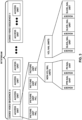
- FIG. 2 is a conceptual diagram illustrating an example of a picture within a group of pictures partitioned according to tiles, slices, and subpictures.
- the techniques described herein may be applicable to tiles, slices, subpictures, sub-divisions thereof and/or equivalent structures thereto. That is, the techniques described herein may be generally applicable regardless of how a picture is partitioned into regions. For example, in some cases, the techniques described herein may be applicable in cases where a tile may be partitioned into so-called bricks, where a brick is a rectangular region of CTU rows within a particular tile.
- a reference picture is determined and a motion vector (MV) identifies samples in the reference picture that are used to generate a prediction for a current video block.
- a current video block may be predicted using reference sample values located in one or more previously coded picture(s) and a motion vector is used to indicate the location of the reference block relative to the current video block.
- a motion vector may describe, for example, a horizontal displacement component of the motion vector (i.e., MV x ), a vertical displacement component of the motion vector (i.e., MV y ), and a resolution for the motion vector (e.g., one-quarter pixel precision, one-half pixel precision, one-pixel precision, two-pixel precision, four-pixel precision).
- RefPicList0 for a P slice, there may be a single reference picture list, RefPicList0 and for a B slice, there may be a second independent reference picture list, RefPicList1, in addition to RefPicList0.
- RefPicList0 for uni-prediction in a B slice, one of RefPicList0 or RefPicList1 may be used to generate a prediction.
- reference picture list(s) are generated from previously decoded pictures stored in a decoded picture buffer (DPB).
- DPB decoded picture buffer
- pictures Pic 0 and Pic 1 would be marked for removal from the DPB, as they are not needed for decoding Pic 3 (or any subsequent pictures, not shown) and assuming Pic 1 and Pic 2 have been output, the DPB would be updated to include ⁇ Pic 0 ⁇ . Pic 3 would then be decoded by referencing Pic 0 .
- the process of marking pictures for removal from a DPB may be referred to as reference picture set (RPS) management.
- RPS reference picture set
- a CU is associated with a transform tree structure having its root at the CU level.
- the transform tree is partitioned into one or more transform units (TLTs). That is, an array of difference values may be partitioned for purposes of generating transform coefficients (e.g., four 8x8 transforms may be applied to a 16x16 array of residual values). For each component of video data, such sub-divisions of difference values may be referred to as Transform Blocks (TBs).
- TLTs transform units
- TBs Transform Blocks
- a core transform and subsequent secondary transforms may be applied (in the video encoder) to generate transform coefficients. For a video decoder, the order of transforms is reversed.
- a quantization process may be performed on transform coefficients or residual sample values directly (e.g., in the case, of palette coding quantization).
- Quantization approximates transform coefficients by amplitudes restricted to a set of specified values.
- Quantization essentially scales transform coefficients in order to vary the amount of data required to represent a group of transform coefficients.
- Quantization may include division of transform coefficients (or values resulting from the addition of an offset value to transform coefficients) by a quantization scaling factor and any associated rounding functions (e.g., rounding to the nearest integer).
- Quantized transform coefficients may be referred to as coefficient level values.
- Inverse quantization (or "dequantization") may include multiplication of coefficient level values by the quantization scaling factor, and any reciprocal rounding or offset addition operations.
- quantization process in some instances may refer to division by a scaling factor to generate level values and multiplication by a scaling factor to recover transform coefficients in some instances. That is, a quantization process may refer to quantization in some cases and inverse quantization in some cases.
- quantization processes are described with respect to arithmetic operations associated with decimal notation, such descriptions are for illustrative purposes and should not be construed as limiting.
- the techniques described herein may be implemented in a device using binary operations and the like.
- multiplication and division operations described herein may be implemented using bit shifting operations and the like.
- Quantized transform coefficients and syntax elements may be entropy coded according to an entropy coding technique.
- An entropy coding process includes coding values of syntax elements using lossless data compression algorithms. Examples of entropy coding techniques include content adaptive variable length coding (CAVLC), context adaptive binary arithmetic coding (CABAC), probability interval partitioning entropy coding (PIPE), and the like.
- Entropy encoded quantized transform coefficients and corresponding entropy encoded syntax elements may form a compliant bitstream that can be used to reproduce video data at a video decoder.
- An entropy coding process may include performing a binarization on syntax elements.
- Binarization refers to the process of converting a value of a syntax element into a series of one or more bits. These bits may be referred to as "bins.”
- Binarization may include one or a combination of the following coding techniques: fixed length coding, unary coding, truncated unary coding, truncated Rice coding, Golomb coding, k-th order exponential Golomb coding, and Golomb-Rice coding.
- binarization may include representing the integer value of 5 for a syntax element as 00000101 using an 8-bit fixed length binarization technique or representing the integer value of 5 as 11110 using a unary coding binarization technique.
- each of the terms fixed length coding, unary coding, truncated unary coding, truncated Rice coding, Golomb coding, k-th order exponential Golomb coding, and Golomb-Rice coding may refer to general implementations of these techniques and/or more specific implementations of these coding techniques.
- a Golomb-Rice coding implementation may be specifically defined according to a video coding standard.
- a context provides a most probable state (MPS) value for the bin (i.e., an MPS for a bin is one of 0 or 1) and a probability value of the bin being the MPS or the least probably state (LPS).
- MPS most probable state
- LPS least probably state
- a context may indicate, that the MPS of a bin is 0 and the probability of the bin being 1 is 0.3.
- a context may be determined based on values of previously coded bins including bins in the current syntax element and previously coded syntax elements. For example, values of syntax elements associated with neighboring video blocks may be used to determine a context for a current bin.
- the sample values of a reconstructed block may differ from the sample values of the current video block that is encoded.
- coding video data on a blockby-block basis may result in artifacts (e.g., so-called blocking artifacts, banding artifacts, etc.)
- blocking artifacts may cause coding block boundaries of reconstructed video data to be visually perceptible to a user.
- reconstructed sample values may be modified to minimize the difference between the sample values of the current video block that is encoded and the reconstructed block and/or minimize artifacts introduced by the video coding process. Such modifications may generally be referred to as filtering.
- filtering may occur as part of an in-loop filtering process or a post-loop (or post-filtering) filtering process.
- the resulting sample values of a filtering process may be used for predictive video blocks (e.g., stored to a reference frame buffer for subsequent encoding at video encoder and subsequent decoding at a video decoder).
- the resulting sample values of a filtering process are merely output as part of the decoding process (e.g., not used for subsequent coding).
- the sample values resulting from filtering the reconstructed block would be used for subsequent decoding (e.g., stored to a reference buffer) and would be output (e.g., to a display).
- the reconstructed block would be used for subsequent decoding and the sample values resulting from filtering the reconstructed block would be output and would not be used for subsequent decoding.
- Deblocking or de-blocking
- deblock filtering or applying a deblocking filter refers to the process of smoothing the boundaries of neighboring reconstructed video blocks (i.e., making boundaries less perceptible to a viewer). Smoothing the boundaries of neighboring reconstructed video blocks may include modifying sample values included in rows or columns adjacent to a boundary.
- JVET-T2001 provides where a deblocking filter is applied to reconstructed sample values as part of an in-loop filtering process.
- JVET-T2001 provides where Sample Adaptive Offset (SAO) filtering may be applied in the in-loop filtering process.
- SAO Sample Adaptive Offset
- an SAO is a process that modifies the deblocked sample values in a region by conditionally adding an offset value.
- Another type of filtering process includes the so-called adaptive loop filter (ALF).
- ALF adaptive loop filter
- JEM JEM
- JEM JEM
- JEM the ALF is applied after the SAO filter. It should be noted that an ALF may be applied to reconstructed samples independently of other filtering techniques.
- each 2x2 block of the luma component for a reconstructed picture is classified according to a classification index; (2) sets of filter coefficients are derived for each classification index; (3) filtering decisions are determined for the luma component; (4) a filtering decision is determined for the chroma components; and (5) filter parameters (e.g., coefficients and decisions) are signaled.
- JVET-T2001 specifies deblocking, SAO, and ALF filters which can be described as being generally based on the deblocking, SAO, and ALF filters provided in ITU-T H.265 and JEM.
- Information technology - Multimedia content description interface - Part 17 Compression of neural networks for multimedia content description and analysis and Test Model of Incremental Compression of Neural Networks for Multimedia Content Description and Analysis (INCTM), N0179. February 2022 , which may be collectively referred to as the MPEG NNR (Neural Network Representation) or Neural Network Coding (NNC) standard.
- JVET-Z0082 further describes where the coded weight-update signaled within the video bitstream as an NNR post-filter SEI message.
- JVET-Z0052v1 (referred to herein as JVET-Z0052) describes the NNR post-filter SEI message utilized by JVET-Z0082. Elements of the NN post-filter described in JVET-Z0082 and the NNR post-filter SEI message described in JVET-Z0052 were adopted in " Additional SEI messages for VSEI (Draft 2)" 27th Meeting of ISO/IEC JTC1/SC29/WG11 13-22 July 2022, Teleconference, document JVET-AA2006-v2 , (referred to herein as JVET-AA2006).
- JVET-AA2006 provides versatile supplemental enhancement information messages for coded video bitstreams (VSEI).
- VSEI coded video bitstreams
- JVET-AA2006 specifies the syntax and semantics for a Neural network post-filter characteristics SEI message and for a Neural-network post-filter activation SEI message.
- a Neural network post-filter characteristics SEI message specifies a neural network that may be used as a post-processing filter. The use of specified post-processing filters for specific pictures is indicated with Neural-network post-filter activation SEI messages.
- JVET-AB2006 Information technology - MPEG video technologies - Part 7: Versatile supplemental enhancement information messages for coded video bitstreams, AMENDMENT 1: Additional SEI messages
- JVET-AB2006 28th Meeting of ISO/IEC JTC1/SC29/WG5 9, November 2022, Mainz , DE, document JVET-AB2006, m61498 (referred to herein as JVET-AB2006). JVET-AB2006 is described in further detail below.
- the techniques described herein provide techniques for signaling of neural network post-filter messages.
- video content includes video sequences comprised of a series of pictures and each picture may be divided into one or more regions.
- a coded representation of a picture comprises VCL NAL units of a particular layer within an AU and contains all CTUs of the picture.
- the coded representation of Pic 3 is encapsulated in three coded slice NAL units (i.e., Slice 0 NAL unit, Slice 1 NAL unit, and Slice 2 NAL unit).
- the term video coding layer (VCL) NAL unit is used as a collective term for coded slice NAL units, i.e., VCL NAL is a collective term which includes all types of slice NAL units.
- a NAL unit may encapsulate metadata used for decoding video data.
- a NAL unit encapsulating metadata used for decoding a video sequence is generally referred to as a non-VCL NAL unit.
- a NAL unit may be a VCL NAL unit or a non-VCL NAL unit.
- a VCL NAL unit includes slice header data, which provides information used for decoding the particular slice.
- information used for decoding video data which may be referred to as metadata in some cases, is not limited to being included in non-VCL NAL units.
- JVET-T2001 each of a video sequence, a GOP, a picture, a slice, and CTU may be associated with metadata that describes video coding properties and some types of metadata an encapsulated in non-VCL NAL units.
- JVET-T2001 defines parameters sets that may be used to describe video data and/or video coding properties.
- JVET-T2001 includes the following four types of parameter sets: video parameter set (VPS), sequence parameter set (SPS), picture parameter set (PPS), and adaption parameter set (APS), where a SPS applies to apply to zero or more entire CVSs, a PPS applies to zero or more entire coded pictures, an APS applies to zero or more slices, and a VPS may be optionally referenced by a SPS.
- VPS video parameter set
- SPS sequence parameter set
- PPS picture parameter set
- APS adaption parameter set
- HEADER is a NAL unit header (i.e., not to be confused with a slice header).
- other non-VCL NAL units which are not illustrated may be included in the CVSs, e.g., SPS NAL units, VPS NAL units, SEI message NAL units, etc.
- a PPS NAL Unit used for decoding Pic 3 may be included elsewhere in the bitstream, e.g., in the picture unit corresponding to Pic 0 or may be provided by an external mechanism.
- a PH syntax structure may be present in the slice header of a VCL NAL unit or in a PH NAL unit of the current PU.
- JVET-T2001 provides the following definitions for the respective syntax elements illustrated in Table 1. forbidden_zero_bit shall be equal to 0.
- nuh layer id shall be equal to one of the nuh layer id values of the layers present in the CVS.
- nuh_temporal_id_plus1 shall not be equal to 0.
- nal _unit_type shall be the same for all VCL NAL units of a subpicture.
- a subpicture is referred to as having the same NAL unit type as the VCL NAL units of the subpicture.
- nal_unit_type shall be the same for all pictures in an IRAP or GDR AU.
- vps_max_tid_il_ref_pics_plus1 [ i ] [ j ] is equal to 0 for j equal to GeneralLayerIdx[ nuh_layer_id ] and any value of i in the range of j + 1 to vps_max_layers_minus1, inclusive, and pps _mixed _nalu_typesin_pic_flag is equal to 1, the value of nal_unit_type shall not be equal to IDR_ W _RADL, IDR_N_LP, or CRA_NUT.
- a NAL unit may include an supplemental enhancement information (SEI) syntax structure.
- Table 3 and Table 4 illustrate the supplemental enhancement information (SEI) syntax structure provided in JVET-T2001.
- Table 3 sei_rbsp( ) ⁇ Descriptor do sei_message( ) while( more_rbsp_data() ) rbsp_trailing_bits( ) ⁇
- this SEI message is not the first NNPFC SEI message, in decoding order, that has a particular nnpfc_id value within the current CLVS, a post-processing filter PostProcessingFilter( ) is obtained by applying the update defined by this SEI message to the base post-processing filter.
- nnpfc_tag_uri equal to "tag:iso.org,2023: 15938-17" indicates that the neural network data identified by nnpfc_uri conforms to ISO/IEC 15938-17.
- nnpfc_interpolated_pics [ i ] specifies the number of interpolated pictures generated by the post-processing filter between the i-th and the ( i + 1 )-th picture used as input for the post-processing filter.
- variable inpTensorBitDepth is derived from the syntax element nnpfc_inp_tensor_bitdepth_minus8 as specified below.
- nnpfc_inp_order_idc shall be in the range of 0 to 3, inclusive, in bitstreams conforming to this edition of this document. Values of 4 to 255, inclusive, for nnpfc_inp_order_idc are reserved for future use by ITU-T
- nnpfc_inp_order_idc shall not be equal to 3.
- Table 9 contains an informative description of nnpfc_inp_order_idc values.
- Table 9 nnpfc_inp_ order_dc Description 0 If nnpfc_auxiliary_inp_idc is equal to 0, one luma matrix is present in the input tensor for each input picture, and the number of channels is 1. Otherwise when nnpfc_auxiliary_inp_idc is equal to 1, one luma matrix and one auxiliary input matrix are present, and the number of channels is 2. 1 If nnpfc auxiliary_inp idc is equal to 0, two chroma matrices are present in the input tensor, and the number of channels is 2.
- nnpfc_auxiliary_inp_idc is equal to 0, four luma matrices and two chroma matrices are present in the input tensor, and the number of channels is 6. Otherwise when nnpfc_auxiliary_inp_idc is equal to 1, four luma matrices, two chroma matrices, and one auxiliary input matrix are present in the input tensor, and the number of channels is 7.
- the luma channels are derived in an interleaved manner as illustrated in FIG. 7 . This nnpfc_inp_order_idc can only be used when the chroma format is 4:2:0. 4..255 Reserved
- a patch is a rectangular array of samples from a component (e.g., a luma or chroma component) of a picture.
- a component e.g., a luma or chroma component
- nnpfc_auxiliary_inp_idc greater than 0 indicates that auxiliary input data is present in the input tensor of the neural-network post-filter.
- nnpfc_auxiliary _inp_idc 0 indicates that auxiliary input data is not present in the input tensor,
- nnpfc_auxiliary_inp_idc 1 specifies that auxiliary input data is derived as specified in Formula 82.
- nnpfc_auxiliary_inp _idc shall be in the range of 0 to 1, inclusive, in bitstreams conforming to this edition of this document. Values of 2 to 255, inclusive, for nnpfc_inp_order_idc are reserved for future use by ITU-T
- the process DeriveInputTensors( ), for deriving the input tensor inputTensor for a given vertical sample coordinate cTop and a horizontal sample coordinate cLeft specifying the top-left sample location for the patch of samples included in the input tensor, is specified as follows:
- nnpfc_separate_colour_description_present_flag 1 indicates that a distinct combination of colour primaries, transfer characteristics, and matrix coefficients for the picture resulting from the post-processing filter is specified in the SEI message syntax structure.
- nnfpc_separate_colour_description_present_flag 0 indicates that the combination of colour primaries, transfer characteristics, and matrix coefficients for the picture resulting from the post-processing filter is the same as indicated in VUI parameters for the CLVS.
- nnpfc_colour_primaries has the same semantics as specified for the vui colour_primaries syntax element, which are as follows: vui_colour_primaries indicates the chromaticity coordinates of the source colour primaries. Its semantics are as specified for the ColourPrimaries parameter in Rec. ITU-T H.273
- nnpfc_out_format_idc 0 indicates that the sample values output by the post-processing filter are real numbers where the value range of 0 to 1, inclusive, maps linearly to the unsigned integer value range of 0 to ( 1 ⁇ bitDepth) - 1, inclusive, for any desired bit depth bitdepth for subsequent post-processing or displaying.
- nnpfc _out format flag 1 indicates that the sample values output by the post-processing filter are unsigned integer numbers in the range of 0 to (1 ⁇ ( nnpfc_out_tensor_bitdepth_minus8 + 8)) - 1, inclusive.
- nnpfc_out_tensor_bitdepth_minus8 plus 8 specifies the bit depth of sample values in the output integer tensor.
- the value of nnpfc_out_tensor_bitdepth_minus8 shall be in the range of 0 to 24, inclusive.
- nnpfc_out_order_idc indicates the output order of samples resulting from the post-processing filter.
- nnpfc_out_order_idc shall be in the range of 0 to 3, inclusive, in bitstreams conforming to this edition of this document. Values of 4 to 255, inclusive, for nnpfc _out_ order_ idc are reserved for future use by ITU-T
- nnpfc_purpose is equal to 2 or 4
- nnpfc _out order idc shall not be equal to 3.
- Table 10 contains an informative description of nnpfc _out order idc values.
- Table 10 nnpfc_out_ order idc Description 0 Only the luma matrix is present in the output tensor, thus the number of channels is 1. 1 Only the chroma matrices are present in the output tensor, thus the number of channels is 2. 2 The luma and chroma matrices are present in the output tensor, thus the number of channels is 3. 3 Four luma matrices and two chroma matrices are present in the output tensor, thus the number of channels is 6. This nnpfc out order idc can only be used when the chroma format is 4:2:0. 4..255 Reserved
- the process StoreOutputTensors( ), for deriving sample values in the filtered output sample arrays FilteredYPic, FilteredCbPic, and FilteredCrPic from the output tensor outputTensor for a given vertical sample coordinate cTop and a horizontal sample coordinate cLeft specifying the top-left sample location for the patch of samples included in the input tensor, is specified as follows:
- nnpfc_constant_patch_size_flag 1 indicates that the post-processing filter accepts exactly the patch size indicated by nnpfc_patch_width_minus1 and nnpfc_patch_height_minus1 as input.
- nnpfc_constant_patch_size_flag 0 indicates that the post-processing filter accepts any patch size that is a positive integer multiple of the patch size indicated by nnpfc_patch_width_minus1 and nnpfc_patch_height_minus 1 as input.
- nnpfc_patch_width_minus1 + 1 when nnpfc_constant_patch_ size _flag equal to 1, indicates the horizontal sample counts of the patch size required for the input to the post-processing filter.
- the value of nnpfc_patch_width_minus1 shall be in the range of 0 to Min( 32766, CroppedWidth - 1), inclusive.
- nnpfc_patch_height_minus1 + 1 when nnpfc_constant_patch_size _flag equal to 1, indicates the vertical sample counts of the patch size required for the input to the post-processing filter.
- the value of nnpfc_patch_height_minus1 shall be in the range of 0 to Min( 32766, CroppedHeight - 1), inclusive.
- inpPatchWidth and inpPatchHeight be the patch size width and the patch size height, respectively.
- nnpfc_constant_patch_size_flag 0
- nnpfc_constant_patch_size_flag 1
- the value of inpPatchWidth is set equal to nnpfc_patch_width_minus1 + 1
- the value of inpPatchHeight is set equal to nnpfc_patch_height_minus1 + 1.
- outPatchWidth, outPatchHeight, horCScaling, verCScaling, outPatchCWidth, outPatchCHeight, and overlapSize are derived as follows:
- outPatchWidth * CroppedWidth shall be equal to nnpfc_pic _width_ in_ luma _samples * inpPatchWidth and outPatchHeight * CroppedHeight shall be equal to nnpfc_pic_height_in_luma_ samples * inpPatchHeight.
- nnpfc_padding_type indicates the process of padding when referencing sample locations outside the boundaries of the cropped decoded output picture as described in Table 11.
- the value of nnpfc_padding_type shall be in the range of 0 to 15, inclusive.
- Table 11 nnpfc_padding_type Description 0 zero padding 1 replication padding 2 reflection padding 3 wrap-around padding 4 fixed padding 5..15 Reserved
- nnpfc_luma_padding_val indicates the luma value to be used for padding when nnpfc_padding_type is equal to 4.
- nnpfc_cb_padding_val indicates the Cb value to be used for padding when nnpfc_padding_type is equal to 4.
- nnpfc_omplexity_info_present_lag 1 specifies that one or more syntax elements that indicate the complexity of the post-processing filter associated with the nnpfc_id are present.
- nnpfc_parameter_type_idc 0 indicates that the neural network uses only integer parameters.
- nnpfc_parameter_type _flag 1 indicates that the neural network may use floating point or integer parameters.
- nnpfc_parameter_type_idc 2 indicates that the neural network uses only binary parameters.
- nnpfc_parameter_type_idc 3 is reserved for future use by ITU-T
- nnpfc_total_kilobyte_size greater than 0 indicates a total size in kilobytes required to store the uncompressed parameters for the neural network.
- the total size in bits is a number equal to or greater than the sum of bits used to store each parameter.
- nnpfc_total_kilobyte_size is the total size in bits divided by 8000, rounded up.
- nnpfc_total_kilobyte_size equal to 0 indicates that the total size required to store the parameters for the neural network is unknown.
- the value of nnpfc_total_kilobyte_size shall be in the range of 0 to 2 32 - 1, inclusive.
- the NNPFC SEI message shall precede the NNPFA SEI message in decoding order.
- nnpfa_cancel_flag 1 indicates that the persistence of the target neural-network post-processing filter established by any previous NNPFA SEI message with the same nnpfa_target_id as the current SEI message is cancelled, i.e., the target neural-network post-processing filter is no longer used unless it is activated by another NNPFA SEI message with the same nnpfa_target_id as the current SEI message and nnpfa_cancel_flag equal to 0.
- nnpfa cancel _flag 0 indicates that the nnpfa_persistence_flag follows.
- nnpfa_persistence_flag 0 specifies that the target neural-network post-processing filter may be used for post-processing filtering for the current picture only.
- nnpfa_persistence_flag 1 specifies that the target neural-network post-processing filter may be used for post-processing filtering for the current picture and all subsequent pictures of the current layer in output order until one or more of the following conditions are true:
- Communications medium 110 may include any combination of wireless and wired communication media, and/or storage devices.
- Communications medium 110 may include coaxial cables, fiber optic cables, twisted pair cables, wireless transmitters and receivers, routers, switches, repeaters, base stations, or any other equipment that may be useful to facilitate communications between various devices and sites.
- Communications medium 110 may include one or more networks.
- communications medium 110 may include a network configured to enable access to the World Wide Web, for example, the Internet.
- a network may operate according to a combination of one or more telecommunication protocols. Telecommunications protocols may include proprietary aspects and/or may include standardized telecommunication protocols.
- FIG. 4 is a conceptual drawing illustrating an example of components that may be included in an implementation of system 100.
- system 100 includes one or more computing devices 402A-402N, television service network 404, television service provider site 406, wide area network 408, local area network 410, and one or more content provider sites 412A-412N.
- the implementation illustrated in FIG. 4 represents an example of a system that may be configured to allow digital media content, such as, for example, a movie, a live sporting event, etc., and data and applications and media presentations associated therewith to be distributed to and accessed by a plurality of computing devices, such as computing devices 402A-402N.
- digital media content such as, for example, a movie, a live sporting event, etc.
- computing devices 402A-402N such as computing devices 402A-402N.
- computing devices 402A-402N may include any device configured to receive data from one or more of television service network 404, wide area network 408, and/or local area network 410.
- computing devices 402A-402N may be equipped for wired and/or wireless communications and may be configured to receive services through one or more data channels and may include televisions, including so-called smart televisions, set top boxes, and digital video recorders.
- computing devices 402A-402N may include desktop, laptop, or tablet computers, gaming consoles, mobile devices, including, for example, "smart" phones, cellular telephones, and personal gaming devices.
- Video encoder 500 may perform intra prediction coding and inter prediction coding of picture areas, and, as such, may be referred to as a hybrid video encoder.
- video encoder 500 receives source video blocks.
- source video blocks may include areas of picture that has been divided according to a coding structure.
- source video data may include macroblocks, CTUs, CBs, sub-divisions thereof, and/or another equivalent coding unit.
- video encoder 500 may be configured to perform additional sub-divisions of source video blocks. It should be noted that the techniques described herein are generally applicable to video coding, regardless of how source video data is partitioned prior to and/or during encoding. In the example illustrated in FIG.
- QP data may include any data used to determine a QP for quantizing a particular set of transform coefficients.
- quantized transform coefficients (which may be referred to as level values) are output to inverse quantization and transform coefficient processing unit 508.
- Inverse quantization and transform coefficient processing unit 508 may be configured to apply an inverse quantization and an inverse transformation to generate reconstructed residual data.
- reconstructed residual data may be added to a predictive video block. In this manner, an encoded video block may be reconstructed and the resulting reconstructed video block may be used to evaluate the encoding quality for a given prediction, transformation, and/or quantization.
- nnpfc_constant_patch_size_flag 1
- the value of inpPatchWidth is set equal to nnpfc_patch_ width_ minus1 + 1
- the value of inpPatchHeight is set equal to nnpfc_patch_height_minus1 + 1.
- processors such as one or more digital signal processors (DSPs), general purpose microprocessors, application specific integrated circuits (ASICs), field programmable logic arrays (FPGAs), or other equivalent integrated or discrete logic circuitry.
- DSPs digital signal processors
- ASICs application specific integrated circuits
- FPGAs field programmable logic arrays
- processors may refer to any of the foregoing structure or any other structure suitable for implementation of the techniques described herein.
- the functionality described herein may be provided within dedicated hardware and/or software modules configured for encoding and decoding, or incorporated in a combined codec. Also, the techniques could be fully implemented in one or more circuits or logic elements.
- each functional block or various features of the base station device and the terminal device used in each of the aforementioned embodiments may be implemented or executed by a circuitry, which is typically an integrated circuit or a plurality of integrated circuits.
- the circuitry designed to execute the functions described in the present specification may comprise a general-purpose processor, a digital signal processor (DSP), an application specific or general application integrated circuit (ASIC), a field programmable gate array (FPGA), or other programmable logic devices, discrete gates or transistor logic, or a discrete hardware component, or a combination thereof.
- the general-purpose processor may be a microprocessor, or alternatively, the processor may be a conventional processor, a controller, a microcontroller or a state machine.
Landscapes
- Engineering & Computer Science (AREA)
- Multimedia (AREA)
- Signal Processing (AREA)
- Artificial Intelligence (AREA)
- Evolutionary Computation (AREA)
- Physics & Mathematics (AREA)
- General Physics & Mathematics (AREA)
- Theoretical Computer Science (AREA)
- Compression Or Coding Systems Of Tv Signals (AREA)
Applications Claiming Priority (2)
| Application Number | Priority Date | Filing Date | Title |
|---|---|---|---|
| US202263436521P | 2022-12-31 | 2022-12-31 | |
| US18/095,876 US12315205B2 (en) | 2022-12-31 | 2023-01-11 | Systems and methods for signaling neural network post-filter overlap and sublayer frame rate upsampling information in video coding |
Publications (1)
| Publication Number | Publication Date |
|---|---|
| EP4395327A1 true EP4395327A1 (en) | 2024-07-03 |
Family
ID=91370902
Family Applications (1)
| Application Number | Title | Priority Date | Filing Date |
|---|---|---|---|
| EP23159307.0A Pending EP4395327A1 (en) | 2022-12-31 | 2023-03-01 | Systems and methods for signaling neural network post-filter overlap and sublayer frame rate upsampling information in video coding |
Country Status (4)
| Country | Link |
|---|---|
| US (1) | US12315205B2 (https=) |
| EP (1) | EP4395327A1 (https=) |
| JP (1) | JP2024095921A (https=) |
| KR (1) | KR20240108186A (https=) |
Families Citing this family (3)
| Publication number | Priority date | Publication date | Assignee | Title |
|---|---|---|---|---|
| US12262060B2 (en) * | 2023-01-12 | 2025-03-25 | Sharp Kabushiki Kaisha | Systems and methods for signaling neural network post-filter patch size information in video coding |
| US20240340456A1 (en) * | 2023-04-06 | 2024-10-10 | Alibaba Innovation Private Limited | Sei message for generative face video |
| US20250373658A1 (en) * | 2024-05-29 | 2025-12-04 | International Business Machines Corporation | Neural networks for mitigating business email compromise (bec) events |
Family Cites Families (7)
| Publication number | Priority date | Publication date | Assignee | Title |
|---|---|---|---|---|
| US11265580B2 (en) * | 2019-03-22 | 2022-03-01 | Tencent America LLC | Supplemental enhancement information messages for neural network based video post processing |
| US11818399B2 (en) * | 2021-01-04 | 2023-11-14 | Tencent America LLC | Techniques for signaling neural network topology and parameters in the coded video stream |
| US12036036B2 (en) * | 2021-02-05 | 2024-07-16 | Nokia Technologies Oy | High-level syntax for signaling neural networks within a media bitstream |
| US12113995B2 (en) * | 2021-04-06 | 2024-10-08 | Lemon Inc. | Neural network-based post filter for video coding |
| US12323608B2 (en) * | 2021-04-07 | 2025-06-03 | Lemon Inc | On neural network-based filtering for imaging/video coding |
| US11647216B2 (en) * | 2021-04-12 | 2023-05-09 | Tencent America LLC | Techniques for signaling neural network topology, parameters, and processing information in video stream |
| US11949918B2 (en) * | 2021-04-15 | 2024-04-02 | Lemon Inc. | Unified neural network in-loop filter signaling |
-
2023
- 2023-01-11 US US18/095,876 patent/US12315205B2/en active Active
- 2023-03-01 EP EP23159307.0A patent/EP4395327A1/en active Pending
- 2023-03-08 KR KR1020230030625A patent/KR20240108186A/ko active Pending
- 2023-03-08 JP JP2023035692A patent/JP2024095921A/ja active Pending
Non-Patent Citations (2)
| Title |
|---|
| DESHPANDE (SHARPLABS) S ET AL: "AHG9: On NNPFC SEI Message", no. m61629, 12 January 2023 (2023-01-12), XP030307401, Retrieved from the Internet <URL:https://dms.mpeg.expert/doc_end_user/documents/141_Teleconference/wg11/m61629-JVET-AC0062-v2-JVET-AC0062-v2.zip JVET-AC0062-v2.docx> [retrieved on 20230112] * |
| Y-K WANG (BYTEDANCE) ET AL: "AHG9: Miscellaneous aspects of the two neural-network post-filtering SEI messages", no. JVET-AB0049 ; m60765, 14 October 2022 (2022-10-14), XP030304459, Retrieved from the Internet <URL:https://jvet-experts.org/doc_end_user/documents/28_Mainz/wg11/JVET-AB0049-v2.zip JVET-AB0049-v2.docx> [retrieved on 20221014] * |
Also Published As
| Publication number | Publication date |
|---|---|
| JP2024095921A (ja) | 2024-07-11 |
| KR20240108186A (ko) | 2024-07-09 |
| US20240221231A1 (en) | 2024-07-04 |
| US12315205B2 (en) | 2025-05-27 |
Similar Documents
| Publication | Publication Date | Title |
|---|---|---|
| EP4395327A1 (en) | Systems and methods for signaling neural network post-filter overlap and sublayer frame rate upsampling information in video coding | |
| US12262060B2 (en) | Systems and methods for signaling neural network post-filter patch size information in video coding | |
| EP4333430A1 (en) | Systems and methods for signaling neural network post-filter characteristics information in video coding | |
| US20250378588A1 (en) | Systems and methods for signaling neural network post-filter parameter information in video coding | |
| WO2024210141A1 (en) | Systems and methods for signaling neural network post-filter description information in video coding | |
| EP4425931A1 (en) | Systems and methods for signaling neural network post-filter resolution information in video coding | |
| EP4440111A1 (en) | Systems and methods for signaling neural network post-filter filter strength control information in video coding | |
| EP4447451A1 (en) | Systems and methods for signaling neural network post-filter tensor purpose and order information in video coding | |
| EP4351134A1 (en) | Systems and methods for signaling neural network post-filter information updates in video coding | |
| US12289446B2 (en) | Systems and methods for signaling neural network post-filter tensor information in video coding | |
| US12137253B2 (en) | Systems and methods for signaling neural network post-filter purpose information in video coding | |
| US12395629B2 (en) | Systems and methods for signaling neural network post-filter filter strength control information in video coding | |
| US20240364936A1 (en) | Systems and methods for removing overlap for a neural network post-filter in video coding | |
| US12034976B2 (en) | Systems and methods for signaling neural network post-filter frame rate upsampling information in video coding | |
| EP4492781A1 (en) | Systems and methods for signaling neural network post-filter application specific purpose information in video coding | |
| WO2024257616A1 (en) | Systems and methods for signaling neural network post-filter chroma location information in video coding |
Legal Events
| Date | Code | Title | Description |
|---|---|---|---|
| PUAI | Public reference made under article 153(3) epc to a published international application that has entered the european phase |
Free format text: ORIGINAL CODE: 0009012 |
|
| STAA | Information on the status of an ep patent application or granted ep patent |
Free format text: STATUS: THE APPLICATION HAS BEEN PUBLISHED |
|
| AK | Designated contracting states |
Kind code of ref document: A1 Designated state(s): AL AT BE BG CH CY CZ DE DK EE ES FI FR GB GR HR HU IE IS IT LI LT LU LV MC ME MK MT NL NO PL PT RO RS SE SI SK SM TR |
|
| STAA | Information on the status of an ep patent application or granted ep patent |
Free format text: STATUS: REQUEST FOR EXAMINATION WAS MADE |
|
| 17P | Request for examination filed |
Effective date: 20250102 |