EP4394792A1 - Datensatzerzeugung für gesundheitsversorgungsanlagenereignisse - Google Patents
Datensatzerzeugung für gesundheitsversorgungsanlagenereignisse Download PDFInfo
- Publication number
- EP4394792A1 EP4394792A1 EP23218630.4A EP23218630A EP4394792A1 EP 4394792 A1 EP4394792 A1 EP 4394792A1 EP 23218630 A EP23218630 A EP 23218630A EP 4394792 A1 EP4394792 A1 EP 4394792A1
- Authority
- EP
- European Patent Office
- Prior art keywords
- healthcare facility
- event
- questions
- data
- events
- Prior art date
- Legal status (The legal status is an assumption and is not a legal conclusion. Google has not performed a legal analysis and makes no representation as to the accuracy of the status listed.)
- Pending
Links
Images


Classifications
-
- G—PHYSICS
- G16—INFORMATION AND COMMUNICATION TECHNOLOGY [ICT] SPECIALLY ADAPTED FOR SPECIFIC APPLICATION FIELDS
- G16H—HEALTHCARE INFORMATICS, i.e. INFORMATION AND COMMUNICATION TECHNOLOGY [ICT] SPECIALLY ADAPTED FOR THE HANDLING OR PROCESSING OF MEDICAL OR HEALTHCARE DATA
- G16H40/00—ICT specially adapted for the management or administration of healthcare resources or facilities; ICT specially adapted for the management or operation of medical equipment or devices
- G16H40/20—ICT specially adapted for the management or administration of healthcare resources or facilities; ICT specially adapted for the management or operation of medical equipment or devices for the management or administration of healthcare resources or facilities, e.g. managing hospital staff or surgery rooms
-
- G—PHYSICS
- G06—COMPUTING OR CALCULATING; COUNTING
- G06Q—INFORMATION AND COMMUNICATION TECHNOLOGY [ICT] SPECIALLY ADAPTED FOR ADMINISTRATIVE, COMMERCIAL, FINANCIAL, MANAGERIAL OR SUPERVISORY PURPOSES; SYSTEMS OR METHODS SPECIALLY ADAPTED FOR ADMINISTRATIVE, COMMERCIAL, FINANCIAL, MANAGERIAL OR SUPERVISORY PURPOSES, NOT OTHERWISE PROVIDED FOR
- G06Q10/00—Administration; Management
- G06Q10/06—Resources, workflows, human or project management; Enterprise or organisation planning; Enterprise or organisation modelling
- G06Q10/063—Operations research, analysis or management
- G06Q10/0631—Resource planning, allocation, distributing or scheduling for enterprises or organisations
- G06Q10/06311—Scheduling, planning or task assignment for a person or group
Definitions
- the healthcare facility may need many different resources, including staff, healthcare objects or supplies (e.g., wheelchairs, intravenous (IV) bags, medications, patient beds, procedure equipment, food, oxygen, etc.), objects to keep the healthcare facility functioning (e.g., generators, water purifiers, communication objects, etc.), and/or the like.
- healthcare objects or supplies e.g., wheelchairs, intravenous (IV) bags, medications, patient beds, procedure equipment, food, oxygen, etc.
- objects to keep the healthcare facility functioning e.g., generators, water purifiers, communication objects, etc.
- governments at local through federal levels can provide supplies, staff, and/or other resources to assist the healthcare facility.
- a particular type of healthcare object may see an increased need, whereas for a different type of event a different type of healthcare object may see an increased need.
- healthcare staff e.g., transport, janitorial, managerial, information technology, etc.
- healthcare facility support departments e.g., transport, janitorial, managerial, information technology, etc.
- the event data identification and collection system For each of the identified events, the event data identification and collection system (referred to herein as "system” for ease of readability), generates a set of questions identifying data that assists in supporting the event corresponding to the set of questions. For example, the system generates a set of questions that identifies data useful for supporting a wildfire affecting a healthcare facility. As another example, the system generates a set of questions that identifies data useful for supporting a hurricane affecting a healthcare facility. It should be noted that while the term "questions" is utilized, the information contained in the set of questions do not necessarily have to be traditional questions.
- the system may provide the set of questions that corresponds to the event to the healthcare facility and/or an entity attempting to assist the healthcare facility.
- the system provides a technique for generating a set of questions for a particular event that can be provided to a healthcare facility that is affected by an event or an entity that is attempting to support the healthcare facility so that resources of the healthcare facility can be monitored. This allows the healthcare facility and/or entity to quickly identify resources that will need to be supported in order to manage the effects of the event before the resources are unavailable, thereby allowing a more efficient process for supporting the healthcare facility and allowing the healthcare facility to focus on supporting the community needs as strongly as possible.
- the described system and method additionally provides a system and method for invoking a data transmission at a healthcare facility that is responsive to a request to provide data that assists in support the healthcare facility in view of an event affecting the healthcare facility.
- the healthcare facility employs the event data identification and collection system that may identify the healthcare facility is experiencing an event or that an event is affecting the healthcare facility. In view of this event, an entity that is attempting to support the healthcare facility may provide an indication to provide data that will assist in supporting the healthcare facility.
- the data may include resource levels, resource consumption, dashboards that provide different information, and/or the like.
- the data may be identified from the set of questions that correspond to the event and that were provided to the healthcare facility and/or supporting entity.
- the healthcare facility can create a modified dataset to be transmitted to the entity that includes the requested information.
- Creating the modified dataset may include modifying an original dataset that is already being provided to the entity to include the requested data.
- the healthcare facility may identify a system that is already tracking the requested data and provide instructions to pull the data from the tracking system.
- the original dataset is a pointer to a data storage location
- the healthcare facility may add the requested data to the data storage location.
- the modified dataset will be accessed and transmitted to the requesting entity, thereby providing the requested data.
- the system provides a technique that allows the healthcare facility to quickly change the information that is provided to a requesting entity without needing the programming entity to change the programming of the application or program. Additionally, the healthcare facility can set a time limit with the information transmission so that, upon expiration of the time limit, the newly provided information is no longer provided and the dataset of information provided reverts back to the original dataset. This results in a more efficient information transmission than conventional systems.
- hospital may be used here throughout.
- this term may refer to any healthcare system or facility, for example, long-term care facility, emergency department, healthcare staffing area, hospital facility including multiple departments within a healthcare campus or affiliations, affiliated or otherwise connected healthcare systems, and the like.
- the fact that this disclosure is discussed with respect to a healthcare system or hospital is not intended to limit this disclosure to only a healthcare system.
- the disclosed systems and methods can be applied to any entity that may need support from an outside entity.
- healthcare resource will be generally used here throughout to refer to any resource that may be utilized within a healthcare facility or to support a healthcare facility.
- the term resource may encompass people, including healthcare professionals and support staff, healthcare objects used to treat or support treating patients (e.g., beds, procedure objects (e.g., scalpels, IV bags, forceps, stethoscope, etc.), wheelchairs, health monitoring devices, etc.), support departments (e.g., information technology, janitorial, housekeeping, managerial, transportation, etc.), healthcare facility support objects (e.g., communication devices, generators, water purifiers, etc.), and/or the like.
- This list is intended to merely be illustrative and not limiting.
- the system may include known hardware and software components and/or hardware and software components developed in the future, the system itself is specifically programmed to perform the functions as described herein to provide an event data identification and collection system for a healthcare facility that can generate a set of questions for each of a plurality of events that may affect a healthcare facility and that can invoke a data transmission that is responsive to a request to provide data that assists in supporting the affected healthcare facility.
- the event data identification and collection system includes modules and features that are unique to the described system.
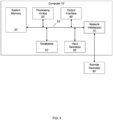
- the event data identification and collection system may include or have access to network devices and or communication components that facilitate communication between the event data identification and collection system and another device, component, facility, healthcare system, entity, and/or the like.
- the event data identification and collection system may utilize a network device to communicate with the healthcare systems applications, programs, and/or systems, that are monitoring or tracking for events affecting the healthcare facility, monitoring or tracking healthcare facility resources, and/or the like.
- the system may communicate and transmit information with other hospital systems that may provide information regarding patients, healthcare professionals, hospital objects, support personnel or departments, healthcare facility support resources, and/or other resources.
- the system may interface with an object tracking system, patient registration system, employee system, support personnel or department system, emergency response systems, and/or the like.
- the system can pull information from each of the interconnected or accessible systems to identify information regarding resources of the healthcare facility.
- the system can also transmit information to one or more of the interconnected or accessible systems.
- the system may be a background application that does not have an associated display or monitor. Rather, the system, when accessed by a user will provide instructions to generate and display a graphical user interface on a display device utilized by the user. Thus, the system may not have its own display device, but does have the ability to generate and display a graphical user interface.
- the graphical user interface is updated and managed based upon instructions provided by the system. In other words, the system generates and transmits instructions to create and update the graphical user interface.
- the system may be a standalone system that has an associated display device. In this case, the system still provides instructions for generating a graphical user interface as further described herein.
- the system may also be accessible through other computing devices.
- the system may be a standalone system that can be accessed by a user and also may be an application that is accessible by a user on another computing device.
- the system may be accessible using any type of computing device, for example, personal computer, laptop computer, smartphone, tablet, smartwatch, head-mounted display, smart television or other smart appliance, and/or the like.
- the layout of the graphical user interface may be a default configuration or configured by the user. It should be noted that different users may configure the graphical user interface per their preferences. Thus, the graphical user interface layout and configuration may be different between users. How much a user can configure the layout may be restricted or set by a system administrator and/or the like. Additionally, different users or different user roles may have different levels of access, which may also change how and what information is displayed.
- Some icons or graphical elements may also be display icons that display information.
- the display icons may be static icons that have static visual elements.
- the display icons may be dynamic icons that have dynamic visual elements that change based upon an update in information displayed on the icon, periodically, based upon a condition being met, and/or the like.
- the graphical element may be a display icon that displays the status of a provision of information to an entity, the status of a resource being utilized and monitored by the facility, the status of a resource being sent to the affected healthcare facility, and/or the like.
- a status dynamic icon as the status is updated, the graphical element is updated to reflect the new status.
- the graphical element is iteratively updated based upon changes to the status of the schedule generation.
- there may be other dynamic graphical elements and this is only an example of one.
- other dynamic graphical elements may include other status indicators, statistic indicators, and/or the like.
- the event data identification and collection system identifies a plurality of events that can affect a healthcare facility.
- An event that may affect a healthcare facility refers to an event that constrains or modifies the normal functioning of the healthcare facility.
- the possible events may be natural events, for example, earthquakes, tsunamis, wildfires, tornadoes, mudslides, floods, hurricanes, and/or the like.
- the possible events may be manmade events, for example, cyberattacks, terrorist attacks, construction, conflicts, and/or the like.
- Other events are also possible, for example, power outages, communication transmission outages, lack of potable water, food or other resource shortages, pandemics, disease transmissions, and/or the like.
- the event data identification and collection system may utilize one or more identification techniques.
- the simplest technique may be by receiving user input identifying an event.
- One or more users may manually upload events to the system.
- the system may also utilize historical data to identify events that may affect a healthcare facility.
- the event data identification and collection system may monitor healthcare facilities, for example, those facilities where the system is deployed, and identify when the healthcare facility experienced or was affected to the point that the healthcare facility was no longer able to function normally.
- Functioning normally may be a state that is learned by the system.
- the system may monitor key datapoints, metrics, dashboards, and/or the like, to determine a normal value or range that those data indicate.
- Example data that may be monitored and may provide an indication of an abnormal functioning condition include staffing values, staff-to-patient ratios, patient bed occupancy, resource usage and availability ratios, and/or the like. Values for those data that run within the normal value or range may indicate a normal functioning of the healthcare facility. If the values meet or exceed a predetermined threshold, the system may identify that the facility is no longer functioning normally.
- the system may require that multiple data values are outside predetermined thresholds, that data values run outside the predetermined thresholds for a predetermined period of time, and/or the like.
- a user may also program the system with some default values and threshold values.
- the system may monitor certain components or objects within or connected to the healthcare facility and may determine that an outage of one or more of those components or objects indicates an abnormal functioning state.
- the system may monitor power to the healthcare facility, generator functioning, water availability, environmental water levels, weather conditions, and/or the like. The loss of one or more of these components may indicate an abnormal functioning state.
- the system may identify an event that has occurred or is occurring proximal to the identification of the abnormal operating state.
- the system may identify a cause of the abnormal operating state and assign that cause as an event.
- the system may monitor one or more information sources that may provide an indication of an event. For example, news, social media sites, Internet searches, healthcare facility communications, and/or the like, may identify an event that has occurred, will be occurring, or is currently occurring that can be correlated to the abnormal operating state. For example, the system may identify that a news report indicated that a wildfire is burning in the area of the healthcare facility.
- the system may correlate the wildfire as the event affecting the healthcare facility.
- a user may also manually identify the event causing the abnormal operating state. By identifying the cause of the abnormal operating state, the system has identified an event that can affect a healthcare facility.
- Another technique for identifying an event may be to utilize crowd-sourced data or secondary sources.
- Many entities have manuals or other documentation that identifies the steps that should be taken when an event occurs at an entity. These events are those that affect the entity. In many cases, these identified events can also affect other entities. Accordingly, the system may access or be provided with entity documentation that includes an identification of events that can affect different entities in a type of crowd-sourcing potential event data. These events can then be identified as events that could affect a healthcare facility.
- the machine-learning model may include a plurality of layers, including input, output, hidden, a combination thereof, and/or the like, layers.
- the machine-learning model is very complex and utilizes complicated mathematical computations. Due to the complexity of the machine-learning model, it would be impossible to perform the analysis as performed by the model in the human mind.
- the model can monitor the predictions made by the model to identify the feedback so that a user does not have manually provide the feedback to the model.
- the model may initially be trained with a training dataset, the model can continually be trained as it is deployed using predictions and feedback regarding the predictions.
- the machine-learning model may be trained using event data and may, therefore, be able to identify events that could affect a healthcare facility. Similar training and corresponding predications may be used for other portions of the described system.
- the machine-learning model also be trained using unsupervised learning techniques, other supervised learning techniques, reinforcement training, a combination thereof, and/or the like.
- the event data identification and collection system generates a set of questions for each of the events identified at 101.
- the set of questions identifies data that assists in supporting a healthcare facility that has been, is currently being, or will be affected by a given event.
- each set of questions identifies data from the healthcare facility that will be helpful in supporting the healthcare facility as it is affected by the event corresponding to the set of questions.
- the set of questions may be based upon identification of resources that are utilized for supporting a particular event.
- a power outage event may result in an increase in the use of generators for powering the healthcare facility.
- a flooding event may result in an increase in the need for potable water either transported in or created using a water purification system.
- a pandemic event may result in an increased need for healthcare staff. While each set of questions is unique to a particular event, it should be noted that many events may have common effects. Therefore, there may be the same or similar questions included in multiple sets of questions. Additionally, it is possible that some sets of questions are identical even if the sets of questions are identified as belonging to different events.
- the sets of questions do not only include questions. Rather, the sets of questions may identify any data that may be useful to assist in supporting the healthcare facility. Thus, the sets of questions may include datapoints that should be monitored, dashboards that should be viewed, resources that should be monitored, and/or the like. The system may also identify a frequency at which the data identified in the set of questions should be viewed, monitored, updated, provided, accessed, and/or any other type of interaction. It should be noted that not all the data corresponding to the questions has to be tied to the same frequency of interaction. Rather, some data may correspond to one frequency of interaction, while other data may correspond to a different frequency of interaction.
- generation of the set of questions may be performed utilizing a machine-learning model.
- the system may monitor healthcare facilities as they are experiencing an event and identify those data that can be correlated to the event. For example, the system may identify particular resources that are utilized during a particular event and a frequency of use of the resources, the system may identify a particular dashboard that is frequently accessed or that provides an indication of the operating state of the healthcare facility, the system may identify an outside source that indicates an attribute of the event which then affects an operation of the healthcare facility, and/or the like.
- the system may access historical information regarding events and the impact on healthcare facilities. From this historical information, the system can identify those data that should be subject to some interaction to support the healthcare facility by analyzing the information associated with the historical event. In this case, the system may analyze information for a historical event that has the same type as the event corresponding to the set of questions. In other words, if the set of questions corresponds to a particular event type, the system will analyze historical information corresponding to events of that same type.
- Other techniques for generating the questions are possible and contemplated, for example, a user may manually identify data that should be subject to some interaction, the system can monitor a healthcare facility while the healthcare facility is affected by a particular event type, the system may utilize a combination of techniques, and/or the like.
- the system can generate a set of questions that identifies those data that are correlated to the event.
- this data may include identification of dashboards, datapoints, information, resources, values, and/or the like, that should be monitored, obtained, accessed, and/or otherwise interacted with, that will assist a supporting entity in supporting the affected healthcare facility.
- the system identifies those data that are helpful in supporting the affected healthcare facility and then adds that data to the set of questions in whatever format the data is provided in (e.g., dashboard, datapoint, resource, etc.).
- the set of questions identifies those data that are useful for interaction in order to accurately and efficiently support the healthcare facility.
- the system may include a monitoring of this resource within the set of questions.
- the system may include a monitoring of this metric or dashboard within the set of questions.
- the set of questions for a given event may be updated or refined periodically based upon feedback.
- the feedback may be user feedback or system feedback.
- the system may identify that a particular set of data is no longer applicable to the event for one reason or another. In this case, the system may remove any questions related to that data from the set of questions.
- the system may update the set of questions to include questions regarding that set of data.
- the system may test questions and determine the effectiveness of the question in determining how to support the healthcare facility while it is affected by an event. Based upon testing and/or feedback, the system can refine the questions included within the set of questions.
- the event data identification and collection system may determine if an indication of an event affecting a healthcare facility has been received.
- the event data identification and collection system may receive an indication that an event is affecting a healthcare facility from the facility itself, from an entity attempting to support a healthcare facility, from a secondary source (e.g., news, social media site, healthcare facility communication transmissions, etc.), and/or the like. Identifying that an event is affecting a healthcare facility is discussed in more detail in connection with FIG. 2 , step 201. Once an event affecting a healthcare facility has been identified, the event data identification and collection system may receive an indication of the event affecting a healthcare facility.
- the system may receive an indication of the type of event affecting the healthcare facility and attributes related to the healthcare facility that is being affected.
- Different healthcare facilities may have different characteristics or attributes that may require a modification of a set of questions.
- a geographical location of a healthcare facility may dictate different resources, data, and/or the like, that may be useful as compared to other geographical locations.
- attributes of the healthcare facility may include a geographical location, resources of the healthcare facility, proximity to other entities, type of healthcare facility (e.g., long-term facility, emergency care facility, short-term recovery facility, general facility, etc.), connection to other healthcare facilities, and/or the like.
- the system may take no action at 105. If, on the other hand, an indication of an event has been received at 103, the system may provide the set of questions corresponding to the event affecting the healthcare facility at 104. It should be noted that the set of questions may be provided to one or more entities, which may include the affected healthcare facility itself. The entities the set of questions is provided to may include those entities that are attempting to assist in supporting the healthcare facility.
- the system may automatically make the modification before the set of questions is provided.
- the system may utilize historical data, crowd-sourced data, machine-learning models, user input, and/or the like. These techniques have been previously described in connection with other steps and can be utilized in much the same except for modified to be for identifying modifications to the set of questions.
- the system may receive an indication of a modification to the set of questions from the affected healthcare facility, which may occur before or after the set of questions is provided. This information can be used to make the modification to the set of questions and can also be stored for use in the future when a set of questions needs to be provided for the affected healthcare facility.
- an entity may then provide the set of questions to the healthcare facility so that the healthcare facility can be responsive to the set of the questions. This is discussed in more detail with respect to FIG. 2 .
- an entity may provide them in a format digestible by healthcare facility.
- the event data identification and collection system may automatically pull data that is responsive to the set of questions from the healthcare facility.
- the set of questions can be pushed to the healthcare facility and connect to a tracking system, inventory system, scheduling system, and/or any other system of the healthcare facility that may provide responsive information, to pull information that is responsive to the set of questions.
- the healthcare facility may also dynamically change the information that is being published from the facility, as discussed in greater detail in connection with FIG. 2 .
- FIG. 2 illustrates an example method of invoking a data transmission at a healthcare facility that is responsive to a request to provide data that assists in support the healthcare facility in view of an event affecting the healthcare facility.
- an event affecting a healthcare facility is identified. In this step, not only is it identified that an event is affecting a healthcare facility, but it is also identified what type of event is affecting the healthcare facility.
- the healthcare facility employs an event data identification and collection system, which may be utilized to identify that an event is affecting the healthcare facility.
- the system may identify that the facility is operating within an abnormal operating state. Identifying the abnormal operating state can be performed utilizing a machine-learning model, historical information, and/or any other technique, for example, those described in connection with FIG. 1 , step 101. In FIG. 1 , identifying an abnormal operating state was utilized to identify different events that could affect a healthcare facility. In the case of step 201, identifying an abnormal operating state can be utilized to identify that a healthcare facility is currently being affected by an event. However, similar techniques can be used to identify that the healthcare facility is experiencing an abnormal operating state.
- a user within the facility may provide an indication that an event is affecting the healthcare facility.
- the user may also provide an indication of the type of event that is affecting the healthcare facility.
- One technique for providing this indication is to access a user interface which may include the graphical user interface discussed further herein.
- the user may interact with one or more icons or graphical elements to indicate that an event is affecting the healthcare facility and may provide additional information regarding the event and/or affect on the healthcare facility.
- Another technique for a user providing this indication is a user could update a status of the healthcare facility on an Internet website or other secondary source. The system could then monitor this secondary source and identify that it has been updated to reflect that an event is affecting the healthcare facility.
- a length of time may be attached to the modification.
- the length of time may be a specific length of time or may a length of time that is tied to a trigger.
- the requesting entity may specify how long the requested data is needed.
- the transmission of the modified dataset may be tied to this identified length of time.
- a user may also identify specific lengths of time, a default length of time may be identified, and/or the like.
- the system may monitor the healthcare facility and determine when the healthcare facility is operating at a normal operating state. Upon detecting the healthcare facility is operating at a normal operating state, the system may stop transmission of the modified dataset. Thus, a normal operating state may be a trigger.
- Other triggers are contemplated and possible, for example, when a resource reaches a predetermined inventory level, when a particular metric is met, when an indication of an event is over is received, and/or the like.
Landscapes
- Business, Economics & Management (AREA)
- Engineering & Computer Science (AREA)
- General Business, Economics & Management (AREA)
- Human Resources & Organizations (AREA)
- Health & Medical Sciences (AREA)
- Public Health (AREA)
- Primary Health Care (AREA)
- Medical Informatics (AREA)
- General Health & Medical Sciences (AREA)
- Epidemiology (AREA)
- Biomedical Technology (AREA)
- Entrepreneurship & Innovation (AREA)
- Strategic Management (AREA)
- Economics (AREA)
- Marketing (AREA)
- General Physics & Mathematics (AREA)
- Theoretical Computer Science (AREA)
- Operations Research (AREA)
- Tourism & Hospitality (AREA)
- Quality & Reliability (AREA)
- Game Theory and Decision Science (AREA)
- Educational Administration (AREA)
- Physics & Mathematics (AREA)
- Development Economics (AREA)
- Management, Administration, Business Operations System, And Electronic Commerce (AREA)
Applications Claiming Priority (1)
| Application Number | Priority Date | Filing Date | Title |
|---|---|---|---|
| US18/149,091 US20240221919A1 (en) | 2022-12-31 | 2022-12-31 | Dataset generation for healthcare facility events |
Publications (1)
| Publication Number | Publication Date |
|---|---|
| EP4394792A1 true EP4394792A1 (de) | 2024-07-03 |
Family
ID=89430072
Family Applications (1)
| Application Number | Title | Priority Date | Filing Date |
|---|---|---|---|
| EP23218630.4A Pending EP4394792A1 (de) | 2022-12-31 | 2023-12-20 | Datensatzerzeugung für gesundheitsversorgungsanlagenereignisse |
Country Status (3)
| Country | Link |
|---|---|
| US (1) | US20240221919A1 (de) |
| EP (1) | EP4394792A1 (de) |
| CA (1) | CA3225291A1 (de) |
Cited By (1)
| Publication number | Priority date | Publication date | Assignee | Title |
|---|---|---|---|---|
| CN118824472A (zh) * | 2024-09-19 | 2024-10-22 | 山东商业职业技术学院 | 一种认知障碍康复的训练路径系统 |
Citations (3)
| Publication number | Priority date | Publication date | Assignee | Title |
|---|---|---|---|---|
| US20190304596A1 (en) * | 2017-11-14 | 2019-10-03 | Tagnos, Inc. | Use Of Historic And Contemporary Tracking Data To Improve Healthcare Facility Operations |
| US10937543B1 (en) * | 2017-04-20 | 2021-03-02 | Teletracking Technologies, Inc. | Systems and methods for predictive and automated and centralized real-time event detection and communication |
| US11323196B1 (en) * | 2017-04-20 | 2022-05-03 | Teletracking Technologies, Inc. | Systems and methods for real-time transmission of digital data using a plurality of channels |
Family Cites Families (15)
| Publication number | Priority date | Publication date | Assignee | Title |
|---|---|---|---|---|
| US20100153132A1 (en) * | 2004-08-06 | 2010-06-17 | Axel Barth | Clinical workflow analysis and customer benchmarking |
| US11195128B2 (en) * | 2016-08-02 | 2021-12-07 | Baidu Usa Llc | Systems and methods for estimating healthcare resource demand |
| US20180121603A1 (en) * | 2016-10-27 | 2018-05-03 | International Business Machines Corporation | Identification of Related Electronic Medical Record Documents in a Question and Answer System |
| US20230130914A1 (en) * | 2018-12-05 | 2023-04-27 | The Handoff Company, Inc. | System and method for patient care handoff |
| US11480934B2 (en) * | 2019-01-24 | 2022-10-25 | Uptake Technologies, Inc. | Computer system and method for creating an event prediction model |
| US12592299B2 (en) * | 2019-03-18 | 2026-03-31 | Care Coordination Systems, LLC | Method for applying analytics through artificial intelligence for delivering medical care |
| WO2021077059A1 (en) * | 2019-10-18 | 2021-04-22 | Anjali Tomer | Systems and methods for computer modeling for healthcare bottleneck prediction and mitigation |
| US12062434B2 (en) * | 2020-04-10 | 2024-08-13 | GE Precision Healthcare LLC | Systems and methods for resource availability management |
| JP2021196634A (ja) * | 2020-06-09 | 2021-12-27 | 株式会社日立製作所 | 連携装置および連携方法 |
| US11609848B2 (en) * | 2020-07-30 | 2023-03-21 | Micron Technology, Inc. | Media management based on data access metrics |
| US11504011B1 (en) * | 2020-08-05 | 2022-11-22 | Vignet Incorporated | Early detection and prevention of infectious disease transmission using location data and geofencing |
| CN112734153A (zh) * | 2020-11-11 | 2021-04-30 | 重庆医科大学附属儿童医院 | 一种突发公共卫生事件中应急资源分配方法、系统及应用 |
| US12205712B2 (en) * | 2021-07-22 | 2025-01-21 | Cilag Gmbh International | Method of surgical system power management, communication, processing, storage and display |
| WO2023023392A1 (en) * | 2021-08-20 | 2023-02-23 | Alivia Capital LLC | Medical fraud, waste, and abuse analytics systems and methods using sensitivity analysis |
| US20240212835A1 (en) * | 2022-12-22 | 2024-06-27 | Teletracking Technologies, Inc. | Healthcare facility scheduling |
-
2022
- 2022-12-31 US US18/149,091 patent/US20240221919A1/en active Pending
-
2023
- 2023-12-20 EP EP23218630.4A patent/EP4394792A1/de active Pending
- 2023-12-29 CA CA3225291A patent/CA3225291A1/en active Pending
Patent Citations (3)
| Publication number | Priority date | Publication date | Assignee | Title |
|---|---|---|---|---|
| US10937543B1 (en) * | 2017-04-20 | 2021-03-02 | Teletracking Technologies, Inc. | Systems and methods for predictive and automated and centralized real-time event detection and communication |
| US11323196B1 (en) * | 2017-04-20 | 2022-05-03 | Teletracking Technologies, Inc. | Systems and methods for real-time transmission of digital data using a plurality of channels |
| US20190304596A1 (en) * | 2017-11-14 | 2019-10-03 | Tagnos, Inc. | Use Of Historic And Contemporary Tracking Data To Improve Healthcare Facility Operations |
Cited By (1)
| Publication number | Priority date | Publication date | Assignee | Title |
|---|---|---|---|---|
| CN118824472A (zh) * | 2024-09-19 | 2024-10-22 | 山东商业职业技术学院 | 一种认知障碍康复的训练路径系统 |
Also Published As
| Publication number | Publication date |
|---|---|
| CA3225291A1 (en) | 2024-06-30 |
| US20240221919A1 (en) | 2024-07-04 |
Similar Documents
| Publication | Publication Date | Title |
|---|---|---|
| Marko et al. | Examining inclusivity: the use of AI and diverse populations in health and social care: a systematic review | |
| Chung et al. | Chatbot-based heathcare service with a knowledge base for cloud computing | |
| US10387899B2 (en) | Systems and methods for monitoring and analyzing computer and network activity | |
| US9830801B2 (en) | Alarm management system | |
| US8161325B2 (en) | Recommendation of relevant information to support problem diagnosis | |
| US9069666B2 (en) | Systems and methods for controlling error reporting and resolution | |
| US20180115464A1 (en) | Systems and methods for monitoring and analyzing computer and network activity | |
| US10365946B2 (en) | Clustering based process deviation detection | |
| US20150269316A1 (en) | Online Referring Service Provider Portal | |
| Del Fiol et al. | Disseminating context-specific access to online knowledge resources within electronic health record systems | |
| Shakshuki et al. | An adaptive user interface in healthcare | |
| US20160063078A1 (en) | Automatic identification and tracking of log entry schemas changes | |
| US10664335B2 (en) | System and method for maintaining the health of a machine | |
| US20250165315A1 (en) | Aps data collection and modification system and method for analytics | |
| EP4394792A1 (de) | Datensatzerzeugung für gesundheitsversorgungsanlagenereignisse | |
| CN111145907A (zh) | 体检数据处理方法、装置、介质及电子设备 | |
| EP4390961A1 (de) | Planung von gesundheitsversorgungseinrichtungen | |
| EP4394791A1 (de) | Datensatzmodifizierung und -bereitstellung für gesundheitsversorgungseinrichtungsereignisse | |
| US9104573B1 (en) | Providing relevant diagnostic information using ontology rules | |
| JP6552160B2 (ja) | 情報管理システム、情報管理方法及びプログラム | |
| US20160267198A1 (en) | Importing data to a semantic graph | |
| US20230290457A1 (en) | Artificial intelligence medical device | |
| EP4394793A1 (de) | Auf ereignisidentifikation ansprechende patientenübertragungsempfehlung | |
| CN111834005B (zh) | 基于传染病的医疗数据筛选方法、装置、介质及设备 | |
| US20120316895A1 (en) | Generating Cross-Channel Medical Data |
Legal Events
| Date | Code | Title | Description |
|---|---|---|---|
| PUAI | Public reference made under article 153(3) epc to a published international application that has entered the european phase |
Free format text: ORIGINAL CODE: 0009012 |
|
| STAA | Information on the status of an ep patent application or granted ep patent |
Free format text: STATUS: THE APPLICATION HAS BEEN PUBLISHED |
|
| AK | Designated contracting states |
Kind code of ref document: A1 Designated state(s): AL AT BE BG CH CY CZ DE DK EE ES FI FR GB GR HR HU IE IS IT LI LT LU LV MC ME MK MT NL NO PL PT RO RS SE SI SK SM TR |
|
| STAA | Information on the status of an ep patent application or granted ep patent |
Free format text: STATUS: REQUEST FOR EXAMINATION WAS MADE |
|
| 17P | Request for examination filed |
Effective date: 20241219 |