EP4394580A1 - Systeme zur bewertung einer stückweisen linearen funktion - Google Patents
Systeme zur bewertung einer stückweisen linearen funktion Download PDFInfo
- Publication number
- EP4394580A1 EP4394580A1 EP23164308.1A EP23164308A EP4394580A1 EP 4394580 A1 EP4394580 A1 EP 4394580A1 EP 23164308 A EP23164308 A EP 23164308A EP 4394580 A1 EP4394580 A1 EP 4394580A1
- Authority
- EP
- European Patent Office
- Prior art keywords
- lut
- value
- entries
- input value
- partial
- Prior art date
- Legal status (The legal status is an assumption and is not a legal conclusion. Google has not performed a legal analysis and makes no representation as to the accuracy of the status listed.)
- Granted
Links
Images







Classifications
-
- G—PHYSICS
- G06—COMPUTING OR CALCULATING; COUNTING
- G06F—ELECTRIC DIGITAL DATA PROCESSING
- G06F7/00—Methods or arrangements for processing data by operating upon the order or content of the data handled
- G06F7/38—Methods or arrangements for performing computations using exclusively denominational number representation, e.g. using binary, ternary, decimal representation
- G06F7/48—Methods or arrangements for performing computations using exclusively denominational number representation, e.g. using binary, ternary, decimal representation using non-contact-making devices, e.g. tube, solid state device; using unspecified devices
- G06F7/544—Methods or arrangements for performing computations using exclusively denominational number representation, e.g. using binary, ternary, decimal representation using non-contact-making devices, e.g. tube, solid state device; using unspecified devices for evaluating functions by calculation
-
- G—PHYSICS
- G06—COMPUTING OR CALCULATING; COUNTING
- G06F—ELECTRIC DIGITAL DATA PROCESSING
- G06F17/00—Digital computing or data processing equipment or methods, specially adapted for specific functions
- G06F17/10—Complex mathematical operations
- G06F17/11—Complex mathematical operations for solving equations, e.g. nonlinear equations, general mathematical optimization problems
- G06F17/12—Simultaneous equations, e.g. systems of linear equations
-
- G—PHYSICS
- G06—COMPUTING OR CALCULATING; COUNTING
- G06F—ELECTRIC DIGITAL DATA PROCESSING
- G06F17/00—Digital computing or data processing equipment or methods, specially adapted for specific functions
- G06F17/10—Complex mathematical operations
- G06F17/17—Function evaluation by approximation methods, e.g. inter- or extrapolation, smoothing, least mean square method
-
- G—PHYSICS
- G06—COMPUTING OR CALCULATING; COUNTING
- G06F—ELECTRIC DIGITAL DATA PROCESSING
- G06F7/00—Methods or arrangements for processing data by operating upon the order or content of the data handled
- G06F7/38—Methods or arrangements for performing computations using exclusively denominational number representation, e.g. using binary, ternary, decimal representation
- G06F7/48—Methods or arrangements for performing computations using exclusively denominational number representation, e.g. using binary, ternary, decimal representation using non-contact-making devices, e.g. tube, solid state device; using unspecified devices
- G06F7/544—Methods or arrangements for performing computations using exclusively denominational number representation, e.g. using binary, ternary, decimal representation using non-contact-making devices, e.g. tube, solid state device; using unspecified devices for evaluating functions by calculation
- G06F7/5443—Sum of products
Definitions
- the present invention relates to systems for evaluating a piecewise linear function, and more particularly relates to a hardware architecture for evaluating the piecewise linear function.
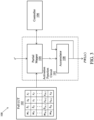
- a system for evaluating a piecewise linear function PWL ( x ) at an input value x ⁇ may include a first look-up table (LUT) with N entries, and a second LUT with M entries, with M being less than N. Each of the N entries may contain parameters that define a corresponding linear segment of the piecewise linear function.
- the system may further include a controller configured to load parameters defining one or more of the linear segments from the first LUT into the second LUT.
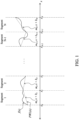
- the system may further include a classifier for receiving the input value x ⁇ and classifying the input value x ⁇ in one of a plurality of segments of a number line.
- a total number of the segments may be equal to M, and the segments may be non-overlapping and contiguous.
- the system may further include a multiplexor for selecting one of the M entries of the second LUT based on the classification of the input value x ⁇ into one of the plurality of segments.
- the system may further include a multiplier for multiplying the input value x ⁇ with a slope value retrieved from the second LUT to form a product.
- the system may further include an adder for summing the product with an intercept value retrieved from the second LUT to arrive at an intermediate value. This procedure may be repeatedly iterated after parameters defining other ones of the linear segments are loaded from the first LUT into the second LUT.
- the system may further include an accumulator to accumulate the intermediate values over a plurality of iterations to arrive at PWL ( x ) evaluated at the input value x ⁇ .
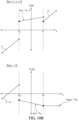
- m i f x i ⁇ f x i ⁇ 1 x i ⁇ x i ⁇ 1
- b i f x i ⁇ 1 x i ⁇ f x i x i ⁇ 1 x i ⁇ x i ⁇ 1 for i ⁇ ⁇ 1, ...
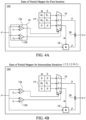
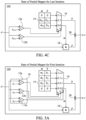
- the partial mapper 104 depicted in Figures 5A-5C includes three comparators 12a, 12b, 12c instead of the two comparators 12a, 12b in Figures 4A-4C , allowing the partial mapper 104 to evaluate more linear segments of the piecewise linear function PWL(x) during each iteration.
- These parameters also include m 1 , b 1 which are loaded from the first row of the full LUT 102 into the first row of the partial LUT 14; m 2 , b 2 which are loaded from the second row of the full LUT 102 into the second row of the partial LUT 14; and m 3 , b 3 which are loaded from the third row of the full LUT 102 into the third row of the partial LUT 14.
- the fourth row of the partial LUT 14 may be populated with zeros.
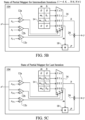
- the output of the comparator 12a being equal to logical 1 or TRUE indicates that the input value x ⁇ has been classified into a first segment of the number line with values less than x 1 ; the output of the comparator 12b being equal to logical 1 or TRUE indicates that the input value x ⁇ has been classified into a second segment of the number line with values greater than or equal to x 1 but less than x 2 ; the output of the comparator 12c being equal to logical 1 or TRUE indicates that the input value x ⁇ has been classified into a third segment of the number line with values greater than or equal to x 2 but less than x 3 ; and the output of all the comparators 12a, 12b, 12c being equal to logical 0 or FALSE indicates that the input value x ⁇ has been classified into a fourth segment of the number line with values greater than or equal to x 3 .
- These parameters also include m N -2 , b N -2 which are loaded from the full LUT 102 into the second row of the partial LUT 14; m N -1 , b N -1 which are loaded from the full LUT 102 into the third row of the partial LUT 14; m N , b N which are loaded from the full LUT 102 into the fourth row of the partial LUT 14.
- the first row of the partial LUT 14 may be set to zero values. There is no change to the operation of the partial mapper 104 in Figure 5C other than the configuration of the parameter values; therefore, the operation of the partial mapper 104 in Figure 5C will not be explained in detail.
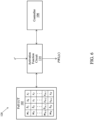
- Figure 7A depicts a logic level schematic of the activation function circuit 114 depicted in Figure 6 , and the state of the activation function circuit 114 during the first iteration of an algorithm for evaluating PWL ( x ) at an input value x ⁇ .
- certain parameters are loaded from the first two rows of the full LUT 102 into the activation function circuit 114. These parameters include x 1 which is loaded into one of the inputs of the comparator 12. These parameters also include m 1 , b 1 which are loaded from the first row of the full LUT 102 into the first row of the partial LUT 14, and m 2 , b 2 which are loaded from the second row of the full LUT 102 into the second row of the partial LUT 14.
- mapping is carried out by passing the logical 0 signal from the output of the comparator 12 to the selector input of the multiplexor 16, retrieving the slope m 2 , intercept b 2 , and enable value 1 , from the partial LUT 14, computing the product p of m 2 and x ⁇ using the multiplier 18, computing the sum of the product p with the intercept b 2 using the adder 20, and storing the resulting sum in the gated memory 22 while the enable signal, en, is asserted (i.e., is equal to logical 1).
- the term "prospectively" is used because such mapping may or may not be correct. Subsequent operations will either confirm that this mapping is correct, and leave the sum stored in the gated memory 22 unchanged, or will determine that this mapping is incorrect, and overwrite the sum stored in the gated memory 22.
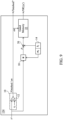
- Figure 9 depicts a logic level schematic of the activation function circuit 124 depicted in Figure 8 , and the state of the activation function circuit 124 during each iteration of an algorithm for evaluating PWL(x) at an input value x ⁇ .
- the algorithm is initialized by setting the index i equal to 1.
- certain parameters are loaded from one row of the full LUT 102 into the activation function circuit 124. These parameters include x i which is loaded into one of the inputs of the comparator 12. These parameters also include m i , b i which are loaded from the full LUT 102 into the partial LUT 14.
- the operation of the activation function circuit 124 may proceed as follows.
- the classifier 10 determines whether the input value x ⁇ is less than x i . If so, the finished and enable signals (i.e., "enable” abbreviated as “en” in Figure 9 ) are asserted or set to logical 1. At the same time the comparison is carried out, the input value x ⁇ is transformed by the function of the i th linear segment by using multiplier 18 to multiply m i and x ⁇ to generate the product p and using the adder 20 to compute the sum of the product p with the intercept b i . If the enable signal is asserted, the sum is stored in the gated memory 22 and the algorithm concludes.
- the index i is incremented, and the algorithm is repeated for the next linear segment (i.e., by loading new parameters from one row of the full LUT 102 into the activation function circuit 124, and computing m i x ⁇ + b i ) .
- the algorithm is repeated in a similar manner until either the index i is set equal to N + 1 or the finished signal is asserted (whichever occurs first).
- activation function circuit 124 is more frugal in its hardware architecture than activation function circuit 114 in that it does not contain multiplexor 16, and further its partial LUT 14 only includes a single row.
- activation function circuit 124 is more frugal in its hardware architecture than activation function circuit 114 in that it does not contain multiplexor 16, and further its partial LUT 14 only includes a single row.
- such efficiencies in the design are offset by the additional complexity associated with communicating the finished signal to the controller 106.
- System 150 described in Figure 12 departs from the above-described systems 100, 120, 130 in that it involves the use of transform functions.
- a discussion of the transform functions is first provided before providing the details of system 150.
- One transform function is defined for each of the N linear segments of the piecewise linear function PWL ( x ) . More specifically, if index i were used to index each of the linear segments, segment i would have a corresponding transform function T i ( x ).
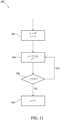
- a flow chart of an algorithm 200 for evaluating PWL(x) at an input value x* is first explained.
- the variable v is set to x* and index i is set to 1.
- the variable v is set equal to T i ( v ) and the index i is incremented by 1.
- the algorithm determines whether the index i is less than or equal to N (i.e., the total number of linear segments of the piecewise linear function PWL ( x )) . If so (yes branch of step 206), the algorithm returns to step 204. If not (no branch of step 206), the output y is set equal to the variable v (step 208), which actually equals PWL ( x ⁇ ) as will become more apparent after the discussion below.
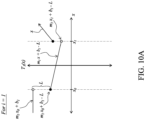
- algorithm 200 if the input value x ⁇ falls within the domain of linear segment i (i.e., for i E ⁇ 1, ..., N - 1 ⁇ ), application of T i ( x ) in step 204 will map the input value x ⁇ to an output value using the linear function of the i th segment (i.e., m i x + b i ) . If the input value x ⁇ falls outside of the domain of segment i, application of T i ( x ) in step 204 will return x ⁇ (i.e., will essentially be the identity function).
- T 1 ( x ) is a linear function for x 0 ⁇ x ⁇ x 1 , its maximum must be the y-value of one of its endpoints, so the above condition is equivalent to: m 1 x 0 + b 1 ⁇ L ⁇ x 1 and m 1 x 1 + b 1 ⁇ L ⁇ x 1
- T i ( x ) is a linear function for x i -1 ⁇ x ⁇ x i , its maximum must be the y-value of one of its endpoints, so the above condition is equivalent to: m i x i ⁇ 1 + b i ⁇ L ⁇ x i and m i x i + b i ⁇ L ⁇ x i , for i ⁇ 1 ... N ⁇ 1
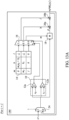
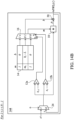
- the respective outputs of the comparators 12a, 12b may be used as selector signals of a multiplexor 16. Specifically, the output of comparators 12a and 12b may be connected to selectors s 1 and s 2 , respectively. Selector s 1 receiving logical 1 causes the multiplexor 16 to output the first row of the partial LUT 14; selector s 2 receiving logical 1 causes the multiplexor 16 to output the second row of the partial LUT 14; and selectors s 1 and s 2 both receiving logical 0 causes the multiplexor 16 to output the third row of the partial LUT 14.
- the values [1, 0, 0] may be stored in the first row of the partial LUT 14, the values [ m i , b i , -L ] may be stored in the second row of the partial LUT 14, and the values [1, 0, 0] may be stored in the third row of the partial LUT 14.
- the operation of the activation function circuit 144 may proceed as follows.
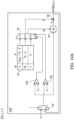
- Figures 14A-14C depict a logic level schematic of a more efficient implementation of the activation function circuit 144 depicted in Figure 12 , and the state of the activation function circuit 144 during various iterations of an algorithm for evaluating PWL(x) at an input value x ⁇ .
- the implementation of Figures 14A-14C differs from that of Figures 14A-14C by summing (i.e., across each row) intercepts and offset values of the partial LUT 14, to form new intercept values. With such change, only a single adder 20 is needed to sum the intercept value, b, with the product, p.
- the description of Figures 14A-14C will not be provided in further detail.
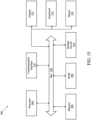
- Figure 15 provides an example of a system 300 that may be representative of any of the computing systems (e.g., controller 106) discussed herein. Examples of system 300 may include a microcontroller, an embedded system, etc. Note, not all of the various computer systems have all of the features of system 300. For example, certain ones of the computer systems discussed above may not include a display inasmuch as the display function may be provided by a client computer communicatively coupled to the computer system or a display function may be unnecessary. Such details are not critical to the present invention.
- System 300 includes a bus 302 or other communication mechanism for communicating information, and a processor 304 coupled with the bus 302 for processing information.
- Computer system 300 also includes a main memory 306, such as a random access memory (RAM) or other dynamic storage device, coupled to the bus 302 for storing information and instructions to be executed by processor 304.
- Main memory 306 also may be used for storing temporary variables or other intermediate information during execution of instructions to be executed by processor 304.
- Computer system 300 further includes a read only memory (ROM) 308 or other static storage device coupled to the bus 302 for storing static information and instructions for the processor 304.
- a storage device 310 for example a hard disk, flash memory-based storage medium, or other storage medium from which processor 304 can read, is provided and coupled to the bus 302 for storing information and instructions (e.g., operating systems, applications programs and the like).
- Computer system 300 may be coupled via the bus 302 to a display 312, such as a flat panel display, for displaying information to a computer user.
- a display 312 such as a flat panel display
- cursor control device 316 such as a mouse, a trackpad, or similar input device for communicating direction information and command selections to processor 304 and for controlling cursor movement on the display 312.
- Other user interface devices, such as microphones, speakers, etc. are not shown in detail but may be involved with the receipt of user input and/or presentation of output.
- processor 304 may be implemented by processor 304 executing appropriate sequences of computer-readable instructions contained in main memory 306. Such instructions may be read into main memory 306 from another computer-readable medium, such as storage device 310, and execution of the sequences of instructions contained in the main memory 306 causes the processor 304 to perform the associated actions.
- main memory 306 may be read into main memory 306 from another computer-readable medium, such as storage device 310, and execution of the sequences of instructions contained in the main memory 306 causes the processor 304 to perform the associated actions.
- hard-wired circuitry or firmware-controlled processing units may be used in place of or in combination with processor 304 and its associated computer software instructions to implement the invention.
- the computer-readable instructions may be rendered in any computer language.
- Computer system 300 also includes a communication interface 318 coupled to the bus 302.
- Communication interface 318 may provide a two-way data communication channel with a computer network, which provides connectivity to and among the various computer systems discussed above.
- communication interface 318 may be a local area network (LAN) card to provide a data communication connection to a compatible LAN, which itself is communicatively coupled to the Internet through one or more Internet service provider networks.
- LAN local area network
- the precise details of such communication paths are not critical to the present invention. What is important is that computer system 300 can send and receive messages and data through the communication interface 318 and in that way communicate with hosts accessible via the Internet. It is noted that the components of system 300 may be located in a single device or located in a plurality of physically and/or geographically distributed devices.
Landscapes
- Engineering & Computer Science (AREA)
- Physics & Mathematics (AREA)
- General Physics & Mathematics (AREA)
- Theoretical Computer Science (AREA)
- Computational Mathematics (AREA)
- Mathematical Analysis (AREA)
- Mathematical Optimization (AREA)
- Pure & Applied Mathematics (AREA)
- Mathematical Physics (AREA)
- General Engineering & Computer Science (AREA)
- Data Mining & Analysis (AREA)
- Algebra (AREA)
- Computing Systems (AREA)
- Databases & Information Systems (AREA)
- Software Systems (AREA)
- Operations Research (AREA)
- Complex Calculations (AREA)
Applications Claiming Priority (1)
| Application Number | Priority Date | Filing Date | Title |
|---|---|---|---|
| US18/148,673 US11645355B1 (en) | 2022-12-30 | 2022-12-30 | Systems for evaluating a piecewise linear function |
Publications (3)
| Publication Number | Publication Date |
|---|---|
| EP4394580A1 true EP4394580A1 (de) | 2024-07-03 |
| EP4394580B1 EP4394580B1 (de) | 2025-07-16 |
| EP4394580C0 EP4394580C0 (de) | 2025-07-16 |
Family
ID=85778916
Family Applications (1)
| Application Number | Title | Priority Date | Filing Date |
|---|---|---|---|
| EP23164308.1A Active EP4394580B1 (de) | 2022-12-30 | 2023-03-27 | Systeme zur bewertung einer stückweisen linearen funktion |
Country Status (2)
| Country | Link |
|---|---|
| US (1) | US11645355B1 (de) |
| EP (1) | EP4394580B1 (de) |
Citations (1)
| Publication number | Priority date | Publication date | Assignee | Title |
|---|---|---|---|---|
| EP3035204A1 (de) * | 2014-12-19 | 2016-06-22 | Intel Corporation | Speichervorrichtung und Verfahren zur Durchführung von Faltungsoperationen |
Family Cites Families (3)
| Publication number | Priority date | Publication date | Assignee | Title |
|---|---|---|---|---|
| US8384722B1 (en) * | 2008-12-17 | 2013-02-26 | Matrox Graphics, Inc. | Apparatus, system and method for processing image data using look up tables |
| US8589463B2 (en) * | 2010-06-25 | 2013-11-19 | Altera Corporation | Calculation of trigonometric functions in an integrated circuit device |
| US11775805B2 (en) | 2018-06-29 | 2023-10-03 | Intel Coroporation | Deep neural network architecture using piecewise linear approximation |
-
2022
- 2022-12-30 US US18/148,673 patent/US11645355B1/en active Active
-
2023
- 2023-03-27 EP EP23164308.1A patent/EP4394580B1/de active Active
Patent Citations (1)
| Publication number | Priority date | Publication date | Assignee | Title |
|---|---|---|---|---|
| EP3035204A1 (de) * | 2014-12-19 | 2016-06-22 | Intel Corporation | Speichervorrichtung und Verfahren zur Durchführung von Faltungsoperationen |
Non-Patent Citations (1)
| Title |
|---|
| SUN HUAQING ET AL: "A Universal Method of Linear Approximation With Controllable Error for the Efficient Implementation of Transcendental Functions", IEEE TRANSACTIONS ON CIRCUITS AND SYSTEMS I: REGULAR PAPERS, IEEE, US, vol. 67, no. 1, 19 September 2019 (2019-09-19), pages 177 - 188, XP011766506, ISSN: 1549-8328, [retrieved on 20200108], DOI: 10.1109/TCSI.2019.2939563 * |
Also Published As
| Publication number | Publication date |
|---|---|
| US11645355B1 (en) | 2023-05-09 |
| EP4394580B1 (de) | 2025-07-16 |
| EP4394580C0 (de) | 2025-07-16 |
Similar Documents
| Publication | Publication Date | Title |
|---|---|---|
| Angelopoulos et al. | Ppi++: Efficient prediction-powered inference | |
| US10713597B2 (en) | Systems and methods for preparing data for use by machine learning algorithms | |
| US20200320428A1 (en) | Fairness improvement through reinforcement learning | |
| Kutyniok | The mathematics of artificial intelligence | |
| US12135703B2 (en) | Method and apparatus for operating accelerator using softmax approximation | |
| Ahmadpour Kasgari et al. | Prediction of bankruptcy Iranian corporations through artificial neural network and Probit-based analyses | |
| US20230098994A1 (en) | Processing Data Batches in a Multi-Layer Network | |
| CN111401473A (zh) | 基于注意力机制卷积神经网络的红外目标分类方法 | |
| KR970001903B1 (ko) | 인공 뉴런 및 인공 뉴런의 상태를 적응적으로 변경시키는 방법 | |
| US20230252299A1 (en) | Detecting and mitigating fault in sparsity computation in deep neural network | |
| US20240028960A1 (en) | Method for evaluating the performance of a prediction algorithm, and associated devices | |
| Sheu et al. | On the potential of a graph attention network in money laundering detection | |
| Amir Haeri et al. | Improving GP generalization: A variance-based layered learning approach | |
| Valls et al. | Supervised data transformation and dimensionality reduction with a 3-layer multi-layer perceptron for classification problems | |
| US20220076103A1 (en) | Data Processing Processor, Corresponding Method and Computer Program. | |
| WO2022153711A1 (en) | Training apparatus, classification apparatus, training method, classification method, and program | |
| Ward et al. | A constant-per-iteration likelihood ratio test for online changepoint detection for exponential family models | |
| EP4394580A1 (de) | Systeme zur bewertung einer stückweisen linearen funktion | |
| CN117077813A (zh) | 一种机器学习模型的训练方法及训练系统 | |
| Liu et al. | A robust regression based on weighted LSSVM and penalized trimmed squares | |
| Pesantez-Narvaez et al. | A synthetic penalized logitboost to model mortgage lending with imbalanced data | |
| Lai et al. | A compressed sensing based least squares approach to semi-supervised local cluster extraction | |
| CN114429220A (zh) | 模型在线更新方法、装置、设备、存储介质和计算机产品 | |
| Eremeev et al. | Integrated approach for data mining based on case-based reasoning and neural networks | |
| EP4357978A1 (de) | Beschleuniger für tiefes neuronales netzwerk (dnn) zur ermöglichung von quantisierter inferenz |
Legal Events
| Date | Code | Title | Description |
|---|---|---|---|
| PUAI | Public reference made under article 153(3) epc to a published international application that has entered the european phase |
Free format text: ORIGINAL CODE: 0009012 |
|
| STAA | Information on the status of an ep patent application or granted ep patent |
Free format text: STATUS: THE APPLICATION HAS BEEN PUBLISHED |
|
| AK | Designated contracting states |
Kind code of ref document: A1 Designated state(s): AL AT BE BG CH CY CZ DE DK EE ES FI FR GB GR HR HU IE IS IT LI LT LU LV MC ME MK MT NL NO PL PT RO RS SE SI SK SM TR |
|
| STAA | Information on the status of an ep patent application or granted ep patent |
Free format text: STATUS: REQUEST FOR EXAMINATION WAS MADE |
|
| 17P | Request for examination filed |
Effective date: 20241119 |
|
| RBV | Designated contracting states (corrected) |
Designated state(s): AL AT BE BG CH CY CZ DE DK EE ES FI FR GB GR HR HU IE IS IT LI LT LU LV MC ME MK MT NL NO PL PT RO RS SE SI SK SM TR |
|
| GRAP | Despatch of communication of intention to grant a patent |
Free format text: ORIGINAL CODE: EPIDOSNIGR1 |
|
| STAA | Information on the status of an ep patent application or granted ep patent |
Free format text: STATUS: GRANT OF PATENT IS INTENDED |
|
| RIC1 | Information provided on ipc code assigned before grant |
Ipc: G06F 7/544 20060101AFI20250128BHEP |
|
| INTG | Intention to grant announced |
Effective date: 20250213 |
|
| GRAS | Grant fee paid |
Free format text: ORIGINAL CODE: EPIDOSNIGR3 |
|
| GRAA | (expected) grant |
Free format text: ORIGINAL CODE: 0009210 |
|
| STAA | Information on the status of an ep patent application or granted ep patent |
Free format text: STATUS: THE PATENT HAS BEEN GRANTED |
|
| RAP3 | Party data changed (applicant data changed or rights of an application transferred) |
Owner name: RECOGNI INC. |
|
| AK | Designated contracting states |
Kind code of ref document: B1 Designated state(s): AL AT BE BG CH CY CZ DE DK EE ES FI FR GB GR HR HU IE IS IT LI LT LU LV MC ME MK MT NL NO PL PT RO RS SE SI SK SM TR |
|
| REG | Reference to a national code |
Ref country code: GB Ref legal event code: FG4D |
|
| REG | Reference to a national code |
Ref country code: CH Ref legal event code: EP |
|
| REG | Reference to a national code |
Ref country code: DE Ref legal event code: R096 Ref document number: 602023004776 Country of ref document: DE |
|
| REG | Reference to a national code |
Ref country code: IE Ref legal event code: FG4D |
|
| U01 | Request for unitary effect filed |
Effective date: 20250806 |
|
| U07 | Unitary effect registered |
Designated state(s): AT BE BG DE DK EE FI FR IT LT LU LV MT NL PT RO SE SI Effective date: 20250818 |
|
| REG | Reference to a national code |
Ref country code: CH Ref legal event code: W10 Free format text: ST27 STATUS EVENT CODE: U-0-0-W10-W00 (AS PROVIDED BY THE NATIONAL OFFICE) Effective date: 20251008 |
|
| RAP4 | Party data changed (patent owner data changed or rights of a patent transferred) |
Owner name: TENSORDYNE, INC. |
|
| U1H | Name or address of the proprietor changed after the registration of the unitary effect |
Owner name: TENSORDYNE, INC.; US |
|
| PG25 | Lapsed in a contracting state [announced via postgrant information from national office to epo] |
Ref country code: IS Free format text: LAPSE BECAUSE OF FAILURE TO SUBMIT A TRANSLATION OF THE DESCRIPTION OR TO PAY THE FEE WITHIN THE PRESCRIBED TIME-LIMIT Effective date: 20251116 |
|
| PG25 | Lapsed in a contracting state [announced via postgrant information from national office to epo] |
Ref country code: NO Free format text: LAPSE BECAUSE OF FAILURE TO SUBMIT A TRANSLATION OF THE DESCRIPTION OR TO PAY THE FEE WITHIN THE PRESCRIBED TIME-LIMIT Effective date: 20251016 |
|
| PG25 | Lapsed in a contracting state [announced via postgrant information from national office to epo] |
Ref country code: HR Free format text: LAPSE BECAUSE OF FAILURE TO SUBMIT A TRANSLATION OF THE DESCRIPTION OR TO PAY THE FEE WITHIN THE PRESCRIBED TIME-LIMIT Effective date: 20250716 |
|
| PG25 | Lapsed in a contracting state [announced via postgrant information from national office to epo] |
Ref country code: GR Free format text: LAPSE BECAUSE OF FAILURE TO SUBMIT A TRANSLATION OF THE DESCRIPTION OR TO PAY THE FEE WITHIN THE PRESCRIBED TIME-LIMIT Effective date: 20251017 |
|
| PG25 | Lapsed in a contracting state [announced via postgrant information from national office to epo] |
Ref country code: PL Free format text: LAPSE BECAUSE OF FAILURE TO SUBMIT A TRANSLATION OF THE DESCRIPTION OR TO PAY THE FEE WITHIN THE PRESCRIBED TIME-LIMIT Effective date: 20250716 |
|
| PG25 | Lapsed in a contracting state [announced via postgrant information from national office to epo] |
Ref country code: RS Free format text: LAPSE BECAUSE OF FAILURE TO SUBMIT A TRANSLATION OF THE DESCRIPTION OR TO PAY THE FEE WITHIN THE PRESCRIBED TIME-LIMIT Effective date: 20251016 |
|
| PG25 | Lapsed in a contracting state [announced via postgrant information from national office to epo] |
Ref country code: ES Free format text: LAPSE BECAUSE OF FAILURE TO SUBMIT A TRANSLATION OF THE DESCRIPTION OR TO PAY THE FEE WITHIN THE PRESCRIBED TIME-LIMIT Effective date: 20250716 |