EP4394555A1 - Sensation transmission system, sensation transmission method, and sensation transmission program - Google Patents
Sensation transmission system, sensation transmission method, and sensation transmission program Download PDFInfo
- Publication number
- EP4394555A1 EP4394555A1 EP22873046.1A EP22873046A EP4394555A1 EP 4394555 A1 EP4394555 A1 EP 4394555A1 EP 22873046 A EP22873046 A EP 22873046A EP 4394555 A1 EP4394555 A1 EP 4394555A1
- Authority
- EP
- European Patent Office
- Prior art keywords
- information
- subject
- sensory information
- sensory
- stimulus
- Prior art date
- Legal status (The legal status is an assumption and is not a legal conclusion. Google has not performed a legal analysis and makes no representation as to the accuracy of the status listed.)
- Pending
Links
Images





Classifications
-
- A—HUMAN NECESSITIES
- A61—MEDICAL OR VETERINARY SCIENCE; HYGIENE
- A61B—DIAGNOSIS; SURGERY; IDENTIFICATION
- A61B5/00—Measuring for diagnostic purposes; Identification of persons
- A61B5/05—Detecting, measuring or recording for diagnosis by means of electric currents or magnetic fields; Measuring using microwaves or radio waves
- A61B5/055—Detecting, measuring or recording for diagnosis by means of electric currents or magnetic fields; Measuring using microwaves or radio waves involving electronic [EMR] or nuclear [NMR] magnetic resonance, e.g. magnetic resonance imaging
-
- A—HUMAN NECESSITIES
- A61—MEDICAL OR VETERINARY SCIENCE; HYGIENE
- A61B—DIAGNOSIS; SURGERY; IDENTIFICATION
- A61B5/00—Measuring for diagnostic purposes; Identification of persons
- A61B5/16—Devices for psychotechnics; Testing reaction times ; Devices for evaluating the psychological state
-
- A—HUMAN NECESSITIES
- A61—MEDICAL OR VETERINARY SCIENCE; HYGIENE
- A61B—DIAGNOSIS; SURGERY; IDENTIFICATION
- A61B5/00—Measuring for diagnostic purposes; Identification of persons
- A61B5/16—Devices for psychotechnics; Testing reaction times ; Devices for evaluating the psychological state
- A61B5/165—Evaluating the state of mind, e.g. depression, anxiety
-
- A—HUMAN NECESSITIES
- A61—MEDICAL OR VETERINARY SCIENCE; HYGIENE
- A61B—DIAGNOSIS; SURGERY; IDENTIFICATION
- A61B5/00—Measuring for diagnostic purposes; Identification of persons
- A61B5/24—Detecting, measuring or recording bioelectric or biomagnetic signals of the body or parts thereof
- A61B5/316—Modalities, i.e. specific diagnostic methods
- A61B5/369—Electroencephalography [EEG]
-
- A—HUMAN NECESSITIES
- A61—MEDICAL OR VETERINARY SCIENCE; HYGIENE
- A61B—DIAGNOSIS; SURGERY; IDENTIFICATION
- A61B5/00—Measuring for diagnostic purposes; Identification of persons
- A61B5/24—Detecting, measuring or recording bioelectric or biomagnetic signals of the body or parts thereof
- A61B5/316—Modalities, i.e. specific diagnostic methods
- A61B5/369—Electroencephalography [EEG]
- A61B5/377—Electroencephalography [EEG] using evoked responses
-
- A—HUMAN NECESSITIES
- A61—MEDICAL OR VETERINARY SCIENCE; HYGIENE
- A61B—DIAGNOSIS; SURGERY; IDENTIFICATION
- A61B5/00—Measuring for diagnostic purposes; Identification of persons
- A61B5/24—Detecting, measuring or recording bioelectric or biomagnetic signals of the body or parts thereof
- A61B5/316—Modalities, i.e. specific diagnostic methods
- A61B5/369—Electroencephalography [EEG]
- A61B5/377—Electroencephalography [EEG] using evoked responses
- A61B5/378—Visual stimuli
-
- A—HUMAN NECESSITIES
- A61—MEDICAL OR VETERINARY SCIENCE; HYGIENE
- A61M—DEVICES FOR INTRODUCING MEDIA INTO, OR ONTO, THE BODY; DEVICES FOR TRANSDUCING BODY MEDIA OR FOR TAKING MEDIA FROM THE BODY; DEVICES FOR PRODUCING OR ENDING SLEEP OR STUPOR
- A61M21/00—Other devices or methods to cause a change in the state of consciousness; Devices for producing or ending sleep by mechanical, optical, or acoustical means, e.g. for hypnosis
-
- G—PHYSICS
- G06—COMPUTING OR CALCULATING; COUNTING
- G06F—ELECTRIC DIGITAL DATA PROCESSING
- G06F3/00—Input arrangements for transferring data to be processed into a form capable of being handled by the computer; Output arrangements for transferring data from processing unit to output unit, e.g. interface arrangements
- G06F3/01—Input arrangements or combined input and output arrangements for interaction between user and computer
- G06F3/011—Arrangements for interaction with the human body, e.g. for user immersion in virtual reality
- G06F3/015—Input arrangements based on nervous system activity detection, e.g. brain waves [EEG] detection, electromyograms [EMG] detection, electrodermal response detection
-
- A—HUMAN NECESSITIES
- A61—MEDICAL OR VETERINARY SCIENCE; HYGIENE
- A61M—DEVICES FOR INTRODUCING MEDIA INTO, OR ONTO, THE BODY; DEVICES FOR TRANSDUCING BODY MEDIA OR FOR TAKING MEDIA FROM THE BODY; DEVICES FOR PRODUCING OR ENDING SLEEP OR STUPOR
- A61M21/00—Other devices or methods to cause a change in the state of consciousness; Devices for producing or ending sleep by mechanical, optical, or acoustical means, e.g. for hypnosis
- A61M2021/0005—Other devices or methods to cause a change in the state of consciousness; Devices for producing or ending sleep by mechanical, optical, or acoustical means, e.g. for hypnosis by the use of a particular sense, or stimulus
- A61M2021/0022—Other devices or methods to cause a change in the state of consciousness; Devices for producing or ending sleep by mechanical, optical, or acoustical means, e.g. for hypnosis by the use of a particular sense, or stimulus by the tactile sense, e.g. vibrations
-
- A—HUMAN NECESSITIES
- A61—MEDICAL OR VETERINARY SCIENCE; HYGIENE
- A61M—DEVICES FOR INTRODUCING MEDIA INTO, OR ONTO, THE BODY; DEVICES FOR TRANSDUCING BODY MEDIA OR FOR TAKING MEDIA FROM THE BODY; DEVICES FOR PRODUCING OR ENDING SLEEP OR STUPOR
- A61M21/00—Other devices or methods to cause a change in the state of consciousness; Devices for producing or ending sleep by mechanical, optical, or acoustical means, e.g. for hypnosis
- A61M2021/0005—Other devices or methods to cause a change in the state of consciousness; Devices for producing or ending sleep by mechanical, optical, or acoustical means, e.g. for hypnosis by the use of a particular sense, or stimulus
- A61M2021/0027—Other devices or methods to cause a change in the state of consciousness; Devices for producing or ending sleep by mechanical, optical, or acoustical means, e.g. for hypnosis by the use of a particular sense, or stimulus by the hearing sense
-
- A—HUMAN NECESSITIES
- A61—MEDICAL OR VETERINARY SCIENCE; HYGIENE
- A61M—DEVICES FOR INTRODUCING MEDIA INTO, OR ONTO, THE BODY; DEVICES FOR TRANSDUCING BODY MEDIA OR FOR TAKING MEDIA FROM THE BODY; DEVICES FOR PRODUCING OR ENDING SLEEP OR STUPOR
- A61M21/00—Other devices or methods to cause a change in the state of consciousness; Devices for producing or ending sleep by mechanical, optical, or acoustical means, e.g. for hypnosis
- A61M2021/0005—Other devices or methods to cause a change in the state of consciousness; Devices for producing or ending sleep by mechanical, optical, or acoustical means, e.g. for hypnosis by the use of a particular sense, or stimulus
- A61M2021/0044—Other devices or methods to cause a change in the state of consciousness; Devices for producing or ending sleep by mechanical, optical, or acoustical means, e.g. for hypnosis by the use of a particular sense, or stimulus by the sight sense
- A61M2021/005—Other devices or methods to cause a change in the state of consciousness; Devices for producing or ending sleep by mechanical, optical, or acoustical means, e.g. for hypnosis by the use of a particular sense, or stimulus by the sight sense images, e.g. video
-
- A—HUMAN NECESSITIES
- A61—MEDICAL OR VETERINARY SCIENCE; HYGIENE
- A61M—DEVICES FOR INTRODUCING MEDIA INTO, OR ONTO, THE BODY; DEVICES FOR TRANSDUCING BODY MEDIA OR FOR TAKING MEDIA FROM THE BODY; DEVICES FOR PRODUCING OR ENDING SLEEP OR STUPOR
- A61M21/00—Other devices or methods to cause a change in the state of consciousness; Devices for producing or ending sleep by mechanical, optical, or acoustical means, e.g. for hypnosis
- A61M2021/0005—Other devices or methods to cause a change in the state of consciousness; Devices for producing or ending sleep by mechanical, optical, or acoustical means, e.g. for hypnosis by the use of a particular sense, or stimulus
- A61M2021/0055—Other devices or methods to cause a change in the state of consciousness; Devices for producing or ending sleep by mechanical, optical, or acoustical means, e.g. for hypnosis by the use of a particular sense, or stimulus with electric or electro-magnetic fields
-
- A—HUMAN NECESSITIES
- A61—MEDICAL OR VETERINARY SCIENCE; HYGIENE
- A61M—DEVICES FOR INTRODUCING MEDIA INTO, OR ONTO, THE BODY; DEVICES FOR TRANSDUCING BODY MEDIA OR FOR TAKING MEDIA FROM THE BODY; DEVICES FOR PRODUCING OR ENDING SLEEP OR STUPOR
- A61M2205/00—General characteristics of the apparatus
- A61M2205/33—Controlling, regulating or measuring
- A61M2205/3306—Optical measuring means
-
- A—HUMAN NECESSITIES
- A61—MEDICAL OR VETERINARY SCIENCE; HYGIENE
- A61M—DEVICES FOR INTRODUCING MEDIA INTO, OR ONTO, THE BODY; DEVICES FOR TRANSDUCING BODY MEDIA OR FOR TAKING MEDIA FROM THE BODY; DEVICES FOR PRODUCING OR ENDING SLEEP OR STUPOR
- A61M2205/00—General characteristics of the apparatus
- A61M2205/33—Controlling, regulating or measuring
- A61M2205/3375—Acoustical, e.g. ultrasonic, measuring means
-
- A—HUMAN NECESSITIES
- A61—MEDICAL OR VETERINARY SCIENCE; HYGIENE
- A61M—DEVICES FOR INTRODUCING MEDIA INTO, OR ONTO, THE BODY; DEVICES FOR TRANSDUCING BODY MEDIA OR FOR TAKING MEDIA FROM THE BODY; DEVICES FOR PRODUCING OR ENDING SLEEP OR STUPOR
- A61M2205/00—General characteristics of the apparatus
- A61M2205/35—Communication
- A61M2205/3576—Communication with non implanted data transmission devices, e.g. using external transmitter or receiver
- A61M2205/3592—Communication with non implanted data transmission devices, e.g. using external transmitter or receiver using telemetric means, e.g. radio or optical transmission
-
- A—HUMAN NECESSITIES
- A61—MEDICAL OR VETERINARY SCIENCE; HYGIENE
- A61M—DEVICES FOR INTRODUCING MEDIA INTO, OR ONTO, THE BODY; DEVICES FOR TRANSDUCING BODY MEDIA OR FOR TAKING MEDIA FROM THE BODY; DEVICES FOR PRODUCING OR ENDING SLEEP OR STUPOR
- A61M2205/00—General characteristics of the apparatus
- A61M2205/84—General characteristics of the apparatus for treating several patients simultaneously
-
- A—HUMAN NECESSITIES
- A61—MEDICAL OR VETERINARY SCIENCE; HYGIENE
- A61M—DEVICES FOR INTRODUCING MEDIA INTO, OR ONTO, THE BODY; DEVICES FOR TRANSDUCING BODY MEDIA OR FOR TAKING MEDIA FROM THE BODY; DEVICES FOR PRODUCING OR ENDING SLEEP OR STUPOR
- A61M2230/00—Measuring parameters of the user
- A61M2230/08—Other bio-electrical signals
- A61M2230/10—Electroencephalographic signals
-
- A—HUMAN NECESSITIES
- A61—MEDICAL OR VETERINARY SCIENCE; HYGIENE
- A61M—DEVICES FOR INTRODUCING MEDIA INTO, OR ONTO, THE BODY; DEVICES FOR TRANSDUCING BODY MEDIA OR FOR TAKING MEDIA FROM THE BODY; DEVICES FOR PRODUCING OR ENDING SLEEP OR STUPOR
- A61M2230/00—Measuring parameters of the user
- A61M2230/20—Blood composition characteristics
Definitions
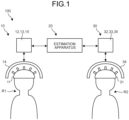
- FIG. 1 is a schematic diagram illustrating an example of a sensory transmission system 100 according to a first embodiment.
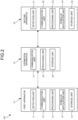
- FIG. 2 is a functional block diagram illustrating an example of the sensory transmission system 100.
- the sensory transmission system 100 includes a first apparatus 10, an estimation apparatus 20, and a second apparatus 30.
- the cerebral activation information may be represented by, for example, a magnitude of an activity level for each voxel when a brain of the first subject R1 is segmented by a three-dimensional matrix that is composed of voxels of few millimeters or less.
- the communication unit 12 is an interface that performs wired communication or wireless communication.
- the communication unit 12 transmits the brain activation information that is detected by the detection unit 11 to the estimation apparatus 20.
- the communication unit 12 includes an interface for performing communication with an external apparatus by what is called a wireless local area network (LAN) that is compliant with IEEE 802.11 standards.
- the communication unit 12 may implement communication with the external apparatus by being controlled by a processing unit 22.
- the communication method is not limited to the wireless LAN, but may include, for example, a wireless communication method, such as an infrared communication method, a Bluetooth (registered trademark) communication method, or a Wireless USB.
- a wired connection such as a USB cable, HDMI (registered trademark), IEEE1394, or Ethernet.
- the processing unit 13, the stimulus application unit 14, and the storage unit 15 will be described later.
- the processing unit 13, the stimulus application unit 14, and the storage unit 15 need not always be arranged.
- the estimation apparatus 20 includes a communication unit 21, the processing unit 22, and a storage unit 23.
- the communication unit 21 is an interface that performs wired communication or wireless communication.
- the communication unit 21 receives, for example, the cerebral activation information that is transmitted from the first apparatus 10.
- the communication unit 21 transmits, for example, corresponding sensory information that is estimated by the processing unit 22 (to be described later) to the second apparatus 30. Meanwhile, the communication unit 21 may have the same configuration as the communication unit 12 as described above.
- the processing unit 22 includes a processing apparatus, such as a Central Processing Unit (CPU), and a storage apparatus, such as a Random Access Memory (RAM) or a Read Only Memory (ROM).
- the processing unit 22 performs various kinds of processes including an estimation process to be described below.
- the sensory information is image data that is perceived by the first subject R1; however, the sensory information is not limited to this example, and may be image data that is obtained by performing sampling on original image data instead of the original image data or image data that is obtained by performing a filtering process on the original image data.
- the sensory information may be information on light that enters an eyeball of the first subject R1. In this case, for example, it may be possible to acquire the information on light by a contact lens that includes an optical sensor. Alternatively, it may be possible to acquire the information on light by using an artificial retina.
- the processing unit 22 estimates corresponding sensory information 44 that corresponds to the reference sensory information 43 with respect to the second subject R2 based on the estimated reference sensory information 43.
- the processing unit 22 inputs the acquired reference sensory information 43 to the second trained model.
- the second trained model outputs the corresponding sensory information 44 that corresponds to the input reference sensory information 43 based on a learning result of a correlation between the reference sensory information 43 and the corresponding sensory information 44.
- the processing unit 22 acquires the output corresponding sensory information 44 as an estimation result.
- the communication unit 21 transmits the acquired corresponding sensory information 44 to the second apparatus 30.
- the sensory transmission system 100 includes the first apparatus 10 that detects cerebral activation information on the first subject R1 when the first subject R1 performs perception, the estimation apparatus 20 that estimates reference sensory information that is sensory information that is evoked in response to the perception based on the detected cerebral activation information on the first subject R1 and estimates corresponding sensory information that is sensory information corresponding to the reference sensory information on the second subject R2 different from the first subject R1 based on the estimated reference sensory information, and the second apparatus 30 that applies a stimulus to the second subject R2 so as to evoke the estimated corresponding sensory information.
- the second subject R2 is not caused to evoke the reference sensory information on the first subject R1 as it is, but the corresponding sensory information that corresponds to the second subject R2 is estimated based on the reference sensory information and a stimulus is applied to the second subject R2 so as to evoke the estimated corresponding sensory information; therefore, even when brain activities are different between the first subject R1 and the second subject R2 when the sensory information is evoked, it is possible to appropriately transmit the sensory information from the first subject R1 to the second subject R2.
- An entire configuration of the sensory transmission system 100 is the same as the first embodiment. In the following, the configuration of the sensory transmission system 100 will be described from the viewpoint of the second apparatus 30 with reference to FIG. 1 and FIG. 2 .
- the processing unit 13 estimates stimulus image information that corresponds to the corresponding sensory information that is received by the communication unit 12.
- the stimulus image information is information indicating a detail of a stimulus that is applied to the first subject R1 by the stimulus application unit 14.
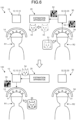
- FIG. 6 is a diagram schematically illustrating an example of operation performed by the sensory transmission system 100.
- the second subject R2 is caused to perform perception so as to evoke the reference sensory information.
- the second subject R2 visually perceives a cat face and evokes visual information.
- the cat face is the same as the cat face of the first embodiment.
- the communication unit 21 receives the cerebral activation information 52 that is transmitted from a third apparatus 130.
- the processing unit 22 estimates reference sensory information 53 based on the received cerebral activation information 52.
- the processing unit 22 inputs the cerebral activation information 52 on the second subject R2 to the fourth trained model.
- the fourth trained model outputs the reference sensory information 53 that corresponds to the input cerebral activation information 52 based on a learning result of a correlation between the cerebral activation information 52 and the reference sensory information 53.
- the processing unit 22 acquires the output reference sensory information 53 as an estimation result.
- a third embodiment will be described below.
- the sensory information that is evoked by the subject for whom the cerebral activation information is detected is adopted as the reference sensory information.
- the third embodiment an example will be described in which standard sensory information that is extracted based on pieces of sensory information that correspond to one another among a plurality of subjects is adopted as the reference sensory information.
- An entire configuration of the sensory transmission system 100 is the same as the first embodiment.
- the standard sensory information may be extracted from a learning result when pieces of sensory information that correspond to one another other among the plurality of subjects is learned. For example, it is possible to generate a sixth trained mode by adopting, as a single training data set, the cerebral activation information on a specific subject (for example, the first subject R1 or the second subject R2) and the standard sensory information (an average value of pieces of cerebral activation information on a plurality of subjects) and performing machine learning on the training data sets.
- the sixth trained model it may be possible to extract the standard sensory information from a plurality of pieces of sensory information included in the training data sets and associate the extracted standard sensory information and each piece of the cerebral activation information included in the training data sets.
- FIG. 7 is a diagram schematically illustrating an example of operation performed by the sensory transmission system 100.
- the first apparatus 10 acquires cerebral activation information 62 on the first subject R1 and transmits the cerebral activation information 62 to the estimation apparatus 20.
- the processing unit 33 inputs the cerebral activation information 62 that is transmitted from the first apparatus 10 and identification information on the second subject R2 who is a transmission destination of the sensory information to the sixth trained model that is stored in the storage unit 35.
- the sixth trained model calculates standard sensory information 63 that corresponds to the cerebral activation information 62, and outputs, as corresponding sensory information 64, the sensory information on the second subject R2 associated with the standard sensory information 63.
- the communication unit 21 transmits the output corresponding sensory information 64 to the second apparatus 30.
- the second apparatus 30 receives, similarly to the first embodiment, the corresponding sensory information 64 that is transmitted from the estimation apparatus 20, and acquires stimulus image information 65 based on the received corresponding sensory information 64.
- the stimulus application unit 34 applies a stimulus to the second subject R2 by applying an electromagnetic wave to the brain of the second subject R2 based on the output stimulus image information 65.
- the second subject R2 to whom the stimulus is applied by the stimulus application unit 34 evokes corresponding sensory information 66 that corresponds to the stimulus image information 65.
- the reference sensory information is the standard sensory information 63 that is extracted based on pieces of sensory information that correspond to one another among a plurality of subjects.
- the standard sensory information 63 that is extracted based on pieces of sensory information that correspond to one other among the plurality of subjects is used as the reference sensory information, so that it is possible to appropriately transmit the sensory information among a large number of subjects.
- FIG. 8 is a diagram illustrating an example of a sensory transmission system 200 according to the fourth embodiment.
- the case has been described in which the sensory information is transmitted between different subjects.
- the sensory transmission system 200 described in the fourth embodiment a case will be described in which the sensory information is transmitted in the same subject.
- the sensory transmission system 200 includes a detection stimulus apparatus (a detection apparatus or a stimulus apparatus) 110 and an estimation apparatus 120.
- the detection stimulus apparatus 110 has the same configuration as the first apparatus 10 described in the embodiments as described above, and includes, for example, the detection unit 11, the communication unit 12, the processing unit 13, the stimulus application unit 14, and the storage unit 15.
- the detection unit 11 detects cerebral activation information.
- the communication unit 12 performs wired communication or wireless communication, and transmits the cerebral activation information that is detected by the detection unit 11 to the estimation apparatus 20.
- the processing unit 13 calculates stimulus image information based on the corresponding sensory information that is received by the communication unit 12.
- the estimation apparatus 120 includes the communication unit 21, the processing unit 22, and the storage unit 23.
- the communication unit 21 is able to perform wired communication or wireless communication.
- the communication unit 21 receives, for example, the cerebral activation information that is transmitted from the detection stimulus apparatus 110.
- the communication unit 21 transmits, for example, corresponding sensory information that is estimated by the processing unit 22 (to be described later) to the detection stimulus apparatus 110.
- the standard sensory information may be adopted, as the reference sensory information, the standard sensory information that is extracted based on sensory information that correspond to one another among a plurality of subjects, for example.
- the standard sensory information for example, it may be possible to adopt information that is extracted based on sensory information that a plurality of subjects who have brain growth conditions equivalent to the target subject R4. Examples of the plurality of subjects as described above include a plurality of subjects with equivalent ages, a plurality of subjects who have grown in equivalent environments (latitude, cultural environments, used languages, or the like), and a plurality of subjects with the same or equivalent occupations.
- the processing unit 22 is able to use an eighth trained model that estimates the standard sensory information based on the cerebral activation information on the target subject R4 at the first time point, for example.
- the eighth trained model may be stored in, for example, the storage unit 25.
- the processing unit 22 estimates the corresponding sensory information that corresponds to the reference sensory information on the target subject R4 at a second time point that is later than the first time point, based on the estimated reference sensory information.
- a degree of growth of the brain of the target subject R4 may largely vary between the first time point and the second time point, for example.
- it may be possible to generate a ninth trained model by adopting, as a single training data set, pieces of sensory information that correspond to each other between the target subject R4 at the first time point and the target subject R4 at the second time point and performing machine learning on the training data set.
- the ninth trained model may be stored in, for example, the storage unit 23.
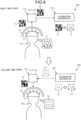
- the subject R4 performs preparation so as to be able to receive a stimulus from the stimulus application unit 14 of the detection stimulus apparatus 110.
- the processing unit 22 estimates corresponding sensory information 74 corresponding to the reference sensory information 73 on the target subject R4 based on the reference sensory information 73 that is stored in the storage unit 25.
- the processing unit 22 inputs the acquired reference sensory information 73 to the ninth trained model.
- the ninth trained model outputs the corresponding sensory information 74 that corresponds to the input reference sensory information 73.
- the processing unit 22 acquires the output corresponding sensory information 74 as an estimation result.
- the communication unit 21 transmits the acquired corresponding sensory information 74 to the detection stimulus apparatus 110.
- the communication unit 12 receives the corresponding sensory information 74 that is transmitted from the estimation apparatus 120.
- the processing unit 13 inputs the received corresponding sensory information 74 to the third trained model that is stored in the storage unit 15.
- the third trained model outputs stimulus image information 75 that corresponds to the input corresponding sensory information 74.
- the stimulus application unit 14 applies a stimulus to the brain of the target subject R4 by applying an electromagnetic wave to the target subject R4 based on the output stimulus image information 75.
- the target subject R4 to whom the stimulus is applied by the stimulus application unit 14 evokes corresponding sensory information 76 that corresponds to the stimulus image information 75.
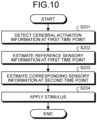
- FIG. 10 is a flowchart illustrating operation performed by the sensory transmission system 200.
- the detection stimulus apparatus 110 detects the cerebral activation information that the target subject R4 evoked at the first time point (Step S201).
- the estimation apparatus 20 estimates the reference sensory information at the first time point based on the cerebral activation information on the target subject R4 (Step S202).
- the estimation apparatus 20 estimates the corresponding sensory information that corresponds to the reference sensory information on the second subject R2 that is different from the first subject R1 based on the estimated reference sensory information (Step S203).
- the second apparatus 30 applies a stimulus to the second subject R2 so as to evoke the estimated corresponding sensory information (Step S204).
- the sensory transmission system 200 includes a detection apparatus (the detection stimulus apparatus 110) that detects cerebral activation information on the target subject R4 when the target subject R4 performs perception, the estimation apparatus 120 that estimates reference sensory information that is sensory information that is evoked in response to the perception based on the cerebral activation information on the target subject R4 that is detected at the first time point, and estimates corresponding sensory information that corresponds to the reference sensory information on the target subject R4 at the second time point later than the first time point based on the estimated reference sensory information, and the stimulus apparatus (the detection stimulus apparatus 110) that applies a stimulus to the target subject R4 at the second time point so as to evoke the estimated corresponding sensory information.
- a detection apparatus the detection stimulus apparatus 110
- the estimation apparatus 120 estimates reference sensory information that is sensory information that is evoked in response to the perception based on the cerebral activation information on the target subject R4 that is detected at the first time point, and estimates corresponding sensory information that corresponds to the reference sensory information on the target subject R4 at the second time point later than the first time point
- the sensory transmission method includes detecting, when the target subject R4 performs perception, cerebral activation information on the target subject R4, estimating reference sensory information that is sensory information that is evoked in response to the perception based on the cerebral activation information on the target subject R4 that is detected at the first time point and estimating corresponding sensory information that corresponds to the reference sensory information on the target subject R4 at the second time point later than the first time point based on the estimated reference sensory information, and applying a stimulus to the target subject R4 at the second time point so as to evoke the estimated corresponding sensory information.
- the target subject R4 at the second time point is not caused to evoke the reference sensory information on the target subject R4 at the first time point as it is, but the corresponding sensory information that corresponds to the target subject R4 at the second time point is estimated based on the reference sensory information, and a stimulus is applied to the target subject R4 so as to evoke the estimated corresponding sensory information. Therefore, even when brain activities that evoke the sensory information vary between the target subject R4 at the first time point and the target subject R4 at the second time point, it is possible to appropriately transmit the sensory information.
- the reference sensory information is sensory information that is evoked by the target subject R4 at the first time point.
- the sensory information on the target subject R4 at the first time point and the sensory information on the target subject R4 at the second time point are directly associated with each other, so that it is possible to appropriately transmit the sensory information.
- the reference sensory information is the standard sensory information that is extracted based on pieces of sensory information that correspond to one another among a plurality of subjects.
- the standard sensory information that is extracted based on the pieces of sensory information that correspond to one another among the plurality of subjects is used as the reference sensory information, so that it is possible to effectively transmit the sensory information between the target subjects R4 at different time points.
- FIG. 11 is a diagram illustrating an example of a sensory transmission system 300 according to a fifth embodiment. As illustrated in FIG. 10 , the sensory transmission system 300 according to the fifth embodiment includes a sensory estimation apparatus 220 and a stimulus apparatus 210.
- the sensory estimation apparatus 220 includes a communication unit 221, a processing unit 222, a storage unit 223, and an input unit 224.
- the communication unit 221 performs wired communication or wireless communication with the stimulus apparatus 210.
- the storage unit 223 stores therein reference sensory information that is sensory information evoked in response to a perception.
- the storage unit 223 includes, for example, a storage, such as a hard disk drive or a solid state drive. Meanwhile, it may be possible to use an external storage medium, such as a removable disk, as the storage unit 223.
- the reference sensory information may be sensory information that a subject R5 or a person different from the subject R5 evokes in response to a perception, or standard sensory information that is extracted based on pieces of sensory information that correspond to one another among a plurality of subjects.
- the stimulus apparatus 210 includes a communication unit 212, a processing unit 213, a stimulus application unit 214, and a storage unit 215.
- the communication unit 212 is able to perform wired communication or wireless communication.
- the communication unit 212 receives the corresponding sensory information that is transmitted from the sensory estimation apparatus 220.
- the communication unit 212 receives the corresponding sensory information 82 that is transmitted from the sensory estimation apparatus 220.
- the processing unit 213 inputs the received corresponding sensory information 82 to the eleventh trained model that is stored in the storage unit 215.
- the eleventh trained model outputs stimulus image information 83 that corresponds to the input corresponding sensory information 82.
- the stimulus application unit 214 applies a stimulus to the subject R5 by applying an electromagnetic wave to the brain of the subject R5 based on the output stimulus image information 83.
- the subject R5 to whom the stimulus is applied by the stimulus application unit 214 evokes corresponding sensory information 84 that corresponds to the stimulus image information 83.
- the subject R5 evokes the visual information on the cat face as the corresponding sensory information 84.
- the sensory estimation apparatus 220 transmits the visual information on the cat face to the subject R5.
- the corresponding sensory information that corresponds to the subject R5 is estimated based on the reference sensory information of the sensory estimation apparatus 220, so that it is possible to estimate appropriate sensory information for each of the subjects R5.
- the reference sensory information is sensory information that a person different from the subject R5 evokes in response to a perception. With this configuration, it is possible to estimate appropriate sensory information between subjects who have different brain activities.
- a trained model When a trained model is to be generated, it may be possible to adopt an instruction, such as "raise right hand” as a content to be provided to a subject, and it may be possible to learn reaction of a motor cortex of the subject. Further, when a trained model is to be generated, it may be possible to adopt a visual and auditory content, such as movie, as a content to be provided to the subject, and it may be possible to learn the entire brain of the subject.
- corresponding sensory information that is derived from certain standard sensory information
- different sensory information For example, it may be possible to transmit, to a transmission destination, corresponding sensory information in which information is replaced with smell information on an orange, taste information on the orange, or tactile information on the orange, based on the standard sensory information corresponding to visual information on the orange.
- the sensory information when the sensory information is to be transmitted from the first subject R1 to the second subject R2, it may be possible to delete command information indicating "transmission of sensory information to the second subject R2", and add communication control information corresponding to a packet header, such as "the first subject R1 evokes the sensory information” or "the first subject R1 requests the second subject R2 to evoke the sensory information".
Landscapes
- Health & Medical Sciences (AREA)
- Engineering & Computer Science (AREA)
- Life Sciences & Earth Sciences (AREA)
- Physics & Mathematics (AREA)
- Biomedical Technology (AREA)
- General Health & Medical Sciences (AREA)
- Public Health (AREA)
- Veterinary Medicine (AREA)
- Animal Behavior & Ethology (AREA)
- Heart & Thoracic Surgery (AREA)
- Psychology (AREA)
- Pathology (AREA)
- Biophysics (AREA)
- Psychiatry (AREA)
- Surgery (AREA)
- Molecular Biology (AREA)
- Medical Informatics (AREA)
- Theoretical Computer Science (AREA)
- General Engineering & Computer Science (AREA)
- Anesthesiology (AREA)
- Dermatology (AREA)
- Hematology (AREA)
- General Physics & Mathematics (AREA)
- Acoustics & Sound (AREA)
- Neurology (AREA)
- Human Computer Interaction (AREA)
- Neurosurgery (AREA)
- Educational Technology (AREA)
- Developmental Disabilities (AREA)
- Hospice & Palliative Care (AREA)
- Child & Adolescent Psychology (AREA)
- Social Psychology (AREA)
- Nuclear Medicine, Radiotherapy & Molecular Imaging (AREA)
- High Energy & Nuclear Physics (AREA)
- Radiology & Medical Imaging (AREA)
- Measurement And Recording Of Electrical Phenomena And Electrical Characteristics Of The Living Body (AREA)
Abstract
Description
- The present disclosure relates to a sensory transmission system, a sensory transmission method, and a sensory transmission program.
- In recent years, a technology, such as functional magnetic resonance or near-infrared spectroscopy, for measuring cerebral activation information in a non-invasive manner has been developed, and a technology for a brain-machine interface that is an interface between a brain and an external apparatus is becoming realistic. As an example using the technology as described above, a certain configuration is disclosed that detects cerebral activation information on a sleeping subject, identifies a sleeping state of the subject, and applies a dream-induction stimulus to the subject when it is identified that the subject is in the REM sleep state (for example, see Patent Literature 1).
-
Japanese Laid-open Patent Publication No. 2003-332251 A - A correspondence relationship between a brain activity state of a subject and measured cerebral activation information varies depending on a personality of the subject, a surrounding environment of the subject at the time of measurement, or the like. For example, in the technology described in Patent Literature 1, a type of dream that the subject has when the dream induction stimulus is applied varies depending on each subject, a timing at which the stimulus is applied, or the like, and it is difficult to control details of the dream. In contrast, when a brain activity state is identified or controlled based on cerebral activation information on a subject, there is a need for a technology that takes into account a certain factor, such as individual differences or differences in surrounding environments of subjects.
- The present disclosure has been conceived in view of the foregoing situation, and an object of the present disclosure is to provide a sensory transmission system and a sensory transmission method capable of appropriately transmitting a sense between subjects when there are individual differences among the subjects or when there are differences in surrounding environments of the subjects. Solution to Problem
- A sensory transmission system according to the present disclosure includes: a first apparatus configured to detect cerebral activation information on a first subject when the first subject performs perception; an estimation apparatus configured to estimate reference sensory information that is sensory information that is evoked in response to the perception based on the detected cerebral activation information on the first subject and estimate corresponding sensory information that is sensory information corresponding to the reference sensory information on a second subject different from the first subject based on the estimated reference sensory information; and a second apparatus configured to apply a stimulus to the second subject so as to evoke the estimated corresponding sensory information.
- A sensory transmission method according to the present disclosure includes: detecting cerebral activation information on a first subject when the first subject performs perception; estimating reference sensory information that is sensory information that is evoked in response to the perception based on the detected cerebral activation information on the first subject; estimating corresponding sensory information that is sensory information corresponding to the reference sensory information on a second subject different from the first subject based on the estimated reference sensory information; and applying a stimulus to the second subject so as to evoke the estimated corresponding sensory information.
- A sensory transmission program according to the present disclosure causes a computer to perform processing including: detecting cerebral activation information on a first subject when the first subject performs perception; estimating reference sensory information that is sensory information that is evoked in response to the perception based on the detected cerebral activation information on the first subject; estimating corresponding sensory information that is sensory information corresponding to the reference sensory information on a second subject different from the first subject based on the estimated reference sensory information; and applying a stimulus to the second subject so as to evoke the estimated corresponding sensory information.
- According to the present disclosure, it is possible to appropriately transmit a sense between subjects when there are individual differences among the subjects or when there are differences in surrounding environments of the subjects.
-
-
FIG. 1 is a schematic diagram illustrating an example of a sensory transmission system according to a first embodiment. -
FIG. 2 is a functional block diagram illustrating an example of the sensory transmission system according to the first embodiment. -
FIG. 3 is a diagram illustrating an example of a neural network. -
FIG. 4 is a diagram schematically illustrating an example of operation performed by the sensory transmission system according to the first embodiment. -
FIG. 5 is a flowchart illustrating an example of operation performed by the sensory transmission system according to the first embodiment. -
FIG. 6 is a diagram schematically illustrating an example of operation performed by a sensory transmission system according to a second embodiment. -
FIG. 7 is a diagram schematically illustrating an example of operation performed by a sensory transmission system according to a third embodiment. -
FIG. 8 is a functional block diagram illustrating an example of a sensory transmission system according to a fourth embodiment. -
FIG. 9 is a diagram schematically illustrating an example of a sensory transmission system according to a fourth embodiment. -
FIG. 10 is a flowchart illustrating an example of operation of the sensory transmission system according to the fourth embodiment. -
FIG. 11 is a functional block diagram illustrating an example of a sensory transmission system according to a fifth embodiment. -
FIG. 12 is a diagram schematically illustrating an example of operation performed by the sensory transmission system according to the fifth embodiment. -
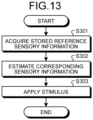
FIG. 13 is a flowchart illustrating an example of the operation performed by the sensory transmission system according to the fifth embodiment. - Embodiments of the present disclosure will be described below based on the drawings. The present invention is not limited by the embodiments below. In addition, components in the embodiments described below include one that can easily be thought of or replaced by a person skilled in the art and one that is practically identical.
-
FIG. 1 is a schematic diagram illustrating an example of asensory transmission system 100 according to a first embodiment.FIG. 2 is a functional block diagram illustrating an example of thesensory transmission system 100. As illustrated inFIG. 1 andFIG. 2 , thesensory transmission system 100 includes afirst apparatus 10, anestimation apparatus 20, and asecond apparatus 30. - The
first apparatus 10 detects cerebral activation information on a first subject R1 when a first subject R1 performs perception. Thefirst apparatus 10 includes adetection unit 11, acommunication unit 12, aprocessing unit 13, astimulus application unit 14, and astorage unit 15. - The
detection unit 11 detects the cerebral activation information. Examples of the cerebral activation information include concentration of oxygenated hemoglobin, concentration of deoxidized hemoglobin, and concentration of total hemoglobin that are included in a cerebral blood flow of the subject. As thedetection unit 11, for example, it may be possible to use a measurement apparatus that performs measurement based on the principle of functional Magnetic Resonance Imaging (fMRI), functional Near-Infrared Spectroscopy (fNIRS), or the like, a measurement apparatus that uses an invasive electrode, a measurement apparatus for which a micromachine is arranged in a cerebral blood vessel and which performs measurement by the micromachine, or the like. Meanwhile, thedetection unit 11 is not limited to the apparatus as described above, but it may be possible to use a different kind of apparatus. The cerebral activation information may be represented by, for example, a magnitude of an activity level for each voxel when a brain of the first subject R1 is segmented by a three-dimensional matrix that is composed of voxels of few millimeters or less. - The
communication unit 12 is an interface that performs wired communication or wireless communication. Thecommunication unit 12 transmits the brain activation information that is detected by thedetection unit 11 to theestimation apparatus 20. Thecommunication unit 12 includes an interface for performing communication with an external apparatus by what is called a wireless local area network (LAN) that is compliant with IEEE 802.11 standards. Thecommunication unit 12 may implement communication with the external apparatus by being controlled by aprocessing unit 22. Meanwhile, the communication method is not limited to the wireless LAN, but may include, for example, a wireless communication method, such as an infrared communication method, a Bluetooth (registered trademark) communication method, or a Wireless USB. Furthermore, it may be possible to adopt a wired connection, such as a USB cable, HDMI (registered trademark), IEEE1394, or Ethernet. - The
processing unit 13, thestimulus application unit 14, and thestorage unit 15 will be described later. In the first embodiment, theprocessing unit 13, thestimulus application unit 14, and thestorage unit 15 need not always be arranged. - The
estimation apparatus 20 includes acommunication unit 21, theprocessing unit 22, and astorage unit 23. Thecommunication unit 21 is an interface that performs wired communication or wireless communication. Thecommunication unit 21 receives, for example, the cerebral activation information that is transmitted from thefirst apparatus 10. Thecommunication unit 21 transmits, for example, corresponding sensory information that is estimated by the processing unit 22 (to be described later) to thesecond apparatus 30. Meanwhile, thecommunication unit 21 may have the same configuration as thecommunication unit 12 as described above. - The
processing unit 22 includes a processing apparatus, such as a Central Processing Unit (CPU), and a storage apparatus, such as a Random Access Memory (RAM) or a Read Only Memory (ROM). Theprocessing unit 22 performs various kinds of processes including an estimation process to be described below. - The
storage unit 23 stores therein various kinds of information. Thestorage unit 23 includes, for example, a storage, such as a hard disk drive or a solid state drive. Meanwhile, it may be possible to use, as thestorage unit 23, an external storage medium, such as a removable disk. - The
processing unit 22 estimates sensory information (reference sensory information) on a sense that the first subject R1 has evoked in response to a perception, based on the detected cerebral activation information on the first subject R1. The sensory information may be, for example, information on at least one of five senses, such as a sense of sight, a sense of hearing, a sense of touch, a sense of taste, and a sense of smell, a sense of balance, a somatosensory system other than the above-described senses, or the like. Specifically, when the sensory information is information on the sense of sight, the sensory information is image data that is perceived by the first subject R1; however, the sensory information is not limited to this example, and may be image data that is obtained by performing sampling on original image data instead of the original image data or image data that is obtained by performing a filtering process on the original image data. Further, when the sensory information is information on the sense of sight, the sensory information may be information on light that enters an eyeball of the first subject R1. In this case, for example, it may be possible to acquire the information on light by a contact lens that includes an optical sensor. Alternatively, it may be possible to acquire the information on light by using an artificial retina. Specifically, it may be possible to use information on light of a charge coupled device (CCD) sensor that is arranged on the artificial retina. Furthermore, when the sensory information is information on the sense of hearing, the sensory information may be voice signal data that is perceived by the first subject R1. Moreover, when the sensory information is information on the sense of taste, the sensory information may be data that indicates indices of a plurality of chemical substances that reproduce the sense of taste that is perceived by the first subject R1. Furthermore, when the sensory information is information on the sense of touch, the sensory information may be data in which a whole body surface of the first subject R1 is developed on a plane and which indicates a portion and a degree of occurrence of a stimulus in the developed view. Meanwhile, the pieces of sensory information as described above are mere examples, and embodiments are not limited to these examples. With respect to the first subject R1, a correspondence relationship between a type of sensory information and a type of cerebral activation information that is observed when each type of sensory information is evoked may be obtained by performing an experiment in advance. For example, it is possible to generate a first trained model by associating the cerebral activation information that is detected from the first subject R1 and sensory information that corresponds to the cerebral activation information, adopting the associated pieces of information as a single training data set, and performing machine learning on the training data set. The first trained model may be stored in, for example, thestorage unit 23. - Furthermore, the
processing unit 22 estimates corresponding sensory information that is sensory information corresponding to reference sensory information on a second subject R2 that is different from the first subject R1 based on the estimated reference sensory information. Meanwhile, specific examples of the corresponding sensory information may be equivalent to specific examples of the sensory information. The second subject R2 is a subject who serves as a transmission destination to which a sense of the first subject R1 is transmitted. As a relationship between the reference sensory information and the corresponding sensory information, it is possible to associate the pieces of information by performing an experiment in advance. For example, it is possible to generate a second trained model by adopting, as a single training data set, pieces of sensory information that correspond to each other between the first subject R1 and the second subject R2 and performing machine learning on the training data set. The second trained model may be stored in, for example, thestorage unit 23. - The
second apparatus 30 applies a stimulus to the second subject R2 so as to evoke the estimated corresponding sensory information. Thesecond apparatus 30 includes adetection unit 31, acommunication unit 32, aprocessing unit 33, astimulus application unit 34, and astorage unit 35. - The
detection unit 31 will be described later. In the first embodiment, thedetection unit 31 need not always be arranged. - The
communication unit 32 is an interface that performs wired communication or wireless communication. Thecommunication unit 32 receives the corresponding sensory information that is transmitted from theestimation apparatus 20. Further, thecommunication unit 32 transmits the cerebral activation information that is detected by thedetection unit 31 to theestimation apparatus 20. Meanwhile, thecommunication unit 32 may have the same configuration as thecommunication unit 12 as described above. - The
stimulus application unit 34 applies a stimulus to the second subject R2 by applying an electromagnetic wave signal to a target part in a brain of the second subject R2 and activating the target part. In this case, the brain of the second subject R2 is segmented by a three-dimensional matrix that is composed of voxels of few millimeters or less and an electromagnetic wave is applied for each of the voxels, for example. Thestimulus application unit 34 is able to apply the electromagnetic wave based on stimulus image information that indicates a voxel in the three-dimensional matrix to which the electromagnetic wave is to be applied and intensity of the electromagnetic wave to be applied. A size, a position, and the like of the voxel in the three-dimensional matrix of the stimulus image information may correspond to those of a voxel of a three-dimensional matrix of the cerebral activation information, for example. It is possible to obtain a correspondence relationship among a voxel in the brain of the second subject R2 to which the electromagnetic wave is to be applied, intensity of the electromagnetic wave, and a type of sensory information to be evoked, by performing an experiment in advance. For example, it is possible to generate a third trained model by associating the stimulus image information on the second subject R2 and sensory information that the second subject R2 evokes when the electromagnetic wave is applied based on the stimulus image information, adopting the pieces of associated information as a single training data set, and performing machine learning on the training data set. The third trained model may be stored in, for example, thestorage unit 35 of thesecond apparatus 30. Theprocessing unit 33 is able to calculate the stimulus image information that corresponds to the received corresponding sensory information based on the corresponding sensory information that is received by thecommunication unit 32 and the third trained model. - The first trained model, the second trained model, and the third trained model as described above may be generated by using, for example, a neural network (convolutional neural network) that is represented by VGG16.
FIG. 3 is a diagram illustrating an example of the neural network. As illustrated in an upper part inFIG. 3 , a neural network NW includes 13 convolutional layers S1, five pooling layers S2, and three fully-connected layers S3. The neural network performs processes on input information in the convolutional layers S1 and the pooling layers S2 in sequence, and processing results are connected by the fully-connected layers S3 and then output. - When the first trained model, the second trained model, and the third trained model are to be generated, as illustrated in a middle part in
FIG. 3 , training data sets including pieces of information (I1 and I2) that correspond to each other are input to the neural network NW, and a correlation between the training data sets is learned by machine learning, such as deep learning. In other words, the neural network NW is optimized by training and the trained models are generated. For example, training is performed such that one of the pieces of information included in the respective training data sets is solved when the other one of the pieces of information is input. - When estimation is to be performed by using the first trained model, the second trained model, and the third trained model, as illustrated in the lower part in
FIG. 3 , the information I1 that is one of the two pieces of information included in the respective training data sets is input to the neural network NW. The first trained model, the second trained model, and the third trained model output the information I2 that is the other one of the pieces of information and that corresponds to the input information I1 that is one of the pieces of information, based on a learning result of the correlation between the pieces of information included in the training data sets. Meanwhile, in the present embodiment, the example is described in which the trained models are generated by using the convolutional neural network that is represented by VGG16, but embodiments are not limited to this example, and it may be possible to generate the trained models by using a different kind of neural network. - A sensory transmission method using the
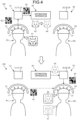
sensory transmission system 100 that is configured as described above will be described below.FIG. 4 is a diagram schematically illustrating an example of operation performed by thesensory transmission system 100. As illustrated inFIG. 4 , the first subject R1 is caused to perform perception so as to evoke the reference sensory information. In the following, an example will be described in which the first subject R1 visually perceives a cat face and evokes visual information. - As illustrated in an upper pert in
FIG. 4 , thedetection unit 11 detectscerebral activation information 42 on the first subject R1 who perceives a cat face and evokessensory information 41. Thecommunication unit 12 transmits thecerebral activation information 42 that is detected by thedetection unit 11 to theestimation apparatus 20. - In the
estimation apparatus 20, thecommunication unit 21 receives thecerebral activation information 42 that is transmitted from thefirst apparatus 10. Theprocessing unit 22 estimates referencesensory information 43 based on the receivedcerebral activation information 42. In this case, theprocessing unit 22 inputs thecerebral activation information 42 on the first subject R1 to the first trained model. The first trained model outputs the referencesensory information 43 that corresponds to the inputcerebral activation information 42 based on a learning result of a correlation between thecerebral activation information 42 and the referencesensory information 43. Theprocessing unit 22 acquires the output referencesensory information 43 as an estimation result. - The
processing unit 22 estimates correspondingsensory information 44 that corresponds to the referencesensory information 43 with respect to the second subject R2 based on the estimated referencesensory information 43. In this case, theprocessing unit 22 inputs the acquired referencesensory information 43 to the second trained model. The second trained model outputs the correspondingsensory information 44 that corresponds to the input referencesensory information 43 based on a learning result of a correlation between the referencesensory information 43 and the correspondingsensory information 44. Theprocessing unit 22 acquires the output correspondingsensory information 44 as an estimation result. Thecommunication unit 21 transmits the acquired correspondingsensory information 44 to thesecond apparatus 30. - In the
second apparatus 30, thecommunication unit 32 receives the correspondingsensory information 44 that is transmitted from theestimation apparatus 20. Theprocessing unit 33 inputs the received correspondingsensory information 44 to the third trained model that is stored in thestorage unit 35. The third trained model outputsstimulus image information 45 that corresponds to the input correspondingsensory information 44 based on a learning result of a correlation between the correspondingsensory information 44 and the stimulus image information. Thestimulus application unit 34 applies a stimulus to the second subject R2 by applying an electromagnetic wave to the brain of the second subject R2 based on the outputstimulus image information 45. As a result, the second subject R2 to whom the stimulus is applied by thestimulus application unit 34 evokes correspondingsensory information 46 that corresponds to thestimulus image information 45. In other words, the second subject R2 evokes visual information on the cat face as the correspondingsensory information 46. - Meanwhile, the first subject R1 and the second subject R2 have different personalities or the like, and therefore, correspondence relationships between brain activity states and the cerebral activation information vary. Therefore, as illustrated in a lower part in
FIG. 4 (indicated by a chain line), if thecerebral activation information 42 on the first subject R1 is directly transmitted to thesecond apparatus 30 and thesecond apparatus 30 applies a stimulus to the brain of the second subject R2 so as to correspond to thecerebral activation information 42, the second subject R2 is more likely to evoke different visual information from the cat face assensory information 47. In this case, the sensory information on the first subject R1 is not appropriately transmitted to the second subject R2. - In contrast, in the
sensory transmission system 100 of the present embodiment, theestimation apparatus 20 estimates the correspondingsensory information 44 on the second subject R2, so that the visual information on the cat face is appropriately transmitted from the first subject R1 to the second subject R2. -
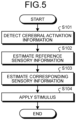
FIG. 5 is a flowchart illustrating operation performed by thesensory transmission system 100. As illustrated inFIG. 5 , in thesensory transmission system 100, thefirst apparatus 10 detects the cerebral activation information on the first subject R1 when the first subject R1 performs perception (Step S101). Subsequently, theestimation apparatus 20 estimates the reference sensory information that the first subject R1 has evoked in response to the perception, based on the cerebral activation information on the first subject R1 (Step S102). Then, theestimation apparatus 20 estimates the corresponding sensory information that corresponds to the reference sensory information on the second subject R2 that is different from the first subject R1, based on the estimated reference sensory information (Step S103). Further, thesecond apparatus 30 applies a stimulus to the second subject R2 so as to evoke the estimated corresponding sensory information (Step S104). - As described above, the
sensory transmission system 100 according to the present embodiment includes thefirst apparatus 10 that detects cerebral activation information on the first subject R1 when the first subject R1 performs perception, theestimation apparatus 20 that estimates reference sensory information that is sensory information that is evoked in response to the perception based on the detected cerebral activation information on the first subject R1 and estimates corresponding sensory information that is sensory information corresponding to the reference sensory information on the second subject R2 different from the first subject R1 based on the estimated reference sensory information, and thesecond apparatus 30 that applies a stimulus to the second subject R2 so as to evoke the estimated corresponding sensory information. - The sensory transmission method according to the present embodiment includes detecting cerebral activation information on the first subject R1 when the first subject R1 performs perception, estimating reference sensory information that the first subject R1 has evoked in response to the perception based on the detected cerebral activation information on the first subject R1 and estimating corresponding sensory information that corresponds to the reference sensory information on the second subject R2 different from the first subject R1 based on the estimated reference sensory information, and applying a stimulus to the second subject R2 so as to evoke the estimated corresponding sensory information.
- A sensory transmission program according to the present embodiment causes a computer to perform processing including: detecting cerebral activation information on the first subject R1 when the first subject R1 performs perception; estimating reference sensory information that the first subject R1 has evoked in response to the perception based on the detected cerebral activation information on the first subject R1; estimating corresponding sensory information that corresponds to the reference sensory information on the second subject R2 different from the first subject R1 based on the estimated reference sensory information; and applying a stimulus to the second subject R2 so as to evoke the estimated corresponding sensory information.
- With this configuration, the second subject R2 is not caused to evoke the reference sensory information on the first subject R1 as it is, but the corresponding sensory information that corresponds to the second subject R2 is estimated based on the reference sensory information and a stimulus is applied to the second subject R2 so as to evoke the estimated corresponding sensory information; therefore, even when brain activities are different between the first subject R1 and the second subject R2 when the sensory information is evoked, it is possible to appropriately transmit the sensory information from the first subject R1 to the second subject R2.
- In the
sensory transmission system 100 according to the present embodiment, the reference sensory information is sensory information that is evoked by the first subject R1 for whom the cerebral activation information is detected. With this configuration, the sensory information on the first subject R1 and the sensory information on the second subject R2 are directly associated with each other, so that it is possible to appropriately transmit the sensory information. - In the
sensory transmission system 100 according to the present embodiment, the stimulus includes activation of a target part by application of an electromagnetic wave signal to the target part in the brain of the second subject R2. With this configuration, by directly activating the brain of the second subject R2, it is possible to cause the second subject R2 to more directly evoke the sensory information. - A second embodiment will be described below. In the first embodiment, the example has been described in which the
sensory transmission system 100 transmits a sense in one direction from the first subject R1 to the second subject R2. In contrast, in the second embodiment, thesensory transmission system 100 transmits a sense even from the second subject R2 to the first subject R1. In other words, thesensory transmission system 100 is configured so as to be able to bi-directionally transmit a sense between the first subject R1 and the second subject R2. - An entire configuration of the
sensory transmission system 100 is the same as the first embodiment. In the following, the configuration of thesensory transmission system 100 will be described from the viewpoint of thesecond apparatus 30 with reference toFIG. 1 andFIG. 2 . - The
second apparatus 30 includes thedetection unit 31, thecommunication unit 32, theprocessing unit 33, thestimulus application unit 34, and thestorage unit 35. Theprocessing unit 33, thestimulus application unit 34, and thestorage unit 35 are the same as those of the first embodiment. Thedetection unit 31 detects the cerebral activation information on the second subject R2 similarly to thedetection unit 11 of the first embodiment. Thecommunication unit 32 transmits the cerebral activation information that is detected by thedetection unit 31 to theestimation apparatus 20. - The
estimation apparatus 20 includes, similarly to theestimation apparatus 20 of the first embodiment, thecommunication unit 21, theprocessing unit 22, and thestorage unit 23. Thecommunication unit 21 is able to perform wired communication or wireless communication. In the present embodiment, thecommunication unit 21 receives, for example, the cerebral activation information that is transmitted from thesecond apparatus 30. Thecommunication unit 21 transmits, for example, corresponding sensory information that is estimated by the processing unit 22 (to be described later) to thefirst apparatus 10. - The
processing unit 22 estimates sensory information (reference sensory information) on a sense that the second subject R2 has evoked in response to a perception, based on the detected cerebral activation information on the second subject R2. With respect to the second subject R2, a correspondence relationship between a type of sensory information and a type of cerebral activation information that is observed when each type of sensory information is evoked may be obtained by performing an experiment in advance. For example, it is possible to generate a fourth trained model by associating the cerebral activation information that is detected from the second subject R2 and sensory information that corresponds to the cerebral activation information, adopting the associated pieces of information as a single training data set, and performing machine learning on the training data set. The fourth trained model may be stored in, for example, thestorage unit 23. - Furthermore, the
processing unit 22 estimates corresponding sensory information that is sensory information corresponding to reference sensory information on the first subject R1 based on the estimated reference sensory information. In this case, theprocessing unit 22 is able to perform estimation based on the second trained model that is stored in thestorage unit 23. - The
first apparatus 10 includes thedetection unit 11, thecommunication unit 12, theprocessing unit 13, thestimulus application unit 14, and thestorage unit 15. Thedetection unit 11 and thecommunication unit 12 have the same configurations as those of the first embodiment. Meanwhile, thecommunication unit 12 receives the corresponding sensory information that is transmitted from theestimation apparatus 20. - The
processing unit 13 estimates stimulus image information that corresponds to the corresponding sensory information that is received by thecommunication unit 12. The stimulus image information is information indicating a detail of a stimulus that is applied to the first subject R1 by thestimulus application unit 14. - The
stimulus application unit 14 applies a stimulus to the first subject R1 by applying an electromagnetic wave signal to a target part in a brain of the first subject R1 and activating the target part. In this case, similarly to thestimulus application unit 34 of the first embodiment, the brain of the first subject R1 is segmented into a three-dimensional matrix that is composed of voxels of few millimeters or less and an electromagnetic wave is applied for each of the voxels, for example. Thestimulus application unit 14 is able to apply electromagnetic wave based on stimulus image information that indicates a voxel in the three-dimensional matrix to which the electromagnetic wave is to be applied and intensity of the electromagnetic wave to be applied. It is possible to obtain a correspondence relationship among a voxel in the brain of the first subject R1 to which electromagnetic wave is to be applied, intensity of the electromagnetic wave, and a type of sensory information to be evoked, by performing an experiment in advance. For example, it is possible to generate a fifth trained model by associating the stimulus image information on the first subject R1 and sensory information that the first subject R1 evokes when the electromagnetic wave is applied based on the stimulus image information, adopting the pieces of associated information as a single training data set, and performing machine learning on the training data set. The fifth trained model may be stored in, for example, thestorage unit 15 of thefirst apparatus 10. - The fourth trained model and the fifth trained model as described above may be generated by using, for example, a neural network that is represented by VGG16, similarly to the first trained model to the third trained model. When the fourth trained model and the fifth trained model are to be generated, respective training data sets are input to the neural network, and a correlation between the training data sets is learned by machine learning, such as deep learning. In other words, the neural network is optimized by training and the trained models are generated. Meanwhile, the neural network is not limited to the convolutional neural network that is represented by VGG16, but it may be possible to generate the trained models by using a different kind of neural network.
- A sensory transmission method using the
sensory transmission system 100 that is configured as described above will be described below. Meanwhile, the sensory transmission method for transmitting a sense from the first subject R1 to the second subject R2 is the same as the first embodiment. In the present embodiment, a case will be described in which a sense is transmitted from the second subject R2 to the first subject R1. -
FIG. 6 is a diagram schematically illustrating an example of operation performed by thesensory transmission system 100. As illustrated inFIG. 6 , the second subject R2 is caused to perform perception so as to evoke the reference sensory information. In the following, an example will be described in which the second subject R2 visually perceives a cat face and evokes visual information. Meanwhile, in the example below, the cat face is the same as the cat face of the first embodiment. - As illustrated in an upper part in
FIG. 6 , thedetection unit 31 detectscerebral activation information 52 on the second subject R2 who perceives the cat face and evokessensory information 51. Thecommunication unit 32 transmits thecerebral activation information 52 that is detected by thedetection unit 31 to theestimation apparatus 20. - In the
estimation apparatus 20, thecommunication unit 21 receives thecerebral activation information 52 that is transmitted from a third apparatus 130. Theprocessing unit 22 estimates referencesensory information 53 based on the receivedcerebral activation information 52. In this case, theprocessing unit 22 inputs thecerebral activation information 52 on the second subject R2 to the fourth trained model. The fourth trained model outputs the referencesensory information 53 that corresponds to the inputcerebral activation information 52 based on a learning result of a correlation between thecerebral activation information 52 and the referencesensory information 53. Theprocessing unit 22 acquires the output referencesensory information 53 as an estimation result. - The
processing unit 22 estimates correspondingsensory information 54 that corresponds to the referencesensory information 53 with respect to the first subject R1 based on the estimated referencesensory information 53. In this case, theprocessing unit 22 inputs the acquired referencesensory information 53 to the second trained model. The second trained model outputs the correspondingsensory information 54 that corresponds to the input referencesensory information 53 based on a learning result of a correlation between the referencesensory information 53 and the correspondingsensory information 54. Theprocessing unit 22 acquires the output correspondingsensory information 54 as an estimation result. Thecommunication unit 21 transmits the acquired correspondingsensory information 54 to thefirst apparatus 10. - As illustrated in a lower part in
FIG. 6 , in thefirst apparatus 10, thecommunication unit 12 receives the correspondingsensory information 54 that is transmitted from theestimation apparatus 20. Theprocessing unit 13 inputs the received correspondingsensory information 54 to the fifth trained model that is stored in thestorage unit 15. The fifth trained model outputsstimulus image information 55 that corresponds to the input correspondingsensory information 54 based on a learning result of a correlation between the correspondingsensory information 54 and thestimulus image information 55. Thestimulus application unit 14 applies a stimulus to the first subject R1 by applying an electromagnetic wave to the brain of the first subject R1 based on the outputstimulus image information 55. As a result, the first subject R1 to whom the stimulus is applied by thestimulus application unit 14 evokes correspondingsensory information 56 that corresponds to thestimulus image information 55. In other words, the first subject R1 evokes the visual information on the cat face as the correspondingsensory information 56. In this manner, the visual information on the cat face is transmitted from the second subject R2 to the first subject R1. - As described above, in the
sensory transmission system 100 according to the present embodiment, the reference sensory information is sensory information that is evoked by the second subject R2 for whom the cerebral activation information is detected. With this configuration, the sensory information on the second subject R2 and the sensory information on the first subject R1 are directly associated with each other, so that it is possible to appropriately transmit the sensory information between subjects who have different brain activities. - A third embodiment will be described below. In the first embodiment and the second embodiment as described above, the sensory information that is evoked by the subject for whom the cerebral activation information is detected is adopted as the reference sensory information. In contrast, in the third embodiment, an example will be described in which standard sensory information that is extracted based on pieces of sensory information that correspond to one another among a plurality of subjects is adopted as the reference sensory information. An entire configuration of the
sensory transmission system 100 is the same as the first embodiment. - In the
estimation apparatus 20, when the corresponding sensory information is to be estimated from the reference sensory information, the standard sensory information is used as the reference sensory information. The standard sensory information may be, for example, an average value of pieces of cerebral activation information that are detected in a plurality of subjects when a plurality of detectors perform same perception, for example, when a plurality of detectors view the same image. Therefore, in the standard sensory information, individual differences due to acquired memories is reduced, and the standard sensory information serves as sensory information on an average person. - The standard sensory information may be extracted from a learning result when pieces of sensory information that correspond to one another other among the plurality of subjects is learned. For example, it is possible to generate a sixth trained mode by adopting, as a single training data set, the cerebral activation information on a specific subject (for example, the first subject R1 or the second subject R2) and the standard sensory information (an average value of pieces of cerebral activation information on a plurality of subjects) and performing machine learning on the training data sets. When the sixth trained model is to be generated, it may be possible to extract the standard sensory information from a plurality of pieces of sensory information included in the training data sets and associate the extracted standard sensory information and each piece of the cerebral activation information included in the training data sets. As a result, for example, the sixth trained model is generated such that the correspondence relationship between each piece of the brain activation information on the plurality of subjects and the standard sensory information is subjected to machine learning with respect to different kinds of sensory information, such as sensory information on the sense of sight when a certain target object is viewed, sensory information on the sense of hearing when certain sound is heard, or sensory information on the sense of touch when a certain target object is touched. The sixth trained model may be stored in, for example, a storage unit 25.
- A sensory transmission method using the
sensory transmission system 100 that is configured as described above will be described below.FIG. 7 is a diagram schematically illustrating an example of operation performed by thesensory transmission system 100. For example, whensensory information 61 that the first subject R1 has evoked in response to the perception is to be transmitted to the second subject R2, thefirst apparatus 10 acquirescerebral activation information 62 on the first subject R1 and transmits thecerebral activation information 62 to theestimation apparatus 20. - In the
estimation apparatus 20, theprocessing unit 33 inputs thecerebral activation information 62 that is transmitted from thefirst apparatus 10 and identification information on the second subject R2 who is a transmission destination of the sensory information to the sixth trained model that is stored in thestorage unit 35. The sixth trained model calculates standardsensory information 63 that corresponds to thecerebral activation information 62, and outputs, as correspondingsensory information 64, the sensory information on the second subject R2 associated with the standardsensory information 63. Thecommunication unit 21 transmits the output correspondingsensory information 64 to thesecond apparatus 30. - The
second apparatus 30 receives, similarly to the first embodiment, the correspondingsensory information 64 that is transmitted from theestimation apparatus 20, and acquiresstimulus image information 65 based on the received correspondingsensory information 64. Thestimulus application unit 34 applies a stimulus to the second subject R2 by applying an electromagnetic wave to the brain of the second subject R2 based on the outputstimulus image information 65. The second subject R2 to whom the stimulus is applied by thestimulus application unit 34 evokes correspondingsensory information 66 that corresponds to thestimulus image information 65. - As described above, in the
sensory transmission system 100 according to the present embodiment, the reference sensory information is the standardsensory information 63 that is extracted based on pieces of sensory information that correspond to one another among a plurality of subjects. With this configuration, the standardsensory information 63 that is extracted based on pieces of sensory information that correspond to one other among the plurality of subjects is used as the reference sensory information, so that it is possible to appropriately transmit the sensory information among a large number of subjects. -
FIG. 8 is a diagram illustrating an example of asensory transmission system 200 according to the fourth embodiment. In thesensory transmission system 100 of the embodiments as described above, the case has been described in which the sensory information is transmitted between different subjects. In contrast, in thesensory transmission system 200 described in the fourth embodiment, a case will be described in which the sensory information is transmitted in the same subject. - As illustrated in
FIG. 8 , thesensory transmission system 200 includes a detection stimulus apparatus (a detection apparatus or a stimulus apparatus) 110 and anestimation apparatus 120. Thedetection stimulus apparatus 110 has the same configuration as thefirst apparatus 10 described in the embodiments as described above, and includes, for example, thedetection unit 11, thecommunication unit 12, theprocessing unit 13, thestimulus application unit 14, and thestorage unit 15. Thedetection unit 11 detects cerebral activation information. Thecommunication unit 12 performs wired communication or wireless communication, and transmits the cerebral activation information that is detected by thedetection unit 11 to theestimation apparatus 20. Theprocessing unit 13 calculates stimulus image information based on the corresponding sensory information that is received by thecommunication unit 12. Thestimulus application unit 14 applies a stimulus to a target subject R4 by applying an electromagnetic wave signal to a target part in a brain of the target subject R4 based on the calculated stimulus image information and activating the target part. Thestorage unit 15 stores therein various kinds of information. - The
estimation apparatus 120 includes thecommunication unit 21, theprocessing unit 22, and thestorage unit 23. Thecommunication unit 21 is able to perform wired communication or wireless communication. In the present embodiment, thecommunication unit 21 receives, for example, the cerebral activation information that is transmitted from thedetection stimulus apparatus 110. Thecommunication unit 21 transmits, for example, corresponding sensory information that is estimated by the processing unit 22 (to be described later) to thedetection stimulus apparatus 110. - The
processing unit 22 estimates the reference sensory information that is evoked in response to a perception, based on the cerebral activation information on the target subject R4 that is detected at a first time point. The first time point may be a time point at which the target subject R4 was a young child and may be a time point at which the target subject R4 was younger than 3 years old, for example. - As the reference sensory information, for example, it is possible to adopt the sensory information that the target subject R4 evoked in response to a perception at the first time point. In this case, the
processing unit 22 is able to estimate the reference sensory information based on a seventh trained model that is the same as the first trained model as described above. The seventh trained model may be stored in, for example, the storage unit 25. - Furthermore, it may be possible to adopt, as the reference sensory information, the standard sensory information that is extracted based on sensory information that correspond to one another among a plurality of subjects, for example. As the standard sensory information, for example, it may be possible to adopt information that is extracted based on sensory information that a plurality of subjects who have brain growth conditions equivalent to the target subject R4. Examples of the plurality of subjects as described above include a plurality of subjects with equivalent ages, a plurality of subjects who have grown in equivalent environments (latitude, cultural environments, used languages, or the like), and a plurality of subjects with the same or equivalent occupations. The
processing unit 22 is able to use an eighth trained model that estimates the standard sensory information based on the cerebral activation information on the target subject R4 at the first time point, for example. The eighth trained model may be stored in, for example, the storage unit 25. - Moreover, the
processing unit 22 estimates the corresponding sensory information that corresponds to the reference sensory information on the target subject R4 at a second time point that is later than the first time point, based on the estimated reference sensory information. A degree of growth of the brain of the target subject R4 may largely vary between the first time point and the second time point, for example. For example, it may be possible to generate a ninth trained model by adopting, as a single training data set, pieces of sensory information that correspond to each other between the target subject R4 at the first time point and the target subject R4 at the second time point and performing machine learning on the training data set. The ninth trained model may be stored in, for example, thestorage unit 23. - A sensory transmission method using the
sensory transmission system 200 that is configured as described above will be described below.FIG. 9 is a diagram schematically illustrating an example of operation performed by thesensory transmission system 100. As illustrated in an upper part inFIG. 9 , thedetection unit 11 of thedetection stimulus apparatus 110 detectscerebral activation information 72 on the target subject R4 who perceives a cat face and evokessensory information 71. Thecommunication unit 12 transmits thecerebral activation information 72 that is detected by thedetection unit 11 to theestimation apparatus 120. In theestimation apparatus 120, thecommunication unit 21 receives thecerebral activation information 72 that is transmitted from thedetection stimulus apparatus 110. Theprocessing unit 22 inputs the received cerebral activation information to the seventh trained model or the eighth trained model. The seventh trained model or the eighth trained model outputs referencesensory information 73 that corresponds to the inputcerebral activation information 72. Theprocessing unit 22 acquires the output referencesensory information 73 as an estimation result. The storage unit 25 stores therein the acquired referencesensory information 73. - As illustrated in a lower part in
FIG. 9 , at the second time point later than the first time point, for example, when the target subject R4 attempts to relieve the experience of perception of the cat face as described above, the subject R4 performs preparation so as to be able to receive a stimulus from thestimulus application unit 14 of thedetection stimulus apparatus 110. Theprocessing unit 22 estimates correspondingsensory information 74 corresponding to the referencesensory information 73 on the target subject R4 based on the referencesensory information 73 that is stored in the storage unit 25. In this case, theprocessing unit 22 inputs the acquired referencesensory information 73 to the ninth trained model. The ninth trained model outputs the correspondingsensory information 74 that corresponds to the input referencesensory information 73. Theprocessing unit 22 acquires the output correspondingsensory information 74 as an estimation result. Thecommunication unit 21 transmits the acquired correspondingsensory information 74 to thedetection stimulus apparatus 110. - In the
detection stimulus apparatus 110, thecommunication unit 12 receives the correspondingsensory information 74 that is transmitted from theestimation apparatus 120. Theprocessing unit 13 inputs the received correspondingsensory information 74 to the third trained model that is stored in thestorage unit 15. The third trained model outputsstimulus image information 75 that corresponds to the input correspondingsensory information 74. Thestimulus application unit 14 applies a stimulus to the brain of the target subject R4 by applying an electromagnetic wave to the target subject R4 based on the outputstimulus image information 75. As a result, the target subject R4 to whom the stimulus is applied by thestimulus application unit 14 evokes correspondingsensory information 76 that corresponds to thestimulus image information 75. In other words, the target subject R4 evokes the visual information that was evoked by viewing the cat face at the first time point, as the correspondingsensory information 76 at the second time point. In this manner, the visual information on the cat face is transmitted from the target subject R4 at the first time point to the target subject R4 at the second time point. Consequently, the target subject R4 is able to relieve the experience of viewing the cat face. -
FIG. 10 is a flowchart illustrating operation performed by thesensory transmission system 200. As illustrated inFIG. 10 , in thesensory transmission system 200, thedetection stimulus apparatus 110 detects the cerebral activation information that the target subject R4 evoked at the first time point (Step S201). Subsequently, theestimation apparatus 20 estimates the reference sensory information at the first time point based on the cerebral activation information on the target subject R4 (Step S202). Then, theestimation apparatus 20 estimates the corresponding sensory information that corresponds to the reference sensory information on the second subject R2 that is different from the first subject R1 based on the estimated reference sensory information (Step S203). Subsequently, thesecond apparatus 30 applies a stimulus to the second subject R2 so as to evoke the estimated corresponding sensory information (Step S204). - As described above, the
sensory transmission system 200 according to the present embodiment includes a detection apparatus (the detection stimulus apparatus 110) that detects cerebral activation information on the target subject R4 when the target subject R4 performs perception, theestimation apparatus 120 that estimates reference sensory information that is sensory information that is evoked in response to the perception based on the cerebral activation information on the target subject R4 that is detected at the first time point, and estimates corresponding sensory information that corresponds to the reference sensory information on the target subject R4 at the second time point later than the first time point based on the estimated reference sensory information, and the stimulus apparatus (the detection stimulus apparatus 110) that applies a stimulus to the target subject R4 at the second time point so as to evoke the estimated corresponding sensory information. - Furthermore, the sensory transmission method according to the present embodiment includes detecting, when the target subject R4 performs perception, cerebral activation information on the target subject R4, estimating reference sensory information that is sensory information that is evoked in response to the perception based on the cerebral activation information on the target subject R4 that is detected at the first time point and estimating corresponding sensory information that corresponds to the reference sensory information on the target subject R4 at the second time point later than the first time point based on the estimated reference sensory information, and applying a stimulus to the target subject R4 at the second time point so as to evoke the estimated corresponding sensory information.
- With this configuration, the target subject R4 at the second time point is not caused to evoke the reference sensory information on the target subject R4 at the first time point as it is, but the corresponding sensory information that corresponds to the target subject R4 at the second time point is estimated based on the reference sensory information, and a stimulus is applied to the target subject R4 so as to evoke the estimated corresponding sensory information. Therefore, even when brain activities that evoke the sensory information vary between the target subject R4 at the first time point and the target subject R4 at the second time point, it is possible to appropriately transmit the sensory information.
- In the
sensory transmission system 200 according to the present embodiment, the reference sensory information is sensory information that is evoked by the target subject R4 at the first time point. With this configuration, the sensory information on the target subject R4 at the first time point and the sensory information on the target subject R4 at the second time point are directly associated with each other, so that it is possible to appropriately transmit the sensory information. - In the
sensory transmission system 200 according to the present embodiment, the reference sensory information is the standard sensory information that is extracted based on pieces of sensory information that correspond to one another among a plurality of subjects. With this configuration, the standard sensory information that is extracted based on the pieces of sensory information that correspond to one another among the plurality of subjects is used as the reference sensory information, so that it is possible to effectively transmit the sensory information between the target subjects R4 at different time points. - In the
sensory transmission system 200 according to the present embodiment, the standard sensory information is extracted based on pieces of sensory information that are evoked by a plurality of subjects who have brain growth conditions equivalent to the target subject R4. With this configuration, it is possible to effectively transmit the sensory information between the target subjects R4 at different time points based on the pieces of sensory information that are evoked by a plurality of subjects who have brain growth conditions equivalent to the target subject R4. -
FIG. 11 is a diagram illustrating an example of asensory transmission system 300 according to a fifth embodiment. As illustrated inFIG. 10 , thesensory transmission system 300 according to the fifth embodiment includes asensory estimation apparatus 220 and astimulus apparatus 210. - The
sensory estimation apparatus 220 includes acommunication unit 221, aprocessing unit 222, astorage unit 223, and aninput unit 224. Thecommunication unit 221 performs wired communication or wireless communication with thestimulus apparatus 210. Thestorage unit 223 stores therein reference sensory information that is sensory information evoked in response to a perception. Thestorage unit 223 includes, for example, a storage, such as a hard disk drive or a solid state drive. Meanwhile, it may be possible to use an external storage medium, such as a removable disk, as thestorage unit 223. The reference sensory information may be sensory information that a subject R5 or a person different from the subject R5 evokes in response to a perception, or standard sensory information that is extracted based on pieces of sensory information that correspond to one another among a plurality of subjects. - The
processing unit 222 estimates corresponding sensory information that is sensory information corresponding to the reference sensory information on the subject R5, based on the reference sensory information that is stored in thestorage unit 223. For example, it is possible to generate a tenth trained model by adopting, as a single training data set, sensory information on the subject R5 and sensory information corresponding to the reference sensory information, and performing machine learning on the training data set. The tenth trained model may be stored in, for example, thestorage unit 223. When the input unit 224 (to be described later) designates the reference sensory information, theprocessing unit 222 estimates corresponding sensory information that corresponds to the designated reference sensory information, for example. - The
input unit 224 is able to perform predetermined input operation for inputting information. As theinput unit 224, for example, an input device, such as a keyboard or a touch pane, may be used. Meanwhile, it may be possible to use, as theinput unit 224, a button, a lever, a dial, a switch, or a different input device in addition to or in place of the above-described input device. Theinput unit 224 is able to input sensory information that the subject R5 wants to experience from among a plurality of pieces of reference sensory information stored in thestorage unit 223, for example. - The
stimulus apparatus 210 includes acommunication unit 212, aprocessing unit 213, astimulus application unit 214, and astorage unit 215. Thecommunication unit 212 is able to perform wired communication or wireless communication. Thecommunication unit 212 receives the corresponding sensory information that is transmitted from thesensory estimation apparatus 220. - The
processing unit 213 calculates stimulus image information corresponding to the received corresponding sensory information based on the corresponding sensory information that is received by thecommunication unit 212 and an eleventh trained model that has learned a correspondence relationship between the corresponding sensory information and the stimulus image information. The eleventh trained model may be the same trained model as the third trained model of the first embodiment as described above, for example. Thestimulus application unit 214 applies a stimulus to the subject R5 by applying an electromagnetic wave signal to a target part in a brain of the subject R5 and activating the target part. - A sensory transmission method using the
sensory transmission system 300 that is configured as described above will be described below.FIG. 12 is a diagram schematically illustrating an example of operation performed by thesensory transmission system 300 according to the present embodiment. The subject R5 performs preparation so as to be able to receive a stimulus from thestimulus application unit 214 of thestimulus apparatus 210. When the subject R selects referencesensory information 81 via theinput unit 224, theprocessing unit 222 in thesensory estimation apparatus 220 estimates correspondingsensory information 82 on the subject R5 based on the selected referencesensory information 81. Theprocessing unit 222 inputs, for example, the selected referencesensory information 81 to the tenth trained model. The tenth trained model outputs the correspondingsensory information 82 that corresponds to the input referencesensory information 81. Theprocessing unit 222 acquires the output correspondingsensory information 82 as an estimation result. Thecommunication unit 221 transmits the acquired correspondingsensory information 82 to thestimulus apparatus 210. - In the
stimulus apparatus 210, thecommunication unit 212 receives the correspondingsensory information 82 that is transmitted from thesensory estimation apparatus 220. Theprocessing unit 213 inputs the received correspondingsensory information 82 to the eleventh trained model that is stored in thestorage unit 215. The eleventh trained model outputsstimulus image information 83 that corresponds to the input correspondingsensory information 82. Thestimulus application unit 214 applies a stimulus to the subject R5 by applying an electromagnetic wave to the brain of the subject R5 based on the outputstimulus image information 83. As a result, the subject R5 to whom the stimulus is applied by thestimulus application unit 214 evokes correspondingsensory information 84 that corresponds to thestimulus image information 83. In other words, the subject R5 evokes the visual information on the cat face as the correspondingsensory information 84. In this manner, thesensory estimation apparatus 220 transmits the visual information on the cat face to the subject R5. -
FIG. 13 is a flowchart illustrating operation performed by thesensory transmission system 300. As illustrated inFIG. 13 , when the subject R5 selects the referencesensory information 81 via theinput unit 224, theprocessing unit 222 in thesensory estimation apparatus 220 acquires the selected reference sensory information 81 (Step S301), and estimates the correspondingsensory information 82 on the subject R5 based on the acquired reference sensory information 81 (Step S302). Further, thestimulus apparatus 210 applies a stimulus to the fifth subject R5 so as to evoke the estimated corresponding sensory information 82 (Step S303). - As described above, the
sensory estimation apparatus 220 according to the present embodiment includes thestorage unit 223 that stores therein reference sensory information that is sensory information that is evoked in response to a perception, and theprocessing unit 222 that estimates corresponding sensory information that is sensory information corresponding to the reference sensory information on the subject R5 based on the reference sensory information that is stored in thestorage unit 223. - Furthermore, a sensory estimation method according to the present embodiment includes acquiring reference sensory information from a storage unit 232 that stores therein reference sensory information that is sensory information that is evoked in response to a perception, and estimating corresponding sensory information that is sensory information corresponding to the reference sensory information on the subject R5 based on the acquired reference sensory information.
- With this configuration, the corresponding sensory information that corresponds to the subject R5 is estimated based on the reference sensory information of the
sensory estimation apparatus 220, so that it is possible to estimate appropriate sensory information for each of the subjects R5. - In the
sensory estimation apparatus 220 according to the present embodiment, the reference sensory information is sensory information that a person different from the subject R5 evokes in response to a perception. With this configuration, it is possible to estimate appropriate sensory information between subjects who have different brain activities. - In the
sensory estimation apparatus 220 according to the present embodiment, the reference sensory information is standard sensory information that is extracted based on pieces of sensory information that correspond to one another among the plurality of subjects R5. With this configuration, it is possible to appropriately transmit the sensory information among a large number of subjects. - The
sensory transmission system 300 according to the present embodiment includes thesensory estimation apparatus 220 as described above, and thestimulus apparatus 210 that applies a stimulus to the subject R5 so as to evoke the corresponding sensory information that is estimated by thesensory estimation apparatus 220. With this configuration, it is possible to estimate appropriate sensory information for each of the subjects R5 and transmit the sensory information to the subject R5 based on the reference sensory information that is stored in thestorage unit 223. - The technical scope of the present disclosure is not limited to the embodiments as described above, and appropriate modifications may be made within the scope not departing from the gist of the present disclosure. For example, in each of the embodiments as described above, the sensory information on the sense of sight has been explained as an example, but embodiments are not limited to this example, and different sensory information may be adopted as long as the sensory information enables detection of the cerebral activation information. Furthermore, for example, it may be possible to adopt specific sensory information that is obtained by cooperation of pieces of sensory information on five senses.
- When a trained model is to be generated, it may be possible to adopt an instruction, such as "raise right hand" as a content to be provided to a subject, and it may be possible to learn reaction of a motor cortex of the subject. Further, when a trained model is to be generated, it may be possible to adopt a visual and auditory content, such as movie, as a content to be provided to the subject, and it may be possible to learn the entire brain of the subject.
- Furthermore, it may be possible to assign an ID to an element of the standard sensory information when a trained model is to be generated, and assign a more similar ID with an increase in correlation with the content. For example, when contents of "dog", "cat", and "paper" are present, it may be possible to assign similar IDs to "dog" and "cat" and assign non-similar IDs to "dog" and "cat" and "paper".
- Moreover, when the corresponding sensory information that corresponds to the standard sensory information is not present, it may be possible to adopt, as the corresponding sensory information, a content for which a similar ID is set as described above, or it may be possible not to transmit the corresponding sensory information.
- Furthermore, it may be possible to replace the corresponding sensory information that is derived from certain standard sensory information with different sensory information and provide the different sensory information. For example, it may be possible to transmit, to a transmission destination, corresponding sensory information in which information is replaced with smell information on an orange, taste information on the orange, or tactile information on the orange, based on the standard sensory information corresponding to visual information on the orange.
- Moreover, when the sensory information is to be transmitted from the first subject R1 to the second subject R2, it may be possible to delete command information indicating "transmission of sensory information to the second subject R2", and add communication control information corresponding to a packet header, such as "the first subject R1 evokes the sensory information" or "the first subject R1 requests the second subject R2 to evoke the sensory information".
- Furthermore, when the standard sensory information is to be extracted, it is possible to perform online learning so as to continuously update a content. Moreover, it may be possible to store each piece of estimated sensory information in the storage unit and transmit each piece of the estimated sensory information to a transmission destination after a lapse of a predetermined period.
- A sensory transmission system, a sensory transmission method, and a sensory transmission program according to the present disclosure may be used for a processing apparatus, such as a computer, for example.
-
- NW Neural network
- R1 First subject
- R2 Second subject
- R4 Target subject
- R5 Subject
- S1 Convolutional layer
- S2 Pooling layer
- S3 Connected layer
- 10 First apparatus
- 11, 31 Detection unit,
- 12, 21, 32, 212, 221 Communication unit
- 13, 22, 33, 213, 222 Processing unit
- 14, 34, 214 Stimulus application unit
- 15, 23, 25, 35, 215, 223 Storage unit
- 20, 120 Estimation apparatus
- 30 Second apparatus
- 41, 47, 51, 61, 71 Sensory information
- 42, 52, 62, 72 Cerebral activation information
- 43, 53, 73, 81 Reference sensory information
- 44, 46, 54, 56, 64, 66, 74, 76, 82, 84 Corresponding sensory information
- 45, 55, 65, 75, 83 Stimulus image information
- 63 Standard sensory information
- 100, 200, 300 Sensory transmission system
- 110 Detection stimulus apparatus
- 130 Third apparatus
- 210 Stimulus apparatus
- 220 Sensory estimation apparatus
- 224 Input unit
Claims (13)
- A sensory transmission system comprising:a first apparatus configured to detect cerebral activation information on a first subject when the first subject performs perception;an estimation apparatus configured to estimate reference sensory information that is sensory information that is evoked in response to the perception based on the detected cerebral activation information on the first subject and estimate corresponding sensory information that is sensory information corresponding to the reference sensory information on a second subject different from the first subject based on the estimated reference sensory information; anda second apparatus configured to apply a stimulus to the second subject so as to evoke the estimated corresponding sensory information.
- The sensory transmission system according to claim 1, whereinthe second apparatus is configured to detect cerebral activation information on the second subject when a stimulus is applied to the second subject,the estimation apparatus is configured to estimate the reference sensory information based on the detected brain activation information on the second subject, and estimate the corresponding sensory information on the first subject based on the estimated reference sensory information; andthe first apparatus is configured to apply a stimulus to the first subject so as to evoke the estimated corresponding sensory information.
- The sensory transmission system according to claim 1 or 2, wherein the reference sensory information is the sensory information that a subject for whom the cerebral activation information is detected between the first subject and the second subject evokes in response to the perception.
- The sensory transmission system according to claim 1 or 2, wherein the reference sensory information is standard sensory information that is extracted based on the sensory information that correspond to one another among a plurality of subjects.
- The sensory transmission system according to claim 1, whereinthe first apparatus includes a detection apparatus configured to detect cerebral activation information on a target subject when the target subject performs perception,the estimation apparatus is configured to estimate reference sensory information that is sensory information that is evoked in response to the perception based on the cerebral activation information on the target subject that is detected at a first time point, and estimate corresponding sensory information that corresponds to the reference sensory information on the target subject at a second time point later than the first time point based on the estimated reference sensory information, andthe second apparatus includes a stimulus apparatus configured to apply a stimulus to the target subject at the second time point so as to evoke the estimated corresponding sensory information.
- The sensory transmission system according to claim 5, wherein the reference sensory information is the sensory information that the target subject evokes in response to the perception at the first time point.
- The sensory transmission system according to claim 5, wherein the reference sensory information is standard sensory information that is extracted based on the sensory information that correspond to one another among a plurality of subjects.
- The sensory transmission system according to claim 7, wherein the standard sensory information is extracted based on the sensory information that are evoked by a plurality of subjects who have brain growth conditions equivalent to a brain growth condition of the target subject.
- The sensory transmission system according to claim 1, wherein the estimation apparatus includesa storage unit configured to store therein the reference sensory information, anda processing unit configured to estimate the corresponding sensory information based on the reference sensory information that is stored in the storage unit.
- The sensory transmission system according to claim 9, wherein the reference sensory information is the sensory information that a person different from the first subject evokes in response to the perception.
- The sensory transmission system according to claim 9, wherein the reference sensory information is standard sensory information that is extracted based on the sensory information that correspond to one another among a plurality of subjects.
- A sensory transmission method comprising:detecting cerebral activation information on a first subject when the first subject performs perception;estimating reference sensory information that is sensory information that is evoked in response to the perception based on the detected cerebral activation information on the first subject;estimating corresponding sensory information that is sensory information corresponding to the reference sensory information on a second subject different from the first subject based on the estimated reference sensory information; andapplying a stimulus to the second subject so as to evoke the estimated corresponding sensory information.
- A sensory transmission program that causes a computer to perform processing including:detecting cerebral activation information on a first subject when the first subject performs perception;estimating reference sensory information that is sensory information that is evoked in response to the perception based on the detected cerebral activation information on the first subject;estimating corresponding sensory information that is sensory information corresponding to the reference sensory information on a second subject different from the first subject based on the estimated reference sensory information; andapplying a stimulus to the second subject so as to evoke the estimated corresponding sensory information.
Applications Claiming Priority (4)
| Application Number | Priority Date | Filing Date | Title |
|---|---|---|---|
| JP2021156506A JP2023047539A (en) | 2021-09-27 | 2021-09-27 | Sensory estimation device, sensory transmission system and sensory estimation method |
| JP2021156717A JP7782182B2 (en) | 2021-09-27 | 2021-09-27 | Sensory transmission system and sensory transmission method |
| JP2021157247A JP7718207B2 (en) | 2021-09-27 | 2021-09-27 | Sensory transmission system and sensory transmission method |
| PCT/JP2022/035933 WO2023048295A1 (en) | 2021-09-27 | 2022-09-27 | Sensation transmission system, sensation transmission method, and sensation transmission program |
Publications (2)
| Publication Number | Publication Date |
|---|---|
| EP4394555A1 true EP4394555A1 (en) | 2024-07-03 |
| EP4394555A4 EP4394555A4 (en) | 2024-11-13 |
Family
ID=85720821
Family Applications (1)
| Application Number | Title | Priority Date | Filing Date |
|---|---|---|---|
| EP22873046.1A Pending EP4394555A4 (en) | 2021-09-27 | 2022-09-27 | SENSATION TRANSMISSION SYSTEM, SENSATION TRANSMISSION METHOD, AND SENSATION TRANSMISSION PROGRAM |
Country Status (3)
| Country | Link |
|---|---|
| US (1) | US20240216643A1 (en) |
| EP (1) | EP4394555A4 (en) |
| WO (1) | WO2023048295A1 (en) |
Family Cites Families (8)
| Publication number | Priority date | Publication date | Assignee | Title |
|---|---|---|---|---|
| US6764926B2 (en) | 2002-03-25 | 2004-07-20 | Agilent Technologies, Inc. | Method for obtaining high quality InGaAsN semiconductor devices |
| JP2009101032A (en) * | 2007-10-25 | 2009-05-14 | Fujimura Denshino Gijutsu Kenkyusho:Kk | Remote point-like 3D electromagnetic wave irradiation system |
| JP2010233746A (en) * | 2009-03-30 | 2010-10-21 | Honda Motor Co Ltd | Brain measuring device |
| JP6473658B2 (en) * | 2015-05-13 | 2019-02-20 | 株式会社国際電気通信基礎技術研究所 | Estimation system, estimation method, and estimation apparatus |
| WO2019060298A1 (en) * | 2017-09-19 | 2019-03-28 | Neuroenhancement Lab, LLC | Method and apparatus for neuroenhancement |
| US11717686B2 (en) * | 2017-12-04 | 2023-08-08 | Neuroenhancement Lab, LLC | Method and apparatus for neuroenhancement to facilitate learning and performance |
| US11318277B2 (en) * | 2017-12-31 | 2022-05-03 | Neuroenhancement Lab, LLC | Method and apparatus for neuroenhancement to enhance emotional response |
| JP2021077280A (en) * | 2019-11-13 | 2021-05-20 | キヤノン株式会社 | Device, system, and providing method |
-
2022
- 2022-09-27 WO PCT/JP2022/035933 patent/WO2023048295A1/en not_active Ceased
- 2022-09-27 EP EP22873046.1A patent/EP4394555A4/en active Pending
-
2024
- 2024-03-20 US US18/610,303 patent/US20240216643A1/en active Pending
Also Published As
| Publication number | Publication date |
|---|---|
| WO2023048295A1 (en) | 2023-03-30 |
| EP4394555A4 (en) | 2024-11-13 |
| US20240216643A1 (en) | 2024-07-04 |
Similar Documents
| Publication | Publication Date | Title |
|---|---|---|
| CN112673378B (en) | Device for generating estimator, monitoring device, method for generating estimator, and program for generating estimator | |
| KR102282961B1 (en) | Systems and methods for sensory and cognitive profiling | |
| US11301775B2 (en) | Data annotation method and apparatus for enhanced machine learning | |
| US20170010663A1 (en) | Smart wearable devices and methods for optimizing output | |
| KR20160095464A (en) | Contents Recommend Apparatus For Digital Signage Using Facial Emotion Recognition Method And Method Threof | |
| US20240086761A1 (en) | Neuroergonomic api service for software applications | |
| US20240216643A1 (en) | Sensory transmission system, sensory transmission method, and computer-readable storage medium | |
| JP7718207B2 (en) | Sensory transmission system and sensory transmission method | |
| JP7782182B2 (en) | Sensory transmission system and sensory transmission method | |
| JP2025161916A (en) | Sensory estimation device, sensory transmission system, and sensory estimation method | |
| KR20230086554A (en) | Method and apparatus for managing usage of electronic devices | |
| JP7435965B2 (en) | Information processing device, information processing method, learning model generation method, and program | |
| CN116056639A (en) | Inductive measurement method and inductive measurement system | |
| Ahmed et al. | Real-world ADL Recognition with Deep Learning and Smartwatches: A Pilot Study | |
| Duerrschmid et al. | Automatic facial expressions analysis in consumer science | |
| JP2026068357A (en) | system | |
| JP2026070101A (en) | system | |
| JP2026029931A (en) | system | |
| JP2026070224A (en) | system | |
| JP2026068403A (en) | system | |
| JP2026069035A (en) | system | |
| JP2026071679A (en) | system | |
| JP2026070975A (en) | system | |
| JP2026074894A (en) | system | |
| JP2026071046A (en) | system |
Legal Events
| Date | Code | Title | Description |
|---|---|---|---|
| STAA | Information on the status of an ep patent application or granted ep patent |
Free format text: STATUS: THE INTERNATIONAL PUBLICATION HAS BEEN MADE |
|
| PUAI | Public reference made under article 153(3) epc to a published international application that has entered the european phase |
Free format text: ORIGINAL CODE: 0009012 |
|
| STAA | Information on the status of an ep patent application or granted ep patent |
Free format text: STATUS: REQUEST FOR EXAMINATION WAS MADE |
|
| 17P | Request for examination filed |
Effective date: 20240326 |
|
| AK | Designated contracting states |
Kind code of ref document: A1 Designated state(s): AL AT BE BG CH CY CZ DE DK EE ES FI FR GB GR HR HU IE IS IT LI LT LU LV MC MK MT NL NO PL PT RO RS SE SI SK SM TR |
|
| A4 | Supplementary search report drawn up and despatched |
Effective date: 20241015 |
|
| RIC1 | Information provided on ipc code assigned before grant |
Ipc: A61B 5/16 20060101ALI20241009BHEP Ipc: A61B 5/369 20210101ALI20241009BHEP Ipc: A61B 5/378 20210101ALI20241009BHEP Ipc: A61B 5/377 20210101ALI20241009BHEP Ipc: G06Q 10/04 20230101ALI20241009BHEP Ipc: A61M 21/00 20060101ALI20241009BHEP Ipc: A61B 10/00 20060101ALI20241009BHEP Ipc: A61B 5/055 20060101ALI20241009BHEP Ipc: G06F 3/01 20060101AFI20241009BHEP |
|
| DAV | Request for validation of the european patent (deleted) | ||
| DAX | Request for extension of the european patent (deleted) | ||
| STAA | Information on the status of an ep patent application or granted ep patent |
Free format text: STATUS: EXAMINATION IS IN PROGRESS |
|
| 17Q | First examination report despatched |
Effective date: 20250702 |