EP4393912A1 - Bacterial capsular oligosaccharide derivative, preparation method therefor, pharmaceutical composition and use thereof - Google Patents
Bacterial capsular oligosaccharide derivative, preparation method therefor, pharmaceutical composition and use thereof Download PDFInfo
- Publication number
- EP4393912A1 EP4393912A1 EP22875066.7A EP22875066A EP4393912A1 EP 4393912 A1 EP4393912 A1 EP 4393912A1 EP 22875066 A EP22875066 A EP 22875066A EP 4393912 A1 EP4393912 A1 EP 4393912A1
- Authority
- EP
- European Patent Office
- Prior art keywords
- substituted
- unsubstituted
- alkoxy
- formula
- alkanoyl
- Prior art date
- Legal status (The legal status is an assumption and is not a legal conclusion. Google has not performed a legal analysis and makes no representation as to the accuracy of the status listed.)
- Pending
Links
Images


Classifications
-
- A—HUMAN NECESSITIES
- A61—MEDICAL OR VETERINARY SCIENCE; HYGIENE
- A61K—PREPARATIONS FOR MEDICAL, DENTAL OR TOILETRY PURPOSES
- A61K31/00—Medicinal preparations containing organic active ingredients
- A61K31/70—Carbohydrates; Sugars; Derivatives thereof
- A61K31/715—Polysaccharides, i.e. having more than five saccharide radicals attached to each other by glycosidic linkages; Derivatives thereof, e.g. ethers, esters
-
- A—HUMAN NECESSITIES
- A61—MEDICAL OR VETERINARY SCIENCE; HYGIENE
- A61K—PREPARATIONS FOR MEDICAL, DENTAL OR TOILETRY PURPOSES
- A61K31/00—Medicinal preparations containing organic active ingredients
- A61K31/70—Carbohydrates; Sugars; Derivatives thereof
- A61K31/7028—Compounds having saccharide radicals attached to non-saccharide compounds by glycosidic linkages
-
- A—HUMAN NECESSITIES
- A61—MEDICAL OR VETERINARY SCIENCE; HYGIENE
- A61P—SPECIFIC THERAPEUTIC ACTIVITY OF CHEMICAL COMPOUNDS OR MEDICINAL PREPARATIONS
- A61P29/00—Non-central analgesic, antipyretic or antiinflammatory agents, e.g. antirheumatic agents; Non-steroidal antiinflammatory drugs [NSAID]
-
- A—HUMAN NECESSITIES
- A61—MEDICAL OR VETERINARY SCIENCE; HYGIENE
- A61P—SPECIFIC THERAPEUTIC ACTIVITY OF CHEMICAL COMPOUNDS OR MEDICINAL PREPARATIONS
- A61P31/00—Antiinfectives, i.e. antibiotics, antiseptics, chemotherapeutics
- A61P31/04—Antibacterial agents
-
- C—CHEMISTRY; METALLURGY
- C07—ORGANIC CHEMISTRY
- C07H—SUGARS; DERIVATIVES THEREOF; NUCLEOSIDES; NUCLEOTIDES; NUCLEIC ACIDS
- C07H1/00—Processes for the preparation of sugar derivatives
-
- C—CHEMISTRY; METALLURGY
- C07—ORGANIC CHEMISTRY
- C07H—SUGARS; DERIVATIVES THEREOF; NUCLEOSIDES; NUCLEOTIDES; NUCLEIC ACIDS
- C07H13/00—Compounds containing saccharide radicals esterified by carbonic acid or derivatives thereof, or by organic acids, e.g. phosphonic acids
- C07H13/02—Compounds containing saccharide radicals esterified by carbonic acid or derivatives thereof, or by organic acids, e.g. phosphonic acids by carboxylic acids
- C07H13/04—Compounds containing saccharide radicals esterified by carbonic acid or derivatives thereof, or by organic acids, e.g. phosphonic acids by carboxylic acids having the esterifying carboxyl radicals attached to acyclic carbon atoms
-
- C—CHEMISTRY; METALLURGY
- C07—ORGANIC CHEMISTRY
- C07H—SUGARS; DERIVATIVES THEREOF; NUCLEOSIDES; NUCLEOTIDES; NUCLEIC ACIDS
- C07H15/00—Compounds containing hydrocarbon or substituted hydrocarbon radicals directly attached to hetero atoms of saccharide radicals
- C07H15/02—Acyclic radicals, not substituted by cyclic structures
- C07H15/04—Acyclic radicals, not substituted by cyclic structures attached to an oxygen atom of the saccharide radical
-
- C—CHEMISTRY; METALLURGY
- C07—ORGANIC CHEMISTRY
- C07H—SUGARS; DERIVATIVES THEREOF; NUCLEOSIDES; NUCLEOTIDES; NUCLEIC ACIDS
- C07H15/00—Compounds containing hydrocarbon or substituted hydrocarbon radicals directly attached to hetero atoms of saccharide radicals
- C07H15/18—Acyclic radicals, substituted by carbocyclic rings
-
- Y—GENERAL TAGGING OF NEW TECHNOLOGICAL DEVELOPMENTS; GENERAL TAGGING OF CROSS-SECTIONAL TECHNOLOGIES SPANNING OVER SEVERAL SECTIONS OF THE IPC; TECHNICAL SUBJECTS COVERED BY FORMER USPC CROSS-REFERENCE ART COLLECTIONS [XRACs] AND DIGESTS
- Y02—TECHNOLOGIES OR APPLICATIONS FOR MITIGATION OR ADAPTATION AGAINST CLIMATE CHANGE
- Y02A—TECHNOLOGIES FOR ADAPTATION TO CLIMATE CHANGE
- Y02A50/00—TECHNOLOGIES FOR ADAPTATION TO CLIMATE CHANGE in human health protection, e.g. against extreme weather
- Y02A50/30—Against vector-borne diseases, e.g. mosquito-borne, fly-borne, tick-borne or waterborne diseases whose impact is exacerbated by climate change
Definitions
- Colwellia psychrerythraea 34H bacterium is a psychrophilic bacterium isolated from Arctic marine sediments. Its capsular polysaccharide can simulate antifreeze protein and has good antifreeze activity, so it can adapt to low-temperature environment.
- the capsular polysaccharide structure of Colwelliapsychrerythraea 34H bacterium was reported in 2015.
- the present application provides a method of preventing or treating inflammation, the method comprises administering to an individual in need thereof a therapeutically effective amount of a bacterial capsular oligosaccharide derivative or a pharmaceutically acceptable salt, solvate, prodrug thereof, the derivative is as shown in Formula I:
- the present application provides a preparation method of the bacterial capsule oligosaccharide derivative as described above, the preparation method including the following steps:
- the present application provides a novel bacterial capsular oligosaccharide derivative represented by formula (I'), or a pharmaceutically acceptable salt, solvate, prodrug thereof:
- the present application provides a pharmaceutical composition comprising the above novel bacterial capsular oligosaccharide derivative.
- the present application provides the anti-inflammatory use of the novel bacterial capsular oligosaccharide derivative or pharmaceutical composition thereof.
- the present application provides the above novel bacterial capsular oligosaccharide derivative or pharmaceutical composition thereof for anti-inflammatory use.
- the present application provides a method of preventing or treating inflammation by administering the above novel bacterial capsular oligosaccharide derivative or pharmaceutical composition thereof to an individual.
- R 14 in formula (I) is OH or methoxy.
- the present application provides a method for preparing the above bacterial capsule oligosaccharide derivative, the method including the steps of: reacting a compound of formula (I-13) with a compound of formula (I-18) to obtain Compound (I-19); reacting a compound of formula (I-13-Me) with a compound of formula (I-18) to obtain Compound (I-19-Me); reacting a compound of formula (I-13-Et) with a compound of formula (I-18) to obtain Compound (I-19-Et); and reacting a compound of formula (I-13-Pr) with a compound of formula (I-18) to obtain Compound (I-19-Pr).
- the compounds of formula (I-13), formula (I-13-Me), formula (I-13-Et) and formula (I-13-Pr) can be prepared using the following route:
- R 2 ' in formula (I') is -N(H)-R 15 , where R 15 is an L-threonine residue.
- R 3 ' and R 4 ' in formula (I') are each independently unsubstituted or substituted C1-C6 alkanoyl; wherein the substituted C1-C6 alkanoyl means that one or more hydrogen in the C1-C6 alkanoyl is substituted by a group selected from halogen, nitro, cyano, acetyl, propionyl and phenyl.
- R 3 ' and R 4 ' in formula (I') are each independently acetyl or trifluoroacetyl.
- R 5 ', R 6 ', R 7 ', R 8 ', R 9 ', R 10 ', R 11 ', R 12 ' and R 13 ' in formula (I') are each independently hydrogen, unsubstituted C1-C6 alkanoyl, phenyl-substituted C1-C6 alkanoyl, or substituted phenylmethyl.
- R 14 ' in formula (I') is OH, or unsubstituted or substituted C1-C6 alkoxy.
- formula (I') is Compound CP-1:
- R 1 ' in the formula (I') is ethoxy
- formula (I') is Compound CP-Et:
- the present application provides a pharmaceutical composition comprising the novel bacterial capsular oligosaccharide derivative described above.
- the pharmaceutical composition provided in the present application may be in the form of an oral or non-gastrointestinal administration preparation, and the dosage may be 0.1-5000 mg/time/day.
- the present application provides the use of the above novel bacterial capsular oligosaccharide derivative or pharmaceutical composition thereof as anti-inflammatory activities, or methods of preventing or treating inflammation, which can inhibit the production of nitric oxide and prostaglandin E2; and/or inhibit the protein expression of nitric oxide synthase and cyclooxygenase-2; and/or reduce the release of interleukin-1 ⁇ , interleukin-6 and tumor necrosis factor ⁇ .
- the present application provides the use of the above novel bacterial capsular oligosaccharide derivative or pharmaceutical composition thereof as anti-inflammatory activities, or methods of preventing or treating inflammation, which can inhibit the production of nitric oxide and prostaglandin E2; and/or inhibit the protein expression of nitric oxide synthase and cyclooxygenase-2; and/or reduce the release of interleukin-1 ⁇ , interleukin-6 and tumor necrosis factor ⁇ .
- the present application provides that the use of the novel bacterial capsular oligosaccharide derivative or pharmaceutical composition thereof is to treat sepsis or a method of preventing or treating inflammation is to treat sepsis; wherein the sepsis includes septicemia.
- reaction solution was diluted with dichloromethane, washed with saturated sodium bicarbonate and saturated salt water in turn, dried with anhydrous sodium sulfate, filtered, concentrated under reduced pressure and purified by column chromatography (petroleum ether/EtOAc 2: 1) to obtain a white solid (5.76 g, 99%).
- P-tolyl 2,3,4,6-tetra-O-acetyl-1-thio- ⁇ -D-galactopyranoside (5.0 g, 11.0 mmol) was dissolved in methanol (50.0 mL), and sodium methoxide was added to adjust the pH of the reaction solution to 9-10, and the reaction was carried out at room temperature for 1 hour.
- P-tolyl 4,6-O-benzylidene-1-thio- ⁇ -D-galactopyranoside (3.50 g, 9.35 mmol) and dibutyl tin oxide (2.79 g, 11.2 mmol, 1.2 equiv.) were dissolved in anhydrous toluene (50.0 mL), reacted at 120°C for 8 hours, cooled to room temperature, and concentrated under reduced pressure to remove solvent, and the resulting intermediate was dried in vacuum for 1 hour.
- reaction solution was diluted with ethyl acetate, washed with 1M hydrochloric acid and saturated salt water in turn, dried with anhydrous sodium sulfate, filtered, concentrated under reduced pressure, and purified by column chromatography (Toluene/EtOAc 9: 1) to obtain a white solid (4.08 g, 94%).
- P-tolyl 3-O-benzyl-4,6-O-benzylidene-1-thio- ⁇ -D-galactopyranoside (2.60 g, 5.60 mmol) was dissolved in anhydrous N,N-dimethylformamide (50.0 mL), sodium hydride (60%, 448 mg, 11.2 mmol, 2.0 equiv.) was added in batches under ice bath conditions, and p-methoxybenzyl chloride (1.52 mL, 11.2 mmol, 2.0 equiv.) was added, and then moved to room temperature and reacted with stirring for 2 hours. After the reaction was completed as monitored by TLC, the reaction was quenched by adding proper amount of methanol dropwise.
- reaction solution was diluted with ethyl acetate, the organic phase was washed with water and saturated salt water in turn, dried with anhydrous sodium sulfate, filtered, concentrated under reduced pressure, and purified by column chromatography (petroleum ether/EtOAc 3: 1) to obtain a white solid (3.18 g, 97%).
- P-tolyl 2-O-p-methoxybenzyl-3,4-di-O-benzyl-1-thio- ⁇ -D-galactopyranoside (1.80 g, 3.07 mmol) was dissolved in anhydrous dichloromethane (30.0 mL), levulinic acid (713 mg, 6.14 mmol, 2.0 equiv.), 1-(3-dimethylaminopropyl)-3-ethylcarbodiimide hydrochloride (1.18 g, 6.14 mmol, 2.0 equiv.) and catalytic amount of 4-dimethylaminopyridine were added in turn, and the reaction was carried out for 3 hours at room temperature.
- reaction solution was diluted with dichloromethane, and the organic phase was washed with saturated sodium bicarbonate solution and saturated salt water in turn, dried with anhydrous sodium sulfate, filtered, concentrated under reduced pressure, and purified by column chromatography (petroleum ether/EtOAc 3: 1) to obtain a white solid (12.3 g, 92%).
- Methyl 2,3,4-tri-O-acetyl- ⁇ -D-glucopyranuronate-(1 ⁇ 3)-1,4,6-tri-O-acetyl-2-deoxy -2-trifluoroacetylamino- ⁇ -D-glucopyranoside 400 mg, 0.56 mmol was dissolved in tetrahydrofuran (6.0 mL), and 3-dimethylaminopropylamine (348 ⁇ L, 2.79 mmol, 5.0 equiv.) was added dropwise, and the reaction was carried out for 1 h at room temperature.
- reaction solution was diluted with dichloromethane, washed with 1 M hydrochloric acid solution, stripped with dichloromethane for three times. The organic phases were combined, and then washed with saturated salt water, dried with anhydrous sodium sulfate, filtered and concentrated under reduced pressure. The crude product obtained was directly used for the next reaction without further purification.
- reaction solution was diluted with dichloromethane, the organic phase was washed with 1M hydrochloric acid solution, saturated sodium bicarbonate solution and saturated salt water in turn, dried with anhydrous sodium sulfate, and concentrated under reduced pressure to obtain a crude product, which was directly used for the next reaction.
- the crude product and L-threonine methyl ester (40.7 mg, 0.24 mmol, 5.0 equiv.) were dissolved in N,N-dimethylformamide/triethylamine (2.0 mL/0. 1 ml), and the temperature was raised to 40°C and the reaction was carried out overnight.
- Benzyl ⁇ -D-glucopyranuronic acid-(1 ⁇ 3)-2-deoxy-2-acetylamino- ⁇ -D-glucopyranosyl-(1 ⁇ 2)-N-L-threonin-3,4-di-O-benzyl- ⁇ -D-galactopyranoic acid-(1 ⁇ 3)-2-deoxy-2-acetylamino- ⁇ -D-galactopyranoside (19.0 mg, 16.6 ⁇ mol) was dissolved in a mixed solution of methanol/water (1.0 mL/1.0 ml), 10% palladium hydroxide carbon (38.0 mg) was added, and the reaction was carried out at room temperature for 48 hours at 40Pa hydrogen pressure.
- Trifluoromethanesulfonic acid (5.0 ⁇ L, 62.5 ⁇ mol, 0.30 equiv.) was added dropwise, and the reaction was carried out with continuously stirring for 3 hours, and moved to room temperature and the reaction was carried out overnight. After the reaction was completed as monitored by TLC, the reaction was quenched by adding proper amount of trimethylamine. The molecular sieve was filtered out by diatomite, and the filter cake was washed by dichloromethane several times. The filtrates were combined, concentrated under reduced pressure, and purified by column chromatography (petroleum ether /EtOAc 3:1) to obtain a white solid (73 mg, 88%).
- Trimethylsilyl trifluoromethylsulfonate (81 ⁇ L, 0.47 mmol, 0.3 equiv.) was added, and the reaction was carried out with stirring at -20°C for 2h, and then the temperature was slowly raised to room temperature and the temperature was carried out overnight. After the reaction was completed as monitored by TLC, the reaction was quenched by adding proper amount of triethylamine dropwise, the molecular sieve was removed by diatomite filtration. The filtrate was concentrated under reduced pressure, and purified by column chromatography (petroleum ether/acetone 2: 1) to obtain a white solid (2.11 g, 87%).
- CP-Pr was obtained from I-21-Pr in two steps by the same method as in Example 3.
- the cells were centrifuged at 4°C at 300 g for 5 minutes, the cell supernatant was collected, and the concentration of IL-1 ⁇ , IL-6, IL-10 and TNF- ⁇ in the supernatant was detected according to the instructions of the corresponding Elisa kit.
- the release of IL-1 ⁇ , IL-6 and TNF- ⁇ can be significantly promoted after being treated with 100 ng/mL of lipopolysaccharide for 24 hours.
- both CP-1 and CP-2 can inhibit the release of IL-1 ⁇ , IL-6 and TNF- ⁇ in a dose-dependent manner, and the difference is statistically significant.
- the cells were divided into control group, LPS group, Compound CP-1 and CP-2 groups with different concentrations (the concentrations of the compound being 1, 3, 10, 30, 100 ⁇ M). Each of the groups was provided with three multiple pores with 100 ⁇ L per well.
- the cells were inoculated into 96-well cell culture plate at the density of 4 ⁇ 10 5 cells per well and incubated overnight at 37°C. The next day, the cells were treated by adding different concentrations of compounds for 2 hours, and then lipopolysaccharide (LPS) solution with a concentration of 100 ng/mL was added, and the culture was continued for 24 hours at 37°C. After the end of culture, the expression of iNOS and COX-2 proteins in cells was detected by western blot.
- LPS lipopolysaccharide
- the membrane was washed with TBST three times the next day, and then placed at room temperature and was incubated with the secondary antibody at room temperature for 1 hour. After the TBST film was washed for three times, the chemiluminescence solution was added and placed it in the chemiluminescence gel imaging system for imaging. The results of western blot are shown in FIG. 4 .
- mice A total of 60 male C57BL/6 mice aged 6-8 weeks, weighing 20 ⁇ 2g, were selected. The mice were placed in a feeding room with temperature of 20-24°C and humidity of 50%-60%, and were allowed to drink and eat freely. They were adaptively raised for 7 days before the experiment.
- CP-1 high-dose group was intraperitoneally injected with 200 ⁇ L CP-1 solution at the concentration of 30 mg/kg
- CP-1 middle-dose group was intraperitoneally injected with equal volume of CP-1 solution at the concentration of 10 mg/kg
- CP-1 low-dose group was intraperitoneally injected with equal volume of CP-1 solution at the concentration of 3 mg/kg
- dexamethasone group was intraperitoneally injected with equal volume of dexamethasone solution at the concentration of 30 mg/kg
- control group was intraperitoneally injected with equal volume of 0.9% normal saline.
- the models were made by intraperitoneal injection of 45 mg/kg LPS solution 200 ⁇ L except the control.
- mice After 24 hours of administration, the mice were killed by removing the neck, and the left lung was soaked and fixed in formalin solution. After fixation, it was embedded in paraffin and sectioned, and the histomorphologically changes were observed by eosin staining.
- the scores were increased from 0 to 4 by different tissue changes, such as bleeding, neutrophil infiltration into alveoli, increased membrane transparency, increased tissue debris, and uneven thickening of the intermediate layer.
- 0 represents no damage
- 1 represents less than 25% of the damage
- 2 represents 25% to 50% of the damage
- 3 represents 50% to 75% of the damage
- 4 represents more than 75% of the damage.
- the inflammation score is calculated by three different technicians, and the average value obtained by the three technicians is used as the final result.
- the CP-1 (10 mg/kg) group can significantly alleviate lung injury caused by LPS and maintain the basic morphology of lung tissue;
- the dexamethasone group can also achieve similar effects, but the morphology is not as good as CP-1, and there may be a higher risk of bleeding early on.
Landscapes
- Health & Medical Sciences (AREA)
- Chemical & Material Sciences (AREA)
- Organic Chemistry (AREA)
- Life Sciences & Earth Sciences (AREA)
- General Health & Medical Sciences (AREA)
- Molecular Biology (AREA)
- Pharmacology & Pharmacy (AREA)
- Public Health (AREA)
- Biotechnology (AREA)
- Biochemistry (AREA)
- Veterinary Medicine (AREA)
- Medicinal Chemistry (AREA)
- Engineering & Computer Science (AREA)
- Genetics & Genomics (AREA)
- Animal Behavior & Ethology (AREA)
- Chemical Kinetics & Catalysis (AREA)
- General Chemical & Material Sciences (AREA)
- Nuclear Medicine, Radiotherapy & Molecular Imaging (AREA)
- Epidemiology (AREA)
- Crystallography & Structural Chemistry (AREA)
- Pain & Pain Management (AREA)
- Rheumatology (AREA)
- Communicable Diseases (AREA)
- Oncology (AREA)
- Pharmaceuticals Containing Other Organic And Inorganic Compounds (AREA)
- Saccharide Compounds (AREA)
Abstract
Description
- This application claims priority to
Chinese invention patent application filed on September 29, 2021, titled "Bacterial Capsular Oligosaccharide Derivative, Preparation Method Therefor, Pharmaceutical Composition and Use Thereof", and with the application number 202111152832.1 - The invention relates to biomedical technology, and in particular to a bacterial capsular oligosaccharide derivative, a preparation method thereof, a pharmaceutical composition and use thereof.
- Colwellia psychrerythraea 34H bacterium is a psychrophilic bacterium isolated from Arctic marine sediments. Its capsular polysaccharide can simulate antifreeze protein and has good antifreeze activity, so it can adapt to low-temperature environment. The capsular polysaccharide structure of Colwelliapsychrerythraea 34H bacterium was reported in 2015. It is a glycosaminoglycan with amino acid modification, and its main chain consists of →4)-β-D-GlcA-(1→3)-β-D-GlcNAc-(1→2)-α-D-GalA-(1→3)-β-D-GalNAc-(1→tetrasaccharid e repeating units, and it has an L-threonine linked to the carboxyl group of galacturonic acid through an amide bond (Sara Carillo, et al., A Unique Capsular Polysaccharide Structure from the Psychrophilic Marine Bacterium Colwellia psychrerythraea 34H That Mimics Antifreeze (Glyco)proteins. J. Am. Chem. Soc. 2015, 137, 179). The disaccharide at the non-reducing end of the tetrasaccharide is hyaluronic acid disaccharide, while the disaccharide at the reducing end is a new structure that has never been reported before. However, there have been no reports of any other activity of this polysaccharide besides its antifreeze activity.

- In 2019, the research group that discovered the polysaccharide structure reported the synthesis of its tetrasaccharide threonine unit. In the reported synthesis strategy thereof, the capsular polysaccharide oligosaccharide fragments were synthesized from four monosaccharide blocks by assembling oligosaccharides through protective groups and glycosylation, there are more than 40 reactions starting from monosaccharide blocks, and the total yield is less than 0.028% (Giulia Vessella et al., Synthesis of the tetrasaccharide repeating unit of the cryoprotectant capsular polysaccharide from Colwellia psychrerythraea 34H. Org. Biomol. Chem., 2019, 17, 3129). Therefore, it is of great significance to develop a new chemical synthesis method of capsular polysaccharide oligosaccharide fragments for facilitating its pharmaceutical chemistry research.
- The following is an overview of the subject matter described in detail herein. This summary is not intended to limit the protection scope of the claims.
- In one aspect, the present application provides the use of a bacterial capsular oligosaccharide derivative or a pharmaceutically acceptable salt, solvate, prodrug thereof as an anti-inflammatory drug, the derivative is as shown in Formula I:

- wherein R1 in formula (I) is OH, unsubstituted or substituted C1-C6 alkoxy, unsubstituted or substituted C2-C6 alkenyloxy, unsubstituted or substituted C2-C6 alkynyloxy, unsubstituted or substituted C1-C6 alkylthio, unsubstituted or substituted C1-C6 alkanoyloxy, or unsubstituted or substituted aryloxy;
- R2 is OH, -N(H)-R15, N(R16)-R17, unsubstituted or substituted C1-C6 alkoxy, or unsubstituted or substituted aryloxy, where R15 is an amino acid residue excluding proline; R16 and R17 together form a proline residue;
- R3 and R4 are each independently unsubstituted or substituted C1-C6 alkanoyl;
- R5, R6, R7, R8, R9, R10, R11, R12 and R13 are each independently hydrogen, or unsubstituted or substituted C1-C6 alkanoyl, or unsubstituted or substituted C1-C6 alkyl;
- R14 is OH, unsubstituted or substituted C1-C6 alkoxy, or unsubstituted or substituted aryloxy.
- In a second aspect, the present application provides a method of preventing or treating inflammation, the method comprises administering to an individual in need thereof a therapeutically effective amount of a bacterial capsular oligosaccharide derivative or a pharmaceutically acceptable salt, solvate, prodrug thereof, the derivative is as shown in Formula I:

- wherein R1 in formula (I) is OH, unsubstituted or substituted C1-C6 alkoxy, unsubstituted or substituted C2-C6 alkenyloxy, unsubstituted or substituted C2-C6 alkynyloxy, unsubstituted or substituted C1-C6 alkylthio, unsubstituted or substituted C1-C6 alkanoyloxy, or unsubstituted or substituted aryloxy;
- R2 is OH, -N(H)-R15, N(R16)-R17, unsubstituted or substituted C1-C6 alkoxy, or unsubstituted or substituted aryloxy, where R15 is an amino acid residue excluding proline; R16 and R17 together form a proline residue;
- R3 and R4 are each independently unsubstituted or substituted C1-C6 alkanoyl;
- R5, R6, R7, R8, R9, R10, R11, R12 and R13 are each independently hydrogen, or unsubstituted or substituted C1-C6 alkanoyl, or unsubstituted or substituted C1-C6 alkyl;
- R14 is OH, unsubstituted or substituted C1-C6 alkoxy, or unsubstituted or substituted aryloxy.
- In a third aspect, the present application provides a preparation method of the bacterial capsule oligosaccharide derivative as described above, the preparation method including the following steps:
- reacting the compound of formula (I-13) with the compound of formula (I-18) to obtain the compound (I-19)

- wherein in the compound of formula (I-13), formula (I-18), or formula (I-19), Ac is acetyl, Ph is phenyl, Bn is benzyl, Me is methyl, TFA is trifluoroacetyl, and Lev is acetylpropionyl.
- In a fourth aspect, the present application provides a novel bacterial capsular oligosaccharide derivative represented by formula (I'), or a pharmaceutically acceptable salt, solvate, prodrug thereof:

- wherein R1' in formula (I') is OH, unsubstituted or substituted C1-C6 alkoxy, unsubstituted or substituted C2-C6 alkenyloxy, unsubstituted or substituted C2-C6 alkynyloxy, unsubstituted or substituted C1-C6 alkylthio, unsubstituted or substituted C1-C6 alkanoyloxy, or unsubstituted or substituted aryloxy;
- R2' is OH, -N(H)-R15, N(R16)-R17, unsubstituted or substituted C1-C6 alkoxy, or unsubstituted or substituted aryloxy, where R15 is an amino acid residue excluding proline; R16 and R17 together form a proline residue;
- R3' and R4' are each independently unsubstituted or substituted C1-C6 alkanoyl;
- R5', R6', R7', R8', R9', R10', R11', R12' and R13' are each independently hydrogen, unsubstituted or substituted C1-C6 alkanoyl, or unsubstituted or substituted C1-C6 alkyl;
- R14' is OH, unsubstituted or substituted C1-C6 alkoxy, or unsubstituted or substituted aryloxy;
- and it is defined that R1' in formula (I') is not n-propoxy or allyloxy.
- In a fifth aspect, the present application provides a pharmaceutical composition comprising the above novel bacterial capsular oligosaccharide derivative.
- In a sixth aspect, the present application provides the anti-inflammatory use of the novel bacterial capsular oligosaccharide derivative or pharmaceutical composition thereof.
- In a seventh aspect, the present application provides the above novel bacterial capsular oligosaccharide derivative or pharmaceutical composition thereof for anti-inflammatory use.
- In an eighth aspect, the present application provides a method of preventing or treating inflammation by administering the above novel bacterial capsular oligosaccharide derivative or pharmaceutical composition thereof to an individual.
- The accompanying drawings are used to provide an understanding of the technical schemes of the present application, and constitute a part of the specification. They are used to explain the technical schemes of the present application together with the embodiments of the present application, and do not constitute a limitation to the technical schemes of the present application.
-
FIG. 1 shows the effect of Compound CP-1/CP-2 of the present invention on LPS-induced NO production in RAW264.7 cells; wherein, NC represents blank control; compared with LPS, **** p < 0.0001, n=3; -
FIG. 2 shows the effect of Compound CP-1/CP-2 of the present invention on LPS-induced PGE2 production in RAW264.7 cells; wherein, NC represents blank control; compared with LPS, **** p < 0.0001, n=3; -
FIG. 3 shows the effect of Compound CP-1/CP-2 of the present invention on LPS-induced release of IL-1β, IL-6, TNF-α in RAW264.7 cells; wherein, NC represents blank control; compared with LPS, **** p < 0.0001, n=3; -
FIG. 4 shows the effect of Compound CP-1/CP-2 of the present invention on LPS-induced expression of iNOS and COX-2 proteins in RAW264.7 cells; Note: NC represents blank control; compared with LPS, * p < 0.05, ** p < 0.001, n=3; -
FIG. 5 shows the effect of Compound CP-1 of the present invention on LPS-induced survival rate of a mouse sepsis model; -
FIG. 6 shows the inhibitory effect of Compound CP-1 of the present invention on LPS-induced inflammatory factors in serum of mouse sepsis model; -
FIG. 7 shows the inhibitory effect of Compound CP-Me of the present invention on LPS-induced inflammatory factors in serum of mouse sepsis model; -
FIG. 8 shows that male C57BL/6 mice are divided into control group (a/e), LPS group (bit), CP-1 group (c/g), and dexamethasone group (d/h); after 24 hours of administration of LPS via intraperitoneal injection, histopathology of lung of the mice is studied by HE staining (A); inflammation scores are scored independently by three experimenters (B, n = 6). - In an embodiment of the first or second aspect, the present application provides use of a bacterial capsular oligosaccharide derivative or pharmaceutically acceptable salt, solvate, prodrug thereof as an anti-inflammatory drug, or a method of preventing or treating inflammation, the derivative is as shown in Formula I:

- wherein R1 in formula (I) is OH, unsubstituted or substituted C1-C6 alkoxy, unsubstituted or substituted C2-C6 alkenyloxy, unsubstituted or substituted C2-C6 alkynyloxy, unsubstituted or substituted C1-C6 alkylthio, unsubstituted or substituted C1-C6 alkanoyloxy, or unsubstituted or substituted aryloxy; herein, the substituted C1-C6 alkoxy, substituted C2-C6 alkenyloxy, substituted C2-C6 alkynyloxy, substituted C1-C6 alkylthio, substituted C1-C6 alkynyloxy and substituted aryloxy mean that one or more hydrogen in C1-C6 alkoxy, C2-C6 alkenyloxy, C2-C6 alkynyloxy, C1-C6 alkylthio, C1-C6 alkanoyloxy or aryloxy are substituted by a group selected from hydroxy, C1-C6 alkoxy, halogen, nitro, cyano, acetyl, propionyl and phenyl;
- R2 is OH, -N(H)-R15, N(R16)-R17, unsubstituted or substituted C1-C6 alkoxy, or unsubstituted or substituted aryloxy, where R15 is an amino acid residue excluding proline; R16 and R17 together form a proline residue; the substituted C1-C6 alkoxy and substituted aryloxy mean that one or more hydrogen in C1-C6 alkoxy or the aryloxy is substituted by a group selected from hydroxy, C1-C6 alkoxy, halogen, nitro, cyano and phenyl;
- R3 and R4 are each independently unsubstituted or substituted C1-C6 alkanoyl; wherein the substituted C1-C6 alkanoyl means that one or more hydrogen in the C1-C6 alkanoyl is substituted by a group selected from hydroxy, C1-C6 alkoxy, halogen, nitro, cyano, acetyl, propionyl and phenyl;
- R5, R6, R7, R8, R9, R10, R11, R12 and R13 are each independently hydrogen, unsubstituted or substituted C1-C6 alkanoyl, or unsubstituted or substituted C1-C6 alkyl; wherein the substituted C1-C6 alkanoyl or substituted C1-C6 alkyl means that one or more hydrogen in C1-C6 alkanoyl or C1-C6 alkyl is substituted by a group selected from hydroxy, C1-C6 alkoxy, halogen, nitro, cyano, acetyl, propionyl and phenyl; optionally, the phenyl may be substituted by one or more selected from C1-C4 alkoxy and nitro;
- R14 is OH, unsubstituted or substituted C1-C6 alkoxy, or unsubstituted or substituted aryloxy; wherein the substituted C1-C6 alkoxy and substituted aryloxy mean that one or more hydrogen in C1-C6 alkoxy or aryloxy is substituted by a group selected from hydroxy, C1-C6 alkoxy, halogen, nitro, cyano and phenyl.
- In some embodiments in the first or the second aspect, R1 in formula (I) is OH, unsubstituted C1-C6 alkoxy, phenyl-substituted C1-C6 alkoxy, or unsubstituted C2-C6 alkenyloxy.
- In some embodiments in the first or the second aspect, R1 in formula (I) is OH, methoxy, ethoxy, n-propoxy, isopropoxy, allyloxy, or benzyloxy.
- In some embodiments in the first or the second aspect, R2 in the formula (I) is OH,-N(H)-R15, N(R16)-R17, unsubstituted C1-C6 alkoxy, or phenyl-substituted C1-C6 alkoxy, where R15 is an amino acid residue excluding proline; R16 and R17 together form a proline residue.
- In some embodiments in the first or the second aspect, R2 in formula (I) is OH, methoxy,-N(H)-R15 or N(R16)-R17, where R15 is glycine residue, alanine residue, valine residue, leucine residue, isoleucine residue, methionine residue, tryptophan residue, serine residue, tyrosine residue, cysteine residue, phenylalanine residue, asparagine residue, glutamine residue, threonine residue, aspartate residue, glutamate residue, lysine residue, arginine residue, or histidine residue; R16 and R17 together form a proline residue.
- In some embodiments in the first or the second aspect, R2 in formula (I) is OH or methoxy.
- In some embodiments in the first or the second aspect, R2 in formula (I) is -N(H)-R15, where R15 is glycine residue, alanine residue, valine residue, leucine residue, isoleucine residue, methionine residue, tryptophan residue, serine residue, tyrosine residue, cysteine residue, phenylalanine residue, asparagine residue, glutamine residue, threonine residue, aspartate residue, glutamate residue, lysine residue, arginine residue or histidine residue.
- In some embodiments in the first or the second aspect, R2 in formula (I) is -N(H)-R15, wherein R15 is a threonine residue.
- In some embodiments in the first or the second aspect, the amino acids may be in L configuration or D configuration.
- In some embodiments in the first or the second aspect, R2 in formula (I) is -N(H)-R15, wherein R15 is an L-threonine residue.
- In some embodiments in the first or the second aspect, R3 and R4 in the formula (I) are each independently unsubstituted or substituted C1-C6 alkanoyl; wherein the substituted C1-C6 alkanoyl means that one or more hydrogen in the C1-C6 alkanoyl is substituted by a group selected from halogen, nitro, cyano, acetyl, propionyl and phenyl.
- In some embodiments in the first or the second aspect, R3 and R4 in formula (I) are each independently acetyl or trifluoroacetyl.
- In some embodiments in the first or the second aspect, R5, R6, R7, R8, R9, R10, R11, R12 and R13 in formula (I) are each independently hydrogen, unsubstituted C1-C6 alkanoyl, phenyl-substituted C1-C6 alkanoyl, or substituted phenylmethyl.
- In some embodiments in the first or the second aspect, R5, R6, R7, R8, R9, R10, R11, R12 and R13 in formula (I) are each independently hydrogen, acetyl, benzyl, or 4-methoxybenzyl.
- In some embodiments in the first or the second aspect, R14 in formula (I) is OH, or unsubstituted or substituted C1-C6 alkoxy.
- In some embodiments in the first or the second aspect, R14 in formula (I) is OH or methoxy.
- In some embodiments in the first or the second aspect, R1 in formula (I) is OH, methoxy, ethoxy, n-propoxy, isopropoxy, allyloxy, or benzyloxy;
- R2 is OH, methoxy or -N(H)-R15, where R15 is threonine residue;
- R3 and R4 are each independently acetyl or trifluoroacetyl;
- R5, R6, R7, R8, R9, R10, R11, R12 and R13 are each independently hydrogen, acetyl, benzyl, or 4-methoxybenzyl; and
- R14 is OH or methoxy.
- In one embodiment in the first or the second aspect, R1 in formula (I) is n-propoxy or allyloxy, or benzyloxy;
- R2 is OH or -N(H)-R15, where R15 is threonine residue;
- R3 and R4 are each independently acetyl;
- R5, R6, R7, R8, R9, R10, R11, R12 and R13 are each independently hydrogen; and
- R14 is OH.
- In one embodiment of the first or second aspect, R1 in formula (I) is OH;
- R2 is OH or -N(H)-R15, where R15 is threonine residue;
- R3 and R4 are each independently acetyl;
- R5, R6, R7, R8, R9, R10, R11, R12 and R13 are each independently hydrogen; and
- R14 is OH.
- In one embodiment in the first or the second aspect, R1 in formula (I) is methoxy;
- R2 is OH or -N(H)-R15, where R15 is threonine residue;
- R3 and R4 are each independently acetyl;
- R5, R6, R7, R8, R9, R10, R11, R12 and R13 are each independently hydrogen; and
- R14 is OH.
- In one embodiment in the first or the second aspect, R1 in formula (I) is ethoxy;
- R2 is OH or -N(H)-R15, where R15 is threonine residue;
- R3 and R4 are each independently acetyl;
- R5, R6, R7, R8, R9, R10, R11, R12 and R13 are each independently hydrogen; and
- R14 is OH.
- In one embodiment in the first or the second aspect, R1 in formula (I) is isopropoxy;
- R2 is OH or -N(H)-R15, where R15 is a threonine residue;
- R3 and R4 are each independently acetyl;
- R5, R6, R7, R8, R9, R10, R11, R12 and R13 are each independently hydrogen; and
- R14 is OH.
- In some embodiments in the first or the second aspect, the present application provides the use of the above bacterial capsular oligosaccharide derivative as anti-inflammatory activity, or a method for the prevention or treatment of inflammation, which can inhibit the production of nitric oxide and prostaglandin E2; and/or inhibit the protein expression of nitric oxide synthase and cyclooxygenase-2; and/or reduce the release of interleukin-1β, interleukin-6 and tumor necrosis factor α.
- In some embodiments in the first or the second aspect, the present application provides use of the above bacterial capsular oligosaccharide derivative or method for preventing or treating inflammation, such as treating sepsis; wherein the sepsis includes septicemia.
- Sepsis is a life-threatening clinical syndrome, which is characterized by organ dysfunction caused by overreaction of the body to infection; Clinically, it is commonly found in surgery, trauma, and low immunity conditions, where bacteria enter the blood circulation, grow and reproduce, and produce toxins therein, resulting in severe systemic infection, which is manifested as fever, severe toxic blood symptoms, rash and petechia, hepatosplenomegaly and increased white blood cell count and the like.
- In some embodiments of the third aspect, the present application provides a method for preparing the above bacterial capsule oligosaccharide derivative, the method including the steps of:
reacting a compound of formula (I-13) with a compound of formula (I-18) to obtain Compound (I-19); reacting a compound of formula (I-13-Me) with a compound of formula (I-18) to obtain Compound (I-19-Me); reacting a compound of formula (I-13-Et) with a compound of formula (I-18) to obtain Compound (I-19-Et); and reacting a compound of formula (I-13-Pr) with a compound of formula (I-18) to obtain Compound (I-19-Pr).
- In some embodiments of the third aspect, the compounds of formula (I-13), formula (I-13-Me), formula (I-13-Et) and formula (I-13-Pr) can be prepared using the following route:


- In the above route, the substituent PMB is p-methoxybenzyl and Tol is p-tolyl.
- In some embodiments of the third aspect, the compound of formula (I-18) may be prepared with sodium hyaluronate as a raw material by the following route:

- In some embodiments of the third aspect, the method for preparing the bacterial capsular oligosaccharide derivative further comprises selectively treating the Lev group after obtaining the compound of formula (I-19), formula (I-19-Me), formula (I-19-Et) or formula (I-19-Pr), followed by an amidation reaction with the protected amino acid, and lastly completely remove the protecting groups to obtain the compound of formula (I) without the protecting group. Alternatively, the method further comprises completely removing the protecting groups after obtaining the compound of formula (I-19), formula (I-19-Me), formula (I-19-Et) or formula (I-19-Pr), thereby obtaining the compound of formula (I) without the protecting group:

- In some embodiments of the fourth aspect, the present application provides a novel bacterial capsular oligosaccharide derivative represented by formula (I'), or pharmaceutically acceptable salts, solvates, prodrugs thereof:

- wherein R1' in formula (I') is hydrogen, unsubstituted or substituted C1-C6 alkoxy, unsubstituted or substituted C2-C6 alkenyloxy, unsubstituted or substituted C2-C6 alkynoxy, unsubstituted or substituted C1-C6 alkylthio, unsubstituted or substituted C1-C6 alkanoyloxy, or unsubstituted or substituted aryloxy; herein, the substituted C1-C6 alkoxy, substituted C2-C6 alkenyloxy, substituted C2-C6 alkynyloxy, substituted C1-C6 alkylthio, substituted C1-C6 alkanoyloxy and substituted aryloxy mean that one or more hydrogen in C1-C6 alkoxy, C2-C6 alkenyloxy, C2-C6 alkynyloxy, C1-C6 alkylthio, C1-C6 alkanoyloxy or aryloxy are substituted by a group selected from hydroxy, C1-C6 alkoxy, halogen, nitro, cyano, acetyl, propionyl, and phenyl;
- R2' is OH, -N(H)-R15, N(R16)-R17, unsubstituted or substituted C1-C6 alkoxy, or unsubstituted or substituted aryloxy, where R15 is an amino acid residue excluding proline; R16 and R17 together form a proline residue; the substituted C1-C6 alkoxy and substituted aryloxy mean that one or more hydrogen in C1-C6 alkoxy or the aryloxy is substituted by a group selected from hydroxy, C1-C6 alkoxy, halogen, nitro, cyano, and phenyl;
- R3' and R4' are each independently unsubstituted or substituted C1-C6 alkanoyl; wherein the substituted C1-C6 alkanoyl means that one or more hydrogen in the C1-C6 alkanoyl is substituted by a group selected from hydroxy, C1-C6 alkoxy, halogen, nitro, cyano, acetyl, propionyl, and phenyl;
- R5', R6', R7', R8', R9', R10', R11', R12' and R13' are each independently hydrogen, or substituted or unsubstituted C1-C6 alkanoyl; wherein the substituted C1-C6 alkanoyl means that one or more hydrogen in C1-C6 alkanoyl is substituted by a group selected from hydroxy, C1-C6 alkoxy, halogen, nitro, cyano, acetyl, propionyl, and phenyl;
- R14' is OH, unsubstituted or substituted C1-C6 alkoxy, or unsubstituted or substituted aryloxy; wherein the substituted C1-C6 alkoxy and substituted aryloxy mean that one or more hydrogen in C1-C6 alkoxy or aryloxy is substituted by a group selected from hydroxy, C1-C6 alkoxy, halogen, nitro, cyano, and phenyl;
- and it is defined that R1' in formula (I') is not n-propoxy or allyloxy.
- In some embodiments of the fourth aspect, R1' in formula (I') is OH, methoxy, ethoxy, isopropoxy, n-butoxy, isobutoxy, tert-butoxy, or benzyloxy.
- In some embodiments of the fourth aspect, R1' in formula (I') is OH.
- In some embodiments of the fourth aspect, R1' in formula (I') is methoxy.
- In some embodiments of the fourth aspect, R1' in formula (I') is ethoxy.
- In some embodiments of the fourth aspect, R1' in formula (I') is isopropoxy.
- In some embodiments of the fourth aspect, R2' in formula (I') is OH, -N(H)-R15, N(R16)-R17, unsubstituted C1-C6 alkoxy, or phenyl-substituted C1-C6 alkoxy, where R15 is an amino acid residue excluding proline; R16 and R17 together form a proline residue.
- In some embodiments of the fourth aspect, R2' in formula (I') is OH, methoxy, -N(H)-R15 or N(R16)-R17, where R15 is glycine residue, alanine residue, valine residue, leucine residue, isoleucine residue, methionine residue, tryptophan residue, serine residue, tyrosine residue, cysteine residue, phenylalanine residue, asparagine residue, glutamine residue, threonine residue, aspartate residue, glutamate residue, lysine residue, arginine residue or histidine residue; R16 and R17 together form a proline residue.
- In some embodiments of the fourth aspect, R2' in formula (I') is OH or methoxy.
- In some embodiments of the fourth aspect, R2' in formula (I') is -N(H)-R15, where R15 is glycine residue, alanine residue, valine residue, leucine residue, isoleucine residue, methionine residue, tryptophan residue, serine residue, tyrosine residue, cysteine residue, phenylalanine residue, asparagine residue, glutamine residue, threonine residue, aspartate residue, glutamate residue, lysine residue, arginine residue or histidine residue.
- In some embodiments of the fourth aspect, R2' in formula (I') is -N(H)-R15, where R15 is a threonine residue.
- In some embodiments of the fourth aspect, the amino acids may be in L configuration or D configuration.
- In some embodiments of the fourth aspect, R2' in formula (I') is -N(H)-R15, where R15 is an L-threonine residue.
- In some embodiments of the fourth aspect, R3' and R4' in formula (I') are each independently unsubstituted or substituted C1-C6 alkanoyl; wherein the substituted C1-C6 alkanoyl means that one or more hydrogen in the C1-C6 alkanoyl is substituted by a group selected from halogen, nitro, cyano, acetyl, propionyl and phenyl.
- In some embodiments of the fourth aspect, R3' and R4' in formula (I') are each independently acetyl or trifluoroacetyl.
- In some embodiments of the fourth aspect, R5', R6', R7', R8', R9', R10', R11', R12' and R13' in formula (I') are each independently hydrogen, unsubstituted C1-C6 alkanoyl, phenyl-substituted C1-C6 alkanoyl, or substituted phenylmethyl.
- In some embodiments of the fourth aspect, R5', R6', R7', R8', R9', R10', R11', R12' and R13' in formula (I') are each independently hydrogen, acetyl, benzyl, or 4-methoxybenzyl.
- In some embodiments of the fourth aspect, R14' in formula (I') is OH, or unsubstituted or substituted C1-C6 alkoxy.
- In some embodiments of the fourth aspect, R14' in formula (I') is OH or methoxy.
- In some embodiments of the fourth aspect, R1' in formula (I') is OH, methoxy, ethoxy or isopropoxy;
- R2' is OH, methoxy or -N(H)-R15, wherein R15 is threonine residue;
- R3' and R4' are each independently acetyl or trifluoroacetyl;
- R5', R6', R7', R8', R9', R10', R11', R12' and R13' are each independently hydrogen, acetyl, benzyl, or 4-methoxybenzyl; and
- R14' is OH or methoxy.
- In an embodiment of the fourth aspect, R1' in formula (I') is OH;
- R2 is OH;
- R3' and R4' are each independently acetyl;
- R5', R6', R7', R8', R9', R10', R11', R12' and R13' are each independently hydrogen; and
- R14' is OH;
- That is, formula (I') is Compound CP-1:

- In an embodiment of the fourth aspect, R1' in formula (I') is OH;
- R2' is -N(H)-R15, wherein R15 is a threonine residue;
- R3' and R4' are each independently acetyl;
- R5', R6', R7', R8', R9', R10', R11', R12' and R13' are each independently hydrogen; and
- R14' is OH;
- That is, formula (I') is Compound CP-2:

- In one embodiment of the fourth aspect, R1' in formula (I') is methoxy;
- R2' is OH;
- R3' and R4' are each independently acetyl;
- R5', R6', R7', R8', R9', R10', R11', R12' and R13' are each independently hydrogen; and
- R14' is OH;
- That is, formula (I') is Compound CP-Me:

- In an embodiment of the fourth aspect, R1' in the formula (I') is ethoxy;
- R2' is OH;
- R3' and R4' are each independently acetyl;
- R5', R6', R7', R8', R9', R10', R11', R12' and R13' are each independently hydrogen; and
- R14' is OH;
- That is, formula (I') is Compound CP-Et:

- In one embodiment of the fourth aspect, R1' in the formula (I') is isopropoxy;
- R2' is OH;
- R3' and R4' are each independently acetyl;
- R5', R6', R7', R8', R9', R10', R11', R12' and R13' are each independently hydrogen; and
- R14' is OH;
- That is, formula (I') is Compound CP-Pr:

- In some embodiments of the fifth aspect, the present application provides a pharmaceutical composition comprising the novel bacterial capsular oligosaccharide derivative described above. The pharmaceutical composition provided in the present application may be in the form of an oral or non-gastrointestinal administration preparation, and the dosage may be 0.1-5000 mg/time/day.
- In some embodiments of the first, second, sixth, seventh or eighth aspect, the present application provides the use of the above novel bacterial capsular oligosaccharide derivative or pharmaceutical composition thereof as anti-inflammatory activities, or methods of preventing or treating inflammation, which can inhibit the production of nitric oxide and prostaglandin E2; and/or inhibit the protein expression of nitric oxide synthase and cyclooxygenase-2; and/or reduce the release of interleukin-1β, interleukin-6 and tumor necrosis factor α.
- In some embodiments of the first, second, sixth, seventh or eighth aspect, the present application provides the use of the above novel bacterial capsular oligosaccharide derivative or pharmaceutical composition thereof as anti-inflammatory activities, or methods of preventing or treating inflammation, which can inhibit the production of nitric oxide and prostaglandin E2; and/or inhibit the protein expression of nitric oxide synthase and cyclooxygenase-2; and/or reduce the release of interleukin-1β, interleukin-6 and tumor necrosis factor α.
- In some embodiments of the first, second, sixth, seventh or eighth aspect, the present application provides that the use of the novel bacterial capsular oligosaccharide derivative or pharmaceutical composition thereof is to treat sepsis or a method of preventing or treating inflammation is to treat sepsis; wherein the sepsis includes septicemia.
- Additional features and advantages of the present application will be set forth in the description which follows, and in part will become apparent from the description, or may be learned by practice of the application. Other advantages of the present application can be realized and obtained by embodiments described in the description and the drawings.
- In order to make the purpose, technical schemes, and advantages of the present application more clear, examples of the present application will be described in detail below. It should be noted that the following examples of the present application and the features of the examples may be arbitrarily combined with each other provided that there is no conflict.
-
- Ac is acetyl;
- PE is petroleum ether;
- EtOAc is ethyl acetate;
- CDCl3 is deuterated chloroform;
- DCM is dichloromethane;
- MeOH is methanol;
- TLC is thin layer chromatography;
- IL-1β is interleukin-1β;
- IL-6 is interleukin-6;
- TNF-α is tumor necrosis factor-α;
- LPS is lipopolysaccharide;
- PEG2 is prostaglandin E2;
- NO is nitric oxide;
- iNOS is human nitric oxide synthase;
- COX-2 is
cyclooxygenase 2; - Dex is dexamethasone.
-

- Peracetylated galactose (5.0 g, 12.8 mmol) and p-toluenethiol (1.75 g, 14.1 mmol, 1.1 equiv.) were dissolved in dichloromethane (50.0 mL), cooled to 0 °C, boron trifluoride diethyl ether (4.0 mL, 32.0 mmol, 2.5 equiv.) was added, and the reaction was carried out overnight at room temperature. The reaction solution was diluted with dichloromethane, washed with saturated sodium bicarbonate and saturated salt water in turn, dried with anhydrous sodium sulfate, filtered, concentrated under reduced pressure and purified by column chromatography (petroleum ether/EtOAc 2: 1) to obtain a white solid (5.76 g, 99%). R f = 0.22 (petroleum ether/EtOAc 2: 1); 1H NMR (400 MHz, CDCl3, TMS) δ 7.41 (2H, d, aromatic, J = 8.1 Hz), 7.13 (2H, d, aromatic, J = 7.9 Hz), 5.41 (1H, d, H-4, J = 2.9 Hz), 5.22 (1H, t, H-2, J = 10.0 Hz), 5.04 (1H, dd, H-3, J = 3.3 Hz, J = 10.0 Hz), 4.65 (1H, d, H-1, J = 9.9 Hz), 4.19 (1H, dd, H-6a, J = 6.9 Hz, J = 11.3 Hz), 4.11 (1H, dd, H-6b, J = 6.4 Hz, J = 11.4 Hz), 3.91 (1H, t, H-5, J = 6.9 Hz), 2.35 (3H, s, CH3 of STol), 2.12 (3H, s, COCH3), 2.10 (3H, s, COCH3), 2.04 (3H, s, COCH3), 1.97 (3H, s, COCH3); 13C NMR (100 MHz, CDCl3, TMS) δ 170.4, 170.2, 170.0, 169.4, 138.5, 133.2, 129.6, 128.6, 87.0, 74.4, 72.0, 67.3, 67.2, 61.6, 21.2, 20.9, 20.7, 20.6, 20.5.
-

- P-
tolyl -

- P-tolyl 4,6-O-benzylidene-1-thio-β-D-galactopyranoside (3.50 g, 9.35 mmol) and dibutyl tin oxide (2.79 g, 11.2 mmol, 1.2 equiv.) were dissolved in anhydrous toluene (50.0 mL), reacted at 120°C for 8 hours, cooled to room temperature, and concentrated under reduced pressure to remove solvent, and the resulting intermediate was dried in vacuum for 1 hour. The intermediate and tetrabutylammonium bromide (4.52 g, 14.0 mmol, 1.5 equiv.) were dissolved in anhydrous toluene (30.0 mL), benzyl bromide (1.66 mL, 14.0 mmol, 1.5 equiv.) was added, and the reaction was carried out at 60°C for 12 hours. After the reaction was completed as monitored by TLC, the reaction solution was diluted with ethyl acetate, washed with 1M hydrochloric acid and saturated salt water in turn, dried with anhydrous sodium sulfate, filtered, concentrated under reduced pressure, and purified by column chromatography (Toluene/EtOAc 9: 1) to obtain a white solid (4.08 g, 94%). R f = 0.30 (petroleum ether/EtOAc 2: 1); 1H NMR (400 MHz, CDCl3, TMS) δ 7.57 (2H, d, aromatic, J = 8.1 Hz), 7.26-7.41 (10H, m, aromatic), 7.05 (2H, d, aromatic, J = 8.1 Hz), 5.41 (1H, s, PhCH), 4.71 (2H, d, PhCH 2, J = 2.0 Hz), 4.46 (1H, d, H-1, J = 9.4 Hz), 4.34 (1H, dd, H-6a, J = 1.6 Hz, J = 12.3 Hz), 4.12 (1H, d, H-4, J = 3.3 Hz), 3.96 (1H, dd, H-6b, J = 1.7 Hz, J = 12.3 Hz), 3.87 (1H, t, H-2, J = 9.4 Hz), 3.50 (1H, dd, H-3, J = 3.3 Hz, J = 9.3 Hz), 3.43 (1H, d, H-5, J = 0.9 Hz), 2.45 (1H, s, OH), 2.33 (3H, s, CH 3 of STol); 13C NMR (100 MHz, CDCl3, TMS) δ 138.4, 138.0, 137.9, 134.4, 129.7, 129.0, 128.5, 128.1, 128.0, 126.6, 126.5, 101.2, 87.1, 80.2, 73.3, 71.7, 70.0, 69.4, 67.1, 21.2. ESI-Q-TOF (positive mode) calculated for C27H32NO5S+ [M+NH4]+ m/z 482.2001, found 482.1999.
-

- P-tolyl 3-O-benzyl-4,6-O-benzylidene-1-thio-β-D-galactopyranoside (2.60 g, 5.60 mmol) was dissolved in anhydrous N,N-dimethylformamide (50.0 mL), sodium hydride (60%, 448 mg, 11.2 mmol, 2.0 equiv.) was added in batches under ice bath conditions, and p-methoxybenzyl chloride (1.52 mL, 11.2 mmol, 2.0 equiv.) was added, and then moved to room temperature and reacted with stirring for 2 hours. After the reaction was completed as monitored by TLC, the reaction was quenched by adding proper amount of methanol dropwise. The reaction solution was diluted with ethyl acetate, the organic phase was washed with water and saturated salt water in turn, dried with anhydrous sodium sulfate, filtered, concentrated under reduced pressure, and purified by column chromatography (petroleum ether/EtOAc 3: 1) to obtain a white solid (3.18 g, 97%). R f = 0.38 (petroleum ether/EtOAc 2: 1); 1H NMR (400 MHz, CDCl3, TMS) δ 7.61-7.59, 7.51-7.50, 7.35-7.25, 6.98-6.96, 6.86-6.84 (18H, m, aromatic), 5.43 (1H, s, PhCH), 4.67 (2H, s, 2PhCH 2), 4.63 (2H, s, 2PhCH 2), 4.52 (1H, d, H-1, J = 9.4 Hz), 4.28 (1H, d, H-6a, J = 12.1 Hz), 4.07 (1H, d, H-4, J = 2.9 Hz), 3.89 (1H, s, H-6b), 3.82 (1H, t, H-2, J = 9.2 Hz), 3.74 (3H, s, OCH 3), 3.56 (1H, dd, H-3, J = 2.4 Hz, J = 8.8 Hz), 3.26 (1H, s, H-5), 2.26 (3H, s, CH 3 of STol); 13C NMR (100 MHz, CDCl3, TMS) δ 159.4, 138.4, 138.2, 137.7, 133.4, 131.0, 129.9, 129.8, 129.1, 129.0, 128.5, 128.2, 127.9, 126.8, 113.9, 101.3, 86.7, 81.6, 75.3, 75.2, 73.7, 69.8, 69.5, 55.4, 21.3. ESI-Q-TOF (positive mode) calculated for C35H40NO6S+ [M+NH4]+ m/z 602.2576, found 602.2583.
-
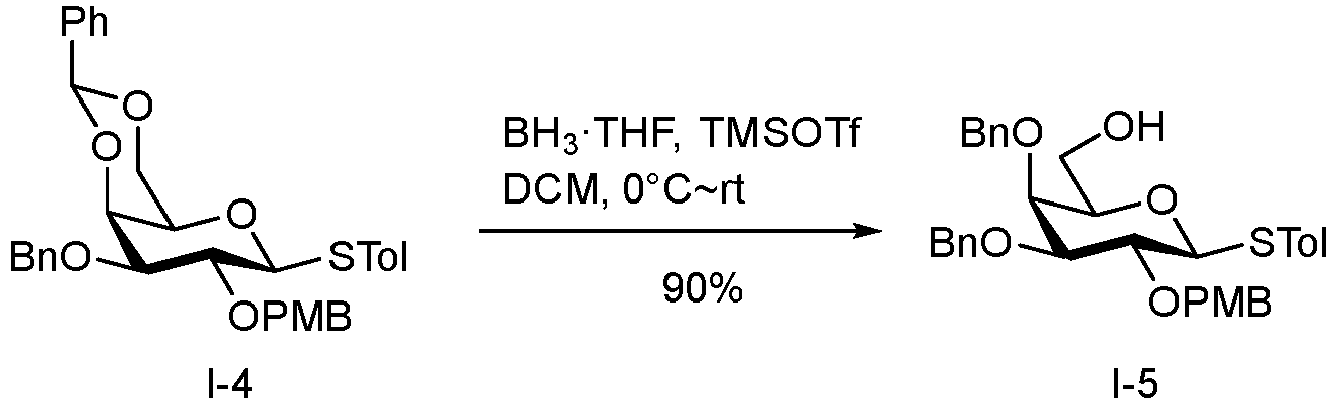
- P-tolyl 2-O-p-methoxybenzyl-3-O-benzyl-4,6-O-benzylidene-1-sulfur-β-D-galactopyranoside (2.0 g, 3.42 mmol) was dissolved in anhydrous dichloromethane (30.0 mL) under the protection of argon. 1M borane tetrahydrofuran solution (17.1 mL, 17.1 mmol, 5.0 equiv.) was added under ice bath conditions, stirred for 10 minutes, and then trimethylsilyl trifluoromethylsulfonate (93 µL, 0.51 mmol, 0.15 equiv.) was added dropwise, and the temperature was recovered to room temperature and the reaction was carried out for 2 hours. After the reaction was completed as monitored by TLC, the reaction was quenched by adding proper amount of trimethylamine, the methanol was added dropwise until no hydrogen was released. Then it was concentrated under reduced pressure and purified by column chromatography (petroleum ether/EtOAc 4: 1) to obtain a white solid (1.81 g, 90%). R f = 0.26 (petroleum ether/EtOAc 2: 1); 1H NMR (400 MHz, CDCl3, TMS) δ 7.46-7.44, 7.34-7.29, 7.01-6.99, 6.85-6.83 (18H, m, aromatic), 4.94 (1H, d, J = 11.7 Hz), 4.73 (3H, m), 4.66 (1H, d, J = 10.0 Hz), 4.61 (1H, d, J = 11.5 Hz), 4.56 (1H, d, J = 9.4 Hz), 3.89 (1H, t, J = 9.4 Hz), 3.83-3.78 (2H, m), 3.76 (3H, s), 3.57-3.50 (2H, m), 3.39 (1H, t, J = 6.0 Hz), 2.26 (3H, s); 13C NMR (100 MHz, CDCl3, TMS) δ 159.4, 138.5, 138.3, 137.4, 132.1, 130.6, 130.2, 130.1, 129.7, 128.6, 128.4, 128.2, 127.8, 127.6, 113.8, 88.0, 84.3, 78.9, 77.2, 75.3, 74.3, 73.5, 73.0, 62.2, 55.4, 21.2; ESI-Q-TOF (positive mode) calculated for C35H42NO6S+ [M+NH4]+ m/z 604.2733, found 604.2737.
-

- P-tolyl 2-O-p-methoxybenzyl-3,4-di-O-benzyl-1-thio-β-D-galactopyranoside (1.80 g, 3.07 mmol) was dissolved in anhydrous dichloromethane (30.0 mL), levulinic acid (713 mg, 6.14 mmol, 2.0 equiv.), 1-(3-dimethylaminopropyl)-3-ethylcarbodiimide hydrochloride (1.18 g, 6.14 mmol, 2.0 equiv.) and catalytic amount of 4-dimethylaminopyridine were added in turn, and the reaction was carried out for 3 hours at room temperature. After the reaction was completed as monitored by TLC, the reaction solution was diluted with dichloromethane, and the organic phase was washed with saturated sodium bicarbonate solution and saturated salt water in turn, dried with anhydrous sodium sulfate, filtered, concentrated under reduced pressure, and purified by column chromatography (petroleum ether/EtOAc 3: 1) to obtain a white solid (12.3 g, 92%). R f = 0.30 (petroleum ether/EtOAc 2: 1); 1H NMR (400 MHz, CDCl3, TMS) δ 7.47-7.45, 7.38-7.29, 7.02-7.00, 6.86-6.84 (18H, m, aromatic), 4.98 (1H, d, J = 11.4 Hz, PhCH 2), 4.75 (3H, m, PhCH 2), 4.67 (1H, d, J = 9.8 Hz, PhCH 2), 4.63 (1H, d, J = 11.4 Hz, PhCH 2), 4.55 (1H, d, J = 9.6 Hz, H-1), 4.27 (1H, m, H-6a), 4.15 (1H, m, H-6b), 3.89 (2H, m, H-2, H-4), 3.78 (3H, s, OCH 3), 3.59-3.55 (2H, m, H-3, H-5), 2.71-2.68, 2.51-2.47 (4H, m, CH 2 of Lev), 2.29 (3H, s, PhCH 3), 2.14 (3H, s, CH 3CO); 13C NMR (100 MHz, CDCl3, TMS) δ 206.5, 159.3, 138.5, 138.3, 137.3, 132.2, 130.6, 130.2, 130.0, 129.6, 128.5, 128.3, 128.1, 127.8, 127.6, 113.8, 88.1, 84.2, 77.0, 75.9, 75.3, 74.3, 73.4, 73.0, 63.4, 55.3, 37.9, 29.8, 27.9, 21.1; HRMS (ESI-MS) calculated for C40H44NaO8S+ [M+Na]+ m/z 707.2649, found 707.2635.
-

- peracetylated galactosamine (5.0 g, 12.8 mmol) was dissolved in anhydrous pyridine (100.0 mL), trifluoroacetic anhydride (9.02 mL, 64.0 mmol, 5.0 equiv.) was added, and the temperature was raised to 135°C, and the reaction was carried out for 1 hour. After the reaction was completed as monitored by TLC, the reaction was quenched by adding proper amount of methanol. The reaction solution was diluted with dichloromethane, the organic phase was washed with 1M hydrochloric acid solution and saturated salt water in turn, dried with anhydrous sodium sulfate, filtered, concentrated under reduced pressure, and purified by column chromatography (DCM/MeOH 60: 1) to obtain a white solid (5.0 g, 88%). R f = 0.34 (DCM/MeOH 30: 1); 1H NMR (400 MHz, CDCl3, TMS) δ 7.19 (1H, d, J = 9.4 Hz, NHAc), 5.80 (1H, d, H-1, J = 8.9 Hz), 5.42 (1H, d, H-4, J = 3.0 Hz), 5.20 (1H, d, H-3, J = 3.2 Hz, J = 11.3 Hz), 4.50 (1H, m, H-2), 4.21-4.07 (3H, m, H-5, H-6a, H-6b), 2.20 (3H, s, CH 3CO), 2.14 (3H, s, CH 3CO), 2.06 (3H, s, CH 3CO), 2.03 (3H, s, CH 3CO); 13C NMR (100 MHz, CDCl3, TMS) δ 170.8, 170.7, 170.2, 169.6, 157.7 (q, J = 37.4 Hz, COCF3), 117.0 (q, J = 285.1 Hz, COCF3), 92.3, 72.0, 69.9, 66.2, 61.4, 50.2, 20.6, 20.5, 20.4. ESI-Q-TOF (positive mode) calculated for C16H24F3N2O10 + [M+NH4]+ m/z 461.1383, found 461.1381.
-

- 2-deoxy-2-trifluoroacetylamino-1,3,4,6-tetra-O-acetyl-β-D-galactopyranoside (5.0 g, 11.3 mmol) and p-toluenethiol (2.1 g, 17.0 mmol, 1.5 equiv.) were dissolved in anhydrous dichloromethane (100.0 mL), boron trifluoride diethyl ether complex (4.28 mL, 33.9 mmol, 3.0 equiv.) was added dropwise under ice bath, and temperature was recovered to room temperature and the reaction was carried out overnight. After the reaction was completed as monitored by TLC, the reaction was quenched by adding proper amount of trimethylamine. The reaction solution was diluted with dichloromethane, and the organic phase was washed with saturated sodium bicarbonate solution and saturated salt water in turn, dried with anhydrous sodium sulfate, filtered, concentrated under reduced pressure, to obtain a yellow syrup (5.68 g, 99%) with Rf = 0.24 (petroleum ether/EtOAc 2: 1), which was directly used for the next reaction.
-

- P-tolyl 2-deoxy-2-trifluoroacetamido-3,4,6-tri-O-acetyl-1-thio-β-D-galactopyranoside (5.68 g, 11.2 mmol) and 4Å molecular sieve were dissolved in anhydrous dichloromethane (100.0 mL) under the protection of argon, and benzyl alcohol was added (2.33 mL, 22.4 mmol, 2.0 equiv.), stirred at room temperature for 2 hours, then cooled to -40°C. N-iodosuccinimide (3.53 g, 15.7 mmol, 1.4 equiv.) was added, stirred for 15 minutes, and then trifluoromethyl sulfonic acid was added dropwise (300 µL, 3.36 mmol, 0.3 equiv.) and the reaction was carried out with continuously stirring for 3 hours. After the reaction was completed as monitored by TLC, the reaction was quenched by adding proper amount of trimethylamine. The molecular sieve was filtered out by diatomite, filter cake was washed several times with dichloromethane. Filtrates were combined, concentrated under reduced pressure, and purified by column chromatography (petroleum ether/EtOAc 2: 1) to obtain a white solid (5.06 g, 92%). R f = 0.19 (petroleum ether/EtOAc 2: 1); 1H NMR (400 MHz, CDCl3, TMS) δ 7.35-7.26 (5H, m, aromatic), 7.01 (1H, br s, NHAc), 5.36 (1H, d, J = 3.0 Hz), 5.20 (1H, dd, J = 11.5 Hz, J = 3.3 Hz), 4.89 (1H, d, J = 12.1 Hz), 4.63 (1H, d, J = 8.4 Hz), 4.61 (1H, d, J = 12.3 Hz), 4.29-4.13 (3H, m), 3.93 (1H, t, J = 6.8 Hz), 2.15 (3H, s), 2.06 (3H, s), 1.92 (3H, s); 13C NMR (100 MHz, CDCl3, TMS) δ 170.7, 170.6, 170.4, 157.5 (q, J= 37.1 Hz, COCF3), 136.4, 128.5, 128.2, 127.9, 115.6 (q, J = 286.2 Hz, COCF3), 99.0, 70.8, 70.7, 69.7, 66.6, 61.7, 51.5, 20.6, 20.5, 20.4; ESI-Q-TOF (positive mode) calculated for C21H28F3N2O9 + [M+NH4]+ m/z 509.1747, found 509.1747.
-

- Benzyl 2-deoxy-2-trifluoroacetamido-3,4,6-tri-O-acetyl-β-D-galactopyranoside (2.50 g, 5.09 mmol) was dissolved in methanol (50.0 mL), pH was adjusted to 9-10 by adding proper amount of sodium methoxide, and the reaction was carried out with stirring at room temperature for 2 hours. After the reaction was completed as monitored by TLC, cationic resin was added to the reaction solution and neutralized it to pH = 7, filtered, and filtrate was concentrated under reduced pressure to dryness to obtain a yellow syrup. R f = 0.45 (DCM/MeOH 30: 1), which was directly used for the next reaction.
-

- Benzyl 2-deoxy-2-trifluoroacetamido-β-D-galactopyranoside (1.80 g, 4.93 mmol) and (+)-camphor sulfonic acid (572 mg, 2.46 mmol, 0.5 equiv.) were dissolved in anhydrous acetonitrile (50.0 mL) under the protection of argon. Benzaldehyde dimethyl acetal (1.11 mL, 7.40 mmol, 1.5 equiv.) was added, and the temperature was raised to 40°C and the reaction was carried out overnight. After the reaction was completed as monitored by TLC, the reaction was quenched by adding proper amount of triethylamine dropwise. The reaction solution was concentrated under reduced pressure, and purified by column chromatography (petroleum ether/EtOAc 2: 1) to obtain the compound as a white solid (2.03 g, 91%). R f = 0.30 (petroleum ether/EtOAc 1: 1); 1H NMR (400 MHz, DMSO-d 6) δ 9.26 (1H, d, NH, J = 9.0 Hz), 7.52-7.49, 7.42-7.26 (10H, m, aromatic), 5.63 (1H, s, PhCH), 5.25 (1H, d, OH, J = 6.4 Hz), 4.82 (1H, d, PhCH 2, J = 12.5 Hz), 4.58 (1H, d, H-1, J = 8.3 Hz), 4.55 (1H, d, PhCH 2, J = 12.3 Hz), 4.17-4.09 (3H, m, H-4, H-6a, H-6b), 3.95 (1H, m, H-2), 3.82 (1H, m, H-3), 3.57 (1H, s, H-5); 13C NMR (100 MHz, DMSO-d 6) δ 157.0 (q, J = 35.6 Hz, COCF3), 138.9, 138.3, 129.2, 128.6, 128.4, 128.0, 127.6, 126.8, 116.5 (q, J = 287.0 Hz, COCF3), 100.6, 100.3, 75.5, 70.4, 69.0, 66.7, 53.2; HRMS (ESI-MS) calculated for C22H22NNaO6F3 + [M+Na]+ m/z 476.1291, found 476.1292.
-

- P-tolyl 2-O-p-methoxybenzyl-3,4-di-O-benzyl-6-acetylpropionyl-1-thio-β-D-galactopyranoside (680 mg, 0.99 mmol, 1.5 equiv.) and benzyl 2-deoxy-2-trifluoroacetamido-4,6-O-benzylidene-β-D-galactopyranoside (300 mg, 0.66 mmol) were dissolved in anhydrous dichloromethane/N,N-dimethylformamide (10.0 mL/2. 0 ml) under the protection of argon, and 4 Å molecular sieve (1.0 g) was added, stirred at room temperature for 2 hours, and then cooled to 0°C. N-iodosuccinimide (297 mg, 1.32 mmol, 2.0 equiv.) and silver trifluoromethanesulfonate (51 mg, 0.20 mmol, 0.3 equiv.) were added in turn, reacted with stirring at 0°C for 2 hours, then the temperature was slowly raised to room temperature and the reaction was carried out overnight. After the reaction was completed as monitored by TLC, the reaction was quenched by adding proper amount of triethylamine dropwise. The molecular sieve was removed by diatomite filtration, the filtrate was concentrated under reduced pressure, and purified by column chromatography (DCM/MeOH 100: 1) to obtain compound I-12 (555 mg, 83%) as a white solid. R f = 0.28 (DCM/MeOH 30:1); 1H NMR (600 MHz, CDCl3, TMS) δ 7.55, 7.44, 7.34-7.25, 6.92, 6.63 (25H, m, aromatic, NH), 5.56 (1H, s, PhCH), 5.23 (1H, d, H-1Gal, J = 3.5 Hz), 4.94 (2H, m, PhCH 2), 4.87 (1H, d, H-1GalNAc, J = 8.3 Hz), 4.80 (1H, d, PhCH 2, J = 11.8 Hz), 4.63 (2H, m, PhCH 2), 4.54 (1H, d, PhCH 2, J = 11.5 Hz), 4.45-4.38 (5H, m, H-2GalNAc, H-4GalNAc, H-6aGalNAc, PhCH 2), 4.17 (1H, dd, H-3GalNAc, J = 3.5 Hz, J = 10.9 Hz), 4.16-4.12 (2H, m, H-6aGal, H-6bGalNAc), 4.07 (1H, dd, H-6bGal, J = 7.8 Hz, J = 11.7 Hz), 4.03 (1H, dd, H-2Gal, J = 3.5 Hz, J = 9.9 Hz), 3.84 (1H, dd, H-3Gal, J = 2.7 Hz, J = 9.9 Hz), 3.80 (1H, m, H-4Gal), 3.75 (3H, s, OCH 3), 3.73 (1H, m, H-5Gal), 3.51 (1H, s, H-5GalNAc), 2.83-2.78, 2.63-2.58, 2.52-2.49, 2.40-2.34 (4H, m, CH 2 of Lev), 2.04 (3H, s, CH 3CO); 13C NMR (150 MHz, CDCl3, TMS) δ 208.9, 172.4, 158.8, 157.1 (q, J = 24.2 Hz, COCF3), 138.6, 138.2, 137.4, 137.3, 130.5, 129.3, 129.1, 128.3, 128.2(2C), 127.9, 127.7(2C), 127.6, 127.5, 126.4, 115.9 (q, J = 191.2 Hz, COCF3), 113.4, 101.2, 98.8, 92.7, 78.1, 75.4, 74.9, 74.5, 73.7, 71.4, 71.3, 70.6, 70.1, 69.4, 66.5, 64.5, 55.2, 52.4, 37.9, 29.7, 27.8; HRMS (ESI-MS) calculated for C55H58NNaO14F3 + [M+Na]+ m/z 1036.3702, found 1036.3699.
-

- Benzyl 2-O-p-methoxybenzyl-3,4-di-O-benzyl-6-acetylpropionyl-β-D-galactopyranosyl-(1→3)-2-deox y-2-trifluoroacetamido-4,6-O-benzylidene-β-D-galactopyranoside (340 mg, 0.34 mmol) was dissolved in dichloromethane/water (6.0 mL/0. 6 ml), and 2,3-dichloro-5,6-dicyano-p-benzoquinone (154 mg, 0.68 mmol, 2.0 equiv.) was added in batches, and reaction was carried out for 1 hour at room temperature. After the reaction was completed as monitored by TLC, the reaction solution was diluted with dichloromethane, and the organic phase was washed with saturated sodium bicarbonate solution, saturated sodium thiosulfate solution and saturated salt water in turn, dried with anhydrous sodium sulfate, filtered, concentrated under reduced pressure, and purified by column chromatography (DCM/MeOH 60: 1) to obtain a white solid (258 mg, 85%). R f = 0.36 (DCM/MeOH 30:1); 1H NMR (600 MHz, CDCl3+CD3OD, TMS) δ 7.59, 7.40-7.26 (20H, m, aromatic), 5.64 (1H, s, PhCH), 5.14 (1H, d, H-1Gal, J = 3.5 Hz), 4.93 (2H, m, PhCH 2), 4.83 (1H, d, PhCH 2, J = 11.8 Hz), 4.76 (1H, d, H-1GalNAc, J = 8.6 Hz), 4.62 (2H, m, PhCH 2), 4.50 (1H, d, PhCH 2, J = 11.4 Hz), 4.42 (2H, m, H-4GalNAc, H-6aGalNAc), 4.35 (1H, t, H-2GalNAc, J = 10.0 Hz), 4.15 (1H, d, H-3GalNAc, J = 12.2 Hz), 4.09 (3H, m, H-6aGal, H-6bGalNAc), 4.03 (1H, dd, H-6bGal, J = 2.9 Hz, J = 10.8 Hz), 3.73 (2H, m, H-3Gal,), 3.60 (1H, dd, H-4Gal, J = 2.0 Hz, J = 10.0 Hz), 3.52 (1H, s, ), 2.82-2.76, 2.69-2.64, 2.52-2.47, 2.43-2.39 (4H, m, CH 2 of Lev), 2.07 (3H, s, CH 3CO); 13C NMR (150 MHz, CDCl3+CD3OD, TMS) δ 209.5, 172.6, 158.2 (q, J = 24.5 Hz, COCF3), 138.5, 138.2, 137.3, 137.2, 129.2, 128.5, 128.4, 128.3, 127.9, 128.4, 128.3, 127.9(2C), 127.7, 126.4, 116.0 (q, J = 190.9 Hz, COCF3), 101.1, 99.0, 95.2, 79.2, 75.1, 74.8, 73.8, 73.0, 70.6, 70.4, 70.1, 69.3, 68.9, 66.6, 63.9, 51.5, 38.0, 29.8, 27.7; HRMS (ESI-MS) calculated for C47H50NNaO13F3 + [M+Na]+ m/z 916.3126, found 916.3132.
-

- 5.0 g hyaluronic acid (Mw=500 kDa) was dissolved in 300.0 mL deionized water, swelled overnight, then concentrated hydrochloric acid (12 M, 13.0 mL, final concentration 0.5 M) was slowly added dropwise, and the reaction was heated at 80°C for two days. After the reaction was completed as monitored by TLC, sodium bicarbonate solid was added to adjust pH to 7.0, the reaction liquid was concentrated to about 20.0 mL under reduced pressure, and slowly dropped into 1000.0 mL ethanol to obtain light brown flocculent precipitate, which was filtered under reduced pressure, and the precipitate was dried in infrared oven to obtain a yellow powdery solid. The crude product was dissolved in methanol solution (0.02 M, 200.0 mL) in hydrochloric acid and reacted at 4°C for 4 days. After the reaction was completed as monitored by TLC, pH was adjusted to 7.0 by adding triethylamine, the solution was concentrated under reduced pressure, with toluene added for 3 times to obtain a brown powdered solid. The brown powdered solid was dissolved in pyridine (100.0 mL), acetic anhydride (50.0 mL) was slowly added dropwise under ice bath conditions, the temperature was naturally raised to room temperature, and reaction was carried out overnight. After the reaction was completed as monitored by TLC, the reaction was quenched by adding proper amount of methanol dropwise udder ice bath conditions. The reaction solution was concentrated under reduced pressure, diluted with dichloromethane, washed with 1 M hydrochloric acid solution, stripped with dichloromethane for three times. The organic phases were combined, and then washed with saturated sodium bicarbonate solution and saturated salt water, dried with anhydrous sodium sulfate, filtered and concentrated under reduced pressure. It was purified by column chromatography (DCM/MeOH 60: 1, 0.1% triethylamine) to obtain a pale yellow solid (2.60 g) (α/β = 2.5/1). R f = 0.40 (DCM/MeOH 20: 1). The NMR spectra of the mixture are shown in the appendix, and the proportion of end isomers was confirmed by 1H NMR. ESI-Q-TOF (positive mode) calculated for C27H41N2O18 + [M+NH4]+ m/z 681.2354, found 681.2360.
-

-
Methyl -

-
Methyl -

-
Methyl -

-
Methyl benzyl 3,4-di-O-benzyl-6-acetylpropionyl-α-D-galactopyranosyl-(1→3)-2-deoxy-2-trifluoroacetylamin o-4,6-O-benzylidene-β-D-galactopyranoside (127 mg, 0.14 mmol) were dissolved in anhydrous dichloromethane (2.0 mL) under the protection of argon, 4Å molecular sieve (200 mg) was added, and reacted with stirring at room temperature for 2 hours, then cooled to -20°C. Trimethylsilyl trifluoromethylsulfonate (7.6 µL, 0.042 mmol, 0.3 equiv.) was added, and reacted with stirring at -20°C for 2 hours, then the temperature was slowly raised to room temperature and the reaction carried out overnight. After the reaction was completed as monitored by TLC, the reaction was quenched by adding proper amount of triethylamine dropwise. The molecular sieve was removed by diatomite filtration. The filtrate was concentrated under reduced pressure, and purified by column chromatography (PE/acetone 2: 1) to obtain a white solid (195 mg, 90%). R f = 0.39 (PE/acetone 1: 1); 1H NMR (600 MHz, CDCl3, TMS) δ 8.08 (1H, s, NH), 7.88 (1H, d, NH, J = 9.4 Hz), 7.62, 7.46-7.41, 7.36-7.25, 7.15 (20H, m, aromatic), 5.62 (1H, s, PhCH), 5.16 (1H, t, H-4GlcA, J = 9.6 Hz), 5.10 (1H, d, H-1Gal, J = 3.6 Hz), 5.07 (1H, t, H-3GlcA, J = 9.4 Hz), 4.98-4.94 (3H, m, H-2GlcA, H-1GlcNAc, PhCH 2), 4.80 (1H, d, PhCH 2, J = 11.6 Hz), 4.72 (1H, d, H-1GalNAc, J = 8.3 Hz), 4.67 (1H, d, PhCH 2, J = 12.0 Hz), 4.62 (3H, m, H-3GlcNAc, H-4GlcNAc, PhCH 2), 4.54 (1H, q, H-2GalNAc, J = 9.4 Hz), 4.45 (1H, d, H-4GalNAc, J = 3.2 Hz), 4.40-4.36 (3H, m, H-6aGalNAc, H-6aGlcNAc, H-1GlcA), 4.30 (1H, d, PhCH 2, J = 12.0 Hz), 4.27 (1H, d, PhCH 2, J = 11.7 Hz), 4.16 (1H, m, H-6bGalNAc), 4.13 (1H, dd, H-6aGal, J = 2.1 Hz, J = 11.9 Hz), 4.08 (1H, dd, H-2Gal, J = 3.6 Hz, J = 10.2 Hz), 3.93 (2H, m, H-5GlcA, H-3GalNAc), 3.88 (1H, dd, H-6bGlcNAc, J = 2.1 Hz, J = 12.2 Hz), 3.83 (1H, m, H-6bGal), 3.71 (3H, s, OCH 3), 3.70 (1H, dd, H-3Gal, J = 2.8 Hz, J = 10.5 Hz), 3.63 (1H, d, H-5Gal, J = 8.3 Hz), 3.58 (1H, m, H-5GlcNAc), 3.49 (1H, s, H-5GalNAc), 3.45 (1H, s, H-4Gal), 2.94-2.86 (1H, m, CH 2 of Lev), 2.56-2.51 (3H, m, CH 2 of Lev, H-2GlcNAc), 2.31-2.28 (1H, m, CH 2 of Lev), 2.10 (3H, s, CH 3CO), 2.04 (3H, s, CH 3CO), 2.00 (12H, m, CH 3CO); 13C NMR (150 MHz, CDCl3, TMS) δ 210.4, 172.3, 170.7, 169.9, 169.8, 169.4(2C), 166.9, 157.9 (q, J = 24.5 Hz, COCF3), 157.7 (q, J = 24.3 Hz, COCF3), 138.1, 137.9, 137.3, 137.2, 130.3, 128.6(2C), 128.3, 128.2, 128.0, 127.9, 127.8, 127.7, 126.4, 116.0 (q, J = 191.1 Hz, COCF3), 115.4 (q, J = 191.2 Hz, COCF3), 101.7, 100.3, 99.1, 98.7, 93.8, 77.6, 76.1, 75.8, 74.7, 74.0, 73.6, 72.6(2C), 72.4, 71.9, 70.9, 70.1, 70.0, 69.9, 69.4, 69.3, 68.6, 66.5, 64.8, 62.3, 58.4, 52.6, 51.3, 37.9, 29.7, 27.7, 20.8, 20.6, 20.4; ESI-Q-TOF (positive mode) calculated for C72H84F6N3O29 + [M+NH4]+ m/z 1568.5095, found 1568.5099. -

- Benzyl
methyl -

- Benzyl
methyl -

- Benzyl
methyl -

- Benzyl
methyl -

- Benzyl β-D-glucopyranuronic acid-(1→3)-2-deoxy-2-acetylamino-β-D-glucopyranosyl-(1 →2)-3,4-di-O-benzyl-α-D-galactopyranoic acid-(1→3)-2-deoxy-2-acetylamino-4,6-O-benzylidene-β-D-galactopyranoside (18.6 mg, 16.4 µ mol) was dissolved in a mixed solution of methanol/water (1.0 mL/1. 0 ml), 10% palladium hydroxide carbon (37.0 mg) was added, and the reaction was carried out at room temperature for 48 hours at 40Pa hydrogen pressure. After the reaction was completed as monitored by TLC, it was filtered, concentrated under reduced pressure, and purified by Sephadex LH-20 with pure water as eluent to obtain a white solid (10.8 mg, 85%). R f =0.11 (CHCl3/MeOH/H2O=1:1:0.3); 1H NMR (600 MHz, D2O) δ 5.31 (0.97H, s), 5.19 (0.53H, d, J = 3.3 Hz), 4.68 (1.69H, m), 4.49 (1.02H, d, J = 7.7 Hz), 4.37 (0.58H, s), 4.31 (0.49H, s), 4.24 (1.52H, m), 4.18 (0.63H, s), 4.11 (0.52H, m), 3.98-3.75 (11.26H, m), 3.70 (0.53H, m), 3.51 (3.46H, m), 3.35 (0.92H, m), 2.02 (3H, s), 1.98 (2.88H, d, J = 4.4 Hz); 13C NMR (150 MHz, D2O) δ 175.5, 103.9, 103.8, 103.7, 97.8, 97.5, 95.8, 92.0, 83.2, 78.7, 78.6, 78.4, 76.6, 76.2(3C), 76.0, 75.4, 73.5, 72.7, 72.4, 71.7, 70.7, 69.4(2C), 69.1, 69.0, 66.3, 65.4, 61.9, 61.7, 61.6, 61.5, 55.4, 52.8, 49.2, 23.0, 22.9, 22.7; ESI-Q-TOF (positive mode) calculated for C28H42N2O23 2-[M-2H]2-m/z 387.1095, found 387.1090.
-
- Benzyl
methyl -

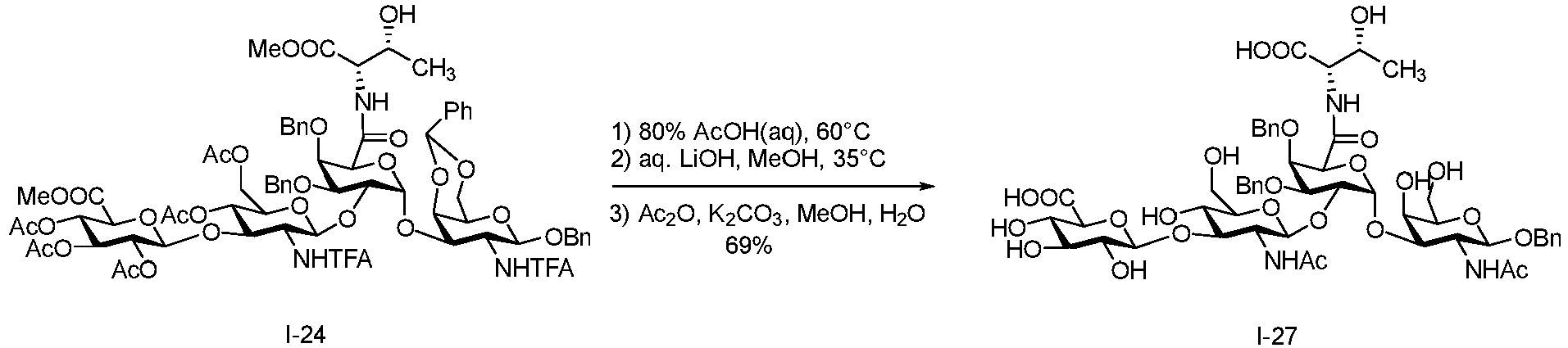
- Benzyl β-D-glucopyranuronic acid-(1→3)-2-deoxy-2-acetylamino-β-D-glucopyranosyl-(1→2)-N-L-threonin-3,4-di-O-benzyl-α-D-galactopyranoic acid-(1→3)-2-deoxy-2-acetylamino-β-D-galactopyranoside (19.0 mg, 16.6 µmol) was dissolved in a mixed solution of methanol/water (1.0 mL/1.0 ml), 10% palladium hydroxide carbon (38.0 mg) was added, and the reaction was carried out at room temperature for 48 hours at 40Pa hydrogen pressure. After the reaction was completed as monitored by TLC, it was filtered, concentrated under reduced pressure, and purified by Sephadex LH-20 with pure water as eluent to obtain a white solid (12.5 mg, 86%). 1H NMR (600 MHz, D2O) δ 5.46 (0.86H, m), 5.18 (0.48H, d, J = 3.6 Hz), 4.81 (0.56H, m), 4.66 (0.95H, m), 4.48 (0.98H, d, J = 7.9 Hz), 4.39 (0.47H, d, J = 2.4 Hz), 4.32-4.23 (5.18H, m), 4.14-4.06 (1.13H, m), 3.99-3.68 (11.95H, m), 3.55-3.47 (4.46H, m), 3.34 (1.26H, m); 13C NMR (150 MHz, D2O) δ 175.69, 175.03, 170.93, 170.76, 103.9, 103.8, 103.7, 98.0, 97.7, 96.0, 92.0, 83.1, 79.0, 78.3, 78.2, 76.6, 76.4, 76.2(2C), 76.0, 75.4, 73.5, 72.5, 72.2, 72.1, 70.7, 70.6(2C), 69.4, 69.3, 69.1, 69.0, 68.7(2C), 66.4, 65.5, 61.9, 61.6, 61.5, 60.4, 55.4, 52.6, 49.2, 23.0, 22.8, 22.5, 20.0; ESI-Q-TOF (negative mode) calculated for C32H49N3O25 2-[M-2H]2-m/z 437.6333, found 437.6323.
-

- P-tolyl 2-deoxy-2-trifluoroacetamido-3,4,6-tri-O-acetyl-1-thio-β-D- galactopyranoside (101 mg, 0.20 mmol), N-iodosuccinimide (70 mg, 0.31 mmol, 1.5 equiv.) and 4Å molecular sieve were dissolved in anhydrous dichloromethane (1.7 mL) under the protection of argon, and methanol ( 50 µL, 1.24 mmol, 6.0 equiv. ) was added, and stirred at room temperature for 2 hours, then cooled to -20°C. Trifluoromethanesulfonic acid (5.0 µL, 62.5 µmol, 0.30 equiv.) was added dropwise, and the reaction was carried out with continuously stirring for 3 hours, and moved to room temperature and the reaction was carried out overnight. After the reaction was completed as monitored by TLC, the reaction was quenched by adding proper amount of trimethylamine. The molecular sieve was filtered out by diatomite, and the filter cake was washed by dichloromethane several times. The filtrates were combined, concentrated under reduced pressure, and purified by column chromatography (petroleum ether /EtOAc 3:1) to obtain a white solid (73 mg, 88%). R f = 0.39 (petroleum ether/EtOAc 1: 1); 1H NMR (400 MHz, CCl3, TMS) δ 7.29 (1H, d, J = 8.9 Hz, NH), 5.37 (1H, d, J=3.2 Hz), 5.28 (1H, dd, J = 11.2, 3.4 Hz), 4.57 (1H, d, J = 8.4 Hz) 4.25-4.06 (3H, m), 3.98 (1H, t, J = 6.5), 3.49 (3H, s), 2.15 (3H, s), 2.03 (3H, s), 1.96 (3H, s); 13C NMR (100 MHz, CDCl3, TMS) δ 170.5, 170.5, 170.2, 157.5, 114.2, 101.2, 70.7, 69.5, 66.5, 61.3, 57.0, 51.8, 20.6, 20.6, 20.3. MS (ESI-MS) calculated for C15H21F3NO9 + [M+H]+ m/z 415.3, found 416.3.
-

- Methyl 2-deoxy-2-trifluoroacetamido-3,4,6-tri-O-acetyl-β-D-galactopyranoside (3.10 g, 7.48 mmol) was dissolved in methanol (50.0 mL), pH was adjusted to 9-10 by adding proper amount of sodium methoxide, and the reaction was carried out with stirring at room temperature for 2 hours. After the reaction was completed as monitored by TLC, cationic resin was added to the reaction solution and neutralized it to pH = 7, filtered, and filtrate was concentrated under reduced pressure to dryness to obtain a yellow syrup, R f = 0.75 (DCM/MeOH 5: 1), which was directly used for the next reaction.
-

- Methyl 2-deoxy-2-trifluoroacetamido-β-D-galactopyranoside (2.16 g, 7.48 mmol) and (+)-camphor sulfonic acid (3.46 g, 14.9 mmol, 2.0 equiv.) were dissolved in anhydrous acetonitrile (60.0 mL) under the protection of argon. Benzaldehyde dimethyl acetal (4.36 mL, 29.0 mmol, 4.0 equiv.) was added and the temperature was raised to 40°C and the reaction was carried out overnight. After the reaction was completed as monitored by TLC, the reaction was quenched by adding proper amount of triethylamine dropwise. The reaction solution was concentrated under reduced pressure, and purified by column chromatography (petroleum ether/EtOAc 2: 1) to obtain a compound as white solid (2.24 g, 80%). R f = 0.72 (petroleum ether/acetone 1: 2). MS (ESI-MS) calculated for C16H19F3NO6 + [M+H]+ m/z 378.3, found 378.3.
-

- P-tolyl 2-O-p-methoxybenzyl-3,4-di-O-benzyl-6-acetylpropionyl-1-thio-β-D-galactopyranoside (5.80 g, 8.48 mmol, 1.5 equiv.) and methyl 2-deoxy-2-trifluoroacetamido-4,6-O-benzylidene-β-D-galactopyranoside (2.15 g, 5.70 mmol) were dissolved in anhydrous dichloromethane/N,N-dimethylformamide (70.0 mL/14.0 mL) under the protection of argon, and 4Å molecular sieve (8.0 g) was added, stirred at room temperature for 2 hours, and then cooled to 0°C. N-iodosuccinimide (2.50 g, 11.1 mmol, 2.0 equiv. ) and silver trifluoromethanesulfonate (731 mg, 2.85 mmol, 0.5 equiv.) were added in turn, the reaction was carried out with stirring at 0°C for 2 hours, then the temperature was slowly raised to room temperature and the reaction was carried out overnight. After the reaction was completed as monitored by TLC, the reaction was quenched by adding proper amount of triethylamine dropwise. The molecular sieve was removed by diatomite filtration, the filtrate was concentrated under reduced pressure, and purified by column chromatography (petroleum ether/EtOAc 1: 1) to obtain the compound I-12 (4.66 g, 87%) as a white solid. R f = 0.58 (DCM/MeOH 25:1); 1H NMR (400 MHz, CDCl3, TMS) δ 7.75 (1H, b), 7.61-7.48 (2H, m), 7.39-7.17 (13H, m), 6.95 (2H, d, J = 8.5 Hz), 6.62 (2H, d, J = 8.6 Hz), 5.54 (1H, s,), 5.20 (1H, d, J = 3.6 Hz), 4.94 (1H, d, J = 11.4 Hz), 4.85-4.73 (2H, m), 4.65 (1H, d, J = 11.8 Hz), 4.54 (1H, d, J = 11.4 Hz), 4.46 (2H, s), 4.42 (1H, s), 4.32 (1H, d, J = 12.4), 4.20 (3H, q, J = 5.3, 4.0 Hz), 4.12-4.02 (4H, m), 3.92-3.87 (1H, m), 3.85-3.81 (1H, m), 3.79-3.74 (1H, m), 3.73(3H, s) 3.50 (3H, s), 2.90-2.79 (1H, m), 2.75-2.38 (3H, m), 2.18 (3H, s); 13C NMR (100 MHz, CDCl3, TMS) δ 208.9, 172.5, 158.9, 157.2 (COCF3), 138.6, 138.3, 137.6, 130.5, 129.5, 129.0, 128.4, 128.3(2C), 128.2, 127.8, 127.7, 127.5, 126.4, 116.0 (COCF3), 113.5, 101.1, 100.6, 92.8, 78.2, 75.4, 74.7, 74.6, 73.5, 71.4, 71.1, 70.5, 70.1, 69.4, 66.5, 64.2, 56.5, 55.2, 52.5, 38.0, 29.8, 27.8; ESI-Q-TOF (positive mode) calculated for C49H54F3NO14 + [M+NH4]+ m/z 955.3840, found 955.3956.
-

- Methyl 2-O-p-methoxybenzyl-3,4-di-O-benzyl-6-acetylpropionyl-β-D-galactopyranosyl-(1→3)-2-deoxy-2-trifluoroacetamido-4,6-O-benzylidene-β-D-galactopyranoside (4.66 g, 4.97 mmol) was dissolved in dichloromethane/water (100 mL/10.0 ml), and 2,3-dichloro-5,6-dicyano-p-benzoquinone (2.17 g, 9.56 mmol, 1.9 equiv.) was added in batches, and the reaction was carried out for 1 hour at room temperature. After the reaction was completed as monitored by TLC, the reaction solution was diluted with dichloromethane, and the organic phase was washed with saturated sodium bicarbonate solution, saturated sodium thiosulfate solution and saturated salt water in turn, dried with anhydrous sodium sulfate, filtered, concentrated under reduced pressure, and purified by column chromatography (DCM/MeOH 40: 1) to obtain a white solid (3.32 mg, 82%). R f = 0.79 (petroleum ether/acetone 1: 1); 1H NMR (400 MHz, CDCl3, TMS) δ 7.71 (1H, d, J = 9.3 Hz), 7.55 (2H, dd, J = 7.8, 1.8 Hz), 7.43-7.22 (13H, m), 5.60 (1H, s), 5.19 (1H, d, J = 3.9 Hz), 4.94 (1H, d, J = 11.4 Hz), 4.86 (1H, d, J = 11.8 Hz), 4.67-4.57 (2H, m), 4.50 (1H, d, J = 11.5 Hz), 4.47-4.35 (3H, m), 4.20 (1H, dd, J = 11.8, 2.7 Hz), 4.15-4.02 (4H, m), 3.83-3.76 (1H, m), 3.72 (1H, b), 3.58 (1H, dd, J = 10.0, 2.7 Hz), 3.52-3.46 (4H, m), 2.93 (1H, ddd, J = 19.1, 10.1, 3.5 Hz), 2.74-2.55 (2H, m), 2.42 (1H, m), 2.21 (3H, s); 13C NMR (100 MHz, CDCl3, TMS) δ 210.3, 172.2, 157.3(COCF3), 138.5, 138.2, 137.2, 129.1, 128.4, 128.3, 128.3(2C), 127.8(2C), 127.6, 126.2, 115.9(COCF3), 101.0(2C), 94.5, 79.6, 75.5, 74.6, 74.0, 73.0, 70.6, 70.3, 69.2, 69.1, 66.5, 64.7, 56.3, 50.8, 38.1, 30.0, 27.7. ESI-Q-TOF (positive mode) calculated for C41H50F3NO13 + [M+NH4]+ m/z 835.3840, found 835.3956.
-

-
Methyl methyl 3,4-di-O-benzyl-6-acetylpropionyl-α-D-galactopyranosyl-(1→3)-2-deoxy-2-trifluoroacetamido-4,6-O-benzylidene-β-D-galactopyranoside (1.35 g, 1.65 mmol) were dissolved in anhydrous dichloromethane (30.0 mL), and 4Å molecular sieve (3.00 g) was added, stirred at room temperature for 2 hours, and then cooled to -20 °C. Trimethylsilyl trifluoromethylsulfonate (81 µL, 0.47 mmol, 0.3 equiv.) was added, and the reaction was carried out with stirring at -20°C for 2h, and then the temperature was slowly raised to room temperature and the temperature was carried out overnight. After the reaction was completed as monitored by TLC, the reaction was quenched by adding proper amount of triethylamine dropwise, the molecular sieve was removed by diatomite filtration. The filtrate was concentrated under reduced pressure, and purified by column chromatography (petroleum ether/acetone 2: 1) to obtain a white solid (2.11 g, 87%). R f = 0.43 (petroleum ether/acetone 1: 1); 1H NMR (400 MHz, CDCl3, TMS) δ 8.47 (1H, d, J = 6.6 Hz), 7.98 (1H, d, J = 9.4 Hz), 7.66-7.55 (2H, m), 7.51-7.39 (3H, m), 7.38-7.23 (8H, m), 7.19-7.06 (2H, m), 5.60 (1H, s), 5.16 (1H, t, J = 9.6 Hz), 5.12-5.03 (2H, m), 5.01-4.91 (2H, m), 4.79 (1H, d, J = 11.6 Hz), 4.72-4.60 (3H, m), 4.58 (1H, d, J = 8.5 Hz), 4.48-4.33 (5H, m), 4.27 (2H, dd, J = 11.9, 6.4 Hz), 4.20 (1H, dd, J = 11.9, 2.1 Hz), 4.17-4.06 (2H, m), 3.95 (1H, d, J = 9.9 Hz), 3.92-3.86 (2H, m), 3.83 (1H, dd, J = 8.1, 3.8 Hz), 3.71 (3H, s), 3.67 (1H, d, J = 2.7 Hz), 3.65-3.56 (2H, m), 3.51 (3H, s), 3.48 (2H, b), 3.01 (1H, ddd, J = 19.0, 11.2, 3.3 Hz), 2.62-2.55 (2H, m), 2.46 (1H, q, J = 8.6, 8.1 Hz), 2.33 (1H, ddd, J = 17.0, 5.5, 3.3 Hz), 2.22 (3H, s), 2.10 (3H, s), 2.02 (3H, s), 2.02 (3H, s), 2.00 (6H, s); 13C NMR (100 MHz, CDCl3, TMS) δ 210.9, 172.4, 170.8, 169.9(2C), 169.5, 169.4, 167.0, 157.9 (COCF3), 157.8 (COCF3), 138.1, 137.9, 137.1, 130.5, 128.7, 128.6, 128.3, 128.2, 128.0, 127.8, 127.8, 126.4, 117.4 (COCF3), 115.4 (COCF3), 101.8, 100.9, 100.3, 98.5, 93.5, 77.8, 76.2, 75.8, 74.8, 73.7, 73.5, 72.7, 72.4, 71.9, 70.9, 70.0, 69.8, 69.4, 69.3, 68.7, 66.5, 64.9, 62.4, 58.5, 56.3, 52.6, 51.0, 38.0, 29.9, 27.7, 20.6 (2C), 20.4 (2C); ESI-Q-TOF (positive mode) calculated for C66H76F6N2O29 + [M+NH4]+ m/z 1492.4782, found 1492.4733. -

-
Methyl -

-
Methyl -

-
Methyl -

- Benzyl β-D-glucopyranuronic acid-(1→3)-2-deoxy-2-acetylamino-β-D-glucopyranosyl -(1→2)-3,4-di-O-benzyl-α-D-galactopyranoic acid-(1→3)-2-deoxy-2-acetylamino-4,6-O-benzylidene-β-D-galactopyranoside (about 0.34 mmol in all of the previous step) was dissolved in a mixed solution of methanol/water (5.0 mL/5. 0 ml), 20% palladium hydroxide carbon (480 mg) was added, and the reaction was carried out at room temperature for 48 hours at 40Pa hydrogen pressure. After the reaction was completed as monitored by TLC, it was filtered, concentrated under reduced pressure, and purified by Sephadex LH-20 with pure water as eluent, to obtain a white solid (95 mg, 52% for both steps). Rf =0.11 (CHCl3/MeOH/H2O =1:1:0.3); 1H NMR (400 MHz, D2O) δ 5.29 (1H, s), 4.64 (1H, d, J = 8.5 Hz), 4.48 (1H, d, J = 8.0 Hz), 4.41 (1H, d, J = 8.7 Hz), 4.34-4.11 (3H, m), 3.98-3.69 (11H, m), 3.69-3.60 (1H, m), 3.60-3.42 (7H, m), 3.39-3.22 (1H, m), 1.98 (3H, s), 1.94 (3H, s); 13C NMR (100 MHz, D2O) δ 176.2, 103.1, 103.0, 102.2, 96.7, 82.6, 77.8, 75.5, 75.3, 74.7, 72.8, 72.0, 71.7, 71.1, 68.7, 68.4, 64.7, 61.0, 60.8, 57.0, 54.7, 50.7, 22.3, 22.1; ESI-Q-TOF (negative mode) calculated for C29H46N2O23 -[M-H+]-m/z 789.2413, found 789.2446.
-

- P-tolyl 2-deoxy-2-trifluoroacetamido-3,4,6-tri-O-acetyl-1-thio-β-D-galactopyranoside (2.0 g, 3.94 mmol), N-iodosuccinimide (1.24 g, 5.51 mmol, 1.4 equiv) and 4Å molecular sieve were dissolved in anhydrous dichloromethane (30 mL) under the protection of argon, and ethanol ( 0.69 mL, 11.8 mmol, 3.0 equiv. ) was added, stirred at room temperature for 2 hours, then cooled to -30°C, and trimethylsilyl trifluoromethylsulfonate ( 0.27 mL, 1.55 mmol, 0.40 equiv. ) was added dropwise, and the reaction was carried out with continuously stirring for 3h, and then moved to room temperature and the reaction was carried out overnight. After the reaction was completed as monitored by TLC, the reaction was quenched by adding proper amount of trimethylamine. The molecular sieve was filtered out by diatomite, and the filter cake was washed several times by dichloromethane. Filtrates were combined, concentrated under reduced pressure, and purified by column chromatography (petroleum ether/EtOAc 3: 1) to obtain a white solid (1.51 g, 89%). R f = 0.45 (petroleum ether/EtOAc 1: 1); 1H NMR (400 MHz, CDCl3, TMS) δ 7.21 (1H, d, J = 9.0 Hz), 5.37 (1H, d, J = 3.4), 5.33 - 5.18 (2H, m), 4.66 (1H, d, J = 8.3 Hz,), 4.23-4.07 (2H, m), 4.00-3.94 (1H, m), 3.94-3.86 (1H, m), 3.62-3.52 (1H, m), 2.14 (3H, s), 2.03 (3H, s), 1.97 (3H, s), 1.18 (3H, t, J = 7.1 Hz); 13C NMR (100 MHz, CDCl3, TMS) δ 170.7, 170.6, 170.3, 157.8 (COCF3), 115.7 (COCF3), 100.2, 70.7, 69.6, 66.7, 65.6, 61.6, 51.8, 20.6, 20.6, 20.4, 14.8.
-

- Ethyl 2-deoxy-2-trifluoroacetamido-3,4,6-tri-O-acetyl-β-D-galactopyranoside (1.51 g, 3.52 mmol) was dissolved in methanol (50.0 mL), and proper amount of sodium methoxide was added to adjust pH to 9-10. The reaction was carried out with stirring at room temperature for 2 hours. After the reaction was completed as monitored by TLC, cationic resin was added to the reaction solution, and the solution was neutralized to pH = 7, filtered, and the filtrate was concentrated under reduced pressure to dryness to obtain a yellow syrup, R f = 0.57 (DCM/MeOH 5: 1, which was directly used for the next reaction.
-

- Ethyl 2-deoxy-2-trifluoroacetamido-β-D-galactopyranoside (1.07 g, 3.52 mmol) and (+)-camphor sulfonic acid (1.90 g, 8.18 mmol, 2.3 equiv.) were dissolved in anhydrous acetonitrile (30.0 mL) under the protection of argon. Benzaldehyde dimethyl acetal (2.50 mL, 16.6 mmol, 4.6 equiv.) was added, and the temperature was raised to 40 °C and the reaction was carried out overnight. After the reaction was completed as monitored by TLC, the reaction was quenched by adding proper amount of triethylamine dropwise. The reaction solution was concentrated under reduced pressure, and then purified by column chromatography (petroleum ether/EtOAc = 2: 1) to obtain a white solid (1.01 g, 74%). R f = 0.68 (petroleum ether/acetone = 1: 2).
-

- P-tolyl-2-O-p-methoxybenzyl-3,4-di-O-benzyl-6-acetylpropionyl-1-thio-β-D-galactopyran oside (2.21 g, 3.23 mmol, 1.4 equiv.) and ethyl 2-deoxy-2-trifluoroacetamido-4,6-O-benzylidene-β-D-galactopyranoside (0.90 g, 2.30 mmol) were dissolved in anhydrous dichloromethane/ N,N-dimethylformamide (30.0 mL/6.0 mL) under the protection of argon. 4Å molecular sieve (3.6 g) was added, stirred at room temperature for 2 hours and then cooled to 0 °C. N-iodosuccinimide (0.90 g, 4.00 mmol, 1.7 equiv.)and silver trifluoromethanesulfonate (193 mg, 0.75 mmol, 0.3 equiv.) were added in turn, and the reaction was carried out with stirring at 0 °C for 2 hours, then the temperature was slowly raised to room temperature and the reaction was carried out overnight. After the reaction was completed as monitored by TLC, the reaction was quenched by adding proper amount of triethylamine dropwise. The molecular sieve was removed by diatomite filtration, and the filtrate was concentrated under reduced pressure, and purified by column chromatography (petroleum ether/EtOAc 1: 1) to obtain compound I-12 (1.96 g, 89%) as a white solid. R f = 0.74 (DCM/MeOH 20:1); 1H NMR (400 MHz, CDCl3, TMS) δ 7.58-7.47 (3H, m), 7.28 (13H, m), 6.92 (2H, d, J = 8.6 Hz), 6.62 (2H, d, J = 8.6 Hz), 5.53 (1H, s), 5.23 (1H, d, J = 3.5 Hz), 4.96 (1H, d, J = 11.5 Hz), 4.84-4.76 (2H, m), 4.65 (1H, d, J = 11.7 Hz), 4.54 (1H, d, J = 11.5 Hz), 4.48-4.38 (3H, m), 4.36 - 4.27 (2H, m), 4.22 (1H, dd, J = 11.7, 3.2 Hz), 4.15 (1H, dd, J = 10.9, 3.4 Hz), 4.11-4.00 (3H, m), 3.94 (1H, dd, J = 9.7, 7.1 Hz), 3.87 (1H, dd, J = 10.0, 2.7 Hz), 3.85-3.80 (1H, b), 3.79-3.71 (4H, m), 3.61-3.51 (1H, m), 3.46 (1H, s), 2.94-2.82 (1H, m), 2.72-2.51 (2H, m), 2.46-2.37 (1H, m), 2.17 (3H, s), 1.17 (3H, t, J = 7.0 Hz); 13C NMR (100 MHz, CDCl3, TMS) δ 209.2, 172.5, 158.9, 157.2 (COCF3), 138.7, 138.3, 137.6, 130.6, 129.3, 129.1, 128.4, 128.3 (2C), 128.2, 127.8, 127.7, 127.5, 126.5,116.0 (COCF3), 113.5, 101.2, 99.6, 92.7, 78.2, 75.6, 74.9, 74.6, 73.7, 71.5, 71.3, 70.5, 70.2, 69.5, 66.5, 64.8, 64.6, 55.3, 52.4, 38.0, 29.8, 27.8, 15.0; ESI-Q-TOF (positive mode) calculated for C50H56F3NO14 + [M+NH4]+ m/z 969.3997, found 969.4011.
-

- Ethyl 2-O-p-methoxybenzyl-3,4-di-O-benzyl-6-acetylpropionyl-β-D-galactopyranosyl-(1→3)-2-deoxy-2-trifluoroacetamido-4,6-O-benzylene-β-D-galactopyranoside (140 mg, 0.15 mmol) was dissolved in dichloromethane/water (2.90 mL/0. 29 mL), and 2,3-dichloro-5,6-dicyano-p-benzoquinone (44 mg, 0.22 mmol, 1.5 equiv.) was added in batches, and the reaction was carried out for 1 hour at room temperature. After the reaction was completed as monitored by TLC, the reaction solution was diluted with dichloromethane, and the organic phase was washed with saturated sodium bicarbonate solution, saturated sodium thiosulfate solution and saturated salt water in turn, dried with anhydrous sodium sulfate, filtered, concentrated under reduced pressure, and purified by column chromatography (DCM/MeOH 40: 1) to obtain a white solid (88 mg, 72%). R f = 0.69 (petroleum ether/acetone 1: 1); 1H NMR (400 MHz, CDCl3, TMS) δ 7.67 (1H, d, J = 9.4 Hz), 7.58-7.50 (2H, m), 7.44-7.21 (13H, m), 5.58 (1H, s), 5.18 (1H, d, J = 3.9 Hz), 4.93 (1H, d, J = 11.4 Hz), 4.86 (1H, d, J = 11.8 Hz), 4.69-4.58 (2H, m), 4.50 (1H, d, J = 11.4 Hz), 4.48-4.31 (3H, m), 4.19 (1H, dd, J = 11.8, 2.9 Hz), 4.17-4.00 (4H, m), 3.92 (1H, dd, J = 9.7, 7.0 Hz), 3.83-3.77 (1H, m), 3.75-3.70 (1H, m), 3.59 (1H, dd, J = 10.0, 2.8 Hz), 3.53 (1H, dd, J = 9.7, 7.0 Hz), 3.44 (1H, s), 2.96-2.85 (1H, m), 2.76-2.35 (3H, m), 2.20 (3H, s), 1.17 (3H, t, J = 7.0 Hz); 13C NMR (100 MHz, CDCl3, TMS) δ 210.2, 172.2, 157.3(COCF3), 138.5, 138.2, 137.3, 129.0, 128.4, 128.3 (2C), 127.8, 127.6, 126.2, 115.9 (COCF3), 100.9, 100.0, 94.5, 79.7, 75.4, 74.6, 73.9, 73.1, 70.6, 70.4, 69.3, 69.1, 66.4, 64.7, 64.6, 51.1, 38.1, 29.9, 27.7, 15.0.
-

-
Methyl ethyl 3,4-di-O-benzyl-6-acetylpropionyl-α-D-galactopyranosyl-(1→3)-2-deoxy-2- trifluoro acetamido-4,6-O-benzylidene-β-D-galactopyranoside (360 mg, 0.43 mmol) were dissolved in anhydrous dichloromethane (8.0 mL). 4Å molecular sieve (800 mg) was added, and the reaction was carried out with stirring at room temperature for 2h, and then cooled to-20 °C. Trimethylsilyl trifluoromethylsulfonate (21.6 µL, 0.13 mmol, 0.3 equiv.) was added, and the reaction was carried out with stirring at-20 °C for 2h, and then the temperature was slowly raised to room temperature and the reaction was carried out overnight. After the reaction was completed as monitored by TLC, the reaction was quenched by adding proper amount of triethylamine dropwise. The molecular sieve was removed by diatomite filtration, and the filtrate was concentrated under reduced pressure, and purified by column chromatography (petroleum ether/acetone 2: 1) to obtain a white solid (664 mg, 94%). R f = 0.45 (petroleum ether/acetone 1: 1); 1H NMR (400 MHz, CDCl3, TMS) δ 8.52 (1H, d, J = 6.6 Hz), 8.00 (1H, d, J = 9.3 Hz), 7.67-7.50 (2H, m), 7.53-7.39 (3H, m), 7.39-7.21 (8H, m), 7.14 (2H, dd, J = 7.7, 1.8 Hz), 5.59 (1H, s), 5.16 (1H, t, J = 9.6 Hz), 5.11-5.02 (2H, m), 5.00-4.93 (2H, m), 4.79 (1H, d, J = 11.6 Hz), 4.74-4.57 (4H, m), 4.44 (1H, d, J = 3.6 Hz), 4.43-4.36 (3H, m), 4.34 (1H, d, J = 12.0 Hz), 4.27 (2H, dd, J = 11.8, 6.1 Hz), 4.20 (1H, d, J = 11.9), 4.16-4.08 (2H, m), 3.99-3.92 (2H, m), 3.89 (2H, dt, J = 12.3, 2.7 Hz), 3.81 (1H, dd, J= 11.8, 8.5 Hz), 3.71 (3H, s), 3.68 (1H, d, J = 2.8 Hz), 3.65-3.56 (2H, m), 3.53 (1H, dd, J = 9.6, 7.1 Hz), 3.46 (2H, b), 3.07-2.95 (1H, m), 2.69-2.55 (2H, m),2.46 (1H, dd, J = 17.2, 8.5 Hz), 2.33 (1H, dt, J = 16.9, 4.1 Hz), 2.21 (3H, s), 2.10 (3H, s), 2.02 (3H, s), 2.01 (3H, s), 1.99 (6H, s), 1.20 (3H, t, J = 7.0 Hz); 13C NMR (100 MHz, CDCl3, TMS) δ 210.8, 172.4, 170.7, 169.9 (2C), 169.5, 169.4, 167.0, 157.9 (COCF3), 157.6 (COCF3), 138.1, 137.9, 137.2, 130.4, 128.7, 128.6, 128.3, 128.2, 128.0, 127.8, 127.8, 126.4, 117.4 (COCF3), 116.9 (COCF3), 101.8, 100.3, 99.9, 98.5, 93.5, 77.9, 76.2, 75.8, 74.7, 73.7, 73.4, 72.7, 72.5, 72.4, 71.9, 70.9, 70.1, 69.8, 69.4, 69.3, 68.7, 66.5, 64.8, 62.4, 58.5, 52.6, 51.3, 38.0, 29.8, 27.6, 20.8, 20.6, 20.5, 20.4 (2C), 15.0; ESI-Q-TOF (positive mode) calculated for C67H78F6N2O29 + [M+NH4]+ m/z 1506.4938, found 1506.4886. -

-
Ethyl methyl -

-
Methyl ethyl - CP-Et was obtained from I-21-Et in two steps using the same method as in Example 3.


-

- P-tolyl 2-deoxy-2-trifluoroacetamido-3,4,6-tri-O-acetyl-1-thio-β-D-galactopyranoside (2.0 g, mmol), N-iodosuccinimide (1.24 g, mmol, equiv.) and 4Å molecular sieves were dissolved in anhydrous dichloromethane (30 mL) under the protection of argon, stirried at room temperature for 2 hours, and then cooled to -20 °C. Trifluoromethanesulfonic acid (0.11 mL, mmol, equiv.) was added dropwise, and the reaction was carried out with continuously stirring for 3 hours, and moved to room temperature and the temperature was carried out overnight. After the reaction was completed as monitored by TLC, the reaction was quenched by adding proper amount of trimethylamine. The molecular sieve was filtered out by diatomite, and filter cake was washed several times with dichloromethane. Filtrates were combined, concentrated under reduced pressure, and purified by column chromatography (petroleum ether/EtOAc = 3: 1) to obtain a white solid (1.72 g, 98%). R f = 0.49 (petroleum ether/EtOAc = 1: 1); 1H NMR (400 MHz, CDCl3, TMS) δ 6.60 (1H, d, J = 8.7 Hz, NH), 5.32 (1H, d, J = 2.1 Hz), 5.28 (1H, dd, J = 11.2, 3.4 Hz), 4.69 (1H, d, J = 8.3 Hz), 4.16-4.03 (2H, m), 4.02-3.93 (1H, m), 3.92-3.80 (2H, m), 2.09 (3H, s), 1.98 (3H, s), 1.93 (3H, s), 1.18 (d, J = 6.1 Hz, 3H), 1.06 (d, J = 6.1 Hz, 3H); 13C NMR (100 MHz, CDCl3, TMS) δ 170.61, 170.53, 170.28 ,157.5,117.2, 99.19, 73.18, 70.70, 69.42, 66.58, 61.50, 52.40, 23.24, 21.72, 20.66, 20.47.
-
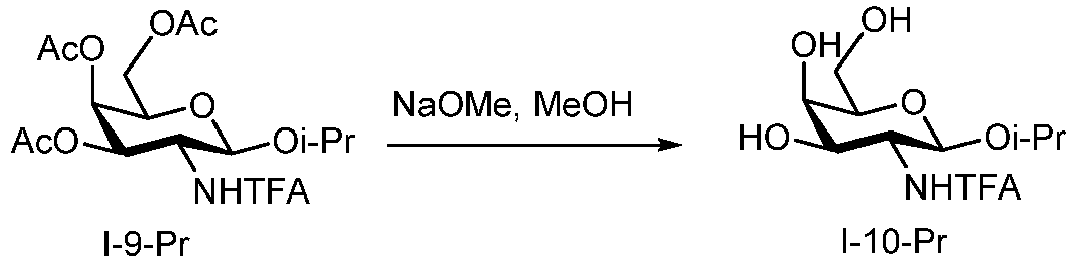
- Isopropyl 2-deoxy-2-trifluoroacetamido-3,4,6-tri-O-acetyl-β-D-galactopyranoside (1.71 g, 3.86 mmol) was dissolved in methanol (50.0 mL), and pH was adjusted to 9-10 by adding proper amount of sodium methoxide, and the reaction was carried out with stirring at room temperature for 2 hours. After the reaction was completed as monitored by TLC, cationic resin was added to the reaction solution and the reaction was neutralized to pH = 7, filtered, and the filtrate was concentrated under reduced pressure to dryness to obtain a yellow syrup, R f = 0.57 (DCM/MeOH = 5: 1), which was directly used for the next reaction.
-

- Isopropyl-2-deoxy-2-trifluoroacetamido-β-D-galactopyranoside (1.22 g, 3.86 mmol) and (+)-camphor sulfonic acid (1.60 g, 6.89 mmol, 1.8 equiv.) were dissolved in anhydrous acetonitrile (40.0 mL) under the protection of argon. Benzaldehyde dimethyl acetal (3.87 mL, 25.7 mmol, 6.6 equiv.) was added and heated to 40°C and the reaction was carried out overnight. After the reaction was completed as monitored by TLC, the reaction was quenched by adding proper amount of triethylamine dropwise. The reaction solution was concentrated under reduced pressure, and purified by column chromatography (petroleum ether/EtOAc = 2: 1) to obtain a white solid (1.12 g, 71%). R f = 0.55 (petroleum ether/acetone = 1: 2).
-

- P-tolyl 2-O-p-methoxybenzyl-3,4-di-O-benzyl-6-acetylpropionyl-1-thio-β-D-galactopyranoside (227 mg, 0.33 mmol, 1.3 equiv.) and isopropyl 2-deoxy-2-trifluoroacetamido-4,6-O-benzylidene-β-D-galactopyranoside (103 mg, 0.25 mmol) were dissolved in anhydrous dichloromethane/N,N-dimethylformamide (5.0 mL/1. 0 mL) under the protection of argon, and 4Å molecular sieve (400 mg) was added, stirred for 2h at room temperature, and then cooled to 0 °C. N-iodosuccinimide ( 100 mg, 0.44 mmol, 1.7 equiv. )and silver trifluoromethanesulfonate (30 mg, 0.12 mmol, 0.5 equiv.) were added in turn, and the reaction was carried out with stirring at 0 °C for 2 hours, then the temperature was slowly raised to room temperature and the reaction was carried out overnight. After the reaction was monitored by TLC to be completed, the reaction was quenched by adding proper amount of triethylamine dropwise. The molecular sieve was removed by diatomite filtration, the filtrate was concentrated under reduced pressure, and purified by column chromatography (petroleum ether/EtOAc = 1: 1) to obtain compound I-12 (210 mg, 86%). R f = 0.61 (DCM/MeOH = 20: 1); 1H NMR (400 MHz, CDCl3, TMS) δ 7.61-7.50 (3H, m), 7.41-7.22 (13H, m), 6.96 (2H, d, J = 8.5 Hz), 6.64 (2H, d, J = 8.6 Hz), 5.54 (1H, s), 5.21 (1H, d, J = 3.6 Hz), 5.00-4.92 (2H, m), 4.78 (1H, d, J = 11.7 Hz), 4.66 (1H, d, J = 11.8 Hz), 4.55 (1H, d, J = 11.4 Hz), 4.47 (2H, dd, J = 11.8, 2.3 Hz), 4.42 (1H, d, J = 3.4 Hz), 4.35-4.24 (2H, m), 4.19 (1H, dd, J = 11.6, 4.0 Hz), 4.13 - 4.03 (4H, m), 3.96 (1H, p, J = 6.3 Hz), 3.89 (1H, dd, J = 10.0, 2.7 Hz), 3.84 (1H, b), 3.79-3.71 (4H, m), 3.48 (1H, s), 2.91-2.80, 2.75-2.42 (4H, m), 2.19 (3H, s), 1.23 (3H, d, J = 6.1 Hz), 1.10 (3H, d, J= 6.0 Hz); 13C NMR (100 MHz, CDCl3, TMS) δ 208.5, 172.5, 158.9, 157.3 (COCF3), 138.6, 138.3, 137.7, 130.4, 129.5, 129.0, 128.4, 128.3 (2C), 128.2, 127.7 (2C), 127.5, 126.4, 115.9 (COCF3), 113.5, 101.0, 98.2, 92.8, 78.3, 75.2, 74.7, 74.6, 73.4, 72.0, 71.5, 70.9, 70.7, 70.0, 69.5, 66.4, 64.1, 55.2, 53.3, 38.0, 29.8, 27.8, 23.4, 21.8; ESI-Q-TOF (positive mode) calculated for C51H58F3NO14 + [M+NH4]+ m/z 983.3433, found 983.4160.
-
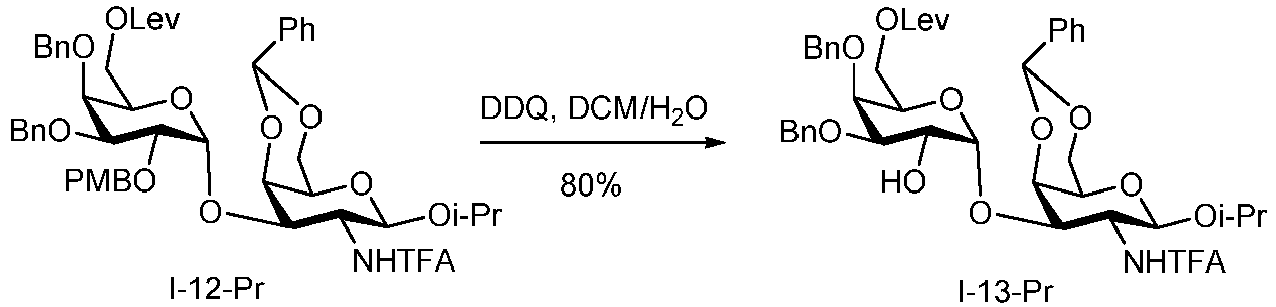
- Isopropyl 2-O-p-methoxybenzyl-3,4-di-O-benzyl-6-acetylpropionyl-β-D-galacto pyranosyl-(1→3)-2-deoxy-2-trifluoroacetamido-4,6-O-benzylidene-β-D-galactopyranoside (714 mg, 0.86 mmol) was dissolved in dichloromethane/water (14.6 mL/1. 46 ml), and 2,3-dichloro-5,6-dicyanop-benzoquinone (204 mg, 0.90 mmol, 1.0 equiv) was added in batches, and the reaction was carried out for 1 hour at room temperature. After the reaction was completed as monitored by TLC, the reaction solution was diluted with dichloromethane, and the organic phase was washed with saturated sodium bicarbonate solution, saturated sodium thiosulfate solution and saturated salt water in turn, dried with anhydrous sodium sulfate, filtered, concentrated under reduced pressure, and purified by column chromatography (DCM/MeOH = 40: 1) to obtain a white solid (490 mg, 80%). R f = 0.63 (petroleum ether/acetone = 1: 1); 1H NMR (400 MHz, CDCl3, TMS) δ 7.64 (1H, d, J = 9.3 Hz), 7.60-7.47 (2H, m), 7.42-7.10 (13H, m), 5.59 (1H, s), 5.18 (1H, d, J = 3.9 Hz), 4.94 (1H, d, J = 11.5 Hz), 4.86 (1H, d, J = 11.9 Hz), 4.70 (1H, d, J = 8.3 Hz), 4.62 (1H, d, J = 11.9 Hz), 4.51 (1H, d, J = 11.5 Hz), 4.42-4.24 (3H, m), 4.20-4.02 (6H, m), 3.95 (1H, p, J = 6.2 Hz), 3.78 (1H, d, J = 7.7 Hz), 3.72 (1H, s), 3.59 (1H, dd, J = 10.0, 2.8 Hz), 3.44 (1H, s), 2.92 (1H, ddd, J =18.9, 10.0, 3.5 Hz), 2.71-2.55 (2H, m), 2.48-2.40 (1H, m), 2.20 (3H, s), 1.23 (3H, d, J = 6.2 Hz), 1.11 (3H, d, J = 6.1 Hz); 13C NMR (100 MHz, CDCl3, TMS) δ 210.0, 172.2, 157.3 (COCF3), 138.5, 138.2, 137.3, 129.0, 128.4, 128.3 (2C), 127.8 (2C), 127.6, 126.2, 116.1 (COCF3), 100.9, 98.9, 94.6, 79.6, 75.4, 74.6, 73.9, 73.1, 71.7, 70.6, 70.4, 69.4, 69.1, 66.3, 64.6, 51.6, 38.1, 29.9, 27.6, 23.4, 21.8; ESI-Q-TOF (positive mode) calculated for C43H50F3NO13 + [M+NH4]+ m/z 863.3578, found 863.3588.
-

-
Methyl isopropyl 3,4-di-O-benzyl-6-acetylpropionyl-α-D-galactopyranosyl-(1→3)-2-deoxy-2-trifluoroacetylamino-4,6-O-benzylidene-β-D-galactopyranoside (438 mg, 0.52 mmol) were dissolved in anhydrous dichloromethane (7.0 mL). 4Å molecular sieve (700 mg) was added, stirred at room temperature for 2 hours, and then cooled to-20 °C, and trimethylsilyl trifluoromethylsulfonate (26.5 µL, 0.16 mmol, 0.3 equiv.) was added, and the reaction was carried out with stirring at -20 °C for 2h, and then the temperature was slowly raised to room temperature and the reaction was carried out overnight. After the reaction was completed as monitored by TLC, the reaction was quenched by adding proper amount of triethylamine dropwise. The molecular sieve was removed by diatomite filtration, the filtrate was concentrated under reduced pressure, and purified by column chromatography (petroleum ether/acetone 2: 1) to obtain a white solid (635 mg, 82%). R f = 0.49 (petroleum ether/acetone 1: 1); 1H NMR (400 MHz, CDCl3, TMS) δ 7.76 (2H, t, J = 9.5 Hz), 7.66-7.58 (2H, m), 7.50 - 7.23 (11H, m), 7.19-7.14 (2H, m), 5.59 (1H, s), 5.16 (1H, t, J = 9.6 Hz), 5.13-5.02 (2H, m), 4.96 (2H, dd, J = 9.4, 8.1 Hz), 4.81 (1H, d, J = 11.6 Hz), 4.74-4.51 (4H, m), 4.42 (1H, d, J = 3.5 Hz), 4.40-4.24 (6H, m), 4.20-4.10 (2H, m), 4.07 (1H, dd, J = 10.2, 3.5 Hz), 4.03-3.78 (5H, m), 3.74 (1H, d, J = 2.9 Hz), 3.72 (3H, s), 3.65 (1H, d, J = 8.0 Hz), 3.59 (1H, td, J = 6.3, 2.9 Hz), 3.45 (2H, b), 3.07-2.92 (1H, m), 2.69-2.55 (3H, m), 2.35 (1H, dt, J=16.4, 4.2 Hz), 2.20 (3H, s), 2.10 (3H, s), 2.05 (3H, s), 2.02 (3H, s), 2.00 (6H, s), 1.24 (3H, d, J = 6.2 Hz), 1.11 (3H, d, J = 6.1 Hz). 13C NMR (100 MHz, CDCl3, TMS) δ 210.2, 172.5, 170.9, 170.1, 169.9, 169.5 (2C), 167.1, 157.9 (COCF3), 157.8 (COCF3), 138.3, 138.1, 137.6, 130.3, 128.7, 128.5, 128.2, 128.1, 128.0, 127.9, 126.6, 117.0 (COCF3), 115.7 (COCF3), 101.6, 100.4, 99.1, 98.9, 94.2,77.8, 77.4, 76.3, 76.0, 74.9, 73.7, 72.9, 72.7, 72.6, 72.1, 71.8, 71.1, 70.4, 70.0, 69.5, 68.7, 66.5, 64.9, 62.5, 58.5, 52.8, 52.0, 38.1, 29.9, 27.8, 23.6, 21.9, 20.9, 20.7, 20.6; ESI-Q-TOF (positive mode) calculated for C68H80F6N2O29 + [M+NH4]+ m/z 1520.5095, found 1520.5051. -

- Isopropyl
methyl -

- Isopropyl
methyl - CP-Pr was obtained from I-21-Pr in two steps by the same method as in Example 3.


- The cells were divided into control group, LPS group, Compound CP-1 and CP-2 groups with different concentrations (the concentrations of the compound being 0.01, 0.03, 0.1, 0.3, 1, 3, 10 µM). Each of the groups was provided with three multiple pores with 100 µL per well. The cells were inoculated into a 96-well cell culture plate at the density of 1 × 10⁵ cells per well and incubated overnight at 37 °C. The next day, the cells were treated by adding different concentrations of compounds for 2 hours, and then lipopolysaccharide (LPS) solution with a concentration of 100 ng/mL was added, and the culture was continued for 24 hours at 37 °C. After the end of culture, nitric oxide level in the cells was detected according to the instructions of the nitric oxide kit. As shown in
FIG. 1 , compared with the blank control group, the release of nitric oxide can be significantly promoted after being treated with 100 ng/mL of lipopolysaccharide for 24 hours. Compared with LPS model group, both CP-1 and CP-2 can inhibit the release of nitric oxide in a dose-dependent manner, and the difference is statistically significant. - The cells were divided into control group, LPS group, Compound CP-1 and CP-2 groups with different concentrations (the concentrations of the compound being 0.01, 0.03, 0.1, 0.3, 1, 3, 10 µM). Each of the groups was provided with three multiple pores with 100 µL per well. The cells were inoculated into 96-well cell culture plate at the density of 1 × 10⁵ cells per well and incubated overnight at 37 °C. The next day, the cells were treated by adding different concentrations of compounds for 2 hours, and then lipopolysaccharide (LPS) solution with a concentration of 100 ng/mL was added, and the culture was continued for 24 hours at 37 °C. After the end of culture, the cells were centrifuged at 4 °C at 300 g for 5 minutes, the cell supernatant was collected, and the level of prostaglandin E2 in the supernatant was detected according to the instructions of prostaglandin E2 kit. As shown in
FIG. 2 , compared with the blank control group, the release of prostaglandin E2 can be significantly promoted after being treated with 100 ng/mL of lipopolysaccharide for 24 hours. Compared with LPS model group, both CP-1 and CP-2 can inhibit the release of prostaglandin E2 in a dose-dependent manner, and the difference is statistically significant. - The cells were divided into control group, LPS group, Compound CP-1 and CP-2 groups with different concentrations (the concentrations of the compound being 0.01, 0.03, 0.1, 0.3, 1, 3, 10 µM). Each of groups was provided with three multiple pores with 100 µL per well. The cells were inoculated into 96-well cell culture plate at the density of 1 × 10⁵ cells per well and incubated overnight at 37°C. The next day, the cells were treated by adding different concentrations of compounds for 2 hours, and then lipopolysaccharide (LPS) solution with a concentration of 100 ng/mL was added, and the culture was continued for 24 hours at 37°C. After the end of culture, the cells were centrifuged at 4°C at 300 g for 5 minutes, the cell supernatant was collected, and the concentration of IL-1 β, IL-6, IL-10 and TNF-α in the supernatant was detected according to the instructions of the corresponding Elisa kit. As shown in
FIG. 3 , compared with the blank control group, the release of IL-1β, IL-6 and TNF-α can be significantly promoted after being treated with 100 ng/mL of lipopolysaccharide for 24 hours. Compared with LPS model group, both CP-1 and CP-2 can inhibit the release of IL-1β, IL-6 and TNF-α in a dose-dependent manner, and the difference is statistically significant. - The cells were divided into control group, LPS group, Compound CP-1 and CP-2 groups with different concentrations (the concentrations of the compound being 1, 3, 10, 30, 100 µM). Each of the groups was provided with three multiple pores with 100 µL per well. The cells were inoculated into 96-well cell culture plate at the density of 4 × 10⁵ cells per well and incubated overnight at 37°C. The next day, the cells were treated by adding different concentrations of compounds for 2 hours, and then lipopolysaccharide (LPS) solution with a concentration of 100 ng/mL was added, and the culture was continued for 24 hours at 37°C. After the end of culture, the expression of iNOS and COX-2 proteins in cells was detected by western blot. The cell supernatant was discarded, and washed by adding the precooled PBS for 3 times, RIPA cell lysis solution containing PMSF was added, and placed on ice for 15 minutes to allow the cells to be fully lysed. The cells were centrifuged at 4°C at 300 g for 5 minutes, the cell supernatant was collected, and the concentration of protein was detected according to the instructions of the BCA protein quantitative kit, and then placed in boiled metal bath at 100°C for 5 minutes to denature the protein. After protein was separated by electrophoresis, the membrane was transfered and sealed at room temperature for 1 hour, and was incubated with the primary antibody at 4°C overnight. The membrane was washed with TBST three times the next day, and then placed at room temperature and was incubated with the secondary antibody at room temperature for 1 hour. After the TBST film was washed for three times, the chemiluminescence solution was added and placed it in the chemiluminescence gel imaging system for imaging. The results of western blot are shown in
FIG. 4 . - Compared with the blank control group, the expression of intracellular iNOS and COX-2 protein can be significantly promoted after treated with 100 ng/mL of lipopolysaccharide for 24 hours. Compared with LPS model group, both CP-1 and CP-2 can inhibit the expression of intracellular iNOS and COX-2 protein in a dose-dependent manner, and the difference is statistically significant.
- A total of 60 male C57BL/6 mice aged 6-8 weeks, weighing 20 ± 2g, were selected. The mice were placed in a feeding room with temperature of 20-24°C and humidity of 50%-60%, and were allowed to drink and eat freely. They were adaptively raised for 7 days before the experiment.
- The mice were randomly divided into six groups: control group, model group, CP-1 high dose group (30 mg/kg), CP-1 middle dose group (10 mg/kg), CP-1 low dose group (3 mg/kg), and dexamethasone group, with 10 mice in each group. CP-1 high-dose group was intraperitoneally injected with 200 µL CP-1 solution at the concentration of 30 mg/kg, CP-1 middle-dose group was intraperitoneally injected with equal volume of CP-1 solution at the concentration of 10 mg/kg, CP-1 low-dose group was intraperitoneally injected with equal volume of CP-1 solution at the concentration of 3 mg/kg, dexamethasone group was intraperitoneally injected with equal volume of dexamethasone solution at the concentration of 30 mg/kg, and control group was intraperitoneally injected with equal volume of 0.9% normal saline. Except for the control group, all groups were intraperitoneally injected with 200 µL of LPS solution at 45 mg/kg for modeling. Each group was administered once for a total of three times, 48 hours and 24 hours before modeling, and 30 minutes after modeling. After administration, the state and survival rate of mice were observed and recorded every 6 hours for 72 hours.
- The experimental results are shown in the figure. After 72 hours of administration, the survival rate of mice in the model group is 40%, that in the control group of 100%, that in CP-1 high and low dose groups is 70%, that in CP-1 middle dose group is 80%, and that in the positive drug dexamethasone group is 60%.
- A total of 24 male C57BL/6 mice aged 6-8 weeks, weighing 20 ± 2g, were selected. The mice were placed in a feeding room with temperature of 20-24°C and humidity of 50%-60%, and were allowed to drink and eat freely. They were adaptively raised for 7 days before the experiment. Mice were randomly divided into four groups: control group, CP-1 group, LPS group and LPS + CP-1group, with 6 mice in each group. CP-1 group and LPS + CP-1 group were intraperitoneally injected with 200 µL CP-1 solution at the concentration of 10 mg/kg, while the control group and LPS group were intraperitoneally injected with equal volume of 0.9% normal saline. LPS group and LPS + CP-1 group were injected intraperitoneally with 200 µL LPS solution at 25 mg/kg for modeling. Each group was administered once for a total of two times, 24 hours before modeling and 30 minutes after modeling. After 12 hours of administration, the mice were anesthetized and blood was taken from the heart. After the blood stood for 2 hours, it was centrifuged at 5000 rpm for 10 minutes to collect serum. According to the instructions of Elisa kit, the absorbance of each hole was detected by using a multifunctional enzyme-labeled instrument at the wavelength of 450 nm, and the contents of cytokines IL-1β, IL-6, IL-18, TNF-α, Gal-3, INF-γ and HMGB1 were calculated according to the standard curve.
- A total of 24 male C57BL/6 mice aged 6-8 weeks, weighing 20 ± 2g, were selected. The mice were placed in a feeding room with temperature of 20-24°C and humidity of 50%-60%, and were allowed to drink and eat freely. They were adaptively raised for 7 days before the experiment. Mice were randomly divided into four groups: control group, CP-Me group, LPS group and LPS + CP-Me group, with 6 mice in each group. CP-
Me 10 mg/kg group and CP-Me 3 mg/kg group were intraperitoneally injected with 200 µL CP-Me solution at the concentrations of 10 mg/kg and 3 mg/kg, while the control group and LPS group were intraperitoneally injected with equal volume of 0.9% normal saline. LPS group was injected intraperitoneally with 200 µL LPS solution at 25 mg/kg for modeling. Each group was administered once for a total of two times, 12 hours before modeling and 30 minutes after modeling. After 12 hours of administration, the mice were anesthetized and blood was taken from the heart. After the blood stood for 2 hours, it was centrifuged at 5000 rpm for 10 minutes to collect serum. According to the instructions of Elisa kit, the absorbance of each hole was detected by using a multifunctional enzyme-labeled instrument at the wavelength of 450 nm, and the contents of cytokines IL-1β, IL-6, and TNF-α were calculated according to the standard curve. - A total of 60 male C57BL/6 mice aged 6-8 weeks, weighing 20 ± 2g, were selected. The mice were placed in a feeding room with temperature of 20-24°C and humidity of 50%-60%, and were allowed to drink and eat freely. They were adaptively raised for 7 days before the experiment. Mice were randomly divided into six groups: control group, LPS group, CP-1 group (10 mg/kg), dexamethasone group, with 6 mice in each group. CP-1 high-dose group was intraperitoneally injected with 200 µL CP-1 solution at the concentration of 30 mg/kg, CP-1 middle-dose group was intraperitoneally injected with equal volume of CP-1 solution at the concentration of 10 mg/kg, CP-1 low-dose group was intraperitoneally injected with equal volume of CP-1 solution at the concentration of 3 mg/kg, dexamethasone group was intraperitoneally injected with equal volume of dexamethasone solution at the concentration of 30 mg/kg, and control group was intraperitoneally injected with equal volume of 0.9% normal saline. The models were made by intraperitoneal injection of 45 mg/
kg LPS solution 200 µL except the control. 24 hours before modeling and 30 minutes after modeling, each was given medicine once, totaling two times. Except for the control group, all groups were intraperitoneally injected with 200 µL of LPS solution at 45 mg/kg for modeling. Each group was administered once for a total of two times, 24 hours before modeling and 30 minutes after modeling. - After 24 hours of administration, the mice were killed by removing the neck, and the left lung was soaked and fixed in formalin solution. After fixation, it was embedded in paraffin and sectioned, and the histomorphologically changes were observed by eosin staining. The scores were increased from 0 to 4 by different tissue changes, such as bleeding, neutrophil infiltration into alveoli, increased membrane transparency, increased tissue debris, and uneven thickening of the intermediate layer. 0 represents no damage, 1 represents less than 25% of the damage, 2 represents 25% to 50% of the damage, 3 represents 50% to 75% of the damage, and 4 represents more than 75% of the damage. The inflammation score is calculated by three different technicians, and the average value obtained by the three technicians is used as the final result.
- The results showed that the LPS group had significant alveolar wall thickening, alveolar shrinkage, extensive interstitial inflammatory cell infiltration, and bleeding compared to the blank group; The CP-1 (10 mg/kg) group can significantly alleviate lung injury caused by LPS and maintain the basic morphology of lung tissue; The dexamethasone group can also achieve similar effects, but the morphology is not as good as CP-1, and there may be a higher risk of bleeding early on.
- Although the embodiments disclosed in this application are as above, the contents described are only for the sake of understanding the embodiments adopted in this application, and are not intended to limit this application. Any person skilled in the art to which this application belongs may make any modifications and changes in the form and details of implementation without departing from the idea and scope disclosed in this application, but the scope of protection of this application shall still be subject to the scope defined in the appended claims.
Claims (17)
- Use of a bacterial capsular oligosaccharide derivative or pharmaceutically acceptable salts, solvates and prodrugs thereof, the derivative is as shown in formula I:
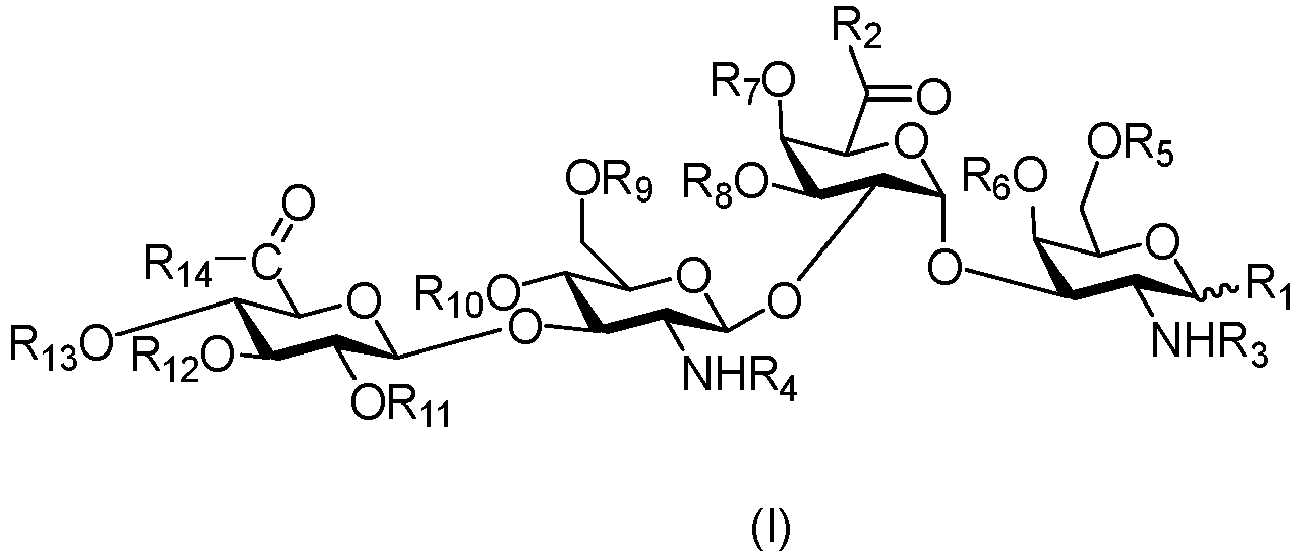 as an anti-inflammatory drug,wherein R1 in formula (I) is OH, unsubstituted or substituted C1-C6 alkoxy, unsubstituted or substituted C2-C6 alkenyloxy, unsubstituted or substituted C2-C6 alkynyloxy, unsubstituted or substituted C1-C6 alkylthio, unsubstituted or substituted C1-C6 alkanoyloxy, or unsubstituted or substituted aryloxy;R2 is OH, -N(H)-R15, N(R16)-R17, unsubstituted or substituted C1-C6 alkoxy, or unsubstituted or substituted aryloxy, where R15 is an amino acid residue excluding proline; R16 and R17 together form a proline residue;R3 and R4 are each independently unsubstituted or substituted C1-C6 alkanoyl;R5, R6, R7, R8, R9, R10, R11, R12 and R13 are each independently hydrogen, or unsubstituted or substituted C1-C6 alkanoyl, or unsubstituted or substituted C1-C6 alkyl;R14 is OH, unsubstituted or substituted C1-C6 alkoxy or unsubstituted or substituted aryloxy.
 - The use according to claim 1, wherein R1 in formula (I) is OH, unsubstituted or substituted C1-C6 alkoxy, unsubstituted or substituted C2-C6 alkenyloxy, unsubstituted or substituted C2-C6 alkynyloxy, unsubstituted or substituted C1-C6 alkylthio, unsubstituted or substituted C1-C6 alkanoyloxy, or unsubstituted or substituted aryloxy; wherein, the substituted C1-C6 alkoxy, substituted C2-C6 alkenyloxy, substituted C2-C6 alkynyloxy, substituted C1-C6 alkylthio, substituted C1-C6 alkynyloxy and substituted aryloxy mean that one or more hydrogen in C1-C6 alkoxy, C2-C6 alkenyloxy, C2-C6 alkynyloxy, C1-C6 alkylthio, C1-C6 alkanoyloxy or aryloxy are substituted by a group selected from hydroxy, C1-C6 alkoxy, halogen, nitro, cyano, acetyl, propionyl and phenyl;R2 is OH, -N(H)-R15, N(R16)-R17, unsubstituted or substituted C1-C6 alkoxy, or unsubstituted or substituted aryloxy, wherein R15 is an amino acid residue excluding proline; R16 and R17 together form a proline residue; the substituted C1-C6 alkoxy and substituted aryloxy mean that one or more hydrogen in C1-C6 alkoxy or the aryloxy is substituted by a group selected from hydroxy, C1-C6 alkoxy, halogen, nitro, cyano and phenyl;R3 and R4 are each independently unsubstituted or substituted C1-C6 alkanoyl; wherein the substituted C1-C6 alkanoyl means that one or more hydrogen in the C1-C6 alkanoyl is substituted by a group selected from hydroxy, C1-C6 alkoxy, halogen, nitro, cyano, acetyl, propionyl and phenyl;R5, R6, R7, R8, R9, R10, R11, R12 and R13 are each independently hydrogen, unsubstituted or substituted C1-C6 alkanoyl, or unsubstituted or substituted C1-C6 alkyl; wherein the substituted C1-C6 alkanoyl or substituted C1-C6 alkyl means that one or more hydrogen in C1-C6 alkanoyl or C1-C6 alkyl is substituted by a group selected from hydroxy, C1-C6 alkoxy, halogen, nitro, cyano, acetyl, propionyl and phenyl; optionally, the phenyl may be substituted by one or more selected from the C1-C4 alkoxy and nitro;R14 is OH, unsubstituted or substituted C1-C6 alkoxy, or unsubstituted or substituted aryloxy; wherein the substituted C1-C6 alkoxy and substituted aryloxy mean that one or more hydrogen in C1-C6 alkoxy or aryloxy is substituted by a group selected from hydroxy, C1-C6 alkoxy, halogen, nitro, cyano and phenyl.
- The use according to claim 2, wherein R1 in formula (I) is OH, unsubstituted C1-C6 alkoxy, phenyl-substituted C1-C6 alkoxy, or unsubstituted C2-C6 alkenyloxy; preferably, R1 is OH, methoxy, ethoxy, n-propoxy, isopropoxy, allyloxy, or benzyloxy.
- The use according to claim 2, wherein R2 in formula (I) is OH, -N(H)-R15, N(R16)-R17, unsubstituted C1-C6 alkoxy, or phenyl-substituted C1-C6 alkoxy, wherein R15 is an amino acid residue excluding proline; R16 and R17 together form a proline residue; preferably, R2 is OH, methoxy, or -N(H)-R15, wherein R15 is threonine residue.
- The use according to claim 2, wherein R3 and R4 in formula (I) are each independently unsubstituted or substituted C1-C6 alkanoyl; wherein the substituted C1-C6 alkanoyl means that one or more hydrogen in the C1-C6 alkanoyl is substituted by a group selected from halogen, nitro, cyano, acetyl, propionyl and phenyl; preferably, R3 and R4 are each independently acetyl or trifluoroacetyl.
- The use according to claim 2, wherein R5, R6, R7, R8, R9, R10, R11, R12 and R13 in formula (I) are each independently hydrogen, unsubstituted C1-C6 alkanoyl, phenyl-substituted C1-C6 alkanoyl, or substituted phenylmethyl; preferably, R5, R6, R7, R8, R9, R10, R11, R12 and R13 are each independently hydrogen, acetyl, benzyl, or 4-methoxybenzyl.
- The use according to claim 2, wherein R14 in formula (I) is OH, or unsubstituted or substituted C1-C6 alkoxy; preferably, R14 is OH or methoxy.
- The use according to any one of claims 1 to 7, wherein anti-inflammatory means inhibiting the production of nitric oxide and prostaglandin E2; and/or inhibiting the protein expression of nitric oxide synthase and cyclooxygenase-2; and/or reducing the release of interleukin-1β, interleukin-6 and tumor necrosis factor α; preferably, treating sepsis.
- A method of preventing or treating inflammation, the method comprising administering to an individual in need thereof a therapeutically effective amount of a bacterial capsular oligosaccharide derivative or a pharmaceutically acceptable salt, solvate, prodrug thereof, the derivative is as shown in Formula I:
 wherein R1 in formula (I) is OH, unsubstituted or substituted C1-C6 alkoxy, unsubstituted or substituted C2-C6 alkenyloxy, unsubstituted or substituted C2-C6 alkynyloxy, unsubstituted or substituted C1-C6 alkylthio, unsubstituted or substituted C1-C6 alkanoyloxy, or unsubstituted or substituted aryloxy;R2 is OH, -N(H)-R15, N(R16)-R17, unsubstituted or substituted C1-C6 alkoxy, or unsubstituted or substituted aryloxy, wherein R15 is an amino acid residue excluding proline; R16 and R17 together form a proline residue;R3 and R4 are each independently unsubstituted or substituted C1-C6 alkanoyl;R5, R6, R7, R8, R9, R10, R11, R12 and R13 are each independently hydrogen, or unsubstituted or substituted C1-C6 alkanoyl, or unsubstituted or substituted C1-C6 alkyl;R14 is OH, unsubstituted or substituted C1-C6 alkoxy or unsubstituted or substituted aryloxy.
 - The method of Claim 9, wherein preventing or treating inflammation means inhibiting the production of nitric oxide and prostaglandin E2; and/or inhibiting the protein expression of nitric oxide synthase and cyclooxygenase-2; and/or reducing the release of interleukin-1β, interleukin-6 and tumor necrosis factor α; preferably, treating sepsis.
- The use according to any one of claims 1 to 8, or the method according to any one of claims 9 to 10, wherein the preparation method of the derivative comprises the following steps:reacting the compound of formula (I-13) with the compound of formula (I-18) to obtain compound (I-19)
 wherein in the compound of formula (I-13), formula (I-18) or formula (I-19), Ac is acetyl, Ph is phenyl, Bn is benzyl, Me is methyl, TFA is trifluoroacetyl, and Lev is acetylpropionyl.
 - A novel bacterial capsular oligosaccharide derivative as shown in formula (I'), or a pharmaceutically acceptable salt, solvate, prodrug thereof:
 wherein R1' in formula (I') is hydrogen, unsubstituted or substituted C1-C6 alkoxy, unsubstituted or substituted C2-C6 alkenyloxy, unsubstituted or substituted C2-C6 alkynoxy, unsubstituted or substituted C1-C6 alkylthio, unsubstituted or substituted C1-C6 alkanoyloxy, or unsubstituted or substituted aryloxy; wherein, the substituted C1-C6 alkoxy, substituted C2-C6 alkenyloxy, substituted C2-C6 alkynyloxy, substituted C1-C6 alkylthio, substituted C1-C6 alkynyloxy and substituted aryloxy mean that one or more hydrogen in C1-C6 alkoxy, C2-C6 alkenyloxy, C2-C6 alkynyloxy, C1-C6 alkylthio, C1-C6 alkanoyloxy or aryloxy are substituted by a group selected from hydroxy, C1-C6 alkoxy, halogen, nitro, cyano, acetyl, propionyl and phenyl;R2' is OH, -N(H)-R15, N(R16)-R17, unsubstituted or substituted C1-C6 alkoxy, or unsubstituted or substituted aryloxy, wherein R15 is an amino acid residue excluding proline; R16 and R17 together form a proline residue; the substituted C1-C6 alkoxy and substituted aryloxy mean that one or more hydrogen in C1-C6 alkoxy or the aryloxy is substituted by a group selected from hydroxy, C1-C6 alkoxy, halogen, nitro, cyano and phenyl;R3' and R4' are each independently unsubstituted or substituted C1-C6 alkanoyl; wherein, the substituted C1-C6 alkanoyl means that one or more hydrogen in the C1-C6 alkanoyl is substituted with a group selected from hydroxy, C1-C6 alkoxy, halogen, nitro, cyano, acetyl, propionyl and phenyl;R5', R6', R7', R8', R9', R10', R11', R12'and R13' are each independently hydrogen, or substituted or unsubstituted C1-C6 alkanoyl; wherein the substituted C1-C6 alkanoyl means that one or more hydrogen in C1-C6 alkanoyl is substituted by a group selected from hydroxy, C1-C6 alkoxy, halogen, nitro, cyano, acetyl, propionyl and phenyl;R14' is OH, unsubstituted or substituted C1-C6 alkoxy, or unsubstituted or substituted aryloxy; wherein, the substituted C1-C6 alkoxy and substituted aryloxy mean that one or more hydrogen in C1-C6 alkoxy or aryloxy is substituted by a group selected from hydroxy, C1-C6 alkoxy, halogen, nitro, cyano and phenyl;and it is defined that R1' in the formula (I') is not n-propoxy or allyloxy.
 - The derivative according to claim 10, wherein R1' in formula (I') is OH, methoxy, ethoxy, isopropoxy, n-butoxy, isobutoxy, tert-butoxy, or benzyloxy; preferably R1' is OH, methoxy, ethoxy, or isopropoxy; and/orR2' is OH, -N(H)-R15, N(R16)-R17, unsubstituted C1-C6 alkoxy, or phenyl-substituted C1-C6 alkoxy, wherein R15 is an amino acid residue excluding proline; R16 and R17 together form a proline residue; preferably, R2' is OH, methoxy or -N(H)-R15, wherein R15 is a threonine residue; and/orR3' and R4' are each independently unsubstituted or substituted C1-C6 alkanoyl; wherein the substituted C1-C6 alkanoyl means that one or more hydrogen in the C1-C6 alkanoyl is substituted by a group selected from halogen, nitro, cyano, acetyl, propionyl and phenyl; preferably, R3' and R4' are each independently acetyl or trifluoroacetyl; and/orR5', R6', R7', R8', R9', R10', R11', R12' and R13' in formula (I') are each independently hydrogen, unsubstituted C1-C6 alkanoyl, phenyl-substituted C1-C6 alkanoyl, or substituted phenylmethyl, preferably R5', R6', R7', R8', R9', R10', R11', R12' and R13' are each independently hydrogen, acetyl, benzyl, or 4-methoxybenzyl; and/orR14' is OH, or unsubstituted or substituted C1-C6 alkoxy; preferably, R14' is OH or methoxy.
- The derivative according to claim 13, wherein formula (I') is Compound CP-1:
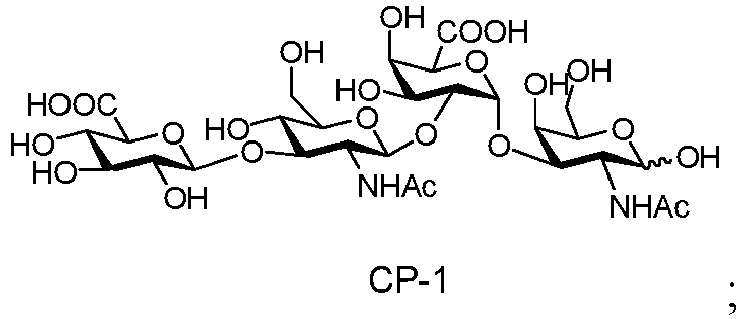
formula (I') is Compound CP-Me:


- The derivative according to claim 13, wherein formula (I') is Compound CP-2:

- A pharmaceutical composition comprising the derivative of any one of claims 13 to 15.
- The derivative of any one of claims 13 to 15, or the pharmaceutical composition of claim 14, for use as an anti-inflammatory drug.
Applications Claiming Priority (2)
| Application Number | Priority Date | Filing Date | Title |
|---|---|---|---|
| CN202111152832 | 2021-09-29 | ||
| PCT/CN2022/122560 WO2023051684A1 (en) | 2021-09-29 | 2022-09-29 | Bacterial capsular oligosaccharide derivative, preparation method therefor, pharmaceutical composition and use thereof |
Publications (2)
| Publication Number | Publication Date |
|---|---|
| EP4393912A1 true EP4393912A1 (en) | 2024-07-03 |
| EP4393912A4 EP4393912A4 (en) | 2024-12-04 |
Family
ID=84127965
Family Applications (1)
| Application Number | Title | Priority Date | Filing Date |
|---|---|---|---|
| EP22875066.7A Pending EP4393912A4 (en) | 2021-09-29 | 2022-09-29 | BACTERIAL CAPSULAR OLIGOSACCHARIDE DERIVATIVE, MANUFACTURING PROCESS THEREOF, PHARMACEUTICAL COMPOSITION AND USE THEREOF |
Country Status (5)
| Country | Link |
|---|---|
| US (1) | US20240408126A1 (en) |
| EP (1) | EP4393912A4 (en) |
| JP (1) | JP7747369B2 (en) |
| CN (1) | CN115381844B (en) |
| WO (1) | WO2023051684A1 (en) |
Family Cites Families (3)
| Publication number | Priority date | Publication date | Assignee | Title |
|---|---|---|---|---|
| WO1997014707A1 (en) * | 1995-10-18 | 1997-04-24 | Cytel Corporation | SIALYL Lex ANALOGUES AS INHIBITORS OF CELLULAR ADHESION |
| KR102225282B1 (en) * | 2015-07-21 | 2021-03-10 | 화이자 인코포레이티드 | Immunogenic composition comprising conjugated capsular saccharide antigen, kit comprising same, and use thereof |
| ES2934583T3 (en) * | 2018-07-16 | 2023-02-23 | Yantai Dongcheng Biochemicals Co Ltd | Fucosylated chondroitin sulfate oligosaccharide, method for preparing the same, composition thereof and use thereof |
-
2022
- 2022-09-29 JP JP2024519833A patent/JP7747369B2/en active Active
- 2022-09-29 WO PCT/CN2022/122560 patent/WO2023051684A1/en not_active Ceased
- 2022-09-29 EP EP22875066.7A patent/EP4393912A4/en active Pending
- 2022-09-29 US US18/696,438 patent/US20240408126A1/en active Pending
- 2022-09-29 CN CN202211201644.8A patent/CN115381844B/en active Active
Also Published As
| Publication number | Publication date |
|---|---|
| CN115381844B (en) | 2024-03-22 |
| JP7747369B2 (en) | 2025-10-01 |
| JP2024537829A (en) | 2024-10-16 |
| US20240408126A1 (en) | 2024-12-12 |
| CN115381844A (en) | 2022-11-25 |
| WO2023051684A1 (en) | 2023-04-06 |
| EP4393912A4 (en) | 2024-12-04 |
Similar Documents
| Publication | Publication Date | Title |
|---|---|---|
| EP0694558B1 (en) | Novel sphingoglycolipid and use thereof | |
| US5849716A (en) | Sphingoglycolipids, their preparation, and therapeutic methods of use | |
| EP0650732B1 (en) | Novel medicinal composition | |
| RU2178794C2 (en) | Inositol glycans with insulin-like effect, method of their synthesis, pharmaceutical composition and method of its preparing | |
| EP0609437B1 (en) | Novel sphingoglycolipid and use thereof | |
| EP0536969A2 (en) | Anti-endotoxin compounds | |
| JPWO1994009020A1 (en) | Novel glycosphingolipids and uses thereof | |
| HU226807B1 (en) | 3-deoxy-oligosaccharides, process for preparing them and pharmaceutical compositions containing them | |
| CN110724209A (en) | Fucosylated chondroitin sulfate oligosaccharide and preparation method, composition and use thereof | |
| IL95928A (en) | N-glycosyl derivatives of 1,4-dideoxy-1,4-imino -d-arabinitol, process for their preparation and pharmaceutical compositions containing them | |
| AU614772B2 (en) | Saccharide derivatives | |
| EP1300411B1 (en) | Novel disaccharides with anti-arthritic action | |
| US20240408126A1 (en) | Bacterial capsular oligosaccharide derivative, preparation method therefor, pharmaceutical composition and use thereof | |
| US5220008A (en) | Oligosaccharide inhibitors for influenza virus | |
| US5254676A (en) | Oligosaccharide inhibitors for influenza virus | |
| CA2118405A1 (en) | Immunosuppressive and tolerogenic modified lewisc and lacnac compounds | |
| CA2110707A1 (en) | Immunosuppressive and tolerogenic oligosaccharide modified lewis x and lewis a compounds | |
| US6511965B2 (en) | Ether type lipid A 1-carboxylic acid analogs | |
| JP4913272B2 (en) | Method for producing oligosaccharide, novel oligosaccharide and pharmaceutical composition containing the same | |
| EP1409498B1 (en) | Inositol phosphoglycan derivatives and their medical uses | |
| EP2721044B1 (en) | Synthetic pentasaccharides having short half-life and high activity | |
| KR100481746B1 (en) | Inositol glycans having insulin-like action and pharmaceutical preparations comprising the same | |
| HU227307B1 (en) | Intermediates for the preparation of 3-deoxy-oligosaccharides | |
| WO1996016071A1 (en) | PROCESSES FOR THE SYNTHESIS OF 3'-SUBSTITUTED LEWISx COMPOUNDS | |
| WO2012103990A1 (en) | Phosphoramidates of monosaccharides |
Legal Events
| Date | Code | Title | Description |
|---|---|---|---|
| STAA | Information on the status of an ep patent application or granted ep patent |
Free format text: STATUS: THE INTERNATIONAL PUBLICATION HAS BEEN MADE |
|
| PUAI | Public reference made under article 153(3) epc to a published international application that has entered the european phase |
Free format text: ORIGINAL CODE: 0009012 |
|
| STAA | Information on the status of an ep patent application or granted ep patent |
Free format text: STATUS: REQUEST FOR EXAMINATION WAS MADE |
|
| 17P | Request for examination filed |
Effective date: 20240327 |
|
| AK | Designated contracting states |
Kind code of ref document: A1 Designated state(s): AL AT BE BG CH CY CZ DE DK EE ES FI FR GB GR HR HU IE IS IT LI LT LU LV MC MK MT NL NO PL PT RO RS SE SI SK SM TR |
|
| REG | Reference to a national code |
Ref country code: DE Ref legal event code: R079 Free format text: PREVIOUS MAIN CLASS: C07D0309020000 Ipc: A61K0031702800 |
|
| A4 | Supplementary search report drawn up and despatched |
Effective date: 20241105 |
|
| RIC1 | Information provided on ipc code assigned before grant |
Ipc: C07H 15/18 20060101ALI20241029BHEP Ipc: C07H 15/04 20060101ALI20241029BHEP Ipc: C07H 1/00 20060101ALI20241029BHEP Ipc: C07H 7/00 20060101ALI20241029BHEP Ipc: C07D 309/02 20060101ALI20241029BHEP Ipc: A61P 31/04 20060101ALI20241029BHEP Ipc: A61P 29/00 20060101ALI20241029BHEP Ipc: A61K 31/7028 20060101AFI20241029BHEP |
|
| DAV | Request for validation of the european patent (deleted) | ||
| DAX | Request for extension of the european patent (deleted) | ||
| STAA | Information on the status of an ep patent application or granted ep patent |
Free format text: STATUS: EXAMINATION IS IN PROGRESS |
|
| 17Q | First examination report despatched |
Effective date: 20251105 |