EP4391745A1 - Electric device and battery pack system - Google Patents
Electric device and battery pack system Download PDFInfo
- Publication number
- EP4391745A1 EP4391745A1 EP23207522.6A EP23207522A EP4391745A1 EP 4391745 A1 EP4391745 A1 EP 4391745A1 EP 23207522 A EP23207522 A EP 23207522A EP 4391745 A1 EP4391745 A1 EP 4391745A1
- Authority
- EP
- European Patent Office
- Prior art keywords
- electric device
- electric
- bus bar
- housing
- heat transfer
- Prior art date
- Legal status (The legal status is an assumption and is not a legal conclusion. Google has not performed a legal analysis and makes no representation as to the accuracy of the status listed.)
- Pending
Links
Images



Classifications
-
- H—ELECTRICITY
- H01—ELECTRIC ELEMENTS
- H01M—PROCESSES OR MEANS, e.g. BATTERIES, FOR THE DIRECT CONVERSION OF CHEMICAL ENERGY INTO ELECTRICAL ENERGY
- H01M10/00—Secondary cells; Manufacture thereof
- H01M10/60—Heating or cooling; Temperature control
- H01M10/61—Types of temperature control
- H01M10/613—Cooling or keeping cold
-
- H—ELECTRICITY
- H05—ELECTRIC TECHNIQUES NOT OTHERWISE PROVIDED FOR
- H05K—PRINTED CIRCUITS; CASINGS OR CONSTRUCTIONAL DETAILS OF ELECTRIC APPARATUS; MANUFACTURE OF ASSEMBLAGES OF ELECTRICAL COMPONENTS
- H05K7/00—Constructional details common to different types of electric apparatus
- H05K7/14—Mounting supporting structure in casing or on frame or rack
- H05K7/1422—Printed circuit boards receptacles, e.g. stacked structures, electronic circuit modules or box like frames
- H05K7/1427—Housings
- H05K7/1432—Housings specially adapted for power drive units or power converters
- H05K7/14329—Housings specially adapted for power drive units or power converters specially adapted for the configuration of power bus bars
-
- B—PERFORMING OPERATIONS; TRANSPORTING
- B60—VEHICLES IN GENERAL
- B60R—VEHICLES, VEHICLE FITTINGS, OR VEHICLE PARTS, NOT OTHERWISE PROVIDED FOR
- B60R16/00—Electric or fluid circuits specially adapted for vehicles and not otherwise provided for; Arrangement of elements of electric or fluid circuits specially adapted for vehicles and not otherwise provided for
- B60R16/02—Electric or fluid circuits specially adapted for vehicles and not otherwise provided for; Arrangement of elements of electric or fluid circuits specially adapted for vehicles and not otherwise provided for electric constitutive elements
- B60R16/023—Electric or fluid circuits specially adapted for vehicles and not otherwise provided for; Arrangement of elements of electric or fluid circuits specially adapted for vehicles and not otherwise provided for electric constitutive elements for transmission of signals between vehicle parts or subsystems
- B60R16/0238—Electrical distribution centers
-
- H—ELECTRICITY
- H01—ELECTRIC ELEMENTS
- H01M—PROCESSES OR MEANS, e.g. BATTERIES, FOR THE DIRECT CONVERSION OF CHEMICAL ENERGY INTO ELECTRICAL ENERGY
- H01M10/00—Secondary cells; Manufacture thereof
- H01M10/60—Heating or cooling; Temperature control
- H01M10/62—Heating or cooling; Temperature control specially adapted for specific applications
- H01M10/625—Vehicles
-
- H—ELECTRICITY
- H01—ELECTRIC ELEMENTS
- H01M—PROCESSES OR MEANS, e.g. BATTERIES, FOR THE DIRECT CONVERSION OF CHEMICAL ENERGY INTO ELECTRICAL ENERGY
- H01M10/00—Secondary cells; Manufacture thereof
- H01M10/60—Heating or cooling; Temperature control
- H01M10/64—Heating or cooling; Temperature control characterised by the shape of the cells
- H01M10/647—Prismatic or flat cells, e.g. pouch cells
-
- H—ELECTRICITY
- H01—ELECTRIC ELEMENTS
- H01M—PROCESSES OR MEANS, e.g. BATTERIES, FOR THE DIRECT CONVERSION OF CHEMICAL ENERGY INTO ELECTRICAL ENERGY
- H01M10/00—Secondary cells; Manufacture thereof
- H01M10/60—Heating or cooling; Temperature control
- H01M10/65—Means for temperature control structurally associated with the cells
- H01M10/653—Means for temperature control structurally associated with the cells characterised by electrically insulating or thermally conductive materials
-
- H—ELECTRICITY
- H01—ELECTRIC ELEMENTS
- H01M—PROCESSES OR MEANS, e.g. BATTERIES, FOR THE DIRECT CONVERSION OF CHEMICAL ENERGY INTO ELECTRICAL ENERGY
- H01M10/00—Secondary cells; Manufacture thereof
- H01M10/60—Heating or cooling; Temperature control
- H01M10/65—Means for temperature control structurally associated with the cells
- H01M10/655—Solid structures for heat exchange or heat conduction
-
- H—ELECTRICITY
- H01—ELECTRIC ELEMENTS
- H01M—PROCESSES OR MEANS, e.g. BATTERIES, FOR THE DIRECT CONVERSION OF CHEMICAL ENERGY INTO ELECTRICAL ENERGY
- H01M10/00—Secondary cells; Manufacture thereof
- H01M10/60—Heating or cooling; Temperature control
- H01M10/65—Means for temperature control structurally associated with the cells
- H01M10/655—Solid structures for heat exchange or heat conduction
- H01M10/6551—Surfaces specially adapted for heat dissipation or radiation, e.g. fins or coatings
-
- H—ELECTRICITY
- H01—ELECTRIC ELEMENTS
- H01M—PROCESSES OR MEANS, e.g. BATTERIES, FOR THE DIRECT CONVERSION OF CHEMICAL ENERGY INTO ELECTRICAL ENERGY
- H01M10/00—Secondary cells; Manufacture thereof
- H01M10/60—Heating or cooling; Temperature control
- H01M10/65—Means for temperature control structurally associated with the cells
- H01M10/655—Solid structures for heat exchange or heat conduction
- H01M10/6553—Terminals or leads
-
- H—ELECTRICITY
- H01—ELECTRIC ELEMENTS
- H01M—PROCESSES OR MEANS, e.g. BATTERIES, FOR THE DIRECT CONVERSION OF CHEMICAL ENERGY INTO ELECTRICAL ENERGY
- H01M10/00—Secondary cells; Manufacture thereof
- H01M10/60—Heating or cooling; Temperature control
- H01M10/65—Means for temperature control structurally associated with the cells
- H01M10/655—Solid structures for heat exchange or heat conduction
- H01M10/6556—Solid parts with flow channel passages or pipes for heat exchange
-
- H—ELECTRICITY
- H01—ELECTRIC ELEMENTS
- H01M—PROCESSES OR MEANS, e.g. BATTERIES, FOR THE DIRECT CONVERSION OF CHEMICAL ENERGY INTO ELECTRICAL ENERGY
- H01M50/00—Constructional details or processes of manufacture of the non-active parts of electrochemical cells other than fuel cells, e.g. hybrid cells
- H01M50/20—Mountings; Secondary casings or frames; Racks, modules or packs; Suspension devices; Shock absorbers; Transport or carrying devices; Holders
- H01M50/204—Racks, modules or packs for multiple batteries or multiple cells
- H01M50/207—Racks, modules or packs for multiple batteries or multiple cells characterised by their shape
- H01M50/209—Racks, modules or packs for multiple batteries or multiple cells characterised by their shape adapted for prismatic or rectangular cells
-
- H—ELECTRICITY
- H01—ELECTRIC ELEMENTS
- H01M—PROCESSES OR MEANS, e.g. BATTERIES, FOR THE DIRECT CONVERSION OF CHEMICAL ENERGY INTO ELECTRICAL ENERGY
- H01M50/00—Constructional details or processes of manufacture of the non-active parts of electrochemical cells other than fuel cells, e.g. hybrid cells
- H01M50/50—Current conducting connections for cells or batteries
- H01M50/502—Interconnectors for connecting terminals of adjacent batteries; Interconnectors for connecting cells outside a battery casing
- H01M50/507—Interconnectors for connecting terminals of adjacent batteries; Interconnectors for connecting cells outside a battery casing comprising an arrangement of two or more busbars within a container structure, e.g. busbar modules
-
- H—ELECTRICITY
- H01—ELECTRIC ELEMENTS
- H01M—PROCESSES OR MEANS, e.g. BATTERIES, FOR THE DIRECT CONVERSION OF CHEMICAL ENERGY INTO ELECTRICAL ENERGY
- H01M50/00—Constructional details or processes of manufacture of the non-active parts of electrochemical cells other than fuel cells, e.g. hybrid cells
- H01M50/50—Current conducting connections for cells or batteries
- H01M50/502—Interconnectors for connecting terminals of adjacent batteries; Interconnectors for connecting cells outside a battery casing
- H01M50/521—Interconnectors for connecting terminals of adjacent batteries; Interconnectors for connecting cells outside a battery casing characterised by the material
- H01M50/522—Inorganic material
-
- H—ELECTRICITY
- H01—ELECTRIC ELEMENTS
- H01M—PROCESSES OR MEANS, e.g. BATTERIES, FOR THE DIRECT CONVERSION OF CHEMICAL ENERGY INTO ELECTRICAL ENERGY
- H01M50/00—Constructional details or processes of manufacture of the non-active parts of electrochemical cells other than fuel cells, e.g. hybrid cells
- H01M50/50—Current conducting connections for cells or batteries
- H01M50/572—Means for preventing undesired use or discharge
- H01M50/574—Devices or arrangements for the interruption of current
- H01M50/583—Devices or arrangements for the interruption of current in response to current, e.g. fuses
-
- H—ELECTRICITY
- H05—ELECTRIC TECHNIQUES NOT OTHERWISE PROVIDED FOR
- H05K—PRINTED CIRCUITS; CASINGS OR CONSTRUCTIONAL DETAILS OF ELECTRIC APPARATUS; MANUFACTURE OF ASSEMBLAGES OF ELECTRICAL COMPONENTS
- H05K7/00—Constructional details common to different types of electric apparatus
- H05K7/02—Arrangements of circuit components or wiring on supporting structure
- H05K7/026—Multiple connections subassemblies
-
- H—ELECTRICITY
- H05—ELECTRIC TECHNIQUES NOT OTHERWISE PROVIDED FOR
- H05K—PRINTED CIRCUITS; CASINGS OR CONSTRUCTIONAL DETAILS OF ELECTRIC APPARATUS; MANUFACTURE OF ASSEMBLAGES OF ELECTRICAL COMPONENTS
- H05K7/00—Constructional details common to different types of electric apparatus
- H05K7/20—Modifications to facilitate cooling, ventilating, or heating
- H05K7/2089—Modifications to facilitate cooling, ventilating, or heating for power electronics, e.g. for inverters for controlling motor
- H05K7/209—Heat transfer by conduction from internal heat source to heat radiating structure
-
- H—ELECTRICITY
- H01—ELECTRIC ELEMENTS
- H01M—PROCESSES OR MEANS, e.g. BATTERIES, FOR THE DIRECT CONVERSION OF CHEMICAL ENERGY INTO ELECTRICAL ENERGY
- H01M2200/00—Safety devices for primary or secondary batteries
- H01M2200/10—Temperature sensitive devices
- H01M2200/103—Fuse
-
- Y—GENERAL TAGGING OF NEW TECHNOLOGICAL DEVELOPMENTS; GENERAL TAGGING OF CROSS-SECTIONAL TECHNOLOGIES SPANNING OVER SEVERAL SECTIONS OF THE IPC; TECHNICAL SUBJECTS COVERED BY FORMER USPC CROSS-REFERENCE ART COLLECTIONS [XRACs] AND DIGESTS
- Y02—TECHNOLOGIES OR APPLICATIONS FOR MITIGATION OR ADAPTATION AGAINST CLIMATE CHANGE
- Y02E—REDUCTION OF GREENHOUSE GAS [GHG] EMISSIONS, RELATED TO ENERGY GENERATION, TRANSMISSION OR DISTRIBUTION
- Y02E60/00—Enabling technologies; Technologies with a potential or indirect contribution to GHG emissions mitigation
- Y02E60/10—Energy storage using batteries
Definitions
- the present technology relates to an electric device and a battery pack system.
- the conventional heat radiation structure is not necessarily sufficient from the viewpoint of cooling to deal with a large amount of generated heat.
- the present technology provides the following electric device and battery pack system.
- the terms “comprise”, “include”, and “have” are open-end terms. That is, when a certain configuration is included, a configuration other than the foregoing configuration may or may not be included.
- battery is not limited to a lithium ion battery, and may include other batteries such as a nickel-metal hydride battery and a sodium ion battery.
- the term "battery cell” is not necessarily limited to a prismatic battery cell and may include a cell having another shape, such as a cylindrical battery cell, a pouch battery cell, or a blade battery cell.
- the “battery cell” can be mounted on vehicles such as a hybrid electric vehicle (HEV), a plug-in hybrid electric vehicle (PHEV), and a battery electric vehicle (BEV). It should be noted that the use of the “battery cell” is not limited to the use in a vehicle.
- Fig. 1 is a diagram showing a configuration of a battery pack system including battery packs 100 and an electric pack 200 (electric device). As shown in Fig. 1 , in the battery pack system, battery packs 100 and electric pack 200 are electrically connected via a charging/discharging line 10 and a signal line 20. The battery pack system can be connected to a vehicle via an interface 300. A current for charging and discharging battery pack 100 flows in charging/discharging line 10. A control signal flows in signal line 20.
- the plurality of battery packs 100 are electrically connected in series via charging/discharging line 10.
- a plurality of battery cells are electrically connected in series.
- Electric pack 200 is electrically connected to each battery pack 100 via signal line 20. Electric pack 200 can control charging and discharging of battery pack 100. The number and manner of connection of battery packs 100 and electric packs 200 can be appropriately changed. Further, electric pack 200 may be provided in battery pack 100.
- Electric pack 200 has connectors 211 on the positive electrode side and connectors 212 on the negative electrode side.
- connectors 211, 212 connectors 211A, 211B are each connected to a load on the vehicle side via interface 300, whereas connectors 211B, 212B are each connected to charging/discharging line 10.
- Electric pack 200 further has connectors 213. Of connectors 213, a connector 213A is connected to a device on the vehicle side via interface 300, whereas a connector 213B is connected to signal line 20 on the system side.
- Fig. 2 is a perspective view showing a battery cell 1 included in battery pack 100.
- battery cell 1 has a prismatic shape.
- the shape of the battery cell included in battery pack 100 is not limited to the prismatic shape.
- Electrode terminals 110 are formed on housing 120. Electrode terminals 110 have a positive electrode terminal 111 and a negative electrode terminal 112 arranged side by side along an X axis direction (second direction) orthogonal to a Y axis direction (first direction). Positive electrode terminal 111 and negative electrode terminal 112 are provided to be separated from each other in the X axis direction.
- Housing 120 has a rectangular parallelepiped shape and forms an external appearance of battery cell 1.
- Housing 120 includes: a case body 120A that accommodates an electrode assembly (not shown) and an electrolyte solution (not shown); and a sealing plate 120B that seals an opening of case body 120A. Sealing plate 120B is joined to case body 120A by welding.
- Housing 120 has an upper surface 121, a lower surface 122, a first side surface 123, a second side surface 124, and two third side surfaces 125.
- Upper surface 121 is a flat surface orthogonal to a Z axis direction (third direction) orthogonal to the Y axis direction and the X axis direction. Electrode terminals 110 are disposed on upper surface 121. Lower surface 122 faces upper surface 121 along the Z axis direction.
- Each of first side surface 123 and second side surface 124 is constituted of a flat surface orthogonal to the Y axis direction.
- Each of first side surface 123 and second side surface 124 has the largest area among the areas of the plurality of side surfaces of housing 120.
- Each of first side surface 123 and second side surface 124 has a rectangular shape when viewed in the Y axis direction.
- Each of first side surface 123 and second side surface 124 has a rectangular shape in which the X axis direction corresponds to the long-side direction and the Z axis direction corresponds to the shortside direction when viewed in the Y axis direction.
- a plurality of battery cells 1 are stacked such that first side surfaces 123 of battery cells 1, 1 adjacent to each other in the Y direction face each other and second side surfaces 124 of battery cells 1, 1 adjacent to each other in the Y axis direction face each other.
- positive electrode terminals 111 and negative electrode terminals 112 are alternately arranged in the Y axis direction in which the plurality of battery cells 1 are stacked.
- Gas-discharge valve 130 is provided in upper surface 121.
- gas-discharge valve 130 discharges the gas to outside of housing 120.
- Each of battery packs 100 shown in Fig. 1 is formed by accommodating a plurality of battery cells 1 in a pack case.
- Battery pack 100 may be such that the side surface portion of the pack case directly supports the stack of battery cells 1 (Cell-to-Pack structure), or may be such that a battery module including the plurality of battery cells 1 is accommodated in the pack case (Cell-Module-Pack structure).
- electric pack 200 includes a case member 200A and a cooling plate 200B. Cooling plate 200B can constitute a bottom surface of case member 200A. Connectors 211A, 211B, 212A, 212B, 213A, 213B and a service plug 280 are provided on side surfaces of case member 200A. Electric components are accommodated in an inner space of case member 200A.
- Fig. 5 is a perspective view showing an configuration of electric pack 200
- Fig. 6 is a diagram showing an arrangement inside case member 200A of electric pack 200.
- electric pack 200 includes a control board 220, fuse elements 230, main relays 240, current sensors 250, a pre-charging resistor 260, and a pre-charging relay 270.
- Fuse elements 230, main relays 240, current sensors 250, pre-charging resistor 260, and pre-charging relay 270 are electric components accommodated in the inner space of case member 200A, and are connected to the outside of electric pack 200 via connectors 211A, 211B, 212A, 212B.
- Control board 220 is also an electric component accommodated in the inner space of case member 200A, and is connected to the outside of electric pack 200 via connectors 213A, 213B.
- Other electric components not shown in Figs. 5 and 6 may be accommodated in case member 200A.
- fuse elements 230 are electrically connected to connector 212A, main relays 240, pre-charging relay 270, and service plug 280 via bus bars 290.
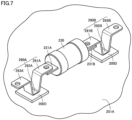
- Fig. 7 is a diagram showing a mounted structure of fuse element 230 (electric component). As shown in Fig. 7 , fuse element 230 is provided to be separated from housing 201A composed of a metal and constituting a portion of case member 200A. It should be noted that the mounted structure of fuse element 230 will be illustratively described below; however, the electric component according to the present technology is not limited to fuse element 230, and the same mounted structure can be also applied to other electric components such as main relay 240 (relay element), for example.
- main relay 240 relay element
- Fuse element 230 has a terminal 231A (first terminal) and a terminal 231B (second terminal).
- a bus bar 290A (first bus bar) is connected to terminal 231A, and a bus bar 290B (second bus bar) is connected to terminal 231B.
- Bus bars 290A, 290B respectively include: first portions 291A, 291B each connected to fuse element 230; second portions 292A, 292B provided at positions close to housing 201A with respect to first portions 291A, 291B; and third portions 293A, 293B provided at positions away from housing 201A with respect to second portions 292A, 292B.
- the heights (separation heights) of first portions 291A, 291B from housing 201A may be substantially the same as or different from the heights (separation heights) of third portions 293A, 293B from housing 201A.
- first portions 291A, 291B, second portions 292A, 292B, and third portions 293A, 293B of bus bars 290A, 290B can be formed by performing a bending process onto a plate-shaped member composed of a metal. It should be noted that a bus bar constituted only of first portions 291A, 291B and second portions 292A, 292B may be formed without forming third portions 293A, 293B.
- Heat transfer member 200D (heat transfer portion) having an insulating property and a thermal conductivity higher than that of air is provided.
- Heat transfer member 200D is preferably composed of a material having thermal conductivity and dielectric strength each having a value equal to or more than a certain value.
- heat transfer member 200D preferably has a thermal conductivity of about 1.0 W/m ⁇ K or more.
- heat transfer member 200D is constituted of a sheet-shaped member having elasticity and including an acrylic-based resin (thermally conductive acrylic-based heat-radiation material). More specifically, heat transfer member 200D may be formed using 6500H provided by 3M Company.
- heat transfer member 200D is not limited to the one described above, and heat transfer member 200D may be composed of a gel-like material, for example.
- electric pack 200 heat generated in fuse element 230 is transferred from fuse element 230 to housing 201A composed of a metal via bus bars 290A, 290B and heat transfer members 200D, thereby efficiently radiating the heat.
- the electric component such as fuse element 230 can be efficiently cooled.
- the above-described mounted structure can be obtained only by processing bus bars 290A, 290B and installing heat transfer member 200D, the structure of electric pack 200 is suppressed from being complicated.
- Fig. 8 is an enlarged cross sectional view showing a modification of the structure around heat transfer member 200D.
- cooling plate 200B having a coolant path 201B and housing 201A overlap with each other.
- a gap filler 200C (filling material) having a thermal conduction property is provided in a clearance formed between housing 201A and cooling plate 200B.
- Heat transfer member 200D is provided at a position overlapping with the clearance in which gap filler 200C is provided.
- Gap filler 200C may be in the form of a paste or may be in the form of a sheet obtained by curing the paste. Gap filler 200C preferably has a thermal conductivity comparable to or higher than that of heat transfer member 200D.
- the heat generated in fuse element 230 is transferred from fuse element 230 to housing 201A via bus bar 290A and heat transfer member 200D, and is further transferred to cooling plate 200B having coolant path 201B via gap filler 200C.
- efficiency of cooling of fuse element 230 can be further improved.
Landscapes
- Chemical & Material Sciences (AREA)
- Chemical Kinetics & Catalysis (AREA)
- Electrochemistry (AREA)
- General Chemical & Material Sciences (AREA)
- Engineering & Computer Science (AREA)
- Manufacturing & Machinery (AREA)
- Microelectronics & Electronic Packaging (AREA)
- Inorganic Chemistry (AREA)
- Mechanical Engineering (AREA)
- Physics & Mathematics (AREA)
- Thermal Sciences (AREA)
- Battery Mounting, Suspending (AREA)
- Secondary Cells (AREA)
- Connection Of Batteries Or Terminals (AREA)
- Aviation & Aerospace Engineering (AREA)
Abstract
An electric device includes: a housing (120) composed of a metal; an electric component (230, 240) provided to be separated from the housing (120); and a bus bar (290, 290A, 290B) connected to the electric component (230, 240). The bus bar (290, 290A, 290B) includes a first portion (291A, 291B) connected to the electric component (230, 240), and a second portion (292A, 292B) provided at a position close to the housing (120) with respect to the first portion (291A, 291B). A heat transfer portion (200D) having an insulating property and a thermal conductivity higher than a thermal conductivity of air is provided between the second portion (292A, 292B) of the bus bar (290, 290A, 290B) and the housing (120).
Description
- This nonprovisional application is based on
Japanese Patent Application No. 2022-205360 filed on December 22, 2022 - The present technology relates to an electric device and a battery pack system.
- As a structure for promoting radiation of heat from an electric component in an electric device, a structure described in each of
Japanese Utility Model Laying-Open No. H05-008947 Japanese Patent Laying-Open No. 2000-125448 - Even when resistance of a conductive portion of an electric component is relatively small in an electric device in which a large amount of current flows, a large amount of heat can be generated in the resistance portion. The conventional heat radiation structure is not necessarily sufficient from the viewpoint of cooling to deal with a large amount of generated heat.
- It is an object of the present technology to provide an electric device and a battery pack system so as to attain high efficiency of cooling of an electric component.
- The present technology provides the following electric device and battery pack system.
- [1] An electric device comprising: a housing composed of a metal; an electric component provided to be separated from the housing; and a bus bar connected to the electric component, wherein the bus bar includes a first portion connected to the electric component, and a second portion provided at a position close to the housing with respect to the first portion, and a heat transfer portion having an insulating property and a thermal conductivity higher than a thermal conductivity of air is provided between the second portion of the bus bar and the housing.
- [2] The electric device according to [1], wherein the electric component includes a fuse element or a relay element.
- [3] The electric device according to [1] or [2], wherein the heat transfer portion has a thermal conductivity of 1.0 W/m·K or more.
- [4] The electric device according to any one of [1] to [3], wherein the heat transfer portion is constituted of a sheet-shaped member.
- [5] The electric device according to any one of [1] to [4], wherein the heat transfer portion includes an acrylic-based resin.
- [6] The electric device according to any one of [1] to [5], wherein the electric component has a first terminal and a second terminal, the bus bar has a first bus bar connected to the first terminal and a second bus bar connected to the second terminal, and each of the first bus bar and the second bus bar includes the first portion and the second portion.
- [7] The electric device according to any one of [1] to [6], wherein the bus bar is constituted of a plate-shaped member, and the first portion and the second portion are formed by performing a bending process onto the plate-shaped member.
- [8] The electric device according to any one of [1] to [7], further comprising a cooling plate attached to the housing, wherein the cooling plate has a coolant path.
- [9] The electric device according to [8], wherein a clearance is formed between the housing and the cooling plate, a filling material having a thermal conduction property is provided in the clearance, and the heat transfer portion is provided at a position overlapping with the clearance.
- [10] A battery pack system comprising: a battery pack including a plurality of battery cells; and the electric device according to any one of [1] to [9], the electric device being electrically connected to the battery pack.
- The foregoing and other objects, features, aspects and advantages of the present invention will become more apparent from the following detailed description of the present invention when taken in conjunction with the accompanying drawings.
-
-
Fig. 1 is a diagram showing a configuration of a system including a battery pack and an electric pack (electric device). -
Fig. 2 is a perspective view showing a battery cell included in the battery pack. -
Fig. 3 is a first external view of the electric pack. -
Fig. 4 is a second external view of the battery pack. -
Fig. 5 is a perspective view showing a configuration of the electric pack. -
Fig. 6 is a diagram showing an arrangement inside a case of the electric pack. -
Fig. 7 is a diagram showing a mounted structure of a fuse element (electric component). -
Fig. 8 is an enlarged cross sectional view showing a modification of a structure around a heat transfer portion. - Hereinafter, embodiments of the present technology will be described. It should be noted that the same or corresponding portions are denoted by the same reference characters, and may not be described repeatedly.
- It should be noted that in the embodiments described below, when reference is made to number, amount, and the like, the scope of the present technology is not necessarily limited to the number, amount, and the like unless otherwise stated particularly. Further, in the embodiments described below, each component is not necessarily essential to the present technology unless otherwise stated particularly. Further, the present technology is not limited to one that necessarily exhibits all the functions and effects stated in the present embodiment.
- It should be noted that in the present specification, the terms "comprise", "include", and "have" are open-end terms. That is, when a certain configuration is included, a configuration other than the foregoing configuration may or may not be included.
- Also, in the present specification, when geometric terms and terms representing positional/directional relations are used, for example, when terms such as "parallel", "orthogonal", "obliquely at 45°", "coaxial", and "along" are used, these terms permit manufacturing errors or slight fluctuations. In the present specification, when terms representing relative positional relations such as "upper side" and "lower side" are used, each of these terms is used to indicate a relative positional relation in one state, and the relative positional relation may be reversed or turned at any angle in accordance with an installation direction of each mechanism (for example, the entire mechanism is reversed upside down).
- In the present specification, the term "battery" is not limited to a lithium ion battery, and may include other batteries such as a nickel-metal hydride battery and a sodium ion battery.
- In the present specification, the term "battery cell" is not necessarily limited to a prismatic battery cell and may include a cell having another shape, such as a cylindrical battery cell, a pouch battery cell, or a blade battery cell. The "battery cell" can be mounted on vehicles such as a hybrid electric vehicle (HEV), a plug-in hybrid electric vehicle (PHEV), and a battery electric vehicle (BEV). It should be noted that the use of the "battery cell" is not limited to the use in a vehicle.
-
Fig. 1 is a diagram showing a configuration of a battery pack system includingbattery packs 100 and an electric pack 200 (electric device). As shown inFig. 1 , in the battery pack system,battery packs 100 andelectric pack 200 are electrically connected via a charging/discharging line 10 and asignal line 20. The battery pack system can be connected to a vehicle via aninterface 300. A current for charging and dischargingbattery pack 100 flows in charging/discharging line 10. A control signal flows insignal line 20. - In the example of
Fig. 1 , the plurality ofbattery packs 100 are electrically connected in series via charging/discharging line 10. In eachbattery pack 100, a plurality of battery cells are electrically connected in series.Electric pack 200 is electrically connected to eachbattery pack 100 viasignal line 20.Electric pack 200 can control charging and discharging ofbattery pack 100. The number and manner of connection ofbattery packs 100 andelectric packs 200 can be appropriately changed. Further,electric pack 200 may be provided inbattery pack 100. -
Electric pack 200 hasconnectors 211 on the positive electrode side andconnectors 212 on the negative electrode side. Ofconnectors connectors interface 300, whereasconnectors discharging line 10. -
Electric pack 200 further hasconnectors 213. Ofconnectors 213, aconnector 213A is connected to a device on the vehicle side viainterface 300, whereas aconnector 213B is connected tosignal line 20 on the system side. -
Fig. 2 is a perspective view showing abattery cell 1 included inbattery pack 100. As shown inFig. 2 ,battery cell 1 has a prismatic shape. However, the shape of the battery cell included inbattery pack 100 is not limited to the prismatic shape. -
Battery cell 1 illustrated inFig. 2 haselectrode terminals 110, ahousing 120, and a gas-discharge valve 130.Electrode terminals 110 are formed onhousing 120.Electrode terminals 110 have apositive electrode terminal 111 and anegative electrode terminal 112 arranged side by side along an X axis direction (second direction) orthogonal to a Y axis direction (first direction).Positive electrode terminal 111 andnegative electrode terminal 112 are provided to be separated from each other in the X axis direction. -
Housing 120 has a rectangular parallelepiped shape and forms an external appearance ofbattery cell 1.Housing 120 includes: acase body 120A that accommodates an electrode assembly (not shown) and an electrolyte solution (not shown); and asealing plate 120B that seals an opening ofcase body 120A.Sealing plate 120B is joined tocase body 120A by welding. -
Housing 120 has anupper surface 121, alower surface 122, afirst side surface 123, asecond side surface 124, and two third side surfaces 125. -
Upper surface 121 is a flat surface orthogonal to a Z axis direction (third direction) orthogonal to the Y axis direction and the X axis direction.Electrode terminals 110 are disposed onupper surface 121.Lower surface 122 facesupper surface 121 along the Z axis direction. - Each of
first side surface 123 andsecond side surface 124 is constituted of a flat surface orthogonal to the Y axis direction. Each offirst side surface 123 andsecond side surface 124 has the largest area among the areas of the plurality of side surfaces ofhousing 120. Each offirst side surface 123 andsecond side surface 124 has a rectangular shape when viewed in the Y axis direction. Each offirst side surface 123 andsecond side surface 124 has a rectangular shape in which the X axis direction corresponds to the long-side direction and the Z axis direction corresponds to the shortside direction when viewed in the Y axis direction. - A plurality of
battery cells 1 are stacked such that first side surfaces 123 ofbattery cells battery cells positive electrode terminals 111 andnegative electrode terminals 112 are alternately arranged in the Y axis direction in which the plurality ofbattery cells 1 are stacked. - Gas-
discharge valve 130 is provided inupper surface 121. When the temperature ofbattery cell 1 is increased (thermal runaway) and internal pressure ofhousing 120 becomes more than or equal to a predetermined value due to gas generated insidehousing 120, gas-discharge valve 130 discharges the gas to outside ofhousing 120. - Each of battery packs 100 shown in
Fig. 1 is formed by accommodating a plurality ofbattery cells 1 in a pack case.Battery pack 100 may be such that the side surface portion of the pack case directly supports the stack of battery cells 1 (Cell-to-Pack structure), or may be such that a battery module including the plurality ofbattery cells 1 is accommodated in the pack case (Cell-Module-Pack structure). - Each of
Figs. 3 and4 is an external view ofelectric pack 200. As shown inFigs. 3 and4 ,electric pack 200 includes acase member 200A and acooling plate 200B.Cooling plate 200B can constitute a bottom surface ofcase member 200A.Connectors service plug 280 are provided on side surfaces ofcase member 200A. Electric components are accommodated in an inner space ofcase member 200A. -
Fig. 5 is a perspective view showing an configuration ofelectric pack 200, andFig. 6 is a diagram showing an arrangement insidecase member 200A ofelectric pack 200. As shown inFigs. 5 and6 ,electric pack 200 includes acontrol board 220, fuseelements 230,main relays 240,current sensors 250, apre-charging resistor 260, and apre-charging relay 270. - Fuse
elements 230,main relays 240,current sensors 250,pre-charging resistor 260, andpre-charging relay 270 are electric components accommodated in the inner space ofcase member 200A, and are connected to the outside ofelectric pack 200 viaconnectors Control board 220 is also an electric component accommodated in the inner space ofcase member 200A, and is connected to the outside ofelectric pack 200 viaconnectors Figs. 5 and6 may be accommodated incase member 200A. - As shown in
Fig. 6 , fuseelements 230 are electrically connected toconnector 212A,main relays 240,pre-charging relay 270, andservice plug 280 via bus bars 290. -
Fig. 7 is a diagram showing a mounted structure of fuse element 230 (electric component). As shown inFig. 7 ,fuse element 230 is provided to be separated fromhousing 201A composed of a metal and constituting a portion ofcase member 200A. It should be noted that the mounted structure offuse element 230 will be illustratively described below; however, the electric component according to the present technology is not limited to fuseelement 230, and the same mounted structure can be also applied to other electric components such as main relay 240 (relay element), for example. -
Fuse element 230 has a terminal 231A (first terminal) and a terminal 231B (second terminal). Abus bar 290A (first bus bar) is connected to terminal 231A, and abus bar 290B (second bus bar) is connected to terminal 231B. - Bus bars 290A, 290B respectively include:
first portions element 230;second portions housing 201A with respect tofirst portions third portions housing 201A with respect tosecond portions first portions housing 201A may be substantially the same as or different from the heights (separation heights) ofthird portions housing 201A. - Each of
first portions second portions third portions bus bars first portions second portions third portions - Between each of
second portions bus bars housing 201A, aheat transfer member 200D (heat transfer portion) having an insulating property and a thermal conductivity higher than that of air is provided.Heat transfer member 200D is preferably composed of a material having thermal conductivity and dielectric strength each having a value equal to or more than a certain value. - For example,
heat transfer member 200D preferably has a thermal conductivity of about 1.0 W/m·K or more. As an example,heat transfer member 200D is constituted of a sheet-shaped member having elasticity and including an acrylic-based resin (thermally conductive acrylic-based heat-radiation material). More specifically,heat transfer member 200D may be formed using 6500H provided by 3M Company. - It should be noted that the configuration of
heat transfer member 200D is not limited to the one described above, andheat transfer member 200D may be composed of a gel-like material, for example. - With an increase in size of
battery pack 100 or the battery module, a large amount of current is likely to flow inelectric pack 200 connected tobattery pack 100. Even when resistance of a conductive portion of the electric component such asfuse element 230 is relatively small inelectric pack 200 in which a large amount of current flows, a large amount of heat can be generated in the resistance portion. - To address this, in
electric pack 200 according to the present embodiment, heat generated infuse element 230 is transferred fromfuse element 230 tohousing 201A composed of a metal viabus bars heat transfer members 200D, thereby efficiently radiating the heat. As a result, the electric component such asfuse element 230 can be efficiently cooled. Further, since the above-described mounted structure can be obtained only by processingbus bars heat transfer member 200D, the structure ofelectric pack 200 is suppressed from being complicated. -
Fig. 8 is an enlarged cross sectional view showing a modification of the structure aroundheat transfer member 200D. In the example shown inFig. 8 , coolingplate 200B having acoolant path 201B andhousing 201A overlap with each other. A gap filler 200C (filling material) having a thermal conduction property is provided in a clearance formed betweenhousing 201A andcooling plate 200B.Heat transfer member 200D is provided at a position overlapping with the clearance in which gap filler 200C is provided. - Gap filler 200C may be in the form of a paste or may be in the form of a sheet obtained by curing the paste. Gap filler 200C preferably has a thermal conductivity comparable to or higher than that of
heat transfer member 200D. - In the example shown in
Fig. 8 , the heat generated infuse element 230 is transferred fromfuse element 230 tohousing 201A viabus bar 290A andheat transfer member 200D, and is further transferred to coolingplate 200B havingcoolant path 201B via gap filler 200C. As a result, efficiency of cooling offuse element 230 can be further improved. - Although the embodiments of the present invention have been described and illustrated in detail, it is clearly understood that the same is by way of illustration and example only and is not to be taken by way of limitation. The scope of the present invention is defined by the terms of the claims, and is intended to include any modifications within the scope and meaning equivalent to the terms of the claims.
Claims (10)
- An electric device comprising:a housing (120) composed of a metal;an electric component (230, 240) provided to be separated from the housing (120); anda bus bar (290, 290A, 290B) connected to the electric component (230, 240), whereinthe bus bar (290, 290A, 290B) includes a first portion (291A, 291B) connected to the electric component (230, 240), and a second portion (292A, 292B) provided at a position close to the housing (120) with respect to the first portion (291A, 291B), anda heat transfer portion (200D) having an insulating property and a thermal conductivity higher than a thermal conductivity of air is provided between the second portion (292A, 292B) of the bus bar (290, 290A, 290B) and the housing (120).
- The electric device according to claim 1, wherein the electric component (230, 240) includes a fuse element (230) or a relay element (240).
- The electric device according to claim 1 or 2, wherein the heat transfer portion (200D) has a thermal conductivity of 1.0 W/m K or more.
- The electric device according to any one of claims 1 to 3, wherein the heat transfer portion (200D) is constituted of a sheet-shaped member.
- The electric device according to any one of claims 1 to 4, wherein the heat transfer portion (200D) includes an acrylic-based resin.
- The electric device according to any one of claims 1 to 5, whereinthe electric component (230) has a first terminal (231A) and a second terminal (231B),the bus bar (290, 290A, 290B) has a first bus bar (290A) connected to the first terminal (231A) and a second bus bar (290B) connected to the second terminal (231B), andeach of the first bus bar (290A) and the second bus bar (290B) includes the first portion (291A, 291B) and the second portion (292A, 292B).
- The electric device according to any one of claims 1 to 6, whereinthe bus bar (290, 290A, 290B) is constituted of a plate-shaped member, andthe first portion (291A, 291B) and the second portion (292A, 292B) are formed by performing a bending process onto the plate-shaped member.
- The electric device according to any one of claims 1 to 7, further comprising a cooling plate (200B) attached to the housing (120), wherein
the cooling plate (200B) has a coolant path (201B). - The electric device according to claim 8, whereina clearance is formed between the housing (120) and the cooling plate (200B),a filling material (200C) having a thermal conduction property is provided in the clearance, andthe heat transfer portion (200D) is provided at a position overlapping with the clearance.
- A battery pack system comprising:a battery pack (100) including a plurality of battery cells (1); andthe electric device according to any one of claims 1 to 9, the electric device being electrically connected to the battery pack (100).
Applications Claiming Priority (1)
| Application Number | Priority Date | Filing Date | Title |
|---|---|---|---|
| JP2022205360A JP7724763B2 (en) | 2022-12-22 | 2022-12-22 | Electrical Equipment and Battery Pack Systems |
Publications (1)
| Publication Number | Publication Date |
|---|---|
| EP4391745A1 true EP4391745A1 (en) | 2024-06-26 |
Family
ID=88689373
Family Applications (1)
| Application Number | Title | Priority Date | Filing Date |
|---|---|---|---|
| EP23207522.6A Pending EP4391745A1 (en) | 2022-12-22 | 2023-11-02 | Electric device and battery pack system |
Country Status (5)
| Country | Link |
|---|---|
| US (1) | US20240213571A1 (en) |
| EP (1) | EP4391745A1 (en) |
| JP (1) | JP7724763B2 (en) |
| KR (1) | KR20240100265A (en) |
| CN (1) | CN118248982A (en) |
Citations (5)
| Publication number | Priority date | Publication date | Assignee | Title |
|---|---|---|---|---|
| JPH058947U (en) | 1991-07-15 | 1993-02-05 | オムロン株式会社 | Solid relay |
| JP2000125448A (en) | 1998-10-14 | 2000-04-28 | Yazaki Corp | Electrical junction box |
| US20190318892A1 (en) * | 2016-12-05 | 2019-10-17 | Toyota Jidosha Kabushiki Kaisha | Relay unit |
| WO2021230077A1 (en) * | 2020-05-13 | 2021-11-18 | 株式会社オートネットワーク技術研究所 | Circuit unit |
| EP3993141A1 (en) * | 2019-08-12 | 2022-05-04 | LG Energy Solution, Ltd. | Busbar having excellent insulation and heat dissipation performance and battery module comprising same |
Family Cites Families (5)
| Publication number | Priority date | Publication date | Assignee | Title |
|---|---|---|---|---|
| JP5825264B2 (en) | 2011-01-21 | 2015-12-02 | 株式会社Gsユアサ | Battery system |
| JP6081128B2 (en) | 2012-10-10 | 2017-02-15 | 三洋電機株式会社 | Power supply device, vehicle including the same, and power storage device |
| JP5714077B2 (en) | 2013-10-25 | 2015-05-07 | 三菱電機株式会社 | Cooling device for connecting conductor and power conversion device using the same |
| JP6295901B2 (en) | 2014-09-24 | 2018-03-20 | トヨタ自動車株式会社 | Power storage device |
| JP6826331B1 (en) | 2019-07-15 | 2021-02-03 | 株式会社オートネットワーク技術研究所 | Circuit configuration |
-
2022
- 2022-12-22 JP JP2022205360A patent/JP7724763B2/en active Active
-
2023
- 2023-11-02 EP EP23207522.6A patent/EP4391745A1/en active Pending
- 2023-12-05 CN CN202311660477.8A patent/CN118248982A/en active Pending
- 2023-12-19 KR KR1020230185461A patent/KR20240100265A/en active Pending
- 2023-12-20 US US18/391,163 patent/US20240213571A1/en active Pending
Patent Citations (5)
| Publication number | Priority date | Publication date | Assignee | Title |
|---|---|---|---|---|
| JPH058947U (en) | 1991-07-15 | 1993-02-05 | オムロン株式会社 | Solid relay |
| JP2000125448A (en) | 1998-10-14 | 2000-04-28 | Yazaki Corp | Electrical junction box |
| US20190318892A1 (en) * | 2016-12-05 | 2019-10-17 | Toyota Jidosha Kabushiki Kaisha | Relay unit |
| EP3993141A1 (en) * | 2019-08-12 | 2022-05-04 | LG Energy Solution, Ltd. | Busbar having excellent insulation and heat dissipation performance and battery module comprising same |
| WO2021230077A1 (en) * | 2020-05-13 | 2021-11-18 | 株式会社オートネットワーク技術研究所 | Circuit unit |
Also Published As
| Publication number | Publication date |
|---|---|
| JP7724763B2 (en) | 2025-08-18 |
| JP2024089864A (en) | 2024-07-04 |
| US20240213571A1 (en) | 2024-06-27 |
| CN118248982A (en) | 2024-06-25 |
| KR20240100265A (en) | 2024-07-01 |
Similar Documents
| Publication | Publication Date | Title |
|---|---|---|
| EP4148876B1 (en) | Battery, electrical device, and method and device for preparing battery | |
| CN114128020B (en) | Battery module and battery pack including the battery module | |
| CN113300037B (en) | Battery, electric equipment and manufacturing method of battery | |
| CN214625290U (en) | Battery pack and device including the same | |
| CN116097517B (en) | Battery, electric device and method for preparing battery | |
| US12525667B2 (en) | Battery module | |
| KR20230027234A (en) | Battery cells, batteries, electrical devices, and apparatuses and methods for manufacturing battery cells | |
| EP4266464A1 (en) | Battery, electric device, and method and device for preparing battery | |
| EP4224595A1 (en) | Battery pack | |
| CN219040669U (en) | Batteries and electrical devices | |
| US20230253684A1 (en) | Battery pack | |
| KR20130113145A (en) | Unit module assembly of enhanced stability and battery module comprising the same | |
| CN116134669B (en) | Battery, electrical equipment, method and equipment for preparing battery | |
| EP4391745A1 (en) | Electric device and battery pack system | |
| US20250118843A1 (en) | Battery pack | |
| JP2023535774A (en) | Battery module and battery pack containing same | |
| EP4333157A1 (en) | Battery module | |
| US20240014503A1 (en) | Battery module | |
| CN120109338A (en) | Busbar bracket assembly, battery module including the same, and manufacturing method thereof | |
| EP4258437B1 (en) | Battery and electric device | |
| KR20190112579A (en) | Sensing bus bar for reducing voltage deviation | |
| US20250118854A1 (en) | Battery pack | |
| US20240291093A1 (en) | Battery pack and method of manufacturing same | |
| US20240291096A1 (en) | Battery pack | |
| EP4661203A1 (en) | Battery pack and vehicle including same |
Legal Events
| Date | Code | Title | Description |
|---|---|---|---|
| PUAI | Public reference made under article 153(3) epc to a published international application that has entered the european phase |
Free format text: ORIGINAL CODE: 0009012 |
|
| STAA | Information on the status of an ep patent application or granted ep patent |
Free format text: STATUS: REQUEST FOR EXAMINATION WAS MADE |
|
| 17P | Request for examination filed |
Effective date: 20231102 |
|
| AK | Designated contracting states |
Kind code of ref document: A1 Designated state(s): AL AT BE BG CH CY CZ DE DK EE ES FI FR GB GR HR HU IE IS IT LI LT LU LV MC ME MK MT NL NO PL PT RO RS SE SI SK SM TR |