EP4391179A1 - Modulares batteriesystem - Google Patents
Modulares batteriesystem Download PDFInfo
- Publication number
- EP4391179A1 EP4391179A1 EP23215598.6A EP23215598A EP4391179A1 EP 4391179 A1 EP4391179 A1 EP 4391179A1 EP 23215598 A EP23215598 A EP 23215598A EP 4391179 A1 EP4391179 A1 EP 4391179A1
- Authority
- EP
- European Patent Office
- Prior art keywords
- battery
- modules
- battery system
- module
- inverter module
- Prior art date
- Legal status (The legal status is an assumption and is not a legal conclusion. Google has not performed a legal analysis and makes no representation as to the accuracy of the status listed.)
- Pending
Links
- 238000004891 communication Methods 0.000 claims description 3
- 238000010586 diagram Methods 0.000 description 4
- 238000009434 installation Methods 0.000 description 4
- 238000012423 maintenance Methods 0.000 description 2
- 238000005259 measurement Methods 0.000 description 2
- 239000002184 metal Substances 0.000 description 2
- 238000010276 construction Methods 0.000 description 1
- 230000001276 controlling effect Effects 0.000 description 1
- 238000001816 cooling Methods 0.000 description 1
- 230000001419 dependent effect Effects 0.000 description 1
- 229910001092 metal group alloy Inorganic materials 0.000 description 1
- 238000012544 monitoring process Methods 0.000 description 1
- 230000001105 regulatory effect Effects 0.000 description 1
- 239000002918 waste heat Substances 0.000 description 1
Images


Classifications
-
- H—ELECTRICITY
- H01—ELECTRIC ELEMENTS
- H01M—PROCESSES OR MEANS, e.g. BATTERIES, FOR THE DIRECT CONVERSION OF CHEMICAL ENERGY INTO ELECTRICAL ENERGY
- H01M50/00—Constructional details or processes of manufacture of the non-active parts of electrochemical cells other than fuel cells, e.g. hybrid cells
- H01M50/20—Mountings; Secondary casings or frames; Racks, modules or packs; Suspension devices; Shock absorbers; Transport or carrying devices; Holders
- H01M50/244—Secondary casings; Racks; Suspension devices; Carrying devices; Holders characterised by their mounting method
-
- H—ELECTRICITY
- H01—ELECTRIC ELEMENTS
- H01M—PROCESSES OR MEANS, e.g. BATTERIES, FOR THE DIRECT CONVERSION OF CHEMICAL ENERGY INTO ELECTRICAL ENERGY
- H01M10/00—Secondary cells; Manufacture thereof
- H01M10/42—Methods or arrangements for servicing or maintenance of secondary cells or secondary half-cells
- H01M10/425—Structural combination with electronic components, e.g. electronic circuits integrated to the outside of the casing
-
- H—ELECTRICITY
- H01—ELECTRIC ELEMENTS
- H01M—PROCESSES OR MEANS, e.g. BATTERIES, FOR THE DIRECT CONVERSION OF CHEMICAL ENERGY INTO ELECTRICAL ENERGY
- H01M10/00—Secondary cells; Manufacture thereof
- H01M10/42—Methods or arrangements for servicing or maintenance of secondary cells or secondary half-cells
- H01M10/48—Accumulators combined with arrangements for measuring, testing or indicating the condition of cells, e.g. the level or density of the electrolyte
- H01M10/486—Accumulators combined with arrangements for measuring, testing or indicating the condition of cells, e.g. the level or density of the electrolyte for measuring temperature
-
- H—ELECTRICITY
- H01—ELECTRIC ELEMENTS
- H01M—PROCESSES OR MEANS, e.g. BATTERIES, FOR THE DIRECT CONVERSION OF CHEMICAL ENERGY INTO ELECTRICAL ENERGY
- H01M50/00—Constructional details or processes of manufacture of the non-active parts of electrochemical cells other than fuel cells, e.g. hybrid cells
- H01M50/20—Mountings; Secondary casings or frames; Racks, modules or packs; Suspension devices; Shock absorbers; Transport or carrying devices; Holders
- H01M50/204—Racks, modules or packs for multiple batteries or multiple cells
-
- H—ELECTRICITY
- H01—ELECTRIC ELEMENTS
- H01M—PROCESSES OR MEANS, e.g. BATTERIES, FOR THE DIRECT CONVERSION OF CHEMICAL ENERGY INTO ELECTRICAL ENERGY
- H01M50/00—Constructional details or processes of manufacture of the non-active parts of electrochemical cells other than fuel cells, e.g. hybrid cells
- H01M50/20—Mountings; Secondary casings or frames; Racks, modules or packs; Suspension devices; Shock absorbers; Transport or carrying devices; Holders
- H01M50/251—Mountings; Secondary casings or frames; Racks, modules or packs; Suspension devices; Shock absorbers; Transport or carrying devices; Holders specially adapted for stationary devices, e.g. power plant buffering or backup power supplies
-
- H—ELECTRICITY
- H01—ELECTRIC ELEMENTS
- H01M—PROCESSES OR MEANS, e.g. BATTERIES, FOR THE DIRECT CONVERSION OF CHEMICAL ENERGY INTO ELECTRICAL ENERGY
- H01M2220/00—Batteries for particular applications
- H01M2220/10—Batteries in stationary systems, e.g. emergency power source in plant
-
- H—ELECTRICITY
- H02—GENERATION; CONVERSION OR DISTRIBUTION OF ELECTRIC POWER
- H02M—APPARATUS FOR CONVERSION BETWEEN AC AND AC, BETWEEN AC AND DC, OR BETWEEN DC AND DC, AND FOR USE WITH MAINS OR SIMILAR POWER SUPPLY SYSTEMS; CONVERSION OF DC OR AC INPUT POWER INTO SURGE OUTPUT POWER; CONTROL OR REGULATION THEREOF
- H02M7/00—Conversion of AC power input into DC power output; Conversion of DC power input into AC power output
- H02M7/003—Constructional details, e.g. physical layout, assembly, wiring or busbar connections
Definitions
- the present invention relates to a modular battery system for a building.
- the battery system can be adapted to an installation location through a flexible arrangement.
- Battery systems are used to store electrical energy in buildings, for example in residential buildings, office buildings or other commercial and/or residential buildings. Such battery systems are also collectively referred to as power storage systems. Such power storage systems can be used in particular to store electrical energy that is generated locally by a photovoltaic system (PV system).
- PV system photovoltaic system
- the size of the power storage unit can be flexibly adapted to the requirements of the respective building.
- Battery systems are therefore partly designed in a modular manner.
- a modular battery rack with a plurality of basic elements that can be combined and stacked with one another according to a modular principle for accommodating a plurality of batteries is known.
- Each basic element is provided with a cover.
- the battery rack is constructed similarly to a shelf, with the individual basic elements being stacked on top of one another.
- the location of power storage units can vary greatly depending on the building. For example, the space available may be limited due to other installed devices, such as a boiler or the like.
- a resulting object of the present invention is therefore to provide a modular battery system that is as variable as possible. Furthermore, the installation of the individual modules should be as simple as possible in order to save time and money.
- the present invention is therefore based on the object of overcoming the problems known in the prior art and of providing a modular battery system that is improved compared to the prior art.
- the modular battery system according to the invention can comprise an inverter module with an inverter for converting direct current into alternating current.
- the inverter is thus already integrated into the battery system, so that an external inverter is no longer required.
- Such a battery system with an integrated inverter is also referred to as a hybrid storage system.
- the battery system further comprises a plurality of battery modules for storing electrical energy.
- Each battery module can consist of one battery unit or have several battery units, each of which comprises a plurality of cells.
- the number of battery modules depends on the desired or required storage capacity of the battery system. For example, a battery system can have two, three, four, five or more battery modules.
- the number of battery modules can be adapted to requirements. If, for example, the storage requirements in a building increase, additional battery modules can be installed and integrated into the system. Furthermore, individual modules can be easily replaced for maintenance.
- the inverter module can also have a device for controlling, regulating and/or monitoring the battery modules.
- a control device in the inverter module monitors a charge state and/or a temperature of the individual battery modules.
- the battery system comprises a plurality of support devices, each of which can be attached to a wall.
- Each support device can carry an inverter module or a battery module.
- the support devices are thus used to mount the inverter module and the battery modules on the wall.
- the support devices are preferably designed as a stable frame construction and can be made from a metal or a metal alloy, for example. Profile sheets can be used to construct the support devices, so that even heavy modules can be carried while the support device is light.
- the support devices for the inverter module and the battery modules are constructed identically.
- the support device for the inverter module differs from the support devices for the battery modules.
- each battery module support device can support two or more battery units, which can be attached to the support device, for example, next to one another or in front of one another.
- the battery system comprises a wiring for connecting the battery modules to the inverter module.
- the wiring can preferably be designed as a cable harness in which the respective plugs for connecting the individual modules can be pre-assembled.
- the cabling may comprise power lines, communication lines and sensor lines.
- the lines may in particular, a CAN bus.
- the wiring can be designed in such a way that the battery modules are connected to one another in series.
- the support systems each include slots for laying the cabling. This can make installing the battery system much easier. For example, when installing, the support systems are first attached to a wall at the installation site. The cabling for the modules can then be laid in the slots of the support systems. The modules are then hung on the support systems and secured. The modules can then be connected preferably by connecting the cabling plugs to the corresponding connections on the modules.
- the battery modules can be arranged in a grid next to each other and/or one below the other on the wall.
- the arrangement of the battery modules can preferably be designed such that the inverter module only has one directly adjacent battery module. Further preferably, each battery module has a maximum of two directly adjacent modules. A last battery module in the arrangement only has one directly adjacent battery module.
- the support devices are preferably designed in such a way that the inverter module or the battery modules can be mounted on the wall with a clear space.
- the modules can be attached to the support devices with a distance from the wall. This has the advantage that the inverter in the inverter module and/or the cells in the battery modules can be cooled better. Furthermore, the distance creates space for laying the cabling.
- the support device itself forms the distance to the wall, wherein a rear wall of the support device is arranged at a distance from the wall.
- a battery module carried by the carrying device can then be arranged directly on the rear wall without any clearance.
- the inverter module and the battery modules can each have a removable housing.
- the removable housing preferably comprises a front panel, two side walls connected to the front panel, a base panel connected to the front panel and a cover panel connected to the front panel, with the rear side of the housing being open. The rear side is the side facing the wall.
- the removable housing between the battery modules can preferably be designed without a cover panel.
- the side walls and the front panel of the housing are preferably arranged vertically, with the side walls also being arranged perpendicular to the wall and the front panel being arranged parallel to the wall.
- the base plate and the cover plate are preferably each arranged horizontally.
- the grid of the arrangement of the modular battery system on the wall is therefore preferably similar to an orthogonal grid on the wall, with the grid lines being aligned vertically and horizontally.
- the battery modules and the inverter module each have a rectangular, in particular square, base area in front of the wall. Accordingly, the modules and their housing preferably have the shape of a cuboid or a cube.
- the modules are preferably arranged next to one another on the wall in such a way that a right-hand side wall of a module faces a left-hand side wall of an adjacent module, with the distance between the adjacent side walls preferably being less than one centimeter. It is particularly preferred that there is no distance, so that the side walls of the modules touch one another.
- the modules are preferably arranged one above the other on the wall in such a way that a base plate of a module faces a cover plate of an adjacent module, with the distance between the adjacent base and cover plates preferably being less than one centimeter. Further preferably, there is no distance, so that the base and cover plates touch each other. According to a particularly preferred embodiment, a base or cover plate can be dispensed with between modules arranged one above the other.
- the battery system preferably comprises an ambient temperature sensor for measuring an ambient temperature.
- the ambient temperature sensor is particularly preferably arranged in a battery module that is furthest away from the inverter module. This has the advantage that the inverter module, which usually emits the most heat to the environment, can influence the measurement of the ambient temperature as little as possible.
- Fig.1 shows an exemplary arrangement of a modular battery system 1 according to the invention with an inverter module 10 and four battery modules 11 on a wall.
- the view schematically shows a view from the front of the front sides of the modules 10, 11 in front of the wall.
- the arrangement of the modules 10, 11 of the battery system 1 follows a rectangular grid, with the battery modules 11 being arranged side by side or one below the other starting from the inverter module 10. Accordingly, the cabling of the modules can be horizontal and vertical.
- a first battery module 11 is arranged on the wall to the right of the inverter module 10.
- a second battery module 11 is arranged to the right of the first battery module 11.
- a third battery module 11 is arranged below the second battery module 11 and a fourth battery module 11 is arranged to the right of the third battery module 11.
- the battery modules 11 can be arranged as desired, side by side and/or one above the other and/or one below the other.
- the resulting arrangement can also be referred to as a polyomino for modules with a square base in front of the wall.
- the example shown with five modules is therefore a pentomino.
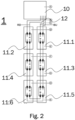
- Fig.2 illustrates a circuit diagram of a battery system 1 with an inverter module 12 and three battery modules 11.
- the battery modules 11 each comprise two battery units 11.1 to 11.6, which are connected to one another in series in a ring architecture starting from the inverter module 12 via a cabling 12, which comprises power lines and communication lines.
- the inverter module 10 is labeled with an A.
- the six battery modules 11.1 to 11.6 are labeled with the letters D, E, F, G, H, K.
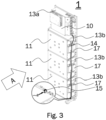
- Fig.3 shows a circuit diagram of the Fig.2 corresponding perspective view of the battery system 1 with an inverter module 12 and three battery modules 11.
- the modules are mounted here, for example, on a shelf.
- the inverter module 12 hangs in a first support device 13a.
- the three battery modules 11 each hang in a second support device 13b.
- each battery module 11 has two battery units, two battery units hang in every second support device 13b.
- the battery units hang in front of each other in the direction indicated by arrow A.
- the respective housings of the modules 10, 11 have been removed in the illustration so that the side connections 17 of the individual battery units are visible.
- the wiring between the modules can simply be laid vertically between the terminals 17 of the battery units according to the Fig.2 shown circuit diagram executed
- the housing covers (not shown) may have corresponding recesses for the wiring on the edges.
- the battery system 1 shown additionally comprises an ambient temperature sensor 15, which is connected to the inverter module 10 via a corresponding sensor line 14.
- the ambient temperature sensor 15 is arranged in the lowest battery module 11, which is furthest away from the inverter module 10, so that the measurement of the ambient temperature is not influenced or is influenced as little as possible by the waste heat of the inverter.
- the support devices 13 can also be attached directly to a wall in the case of the shelf shown.
- the support devices 13 allow flexible arrangement in a grid as described above.
- Fig.4 shows on the right side a support device 13a for an inverter module 10 and on the left side a support device 13b for a battery module 11. Since these support devices 13 are intended for fastening to a wall, they can also be referred to as wall brackets.
- Fig.4 shows a plan view from the front onto a rear wall of the support devices 13. This corresponds to the view from the front when the support devices 13 are attached to a wall.
- the dashed arrow 12 in Fig.4 illustrates the routing of a cabling for connecting battery modules 11 to the inverter module 10.
- the support devices 13 have horizontal cable ducts that run behind the rear wall. In other words, the cabling can be routed between the rear wall of the support device 13 and the wall to which the support device 13 is attached.
- Openings 16 for passing through the cabling 12 are formed in the rear wall of the support devices 13.
- the location of the opening 16a in the support device 13a differs from the location of the opening 16b in the support device 13b, since these are each adapted to the connections of the inverter module 10 or the battery module 11.
- the rear wall of the support device 13a or 13b has openings 19 at the corners for fastening the support device 13a or 13b to a wall.
- the support device 13a or 13b can be hung on suitable brackets screwed to the wall.
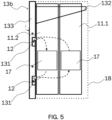
- Fig.5 shows a side view of the carrying device 13b for a battery module 11, which comprises two battery units 11.1 and 11.2.
- the dotted line in Fig.5 indicates the housing 18 of the battery module 11.
- the housing 18 is a cuboid with five sides that is open at the back so that the housing can be pushed over the battery module 11 from the front.
- the fastening can be done, for example, by clipping it to the support device 13.
- the inverter module 10 has a similar housing.
- the carrying device 13b of the battery module 11 shown comprises two carrying arms 132 projecting forward from the rear wall 133, on which the two battery units 11.1 and 11.2 are suspended. In the side view of the Fig.5 only one of the support arms 132 is visible.
- the dashed arrows in Fig.5 illustrate the route of the cabling 12, which is led from the side connections 17 of the battery units to the two cable ducts 131 running horizontally in the rear wall 133.
- the rear wall 133 is designed here on both sides as a bent sheet metal, which has the shape of a U when viewed from above.
- the rear wall 133 thus comprises a back surface and two side surfaces. The edges of the side surfaces lie on the Wall on which the support device 13 is mounted, so that a clear distance is created between the wall and the back surface, which can be used to cool the inverter module 10 or the battery module 11.
- the cable ducts 131 running horizontally in the rear wall 133 enable the modules to be arranged on the wall in a simple, variable manner.
- the support devices 13 are preferably first attached to the wall.
- the cabling 12, which is preferably designed as a prefabricated cable harness, can then be laid in the cable ducts 131.
- the inverter module 10 and the battery modules 11 can then be mounted in the support devices 13.
- the cabling connections are then connected to the module connections.
- the individual modules 10, 11 can be covered with their respective housings 18, so that an arrangement that is closed to the outside is created.
- the routing of the cabling 12 through the cable ducts 131 particularly simplifies the cabling of two modules 10, 11 arranged horizontally next to one another.
- Modules 10, 11 arranged vertically one above the other can also be cabled directly to one another without the necessary cables being laid through the cable ducts 131.
- the housings 18 of the modules 10, 11 can have corresponding recesses on their edges so that the housing 18 can be easily pushed over the respective module 10, 11 despite the vertical cables laid between the modules 10, 11.
- the modular battery system 1 described here allows a flexible arrangement of the modules 10, 11 on a wall.
- the battery system 1 can therefore be adapted to the available space at the installation site.
- modules 10, 11 can be added or removed in a simple manner, which simplifies maintenance or expansion or reduction of the power storage system.
- the modules 10, 11 have a uniform size and are closed with a housing 18, an attractive and tidy external appearance can be achieved so that the battery system 1 can also be installed in living or work spaces.
- the internal components are protected from external influences by the housing, while sufficient cooling can be ensured by the arrangement at a distance from the wall.
Landscapes
- Chemical & Material Sciences (AREA)
- Chemical Kinetics & Catalysis (AREA)
- Electrochemistry (AREA)
- General Chemical & Material Sciences (AREA)
- Engineering & Computer Science (AREA)
- Manufacturing & Machinery (AREA)
- Microelectronics & Electronic Packaging (AREA)
- Battery Mounting, Suspending (AREA)
Abstract
Description
- Die vorliegende Erfindung betrifft ein modulares Batteriesystem für ein Gebäude. Durch eine flexible Anordnung kann das Batteriesystem an einen Aufstellort angepasst werden.
- Batteriesysteme werden zum Speichern elektrischer Energie in Gebäuden, beispielsweise in Wohnhäusern, Bürogebäuden oder sonstigen gewerblich und/oder zum Wohnen genutzten Gebäuden verwendet. Solche Batteriesysteme werden zusammenfassend auch als Stromspeicher bezeichnet. Ein derartiger Stromspeicher kann insbesondere zum Speichern elektrischer Energie verwendet werden, die lokal durch eine Photovoltaik-Anlage (PV-Anlage) erzeugt wird.
- Aufgrund des unterschiedlichen Bedarfs verschieden großer und verschieden genutzter Gebäude, ist es vorteilhaft, wenn die Größe des Stromspeichers flexibel an die Anforderung des jeweiligen Gebäudes angepasst werden kann. Daher werden Batteriesysteme zum Teil modular aufgebaut.
- Aus der Gebrauchsmusterschrift
DE 20 2012 104 578 U1 ist beispielsweise ein modulares Batteriegestell mit einer Mehrzahl von nach einem Baukastenprinzip miteinander kombinier- und stapelbaren Grundelementen zum Unterbringen einer Mehrzahl von Batterien bekannt. Dabei wird jedes Grundelement mit einer Abdeckung versehen. Das Batteriegestell ist ähnlich wie ein Regal aufgebaut, wobei die einzelnen Grundelemente übereinander gestapelt werden. - Der Aufstellort von Stromspeichern kann je nach Gebäude sehr unterschiedlich sein. Beispielsweise kann das Platzangebot aufgrund anderer aufgestellter Geräte, wie z.B. einem Heizkessel oder dergleichen beschränkt sein. Eine daraus resultierende Aufgabe der vorliegenden Erfindung liegt somit darin, ein möglichst variables modulares Batteriesystem bereitzustellen. Ferner soll das Installieren der einzelnen Module möglichst einfach sein, um dadurch Zeit und Kosten zu sparen.
- Der vorliegenden Erfindung liegt somit die Aufgabe zugrunde, die im Stand der Technik bekannten Probleme zu überwinden und ein gegenüber dem Stand der Technik verbessertes modulares Batteriesystem bereitzustellen.
- Die Lösung der Aufgabe gelingt erfindungsgemäß durch ein modulares Batteriesystem für ein Gebäude nach Anspruch 1. Bevorzugte Ausgestaltungen der vorliegenden Erfindung sind Gegenstand der abhängigen Ansprüche, der angehängten Zeichnungen und der folgenden Beschreibung von Ausführungsbeispielen.
- Das erfindungsgemäße modulare Batteriesystem kann gemäß einer bevorzugten Ausführung ein Wechselrichtermodul mit einem Wechselrichter zum Konvertieren eines Gleichstroms in einen Wechselstrom umfassen. Der Wechselrichter ist somit bereits in das Batteriesystem integriert, so dass kein externer Wechselrichter mehr benötigt wird. Ein solches Batteriesystem mit integriertem Wechselrichter wird auch als Hybridspeicher bezeichnet.
- Das Batteriesystem umfasst ferner eine Vielzahl von Batteriemodulen zum Speichern elektrischer Energie. Jedes Batteriemodul kann aus einer Batterieeinheit bestehen oder mehrere Batterieeinheiten aufweisen, die jeweils eine Vielzahl von Zellen umfassen. Die Anzahl der Batteriemodule hängt von der gewünschten bzw. erforderlichen Speicherkapazität des Batteriesystems ab. Beispielsweise kann ein Batteriesystem zwei, drei, vier, fünf oder mehr Batteriemodule aufweisen.
- Gemäß einer bevorzugten Ausführung kann die Anzahl der Batteriemodule an den Bedarf angepasst werden. Erhöht sich beispielsweise der Speicherbedarf in einem Gebäude, können weitere zusätzliche Batteriemodule installiert und in das System integriert werden. Ferner können einzelne Module zur Wartung auf einfache Weise ausgetauscht werden.
- Das Wechselrichtermodul kann neben dem Wechselrichter auch eine Einrichtung zum Steuern, Regeln und/oder Überwachen der Batteriemodule aufweisen. Beispielsweise überwacht eine Steuereinrichtung im Wechselrichtermodul einen Ladezustand und/oder eine Temperatur der einzelnen Batteriemodule.
- Das Batteriesystem umfasst eine Vielzahl von Trageeinrichtungen, die jeweils an einer Wand befestigt werden können. Jede Trageeinrichtung kann ein Wechselrichtermodul oder ein Batteriemodul tragen. Die Trageeinrichtungen dienen somit zum Montieren des Wechselrichtermoduls und der Batteriemodule an der Wand. Die Trageeinrichtungen sind vorzugsweise als stabile Rahmenkonstruktion ausgebildet und können z.B. aus einem Metall oder einer Metalllegierung gefertigt sein. Zum Aufbauen der Trageeinrichtungen können beispielsweise Profilbleche verwendet werden, so dass bei geringem Gewicht der Trageeinrichtung auch Module mit hohem Gewicht getragen werden können.
- Gemäß einer bevorzugten Ausführung sind die Trageeinrichtungen für das Wechselrichtermodul und die Batteriemodule identisch aufgebaut. In alternativen Ausführungen unterscheidet sich die Trageeinrichtung für das Wechselrichtermodul von den Trageeinrichtungen für die Batteriemodule.
- Vorzugsweise kann jede Trageeinrichtung für ein Batteriemodule zwei oder mehr Batterieeinheiten tragen, die beispielsweise nebeneinander oder voreinander an der Trageeinrichtung befestigt werden können.
- Das Batteriesystem umfasst eine Verkabelung zum Verbinden der Batteriemodule mit dem Wechselrichtermodul. Die Verkabelung kann vorzugsweise als Kabelbaum ausgebildet sein, bei dem jeweilige Stecker zum Anschließen der einzelnen Module vorkonfektioniert sein können.
- Gemäß einer bevorzugten Ausführung kann die Verkabelung Stromleitungen, Kommunikationsleitungen und Sensorleitungen umfassen. Die Leitungen können insbesondere einen CAN-Bus umfassen. Beispielsweise kann die Verkabelung derart ausgebildet sein, dass die Batteriemodule seriell miteinander verschaltet werden.
- Die Trageeinrichtungen umfassen jeweils Schächte zum Verlegen der Verkabelung. Hierdurch kann das Installieren des Batteriesystems deutlich erleichtert werden. Beispielsweise werden beim Installieren zunächst die Trageeinrichtungen an einer Wand am Aufstellort befestigt. Anschließend kann die Verkabelung für die Module in den Schächten der Trageeinrichtungen verlegt werden. Dann werden die Module an den Trageeinrichtungen eingehängt und befestigt. Das Anschließen der Module kann dann vorzugsweise durch Verbinden von Steckern der Verkabelung mit entsprechenden Anschlüssen an den Modulen erfolgen.
- Die Batteriemodule können ausgehend vom Wechselrichtermodul jeweils in einem Raster nebeneinander und/oder untereinander an der Wand angeordnet werden. Die Anordnung der Batteriemodule kann vorzugsweise so ausgeführt sein, dass das Wechselrichtermodul nur ein direkt benachbartes Batteriemodul aufweist. Weiter vorzugsweise weist jedes Batteriemodul höchstens zwei direkt benachbarte Module auf. Ein letztes Batteriemodul der Anordnung weist nur ein direkt benachbartes Batteriemodul auf.
- Die Trageeinrichtungen sind vorzugsweise jeweils so aufgebaut, um das Wechselrichtermodul bzw. die Batteriemodule mit einem lichten Maß an der Wand zu montieren. In anderen Worten, die Module können mit einem Abstand zur Wand an den Trageeinrichtungen befestigt werden. Dies hat den Vorteil, dass der Wechselrichter im Wechselrichtermodul und/oder die Zellen in den Batteriemodulen besser gekühlt werden können. Ferner wird durch den Abstand ein Platz zum Verlegen der Verkabelung geschaffen.
- Besonders vorzugsweise bildet die Trageeinrichtung selbst den Abstand zur Wand, wobei eine Rückwand der Trageeinrichtung zur Wand beabstandet angeordnet ist.
- Ein von der Trageeinrichtung getragenes Batteriemodul kann dann ohne Abstand direkt an der Rückwand angeordnet werden.
- Das Wechselrichtermodul und die Batteriemodule können jeweils ein abnehmbares Gehäuse aufweisen. Das abnehmbare Gehäuse umfasst vorzugsweise eine Frontplatte, zwei mit der Frontplatte verbundene Seitenwände, eine mit der Frontplatte verbundene Bodenplatte und eine mit der Frontplatte verbundene Deckplatte, wobei die Rückseite des Gehäuses offen ist. Die Rückseite ist hierbei die der Wand zugewandte Seite. Bei untereinander angeordneten Batteriemodulen, kann das abnehmbare Gehäuse zwischen den Batteriemodulen vorzugsweise ohne Deckplatte ausgeführt sein.
- Die Seitenwände sowie die Frontplatte des Gehäuses sind vorzugsweise senkrecht angeordnet, wobei die Seitenwände auch senkrecht zur Wand und die Frontplatte parallel zur Wand angeordnet sind. Die Bodenplatte und die Deckplatte sind vorzugsweise jeweils horizontal angeordnet. Das Raster der Anordnung des modularen Batteriesystems an der Wand gleicht somit vorzugsweise einem orthogonalen Gitter auf der Wand, wobei die Gitterlinien vertikal bzw. horizontal ausgerichtet sind.
- Vorzugsweise weisen die Batteriemodule und das Wechselrichtermodul jeweils eine rechteckige, insbesondere quadratische, Grundfläche vor der Wand auf. Entsprechend haben die Module mit ihrem Gehäuse vorzugsweise die Form eines Quaders oder eines Würfels.
- Die Anordnung der Module an der Wand nebeneinander erfolgt vorzugsweise derart, dass jeweils eine rechte Seitenwand eines Moduls einer linken Seitenwand eines benachbarten Moduls zugewandt ist, wobei der Abstand zwischen den benachbarten Seitenwänden vorzugsweise kleiner als ein Zentimeter ist. Besonders vorzugsweise ist kein Abstand vorhanden, so dass sich die Seitenwände der Module berühren.
- Die Anordnung der Module an der Wand übereinander erfolgt vorzugsweise derart, dass jeweils eine Bodenplatte eines Moduls einer Deckplatte eines benachbarten Moduls zugewandt ist, wobei der Abstand zwischen den benachbarten Boden- und Deckplatten vorzugsweise kleiner als ein Zentimeter ist. Weiter vorzugsweise ist kein Abstand vorhanden, so dass sich die Boden- und Deckplatten berühren. Gemäß einer besonders bevorzugten Ausführung kann zwischen übereinander angeordneten Modulen auf eine Boden- bzw. Deckplatte verzichtet werden.
- Das Batteriesystem umfasst vorzugsweise einen Umgebungstemperatursensor zum Messen einer Umgebungstemperatur. Der Umgebungstemperatursensor besonderes vorzugsweise in einem vom Wechselrichtermodul am weitesten entfernten Batteriemodul angeordnet. Dies hat den Vorteil, dass das Wechselrichtermodul, welches üblicherweise am meisten Wärme an die Umgebung abgibt, die Messung der Umgebungstemperatur möglichst wenig beeinflussen kann.
- Weitere vorteilhafte Ausgestaltungen werden nachfolgend anhand eines in den Zeichnungen dargestellten Ausführungsbeispiels, auf welches die Erfindung jedoch nicht beschränkt ist, näher beschrieben.
- Es zeigen schematisch:
- Figur 1
- illustriert eine Anordnung eines erfindungsgemäßen Batteriesystems.
- Figur 2
- illustriert einen Schaltplan eines erfindungsgemäßen Batteriesystems.
- Figur 3
- illustriert ein Ausführungsbeispiel eines erfindungsgemäßen Batteriesystems.
- Figur 4
- illustriert eine Trageeinrichtung des erfindungsgemäßen Batteriesystems.
- Figur 5
- ist eine Seitenansicht eines Batteriemoduls mit Trageeinrichtung.
- Bei der nachfolgenden Beschreibung einer bevorzugten Ausführungsform der vorliegenden Erfindung bezeichnen gleiche Bezugszeichen gleiche oder vergleichbare Komponenten.
-
Fig. 1 zeigt eine beispielhafte Anordnung eines erfindungsgemäßen modularen Batteriesystems 1 mit einem Wechselrichtermodul 10 und vier Batteriemodulen 11 an einer Wand. Die Ansicht zeigt schematisch eine Ansicht von vorne auf die Frontseiten der Module 10, 11 vor der Wand. - Die Anordnung der Module 10, 11 des Batteriesystems 1 folgt einem rechteckigen Raster, wobei die Batteriemodule 11 ausgehend vom Wechselrichtermodul 10 jeweils seitlich nebeneinander bzw. untereinander angeordnet sind. Entsprechend kann die Verkabelung der Module horizontal und vertikal erfolgen.
- Ausgehend vom Wechselrichtermodul 10 ist ein erstes Batteriemodul 11 rechts neben dem Wechselrichtermodul 10 an der Wand angeordnet. Rechts neben dem ersten Batteriemodul 11 ist ein zweites Batteriemodul 11 angeordnet. Ein drittes Batteriemodul 11 ist unter dem zweiten Batteriemodul 11 angeordnet und ein viertes Batteriemodul 11 ist rechts neben dem dritten Batteriemodul 11 angeordnet.
- Abweichend von der dargestellten beispielhaften Anordnung können die Batteriemodule 11 beliebig seitlich nebeneinander und/oder übereinander und/oder untereinander angeordnet werden. Die resultierende Anordnung kann bei Modulen mit quadratischer Grundfläche vor der Wand auch als Polyomino bezeichnet werden. Das dargestellte Beispiel mit fünf Modulen ist somit ein Pentomino.
- Weitere bevorzugte Ausführungsformen eines Batteriesystems 1 mit einem Wechselrichtermodul 10 und einer ganzen Anzahl N Batteriemodulen 11, also mit insgesamt N+1 Modulen, können entsprechend als Domino (N=1), Tromino (N=2), Tetromino (N=3), Pentomino (N=4), Hexomino (N=5), Heptomino (N=6), Oktomino (N=7), Nonomino (N=8), Dekomino (N=9), Undekomino (N=10), Dodekomino (N=11) usw. ausgeführt sein.
-
Fig. 2 illustriert einen Schaltplan eines Batteriesystems 1 mit einem Wechselrichtermodul 12 und drei Batteriemodulen 11. Die Batteriemodule 11 umfassen jeweils zwei Batterieeinheiten 11.1 bis 11.6, die ausgehend vom Wechselrichtermodul 12 über eine Verkabelung 12, die Stromleitungen und Kommunikationsleitungen umfasst, seriell in einer Ringarchitektur miteinander verschaltet sind. Das Wechselrichtermodul 10 ist mit einem A beschriftet. Die sechs Batteriemodule 11.1 bis 11.6 sind mit den Buchstaben D, E, F, G, H, K beschriftet. -
Fig. 3 zeigt eine dem Schaltplan derFig. 2 entsprechende perspektivische Ansicht des Batteriesystems 1 mit einem Wechselrichtermodul 12 und drei Batteriemodulen 11. Die Module sind hier beispielhaft in einem Regal montiert. Das Wechselrichtermodul 12 hängt in einer ersten Trageeinrichtung 13a. Die drei Batteriemodule 11 hängen jeweils in einer zweiten Trageeinrichtung 13b. - Da jedes Batteriemodul 11 zwei Batterieeinheiten aufweist, hängen in jeder zweiten Trageeinrichtung 13b jeweils zwei Batterieeinheiten. Die Batterieeinheiten hängen in der durch den Pfeil A angedeuteten Blickrichtung voreinander. Die jeweiligen Gehäuse der Module 10, 11 wurden bei der Darstellung entfernt, so dass die seitlichen Anschlüsse 17 der einzelnen Batterieeinheiten sichtbar sind.
- In der in
Fig. 3 gezeigten Anordnung der Module 10, 11 übereinander kann die Verkabelung zwischen den Modulen einfach senkrecht zwischen den Anschlüssen 17 der Batterieeinheiten gemäß dem inFig. 2 gezeigten Schaltplan ausgeführt werden. Die nicht dargestellten Gehäusedeckel können an den Kanten entsprechende Aussparungen für die Verkabelung aufweisen. - Das in
Fig. 3 gezeigte Batteriesystem 1 umfasst zusätzlich einen Umgebungstemperatursensor 15, der über eine entsprechende Sensorleitung 14 mit dem Wechselrichtermodul 10 verbunden ist. Der Umgebungstemperatursensor 15 wird im untersten Batteriemodul 11 angeordnet, das am weitesten vom Wechselrichtermodul 10 entfernt ist, damit die Messung der Umgebungstemperatur durch die Abwärme des Wechselrichters nicht bzw. möglichst wenig beeinflusst wird. - Anstelle des in
Fig. 3 gezeigten Regals können die Trageeinrichtungen 13 auch direkt an einer Wand befestigt werden. Die Trageeinrichtungen 13 erlauben dabei eine flexible Anordnung in einem wie oben beschriebenen Raster. -
Fig. 4 zeigt auf der rechten Seite eine Trageeinrichtung 13a für ein Wechselrichtermodul 10 und auf der linken Seite eine Trageeinrichtung 13b für ein Batteriemodul 11. Da diese Trageeinrichtungen 13 zum Befestigen an einer Wand vorgesehen sind, können sie auch als Wandhalterungen bezeichnet werden.Fig. 4 zeigt eine Draufsicht von vorne auf eine Rückwand der Trageeinrichtungen 13. Dies entspricht der Ansicht von vorne wenn die Trageeinrichtungen 13 an einer Wand befestigt sind. - Der gestrichelte Pfeil 12 in
Fig. 4 illustriert den Verlauf einer Verkabelung zum Verbinden von Batteriemodulen 11 mit dem Wechselrichtermodul 10. Zum Verlegen der Verkabelung weisen die Trageeinrichtungen 13 horizontal verlaufende Kabelschächte auf, die hinter der Rückwand verlaufen. Mit anderen Worten, die Verkabelung kann zwischen der Rückwand der Trageeinrichtung 13 und der Wand, an der die Trageeinrichtung 13 befestigt ist, verlegt werden. - In der Rückwand der Trageeinrichtungen 13 sind jeweils Öffnungen 16 zum Durchführen der Verkabelung 12 ausgebildet. Der Ort der Öffnung 16a in der Trageeinrichtung 13a unterscheidet sich vom Ort der Öffnung 16b in der Trageeinrichtung 13b, da diese jeweils an die Anschlüsse des Wechselrichtermoduls 10 bzw. des Batteriemoduls 11 angepasst sind.
- Die Rückwand der Trageeinrichtung 13a bzw. 13b weist an den Ecken jeweils Öffnungen 19 zum Befestigen der Trageeinrichtung 13a bzw. 13b an einer Wand auf. Beispielweise kann die Trageeinrichtung 13a bzw. 13b an passenden an der Wand verschraubten Halterungen eingehängt werden.
-
Fig. 5 zeigt eine Seitenansicht der Trageeinrichtung 13b für ein Batteriemodul 11, da zwei Batterieeinheiten 11.1 und 11.2 umfasst. Die gepunktete Linie inFig. 5 deutet das Gehäuse 18 des Batteriemoduls 11 an. Das Gehäuse 18 ist ein Quader mit fünf Seiten der hinten offen ist, so dass das Gehäuse von vorne über das Batteriemodul 11 geschoben werden kann. Die Befestigung kann beispielsweise über Verklipsen mit der Trageeinrichtung 13 erfolgen. Das Wechselrichtermodul 10 weist ein ähnliches Gehäuse auf. - Die in
Fig. 5 gezeigte Trageeinrichtung 13b des Batteriemoduls 11 umfasst zwei von der Rückwand 133 nach vorne abstehenden Tragearme 132, an denen die beiden Batterieeinheiten 11.1 und 11.2 aufgehängt werden. In der Seitenansicht derFig. 5 ist nur einer der Tragearme 132 erkennbar. - Die gestrichelten Pfeile in
Fig. 5 illustrieren den Verlauf der Verkabelung 12, welche von den seitlichen Anschlüssen 17 der Batterieeinheiten zu den beiden horizontal in der Rückwand 133 verlaufenden Kabelschächten 131 geführt wird. - Die Rückwand 133 ist hier an beiden Seiten als abgekantetes Blech ausführt, das von oben gesehen die Form eines U hat. Die Rückwand 133 umfasst somit eine Rückenfläche und zweit Seitenflächen. Die Kanten der Seitenflächen liegen auf der Wand, an der die Trageeinrichtung 13 montiert wird, auf, so dass zwischen Wand und Rückenfläche ein lichter Abstand entsteht, der zum Kühlen des Wechselrichtermoduls 10 bzw. des Batteriemoduls 11 genutzt werden kann.
- Die horizontal in der Rückwand 133 verlaufenden Kabelschächte 131 ermöglichen die einfache variable Anordnung der Module an der Wand. Beim Installieren des erfindungsgemäßen Batteriesystems 1 werden vorzugsweise zunächst die Trageeinrichtungen 13 an der Wand befestigt. Dann kann die Verkabelung 12, die vorzugsweise als vorkonfektionierter Kabelbaum ausgeführt ist, in den Kabelschächten 131 verlegt. Anschließend können das Wechselrichtermodul 10 und die Batteriemodule 11 in den Trageeinrichtungen 13 montiert werden. Danach werden die Anschlüsse der Verkabelung mit den Anschlüssen der Module verbunden. Zuletzt können die einzelnen Module 10, 11 mit ihren jeweiligen Gehäusen 18 abgedeckt werden, so dass eine nach außen geschlossene Anordnung entsteht.
- Die Führung der Verkabelung 12 durch die Kabelschächte 131 vereinfacht insbesondere das Verkabeln zweier horizontal nebeneinander angeordneter Module 10, 11. Vertikal übereinander angeordnete Module 10, 11 können auch direkt miteinander verkabelt werden, ohne dass hierfür die dabei notwendigen Kabel durch die Kabelschächte 131 verlegt werden. Hierzu können die Gehäuse 18 der Module 10, 11 an ihren Kanten entsprechende Aussparungen aufweisen, damit das Gehäuse 18 trotz der zwischen den Modulen 10, 11 verlegten vertikalen Kabel einfach über das jeweilige Modul 10, 11 geschoben werden kann.
- Das hier beschriebene modulare Batteriesystem 1 erlaubt eine flexible Anordnung der Module 10, 11 an einer Wand. Somit kann das Batteriesystem 1 an den verfügbaren Platz am Aufstellort angepasst werden. Ferner kann ein Hinzufügen bzw. Entfernen von Modulen 10, 11 auf einfache Weise erfolgen, was ein Warten bzw. Erweitern oder Verkleinern des Stromspeichers vereinfacht.
- Dadurch, dass die Module 10, 11 eine einheitliche Größe aufweisen und mit einem Gehäuse 18 verschlossen werden, kann ein attraktives und aufgeräumtes äußeres Erscheinungsbild erreicht werden, so dass das Batteriesystem 1 auch in Wohn- oder Arbeitsräumen installiert werden kann. Außerdem werden die inneren Komponenten durch das Gehäuse vor äußeren Einflüssen geschützt, während durch die von der Wand beabstandete Anordnung eine ausreichende Kühlung gewährleistet werden kann.
- Die in der vorstehenden Beschreibung, den Ansprüchen und den Zeichnungen offenbarten Merkmale können sowohl einzeln als auch in beliebiger Kombination für die Verwirklichung der Erfindung in ihren verschiedenen Ausgestaltungen von Bedeutung sein.
Claims (11)
- Modulares Batteriesystem (1) für ein Gebäude, umfassend:eine Vielzahl von Batteriemodulen (11) zum Speichern elektrischer Energie;eine Vielzahl von Trageeinrichtungen jeweils zum Montieren des Wechselrichtermoduls (10) und der Batteriemodule (11) an einer Wand; undeine Verkabelung zum Verbinden der Batteriemodule (11) mit dem Wechselrichtermodul (10), wobei:
die Trageeinrichtungen jeweils Schächte (131) zum Verlegen der Verkabelung aufweisen. - Modulares Batteriesystem (1) nach Anspruch 1, ferner umfassend:
ein Wechselrichtermodul (10) mit einem Wechselrichter zum Konvertieren eines Gleichstroms in einen Wechselstrom. - Modulares Batteriesystem (1) nach Anspruch 2, wobei
die Batteriemodule (11) ausgehend vom Wechselrichtermodul (10) jeweils in einem Raster nebeneinander und/oder untereinander an der Wand angeordnet sind. - Modulares Batteriesystem (1) nach einem der vorstehenden Ansprüche, wobei
die Trageeinrichtungen (13) jeweils konfiguriert sind, das Wechselrichtermodul (10) bzw. die Batteriemodule (11) mit einem Abstand zur Wand zu montieren. - Modulares Batteriesystem (1) nach einem der vorstehenden Ansprüche, wobei
das Wechselrichtermodul (10) und die Batteriemodule (11) jeweils ein abnehmbares Gehäuse (18) aufweisen. - Modulares Batteriesystem (1) nach Anspruch 5, wobei
das abnehmbare Gehäuse (18) eine Frontplatte, zwei mit der Frontplatte verbundene Seitenwände, eine mit der Frontplatte verbundene Bodenplatte und eine mit der Frontplatte verbundene Deckplatte aufweist, wobei die Rückseite des Gehäuses offen ist. - Modulares Batteriesystem (1) nach einem der vorstehenden Ansprüche, wobei
die Verkabelung (12) Stromleitungen, Kommunikationsleitungen und Sensorleitungen umfasst. - Modulares Batteriesystem (1) nach einem der vorstehenden Ansprüche, wobei
die Batteriemodule (11) seriell verschaltet sind. - Modulares Batteriesystem (1) nach einem der vorstehenden Ansprüche, ferner umfassend:
einen Umgebungstemperatursensor (15) zum Messen einer Umgebungstemperatur. - Modulares Batteriesystem (1) nach Anspruch 9, wobei
der Umgebungstemperatursensor (15) in einem vom Wechselrichtermodul (10) am weitesten entfernten Batteriemodul (11) angeordnet ist. - Modulares Batteriesystem (1) nach einem der vorstehenden Ansprüche, wobei
jedes Batteriemodul (11) mindestens zwei Batterieeinheiten (11.1, 11.2) aufweist.
Applications Claiming Priority (1)
| Application Number | Priority Date | Filing Date | Title |
|---|---|---|---|
| DE102022134349.9A DE102022134349A1 (de) | 2022-12-21 | 2022-12-21 | Modulares Batteriesystem |
Publications (1)
| Publication Number | Publication Date |
|---|---|
| EP4391179A1 true EP4391179A1 (de) | 2024-06-26 |
Family
ID=89168325
Family Applications (1)
| Application Number | Title | Priority Date | Filing Date |
|---|---|---|---|
| EP23215598.6A Pending EP4391179A1 (de) | 2022-12-21 | 2023-12-11 | Modulares batteriesystem |
Country Status (2)
| Country | Link |
|---|---|
| EP (1) | EP4391179A1 (de) |
| DE (1) | DE102022134349A1 (de) |
Citations (3)
| Publication number | Priority date | Publication date | Assignee | Title |
|---|---|---|---|---|
| DE202012104578U1 (de) | 2012-11-26 | 2012-12-06 | Hoppecke Batterien Gmbh & Co. Kg | Modulares Batteriegestell |
| CN217334243U (zh) * | 2022-04-20 | 2022-08-30 | 长沙时代联合新能源技术有限公司 | 一种壁挂式家用储能系统 |
| US20220329088A1 (en) * | 2019-09-09 | 2022-10-13 | Enertek Holdings Pty Ltd | Energy storage system |
Family Cites Families (2)
| Publication number | Priority date | Publication date | Assignee | Title |
|---|---|---|---|---|
| KR101675972B1 (ko) | 2013-07-31 | 2016-11-29 | 주식회사 엘지화학 | 외부 장착 구조를 포함하는 전지팩 |
| AU2015336063B2 (en) | 2014-10-20 | 2020-07-23 | Enphase Energy, Inc. | Energy storage/delivery device mounting plate |
-
2022
- 2022-12-21 DE DE102022134349.9A patent/DE102022134349A1/de active Pending
-
2023
- 2023-12-11 EP EP23215598.6A patent/EP4391179A1/de active Pending
Patent Citations (3)
| Publication number | Priority date | Publication date | Assignee | Title |
|---|---|---|---|---|
| DE202012104578U1 (de) | 2012-11-26 | 2012-12-06 | Hoppecke Batterien Gmbh & Co. Kg | Modulares Batteriegestell |
| US20220329088A1 (en) * | 2019-09-09 | 2022-10-13 | Enertek Holdings Pty Ltd | Energy storage system |
| CN217334243U (zh) * | 2022-04-20 | 2022-08-30 | 长沙时代联合新能源技术有限公司 | 一种壁挂式家用储能系统 |
Also Published As
| Publication number | Publication date |
|---|---|
| DE102022134349A1 (de) | 2024-06-27 |
Similar Documents
| Publication | Publication Date | Title |
|---|---|---|
| EP2321882B1 (de) | Serverschrank | |
| DE202017104099U1 (de) | Photovoltaische Eingergiespeichervorrichtung, Gehäuse und photovoltaisches Energiespeichersystem | |
| EP1871154B1 (de) | Vorrichtung zur Aufnahme einer Mehrzahl einzelner Wechselrichter | |
| DE102013113222A1 (de) | Schaltschrank mit einer kühlenden verbindungsplatte zur verbindung mehrerer stromsammelschienen | |
| EP4391179A1 (de) | Modulares batteriesystem | |
| EP0109568B1 (de) | Schrank oder Gerüst für die Aufnahme von Einschüben elektrischer Anlagen | |
| EP1213805B1 (de) | Schrank der elektrischen Hausinstallation | |
| DE102012206076A1 (de) | Stromschienensystem | |
| EP2912734B1 (de) | Schaltschrank mit verbesserter möglichkeit zur aneinanderreihung | |
| DE102012205987A1 (de) | Stromschienensystem | |
| CH716062A2 (de) | Mobile Energieversorgungseinheit. | |
| DE102012202435A1 (de) | Stromschienensystem | |
| WO2013056784A1 (de) | Rechenzentrum | |
| DE10210658C1 (de) | Bausatz zum Aufbau eines Schaltschrankes mit einer Klimatisierungseinrichtung | |
| EP1443617B1 (de) | Tragschienenanordnung für Schaltschränke | |
| DE102014114938B4 (de) | Zählerplatz mit einer Aufnahmevorrichtung für Zählerzusatzgeräte | |
| DE69602640T2 (de) | Kanal für das auf Putz oder unter Putz Montieren von elektrischen Gehäusen oder dergleichen in Etagenwohnungen, Wohnhäusern, Geschäften oder industriellen Anlagen | |
| DE29818507U1 (de) | Verteilerschrank | |
| DE9315131U1 (de) | Geräteschrank | |
| EP3965240A1 (de) | Vorrichtung zur befestigung und verdrahtung von elektrischen einheiten in einem schaltschrank | |
| DE19859716A1 (de) | Schaltschrank-Montagesystem | |
| DE19713948C2 (de) | Innenausbau für Schaltschränke | |
| EP4484208A1 (de) | Wandladestation für elektrofahrzeuge | |
| DE102019202921B4 (de) | Lichtverteilervorrichtung für eine Fertigungsinfrastruktur, Verfahren zum Bestücken einer Lichtverteilervorrichtung | |
| DE102023118663A1 (de) | Begrenzungsmauer-System mit Photovoltaik-Panelelement |
Legal Events
| Date | Code | Title | Description |
|---|---|---|---|
| PUAI | Public reference made under article 153(3) epc to a published international application that has entered the european phase |
Free format text: ORIGINAL CODE: 0009012 |
|
| STAA | Information on the status of an ep patent application or granted ep patent |
Free format text: STATUS: THE APPLICATION HAS BEEN PUBLISHED |
|
| AK | Designated contracting states |
Kind code of ref document: A1 Designated state(s): AL AT BE BG CH CY CZ DE DK EE ES FI FR GB GR HR HU IE IS IT LI LT LU LV MC ME MK MT NL NO PL PT RO RS SE SI SK SM TR |
|
| STAA | Information on the status of an ep patent application or granted ep patent |
Free format text: STATUS: REQUEST FOR EXAMINATION WAS MADE |
|
| 17P | Request for examination filed |
Effective date: 20240902 |
|
| RBV | Designated contracting states (corrected) |
Designated state(s): AL AT BE BG CH CY CZ DE DK EE ES FI FR GB GR HR HU IE IS IT LI LT LU LV MC ME MK MT NL NO PL PT RO RS SE SI SK SM TR |
|
| RAP1 | Party data changed (applicant data changed or rights of an application transferred) |
Owner name: VIESSMANN HOLDING INTERNATIONAL GMBH |