EP4390940A2 - Procédés de détection de variants dans des données génomiques de séquençage de nouvelle génération - Google Patents
Procédés de détection de variants dans des données génomiques de séquençage de nouvelle génération Download PDFInfo
- Publication number
- EP4390940A2 EP4390940A2 EP24156160.4A EP24156160A EP4390940A2 EP 4390940 A2 EP4390940 A2 EP 4390940A2 EP 24156160 A EP24156160 A EP 24156160A EP 4390940 A2 EP4390940 A2 EP 4390940A2
- Authority
- EP
- European Patent Office
- Prior art keywords
- variant
- string
- variants
- symbols
- patient
- Prior art date
- Legal status (The legal status is an assumption and is not a legal conclusion. Google has not performed a legal analysis and makes no representation as to the accuracy of the status listed.)
- Granted
Links
Images


Classifications
-
- G—PHYSICS
- G16—INFORMATION AND COMMUNICATION TECHNOLOGY [ICT] SPECIALLY ADAPTED FOR SPECIFIC APPLICATION FIELDS
- G16B—BIOINFORMATICS, i.e. INFORMATION AND COMMUNICATION TECHNOLOGY [ICT] SPECIALLY ADAPTED FOR GENETIC OR PROTEIN-RELATED DATA PROCESSING IN COMPUTATIONAL MOLECULAR BIOLOGY
- G16B30/00—ICT specially adapted for sequence analysis involving nucleotides or amino acids
-
- C—CHEMISTRY; METALLURGY
- C12—BIOCHEMISTRY; BEER; SPIRITS; WINE; VINEGAR; MICROBIOLOGY; ENZYMOLOGY; MUTATION OR GENETIC ENGINEERING
- C12Q—MEASURING OR TESTING PROCESSES INVOLVING ENZYMES, NUCLEIC ACIDS OR MICROORGANISMS; COMPOSITIONS OR TEST PAPERS THEREFOR; PROCESSES OF PREPARING SUCH COMPOSITIONS; CONDITION-RESPONSIVE CONTROL IN MICROBIOLOGICAL OR ENZYMOLOGICAL PROCESSES
- C12Q1/00—Measuring or testing processes involving enzymes, nucleic acids or microorganisms; Compositions therefor; Processes of preparing such compositions
- C12Q1/68—Measuring or testing processes involving enzymes, nucleic acids or microorganisms; Compositions therefor; Processes of preparing such compositions involving nucleic acids
- C12Q1/6869—Methods for sequencing
-
- G—PHYSICS
- G16—INFORMATION AND COMMUNICATION TECHNOLOGY [ICT] SPECIALLY ADAPTED FOR SPECIFIC APPLICATION FIELDS
- G16B—BIOINFORMATICS, i.e. INFORMATION AND COMMUNICATION TECHNOLOGY [ICT] SPECIALLY ADAPTED FOR GENETIC OR PROTEIN-RELATED DATA PROCESSING IN COMPUTATIONAL MOLECULAR BIOLOGY
- G16B20/00—ICT specially adapted for functional genomics or proteomics, e.g. genotype-phenotype associations
- G16B20/20—Allele or variant detection, e.g. single nucleotide polymorphism [SNP] detection
-
- G—PHYSICS
- G16—INFORMATION AND COMMUNICATION TECHNOLOGY [ICT] SPECIALLY ADAPTED FOR SPECIFIC APPLICATION FIELDS
- G16B—BIOINFORMATICS, i.e. INFORMATION AND COMMUNICATION TECHNOLOGY [ICT] SPECIALLY ADAPTED FOR GENETIC OR PROTEIN-RELATED DATA PROCESSING IN COMPUTATIONAL MOLECULAR BIOLOGY
- G16B20/00—ICT specially adapted for functional genomics or proteomics, e.g. genotype-phenotype associations
-
- G—PHYSICS
- G16—INFORMATION AND COMMUNICATION TECHNOLOGY [ICT] SPECIALLY ADAPTED FOR SPECIFIC APPLICATION FIELDS
- G16B—BIOINFORMATICS, i.e. INFORMATION AND COMMUNICATION TECHNOLOGY [ICT] SPECIALLY ADAPTED FOR GENETIC OR PROTEIN-RELATED DATA PROCESSING IN COMPUTATIONAL MOLECULAR BIOLOGY
- G16B20/00—ICT specially adapted for functional genomics or proteomics, e.g. genotype-phenotype associations
- G16B20/40—Population genetics; Linkage disequilibrium
Definitions
- Methods described herein relate to genomic analysis in general, and more specifically to next generation sequencing applications.
- NGS next-generation sequencing
- MPS massively parallel sequencing
- NGS Integrated Genomerase chain reaction
- sequencers are now replacing Sanger in routine diagnosis.
- genomic variations of individuals (germline) or of cancerous tissues (somatic) can now be routinely analyzed for a number of medical applications ranging from genetic disease diagnostic to pharmacogenomics fine-tuning of medication in precision medicine practice.
- NGS consists in processing multiple fragmented DNA sequence reads, typically short ones (less than 300 nucleotide base pairs).
- the resulting reads can then be compared to a reference genome by means of a number of bioinformatics methods, to identify small variants such as Single Nucleotide Polymorphisms (SNP) corresponding to a single nucleotide substitution, as well as short insertions and deletions (INDEL) of nucleotides in the DNA sequence compared to its reference.
- SNP Single Nucleotide Polymorphisms
- INDEL short insertions and deletions
- An example of a commonly used reference is the human reference genome from the 1000 Genomes Project, Consortium 2015, as described in " A Global Reference for Human Genetic variation. " Nature 526 (7571): 68-74. doi:10.1038/nature15393 , but other references may also be used as the human genome knowledge progresses.
- a specific gene variant has been associated with the illness, such as the BRCA1 and BRCA2 genes in certain forms of hereditary breast and ovarian cancers or the CFTR gene in cystic fibrosis.
- the genomic analysis can focus on the genome region associated with the illness, by targeting, with a set of region-specific DNA primers or probes, and enriching or amplifying, for instance with PCR (Polymerase Chain Reaction), the biological DNA sample specifically for sub-regions corresponding to the gene along the DNA strand.
- PCR Polymerase Chain Reaction
- next generation sequencing assays have now been developed along those principles as ready-to-use biological kits, such as for instance the Multiplicom MASTR TM or the Illumina TruSeq ® Amplicon assay kits to facilitate DNA based diagnostics with next generation sequencers, such as for instance the Illumina MiSeq ® sequencer, in medical research and clinical practice.
- ready-to-use biological kits such as for instance the Multiplicom MASTR TM or the Illumina TruSeq ® Amplicon assay kits to facilitate DNA based diagnostics with next generation sequencers, such as for instance the Illumina MiSeq ® sequencer, in medical research and clinical practice.
- Target enrichment may be achieved from a small sample of DNA by means of probe-based hybridization (on arrays or in-solution) or highly multiplexed PCR-based targeted exon enrichment, so that both the gene coverage/read depth and the amplification specificity (amplifying the right region, as measured by further alignment to the desired target regions) are maximized.
- target enrichment systems include Agilent SureSelect TM Target Enrichment System, Roche NimbleGen SeqCap EZ, Illumina Nextera Rapid Capture, Agilent Haloplex TM, and Multiplicom MASTR TM .
- a number of samples are multiplexed in the targeted NGS experiment - a pool of 48 or more target enrichment samples can thus be simultaneously input to the Illumina MiSeq sequencer for instance.
- Raw sequencing data out of the NGS sequencer may then be analyzed to identify specific subsequences, for instance by alignment to a reference genome.
- the amplification may produce more than a thousand reads for a given amplicon in a patient sample.
- NGS raises specific data processing challenges as the reads are short and fragmented, thus making the mapping process to the reference genome chromosome alleles inherently ambiguous.
- the amount of data reads to be processed, combined with the multiple mapping solutions to be explored, requires significant computational resources.
- dedicated statistical processing and artificial intelligence algorithms have to be developed by bio-informaticians to facilitate the interpretation of inherently noisy and ambiguous NGS data reads.
- NGS Next Generation Sequencing
- SNPs single nucleotide polymorphisms
- MNPs multiple nucleotide polymorphisms
- INDELs insertions or deletions
- DELINS combinations of deletion(s) and SNP(s)
- bioinformatics methods such as sequencing read alignment, variant calling, and variant annotation.
- NGS workflows refer to the configuration and combination of such methods into an end-to-end genomic analysis application.
- genomic research practice NGS workflows are often manually setup and optimized using for instance dedicated scripts on a UNIX operating system, dedicated platforms including a graphical pipeline representation such as the Galaxy project, and/or a combination thereof.
- NGS workflows may no longer be experimentally setup on a case-per-case basis, but rather integrated in SaaS (Software as a Service), PaaS (Platform as a Service) or IaaS (Infrastructure as a Service) offerings by third party providers.
- SaaS Software as a Service
- PaaS Platinum as a Service
- IaaS Infrastructure as a Service
- Sequence variations can be described in the NGS workflow by a compact string representation that specifies the local biological sequence mutations. They are not only limited to genomic sequence but can also be used to describe mutations occurring on other biological sequence types such as the translated protein sequence.
- a standardized variant nomenclature is defined in the Human Genome Variation Society (HGVS) web site (" Sequence Variant Nomenclature” 2017 ) .
- Variants at the genomic level are generally stored in the variant call file (VCF) text format as described for instance in "VCFv4.2.pdf' available at https://samtools.github.io/hts-specs/VCFv4.2.pdf, but alternative formats may also be used.
- a convenient human readable format is the x:ref>alt variant notation, where x specifies the coordinate of the variant in the reference sequence, ref is allele string from the reference, and alt is alternate allele string from the patient.
- x specifies the coordinate of the variant in the reference sequence
- ref allele string from the reference
- alt alternate allele string from the patient.
- 3:A>T means that the 'A' in position 3 is changed to a 'T'.
- 11:C>CTTAC means that the string "TTAC” is inserted just after the symbol "C" at position 11.
- Insertion and deletion (indel) variants are commonly specified by including the symbol that precedes the indel site. This preceding position is referred to as the anchor. However, the anchor is not necessary to specify the variant.
- the insertion 11:C>CTTAC could be equivalently noted by the NGS workflow as 12: ⁇ >TTAC, which means that the sample displays a "TTAC" insertion just before the 12 th symbol in the reference, where the symbol ' ⁇ ' denotes an empty reference allele.
- a crucial step for the characterization and annotation of those variants is to retrieve relevant entries from public or private variants databases, which provides inestimable information for diagnosis and personalized medicine treatment, such as the variants frequency in the population, their pathogenicity, clinical trials annotations, cancers drug response, etc. This collected information them contribute in turning the patient data into actionable clinical insights.
- Matching variant calling data information is however not trivial because of their nature: they are not uniquely defined entities but rather correspond to sequence differences as determined by a certain sequence alignment model. While the real sequence is uniquely defined for both the patient and the reference sequence, the observed variations when comparing them may vary according to the NGS workflow and parameters of the genomic analyzer system the patient sample was submitted to. First, the read alignment module of the genomic analyzer system may align the sequence onto the reference differently, depending on the alignment model and parameters they use.
- the variant calling module may be parameterized to output variants only into their canonical form (i.e SNP, deletion and insertion only), or to assemble the variants into longer haplotypes, resulting in non-canonical complex variants such as MNPs or DELINS.
- canonical form i.e SNP, deletion and insertion only
- non-canonical complex variants such as MNPs or DELINS.
- R be a reference sequence "TCAC” and P be a patient sequence as "TCTGC”.
- Representation 1 Representation 2 v1) 3:A>T ( ⁇ A' in position 3 is mutated to a 'T') v12) 3:A>TG ( ⁇ A' in position 3 is replaced by ⁇ TG') v2)
- Representation 2 v1) 3:A>T ( ⁇ A' in position 3 is mutated to a 'T') v12) 3:A>TG ( ⁇ A' in position 3 is replaced by ⁇ TG') v2)
- 4: ⁇ >G ( "G" insertion just before the position 4)
- the first representation enumerates the sequence differences between R and P as two individual variants v1 and v2, while the second one involves a single variant v12. Those two representations are however strictly equivalent from a functional point of view.
- a generic database search allows retrieving the variants using an exact comparison between the variant components (position coordinate pos, reference ref, alternative alt ) in a variant calling file and the database index.
- the index Depending on the index, such retrieval is generally very efficient with a time complexity O(log2(
- a mutation event in the sample could be represented differently in the database.
- the v12 variant 3:A>TG is a database entry
- two variants: 3:A>T and 4: ⁇ >G were reported in the NGS workflow for a patient sample.
- a generic database search that only compares the coordinates, ref and alt strings will miss the match because the representations between the queried variants and the one in the database is not the same.
- generic database search functions can only identify variants that are identical to the queried one but would miss the matches that represent the same mutation differently. This example illustrates that a dedicated database retrieving approach is needed to identify all matches in a database, which is of primary importance in a clinical diagnostic context.
- Strategies to compare variants with different representations have already been proposed and are publicly available. However, none of them are currently applicable to variants database retrieval. They are rather developed for VCF files comparisons.
- variant normalization approach wherein the variants to be compared are first normalized to a common standard.
- the underlying idea is that once both sets of variants have been converted to some standard, they can be straightforwardly compared using a generic matching procedure that only compares the coordinates and ref/alt strings.
- the simplest normalization procedure consists in discarding the contextual nucleotides and in shifting the indels to their left-most position, as described for instance by Tan et al. in "Unified Representation of Genetic Variants", Bioinformatics (Oxford, England) 31 (13): 2202-4. doi:10.1093/bioinformatics/btv112 or by Talwalkar et al.
- this package also features the program " vcfgeno2haplo ", which performs the reverse operation that consists in merging several variants into a larger complex variant.
- a further improved normalization method is described in Bayat et al. "Improved VCF normalization for accurate VCF comparison ", Bioinformatics, 19 Dec 2016, page btw748, XP055493329, GB ISSN: 1367:4803, DOI: 1093/bioinformatics/btw748 , where all the variants in the variant calling file are applied to the reference genome to reconstruct a sample genome. After that, the variants need to be called once more by comparing this sample genome to the reference genome (best alignment normalization - BAN).
- the method classifies each variant from C as TP (true positive), FP (false positive) and FN (false negative) in accordance with its matching status to the gold standard.
- the vcfeval software module allows matching variants between C and B whatever their representations. It optimizes the way of assembling variants into larger haplotypes regarding the maximization of the number of agreements between the two sets. In other words, the program searches for the haplotypes combination that maximizes the number of true positives.
- the dynamic programming algorithm performs the variant comparisons by elongating a possible haplotype in a stepwise way with a haplotype function h ( V, k ) ⁇ p that replays into the reference sequence R the first k variant from a subset V .
- the [Cleary2015] method of replaying a set of variants consists in reconstructing the patient sequence string p from the variant string V and the reference sequence string R .
- the resulting reconstructed patient haplotype p may be represented as a string that concatenates in turn the variant string subsequences V from the variants, and the ones from the reference sequence R .
- P embeds all mutations in V as compared to R. Note that this process is equivalent to merging a set of variants into a single larger one as performed by " vcfgeno2haplo " from the vcflib package.
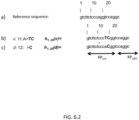
- the patient variants and the database entry may respectively be replayed into the reference sequence as disclosed for instance in [Cleary2015].
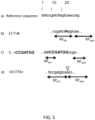
- Synced and out of sync regions are depicted with the plain and dashed arrows respectively.
- the replayed haplotypes compare exactly and start and end at the same reference coordinates, which means that the two mutations representation are equivalent.
- this replay can be achieved by choosing two synchronization points that are external to the variants from both set, and by producing the haplotypes of both sets starting and ending at a synchronization start point s and end point e, such that the variants are enclosed between the start point s and the end point e.
- the present disclosure addresses the above needs by proposing a method and a genomic data analyzer for identifying, with a variant annotation module on at least one data processor, if the variant calling information of a patient sample includes at least one variant entry in at least one medical variant reference database, a variant v being defined by a start coordinate s(v) , an end coordinate e(v) and a string alt(v) of a genomic variation relative to a human genome reference string R , characterized in that the method comprises the steps of:
- the extended region string RP left on the left of the variant alt ( d ) is an empty string and the extended region string RP right on the right of the variant alt ( d ) is at least one symbol long.
- the extended region string RP right on the right of the variant alt( d ) is an empty string and the extended region string RP left on the left of the variant alt( d ) is at least one symbol long.
- the horizon parameter z is calculated as a function of the maximum distance an INDEL could be shifted into an alternate equivalent alignment, of the maximum length of the genomic variants, of the read length, or of a combination thereof. It can be further predefined as a length of 500 symbols, 100 symbols, 200 symbols, 300 symbols, 400 symbols, 600 symbols, 700 symbols, 800 symbols, 900 symbols, 1000 symbols, or 1500 symbols
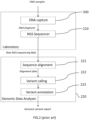
- FIG. 2 shows an exemplary genomic analysis system comprising a DNA enrichment assay 200, a next generation sequencer 210 and a genomic data analyzer 220.
- a pool of DNA samples is processed by the DNA enrichment assay 200 to generate a library of pooled amplicons (for amplicon-based enrichment) or fragments (for probe-based enrichment) as DNA fragments input to the next generation sequencer 210, each set of amplicons/fragments corresponding to a different sample.
- the number of amplicons/fragments is application dependent.
- target enrichment may require 150 primers to enrich 75 different regions to be targeted out of the sample genome, resulting in a set of 75 amplicons for each sample.
- the number of samples may also be adapted to the next-generation sequencing sequencer 210 parallel processing capability, for instance 48 samples in the form of a library of pooled amplicons may be sequenced in parallel by an Illumina MiSeq sequencer.
- Other NGS sequencer technologies may be used, such as for instance the Roche 454 TM GS Junior or GS FLX, Illumina MiSeq ® , or Life Technologies Ion PGM TM sequencers.
- the next-generation sequencer 210 analyses the input samples and generates sequence reads in a computer-readable file format representing raw NGS sequencing data.
- a computer-readable file format representing raw NGS sequencing data.
- one or more files may be output by the NGS sequencer 210.
- the FASTQ file format may be used with two different files for forward and reverse reads or as a single joined file.
- This text file typically starts with a sequence header marked by a '@' start character, followed by one line of sequence information represented as a string of 'A', 'T', 'C', 'G' nucleotide characters, then by a quality header marked by a '+' start character, followed by one line of quality metrics, one quality score matching each nucleotide read.
- the format for the quality metrics for each nucleotide in the sequence information string may depend on the sequencer.
- Some legacy sequencers output the raw sequencing data in the SFF (Standard Flowgram Format) binary file format, which comprises an informative header and the read data.
- SFF Standard Flowgram Format
- the laboratory operates a computing infrastructure to store the resulting raw NGS sequencing data file in a laboratory biobank.
- the laboratory computing infrastructure connects, with authentication credentials, through a communication network, to the genomic data analyzer 220 and transmits a genomic analysis request comprising the raw NGS sequencing file to the genomic data analyzer 220.
- the genomic data analyzer computer system (also "system” herein) 220 is programmed or otherwise configured to implement different genomic data analysis methods, such as receiving and/or combining sequencing data and/or annotating sequencing data.
- the genomic data analyzer 220 may be a computer system or part of a computer system including a central processing unit (CPU, "processor” or “computer processor” herein), memory such as RAM and storage units such as a hard disk, and communication interfaces to communicate with other computer systems through a communication network, for instance the internet or a local network.
- a central processing unit CPU, "processor” or “computer processor” herein
- RAM random access memory
- storage units such as a hard disk
- Examples of genomic data analyzer computing systems, environments, and/or configurations include, but are not limited to, personal computer systems, server computer systems, thin clients, thick clients, handheld or laptop devices, multiprocessor systems, microprocessor-based systems, set top boxes, programmable consumer electronics, network PCs, minicomputer systems, mainframe computer systems, and the like.
- the computer system may comprise one or more computer servers, which are operational with numerous other general purpose or special purpose computing systems and may enable distributed computing, such as cloud computing, for instance in a genomic data farm.
- the genomic data analyzer 220 may be integrated into a massively parallel system. In some embodiments, the genomic data analyzer 220 may be directly integrated into a next generation sequencing system.
- the genomic data analyzer 220 computer system may be adapted in the general context of computer system-executable instructions, such as program modules, being executed by a computer system.
- program modules may include routines, programs, objects, components, logic, data structures, and so on that perform particular tasks or implement particular abstract data types.
- program modules may use native operating system and/or file system functions, standalone applications; browser or application plugins, applets, etc.; commercial or open source libraries and/or library tools as may be programmed in Python, Biopython, C/C++, or other programming languages; custom scripts, such as Perl or Bioperl scripts.
- Instructions may be executed in distributed cloud computing environments where tasks are performed by remote processing devices that are linked through a communications network.
- program modules may be located in both local and remote computer system storage media including memory storage devices.
- the genomic data analyzer 220 may comprise a sequence alignment module 221, which compares the raw NGS sequencing data to a reference genome.
- the sequence alignment module 221 may be configured to execute different alignment algorithms. Standard raw data alignment algorithms such as Bowtie2 or BWA that have been optimized for fast processing of numerous genomic data sequencing reads may be used, but other embodiments are also possible.
- the alignment results may be represented as one or several files in BAM or SAM format, as known to those skilled in the bioinformatics art, but other formats may also be used, for instance compressed formats or formats optimized for order-preserving encryption, depending on the genomic data analyzer 220 requirements for storage optimization and/or genomic data privacy enforcement.
- the resulting alignment data may be further filtered and analyzed by a variant calling module 222 to retrieve variant information such as SNP, MNPs, INDELs and DELINS polymorphisms.
- the variant calling module 222 may be configured to execute different variant calling algorithms to output the information into a variant calling file in the VCF file format, but other formats may be used too.
- the variant calling information may then be processed by a variant annotation module 223 which may be configured to analyze the variant calling information, to match it against medical reference variant databases information, and to generate a genomic variant report synthesis which further facilitates the diagnosis and the personalized medicine treatment for the analyzed patient.
- a variant annotation module 223 may be configured to analyze the variant calling information, to match it against medical reference variant databases information, and to generate a genomic variant report synthesis which further facilitates the diagnosis and the personalized medicine treatment for the analyzed patient.
- the variant annotation module 223 of the genomic data analyzer 220 may thus be adapted to automatically identify in the variant calling information, with a processor, a set of variants which have been listed in one or more reference variant database storage.
- database variants can be understood as representing all variants stored in a storage device or a group of variants stored in a storage device and organized as a group.
- the variant annotation module 223 may be adapted to query entries into the reference database, with a processor. In a possible embodiment, the variant annotation module 223 sends queries and receives answers from a remote medical reference variant database storage through a communication network such as the internet.
- the genomic data analyzer may send queries and receive answers from a local memory storage replicate of a medical reference variants database.
- the variant annotation module 223 may be fully integrated as part of the software workflow of an end-to-end genomic data analyzer 220 or it may operate as a stand-alone module which processes upon request an input variant calling data file of a patient sample in any variant data analyzer workflow (not represented) to annotate variants of possible clinical relevance.
- the variant annotation module 223 may be integrated in a client-server architecture, but other embodiments are also possible.
- the proposed variant annotation module 223 may identify variants from a specific version of a medical reference variant database such as for instance Clinvar or COSMIC.
- a diversity of medical reference variant databases may be parsed and compiled into a single merged reference database prior to running the genomic analysis workflow on a diversity of patient sample analysis requests.
- the proposed variant annotation module 223 may also independently refer to various medical reference variant databases in search for all possible references, either sequentially with at least one processor or in parallel with different processors.
- the proposed variant annotation module 223 may associate the version and reference of the medical reference variant database with the identified patient variants to annotate 346 the patient variants by retrieving the variant attributes in this database version, and may report 350 this reference information to the end user together with the retrieved variants and their attributes.
- the proposed variant annotation module 223 may only keep one occurrence to avoid redundant variant annotation 346.
- only the attributes from the most recent database version are retrieved.
- the proposed variant annotation module 223 may annotate the variant by merging attributes retrieved from different reference databases, to avoid redundant reporting 350 to the end user while reporting as many attributes as could be retrieved for any identified variant.
- Other embodiments are also possible.
- the proposed variant annotation module 223 may thus serve next generation sequencing genomic analysis requests from different labs that are independently operating different sequencer technologies and different DNA enrichment technologies on different samples for different genes, by comparing the variant calling information from each sample patient NGS analysis to one or more medical reference variant databases.
- the proposed variant annotation module 223 may automatically and efficiently detect which entries in at least one reference variant database do match the sample variant calling information out of the variant calling module 222, even if the patient variant calling information and the reference variant database use different variant data representation encoding models.
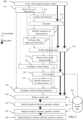
- FIG.3 shows accordingly an exemplary end-to-end genomic analysis workflow for the genomic data analyzer 220, comprising:
- the fully automated variant annotation module 223 in the genomic data analysis workflow of FIG.2 operates on variant calling data information sourced from at least one patient sample with reference to at least one variant reference database.
- medical reference database variants are generally independent from each other. In most cases, they were obtained at a different time, from a diversity of samples, from different tissues, under different conditions, and by different laboratories. This is a significant difference as compared to the genomic variants of a single patient sample, where all variants were obtained during a single experiment from the same sample with a single bioinformatics workflow. Such patient variants may be interdependent because they were all determined from a single alignment of the patient sequence onto the same version of the human reference genome. Some patient variants can thus be combined into other equivalent representations.
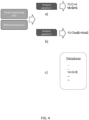
- An exemplary patient sample variant may be represented as two individual SNPs 10:C>A and 14:G>C variants when analyzed in a first genomic analyzer workflow 1 ( FIG.4a ) while it may be represented as a single complex non-canonical MNP variant 10:CttaG>AttaC MNP while analyzed in a second workflow 2 ( FIG.4b ).
- the medical reference database entry comprises the second individual SNP 14:G>C ( FIG.4c )
- the second workflow should also identify 345 a medical reference database variant match 14:G>C because this entry is an individual component of the MNP. Therefore, such included matches need to be identified 345, annotated 346 and reported 350 as well as the exact matches by the proposed improved variant annotation module 223.
- R ⁇ r 1 , r 2 , ..., r m ⁇ denote a reference sequence string of length m where r i is the i th symbol in the R string.
- R i .. j denotes the substring of R that starts and ends at position i and j respectively.
- R can be a sequence of any type such as a human chromosome sequence or a region only, such as a gene, an exon, a cDNA sequence or protein sequence.
- a patient variant on R is the expression of a local difference between the R string and a patient sample variant calling sequence string P .
- this local difference can be represented as a triple ( a , s , e ) where a is the alternative allele sequence issued from P, s is the inclusive start coordinate of the allele on R and e is the exclusive end coordinate.
- the reference allele is thus implicitly defined as R s.. ( e -1) .
- the reference sequence identifier such as the chromosome or protein sequence name
- the reference sequence identifier may be implicit in this exemplary embodiment representation, under the assumption all patient variants to be compared are defined on the same reference sequence and using the same coordinate system. If different coordinate systems and/or different reference sequences need to be used, it may be possible to pre-process them to align them to one or another reference prior to identifying the matching variants.
- V ⁇ v 1 ⁇ , v 2 ⁇ , ... , v V ⁇ denote a set of patient variants on R that were obtained from a given patient sample, sorted by the variants start coordinates.
- D ⁇ d 1 , d 2 , ..., d
- ⁇ be the set, also defined on the reference sequence R , of independent variants in the medical reference variant database that are to be assessed against V *.
- D may be a subset of the reference variants that are at a distance of at most z symbols from any patient variant v i ⁇ in V*, where z is a horizon parameter that determines the maximum coordinate distance at which a match possibly involving different variant representations could still be possible within the overall genomic region to be analyzed for the patient.
- z is a horizon parameter that determines the maximum coordinate distance at which a match possibly involving different variant representations could still be possible within the overall genomic region to be analyzed for the patient.
- the value of the horizon parameter z may be selected by the variant annotation module 223 depending on several parameters, among which the maximum distance an indel could be shifted to an alternate equivalent alignment, the maximum length of the complex variants, the read length, or a combination thereof.
- this parameter may also be predefined as a length of 500 nucleotide symbols, but other values in this or other representation coordinate systems are also possible, for instance a horizon length of 100 symbols, 200 symbols, 300 symbols, 400 symbols, 600 symbols, 700 symbols, 800 symbols, 900 symbols, 1000 symbols, 1500 symbols, etc.
- the subset of reference variants D within the search horizon may be obtained by a coordinate-based retrieving from the reference databases, using an index-based search such as the tabix index for instance (http://www.htslib.org/doc/tabix.html).
- the problem to be solved then consists in assessing each database entry d ⁇ D as a possible match in V*.
- This subset thus includes the variants that can potentially match d .
- the value of the horizon parameter z d may be selected by the variant annotation module 223 depending on several parameters, among which the maximum distance a INDEL could be shifted to an alternate equivalent alignment, the maximum length of the complex variants, the read length, or a combination thereof.
- this parameter may also be predefined as a length of 500 nucleotide symbols, but other values in this or other symbol representation and coordinate systems are also possible, for instance a horizon length of 100 symbols, 200 symbols, 300 symbols, 400 symbols, 600 symbols, 700 symbols, 800 symbols, 900 symbols, 1000 symbols, 1500 symbols, etc.
- the variant annotation module 223 may then be adapted to identify whether the patient sample haplotype carries the variant database entry d .
- ⁇ ⁇ V such that: S X ⁇ V
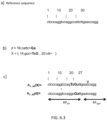
- comp h a .. b X , h a .. b d 1 where h a .. b ( X ) is the haplotype obtained by replaying the patient sample variants in X into R a .. b , and the coordinate boundaries a and b are defined such that they at least include the compared patient variants X and the database entry d.
- the proposed comp ( h 1, h 2) comparison function used for database searching may be designed to further account for included matches and not just exact matches, by tolerating symbol mismatches at specific locations between the replayed haplotype strings h 1 and h 2 , as will now be described in further detail.
- the variant annotation module 223 may compare the symbols h 1 i and h 2 i for 1 ⁇ i ⁇
- s ( d )-1 on the left and/or RP right R e ( d ).. b on the right part of alt ( d ) as: RP left + alt d , or alt d + RP right , or more generally RP left + alt d + RP right .
- the comp(h(X),h(d)) function may then tolerate mismatches between h(X) and h(d) provided three conditions are satisfied:
- horizon parameters z and z d may be chosen so as to ensure that all matches, exact, included or composed will be detected within the extended replayed region.
- the horizon parameters may also be defined as a function of the length of the reads in the NGS sequencing workflow.
- the horizon parameters may also be pre-calculated as a function of the length of repeated nucleotide patterns in the genomic area to be analyzed by the genomic workflow, as these repetitions may affect the maximum distance at which equivalent representation, and particularly indels, may be shifted along the reference sequence.
- the horizon parameters may also be determined by the maximum length of the complex variants (MNPs and DELINS) that are analyzed.
- Various further embodiments of the proposed identification method may also adapt the variant annotation module 223 to identify 345, annotate 346 and report 350 the exact as well as the included variant matches in at least one medical variant reference database so that the end user can more easily identify the haplotypes of medical relevance, regardless of the diversity of the genomic data analyzer workflow algorithms and reference data representation models.
- Various embodiments may also optimize the processing time of the proposed improved variant identification method in a genomic data analyzer workflow 220. Examples of such embodiments will now be described in more detail.
- the variant annotation module 223 may be further adapted to solve the problem in linear time with a branch-and-bound-like (B&B) algorithm.
- B&B branch-and-bound-like
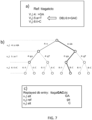
- the patient variant set comprises three simple variants:
- the possible combinations of the patient variants may be explored in a stepwise way by adding one variant at a time to the patient haplotype, and by comparing the extension to h(d).
- the exhaustive set of solutions can be represented by a haplotype binary tree as illustrated in the example of FIG. 7b ), where each leaf represents a possible combination X, and an internal node at level k corresponding to a partial combination among the k first variants from X.
- Each level either corresponds to the rejection (for instance, left branch - corresponding to the reference allele) or to the confirmation (for instance, right branch - alternative allele) of a particular variant v i ⁇ V , defining thus the particular combination X .
- FIG.7c shows an example extended replayed database entry haplotype with the matched alleles, either reference alleles (v2) or alternative alleles (v1, v3 - represented by capital letters).
- Each allele addition may then be assessed against h(d) using the proposed identification method with the comp function to identify both exact and included matches. If the comparison fails, then the underlying sub-tree does not need to be further constructed and can be discarded from the search.
- is then identified as a match of the medical reference variant database entry d .
- the variant annotation module 223 may also further identify 345, annotate 346 and report 350 the patient variants which correspond to a haplotype of possible medical relevance by associating the individual variants according to their phasing information.
- This information provides variants relationships regarding the alleles on which they occur.
- Human germline samples display two alleles, one from each chromosome, while somatic samples may display more alleles. Variants occurring on the same allele are said in-phase, while the ones occurring on opposite alleles are said anti-phase. When no phase information can be obtained for some variants, the variants are said unphased.
- phasing information does not affect the variant comparison procedure but can simply be used in a post-processing step by filtering the matches. Indeed, phasing enables to determine whether the variants are on the same chromosome, to determine the actual haplotype information and thus its functional genomics relevance.
- the variant annotation module 123 should primarily identify 345, annotate 346 and report 350 those compositions that are possible because they are on the same phase.
- the phasing information enables to combine the patient variants into larger haplotypes.
- a haplotype may be reported 350 as confirmed if and only if all involved variants are in-phase. Combinations of variants that are anti-phase can be ignored in the post-processing phasing assembly because the resulting haplotype cannot exist in the real sample. If some phasing information is lacking so that it is not possible to discriminate between the in-phase and out-of-phase status of the variant composition, then the haplotype may be reported 350 as potential.
- a simple representation model as represented for instance in the examples of FIG.1 , FIG.4 , FIG.5 , FIG.6 and FIG.7 consists in describing genomic variants with reference to the DNA sequence representation model, with the four DNA nucleotides respectively represented by the A, T, C and G symbols.
- the proposed methods may also work on other string representations of the genomic or proteomic information.
- Reference variant databases may also include extended symbols. Extended symbols are particularly useful in a particular database search application called hotspots screening.
- Hotspots screening analysis consists in analyzing a patient sample with regards to a predefined list of mutations that are called hotspots. The list of hotspots can be seen as a custom variant database against which the patient variants are matched.
- the referenced variant identification process 345 consists then in assessing the presence or the absence of each hotspot in the list. By restricting the test scope to the relevant mutations only, such analysis simplifies and reduces the time for the clinicians to get the relevant information that is related to some disease.
- hotspots screening requires a robust variant matching algorithm 345 to guarantee that all hotspots are correctly identified 345 by the variant annotation module 223.
- hotspots are commonly defined using an extended alphabet.
- Extended alphabet contains symbols that represent subsets of some symbols.
- the extended DNA symbol "W” means both "A” and "T”.
- Extended symbols provide a way to define a range of mutations using a single symbol.
- the comp ( h 1, h 2) function can involve symbol comparison methods that account for extended symbols matching, allowing thus to identify the referenced variants that are described using such an extended alphabet.
- V600E valine at position 600 is replaced by glutamic acid
- V600K amino acid
- V600M amino acid sequence
- V600D extended variant description format
- the proposed methods may also work with RNA sequences as a possible reference representation model, for instance with a RNA-seq next generation sequencing workflow.
- the variant annotation module 223 operates with a proteomic representation on the translated cDNA sequence, but it may also apply the method directly on the RNA string representation, whose symbols are ⁇ AUGC).
- the reference sequence R may also be further split into independent non-overlapping regions based on the variants occurrence density, that is regions which are sufficiently far apart on the human genome to exclude any possible overlap of the sequencing reads in a next generation sequencing workflow. Those regions define partitions of the whole patient variants set so that each partition can be processed independently, to enable multitasking or distributing over a parallel computing architecture the variant annotation module 223 tasks for more efficient computational implementation of the genomic data analyzer workflow 220.
- the regions may be determined using horizon parameters z, z d that defines the minimal coordinate distance in the reference coordinate system above which two variants can be considered independent and thus do not need to be replayed into the same haplotype.
- the horizon parameters depend on the largest distance an insertion or a deletion could be shifted as well as on the sequencing reads length.
- a typical value in is 500 nucleotides, but other values are also possible, for instance 100 nucleotides, 200 nucleotides, 300 nucleotides, 400 nucleotides, 600 nucleotides, 700 nucleotides, 800 nucleotides, 900 nucleotides, 1000 nucleotides, 1500 nucleotides, etc.
- Regions may be determined such that a coordinate distance of at most the horizon separates any two consecutive variants in a region. The partitioning procedure is trivial provided that the patient variants set is sorted according to the variants start coordinates.
- the proposed genomic data analyzer 220 has been embedded into the Hospital Genetics Data Driven Medicine (DDM) genomic analysis software workflow 220 and operated on a set of patient samples to identify variants of clinical relevance in the BRCA2 gene.
- Variant calling information is represented using the HGVS notation for cDNA coordinates and comprises complex MNP variants.
- the reference sequence is the transcript NM_000059 ( https://www.ncbi.nlm.nih.gov/nuccore/NM_000059).
- the medical reference variant database is Clinvar.
- the proposed genomic data analyzer 220 has been embedded into the Sophia Genetics Data Driven Medicine (DDM) genomic analysis software workflow 220 and operated on a patient sample to identify variants of clinical relevance in the ARSD gene.
- Variant calling information is represented using the genomic notation seqId:startCoord:ref:alt and comprises complex DELINS variants.
- the reference sequence is the transcript NM_001669 (https://www.ncbi.nlm.nih.gov/nuccore/nm_001669).
- the medical reference variant database is Cosmic.
- the methods described herein may be indifferently applied to various statistical methods such as probability representations and statistical measurements.
- the terms “distribution”, “likelihood”, “probability” may thus be used indifferently throughout this specification.
- a "hardware module” is a tangible unit capable of performing certain operations and may be configured or arranged in a certain physical manner.
- one or more computer systems e.g., a standalone computer system, a client computer system, or a server computer system
- one or more hardware modules of a computer system e.g., a processor or a group of processors
- software e.g., an application or application portion
- a hardware module may be implemented mechanically, electronically, or any suitable combination thereof.
- a hardware module may include dedicated circuitry or logic that is permanently configured to perform certain operations.
- a hardware module may be a special-purpose processor, such as a field-programmable gate array (FPGA) or an ASIC.
- a hardware module may also include programmable logic or circuitry that is temporarily configured by software to perform certain operations.
- a hardware module may include software encompassed within a general-purpose processor or other programmable processor. It will be appreciated that the decision to implement a hardware module mechanically, in dedicated and permanently configured circuitry, or in temporarily configured circuitry (e.g., configured by software) may be driven by cost and time considerations.
- processors may be temporarily configured (e.g., by software) or permanently configured to perform the relevant operations. Whether temporarily or permanently configured, such processors may constitute processor-implemented modules that operate to perform one or more operations or functions described herein.
- processor-implemented module refers to a hardware module implemented using one or more processors.
- the methods described herein may be at least partially processor-implemented, a processor being an example of hardware.
- processors or processor-implemented modules may be performed by one or more processors or processor-implemented modules.
Landscapes
- Life Sciences & Earth Sciences (AREA)
- Physics & Mathematics (AREA)
- Chemical & Material Sciences (AREA)
- Engineering & Computer Science (AREA)
- Health & Medical Sciences (AREA)
- Proteomics, Peptides & Aminoacids (AREA)
- Bioinformatics & Cheminformatics (AREA)
- General Health & Medical Sciences (AREA)
- Biophysics (AREA)
- Biotechnology (AREA)
- Analytical Chemistry (AREA)
- Bioinformatics & Computational Biology (AREA)
- Evolutionary Biology (AREA)
- Theoretical Computer Science (AREA)
- Spectroscopy & Molecular Physics (AREA)
- Medical Informatics (AREA)
- Organic Chemistry (AREA)
- Molecular Biology (AREA)
- Genetics & Genomics (AREA)
- Wood Science & Technology (AREA)
- Zoology (AREA)
- Biochemistry (AREA)
- Immunology (AREA)
- Microbiology (AREA)
- General Engineering & Computer Science (AREA)
- Measuring Or Testing Involving Enzymes Or Micro-Organisms (AREA)
Priority Applications (1)
| Application Number | Priority Date | Filing Date | Title |
|---|---|---|---|
| EP26153190.9A EP4715826A2 (fr) | 2017-12-12 | 2018-12-12 | Procédés de détection de variants dans des données génomiques de séquençage de nouvelle génération |
Applications Claiming Priority (3)
| Application Number | Priority Date | Filing Date | Title |
|---|---|---|---|
| EP17206590.6A EP3499394A1 (fr) | 2017-12-12 | 2017-12-12 | Procédés de détection de variantes dans le séquençage de la prochaine génération de données génomiques |
| EP18825938.6A EP3724882B1 (fr) | 2017-12-12 | 2018-12-12 | Procédés de détection de variantes dans le séquençage de la prochaine génération de données génomiques |
| PCT/EP2018/084649 WO2019115657A1 (fr) | 2017-12-12 | 2018-12-12 | Procédés de détection de variants dans des données génomiques de séquençage de nouvelle génération |
Related Parent Applications (1)
| Application Number | Title | Priority Date | Filing Date |
|---|---|---|---|
| EP18825938.6A Division EP3724882B1 (fr) | 2017-12-12 | 2018-12-12 | Procédés de détection de variantes dans le séquençage de la prochaine génération de données génomiques |
Related Child Applications (1)
| Application Number | Title | Priority Date | Filing Date |
|---|---|---|---|
| EP26153190.9A Division EP4715826A2 (fr) | 2017-12-12 | 2018-12-12 | Procédés de détection de variants dans des données génomiques de séquençage de nouvelle génération |
Publications (4)
| Publication Number | Publication Date |
|---|---|
| EP4390940A2 true EP4390940A2 (fr) | 2024-06-26 |
| EP4390940A3 EP4390940A3 (fr) | 2024-10-02 |
| EP4390940B1 EP4390940B1 (fr) | 2026-02-11 |
| EP4390940C0 EP4390940C0 (fr) | 2026-02-11 |
Family
ID=60661858
Family Applications (4)
| Application Number | Title | Priority Date | Filing Date |
|---|---|---|---|
| EP17206590.6A Withdrawn EP3499394A1 (fr) | 2017-12-12 | 2017-12-12 | Procédés de détection de variantes dans le séquençage de la prochaine génération de données génomiques |
| EP18825938.6A Active EP3724882B1 (fr) | 2017-12-12 | 2018-12-12 | Procédés de détection de variantes dans le séquençage de la prochaine génération de données génomiques |
| EP24156160.4A Active EP4390940B1 (fr) | 2017-12-12 | 2018-12-12 | Procédés de détection de variants dans des données génomiques de séquençage de nouvelle génération |
| EP26153190.9A Pending EP4715826A2 (fr) | 2017-12-12 | 2018-12-12 | Procédés de détection de variants dans des données génomiques de séquençage de nouvelle génération |
Family Applications Before (2)
| Application Number | Title | Priority Date | Filing Date |
|---|---|---|---|
| EP17206590.6A Withdrawn EP3499394A1 (fr) | 2017-12-12 | 2017-12-12 | Procédés de détection de variantes dans le séquençage de la prochaine génération de données génomiques |
| EP18825938.6A Active EP3724882B1 (fr) | 2017-12-12 | 2018-12-12 | Procédés de détection de variantes dans le séquençage de la prochaine génération de données génomiques |
Family Applications After (1)
| Application Number | Title | Priority Date | Filing Date |
|---|---|---|---|
| EP26153190.9A Pending EP4715826A2 (fr) | 2017-12-12 | 2018-12-12 | Procédés de détection de variants dans des données génomiques de séquençage de nouvelle génération |
Country Status (3)
| Country | Link |
|---|---|
| US (1) | US12573472B2 (fr) |
| EP (4) | EP3499394A1 (fr) |
| WO (1) | WO2019115657A1 (fr) |
Families Citing this family (3)
| Publication number | Priority date | Publication date | Assignee | Title |
|---|---|---|---|---|
| CN110993023B (zh) * | 2019-11-29 | 2023-08-15 | 北京优迅医学检验实验室有限公司 | 复杂突变的检测方法及检测装置 |
| CN113628685B (zh) * | 2021-07-27 | 2022-03-15 | 广东省农业科学院水稻研究所 | 一种基于多个基因组比较和二代测序数据的全基因组关联分析方法 |
| CN114566214B (zh) * | 2022-04-26 | 2022-07-05 | 北京泛生子基因科技有限公司 | 检测基因组缺失插入变异的方法及检测装置和计算机可读存储介质与应用 |
-
2017
- 2017-12-12 EP EP17206590.6A patent/EP3499394A1/fr not_active Withdrawn
-
2018
- 2018-12-12 EP EP18825938.6A patent/EP3724882B1/fr active Active
- 2018-12-12 WO PCT/EP2018/084649 patent/WO2019115657A1/fr not_active Ceased
- 2018-12-12 EP EP24156160.4A patent/EP4390940B1/fr active Active
- 2018-12-12 US US16/771,880 patent/US12573472B2/en active Active
- 2018-12-12 EP EP26153190.9A patent/EP4715826A2/fr active Pending
Non-Patent Citations (9)
| Title |
|---|
| "A Global Reference for Human Genetic variation", NATURE, vol. 526, no. 7571, pages 68 - 74 |
| BAYAT ET AL.: "Improved VCF normalization for accurate VCF comparison", BIOINFORMATICS, 19 December 2016 (2016-12-19), pages btw748, XP055493329, DOI: 10.1093/bioinformatics/btw748 |
| CLEARY ET AL., COMPARING VARIANT CALL FILES FOR PERFORMANCE BENCHMARKING OF NEXT-GENERATION SEQUENCING VARIANT CALLING PIPELINES, August 2015 (2015-08-01), Retrieved from the Internet <URL:http://dx.doi.org/10.1101/023754> |
| FORBES ET AL.: "COSMIC: Somatic Cancer Genetics at High-Resolution", NUCLEIC ACIDS RESEARCH, vol. 45, no. D1, 2017, pages D777 - 83, XP055458076, DOI: 10.1093/nar/gkw1121 |
| GARRISON ET AL.: "Haplotype-Based Variant Detection from Short-Read Sequencing", ARXIV: 1207.3907, July 2012 (2012-07-01), Retrieved from the Internet <URL:http://arxiv.org/abs/1207.3907> |
| GITHUB - VCFLIB, 5 May 2017 (2017-05-05), Retrieved from the Internet <URL:https://github.com/vcflib/vcflib> |
| TALWALKAR ET AL.: "SMaSH: A Benchmarking Toolkit for Human Genome Variant Calling", BIOINFORMATICS (OXFORD, ENGLAND), vol. 30, no. 19, pages 2787 - 95, XP055493330, DOI: 10.1093/bioinformatics/btu345 |
| TAN ET AL.: "Unified Representation of Genetic Variants", BIOINFORMATICS (OXFORD, ENGLAND, vol. 31, no. 13, pages 2202 - 4 |
| USEQ VCF COMPARATOR, 27 April 2017 (2017-04-27), Retrieved from the Internet <URL:http://useq.sourceforge.net/cmdLnMenus.html#VCFComparator> |
Also Published As
| Publication number | Publication date |
|---|---|
| US12573472B2 (en) | 2026-03-10 |
| EP3724882A1 (fr) | 2020-10-21 |
| EP4390940B1 (fr) | 2026-02-11 |
| EP4390940C0 (fr) | 2026-02-11 |
| WO2019115657A1 (fr) | 2019-06-20 |
| EP4715826A2 (fr) | 2026-03-25 |
| EP3724882B1 (fr) | 2024-02-07 |
| EP3499394A1 (fr) | 2019-06-19 |
| EP3724882C0 (fr) | 2024-02-07 |
| US20210074379A1 (en) | 2021-03-11 |
| EP4390940A3 (fr) | 2024-10-02 |
Similar Documents
| Publication | Publication Date | Title |
|---|---|---|
| Hickey et al. | Pangenome graph construction from genome alignments with Minigraph-Cactus | |
| Reinert et al. | Alignment of next-generation sequencing reads | |
| Boisvert et al. | Ray: simultaneous assembly of reads from a mix of high-throughput sequencing technologies | |
| US20240296912A1 (en) | Methods for processing next-generation sequencing genomic data | |
| Major et al. | HLA typing from 1000 genomes whole genome and whole exome illumina data | |
| Ulintz et al. | Bioinformatics analysis of whole exome sequencing data | |
| Bravo et al. | Model-based quality assessment and base-calling for second-generation sequencing data | |
| Johnston et al. | PEMapper and PECaller provide a simplified approach to whole-genome sequencing | |
| Li et al. | An NGS workflow blueprint for DNA sequencing data and its application in individualized molecular oncology | |
| EP3658687A1 (fr) | Procédés pour la détection de la perte biallélique d'une fonction dans des données génomiques de séquençage de nouvelle génération | |
| US12094574B2 (en) | Difference-based genomic identity scores | |
| EP3724882B1 (fr) | Procédés de détection de variantes dans le séquençage de la prochaine génération de données génomiques | |
| Ma et al. | Omics informatics: from scattered individual software tools to integrated workflow management systems | |
| Abakarova et al. | Alignment-based protein mutational landscape prediction: doing more with less | |
| Sahlin | Strobemers: an alternative to k-mers for sequence comparison | |
| JP7366129B2 (ja) | ゲノムデータを次世代シーケンシングする際のバリアント検出方法 | |
| EP3552127A1 (fr) | Procédés de détection de variants dans des données génomiques de séquençage de nouvelle génération | |
| JP2023541341A (ja) | 個別化医療のためのカスタムデータファイル | |
| WO2020185411A1 (fr) | Système et procédé d'appel de variant | |
| Shokrof et al. | The Great Genotyper: a graph-based method for population genotyping of small and structural variants | |
| Venâncio | Application of New Bioinformatic Algorithms in Next Generation Sequencing (NGS) Data Analysis | |
| Bourn | Creating and analysing an African pan-genome | |
| Glusman et al. | Ultrafast comparison of personal genomes | |
| Letcher et al. | Enabling multiscale variation analysis with genome graphs | |
| Bradshaw | Computer Aided Genetic Variant Validation for Rare Diseases |
Legal Events
| Date | Code | Title | Description |
|---|---|---|---|
| PUAI | Public reference made under article 153(3) epc to a published international application that has entered the european phase |
Free format text: ORIGINAL CODE: 0009012 |
|
| STAA | Information on the status of an ep patent application or granted ep patent |
Free format text: STATUS: THE APPLICATION HAS BEEN PUBLISHED |
|
| AC | Divisional application: reference to earlier application |
Ref document number: 3724882 Country of ref document: EP Kind code of ref document: P |
|
| AK | Designated contracting states |
Kind code of ref document: A2 Designated state(s): AL AT BE BG CH CY CZ DE DK EE ES FI FR GB GR HR HU IE IS IT LI LT LU LV MC MK MT NL NO PL PT RO RS SE SI SK SM TR |
|
| PUAL | Search report despatched |
Free format text: ORIGINAL CODE: 0009013 |
|
| AK | Designated contracting states |
Kind code of ref document: A3 Designated state(s): AL AT BE BG CH CY CZ DE DK EE ES FI FR GB GR HR HU IE IS IT LI LT LU LV MC MK MT NL NO PL PT RO RS SE SI SK SM TR |
|
| RIC1 | Information provided on ipc code assigned before grant |
Ipc: C12Q 1/6869 20180101ALN20240827BHEP Ipc: G16B 20/30 20190101ALI20240827BHEP Ipc: G16B 20/20 20190101AFI20240827BHEP |
|
| STAA | Information on the status of an ep patent application or granted ep patent |
Free format text: STATUS: REQUEST FOR EXAMINATION WAS MADE |
|
| 17P | Request for examination filed |
Effective date: 20250331 |
|
| GRAP | Despatch of communication of intention to grant a patent |
Free format text: ORIGINAL CODE: EPIDOSNIGR1 |
|
| STAA | Information on the status of an ep patent application or granted ep patent |
Free format text: STATUS: GRANT OF PATENT IS INTENDED |
|
| RIC1 | Information provided on ipc code assigned before grant |
Ipc: G16B 20/20 20190101AFI20250813BHEP Ipc: G16B 20/30 20190101ALI20250813BHEP Ipc: C12Q 1/6869 20180101ALN20250813BHEP |
|
| INTG | Intention to grant announced |
Effective date: 20250908 |
|
| GRAS | Grant fee paid |
Free format text: ORIGINAL CODE: EPIDOSNIGR3 |
|
| GRAA | (expected) grant |
Free format text: ORIGINAL CODE: 0009210 |
|
| STAA | Information on the status of an ep patent application or granted ep patent |
Free format text: STATUS: THE PATENT HAS BEEN GRANTED |
|
| AC | Divisional application: reference to earlier application |
Ref document number: 3724882 Country of ref document: EP Kind code of ref document: P |
|
| AK | Designated contracting states |
Kind code of ref document: B1 Designated state(s): AL AT BE BG CH CY CZ DE DK EE ES FI FR GB GR HR HU IE IS IT LI LT LU LV MC MK MT NL NO PL PT RO RS SE SI SK SM TR |
|
| REG | Reference to a national code |
Ref country code: CH Ref legal event code: F10 Free format text: ST27 STATUS EVENT CODE: U-0-0-F10-F00 (AS PROVIDED BY THE NATIONAL OFFICE) Effective date: 20260211 Ref country code: GB Ref legal event code: FG4D |
|
| REG | Reference to a national code |
Ref country code: DE Ref legal event code: R096 Ref document number: 602018089156 Country of ref document: DE Ref country code: CH Ref legal event code: R17 Free format text: ST27 STATUS EVENT CODE: U-0-0-R10-R17 (AS PROVIDED BY THE NATIONAL OFFICE) Effective date: 20260305 |
|
| REG | Reference to a national code |
Ref country code: IE Ref legal event code: FG4D |
|
| U01 | Request for unitary effect filed |
Effective date: 20260310 |
|
| U07 | Unitary effect registered |
Designated state(s): AT BE BG DE DK EE FI FR IT LT LU LV MT NL PT RO SE SI Effective date: 20260316 |