EP4390741A1 - Sicherung eines dateisystems eines autonomen fernsystems - Google Patents
Sicherung eines dateisystems eines autonomen fernsystems Download PDFInfo
- Publication number
- EP4390741A1 EP4390741A1 EP23217932.5A EP23217932A EP4390741A1 EP 4390741 A1 EP4390741 A1 EP 4390741A1 EP 23217932 A EP23217932 A EP 23217932A EP 4390741 A1 EP4390741 A1 EP 4390741A1
- Authority
- EP
- European Patent Office
- Prior art keywords
- file system
- remote autonomous
- key
- private key
- autonomous system
- Prior art date
- Legal status (The legal status is an assumption and is not a legal conclusion. Google has not performed a legal analysis and makes no representation as to the accuracy of the status listed.)
- Pending
Links
Images

Classifications
-
- G—PHYSICS
- G06—COMPUTING OR CALCULATING; COUNTING
- G06F—ELECTRIC DIGITAL DATA PROCESSING
- G06F21/00—Security arrangements for protecting computers, components thereof, programs or data against unauthorised activity
- G06F21/50—Monitoring users, programs or devices to maintain the integrity of platforms, e.g. of processors, firmware or operating systems
- G06F21/57—Certifying or maintaining trusted computer platforms, e.g. secure boots or power-downs, version controls, system software checks, secure updates or assessing vulnerabilities
-
- H—ELECTRICITY
- H04—ELECTRIC COMMUNICATION TECHNIQUE
- H04L—TRANSMISSION OF DIGITAL INFORMATION, e.g. TELEGRAPHIC COMMUNICATION
- H04L9/00—Cryptographic mechanisms or cryptographic arrangements for secret or secure communications; Network security protocols
- H04L9/08—Key distribution or management, e.g. generation, sharing or updating, of cryptographic keys or passwords
- H04L9/0816—Key establishment, i.e. cryptographic processes or cryptographic protocols whereby a shared secret becomes available to two or more parties, for subsequent use
- H04L9/0819—Key transport or distribution, i.e. key establishment techniques where one party creates or otherwise obtains a secret value, and securely transfers it to the other(s)
- H04L9/0825—Key transport or distribution, i.e. key establishment techniques where one party creates or otherwise obtains a secret value, and securely transfers it to the other(s) using asymmetric-key encryption or public key infrastructure [PKI], e.g. key signature or public key certificates
-
- G—PHYSICS
- G06—COMPUTING OR CALCULATING; COUNTING
- G06F—ELECTRIC DIGITAL DATA PROCESSING
- G06F21/00—Security arrangements for protecting computers, components thereof, programs or data against unauthorised activity
- G06F21/50—Monitoring users, programs or devices to maintain the integrity of platforms, e.g. of processors, firmware or operating systems
- G06F21/57—Certifying or maintaining trusted computer platforms, e.g. secure boots or power-downs, version controls, system software checks, secure updates or assessing vulnerabilities
- G06F21/575—Secure boot
-
- G—PHYSICS
- G06—COMPUTING OR CALCULATING; COUNTING
- G06F—ELECTRIC DIGITAL DATA PROCESSING
- G06F21/00—Security arrangements for protecting computers, components thereof, programs or data against unauthorised activity
- G06F21/60—Protecting data
- G06F21/62—Protecting access to data via a platform, e.g. using keys or access control rules
- G06F21/6218—Protecting access to data via a platform, e.g. using keys or access control rules to a system of files or objects, e.g. local or distributed file system or database
- G06F21/6281—Protecting access to data via a platform, e.g. using keys or access control rules to a system of files or objects, e.g. local or distributed file system or database at program execution time, where the protection is within the operating system
-
- G—PHYSICS
- G06—COMPUTING OR CALCULATING; COUNTING
- G06F—ELECTRIC DIGITAL DATA PROCESSING
- G06F21/00—Security arrangements for protecting computers, components thereof, programs or data against unauthorised activity
- G06F21/60—Protecting data
- G06F21/64—Protecting data integrity, e.g. using checksums, certificates or signatures
-
- G—PHYSICS
- G06—COMPUTING OR CALCULATING; COUNTING
- G06F—ELECTRIC DIGITAL DATA PROCESSING
- G06F2221/00—Indexing scheme relating to security arrangements for protecting computers, components thereof, programs or data against unauthorised activity
- G06F2221/21—Indexing scheme relating to G06F21/00 and subgroups addressing additional information or applications relating to security arrangements for protecting computers, components thereof, programs or data against unauthorised activity
- G06F2221/2143—Clearing memory, e.g. to prevent the data from being stolen
Definitions
- the present invention relates to a device for securing a file system of a remote autonomous system, said remote autonomous system using an operating system associated with said file system of said remote autonomous system, the remote autonomous system using furthermore a double file system partition allowing A/B updates, said remote autonomous system being further capable of being updated by atomic update, the remote autonomous system further comprising a boot tool secure.
- the present invention also relates to such a remote autonomous system, said remote autonomous system using an operating system associated with said file system of said remote autonomous system, the remote autonomous system further using a double file system partition allowing A/B updates, said remote autonomous system further being able to be updated by atomic update, the remote autonomous system further comprising a secure boot tool.
- the invention also relates to a method of securing a file system of such a remote autonomous system.
- the invention also relates to a computer program associated with said method.
- the invention lies in the field of autonomous systems using at least one OS operating system , for example the Linux operating system, and which are administered remotely ( Over The Air ).
- OS operating system for example the Linux operating system
- Such remote administration requires the ability to atomically manage updates of such a remote autonomous system whose file system, also called rootfs, is, in order to control updates, commonly type A /B, that is to say comprising two file systems A and B, alternately active. More precisely, if file system A is active then the update will be done on file system B, and vice versa). Once the update is complete, the system reboots and switches to file system B. If the update is faulty, the system can revert to the old version, file system A, which is still available. The active file system is read-only and no partial updates are possible to ensure proper operation after an update. Persistent data, e.g.
- configuration data is stored on a partition, dedicated if need, the media corresponding to the physical storage medium (eg hard disk, flash memory, eMMC ( Embedded MultiMediaCard (7)), the media being formatted with several partitions which each contain a file system.
- the media eg hard disk, flash memory, eMMC ( Embedded MultiMediaCard 7)
- the media being formatted with several partitions which each contain a file system.
- such an atomic update consists of updating in one go, both the kernel of the operating system, subsequently called kernel, as well as jointly the file system, and this on the same partition. of the media (i.e. of the remote autonomous system).
- This couple namely the kernel and the file system, is therefore linked, and it is difficult, if not impossible, to update these two elements independently.
- Verifying the integrity and authenticity of the files of such a remote autonomous system, using in particular a Linux operating system, is an imperative for these systems, for which it is necessary in particular to ensure that the binaries which are executed actually come from the software supplier. original software and have not been altered.
- such remote autonomous systems also include a secure boot hardware tool , however such a tool guarantees the integrity and authenticity only of the kernel and the bootloader suitable for launching the (or each) operating system, without allowing verification of the integrity and authenticity of the elements of the file system.
- the first solution is based on fingerprint calculations (from the English hash ) of the blocks of the media partition via a Merkle tree, also called a hash tree, capable of producing a unique fingerprint (from the English hash root ) serving as a reference for integrity.
- Merkle trees are binary trees used to perform data validation. To do this, each leaf of the tree will contain the cryptographic fingerprint (hash) corresponding to part of the data to be validated. Each node in the tree will also contain a footprint. This fingerprint is obtained by concatenating the fingerprint of the two children and passing the result into a function to create a new fingerprint. A general dependency is then constructed where the value of each node depends on the values of its child nodes to ultimately obtain a unique hash ( root hash ). This unique fingerprint is then integrated into the kernel of the operating system, notably Linux, and is checked at startup and dynamically.
- the second solution is based on a signature verification of the integrity and authenticity of the files, using for example for a Linux type operating system, a Linux IMA ( Integrity Measurement Architecture ) subsystem. with the EVM module ( Extended Verification Module ).
- This second solution based on signature verification requires the creation of a pair of private/public asymmetric cryptography keys.
- the private key is used to sign the kernel and bootloader
- the public key is stored on the hardware running the OS, for example an iMX6 processor.
- This engraving of the public key is carried out in particular by relying on a physical mechanism based on OTP ( One Time-Programmable ) fuses. These fuses have the characteristic of being able to be written only once, while still being able to be read as many times as necessary. They thus allow the secure storage of the public key in the hardware in an unalterable manner.
- OTP One Time-Programmable
- This second solution has the advantage of being compatible with the implementation of atomic updates because the public key can be added in the kernel without impacting the integrity calculation while allowing atomic update management.
- a first current solution for securing the private key requires an interconnection with a public key infrastructure for key management PKI ( Public Key Infrastructure ) but this is inefficient, complex and expensive to implement because it requires by example of modifying the signature software integrated into the kernel, in particular the open source Linux signature software called “evmctl”, which is under a specific “GPLv2” license which is not necessarily industrially acceptable, in fact such signature software does not It is not designed to connect to this PKI, as it is only intended to work with a local private key.
- PKI Public Key Infrastructure
- a second current solution for securing the private key involves the use of a local hardware security module HSM ( Hardware Security Module ), but requires, like the first solution, also to develop a software layer to interface the signature software with the HSM component which also involves high costs.
- HSM Hardware Security Module
- a third current solution for securing the private key is based on the use of a local TPM trusted platform module ( Trusted Platform Module ) to store the private key, but requires, like the previous solutions, to develop a software layer to interface the signature software with the TPM component, which also adds constraints on the machine used to produce the image of the file system, noting that the use of “asset hardware” complicates, or even prevents automated software production on cloud computing.
- Trusted Platform Module Trusted Platform Module
- a fourth current solution is based on the use of a locally self-signed private key, which is efficient and compatible with the implementation of atomic updates of a remote autonomous system, but on the other hand requires constraints complex organizational measures to protect, trace, monitor access(s) to the private key, such as storage on encrypted disk, with rather relative security and difficulty in identifying a data leak or detecting a compromise (ie hacking) of the private key. Indeed, if the private key is intercepted, trust in the file system is lost, because the interceptor will have the means to modify the contents while validating the verification with the public key)
- the object of the invention is to remedy the drawbacks of the state of the art by proposing an alternative solution, simpler and more industrially secure, for creating and managing private/public key pair(s) dedicated to verification. signature.
- the invention proposes a device for securing a file system of a remote autonomous system, said remote autonomous system using an operating system associated with said file system of said remote autonomous system, the system remote autonomous system further using a dual file system partition allowing A/B updates, said remote autonomous system further being capable of being updated by atomic update, the remote autonomous system further comprising a secure boot tool, said security device being configured to sign said file system based on two-key asymmetric cryptography comprising a public key and a private key, the public key being integrated into the kernel of said security system exploitation, the lifespan of said private key being limited, said two public and private keys being regenerated by said security device each time a new atomic update of said remote autonomous system is produced.
- the present invention provides a solution to securing the private key in the case of a solution based on a self-signed key in order to maintain a simple mechanism to implement rather than going through an external authority to generate the keys. .
- the solution according to the present invention uses a volatile private key in the sense that its lifespan is limited and where the two public and private keys are regenerated by the security device each time a new atomic update of the remote autonomous system.
- the complexity of securing this private key the need for which is almost non-existent, because it is very limited in time, is reduced, and updating the file system will involve a complete update of the autonomous system remotely with a new public/private key pair associated with this production as such of this new update, the same update subsequently being able to be broadcast to several distinct remote autonomous systems.
- the invention also relates to an autonomous system using an operating system associated with a file system of said remote autonomous system, the remote autonomous system further using a double file system partition allowing updates A /B, said autonomous remote system being further capable of being updated by atomic update, the autonomous remote system further comprising a secure startup tool, the autonomous remote system comprising the security device according to the present invention as mentioned above.
- the remote autonomous system proposed according to the present invention may also have the characteristic that said operating system is a Linux operating system using the signature mechanism provided by IMA/EVM Linux.
- the invention also relates to a computer program comprising software instructions which, when executed by a computer, implement a method of securing a file system of a remote autonomous system as defined above.
- the figure 1 schematically represents a remote autonomous system 10 and a device for securing a file system of such a remote autonomous system according to one embodiment of the invention.
- Such an autonomous remote system 10 firstly comprises, and uses, a media 12, presenting a double partition of type A 14, and B 16, allowing A/B updates.
- a media 12 presenting a double partition of type A 14, and B 16, allowing A/B updates.
- Each partition A 14 and B 16 has its own file system.
- said autonomous remote system 10 is also capable of being updated by atomic update as defined above.
- the remote autonomous system 10 further comprises, and uses, at least one operating system 18, the kernel 20 of which is subsequently called kernel.
- This operating system 18 is associated with the file system of said remote autonomous system 10.
- said operating system 18 is a Linux operating system 18 using the signature mechanism provided by IMA/EVM Linux, to compile the public key with the kernel in accordance with this IMA system and the EVM module of Linux, to ensure verification.
- the autonomous remote system 10 also includes a secure boot tool 22.
- the remote autonomous system 10 also includes a device 24 for securing the file system of the remote autonomous system 10.
- Said security device 24 is configured to sign said file system based on two-key asymmetric cryptography comprising a public key and a private key, the public key subsequently being integrated into the kernel 20 of said operating system 18.
- the security device 24 is specifically configured to generate a private key whose lifespan is limited, the two public and private keys being regenerated by the security device 24 each time a new update is produced.
- atomic of said remote autonomous system 10 (which amounts to a regeneration of the two public and private keys each time a version of a remote autonomous system 10 is produced, N remote autonomous systems according to this version being able to be installed on N machines distinct for example).
- said private key is configured to sign said file system once.
- the security device 24 comprises, according to the embodiment of the figure 1 , a first generation module 26 configured to generate the public key then to integrate it into the kernel 20 of said operating system 18.
- the security device 24 further comprises a second generation module 28 configured to generate the private signature key of said file system, the lifespan of said private key being limited.
- the first generation module 26 and the second generation module 28 are distinct. According to another variant, the first generation module 26 and the second generation module 28 share the same key generation tool configured to directly generate the private key/public key pair.
- the security device 24 further comprises an encrypted container 30, represented using dashes, said encrypted container 30 being configured to store said private key, the opening key of said encrypted container 30 being generated randomly without being saved.
- the security device 24 further comprises a signature module 32 configured to sign and secure said file system using said private key with a limited lifespan.
- the electronic security device 24 further comprises a destruction module 34, represented using dashes, configured to securely destroy said private key, after its use to sign and secure said system of files.
- a destruction module 34 represented using dashes, configured to securely destroy said private key, after its use to sign and secure said system of files.
- such an optional destruction module 34 is capable of implementing multi-pass erasure.
- the electronic security device 24 is thus configured to implement at least in part the method of securing a file system of a remote autonomous system as detailed below in relation to the figure 2 .
- the electronic security device 24 comprises an information processing unit 36 formed for example by a memory 38 and a processor 40 associated with the memory 38.
- the first generation module 26, and the second generation module 28, the signature module 32, and optionally the encrypted container 30 or the destruction module 34 are each produced in the form of software, or a software brick, executable by the processor 40 of the electronic security device 24 according to the present invention.
- the memory 38 of the electronic security device 24 is then capable of storing a first software for generating and integrating the public key into the kernel 20 of said operating system 22, a second software for generating a private signature key of said file system, the lifespan of said private key being limited, software for signing and securing said file system using said private key with a limited lifespan, and optionally encrypted container software whose opening key is generated randomly without being saved, or software for secure destruction of said private key after its use for signature.
- the processor 40 is then able to execute each of these software programs.
- the first generation module 26, and the second generation module 28, the signature module 32, and optionally the encrypted container 30 or the destruction module 34 are each produced in the form of a programmable logic component, such as an FPGA ( Field Programmable Gate Array ), or in the form of a dedicated integrated circuit, such as an ASIC ( Application Specifies Integrated Circuit ).
- a programmable logic component such as an FPGA ( Field Programmable Gate Array )
- ASIC Application Specifies Integrated Circuit
- the electronic security device 24 When the electronic security device 24 is produced in the form of one or more software programs, that is to say in the form of a computer program, it is also capable of being recorded on a medium, not shown, computer readable.
- the computer-readable medium is for example a medium capable of storing electronic instructions and of being coupled to a bus of a computer system.
- the readable medium is an optical disk, a magneto-optical disk, a ROM memory, a RAM memory, any type of non-volatile memory (for example EPROM, EEPROM, FLASH, MVRAM), a magnetic card or an optical card.
- a computer program comprising software instructions is then stored on the readable medium.
- said security device 24 which is used to produce the new system and therefore uses the volatile private key according to the present invention, is itself conventionally secure to be itself correctly protected in order to ensure the protection of the private key, which amounts to prohibiting the use of a device without any protection, without updating, connected to the Internet, and therefore vulnerable.
- the lifespan of said security device 24 itself is also limited.
- said security device 24 is a Docker container.
- the method of carrying out the figure 2 corresponds to an implementation of said method 50 considering that the operating system 18 of the figure 1 is a Linux operating system.
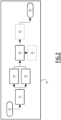
- a packet initialization is first implemented. Then, the creation of the system as such is carried out and it is during this creation that the method 50 of securing the file system of the remote autonomous system 10 according to the present invention is implemented.
- a step 52 of generating the file system is first implemented.
- the generation of the public key and the generation of the aforementioned private key are implemented simultaneously within step 54 of generating a private key/public key pair, the private key being configured to have a duration of limited life (ie the private key being volatile).
- step 56 the compilation (i.e. integration) of the public key into the kernel 20 is implemented.
- step 58 the creation of the file system files is implemented.
- step 60 the signing and securing of the files using the limited-duration private key is carried out.
- the method 50 of securing a file system of a remote autonomous system further comprises a step 62, represented using hyphens, of storing said private key in an encrypted container whose key opening is generated randomly without being saved.
- step 62 the aforementioned signature step 60 is followed by an also optional step 64 of secure destruction of said private key.
- such destruction 64 is implemented by multi-pass erasure (i.e. by multiple passes).
- step 66 a signed and immutable file system is then obtained.
- the method 50 according to the present invention is based on the innovative use of a volatile private key, that is to say that the key will have a limited lifespan, and according to an advantageous optional aspect, limited to the file system signing period.
- a malicious actor who would like to steal the private key will then have to either recover the key from the system after its shutdown, which is subsequently qualified as a post-mortem attack, in particular by theft of a hard drive or installation/execution of malicious software. (from English malware ) after the production of the file system, or intercept the key by having previously compromised the system containing the private key, which is subsequently qualified as a dynamic attack, this time using malicious software (from English malware ) during the execution of step 60 signature as such.
- the present invention proposes, to protect against such post-mortem attacks, to set up a mechanism for secure storage 62 and/or destruction 64 of the private key.
- the present invention proposes to use an encrypted container.
- this security option 62 it involves generating and storing the key not “in plain text” on the storage media but inside an encrypted container 30 as shown on the figure 1 , such as a “cryptsetup LUKS”, “truecrypt” container secured by AES-256 type encryption, for example.
- such an encrypted container 30 could be created and mounted directly in volatile memory RAM (Random Access Memory).
- the security password will be generated randomly and not saved, so that in post-mortem analysis it is therefore impossible to find the opening key of the encrypted container 30, and this encrypted container will not be able to not be deciphered with current means.
- the secure destruction 64 corresponds, according to a first variant, already mentioned previously, to a multi-pass erasure, according to which dedicated software is used to carry out an erasure comprising successions of random or non-random data writing on the old data then erasing, thus ensuring secure erasure of the data.
- SSD disk(s) Solid State Drive, technology based on Flash memory
- the methods of manufacturers, who offer software dedicated to their hardware of this type, are used to actually erase the flash memory areas.
- the security device 24 used to perform the signature and store the private key is also ephemeral.
- virtualized devices without persistence such as for example a Docker container corresponding to an open platform for the deployment and execution of applications and which makes it possible to embed and execute an application in a partitioned environment. called container.
- a Docker container Unlike virtualization where the virtual machine contains a complete operating system, associated tools and the hosted application, such a Docker container only contains the libraries and tools necessary to run the application, and works directly in the kernel of the host machine.
- Such a Docker storyteller then amounts to implementing isolation of the computing means during the creation, use and destruction of the private key, which makes it possible to guarantee the security of the process.
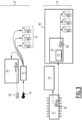
- FIG. 3 illustrates the security effects associated with each step of the process illustrated by the figure 2 .
- view 67 corresponds to the software production of the file system.
- the public 68 and private 70 keys are for example generated using an encryption toolbox such as OpenSSL, and in particular the signature tool 72 provided by IMA/EVM Linux is used.
- a signed and immutable file system 74 is then obtained, and the private key 70 is, according to an option detailed previously, destroyed in a secure manner to limit the risks of exfiltration of this key private via forensic methods (i.e. based on forensic analysis also called digital investigation).
- the lifespan of the private key 70 is limited to the duration of software production of the file system, i.e. a few hours, for example two or three hours, and as such only serves a few seconds for sign the files in order to obtain the signed file system 74 after its use.
- View 75 of the Figure 3 illustrates the execution of the remote autonomous system 10.
- the secure boot tool from the English secure boot
- the hardware of the remote autonomous system 10 will also conventionally check the integrity of the bootloader (from the English bootloader, or even BIOS from the English Basic Input Output System, or even UEFI from the English Unified Extensible Firmware Interface ) 76 and kernel 20 via, for example, a “ROM code” (from the English Read Only Memory ), or an embedded software (from the English Firmware ), implementing the management of the secure boot 22 and using another pair of asymmetric keys, of which the public key 78 is represented on the Figure 3 , themselves suitably secured via classic security by public key management infrastructure such as PKI ( Public Key Infrastructure ) or via an HSM module ( Hardware Security Module ), etc.
- public key management infrastructure such as PKI ( Public Key Infrastructure ) or via an HSM module ( Hardware Security Module ), etc.
- an attacker ie malicious actor could attempt to use an attack which would employ a new unrepresented malicious public/private key pair, and would attempt to re-sign the entire file system with the malicious private key by also replacing the public key 68 in kernel 20 by its malicious public key.
- the kernel 20 is also controlled by the secure boot tool 22 which implements additional cryptographic verification in particular via key 78.
- the public key 68 generated during the software production of view 67 of the Figure 3 , associated with the file system, is included in kernel 20 and together forms the coherent whole 80.
- the present invention thus proposes a security solution for verifying the integrity of a file system, in particular of the Linux type.
- This solution based on a volatile private key no longer makes it possible to modify or alter the file system because the private key will no longer exist, which makes it more complex for a malicious person to set up a persistent attack on this type of system.
- the public key is compiled with the kernel to ensure verification in accordance with the IMA system and the Linux EVM module, the integrity and authenticity of the kernel being themselves protected by the tool secure boot hardware.
- adding/modifying/deleting a file requires regenerating the entire file system, which therefore involves generating a new public/private key pair.
- a new kernel is also compiled including the new public key.
- the solution proposed according to the present invention is advantageous because it eliminates the need to take cumbersome technical or organizational measures to manage private key protection.
Landscapes
- Engineering & Computer Science (AREA)
- Theoretical Computer Science (AREA)
- Computer Security & Cryptography (AREA)
- General Engineering & Computer Science (AREA)
- Computer Hardware Design (AREA)
- Software Systems (AREA)
- Physics & Mathematics (AREA)
- General Physics & Mathematics (AREA)
- General Health & Medical Sciences (AREA)
- Bioethics (AREA)
- Health & Medical Sciences (AREA)
- Databases & Information Systems (AREA)
- Computer Networks & Wireless Communication (AREA)
- Signal Processing (AREA)
- Information Retrieval, Db Structures And Fs Structures Therefor (AREA)
- Storage Device Security (AREA)
Applications Claiming Priority (1)
| Application Number | Priority Date | Filing Date | Title |
|---|---|---|---|
| FR2214050A FR3144342B1 (fr) | 2022-12-21 | 2022-12-21 | Sécurisation d’un système de fichiers d’un système autonome à distance |
Publications (1)
| Publication Number | Publication Date |
|---|---|
| EP4390741A1 true EP4390741A1 (de) | 2024-06-26 |
Family
ID=86271933
Family Applications (1)
| Application Number | Title | Priority Date | Filing Date |
|---|---|---|---|
| EP23217932.5A Pending EP4390741A1 (de) | 2022-12-21 | 2023-12-19 | Sicherung eines dateisystems eines autonomen fernsystems |
Country Status (3)
| Country | Link |
|---|---|
| US (1) | US12574218B2 (de) |
| EP (1) | EP4390741A1 (de) |
| FR (1) | FR3144342B1 (de) |
Families Citing this family (1)
| Publication number | Priority date | Publication date | Assignee | Title |
|---|---|---|---|---|
| CN115729586B (zh) * | 2021-06-15 | 2023-10-20 | 荣耀终端有限公司 | 操作系统升级方法、设备、存储介质及计算机程序产品 |
Citations (2)
| Publication number | Priority date | Publication date | Assignee | Title |
|---|---|---|---|---|
| WO2016195764A1 (en) * | 2015-04-27 | 2016-12-08 | Benedor Tse Llc | Secure authorizations using independent communications and different one-time-use encryption keys for each party to a transaction |
| CN108491229A (zh) * | 2018-02-01 | 2018-09-04 | 烽火通信科技股份有限公司 | 一种Femtocell设备安全启动的方法 |
Family Cites Families (2)
| Publication number | Priority date | Publication date | Assignee | Title |
|---|---|---|---|---|
| US8784195B1 (en) * | 2003-03-05 | 2014-07-22 | Bally Gaming, Inc. | Authentication system for gaming machines |
| US7444349B1 (en) * | 2003-05-23 | 2008-10-28 | Xilinx, Inc. | Control of concurrent access to a partitioned data file |
-
2022
- 2022-12-21 FR FR2214050A patent/FR3144342B1/fr active Active
-
2023
- 2023-12-16 US US18/542,654 patent/US12574218B2/en active Active
- 2023-12-19 EP EP23217932.5A patent/EP4390741A1/de active Pending
Patent Citations (2)
| Publication number | Priority date | Publication date | Assignee | Title |
|---|---|---|---|---|
| WO2016195764A1 (en) * | 2015-04-27 | 2016-12-08 | Benedor Tse Llc | Secure authorizations using independent communications and different one-time-use encryption keys for each party to a transaction |
| CN108491229A (zh) * | 2018-02-01 | 2018-09-04 | 烽火通信科技股份有限公司 | 一种Femtocell设备安全启动的方法 |
Non-Patent Citations (3)
| Title |
|---|
| BERGER STEFAN ET AL: "Scalable Attestation: A Step Toward Secure and Trusted Clouds", 2015 IEEE INTERNATIONAL CONFERENCE ON CLOUD ENGINEERING, IEEE, 9 March 2015 (2015-03-09), pages 185 - 194, XP032767842, DOI: 10.1109/IC2E.2015.32 * |
| ELAINE BARKER: "Recommendation for key management: part 1 - general NIST SP 800-57pt1r5", 4 May 2020 (2020-05-04), pages 1 - 171, XP061057873, Retrieved from the Internet <URL:https://nvlpubs.nist.gov/nistpubs/SpecialPublications/NIST.SP.800-57pt1r5.pdf> [retrieved on 20200531], DOI: 10.6028/NIST.SP.800-57PT1R5 * |
| PIERRE-JEAN TEXIER: "Mise � jour d'un syst�me Linux embarqu� < Over The Air > : comment int�grer et utiliser < Mender > pour vos d�ploiements", 1 October 2018 (2018-10-01), pages 1 - 46, XP093052478, Retrieved from the Internet <URL:https://connect.ed-diamond.com/GNU-Linux-Magazine/glmf-219/mise-a-jour-d-un-systeme-linux-embarque-over-the-air-comment-integrer-et-utiliser-mender-pour-vos-deploiements> [retrieved on 20230607] * |
Also Published As
| Publication number | Publication date |
|---|---|
| FR3144342B1 (fr) | 2025-01-17 |
| US12574218B2 (en) | 2026-03-10 |
| FR3144342A1 (fr) | 2024-06-28 |
| US20240214184A1 (en) | 2024-06-27 |
Similar Documents
| Publication | Publication Date | Title |
|---|---|---|
| EP3457620B1 (de) | Ausführungsverfahren eines binären codes einer durch einen mikroprozessor gesicherten funktion | |
| US10419216B2 (en) | Keying infrastructure | |
| EP1964307B1 (de) | Verfahren zum erzeugen eines sicheren zählers auf einem onboard-computersystem mit einer chipkarte | |
| EP2178016B1 (de) | Betriebsverfahren eines Bordsystems, entsprechendes Gerät und mit einem solchen Gerät ausgestattetes Luftfahrzeug | |
| TW201500960A (zh) | 在配有適用統一可延伸韌體介面(uefi)之韌體之計算裝置中的安全性變數變化檢測技術 | |
| WO2003024017A2 (fr) | Procede de securisation d'une quantite secrete | |
| EP1627362A1 (de) | Verfahren zum erzeugen eines sicherheitsschlüssels | |
| EP2024798B1 (de) | Verfahren und vorrichtung zur gesicherten konfiguration eines endgeräts mittels einer speichervorrichtung für boot-daten | |
| EP3885953A1 (de) | Verfahren und vorrichtung zur dynamischen prüfung auf dateiebene der integrität von programmdateien in einem dauerhaften speicher eines computers, computerprogramm und computer, der es enthält | |
| EP2077515B1 (de) | Vorrichtung, Systeme und Verfahren zum gesicherten Starten einer IT-Anlage | |
| EP4068128B1 (de) | Gesichertes starten einer verarbeitungseinheit | |
| EP4390741A1 (de) | Sicherung eines dateisystems eines autonomen fernsystems | |
| EP1983436B1 (de) | Kontrolle der Integrität eines prozessorexternen Speichers | |
| EP4068134B1 (de) | Gesicherte fehlerbeseitigung | |
| FR2867929A1 (fr) | Procede d'authentification dynamique de programmes par un objet portable electronique | |
| CN109643352B (zh) | 跨安全引导更新保留受保护机密 | |
| EP2860660A1 (de) | Gesichertes Ladesystem und -verfahren von Daten in einen mit einem gesicherten Prozessor verbundenen Cache-Speicher | |
| EP3166252B1 (de) | Verfahren zur sicheren speicherung von daten, entsprechendes gerät und programm | |
| EP3547602A1 (de) | Verfahren zur anwendung einer kryptografischen funktion für einen geheimschlüssel | |
| EP4589885A1 (de) | Datenschutz | |
| FR3105484A1 (fr) | Méthode de vérification dynamique de l’intégrité d’un code machine | |
| WO2011000722A1 (fr) | Procédé de validation distante d'un code exécutable | |
| FR2854706A1 (fr) | Procede et dispositif de protection d'information et de consultation d'information protegee |
Legal Events
| Date | Code | Title | Description |
|---|---|---|---|
| PUAI | Public reference made under article 153(3) epc to a published international application that has entered the european phase |
Free format text: ORIGINAL CODE: 0009012 |
|
| STAA | Information on the status of an ep patent application or granted ep patent |
Free format text: STATUS: THE APPLICATION HAS BEEN PUBLISHED |
|
| AK | Designated contracting states |
Kind code of ref document: A1 Designated state(s): AL AT BE BG CH CY CZ DE DK EE ES FI FR GB GR HR HU IE IS IT LI LT LU LV MC ME MK MT NL NO PL PT RO RS SE SI SK SM TR |
|
| STAA | Information on the status of an ep patent application or granted ep patent |
Free format text: STATUS: REQUEST FOR EXAMINATION WAS MADE |
|
| 17P | Request for examination filed |
Effective date: 20241127 |
|
| RBV | Designated contracting states (corrected) |
Designated state(s): AL AT BE BG CH CY CZ DE DK EE ES FI FR GB GR HR HU IE IS IT LI LT LU LV MC ME MK MT NL NO PL PT RO RS SE SI SK SM TR |
|
| STAA | Information on the status of an ep patent application or granted ep patent |
Free format text: STATUS: EXAMINATION IS IN PROGRESS |
|
| 17Q | First examination report despatched |
Effective date: 20260115 |