EP4388935A1 - Product with the function of a toothbrush dryer and toothbrush holder - Google Patents
Product with the function of a toothbrush dryer and toothbrush holder Download PDFInfo
- Publication number
- EP4388935A1 EP4388935A1 EP23020509.8A EP23020509A EP4388935A1 EP 4388935 A1 EP4388935 A1 EP 4388935A1 EP 23020509 A EP23020509 A EP 23020509A EP 4388935 A1 EP4388935 A1 EP 4388935A1
- Authority
- EP
- European Patent Office
- Prior art keywords
- toothbrush
- height
- opening
- product
- filaments
- Prior art date
- Legal status (The legal status is an assumption and is not a legal conclusion. Google has not performed a legal analysis and makes no representation as to the accuracy of the status listed.)
- Granted
Links
Images
Classifications
-
- A—HUMAN NECESSITIES
- A46—BRUSHWARE
- A46B—BRUSHES
- A46B17/00—Accessories for brushes
- A46B17/06—Devices for cleaning brushes after use
-
- A—HUMAN NECESSITIES
- A46—BRUSHWARE
- A46B—BRUSHES
- A46B15/00—Other brushes; Brushes with additional arrangements
- A46B15/0095—Brushes with a feature for storage after use
-
- A—HUMAN NECESSITIES
- A46—BRUSHWARE
- A46B—BRUSHES
- A46B17/00—Accessories for brushes
- A46B17/04—Protective covers for the bristles
-
- A—HUMAN NECESSITIES
- A46—BRUSHWARE
- A46B—BRUSHES
- A46B17/00—Accessories for brushes
- A46B17/06—Devices for cleaning brushes after use
- A46B17/065—Sterilising brushes; products integral with the brush for sterilising, e.g. tablets, rinse, disinfectant
-
- F—MECHANICAL ENGINEERING; LIGHTING; HEATING; WEAPONS; BLASTING
- F16—ENGINEERING ELEMENTS AND UNITS; GENERAL MEASURES FOR PRODUCING AND MAINTAINING EFFECTIVE FUNCTIONING OF MACHINES OR INSTALLATIONS; THERMAL INSULATION IN GENERAL
- F16M—FRAMES, CASINGS OR BEDS OF ENGINES, MACHINES OR APPARATUS, NOT SPECIFIC TO ENGINES, MACHINES OR APPARATUS PROVIDED FOR ELSEWHERE; STANDS; SUPPORTS
- F16M13/00—Other supports for positioning apparatus or articles; Means for steadying hand-held apparatus or articles
-
- A—HUMAN NECESSITIES
- A46—BRUSHWARE
- A46B—BRUSHES
- A46B17/00—Accessories for brushes
-
- A—HUMAN NECESSITIES
- A46—BRUSHWARE
- A46B—BRUSHES
- A46B17/00—Accessories for brushes
- A46B17/02—Devices for holding brushes in use
-
- A—HUMAN NECESSITIES
- A46—BRUSHWARE
- A46B—BRUSHES
- A46B2200/00—Brushes characterized by their functions, uses or applications
- A46B2200/10—For human or animal care
- A46B2200/1066—Toothbrush for cleaning the teeth or dentures
Definitions
- the invention relates to a product with a combined function of a dryer and a toothbrush holder.
- a known solution according to document US3968950A is disclosed, which is a combined toothbrush support and protective cover designed to be coupled to a handle or to be coupled to a handle of different cross-sections and having surfaces that support the toothbrush in a suspended position in a toothbrush stand with the head spaced from the stand and in a position on a flat surface with the head spaced from the flat support surface.
- this arrangement is not adapted and intended to mechanically dry the toothbrush, since only the body of the toothbrush is inserted into the opening.
- the solution does not propose any elements for mechanically drying the brush.
- a properly positioned guard prevents toothpaste from dripping onto the handle; prevents the toothbrush from being swallowed or regurgitating; and suspends the toothbrush in the air so the filaments do not touch the table top or toothbrush stand.
- This solution therefore has a completely different purpose, which is primarily to protect against water running off during brushing.
- the opening is designed to hold the handle of the toothbrush firmly in place, i.e. it is not designed as a through hole for the brush head and, in particular, it does not serve to dry it out mechanically.
- a solution according to US6758446 which is a portable device for hygienically holding a toothbrush, which is generally planar in shape and made of a rigid polymer, such as an acrylic resin, and has a predefined shape with at least one linear edge for resting on a planar surface, such as a counter or sink.
- the toothbrush holder includes one or more openings for passage of the toothbrush handle. The distal end of the toothbrush handle rests against a surface such as a counter or sink, while the end of the toothbrush filaments is elevated above the counter surface due to the supporting effect of the toothbrush holder being positioned near the end of the toothbrush filaments.
- this device does not comprise an opening adapted and designed as a through hole for the brush head and, in particular, does not serve to mechanically dry it.
- KR200437777Y1 aims to provide a children's toothbrush that can be used hygienically and safely for children aged 3 to 4 years.
- this solution comprises a part with an opening which prevents the toothbrush from being inserted too deeply into the child's oral cavity and into which the body of the toothbrush is inserted, this solution has a completely different purpose from the invention proposed here.
- the subject of the invention is a means or device in the form of a combined brush dryer and brush stand, the primary function of which is the effective removal of moisture from the brush filaments, first primarily by mechanical action consisting of achieving an optimum frictional force on the brush filaments and achieving a maximum centrifugal effect, by which the filaments are freed from moisture, and in a second step, by using the same means, the toothbrush is dried by a free stream of air, since the subject dryer also acts as a stand after the body of the toothbrush has been supported by the edge of the opening of the device.
- the advantage of the device according to the present invention is the minimal manufacturing cost and therefore purchasing cost, where it can advantageously be delivered directly with the toothbrush, and the minimal storage requirements consisting in the degradability of the device.
- the present device comprises an opening for inserting a toothbrush that is adapted for the passage of a toothbrush head with filaments and which therefore has specially designed proportions of size in relation to the length, quantity and elasticity of the toothbrush filaments and the overall thickness of the toothbrush head with filaments, including a specially adapted shape of the opening.
- the material of the device according to the present invention is identical to the material for the manufacture of the toothbrush body, which reduces the cost of manufacture.
- the computational model for determining residual water is dependent on the efficiency of the device, which is dependent on the dimensional parameters of the pass-through opening and the brush used.
- Laboratory measurements were made on three types of toothbrushes which differed in the density parameter of the filaments used in the toothbrush head. The effect of the areal density of the filaments on the amount of water loss was negligible, with individual results varying within ⁇ 2%.
- the reduction in the amount of residual water in the brush head is shown in the graph, where the horizontal axis shows the number of passes N and the vertical axis shows the percentage of the relative amount of residual water w .
- the minimum width S 1 min of the opening is defined as the width T 1 of the toothbrush head increased by 10 %.
- the maximum usable opening width S 1 max is defined as the width T 1 of the toothbrush head increased by 80 %.
- S 1 min 110 % T 1
- the minimum usable height S 2 min of the pass-through opening is defined as the sum of half the visible height T 5 of the filaments and the height T 4 of the fixed part.
- the fixed part of the toothbrush head is primarily the base for the filament placement. If a smaller pass-through opening height is used, mechanical degradation of the filaments occurs and results in irreversible damage to the toothbrush.
- the maximum usable height S 2 max of the pass-through opening is less than the sum of the height T 4 of the fixed part of the head and the visible height T 5 of the filaments.
- S 2 min 1 2 ⁇ T 5 + T 4
- S 2 max ⁇ T 5 + T 4 S 2 1 2 ⁇ T 5 + T 4 ; T 5 + T 4
- the thickness of the product must be such that the product meets the mechanical resistance and at the same time does not prevent water from leaving the toothbrush filaments. It is therefore defined as having a minimum of 20 % of the height of the solid part of the toothbrush head and a maximum of 80 % of the height of the solid part of the toothbrush head.
- S 3 min 20 % T 4
- S 3 max 80 % T 4
- S 3 ⁇ 20 % T 4 ; 80 % T 4 ⁇
- the opening must be of an appropriate shape to allow the toothbrush to pass through the opening.
- the opening of the product preferably has a rectangular shape.
- the opening is defined as the projection of the surface of the opening into the direction of the toothbrush passage.
- ⁇ T 5 , v T 5 ,
- the efficiency value ⁇ of the product is also dependent on the type of toothbrush to which the product is applied.
- the efficiency of the product increases when using a head with a higher density of filaments, while the resulting efficiency decreases when using a head with a lower density of filaments.
- the application of the product causes the filaments to come into closer contact with each other, contributing to a greater degree of drying of the individual filaments.
- the efficiency increases with higher filament flexibility. Water loss occurs by two mechanisms, namely centrifugal force on the return of the filaments to their original configuration causing a droplet ejection effect into the environment and direct pressure on the filaments causing a wringing effect.
- the residual weight of water is less than 20 % of the weight of the original amount of water before the use of product. Therefore, it can be said that for sufficient drying of the toothbrush, it is sufficient to perform three pull throughs (back and forth), then place the toothbrush in the stand and let the filaments dry by the air flow and the process of spontaneous drying of the toothbrush.
- the thickness of the edge of the opening 21 corresponds to at least 20 % of the height of the fixed part 111 of the toothbrush head and is at most 80 % of the height of the fixed part 111 of the toothbrush head.
- the product 2 according to any one of Examples 1 to 4, wherein the opening 21 is rectangular in shape.
- the product 2 according to any one of Examples 1 to 5, which is formed from the same material as the toothbrush 1 body.
- the outer shape of the product 2_ may be formed in any commercial form, but must include at least two support points in the lower support portion of the outer shape of the product 2_.
- the invention is industrially utilizable in the field of oral hygiene as a widely available and inexpensive accessory to reduce bacterial and fungal growth in toothbrushes.
Landscapes
- Engineering & Computer Science (AREA)
- General Engineering & Computer Science (AREA)
- Mechanical Engineering (AREA)
- Brushes (AREA)
Abstract
Description
- The invention relates to a product with a combined function of a dryer and a toothbrush holder.
- At present, various aids are used to dry the brushes. Drying the toothbrush has a hygienic justification, as bacteria and mould can accumulate on a wet or damp toothbrush. Usually, the toothbrush is left in a container. Drying is done by, for example, running a finger over the filaments and then placing the brush in a container. However, there are also sophisticated devices in which the toothbrush is placed and the UV rays are used to eliminate the germs from the toothbrush filaments. However, these devices are relatively expensive and inaccessible to the average user, they are not designed to be carried and therefore, especially in the case of travel, their use is inappropriate and too complicated.
- No product has yet been designed that is very inexpensive, effectively mechanically dries the brush filaments, and can be used to allow the brush to dry itself so that air can flow freely around the brush filaments.
- A known solution according to document
US3968950A is disclosed, which is a combined toothbrush support and protective cover designed to be coupled to a handle or to be coupled to a handle of different cross-sections and having surfaces that support the toothbrush in a suspended position in a toothbrush stand with the head spaced from the stand and in a position on a flat surface with the head spaced from the flat support surface. However, this arrangement is not adapted and intended to mechanically dry the toothbrush, since only the body of the toothbrush is inserted into the opening. The solution does not propose any elements for mechanically drying the brush. - Also known is a solution according to
US5875516A , which provides a splash guard and a support accessory for a toothbrush, which is available in six shapes and is made of a single piece of injection-moulded flexible plastic with a through-hole in the centre. A support collar is moulded into both surfaces of the guard and surrounds the opening, ensuring high stability of the guard position when fitted to the toothbrush handle. The guard is easily fitted to the toothbrush by wetting the handle with water, aligning the opening, pressing the guard against the lower end of the toothbrush handle, and sliding it forward to the neck area approximately 11.5 inches below the filaments. A properly positioned guard prevents toothpaste from dripping onto the handle; prevents the toothbrush from being swallowed or regurgitating; and suspends the toothbrush in the air so the filaments do not touch the table top or toothbrush stand. This solution therefore has a completely different purpose, which is primarily to protect against water running off during brushing. The opening is designed to hold the handle of the toothbrush firmly in place, i.e. it is not designed as a through hole for the brush head and, in particular, it does not serve to dry it out mechanically. - Further known is a solution according to
US6758446 , which is a portable device for hygienically holding a toothbrush, which is generally planar in shape and made of a rigid polymer, such as an acrylic resin, and has a predefined shape with at least one linear edge for resting on a planar surface, such as a counter or sink. The toothbrush holder includes one or more openings for passage of the toothbrush handle. The distal end of the toothbrush handle rests against a surface such as a counter or sink, while the end of the toothbrush filaments is elevated above the counter surface due to the supporting effect of the toothbrush holder being positioned near the end of the toothbrush filaments. Again, this device does not comprise an opening adapted and designed as a through hole for the brush head and, in particular, does not serve to mechanically dry it. - Further, a solution according to
KR200437777Y1 - The subject of the invention is a means or device in the form of a combined brush dryer and brush stand, the primary function of which is the effective removal of moisture from the brush filaments, first primarily by mechanical action consisting of achieving an optimum frictional force on the brush filaments and achieving a maximum centrifugal effect, by which the filaments are freed from moisture, and in a second step, by using the same means, the toothbrush is dried by a free stream of air, since the subject dryer also acts as a stand after the body of the toothbrush has been supported by the edge of the opening of the device. The advantage of the device according to the present invention is the minimal manufacturing cost and therefore purchasing cost, where it can advantageously be delivered directly with the toothbrush, and the minimal storage requirements consisting in the degradability of the device.
- The basis of the invention is that the present device comprises an opening for inserting a toothbrush that is adapted for the passage of a toothbrush head with filaments and which therefore has specially designed proportions of size in relation to the length, quantity and elasticity of the toothbrush filaments and the overall thickness of the toothbrush head with filaments, including a specially adapted shape of the opening.
- In an advantageous embodiment, the material of the device according to the present invention is identical to the material for the manufacture of the toothbrush body, which reduces the cost of manufacture.
- The computational model for determining residual water is dependent on the efficiency of the device, which is dependent on the dimensional parameters of the pass-through opening and the brush used. The calculation of the residual water is given by

- Using the three types of toothbrushes, 10 measurements were made each time, from which the mean value of the effectiveness of the product used was determined. When the head of the toothbrush was passed through the opening, the efficiency was equal to 40.9 % for the first type of test toothbrush, 42.5 % for the second type of toothbrush and 43.3 % for the third type.
- Based on these measurements, a product efficiency of 42 % was determined. The calculation of the amount of residual water after using the product with N repetitions of steps (moving the toothbrush back and forth) is hereby defined as

- From the formula for the residual amount of water, a relationship can be derived for the relative amount of residual water w, which gives the percentage ratio of the remaining water in the toothbrush after the N-th passage z H2O to the initial state p H2O . The following table shows the percentage of residual water when using the product with N number of passes:
Number of passes N Relative amount of residual water [%] 0 100 % 1 58 % 2 33 % 3 19 % 4 11 % 5 6 % - The reduction in the amount of residual water in the brush head is shown in the graph, where the horizontal axis shows the number of passes N and the vertical axis shows the percentage of the relative amount of residual water w.
- In order to maintain usability and the possibility of inserting the toothbrush into the opening of the product at different entry angles, the minimum width S1 min of the opening is defined as the width T1 of the toothbrush head increased by 10 %. The maximum usable opening width S1 max is defined as the width T1 of the toothbrush head increased by 80 %.


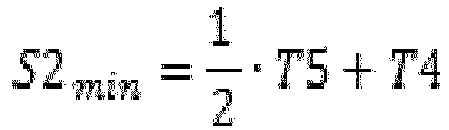
- The minimum usable height S2 min of the pass-through opening is defined as the sum of half the visible height T5 of the filaments and the height T4 of the fixed part. The fixed part of the toothbrush head is primarily the base for the filament placement. If a smaller pass-through opening height is used, mechanical degradation of the filaments occurs and results in irreversible damage to the toothbrush. The maximum usable height S2 max of the pass-through opening is less than the sum of the height T4 of the fixed part of the head and the visible height T5 of the filaments.


- The thickness of the product must be such that the product meets the mechanical resistance and at the same time does not prevent water from leaving the toothbrush filaments. It is therefore defined as having a minimum of 20 % of the height of the solid part of the toothbrush head and a maximum of 80 % of the height of the solid part of the toothbrush head.



- Given the shape of the toothbrush and the direction of application, it is apparent to the skilled person that the opening must be of an appropriate shape to allow the toothbrush to pass through the opening. In the case of a rectangular shaped toothbrush head, the opening of the product preferably has a rectangular shape. The opening is defined as the projection of the surface of the opening into the direction of the toothbrush passage.
- Let λ be the relative height of the uncovered (visible) filaments of the head in percentage, defined as the ratio of the visible height T5, v of the uncovered filaments (measured from the fixed part of the head) to the visible height T5 of the filaments.

- The optimum height S2, optimal of the opening was experimentally defined as the sum of 61 % of the visible height T5 of the filaments and the height T4 of the fixed part of the head. At this height, the pass-through opening provides efficiency n = 42 % when the toothbrush is drawn parallel to the normal axis of the opening of the device.

- When the relative height λ of the non-overlapping (visible) filaments changes, the η0 efficiency of the product changes. The calculation of this efficiency as a function of the relative height λ of the non-overlapping (visible) filaments is defined by the
formula 
valid for the definition domain λ = (50;100). In the case where the opening of the product covers more than half of the visible filament height, material damage to the toothbrush occurs. - Furthermore, the efficiency value η of the product is also dependent on the type of toothbrush to which the product is applied. By keeping the same type of filament of the brush, the efficiency of the product increases when using a head with a higher density of filaments, while the resulting efficiency decreases when using a head with a lower density of filaments. When using a higher number of filaments in the head, the application of the product causes the filaments to come into closer contact with each other, contributing to a greater degree of drying of the individual filaments. For the same density, then, the efficiency increases with higher filament flexibility. Water loss occurs by two mechanisms, namely centrifugal force on the return of the filaments to their original configuration causing a droplet ejection effect into the environment and direct pressure on the filaments causing a wringing effect.
- It is valid that at the third pull through, the residual weight of water is less than 20 % of the weight of the original amount of water before the use of product. Therefore, it can be said that for sufficient drying of the toothbrush, it is sufficient to perform three pull throughs (back and forth), then place the toothbrush in the stand and let the filaments dry by the air flow and the process of spontaneous drying of the toothbrush.
-
- 51 [mm]
- width of the opening
- S2 [mm]
- height of the opening
- S3 [mm]
- product thickness
- T1 [mm]
- width of the toothbrush head (fixed part)
- T2 [mm]
- length of the toothbrush head (fixed part)
- T3 [mm]
- total height of the toothbrush head (fixed part + visible length of the filaments)
- T4 [mm]
- height of the fixed part of the toothbrush head
- T5 [mm]
- visible height of filaments
- T5,v [mm]
- visible height of the uncovered filaments (after application of the product, measured from the fixed part of the head)
- D [pcs]
- number of filaments depending on the density and surface area of each type of toothbrush
- w [%]
- the relative amount of residual water in the brush
- N [pcs]
- number of passes through the opening (defined as a back and forth movement through the opening)
- η [%]
- the efficiency of the product having pass-through opening
- zH2O [mg]
- residual amount of water (after the Nth step of product use)
- pH2O [mg]
- initial amount of water (total weight of water soaked by the brush)
- λ
- the relative height of the visible filaments not overlapped by the product
- ZK
- toothbrush
-
-
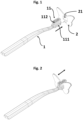
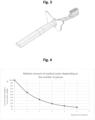
Fig. 1 shows a toothbrush before insertion into the opening of the product; -
Fig. 2 shows a toothbrush being partially pulled through the opening of the product, which acts as a dryer when the toothbrush is moved through the opening; -
Fig. 3 shows a toothbrush passed through the opening of the product and resting on the edge of the opening of the product, which performs the function of a stand; -
Fig. 4 shows a graph representing the drying function of the product as a function of the quantity of passages of the toothbrush head through the opening of the product. - A
product 2 having the function of a toothbrush dryer andtoothbrush holder 1, comprising a pass-throughopening 21 for inserting thetoothbrush head 11, wherein theopening 21 also serves as a support for the toothbrush body, as seen, for example, inFig. 3 , wherein the width of the pass-throughopening 21 corresponds to between 110% to 180% of the width of the fixedportion 111 of the toothbrush head, and the height of the pass-throughopening 21 corresponds to at least half of the sum of the visible height of thefilaments 112 and the height of the fixedportion 111 of the toothbrush head and is no greater than the sum of the height of the fixedportion 111 of the toothbrush head and the visible height of thefilaments 112. The thickness of the edge of theopening 21 corresponds to at least 20 % of the height of thefixed part 111 of the toothbrush head and is at most 80 % of the height of thefixed part 111 of the toothbrush head. - The product 2_ according to Example 1, wherein the height of the pass-through
opening 21 corresponds to the sum of 55 to 65 % of the visible height of thefilaments 112 and the height of thefixed part 111 of the brush head. - The product 2_ according to Example 2, wherein the height of the pass-through
opening 21 corresponds to the sum of 61 % of the visible height of thefilaments 112 and the height of thefixed part 111 of the brush head. - The product 2_ according to any one of Examples 1 to 3, wherein the basic shape of the
opening 21 is identical to the shape of thebrush head 11. - The
product 2 according to any one of Examples 1 to 4, wherein theopening 21 is rectangular in shape. - The
product 2 according to any one of Examples 1 to 5, which is formed from the same material as thetoothbrush 1 body. - The outer shape of the product 2_ according to any of Examples 1 to 5 in
Figures 1, 2 , and3 , here in the form of a butterfly, may be formed in any commercial form, but must include at least two support points in the lower support portion of the outer shape of the product 2_. - The invention is industrially utilizable in the field of oral hygiene as a widely available and inexpensive accessory to reduce bacterial and fungal growth in toothbrushes.
-
- 1 - toothbrush
- 11 - toothbrush head
- 111 - fixed part of the toothbrush head
- 112 - toothbrush filaments
- 2 - product
- 21 - pass-through opening
Claims (6)
- A product (2) having the function of a toothbrush (1) dryer and toothbrush (1) holder, characterized in that it comprises a pass-through opening (21) for inserting the head (11) of the toothbrush, which also serves as a support for the body of the toothbrush,wherein the width of the pass-through opening (21) corresponds to between 110 % to 180 % of the width of the fixed part (111) of the toothbrush head,wherein the height of the pass-through opening (21) is at least half the sum of the visible height of the filaments (112) and the height of the fixed part (111) of the brush head and is not greater than the sum of the height of the fixed part (111) of the brush head and the visible height of the filaments (112),wherein the thickness of the edge of the opening (21) corresponds to at least 20 % of the height of the fixed part (111) of the toothbrush head and is at most 80 % of the height of the fixed part (111) of the toothbrush head.
- The product (2) according to claim 1, characterized in that the height of the pass-through opening (21) corresponds to the sum of 55 to 65 % of the visible height of the filaments (112) and the height of the fixed part (111) of the toothbrush head.
- The product (2) according to claim 1, characterized in that the height of the pass-through opening (21) corresponds to the sum of 61 % of the visible height of the filaments (112) and the height of the fixed part (111) of the toothbrush head.
- The product (2) according to any one of claims 1 to 3, characterized in that the shape of the opening (21) is identical to the shape of the toothbrush head (11).
- The product (2) according to any one of claims 1 to 4, characterized in that the opening (21) is rectangular in shape.
- The product (2) according to any one of claims 1 to 5, characterized in that it is formed of the same material as the toothbrush (1) body.
Applications Claiming Priority (1)
| Application Number | Priority Date | Filing Date | Title |
|---|---|---|---|
| CZ2022-489A CZ2022489A3 (en) | 2022-11-22 | 2022-11-22 | Product with the function of dryer and toothbrush stand |
Publications (3)
| Publication Number | Publication Date |
|---|---|
| EP4388935A1 true EP4388935A1 (en) | 2024-06-26 |
| EP4388935C0 EP4388935C0 (en) | 2025-07-09 |
| EP4388935B1 EP4388935B1 (en) | 2025-07-09 |
Family
ID=88837609
Family Applications (1)
| Application Number | Title | Priority Date | Filing Date |
|---|---|---|---|
| EP23020509.8A Active EP4388935B1 (en) | 2022-11-22 | 2023-11-16 | Product with the function of a toothbrush dryer and toothbrush holder |
Country Status (2)
| Country | Link |
|---|---|
| EP (1) | EP4388935B1 (en) |
| CZ (1) | CZ2022489A3 (en) |
Citations (6)
| Publication number | Priority date | Publication date | Assignee | Title |
|---|---|---|---|---|
| US3968950A (en) | 1975-04-10 | 1976-07-13 | Gallo George T | Combination support and guard for a toothbrush |
| US5875516A (en) | 1997-02-12 | 1999-03-02 | Blue; John D. | Accessory for a toothbrush |
| US6758446B2 (en) | 2002-05-15 | 2004-07-06 | Donald Bjornrud | Toothbrush holder/stand |
| KR200437777Y1 (en) | 2007-01-04 | 2007-12-26 | 김중열 | Infant toothbrush |
| US20120298135A1 (en) * | 2011-05-26 | 2012-11-29 | Luttrell Lindsay G | Toothbrush Having Removable Absorbent Pad |
| US20150157431A1 (en) * | 2013-12-10 | 2015-06-11 | Wanda Ruffin-Proctor | Toothbrush Dryer Towel |
-
2022
- 2022-11-22 CZ CZ2022-489A patent/CZ2022489A3/en unknown
-
2023
- 2023-11-16 EP EP23020509.8A patent/EP4388935B1/en active Active
Patent Citations (6)
| Publication number | Priority date | Publication date | Assignee | Title |
|---|---|---|---|---|
| US3968950A (en) | 1975-04-10 | 1976-07-13 | Gallo George T | Combination support and guard for a toothbrush |
| US5875516A (en) | 1997-02-12 | 1999-03-02 | Blue; John D. | Accessory for a toothbrush |
| US6758446B2 (en) | 2002-05-15 | 2004-07-06 | Donald Bjornrud | Toothbrush holder/stand |
| KR200437777Y1 (en) | 2007-01-04 | 2007-12-26 | 김중열 | Infant toothbrush |
| US20120298135A1 (en) * | 2011-05-26 | 2012-11-29 | Luttrell Lindsay G | Toothbrush Having Removable Absorbent Pad |
| US20150157431A1 (en) * | 2013-12-10 | 2015-06-11 | Wanda Ruffin-Proctor | Toothbrush Dryer Towel |
Also Published As
| Publication number | Publication date |
|---|---|
| EP4388935C0 (en) | 2025-07-09 |
| EP4388935B1 (en) | 2025-07-09 |
| CZ2022489A3 (en) | 2024-06-19 |
Similar Documents
| Publication | Publication Date | Title |
|---|---|---|
| US3968950A (en) | Combination support and guard for a toothbrush | |
| JP5378533B2 (en) | Toothbrush charging station with toothbrush storage | |
| CN206227928U (en) | Toothbrush | |
| US20030213877A1 (en) | Toothbrush holder/stand | |
| US6921409B2 (en) | Tongue cleaning device | |
| US20080311282A1 (en) | Method and Device for Stabilizing a Toothbrush for One-Handed Use | |
| US20100146725A1 (en) | Sanitary toothbrush and holder apparatus | |
| MXPA02006372A (en) | Tongue cleaning device. | |
| GB2451230A (en) | Tongue cleaning device for attachment to a toothbrush | |
| GB2043438A (en) | Teeth cleaning device | |
| EP4388935B1 (en) | Product with the function of a toothbrush dryer and toothbrush holder | |
| US20240216178A1 (en) | Ear Hygienic Implements and Kit | |
| KR20080013023A (en) | Vibrating Oral Treatment Device | |
| TW201201771A (en) | Oral care implement | |
| US12433727B1 (en) | Dental implement holder | |
| CN113854732A (en) | toothbrush cover | |
| CN214857514U (en) | Special oral bag for stomatological examination | |
| US8105083B2 (en) | Foam teeth cleaning and stain removing device | |
| US20040055977A1 (en) | Tooth brush holder | |
| CN222237006U (en) | Toothbrush with whitening function brush head | |
| JP2000300347A (en) | toothbrush | |
| CN210901888U (en) | an antibacterial toothbrush | |
| US20050142519A1 (en) | Device allowing careful dental prevention and hygiene | |
| US20170164727A1 (en) | Oral Care Device | |
| JP2023007284A (en) | toothbrush |
Legal Events
| Date | Code | Title | Description |
|---|---|---|---|
| PUAI | Public reference made under article 153(3) epc to a published international application that has entered the european phase |
Free format text: ORIGINAL CODE: 0009012 |
|
| STAA | Information on the status of an ep patent application or granted ep patent |
Free format text: STATUS: THE APPLICATION HAS BEEN PUBLISHED |
|
| AK | Designated contracting states |
Kind code of ref document: A1 Designated state(s): AL AT BE BG CH CY CZ DE DK EE ES FI FR GB GR HR HU IE IS IT LI LT LU LV MC ME MK MT NL NO PL PT RO RS SE SI SK SM TR |
|
| STAA | Information on the status of an ep patent application or granted ep patent |
Free format text: STATUS: REQUEST FOR EXAMINATION WAS MADE |
|
| 17P | Request for examination filed |
Effective date: 20240906 |
|
| RBV | Designated contracting states (corrected) |
Designated state(s): AL AT BE BG CH CY CZ DE DK EE ES FI FR GB GR HR HU IE IS IT LI LT LU LV MC ME MK MT NL NO PL PT RO RS SE SI SK SM TR |
|
| GRAP | Despatch of communication of intention to grant a patent |
Free format text: ORIGINAL CODE: EPIDOSNIGR1 |
|
| STAA | Information on the status of an ep patent application or granted ep patent |
Free format text: STATUS: GRANT OF PATENT IS INTENDED |
|
| INTG | Intention to grant announced |
Effective date: 20250204 |
|
| RIC1 | Information provided on ipc code assigned before grant |
Ipc: A46B 15/00 20060101ALI20250124BHEP Ipc: A46B 17/06 20060101AFI20250124BHEP |
|
| GRAS | Grant fee paid |
Free format text: ORIGINAL CODE: EPIDOSNIGR3 |
|
| GRAA | (expected) grant |
Free format text: ORIGINAL CODE: 0009210 |
|
| STAA | Information on the status of an ep patent application or granted ep patent |
Free format text: STATUS: THE PATENT HAS BEEN GRANTED |
|
| AK | Designated contracting states |
Kind code of ref document: B1 Designated state(s): AL AT BE BG CH CY CZ DE DK EE ES FI FR GB GR HR HU IE IS IT LI LT LU LV MC ME MK MT NL NO PL PT RO RS SE SI SK SM TR |
|
| REG | Reference to a national code |
Ref country code: GB Ref legal event code: FG4D |
|
| REG | Reference to a national code |
Ref country code: CH Ref legal event code: EP |
|
| REG | Reference to a national code |
Ref country code: IE Ref legal event code: FG4D |
|
| REG | Reference to a national code |
Ref country code: DE Ref legal event code: R096 Ref document number: 602023004572 Country of ref document: DE |
|
| U01 | Request for unitary effect filed |
Effective date: 20250801 |
|
| U07 | Unitary effect registered |
Designated state(s): AT BE BG DE DK EE FI FR IT LT LU LV MT NL PT RO SE SI Effective date: 20250812 |
|
| U20 | Renewal fee for the european patent with unitary effect paid |
Year of fee payment: 3 Effective date: 20251110 |
|
| PG25 | Lapsed in a contracting state [announced via postgrant information from national office to epo] |
Ref country code: IS Free format text: LAPSE BECAUSE OF FAILURE TO SUBMIT A TRANSLATION OF THE DESCRIPTION OR TO PAY THE FEE WITHIN THE PRESCRIBED TIME-LIMIT Effective date: 20251109 |
|
| PG25 | Lapsed in a contracting state [announced via postgrant information from national office to epo] |
Ref country code: NO Free format text: LAPSE BECAUSE OF FAILURE TO SUBMIT A TRANSLATION OF THE DESCRIPTION OR TO PAY THE FEE WITHIN THE PRESCRIBED TIME-LIMIT Effective date: 20251009 |
|
| PG25 | Lapsed in a contracting state [announced via postgrant information from national office to epo] |
Ref country code: HR Free format text: LAPSE BECAUSE OF FAILURE TO SUBMIT A TRANSLATION OF THE DESCRIPTION OR TO PAY THE FEE WITHIN THE PRESCRIBED TIME-LIMIT Effective date: 20250709 |
|
| PG25 | Lapsed in a contracting state [announced via postgrant information from national office to epo] |
Ref country code: GR Free format text: LAPSE BECAUSE OF FAILURE TO SUBMIT A TRANSLATION OF THE DESCRIPTION OR TO PAY THE FEE WITHIN THE PRESCRIBED TIME-LIMIT Effective date: 20251010 |
|
| PGFP | Annual fee paid to national office [announced via postgrant information from national office to epo] |
Ref country code: CZ Payment date: 20251107 Year of fee payment: 3 |
|
| PG25 | Lapsed in a contracting state [announced via postgrant information from national office to epo] |
Ref country code: PL Free format text: LAPSE BECAUSE OF FAILURE TO SUBMIT A TRANSLATION OF THE DESCRIPTION OR TO PAY THE FEE WITHIN THE PRESCRIBED TIME-LIMIT Effective date: 20250709 |
|
| PG25 | Lapsed in a contracting state [announced via postgrant information from national office to epo] |
Ref country code: RS Free format text: LAPSE BECAUSE OF FAILURE TO SUBMIT A TRANSLATION OF THE DESCRIPTION OR TO PAY THE FEE WITHIN THE PRESCRIBED TIME-LIMIT Effective date: 20251009 |
|
| PG25 | Lapsed in a contracting state [announced via postgrant information from national office to epo] |
Ref country code: ES Free format text: LAPSE BECAUSE OF FAILURE TO SUBMIT A TRANSLATION OF THE DESCRIPTION OR TO PAY THE FEE WITHIN THE PRESCRIBED TIME-LIMIT Effective date: 20250709 |
|
| PG25 | Lapsed in a contracting state [announced via postgrant information from national office to epo] |
Ref country code: SM Free format text: LAPSE BECAUSE OF FAILURE TO SUBMIT A TRANSLATION OF THE DESCRIPTION OR TO PAY THE FEE WITHIN THE PRESCRIBED TIME-LIMIT Effective date: 20250709 |
|
| PG25 | Lapsed in a contracting state [announced via postgrant information from national office to epo] |
Ref country code: SK Free format text: LAPSE BECAUSE OF FAILURE TO SUBMIT A TRANSLATION OF THE DESCRIPTION OR TO PAY THE FEE WITHIN THE PRESCRIBED TIME-LIMIT Effective date: 20250709 |
|
| PLBE | No opposition filed within time limit |
Free format text: ORIGINAL CODE: 0009261 |
|
| STAA | Information on the status of an ep patent application or granted ep patent |
Free format text: STATUS: NO OPPOSITION FILED WITHIN TIME LIMIT |
|
| REG | Reference to a national code |
Ref country code: CH Ref legal event code: L10 Free format text: ST27 STATUS EVENT CODE: U-0-0-L10-L00 (AS PROVIDED BY THE NATIONAL OFFICE) Effective date: 20260521 |
|
| 26N | No opposition filed |
Effective date: 20260410 |
|
| PG25 | Lapsed in a contracting state [announced via postgrant information from national office to epo] |
Ref country code: MC Free format text: LAPSE BECAUSE OF FAILURE TO SUBMIT A TRANSLATION OF THE DESCRIPTION OR TO PAY THE FEE WITHIN THE PRESCRIBED TIME-LIMIT Effective date: 20250709 |
|
| PG25 | Lapsed in a contracting state [announced via postgrant information from national office to epo] |
Ref country code: TR Free format text: LAPSE BECAUSE OF FAILURE TO SUBMIT A TRANSLATION OF THE DESCRIPTION OR TO PAY THE FEE WITHIN THE PRESCRIBED TIME-LIMIT Effective date: 20250709 |