EP4387187A1 - User equipment route selection policy detection method and related device, storage medium and program product - Google Patents
User equipment route selection policy detection method and related device, storage medium and program product Download PDFInfo
- Publication number
- EP4387187A1 EP4387187A1 EP22919956.7A EP22919956A EP4387187A1 EP 4387187 A1 EP4387187 A1 EP 4387187A1 EP 22919956 A EP22919956 A EP 22919956A EP 4387187 A1 EP4387187 A1 EP 4387187A1
- Authority
- EP
- European Patent Office
- Prior art keywords
- rule
- network element
- ursp
- target
- service flow
- Prior art date
- Legal status (The legal status is an assumption and is not a legal conclusion. Google has not performed a legal analysis and makes no representation as to the accuracy of the status listed.)
- Pending
Links
Images




Classifications
-
- H—ELECTRICITY
- H04—ELECTRIC COMMUNICATION TECHNIQUE
- H04L—TRANSMISSION OF DIGITAL INFORMATION, e.g. TELEGRAPHIC COMMUNICATION
- H04L45/00—Routing or path finding of packets in data switching networks
- H04L45/14—Routing performance; Theoretical aspects
-
- H—ELECTRICITY
- H04—ELECTRIC COMMUNICATION TECHNIQUE
- H04L—TRANSMISSION OF DIGITAL INFORMATION, e.g. TELEGRAPHIC COMMUNICATION
- H04L45/00—Routing or path finding of packets in data switching networks
-
- H—ELECTRICITY
- H04—ELECTRIC COMMUNICATION TECHNIQUE
- H04W—WIRELESS COMMUNICATION NETWORKS
- H04W40/00—Communication routing or communication path finding
- H04W40/02—Communication route or path selection, e.g. power-based or shortest path routing
-
- H—ELECTRICITY
- H04—ELECTRIC COMMUNICATION TECHNIQUE
- H04W—WIRELESS COMMUNICATION NETWORKS
- H04W76/00—Connection management
- H04W76/10—Connection setup
Definitions
- the present disclosure relates to the field of communication technologies, and specifically, to a UE route selection policy (URSP) detection method, a first core network element, a target user equipment, a user plane function (UPF) network element, a communication device, a computer-readable storage medium, and a computer program product.
- URSP UE route selection policy
- first core network element a first core network element
- target user equipment a target user equipment
- UPF user plane function
- a user equipment (UE) policy delivered by a network side to a user equipment side includes a UE route selection policy (URSP) policy, and the URSP policy includes one or more URSP rules.
- URSP UE route selection policy
- the related art there is no solution for detecting whether the URSP rule is correctly executed by the UE.
- Embodiments of the present disclosure provide a URSP detection method, a first core network element, a target user equipment, a UPF network element, a communication device, a computer-readable storage medium, and a computer program product, which can determine whether a UE correctly executes a URSP rule delivered by a network side.
- An embodiment of the present disclosure provides a URSP detection method, performed by a first core network element, the method including: obtaining first policy section identifier (PSI) information corresponding to a first URSP rule reported by a target user equipment, the first URSP rule being matched with a target service flow initiated by the target user equipment; generating a first packet detection rule according to the first URSP rule obtained from the first PSI information; configuring the first packet detection rule to a user plane function (UPF) network element of a first protocol data unit (PDU) session, the first PDU session corresponding to the first URSP rule, and the first packet detection rule being used for instructing the UPF network element to detect whether the target service flow transmitted by the target user equipment on the first PDU session is matched with the first packet detection rule, to obtain a first detection result; and receiving the first detection result transmitted by the UPF network element.
- PPF user plane function
- An embodiment of the present disclosure provides a URSP detection method, performed by a target user equipment, the method including: determining, in response to initiating a target service flow, a first URSP rule matched with the target service flow, and obtaining first PSI information corresponding to the first URSP rule; and reporting the first PSI information to a first core network element, the first PSI information being used for instructing the first core network element to generate a first packet detection rule according to the first URSP rule obtained from the first PSI information, and configure the first packet detection rule to a user plane function (UPF) network element of a first PDU session, the first PDU session corresponding to the first URSP rule; and the first packet detection rule being used for instructing the UPF network element to obtain a first detection result, the first detection result representing whether the target service flow transmitted by the target user equipment on the first PDU session is matched with the first packet detection rule.
- UPF user plane function
- An embodiment of the present disclosure provides a URSP detection method, performed by a UPF network element of a first PDU session, the first PDU session corresponding to a first URSP rule, the first URSP rule corresponding to first PSI information, the first URSP rule being matched with a target service flow initiated by a target user equipment, and the method including: receiving a first packet detection rule that is of the first URSP rule and that is transmitted by a first core network element, the first PSI information being used for instructing the first core network element to generate the first packet detection rule according to the first URSP rule obtained from the first PSI information; detecting whether a target service flow transmitted by a target user equipment on a first PDU session is matched with the first packet detection rule, to obtain a first detection result; and transmitting the first detection result to the first core network element.
- An embodiment of the present disclosure provides a URSP detection method, performed by an application function (AF), the method including: receiving URSP rule execution notification information transmitted by a first core network element, the URSP rule execution notification information being used for indicating an execution situation of a URSP rule in a UE or a group of UE(s), the URSP rule including a first URSP rule, the UE or the group of UE(s) including a target user equipment, and the first URSP rule being matched with a target service flow indicated by the target user equipment.
- AF application function
- the first PSI information is used for instructing the first core network element to perform the following processing: obtaining first PSI information corresponding to the first URSP rule reported by the target user equipment, generating a first packet detection rule according to the first URSP rule obtained from the first PSI information, and configuring the first packet detection rule to a UPF network element of a first protocol data unit (PDU) session, the first PDU session corresponding to the first URSP rule; and the first packet detection rule being used for instructing the UPF network element to obtain a first detection result, the first detection result representing whether the target service flow transmitted by the target user equipment on the first PDU session is matched with the first packet detection rule.
- the first core network element is further configured to receive the first detection result, and generate the URSP rule execution notification information according to the first detection result.
- An embodiment of the present disclosure provides a first core network element, including: an obtaining unit, configured to obtain first PSI information corresponding to a first URSP rule reported by a target user equipment, the first URSP rule being matched with a target service flow initiated by the target user equipment; a generation unit, configured to generate a first packet detection rule according to the first URSP rule obtained from the first PSI information; a configuration unit, configured to configure the first packet detection rule to a UPF network element of a first PDU session, the first PDU session corresponding to the first URSP rule, and the first packet detection rule being used for instructing the UPF network element to obtain a first detection result, the first detection result representing whether the target service flow transmitted by the target user equipment on the first PDU session is matched with the first packet detection rule; and a receiving unit, configured to receive the first detection result transmitted by the UPF network element.
- An embodiment of the present disclosure provides a target user equipment, including: a determining unit, configured to determine, in response to initiating a target service flow, a first UE route selection policy (URSP) rule matched with the target service flow, and obtain first policy section identifier (PSI) information corresponding to the first URSP rule; and a reporting unit, configured to report the first PSI information to a first core network element, the first PSI information being used for instructing the first core network element to generate a first packet detection rule according to the first URSP rule obtained from the first PSI information, and configure the first packet detection rule to a UPF network element of a first PDU session, the first PDU session corresponding to the first URSP rule; and the first packet detection rule being used for instructing the UPF network element to obtain a first detection result, the first detection result representing whether the target service flow transmitted by the target user equipment on the first PDU session is matched with the first packet detection rule, and transmitting the first detection result to the first core network element.
- URSP
- An embodiment of the present disclosure provides a user plane function (UPF) network element, corresponding to a first protocol data unit (PDU) session, the first PDU session corresponding to a first UE route selection policy (URSP) rule, the first URSP rule corresponding to first PSI information, the first URSP rule being matched with a target service flow initiated by a target user equipment, and the UPF network element including: a receiving unit, configured to receive a first packet detection rule that is of the first URSP rule and that is transmitted by a first core network element, the first PSI information being used for instructing the first core network element to perform the following processing: obtaining the first URSP rule according to the first PSI information, and generating the first packet detection rule according to the first URSP rule; a detection unit, configured to obtain a first detection result, the first detection result representing whether the target service flow transmitted by the target user equipment on the first PDU session is matched with the first packet detection rule; and a transmission unit, configured to transmit the first detection result to the first core network
- An embodiment of the present disclosure provides an AF, including: a receiving unit, configured to receive URSP rule execution notification information transmitted by a first core network element, the URSP rule execution notification information being used for indicating an execution situation of a URSP rule in a UE or a group of UE(s), the URSP rule including a first URSP rule, the UE or the group of UE(s) including a target user equipment, and the first URSP rule being matched with a target service flow indicated by the target user equipment.
- the first PSI information is used for instructing the first core network element to perform the following processing: obtaining first PSI information corresponding to a first URSP rule reported by the target user equipment, obtaining the first URSP rule according to the first PSI information, generating a first packet detection rule according to the first URSP rule, and configuring the first packet detection rule to a user plane function (UPF) network element of a first PDU session, the first PDU session corresponding to the first URSP rule; and the first packet detection rule being used for instructing the UPF network element to obtain a first detection result, the first detection result representing whether the target service flow transmitted by the target user equipment on the first PDU session is matched with the first packet detection rule.
- the first detection result is used for instructing the first core network element to generate the URSP rule execution notification information according to the first detection result.
- An embodiment of the present disclosure provides a computer-readable storage medium, storing a computer program, the computer program, when executed by a processor, implementing the URSP detection method according to the foregoing embodiments.
- An embodiment of the present disclosure provides a communication device, including: one or more processors; and a memory, configured to store one or more programs, the one or more programs, when executed by the one or more processors, enabling the communication device to implement the URSP detection method according to the foregoing embodiments.
- a first core network element obtains first PSI information reported by a target user equipment, to obtain a first URSP rule corresponding to the first PSI information, generate a first packet detection rule according to the first URSP rule, and configure the first packet detection rule to a UPF network element of a first PDU session, to use the first packet detection rule to instruct the UPF network element to detect whether the target service flow transmitted by the target user equipment on the first PDU session is matched with the first packet detection rule, and obtain a first detection result, so that the first core network element can determine, according to the first detection result, whether a UE correctly executes a URSP rule delivered by a network side, to take a corresponding processing measure in time to ensure stable communication of the UE.
- GSM Global System for Mobile communications
- CDMA code division multiple access
- WCDMA wideband code division multiple access
- GPRS general packet radio service
- LTE long term evolution
- FDD frequency division duplex
- TDD time division duplex
- UMTS universal mobile telecommunication system
- WiMAX worldwide interoperability for microwave access
- the communication system 100 may include a network device 110, and the network device 110 may be a device communicating with a terminal 120 (or referred to as a communication terminal or a terminal).
- the network device 110 may provide communication coverage for a specific geographical area, and may communicate with a terminal that is located within the covered area.
- the network device 110 may be a base transceiver station (BTS) in a GSM system or a CDMA system, a NodeB (NB) in a WCDMA system, an evolved NodeB (eNB or eNodeB) in an LTE system, or a base station in a 5G communication system, or a wireless controller in a cloud radio access network (CRAN).
- BTS base transceiver station
- NB NodeB
- eNB or eNodeB evolved NodeB
- LTE Long Term Evolution
- 5G communication system a wireless controller in a cloud radio access network
- the network device may be a network side device in a mobile switching center, a relay station, an access point, an in-vehicle device, a wearable device, a hub, a switch, a bridge, a router, or a 5G network, or may be a network device or the like in a future evolved public land mobile network (PLMN).
- PLMN public land mobile network
- the communication system 100 further includes at least one terminal 120 located within a coverage area of the network device 110.
- the "terminal” used herein includes, but is not limited to: being connected through a wired line, for example, through a public switched telephone network (PSTN), a digital subscriber line (DSL), a digital cable, or a direct cable; and/or another data connection/network; and/or being connected through a wireless interface, for example, through a cellular network, a wireless local area network (WLAN), a digital television network such as a DVB-H network, a satellite network, or an AM-FM broadcast transmitter; and/or an apparatus of another terminal that is configured to receive/send communication signals; and/or an Internet of Things (IoT) device.
- PSTN public switched telephone network
- DSL digital subscriber line
- WLAN wireless local area network
- AM-FM broadcast transmitter AM-FM broadcast transmitter
- IoT Internet of Things
- the terminal that is configured to communicate through the wireless interface may be referred to as a "wireless communication terminal", a “wireless terminal”, or a “mobile terminal”.
- An example of the mobile terminal includes, but is not limited to, a satellite or a cellular phone; a personal communication system (PCS) terminal that combines a cellular radio telephone, data processing, fax, and data communication capabilities; a PDA that may include a radio telephone, a beeper, Internet/Intranet access, a web browser, a memo pad, a calendar, and/or a global positioning system (GPS) receiver; and a conventional laptop and/or palmtop receiver or another electronic apparatus including a radio telephone transceiver.
- PCS personal communication system
- GPS global positioning system
- the terminal may be referred to as an access terminal, a user equipment, a subscriber unit, a subscriber station, a mobile station, a mobile console, a remote station, a remote terminal, a mobile device, a user terminal, a terminal, a wireless communication device, a user agent, or a user apparatus.
- the access terminal may be a cellular phone, a cordless phone, a Session Initiation Protocol (SIP) phone, a wireless local loop (WLL) station, a personal digital assistant (PDA), a handheld device having a wireless communication function, a computing device, another processing device connected to a wireless modem, an in-vehicle device, a wearable device, a terminal in a 5G network, a terminal in a future evolved PLMN, or the like.
- the terminals 120 may perform device to device (D2D) communication with each other.
- a 5G system or a 5G network may also be referred to as a new radio (NR) system or an NR network.
- NR new radio
- FIG. 1 illustratively shows one network device and two terminals.
- the communication system 100 may include a plurality of network devices, and in a coverage area of each network device, another quantity of terminals may be included. This is not limited in the embodiments of the present disclosure.
- the communication system 100 may further include another network entity such as a network policy control entity or a mobility management entity. This is not limited in the embodiments of the present disclosure. It may be understood that, in a network/system in the embodiments of the present disclosure, a device having a communication function can be referred to as a communication device.
- the communication device may include a network device 110 and a terminal 120 that have a communication function.
- the network device 110 and the terminal 120 can be specific devices described above. Details are not described herein again.
- the communication device may further include other devices in the communication system 100, for example, other network entities such as a network policy control entity and a mobility management entity. This is not limited in the embodiments of the present disclosure.
- FIG. 2 is an architectural diagram of a system of a 5G network according to an embodiment of the present disclosure.
- devices involved in the 5G network include: a user equipment > a radio access network (RAN) and a UPF > a data network (DN), an access and mobility management function (AMF), a session management function (SMF), a policy control function (PCF) > AF > an authentication server function (AUSF), unified data management (UDM), and a network slice selection function (NSSF).
- RAN radio access network
- UPF data network
- AMF access and mobility management function
- SMF session management function
- PCF policy control function
- AF an authentication server function
- UDM unified data management
- NSSF network slice selection function
- network elements related to a policy are mainly the PCF, the AMF, the SMF, the RAN, and the UE.
- the SMF is mainly responsible for execution a policy related to a session
- the AMF is mainly responsible for access and execution of a policy related to the UE policy
- policy delivery and update of the two network elements are managed by the PCF.
- the UE policy includes a UPSP.
- the UPSP includes a plurality of policy rules (which is referred to as URSP rules). Each URSP rule includes a traffic descriptor/service descriptor and a group of route selection descriptors (RSDs).
- RSDs route selection descriptors
- the traffic descriptor in the URSP is used for describing a specific service.
- One traffic descriptor may correspond to one or more RSDs, and each RSD corresponds to an attribute of one PDU session.
- service data corresponding to the traffic descriptor may be transmitted in the PDU session corresponding to the RSD.
- Table 1 URSP rule Information name Description Category PCF permitted to modify in a UE context Scope Rule precedence It determines the order of executing the URSP rule in the UE Mandatory Yes UE context This part defines the Traffic descriptor components for the URSP rule. Traffic descriptor It consists of OSId and OSAppId(s). (Note 2) Mandatory It consists of OSId and OSAppId(s). Application descriptor It consists of OSId and OSAppId(s). (Note 2) Optional Yes UE context It consists of OSId and OSAppId(s).
- IP descriptor Destination IP 3 tuple(s) IP address or IPv6 network
- Optional Yes UE context Non-IP descriptors Descriptor(s) for destination information of non-IP traffic.
- Optional Yes UE context Data network name (DNN) This is matched against the DNN information provided by the application.
- Optional Yes UE context Connection capability This is matched against the information provided by a UE application when it requests a network connection with certain capabilities.
- Optional Yes UE context List of route selection descriptors A list of route selection descriptors The components of a Route Selection Descriptor are described in table 6.6.2.1-3.
- the rule precedence determines the order of using the URSP rule in the UE.
- the traffic descriptor may include one or more components: an application descriptor, an IP descriptor (a destination IP), a domain descriptor (a destination fully qualified domain name (FQDN)), a non-IP descriptor, a data network name (DNN), and a connection capability.
- the traffic descriptor is used by the UE for performing application matching.
- the URSP rule is applicable when each component in the traffic descriptor is matched with corresponding information from an application.
- the URSP rule is not applicable when any component in the traffic descriptor has the following cases: Corresponding information from an application is not available; and the corresponding information from the application is not matched with any value in the traffic descriptor.
- Table 2 RSD Information name Description Category PCF permitted to modify in URSP Scope Route selection descriptor precedence Determines the order in which the route selection descriptors are to be applied.
- Mandatory Yes UE context Route selection components This part defines the route selection components.
- Mandatory SSC mode selection One single value of SSC mode.
- Optional Yes UE context Network Slice Selection Either a single value or a list of values of S-NSSAI(s).
- Optional Yes UE context DNN Selection Either a single value or a list of values of DNN(s).
- Optional Yes UE context PDU session type selection One single value of PDU Session Type.
- Optional Yes UE context Non-seamless offload indication Indicates if the traffic of the matching application is to be offloaded to non-3GPP access outside of a PDU Session.
- Optional Yes UE context ProSe Layer-3 UE-to-Network Relay Offload indication Indicates if the traffic of the matching application is to be sent via a ProSe Layer-3 UE-to-Network Relay outside of a PDU session.
- Optional Yes UE context Access type preference Indicates the preferred Access Type (3GPP or non-3GPP or Multi-Access) when the UE establishes a PDU Session for the matching application.
- Optional Yes UE context PDU session pair ID An indication shared by redundant PDU Sessions as described in clause 5.33.2.1 of TS 23.501 [2].
- Optional Yes UE context Robust security network (RSN) The RSN as described in clause 5.33.2.1 of TS 23.501 [2].
- Optional Yes UE context Route Selection Validation Criteria This part defines the Route Validation Criteria components.
- Optional Time window The time window when the matching traffic is allowed. The RSD is not considered to be valid if the current time is not in the time window.
- Optional Yes UE context Location criteria The UE location where the matching traffic is allowed. The RSD rule is not considered to be valid if the UE location does not match the location criteria.
- the route selection descriptor precedence represents RSD precedence, and determines the order of using RSDs. When an RSD with higher precedence cannot be used, another RSD is used.
- the route selection components describe various network resources that can be used by an application and include one or more components, which may include: service and session continuity (SSC) mode selection (where the UE is configured to associate a matched application with an SSC mode), network slice selection (where the UE is configured to associate a matched application with S-NSSAI), DNN selection (where the UE is configured to associate a matched application with a DNN), protocol data unit (PDU) session type selection (PSTS, where the UE is configured to associate a matched application with a PDU session type), a non-seamless offload indication, an access type preference (which is also referred to as an access type priority, and indicates a preferred access type (3GPP or non-3GPP or multi-access if the UE needs to establish a PDU session for a matched application).
- the route selection validation criteria are also referred to as route selection verification parameters, describe corresponding validation conditions, and include a time window (also referred to as a valid time window) and location criteria (also referred to as valid region parameters). If a current time point is not within the time window or a UE location is not matched with the location criteria, a corresponding RSD is considered to be invalid.
- the SSC mode, the single network slice selection assistance information (S-NSSAI), the PDU session type, and the DNN are all parameters related to a PDU session attribute.
- UE policy user equipment policy
- PSI policy section identifier
- the PCF or the AMF transmits the UE policy to the UE, where the UE policy includes a UPSF policy.
- the UE policy is divided into one or more sections, and each section corresponds to one PSI and is sent to the UE, where the PSI is also referred to as a UE PSI (UPSI).
- a network side may divide the UE policy into a plurality of sections, and transmit the sections to the UE by using one or more NAS messages.
- the UE may trigger a UE policy reporting procedure.
- the reporting may be completed in an initial registration procedure, or may be completed in a mobility management procedure when the UE is handed over from an evolved packet system (EPS), also referred to as a 4G system to a 5G network.
- EPS evolved packet system
- the UE retrieves the URSP rule by using the initial registration procedure.
- the UE may include saved PSI information in this procedure, and the PCF receives the PSI information reported by the UE.
- the PCF may also obtain the PSI information from a unified data repository (UDR) function, compare whether the PSI information retrieved from the UDR is the same as the PSI information reported by the UE; and if the information is different, transmit URSP content corresponding to different PSIs to the UE, that is, transmit, to the UE, URSP content corresponding to the PSI information retrieved from the UDR; or skip returning UPSP content to the UE if the information is the same.
- UDR unified data repository
- UPSI Each UE policy section is identified by a UPSI, where the UPSI includes the following two parts:
- a solution for detecting execution of the URSP rule is provided, to determine whether the URSP rule delivered by the network side is correctly executed by the UE, so that when it is detected that the UE does not executes the URSP rule, a corresponding processing measure can be taken in time, for example, the UE is triggered to re-execute, to ensure normal communication of the UE.
- a URSP detection method provided in an embodiment of FIG. 3 may be performed by a first core network element.
- the first core network element may be a PCF.
- this embodiment of the present disclosure is not limited thereto.
- the method provided in this embodiment of the present disclosure may include:
- S310 Obtain first PSI information corresponding to a first URSP rule reported by a target user equipment.
- the first URSP rule is matched with a target service flow initiated by the target user equipment.
- the target user equipment may be any UE.
- the UE may determine which URSP rule is matched with the service flow.
- a URSP rule matched with the target service flow is referred to as a first URSP rule, where the first URSP rule may be any one of URSP rules, each URSP rule has corresponding PSI information, and PSI information corresponding to the first URSP rule is referred to as first PSI information.
- the URSP may be used for enabling the UE to map a specific service flow to a corresponding data transmission session.
- the PCF may generate a plurality of URSP rules in a core network, and each URSP rule may include a traffic descriptor and an RSD.
- a traffic descriptor in the URSP rule generated by the core network may be matched according to a traffic feature of the application started by the UE, to determine a corresponding URSP.
- Each URSP rule may include one or more RSDs, and corresponding RSD precedence may be configured for different RSDs in each URSP rule according to a service requirement and a service type.
- the UE may select a corresponding RSD according to RSD precedence of each generated RSD, and transmit data of the application (which is referred to as service data or application data, and is referred to as a target service flow herein) on a data transmission session corresponding to the RSD.
- data of the application which is referred to as service data or application data, and is referred to as a target service flow herein
- the obtaining first PSI information corresponding to a first URSP rule reported by a target user equipment may include: in a case that the first PDU session has been established in a process of initiating the target service flow by the target user equipment, obtaining the first PSI information from a second core network element in a modification procedure of the first PDU session triggered by the target user equipment.
- the second core network element may be configured to receive the first PSI information from a third core network element.
- the third core network element may be configured to receive the first PSI information from the target user equipment.
- the second core network element may be an SMF.
- the third core network element may be an AMF.
- this embodiment of the present disclosure is not limited thereto.
- the obtaining first PSI information corresponding to a first URSP rule reported by a target user equipment may include: in a case that the first PDU session has not been established in a process of initiating the target service flow by the target user equipment, obtaining the first PSI information from a second core network element in an establishment procedure of the first PDU session triggered by the target user equipment.
- the second core network element may be configured to receive the first PSI information from a third core network element.
- the third core network element may be configured to receive the first PSI information from the target user equipment.
- the UE when initiating a new target service flow, may determine which URSP rule is matched with the target service flow; and if the matched URSP rule (the first URSP rule) has been used for establishing a PDU session (a first PDU session), transmit the target service flow on the PDU session; or if the matched URSP rule has not been used for establishing a PDU session, initiate a procedure of establishing a new PDU session, which is referred to as a procedure of establishing the first PDU session.
- the UE may determine which URSP rule is matched with the target service flow; and if the matched URSP rule (the first URSP rule) has been used for establishing a PDU session (a first PDU session), transmit the target service flow on the PDU session; or if the matched URSP rule has not been used for establishing a PDU session, initiate a procedure of establishing a new PDU session, which is referred to as a procedure of establishing the first PDU session.
- S320 Obtain the first URSP rule corresponding to the first PSI information, and generate a first packet detection rule acquire the first URSP rule.
- the first packet detection rule may include at least one of a first IP descriptor, a first domain descriptor, and a first non-IP descriptor.
- the PCF may obtain a first URSP rule corresponding to the first PSI information, where the first URSP rule includes rule precedence and a traffic descriptor, and may further include one or more of an application descriptor (which is also referred to as a first application descriptor), an IP descriptor (which is also referred to as a first domain descriptor), a domain descriptor (which is also referred to as a first domain descriptor), a non-IP descriptor (which is referred to as a first non-IP descriptor), a DNN, a connection capability, a list of route selection descriptors, and each parameter of each RSD.
- an application descriptor which is also referred to as a first application descriptor
- IP descriptor which is also referred to as a first domain descriptor
- the PCF may select some or all parameters in content of the first URSP rule to generate a corresponding first packet detection rule (PDR). For example, if the first URSP rule includes an IP descriptor, the first PDR may include the IP descriptor. If the first URSP rule includes a domain descriptor, the first PDR may include the domain descriptor. If the first URSP rule includes a non-IP descriptor, the first PDR may include the non-IP descriptor. In another example, if the first URSP rule includes an application descriptor, the first PDR may include the application descriptor. If the first URSP rule includes a DNN, the first PDR may include the DNN.
- PDR packet detection rule
- the first PDR includes the IP descriptor and the domain descriptor; or the first PDR includes the IP descriptor, the domain descriptor, the application descriptor, and the DNN; or the first PDR includes the IP descriptor, the domain descriptor, the application descriptor, and the like.
- the first PDR may be stored on the PCF before the first PDU session is established, or may be obtained by the PCF after receiving the first PSI information.
- S330 Configure the first packet detection rule to a user plane function (UPF) network element of a first protocol data unit (PDU) session.
- UPF user plane function
- the first PDU session corresponds to the first URSP rule, where the first packet detection rule may be used for instructing the UPF network element to detect whether the target service flow transmitted by the target user equipment on the first PDU session is matched with the first packet detection rule, to obtain a first detection result.
- the configuring the first packet detection rule to a user plane function (UPF) network element of a first protocol data unit (PDU) session may include: transmitting the first packet detection rule to the second core network element.
- the second core network element may be configured to transmit the first packet detection rule to the UPF network element.
- the second core network element may be an SMF.
- this embodiment of the present disclosure is not limited thereto. For example, if the first PDU session has been established, the PCF transmits the first packet detection rule to the SMF, and the SMF transmits the first PDR to the UPF of the first PDU session.
- the target UE transmits the target service flow on the first PDU session, and the UP may detect whether the target service flow is matched with the first PDR.
- the PCF transmits the first packet detection rule to the SMF, and the SMF transmits the first PDR to the UPF of the first PDU session.
- the target UE transmits the target service flow on the first PDU session, and the UP may detect whether the target service flow is matched with the first PDR, and obtain a first detection result.
- the UPF may send the first detection result to the SMF, and indicates whether a target service flow on the first PDU session is matched with the first PDR.
- S340 Receive the first detection result transmitted by the UPF network element.
- the receiving the first detection result transmitted by the UPF network element may include: receiving the first detection result from the second core network element.
- the second core network element may be configured to receive the first detection result from the UPF network element.
- the receiving the first detection result transmitted by the UPF network element may include: receiving the first detection result in a case that the first detection result indicates that the target service flow is matched with the first packet detection rule; receiving the first detection result in a case that the first detection result indicates that the target service flow is not matched with the first packet detection rule; or receiving the first detection result in a case that the first detection result indicates that the target service flow is matched with or not matched with the first packet detection rule.
- the UPF may send the first detection result to the SMF, and indicates whether a target service flow on the first PDU session is matched with the first PDR.
- the SMF reports the first detection result to the PCF.
- the first detection result is reported to the PCF when it is detected that the target service flow on the first PDU session is not matched with the first PDR, and if only a mismatching case needs to be uploaded and a matching case does not to be loaded, a data transmission volume of the SMF and the PCF may be reduced, and occupied storage space may be reduced.
- the first detection is reported to the PCF regardless of whether the target service flow on the first PDU session is matched or not matched with the first PDR, and the SMF simultaneously reports matching and mismatching cases to the PCF, which facilitates the PCF in directly collecting statistics on sums of matching and mismatching cases and respective proportions according to the received data, and increasing a calculation rate.
- the first detection result is reported to the PCF when it is detected that the target service flow on the first PDU session is matched with the first PDR, and if only a matching case needs to be uploaded and a mismatching case does not to be loaded, a data transmission volume of the SMF and the PCF may be reduced, and occupied storage space may be reduced. This is not limited in the embodiments of the present disclosure.
- the first packet detection rule may include a detection frequency, where the detection frequency may be used for instructing the UPF network element to regularly detect a packet in the target service flow according to the detection frequency.
- the detection frequency may further be added in the first PDR. The UPF detects a packet on the first PDU session once at a fixed interval according to the detection frequency. This is because the UE is great by fault, may perform an incorrect operation and transmit data of a plurality of service flows through the first PDU session.
- first detection result for some packets (which are packets in the target service flow) may be matched, and first detection results for some packets (which are packets of other service flows put into the target service flow through misoperation.
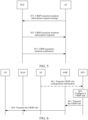
- the method provided in this embodiment of the present disclosure may include the following steps.
- a UE reports information about an executed UPSP, where the information includes PSI information
- the UE in S41 may be any UE and is referred to as a target UE.
- the information about the executed UPSP reported by the UE is information related to a first URSP rule matched with a target service flow newly initiated by the UE, where included PSI information is referred to as first PSI information, and a corresponding PDU session is referred to as a first PDU session.
- the corresponding first PSI information may be transmitted to the PCF in a PDU session establishment procedure or a PDU session update procedure, and the UE may report the first PSI information to a PCF sequentially through a base station, an AMF, and an SMF.
- S42 A PCF transmits a first packet detection rule to an SMF.
- the PCF transmits a corresponding packet detection rule, referred to as a first packet detection rule, to the SMF according to the received first PSI information.
- S43 The SMF forwards the first packet detection rule to a UPF of a first PDU session.
- the SMF After receiving the first packet detection rule, the SMF forwards the first packet detection rule to a UPF of the first PDU session.
- the UPF of the first PDU session After receiving the first packet detection rule, the UPF of the first PDU session detects, according to the first packet detection rule, whether a target service flow transmitted by the UE on the first PDU session is matched with the first packet detection rule, obtains a first detection result, and uses the first detection result as a service detection situation for reporting to the SMF.
- S45 The SMF reports the service detection situation to the PCF.
- the SMF After receiving the service detection situation, the SMF transmits the service detection situation to the PCF.
- the method may further include: generating URSP rule execution notification information according to the first detection result, where the URSP rule execution notification information is used for indicating an execution situation of a URSP rule in a UE or a group of UE(s), the URSP rule includes the first URSP rule, and the UE or the group of UE(s) includes the target user equipment; and transmitting the URSP rule execution notification information to an application function (AF).
- AF application function
- the method may further include: receiving a URSP execution situation subscription request message transmitted by the AF, where the URSP execution situation subscription request message includes information about the URSP rule and information about the AF; authenticating the URSP execution situation subscription request message according to the information about the AF, and generating a URSP execution situation subscription response message according to an authentication result; and transmitting a URSP execution request subscription response message to the AF.
- the method may further include: receiving URSP rule configuration information transmitted by the AF; generating the URSP rule with reference to the URSP rule configuration information; and transmitting information about the URSP rule to the AF.
- the AF may affect the PCF to generate a URSP rule, for example, a process in which the AF affects the URSP rule is defined.
- the AF may provide parameter information to a network element, such as an NEF, in a network, including but not limited to:
- URSP rule configuration information is carried in the service parameters, and the URSP rule configuration information may include configuration information that the AF hopes to affect any one or more of parameters in Table 1 and Table 2 above.
- the PCF may determine, according to a decision of the PCF, whether to receive the URSP rule configuration information; and if determining to receive, generate a URSP rule with reference to the URSP rule configuration information; or if determining not to receive, skip generating a URSP rule with reference to the URSP rule configuration information.
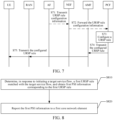
- the method provided in this embodiment of the present disclosure may include the following steps.
- the PCF After receiving the URSP rule configuration information from the AF, the PCF determines, with reference to the URSP rule configuration information, to generate the URSP rule. It may be understood that, the URSP rule configuration information may be included in an existing parameter in an existing message, or may be included in a newly-added parameter of an existing parameter, or may be transmitted through a newly-added parameter. This is not limited in this embodiment of the present disclosure. S61 may be default, that is, the PCF may alternatively directly configures the URSP rule.
- the PCF transmits the generated URSP rule to the AMF.
- the PCF may put the configured URSP rule into a container for sending to the AMF. This is not limited in this embodiment of the present disclosure.
- the AMF After receiving a UPSP, the AMF sends the UPSP to the UE through a RAN.
- the AMF may directly forward, to the UE by using an NAS message, a container in which the URSP rule is encapsulated.
- this embodiment of the present disclosure is not limited thereto.
- the method provided in this embodiment of the present disclosure may include:
- the PCF After receiving the URSP rule configuration information from the NEF, the PCF configures, with reference to the URSP rule configuration information, to generate the URSP rule.
- S71 and S72 may be default, for example, the PCF may alternatively directly configures the URSP rule.
- the AMF transmits the configured URSP rule to the UE through the RAN.
- the AMF After receiving the configured URSP rule, the AMF forwards the configured URSP rule to the UE through the RAN.
- the PCF receives the URSP rule configuration information from the AF or the NEF, to configure to generate a URSP rule, and then transmit, to the AF through the RAN, the generated URSP rule and corresponding information, for example, an identity (ID) of the URSP rule and/or PSI information.
- ID identity
- the method provided in this embodiment of the present disclosure may include the following steps.
- S51 The AF transmits a URSP execution situation subscription request message to the PCF.
- the AF may transmit URSP execution situation subscription request message to the PCF, where the URSP execution situation subscription request message may include at least information about the URSP rule that the AF wishes to know about its execution status in the UE or the group of UE(s), and information about the AF.
- the PCF After receiving the URSP execution situation subscription request message, the PCF authenticates the URSP execution situation subscription request message according to the information about the AF carried in the URSP execution situation subscription request message, and determines whether the AF can subscribe to the information (that is, an execution situation of whether the URSP rule can be subscribed on the UE or the group of UE(s)). If authentication is successful, a subscription success message is sent to the AF a URSP execution situation subscription response message; and if authentication is not successful, a subscription failure message is sent to the AF as a URSP execution situation subscription response message.
- the PCF may send a message to the AF according to the received service execution situation, where the message indicates a situation of executing the URSP rule by the UE or the group of UE(s), which is referred to as URSP execution situation notification information, and the URSP execution situation notification information may optionally include ID information of the UE, ID information of the URSP rule, and/or PSI information.
- the URSP execution situation notification information includes an indication of an execution situation
- the indication of the execution situation may be any one or more of the following: a detection result of a URSP rule on a UE, for example, the first detection result of the first URSP rule on the target UE, where the URSP rule is included in the URSP execution situation subscription request message transmitted by the AF to the PCF; a detection result of a URSP rule on all UEs or the group of UE(s) to which the URSP rule is delivered, where the URSP rule is included in the URSP execution situation subscription request message transmitted by the AF to the PCF; a detection result that is of each URSP rule on each UE or group of UE(s) to which the URSP rule is delivered and that is in the URSP execution situation subscription request message transmitted by the AF to the PCF; and statistical information generated according to the detection result that is of each URSP rule on each UE or group of UE(s) to
- the statistical information generated according to the detection result that is of each URSP rule on each UE or group of UE(s) to which the URSP rule is delivered and that is in the URSP execution situation subscription request message transmitted by the AF to the PCF may include, for example, one or more of the following information: a percentage of UEs whose detection results are being matched within a period of time in UEs to which the URSP rule is delivered, for example, assuming that a URSP rule is delivered to 100 UEs, detection results of 50 UEs in 100 UEs are being matched, and the obtained percentage is 50%; and a percentage of UEs whose detection results are being not matched within a period of time in UEs to which the URSP rule is delivered.
- the indication of the execution situation included in the URSP execution situation notification information may vary according to different content carried in the URSP execution situation subscription request message transmitted by the AF to the PCF, for example, if the URSP execution situation subscription request message returns statistical information, the returned URSP execution situation notification information includes the statistical information.
- the method may further include: transmitting blocking indication information corresponding to the first packet detection rule, where the blocking indication information may be used for instructing the UPF network element to block a target service flow that is not matched with the first packet detection rule.
- the SMF may instruct the UPF to block a target service flow that does not comply with the first PDR.
- the UPF detects a target service flow of a first PDU session, and when the target service flow does not comply with the first PDR, may report the information to the SMF, and block the target service flow according to an instruction of the SMF.
- the method may further include: when the first detection result indicates that the target service flow is not matched with the first packet detection rule, generating a URSP rule matching error message, where the URSP rule matching error message may be used for indicating that the first URSP rule matched by the target user equipment on the first PDU session is incorrect; and transmitting the URSP rule matching error message to the target user equipment.
- the PCF may send the URSP rule matching error message to the target UE, where the URSP rule matching error message may be used for indicating that the target UE has error matching on the first URSP rule on the first PDU session, and the URSP rule matching error message may include an ID of the first PDU session and first PSI information of the first URSP rule.
- the target UE may re-match the target service flow on the first PDU session and another URSP rule until finding a suitable URSP rule.
- the found another suitable URSP rule may be referred to as a second URSP rule.
- a second URSP rule For a case in which the target service flow of the target UE is transmitted by using a second PDU session of the second URSP rule, reference may be made to the description of transmitting the target service flow by using the first PDU session of the first URSP rule.
- the UE associates application data to a corresponding PDU session based on a received URSP for transmission.
- a mechanism is as follows: When an application layer transmits data, the UE uses a URSP rule in the URSP to view whether a feature of the application data is matched with a traffic descriptor of a rule in the URSP rule. For an order of viewing is determined according to rule precedence in the URSP rule. In other words, the UE checks sequentially a matching situation based on a precedence order. When the traffic descriptor of a URSP rule is matched, an RSD list under the URSP rule is used to bind the PDU session.
- the UE searches for a suitable PDU session according to route selection descriptor precedence. An RSD with higher precedence is used first. If a parameter in the RSD includes one or more values, the UE selects a combination of parameters to determine whether the PDU session exists:
- an execution result for the URSP rule may be detected, and the execution result may be fed back to an AF on an application side.
- a URSP detection method provided in an embodiment of FIG. 8 may be performed by a target user equipment.
- the method provided in this embodiment of the present disclosure may include the following steps.
- S810 Determine, in response to initiating a target service flow, a first URSP rule matched with the target service flow, and obtain first PSI information corresponding to the first URSP rule.
- the first PSI information may be used for instructing the first core network element to generate a first packet detection rule according to the first URSP rule obtained from the first PSI information, and configure the first packet detection rule to a UPF network element of a first protocol data unit (PDU) session, the first PDU session corresponding to the first URSP rule.
- the first packet detection rule may be used for instructing the UPF network element to detect whether the target service flow transmitted by the target user equipment on the first PDU session is matched with the first packet detection rule, obtain a first detection result, and transmit the first detection result to the first core network element.
- the reporting the first PSI information to a first core network element may include: triggering a procedure of modifying the first PDU session if the first PDU session has been established in response to initiating the target service flow; and transmitting the first PSI information to a third core network element in the procedure of modifying the first PDU session.
- the third core network element may be configured to transmit the first PSI information to the second core network element.
- the second core network element may be configured to transmit the first PSI information to the first core network element.
- the reporting the first PSI information to a first core network element may include: triggering a procedure of establishing the first PDU session if the first PDU session has not been established in response to initiating the target service flow; and transmitting the first PSI information to a third core network element in the procedure of establishing the first PDU session.
- the third core network element may be configured to transmit the first PSI information to the second core network element.
- the second core network element may be configured to transmit the first PSI information to the first core network element.
- the method may further include: receiving a URSP rule matching error message from the first core network element, where the URSP rule matching error message may be used for indicating that the first URSP rule matched by the target user equipment on the first PDU session is incorrect; re-matching a second URSP rule for the target service flow according to the URSP rule matching error message; and transmitting the target service flow on a second PDU session corresponding to the second URSP rule.
- the first core network element may be further configured to generate the URSP rule matching error message when the first detection result indicates that the target service flow is not matched with the first packet detection rule.
- a URSP detection method provided in an embodiment of FIG. 9 may be performed by a user plane function (UPF) network element of a first protocol data unit (PDU) session, the first PDU session corresponds to a first URSP rule, the first URSP rule corresponds to first PSI information, and the first URSP rule is matched with a target service flow initiated by a target user equipment.
- UPF user plane function
- the method provided in this embodiment of the present disclosure may include the following steps.
- S910 Receive a first packet detection rule that is of the first URSP rule and that is transmitted by a first core network element, where the first PSI information may be used for instructing the first core network element to generate the first packet detection rule according to the first URSP rule obtained from the first PSI information.
- S920 Detect whether a target service flow transmitted by a target user equipment on a first PDU session is matched with the first packet detection rule, to obtain a first detection result.
- S930 Transmit the first detection result to the first core network element.
- the receiving a first packet detection rule that is of the first URSP rule and that is transmitted by a first core network element may include: receiving the first packet detection rule from a second core network element.
- the second core network element may be configured to receive the first packet detection rule from the first core network element.
- the transmitting the first detection result to the first core network element may include: transmitting the first detection result to the second core network element.
- the second core network element may be configured to transmit the first detection result to the first core network element.
- the first packet detection rule may include at least one of a first IP descriptor, a first domain descriptor, and a first non-IP descriptor.
- the detecting whether the target service flow transmitted by the target user equipment on the first PDU session is matched with the first packet detection rule, to obtain a first detection result may include: detecting whether the target service flow is matched with the first packet detection rule. If not matched, the obtained first detection result is that the target service flow is not matched with the first packet detection rule; or if matched, the obtained first detection result is that the target service flow is matched with the first packet detection rule.
- the first packet detection rule may include a detection frequency.
- the detecting whether the target service flow transmitted by the target user equipment on the first PDU session is matched with the first packet detection rule, to obtain a first detection result may include: regularly detecting, according to the detection frequency, whether a packet in the target service flow is matched with the first packet detection rule, and obtaining the first detection result.
- the method may further include: receiving blocking indication information corresponding to the first packet detection rule, where the blocking indication information may be used for instructing the UPF network element to block a target service flow that is not matched with the first packet detection rule.
- the method may further include: blocking the target service flow if the first detection result is that the target service flow is not matched with the first packet detection rule.
- a URSP detection method provided in an embodiment of FIG. 10 may be performed by an application function (AF).
- AF application function
- this embodiment of the present disclosure is not limited thereto.
- the method provided in this embodiment of the present disclosure may include the following steps.
- S1030 Receive URSP rule execution notification information transmitted by the first core network element.
- the URSP rule execution notification information transmitted by the first core network element is received, where the URSP rule execution notification information may be used for indicating an execution situation of a URSP rule in a UE or a group of UE(s), the URSP rule may include a first URSP rule, the UE or the group of UE(s) including a target user equipment, and the first URSP rule may be matched with a target service flow indicated by the target user equipment.
- the first core network element may be configured to obtain first PSI information corresponding to the first URSP rule reported by the target user equipment, generate a first packet detection rule according to the first URSP rule obtained from the first PSI information, and configure the first packet detection rule to a user plane function (UPF) network element of a first protocol data unit (PDU) session, the first PDU session corresponding to the first URSP rule.
- the first packet detection rule may be used for instructing the UPF network element to detect whether the target service flow transmitted by the target user equipment on the first PDU session is matched with the first packet detection rule, to obtain a first detection result.
- the first detection result may be used for instructing the first core network element to generate the URSP rule execution notification information according to the received first detection result.
- the method may further include: S1010: Transmit a URSP execution situation subscription request message to a first core network element.
- a URSP execution situation subscription request message is transmitted to the first core network element, where the URSP execution situation subscription request message includes information about the URSP rule and information about the AF.
- the URSP execution situation subscription request message may be used for instructing the first core network element to authenticate the URSP execution situation subscription request message according to the information about the AF, and generating a URSP execution situation subscription response according to an authentication result.
- S1020 Receive a URSP execution request subscription response message transmitted by the first core network element.
- the method may further include: transmitting URSP rule configuration information to the first core network element.
- the URSP rule configuration information may be used for instructing the first core network element to generate the URSP rule with reference to the URSP rule configuration information, and receive the information about the URSP rule transmitted by the first core network element.
- the first core network element may be further configured to generate the URSP rule with reference to the URSP rule configuration information; and receive the information about the URSP rule transmitted by the first core network element.
- a first core network element 1100 provided in an embodiment of FIG. 11 may include: an obtaining unit 1110, a generation unit 1120, a configuration unit 1130, and a receiving unit 1140.
- the obtaining unit 1110 may be configured to obtain first PSI information corresponding to a first URSP rule reported by a target user equipment, the first URSP rule being matched with a target service flow initiated by the target user equipment.
- the generation unit 1120 may be configured to generate a first packet detection rule according to the first URSP rule obtained from the first PSI information.
- the configuration unit 1130 may be configured to configure the first packet detection rule to a user plane function (UPF) network element of a first protocol data unit (PDU) session, the first PDU session corresponding to the first URSP rule, and the first packet detection rule being used for instructing the UPF network element to detect whether the target service flow transmitted by the target user equipment on the first PDU session is matched with the first packet detection rule, to obtain a first detection result.
- the receiving unit 1140 is configured to receive the first detection result transmitted by the UPF network element.
- the obtaining unit 1110 is further configured to: in a case that the first PDU session has been established in a process of initiating the target service flow by the target user equipment, obtain the first PSI information from a second core network element in a modification procedure of the first PDU session triggered by the target user equipment.
- the second core network element may be configured to receive the first PSI information from a third core network element.
- the third core network element may be configured to receive the first PSI information from the target user equipment.
- the obtaining unit 1110 is further configured to: in a case that the first PDU session has not been established in a process of initiating the target service flow by the target user equipment, obtain the first PSI information from a second core network element in an establishment procedure of the first PDU session triggered by the target user equipment.
- the second core network element may be configured to receive the first PSI information from a third core network element.
- the third core network element may be configured to receive the first PSI information from the target user equipment.
- the first packet detection rule may include at least one of a first IP descriptor, a first domain descriptor, and a first non-IP descriptor.
- the first packet detection rule may include a detection frequency, where the detection frequency may be used for instructing the UPF network element to regularly detect a packet in the target service flow according to the detection frequency.
- the first core network element 1100 may further include a transmission unit, configured to transmit the first packet detection rule to the second core network element.
- the second core network element may be configured to transmit the first packet detection rule to the UPF network element.
- the receiving unit 1140 may be further configured to: receive the first detection result from the second core network element.
- the second core network element may be configured to receive the first detection result from the UPF network element.
- the receiving unit 1140 may be further configured to: receive the first detection result in a case that the first detection result indicates that the target service flow is matched with the first packet detection rule; receive the first detection result in a case that the first detection result indicates that the target service flow is not matched with the first packet detection rule; or receive the first detection result in a case that the first detection result indicates that the target service flow is matched with or not matched with the first packet detection rule.
- the first core network element 1100 may further include: a generation unit, configured to generate URSP rule execution notification information according to the first detection result, where the URSP rule execution notification information is used for indicating an execution situation of a URSP rule in a UE or a group of UE(s), the URSP rule includes the first URSP rule, and the UE or the group of UE(s) includes the target user equipment.
- the first core network element 1100 may further include a sending unit, configured to transmit the URSP rule execution notification information to an application function (AF).
- AF application function
- the receiving unit 1140 may be further configured to receive a URSP execution situation subscription request message transmitted by the AF, where the URSP execution situation subscription request message includes information about the URSP rule and information about the AF.
- the first core network element 1100 may include: a generation unit, configured to authenticate the URSP execution situation subscription request message according to the information about the AF, and generating a URSP execution situation subscription response message according to an authentication result.
- the first core network element 1100 may further include a sending unit, configured to transmit the URSP execution request subscription response message to the AF.
- receiving unit 1140 may be further configured to receive URSP rule configuration information transmitted by the AF.
- the first core network element 1100 may include: a generation unit, configured to generate the URSP rule with reference to the URSP rule configuration information.
- the first core network element 1100 may further include transmit information about the URSP rule to the AF.
- the first core network element 1100 may further include a sending unit, configured to transmit blocking indication information corresponding to the first packet detection rule, where the blocking indication information may be used for instructing the UPF network element to block a target service flow that is not matched with the first packet detection rule.
- the generation unit 1120 may be further configured to: when the first detection result indicates that the target service flow is not matched with the first packet detection rule, generate a URSP rule matching error message for indicating that the first URSP rule matched by the target user equipment on the first PDU session is incorrect.
- the first core network element 1100 may further include a sending unit, configured to transmit the URSP rule matching error message to the target user equipment.
- a target user equipment 1200 may include a determining unit 1210 and a reporting unit 1220.
- the determining unit 1210 is configured to determine, in response to initiating a target service flow, a first UE route selection policy (URSP) rule matched with the target service flow, and obtain first policy section identifier (PSI) information corresponding to the first URSP rule.
- the reporting unit 1220 is configured to report the first PSI information to a first core network element.
- the first PSI information may be used for instructing the first core network element to generate a first packet detection rule according to the first URSP rule obtained from the first PSI information, and configure the first packet detection rule to a user plane function (UPF) network element of a first protocol data unit (PDU) session.
- the first core network element may be configured to generate a first packet detection rule according to the first URSP rule obtained from the first PSI information, and configure the first packet detection rule to a user plane function (UPF) network element of a first protocol data unit (PDU) session, the first PDU session corresponding to the first URSP rule.
- the UPF network element may be configured to detect whether the target service flow transmitted by the target user equipment on the first PDU session is matched with the first packet detection rule, to obtain a first detection result, and transmit the first detection result to the first core network element.
- the reporting unit 1220 may be further configured to: trigger a procedure of modifying the first PDU session if the first PDU session has been established in response to initiating the target service flow.
- the target user equipment 1200 may further include a sending unit, configured to transmit the first PSI information to a third core network element in the procedure of modifying the first PDU session.
- the third core network element may be configured to transmit the first PSI information to the second core network element.
- the second core network element may be configured to transmit the first PSI information to the first core network element.
- the reporting unit 1220 may be further configured to: trigger a procedure of establishing the first PDU session if the first PDU session has not been established in response to initiating the target service flow.
- the target user equipment 1200 may further include a sending unit, configured to transmit the first PSI information to a third core network element in the procedure of establishing the first PDU session.
- the third core network element may be configured to transmit the first PSI information to the second core network element.
- the second core network element may be configured to transmit the first PSI information to the first core network element.
- the transmission unit may be further configured to transmit the target service flow on the first PDU session after the first PDU session is established.
- the target user equipment 1200 may further include a receiving unit, configured to receive a URSP rule matching error message from the first core network element, where the URSP rule matching error message may be used for indicating that the first URSP rule matched by the target user equipment on the first PDU session is incorrect.
- the determining unit 1210 may be further configured to re-match a second URSP rule for the target service flow according to the URSP rule matching error message.
- the target user equipment 1200 may further include a sending unit, configured to transmit the target service flow on a second PDU session corresponding to the second URSP rule.
- the first core network element may be further configured to generate the URSP rule matching error message when the first detection result indicates that the target service flow is not matched with the first packet detection rule.
- a user plane function UPF network element 1300 provided in an embodiment of FIG. 13 corresponds to a first PDU session
- the first PDU session corresponds to a first URSP rule
- the first URSP rule corresponds to first PSI information
- the first URSP rule is matched with a target service flow initiated by a target user equipment.
- the UPF network element 1300 may include a receiving unit 1310, a detection unit 1320, and a transmission unit 1330.
- the receiving unit 1310 may be configured to receive a first packet detection rule that is of the first URSP rule and that is transmitted by a first core network element, the first PSI information being used for instructing the first core network element to generate the first packet detection rule according to the first URSP rule obtained from the first PSI information.
- the detection unit 1320 may be configured to detect whether the target service flow transmitted by the target user equipment on the first PDU session is matched with the first packet detection rule, to obtain a first detection result.
- the transmission unit 1330 may be configured to transmit the first detection result to the first core network element.
- the receiving unit 1310 may be further configured to: receive the first packet detection rule from a second core network element.
- the second core network element may be configured to receive the first packet detection rule from the first core network element.
- the UPF network element 1300 may further include a sending unit, configured to send the first detection result to the second core network element.
- the second core network element may be configured to transmit the first detection result to the first core network element.
- the first packet detection rule may include at least one of a first IP descriptor, a first domain descriptor, and a first non-IP descriptor.
- the detection unit 1320 may be configured to perform the following steps: detecting whether the target service flow is matched with the first packet detection rule. If not matched, the obtained first detection result is that the target service flow is not matched with the first packet detection rule; or if matched, the obtained first detection result is that the target service flow is matched with the first packet detection rule.
- the first packet detection rule may include a detection frequency.
- the detection unit 1320 may be configured to perform the following steps: regularly detecting, according to the detection frequency, whether a packet in the target service flow is matched with the first packet detection rule, and obtaining the first detection result.
- the receiving unit 1310 may be further configured to receive blocking indication information corresponding to the first packet detection rule, where the blocking indication information may be used for instructing the UPF network element to block a target service flow that is not matched with the first packet detection rule.
- the user plane function (UPF) network element 1300 may further include a blocking unit, configured to block the target service flow if the first detection result is that the target service flow is not matched with the first packet detection rule.
- an AF 1400 provided in an embodiment of FIG. 14 may include a receiving unit 1410.
- the receiving unit 1410 may be configured to receive URSP rule execution notification information transmitted by a first core network element, the URSP rule execution notification information being used for indicating an execution situation of a URSP rule in a UE or a group of UE(s), the URSP rule including a first URSP rule, the UE or the group of UE(s) including a target user equipment, and the first URSP rule being matched with a target service flow indicated by the target user equipment.
- the first core network element may be configured to obtain first PSI information corresponding to the first URSP rule reported by the target user equipment, generate a first packet detection rule according to the first URSP rule obtained from the first PSI information, and configure the first packet detection rule to a user plane function (UPF) network element of a first protocol data unit (PDU) session, the first PDU session corresponding to the first URSP rule.
- the UPF network element may be configured to detect whether the target service flow transmitted by the target user equipment on the first PDU session is matched with the first packet detection rule, to obtain a first detection result.
- the first core network element may be further configured to receive the first detection result, and generate the URSP rule execution notification information according to the first detection result.
- the AF 1400 may further include a sending unit, configured to transmit a URSP execution situation subscription request message to the first core network element, where the URSP execution situation subscription request message includes information about the URSP rule and information about the AF.
- the first core network element is further configured to authenticate the URSP execution situation subscription request message according to the information about the AF, and generate a URSP execution situation subscription response message according to an authentication result.
- the receiving unit 1410 may be further configured to receive the URSP execution request subscription response message transmitted by the first core network element.
- the AF 1400 may further include a sending unit, configured to transmit URSP rule configuration information to the first core network element.
- the first core network element may be further configured to generate the URSP rule with reference to the URSP rule configuration information.
- the receiving unit 1410 may be further configured to receive the information about the URSP rule transmitted by the first core network element.
- FIG. 15 is a schematic diagram of a communication device 1500 according to an embodiment of the present disclosure.
- the communication device may be a terminal, or may be another communication device, for example, a first core network element and/or a second core network element and/or a third core network element and/or a user plane function, and/or an application function network element.
- the communication device 1500 shown in FIG. 15 may include a processor 1510.
- the processor 1510 may invoke a computer program from a memory and run the computer program, to implement the method in the embodiments of the present disclosure.
- the communication device 1500 may further include a memory 1520.
- the processor 1510 may invoke the computer program from the memory 1520 and run the computer program, to implement the method in the embodiments of the present disclosure.
- the memory 1520 may be a component independent of the processor 1510, or may be integrated into the processor 1510.
- the communication device 1500 may further include a transceiver 1530, and the processor 1510 can control the transceiver 1530 to communicate with another device.
- the transceiver 1530 sends information or data to another device, or receives information or data sent by another device.
- the transceiver 1530 may include a transmitter and a receiver.
- the transceiver 1530 may further include an antenna, and a quantity of the antenna can be one or more.
- the communication device 1500 may specifically be the first core network element and/or the second core network element and/or the third core network element and/or the user plane function network element and/or the application function network element in the embodiments of the present disclosure, and the communication device 1500 may implement a corresponding procedure implemented by the first core network element and/or the second core network element and/or the third core network element and/or the user plane function network element and/or the application function network element in the methods in the embodiments of the present disclosure.
- the communication device 1500 may specifically be the first core network element and/or the second core network element and/or the third core network element and/or the user plane function network element and/or the application function network element in the embodiments of the present disclosure, and the communication device 1500 may implement a corresponding procedure implemented by the first core network element and/or the second core network element and/or the third core network element and/or the user plane function network element and/or the application function network element in the methods in the embodiments of the present disclosure.
- details are not described herein again.
- the communication device 1500 may specifically be a mobile terminal/a terminal in the embodiments of the present disclosure, and the communication device 1500 can implement corresponding procedures implemented by the mobile terminal/the terminal in various methods in the embodiments of the present disclosure. For brevity, details are not described herein again.
- the processor of this embodiment of the present disclosure may be an integrated circuit chip, and has a signal processing capability.
- the steps of the foregoing method embodiment may be implemented by using a hardware integrated logic circuit in the processor or implemented by using an instruction in a software form.
- the foregoing processor may be a general-purpose processor, a digital signal processor (DSP), an application-specific integrated circuit (ASIC), a field programmable gate array (FPGA), or another programmable logical device, discrete gate or transistor logical device, or discrete hardware component, and
- DSP digital signal processor
- ASIC application-specific integrated circuit
- FPGA field programmable gate array
- the processor can implement or execute methods, steps, and logical block diagrams disclosed in the embodiments of the present disclosure.
- the general-purpose processor may be a microprocessor, or the processor may be any conventional processor and the like.
- a software module may be located in a mature storage medium in the art, such as a random access memory, a flash memory, a read-only memory, a programmable read-only memory, an electrically erasable programmable memory, or a register.
- the storage medium is located in the memory.
- the processor reads information in the memory and completes the steps of the foregoing methods in combination with hardware thereof.
- the memory in the embodiments of the present disclosure may be a volatile memory or a non-volatile memory, or may include both a volatile memory and a non-volatile memory.
- the non-volatile memory may be a read-only memory (ROM), a programmable ROM (PROM), an erasable programmable read-only memory (EPROM), an electrically EPROM (EEPROM), or a flash memory.
- the volatile memory may be a random access memory (RAM), and is used as an external cache.
- RAMs may be used, for example, a static random access memory (SRAM), a dynamic random access memory (DRAM), a synchronous dynamic random access memory (SDRAM), a double data rate synchronous dynamic random access memory (DDR SDRAM), an enhanced synchronous dynamic random access memory (ESDRAM), a synchlink dynamic random access memory (SLDRAM) and a direct rambus random access memory (DR RAM).
- SRAM static random access memory
- DRAM dynamic random access memory
- SDRAM synchronous dynamic random access memory
- DDR SDRAM double data rate synchronous dynamic random access memory
- ESDRAM enhanced synchronous dynamic random access memory
- SLDRAM synchlink dynamic random access memory
- DR RAM direct rambus random access memory
- An embodiment of the present disclosure further provides a computer-readable storage medium, configured to store a computer program.
- the computer-readable storage medium is applicable to the first core network element and/or the second core network element and/or the third core network element and/or the user plane function network element and/or the application function network element in the embodiments of the present disclosure
- the computer program enables a computer to implement a corresponding procedure implemented by the first core network element and/or the second core network element and/or the third core network element and/or the user plane function network element and/or the application function network element in the methods in the embodiments of the present disclosure.
- details are not described herein again.
- the computer-readable storage medium may be applied to the network device in the mobile terminal/the terminal in the embodiments of the present disclosure, and the computer program enables a computer to perform corresponding procedures implemented by the mobile terminal/the terminal in the methods in the embodiments of the present disclosure. For brevity, details are not described herein again.
- An embodiment of the present disclosure further provides a computer program product, including computer program instructions.
- the computer program product is applicable to the first core network element and/or the second core network element and/or the third core network element and/or the user plane function network element and/or the application function network element in the embodiments of the present disclosure
- the computer program instructions enable a computer to implement a corresponding procedure implemented by the first core network element and/or the second core network element and/or the third core network element and/or the user plane function network element and/or the application function network element in the methods in the embodiments of the present disclosure.
- details are not described herein again.
- the computer program product may be applied to the mobile terminal/the terminal in the embodiments of the present disclosure, and the computer program instruction enables a computer to perform corresponding procedures implemented by the mobile terminal/the terminal in the methods in the embodiments of the present disclosure.
- the computer program instruction enables a computer to perform corresponding procedures implemented by the mobile terminal/the terminal in the methods in the embodiments of the present disclosure.
- An embodiment of the present disclosure further provides a computer program.
- the computer program is applicable to the first core network element and/or the second core network element and/or the third core network element and/or the user plane function network element and/or the application function network element in the embodiments of the present disclosure, and when the computer program is run on a computer, the computer is enabled to implement a corresponding procedure implemented by the first core network element and/or the second core network element and/or the third core network element and/or the user plane function network element and/or the application function network element in the methods in the embodiments of the present disclosure.
- the computer program is applicable to the first core network element and/or the second core network element and/or the third core network element and/or the user plane function network element and/or the application function network element in the embodiments of the present disclosure, and when the computer program is run on a computer, the computer is enabled to implement a corresponding procedure implemented by the first core network element and/or the second core network element and/or the third core network element and/or the user plane function network element and
- the computer program may be applied to the network device in the mobile terminal/the terminal in the embodiments of the present disclosure, and when the computer program is run on the computer, the computer is enabled to perform corresponding procedures implemented by the mobile terminal/the terminal in the methods in the embodiments of the present disclosure. For brevity, details are not described herein again.
Landscapes
- Engineering & Computer Science (AREA)
- Computer Networks & Wireless Communication (AREA)
- Signal Processing (AREA)
- Mobile Radio Communication Systems (AREA)
Abstract
Description
- This application is proposed based on
Chinese Patent Application No. 202210027123.9 filed on January 11, 2022 - The present disclosure relates to the field of communication technologies, and specifically, to a UE route selection policy (URSP) detection method, a first core network element, a target user equipment, a user plane function (UPF) network element, a communication device, a computer-readable storage medium, and a computer program product.
- A user equipment (UE) policy delivered by a network side to a user equipment side includes a UE route selection policy (URSP) policy, and the URSP policy includes one or more URSP rules. However, in the related art, there is no solution for detecting whether the URSP rule is correctly executed by the UE.
- Embodiments of the present disclosure provide a URSP detection method, a first core network element, a target user equipment, a UPF network element, a communication device, a computer-readable storage medium, and a computer program product, which can determine whether a UE correctly executes a URSP rule delivered by a network side.
- An embodiment of the present disclosure provides a URSP detection method, performed by a first core network element, the method including: obtaining first policy section identifier (PSI) information corresponding to a first URSP rule reported by a target user equipment, the first URSP rule being matched with a target service flow initiated by the target user equipment; generating a first packet detection rule according to the first URSP rule obtained from the first PSI information; configuring the first packet detection rule to a user plane function (UPF) network element of a first protocol data unit (PDU) session, the first PDU session corresponding to the first URSP rule, and the first packet detection rule being used for instructing the UPF network element to detect whether the target service flow transmitted by the target user equipment on the first PDU session is matched with the first packet detection rule, to obtain a first detection result; and receiving the first detection result transmitted by the UPF network element.
- An embodiment of the present disclosure provides a URSP detection method, performed by a target user equipment, the method including: determining, in response to initiating a target service flow, a first URSP rule matched with the target service flow, and obtaining first PSI information corresponding to the first URSP rule; and reporting the first PSI information to a first core network element, the first PSI information being used for instructing the first core network element to generate a first packet detection rule according to the first URSP rule obtained from the first PSI information, and configure the first packet detection rule to a user plane function (UPF) network element of a first PDU session, the first PDU session corresponding to the first URSP rule; and the first packet detection rule being used for instructing the UPF network element to obtain a first detection result, the first detection result representing whether the target service flow transmitted by the target user equipment on the first PDU session is matched with the first packet detection rule.
- An embodiment of the present disclosure provides a URSP detection method, performed by a UPF network element of a first PDU session, the first PDU session corresponding to a first URSP rule, the first URSP rule corresponding to first PSI information, the first URSP rule being matched with a target service flow initiated by a target user equipment, and the method including: receiving a first packet detection rule that is of the first URSP rule and that is transmitted by a first core network element, the first PSI information being used for instructing the first core network element to generate the first packet detection rule according to the first URSP rule obtained from the first PSI information; detecting whether a target service flow transmitted by a target user equipment on a first PDU session is matched with the first packet detection rule, to obtain a first detection result; and transmitting the first detection result to the first core network element.
- An embodiment of the present disclosure provides a URSP detection method, performed by an application function (AF), the method including: receiving URSP rule execution notification information transmitted by a first core network element, the URSP rule execution notification information being used for indicating an execution situation of a URSP rule in a UE or a group of UE(s), the URSP rule including a first URSP rule, the UE or the group of UE(s) including a target user equipment, and the first URSP rule being matched with a target service flow indicated by the target user equipment. The first PSI information is used for instructing the first core network element to perform the following processing: obtaining first PSI information corresponding to the first URSP rule reported by the target user equipment, generating a first packet detection rule according to the first URSP rule obtained from the first PSI information, and configuring the first packet detection rule to a UPF network element of a first protocol data unit (PDU) session, the first PDU session corresponding to the first URSP rule; and the first packet detection rule being used for instructing the UPF network element to obtain a first detection result, the first detection result representing whether the target service flow transmitted by the target user equipment on the first PDU session is matched with the first packet detection rule. The first core network element is further configured to receive the first detection result, and generate the URSP rule execution notification information according to the first detection result.
- An embodiment of the present disclosure provides a first core network element, including: an obtaining unit, configured to obtain first PSI information corresponding to a first URSP rule reported by a target user equipment, the first URSP rule being matched with a target service flow initiated by the target user equipment; a generation unit, configured to generate a first packet detection rule according to the first URSP rule obtained from the first PSI information; a configuration unit, configured to configure the first packet detection rule to a UPF network element of a first PDU session, the first PDU session corresponding to the first URSP rule, and the first packet detection rule being used for instructing the UPF network element to obtain a first detection result, the first detection result representing whether the target service flow transmitted by the target user equipment on the first PDU session is matched with the first packet detection rule; and a receiving unit, configured to receive the first detection result transmitted by the UPF network element.
- An embodiment of the present disclosure provides a target user equipment, including: a determining unit, configured to determine, in response to initiating a target service flow, a first UE route selection policy (URSP) rule matched with the target service flow, and obtain first policy section identifier (PSI) information corresponding to the first URSP rule; and a reporting unit, configured to report the first PSI information to a first core network element, the first PSI information being used for instructing the first core network element to generate a first packet detection rule according to the first URSP rule obtained from the first PSI information, and configure the first packet detection rule to a UPF network element of a first PDU session, the first PDU session corresponding to the first URSP rule; and the first packet detection rule being used for instructing the UPF network element to obtain a first detection result, the first detection result representing whether the target service flow transmitted by the target user equipment on the first PDU session is matched with the first packet detection rule, and transmitting the first detection result to the first core network element.
- An embodiment of the present disclosure provides a user plane function (UPF) network element, corresponding to a first protocol data unit (PDU) session, the first PDU session corresponding to a first UE route selection policy (URSP) rule, the first URSP rule corresponding to first PSI information, the first URSP rule being matched with a target service flow initiated by a target user equipment, and the UPF network element including: a receiving unit, configured to receive a first packet detection rule that is of the first URSP rule and that is transmitted by a first core network element, the first PSI information being used for instructing the first core network element to perform the following processing: obtaining the first URSP rule according to the first PSI information, and generating the first packet detection rule according to the first URSP rule; a detection unit, configured to obtain a first detection result, the first detection result representing whether the target service flow transmitted by the target user equipment on the first PDU session is matched with the first packet detection rule; and a transmission unit, configured to transmit the first detection result to the first core network element.
- An embodiment of the present disclosure provides an AF, including: a receiving unit, configured to receive URSP rule execution notification information transmitted by a first core network element, the URSP rule execution notification information being used for indicating an execution situation of a URSP rule in a UE or a group of UE(s), the URSP rule including a first URSP rule, the UE or the group of UE(s) including a target user equipment, and the first URSP rule being matched with a target service flow indicated by the target user equipment. The first PSI information is used for instructing the first core network element to perform the following processing: obtaining first PSI information corresponding to a first URSP rule reported by the target user equipment, obtaining the first URSP rule according to the first PSI information, generating a first packet detection rule according to the first URSP rule, and configuring the first packet detection rule to a user plane function (UPF) network element of a first PDU session, the first PDU session corresponding to the first URSP rule; and the first packet detection rule being used for instructing the UPF network element to obtain a first detection result, the first detection result representing whether the target service flow transmitted by the target user equipment on the first PDU session is matched with the first packet detection rule. The first detection result is used for instructing the first core network element to generate the URSP rule execution notification information according to the first detection result.
- An embodiment of the present disclosure provides a computer-readable storage medium, storing a computer program, the computer program, when executed by a processor, implementing the URSP detection method according to the foregoing embodiments.
- An embodiment of the present disclosure provides a communication device, including: one or more processors; and a memory, configured to store one or more programs, the one or more programs, when executed by the one or more processors, enabling the communication device to implement the URSP detection method according to the foregoing embodiments.
- In the embodiments of the present disclosure, a first core network element obtains first PSI information reported by a target user equipment, to obtain a first URSP rule corresponding to the first PSI information, generate a first packet detection rule according to the first URSP rule, and configure the first packet detection rule to a UPF network element of a first PDU session, to use the first packet detection rule to instruct the UPF network element to detect whether the target service flow transmitted by the target user equipment on the first PDU session is matched with the first packet detection rule, and obtain a first detection result, so that the first core network element can determine, according to the first detection result, whether a UE correctly executes a URSP rule delivered by a network side, to take a corresponding processing measure in time to ensure stable communication of the UE.
-
-
FIG. 1 is a schematic diagram of a communication system architecture according to an embodiment of the present disclosure. -
FIG. 2 is an architectural diagram of a system of a 5G network according to an embodiment of the present disclosure. -
FIG. 3 is a flowchart of a URSP detection method according to an embodiment of the present disclosure. -
FIG. 4 is a schematic diagram of interaction of a URSP detection method according to an embodiment of the present disclosure. -
FIG. 5 is a schematic diagram of interaction of a URSP detection method according to another embodiment of the present disclosure. -
FIG. 6 is a schematic diagram of interaction of a URSP detection method according to yet another embodiment of the present disclosure. -
FIG. 7 is a schematic diagram of interaction of a URSP detection method according to still another embodiment of the present disclosure. -
FIG. 8 is a flowchart of a URSP detection method according to another embodiment of the present disclosure. -
FIG. 9 is a flowchart of a URSP detection method according to yet another embodiment of the present disclosure. -
FIG. 10 is a flowchart of a URSP detection method according to still another embodiment of the present disclosure. -
FIG. 11 is a schematic block diagram of a first core network element according to an embodiment of the present disclosure. -
FIG. 12 is a schematic block diagram of a target user equipment according to an embodiment of the present disclosure. -
FIG. 13 is a schematic block diagram of a user plane function (UPF) network element according to an embodiment of the present disclosure. -
FIG. 14 is a schematic block diagram of an application function (AF) according to an embodiment of the present disclosure. -
FIG. 15 is a schematic diagram of a communication device according to an embodiment of the present disclosure. - Exemplary implementations are now described more comprehensively with reference to the accompanying drawings. However, the exemplary implementations can be implemented in various forms, and are not constructed as a limitation to examples described herein. Instead, the implementations are provided to make the present disclosure more comprehensive and complete, and comprehensively convey the concept of the exemplary implementations to a person skilled in the art.
- The technical solutions in the embodiments of the present disclosure is applicable to various communication systems, such as a Global System for Mobile communications (GSM) system, a code division multiple access (CDMA) system, a wideband code division multiple access (WCDMA) system, a general packet radio service (GPRS), a long term evolution (LTE) system, an LTE frequency division duplex (FDD) system, an LTE time division duplex (TDD) system, a universal mobile telecommunication system (UMTS), a worldwide interoperability for microwave access (WiMAX) communication system, or a 5G system. For example, a
communication system 100 used in an embodiment of the present disclosure is shown inFIG. 1 . Thecommunication system 100 may include anetwork device 110, and thenetwork device 110 may be a device communicating with a terminal 120 (or referred to as a communication terminal or a terminal). Thenetwork device 110 may provide communication coverage for a specific geographical area, and may communicate with a terminal that is located within the covered area. In some embodiments, thenetwork device 110 may be a base transceiver station (BTS) in a GSM system or a CDMA system, a NodeB (NB) in a WCDMA system, an evolved NodeB (eNB or eNodeB) in an LTE system, or a base station in a 5G communication system, or a wireless controller in a cloud radio access network (CRAN). Alternatively, the network device may be a network side device in a mobile switching center, a relay station, an access point, an in-vehicle device, a wearable device, a hub, a switch, a bridge, a router, or a 5G network, or may be a network device or the like in a future evolved public land mobile network (PLMN). - The
communication system 100 further includes at least oneterminal 120 located within a coverage area of thenetwork device 110. The "terminal" used herein includes, but is not limited to: being connected through a wired line, for example, through a public switched telephone network (PSTN), a digital subscriber line (DSL), a digital cable, or a direct cable; and/or another data connection/network; and/or being connected through a wireless interface, for example, through a cellular network, a wireless local area network (WLAN), a digital television network such as a DVB-H network, a satellite network, or an AM-FM broadcast transmitter; and/or an apparatus of another terminal that is configured to receive/send communication signals; and/or an Internet of Things (IoT) device. The terminal that is configured to communicate through the wireless interface may be referred to as a "wireless communication terminal", a "wireless terminal", or a "mobile terminal". An example of the mobile terminal includes, but is not limited to, a satellite or a cellular phone; a personal communication system (PCS) terminal that combines a cellular radio telephone, data processing, fax, and data communication capabilities; a PDA that may include a radio telephone, a beeper, Internet/Intranet access, a web browser, a memo pad, a calendar, and/or a global positioning system (GPS) receiver; and a conventional laptop and/or palmtop receiver or another electronic apparatus including a radio telephone transceiver. The terminal may be referred to as an access terminal, a user equipment, a subscriber unit, a subscriber station, a mobile station, a mobile console, a remote station, a remote terminal, a mobile device, a user terminal, a terminal, a wireless communication device, a user agent, or a user apparatus. The access terminal may be a cellular phone, a cordless phone, a Session Initiation Protocol (SIP) phone, a wireless local loop (WLL) station, a personal digital assistant (PDA), a handheld device having a wireless communication function, a computing device, another processing device connected to a wireless modem, an in-vehicle device, a wearable device, a terminal in a 5G network, a terminal in a future evolved PLMN, or the like. In some embodiments, theterminals 120 may perform device to device (D2D) communication with each other. In some embodiments, a 5G system or a 5G network may also be referred to as a new radio (NR) system or an NR network. -
FIG. 1 illustratively shows one network device and two terminals. In some embodiments, thecommunication system 100 may include a plurality of network devices, and in a coverage area of each network device, another quantity of terminals may be included. This is not limited in the embodiments of the present disclosure. In some embodiments, thecommunication system 100 may further include another network entity such as a network policy control entity or a mobility management entity. This is not limited in the embodiments of the present disclosure. It may be understood that, in a network/system in the embodiments of the present disclosure, a device having a communication function can be referred to as a communication device. Using thecommunication system 100 shown inFIG. 1 as an example, the communication device may include anetwork device 110 and aterminal 120 that have a communication function. Thenetwork device 110 and the terminal 120 can be specific devices described above. Details are not described herein again. The communication device may further include other devices in thecommunication system 100, for example, other network entities such as a network policy control entity and a mobility management entity. This is not limited in the embodiments of the present disclosure. - It may be understood that, terms "system" and "network" in this specification are usually interchangeably used in this specification. The term "and/or" in this specification describes only an association relationship for describing associated objects and represents that three relationships may exist. For example, A and/or B may represent the following three cases: Only A exists, both A and B exist, and only B exists.
-
FIG. 2 is an architectural diagram of a system of a 5G network according to an embodiment of the present disclosure. As shown inFIG. 2 , devices involved in the 5G network include: a user equipment > a radio access network (RAN) and a UPF > a data network (DN), an access and mobility management function (AMF), a session management function (SMF), a policy control function (PCF) > AF > an authentication server function (AUSF), unified data management (UDM), and a network slice selection function (NSSF). - As shown in
FIG. 2 , network elements related to a policy are mainly the PCF, the AMF, the SMF, the RAN, and the UE. The SMF is mainly responsible for execution a policy related to a session, the AMF is mainly responsible for access and execution of a policy related to the UE policy, and policy delivery and update of the two network elements (the AMF and the SMF) are managed by the PCF. - For the UE policy, information related to the UE policy, including UE policy content, a UE policy identifier, and the like, may be monitored between the PCF and the UE through a container. In an uplink direction of the container, the container is sent to the AMF by using a non-access stratum (NAS) message, and the AMF continues to transparently transmit the container to the PCF without sensing or modifying the container. Conversely, in a downlink direction, the PCF transmits the container to the AMF, and the AMF further transparently transmits the container to the UE by using the NAS message. The UE policy includes a UPSP. The UPSP includes a plurality of policy rules (which is referred to as URSP rules). Each URSP rule includes a traffic descriptor/service descriptor and a group of route selection descriptors (RSDs).
- The traffic descriptor in the URSP is used for describing a specific service. One traffic descriptor may correspond to one or more RSDs, and each RSD corresponds to an attribute of one PDU session. In other words, service data corresponding to the traffic descriptor may be transmitted in the PDU session corresponding to the RSD.
- Related content of the UPSP in the related art is shown in
FIG. 1 and FIG. 2 .Table 1: URSP rule Information name Description Category PCF permitted to modify in a UE context Scope Rule precedence It determines the order of executing the URSP rule in the UE Mandatory Yes UE context This part defines the Traffic descriptor components for the URSP rule. Traffic descriptor It consists of OSId and OSAppId(s). (Note 2) Mandatory It consists of OSId and OSAppId(s). Application descriptor It consists of OSId and OSAppId(s). (Note 2) Optional Yes UE context It consists of OSId and OSAppId(s). IP descriptor Destination IP 3 tuple(s) (IP address or IPv6 network Optional Yes UE prefix, port number, protocol ID of the protocol above IP). context Domain descriptor FQDN(s) or a regular expression which are used as a domain name matching criteria. Optional Yes UE context Non-IP descriptors Descriptor(s) for destination information of non-IP traffic. Optional Yes UE context Data network name (DNN) This is matched against the DNN information provided by the application. Optional Yes UE context Connection capability This is matched against the information provided by a UE application when it requests a network connection with certain capabilities. (Note 4) Optional Yes UE context List of route selection descriptors A list of route selection descriptors The components of a Route Selection Descriptor are described in table 6.6.2.1-3. Mandatory - In Table 1, the rule precedence determines the order of using the URSP rule in the UE. The traffic descriptor may include one or more components: an application descriptor, an IP descriptor (a destination IP), a domain descriptor (a destination fully qualified domain name (FQDN)), a non-IP descriptor, a data network name (DNN), and a connection capability. The traffic descriptor is used by the UE for performing application matching. The URSP rule is applicable when each component in the traffic descriptor is matched with corresponding information from an application. The URSP rule is not applicable when any component in the traffic descriptor has the following cases: Corresponding information from an application is not available; and the corresponding information from the application is not matched with any value in the traffic descriptor.
Table 2: RSD Information name Description Category PCF permitted to modify in URSP Scope Route selection descriptor precedence Determines the order in which the route selection descriptors are to be applied. Mandatory Yes UE context Route selection components This part defines the route selection components. Mandatory SSC mode selection One single value of SSC mode. Optional Yes UE context Network Slice Selection Either a single value or a list of values of S-NSSAI(s). Optional Yes UE context DNN Selection Either a single value or a list of values of DNN(s). Optional Yes UE context PDU session type selection One single value of PDU Session Type. Optional Yes UE context Non-seamless offload indication Indicates if the traffic of the matching application is to be offloaded to non-3GPP access outside of a PDU Session. Optional Yes UE context ProSe Layer-3 UE-to-Network Relay Offload indication Indicates if the traffic of the matching application is to be sent via a ProSe Layer-3 UE-to-Network Relay outside of a PDU session. Optional Yes UE context Access type preference Indicates the preferred Access Type (3GPP or non-3GPP or Multi-Access) when the UE establishes a PDU Session for the matching application. Optional Yes UE context PDU session pair ID An indication shared by redundant PDU Sessions as described in clause 5.33.2.1 of TS 23.501 [2]. Optional Yes UE context Robust security network (RSN) The RSN as described in clause 5.33.2.1 of TS 23.501 [2]. Optional Yes UE context Route Selection Validation Criteria This part defines the Route Validation Criteria components. Optional Time window The time window when the matching traffic is allowed. The RSD is not considered to be valid if the current time is not in the time window. Optional Yes UE context Location criteria The UE location where the matching traffic is allowed. The RSD rule is not considered to be valid if the UE location does not match the location criteria. Optional Yes UE context - In Table 2, the route selection descriptor precedence represents RSD precedence, and determines the order of using RSDs. When an RSD with higher precedence cannot be used, another RSD is used. The route selection components describe various network resources that can be used by an application and include one or more components, which may include: service and session continuity (SSC) mode selection (where the UE is configured to associate a matched application with an SSC mode), network slice selection (where the UE is configured to associate a matched application with S-NSSAI), DNN selection (where the UE is configured to associate a matched application with a DNN), protocol data unit (PDU) session type selection (PSTS, where the UE is configured to associate a matched application with a PDU session type), a non-seamless offload indication, an access type preference (which is also referred to as an access type priority, and indicates a preferred access type (3GPP or non-3GPP or multi-access if the UE needs to establish a PDU session for a matched application).
- The route selection validation criteria are also referred to as route selection verification parameters, describe corresponding validation conditions, and include a time window (also referred to as a valid time window) and location criteria (also referred to as valid region parameters). If a current time point is not within the time window or a UE location is not matched with the location criteria, a corresponding RSD is considered to be invalid. The SSC mode, the single network slice selection assistance information (S-NSSAI), the PDU session type, and the DNN are all parameters related to a PDU session attribute. When a network delivers a user equipment policy (UE policy) to a terminal, the UE policy is divided into one or more sections for transmission, where each section corresponds to one identifier, that is, a policy section identifier (PSI). The PCF or the AMF transmits the UE policy to the UE, where the UE policy includes a UPSF policy. The UE policy is divided into one or more sections, and each section corresponds to one PSI and is sent to the UE, where the PSI is also referred to as a UE PSI (UPSI). In other words, a network side may divide the UE policy into a plurality of sections, and transmit the sections to the UE by using one or more NAS messages.
- In a design of a 5th generation mobile communication technology (5G) system, the UE may trigger a UE policy reporting procedure. The reporting may be completed in an initial registration procedure, or may be completed in a mobility management procedure when the UE is handed over from an evolved packet system (EPS), also referred to as a 4G system to a 5G network. When the URSP is lost or invalid, the UE retrieves the URSP rule by using the initial registration procedure. The UE may include saved PSI information in this procedure, and the PCF receives the PSI information reported by the UE. The PCF may also obtain the PSI information from a unified data repository (UDR) function, compare whether the PSI information retrieved from the UDR is the same as the PSI information reported by the UE; and if the information is different, transmit URSP content corresponding to different PSIs to the UE, that is, transmit, to the UE, URSP content corresponding to the PSI information retrieved from the UDR; or skip returning UPSP content to the UE if the information is the same.
- Each UE policy section is identified by a UPSI, where the UPSI includes the following two parts:
- a) a PLMN ID part, including a PLMN ID of a PLMN of the PCF that provides a UE policy; and
- b) UE policy section code (UPSC), including a unique value in a PLMN selected by the PCF.
- In the related art, there is no solution for detecting whether the URSP rule is correctly executed by the UE. In view of a problem of executing the URSP rule by the UE, in the embodiments of the present disclosure, a solution for detecting execution of the URSP rule is provided, to determine whether the URSP rule delivered by the network side is correctly executed by the UE, so that when it is detected that the UE does not executes the URSP rule, a corresponding processing measure can be taken in time, for example, the UE is triggered to re-execute, to ensure normal communication of the UE.
- A URSP detection method provided in an embodiment of
FIG. 3 may be performed by a first core network element. In an exemplary embodiment, the first core network element may be a PCF. However, this embodiment of the present disclosure is not limited thereto. As shown inFIG. 3 , the method provided in this embodiment of the present disclosure may include: - S310: Obtain first PSI information corresponding to a first URSP rule reported by a target user equipment.
- The first URSP rule is matched with a target service flow initiated by the target user equipment. In this embodiment of the present disclosure, the target user equipment may be any UE. When initiating a new service flow (which is referred to as a target service flow), the UE may determine which URSP rule is matched with the service flow. A URSP rule matched with the target service flow is referred to as a first URSP rule, where the first URSP rule may be any one of URSP rules, each URSP rule has corresponding PSI information, and PSI information corresponding to the first URSP rule is referred to as first PSI information.
- The URSP may be used for enabling the UE to map a specific service flow to a corresponding data transmission session. For example, the PCF may generate a plurality of URSP rules in a core network, and each URSP rule may include a traffic descriptor and an RSD. When an application on the UE is started, a traffic descriptor in the URSP rule generated by the core network may be matched according to a traffic feature of the application started by the UE, to determine a corresponding URSP. Each URSP rule may include one or more RSDs, and corresponding RSD precedence may be configured for different RSDs in each URSP rule according to a service requirement and a service type. After a corresponding UPSP is matched, the UE may select a corresponding RSD according to RSD precedence of each generated RSD, and transmit data of the application (which is referred to as service data or application data, and is referred to as a target service flow herein) on a data transmission session corresponding to the RSD.
- In an exemplary embodiment, the obtaining first PSI information corresponding to a first URSP rule reported by a target user equipment may include: in a case that the first PDU session has been established in a process of initiating the target service flow by the target user equipment, obtaining the first PSI information from a second core network element in a modification procedure of the first PDU session triggered by the target user equipment. In this embodiment of the present disclosure, the second core network element may be configured to receive the first PSI information from a third core network element. The third core network element may be configured to receive the first PSI information from the target user equipment.
- In an exemplary embodiment, the second core network element may be an SMF. However, this embodiment of the present disclosure is not limited thereto. The third core network element may be an AMF. However, this embodiment of the present disclosure is not limited thereto.
- In an exemplary embodiment, the obtaining first PSI information corresponding to a first URSP rule reported by a target user equipment may include: in a case that the first PDU session has not been established in a process of initiating the target service flow by the target user equipment, obtaining the first PSI information from a second core network element in an establishment procedure of the first PDU session triggered by the target user equipment. In this embodiment of the present disclosure, the second core network element may be configured to receive the first PSI information from a third core network element. The third core network element may be configured to receive the first PSI information from the target user equipment.
- In this embodiment of the present disclosure, when initiating a new target service flow, the UE may determine which URSP rule is matched with the target service flow; and if the matched URSP rule (the first URSP rule) has been used for establishing a PDU session (a first PDU session), transmit the target service flow on the PDU session; or if the matched URSP rule has not been used for establishing a PDU session, initiate a procedure of establishing a new PDU session, which is referred to as a procedure of establishing the first PDU session.
- (1) If the matched first URSP rule has been used for establishing a first PDU session, the UE triggers a procedure of modifying the first PDU session, and transmits an NAS message to a network (where the NAS message is sent to the SM through a base station, and is finally sent to the PCF), where the message includes first PSI information of the first URSP rule matched with the newly added target service flow.
- (2) If the matched first URSP rule has not been used for establishing a first PDU session, the UE initiates a procedure of establishing a first PDU session, and transmits first PSI information of the first URSP rule matched with the target service flow to a network (where the first PSI information is sent to the AMF through a base station, and is finally sent to the PCF).
- S320: Obtain the first URSP rule corresponding to the first PSI information, and generate a first packet detection rule acquire the first URSP rule.
- In an exemplary embodiment, the first packet detection rule may include at least one of a first IP descriptor, a first domain descriptor, and a first non-IP descriptor. In this embodiment of the present disclosure, after obtaining the reported first PSI information, the PCF may obtain a first URSP rule corresponding to the first PSI information, where the first URSP rule includes rule precedence and a traffic descriptor, and may further include one or more of an application descriptor (which is also referred to as a first application descriptor), an IP descriptor (which is also referred to as a first domain descriptor), a domain descriptor (which is also referred to as a first domain descriptor), a non-IP descriptor (which is referred to as a first non-IP descriptor), a DNN, a connection capability, a list of route selection descriptors, and each parameter of each RSD.
- After obtaining the first URSP rule, the PCF may select some or all parameters in content of the first URSP rule to generate a corresponding first packet detection rule (PDR). For example, if the first URSP rule includes an IP descriptor, the first PDR may include the IP descriptor. If the first URSP rule includes a domain descriptor, the first PDR may include the domain descriptor. If the first URSP rule includes a non-IP descriptor, the first PDR may include the non-IP descriptor. In another example, if the first URSP rule includes an application descriptor, the first PDR may include the application descriptor. If the first URSP rule includes a DNN, the first PDR may include the DNN. In another example, if the first URSP rule includes the IP descriptor, the domain descriptor, the non-IP descriptor, and the DNN, the first PDR includes the IP descriptor and the domain descriptor; or the first PDR includes the IP descriptor, the domain descriptor, the application descriptor, and the DNN; or the first PDR includes the IP descriptor, the domain descriptor, the application descriptor, and the like. The first PDR may be stored on the PCF before the first PDU session is established, or may be obtained by the PCF after receiving the first PSI information.
- S330: Configure the first packet detection rule to a user plane function (UPF) network element of a first protocol data unit (PDU) session.
- The first PDU session corresponds to the first URSP rule, where the first packet detection rule may be used for instructing the UPF network element to detect whether the target service flow transmitted by the target user equipment on the first PDU session is matched with the first packet detection rule, to obtain a first detection result.
- In an exemplary embodiment, the configuring the first packet detection rule to a user plane function (UPF) network element of a first protocol data unit (PDU) session may include: transmitting the first packet detection rule to the second core network element. The second core network element may be configured to transmit the first packet detection rule to the UPF network element. In this embodiment of the present disclosure, the second core network element may be an SMF. However, this embodiment of the present disclosure is not limited thereto. For example, if the first PDU session has been established, the PCF transmits the first packet detection rule to the SMF, and the SMF transmits the first PDR to the UPF of the first PDU session. The target UE transmits the target service flow on the first PDU session, and the UP may detect whether the target service flow is matched with the first PDR. In another example, if the first PDU session has not been established, the PCF transmits the first packet detection rule to the SMF, and the SMF transmits the first PDR to the UPF of the first PDU session. After the first PDU session has been established, the target UE transmits the target service flow on the first PDU session, and the UP may detect whether the target service flow is matched with the first PDR, and obtain a first detection result. The UPF may send the first detection result to the SMF, and indicates whether a target service flow on the first PDU session is matched with the first PDR.
- S340: Receive the first detection result transmitted by the UPF network element.
- In an exemplary embodiment, the receiving the first detection result transmitted by the UPF network element may include: receiving the first detection result from the second core network element. The second core network element may be configured to receive the first detection result from the UPF network element.
- In an exemplary embodiment, the receiving the first detection result transmitted by the UPF network element may include: receiving the first detection result in a case that the first detection result indicates that the target service flow is matched with the first packet detection rule; receiving the first detection result in a case that the first detection result indicates that the target service flow is not matched with the first packet detection rule; or receiving the first detection result in a case that the first detection result indicates that the target service flow is matched with or not matched with the first packet detection rule.
- In this embodiment of the present disclosure, the UPF may send the first detection result to the SMF, and indicates whether a target service flow on the first PDU session is matched with the first PDR. The SMF reports the first detection result to the PCF. In a case, the first detection result is reported to the PCF when it is detected that the target service flow on the first PDU session is not matched with the first PDR, and if only a mismatching case needs to be uploaded and a matching case does not to be loaded, a data transmission volume of the SMF and the PCF may be reduced, and occupied storage space may be reduced. In another case, the first detection is reported to the PCF regardless of whether the target service flow on the first PDU session is matched or not matched with the first PDR, and the SMF simultaneously reports matching and mismatching cases to the PCF, which facilitates the PCF in directly collecting statistics on sums of matching and mismatching cases and respective proportions according to the received data, and increasing a calculation rate. In yet another case, the first detection result is reported to the PCF when it is detected that the target service flow on the first PDU session is matched with the first PDR, and if only a matching case needs to be uploaded and a mismatching case does not to be loaded, a data transmission volume of the SMF and the PCF may be reduced, and occupied storage space may be reduced. This is not limited in the embodiments of the present disclosure.
- In an exemplary embodiment, the first packet detection rule may include a detection frequency, where the detection frequency may be used for instructing the UPF network element to regularly detect a packet in the target service flow according to the detection frequency. In this embodiment of the present disclosure, the detection frequency may further be added in the first PDR. The UPF detects a packet on the first PDU session once at a fixed interval according to the detection frequency. This is because the UE is incredible by fault, may perform an incorrect operation and transmit data of a plurality of service flows through the first PDU session. In view of this, when the UPF performs regular detection according to the detection frequency, first detection result for some packets (which are packets in the target service flow) may be matched, and first detection results for some packets (which are packets of other service flows put into the target service flow through misoperation.
- As shown in
FIG. 4 , the method provided in this embodiment of the present disclosure may include the following steps. - S41: A UE reports information about an executed UPSP, where the information includes PSI information
- The UE in S41 may be any UE and is referred to as a target UE. The information about the executed UPSP reported by the UE is information related to a first URSP rule matched with a target service flow newly initiated by the UE, where included PSI information is referred to as first PSI information, and a corresponding PDU session is referred to as a first PDU session.
- In S41, the corresponding first PSI information may be transmitted to the PCF in a PDU session establishment procedure or a PDU session update procedure, and the UE may report the first PSI information to a PCF sequentially through a base station, an AMF, and an SMF.
- S42: A PCF transmits a first packet detection rule to an SMF.
- The PCF transmits a corresponding packet detection rule, referred to as a first packet detection rule, to the SMF according to the received first PSI information.
- S43: The SMF forwards the first packet detection rule to a UPF of a first PDU session.
- After receiving the first packet detection rule, the SMF forwards the first packet detection rule to a UPF of the first PDU session.
- S44: The UPF reports a service detection situation to the SMF.
- After receiving the first packet detection rule, the UPF of the first PDU session detects, according to the first packet detection rule, whether a target service flow transmitted by the UE on the first PDU session is matched with the first packet detection rule, obtains a first detection result, and uses the first detection result as a service detection situation for reporting to the SMF.
- S45: The SMF reports the service detection situation to the PCF.
- After receiving the service detection situation, the SMF transmits the service detection situation to the PCF.
- In an exemplary embodiment, the method may further include: generating URSP rule execution notification information according to the first detection result, where the URSP rule execution notification information is used for indicating an execution situation of a URSP rule in a UE or a group of UE(s), the URSP rule includes the first URSP rule, and the UE or the group of UE(s) includes the target user equipment; and transmitting the URSP rule execution notification information to an application function (AF).
- In an exemplary embodiment, the method may further include: receiving a URSP execution situation subscription request message transmitted by the AF, where the URSP execution situation subscription request message includes information about the URSP rule and information about the AF; authenticating the URSP execution situation subscription request message according to the information about the AF, and generating a URSP execution situation subscription response message according to an authentication result; and transmitting a URSP execution request subscription response message to the AF.
- In an exemplary embodiment, the method may further include: receiving URSP rule configuration information transmitted by the AF; generating the URSP rule with reference to the URSP rule configuration information; and transmitting information about the URSP rule to the AF.
- In this embodiment of the present disclosure, the AF may affect the PCF to generate a URSP rule, for example, a process in which the AF affects the URSP rule is defined. The AF may provide parameter information to a network element, such as an NEF, in a network, including but not limited to:
- 1) Service description indicates an AF identifier
- 2) Service parameters
- 3) A specific UE, or a group of UE(s) or any UE that the AF request may be associated with
- 4) Subscription to events
- This embodiment of the present disclosure proposes that, URSP rule configuration information is carried in the service parameters, and the URSP rule configuration information may include configuration information that the AF hopes to affect any one or more of parameters in Table 1 and Table 2 above. After receiving the URSP rule configuration information from the AF or the NEF, the PCF may determine, according to a decision of the PCF, whether to receive the URSP rule configuration information; and if determining to receive, generate a URSP rule with reference to the URSP rule configuration information; or if determining not to receive, skip generating a URSP rule with reference to the URSP rule configuration information.
- For example, as shown in
FIG. 6 , the method provided in this embodiment of the present disclosure may include the following steps. - S61: The AF transmits URSP rule configuration information to the PCF.
- S62: The PCF configures a URSP rule.
- After receiving the URSP rule configuration information from the AF, the PCF determines, with reference to the URSP rule configuration information, to generate the URSP rule. It may be understood that, the URSP rule configuration information may be included in an existing parameter in an existing message, or may be included in a newly-added parameter of an existing parameter, or may be transmitted through a newly-added parameter. This is not limited in this embodiment of the present disclosure. S61 may be default, that is, the PCF may alternatively directly configures the URSP rule.
- S63: The PCF transmits the generated URSP rule to the AMF.
- The PCF may put the configured URSP rule into a container for sending to the AMF. This is not limited in this embodiment of the present disclosure.
- S64: After receiving a UPSP, the AMF sends the UPSP to the UE through a RAN.
- In this embodiment of the present disclosure, the AMF may directly forward, to the UE by using an NAS message, a container in which the URSP rule is encapsulated. However, this embodiment of the present disclosure is not limited thereto.
- In another example, as shown in
FIG. 7 , the method provided in this embodiment of the present disclosure may include: - S71: The AF sends URSP rule configuration information to the NEF.
- S72: After receiving the URSP rule configuration information from the UE, the NEF forwards the URSP rule configuration information to the PCF.
- S73: The PCF configures a URSP rule.
- After receiving the URSP rule configuration information from the NEF, the PCF configures, with reference to the URSP rule configuration information, to generate the URSP rule.
- S71 and S72 may be default, for example, the PCF may alternatively directly configures the URSP rule.
- S74: The PCF transmits the configured URSP rule to the AMF.
- S75: The AMF transmits the configured URSP rule to the UE through the RAN.
- After receiving the configured URSP rule, the AMF forwards the configured URSP rule to the UE through the RAN. For example, assuming that the PCF receives the URSP rule configuration information from the AF or the NEF, to configure to generate a URSP rule, and then transmit, to the AF through the RAN, the generated URSP rule and corresponding information, for example, an identity (ID) of the URSP rule and/or PSI information.
- As shown in
FIG. 5 , the method provided in this embodiment of the present disclosure may include the following steps. - S51: The AF transmits a URSP execution situation subscription request message to the PCF.
- After receiving information about the URSP rule returned by the PCF, if the AF hopes to know whether the URSP rule is correctly executed after being delivered to the UE or the group of UE(s), the AF may transmit URSP execution situation subscription request message to the PCF, where the URSP execution situation subscription request message may include at least information about the URSP rule that the AF wishes to know about its execution status in the UE or the group of UE(s), and information about the AF.
- S52: PCF execution situation subscription response.
- After receiving the URSP execution situation subscription request message, the PCF authenticates the URSP execution situation subscription request message according to the information about the AF carried in the URSP execution situation subscription request message, and determines whether the AF can subscribe to the information (that is, an execution situation of whether the URSP rule can be subscribed on the UE or the group of UE(s)). If authentication is successful, a subscription success message is sent to the AF a URSP execution situation subscription response message; and if authentication is not successful, a subscription failure message is sent to the AF as a URSP execution situation subscription response message.
- S53: URSP execution situation notification
- If the PCF receives a URSP rule execution situation subscription request transmitted by the AF, when receiving a URSP service execution situation (for example, the first detection result) reported by the SMF, the PCF may send a message to the AF according to the received service execution situation, where the message indicates a situation of executing the URSP rule by the UE or the group of UE(s), which is referred to as URSP execution situation notification information, and the URSP execution situation notification information may optionally include ID information of the UE, ID information of the URSP rule, and/or PSI information.
- In this embodiment of the present disclosure, the URSP execution situation notification information includes an indication of an execution situation, and the indication of the execution situation may be any one or more of the following: a detection result of a URSP rule on a UE, for example, the first detection result of the first URSP rule on the target UE, where the URSP rule is included in the URSP execution situation subscription request message transmitted by the AF to the PCF; a detection result of a URSP rule on all UEs or the group of UE(s) to which the URSP rule is delivered, where the URSP rule is included in the URSP execution situation subscription request message transmitted by the AF to the PCF; a detection result that is of each URSP rule on each UE or group of UE(s) to which the URSP rule is delivered and that is in the URSP execution situation subscription request message transmitted by the AF to the PCF; and statistical information generated according to the detection result that is of each URSP rule on each UE or group of UE(s) to which the URSP rule is delivered and that is in the URSP execution situation subscription request message transmitted by the AF to the PCF.
- The statistical information generated according to the detection result that is of each URSP rule on each UE or group of UE(s) to which the URSP rule is delivered and that is in the URSP execution situation subscription request message transmitted by the AF to the PCF may include, for example, one or more of the following information: a percentage of UEs whose detection results are being matched within a period of time in UEs to which the URSP rule is delivered, for example, assuming that a URSP rule is delivered to 100 UEs, detection results of 50 UEs in 100 UEs are being matched, and the obtained percentage is 50%; and a percentage of UEs whose detection results are being not matched within a period of time in UEs to which the URSP rule is delivered.
- The indication of the execution situation included in the URSP execution situation notification information may vary according to different content carried in the URSP execution situation subscription request message transmitted by the AF to the PCF, for example, if the URSP execution situation subscription request message returns statistical information, the returned URSP execution situation notification information includes the statistical information.
- In an exemplary embodiment, the method may further include: transmitting blocking indication information corresponding to the first packet detection rule, where the blocking indication information may be used for instructing the UPF network element to block a target service flow that is not matched with the first packet detection rule. Specifically, when transmitting a first PDR to the UPF, the SMF may instruct the UPF to block a target service flow that does not comply with the first PDR. The UPF detects a target service flow of a first PDU session, and when the target service flow does not comply with the first PDR, may report the information to the SMF, and block the target service flow according to an instruction of the SMF.
- In an exemplary embodiment, the method may further include: when the first detection result indicates that the target service flow is not matched with the first packet detection rule, generating a URSP rule matching error message, where the URSP rule matching error message may be used for indicating that the first URSP rule matched by the target user equipment on the first PDU session is incorrect; and transmitting the URSP rule matching error message to the target user equipment. In this embodiment of the present disclosure, when receiving a message that is transmitted by the SMF and includes the first detection result that the target service flow does not comply with the first PDR, the PCF may send the URSP rule matching error message to the target UE, where the URSP rule matching error message may be used for indicating that the target UE has error matching on the first URSP rule on the first PDU session, and the URSP rule matching error message may include an ID of the first PDU session and first PSI information of the first URSP rule. When receiving the URSP rule matching error message, the target UE may re-match the target service flow on the first PDU session and another URSP rule until finding a suitable URSP rule. The found another suitable URSP rule may be referred to as a second URSP rule. For a case in which the target service flow of the target UE is transmitted by using a second PDU session of the second URSP rule, reference may be made to the description of transmitting the target service flow by using the first PDU session of the first URSP rule.
- The UE associates application data to a corresponding PDU session based on a received URSP for transmission. A mechanism is as follows: When an application layer transmits data, the UE uses a URSP rule in the URSP to view whether a feature of the application data is matched with a traffic descriptor of a rule in the URSP rule. For an order of viewing is determined according to rule precedence in the URSP rule. In other words, the UE checks sequentially a matching situation based on a precedence order. When the traffic descriptor of a URSP rule is matched, an RSD list under the URSP rule is used to bind the PDU session. When a URSP rule is matched, the UE searches for a suitable PDU session according to route selection descriptor precedence. An RSD with higher precedence is used first. If a parameter in the RSD includes one or more values, the UE selects a combination of parameters to determine whether the PDU session exists:
- 1) if exists, the application data is bound to the session for transmission; and
- 2) If not exists, the UE triggers establishment of the PDU session, and the UE reports an attribute parameter of the PDU session in an establishment request message. Further,
- 2.1) if the session is successfully established, the UE binds the application data to the session for transmission; and
- 2.2) if the session is not successfully established, the UE determines again whether the PDU session exists based on another combination of parameters in the RSD or by using a combination of parameters in an RSD of lower precedence (cyclically performing step 1).
- According to the method provided in this embodiment of the present disclosure, an execution result for the URSP rule may be detected, and the execution result may be fed back to an AF on an application side.
- A URSP detection method provided in an embodiment of
FIG. 8 may be performed by a target user equipment. - As shown in
FIG. 8 , the method provided in this embodiment of the present disclosure may include the following steps. - S810: Determine, in response to initiating a target service flow, a first URSP rule matched with the target service flow, and obtain first PSI information corresponding to the first URSP rule.
- S820: Report the first PSI information to a first core network element. The first PSI information may be used for instructing the first core network element to generate a first packet detection rule according to the first URSP rule obtained from the first PSI information, and configure the first packet detection rule to a UPF network element of a first protocol data unit (PDU) session, the first PDU session corresponding to the first URSP rule. The first packet detection rule may be used for instructing the UPF network element to detect whether the target service flow transmitted by the target user equipment on the first PDU session is matched with the first packet detection rule, obtain a first detection result, and transmit the first detection result to the first core network element.
- In an exemplary embodiment, the reporting the first PSI information to a first core network element may include: triggering a procedure of modifying the first PDU session if the first PDU session has been established in response to initiating the target service flow; and transmitting the first PSI information to a third core network element in the procedure of modifying the first PDU session. The third core network element may be configured to transmit the first PSI information to the second core network element. The second core network element may be configured to transmit the first PSI information to the first core network element.
- In an exemplary embodiment, the reporting the first PSI information to a first core network element may include: triggering a procedure of establishing the first PDU session if the first PDU session has not been established in response to initiating the target service flow; and transmitting the first PSI information to a third core network element in the procedure of establishing the first PDU session. The third core network element may be configured to transmit the first PSI information to the second core network element. The second core network element may be configured to transmit the first PSI information to the first core network element. After the first PDU session is established, the target service flow is transmitted on the first PDU session.
- In an exemplary embodiment, the method may further include: receiving a URSP rule matching error message from the first core network element, where the URSP rule matching error message may be used for indicating that the first URSP rule matched by the target user equipment on the first PDU session is incorrect; re-matching a second URSP rule for the target service flow according to the URSP rule matching error message; and transmitting the target service flow on a second PDU session corresponding to the second URSP rule.
- The first core network element may be further configured to generate the URSP rule matching error message when the first detection result indicates that the target service flow is not matched with the first packet detection rule. For other content in the embodiment of
FIG. 8 , reference may be made to other embodiments described above. - A URSP detection method provided in an embodiment of
FIG. 9 may be performed by a user plane function (UPF) network element of a first protocol data unit (PDU) session, the first PDU session corresponds to a first URSP rule, the first URSP rule corresponds to first PSI information, and the first URSP rule is matched with a target service flow initiated by a target user equipment. - As shown in
FIG. 9 , the method provided in this embodiment of the present disclosure may include the following steps. - S910: Receive a first packet detection rule that is of the first URSP rule and that is transmitted by a first core network element, where the first PSI information may be used for instructing the first core network element to generate the first packet detection rule according to the first URSP rule obtained from the first PSI information.
- S920: Detect whether a target service flow transmitted by a target user equipment on a first PDU session is matched with the first packet detection rule, to obtain a first detection result.
- S930: Transmit the first detection result to the first core network element.
- In an exemplary embodiment, the receiving a first packet detection rule that is of the first URSP rule and that is transmitted by a first core network element may include: receiving the first packet detection rule from a second core network element. The second core network element may be configured to receive the first packet detection rule from the first core network element.
- In an exemplary embodiment, the transmitting the first detection result to the first core network element may include: transmitting the first detection result to the second core network element. The second core network element may be configured to transmit the first detection result to the first core network element.
- In an exemplary embodiment, the first packet detection rule may include at least one of a first IP descriptor, a first domain descriptor, and a first non-IP descriptor. The detecting whether the target service flow transmitted by the target user equipment on the first PDU session is matched with the first packet detection rule, to obtain a first detection result may include: detecting whether the target service flow is matched with the first packet detection rule. If not matched, the obtained first detection result is that the target service flow is not matched with the first packet detection rule; or if matched, the obtained first detection result is that the target service flow is matched with the first packet detection rule.
- In an exemplary embodiment, the first packet detection rule may include a detection frequency. The detecting whether the target service flow transmitted by the target user equipment on the first PDU session is matched with the first packet detection rule, to obtain a first detection result may include: regularly detecting, according to the detection frequency, whether a packet in the target service flow is matched with the first packet detection rule, and obtaining the first detection result.
- In an exemplary embodiment, the method may further include: receiving blocking indication information corresponding to the first packet detection rule, where the blocking indication information may be used for instructing the UPF network element to block a target service flow that is not matched with the first packet detection rule. The method may further include: blocking the target service flow if the first detection result is that the target service flow is not matched with the first packet detection rule.
- For other content in the embodiment of
FIG. 9 , reference may be made to other embodiments described above. - A URSP detection method provided in an embodiment of
FIG. 10 may be performed by an application function (AF). However, this embodiment of the present disclosure is not limited thereto. - As shown in
FIG. 10 , the method provided in this embodiment of the present disclosure may include the following steps. - S1030: Receive URSP rule execution notification information transmitted by the first core network element.
- URSP rule execution notification information transmitted by the first core network element is received, where the URSP rule execution notification information may be used for indicating an execution situation of a URSP rule in a UE or a group of UE(s), the URSP rule may include a first URSP rule, the UE or the group of UE(s) including a target user equipment, and the first URSP rule may be matched with a target service flow indicated by the target user equipment.
- The first core network element may be configured to obtain first PSI information corresponding to the first URSP rule reported by the target user equipment, generate a first packet detection rule according to the first URSP rule obtained from the first PSI information, and configure the first packet detection rule to a user plane function (UPF) network element of a first protocol data unit (PDU) session, the first PDU session corresponding to the first URSP rule. The first packet detection rule may be used for instructing the UPF network element to detect whether the target service flow transmitted by the target user equipment on the first PDU session is matched with the first packet detection rule, to obtain a first detection result. The first detection result may be used for instructing the first core network element to generate the URSP rule execution notification information according to the received first detection result.
- Still referring to
FIG. 10 , in some embodiments, before S1030, the method may further include:
S1010: Transmit a URSP execution situation subscription request message to a first core network element. - A URSP execution situation subscription request message is transmitted to the first core network element, where the URSP execution situation subscription request message includes information about the URSP rule and information about the AF. The URSP execution situation subscription request message may be used for instructing the first core network element to authenticate the URSP execution situation subscription request message according to the information about the AF, and generating a URSP execution situation subscription response according to an authentication result.
- S1020: Receive a URSP execution request subscription response message transmitted by the first core network element.
- In an exemplary embodiment, the method may further include: transmitting URSP rule configuration information to the first core network element. The URSP rule configuration information may be used for instructing the first core network element to generate the URSP rule with reference to the URSP rule configuration information, and receive the information about the URSP rule transmitted by the first core network element. In this embodiment of the present disclosure, the first core network element may be further configured to generate the URSP rule with reference to the URSP rule configuration information; and receive the information about the URSP rule transmitted by the first core network element.
- For other content in the embodiment of
FIG. 10 , reference may be made to other embodiments described above. - As shown in
FIG. 11 , a firstcore network element 1100 provided in an embodiment ofFIG. 11 may include: an obtainingunit 1110, ageneration unit 1120, a configuration unit 1130, and areceiving unit 1140. The obtainingunit 1110 may be configured to obtain first PSI information corresponding to a first URSP rule reported by a target user equipment, the first URSP rule being matched with a target service flow initiated by the target user equipment. Thegeneration unit 1120 may be configured to generate a first packet detection rule according to the first URSP rule obtained from the first PSI information. The configuration unit 1130 may be configured to configure the first packet detection rule to a user plane function (UPF) network element of a first protocol data unit (PDU) session, the first PDU session corresponding to the first URSP rule, and the first packet detection rule being used for instructing the UPF network element to detect whether the target service flow transmitted by the target user equipment on the first PDU session is matched with the first packet detection rule, to obtain a first detection result. The receivingunit 1140 is configured to receive the first detection result transmitted by the UPF network element. - In an exemplary embodiment, the obtaining
unit 1110 is further configured to: in a case that the first PDU session has been established in a process of initiating the target service flow by the target user equipment, obtain the first PSI information from a second core network element in a modification procedure of the first PDU session triggered by the target user equipment. The second core network element may be configured to receive the first PSI information from a third core network element. The third core network element may be configured to receive the first PSI information from the target user equipment. - In an exemplary embodiment, the obtaining
unit 1110 is further configured to: in a case that the first PDU session has not been established in a process of initiating the target service flow by the target user equipment, obtain the first PSI information from a second core network element in an establishment procedure of the first PDU session triggered by the target user equipment. The second core network element may be configured to receive the first PSI information from a third core network element. The third core network element may be configured to receive the first PSI information from the target user equipment. - In an exemplary embodiment, the first packet detection rule may include at least one of a first IP descriptor, a first domain descriptor, and a first non-IP descriptor.
- In an exemplary embodiment, the first packet detection rule may include a detection frequency, where the detection frequency may be used for instructing the UPF network element to regularly detect a packet in the target service flow according to the detection frequency.
- In an exemplary embodiment, the first
core network element 1100 may further include a transmission unit, configured to transmit the first packet detection rule to the second core network element. The second core network element may be configured to transmit the first packet detection rule to the UPF network element. - In an exemplary embodiment, the receiving
unit 1140 may be further configured to: receive the first detection result from the second core network element. The second core network element may be configured to receive the first detection result from the UPF network element. - In an exemplary embodiment, the receiving
unit 1140 may be further configured to: receive the first detection result in a case that the first detection result indicates that the target service flow is matched with the first packet detection rule; receive the first detection result in a case that the first detection result indicates that the target service flow is not matched with the first packet detection rule; or receive the first detection result in a case that the first detection result indicates that the target service flow is matched with or not matched with the first packet detection rule. - In an exemplary embodiment, the first
core network element 1100 may further include: a generation unit, configured to generate URSP rule execution notification information according to the first detection result, where the URSP rule execution notification information is used for indicating an execution situation of a URSP rule in a UE or a group of UE(s), the URSP rule includes the first URSP rule, and the UE or the group of UE(s) includes the target user equipment. The firstcore network element 1100 may further include a sending unit, configured to transmit the URSP rule execution notification information to an application function (AF). - In an exemplary embodiment, the receiving
unit 1140 may be further configured to receive a URSP execution situation subscription request message transmitted by the AF, where the URSP execution situation subscription request message includes information about the URSP rule and information about the AF. The firstcore network element 1100 may include: a generation unit, configured to authenticate the URSP execution situation subscription request message according to the information about the AF, and generating a URSP execution situation subscription response message according to an authentication result. The firstcore network element 1100 may further include a sending unit, configured to transmit the URSP execution request subscription response message to the AF. - In an exemplary embodiment, receiving
unit 1140 may be further configured to receive URSP rule configuration information transmitted by the AF. The firstcore network element 1100 may include: a generation unit, configured to generate the URSP rule with reference to the URSP rule configuration information. The firstcore network element 1100 may further include transmit information about the URSP rule to the AF. - In an exemplary embodiment, the first
core network element 1100 may further include a sending unit, configured to transmit blocking indication information corresponding to the first packet detection rule, where the blocking indication information may be used for instructing the UPF network element to block a target service flow that is not matched with the first packet detection rule. - In an exemplary embodiment, the
generation unit 1120 may be further configured to: when the first detection result indicates that the target service flow is not matched with the first packet detection rule, generate a URSP rule matching error message for indicating that the first URSP rule matched by the target user equipment on the first PDU session is incorrect. The firstcore network element 1100 may further include a sending unit, configured to transmit the URSP rule matching error message to the target user equipment. - For other content in the embodiment of
FIG. 11 , reference may be made to other embodiments described above. - As shown in
FIG. 12 , atarget user equipment 1200 provided in an embodiment ofFIG. 12 may include a determiningunit 1210 and areporting unit 1220. The determiningunit 1210 is configured to determine, in response to initiating a target service flow, a first UE route selection policy (URSP) rule matched with the target service flow, and obtain first policy section identifier (PSI) information corresponding to the first URSP rule. Thereporting unit 1220 is configured to report the first PSI information to a first core network element. The first PSI information may be used for instructing the first core network element to generate a first packet detection rule according to the first URSP rule obtained from the first PSI information, and configure the first packet detection rule to a user plane function (UPF) network element of a first protocol data unit (PDU) session. The first core network element may be configured to generate a first packet detection rule according to the first URSP rule obtained from the first PSI information, and configure the first packet detection rule to a user plane function (UPF) network element of a first protocol data unit (PDU) session, the first PDU session corresponding to the first URSP rule. The UPF network element may be configured to detect whether the target service flow transmitted by the target user equipment on the first PDU session is matched with the first packet detection rule, to obtain a first detection result, and transmit the first detection result to the first core network element. - In an exemplary embodiment, the
reporting unit 1220 may be further configured to: trigger a procedure of modifying the first PDU session if the first PDU session has been established in response to initiating the target service flow. Thetarget user equipment 1200 may further include a sending unit, configured to transmit the first PSI information to a third core network element in the procedure of modifying the first PDU session. In this embodiment of the present disclosure, the third core network element may be configured to transmit the first PSI information to the second core network element. The second core network element may be configured to transmit the first PSI information to the first core network element. - In an exemplary embodiment, the
reporting unit 1220 may be further configured to: trigger a procedure of establishing the first PDU session if the first PDU session has not been established in response to initiating the target service flow. Thetarget user equipment 1200 may further include a sending unit, configured to transmit the first PSI information to a third core network element in the procedure of establishing the first PDU session. The third core network element may be configured to transmit the first PSI information to the second core network element. The second core network element may be configured to transmit the first PSI information to the first core network element. The transmission unit may be further configured to transmit the target service flow on the first PDU session after the first PDU session is established. - In an exemplary embodiment, the
target user equipment 1200 may further include a receiving unit, configured to receive a URSP rule matching error message from the first core network element, where the URSP rule matching error message may be used for indicating that the first URSP rule matched by the target user equipment on the first PDU session is incorrect. The determiningunit 1210 may be further configured to re-match a second URSP rule for the target service flow according to the URSP rule matching error message. Thetarget user equipment 1200 may further include a sending unit, configured to transmit the target service flow on a second PDU session corresponding to the second URSP rule. The first core network element may be further configured to generate the URSP rule matching error message when the first detection result indicates that the target service flow is not matched with the first packet detection rule. For other content in the embodiment ofFIG. 12 , reference may be made to other embodiments described above. - As shown in
FIG. 13 , a user plane functionUPF network element 1300 provided in an embodiment ofFIG. 13 corresponds to a first PDU session, the first PDU session corresponds to a first URSP rule, the first URSP rule corresponds to first PSI information, and the first URSP rule is matched with a target service flow initiated by a target user equipment. TheUPF network element 1300 may include areceiving unit 1310, adetection unit 1320, and atransmission unit 1330. The receivingunit 1310 may be configured to receive a first packet detection rule that is of the first URSP rule and that is transmitted by a first core network element, the first PSI information being used for instructing the first core network element to generate the first packet detection rule according to the first URSP rule obtained from the first PSI information. Thedetection unit 1320 may be configured to detect whether the target service flow transmitted by the target user equipment on the first PDU session is matched with the first packet detection rule, to obtain a first detection result. Thetransmission unit 1330 may be configured to transmit the first detection result to the first core network element. - In an exemplary embodiment, the receiving
unit 1310 may be further configured to: receive the first packet detection rule from a second core network element. The second core network element may be configured to receive the first packet detection rule from the first core network element. - In an exemplary embodiment, the
UPF network element 1300 may further include a sending unit, configured to send the first detection result to the second core network element. The second core network element may be configured to transmit the first detection result to the first core network element. - In an exemplary embodiment, the first packet detection rule may include at least one of a first IP descriptor, a first domain descriptor, and a first non-IP descriptor.
- The
detection unit 1320 may be configured to perform the following steps: detecting whether the target service flow is matched with the first packet detection rule. If not matched, the obtained first detection result is that the target service flow is not matched with the first packet detection rule; or if matched, the obtained first detection result is that the target service flow is matched with the first packet detection rule. - In an exemplary embodiment, the first packet detection rule may include a detection frequency. The
detection unit 1320 may be configured to perform the following steps: regularly detecting, according to the detection frequency, whether a packet in the target service flow is matched with the first packet detection rule, and obtaining the first detection result. - In an exemplary embodiment, the receiving
unit 1310 may be further configured to receive blocking indication information corresponding to the first packet detection rule, where the blocking indication information may be used for instructing the UPF network element to block a target service flow that is not matched with the first packet detection rule. The user plane function (UPF)network element 1300 may further include a blocking unit, configured to block the target service flow if the first detection result is that the target service flow is not matched with the first packet detection rule. For other content in the embodiment ofFIG. 13 , reference may be made to other embodiments described above. - As shown in
FIG. 14 , anAF 1400 provided in an embodiment ofFIG. 14 may include areceiving unit 1410. The receivingunit 1410 may be configured to receive URSP rule execution notification information transmitted by a first core network element, the URSP rule execution notification information being used for indicating an execution situation of a URSP rule in a UE or a group of UE(s), the URSP rule including a first URSP rule, the UE or the group of UE(s) including a target user equipment, and the first URSP rule being matched with a target service flow indicated by the target user equipment. The first core network element may be configured to obtain first PSI information corresponding to the first URSP rule reported by the target user equipment, generate a first packet detection rule according to the first URSP rule obtained from the first PSI information, and configure the first packet detection rule to a user plane function (UPF) network element of a first protocol data unit (PDU) session, the first PDU session corresponding to the first URSP rule. The UPF network element may be configured to detect whether the target service flow transmitted by the target user equipment on the first PDU session is matched with the first packet detection rule, to obtain a first detection result. The first core network element may be further configured to receive the first detection result, and generate the URSP rule execution notification information according to the first detection result. - In an exemplary embodiment, the
AF 1400 may further include a sending unit, configured to transmit a URSP execution situation subscription request message to the first core network element, where the URSP execution situation subscription request message includes information about the URSP rule and information about the AF. The first core network element is further configured to authenticate the URSP execution situation subscription request message according to the information about the AF, and generate a URSP execution situation subscription response message according to an authentication result. The receivingunit 1410 may be further configured to receive the URSP execution request subscription response message transmitted by the first core network element. - In an exemplary embodiment, the
AF 1400 may further include a sending unit, configured to transmit URSP rule configuration information to the first core network element. The first core network element may be further configured to generate the URSP rule with reference to the URSP rule configuration information. The receivingunit 1410 may be further configured to receive the information about the URSP rule transmitted by the first core network element. For other content in the embodiment ofFIG. 14 , reference may be made to other embodiments described above. -
FIG. 15 is a schematic diagram of acommunication device 1500 according to an embodiment of the present disclosure. The communication device may be a terminal, or may be another communication device, for example, a first core network element and/or a second core network element and/or a third core network element and/or a user plane function, and/or an application function network element. Thecommunication device 1500 shown inFIG. 15 may include aprocessor 1510. Theprocessor 1510 may invoke a computer program from a memory and run the computer program, to implement the method in the embodiments of the present disclosure. In some embodiments, as shown inFIG. 15 , thecommunication device 1500 may further include amemory 1520. Theprocessor 1510 may invoke the computer program from thememory 1520 and run the computer program, to implement the method in the embodiments of the present disclosure. Thememory 1520 may be a component independent of theprocessor 1510, or may be integrated into theprocessor 1510. In some embodiments, as shown inFIG. 15 , thecommunication device 1500 may further include atransceiver 1530, and theprocessor 1510 can control thetransceiver 1530 to communicate with another device. Specifically, thetransceiver 1530 sends information or data to another device, or receives information or data sent by another device. Thetransceiver 1530 may include a transmitter and a receiver. Thetransceiver 1530 may further include an antenna, and a quantity of the antenna can be one or more. - In some embodiments, the
communication device 1500 may specifically be the first core network element and/or the second core network element and/or the third core network element and/or the user plane function network element and/or the application function network element in the embodiments of the present disclosure, and thecommunication device 1500 may implement a corresponding procedure implemented by the first core network element and/or the second core network element and/or the third core network element and/or the user plane function network element and/or the application function network element in the methods in the embodiments of the present disclosure. For brevity, details are not described herein again. In some embodiments, thecommunication device 1500 may specifically be a mobile terminal/a terminal in the embodiments of the present disclosure, and thecommunication device 1500 can implement corresponding procedures implemented by the mobile terminal/the terminal in various methods in the embodiments of the present disclosure. For brevity, details are not described herein again. - It should be understood that, the processor of this embodiment of the present disclosure may be an integrated circuit chip, and has a signal processing capability. During implementation, the steps of the foregoing method embodiment may be implemented by using a hardware integrated logic circuit in the processor or implemented by using an instruction in a software form. The foregoing processor may be a general-purpose processor, a digital signal processor (DSP), an application-specific integrated circuit (ASIC), a field programmable gate array (FPGA), or another programmable logical device, discrete gate or transistor logical device, or discrete hardware component, and The processor can implement or execute methods, steps, and logical block diagrams disclosed in the embodiments of the present disclosure. The general-purpose processor may be a microprocessor, or the processor may be any conventional processor and the like. The steps of the methods disclosed with reference to the embodiments of the present disclosure may be directly performed and completed by using a hardware decoding processor, or may be performed and completed by using a combination of hardware and software modules in the decoding processor. A software module may be located in a mature storage medium in the art, such as a random access memory, a flash memory, a read-only memory, a programmable read-only memory, an electrically erasable programmable memory, or a register. The storage medium is located in the memory. The processor reads information in the memory and completes the steps of the foregoing methods in combination with hardware thereof.
- It can be understood that, the memory in the embodiments of the present disclosure may be a volatile memory or a non-volatile memory, or may include both a volatile memory and a non-volatile memory. The non-volatile memory may be a read-only memory (ROM), a programmable ROM (PROM), an erasable programmable read-only memory (EPROM), an electrically EPROM (EEPROM), or a flash memory. The volatile memory may be a random access memory (RAM), and is used as an external cache. Through exemplary but not limitative description, many forms of RAMs may be used, for example, a static random access memory (SRAM), a dynamic random access memory (DRAM), a synchronous dynamic random access memory (SDRAM), a double data rate synchronous dynamic random access memory (DDR SDRAM), an enhanced synchronous dynamic random access memory (ESDRAM), a synchlink dynamic random access memory (SLDRAM) and a direct rambus random access memory (DR RAM). It should be noted that, the memory for the system and the method described herein aims to include but not limited to these memories and any other suitable types of memories. The foregoing description of the memory is illustrative, but is not limitative.
- An embodiment of the present disclosure further provides a computer-readable storage medium, configured to store a computer program.
- Optionally, the computer-readable storage medium is applicable to the first core network element and/or the second core network element and/or the third core network element and/or the user plane function network element and/or the application function network element in the embodiments of the present disclosure, and the computer program enables a computer to implement a corresponding procedure implemented by the first core network element and/or the second core network element and/or the third core network element and/or the user plane function network element and/or the application function network element in the methods in the embodiments of the present disclosure. For brevity, details are not described herein again.
- In some embodiments, the computer-readable storage medium may be applied to the network device in the mobile terminal/the terminal in the embodiments of the present disclosure, and the computer program enables a computer to perform corresponding procedures implemented by the mobile terminal/the terminal in the methods in the embodiments of the present disclosure. For brevity, details are not described herein again.
- An embodiment of the present disclosure further provides a computer program product, including computer program instructions. Optionally, the computer program product is applicable to the first core network element and/or the second core network element and/or the third core network element and/or the user plane function network element and/or the application function network element in the embodiments of the present disclosure, and the computer program instructions enable a computer to implement a corresponding procedure implemented by the first core network element and/or the second core network element and/or the third core network element and/or the user plane function network element and/or the application function network element in the methods in the embodiments of the present disclosure. For brevity, details are not described herein again. In some embodiments, the computer program product may be applied to the mobile terminal/the terminal in the embodiments of the present disclosure, and the computer program instruction enables a computer to perform corresponding procedures implemented by the mobile terminal/the terminal in the methods in the embodiments of the present disclosure. For brevity, details are not described herein again.
- An embodiment of the present disclosure further provides a computer program. Optionally, the computer program is applicable to the first core network element and/or the second core network element and/or the third core network element and/or the user plane function network element and/or the application function network element in the embodiments of the present disclosure, and when the computer program is run on a computer, the computer is enabled to implement a corresponding procedure implemented by the first core network element and/or the second core network element and/or the third core network element and/or the user plane function network element and/or the application function network element in the methods in the embodiments of the present disclosure. For brevity, details are not described herein again. In some embodiments, the computer program may be applied to the network device in the mobile terminal/the terminal in the embodiments of the present disclosure, and when the computer program is run on the computer, the computer is enabled to perform corresponding procedures implemented by the mobile terminal/the terminal in the methods in the embodiments of the present disclosure. For brevity, details are not described herein again.
- A person of ordinary skill in the art may be aware that, in combination with the examples described in embodiments disclosed in this specification, units and algorithm steps may be implemented by electronic hardware or a combination of computer software and electronic hardware. Whether the functions are performed by hardware or software depends on particular applications and design constraint conditions of the technical solutions.
- The foregoing descriptions are merely specific implementations of the present disclosure, but are not intended to limit the protection scope of the present disclosure. Any variation or replacement readily figured out by a person skilled in the art within the technical scope disclosed in the present disclosure shall fall within the protection scope of the present disclosure. Therefore, the protection scope of the present disclosure shall be subject to the protection scope of the appended claims.
Claims (16)
- A user equipment (UE) route selection policy (URSP) detection method, performed by a first core network element, the method comprising:obtaining first policy section identifier (PSI) information corresponding to a first URSP rule reported by a target UE, the first URSP rule being matched with a target service flow initiated by the target UE;generating a first packet detection rule according to the first URSP rule obtained from the first PSI information;configuring the first packet detection rule to a user plane function (UPF) network element of a first protocol data unit (PDU) session, the first PDU session corresponding to the first URSP rule, and the first packet detection rule being used for instructing the UPF network element to obtain a first detection result, the first detection result representing whether the target service flow transmitted by the target UE on the first PDU session is matched with the first packet detection rule; andreceiving the first detection result transmitted by the UPF network element.
- The method according to claim 1, wherein the obtaining first PSI information corresponding to a first URSP rule reported by a target UE comprises:
in a case that the first PDU session has been established in a process of initiating the target service flow by the target UE, obtaining the first PSI information from a second core network element in a modification procedure of the first PDU session triggered by the target UE. - The method according to claim 1, wherein the obtaining first PSI information corresponding to a first URSP rule reported by a target UE comprises:
in a case that the first PDU session has not been established in a process of initiating the target service flow by the target UE, obtaining the first PSI information from a second core network element in an establishment procedure of the first PDU session triggered by the target UE. - The method according to claim 1, wherein the first packet detection rule comprises at least one of a first IP descriptor, a first domain descriptor, or a first non-IP descriptor.
- The method according to claim 1, wherein the first packet detection rule comprises a detection frequency used for instructing the UPF network element to regularly detect a packet in the target service flow according to the detection frequency.
- The method according to claim 1, wherein the receiving the first detection result transmitted by the UPF network element comprises:
performing one of the following processing:receiving the first detection result in a case that the first detection result indicates that the target service flow is matched with the first packet detection rule;receiving the first detection result in a case that the first detection result indicates that the target service flow is not matched with the first packet detection rule; orreceiving the first detection result in a case that the first detection result indicates that the target service flow is matched with or not matched with the first packet detection rule. - The method according to claim 1, further comprising:generating URSP rule execution notification information according to the first detection result, wherein the URSP rule execution notification information is used for indicating an execution situation of a URSP rule in a UE or a group of UE(s), the URSP rule comprises the first URSP rule, and the UE or the group of UE(s) comprises the target UE; andtransmitting the URSP rule execution notification information to an application function (AF).
- The method according to claim 1, further comprising:
transmitting blocking indication information corresponding to the first packet detection rule, wherein the blocking indication information is used for instructing the UPF network element to block a target service flow that is not matched with the first packet detection rule. - A user equipment (UE) route selection policy (URSP) detection method, performed by a target UE, the method comprising:determining, in response to initiating a target service flow, a first URSP rule matched with the target service flow, and obtaining first policy section identifier (PSI) information corresponding to the first URSP rule; andreporting the first PSI information to a first core network element,the first PSI information being used for instructing the first core network element to perform the following processing: generating a first packet detection rule according to the first URSP rule obtained from the first PSI information, and configuring the first packet detection rule to a user plane function (UPF) network element of a first protocol data unit (PDU) session, the first PDU session corresponding to the first URSP rule; andthe first packet detection rule being used for instructing the UPF network element to obtain a first detection result, the first detection result representing whether the target service flow transmitted by the target UE on the first PDU session is matched with the first packet detection rule, and transmitting the first detection result to the first core network element.
- A user equipment (UE) route selection policy (URSP) detection method, performed by a user plane function (UPF) network element of a first protocol data unit (PDU) session, the first PDU session corresponding to a first URSP rule, the first URSP rule corresponding to first policy section identifier (PSI) information, the first URSP rule being matched with a target service flow initiated by a target UE, and the method comprising:receiving a first packet detection rule that is of the first URSP rule and that is transmitted by a first core network element, the first PSI information being used for instructing the first core network element to generate the first packet detection rule according to the first URSP rule;obtaining a first detection result, the first detection result representing whether the target service flow transmitted by the target UE on the first PDU session is matched with the first packet detection rule; andtransmitting the first detection result to the first core network element.
- A first core network element, comprising:an obtaining unit, configured to obtain first policy section identifier (PSI) information corresponding to a first user equipment (UE) route selection policy (URSP) rule reported by a target UE, the first URSP rule being matched with a target service flow initiated by the target UE;a generation unit, configured to generate a first packet detection rule according to the first URSP rule obtained from the first PSI information;a configuration unit, configured to configure the first packet detection rule to a user plane function (UPF) network element of a first protocol data unit (PDU) session, the first PDU session corresponding to the first URSP rule, and the first packet detection rule being used for instructing the UPF network element to obtain a first detection result, the first detection result representing whether the target service flow transmitted by the target UE on the first PDU session is matched with the first packet detection rule; anda receiving unit, configured to receive the first detection result transmitted by the UPF network element.
- A target user equipment (UE), comprising:a determining unit, configured to determine, in response to initiating a target service flow, a first UE route selection policy (URSP) rule matched with the target service flow, and obtain first policy section identifier (PSI) information corresponding to the first URSP rule; anda reporting unit, configured to report the first PSI information to a first core network element,the first PSI information being used for instructing the first core network element to perform the following processing: generating a first packet detection rule according to the first URSP rule obtained from the first PSI information, and configuring the first packet detection rule to a user plane function (UPF) network element of a first protocol data unit (PDU) session, the first PDU session corresponding to the first URSP rule; andthe first packet detection rule being used for instructing the UPF network element to perform the following processing: detecting whether the target service flow transmitted by the target UE on the first PDU session is matched with the first packet detection rule, obtaining a first detection result, and transmitting the first detection result to the first core network element.
- A user plane function (UPF) network element, corresponding to a first protocol data unit (PDU) session, the first PDU session corresponding to a first user equipment (UE) route selection policy (URSP) rule, the first URSP rule corresponding to first policy section identifier (PSI) information, the first URSP rule being matched with a target service flow initiated by a target UE, and the UPF network element comprising:a receiving unit, configured to receive a first packet detection rule that is of the first URSP rule and that is transmitted by a first core network element, the first PSI information being used for instructing the first core network element to perform the following processing: obtaining the first URSP rule according to the first PSI information, and generating the first packet detection rule according to the first URSP rule;a detection unit, configured to obtain a first detection result, the first detection result representing whether the target service flow transmitted by the target UE on the first PDU session is matched with the first packet detection rule; anda transmission unit, configured to transmit the first detection result to the first core network element.
- A communication device, comprising:one or more processors; anda memory, configured to store one or more programs, the one or more programs, when executed by the one or more processors, enabling the communication device to implement the method according to any one of claims 1 to 8, or the method according to claim 9, or the method according to claim 10.
- A computer-readable storage medium having stored thereon a computer program, the computer program enabling a communication device to perform the method according to any one of claims 1 to 8, or the method according to claim 9, or the method according to claim 10.
- A computer program product, comprising a computer program, the computer program, when executed by a processor, implementing the method according to any one of claims 1 to 8, or the method according to claim 9, or the method according to claim 10.
Applications Claiming Priority (2)
| Application Number | Priority Date | Filing Date | Title |
|---|---|---|---|
| CN202210027123.9A CN116471218A (en) | 2022-01-11 | 2022-01-11 | Terminal routing selection policy URSP detection method and related equipment |
| PCT/CN2022/135965 WO2023134323A1 (en) | 2022-01-11 | 2022-12-01 | User equipment route selection policy detection method and related device, storage medium and program product |
Publications (2)
| Publication Number | Publication Date |
|---|---|
| EP4387187A1 true EP4387187A1 (en) | 2024-06-19 |
| EP4387187A4 EP4387187A4 (en) | 2025-01-08 |
Family
ID=87174013
Family Applications (1)
| Application Number | Title | Priority Date | Filing Date |
|---|---|---|---|
| EP22919956.7A Pending EP4387187A4 (en) | 2022-01-11 | 2022-12-01 | User equipment route selection policy detection method and related device, storage medium and program product |
Country Status (4)
| Country | Link |
|---|---|
| US (1) | US12557001B2 (en) |
| EP (1) | EP4387187A4 (en) |
| CN (1) | CN116471218A (en) |
| WO (1) | WO2023134323A1 (en) |
Families Citing this family (4)
| Publication number | Priority date | Publication date | Assignee | Title |
|---|---|---|---|---|
| CN115150895B (en) * | 2021-03-31 | 2025-10-28 | 华为技术有限公司 | A business flow processing method, device and system |
| US11751058B2 (en) * | 2022-01-14 | 2023-09-05 | T-Mobile Innovations Llc | 5G network slice device security protection |
| CN119484687A (en) * | 2023-08-10 | 2025-02-18 | 荣耀终端有限公司 | A communication method and device |
| US20250294385A1 (en) * | 2024-03-14 | 2025-09-18 | T-Mobile Innovations Llc | 5g slice performance indicator |
Family Cites Families (9)
| Publication number | Priority date | Publication date | Assignee | Title |
|---|---|---|---|---|
| CN112333825B (en) * | 2018-03-12 | 2022-10-25 | Oppo广东移动通信有限公司 | Method and device for updating UE (user Equipment) strategy and computer storage medium |
| KR102709496B1 (en) * | 2018-04-05 | 2024-09-26 | 삼성전자주식회사 | Apparatus and method for policy management of user equipment in wireless communication system |
| CN110831044B (en) * | 2018-08-10 | 2023-09-05 | 中国移动通信有限公司研究院 | Processing method, device and equipment of routing strategy |
| CN112088558B (en) * | 2019-04-12 | 2022-07-01 | Oppo广东移动通信有限公司 | Method and device for configuring policy, network equipment and terminal |
| EP3981199B1 (en) * | 2019-06-07 | 2026-02-11 | InterDigital Patent Holdings, Inc. | Performing service delivery for multi-user mobile terminals cross-reference to related application |
| WO2021022460A1 (en) * | 2019-08-05 | 2021-02-11 | Oppo广东移动通信有限公司 | Session verification method, electronic device, and storage medium |
| CN112449399B (en) * | 2019-09-02 | 2023-03-10 | 华为技术有限公司 | A communication method, device and system |
| CN113708947B (en) * | 2020-05-21 | 2023-02-28 | 华为技术有限公司 | Slice access method, device and system |
| CN112399523B (en) * | 2020-12-01 | 2022-11-18 | 中国联合网络通信集团有限公司 | URSP checking method and device |
-
2022
- 2022-01-11 CN CN202210027123.9A patent/CN116471218A/en active Pending
- 2022-12-01 EP EP22919956.7A patent/EP4387187A4/en active Pending
- 2022-12-01 WO PCT/CN2022/135965 patent/WO2023134323A1/en not_active Ceased
-
2023
- 2023-10-20 US US18/382,260 patent/US12557001B2/en active Active
Also Published As
| Publication number | Publication date |
|---|---|
| US20240049100A1 (en) | 2024-02-08 |
| CN116471218A (en) | 2023-07-21 |
| WO2023134323A1 (en) | 2023-07-20 |
| EP4387187A4 (en) | 2025-01-08 |
| US12557001B2 (en) | 2026-02-17 |
Similar Documents
| Publication | Publication Date | Title |
|---|---|---|
| EP4387187A1 (en) | User equipment route selection policy detection method and related device, storage medium and program product | |
| US20220330361A1 (en) | Method for establishing connection and obtaining relay service code and communications apparatus | |
| US11553395B2 (en) | Data transmission method, apparatus and terminal | |
| US11665542B2 (en) | Method and device for network slice authentication | |
| US12082273B2 (en) | Methods for service transmission, terminal device and AMF | |
| EP4007360B1 (en) | Session verification methods, user equipment and policy control function | |
| US11503531B2 (en) | Control data transmission method and network device and storage medium | |
| CN114342549B (en) | Method and apparatus for connecting networks | |
| CN115299168B (en) | Method and apparatus for switching | |
| US12563474B2 (en) | Data transmission method and related device, computer-readable storage medium, and computer program product | |
| CN113692777B (en) | Redirection method and device, terminal equipment and network equipment | |
| CN112154678B (en) | Method and device for wireless communication | |
| US12075349B2 (en) | Method and device for communication | |
| US20250125982A1 (en) | Data transmission method and apparatus, communication device, and computer readable storage medium | |
| US12621742B2 (en) | Data transmission method, related device, computer-readable storage medium, and computer program product | |
| US20230337109A1 (en) | Data transmission method, related device, computer-readable storage medium, and computer program product | |
| HK40090786A (en) | Terminal route selection policy ursp detection method and related device | |
| US12507142B2 (en) | Dynamic switching between a home network and a roaming network based on data connectivity in the home network | |
| WO2025118584A1 (en) | Data transmission method and related device | |
| KR20240134011A (en) | Methods for exposing network capabilities and related devices |
Legal Events
| Date | Code | Title | Description |
|---|---|---|---|
| STAA | Information on the status of an ep patent application or granted ep patent |
Free format text: STATUS: THE INTERNATIONAL PUBLICATION HAS BEEN MADE |
|
| PUAI | Public reference made under article 153(3) epc to a published international application that has entered the european phase |
Free format text: ORIGINAL CODE: 0009012 |
|
| STAA | Information on the status of an ep patent application or granted ep patent |
Free format text: STATUS: REQUEST FOR EXAMINATION WAS MADE |
|
| 17P | Request for examination filed |
Effective date: 20240312 |
|
| AK | Designated contracting states |
Kind code of ref document: A1 Designated state(s): AL AT BE BG CH CY CZ DE DK EE ES FI FR GB GR HR HU IE IS IT LI LT LU LV MC ME MK MT NL NO PL PT RO RS SE SI SK SM TR |
|
| A4 | Supplementary search report drawn up and despatched |
Effective date: 20241206 |
|
| RIC1 | Information provided on ipc code assigned before grant |
Ipc: H04W 76/10 20180101ALI20241202BHEP Ipc: H04W 40/02 20090101ALI20241202BHEP Ipc: H04L 45/00 20220101AFI20241202BHEP |
|
| DAV | Request for validation of the european patent (deleted) | ||
| DAX | Request for extension of the european patent (deleted) | ||
| STAA | Information on the status of an ep patent application or granted ep patent |
Free format text: STATUS: EXAMINATION IS IN PROGRESS |
|
| 17Q | First examination report despatched |
Effective date: 20250805 |
|
| GRAP | Despatch of communication of intention to grant a patent |
Free format text: ORIGINAL CODE: EPIDOSNIGR1 |
|
| STAA | Information on the status of an ep patent application or granted ep patent |
Free format text: STATUS: GRANT OF PATENT IS INTENDED |