EP4387038A1 - Battery power supply regulation circuit, regulation method, charging line, and terminal device - Google Patents
Battery power supply regulation circuit, regulation method, charging line, and terminal device Download PDFInfo
- Publication number
- EP4387038A1 EP4387038A1 EP21953949.1A EP21953949A EP4387038A1 EP 4387038 A1 EP4387038 A1 EP 4387038A1 EP 21953949 A EP21953949 A EP 21953949A EP 4387038 A1 EP4387038 A1 EP 4387038A1
- Authority
- EP
- European Patent Office
- Prior art keywords
- transistor
- charging
- charge pump
- circuit module
- capacitor
- Prior art date
- Legal status (The legal status is an assumption and is not a legal conclusion. Google has not performed a legal analysis and makes no representation as to the accuracy of the status listed.)
- Pending
Links
Images



Classifications
-
- H—ELECTRICITY
- H02—GENERATION; CONVERSION OR DISTRIBUTION OF ELECTRIC POWER
- H02M—APPARATUS FOR CONVERSION BETWEEN AC AND AC, BETWEEN AC AND DC, OR BETWEEN DC AND DC, AND FOR USE WITH MAINS OR SIMILAR POWER SUPPLY SYSTEMS; CONVERSION OF DC OR AC INPUT POWER INTO SURGE OUTPUT POWER; CONTROL OR REGULATION THEREOF
- H02M3/00—Conversion of DC power input into DC power output
- H02M3/02—Conversion of DC power input into DC power output without intermediate conversion into AC
- H02M3/04—Conversion of DC power input into DC power output without intermediate conversion into AC by static converters
- H02M3/10—Conversion of DC power input into DC power output without intermediate conversion into AC by static converters using discharge tubes with control electrode or semiconductor devices with control electrode
- H02M3/145—Conversion of DC power input into DC power output without intermediate conversion into AC by static converters using discharge tubes with control electrode or semiconductor devices with control electrode using devices of a triode or transistor type requiring continuous application of a control signal
- H02M3/155—Conversion of DC power input into DC power output without intermediate conversion into AC by static converters using discharge tubes with control electrode or semiconductor devices with control electrode using devices of a triode or transistor type requiring continuous application of a control signal using semiconductor devices only
- H02M3/156—Conversion of DC power input into DC power output without intermediate conversion into AC by static converters using discharge tubes with control electrode or semiconductor devices with control electrode using devices of a triode or transistor type requiring continuous application of a control signal using semiconductor devices only with automatic control of output voltage or current, e.g. switching regulators
-
- H—ELECTRICITY
- H02—GENERATION; CONVERSION OR DISTRIBUTION OF ELECTRIC POWER
- H02J—ELECTRIC POWER NETWORKS; CIRCUIT ARRANGEMENTS OR SYSTEMS FOR SUPPLYING OR DISTRIBUTING ELECTRIC POWER; SYSTEMS FOR STORING ELECTRIC ENERGY
- H02J7/00—Circuit arrangements for charging or discharging batteries or for supplying loads from batteries
- H02J7/90—Regulation of charging or discharging current or voltage
- H02J7/933—Regulation of charging or discharging current or voltage the cycle being controlled or terminated in response to electric parameters
-
- H—ELECTRICITY
- H02—GENERATION; CONVERSION OR DISTRIBUTION OF ELECTRIC POWER
- H02J—ELECTRIC POWER NETWORKS; CIRCUIT ARRANGEMENTS OR SYSTEMS FOR SUPPLYING OR DISTRIBUTING ELECTRIC POWER; SYSTEMS FOR STORING ELECTRIC ENERGY
- H02J7/00—Circuit arrangements for charging or discharging batteries or for supplying loads from batteries
- H02J7/02—Circuit arrangements for charging or discharging batteries or for supplying loads from batteries for charging batteries from AC mains by converters
- H02J7/04—Regulation of charging current or voltage
- H02J7/06—Regulation of charging current or voltage using discharge tubes or semiconductor devices
-
- H—ELECTRICITY
- H02—GENERATION; CONVERSION OR DISTRIBUTION OF ELECTRIC POWER
- H02J—ELECTRIC POWER NETWORKS; CIRCUIT ARRANGEMENTS OR SYSTEMS FOR SUPPLYING OR DISTRIBUTING ELECTRIC POWER; SYSTEMS FOR STORING ELECTRIC ENERGY
- H02J7/00—Circuit arrangements for charging or discharging batteries or for supplying loads from batteries
- H02J7/40—Circuit arrangements for charging or discharging batteries or for supplying loads from batteries characterised by the exchange of charge or discharge related data
- H02J7/44—Circuit arrangements for charging or discharging batteries or for supplying loads from batteries characterised by the exchange of charge or discharge related data between battery management systems and power sources
-
- H—ELECTRICITY
- H02—GENERATION; CONVERSION OR DISTRIBUTION OF ELECTRIC POWER
- H02J—ELECTRIC POWER NETWORKS; CIRCUIT ARRANGEMENTS OR SYSTEMS FOR SUPPLYING OR DISTRIBUTING ELECTRIC POWER; SYSTEMS FOR STORING ELECTRIC ENERGY
- H02J7/00—Circuit arrangements for charging or discharging batteries or for supplying loads from batteries
- H02J7/70—Circuit arrangements for charging or discharging batteries or for supplying loads from batteries characterised by the mechanical construction
- H02J7/751—Circuit arrangements for charging or discharging batteries or for supplying loads from batteries characterised by the mechanical construction concerning the insertion or the connection of the batteries
-
- H—ELECTRICITY
- H02—GENERATION; CONVERSION OR DISTRIBUTION OF ELECTRIC POWER
- H02J—ELECTRIC POWER NETWORKS; CIRCUIT ARRANGEMENTS OR SYSTEMS FOR SUPPLYING OR DISTRIBUTING ELECTRIC POWER; SYSTEMS FOR STORING ELECTRIC ENERGY
- H02J7/00—Circuit arrangements for charging or discharging batteries or for supplying loads from batteries
- H02J7/855—Circuit arrangements for charging or discharging batteries or for supplying loads from batteries with circuits adapted for supplying loads from the battery
-
- H—ELECTRICITY
- H02—GENERATION; CONVERSION OR DISTRIBUTION OF ELECTRIC POWER
- H02J—ELECTRIC POWER NETWORKS; CIRCUIT ARRANGEMENTS OR SYSTEMS FOR SUPPLYING OR DISTRIBUTING ELECTRIC POWER; SYSTEMS FOR STORING ELECTRIC ENERGY
- H02J7/00—Circuit arrangements for charging or discharging batteries or for supplying loads from batteries
- H02J7/865—Battery or charger load switching, e.g. concurrent charging and load supply
-
- H—ELECTRICITY
- H02—GENERATION; CONVERSION OR DISTRIBUTION OF ELECTRIC POWER
- H02J—ELECTRIC POWER NETWORKS; CIRCUIT ARRANGEMENTS OR SYSTEMS FOR SUPPLYING OR DISTRIBUTING ELECTRIC POWER; SYSTEMS FOR STORING ELECTRIC ENERGY
- H02J7/00—Circuit arrangements for charging or discharging batteries or for supplying loads from batteries
- H02J7/90—Regulation of charging or discharging current or voltage
- H02J7/94—Regulation of charging or discharging current or voltage in response to battery current
-
- H—ELECTRICITY
- H02—GENERATION; CONVERSION OR DISTRIBUTION OF ELECTRIC POWER
- H02J—ELECTRIC POWER NETWORKS; CIRCUIT ARRANGEMENTS OR SYSTEMS FOR SUPPLYING OR DISTRIBUTING ELECTRIC POWER; SYSTEMS FOR STORING ELECTRIC ENERGY
- H02J7/00—Circuit arrangements for charging or discharging batteries or for supplying loads from batteries
- H02J7/90—Regulation of charging or discharging current or voltage
- H02J7/94—Regulation of charging or discharging current or voltage in response to battery current
- H02J7/947—Regulation of charging or discharging current or voltage in response to battery current in response to integrated charge or discharge current
-
- H—ELECTRICITY
- H02—GENERATION; CONVERSION OR DISTRIBUTION OF ELECTRIC POWER
- H02J—ELECTRIC POWER NETWORKS; CIRCUIT ARRANGEMENTS OR SYSTEMS FOR SUPPLYING OR DISTRIBUTING ELECTRIC POWER; SYSTEMS FOR STORING ELECTRIC ENERGY
- H02J7/00—Circuit arrangements for charging or discharging batteries or for supplying loads from batteries
- H02J7/90—Regulation of charging or discharging current or voltage
- H02J7/96—Regulation of charging or discharging current or voltage in response to battery voltage
-
- H—ELECTRICITY
- H02—GENERATION; CONVERSION OR DISTRIBUTION OF ELECTRIC POWER
- H02M—APPARATUS FOR CONVERSION BETWEEN AC AND AC, BETWEEN AC AND DC, OR BETWEEN DC AND DC, AND FOR USE WITH MAINS OR SIMILAR POWER SUPPLY SYSTEMS; CONVERSION OF DC OR AC INPUT POWER INTO SURGE OUTPUT POWER; CONTROL OR REGULATION THEREOF
- H02M3/00—Conversion of DC power input into DC power output
- H02M3/02—Conversion of DC power input into DC power output without intermediate conversion into AC
- H02M3/04—Conversion of DC power input into DC power output without intermediate conversion into AC by static converters
- H02M3/06—Conversion of DC power input into DC power output without intermediate conversion into AC by static converters using resistors or capacitors, e.g. potential divider
- H02M3/07—Conversion of DC power input into DC power output without intermediate conversion into AC by static converters using resistors or capacitors, e.g. potential divider using capacitors charged and discharged alternately by semiconductor devices with control electrode, e.g. charge pumps
-
- H—ELECTRICITY
- H02—GENERATION; CONVERSION OR DISTRIBUTION OF ELECTRIC POWER
- H02J—ELECTRIC POWER NETWORKS; CIRCUIT ARRANGEMENTS OR SYSTEMS FOR SUPPLYING OR DISTRIBUTING ELECTRIC POWER; SYSTEMS FOR STORING ELECTRIC ENERGY
- H02J2207/00—Details of circuit arrangements for charging or discharging batteries or supplying loads from batteries
- H02J2207/20—Charging or discharging characterised by the power electronics converter
-
- H—ELECTRICITY
- H02—GENERATION; CONVERSION OR DISTRIBUTION OF ELECTRIC POWER
- H02J—ELECTRIC POWER NETWORKS; CIRCUIT ARRANGEMENTS OR SYSTEMS FOR SUPPLYING OR DISTRIBUTING ELECTRIC POWER; SYSTEMS FOR STORING ELECTRIC ENERGY
- H02J7/00—Circuit arrangements for charging or discharging batteries or for supplying loads from batteries
- H02J7/02—Circuit arrangements for charging or discharging batteries or for supplying loads from batteries for charging batteries from AC mains by converters
Definitions
- the present disclosure relates to the technical field of battery charging, and particularly to a battery power supply adjusting circuit and method, a charging cable and a terminal device.
- a rechargeable battery is rechargeable, has limited charging times, and may be used with a recharger. By charging the battery, the battery is reusable, which is beneficial for meeting the needs of economy and environmental protection.
- a charging process of the battery is a reverse process of a discharging process, and is specifically a process of converting electric energy into chemical energy stored in the battery.
- a single-cell battery is mainly used for charging.
- a voltage of the single-cell battery is about 4.5 V, and when a charging current exceeds 8 A, a circuit board of a battery end will generate heat seriously. Therefore, a battery connector usually needs to be replaced with a battery connector with smaller impedance and larger current flow, which leads to an increase in hardware cost; and meanwhile, wiring and heat dissipation in the circuit board of the battery end will be more difficult.
- the charging power of the battery end of the single-cell battery is about 36 W, which leads to low charging efficiency.
- the technical problem to be solved by the present disclosure is to solve the problem of low charging efficiency caused by charging of an existing single-cell battery.
- an embodiment of the present disclosure provides a battery power supply adjusting circuit and method, a charging cable and a terminal device, which can improve charging efficiency.
- the present disclosure provides a battery power supply adjusting circuit, which is configured for charging a double-cell battery, wherein the circuit comprises a Buck circuit module, a first charge pump circuit module, a second charge pump circuit module, a battery charging and discharging control module and a system power supply module;
- the Buck circuit module comprises a Buck controller, an input capacitor, an output capacitor, an output inductance and a charging voltage and current controller, and the Buck controller comprises a first transistor and a second transistor;
- the first charge pump circuit module comprises N charge pump circuit submodules arranged in parallel; N ⁇ 1 and N is an integer; and controlled ends of the N charge pump circuit submodules are respectively connected with the battery charging and discharging control module.
- the charge pump circuit submodule comprises a first capacitor, a second capacitor, a third capacitor, a fourth transistor, a fifth transistor and a sixth transistor;
- the charge pump circuit submodule comprises a fourth capacitor, a fifth capacitor, a sixth capacitor, a seventh capacitor, a seventh transistor, an eighth transistor, a ninth transistor, a tenth transistor, an eleventh transistor, a twelfth transistor and a thirteenth transistor;
- the second charge pump circuit module comprises an eighth capacitor, a ninth capacitor, a tenth capacitor, a fourteenth transistor, a fifteenth transistor, a sixteenth transistor, a seventeenth transistor, an eighteenth transistor and a nineteenth transistor;
- the present disclosure further provides a battery power supply adjusting method, which is executed based on the battery power supply adjusting circuit according to any one of the embodiments above, wherein the method comprises:
- the judging the charging and discharging phases of the dual-cell battery based on the charging voltage and the charging current comprises:
- the present disclosure further provides a charging cable, which comprises the battery power supply adjusting circuit according to any one of the embodiments above.
- the present disclosure further provides a terminal device, which comprises a dual-cell battery, wherein the dual-cell battery is charged by the battery power supply adjusting circuit according to any one of the embodiments above, or charged utilizing the battery power supply adjusting method according to any one of the embodiments above, or charged on the basis of the charging cable according to any one of the embodiments above.
- the first charge pump circuit module and the second charge pump circuit module are arranged in the dual-cell battery power supply adjusting circuit provided by the embodiment of the present disclosure, wherein, in the trickle charging phase, the constant-voltage charging phase and the charging cut-off phase, because the current is small and heat generation is low, the Buck circuit module is used to reduce the voltage first, on one hand, power is supplied to the system power supply module, and on the other hand, the voltage is boosted by the second charge pump circuit module to charge the dual-cell battery.
- the first charge pump circuit module is used to control the charging current, thus making the output current of the first charge pump circuit module greater than the input current, so that the current transmitted on the charging cable can be reduced when large current charging is realized, and because the charging cable has certain impedance, based on a power calculation formula I 2 R, the power corresponds to the heat generation; and when the current is reduced, the heat generation is also reduced, which can reduce the heat generation on the charging cable, and similarly, the heat generation on a charging chip and a PCB can be reduced, that is, the heat generation on the whole charging circuit can be reduced, thus ensuring high charging efficiency.
- 010 refers to double-cell battery;
- 020 refers to AC/DC adapter;
- 125 refers to charge pump circuit submodule;
- 130 refers to second charge pump circuit module;
- 140 refers to battery charging and discharging control module;
- 150 refers to system power supply module;
- 201 refers to Buck controller;
- 202 refers to input capacitor;
- 203 refers to output capacitor;
- 204 refers to output inductance;
- 205 refers to charging voltage and current controller;
- C1 refers to first capacitor;
- C2 refers to second capacitor;
- C3 refers to third capacitor;
- C4 refers to fourth capacitor;
- C5 refers to fifth capacitor;
- C6 refers to sixth capacitor;
- C7 refers to seventh capacitor;
- C8 refers to eighth capacitor;
- C9 refers to ninth capacitor;
- C10 refers to tenth capacitor;
- a first charge pump circuit module and a second charge pump circuit module are arranged in a dual-cell battery power supply adjusting circuit provided by an embodiment of the present disclosure, wherein, in a trickle charging phase, a constant-voltage charging phase and a charging cut-off phase, because a current is small and heat generation is low, a Buck circuit module is used to reduce a voltage first, on one hand, power is supplied to a system power supply module, and on the other hand, the voltage is boosted by the second charge pump circuit module to charge a dual-cell battery.
- the first charge pump circuit module may be used to control, so that charging efficiency is high and heat generation is reduced during large current charging.
- the first charge pump circuit module may comprise a 1/2 buck charge pump (with an input voltage being twice an output voltage and an input current being a half of an output current), may also comprise a 1/3 buck charge pump (with an input voltage being three times an output voltage and an input current being one third of an output current), or may be other types of buck charge pumps, which is not limited herein, and will be illustrated hereinafter.
- a voltage can be reduced by the second charge pump circuit module, and the dual-cell battery is used to supply power to the system power supply module.
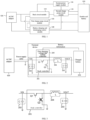
- FIG. 1 is a schematic structural diagram of the battery power supply adjusting circuit provided by the embodiment of the present disclosure.
- the battery power supply adjusting circuit is configured for charging a double-cell battery 010, and the battery power supply adjusting circuit may comprise a Buck circuit module 110, a first charge pump circuit module 120, a second charge pump circuit module 130, a battery charging and discharging control module 140 and a system power supply module 150.
- An input of the Buck circuit module 110 and an input of the first charge pump circuit module 120 are externally connected with an AC/DC adapter 020 respectively, a first output of the Buck circuit module 110 is connected with the second charge pump circuit module 130, a second output of the Buck circuit module 110 is connected with the system power supply module 150, the battery charging and discharging control module 140 is connected with a controlled end of the Buck circuit module 110, a controlled end of the first charge pump circuit module (120), a controlled end of the second charge pump circuit module 010 and the double-cell battery 010, the first charge pump circuit module 120 and the second charge pump circuit module 130 are respectively connected with the double-cell battery 010, and the second charge pump circuit module 130 is further connected with the system power supply module 150.
- the battery charging and discharging control module 140 is a control module for controlling the Buck circuit module 110, the first charge pump circuit module 120 and the second charge pump circuit module 130 to work in corresponding charging and discharging phases.
- the Buck circuit module 110 works in a trickle charging phase, a constant-voltage charging phase and a charging cut-off phase.
- the Buck circuit module is configured for supplying power to the system power supply module 150, and on the other hand, the Buck circuit module charges the dual-cell battery 010 after being boosted by the second charge pump circuit module 130.
- the first charge pump circuit module 120 works in a constant-current charging phase, and is a circuit module for making an output current of the first charge pump circuit module 120 smaller than an input current, and making an output voltage of the charge pump circuit module smaller than an input voltage.
- the second charge pump circuit module 130 works during discharging, and is a circuit module for converting a discharging voltage of the dual-cell battery 010 into a voltage suitable for the system power supply module 150.
- the "double-cell battery” may also be referred to as "battery" for short hereinafter.
- the charging phase of the battery may comprise the trickle charging phase, the constant-current charging phase, the constant-voltage charging phase and the charging cut-off phase.
- the trickle charging phase may be understood as a "pre-charging phase", which is a small current charging phase; the constant-current charging phase is a phase of charging with a constant current value, and in this phase, the charging voltage is gradually increased; the constant-voltage charging phase is a phase of charging with a constant voltage value, and in this phase, the charging current is gradually decreased; and in the charging cut-off phase, the charging current is gradually decreased, and the charging current decreased to a certain degree corresponds to a fully charged state of the battery.
- the charging current corresponds to reminding a user of full charge at this time.
- various circuit modules may cooperate to work in various phases as follows.
- a maximum constant current of 0.1 C may be used to charge the battery.
- the battery charging and discharging control module 140 may judge a port type of a power supply adapter (that is, the AC/DC adapter 020), and the port type may comprise, for example, a Standard Downstream Port (SDP), a Dedicated Charging Port (DCP), a Charging Downstream Port (CDP) or other ports known to those skilled in the art.
- SDP Standard Downstream Port
- DCP Dedicated Charging Port
- CDP Charging Downstream Port
- the port type of the AC/DC adapter 020 is the Standard Downstream Port (SDP)
- the port is a pluggable USB interface in a computer, with a through-flow current of 500 mA and a voltage of 5 V.
- the port type of the AC/DC adapter 020 is the Charging Downstream Port (CDP)
- the port is similar to a hub, and may be a hub with multiple interfaces, with a through-flow current of 1 A to 1.5 A and a voltage of 5 V. In the above two cases, an output voltage of the AC/DC adapter 020 is also 5 V.
- the battery charging and discharging control module 140 controls to: turn on the Buck circuit module 110 and the second charge pump circuit module 130 and turn off the first charge pump circuit module 120.
- the voltage is reduced by the Buck circuit module first, and on one hand, the Buck circuit module is configured for supplying power to the system power supply module 150; and on the other hand, the Buck circuit module charges the dual-cell battery 010 after being boosted by the second charge pump circuit module 130.
- the battery charging and discharging control module 140 When the port type of the AC/DC adapter 020 is the Dedicated Charging Port (DCP), the battery charging and discharging control module 140 will not carry out a boost control protocol with the AC/DC adapter 020, and the output voltage of the AC/DC adapter 020 is also 5 V.
- the battery charging and discharging control module 140 controls to: turn on the Buck circuit module and the second charge pump circuit module 130, and turn off the first charge pump circuit module 120. Therefore, the voltage is reduced by the Buck circuit module first, and on one hand, the Buck circuit module is configured for supplying power to the system power supply module 150; and on the other hand, the Buck circuit module charges the dual-cell battery 010 after being boosted by the second charge pump circuit module 130.
- DCP Dedicated Charging Port
- the battery charging and discharging control module 140 controls to: turn on the first charge pump circuit module 120, and the battery charging and discharging control module 140 will also carry out the boost control protocol with the AC/DC adapter 020 to control the AC/DC adapter 020 to output a dynamic voltage and a dynamic current to the first charge pump circuit module 120.
- the first charge pump circuit module 120 may carry out large current charging, and a working principle and a working process of the first charge pump circuit module 120 will be illustrated hereinafter with reference to the drawings.
- the Buck circuit module 110 is also continuously controlled to be turned on to supply power to the system power supply module 150.
- the second charge pump circuit module 130 is controlled to be turned on to distribute a part of the charging current. It can be understood that, because the Buck circuit module 110 has poor efficiency and high heat generation, the Buck circuit module 110 cannot distribute a large charging current, which determines that the second charge pump circuit module 130 can only distribute a part of the charging current.
- the charging current is smaller than the set current threshold
- the battery charging and discharging control module 140 does not need to carry out the boost control protocol with the AC/DC adapter 020, and the AC/DC adapter 020 is controlled to output a voltage value lower than the voltage of the battery, such as 5 V or 6 V.
- the battery charging and discharging control module 140 controls to: turn on the Buck circuit module 110 and the second charge pump circuit module 130 and turn off the first charge pump circuit module 120.
- the voltage is reduced by the Buck circuit module first, and on one hand, the Buck circuit module is configured for supplying power to the system power supply module 150; and on the other hand, the Buck circuit module charges the dual-cell battery 010 after being boosted by the second charge pump circuit module 130.
- the voltage threshold and the current threshold may be set on the basis of a charging requirement of the dual-cell battery, which will not be limited herein.
- the battery charging and discharging control module 140 controls to: turn on the second charge pump circuit module 130, and connect the dual-cell battery 010 and the system power supply module 150 through the second charge pump circuit module 130. Therefore, the second charge pump circuit module 130 is used to reduce the voltage and supply power to the system power supply module 150.
- the system power supply module 160 is mainly used to provide relevant power supply to the system, thus ensure the normal working of the system.
- the voltage is boosted by the second charge pump circuit module 130 to charge the dual-cell battery 010.
- the second charge pump circuit module 130 can reduce the output voltage of the dual-cell battery 010 to supply power to the system power supply module 150.
- the first charge pump circuit module 120 and the second charge pump circuit module 130 are arranged in the dual-cell battery power supply adjusting circuit provided by the embodiment of the present disclosure, wherein, in the trickle charging phase, the constant-voltage charging phase and the charging cut-off phase, because the current is small and heat generation is low, the Buck circuit module 110 is used to reduce the voltage first, on one hand, power is supplied to the system power supply module 150, and on the other hand, the voltage is boosted by the second charge pump circuit module 130 to charge the dual-cell battery 010.
- the first charge pump circuit module 120 is used to control the charging current, thus making the output current of the first charge pump circuit module greater than the input current, so that the current transmitted on the charging cable can be reduced when large current charging is realized, and because the charging cable has certain impedance, based on a power calculation formula I 2 R, the power corresponds to the heat generation; and when the current is reduced, the heat generation is also reduced, which can reduce the heat generation on the charging cable, and similarly, the heat generation on a charging chip and a PCB can be reduced, that is, the heat generation on the whole charging circuit can be reduced, thus ensuring high charging efficiency.
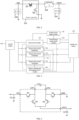
- FIG 2 is a schematic structural diagram of a connection relationship of the Buck circuit module provided by the embodiment of the present disclosure in the battery power supply adjusting circuit, which shows a specific structure of the Buck circuit module.
- the Buck circuit module 110 comprises a Buck controller 201, an input capacitor 202, an output capacitor 203, an output inductance 204 and a charging voltage and current controller 205, and the Buck controller 201 comprises a first transistor Q1 and a second transistor Q2.
- Battery information of a being charged battery 030 is transmitted to the charging voltage and current controller 205, the first transistor Q1 and the output inductance 204 are connected in series between the AC/DC adapter 020 and the being charged battery 030, the input capacitor 202 is connected in series between an input of the first transistor Q1 and the ground, the output capacitor 203 is connected in series between an output of the output inductance 204 and the ground, one end of the second transistor Q2 is connected between the first transistor Q1 and the output inductance 204, and the other end of the second transistor is grounded.
- the first transistor Q1 is turned on and the second transistor Q2 is turned off; and during discharging of the output inductance 204, the first transistor Q1 is turned off and the second transistor Q2 is turned on.
- the Buck circuit module 110 may comprise a Buck topological structure, which is also called a Buck voltage reduction circuit or a Buck circuit, and the Buck circuit mainly comprises the Buck controller 201, the input capacitor 202, the output capacitor 203 and the output inductance 204; that is, the input capacitor 202, the output capacitor 203, the output inductance 204 and the Buck controller 201 constitute the Buck circuit.
- the charging voltage and current controller 205 is configured for controlling a voltage and a current which change in a zigzag manner with time.
- the Buck circuit is a main loop of power supply conversion in the whole battery power supply adjusting circuit, so that the charging current, the charging efficiency and the heat generation are all determined by circuit components in the Buck circuit.
- a basic working principle of the Buck circuit comprises two phases as follows.
- a phase 1 which is namely the charging phase of the output inductance 204, with reference to FIG 3 , the first transistor Q1 is turned on and the second transistor Q2 is turned off, and the output inductance 204 is charged.
- the first transistor Q1, the output inductance 204 and the being charged battery 030 form the main loop, and the main current of the circuit may flow through the first transistor Q1, the output inductance 204 and the being charged battery 030.
- a phase 2 which is namely the discharging phase of the output inductance 204, with reference to FIG 4 , the first transistor Q1 is turned off and the second transistor Q2 is turned on, and the output inductance 204 is discharged.
- the second transistor Q2, the output inductance 204 and the being charged battery 030 form the main loop, and the main current of the circuit may flow through the second transistor Q2, the output inductance 204 and the being charged battery 030.
- the being charged battery 030 may be a battery in the system power supply module 150 or a battery in the dual-cell battery 010. If the being charged battery is the battery in the dual-cell battery, the main loop formed above further comprises the second charge pump circuit module 130 connected between the being charged battery 030 and the output inductance 204.
- the first transistor Q1 and the second transistor Q2 may have a conduction loss and a switching loss, and the output inductance 204 may have a coil loss and a core loss, so that the whole Buck circuit cannot achieve very high efficiency.
- the conversion efficiency in the voltage reduction circuit applying the Buck circuit is below 91%.
- energy lost by main power devices, comprising the first transistor Q1, the second transistor Q2 and the output inductance 204 is basically converted into heat energy, so that there is high heat generation when the Buck circuit is used in the charging process, leading to the case that the whole Buck circuit cannot achieve very large charging current.
- the Buck circuit may be suitable for converting a voltage at the input into a voltage suitable for the system power supply module 150, and charging the dual-cell battery 010 in combination with the second charge pump circuit module 130 in a small current charging phase, so as to be beneficial for avoiding excessive heat generation in a large current charging process, thus avoiding affecting the charging efficiency.
- FIG 5 is a schematic structural diagram of another battery power supply adjusting circuit provided by the embodiment of the present disclosure, in which the first charge pump circuit module is detailed on the basis of FIG 1 .
- the first charge pump circuit module 120 comprises N charge pump circuit submodules 125 arranged in parallel; N ⁇ 1 and N is an integer; and controlled ends of the N charge pump circuit submodules 125 are respectively connected with the battery charging and discharging control module 140.
- a suitable charging current range of a single charge pump circuit submodule 125 may be 4 A to 6 A.
- a plurality of charge pump circuit submodules 125 are arranged in parallel, so that the first charge pump circuit module 120 suitable the large charging current can be constituted. That is, in practical application, a quantity of parallel charge pump circuit submodules 125 may be selected according to the charging current, and the larger the charging current, the greater the quantity of the charge pump circuit submodules 125, so that the power supply conversion efficiency of the whole charging scheme can be improved and the heat generation can be reduced.
- the charging current is 8 A to 10 A
- two charge pump circuit submodules 125 are arranged in parallel in the first charge pump circuit module 120, and each charge pump circuit submodule 125 shares the charging current of 4 A to 5 A
- the charging current is 20 A
- four charge pump circuit submodules 125 are arranged in parallel in the first charge pump circuit module 120, and each charge pump circuit submodule 125 shares the charging current of 5 A.
- the charge pump circuit submodule may be a 1/2 buck charge pump, which will be illustrated hereinafter with reference to FIG 6 to FIG 8 ; and may also be a 1/3 buck charge pump, which will be illustrated hereinafter with reference to FIG 9 to FIG 11 .
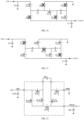
- FIG 6 is a schematic structural diagram of the charge pump circuit submodule provided by the embodiment of the present disclosure.
- the charge pump circuit submodule 125 comprises a first capacitor C1, a second capacitor C2, a third capacitor C3, a third transistor Q3, a fourth transistor Q4, a fifth transistor Q5 and a sixth transistor Q6.
- the third transistor Q3 and the fifth transistor Q5 are turned on, and the fourth transistor Q4 and the sixth transistor Q6 are turned off.
- the fourth transistor Q4 and the sixth transistor Q6 are turned on, and the third transistor Q3 and the fifth transistor Q5 are turned off.
- the voltage is reduced only by switching between the capacitors turned on, so that there is no energy loss caused by the inductor, thus making the conversion efficiency of the whole circuit structure high. Because the conversion efficiency of the whole circuit structure is higher, there are a low noise (that is, an input noise and an output noise, which corresponds to a fluctuation caused by inductive switching, and is related to internal switching control), a small fluctuation of an electrical signal, and a small electromagnetic interference (EMI).
- EMI electromagnetic interference
- the charge pump circuit submodule 125 in the embodiment of the present disclosure is the 1/2 buck charge pump, with an input voltage being twice an output voltage and an input current being a half of an output current.
- the 1/2 buck charge pump comprises four transistors and three capacitors. The capacitors are connected in series and in parallel by controlling the transistors to be turned on and off, so as to reduce the voltage, which will be illustrated hereinafter with reference to FIG 7 and FIG 8 .
- a basic working principle of the 1/2 buck charge pump comprises two phases as follows.
- a phase 1 which is namely the series connection phase of the capacitors, or called a capacitor charging phase, as shown in FIG 7 , only the third transistor Q3 and the fifth transistor Q5 are turned on, the first capacitor C1 and the second capacitor C2 are connected in series, and the two capacitors are both charged at a charging voltage approximately equal to a half of an input voltage, that is, VIN/2.
- FIG 6 to FIG 8 a circuit structure and a working principle of the 1/2 buck charge pump are illustrated hereinafter, and with reference to FIG 9 to FIG 11 , a circuit structure and a working principle of the 1/3 buck charge pump are illustrated hereinafter.
- FIG 9 is a schematic structural diagram of another charge pump circuit submodule provided by the embodiment of the present disclosure.
- the charge pump circuit submodule 125 comprises a fourth capacitor C4, a fifth capacitor C5, a sixth capacitor C6, a seventh capacitor C7, a seventh transistor Q7, an eighth transistor Q8, a ninth transistor Q9, a tenth transistor Q10, an eleventh transistor Q11, a twelfth transistor Q12 and a thirteenth transistor Q13.
- One end of the fourth capacitor C4 and an input of the seventh transistor Q7 are both connected with the AC/DC adapter 020, the other end of the fourth capacitor C4 is grounded, an output of the seventh transistor Q7 and an input of the eighth transistor Q8 are both connected with one end of the fifth capacitor C5, the other end of the fifth capacitor C5 is connected with an input of the ninth transistor Q9 and an input of the tenth transistor Q10, an output of the ninth transistor Q9 and an output of the thirteenth transistor Q13 are both grounded, an input of the thirteenth transistor Q13 and an output of the twelfth transistor Q12 are both connected with one end of the sixth capacitor C6, the other end of the sixth capacitor C6 is connected with an output of the tenth transistor Q10 and an output of the eleventh transistor Q11, an output of the eighth transistor Q8, an input of the eleventh transistor Q11, an input of the twelfth transistor Q12 and one end of the seventh capacitor C7 are all connected with the double-cell battery 010, and the other end of the seventh capacitor C7 is
- the voltage is reduced only by switching between the capacitors turned on, so that there is no energy loss caused by the inductor, thus making the conversion efficiency of the whole circuit structure high. Because the conversion efficiency of the whole circuit structure is higher, there are a low noise (that is, an input noise and an output noise, which corresponds to a fluctuation caused by inductive switching, and is related to internal switching control), a small fluctuation of an electrical signal, and a small electromagnetic interference (EMI).
- EMI electromagnetic interference
- the charge pump circuit submodule 125 in the embodiment of the present disclosure is the 1/3 buck charge pump, with an input voltage being three times an output voltage and an input current being one third of an output current.
- the 1/3 buck charge pump comprises seven transistors and four capacitors. The capacitors are connected in series and in parallel by controlling the transistors to be turned on and off, so as to reduce the voltage, which will be illustrated hereinafter with reference to FIG 10 and FIG 11 .
- a circuit working principle of the 1/3 buck charge pump comprises two phases as follows.
- a phase 1 which is namely the series connection phase of the capacitors, or called the capacitor charging phase, as shown in FIG 10 , the seventh transistor Q7, the tenth transistor Q10 and the twelfth transistor Q12 are all connected, that is, turned on; and other transistors are disconnected, that is, turned off; and at this time, the fifth capacitor C5, the sixth capacitor C6 and the seventh capacitor C7 are connected in series, and the three capacitors are all charged at a charging voltage approximately equal to one third of an input voltage, that is, 1/ 3VIN.
- a phase 2 which is namely the parallel connection phase of the capacitors, or called the capacitor discharging phase, as shown in FIG 11 , the eighth transistor Q8, the ninth transistor Q9, the eleventh transistor Q11 and the thirteenth transistor Q13 are all connected, that is, turned on; and other transistors are disconnected, that is, turned off; and at this time, the fifth capacitor C5, the sixth capacitor C6 and the seventh capacitor C7 are connected in parallel, and the three capacitors are all discharged, wherein an output voltage VOUT is equal to a discharging voltage of two ends of the seventh capacitor C7, and is also equal to the charging voltage in the phase 1, that is, 1/ 3VIN. Therefore, the voltage is reduced.
- the input current of the 1/3 buck charge pump is one third of the output current and the input current of the 1/2 buck charge pump is a half of the output current
- the input current corresponding to the 1/3 buck charge pump is further reduced by 1/3 compared with the input current of the 1/2 buck charge pump at the same output current, so as to greatly reduce the heat generation on the charging cable, the heat generation on the charging chip and the heat generation on the PCB, and ensuring high charging efficiency.
- the output current of the 1/3 buck charge pump may be larger than that of the 1/2 buck charge pump at the same input current, that is, a larger charging current may be achieved, thus improving charging efficiency and shortening charging time.
- the charge pump circuit submodule may also be a buck charge pump of other multiples, which will not be limited herein.
- the second charge pump circuit module is illustrated hereinafter.
- FIG 12 is a schematic structural diagram of the second charge pump circuit module provided by the embodiment of the present disclosure.
- the second charge pump circuit module 130 comprises an eighth capacitor C8, a ninth capacitor C9, a tenth capacitor C10, a fourteenth transistor Q14, a fifteenth transistor Q15, a sixteenth transistor Q16, a seventeenth transistor Q17, an eighteenth transistor Q18 and a nineteenth transistor Q19.
- One end of the eighth capacitor C8 is connected with an output of the fourteenth transistor Q14 and an input of the fifteenth transistor Q15, the other end of the eighth capacitor C8 is connected with an output of the sixteenth transistor Q16 and an input of the seventeenth transistor Q17, an output of the seventeenth transistor Q17 is grounded, an input of the fourteenth transistor Q14, an input of the eighteenth transistor Q18 and one end of the tenth capacitor C10 are all connected with the AC/DC adapter 020, the other end of the tenth capacitor C10 is grounded, an output of the eighteenth transistor Q18 and an output of the fifteenth transistor Q15 are both connected with an input of the nineteenth transistor Q19, an input of the sixteenth transistor Q16, an output of the nineteenth transistor Q19 and one end of the ninth capacitor C9 are all connected with the double-cell battery 010, and the other end of the ninth capacitor C9 is grounded.
- the working phase of the second charge pump circuit module 130 comprises a first charging phase and a first discharging phase.
- the fourteenth transistor Q14 and the seventeenth transistor Q17 are turned on, and the fifteenth transistor Q15, the sixteenth transistor Q16, the eighteenth transistor Q18 and the nineteenth transistor Q19 are turned off.
- the fifteenth transistor Q15, the sixteenth transistor Q16 and the eighteenth transistor Q18 are turned on, and the fourteenth transistor Q14, the seventeenth transistor Q17 and the nineteenth transistor Q19 are turned off.
- the working phase of the second charge pump circuit module 130 comprises a second charging phase and a second discharging phase.
- the fourteenth transistor Q14 and the sixteenth transistor Q16 are turned on, and the fifteenth transistor Q15, the seventeenth transistor Q17, the eighteenth transistor Q18 and the nineteenth transistor Q19 are turned off.
- the fifteenth transistor Q15, the seventeenth transistor Q17 and the nineteenth transistor Q19 are turned on, and the fourteenth transistor Q14, the sixteenth transistor Q16 and the eighteenth transistor Q18 are turned off.
- the voltage is boosted inside the second charge pump circuit module 130 during the trickle charging phase, the constant-voltage charging phase and the charging cut-off phase in the charging process, and the output voltage of the Buck circuit module 110 is converted into a voltage suitable for charging the dual-cell battery 010; and the voltage is reduced inside the second charge pump circuit module during the discharging phase, and the output voltage of the dual-cell battery 010 is converted into a voltage suitable for supplying power to the system power supply module 150.
- the second charge pump circuit module 130 is composed of six transistors and three capacitors.
- the capacitors are charged and discharged by controlling the transistors to be turned on and turned off, thus reducing the voltage and boosting the voltage.
- the voltage is boosted inside the second charge pump circuit module 130, that is, the output voltage is greater than the input voltage, for example, the output voltage is approximately equal to twice the input voltage.
- a corresponding working principle of the voltage boosting process is as follows.
- phase 1 which is namely a first charging phase of the second charge pump circuit module, as shown in FIG 13 , the fourteenth transistor Q14 and the seventeenth transistor Q17 are turned on, and other transistors are all disconnected, that is, turned off; and at this time, the eighth capacitor C8 is charged, and the voltage of the eighth capacitor C8 is approximately equal to the input voltage, that is, VIN.
- the voltage is reduced inside the second charge pump circuit module, that is, the output voltage is smaller than the input voltage, for example, the output voltage is approximately equal to a half of the input voltage.
- a corresponding working principle of the voltage reducing process is as follows.
- phase 3 which is namely a second charging phase of the second charge pump circuit module, as shown in FIG 15 , the fourteenth transistor Q14 and the seventeenth transistor Q16 are turned on, and other transistors are all disconnected, that is, turned off; and at this time, the eighth capacitor C8 and the ninth capacitor C9 are connected in series, the two capacitors are both charged, and the voltages on the eighth capacitor C8 and the ninth capacitor C9 are both equal to a half of the input voltage, that is, VIN/2.
- phase 4 which is namely a second discharging phase of the second charge pump circuit module, as shown in FIG 16 , the fifteenth transistor Q15, the seventeenth transistor Q17 and the nineteenth transistor Q19 are turned on, and other transistors are all disconnected, that is, turned off; and at this time, the eighth capacitor C8 and the ninth capacitor C9 are connected in parallel, the two capacitors are both discharged, and the output voltage is equal to the charging voltage of the ninth capacitor C9, that is, the output voltage VOUT is equal to the VIN/2. Therefore, the voltage is reduced.
- the transistors in various circuit modules or submodules may all be a metal-oxide-semiconductor field-effect transistor (MOSFET), or other switching tubes known to those skilled in the art, or other types of switches, which will not be limited herein.
- MOSFET metal-oxide-semiconductor field-effect transistor
- the dual-cell battery power supply adjusting circuit provided by the embodiment of the present disclosure can solve the problem that charging power of a single-cell battery cannot be greater. Specifically, when the double-cell battery is charged, a charging voltage of the double-cell battery is twice a charging voltage of the single-cell battery, and in the case of the same charging circuit, greater charging power can be realized. For example, charging power of 50 W, 60 W, 100 W or higher can be achieved.
- a charging current of the battery is a half of a current of the single-cell battery at the same charging power of the battery.
- heat generation of a circuit board of the double-cell battery is obviously reduced, thus greatly reducing the heat generation, and in the case of constant output power, an impedance requirement of a battery connector is reduced due to the reduction of the current, which is beneficial for reducing a cost.
- the reduction of the heat generation is beneficial for providing safety.
- the wiring and heat dissipation of the printed circuit board (PCB) of the battery will be relatively easy.
- the embodiment of the present disclosure further provides a battery power supply adjusting method, which is executed based on the battery power supply adjusting circuit according to any one of the embodiments above, thus having corresponding beneficial effects.
- FIG 17 is a flow chart of the battery power supply adjusting method provided by the embodiment of the present disclosure.
- the battery power supply adjusting method may comprise:
- the battery charging and discharging control module controls the first charge pump circuit module to be turned on, the battery charging and discharging control module will also carry out the boost control protocol with the AC/DC adapter, and control the AC/DC adapter to output a dynamic voltage and a dynamic current to the first charge pump circuit module to charge the dual-cell battery, so as to realize large current charging.
- the battery charging and discharging control module controls the second charge pump circuit module to reduce the voltage to supply power to the system power supply module.
- the judging the charging and discharging phases of the dual-cell battery based on the charging voltage and the charging current comprises:
- the identification of the port type of the AC/DC adapter may assist in determining the voltage threshold and the current threshold, so as to compare the voltage threshold and the current threshold with the charging current and the charging voltage collected in real time, thus determining the charging and discharging phases of the dual-cell battery.
- the embodiment of the present disclosure further provides a charging cable, which comprises the battery power supply adjusting circuit according to any one of the embodiments above.
- the battery power supply adjusting circuit above may be arranged at one end of the charging cable which is arranged to be connected with the double-cell battery. Therefore, a small current may flow through most cable of the charging cable to reduce the heat generation on the cable, thus reducing the loss of the cable.
- the embodiment of the present disclosure further provides a terminal device, which comprises a dual-cell battery, wherein the dual-cell battery is charged by the battery power supply adjusting circuit according to any one of the embodiments above, or charged utilizing the battery power supply adjusting method according to any one of the embodiments above, or charged on the basis of the charging cable according to any one of the embodiments above, thus achieving corresponding beneficial effects.
- the battery power supply adjusting circuit may also be arranged in the terminal device and connected with the AC/DC adapter through the charging cable. At this time, there is no battery power supply adjusting circuit in the charging cable, which simplifies a structure of the charging cable.
- the terminal device may be a mobile phone, a tablet, a mobile computer or other rechargeable terminal devices known to those skilled in the art, which will not be limited herein.
- the first charge pump circuit module and the second charge pump circuit module are arranged in the dual-cell battery power supply adjusting circuit provided by the present disclosure, wherein, in the trickle charging phase, the constant-voltage charging phase and the charging cut-off phase, because the current is small and the heat generation is low, the Buck circuit module is used to reduce the voltage first, on one hand, power is supplied to the system power supply module, and on the other hand, the voltage is boosted by the second charge pump circuit module to charge the dual-cell battery.
- the first charge pump circuit module is used to control the charging current, thus making the output current of the first charge pump circuit module greater than the input current, so that the current transmitted on the charging cable can be reduced when large current charging is realized, and because the charging cable has certain impedance, based on a power calculation formula I 2 R, the power corresponds to the heat generation; and when the current is reduced, the heat generation is also reduced, which can reduce the heat generation on the charging cable, and similarly, the heat generation on a charging chip and a PCB can be reduced, that is, the heat generation on the whole charging circuit can be reduced, thus ensuring high charging efficiency, thus having very strong industrial practicability.
Landscapes
- Engineering & Computer Science (AREA)
- Power Engineering (AREA)
- Charge And Discharge Circuits For Batteries Or The Like (AREA)
- Secondary Cells (AREA)
Abstract
Description
- The present disclosure relates to the technical field of battery charging, and particularly to a battery power supply adjusting circuit and method, a charging cable and a terminal device.
- A rechargeable battery is rechargeable, has limited charging times, and may be used with a recharger. By charging the battery, the battery is reusable, which is beneficial for meeting the needs of economy and environmental protection. A charging process of the battery is a reverse process of a discharging process, and is specifically a process of converting electric energy into chemical energy stored in the battery.
- At present, in a terminal device, a single-cell battery is mainly used for charging. However, when the single-cell battery is fully charged, a voltage of the single-cell battery is about 4.5 V, and when a charging current exceeds 8 A, a circuit board of a battery end will generate heat seriously. Therefore, a battery connector usually needs to be replaced with a battery connector with smaller impedance and larger current flow, which leads to an increase in hardware cost; and meanwhile, wiring and heat dissipation in the circuit board of the battery end will be more difficult. In order to meet the heat dissipation demand, the charging power of the battery end of the single-cell battery is about 36 W, which leads to low charging efficiency.
- The technical problem to be solved by the present disclosure is to solve the problem of low charging efficiency caused by charging of an existing single-cell battery.
- In order to solve the above technical problem, an embodiment of the present disclosure provides a battery power supply adjusting circuit and method, a charging cable and a terminal device, which can improve charging efficiency.
- In a first aspect, the present disclosure provides a battery power supply adjusting circuit, which is configured for charging a double-cell battery, wherein the circuit comprises a Buck circuit module, a first charge pump circuit module, a second charge pump circuit module, a battery charging and discharging control module and a system power supply module;
- an input of the Buck circuit module and an input of the first charge pump circuit module are externally connected with an AC/DC adapter respectively, a first output of the Buck circuit module is connected with the second charge pump circuit module, a second output of the Buck circuit module is connected with the system power supply module, the battery charging and discharging control module is connected with a controlled end of the Buck circuit module, a controlled end of the first charge pump circuit module, a controlled end of the second charge pump circuit module and the double-cell battery, the first charge pump circuit module and the second charge pump circuit module are respectively connected with the double-cell battery, and the second charge pump circuit module is further connected with the system power supply module;
- the battery charging and discharging control module is a control module for controlling the Buck circuit module, the first charge pump circuit module and the second charge pump circuit module to work during charging and discharging;
- the Buck circuit module works in a trickle charging phase, a constant-voltage charging phase and a charging cut-off phase; and on one hand, the Buck circuit module is configured for supplying power to the system power supply module, and on the other hand, the Buck circuit module charges the dual-cell battery after being boosted by the second charge pump circuit module;
- the first charge pump circuit module works in a constant-current charging phase, and is a circuit module for making an output current of the first charge pump circuit module smaller than an input current, and making an output voltage of the charge pump circuit module smaller than an input voltage; and
- the second charge pump circuit module works during discharging, and is a circuit module for converting a discharging voltage of the dual-cell battery into a voltage suitable for the system power supply module.
- In some embodiments, the Buck circuit module comprises a Buck controller, an input capacitor, an output capacitor, an output inductance and a charging voltage and current controller, and the Buck controller comprises a first transistor and a second transistor;
- battery information of a being charged battery is transmitted to the charging voltage and current controller, the first transistor and the output inductance are connected in series between the AC/DC adapter and the being charged battery, the input capacitor is connected in series between an input of the first transistor and the ground, the output capacitor is connected in series between an output of the output inductance and the ground, one end of the second transistor is connected between the first transistor and the output inductance, and the other end of the second transistor is grounded; and the being charged battery is a battery in the dual-cell battery or a battery in the power supply system module;
- during charging of the output inductance, the first transistor is turned on and the second transistor is turned off; and
- during discharging of the output inductance, the first transistor is turned off and the second transistor is turned on.
- In some embodiments, the first charge pump circuit module comprises N charge pump circuit submodules arranged in parallel; N≥1 and N is an integer; and
controlled ends of the N charge pump circuit submodules are respectively connected with the battery charging and discharging control module. - In some embodiments, the charge pump circuit submodule comprises a first capacitor, a second capacitor, a third capacitor, a fourth transistor, a fifth transistor and a sixth transistor;
- an input of the third transistor and one end of the third capacitor are connected with the AC/DC adapter, the other end of the third capacitor is grounded, an output of the third transistor and an input of the fourth transistor are both connected with a first end of the first capacitor, the other end of the first capacitor is connected with an input of the sixth transistor and an output of the fifth transistor, an output of the sixth transistor is grounded, an output of the fourth transistor, an input of the fifth transistor and one end of the second capacitor are all connected with the double-cell battery, and the other end of the second capacitor is grounded;
- in a series connection phase of the capacitors, the third transistor and the fifth transistor are turned on, and the fourth transistor and the sixth transistor are turned off; and
- in a parallel connection phase of the capacitors, the fourth transistor and the sixth transistor are turned on, and the third transistor and the fifth transistor are turned off.
- In some embodiments, the charge pump circuit submodule comprises a fourth capacitor, a fifth capacitor, a sixth capacitor, a seventh capacitor, a seventh transistor, an eighth transistor, a ninth transistor, a tenth transistor, an eleventh transistor, a twelfth transistor and a thirteenth transistor;
- one end of the fourth capacitor and an input of the seventh transistor are both connected with the AC/DC adapter, the other end of the fourth capacitor is grounded, an output of the seventh transistor and an input of the eighth transistor are both connected with one end of the fifth capacitor, the other end of the fifth capacitor is connected with an input of the ninth transistor and an input of the tenth transistor, an output of the ninth transistor and an output of the thirteenth transistor are both grounded, an input of the thirteenth transistor and an output of the twelfth transistor are both connected with one end of the sixth capacitor, the other end of the sixth capacitor is connected with an output of the tenth transistor and an output of the eleventh transistor, an output of the eighth transistor, an input of the eleventh transistor, an input of the twelfth transistor and one end of the seventh capacitor are all connected with the double-cell battery, and the other end of the seventh capacitor is grounded;
- in a series connection phase of the capacitors, the seventh transistor, the tenth transistor and the twelfth transistor are turned on, and the eighth transistor, the ninth transistor, the eleventh transistor and the thirteenth transistor are turned off; and
- in a parallel connection phase of the capacitors, the eighth transistor, the ninth transistor, the eleventh transistor and the thirteenth transistor are turned on, and the seventh transistor, the tenth transistor and the twelfth transistor are turned off.
- In some embodiments, the second charge pump circuit module comprises an eighth capacitor, a ninth capacitor, a tenth capacitor, a fourteenth transistor, a fifteenth transistor, a sixteenth transistor, a seventeenth transistor, an eighteenth transistor and a nineteenth transistor;
- one end of the eighth capacitor is connected with an output of the fourteenth transistor and an input of the fifteenth transistor, the other end of the eighth capacitor is connected with an output of the sixteenth transistor and an input of the seventeenth transistor, an output of the seventeenth transistor is grounded, an input of the fourteenth transistor, an input of the eighteenth transistor and one end of the tenth capacitor are all connected with the AC/DC adapter, the other end of the tenth capacitor is grounded, an output of the eighteenth transistor and an output of the fifteenth transistor are both connected with an input of the nineteenth transistor, an input of the sixteenth transistor, an output of the nineteenth transistor and one end of the ninth capacitor are all connected with the double-cell battery, and the other end of the ninth capacitor is grounded;
- during charging of the dual-cell battery, the working phase of the second charge pump circuit module comprises a first charging phase and a first discharging phase;
- in the first charging phase, the fourteenth transistor and the seventeenth transistor are turned on, and the fifteenth transistor, the sixteenth transistor, the eighteenth transistor and the nineteenth transistor are turned off;
- in the first discharging phase, the fifteenth transistor, the sixteenth transistor and the eighteenth transistor are turned on, and the fourteenth transistor, the seventeenth transistor and the nineteenth transistor are turned off;
- during discharging of the dual-cell battery, the working phase of the second charge pump circuit module comprises a second charging phase and a second discharging phase;
- in the second charging phase, the fourteenth transistor and the sixteenth transistor are turned on, and the fifteenth transistor, the seventeenth transistor, the eighteenth transistor and the nineteenth transistor are turned off; and
- in the second discharging phase, the fifteenth transistor, the seventeenth transistor and the nineteenth transistor are turned on, and the fourteenth transistor, the sixteenth transistor and the eighteenth transistor are turned off.
- In a second aspect, the present disclosure further provides a battery power supply adjusting method, which is executed based on the battery power supply adjusting circuit according to any one of the embodiments above, wherein the method comprises:
- collecting, by the battery charging and discharging control module, a charging voltage and a charging current of the dual-cell battery in real time, and judging the charging and discharging phases of the dual-cell battery based on the charging voltage and the charging current;
- in the trickle charging phase, controlling, by the battery charging and discharging control module, the Buck circuit module and the second charge pump circuit module to be turned on to work, wherein the second charge pump circuit module plays a boosting role;
- in the constant-current charging phase, controlling, by the battery charging and discharging control module, the first charge pump circuit module to be turned on to work to make the output current of the first charge pump circuit module smaller than the input current, and make the output voltage of the first charge pump circuit module smaller than the input voltage;
- in the constant-voltage charging phase and the charging cut-off phase, controlling, by the battery charging and discharging control module, the first charge pump circuit module to be turned off; and
- in the discharging phase, controlling, by the battery charging and discharging control module, the second charge pump circuit module to be turned on to convert the discharging voltage of the dual-cell battery into the voltage suitable for the system power supply module.
- In some embodiments, the judging the charging and discharging phases of the dual-cell battery based on the charging voltage and the charging current, comprises:
- identifying, by the charging and discharging control module, a port type of the AC/DC adapter to determine a voltage threshold and a current threshold; and
- comparing, by the charging and discharging control module, the charging voltage collected in real time with the voltage threshold, and comparing the charging current collected in real time with the current threshold to determine the charging and discharging phases of the dual-cell battery.
- In a third aspect, the present disclosure further provides a charging cable, which comprises the battery power supply adjusting circuit according to any one of the embodiments above.
- In a forth aspect, the present disclosure further provides a terminal device, which comprises a dual-cell battery, wherein the dual-cell battery is charged by the battery power supply adjusting circuit according to any one of the embodiments above, or charged utilizing the battery power supply adjusting method according to any one of the embodiments above, or charged on the basis of the charging cable according to any one of the embodiments above.
- Compared with the prior art, the above technical solution provided by the embodiment of the present disclosure has the following advantages.
- The first charge pump circuit module and the second charge pump circuit module are arranged in the dual-cell battery power supply adjusting circuit provided by the embodiment of the present disclosure, wherein, in the trickle charging phase, the constant-voltage charging phase and the charging cut-off phase, because the current is small and heat generation is low, the Buck circuit module is used to reduce the voltage first, on one hand, power is supplied to the system power supply module, and on the other hand, the voltage is boosted by the second charge pump circuit module to charge the dual-cell battery. In the constant-current charging phase, the first charge pump circuit module is used to control the charging current, thus making the output current of the first charge pump circuit module greater than the input current, so that the current transmitted on the charging cable can be reduced when large current charging is realized, and because the charging cable has certain impedance, based on a power calculation formula I2R, the power corresponds to the heat generation; and when the current is reduced, the heat generation is also reduced, which can reduce the heat generation on the charging cable, and similarly, the heat generation on a charging chip and a PCB can be reduced, that is, the heat generation on the whole charging circuit can be reduced, thus ensuring high charging efficiency.
- It should be understood that, the above general description and the following detailed description are exemplary and explanatory only, and cannot limit the present disclosure.
- The drawings herein are incorporated into the specification and constitute a part of the specification, show the embodiments that conform to the present disclosure, and are used for explaining the principle of the present disclosure together with the specification.
- In order to illustrate the embodiments of the present disclosure or the technical solutions in the prior art more clearly, the drawings needed to be used in the description of the embodiments or the prior art will be briefly introduced hereinafter. Obviously, for those of ordinary skills in the art, other drawings may also be obtained according to these drawings without going through creative works.
-
FIG 1 is a schematic structural diagram of a battery power supply adjusting circuit provided by an embodiment of the present disclosure; -
FIG 2 is a schematic structural diagram of a connection relationship of a Buck circuit module provided by the embodiment of the present disclosure in the battery power supply adjusting circuit; -
FIG 3 is a state diagram of an inductor during charging in the Buck circuit module provided by the embodiment of the present disclosure; -
FIG 4 is a state diagram of the inductor during discharging in the Buck circuit module provided by the embodiment of the present disclosure; -
FIG 5 is a schematic structural diagram of another battery power supply adjusting circuit provided by the embodiment of the present disclosure; -
FIG 6 is a schematic structural diagram of a first charge pump circuit module provided by the embodiment of the present disclosure; -
FIG 7 is a state diagram of the first charge pump circuit module shown inFIG 6 in a series connection phase of capacitors; -
FIG 8 is a state diagram of the first charge pump circuit module shown inFIG 6 in a parallel connection phase of the capacitors; -
FIG 9 is a schematic structural diagram of another first charge pump circuit module provided by the embodiment of the present disclosure; -
FIG 10 is a state diagram of the first charge pump circuit module shown inFIG 9 in the series connection phase of the capacitors; -
FIG 11 is a state diagram of the first charge pump circuit module shown inFIG 9 in the parallel connection phase of the capacitors; -
FIG 12 is a schematic structural diagram of a second charge pump circuit module provided by the embodiment of the present disclosure; -
FIG 13 is a state diagram of the second charge pump circuit module shown inFIG 12 when a cell is during charging and a charge pump is during charging; -
FIG. 14 is a state diagram of the second charge pump circuit module shown inFIG 12 when the cell is in the charging phase and the charge pump is during discharging; -
FIG. 15 is a state diagram of the second charge pump circuit module shown inFIG 12 when the cell is during discharging and the charge pump is in the charging phase; -
FIG. 16 is a state diagram of the second charge pump circuit module shown inFIG 12 when the cell is in the discharging phase and the charge pump is in the discharging phase; and -
FIG. 17 is a flow chart of a battery power supply adjusting method provided by the embodiment of the present disclosure. - In the drawings, 010 refers to double-cell battery; 020 refers to AC/DC adapter; 110 refers to Buck circuit module, 120 refers to first charge pump circuit module; 125 refers to charge pump circuit submodule; 130 refers to second charge pump circuit module; 140 refers to battery charging and discharging control module; 150 refers to system power supply module; 201 refers to Buck controller; 202 refers to input capacitor; 203 refers to output capacitor; 204 refers to output inductance; 205 refers to charging voltage and current controller; C1 refers to first capacitor; C2 refers to second capacitor; C3 refers to third capacitor; C4 refers to fourth capacitor; C5 refers to fifth capacitor; C6 refers to sixth capacitor; C7 refers to seventh capacitor; C8 refers to eighth capacitor; C9 refers to ninth capacitor; C10 refers to tenth capacitor; Q1 refers to first transistor; Q2 refers to second transistor; Q3 refers to third transistor; Q4 refers to fourth transistor; Q5 refers to fifth transistor; Q6 refers to sixth transistor; Q7 refers to seventh transistor; Q8 refers to eighth transistor; Q9 refers to ninth transistor; Q10 refers to tenth transistor; Q11 refers to eleventh transistor; Q12 refers to twelfth transistor; Q13 refers to thirteenth transistor; Q14 refers to fourteenth transistor; Q15 refers to fifteenth transistor; Q16 refers to sixteenth transistor; Q17 refers to seventeenth transistor; Q18 refers to eighteenth transistor; and Q19 refers nineteenth transistor.
- In order to make objects, technical solutions, and advantages of embodiments of the present disclosure more clearly, a technical solution in the embodiments of the present disclosure will be described clearly and completely hereinafter. Obviously, the described embodiments are some, but not all, embodiments of the present disclosure. Based on the embodiments in the present disclosure, all other embodiments obtained by those of ordinary skills in the art without going through creative works fall within the scope of protection of the present disclosure.
- A first charge pump circuit module and a second charge pump circuit module are arranged in a dual-cell battery power supply adjusting circuit provided by an embodiment of the present disclosure, wherein, in a trickle charging phase, a constant-voltage charging phase and a charging cut-off phase, because a current is small and heat generation is low, a Buck circuit module is used to reduce a voltage first, on one hand, power is supplied to a system power supply module, and on the other hand, the voltage is boosted by the second charge pump circuit module to charge a dual-cell battery. In a constant-current charging phase, the first charge pump circuit module may be used to control, so that charging efficiency is high and heat generation is reduced during large current charging. Optionally, the first charge pump circuit module may comprise a 1/2 buck charge pump (with an input voltage being twice an output voltage and an input current being a half of an output current), may also comprise a 1/3 buck charge pump (with an input voltage being three times an output voltage and an input current being one third of an output current), or may be other types of buck charge pumps, which is not limited herein, and will be illustrated hereinafter.
- During discharging, a voltage can be reduced by the second charge pump circuit module, and the dual-cell battery is used to supply power to the system power supply module.
- With reference to
FIG 1 to FIG 17 , a dual-cell battery charging circuit and method, a charging cable and a terminal device provided by the embodiment of the present disclosure will be illustrated hereinafter. -
FIG. 1 is a schematic structural diagram of the battery power supply adjusting circuit provided by the embodiment of the present disclosure. With reference toFIG 1 , the battery power supply adjusting circuit is configured for charging a double-cell battery 010, and the battery power supply adjusting circuit may comprise aBuck circuit module 110, a first chargepump circuit module 120, a second chargepump circuit module 130, a battery charging and dischargingcontrol module 140 and a systempower supply module 150. An input of theBuck circuit module 110 and an input of the first chargepump circuit module 120 are externally connected with an AC/DC adapter 020 respectively, a first output of theBuck circuit module 110 is connected with the second chargepump circuit module 130, a second output of theBuck circuit module 110 is connected with the systempower supply module 150, the battery charging and dischargingcontrol module 140 is connected with a controlled end of theBuck circuit module 110, a controlled end of the first charge pump circuit module (120), a controlled end of the second chargepump circuit module 010 and the double-cell battery 010, the first chargepump circuit module 120 and the second chargepump circuit module 130 are respectively connected with the double-cell battery 010, and the second chargepump circuit module 130 is further connected with the systempower supply module 150. The battery charging and dischargingcontrol module 140 is a control module for controlling theBuck circuit module 110, the first chargepump circuit module 120 and the second chargepump circuit module 130 to work in corresponding charging and discharging phases. TheBuck circuit module 110 works in a trickle charging phase, a constant-voltage charging phase and a charging cut-off phase. On one hand, the Buck circuit module is configured for supplying power to the systempower supply module 150, and on the other hand, the Buck circuit module charges the dual-cell battery 010 after being boosted by the second chargepump circuit module 130. The first chargepump circuit module 120 works in a constant-current charging phase, and is a circuit module for making an output current of the first chargepump circuit module 120 smaller than an input current, and making an output voltage of the charge pump circuit module smaller than an input voltage. The second chargepump circuit module 130 works during discharging, and is a circuit module for converting a discharging voltage of the dual-cell battery 010 into a voltage suitable for the systempower supply module 150. The "double-cell battery" may also be referred to as "battery" for short hereinafter. - In the embodiment of the present disclosure, the charging phase of the battery may comprise the trickle charging phase, the constant-current charging phase, the constant-voltage charging phase and the charging cut-off phase. The trickle charging phase may be understood as a "pre-charging phase", which is a small current charging phase; the constant-current charging phase is a phase of charging with a constant current value, and in this phase, the charging voltage is gradually increased; the constant-voltage charging phase is a phase of charging with a constant voltage value, and in this phase, the charging current is gradually decreased; and in the charging cut-off phase, the charging current is gradually decreased, and the charging current decreased to a certain degree corresponds to a fully charged state of the battery. Illustratively, the charging current corresponds to reminding a user of full charge at this time.
- Illustratively, in the charging phase, various circuit modules may cooperate to work in various phases as follows.
- In the trickle charging phase, when the voltage of the battery is lower than 6 V or a certain voltage value about 6 V, a maximum constant current of 0.1 C may be used to charge the battery.
- Illustratively, the battery charging and discharging
control module 140 may judge a port type of a power supply adapter (that is, the AC/DC adapter 020), and the port type may comprise, for example, a Standard Downstream Port (SDP), a Dedicated Charging Port (DCP), a Charging Downstream Port (CDP) or other ports known to those skilled in the art. - When the port type of the AC/
DC adapter 020 is the Standard Downstream Port (SDP), the port is a pluggable USB interface in a computer, with a through-flow current of 500 mA and a voltage of 5 V. When the port type of the AC/DC adapter 020 is the Charging Downstream Port (CDP), the port is similar to a hub, and may be a hub with multiple interfaces, with a through-flow current of 1 A to 1.5 A and a voltage of 5 V. In the above two cases, an output voltage of the AC/DC adapter 020 is also 5 V. The battery charging and dischargingcontrol module 140 controls to: turn on theBuck circuit module 110 and the second chargepump circuit module 130 and turn off the first chargepump circuit module 120. Therefore, the voltage is reduced by the Buck circuit module first, and on one hand, the Buck circuit module is configured for supplying power to the systempower supply module 150; and on the other hand, the Buck circuit module charges the dual-cell battery 010 after being boosted by the second chargepump circuit module 130. - When the port type of the AC/
DC adapter 020 is the Dedicated Charging Port (DCP), the battery charging and dischargingcontrol module 140 will not carry out a boost control protocol with the AC/DC adapter 020, and the output voltage of the AC/DC adapter 020 is also 5 V. The battery charging and dischargingcontrol module 140 controls to: turn on the Buck circuit module and the second chargepump circuit module 130, and turn off the first chargepump circuit module 120. Therefore, the voltage is reduced by the Buck circuit module first, and on one hand, the Buck circuit module is configured for supplying power to the systempower supply module 150; and on the other hand, the Buck circuit module charges the dual-cell battery 010 after being boosted by the second chargepump circuit module 130. - In the constant-current charging phase, when the charging voltage is greater than a set voltage threshold and the charging current is greater than a set current threshold (such as 1 A or 2 A), the battery charging and discharging
control module 140 controls to: turn on the first chargepump circuit module 120, and the battery charging and dischargingcontrol module 140 will also carry out the boost control protocol with the AC/DC adapter 020 to control the AC/DC adapter 020 to output a dynamic voltage and a dynamic current to the first chargepump circuit module 120. At this time, the first chargepump circuit module 120 may carry out large current charging, and a working principle and a working process of the first chargepump circuit module 120 will be illustrated hereinafter with reference to the drawings. At this time, theBuck circuit module 110 is also continuously controlled to be turned on to supply power to the systempower supply module 150. Alternatively, the second chargepump circuit module 130 is controlled to be turned on to distribute a part of the charging current. It can be understood that, because theBuck circuit module 110 has poor efficiency and high heat generation, theBuck circuit module 110 cannot distribute a large charging current, which determines that the second chargepump circuit module 130 can only distribute a part of the charging current. - In the constant-voltage charging phase and the charging cut-off phase, the charging current is smaller than the set current threshold, the battery charging and discharging
control module 140 does not need to carry out the boost control protocol with the AC/DC adapter 020, and the AC/DC adapter 020 is controlled to output a voltage value lower than the voltage of the battery, such as 5 V or 6 V. At this time, the battery charging and dischargingcontrol module 140 controls to: turn on theBuck circuit module 110 and the second chargepump circuit module 130 and turn off the first chargepump circuit module 120. Therefore, the voltage is reduced by the Buck circuit module first, and on one hand, the Buck circuit module is configured for supplying power to the systempower supply module 150; and on the other hand, the Buck circuit module charges the dual-cell battery 010 after being boosted by the second chargepump circuit module 130. - In the above charging process, the voltage threshold and the current threshold may be set on the basis of a charging requirement of the dual-cell battery, which will not be limited herein.
- In the discharging phase, the battery charging and discharging
control module 140 controls to: turn on the second chargepump circuit module 130, and connect the dual-cell battery 010 and the systempower supply module 150 through the second chargepump circuit module 130. Therefore, the second chargepump circuit module 130 is used to reduce the voltage and supply power to the systempower supply module 150. - The system power supply module 160 is mainly used to provide relevant power supply to the system, thus ensure the normal working of the system.
- In the above charging process, specifically, in the trickle charging phase, the constant-voltage charging phase and the charging cut-off phase, the voltage is boosted by the second charge
pump circuit module 130 to charge the dual-cell battery 010. In the discharging phase, because the power supply to the system does not need too high voltage, the second chargepump circuit module 130 can reduce the output voltage of the dual-cell battery 010 to supply power to the systempower supply module 150. - The first charge
pump circuit module 120 and the second chargepump circuit module 130 are arranged in the dual-cell battery power supply adjusting circuit provided by the embodiment of the present disclosure, wherein, in the trickle charging phase, the constant-voltage charging phase and the charging cut-off phase, because the current is small and heat generation is low, theBuck circuit module 110 is used to reduce the voltage first, on one hand, power is supplied to the systempower supply module 150, and on the other hand, the voltage is boosted by the second chargepump circuit module 130 to charge the dual-cell battery 010. In the constant-current charging phase, the first chargepump circuit module 120 is used to control the charging current, thus making the output current of the first charge pump circuit module greater than the input current, so that the current transmitted on the charging cable can be reduced when large current charging is realized, and because the charging cable has certain impedance, based on a power calculation formula I2R, the power corresponds to the heat generation; and when the current is reduced, the heat generation is also reduced, which can reduce the heat generation on the charging cable, and similarly, the heat generation on a charging chip and a PCB can be reduced, that is, the heat generation on the whole charging circuit can be reduced, thus ensuring high charging efficiency. - With reference to
FIG 2 to FIG 16 , specific compositions and working principles of various circuit modules will be illustrated hereinafter. - In some embodiments,
FIG 2 is a schematic structural diagram of a connection relationship of the Buck circuit module provided by the embodiment of the present disclosure in the battery power supply adjusting circuit, which shows a specific structure of the Buck circuit module. On the basis ofFIG 1 , with reference toFIG 2 , theBuck circuit module 110 comprises aBuck controller 201, aninput capacitor 202, anoutput capacitor 203, anoutput inductance 204 and a charging voltage andcurrent controller 205, and theBuck controller 201 comprises a first transistor Q1 and a second transistor Q2. Battery information of a being chargedbattery 030 is transmitted to the charging voltage andcurrent controller 205, the first transistor Q1 and theoutput inductance 204 are connected in series between the AC/DC adapter 020 and the being chargedbattery 030, theinput capacitor 202 is connected in series between an input of the first transistor Q1 and the ground, theoutput capacitor 203 is connected in series between an output of theoutput inductance 204 and the ground, one end of the second transistor Q2 is connected between the first transistor Q1 and theoutput inductance 204, and the other end of the second transistor is grounded. During charging of theoutput inductance 204, the first transistor Q1 is turned on and the second transistor Q2 is turned off; and during discharging of theoutput inductance 204, the first transistor Q1 is turned off and the second transistor Q2 is turned on. - The
Buck circuit module 110 may comprise a Buck topological structure, which is also called a Buck voltage reduction circuit or a Buck circuit, and the Buck circuit mainly comprises theBuck controller 201, theinput capacitor 202, theoutput capacitor 203 and theoutput inductance 204; that is, theinput capacitor 202, theoutput capacitor 203, theoutput inductance 204 and theBuck controller 201 constitute the Buck circuit. The charging voltage andcurrent controller 205 is configured for controlling a voltage and a current which change in a zigzag manner with time. The Buck circuit is a main loop of power supply conversion in the whole battery power supply adjusting circuit, so that the charging current, the charging efficiency and the heat generation are all determined by circuit components in the Buck circuit. - A basic working principle of the Buck circuit comprises two phases as follows.
- In a
phase 1, which is namely the charging phase of theoutput inductance 204, with reference toFIG 3 , the first transistor Q1 is turned on and the second transistor Q2 is turned off, and theoutput inductance 204 is charged. The first transistor Q1, theoutput inductance 204 and the being chargedbattery 030 form the main loop, and the main current of the circuit may flow through the first transistor Q1, theoutput inductance 204 and the being chargedbattery 030. - In a
phase 2, which is namely the discharging phase of theoutput inductance 204, with reference toFIG 4 , the first transistor Q1 is turned off and the second transistor Q2 is turned on, and theoutput inductance 204 is discharged. The second transistor Q2, theoutput inductance 204 and the being chargedbattery 030 form the main loop, and the main current of the circuit may flow through the second transistor Q2, theoutput inductance 204 and the being chargedbattery 030. - In the above working principle, the being charged
battery 030 may be a battery in the systempower supply module 150 or a battery in the dual-cell battery 010. If the being charged battery is the battery in the dual-cell battery, the main loop formed above further comprises the second chargepump circuit module 130 connected between the being chargedbattery 030 and theoutput inductance 204. - In the Buck circuit, the first transistor Q1 and the second transistor Q2 may have a conduction loss and a switching loss, and the
output inductance 204 may have a coil loss and a core loss, so that the whole Buck circuit cannot achieve very high efficiency. At present, the conversion efficiency in the voltage reduction circuit applying the Buck circuit is below 91%. However, energy lost by main power devices, comprising the first transistor Q1, the second transistor Q2 and theoutput inductance 204, is basically converted into heat energy, so that there is high heat generation when the Buck circuit is used in the charging process, leading to the case that the whole Buck circuit cannot achieve very large charging current. - On this basis, in the battery power supply adjusting circuit provided by the embodiment of the present disclosure, the Buck circuit may be suitable for converting a voltage at the input into a voltage suitable for the system
power supply module 150, and charging the dual-cell battery 010 in combination with the second chargepump circuit module 130 in a small current charging phase, so as to be beneficial for avoiding excessive heat generation in a large current charging process, thus avoiding affecting the charging efficiency. - In some embodiments,
FIG 5 is a schematic structural diagram of another battery power supply adjusting circuit provided by the embodiment of the present disclosure, in which the first charge pump circuit module is detailed on the basis ofFIG 1 . With reference toFIG 5 , the first chargepump circuit module 120 comprises N chargepump circuit submodules 125 arranged in parallel; N≥1 and N is an integer; and controlled ends of the N chargepump circuit submodules 125 are respectively connected with the battery charging and dischargingcontrol module 140. - At the same charging voltage, the greater the charging current, the higher the charging power, but the higher the heat generation. In order to reduce heat generation as much as possible while ensuring large charging power, that is to balance the charging power and the heat generation, a suitable charging current range of a single charge
pump circuit submodule 125 may be 4 A to 6 A. - On this basis, a plurality of charge
pump circuit submodules 125 are arranged in parallel, so that the first chargepump circuit module 120 suitable the large charging current can be constituted. That is, in practical application, a quantity of parallel chargepump circuit submodules 125 may be selected according to the charging current, and the larger the charging current, the greater the quantity of the chargepump circuit submodules 125, so that the power supply conversion efficiency of the whole charging scheme can be improved and the heat generation can be reduced. - Illustratively, when the charging current is 8 A to 10 A, two charge
pump circuit submodules 125 are arranged in parallel in the first chargepump circuit module 120, and each chargepump circuit submodule 125 shares the charging current of 4 A to 5 A; and when the charging current is 20 A, four chargepump circuit submodules 125 are arranged in parallel in the first chargepump circuit module 120, and each chargepump circuit submodule 125 shares the charging current of 5 A. - It can be understood that there may also be one charge
pump circuit submodule 125 in the first chargepump circuit module 120. - In other embodiments, when the charging current is at other current values or within other current ranges, the quantity of the charge
pump circuit submodules 125 in the first chargepump circuit module 120 may change accordingly, which will not be limited herein. - In the above embodiment, the charge pump circuit submodule may be a 1/2 buck charge pump, which will be illustrated hereinafter with reference to
FIG 6 to FIG 8 ; and may also be a 1/3 buck charge pump, which will be illustrated hereinafter with reference toFIG 9 to FIG 11 . - In some embodiments,
FIG 6 is a schematic structural diagram of the charge pump circuit submodule provided by the embodiment of the present disclosure. On the basis ofFIG 1 , with reference toFIG 6 , the chargepump circuit submodule 125 comprises a first capacitor C1, a second capacitor C2, a third capacitor C3, a third transistor Q3, a fourth transistor Q4, a fifth transistor Q5 and a sixth transistor Q6. An input of the third transistor Q3 and one end of the third capacitor C3 are connected with the AC/DC adapter 020, the other end of the third capacitor C3 is grounded, an output of the third transistor Q3 and an input of the fourth transistor Q4 are both connected with a first end of the first capacitor C1, the other end of the first capacitor C1 is connected with an input of the sixth transistor Q6 and an output of the fifth transistor Q5, an output of the sixth transistor Q6 is grounded, an output of the fourth transistor Q4, an input of the fifth transistor Q5 and one end of the second capacitor C2 are all connected with the double-cell battery 010, and the other end of the second capacitor C2 is grounded. In a series connection phase of the capacitors, the third transistor Q3 and the fifth transistor Q5 are turned on, and the fourth transistor Q4 and the sixth transistor Q6 are turned off. In a parallel connection phase of the capacitors, the fourth transistor Q4 and the sixth transistor Q6 are turned on, and the third transistor Q3 and the fifth transistor Q5 are turned off. - In the embodiment of the present disclosure, because a circuit structure of the charge
pump circuit submodule 125 does not need an inductance device, the voltage is reduced only by switching between the capacitors turned on, so that there is no energy loss caused by the inductor, thus making the conversion efficiency of the whole circuit structure high. Because the conversion efficiency of the whole circuit structure is higher, there are a low noise (that is, an input noise and an output noise, which corresponds to a fluctuation caused by inductive switching, and is related to internal switching control), a small fluctuation of an electrical signal, and a small electromagnetic interference (EMI). - The charge
pump circuit submodule 125 in the embodiment of the present disclosure is the 1/2 buck charge pump, with an input voltage being twice an output voltage and an input current being a half of an output current. The 1/2 buck charge pump comprises four transistors and three capacitors. The capacitors are connected in series and in parallel by controlling the transistors to be turned on and off, so as to reduce the voltage, which will be illustrated hereinafter with reference toFIG 7 and FIG 8 . - A basic working principle of the 1/2 buck charge pump comprises two phases as follows.
- In a
phase 1, which is namely the series connection phase of the capacitors, or called a capacitor charging phase, as shown inFIG 7 , only the third transistor Q3 and the fifth transistor Q5 are turned on, the first capacitor C1 and the second capacitor C2 are connected in series, and the two capacitors are both charged at a charging voltage approximately equal to a half of an input voltage, that is, VIN/2. - In a
phase 2, which is namely the parallel connection phase of the capacitors, or called a capacitor discharging phase, as shown inFIG 8 , only the fourth transistor Q4 and the sixth transistor Q6 are turned on, the first capacitor C1 and the second capacitor C2 are connected in parallel, and the two capacitors are both discharged, wherein an output voltage VOUT is equal to a discharging voltage of two ends of the second capacitor C2, and is also equal to the charging voltage in thephase 1, that is, VIN/2. - Therefore, the voltage is reduced.
- With reference to
FIG 6 to FIG 8 , a circuit structure and a working principle of the 1/2 buck charge pump are illustrated hereinafter, and with reference toFIG 9 to FIG 11 , a circuit structure and a working principle of the 1/3 buck charge pump are illustrated hereinafter. - In some embodiments,
FIG 9 is a schematic structural diagram of another charge pump circuit submodule provided by the embodiment of the present disclosure. With reference toFIG 9 , the chargepump circuit submodule 125 comprises a fourth capacitor C4, a fifth capacitor C5, a sixth capacitor C6, a seventh capacitor C7, a seventh transistor Q7, an eighth transistor Q8, a ninth transistor Q9, a tenth transistor Q10, an eleventh transistor Q11, a twelfth transistor Q12 and a thirteenth transistor Q13. One end of the fourth capacitor C4 and an input of the seventh transistor Q7 are both connected with the AC/DC adapter 020, the other end of the fourth capacitor C4 is grounded, an output of the seventh transistor Q7 and an input of the eighth transistor Q8 are both connected with one end of the fifth capacitor C5, the other end of the fifth capacitor C5 is connected with an input of the ninth transistor Q9 and an input of the tenth transistor Q10, an output of the ninth transistor Q9 and an output of the thirteenth transistor Q13 are both grounded, an input of the thirteenth transistor Q13 and an output of the twelfth transistor Q12 are both connected with one end of the sixth capacitor C6, the other end of the sixth capacitor C6 is connected with an output of the tenth transistor Q10 and an output of the eleventh transistor Q11, an output of the eighth transistor Q8, an input of the eleventh transistor Q11, an input of the twelfth transistor Q12 and one end of the seventh capacitor C7 are all connected with the double-cell battery 010, and the other end of the seventh capacitor C7 is grounded. In a series connection phase of the capacitors, the seventh transistor Q7, the tenth transistor Q10 and the twelfth transistor Q12 are turned on, and the eighth transistor Q8, the ninth transistor Q9, the eleventh transistor Q11 and the thirteenth transistor Q13 are turned off. In a parallel connection phase of the capacitors, the eighth transistor Q8, the ninth transistor Q9, the eleventh transistor Q11 and the thirteenth transistor Q13 are turned on, and the seventh transistor Q7, the tenth transistor Q10 and the twelfth transistor Q12 are turned off. - In the embodiment of the present disclosure, because a circuit structure of the charge
pump circuit submodule 125 does not need an inductance device, the voltage is reduced only by switching between the capacitors turned on, so that there is no energy loss caused by the inductor, thus making the conversion efficiency of the whole circuit structure high. Because the conversion efficiency of the whole circuit structure is higher, there are a low noise (that is, an input noise and an output noise, which corresponds to a fluctuation caused by inductive switching, and is related to internal switching control), a small fluctuation of an electrical signal, and a small electromagnetic interference (EMI). - The charge
pump circuit submodule 125 in the embodiment of the present disclosure is the 1/3 buck charge pump, with an input voltage being three times an output voltage and an input current being one third of an output current. The 1/3 buck charge pump comprises seven transistors and four capacitors. The capacitors are connected in series and in parallel by controlling the transistors to be turned on and off, so as to reduce the voltage, which will be illustrated hereinafter with reference toFIG 10 and FIG 11 . - A circuit working principle of the 1/3 buck charge pump comprises two phases as follows.
- In a
phase 1, which is namely the series connection phase of the capacitors, or called the capacitor charging phase, as shown inFIG 10 , the seventh transistor Q7, the tenth transistor Q10 and the twelfth transistor Q12 are all connected, that is, turned on; and other transistors are disconnected, that is, turned off; and at this time, the fifth capacitor C5, the sixth capacitor C6 and the seventh capacitor C7 are connected in series, and the three capacitors are all charged at a charging voltage approximately equal to one third of an input voltage, that is, 1/ 3VIN. - In a
phase 2, which is namely the parallel connection phase of the capacitors, or called the capacitor discharging phase, as shown inFIG 11 , the eighth transistor Q8, the ninth transistor Q9, the eleventh transistor Q11 and the thirteenth transistor Q13 are all connected, that is, turned on; and other transistors are disconnected, that is, turned off; and at this time, the fifth capacitor C5, the sixth capacitor C6 and the seventh capacitor C7 are connected in parallel, and the three capacitors are all discharged, wherein an output voltage VOUT is equal to a discharging voltage of two ends of the seventh capacitor C7, and is also equal to the charging voltage in thephase 1, that is, 1/ 3VIN. Therefore, the voltage is reduced. - It can be understood that, because the input current of the 1/3 buck charge pump is one third of the output current and the input current of the 1/2 buck charge pump is a half of the output current, the input current corresponding to the 1/3 buck charge pump is further reduced by 1/3 compared with the input current of the 1/2 buck charge pump at the same output current, so as to greatly reduce the heat generation on the charging cable, the heat generation on the charging chip and the heat generation on the PCB, and ensuring high charging efficiency. In addition, the output current of the 1/3 buck charge pump may be larger than that of the 1/2 buck charge pump at the same input current, that is, a larger charging current may be achieved, thus improving charging efficiency and shortening charging time.
- With reference to
FIG 6 to FIG 8 , the circuit structure and the working principle of the 1/2 buck charge pump are illustrated above, and with reference toFIG 9 to FIG 11 , the circuit structure and the working principle of the 1/3 buck charge pump are illustrated above. In other embodiments, the charge pump circuit submodule may also be a buck charge pump of other multiples, which will not be limited herein. - With reference to
FIG 12 to FIG 16 , the second charge pump circuit module is illustrated hereinafter. - In some embodiments,
FIG 12 is a schematic structural diagram of the second charge pump circuit module provided by the embodiment of the present disclosure. On the basis ofFIG 1 , with reference toFIG 12 , the second chargepump circuit module 130 comprises an eighth capacitor C8, a ninth capacitor C9, a tenth capacitor C10, a fourteenth transistor Q14, a fifteenth transistor Q15, a sixteenth transistor Q16, a seventeenth transistor Q17, an eighteenth transistor Q18 and a nineteenth transistor Q19. One end of the eighth capacitor C8 is connected with an output of the fourteenth transistor Q14 and an input of the fifteenth transistor Q15, the other end of the eighth capacitor C8 is connected with an output of the sixteenth transistor Q16 and an input of the seventeenth transistor Q17, an output of the seventeenth transistor Q17 is grounded, an input of the fourteenth transistor Q14, an input of the eighteenth transistor Q18 and one end of the tenth capacitor C10 are all connected with the AC/DC adapter 020, the other end of the tenth capacitor C10 is grounded, an output of the eighteenth transistor Q18 and an output of the fifteenth transistor Q15 are both connected with an input of the nineteenth transistor Q19, an input of the sixteenth transistor Q16, an output of the nineteenth transistor Q19 and one end of the ninth capacitor C9 are all connected with the double-cell battery 010, and the other end of the ninth capacitor C9 is grounded. During charging of the dual-cell battery 010, the working phase of the second chargepump circuit module 130 comprises a first charging phase and a first discharging phase. In the first charging phase, the fourteenth transistor Q14 and the seventeenth transistor Q17 are turned on, and the fifteenth transistor Q15, the sixteenth transistor Q16, the eighteenth transistor Q18 and the nineteenth transistor Q19 are turned off. In the first discharging phase, the fifteenth transistor Q15, the sixteenth transistor Q16 and the eighteenth transistor Q18 are turned on, and the fourteenth transistor Q14, the seventeenth transistor Q17 and the nineteenth transistor Q19 are turned off. During discharging of the dual-cell battery 010, the working phase of the second chargepump circuit module 130 comprises a second charging phase and a second discharging phase. In the second charging phase, the fourteenth transistor Q14 and the sixteenth transistor Q16 are turned on, and the fifteenth transistor Q15, the seventeenth transistor Q17, the eighteenth transistor Q18 and the nineteenth transistor Q19 are turned off. In the second discharging phase, the fifteenth transistor Q15, the seventeenth transistor Q17 and the nineteenth transistor Q19 are turned on, and the fourteenth transistor Q14, the sixteenth transistor Q16 and the eighteenth transistor Q18 are turned off. - In the battery power supply adjusting circuit provided by the embodiment of the present disclosure, the voltage is boosted inside the second charge
pump circuit module 130 during the trickle charging phase, the constant-voltage charging phase and the charging cut-off phase in the charging process, and the output voltage of theBuck circuit module 110 is converted into a voltage suitable for charging the dual-cell battery 010; and the voltage is reduced inside the second charge pump circuit module during the discharging phase, and the output voltage of the dual-cell battery 010 is converted into a voltage suitable for supplying power to the systempower supply module 150. - In the embodiment of the present disclosure, the second charge
pump circuit module 130 is composed of six transistors and three capacitors. The capacitors are charged and discharged by controlling the transistors to be turned on and turned off, thus reducing the voltage and boosting the voltage. - With reference to
FIG 13 to FIG 15 , voltage boosting and reducing principles of the second charge pump circuit module are illustrated hereinafter. - During the trickle charging phase, the constant-voltage charging phase and the charging cut-off phase in the charging process of the dual-cell battery, the voltage is boosted inside the second charge
pump circuit module 130, that is, the output voltage is greater than the input voltage, for example, the output voltage is approximately equal to twice the input voltage. Illustratively, a corresponding working principle of the voltage boosting process is as follows. - In a
phase 1, which is namely a first charging phase of the second charge pump circuit module, as shown inFIG 13 , the fourteenth transistor Q14 and the seventeenth transistor Q17 are turned on, and other transistors are all disconnected, that is, turned off; and at this time, the eighth capacitor C8 is charged, and the voltage of the eighth capacitor C8 is approximately equal to the input voltage, that is, VIN. - In a
phase 2, which is namely a first discharging phase of the second charge pump circuit module, as shown inFIG 14 , the fifteenth transistor Q15, the sixteenth transistor Q16 and the eighteenth transistor Q18 are turned on, and other transistors are disconnected, that is, turned off; and at this time, the input (with the voltage being VIN), the eighth capacitor C8 and the ninth capacitor C9 are connected in series, and the output voltage VOUT is equal to a sum of the voltage of the input and the voltage on the eighth capacitor C8, that is, VOUT=VIN+VC8=2VIN. That is, in this phase, the eighth capacitor C8 is discharged, and the charging voltage in the first charging phase is superimposed on the voltage of the input, so that the output voltage is doubled relative to the input voltage. - During the discharging phase of the dual-cell battery, the voltage is reduced inside the second charge pump circuit module, that is, the output voltage is smaller than the input voltage, for example, the output voltage is approximately equal to a half of the input voltage. Illustratively, a corresponding working principle of the voltage reducing process is as follows.
- In a phase 3, which is namely a second charging phase of the second charge pump circuit module, as shown in
FIG 15 , the fourteenth transistor Q14 and the seventeenth transistor Q16 are turned on, and other transistors are all disconnected, that is, turned off; and at this time, the eighth capacitor C8 and the ninth capacitor C9 are connected in series, the two capacitors are both charged, and the voltages on the eighth capacitor C8 and the ninth capacitor C9 are both equal to a half of the input voltage, that is, VIN/2. - In a phase 4, which is namely a second discharging phase of the second charge pump circuit module, as shown in
FIG 16 , the fifteenth transistor Q15, the seventeenth transistor Q17 and the nineteenth transistor Q19 are turned on, and other transistors are all disconnected, that is, turned off; and at this time, the eighth capacitor C8 and the ninth capacitor C9 are connected in parallel, the two capacitors are both discharged, and the output voltage is equal to the charging voltage of the ninth capacitor C9, that is, the output voltage VOUT is equal to the VIN/2. Therefore, the voltage is reduced. - In the above embodiment, the transistors in various circuit modules or submodules may all be a metal-oxide-semiconductor field-effect transistor (MOSFET), or other switching tubes known to those skilled in the art, or other types of switches, which will not be limited herein.
- The dual-cell battery power supply adjusting circuit provided by the embodiment of the present disclosure can solve the problem that charging power of a single-cell battery cannot be greater. Specifically, when the double-cell battery is charged, a charging voltage of the double-cell battery is twice a charging voltage of the single-cell battery, and in the case of the same charging circuit, greater charging power can be realized. For example, charging power of 50 W, 60 W, 100 W or higher can be achieved.
- Meanwhile, because the charging voltage of the battery is twice the charging voltage of the original single-cell battery, a charging current of the battery is a half of a current of the single-cell battery at the same charging power of the battery. Compared with the single-cell battery, heat generation of a circuit board of the double-cell battery is obviously reduced, thus greatly reducing the heat generation, and in the case of constant output power, an impedance requirement of a battery connector is reduced due to the reduction of the current, which is beneficial for reducing a cost. The reduction of the heat generation is beneficial for providing safety. Meanwhile, the wiring and heat dissipation of the printed circuit board (PCB) of the battery will be relatively easy.
- The embodiment of the present disclosure further provides a battery power supply adjusting method, which is executed based on the battery power supply adjusting circuit according to any one of the embodiments above, thus having corresponding beneficial effects.
- In some embodiments,
FIG 17 is a flow chart of the battery power supply adjusting method provided by the embodiment of the present disclosure. With reference toFIG 17 , the battery power supply adjusting method may comprise: - S410: collecting, by the battery charging and discharging control module, a charging voltage and a charging current of the dual-cell battery in real time, and judging the charging and discharging phases of the dual-cell battery based on the charging voltage and the charging current;
- S420: in the trickle charging phase, controlling, by the battery charging and discharging control module, the Buck circuit module and the second charge pump circuit module to be turned on to work, wherein the second charge pump circuit module plays a boosting role;
- S430: in the constant-current charging phase, controlling, by the battery charging and discharging control module, the first charge pump circuit module to be turned on to work to make the output current of the first charge pump circuit module smaller than the input current, and make the output voltage of the first charge pump circuit module smaller than the input voltage;
- S440: in the constant-voltage charging phase and the charging cut-off phase, controlling, by the battery charging and discharging control module, the first charge pump circuit module to be turned off; and
- S450: in the discharging phase, controlling, by the battery charging and discharging control module, the second charge pump circuit module to be turned on to convert the discharging voltage of the dual-cell battery into the voltage suitable for the system power supply module.
- In the embodiment of the present disclosure, the battery charging and discharging control module is used to control whether other circuit modules work or not, so as to realize charging and discharging control. Specifically, the battery charging and discharging control module can judge a port type of the AC/DC adapter to assist in determining a current threshold and a voltage threshold in the subsequent steps for switching the charging and discharging phases. The battery charging and discharging control module collects the charging voltage and the charging current of the dual-cell battery in real time, and is set to judge whether the charging voltage is greater than the set voltage threshold and whether the charging current is greater than the set current threshold. If the charging voltage is greater than the set voltage threshold and the charging current is greater than the set current threshold, the battery charging and discharging control module controls the first charge pump circuit module to be turned on, the battery charging and discharging control module will also carry out the boost control protocol with the AC/DC adapter, and control the AC/DC adapter to output a dynamic voltage and a dynamic current to the first charge pump circuit module to charge the dual-cell battery, so as to realize large current charging. In the discharging phase, the battery charging and discharging control module controls the second charge pump circuit module to reduce the voltage to supply power to the system power supply module.
- In some embodiments, the judging the charging and discharging phases of the dual-cell battery based on the charging voltage and the charging current, comprises:
- identifying, by the charging and discharging control module, a port type of the AC/DC adapter to determine a voltage threshold and a current threshold; and
- comparing, by the charging and discharging control module, the charging voltage collected in real time with the voltage threshold, and comparing the charging current collected in real time with the current threshold to determine the charging and discharging phases of the dual-cell battery.
- Illustratively, in combination with the above, when there are different port types of the AC/DC adapter, there may be different corresponding allowable ranges of the charging current and the charging voltage, so that the identification of the port type of the AC/DC adapter may assist in determining the voltage threshold and the current threshold, so as to compare the voltage threshold and the current threshold with the charging current and the charging voltage collected in real time, thus determining the charging and discharging phases of the dual-cell battery.
- In other embodiments, other methods known to those skilled in the art may also be used to determine the charging and discharging phases of the dual-cell battery, which will not be repeated and limited herein.
- The embodiment of the present disclosure further provides a charging cable, which comprises the battery power supply adjusting circuit according to any one of the embodiments above.
- Illustratively, the battery power supply adjusting circuit above may be arranged at one end of the charging cable which is arranged to be connected with the double-cell battery. Therefore, a small current may flow through most cable of the charging cable to reduce the heat generation on the cable, thus reducing the loss of the cable.
- The embodiment of the present disclosure further provides a terminal device, which comprises a dual-cell battery, wherein the dual-cell battery is charged by the battery power supply adjusting circuit according to any one of the embodiments above, or charged utilizing the battery power supply adjusting method according to any one of the embodiments above, or charged on the basis of the charging cable according to any one of the embodiments above, thus achieving corresponding beneficial effects.
- Illustratively, the battery power supply adjusting circuit may also be arranged in the terminal device and connected with the AC/DC adapter through the charging cable. At this time, there is no battery power supply adjusting circuit in the charging cable, which simplifies a structure of the charging cable.
- Illustratively, the terminal device may be a mobile phone, a tablet, a mobile computer or other rechargeable terminal devices known to those skilled in the art, which will not be limited herein.
- It should be noted that relational terms, such as "first" and "second", and the like, used herein are only intended to distinguish one entity or operation from another entity or operation, and do not necessarily require or imply that any such actual relationship or sequence exists between these entities or operations. Furthermore, the terms "comprise", "include", or any other variation thereof, are intended to cover a non-exclusive inclusion, so that a process, a method, an article, or equipment that comprises a list of elements not only includes those elements but also includes other elements not expressly listed, or further includes elements inherent to such process, method, article, or equipment. In a case without further limitations, an element defined by the phrase "comprising one..." does not preclude the presence of additional identical elements in the process, method, article, or equipment that includes the element.
- The foregoing descriptions are only specific embodiments of the present disclosure, such that those skilled in the art can understand or realize the present disclosure. Many modifications to these embodiments will be obvious to those skilled in the art, and general principles defined herein may be realized in other embodiments without departing from the spirit or scope of the present disclosure. Therefore, the present disclosure will not be limited to these embodiments shown herein, but should comply with the widest scope consistent with the principles and novel features disclosed herein.
- The first charge pump circuit module and the second charge pump circuit module are arranged in the dual-cell battery power supply adjusting circuit provided by the present disclosure, wherein, in the trickle charging phase, the constant-voltage charging phase and the charging cut-off phase, because the current is small and the heat generation is low, the Buck circuit module is used to reduce the voltage first, on one hand, power is supplied to the system power supply module, and on the other hand, the voltage is boosted by the second charge pump circuit module to charge the dual-cell battery. In the constant-current charging phase, the first charge pump circuit module is used to control the charging current, thus making the output current of the first charge pump circuit module greater than the input current, so that the current transmitted on the charging cable can be reduced when large current charging is realized, and because the charging cable has certain impedance, based on a power calculation formula I2R, the power corresponds to the heat generation; and when the current is reduced, the heat generation is also reduced, which can reduce the heat generation on the charging cable, and similarly, the heat generation on a charging chip and a PCB can be reduced, that is, the heat generation on the whole charging circuit can be reduced, thus ensuring high charging efficiency, thus having very strong industrial practicability.
Claims (10)
- A battery power supply adjusting circuit, configured for charging a double-cell battery, the circuit comprising: a Buck circuit module, a first charge pump circuit module, a second charge pump circuit module, a battery charging and discharging control module and a system power supply module;an input of the Buck circuit module and an input of the first charge pump circuit module are externally connected with an AC/DC adapter respectively, a first output of the Buck circuit module is connected with the second charge pump circuit module, a second output of the Buck circuit module is connected with the system power supply module, the battery charging and discharging control module is connected with a controlled end of the Buck circuit module, a controlled end of the first charge pump circuit module, a controlled end of the second charge pump circuit module and the double-cell battery, the first charge pump circuit module and the second charge pump circuit module are respectively connected with the double-cell battery, and the second charge pump circuit module is further connected with the system power supply module;the battery charging and discharging control module is a control module for controlling the Buck circuit module, the first charge pump circuit module and the second charge pump circuit module to work during charging and discharging;the Buck circuit module works in a trickle charging phase, a constant-voltage charging phase and a charging cut-off phase; and on one hand, the Buck circuit module is configured for supplying power to the system power supply module, and on the other hand, the Buck circuit module charges the dual-cell battery after being boosted by the second charge pump circuit module;the first charge pump circuit module works in a constant-current charging phase, and is a circuit module for making an output current of the first charge pump circuit module smaller than an input current, and making an output voltage of the charge pump circuit module smaller than an input voltage; andthe second charge pump circuit module works during discharging, and is a circuit module for converting a discharging voltage of the dual-cell battery into a voltage suitable for the system power supply module.
- The circuit according to claim 1, wherein the Buck circuit module comprises a Buck controller, an input capacitor, an output capacitor, an output inductance and a charging voltage and current controller, and the Buck controller comprises a first transistor and a second transistor;battery information of a being charged battery is transmitted to the charging voltage and current controller, the first transistor and the output inductance are connected in series between the AC/DC adapter and the being charged battery, the input capacitor is connected in series between an input of the first transistor and the ground, the output capacitor is connected in series between an output of the output inductance and the ground, one end of the second transistor is connected between the first transistor and the output inductance, and the other end of the second transistor is grounded; and the being charged battery is a battery in the dual-cell battery or a battery in the power supply system module;during charging of the output inductance, the first transistor is turned on and the second transistor is turned off; andduring discharging of the output inductance, the first transistor is turned off and the second transistor is turned on.
- The circuit according to claim 1, wherein the first charge pump circuit module comprises N charge pump circuit sub-modules arranged in parallel; N>1 and N is an integer; and
controlled ends of the N charge pump circuit sub-modules are respectively connected with the battery charging and discharging control module. - The circuit according to claim 3, wherein the charge pump circuit sub-module comprises a first capacitor, a second capacitor, a third capacitor, a fourth transistor, a fifth transistor and a sixth transistor;an input of the third transistor and one end of the third capacitor are connected with the AC/DC adapter, the other end of the third capacitor is grounded, an output of the third transistor and an input of the fourth transistor are both connected with a first end of the first capacitor, the other end of the first capacitor is connected with an input of the sixth transistor and an output of the fifth transistor, an output of the sixth transistor is grounded, an output of the fourth transistor, an input of the fifth transistor and one end of the second capacitor are all connected with the double-cell battery, and the other end of the second capacitor is grounded;in a series connection phase of the capacitors, the third transistor and the fifth transistor are turned on, and the fourth transistor and the sixth transistor are turned off; andin a parallel connection phase of the capacitors, the fourth transistor and the sixth transistor are turned on, and the third transistor and the fifth transistor are turned off.
- The circuit according to claim 3, wherein the charge pump circuit sub-module comprises a fourth capacitor, a fifth capacitor, a sixth capacitor, a seventh capacitor, a seventh transistor, an eighth transistor, a ninth transistor, a tenth transistor, an eleventh transistor, a twelfth transistor and a thirteenth transistor;one end of the fourth capacitor and an input of the seventh transistor are both connected with the AC/DC adapter, the other end of the fourth capacitor is grounded, an output of the seventh transistor and an input of the eighth transistor are both connected with one end of the fifth capacitor, the other end of the fifth capacitor is connected with an input of the ninth transistor and an input of the tenth transistor, an output of the ninth transistor and an output of the thirteenth transistor are both grounded, an input of the thirteenth transistor and an output of the twelfth transistor are both connected with one end of the sixth capacitor, the other end of the sixth capacitor is connected with an output of the tenth transistor and an output of the eleventh transistor, an output of the eighth transistor, an input of the eleventh transistor, an input of the twelfth transistor and one end of the seventh capacitor are all connected with the double-cell battery, and the other end of the seventh capacitor is grounded;in a series connection phase of the capacitors, the seventh transistor, the tenth transistor and the twelfth transistor are turned on, and the eighth transistor, the ninth transistor, the eleventh transistor and the thirteenth transistor are turned off; andin a parallel connection phase of the capacitors, the eighth transistor, the ninth transistor, the eleventh transistor and the thirteenth transistor are turned on, and the seventh transistor, the tenth transistor and the twelfth transistor are turned off.
- The circuit according to claim 2 or 3, wherein the second charge pump circuit module comprises an eighth capacitor, a ninth capacitor, a tenth capacitor, a fourteenth transistor, a fifteenth transistor, a sixteenth transistor, a seventeenth transistor, an eighteenth transistor and a nineteenth transistor;one end of the eighth capacitor is connected with an output of the fourteenth transistor and an input of the fifteenth transistor, the other end of the eighth capacitor is connected with an output of the sixteenth transistor and an input of the seventeenth transistor, an output of the seventeenth transistor is grounded, an input of the fourteenth transistor, an input of the eighteenth transistor and one end of the tenth capacitor are all connected with the AC/DC adapter, the other end of the tenth capacitor is grounded, an output of the eighteenth transistor and an output of the fifteenth transistor are both connected with an input of the nineteenth transistor, an input of the sixteenth transistor, an output of the nineteenth transistor and one end of the ninth capacitor are all connected with the double-cell battery, and the other end of the ninth capacitor is grounded;during charging of the dual-cell battery, the working phase of the second charge pump circuit module comprises a first charging phase and a first discharging phase;in the first charging phase, the fourteenth transistor and the seventeenth transistor are turned on, and the fifteenth transistor, the sixteenth transistor, the eighteenth transistor and the nineteenth transistor are turned off;in the first discharging phase, the fifteenth transistor, the sixteenth transistor and the eighteenth transistor are turned on, and the fourteenth transistor, the seventeenth transistor and the nineteenth transistor are turned off;during discharging of the dual-cell battery, the working phase of the second charge pump circuit module comprises a second charging phase and a second discharging phase;in the second charging phase, the fourteenth transistor and the sixteenth transistor are turned on, and the fifteenth transistor, the seventeenth transistor, the eighteenth transistor and the nineteenth transistor are turned off; andin the second discharging phase, the fifteenth transistor, the seventeenth transistor and the nineteenth transistor are turned on, and the fourteenth transistor, the sixteenth transistor and the eighteenth transistor are turned off.
- A battery power supply adjusting method, executed based on the battery power supply adjusting circuit according to any one of claims 1 to 6, the method comprises:collecting, by the battery charging and discharging control module, a charging voltage and a charging current of the dual-cell battery in real time, and judging the charging and discharging phases of the dual-cell battery based on the charging voltage and the charging current;in the trickle charging phase, controlling, by the battery charging and discharging control module, the Buck circuit module and the second charge pump circuit module to be turned on to work, wherein the second charge pump circuit module plays a boosting role;in the constant-current charging phase, controlling, by the battery charging and discharging control module, the first charge pump circuit module to be turned on to work to make the output current of the first charge pump circuit module smaller than the input current, and make the output voltage of the first charge pump circuit module smaller than the input voltage;in the constant-voltage charging phase and the charging cut-off phase, controlling, by the battery charging and discharging control module, the first charge pump circuit module to be turned off; andin the discharging phase, controlling, by the battery charging and discharging control module, the second charge pump circuit module to be turned on to convert the discharging voltage of the dual-cell battery into the voltage suitable for the system power supply module.
- The battery power supply adjusting method according to claim 7, the judging the charging and discharging phases of the dual-cell battery based on the charging voltage and the charging current, comprises:identifying, by the charging and discharging control module, a port type of the AC/DC adapter to determine a voltage threshold and a current threshold; andcomparing, by the charging and discharging control module, the charging voltage collected in real time with the voltage threshold, and comparing the charging current collected in real time with the current threshold to determine the charging and discharging phases of the dual-cell battery.
- A charging cable, comprising the battery power supply adjusting circuit according to any one of claims 1 to 6.
- A terminal device, comprising a dual-cell battery, the dual-cell battery is charged by the battery power supply adjusting circuit according to any one of claims 1 to 6, or charged utilizing the battery power supply adjusting method according to claim 7 or 8, or charged on the basis of the charging cable according to claim 9.
Applications Claiming Priority (2)
| Application Number | Priority Date | Filing Date | Title |
|---|---|---|---|
| CN202110942372.6A CN113725958A (en) | 2021-08-17 | 2021-08-17 | Battery power supply adjusting circuit, adjusting method, charging wire and terminal equipment |
| PCT/CN2021/124493 WO2023019713A1 (en) | 2021-08-17 | 2021-10-18 | Battery power supply regulation circuit, regulation method, charging line, and terminal device |
Publications (2)
| Publication Number | Publication Date |
|---|---|
| EP4387038A1 true EP4387038A1 (en) | 2024-06-19 |
| EP4387038A4 EP4387038A4 (en) | 2024-12-18 |
Family
ID=78676053
Family Applications (1)
| Application Number | Title | Priority Date | Filing Date |
|---|---|---|---|
| EP21953949.1A Pending EP4387038A4 (en) | 2021-08-17 | 2021-10-18 | BATTERY POWER SUPPLY CONTROL CIRCUIT, CONTROL METHOD, LOAD LINE AND TERMINAL DEVICE |
Country Status (4)
| Country | Link |
|---|---|
| US (1) | US12341370B2 (en) |
| EP (1) | EP4387038A4 (en) |
| CN (1) | CN113725958A (en) |
| WO (1) | WO2023019713A1 (en) |
Families Citing this family (6)
| Publication number | Priority date | Publication date | Assignee | Title |
|---|---|---|---|---|
| CN114267892A (en) * | 2021-12-21 | 2022-04-01 | 努比亚技术有限公司 | Quick charging method and device, mobile terminal and storage medium |
| CN114465311A (en) * | 2022-02-08 | 2022-05-10 | Oppo广东移动通信有限公司 | Charging circuit, charging method, electronic device, and storage medium |
| CN114938061A (en) * | 2022-07-04 | 2022-08-23 | Oppo广东移动通信有限公司 | Charging and discharging circuit and terminal equipment |
| CN116054307B (en) * | 2022-07-27 | 2023-10-20 | 荣耀终端有限公司 | Power supply control system and electronic equipment |
| US20240055984A1 (en) * | 2022-08-11 | 2024-02-15 | Milwaukee Electric Tool Corporation | Bidirectional universal serial bus power delivery ports |
| CN115882568A (en) * | 2023-02-02 | 2023-03-31 | 钰泰半导体股份有限公司 | Charge pump charging circuit, battery pack and electric device |
Family Cites Families (36)
| Publication number | Priority date | Publication date | Assignee | Title |
|---|---|---|---|---|
| US6522558B2 (en) * | 2000-06-13 | 2003-02-18 | Linfinity Microelectronics | Single mode buck/boost regulating charge pump |
| US8319545B2 (en) * | 2010-02-24 | 2012-11-27 | Linear Technology Corporation | Charge pump with reduced current variation |
| TW201312916A (en) * | 2011-09-15 | 2013-03-16 | Richtek Technology Corp | Power supply circuit and power supply circuit with adaptively enabled charge pump |
| CN103066666B (en) * | 2013-01-22 | 2015-08-26 | 矽力杰半导体技术(杭州)有限公司 | A kind of booster type battery charging management system and control method thereof |
| US9742266B2 (en) * | 2013-09-16 | 2017-08-22 | Arctic Sand Technologies, Inc. | Charge pump timing control |
| US9041459B2 (en) * | 2013-09-16 | 2015-05-26 | Arctic Sand Technologies, Inc. | Partial adiabatic conversion |
| US9312767B2 (en) * | 2013-12-06 | 2016-04-12 | Infineon Technologies Austria Ag | Reconfigurable multiphase power stage for switched mode chargers |
| US9712050B2 (en) * | 2014-07-17 | 2017-07-18 | Infineon Technologies Americas Corp. | Power converter utilizing a resonant half-bridge and charge pump circuit |
| US10615685B2 (en) * | 2016-03-21 | 2020-04-07 | Intel Corporation | Deriving power output from an energy harvester |
| US11101674B2 (en) * | 2016-08-05 | 2021-08-24 | Avago Technologies International Sales Pte. Limited | Battery charging architectures |
| CN106849645A (en) * | 2016-08-15 | 2017-06-13 | 珠海市魅族科技有限公司 | A kind of charging circuit, method and electronic installation |
| CN106300539B (en) * | 2016-09-12 | 2018-12-18 | 南昌黑鲨科技有限公司 | A kind of charging system and method |
| CN107947252B (en) | 2016-10-12 | 2020-09-22 | Oppo广东移动通信有限公司 | Terminal and equipment |
| CN106787055B (en) * | 2016-11-30 | 2018-10-26 | 珠海市魅族科技有限公司 | A kind of charging circuit, system, method and terminal |
| CN106532831B (en) * | 2016-11-30 | 2018-06-01 | 珠海市魅族科技有限公司 | A kind of charge control method and device |
| US10468898B2 (en) * | 2017-05-19 | 2019-11-05 | Nxp B.V. | Implementation of high efficiency battery charger for electronic devices |
| CN206908373U (en) * | 2017-07-20 | 2018-01-19 | 重庆永翕光电科技有限公司 | A kind of double BUCK charge controllers of lithium battery |
| CN108233461B (en) * | 2017-09-04 | 2024-01-23 | 珠海市魅族科技有限公司 | Charging circuit and terminal equipment |
| CN107834844B (en) * | 2017-10-19 | 2020-04-03 | 华为技术有限公司 | A switched capacitor conversion circuit, charging control system and control method |
| US10321539B1 (en) * | 2018-05-15 | 2019-06-11 | Infineon Technologies Ag | Input protection circuit |
| US11606032B2 (en) * | 2018-11-15 | 2023-03-14 | Qualcomm Incorporated | Adaptive combination power supply circuit and charging architecture |
| EP3902086A4 (en) | 2018-12-21 | 2022-01-12 | Guangdong Oppo Mobile Telecommunications Corp., Ltd. | LOAD CONTROL APPARATUS AND METHOD, AND ELECTRONIC DEVICE |
| KR102509907B1 (en) * | 2019-01-11 | 2023-03-15 | 광동 오포 모바일 텔레커뮤니케이션즈 코포레이션 리미티드 | Charging device, charging method and charging standby equipment |
| CN109787318B (en) | 2019-02-23 | 2021-09-03 | 华为技术有限公司 | Discharge circuit and electronic equipment |
| CN111869038B (en) | 2019-02-28 | 2021-06-04 | Oppo广东移动通信有限公司 | Charging circuit and method for electronic device, device and storage medium |
| US20210067033A1 (en) * | 2019-08-29 | 2021-03-04 | Qualcomm Incorporated | Differential sensing and maintenance of flying capacitor voltage in a switched-mode power supply circuit |
| US12525816B2 (en) * | 2021-03-24 | 2026-01-13 | Psemi Corporation | Power converters and methods for protecting power converters |
| EP4075635A1 (en) * | 2021-04-14 | 2022-10-19 | Nxp B.V. | Battery management circuit for a mobile device |
| CN113507149B (en) * | 2021-06-29 | 2023-04-28 | 珠海智融科技股份有限公司 | Mixed mode charging circuit and charging method |
| US11831241B2 (en) * | 2021-06-30 | 2023-11-28 | Qualcomm Incorporated | Three-level buck converter configurable for two-level buck converter mode operation |
| US11777396B2 (en) * | 2021-07-22 | 2023-10-03 | Halo Microelectronics International | Dual converter based single-stage battery charging system and control method |
| US12021402B2 (en) * | 2021-08-13 | 2024-06-25 | Halo Microelectronics International | Multi-cell battery charging system and control method |
| US12587021B2 (en) * | 2021-09-15 | 2026-03-24 | Halo Microelectronics International | Versatile battery charging system and control method |
| CN113746178B (en) * | 2021-09-15 | 2025-05-13 | 上海伏达半导体有限公司 | Battery charging device, method and controller |
| CN115037011A (en) * | 2022-04-19 | 2022-09-09 | 伏达半导体(合肥)有限公司 | Dual-battery charging device and method and controller thereof |
| CN117526471A (en) * | 2022-07-28 | 2024-02-06 | 北京小米移动软件有限公司 | Wireless charging circuits and wearable devices applied to wearable devices |
-
2021
- 2021-08-17 CN CN202110942372.6A patent/CN113725958A/en active Pending
- 2021-10-18 US US18/684,630 patent/US12341370B2/en active Active
- 2021-10-18 WO PCT/CN2021/124493 patent/WO2023019713A1/en not_active Ceased
- 2021-10-18 EP EP21953949.1A patent/EP4387038A4/en active Pending
Also Published As
| Publication number | Publication date |
|---|---|
| US12341370B2 (en) | 2025-06-24 |
| CN113725958A (en) | 2021-11-30 |
| EP4387038A4 (en) | 2024-12-18 |
| US20240333013A1 (en) | 2024-10-03 |
| WO2023019713A1 (en) | 2023-02-23 |
Similar Documents
| Publication | Publication Date | Title |
|---|---|---|
| EP4387038A1 (en) | Battery power supply regulation circuit, regulation method, charging line, and terminal device | |
| CN108233461B (en) | Charging circuit and terminal equipment | |
| CN113507149A (en) | A hybrid mode charging circuit and charging method | |
| CN103532187B (en) | Charger, charging wire, charging system and charging method | |
| CN115313593B (en) | High-power supply charger | |
| CN112993970B (en) | A bipolar bidirectional buck-boost DC-DC converter with the function of suppressing DC voltage unbalance | |
| CN108233460A (en) | A kind of charging method, charging unit and terminal device | |
| US20230283185A1 (en) | Power source supplying apparatus, circuit control method, and power supply system | |
| CN114793059A (en) | Voltage control circuit of voltage reduction circuit, voltage reduction device and electronic equipment | |
| CN113922431B (en) | Power supply device and charging control method | |
| CN113725962A (en) | Charging and discharging system and method for multi-connector battery and electronic equipment | |
| CN117411155A (en) | A charging device, charging pile and charging system | |
| CN113725959A (en) | Shunting type battery charging and discharging control system, control method thereof and electronic equipment | |
| CN113725960A (en) | Charge and discharge control architecture, charge and discharge control method thereof and terminal equipment | |
| CN113725964A (en) | Charge and discharge control circuit of three-cell battery, control method of charge and discharge control circuit and terminal equipment | |
| CN104979873A (en) | Circuit structure integrated with battery charger and direct-current booster | |
| CN101917042A (en) | Lithium battery charger and DC booster integrated circuit system | |
| CN113725963B (en) | Controllable buck-boost charging and discharging circuit, method, charging cable and terminal equipment | |
| WO2022007577A1 (en) | Power supply providing device and charging control method | |
| CN113725956A (en) | Controllable power supply system of single-cell battery, charging method of controllable power supply system and terminal equipment | |
| CN209488241U (en) | Small-sized quick charger | |
| CN107846143B (en) | Capacitive power conversion circuit and charging control method | |
| CN111835089B (en) | Broadband power line carrier coupling module and molded case circuit breaker with same | |
| CN113725965A (en) | Power supply control system and control method of multi-tab battery and electronic equipment | |
| CN113725957A (en) | Multi-charge pump control circuit, control method and electronic equipment |
Legal Events
| Date | Code | Title | Description |
|---|---|---|---|
| STAA | Information on the status of an ep patent application or granted ep patent |
Free format text: STATUS: THE INTERNATIONAL PUBLICATION HAS BEEN MADE |
|
| PUAI | Public reference made under article 153(3) epc to a published international application that has entered the european phase |
Free format text: ORIGINAL CODE: 0009012 |
|
| STAA | Information on the status of an ep patent application or granted ep patent |
Free format text: STATUS: REQUEST FOR EXAMINATION WAS MADE |
|
| 17P | Request for examination filed |
Effective date: 20240315 |
|
| AK | Designated contracting states |
Kind code of ref document: A1 Designated state(s): AL AT BE BG CH CY CZ DE DK EE ES FI FR GB GR HR HU IE IS IT LI LT LU LV MC MK MT NL NO PL PT RO RS SE SI SK SM TR |
|
| DAV | Request for validation of the european patent (deleted) | ||
| DAX | Request for extension of the european patent (deleted) | ||
| A4 | Supplementary search report drawn up and despatched |
Effective date: 20241118 |
|
| RIC1 | Information provided on ipc code assigned before grant |
Ipc: H02M 3/156 20060101ALI20241112BHEP Ipc: H02M 3/07 20060101ALI20241112BHEP Ipc: H02J 7/10 20060101ALI20241112BHEP Ipc: H02J 7/02 20160101ALI20241112BHEP Ipc: H02J 7/00 20060101AFI20241112BHEP |