EP4386970A1 - Plate, electrode assembly, battery, power consuming device and manufacturing method for plate - Google Patents
Plate, electrode assembly, battery, power consuming device and manufacturing method for plate Download PDFInfo
- Publication number
- EP4386970A1 EP4386970A1 EP21969632.5A EP21969632A EP4386970A1 EP 4386970 A1 EP4386970 A1 EP 4386970A1 EP 21969632 A EP21969632 A EP 21969632A EP 4386970 A1 EP4386970 A1 EP 4386970A1
- Authority
- EP
- European Patent Office
- Prior art keywords
- electrode plate
- tabs
- side cut
- tab
- electrode
- Prior art date
- Legal status (The legal status is an assumption and is not a legal conclusion. Google has not performed a legal analysis and makes no representation as to the accuracy of the status listed.)
- Pending
Links
Images




Classifications
-
- H—ELECTRICITY
- H01—ELECTRIC ELEMENTS
- H01M—PROCESSES OR MEANS, e.g. BATTERIES, FOR THE DIRECT CONVERSION OF CHEMICAL ENERGY INTO ELECTRICAL ENERGY
- H01M50/00—Constructional details or processes of manufacture of the non-active parts of electrochemical cells other than fuel cells, e.g. hybrid cells
- H01M50/50—Current conducting connections for cells or batteries
- H01M50/543—Terminals
- H01M50/552—Terminals characterised by their shape
-
- H—ELECTRICITY
- H01—ELECTRIC ELEMENTS
- H01M—PROCESSES OR MEANS, e.g. BATTERIES, FOR THE DIRECT CONVERSION OF CHEMICAL ENERGY INTO ELECTRICAL ENERGY
- H01M50/00—Constructional details or processes of manufacture of the non-active parts of electrochemical cells other than fuel cells, e.g. hybrid cells
- H01M50/50—Current conducting connections for cells or batteries
- H01M50/531—Electrode connections inside a battery casing
- H01M50/533—Electrode connections inside a battery casing characterised by the shape of the leads or tabs
-
- H—ELECTRICITY
- H01—ELECTRIC ELEMENTS
- H01M—PROCESSES OR MEANS, e.g. BATTERIES, FOR THE DIRECT CONVERSION OF CHEMICAL ENERGY INTO ELECTRICAL ENERGY
- H01M10/00—Secondary cells; Manufacture thereof
- H01M10/04—Construction or manufacture in general
- H01M10/0431—Cells with wound or folded electrodes
-
- H—ELECTRICITY
- H01—ELECTRIC ELEMENTS
- H01M—PROCESSES OR MEANS, e.g. BATTERIES, FOR THE DIRECT CONVERSION OF CHEMICAL ENERGY INTO ELECTRICAL ENERGY
- H01M10/00—Secondary cells; Manufacture thereof
- H01M10/05—Accumulators with non-aqueous electrolyte
- H01M10/058—Construction or manufacture
- H01M10/0587—Construction or manufacture of accumulators having only wound construction elements, i.e. wound positive electrodes, wound negative electrodes and wound separators
-
- H—ELECTRICITY
- H01—ELECTRIC ELEMENTS
- H01M—PROCESSES OR MEANS, e.g. BATTERIES, FOR THE DIRECT CONVERSION OF CHEMICAL ENERGY INTO ELECTRICAL ENERGY
- H01M50/00—Constructional details or processes of manufacture of the non-active parts of electrochemical cells other than fuel cells, e.g. hybrid cells
- H01M50/50—Current conducting connections for cells or batteries
- H01M50/531—Electrode connections inside a battery casing
- H01M50/536—Electrode connections inside a battery casing characterised by the method of fixing the leads to the electrodes, e.g. by welding
-
- H—ELECTRICITY
- H01—ELECTRIC ELEMENTS
- H01M—PROCESSES OR MEANS, e.g. BATTERIES, FOR THE DIRECT CONVERSION OF CHEMICAL ENERGY INTO ELECTRICAL ENERGY
- H01M50/00—Constructional details or processes of manufacture of the non-active parts of electrochemical cells other than fuel cells, e.g. hybrid cells
- H01M50/50—Current conducting connections for cells or batteries
- H01M50/531—Electrode connections inside a battery casing
- H01M50/538—Connection of several leads or tabs of wound or folded electrode stacks
-
- H—ELECTRICITY
- H01—ELECTRIC ELEMENTS
- H01M—PROCESSES OR MEANS, e.g. BATTERIES, FOR THE DIRECT CONVERSION OF CHEMICAL ENERGY INTO ELECTRICAL ENERGY
- H01M2220/00—Batteries for particular applications
- H01M2220/20—Batteries in motive systems, e.g. vehicle, ship, plane
-
- Y—GENERAL TAGGING OF NEW TECHNOLOGICAL DEVELOPMENTS; GENERAL TAGGING OF CROSS-SECTIONAL TECHNOLOGIES SPANNING OVER SEVERAL SECTIONS OF THE IPC; TECHNICAL SUBJECTS COVERED BY FORMER USPC CROSS-REFERENCE ART COLLECTIONS [XRACs] AND DIGESTS
- Y02—TECHNOLOGIES OR APPLICATIONS FOR MITIGATION OR ADAPTATION AGAINST CLIMATE CHANGE
- Y02E—REDUCTION OF GREENHOUSE GAS [GHG] EMISSIONS, RELATED TO ENERGY GENERATION, TRANSMISSION OR DISTRIBUTION
- Y02E60/00—Enabling technologies; Technologies with a potential or indirect contribution to GHG emissions mitigation
- Y02E60/10—Energy storage using batteries
Definitions
- the present disclosure relates to the technical field of an energy storage device, and in particular, to an electrode plate, an electrode assembly, a battery, an electric device, and a manufacturing method for an electrode plate.
- the present disclosure provides an electrode plate, an electrode assembly, a battery, an electric device, and a manufacturing method for an electrode plate, which can increase a product yield rate, reduce production costs, and improve production efficiency during battery production.
- a first aspect of embodiments of the present disclosure provides an electrode plate, including a plurality of tabs, the tabs each include a first part and a second part, and along a height direction of the electrode plate, the second part is located outside the first part; where a shape of the first part is different from a shape of the second part.
- the first part and the second part have different shapes, so that the first part and the second part can have different types of strength and deformation capabilities.
- the first part and the second part can be shaped according to a required deformation manner, so that the tab is shaped to obtain a required tab end face, thereby improving a product yield rate, reducing production costs, and improving production efficiency.
- predetermined deformation occurs on the second part based on the first part, to form a shaping region of the tab.
- the tab When the tab is rubbed and shaped, deformation of the tab mainly occurs on the second part, so as to protect the first part from cracking.
- the second part that is more easily deformable can make a tab end face easy to be rubbed and unfolded, and form a flat tab end face in a shaping region.
- heights of the second parts are different.
- the second parts with different heights help to form a flat tab end face when the tab is rubbed.
- two sides of the first part when the electrode plate is unfolded, along a length direction of the electrode plate, two sides of the first part respectively have a first side cut and a second side cut that are opposite to each other, two sides of the second part respectively have a third side cut and a fourth side cut that are opposite to each other, the first side cut and the third side cut are located on a same side and connected to each other, and the second side cut and the fourth side cut are located on a same side and connected to each other; where a first angle is formed between the first side cut and the length direction of the electrode plate, a second angle is formed between the third side cut and the length direction of the electrode plate, and the first angle is greater than or equal to the second angle.
- a smaller second angle is between a third side cut of the second part and the length direction of the electrode plate.
- the tabs are laminated, the tabs are shaped by rotating and rubbing during shaping, and an inclined direction of the second part is the same as a rotation direction, so that the tabs are unfolded along the rotation direction during rotating and shaping, and shaping is more easily implemented.
- a larger first angle is between the first side cut of the first part located in a root region of the tab and the length direction of the electrode plate.
- the first angle ranges from 15° to 90°, which can ensure that the first part has strong deformation resistance.
- the third side cut and the fourth side cut are disposed in parallel.
- the tabs are prone to fall toward a direction of the fourth side cut, forming generally regular deformation, and making the shaping region regular and flat.
- the third side cut and the fourth side cut are symmetrically disposed.
- a second part of at least one of the tabs when the electrode plate is unfolded, include corner cutting edges, and the corner cutting edge is located at an end of a second part away from the first part and connected to the fourth side cut to remove a sharp corner of the second part on one side of the fourth side cut.
- the second parts at a winding head end of the electrode plate and the second parts at a winding tail end of the electrode plate are provided with the corner cutting edges.
- the corner cutting edge includes a bevel edge or an arc-shaped edge.
- the arc-shaped edge can better remove a sharp corner, and the bevel edge is easy to process, and work efficiency is high.
- a plurality of tabs are disposed at intervals when the electrode plate is unfolded.
- tabs that are disposed at intervals do not form an excessively dense end face after the tabs are rubbed and shaped, and help the electrode assembly absorb an electrolyte.
- a predetermined distance is reserved between ends on two sides of the electrode plate and the tab along the length direction of the electrode plate.
- an arrangement of different tabs can be implemented. During a rubbing and shaping process, the tabs do not protrude outside an outer peripheral surface of the main body part after falling, thereby ensuring dimensional accuracy of the electrode assembly.
- the predetermined distance ranges from 10 mm to 1500 mm.
- an arrangement of the tabs can be ensured, and a quantity of the tabs can be ensured without affecting an overcurrent area of the electrode assembly.
- D n is a spacing between an n th tab and a (n-1) th tab
- D n-1 is a spacing between a (n-1) th tab and a (n-2) th tab
- T is a thickness of the electrode plate and a separator that are laminated
- a is a positive number
- C is an error.
- tabs with a same polarity can aligns at a straight line after winding is completed, so as to ensure arrangement positions of tabs with different polarities.
- a height hi of the first part ranges from 2 mm to 8 mm, and a height h 2 of the second part ranges from 1 mm to 8 mm.
- setting of the height hi of the first part ensures strength of a root of the tab, so that it can withstand an extrusion pressure during a shaping process of the tab to reduce a risk of deformation or cracking.
- Setting of the height hz of the second part enables the second part to be deformed without damaging the main body part.
- heights of the tabs are gradually increased from the winding head end to the winding tail end of the electrode plate.
- the heights of the tabs are gradually increased from the winding head end to the winding tail end of the electrode plate, so that a height of a tab at an outer ring is greater than a height of a tab at an inner ring.
- heights of tabs from a first to an m th starting from the winding head end of the electrode plate are H1, H2 ... and Hm
- heights of tabs from a (m+1) th to a (m+m1) th starting from the winding head end of the electrode plate are H(m+1), H(m+2) ... and H(m+m1).
- H1, H2 ... and Hm each equal h1+c
- H(m+m1) each equal h1+c+c1, where c E [1 mm, 8 mm]; m ⁇ [1, 5]; c1 E [0 mm, 3 mm]; and m1 ⁇ [1, 5].
- the heights of the tabs are gradually increased, according to rules, from the winding head end to the winding tail end of the electrode plate, so that a height of a tab at an outer ring is greater than a height of a tab at an inner ring.
- quantities of tabs with same heights in each group are the same, processing is simple, and production efficiency is improved.
- a second aspect of the present disclosure provides an electrode assembly, including the electrode plate provided in the first aspect of the present disclosure.
- the electrode plate includes a first electrode plate and a second electrode plate, the first electrode plate and the second electrode plate have opposite polarities, the first electrode plate has a plurality of first tabs, the second electrode plate has a plurality of second tabs, and along a height direction of the electrode assembly, the first tabs and the second tabs extend respectively from ends at two sides of the electrode assembly.
- tabs with opposite polarities extend from ends at two sides of the electrode assembly in the height direction, and it is unnecessary to avoid positions of the tabs with different polarities in case of being short circuited, so that layouts and spacings of the tabs are not limited, and tabs with a same polarity can be spread over ends of an entire body part. Therefore, the electrode assembly has a full-tab layout, and an overcurrent area of the electrode assembly is increased.
- the electrode plate includes a first electrode plate and a second electrode plate, the first electrode plate and the second electrode plate have opposite polarities, the first electrode plate has a plurality of first tabs, the second electrode plate has a plurality of second tabs, and along the height direction of the electrode assembly, the first tabs and the second tabs extend respectively from ends at a same side of the electrode assembly.
- the first tabs and the second tabs with different polarities extend from a same side of the main body part, thereby facilitating a layout of an overall structure of the electrode assembly.
- a third aspect of embodiments of the present disclosure provides a battery, including a plurality of electrode assemblies provided in the second aspect, which have good insulation performance, reduce a risk of being short circuited, and improve battery safety.
- a fourth aspect of embodiments of the present disclosure provides an electric device, including the battery provided in the third aspect, where the battery is configured to provide electric energy, and safety performance thereof is high.
- a fifth aspect of embodiments of the present disclosure provides a manufacturing method for an electrode plate, including the following steps: An electrode plate is provided; a plurality of tabs are die cut on the electrode plate; and the tabs each include a first part and a second part, and along a height direction of the electrode plate, the second part is located outside the first part; where a shape of the first part is different from a shape of the second part.
- a power battery is widely used.
- the power battery is not only applied to a power storage system such as a hydraulic power, a fire power, a wind power, and a solar power plant, but also widely used in electric transportation, such as an electric bicycle, an electric motorcycle, and an electric vehicle, and various fields, such as military equipment, and aerospace.
- a power storage system such as a hydraulic power, a fire power, a wind power, and a solar power plant
- electric transportation such as an electric bicycle, an electric motorcycle, and an electric vehicle
- various fields such as military equipment, and aerospace.
- the power battery serves as a core component of a vehicle, and is related to safety when a vehicle is used, and costs of the vehicle. How to reduce manufacturing costs of the power battery and improve production efficiency are important indexes of the power battery.
- the battery mentioned in the embodiments of the present disclosure refers to a single physical module that includes one or more battery cells to provide a higher voltage and capacity.
- the battery mentioned in the present disclosure can include a battery module, a battery pack, and the like.
- the battery generally includes a case for encapsulating one or more battery cells. The case can prevent liquid or other foreign matter from affecting charging or discharging of the battery cell.
- a battery cell generally includes a shell, an electrode assembly, and an end cap assembly, where the electrode assembly is electrically connected to the end cap assembly, the end cap assembly covers an opening of the shell, and the shell and the end cap assembly are usually connected and fixed by welding, so as to provide an enclosed space for the electrode assembly and an electrolyte.
- the electrode assembly includes a positive electrode plate, a negative electrode plate, and a separator.
- the battery cell works mainly depending on metal ions to move between the positive electrode plate and the negative electrode plate.
- the positive electrode plate includes a cathode current collector and a cathode active material layer, a surface of the cathode current collector is coated with the cathode active material layer, a cathode current collector that is not coated with the cathode active material layer protrudes from a cathode current collector coated with the cathode active material layer, and the cathode current collector that is not coated with the cathode active material layer is used as a cathode tab.
- a surface of an anode current collector is coated with an anode active material layer, an anode current collector that is not coated with the anode active material layer protrudes from an anode current collector coated with the anode active material layer, and the anode current collector that is not coated with the anode active material layer is used as an anode tab.
- the electrode assembly can be a winding structure, and a winding electrode assembly is formed by winding a positive electrode plate, a negative electrode plate, and a separator between the positive electrode plate and the negative electrode plate together.
- the winding electrode assembly may be in a cylindrical structure, or may be in a square or an oval structure. This is not specifically limited in the present disclosure.
- a tab of the winding electrode assembly may be in a full-tab structure, or may be in a tab cutting structure. After the electrode assembly is wound, the tab needs to be rubbed and unfolded to make the tab flat and compact.
- the full-tab structure is formed by current collectors that are not coated with active materials of the positive electrode plate and the negative electrode plate. When the full-tab structure is rubbed and unfolded, because end faces of an entire electrode assembly are in a tab structure, after rubbing and flattening, the end faces of the tab are too dense to inject an electrolyte.
- the inventor of the present disclosure found that, because of a die-cut structure of the tab, when the end faces of the tab are rubbed and unfolded, a force exerted by rubbing and flattening the end faces of the tab may cause a root of the tab to crack in a rubbing and flattening process, thereby causing a defect in a product, reducing a product yield rate, and reducing production efficiency.
- the present disclosure provides an electrode assembly to enhance strength of a root of the tab by designing a tab die cut shape, reduce a cracking risk of the root of the tab, and improve a product yield rate and production efficiency.
- the battery cell described in the embodiments of the present disclosure is applicable to a battery and a device using a battery.
- the electric device may be a mobile phone, a portable device, a laptop, an electric motorcycle, an electric vehicle, a steamship, a spacecraft, an electric toy, an electric tool, or the like.
- the vehicle may be a fuel vehicle, a gas vehicle, or a new energy vehicle, and the new energy vehicle may be a pure electric vehicle, a hybrid vehicle, an extended-range vehicle, or the like.
- the spacecraft includes an airplane, a rocket, a spaceshuttle, and a spaceship
- the electric toy includes a stationary or mobile electric toy, such as a game console, an electric toy car, an electric toy ship, and an electric toy plane
- the electric tool includes a metal cutting electric tool, a grinding electric tool, an assembly electric tool, and a railway electric tool, such as an electric drill, an electric grinding machine, an electric wrench, an electric screwdriver, an electric hammer, an electric impact drill, a concrete vibrator, and an electric planer.
- the embodiments of the present disclosure set no special limitation on the foregoing electric device.
- the device using a battery is a vehicle is used as an example for description in the following embodiments.
- FIG. 1 is a schematic diagram of a structure of a vehicle 1 according to some embodiments of the present disclosure.
- a battery 2 is disposed in the vehicle 1.
- the battery 2 refers to a single physical module that includes one or more battery cells to provide a higher voltage and capacity.
- the battery 2 mentioned in the present disclosure can include a battery module, a battery pack, or the like.
- the battery 2 can be disposed at a bottom, a head, or a tail of the vehicle 1.
- the battery 2 can be configured to supply power to the vehicle 1.
- the battery 2 may be used as an operational power source of the vehicle 1.
- the vehicle 1 can further include a controller 3 and a motor 4.
- the controller 3 is configured to control the battery 2 to supply power to the motor 4, for example, is configured to enable, navigate, and drive the vehicle 1.
- the battery 2 can be used not only as the operational power source of the vehicle 1, but also as a driving power source of the vehicle 1, in place of or partly in place of fuel or natural gas to provide a driving power for the vehicle 1.
- a battery cell is a cylindrical battery cell in the following embodiments.
- FIG. 2 is a schematic diagram of a structure of a battery 2 according to some embodiments of the present disclosure.
- FIG. 3 is an exploded diagram of the battery 2 in FIG. 2 .
- the battery 2 includes a case 10 and a battery cell 20, and the battery cell 20 is accommodated in the case 10.
- the case 10 is configured to accommodate the battery cell 20, and the case 10 may be of a plurality of structures.
- the case 10 includes a case body 11, a first cover body 12, and a second cover body 13.
- the first cover body 12 and the second cover body 13 are respectively disposed at two ends of the case body 11.
- the first cover body 12 and the second cover body 13 are detachably connected to the case body 11.
- the first cover body 12 and the second cover body 13 can be separately stuck with the case body 11 or connected by using screws.
- an accommodating space is formed.
- the battery cell 20 is disposed in an accommodating space of the case 10.
- the plurality of battery cells 20 can be connected in series or in parallel or in series parallel.
- the parallel series means that the plurality of battery cells 20 are connected in series and in parallel.
- the plurality of battery cells 20 may be directly connected in series or in parallel or in series parallel, and then a whole of the plurality of battery cells 20 is accommodated in the case 10.
- the plurality of battery cells 20 may alternatively first form battery groups in series or in parallel or in series parallel, and then a plurality of battery groups form a whole in series or in parallel or in series parallel, accommodated in the case 10.
- a quantity of battery cells 20 may be set to any value according to different power requirements.
- the plurality of battery cells 20 can be connected in series, in parallel, or in series parallel to achieve a large capacity or power.
- the plurality of battery cells 20 can alternatively first form battery modules in series, in parallel, or in series parallel, and a plurality of battery modules then form a battery 2 in series, in parallel, or in series parallel. That is, the plurality of battery cells 20 can directly form the battery 2, or can first form the battery modules, and then the battery modules form the battery 2, accommodated in the case 10.
- the plurality of battery cells 20 are electrically connected by using a bus part 30 to reach a design voltage of the battery 2.
- the plurality of battery cells 20 are electrically connected, specifically in connection manners such as in series, in parallel, or in series parallel (a hybrid connection of series and parallel), and the battery cells 20 are connected by using the bus part 30.
- the battery cell 20 includes electrode terminals, and each of the battery cells 20 includes a positive electrode terminal and a negative electrode terminal. For example, when the battery cells 20 are connected in series, a positive electrode terminal of a battery cell 20 is connected, by using the bus part 30, to a negative electrode terminal of a battery cell 20 adjacent to the foregoing battery cell 20.
- a structure of the bus part 30 is determined by an arrangement form of the plurality of battery cells 20 and a connection manner between the battery cells 20.
- a specific connection manner of the battery cells 20 is not limited in the present disclosure.
- the bus part 30 may be a metal conductor, such as copper, iron, aluminum, stainless steel, and aluminum alloy.
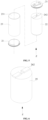
- FIG. 4 is a schematic diagram of a structure of a battery cell 20 according to some embodiments of the present disclosure.
- FIG. 5 is an exploded diagram of the battery cell 20 in FIG. 4 .
- the battery cells 20 refer to minimum composition units configured to form the battery 2.
- the battery cell 20 may include a lithium ion secondary battery cell, a lithium ion primary battery cell, a lithium-sulphur battery cell, a sodium lithium-ion battery cell, a sodium ion battery cell, or a magnesium ion battery cell. This is not limited in the embodiments of the present disclosure.
- the battery cell 20 may be cylindrical, flat, rectangular, or in another shape. For ease of description, a cylindrical battery cell 20 is used as an example in the following embodiments.
- the battery cell 20 includes an end cap 21, an electrode assembly 22, and a shell 23.
- the shell 23 is configured to accommodate the electrode assembly 22.
- the shell 23 may be of a plurality of shapes and sizes. Specifically, a shape of the shell 23 may be determined according to a specific shape and size of one or more electrode assemblies 22.
- the shell 23 is a hollow cylinder.
- An opening 231 is disposed at an end of the shell 23, and the end cap 21 covers the opening 231 and is connected to the shell 23 to form a closed cavity for placing the electrode assembly 22.
- the cavity can be filled with the electrolyte.
- an electrode terminal is disposed on the end cap 21, a tab 262 is disposed on the electrode assembly 22, and the electrode terminal can be configured to be electrically connected to the tab 262 to output electric energy of the battery cell 20.
- a current collector member can be correspondingly disposed at each electrode terminal, and the current collector member is located between the end cap 21 and the tab 262, so that the electrode terminal and the tab 262 can be electrically connected by using the current collector member.
- the end cap 21 may be further provided with another functional component, for example, a pressure relief mechanism configured to release an internal pressure when an internal pressure or a temperature of the battery cell 20 reaches a threshold.
- the shell 23 and the end cap 21 have a plurality of materials, such as copper, iron, aluminum, stainless steel, and aluminum alloy.
- FIG. 6 is a schematic diagram of a structure of an electrode assembly 22 according to some embodiments of the present disclosure.
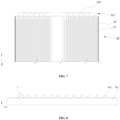
- FIG. 7 is a partially sectional view of an electrode assembly 22.
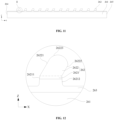
- FIG. 8 is an unfolded diagram of the electrode plate 26 in FIG. 7 .
- FIG. 9 is an enlarged view of I in FIG. 8 .
- the electrode assembly 22 is formed by winding the electrode plate 26 and the separator 27, the electrode plate 26 includes a coating region 261 and a plurality of tabs 262, the coating region 261 and the separator 27 form a main body part 25, the tabs 262 form a multi-tab structure, and the tabs 262 are located at ends of the main body part 25 along a height direction Z of the electrode assembly, and are connected to the main body part 25.
- the tab 262 includes a shaping region 260.
- the electrode assembly 22 is formed by winding the electrode plate 26 and the separator 27.
- the electrode plate 26 and the separator 27 are first laminated and then wound together.
- the wound electrode assembly 22 can be cylindrical, square, or oval. An example in which the electrode assembly 22 is cylindrical is used in the following embodiments for description.
- the electrode plate 26 includes a plurality of tabs 262, each of the tabs 262 includes a first part 2621 and a second part 2622, and along a height direction Z of the electrode plate, the second part 2622 is located outside the first part 2621, where a shape of the first part 2621 is different from a shape of the second part 2622.
- a region with a height hi is the first part 2621
- a region with a height hz is the second part 2622.
- a dashed line in FIG. 9 does not represent an entity, and the dashed line is parallel to a length direction X of the electrode plate 26, and represents a position at which the first part 2621 and the second part 2622 are connected.
- the first part 2621 and the second part 2622 have different shapes, so that the first part 2621 and the second part 2622 have different types of strength and deformation capabilities.
- shapes of the first part 2621 and the second part 2622 can be set according to a required deformation manner, so that the first part 2621 and the second part 2622 can be shaped, and the tab 262 is shaped to obtain a required tab end face.
- the first part 2621 is generally stronger than the first part 2622, so as to reduce a risk of damaging a root of the tab 262.
- a region on the electrode plate 26 coated with an active material is the coating region 261, and a region on the electrode plate 26 that is not coated with an active material is a tab region.
- the tab region is die cut to form the tabs 262, and the tabs 262 are distributed at intervals.
- the electrode plate 26 and the separator 27 are laminated and then jointly wound into the electrode assembly 22, a part that the coating region 261 and the separator 27 are jointly wound forms the main body part 25, and the tabs 262 are wound and then laminated into a multi-tab structure.
- the tabs 262 with different polarities can protrude form ends at a same side of the main body part 25 along a height direction Z (the same as the height direction Z of the electrode plate 262) of the electrode assembly 22, or can protrude from ends at two sides of the main body part 25.
- the tabs 262 with different polarities can be distributed symmetrically when the tabs 262 with different polarities protrude from the ends at the same side of the main body part 25, so that a center of tabs 262 with a same polarity may be aligned with a center of the electrode assembly 22 as a straight line.
- the tabs 262 with different polarities protrude from the ends at two sides of the main body part 25, the tabs 262 can be aligned, or can be randomly distributed at an end face of the main body part 25 along the height direction Z of the electrode assembly 22.
- the tab 262 After the electrode plate 26 and the separator 27 are laminated and then wound together into the electrode assembly 22, the tab 262 needs to be rubbed and shaped to obtain a flat and compact tab end face, so as to improve a connection reliability between the tab 262 and a current collector component, so that the tab 262 has better overcurrent performance.
- predetermined deformation occurs on the second part 2622 based on the first part 2621, to form a shaping region 260 of the tab 262.
- the first part 2621 has a higher strength than the second part 2622
- the second part 2622 is more prone to be deformed than the first part 2621
- deformation of the tab 262 mainly occurs on the second part 2622, so as to protect the first part 2621 from cracking.
- the second part 2622 that is more easily deformable can make a tab end face easy to be rubbed and unfolded, and form a flat tab end face in the shaping region 260.
- heights of the second parts 2622 are different.
- the second parts 2622 with different heights help to form a flat tab end face when the tab 262 is rubbed and unfolded.
- a second coating region 263 is further disposed in a region in which the first part 2621 is connected to the coating region 261, and the second coating region 263 is located on an edge of the coating region 261 and extends into the first part 2621 of the tab 262.
- the second coating region 263 can prevent a burr from being generated when the die cutting is performed.
- the electrode plate 26 and the separator 27 are jointly wound, a burr is prevented from piercing the separator 27, to reduce a risk that the electrode assembly 22 is short circuited.
- the second coating region 263 can be made of a ceramic material.
- the electrode plate 26 when the electrode plate 26 is unfolded, along a length direction X of the electrode plate 262, two sides of the first part 2621 respectively have a first side cut 26211 and a second side cut 26212 that are opposite to each other, two sides of the second part 2622 respectively have a third side cut 26221 and a fourth side cut 26222 that are opposite to each other, the first side cut 26211 and the third side cut 26221 are located on a same side and connected to each other, and the second side cut 26212 and the fourth side cut 26222 are located on a same side and connected to each other.
- a first angle ⁇ 1 is formed between the first side cut 26211 and the length direction X of the electrode plate 26, a second angle ⁇ 2 is formed between the third side cut 26221 and the length direction X of the electrode plate, and the first angle ⁇ 1 is greater than or equal to the second angle ⁇ 2 .
- a smaller second angle ⁇ 2 is between the third side cut 26221 of the second part 2622 and the length direction X of the electrode plate.
- a larger first angle ⁇ 1 is between the first side cut 26211 of the first part 2621 located in a root region of the tab 262 and the length direction X of the electrode plate. Therefore, deformation resistance of a root of the tab 262 is increased, when the second part 2622 is rubbed and shaped, a risk of cracking at a root at which the tab 262 is connected to the main body part 25 is reduced, and a product yield rate and production efficiency are increased.
- the first angle ⁇ 1 ranges from 15° to 90°, preferably from 70° to 90°, and a larger first angle ⁇ 1 can ensure that the first part 2621 has relatively strong deformation resistance.
- the third side cut 26221 and the fourth side cut 26222 are disposed in parallel, that is, an included angle between the fourth side cut 26222 and the length direction X of the electrode plate is also ⁇ 2 , and the second angle ⁇ 2 is an acute angle less than the first angle ⁇ 1 .
- the tab 262 is more prone to fall toward a direction of the fourth side cut 26222, so as to form generally regular deformation, so that the shaping region 260 becomes flat.
- FIG. 10 is a partially enlarged diagram of an electrode plate 26 according to some other embodiments of the present disclosure.
- the third side cut 26221 and the fourth side cut 26222 are symmetrically disposed, that is, an included angle between the fourth side cut 26222 and the length direction X of the electrode plate is 180°- ⁇ 2 , so that both the third side cut 26221 and the fourth side cut 26222 are inclined in a central direction of the tab 262.
- FIG. 11 is a schematic diagram of an electrode plate 26 according to some other embodiments of the present disclosure
- FIG. 12 is an enlarged diagram of II in FIG. 11 .
- second parts 2622 of at least some of the tabs 262 include a corner cutting edge 26223, and the corner cutting edge 26223 is located at an end of the second part 2622 away from the first part 2621 and connected to the fourth side cut 26222 to remove a sharp corner of the second part 2622 on one side of the fourth side cut 26222.
- a corner cutting edge 26223 connected to the fourth side cut 26222 is disposed on the second part 2622, so that a sharp corner 26224 on one side of the fourth side cut 26222 can be removed (refer to FIG. 9 ), that is, the sharp corner 26224 in the falling direction of the second part 2622 is removed.
- the corner cutting edge 26223 is disposed, and the sharp corner 26224 on one side of the fourth side cut 26222 is removed, so that the second part 2622 is beneficial to process and easily falls in a shaping process of the tab 262, and the sharp corner can be prevented from piercing into the main body part 25, thereby increasing a product yield rate, improving production efficiency, and reducing costs.
- All the tabs 262 on the electrode plate 26 can be disposed with corner cutting edges 26223, or only some tabs 262 are disposed with the corner cutting edges 26223, and the other part of the tabs 262 is not disposed with the corner cutting edges 26233, so as to improve processing efficiency.
- the corner cutting edges 26223 are disposed on the second parts 2622 on one side at a winding head end 264 of the electrode plate 26 and the second parts 2622 on one side at a winding tail end 265 of the electrode plate.
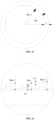
- the electrode plate 26 starts to be wound on one side of the head end 264.
- the tabs 262 on one side of the head end 264 are wound around an inner ring part of the electrode assembly 22, and the tabs 262 on one side of the tail end 265 are wound around an outer ring part of the electrode assembly 22.
- the tabs 262 are rubbed and shaped, the tabs 262 fall.
- the tabs 262 located at the inner ring part fall toward the main body part 25, and the tabs 262 located at the outer ring part fall toward the tabs 262 located at the inner ring part, and are pressed against the tabs 262 in the inner ring part.
- Tabs 262 in the middle part is wrapped by the tabs 262 in the outer ring part and the tabs 262 in the inner ring part. Therefore, the corner cutting edges 26223 only need to be disposed on the tabs 262 in the inner ring part and in the outer ring part. Even if the tabs 262 in the middle part have sharp corners 26224, the sharp corners 26224 do not pierce into the main body part 25. That is, only sharp corners 26224 of the tabs 262 located on one side at the head end 264 and on one side at the tail end 265 of the electrode plate 26 need to be removed, so as to reduce a risk that the sharp corners 26224 pierce into the main body part 25.
- FIG. 13 is a partially enlarged diagram of an electrode plate 26 according to still some other embodiments of the present disclosure.
- the corner cutting edge 26223 includes a bevel edge or an arc-shaped edge.
- the corner cutting edge 26223 in FIG. 12 is an arc-shaped edge of a circular arc.
- the arc-shaped edge can be an integral arc connecting the third side cut 26221 and the fourth side cut 26222, or can be a part of an arc connecting an end of the second part 2622 away from the first part 2621 and the fourth side cut 26222.
- the arc-shaped edge can better remove the sharp corner 26224.
- the corner cutting edge 26223 is a bevel edge, and the bevel edge directly removes the sharp corner 26224 on one side of the fourth side cut 26222, so that processing is simple and work efficiency is high.
- FIG. 14 is a schematic diagram of an electrode plate 26 according to some other embodiments of the present disclosure.
- a plurality of tabs 262 are disposed at intervals when the electrode assembly is unfolded.
- the tabs 262 disposed at intervals do not form an excessively dense end face after the tabs 262 are rubbed and shaped, and help the electrode assembly 22 absorb an electrolyte.
- the electrode plate 26 when the electrode assembly is unfolded, reserves a predetermined distance from the tab 262 along ends at two sides of the electrode plate in the length direction X, that is, the head end 264 of the electrode plate 26 reserves a predetermined distance from the first tab 262, and the tail end 265 of the electrode plate 26 reserves a predetermined distance from the last tab 262.
- the tabs 262 are not disposed in the outer ring part of the electrode assembly 22, that is, a predetermined distance is maintained between the last tab 262 and the tail end 265 of the electrode plate 26, so that a width is maintained between two of the tabs 262 at an outermost ring and the outer peripheral surface of the main body part 25.
- the tabs 262 do not extend to outside of the outer peripheral surface of the main body part 25, thereby ensuring dimensional accuracy of the electrode assembly 22.
- a predetermined distance ranges from 10 mm to 1500 mm, preferably from 300 mm to 600 mm, that is, an arrangement of each of the tabs 262 can be ensured, and a quantity of the tabs 262 can be ensured, which does not affect an overcurrent area of the electrode assembly 22.
- D n is a spacing between an n th tab 262 and a (n-1) th tab 262; D n-1 is a spacing between the (n-1) th tab 262 and the n th tab 262; T is a thickness of the electrode plate 26 and the separator 27 that are laminated; a is a positive number; and C is an error.
- FIG. 15 is a schematic diagram of calculating a spacing between two of tabs 262 according to some embodiments of the present disclosure.
- a radius of the (n-1) th tab 262 is R n-1
- a radius of the n th tab 262 is R n
- a radius difference between two circles is R n-1 -R n .
- a circumference of one circle of the electrode assembly in which the n th tab 262 is located is a distance D n between the n th tab 262 and the (n-1) th tab 262.
- a circumference of one circle of the electrode assembly in which the (n-1) th tab 262 is located is a distance D n-1 between the (n-1) th tab 262 and a (n-2) th tab 262.
- b is a quantity of circles of adjacent tabs 262
- T is a thickness of the electrode plate 26 and the separator 27 that are laminated
- bT is equal to R n-1 -R n . If there is a tab 262 at each circle, b is equal to 1. If there is a tab 262 spacing a plurality of circles, b is equal to the quantity of circles that are spaced.
- a distance difference D n -D n-1 thereof can be obtained by subtracting inner ring circumference and the thickness T of the electrode plate 26 and the separator 27 that are laminated from outer ring circumference, and details are not described again.
- the distance difference D n -D n-1 allows for an error of a value C, which in some embodiments ranges preferably from 1 mm to 5 mm.
- the tabs 262 with a same polarity can aligns at a straight line after winding is completed, so as to ensure arrangement positions of the tabs 262 with different polarities.
- a height hi of the first part 2621 ranges from 2 mm to 8 mm
- a height h 2 of the second part 2622 ranges from 1 mm to 8 mm.
- Setting of the height hi of the first part 2621 ensures strength of a root of the tab 262, so that it can withstand an extrusion pressure during a shaping process of the tab 262 to reduce a risk of deformation or cracking.
- Setting of the height hz of the second part 2622 enables the second part to be deformed without damaging the main body part 25.
- heights of the tabs 262 are gradually increased from the winding head end 264 to the winding tail end 265 of the electrode plate 26.
- the tabs 262 on one side of the head end 264 of the electrode plate 26 are located at an inner ring of the electrode assembly 22, and the tabs 262 on one side of the tail end 265 of the electrode plate 26 are located at an outer ring of the electrode assembly 22.
- the tabs 262 are rubbed and shaped, the tabs 262 at the outer ring fall toward the tabs 262 at the inner ring and press against the tabs 262 at the inner ring.
- the heights of the tabs 262 are gradually increased from the winding head end 264 to the winding tail end 265 of the electrode plate 26, so that heights of tabs 262 at the outer ring are greater than heights of tabs 262 at the inner ring. After rubbing and shaping are performed again, an end face on which the tab 262 falls can become a flat end face.
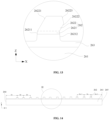
- FIG. 16 is an enlarged view of III in FIG. 14 .
- heights of tabs 262 from the first to the m th starting from the wing head end 264 of the electrode plate 26 are H1, H2 ... and Hm
- heights of tabs 262 from the (m+1) th to the (m+m1) th starting from the wing head end 264 of the electrode plate 26 are H(m+1), H(m+2) ... and H(m+m1).
- H1, H2 ... and Hm each equal h1+c
- H(m+m1) each equal h1+c+c1, where c E [1 mm, 8 mm]; m ⁇ [1, 5]; c1 ⁇ [0 mm, 3 mm]; and m1 ⁇ [1,5].
- a group of adjacent tabs 262 can be set to the same height, and a group of next tabs 262 is set to the same height, which increases by a constant c1 compared with the previous group, and so on, until a height of the last tab 262 is set, so that the heights of tabs 262 gradually increase from the head end 264 to the tail end 265 of the electrode plate 26.
- m E [1, 5] represent that a quantity of each group of tabs 262 with a same height ranges from 1 to 5.
- the heights of the tabs 262 are gradually increased, according to rules, from the winding head end 264 to the winding tail end 265 of the electrode plate 26, so that a height of the tab 262 at the outer ring is greater than a height of the tab 262 at the inner ring.
- an end face on which the tab 262 falls can become a flat end face, thereby improving processing accuracy of the electrode assembly 22.
- FIG. 17 is a partially unfolded diagram of an electrode assembly 22 according to some embodiments of the present disclosure.
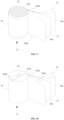
- the electrode assembly 22 includes an electrode plate 26, the electrode plate 26 includes a first electrode plate 26a and a second electrode plate 26b, and the first electrode plate 26a and the second electrode plate 26b have opposite polarities.
- the first electrode plate 26a has a plurality of first tabs 262a
- the second electrode plate 26b has a plurality of second tabs 262b.
- the first tabs 262a and the second tabs 262b extend respectively from ends at two sides of the electrode assembly 22.
- Tabs 262 with opposite polarities extend from ends at two sides of the electrode assembly in the height direction Z, and it is unnecessary to avoid positions of the tabs 262 with different polarities in case of being short circuited, so that layouts and spacings of the tabs 262 are not limited, and tabs 262 with a same polarity can be spread over ends of an entire main body part 25. Therefore, the electrode assembly 22 has a full-tab layout, and an overcurrent area of the electrode assembly 22 is increased.
- FIG. 18 is a partially unfolded diagram of an electrode assembly 22 according to some other embodiments of the present disclosure.
- the electrode plate 26 includes the first electrode plate 26a and the second electrode plate 26b, the first electrode plate 26a and the second electrode plate 26b have opposite polarities, the first electrode plate 26a has the plurality of first tabs 262a, the second electrode plate 26b has the plurality of second tabs 262b, and along the height direction Z of the electrode assembly, the first tabs 262a and the second tabs 262b extend respectively from ends at two side of the electrode assembly.
- the first tabs 262a and the second tabs 262b with different polarities extend from ends at a same side of the main body part 25, all the first tabs 262a are aligned and overlapped, all the second tabs 262b are aligned and overlapped, and the first tabs 262a and the second tabs 262b can be disposed relative to each other at a central position of the electrode assembly 22 and are not in contact with each other to prevent a short circuit.
- the first tabs 262a and the second tabs 262b with different polarities extend from the ends at a same side of the main body part 25, thereby facilitating a layout of an overall structure of the electrode assembly 22.
- widths of the tabs 262 with a same polarity gradually increase from an inner ring to an outer ring of the electrode assembly 22, and a substantially fan-shaped structure is formed on the end face of the main body part 25.
- a width of the tabs 262 can be relatively small at a position at which an inner ring has relatively small radius.
- a width of the tabs 262 gradually increases with the radius, so that the tabs 262 have a larger overcurrent area, and overcurrent performance of the electrode assembly 22 is improved.
- a manufacturing method for an electrode plate according to an embodiment of the present disclosure includes the following steps:
- Step S3 allow each of the tabs 262 to include a first part 2621 and a second part 2622, where along a height direction Z of the electrode plate, the second part 2622 is located outside the first part 2621, and a shape of the first part 2621 is different from a shape of the second part 2622.
- the tab 262 includes the first part 2621 and the second part 2622, and the first part 2621 is separately connected to the coating region 261 and the second part 2622 along two sides of the height direction Z of the electrode plate 26.
- Two sides of the first part 2621 respectively have a first side cut 26211 and a second side cut 26212 that are opposite to each other
- two sides of the second part 2622 respectively have a third side cut 26221 and a fourth side cut 26222 that are opposite to each other
- the first side cut 26211 and the third side cut 26221 are located on a same side and connected to each other.
- a first angle ⁇ 1 is formed between the first side cut 26211 and the length direction X of the electrode plate
- a second angle ⁇ 2 is formed between the third side cut 26221 and the length direction X of the electrode plate
- the first angle ⁇ 1 is greater than or equal to the second angle ⁇ 2 .
- an electrode plate an electrode assembly, a battery, an electric device and a manufacturing method for an electrode plate in the present disclosure
- a structure of a tab on the electrode plate is improved, so that deformation resistance of a root of the tab is improved.
- the tab is rubbed and shaped, a risk of cracking at a root at which the tab is connected to a main body part is reduced, a product yield rate and production efficiency are increased, and production costs are reduced.
Landscapes
- Chemical & Material Sciences (AREA)
- Chemical Kinetics & Catalysis (AREA)
- Electrochemistry (AREA)
- General Chemical & Material Sciences (AREA)
- Engineering & Computer Science (AREA)
- Manufacturing & Machinery (AREA)
- Connection Of Batteries Or Terminals (AREA)
- Battery Electrode And Active Subsutance (AREA)
- Secondary Cells (AREA)
Abstract
Description
- The present disclosure relates to the technical field of an energy storage device, and in particular, to an electrode plate, an electrode assembly, a battery, an electric device, and a manufacturing method for an electrode plate.
- Energy conservation and emission reduction are the key to sustainable development of the automobile industry. In this case, an electric vehicle has become an important part of the sustainable development of the automobile industry due to its advantages of energy conservation and environmental protection. For the electric vehicle, a battery technology is another important factor related to its development. During battery production, it is important to increase a product yield rate, reduce production costs, and improve production efficiency.
- To resolve the foregoing problem, the present disclosure provides an electrode plate, an electrode assembly, a battery, an electric device, and a manufacturing method for an electrode plate, which can increase a product yield rate, reduce production costs, and improve production efficiency during battery production.
- A first aspect of embodiments of the present disclosure provides an electrode plate, including a plurality of tabs, the tabs each include a first part and a second part, and along a height direction of the electrode plate, the second part is located outside the first part; where a shape of the first part is different from a shape of the second part.
- The first part and the second part have different shapes, so that the first part and the second part can have different types of strength and deformation capabilities. When a tab is shaped, the first part and the second part can be shaped according to a required deformation manner, so that the tab is shaped to obtain a required tab end face, thereby improving a product yield rate, reducing production costs, and improving production efficiency.
- In some embodiments, predetermined deformation occurs on the second part based on the first part, to form a shaping region of the tab.
- When the tab is rubbed and shaped, deformation of the tab mainly occurs on the second part, so as to protect the first part from cracking. In addition, the second part that is more easily deformable can make a tab end face easy to be rubbed and unfolded, and form a flat tab end face in a shaping region.
- In some embodiments, heights of the second parts are different.
- The second parts with different heights help to form a flat tab end face when the tab is rubbed.
- In some embodiments, when the electrode plate is unfolded, along a length direction of the electrode plate, two sides of the first part respectively have a first side cut and a second side cut that are opposite to each other, two sides of the second part respectively have a third side cut and a fourth side cut that are opposite to each other, the first side cut and the third side cut are located on a same side and connected to each other, and the second side cut and the fourth side cut are located on a same side and connected to each other; where a first angle is formed between the first side cut and the length direction of the electrode plate, a second angle is formed between the third side cut and the length direction of the electrode plate, and the first angle is greater than or equal to the second angle.
- In the foregoing technical solution, a smaller second angle is between a third side cut of the second part and the length direction of the electrode plate. When the tabs are laminated, the tabs are shaped by rotating and rubbing during shaping, and an inclined direction of the second part is the same as a rotation direction, so that the tabs are unfolded along the rotation direction during rotating and shaping, and shaping is more easily implemented. A larger first angle is between the first side cut of the first part located in a root region of the tab and the length direction of the electrode plate. Therefore, deformation resistance of a root of the tab is increased, and when the second part is rubbed and shaped, a risk of cracking at a root at which the tab is connected to a main body part is reduced, a product yield rate and production efficiency are increased, and production costs are reduced.
- In some embodiments, the first angle ranges from 15° to 90°, which can ensure that the first part has strong deformation resistance.
- In some embodiments, the third side cut and the fourth side cut are disposed in parallel.
- In the foregoing technical solution, the tabs are prone to fall toward a direction of the fourth side cut, forming generally regular deformation, and making the shaping region regular and flat.
- In some embodiments, the third side cut and the fourth side cut are symmetrically disposed.
- In the foregoing technical solution, when the second part falls toward a direction of the fourth side cut, a sharp corner of the second part is prevented from being pierced into the main body part, a risk of damaging the main body part is reduced, and an optimization rate of the electrode assembly is increased.
- In some embodiments, when the electrode plate is unfolded, a second part of at least one of the tabs include corner cutting edges, and the corner cutting edge is located at an end of a second part away from the first part and connected to the fourth side cut to remove a sharp corner of the second part on one side of the fourth side cut.
- In the foregoing technical solution, when the tabs are shaped, because the sharp corner on one side of the fourth side cut is removed from the corner cutting edge, second parts of the tabs fall toward one side of the fourth side cut, so that no sharp corner is pierced into the main body part, thereby avoiding damage to the electrode assembly and improving a product yield rate.
- In some embodiments, when the electrode plate is unfolded, the second parts at a winding head end of the electrode plate and the second parts at a winding tail end of the electrode plate are provided with the corner cutting edges.
- In the foregoing technical solution, only sharp corners of the tabs located on one side at the head end and on one side at the tail end of the electrode plate need to be removed, so as to reduce a risk that the sharp corner pierces into a main body part.
- In some embodiments, the corner cutting edge includes a bevel edge or an arc-shaped edge.
- In the foregoing technical solution, the arc-shaped edge can better remove a sharp corner, and the bevel edge is easy to process, and work efficiency is high.
- In some embodiments, a plurality of tabs are disposed at intervals when the electrode plate is unfolded.
- In the foregoing technical solution, tabs that are disposed at intervals do not form an excessively dense end face after the tabs are rubbed and shaped, and help the electrode assembly absorb an electrolyte.
- In some embodiments, when the electrode plate is unfolded, a predetermined distance is reserved between ends on two sides of the electrode plate and the tab along the length direction of the electrode plate.
- In the foregoing technical solution, an arrangement of different tabs can be implemented. During a rubbing and shaping process, the tabs do not protrude outside an outer peripheral surface of the main body part after falling, thereby ensuring dimensional accuracy of the electrode assembly.
- In some embodiments, the predetermined distance ranges from 10 mm to 1500 mm.
- In the foregoing technical solution, an arrangement of the tabs can be ensured, and a quantity of the tabs can be ensured without affecting an overcurrent area of the electrode assembly.
- In some embodiments, a spacing of adjacent tabs meets:

- Dn is a spacing between an nth tab and a (n-1)th tab; Dn-1 is a spacing between a (n-1)th tab and a (n-2)th tab; T is a thickness of the electrode plate and a separator that are laminated; a is a positive number; and C is an error.
- In the foregoing technical solution, tabs with a same polarity can aligns at a straight line after winding is completed, so as to ensure arrangement positions of tabs with different polarities.
- In some embodiments, along the height direction of the electrode plate, a height hi of the first part ranges from 2 mm to 8 mm, and a height h2 of the second part ranges from 1 mm to 8 mm.
- In the foregoing technical solution, setting of the height hi of the first part ensures strength of a root of the tab, so that it can withstand an extrusion pressure during a shaping process of the tab to reduce a risk of deformation or cracking. Setting of the height hz of the second part enables the second part to be deformed without damaging the main body part.
- In some embodiments, along the length direction of the electrode plate, heights of the tabs are gradually increased from the winding head end to the winding tail end of the electrode plate.
- In the foregoing technical solution, the heights of the tabs are gradually increased from the winding head end to the winding tail end of the electrode plate, so that a height of a tab at an outer ring is greater than a height of a tab at an inner ring. After rubbing and shaping are performed again, an end face on which the tab falls can become a flat end face, thereby improving processing accuracy of the electrode assembly.
- In some embodiments, along the height direction of the electrode plate, heights of tabs from a first to an mth starting from the winding head end of the electrode plate are H1, H2 ... and Hm, and heights of tabs from a (m+1)th to a (m+m1)th starting from the winding head end of the electrode plate are H(m+1), H(m+2) ... and H(m+m1). H1, H2 ... and Hm each equal h1+c, and H(m+1), H(m+2) ... and H(m+m1) each equal h1+c+c1, where c E [1 mm, 8 mm]; m ∈ [1, 5]; c1 E [0 mm, 3 mm]; and m1 ∈ [1, 5].
- In the foregoing technical solution, the heights of the tabs are gradually increased, according to rules, from the winding head end to the winding tail end of the electrode plate, so that a height of a tab at an outer ring is greater than a height of a tab at an inner ring. After rubbing and shaping are performed again, an end face on which the tab falls can become a flat end face, thereby improving processing accuracy of the electrode assembly.
- In some embodiments, quantities of tabs with same heights in each group are the same, processing is simple, and production efficiency is improved.
- A second aspect of the present disclosure provides an electrode assembly, including the electrode plate provided in the first aspect of the present disclosure.
- In some embodiments, the electrode plate includes a first electrode plate and a second electrode plate, the first electrode plate and the second electrode plate have opposite polarities, the first electrode plate has a plurality of first tabs, the second electrode plate has a plurality of second tabs, and along a height direction of the electrode assembly, the first tabs and the second tabs extend respectively from ends at two sides of the electrode assembly.
- In the foregoing technical solution, tabs with opposite polarities extend from ends at two sides of the electrode assembly in the height direction, and it is unnecessary to avoid positions of the tabs with different polarities in case of being short circuited, so that layouts and spacings of the tabs are not limited, and tabs with a same polarity can be spread over ends of an entire body part. Therefore, the electrode assembly has a full-tab layout, and an overcurrent area of the electrode assembly is increased.
- In some embodiments, the electrode plate includes a first electrode plate and a second electrode plate, the first electrode plate and the second electrode plate have opposite polarities, the first electrode plate has a plurality of first tabs, the second electrode plate has a plurality of second tabs, and along the height direction of the electrode assembly, the first tabs and the second tabs extend respectively from ends at a same side of the electrode assembly.
- In the foregoing technical solution, the first tabs and the second tabs with different polarities extend from a same side of the main body part, thereby facilitating a layout of an overall structure of the electrode assembly.
- A third aspect of embodiments of the present disclosure provides a battery, including a plurality of electrode assemblies provided in the second aspect, which have good insulation performance, reduce a risk of being short circuited, and improve battery safety.
- A fourth aspect of embodiments of the present disclosure provides an electric device, including the battery provided in the third aspect, where the battery is configured to provide electric energy, and safety performance thereof is high.
- A fifth aspect of embodiments of the present disclosure provides a manufacturing method for an electrode plate, including the following steps: An electrode plate is provided; a plurality of tabs are die cut on the electrode plate; and the tabs each include a first part and a second part, and along a height direction of the electrode plate, the second part is located outside the first part; where a shape of the first part is different from a shape of the second part.
- It should be understood that the foregoing general description and the following detailed description are merely exemplary, and do not limit the present disclosure.
- To describe technical solutions in embodiments of the present disclosure more clearly, the following briefly describes the accompanying drawings required for describing the embodiments of the present disclosure. Clearly, the accompanying drawings in the following description show merely specific embodiments of the present disclosure, and a person of ordinary skill in the art may still derive other embodiments from these accompanying drawings without creative efforts.
-
FIG. 1 is a schematic diagram of a structure of a vehicle according to some embodiments of the present disclosure; -
FIG. 2 is a schematic diagram of a structure of a battery according to some embodiments of the present disclosure; -
FIG. 3 is an exploded diagram of the battery inFIG. 2 ; -
FIG. 4 is a schematic diagram of a structure of a battery cell according to some embodiments of the present disclosure; -
FIG. 5 is an exploded diagram of the battery cell inFIG. 4 ; -
FIG. 6 is a schematic diagram of a structure of an electrode assembly according to some embodiments of the present disclosure; -
FIG. 7 is a partially sectional view of an electrode assembly; -
FIG. 8 is an unfolded diagram of the electrode plate inFIG. 7 ; -
FIG. 9 is an enlarged view of I inFIG. 8 ; -
FIG. 10 is a partially enlarged diagram of an electrode plate according to some other embodiments of the present disclosure; -
FIG. 11 is a schematic diagram of an electrode plate according to some other embodiments of the present disclosure; -
FIG. 12 is an enlarged view of II inFIG. 11 ; -
FIG. 13 is a partially enlarged diagram of an electrode plate according to still some other embodiments of the present disclosure; -
FIG. 14 is a schematic diagram of an electrode plate according to some other embodiments of the present disclosure; -
FIG. 15 is a schematic diagram of calculating a spacing between two of tabs according to some embodiments of the present disclosure; -
FIG. 16 is an enlarged view of III inFIG. 14 ; -
FIG. 17 is a partially unfolded diagram of an electrode assembly according to some embodiments of the present disclosure; -
FIG. 18 is a partially unfolded diagram of an electrode assembly according to some other embodiments of the present disclosure; -
FIG. 19 is a schematic diagram of an electrode assembly according to still some other embodiments of the present disclosure; and -
FIG. 20 is a flowchart of a manufacturing method for an electrode plate according to an embodiment of the present disclosure. -
- 1 - vehicle; 2 - battery; 3 - controller; 4 - motor;
- 10 - case; 11 - case body; 12. first cover body; 13. second cover body;
- 20 - battery cell; 200 - battery module; 30 - bus part;
- 21 - end cap; 22 - electrode assembly; 23 - shell; 231 - opening;
- 25 - main body part;
- 26 - electrode plate; 26a - first electrode plate; 26b - second electrode plate;
- 260 - shaping region; 261 - coating region; 262 - tab; 262a - first tab; 262b - second tab;
- 2621 - first part; 26211 - first side cut; 26212 - second side cut;
- 2622 - second part; 26221 - third side cut; 26222 - fourth side cut; 26223- corner cutting edge;
- 26224 - sharp corner;
- 263 - second coating region; 264 - head end; 265 - tail end;
- 27 - separator.
- The accompanying drawings herein are incorporated into the specification and constitute a part of the specification, illustrate embodiments that conform to the present disclosure, and are used together with the specification to describe the principles of the present disclosure.
- To better understand technical solutions of the present disclosure, the following describes embodiments of the present disclosure in detail with reference to the accompanying drawings.
- It should be noted that the described embodiments are merely some, but not all, embodiments of the present disclosure. Based on the embodiments of the present disclosure, all other embodiments obtained by a person of ordinary skill in the art without creative efforts fall within the protection scope of the present disclosure.
- Terms in the embodiments of the present disclosure are merely used to describe the specific embodiments, and are not intended to limit the present disclosure. Unless otherwise specified in the context, words, such as "a", "the", and "this", in a singular form in the embodiments and appended claims of the present disclosure include plural forms.
- It should be understood that the term "and/or" in this specification merely describes associations between associated objects, and it indicates three types of relationships. For example, A and/or B may indicate that A exists alone, A and B coexist, or B exists alone. In addition, the character "/" in this specification generally indicates that the associated objects are in an "or" relationship.
- It should be noted that nouns of locality such as "upper", "lower", "left", and "right" described in the embodiments of the present disclosure are described from perspectives shown in the accompanying drawings, and should not be construed as a limitation on the embodiments of the present disclosure. In addition, in the context, it should be further understood that when one element is connected "above" or "below" another element, the element can be directly connected "above" or "below" another element, or may be indirectly connected "above" or "below" another element by using an intermediate element.
- At present, with the development of the market, a power battery is widely used. The power battery is not only applied to a power storage system such as a hydraulic power, a fire power, a wind power, and a solar power plant, but also widely used in electric transportation, such as an electric bicycle, an electric motorcycle, and an electric vehicle, and various fields, such as military equipment, and aerospace. As the power battery application field continues to expand, the market demand for the power battery is constantly increasing.
- In the field of electric carriers such as electric vehicles, the power battery serves as a core component of a vehicle, and is related to safety when a vehicle is used, and costs of the vehicle. How to reduce manufacturing costs of the power battery and improve production efficiency are important indexes of the power battery.
- The battery mentioned in the embodiments of the present disclosure refers to a single physical module that includes one or more battery cells to provide a higher voltage and capacity. For example, the battery mentioned in the present disclosure can include a battery module, a battery pack, and the like. The battery generally includes a case for encapsulating one or more battery cells. The case can prevent liquid or other foreign matter from affecting charging or discharging of the battery cell.
- Currently, a battery cell generally includes a shell, an electrode assembly, and an end cap assembly, where the electrode assembly is electrically connected to the end cap assembly, the end cap assembly covers an opening of the shell, and the shell and the end cap assembly are usually connected and fixed by welding, so as to provide an enclosed space for the electrode assembly and an electrolyte.
- The electrode assembly includes a positive electrode plate, a negative electrode plate, and a separator. The battery cell works mainly depending on metal ions to move between the positive electrode plate and the negative electrode plate. The positive electrode plate includes a cathode current collector and a cathode active material layer, a surface of the cathode current collector is coated with the cathode active material layer, a cathode current collector that is not coated with the cathode active material layer protrudes from a cathode current collector coated with the cathode active material layer, and the cathode current collector that is not coated with the cathode active material layer is used as a cathode tab. A surface of an anode current collector is coated with an anode active material layer, an anode current collector that is not coated with the anode active material layer protrudes from an anode current collector coated with the anode active material layer, and the anode current collector that is not coated with the anode active material layer is used as an anode tab.
- The electrode assembly can be a winding structure, and a winding electrode assembly is formed by winding a positive electrode plate, a negative electrode plate, and a separator between the positive electrode plate and the negative electrode plate together. The winding electrode assembly may be in a cylindrical structure, or may be in a square or an oval structure. This is not specifically limited in the present disclosure.
- A tab of the winding electrode assembly may be in a full-tab structure, or may be in a tab cutting structure. After the electrode assembly is wound, the tab needs to be rubbed and unfolded to make the tab flat and compact. The full-tab structure is formed by current collectors that are not coated with active materials of the positive electrode plate and the negative electrode plate. When the full-tab structure is rubbed and unfolded, because end faces of an entire electrode assembly are in a tab structure, after rubbing and flattening, the end faces of the tab are too dense to inject an electrolyte. Therefore, when the positive electrode plate and the negative electrode plate are manufactured, current collectors that are not coated with the active materials of the positive electrode plate and the negative electrode plate are die cut to form a plurality of tabs, and the tabs form a tab structure. Because the tabs are distributed at intervals, when the tab structure is rubbed and unfolded, end faces of the tab are not too dense, which facilitates injecting an electrolyte.
- The inventor of the present disclosure found that, because of a die-cut structure of the tab, when the end faces of the tab are rubbed and unfolded, a force exerted by rubbing and flattening the end faces of the tab may cause a root of the tab to crack in a rubbing and flattening process, thereby causing a defect in a product, reducing a product yield rate, and reducing production efficiency.
- To resolve a problem that a tab is easy to crack in a rubbing and flattening process, the present disclosure provides an electrode assembly to enhance strength of a root of the tab by designing a tab die cut shape, reduce a cracking risk of the root of the tab, and improve a product yield rate and production efficiency. The following describes solutions of the embodiments of the present disclosure in detail.
- The battery cell described in the embodiments of the present disclosure is applicable to a battery and a device using a battery.
- The electric device may be a mobile phone, a portable device, a laptop, an electric motorcycle, an electric vehicle, a steamship, a spacecraft, an electric toy, an electric tool, or the like. The vehicle may be a fuel vehicle, a gas vehicle, or a new energy vehicle, and the new energy vehicle may be a pure electric vehicle, a hybrid vehicle, an extended-range vehicle, or the like. For example, the spacecraft includes an airplane, a rocket, a spaceshuttle, and a spaceship; the electric toy includes a stationary or mobile electric toy, such as a game console, an electric toy car, an electric toy ship, and an electric toy plane; and the electric tool includes a metal cutting electric tool, a grinding electric tool, an assembly electric tool, and a railway electric tool, such as an electric drill, an electric grinding machine, an electric wrench, an electric screwdriver, an electric hammer, an electric impact drill, a concrete vibrator, and an electric planer. The embodiments of the present disclosure set no special limitation on the foregoing electric device.
- For ease of description, that the device using a battery is a vehicle is used as an example for description in the following embodiments.
-
FIG. 1 is a schematic diagram of a structure of avehicle 1 according to some embodiments of the present disclosure. - As shown in
FIG. 1 , abattery 2 is disposed in thevehicle 1. Thebattery 2 refers to a single physical module that includes one or more battery cells to provide a higher voltage and capacity. For example, thebattery 2 mentioned in the present disclosure can include a battery module, a battery pack, or the like. Thebattery 2 can be disposed at a bottom, a head, or a tail of thevehicle 1. Thebattery 2 can be configured to supply power to thevehicle 1. For example, thebattery 2 may be used as an operational power source of thevehicle 1. Thevehicle 1 can further include a controller 3 and amotor 4. The controller 3 is configured to control thebattery 2 to supply power to themotor 4, for example, is configured to enable, navigate, and drive thevehicle 1. - In some embodiments of the present disclosure, the
battery 2 can be used not only as the operational power source of thevehicle 1, but also as a driving power source of thevehicle 1, in place of or partly in place of fuel or natural gas to provide a driving power for thevehicle 1. - For ease of description, the embodiments of the present disclosure are described in detail by using an example in which a battery cell is a cylindrical battery cell in the following embodiments.
-
FIG. 2 is a schematic diagram of a structure of abattery 2 according to some embodiments of the present disclosure.FIG. 3 is an exploded diagram of thebattery 2 inFIG. 2 . - As shown in
FIG. 2 andFIG. 3 , thebattery 2 includes a case 10 and abattery cell 20, and thebattery cell 20 is accommodated in the case 10. - The case 10 is configured to accommodate the
battery cell 20, and the case 10 may be of a plurality of structures. In some embodiments, the case 10 includes acase body 11, afirst cover body 12, and asecond cover body 13. Thefirst cover body 12 and thesecond cover body 13 are respectively disposed at two ends of thecase body 11. Thefirst cover body 12 and thesecond cover body 13 are detachably connected to thecase body 11. For example, thefirst cover body 12 and thesecond cover body 13 can be separately stuck with thecase body 11 or connected by using screws. After thecase body 11, thefirst cover body 12, and thesecond cover body 13 are assembled, an accommodating space is formed. Thebattery cell 20 is disposed in an accommodating space of the case 10. - In the
battery 2, there are a plurality ofbattery cells 20. The plurality ofbattery cells 20 can be connected in series or in parallel or in series parallel. The parallel series means that the plurality ofbattery cells 20 are connected in series and in parallel. The plurality ofbattery cells 20 may be directly connected in series or in parallel or in series parallel, and then a whole of the plurality ofbattery cells 20 is accommodated in the case 10. Certainly, the plurality ofbattery cells 20 may alternatively first form battery groups in series or in parallel or in series parallel, and then a plurality of battery groups form a whole in series or in parallel or in series parallel, accommodated in the case 10. - A quantity of
battery cells 20 may be set to any value according to different power requirements. The plurality ofbattery cells 20 can be connected in series, in parallel, or in series parallel to achieve a large capacity or power. The plurality ofbattery cells 20 can alternatively first form battery modules in series, in parallel, or in series parallel, and a plurality of battery modules then form abattery 2 in series, in parallel, or in series parallel. That is, the plurality ofbattery cells 20 can directly form thebattery 2, or can first form the battery modules, and then the battery modules form thebattery 2, accommodated in the case 10. - As shown in
FIG. 3 , the plurality ofbattery cells 20 are electrically connected by using abus part 30 to reach a design voltage of thebattery 2. In thebattery 2, the plurality ofbattery cells 20 are electrically connected, specifically in connection manners such as in series, in parallel, or in series parallel (a hybrid connection of series and parallel), and thebattery cells 20 are connected by using thebus part 30. Thebattery cell 20 includes electrode terminals, and each of thebattery cells 20 includes a positive electrode terminal and a negative electrode terminal. For example, when thebattery cells 20 are connected in series, a positive electrode terminal of abattery cell 20 is connected, by using thebus part 30, to a negative electrode terminal of abattery cell 20 adjacent to the foregoingbattery cell 20. A structure of thebus part 30 is determined by an arrangement form of the plurality ofbattery cells 20 and a connection manner between thebattery cells 20. A specific connection manner of thebattery cells 20 is not limited in the present disclosure. Thebus part 30 may be a metal conductor, such as copper, iron, aluminum, stainless steel, and aluminum alloy. -
FIG. 4 is a schematic diagram of a structure of abattery cell 20 according to some embodiments of the present disclosure.FIG. 5 is an exploded diagram of thebattery cell 20 inFIG. 4 . - With reference to
FIG. 4 , thebattery cells 20 refer to minimum composition units configured to form thebattery 2. In some embodiments of the present disclosure, thebattery cell 20 may include a lithium ion secondary battery cell, a lithium ion primary battery cell, a lithium-sulphur battery cell, a sodium lithium-ion battery cell, a sodium ion battery cell, or a magnesium ion battery cell. This is not limited in the embodiments of the present disclosure. Thebattery cell 20 may be cylindrical, flat, rectangular, or in another shape. For ease of description, acylindrical battery cell 20 is used as an example in the following embodiments. - With reference to
FIG. 4 andFIG. 5 , thebattery cell 20 includes anend cap 21, anelectrode assembly 22, and ashell 23. Theshell 23 is configured to accommodate theelectrode assembly 22. Theshell 23 may be of a plurality of shapes and sizes. Specifically, a shape of theshell 23 may be determined according to a specific shape and size of one ormore electrode assemblies 22. In some embodiments, theshell 23 is a hollow cylinder. Anopening 231 is disposed at an end of theshell 23, and theend cap 21 covers theopening 231 and is connected to theshell 23 to form a closed cavity for placing theelectrode assembly 22. The cavity can be filled with the electrolyte. In some embodiments, an electrode terminal is disposed on theend cap 21, atab 262 is disposed on theelectrode assembly 22, and the electrode terminal can be configured to be electrically connected to thetab 262 to output electric energy of thebattery cell 20. A current collector member can be correspondingly disposed at each electrode terminal, and the current collector member is located between theend cap 21 and thetab 262, so that the electrode terminal and thetab 262 can be electrically connected by using the current collector member. Theend cap 21 may be further provided with another functional component, for example, a pressure relief mechanism configured to release an internal pressure when an internal pressure or a temperature of thebattery cell 20 reaches a threshold. Theshell 23 and theend cap 21 have a plurality of materials, such as copper, iron, aluminum, stainless steel, and aluminum alloy. -
FIG. 6 is a schematic diagram of a structure of anelectrode assembly 22 according to some embodiments of the present disclosure.FIG. 7 is a partially sectional view of anelectrode assembly 22. -
FIG. 8 is an unfolded diagram of theelectrode plate 26 inFIG. 7 .FIG. 9 is an enlarged view of I inFIG. 8 . - As shown in
FIG. 6 to FIG. 9 , in some embodiments, theelectrode assembly 22 is formed by winding theelectrode plate 26 and theseparator 27, theelectrode plate 26 includes acoating region 261 and a plurality oftabs 262, thecoating region 261 and theseparator 27 form amain body part 25, thetabs 262 form a multi-tab structure, and thetabs 262 are located at ends of themain body part 25 along a height direction Z of the electrode assembly, and are connected to themain body part 25. Thetab 262 includes ashaping region 260. - With reference to
FIG. 7 and FIG. 8 , theelectrode assembly 22 is formed by winding theelectrode plate 26 and theseparator 27. When theelectrode assembly 22 is wound, theelectrode plate 26 and theseparator 27 are first laminated and then wound together. Thewound electrode assembly 22 can be cylindrical, square, or oval. An example in which theelectrode assembly 22 is cylindrical is used in the following embodiments for description. - As shown in
FIG. 8 andFIG. 9 , in some embodiments, theelectrode plate 26 includes a plurality oftabs 262, each of thetabs 262 includes afirst part 2621 and asecond part 2622, and along a height direction Z of the electrode plate, thesecond part 2622 is located outside thefirst part 2621, where a shape of thefirst part 2621 is different from a shape of thesecond part 2622. - In
FIG. 9 , a region with a height hi is thefirst part 2621, and a region with a height hz is thesecond part 2622. A dashed line inFIG. 9 does not represent an entity, and the dashed line is parallel to a length direction X of theelectrode plate 26, and represents a position at which thefirst part 2621 and thesecond part 2622 are connected. Thefirst part 2621 and thesecond part 2622 have different shapes, so that thefirst part 2621 and thesecond part 2622 have different types of strength and deformation capabilities. When thetab 262 is shaped, shapes of thefirst part 2621 and thesecond part 2622 can be set according to a required deformation manner, so that thefirst part 2621 and thesecond part 2622 can be shaped, and thetab 262 is shaped to obtain a required tab end face. - In order to ensure the strength of the
tab 262, make thetab 262 not damaged in a shaping process, and increase a product yield rate and production efficiency, thefirst part 2621 is generally stronger than thefirst part 2622, so as to reduce a risk of damaging a root of thetab 262. - Still referring to
FIG. 8 , a region on theelectrode plate 26 coated with an active material is thecoating region 261, and a region on theelectrode plate 26 that is not coated with an active material is a tab region. The tab region is die cut to form thetabs 262, and thetabs 262 are distributed at intervals. Theelectrode plate 26 and theseparator 27 are laminated and then jointly wound into theelectrode assembly 22, a part that thecoating region 261 and theseparator 27 are jointly wound forms themain body part 25, and thetabs 262 are wound and then laminated into a multi-tab structure. - The
tabs 262 with different polarities can protrude form ends at a same side of themain body part 25 along a height direction Z (the same as the height direction Z of the electrode plate 262) of theelectrode assembly 22, or can protrude from ends at two sides of themain body part 25. Thetabs 262 with different polarities can be distributed symmetrically when thetabs 262 with different polarities protrude from the ends at the same side of themain body part 25, so that a center oftabs 262 with a same polarity may be aligned with a center of theelectrode assembly 22 as a straight line. When thetabs 262 with different polarities protrude from the ends at two sides of themain body part 25, thetabs 262 can be aligned, or can be randomly distributed at an end face of themain body part 25 along the height direction Z of theelectrode assembly 22. - After the
electrode plate 26 and theseparator 27 are laminated and then wound together into theelectrode assembly 22, thetab 262 needs to be rubbed and shaped to obtain a flat and compact tab end face, so as to improve a connection reliability between thetab 262 and a current collector component, so that thetab 262 has better overcurrent performance. - Still referring to
FIG. 7 , in some embodiments, predetermined deformation occurs on thesecond part 2622 based on thefirst part 2621, to form ashaping region 260 of thetab 262. - When the
tab 262 is rubbed and shaped, thefirst part 2621 has a higher strength than thesecond part 2622, thesecond part 2622 is more prone to be deformed than thefirst part 2621, and deformation of thetab 262 mainly occurs on thesecond part 2622, so as to protect thefirst part 2621 from cracking. In addition, thesecond part 2622 that is more easily deformable can make a tab end face easy to be rubbed and unfolded, and form a flat tab end face in theshaping region 260. - In some embodiments, heights of the
second parts 2622 are different. Thesecond parts 2622 with different heights help to form a flat tab end face when thetab 262 is rubbed and unfolded. - Still referring to
FIG. 9 , in some embodiments, asecond coating region 263 is further disposed in a region in which thefirst part 2621 is connected to thecoating region 261, and thesecond coating region 263 is located on an edge of thecoating region 261 and extends into thefirst part 2621 of thetab 262. When die cutting of thetab 262 is performed on theelectrode plate 26, thesecond coating region 263 can prevent a burr from being generated when the die cutting is performed. When theelectrode plate 26 and theseparator 27 are jointly wound, a burr is prevented from piercing theseparator 27, to reduce a risk that theelectrode assembly 22 is short circuited. Thesecond coating region 263 can be made of a ceramic material. - In some embodiments, when the
electrode plate 26 is unfolded, along a length direction X of theelectrode plate 262, two sides of thefirst part 2621 respectively have a first side cut 26211 and a second side cut 26212 that are opposite to each other, two sides of thesecond part 2622 respectively have a third side cut 26221 and a fourth side cut 26222 that are opposite to each other, the first side cut 26211 and the third side cut 26221 are located on a same side and connected to each other, and the second side cut 26212 and the fourth side cut 26222 are located on a same side and connected to each other. A first angle θ1 is formed between the first side cut 26211 and the length direction X of theelectrode plate 26, a second angle θ2 is formed between the third side cut 26221 and the length direction X of the electrode plate, and the first angle θ1 is greater than or equal to the second angle θ2. - A smaller second angle θ2 is between the third side cut 26221 of the
second part 2622 and the length direction X of the electrode plate. When thetabs 262 are laminated, and end faces of thetabs 262 are shaped, thesecond part 2622 is tilted toward a direction. When thetabs 262 are rubbed and shaped by means of rotation, thesecond part 2622 is tilted toward a direction consistent with a direction of rotation, so that thetabs 262 are unfolded toward a direction of rotation during a rotating and shaping process, shaping is more easily implemented, and ashaping region 260 is formed. A larger first angle θ1 is between the first side cut 26211 of thefirst part 2621 located in a root region of thetab 262 and the length direction X of the electrode plate. Therefore, deformation resistance of a root of thetab 262 is increased, when thesecond part 2622 is rubbed and shaped, a risk of cracking at a root at which thetab 262 is connected to themain body part 25 is reduced, and a product yield rate and production efficiency are increased. - In some embodiments, the first angle θ1 ranges from 15° to 90°, preferably from 70° to 90°, and a larger first angle θ1 can ensure that the
first part 2621 has relatively strong deformation resistance. - Still referring to
FIG. 9 , in some embodiments, the third side cut 26221 and the fourth side cut 26222 are disposed in parallel, that is, an included angle between the fourth side cut 26222 and the length direction X of the electrode plate is also θ2, and the second angle θ2 is an acute angle less than the first angle θ1. When thesecond part 2622 is rubbed and shaped, thetab 262 is more prone to fall toward a direction of the fourth side cut 26222, so as to form generally regular deformation, so that the shapingregion 260 becomes flat. -
FIG. 10 is a partially enlarged diagram of anelectrode plate 26 according to some other embodiments of the present disclosure. - As shown in
FIG. 10 , in some other embodiments, the third side cut 26221 and the fourth side cut 26222 are symmetrically disposed, that is, an included angle between the fourth side cut 26222 and the length direction X of the electrode plate is 180°-θ2, so that both the third side cut 26221 and the fourth side cut 26222 are inclined in a central direction of thetab 262. When thetab 262 is rubbed and shaped, and thetab 262 falls toward the direction of the fourth side cut 26222, because an included angle between the fourth side cut 26222 and the length direction X of the electrode plate is 180°-θ2, and θ2 is an acute angle, 180°-θ2 is an obtuse angle, and the second part 2262 at a side of the fourth side cut 26222 does not have a sharp corner toward a falling direction. When thesecond part 2622 falls toward the direction of the fourth side cut 26222, a sharp corner of the second part 2262 is prevented from piercing into themain body part 25, which reduces a risk of damaging themain body part 25, and increases an optimization rate of theelectrode assembly 22. -
FIG. 11 is a schematic diagram of anelectrode plate 26 according to some other embodiments of the present disclosure, andFIG. 12 is an enlarged diagram of II inFIG. 11 . - As shown in
FIG. 11 and FIG. 12 , in some other embodiments, when theelectrode plate 26 is unfolded,second parts 2622 of at least some of thetabs 262 include acorner cutting edge 26223, and thecorner cutting edge 26223 is located at an end of thesecond part 2622 away from thefirst part 2621 and connected to the fourth side cut 26222 to remove a sharp corner of thesecond part 2622 on one side of the fourth side cut 26222. - To avoid that the sharp corner of the
second part 2622 is bent and pierced into themain body part 25 in a shaping process, acorner cutting edge 26223 connected to the fourth side cut 26222 is disposed on thesecond part 2622, so that asharp corner 26224 on one side of the fourth side cut 26222 can be removed (refer toFIG. 9 ), that is, thesharp corner 26224 in the falling direction of thesecond part 2622 is removed. When thetabs 262 are shaped, because thesharp corner 26224 on one side of the fourth side cut 26222 is removed from thecorner cutting edge 26223, second parts 2262 of thetabs 262 fall toward one side of the fourth side cut 26222, so that nosharp corner 26224 is pierced into themain body part 25, thereby avoiding damage to theelectrode assembly 22 and improving a product yield rate. - Still referring to
FIG. 12 , particularly, for thesecond part 2622 which has the third side cut 26221 parallel to the fourth side cut 26222, thecorner cutting edge 26223 is disposed, and thesharp corner 26224 on one side of the fourth side cut 26222 is removed, so that thesecond part 2622 is beneficial to process and easily falls in a shaping process of thetab 262, and the sharp corner can be prevented from piercing into themain body part 25, thereby increasing a product yield rate, improving production efficiency, and reducing costs. - All the
tabs 262 on theelectrode plate 26 can be disposed withcorner cutting edges 26223, or only sometabs 262 are disposed with thecorner cutting edges 26223, and the other part of thetabs 262 is not disposed with the corner cutting edges 26233, so as to improve processing efficiency. - With reference to
FIG. 11 , in some embodiments, when the electrode assembly is unfolded, thecorner cutting edges 26223 are disposed on thesecond parts 2622 on one side at a windinghead end 264 of theelectrode plate 26 and thesecond parts 2622 on one side at a windingtail end 265 of the electrode plate. - When the
electrode plate 26 and theseparator 27 are jointly wound into theelectrode assembly 22, theelectrode plate 26 starts to be wound on one side of thehead end 264. Thetabs 262 on one side of thehead end 264 are wound around an inner ring part of theelectrode assembly 22, and thetabs 262 on one side of thetail end 265 are wound around an outer ring part of theelectrode assembly 22. When thetabs 262 are rubbed and shaped, thetabs 262 fall. Thetabs 262 located at the inner ring part fall toward themain body part 25, and thetabs 262 located at the outer ring part fall toward thetabs 262 located at the inner ring part, and are pressed against thetabs 262 in the inner ring part.Tabs 262 in the middle part is wrapped by thetabs 262 in the outer ring part and thetabs 262 in the inner ring part. Therefore, thecorner cutting edges 26223 only need to be disposed on thetabs 262 in the inner ring part and in the outer ring part. Even if thetabs 262 in the middle part havesharp corners 26224, thesharp corners 26224 do not pierce into themain body part 25. That is, onlysharp corners 26224 of thetabs 262 located on one side at thehead end 264 and on one side at thetail end 265 of theelectrode plate 26 need to be removed, so as to reduce a risk that thesharp corners 26224 pierce into themain body part 25. -
FIG. 13 is a partially enlarged diagram of anelectrode plate 26 according to still some other embodiments of the present disclosure. - With reference to
FIG. 12 andFIG. 13 , in some embodiments, thecorner cutting edge 26223 includes a bevel edge or an arc-shaped edge. - The
corner cutting edge 26223 inFIG. 12 is an arc-shaped edge of a circular arc. The arc-shaped edge can be an integral arc connecting the third side cut 26221 and the fourth side cut 26222, or can be a part of an arc connecting an end of thesecond part 2622 away from thefirst part 2621 and the fourth side cut 26222. The arc-shaped edge can better remove thesharp corner 26224. - In
FIG. 13 , thecorner cutting edge 26223 is a bevel edge, and the bevel edge directly removes thesharp corner 26224 on one side of the fourth side cut 26222, so that processing is simple and work efficiency is high. -
FIG. 14 is a schematic diagram of anelectrode plate 26 according to some other embodiments of the present disclosure. - As shown in
FIG. 14 , in some embodiments, a plurality oftabs 262 are disposed at intervals when the electrode assembly is unfolded. - After the
electrode assembly 22 completes winding, thetabs 262 disposed at intervals do not form an excessively dense end face after thetabs 262 are rubbed and shaped, and help theelectrode assembly 22 absorb an electrolyte. - Still referring to
FIG. 8 ,FIG. 11 , andFIG. 14 , in some embodiments, when the electrode assembly is unfolded, theelectrode plate 26 reserves a predetermined distance from thetab 262 along ends at two sides of the electrode plate in the length direction X, that is, thehead end 264 of theelectrode plate 26 reserves a predetermined distance from thefirst tab 262, and thetail end 265 of theelectrode plate 26 reserves a predetermined distance from thelast tab 262. - When the
electrode plate 26 and theseparator 27 are jointly wound into theelectrode assembly 22, winding is started from a position at the windinghead end 264 of theelectrode plate 26, and a radius of a winding inner ring is very small. To arrange thetabs 262, thetabs 262 are not disposed in the inner ring of theelectrode assembly 22. When the radius of the winding inner ring is large enough, and thetabs 262 with different polarities can be disposed on an end face at one side of theelectrode assembly 22, thefirst tab 262 is disposed at the position which is used as a starting point, so that an arrangement of thetabs 262 with different polarities can be implemented. - When the
tabs 262 are rubbed and unfolded, a rotating extrusion pressure is applied to an end face of thetabs 262, and each of thetabs 262 is subjected to an extrusion pressure and then deforms, and falls with a rotation direction. Deformation caused after thetabs 262 in the outer ring part are subjected to the extrusion pressure may cause sometabs 262 to extend to an outer peripheral surface of themain body part 25, thereby affecting overall dimensional accuracy of theelectrode assembly 22. To prevent thetabs 262 being extruded and extended in a shaping process, thetabs 262 are not disposed in the outer ring part of theelectrode assembly 22, that is, a predetermined distance is maintained between thelast tab 262 and thetail end 265 of theelectrode plate 26, so that a width is maintained between two of thetabs 262 at an outermost ring and the outer peripheral surface of themain body part 25. In a rubbing and shaping process, thetabs 262 do not extend to outside of the outer peripheral surface of themain body part 25, thereby ensuring dimensional accuracy of theelectrode assembly 22. - In some embodiments, a predetermined distance ranges from 10 mm to 1500 mm, preferably from 300 mm to 600 mm, that is, an arrangement of each of the
tabs 262 can be ensured, and a quantity of thetabs 262 can be ensured, which does not affect an overcurrent area of theelectrode assembly 22. - Still referring to
FIG. 14 , in some embodiments, after theelectrode plate 26 is wound into theelectrode assembly 22, to enable a center oftabs 262 with a same polarity to be aligned with a center of theelectrode assembly 22 in a straight line, a spacing between adjacent two of thetabs 262 meets the following requirements:

- Dn is a spacing between an nth tab 262 and a (n-1)th
tab 262; Dn-1 is a spacing between the (n-1)thtab 262 and the nth tab 262; T is a thickness of theelectrode plate 26 and theseparator 27 that are laminated; a is a positive number; and C is an error. -
FIG. 15 is a schematic diagram of calculating a spacing between two oftabs 262 according to some embodiments of the present disclosure. - As shown in
FIG. 15 , for a cylindrical electrode assembly, a radius of the (n-1)thtab 262 is Rn-1, a radius of the nth tab 262 is Rn, and a radius difference between two circles is Rn-1-Rn. When twoadjacent tabs 262 are aligned, a circumference of one circle of the electrode assembly in which the nth tab 262 is located is a distance Dn between the nth tab 262 and the (n-1)thtab 262. A circumference of one circle of the electrode assembly in which the (n-1)thtab 262 is located is a distance Dn-1 between the (n-1)thtab 262 and a (n-2)thtab 262. - It can be learned from
FIG. 15 that Dn==2πRn, and Dn-1=2πRn-1, a difference between a distance Dn between adjacent two of thetabs 262 and a distance Dn-1 of the previous twoadjacent tabs 262 is:
- b is a quantity of circles of
adjacent tabs 262, T is a thickness of theelectrode plate 26 and theseparator 27 that are laminated, and bT is equal to Rn-1-Rn. If there is atab 262 at each circle, b is equal to 1. If there is atab 262 spacing a plurality of circles, b is equal to the quantity of circles that are spaced. - It can be learned from the foregoing formulas (1) and (2) that, for a cylindrical electrode assembly, a positive number a=2πb, and for
tabs 262 with a fixed quantity of spacings, a is a constant. - Similarly, for electrode assemblies having oval and square cross-section shapes, a distance difference Dn-Dn-1 thereof can be obtained by subtracting inner ring circumference and the thickness T of the
electrode plate 26 and theseparator 27 that are laminated from outer ring circumference, and details are not described again. - There is a manufacturing deviation in a winding process of the
electrode plate 26 and theseparator 27. Therefore, the distance difference Dn-Dn-1 allows for an error of a value C, which in some embodiments ranges preferably from 1 mm to 5 mm. - By setting the distance difference of the formula (1), the
tabs 262 with a same polarity can aligns at a straight line after winding is completed, so as to ensure arrangement positions of thetabs 262 with different polarities. - Still referring to
FIG. 9 , in some embodiments, along a height direction Z of the electrode assembly, a height hi of thefirst part 2621 ranges from 2 mm to 8 mm, and a height h2 of thesecond part 2622 ranges from 1 mm to 8 mm. - Setting of the height hi of the
first part 2621 ensures strength of a root of thetab 262, so that it can withstand an extrusion pressure during a shaping process of thetab 262 to reduce a risk of deformation or cracking. Setting of the height hz of thesecond part 2622 enables the second part to be deformed without damaging themain body part 25. - Still referring to
FIG. 14 , in some embodiments, along the length direction X of theelectrode plate 26, heights of thetabs 262 are gradually increased from the windinghead end 264 to the windingtail end 265 of theelectrode plate 26. - When the
electrode plate 26 and theseparator 27 are jointly wound into theelectrode assembly 22, thetabs 262 on one side of thehead end 264 of theelectrode plate 26 are located at an inner ring of theelectrode assembly 22, and thetabs 262 on one side of thetail end 265 of theelectrode plate 26 are located at an outer ring of theelectrode assembly 22. When thetabs 262 are rubbed and shaped, thetabs 262 at the outer ring fall toward thetabs 262 at the inner ring and press against thetabs 262 at the inner ring. To obtain a flat end face after rubbing and flattening, the heights of thetabs 262 are gradually increased from the windinghead end 264 to the windingtail end 265 of theelectrode plate 26, so that heights oftabs 262 at the outer ring are greater than heights oftabs 262 at the inner ring. After rubbing and shaping are performed again, an end face on which thetab 262 falls can become a flat end face. -
FIG. 16 is an enlarged view of III inFIG. 14 . - As shown in
FIG. 14 to FIG. 16 , in some embodiments, along the height direction Z of theelectrode plate 26, heights oftabs 262 from the first to the mth starting from thewing head end 264 of theelectrode plate 26 are H1, H2 ... and Hm, and heights oftabs 262 from the (m+1)th to the (m+m1)th starting from thewing head end 264 of theelectrode plate 26 are H(m+1), H(m+2) ... and H(m+m1). H1, H2 ... and Hm each equal h1+c, and H(m+1), H(m+2) ... and H(m+m1) each equal h1+c+c1, where c E [1 mm, 8 mm]; m ∈ [1, 5]; c1 ∈ [0 mm, 3 mm]; and m1 ∈ [1,5]. - From the winding
head end 264 to the windingtail end 265 of theelectrode plate 26, the heights of thetabs 262 gradually increase. A group ofadjacent tabs 262 can be set to the same height, and a group ofnext tabs 262 is set to the same height, which increases by a constant c1 compared with the previous group, and so on, until a height of thelast tab 262 is set, so that the heights oftabs 262 gradually increase from thehead end 264 to thetail end 265 of theelectrode plate 26. - For example, as shown in
FIG. 16 , a height of the mth tab 262 is Hm = h1 + c, and a height of the (m+m1)thtab 262 is H (m + 1) = h1+c+c1, where m E [1, 5], and m1 ∈ [1, 5] represent that a quantity of each group oftabs 262 with a same height ranges from 1 to 5. - In some embodiments, a quantity of
tabs 262 with a same height in each group is the same, that is, m=m1, processing is simple, and production efficiency is improved. - By means of the foregoing setting, the heights of the
tabs 262 are gradually increased, according to rules, from the windinghead end 264 to the windingtail end 265 of theelectrode plate 26, so that a height of thetab 262 at the outer ring is greater than a height of thetab 262 at the inner ring. After rubbing and shaping are performed again, an end face on which thetab 262 falls can become a flat end face, thereby improving processing accuracy of theelectrode assembly 22. -
FIG. 17 is a partially unfolded diagram of anelectrode assembly 22 according to some embodiments of the present disclosure. - As shown in
FIG. 17 , in some embodiments, theelectrode assembly 22 includes anelectrode plate 26, theelectrode plate 26 includes afirst electrode plate 26a and asecond electrode plate 26b, and thefirst electrode plate 26a and thesecond electrode plate 26b have opposite polarities. Thefirst electrode plate 26a has a plurality offirst tabs 262a, and thesecond electrode plate 26b has a plurality ofsecond tabs 262b. Along the height direction Z of the electrode assembly, thefirst tabs 262a and thesecond tabs 262b extend respectively from ends at two sides of theelectrode assembly 22. -
Tabs 262 with opposite polarities extend from ends at two sides of the electrode assembly in the height direction Z, and it is unnecessary to avoid positions of thetabs 262 with different polarities in case of being short circuited, so that layouts and spacings of thetabs 262 are not limited, andtabs 262 with a same polarity can be spread over ends of an entiremain body part 25. Therefore, theelectrode assembly 22 has a full-tab layout, and an overcurrent area of theelectrode assembly 22 is increased. -
FIG. 18 is a partially unfolded diagram of anelectrode assembly 22 according to some other embodiments of the present disclosure. - As shown in
FIG. 18 , in some embodiments, theelectrode plate 26 includes thefirst electrode plate 26a and thesecond electrode plate 26b, thefirst electrode plate 26a and thesecond electrode plate 26b have opposite polarities, thefirst electrode plate 26a has the plurality offirst tabs 262a, thesecond electrode plate 26b has the plurality ofsecond tabs 262b, and along the height direction Z of the electrode assembly, thefirst tabs 262a and thesecond tabs 262b extend respectively from ends at two side of the electrode assembly. - The
first tabs 262a and thesecond tabs 262b with different polarities extend from ends at a same side of themain body part 25, all thefirst tabs 262a are aligned and overlapped, all thesecond tabs 262b are aligned and overlapped, and thefirst tabs 262a and thesecond tabs 262b can be disposed relative to each other at a central position of theelectrode assembly 22 and are not in contact with each other to prevent a short circuit. Thefirst tabs 262a and thesecond tabs 262b with different polarities extend from the ends at a same side of themain body part 25, thereby facilitating a layout of an overall structure of theelectrode assembly 22. -
FIG. 19 is a schematic diagram of anelectrode assembly 22 according to still some other embodiments of the present disclosure. - As shown in
FIG. 19 , for an embodiment in which thetabs 262 with different polarities at the same side of themain body part 25, widths of thetabs 262 with a same polarity gradually increase from an inner ring to an outer ring of theelectrode assembly 22, and a substantially fan-shaped structure is formed on the end face of themain body part 25. - Because a radius of the
electrode assembly 22 gradually increases from an inner ring to an outer ring, to meet an arrangement of thetabs 262 with different polarities, a width of thetabs 262 can be relatively small at a position at which an inner ring has relatively small radius. When a radius gradually increases from the inner ring to the outer ring, a width of thetabs 262 gradually increases with the radius, so that thetabs 262 have a larger overcurrent area, and overcurrent performance of theelectrode assembly 22 is improved. -
FIG. 20 is a flowchart of a manufacturing method for an electrode plate according to an embodiment of the present disclosure. - As shown in
FIG. 20 , a manufacturing method for an electrode plate according to an embodiment of the present disclosure includes the following steps: - Step S1, provide an
electrode plate 26. - Step S2, die cut a plurality of
tabs 262 on theelectrode plate 26. - In step S2, the
electrode plate 26 is treated, so that theelectrode plate 26 includes acoating region 261 and the plurality oftabs 262. - Step S3, allow each of the
tabs 262 to include afirst part 2621 and asecond part 2622, where along a height direction Z of the electrode plate, thesecond part 2622 is located outside thefirst part 2621, and a shape of thefirst part 2621 is different from a shape of thesecond part 2622. - In step S3, the
tab 262 includes thefirst part 2621 and thesecond part 2622, and thefirst part 2621 is separately connected to thecoating region 261 and thesecond part 2622 along two sides of the height direction Z of theelectrode plate 26. Two sides of thefirst part 2621 respectively have a first side cut 26211 and a second side cut 26212 that are opposite to each other, two sides of thesecond part 2622 respectively have a third side cut 26221 and a fourth side cut 26222 that are opposite to each other, and the first side cut 26211 and the third side cut 26221 are located on a same side and connected to each other. A first angle θ1 is formed between the first side cut 26211 and the length direction X of the electrode plate, a second angle θ2 is formed between the third side cut 26221 and the length direction X of the electrode plate, and the first angle θ1 is greater than or equal to the second angle θ2. - According to an electrode plate, an electrode assembly, a battery, an electric device and a manufacturing method for an electrode plate in the present disclosure, a structure of a tab on the electrode plate is improved, so that deformation resistance of a root of the tab is improved. When the tab is rubbed and shaped, a risk of cracking at a root at which the tab is connected to a main body part is reduced, a product yield rate and production efficiency are increased, and production costs are reduced.
- The foregoing descriptions are merely preferred embodiments of the present disclosure, and are not intended to limit the present disclosure. For a person skilled in the art, various modifications and changes may be made to the present disclosure. Any modifications, equivalents, improvements, and the like, made within the spirit and principle of the present disclosure shall all fall within the protection scope of the present disclosure.
Claims (24)
- An electrode plate, comprisinga plurality of tabs, wherein the tabs each comprise a first part and a second part, and along a height direction of the electrode plate, the second part is located outside the first part of the tab; anda shape of the first part is different from a shape of the second part.
- The electrode plate according to claim 1, wherein predetermined deformation occurs on the second part based on the first part, to form a shaping region of the tab.
- The electrode plate according to any one of claims 1 to 2, wherein the second parts have different heights.
- The electrode plate according to any one of claims 1 to 3, wherein when the electrode plate is unfolded, along a length direction of the electrode plate, two sides of the first part respectively have a first side cut and a second side cut that are opposite to each other, two sides of the second part respectively have a third side cut and a fourth side cut that are opposite to each other, the first side cut and the third side cut are located on a same side and connected to each other, and the second side cut and the fourth side cut are located on a same side and connected to each other; and
a first angle is formed between the first side cut and the length direction of the electrode plate, a second angle is formed between the third side cut and the length direction of the electrode plate, and the first angle is greater than or equal to the second angle. - The electrode plate according to claim 4, wherein the first angle ranges from 15° to 90°.
- The electrode plate according to claim 4 or 5, wherein the third side cut and the fourth side cut are disposed in parallel.
- The electrode plate according to claim 4 or 5, wherein the third side cut and the fourth side cut are symmetrically disposed.
- The electrode plate according to any one of claims 1 to 4, wherein when the electrode plate is unfolded, a second part of at least one of the tabs comprises a corner cutting edge, and the corner cutting edge is located at an end of a second part away from the first part and connected to the fourth side cut to remove a sharp corner of the second part on one side of the fourth side cut.
- The electrode plate according to claim 8, wherein when the electrode plate is unfolded, the second parts at a winding head end of the electrode plate and the second parts at a winding tail end of the electrode plate are provided with the corner cutting edges.
- The electrode plate according to claim 8 or 9, wherein the corner cutting edge comprises a bevel edge or an arc-shaped edge.
- The electrode plate according to any one of claims 1 to 10, wherein the tabs are disposed at intervals when the electrode plate is unfolded.
- The electrode plate according to any one of claims 1 to 11, wherein when the electrode plate is unfolded, a predetermined distance is reserved between ends on two sides of the electrode plate and the tab along the length direction of the electrode plate.
- The electrode plate according to claim 12, wherein the predetermined distance ranges from 10 mm to 1500 mm.
- The electrode plate according to any one of claims 1 to 13, wherein a spacing between adjacent two of the tabs meets:
 Dn is a spacing between an nth tab and a (n-1)th tab;Dn-1 is a spacing between the (n-1)th tab and a (n-2)th tab;T is a thickness of the electrode plate and a separator that are laminated;a is a positive number; andC is an error.
 - The electrode plate according to any one of claims 1 to 14, wherein along the height direction of the electrode plate, a height h1 of the first part ranges from 2 mm to 8 mm, and a height h2 of the second part ranges from 1 mm to 8 mm.
- The electrode plate according to any one of claims 1 to 15, wherein along the length direction of the electrode plate, heights of the tabs are gradually increased from the winding head end to the winding tail end of the electrode plate.
- The electrode plate according to any one of claims 1 to 16, wherein along the height direction of the electrode plate, heights of tabs from a first to an mth starting from the winding head end of the electrode plate are H1, H2 ... and Hm, heights of tabs from a (m+1)th to a (m+m1)th starting from the winding head end of the electrode plate are H(m+1), H(m+2) ... and H(m+m1),H1, H2 ... and Hm each equal h1+c, and H(m+1), H(m+2) ... and H(m+m1) each equal h1+c+c1; whereinc∈ [1 mm, 8 mm]; mE [1,5]; c1 ∈ [0 mm, 3 mm]; and m1 E [1,5].
- The electrode plate according to claim 17, wherein quantities of tabs with same heights in each group are the same.
- An electrode assembly, comprising the electrode plate according to any one of claims 1 to 18.
- The electrode assembly according to claim 19, wherein the electrode plate comprises a first electrode plate and a second electrode plate, the first electrode plate and the second electrode plate have opposite polarities, the first electrode plate has a plurality of first tabs, the second electrode plate has a plurality of second tabs, and along a height direction of the electrode assembly, the first tabs and the second tabs extend respectively from ends at two sides of the electrode assembly.
- The electrode assembly according to claim 19, wherein the electrode plate comprises a first electrode plate and a second electrode plate, the first electrode plate and the second electrode plate have opposite polarities, the first electrode plate has a plurality of first tabs, the second electrode plate has a plurality of second tabs, and along a height direction of the electrode assembly, the first tabs and the second tabs extend respectively from ends at a same side of the electrode assembly.
- A battery, comprising the electrode assembly according to any one of claims 19 to 21.
- An electric device, comprising the battery according to claim 23, wherein the battery is configured to provide electric energy.
- A manufacturing method for an electrode plate, comprising the following steps:providing an electrode plate;die cutting a plurality of tabs on the electrode plate; andallowing each of the tabs to have a first part and a second part, wherein along a height direction of the electrode plate, the second part is located outside the first part;wherein a shape of the first part is different from a shape of the second part.
Applications Claiming Priority (1)
| Application Number | Priority Date | Filing Date | Title |
|---|---|---|---|
| PCT/CN2021/143333 WO2023123274A1 (en) | 2021-12-30 | 2021-12-30 | Plate, electrode assembly, battery, power consuming device and manufacturing method for plate |
Publications (2)
| Publication Number | Publication Date |
|---|---|
| EP4386970A1 true EP4386970A1 (en) | 2024-06-19 |
| EP4386970A4 EP4386970A4 (en) | 2025-08-13 |
Family
ID=86997069
Family Applications (1)
| Application Number | Title | Priority Date | Filing Date |
|---|---|---|---|
| EP21969632.5A Pending EP4386970A4 (en) | 2021-12-30 | 2021-12-30 | PLATE, ELECTRODE ASSEMBLY, BATTERY, POWER CONSUMPTION DEVICE AND METHOD OF MANUFACTURING THE PLATE |
Country Status (4)
| Country | Link |
|---|---|
| US (1) | US20240222812A1 (en) |
| EP (1) | EP4386970A4 (en) |
| CN (1) | CN116964859A (en) |
| WO (1) | WO2023123274A1 (en) |
Cited By (1)
| Publication number | Priority date | Publication date | Assignee | Title |
|---|---|---|---|---|
| WO2025243189A1 (en) * | 2024-05-23 | 2025-11-27 | Verkor | Current-collecting tabs for electrodes |
Families Citing this family (3)
| Publication number | Priority date | Publication date | Assignee | Title |
|---|---|---|---|---|
| CN110061182B (en) * | 2019-05-21 | 2020-12-01 | 宁德新能源科技有限公司 | Battery pole pieces and cells |
| CN218005176U (en) * | 2022-06-15 | 2022-12-09 | 江苏正力新能电池技术有限公司 | Cylindrical battery pole piece and cylindrical battery |
| CN116914233B (en) * | 2023-09-14 | 2024-02-13 | 宁德时代新能源科技股份有限公司 | Battery monomer, battery and power consumption device |
Family Cites Families (8)
| Publication number | Priority date | Publication date | Assignee | Title |
|---|---|---|---|---|
| CN102157752B (en) * | 2011-03-16 | 2015-11-25 | 宁德新能源科技有限公司 | There is the power-type lithium ion battery of heat dispersion |
| CN102437306A (en) * | 2011-12-02 | 2012-05-02 | 苏州冠硕新能源有限公司 | Pole piece of secondary battery, manufacturing method for pole piece of secondary battery and secondary battery using pole piece |
| JP2014123454A (en) * | 2012-12-20 | 2014-07-03 | Toyota Industries Corp | Power storage device |
| CN204793089U (en) * | 2015-07-10 | 2015-11-18 | 凤凰新能源(惠州)有限公司 | High magnification lithium ion battery's novel roll of core structure |
| CN204946992U (en) * | 2015-07-10 | 2016-01-06 | 凤凰新能源(惠州)有限公司 | A kind of polar ear structure of polymer Li-ion battery |
| CN207765532U (en) * | 2018-07-20 | 2018-08-24 | 上海瑞浦青创新能源有限公司 | A pole piece and battery core of a winding lithium ion battery |
| CN115280589B (en) * | 2020-03-26 | 2024-06-14 | 三洋电机株式会社 | Secondary battery |
| CN112103455A (en) * | 2020-08-28 | 2020-12-18 | 中天储能科技有限公司 | Tab structure, application of tab structure, preparation method and preparation device |
-
2021
- 2021-12-30 WO PCT/CN2021/143333 patent/WO2023123274A1/en not_active Ceased
- 2021-12-30 EP EP21969632.5A patent/EP4386970A4/en active Pending
- 2021-12-30 CN CN202180095047.9A patent/CN116964859A/en active Pending
-
2024
- 2024-03-20 US US18/610,284 patent/US20240222812A1/en active Pending
Cited By (2)
| Publication number | Priority date | Publication date | Assignee | Title |
|---|---|---|---|---|
| WO2025243189A1 (en) * | 2024-05-23 | 2025-11-27 | Verkor | Current-collecting tabs for electrodes |
| FR3162556A1 (en) * | 2024-05-23 | 2025-11-28 | Verkor | Electrode current collection tabs |
Also Published As
| Publication number | Publication date |
|---|---|
| CN116964859A (en) | 2023-10-27 |
| WO2023123274A1 (en) | 2023-07-06 |
| US20240222812A1 (en) | 2024-07-04 |
| EP4386970A4 (en) | 2025-08-13 |
Similar Documents
| Publication | Publication Date | Title |
|---|---|---|
| US20240222812A1 (en) | Electrode plate, electrode assembly, battery, electric device, and manufacturing method for electrode plate | |
| CN112713345B (en) | Battery cell, battery, electric device, manufacturing method and manufacturing equipment | |
| EP4109664A1 (en) | Battery cell, battery, and electric device | |
| EP4510319A1 (en) | Shell, battery cell, battery, and electric device | |
| US20230155262A1 (en) | Housing, battery cell, battery and electric apparatus | |
| CN218414802U (en) | Battery cells, batteries and electrical devices | |
| US12519183B2 (en) | Battery cell, battery, and electrical device | |
| CN116349046B (en) | Battery cell, manufacturing method and system thereof, battery and electric device | |
| US20230198089A1 (en) | Pressure relief apparatus, battery cell, battery and electric apparatus | |
| CN118679634A (en) | Battery monomer, battery and electric equipment | |
| US20240429546A1 (en) | End cover of battery cell, end cover assembly, battery cell, battery, and electric apparatus | |
| WO2024008054A1 (en) | Battery cell, battery and electrical device | |
| US20250079651A1 (en) | Battery Cell, Battery and Electrical Equipment | |
| EP4475331A1 (en) | End cover assembly, battery cell, battery, and electrical device | |
| US20240413495A1 (en) | Battery cell, battery, electric device, and manufacturing method | |
| EP4398400B1 (en) | Housing, battery cell, battery, and electrical device | |
| WO2024050697A1 (en) | Electrode assembly, battery cell, battery, electrical device, and tab shaping apparatus | |
| WO2024020766A1 (en) | Battery cell, battery, electric apparatus, and manufacturing method for battery cell | |
| US20230223642A1 (en) | Pressure relief apparatus, battery cell, battery, and electrical device | |
| US20230369728A1 (en) | Electrode assembly, method and system for manufacturing same, battery cell, battery, and electric apparatus | |
| US20260074375A1 (en) | Battery cell, battery, and power consuming apparatus | |
| US20250202073A1 (en) | Electrode assembly, battery cell, battery, and electrical apparatus | |
| US20240243366A1 (en) | Electrode assembly and preparation method therefor, battery cell, battery, and power consuming apparatus | |
| WO2023035763A1 (en) | Electrode assembly and battery cell related to same, and battery, apparatus and manufacturing method | |
| CN224036579U (en) | Battery cell, battery device and electricity utilization device |
Legal Events
| Date | Code | Title | Description |
|---|---|---|---|
| STAA | Information on the status of an ep patent application or granted ep patent |
Free format text: STATUS: THE INTERNATIONAL PUBLICATION HAS BEEN MADE |
|
| PUAI | Public reference made under article 153(3) epc to a published international application that has entered the european phase |
Free format text: ORIGINAL CODE: 0009012 |
|
| STAA | Information on the status of an ep patent application or granted ep patent |
Free format text: STATUS: REQUEST FOR EXAMINATION WAS MADE |
|
| 17P | Request for examination filed |
Effective date: 20240313 |
|
| AK | Designated contracting states |
Kind code of ref document: A1 Designated state(s): AL AT BE BG CH CY CZ DE DK EE ES FI FR GB GR HR HU IE IS IT LI LT LU LV MC MK MT NL NO PL PT RO RS SE SI SK SM TR |
|
| RAP1 | Party data changed (applicant data changed or rights of an application transferred) |
Owner name: CONTEMPORARY AMPEREX TECHNOLOGY(HONG KONG) LIMITED |
|
| DAV | Request for validation of the european patent (deleted) | ||
| DAX | Request for extension of the european patent (deleted) | ||
| A4 | Supplementary search report drawn up and despatched |
Effective date: 20250716 |
|
| RIC1 | Information provided on ipc code assigned before grant |
Ipc: H01M 50/552 20210101AFI20250710BHEP Ipc: H01M 50/538 20210101ALI20250710BHEP Ipc: H01M 50/536 20210101ALI20250710BHEP Ipc: H01M 10/04 20060101ALI20250710BHEP Ipc: H01M 10/0587 20100101ALI20250710BHEP Ipc: H01M 50/533 20210101ALI20250710BHEP |