EP4386910A1 - Supported metal catalyst and production method thereof - Google Patents
Supported metal catalyst and production method thereof Download PDFInfo
- Publication number
- EP4386910A1 EP4386910A1 EP22855834.2A EP22855834A EP4386910A1 EP 4386910 A1 EP4386910 A1 EP 4386910A1 EP 22855834 A EP22855834 A EP 22855834A EP 4386910 A1 EP4386910 A1 EP 4386910A1
- Authority
- EP
- European Patent Office
- Prior art keywords
- particles
- active metal
- average
- supported
- pores
- Prior art date
- Legal status (The legal status is an assumption and is not a legal conclusion. Google has not performed a legal analysis and makes no representation as to the accuracy of the status listed.)
- Pending
Links
Images









Classifications
-
- H—ELECTRICITY
- H01—ELECTRIC ELEMENTS
- H01M—PROCESSES OR MEANS, e.g. BATTERIES, FOR THE DIRECT CONVERSION OF CHEMICAL ENERGY INTO ELECTRICAL ENERGY
- H01M4/00—Electrodes
- H01M4/86—Inert electrodes with catalytic activity, e.g. for fuel cells
- H01M4/90—Selection of catalytic material
- H01M4/92—Metals of platinum group
- H01M4/921—Alloys or mixtures with metallic elements
-
- B—PERFORMING OPERATIONS; TRANSPORTING
- B01—PHYSICAL OR CHEMICAL PROCESSES OR APPARATUS IN GENERAL
- B01J—CHEMICAL OR PHYSICAL PROCESSES, e.g. CATALYSIS OR COLLOID CHEMISTRY; THEIR RELEVANT APPARATUS
- B01J23/00—Catalysts comprising metals or metal oxides or hydroxides, not provided for in group B01J21/00
- B01J23/38—Catalysts comprising metals or metal oxides or hydroxides, not provided for in group B01J21/00 of noble metals
- B01J23/40—Catalysts comprising metals or metal oxides or hydroxides, not provided for in group B01J21/00 of noble metals of the platinum group metals
- B01J23/42—Platinum
-
- B—PERFORMING OPERATIONS; TRANSPORTING
- B01—PHYSICAL OR CHEMICAL PROCESSES OR APPARATUS IN GENERAL
- B01J—CHEMICAL OR PHYSICAL PROCESSES, e.g. CATALYSIS OR COLLOID CHEMISTRY; THEIR RELEVANT APPARATUS
- B01J35/00—Catalysts, in general, characterised by their form or physical properties
- B01J35/60—Catalysts, in general, characterised by their form or physical properties characterised by their surface properties or porosity
-
- B—PERFORMING OPERATIONS; TRANSPORTING
- B01—PHYSICAL OR CHEMICAL PROCESSES OR APPARATUS IN GENERAL
- B01J—CHEMICAL OR PHYSICAL PROCESSES, e.g. CATALYSIS OR COLLOID CHEMISTRY; THEIR RELEVANT APPARATUS
- B01J37/00—Processes, in general, for preparing catalysts; Processes, in general, for activation of catalysts
- B01J37/02—Impregnation, coating or precipitation
-
- B—PERFORMING OPERATIONS; TRANSPORTING
- B01—PHYSICAL OR CHEMICAL PROCESSES OR APPARATUS IN GENERAL
- B01J—CHEMICAL OR PHYSICAL PROCESSES, e.g. CATALYSIS OR COLLOID CHEMISTRY; THEIR RELEVANT APPARATUS
- B01J37/00—Processes, in general, for preparing catalysts; Processes, in general, for activation of catalysts
- B01J37/12—Oxidising
-
- B—PERFORMING OPERATIONS; TRANSPORTING
- B01—PHYSICAL OR CHEMICAL PROCESSES OR APPARATUS IN GENERAL
- B01J—CHEMICAL OR PHYSICAL PROCESSES, e.g. CATALYSIS OR COLLOID CHEMISTRY; THEIR RELEVANT APPARATUS
- B01J37/00—Processes, in general, for preparing catalysts; Processes, in general, for activation of catalysts
- B01J37/16—Reducing
- B01J37/18—Reducing with gases containing free hydrogen
-
- B—PERFORMING OPERATIONS; TRANSPORTING
- B01—PHYSICAL OR CHEMICAL PROCESSES OR APPARATUS IN GENERAL
- B01J—CHEMICAL OR PHYSICAL PROCESSES, e.g. CATALYSIS OR COLLOID CHEMISTRY; THEIR RELEVANT APPARATUS
- B01J37/00—Processes, in general, for preparing catalysts; Processes, in general, for activation of catalysts
- B01J37/34—Irradiation by, or application of, electric, magnetic or wave energy, e.g. ultrasonic waves ; Ionic sputtering; Flame or plasma spraying; Particle radiation
-
- C—CHEMISTRY; METALLURGY
- C01—INORGANIC CHEMISTRY
- C01B—NON-METALLIC ELEMENTS; COMPOUNDS THEREOF; METALLOIDS OR COMPOUNDS THEREOF NOT COVERED BY SUBCLASS C01C
- C01B32/00—Carbon; Compounds thereof
- C01B32/05—Preparation or purification of carbon not covered by groups C01B32/15, C01B32/20, C01B32/25, C01B32/30
-
- H—ELECTRICITY
- H01—ELECTRIC ELEMENTS
- H01M—PROCESSES OR MEANS, e.g. BATTERIES, FOR THE DIRECT CONVERSION OF CHEMICAL ENERGY INTO ELECTRICAL ENERGY
- H01M4/00—Electrodes
- H01M4/86—Inert electrodes with catalytic activity, e.g. for fuel cells
- H01M4/88—Processes of manufacture
- H01M4/8825—Methods for deposition of the catalytic active composition
- H01M4/8846—Impregnation
- H01M4/885—Impregnation followed by reduction of the catalyst salt precursor
-
- H—ELECTRICITY
- H01—ELECTRIC ELEMENTS
- H01M—PROCESSES OR MEANS, e.g. BATTERIES, FOR THE DIRECT CONVERSION OF CHEMICAL ENERGY INTO ELECTRICAL ENERGY
- H01M4/00—Electrodes
- H01M4/86—Inert electrodes with catalytic activity, e.g. for fuel cells
- H01M4/88—Processes of manufacture
- H01M4/8878—Treatment steps after deposition of the catalytic active composition or after shaping of the electrode being free-standing body
- H01M4/8882—Heat treatment, e.g. drying, baking
-
- H—ELECTRICITY
- H01—ELECTRIC ELEMENTS
- H01M—PROCESSES OR MEANS, e.g. BATTERIES, FOR THE DIRECT CONVERSION OF CHEMICAL ENERGY INTO ELECTRICAL ENERGY
- H01M4/00—Electrodes
- H01M4/86—Inert electrodes with catalytic activity, e.g. for fuel cells
- H01M4/90—Selection of catalytic material
- H01M4/9075—Catalytic material supported on carriers, e.g. powder carriers
- H01M4/9083—Catalytic material supported on carriers, e.g. powder carriers on carbon or graphite
-
- H—ELECTRICITY
- H01—ELECTRIC ELEMENTS
- H01M—PROCESSES OR MEANS, e.g. BATTERIES, FOR THE DIRECT CONVERSION OF CHEMICAL ENERGY INTO ELECTRICAL ENERGY
- H01M4/00—Electrodes
- H01M4/86—Inert electrodes with catalytic activity, e.g. for fuel cells
- H01M4/90—Selection of catalytic material
- H01M4/92—Metals of platinum group
-
- H—ELECTRICITY
- H01—ELECTRIC ELEMENTS
- H01M—PROCESSES OR MEANS, e.g. BATTERIES, FOR THE DIRECT CONVERSION OF CHEMICAL ENERGY INTO ELECTRICAL ENERGY
- H01M4/00—Electrodes
- H01M4/86—Inert electrodes with catalytic activity, e.g. for fuel cells
- H01M4/90—Selection of catalytic material
- H01M4/92—Metals of platinum group
- H01M4/925—Metals of platinum group supported on carriers, e.g. powder carriers
- H01M4/926—Metals of platinum group supported on carriers, e.g. powder carriers on carbon or graphite
-
- H—ELECTRICITY
- H01—ELECTRIC ELEMENTS
- H01M—PROCESSES OR MEANS, e.g. BATTERIES, FOR THE DIRECT CONVERSION OF CHEMICAL ENERGY INTO ELECTRICAL ENERGY
- H01M8/00—Fuel cells; Manufacture thereof
- H01M8/10—Fuel cells with solid electrolytes
-
- C—CHEMISTRY; METALLURGY
- C01—INORGANIC CHEMISTRY
- C01P—INDEXING SCHEME RELATING TO STRUCTURAL AND PHYSICAL ASPECTS OF SOLID INORGANIC COMPOUNDS
- C01P2006/00—Physical properties of inorganic compounds
- C01P2006/16—Pore diameter
-
- C—CHEMISTRY; METALLURGY
- C01—INORGANIC CHEMISTRY
- C01P—INDEXING SCHEME RELATING TO STRUCTURAL AND PHYSICAL ASPECTS OF SOLID INORGANIC COMPOUNDS
- C01P2006/00—Physical properties of inorganic compounds
- C01P2006/40—Electric properties
-
- H—ELECTRICITY
- H01—ELECTRIC ELEMENTS
- H01M—PROCESSES OR MEANS, e.g. BATTERIES, FOR THE DIRECT CONVERSION OF CHEMICAL ENERGY INTO ELECTRICAL ENERGY
- H01M4/00—Electrodes
- H01M4/86—Inert electrodes with catalytic activity, e.g. for fuel cells
- H01M2004/8678—Inert electrodes with catalytic activity, e.g. for fuel cells characterised by the polarity
- H01M2004/8689—Positive electrodes
-
- H—ELECTRICITY
- H01—ELECTRIC ELEMENTS
- H01M—PROCESSES OR MEANS, e.g. BATTERIES, FOR THE DIRECT CONVERSION OF CHEMICAL ENERGY INTO ELECTRICAL ENERGY
- H01M8/00—Fuel cells; Manufacture thereof
- H01M8/10—Fuel cells with solid electrolytes
- H01M2008/1095—Fuel cells with polymeric electrolytes
-
- H—ELECTRICITY
- H01—ELECTRIC ELEMENTS
- H01M—PROCESSES OR MEANS, e.g. BATTERIES, FOR THE DIRECT CONVERSION OF CHEMICAL ENERGY INTO ELECTRICAL ENERGY
- H01M2250/00—Fuel cells for particular applications; Specific features of fuel cell system
- H01M2250/20—Fuel cells in motive systems, e.g. vehicle, ship, plane
-
- Y—GENERAL TAGGING OF NEW TECHNOLOGICAL DEVELOPMENTS; GENERAL TAGGING OF CROSS-SECTIONAL TECHNOLOGIES SPANNING OVER SEVERAL SECTIONS OF THE IPC; TECHNICAL SUBJECTS COVERED BY FORMER USPC CROSS-REFERENCE ART COLLECTIONS [XRACs] AND DIGESTS
- Y02—TECHNOLOGIES OR APPLICATIONS FOR MITIGATION OR ADAPTATION AGAINST CLIMATE CHANGE
- Y02E—REDUCTION OF GREENHOUSE GAS [GHG] EMISSIONS, RELATED TO ENERGY GENERATION, TRANSMISSION OR DISTRIBUTION
- Y02E60/00—Enabling technologies; Technologies with a potential or indirect contribution to GHG emissions mitigation
- Y02E60/30—Hydrogen technology
- Y02E60/50—Fuel cells
Definitions
- the present invention relates to a supported metal catalyst and a manufacturing method thereof.
- the supported metal catalyst of the present invention is suitably used as an electrode catalyst (particularly as a cathode catalyst) of a fuel cell.
- Patent Literature 1 discloses a supported metal catalyst in which active metal particles are supported on MCND (Mesoporous Carbon Nano Dendrite).
- MCND Mesoporous Carbon Nano Dendrite
- MCND has a well-developed pore structure, and the ionomer-induced deactivation of the active metal particles can be avoided by supporting the active metal particles in pores.
- the effectiveness factor of the active metal particles is not sufficiently high even in the configuration of Patent Literature 1, and it is desired to further increase the effectiveness factor.
- the present invention has been made in view of such circumstances and provides a supported metal catalyst with excellent effectiveness factor of active metal particles while avoiding close contact with the ionomer.
- a supported metal catalyst comprising: a support that is a collective body of conductive particles; and dispersed active metal particles supported on the conductive particles, wherein: the conductive particles include a plurality of pores; an average entrance pore diameter of the pores is 1 to 20 nm; a standard deviation of the average entrance pore diameter is equal to or less than 50% of the average entrance pore diameter; a number fraction of the active metal particles supported in a surface layer region of the conductive particles divided by a total number of the active metal particles is equal to or more than 50%; the surface layer region is a region on a surface of the conductive particles or a region in the pores within a depth of 15 nm from the surface; an average interparticle distance of the active metal particles is 5 to 20 nm; and a standard deviation of the average interparticle distance is equal to or less than 50% of the average interparticle distance.
- MCND in Patent Literature 1 is formed by explosive reaction of silver acetylide
- the pore diameter of MCND varies widely.
- the active metal particles need to be supported at a shallow position in the pores.
- the pore diameter of MCND varies widely, it is difficult to control the supporting position of the active metal particles in the pores. Consequently, the active metal particles are supported at a deep position in the pores.
- the catalytic reaction rate is lower due to diffusion resistance of reactants used in a catalytic reaction and products generated by the catalytic reaction, resulting in lower effectiveness factor of the catalyst. Therefore, the effectiveness factor of the active metal particles is not sufficient in the supported metal catalyst using MCND of Patent Literature 1.
- the effectiveness factor of the active metal particles can be increased by reducing the variation in the pore diameter of the pores provided on the support and then by causing 50% or more of the active metal particles to be supported in a surface layer region of conductive particles constituting the support.
- the supported metal catalyst of the present invention is also characterized in that the average interparticle distance of the active metal particles is 5 to 20 nm and the standard deviation of the average interparticle distance is equal to or less than 50% of the average interparticle distance.
- the average interparticle distance is too small, the activity of each active metal particle tends to be low, or adjacent active metal particles tend to fuse with each other, be coarsened, and deteriorate.
- the average interparticle distance of the active metal particles and the standard deviation thereof are appropriately set, resulting in excellent activity and durability.
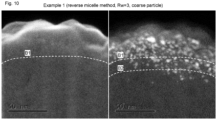
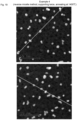
- the image on the left side is a secondary electron image of a supported metal catalyst of Comparative Example 1, and the image on the right side is a Z-contrast image thereof.
- the supported metal catalyst 1 of one embodiment of the present invention includes a support 3 and active metal particles 4.
- a support 3 As shown in Figs. 1 to 4 , the supported metal catalyst 1 of one embodiment of the present invention includes a support 3 and active metal particles 4.
- active metal particles 4 As shown in Figs. 1 to 4 , each configuration will be described in detail.
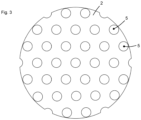
- the support 3 is a collective body of conductive particles 2, and preferably in the form of powder. In this regard, only one conductive particle 2 is shown in Fig. 1 to Fig. 4 .
- the conductive particles 2 are particles having conductivity.
- the composition of the conductive particle 2 is not particularly limited. From the viewpoint of conductivity, ease of manufacturing and the like, the conductive particles 2 are preferably carbon particles, more preferably mesoporous carbon particles, and even more preferably ordered mesoporous carbon (OMC) particles having pore diameter and pore spacing with small deviation and periodic arrangement of pores.
- OMC ordered mesoporous carbon
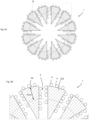
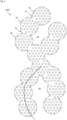
- the conductive particle 2 may be composed of a (preferably substantially spherical) single particle and is preferably an interconnected structure 2a in which a plurality of (preferably an average of 5 or more) (preferably substantially spherical) primary particles 2b are connected, as shown in Fig. 4 .
- the single particle is also referred to as the "primary particle” for convenience.
- the interconnected structure 2a is referred to as an aggregate and is preferable because a flow path 2e surrounded by the primary particles 2b is formed, which decreases the diffusion resistance of a substance and facilitates catalytic reaction.
- the flow path 2e may be also referred to as a "primary pore".
- an agglomerated body of the aggregates that is formed by agglomerating the interconnected structure 2a and the interconnected structure 2a is referred to as a secondary particle, an agglomerate. Since the agglomerate is a secondary particle, it can be crushed relatively easily.
- a pore formed by a gap between the agglomerates may be referred to as a "secondary pore".
- the average primary particle diameter of the conductive particles 2 is preferably 20 to 100 nm. This is because if this value is too small, the entrance diameter of pores 5 may be too small, while if this value is too large, the specific surface area of the support 3 may be too small. This average particle diameter is, specifically for example, 20, 30, 40, 50, 60, 70, 80, 90, or 100 nm, and may be in the range between the two values exemplified herein.
- the pores 5 open on the primary particle surface of the conductive particles 2, have a nanoscale size and can also be referred to as "nanopores".
- an example of a method for measuring the average primary particle diameter of the conductive particles 2 is described, taking the case where the conductive particles 2 are the interconnected structures 2a of the carbon particles as an example.
- an electron microscope image as shown in Fig. 8 is taken for a powder of the conductive particles 2 by means of a scanning transmission electron microscope (STEM, manufactured by Hitachi High-Tech Corporation, HD-2700) with an aberration correction lens.
- STEM scanning transmission electron microscope
- the carbon particles are interconnected structures that have a thick portion and thin portion alternately and continuously and is formed by interconnecting an average of 5 or more primary particles.
- the maximum diameter of the thick portion is defined as the primary particle diameter and is measured at 100 or more points, and the average value of the measured results is calculated.
- the minimum diameter of the thin portion is defined as the diameter of a connected portion between the primary particles and is measured at 100 or more points, and the average value of the measured results is calculated.
- the thick portion and the thin portion are alternately continuous along its connecting direction.
- the thick portion is the primary particle 2b
- the thin portion is a connected portion 2c between the primary particles 2b.
- B/A is preferably 0.1 to 0.9, and more preferably 0.2 to 0.8. If B/A is too small, the strength of the interconnected structures 2a may not be sufficient.
- B/A is, specifically for example, 0.1, 0.2, 0.3, 0.4, 0.5, 0.6, 0.7, 0.8, or 0.9, and may be in the range between the two values exemplified herein.
- the average particle diameter of the primary particles 2b is an average value of equivalent circle diameter of the single particles.
- the average particle diameter is an average value of the maximum width of the thick portions of the interconnected structures 2a. In the present specification, the average is preferably calculated by averaging 50 or more (preferably 100 or more) measured values.
- the average connection number of the interconnected structures 2a (the average value of the number of the primary particles 2b included in the interconnected structures 2a) is preferably 5 or more, more preferably 10 or more, and even more preferably 100 or more. This average connection number is, for example, 5 to 10000, specifically for example, 5, 10, 50, 100, 500, 1000, 5000, or 10000, and may be in the range between the two values exemplified herein.
- the average series connection number of the interconnected structures 2a (the average value of the number of the primary particles 2b connected in series) is preferably 3 or more, and more preferably 5 or more.
- the connection in series means the connection along one line (straight line or curved line). The series connection number is counted starting from the primary particle where a branch is generated.
- the series connection number is 4.
- the average series connection number is an average value of the series connection number for 50 or more (preferably 100 or more) branches.
- This average series connection number is, for example, 3 to 100, specifically for example, 3, 5, 10, 50, or 100, and may be in the range between the two values exemplified herein.
- the conductive particle 2 has a plurality of pores 5.
- the plurality of pores 5 is preferably regular in size, arrangement, shape and the like.
- the diameter of the pores 5 may be constant or may vary along the depth direction.
- the conductive particle 2 in Fig. 2A and Fig. 2B is hollow at the center, the conductive particles 2 and the primary particles may be hollow or solid at the center.
- the average entrance pore diameter of the pores 5 is 1 to 20 nm.
- the average entrance pore diameter is an average value of the equivalent circle diameter of the entrance of the pores 5. If the average entrance pore diameter is too small, it may be difficult to support the active metal particles 4 in the pores 5, and if the average entrance pore diameter is too large, the active metal particles 4 are supported at a deep position in the pores 5 and are unavailable for the catalytic reaction.
- the average entrance pore diameter is, specifically for example, 1, 2, 3, 4, 5, 6, 7, 8, 9, 10, 11, 12, 13, 14, 15, 16, 17, 18, 19, or 20 nm, and may be in the range between the two values exemplified herein.
- the conductive particles 2 are carbon particles as an example.
- the observation of an electron microscope image is performed at a magnification of 500,000 times to 1,000,000 times, and the pore size is measured. At that time, the brightness and contrast of the electron microscope image are adjusted so that the boundary between an outer surface of the primary particles of the carbon particles and the pores opening on the outer surface becomes clear.
- a particle diameter measurement software manufactured by NIRECO Corporation, LUZEX AP
- the equivalent circle diameter of each pore is measured for 100 or more pores, and the average entrance pore diameter and its standard deviation are obtained.
- pores in the following three cases are not counted.
- the primary particles of the carbon particles are spherical or spindle-shaped, the size of the pores located near a side surface cannot be accurately measured by electron microscope observation.
- the boundary line between the outer surface of the carbon particles and the pores may not be sufficiently clear depending on the shape of a sample and observation conditions.
- the sample is not within the exact focus range, the pore size cannot be accurately obtained.
- the standard deviation of the average entrance pore diameter of the pores 5 is equal to or less than 50% of the average entrance pore diameter, and preferably equal to or less than 30%.
- This standard deviation is, specifically for example, 0, 5, 10, 15, 20, 25, 30, 35, 40, 45, or 50% of the average entrance pore diameter, and may be in the range between the two values exemplified herein.
- the average interpore distance of the pores 5 is preferably 5 to 20 nm.
- the average interpore distance is an average value of the interpore distance obtained from the distance between circle center points of the adjacent pores 5. If the average interpore distance is too small, the reaction rate may decrease due to the insufficient supply of reactants of the catalytic reaction. If the average interpore distance is too large, the number of the pores 5 may be too small, or the active metal particles 4 may tend to be supported on the surface outside the pores.
- the conductive particles 2 are carbon particles as an example.
- the observation of the electron microscope image is performed at a magnification of 500,000 times to 1,000,000 times, and the pore size is measured. At that time, the brightness and contrast of the electron microscope image are adjusted so that the boundary between an outer surface of the primary particles of the carbon particles and the pores opening on the outer surface becomes clear.
- the particle diameter measurement software manufactured by NIRECO Corporation, LUZEX AP
- the equivalent circle diameter of each pore is measured for 100 or more pores.
- pores in the following three cases are not counted.
- the primary particles of the carbon particles are spherical or spindle-shaped, the size of the pores located near a side surface cannot be accurately measured by electron microscope observation.
- the boundary line between the outer surface of the carbon particles and the pores may not be sufficiently clear depending on the shape of a sample and observation conditions.
- the sample is not within the exact focus range, the pore size cannot be accurately obtained.
- the circle center coordinates of the pores approximated by a circle are recorded to obtain the equivalent circle diameter of the pores.
- the interpore distance is obtained at 100 or more points from the distance between circle center points of the adjacent pores, and the average interpore distance and its standard deviation are calculated.
- the standard deviation of the average interpore distance of the pores 5 is preferably equal to or less than 50% of the average interpore distance, and more preferably equal to or less than 30%.
- This standard deviation is, specifically for example, 0, 5, 10, 15, 20, 25, 30, 35, 40, 45, or 50% of the average interpore distance, and may be in the range between the two values exemplified herein.
- the support 3 can be manufactured by any method capable of forming the pores 5 having the above-described physical properties, and examples of the manufacturing method of the support 3 include a hard template method and a soft template method.
- the hard template method is a method using a solid, such as fine particles, mesoporous materials, and zeolite, as a template.
- a template having regular pores, such as mesoporous silica, is prepared.
- the pores of this template are impregnated with a carbon source (e.g., sugar, such as sucrose), the carbon source is carbonized, and the template is removed, so that the carbon particles having the regular pores can be obtained.
- a carbon source e.g., sugar, such as sucrose
- the soft template method is a method using a phase-separated structure of a soft matter, such as micelle, emulsion, liposome, polymer blend, and liquid crystal, as a template.
- the conductive particles 2 when the conductive particles 2 are carbon particles, the conductive particles 2 can be manufactured by a method including a cohesion step, a bonding step, and a carbonizing step.
- a carbon source cohered body 8 in which carbon source spheres 7 cohere to each other is formed.
- the carbon source cohered body 8 becomes a primary particle of the conductive particle 2.
- the carbon source sphere 7 can be formed by forming a coating film of the carbon source on the surface of micelle.
- the carbon source sphere 7 has a reactive functional group, such as a methylol group or a hydroxyl group, and the carbon source spheres 7 can be bonded to each other, for example, by condensation reaction of the reactive functional groups. Since the carbon source spheres 7 are spheres and cannot cohere without a gap, a gap 8a surrounded by a plurality of carbon source spheres 7 is inevitably formed in the carbon source cohered body 8. The gap 8a becomes the pore 5 of the conductive particle 2. Since the gaps 8a are regularly formed, the pores 5 are also regularly formed.
- a manufacture example of the carbon source spheres 7 and the carbon source cohered bodies 8 is as follows.
- phenol 0.6057 g as the carbon source
- formaldehyde solution 2.1 mL
- 0.1 M NaOH 15.1613 g
- the mixed solution is stirred in a 70°C bath at 345 rpm for 0.5 h.
- Pluronic F-127 as a template molecule manufactured by BASF, nonionic surfactant, triblock copolymer composed of a hydrophobic block sandwiched between a pair of hydrophilic blocks, hereinafter referred to as "F-127".
- F-127 nonionic surfactant, triblock copolymer composed of a hydrophobic block sandwiched between a pair of hydrophilic blocks
- the carbon source sphere 7 in which a micelle composed of F-127 is coated with resol is generated. Then, self-organization of the carbon source spheres 7 takes place and the carbon source cohered bodies 8 are generated.
- the micelle can be formed, for example, by dispersing block copolymer having a hydrophilic block and a hydrophobic block in a dispersion medium, such as water.
- the block copolymer is preferably triblock copolymer composed of a hydrophobic block sandwiched between a pair of hydrophilic blocks.
- a block copolymer in which the hydrophobic block is composed of a polymer of propylene oxide and the hydrophilic block is composed of a polymer of ethylene oxide can be used.
- the coating film is composed of, for example, resol.
- the resol is a phenolic resin having a reactive functional group.
- the coating film of resol can be formed by polymerizing phenol and formaldehyde in a dispersion medium containing micelle under conditions where formaldehyde is excessive.
- the carbon source sphere 7 is formed by coating the micelle composed of the triblock copolymer with a resol coating film.
- carbon source bonded bodies are formed by bonding the carbon source spheres 7 to each other in a state of no stirring or in a state of stirring of the dispersion liquid containing the carbon source cohered bodies 8.
- the bonding between the carbon source spheres 7 when the carbon source spheres 7 are bonded to each other in a state of no stirring or in a state of stirring at the Reynolds number of 1400 or less (hereinafter, referred to as "low-speed stirring") of the dispersion liquid containing the carbon source cohered bodies 8, as shown in Fig. 6 , in addition to the bonding between the carbon source spheres 7 included in the same carbon source cohered body 8, the carbon source spheres 7 included in different carbon source cohered bodies 8 are also bonded to each other.
- the carbon source bonded bodies having an interconnected structure in which an average of 5 or more carbon source cohered bodies 8 are connected to each other are obtained.
- the interconnected structures 2a in which an average of 5 or more primary particles 2b are interconnected can be formed.
- the Reynolds number is preferably 1200 or less, and more preferably 1000 or less.
- the Reynolds number is, for example, 0 to 1400, specifically for example, 0, 100, 200, 300, 400, 500, 600, 700, 800, 900, 1000, 1100, 1200, 1300, or 1400, and may be in the range between the two values exemplified herein.
- the carbon source spheres 7 are bonded to each other by stirring the dispersion liquid at high speed, the bonding between the carbon source spheres 7 contained in the same carbon source cohered bodies 8 occurs dominantly, and the carbon source bonded bodies of the single particles are obtained.
- the conductive particles 2 having a single particle structure in which the primary particles 2b are not connected to each other can be obtained.
- the dispersion medium is preferably water. Further, it is preferable to bond the carbon source spheres 7 to each other by heating the dispersion liquid.
- the reaction temperature is, for example, 100 to 150°C, specifically for example, 100, 110, 120, 130, 140, or 150°C, and may be in the range between the two values exemplified herein.
- the reaction time is, for example, 5 to 48 h, specifically for example, 5, 10, 15, 20, 25, 30, 35, 40, 45, or 48 h, and may be in the range between the two values exemplified herein.
- the structure of the carbon source bonded bodies obtained by the reaction can be changed by changing the reaction temperature, the reaction time, and the concentration of the reaction solution.
- the reaction temperature, increasing the reaction time, or increasing the concentration of the reaction solution By increasing the reaction temperature, increasing the reaction time, or increasing the concentration of the reaction solution, the connection number and the primary particle diameter of the carbon source cohered bodies 8 can be increased.
- the conductive particles 2 can be obtained by carbonizing the carbon source bonded bodies.
- the primary particles 2b (the primary particles 2b in a state of the single particles, or the primary particles 2b in a state of the interconnected structures 2a) are prone to be three-dimensionally connected to each other to form a structure in which the primary particles 2b excessively cohere to each other. Therefore, it is preferable to re-disperse the carbon source bonded bodies and then dry them before carbonization. Consequently, the cohesion of the primary particles 2b can be mitigated. Further, it is preferable to thinly spread the dispersion liquid obtained by the re-dispersion of the carbon source bonded bodies and then dry it.
- the cohesion of the primary particles 2b can be further mitigated.
- a method of spreading the dispersion liquid thinly there is a method of dropping the dispersion liquid onto a surface, such as the surface of a glass plate.
- a method of dropping the dispersion liquid onto a glass plate heated by a hot plate the dispersion liquid can be dried in a thinly spread state.
- the cohesion of the primary particles 2b may be mitigated by spray-drying the dispersion liquid obtained by the re-dispersion of the carbon source bonded bodies. Freeze-drying is preferable as a drying method.
- the carbon source bonded bodies can be carbonized by heating the carbon source bonded bodies in an atmosphere of an inert gas (e.g., nitrogen gas).
- the carbon source bonded bodies can be carbonized by, for example, heating the carbon source bonded bodies to 600 to 1000°C. This temperature is, specifically for example, 600, 650, 700, 750, 800, 850, 900, 950, or 1000°C, and may be in the range between the two values exemplified herein.
- An annealing step of performing the annealing treatment of the conductive particles 2 may be performed after the carbonizing step.
- the structure of the conductive particles 2 can be controlled by changing the temperature or time of the annealing treatment.
- the annealing treatment can be performed by, for example, heating the conductive particles 2 in flowing nitrogen or a vacuum.
- the temperature of the annealing treatment is, for example, 800 to 2000°C. This temperature is, specifically for example, 800, 900, 1000, 1100, 1200, 1300, 1400, 1500, 1600, 1700, 1800, 1900, or 2000°C, and may be in the range between the two values exemplified herein.
- the active metal particles 4 are supported by the reverse micelle method described below, it is preferable to perform the annealing step before the first supporting step.
- this annealing step is performed at 1100 to 2000°C in a vacuum.
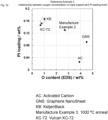
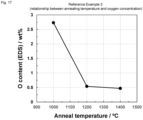
- the following are found: (1) in the reverse micelle method, the lower the oxygen content in the conductive particles 2, the larger the amount of the active metal particles 4 supported tends to be, and (2) the oxygen content in the conductive particles 2 is reduced by annealing treatment at 1100 to 2000°C in a vacuum.
- the annealing time is, for example, 0.5 h or longer, and preferably 0.5 to 20 h.
- the annealing time is, specifically for example, 0.5, 1, 2, 3, 4, 5, 6, 7, 8, 9, 10, 15, or 20 h, and may be in the range between the two values exemplified herein.
- vacuum means a state in which the pressure is reduced to 10 -2 hPa or lower (preferably 10 -3 hPa or lower, 10 -4 hPa or lower, or 10 -5 hPa or lower).
- the interconnected structures 2a may be generated by connecting the primary particles 2b to each other using a linking agent.
- the primary particles 2b may be generated by bonding the carbon source spheres 7 to each other while stirring the dispersion liquid at high speed or may be generated by dividing coarse particles of the carbon source (carbon source coarse particles).
- the carbon source coarse particles may be manufactured by a method described later in Manufacture Example 2 and are particles having the primary particle diameter of more than 100 nm.
- the linking agent include compounds having a plurality of reactive functional groups. Each of the reactive functional groups is connected to the primary particles 2b, so that the primary particles 2b are connected to each other via the linking agent.
- linking agent specifically, for example, sugar, such as sucrose, and alcohol, such as furfuryl alcohol, can be used.
- the active metal particles 4 are dispersed and supported on the conductive particles 2.
- the active metal particles 4 are fine particles of metal or alloy that can function as a catalyst.
- the active metal particles 4 are preferably platinum or platinum alloy particles.
- As the platinum alloy an alloy of platinum and transition metal is preferable. Examples of the transition metal include cobalt and nickel.
- the active metal particles 4 are supported in a region on a surface 2d of the conductive particles 2 or in the pores 5. Since the diffusion rate of the substance is small at a deep position in the pores 5, the active metal particles 4 supported at the deep position in the pores 5 make little or no contribution to the catalytic reaction. Therefore, if the number fraction of the active metal particles 4 supported at the deep position in the pores 5 is large, the effectiveness factor of the active metal particles 4 will decrease correspondingly. If the effectiveness factor of the active metal particle 4 decreases, more active metal particles 4 need to be supported to achieve the required reaction rate, which leads to an increase in the cost of the catalyst.
- the proportion of the active metal particles 4 supported in a surface layer region of the conductive particles 2 is high.
- the number fraction of the active metal particles 4 supported in the surface layer region (hereinafter, referred to as "particles supported on the surface layer") (the number of the active metal particles 4 supported in the surface layer region/the number of all active metal particles 4) is preferably 50% or more, and more preferably 60% or more. In such a case, the effectiveness factor of the active metal particles 4 is excellent.
- This number fraction is, specifically for example, 50, 55, 60, 65, 70, 75, 80, 85, 90, 95, 99, or 100%, and may be in the range between the two values exemplified herein.
- a powder of carbon particles on which platinum particles are supported is placed on a silicon wafer substrate, and a protective layer is formed on the outer surface of sample particles by gold vapor deposition.
- a focused ion beam (FIB) device (FB2200, manufactured by Hitachi High-Tech Corporation) is used to cut the sample particles with the gallium ion beam, and a sample section for electron microscope observation is prepared.
- metal particles Au particles and Pt particles present on the sample are observed from a Z-contrast image (atomic number contrast image) shown in Fig.
- the composition of each of the metal particles is analyzed using an energy-dispersive X-ray spectrometer to distinguish between the Pt particles and the Au particles.
- the point of change (boundary line) from a portion where the Au particles exist to a portion where only the Pt particles exist without the Au particles is defined as the boundary line between the outer surface and the cross section of the carbon particle.
- a line segment parallel to the outer surface boundary line is drawn at a position 15 nm from the above-described sample outer surface boundary line in the direction toward the center of the sample particle, and the number fraction of the particles supported on the surface layer is calculated from the ratio of the number of Pt particles between the outer surface boundary line and the line segment at the 15 nm position and the number of Pt particles deeper beyond the line segment at the 15 nm position in the direction toward the center of the sample particle.
- X may be 5 nm or 10 nm and is more preferably 5 nm or less. Further, X may be set to be the average particle diameter of the primary particles 2b ⁇ Y. Y is, for example, 0.1, 0.2, 0.3, 0.4, or 0.5, and is preferably 0.3. Further, X may be set to be the average entrance pore diameter of the pores 5 ⁇ Z. Z is, for example, 1, 2, 3, 4, or 5, and is preferably 1.
- the number fraction of the active metal particles 4 supported in the pores 5 divided by the total number of the active metal particles 4 supported in the surface layer region of the conductive particles 2 is preferably 40% or more.
- the supported metal catalyst 1 may be thickly coated with an electrolyte material, and in such a case, the activity of the active metal particles 4 coated with the electrolyte material may decrease. By increasing the number fraction of the active metal particles 4 supported in the pores 5, the influence of the decrease in the activity of the active metal particles 4 can be suppressed.
- This number fraction is, specifically for example, 40, 45, 50, 51, 52, 53, 54, 55, 56, 57, 58, 59, 60, 65, 70, 75, 80, 85, 90, 95, 99, or 100%, and may be in the range between the two values exemplified herein.
- the electrolyte material present on the support surface may adhere to the active metal particles present on the support surface, and their activity may decrease (reaction rate decrease on the active metal particles on the surface).
- the adhesion of the electrolyte material to the active metal particles present on the support surface is mitigated by the large amount of water generated on the cathode catalyst, and the activity is restored.
- the reaction rate of the entire catalyst layer is high, the rate on activity metal in a deep portion of the pores may decrease due to the diffusion resistance to the deep portion of the pores (reaction rate decrease on the active metal particles in the deep portion of the pores).
- the majority of the active metal particles are arranged inside the pores while the active metal particles are arranged in the region inside the pores (15 nm or less) from the vicinity of the support surface, so that a superior catalyst for fuel cell vehicles can be prepared. Further, from this viewpoint, it is considered to be even more effective if the active metal particles are arranged within a range of 10 nm or less, preferably 5 nm or less from the surface.
- the active metal particles 4 have an average interparticle distance of 5 to 20 nm, and a standard deviation of the average interparticle distance is equal to or less than 50% of the average interparticle distance.
- the average interparticle distance of the active metal particles 4 is preferably 5 to 20 nm.
- the average interparticle distance is the average value of the interparticle distances obtained from the distance between circle center points of the adjacent active metal particles 4. If the average interparticle distance is too small, the reaction rate may decrease due to the insufficient supply of reactants of the catalytic reaction. If the average interpore distance is too large, the number of the active metal particles 4 may be too small.
- the conductive particles 2 are carbon particles as an example.
- the observation of the electron microscope image is performed at a magnification of 500,000 times to 1,000,000 times, and the particle size is measured. At that time, the brightness and contrast of the electron microscope image are adjusted, so that the active metal particles 4 become clear.
- the particle diameter measurement software manufactured by NIRECO Corporation, LUZEX AP
- the equivalent circle diameter of each particle is measured for 100 or more particles.
- particles in the following three cases are not counted.
- the primary particles of the carbon particles are spherical or spindle-shaped, the size of the particles located near a side surface cannot be accurately measured by electron microscope observation.
- the active metal particles 4 may not be sufficiently clear depending on the shape of a sample and observation conditions.
- the sample is not within the exact focus range, the particle size cannot be accurately obtained.
- the circle center coordinates of the particles approximated by a circle are recorded to obtain the equivalent circle diameter of the particles.
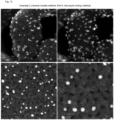
- the interparticle distance is obtained at 100 or more points from the distance between circle center points of the adjacent particles, and the average interparticle distance and its standard deviation are calculated.
- the standard deviation of the average interparticle distance of the active metal particles 4 is preferably equal to or less than 50% of the average interparticle distance, and more preferably equal to or less than 30%.
- This standard deviation is, specifically for example, 0, 5, 10, 15, 20, 25, 30, 35, 40, 45, or 50% of the average interparticle distance, and may be in the range between the two values exemplified herein.
- the average particle diameter of the active metal particles 4 is preferably 1 to 8 nm. This average particle diameter is, specifically for example, 1, 2, 3, 4, 5, 6, 7, or 8 nm, and may be in the range between the two values exemplified herein. When the average particle diameter of the active metal particles 4 is less than 1 nm, the active metal particles 4 may dissolve as the electrode reaction progresses. When the average particle diameter is more than 8 nm, the electrochemically active surface area may become small, and the desired electrode performance may not be achieved.
- the average particle diameter of the active metal particles 4 is an average value of the equivalent circle diameter.
- the active metal particles 4 are platinum particles as an example.
- a catalyst in which platinum particles are supported is placed on a grid with a carbon supporting film for an electron microscope, and the average particle diameter of the equivalent circle diameter of the platinum particles is calculated from an image obtained with an electron microscope.
- the value of [the average particle diameter of the active metal particles 4 divided by the average entrance pore diameter of the pores 5] is preferably 0.2 to 0.8. In such a condition, the active metal particles 4 can be easily supported in the surface layer region. This value is, specifically for example, 0.2, 0.3, 0.4, 0.5, 0.6, 0.7, or 0.8, and may be in the range between the two values exemplified herein.
- the proportion of the active metal particles 4 in the supported metal catalyst 1 (hereinafter referred to as "supporting amount of active metal particles 4") is preferably 16 to 50 mass%, and more preferably 21 to 35 mass%. If this proportion is too small, the performance of the catalyst may not be fully exhibited. If this proportion is too large, the distance between the adjacent active metal particles 4 becomes too small, and deterioration due to aggregation and enlargement of the active metal particles 4 may easily occur.
- the supporting amount of the active metal particles 4 is, specifically for example, 16, 17, 18, 19, 20, 21, 22, 23, 24, 25, 26, 27, 28, 29, 30, 31, 32, 33, 34, 35, 36, 37, 38, 39, 40, 41, 42, 43, 44, 45, 46, 47, 48, 49, or 50 mass%, and may be in the range between the two values exemplified herein.
- the supporting amount of the active metal particles 4 can be measured by thermogravimetric analysis.
- the supported metal catalyst 1 is burned in air, and the supporting amount can be calculated taking the residue as the active metal particles 4.
- a usual impregnation method As a method for supporting the active metal particles 4, a usual impregnation method can be first considered. However, with the usual impregnation method, it is not possible to selectively support the particles only near the entrance of the pores, and the particle size distribution of the active metal particles 4 is widened, resulting in mass transfer resistance in addition to inhibition by electrolyte adsorption. Consequently, when used as a cathode of a fuel cell, the particle growth of the active metal particles 4 progresses during operation, causing deterioration.
- the active metal particles 4 are synthesized in advance in a liquid phase and then supported. That is, the active metal particles 4 or oxides thereof with uniform size are synthesized in advance in the liquid phase by the reverse micelle method, the colloid method, or the like, and then supported on the support having regular pores. Since the size of the pores 5 of the conductive particles 2 is uniform, the selectivity of the supporting position of the active metal particles 4 can be enhanced, which leads to suppression of catalyst deactivation and reduction of the amount of the active metal particles 4 used.
- the supported metal catalyst 1 having appropriate values for the average interparticle distance of the active metal particles 4 and its standard deviation.
- a manufacturing method of the supported metal catalyst comprises a mixing step, a reduction step, and a supporting step.
- a mixing step a mixing step
- a reduction step a reduction step
- a supporting step a supporting step
- a mixed solution (hereinafter, referred to as “active metal precursor mixed solution”) is generated by mixing an active metal precursor solution containing an active metal precursor with a surfactant and an organic solvent.
- the active metal precursor is a compound that serves as a raw material reduced to form active metal, and examples thereof include an acid, a salt, or a complex of the active metal.
- the active metal precursor for example, a metal chloride acid and a salt thereof (e.g., potassium salt), an ammine complex, ethylenediamine complex, acetylacetonate complex of the active metal or the like can be used.
- platinum precursor compound such as chloroplatinic acid (e.g., hexachloroplatinic acid, tetrachloroplatinic acid), acetylacetonate platinum (Pt(acac) 2 ), chloroplatinate (e.g., potassium chloroplatinate (K 2 PtCl 4 )), and platinum ammine complex
- chloroplatinic acid e.g., hexachloroplatinic acid, tetrachloroplatinic acid
- acetylacetonate platinum Pt(acac) 2
- chloroplatinate e.g., potassium chloroplatinate (K 2 PtCl 4 )
- platinum ammine complex platinum ammine complex
- the active metal precursor solution is preferably an aqueous solution.
- the active metal precursor is not limited to one type, and a second or third metal salt may be added.
- any surfactant capable of forming a reverse micelle can be used.
- the examples of the surfactant include anionic surfactant (for example, soap, sulfated oil, polyoxyethylene alkyl ether sulfate, alkyl sulfate ester salt, alkylbenzene sulfonate, alkane sulfonate, ⁇ -olefin sulfonate, N-acylamino acid salt, dialkyl sulfosuccinate, alkyl naphthalene sulfonate), cationic surfactant (for example, alkyl trimethylammonium salt, alkyl pyridinium salt), nonionic surfactant (for example, polyoxyethylene alkyl ether, polyoxyethylene alkyl phenyl ether, polyoxyethylene fatty acid ester, polyhydric alcohol fatty acid ester), and amphoteric surfactant (for example, betaine and sulfobetaine).
- the nonionic surfactant is preferable, the surfactant having a phenylene group is more preferable, polyoxyalkylene alkylphenyl ether is more preferable, polyoxyethylene alkylphenyl ether is preferable, and polyoxyethylene nonylphenyl ether is more preferable.
- the average addition mole number of polyoxyalkylene is preferably 2 to 10, more preferably 3 to 7, and even more preferably 5.
- the average addition mole number is, specifically for example, 2, 3, 4, 5, 6, 7, 8, 9, or 10, and may be in the range between the two values exemplified herein.
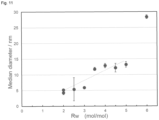
- the molar ratio Rw between water and the surfactant is preferably 1 to 7 and more preferably 2 to 5. Further, the concentration of the surfactant is preferably equal to or more than the critical micelle concentration and preferably 40 to 160 mmol/L.
- organic solvent a hydrophobic organic solvent is preferable, and an organic solvent containing at least one selected from cyclohexane, heptane, and toluene is more preferable.
- the active metal precursor in the active metal precursor mixed solution is reduced to generate the active metal particles 4.
- the liquid temperature is preferably 20°C to 30°C.
- the active metal precursor can be reduced by adding a reducing agent to the mixed solution.
- a reducing agent examples include MBR 3 H, MH (where M represents lithium, sodium, or potassium, and R represents a hydrogen atom or a hydrocarbon group, and the hydrocarbon group may be linear or branched and may be saturated or unsaturated), and hydrogen, and NaBH 4 is preferable.
- the reduction is preferably performed by mixing a solution containing a reducing agent, an organic solvent, water, and surfactant with the active metal precursor mixed solution.
- a solution containing a reducing agent, an organic solvent, water, and surfactant with the active metal precursor mixed solution.
- the reduction rate of the active metal precursor is controlled, and the monodispersity of Pt particles is improved, so that the increase in the supporting amount on the surface layer is expected.
- the surfactant in the reducing agent mixed solution can be selected from the group listed in the above-described ⁇ Mixing Step> and is preferably the same as the surfactant mixed in the ⁇ Mixing Step>.
- the molar ratio Rw between the water and the surfactant in the reducing agent mixed solution is preferably 1 to 7 and more preferably 2 to 5, and it is even more preferable that the concentration is the same as the concentration of the active metal precursor mixed solution.
- a hydrophobic organic solvent is preferable, a solvent containing at least one selected from cyclohexane, heptane, and toluene is more preferable, and the solvent same as the solvent in the active metal precursor mixed solution is even more preferable.
- the active metal particles 4 obtained in the reduction step are in a state of being confined in the reverse micelles, and the diameter of the reverse micelles is larger than the diameter of the active metal particles 4. Therefore, the active metal particles 4 are suppressed from being supported at a deep position in the pores 5, and the number fraction of the active metal particles 4 supported in the surface layer region is increased.
- the count median diameter measured in the mixed solution by the dynamic light scattering method is the reverse micelle diameter.
- This reverse micelle diameter is preferably 0.5 to 2 times as large as the average entrance pore diameter of the pores 5.
- the number fraction of the active metal particles 4 supported in the surface layer region is particularly increased.
- This factor is, specifically for example, 0.5, 0.6, 0.7, 0.8, 0.9, 1, 1.1, 1.2, 1.3, 1.4, 1.5, 1.6, 1.7, 1.8, 1.9, or 2 times, and may be in the range between the two values exemplified herein.
- the reverse micelle in the solvent is composed of a surfactant layer surrounding a fine water droplet encapsulating the active metal particle and a solvent layer formed around the surfactant layer.
- the reverse micelle diameter is sufficiently smaller than the support pore entrance diameter (the reverse micelle diameter is less than 0.5 times as large as the entrance pore diameter of the pore 5)
- the interaction between a pore wall and the surfactant is weak because the solvent layer formed outside the surfactant layer hinders contacting the surfactant layer with the inner wall of the pore entrance, so that the reverse micelle penetrates deep inside the pore without collapsing.
- the reverse micelle diameter exceeds twice the entrance pore diameter of the pore 5
- the reverse micelle diameter is too large compared to the pore entrance diameter, and the reverse micelle cannot penetrate the pore, so that the active metal particle is supported on the surface outside the pore.
- the reverse micelle diameter is within the range of 0.5 to 2 times as large as the entrance pore diameter of the pore 5
- the diameter of the surfactant layer surrounded by the solvent layer is almost the same as the pore entrance diameter, so that, in the course of the reverse micelle being penetrating the pore entrance, the stability of the reverse micelle is lost and the micelle structure collapses due to strong adsorption between a hydrophobic portion of a surfactant molecule and the support pore wall.
- the active metal particles are adsorbed on a hydrophilic portion of the surfactant, the active metal particles are trapped near the pore entrance via the surfactant and fixed at a short distance from the pore entrance.
- the support 3 which is a collective body of the conductive particles 2 and the active metal particles 4 obtained in the reduction step are mixed to disperse and support the active metal particles 4 on the conductive particles 2.
- the support described in "2. Configuration of Support 3" can be used. It is preferable to mix the mixed solution after the reduction step with the support 3.
- the uniformity of supporting can be enhanced by stirring the mixed solution obtained after mixing.
- the stirring time is preferably 1 h or longer, and more preferably 6 h or longer. This stirring time is, specifically for example, 1, 2, 3, 4, 5, 6, 7, 8, 9, 10, 20, 30, 40, 50, or 100 h, and may be in the range between the two values exemplified herein.
- the supported metal catalyst 1 after supporting can be taken out from the mixed solution by a solid-liquid separation method such as filtration.
- the supported metal catalyst 1 taken out can be subjected to a treatment to remove the remaining surfactant.
- the surfactant can be removed by washing with a solvent, reduction treatment, or the like. It is preferable to remove most of the surfactant by washing with a solvent and remove a small amount of the surfactant remaining in the pores by subsequent reduction treatment.
- the solvent include water, and compounds having hydrophilic and hydrophobic groups.
- the compound having hydrophilic and hydrophobic groups include alcohol. This alcohol is preferably methanol or ethanol.
- the supported metal catalyst 1 after washing is preferably dried by drying under reduced pressure or the like.
- the reduction treatment can be performed by heat-treating the supported metal catalyst 1 taken out from the mixed solution under a reducing gas atmosphere.
- the supported metal catalyst 1 is preferably the supported metal catalyst that was washed with a solvent and dried under reduced pressure before reduction treatment.
- the reducing gas is a gas having a reducing action, and examples thereof include a mixed gas of hydrogen and inert gas (e.g., nitrogen).
- the hydrogen concentration in the reducing gas is, for example, 1 to 100%, and preferably 1 to 10%. This concentration may be, specifically for example, 1, 2, 3, 4, 5, 6, 7, 8, 9, 10, 50, or 100%, and may be in the range between the two values exemplified herein.
- the heat-treating temperature is, for example, 100 to 400°C, and preferably 150 to 250°C.
- This temperature is, specifically for example, 100, 150, 200, 250, 300, 350, or 400°C, and may be in the range between the two values exemplified herein.
- the manufacturing method of the supported metal catalyst may comprise a step to enhance regular arrangement after the supporting step.
- a regular arrangement of the active metal particles 4 is achieved by performing an arrangement treatment.
- the arrangement treatment can be performed in the same manner as in " ⁇ Arrangement Step>" in "5-3. Colloid Method”.
- the active metal particles 4 supported in such unstable positions are thought to move into the more stable pores 5 by performing the arrangement treatment, and the active metal particles 4 become more regularly arranged by increasing the proportion of the active metal particles 4 in the pores 5. Further, it is thought that the dissolution and reprecipitation of the active metal particles 4 proceed by potential sweep in the electrolyte, reducing the variation in particle diameter of the active metal particles 4 and increasing the proportion of active metal particles 4 supported in the pores 5.
- the reduction treatment in the above-described surfactant removal step can also serve as the arrangement treatment.
- the reduction treatment by the reduction treatment, the surfactant is removed and regular arrangement of the active metal particles 4 is promoted.
- the arrangement treatment only the reduction treatment may be performed, or another arrangement treatment may be performed before or after the reduction treatment.
- the supporting amount of the active metal particles 4 may be difficult to sufficiently increase the supporting amount of the active metal particles 4 by performing only one cycle. In such cases, the supporting amount can be increased by performing the reverse micelle method with multiple cycles.
- this method comprises a first step, a surfactant removal step, and a second step.
- the first step comprises a first mixing step, a first reduction step, and a first supporting step.
- the second step comprises a second mixing step, a second reduction step, and a second supporting step.
- a first active metal precursor mixed solution is generated by mixing an active metal precursor solution containing an active metal precursor with a surfactant and an organic solvent. This step can be performed in the same manner as ⁇ Mixing Step> described above.
- the active metal particles 4 are generated by the reduction of the active metal precursor in the first active metal precursor mixed solution. This step can be performed in the same manner as ⁇ Reduction Step> described above.
- the support 3 which is a collective body of the conductive particles 2 and the active metal particles 4 obtained in the first reduction step are mixed to disperse and support the active metal particles 4 on the conductive particles 2.
- This step can be performed in the same manner as ⁇ Supporting Step> described above.
- the surfactant adhered to the support 3 is removed.
- the removal of the surfactant can be performed in the same manner as in ⁇ Surfactant Removal Step> described above.
- This step is preferably performed by reduction treatment, and more preferably performed by washing with a solvent and subsequent reduction treatment.
- the surfactant in the pores 5 where the active metal particles 4 are not supported can also be effectively removed, thus promoting the supporting of the active metal particles 4 in the pores 5 where the active metal particles 4 are not supported in the next supporting step.
- a second active metal precursor mixed solution is generated by mixing an active metal precursor solution containing an active metal precursor with a surfactant and an organic solvent.
- This step can be performed in the same manner as the first mixing step.
- the active metal precursor solution, surfactant, and organic solvent may be different from those in the first mixing step, and are preferably the same.
- the active metal particles 4 are generated by the reduction of the active metal precursor in the second active metal precursor mixed solution. This step can be performed in the same manner as ⁇ Reduction Step> described above.
- the support after the surfactant removal step and the active metal particles 4 obtained in the second reduction step are mixed to disperse and support the active metal particles 4 obtained in the second reduction step on the conductive particles 2.
- This step can be performed in the same manner as ⁇ Supporting Step> described above.
- the surfactant removal step may be performed after the second supporting step. This step can be performed in the same manner as ⁇ Surfactant Removal Step> in "5-1. Reverse Micelle Method".
- the reverse micelle method with multiple cycles may comprise an arrangement step after the second supporting step. This step can be performed in the same manner as ⁇ Arrangement Step> in "5-1. Reverse Micelle Method".
- a second surfactant removal step and a third step can be performed after the second step.
- the second surfactant removal step can be performed in the same manner as ⁇ Surfactant Removal Step> described above.
- the third step can be performed in the same manner as the second step.
- the manufacturing method of the supported metal catalyst comprises an initial addition step, a simultaneous addition step, a supporting step, and an arrangement step.
- an oxidizing agent that oxidizes the active metal precursor to form oxide particles of the active metal is added to the active metal precursor solution containing the active metal precursor to generate a colloid.
- the oxidizing agent is, for example, hydrogen peroxide.
- the active metal precursor is oxidized by the oxidizing agent to generate oxides of the active metal.
- the oxides are in the form of fine particles and dispersed in the mixed solution.
- the addition of the oxidizing agent lowers the pH, and the pH immediately after the initial addition step becomes, for example, 1.0 to 2.5.
- This pH is, specifically for example, 1.0, 1.1, 1.2, 1.3, 1.4, 1.5, 1.6, 1.7, 1.8, 1.9, 2.0, 2.1, 2.2, 2.3, 2.4, or 2.5, and may be in the range between the two values exemplified herein.
- the oxidizing agent may be added, or the neutralizing agent may be added along with the oxidizing agent. Further, only the neutralizing agent may be added before the initial addition to bring the pH closer to the target value described below.
- the neutralizing agent and the oxidizing agent are added simultaneously to the colloid until the amount of the oxidizing agent added reaches a specified amount.
- the neutralizing agent is an aqueous solution of a basic substance such as sodium hydroxide, and is added for the purpose of increasing the pH lowered in the initial addition step to make it closer to a target value.
- the target value of the pH is, for example, 4.0 to 6.0, preferably 4.5 to 5.5, and more preferably 4.9 to 5.1. If the pH is too low, oxidation of the active metal precursor may be less likely to proceed, and if the pH is too high, the colloid may be unstable.
- the target value is, specifically for example, 4.0, 4.1, 4.2, 4.3, 4.4, 4.5, 4.6, 4.7, 4.8, 4.9, 5.0, 5.1, 5.2, 5.3, 5.4, 5.5, 5.6, 5.7, 5.8, 5.9, or 6.0, and may be in the range between the two values exemplified herein.
- Comparative Example 1 after the initial addition step, the specified amount of the oxidizing agent was added by repeating the neutralizing agent addition step, in which only the neutralizing agent is added, and the oxidizing agent addition step, in which only the oxidizing agent is added.
- the pH increased immediately after the neutralizing agent was added and decreased immediately after the oxidizing agent was added, making the colloid unstable and making it easier for the oxide particles in the colloid to aggregate.
- the oxide particles in the colloid were likely to aggregate because it took time to add the specified amount of the oxidizing agent and finally adjust the pH to the target pH.
- the neutralizing agent and oxidizing agent are added simultaneously. More specifically, when the neutralizing agent is added to increase the pH lowered in the initial addition step, the oxidizing agent is also added simultaneously. With this method, the specified amount of oxidizing agent can be added in a short time while suppressing pH fluctuation, and the pH immediately after the simultaneous addition step becomes the value of the target value of the pH described above. According to this method, since the aggregation of oxide particles in the colloid is suppressed by destabilization of the colloid, the colloid in which fine and uniform oxide particles are suspended can be obtained.
- the neutralizing agent and oxidizing agent may be added manually, but from the viewpoint of more reliably suppressing pH fluctuation, it is preferable to add them using an automatic titration device.
- the support 3 which is a collective body of the conductive particles 2 and the colloid are mixed to support the oxide particles on the conductive particles 2.
- the uniformity of supporting can be enhanced by stirring the mixed solution obtained after mixing.
- the stirring time is preferably 1 h or longer, and more preferably 6 h or longer. This time is, for example, 1 to 100 h, specifically for example, 1, 2, 3, 4, 5, 6, 7, 8, 9, 10, 20, 30, 40, 50, or 100 h, and may be in the range between the two values exemplified herein.
- the stirring temperature is, for example, 70 to 100°C, specifically for example, 70, 75, 80, 85, 90, 95, 99, or 100°C, and may be in the range between the two values exemplified herein.
- the supported metal catalyst 1 after supporting can be taken out from the mixed solution by a solid-liquid separation method such as filtration.
- a regular arrangement of the oxide particles or active metal particles 4 generated by reducing the oxide particles is achieved by performing an arrangement treatment.
- the arrangement treatment includes at least one of heat treatment and/or electrochemical treatment.
- Examples of the heat treatment include heating in inert gas, reducing gas, oxidizing gas, or vacuum. More specific examples of the heat treatment include heating and reducing under a hydrogen flow (e.g., under a flow of 5% H 2 /N 2 at a flow rate of 500 mL/min, held at 300°C for 1 h)), heating in inert gas (e.g., under a flow of N 2 at a flow rate of 500 mL/min, held at 300°C for 1 h), vacuum heating (e.g., under reduced pressure to 5 ⁇ 10 -5 hPa, held at 300°C for 1 h), and heating oxidization under oxygen (or oxygen-containing gas) flow (e.g., under a flow of 5% O 2 /N 2 at a flow rate of 500 mL/min, held at 200°C for 1 h).
- a hydrogen flow e.g., under a flow of 5% H 2 /N 2 at a flow rate of 500 mL/min,
- Examples of the electrochemical treatment include potential sweep (e.g., 100 cycles at 500 mV/s from 0.05 V to 1.15 V under N 2 saturation) in an electrolyte (e.g., 0.1 M perchloric acid aqueous solution, 0.1 M sulfuric acid aqueous solution, etc.), potential sweep (e.g., repeating the sweep 20 times at 20 mV/s from 0.25V to 1.0 V under O 2 saturation), and potential step (e.g., 10,000 cycles of holding at 1.0 V for 3 s and holding at 0.6 V for 3 s, under N 2 saturation).
- potential sweep e.g., 100 cycles at 500 mV/s from 0.05 V to 1.15 V under N 2 saturation
- an electrolyte e.g., 0.1 M perchloric acid aqueous solution, 0.1 M sulfuric acid aqueous solution, etc.
- potential sweep e.g., repeating the sweep 20 times at 20 mV/s from 0.25V to 1.0 V under O
- the oxide particles are adhered to the surface of the conductive particles 2 in the form of a layer and are not supported in a regular arrangement.
- the regular arrangement of the oxide particles or active metal particles 4 generated by reducing the oxide particles can be enhanced by performing an arrangement treatment.
- the step to enhance regular arrangement is accompanied by the reduction of oxide particles as in the case of heat treatment with reducing gas, the reduction of oxide particles and the enhancement of regular arrangement of the oxide particles or active metal particles 4 generated by the reduction of the oxide particles proceed simultaneously.
- the step to enhance regular arrangement is not accompanied by the reduction of oxide particles, it is preferable to perform the reduction treatment of oxide particles before or after the arrangement step.
- the active metal particles 4 are generated by the reduction treatment of the oxide particles.
- the reduction treatment of the oxide particles supported on the conductive particles 2 (which also serves as the arrangement treatment) is performed after the supporting step, and another arrangement treatment is then performed as needed.
- the manufacturing method of the supported metal catalyst comprises a mixing step, a reduction step, and a supporting step.
- a mixing step a reduction step
- a supporting step a supporting step
- a mixed solution is generated by mixing an active metal precursor solution containing an active metal precursor with a protecting polymer agent and a reducing agent.
- the protecting polymer agent is any substance capable of adhering to the active metal precursor to form a hydrophilic protective colloid and preferably contains at least one of polyvinyl pyrrolidone, polyacrylic acid, and/or polyvinyl alcohol.
- any reducing agent capable of reducing the active metal precursor can be used.
- the reducing agent exemplified in the description of the reverse micelle method and alcohol ethylene glycol, ethanol, methanol, and the like
- alcohol is preferable.
- the active metal precursor in the mixed solution is reduced to generate the active metal particles 4.
- the reduction of the active metal precursor can be performed using the reducing agent in the mixed solution.
- the reduction is preferably performed by refluxing the mixed solution.
- the active metal particles 4 obtained in the reduction step are in a state of hydrophilic protective colloid, and the diameter of the entire hydrophilic protective colloid is larger than the diameter of the active metal particle 4 itself. Therefore, the active metal particles 4 are suppressed from being supported at a deep position in the pores 5, and the number fraction of the active metal particles 4 supported in the surface layer region is increased.
- the count median diameter measured in the mixed solution by the dynamic light scattering method corresponds to the diameter of the entire hydrophilic protective colloid, and this count median diameter is preferably 0.5 to 2 times as large as the average entrance pore diameter of the pores 5, which is similar to the reverse micelle method.
- This factor is, specifically for example, 0.5, 0.6, 0.7, 0.8, 0.9, 1, 1.1, 1.2, 1.3, 1.4, 1.5, 1.6, 1.7, 1.8, 1.9, or 2 times, and may be in the range between the two values exemplified herein.
- the description of the supporting step is similar to that in the reverse micelle method.
- Fig. 7 shows a schematic diagram of a fuel cell.
- a fuel cell 200 is configured such that a catalyst layer 220A and a gas diffusion layer 210A on a side of an anode 201 and a catalyst layer 220K and a gas diffusion layer 210K on a side of a cathode 202 face each other, respectively, interposing an electrolyte membrane 230 therebetween.
- the anode-side gas diffusion layer 210A, the anode-side catalyst layer 220A, the electrolyte membrane 230, the cathode-side catalyst layer 220K, and the cathode-side gas diffusion layer 210K are arranged in this order.
- the cathode-side catalyst layer 220K preferably contains the supported metal catalyst 1.
- the cathode reaction occurs at a deep position of the pores 5, water generated by the reaction is not properly discharged, and the activity of the active metal particles 4 is lowered. Since, in the supported metal catalyst 1 of the present invention, the number fraction of the active metal particles 4 supported in the surface layer region of the conductive particles 2 is high, the above problem is alleviated when the cathode-side catalyst layer 220K contains the supported metal catalyst 1.
- the support is manufactured by the method described below.
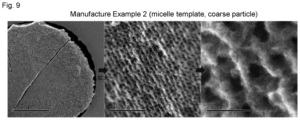
- Example 1 a support that was a powder of carbon particles was manufactured using micelle as a template.
- a mixed solution was prepared by mixing phenol: 0.6057 g as the carbon source, formaldehyde solution: 2.1 mL, and 0.1 M NaOH: 15.1613 g.
- the mixed solution was stirred at 345 rpm for 0.5 h in a 70°C bath.
- Pluronic F-127 manufactured by BASF, nonionic surfactant, triblock copolymer composed of a hydrophobic block sandwiched between a pair of hydrophilic blocks, hereinafter referred to as "F-127": 0.96 g as the template molecule and ultrapure water: 15.0033 g were added, the mixed solution was stirred at 345 rpm for 2h in a 65°C bath.
- the carbon source spheres 7 in which micelle composed of F-127 was coated with resol were generated. Then, self-organization of the carbon source spheres 7 took place and the carbon source cohered bodies 8 were generated.
- the dispersion liquid obtained by mixing the supernatant liquid: 17.7 mL and ultrapure water: 56 g was allowed to stand still in an autoclave at 130°C for 24 h without stirring, so that the carbon source spheres 7 were bonded to each other to form the carbon source bonded bodies.
- the carbon source bonded bodies were taken out by filtration and washed with water and then dried by vacuum heating at 50°C.
- the dry powder obtained in the above-described step was carbonized by heating in nitrogen at 700°C for 2 h to obtain a powder of carbon particles.
- the obtained powder of carbon particles had a very low degree of cohesion between the particles.
- FIG. 8 An electron microscope image shown in Fig. 8 was taken for the obtained powder using a scanning transmission electron microscope (STEM, manufactured by Hitachi High-Tech Corporation, HD-2700) with an aberration correction lens.
- STEM scanning transmission electron microscope
- the carbon particles had continuous thick and thin portions arranged alternately and were interconnected structures in which an average of more than 5 primary particles were interconnected.
- the average connection number of primary particles was 10 or more, and the average series connection number was 4.3.
- the maximum diameter of the thick portion was taken as the primary particle diameter and was measured at 100 or more points, and the average value calculated was 55.7 ⁇ 5.4 nm. Further, the minimum diameter of the thin portion was taken as the diameter of the connected portion of the primary particles and was measured at 100 or more points, and the average value calculated was 37.7 ⁇ 5.4 nm.
- the electron microscope image was observed at a magnification of 500,000 to 1,000,000, and the pore size was measured. At that time, the brightness and contrast of the electron microscope image were adjusted, so that the boundary between the outer surface of the primary particles of the carbon particles and the pores opening on the outer surface became clear.
- a particle diameter measurement software manufactured by NIRECO Corporation, LUZEX AP
- the equivalent circle diameter of each pore was measured for 100 or more pores, and the average entrance pore diameter and its standard deviation obtained were 5.2 ⁇ 0.5 nm. The value after ⁇ indicates the standard deviation.
- pores in the following three cases were not counted.
- the circle center coordinates of the pores approximated by a circle were recorded when obtaining the equivalent circle diameter of the pores.
- the interpore distance was obtained at 100 or more points from the distance between circle center points of the adjacent pores, and the average interpore distance and its standard deviation calculated were 12.6 ⁇ 1.4 nm.
- the mixed solution was prepared by mixing ethanol: 69.11 g, ultrapure water: 4.48 mL, and F-127: 3.62 g.
- the carbonization was performed by heating in nitrogen at 800°C for 3 h to obtain a powder of carbon particles.
- the average entrance pore diameter, its standard deviation, the average interpore distance, and its standard deviation obtained by the same method as in Manufacturing Example 1 were 4.6 ⁇ 1.1 nm and 10.4 ⁇ 1.1 nm, respectively.
- a graphite crucible accommodating 200 mg of the carbon particle powder obtained in Manufacture Example 1 was placed in a high vacuum induction heating furnace, and preliminary evacuation was performed for 12 h.
- the temperature was raised from 25°C to 700°C in 30 min and held at the same temperature for 5 min, while evacuating the high vacuum induction heating furnace to a pressure of 5 ⁇ 10 -4 hPa or lower. Thereafter, the temperature was raised to the target maximum temperature at 100 °C/h and held at the same temperature for 1 h followed by cooling to obtain the carbon particles of Manufacture Example 3.
- the target temperature was 1000°C
- the temperature rising time from 700°C to 1000°C was 3 h.
- the carbon particles of Manufacture Example 4 were obtained in the same manner as in Manufacture Example 3 except that the target temperature was 1200°C.
- the carbon particles of Manufacture Example 5 were obtained in the same manner as in Manufacture Example 3 except that the target temperature was 1400°C.
- the active metal particles were supported on the support by the method described below.
- a 60 mmol/L of surfactant (NP-5, polyoxyethylene nonylphenyl ether with an average of 5 oxyethylene groups)/cyclohexane solution was prepared in a volumetric flask.
- the carbon particles obtained in Manufacture Example 2 were put into the solution after the reduction step in the ratio such that the amount of Pt supported was 20 mass%, and the solution was stirred overnight at room temperature.
- the obtained product was filtered through a membrane filter, washed with methanol (100 mL) on the membrane filter, and subjected to drying under reduced pressure to remove the surfactant.
- methanol 100 mL
- the average particle diameter of the platinum particles supported on the carbon particles was calculated by the method described below. First, the Pt-supported catalyst was placed on a grid with a carbon supporting film for an electron microscope, and from the image obtained by observing it with an electron microscope, the average particle diameter of the platinum particles was calculated by the elliptical approximation. As a result, the average particle diameter of the platinum particles was 2.9 nm.
- the number fraction of the platinum particles supported in the surface layer region was calculated by the method described below.
- the powder of the carbon particles supporting the platinum particles was placed on a silicon wafer substrate, and the protective layer was formed on the outer surface of the sample particles by gold vapor deposition.
- the focused ion beam (FIB) device (FB2200, manufactured by Hitachi High-Tech Corporation) was used to cut the sample particles with the gallium ion beam, and a sample section for electron microscope observation was prepared.
- a line segment B2 parallel to the outer surface boundary line was drawn at a position 15 nm from the above-described sample outer surface boundary line B1 in the direction toward the center of the sample particle, and the number fraction of the particles supported on the surface layer was calculated from the ratio of the number of Pt particles between the outer surface boundary line B1 and the line segment B2 at the 15 nm position and the number of Pt particles deeper beyond the line segment at the 15 nm position in the direction toward the center of the sample particle.
- the number fraction of the particles supported on the surface layer was 86%.
- the number fraction of the particles supported in the pores (hereinafter, referred to as "particles supported in the surface layer pores") divided by the total number of the particles supported on the surface layer was calculated by the method described below.
- the position of the pore entrance in the plane direction was specified from the secondary electron image, and then the position of all platinum supported on and inside the carbon particles in the observation field was specified in the plane direction from the Z-contrast image.
- the number fraction of platinum supported in the pores was calculated. At this time, it was determined that the platinum which was observed in the Z-contrast image but was not observed in the secondary electron image was supported inside the pores.
- the platinum present in the back hemisphere of the carbon particles was excluded with reference to the depth of focus when acquiring the Z-contrast image. As a result, the number fraction of the particles supported in the surface layer pores was 74.4%.
- the arrangement of the platinum particles was enhanced in the same way as in Example 2 below, and the average interparticle distance and standard deviation of the platinum particles were also almost the same as those in Example 2.
- the mixing step and the reduction step were performed in the same manner as Example 1, except that Rw was changed within the range between 2 to 6, and the count median diameter measured in the mixed solution after the reduction step by the dynamic light scattering method was measured.
- the result is shown in Fig. 11 .
- the horizontal axis in Fig. 11 represents Rw, and the vertical axis represents the count median diameter.
- the measurement conditions of the count median diameter were as follows. Measurement device: manufactured by HORIBA, Ltd., model: SZ-100V2
- the measurement was performed in the nanoanalysis mode with a gate time of 640 ns. The measurement was performed three times or more, and the average value was taken as the count median diameter.
- NaBH 4 aqueous solution was added so that Rw became 3 (mol/mol), to generate the reducing agent mixed solution.
- NaBH 4 was added so that its concentration became 20 equivalent with respect to Pt.
- the reducing agent mixed solution was added to the active metal precursor mixed solution and mixed with stirring.
- the supported metal catalyst in which platinum particles were supported on carbon particles was obtained by performing the supporting step in the same manner as in Example 1, except that the carbon particles obtained in Manufacture Example 3 were used in the supporting step. At this time, the carbon particles and the solution of the reduction step were mixed at a ratio such that the amount of Pt added was 20 mass%.
- the ZC image (Z contrast image) and SE image (secondary electron image) of the surface of the obtained supported metal catalyst are shown in Figs. 12 and 13 . As shown in Fig. 13 , most of the platinum particles supported are arranged on the dotted lines, indicating that they are regularly arranged. The distribution of the distances between the centers of gravity of the platinum particles was measured, and the distribution shown in Fig. 14A was obtained. The average interparticle distance was 11 nm and the standard deviation was 3 nm.
- the average particle diameter of the platinum particles calculated by the same method as in Example 1 was 4.8 nm.
- the number fraction of the particles supported in the surface layer pores calculated by the same method as Example 1 was 60% or more. Further, the platinum loading level measured by thermogravimetric analysis was 16 mass%.
- the oxygen reduction activity of the prepared catalyst was measured by the rotating disk electrode (RDE) method.
- the catalyst ink was prepared by ultrasonically dispersing the catalyst powder in an ethanol solution containing a small amount of ultrapure water.
- the catalyst ink was dropped onto a glassy carbon disk having a diameter of 10 mm and was dried in an ethanol vapor atmosphere. The dropping and drying of the ink were repeated several times so that the amount of Pt supported was 11 ⁇ g/cm 2 (representative value) .
- 5 wt% Nafion solution was dropped so that the thickness of the Nafion film after drying was 0.05 um, and the sample was dried at room temperature and then placed in an electric furnace maintained at 130°C for 3 h.
- the glassy carbon disk coated with the catalyst fixed to a stainless-steel rod was used as a working electrode and attached to a RDE device, and then the working electrode was immersed in a Pyrex three-pole cell filled with 0.1 M perchloric acid electrolyte. After purging the electrolyte with nitrogen for 30 min, the sweep was repeated at a scan rate of 500 mV/s from 0.05 V to 1.0 V until there was no change in the waveform of cyclic voltammogram. Next, the electrochemical surface area (ECA) was obtained from the area of the hydrogen adsorption wave of the cyclic voltammogram obtained at a scan rate of 50 mV/s from 0.05 V to 1.0 V.
- ECA electrochemical surface area
- the electrolyte was purged with oxygen for 30 min, and the linear sweep voltammogram was obtained by sweeping at a scan rate of 5 mV/s from 0.25 V to 1.0 V.
- the area specific activity and mass activity were calculated from the Koutecky-Levich plot using the current values of the obtained linear sweep voltammogram at 0.70 V, 0.75 V, 0.85 V, 0.90 V.
- Example 5 The mass activity of the supported metal catalyst obtained in Example 5 was also calculated in the same manner. The results are shown in Table 1. As shown in Table 1, both the catalyst of Example 2 prepared by the reverse micelle method and the catalyst of Example 5 (OMC catalyst) prepared by the colloid method using an automatic titrating device showed much higher mass activity than the commercially available catalyst (manufactured by Tanaka Kikinzoku Kogyo, product name: TEC10E50E, 50 wt% Pt/CB catalyst).
- Example 2 Commercially Available Catalyst Mass Activity MA (A/g) 0.70V 32854 41331 2202 0.75V 15810 21431 1228 0.80V 4434 6139 574 0.85V 944 1444 253 0.90V 177 320 83
- Figs. 15A to 15C each show a Z-contrast image or secondary electron image of the supported metal catalyst.
- Fig. 15A shows a Z-contrast image in an untreated state after the supporting step
- Fig. 15B shows a secondary electron image in a state after hydrogen reduction treatment is performed after the supporting step
- Fig. 15C shows a secondary electron image in a state after oxygen reduction activity measurement is performed after hydrogen reduction.
- the hydrogen reduction treatment was performed in a manner such that the sample was transferred to a quartz boat, then the temperature was raised from room temperature to 200°C at 1.5 °C/min in a 5% hydrogen/95% nitrogen stream using a tubular furnace equipped with a quartz reactor, and this temperature was maintained for 2 h.
- the platinum particles in the supported metal catalyst manufactured by the method in this example have the already enhanced regular arrangement in an untreated state, and that state does not change significantly after the hydrogen reduction and oxygen reduction activity measurement. This is thought to be because most of the platinum particles are supported in the pores of the carbon particles, and the regular arrangement of the pores is reflected in the regular arrangement of the platinum particles.
- the distribution of the distances between the centers of gravity of the platinum particles was measured for the supported metal catalyst after hydrogen reduction, and the distribution shown in Fig. 14B was obtained. The average interparticle distance was 12nm and the standard deviation was 3 nm.
- the supported metal catalyst was manufactured in the same manner as in Example 2, except that the support was changed to that shown in Fig. 16 .
- the oxygen content of each support was measured by an EDS method.
- the platinum loading level was measured in the same manner as in Example 2.
- the oxygen contents of carbon particles manufactured in Manufacture Examples 3 to 5 were measured by the EDS method.
- the relationship between the annealing temperature and the oxygen content is shown in Fig. 17 .
- the oxygen content of the carbon particles drastically decreased to approximately 0.5 wt% by annealing at 1200°C. Even when the annealing temperature was increased to 1400°C, the oxygen content decreased only slightly. Since the oxygen content of 0.5 wt% is equivalent to that of XC-72 in Fig. 16 , the Pt loading level is expected to increase.
- Example 3 (reverse micelle method, supporting twice, annealing at 1000°C)
- Example 3 the mixing step, reduction step, and supporting step were performed in the same manner as in Example 2, except that carbon particles annealed at 1000°C in Manufacture Example 3 were used.
- the second mixing step, reduction step, and supporting step were performed in the same manner, and then the hydrogen reduction step (surfactant removal step) was performed again to obtain the supported metal catalyst.
- the hydrogen reduction step was performed in a manner such that the sample was transferred to a quartz boat, then the temperature was raised from room temperature to 200°C at 1.5°C/min in a 5% hydrogen/95% nitrogen stream using a tubular furnace equipped with a quartz reactor, and this temperature was maintained for 2 h.
- the platinum loading level of the obtained supported metal catalyst was approximately 20 mass%.
- the secondary electron image of the supported metal catalyst is shown in Fig. 18 .
- the platinum particles were linearly arranged in accordance with the arrangement of the pores of the carbon particles.
- the average interparticle distance and standard deviation of the platinum particles were almost the same as those in Example 2.
- Example 4 (reverse micelle method, supporting twice, annealing at 1400°C)
- Example 4 the supported metal catalyst was manufactured in the same manner as in Example 3, except that carbon particles annealed at 1400°C in Manufacture Example 5 were used.
- the platinum loading level of the obtained supported metal catalyst was approximately 30 mass%.
- the secondary electron image of this supported metal catalyst is shown in Fig. 19 .
- the platinum particles were linearly arranged in accordance with the arrangement of the pores of the carbon particles.
- the average interparticle distance and standard deviation of the platinum particles were almost the same as those in Example 2.
- Example 5 (colloid method, automatic titration, 20 mass%)
- the amounts of sodium hydroxide aqueous solution and hydrogen peroxide solution added vary depending on external factors such as temperature, but as an example, the amounts of 5% sodium hydroxide aqueous solution and 30% hydrogen peroxide solution added in this step were 17.4 mL and 22.5 mL, respectively.
- the solution obtained in this operation is referred to as platinum colloid solution.
- This powder was transferred to a quartz boat and subjected to the hydrogen reduction treatment at 300°C for 1 h under a hydrogen stream.
- Fig. 22A shows a secondary electron image of a supported metal catalyst manufactured in the same manner as in Example 5, except that an amount of Pt supported was 50 mass%
- Figs. 22B and 22C show secondary electron images of a supported metal catalyst of Example 5.
- Fig. 22A shows the untreated state after the supporting step
- Fig. 22B shows the state after hydrogen reduction treatment is performed after the supporting step
- Fig. 22C shows the state after oxygen reduction activity measurement is performed in the same manner as in Example 2 after hydrogen reduction treatment.
- Example 6 (colloid method, automatic titration, 30 mass%)
- the supported metal catalyst was manufactured in the same manner as in Example 5, except that the amount of platinum colloid solution added was changed to 15.3 mL (an amount of platinum equivalent to 30 mass%).
- Figs. 23A and 23B show secondary electron images in the state after the hydrogen reduction treatment is performed after the supporting step
- Fig. 23C shows the secondary electron image in the state after the oxygen reduction activity measurement is performed in the same manner as in Example 2 after the hydrogen reduction treatment.
- the supported metal catalyst manufactured by the method in this example has a regular arrangement of platinum both after the hydrogen reduction treatment and after the oxygen reduction activity measurement.
- the average interparticle distance and standard deviation of the platinum particles after the hydrogen reduction treatment were almost the same as those in Example 2.
- Figs. 24A and 24B are the secondary electron image and the Z contrast image, respectively, in the state after the hydrogen reduction treatment was performed following the supporting step.
- the total amount of 30% hydrogen peroxide solution added in this step was 15 mL.
- 500 mg of carbon particles obtained in Manufacture Example 1 was added and stirred. This mixture was heated at 90°C with stirring on a hot stirrer and then cooled, filtered, washed with ultrapure water, and dried to obtain a powder.
- This powder was transferred to a quartz U-shaped tube and subjected to a reduction treatment at 300°C for 2 h (at a temperature increase rate of 10 °C/min) under a hydrogen stream.
- the obtained ZC image (Z-contrast image) and SE image (secondary electron image) of the surface of the supported metal catalyst are shown in Fig. 25 .
- the diameter of the platinum particles supported on the carbon particles was calculated by the same method as Example 1. As a result, the average particle diameter of platinum was 1.1 nm.
- the comparison of the secondary electron image with the ZC image using STEM showed that the platinum particles were uniformly and non-selectively supported both on the surface layer and inside the support particles.
- Example 6 In Comparative Example 1, there was no difference in the concentration of the active metal present in the surface layer portion and the central portion, and the active metal was uniformly supported on the entire support. On the other hand, in Example 6, almost all of the platinum particles were supported in the surface layer region (surface layer portion > central portion), as shown in Figs. 24A and 24B .
Landscapes
- Chemical & Material Sciences (AREA)
- Engineering & Computer Science (AREA)
- Chemical Kinetics & Catalysis (AREA)
- Materials Engineering (AREA)
- Electrochemistry (AREA)
- General Chemical & Material Sciences (AREA)
- Organic Chemistry (AREA)
- Manufacturing & Machinery (AREA)
- Physics & Mathematics (AREA)
- Plasma & Fusion (AREA)
- Health & Medical Sciences (AREA)
- Toxicology (AREA)
- Life Sciences & Earth Sciences (AREA)
- Inorganic Chemistry (AREA)
- Sustainable Development (AREA)
- Sustainable Energy (AREA)
- Thermal Sciences (AREA)
- Catalysts (AREA)
- Inert Electrodes (AREA)
- Organic Low-Molecular-Weight Compounds And Preparation Thereof (AREA)
Abstract
Description
- The present invention relates to a supported metal catalyst and a manufacturing method thereof. The supported metal catalyst of the present invention is suitably used as an electrode catalyst (particularly as a cathode catalyst) of a fuel cell.
-
Patent Literature 1 discloses a supported metal catalyst in which active metal particles are supported on MCND (Mesoporous Carbon Nano Dendrite). MCND has a well-developed pore structure, and the ionomer-induced deactivation of the active metal particles can be avoided by supporting the active metal particles in pores. - [Patent Literature 1]
JP-A-2018-10806 - However, the effectiveness factor of the active metal particles is not sufficiently high even in the configuration of
Patent Literature 1, and it is desired to further increase the effectiveness factor. - The present invention has been made in view of such circumstances and provides a supported metal catalyst with excellent effectiveness factor of active metal particles while avoiding close contact with the ionomer.
- According to the present invention, provided is a supported metal catalyst, comprising: a support that is a collective body of conductive particles; and dispersed active metal particles supported on the conductive particles, wherein: the conductive particles include a plurality of pores; an average entrance pore diameter of the pores is 1 to 20 nm; a standard deviation of the average entrance pore diameter is equal to or less than 50% of the average entrance pore diameter; a number fraction of the active metal particles supported in a surface layer region of the conductive particles divided by a total number of the active metal particles is equal to or more than 50%; the surface layer region is a region on a surface of the conductive particles or a region in the pores within a depth of 15 nm from the surface; an average interparticle distance of the active metal particles is 5 to 20 nm; and a standard deviation of the average interparticle distance is equal to or less than 50% of the average interparticle distance.
- The present inventors have conducted intensive research and have made the following findings. Since MCND in
Patent Literature 1 is formed by explosive reaction of silver acetylide, the pore diameter of MCND varies widely. To increase the effectiveness factor of the active metal particles, the active metal particles need to be supported at a shallow position in the pores. However, since the pore diameter of MCND varies widely, it is difficult to control the supporting position of the active metal particles in the pores. Consequently, the active metal particles are supported at a deep position in the pores. At the deep position of the pores, the catalytic reaction rate is lower due to diffusion resistance of reactants used in a catalytic reaction and products generated by the catalytic reaction, resulting in lower effectiveness factor of the catalyst. Therefore, the effectiveness factor of the active metal particles is not sufficient in the supported metal catalyst using MCND ofPatent Literature 1. - On the basis of these findings, the inventors have found that the effectiveness factor of the active metal particles can be increased by reducing the variation in the pore diameter of the pores provided on the support and then by causing 50% or more of the active metal particles to be supported in a surface layer region of conductive particles constituting the support.
- The supported metal catalyst of the present invention is also characterized in that the average interparticle distance of the active metal particles is 5 to 20 nm and the standard deviation of the average interparticle distance is equal to or less than 50% of the average interparticle distance. When the average interparticle distance is too small, the activity of each active metal particle tends to be low, or adjacent active metal particles tend to fuse with each other, be coarsened, and deteriorate. However, in the supported metal catalyst of the present invention, the average interparticle distance of the active metal particles and the standard deviation thereof are appropriately set, resulting in excellent activity and durability.
- According to the present invention, the following inventions are provided.
- (1) A supported metal catalyst, comprising:
- a support that is a collective body of conductive particles; and
- dispersed active metal particles supported on the conductive particles, wherein:
- the conductive particles include a plurality of pores;
- an average entrance pore diameter of the pores is 1 to 20 nm;
- a standard deviation of the average entrance pore diameter is equal to or less than 50% of the average entrance pore diameter;
- a number fraction of the active metal particles supported in a surface layer region of the conductive particles divided by a total number of the active metal particles is equal to or more than 50%;
- the surface layer region is a region on a surface of the conductive particles or a region in the pores within a depth of 15 nm from the surface;
- an average interparticle distance of the active metal particles is 5 to 20 nm; and
- a standard deviation of the average interparticle distance is equal to or less than 50% of the average interparticle distance.
- (2) The supported metal catalyst of (1), wherein a proportion of the active metal particles in the supported metal catalyst is 16 to 50 mass%.
- (3) The supported metal catalyst of (1) or (2), wherein a proportion of the active metal particles in the supported metal catalyst is 21 to 35 mass%.
- (4) The supported metal catalyst of any one of (1) to (3), wherein the conductive particles are carbon particles.
- (5) The supported metal catalyst of any one of (1) to (4), wherein:
- an average interpore distance of the pores is 5 to 20 nm; and
- a standard deviation of the average interpore distance is equal to or less than 50% of the average interpore distance.
- (6) The supported metal catalyst of any one of (1) to (5), wherein the conductive particles are interconnected structures in which an average of 5 or more primary particles are interconnected.
- (7) The supported metal catalyst of (6), wherein an average series connection number of the interconnected structures is equal to or more than 3.
- (8) The supported metal catalyst of any one of (1) to (7), wherein an average primary particle diameter of the conductive particles is 20 to 100 nm.
- (9) The supported metal catalyst of any one of (1) to (8), wherein a number fraction of the active metal particles supported in the pores divided by a total number of the active metal particles supported in the surface layer region is equal to or more than 40%.
- (10) The supported metal catalyst of any one of (1) to (9), wherein the active metal particles are platinum or platinum alloy particles.
- (11) The supported metal catalyst of any one of (1) to (10), wherein an average particle diameter of the active metal particles is 1 to 8 nm.
- (12) The supported metal catalyst of any one of (1) to (11), wherein a value of [an average particle diameter of the active metal particles divided by the average entrance pore diameter] is 0.2 to 0.8.
- (13) The supported metal catalyst of any one of (1) to (12), wherein a number fraction of the active metal particles supported in the surface layer region of the conductive particles divided by the total number of the active metal particles is equal to or more than 60%.
- (14) A fuel cell, comprising a cathode-side catalyst layer,
wherein the cathode-side catalyst layer includes the supported metal catalyst of any one of (1) to (13). - (15) A manufacturing method of a supported metal catalyst, comprising:
an initial addition step; a simultaneous addition step; a supporting step; and a step to enhance regular arrangement, wherein:- in the initial addition step, an oxidizing agent that oxidizes an active metal precursor to form oxide particles of active metal is added to an active metal precursor solution containing the active metal precursor to generate a colloid;
- in the simultaneous addition step, a neutralizing agent and the oxidizing agent are added simultaneously to the colloid until an amount of the oxidizing agent added reaches a specified amount;
- in the supporting step, a support which is a collective body of conductive particles and the colloid are mixed to support the oxide particles on the conductive particles;
- in the step to enhance regular arrangement, a regular arrangement of the oxide particles or active metal particles generated by reducing the oxide particles is achieved by performing an arrangement treatment;
- the conductive particles include a plurality of pores;
- an average entrance pore diameter of the pores is 1 to 20 nm; and
- a standard deviation of the average entrance pore diameter is equal to or less than 50% of the average entrance pore diameter.
- (16) The method of (15), wherein the oxidizing agent is hydrogen peroxide.
- (17) The method of (15) or (16), wherein:
- a pH immediately after the initial addition step is 1.0 to 2.5; and
- a pH immediately after the simultaneous addition step is 4.0 to 6.0.
- (18) The method of any one of (15) to (17), wherein a time from a start of the initial addition step to a completion of the simultaneous addition step is 10 to 30 min.
- (19) The method of any one of (15) to (18), wherein the arrangement treatment includes at least one of heat treatment and/or electrochemical treatment.
- (20) A manufacturing method of a supported metal catalyst, comprising:
a first step; a surfactant removal step; and a second step, wherein:- the first step comprises a first mixing step, a first reduction step, and a first supporting step;
- the second step comprises a second mixing step, a second reduction step, and a second supporting step;
- in the first mixing step, a first active metal precursor mixed solution is generated by mixing an active metal precursor solution containing an active metal precursor with a surfactant and an organic solvent;
- in the first reduction step, active metal particles are generated by a reduction of the active metal precursor in the first active metal precursor mixed solution;
- in the first supporting step, a support which is a collective body of conductive particles and the active metal particles are mixed to disperse and support the active metal particles on the conductive particles;
- in the surfactant removal step, a surfactant adhered to the support is removed;
- in the second mixing step, a second active metal precursor mixed solution is generated by mixing an active metal precursor solution containing an active metal precursor with a surfactant and an organic solvent;
- in the second reduction step, active metal particles are generated by a reduction of the active metal precursor in the second active metal precursor mixed solution;
- in the second supporting step, the support after the surfactant removal step and the active metal particles obtained in the second reduction step are mixed to disperse and support the active metal particles obtained in the second reduction step on the conductive particles;
- the conductive particles include a plurality of pores;
- an average entrance pore diameter of the pores is 1 to 20 nm;
- a standard deviation of the average entrance pore diameter is equal to or less than 50% of the average entrance pore diameter; and
- a count median diameter measured in the first or second active metal precursor mixed solution by a dynamic light scattering method is 0.5 to 2 times as large as the average entrance pore diameter.
- (21) The method of (20), wherein:
- in the first reduction step, the reduction is performed by mixing a reducing agent mixed solution containing a reducing agent, an organic agent, water, and a surfactant with the first active metal precursor mixed solution; and
- in the second reduction step, the reduction is performed by mixing a reducing agent mixed solution containing a reducing agent, an organic agent, water, and a surfactant with the second active metal precursor mixed solution.
- (22) The method of (20) or (21), wherein a removal of the surfactant is performed by heat-treating the support under a reducing gas atmosphere.
- (23) The method of any one of (20) to (22), wherein the conductive particles are subjected to an annealing treatment at 800 to 2000°C in a vacuum before the first supporting step.
- (24) The method of any one of (20) to (23), wherein the conductive particles are subjected to an annealing treatment at 1100 to 2000°C in a vacuum before the first supporting step.
- (25) A manufacturing method of a supported metal catalyst, comprising:
a mixing step; a reduction step; and a supporting step, wherein:- in the mixing step, an active metal precursor mixed solution is generated by mixing an active metal precursor solution containing an active metal precursor with a surfactant and an organic solvent;
- in the reduction step, active metal particles are generated by a reduction of the active metal precursor in the active metal precursor mixed solution;
- in the supporting step, a support which is a collective body of conductive particles and the active metal particles are mixed to disperse and support the active metal particles on the conductive particles;
- the conductive particles include a plurality of pores;
- an average entrance pore diameter of the pores is 1 to 20 nm;
- a standard deviation of the average entrance pore diameter is equal to or less than 50% of the average entrance pore diameter;
- a count median diameter measured in the mixed solution by a dynamic light scattering method is 0.5 to 2 times as large as the average entrance pore diameter; and
- the conductive particles are subjected to an annealing treatment at 1100 to 2000°C in a vacuum before the supporting step.
- (26) The method of any one of (20) to (25), wherein:
- the method comprises a step to enhance regular arrangement after the second supporting step of any one on
Claims 20 to 24 or after the supporting step ofClaim 25; and - in the step to enhance regular arrangement, a regular arrangement of the active metal particles is achieved by performing an arrangement treatment.
- the method comprises a step to enhance regular arrangement after the second supporting step of any one on
- (27) The method of (26), wherein the arrangement treatment includes at least one of heat treatment and/or electrochemical treatment.
- (28) The method of any one of (20) to (27), wherein the organic solvent is a hydrophobic organic solvent and includes at least one selected from cyclohexane, heptane, and toluene.
- (29) The method of any one of (20) to (28), wherein the surfactant is a nonionic surfactant.
- (30) The method of any one of (20) to (29), wherein the active metal precursor includes a platinum precursor compound.
- (31) The method of any one of (15) to (30), wherein the conductive particles are carbon particles.
- (32) The method of any one of (15) to (31), wherein:
- an average interpore distance of the pores is 5 to 20 nm; and
- a standard deviation of the average interpore distance is equal to or less than 50% of the average interpore distance.
- (33) The method of any one of (15) to (32), wherein the conductive particles are interconnected structures in which an average of 5 or more primary particles are interconnected.
- (34) The method of (33), wherein an average series connection number of the interconnected structures is equal to or more than 3.
- (35) The method of any one of (15) to (34), wherein an average particle diameter of primary particles of the conductive particles is 20 to 100 nm.
-
-
Fig. 1 is a schematic diagram of a supportedmetal catalyst 1. -
Fig. 2A is a schematic diagram of a cross section of the supportedmetal catalyst 1, and -
Fig. 2B is an enlarged view of a region B inFig. 2A . -
Fig. 3 is a schematic diagram of aconductive particle 2 composed of a single particle. -
Fig. 4 is a schematic diagram of theconductive particle 2 composed of an interconnected structure 2a. -
Fig. 5 is a schematic diagram of a carbon source coheredbody 8 in whichcarbon source spheres 7 cohere to each other. -
Fig. 6 is a schematic diagram showing a state in which carbon source coheredbodies 8 are connected to each other. -
Fig. 7 is a schematic diagram of a fuel cell. -
Fig. 8 is an electron microscope image of carbon particles of Manufacture Example 1. -
Fig. 9 is an electron microscope image of carbon particles of Manufacture Example 2. - In
Fig. 10 , the image on the left side is a cross-sectional secondary electron image of a supported metal catalyst of Example 1, and the image on the right side is a Z-contrast image thereof. -
Fig. 11 is a graph showing a relationship between Rw and the count median diameter in the reverse micelle method of Reference Example 1. - In
Fig. 12 , the image on the upper left side is a secondary electron image of a supported metal catalyst of Example 2, the image on the upper right side is a Z-contrast image thereof, and the images on the lower left and lower right sides are other secondary electron images of the supported metal catalyst of Example 2. -
Fig. 13 is a Z-contrast image of the supported metal catalyst of Example 2. -
Figs. 14A and 14B show a distribution of distances between centers of gravity of platinum particles of the supported metal catalyst of Example 2.Fig. 14A shows an untreated state, andFig. 14B shows a state after hydrogen reduction treatment. -
Figs. 15A to 15C each show a Z-contrast image or secondary electron image of the supported metal catalyst of Example 2.Fig. 15A shows a Z-contrast image in an untreated state after supporting step,Fig. 15B shows a secondary electron image in a state after hydrogen reduction treatment is performed after the supporting step, andFig. 15C shows a secondary electron image in a state after oxygen reduction activity measurement is performed after hydrogen reduction. -
Fig. 16 is a graph showing a relationship between an oxygen concentration on the bare support and a Pt loading level in Reference Example 2. -
Fig. 17 is a graph showing a relationship between an annealing temperature and an oxygen concentration in Reference Example 2. -
Fig. 18 is a secondary electron image of a supported metal catalyst of Example 3. -
Fig. 19 is a secondary electron image of a supported metal catalyst of Example 4. -
Fig. 20 is a graph showing the results of analysis using a quadrupole mass spectrometer to examine the effect of removing remaining surfactant by hydrogen treatment in Reference Example 4. -
Fig. 21 is a graph showing a change in pH with time during dropwise addition of an oxidizing agent and a neutralizing agent in Example 5 and Comparative Example 1. -
Fig. 22A shows a secondary electron image of a supported metal catalyst manufactured in the same manner as in Example 5, except that an amount of platinum supported was 50 mass%, andFigs. 22B and 22C show secondary electron images of a supported metal catalyst of Example 5.Fig. 22A shows the untreated state after the supporting step,Fig. 22B shows the state after hydrogen reduction treatment is performed after the supporting step, andFig. 22C shows the state after oxygen reduction activity measurement is performed in the same manner as in Example 2 after hydrogen reduction treatment. -
Figs. 23A to 23C are secondary electron images of a supported metal catalyst of Example 6.Figs. 23A and 23B show the state after hydrogen reduction treatment is performed after the supporting step, andFig. 23C shows the state after oxygen reduction activity measurement is performed in the same manner as in Example 2 after hydrogen reduction treatment. -
Fig. 24A is a secondary electron image of the supported metal catalyst of Example 6, andFig. 24B is a Z-contrast image thereof. - In
Fig. 25 , the image on the left side is a secondary electron image of a supported metal catalyst of Comparative Example 1, and the image on the right side is a Z-contrast image thereof. - Hereinafter, embodiments of the present invention will be explained with reference to the drawings. Various distinctive features shown in the following embodiments can be combined with each other. In addition, an invention can be established independently for each of the distinctive features.
- As shown in
Figs. 1 to 4 , the supportedmetal catalyst 1 of one embodiment of the present invention includes asupport 3 andactive metal particles 4. Hereinafter, each configuration will be described in detail. - The
support 3 is a collective body ofconductive particles 2, and preferably in the form of powder. In this regard, only oneconductive particle 2 is shown inFig. 1 to Fig. 4 . - The
conductive particles 2 are particles having conductivity. The composition of theconductive particle 2 is not particularly limited. From the viewpoint of conductivity, ease of manufacturing and the like, theconductive particles 2 are preferably carbon particles, more preferably mesoporous carbon particles, and even more preferably ordered mesoporous carbon (OMC) particles having pore diameter and pore spacing with small deviation and periodic arrangement of pores. - The shape of the
conductive particles 2 is not particularly limited. As shown inFig. 3 , theconductive particle 2 may be composed of a (preferably substantially spherical) single particle and is preferably an interconnected structure 2a in which a plurality of (preferably an average of 5 or more) (preferably substantially spherical)primary particles 2b are connected, as shown inFig. 4 . In the following description, the single particle is also referred to as the "primary particle" for convenience. The interconnected structure 2a is referred to as an aggregate and is preferable because aflow path 2e surrounded by theprimary particles 2b is formed, which decreases the diffusion resistance of a substance and facilitates catalytic reaction. Theflow path 2e may be also referred to as a "primary pore". Further, an agglomerated body of the aggregates that is formed by agglomerating the interconnected structure 2a and the interconnected structure 2a is referred to as a secondary particle, an agglomerate. Since the agglomerate is a secondary particle, it can be crushed relatively easily. A pore formed by a gap between the agglomerates may be referred to as a "secondary pore". - The average primary particle diameter of the
conductive particles 2 is preferably 20 to 100 nm. This is because if this value is too small, the entrance diameter ofpores 5 may be too small, while if this value is too large, the specific surface area of thesupport 3 may be too small. This average particle diameter is, specifically for example, 20, 30, 40, 50, 60, 70, 80, 90, or 100 nm, and may be in the range between the two values exemplified herein. Thepores 5 open on the primary particle surface of theconductive particles 2, have a nanoscale size and can also be referred to as "nanopores". - Here, an example of a method for measuring the average primary particle diameter of the
conductive particles 2 is described, taking the case where theconductive particles 2 are the interconnected structures 2a of the carbon particles as an example. First, an electron microscope image as shown inFig. 8 is taken for a powder of theconductive particles 2 by means of a scanning transmission electron microscope (STEM, manufactured by Hitachi High-Tech Corporation, HD-2700) with an aberration correction lens. From the electron microscope image, it can be seen that the carbon particles are interconnected structures that have a thick portion and thin portion alternately and continuously and is formed by interconnecting an average of 5 or more primary particles. The maximum diameter of the thick portion is defined as the primary particle diameter and is measured at 100 or more points, and the average value of the measured results is calculated. Further, the minimum diameter of the thin portion is defined as the diameter of a connected portion between the primary particles and is measured at 100 or more points, and the average value of the measured results is calculated. - As shown in
Fig. 4 , in the interconnected structure 2a, the thick portion and the thin portion are alternately continuous along its connecting direction. The thick portion is theprimary particle 2b, and the thin portion is a connectedportion 2c between theprimary particles 2b. When the average primary particle diameter of the interconnected structures 2a is defined as A, and the average diameter of theconnected portions 2c is defined as B, B/A is preferably 0.1 to 0.9, and more preferably 0.2 to 0.8. If B/A is too small, the strength of the interconnected structures 2a may not be sufficient. B/A is, specifically for example, 0.1, 0.2, 0.3, 0.4, 0.5, 0.6, 0.7, 0.8, or 0.9, and may be in the range between the two values exemplified herein. - When the
conductive particles 2 are the single particles, the average particle diameter of theprimary particles 2b is an average value of equivalent circle diameter of the single particles. When theconductive particles 2 are the interconnected structures 2a, the average particle diameter is an average value of the maximum width of the thick portions of the interconnected structures 2a. In the present specification, the average is preferably calculated by averaging 50 or more (preferably 100 or more) measured values. - The average connection number of the interconnected structures 2a (the average value of the number of the
primary particles 2b included in the interconnected structures 2a) is preferably 5 or more, more preferably 10 or more, and even more preferably 100 or more. This average connection number is, for example, 5 to 10000, specifically for example, 5, 10, 50, 100, 500, 1000, 5000, or 10000, and may be in the range between the two values exemplified herein. The average series connection number of the interconnected structures 2a (the average value of the number of theprimary particles 2b connected in series) is preferably 3 or more, and more preferably 5 or more. The connection in series means the connection along one line (straight line or curved line). The series connection number is counted starting from the primary particle where a branch is generated. For example, in a branch of a line L inFig. 4 , the series connection number is 4. The average series connection number is an average value of the series connection number for 50 or more (preferably 100 or more) branches. This average series connection number is, for example, 3 to 100, specifically for example, 3, 5, 10, 50, or 100, and may be in the range between the two values exemplified herein. When theconductive particles 2 have such a structure, the diffusion resistance of a substance becomes particularly low. - As shown in
Fig. 1 to Fig. 3 , theconductive particle 2 has a plurality ofpores 5. The plurality ofpores 5 is preferably regular in size, arrangement, shape and the like. The diameter of thepores 5 may be constant or may vary along the depth direction. In this regard, while theconductive particle 2 inFig. 2A and Fig. 2B is hollow at the center, theconductive particles 2 and the primary particles may be hollow or solid at the center. - The average entrance pore diameter of the
pores 5 is 1 to 20 nm. The average entrance pore diameter is an average value of the equivalent circle diameter of the entrance of thepores 5. If the average entrance pore diameter is too small, it may be difficult to support theactive metal particles 4 in thepores 5, and if the average entrance pore diameter is too large, theactive metal particles 4 are supported at a deep position in thepores 5 and are unavailable for the catalytic reaction. The average entrance pore diameter is, specifically for example, 1, 2, 3, 4, 5, 6, 7, 8, 9, 10, 11, 12, 13, 14, 15, 16, 17, 18, 19, or 20 nm, and may be in the range between the two values exemplified herein. - Here, an example of the measurement method of the average entrance pore diameter of the
pores 5 is described, taking the case where theconductive particles 2 are carbon particles as an example. The observation of an electron microscope image is performed at a magnification of 500,000 times to 1,000,000 times, and the pore size is measured. At that time, the brightness and contrast of the electron microscope image are adjusted so that the boundary between an outer surface of the primary particles of the carbon particles and the pores opening on the outer surface becomes clear. Using a particle diameter measurement software (manufactured by NIRECO Corporation, LUZEX AP), the equivalent circle diameter of each pore is measured for 100 or more pores, and the average entrance pore diameter and its standard deviation are obtained. - In this regard, pores in the following three cases are not counted. (1) Since the primary particles of the carbon particles are spherical or spindle-shaped, the size of the pores located near a side surface cannot be accurately measured by electron microscope observation. (2) Even after adjusting the brightness and contrast of the electron microscope image, the boundary line between the outer surface of the carbon particles and the pores may not be sufficiently clear depending on the shape of a sample and observation conditions. (3) If the sample is not within the exact focus range, the pore size cannot be accurately obtained.
- The standard deviation of the average entrance pore diameter of the
pores 5 is equal to or less than 50% of the average entrance pore diameter, and preferably equal to or less than 30%. The smaller the standard deviation, the smaller the variation in the entrance diameter of thepores 5, and the easier it is to control the supporting position of theactive metal particles 4. This standard deviation is, specifically for example, 0, 5, 10, 15, 20, 25, 30, 35, 40, 45, or 50% of the average entrance pore diameter, and may be in the range between the two values exemplified herein. - The average interpore distance of the
pores 5 is preferably 5 to 20 nm. The average interpore distance is an average value of the interpore distance obtained from the distance between circle center points of the adjacent pores 5. If the average interpore distance is too small, the reaction rate may decrease due to the insufficient supply of reactants of the catalytic reaction. If the average interpore distance is too large, the number of thepores 5 may be too small, or theactive metal particles 4 may tend to be supported on the surface outside the pores. - Here, an example of the method for measuring the average interpore distance of the
pores 5 is described, taking the case where theconductive particles 2 are carbon particles as an example. The observation of the electron microscope image is performed at a magnification of 500,000 times to 1,000,000 times, and the pore size is measured. At that time, the brightness and contrast of the electron microscope image are adjusted so that the boundary between an outer surface of the primary particles of the carbon particles and the pores opening on the outer surface becomes clear. Using the particle diameter measurement software (manufactured by NIRECO Corporation, LUZEX AP), the equivalent circle diameter of each pore is measured for 100 or more pores. - In this regard, pores in the following three cases are not counted. (1) Since the primary particles of the carbon particles are spherical or spindle-shaped, the size of the pores located near a side surface cannot be accurately measured by electron microscope observation. (2) Even after adjusting the brightness and contrast of the electron microscope image, the boundary line between the outer surface of the carbon particles and the pores may not be sufficiently clear depending on the shape of a sample and observation conditions. (3) If the sample is not within the exact focus range, the pore size cannot be accurately obtained.
- Next, the circle center coordinates of the pores approximated by a circle are recorded to obtain the equivalent circle diameter of the pores. The interpore distance is obtained at 100 or more points from the distance between circle center points of the adjacent pores, and the average interpore distance and its standard deviation are calculated.
- The standard deviation of the average interpore distance of the
pores 5 is preferably equal to or less than 50% of the average interpore distance, and more preferably equal to or less than 30%. The smaller the standard deviation, the easier it is for theactive metal particles 4 to be supported uniformly. This standard deviation is, specifically for example, 0, 5, 10, 15, 20, 25, 30, 35, 40, 45, or 50% of the average interpore distance, and may be in the range between the two values exemplified herein. - The
support 3 can be manufactured by any method capable of forming thepores 5 having the above-described physical properties, and examples of the manufacturing method of thesupport 3 include a hard template method and a soft template method. - The hard template method is a method using a solid, such as fine particles, mesoporous materials, and zeolite, as a template. For example, when the
conductive particles 2 are carbon particles, a template having regular pores, such as mesoporous silica, is prepared. The pores of this template are impregnated with a carbon source (e.g., sugar, such as sucrose), the carbon source is carbonized, and the template is removed, so that the carbon particles having the regular pores can be obtained. A portion corresponding to the template becomes the pores. - The soft template method is a method using a phase-separated structure of a soft matter, such as micelle, emulsion, liposome, polymer blend, and liquid crystal, as a template.
- For example, when the
conductive particles 2 are carbon particles, theconductive particles 2 can be manufactured by a method including a cohesion step, a bonding step, and a carbonizing step. - As shown in
Fig. 5 , in the cohesion step, a carbon source coheredbody 8 in whichcarbon source spheres 7 cohere to each other is formed. The carbon source coheredbody 8 becomes a primary particle of theconductive particle 2. - In one example, the
carbon source sphere 7 can be formed by forming a coating film of the carbon source on the surface of micelle. Thecarbon source sphere 7 has a reactive functional group, such as a methylol group or a hydroxyl group, and thecarbon source spheres 7 can be bonded to each other, for example, by condensation reaction of the reactive functional groups. Since thecarbon source spheres 7 are spheres and cannot cohere without a gap, agap 8a surrounded by a plurality ofcarbon source spheres 7 is inevitably formed in the carbon source coheredbody 8. Thegap 8a becomes thepore 5 of theconductive particle 2. Since thegaps 8a are regularly formed, thepores 5 are also regularly formed. - A manufacture example of the
carbon source spheres 7 and the carbon source coheredbodies 8 is as follows. - First, phenol: 0.6057 g as the carbon source, formaldehyde solution: 2.1 mL, and 0.1 M NaOH: 15.1613 g are mixed to prepare a mixed solution.
- Next, the mixed solution is stirred in a 70°C bath at 345 rpm for 0.5 h.
- Next, after Pluronic F-127 as a template molecule (manufactured by BASF, nonionic surfactant, triblock copolymer composed of a hydrophobic block sandwiched between a pair of hydrophilic blocks, hereinafter referred to as "F-127".): 0.96 g and ultrapure water: 15.0033 g are added, the mixed solution is stirred in a 65°C bath at 345 rpm for 2h.
- Next, after ultrapure water: 50 g is added, the mixed solution is stirred in a 65°C bath at 345 rpm for 16 to 18 h and then is allowed to stand still at 25°C, and supernatant liquid: 17.7 mL is taken out.
- In the reaction described above, the
carbon source sphere 7 in which a micelle composed of F-127 is coated with resol is generated. Then, self-organization of thecarbon source spheres 7 takes place and the carbon source coheredbodies 8 are generated. - The micelle can be formed, for example, by dispersing block copolymer having a hydrophilic block and a hydrophobic block in a dispersion medium, such as water. The block copolymer is preferably triblock copolymer composed of a hydrophobic block sandwiched between a pair of hydrophilic blocks. As the block copolymer, for example, a block copolymer in which the hydrophobic block is composed of a polymer of propylene oxide and the hydrophilic block is composed of a polymer of ethylene oxide can be used.
- The coating film is composed of, for example, resol. The resol is a phenolic resin having a reactive functional group. The coating film of resol can be formed by polymerizing phenol and formaldehyde in a dispersion medium containing micelle under conditions where formaldehyde is excessive. In one example, the
carbon source sphere 7 is formed by coating the micelle composed of the triblock copolymer with a resol coating film. - In the bonding step, carbon source bonded bodies are formed by bonding the
carbon source spheres 7 to each other in a state of no stirring or in a state of stirring of the dispersion liquid containing the carbon source coheredbodies 8. - Regarding the bonding between the
carbon source spheres 7, when thecarbon source spheres 7 are bonded to each other in a state of no stirring or in a state of stirring at the Reynolds number of 1400 or less (hereinafter, referred to as "low-speed stirring") of the dispersion liquid containing the carbon source coheredbodies 8, as shown inFig. 6 , in addition to the bonding between thecarbon source spheres 7 included in the same carbon source coheredbody 8, thecarbon source spheres 7 included in different carbon source coheredbodies 8 are also bonded to each other. In this case, the carbon source bonded bodies having an interconnected structure in which an average of 5 or more carbon source coheredbodies 8 are connected to each other are obtained. By carbonizing such carbon source bonded bodies, the interconnected structures 2a in which an average of 5 or moreprimary particles 2b are interconnected can be formed. The Reynolds number is preferably 1200 or less, and more preferably 1000 or less. The Reynolds number is, for example, 0 to 1400, specifically for example, 0, 100, 200, 300, 400, 500, 600, 700, 800, 900, 1000, 1100, 1200, 1300, or 1400, and may be in the range between the two values exemplified herein. - The Reynolds number Re can be calculated on the basis of the following equation.

- In one example, Reynolds number Re=1490 when d=20×10-3 m, n=0.83 s-1 (in the case of 50 rpm), and in the case of 130°C, pure water, ρ=934.5 kg/m3, and µ=0.208 mPa·s.
- On the other hand, when the
carbon source spheres 7 are bonded to each other by stirring the dispersion liquid at high speed, the bonding between thecarbon source spheres 7 contained in the same carbon source coheredbodies 8 occurs dominantly, and the carbon source bonded bodies of the single particles are obtained. By carbonizing such carbon source bonded bodies, theconductive particles 2 having a single particle structure in which theprimary particles 2b are not connected to each other can be obtained. - The dispersion medium is preferably water. Further, it is preferable to bond the
carbon source spheres 7 to each other by heating the dispersion liquid. The reaction temperature is, for example, 100 to 150°C, specifically for example, 100, 110, 120, 130, 140, or 150°C, and may be in the range between the two values exemplified herein. The reaction time is, for example, 5 to 48 h, specifically for example, 5, 10, 15, 20, 25, 30, 35, 40, 45, or 48 h, and may be in the range between the two values exemplified herein. - The structure of the carbon source bonded bodies obtained by the reaction can be changed by changing the reaction temperature, the reaction time, and the concentration of the reaction solution. By increasing the reaction temperature, increasing the reaction time, or increasing the concentration of the reaction solution, the connection number and the primary particle diameter of the carbon source cohered
bodies 8 can be increased. - In the carbonizing step, the
conductive particles 2 can be obtained by carbonizing the carbon source bonded bodies. - When the carbon source bonded bodies obtained in the above-described bonding step are heated and carbonized as they are, the
primary particles 2b (theprimary particles 2b in a state of the single particles, or theprimary particles 2b in a state of the interconnected structures 2a) are prone to be three-dimensionally connected to each other to form a structure in which theprimary particles 2b excessively cohere to each other. Therefore, it is preferable to re-disperse the carbon source bonded bodies and then dry them before carbonization. Consequently, the cohesion of theprimary particles 2b can be mitigated. Further, it is preferable to thinly spread the dispersion liquid obtained by the re-dispersion of the carbon source bonded bodies and then dry it. Consequently, the cohesion of theprimary particles 2b can be further mitigated. As an example of a method of spreading the dispersion liquid thinly, there is a method of dropping the dispersion liquid onto a surface, such as the surface of a glass plate. In one example, by dropping the dispersion liquid onto a glass plate heated by a hot plate, the dispersion liquid can be dried in a thinly spread state. - Further, the cohesion of the
primary particles 2b may be mitigated by spray-drying the dispersion liquid obtained by the re-dispersion of the carbon source bonded bodies. Freeze-drying is preferable as a drying method. - The carbon source bonded bodies can be carbonized by heating the carbon source bonded bodies in an atmosphere of an inert gas (e.g., nitrogen gas). The carbon source bonded bodies can be carbonized by, for example, heating the carbon source bonded bodies to 600 to 1000°C. This temperature is, specifically for example, 600, 650, 700, 750, 800, 850, 900, 950, or 1000°C, and may be in the range between the two values exemplified herein.
- An annealing step of performing the annealing treatment of the
conductive particles 2 may be performed after the carbonizing step. The structure of theconductive particles 2 can be controlled by changing the temperature or time of the annealing treatment. The annealing treatment can be performed by, for example, heating theconductive particles 2 in flowing nitrogen or a vacuum. The temperature of the annealing treatment is, for example, 800 to 2000°C. This temperature is, specifically for example, 800, 900, 1000, 1100, 1200, 1300, 1400, 1500, 1600, 1700, 1800, 1900, or 2000°C, and may be in the range between the two values exemplified herein. - If the
active metal particles 4 are supported by the reverse micelle method described below, it is preferable to perform the annealing step before the first supporting step. Preferably, this annealing step is performed at 1100 to 2000°C in a vacuum. As shown in Examples described below, the following are found: (1) in the reverse micelle method, the lower the oxygen content in theconductive particles 2, the larger the amount of theactive metal particles 4 supported tends to be, and (2) the oxygen content in theconductive particles 2 is reduced by annealing treatment at 1100 to 2000°C in a vacuum. Combining these findings, it can be seen that the annealing treatment at 1100 to 2000°C in a vacuum can reduce the oxygen content in theconductive particles 2 and increase the amount of theactive metal particles 4 supported. - The annealing time is, for example, 0.5 h or longer, and preferably 0.5 to 20 h. The annealing time is, specifically for example, 0.5, 1, 2, 3, 4, 5, 6, 7, 8, 9, 10, 15, or 20 h, and may be in the range between the two values exemplified herein.
- In the present specification, "vacuum" means a state in which the pressure is reduced to 10-2 hPa or lower (preferably 10-3 hPa or lower, 10-4 hPa or lower, or 10-5 hPa or lower).
- In addition to the above-described method, the interconnected structures 2a may be generated by connecting the
primary particles 2b to each other using a linking agent. Theprimary particles 2b may be generated by bonding thecarbon source spheres 7 to each other while stirring the dispersion liquid at high speed or may be generated by dividing coarse particles of the carbon source (carbon source coarse particles). Here, the carbon source coarse particles may be manufactured by a method described later in Manufacture Example 2 and are particles having the primary particle diameter of more than 100 nm. Examples of the linking agent include compounds having a plurality of reactive functional groups. Each of the reactive functional groups is connected to theprimary particles 2b, so that theprimary particles 2b are connected to each other via the linking agent. - As the linking agent, specifically, for example, sugar, such as sucrose, and alcohol, such as furfuryl alcohol, can be used.
- As shown in
Fig. 1 , theactive metal particles 4 are dispersed and supported on theconductive particles 2. Theactive metal particles 4 are fine particles of metal or alloy that can function as a catalyst. Theactive metal particles 4 are preferably platinum or platinum alloy particles. As the platinum alloy, an alloy of platinum and transition metal is preferable. Examples of the transition metal include cobalt and nickel. - As shown in
Fig. 1 to Fig. 2B , theactive metal particles 4 are supported in a region on asurface 2d of theconductive particles 2 or in thepores 5. Since the diffusion rate of the substance is small at a deep position in thepores 5, theactive metal particles 4 supported at the deep position in thepores 5 make little or no contribution to the catalytic reaction. Therefore, if the number fraction of theactive metal particles 4 supported at the deep position in thepores 5 is large, the effectiveness factor of theactive metal particles 4 will decrease correspondingly. If the effectiveness factor of theactive metal particle 4 decreases, moreactive metal particles 4 need to be supported to achieve the required reaction rate, which leads to an increase in the cost of the catalyst. - Therefore, it is preferable that the proportion of the
active metal particles 4 supported in a surface layer region of theconductive particles 2 is high. The surface layer region is a region on thesurface 2d of theconductive particles 2 or a region in thepores 5 within a depth X (=15 nm) from thesurface 2d (that is, a region outside the alternate long and short dash line inFig. 2B ). - Specifically, the number fraction of the
active metal particles 4 supported in the surface layer region (hereinafter, referred to as "particles supported on the surface layer") (the number of theactive metal particles 4 supported in the surface layer region/the number of all active metal particles 4) is preferably 50% or more, and more preferably 60% or more. In such a case, the effectiveness factor of theactive metal particles 4 is excellent. This number fraction is, specifically for example, 50, 55, 60, 65, 70, 75, 80, 85, 90, 95, 99, or 100%, and may be in the range between the two values exemplified herein. - Here, an example of a method of calculating the number fraction of the particles supported on the surface layer is described, taking the case where the
active metal particles 4 are platinum particles and theconductive particles 2 are carbon particles as an example. - First, a powder of carbon particles on which platinum particles are supported is placed on a silicon wafer substrate, and a protective layer is formed on the outer surface of sample particles by gold vapor deposition. Then, a focused ion beam (FIB) device (FB2200, manufactured by Hitachi High-Tech Corporation) is used to cut the sample particles with the gallium ion beam, and a sample section for electron microscope observation is prepared. Then, when observing the cut surface with an electron microscope, metal particles (Au particles and Pt particles) present on the sample are observed from a Z-contrast image (atomic number contrast image) shown in
Fig. 10 , and at the same time, the composition of each of the metal particles is analyzed using an energy-dispersive X-ray spectrometer to distinguish between the Pt particles and the Au particles. The point of change (boundary line) from a portion where the Au particles exist to a portion where only the Pt particles exist without the Au particles is defined as the boundary line between the outer surface and the cross section of the carbon particle. On the electron microscope image, a line segment parallel to the outer surface boundary line is drawn at aposition 15 nm from the above-described sample outer surface boundary line in the direction toward the center of the sample particle, and the number fraction of the particles supported on the surface layer is calculated from the ratio of the number of Pt particles between the outer surface boundary line and the line segment at the 15 nm position and the number of Pt particles deeper beyond the line segment at the 15 nm position in the direction toward the center of the sample particle. - In this regard, X may be 5 nm or 10 nm and is more preferably 5 nm or less. Further, X may be set to be the average particle diameter of the
primary particles 2b×Y. Y is, for example, 0.1, 0.2, 0.3, 0.4, or 0.5, and is preferably 0.3. Further, X may be set to be the average entrance pore diameter of thepores 5×Z. Z is, for example, 1, 2, 3, 4, or 5, and is preferably 1. - Further, the number fraction of the
active metal particles 4 supported in thepores 5 divided by the total number of theactive metal particles 4 supported in the surface layer region of theconductive particles 2 is preferably 40% or more. The supportedmetal catalyst 1 may be thickly coated with an electrolyte material, and in such a case, the activity of theactive metal particles 4 coated with the electrolyte material may decrease. By increasing the number fraction of theactive metal particles 4 supported in thepores 5, the influence of the decrease in the activity of theactive metal particles 4 can be suppressed. This number fraction is, specifically for example, 40, 45, 50, 51, 52, 53, 54, 55, 56, 57, 58, 59, 60, 65, 70, 75, 80, 85, 90, 95, 99, or 100%, and may be in the range between the two values exemplified herein. - In actual operation of a fuel cell vehicle, when the vehicle travels at low speed with a small current density on the electrode catalyst, the electrolyte material present on the support surface may adhere to the active metal particles present on the support surface, and their activity may decrease (reaction rate decrease on the active metal particles on the surface). On the other hand, when the vehicle travels at high speed with a large current density, the adhesion of the electrolyte material to the active metal particles present on the support surface is mitigated by the large amount of water generated on the cathode catalyst, and the activity is restored. However, since the reaction rate of the entire catalyst layer is high, the rate on activity metal in a deep portion of the pores may decrease due to the diffusion resistance to the deep portion of the pores (reaction rate decrease on the active metal particles in the deep portion of the pores). For the above reasons, to address all operating conditions of fuel cell vehicles, the majority of the active metal particles are arranged inside the pores while the active metal particles are arranged in the region inside the pores (15 nm or less) from the vicinity of the support surface, so that a superior catalyst for fuel cell vehicles can be prepared. Further, from this viewpoint, it is considered to be even more effective if the active metal particles are arranged within a range of 10 nm or less, preferably 5 nm or less from the surface.
- The
active metal particles 4 have an average interparticle distance of 5 to 20 nm, and a standard deviation of the average interparticle distance is equal to or less than 50% of the average interparticle distance. - The average interparticle distance of the
active metal particles 4 is preferably 5 to 20 nm. The average interparticle distance is the average value of the interparticle distances obtained from the distance between circle center points of the adjacentactive metal particles 4. If the average interparticle distance is too small, the reaction rate may decrease due to the insufficient supply of reactants of the catalytic reaction. If the average interpore distance is too large, the number of theactive metal particles 4 may be too small. - Here, an example of measurement method of the average interparticle distance of the
active metal particles 4 is described, taking the case where theconductive particles 2 are carbon particles as an example. The observation of the electron microscope image is performed at a magnification of 500,000 times to 1,000,000 times, and the particle size is measured. At that time, the brightness and contrast of the electron microscope image are adjusted, so that theactive metal particles 4 become clear. Using the particle diameter measurement software (manufactured by NIRECO Corporation, LUZEX AP), the equivalent circle diameter of each particle is measured for 100 or more particles. - In this regard, particles in the following three cases are not counted. (1) Since the primary particles of the carbon particles are spherical or spindle-shaped, the size of the particles located near a side surface cannot be accurately measured by electron microscope observation. (2) Even after adjusting the brightness and contrast of the electron microscope image, the
active metal particles 4 may not be sufficiently clear depending on the shape of a sample and observation conditions. (3) If the sample is not within the exact focus range, the particle size cannot be accurately obtained. - Next, the circle center coordinates of the particles approximated by a circle are recorded to obtain the equivalent circle diameter of the particles. The interparticle distance is obtained at 100 or more points from the distance between circle center points of the adjacent particles, and the average interparticle distance and its standard deviation are calculated.
- The standard deviation of the average interparticle distance of the
active metal particles 4 is preferably equal to or less than 50% of the average interparticle distance, and more preferably equal to or less than 30%. The smaller the standard deviation, the easier it is for theactive metal particles 4 to be supported uniformly. This standard deviation is, specifically for example, 0, 5, 10, 15, 20, 25, 30, 35, 40, 45, or 50% of the average interparticle distance, and may be in the range between the two values exemplified herein. - The average particle diameter of the
active metal particles 4 is preferably 1 to 8 nm. This average particle diameter is, specifically for example, 1, 2, 3, 4, 5, 6, 7, or 8 nm, and may be in the range between the two values exemplified herein. When the average particle diameter of theactive metal particles 4 is less than 1 nm, theactive metal particles 4 may dissolve as the electrode reaction progresses. When the average particle diameter is more than 8 nm, the electrochemically active surface area may become small, and the desired electrode performance may not be achieved. The average particle diameter of theactive metal particles 4 is an average value of the equivalent circle diameter. - Here, a method of calculating the average particle diameter is described, taking the case where the
active metal particles 4 are platinum particles as an example. First, a catalyst in which platinum particles are supported is placed on a grid with a carbon supporting film for an electron microscope, and the average particle diameter of the equivalent circle diameter of the platinum particles is calculated from an image obtained with an electron microscope. - The value of [the average particle diameter of the
active metal particles 4 divided by the average entrance pore diameter of the pores 5] is preferably 0.2 to 0.8. In such a condition, theactive metal particles 4 can be easily supported in the surface layer region. This value is, specifically for example, 0.2, 0.3, 0.4, 0.5, 0.6, 0.7, or 0.8, and may be in the range between the two values exemplified herein. - The proportion of the
active metal particles 4 in the supported metal catalyst 1 (hereinafter referred to as "supporting amount ofactive metal particles 4") is preferably 16 to 50 mass%, and more preferably 21 to 35 mass%. If this proportion is too small, the performance of the catalyst may not be fully exhibited. If this proportion is too large, the distance between the adjacentactive metal particles 4 becomes too small, and deterioration due to aggregation and enlargement of theactive metal particles 4 may easily occur. The supporting amount of theactive metal particles 4 is, specifically for example, 16, 17, 18, 19, 20, 21, 22, 23, 24, 25, 26, 27, 28, 29, 30, 31, 32, 33, 34, 35, 36, 37, 38, 39, 40, 41, 42, 43, 44, 45, 46, 47, 48, 49, or 50 mass%, and may be in the range between the two values exemplified herein. - The supporting amount of the
active metal particles 4 can be measured by thermogravimetric analysis. In the thermogravimetric analysis method, the supportedmetal catalyst 1 is burned in air, and the supporting amount can be calculated taking the residue as theactive metal particles 4. - As a method for supporting the
active metal particles 4, a usual impregnation method can be first considered. However, with the usual impregnation method, it is not possible to selectively support the particles only near the entrance of the pores, and the particle size distribution of theactive metal particles 4 is widened, resulting in mass transfer resistance in addition to inhibition by electrolyte adsorption. Consequently, when used as a cathode of a fuel cell, the particle growth of theactive metal particles 4 progresses during operation, causing deterioration. - Therefore, a method in which the
active metal particles 4 are synthesized in advance in a liquid phase and then supported is preferable. That is, theactive metal particles 4 or oxides thereof with uniform size are synthesized in advance in the liquid phase by the reverse micelle method, the colloid method, or the like, and then supported on the support having regular pores. Since the size of thepores 5 of theconductive particles 2 is uniform, the selectivity of the supporting position of theactive metal particles 4 can be enhanced, which leads to suppression of catalyst deactivation and reduction of the amount of theactive metal particles 4 used. - Further, by supporting the
active metal particles 4 by the method described below, it is possible to obtain the supportedmetal catalyst 1 having appropriate values for the average interparticle distance of theactive metal particles 4 and its standard deviation. - In the reverse micelle method, a manufacturing method of the supported metal catalyst comprises a mixing step, a reduction step, and a supporting step. Hereinafter, each step will be described.
- In the mixing step, a mixed solution (hereinafter, referred to as "active metal precursor mixed solution") is generated by mixing an active metal precursor solution containing an active metal precursor with a surfactant and an organic solvent.
- The active metal precursor is a compound that serves as a raw material reduced to form active metal, and examples thereof include an acid, a salt, or a complex of the active metal. As the active metal precursor, for example, a metal chloride acid and a salt thereof (e.g., potassium salt), an ammine complex, ethylenediamine complex, acetylacetonate complex of the active metal or the like can be used. When the active metal is platinum, platinum precursor compound, such as chloroplatinic acid (e.g., hexachloroplatinic acid, tetrachloroplatinic acid), acetylacetonate platinum (Pt(acac)2), chloroplatinate (e.g., potassium chloroplatinate (K2PtCl4)), and platinum ammine complex can be used. The active metal precursor solution is preferably an aqueous solution. Further, the active metal precursor is not limited to one type, and a second or third metal salt may be added.
- As the surfactant, any surfactant capable of forming a reverse micelle can be used. The examples of the surfactant include anionic surfactant (for example, soap, sulfated oil, polyoxyethylene alkyl ether sulfate, alkyl sulfate ester salt, alkylbenzene sulfonate, alkane sulfonate, α-olefin sulfonate, N-acylamino acid salt, dialkyl sulfosuccinate, alkyl naphthalene sulfonate), cationic surfactant (for example, alkyl trimethylammonium salt, alkyl pyridinium salt), nonionic surfactant (for example, polyoxyethylene alkyl ether, polyoxyethylene alkyl phenyl ether, polyoxyethylene fatty acid ester, polyhydric alcohol fatty acid ester), and amphoteric surfactant (for example, betaine and sulfobetaine). The nonionic surfactant is preferable, the surfactant having a phenylene group is more preferable, polyoxyalkylene alkylphenyl ether is more preferable, polyoxyethylene alkylphenyl ether is preferable, and polyoxyethylene nonylphenyl ether is more preferable. The average addition mole number of polyoxyalkylene is preferably 2 to 10, more preferably 3 to 7, and even more preferably 5. The average addition mole number is, specifically for example, 2, 3, 4, 5, 6, 7, 8, 9, or 10, and may be in the range between the two values exemplified herein.
- The molar ratio Rw between water and the surfactant is preferably 1 to 7 and more preferably 2 to 5. Further, the concentration of the surfactant is preferably equal to or more than the critical micelle concentration and preferably 40 to 160 mmol/L.
- As the organic solvent, a hydrophobic organic solvent is preferable, and an organic solvent containing at least one selected from cyclohexane, heptane, and toluene is more preferable.
- In the reduction step, the active metal precursor in the active metal precursor mixed solution is reduced to generate the
active metal particles 4. The liquid temperature is preferably 20°C to 30°C. - The active metal precursor can be reduced by adding a reducing agent to the mixed solution. Examples of the reducing agent include MBR3H, MH (where M represents lithium, sodium, or potassium, and R represents a hydrogen atom or a hydrocarbon group, and the hydrocarbon group may be linear or branched and may be saturated or unsaturated), and hydrogen, and NaBH4 is preferable.
- The reduction is preferably performed by mixing a solution containing a reducing agent, an organic solvent, water, and surfactant with the active metal precursor mixed solution. In such a case, as compared with the case where the solid reducing agent is directly added to the active metal precursor mixed solution, the reduction rate of the active metal precursor is controlled, and the monodispersity of Pt particles is improved, so that the increase in the supporting amount on the surface layer is expected.
- The surfactant in the reducing agent mixed solution can be selected from the group listed in the above-described <Mixing Step> and is preferably the same as the surfactant mixed in the <Mixing Step>.
- The molar ratio Rw between the water and the surfactant in the reducing agent mixed solution is preferably 1 to 7 and more preferably 2 to 5, and it is even more preferable that the concentration is the same as the concentration of the active metal precursor mixed solution.
- As the organic solvent in the reducing agent mixed solution, a hydrophobic organic solvent is preferable, a solvent containing at least one selected from cyclohexane, heptane, and toluene is more preferable, and the solvent same as the solvent in the active metal precursor mixed solution is even more preferable.
- The
active metal particles 4 obtained in the reduction step are in a state of being confined in the reverse micelles, and the diameter of the reverse micelles is larger than the diameter of theactive metal particles 4. Therefore, theactive metal particles 4 are suppressed from being supported at a deep position in thepores 5, and the number fraction of theactive metal particles 4 supported in the surface layer region is increased. - The count median diameter measured in the mixed solution by the dynamic light scattering method is the reverse micelle diameter. This reverse micelle diameter is preferably 0.5 to 2 times as large as the average entrance pore diameter of the
pores 5. In such a case, the number fraction of theactive metal particles 4 supported in the surface layer region is particularly increased. This factor is, specifically for example, 0.5, 0.6, 0.7, 0.8, 0.9, 1, 1.1, 1.2, 1.3, 1.4, 1.5, 1.6, 1.7, 1.8, 1.9, or 2 times, and may be in the range between the two values exemplified herein. - The reverse micelle in the solvent is composed of a surfactant layer surrounding a fine water droplet encapsulating the active metal particle and a solvent layer formed around the surfactant layer. When the reverse micelle diameter is sufficiently smaller than the support pore entrance diameter (the reverse micelle diameter is less than 0.5 times as large as the entrance pore diameter of the pore 5), the interaction between a pore wall and the surfactant is weak because the solvent layer formed outside the surfactant layer hinders contacting the surfactant layer with the inner wall of the pore entrance, so that the reverse micelle penetrates deep inside the pore without collapsing. On the other hand, when the reverse micelle diameter exceeds twice the entrance pore diameter of the
pore 5, the reverse micelle diameter is too large compared to the pore entrance diameter, and the reverse micelle cannot penetrate the pore, so that the active metal particle is supported on the surface outside the pore. When the reverse micelle diameter is within the range of 0.5 to 2 times as large as the entrance pore diameter of thepore 5, the diameter of the surfactant layer surrounded by the solvent layer is almost the same as the pore entrance diameter, so that, in the course of the reverse micelle being penetrating the pore entrance, the stability of the reverse micelle is lost and the micelle structure collapses due to strong adsorption between a hydrophobic portion of a surfactant molecule and the support pore wall. At that time, since the active metal particles are adsorbed on a hydrophilic portion of the surfactant, the active metal particles are trapped near the pore entrance via the surfactant and fixed at a short distance from the pore entrance. - In the supporting step, the
support 3 which is a collective body of theconductive particles 2 and theactive metal particles 4 obtained in the reduction step are mixed to disperse and support theactive metal particles 4 on theconductive particles 2. - As the
support 3, the support described in "2. Configuration ofSupport 3" can be used. It is preferable to mix the mixed solution after the reduction step with thesupport 3. The uniformity of supporting can be enhanced by stirring the mixed solution obtained after mixing. The stirring time is preferably 1 h or longer, and more preferably 6 h or longer. This stirring time is, specifically for example, 1, 2, 3, 4, 5, 6, 7, 8, 9, 10, 20, 30, 40, 50, or 100 h, and may be in the range between the two values exemplified herein. - The supported
metal catalyst 1 after supporting can be taken out from the mixed solution by a solid-liquid separation method such as filtration. - The supported
metal catalyst 1 taken out can be subjected to a treatment to remove the remaining surfactant. The surfactant can be removed by washing with a solvent, reduction treatment, or the like. It is preferable to remove most of the surfactant by washing with a solvent and remove a small amount of the surfactant remaining in the pores by subsequent reduction treatment. Examples of the solvent include water, and compounds having hydrophilic and hydrophobic groups. Examples of the compound having hydrophilic and hydrophobic groups include alcohol. This alcohol is preferably methanol or ethanol. The supportedmetal catalyst 1 after washing is preferably dried by drying under reduced pressure or the like. - The reduction treatment can be performed by heat-treating the supported
metal catalyst 1 taken out from the mixed solution under a reducing gas atmosphere. The supportedmetal catalyst 1 is preferably the supported metal catalyst that was washed with a solvent and dried under reduced pressure before reduction treatment. The reducing gas is a gas having a reducing action, and examples thereof include a mixed gas of hydrogen and inert gas (e.g., nitrogen). The hydrogen concentration in the reducing gas is, for example, 1 to 100%, and preferably 1 to 10%. This concentration may be, specifically for example, 1, 2, 3, 4, 5, 6, 7, 8, 9, 10, 50, or 100%, and may be in the range between the two values exemplified herein. The heat-treating temperature is, for example, 100 to 400°C, and preferably 150 to 250°C. Since the reducing gas enters thepores 5 of theconductive particles 2 as well, the surfactant remaining in thepores 5 can be hydrogenated and effectively removed. This temperature is, specifically for example, 100, 150, 200, 250, 300, 350, or 400°C, and may be in the range between the two values exemplified herein. - The manufacturing method of the supported metal catalyst may comprise a step to enhance regular arrangement after the supporting step. In the step to enhance regular arrangement, a regular arrangement of the
active metal particles 4 is achieved by performing an arrangement treatment. The arrangement treatment can be performed in the same manner as in "<Arrangement Step>" in "5-3. Colloid Method". When theactive metal particles 4 were supported by the reverse micellar method, many of theactive metal particles 4 are supported in thepores 5 and are already regularly arranged, but some are supported on the edges of thepores 5 or outside thepores 5. Theactive metal particles 4 supported in such unstable positions are thought to move into the morestable pores 5 by performing the arrangement treatment, and theactive metal particles 4 become more regularly arranged by increasing the proportion of theactive metal particles 4 in thepores 5. Further, it is thought that the dissolution and reprecipitation of theactive metal particles 4 proceed by potential sweep in the electrolyte, reducing the variation in particle diameter of theactive metal particles 4 and increasing the proportion ofactive metal particles 4 supported in thepores 5. - In this regard, the reduction treatment in the above-described surfactant removal step can also serve as the arrangement treatment. In other words, by the reduction treatment, the surfactant is removed and regular arrangement of the
active metal particles 4 is promoted. As the arrangement treatment, only the reduction treatment may be performed, or another arrangement treatment may be performed before or after the reduction treatment. - In the above-described reverse micelle method, it may be difficult to sufficiently increase the supporting amount of the
active metal particles 4 by performing only one cycle. In such cases, the supporting amount can be increased by performing the reverse micelle method with multiple cycles. - In one example, this method comprises a first step, a surfactant removal step, and a second step. The first step comprises a first mixing step, a first reduction step, and a first supporting step. The second step comprises a second mixing step, a second reduction step, and a second supporting step.
- Hereinafter, each step will be described.
- In the first mixing step, a first active metal precursor mixed solution is generated by mixing an active metal precursor solution containing an active metal precursor with a surfactant and an organic solvent. This step can be performed in the same manner as <Mixing Step> described above.
- In the first reduction step, the
active metal particles 4 are generated by the reduction of the active metal precursor in the first active metal precursor mixed solution. This step can be performed in the same manner as <Reduction Step> described above. - In the first supporting step, the
support 3 which is a collective body of theconductive particles 2 and theactive metal particles 4 obtained in the first reduction step are mixed to disperse and support theactive metal particles 4 on theconductive particles 2. This step can be performed in the same manner as <Supporting Step> described above. - In the surfactant removal step, the surfactant adhered to the
support 3 is removed. The removal of the surfactant can be performed in the same manner as in <Surfactant Removal Step> described above. This step is preferably performed by reduction treatment, and more preferably performed by washing with a solvent and subsequent reduction treatment. In this case, the surfactant in thepores 5 where theactive metal particles 4 are not supported can also be effectively removed, thus promoting the supporting of theactive metal particles 4 in thepores 5 where theactive metal particles 4 are not supported in the next supporting step. - In the second mixing step, a second active metal precursor mixed solution is generated by mixing an active metal precursor solution containing an active metal precursor with a surfactant and an organic solvent. This step can be performed in the same manner as the first mixing step. The active metal precursor solution, surfactant, and organic solvent may be different from those in the first mixing step, and are preferably the same.
- In the second reduction step, the
active metal particles 4 are generated by the reduction of the active metal precursor in the second active metal precursor mixed solution. This step can be performed in the same manner as <Reduction Step> described above. - In the second supporting step, the support after the surfactant removal step and the
active metal particles 4 obtained in the second reduction step are mixed to disperse and support theactive metal particles 4 obtained in the second reduction step on theconductive particles 2. This step can be performed in the same manner as <Supporting Step> described above. - The surfactant removal step may be performed after the second supporting step. This step can be performed in the same manner as <Surfactant Removal Step> in "5-1. Reverse Micelle Method".
- The reverse micelle method with multiple cycles may comprise an arrangement step after the second supporting step. This step can be performed in the same manner as <Arrangement Step> in "5-1. Reverse Micelle Method".
- Through the above-described steps, it is possible to obtain the supported
metal catalyst 1 with an increased supporting amount of theactive metal particles 4. If it is desired to further increase the supporting amount of the active metal particles, a second surfactant removal step and a third step can be performed after the second step. The second surfactant removal step can be performed in the same manner as <Surfactant Removal Step> described above. The third step can be performed in the same manner as the second step. - In the colloid method, the manufacturing method of the supported metal catalyst comprises an initial addition step, a simultaneous addition step, a supporting step, and an arrangement step.
- In the initial addition step, an oxidizing agent that oxidizes the active metal precursor to form oxide particles of the active metal is added to the active metal precursor solution containing the active metal precursor to generate a colloid.
- The description of the active metal precursor solution is the same as that of the reverse micellar method.
- The oxidizing agent is, for example, hydrogen peroxide. The active metal precursor is oxidized by the oxidizing agent to generate oxides of the active metal. The oxides are in the form of fine particles and dispersed in the mixed solution.
- In one example, the addition of the oxidizing agent lowers the pH, and the pH immediately after the initial addition step becomes, for example, 1.0 to 2.5. This pH is, specifically for example, 1.0, 1.1, 1.2, 1.3, 1.4, 1.5, 1.6, 1.7, 1.8, 1.9, 2.0, 2.1, 2.2, 2.3, 2.4, or 2.5, and may be in the range between the two values exemplified herein.
- In the initial addition step, only the oxidizing agent may be added, or the neutralizing agent may be added along with the oxidizing agent. Further, only the neutralizing agent may be added before the initial addition to bring the pH closer to the target value described below.
- In the simultaneous addition step, the neutralizing agent and the oxidizing agent are added simultaneously to the colloid until the amount of the oxidizing agent added reaches a specified amount.
- In one example, the neutralizing agent is an aqueous solution of a basic substance such as sodium hydroxide, and is added for the purpose of increasing the pH lowered in the initial addition step to make it closer to a target value. The target value of the pH is, for example, 4.0 to 6.0, preferably 4.5 to 5.5, and more preferably 4.9 to 5.1. If the pH is too low, oxidation of the active metal precursor may be less likely to proceed, and if the pH is too high, the colloid may be unstable. The target value is, specifically for example, 4.0, 4.1, 4.2, 4.3, 4.4, 4.5, 4.6, 4.7, 4.8, 4.9, 5.0, 5.1, 5.2, 5.3, 5.4, 5.5, 5.6, 5.7, 5.8, 5.9, or 6.0, and may be in the range between the two values exemplified herein.
- In Comparative Example 1 described below, after the initial addition step, the specified amount of the oxidizing agent was added by repeating the neutralizing agent addition step, in which only the neutralizing agent is added, and the oxidizing agent addition step, in which only the oxidizing agent is added. In this method, the pH increased immediately after the neutralizing agent was added and decreased immediately after the oxidizing agent was added, making the colloid unstable and making it easier for the oxide particles in the colloid to aggregate. Further, in the case of Comparative Example 1, the oxide particles in the colloid were likely to aggregate because it took time to add the specified amount of the oxidizing agent and finally adjust the pH to the target pH.
- In contrast, in this method, the neutralizing agent and oxidizing agent are added simultaneously. More specifically, when the neutralizing agent is added to increase the pH lowered in the initial addition step, the oxidizing agent is also added simultaneously. With this method, the specified amount of oxidizing agent can be added in a short time while suppressing pH fluctuation, and the pH immediately after the simultaneous addition step becomes the value of the target value of the pH described above. According to this method, since the aggregation of oxide particles in the colloid is suppressed by destabilization of the colloid, the colloid in which fine and uniform oxide particles are suspended can be obtained.
- The neutralizing agent and oxidizing agent may be added manually, but from the viewpoint of more reliably suppressing pH fluctuation, it is preferable to add them using an automatic titration device.
- In the supporting step, the
support 3 which is a collective body of theconductive particles 2 and the colloid are mixed to support the oxide particles on theconductive particles 2. - As the
support 3, the support described in "2. Configuration ofSupport 3" can be used. The uniformity of supporting can be enhanced by stirring the mixed solution obtained after mixing. The stirring time is preferably 1 h or longer, and more preferably 6 h or longer. This time is, for example, 1 to 100 h, specifically for example, 1, 2, 3, 4, 5, 6, 7, 8, 9, 10, 20, 30, 40, 50, or 100 h, and may be in the range between the two values exemplified herein. The stirring temperature is, for example, 70 to 100°C, specifically for example, 70, 75, 80, 85, 90, 95, 99, or 100°C, and may be in the range between the two values exemplified herein. - The supported
metal catalyst 1 after supporting can be taken out from the mixed solution by a solid-liquid separation method such as filtration. - In the step to enhance regular arrangement, a regular arrangement of the oxide particles or
active metal particles 4 generated by reducing the oxide particles is achieved by performing an arrangement treatment. - Preferably, the arrangement treatment includes at least one of heat treatment and/or electrochemical treatment.
- Examples of the heat treatment include heating in inert gas, reducing gas, oxidizing gas, or vacuum. More specific examples of the heat treatment include heating and reducing under a hydrogen flow (e.g., under a flow of 5% H2/N2 at a flow rate of 500 mL/min, held at 300°C for 1 h)), heating in inert gas (e.g., under a flow of N2 at a flow rate of 500 mL/min, held at 300°C for 1 h), vacuum heating (e.g., under reduced pressure to 5×10⁻⁵ hPa, held at 300°C for 1 h), and heating oxidization under oxygen (or oxygen-containing gas) flow (e.g., under a flow of 5% O2/N2 at a flow rate of 500 mL/min, held at 200°C for 1 h).
- Examples of the electrochemical treatment include potential sweep (e.g., 100 cycles at 500 mV/s from 0.05 V to 1.15 V under N2 saturation) in an electrolyte (e.g., 0.1 M perchloric acid aqueous solution, 0.1 M sulfuric acid aqueous solution, etc.), potential sweep (e.g., repeating the
sweep 20 times at 20 mV/s from 0.25V to 1.0 V under O2 saturation), and potential step (e.g., 10,000 cycles of holding at 1.0 V for 3 s and holding at 0.6 V for 3 s, under N2 saturation). - Immediately after the supporting step, the oxide particles are adhered to the surface of the
conductive particles 2 in the form of a layer and are not supported in a regular arrangement. However, by performing the step to enhance regular arrangement, the regular arrangement of the oxide particles oractive metal particles 4 generated by reducing the oxide particles can be enhanced by performing an arrangement treatment. - If the step to enhance regular arrangement is accompanied by the reduction of oxide particles as in the case of heat treatment with reducing gas, the reduction of oxide particles and the enhancement of regular arrangement of the oxide particles or
active metal particles 4 generated by the reduction of the oxide particles proceed simultaneously. On the other hand, if the step to enhance regular arrangement is not accompanied by the reduction of oxide particles, it is preferable to perform the reduction treatment of oxide particles before or after the arrangement step. Theactive metal particles 4 are generated by the reduction treatment of the oxide particles. - For example, it is preferable that the reduction treatment of the oxide particles supported on the conductive particles 2 (which also serves as the arrangement treatment) is performed after the supporting step, and another arrangement treatment is then performed as needed.
- In the protective colloid method, the manufacturing method of the supported metal catalyst comprises a mixing step, a reduction step, and a supporting step. Hereinafter, each step will be described.
- In the mixing step, a mixed solution is generated by mixing an active metal precursor solution containing an active metal precursor with a protecting polymer agent and a reducing agent.
- The description of the active metal precursor and its solution is similar to that in the reverse micelle method.
- The protecting polymer agent is any substance capable of adhering to the active metal precursor to form a hydrophilic protective colloid and preferably contains at least one of polyvinyl pyrrolidone, polyacrylic acid, and/or polyvinyl alcohol.
- As the reducing agent, any reducing agent capable of reducing the active metal precursor can be used. For example, the reducing agent exemplified in the description of the reverse micelle method and alcohol (ethylene glycol, ethanol, methanol, and the like) can be used, and alcohol is preferable.
- In the reduction step, the active metal precursor in the mixed solution is reduced to generate the
active metal particles 4. - The reduction of the active metal precursor can be performed using the reducing agent in the mixed solution. When alcohol is used as the reducing agent, the reduction is preferably performed by refluxing the mixed solution.
- The
active metal particles 4 obtained in the reduction step are in a state of hydrophilic protective colloid, and the diameter of the entire hydrophilic protective colloid is larger than the diameter of theactive metal particle 4 itself. Therefore, theactive metal particles 4 are suppressed from being supported at a deep position in thepores 5, and the number fraction of theactive metal particles 4 supported in the surface layer region is increased. - The count median diameter measured in the mixed solution by the dynamic light scattering method corresponds to the diameter of the entire hydrophilic protective colloid, and this count median diameter is preferably 0.5 to 2 times as large as the average entrance pore diameter of the
pores 5, which is similar to the reverse micelle method. This factor is, specifically for example, 0.5, 0.6, 0.7, 0.8, 0.9, 1, 1.1, 1.2, 1.3, 1.4, 1.5, 1.6, 1.7, 1.8, 1.9, or 2 times, and may be in the range between the two values exemplified herein. - The description of the supporting step is similar to that in the reverse micelle method.
-
Fig. 7 shows a schematic diagram of a fuel cell. InFig. 7 , afuel cell 200 is configured such that acatalyst layer 220A and agas diffusion layer 210A on a side of ananode 201 and acatalyst layer 220K and agas diffusion layer 210K on a side of acathode 202 face each other, respectively, interposing anelectrolyte membrane 230 therebetween. The anode-sidegas diffusion layer 210A, the anode-side catalyst layer 220A, theelectrolyte membrane 230, the cathode-side catalyst layer 220K, and the cathode-sidegas diffusion layer 210K are arranged in this order. By connecting aload 203 between theanode 201 and thecathode 202 of thefuel cell 200, electric power is output to theload 203. - The cathode-
side catalyst layer 220K preferably contains the supportedmetal catalyst 1. When the cathode reaction occurs at a deep position of thepores 5, water generated by the reaction is not properly discharged, and the activity of theactive metal particles 4 is lowered. Since, in the supportedmetal catalyst 1 of the present invention, the number fraction of theactive metal particles 4 supported in the surface layer region of theconductive particles 2 is high, the above problem is alleviated when the cathode-side catalyst layer 220K contains the supportedmetal catalyst 1. - The support is manufactured by the method described below.
- In Manufacture Example 1, a support that was a powder of carbon particles was manufactured using micelle as a template.
- First, a mixed solution was prepared by mixing phenol: 0.6057 g as the carbon source, formaldehyde solution: 2.1 mL, and 0.1 M NaOH: 15.1613 g.
- Next, the mixed solution was stirred at 345 rpm for 0.5 h in a 70°C bath.
- Next, after Pluronic F-127 (manufactured by BASF, nonionic surfactant, triblock copolymer composed of a hydrophobic block sandwiched between a pair of hydrophilic blocks, hereinafter referred to as "F-127"): 0.96 g as the template molecule and ultrapure water: 15.0033 g were added, the mixed solution was stirred at 345 rpm for 2h in a 65°C bath.
- Next, after ultrapure water: 50 g was added, the mixed solution was stirred in a 65°C bath at 345 rpm for 16 to 18 h and then was allowed to stand still at 25°C, and supernatant liquid: 17.7mL was taken out.
- In the reaction described above, the
carbon source spheres 7 in which micelle composed of F-127 was coated with resol were generated. Then, self-organization of thecarbon source spheres 7 took place and the carbon source coheredbodies 8 were generated. - The dispersion liquid obtained by mixing the supernatant liquid: 17.7 mL and ultrapure water: 56 g was allowed to stand still in an autoclave at 130°C for 24 h without stirring, so that the
carbon source spheres 7 were bonded to each other to form the carbon source bonded bodies. - Next, the carbon source bonded bodies were taken out by filtration and washed with water and then dried by vacuum heating at 50°C.
- Next, 0.3 g of the powder of the carbon source bonded bodies after drying by vacuum heating was treated in 40 mL of ultrapure water for 5 min using an ultrasonic homogenizer to prepare dispersion liquid. Next, this dispersion liquid was sprayed into 750 mL of liquid nitrogen. The obtained frozen fine powder was subjected to a freeze-drying step for 16 h in a freeze-drying apparatus to obtain a dry powder of the carbon source bonded bodies.
- Next, the dry powder obtained in the above-described step was carbonized by heating in nitrogen at 700°C for 2 h to obtain a powder of carbon particles. The obtained powder of carbon particles had a very low degree of cohesion between the particles.
- An electron microscope image shown in
Fig. 8 was taken for the obtained powder using a scanning transmission electron microscope (STEM, manufactured by Hitachi High-Tech Corporation, HD-2700) with an aberration correction lens. As is clear from the electron microscope image, it was found that the carbon particles had continuous thick and thin portions arranged alternately and were interconnected structures in which an average of more than 5 primary particles were interconnected. In the interconnected structures, the average connection number of primary particles was 10 or more, and the average series connection number was 4.3. - The maximum diameter of the thick portion was taken as the primary particle diameter and was measured at 100 or more points, and the average value calculated was 55.7±5.4 nm. Further, the minimum diameter of the thin portion was taken as the diameter of the connected portion of the primary particles and was measured at 100 or more points, and the average value calculated was 37.7±5.4 nm.
- Next, the electron microscope image was observed at a magnification of 500,000 to 1,000,000, and the pore size was measured. At that time, the brightness and contrast of the electron microscope image were adjusted, so that the boundary between the outer surface of the primary particles of the carbon particles and the pores opening on the outer surface became clear. Using a particle diameter measurement software (manufactured by NIRECO Corporation, LUZEX AP), the equivalent circle diameter of each pore was measured for 100 or more pores, and the average entrance pore diameter and its standard deviation obtained were 5.2±0.5 nm. The value after ± indicates the standard deviation.
- In this regard, pores in the following three cases were not counted. (1) Since the primary particles of the carbon particles are spherical or spindle-shaped, the size of the pores located near a side surface cannot be accurately measured by electron microscope observation. (2) Even after adjusting the brightness and contrast of the electron microscope image, the boundary line between the outer surface of the carbon particles and the pores may not be sufficiently clear depending on the shape of a sample and observation conditions. (3) If the sample is not within the exact focus range, the pore size cannot be accurately obtained.
- Next, the circle center coordinates of the pores approximated by a circle were recorded when obtaining the equivalent circle diameter of the pores. The interpore distance was obtained at 100 or more points from the distance between circle center points of the adjacent pores, and the average interpore distance and its standard deviation calculated were 12.6±1.4 nm.
- First, the mixed solution was prepared by mixing ethanol: 69.11 g, ultrapure water: 4.48 mL, and F-127: 3.62 g.
- Next, the mixed solution was stirred at room temperature for 0.5 h.
- Next, after resorcinol: 11.01 g as the carbon source was added, the mixed solution was stirred at room temperature for 0.5 h.
- Next, after 37% formalin: 7.3048 g was added, the mixed solution was stirred at room temperature for 0.5 h.
- Next, after 5 mol/dm3 hydrochloric acid: 1.182 g was added, the mixed solution was stirred at 30°C and 300 rpm for 72 h.
- Next, after settling, 16.0226 g of the lower layer of two separated phases was taken out.
- Next, the lower layer taken out was allowed to stand still at 90°C for 24 h.
- Next, the carbonization was performed by heating in nitrogen at 800°C for 3 h to obtain a powder of carbon particles.
- An electron microscope image shown in
Fig. 9 was taken for the obtained powder of carbon particles in the same manner as Manufacture Example 1. As is clear from the electron microscope image, the carbon particles were coarse particles. - The average entrance pore diameter, its standard deviation, the average interpore distance, and its standard deviation obtained by the same method as in Manufacturing Example 1 were 4.6±1.1 nm and 10.4±1.1 nm, respectively.
- A graphite crucible accommodating 200 mg of the carbon particle powder obtained in Manufacture Example 1 was placed in a high vacuum induction heating furnace, and preliminary evacuation was performed for 12 h. The temperature was raised from 25°C to 700°C in 30 min and held at the same temperature for 5 min, while evacuating the high vacuum induction heating furnace to a pressure of 5×10⁻⁴ hPa or lower. Thereafter, the temperature was raised to the target maximum temperature at 100 °C/h and held at the same temperature for 1 h followed by cooling to obtain the carbon particles of Manufacture Example 3. For example, when the target temperature was 1000°C, the temperature rising time from 700°C to 1000°C was 3 h.
- The carbon particles of Manufacture Example 4 were obtained in the same manner as in Manufacture Example 3 except that the target temperature was 1200°C.
- The carbon particles of Manufacture Example 5 were obtained in the same manner as in Manufacture Example 3 except that the target temperature was 1400°C.
- The active metal particles were supported on the support by the method described below.
- A 60 mmol/L of surfactant (NP-5, polyoxyethylene nonylphenyl ether with an average of 5 oxyethylene groups)/cyclohexane solution was prepared in a volumetric flask.
- After allowing the prepared solution to stand still for one day, the addition amount of 40 mmol/L (Pt: 7684 ppm) of H2PtCl6 aqueous solution was adjusted so that Rw was equal to 3 (mol/mol) to generate the active metal precursor mixed solution. Here, Rw is a molar ratio between water and the surfactant (water/surfactant) .
- While the obtained active metal precursor mixed solution was stirred at room temperature for 5 h, 20 equivalents of NaBH4 with respect to Pt was added. At this time, H2PtCl6 was reduced by NaBH4, causing a change in the color tone of the solution, and the platinum particles were encapsulated in the reverse micelles. The count median diameter of the reverse micelles measured by the dynamic scattering method was 5.9 nm. This was 1.28 times as large as the average entrance pore diameter (=4.6 nm) of the carbon particles obtained in Manufacture Example 2.
- The carbon particles obtained in Manufacture Example 2 were put into the solution after the reduction step in the ratio such that the amount of Pt supported was 20 mass%, and the solution was stirred overnight at room temperature.
- Next, the obtained product was filtered through a membrane filter, washed with methanol (100 mL) on the membrane filter, and subjected to drying under reduced pressure to remove the surfactant. Through the above steps, the supported metal catalyst in which the platinum particles were supported on the carbon particles was obtained.
- The average particle diameter of the platinum particles supported on the carbon particles was calculated by the method described below. First, the Pt-supported catalyst was placed on a grid with a carbon supporting film for an electron microscope, and from the image obtained by observing it with an electron microscope, the average particle diameter of the platinum particles was calculated by the elliptical approximation. As a result, the average particle diameter of the platinum particles was 2.9 nm.
- The number fraction of the platinum particles supported in the surface layer region (hereinafter, referred to as "particles supported on the surface layer") was calculated by the method described below. First, the powder of the carbon particles supporting the platinum particles was placed on a silicon wafer substrate, and the protective layer was formed on the outer surface of the sample particles by gold vapor deposition. Then, the focused ion beam (FIB) device (FB2200, manufactured by Hitachi High-Tech Corporation) was used to cut the sample particles with the gallium ion beam, and a sample section for electron microscope observation was prepared. Then, when observing the cut surface with an electron microscope, metal particles (Au particles and Pt particles) present on the sample were observed from a Z-contrast image (atomic number contrast image) shown on the right side of
Fig. 10 , and at the same time, the composition of each of the metal particles was analyzed using an energy-dispersive X-ray spectrometer to distinguish between Pt particles and Au particles. The point of change (boundary line) from a portion where both Au and Pt particles existed to a portion where only Pt particles existed without the Au particles was defined as the boundary line between the outer surface and the cross section of the carbon particle. On the electron microscope image, a line segment B2 parallel to the outer surface boundary line was drawn at aposition 15 nm from the above-described sample outer surface boundary line B1 in the direction toward the center of the sample particle, and the number fraction of the particles supported on the surface layer was calculated from the ratio of the number of Pt particles between the outer surface boundary line B1 and the line segment B2 at the 15 nm position and the number of Pt particles deeper beyond the line segment at the 15 nm position in the direction toward the center of the sample particle. As a result, the number fraction of the particles supported on the surface layer was 86%. - Further, the number fraction of the particles supported in the pores (hereinafter, referred to as "particles supported in the surface layer pores") divided by the total number of the particles supported on the surface layer was calculated by the method described below. In the STEM observation of the platinum supported carbon particles, the position of the pore entrance in the plane direction was specified from the secondary electron image, and then the position of all platinum supported on and inside the carbon particles in the observation field was specified in the plane direction from the Z-contrast image. Next, by comparing the obtained position of the pore entrance with the obtained position of platinum, the number fraction of platinum supported in the pores was calculated. At this time, it was determined that the platinum which was observed in the Z-contrast image but was not observed in the secondary electron image was supported inside the pores. The platinum present in the back hemisphere of the carbon particles was excluded with reference to the depth of focus when acquiring the Z-contrast image. As a result, the number fraction of the particles supported in the surface layer pores was 74.4%.
- The arrangement of the platinum particles was enhanced in the same way as in Example 2 below, and the average interparticle distance and standard deviation of the platinum particles were also almost the same as those in Example 2.
- The mixing step and the reduction step were performed in the same manner as Example 1, except that Rw was changed within the range between 2 to 6, and the count median diameter measured in the mixed solution after the reduction step by the dynamic light scattering method was measured. The result is shown in
Fig. 11 . The horizontal axis inFig. 11 represents Rw, and the vertical axis represents the count median diameter. - The measurement conditions of the count median diameter were as follows.
Measurement device: manufactured by HORIBA, Ltd., model: SZ-100V2 - The measurement was performed in the nanoanalysis mode with a gate time of 640 ns. The measurement was performed three times or more, and the average value was taken as the count median diameter.
- As shown in
Fig. 11 , the value of the count median diameter depends on the value of Rw and was about 6 nm when Rw=3. - A 100-mL solution of 60 mmol/L surfactant (NP-5, polyoxyethylene nonylphenyl ether, average addition mole number=5)/cyclohexane was prepared in a volumetric flask.
- After allowing the prepared solution to stand still for one day, 40 mmol/L (Pt: 7684 ppm) of H2PtCl6 aqueous solution was added so that Rw was 3 (mol/mol) to generate the active metal precursor mixed solution.
- Similarly, a solution of 60 mmol/L of surfactant (NP-5, polyoxyethylene nonylphenyl ether, average addition mole number=5)/cyclohexane was prepared in a volumetric flask.
- After the prepared solution was allowed to stand still for one day, NaBH4 aqueous solution was added so that Rw became 3 (mol/mol), to generate the reducing agent mixed solution. Here, NaBH4 was added so that its concentration became 20 equivalent with respect to Pt. Then, the reducing agent mixed solution was added to the active metal precursor mixed solution and mixed with stirring.
- At this time, H2PtCl6 was reduced by NaBH4, and the count median diameter of the reverse micelles was 6.1 nm. This was 1.3 times as large as the average entrance pore diameter (=4.6 nm) of the carbon particles obtained in Manufacture Example 2.
- The supported metal catalyst in which platinum particles were supported on carbon particles was obtained by performing the supporting step in the same manner as in Example 1, except that the carbon particles obtained in Manufacture Example 3 were used in the supporting step. At this time, the carbon particles and the solution of the reduction step were mixed at a ratio such that the amount of Pt added was 20 mass%. The ZC image (Z contrast image) and SE image (secondary electron image) of the surface of the obtained supported metal catalyst are shown in
Figs. 12 and13 . As shown inFig. 13 , most of the platinum particles supported are arranged on the dotted lines, indicating that they are regularly arranged. The distribution of the distances between the centers of gravity of the platinum particles was measured, and the distribution shown inFig. 14A was obtained. The average interparticle distance was 11 nm and the standard deviation was 3 nm. - The average particle diameter of the platinum particles calculated by the same method as in Example 1 was 4.8 nm. The number fraction of the particles supported in the surface layer pores calculated by the same method as Example 1 was 60% or more. Further, the platinum loading level measured by thermogravimetric analysis was 16 mass%.
- The oxygen reduction activity of the prepared catalyst was measured by the rotating disk electrode (RDE) method. The catalyst ink was prepared by ultrasonically dispersing the catalyst powder in an ethanol solution containing a small amount of ultrapure water. The catalyst ink was dropped onto a glassy carbon disk having a diameter of 10 mm and was dried in an ethanol vapor atmosphere. The dropping and drying of the ink were repeated several times so that the amount of Pt supported was 11 µg/cm2 (representative value) . Next, 5 wt% Nafion solution was dropped so that the thickness of the Nafion film after drying was 0.05 um, and the sample was dried at room temperature and then placed in an electric furnace maintained at 130°C for 3 h. The glassy carbon disk coated with the catalyst fixed to a stainless-steel rod was used as a working electrode and attached to a RDE device, and then the working electrode was immersed in a Pyrex three-pole cell filled with 0.1 M perchloric acid electrolyte. After purging the electrolyte with nitrogen for 30 min, the sweep was repeated at a scan rate of 500 mV/s from 0.05 V to 1.0 V until there was no change in the waveform of cyclic voltammogram. Next, the electrochemical surface area (ECA) was obtained from the area of the hydrogen adsorption wave of the cyclic voltammogram obtained at a scan rate of 50 mV/s from 0.05 V to 1.0 V. Next, the electrolyte was purged with oxygen for 30 min, and the linear sweep voltammogram was obtained by sweeping at a scan rate of 5 mV/s from 0.25 V to 1.0 V. The area specific activity and mass activity were calculated from the Koutecky-Levich plot using the current values of the obtained linear sweep voltammogram at 0.70 V, 0.75 V, 0.85 V, 0.90 V.
- The mass activity of the supported metal catalyst obtained in Example 5 was also calculated in the same manner. The results are shown in Table 1. As shown in Table 1, both the catalyst of Example 2 prepared by the reverse micelle method and the catalyst of Example 5 (OMC catalyst) prepared by the colloid method using an automatic titrating device showed much higher mass activity than the commercially available catalyst (manufactured by Tanaka Kikinzoku Kogyo, product name: TEC10E50E, 50 wt% Pt/CB catalyst).
[Table 1] Measured Potential Example 2 Example 5 Commercially Available Catalyst Mass Activity MA (A/g) 0.70V 32854 41331 2202 0.75V 15810 21431 1228 0.80V 4434 6139 574 0.85V 944 1444 253 0.90V 177 320 83 -
Figs. 15A to 15C each show a Z-contrast image or secondary electron image of the supported metal catalyst.Fig. 15A shows a Z-contrast image in an untreated state after the supporting step,Fig. 15B shows a secondary electron image in a state after hydrogen reduction treatment is performed after the supporting step, andFig. 15C shows a secondary electron image in a state after oxygen reduction activity measurement is performed after hydrogen reduction. - The hydrogen reduction treatment was performed in a manner such that the sample was transferred to a quartz boat, then the temperature was raised from room temperature to 200°C at 1.5 °C/min in a 5% hydrogen/95% nitrogen stream using a tubular furnace equipped with a quartz reactor, and this temperature was maintained for 2 h.
- By comparing these images, it can be seen that the platinum particles in the supported metal catalyst manufactured by the method in this example have the already enhanced regular arrangement in an untreated state, and that state does not change significantly after the hydrogen reduction and oxygen reduction activity measurement. This is thought to be because most of the platinum particles are supported in the pores of the carbon particles, and the regular arrangement of the pores is reflected in the regular arrangement of the platinum particles. The distribution of the distances between the centers of gravity of the platinum particles was measured for the supported metal catalyst after hydrogen reduction, and the distribution shown in
Fig. 14B was obtained. The average interparticle distance was 12nm and the standard deviation was 3 nm. By comparing the graphs inFigs. 14A and 14B , it can be seen that the distribution of the distances between the centers of gravity of the platinum particles does not change significantly before and after hydrogen reduction. - The supported metal catalyst was manufactured in the same manner as in Example 2, except that the support was changed to that shown in
Fig. 16 . The oxygen content of each support was measured by an EDS method. The platinum loading level was measured in the same manner as in Example 2. - As shown in
Fig. 16 , the higher the oxygen content, the lower the platinum loading level, suggesting that the platinum loading level can be increased by decreasing the oxygen content. - The oxygen contents of carbon particles manufactured in Manufacture Examples 3 to 5 were measured by the EDS method. The relationship between the annealing temperature and the oxygen content is shown in
Fig. 17 . As shown inFig. 17 , the oxygen content of the carbon particles drastically decreased to approximately 0.5 wt% by annealing at 1200°C. Even when the annealing temperature was increased to 1400°C, the oxygen content decreased only slightly. Since the oxygen content of 0.5 wt% is equivalent to that of XC-72 inFig. 16 , the Pt loading level is expected to increase. - In Example 3, the mixing step, reduction step, and supporting step were performed in the same manner as in Example 2, except that carbon particles annealed at 1000°C in Manufacture Example 3 were used.
- Next, after performing the hydrogen reduction step (surfactant removal step), the second mixing step, reduction step, and supporting step were performed in the same manner, and then the hydrogen reduction step (surfactant removal step) was performed again to obtain the supported metal catalyst.
- The hydrogen reduction step was performed in a manner such that the sample was transferred to a quartz boat, then the temperature was raised from room temperature to 200°C at 1.5°C/min in a 5% hydrogen/95% nitrogen stream using a tubular furnace equipped with a quartz reactor, and this temperature was maintained for 2 h.
- The platinum loading level of the obtained supported metal catalyst was approximately 20 mass%. The secondary electron image of the supported metal catalyst is shown in
Fig. 18 . As shown inFig. 18 , the platinum particles were linearly arranged in accordance with the arrangement of the pores of the carbon particles. The average interparticle distance and standard deviation of the platinum particles were almost the same as those in Example 2. - In Example 4, the supported metal catalyst was manufactured in the same manner as in Example 3, except that carbon particles annealed at 1400°C in Manufacture Example 5 were used.
- The platinum loading level of the obtained supported metal catalyst was approximately 30 mass%. The secondary electron image of this supported metal catalyst is shown in
Fig. 19 . As shown inFig. 19 , the platinum particles were linearly arranged in accordance with the arrangement of the pores of the carbon particles. The average interparticle distance and standard deviation of the platinum particles were almost the same as those in Example 2. - Approximately 50 mg of Pt/KB (reverse micelle method, supporting once, without hydrogen reduction) was heated from room temperature at a rate of 5 °C/min in a 5% H2/95% Ar stream, and the resulting product was detected using a quadrupole mass spectrometer. The results are shown in
Fig. 20 . - As a result, H2O (m/z=17, 18) and CO2 (m/z=44) were detected at around 184°C. This is thought to be because the oxygen atoms in the surfactant (polyoxyethylene nonylphenyl ether) molecule were reduced by hydrogen to produce H2O, and the carbon skeleton was oxidized by intramolecular oxygen to produce CO2.
- From these results, it is inferred that the small amount of surfactant remaining on the catalyst after supporting is removed by hydrogen reduction treatment at 200°C.
- To a flat-bottomed beaker, 55.6 mL of ultrapure water, 0.94 g of H2PtCl6 aqueous solution (200 g/L in platinum equivalent), and 2.94 g of sodium bisulfite were added, and stirred and mixed with a magnetic stirrer. Next, 225 g of ultrapure water was added to this solution while stirring.
- Next, using an automatic titrating device, 5 wt% sodium hydroxide and 30% hydrogen peroxide solution were added dropwise to adjust the final pH to 5.0. More specifically, as shown in the graph in
Fig. 21 , only sodium hydroxide was first added dropwise to adjust the pH to approximately 5.0, and then only hydrogen peroxide solution was added dropwise to drastically decrease the pH to around 1.8. Thereafter, sodium hydroxide and hydrogen peroxide solution were added simultaneously. The time from the start of dropwise addition of hydrogen peroxide solution to the completion of dropwise addition was approximately 15 min. - The amounts of sodium hydroxide aqueous solution and hydrogen peroxide solution added vary depending on external factors such as temperature, but as an example, the amounts of 5% sodium hydroxide aqueous solution and 30% hydrogen peroxide solution added in this step were 17.4 mL and 22.5 mL, respectively. The solution obtained in this operation is referred to as platinum colloid solution.
- Next, 100 mL of ultrapure water was added to another flat-bottomed beaker, and while stirring with a magnetic stirrer, 17.1 mg of the carbon particle powder obtained in Manufacture Example 1 was added and stirred until a uniform suspension was obtained. Next, 10.2 mL of the platinum colloid solution (an amount of platinum equivalent to 20 mass%) was added dropwise over 1 min while stirring this carbon particle suspension. This mixture was heated at 90°C for 3 h with stirring on a hot stirrer and then cooled, filtered, washed with ultrapure water, and dried to obtain a powder.
- This powder was transferred to a quartz boat and subjected to the hydrogen reduction treatment at 300°C for 1 h under a hydrogen stream.
-
Fig. 22A shows a secondary electron image of a supported metal catalyst manufactured in the same manner as in Example 5, except that an amount of Pt supported was 50 mass%, andFigs. 22B and 22C show secondary electron images of a supported metal catalyst of Example 5.Fig. 22A shows the untreated state after the supporting step,Fig. 22B shows the state after hydrogen reduction treatment is performed after the supporting step, andFig. 22C shows the state after oxygen reduction activity measurement is performed in the same manner as in Example 2 after hydrogen reduction treatment. - Comparison of these images shows that, for the supported metal catalyst manufactured by the method of this example, platinum is adhered to the surface of carbon particles in the form of a layer in the untreated state, and is not supported in a regular arrangement. On the other hand, platinum is regularly arranged in the form of particles in the state after the hydrogen reduction treatment, and platinum is even more regularly arranged in the state after the oxygen reduction activity measurement. This result indicates that both the hydrogen reduction treatment and the oxygen reduction activity measurement contribute to the enhancement of the regular arrangement of the platinum particles.
- The average interparticle distance and standard deviation of the platinum particles after the hydrogen reduction treatment were almost the same as those in Example 2.
- The supported metal catalyst was manufactured in the same manner as in Example 5, except that the amount of platinum colloid solution added was changed to 15.3 mL (an amount of platinum equivalent to 30 mass%).
-
Figs. 23A and 23B show secondary electron images in the state after the hydrogen reduction treatment is performed after the supporting step, andFig. 23C shows the secondary electron image in the state after the oxygen reduction activity measurement is performed in the same manner as in Example 2 after the hydrogen reduction treatment. - By comparing these images, it was found that the supported metal catalyst manufactured by the method in this example has a regular arrangement of platinum both after the hydrogen reduction treatment and after the oxygen reduction activity measurement. The average interparticle distance and standard deviation of the platinum particles after the hydrogen reduction treatment were almost the same as those in Example 2.
- Further,
Figs. 24A and 24B are the secondary electron image and the Z contrast image, respectively, in the state after the hydrogen reduction treatment was performed following the supporting step. By comparing these images, it can be seen that, in the supported metal catalyst obtained in this example, almost all of the platinum particles are supported on the surface layer region of the carbon particles. - In a flat-bottomed beaker, 37 mL of ultrapure water, 0.82 g of H2PtCl6 aqueous solution (20 g/L in platinum equivalent), and 1.96 g of sodium bisulfite were mixed. Next, 150 g of ultrapure water was added, and 5 wt% sodium hydroxide and 30% hydrogen peroxide solution were added to adjust the final pH to 5.0. More specifically, as shown in the graph in
Fig. 21 , only sodium hydroxide was added dropwise to adjust the pH to approximately 5.0, and then only hydrogen peroxide solution was added dropwise to drastically decrease the pH to around 1.8. Thereafter, only sodium hydroxide was added dropwise until the pH exceeded the target value of 5.0, and then hydrogen peroxide and sodium hydroxide were added dropwise manually and alternately. The pH fluctuation during alternate dropwise addition was approximately 1. The time from the start of dropwise addition of hydrogen peroxide solution to the completion of dropwise addition was approximately 50 min. - The total amount of 30% hydrogen peroxide solution added in this step was 15 mL. Next, 500 mg of carbon particles obtained in Manufacture Example 1 was added and stirred. This mixture was heated at 90°C with stirring on a hot stirrer and then cooled, filtered, washed with ultrapure water, and dried to obtain a powder.
- This powder was transferred to a quartz U-shaped tube and subjected to a reduction treatment at 300°C for 2 h (at a temperature increase rate of 10 °C/min) under a hydrogen stream.
- The obtained ZC image (Z-contrast image) and SE image (secondary electron image) of the surface of the supported metal catalyst are shown in
Fig. 25 . The diameter of the platinum particles supported on the carbon particles was calculated by the same method as Example 1. As a result, the average particle diameter of platinum was 1.1 nm. The comparison of the secondary electron image with the ZC image using STEM showed that the platinum particles were uniformly and non-selectively supported both on the surface layer and inside the support particles. - Further, in Comparative Example 1, there was no difference in the concentration of the active metal present in the surface layer portion and the central portion, and the active metal was uniformly supported on the entire support. On the other hand, in Example 6, almost all of the platinum particles were supported in the surface layer region (surface layer portion > central portion), as shown in
Figs. 24A and 24B . -
- 1: supported metal catalyst,
- 2: conductive particle,
- 2a: interconnected structure,
- 2b: primary particle,
- 2c: connected portion,
- 2d: surface,
- 3: support,
- 4: active metal particle,
- 5: pore,
- 7: carbon source sphere,
- 8: carbon source cohered body,
- 8a: gap,
- 200: fuel cell,
- 201: anode,
- 202: cathode,
- 203: load,
- 210A: anode-side gas diffusion layer,
- 210K: cathode-side gas diffusion layer,
- 220A: anode-side catalyst layer,
- 220K: cathode-side catalyst layer,
- 230: electrolyte membrane
Claims (35)
- A supported metal catalyst, comprising:a support that is a collective body of conductive particles; anddispersed active metal particles supported on the conductive particles, wherein:the conductive particles include a plurality of pores;an average entrance pore diameter of the pores is 1 to 20 nm;a standard deviation of the average entrance pore diameter is equal to or less than 50% of the average entrance pore diameter;a number fraction of the active metal particles supported in a surface layer region of the conductive particles divided by a total number of the active metal particles is equal to or more than 50%;the surface layer region is a region on a surface of the conductive particles or a region in the pores within a depth of 15 nm from the surface;an average interparticle distance of the active metal particles is 5 to 20 nm; anda standard deviation of the average interparticle distance is equal to or less than 50% of the average interparticle distance.
- The supported metal catalyst of Claim 1, wherein a proportion of the active metal particles in the supported metal catalyst is 16 to 50 mass%.
- The supported metal catalyst of Claim 1, wherein a proportion of the active metal particles in the supported metal catalyst is 21 to 35 mass%.
- The supported metal catalyst of Claim 1, wherein the conductive particles are carbon particles.
- The supported metal catalyst of Claim 1, wherein:an average interpore distance of the pores is 5 to 20 nm; anda standard deviation of the average interpore distance is equal to or less than 50% of the average interpore distance.
- The supported metal catalyst of Claim 1, wherein the conductive particles are interconnected structures in which an average of 5 or more primary particles are interconnected.
- The supported metal catalyst of Claim 6, wherein an average series connection number of the interconnected structures is equal to or more than 3.
- The supported metal catalyst of Claim 1, wherein an average primary particle diameter of the conductive particles is 20 to 100 nm.
- The supported metal catalyst of Claim 1, wherein a number fraction of the active metal particles supported in the pores divided by a total number of the active metal particles supported in the surface layer region is equal to or more than 40%.
- The supported metal catalyst of Claim 1, wherein the active metal particles are platinum or platinum alloy particles.
- The supported metal catalyst of Claim 1, wherein an average particle diameter of the active metal particles is 1 to 8 nm.
- The supported metal catalyst of Claim 1, wherein a value of [an average particle diameter of the active metal particles divided by the average entrance pore diameter] is 0.2 to 0.8.
- The supported metal catalyst of Claim 1, wherein a number fraction of the active metal particles supported in the surface layer region of the conductive particles divided by the total number of the active metal particles is equal to or more than 60%.
- A fuel cell, comprising a cathode-side catalyst layer,
wherein the cathode-side catalyst layer includes the supported metal catalyst of any one of Claims 1 to 13. - A manufacturing method of a supported metal catalyst, comprising:
an initial addition step; a simultaneous addition step; a supporting step; and a step to enhance regular arrangement, wherein:in the initial addition step, an oxidizing agent that oxidizes an active metal precursor to form oxide particles of active metal is added to an active metal precursor solution containing the active metal precursor to generate a colloid;in the simultaneous addition step, a neutralizing agent and the oxidizing agent are added simultaneously to the colloid until an amount of the oxidizing agent added reaches a specified amount;in the supporting step, a support which is a collective body of conductive particles and the colloid are mixed to support the oxide particles on the conductive particles;in the step to enhance regular arrangement, a regular arrangement of the oxide particles or active metal particles generated by reducing the oxide particles is achieved by performing an arrangement treatment;the conductive particles include a plurality of pores;an average entrance pore diameter of the pores is 1 to 20 nm; anda standard deviation of the average entrance pore diameter is equal to or less than 50% of the average entrance pore diameter. - The method of Claim 15, wherein the oxidizing agent is hydrogen peroxide.
- The method of Claim 15, wherein:a pH immediately after the initial addition step is 1.0 to 2.5; anda pH immediately after the simultaneous addition step is 4.0 to 6.0.
- The method of Claim 15, wherein a time from a start of the initial addition step to a completion of the simultaneous addition step is 10 to 30 min.
- The method of Claim 15, wherein the arrangement treatment includes at least one of heat treatment and/or electrochemical treatment.
- A manufacturing method of a supported metal catalyst, comprising:
a first step; a surfactant removal step; and a second step, wherein:the first step comprises a first mixing step, a first reduction step, and a first supporting step;the second step comprises a second mixing step, a second reduction step, and a second supporting step;in the first mixing step, a first active metal precursor mixed solution is generated by mixing an active metal precursor solution containing an active metal precursor with a surfactant and an organic solvent;in the first reduction step, active metal particles are generated by a reduction of the active metal precursor in the first active metal precursor mixed solution;in the first supporting step, a support which is a collective body of conductive particles and the active metal particles are mixed to disperse and support the active metal particles on the conductive particles;in the surfactant removal step, a surfactant adhered to the support is removed;in the second mixing step, a second active metal precursor mixed solution is generated by mixing an active metal precursor solution containing an active metal precursor with a surfactant and an organic solvent;in the second reduction step, active metal particles are generated by a reduction of the active metal precursor in the second active metal precursor mixed solution;in the second supporting step, the support after the surfactant removal step and the active metal particles obtained in the second reduction step are mixed to disperse and support the active metal particles obtained in the second reduction step on the conductive particles;the conductive particles include a plurality of pores;an average entrance pore diameter of the pores is 1 to 20 nm;a standard deviation of the average entrance pore diameter is equal to or less than 50% of the average entrance pore diameter; anda count median diameter measured in the first or second active metal precursor mixed solution by a dynamic light scattering method is 0.5 to 2 times as large as the average entrance pore diameter. - The method of Claim 20, wherein:in the first reduction step, the reduction is performed by mixing a reducing agent mixed solution containing a reducing agent, an organic agent, water, and a surfactant with the first active metal precursor mixed solution; andin the second reduction step, the reduction is performed by mixing a reducing agent mixed solution containing a reducing agent, an organic agent, water, and a surfactant with the second active metal precursor mixed solution.
- The method of Claim 20, wherein a removal of the surfactant is performed by heat-treating the support under a reducing gas atmosphere.
- The method of Claim 20, wherein the conductive particles are subjected to an annealing treatment at 800 to 2000°C in a vacuum before the first supporting step.
- The method of Claim 20, wherein the conductive particles are subjected to an annealing treatment at 1100 to 2000°C in a vacuum before the first supporting step.
- A manufacturing method of a supported metal catalyst, comprising:
a mixing step; a reduction step; and a supporting step, wherein:in the mixing step, an active metal precursor mixed solution is generated by mixing an active metal precursor solution containing an active metal precursor with a surfactant and an organic solvent;in the reduction step, active metal particles are generated by a reduction of the active metal precursor in the active metal precursor mixed solution;in the supporting step, a support which is a collective body of conductive particles and the active metal particles are mixed to disperse and support the active metal particles on the conductive particles;the conductive particles include a plurality of pores;an average entrance pore diameter of the pores is 1 to 20 nm;a standard deviation of the average entrance pore diameter is equal to or less than 50% of the average entrance pore diameter;a count median diameter measured in the mixed solution by a dynamic light scattering method is 0.5 to 2 times as large as the average entrance pore diameter; andthe conductive particles are subjected to an annealing treatment at 1100 to 2000°C in a vacuum before the supporting step. - The method of any one of Claims 20 to 25, wherein:the method comprises a step to enhance regular arrangement after the second supporting step of any one of Claims 20 to 24 or after the supporting step of Claim 25; andin the step to enhance regular arrangement, a regular arrangement of the active metal particles is achieved by performing an arrangement treatment.
- The method of Claim 26, wherein the arrangement treatment includes at least one of heat treatment and/or electrochemical treatment.
- The method of any one of Claims 20 to 25, wherein the organic solvent is a hydrophobic organic solvent and includes at least one selected from cyclohexane, heptane, and toluene.
- The method of any one of Claims 20 to 25, wherein the surfactant is a nonionic surfactant.
- The method of any one of Claims 20 to 25, wherein the active metal precursor includes a platinum precursor compound.
- The method of any one of Claims 15 to 25, wherein the conductive particles are carbon particles.
- The method of any one of Claims 15 to 25, wherein:an average interpore distance of the pores is 5 to 20 nm; anda standard deviation of the average interpore distance is equal to or less than 50% of the average interpore distance.
- The method of any one of Claims 15 to 25, wherein the conductive particles are interconnected structures in which an average of 5 or more primary particles are interconnected.
- The method of Claim 33, wherein an average series connection number of the interconnected structures is equal to or more than 3.
- The method of any one of Claims 15 to 25, wherein an average particle diameter of primary particles of the conductive particles is 20 to 100 nm.
Applications Claiming Priority (2)
| Application Number | Priority Date | Filing Date | Title |
|---|---|---|---|
| JP2021130637 | 2021-08-10 | ||
| PCT/JP2022/029914 WO2023017771A1 (en) | 2021-08-10 | 2022-08-04 | Supported metal catalyst and production method thereof |
Publications (2)
| Publication Number | Publication Date |
|---|---|
| EP4386910A1 true EP4386910A1 (en) | 2024-06-19 |
| EP4386910A4 EP4386910A4 (en) | 2025-07-02 |
Family
ID=85200452
Family Applications (1)
| Application Number | Title | Priority Date | Filing Date |
|---|---|---|---|
| EP22855834.2A Pending EP4386910A4 (en) | 2021-08-10 | 2022-08-04 | Supported metal catalyst and production process therefor |
Country Status (8)
| Country | Link |
|---|---|
| US (1) | US20240266554A1 (en) |
| EP (1) | EP4386910A4 (en) |
| JP (1) | JPWO2023017771A1 (en) |
| KR (1) | KR20240041986A (en) |
| CN (1) | CN117813707A (en) |
| CA (1) | CA3227560A1 (en) |
| TW (1) | TWI804404B (en) |
| WO (1) | WO2023017771A1 (en) |
Family Cites Families (11)
| Publication number | Priority date | Publication date | Assignee | Title |
|---|---|---|---|---|
| WO2014175106A1 (en) * | 2013-04-25 | 2014-10-30 | 日産自動車株式会社 | Electrode and fuel cell electrode catalyst layer containing same |
| JP6931971B2 (en) * | 2014-09-16 | 2021-09-08 | 東レ株式会社 | Method for manufacturing metal composite carbon material, fuel cell catalyst, fuel cell, hydrogen storage material, hydrogen tank and metal composite carbon material |
| US20170033368A1 (en) * | 2015-07-31 | 2017-02-02 | GM Global Technology Operations LLC | Oxidative Control of Pore Structure in Carbon-Supported PGM-Based Catalysts |
| JP6703911B2 (en) | 2016-07-14 | 2020-06-03 | 日本製鉄株式会社 | Catalyst layer for fuel cell, carbon material for catalyst carrier, and method for producing carbon material for catalyst carrier |
| JP7006497B2 (en) * | 2018-05-11 | 2022-02-10 | トヨタ自動車株式会社 | Fuel cell catalyst layer and its manufacturing method |
| JP2019204700A (en) * | 2018-05-24 | 2019-11-28 | ロベルト・ボッシュ・ゲゼルシャフト・ミト・ベシュレンクテル・ハフツングRobert Bosch Gmbh | Fuel cell manufacturing method |
| WO2020138800A1 (en) * | 2018-12-26 | 2020-07-02 | 코오롱인더스트리 주식회사 | Catalyst, method for producing same, electrode comprising same, membrane-electrode assembly comprising same, and fuel cell comprising same |
| CN112823880B (en) * | 2019-11-21 | 2022-05-06 | 中国科学院大连化学物理研究所 | A kind of catalyst with high metal loading and its preparation and application |
| CN114829008A (en) * | 2020-02-10 | 2022-07-29 | 国立大学法人山梨大学 | Supported metal catalyst, method for producing same, and method for producing carrier |
| EP4131516A4 (en) * | 2020-03-23 | 2024-05-15 | N.E. Chemcat Corporation | Electrode catalyst, composition for forming gas diffusion electrode, gas diffusion electrode, membrane electrode assembly, and fuel cell stack |
| CN111569868A (en) * | 2020-06-10 | 2020-08-25 | 上海济平新能源科技有限公司 | Method for preparing catalyst loaded on carbon |
-
2022
- 2022-08-04 CA CA3227560A patent/CA3227560A1/en active Pending
- 2022-08-04 CN CN202280053003.4A patent/CN117813707A/en active Pending
- 2022-08-04 EP EP22855834.2A patent/EP4386910A4/en active Pending
- 2022-08-04 JP JP2023541422A patent/JPWO2023017771A1/ja active Pending
- 2022-08-04 WO PCT/JP2022/029914 patent/WO2023017771A1/en not_active Ceased
- 2022-08-04 US US18/294,266 patent/US20240266554A1/en active Pending
- 2022-08-04 KR KR1020247006674A patent/KR20240041986A/en active Pending
- 2022-08-04 TW TW111129403A patent/TWI804404B/en active
Also Published As
| Publication number | Publication date |
|---|---|
| EP4386910A4 (en) | 2025-07-02 |
| TWI804404B (en) | 2023-06-01 |
| WO2023017771A1 (en) | 2023-02-16 |
| CN117813707A (en) | 2024-04-02 |
| US20240266554A1 (en) | 2024-08-08 |
| JPWO2023017771A1 (en) | 2023-02-16 |
| CA3227560A1 (en) | 2023-02-16 |
| TW202313195A (en) | 2023-04-01 |
| KR20240041986A (en) | 2024-04-01 |
Similar Documents
| Publication | Publication Date | Title |
|---|---|---|
| US12494492B2 (en) | Supported metal catalyst, method for producing same, and method for producing carrier | |
| EP2337128A1 (en) | Gas diffusion layer for fuel cell | |
| Liu et al. | New insights on the agglomeration and sedimentation behaviours of catalyst ink of proton exchange membrane fuel cells affected by ionomers concentration | |
| Zhang et al. | Nanoparticle in Nanocage: Au@ Porous Pt Yolk-Shell Nanoelectrocatalysts. | |
| JP6547696B2 (en) | Fuel cell electrode catalyst, method for producing the same, and fuel cell | |
| JP2018152333A (en) | Ionomer-coated catalyst and method for manufacturing the same, and catalyst ink | |
| Liu et al. | Pt-containing Ag2S-noble metal nanocomposites as highly active electrocatalysts for the oxidation of formic acid | |
| EP4386910A1 (en) | Supported metal catalyst and production method thereof | |
| JP2002015745A (en) | Polymer electrolyte fuel cell | |
| Kim et al. | Preparation of PtRu nanoparticles on various carbon supports using surfactants and their catalytic activities for methanol electro-oxidation | |
| JP7418656B2 (en) | Electrocatalyst and its manufacturing method and fuel cell | |
| JP7599797B2 (en) | Membrane electrode assembly and method for producing same | |
| CN115360365A (en) | Supported monatomic alloy catalyst, preparation method and application thereof | |
| KR20100135423A (en) | Dendritic platinum nanoparticle catalyst for fuel cell and method for preparing same | |
| JP7648322B2 (en) | Membrane Electrode Assembly | |
| JP2017016895A (en) | Catalyst particle and catalyst for solid polymer type fuel battery, and method of manufacturing catalyst particle | |
| JP6658633B2 (en) | Method for producing catalyst ink and catalyst composite | |
| JP2015219947A (en) | Catalyst particles for polymer electrolyte fuel cell, catalyst using the same, and polymer electrolyte fuel cell | |
| EP4617406A1 (en) | Composition for forming catalyst layer, method for producing catalyst layer using same, gas diffusion electrode and electrolysis cell using same | |
| JPH0722035A (en) | Method for manufacturing fuel cell electrode | |
| JP6988143B2 (en) | Method for manufacturing catalyst layer for fuel cell and electrode catalyst mixture | |
| JPH0737592A (en) | Method for manufacturing fuel cell electrode | |
| JP2003178763A (en) | Method for producing electrode of phosphoric acid type fuel cell | |
| JP2013114903A (en) | Catalyst for reaction layer of fuel cell and production method therefor | |
| JP2024126514A (en) | Carbon dioxide reduction method, ethanol production method, and carbon dioxide reduction catalyst |
Legal Events
| Date | Code | Title | Description |
|---|---|---|---|
| STAA | Information on the status of an ep patent application or granted ep patent |
Free format text: STATUS: THE INTERNATIONAL PUBLICATION HAS BEEN MADE |
|
| PUAI | Public reference made under article 153(3) epc to a published international application that has entered the european phase |
Free format text: ORIGINAL CODE: 0009012 |
|
| STAA | Information on the status of an ep patent application or granted ep patent |
Free format text: STATUS: REQUEST FOR EXAMINATION WAS MADE |
|
| 17P | Request for examination filed |
Effective date: 20240220 |
|
| AK | Designated contracting states |
Kind code of ref document: A1 Designated state(s): AL AT BE BG CH CY CZ DE DK EE ES FI FR GB GR HR HU IE IS IT LI LT LU LV MC MK MT NL NO PL PT RO RS SE SI SK SM TR |
|
| DAV | Request for validation of the european patent (deleted) | ||
| DAX | Request for extension of the european patent (deleted) | ||
| A4 | Supplementary search report drawn up and despatched |
Effective date: 20250603 |
|
| RIC1 | Information provided on ipc code assigned before grant |
Ipc: H01M 8/10 20160101ALI20250527BHEP Ipc: H01M 4/92 20060101ALI20250527BHEP Ipc: H01M 4/90 20060101ALI20250527BHEP Ipc: H01M 4/88 20060101ALI20250527BHEP Ipc: B01J 37/34 20060101ALI20250527BHEP Ipc: B01J 37/18 20060101ALI20250527BHEP Ipc: B01J 37/12 20060101ALI20250527BHEP Ipc: B01J 37/10 20060101ALI20250527BHEP Ipc: B01J 37/04 20060101ALI20250527BHEP Ipc: B01J 37/02 20060101ALI20250527BHEP Ipc: B01J 23/42 20060101ALI20250527BHEP Ipc: H01M 4/86 20060101AFI20250527BHEP |