EP4386780B1 - Resin composition, pellet, power cable, and method for manufacturing power cable - Google Patents
Resin composition, pellet, power cable, and method for manufacturing power cable Download PDFInfo
- Publication number
- EP4386780B1 EP4386780B1 EP23205823.0A EP23205823A EP4386780B1 EP 4386780 B1 EP4386780 B1 EP 4386780B1 EP 23205823 A EP23205823 A EP 23205823A EP 4386780 B1 EP4386780 B1 EP 4386780B1
- Authority
- EP
- European Patent Office
- Prior art keywords
- polyethylene
- resin composition
- electric field
- composition according
- needle electrode
- Prior art date
- Legal status (The legal status is an assumption and is not a legal conclusion. Google has not performed a legal analysis and makes no representation as to the accuracy of the status listed.)
- Active
Links
Images


Classifications
-
- H—ELECTRICITY
- H01—ELECTRIC ELEMENTS
- H01B—CABLES; CONDUCTORS; INSULATORS; SELECTION OF MATERIALS FOR THEIR CONDUCTIVE, INSULATING OR DIELECTRIC PROPERTIES
- H01B3/00—Insulators or insulating bodies characterised by the insulating materials; Selection of materials for their insulating or dielectric properties
- H01B3/18—Insulators or insulating bodies characterised by the insulating materials; Selection of materials for their insulating or dielectric properties mainly consisting of organic substances
- H01B3/30—Insulators or insulating bodies characterised by the insulating materials; Selection of materials for their insulating or dielectric properties mainly consisting of organic substances plastics; resins; waxes
- H01B3/44—Insulators or insulating bodies characterised by the insulating materials; Selection of materials for their insulating or dielectric properties mainly consisting of organic substances plastics; resins; waxes vinyl resins; acrylic resins
- H01B3/441—Insulators or insulating bodies characterised by the insulating materials; Selection of materials for their insulating or dielectric properties mainly consisting of organic substances plastics; resins; waxes vinyl resins; acrylic resins from alkenes
Definitions
- Polyethylene has been used as a base resin for forming an insulation layer of a power cable, for example (see Patent Literature 1, Patent Literature 2, Non-Patent Literature 1 and Non-Patent Literature 2 for example).
- An object of the present disclosure is to improve insulating properties of an insulation layer.
- Insulating properties of an insulation layer of a power cable are evaluated based on DC breakdown electric field strength as described in JP 2019-189842A or US 2021/032434A , for example. Hitherto, flat electrodes (flat plate electrodes) have been used in the evaluation.
- insulating properties of an insulation layer of a power cable may deteriorate at an electric field strength that is lower than the DC breakdown electric field strength.
- electrical treeing locally occurs in a portion of the insulation layer of the power cable.
- the electrical treeing is caused by foreign matter.
- the foreign matter is minute metal foreign matter or a minute void, for example.
- the inventor(s) found that it is possible to observe the occurrence of electrical treeing described above by measuring the DC breakdown electric field strength of the insulation layer using a needle electrode. That is, it is possible to reproduce local occurrence of electrical treeing by creating a simulative situation using a needle electrode that has a sharp tip end.
- the polyethylene includes a methyl group c1 at a terminal end of the main chain or a methyl group c2 at a terminal end of a branch.
- the proportion RX was 10 in sample 1-9.
- the DC breakdown electric field strengths respectively measured using the needle electrode A and the needle electrode B were less than 100 kV/mm in sample 1-9.
- the proportion RX was more than 5 in sample 1-9, and accordingly, the number of tertiary carbon atoms included in methine groups was large. Therefore, decomposition of the tertiary carbon atoms was likely to occur when a high electric field was locally applied. Also, the number of branches bound to methine groups was large in sample 1-9. Accordingly, the polyethylene included many amorphous portions. Since the polyethylene included many amorphous portions, an electric current was easily transmitted in the amorphous portions. It is thought that, consequently, the DC breakdown electric field strengths respectively measured using the needle electrode A and the needle electrode B were low in sample 1-9.
- the DC breakdown electric field strength measured using the flat electrodes was 250 kV/mm or more in sample 1-1 in which the proportion RX was 0.01.
- the DC breakdown electric field strength measured using the needle electrode A was 100 kV/mm or more in sample 1-1.
- the DC breakdown electric field strength measured using the needle electrode B was less than 100 kV/mm in sample 1-1.
- the proportion RX was less than 0.05 in sample 1-1. That is, the number of branches bound to methine groups was small, and accordingly, crystals of the polyethylene were large. Therefore, a sink mark was likely to form between the crystals. Electrical treeing started from such a sink mark when a high electric field was applied. It is thought that, consequently, the DC breakdown electric field strength measured using the needle electrode B was low in sample 1-1.
- Polyethylenes contained in resin compositions of samples 2-1 to 2-5 were polymerized using a high pressure method. Ethylene was used as a monomer as in Experiment 1. The polymerization peak temperature and the polymerization pressure are shown in Table 2.
- samples 2-1 to 2-5 were produced by polymerizing the monomer at various polymerization pressures.
- the ratio (X/Z) of methine groups to methyl groups in polyethylene was controlled.
- sample 2-3 corresponds to sample 1-6 in Experiment 1.
- a DC breakdown electric field strength was measured using a needle electrode C as described below.
- the radius of curvature of a tip end of the needle electrode C was 3 ⁇ m. Measurement conditions other than the radius of curvature of the tip end of the needle electrode C were the same as the measurement conditions under which the DC breakdown electric field strength was measured using the needle electrode A.
- Table 2 below shows evaluation results of the resin compositions of samples 2-1 to 2-5 in experiment 2.
- the DC breakdown electric field strengths respectively measured using the needle electrode A and the needle electrode B were 100 kV/mm or more in sample 2-1 in which the ratio X/Z was 0.7.
- the DC breakdown electric field strength measured using the needle electrode C was less than 100 kV/mm in sample 2-1.
- the ratio X/Z of methine groups to methyl groups was less than 0.8. That is, the content of methine groups was smaller than the content of methyl groups. Accordingly, the polyethylene included portions in which two branches were generated from a quaternary carbon atom, for example. Therefore, decomposition of the quaternary carbon atom was likely to occur when a high electric field was locally applied. It is though that, consequently, the DC breakdown electric field strength measured using the needle electrode C was low in sample 2-1.
- the DC breakdown electric field strengths respectively measured using the needle electrode A and the needle electrode B were 100 kV/mm or more in sample 2-5 in which the ratio X/Z was 1.3.
- the DC breakdown electric field strength measured using the needle electrode C was less than 100 kV/mm in sample 2-5.
- the ratio X/Z was more than 1.2 in sample 2-5. That is, the content of methine groups was larger than the content of methyl groups. Accordingly, many methine groups from which no branch was generated, such as a methine group constituting a vinyl group, were generated, and the number of branches was small. Therefore, a minute sink mark was formed between crystals, and electrical treeing may start from such the minute sink mark when a high electric field was applied. It is though that, consequently, the DC breakdown electric field strength measured using the needle electrode C was low in sample 2-5.
- the DC breakdown electric field strengths respectively measured using the needle electrode A and the needle electrode B were 100 kV/mm or more in samples 2-2 to 2-4 in which the ratio X/Z was 0.8 or more and 1.2 or less.
- the polymerization peak temperature is higher than that of the inventive example 3. Therefore, the proportion RX of methine groups in each of the other inventive examples of reference 1 is even higher than that of the present disclosure.
- reference 1 neither discloses nor suggests the range of the proportion RX of methine groups selected to solve new problems discovered by the present inventors. Since there is no disclosure nor suggestion in reference 1, the skilled person in the art would not seriously contemplate the proportion RX of methine groups.
- inventive step as selection invention as follows.
- tests for loss tan ⁇ measurements are performed using cables (paragraphs 0169 to 0177 in reference 1).
- Reference 1 neither discloses nor suggests tests for measurements that can detect the influence of minute foreign matter in the insulation layer. Tests for measurements of Reference 1 cannot discover new problem of the present disclosure, which is the occurrence of electrical treeing caused due to minute foreign matter.
- reference 1 does not recognize the new problem of the present disclosure at all.
- the effect by satisfying the proportion RX of methine groups in the present disclosure is that the above new problem can be solved, that is, it is possible to suppress local occurrence of electrical treeing.
- the present disclosure involves inventive step as selection invention compared to reference 1.
- Reference 2 describes the component (B) (modified polyethylene) of the resin composition (paragraph 0035 in reference 2).
- Reference 2 describes various additives (paragraph 0074).
- Reference 2 neither discloses nor suggests the proportion RX of methine groups in the present disclosure, and the method for manufacturing polyethylene that satisfies the proportion.
- reference 2 neither discloses nor suggest the configuration of the present disclosure.
- the configuration of reference 2 cannot obtain the effect of the present disclosure.
- Reference 3 describes a flooding compound including a polymeric filler and a branched olefinic fluid.
- Reference 3 describes that the branched olefinic fluid has at least 40 methine carbons per one-thousand total carbons (p16l15 to 16 in reference 3).
- reference 3 describes that the branched olefinic fluid is liquid at 22°C and 1 atmosphere of pressure (p7 l8 to 9 in reference 3). In other words, the branched olefinic fluid is no longer polyethylene.
Landscapes
- Physics & Mathematics (AREA)
- Spectroscopy & Molecular Physics (AREA)
- Organic Insulating Materials (AREA)
- Compositions Of Macromolecular Compounds (AREA)
- Addition Polymer Or Copolymer, Post-Treatments, Or Chemical Modifications (AREA)
- Insulated Conductors (AREA)
Description
- The present disclosure relates to a resin composition, a pellet, a power cable, and a method for manufacturing a power cable.
- Polyethylene has been used as a base resin for forming an insulation layer of a power cable, for example (see
Patent Literature 1,Patent Literature 2,Non-Patent Literature 1 and Non-PatentLiterature 2 for example). -
- PTL. 1: International Patent Application Publication No.
2019/202870 - Non-Patent Literature 1: Mattias G. Andersson: "Highly Insulating Polyethylene Blends for High-Voltage Direct-Current Power Cables", ACS Macro Letters, vol. 6, no. 2, 11 January 2017, pages 78-82
- Patent Literature 2:
JP H11 286522 A - Non-Patent Literature 2: Jiang Liuhao et al.: "The Influence of Short Chain Branch on the Crystal Characteristics and Breakdown Strength of Low-Density Polyethylene", IEEE Transactions on Dielectrics and Electrical Insulation, vol. 28, no. 4, 17 August 2021, pages 1181-1188
- An object of the present disclosure is to improve insulating properties of an insulation layer.
- According to the present disclosure, it is possible to improve insulating properties of an insulation layer.
-
- [1] A resin composition according to an aspect of the present disclosure is a resin composition for forming an insulation layer of a power cable, the resin composition including:
- polyethylene,
- wherein the polyethylene includes methine groups, and
- the polyethylene satisfies the following formula (1) in a 13C nuclear magnetic resonance spectrum,

- where RX satisfies RX =X/(X+Y+Z)} × 100, and
- X, Y, and Z respectively represent an integrated intensity of the methine groups, an integrated intensity of methylene groups, and an integrated intensity of methyl groups in the 13C nuclear magnetic resonance spectrum of the polyethylene.
- With this configuration, it is possible to suppress local occurrence of electrical treeing.
- [2] In the resin composition described above in [1],
- a DC breakdown electric field strength measured using a needle electrode having a tip end with a radius of curvature of 10 µm is 100 kV/mm or more.
- With this configuration, it is possible to suppress dielectric breakdown that occurs in the insulation layer due to local occurrence of electrical treeing in practical use.
- [3] In the resin composition described above in [1] or [2],
- the polyethylene satisfies the following formula (2),

- With this configuration, it is possible to stably suppress local occurrence of electrical treeing.
- the polyethylene satisfies the following formula (2),
- [4] In the resin composition described above in [3],
- a DC breakdown electric field strength measured using a needle electrode having a tip end with a radius of curvature of 5 µm is 100 kV/mm or more.
- With this configuration, it is possible to stably suppress dielectric breakdown that occurs in the insulation layer due to local occurrence of electrical treeing in practical use.
- [5] In the resin composition described above in [3] or [4],
- the polyethylene satisfies the following formula (2)',

- With this configuration, it is possible to stably suppress local occurrence of electrical treeing.
- the polyethylene satisfies the following formula (2)',
- [6] In the resin composition described above in any one of [1] to [5],
- the polyethylene satisfies the following formula (3),

- With this configuration, it is possible to stably suppress local occurrence of electrical treeing.
- the polyethylene satisfies the following formula (3),
- [7] In the resin composition described above in [6],
- a DC breakdown electric field strength measured using a needle electrode having a tip end with a radius of curvature of 3 µm is 100 kV/mm or more.
- With this configuration, it is possible to stably suppress dielectric breakdown that occurs in the insulation layer due to local occurrence of electrical treeing in practical use.
- [8] The resin composition described above in any one of [1] to [7], further including an inorganic filler.
With this configuration, it is possible to suppress the accumulation of space charge under a DC electric field. - [9] In the resin composition described above in any one of [1] to [8],
- the polyethylene includes at least low density polyethylene.
- With this configuration, it is possible to stably obtain a resin composition that suppresses local occurrence of electrical treeing.
- [10] A pellet according to an aspect of the present disclosure includes the resin composition described above in any one of [1] to [9].
With this configuration, it is possible to suppress local occurrence of electrical treeing. - [11] A power cable according to an aspect of the present disclosure includes:
- a conductor; and
- an insulation layer covering an outer circumferential surface of the conductor,
- wherein the insulation layer includes the resin composition described above in any one of [1] to [9].
- With this configuration, it is possible to suppress local occurrence of electrical treeing.
- [12] A method for manufacturing a power cable according to an aspect of the present disclosure includes:
- preparing a conductor; and
- forming an insulation layer so as to cover an outer circumferential surface of the conductor,
- wherein when forming the insulation layer, the insulation layer is formed using the resin composition described above in any one of [1] to [9].
- With this configuration, it is possible to suppress local occurrence of electrical treeing.
-
- [
FIG. 1 ]
FIG. 1 is a schematic diagram showing a structure of a part of polyethylene contained as an example in a resin composition according to an embodiment of the present disclosure. - [
FIG. 2 ]
FIG. 2 is a schematic cross-sectional view of a power cable according to an embodiment of the present disclosure, which is taken along a plane perpendicular to an axial direction of the power cable. - [
FIG. 3 ]
FIG. 3 is a flowchart showing a method for manufacturing a power cable according to an embodiment of the present disclosure. - [
FIG. 4 ]
FIG. 4 is a schematic cross-sectionalview showing Evaluation 1. - [
FIG. 5A ]
FIG. 5A is a schematic cross-sectionalview showing Evaluation 2. - [
FIG. 5B ]
FIG. 5B is an enlarged schematic cross-sectional view of a tip end of a needle electrode used inEvaluation 2. - [
FIG. 6 ]
FIG. 6 is a schematic diagram showing a structure of the copolymer inreference 1. - [
FIG.7 ]
FIG. 7 is a diagram showing the proportion RX of methine groups to the polymerization peak temperature. - [
FIG.8 ]
FIG. 8 is a diagram showing the proportion RX of methine groups to the polymerization pressure. - Insulating properties of an insulation layer of a power cable are evaluated based on DC breakdown electric field strength as described in
JP 2019-189842A US 2021/032434A , for example. Hitherto, flat electrodes (flat plate electrodes) have been used in the evaluation. - However, it was found that insulating properties of an insulation layer of a power cable may deteriorate at an electric field strength that is lower than the DC breakdown electric field strength. When insulating properties deteriorate, electrical treeing locally occurs in a portion of the insulation layer of the power cable. The electrical treeing is caused by foreign matter. The foreign matter is minute metal foreign matter or a minute void, for example.
- The inventor(s) found that it is possible to observe the occurrence of electrical treeing described above by measuring the DC breakdown electric field strength of the insulation layer using a needle electrode. That is, it is possible to reproduce local occurrence of electrical treeing by creating a simulative situation using a needle electrode that has a sharp tip end.
- As a result of the reproduction, it was found that a specific functional group (hydrocarbon group) in polyethylene affects insulating properties of the insulation layer. The inventor(s) found that polyethylene that includes the functional group at a specific proportion can suppress local occurrence of electrical treeing.
- Next, an embodiment of the present disclosure will be described below with reference to the drawings. The present disclosure is not limited to these illustrations, but is intended to be indicated by the claims and encompass all the changes which fall within the meaning and scope equivalent to the claims.
- A resin composition according to the present embodiment is a material that constitutes an
insulation layer 130 of apower cable 10, which will be described later. The resin composition contains at least a base resin, for example. - The base resin (base polymer) is a resin component that constitutes a main component of the resin composition. The base resin in the present embodiment includes polyethylene, for example.
- In the resin composition according to the present embodiment, the polyethylene includes methine groups, methylene groups, and methyl groups, for example.
- A "methine group" is a functional group represented by -CH. The methine group includes one carbon atom and one hydrogen atom bound to the carbon atom. In addition to the hydrogen atom, at least another carbon atom is bound to the carbon atom included in the methine group.
- Specifically, as shown in
FIG. 1 , for example, methine groups a constitute a portion of a main chain of the polyethylene. Branches are bound to carbon atoms included in the methine groups a. Examples of the branches include the following. - · Short chain branches (SCB) such as a methyl branch
- · Long chain branches (LCB)
- Note that carbon atoms included in the methine groups a to which branches are bound are tertiary carbon atoms. Since the polyethylene includes the above-described branches, the density and crystallinity of the polyethylene can be adjusted.
- Note that in the polyethylene according to the present embodiment, methine groups are bound to branches at many positions. However, there may be a position at which a methine group is not bound to a branch but constitutes a portion of a vinyl group or the like.
- A "methylene group" is a functional group represented by -CH2. The methylene group includes one carbon atom and two hydrogen atoms bound to the carbon atom.
- Specifically, as shown in
FIG. 1 , for example, methylene groups b1 constitute a portion of the main chain of the polyethylene. Carbon atoms that are included in branches are not bound to the carbon atoms included in the methylene groups b1. However, a methylene group b2 itself may constitute a portion of a branch including two or more carbon atoms. - A "methyl group" is a functional group represented by -CH3. The methyl group includes one carbon atom and three hydrogen atoms bound to the carbon atom.
- Specifically, as shown in
FIG. 1 , for example, the polyethylene includes a methyl group c1 at a terminal end of the main chain or a methyl group c2 at a terminal end of a branch. - Methine groups, methylene groups, and methyl groups included in the polyethylene can be analyzed using 13C nuclear magnetic resonance (NMR, hereinafter abbreviated as "13C-NMR"), for example. In a 13C-NMR spectrum of the polyethylene, multiple peaks attributed to methine groups, methylene groups, and methyl groups are detected according to their positions in the polyethylene.
- The resin composition in the present embodiment has the following characteristics in the 13C-NMR spectrum of the polyethylene, for example.
- The polyethylene contained in the resin composition according to the present embodiment satisfies the following formula (1) regarding peaks attributed to methine groups in the 13C-NMR spectrum.

- Here, RX satisfies the following formula.

- X, Y, and Z respectively represent the following values in the 13C-NMR spectrum of the polyethylene.
- The integrated intensity of methine groups is a sum obtained by integrating intensities of peaks attributed to methine groups, which appear according to positions of methine groups in the polyethylene.
- The integrated intensity of methylene groups is a sum obtained by integrating intensities of peaks attributed to methylene groups, which appear according to positions of methylene groups in the polyethylene.
- The integrated intensity of methyl groups is a sum obtained by integrating intensities of peaks attributed to methyl groups, which appear according to positions of methyl groups in the polyethylene.
- When the proportion RX of methine groups is more than 5, the polyethylene easily decomposes. This is because the bond energy of a tertiary carbon atom included in a methine group is smaller than the bond energy of a methylene group or the bond energy of a methyl group. Accordingly, a methine group more easily decomposes when subjected to a high electric field, compared with a methylene group or a methyl group. Also, when the proportion RX of methine groups is more than 5, the polyethylene includes many branches bound to the methine groups. The amount of amorphous portions of the polyethylene increases in proportion to the number of branches included in the polyethylene. Amorphous portions of the polyethylene easily transmit an electric current.
- The proportion RX of methine groups in the polyethylene according to the present embodiment is 5 or less. Polyethylene having a proportion RX of 5 or less includes fewer methine groups than polyethylene having a proportion RX more than 5. Therefore, even when a high electric field is locally applied to the polyethylene according to the present embodiment, decomposition of tertiary carbon atoms included in methine groups is less likely to occur. Also, polyethylene having a proportion RX of 5 or less includes fewer branches bound to methine groups than polyethylene having a proportion RX more than 5. Accordingly, the polyethylene includes few amorphous portions generated due to the branches. Therefore, transmission of an electric current in the amorphous portions can be suppressed.
- The polyethylene contained in the resin composition according to the present embodiment satisfies the following formula (2) regarding peaks attributed to methine groups in the 13C-NMR spectrum.

- A crystal of polyethylene having a proportion RX less than 0.05 is larger than a crystal of polyethylene having a proportion RX of 0.05 or more. When crystals of polyethylene are large, a sink mark (a shrink mark, or a sunk spot) is likely to form between the crystals. The terms "sink mark" used here mean at least either a depression or a void formed through contraction of resin. Electrical treeing may start from such a sink mark when a high electric field is applied.
- In the present embodiment, the proportion RX is 0.05 or more, and therefore, formation of a sink mark between crystals can be suppressed.
- The polyethylene contained in the resin composition according to the present embodiment may satisfy the following formula (2)' regarding peaks attributed to methine groups in the 13C-NMR spectrum.

- In this case, it is possible to stably suppress formation of a sink mark between crystals.
- Furthermore, in the resin composition according to the present embodiment, the content of methine groups and the content of methyl groups in the polyethylene satisfy the following formula (3).

- When compared with polyethylene having a ratio X/Z of 0.8 or more, in polyethylene having a ratio X/Z less than 0.8, the content of methine groups is smaller than the content of methyl groups. In this case, the polyethylene includes a portion in which two branches are generated from one quaternary carbon atom, for example. The quaternary carbon atom has a smaller bond energy than a tertiary carbon atom included in a methine group. Therefore, decomposition of the quaternary carbon atom is likely to occur when a high electric field is locally applied.
- When compared with polyethylene having a ratio X/Z of 1.2 or less, in polyethylene having a ratio X/Z more than 1.2, the content of methine groups is larger than the content of methyl groups. In this case, the polyethylene includes many methine groups that constitute vinyl groups, for example. Methine groups constituting vinyl groups do not have branches, and accordingly, the number of branches is small. Therefore, a minute sink mark may form between crystals.
- In the present embodiment, the ratio X/Z is 0.8 or more. Therefore, it is possible to suppress generation of a portion in which two branches are generated from a quaternary carbon atom. Accordingly, it is possible to suppress decomposition that occurs due to the presence of a quaternary carbon atom even when a high electric field is locally applied.
- In the present embodiment, the ratio X/Z is 1.2 or less. In this case, the polyethylene includes a predetermined number of branches. Therefore, it is possible to suppress formation of a minute sink mark between crystals.
- The polyethylene in the present embodiment described above includes at least low density polyethylene (LDPE), for example. The density of LDPE is 0.91 g/cm3 or more and less than 0.93 g/cm3. The polyethylene in the present embodiment includes LDPE as a main component, for example. The term "main component" used here means a component whose content is the largest.
- The polyethylene in the present embodiment may also include a polyethylene other than LDPE. Examples of the polyethylene other than LDPE include linear low density polyethylene (LLDPE), medium density polyethylene (MDPE), and high density polyethylene (HDPE).
- Also, the base resin may further include a modified polyolefin obtained by grafting a polar group to a polyolefin, or a copolymer of an olefin and a polar monomer, for example. These are disclosed in
WO 2019/202870 orUS 2021/032434A . - Two or more materials may also be used in combination out of the examples of polyethylene other than LDPE, the modified polyolefin obtained by grafting a polar group to a polyolefin, and the copolymer of an olefin and a polar monomer.
- The resin composition may further contain at least any of an inorganic filler, a crosslinking agent, an antioxidant, and a lubricant as other additives. The inorganic filler, the crosslinking agent, the antioxidant, and the lubricant are disclosed in
JP 2020-132819A US 2020/279672A ,JP 2020-132818A US 2020/273598A ,JP 2020-132817A US 2020/270426A ,JP 2019-189842A US 2021/032434A , for example, and therefore descriptions thereof are omitted. - The resin composition according to the present embodiment containing the materials described above is loaded as pellets into an extruder when the
insulation layer 130 of thepower cable 10 is to be extrusion-molded. - The resin composition according to the present embodiment has the following properties.
- In the present embodiment, a sheet made of the resin composition has a volume resistivity of 1×10¹⁵ Ω·cm or more, for example. A method for measuring the volume resistivity is disclosed in
JP 2020-132819A US 2020/279672A , for example, and therefore a description thereof is omitted. - In the present embodiment, the sheet made of the resin composition has a dielectric breakdown electric field strength of 250 kV/mm or more, for example, and the dielectric breakdown electric field strength may be 300 kV/mm or more. A method for measuring the dielectric breakdown electric field strength is disclosed in
JP 2019-189842A US 2021/032434A , for example, and therefore a description thereof is omitted. - Furthermore, the resin composition according to the present embodiment has the following properties due to satisfying the above-described requirements for the 13C-NMR spectrum of polyethylene.
- In the present embodiment, local occurrence of electrical treeing can be suppressed due to the polyethylene contained in the resin composition satisfying the formula (1): RX≤5. Accordingly, a DC breakdown electric field strength of 100 kV/mm or more can be obtained when measured using a needle electrode having a tip end with a radius of curvature of 10 µm.
- In the present embodiment, local occurrence of electrical treeing can be suppressed due to the polyethylene contained in the resin composition satisfying the formula (2): 0.05≤RX. Accordingly, a DC breakdown electric field strength of 100 kV/mm or more can be obtained when measured using a needle electrode having a tip end with a radius of curvature of 5 µm.
- In the present embodiment, local occurrence of electrical treeing can be suppressed due to the polyethylene contained in the resin composition satisfying the formula (3): 0.8≤(X/Z)≤1.2. Accordingly, a DC breakdown electric field strength of 100 kV/mm or more can be obtained when measured using a needle electrode having a tip end with a radius of curvature of 3 µm.
- In the present embodiment, the accumulation of space charge in the resin composition can be suppressed due to the resin composition further containing an inorganic filler. A method for measuring a field enhancement factor (FEF) is disclosed in
WO 2017/026039 orUS 2018/218804 , for example, and therefore a description thereof is omitted. - Next, the power cable according to the present embodiment will be described with reference to
FIG. 2 . - The
power cable 10 according to the present embodiment includes aconductor 110, an internalsemiconductive layer 120, aninsulation layer 130, an externalsemiconductive layer 140, ashielding layer 150, and asheath 160. Theconductor 110, the internalsemiconductive layer 120, theinsulation layer 130, the externalsemiconductive layer 140, theshielding layer 150, thesheath 160, and dimensions are disclosed inWO 2019/202870 orUS 2021/032434 , and therefore descriptions thereof are omitted. - The
insulation layer 130 is formed through extrusion molding using the resin composition of the present embodiment described above. Note that a sheet cut out from the extrusion-moldedinsulation layer 130 has the above-described properties of the resin composition according to the present embodiment. - Next, a method for manufacturing the
power cable 10 according to the present embodiment will be described with reference toFIG. 3 . - The method for manufacturing the
power cable 10 according to the present embodiment includes a resin composition preparation step S100, a conductor preparation step S200, a cable core formation step S300, a shielding layer formation step S400, and a sheath formation step S500, for example. The conductor preparation step S200, the cable core formation step S300, the shielding layer formation step S400, and the sheath formation step S500 are disclosed inJP 2020-132819A US 2020/279672A , for example, and therefore descriptions thereof are omitted. The following describes the resin composition preparation step S100. - First, the resin composition according to the present embodiment is prepared. The resin composition preparation step S100 includes a polyethylene preparation step S120 and a mixing step S140, for example.
- In the present embodiment, polyethylene is produced by polymerizing a monomer using a high pressure method, for example. The monomer is ethylene, for example.
- In the present embodiment, a polymerization peak temperature during polymerization of ethylene is mainly controlled, for example. As a result, polyethylene that satisfies the formulas (1), (2), and (3) in the 13C-NMR spectrum described above is obtained.
- Specifically, short chain branches (SCB) are generated through an intramolecular chain transfer reaction of polymer radicals during high-pressure radical polymerization. Furthermore, long chain branches (LCB) are generated as a result of chain transfer occurring between generated polymer molecules and polymer radicals. The above-described methine groups are formed at binding sites between the thus generated branches and the main chain.
- For example, the polymerization peak temperature in a reaction tube of a polymerization apparatus is controlled to control the proportion of methine groups in the polyethylene. The higher the polymerization peak temperature is, the more likely thermal noise is to occur. It is possible to thus facilitate the generation of branches. That is, the proportion of methine groups in the polyethylene can be increased.
- The proportion of methine groups in the polyethylene may also be controlled by controlling the position at which the temperature reaches the polymerization peak temperature in the reaction tube of the polymerization apparatus, for example. The temperature reaches the polymerization peak temperature at a predetermined position in the cooling section because the flow in the reaction tube of the polymerization apparatus is an extrusion flow. The polymerization peak temperature and the position at which the temperature reaches the polymerization peak temperature depend on operating conditions. At this time, a polymer may be deposited on a tube wall depending on the temperature distribution in the reaction tube. It is possible to facilitate the generation of branches by increasing the amount of the polymer deposited on the tube wall. That is, the proportion of methine groups in the polyethylene can be increased.
- Furthermore, a polymerization pressure in the reaction tube of the polymerization apparatus may also be controlled. The higher the polymerization pressure is, the more the generation of branches can be facilitated. That is, the proportion of methine groups in the polyethylene can be increased.
- Note that it is possible to reduce the proportion of methine groups in the polyethylene by performing control in a manner opposite to that described above.
- The mixing step is performed subsequently to the polyethylene preparation step. A base resin including the polyethylene and additives are mixed, and pellets of the mixed material are formed.
- On the other hand, the
conductor 110 formed by twisting together a plurality of conductor core wires is prepared. - Next, a cable core is formed by applying the internal
semiconductive layer 120, theinsulation layer 130, and the externalsemiconductive layer 140 to the outer circumferential surface of theconductor 110. Note that the internalsemiconductive layer 120, theinsulation layer 130, and the externalsemiconductive layer 140 are crosslinked. - Next, the
shielding layer 150 constituted by a copper tape, for example, is formed on the outer surface of the externalsemiconductive layer 140. - The
sheath 160 is formed on the outer circumferential surface of theshielding layer 150. - The
power cable 10 is manufactured through the above steps. - One or more of the following effects can be achieved according to the present embodiment.
-
- (a) The polyethylene contained in the resin composition according to the present embodiment satisfies the formula (1): RX≤5. Therefore, it is possible to suppress local occurrence of electrical treeing.
- (b) In the present embodiment, the proportion RX is 5 or less, and accordingly, it is possible to obtain a DC breakdown electric field strength of 100 kV/mm or more. Note that the DC breakdown electric field strength was measured using a needle electrode having a tip end with a radius of curvature of 10 µm. In this case, it is possible to suppress local occurrence of electrical treeing. Consequently, dielectric breakdown of the
insulation layer 130 can be suppressed. - (c) The polyethylene contained in the resin composition according to the present embodiment satisfies the formula (2): 0.05≤RX. Therefore, it is possible to stably suppress local occurrence of electrical treeing.
- (d) In the present embodiment, the proportion RX is 0.05 or more, and accordingly, it is possible to obtain a DC breakdown electric field strength of 100 kV/mm or more. Note that the DC breakdown electric field strength was measured using a needle electrode having a tip end with a radius of curvature of 5 µm. In this case, it is possible to stably suppress local occurrence of electrical treeing. Consequently, it is possible to stably suppress dielectric breakdown of the
insulation layer 130. - (e) The polyethylene contained in the resin composition according to the present embodiment satisfies the formula (3): 0.8≤(X/Z)≤1.2. Therefore, it is possible to suppress decomposition that occurs due to the presence of a quaternary carbon atom even when a high electric field is locally applied. Also, it is possible to suppress formation of a minute sink mark between crystals. As a consequent of these, it is possible to stably suppress local occurrence of electrical treeing.
- (f) In the present embodiment, the polyethylene contained in the resin composition satisfies the formula (3): 0.8≤(X/Z)≤1.2, and accordingly, it is possible to obtain a DC breakdown electric field strength of 100 kV/mm or more. Note that the DC breakdown electric field strength was measured using a needle electrode having a tip end with a radius of curvature of 3 µm. In this case, it is possible to more stably suppress dielectric breakdown of the
insulation layer 130. - Although an embodiment of the present disclosure has been described specifically, the present disclosure is not limited to the above embodiment.
- In the above embodiment, a case is described in which the resin composition contains an inorganic filler, but a configuration is also possible in which the resin composition does not contain an inorganic filler.
- In the above embodiment, a case is described in which the polyethylene contained in the resin composition satisfies the formulas (1), (2), and (3). However, it is sufficient that the polyethylene contained in the resin composition satisfies at least the formula (1). That is, a configuration is also possible in which the 13C-NMR spectrum of the polyethylene does not satisfy at least either the formula (2) or (3). In this case as well, it is possible to obtain the effect of suppressing electrical treeing due to the formula (1) being satisfied. However, the effect of suppressing electrical treeing can be obtained more stably in a case where the polyethylene further satisfies the formula (2) or (3).
- Next, examples according to the present disclosure will be described. These examples are illustrations of the present disclosure.
- Polyethylenes contained in resin compositions of samples 1-1 to 1-9 were produced under the following conditions.
- · Polymerization apparatus: Tubular reactor
- · Monomer: Ethylene
- · Catalyst: Organic peroxide
- · Chain transfer agent: Not used.
- · Polymerization peak temperature: See Table 1.
- · Polymerization pressure: See Table 1.
- The following evaluation was performed on each of the resin compositions of samples 1-1 to 1-9.
- The resin composition of each sample described above was dissolved in ortho chlorobenzene, and 13C-NMR analysis was performed in an environment at a temperature of 130°C using an NMR apparatus manufactured by JEOL Ltd. The proportion RX was determined regarding peaks attributed to methine groups in the obtained 13C-NMR spectrum.
- Here, RX satisfies RX={X/(X+Y+Z)}×100, as described above.
- As shown in
FIG. 4 , a DC breakdown electric field strength was measured using flat electrodes as described below. - · A sheet S with a thickness of 0.15 mm was formed. Note that the sheet S was formed using the resin composition of each sample.
- · A flat electrode FE1 was placed on a first surface S1 of the sheet S. Also, a flat electrode FE2 was placed on a second surface S2 of the sheet S. Note that the second surface S2 is opposite to the first surface S1. The flat electrode FE1 and the flat electrode FE2 had a circular shape with a diameter of 25 mm.
- · The sheet S was immersed in silicone oil O. The temperature of the silicone oil O was 90°C.
- · Voltage was applied to the sheet S using the flat electrode FE1 and the flat electrode FE2. The voltage was increased at a rate of 4 kV/min.
- · The DC breakdown electric field strength of the sheet S was calculated based on an applied voltage at the time when dielectric breakdown occurred in the sheet S and the thickness of the sheet S.
- As shown in
FIGS. 5A and5B , a DC breakdown electric field strength was measured using a needle electrode A as described below. - · A sheet S with a thickness of 4 mm was formed. Note that the sheet S was formed using the resin composition of each sample.
- · An electrically conductive coating material, which was a silver paste, was applied to a first surface S1 of the sheet S to form an electrode FE3. The electrode FE3 was formed in a circular shape with a diameter of 25 mm.
- · A tip end of the needle electrode A (NE) was stuck from a second surface S2 of the sheet S along the thickness direction of the sheet S. The tip end of the needle electrode A (NE) had a radius of curvature r of 10 µm. The tip end of the needle electrode A (NE) was spaced apart from the electrode FE3 by 1 mm.
- · The sheet S into which the needle electrode A (NE) was stuck was immersed in silicone oil O. The temperature of the silicone oil O was 90°C.
- · Voltage was applied between the needle electrode A (NE) and the electrode FE3. The voltage was increased at a rate of 4 kV/min.
- · The DC breakdown electric field strength of the sheet S was calculated based on an applied voltage at the time when dielectric breakdown occurred in the sheet S and the distance between the needle electrode A (NE) and the electrode FE3.
- A DC breakdown electric field strength was measured using a needle electrode B as described below. The radius of curvature of a tip end of the needle electrode B was 5 µm. Measurement conditions other than the radius of curvature of the tip end of the needle electrode B were the same as the measurement conditions under which the DC breakdown electric field strength was measured using the needle electrode A.
- Table 1 below shows production conditions and evaluation results of the resin compositions of samples 1-1 to 1-9.
[Table 1] Sample 1-1 1-2 1-3 1-4 1-5 1-6 1-7 1-8 1-9 Production conditions of polyethylene Polymerization peak temperature (degree C) 230 240 245 250 255 260 265 270 280 Polymerization pressure (MPa) 300 300 300 300 300 300 300 300 300 Properties of polyethylene RX 0.01 0.05 0.1 0.5 1.1 1.7 3.2 5 10 Evaluation Evaluation 1 (kV/mm) 301 312 320 325 331 335 330 321 310 Evaluation 2 (kV/mm) 112 120 123 138 141 152 139 131 92 Evaluation 3 (kV/mm) 72 105 120 125 135 126 128 125 82 Evaluation 1: DC breakdown electric field strength measured using flat electrodes
Evaluation 2: DC breakdown electric field strength measured using needle electrode A
Evaluation 3: DC breakdown electric field strength measured using needle electrode B - Note that the ratio X/Z was 0.8 or more and 1.2 or less in samples 1-1 to 1-9.
- The proportion RX was 0.05 or more and 5 or less in samples 1-2 to 1-8. Evaluation results of these samples in
evaluation 1 were 250 kV/mm or more. Evaluation results of these samples inevaluation 2 andevaluation 3 were 100 kV/mm or more. - The proportion RX was 5 or less in these samples. Accordingly, the number of tertiary carbon atoms included in methine groups was small. Therefore, decomposition of tertiary carbon atoms included in methine groups was suppressed even when a high electric field was locally applied. Moreover, the number of branches bound to methine groups was small. Accordingly, the polyethylene included few amorphous portions generated due to the branches. Since the polyethylene included few amorphous portions, transmission of an electric current in the amorphous portions was suppressed. For the above reasons, local occurrence of electrical treeing was suppressed. It was confirmed that, consequently, the DC breakdown electric field strength measured using the needle electrode A having the tip end with a radius of curvature of 10 µm was high in samples 1-2 to 1-8.
- The proportion RX was 0.05 or more in these samples. Therefore, crystals of the polyethylene were small. Since the crystals were small, formation of a sink mark between the crystals was suppressed. Therefore, local occurrence of electrical treeing was stably suppressed. It was confirmed that, consequently, the DC breakdown electric field strength measured using the needle electrode B was high in samples 1-2 to 1-8.
- The proportion RX was 10 in sample 1-9.
- The DC breakdown electric field strengths respectively measured using the needle electrode A and the needle electrode B were less than 100 kV/mm in sample 1-9.
- The proportion RX was more than 5 in sample 1-9, and accordingly, the number of tertiary carbon atoms included in methine groups was large. Therefore, decomposition of the tertiary carbon atoms was likely to occur when a high electric field was locally applied. Also, the number of branches bound to methine groups was large in sample 1-9. Accordingly, the polyethylene included many amorphous portions. Since the polyethylene included many amorphous portions, an electric current was easily transmitted in the amorphous portions. It is thought that, consequently, the DC breakdown electric field strengths respectively measured using the needle electrode A and the needle electrode B were low in sample 1-9.
- The DC breakdown electric field strength measured using the flat electrodes was 250 kV/mm or more in sample 1-1 in which the proportion RX was 0.01. The DC breakdown electric field strength measured using the needle electrode A was 100 kV/mm or more in sample 1-1.
- However, the DC breakdown electric field strength measured using the needle electrode B was less than 100 kV/mm in sample 1-1.
- The proportion RX was less than 0.05 in sample 1-1. That is, the number of branches bound to methine groups was small, and accordingly, crystals of the polyethylene were large. Therefore, a sink mark was likely to form between the crystals. Electrical treeing started from such a sink mark when a high electric field was applied. It is thought that, consequently, the DC breakdown electric field strength measured using the needle electrode B was low in sample 1-1.
- Polyethylenes contained in resin compositions of samples 2-1 to 2-5 were polymerized using a high pressure method. Ethylene was used as a monomer as in
Experiment 1. The polymerization peak temperature and the polymerization pressure are shown in Table 2. - At this time, samples 2-1 to 2-5 were produced by polymerizing the monomer at various polymerization pressures. Thus, the ratio (X/Z) of methine groups to methyl groups in polyethylene was controlled.
- Note that sample 2-3 corresponds to sample 1-6 in
Experiment 1. - The following evaluation was performed on the resin compositions of samples 2-1 to 2-5.
- DC breakdown electric field strengths were respectively measured using the needle electrode A and the needle electrode B in the same manner as in
experiment 1. - A DC breakdown electric field strength was measured using a needle electrode C as described below. The radius of curvature of a tip end of the needle electrode C was 3 µm. Measurement conditions other than the radius of curvature of the tip end of the needle electrode C were the same as the measurement conditions under which the DC breakdown electric field strength was measured using the needle electrode A.
- Table 2 below shows evaluation results of the resin compositions of samples 2-1 to 2-5 in
experiment 2. -
[Table 2] Sample 2-1 2-2 2-3 2-4 2-5 Production conditions of polyethylene Polymerization peak temperature (degree C) 260 260 260 260 260 Polymerization pressure (MPa) 240 270 300 330 360 Properties of polyethylene RX 0.9 1.4 1.7 1.8 2.1 X/Z 0.7 0.8 1 1.2 1.3 Evaluation Evaluation 2 (kV/mm) 115 132 152 144 132 Evaluation 3 (kV/mm) 101 116 126 122 105 Evaluation 4 (kV/mm) 65 109 123 121 92 Evaluation 2: DC breakdown electric field strength measured using needle electrode A
Evaluation 3: DC breakdown electric field strength measured using needle electrode B
Evaluation 4: DC breakdown electric field strength measured using needle electrode C - The DC breakdown electric field strengths respectively measured using the needle electrode A and the needle electrode B were 100 kV/mm or more in sample 2-1 in which the ratio X/Z was 0.7.
- However, the DC breakdown electric field strength measured using the needle electrode C was less than 100 kV/mm in sample 2-1.
- In sample 2-1, the ratio X/Z of methine groups to methyl groups was less than 0.8. That is, the content of methine groups was smaller than the content of methyl groups. Accordingly, the polyethylene included portions in which two branches were generated from a quaternary carbon atom, for example. Therefore, decomposition of the quaternary carbon atom was likely to occur when a high electric field was locally applied. It is though that, consequently, the DC breakdown electric field strength measured using the needle electrode C was low in sample 2-1.
- The DC breakdown electric field strengths respectively measured using the needle electrode A and the needle electrode B were 100 kV/mm or more in sample 2-5 in which the ratio X/Z was 1.3.
- However, the DC breakdown electric field strength measured using the needle electrode C was less than 100 kV/mm in sample 2-5.
- The ratio X/Z was more than 1.2 in sample 2-5. That is, the content of methine groups was larger than the content of methyl groups. Accordingly, many methine groups from which no branch was generated, such as a methine group constituting a vinyl group, were generated, and the number of branches was small. Therefore, a minute sink mark was formed between crystals, and electrical treeing may start from such the minute sink mark when a high electric field was applied. It is though that, consequently, the DC breakdown electric field strength measured using the needle electrode C was low in sample 2-5.
- The DC breakdown electric field strengths respectively measured using the needle electrode A and the needle electrode B were 100 kV/mm or more in samples 2-2 to 2-4 in which the ratio X/Z was 0.8 or more and 1.2 or less.
- Furthermore, the DC breakdown electric field strength measured using the needle electrode C was 100 kV/mm or more in samples 2-2 to 2-4.
- The ratio X/Z was 0.8 or more in samples 2-2 to 2-4. This suppressed generation of a portion in which two branches are generated from a quaternary carbon atom, for example. Therefore, decomposition that occurs due to the presence of a quaternary carbon atom was suppressed.
- In samples 2-2 to 2-4, the ratio X/Z of methine groups to methyl groups was 1.2 or less, and accordingly, excessive generation of methine groups from which no branch was generated was suppressed, and a predetermined number of branches was generated. Therefore, formation of a minute sink mark between crystals was suppressed.
- It was confirmed that, consequently, the DC breakdown electric field strength measured using the needle electrode C was high in samples 2-2 to 2-4.
- Power cable samples were produced as described below.
- · Conductor made of copper with a diameter of 14 mm
- · Internal semiconductive layer with a thickness of 1 mm
- · Insulation layer made of the resin composition of sample 1-2, 1-6, 1-8, 2-2, or 2-4 with a thickness of 3 mm
- · External semiconductive layer with a thickness of 1 mm
- Each of the power cables of samples 1-2, 1-6, 1-8, 2-2, and 2-4 was immersed in silicone oil at a temperature of 90°C, and a direct electric field of 200 kV/mm was applied in the thickness direction of the insulation layer for 1000 hours. At this time, whether or not dielectric breakdown occurred in the insulation layer of each power cable was checked.
- As a result of the above evaluation, it was confirmed that dielectric breakdown did not occur in the power cables of samples 1-2, 1-6, 1-8, 2-2, and 2-4.
- As prior art, the following references are disclosed.
- Reference 1:
EP 2 450 910 A1 - Reference 2:
EP 3 498 772 A1 - Reference 3:
EP 3 278 157 A1 - Reference 4:
US 2020/123354 A1 -
Reference 1 discloses high pressure method as the method for manufacturing polyethylene, and discloses polyethylene having a very wide range of properties. - In contrast, the present disclosure can be considered as a so-called "selection invention", being the selection of individual elements, subsets, or sub-ranges, which have not been explicitly mentioned, within or overlapping with a known set or range in
reference 1. - In
reference 1, LDPE includes a low-density copolymer containing of ethylene with one or more comonomer(s) (paragraph 0051 in reference 1).Reference 1 describes that the upper limit of content of the comonomer in the LDPE copolymer is "50 wt%" (paragraph 0054 in reference 1). - Here, in LDPE of
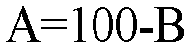
reference 1, as shown inFIG. 6 , assuming that the comonomer is propylene unit, the proportion RX of methine groups is estimated based on the content of the comonomer. - A : the content of ethylene units (mol%)
- B : the content of propylene units (mol%)
- In
FIG. 6 , when the content of propylene units as a comonomer is less than 50 wt%, by converting the unit wt% to mol % based on the molecular weight of each monomer unit, B is calculated as described below.
- The proportion RX of methine groups in the above LDPE of
reference 1 is obtained by the following equation (A).
- When B<40 is substituted into equation (A), RX is calculated as follows in
reference 1.
- Thus,
reference 1 describes LDPEs having the proportion RX of methine groups in a much wider range than the range of the present disclosure. -
Reference 1 describes that the polymerization peak temperature is "up to 400°C", which is wider than the range of polymerization peak temperatures (240°C to 270°C) in samples 1-2 to 1-8 of the present disclosure (paragraph 0100 in reference 1). -
Reference 1 describes that the polymerization pressure is "700 bar (70 MPa) or more", which is wider than the range of polymerization pressure (270 MPa to 330 MPa) in samples 2-2 to 2-4 of the present disclosure (paragraph 0100 in reference 1). - Thus,
reference 1 describes a much wider manufacturing conditions than those used in the Examples of the present disclosure. - Among inventive examples in
reference 1, the inventive example using manufacturing conditions closest to those of samples 1-2 to 1-8 and 2-2 to 2-4 of the present disclosure is "the inventive example 3". In the inventive example 3 ofreference 1, the polymerization pressure is 280 MPa (280 bar) and the polymerization peak temperature is 271°C. - Regarding the inventive example 3 of
reference 1, the proportion RX of methine groups is estimated based on the tendency shown in the Examples of the present disclosure. -
FIG. 7 shows the polymerization peak temperature dependence of the proportion RX of methine groups when the polymerization pressure is 300 MPa, based on Table 1 of the Examples of the present disclosure. - From the tendency shown in
FIG. 7 , when the polymerization pressure is 300 MPa and the polymerization peak temperature is 271°C, the proportion RX of methine groups is "5.5" (at the point a inFIG. 7 ). - Next, as shown in
FIG.8 , based on the tendency of RX at the polymerization peak temperature of 260°C in Table 2 of the present disclosure, it is assumed that even when the polymerization peak temperature is 271°C, RX changes linearly with the same slope as that at the polymerization peak temperature of 260°C. - In
FIG. 8 , the straight line (solid line) of the tendency assumed at the above-mentioned polymerization peak temperature of 271°C, is set to pass through "RX=5.5" obtained above at the polymerization pressure of 300 MPa. - In the straight line of
FIG. 8 , when the polymerization peak temperature is 271°C and the polymerization pressure is 280 MPa, as the manufacturing conditions of the inventive example 3 ofreference 1, the proportion RX of methine groups is estimated to be "5.31" (at the point b inFIG. 8 ). - Furthermore, in the inventive example 3 of
reference 1, "1,7-octadiene" is added during the manufacturing process. Therefore, a lot of vinyl groups containing methine group are incorporated into LDPE (Table 1 of reference 1). From this, in the inventive example 3 ofreference 1, the proportion RX of methine groups is even higher than the above estimated "5.31". - In each of the other inventive examples of
reference 1, the polymerization peak temperature is higher than that of the inventive example 3. Therefore, the proportion RX of methine groups in each of the other inventive examples ofreference 1 is even higher than that of the present disclosure. - From the above, the examples described in
reference 1 are not included in the range of the proportion RX (5 or less) of methine groups defined in the present disclosure. - As described above, the technical scope described in
reference 1 is extremely wide and includes a range in which the effects of the present disclosure cannot be achieved. Furthermore, the specific examples inreference 1 are not included within the technical scope defined by the present disclosure and cannot obtain the effects of the present disclosure. - That is,
reference 1 neither discloses nor suggests the range of the proportion RX of methine groups selected to solve new problems discovered by the present inventors. Since there is no disclosure nor suggestion inreference 1, the skilled person in the art would not seriously contemplate the proportion RX of methine groups. - Accordingly, the present disclosure has novelty as selection invention compared to
reference 1. - Further, the present disclosure involves inventive step as selection invention as follows.
- In Examples of
reference 1, tests for loss tan δ measurements are performed using cables (paragraphs 0169 to 0177 in reference 1). -
Reference 1 neither discloses nor suggests tests for measurements that can detect the influence of minute foreign matter in the insulation layer. Tests for measurements ofReference 1 cannot discover new problem of the present disclosure, which is the occurrence of electrical treeing caused due to minute foreign matter. - That is,
reference 1 does not recognize the new problem of the present disclosure at all. - The effect of the invention in
reference 1 is that loss tan δ is reduced in AC (paragraph 0202 in reference 1). - In contrast, the effect by satisfying the proportion RX of methine groups in the present disclosure is that the above new problem can be solved, that is, it is possible to suppress local occurrence of electrical treeing.
- This effect of the present disclosure is neither disclosed nor suggested in
reference 1 and is advantageous overreference 1. Further, this effect of the present disclosure cannot be confirmed by tests for loss tan δ measurements, which is measured in the state of the cables. That is, this effect of the present disclosure is different from the effect described inreference 1. - Since
reference 1 does not recognize the new problem of the present disclosure as described above, the effect of the present disclosure cannot be expected by the skilled person in the art based on the state of the art at the time of the present application. - From the above, the present disclosure as selection invention is connected to the above technical effect. There is no hint in
reference 1 that would lead the skilled person to the present disclosure as selection invention. - Accordingly, the present disclosure involves inventive step as selection invention compared to
reference 1. -
Reference 2 describes the component (B) (modified polyethylene) of the resin composition (paragraph 0035 in reference 2).Reference 2 describes various additives (paragraph 0074). - However,
Reference 2 neither discloses nor suggests the proportion RX of methine groups in the present disclosure, and the method for manufacturing polyethylene that satisfies the proportion. - That is,
reference 2 neither discloses nor suggest the configuration of the present disclosure. The configuration ofreference 2 cannot obtain the effect of the present disclosure. -
Reference 3 describes a flooding compound including a polymeric filler and a branched olefinic fluid.Reference 3 describes that the branched olefinic fluid has at least 40 methine carbons per one-thousand total carbons (p16l15 to 16 in reference 3). - However,
reference 3 describes that the branched olefinic fluid is liquid at 22°C and 1 atmosphere of pressure (p7 l8 to 9 in reference 3). In other words, the branched olefinic fluid is no longer polyethylene. - That is,
reference 3 neither discloses nor suggest the configuration of the present disclosure. The configuration ofreference 3 cannot obtain the effect of the present disclosure. -
Reference 4 describes a rubber composition including a rubber matrix containing a branched polyethylene, EPM and EPDM, and essential components containing a crosslinking agent and a reinforcing agent.Reference 4 describes that the degree of branching of the branched polyethylene is preferably 50 to 130 branches/1000 carbon atoms (paragraphs 0016 and 0080 in reference 4). - However, in reference4, only the branched polyethylene whose degree of branching is 50 branches/1000 carbons has a possibility of overlapping with the range of the proportion RX of methine groups (5 or less) of the present disclosure. In other words, other branched polyethylene in
reference 4 do not satisfy the proportion RX of methine groups in the present disclosure. -
Reference 4 neither discloses nor suggests the method for manufacturing polyethylene that satisfies the proportion RX of methine groups in the present disclosure. - In all examples of
reference 4, the degrees of branching are more than 60. Therefore, all examples inreference 4 do not satisfy the proportion RX of methine groups (5 or less) in the present disclosure. - In the first place,
reference 4 neither discloses nor suggests the insulation properties of the rubber composition. That is,reference 4 does not recognize the new problem of the present disclosure. - The effect of the invention in
reference 4 is that good heat resistance, compression set resistance and mechanical strength are simultaneously obtained (paragraph 0073 in reference 4). - In contrast, the effect of the present disclosure is neither disclosed nor suggested in
reference 4 and is advantageous overreference 4. Further, this effect of the present disclosure is clearly different from the effect described inreference 4. - Since
reference 4 does not recognize the new problem of the present disclosure as described above, the effect of the present disclosure cannot be expected by the skilled person in the art based on the state of the art at the time of the present application. - Accordingly, the present disclosure has novelty and involves inventive step compared to
reference 4. - Even if
references 1 to 4 are combined, the present disclosure can obtain the unexpected effect that are different from that obtained by the combination of these references. The skilled person in the art cannot achieve the present disclosure based onreferences 1 to 4. - Accordingly, the present disclosure has novelty and involves inventive step compared to
references 1 to 4. -
- 10 Power cable
- 110 Conductor
- 120 Internal semiconductive layer
- 130 Insulation layer
- 140 External semiconductive layer
- 150 Shielding layer
- 160 Sheath
- NE Needle electrode
- FE1, FE2 Flat electrode
- FE3 Electrode
- O Silicone oil
- S Sheet
- S1 First surface
- S2 Second surface
- a Methine group
- b1, b2 Methylene group
- c1, c2 Methyl group
Claims (12)
- A resin composition for forming an insulation layer of a power cable, the resin composition comprising:polyethylene,wherein the polyethylene includes methine groups, andthe polyethylene satisfies the following formula (1) in a 13C nuclear magnetic resonance spectrum,
 where RX satisfies RX = X/(X+Y+Z)} × 100, andX, Y, and Z respectively represent an integrated intensity of the methine groups, an integrated intensity of methylene groups, and an integrated intensity of methyl groups in the 13C nuclear magnetic resonance spectrum of the polyethylene, measured as detailed in the description.
 - The resin composition according to claim 1,
wherein a DC breakdown electric field strength measured using a needle electrode having a tip end with a radius of curvature of 10 µm is 100 kV/mm or more. - The resin composition according to claim 1 or 2,
wherein the polyethylene satisfies the following formula (2),
- The resin composition according to claim 3,
wherein a DC breakdown electric field strength measured using a needle electrode having a tip end with a radius of curvature of 5 µm is 100 kV/mm or more. - The resin composition according to claim 3,
wherein the polyethylene satisfies the following formula (2)',
- The resin composition according to any one of claim 1 or 2,
wherein the polyethylene satisfies the following formula (3),
- The resin composition according to claim 6,
wherein a DC breakdown electric field strength measured using a needle electrode having a tip end with a radius of curvature of 3 µm is 100 kV/mm or more. - The resin composition according to claim 1 or 2, further comprising an inorganic filler.
- The resin composition according to claim 1 or 2,
wherein the polyethylene includes at least low density polyethylene. - A pellet comprising the resin composition according to claim 1 or 2.
- A power cable comprising:a conductor; andan insulation layer covering an outer circumferential surface of the conductor,wherein the insulation layer includes the resin composition according to claim 1 or 2.
- A method for manufacturing a power cable, comprising:preparing a conductor; andforming an insulation layer so as to cover an outer circumferential surface of the conductor,wherein when forming the insulation layer, the insulation layer is formed using the resin composition according to claim 1 or 2.
Applications Claiming Priority (1)
| Application Number | Priority Date | Filing Date | Title |
|---|---|---|---|
| JP2022176045A JP7380804B1 (en) | 2022-11-02 | 2022-11-02 | Resin composition, pellets, power cable, and method for producing power cable |
Publications (2)
| Publication Number | Publication Date |
|---|---|
| EP4386780A1 EP4386780A1 (en) | 2024-06-19 |
| EP4386780B1 true EP4386780B1 (en) | 2025-07-02 |
Family
ID=88511350
Family Applications (1)
| Application Number | Title | Priority Date | Filing Date |
|---|---|---|---|
| EP23205823.0A Active EP4386780B1 (en) | 2022-11-02 | 2023-10-25 | Resin composition, pellet, power cable, and method for manufacturing power cable |
Country Status (2)
| Country | Link |
|---|---|
| EP (1) | EP4386780B1 (en) |
| JP (1) | JP7380804B1 (en) |
Families Citing this family (1)
| Publication number | Priority date | Publication date | Assignee | Title |
|---|---|---|---|---|
| JP7380804B1 (en) | 2022-11-02 | 2023-11-15 | 住友電気工業株式会社 | Resin composition, pellets, power cable, and method for producing power cable |
Citations (7)
| Publication number | Priority date | Publication date | Assignee | Title |
|---|---|---|---|---|
| JPH11286522A (en) | 1998-04-02 | 1999-10-19 | Nippon Unicar Co Ltd | High-melting and low-density polyethylene resin |
| US6369129B1 (en) | 1998-01-02 | 2002-04-09 | Borealis Technology Oy | Insulating composition for an electric power cable |
| EP2450910A1 (en) | 2010-11-03 | 2012-05-09 | Borealis AG | A polymer composition and a power cable comprising the polymer composition |
| US20130175068A1 (en) | 2010-09-30 | 2013-07-11 | Dow Chemical Company Ltd | Recyclable Thermoplastic Insulation with Improved Breakdown Strength |
| JP2015183039A (en) | 2014-03-20 | 2015-10-22 | 株式会社ジェイ・パワーシステムズ | Method for producing insulation material, master batch, insulation material, and power cable |
| JP2018045921A (en) | 2016-09-15 | 2018-03-22 | 古河電気工業株式会社 | Power cable and production method thereof |
| US20200123354A1 (en) | 2017-01-13 | 2020-04-23 | Hangzhou Xinglu Technologies Co., Ltd | Rubber composite, processing method, rubber products applying composite, and manufacturing method |
Family Cites Families (9)
| Publication number | Priority date | Publication date | Assignee | Title |
|---|---|---|---|---|
| CN107430254B (en) | 2015-03-31 | 2020-09-15 | 陶氏环球技术有限责任公司 | Infusion compounds for telecommunication cables |
| KR20180039635A (en) | 2015-08-10 | 2018-04-18 | 스미토모 덴키 고교 가부시키가이샤 | DC cable, composition and method of manufacturing a DC cable |
| JP6205032B1 (en) | 2016-08-09 | 2017-09-27 | 株式会社Nuc | Insulating resin composition for DC power cable, resin cross-linked body, DC power cable, reinforcing insulation layer forming member for DC power cable connecting part and DC power cable connecting part |
| JP6652182B2 (en) | 2018-04-20 | 2020-02-19 | 住友電気工業株式会社 | Resin composition, inorganic filler, DC power cable, and method for manufacturing DC power cable |
| WO2019202870A1 (en) | 2018-04-20 | 2019-10-24 | 住友電気工業株式会社 | Resin composition, inorganic filler, dc power cable, and method for producing dc power cable |
| JP6590099B1 (en) | 2019-02-25 | 2019-10-16 | 住友電気工業株式会社 | Resin composition molded body and DC power cable |
| JP6575701B1 (en) | 2019-02-25 | 2019-09-18 | 住友電気工業株式会社 | Resin composition, inorganic filler, DC power cable, and method for manufacturing DC power cable |
| JP6558511B1 (en) | 2019-02-25 | 2019-08-14 | 住友電気工業株式会社 | Resin composition, inorganic filler, DC power cable, and method for manufacturing DC power cable |
| JP7380804B1 (en) | 2022-11-02 | 2023-11-15 | 住友電気工業株式会社 | Resin composition, pellets, power cable, and method for producing power cable |
-
2022
- 2022-11-02 JP JP2022176045A patent/JP7380804B1/en active Active
-
2023
- 2023-10-25 EP EP23205823.0A patent/EP4386780B1/en active Active
Patent Citations (7)
| Publication number | Priority date | Publication date | Assignee | Title |
|---|---|---|---|---|
| US6369129B1 (en) | 1998-01-02 | 2002-04-09 | Borealis Technology Oy | Insulating composition for an electric power cable |
| JPH11286522A (en) | 1998-04-02 | 1999-10-19 | Nippon Unicar Co Ltd | High-melting and low-density polyethylene resin |
| US20130175068A1 (en) | 2010-09-30 | 2013-07-11 | Dow Chemical Company Ltd | Recyclable Thermoplastic Insulation with Improved Breakdown Strength |
| EP2450910A1 (en) | 2010-11-03 | 2012-05-09 | Borealis AG | A polymer composition and a power cable comprising the polymer composition |
| JP2015183039A (en) | 2014-03-20 | 2015-10-22 | 株式会社ジェイ・パワーシステムズ | Method for producing insulation material, master batch, insulation material, and power cable |
| JP2018045921A (en) | 2016-09-15 | 2018-03-22 | 古河電気工業株式会社 | Power cable and production method thereof |
| US20200123354A1 (en) | 2017-01-13 | 2020-04-23 | Hangzhou Xinglu Technologies Co., Ltd | Rubber composite, processing method, rubber products applying composite, and manufacturing method |
Non-Patent Citations (10)
| Title |
|---|
| "ENCYCLOPEDIA OF POLYMER SCIENCE AND TECHNOLOGY, volume 2", 22 October 2001, JOHN WILEY & SONS, INC. , ISBN: 978-1-118-63389-2, article N. MARASCHIN: "Ethylene Polymers, LDPE", pages: 412 - 441, XP055646936, DOI: 10.1002/0471440264.pst121 |
| ANONYMOUS: "High-density polyethylene", WIKIPEDIA, 6 March 2026 (2026-03-06), pages 1 - 7, XP093386931, Retrieved from the Internet <URL:https://en.wikipedia.org/w/index.php?title=High-density_polyethylene&oldid=1342090352> |
| BROWN JAMES E.: "The characterization of linear polyethylene SRM 1475. II. Determination of total methyl content by infrared spectrophotometry", JOURNAL OF RESEARCH OF THE NATIONAL BUREAU OF STANDARDS SECTION A: PHYSICS AND CHEMISTRY, NATIONAL INSTITUTE OF STANDARDS AND TECHNOLOGY (NIST), vol. 76A, no. 2, 1 March 1972 (1972-03-01), pages 141 - 142, XP093386927, ISSN: 0022-4332, DOI: 10.6028/jres.076a.015 |
| D2a - Declaration of Kenneth Johansson |
| D2b - Declaration of Mithun Goswami |
| D4 - NUCV-9253 Specification and NUC9053 specification |
| D5 - DYNI-V C13 NMR Spectrum data and its |
| HAMA TOMOHIKO, MICHIO SUZUKI, KENICHI KOSAKA: "Branch structure of high-pressure polyethylene 13. Analysis by 13¹¹C-NMR", JAPANESE JOURNAL OF POLYMER SCIENCE AND TECHNOLOGY, SOCIETY OF POLYMER SCIENCE JP, JP, vol. 32, no. 2, 25 February 1975 (1975-02-25), JP , pages 91 - 96, XP093386928, ISSN: 0386-2186, DOI: 10.1295/koron.32.91 |
| HAMEED TAYYAB, HUSSEIN IBNELWALEED A.: "Effect of Short Chain Branching of LDPE on its Miscibility with Linear HDPE", MACROMOLECULAR MATERIALS AND ENGINEERING., WILEY VCH VERLAG, WEINHEIM., DE, vol. 289, no. 2, 1 February 2004 (2004-02-01), DE , pages 198 - 203, XP093386934, ISSN: 1438-7492, DOI: 10.1002/mame.200300173 |
| JIANG LIUHAO; WANG SHIHANG; YANG LIUQING; LI SHENGTAO; FENG YANG; BAI YUNFEI: "The Influence of Short Chain Branch on the Crystal Characteristics and Breakdown Strength of Low-Density Polyethylene", IEEE TRANSACTIONS ON DIELECTRICS AND ELECTRICAL INSULATION, IEEE SERVICE CENTER, PISCATAWAY, NJ., US, vol. 28, no. 4, 17 August 2021 (2021-08-17), US , pages 1181 - 1188, XP011872581, ISSN: 1070-9878, DOI: 10.1109/TDEI.2021.009529 |
Also Published As
| Publication number | Publication date |
|---|---|
| JP7380804B1 (en) | 2023-11-15 |
| EP4386780A1 (en) | 2024-06-19 |
| JP2024066593A (en) | 2024-05-16 |
Similar Documents
| Publication | Publication Date | Title |
|---|---|---|
| RU2547011C2 (en) | Power cable | |
| US8124877B2 (en) | Semiconductive polymer composition | |
| US20120273253A1 (en) | Cable and production process thereof | |
| EP2628162B9 (en) | Semiconductive polymer composition | |
| EP2379624B1 (en) | Masterbatch and process for preparing a polymer composition | |
| US20120227997A1 (en) | Medium-or high-voltage electric cable | |
| EP2637178A2 (en) | Insulating composition and electric cable comprising same | |
| KR20170139696A (en) | Energy Cable Having a Voltage Stabilized Thermoplastic Electrically Insulating Layer | |
| BR112013011084B1 (en) | alternating current (ac) electric cable and its production process | |
| CN108699304B (en) | Polymer composition comprising dielectric liquid with improved polarity | |
| CN105940462A (en) | Electric HV transmission cable | |
| CN108699305B (en) | Polymer composition with improved stress whitening resistance | |
| CA2915044C (en) | Voltage-stabilized polymeric compositions | |
| EP4376027A1 (en) | Marine cable for offshore wind power having an improved water-tree property | |
| EP4386780A1 (en) | Resin composition, pellet, power cable, and method for manufacturing power cable | |
| WO2017220620A1 (en) | Cable with advantageous electrical properties | |
| CN113571233A (en) | A thermoplastic cable with modified polypropylene insulation layer | |
| KR102267280B1 (en) | Polymer Composition Comprising Polar Dielectric Liquid | |
| WO2024095407A1 (en) | Resin composition, pellet, power cable, and method for manufacturing power cable | |
| CN115244627A (en) | Cables comprising semiconducting layers with smooth surfaces | |
| KR20240020533A (en) | Polypropylene resin composition for insulation of power cables with excellent thermal stability and article prepared using the same | |
| EP3084777A1 (en) | An electrical hv transmission power cable |
Legal Events
| Date | Code | Title | Description |
|---|---|---|---|
| PUAI | Public reference made under article 153(3) epc to a published international application that has entered the european phase |
Free format text: ORIGINAL CODE: 0009012 |
|
| STAA | Information on the status of an ep patent application or granted ep patent |
Free format text: STATUS: THE APPLICATION HAS BEEN PUBLISHED |
|
| AK | Designated contracting states |
Kind code of ref document: A1 Designated state(s): AL AT BE BG CH CY CZ DE DK EE ES FI FR GB GR HR HU IE IS IT LI LT LU LV MC ME MK MT NL NO PL PT RO RS SE SI SK SM TR |
|
| STAA | Information on the status of an ep patent application or granted ep patent |
Free format text: STATUS: REQUEST FOR EXAMINATION WAS MADE |
|
| 17P | Request for examination filed |
Effective date: 20241205 |
|
| GRAP | Despatch of communication of intention to grant a patent |
Free format text: ORIGINAL CODE: EPIDOSNIGR1 |
|
| STAA | Information on the status of an ep patent application or granted ep patent |
Free format text: STATUS: GRANT OF PATENT IS INTENDED |
|
| INTG | Intention to grant announced |
Effective date: 20250227 |
|
| RIN1 | Information on inventor provided before grant (corrected) |
Inventor name: YAMASAKI, SATOSHI Inventor name: YAMAZAKI, TAKANORI Inventor name: IZUMI, NAOKI Inventor name: YAMANA, TAKESHI Inventor name: HOSOMIZU, KOHEI |
|
| P01 | Opt-out of the competence of the unified patent court (upc) registered |
Free format text: CASE NUMBER: APP_12986/2025 Effective date: 20250316 |
|
| GRAS | Grant fee paid |
Free format text: ORIGINAL CODE: EPIDOSNIGR3 |
|
| TPAC | Observations filed by third parties |
Free format text: ORIGINAL CODE: EPIDOSNTIPA |
|
| GRAA | (expected) grant |
Free format text: ORIGINAL CODE: 0009210 |
|
| STAA | Information on the status of an ep patent application or granted ep patent |
Free format text: STATUS: THE PATENT HAS BEEN GRANTED |
|
| AK | Designated contracting states |
Kind code of ref document: B1 Designated state(s): AL AT BE BG CH CY CZ DE DK EE ES FI FR GB GR HR HU IE IS IT LI LT LU LV MC ME MK MT NL NO PL PT RO RS SE SI SK SM TR |
|
| REG | Reference to a national code |
Ref country code: GB Ref legal event code: FG4D |
|
| REG | Reference to a national code |
Ref country code: CH Ref legal event code: EP |
|
| REG | Reference to a national code |
Ref country code: DE Ref legal event code: R096 Ref document number: 602023004501 Country of ref document: DE |
|
| REG | Reference to a national code |
Ref country code: IE Ref legal event code: FG4D |
|
| REG | Reference to a national code |
Ref country code: NL Ref legal event code: MP Effective date: 20250702 |
|
| PG25 | Lapsed in a contracting state [announced via postgrant information from national office to epo] |
Ref country code: PT Free format text: LAPSE BECAUSE OF FAILURE TO SUBMIT A TRANSLATION OF THE DESCRIPTION OR TO PAY THE FEE WITHIN THE PRESCRIBED TIME-LIMIT Effective date: 20251103 |
|
| PG25 | Lapsed in a contracting state [announced via postgrant information from national office to epo] |
Ref country code: NL Free format text: LAPSE BECAUSE OF FAILURE TO SUBMIT A TRANSLATION OF THE DESCRIPTION OR TO PAY THE FEE WITHIN THE PRESCRIBED TIME-LIMIT Effective date: 20250702 |
|
| REG | Reference to a national code |
Ref country code: AT Ref legal event code: MK05 Ref document number: 1810245 Country of ref document: AT Kind code of ref document: T Effective date: 20250702 |
|
| PG25 | Lapsed in a contracting state [announced via postgrant information from national office to epo] |
Ref country code: IS Free format text: LAPSE BECAUSE OF FAILURE TO SUBMIT A TRANSLATION OF THE DESCRIPTION OR TO PAY THE FEE WITHIN THE PRESCRIBED TIME-LIMIT Effective date: 20251102 |
|
| PGFP | Annual fee paid to national office [announced via postgrant information from national office to epo] |
Ref country code: DE Payment date: 20251029 Year of fee payment: 3 |
|
| PG25 | Lapsed in a contracting state [announced via postgrant information from national office to epo] |
Ref country code: NO Free format text: LAPSE BECAUSE OF FAILURE TO SUBMIT A TRANSLATION OF THE DESCRIPTION OR TO PAY THE FEE WITHIN THE PRESCRIBED TIME-LIMIT Effective date: 20251002 |
|
| REG | Reference to a national code |
Ref country code: LT Ref legal event code: MG9D |
|
| PG25 | Lapsed in a contracting state [announced via postgrant information from national office to epo] |
Ref country code: AT Free format text: LAPSE BECAUSE OF FAILURE TO SUBMIT A TRANSLATION OF THE DESCRIPTION OR TO PAY THE FEE WITHIN THE PRESCRIBED TIME-LIMIT Effective date: 20250702 |
|
| PG25 | Lapsed in a contracting state [announced via postgrant information from national office to epo] |
Ref country code: FI Free format text: LAPSE BECAUSE OF FAILURE TO SUBMIT A TRANSLATION OF THE DESCRIPTION OR TO PAY THE FEE WITHIN THE PRESCRIBED TIME-LIMIT Effective date: 20250702 |
|
| PG25 | Lapsed in a contracting state [announced via postgrant information from national office to epo] |
Ref country code: HR Free format text: LAPSE BECAUSE OF FAILURE TO SUBMIT A TRANSLATION OF THE DESCRIPTION OR TO PAY THE FEE WITHIN THE PRESCRIBED TIME-LIMIT Effective date: 20250702 |
|
| PG25 | Lapsed in a contracting state [announced via postgrant information from national office to epo] |
Ref country code: GR Free format text: LAPSE BECAUSE OF FAILURE TO SUBMIT A TRANSLATION OF THE DESCRIPTION OR TO PAY THE FEE WITHIN THE PRESCRIBED TIME-LIMIT Effective date: 20251003 |
|
| PG25 | Lapsed in a contracting state [announced via postgrant information from national office to epo] |
Ref country code: CZ Free format text: LAPSE BECAUSE OF FAILURE TO SUBMIT A TRANSLATION OF THE DESCRIPTION OR TO PAY THE FEE WITHIN THE PRESCRIBED TIME-LIMIT Effective date: 20250702 Ref country code: SE Free format text: LAPSE BECAUSE OF FAILURE TO SUBMIT A TRANSLATION OF THE DESCRIPTION OR TO PAY THE FEE WITHIN THE PRESCRIBED TIME-LIMIT Effective date: 20250702 |
|
| PG25 | Lapsed in a contracting state [announced via postgrant information from national office to epo] |
Ref country code: LV Free format text: LAPSE BECAUSE OF FAILURE TO SUBMIT A TRANSLATION OF THE DESCRIPTION OR TO PAY THE FEE WITHIN THE PRESCRIBED TIME-LIMIT Effective date: 20250702 |
|
| PG25 | Lapsed in a contracting state [announced via postgrant information from national office to epo] |
Ref country code: BG Free format text: LAPSE BECAUSE OF FAILURE TO SUBMIT A TRANSLATION OF THE DESCRIPTION OR TO PAY THE FEE WITHIN THE PRESCRIBED TIME-LIMIT Effective date: 20250702 Ref country code: PL Free format text: LAPSE BECAUSE OF FAILURE TO SUBMIT A TRANSLATION OF THE DESCRIPTION OR TO PAY THE FEE WITHIN THE PRESCRIBED TIME-LIMIT Effective date: 20250702 |
|
| PG25 | Lapsed in a contracting state [announced via postgrant information from national office to epo] |
Ref country code: RS Free format text: LAPSE BECAUSE OF FAILURE TO SUBMIT A TRANSLATION OF THE DESCRIPTION OR TO PAY THE FEE WITHIN THE PRESCRIBED TIME-LIMIT Effective date: 20251002 |
|
| PG25 | Lapsed in a contracting state [announced via postgrant information from national office to epo] |
Ref country code: ES Free format text: LAPSE BECAUSE OF FAILURE TO SUBMIT A TRANSLATION OF THE DESCRIPTION OR TO PAY THE FEE WITHIN THE PRESCRIBED TIME-LIMIT Effective date: 20250702 |
|
| PG25 | Lapsed in a contracting state [announced via postgrant information from national office to epo] |
Ref country code: RO Free format text: LAPSE BECAUSE OF FAILURE TO SUBMIT A TRANSLATION OF THE DESCRIPTION OR TO PAY THE FEE WITHIN THE PRESCRIBED TIME-LIMIT Effective date: 20250702 |
|
| REG | Reference to a national code |
Ref country code: DE Ref legal event code: R026 Ref document number: 602023004501 Country of ref document: DE |
|
| PG25 | Lapsed in a contracting state [announced via postgrant information from national office to epo] |
Ref country code: SM Free format text: LAPSE BECAUSE OF FAILURE TO SUBMIT A TRANSLATION OF THE DESCRIPTION OR TO PAY THE FEE WITHIN THE PRESCRIBED TIME-LIMIT Effective date: 20250702 |
|
| PLBI | Opposition filed |
Free format text: ORIGINAL CODE: 0009260 |
|
| PG25 | Lapsed in a contracting state [announced via postgrant information from national office to epo] |
Ref country code: DK Free format text: LAPSE BECAUSE OF FAILURE TO SUBMIT A TRANSLATION OF THE DESCRIPTION OR TO PAY THE FEE WITHIN THE PRESCRIBED TIME-LIMIT Effective date: 20250702 |
|
| PG25 | Lapsed in a contracting state [announced via postgrant information from national office to epo] |
Ref country code: IT Free format text: LAPSE BECAUSE OF FAILURE TO SUBMIT A TRANSLATION OF THE DESCRIPTION OR TO PAY THE FEE WITHIN THE PRESCRIBED TIME-LIMIT Effective date: 20250702 |
|
| REG | Reference to a national code |
Ref country code: CH Ref legal event code: L10 Free format text: ST27 STATUS EVENT CODE: U-0-0-L10-L00 (AS PROVIDED BY THE NATIONAL OFFICE) Effective date: 20260416 |
|
| PLAX | Notice of opposition and request to file observation + time limit sent |
Free format text: ORIGINAL CODE: EPIDOSNOBS2 |
|
| PG25 | Lapsed in a contracting state [announced via postgrant information from national office to epo] |
Ref country code: EE Free format text: LAPSE BECAUSE OF FAILURE TO SUBMIT A TRANSLATION OF THE DESCRIPTION OR TO PAY THE FEE WITHIN THE PRESCRIBED TIME-LIMIT Effective date: 20250702 Ref country code: SK Free format text: LAPSE BECAUSE OF FAILURE TO SUBMIT A TRANSLATION OF THE DESCRIPTION OR TO PAY THE FEE WITHIN THE PRESCRIBED TIME-LIMIT Effective date: 20250702 |
|
| 26 | Opposition filed |
Opponent name: BOREALIS GMBH Effective date: 20260402 |