EP4386637A1 - Method and system for incremental centroid clustering - Google Patents
Method and system for incremental centroid clustering Download PDFInfo
- Publication number
- EP4386637A1 EP4386637A1 EP23215114.2A EP23215114A EP4386637A1 EP 4386637 A1 EP4386637 A1 EP 4386637A1 EP 23215114 A EP23215114 A EP 23215114A EP 4386637 A1 EP4386637 A1 EP 4386637A1
- Authority
- EP
- European Patent Office
- Prior art keywords
- cluster
- computing device
- data point
- data
- clusters
- Prior art date
- Legal status (The legal status is an assumption and is not a legal conclusion. Google has not performed a legal analysis and makes no representation as to the accuracy of the status listed.)
- Pending
Links
Images






Classifications
-
- G—PHYSICS
- G06—COMPUTING OR CALCULATING; COUNTING
- G06F—ELECTRIC DIGITAL DATA PROCESSING
- G06F21/00—Security arrangements for protecting computers, components thereof, programs or data against unauthorised activity
- G06F21/50—Monitoring users, programs or devices to maintain the integrity of platforms, e.g. of processors, firmware or operating systems
- G06F21/55—Detecting local intrusion or implementing counter-measures
- G06F21/56—Computer malware detection or handling, e.g. anti-virus arrangements
- G06F21/566—Dynamic detection, i.e. detection performed at run-time, e.g. emulation, suspicious activities
-
- G—PHYSICS
- G06—COMPUTING OR CALCULATING; COUNTING
- G06N—COMPUTING ARRANGEMENTS BASED ON SPECIFIC COMPUTATIONAL MODELS
- G06N20/00—Machine learning
-
- H—ELECTRICITY
- H04—ELECTRIC COMMUNICATION TECHNIQUE
- H04L—TRANSMISSION OF DIGITAL INFORMATION, e.g. TELEGRAPHIC COMMUNICATION
- H04L41/00—Arrangements for maintenance, administration or management of data switching networks, e.g. of packet switching networks
- H04L41/06—Management of faults, events, alarms or notifications
- H04L41/0631—Management of faults, events, alarms or notifications using root cause analysis; using analysis of correlation between notifications, alarms or events based on decision criteria, e.g. hierarchy, tree or time analysis
-
- G—PHYSICS
- G06—COMPUTING OR CALCULATING; COUNTING
- G06F—ELECTRIC DIGITAL DATA PROCESSING
- G06F16/00—Information retrieval; Database structures therefor; File system structures therefor
- G06F16/20—Information retrieval; Database structures therefor; File system structures therefor of structured data, e.g. relational data
- G06F16/28—Databases characterised by their database models, e.g. relational or object models
- G06F16/284—Relational databases
- G06F16/285—Clustering or classification
-
- H—ELECTRICITY
- H04—ELECTRIC COMMUNICATION TECHNIQUE
- H04L—TRANSMISSION OF DIGITAL INFORMATION, e.g. TELEGRAPHIC COMMUNICATION
- H04L41/00—Arrangements for maintenance, administration or management of data switching networks, e.g. of packet switching networks
- H04L41/06—Management of faults, events, alarms or notifications
- H04L41/069—Management of faults, events, alarms or notifications using logs of notifications; Post-processing of notifications
-
- H—ELECTRICITY
- H04—ELECTRIC COMMUNICATION TECHNIQUE
- H04L—TRANSMISSION OF DIGITAL INFORMATION, e.g. TELEGRAPHIC COMMUNICATION
- H04L41/00—Arrangements for maintenance, administration or management of data switching networks, e.g. of packet switching networks
- H04L41/16—Arrangements for maintenance, administration or management of data switching networks, e.g. of packet switching networks using machine learning or artificial intelligence
-
- H—ELECTRICITY
- H04—ELECTRIC COMMUNICATION TECHNIQUE
- H04L—TRANSMISSION OF DIGITAL INFORMATION, e.g. TELEGRAPHIC COMMUNICATION
- H04L63/00—Network architectures or network communication protocols for network security
- H04L63/14—Network architectures or network communication protocols for network security for detecting or protecting against malicious traffic
- H04L63/1408—Network architectures or network communication protocols for network security for detecting or protecting against malicious traffic by monitoring network traffic
- H04L63/1425—Traffic logging, e.g. anomaly detection
-
- H—ELECTRICITY
- H04—ELECTRIC COMMUNICATION TECHNIQUE
- H04L—TRANSMISSION OF DIGITAL INFORMATION, e.g. TELEGRAPHIC COMMUNICATION
- H04L63/00—Network architectures or network communication protocols for network security
- H04L63/14—Network architectures or network communication protocols for network security for detecting or protecting against malicious traffic
- H04L63/1433—Vulnerability analysis
-
- H—ELECTRICITY
- H04—ELECTRIC COMMUNICATION TECHNIQUE
- H04L—TRANSMISSION OF DIGITAL INFORMATION, e.g. TELEGRAPHIC COMMUNICATION
- H04L9/00—Cryptographic mechanisms or cryptographic arrangements for secret or secure communications; Network security protocols
- H04L9/40—Network security protocols
-
- H—ELECTRICITY
- H04—ELECTRIC COMMUNICATION TECHNIQUE
- H04W—WIRELESS COMMUNICATION NETWORKS
- H04W24/00—Supervisory, monitoring or testing arrangements
- H04W24/04—Arrangements for maintaining operational condition
-
- H—ELECTRICITY
- H04—ELECTRIC COMMUNICATION TECHNIQUE
- H04W—WIRELESS COMMUNICATION NETWORKS
- H04W84/00—Network topologies
- H04W84/02—Hierarchically pre-organised networks, e.g. paging networks, cellular networks, WLAN [Wireless Local Area Network] or WLL [Wireless Local Loop]
- H04W84/04—Large scale networks; Deep hierarchical networks
- H04W84/08—Trunked mobile radio systems
-
- G—PHYSICS
- G06—COMPUTING OR CALCULATING; COUNTING
- G06F—ELECTRIC DIGITAL DATA PROCESSING
- G06F2221/00—Indexing scheme relating to security arrangements for protecting computers, components thereof, programs or data against unauthorised activity
- G06F2221/03—Indexing scheme relating to G06F21/50, monitoring users, programs or devices to maintain the integrity of platforms
- G06F2221/034—Test or assess a computer or a system
-
- G—PHYSICS
- G06—COMPUTING OR CALCULATING; COUNTING
- G06N—COMPUTING ARRANGEMENTS BASED ON SPECIFIC COMPUTATIONAL MODELS
- G06N20/00—Machine learning
- G06N20/10—Machine learning using kernel methods, e.g. support vector machines [SVM]
Definitions
- the present disclosure relates to anomaly detection systems, and in particular relates to machine learning for anomaly detection systems.
- Anomaly detection is a process by which outliers in a dataset can be identified. It plays a role in complex software systems such as distributed systems and allows threats to the system to be detected, root causes of errors to be identified, monitoring of the health of a system, cleaning of data, among other benefits.
- anomaly detection systems were built manually. This involved significant domain knowledge and foresight of issues likely to be encountered. Further, such systems tend to be static, which is undesirable when the threats to the system may evolve.
- machine learning algorithms have more recently been used to create such anomaly detection systems.
- Such machine learning algorithms generally create systems that are able to handle large data sets, can be adaptive over time, and may work better than manual creation.
- Examples of such machine learning algorithms include One Class Support Vector Method (SVM), Random Forest, Local Outlier Factor, among others.
- the present disclosure provides a method at a computing device for anomaly detection, the method comprising: storing, at the computing device, a full batch model for a plurality of data points, wherein each of the plurality of data points is associated with one of a plurality of clusters, and wherein the storing comprises a table for storing information about the plurality of clusters without storing the plurality of data points; receiving a new data point from a hardware sensor; determining that the new data point falls outside the full batch model, thereby detecting an anomaly; and performing an action based on the anomaly.
- the present disclosure further provides a computing device for anomaly detection, the computing device comprising: a processor; and a communications subsystem, wherein the computing device is configured to: store a full batch model for a plurality of data points, wherein each of the plurality of data points is associated with one of a plurality of clusters, and wherein the storing comprises a table for storing information about the plurality of clusters without storing the plurality of data points; receive a new data point from a hardware sensor; determine that the new data point falls outside the full batch model, thereby detecting an anomaly; and perform an action based on the anomaly.
- the present disclosure further provides a computer storage medium for storing instruction code for anomaly detection, which, when executed by a processor on a computing device, cause the computing device to: store a full batch model for a plurality of data points, wherein each of the plurality of data points is associated with one of a plurality of clusters, and wherein the storing comprises a table for storing information about the plurality of clusters without storing the plurality of data points; receive a new data point from a hardware sensor; determine that the new data point falls outside the full batch model, thereby detecting an anomaly; and perform an action based on the anomaly.
- the present disclosure is directed to Internet of Things devices.
- such devices may include automotive systems.
- the methods and systems described herein could equally be used in other systems. Therefore, the techniques of present disclosure are not limited to any particular system.
- software programs may execute in systems connected to, or accessible via, public networks such as the Internet.
- Malicious actors can use various exploitative techniques to influence the behavior of a network-connected software program.
- malicious actors with access to the system may insert malicious code into the system software to influence the behavior of the software.
- IoT Internet of Things
- a modern vehicle may have over 100 million lines of software code. As software in a vehicle grows, so does an attack surface, which makes such software vulnerable to attacks. Each poorly constructed piece of software represents a potential vulnerability that can be exploited by attackers.
- the "castle walls" used to keep hackers out of the system may be insufficient, or may be circumvented by the malicious actors over time.
- a system may not be able to detect compromised devices in some cases.
- methods and systems which may analyze data such as logs within a system to detect anomalies.
- Such system may use machine learning to find data anomalies.
- IoT devices do not typically optimize for hard drive space, meaning the ability to store data may be limited. Further, IoT devices often have limited processing power and not all IoT devices will readily be able to connect to the cloud at all times.
- IoT devices may have varied behaviors. In particular, depending on how the user uses the IoT device, or how it is configured in a system, the normal behavior may look different between similar IoT devices.
- edge devices As used herein, edge devices and IoT devices are used interchangeably.
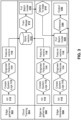
- Figure 1 shows the steps required during edge training 102, edge retraining 104 and edge inference 106, where the full batch model is located on the edge device.
- FIG. 1 uses an in vehicle infotainment system (IVI) 110 as an example edge device.
- IVI in vehicle infotainment system
- such device is merely provided for illustration purposes and the present disclosure is not limited to in vehicle infotainment systems.
- IVI 110 creates system logs 112 and, from the system logs, engineers features 114.
- Such features are converted to feature vectors at block 116. This occurs for all of edge training 102, edge retraining 104 and edge inference 106.
- the edge device For edge training 102 and edge retraining 104, the edge device needs to store the vectors at block 120. This is done to eventually cluster on the aggregate. For an edge device, the requirement to store the vectors on the edge device may lead to an infeasible solution if the desired disk allocation is too small. This may be exacerbated if the model needs to be retrained. For example, if a new software update is provided to the edge device, a new application is installed, among other factors, the storage problem is added to.
- the model is trained at block 122.
- the model may need to be trained on all available benign data. With some full batch models such as One Class SVM, this may take a long time, and may take many resources to train. In some cases, the model may not be able to train an entire data set without failing. Other models such as Isolation Forest may not suffer from this, but they typically suffer from efficacy compared to one class SVM.
- a full batch model 130 may be created.
- a retrained model 140 may be used to create the updated full batch model 130.
- the full batch model 130 may then be used during inference, shown at block 150 which may then generate an output 152.
- Full batch models typically cannot incrementally train the model, but instead may need to start from scratch, which may take more resources than an edge device may have.
- the edge device could send a constant stream of log data to be analyzed to a cloud server or service, but this may overwhelm the communications channels from the edge device and thus be too expensive to implement.
- edge gathering 202 which occurs on the edge device
- cloud training 204 which occurs in the cloud
- edge re-gathering 206 which occurs on the edge device
- edge inference 208 which occurs on the edge device (with input from the cloud).
- edge device IVI 110 creates system logs 112 and, from the system logs, engineers features 114.
- Such features are converted to feature vectors at block 116. This occurs for all of edge gathering 202, edge re-gathering 206 and edge inference 208.
- the edge device For edge gathering 202 and edge re-gathering 206, the edge device provides the vectors to the cloud for cloud storage at block 210.
- the model is trained at block 212. Further, from the training at block 212, a full batch model 220 may be created at the cloud.
- the full batch model 220 may then be used during inference, shown at block 150 which may then generate an output 152.
- edge devices can be capable of generating thousands of records each second. While some filtering, aggregation, among other factors, may be applied, this will result in a significant amount of bandwidth per end point. Such communication costs may be further be compounded by the number of end points expected to be transmitting data.
- the costs for training in the cloud may be prohibitive given the amount of data needed to train.
- the model then needs to send data back to the end point for inference, which is both data heavy and may also increase the latency time for inference, potentially making it too late to take action on the inference in some cases.
- the communication with the cloud adds latency for each roundtrip and further requires a component with Internet connectivity to the cloud and back. If an attacker is able to take an endpoint offline, the anomaly detection function will cease to work.
- edge gathering 302 which occurs on the edge device
- cloud training 304 which occurs in the cloud
- edge re-gathering 306 which occurs on the edge device
- edge inference 308 which occurs on the edge device.
- edge device IVI 110 creates system logs 112 and, from the system logs, engineers features 114.
- Such features are converted to feature vectors at block 116. This occurs for all of edge gathering 302, edge re-gathering 306 and edge inference 308.
- the edge device For edge gathering 302 and edge re-gathering 306, the edge device provides the vectors to the cloud for cloud storage at block 210.
- the model is trained at block 212. Further, from the training at block 212, a full batch model 220 may be created at the cloud.
- the full batch model 220 may then be deployed to the edge, shown with block 310, which may then create a full batch model 320 which may used during inference, shown at block 330, which may then generate an output 332.
- the present disclosure provides an incremental centroid clustering method and system for anomaly detection on complex systems.
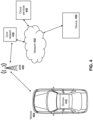
- a vehicle 400 may be equipped with a computing system and a communications system.
- Part of the computing system may include a domain 410, which may have applications that create log data. Further, part of the computing system on vehicle 400 perform anomaly detection as described below.
- vehicle 400 communicates utilizing a communications system with a cellular base station, shown in Figure 4 as eNB 420.
- the base station may communicate with a core network 430 which may then forward communications through a network 432 to a cloud services provider 440.
- Network 432 may, for example, be a wide area network such as the Internet.
- any technology associated with a particular cellular or wireless communications protocol may be used.
- cloud services 440 may provide processing for a domain, or may provide information used within a domain.
- a device 460 may be used for anomaly detection.
- Device 460 may be any computing device, and could include Internet of Things devices, mobile devices, medical equipment, vehicles or equipment associated with vehicles, among other options.
- Device 460 may communicate through network 432 utilizing various wired or wireless technologies, including but not limited to Ethernet, fiber, cellular, Wi-Fi, satellite, among other options.
- domain 410 on vehicle 400 and device 450 may be considered edge devices, and have limited storage and/or processing in some cases.
- a first data point would be used to create a cluster and subsequent points will then be analyzed to determine they are within a threshold distance of the average distance all points are to each other within that cluster. If so, the new data point is added to the cluster and the cluster shape is adjusted based on the new addition. Otherwise, a new cluster is formed.
- the number of clusters may be limited to be proportional to the number of points processed so that inference times do not get too expensive.
- small clusters such as those of size 1 which are typically outliers may be removed on occasion if a desired maximum cluster proportion threshold is passed.
- the threshold may be increased by a threshold adjustment factor to promote less new clusters being created.
- the only data being stored are the clusters which are a function of the square root of the number of points processed at maximum, or each cluster contains a single vector including all information for the algorithm to work.
- incremental centroid clustering is incremental. As opposed to requiring all the data to perform clustering, incremental centroid clustering can cluster one data point at a time.
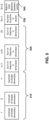
- Figure 5 shows an example of a data structure for storing information about a cluster.
- the example of Figure 5 is merely one option for storing such information.
- the information stored in the example data structure is illustrative of the type of information that may be stored for a cluster.
- a system having a plurality of clusters may be represented in a table in which each row has the information about one cluster.
- the information may comprise data about the centroid of the cluster for a particular dimension or feature for which the information is being processed.
- "n" dimensions or features are being processed, and therefore columns 1 to n comprise data on the centroid for the cluster for that particular dimension or feature. Collectively these columns are shown in Figure 5 as columns 510.
- columns n + 1 to 2n represent as columns 520, provide the sum of the features cumulatively for the cluster for each of the dimensions or features being analyzed.
- Column 530 provides a number of points in a cluster. In other words, the number of data points that have been analyzed and stored in that cluster are represented by column 530.
- Column 540 provides an approximate total distance between the points in the cluster. In other words, a distance measurement between data points can be updated as new data points are added to the cluster.
- the data structure of Figure 5 or similar data structure can be used in training an incremental centroid clustering algorithm in accordance with the embodiment of Figure 6 .
- the process of Figure 6 starts at block 610 and proceeds to block 612 in which a data point is selected.
- the data point selection may involve using a line in a log file, processing data as the data is created, using the feature vectors as described in Figures 1 to 3 above, among other options.
- the data point represents data from a sensor, such as a vehicle sensor, or a group of sensors from a vehicle.
- the data point may be received directly from the sensor, Electronic control unit (ECU) or other computing unit to be processed.
- the data from the sensors or ECUs may be stored in a log file and may have some processing performed ahead of time. Other options are possible.
- the process proceeds to block 620 in which a check is made to determine whether the selected data point from block 612 is the first data point for the incremental centroid clustering algorithm. If yes, the process proceeds to block 630 in which the data point is assigned to a new cluster.
- the values for columns 510 in Figure 5 correspond to the n features or dimensions being analyzed for the data point being passed into the algorithm.
- columns 520 are populated with the values corresponding to the n features of the data point being processed. This is because the sum of the features in the dimension would have only the one data point and therefore the sum is the original value.
- Column 530 is assigned a value of 1, indicating a single data point.
- Column 540 is assigned a value of 0, indicating that there is no distance currently between the data points in the cluster. Specifically, as there is only the one data point, the distance between data points is 0.
- block 620 if the data point is not the first data point for the system, the process proceeds to block 640 in which a check is made to determine whether the data point is within a threshold of the average distance to a cluster center of any existing cluster in the system.
- Cluster Distance The average distance to a cluster center starts at zero.
- Cluster Distance a global variable, referred to herein as "Cluster Distance” may be used, which monitors the distance from the new point to the closest cluster. At each iteration past the first data point, the distance between the new data point and the closest cluster is added to this variable, starting at 0.
- a second variable referred to herein as "Count" may indicate the total number of data points saved to a system.
- the check at block 640 multiplies the "threshold distance” by the value of "Cluster Distance” divided by "Count".
- Cluster Distance divided by “count” is meant to represent the average distance of each point to the nearest cluster. This is useful since a good choice for the "threshold distance” hyperparameter may be difficult to determine ahead of time and the condition may be more flexible if clusters are becoming more or less dense over time.
- Such global variables may in some cases be used for all training. In other cases, the global variables may be used until a cluster has enough points in it. After this, he check at block 640 may then multiply the "threshold distance" by the value of column 540, divided by the count at column 530. Specifically, the value of column 540 divided by the value at column 530 is meant to represent the average distance of each point to its cluster center..
- the check at block 640 finds if the data point is within a threshold distance of the average distance of the average distance of points to their nearest cluster.
- the threshold distance could be a value assigned for the system, which may be adjusted in some cases as described below. Further, in some embodiments the distance being used is a Euclidean distance.
- the process proceeds to block 630 in which the data point is assigned to a new cluster, and then to block 632 in which the new cluster is added to the system.
- the process proceeds to block 642 in which the data point is mapped to the closest cluster.
- the mapping may be done in accordance with the embodiment of Figure 7 .
- the process starts at block 710 and proceeds to block 720 in which the values for the new data point being mapped to the cluster are calculated and added to the sum of features columns 520. This new sum is then stored in columns 520.
- the process then proceeds to block 750 in which the distance values of the new data point is added to the previous cluster center. These values can then be divided by the total number of data points stored at block 730 and then averaged to create an approximation for the average distance between all points to the cluster center, which can then be stored in column 540.
- the columns representing a cluster can thus be updated with a new data point at block 642.
- a check can be made to see if the maximum cluster count exceeds a predetermined threshold when compared with the total number of data points.
- a hyperparameter for the machine learning incremental centroid clustering algorithm can be set, indicating a maximum cluster proportion.
- the check at block 650 is true.
- the process proceeds to block 652 in which the number of clusters may be reduced.
- the number of clusters may be reduced by removing all clusters of size 1, for example, as these indicate outliers.
- the hyperparameter dealing with the threshold distance can be increased.
- the threshold distance used for the check at block 640 can be increased by an amount to allow data points to be located within clusters at a higher distance.
- the increase in the threshold may in some case be by some pre-set factor, for example designated as a Threshold Adjustment hyperparameter.
- the increase can be based on an enumerated list of increases.
- the increase may be based on some function of the size of the data set or the number of data points processed. Other options for the increase size are possible.
- Figure 6 shows training steps for an incremental centroid clustering algorithm.
- a data point may be analyzed and it may be found to belong to a cluster if it is within the distance threshold of any of the existing clusters in the model. In this case, the data point would be considered benign. Conversely, if the data point does not belong to a cluster, it would be considered anomalous.
- the incremental centroid clustering model may process one record at a time, keeping its peak resource requirements as low as feasible.
- Figures 6 and 7 require no cloud connectivity, as all training and inference occurs on the edge device.
- a separate model may be trained for each edge device.
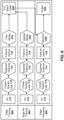
- edge training 802 edge retraining 804 and edge inference 806, all of which occur at the edge device.
- FIG. 8 uses an in vehicle infotainment system (IVI) 110 as an example edge device.
- IVI in vehicle infotainment system
- such device is merely provided for illustration purposes and the present disclosure is not limited to in vehicle infotainment systems.
- IVI 110 creates system logs 112 and, from the system logs, engineers features 114.
- Such features are converted to feature vectors at block 116. This occurs for all of edge training 802, edge retraining 804 and edge inference 806.
- Each record can then be incrementally processed, so no storage as shown in Figure 1 is required.
- the feature vectors 116 may be used to train the model, as shown at block 810, or update the model, as shown at block 830.
- the trained or updated model can be stored (as the table of Figure 5 ) for the full batch model 820.
- the full batch model 820 may then be used during inference, shown at block 840, which may then generate an output 842.
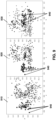
- the process of Figure 6 was used on a data set having 8 clusters with three-dimensional features, shown in the embodiment of Figure 9 .
- the embodiment of Figure 9 shows the eight clusters in grayscale, where graph 910, graph 920 and graph 930 are the same eight clusters shown with rotation along one of the three axes.
- the process can be evaluated based on a confusion matrix, such as that shown with regard to Figure 11 .
- the matrix compares the prediction results with the actual results. If both the prediction and actual value for a data point is that the data point is benign, this is classified as a true positive 1110.
- both the prediction and actual value for a data point is that the data point is anomalous, this is classified as a true negative 1140.
- a system goal is the maximizing of the true positive 1110 and true negative 1140 values, while minimizing the false negative 1120 and false positive 1130.
- the recall for the test, specifically out of the total positive, what percentage are predicted positive, is 99.5% for the benign data points and 90.9% for the anomalous data points.
- the F1 score for the benign data points is 99.3 and for the anomalous data points is 92.3.
- the model can be used on computing devices having limited storage and/or processing with high efficacy.
- the only storage needed is with regard to the table for the plurality of clusters.
- the only data being stored are the clusters which are a function of the square root of the number of points processed at maximum, or each cluster contains a single vector including all information for the process to work.
- the processing can be assisted by the paring down of the number of clusters when the cluster proportion exceeds a threshold and then by increasing the size of the distance threshold used. This further assists in tuning the parameters of the algorithm.
- the process is incremental and does not require all the data to perform a clustering.
- the method can cluster one data point at a time.
- the incremental centroid clustering model was tested against a One Class SVM model.
- the same training data, validation data and testing data were used.
- the training data was used to train each model.
- the validation data was used to find the best choice of hyperparameters that resulted in the proper separation of the anomaly detection and the test data was used to compare the results.
- the precision for the benign data was 96.6 and for the anomalous data was 85.7.
- the recall for the benign data was 99.1 and for the anomalous data was 60.0.
- the F1 score for the benign data was 97.9 and for the anomalous data was 70.6.
- the precision for the benign data was 98.6 and for the anomalous data was 92.6.
- the recall for the benign data was 99.4 and for the anomalous data was 83.3.
- the F1 score for the benign data was 99.0 and for the anomalous data was 87.7.
- anomaly detection can be done to perform various actions either at the edge device, a server, cloud and/or other computing device. Specifically, reference is now made to Figure 12 .
- the embodiment of Figure 12 starts at block 1210 and proceeds to block 1212 in which the anomaly detection is performed.
- the anomaly detection performed can use the full batch model created in the embodiments of Figures 6 and 7 described above.
- New data points can then be received, for example from a log file, which may be created based on input from a hardware sensor or based on a software process in some cases.
- the new data point can be checked to determine whether it falls into the full batch model by determining whether the point is the distance threshold from any existing cluster in the full batch model. If yes, the data point is considered a benign data point. If no, the data point is considered an anomalous data point. This can be repeated as data points are created, based on log file contents, among other options.
- the process proceeds to block 1220 in which a check is made to determine whether any anomalies were found in the data being processed. If not, the process may proceed back to block 1212 to continue to perform anomaly detection.
- the process may proceed to block 1230 in which an action may be performed.
- the action being performed may be specific to the type of application the edge device is deployed in. For example, in a vehicle system, if an anomaly is detected one possible action would be to provide an alert to the driver of the vehicle.
- the alert may include a message on an infotainment system, on the dashboard of the vehicle, an audio alert to the driver, haptic feedback on the steering wheel, among other options.
- the alert may indicate that the driver should have the vehicle serviced, should pull over and stop driving the vehicle, should contact the manufacturer or dealer, should reset the system, among other options.
- the action may be an alert to a third party rather than the driver.
- Such alert may be sent to a vehicle manufacturer, dealer, fleet operator, business IT department, among other options.
- the alert may include the data that caused the anomaly, context surrounding the anomaly, other vehicle sensor readings, among other such information. This may then allow the third party to make decisions with regard to the vehicle, such as whether to cause the vehicle to be serviced, remove the vehicle from the road, reset software on the vehicle, whether a software update should be pushed to the vehicle, among other such actions.
- the action may involve the vehicle itself taking the action autonomously.
- the vehicle may pull over if the vehicle has autonomous functionality, the vehicle may ignore anomalous sensor readings in some cases, the vehicle may be limited in speed in some cases, among other such actions.
- the action may similarly include alerting a user, a third party, or performing some functionality on the edge device based on the anomalous data detection.
- the action may be to use the new data points in re-training the model.
- FIG. 13 One simplified diagram of a computing device is shown with regard to Figure 13 .
- the computing device of Figure 13 could be any fixed or mobile computing device.
- device 1310 includes a processor 1320 and a communications subsystem 1330, where the processor 1320 and communications subsystem 1330 cooperate to perform the methods of the embodiments described above.
- Communications subsystem 1330 allows device 1310 to communicate with other devices or network elements and may vary based on the type of communication being performed. Further, communications subsystem 1330 may comprise a plurality of communications technologies, including any wired or wireless communications technology.
- Processor 1320 is configured to execute programmable logic, which may be stored, along with data, on device 1310, and shown in the example of Figure 13 as memory 1332.
- Memory 1332 can be any tangible, non-transitory computer readable storage medium which stores instruction code that, when executed by processor 1320 cause device 1310 to perform the methods of the present disclosure.
- the computer readable storage medium may be a tangible or in transitory/non-transitory medium such as optical (e.g., CD, DVD, etc.), magnetic (e.g., tape), flash drive, hard drive, or other memory known in the art.
- device 1310 may access data or programmable logic from an external storage medium, for example through communications subsystem 1330.
- one or more sensors 1340 may be associated with the computing device. However, this is optional and in some cases computing device 1310 will not be associated with sensors.
- Communications between the various elements of device 1310 may be through an internal bus 1360 in one embodiment. However, other forms of communication are possible.
- Such operations may not be immediate or from the server directly. They may be synchronously or asynchronously delivered, from a server or other computing system infrastructure supporting the devices/methods/systems described herein. The foregoing steps may include, in whole or in part, synchronous/asynchronous communications to/from the device/infrastructure. Moreover, communication from the electronic device may be to one or more endpoints on a network. These endpoints may be serviced by a server, a distributed computing system, a stream processor, etc. Content Delivery Networks (CDNs) may also provide may provide communication to an electronic device.
- CDNs Content Delivery Networks
- the server may also provision or indicate a data for content delivery network (CDN) to await download by the electronic device at a later time, such as a subsequent activity of electronic device.
- CDN content delivery network
- data may be sent directly from the server, or other infrastructure, such as a distributed infrastructure, or a CDN, as part of or separate from the system.
- storage mediums can include any or some combination of the following: a semiconductor memory device such as a dynamic or static random access memory (a DRAM or SRAM), an erasable and programmable read-only memory (EPROM), an electrically erasable and programmable read-only memory (EEPROM) and flash memory; a magnetic disk such as a fixed, floppy and removable disk; another magnetic medium including tape; an optical medium such as a compact disk (CD) or a digital video disk (DVD); or another type of storage device.
- a semiconductor memory device such as a dynamic or static random access memory (a DRAM or SRAM), an erasable and programmable read-only memory (EPROM), an electrically erasable and programmable read-only memory (EEPROM) and flash memory
- a magnetic disk such as a fixed, floppy and removable disk
- another magnetic medium including tape an optical medium such as a compact disk (CD) or a digital video disk (DVD); or another type of storage device.
- CD compact disk
- DVD
- Such computer-readable or machine-readable storage medium or media is (are) considered to be part of an article (or article of manufacture).
- An article or article of manufacture can refer to any manufactured single component or multiple components.
- the storage medium or media can be located either in the machine running the machine-readable instructions, or located at a remote site from which machine-readable instructions can be downloaded over a network for execution.
Landscapes
- Engineering & Computer Science (AREA)
- Computer Security & Cryptography (AREA)
- Computer Networks & Wireless Communication (AREA)
- Signal Processing (AREA)
- Theoretical Computer Science (AREA)
- General Engineering & Computer Science (AREA)
- Software Systems (AREA)
- Databases & Information Systems (AREA)
- Computer Hardware Design (AREA)
- General Physics & Mathematics (AREA)
- Physics & Mathematics (AREA)
- Computing Systems (AREA)
- Data Mining & Analysis (AREA)
- Medical Informatics (AREA)
- Artificial Intelligence (AREA)
- Evolutionary Computation (AREA)
- Computer Vision & Pattern Recognition (AREA)
- Health & Medical Sciences (AREA)
- General Health & Medical Sciences (AREA)
- Virology (AREA)
- Mathematical Physics (AREA)
- Debugging And Monitoring (AREA)
- Information Retrieval, Db Structures And Fs Structures Therefor (AREA)
- Testing And Monitoring For Control Systems (AREA)
- Management, Administration, Business Operations System, And Electronic Commerce (AREA)
Applications Claiming Priority (1)
| Application Number | Priority Date | Filing Date | Title |
|---|---|---|---|
| US18/083,102 US12511387B2 (en) | 2022-12-16 | 2022-12-16 | Method and system for incremental centroid clustering |
Publications (1)
| Publication Number | Publication Date |
|---|---|
| EP4386637A1 true EP4386637A1 (en) | 2024-06-19 |
Family
ID=89164529
Family Applications (1)
| Application Number | Title | Priority Date | Filing Date |
|---|---|---|---|
| EP23215114.2A Pending EP4386637A1 (en) | 2022-12-16 | 2023-12-08 | Method and system for incremental centroid clustering |
Country Status (5)
| Country | Link |
|---|---|
| US (2) | US12511387B2 (enExample) |
| EP (1) | EP4386637A1 (enExample) |
| JP (1) | JP2024086626A (enExample) |
| CN (1) | CN118214644A (enExample) |
| CA (1) | CA3220172A1 (enExample) |
Families Citing this family (2)
| Publication number | Priority date | Publication date | Assignee | Title |
|---|---|---|---|---|
| US20250086464A1 (en) * | 2023-09-11 | 2025-03-13 | Successkpi, Inc. | Executing playbooks based on cluster drift |
| CN121117929B (zh) * | 2025-08-28 | 2026-05-01 | 南京奕虎科技有限公司 | 一种企业多源异构数据自动化融合方法及系统 |
Citations (2)
| Publication number | Priority date | Publication date | Assignee | Title |
|---|---|---|---|---|
| US20160342903A1 (en) * | 2015-05-21 | 2016-11-24 | Software Ag Usa, Inc. | Systems and/or methods for dynamic anomaly detection in machine sensor data |
| US11237897B2 (en) * | 2019-07-25 | 2022-02-01 | International Business Machines Corporation | Detecting and responding to an anomaly in an event log |
Family Cites Families (13)
| Publication number | Priority date | Publication date | Assignee | Title |
|---|---|---|---|---|
| JPH0765168A (ja) * | 1993-08-31 | 1995-03-10 | Hitachi Ltd | 関数近似装置及び方法 |
| WO2011145374A1 (ja) * | 2010-05-17 | 2011-11-24 | 株式会社日立製作所 | 計算機システム、及び、規則生成方法 |
| JP5977958B2 (ja) * | 2012-02-29 | 2016-08-24 | 綜合警備保障株式会社 | 特異データ検出装置および特異データ検出方法 |
| JP6778132B2 (ja) * | 2017-03-13 | 2020-10-28 | 株式会社日立製作所 | 設備機器の異常診断システム |
| US10242087B2 (en) * | 2017-05-12 | 2019-03-26 | International Business Machines Corporation | Cluster evaluation in unsupervised learning of continuous data |
| JP7033262B6 (ja) * | 2018-03-19 | 2022-04-18 | 日本電気株式会社 | 情報処理装置、情報処理方法及びプログラム |
| US10802942B2 (en) * | 2018-12-28 | 2020-10-13 | Intel Corporation | Methods and apparatus to detect anomalies of a monitored system |
| WO2020139179A1 (en) * | 2018-12-28 | 2020-07-02 | Telefonaktiebolaget Lm Ericsson (Publ) | A wireless device, a network node and methods therein for training of a machine learning model |
| US11533326B2 (en) * | 2019-05-01 | 2022-12-20 | Oracle International Corporation | Systems and methods for multivariate anomaly detection in software monitoring |
| US11079731B2 (en) * | 2019-10-07 | 2021-08-03 | Honeywell International Inc. | Multi-site building management system |
| KR102455758B1 (ko) * | 2020-01-30 | 2022-10-17 | 가부시키가이샤 스크린 홀딩스 | 데이터 처리 방법, 데이터 처리 장치 및 기억 매체 |
| US11507785B2 (en) * | 2020-04-30 | 2022-11-22 | Bae Systems Information And Electronic Systems Integration Inc. | Anomaly detection system using multi-layer support vector machines and method thereof |
| US11831664B2 (en) * | 2020-06-03 | 2023-11-28 | Netskope, Inc. | Systems and methods for anomaly detection |
-
2022
- 2022-12-16 US US18/083,102 patent/US12511387B2/en active Active
-
2023
- 2023-11-15 CA CA3220172A patent/CA3220172A1/en active Pending
- 2023-12-07 JP JP2023206683A patent/JP2024086626A/ja active Pending
- 2023-12-08 EP EP23215114.2A patent/EP4386637A1/en active Pending
- 2023-12-14 CN CN202311721101.3A patent/CN118214644A/zh active Pending
-
2025
- 2025-11-25 US US19/401,095 patent/US20260087136A1/en active Pending
Patent Citations (2)
| Publication number | Priority date | Publication date | Assignee | Title |
|---|---|---|---|---|
| US20160342903A1 (en) * | 2015-05-21 | 2016-11-24 | Software Ag Usa, Inc. | Systems and/or methods for dynamic anomaly detection in machine sensor data |
| US11237897B2 (en) * | 2019-07-25 | 2022-02-01 | International Business Machines Corporation | Detecting and responding to an anomaly in an event log |
Non-Patent Citations (4)
| Title |
|---|
| ACKERMAN MARGARETA ET AL: "Incremental Clustering: The Case for Extra Clusters", ARXIV:1406.6398V1 [CS.LG] 24 JUNE 2014, 24 June 2014 (2014-06-24), XP055786349, Retrieved from the Internet <URL:https://arxiv.org/pdf/1406.6398.pdf> [retrieved on 20210316] * |
| BALEGA MARIA ET AL: "IoT Anomaly Detection Using a Multitude of Machine Learning Algorithms", 2022 IEEE APPLIED IMAGERY PATTERN RECOGNITION WORKSHOP (AIPR), IEEE, 11 October 2022 (2022-10-11), pages 1 - 7, XP034328343, DOI: 10.1109/AIPR57179.2022.10092209 * |
| BURBECK KALLE ET AL: "Adaptive real-time anomaly detection with incremental clustering", INFORMATION SECURITY TECHNICAL REPORT, ELSEVIER ADVANCED TECHNOLOGY, AMSTERDAM, NL, vol. 12, no. 1, 7 March 2007 (2007-03-07), pages 56 - 67, XP085895736, ISSN: 1363-4127, [retrieved on 20070307], DOI: 10.1016/J.ISTR.2007.02.004 * |
| ZHAO WEIZUN ET AL: "An incremental clustering method for anomaly detection in flight data", TRANSPORTATION RESEARCH PART C:EMERGING TECHNOLOGIES, PERGAMON, NEW YORK, NY, GB, vol. 132, 29 September 2021 (2021-09-29), XP086862410, ISSN: 0968-090X, [retrieved on 20210929], DOI: 10.1016/J.TRC.2021.103406 * |
Also Published As
| Publication number | Publication date |
|---|---|
| CN118214644A (zh) | 2024-06-18 |
| JP2024086626A (ja) | 2024-06-27 |
| US12511387B2 (en) | 2025-12-30 |
| US20240202336A1 (en) | 2024-06-20 |
| US20260087136A1 (en) | 2026-03-26 |
| CA3220172A1 (en) | 2024-06-16 |
Similar Documents
| Publication | Publication Date | Title |
|---|---|---|
| US20260087136A1 (en) | Method and system for incremental centroid clustering | |
| Rajapaksha et al. | Ai-based intrusion detection systems for in-vehicle networks: A survey | |
| US12175853B2 (en) | Adaptive severity functions for alerts | |
| US11151246B2 (en) | Risk score generation with dynamic aggregation of indicators of compromise across multiple categories | |
| EP3745654A1 (en) | Vehicle abnormality detection server, vehicle abnormality detection system, and vehicle abnormality detection method | |
| US9444836B2 (en) | Modeling and outlier detection in threat management system data | |
| EP3435623A1 (en) | Malware detection using local computational models | |
| Bezemskij et al. | Detecting cyber-physical threats in an autonomous robotic vehicle using Bayesian networks | |
| JP2018092613A (ja) | 情報処理装置、情報処理方法及びプログラム | |
| US10938853B1 (en) | Real-time detection and clustering of emerging fraud patterns | |
| CN104519031A (zh) | 一种用于恶意网络行为检测的方法和装置 | |
| Shah et al. | Reducing features of KDD CUP 1999 dataset for anomaly detection using back propagation neural network | |
| CN115718874A (zh) | 异常检测 | |
| EP3798840A1 (en) | Information processing device, data analysis method, and program | |
| US20170082680A1 (en) | Systems and methods for determining whether a circuit is operating properly | |
| US20200213203A1 (en) | Dynamic network health monitoring using predictive functions | |
| EP4042296A1 (en) | Moderator for federated learning | |
| CN109272599A (zh) | 一种数据处理方法及相关设备 | |
| CN117290803B (zh) | 一种储能逆变器远程故障诊断方法、系统及介质 | |
| Mansourian et al. | Anomaly detection for connected autonomous vehicles using LSTM and Gaussian naïve Bayes | |
| HK40112600A (en) | Method and system for incremental centroid clustering | |
| Ahmad et al. | Intelligent Ensemble Learning Framework for Intrusion Detection in Consumer Connected and Autonomous Vehicles | |
| EP3580676B1 (en) | Sample-based multidimensional data cloning | |
| Kunwar et al. | Role of blockchain-enabled Secure Supply Chain management using IIoT for Anomaly detection in 6G | |
| US10148673B1 (en) | Automatic selection of malicious activity detection rules using crowd-sourcing techniques |
Legal Events
| Date | Code | Title | Description |
|---|---|---|---|
| PUAI | Public reference made under article 153(3) epc to a published international application that has entered the european phase |
Free format text: ORIGINAL CODE: 0009012 |
|
| STAA | Information on the status of an ep patent application or granted ep patent |
Free format text: STATUS: THE APPLICATION HAS BEEN PUBLISHED |
|
| AK | Designated contracting states |
Kind code of ref document: A1 Designated state(s): AL AT BE BG CH CY CZ DE DK EE ES FI FR GB GR HR HU IE IS IT LI LT LU LV MC ME MK MT NL NO PL PT RO RS SE SI SK SM TR |
|
| STAA | Information on the status of an ep patent application or granted ep patent |
Free format text: STATUS: REQUEST FOR EXAMINATION WAS MADE |
|
| 17P | Request for examination filed |
Effective date: 20241217 |
|
| REG | Reference to a national code |
Ref country code: HK Ref legal event code: DE Ref document number: 40112600 Country of ref document: HK |