EP4386531A1 - Card display method and terminal device - Google Patents
Card display method and terminal device Download PDFInfo
- Publication number
- EP4386531A1 EP4386531A1 EP22952948.2A EP22952948A EP4386531A1 EP 4386531 A1 EP4386531 A1 EP 4386531A1 EP 22952948 A EP22952948 A EP 22952948A EP 4386531 A1 EP4386531 A1 EP 4386531A1
- Authority
- EP
- European Patent Office
- Prior art keywords
- card
- application
- display region
- display
- user
- Prior art date
- Legal status (The legal status is an assumption and is not a legal conclusion. Google has not performed a legal analysis and makes no representation as to the accuracy of the status listed.)
- Granted
Links
Images
















Classifications
-
- G—PHYSICS
- G06—COMPUTING OR CALCULATING; COUNTING
- G06F—ELECTRIC DIGITAL DATA PROCESSING
- G06F3/00—Input arrangements for transferring data to be processed into a form capable of being handled by the computer; Output arrangements for transferring data from processing unit to output unit, e.g. interface arrangements
- G06F3/01—Input arrangements or combined input and output arrangements for interaction between user and computer
- G06F3/048—Interaction techniques based on graphical user interfaces [GUI]
- G06F3/0481—Interaction techniques based on graphical user interfaces [GUI] based on specific properties of the displayed interaction object or a metaphor-based environment, e.g. interaction with desktop elements like windows or icons, or assisted by a cursor's changing behaviour or appearance
- G06F3/04817—Interaction techniques based on graphical user interfaces [GUI] based on specific properties of the displayed interaction object or a metaphor-based environment, e.g. interaction with desktop elements like windows or icons, or assisted by a cursor's changing behaviour or appearance using icons
-
- G—PHYSICS
- G06—COMPUTING OR CALCULATING; COUNTING
- G06F—ELECTRIC DIGITAL DATA PROCESSING
- G06F3/00—Input arrangements for transferring data to be processed into a form capable of being handled by the computer; Output arrangements for transferring data from processing unit to output unit, e.g. interface arrangements
- G06F3/01—Input arrangements or combined input and output arrangements for interaction between user and computer
- G06F3/048—Interaction techniques based on graphical user interfaces [GUI]
- G06F3/0481—Interaction techniques based on graphical user interfaces [GUI] based on specific properties of the displayed interaction object or a metaphor-based environment, e.g. interaction with desktop elements like windows or icons, or assisted by a cursor's changing behaviour or appearance
-
- G—PHYSICS
- G06—COMPUTING OR CALCULATING; COUNTING
- G06F—ELECTRIC DIGITAL DATA PROCESSING
- G06F3/00—Input arrangements for transferring data to be processed into a form capable of being handled by the computer; Output arrangements for transferring data from processing unit to output unit, e.g. interface arrangements
- G06F3/01—Input arrangements or combined input and output arrangements for interaction between user and computer
- G06F3/048—Interaction techniques based on graphical user interfaces [GUI]
- G06F3/0481—Interaction techniques based on graphical user interfaces [GUI] based on specific properties of the displayed interaction object or a metaphor-based environment, e.g. interaction with desktop elements like windows or icons, or assisted by a cursor's changing behaviour or appearance
- G06F3/0483—Interaction with page-structured environments, e.g. book metaphor
-
- G—PHYSICS
- G06—COMPUTING OR CALCULATING; COUNTING
- G06F—ELECTRIC DIGITAL DATA PROCESSING
- G06F3/00—Input arrangements for transferring data to be processed into a form capable of being handled by the computer; Output arrangements for transferring data from processing unit to output unit, e.g. interface arrangements
- G06F3/01—Input arrangements or combined input and output arrangements for interaction between user and computer
- G06F3/048—Interaction techniques based on graphical user interfaces [GUI]
- G06F3/0484—Interaction techniques based on graphical user interfaces [GUI] for the control of specific functions or operations, e.g. selecting or manipulating an object, an image or a displayed text element, setting a parameter value or selecting a range
- G06F3/0486—Drag-and-drop
-
- G—PHYSICS
- G06—COMPUTING OR CALCULATING; COUNTING
- G06F—ELECTRIC DIGITAL DATA PROCESSING
- G06F3/00—Input arrangements for transferring data to be processed into a form capable of being handled by the computer; Output arrangements for transferring data from processing unit to output unit, e.g. interface arrangements
- G06F3/01—Input arrangements or combined input and output arrangements for interaction between user and computer
- G06F3/048—Interaction techniques based on graphical user interfaces [GUI]
- G06F3/0487—Interaction techniques based on graphical user interfaces [GUI] using specific features provided by the input device, e.g. functions controlled by the rotation of a mouse with dual sensing arrangements, or of the nature of the input device, e.g. tap gestures based on pressure sensed by a digitiser
- G06F3/0488—Interaction techniques based on graphical user interfaces [GUI] using specific features provided by the input device, e.g. functions controlled by the rotation of a mouse with dual sensing arrangements, or of the nature of the input device, e.g. tap gestures based on pressure sensed by a digitiser using a touch-screen or digitiser, e.g. input of commands through traced gestures
-
- G—PHYSICS
- G06—COMPUTING OR CALCULATING; COUNTING
- G06F—ELECTRIC DIGITAL DATA PROCESSING
- G06F3/00—Input arrangements for transferring data to be processed into a form capable of being handled by the computer; Output arrangements for transferring data from processing unit to output unit, e.g. interface arrangements
- G06F3/01—Input arrangements or combined input and output arrangements for interaction between user and computer
- G06F3/048—Interaction techniques based on graphical user interfaces [GUI]
- G06F3/0487—Interaction techniques based on graphical user interfaces [GUI] using specific features provided by the input device, e.g. functions controlled by the rotation of a mouse with dual sensing arrangements, or of the nature of the input device, e.g. tap gestures based on pressure sensed by a digitiser
- G06F3/0488—Interaction techniques based on graphical user interfaces [GUI] using specific features provided by the input device, e.g. functions controlled by the rotation of a mouse with dual sensing arrangements, or of the nature of the input device, e.g. tap gestures based on pressure sensed by a digitiser using a touch-screen or digitiser, e.g. input of commands through traced gestures
- G06F3/04883—Interaction techniques based on graphical user interfaces [GUI] using specific features provided by the input device, e.g. functions controlled by the rotation of a mouse with dual sensing arrangements, or of the nature of the input device, e.g. tap gestures based on pressure sensed by a digitiser using a touch-screen or digitiser, e.g. input of commands through traced gestures for inputting data by handwriting, e.g. gesture or text
-
- G—PHYSICS
- G06—COMPUTING OR CALCULATING; COUNTING
- G06F—ELECTRIC DIGITAL DATA PROCESSING
- G06F3/00—Input arrangements for transferring data to be processed into a form capable of being handled by the computer; Output arrangements for transferring data from processing unit to output unit, e.g. interface arrangements
- G06F3/01—Input arrangements or combined input and output arrangements for interaction between user and computer
- G06F3/048—Interaction techniques based on graphical user interfaces [GUI]
- G06F3/0487—Interaction techniques based on graphical user interfaces [GUI] using specific features provided by the input device, e.g. functions controlled by the rotation of a mouse with dual sensing arrangements, or of the nature of the input device, e.g. tap gestures based on pressure sensed by a digitiser
- G06F3/0488—Interaction techniques based on graphical user interfaces [GUI] using specific features provided by the input device, e.g. functions controlled by the rotation of a mouse with dual sensing arrangements, or of the nature of the input device, e.g. tap gestures based on pressure sensed by a digitiser using a touch-screen or digitiser, e.g. input of commands through traced gestures
- G06F3/04886—Interaction techniques based on graphical user interfaces [GUI] using specific features provided by the input device, e.g. functions controlled by the rotation of a mouse with dual sensing arrangements, or of the nature of the input device, e.g. tap gestures based on pressure sensed by a digitiser using a touch-screen or digitiser, e.g. input of commands through traced gestures by partitioning the display area of the touch-screen or the surface of the digitising tablet into independently controllable areas, e.g. virtual keyboards or menus
-
- G—PHYSICS
- G06—COMPUTING OR CALCULATING; COUNTING
- G06F—ELECTRIC DIGITAL DATA PROCESSING
- G06F9/00—Arrangements for program control, e.g. control units
- G06F9/06—Arrangements for program control, e.g. control units using stored programs, i.e. using an internal store of processing equipment to receive or retain programs
- G06F9/44—Arrangements for executing specific programs
- G06F9/451—Execution arrangements for user interfaces
-
- G—PHYSICS
- G06—COMPUTING OR CALCULATING; COUNTING
- G06F—ELECTRIC DIGITAL DATA PROCESSING
- G06F2203/00—Indexing scheme relating to G06F3/00 - G06F3/048
- G06F2203/048—Indexing scheme relating to G06F3/048
- G06F2203/04803—Split screen, i.e. subdividing the display area or the window area into separate subareas
-
- G—PHYSICS
- G06—COMPUTING OR CALCULATING; COUNTING
- G06F—ELECTRIC DIGITAL DATA PROCESSING
- G06F3/00—Input arrangements for transferring data to be processed into a form capable of being handled by the computer; Output arrangements for transferring data from processing unit to output unit, e.g. interface arrangements
- G06F3/01—Input arrangements or combined input and output arrangements for interaction between user and computer
- G06F3/048—Interaction techniques based on graphical user interfaces [GUI]
- G06F3/0484—Interaction techniques based on graphical user interfaces [GUI] for the control of specific functions or operations, e.g. selecting or manipulating an object, an image or a displayed text element, setting a parameter value or selecting a range
- G06F3/04842—Selection of displayed objects or displayed text elements
Definitions
- This application relates to the field of electronic technologies, and in particular, to a card display method and a terminal device.
- Messages such as a new reminder or a notification message always appear in various applications (application, APP) installed on a terminal device.
- a means used by a user to view these notification messages and reminders is relatively simple, and is generally: viewing by using a leftmost home screen of the terminal device or viewing by tapping to enter a specific APP.
- Appearance of a service card enriches ways used by the user to view messages such as APP notification messages and reminders.
- a card is a new message display technology, and is now widely applied to various terminal devices, to provide rich information display and meet a user requirement.
- a manner of setting an APP application as a card is relatively cumbersome, and affects user experience.
- one card can display information about only one APP.
- This application relates to the field of electronic technologies, and in particular, to a card display method and a terminal device.
- the card display method in this application after a user adds a card of a first application to a desktop of an electronic device, the card of the first application is displayed on the desktop of the electronic device, and the user may drag an icon or a card of another application to a display region corresponding to the card of the first application and hover for specified duration, to add the card of the another application.
- this application provides a card display method, applied to an electronic device.
- the method includes: displaying a first card of a first application in a first display region of the electronic device; detecting a generation instruction for generating a second card of a second application; and using the first display region as a display region for both the second card of the second application and the first card of the first application.
- the first application may be an application such as a video application, a note-taking application, or a food ordering application in the following descriptions.
- the second application is different from the first application.
- the electronic device may be a terminal device such as a smartphone or a tablet computer. This is not limited in this application.
- the first card of the first application is displayed in the first display region, and then, after detecting the generation instruction for generating the second card of the second application, the electronic device uses a display region of the first card of the first application as the display region for both the second card of the second application and the first card of the first application.
- the second card of the second application does not separately occupy space of a desktop of the electronic device, but is displayed in the first display region together with the first card of the first application.
- the first card of the first application may alternatively still be displayed in the first display region.
- the second card of the second application may be displayed in the first display region, that is, the second card covers the first card for display. This is not limited in this application.
- a newly-added card of an application does not occupy the space of the desktop of the electronic device, and does not apply a layout of the desktop of the electronic device, and further does not affect user experience.
- the method further includes: detecting the generation instruction for generating the second card of the second application, and displaying the second card in the first display region, where the second card covers the first card for display.
- the first card is displayed in the first display region in a first display size, and a size of the first display region is the same as the first display size; and the method further includes: detecting the generation instruction for generating the second card of the second application; obtaining card data of the second card, where the card data of the second card includes at least one display size corresponding to the second card; determining whether the at least one display size of the second card includes the first display size; and if the at least one display size of the card of the second application includes the first display size, displaying the second card of the second application in the first display region in the first display size.
- a card of each application has a display size supported by the card, for example, 1000 pixels ⁇ 500 pixels, and 500 pixels ⁇ 500 pixels. Therefore, the electronic device displays the card in the display size supported by the card.
- the first card is displayed in the first display region in the first display size supported by the first card, and the size of the first display region is the same as the first display size.
- the electronic device obtains the card data of the second card, to obtain the at least one display size supported by the second card.
- a first control in the first display region there is correspondingly a first control in the first display region, and the first control is configured to control, according to a user instruction, to switch a card displayed in the first display region.
- the user may control, by using the first control, to switch the card displayed in the first display region.
- the user may select, by using the first control, the card of the first application for display.
- the method further includes: detecting the instruction for generating the second card of the second application; determining whether a quantity of cards included in the first display region exceeds a preset quantity; and if the quantity of cards included in the first display region is less than the preset quantity, using the first display region as the display region for both the second card of the second application and the first card of the first application.
- an excessively large quantity of cards included in the first display region are unfavorable to viewing a card of a corresponding application by the user. Therefore, in some implementations, it is necessary to set an upper limit for a quantity of cards that can be accommodated in the first display region.
- the electronic device After detecting the instruction for generating the second card of the second application, the electronic device needs to determine whether the first display region can continue to accommodate a new card. When the quantity of cards included in the first display region is less than the preset quantity, the first display region is used as the display region for both the second card of the second application and the first card of the first application.
- the first display region is no longer used as the display region for both the second card of the second application and the first card of the first application.
- the preset quantity is an empirical value or an experimental value, and a value of the preset quantity may be, for example, 10. This is not limited in this application.
- the generation instruction is generated after an operation of moving an icon or a card of the second application to the first display region is detected.
- the generation instruction for generating the second card of the second application needs to be generated after the operation of moving the icon or the card of the second application to the first display region is detected.
- the generation instruction is generated after an operation of moving an icon or a card of the second application to a preset region corresponding to the first display region is detected.
- the generation instruction may be generated after the icon or the card of the second application is moved to the first display region, or may be generated after the icon or the card of the second application is moved to the preset region corresponding to the first display region, for example, the generation instruction is generated after the icon or the card of the second application is moved to a place close to the first display region. This is not limited in this application.
- the detecting a generation instruction for generating a second card of a second application includes: detecting the generation instruction when it is detected that time of stay of the icon or the card corresponding to the second application in the first display region or the preset region corresponding to the first display region exceeds first preset duration.
- the user transitorily moves the icon or the card of the second application to the first display region or the preset region corresponding to the first display region when adjusting a location of the icon or the card of the second application
- an Android operating system is deployed on the electronic device, and the Android system of the electronic device includes a system program and the second application that are located at an application layer, and the system program is used to: in response to the generation instruction for generating the second card of the second application, obtain card data of the second card from the second application, and when the at least one display size of the second card of the second application includes the first display size, control the electronic device to display the card of the second application in the first display region in the first display size.
- system program is further used to: detect the instruction for generating the second card of the second application, determine whether a quantity of cards included in the first display region exceeds a preset quantity, and obtain card data of the second card from the second application when the quantity of cards included in the first display region is less than the preset quantity.
- the generation instruction is generated by the system program after the operation of moving the icon or the card of the second application to the first display region is detected.
- the generation instruction is generated by the system program after the operation of moving the icon or the card of the second application to the preset region corresponding to the first display region is detected.
- the generation instruction is generated when it is detected that the time of stay of the icon or the card corresponding to the second application in the first display region or the preset region corresponding to the first display region exceeds the first preset duration.
- this application provides a card display apparatus, including a display module and a processing module.
- the processing module is configured to: detect a generation instruction for generating a second card of a second application, and use a first display region for displaying a first card of a first application as a display region for both the second card of the second application and the first card of the first application.
- the display module is configured to display the first card of the first application in the first display region.
- the processing module is further configured to: detect the generation instruction for generating the second card of the second application, and control the display module to display the second card in the first display region, where the second card covers the first card for display.
- the first card is displayed in the first display region in a first display size, and a size of the first display region is the same as the first display size; and the processing module is further configured to: detect the generation instruction for generating the second card of the second application; then, obtain card data of the second card, where the card data of the second card includes at least one display size corresponding to the second card; determine whether the at least one display size of the second card includes the first display size; and if the at least one display size of the card of the second application includes the first display size, control the display module to display the second card of the second application in the first display region in the first display size.
- the first control is configured to control, according to a user instruction, to switch a card displayed in the first display region.
- the user instruction includes: The user switches the card in the first display region in a manner such as voice or a preset gesture. For example, the user slides downward, upward, leftward, or rightward by using an air gesture, to switch the card displayed in the first display region.
- the processing module is further configured to: detect the instruction for generating the second card of the second application; determine whether a quantity of cards included in the first display region exceeds a preset quantity; and if the quantity of cards included in the first display region is less than the preset quantity, use the first display region as the display region for both the second card of the second application and the first card of the first application.
- the generation instruction is generated after an operation of moving an icon or a card of the second application to the first display region is detected. In some other implementations, the generation instruction is generated after an operation of moving an icon or a card of the second application to a preset region corresponding to the first display region is detected.
- the processing module detects the generation instruction when detecting that time of stay of the icon or the card corresponding to the second application in the first display region or the preset region corresponding to the first display region exceeds first preset duration.
- this application provides an electronic device, including one or more processors and one or more memories.
- the one or more memories store one or more programs, and when the one or more programs are executed by the one or more processors, the electronic device is enabled to perform the method according to any implementation of the first aspect.
- this application provides a computer-readable storage medium.
- the storage medium stores instructions, and when the instructions are executed on a computer, the computer is enabled to perform the method according to any implementation of the first aspect.
- an embodiment of this application provides a computer program product.
- the computer program product runs on an electronic device, the electronic device is enabled to perform the method according to any implementation of the first aspect.
- This application provides a card display method and a terminal device.
- Various aspects of illustrative embodiments are described below by using terms commonly used by persons skilled in the art.
- "/" means “or” unless otherwise specified.
- A/B may represent A or B.
- "and/or” is merely an association relationship for describing associated objects, and represents that three relationships may exist.
- a and/or B may represent three cases: only A exists, both A and B exist, and only B exists.
- "a plurality of" means two or more.
- a card display method provided in embodiments of this application may be applied to a terminal device such as a mobile phone, a tablet computer, a wearable device, a vehicle-mounted device, an augmented reality (augmented reality, AR)/virtual reality (virtual reality, VR) device, a notebook computer, an ultra-mobile personal computer (ultra-mobile personal computer, UMPC), a netbook, or a personal digital assistant (personal digital assistant, PDA).
- a terminal device such as a mobile phone, a tablet computer, a wearable device, a vehicle-mounted device, an augmented reality (augmented reality, AR)/virtual reality (virtual reality, VR) device, a notebook computer, an ultra-mobile personal computer (ultra-mobile personal computer, UMPC), a netbook, or a personal digital assistant (personal digital assistant, PDA).
- a terminal device such as a mobile phone, a tablet computer, a wearable device, a vehicle-mounted device, an augmented reality (augmented reality, AR)/virtual
- a user usually views a message of an APP by using a leftmost home screen of the terminal device or taps an APP to view a message of the APP.
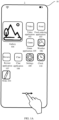
- a mobile phone is used as the terminal device, and applications such as a note-taking application 101, a video application 02, a food ordering application 103, a gallery application 104, a game application 105, a weather application 106, a review application 107, a chat application 108, Settings 109, and Clock 110 are displayed on a desktop 10 of the mobile phone 1.
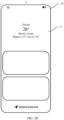
- the user needs to slide rightward to a leftmost home screen 20 of the mobile phone 1, to display weather information 201 "Cloudy ⁇ 26°" shown in FIG. 1B .
- the user taps the weather application 106 on the desktop 10, and enters a first interface 17 of the weather application 106, to display the first interface 17 of the weather application 106 shown in FIG. 1D and display weather information "Zhuhai ⁇ 26° ⁇ Mostly cloudy ⁇ Highest: 32° ⁇ Lowest: 24°".
- information about the weather application 106 displayed on the leftmost home screen 20 of the mobile phone 1 and the first interface 17 of the weather application 106 is merely an example. In another implementation, more weather-related information may be further displayed. This is not limited in this application.
- the applications displayed on the desktop 10 are also examples. In another implementation, there may alternatively be more or fewer other applications on the desktop 10. This is not limited in this application.
- the user may display an APP message by using a service card.
- the service card (referred to as a card below) is a new message display manner. After the user adds a card of an APP application, a message of the APP is displayed to the user in a form of a card.
- a card 11 corresponding to the note-taking application 101 is displayed on the desktop 10 of the mobile phone 1, and a message, such as text information or picture information, of the note-taking application 101 is displayed on the card 11.
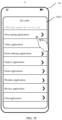
- the user needs to tap the settings application 109 on the desktop 10, and select, from a setting card interface 0101 of the settings application 109 in FIG. 1F , to add a card of a specific application.
- various applications for example, the note-taking application 101, the video application 102, and the food ordering application 103 that support the service card are displayed in the setting card interface 0101.
- the user may tap a corresponding application to add a card for the application. Assuming that the user taps an option corresponding to the note-taking application to enter an interface 0102 shown in FIG.
- the user may add the card corresponding to the note-taking application 101 by selecting a display size and a display location of the card corresponding to the note-taking application 101. If the user needs to add cards of a plurality of applications, the foregoing operations in FIG. 1E to FIG. 1G are undoubtedly cumbersome.
- each card can display a message of only one application; in other words, a card and an application are in a one-to-one relationship. If the user wants to display messages of more applications on the desktop 10 in a form of a card, the user needs to add cards of a plurality of applications. This increases a quantity of cards and affects display of cards. In addition, to display more application messages, a size of the card is usually greater than a size of an application icon. Therefore, while the quantity of cards is increased, more space of the desktop 10 is undoubtedly occupied, an overall layout of the desktop 10 is affected, and sense of beauty of the desktop 10 is affected.
- cards of only four applications can be displayed in a current interface of the desktop 10: a card of the note-taking application 101, a card of the gallery application 104, a card of the video application 102, and a card of the food ordering application 103, and icons or cards of other applications can only be displayed on another page of the desktop 10.
- the user needs to turn pages by using a control 19 to view the other applications, and this affects user experience.
- this application provides a card display method and a terminal device.
- the card display method in this application after a user adds a card of a first application to a desktop of an electronic device, the card of the first application is displayed on the desktop of the electronic device, and the user may drag an icon or a card of another application to a display region corresponding to the card of the first application and hover for specified duration, to add the card of the another application.
- the electronic device detects that the user drags the icon or the card of the another application to the display region and hovers for time longer than a period of time, the electronic device adds the card of the another application to the display region.
- the newly-added card of the another application covers the card of the first application, and is displayed in the display region in a size corresponding to the card of the first application.
- a display region corresponding to the card of the first application may accommodate a preset quantity of cards.
- the preset quantity is an empirical value or an experimental value, and may be set by the user based on a requirement; or the preset quantity may be a fixed value, and a value of the preset quantity may be 10. This is not limited in this application.
- the first card displayed to the user in the display region corresponding to the card of the first application is a card corresponding to a message of an application displayed on the desktop, and may be selected by the user based on a requirement from cards in the display region corresponding to the card of the first application, and a display sequence of the cards in the display region may also be adjusted by the user based on a requirement.
- the first application includes but is not limited to applications such as the video application 02, the food ordering application 103, the gallery application 104, the game application 105, the weather application 106, the review application 107, the chat application 108, Settings 109, and Clock 110. Another application is an application different from the first application.
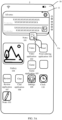
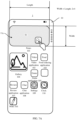
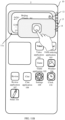
- the card 11 corresponding to the note-taking application 101 is displayed on the desktop 10, and the display region 11a of the card 11 is a display size of the card 11 that the user selects to display.
- the user if the user continues to add the weather application 106 as a card, as shown in FIG. 3B , the user only needs to drag an icon of the weather application 106 to the display region 11a corresponding to the card 11, and a card 12 corresponding to the weather application 106 is displayed in the display region 11, as shown in FIG. 3C .
- the card 12 of the weather application 106 covers the originally displayed card 11 of the note-taking application 101.
- the user may slide upward or downward by using a control 13 to switch a card displayed in the display region, to choose to view a message of the card 11 corresponding to the note-taking application 101. This is not limited in this application.
- the newly-added card 12 of the weather application 106 may alternatively be displayed below an existing card; in other words, the card 11 of the note-taking application 101 is still displayed in the display region 11a.
- the user after adding a card of an application, the user only needs to drag an icon or a card of another application to a card display region corresponding to the application, to add the another application as a card, thereby eliminating a series of operations performed through system settings each time a card is added, and improving user experience.
- the card display method in this application may be applied to a terminal device such as a smartphone, a tablet computer, or an intelligent wearable device with no limitation.
- a terminal device such as a smartphone, a tablet computer, or an intelligent wearable device with no limitation.
- a mobile phone is still used as the terminal device 1 to provide descriptions with reference to the accompanying drawings.
- FIG. 4 is a schematic diagram of a layered architecture of a software structure of a mobile phone 1 used in an embodiment of this application.
- the layered architecture divides software into several layers, and each layer has a clear role and task.
- the layers communicate with each other through software interfaces.
- the software structure of the mobile phone 1 is separately an application layer 01, an application framework layer 02, a system layer 03, and a kernel layer 04 from top to bottom.
- the application layer 01 may include a series of application packages.
- programs mainly included in the application layer 01 are classified into an application 012 and a system program 011.
- the application 012 is each application installed on a desktop of the mobile phone 1
- the system program 011 is a system program used to manage each application on the desktop of the mobile phone 1, and is a system that controls and coordinates the mobile phone 1 and an external device (for example, an input/output device) of the mobile phone 1 and supports application development and running on the mobile phone 1.
- a main function of the system program 011 is to schedule, monitor, and maintain a system of the mobile phone 1, and manage various independent hardware in the system of the mobile phone 1, so that they can work in a coordinated manner.
- the system program 011 may be an operating system installed on the mobile phone 1, for example, an Android (android) operating system or a Harmony operating system.
- the system program 011 is used to: add a card of an application according to a user instruction, and determine, according to the user instruction, a display manner of the card corresponding to the application.
- a display manner of a card corresponding to an application includes a display size of the card and a display theme of the card (for example, a daytime theme or a night theme). This is not limited in this application.
- system program 011 is further used to: obtain card data corresponding to an application, determine a display size that can be supported by the card corresponding to the application, and display the card in the display size supported by the card corresponding to the application. Details are described below with reference to FIG. 5A and FIG. 5B .
- the application 012 may include applications installed on the mobile phone 1, such as a video application 102, a food ordering application 103, a gallery application 104, a game application 105, a weather application 106, a review application 107, a chat application 108, Settings 109, and Clock 110. Examples are not listed one by one in this embodiment of this application.
- the application framework layer 02 provides an application programming interface (application programming interface, API) and a programming framework for an application at the application layer 01.
- the application framework layer 02 includes some predefined functions.
- the application framework layer 02 may include a window manager 021, a content provider 022, a phone manager 023, a notification manager 024, a view system 025, a resource manager 026, and the like.
- the window manager 021 is configured to manage a window program, for example, a size of a window currently displayed on the mobile phone 1, or a manner in which the window is currently displayed (for example, whether the manner is split-screen display).
- the content provider 022 is configured to: store and obtain data and make the data accessible to an application.
- the data may include video data, image data, audio data, phone book data, and the like.
- the phone manager 023 is configured to: manage a call status of the mobile phone 1, obtain device information of the mobile phone 1, subscriber identity card (Subscriber Identity Module, SIM) information, and mobile network or wireless fidelity (wireless-fidelity, Wi-Fi) information, and listen to the call status of the mobile phone 1, for example, a call status service or a signal strength status.
- the view system 025 includes a visual control, such as a control 13 that displays a quantity of selectable cards in a display region.
- a display interface of the mobile phone 1 may include one or more views.
- the display interface may include a view for displaying icons of the foregoing applications, a view for displaying text, a view for displaying a picture, and the like.
- the Android runtime 035 includes a kernel library and a virtual machine.
- the Android runtime 035 is responsible for scheduling and management of the Android system.
- the kernel library includes two parts: a functional function that needs to be invoked by a java language, and a kernel library of Android.
- the application layer 01 and the application framework layer 02 run in the virtual machine.
- the virtual machine executes java files at the application layer 01 and the application framework layer 02 as binary files.
- the virtual machine is configured to perform operations such as object lifecycle management, stack management, thread management, security and exception management, and garbage collection.
- the system library may include a plurality of functional modules, for example, a surface manager 031 (surface manager or surface flinger), a media library 034 (media libraries), a three-dimensional graphics processing library 032 (for example, OpenGL ES), and a two-dimensional graphics engine 033 (for example, SGL).
- a surface manager 031 surface manager or surface flinger
- media library 034 media libraries
- three-dimensional graphics processing library 032 for example, OpenGL ES
- two-dimensional graphics engine 033 for example, SGL
- the surface manager 031 is configured to manage a display subsystem, and provide fusion of two-dimensional and three-dimensional layers for a plurality of applications.
- the media library 034 supports playback and recording in a plurality of common audio and video formats, static image files, and the like.
- the media library may support a plurality of audio and video coding formats, for example, MPEG4, H.264, MP3, AAC, AMR, JPG, and PNG.
- the three-dimensional graphics processing library 032 is used to implement three-dimensional graphics drawing, image rendering, composition, layer processing, and the like.
- the two-dimensional graphics engine 033 is a drawing engine for two-dimensional drawing.
- the kernel layer 04 is a layer between hardware and software.
- the kernel layer 04 includes at least a display driver 041, a camera driver 042, an audio driver 043, and a sensor driver 044.
- a physical layer may be included below the kernel layer 04, and the physical layer may provide a transmission medium and an interconnection channel for data communication inside a device or between devices, to provide a reliable environment for data transmission.
- the physical layer may be understood as a transport layer that provides a "signal and medium”.
- the foregoing schematic diagram of the layered architecture of the software structure of the mobile phone 1 is merely an example.
- the layered architecture of the software structure of the mobile phone 1 may further include more or fewer layers, or a layered structure formed in another manner. This is not limited in this application.
- FIG. 4 An interaction process of some modules or layer structures in FIG. 4 that are involved when the method in this application is implemented is described below with reference to FIG. 5A and FIG. 5B based on the software structure framework layer of the mobile phone 1 shown in FIG. 4 .
- the method includes the following steps.
- the mobile phone 1 invokes, in response to a first operation of adding a card of a first application, a system program 011 to send information about the added card to the first application.
- the first operation means that the user adds the card of the first application through system settings.
- the first operation may alternatively be some preset gesture operations or a voice instruction.
- the user adds the card of the first application in a voice instruction manner.
- the user enables, in a two-finger pinching manner on a desktop 10, the desktop 10 to enter an editing state, and then adds a first card for the first application in the editing state. This is not limited in this application.
- the first application includes applications such as the video application 102, the food ordering application 103, the gallery application 104, the game application 105, the weather application 106, the review application 107, the chat application 108, Settings 109, and Clock 110 that are shown in FIG. 1A to FIG. 4 . This is not limited in this application.
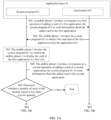
- the mobile phone 1 invokes the system program 011 to obtain first card data of the first application from an application 012.
- the card data includes data such as a display size that can be supported by the card, a display theme of the card, and a display location of the card. It may be understood that for operations of adding cards for different applications, the mobile phone 1 invokes the system program 011 to obtain card data of corresponding applications from different applications 012. For example, if the first operation is to add a card for the video application 102, the system program 011 obtains card data of the video application 102 from the video application 102; and if the first operation is to add a card for the food ordering application 103, the system 011 obtains card data of the food ordering application 103 from the food ordering application 103.
- FIG. 6A and FIG. 6B are schematic diagrams of a display size that can be supported by a card.
- a length-width ratio of the display size that can be supported by the card is 4 ⁇ 2 (for example, 1000 pixels (px) ⁇ 500 px).
- a length-width ratio of the display size that can be supported by the card is 2 ⁇ 2 (for example, 500 pixels (px) ⁇ 500 px). It may be understood that in some other implementations, the display size that can be supported by the card may alternatively have another corresponding length-width ratio. This is not limited in this application.
- the mobile phone 1 invokes the system program 011 to control the mobile phone 1 to display the card of the first application in a first size.
- the mobile phone 1 invokes the system program 011 to control the mobile phone 1 to display the card of the first application in the first size according to a user instruction. It may be understood that, when the user adds the card of the first application through system settings, the user may select any display size based on a display size supported by the card, to display the card of the first application.
- the first application is the note-taking application 101. If the user chooses to display a card of the note-taking application 101 in the display size with the length-width ratio 4 ⁇ 2, as shown in FIG. 3A , the card of the note-taking application 101 is displayed in the interface 10 of the mobile phone 1 in the display size with the length-width ratio 4 ⁇ 2.
- the mobile phone 1 invokes, in response to a second operation of adding a card of a second application, the system program 011 to send information about the added card to the second application.
- the second application is different from the first application, and the second application includes but is not limited to applications such as the video application 102, the food ordering application 103, the gallery application 104, the game application 105, the weather application 106, the review application 107, the chat application 108, Settings 109, and Clock 110 that are shown in FIG. 1A to FIG. 4 .
- the second operation is an operation in which the user adds an application card without using a manner of adding the application card through system settings, for example, an operation in which the user adds the card of the second application by dragging an icon of the second application to a display region of the card of the first application.
- the second operation may alternatively be an operation in which the user adds an application card through system settings and then drags the card to a display region of the card of the first application to accommodate the card of the second application in the display region of the card of the first application. This is not limited in this application.
- the display region of the card of the first application is a region covered by the card after the card is displayed in any display size.
- the display region of the card of the first application is a shaded region S 1 (that is, the display region 11a in the foregoing descriptions) covered by the card of the note-taking application 101 that is displayed in the first size (the length-width ratio 4 ⁇ 2).
- the second application is the weather application 106. The user may add a card of the weather application 106 by dragging an icon of the weather application 106 to the region S 1.
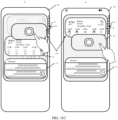
- the mobile phone 1 may invoke the system program 011 to control to deform the icon of the weather application 106, to prompt the user that the card of the weather application 106 is being added. For example, as shown in FIG. 7B , after detecting that the user drags an icon of the weather application 106 to the region S1 and detecting that the user has an obvious hovering action, the mobile phone 1 invokes the system program 011 to deform the icon of the weather application 106 to a second size shown in FIG. 7B .
- a length-width ratio of the second size may be consistent with the length-width ratio of the first size, but an area displayed by the second size is less than an area displayed by the first size.
- the mobile phone 1 may determine that it is detected that the user has an obvious hovering action in the region S1.
- the first preset duration is an empirical value or an experimental value, for example, a value of the first preset duration may be 3 seconds. This is not limited in this application.
- the user may alternatively drag the icon of the second application to a preset region corresponding to a location of the card of the first application, and after detecting that the user drags the icon of the second application to the preset region, the mobile phone 1 determines that the second operation of adding the card of the second application by the user is detected. For example, as shown in FIG. 7B , the user may drag the icon of the weather application 106 to a preset region S2. In some implementations, an area of the preset region S2 is greater than that of the region S1.
- the mobile phone 1 determines that the second operation of adding the second application by the user is detected, and then invokes the system program 011 to control to deform the icon of the second application, to indicate that the user is currently performing an operation of adding a card. This is not limited in this application.
- the second application may alternatively be a card corresponding to an application.
- the card is also an application.
- the second operation means that the user drags a card of an application to a display region of the existing card of the first application, that is, accommodates and manages cards in the interface 10.
- the second application is an application such as a non-card application
- the user may add the second application as a card by dragging the icon of the second application to the display region of the card of the first application
- the second application is a card application
- the user may accommodate the second application in the display region of the existing card of the first application by dragging the card to the display region of the card of the first application.
- the gallery application 104 has been displayed in the interface 10 as a card.
- the user drags a card 104' of the gallery application 104 to the display region 11a corresponding to the card 11 of the note-taking application 101, to accommodate the card 104' of the gallery application 104 in the display region 11a.
- the user accommodates the card of the second application in the display region of the card of the first application, for corresponding deformation of the card of the second application, refer to the foregoing related descriptions. Details are not described herein again.
- the system program 011 determines whether a quantity of cards in the display region is less than a preset quantity.
- the system program 011 after detecting the second operation of adding the card of the second application by the user, the system program 011 needs to determine whether the display region of the card of the first application can continue to accommodate the card of the second application that is currently added by the user, that is, determine whether the quantity of cards in the display region exceeds the preset quantity.
- the preset quantity is an empirical value or an experimental value, and may be set by research and development personnel based on a requirement. For example, a value of the preset quantity may be 10. In some other implementations, the preset quantity may alternatively be set by the user through system settings based on a requirement. For example, the user may set the preset quantity to 5.
- the user may separately set different preset quantities for display regions of different types of cards based on requirements. For example, the user may add all chat applications in a display region (for example, a display region corresponding to a card of the chat application 108) as cards, and if three chat applications are installed on the mobile phone 1, the user may set the preset quantity to 3 (or greater than 3). For another example, the user may alternatively add commonly used APPs to a display region, and the preset quantity is also set based on a quantity of commonly used APPs of the user. This is not limited in this application.
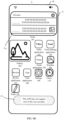
- the mobile phone 1 may display corresponding prompt information, to prompt the user that a quantity of cards that can be accommodated in the current display region has exceeded the preset quantity.
- FIG. 8A it is assumed that a quantity of cards (which can be learned by using a selection option corresponding to a control 13) in the display region 11a of the card 11 of the note-taking application 101 is 10, and a preset quantity corresponding to the display region 11a is also 10.
- FIG. 8B when the user continues to add the card of the chat application 108 to the display region 11a, because the quantity of cards has already exceeded the preset quantity, prompt information 17 "At most ten cards can be added to this card display region" shown in FIG. 8C is displayed in the interface 10 of the mobile phone 1, to prompt the user that a quantity of cards that can be accommodated in the current display region 11a reaches an upper limit and no more new cards can be accommodated.
- the foregoing prompt may alternatively be provided for the user in another manner.
- the mobile phone 1 prompts, in a form such as voice broadcasting or vibration, the user that the quantity of cards that can be accommodated in the current display region has exceeded the upper limit. This is not limited in this application.
- the quantity of cards in the display region is less than the preset quantity, it indicates that the display region can further accommodate a new card. In this case, 506 is performed.
- the mobile phone 1 invokes the system program 011 to obtain second card data of the second application from the application 012.
- the mobile phone 10 When determining that the quantity of cards in the display region does not exceed the preset quantity, the mobile phone 10 invokes the system program 011 to obtain the card data of the second application from the application 012. For details, refer to the foregoing descriptions of 502. Details are not described herein again.
- the system program 011 determines whether the card of the second application can be displayed in the first size. If yes, 508 is performed, and the system program 011 displays the card of the second application in the first size. If no, a current operation procedure of adding the card of the second application ends.
- the current process of adding the card of the second application ends.
- the mobile phone 1 may also display corresponding prompt information, to prompt the user that the card of the second application does not support the first size and cannot be displayed in the first size.
- the mobile phone 1 invokes the system program 011, and determines, based on card data of the game application 105 that is obtained in 506, that the game application 105 does not support the first size.
- the mobile phone 1 displays prompt information 15 "This APP does not support card of this size currently", to prompt the user that the game application 105 cannot be displayed in the first size.
- the foregoing prompt may alternatively be provided for the user in another manner.
- the mobile phone 1 prompts, in a form such as voice broadcasting or vibration, the user that the quantity of cards that can be accommodated in the current display region 11a has exceeded an upper limit. This is not limited in this application.
- the system program 011 displays the card of the second application in the first size.
- the second application is the weather application 106.
- the weather application 106 supports the first size, as shown in FIG. 3C , the card 12 of the weather application 106 is displayed in the interface 10 in the first size.
- an icon of the application is still displayed in the interface 10.
- an icon of the weather application 106 is still displayed in the interface 10.
- the second application is a card
- a purpose of dragging the card by the user to the display region of the card of the first application is to accommodate the card in the existing display region, to save space of the interface 10.
- the icon of the application corresponding to the card is no longer displayed in the interface 10
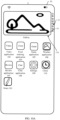
- a location of the icon of the application corresponding to the card is automatically filled by an icon of another application, for example, as shown in FIG. 10A , is automatically filled by icons of the video application 102, the food ordering application 103, the review application 107, and the chat application 108.
- a card corresponding to an original application in the interface 10 may also continue to be displayed. For example, as shown in FIG. 10B , after the user drags the card of the gallery application 104 to the display region 11a, an original card of the gallery application 104 may still be displayed in the interface 10 in a size different from the first size. This is not limited in this application.
- the system program 011 detects a user instruction for adjusting a display sequence of cards, and displays the cards in the card sequence adjusted by the user.
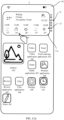
- the user may alternatively adjust the display sequence of the cards in the display region based on a requirement. For example, as shown in FIG. 11A , the user drags a card 14 corresponding to the gallery application 104 to the display region 11a, and the user may hover for second preset duration, to adjust a display sequence of cards in the display region 11a. After detecting that the user hovers for the second preset duration, the mobile phone 1 displays an interface 10 shown in FIG. 11B . The user may drag, in a manner shown in FIG. 11C , the card 14 corresponding to the gallery application 104 in the display region 11a, to adjust a location of the card 14 corresponding to the gallery application 104 in the display region 11a.
- a first card displayed in the display region is, by default, a card newly added by the user. For example, it can be learned by comparing FIG. 3A and FIG. 10B that the first card displayed in the display region in the interface 10 is the card 11 of the note-taking application 101. After the user adds the card of the gallery application 104, a card displayed in the display region 11a in the interface 10 is the card 14 corresponding to the gallery application 104.
- the user when adding a card of an application, the user does not need to add the card of the application through system settings each time, and only needs to drag, after creating a new card for the first time, an icon of another application or a card of another application to a location of the card created for the first time, to add the card of the another application.
- the newly-added card is accommodated in the display region of the card of the first application, to reduce space occupied by the card, and ensure that a layout of the interface 10 is not affected by an increase in a quantity of cards.
- the user after a quantity of cards in the display region of the card of the first application exceeds a specific value, the user needs to continuously slide, by using the control 13, to a card that the user wants to view, instead of viewing a message of a related application in a card manner. Therefore, when the user adds a card to the display region, it is necessary to set an upper limit for a quantity of cards that can be accommodated in the display region. When the quantity of cards in the display region is equal to the upper limit, the user is no longer allowed to continue to add a card to the display region, to ensure convenience of a manner in which the user views an application message by using the display region. However, if necessary, the user may alternatively not limit the quantity of cards that can be accommodated in the display region, that is, in the foregoing interaction process, 505 may be omitted. This is not limited in this application.
- the user may further combine display regions of cards corresponding to different applications, to quickly organize cards on the desktop 10.
- the user may combine display regions of cards corresponding to two applications by moving a display region of a card corresponding to an application to a display region of a card corresponding to the other application.
- the user may combine display regions of cards corresponding to two applications by moving a display region of a card corresponding to an application to a display region of a card corresponding to the other application.
- the card or the icon of the second application is displayed in the display size of the card of the first application.
- the card of the second application is still displayed on the desktop 10 in the display size of the card of the first application.
- a display location of the card of the second application may be determined by a location dragged to by the user, or the card of the second application may be displayed below the display region of the card of the first application. This is not limited in this application.
- the user drags the card 12 of the second application (the weather application 106) that has been displayed in the display region 11a corresponding to the card 11 of the note-taking application 101 out of the display region 11a.
- the card 12 of the weather application 106 is still displayed on the desktop 10 in the display size of the card of the first application.
- the user may want to adjust a display location of the display region of the card of the first application. Therefore, to determine whether the user is to move the display location of the display region of the card of the first application, in some other implementations, it may be further determined whether duration of pressing or tapping the card in the display region of the card of the first application by the user exceeds the second preset duration. If the duration of pressing or tapping the card in the display region of the card of the first application by the user exceeds the second preset duration, it indicates that the user does not want to adjust the display location of the display region of the card of the first application, but wants to remove the card from the display region (that is, edit the card).
- the display region enters an editing state shown in FIG. 11C , so that the user removes the card in the display region. If the duration of pressing or tapping the card in the display region of the card of the first application by the user is less than the second preset duration, it indicates that the user wants to adjust the display location of the display region of the card of the first application, and in this case, the display location of the display region is adjusted in response to a user instruction of moving the display region.
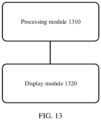
- FIG. 13 is a schematic diagram of a structure of a card management apparatus according to an embodiment of this application.
- the apparatus includes a processing module 1310 and a display module 1320.
- the processing module 1310 is configured to: detect a generation instruction for generating a second card of a second application, and use a first display region for displaying a first card of a first application as a display region for both the second card of the second application and the first card of the first application.
- the display module 1320 is configured to display the first card of the first application in the first display region.
- the processing module 1310 is further configured to: detect the generation instruction for generating the second card of the second application, and control the display module 1320 to display the second card in the first display region, where the second card covers the first card for display.
- the first card is displayed in the first display region in a first display size, and a size of the first display region is the same as the first display size; and the processing module 1310 is further configured to: detect the generation instruction for generating the second card of the second application; then, obtain card data of the second card, where the card data of the second card includes at least one display size corresponding to the second card; determine whether the at least one display size of the second card includes the first display size; and if the at least one display size of the card of the second application includes the first display size, control the display module 1320 to display the second card of the second application in the first display region in the first display size.
- the first control is configured to control, according to a user instruction, to switch a card displayed in the first display region.
- the user instruction includes: The user switches the card in the first display region in a manner such as voice or a preset gesture. For example, the user slides downward, upward, leftward, or rightward by using an air gesture, to switch the card displayed in the first display region.
- the processing module 1310 is further configured to: detect the instruction for generating the second card of the second application; determine whether a quantity of cards included in the first display region exceeds a preset quantity; and if the quantity of cards included in the first display region is less than the preset quantity, use the first display region as the display region for both the second card of the second application and the first card of the first application.
- the generation instruction is generated after an operation of moving an icon or a card of the second application to the first display region is detected. In some other implementations, the generation instruction is generated after an operation of moving an icon or a card of the second application to a preset region corresponding to the first display region is detected.
- the processing module 1310 detects the generation instruction when detecting that time of stay of the icon or the card corresponding to the second application in the first display region or the preset region corresponding to the first display region exceeds first preset duration. It may be understood that the foregoing modules may be implemented in a software or hardware manner.
- the processing module 1310 may be a processor shown in FIG. 14
- the display module 1320 may be a display shown in FIG. 14 . This is not limited in this application.
- FIG. 14 is a schematic diagram of a hardware structure of an electronic device according to an embodiment of this application.
- FIG. 14 is a schematic diagram of a structure of an electronic device 100.
- the electronic device 100 may include a processor 110, an external memory interface 120, an internal memory 121, a universal serial bus (universal serial bus, USB) interface 130, a charging management module 140, a power management module 141, a battery 142, an antenna 1, an antenna 2, a mobile communication module 150, a wireless communication module 160, an audio module 170, a speaker 170A, a telephone receiver 170B, a microphone 170C, a headset jack 170D, a sensor module 180, a button 190, a motor 191, an indicator 192, a camera 193, a display 194, a subscriber identity module (subscriber identification module, SIM) card interface 195, and the like.
- SIM subscriber identity module
- the sensor module 180 may include a pressure sensor 180A, a gyroscope sensor 180B, a barometric pressure sensor 180C, a magnetic sensor 180D, an acceleration sensor 180E, a distance sensor 180F, an optical proximity sensor 180G, a fingerprint sensor 180H, a temperature sensor 180J, a touch sensor 180K, an ambient light sensor 180L, a bone conduction sensor 180M, and the like.
- the structure shown in this embodiment of this application constitutes no specific limitation on the electronic device 100.
- the electronic device 100 may include more or fewer components than those shown in the figure, some components may be combined, some components may be split, or different components may be disposed.
- the components shown in the figure may be implemented by using hardware, software, or a combination of software and hardware.
- the processor 110 may include one or more processing units.
- the processor 110 may include an application processor (application processor, AP), a modem processor, a graphics processing unit (graphics processing unit, GPU), an image signal processor (image signal processor, ISP), a controller, a memory, a video codec, a digital signal processor (digital signal processor, DSP), a baseband processor, a neural-network processing unit (neural-network processing unit, NPU), and/or the like.
- Different processing units may be independent components, or may be integrated into one or more processors.
- the controller may be a nerve center and command center of the electronic device 100. The controller may generate an operation control signal based on an instruction operation code and a timing signal, to control instruction fetching and instruction execution.
- a memory may further be disposed in the processor 110, to store instructions and data.
- the memory in the processor 110 is a cache.
- the memory may store instructions or data that is recently used or cyclically used by the processor 110. If the processor 110 needs to use the instructions or the data again, the processor 110 may directly invoke the instructions or the data from the memory. This avoids repeated access and reduces waiting time of the processor 110, thereby improving system efficiency.
- the processor 110 is configured to control, according to a detected instruction for generating a second card of a second application, to display the second card in a display region corresponding to a first card of a first application.
- the processor 110 may be configured to perform the foregoing methods 501 to 509.
- the processor 110 may include one or more interfaces.
- the interface may include an inter-integrated circuit (inter-integrated circuit, I2C) interface, an inter-integrated circuit sound (inter-integrated circuit sound, I2S) interface, a pulse code modulation (pulse code modulation, PCM) interface, a universal asynchronous receiver/transmitter (universal asynchronous receiver/transmitter, UART) interface, a mobile industry processor interface (mobile industry processor interface, MIPI), a general-purpose input/output (general-purpose input/output, GPIO) interface, a subscriber identity module (subscriber identity module, SIM) interface, a universal serial bus (universal serial bus, USB) interface, and/or the like.
- I2C inter-integrated circuit
- I2S inter-integrated circuit sound
- PCM pulse code modulation
- PCM pulse code modulation
- UART universal asynchronous receiver/transmitter
- MIPI mobile industry processor interface
- GPIO general-purpose input/output
- the I2C interface is a bidirectional synchronous serial bus, including a serial data line (serial data line, SDA) and a serial clock line (derail clock line, SCL).
- the I2S interface may be used for audio communication.
- the PCM interface may also be used for audio communication, to sample, quantize, and encode an analog signal.
- the UART interface is a universal serial data bus used for asynchronous communication.
- the bus may be a bidirectional communication bus. The bus converts to-be-transmitted data between serial communication and parallel communication.
- the MIPI interface may be configured to connect the processor 110 and peripheral devices such as the display 194 and the camera 193.
- the MIPI interface includes a camera serial interface (camera serial interface, CSI), a display serial interface (display serial interface, DSI), and the like.
- the processor 110 and the camera 193 communicate with each other by using the CSI interface, to implement a photographing function of the electronic device 100.
- the processor 110 and the display 194 communicate with each other by using the DSI interface, to implement a display function of the electronic device 100.
- an interface connection relationship between the modules that is shown in this embodiment of this application is merely an example for description, and constitutes no limitation on the structure of the electronic device 100.
- different interface connection manners in the foregoing embodiments or a combination of a plurality of interface connection manners may alternatively be used for the electronic device 100.
- the charging management module 140 is configured to receive charging input from the charger.
- the power management module 141 is configured to connect the battery 142 and the charging management module 140 to the processor 110.
- a wireless communication function of the electronic device 100 may be implemented by using the antenna 1, the antenna 2, the mobile communication module 150, the wireless communication module 160, the modem processor, the baseband processor, and the like.
- the mobile communication module 150 may provide a solution for wireless communication including 2G/3G/4G/5G and the like applied to the electronic device 100.
- the wireless communication module 160 may provide a solution for wireless communication including a wireless local area network (wireless local area networks, WLAN) (for example, a wireless fidelity (wireless fidelity, Wi-Fi) network), Bluetooth (bluetooth, BT), a global navigation satellite system (global navigation satellite system, GNSS), frequency modulation (frequency modulation, FM), a near field communication (near field communication, NFC) technology, an infrared (infrared, IR) technology, and the like applied to the electronic device 100.
- WLAN wireless local area networks
- WLAN wireless local area networks
- WLAN wireless local area networks
- WLAN wireless local area networks
- WLAN wireless local area networks
- WLAN wireless local area networks
- WLAN wireless local area networks
- WLAN wireless local area networks
- WLAN wireless local area networks
- WLAN wireless local area networks
- WLAN for example, a wireless fidelity (wireless fidelity, Wi-Fi) network
- Bluetooth blue, BT
- global navigation satellite system global navigation satellite system
- frequency modulation frequency modulation, FM
- NFC near field
- the electronic device 100 implements a display function by using the GPU, the display 194, the application processor, and the like.
- the GPU is a microprocessor for image processing, and is connected to the display 194 and the application processor.
- the GPU is configured to perform mathematical and geometric calculation for graphics rendering.
- the processor 110 may include one or more GPUs that execute program instructions to generate or change display information.
- the display 194 is configured to display an image, a video, or the like.
- the display 194 includes a display panel.
- the display panel may use a liquid crystal display (liquid crystal display, LCD), an organic light-emitting diode (organic light-emitting diode, OLED), an active-matrix organic light emitting diode (active-matrix organic light emitting diode, AMOLED), a flexible light-emitting diode (flex light-emitting diode, FLED), a MiniLed, a MicroLed, a Micro-OLED, a quantum dot light emitting diode (quantum dot light emitting diodes, QLED), and the like.
- LCD liquid crystal display
- OLED organic light-emitting diode
- AMOLED active-matrix organic light emitting diode
- FLED flexible light-emitting diode
- MiniLed a MicroLed
- Micro-OLED a quantum dot light emitting di
- the electronic device 100 may include one or N displays 194, where N is a positive integer greater than 1.
- the display 194 is configured to display icons of the foregoing applications, a card (a first card) corresponding to a first application, and a card (a second card) corresponding to a second application.
- the electronic device 100 may implement a photographing function by using the ISP, the camera 193, the video codec, the GPU, the display 194, the application processor, and the like.
- the ISP is configured to process data fed back by the camera 193. For example, during photographing, a shutter is opened, and light is transmitted to a photosensitive element of the camera by using a lens. An optical signal is converted into an electrical signal. The photosensitive element of the camera transmits the electrical signal to the ISP for processing, to convert the electrical signal into an image visible to naked eyes.
- the ISP may further perform algorithm optimization on noise, brightness, and complexion of the image.
- the ISP may further optimize parameters such as exposure and color temperature of a shooting scene.
- the ISP may be disposed in the camera 193.
- the camera 193 is configured to capture a still image or a video. An optical image is generated for an object by using the lens and is projected onto the photosensitive element.
- the electronic device 100 may include 1 or N cameras 193, where N is a positive integer greater than 1.
- the digital signal processor is configured to process a digital signal. In addition to processing a digital image signal, the digital signal processor can further process another digital signal. For example, when the electronic device 100 selects a frequency, the digital signal processor is configured to perform Fourier transform on frequency energy.
- the video codec is configured to compress or decompress a digital video.
- the electronic device 100 may support one or more types of video codecs. Therefore, the electronic device 100 may play or record videos in a plurality of encoding formats, such as moving picture experts group (moving picture experts group, MPEG)1, MPEG2, MPEG3, and MPEG4.
- moving picture experts group moving picture experts group, MPEG1
- MPEG2 moving picture experts group
- MPEG3 MPEG4
- the NPU is a neural-network (neural-network, NN) computing processor.
- NN neural-network
- the NPU quickly processes input information, and can further continuously perform self-learning.
- Applications such as intelligent cognition of the electronic device 100, for example, image recognition, face recognition, speech recognition, and text understanding, may be implemented by using the NPU.
- the external memory interface 120 may be configured to connect to an external storage card, for example, a Micro SD card, to expand a storage capability of the electronic device 100.
- the external storage card communicates with the processor 110 through the external memory interface 120, to implement a data storage function, for example, to store files such as music and a video in the external storage card.
- the internal memory 121 may be configured to store computer-executable program code, and the executable program code includes instructions.
- the processor 110 executes various function applications and data processing of the electronic device 100 by running the instructions stored in the internal memory 121.
- the internal memory 121 may include a program storage area and a data storage area.
- the program storage area may store an operating system, an application required by at least one function (for example, a sound playback function or an image playback function), and the like.
- the data storage area may store data (such as audio data and a phone book) and the like created during use of the electronic device 100.
- the internal memory 121 may include a high-speed random access memory, and may further include a nonvolatile memory, for example, at least one disk storage device, a flash memory device, or a universal flash storage (universal flash storage, UFS).
- the electronic device 100 may implement audio functions such as music playing and sound recording by using the audio module 170, the speaker 170A, the telephone receiver 170B, the microphone 170C, the headset jack 170D, the application processor, and the like.
- the audio module 170 is configured to convert digital audio information into an analog audio signal for output, and is further configured to convert an analog audio input into a digital audio signal.
- the audio module 170 may be further configured to encode and decode audio signals.
- the audio module 170 may be disposed in the processor 110, or some functional modules in the audio module 170 may be disposed in the processor 110.
- the speaker 170A also referred to as a "loudspeaker" is configured to convert an audio electrical signal into a sound signal.
- the electronic device 100 may be configured to listen to music or answer a call in a hands-free mode by using the speaker 170A.
- the telephone receiver 170B also referred to as an "earpiece" is configured to convert an audio electrical signal into a sound signal.
- the telephone receiver 170B may be put close to a human ear to listen to a voice.
- the microphone 170C also referred to as a "mic” or “mike”, is configured to convert a sound signal into an electrical signal.
- a user may make a sound by approaching the mouth to the microphone 170C, to input a sound signal to the microphone 170C.
- At least one microphone 170C may be disposed in the electronic device 100.
- two microphones 170C may be disposed in the electronic device 100, to implement a noise reduction function in addition to collecting a sound signal.
- three, four, or more microphones 170C may be disposed in the electronic device 100, to collect a sound signal, implement noise reduction, and identify a sound source, so as to implement a directional recording function and the like.
- the headset jack 170D is configured to be connected to a wired headset.
- the headset jack 170D may be a USB interface 130, or may be a 3.5 mm open mobile terminal platform (open mobile terminal platform, OMTP) standard interface, or a cellular telecommunications industry association of the USA (cellular telecommunications industry association of the USA, CTIA) standard interface.
- the pressure sensor 180A is configured to sense a pressure signal, and may convert the pressure signal into an electrical signal.
- the gyroscope sensor 180B may be configured to determine a moving posture of the electronic device 100.
- the barometric pressure sensor 180C is configured to measure barometric pressure. In some embodiments, the electronic device 100 calculates an altitude by using a barometric pressure value measured by the barometric pressure sensor 180C, to assist in positioning and navigation.
- the magnetic sensor 180D includes a Hall sensor.
- the acceleration sensor 180E may detect magnitudes of acceleration of the electronic device 100 in all directions (generally in three axes), and may detect a magnitude and a direction of gravity when the electronic device 100 is still.
- the acceleration sensor 180E may be further configured to identify a posture of the electronic device, and is applied to applications such as switching between a landscape mode and a portrait mode and a pedometer.
- the distance sensor 180F is configured to measure a distance.
- the electronic device 100 may measure a distance in an infrared manner or a laser manner.
- the optical proximity sensor 180G may include, for example, a light-emitting diode (LED) and a light detector such as a photodiode.
- the light-emitting diode may be an infrared light-emitting diode.
- the ambient light sensor 180L is configured to sense brightness of ambient light.
- the electronic device 100 may adaptively adjust brightness of the display 194 based on sensed brightness of ambient light.
- the fingerprint sensor 180H is configured to collect a fingerprint.
- the electronic device 100 may implement fingerprint unlocking, application lock accessing, fingerprint-based photographing, fingerprint-based call answering, and the like by using a feature of the collected fingerprint.
- the temperature sensor 180J is configured to detect temperature. In some embodiments, the electronic device 100 performs a temperature handling policy based on the temperature detected by the temperature sensor 180J.
- the touch sensor 180K is also referred to as a "touch panel”.
- the touch sensor 180K may be disposed on the display 194.
- the touch sensor 180K and the display 194 form a touchscreen, which is also referred to as "touch control screen”.
- the bone conduction sensor 180M may obtain a vibration signal.
- the button 190 includes a power on/off button, a volume button, and the like.
- the button 190 may be a mechanical button, or may be a touch button.
- the electronic device 100 may receive a key input and generate a key signal input related to user settings and function control of the electronic device 100.
- the motor 191 may generate a vibration prompt.
- the motor 191 may be configured to provide a vibration prompt for an incoming call, and may also be configured to provide vibration feedback for a touch.
- the indicator 192 may be an indicator light, may be configured to indicate a charging state or a power change, and may be further configured to indicate a message, a missed call, a notification, and the like.
- the SIM card interface 195 is configured to be connected to a SIM card.
- a possible hardware structure of the electronic device 100 is described above. It may be understood that the structure shown in this embodiment of this application does not constitute a specific limitation on the electronic device 100. In some other embodiments of this application, the electronic device 100 may include more or fewer components than those shown in the figure, some components may be combined, some components may be split, or different components may be disposed. The components shown in the figure may be implemented by using hardware, software, or a combination of software and hardware.
- An embodiment of this application further provides an electronic device.
- the electronic device includes at least one processor, a memory, and a computer program that is stored in the memory and that can run on the at least one processor.
- the processor implements the steps in the foregoing method embodiments when executing the computer program.
- An embodiment of this application further provides a computer-readable storage medium.
- the computer-readable storage medium stores a computer program, and when the computer program is executed by a processor, the steps in the foregoing method embodiments may be implemented.
- An embodiment of this application provides a computer program product.
- the computer program product runs on a terminal device or an electronic device, the terminal device or the electronic device is enabled to perform the steps in the foregoing method embodiments.
- the integrated unit When the integrated unit is implemented in the form of the software functional unit and sold or used as an independent product, the integrated unit may be stored in a computer-readable storage medium. Based on such an understanding, in this application, all or a part of the processes in the methods in the foregoing embodiments may be implemented by a computer program instructing related hardware.
- the computer program may be stored in a computer-readable storage medium.
- the steps in the foregoing method embodiments may be implemented.
- the computer program includes computer program code, and the computer program code may be in a source code form, an object code form, an executable file, some intermediate forms, or the like.
- the computer-readable medium may include at least any entity or apparatus capable of adding computer program code to a photographing apparatus/terminal device, a recording medium, a computer memory, a read-only memory (read-only memory, ROM), a random access memory (random access memory, RAM), an electrical carrier signal, a telecommunications signal, and a software distribution medium, for example, a USB flash drive, a removable hard disk, a magnetic disk, or an optical disc.
- a computer-readable medium cannot be an electrical carrier signal or a telecommunications signal.
- the disclosed apparatus/network device and method may be implemented in another manner.
- the described apparatus/network device embodiment is merely an example.
- division of the modules or units is merely logical function division.
- a plurality of units or components may be combined or integrated into another system, or some characteristics may be ignored or not performed.
- the displayed or discussed mutual coupling, direct coupling, or communication connection may be implemented through some interfaces, and indirect coupling or a communication connection of the apparatuses or units may be in an electrical, mechanical, or another form.
- the units described as separate components may or may not be physically separated, and components displayed as units may or may not be physical units, that is, may be located in one place, or may be distributed on a plurality of network units. Some or all of the units may be selected based on actual requirements to achieve the objectives of the solutions in the embodiments.
- the term “if” may be interpreted according to the context as “when", “once”, “determining in response to”, or “detecting in response to”.
- the phrase “if it is determined that” or “if [a described condition or event] is detected” may be interpreted according to the context as "once it is determined that”, “it is determined that in response to”, “once [a described condition or event] is detected”, or “[a described condition or event] is detected in response to”.
Landscapes
- Engineering & Computer Science (AREA)
- Theoretical Computer Science (AREA)
- General Engineering & Computer Science (AREA)
- Human Computer Interaction (AREA)
- Physics & Mathematics (AREA)
- General Physics & Mathematics (AREA)
- Software Systems (AREA)
- User Interface Of Digital Computer (AREA)
Abstract
Description
- This application claims priority to
Chinese Patent Application No. 202210881397.4, filed with the China National Intellectual Property Administration on July 26, 2022 - This application relates to the field of electronic technologies, and in particular, to a card display method and a terminal device.
- Messages such as a new reminder or a notification message always appear in various applications (application, APP) installed on a terminal device. A means used by a user to view these notification messages and reminders is relatively simple, and is generally: viewing by using a leftmost home screen of the terminal device or viewing by tapping to enter a specific APP.
- Appearance of a service card enriches ways used by the user to view messages such as APP notification messages and reminders. A card is a new message display technology, and is now widely applied to various terminal devices, to provide rich information display and meet a user requirement. However, currently, a manner of setting an APP application as a card is relatively cumbersome, and affects user experience. In addition, one card can display information about only one APP.
- This application relates to the field of electronic technologies, and in particular, to a card display method and a terminal device. In the card display method in this application, after a user adds a card of a first application to a desktop of an electronic device, the card of the first application is displayed on the desktop of the electronic device, and the user may drag an icon or a card of another application to a display region corresponding to the card of the first application and hover for specified duration, to add the card of the another application. In this method, after adding a card of an application, the user only needs to drag an icon or a card of another application to a card display region corresponding to the application, to add the another application as a card, thereby eliminating a series of operations performed through system settings each time a card is added, and improving user experience.
- Solutions of this application are described below.
- According to a first aspect, this application provides a card display method, applied to an electronic device. The method includes: displaying a first card of a first application in a first display region of the electronic device; detecting a generation instruction for generating a second card of a second application; and using the first display region as a display region for both the second card of the second application and the first card of the first application.
- In some implementations, the first application may be an application such as a video application, a note-taking application, or a food ordering application in the following descriptions. The second application is different from the first application. In some implementations, the electronic device may be a terminal device such as a smartphone or a tablet computer. This is not limited in this application.
- In other words, the first card of the first application is displayed in the first display region, and then, after detecting the generation instruction for generating the second card of the second application, the electronic device uses a display region of the first card of the first application as the display region for both the second card of the second application and the first card of the first application. In addition, the second card of the second application does not separately occupy space of a desktop of the electronic device, but is displayed in the first display region together with the first card of the first application.
- In some implementations, after the second card of the second application is generated, the first card of the first application may alternatively still be displayed in the first display region. In some implementations, after the second card of the second application is generated, the second card of the second application may be displayed in the first display region, that is, the second card covers the first card for display. This is not limited in this application.
- In this manner, a newly-added card of an application does not occupy the space of the desktop of the electronic device, and does not apply a layout of the desktop of the electronic device, and further does not affect user experience.
- With reference to the first aspect, in a possible implementation of the first aspect, the method further includes: detecting the generation instruction for generating the second card of the second application, and displaying the second card in the first display region, where the second card covers the first card for display.
- With reference to the first aspect and the foregoing possible implementations, in a possible implementation, the first card is displayed in the first display region in a first display size, and a size of the first display region is the same as the first display size; and the method further includes: detecting the generation instruction for generating the second card of the second application; obtaining card data of the second card, where the card data of the second card includes at least one display size corresponding to the second card; determining whether the at least one display size of the second card includes the first display size; and if the at least one display size of the card of the second application includes the first display size, displaying the second card of the second application in the first display region in the first display size.
- It may be understood that a card of each application has a display size supported by the card, for example, 1000 pixels × 500 pixels, and 500 pixels × 500 pixels. Therefore, the electronic device displays the card in the display size supported by the card.
- Therefore, in some implementations, the first card is displayed in the first display region in the first display size supported by the first card, and the size of the first display region is the same as the first display size. Then, when detecting the generation instruction for generating the second card of the second application, the electronic device obtains the card data of the second card, to obtain the at least one display size supported by the second card. Then, it is determined whether the at least one display size supported by the second card includes the first display size, that is, it is determined whether the second card can be displayed in the first display size. If the second card can be displayed in the first display size, the card of the second application is displayed in the first display region in the first display size. It may be understood that in this case, the second card of the second application covers the first card of the first application for display.
- With reference to the first aspect and the foregoing possible implementations, in a possible implementation, there is correspondingly a first control in the first display region, and the first control is configured to control, according to a user instruction, to switch a card displayed in the first display region.
- In other words, to facilitate selection, by the user based on a requirement of the user, of the card displayed in the first display region, there is correspondingly the first control in the first display region, and the user may control, by using the first control, to switch the card displayed in the first display region. For example, if the user wants to view the first card of the first application, the user may select, by using the first control, the card of the first application for display.
- With reference to the first aspect and the foregoing possible implementations, in a possible implementation, the method further includes: detecting the instruction for generating the second card of the second application; determining whether a quantity of cards included in the first display region exceeds a preset quantity; and if the quantity of cards included in the first display region is less than the preset quantity, using the first display region as the display region for both the second card of the second application and the first card of the first application.
- It may be understood that, an excessively large quantity of cards included in the first display region are unfavorable to viewing a card of a corresponding application by the user. Therefore, in some implementations, it is necessary to set an upper limit for a quantity of cards that can be accommodated in the first display region. To be specific, after detecting the instruction for generating the second card of the second application, the electronic device needs to determine whether the first display region can continue to accommodate a new card. When the quantity of cards included in the first display region is less than the preset quantity, the first display region is used as the display region for both the second card of the second application and the first card of the first application. If the quantity of cards included in the first display region is greater than the preset quantity, the first display region is no longer used as the display region for both the second card of the second application and the first card of the first application. The preset quantity is an empirical value or an experimental value, and a value of the preset quantity may be, for example, 10. This is not limited in this application.
- With reference to the first aspect and the foregoing possible implementations, in a possible implementation, the generation instruction is generated after an operation of moving an icon or a card of the second application to the first display region is detected. In other words, in some implementations, the generation instruction for generating the second card of the second application needs to be generated after the operation of moving the icon or the card of the second application to the first display region is detected.
- With reference to the first aspect and the foregoing possible implementations, in a possible implementation, the generation instruction is generated after an operation of moving an icon or a card of the second application to a preset region corresponding to the first display region is detected. In other words, in some implementations, the generation instruction may be generated after the icon or the card of the second application is moved to the first display region, or may be generated after the icon or the card of the second application is moved to the preset region corresponding to the first display region, for example, the generation instruction is generated after the icon or the card of the second application is moved to a place close to the first display region. This is not limited in this application.
- With reference to the first aspect and the foregoing possible implementations, in a possible implementation, the detecting a generation instruction for generating a second card of a second application includes: detecting the generation instruction when it is detected that time of stay of the icon or the card corresponding to the second application in the first display region or the preset region corresponding to the first display region exceeds first preset duration.
- In other words, to avoid mis-generation of the second card of the second application, for example, the user transitorily moves the icon or the card of the second application to the first display region or the preset region corresponding to the first display region when adjusting a location of the icon or the card of the second application, in an implementation of this application, after it is detected that the icon or the card corresponding to the second application is moved to the first display region or the preset region corresponding to the first display region, it is further determined whether time of stay of the icon or the card corresponding to the second application in the first display region or the preset region corresponding to the first display region exceeds the first preset duration. When the time of stay of the icon or the card corresponding to the second application in the first display region or the preset region corresponding to the first display region exceeds the first preset duration, it is determined that the generation instruction for the second card of the second application is detected.
- With reference to the first aspect and the foregoing possible implementations, in a possible implementation, an Android operating system is deployed on the electronic device, and the Android system of the electronic device includes a system program and the second application that are located at an application layer, and the system program is used to: in response to the generation instruction for generating the second card of the second application, obtain card data of the second card from the second application, and when the at least one display size of the second card of the second application includes the first display size, control the electronic device to display the card of the second application in the first display region in the first display size.
- With reference to the first aspect and the foregoing possible implementations, in a possible implementation, the system program is further used to: detect the instruction for generating the second card of the second application, determine whether a quantity of cards included in the first display region exceeds a preset quantity, and obtain card data of the second card from the second application when the quantity of cards included in the first display region is less than the preset quantity.
- With reference to the first aspect and the foregoing possible implementations, in a possible implementation, the generation instruction is generated by the system program after the operation of moving the icon or the card of the second application to the first display region is detected.
- With reference to the first aspect and the foregoing possible implementations, in a possible implementation, the generation instruction is generated by the system program after the operation of moving the icon or the card of the second application to the preset region corresponding to the first display region is detected.
- With reference to the first aspect and the foregoing possible implementations, in a possible implementation, the generation instruction is generated when it is detected that the time of stay of the icon or the card corresponding to the second application in the first display region or the preset region corresponding to the first display region exceeds the first preset duration.
- According to a second aspect, this application provides a card display apparatus, including a display module and a processing module. The processing module is configured to: detect a generation instruction for generating a second card of a second application, and use a first display region for displaying a first card of a first application as a display region for both the second card of the second application and the first card of the first application.
- The display module is configured to display the first card of the first application in the first display region.
- In some implementations, the processing module is further configured to: detect the generation instruction for generating the second card of the second application, and control the display module to display the second card in the first display region, where the second card covers the first card for display.
- In some other implementations, the first card is displayed in the first display region in a first display size, and a size of the first display region is the same as the first display size; and the processing module is further configured to: detect the generation instruction for generating the second card of the second application; then, obtain card data of the second card, where the card data of the second card includes at least one display size corresponding to the second card; determine whether the at least one display size of the second card includes the first display size; and if the at least one display size of the card of the second application includes the first display size, control the display module to display the second card of the second application in the first display region in the first display size.
- In some implementations, there is correspondingly a first control in the first display region, and the first control is configured to control, according to a user instruction, to switch a card displayed in the first display region. The user instruction includes: The user switches the card in the first display region in a manner such as voice or a preset gesture. For example, the user slides downward, upward, leftward, or rightward by using an air gesture, to switch the card displayed in the first display region.
- In some implementations, the processing module is further configured to: detect the instruction for generating the second card of the second application; determine whether a quantity of cards included in the first display region exceeds a preset quantity; and if the quantity of cards included in the first display region is less than the preset quantity, use the first display region as the display region for both the second card of the second application and the first card of the first application.
- In some implementations, the generation instruction is generated after an operation of moving an icon or a card of the second application to the first display region is detected. In some other implementations, the generation instruction is generated after an operation of moving an icon or a card of the second application to a preset region corresponding to the first display region is detected.
- In some implementations, the processing module detects the generation instruction when detecting that time of stay of the icon or the card corresponding to the second application in the first display region or the preset region corresponding to the first display region exceeds first preset duration.
- According to a third aspect, this application provides an electronic device, including one or more processors and one or more memories. The one or more memories store one or more programs, and when the one or more programs are executed by the one or more processors, the electronic device is enabled to perform the method according to any implementation of the first aspect.
- According to a fourth aspect, this application provides a computer-readable storage medium. The storage medium stores instructions, and when the instructions are executed on a computer, the computer is enabled to perform the method according to any implementation of the first aspect.
- According to a fifth aspect, an embodiment of this application provides a computer program product. When the computer program product runs on an electronic device, the electronic device is enabled to perform the method according to any implementation of the first aspect.
- It may be understood that, for beneficial effects of the second aspect to the fifth aspect, refer to related descriptions in the first aspect. Details are not described herein again.
-
-
FIG. 1A is a schematic diagram of adesktop 10 of amobile phone 1 according to an embodiment of this application; -
FIG. 1B is a schematic diagram of aleftmost home screen 20 of amobile phone 1 according to an embodiment of this application; -
FIG. 1C is a schematic diagram of a graphical interface in which a user taps aweather application 106 to view a weather message according to an embodiment of this application; -
FIG. 1D is a schematic diagram of aninterface 17 of aweather application 106 according to an embodiment of this application; -
FIG. 1E is a schematic diagram showing that a user adds a service card by using asettings application 109 according to an embodiment of this application; -
FIG. 1F is a schematic diagram of applications that support a service card according to an embodiment of this application; -
FIG. 1G is a schematic diagram of setting a display location and a display size of a service card according to an embodiment of this application; -
FIG. 2A is a schematic diagram of adesktop 10 of amobile phone 1 according to an embodiment of this application; -
FIG. 2B is a schematic diagram of adesktop 10 obtained after a card of afood ordering application 103 is added according to an embodiment of this application; -
FIG. 3A is a schematic diagram showing that a user moves an icon of aweather application 106 to adisplay region 11a of acard 11 of a note-taking application 101 according to an embodiment of this application; -
FIG. 3B is a schematic diagram showing that a user moves an icon of aweather application 106 to adisplay region 11a of acard 11 of a note-taking application 101 according to an embodiment of this application; -
FIG. 3C is a schematic diagram of adesktop 10 obtained after acard 12 of aweather application 106 is added according to an embodiment of this application; -
FIG. 4 is a framework diagram of a software structure of a terminal device according to an embodiment of this application; -
FIG. 5A andFIG. 5B are a schematic diagram of an interaction procedure between modules inFIG. 4 that are related to solutions of this application according to an embodiment of this application; -
FIG. 6A is a schematic diagram of a first size of a card according to an embodiment of this application; -
FIG. 6B is a schematic diagram of a second size of a card according to an embodiment of this application; -
FIG. 7A is a schematic diagram of a carddisplay region S 1 according to an embodiment of this application; -
FIG. 7B is a schematic diagram of a preset region S2 corresponding to a card display region according to an embodiment of this application; -
FIG. 8A is a schematic diagram of adesktop 10 of amobile phone 1 according to an embodiment of this application; -
FIG. 8B is a schematic diagram showing that a user adds a card of achat application 108 according to an embodiment of this application; -
FIG. 8C is a schematic diagram of prompting a user that a quantity of cards accommodated in a card display region exceeds a preset quantity according to an embodiment of this application; -
FIG. 9A is a schematic diagram showing that a user adds a card of agame application 105 according to an embodiment of this application; -
FIG. 9B is a schematic diagram of prompting a user that a card of agame application 105 does not support a first size according to an embodiment of this application; -
FIG. 10A is a schematic diagram of adesktop 10 obtained after acard 14 of agallery application 104 is added according to an embodiment of this application, where an original card of thegallery application 104 is no longer displayed; -
FIG. 10B is a schematic diagram of anotherdesktop 10 obtained after acard 14 of agallery application 104 is added according to an embodiment of this application, where an original card of thegallery application 104 is still displayed; -
FIG. 11A is a schematic diagram of adesktop 10 of amobile phone 1 according to an embodiment of this application; -
FIG. 11B is a schematic diagram showing that a user adds a card of agallery application 104 according to an embodiment of this application; -
FIG. 11C is a schematic diagram showing that a user adjusts a display sequence of a card of agallery application 104 according to an embodiment of this application; -
FIG. 12A is a schematic diagram of adesktop 10 of amobile phone 1 according to an embodiment of this application; -
FIG. 12B is a schematic diagram showing that a user drags a card of aweather application 106 out of adisplay region 11a according to an embodiment of this application; -
FIG. 12C is a schematic diagram of adesktop 10 obtained after a user drags a card of aweather application 106 out of adisplay region 11a according to an embodiment of this application; -
FIG. 13 is a schematic diagram of a structure of an apparatus according to an embodiment of this application; and -
FIG. 14 is a schematic diagram of a hardware structure of an electronic device according to an embodiment of this application. - This application provides a card display method and a terminal device. Various aspects of illustrative embodiments are described below by using terms commonly used by persons skilled in the art. In the descriptions of embodiments of this application, "/" means "or" unless otherwise specified. For example, A/B may represent A or B. In this specification, "and/or" is merely an association relationship for describing associated objects, and represents that three relationships may exist. For example, A and/or B may represent three cases: only A exists, both A and B exist, and only B exists. In addition, in the descriptions of embodiments of this application, "a plurality of" means two or more.
- Terms "first", "second", and "third" below are used for description only, and cannot be understood as indicating or implying relative importance or implicitly indicating a quantity of indicated technical features. Therefore, a feature defined by "first", "second", or "third" may explicitly or implicitly include one or more such features.
- A card display method provided in embodiments of this application may be applied to a terminal device such as a mobile phone, a tablet computer, a wearable device, a vehicle-mounted device, an augmented reality (augmented reality, AR)/virtual reality (virtual reality, VR) device, a notebook computer, an ultra-mobile personal computer (ultra-mobile personal computer, UMPC), a netbook, or a personal digital assistant (personal digital assistant, PDA). A specific type of the terminal device is not limited in embodiments of this application.
- As described above, a user usually views a message of an APP by using a leftmost home screen of the terminal device or taps an APP to view a message of the APP. For example, as shown in
FIG. 1A , a mobile phone is used as the terminal device, and applications such as a note-taking application 101, avideo application 02, afood ordering application 103, agallery application 104, agame application 105, aweather application 106, areview application 107, achat application 108,Settings 109, andClock 110 are displayed on adesktop 10 of themobile phone 1. Assuming that the user needs to view a message ofWeather 106, the user needs to slide rightward to aleftmost home screen 20 of themobile phone 1, to displayweather information 201 "Cloudy·26°" shown inFIG. 1B . Alternatively, as shown inFIG. 1C , the user taps theweather application 106 on thedesktop 10, and enters afirst interface 17 of theweather application 106, to display thefirst interface 17 of theweather application 106 shown inFIG. 1D and display weather information "Zhuhai·26°·Mostly cloudy·Highest: 32°·Lowest: 24°". - It may be understood that information about the
weather application 106 displayed on theleftmost home screen 20 of themobile phone 1 and thefirst interface 17 of theweather application 106 is merely an example. In another implementation, more weather-related information may be further displayed. This is not limited in this application. - It may be understood that the applications displayed on the
desktop 10 are also examples. In another implementation, there may alternatively be more or fewer other applications on thedesktop 10. This is not limited in this application. - It may be learned that the foregoing operation manner is simplex and boring. Therefore, in some implementations, the user may display an APP message by using a service card. The service card (referred to as a card below) is a new message display manner. After the user adds a card of an APP application, a message of the APP is displayed to the user in a form of a card.
- For example, as shown in
FIG. 2A , assuming that the user adds the note-taking application 101 as a card, acard 11 corresponding to the note-taking application 101 is displayed on thedesktop 10 of themobile phone 1, and a message, such as text information or picture information, of the note-taking application 101 is displayed on thecard 11. - In such a solution, rich messages of an application can be flexibly displayed. However, first, steps of adding a card are cumbersome. The user needs to add, as a card by using a system settings option, an application that the user wants to add as a card. If the user wants to add cards of a plurality of applications, the user needs to add each application as a card by using the system settings option.
- For example, as shown in
FIG. 1E , the user needs to tap thesettings application 109 on thedesktop 10, and select, from asetting card interface 0101 of thesettings application 109 inFIG. 1F , to add a card of a specific application. It may be learned fromFIG. 1F that various applications (for example, the note-taking application 101, thevideo application 102, and the food ordering application 103) that support the service card are displayed in thesetting card interface 0101. The user may tap a corresponding application to add a card for the application. Assuming that the user taps an option corresponding to the note-taking application to enter aninterface 0102 shown inFIG. 1G , the user may add the card corresponding to the note-taking application 101 by selecting a display size and a display location of the card corresponding to the note-taking application 101. If the user needs to add cards of a plurality of applications, the foregoing operations inFIG. 1E to FIG. 1G are undoubtedly cumbersome. - Second, each card can display a message of only one application; in other words, a card and an application are in a one-to-one relationship. If the user wants to display messages of more applications on the
desktop 10 in a form of a card, the user needs to add cards of a plurality of applications. This increases a quantity of cards and affects display of cards. In addition, to display more application messages, a size of the card is usually greater than a size of an application icon. Therefore, while the quantity of cards is increased, more space of thedesktop 10 is undoubtedly occupied, an overall layout of thedesktop 10 is affected, and sense of beauty of thedesktop 10 is affected. - For another example, as shown in
FIG. 2B , after the user adds the note-taking application 101, thegallery application 104, thevideo application 102, and thefood ordering application 103 as cards, cards of only four applications can be displayed in a current interface of the desktop 10: a card of the note-taking application 101, a card of thegallery application 104, a card of thevideo application 102, and a card of thefood ordering application 103, and icons or cards of other applications can only be displayed on another page of thedesktop 10. The user needs to turn pages by using acontrol 19 to view the other applications, and this affects user experience. - Therefore, this application provides a card display method and a terminal device. In the card display method in this application, after a user adds a card of a first application to a desktop of an electronic device, the card of the first application is displayed on the desktop of the electronic device, and the user may drag an icon or a card of another application to a display region corresponding to the card of the first application and hover for specified duration, to add the card of the another application. Correspondingly, if the electronic device detects that the user drags the icon or the card of the another application to the display region and hovers for time longer than a period of time, the electronic device adds the card of the another application to the display region. In addition, if the user does not adjust a display sequence between the card of the another application and the card of the first application, the newly-added card of the another application covers the card of the first application, and is displayed in the display region in a size corresponding to the card of the first application.
- In some implementations, a display region corresponding to the card of the first application may accommodate a preset quantity of cards. The preset quantity is an empirical value or an experimental value, and may be set by the user based on a requirement; or the preset quantity may be a fixed value, and a value of the preset quantity may be 10. This is not limited in this application.
- In addition, the first card displayed to the user in the display region corresponding to the card of the first application is a card corresponding to a message of an application displayed on the desktop, and may be selected by the user based on a requirement from cards in the display region corresponding to the card of the first application, and a display sequence of the cards in the display region may also be adjusted by the user based on a requirement. The first application includes but is not limited to applications such as the
video application 02, thefood ordering application 103, thegallery application 104, thegame application 105, theweather application 106, thereview application 107, thechat application 108,Settings 109, andClock 110. Another application is an application different from the first application. - For example, as shown in
FIG. 3A , after the user adds the note-taking application 101 as a card, thecard 11 corresponding to the note-taking application 101 is displayed on thedesktop 10, and thedisplay region 11a of thecard 11 is a display size of thecard 11 that the user selects to display. In this case, if the user continues to add theweather application 106 as a card, as shown inFIG. 3B , the user only needs to drag an icon of theweather application 106 to thedisplay region 11a corresponding to thecard 11, and acard 12 corresponding to theweather application 106 is displayed in thedisplay region 11, as shown inFIG. 3C . - In some implementations, when the user does not adjust a display sequence of the card corresponding to the
weather application 106 and the card of the note-taking application 101 or a card of another application (for example, the card of thevideo application 102 or the card of the food ordering application 103) in thedisplay region 11a, as shown inFIG. 3C , thecard 12 of theweather application 106 covers the originally displayedcard 11 of the note-taking application 101. - In some implementations, the user may slide upward or downward by using a
control 13 to switch a card displayed in the display region, to choose to view a message of thecard 11 corresponding to the note-taking application 101. This is not limited in this application. - In some other implementations, when the user does not adjust a display sequence of the card corresponding to the
weather application 106 and the card of the note-taking application 101 or a card of another application in thedisplay region 11a, the newly-addedcard 12 of theweather application 106 may alternatively be displayed below an existing card; in other words, thecard 11 of the note-taking application 101 is still displayed in thedisplay region 11a. - In the foregoing method, after adding a card of an application, the user only needs to drag an icon or a card of another application to a card display region corresponding to the application, to add the another application as a card, thereby eliminating a series of operations performed through system settings each time a card is added, and improving user experience.
- In addition, if all newly-added cards are displayed in a display region corresponding to an existing card, and an overall layout of the
desktop 10 is not affected due to an increase in a quantity of cards, thereby saving space of thedesktop 10, ensuring sense of beauty of the layout of thedesktop 10, and improving user experience. - It may be understood that the card display method in this application may be applied to a terminal device such as a smartphone, a tablet computer, or an intelligent wearable device with no limitation. For ease of description, a mobile phone is still used as the
terminal device 1 to provide descriptions with reference to the accompanying drawings. -
FIG. 4 is a schematic diagram of a layered architecture of a software structure of amobile phone 1 used in an embodiment of this application. The layered architecture divides software into several layers, and each layer has a clear role and task. The layers communicate with each other through software interfaces. As shown inFIG. 4 , the software structure of themobile phone 1 is separately anapplication layer 01, anapplication framework layer 02, asystem layer 03, and akernel layer 04 from top to bottom. - The
application layer 01 may include a series of application packages. In some implementations of this application, programs mainly included in theapplication layer 01 are classified into anapplication 012 and asystem program 011. Theapplication 012 is each application installed on a desktop of themobile phone 1, and thesystem program 011 is a system program used to manage each application on the desktop of themobile phone 1, and is a system that controls and coordinates themobile phone 1 and an external device (for example, an input/output device) of themobile phone 1 and supports application development and running on themobile phone 1. A main function of thesystem program 011 is to schedule, monitor, and maintain a system of themobile phone 1, and manage various independent hardware in the system of themobile phone 1, so that they can work in a coordinated manner. In some implementations, thesystem program 011 may be an operating system installed on themobile phone 1, for example, an Android (android) operating system or a Harmony operating system. - In some implementations of this application, the
system program 011 is used to: add a card of an application according to a user instruction, and determine, according to the user instruction, a display manner of the card corresponding to the application. In some implementations, a display manner of a card corresponding to an application includes a display size of the card and a display theme of the card (for example, a daytime theme or a night theme). This is not limited in this application. - In some implementations of this application, the
system program 011 is further used to: obtain card data corresponding to an application, determine a display size that can be supported by the card corresponding to the application, and display the card in the display size supported by the card corresponding to the application. Details are described below with reference toFIG. 5A andFIG. 5B . - The
application 012 may include applications installed on themobile phone 1, such as avideo application 102, afood ordering application 103, agallery application 104, agame application 105, aweather application 106, areview application 107, achat application 108,Settings 109, andClock 110. Examples are not listed one by one in this embodiment of this application. - The
application framework layer 02 provides an application programming interface (application programming interface, API) and a programming framework for an application at theapplication layer 01. Theapplication framework layer 02 includes some predefined functions. As shown inFIG. 4 , theapplication framework layer 02 may include awindow manager 021, acontent provider 022, aphone manager 023, anotification manager 024, aview system 025, aresource manager 026, and the like. Thewindow manager 021 is configured to manage a window program, for example, a size of a window currently displayed on themobile phone 1, or a manner in which the window is currently displayed (for example, whether the manner is split-screen display). Thecontent provider 022 is configured to: store and obtain data and make the data accessible to an application. The data may include video data, image data, audio data, phone book data, and the like. Thephone manager 023 is configured to: manage a call status of themobile phone 1, obtain device information of themobile phone 1, subscriber identity card (Subscriber Identity Module, SIM) information, and mobile network or wireless fidelity (wireless-fidelity, Wi-Fi) information, and listen to the call status of themobile phone 1, for example, a call status service or a signal strength status. Theview system 025 includes a visual control, such as acontrol 13 that displays a quantity of selectable cards in a display region. Generally, a display interface of themobile phone 1 may include one or more views. For example, the display interface may include a view for displaying icons of the foregoing applications, a view for displaying text, a view for displaying a picture, and the like. - The
Android runtime 035 includes a kernel library and a virtual machine. TheAndroid runtime 035 is responsible for scheduling and management of the Android system. The kernel library includes two parts: a functional function that needs to be invoked by a java language, and a kernel library of Android. - The
application layer 01 and theapplication framework layer 02 run in the virtual machine. The virtual machine executes java files at theapplication layer 01 and theapplication framework layer 02 as binary files. The virtual machine is configured to perform operations such as object lifecycle management, stack management, thread management, security and exception management, and garbage collection. - The system library may include a plurality of functional modules, for example, a surface manager 031 (surface manager or surface flinger), a media library 034 (media libraries), a three-dimensional graphics processing library 032 (for example, OpenGL ES), and a two-dimensional graphics engine 033 (for example, SGL).
- The
surface manager 031 is configured to manage a display subsystem, and provide fusion of two-dimensional and three-dimensional layers for a plurality of applications. Themedia library 034 supports playback and recording in a plurality of common audio and video formats, static image files, and the like. The media library may support a plurality of audio and video coding formats, for example, MPEG4, H.264, MP3, AAC, AMR, JPG, and PNG. The three-dimensionalgraphics processing library 032 is used to implement three-dimensional graphics drawing, image rendering, composition, layer processing, and the like. The two-dimensional graphics engine 033 is a drawing engine for two-dimensional drawing. - The
kernel layer 04 is a layer between hardware and software. Thekernel layer 04 includes at least adisplay driver 041, acamera driver 042, anaudio driver 043, and asensor driver 044. - A physical layer (physic, PHY) may be included below the
kernel layer 04, and the physical layer may provide a transmission medium and an interconnection channel for data communication inside a device or between devices, to provide a reliable environment for data transmission. The physical layer may be understood as a transport layer that provides a "signal and medium". - It may be understood that the foregoing schematic diagram of the layered architecture of the software structure of the
mobile phone 1 is merely an example. In another implementation, the layered architecture of the software structure of themobile phone 1 may further include more or fewer layers, or a layered structure formed in another manner. This is not limited in this application. - An interaction process of some modules or layer structures in
FIG. 4 that are involved when the method in this application is implemented is described below with reference toFIG. 5A andFIG. 5B based on the software structure framework layer of themobile phone 1 shown inFIG. 4 . - Specifically, as shown in
FIG. 5A andFIG. 5B , the method includes the following steps. - 501: The
mobile phone 1 invokes, in response to a first operation of adding a card of a first application, asystem program 011 to send information about the added card to the first application. - It should be noted that, when a user creates the card of the first application, the first operation means that the user adds the card of the first application through system settings. For details, refer to the descriptions in
FIG. 1E to FIG. 1G . Details are not described herein again. In some other implementations, the first operation may alternatively be some preset gesture operations or a voice instruction. For example, the user adds the card of the first application in a voice instruction manner. Alternatively, the user enables, in a two-finger pinching manner on adesktop 10, thedesktop 10 to enter an editing state, and then adds a first card for the first application in the editing state. This is not limited in this application. In some implementations, the first application includes applications such as thevideo application 102, thefood ordering application 103, thegallery application 104, thegame application 105, theweather application 106, thereview application 107, thechat application 108,Settings 109, andClock 110 that are shown inFIG. 1A to FIG. 4 . This is not limited in this application. - 502: The
mobile phone 1 invokes thesystem program 011 to obtain first card data of the first application from anapplication 012. - In some implementations, the card data includes data such as a display size that can be supported by the card, a display theme of the card, and a display location of the card. It may be understood that for operations of adding cards for different applications, the
mobile phone 1 invokes thesystem program 011 to obtain card data of corresponding applications fromdifferent applications 012. For example, if the first operation is to add a card for thevideo application 102, thesystem program 011 obtains card data of thevideo application 102 from thevideo application 102; and if the first operation is to add a card for thefood ordering application 103, thesystem 011 obtains card data of thefood ordering application 103 from thefood ordering application 103. - For example,
FIG. 6A and FIG. 6B are schematic diagrams of a display size that can be supported by a card. As shown inFIG. 6A , a length-width ratio of the display size that can be supported by the card is 4×2 (for example, 1000 pixels (px) × 500 px). As shown inFIG. 6B , a length-width ratio of the display size that can be supported by the card is 2×2 (for example, 500 pixels (px) × 500 px). It may be understood that in some other implementations, the display size that can be supported by the card may alternatively have another corresponding length-width ratio. This is not limited in this application. - 503: The
mobile phone 1 invokes thesystem program 011 to control themobile phone 1 to display the card of the first application in a first size. - In some implementations, the
mobile phone 1 invokes thesystem program 011 to control themobile phone 1 to display the card of the first application in the first size according to a user instruction. It may be understood that, when the user adds the card of the first application through system settings, the user may select any display size based on a display size supported by the card, to display the card of the first application. - For example, the first application is the note-
taking application 101. If the user chooses to display a card of the note-taking application 101 in the display size with the length-width ratio 4×2, as shown inFIG. 3A , the card of the note-taking application 101 is displayed in theinterface 10 of themobile phone 1 in the display size with the length-width ratio 4×2. - 504: The
mobile phone 1 invokes, in response to a second operation of adding a card of a second application, thesystem program 011 to send information about the added card to the second application. - In some implementations, the second application is different from the first application, and the second application includes but is not limited to applications such as the
video application 102, thefood ordering application 103, thegallery application 104, thegame application 105, theweather application 106, thereview application 107, thechat application 108,Settings 109, andClock 110 that are shown inFIG. 1A to FIG. 4 . - In some implementations, the second operation is an operation in which the user adds an application card without using a manner of adding the application card through system settings, for example, an operation in which the user adds the card of the second application by dragging an icon of the second application to a display region of the card of the first application.
- In some implementations, the second operation may alternatively be an operation in which the user adds an application card through system settings and then drags the card to a display region of the card of the first application to accommodate the card of the second application in the display region of the card of the first application. This is not limited in this application.
- In some implementations, the display region of the card of the first application is a region covered by the card after the card is displayed in any display size. For example, as shown in
FIG. 7A , the display region of the card of the first application is a shaded region S 1 (that is, thedisplay region 11a in the foregoing descriptions) covered by the card of the note-taking application 101 that is displayed in the first size (the length-width ratio 4×2). Correspondingly, for example, the second application is theweather application 106. The user may add a card of theweather application 106 by dragging an icon of theweather application 106 to theregion S 1. In some implementations, when the user drags theweather application 106 to the region S1, to prevent the user from accidentally triggering adding of the card of theweather application 106, after detecting that the user has an obvious hovering action, themobile phone 1 may invoke thesystem program 011 to control to deform the icon of theweather application 106, to prompt the user that the card of theweather application 106 is being added. For example, as shown inFIG. 7B , after detecting that the user drags an icon of theweather application 106 to the region S1 and detecting that the user has an obvious hovering action, themobile phone 1 invokes thesystem program 011 to deform the icon of theweather application 106 to a second size shown inFIG. 7B . In some implementations, a length-width ratio of the second size may be consistent with the length-width ratio of the first size, but an area displayed by the second size is less than an area displayed by the first size. - In some implementations, when detecting that the user drags an icon of the second application to the
region S 1 and stays in theregion S 1 for first preset duration, themobile phone 1 may determine that it is detected that the user has an obvious hovering action in the region S1. The first preset duration is an empirical value or an experimental value, for example, a value of the first preset duration may be 3 seconds. This is not limited in this application. - It may be understood that, in some implementations, the user may alternatively drag the icon of the second application to a preset region corresponding to a location of the card of the first application, and after detecting that the user drags the icon of the second application to the preset region, the
mobile phone 1 determines that the second operation of adding the card of the second application by the user is detected. For example, as shown inFIG. 7B , the user may drag the icon of theweather application 106 to a preset region S2. In some implementations, an area of the preset region S2 is greater than that of the region S1. - Similarly, in some implementations, after detecting that the user drags the icon of the second application to the preset region S2 and detecting that the user has an obvious hovering action, the
mobile phone 1 determines that the second operation of adding the second application by the user is detected, and then invokes thesystem program 011 to control to deform the icon of the second application, to indicate that the user is currently performing an operation of adding a card. This is not limited in this application. - In some other implementations, the second application may alternatively be a card corresponding to an application. In other words, it may be understood that the card is also an application. When the second application is a card, the second operation means that the user drags a card of an application to a display region of the existing card of the first application, that is, accommodates and manages cards in the
interface 10. It may be understood that, when the second application is an application such as a non-card application, the user may add the second application as a card by dragging the icon of the second application to the display region of the card of the first application, and when the second application is a card application, the user may accommodate the second application in the display region of the existing card of the first application by dragging the card to the display region of the card of the first application. For example, as shown inFIG. 3A , thegallery application 104 has been displayed in theinterface 10 as a card. The user drags a card 104' of thegallery application 104 to thedisplay region 11a corresponding to thecard 11 of the note-taking application 101, to accommodate the card 104' of thegallery application 104 in thedisplay region 11a. In a process in which the user accommodates the card of the second application in the display region of the card of the first application, for corresponding deformation of the card of the second application, refer to the foregoing related descriptions. Details are not described herein again. - 505: The
system program 011 determines whether a quantity of cards in the display region is less than a preset quantity. - In some implementations, after detecting the second operation of adding the card of the second application by the user, the
system program 011 needs to determine whether the display region of the card of the first application can continue to accommodate the card of the second application that is currently added by the user, that is, determine whether the quantity of cards in the display region exceeds the preset quantity. In some implementations, the preset quantity is an empirical value or an experimental value, and may be set by research and development personnel based on a requirement. For example, a value of the preset quantity may be 10. In some other implementations, the preset quantity may alternatively be set by the user through system settings based on a requirement. For example, the user may set the preset quantity to 5. - In still other implementations, the user may separately set different preset quantities for display regions of different types of cards based on requirements. For example, the user may add all chat applications in a display region (for example, a display region corresponding to a card of the chat application 108) as cards, and if three chat applications are installed on the
mobile phone 1, the user may set the preset quantity to 3 (or greater than 3). For another example, the user may alternatively add commonly used APPs to a display region, and the preset quantity is also set based on a quantity of commonly used APPs of the user. This is not limited in this application. - If the quantity of cards in the display region is already equal to or even greater than the preset quantity, it indicates that the display region cannot accommodate a new card, and a current process of adding the card of the second application ends. In some implementations, when it is determined that the quantity of cards in the display region is already equal to or even greater than the preset quantity, the
mobile phone 1 may display corresponding prompt information, to prompt the user that a quantity of cards that can be accommodated in the current display region has exceeded the preset quantity. - For example, as shown in
FIG. 8A , it is assumed that a quantity of cards (which can be learned by using a selection option corresponding to a control 13) in thedisplay region 11a of thecard 11 of the note-taking application 101 is 10, and a preset quantity corresponding to thedisplay region 11a is also 10. As shown inFIG. 8B , when the user continues to add the card of thechat application 108 to thedisplay region 11a, because the quantity of cards has already exceeded the preset quantity,prompt information 17 "At most ten cards can be added to this card display region" shown inFIG. 8C is displayed in theinterface 10 of themobile phone 1, to prompt the user that a quantity of cards that can be accommodated in thecurrent display region 11a reaches an upper limit and no more new cards can be accommodated. It may be understood that, in some implementations, the foregoing prompt may alternatively be provided for the user in another manner. For example, themobile phone 1 prompts, in a form such as voice broadcasting or vibration, the user that the quantity of cards that can be accommodated in the current display region has exceeded the upper limit. This is not limited in this application. - If the quantity of cards in the display region is less than the preset quantity, it indicates that the display region can further accommodate a new card. In this case, 506 is performed.
- 506: When the quantity of cards in the display region is less than the preset quantity, the
mobile phone 1 invokes thesystem program 011 to obtain second card data of the second application from theapplication 012. - When determining that the quantity of cards in the display region does not exceed the preset quantity, the
mobile phone 10 invokes thesystem program 011 to obtain the card data of the second application from theapplication 012. For details, refer to the foregoing descriptions of 502. Details are not described herein again. - 507: The
system program 011 determines whether the card of the second application can be displayed in the first size. If yes, 508 is performed, and thesystem program 011 displays the card of the second application in the first size. If no, a current operation procedure of adding the card of the second application ends. - It may be understood that display sizes that can be supported by cards of applications are different. Therefore, whether a display size supported by the card of the second application that is to be added by the user includes the first size needs to be determined, that is, whether the card of the second application can be displayed in the first size.
- If the card of the second application does not support the first size, the current process of adding the card of the second application ends.
- In some implementations, when determining that the card of the second application does not support the first size, the
mobile phone 1 may also display corresponding prompt information, to prompt the user that the card of the second application does not support the first size and cannot be displayed in the first size. - For example, as shown in
FIG. 9A , it is assumed that the user continues to add a card of thegame application 105 to thedisplay region 11a, and themobile phone 1 invokes thesystem program 011, and determines, based on card data of thegame application 105 that is obtained in 506, that thegame application 105 does not support the first size. In this case, as shown inFIG. 9B , themobile phone 1 displays promptinformation 15 "This APP does not support card of this size currently", to prompt the user that thegame application 105 cannot be displayed in the first size. It may be understood that, in some implementations, the foregoing prompt may alternatively be provided for the user in another manner. For example, themobile phone 1 prompts, in a form such as voice broadcasting or vibration, the user that the quantity of cards that can be accommodated in thecurrent display region 11a has exceeded an upper limit. This is not limited in this application. - If the card of the second application can be displayed in the first size, 508 is performed.
- 508: The
system program 011 displays the card of the second application in the first size. - For example, the second application is the
weather application 106. As shown inFIG. 3A andFIG. 3B , it is assumed that the user adds acard 12 of theweather application 106. Because theweather application 106 supports the first size, as shown inFIG. 3C , thecard 12 of theweather application 106 is displayed in theinterface 10 in the first size. - It should be noted that, generally, after the user adds a card of an application, an icon of the application is still displayed in the
interface 10. For example, as shown inFIG. 3C , after the user adds the card of theweather application 106, an icon of theweather application 106 is still displayed in theinterface 10. - However, when the second application is a card, a purpose of dragging the card by the user to the display region of the card of the first application is to accommodate the card in the existing display region, to save space of the
interface 10. In this case, after the user drags the second application to the display region, the icon of the application corresponding to the card is no longer displayed in theinterface 10, and a location of the icon of the application corresponding to the card is automatically filled by an icon of another application, for example, as shown inFIG. 10A , is automatically filled by icons of thevideo application 102, thefood ordering application 103, thereview application 107, and thechat application 108. - In some implementations, after the user drags the card to the display region of the card of the first application, a card corresponding to an original application in the
interface 10 may also continue to be displayed. For example, as shown inFIG. 10B , after the user drags the card of thegallery application 104 to thedisplay region 11a, an original card of thegallery application 104 may still be displayed in theinterface 10 in a size different from the first size. This is not limited in this application. - 509: The
system program 011 detects a user instruction for adjusting a display sequence of cards, and displays the cards in the card sequence adjusted by the user. - In some implementations, the user may alternatively adjust the display sequence of the cards in the display region based on a requirement. For example, as shown in
FIG. 11A , the user drags acard 14 corresponding to thegallery application 104 to thedisplay region 11a, and the user may hover for second preset duration, to adjust a display sequence of cards in thedisplay region 11a. After detecting that the user hovers for the second preset duration, themobile phone 1 displays aninterface 10 shown inFIG. 11B . The user may drag, in a manner shown inFIG. 11C , thecard 14 corresponding to thegallery application 104 in thedisplay region 11a, to adjust a location of thecard 14 corresponding to thegallery application 104 in thedisplay region 11a. - In some other implementations, if the user does not adjust the display sequence of the cards in the display region, a first card displayed in the display region is, by default, a card newly added by the user. For example, it can be learned by comparing
FIG. 3A andFIG. 10B that the first card displayed in the display region in theinterface 10 is thecard 11 of the note-taking application 101. After the user adds the card of thegallery application 104, a card displayed in thedisplay region 11a in theinterface 10 is thecard 14 corresponding to thegallery application 104. - In the foregoing method, when adding a card of an application, the user does not need to add the card of the application through system settings each time, and only needs to drag, after creating a new card for the first time, an icon of another application or a card of another application to a location of the card created for the first time, to add the card of the another application. In addition, the newly-added card is accommodated in the display region of the card of the first application, to reduce space occupied by the card, and ensure that a layout of the
interface 10 is not affected by an increase in a quantity of cards. - In some implementations of this application, after a quantity of cards in the display region of the card of the first application exceeds a specific value, the user needs to continuously slide, by using the
control 13, to a card that the user wants to view, instead of viewing a message of a related application in a card manner. Therefore, when the user adds a card to the display region, it is necessary to set an upper limit for a quantity of cards that can be accommodated in the display region. When the quantity of cards in the display region is equal to the upper limit, the user is no longer allowed to continue to add a card to the display region, to ensure convenience of a manner in which the user views an application message by using the display region. However, if necessary, the user may alternatively not limit the quantity of cards that can be accommodated in the display region, that is, in the foregoing interaction process, 505 may be omitted. This is not limited in this application. - In some implementations of this application, the user may further combine display regions of cards corresponding to different applications, to quickly organize cards on the
desktop 10. However, it should be understood that, before the display regions of the cards corresponding to the different applications are combined, it is still necessary to determine whether sizes of the display regions of the cards corresponding to the different applications are the same. When the sizes of the display regions of the cards corresponding to the different applications are the same, the user may combine display regions of cards corresponding to two applications by moving a display region of a card corresponding to an application to a display region of a card corresponding to the other application. For a specific manner, refer to 501 to 509. Details are not described herein again. - It may be understood that, in some implementations, after the card or the icon of the second application is dragged to the display region of the card of the first application for display, the card or the icon of the second application is displayed in the display size of the card of the first application. In addition, if the user drags the card of the second application that is already in the display region of the card of the first application out of the display region, the card of the second application is still displayed on the
desktop 10 in the display size of the card of the first application. A display location of the card of the second application may be determined by a location dragged to by the user, or the card of the second application may be displayed below the display region of the card of the first application. This is not limited in this application. - For example, as shown in
FIG. 12A andFIG. 12B , the user drags thecard 12 of the second application (the weather application 106) that has been displayed in thedisplay region 11a corresponding to thecard 11 of the note-taking application 101 out of thedisplay region 11a. As shown inFIG. 12C , thecard 12 of theweather application 106 is still displayed on thedesktop 10 in the display size of the card of the first application. - When moving a card displayed in the display region of the card of the first application, the user may want to adjust a display location of the display region of the card of the first application. Therefore, to determine whether the user is to move the display location of the display region of the card of the first application, in some other implementations, it may be further determined whether duration of pressing or tapping the card in the display region of the card of the first application by the user exceeds the second preset duration. If the duration of pressing or tapping the card in the display region of the card of the first application by the user exceeds the second preset duration, it indicates that the user does not want to adjust the display location of the display region of the card of the first application, but wants to remove the card from the display region (that is, edit the card). In this case, the display region enters an editing state shown in
FIG. 11C , so that the user removes the card in the display region. If the duration of pressing or tapping the card in the display region of the card of the first application by the user is less than the second preset duration, it indicates that the user wants to adjust the display location of the display region of the card of the first application, and in this case, the display location of the display region is adjusted in response to a user instruction of moving the display region. -
FIG. 13 is a schematic diagram of a structure of a card management apparatus according to an embodiment of this application. - As shown in
FIG. 13 , the apparatus includes aprocessing module 1310 and adisplay module 1320. Theprocessing module 1310 is configured to: detect a generation instruction for generating a second card of a second application, and use a first display region for displaying a first card of a first application as a display region for both the second card of the second application and the first card of the first application. - The
display module 1320 is configured to display the first card of the first application in the first display region. - In some implementations, the
processing module 1310 is further configured to: detect the generation instruction for generating the second card of the second application, and control thedisplay module 1320 to display the second card in the first display region, where the second card covers the first card for display. - In some other implementations, the first card is displayed in the first display region in a first display size, and a size of the first display region is the same as the first display size; and the
processing module 1310 is further configured to: detect the generation instruction for generating the second card of the second application; then, obtain card data of the second card, where the card data of the second card includes at least one display size corresponding to the second card; determine whether the at least one display size of the second card includes the first display size; and if the at least one display size of the card of the second application includes the first display size, control thedisplay module 1320 to display the second card of the second application in the first display region in the first display size. - In some implementations, there is correspondingly a first control in the first display region, and the first control is configured to control, according to a user instruction, to switch a card displayed in the first display region. The user instruction includes: The user switches the card in the first display region in a manner such as voice or a preset gesture. For example, the user slides downward, upward, leftward, or rightward by using an air gesture, to switch the card displayed in the first display region.
- In some implementations, the
processing module 1310 is further configured to: detect the instruction for generating the second card of the second application; determine whether a quantity of cards included in the first display region exceeds a preset quantity; and if the quantity of cards included in the first display region is less than the preset quantity, use the first display region as the display region for both the second card of the second application and the first card of the first application. In some implementations, the generation instruction is generated after an operation of moving an icon or a card of the second application to the first display region is detected. In some other implementations, the generation instruction is generated after an operation of moving an icon or a card of the second application to a preset region corresponding to the first display region is detected. - In some implementations, the
processing module 1310 detects the generation instruction when detecting that time of stay of the icon or the card corresponding to the second application in the first display region or the preset region corresponding to the first display region exceeds first preset duration. It may be understood that the foregoing modules may be implemented in a software or hardware manner. For example, as an example of hardware, theprocessing module 1310 may be a processor shown inFIG. 14 , and thedisplay module 1320 may be a display shown inFIG. 14 . This is not limited in this application. -
FIG. 14 is a schematic diagram of a hardware structure of an electronic device according to an embodiment of this application. - For example,
FIG. 14 is a schematic diagram of a structure of anelectronic device 100. Theelectronic device 100 may include aprocessor 110, anexternal memory interface 120, aninternal memory 121, a universal serial bus (universal serial bus, USB) interface 130, acharging management module 140, apower management module 141, abattery 142, anantenna 1, anantenna 2, amobile communication module 150, a wireless communication module 160, anaudio module 170, aspeaker 170A, atelephone receiver 170B, amicrophone 170C, aheadset jack 170D, asensor module 180, abutton 190, amotor 191, anindicator 192, acamera 193, adisplay 194, a subscriber identity module (subscriber identification module, SIM)card interface 195, and the like. Thesensor module 180 may include apressure sensor 180A, agyroscope sensor 180B, a barometric pressure sensor 180C, amagnetic sensor 180D, anacceleration sensor 180E, adistance sensor 180F, anoptical proximity sensor 180G, afingerprint sensor 180H, atemperature sensor 180J, atouch sensor 180K, an ambientlight sensor 180L, a bone conduction sensor 180M, and the like. - It may be understood that the structure shown in this embodiment of this application constitutes no specific limitation on the
electronic device 100. In some other embodiments of this application, theelectronic device 100 may include more or fewer components than those shown in the figure, some components may be combined, some components may be split, or different components may be disposed. The components shown in the figure may be implemented by using hardware, software, or a combination of software and hardware. - The
processor 110 may include one or more processing units. For example, theprocessor 110 may include an application processor (application processor, AP), a modem processor, a graphics processing unit (graphics processing unit, GPU), an image signal processor (image signal processor, ISP), a controller, a memory, a video codec, a digital signal processor (digital signal processor, DSP), a baseband processor, a neural-network processing unit (neural-network processing unit, NPU), and/or the like. Different processing units may be independent components, or may be integrated into one or more processors. The controller may be a nerve center and command center of theelectronic device 100. The controller may generate an operation control signal based on an instruction operation code and a timing signal, to control instruction fetching and instruction execution. - A memory may further be disposed in the
processor 110, to store instructions and data. In some embodiments, the memory in theprocessor 110 is a cache. The memory may store instructions or data that is recently used or cyclically used by theprocessor 110. If theprocessor 110 needs to use the instructions or the data again, theprocessor 110 may directly invoke the instructions or the data from the memory. This avoids repeated access and reduces waiting time of theprocessor 110, thereby improving system efficiency. In some implementations, theprocessor 110 is configured to control, according to a detected instruction for generating a second card of a second application, to display the second card in a display region corresponding to a first card of a first application. In some implementations, theprocessor 110 may be configured to perform the foregoingmethods 501 to 509. - In some embodiments, the
processor 110 may include one or more interfaces. The interface may include an inter-integrated circuit (inter-integrated circuit, I2C) interface, an inter-integrated circuit sound (inter-integrated circuit sound, I2S) interface, a pulse code modulation (pulse code modulation, PCM) interface, a universal asynchronous receiver/transmitter (universal asynchronous receiver/transmitter, UART) interface, a mobile industry processor interface (mobile industry processor interface, MIPI), a general-purpose input/output (general-purpose input/output, GPIO) interface, a subscriber identity module (subscriber identity module, SIM) interface, a universal serial bus (universal serial bus, USB) interface, and/or the like. - The I2C interface is a bidirectional synchronous serial bus, including a serial data line (serial data line, SDA) and a serial clock line (derail clock line, SCL). The I2S interface may be used for audio communication. The PCM interface may also be used for audio communication, to sample, quantize, and encode an analog signal. The UART interface is a universal serial data bus used for asynchronous communication. The bus may be a bidirectional communication bus. The bus converts to-be-transmitted data between serial communication and parallel communication.
- The MIPI interface may be configured to connect the
processor 110 and peripheral devices such as thedisplay 194 and thecamera 193. The MIPI interface includes a camera serial interface (camera serial interface, CSI), a display serial interface (display serial interface, DSI), and the like. In some embodiments, theprocessor 110 and thecamera 193 communicate with each other by using the CSI interface, to implement a photographing function of theelectronic device 100. Theprocessor 110 and thedisplay 194 communicate with each other by using the DSI interface, to implement a display function of theelectronic device 100. - It may be understood that an interface connection relationship between the modules that is shown in this embodiment of this application is merely an example for description, and constitutes no limitation on the structure of the
electronic device 100. In some other embodiments of this application, different interface connection manners in the foregoing embodiments or a combination of a plurality of interface connection manners may alternatively be used for theelectronic device 100. - The
charging management module 140 is configured to receive charging input from the charger. Thepower management module 141 is configured to connect thebattery 142 and thecharging management module 140 to theprocessor 110. A wireless communication function of theelectronic device 100 may be implemented by using theantenna 1, theantenna 2, themobile communication module 150, the wireless communication module 160, the modem processor, the baseband processor, and the like. Themobile communication module 150 may provide a solution for wireless communication including 2G/3G/4G/5G and the like applied to theelectronic device 100. The wireless communication module 160 may provide a solution for wireless communication including a wireless local area network (wireless local area networks, WLAN) (for example, a wireless fidelity (wireless fidelity, Wi-Fi) network), Bluetooth (bluetooth, BT), a global navigation satellite system (global navigation satellite system, GNSS), frequency modulation (frequency modulation, FM), a near field communication (near field communication, NFC) technology, an infrared (infrared, IR) technology, and the like applied to theelectronic device 100. - The
electronic device 100 implements a display function by using the GPU, thedisplay 194, the application processor, and the like. The GPU is a microprocessor for image processing, and is connected to thedisplay 194 and the application processor. The GPU is configured to perform mathematical and geometric calculation for graphics rendering. Theprocessor 110 may include one or more GPUs that execute program instructions to generate or change display information. - The
display 194 is configured to display an image, a video, or the like. Thedisplay 194 includes a display panel. The display panel may use a liquid crystal display (liquid crystal display, LCD), an organic light-emitting diode (organic light-emitting diode, OLED), an active-matrix organic light emitting diode (active-matrix organic light emitting diode, AMOLED), a flexible light-emitting diode (flex light-emitting diode, FLED), a MiniLed, a MicroLed, a Micro-OLED, a quantum dot light emitting diode (quantum dot light emitting diodes, QLED), and the like. In some embodiments, theelectronic device 100 may include one or N displays 194, where N is a positive integer greater than 1. In some implementations of this application, thedisplay 194 is configured to display icons of the foregoing applications, a card (a first card) corresponding to a first application, and a card (a second card) corresponding to a second application. - The
electronic device 100 may implement a photographing function by using the ISP, thecamera 193, the video codec, the GPU, thedisplay 194, the application processor, and the like. - The ISP is configured to process data fed back by the
camera 193. For example, during photographing, a shutter is opened, and light is transmitted to a photosensitive element of the camera by using a lens. An optical signal is converted into an electrical signal. The photosensitive element of the camera transmits the electrical signal to the ISP for processing, to convert the electrical signal into an image visible to naked eyes. The ISP may further perform algorithm optimization on noise, brightness, and complexion of the image. The ISP may further optimize parameters such as exposure and color temperature of a shooting scene. In some embodiments, the ISP may be disposed in thecamera 193. - The
camera 193 is configured to capture a still image or a video. An optical image is generated for an object by using the lens and is projected onto the photosensitive element. In some embodiments, theelectronic device 100 may include 1 orN cameras 193, where N is a positive integer greater than 1. - The digital signal processor is configured to process a digital signal. In addition to processing a digital image signal, the digital signal processor can further process another digital signal. For example, when the
electronic device 100 selects a frequency, the digital signal processor is configured to perform Fourier transform on frequency energy. - The video codec is configured to compress or decompress a digital video. The
electronic device 100 may support one or more types of video codecs. Therefore, theelectronic device 100 may play or record videos in a plurality of encoding formats, such as moving picture experts group (moving picture experts group, MPEG)1, MPEG2, MPEG3, and MPEG4. - The NPU is a neural-network (neural-network, NN) computing processor. By referring to a biological neural-network structure, for example, by referring to a transfer mode between human brain neurons, the NPU quickly processes input information, and can further continuously perform self-learning. Applications such as intelligent cognition of the
electronic device 100, for example, image recognition, face recognition, speech recognition, and text understanding, may be implemented by using the NPU. - The
external memory interface 120 may be configured to connect to an external storage card, for example, a Micro SD card, to expand a storage capability of theelectronic device 100. The external storage card communicates with theprocessor 110 through theexternal memory interface 120, to implement a data storage function, for example, to store files such as music and a video in the external storage card. - The
internal memory 121 may be configured to store computer-executable program code, and the executable program code includes instructions. Theprocessor 110 executes various function applications and data processing of theelectronic device 100 by running the instructions stored in theinternal memory 121. Theinternal memory 121 may include a program storage area and a data storage area. The program storage area may store an operating system, an application required by at least one function (for example, a sound playback function or an image playback function), and the like. The data storage area may store data (such as audio data and a phone book) and the like created during use of theelectronic device 100. In addition, theinternal memory 121 may include a high-speed random access memory, and may further include a nonvolatile memory, for example, at least one disk storage device, a flash memory device, or a universal flash storage (universal flash storage, UFS). - The
electronic device 100 may implement audio functions such as music playing and sound recording by using theaudio module 170, thespeaker 170A, thetelephone receiver 170B, themicrophone 170C, theheadset jack 170D, the application processor, and the like. - The
audio module 170 is configured to convert digital audio information into an analog audio signal for output, and is further configured to convert an analog audio input into a digital audio signal. Theaudio module 170 may be further configured to encode and decode audio signals. In some embodiments, theaudio module 170 may be disposed in theprocessor 110, or some functional modules in theaudio module 170 may be disposed in theprocessor 110. - The
speaker 170A, also referred to as a "loudspeaker", is configured to convert an audio electrical signal into a sound signal. Theelectronic device 100 may be configured to listen to music or answer a call in a hands-free mode by using thespeaker 170A. - The
telephone receiver 170B, also referred to as an "earpiece", is configured to convert an audio electrical signal into a sound signal. When a call is answered or audio information is listened to by using theelectronic device 100, thetelephone receiver 170B may be put close to a human ear to listen to a voice. - The
microphone 170C, also referred to as a "mic" or "mike", is configured to convert a sound signal into an electrical signal. When making a call or sending a voice message, a user may make a sound by approaching the mouth to themicrophone 170C, to input a sound signal to themicrophone 170C. At least onemicrophone 170C may be disposed in theelectronic device 100. In some other embodiments, twomicrophones 170C may be disposed in theelectronic device 100, to implement a noise reduction function in addition to collecting a sound signal. In some other embodiments, three, four, ormore microphones 170C may be disposed in theelectronic device 100, to collect a sound signal, implement noise reduction, and identify a sound source, so as to implement a directional recording function and the like. - The
headset jack 170D is configured to be connected to a wired headset. Theheadset jack 170D may be a USB interface 130, or may be a 3.5 mm open mobile terminal platform (open mobile terminal platform, OMTP) standard interface, or a cellular telecommunications industry association of the USA (cellular telecommunications industry association of the USA, CTIA) standard interface. - The
pressure sensor 180A is configured to sense a pressure signal, and may convert the pressure signal into an electrical signal. Thegyroscope sensor 180B may be configured to determine a moving posture of theelectronic device 100. The barometric pressure sensor 180C is configured to measure barometric pressure. In some embodiments, theelectronic device 100 calculates an altitude by using a barometric pressure value measured by the barometric pressure sensor 180C, to assist in positioning and navigation. Themagnetic sensor 180D includes a Hall sensor. Theacceleration sensor 180E may detect magnitudes of acceleration of theelectronic device 100 in all directions (generally in three axes), and may detect a magnitude and a direction of gravity when theelectronic device 100 is still. Theacceleration sensor 180E may be further configured to identify a posture of the electronic device, and is applied to applications such as switching between a landscape mode and a portrait mode and a pedometer. Thedistance sensor 180F is configured to measure a distance. Theelectronic device 100 may measure a distance in an infrared manner or a laser manner. Theoptical proximity sensor 180G may include, for example, a light-emitting diode (LED) and a light detector such as a photodiode. The light-emitting diode may be an infrared light-emitting diode. The ambientlight sensor 180L is configured to sense brightness of ambient light. Theelectronic device 100 may adaptively adjust brightness of thedisplay 194 based on sensed brightness of ambient light. Thefingerprint sensor 180H is configured to collect a fingerprint. Theelectronic device 100 may implement fingerprint unlocking, application lock accessing, fingerprint-based photographing, fingerprint-based call answering, and the like by using a feature of the collected fingerprint. Thetemperature sensor 180J is configured to detect temperature. In some embodiments, theelectronic device 100 performs a temperature handling policy based on the temperature detected by thetemperature sensor 180J. Thetouch sensor 180K is also referred to as a "touch panel". Thetouch sensor 180K may be disposed on thedisplay 194. Thetouch sensor 180K and thedisplay 194 form a touchscreen, which is also referred to as "touch control screen". The bone conduction sensor 180M may obtain a vibration signal. Thebutton 190 includes a power on/off button, a volume button, and the like. Thebutton 190 may be a mechanical button, or may be a touch button. Theelectronic device 100 may receive a key input and generate a key signal input related to user settings and function control of theelectronic device 100. Themotor 191 may generate a vibration prompt. Themotor 191 may be configured to provide a vibration prompt for an incoming call, and may also be configured to provide vibration feedback for a touch. Theindicator 192 may be an indicator light, may be configured to indicate a charging state or a power change, and may be further configured to indicate a message, a missed call, a notification, and the like. TheSIM card interface 195 is configured to be connected to a SIM card. - A possible hardware structure of the
electronic device 100 is described above. It may be understood that the structure shown in this embodiment of this application does not constitute a specific limitation on theelectronic device 100. In some other embodiments of this application, theelectronic device 100 may include more or fewer components than those shown in the figure, some components may be combined, some components may be split, or different components may be disposed. The components shown in the figure may be implemented by using hardware, software, or a combination of software and hardware. - An embodiment of this application further provides an electronic device. The electronic device includes at least one processor, a memory, and a computer program that is stored in the memory and that can run on the at least one processor. The processor implements the steps in the foregoing method embodiments when executing the computer program.
- An embodiment of this application further provides a computer-readable storage medium. The computer-readable storage medium stores a computer program, and when the computer program is executed by a processor, the steps in the foregoing method embodiments may be implemented.
- An embodiment of this application provides a computer program product. When the computer program product runs on a terminal device or an electronic device, the terminal device or the electronic device is enabled to perform the steps in the foregoing method embodiments.
- When the integrated unit is implemented in the form of the software functional unit and sold or used as an independent product, the integrated unit may be stored in a computer-readable storage medium. Based on such an understanding, in this application, all or a part of the processes in the methods in the foregoing embodiments may be implemented by a computer program instructing related hardware. The computer program may be stored in a computer-readable storage medium. When the computer program is executed by a processor, the steps in the foregoing method embodiments may be implemented. The computer program includes computer program code, and the computer program code may be in a source code form, an object code form, an executable file, some intermediate forms, or the like. The computer-readable medium may include at least any entity or apparatus capable of adding computer program code to a photographing apparatus/terminal device, a recording medium, a computer memory, a read-only memory (read-only memory, ROM), a random access memory (random access memory, RAM), an electrical carrier signal, a telecommunications signal, and a software distribution medium, for example, a USB flash drive, a removable hard disk, a magnetic disk, or an optical disc. In some jurisdictions, under legislation and patent practice, a computer-readable medium cannot be an electrical carrier signal or a telecommunications signal.
- In the foregoing embodiments, descriptions of the embodiments have respective focuses. For a part that is not detailed or described in an embodiment, refer to related descriptions in other embodiments.
- Persons of ordinary skill in the art may recognize that the units and algorithm steps of the examples described with reference to embodiments disclosed herein can be implemented by using electronic hardware or a combination of computer software and electronic hardware. Whether these functions are implemented in a hardware or software manner depends on a specific application and a design constraint of a technical solution. Persons skilled in the art may use different methods to implement the described functions for each particular application, but it should not be considered that the implementation goes beyond the scope of this application.
- In the embodiments provided in this application, it should be understood that the disclosed apparatus/network device and method may be implemented in another manner. For example, the described apparatus/network device embodiment is merely an example. For example, division of the modules or units is merely logical function division. In actual implementation, there may be another division manner. For example, a plurality of units or components may be combined or integrated into another system, or some characteristics may be ignored or not performed. In addition, the displayed or discussed mutual coupling, direct coupling, or communication connection may be implemented through some interfaces, and indirect coupling or a communication connection of the apparatuses or units may be in an electrical, mechanical, or another form.
- The units described as separate components may or may not be physically separated, and components displayed as units may or may not be physical units, that is, may be located in one place, or may be distributed on a plurality of network units. Some or all of the units may be selected based on actual requirements to achieve the objectives of the solutions in the embodiments.
- In the following descriptions, specific details such as a specific system structure and a technology are proposed for description rather than limitation, to thoroughly understand embodiments of this application. However, persons skilled in the art should understand that this application may also be implemented in another embodiment without these specific details. In other cases, detailed descriptions about a well-known system, apparatus, circuit, and method are omitted to prevent unnecessary details from obscuring the description of this application.
- It should be understood that when being used in this specification and the appended claims of this application, the term "include" indicates presence of a described characteristic, entirety, step, operation, element and/or component, but does not rule out presence or addition of one or more other characteristics, entireties, steps, operations, elements, components and/or sets thereof.
- It should also be understood that the term "and/or" used in this specification and the appended claims of this application means any combination and all possible combinations of one or more of listed associated items, and these combinations are included.
- As used in this specification and the appended claims of this application, the term "if" may be interpreted according to the context as "when...", "once", "determining in response to", or "detecting in response to". Similarly, the phrase "if it is determined that" or "if [a described condition or event] is detected" may be interpreted according to the context as "once it is determined that", "it is determined that in response to", "once [a described condition or event] is detected", or "[a described condition or event] is detected in response to".
- In addition, in the descriptions of this specification and the appended claims of this application, the terms "first", "second", "third", and the like are merely used to distinguish between the descriptions, and cannot be understood as indicating or implying relative importance.
- Referring to "one embodiment", "some embodiments", or the like that is described in this specification of this application means that specific characteristics, structures, or features described with reference to one or more embodiments are included in the one or more embodiments of this application. Therefore, the statements "in one embodiment", "in some embodiments", "in some other embodiments", "in some other embodiments", and the like that appear in different parts of this specification are not necessarily referred to a same embodiment, but mean "one or more but not all embodiments", unless otherwise specifically emphasized. The terms "include", "comprise", "have", and variations thereof all mean "include but be not limited to" unless otherwise specified in another manner.
- The foregoing embodiments are merely used to describe the technical solutions of this application, but not limit the technical solutions of this application. Although this application is described in detail with reference to the foregoing embodiments, persons of ordinary skill in the art should understand that they may still modify the technical solutions described in the foregoing embodiments, or perform equivalent replacement on some technical features. However, these modifications or replacements do not make the essence of the corresponding technical solutions depart from the spirit and scope of the technical solutions in embodiments of this application, and shall fall within the protection scope of this application.
Claims (18)
- A card display method, applied to an electronic device and comprising:displaying a first card of a first application in a first display region of the electronic device, wherein the first card has a first size;detecting a first operation of a user for a second card of a second application, wherein the second card has a second size, and the second size is different from the first size; andstacking and displaying a third card of the second application and the first card in the first display region in response to the first operation, wherein the third card has the first size, and content displayed on the third card is different from content displayed on the second card.
- The method according to claim 1, wherein the third card covers the first card for display.
- The method according to claim 1, further comprising:detecting a second operation of the user for an icon of a third application; andstacking and displaying a fourth card of the third application, the third card, and the first card in the first display region in response to the second operation, wherein the fourth card has the first size.
- The method according to claim 3, wherein the fourth card covers the third card for display.
- The method according to claim 3, wherein the first operation or the second operation comprises: dragging the second card of the second application or the icon of the third application to the first display region or a preset region corresponding to the first display region, with time of stay exceeding first preset duration.
- The method according to claim 3, wherein the first display region is a region on a desktop of the electronic device; and
the third card of the second application and/or the icon of the third application are/is located on the desktop. - The method according to any one of claims 1 to 6, further comprising:
keeping displaying the icon of the third application on the desktop of the electronic device. - The method according to any one of claims 1 to 6, further comprising:
stopping displaying the second card of the second application on the desktop of the electronic device. - The method according to claim 3, further comprising:
displaying prompt information when the first operation or the second operation is detected and a quantity of cards comprised in the first display region is equal to a preset quantity or the second application or the third application does not support the first size, wherein the prompt information indicates that a card cannot be added. - The method according to claim 3, wherein the fourth card, the third card, and the first card are arranged in sequence from top to bottom in the first display region.
- The method according to claim 10, wherein the first display region comprises a first control, and the method further comprises:detecting a third operation of the user for the first control; andswitching a first one card displayed in the first display region from the fourth card to the third card in response to the third operation.
- The method according to claim 3, further comprising:detecting a fourth operation of the user for the fourth card; andadjusting a sequence of the first card, the fourth card, and the third card based on a location of the fourth card in the first display region in response to the fourth operation.
- The method according to claim 12, wherein the adjusting a sequence of the first card, the fourth card, and the third card based on a location of the fourth card in the first display region in response to the fourth operation comprises:dragging the fourth card to move toward the third card in the first display region or a preset region corresponding to the first display region; andexchanging locations of the fourth card and the third card if the fourth card and the third card meet a first condition, wherein that the fourth card and the third card meet the first condition comprises:
a center point of the fourth card overlaps any point in the third card, and time of stay of the fourth card exceeds second preset duration. - The method according to claim 8, further comprising:detecting a fifth operation of the user for the third card; anddisplaying the second card of the second application on the desktop of the electronic device in response to the fifth operation, and stopping displaying the second card in the first display region.
- The method according to claim 14, wherein the fifth operation comprises:
dragging the third card to a desktop outside the first display region. - The method according to claim 6, wherein the first display region is a region on a first desktop of the electronic device; and
the third card of the second application and/or the icon of the third application are/is located on a second desktop of the electronic device, wherein mutual switching between the first desktop and the second desktop is supported. - An electronic device, comprising one or more processors and one or more memories, wherein the one or more memories store one or more programs, and when the one or more programs are executed by the one or more processors, the electronic device is enabled to perform the method according to any one of claims 1 to 16.
- A computer-readable storage medium, wherein the storage medium stores instructions, and when the instructions are executed on a computer, the computer is enabled to perform the method according to any one of claims 1 to 16.
Applications Claiming Priority (2)
| Application Number | Priority Date | Filing Date | Title |
|---|---|---|---|
| CN202210881397.4A CN114968018B (en) | 2022-07-26 | 2022-07-26 | Card display method and terminal equipment |
| PCT/CN2022/143238 WO2024021519A1 (en) | 2022-07-26 | 2022-12-29 | Card display method and terminal device |
Publications (3)
| Publication Number | Publication Date |
|---|---|
| EP4386531A1 true EP4386531A1 (en) | 2024-06-19 |
| EP4386531A4 EP4386531A4 (en) | 2025-01-29 |
| EP4386531B1 EP4386531B1 (en) | 2025-12-24 |
Family
ID=82969344
Family Applications (1)
| Application Number | Title | Priority Date | Filing Date |
|---|---|---|---|
| EP22952948.2A Active EP4386531B1 (en) | 2022-07-26 | 2022-12-29 | Card display method and terminal device |
Country Status (4)
| Country | Link |
|---|---|
| US (1) | US20240288989A1 (en) |
| EP (1) | EP4386531B1 (en) |
| CN (2) | CN117453087A (en) |
| WO (1) | WO2024021519A1 (en) |
Families Citing this family (5)
| Publication number | Priority date | Publication date | Assignee | Title |
|---|---|---|---|---|
| CN116450070A (en) * | 2022-01-10 | 2023-07-18 | 荣耀终端有限公司 | Electronic equipment and information display method and medium thereof |
| CN117453087A (en) * | 2022-07-26 | 2024-01-26 | 荣耀终端有限公司 | Card display method, terminal equipment |
| CN118210422A (en) * | 2022-12-16 | 2024-06-18 | 华为技术有限公司 | Service card adding method and electronic device |
| CN116149778B (en) * | 2023-04-19 | 2023-06-27 | 深圳开鸿数字产业发展有限公司 | Interface display method, terminal device and storage medium |
| CN119248390B (en) * | 2024-02-29 | 2025-11-21 | 荣耀终端股份有限公司 | Card display method, electronic equipment and computer readable storage medium |
Family Cites Families (23)
| Publication number | Priority date | Publication date | Assignee | Title |
|---|---|---|---|---|
| US20100037168A1 (en) * | 2008-07-10 | 2010-02-11 | Nile Thayne | Systems and methods for webpage design |
| US8499243B2 (en) * | 2009-03-23 | 2013-07-30 | Panasonic Corporation | Information processing device, information processing method, recording medium, and integrated circuit |
| GB201011146D0 (en) * | 2010-07-02 | 2010-08-18 | Vodafone Ip Licensing Ltd | Mobile computing device |
| KR101514042B1 (en) * | 2011-08-31 | 2015-04-21 | 주식회사 케이티 | Method and apparatus for editing widget |
| US11360641B2 (en) * | 2019-06-01 | 2022-06-14 | Apple Inc. | Increasing the relevance of new available information |
| CN112241867A (en) * | 2019-07-19 | 2021-01-19 | 北京小米移动软件有限公司 | Service card display method and device and storage medium |
| CN115220838A (en) * | 2020-01-17 | 2022-10-21 | 华为技术有限公司 | A widget processing method and related device |
| CN113849090B (en) * | 2020-02-11 | 2022-10-25 | 荣耀终端有限公司 | Card display method, electronic device and computer readable storage medium |
| US11455085B2 (en) * | 2020-03-10 | 2022-09-27 | Apple Inc. | Devices, methods, and graphical user interfaces for interacting with user interface objects corresponding to applications |
| CN113986070B (en) * | 2020-07-10 | 2023-01-06 | 荣耀终端有限公司 | Quick viewing method for application card and electronic equipment |
| CN112181225A (en) * | 2020-09-29 | 2021-01-05 | 维沃移动通信有限公司 | Desktop element adjusting method and device and electronic equipment |
| CN112148174B (en) * | 2020-09-30 | 2022-11-22 | 维沃移动通信有限公司 | Application information display method and device and electronic equipment |
| CN114647351B (en) * | 2020-12-25 | 2023-03-03 | 华为技术有限公司 | Interface element display method and device |
| CN113722027A (en) * | 2021-04-14 | 2021-11-30 | 荣耀终端有限公司 | Notification message display method and electronic equipment |
| CN113515227B (en) * | 2021-05-21 | 2025-03-07 | 腾讯科技(深圳)有限公司 | Card unit display method, device, computer equipment and storage medium |
| CN113849147A (en) * | 2021-09-30 | 2021-12-28 | 联想(北京)有限公司 | Information processing method and electronic equipment |
| CN114065312A (en) * | 2021-10-08 | 2022-02-18 | 荣耀终端有限公司 | Component display method and electronic equipment |
| CN114416227B (en) * | 2021-11-16 | 2023-06-23 | 华为技术有限公司 | Window switching method, electronic device and readable storage medium |
| CN114296360A (en) * | 2021-12-27 | 2022-04-08 | 珠海格力电器股份有限公司 | Equipment control method and device, electronic equipment and storage medium |
| CN114327195B (en) * | 2022-02-15 | 2022-08-16 | 荣耀终端有限公司 | Card management method, device and storage medium |
| CN114546385A (en) * | 2022-02-24 | 2022-05-27 | 创优数字科技(广东)有限公司 | Landing page generation method, device, equipment and storage medium |
| CN114721761B (en) * | 2022-04-15 | 2023-09-19 | 青岛海信移动通信技术有限公司 | Terminal equipment, application icon management method and storage medium |
| CN117453087A (en) * | 2022-07-26 | 2024-01-26 | 荣耀终端有限公司 | Card display method, terminal equipment |
-
2022
- 2022-07-26 CN CN202211598837.1A patent/CN117453087A/en active Pending
- 2022-07-26 CN CN202210881397.4A patent/CN114968018B/en active Active
- 2022-12-29 WO PCT/CN2022/143238 patent/WO2024021519A1/en not_active Ceased
- 2022-12-29 US US18/693,594 patent/US20240288989A1/en active Pending
- 2022-12-29 EP EP22952948.2A patent/EP4386531B1/en active Active
Also Published As
| Publication number | Publication date |
|---|---|
| CN117453087A (en) | 2024-01-26 |
| US20240288989A1 (en) | 2024-08-29 |
| WO2024021519A1 (en) | 2024-02-01 |
| EP4386531B1 (en) | 2025-12-24 |
| CN114968018A (en) | 2022-08-30 |
| CN114968018B (en) | 2022-12-16 |
| EP4386531A4 (en) | 2025-01-29 |
Similar Documents
| Publication | Publication Date | Title |
|---|---|---|
| EP3872609B1 (en) | Application display method and electronic device | |
| EP3944063B1 (en) | Screen capture method and electronic device | |
| EP4386531B1 (en) | Card display method and terminal device | |
| CN110471639B (en) | Display method and related device | |
| JP2022549157A (en) | DATA TRANSMISSION METHOD AND RELATED DEVICE | |
| CN113961157B (en) | Display interaction system, display method and equipment | |
| CN115866121A (en) | Application interface interaction method, electronic device and computer-readable storage medium | |
| WO2021000881A1 (en) | Screen splitting method and electronic device | |
| WO2021036571A1 (en) | Desktop editing method and electronic device | |
| EP4163782A1 (en) | Cross-device desktop management method, first electronic device, and second electronic device | |
| EP4024210A1 (en) | Card sharing method, electronic device, and communication system | |
| CN114115619A (en) | Application program interface display method and electronic equipment | |
| WO2022068483A1 (en) | Application startup method and apparatus, and electronic device | |
| CN110633043A (en) | A split-screen processing method and terminal device | |
| CN113986070A (en) | Quick viewing method for application card and electronic equipment | |
| EP4383246A1 (en) | Icon moving method, related graphical interface, and electronic device | |
| CN113934330A (en) | Screen capturing method and electronic equipment | |
| CN113746961A (en) | Display control method, electronic device, and computer-readable storage medium | |
| WO2022002213A1 (en) | Translation result display method and apparatus, and electronic device | |
| CN114356196B (en) | Display method and electronic equipment | |
| WO2022143180A1 (en) | Collaborative display method, terminal device, and computer readable storage medium | |
| CN116301483A (en) | Application card management method, electronic device and storage medium | |
| WO2023160224A1 (en) | Photographing method and related device | |
| WO2023006035A1 (en) | Screen mirroring method and system, and electronic device | |
| EP4266164A1 (en) | Display method and electronic device |
Legal Events
| Date | Code | Title | Description |
|---|---|---|---|
| STAA | Information on the status of an ep patent application or granted ep patent |
Free format text: STATUS: THE INTERNATIONAL PUBLICATION HAS BEEN MADE |
|
| PUAI | Public reference made under article 153(3) epc to a published international application that has entered the european phase |
Free format text: ORIGINAL CODE: 0009012 |
|
| STAA | Information on the status of an ep patent application or granted ep patent |
Free format text: STATUS: REQUEST FOR EXAMINATION WAS MADE |
|
| 17P | Request for examination filed |
Effective date: 20240311 |
|
| AK | Designated contracting states |
Kind code of ref document: A1 Designated state(s): AL AT BE BG CH CY CZ DE DK EE ES FI FR GB GR HR HU IE IS IT LI LT LU LV MC ME MK MT NL NO PL PT RO RS SE SI SK SM TR |
|
| A4 | Supplementary search report drawn up and despatched |
Effective date: 20250108 |
|
| RIC1 | Information provided on ipc code assigned before grant |
Ipc: G06F 9/451 20180101ALI20241224BHEP Ipc: G06F 3/04842 20220101ALI20241224BHEP Ipc: G06F 3/04817 20220101AFI20241224BHEP |
|
| REG | Reference to a national code |
Ref country code: DE Free format text: PREVIOUS MAIN CLASS: G06F0003048170 Ref country code: DE Ref legal event code: R079 Ref document number: 602022027661 Country of ref document: DE Free format text: PREVIOUS MAIN CLASS: G06F0003048170 Ipc: G06F0003048100 |
|
| GRAP | Despatch of communication of intention to grant a patent |
Free format text: ORIGINAL CODE: EPIDOSNIGR1 |
|
| STAA | Information on the status of an ep patent application or granted ep patent |
Free format text: STATUS: GRANT OF PATENT IS INTENDED |
|
| RIC1 | Information provided on ipc code assigned before grant |
Ipc: G06F 3/0481 20220101AFI20250703BHEP Ipc: G06F 9/451 20180101ALI20250703BHEP Ipc: G06F 3/0483 20130101ALI20250703BHEP Ipc: G06F 3/0488 20220101ALI20250703BHEP Ipc: G06F 3/04883 20220101ALI20250703BHEP Ipc: G06F 3/04886 20220101ALI20250703BHEP Ipc: G06F 3/04817 20220101ALI20250703BHEP Ipc: G06F 3/04842 20220101ALI20250703BHEP Ipc: G06F 3/0486 20130101ALI20250703BHEP |
|
| DAV | Request for validation of the european patent (deleted) | ||
| DAX | Request for extension of the european patent (deleted) | ||
| INTG | Intention to grant announced |
Effective date: 20250717 |
|
| GRAS | Grant fee paid |
Free format text: ORIGINAL CODE: EPIDOSNIGR3 |
|
| GRAA | (expected) grant |
Free format text: ORIGINAL CODE: 0009210 |
|
| STAA | Information on the status of an ep patent application or granted ep patent |
Free format text: STATUS: THE PATENT HAS BEEN GRANTED |
|
| AK | Designated contracting states |
Kind code of ref document: B1 Designated state(s): AL AT BE BG CH CY CZ DE DK EE ES FI FR GB GR HR HU IE IS IT LI LT LU LV MC ME MK MT NL NO PL PT RO RS SE SI SK SM TR |
|
| REG | Reference to a national code |
Ref country code: CH Ref legal event code: F10 Free format text: ST27 STATUS EVENT CODE: U-0-0-F10-F00 (AS PROVIDED BY THE NATIONAL OFFICE) Effective date: 20251224 Ref country code: GB Ref legal event code: FG4D |
|
| PGFP | Annual fee paid to national office [announced via postgrant information from national office to epo] |
Ref country code: DE Payment date: 20251216 Year of fee payment: 4 |
|
| REG | Reference to a national code |
Ref country code: DE Ref legal event code: R096 Ref document number: 602022027661 Country of ref document: DE |
|
| PGFP | Annual fee paid to national office [announced via postgrant information from national office to epo] |
Ref country code: AT Payment date: 20260113 Year of fee payment: 4 |
|
| PGFP | Annual fee paid to national office [announced via postgrant information from national office to epo] |
Ref country code: NL Payment date: 20251225 Year of fee payment: 4 |
|
| REG | Reference to a national code |
Ref country code: NL Ref legal event code: FP |
|
| REG | Reference to a national code |
Ref country code: LT Ref legal event code: MG9D |
|
| PG25 | Lapsed in a contracting state [announced via postgrant information from national office to epo] |
Ref country code: NO Free format text: LAPSE BECAUSE OF FAILURE TO SUBMIT A TRANSLATION OF THE DESCRIPTION OR TO PAY THE FEE WITHIN THE PRESCRIBED TIME-LIMIT Effective date: 20260324 |
|
| PG25 | Lapsed in a contracting state [announced via postgrant information from national office to epo] |
Ref country code: FI Free format text: LAPSE BECAUSE OF FAILURE TO SUBMIT A TRANSLATION OF THE DESCRIPTION OR TO PAY THE FEE WITHIN THE PRESCRIBED TIME-LIMIT Effective date: 20251224 Ref country code: HR Free format text: LAPSE BECAUSE OF FAILURE TO SUBMIT A TRANSLATION OF THE DESCRIPTION OR TO PAY THE FEE WITHIN THE PRESCRIBED TIME-LIMIT Effective date: 20251224 |
|
| PG25 | Lapsed in a contracting state [announced via postgrant information from national office to epo] |
Ref country code: RS Free format text: LAPSE BECAUSE OF FAILURE TO SUBMIT A TRANSLATION OF THE DESCRIPTION OR TO PAY THE FEE WITHIN THE PRESCRIBED TIME-LIMIT Effective date: 20260324 |
|
| PG25 | Lapsed in a contracting state [announced via postgrant information from national office to epo] |
Ref country code: LV Free format text: LAPSE BECAUSE OF FAILURE TO SUBMIT A TRANSLATION OF THE DESCRIPTION OR TO PAY THE FEE WITHIN THE PRESCRIBED TIME-LIMIT Effective date: 20251224 |
|
| PG25 | Lapsed in a contracting state [announced via postgrant information from national office to epo] |
Ref country code: BG Free format text: LAPSE BECAUSE OF FAILURE TO SUBMIT A TRANSLATION OF THE DESCRIPTION OR TO PAY THE FEE WITHIN THE PRESCRIBED TIME-LIMIT Effective date: 20251224 |