EP4385880A1 - In-cabin partition and mobility vehicle including the same - Google Patents
In-cabin partition and mobility vehicle including the same Download PDFInfo
- Publication number
- EP4385880A1 EP4385880A1 EP23197122.7A EP23197122A EP4385880A1 EP 4385880 A1 EP4385880 A1 EP 4385880A1 EP 23197122 A EP23197122 A EP 23197122A EP 4385880 A1 EP4385880 A1 EP 4385880A1
- Authority
- EP
- European Patent Office
- Prior art keywords
- rail
- slider
- cabin
- groove
- driver
- Prior art date
- Legal status (The legal status is an assumption and is not a legal conclusion. Google has not performed a legal analysis and makes no representation as to the accuracy of the status listed.)
- Pending
Links
Images


Classifications
-
- B—PERFORMING OPERATIONS; TRANSPORTING
- B64—AIRCRAFT; AVIATION; COSMONAUTICS
- B64C—AEROPLANES; HELICOPTERS
- B64C1/00—Fuselages; Constructional features common to fuselages, wings, stabilising surfaces or the like
- B64C1/06—Frames; Stringers; Longerons ; Fuselage sections
- B64C1/10—Bulkheads
-
- B—PERFORMING OPERATIONS; TRANSPORTING
- B64—AIRCRAFT; AVIATION; COSMONAUTICS
- B64D—EQUIPMENT FOR FITTING IN OR TO AIRCRAFT; FLIGHT SUITS; PARACHUTES; ARRANGEMENT OR MOUNTING OF POWER PLANTS OR PROPULSION TRANSMISSIONS IN AIRCRAFT
- B64D11/00—Passenger or crew accommodation; Flight-deck installations not otherwise provided for
- B64D11/0023—Movable or removable cabin dividers, e.g. for class separation
-
- B—PERFORMING OPERATIONS; TRANSPORTING
- B60—VEHICLES IN GENERAL
- B60N—SEATS SPECIALLY ADAPTED FOR VEHICLES; VEHICLE PASSENGER ACCOMMODATION NOT OTHERWISE PROVIDED FOR
- B60N2/00—Seats specially adapted for vehicles; Arrangement or mounting of seats in vehicles
- B60N2/005—Arrangement or mounting of seats in vehicles, e.g. dismountable auxiliary seats
- B60N2/015—Attaching seats directly to vehicle chassis
- B60N2/01508—Attaching seats directly to vehicle chassis using quick release attachments
- B60N2/01516—Attaching seats directly to vehicle chassis using quick release attachments with locking mechanisms
- B60N2/01558—Attaching seats directly to vehicle chassis using quick release attachments with locking mechanisms with key and slot
-
- B—PERFORMING OPERATIONS; TRANSPORTING
- B60—VEHICLES IN GENERAL
- B60N—SEATS SPECIALLY ADAPTED FOR VEHICLES; VEHICLE PASSENGER ACCOMMODATION NOT OTHERWISE PROVIDED FOR
- B60N2/00—Seats specially adapted for vehicles; Arrangement or mounting of seats in vehicles
- B60N2/02—Seats specially adapted for vehicles; Arrangement or mounting of seats in vehicles the seat or part thereof being movable, e.g. adjustable
- B60N2/0224—Non-manual adjustments, e.g. with electrical operation
- B60N2/0244—Non-manual adjustments, e.g. with electrical operation with logic circuits
- B60N2/0264—Non-manual adjustments, e.g. with electrical operation with logic circuits characterised by the type of electrical connection, e.g. wiring, plugs or USB
-
- B—PERFORMING OPERATIONS; TRANSPORTING
- B61—RAILWAYS
- B61D—BODY DETAILS OR KINDS OF RAILWAY VEHICLES
- B61D33/00—Seats
- B61D33/0057—Seats characterised by their mounting in vehicles
- B61D33/0078—Seats characterised by their mounting in vehicles adjustably mounted
-
- B—PERFORMING OPERATIONS; TRANSPORTING
- B64—AIRCRAFT; AVIATION; COSMONAUTICS
- B64D—EQUIPMENT FOR FITTING IN OR TO AIRCRAFT; FLIGHT SUITS; PARACHUTES; ARRANGEMENT OR MOUNTING OF POWER PLANTS OR PROPULSION TRANSMISSIONS IN AIRCRAFT
- B64D11/00—Passenger or crew accommodation; Flight-deck installations not otherwise provided for
- B64D11/06—Arrangements of seats, or adaptations or details specially adapted for aircraft seats
- B64D11/0696—Means for fastening seats to floors, e.g. to floor rails
Definitions
- the present disclosure relates to an in-cabin partition, and a mobility vehicle including the same, that allows for automatically adjusting the size of a space in the mobility vehicle for passengers and/or cargo according to circumstances and/or needs.
- Efficient passenger boarding and cargo loading are required to maximize the number of aircraft flights performed at a given time.
- the aircraft should be designed to optimally use an interior space with respect to the number of passengers and cargo capacity.
- Conventional commercial aircraft may include an upper deck that is almost exclusively used for transporting passengers, and a lower deck that is exclusively used for transporting cargo.
- the in-cabin partition may comprise at least one rail installed in a cabin, a slider movable along the rail, a first driver connected to the rail and the slider and configured to provide a driving force for moving the slider, and a partition body fixed on the slider.
- a mobility vehicle may comprise a cabin provided with a plurality of seats and an in-cabin partition according to the present disclosure.
- the present disclosure is described as an exemplary application to an air mobility vehicle with a cabin, but the present disclosure is not necessarily limited thereto.
- the present disclosure may be applied to any mobility vehicle (e.g., an air mobility vehicle, a water or underwater mobility vehicle, a land mobility vehicle, an all- or multi- terrain mobility vehicle, etc.) with a cabin or an interior.
- any mobility vehicle e.g., an air mobility vehicle, a water or underwater mobility vehicle, a land mobility vehicle, an all- or multi- terrain mobility vehicle, etc.
- FIG. 1 is a side view of an in-cabin partition according to an example of the present disclosure
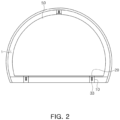
- FIG. 2 is a front view of the in-cabin partition according to an example of the present disclosure
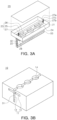
- FIG. 3A and 3B are perspective views illustrating a first driver, where FIG. 3A is a perspective view of a slider, and FIG. 3B is a perspective view of a rail.
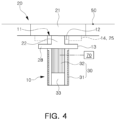
- FIG. 4 is a cross-sectional view illustrating the first driver.
- the in-cabin partition may include at least one rail 10, a slider 20, a first driver 30, and a partition body 50.
- At least one rail 10 may be disposed on a floor and/or a ceiling of a cabin 1 in a longitudinal direction of the cabin (e.g., in a front/rear direction of the cabin).
- the rail 10 may be formed at least partially of a conductive material, such as a metal.
- the rail 10 may form a groove 11 therein that extends in the longitudinal direction of the rail 10.
- the groove 11 may have a substantially cross-shaped cross-section (e.g., transverse to the longitudinal direction).
- the groove 11 may include a main groove 12 and a separation prevention groove 13 formed in a direction crossing the main groove and extending in a longitudinal direction of the rail 10.
- the main groove 12 may be exposed to the outside through an opening of the groove 11 through a surface of the rail 10.
- a plurality of locking grooves 14 spaced apart from each other at intervals in the longitudinal direction of the rail 10 may be formed in at least one edge of the groove 11.
- the at least one rail 10 is disposed on the floor and/or the ceiling of the cabin 1 is illustrated and described, the present disclosure is not limited thereto, and for example, the rail 10 may be installed on a sidewall of the cabin 1.
- the rail 10 may serve to guide a movement of the partition body 50 and form a portion of the first driver 30 to provide moving force to the partition body 50. Furthermore, the rail 10 may be electrically connected to the power source and configured to allow a current to flow through the rail 10 so that a current may be applied to a coil of the first driver through the slider 20.
- the slider 20 may be inserted into the rail 10. That is, the slider may be inserted into the main groove 12 of the groove 11, and may slide forwards and backwards in the longitudinal direction of the rail 10 in the groove 11 of the rail 10.
- the slider 20 may have a cross-sectional shape corresponding to a cross-sectional shape of the groove 11 of the rail 10 (e.g., the transverse cross-sectional shape of the groove 11).
- the slider 20 may be formed to be substantially T-shaped.
- the slider 20 may include a support 21 (e.g., a flat support 21) supporting the partition body 50 and an insertion portion 22 orthogonally connected to the support 21 and configured to be inserted into the main groove 12 of the groove 11.
- At least the support 21 may be formed to have a hollow portion, and may include a position fixing unit 23 installed to extend outside of or retract inside of the hollow portion. To this end, at least one through-hole 24 may be formed in one side surface of the support 21.
- the position fixing unit 23 may include at least one stud 25, a frame 26 connected to the stud 25, and a second driver 27 installed in the hollow portion of the support 21 to provide driving force for moving the frame 26.
- the stud 25 may be, for example, a pillar with a substantially semicircular cross-section, and may be inserted into the corresponding locking groove 14 while being shape-fitted to one of the plurality of locking grooves 14 of the rail 10.
- the shape of the stud 25 is not necessarily limited thereto and may have any other polygonal and/or elliptical and/or irregular cross-sectional shape.
- the frame 26 may connect the stud 25 and the second driver 27 and may serve as a stopper for preventing the stud 25 from being completely separated from the support 21 through the through-hole 24.
- the frame 26 may connect the plurality of studs 25 so that these studs 25 can move integrally.
- a rack and a pinion mechanism may be adopted as the second driver 27.
- the second driver 27 may include a motor 27a installed in the frame 26, a pinion gear 27b connected to a motor shaft of the motor 27a, and a rack gear 27c installed in the hollow portion of the support 21 to engage with the pinion gear 27b.
- the pinion gear 27b connected to the motor shaft of the motor 27a rotates by the driving force of the motor 27a
- the pinion gear 27b moves along the rack gear 27c while rotating by engaging with the rack gear 27c.
- the stud 25 may protrude from the support 21 through the through-hole 24 while the frame 26 and at least one stud 25 move along with the movement of the pinion gear 27b.
- the protruding stud 25 may be inserted into the corresponding locking groove 14 while being shape-fitted to one of the plurality of locking grooves 14 of the rail 10. Accordingly, the position of the slider 20 with respect to the rail 10 may be determined to be fixed.
- the motor 27a may rotate forwards and/or backwards according to an application of power.
- the stud 25 may reciprocate with driving force according to the operation of the motor 27a, and the stud 25 may protrude from a surface of the support 21 or may be immersed (e.g., retract) into the hollow portion of the support 21 based on the driving force.
- the second driver 27 may be provided in pairs to implement a stable operation of the stud 25.
- the configuration of the second driver 27 is not limited to the above-described example, and, for example, a fluid pressure cylinder such as a pneumatic cylinder, and an electric actuator such as a solenoid actuator, which have an operating rod, may be adopted as the second driver 27.
- the insertion portion 22 may include a separation prevention portion 28 formed to protrude in a direction crossing a movement direction of the slider 20 and configured to be insertable into the separation prevention groove 13 of the groove 11.
- the separation prevention portion 28 and the separation prevention groove 13 may constitute a means for preventing the slider 20 from being separated from the rail 10 in a height direction of the cabin 1 when the in-cabin partition according to an example of the present disclosure is connected to the floor and the ceiling of the cabin 1 of the mobility vehicle.
- the in-cabin partition may be continuously and stably supported by the floor and/or the ceiling of the cabin 1 for any movement of the mobility vehicle.
- the rail 10 and the slider 20 may form a portion of the first driver 30.
- the first driver 30 of the in-cabin partition according to an example of the present disclosure may adopt a linear motor.
- a plurality of permanent magnets 31 may be arranged on an internal wall of the rail 10 in the longitudinal direction of the rail 10, and coils 32 may be wound and/or stacked on the insertion portion 22 of the slider 20.
- the plurality of permanent magnets 31 may be disposed on each internal wall of the rail 10 such that different polarities may be alternately arranged, but may be aligned with permanent magnets on the opposite inner wall such that the magnet portions having the same polarity may face each other.
- Each of the permanent magnets 31 may be fixed to the rail using any suitable technology such as, for example, an adhesive, a fastener, or the like.
- the coils 32 may be wound and/or stacked on the insertion portion 22 of the slider 20 so as to form a magnetic void that faces the surfaces of the permanent magnets 31.
- An appropriate current for the position of the permanent magnet 31 is applied to the coil 32 at every phase to generate a magnetic flux around the coil 32, and such a magnetic flux may interact with a magnetic flux of the permanent magnet 31, thus generating electromagnetic force (e.g., a moving force).
- the slider 20 may be linearly movable in the rail 10.
- the coils 32 and the permanent magnets 31 are not in physical contact with each other. A change in the magnetic flux may occur when a current flows through the coil 32, and accordingly, the moving force may be generated between the coils 32 and the permanent magnets 31.
- a current may have a positive (+) value, zero (0), and/or a negative (-) value at different times (e.g., at regular intervals).
- the direction and/or magnitude of the current in the coil 32 may be applied to generate positive moving force in some or all coils, given a direction of the magnetic flux generated by the permanent magnet 31. Accordingly, a linear movement may be performed in a single direction.
- a current for generating negative moving force may be provided to some or all coils 32.
- the permanent magnet 31 may be installed on the rail 10 to fix a position thereof, and the coils 32 may be disposed on the slider 20 to move the coils, but the present disclosure is not limited thereto.
- the coils 32 may be installed on the slider 20 and the permanent magnets may be disposed on the rail so that the permanent magnets 31 move with the slider.
- the in-cabin partition according to an example of the present disclosure may selectively further include a connection terminal 33, mounted on the slider 20 so as to be disposed between the rail 10 and the slider 20, which may be configured to slide while in contact with the rail 10, and which may be electrically connected to the rail, through which the current flows.
- a connection terminal 33 mounted on the slider 20 so as to be disposed between the rail 10 and the slider 20, which may be configured to slide while in contact with the rail 10, and which may be electrically connected to the rail, through which the current flows.
- connection terminal 33 may be formed of a conductor.
- the connection terminal may be made of a material having excellent electrical conductivity, and may be fixedly installed in an end of the insertion portion 22 of the slider 20 using any suitable technology, such as an adhesive and/or a fastener.
- the connection terminal 33 may be electrically connected to the coil 32.
- connection terminal 33 may slide with the slider 20 to continuously contact an internal surface of the rail. Through such contact, the connection terminal 33 may transmit the current applied from the rail 10 to the coil 32 and supply the power source to the first driver 30.
- the partition body 50 may be fixedly installed on the slider 20.
- a plurality of sliders 20 may be connected to a lower end of the partition body 50, and at least one slider 20 may be connected to an upper end of the partition body 50.
- the partition body 50 may comprise, for example, a substantially plate-shaped member having a predetermined thickness.
- the shape of the partition body 50 is not necessarily limited thereto and may be formed to have any other shape.
- the partition body 50 may comprise a plurality of horizontal frames and/or a plurality of vertical frames and may form a plurality of storage spaces. A passenger's baggage may be accommodated in the storage spaces.
- a lighting fixture, a refrigerator, or a heating device may be installed in the partition body 50.
- the power of such electric appliances may be obtained through the connection terminal 33 in contact with the rail 10 through which current flows.
- the partition body 50 may be fixedly coupled to the slider 40 using any suitable technique, such as welding or a fastener. Accordingly, the partition body 50 may move linearly according to the movement of the slider 20.
- the in-cabin partition according to an example of the present disclosure is disposed across the cabin 1 inside the cabin 1 in a transverse direction (e.g., width direction) of the cabin 1 (e.g., so as to at least block a corridor in the cabin 1).
- the in-cabin partition may further include a controller 70 configured to control one or more operations of the first driver 30 and/or the second driver 27 so as to selectively cause movement of the in-cabin partition.
- the controller 70 may be communicatively connected to the first driver 30 and/or the second driver 27 through, for example, at least one of wired communication, wireless communication, and/or a combination of wired and wireless communications.
- the controller 70 may be configured to transmit a control signal to each of the drivers 30 or 27 through a controller area network (CAN).
- CAN controller area network
- the controller 70 may be a computing device comprising a memory, a processor, a microprocessor, or the like.
- the memory may store an algorithm and/or instructions for controlling components of the first driver 30 or the second driver 27. Specifically, the memory may store an algorithm and/or instructions for controlling an operation of the corresponding motor.
- the controller 70 may also, or alternatively, store data for a program reproducing the algorithm.
- the processor or microprocessor may execute the stored algorithm or instructions to cause performance of predetermined control of the components of each driver (e.g., the corresponding motor) using data stored in the memory.
- controller 70 may be merged into or used in, for example, a control system of the mobility vehicle.
- the controller 70 may control an overall operation of the in-cabin partition according to an example of the present disclosure.
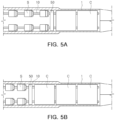
- FIG. 5A and 5B are plan views illustrating the mobility vehicle to which the in-cabin partition is applied according to an example of the present disclosure
- FIG. 6 is a view illustrating a seat applied with the in-cabin partition according to an example of the present disclosure.
- a layout of the cabin 1 may be changed and an internal space of the cabin 1 may be redistributed and reconstructed depending on the number of passengers or the capacity of a cargo C input to the controller 70 in advance.
- Some of passenger seats S may be removed or a volume of the seat S may be reduced by folding a cushion thereof upward.
- some of the passenger seats S may be added or a gap between seat rows may be adjusted so as to accommodate more passengers.
- the rail 10, the slider 20, and the first driver 30 of the present disclosure may be applied to one or more seats S.
- the one or more seats S may be installed on the support 21 of the slider 20, and the rail 10 and the slider 20 may form a portion of the first driver having the linear motor.
- the one or more seats S may comprise the connection terminal 33, mounted on the slider 20 so as to be disposed between the rail 10 and the slider 20, which may slide while in contact with the rail 10, and which is electrically connected to the rail 10 through which current may flow.
- the seat S may be provided with motors for adjusting angles of a backrest and/or a cushion or rotation of the seat S, a monitor, a lighting lamp, a ventilation device, a heating device, and/or the like.
- the power of such electric appliances may be obtained through the connection terminal 33 in contact with the rail 10 through which current may flow.
- the one or more seats S may be controlled to move along the rail 10, thereby providing easily adjustment of the space for the passengers in the cabin 1.
- the one or more seats may be easily connected to the power source for convenience.
- the controller 70 may control the first driver 30 of the in-cabin partition to linearly move the in-cabin partition along the rail 10 so that the in-cabin partition may be placed in an appropriate position within the cabin 1 (e.g., a desired position based on a number of passengers and/or cargo C).
- the controller 70 may control the second driver 27 to operate the stud 25, thereby fixing the position of the in-cabin partition.
- the cargo C may be loaded in the remaining space in the cabin 1.
- a single mobility vehicle may be utilized for various purposes, thereby reducing costs and maximizing profits.
- the present disclosure provides an in-cabin partition and a mobility vehicle including the same for automatically adjusting a size of a space for passengers and cargo according to circumstances and needs.
- the in-cabin partition may include at least one rail installed in a cabin, a slider movable along the rail, a first driver mounted on the rail and the slider and configured to provide driving force for moving the slider, and a partition body fixed on the slider.
- the rail may include a groove formed to extend in a longitudinal direction thereof, the groove may include a main groove and a separation prevention groove formed in a direction crossing the main groove and extending in the longitudinal direction of the rail, the slider may include a flat support configured to support the partition body and an insertion portion connected to the support orthogonally and inserted into the main groove, and the insertion portion may include a separation prevention portion formed to protrude from the insertion portion and configured to be insertable into the separation prevention groove.
- a plurality of locking grooves spaced apart from each other at intervals in the longitudinal direction of the rail may be formed in at least one edge of the groove, and the support may include a hollow portion, a position fixing unit installed to appear outside or disappear inside the hollow portion, and at least one through-hole formed in one side surface thereof.
- the position fixing unit may include at least one stud, a frame connected to the stud, and a second driver installed in the hollow portion and configured to provide driving force for moving the frame, and the stud may be inserted into one of the plurality of locking grooves through the through-hole.
- the second driver includes a motor installed in the frame, a pinion gear connected to a motor shaft of the motor, and a rack gear installed in the hollow portion of the support and configured to engage with the pinion gear.
- the first driver may be a linear motor, and one of the rail and the slider may include a plurality of permanent magnets arranged in the longitudinal direction, and the other thereof may be provided with coils, the coils being wound or stacked.
- the in-cabin partition may further include a connection terminal mounted on the slider, configured to slide while coming into the contact with the rail, and electrically connected to the rail through which a current flows, and the connection terminal may be electrically connected to the first driver.
- a mobility vehicle may include a cabin provided with a plurality of passenger seats, and the in-cabin partition.
- One or more of the seats may be mounted on a slider movable along the rail, and one of the rail or the slider may include a plurality of permanent magnets arranged in a longitudinal direction, and the other thereof may be provided with coils, the coils being wound or stacked.
- the mobility vehicle may further include a connection terminal mounted on the slider, configured to slide while coming into the contact with the rail, and electrically connected to the rail through which a current flows, and the connection terminal may be electrically connected to the coil.
Landscapes
- Engineering & Computer Science (AREA)
- Aviation & Aerospace Engineering (AREA)
- Mechanical Engineering (AREA)
- Transportation (AREA)
- Seats For Vehicles (AREA)
- Power-Operated Mechanisms For Wings (AREA)
Abstract
Description
- The present disclosure relates to an in-cabin partition, and a mobility vehicle including the same, that allows for automatically adjusting the size of a space in the mobility vehicle for passengers and/or cargo according to circumstances and/or needs.
- Efficient passenger boarding and cargo loading are required to maximize the number of aircraft flights performed at a given time. The aircraft should be designed to optimally use an interior space with respect to the number of passengers and cargo capacity.
- Conventional commercial aircraft may include an upper deck that is almost exclusively used for transporting passengers, and a lower deck that is exclusively used for transporting cargo.
- However, even if aircraft are configured with a double deck, it is impossible to utilize extra or unoccupied room in a cabin or an upper deck so as to carry more cargo, for example, in a flight with few or no passengers.
- The following summary presents a simplified summary of certain features. The summary is not an extensive overview and is not intended to identify key or critical elements.
- Systems, apparatuses, and methods are described for an in-cabin partition and operation thereof. The in-cabin partition may comprise at least one rail installed in a cabin, a slider movable along the rail, a first driver connected to the rail and the slider and configured to provide a driving force for moving the slider, and a partition body fixed on the slider.
- Also, or alternatively, a mobility vehicle may comprise a cabin provided with a plurality of seats and an in-cabin partition according to the present disclosure.
- These and other features and advantages are described in greater detail below.
- The above and other aspects, features, and advantages of the present disclosure will be more clearly understood from the following detailed description, taken in conjunction with the accompanying drawings, in which:
-
FIG. 1 is a side view of an in-cabin partition according to an example of the present disclosure; -
FIG. 2 is a front view of the in-cabin partition according to an example of the present disclosure; -
FIG. 3A and 3B are perspective views illustrating a first driver; -
FIG. 4 is a cross-sectional view illustrating the first driver; -
FIG. 5A and 5B are plan views illustrating a mobility vehicle to which the in-cabin partition is applied according to an example of the present disclosure; and -
FIG. 6 is a view illustrating a seat applied with the in-cabin partition according to an example of the present disclosure. - Hereinafter, some aspects of the present disclosure will be described in detail with reference to the accompanying drawings. In designating elements of the drawings by reference numerals, the same elements will be designated by the same reference numerals although they are shown in different drawings.
- For convenience of description, the present disclosure is described as an exemplary application to an air mobility vehicle with a cabin, but the present disclosure is not necessarily limited thereto. For example, the present disclosure may be applied to any mobility vehicle (e.g., an air mobility vehicle, a water or underwater mobility vehicle, a land mobility vehicle, an all- or multi- terrain mobility vehicle, etc.) with a cabin or an interior.
- In addition, it will be understood that, although the terms first, second, etc., may be used herein to describe various elements, these elements should not be limited in order, size, location, or importance by these terms, and these terms are only used to distinguish one element from another.
-
FIG. 1 is a side view of an in-cabin partition according to an example of the present disclosure,FIG. 2 is a front view of the in-cabin partition according to an example of the present disclosure, andFIG. 3A and 3B are perspective views illustrating a first driver, whereFIG. 3A is a perspective view of a slider, andFIG. 3B is a perspective view of a rail.FIG. 4 is a cross-sectional view illustrating the first driver. - The in-cabin partition according to an example of the present disclosure may include at least one
rail 10, aslider 20, afirst driver 30, and apartition body 50. - At least one
rail 10 may be disposed on a floor and/or a ceiling of a cabin 1 in a longitudinal direction of the cabin (e.g., in a front/rear direction of the cabin). Therail 10 may be formed at least partially of a conductive material, such as a metal. Therail 10 may form agroove 11 therein that extends in the longitudinal direction of therail 10. - The
groove 11 may have a substantially cross-shaped cross-section (e.g., transverse to the longitudinal direction). Thegroove 11 may include amain groove 12 and aseparation prevention groove 13 formed in a direction crossing the main groove and extending in a longitudinal direction of therail 10. Themain groove 12 may be exposed to the outside through an opening of thegroove 11 through a surface of therail 10. - In addition, a plurality of
locking grooves 14 spaced apart from each other at intervals in the longitudinal direction of therail 10 may be formed in at least one edge of thegroove 11. - Although an example in which the at least one
rail 10 is disposed on the floor and/or the ceiling of the cabin 1 is illustrated and described, the present disclosure is not limited thereto, and for example, therail 10 may be installed on a sidewall of the cabin 1. - In the in-cabin partition according to an example of the present disclosure, the
rail 10 may serve to guide a movement of thepartition body 50 and form a portion of thefirst driver 30 to provide moving force to thepartition body 50. Furthermore, therail 10 may be electrically connected to the power source and configured to allow a current to flow through therail 10 so that a current may be applied to a coil of the first driver through theslider 20. - The
slider 20 may be inserted into therail 10. That is, the slider may be inserted into themain groove 12 of thegroove 11, and may slide forwards and backwards in the longitudinal direction of therail 10 in thegroove 11 of therail 10. - To this end, the
slider 20 may have a cross-sectional shape corresponding to a cross-sectional shape of thegroove 11 of the rail 10 (e.g., the transverse cross-sectional shape of the groove 11). For example, theslider 20 may be formed to be substantially T-shaped. Accordingly, theslider 20 may include a support 21 (e.g., a flat support 21) supporting thepartition body 50 and aninsertion portion 22 orthogonally connected to thesupport 21 and configured to be inserted into themain groove 12 of thegroove 11. - At least the
support 21 may be formed to have a hollow portion, and may include aposition fixing unit 23 installed to extend outside of or retract inside of the hollow portion. To this end, at least one through-hole 24 may be formed in one side surface of thesupport 21. - The
position fixing unit 23 may include at least onestud 25, aframe 26 connected to thestud 25, and asecond driver 27 installed in the hollow portion of thesupport 21 to provide driving force for moving theframe 26. - The
stud 25 may be, for example, a pillar with a substantially semicircular cross-section, and may be inserted into thecorresponding locking groove 14 while being shape-fitted to one of the plurality oflocking grooves 14 of therail 10. However, the shape of thestud 25 is not necessarily limited thereto and may have any other polygonal and/or elliptical and/or irregular cross-sectional shape. - The
frame 26 may connect thestud 25 and thesecond driver 27 and may serve as a stopper for preventing thestud 25 from being completely separated from thesupport 21 through the through-hole 24. In addition, when a plurality ofstuds 25 are provided, theframe 26 may connect the plurality ofstuds 25 so that thesestuds 25 can move integrally. - A rack and a pinion mechanism may be adopted as the
second driver 27. For example, thesecond driver 27 may include amotor 27a installed in theframe 26, apinion gear 27b connected to a motor shaft of themotor 27a, and arack gear 27c installed in the hollow portion of thesupport 21 to engage with thepinion gear 27b. - When the
pinion gear 27b connected to the motor shaft of themotor 27a rotates by the driving force of themotor 27a, thepinion gear 27b moves along therack gear 27c while rotating by engaging with therack gear 27c. Accordingly, thestud 25 may protrude from thesupport 21 through the through-hole 24 while theframe 26 and at least onestud 25 move along with the movement of thepinion gear 27b. - The protruding
stud 25 may be inserted into thecorresponding locking groove 14 while being shape-fitted to one of the plurality oflocking grooves 14 of therail 10. Accordingly, the position of theslider 20 with respect to therail 10 may be determined to be fixed. - The
motor 27a may rotate forwards and/or backwards according to an application of power. Thestud 25 may reciprocate with driving force according to the operation of themotor 27a, and thestud 25 may protrude from a surface of thesupport 21 or may be immersed (e.g., retract) into the hollow portion of thesupport 21 based on the driving force. - The
second driver 27 may be provided in pairs to implement a stable operation of thestud 25. The configuration of thesecond driver 27 is not limited to the above-described example, and, for example, a fluid pressure cylinder such as a pneumatic cylinder, and an electric actuator such as a solenoid actuator, which have an operating rod, may be adopted as thesecond driver 27. - In addition, the
insertion portion 22 may include aseparation prevention portion 28 formed to protrude in a direction crossing a movement direction of theslider 20 and configured to be insertable into theseparation prevention groove 13 of thegroove 11. - The
separation prevention portion 28 and theseparation prevention groove 13 may constitute a means for preventing theslider 20 from being separated from therail 10 in a height direction of the cabin 1 when the in-cabin partition according to an example of the present disclosure is connected to the floor and the ceiling of the cabin 1 of the mobility vehicle. - Accordingly, the in-cabin partition may be continuously and stably supported by the floor and/or the ceiling of the cabin 1 for any movement of the mobility vehicle.
- In the in-cabin partition according to an example of the present disclosure, the
rail 10 and theslider 20 may form a portion of thefirst driver 30. For example, thefirst driver 30 of the in-cabin partition according to an example of the present disclosure may adopt a linear motor. - To this end, a plurality of
permanent magnets 31 may be arranged on an internal wall of therail 10 in the longitudinal direction of therail 10, and coils 32 may be wound and/or stacked on theinsertion portion 22 of theslider 20. - The plurality of
permanent magnets 31 may be disposed on each internal wall of therail 10 such that different polarities may be alternately arranged, but may be aligned with permanent magnets on the opposite inner wall such that the magnet portions having the same polarity may face each other. Each of thepermanent magnets 31 may be fixed to the rail using any suitable technology such as, for example, an adhesive, a fastener, or the like. - The
coils 32 may be wound and/or stacked on theinsertion portion 22 of theslider 20 so as to form a magnetic void that faces the surfaces of thepermanent magnets 31. An appropriate current for the position of thepermanent magnet 31 is applied to thecoil 32 at every phase to generate a magnetic flux around thecoil 32, and such a magnetic flux may interact with a magnetic flux of thepermanent magnet 31, thus generating electromagnetic force (e.g., a moving force). Accordingly, theslider 20 may be linearly movable in therail 10. - The
coils 32 and thepermanent magnets 31 are not in physical contact with each other. A change in the magnetic flux may occur when a current flows through thecoil 32, and accordingly, the moving force may be generated between thecoils 32 and thepermanent magnets 31. - For example, a current may have a positive (+) value, zero (0), and/or a negative (-) value at different times (e.g., at regular intervals). The direction and/or magnitude of the current in the
coil 32 may be applied to generate positive moving force in some or all coils, given a direction of the magnetic flux generated by thepermanent magnet 31. Accordingly, a linear movement may be performed in a single direction. When a reverse movement is required, a current for generating negative moving force may be provided to some or all coils 32. - In the in-cabin partition according to an example of the present disclosure, the
permanent magnet 31 may be installed on therail 10 to fix a position thereof, and thecoils 32 may be disposed on theslider 20 to move the coils, but the present disclosure is not limited thereto. Thecoils 32 may be installed on theslider 20 and the permanent magnets may be disposed on the rail so that thepermanent magnets 31 move with the slider. - The in-cabin partition according to an example of the present disclosure may selectively further include a
connection terminal 33, mounted on theslider 20 so as to be disposed between therail 10 and theslider 20, which may be configured to slide while in contact with therail 10, and which may be electrically connected to the rail, through which the current flows. - The
connection terminal 33 may be formed of a conductor. The connection terminal may be made of a material having excellent electrical conductivity, and may be fixedly installed in an end of theinsertion portion 22 of theslider 20 using any suitable technology, such as an adhesive and/or a fastener. Theconnection terminal 33 may be electrically connected to thecoil 32. - Accordingly, within the
rail 10, which may be electrically connected to a power source (not illustrated) and through which the current may flow from the power source, theconnection terminal 33 may slide with theslider 20 to continuously contact an internal surface of the rail. Through such contact, theconnection terminal 33 may transmit the current applied from therail 10 to thecoil 32 and supply the power source to thefirst driver 30. - In the in-cabin partition according to an example of the present disclosure, the
partition body 50 may be fixedly installed on theslider 20. For example, in order to implement stable support and movement of thepartition body 50, a plurality ofsliders 20 may be connected to a lower end of thepartition body 50, and at least oneslider 20 may be connected to an upper end of thepartition body 50. - The
partition body 50 may comprise, for example, a substantially plate-shaped member having a predetermined thickness. However, the shape of thepartition body 50 is not necessarily limited thereto and may be formed to have any other shape. - For example, the
partition body 50 may comprise a plurality of horizontal frames and/or a plurality of vertical frames and may form a plurality of storage spaces. A passenger's baggage may be accommodated in the storage spaces. - In addition, a lighting fixture, a refrigerator, or a heating device may be installed in the
partition body 50. The power of such electric appliances may be obtained through theconnection terminal 33 in contact with therail 10 through which current flows. - The
partition body 50 may be fixedly coupled to the slider 40 using any suitable technique, such as welding or a fastener. Accordingly, thepartition body 50 may move linearly according to the movement of theslider 20. - As illustrated in
FIGS. 1 and2 , the in-cabin partition according to an example of the present disclosure is disposed across the cabin 1 inside the cabin 1 in a transverse direction (e.g., width direction) of the cabin 1 (e.g., so as to at least block a corridor in the cabin 1). - The in-cabin partition according to an example of the present disclosure may further include a
controller 70 configured to control one or more operations of thefirst driver 30 and/or thesecond driver 27 so as to selectively cause movement of the in-cabin partition. - The
controller 70 may be communicatively connected to thefirst driver 30 and/or thesecond driver 27 through, for example, at least one of wired communication, wireless communication, and/or a combination of wired and wireless communications. For example, thecontroller 70 may be configured to transmit a control signal to each of thedrivers - The
controller 70 may be a computing device comprising a memory, a processor, a microprocessor, or the like. The memory may store an algorithm and/or instructions for controlling components of thefirst driver 30 or thesecond driver 27. Specifically, the memory may store an algorithm and/or instructions for controlling an operation of the corresponding motor. Thecontroller 70 may also, or alternatively, store data for a program reproducing the algorithm. The processor or microprocessor may execute the stored algorithm or instructions to cause performance of predetermined control of the components of each driver (e.g., the corresponding motor) using data stored in the memory. - In addition, the
controller 70 may be merged into or used in, for example, a control system of the mobility vehicle. Thecontroller 70 may control an overall operation of the in-cabin partition according to an example of the present disclosure. -
FIG. 5A and 5B are plan views illustrating the mobility vehicle to which the in-cabin partition is applied according to an example of the present disclosure, andFIG. 6 is a view illustrating a seat applied with the in-cabin partition according to an example of the present disclosure. - For example, before the operation of the mobility vehicle, a layout of the cabin 1 may be changed and an internal space of the cabin 1 may be redistributed and reconstructed depending on the number of passengers or the capacity of a cargo C input to the
controller 70 in advance. Some of passenger seats S may be removed or a volume of the seat S may be reduced by folding a cushion thereof upward. Conversely, some of the passenger seats S may be added or a gap between seat rows may be adjusted so as to accommodate more passengers. - Also, or alternatively, (see, e.g.,
FIG. 6 ) therail 10, theslider 20, and thefirst driver 30 of the present disclosure may be applied to one or more seats S. In other words, the one or more seats S may be installed on thesupport 21 of theslider 20, and therail 10 and theslider 20 may form a portion of the first driver having the linear motor. - Also, or alternatively, the one or more seats S may comprise the
connection terminal 33, mounted on theslider 20 so as to be disposed between therail 10 and theslider 20, which may slide while in contact with therail 10, and which is electrically connected to therail 10 through which current may flow. - The seat S may be provided with motors for adjusting angles of a backrest and/or a cushion or rotation of the seat S, a monitor, a lighting lamp, a ventilation device, a heating device, and/or the like. The power of such electric appliances may be obtained through the
connection terminal 33 in contact with therail 10 through which current may flow. - In such a configuration, the one or more seats S (e.g., each seat S individually, and/or each row of the seats S) may be controlled to move along the
rail 10, thereby providing easily adjustment of the space for the passengers in the cabin 1. - In addition, the one or more seats (e.g., each of the seats S and/or each seat row of seats S) may be easily connected to the power source for convenience.
- After the space for the passengers is adjusted as described above, the
controller 70 may control thefirst driver 30 of the in-cabin partition to linearly move the in-cabin partition along therail 10 so that the in-cabin partition may be placed in an appropriate position within the cabin 1 (e.g., a desired position based on a number of passengers and/or cargo C). After the position of the in-cabin partition is determined, thecontroller 70 may control thesecond driver 27 to operate thestud 25, thereby fixing the position of the in-cabin partition. - After passenger boarding is completed, the cargo C may be loaded in the remaining space in the cabin 1.
- As described above, according to an example of the present disclosure, it is possible to significantly reduce the time and process required for changing the layout in the cabin 1 of the mobility vehicle.
- In addition, according to an example of the present disclosure, a single mobility vehicle may be utilized for various purposes, thereby reducing costs and maximizing profits.
- The present disclosure provides an in-cabin partition and a mobility vehicle including the same for automatically adjusting a size of a space for passengers and cargo according to circumstances and needs.
- The in-cabin partition may include at least one rail installed in a cabin, a slider movable along the rail, a first driver mounted on the rail and the slider and configured to provide driving force for moving the slider, and a partition body fixed on the slider.
- The rail may include a groove formed to extend in a longitudinal direction thereof, the groove may include a main groove and a separation prevention groove formed in a direction crossing the main groove and extending in the longitudinal direction of the rail, the slider may include a flat support configured to support the partition body and an insertion portion connected to the support orthogonally and inserted into the main groove, and the insertion portion may include a separation prevention portion formed to protrude from the insertion portion and configured to be insertable into the separation prevention groove.
- A plurality of locking grooves spaced apart from each other at intervals in the longitudinal direction of the rail may be formed in at least one edge of the groove, and the support may include a hollow portion, a position fixing unit installed to appear outside or disappear inside the hollow portion, and at least one through-hole formed in one side surface thereof.
- The position fixing unit may include at least one stud, a frame connected to the stud, and a second driver installed in the hollow portion and configured to provide driving force for moving the frame, and the stud may be inserted into one of the plurality of locking grooves through the through-hole.
- The second driver includes a motor installed in the frame, a pinion gear connected to a motor shaft of the motor, and a rack gear installed in the hollow portion of the support and configured to engage with the pinion gear.
- The first driver may be a linear motor, and one of the rail and the slider may include a plurality of permanent magnets arranged in the longitudinal direction, and the other thereof may be provided with coils, the coils being wound or stacked.
- The in-cabin partition may further include a connection terminal mounted on the slider, configured to slide while coming into the contact with the rail, and electrically connected to the rail through which a current flows, and the connection terminal may be electrically connected to the first driver.
- A mobility vehicle may include a cabin provided with a plurality of passenger seats, and the in-cabin partition.
- One or more of the seats may be mounted on a slider movable along the rail, and one of the rail or the slider may include a plurality of permanent magnets arranged in a longitudinal direction, and the other thereof may be provided with coils, the coils being wound or stacked.
- The mobility vehicle may further include a connection terminal mounted on the slider, configured to slide while coming into the contact with the rail, and electrically connected to the rail through which a current flows, and the connection terminal may be electrically connected to the coil.
- Although examples of the present disclosure have been described for illustrative purposes, those skilled in the art will appreciate that various changes and modifications are possible, without departing from essential characteristics of the disclosure.
- Accordingly, the examples disclosed in the present disclosure are intended to illustrate the scope of the technical idea of the present disclosure, and the scope of the present disclosure is not limited by the example. The scope of the present disclosure shall be construed on the basis of the accompanying claims in such a manner that all of the technical ideas included within the scope equivalent to the claims belong to the present disclosure.
Claims (10)
- An in-cabin partition comprising:at least one rail installed in a cabin;a slider movable along the rail;a first driver connected to the rail and the slider and configured to provide a driving force for moving the slider; anda partition body fixed on the slider.
- The in-cabin partition according to claim 1, wherein the rail forms a groove that extends in a longitudinal direction thereof, the groove comprising:a main groove that extends in a first transverse direction of the rail and in a longitudinal direction of the rail, anda separation prevention groove that extends in a second transverse direction of the rail, so as to cross the main groove, and in the longitudinal direction of the rail;wherein the slider comprises a support configured to support the partition body and an insertion portion connected to the support orthogonally and configured to be inserted into the main groove; andwherein the insertion portion comprises a separation prevention portion formed to protrude from the insertion portion and configured to be inserted into the separation prevention groove.
- The in-cabin partition according to claim 2,wherein a plurality of locking grooves spaced apart from each other at intervals in the longitudinal direction of the rail are formed in at least one edge of the groove, andwherein the support comprises a hollow portion and a position fixing unit configured to protrude outside of or retract inside of the hollow portion via at least one through-hole formed in a side surface of the support.
- The in-cabin partition according to claim 3,wherein the position fixing unit comprises:at least one stud,a frame connected to the stud, anda second driver installed in the hollow portion and configured to provide driving force for moving the frame,wherein the at least one stud is configured to be inserted into at least one of the plurality of locking grooves via the at least one through-hole.
- The in-cabin partition according to claim 4, wherein the second driver comprises:a motor connected to the frame,a pinion gear connected to a motor shaft of the motor, anda rack gear in the hollow portion of the support and configured to engage with the pinion gear.
- The in-cabin partition according to any one of the preceding claims,wherein the first driver comprises a linear motor, andwherein one of the rail or the slider comprises a plurality of permanent magnets arranged in a longitudinal direction of the rail, and the other of the rail or the slider comprises coils that are wound or stacked.
- The in-cabin partition according to any one of the preceding claims, further comprising:
a connection terminal coupled to the slider so as to contact the rail when the slider is inserted in a groove of the rail, wherein the connection terminal is configured to be electrically connected to the rail, and electrically connected to the first driver. - A mobility vehicle comprising:a cabin provided with a plurality of seats; andan in-cabin partition comprising:at least one rail installed in the cabin;a slider movable along the rail;a first driver connected to the rail and the slider and configured to provide a driving force for moving the slider; anda partition body fixed on the slider.
- The mobility vehicle according to claim 8,wherein a seat, of the plurality of seats, is mounted on the slider, which is movable along the rail, andwherein one of the rail or the slider comprises a plurality of permanent magnets arranged in a longitudinal direction of the rail, and the other of the rail or the slider comprises coils that are wound or stacked.
- The mobility vehicle according to claim 9, further comprising:
a connection terminal coupled to the slider so as to contact the rail when the slider is inserted in a groove of the rail, wherein the connection terminal is configured to be electrically connected to the rail, and electrically connected to the coils.
Applications Claiming Priority (1)
| Application Number | Priority Date | Filing Date | Title |
|---|---|---|---|
| KR1020220177548A KR20240094885A (en) | 2022-12-16 | 2022-12-16 | In-cabin partition and mobility including the same |
Publications (1)
| Publication Number | Publication Date |
|---|---|
| EP4385880A1 true EP4385880A1 (en) | 2024-06-19 |
Family
ID=88020994
Family Applications (1)
| Application Number | Title | Priority Date | Filing Date |
|---|---|---|---|
| EP23197122.7A Pending EP4385880A1 (en) | 2022-12-16 | 2023-09-13 | In-cabin partition and mobility vehicle including the same |
Country Status (3)
| Country | Link |
|---|---|
| US (1) | US12434840B2 (en) |
| EP (1) | EP4385880A1 (en) |
| KR (1) | KR20240094885A (en) |
Citations (3)
| Publication number | Priority date | Publication date | Assignee | Title |
|---|---|---|---|---|
| US5816534A (en) * | 1995-07-20 | 1998-10-06 | Daimler-Benz Aerospace Airbus Gmbh | Aircraft cabin divider arrangement |
| DE10036551A1 (en) * | 2000-03-03 | 2001-09-06 | Ancra Jungfalk Gmbh & Co Kg | Car seat anchorage of floor rail and slide uses slide of end hinged elements to permit slide movement even in torqued rail assisted by seat-fitted holder engaging floor rail holes. |
| US20220010607A1 (en) * | 2020-07-10 | 2022-01-13 | Thompson Aero Seating Limited Address | Actuation system |
Family Cites Families (17)
| Publication number | Priority date | Publication date | Assignee | Title |
|---|---|---|---|---|
| US2396039A (en) * | 1941-11-10 | 1946-03-05 | Douglas Aircraft Co Inc | Aircraft interior |
| KR20010096284A (en) | 2000-04-18 | 2001-11-07 | 김윤철 | Vehicle |
| DE10211437A1 (en) * | 2002-03-05 | 2003-10-02 | Bishop Gmbh Aeronautical Engin | Process for adapting the row of seats in passenger aircraft as required |
| EP1626470B8 (en) * | 2004-08-12 | 2016-06-29 | Airbus Operations GmbH | Current distribution system for electric supply of rail-mounted installations in an aircraft |
| ATE473162T1 (en) * | 2005-03-03 | 2010-07-15 | Airbus Operations Gmbh | ARRANGEMENT OF A FIRST AND A SECOND FURNISHING ITEM |
| FR2926062B1 (en) * | 2008-01-04 | 2010-07-30 | Airbus France | DEVICE FOR FIXING A FURNITURE ELEMENT TO THE FLOOR OF AN AIRCRAFT. |
| JP5371500B2 (en) | 2009-03-17 | 2013-12-18 | 株式会社ジャムコ | Aircraft restroom door structure |
| DE102009034416B4 (en) | 2009-07-23 | 2011-06-30 | Airbus Operations GmbH, 21129 | Method and device for system installation and freight loading system |
| DE202011102248U1 (en) | 2011-06-21 | 2011-08-31 | Keiper Gmbh & Co. Kg | Longitudinally adjustable vehicle seat with kick protection |
| EP2886447A1 (en) | 2013-12-18 | 2015-06-24 | Airbus Operations, S.L. | A double-deck airplane |
| KR101770704B1 (en) | 2015-06-17 | 2017-09-05 | 동부대우전자 주식회사 | Adjust apparatus for inner volume of refrigerator and controlling method for the same |
| KR20170016546A (en) | 2015-08-03 | 2017-02-14 | 동아대학교 산학협력단 | Refrigerated container for transferring simultaneous of fresh cargo that different storage temperature |
| KR101901581B1 (en) | 2016-12-27 | 2018-09-27 | 한국항공우주산업 주식회사 | Ejection system for aircraft |
| US10479227B2 (en) * | 2017-07-10 | 2019-11-19 | GM Global Technology Operations LLC | Systems and methods for controlling automotive seat adjustments using electromagnetic rail technology |
| US11919643B2 (en) * | 2018-04-10 | 2024-03-05 | Rockwell Collins, Inc. | Self-deploying counter for multimode transformable monuments |
| DE102018211055B4 (en) * | 2018-07-04 | 2020-08-06 | Magna Seating (Germany) Gmbh | Locking and contacting system for the electrical connection of an electrical system of a motor vehicle to a removable vehicle seat or a seat system |
| US11584259B2 (en) * | 2020-01-17 | 2023-02-21 | The Boeing Company | Seat fittings for attaching seats to seat tracks in a vehicle and related systems and methods |
-
2022
- 2022-12-16 KR KR1020220177548A patent/KR20240094885A/en active Pending
-
2023
- 2023-05-15 US US18/197,349 patent/US12434840B2/en active Active
- 2023-09-13 EP EP23197122.7A patent/EP4385880A1/en active Pending
Patent Citations (3)
| Publication number | Priority date | Publication date | Assignee | Title |
|---|---|---|---|---|
| US5816534A (en) * | 1995-07-20 | 1998-10-06 | Daimler-Benz Aerospace Airbus Gmbh | Aircraft cabin divider arrangement |
| DE10036551A1 (en) * | 2000-03-03 | 2001-09-06 | Ancra Jungfalk Gmbh & Co Kg | Car seat anchorage of floor rail and slide uses slide of end hinged elements to permit slide movement even in torqued rail assisted by seat-fitted holder engaging floor rail holes. |
| US20220010607A1 (en) * | 2020-07-10 | 2022-01-13 | Thompson Aero Seating Limited Address | Actuation system |
Also Published As
| Publication number | Publication date |
|---|---|
| KR20240094885A (en) | 2024-06-25 |
| US12434840B2 (en) | 2025-10-07 |
| US20240199210A1 (en) | 2024-06-20 |
Similar Documents
| Publication | Publication Date | Title |
|---|---|---|
| EP4385893A1 (en) | In-cabin partition of mobility vehicle | |
| US11584261B2 (en) | Power seat track assembly | |
| JP4468811B2 (en) | Aircraft cabin internal layout | |
| US10246298B2 (en) | Ropeless elevator system | |
| TW200806562A (en) | Lift installation with a linear drive system and linear drive system for such a lift installation | |
| EP3077311B1 (en) | Linear propulsion system | |
| US12107467B2 (en) | Transport device | |
| US12388338B2 (en) | Transport device | |
| US10953780B2 (en) | Deployable infill assembly and passenger seat construction | |
| US10177641B2 (en) | Stator assembly including stator elements with slotted stator cores for use in an electrical motor | |
| JP2530382B2 (en) | Linear motor elevator | |
| EP4385880A1 (en) | In-cabin partition and mobility vehicle including the same | |
| WO2015084367A1 (en) | High speed ropeless elevator with different number of hoistways up and down in a group | |
| US20160297648A1 (en) | Stator reduction in ropeless elevator transfer station | |
| JP7200827B2 (en) | Mobile cabin set, mobile cabin, and cabin attachment | |
| JP2018020665A (en) | Automobile body | |
| US20100164306A1 (en) | Linear motor | |
| US20210188442A1 (en) | Seating arrangements | |
| KR102872950B1 (en) | Sliding unit for vehicle | |
| RU2748729C2 (en) | Systems and methods for braking or advancing mobile vehicle | |
| US11159049B2 (en) | Power supply system | |
| US20090302693A1 (en) | Linear Motor | |
| US9024487B1 (en) | Levitation with switchable inductive element and associated systems, devices, and methods | |
| EP4410676B1 (en) | Robot and in-cabin service system | |
| EP3795526A1 (en) | Device, elevator, and method for moving an elevator car of an elevator |
Legal Events
| Date | Code | Title | Description |
|---|---|---|---|
| PUAI | Public reference made under article 153(3) epc to a published international application that has entered the european phase |
Free format text: ORIGINAL CODE: 0009012 |
|
| STAA | Information on the status of an ep patent application or granted ep patent |
Free format text: STATUS: THE APPLICATION HAS BEEN PUBLISHED |
|
| AK | Designated contracting states |
Kind code of ref document: A1 Designated state(s): AL AT BE BG CH CY CZ DE DK EE ES FI FR GB GR HR HU IE IS IT LI LT LU LV MC ME MK MT NL NO PL PT RO RS SE SI SK SM TR |
|
| STAA | Information on the status of an ep patent application or granted ep patent |
Free format text: STATUS: REQUEST FOR EXAMINATION WAS MADE |
|
| 17P | Request for examination filed |
Effective date: 20240813 |
|
| RBV | Designated contracting states (corrected) |
Designated state(s): AL AT BE BG CH CY CZ DE DK EE ES FI FR GB GR HR HU IE IS IT LI LT LU LV MC ME MK MT NL NO PL PT RO RS SE SI SK SM TR |
|
| P01 | Opt-out of the competence of the unified patent court (upc) registered |
Free format text: CASE NUMBER: APP_17647/2025 Effective date: 20250410 |
|
| STAA | Information on the status of an ep patent application or granted ep patent |
Free format text: STATUS: EXAMINATION IS IN PROGRESS |
|
| 17Q | First examination report despatched |
Effective date: 20250711 |