EP4385782A1 - Structure for arranging intake air duct - Google Patents
Structure for arranging intake air duct Download PDFInfo
- Publication number
- EP4385782A1 EP4385782A1 EP21953023.5A EP21953023A EP4385782A1 EP 4385782 A1 EP4385782 A1 EP 4385782A1 EP 21953023 A EP21953023 A EP 21953023A EP 4385782 A1 EP4385782 A1 EP 4385782A1
- Authority
- EP
- European Patent Office
- Prior art keywords
- vehicle
- intake duct
- intake
- intake port
- air
- Prior art date
- Legal status (The legal status is an assumption and is not a legal conclusion. Google has not performed a legal analysis and makes no representation as to the accuracy of the status listed.)
- Withdrawn
Links
Images


Classifications
-
- B—PERFORMING OPERATIONS; TRANSPORTING
- B60—VEHICLES IN GENERAL
- B60K—ARRANGEMENT OR MOUNTING OF PROPULSION UNITS OR OF TRANSMISSIONS IN VEHICLES; ARRANGEMENT OR MOUNTING OF PLURAL DIVERSE PRIME-MOVERS IN VEHICLES; AUXILIARY DRIVES FOR VEHICLES; INSTRUMENTATION OR DASHBOARDS FOR VEHICLES; ARRANGEMENTS IN CONNECTION WITH COOLING, AIR INTAKE, GAS EXHAUST OR FUEL SUPPLY OF PROPULSION UNITS IN VEHICLES
- B60K13/00—Arrangement in connection with combustion air intake or gas exhaust of propulsion units
- B60K13/02—Arrangement in connection with combustion air intake or gas exhaust of propulsion units concerning intake
-
- B—PERFORMING OPERATIONS; TRANSPORTING
- B62—LAND VEHICLES FOR TRAVELLING OTHERWISE THAN ON RAILS
- B62D—MOTOR VEHICLES; TRAILERS
- B62D25/00—Superstructure or monocoque structure sub-units; Parts or details thereof not otherwise provided for
- B62D25/08—Front or rear portions
- B62D25/10—Bonnets or lids, e.g. for trucks, tractors, busses, work vehicles
-
- F—MECHANICAL ENGINEERING; LIGHTING; HEATING; WEAPONS; BLASTING
- F02—COMBUSTION ENGINES; HOT-GAS OR COMBUSTION-PRODUCT ENGINE PLANTS
- F02M—SUPPLYING COMBUSTION ENGINES IN GENERAL WITH COMBUSTIBLE MIXTURES OR CONSTITUENTS THEREOF
- F02M35/00—Combustion-air cleaners, air intakes, intake silencers, or induction systems specially adapted for, or arranged on, internal-combustion engines
- F02M35/02—Air cleaners
- F02M35/08—Air cleaners with means for removing dust, particles or liquids from cleaners; with means for indicating clogging; with by-pass means; Regeneration of cleaners
- F02M35/084—Dust collection chambers or discharge sockets, e.g. chambers fed by gravity or closed by a valve
-
- F—MECHANICAL ENGINEERING; LIGHTING; HEATING; WEAPONS; BLASTING
- F02—COMBUSTION ENGINES; HOT-GAS OR COMBUSTION-PRODUCT ENGINE PLANTS
- F02M—SUPPLYING COMBUSTION ENGINES IN GENERAL WITH COMBUSTIBLE MIXTURES OR CONSTITUENTS THEREOF
- F02M35/00—Combustion-air cleaners, air intakes, intake silencers, or induction systems specially adapted for, or arranged on, internal-combustion engines
- F02M35/10—Air intakes; Induction systems
- F02M35/10006—Air intakes; Induction systems characterised by the position of elements of the air intake system in direction of the air intake flow, i.e. between ambient air inlet and supply to the combustion chamber
- F02M35/10013—Means upstream of the air filter; Connection to the ambient air
-
- F—MECHANICAL ENGINEERING; LIGHTING; HEATING; WEAPONS; BLASTING
- F02—COMBUSTION ENGINES; HOT-GAS OR COMBUSTION-PRODUCT ENGINE PLANTS
- F02M—SUPPLYING COMBUSTION ENGINES IN GENERAL WITH COMBUSTIBLE MIXTURES OR CONSTITUENTS THEREOF
- F02M35/00—Combustion-air cleaners, air intakes, intake silencers, or induction systems specially adapted for, or arranged on, internal-combustion engines
- F02M35/10—Air intakes; Induction systems
- F02M35/10242—Devices or means connected to or integrated into air intakes; Air intakes combined with other engine or vehicle parts
- F02M35/10262—Flow guides, obstructions, deflectors or the like
-
- F—MECHANICAL ENGINEERING; LIGHTING; HEATING; WEAPONS; BLASTING
- F02—COMBUSTION ENGINES; HOT-GAS OR COMBUSTION-PRODUCT ENGINE PLANTS
- F02M—SUPPLYING COMBUSTION ENGINES IN GENERAL WITH COMBUSTIBLE MIXTURES OR CONSTITUENTS THEREOF
- F02M35/00—Combustion-air cleaners, air intakes, intake silencers, or induction systems specially adapted for, or arranged on, internal-combustion engines
- F02M35/10—Air intakes; Induction systems
- F02M35/10242—Devices or means connected to or integrated into air intakes; Air intakes combined with other engine or vehicle parts
- F02M35/10268—Heating, cooling or thermal insulating means
-
- F—MECHANICAL ENGINEERING; LIGHTING; HEATING; WEAPONS; BLASTING
- F02—COMBUSTION ENGINES; HOT-GAS OR COMBUSTION-PRODUCT ENGINE PLANTS
- F02M—SUPPLYING COMBUSTION ENGINES IN GENERAL WITH COMBUSTIBLE MIXTURES OR CONSTITUENTS THEREOF
- F02M35/00—Combustion-air cleaners, air intakes, intake silencers, or induction systems specially adapted for, or arranged on, internal-combustion engines
- F02M35/16—Combustion-air cleaners, air intakes, intake silencers, or induction systems specially adapted for, or arranged on, internal-combustion engines characterised by use in vehicles
- F02M35/161—Arrangement of the air intake system in the engine compartment, e.g. with respect to the bonnet or the vehicle front face
-
- B—PERFORMING OPERATIONS; TRANSPORTING
- B60—VEHICLES IN GENERAL
- B60K—ARRANGEMENT OR MOUNTING OF PROPULSION UNITS OR OF TRANSMISSIONS IN VEHICLES; ARRANGEMENT OR MOUNTING OF PLURAL DIVERSE PRIME-MOVERS IN VEHICLES; AUXILIARY DRIVES FOR VEHICLES; INSTRUMENTATION OR DASHBOARDS FOR VEHICLES; ARRANGEMENTS IN CONNECTION WITH COOLING, AIR INTAKE, GAS EXHAUST OR FUEL SUPPLY OF PROPULSION UNITS IN VEHICLES
- B60K11/00—Arrangement in connection with cooling of propulsion units
- B60K11/02—Arrangement in connection with cooling of propulsion units with liquid cooling
- B60K11/04—Arrangement or mounting of radiators, radiator shutters, or radiator blinds
Definitions
- the present invention relates to an arrangement structure of an intake duct.
- Patent Literature 1 discloses an intake duct mounting part structure of an automobile in which a radiator core support upper panel is formed with a C-shaped longitudinal section opening rearward and a plurality of air holes are provided in a vertical wall surface of the C-shaped section, and an inlet port of an intake duct is arranged behind the radiator core support upper panel.
- Patent Literature 1 Japanese Unexamined Patent Application Publication No. 2002-211252
- the air heated by a heat dump such as a radiator flows toward the intake port of the intake duct and may be sucked in the intake duct.
- An object of the present invention is to prevent the heated air from being taken in the intake duct.
- An arrangement structure of an intake duct includes an air inlet, a heat bump, an intake duct having an intake port, and a first shielding member.
- the first shielding member includes at least an upper wall defining an upper part of a flow path from the air inlet to the heat bump, and a side wall defining a side part of the flow path.
- the intake port is located above the upper wall.
- FR and RR denote front and rear in a vehicle longitudinal direction
- LH and RH denote left and right in a vehicle width direction
- UP and DN denote an upper side and a lower side in a vehicle vertical direction.
- front and rear in the vehicle longitudinal direction, left and right in the vehicle width direction, the upper side and the lower side in the vehicle vertical direction are simply referred to as "front of vehicle,” “rear of vehicle,” “left of vehicle,” “right of vehicle,” “upper side,” and “lower side,” respectively.
- Elements having the same function are denoted by the same reference numerals, and duplicate descriptions are omitted.
- the arrangement structure of the intake duct according to the embodiment can be used in an engine compartment 70 provided on a vehicle front side of a vehicle V.
- the vehicle V is, for example, a hybrid vehicle powered by an engine 71 arranged in the engine compartment 70 and an electric motor (not shown).
- the arrangement structure of the intake duct according to the embodiment includes an air inlet 10, a heat dump 20, an intake duct 30, and a first shielding member 40. As illustrated in the drawings, the heat dump 20, the intake duct 30, and the first shielding member 40 may be arranged on the front side of the vehicle relative to the engine 71.
- the air inlet 10 is an opening for introducing outside air into the engine compartment 70 from outside of the vehicle V.
- the air inlet 10 is formed by opening the front side of the vehicle within a predetermined range of body exterior members 72 constituting an exterior of the vehicle V such as a body panel, a bumper, or a hood.
- the air inlet 10 is located in a center portion in the vehicle width direction and has a substantially rectangular shape in the vehicle longitudinal direction.
- the air inlet 10 may be covered with, for example, a mesh-like or grid-like front grill 11.
- Heat of the heat bump 20 is radiated to the introduced outside air that is introduced from the air inlet 10.
- the introduced outside air is, for example, air.
- the heat bump 20 includes, but is not limited to, a condenser 20a and a radiator 20b.
- the heat bump 20 may be either a condenser 20a or a radiator 20b.
- the condenser 20a is a heat exchanger of an air conditioner mounted on the vehicle V for radiating the heat of a refrigerant to the introduced outside air.
- the condenser 20a may be arranged at a predetermined distance from the air inlet 10on the rear side of the vehicle and may have a substantially rectangular shape in the vehicle longitudinal direction.
- the radiator 20b is a heat exchanger for radiating heat from cooling water of an engine 71 to the introduced outside air.
- the radiator 20b may be arranged at a predetermined distance from the condenser 20a on the rear side of the vehicle and may have a substantially rectangular shape in the vehicle longitudinal direction.
- the radiator 20b may be a heat exchanger for radiating heat from the cooling water of the electric motor of the vehicle V to the outside air.
- the heat bump 20 may be arranged closer to a left side than a center of the vehicle in the vehicle width direction in the vehicle longitudinal direction.
- the air inlet 10 and the heat bump 20 may overlap at least partially in the vehicle longitudinal direction.
- a first shielding member 40 is disposed between the air inlet 10 and the condenser 20a.
- the first shielding member 40 includes at least an upper wall 41 and side walls 45, 46, and covers a space S between the air inlet 10 and the heat bump 20 from an upper side and a lateral side.
- the first shielding member 40 may be formed by molding a heat-resistant resin material, for example.
- a side of the air inlet 10 of the first shielding member 40 corresponds to the front side of the vehicle, and a side opposite to the air inlet 10 corresponds to the rear side of the vehicle.
- the first shielding member 40 is a member defining the flow path P of the introduced outside air.
- the upper wall 41 of the first shielding member 40 extends between the intake port 31 of the intake duct 30 and the space S.
- the side walls 45 and 46 extend on the sides of the space S in the vehicle width direction. Therefore, the first shielding member 40 shields the intake port 31 from the flow of the introduced outside air. As a result, the flow of the introduced outside air introduced into the flow path P is blocked by the first shielding member, and the introduced outside air is prevented from flowing toward the intake port 31.
- the upper wall 41 defines an upper part of the flow path P from the air inlet 10 to the heat bump 20.
- the upper wall 41 is a plate-like part extending in the vehicle longitudinal direction and covering the space S from above, and may have a substantially rectangular shape in a plan view.
- the upper wall 41 may be arranged above the heat bump 20 to form a predetermined gap to the upper part of the heat bump 20.
- the upper wall 41 and the heat bump 20 may be arranged to overlap at least partially in a plan view.
- the heat bump 20 may be connected to the upper wall 41 through a fastening tool such as a bolt (not shown).
- an upper wall front end 41a which is an end of the upper wall 41 on the front side of the vehicle, may be formed so that it abuts a part of a vehicle body exterior member 72 that is located above an upper edge 10a of the air inlet 10 on the front side of the vehicle, from the inside of the engine compartment 70.
- an upper wall rear end 41b which is an end of the upper wall 41 on the rear side of the vehicle, is located on the rear side of the vehicle relative to the condenser 20a, but is not limited thereto.
- the upper wall rear end 41b may be located on the rear side of the vehicle relative to the radiator 20b.
- a vertical wall portion 42 extending upward may be formed on the upper wall rear end 41b.
- the upper wall 41 may be fixed by fastening the vertical wall portion 42 and a vehicle body framework member 73 above the radiator 20b using a fastening tool such as a bolt (not shown).
- the vehicle body framework member 73 extends in the engine compartment 70 in the vehicle width direction, and may be, for example, a resin or metal radiator core support.
- the upper wall 41 has openings 43 penetrating vertically.
- the openings 43 are formed as an opening 43a and an opening 43b by cutting off the upper wall front end 41a.
- the opening 43a is provided as an opening in the upper wall front end 41a at a position near an upper wall side end 41c.
- the opening 43b is provided as an opening in the upper wall front end 41a at a position near an upper wall side end 41d.
- the upper wall side end 41c is an end of the upper wall 41 on the left side of the vehicle
- the upper wall side end 41d is an end of the upper wall 41 on the right side of the vehicle.
- the side walls 45 and 46 define sides of the flow path P from the air inlet 10 to the heat bump 20.
- the first shielding member 40 has the side walls 45 and 46 covering the space S from the side on each of the left side of the vehicle and the right side of the vehicle, but is not limited thereto.
- the first shielding member 40 may include a side wall on either the left side of the vehicle or the right side of the vehicle.
- the side wall 45 covers the space S from the left side of the vehicle, and may be, for example, a plate-like part having a substantially rectangular shape in a side view and extending in the vehicle longitudinal direction.
- the side wall 45 defines a side part on the left side of the vehicle in the flow path P from the air inlet 10 to the heat bump 20.
- the end of the side wall 45 on the rear side of the vehicle may abut an end of the condenser 20a on the left side of the vehicle.
- An end of the side wall 45 on the front side of the vehicle may abut a part of the vehicle body exterior member 72 on the front side of the vehicle, that is, a part being located on a part of the air inlet 10 on the left side of the vehicle, from the inside of the engine compartment 70.
- the side wall 46 covers the space S from the right side of the vehicle, and may be, for example, a plate-like part having a substantially rectangular shape in a side view and extending in the vehicle longitudinal direction.
- the side wall 46 defines a side part on the right side of the vehicle in the flow path P from the air inlet 10 to the heat bump 20.
- the side wall 46 includes a rear side wall 46b, a front side wall 46c, and an intermediate wall 47, and may have a substantially Z-like shape in a plan view.
- the rear side wall 46b constitutes a part of the side wall 46 on the rear side of the vehicle. An end of the rear side wall 46b on the rear side of the vehicle may abut an end of the condenser 20a on the right side of the vehicle.
- the front side wall 46c constitutes a part of the side wall 46 on the front side of the vehicle.
- an end of the front side wall 46c on the front side of the vehicle may abut a part of the vehicle body exterior member 72 on the front side of the vehicle, that is, a part being located on a part of the air inlet 10 on the left side of the vehicle, from the inside of the engine compartment 70
- An upper end of the side wall 46 may be fixed to the upper wall side end 41d by a fastening tool such as a bolt.
- a fastening tool such as a bolt.
- an upper end of the rear side wall 46b is fastened to the upper wall side end 41d.
- the intermediate wall 47 is a wall extending between an end of the rear side wall 46b on the front side of the vehicle and an end of the front side wall 46c on the rear side of the vehicle.
- the front side wall 46c can be arranged on the right of the vehicle relative to the end of the condenser 20a on the right side of the vehicle. Therefore, the distance between the side walls 45 and 46 in the vehicle width direction can be formed larger than the dimension of the heat bump 20.
- the flow path P of the introduced outside air can be formed larger, and more outside air taken in from the air inlet 10 can be introduced toward the heat bump 20. Therefore, the heat bump 20 can be cooled more reliably.
- the sidewall 46 may not include the intermediate wall 47.
- the sidewall 46 may be a wall extending in the vehicle longitudinal direction between the air inlet 10 and the end of the condenser 20a on the right side of the vehicle. Further, the sidewall 46 may extend in an oblique direction to the vehicle longitudinal direction so that the end thereof on the front side of the vehicle is located to the right relative to the end thereof on the rear side of the vehicle in the vehicle width direction.
- the first shielding member 40 may include, for example, an elastic part 48 composed of a resin at an end on the front side of the vehicle or at an end on the rear side of the vehicle.
- the upper wall front end 41a as well as ends of each of the side walls 45, 46 on the front side of the vehicle end and on the rear side of the vehicle include an elastic portion 48.
- the shapes of the sidewalls 45 and 46 can be set as appropriate according to the shape, dimension, or arrangement method of the vehicle V, the air inlet 10, the heat bump 20 and the like.
- the side wall 45 may include a rear side wall, a front side wall, and an intermediate wall in the same manner as the side wall 46, and may have a substantially Z-like shape in a plan view.
- an opening through the vehicle width direction may be formed in a part of the side walls 45 and 46, and a bumper reinforcement 74 for absorbing an impact input in the vehicle longitudinal direction may be arranged in the opening.
- the bumper reinforcement 74 is a long member extending in the vehicle width direction, and may be composed of a metal such as aluminum, for example.
- An energy absorbing material 75 formed by molding a resin such as polypropylene may be arranged on the bumper reinforcement 74 on the front side of the vehicle.
- An intake duct 30 having an intake port 31 for taking in a part of the introduced outside air is arranged above the first shielding member 40.
- the intake duct 30 is a piping member for taking in the introduced outside air toward the engine 71, and is connected to a filter 32 in the illustrated example. Further, the intake duct 30 may include an end portion 33, an upstream duct portion 34, and a bent portion 35.
- the intake duct 30 may be formed by molding, for example, a resin and the like.
- the intake duct 30 can, for example, take in a portion of the introduced outside air taken in from the air inlet through the opening 43, as shown by the arrow D in FIG. 4 .
- the introduced outside air taken in by the intake duct 30 is introduced into the engine 71 through the filter 32 and mixed with fuel.
- the intake port 31 is placed on an edge of the end portion 33 of the intake duct 30 that is located upstream of the intake air.
- the intake port 31 may open toward the front side of the vehicle and have a substantially rectangular shape in the vehicle longitudinal direction. Further, the intake port 31 is located above the upper wall 41.
- a lower edge 31a of the intake port 31 is arranged above an upper surface of the upper wall 41, and the intake port 31 and the upper wall 41 are arranged such that they overlap at least partially in a plan view.
- the lower edge 31a of the intake port 31 and the upper surface of the upper wall 41 may be separated from each other at a predetermined distance. Furthermore, the lower edge 31a and the upper surface of the upper wall 41 may be in contact with each other.
- the intake duct 30 includes the upstream duct portion 34 extending from the end portion 33.
- the upstream duct portion 34 is a tubular portion extending in the vehicle longitudinal direction and extending from the end portion 33 toward the rear of the vehicle.
- the upstream duct portion 34 has a substantially rectangular flow path cross-section whose flow path width is larger than the flow path height in the vehicle longitudinal direction.
- the flow path height is a vertical dimension of the flow path cross-section.
- the flow path width is a dimension of the flow path cross-section in perpendicular and horizontal directions to an extending direction of the upstream duct portion 34.
- the upstream duct portion 34 may be connected to the bent portion 35 downstream of the intake air, an intermediate piping portion 36 may be interposed between both portions.
- An upstream side of the intake air refers to an upstream side of the air flow taken in the upstream duct portion 34 in a direction parallel to the direction in which the upstream duct portion 34 extends.
- a downstream side of the intake air refers to a downstream side of the air flow taken in the upstream duct portion 34 in a direction parallel to a direction in which the upstream duct portion 34 extends.
- the front of the vehicle corresponds to the upstream side of the intake air
- the rear of the vehicle corresponds to the downstream side of the intake air.
- the bent portion 35 is a piping portion formed by bending a part of piping of the intake duct 30 between the filter 32 and the intake port 31.
- the intermediate piping portion 36 extending from the upstream duct portion 34 downstream of the intake air toward the right rear of the vehicle is bent approximately 120 degrees toward the left of the vehicle to form the bent portion 35.
- the intake duct 30 includes, but is not limited to, one bent portion 35, and may include a plurality of bent portions 35. In other words, at least one bent portion 35 may be formed between the filter 32 of the intake duct 30 and the intake port 31.
- the filter 32 is a filter for filtering air taken in the intake duct 30 and is connected to the intake duct 30.
- the filter 32 is an air cleaner having a substantially rectangular hollow box-shaped structure in a plan view.
- a filter element (not shown) is arranged inside the filter 32. Air taken in the intake duct 30 is introduced into the intake manifold (not shown) of the engine 71 through the filter portion 32. At that time, dust and the like contained in the air is adsorbed on the filter element, and the air can be filtered.
- the intake duct 30 may include a resonator 37.
- the resonator 37a is arranged on a vehicle left-side and the resonator 37b is arranged on a vehicle right-side of the upstream duct 34.
- the resonators 37a and 37b have a hollow box-shaped structure that is substantially rectangular in a plan view.
- the internal spaces of the resonators 37a and 37b communicate with the intermediate piping portion 36, and a part of the air introduced into the intake duct 30 is introduced into the resonators 37a and 37b.
- the intake air sound of the engine 71 is resonated in the internal space of the resonator 37, and a predetermined frequency band contained in the intake air sound can be attenuated. Therefore, the generation of the intake sound can be suppressed by the resonator 37.
- a second storage 39 which can store contaminants contained in the air and having a specific gravity larger than the air may be arranged.
- second storages 39a, 39b having a substantially rectangular hollow box-shaped structure in a plan view are arranged on the right side of the vehicle, which is an outer peripheral side of the bent portion 35.
- the second storage 39 functions as a resonator.
- a bottom of the second storage 39 may have an opening penetrating in the vertical direction.
- an axis parallel to an extending direction of the upstream duct portion 34 and passing through a geometric center of the flow path cross-section of the upstream duct portion 34 will be referred to as an upstream duct center axis C1.
- An axis passing through a center of the vehicle width direction on an upper side of an opening surface of the opening 43a and parallel to the extending direction of the upstream duct portion 34 will be referred to as an opening center axis C2.
- the opening surface of the opening 43 is a surface defined by an inner periphery of the opening 43.
- a cross section including the upstream duct center axis C1 of the upstream duct portion 34 is referred to as a first cross section. Further, the cross section passing through the upstream duct center axis C1 and the opening center axis C2 is referred to as a second cross section.
- the end portion 33 of the intake duct 30 on the side of the intake port 31 is formed in a bell mouth shape which is curved radially outward and expands toward the upstream side of the intake air.
- the shape of the bell mouth shape of the end portion 33 in the first cross-section can be set as appropriate according to an arrangement position, a shape, or a dimension of the intake port 31 or the first shielding member 40.
- the bell mouth shape can include an arc, an elliptical arc, a parabola, or a curve smoothly connecting some of them in the second section.
- an inner surface of the end portion 33 has a shape along a curve L in the second cross section.
- the curve L is an elliptical arc smoothly connected to the inner surface of the flow path of the upstream duct 34.
- the inner surface of a part of the end portion 33 that extends at least toward the opening 43a has a curved shape so that it is positioned radially outward toward the upstream side of the intake air.
- the curve L may be an arc, a parabola, and the like.
- the virtual extension surface F is smoothly connected to the inner surface of the end portion 33 at the intake port 31, that is, an edge of the end portion 33.
- the curve formed by the inner surface of the end portion 33 and the curve formed by the virtual extension surface F follow the same curve in the second cross section.
- the curve formed by the inner surface of the a part of the end portion 33 that extends toward the opening 43a and the curve formed by the virtual extension surface F of the part constitute one curve L in the second cross section.
- follow the same curve means that the curve formed by the inner surface of the end portion 33 and the curve formed by the virtual extension surface F follow a curve represented by one equation whose variable is a position coordinate at least in a direction of the upstream duct center axis C1.
- the virtual extension surface F may be smoothly connected to the inner surface of the end portion 33 at the edge of the end portion 33 in the second cross section and may include a half-line extending radially outward from the edge. That is, the half-line formed by the virtual extension surface F in the second cross section may correspond to the tangent line at the edge of the end portion 33 of the curve formed by the inner surface of the end portion 33 in the second cross section.
- the smaller angle among the intersection angles formed by the half-line formed by the virtual extension surface F and the upstream duct center axis C1 in the second cross section is 90 degrees or less. That is, the angle between the half-line formed by the virtual extension surface F and the upstream duct center axis C1 is 90 degrees or less.
- the virtual extension surface F extends from the edge of the end portion 33 so that the curve formed by the inner surface of the end portion 33 and the curve formed by the virtual extension surface F follow the same curve in the second cross section.
- the angle ⁇ which is the smaller angle among the intersection angles formed by the tangent T of the virtual extension surface F and the upstream duct center axis C1 in the second cross section, exceeds 90 degrees, the virtual extension surface F is formed so that the angle ⁇ becomes 90 degrees.
- the curve formed by the inner surface of the end portion 33 and the curve formed by the virtual extension surface F may be formed to follow the same curve, and the angle ⁇ between the tangent T of the virtual extension surface F and the upstream duct center axis C1 in the second cross section may be formed to be 90 degrees or less.
- any of the virtual extension surfaces F set as described above may be formed to intersect the opening surface of the opening 43.
- the curve L intersects the opening surface of the opening 43a. Accordingly, at least a portion of the virtual extension surface F formed by virtual extension from the portion of the end 33 extending toward the opening 43a intersects the opening surface of the opening 43a.
- a position of the opening 43b may be set so that the virtual extension surface F intersects the opening surface of the opening 43b.
- the opening 43a of the upper wall 41 of the intake port 31 may be arranged on the left of the vehicle in the vehicle longitudinal direction, and an opening 43b may be arranged on the right of the vehicle.
- the opening 43 of the upper wall 41 may be arranged to a side of the intake port 31 in a direction that is vertical and horizontal to the extending direction of the upstream duct portion 34.
- the intake duct 30 and the upper wall 41 may be separated at a predetermined distance in the vertical direction. In this way, a gap is formed between the lower edge 3 1a of the intake port 31 and the upper surface of the upper wall 41, and between a bottom surface of the resonator 37 and the upper surface of the upper wall 41.
- a first side of the intake port 31 38 is formed between the upper wall 41 and the intake duct 30.
- the first storage 38 is a space capable of storing contaminants contained in the introduced outside air having a specific gravity larger than the introduced outside air. Further, the first storage 38 is opened between the lower edge 31a of the intake port 31 and the upper wall 41.
- the gap between the lower edge 31a and the upper surface of the upper wall 41 may be larger than the gap between the bottom surface of the resonator 37 and the upper surface of the upper wall 41.
- a vertical dimension of the gap between the lower edge 31a and the upper surface of the upper wall 41 may be 10 mm to 30 mm.
- a vertical dimension of the gap between the bottom surface of the resonator 37 and the upper surface of the upper wall 41 may be 5 mm to 25 mm.
- a second shielding member 50 may be disposed between the intake duct 30 and a hood 60 of the vehicle V.
- the hood 60 is an exterior member that covers the engine compartment 70 of the vehicle V from above, and is composed of a metal such as iron, for example.
- the hood 60 is rotatably supported by a hinge (not shown) at a predetermined angle range around the shaft on the rear side of the vehicle in the engine compartment 70, and is formed to block a hood opening 61.
- the hood opening 61 is formed by opening an upper side of the engine compartment 70 of the vehicle body exterior members 72 within a predetermined range. The opening is defined by an inner periphery 61a of the hood opening 61.
- the inner periphery 61a of the hood opening 61 surrounds an outer periphery 60a of the hood 60. Then, a gap 62 is formed between the inner periphery 61a of the hood opening 61 and the outer periphery 60a of the hood 60.
- the second shielding member 50 is a member extending such that it blocks at least a space between a part of gap 62 closest to the intake port 31 and the intake port 31.
- the second shielding member 50 may include a body 51 and a flange 52.
- the body 51 may be a plate-like member formed by molding a material such as resin and having a substantially rectangular shape in a plan view.
- the flange 52 may be a wall portion extending toward the rear of the vehicle from a part of the inner periphery 61a on the front side of the vehicle.
- the body 51 By fastening the flange 52 and the front end 51a, which is an end of the body 51 on the front side of the vehicle, by using a fastening tool such as a bolt (not shown), the body 51 can be arranged in the engine compartment 70.
- the rear end 51b which is an end of the body 51 on the rear side of the vehicle, may be formed such that it extends further to the rear of the vehicle relative to the radiator 20b.
- an inner periphery 62a of the gap 62 is formed between a part of the inner periphery 61a on the front side of the vehicle and a part of the outer periphery 60a of the hood 60 on the front side of the vehicle.
- the flange 52 as the second shielding member 50 and the body 51 extend between the gap front 62a and the intake port 31 arranged in the engine compartment 70 on the front side of the vehicle. Therefore, the gap front 62a and the intake port 31 are shielded by the second shielding member 50.
- the second shielding member 50 is not limited to the illustrated examples.
- the second shielding member 50 may not include the flange 52.
- the second shielding member 50 may be arranged so that a front end 51a of the body 51 abuts the inner periphery 61a of the hood opening 61. Further, the front end 51a may abut an area of the hood opening 61 of the body exterior member 72 that extends on the front side of the vehicle, from the inside of the engine compartment 70.
- an arrangement position and a shape of the second shielding member 50 are not limited to the illustrated examples, and may be set as appropriate according to the position, shape, or size of the intake port 31 or the gap 62.
- the vehicle V as a hybrid vehicle has been described by way of example, but is not limited thereto.
- the arrangement of the intake duct according to the embodiment can be applied to a vehicle powered only by an internal combustion engine such as an engine.
- a vehicle V having an engine compartment 70 on the front side of the vehicle has been described by way of example, but is not limited thereto.
- the arrangement structure of the intake duct according to the embodiment can also be applied to a vehicle having an engine compartment 70 on the rear side of the vehicle.
Landscapes
- Engineering & Computer Science (AREA)
- Chemical & Material Sciences (AREA)
- Combustion & Propulsion (AREA)
- Mechanical Engineering (AREA)
- General Engineering & Computer Science (AREA)
- Transportation (AREA)
- Cooling, Air Intake And Gas Exhaust, And Fuel Tank Arrangements In Propulsion Units (AREA)
Abstract
Description
- The present invention relates to an arrangement structure of an intake duct.
- The following Patent Literature 1 discloses an intake duct mounting part structure of an automobile in which a radiator core support upper panel is formed with a C-shaped longitudinal section opening rearward and a plurality of air holes are provided in a vertical wall surface of the C-shaped section, and an inlet port of an intake duct is arranged behind the radiator core support upper panel.
- Patent Literature 1:
Japanese Unexamined Patent Application Publication No. 2002-211252 - In a conventional arrangement structure of the intake duct, the air heated by a heat dump such as a radiator flows toward the intake port of the intake duct and may be sucked in the intake duct.
- An object of the present invention is to prevent the heated air from being taken in the intake duct.
- An arrangement structure of an intake duct according to one aspect of the present invention includes an air inlet, a heat bump, an intake duct having an intake port, and a first shielding member. The first shielding member includes at least an upper wall defining an upper part of a flow path from the air inlet to the heat bump, and a side wall defining a side part of the flow path. The intake port is located above the upper wall.
- According to the present invention, it is possible to prevent the heated air from being taken in the intake duct.
-
- [
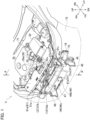
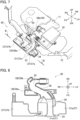
Fig. 1] Fig. 1 is a partial perspective view showing an arrangement relationship among an air inlet, an intake duct, a first shielding member, and a second shielding member in a vehicle with an arrangement structure of the intake duct according to an embodiment. - [
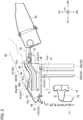
Fig. 2] Fig. 2 is a partial cross-sectional view showing the arrangement relationship among the air inlet, the heat dump, the intake duct, the first shielding member, and the second shielding member in a section along line A-A ofFIG. 1 . - [
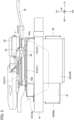
Fig. 3] Fig. 3 is a partial front view showing an arrangement relationship among the air inlet, the heat dump, the intake duct, and the first shielding member. - [
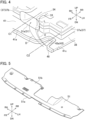
Fig. 4] Fig. 4 is a partial perspective view showing an arrangement relationship between the intake duct and the first shielding member. - [
Fig. 5] Fig. 5 is a partial perspective view showing the second shielding member. - [
Fig. 6] Fig. 6 is a partial perspective view showing the first shielding member. - [
Fig. 7] Fig. 7 is a partial perspective view showing an arrangement position of the intake duct. - [
Fig. 8] Fig. 8 is a partial cross-sectional view showing a cross section along line B-B ofFIG. 7 for explaining the intake duct. - [
Fig. 9] Fig. 9 is a schematic partial cross-sectional view in an axial direction perpendicular to the second cross section for explaining the relationship between an end portion of the intake duct and a virtual extension surface. - [
Fig. 10] Fig. 10 is a schematic partial cross-sectional view in an axial direction perpendicular to the second cross section for explaining the relationship between the end portion of the intake duct and the virtual extension surface. - [
Fig. 11] Fig. 11 is a schematic partial cross-sectional view in an axial direction perpendicular to the second cross section for explaining the relationship between the end portion of the intake duct and the virtual extension surface. - Hereinafter, an arrangement structure of an intake duct according to an embodiment will be described with reference to the drawings. In the drawings, FR and RR denote front and rear in a vehicle longitudinal direction, LH and RH denote left and right in a vehicle width direction, and UP and DN denote an upper side and a lower side in a vehicle vertical direction. In the following description, front and rear in the vehicle longitudinal direction, left and right in the vehicle width direction, the upper side and the lower side in the vehicle vertical direction are simply referred to as "front of vehicle," "rear of vehicle," "left of vehicle," "right of vehicle," "upper side," and "lower side," respectively. Elements having the same function are denoted by the same reference numerals, and duplicate descriptions are omitted.
- As illustrated in
FIGS. 1 to 3 , the arrangement structure of the intake duct according to the embodiment can be used in anengine compartment 70 provided on a vehicle front side of a vehicle V. The vehicle V is, for example, a hybrid vehicle powered by anengine 71 arranged in theengine compartment 70 and an electric motor (not shown). The arrangement structure of the intake duct according to the embodiment includes anair inlet 10, aheat dump 20, anintake duct 30, and afirst shielding member 40. As illustrated in the drawings, theheat dump 20, theintake duct 30, and thefirst shielding member 40 may be arranged on the front side of the vehicle relative to theengine 71. - The
air inlet 10 is an opening for introducing outside air into theengine compartment 70 from outside of the vehicle V. Theair inlet 10 is formed by opening the front side of the vehicle within a predetermined range ofbody exterior members 72 constituting an exterior of the vehicle V such as a body panel, a bumper, or a hood. In an illustrated example, theair inlet 10 is located in a center portion in the vehicle width direction and has a substantially rectangular shape in the vehicle longitudinal direction. Theair inlet 10 may be covered with, for example, a mesh-like or grid-likefront grill 11. By providing theair inlet 10, for example, outside air is introduced from theair inlet 10 into theengine compartment 70 as the vehicle V travels forward of the vehicle. - Heat of the
heat bump 20 is radiated to the introduced outside air that is introduced from theair inlet 10. The introduced outside air is, for example, air. In the example shown inFIG. 2 or3 , theheat bump 20 includes, but is not limited to, acondenser 20a and aradiator 20b. For example, theheat bump 20 may be either acondenser 20a or aradiator 20b. - The
condenser 20a is a heat exchanger of an air conditioner mounted on the vehicle V for radiating the heat of a refrigerant to the introduced outside air. As in the illustrated example, thecondenser 20a may be arranged at a predetermined distance from the air inlet 10on the rear side of the vehicle and may have a substantially rectangular shape in the vehicle longitudinal direction. Theradiator 20b is a heat exchanger for radiating heat from cooling water of anengine 71 to the introduced outside air. As in the illustrated example, theradiator 20b may be arranged at a predetermined distance from thecondenser 20a on the rear side of the vehicle and may have a substantially rectangular shape in the vehicle longitudinal direction. Theradiator 20b may be a heat exchanger for radiating heat from the cooling water of the electric motor of the vehicle V to the outside air. As shown inFIG. 3 , theheat bump 20 may be arranged closer to a left side than a center of the vehicle in the vehicle width direction in the vehicle longitudinal direction. Theair inlet 10 and theheat bump 20 may overlap at least partially in the vehicle longitudinal direction. - As shown in
FIGS. 1 to 3 , afirst shielding member 40 is disposed between theair inlet 10 and thecondenser 20a. Thefirst shielding member 40 includes at least anupper wall 41 andside walls air inlet 10 and theheat bump 20 from an upper side and a lateral side. Thefirst shielding member 40 may be formed by molding a heat-resistant resin material, for example. In the illustrated example, a side of theair inlet 10 of thefirst shielding member 40 corresponds to the front side of the vehicle, and a side opposite to theair inlet 10 corresponds to the rear side of the vehicle. Since such afirst shielding member 40 is provided, it is possible to prevent the introduced outside air from flowing upward, to the left of the vehicle, or to the right of the vehicle from the space S. Therefore, the introduced outside air flows from theair inlet 10 toward theheat dump 20. As a result, as shown inFIG. 2 , a flow path P from theair inlet 10 toward theheat dump 20 is formed between theair inlet 10 and theheat dump 20. Thus, thefirst shielding member 40 is a member defining the flow path P of the introduced outside air. - As shown in the drawings, the
upper wall 41 of thefirst shielding member 40 extends between theintake port 31 of theintake duct 30 and the space S. Theside walls first shielding member 40 shields theintake port 31 from the flow of the introduced outside air. As a result, the flow of the introduced outside air introduced into the flow path P is blocked by the first shielding member, and the introduced outside air is prevented from flowing toward theintake port 31. - The
upper wall 41 defines an upper part of the flow path P from theair inlet 10 to theheat bump 20. As shown inFIG. 2 or6 , theupper wall 41 is a plate-like part extending in the vehicle longitudinal direction and covering the space S from above, and may have a substantially rectangular shape in a plan view. Theupper wall 41 may be arranged above theheat bump 20 to form a predetermined gap to the upper part of theheat bump 20. In addition, theupper wall 41 and theheat bump 20 may be arranged to overlap at least partially in a plan view. It should be noted that theheat bump 20 may be connected to theupper wall 41 through a fastening tool such as a bolt (not shown). - At least a part of an upper wall
front end 41a, which is an end of theupper wall 41 on the front side of the vehicle, may be formed so that it abuts a part of a vehiclebody exterior member 72 that is located above anupper edge 10a of theair inlet 10 on the front side of the vehicle, from the inside of theengine compartment 70. In the illustrated example, an upper wallrear end 41b, which is an end of theupper wall 41 on the rear side of the vehicle, is located on the rear side of the vehicle relative to thecondenser 20a, but is not limited thereto. For example, the upper wallrear end 41b may be located on the rear side of the vehicle relative to theradiator 20b. - A
vertical wall portion 42 extending upward may be formed on the upper wallrear end 41b. Theupper wall 41 may be fixed by fastening thevertical wall portion 42 and a vehiclebody framework member 73 above theradiator 20b using a fastening tool such as a bolt (not shown). The vehiclebody framework member 73 extends in theengine compartment 70 in the vehicle width direction, and may be, for example, a resin or metal radiator core support. - The
upper wall 41 hasopenings 43 penetrating vertically. In the illustrated example, theopenings 43 are formed as anopening 43a and anopening 43b by cutting off the upper wallfront end 41a. Theopening 43a is provided as an opening in the upper wallfront end 41a at a position near an upperwall side end 41c. Theopening 43b is provided as an opening in the upper wallfront end 41a at a position near an upperwall side end 41d. The upperwall side end 41c is an end of theupper wall 41 on the left side of the vehicle, and the upperwall side end 41d is an end of theupper wall 41 on the right side of the vehicle. - The
side walls air inlet 10 to theheat bump 20. In the illustrated example, the first shieldingmember 40 has theside walls member 40 may include a side wall on either the left side of the vehicle or the right side of the vehicle. - The
side wall 45 covers the space S from the left side of the vehicle, and may be, for example, a plate-like part having a substantially rectangular shape in a side view and extending in the vehicle longitudinal direction. Theside wall 45 defines a side part on the left side of the vehicle in the flow path P from theair inlet 10 to theheat bump 20. As in the illustrated example, the end of theside wall 45 on the rear side of the vehicle may abut an end of thecondenser 20a on the left side of the vehicle. An end of theside wall 45 on the front side of the vehicle may abut a part of the vehiclebody exterior member 72 on the front side of the vehicle, that is, a part being located on a part of theair inlet 10 on the left side of the vehicle, from the inside of theengine compartment 70. - The
side wall 46 covers the space S from the right side of the vehicle, and may be, for example, a plate-like part having a substantially rectangular shape in a side view and extending in the vehicle longitudinal direction. Theside wall 46 defines a side part on the right side of the vehicle in the flow path P from theair inlet 10 to theheat bump 20. As shown in the drawings, theside wall 46 includes arear side wall 46b, afront side wall 46c, and anintermediate wall 47, and may have a substantially Z-like shape in a plan view. - The
rear side wall 46b constitutes a part of theside wall 46 on the rear side of the vehicle. An end of therear side wall 46b on the rear side of the vehicle may abut an end of thecondenser 20a on the right side of the vehicle. Thefront side wall 46c constitutes a part of theside wall 46 on the front side of the vehicle. It should be noted that an end of thefront side wall 46c on the front side of the vehicle may abut a part of the vehiclebody exterior member 72 on the front side of the vehicle, that is, a part being located on a part of theair inlet 10 on the left side of the vehicle, from the inside of theengine compartment 70 An upper end of theside wall 46 may be fixed to the upperwall side end 41d by a fastening tool such as a bolt. In the illustrated example, an upper end of therear side wall 46b is fastened to the upperwall side end 41d. - The
intermediate wall 47 is a wall extending between an end of therear side wall 46b on the front side of the vehicle and an end of thefront side wall 46c on the rear side of the vehicle. By providing theintermediate wall 47, thefront side wall 46c can be arranged on the right of the vehicle relative to the end of thecondenser 20a on the right side of the vehicle. Therefore, the distance between theside walls heat bump 20. Thus, the flow path P of the introduced outside air can be formed larger, and more outside air taken in from theair inlet 10 can be introduced toward theheat bump 20. Therefore, theheat bump 20 can be cooled more reliably. - The
sidewall 46 may not include theintermediate wall 47. For example, thesidewall 46 may be a wall extending in the vehicle longitudinal direction between theair inlet 10 and the end of thecondenser 20a on the right side of the vehicle. Further, thesidewall 46 may extend in an oblique direction to the vehicle longitudinal direction so that the end thereof on the front side of the vehicle is located to the right relative to the end thereof on the rear side of the vehicle in the vehicle width direction. - Further, the first shielding
member 40 may include, for example, anelastic part 48 composed of a resin at an end on the front side of the vehicle or at an end on the rear side of the vehicle. In the illustrated example, the upper wallfront end 41a as well as ends of each of theside walls elastic portion 48. In this manner, it is possible to prevent a gap from being formed between an end of the first shieldingmember 40 on the front side of the vehicle and an inner wall surface of thevehicle exterior member 72 on the front side of the vehicle, and between the end of the first shieldingmember 40 on the rear side of the vehicle and theheat bump 20. Thus, it is possible to prevent the introduced outside air flowing in the flow path P from leaking to the outside of the flow path P, and to realize more efficient heat exchange in theheat bump 20. - The shapes of the
sidewalls air inlet 10, theheat bump 20 and the like. For example, when theheat bump 20 is arranged in a center part in the vehicle width direction, theside wall 45 may include a rear side wall, a front side wall, and an intermediate wall in the same manner as theside wall 46, and may have a substantially Z-like shape in a plan view. - As illustrated in
FIGS. 1 to 3 , an opening through the vehicle width direction may be formed in a part of theside walls bumper reinforcement 74 for absorbing an impact input in the vehicle longitudinal direction may be arranged in the opening. Thebumper reinforcement 74 is a long member extending in the vehicle width direction, and may be composed of a metal such as aluminum, for example. Anenergy absorbing material 75 formed by molding a resin such as polypropylene may be arranged on thebumper reinforcement 74 on the front side of the vehicle. - An
intake duct 30 having anintake port 31 for taking in a part of the introduced outside air is arranged above the first shieldingmember 40. Theintake duct 30 is a piping member for taking in the introduced outside air toward theengine 71, and is connected to afilter 32 in the illustrated example. Further, theintake duct 30 may include anend portion 33, anupstream duct portion 34, and abent portion 35. Theintake duct 30 may be formed by molding, for example, a resin and the like. Theintake duct 30 can, for example, take in a portion of the introduced outside air taken in from the air inlet through theopening 43, as shown by the arrow D inFIG. 4 . The introduced outside air taken in by theintake duct 30 is introduced into theengine 71 through thefilter 32 and mixed with fuel. - The
intake port 31 is placed on an edge of theend portion 33 of theintake duct 30 that is located upstream of the intake air. As in the example shown inFIG. 3 , theintake port 31 may open toward the front side of the vehicle and have a substantially rectangular shape in the vehicle longitudinal direction. Further, theintake port 31 is located above theupper wall 41. In other words, alower edge 31a of theintake port 31 is arranged above an upper surface of theupper wall 41, and theintake port 31 and theupper wall 41 are arranged such that they overlap at least partially in a plan view. It should be noted that as in the illustrated example, thelower edge 31a of theintake port 31 and the upper surface of theupper wall 41 may be separated from each other at a predetermined distance. Furthermore, thelower edge 31a and the upper surface of theupper wall 41 may be in contact with each other. - As illustrated in
FIG. 7 or 8 , theintake duct 30 includes theupstream duct portion 34 extending from theend portion 33. In the illustrated example, theupstream duct portion 34 is a tubular portion extending in the vehicle longitudinal direction and extending from theend portion 33 toward the rear of the vehicle. Further, theupstream duct portion 34 has a substantially rectangular flow path cross-section whose flow path width is larger than the flow path height in the vehicle longitudinal direction. The flow path height is a vertical dimension of the flow path cross-section. The flow path width is a dimension of the flow path cross-section in perpendicular and horizontal directions to an extending direction of theupstream duct portion 34. As shown in the drawings, theupstream duct portion 34 may be connected to thebent portion 35 downstream of the intake air, anintermediate piping portion 36 may be interposed between both portions. - An upstream side of the intake air refers to an upstream side of the air flow taken in the
upstream duct portion 34 in a direction parallel to the direction in which theupstream duct portion 34 extends. A downstream side of the intake air refers to a downstream side of the air flow taken in theupstream duct portion 34 in a direction parallel to a direction in which theupstream duct portion 34 extends. In the illustrated example, the front of the vehicle corresponds to the upstream side of the intake air, and the rear of the vehicle corresponds to the downstream side of the intake air. - The
bent portion 35 is a piping portion formed by bending a part of piping of theintake duct 30 between thefilter 32 and theintake port 31. In the illustrated example, theintermediate piping portion 36 extending from theupstream duct portion 34 downstream of the intake air toward the right rear of the vehicle is bent approximately 120 degrees toward the left of the vehicle to form thebent portion 35. In the illustrated example, theintake duct 30 includes, but is not limited to, onebent portion 35, and may include a plurality ofbent portions 35. In other words, at least onebent portion 35 may be formed between thefilter 32 of theintake duct 30 and theintake port 31. - The
filter 32 is a filter for filtering air taken in theintake duct 30 and is connected to theintake duct 30. In the illustrated example, thefilter 32 is an air cleaner having a substantially rectangular hollow box-shaped structure in a plan view. A filter element (not shown) is arranged inside thefilter 32. Air taken in theintake duct 30 is introduced into the intake manifold (not shown) of theengine 71 through thefilter portion 32. At that time, dust and the like contained in the air is adsorbed on the filter element, and the air can be filtered. - The
intake duct 30 may include aresonator 37. In the illustrated example, theresonator 37a is arranged on a vehicle left-side and theresonator 37b is arranged on a vehicle right-side of theupstream duct 34. Theresonators resonators intermediate piping portion 36, and a part of the air introduced into theintake duct 30 is introduced into theresonators resonator 37, the intake air sound of theengine 71 is resonated in the internal space of theresonator 37, and a predetermined frequency band contained in the intake air sound can be attenuated. Therefore, the generation of the intake sound can be suppressed by theresonator 37. - On an outer peripheral side of the
bent portion 35, asecond storage 39 which can store contaminants contained in the air and having a specific gravity larger than the air may be arranged. In the illustrated example,second storages bent portion 35. Further, thesecond storage 39 functions as a resonator. A bottom of thesecond storage 39 may have an opening penetrating in the vertical direction. - Next, the
end portion 33 of theintake duct 30 will be described in more detail. In the following description, an axis parallel to an extending direction of theupstream duct portion 34 and passing through a geometric center of the flow path cross-section of theupstream duct portion 34 will be referred to as an upstream duct center axis C1. An axis passing through a center of the vehicle width direction on an upper side of an opening surface of theopening 43a and parallel to the extending direction of theupstream duct portion 34 will be referred to as an opening center axis C2. The opening surface of theopening 43 is a surface defined by an inner periphery of theopening 43. A cross section including the upstream duct center axis C1 of theupstream duct portion 34 is referred to as a first cross section. Further, the cross section passing through the upstream duct center axis C1 and the opening center axis C2 is referred to as a second cross section. - As shown in
FIGS. 2 to 4 , theend portion 33 of theintake duct 30 on the side of theintake port 31 is formed in a bell mouth shape which is curved radially outward and expands toward the upstream side of the intake air. The shape of the bell mouth shape of theend portion 33 in the first cross-section can be set as appropriate according to an arrangement position, a shape, or a dimension of theintake port 31 or the first shieldingmember 40. For example, the bell mouth shape can include an arc, an elliptical arc, a parabola, or a curve smoothly connecting some of them in the second section. - In the illustrated example, an inner surface of the
end portion 33 has a shape along a curve L in the second cross section. The curve L is an elliptical arc smoothly connected to the inner surface of the flow path of theupstream duct 34. Thus, the inner surface of a part of theend portion 33 that extends at least toward theopening 43a has a curved shape so that it is positioned radially outward toward the upstream side of the intake air. As described above, the curve L may be an arc, a parabola, and the like. - Next, a virtual extension surface F formed by virtually extending a curved surface of the bell-mouth shape from the
intake port 31 will be described. The virtual extension surface F is smoothly connected to the inner surface of theend portion 33 at theintake port 31, that is, an edge of theend portion 33. - In the example shown in
FIG. 9 , the curve formed by the inner surface of theend portion 33 and the curve formed by the virtual extension surface F follow the same curve in the second cross section. In the example shown inFIGS. 2 to 4 , the curve formed by the inner surface of the a part of theend portion 33 that extends toward theopening 43a and the curve formed by the virtual extension surface F of the part constitute one curve L in the second cross section. It should be noted that "follow the same curve" means that the curve formed by the inner surface of theend portion 33 and the curve formed by the virtual extension surface F follow a curve represented by one equation whose variable is a position coordinate at least in a direction of the upstream duct center axis C1. - As in the example shown in
FIG. 10 , the virtual extension surface F may be smoothly connected to the inner surface of theend portion 33 at the edge of theend portion 33 in the second cross section and may include a half-line extending radially outward from the edge. That is, the half-line formed by the virtual extension surface F in the second cross section may correspond to the tangent line at the edge of theend portion 33 of the curve formed by the inner surface of theend portion 33 in the second cross section. The smaller angle among the intersection angles formed by the half-line formed by the virtual extension surface F and the upstream duct center axis C1 in the second cross section is 90 degrees or less. That is, the angle between the half-line formed by the virtual extension surface F and the upstream duct center axis C1 is 90 degrees or less. - In an example shown in
FIG. 11 , the virtual extension surface F extends from the edge of theend portion 33 so that the curve formed by the inner surface of theend portion 33 and the curve formed by the virtual extension surface F follow the same curve in the second cross section. When the angle θ, which is the smaller angle among the intersection angles formed by the tangent T of the virtual extension surface F and the upstream duct center axis C1 in the second cross section, exceeds 90 degrees, the virtual extension surface F is formed so that the angle θ becomes 90 degrees. That is, in the second cross section, the curve formed by the inner surface of theend portion 33 and the curve formed by the virtual extension surface F may be formed to follow the same curve, and the angle θ between the tangent T of the virtual extension surface F and the upstream duct center axis C1 in the second cross section may be formed to be 90 degrees or less. - Any of the virtual extension surfaces F set as described above may be formed to intersect the opening surface of the
opening 43. In the example shown inFIG. 4 , the curve L intersects the opening surface of theopening 43a. Accordingly, at least a portion of the virtual extension surface F formed by virtual extension from the portion of theend 33 extending toward theopening 43a intersects the opening surface of theopening 43a. A position of theopening 43b may be set so that the virtual extension surface F intersects the opening surface of theopening 43b. - Further, as in the example shown in
FIG. 3 , theopening 43a of theupper wall 41 of theintake port 31 may be arranged on the left of the vehicle in the vehicle longitudinal direction, and anopening 43b may be arranged on the right of the vehicle. In other words, theopening 43 of theupper wall 41 may be arranged to a side of theintake port 31 in a direction that is vertical and horizontal to the extending direction of theupstream duct portion 34. - Further, as in the illustrated example, the
intake duct 30 and theupper wall 41 may be separated at a predetermined distance in the vertical direction. In this way, a gap is formed between the lower edge 3 1a of theintake port 31 and the upper surface of theupper wall 41, and between a bottom surface of theresonator 37 and the upper surface of theupper wall 41. Thus, a first side of theintake port 31 38 is formed between theupper wall 41 and theintake duct 30. Thefirst storage 38 is a space capable of storing contaminants contained in the introduced outside air having a specific gravity larger than the introduced outside air. Further, thefirst storage 38 is opened between thelower edge 31a of theintake port 31 and theupper wall 41. Furthermore, in the vertical direction, the gap between thelower edge 31a and the upper surface of theupper wall 41 may be larger than the gap between the bottom surface of theresonator 37 and the upper surface of theupper wall 41. In some embodiments, a vertical dimension of the gap between thelower edge 31a and the upper surface of theupper wall 41 may be 10 mm to 30 mm. Further, a vertical dimension of the gap between the bottom surface of theresonator 37 and the upper surface of theupper wall 41 may be 5 mm to 25 mm. - As shown in
FIG. 1 or2 , asecond shielding member 50 may be disposed between theintake duct 30 and ahood 60 of the vehicle V. Thehood 60 is an exterior member that covers theengine compartment 70 of the vehicle V from above, and is composed of a metal such as iron, for example. Thehood 60 is rotatably supported by a hinge (not shown) at a predetermined angle range around the shaft on the rear side of the vehicle in theengine compartment 70, and is formed to block ahood opening 61. Thehood opening 61 is formed by opening an upper side of theengine compartment 70 of the vehiclebody exterior members 72 within a predetermined range. The opening is defined by aninner periphery 61a of thehood opening 61. - With the hood opening 61 closed by the
hood 60, theinner periphery 61a of the hood opening 61 surrounds anouter periphery 60a of thehood 60. Then, agap 62 is formed between theinner periphery 61a of thehood opening 61 and theouter periphery 60a of thehood 60. - The
second shielding member 50 is a member extending such that it blocks at least a space between a part ofgap 62 closest to theintake port 31 and theintake port 31. As illustrated inFIGS. 2 or5 , thesecond shielding member 50 may include abody 51 and aflange 52. As in the illustrated example, thebody 51 may be a plate-like member formed by molding a material such as resin and having a substantially rectangular shape in a plan view. Theflange 52 may be a wall portion extending toward the rear of the vehicle from a part of theinner periphery 61a on the front side of the vehicle. By fastening theflange 52 and thefront end 51a, which is an end of thebody 51 on the front side of the vehicle, by using a fastening tool such as a bolt (not shown), thebody 51 can be arranged in theengine compartment 70. In a side view, therear end 51b, which is an end of thebody 51 on the rear side of the vehicle, may be formed such that it extends further to the rear of the vehicle relative to theradiator 20b. - In the illustrated example, an
inner periphery 62a of thegap 62 is formed between a part of theinner periphery 61a on the front side of the vehicle and a part of theouter periphery 60a of thehood 60 on the front side of the vehicle. Further, theflange 52 as thesecond shielding member 50 and thebody 51 extend between thegap front 62a and theintake port 31 arranged in theengine compartment 70 on the front side of the vehicle. Therefore, thegap front 62a and theintake port 31 are shielded by thesecond shielding member 50. - It should be noted that aspects of the
second shielding member 50 is not limited to the illustrated examples. In some embodiments, thesecond shielding member 50 may not include theflange 52. In this case, for example, thesecond shielding member 50 may be arranged so that afront end 51a of thebody 51 abuts theinner periphery 61a of thehood opening 61. Further, thefront end 51a may abut an area of the hood opening 61 of thebody exterior member 72 that extends on the front side of the vehicle, from the inside of theengine compartment 70. Furthermore, an arrangement position and a shape of thesecond shielding member 50 are not limited to the illustrated examples, and may be set as appropriate according to the position, shape, or size of theintake port 31 or thegap 62. - Hereinafter, the effect of the arrangement structure of the intake duct according to the embodiment will be described.
- (1) An arrangement structure of an intake duct according to an embodiment includes an
air inlet 10 for introducing outside air from outside of a vehicle V, aheat bump 20 for radiating heat to the introduced outside air introduced from theair inlet 10, anintake duct 30 having anintake port 31 for taking in a part of the introduced outside air, and afirst shielding member 40 for defining a flow path P of the introduced outside air and shielding theintake port 31 from a flow of the introduced outside air, and the first shieldingmember 40 includes at least anupper wall 41 for defining an upper part of a flow path P from theair inlet 10 to theheat bump 20, andside walls intake port 31 is located above theupper wall 41. The introduced outside air taken in from theair inlet 10 passes through the flow path P and reaches theheat bump 20 such as acondenser 20a. Since theheat bump 20 radiates heat to the introduced outside air, the introduced outside air is heated by theheat bump 20. In the arrangement structure of the intake duct according to the embodiment, the introduced outside air passing through the flow path P and heated by theheat bump 20 is blocked by the first shieldingmember 40 when it flows upward or laterally from the flow path P. Thus, the introduced outside air that has been heated is prevented from flowing toward theintake port 31. Therefore, the introduced outside air that has been heated can be prevented from being taken from theintake port 31 into theintake duct 30. Furthermore, the power performance of the vehicle V can be improved.
It should be noted that the arrangement structure of the intake duct according to the embodiment may include avertical wall portion 42 extending upward at a upper wallrear end 41b of theupper wall 41 on a side opposite to theair inlet 10, and thevertical wall portion 42 shields at least a part of the air flow flowing toward theintake port 31 from the side opposite to theair inlet 10 across thevertical wall portion 42. In this way, even when a heating element such as anengine 71 is arranged on the rear of the vehicle relative to theintake duct 30 and the first shieldingmember 40, for example, as shown inFIG. 1 , at least a part of the air heated by the heating element is shielded by thevertical wall portion 42. Thus, it is possible to prevent the heated air from being taken from theintake port 31 into theintake duct 30. - (2) In the arrangement structure of the intake duct according to the embodiment, a
first storage 38 capable of storing contaminants contained in the introduced outside air and having a specific gravity larger than the introduced outside air is formed between theupper wall 41 and theintake duct 30, and thefirst storage 38 opens between alower edge 31a of theintake port 31 and theupper wall 41. The introduced outside air that is introduced from theair inlet 10 to theintake port 31 may contain contaminants having a specific gravity larger than the introduced outside air. The contaminants may be, for example, snow, water drops of rain, and the like. Such contaminants may fall down toward theinlet 31 before a part of the introduced outside air is taken in theintake duct 30. For example, snow and the like contained in the introduced outside air and introduced through theopening 43a of the first shieldingmember 40 fall down below thelower edge 31a of theintake port 31 by gravity before being taken in theintake duct 30, as shown by arrow E inFIG. 4 . In the arrangement structure of the intake duct according to the embodiment, between theintake duct 30 and theupper wall 41, afirst storage 38 opening between thelower edge 31a of theintake port 31 and theupper wall 41 is formed. Therefore, fallen snow and the like are introduced into thefirst storage 38 through an opening between thelower edge part 31a and theupper wall 41, and is stored in thefirst storage 38. Thus, it is possible to prevent accumulation of snow and the like contained in the introduced outside air in theintake port 31 on the front side of vehicle and to prevent the snow and the like from being taken in theintake duct 30. - (3) In the arrangement structure of the intake duct according to the embodiment, the
upper wall 41 has anopening 43 penetrating vertically, theend portion 33 of theintake duct 30 on a side of theintake port 31 has a bell mouth shape curved and expanding radially outward toward the upstream side of the intake air, and a virtual extension surface F formed by virtually extending the curved surface of the bell mouth shape from theintake port 31 intersects an opening surface of theopening 43. In the arrangement structure of the intake duct according to the embodiment, theintake duct 30 can more reliably take in the introduced outside air through theopening 43 of theupper wall 41 of the first shieldingmember 40. Further, even when the introduced outside air introduced along a curve L in the second cross section contains snow and the like, as shown inFIG. 4 , the snow and the like fall by gravity before being taken in theintake duct 30. The fallen snow and the like are stored in thefirst storage 38. Therefore, the contaminants contained in the introduced outside air can be fallen down below theintake port 31 and stored more reliably in thefirst storage 38. Therefore, it is possible to prevent snow and the like from being taken in theintake duct 30 more reliably. - (4) In the arrangement structure of the intake duct according to the embodiment, the
intake duct 30 includes anupstream duct portion 34 extending from theend portion 33, and theopening 43 is arranged on a side of theintake port 31 in a direction perpendicular and horizontal to an extension direction of theupstream duct portion 34. In the arrangement structure of the intake duct according to the embodiment, the introduced outside air is taken in theintake duct 30 throughopenings intake port 31 of the vehicle, for example, in the vehicle longitudinal direction. Therefore, it is possible to prevent the introduced outside air from being taken in theintake duct 30 through the area below the front of the vehicle of theintake port 31. That is, it is possible to prevent the introduced outside air from being taken in theintake duct 30 from a lower front side of theintake port 31 in the extending direction of theupstream duct portion 34 of theintake duct 30. Thus, contaminants such as snow contained in the introduced outside air can be more reliably dropped below theintake port 31 and stored in thefirst storage 38. Therefore, snow and the like can be more reliably prevented from being taken in theintake duct 30.
Further, in the arrangement structure of the intake duct according to the embodiment, the distance between the side edge of theintake port 31 and a part of the inner periphery of theopening 43 that is closest to theintake port 31 in a direction perpendicular and horizontal to the extending direction of theupstream duct portion 34 may be at least larger than the flow path width of theupstream duct portion 34. In this way, theopening 43 can be arranged at a position of theupper wall 41 that is sufficiently distant from the area located in theintake port 31 on a lower front side of the vehicle. Thus, it is possible to prevent the air from being taken in theintake duct 30 through the area of theintake port 31 on the lower front side of the vehicle and the vicinity of the area. As a result, contaminants such as snow contained in the intake air can be more reliably dropped below theintake port 31 and stored in thefirst storage section 38. Therefore, snow or the like can be more reliably prevented from being taken in theintake duct 30. - (5) In the arrangement structure of the intake duct according to the embodiment, the
intake duct 30 is connected to afilter 32 for filtering the air taken in theintake duct 30, at least onebent portion 35 is formed between thefilter 32 of theintake duct 30 and theintake port 31, and asecond storage 39 capable of storing contaminants contained in the air and having a specific gravity larger than the air is arranged on an outer periphery of the at least onebent portion 35. According to the arrangement structure of the intake duct according to the embodiment, the air taken in theintake duct 30 is introduced into thefilter 32 through thebent portion 35. If the air taken in theintake duct 30 contains snow and the like, the snow and the like are introduced into thesecond storage 39 arranged on the outer periphery of thebent portion 35 by inertia force. Thus, snow and the like can be prevented from being taken in thefilter 32 and adsorbed to the filter element. Consequently, the clogging of the filter element can be suppressed, and the deterioration of the power performance of the vehicle V can be suppressed.
The bottom of thesecond storage 39 may include an opening penetrating vertically. In this way, contaminants such as snow stored in thesecond storage 39 can be discharged downward from the opening. - (6) The arrangement structure of the intake duct according to the embodiment includes: a
hood 60 of the vehicle V; a hood opening 61 of the vehicle V closed by thehood 60; agap 62 formed between aninner periphery 61a of thehood opening 61 and anouter periphery 60a of thehood 60; and asecond shielding member 50 extending such that it blocks at least a space between a part of thegap 62 closest to theintake port 31 and theintake port 31. In the arrangement structure of the intake duct according to the embodiment, even when, for example, snow enters thegap 62 between theouter periphery 60a of thehood 60 of the vehicle V and theinner periphery 61a of thehood opening 61, the snow is blocked by thesecond shielding member 50. Therefore, the deposition of the snow in the vicinity of theintake port 31 can be prevented. Therefore, it is possible to more reliably prevent snow from being taken in theintake duct 30. - In the embodiment described above, the vehicle V as a hybrid vehicle has been described by way of example, but is not limited thereto. Needless to say, the arrangement of the intake duct according to the embodiment can be applied to a vehicle powered only by an internal combustion engine such as an engine. In the above description, a vehicle V having an
engine compartment 70 on the front side of the vehicle has been described by way of example, but is not limited thereto. Needless to say, the arrangement structure of the intake duct according to the embodiment can also be applied to a vehicle having anengine compartment 70 on the rear side of the vehicle. -
- V
- vehicle
- P
- flow path
- F
- virtual extension surface
- 10
- air inlet
- 20
- heat bump
- 30
- intake duct
- 31
- intake port
- 31a
- lower edge
- 32
- filter
- 33
- end portion
- 34
- upstream duct portion
- 35
- bent portion
- 38
- first storage
- 39, 39a, 39b
- second storage
- 40
- first shielding member
- 41
- upper wall
- 43, 43a, 43b
- opening
- 45, 46
- side wall
- 50
- second shielding member
- 60
- hood
- 60a
- outer periphery
- 61
- hood opening
- 61a
- inner periphery
- 62
- gap
Claims (6)
- An arrangement structure of an intake duct comprising:an air inlet for introducing outside air from outside of a vehicle,a heat bump for radiating heat to the introduced outside air introduced from the air inlet,an intake duct having an intake port for taking in a part of the introduced outside air, anda first shielding member for defining a flow path of the introduced outside air and shielding the intake port from a flow of the introduced outside air,wherein the first shielding member includes at least an upper wall for defining an upper part of the flow path from the air inlet to the heat bump and side walls for defining a side part of the flow path, andwherein the intake port is located above the upper wall.
- The arrangement structure of the intake duct according to claim 1,wherein a first storage capable of storing contaminants contained in the introduced outside air and having a specific gravity larger than the introduced outside air is formed between the upper wall and the intake duct, andwherein the first storage opens between a lower edge of the intake port and the upper wall.
- The arrangement structure of the intake duct according to claim 2,wherein the upper wall has an opening penetrating vertically,wherein the end portion of the intake duct on a side of the intake port has a bell mouth shape curved and expanding radially outward toward the upstream side of the intake air, andwherein a virtual extension surface formed by virtually extending the curved surface of the bell mouth shape from the intake port intersects an opening surface of the opening.
- The arrangement structure of the intake duct according to claim 3,wherein the intake duct comprises an upstream duct portion extending from the end portion, andwherein an opening is arranged on a side of the intake port in a direction perpendicular and horizontal to an extension direction of the upstream duct portion.
- The arrangement structure of the intake duct according to any one of claims 1 to 4,wherein the intake duct is connected to a filter for filtering the air taken in the intake duct,wherein at least one bent portion is formed between the filter of the intake duct and the intake port, andwherein a second storage capable of storing contaminants contained in the air and having a specific gravity larger than the air is arranged on an outer periphery of the at least one bent portion.
- The arrangement structure of the intake duct according to any one of claims 1 to 5 comprising:a hood of the vehicle;a hood opening of the vehicle closed by the hood;a gap formed between an inner periphery of the hood opening and an outer periphery of the hood; anda second shielding member extending such that it blocks at least a space between a part of the gap closest to the intake port and the intake port.
Applications Claiming Priority (1)
| Application Number | Priority Date | Filing Date | Title |
|---|---|---|---|
| PCT/JP2021/029613 WO2023017575A1 (en) | 2021-08-11 | 2021-08-11 | Structure for arranging intake air duct |
Publications (2)
| Publication Number | Publication Date |
|---|---|
| EP4385782A1 true EP4385782A1 (en) | 2024-06-19 |
| EP4385782A4 EP4385782A4 (en) | 2024-12-04 |
Family
ID=85200069
Family Applications (1)
| Application Number | Title | Priority Date | Filing Date |
|---|---|---|---|
| EP21953023.5A Withdrawn EP4385782A4 (en) | 2021-08-11 | 2021-08-11 | Structure for arranging intake air duct |
Country Status (5)
| Country | Link |
|---|---|
| US (1) | US20240424888A1 (en) |
| EP (1) | EP4385782A4 (en) |
| JP (1) | JP7552916B2 (en) |
| CN (1) | CN117881561A (en) |
| WO (1) | WO2023017575A1 (en) |
Family Cites Families (14)
| Publication number | Priority date | Publication date | Assignee | Title |
|---|---|---|---|---|
| DE1726690U (en) * | 1956-05-12 | 1956-07-19 | Bayerische Motoren Werke Ag | FRESH AIR SUPPLY DUCT TO THE FRONT ENGINE OF MOTOR VEHICLES. |
| JPS5778759U (en) * | 1980-10-31 | 1982-05-15 | ||
| US5660243A (en) | 1995-02-13 | 1997-08-26 | Chrysler Corporation | Air flow, atmospheric particle, and environmental element diverter system |
| JP2002211252A (en) | 2001-01-15 | 2002-07-31 | Nissan Motor Co Ltd | Attachment duct structure for automobile |
| US8201651B2 (en) * | 2004-07-12 | 2012-06-19 | Honda Motor Co., Ltd. | Automobile over-bulkhead air intake system |
| DE102005033659B4 (en) * | 2005-07-19 | 2007-12-27 | Dr.Ing.H.C. F. Porsche Ag | Drive unit for a motor vehicle |
| JP4788657B2 (en) | 2007-05-16 | 2011-10-05 | 株式会社デンソー | Intake device for internal combustion engine |
| JP5054435B2 (en) | 2007-06-04 | 2012-10-24 | 富士重工業株式会社 | Automobile intake duct structure |
| JP4665957B2 (en) | 2007-11-26 | 2011-04-06 | 株式会社デンソー | Air element storage case and fan shroud member having the same |
| DE112009001661B4 (en) | 2008-07-08 | 2017-03-30 | Toyota Jidosha Kabushiki Kaisha | Inlet structure for a vehicle |
| US9046063B2 (en) * | 2009-06-29 | 2015-06-02 | Ford Global Technologies, Llc | Vehicle air intake system |
| JP6526741B2 (en) * | 2017-06-14 | 2019-06-05 | 本田技研工業株式会社 | Vehicle intake structure |
| JP6549642B2 (en) * | 2017-06-14 | 2019-07-24 | 本田技研工業株式会社 | Vehicle intake structure |
| JP6527551B2 (en) * | 2017-06-14 | 2019-06-05 | 本田技研工業株式会社 | Intake duct module |
-
2021
- 2021-08-11 EP EP21953023.5A patent/EP4385782A4/en not_active Withdrawn
- 2021-08-11 WO PCT/JP2021/029613 patent/WO2023017575A1/en not_active Ceased
- 2021-08-11 CN CN202180101452.7A patent/CN117881561A/en active Pending
- 2021-08-11 JP JP2023541162A patent/JP7552916B2/en active Active
- 2021-08-11 US US18/682,741 patent/US20240424888A1/en active Pending
Also Published As
| Publication number | Publication date |
|---|---|
| EP4385782A4 (en) | 2024-12-04 |
| WO2023017575A1 (en) | 2023-02-16 |
| JPWO2023017575A1 (en) | 2023-02-16 |
| JP7552916B2 (en) | 2024-09-18 |
| CN117881561A (en) | 2024-04-12 |
| US20240424888A1 (en) | 2024-12-26 |
Similar Documents
| Publication | Publication Date | Title |
|---|---|---|
| US6508506B2 (en) | Front end structure of vehicle | |
| US7290630B2 (en) | Vehicle front end structure | |
| EP2169210B1 (en) | Engine intake passage structure of front vehicle body and method of providing the same | |
| JP2004322847A (en) | Vehicle front end structure | |
| CN112026935B (en) | Front-end structure | |
| JP2010058639A (en) | Front structure of vehicle | |
| US11420684B2 (en) | Front end structure | |
| JP2003326981A (en) | Vehicle engine installation structure | |
| US6422034B2 (en) | Air deflector for truck with refrigeration unit | |
| EP4385782A1 (en) | Structure for arranging intake air duct | |
| GB2053822A (en) | Vehicle front end structure | |
| JP6090188B2 (en) | Automotive front structure | |
| EP3779170B1 (en) | Vehicle with engine intake system | |
| JP2018103840A (en) | Body structure | |
| EP1775200B1 (en) | Front construction of motor vehicle | |
| EP3770417B1 (en) | Vehicle | |
| JP3082660B2 (en) | Hot air discharge structure of cooler condenser | |
| JP6123692B2 (en) | Automotive front structure | |
| JP7416108B2 (en) | engine cooling system | |
| JPH0415124A (en) | Cooling air take-in structure at automobile front portion | |
| JP4193593B2 (en) | Vehicle front end structure | |
| JP2023118179A (en) | vehicle front structure | |
| JP2004114795A (en) | Heat exchanger for vehicle | |
| JPH05262143A (en) | Structure for introducing outside air into the engine room | |
| JP2019077269A (en) | Air intake duct |
Legal Events
| Date | Code | Title | Description |
|---|---|---|---|
| STAA | Information on the status of an ep patent application or granted ep patent |
Free format text: STATUS: THE INTERNATIONAL PUBLICATION HAS BEEN MADE |
|
| PUAI | Public reference made under article 153(3) epc to a published international application that has entered the european phase |
Free format text: ORIGINAL CODE: 0009012 |
|
| STAA | Information on the status of an ep patent application or granted ep patent |
Free format text: STATUS: REQUEST FOR EXAMINATION WAS MADE |
|
| 17P | Request for examination filed |
Effective date: 20240308 |
|
| AK | Designated contracting states |
Kind code of ref document: A1 Designated state(s): AL AT BE BG CH CY CZ DE DK EE ES FI FR GB GR HR HU IE IS IT LI LT LU LV MC MK MT NL NO PL PT RO RS SE SI SK SM TR |
|
| REG | Reference to a national code |
Ref country code: DE Ref legal event code: R079 Free format text: PREVIOUS MAIN CLASS: B60K0013020000 Ipc: F02M0035080000 |
|
| DAV | Request for validation of the european patent (deleted) | ||
| DAX | Request for extension of the european patent (deleted) | ||
| A4 | Supplementary search report drawn up and despatched |
Effective date: 20241105 |
|
| RIC1 | Information provided on ipc code assigned before grant |
Ipc: B60K 11/04 20060101ALN20241029BHEP Ipc: B60K 13/02 20060101ALI20241029BHEP Ipc: F02M 35/16 20060101ALI20241029BHEP Ipc: F02M 35/10 20060101ALI20241029BHEP Ipc: F02M 35/08 20060101AFI20241029BHEP |
|
| STAA | Information on the status of an ep patent application or granted ep patent |
Free format text: STATUS: THE APPLICATION IS DEEMED TO BE WITHDRAWN |
|
| 18D | Application deemed to be withdrawn |
Effective date: 20250523 |