EP4385628A1 - Hypochlorous acid water spray device - Google Patents
Hypochlorous acid water spray device Download PDFInfo
- Publication number
- EP4385628A1 EP4385628A1 EP22855872.2A EP22855872A EP4385628A1 EP 4385628 A1 EP4385628 A1 EP 4385628A1 EP 22855872 A EP22855872 A EP 22855872A EP 4385628 A1 EP4385628 A1 EP 4385628A1
- Authority
- EP
- European Patent Office
- Prior art keywords
- hypochlorous acid
- acid water
- spray device
- misty
- water spray
- Prior art date
- Legal status (The legal status is an assumption and is not a legal conclusion. Google has not performed a legal analysis and makes no representation as to the accuracy of the status listed.)
- Pending
Links
Images
Classifications
-
- A—HUMAN NECESSITIES
- A01—AGRICULTURE; FORESTRY; ANIMAL HUSBANDRY; HUNTING; TRAPPING; FISHING
- A01N—PRESERVATION OF BODIES OF HUMANS OR ANIMALS OR PLANTS OR PARTS THEREOF; BIOCIDES, e.g. AS DISINFECTANTS, AS PESTICIDES OR AS HERBICIDES; PEST REPELLANTS OR ATTRACTANTS; PLANT GROWTH REGULATORS
- A01N25/00—Biocides, pest repellants or attractants, or plant growth regulators, characterised by their forms, or by their non-active ingredients or by their methods of application, e.g. seed treatment or sequential application; Substances for reducing the noxious effect of the active ingredients to organisms other than pests
- A01N25/02—Biocides, pest repellants or attractants, or plant growth regulators, characterised by their forms, or by their non-active ingredients or by their methods of application, e.g. seed treatment or sequential application; Substances for reducing the noxious effect of the active ingredients to organisms other than pests containing liquids as carriers, diluents or solvents
- A01N25/04—Dispersions, emulsions, suspoemulsions, suspension concentrates or gels
- A01N25/06—Aerosols
-
- B—PERFORMING OPERATIONS; TRANSPORTING
- B05—SPRAYING OR ATOMISING IN GENERAL; APPLYING FLUENT MATERIALS TO SURFACES, IN GENERAL
- B05B—SPRAYING APPARATUS; ATOMISING APPARATUS; NOZZLES
- B05B17/00—Apparatus for spraying or atomising liquids or other fluent materials, not covered by the preceding groups
- B05B17/04—Apparatus for spraying or atomising liquids or other fluent materials, not covered by the preceding groups operating with special methods
- B05B17/06—Apparatus for spraying or atomising liquids or other fluent materials, not covered by the preceding groups operating with special methods using ultrasonic or other kinds of vibrations
- B05B17/0607—Apparatus for spraying or atomising liquids or other fluent materials, not covered by the preceding groups operating with special methods using ultrasonic or other kinds of vibrations generated by electrical means, e.g. piezoelectric transducers
- B05B17/0653—Details
- B05B17/0676—Feeding means
- B05B17/0684—Wicks or the like
-
- A—HUMAN NECESSITIES
- A01—AGRICULTURE; FORESTRY; ANIMAL HUSBANDRY; HUNTING; TRAPPING; FISHING
- A01P—BIOCIDAL, PEST REPELLANT, PEST ATTRACTANT OR PLANT GROWTH REGULATORY ACTIVITY OF CHEMICAL COMPOUNDS OR PREPARATIONS
- A01P1/00—Disinfectants; Antimicrobial compounds or mixtures thereof
-
- B—PERFORMING OPERATIONS; TRANSPORTING
- B05—SPRAYING OR ATOMISING IN GENERAL; APPLYING FLUENT MATERIALS TO SURFACES, IN GENERAL
- B05B—SPRAYING APPARATUS; ATOMISING APPARATUS; NOZZLES
- B05B7/00—Spraying apparatus for discharge of liquids or other fluent materials from two or more sources, e.g. of liquid and air, of powder and gas
- B05B7/0012—Apparatus for achieving spraying before discharge from the apparatus
-
- B—PERFORMING OPERATIONS; TRANSPORTING
- B05—SPRAYING OR ATOMISING IN GENERAL; APPLYING FLUENT MATERIALS TO SURFACES, IN GENERAL
- B05B—SPRAYING APPARATUS; ATOMISING APPARATUS; NOZZLES
- B05B7/00—Spraying apparatus for discharge of liquids or other fluent materials from two or more sources, e.g. of liquid and air, of powder and gas
- B05B7/24—Spraying apparatus for discharge of liquids or other fluent materials from two or more sources, e.g. of liquid and air, of powder and gas with means, e.g. a container, for supplying liquid or other fluent material to a discharge device
- B05B7/2402—Apparatus to be carried on or by a person, e.g. by hand; Apparatus comprising containers fixed to the discharge device
- B05B7/2405—Apparatus to be carried on or by a person, e.g. by hand; Apparatus comprising containers fixed to the discharge device using an atomising fluid as carrying fluid for feeding, e.g. by suction or pressure, a carried liquid from the container to the nozzle
- B05B7/2429—Apparatus to be carried on or by a person, e.g. by hand; Apparatus comprising containers fixed to the discharge device using an atomising fluid as carrying fluid for feeding, e.g. by suction or pressure, a carried liquid from the container to the nozzle the carried liquid and the main stream of atomising fluid being brought together after discharge
-
- A—HUMAN NECESSITIES
- A61—MEDICAL OR VETERINARY SCIENCE; HYGIENE
- A61L—METHODS OR APPARATUS FOR STERILISING MATERIALS OR OBJECTS IN GENERAL; DISINFECTION, STERILISATION OR DEODORISATION OF AIR; CHEMICAL ASPECTS OF BANDAGES, DRESSINGS, ABSORBENT PADS OR SURGICAL ARTICLES; MATERIALS FOR BANDAGES, DRESSINGS, ABSORBENT PADS OR SURGICAL ARTICLES
- A61L2/00—Disinfection or sterilisation of materials or objects, in general; Accessories therefor
- A61L2/16—Disinfection or sterilisation of materials or objects, in general; Accessories therefor using chemical substances
- A61L2/22—Phase substances, e.g. smokes or aerosols
-
- A—HUMAN NECESSITIES
- A61—MEDICAL OR VETERINARY SCIENCE; HYGIENE
- A61L—METHODS OR APPARATUS FOR STERILISING MATERIALS OR OBJECTS IN GENERAL; DISINFECTION, STERILISATION OR DEODORISATION OF AIR; CHEMICAL ASPECTS OF BANDAGES, DRESSINGS, ABSORBENT PADS OR SURGICAL ARTICLES; MATERIALS FOR BANDAGES, DRESSINGS, ABSORBENT PADS OR SURGICAL ARTICLES
- A61L9/00—Disinfection, sterilisation or deodorisation of air
- A61L9/01—Deodorant compositions
-
- A—HUMAN NECESSITIES
- A61—MEDICAL OR VETERINARY SCIENCE; HYGIENE
- A61L—METHODS OR APPARATUS FOR STERILISING MATERIALS OR OBJECTS IN GENERAL; DISINFECTION, STERILISATION OR DEODORISATION OF AIR; CHEMICAL ASPECTS OF BANDAGES, DRESSINGS, ABSORBENT PADS OR SURGICAL ARTICLES; MATERIALS FOR BANDAGES, DRESSINGS, ABSORBENT PADS OR SURGICAL ARTICLES
- A61L9/00—Disinfection, sterilisation or deodorisation of air
- A61L9/14—Disinfection, sterilisation or deodorisation of air using sprayed or atomised substances including air-liquid contact processes
-
- B—PERFORMING OPERATIONS; TRANSPORTING
- B05—SPRAYING OR ATOMISING IN GENERAL; APPLYING FLUENT MATERIALS TO SURFACES, IN GENERAL
- B05B—SPRAYING APPARATUS; ATOMISING APPARATUS; NOZZLES
- B05B17/00—Apparatus for spraying or atomising liquids or other fluent materials, not covered by the preceding groups
- B05B17/04—Apparatus for spraying or atomising liquids or other fluent materials, not covered by the preceding groups operating with special methods
- B05B17/06—Apparatus for spraying or atomising liquids or other fluent materials, not covered by the preceding groups operating with special methods using ultrasonic or other kinds of vibrations
- B05B17/0607—Apparatus for spraying or atomising liquids or other fluent materials, not covered by the preceding groups operating with special methods using ultrasonic or other kinds of vibrations generated by electrical means, e.g. piezoelectric transducers
- B05B17/0638—Apparatus for spraying or atomising liquids or other fluent materials, not covered by the preceding groups operating with special methods using ultrasonic or other kinds of vibrations generated by electrical means, e.g. piezoelectric transducers spray being produced by discharging the liquid or other fluent material through a plate comprising a plurality of orifices
- B05B17/0646—Vibrating plates, i.e. plates being directly subjected to the vibrations, e.g. having a piezoelectric transducer attached thereto
-
- B—PERFORMING OPERATIONS; TRANSPORTING
- B05—SPRAYING OR ATOMISING IN GENERAL; APPLYING FLUENT MATERIALS TO SURFACES, IN GENERAL
- B05B—SPRAYING APPARATUS; ATOMISING APPARATUS; NOZZLES
- B05B17/00—Apparatus for spraying or atomising liquids or other fluent materials, not covered by the preceding groups
- B05B17/04—Apparatus for spraying or atomising liquids or other fluent materials, not covered by the preceding groups operating with special methods
- B05B17/06—Apparatus for spraying or atomising liquids or other fluent materials, not covered by the preceding groups operating with special methods using ultrasonic or other kinds of vibrations
- B05B17/0607—Apparatus for spraying or atomising liquids or other fluent materials, not covered by the preceding groups operating with special methods using ultrasonic or other kinds of vibrations generated by electrical means, e.g. piezoelectric transducers
- B05B17/0653—Details
- B05B17/0669—Excitation frequencies
Definitions
- the present invention relates to a spray device that utilizes ultrasonic vibration and is intended for atomizing and spraying hypochlorous acid water, and more particularly to the spray device that inhibits decomposition of hypochlorous acid.
- sodium hypochlorite as one of chlorine-based halogens exerts an immediate germ-killing potency at a very low concentration against bacteria, and is widely used in various fields including public health such as disinfection and sterilization in daily life, food, and medical care as the most reliable disinfectant in terms of the effect against viruses such as HIV and HBV.
- viruses having no envelope such as viruses belonging to the family Caliciviridae including norovirus and SLV (sapovirus), and rotavirus, it is difficult to expect sterilization by alcohol disinfection, and chloric acid-based disinfection and sterilization are the first choice.
- aqueous solutions containing sodium hypochlorite are used in the form of a spray or the like for disinfection and germ-killing/sterilization of various articles such as clothes, tableware, glass containers, and plastic containers, and environments, in homes and medical settings.
- spatial sterilization using hypochlorous acid water instead of a strongly alkaline aqueous sodium hypochlorite solution has also been performed.
- hypochlorous acid is regarded to have a more potent germ-killing and antiviral effect than that of sodium hypochlorite by a factor of 80 or more and have a wider antimicrobial spectrum covering non-enveloped viruses and fungi (Non-Patent Document 1).
- hypochlorous acid water is acidic to slightly acidic unlike the alkaline aqueous sodium hypochlorite solution.
- Patent Document 1 describes a spray device capable of drifting a dry mist in an indoor space for a long time without unnecessarily increasing the indoor humidity by utilizing ultrasonic vibration and spraying an aqueous hypochlorous acid solution as a mist having a particle diameter of about 0.5 ⁇ m in the indoor space.
- Patent Document 2 describes a hypochlorous acid water spray device that ultra-finely atomizes hypochlorous acid water in a water tank container storing the hypochlorous acid water by ultrasonic vibration and sprays the hypochlorous acid water from a nozzle.
- the hypochlorous acid water spray device includes a tray-shaped ultra-finely atomizing and generating device that has an ultrasonic vibrator disposed on a bottom surface thereof and that is immersed and floats in the hypochlorous acid water in the water tank container.
- hypochlorous acid is easily decomposed by external force (energy). For this reason, spraying by heat or pressure greatly decomposes hypochlorous acid, and therefore, ultrasonic spraying utilizing an ultrasonic element is employed.
- decomposition of the hypochlorous acid water on the ultrasonic element is promoted by energy of ultrasonic vibration even if the hypochlorous acid water is not vaporized. Therefore, the devices described in Patent Documents 1 and 2 have a problem that since the hypochlorous acid water stays on the ultrasonic element for a long time, hypochlorous acid is decomposed with time and the concentration thereof decreases.
- an object of the present invention is to provide a hypochlorous acid water spray device that utilizes ultrasonic vibration and is capable of inhibiting decomposition of hypochlorous acid.
- hypochlorous acid water spray device in which the direct influence of an ultrasonic vibrator on hypochlorous acid is reduced by utilization of capillary action so that decomposition of hypochlorous acid is inhibited, thereby completing the present invention.
- the present invention relates to:
- a guiding mechanism that utilizes capillary action for guiding the hypochlorous acid water from a storage unit to the atomization mechanism is provided, so that unnecessary decomposition of hypochlorous acid can be inhibited.
- hypochlorous acid water spray device of the present invention is specifically described with reference to drawings, but the present invention is not intended to be limited to the embodiments.
- members, materials, and the like described below can be variously modified within the scope of the gist of the present invention.
- the same reference signs denote equivalent or same components, and sizes, positional relations, and the like of the structural elements are illustrated for convenience, and do not necessarily reflect actual conditions.
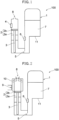
- a hypochlorous acid water 7 spray device 100 includes a storage unit 1 that stores hypochlorous acid water 7, an atomization mechanism 2 that atomizes the hypochlorous acid water 7 using ultrasonic vibration, and a guiding mechanism 3 that guides the hypochlorous acid water 7 from the storage unit 1 to the atomization mechanism 2 by capillary action.
- the hypochlorous acid water 7 spray device 100 may further include, as necessary, a spray mechanism 4 that sprays the atomized misty hypochlorous acid water 7.
- the hypochlorous acid water 7 is supplied from the storage unit 1 to a region where the guiding mechanism 3 is disposed through an outlet 5, and is guided to above the atomization mechanism 2, that is, above a vibration plate 2b by capillary action of the guiding mechanism 3. Accordingly, the hypochlorous acid water 7 spray device 100 has a structure that can reduce the amount of hypochlorous acid water staying on a vibrating element 2a and the vibration plate 2b to reduce the direct influence of the atomization mechanism 2 on hypochlorous acid.
- the storage unit 1 is provided with the outlet 5 for the hypochlorous acid water 7 and an air inlet 6 for introducing air into the storage unit 1.
- the air inlet 6 is disposed above the outlet 5 with a height difference.
- This structure allows air to easily enter from the air inlet 6.
- the size of the outlet 5 is designed to be as small as possible, and the air inlet 6 is provided with a filter or the like so as to be also designed to have small openings.
- the air inlet 6 is preferably provided at a position lower than a bottom surface 11 of the storage unit 1 and higher than the outlet 5.
- a glass or resin tank or the like can be used as the storage unit 1.
- a material such as glass, a PET resin, a PMMA resin, an ABS resin, an ASA resin, or a styrene-based resin (such as GPPS and HIPS) is used. Since there may be a possibility to promote decomposition of hypochlorous acid and decrease the hypochlorous acid concentration depending on material, a PET resin, a PMMA resin, an ABS resin, a styrene-based resin (such as GPPS and HIPS), or the like is preferably used.
- the atomization mechanism 2 can include, for example, the ultrasonic element 2a including an ultrasonic vibrator and the vibration plate 2b. Since the vibration plate 2b is porous and has a lower surface in contact with the guiding mechanism 3 described later, hypochlorous acid water sucked up by capillary action of the guiding mechanism 3 reaches the vibration plate 2b.
- the frequency range used is preferably high.
- the ultrasonic wave used has a frequency in too high a range, the atomized misty hypochlorous acid water has a smaller average particle diameter, and hypochlorous acid tends to be easily decomposed. Therefore, the frequency range used can be appropriately selected in consideration of these tendencies.
- the frequency range used is not particularly limited, but is, for example, preferably 1.0 MHz or more, more preferably 1.2 MHz or more, and is preferably 3.0 MHz or less, more preferably 2.4 MHz or less, still more preferably 1.6 MHz or less.
- the average particle diameter of the misty hypochlorous acid water is preferably small to some extent, and is preferably about 10 ⁇ m or less, more preferably 7 ⁇ m or less, and still more preferably 5 ⁇ m or less.
- the average particle diameter of the misty hypochlorous acid water atomized by the atomization mechanism 2 is preferably about 3 ⁇ m or more, and more preferably 4 ⁇ m or more from the viewpoint of inhibiting an increase in surface area to some extent and inhibiting decomposition of hypochlorous acid.
- the guiding mechanism 3 guides the hypochlorous acid water 7 supplied from the outlet 5 of the storage unit 1 to the atomization mechanism 2 by capillary action so that the hypochlorous acid water 7 will not receive energy (acceleration) generated by ultrasonic vibration as much as possible.
- the guiding mechanism 3 for example, one that can replenish the hypochlorous acid water 7 supplied from the storage unit 1 to above the atomization mechanism 2 by capillary action, such as an elastic soft cloth or resin can be used.
- materials such as a polyester-based resin, a PET resin, absorbent cotton, and a cellulose-based resin can be used, and a PET resin or the like is preferably used from the viewpoint of little influence on hypochlorous acid.
- the spray mechanism 4 is not particularly limited as long as it can send misty particles of atomized hypochlorous acid water generated by the atomization mechanism 2 to the outside of the device.
- pressurization or a sending mechanism such as a fan can be used as the spray mechanism 4, and the spray mechanism 4 can be configured to spray the misty particles from a spout 8.
- the spray mechanism 4 can be configured to spray the misty particles from a spout 8.
- the atomization mechanism 4 is provided in the spout 8, such as in a structure in which the atomization mechanism 4 and the spout 8 are connected together, it is also possible to spray and diffuse the misty particles simultaneously with vaporization (atomization) by the ultrasonic vibrator in the atomization mechanism 4.
- a siliconebased mold release agent reacts with hypochlorous acid water to deactivate the hypochlorous acid water, it is preferable to use these structures after sufficient washing when such a mold release agent remains.
- Typical examples of the component that decomposes hypochlorous acid include nitrogen contained in a polyamide-based resin.
- hypochlorous acid water spray device 100 may incorporate a balance (weight scale) for accurately controlling the spraying amount.
- a balance weight scale
- the weight of a storage tank or the entire device is measured by a weight sensor, and feedback control is performed or a decrease amount is displayed, whereby an accurate spraying amount can be recognized.
- the hypochlorous acid water spray device 100 may be provided with a thermometer, a CO 2 sensor, and the like.
- a thermometer In order to prevent infection by coronavirus or influenza virus, closed, crowded, and close-contact settings should be avoided.
- As one method of controlling the timing for spraying the hypochlorous acid water it is possible to detect a "closed, crowded, and close-contact" setting from a change in the temperature or CO 2 concentration, and spray the hypochlorous acid water.
- the hypochlorous acid water 7 used preferably contains as few contaminant ions as possible other than hypochlorous acid molecules.
- the hypochlorous acid water containing as few contaminant ions as possible other than hypochlorous acid molecules include those in which 40 mol% or more of the total amount of chlorine in the liquid is chlorine of hypochlorous acid, that is, chlorine derived from hypochlorous acid. This is because if the hypochlorous acid water 7 contains a large amount of contaminant ions, hypochlorous acid and contaminant ions may cause a chemical reaction to promote decomposition in the process of evaporation and aggregation of moisture in the mist.
- water used for preparing hypochlorous acid water pure water, purified water, ion-exchanged water, or the like is preferably used in order to reduce contamination with unintended components, for example, metal ions and organic substances contained in tap water.
- the hypochlorous acid water used is preferably electrolytic water. More specifically, the hypochlorous acid water is preferably electrolytic water containing, as a main component, hypochlorous acid and obtained by electrolysis using hydrochloric acid or sodium chloride as a raw material. As such hypochlorous acid water, a commercially available product can also be used.
- the hypochlorous acid water used preferably has a pH of 3.2 or more, more preferably 3.5 or more, and particularly preferably 5.8 or more. Setting the pH of the hypochlorous acid water used to 3.2 or more can reduce corrosion and deterioration of parts used in the spray device, and further reduce generation of chlorine gas (hydrogen chloride gas).
- the hypochlorous acid water is suitably used for washing and sterilizing the skin as in hand/finger washing (hand washing sterilization), sterilizing indoor spaces, and the like in various environments, for example, hospitals, welfare facilities, hospitals, nursery schools, kindergarten, schools, and cram schools.
- hand washing sterilization hand washing sterilization
- the hypochlorous acid water does not contain a salt and has a pH that is not too low, there is little concern about corrosion, and thus the hypochlorous acid water can be used in combination with a humidification function or an air cleaning function.
- the means for generating the airflow is not limited to the fan, but is intended to have a configuration capable of indirectly spraying atomized misty hypochlorous acid water upward by the generated upward airflow in conjunction with the outer peripheral portion 10 serving as a guide.
- the misty hypochlorous acid water 7 atomized by the atomization mechanism 2 utilizing an ultrasonic wave is usually ejected from the spout 8 to the outside by using the fan 9.
- the wind from the fan 9 that directly hits the misty hypochlorous acid water deactivates hypochlorous acid in the misty hypochlorous acid water, which may reduce the effective chlorine concentration in the ejected mist.
- a countermeasure as shown in FIG.
- the spray device of the present invention can be used to sterilize various indoor spaces such as clinics, hospitals, welfare facilities, nursery schools, kindergartens, schools, cram schools, elderly housings, and standard homes.
Landscapes
- Life Sciences & Earth Sciences (AREA)
- Chemical & Material Sciences (AREA)
- Health & Medical Sciences (AREA)
- Engineering & Computer Science (AREA)
- General Health & Medical Sciences (AREA)
- Pest Control & Pesticides (AREA)
- Plant Pathology (AREA)
- Wood Science & Technology (AREA)
- Zoology (AREA)
- Environmental Sciences (AREA)
- Dispersion Chemistry (AREA)
- General Chemical & Material Sciences (AREA)
- Agronomy & Crop Science (AREA)
- Chemical Kinetics & Catalysis (AREA)
- Toxicology (AREA)
- Dentistry (AREA)
- Apparatus For Disinfection Or Sterilisation (AREA)
- Special Spraying Apparatus (AREA)
- Disinfection, Sterilisation Or Deodorisation Of Air (AREA)
Abstract
Description
- The present invention relates to a spray device that utilizes ultrasonic vibration and is intended for atomizing and spraying hypochlorous acid water, and more particularly to the spray device that inhibits decomposition of hypochlorous acid.
- Conventionally, sodium hypochlorite as one of chlorine-based halogens exerts an immediate germ-killing potency at a very low concentration against bacteria, and is widely used in various fields including public health such as disinfection and sterilization in daily life, food, and medical care as the most reliable disinfectant in terms of the effect against viruses such as HIV and HBV. In particular, as the most familiar example, as for viruses having no envelope, such as viruses belonging to the family Caliciviridae including norovirus and SLV (sapovirus), and rotavirus, it is difficult to expect sterilization by alcohol disinfection, and chloric acid-based disinfection and sterilization are the first choice. Specifically, aqueous solutions containing sodium hypochlorite are used in the form of a spray or the like for disinfection and germ-killing/sterilization of various articles such as clothes, tableware, glass containers, and plastic containers, and environments, in homes and medical settings. In addition, spatial sterilization using hypochlorous acid water instead of a strongly alkaline aqueous sodium hypochlorite solution has also been performed.
- Hypochlorous acid is regarded to have a more potent germ-killing and antiviral effect than that of sodium hypochlorite by a factor of 80 or more and have a wider antimicrobial spectrum covering non-enveloped viruses and fungi (Non-Patent Document 1). In addition, hypochlorous acid water is acidic to slightly acidic unlike the alkaline aqueous sodium hypochlorite solution. As a device for spraying hypochlorous acid water, for example,
Patent Document 1 describes a spray device capable of drifting a dry mist in an indoor space for a long time without unnecessarily increasing the indoor humidity by utilizing ultrasonic vibration and spraying an aqueous hypochlorous acid solution as a mist having a particle diameter of about 0.5 µm in the indoor space. In addition,Patent Document 2 describes a hypochlorous acid water spray device that ultra-finely atomizes hypochlorous acid water in a water tank container storing the hypochlorous acid water by ultrasonic vibration and sprays the hypochlorous acid water from a nozzle. The hypochlorous acid water spray device includes a tray-shaped ultra-finely atomizing and generating device that has an ultrasonic vibrator disposed on a bottom surface thereof and that is immersed and floats in the hypochlorous acid water in the water tank container. -
- Patent Document 1:
JP 2019-154884 A - Patent Document 2:
JP 2020-062289 A - Non-Patent Document 1: "<Table 2> Germ-killing activity of acidic electrolytic water (hypochlorous acid water)", Functional Water Foundation, 2015, [online], [searched on April 23, 2020], Internet <URL: http://www.fwf.or.jp/kinousui.html>
- Hypochlorous acid is easily decomposed by external force (energy). For this reason, spraying by heat or pressure greatly decomposes hypochlorous acid, and therefore, ultrasonic spraying utilizing an ultrasonic element is employed. Unfortunately, decomposition of the hypochlorous acid water on the ultrasonic element (vibrator) is promoted by energy of ultrasonic vibration even if the hypochlorous acid water is not vaporized. Therefore, the devices described in
Patent Documents - Therefore, an object of the present invention is to provide a hypochlorous acid water spray device that utilizes ultrasonic vibration and is capable of inhibiting decomposition of hypochlorous acid.
- As a result of study of the above-mentioned problem, the present inventors have found that it is possible to provide a hypochlorous acid water spray device in which the direct influence of an ultrasonic vibrator on hypochlorous acid is reduced by utilization of capillary action so that decomposition of hypochlorous acid is inhibited, thereby completing the present invention.
- That is, the present invention relates to:
- [1] A hypochlorous acid water spray device including:
- a storage unit that stores hypochlorous acid water;
- an atomization mechanism that atomizes the hypochlorous acid water using ultrasonic vibration; and
- a guiding mechanism that guides the hypochlorous acid water to the atomization mechanism by capillary action;
- [2] The hypochlorous acid water spray device according to [1], wherein liquid contact members, which include the storage unit and the guiding mechanism and come into contact with hypochlorous acid water, are free of any attached component that decomposes hypochlorous acid;
- [3] The hypochlorous acid water spray device according to [1] or [2], further including an airflow generating mechanism that sprays atomized misty hypochlorous acid water upward by generating an upward airflow;
- [4] The hypochlorous acid water spray device according to any one of [1] to [3], wherein misty hypochlorous acid water atomized in the atomization mechanism has an average particle diameter of 3 to 10 µm, preferably 3 to 7 µm, and more preferably 4 to 5 µm; and
- [5] The hypochlorous acid water spray device according to any one of [1] to [4], wherein an ultrasonic wave used in the atomization mechanism has a frequency in a range of 1.0 to 3.0 MHz, preferably 1.0 to 2.4 MHz, and more preferably 1.2 to 1.6 MHz.
- According to the present invention, in a hypochlorous acid water spray device including an atomization mechanism that atomizes hypochlorous acid water using ultrasonic vibration, a guiding mechanism that utilizes capillary action for guiding the hypochlorous acid water from a storage unit to the atomization mechanism is provided, so that unnecessary decomposition of hypochlorous acid can be inhibited.
-
-
FIG. 1 is a schematic diagram illustrating a hypochlorous acid water spray device according toEmbodiment 1. -
FIG. 2 is a schematic diagram illustrating the hypochlorous acid water spray device according toEmbodiment 2. - Next, embodiments of the hypochlorous acid water spray device of the present invention are specifically described with reference to drawings, but the present invention is not intended to be limited to the embodiments. In addition, members, materials, and the like described below can be variously modified within the scope of the gist of the present invention. Furthermore, in the drawings, the same reference signs denote equivalent or same components, and sizes, positional relations, and the like of the structural elements are illustrated for convenience, and do not necessarily reflect actual conditions.
- As shown in
FIG. 1 , ahypochlorous acid water 7spray device 100 according toEmbodiment 1 includes astorage unit 1 that storeshypochlorous acid water 7, anatomization mechanism 2 that atomizes thehypochlorous acid water 7 using ultrasonic vibration, and aguiding mechanism 3 that guides thehypochlorous acid water 7 from thestorage unit 1 to theatomization mechanism 2 by capillary action. Thehypochlorous acid water 7spray device 100 may further include, as necessary, aspray mechanism 4 that sprays the atomized mistyhypochlorous acid water 7. Thehypochlorous acid water 7 is supplied from thestorage unit 1 to a region where the guidingmechanism 3 is disposed through anoutlet 5, and is guided to above theatomization mechanism 2, that is, above avibration plate 2b by capillary action of the guidingmechanism 3. Accordingly, thehypochlorous acid water 7spray device 100 has a structure that can reduce the amount of hypochlorous acid water staying on a vibratingelement 2a and thevibration plate 2b to reduce the direct influence of theatomization mechanism 2 on hypochlorous acid. - The
storage unit 1 is provided with theoutlet 5 for thehypochlorous acid water 7 and anair inlet 6 for introducing air into thestorage unit 1. Theair inlet 6 is disposed above theoutlet 5 with a height difference. This structure allows air to easily enter from theair inlet 6. The size of theoutlet 5 is designed to be as small as possible, and theair inlet 6 is provided with a filter or the like so as to be also designed to have small openings. As a result, in this structure, small air bubbles enter thestorage unit 1 from theair inlet 6, and the up-and-down width of the water surface in thestorage unit 1 is made small to avoid generation of impact and kinetic energy, thereby inhibiting decomposition of hypochlorous acid. In consideration of such a mechanism, theair inlet 6 is preferably provided at a position lower than abottom surface 11 of thestorage unit 1 and higher than theoutlet 5. - As the
storage unit 1, a glass or resin tank or the like can be used. As for the member that constitutes the storage unit, a material such as glass, a PET resin, a PMMA resin, an ABS resin, an ASA resin, or a styrene-based resin (such as GPPS and HIPS) is used. Since there may be a possibility to promote decomposition of hypochlorous acid and decrease the hypochlorous acid concentration depending on material, a PET resin, a PMMA resin, an ABS resin, a styrene-based resin (such as GPPS and HIPS), or the like is preferably used. - The
atomization mechanism 2 can include, for example, theultrasonic element 2a including an ultrasonic vibrator and thevibration plate 2b. Since thevibration plate 2b is porous and has a lower surface in contact with the guidingmechanism 3 described later, hypochlorous acid water sucked up by capillary action of the guidingmechanism 3 reaches thevibration plate 2b. - As for the
ultrasonic element 2a, when the ultrasonic wave used has a frequency in a low range, the vibrator has a large amplitude, and large energy is given to the hypochlorous acid water. Therefore, the frequency range used is preferably high. Meanwhile, when the ultrasonic wave used has a frequency in too high a range, the atomized misty hypochlorous acid water has a smaller average particle diameter, and hypochlorous acid tends to be easily decomposed. Therefore, the frequency range used can be appropriately selected in consideration of these tendencies. The frequency range used is not particularly limited, but is, for example, preferably 1.0 MHz or more, more preferably 1.2 MHz or more, and is preferably 3.0 MHz or less, more preferably 2.4 MHz or less, still more preferably 1.6 MHz or less. - In order to stabilize an atomized state of the misty hypochlorous acid water atomized in the
atomization mechanism 2, the average particle diameter of the misty hypochlorous acid water is preferably small to some extent, and is preferably about 10 µm or less, more preferably 7 µm or less, and still more preferably 5 µm or less. The average particle diameter of the misty hypochlorous acid water atomized by theatomization mechanism 2 is preferably about 3 µm or more, and more preferably 4 µm or more from the viewpoint of inhibiting an increase in surface area to some extent and inhibiting decomposition of hypochlorous acid. - As described above, the
guiding mechanism 3 guides thehypochlorous acid water 7 supplied from theoutlet 5 of thestorage unit 1 to theatomization mechanism 2 by capillary action so that thehypochlorous acid water 7 will not receive energy (acceleration) generated by ultrasonic vibration as much as possible. As for theguiding mechanism 3, for example, one that can replenish thehypochlorous acid water 7 supplied from thestorage unit 1 to above theatomization mechanism 2 by capillary action, such as an elastic soft cloth or resin can be used. Specifically, materials such as a polyester-based resin, a PET resin, absorbent cotton, and a cellulose-based resin can be used, and a PET resin or the like is preferably used from the viewpoint of little influence on hypochlorous acid. - The
spray mechanism 4 is not particularly limited as long as it can send misty particles of atomized hypochlorous acid water generated by theatomization mechanism 2 to the outside of the device. However, pressurization or a sending mechanism such as a fan can be used as thespray mechanism 4, and thespray mechanism 4 can be configured to spray the misty particles from aspout 8. Further, for example, in a case where theatomization mechanism 4 is provided in thespout 8, such as in a structure in which theatomization mechanism 4 and thespout 8 are connected together, it is also possible to spray and diffuse the misty particles simultaneously with vaporization (atomization) by the ultrasonic vibrator in theatomization mechanism 4. - In the
spray device 100 described inEmbodiment 1, as for liquid contact members with which thehypochlorous acid water 7 comes into direct contact, specifically, for example, thestorage unit 1 and theguiding mechanism 3, it is preferable to use a member formed of a material having little influence on hypochlorous acid as described above. Furthermore, it is more preferable that the constituent members that constitute portions thereof are free of any attached component that decomposes hypochlorous acid. More specifically, it is particularly preferable that the portions in contact with hypochlorous acid water are free of any mold release agent for release from a mold used in manufacturing these structures (thestorage unit 1 and the guiding mechanism 3), adhesive used in assembling thespray device 100, and the like attached thereto. Specifically, since it has been found by the present inventors that a siliconebased mold release agent reacts with hypochlorous acid water to deactivate the hypochlorous acid water, it is preferable to use these structures after sufficient washing when such a mold release agent remains. Typical examples of the component that decomposes hypochlorous acid include nitrogen contained in a polyamide-based resin. - In addition, the hypochlorous acid
water spray device 100 according toEmbodiment 1 may incorporate a balance (weight scale) for accurately controlling the spraying amount. For example, the weight of a storage tank or the entire device is measured by a weight sensor, and feedback control is performed or a decrease amount is displayed, whereby an accurate spraying amount can be recognized. - Moreover, the hypochlorous acid
water spray device 100 according toEmbodiment 1 may be provided with a thermometer, a CO2 sensor, and the like. In order to prevent infection by coronavirus or influenza virus, closed, crowded, and close-contact settings should be avoided. As one method of controlling the timing for spraying the hypochlorous acid water, it is possible to detect a "closed, crowded, and close-contact" setting from a change in the temperature or CO2 concentration, and spray the hypochlorous acid water. For this purpose, it is possible to provide a thermometer and a CO2 sensor in the hypochlorous acidwater spray device 100, and control the operation of the hypochlorous acidwater spray device 100 in conjunction with the thermometer and the CO2 sensor. - In the hypochlorous acid
water spray device 100 according toEmbodiment 1, thehypochlorous acid water 7 used preferably contains as few contaminant ions as possible other than hypochlorous acid molecules. Examples of the hypochlorous acid water containing as few contaminant ions as possible other than hypochlorous acid molecules include those in which 40 mol% or more of the total amount of chlorine in the liquid is chlorine of hypochlorous acid, that is, chlorine derived from hypochlorous acid. This is because if thehypochlorous acid water 7 contains a large amount of contaminant ions, hypochlorous acid and contaminant ions may cause a chemical reaction to promote decomposition in the process of evaporation and aggregation of moisture in the mist. For this reason, as for water used for preparing hypochlorous acid water, pure water, purified water, ion-exchanged water, or the like is preferably used in order to reduce contamination with unintended components, for example, metal ions and organic substances contained in tap water. - The hypochlorous acid water used is preferably electrolytic water. More specifically, the hypochlorous acid water is preferably electrolytic water containing, as a main component, hypochlorous acid and obtained by electrolysis using hydrochloric acid or sodium chloride as a raw material. As such hypochlorous acid water, a commercially available product can also be used.
- The hypochlorous acid water used preferably has a pH of 3.2 or more, more preferably 3.5 or more, and particularly preferably 5.8 or more. Setting the pH of the hypochlorous acid water used to 3.2 or more can reduce corrosion and deterioration of parts used in the spray device, and further reduce generation of chlorine gas (hydrogen chloride gas).
- Owing to properties such as not too low a pH and a strong germ-killing and antiviral potency, the hypochlorous acid water is suitably used for washing and sterilizing the skin as in hand/finger washing (hand washing sterilization), sterilizing indoor spaces, and the like in various environments, for example, hospitals, welfare facilities, hospitals, nursery schools, kindergarten, schools, and cram schools. In particular, in an aspect in which the hypochlorous acid water does not contain a salt and has a pH that is not too low, there is little concern about corrosion, and thus the hypochlorous acid water can be used in combination with a humidification function or an air cleaning function.
- The
hypochlorous acid water 7spray device 100 according toEmbodiment 2 further includes an airflow generating mechanism that sprays atomized misty hypochlorous acid water upward by generating an upward airflow. As illustrated inFIG. 2 , thespout 8 is covered with an outerperipheral portion 10 provided with afan 9 for generating an upward airflow (arrows in the drawing). More specifically, inFIG. 2 , thefan 9 and the outerperipheral portion 10 constitute an airflow generating mechanism that sprays atomized misty hypochlorous acid water upward. Here, the means for generating the airflow is not limited to the fan, but is intended to have a configuration capable of indirectly spraying atomized misty hypochlorous acid water upward by the generated upward airflow in conjunction with the outerperipheral portion 10 serving as a guide. The mistyhypochlorous acid water 7 atomized by theatomization mechanism 2 utilizing an ultrasonic wave is usually ejected from thespout 8 to the outside by using thefan 9. The wind from thefan 9 that directly hits the misty hypochlorous acid water deactivates hypochlorous acid in the misty hypochlorous acid water, which may reduce the effective chlorine concentration in the ejected mist. As a countermeasure, as shown inFIG. 2 , by generating an upward airflow outside to promote ejection of atomized misty hypochlorous acid water, the misty hypochlorous acid water is efficiently ejected upward, and deactivation of hypochlorous acid is satisfactorily remedied as compared with a case where the wind from the fan directly hits the hypochlorous acid water. The portions inFIG. 2 same as those inFIG. 1 are denoted by the same reference signs as those inFIG. 1 , and the description thereof is omitted. - In the present description, the matters described in each of
Embodiments -
- (1) A hypochlorous acid water spray device of the present invention includes a storage unit that stores hypochlorous acid water, an atomization mechanism that atomizes the hypochlorous acid water using ultrasonic vibration, and a guiding mechanism that guides the hypochlorous acid water to the atomization mechanism by capillary action. With this configuration, the amount of hypochlorous acid water staying on the atomization mechanism that atomizes the hypochlorous acid water using ultrasonic vibration from an ultrasonic vibrator, a vibration plate, or the like can be reduced as much as possible, the influence of the atomization mechanism on hypochlorous acid can be reduced, and unnecessary decomposition of hypochlorous acid can be inhibited.
- (2) Liquid contact members, which include the storage unit and the guiding mechanism and come into contact with hypochlorous acid water, are preferably free of any attached component that decomposes hypochlorous acid. With this configuration, unnecessary decomposition (deactivation) of hypochlorous acid is inhibited.
- (3) The hypochlorous acid water spray device of the present invention preferably further includes an airflow generating mechanism that sprays atomized misty hypochlorous acid water upward by generating an upward airflow. The airflow generating mechanism can more efficiently guide the atomized misty hypochlorous acid water to the outside while reducing direct impact on the atomized misty hypochlorous acid water and reducing the risk that the effective chlorine concentration in the ejected mist is reduced.
- (4) The atomized misty hypochlorous acid water preferably has an average particle diameter of 3 to 10 µm, more preferably 3 to 7 µm, and still more preferably 4 to 5 µm. Setting the average particle diameter of the atomized misty hypochlorous acid water within such a range can stabilize the atomized state and inhibit decomposition of the hypochlorous acid water.
- (5) An ultrasonic wave used in the atomization mechanism preferably has a frequency in a range of 1.0 to 3.0 MHz, more preferably 1.0 to 2.4 MHz, and still more preferably 1.2 to 1.6 MHz. Setting the frequency range used within such a range can provide, under moderate energy application, atomized misty hypochlorous acid water having an appropriate particle diameter with which decomposition is not excessively promoted.
-
- 100
- SPRAY DEVICE
- 1
- STORAGE UNIT
- 2
- ATOMIZATION MECHANISM
- 2a
- ULTRASONIC ELEMENT
- 2b
- VIBRATION PLATE
- 3
- GUIDING MECHANISM
- 31
- NARROW TUBE
- 4
- SPRAY MECHANISM
- 5
- OUTLET
- 6
- AIR INLET
- 7
- HYPOCHLOROUS ACID WATER
- 8
- SPOUT
- 9
- FAN
- 10
- OUTER PERIPHERAL PORTION
Claims (5)
- A hypochlorous acid water spray device comprising:a storage unit that stores hypochlorous acid water;an atomization mechanism that atomizes the hypochlorous acid water using ultrasonic vibration; anda guiding mechanism that guides the hypochlorous acid water to the atomization mechanism by capillary action.
- The hypochlorous acid water spray device according to claim 1, wherein liquid contact members, which include the storage unit and the guiding mechanism and come into contact with hypochlorous acid water, are free of any attached component that decomposes hypochlorous acid.
- The hypochlorous acid water spray device according to claim 1 or 2, further comprising an airflow generating mechanism that sprays atomized misty hypochlorous acid water upward by generating an upward airflow.
- The hypochlorous acid water spray device according to claim 1 or 2, wherein misty hypochlorous acid water atomized in the atomization mechanism has an average particle diameter of 3 to 10 µm.
- The hypochlorous acid water spray device according to claim 1 or 2, wherein an ultrasonic wave used in the atomization mechanism has a frequency in a range of 1.0 to 3.0 MHz.
Applications Claiming Priority (2)
| Application Number | Priority Date | Filing Date | Title |
|---|---|---|---|
| JP2021131286 | 2021-08-11 | ||
| PCT/JP2022/030315 WO2023017810A1 (en) | 2021-08-11 | 2022-08-08 | Hypochlorous acid water spray device |
Publications (2)
| Publication Number | Publication Date |
|---|---|
| EP4385628A1 true EP4385628A1 (en) | 2024-06-19 |
| EP4385628A4 EP4385628A4 (en) | 2025-07-30 |
Family
ID=85200659
Family Applications (1)
| Application Number | Title | Priority Date | Filing Date |
|---|---|---|---|
| EP22855872.2A Pending EP4385628A4 (en) | 2021-08-11 | 2022-08-08 | Device for spraying hypochloric acid water |
Country Status (5)
| Country | Link |
|---|---|
| US (1) | US20250135485A1 (en) |
| EP (1) | EP4385628A4 (en) |
| JP (1) | JPWO2023017810A1 (en) |
| CN (1) | CN117729977A (en) |
| WO (1) | WO2023017810A1 (en) |
Families Citing this family (1)
| Publication number | Priority date | Publication date | Assignee | Title |
|---|---|---|---|---|
| CN116786340B (en) * | 2023-06-09 | 2026-06-23 | 广东奥迪威传感科技股份有限公司 | Oiling agent atomizing device |
Family Cites Families (15)
| Publication number | Priority date | Publication date | Assignee | Title |
|---|---|---|---|---|
| JP5254531B2 (en) * | 2006-03-09 | 2013-08-07 | 東海旅客鉄道株式会社 | Ozone mist generator |
| JP4749248B2 (en) * | 2006-06-30 | 2011-08-17 | 三洋電機株式会社 | Blower built-in equipment and sterilization unit |
| JP2009208021A (en) * | 2008-03-05 | 2009-09-17 | Sanyo Electric Co Ltd | Water absorption device and atomizer |
| JP5560835B2 (en) * | 2010-03-29 | 2014-07-30 | 三洋電機株式会社 | Mist generator |
| JP5467088B2 (en) * | 2011-09-26 | 2014-04-09 | シルバー株式会社 | Chemical spraying device |
| JP5868474B1 (en) * | 2014-11-07 | 2016-02-24 | 株式会社イースタン | Spraying device and spraying system |
| JP2017038817A (en) * | 2015-08-20 | 2017-02-23 | 株式会社ハーテック | Spraying equipment |
| JP2017149125A (en) * | 2016-02-27 | 2017-08-31 | 俊寛 倉見 | Fingertip humidifier |
| JP7158824B2 (en) * | 2017-03-08 | 2022-10-24 | 森永乳業株式会社 | Mist processing device |
| JP2019154884A (en) | 2018-03-15 | 2019-09-19 | 株式会社グリーンウェル | Sterilization/deodorization system using hypochlorite tablet |
| JP2020037085A (en) * | 2018-09-05 | 2020-03-12 | 本多電子株式会社 | Ultrasonic atomizer |
| JP2020054970A (en) * | 2018-10-03 | 2020-04-09 | 住友化学株式会社 | Spray device, use of spray device and using method of spray device |
| JP7216978B2 (en) | 2018-10-18 | 2023-02-02 | 株式会社エムファームランド | Hypochlorous acid water spray device |
| JP3224953U (en) * | 2019-11-15 | 2020-01-30 | Red株式会社 | Dry sterilizer and deodorizer |
| JP6751934B1 (en) * | 2020-06-15 | 2020-09-09 | 康司 畑田 | Spatial arrangement control system for fine particles, spatial arrangement control method for fine particles, spatial arrangement control program for fine particles |
-
2022
- 2022-08-08 JP JP2023541444A patent/JPWO2023017810A1/ja active Pending
- 2022-08-08 WO PCT/JP2022/030315 patent/WO2023017810A1/en not_active Ceased
- 2022-08-08 CN CN202280053019.5A patent/CN117729977A/en active Pending
- 2022-08-08 US US18/682,898 patent/US20250135485A1/en active Pending
- 2022-08-08 EP EP22855872.2A patent/EP4385628A4/en active Pending
Also Published As
| Publication number | Publication date |
|---|---|
| JPWO2023017810A1 (en) | 2023-02-16 |
| EP4385628A4 (en) | 2025-07-30 |
| WO2023017810A1 (en) | 2023-02-16 |
| US20250135485A1 (en) | 2025-05-01 |
| CN117729977A (en) | 2024-03-19 |
Similar Documents
| Publication | Publication Date | Title |
|---|---|---|
| CN103619361B (en) | For reducing the method for the concentration of disinfectant, cleaning equipment and system and the correlation technique using described cleaning equipment and system | |
| US20060177521A1 (en) | Humidifer sanitization | |
| CN201108612Y (en) | A atomization disinfection device for chlorine dioxide disinfectant | |
| JP6887679B2 (en) | Sprayer | |
| KR20100011542U (en) | Sterilizing water spraying apparatus | |
| US20250135485A1 (en) | Hypochlorous acid water spray device | |
| JP2019154884A (en) | Sterilization/deodorization system using hypochlorite tablet | |
| JP2018090547A (en) | Disinfectant and method for producing the same | |
| KR200482450Y1 (en) | a humidification and serilizer with portable | |
| KR20210010904A (en) | Disinfection method using disinfectant formed on site by reaction of H2O2 and NO2- | |
| KR101147148B1 (en) | Portable sterillizer and method of using the same | |
| JP2010131337A (en) | Slightly acidic electrolytic water atomizer | |
| CN111217334B (en) | Ultrasonic atomization preparation device for food-grade chlorine dioxide for disinfection, sterilization and deodorization of banknotes | |
| US20220062479A1 (en) | Disinfection Bomb | |
| CN105381492B (en) | Method and apparatus for releasing chlorine dioxide into a space environment | |
| JP7504388B2 (en) | Hypochlorous acid spray system | |
| JP4575234B2 (en) | Generation method of chlorine dioxide gas | |
| KR20120008720U (en) | portable sterillizer | |
| US20120275952A1 (en) | Method for Reducing the Concentration of Disinfectant, Decontamination Apparatuses and Systems and Related Methods of Employing the Same | |
| JP7788704B2 (en) | Sterilization method and sterilization device | |
| JP2007162997A (en) | Dry fog generator | |
| JP6550570B2 (en) | Chemical sprayer with solid drug enclosed | |
| KR20110100515A (en) | Evaporative Vaporizer Using Ultrasonic Vibrator | |
| JP4738905B2 (en) | Disinfectant / deodorant composition and aerosol spray device | |
| CN108543214B (en) | Induction type disinfection equipment and disinfection method using same |
Legal Events
| Date | Code | Title | Description |
|---|---|---|---|
| STAA | Information on the status of an ep patent application or granted ep patent |
Free format text: STATUS: THE INTERNATIONAL PUBLICATION HAS BEEN MADE |
|
| PUAI | Public reference made under article 153(3) epc to a published international application that has entered the european phase |
Free format text: ORIGINAL CODE: 0009012 |
|
| STAA | Information on the status of an ep patent application or granted ep patent |
Free format text: STATUS: REQUEST FOR EXAMINATION WAS MADE |
|
| 17P | Request for examination filed |
Effective date: 20240208 |
|
| AK | Designated contracting states |
Kind code of ref document: A1 Designated state(s): AL AT BE BG CH CY CZ DE DK EE ES FI FR GB GR HR HU IE IS IT LI LT LU LV MC MK MT NL NO PL PT RO RS SE SI SK SM TR |
|
| DAV | Request for validation of the european patent (deleted) | ||
| DAX | Request for extension of the european patent (deleted) | ||
| A4 | Supplementary search report drawn up and despatched |
Effective date: 20250630 |
|
| RIC1 | Information provided on ipc code assigned before grant |
Ipc: B05B 17/06 20060101AFI20250624BHEP Ipc: A01N 25/02 20060101ALI20250624BHEP Ipc: A01N 59/08 20060101ALI20250624BHEP Ipc: A61L 9/01 20060101ALI20250624BHEP Ipc: A61L 9/14 20060101ALI20250624BHEP |
|
| STAA | Information on the status of an ep patent application or granted ep patent |
Free format text: STATUS: EXAMINATION IS IN PROGRESS |
|
| 17Q | First examination report despatched |
Effective date: 20260313 |