EP4383428A1 - Battery assembly, and battery pack and vehicle which comprise same - Google Patents
Battery assembly, and battery pack and vehicle which comprise same Download PDFInfo
- Publication number
- EP4383428A1 EP4383428A1 EP23843270.2A EP23843270A EP4383428A1 EP 4383428 A1 EP4383428 A1 EP 4383428A1 EP 23843270 A EP23843270 A EP 23843270A EP 4383428 A1 EP4383428 A1 EP 4383428A1
- Authority
- EP
- European Patent Office
- Prior art keywords
- cell
- battery
- battery assembly
- cell units
- cover
- Prior art date
- Legal status (The legal status is an assumption and is not a legal conclusion. Google has not performed a legal analysis and makes no representation as to the accuracy of the status listed.)
- Pending
Links
Images







Classifications
-
- H—ELECTRICITY
- H01—ELECTRIC ELEMENTS
- H01M—PROCESSES OR MEANS, e.g. BATTERIES, FOR THE DIRECT CONVERSION OF CHEMICAL ENERGY INTO ELECTRICAL ENERGY
- H01M50/00—Constructional details or processes of manufacture of the non-active parts of electrochemical cells other than fuel cells, e.g. hybrid cells
- H01M50/20—Mountings; Secondary casings or frames; Racks, modules or packs; Suspension devices; Shock absorbers; Transport or carrying devices; Holders
- H01M50/256—Carrying devices, e.g. belts
-
- H—ELECTRICITY
- H01—ELECTRIC ELEMENTS
- H01M—PROCESSES OR MEANS, e.g. BATTERIES, FOR THE DIRECT CONVERSION OF CHEMICAL ENERGY INTO ELECTRICAL ENERGY
- H01M50/00—Constructional details or processes of manufacture of the non-active parts of electrochemical cells other than fuel cells, e.g. hybrid cells
- H01M50/10—Primary casings; Jackets or wrappings
- H01M50/102—Primary casings; Jackets or wrappings characterised by their shape or physical structure
- H01M50/105—Pouches or flexible bags
-
- H—ELECTRICITY
- H01—ELECTRIC ELEMENTS
- H01M—PROCESSES OR MEANS, e.g. BATTERIES, FOR THE DIRECT CONVERSION OF CHEMICAL ENERGY INTO ELECTRICAL ENERGY
- H01M50/00—Constructional details or processes of manufacture of the non-active parts of electrochemical cells other than fuel cells, e.g. hybrid cells
- H01M50/10—Primary casings; Jackets or wrappings
- H01M50/147—Lids or covers
- H01M50/148—Lids or covers characterised by their shape
- H01M50/15—Lids or covers characterised by their shape for prismatic or rectangular cells
-
- H—ELECTRICITY
- H01—ELECTRIC ELEMENTS
- H01M—PROCESSES OR MEANS, e.g. BATTERIES, FOR THE DIRECT CONVERSION OF CHEMICAL ENERGY INTO ELECTRICAL ENERGY
- H01M50/00—Constructional details or processes of manufacture of the non-active parts of electrochemical cells other than fuel cells, e.g. hybrid cells
- H01M50/20—Mountings; Secondary casings or frames; Racks, modules or packs; Suspension devices; Shock absorbers; Transport or carrying devices; Holders
- H01M50/204—Racks, modules or packs for multiple batteries or multiple cells
- H01M50/207—Racks, modules or packs for multiple batteries or multiple cells characterised by their shape
- H01M50/211—Racks, modules or packs for multiple batteries or multiple cells characterised by their shape adapted for pouch cells
-
- H—ELECTRICITY
- H01—ELECTRIC ELEMENTS
- H01M—PROCESSES OR MEANS, e.g. BATTERIES, FOR THE DIRECT CONVERSION OF CHEMICAL ENERGY INTO ELECTRICAL ENERGY
- H01M50/00—Constructional details or processes of manufacture of the non-active parts of electrochemical cells other than fuel cells, e.g. hybrid cells
- H01M50/20—Mountings; Secondary casings or frames; Racks, modules or packs; Suspension devices; Shock absorbers; Transport or carrying devices; Holders
- H01M50/244—Secondary casings; Racks; Suspension devices; Carrying devices; Holders characterised by their mounting method
-
- H—ELECTRICITY
- H01—ELECTRIC ELEMENTS
- H01M—PROCESSES OR MEANS, e.g. BATTERIES, FOR THE DIRECT CONVERSION OF CHEMICAL ENERGY INTO ELECTRICAL ENERGY
- H01M50/00—Constructional details or processes of manufacture of the non-active parts of electrochemical cells other than fuel cells, e.g. hybrid cells
- H01M50/20—Mountings; Secondary casings or frames; Racks, modules or packs; Suspension devices; Shock absorbers; Transport or carrying devices; Holders
- H01M50/249—Mountings; Secondary casings or frames; Racks, modules or packs; Suspension devices; Shock absorbers; Transport or carrying devices; Holders specially adapted for aircraft or vehicles, e.g. cars or trains
-
- H—ELECTRICITY
- H01—ELECTRIC ELEMENTS
- H01M—PROCESSES OR MEANS, e.g. BATTERIES, FOR THE DIRECT CONVERSION OF CHEMICAL ENERGY INTO ELECTRICAL ENERGY
- H01M50/00—Constructional details or processes of manufacture of the non-active parts of electrochemical cells other than fuel cells, e.g. hybrid cells
- H01M50/20—Mountings; Secondary casings or frames; Racks, modules or packs; Suspension devices; Shock absorbers; Transport or carrying devices; Holders
- H01M50/262—Mountings; Secondary casings or frames; Racks, modules or packs; Suspension devices; Shock absorbers; Transport or carrying devices; Holders with fastening means, e.g. locks
- H01M50/264—Mountings; Secondary casings or frames; Racks, modules or packs; Suspension devices; Shock absorbers; Transport or carrying devices; Holders with fastening means, e.g. locks for cells or batteries, e.g. straps, tie rods or peripheral frames
-
- H—ELECTRICITY
- H01—ELECTRIC ELEMENTS
- H01M—PROCESSES OR MEANS, e.g. BATTERIES, FOR THE DIRECT CONVERSION OF CHEMICAL ENERGY INTO ELECTRICAL ENERGY
- H01M50/00—Constructional details or processes of manufacture of the non-active parts of electrochemical cells other than fuel cells, e.g. hybrid cells
- H01M50/20—Mountings; Secondary casings or frames; Racks, modules or packs; Suspension devices; Shock absorbers; Transport or carrying devices; Holders
- H01M50/289—Mountings; Secondary casings or frames; Racks, modules or packs; Suspension devices; Shock absorbers; Transport or carrying devices; Holders characterised by spacing elements or positioning means within frames, racks or packs
- H01M50/291—Mountings; Secondary casings or frames; Racks, modules or packs; Suspension devices; Shock absorbers; Transport or carrying devices; Holders characterised by spacing elements or positioning means within frames, racks or packs characterised by their shape
-
- H—ELECTRICITY
- H01—ELECTRIC ELEMENTS
- H01M—PROCESSES OR MEANS, e.g. BATTERIES, FOR THE DIRECT CONVERSION OF CHEMICAL ENERGY INTO ELECTRICAL ENERGY
- H01M50/00—Constructional details or processes of manufacture of the non-active parts of electrochemical cells other than fuel cells, e.g. hybrid cells
- H01M50/30—Arrangements for facilitating escape of gases
-
- H—ELECTRICITY
- H01—ELECTRIC ELEMENTS
- H01M—PROCESSES OR MEANS, e.g. BATTERIES, FOR THE DIRECT CONVERSION OF CHEMICAL ENERGY INTO ELECTRICAL ENERGY
- H01M50/00—Constructional details or processes of manufacture of the non-active parts of electrochemical cells other than fuel cells, e.g. hybrid cells
- H01M50/30—Arrangements for facilitating escape of gases
- H01M50/35—Gas exhaust passages comprising elongated, tortuous or labyrinth-shaped exhaust passages
- H01M50/358—External gas exhaust passages located on the battery cover or case
-
- H—ELECTRICITY
- H01—ELECTRIC ELEMENTS
- H01M—PROCESSES OR MEANS, e.g. BATTERIES, FOR THE DIRECT CONVERSION OF CHEMICAL ENERGY INTO ELECTRICAL ENERGY
- H01M50/00—Constructional details or processes of manufacture of the non-active parts of electrochemical cells other than fuel cells, e.g. hybrid cells
- H01M50/50—Current conducting connections for cells or batteries
- H01M50/502—Interconnectors for connecting terminals of adjacent batteries; Interconnectors for connecting cells outside a battery casing
-
- B—PERFORMING OPERATIONS; TRANSPORTING
- B60—VEHICLES IN GENERAL
- B60R—VEHICLES, VEHICLE FITTINGS, OR VEHICLE PARTS, NOT OTHERWISE PROVIDED FOR
- B60R16/00—Electric or fluid circuits specially adapted for vehicles and not otherwise provided for; Arrangement of elements of electric or fluid circuits specially adapted for vehicles and not otherwise provided for
- B60R16/02—Electric or fluid circuits specially adapted for vehicles and not otherwise provided for; Arrangement of elements of electric or fluid circuits specially adapted for vehicles and not otherwise provided for electric constitutive elements
- B60R16/03—Electric or fluid circuits specially adapted for vehicles and not otherwise provided for; Arrangement of elements of electric or fluid circuits specially adapted for vehicles and not otherwise provided for electric constitutive elements for supply of electrical power to vehicle subsystems or for
- B60R16/033—Electric or fluid circuits specially adapted for vehicles and not otherwise provided for; Arrangement of elements of electric or fluid circuits specially adapted for vehicles and not otherwise provided for electric constitutive elements for supply of electrical power to vehicle subsystems or for characterised by the use of electrical cells or batteries
-
- H—ELECTRICITY
- H01—ELECTRIC ELEMENTS
- H01M—PROCESSES OR MEANS, e.g. BATTERIES, FOR THE DIRECT CONVERSION OF CHEMICAL ENERGY INTO ELECTRICAL ENERGY
- H01M2200/00—Safety devices for primary or secondary batteries
- H01M2200/20—Pressure-sensitive devices
-
- H—ELECTRICITY
- H01—ELECTRIC ELEMENTS
- H01M—PROCESSES OR MEANS, e.g. BATTERIES, FOR THE DIRECT CONVERSION OF CHEMICAL ENERGY INTO ELECTRICAL ENERGY
- H01M2220/00—Batteries for particular applications
- H01M2220/20—Batteries in motive systems, e.g. vehicle, ship, plane
-
- Y—GENERAL TAGGING OF NEW TECHNOLOGICAL DEVELOPMENTS; GENERAL TAGGING OF CROSS-SECTIONAL TECHNOLOGIES SPANNING OVER SEVERAL SECTIONS OF THE IPC; TECHNICAL SUBJECTS COVERED BY FORMER USPC CROSS-REFERENCE ART COLLECTIONS [XRACs] AND DIGESTS
- Y02—TECHNOLOGIES OR APPLICATIONS FOR MITIGATION OR ADAPTATION AGAINST CLIMATE CHANGE
- Y02E—REDUCTION OF GREENHOUSE GAS [GHG] EMISSIONS, RELATED TO ENERGY GENERATION, TRANSMISSION OR DISTRIBUTION
- Y02E60/00—Enabling technologies; Technologies with a potential or indirect contribution to GHG emissions mitigation
- Y02E60/10—Energy storage using batteries
Definitions
- the present disclosure relates to a battery assembly, and a battery pack and a vehicle including the same and, more specifically, relates to a battery assembly applicable to a battery pack manufactured by a CTP (cell-to-pack) method, and a battery pack and a vehicle including the same.
- CTP cell-to-pack
- secondary batteries refer to batteries capable of being repeatedly charged and discharged, such as lithium-ion batteries, lithium polymer batteries, nickel-cadmium batteries, nickel-hydrogen batteries, nickel-zinc batteries, and the like.
- the output voltage of a battery cell which is a basic unit of charging and discharging of the secondary batteries, is approximately 2.5V to 4.2V.
- a battery pack which is manufactured in a manner of configuring a battery module by connecting a plurality of battery cells in series or parallel and reconnecting multiple battery modules configured above in series or parallel, has been widely used.
- the existing CTP (cell-to-pack) method of mounting multiple battery cells directly into the battery pack case is applied to increase the energy density of the battery pack, it is difficult to handle the multiple battery cells simultaneously, and there is a risk of damage to the battery cells in the process of mounting the same.
- the existing CTP method since structures for mounting the battery cells are arranged redundantly inside the case, there are problems of deteriorating the effect of reducing the weight and volume of the battery pack and increasing manufacturing costs.
- the present disclosure has been designed to solve the problems of the related art, and therefore one aspect of the present disclosure provides a battery assembly capable of reducing the overall weight and volume of an electrical device including a plurality of battery cells and increasing the energy density of the electrical device, and a battery pack and a vehicle including such a battery assembly.
- Another aspect of the present disclosure provides a battery assembly capable of preventing damage to a plurality of battery cells, which is caused during mounting and using the battery cells in a case, and facilitating handling and installation of the battery cells, and a battery pack and a vehicle including such a battery assembly.
- Another aspect of the present disclosure provides a battery assembly capable of reducing manufacturing costs by simplifying and lightening the structures required for installation of the battery cells, and a battery pack and a vehicle including such a battery assembly.
- a battery assembly including: a plurality of stacked cell units each including at least one battery cell; and a support structure configured to support the plurality of cell units and maintain a stacked state of the plurality of cell units, wherein the support structure includes coupling portion configured to be coupled to a transport structure used to transport the plurality of cell units.
- each of the plurality of cell units may further include a cell cover having a slot into which the at least one battery cell is inserted and an opening through which an electrode lead of the at least one battery cell inserted into the slot is exposed, and covering the at least one battery cell inserted into the slot.
- the cell cover may further include at least one vent portion configured to vent gas from the at least one battery cell inserted into the slot.
- each of the plurality of cell units may further include: a bus bar electrically connected to the electrode lead; and a bus bar frame disposed at the opening of the cell cover and supporting the bus bar.
- the support structure may include: a first side wall disposed adjacent to a first cell unit located at the outermost on one side of the plurality of cell units; a second side wall disposed adjacent to a second cell unit located at the outermost on the other side of the plurality of cell units; and an integrated end cover having one end connected to the first side wall and the other end connected to the second side wall and configured to cover all openings of two or more of the cell covers of the plurality of cell units.
- the integrated end cover may include: a main body portion configured to cover the openings; and a support portion extending from the main body portion toward the lower end of the plurality of cell units to support the lower end of the plurality of cell units, and the transport structure coupled to the coupling portion of the support structure may be configured to be located at the upper end of the plurality of cell units.
- the integrated end cover has vent holes for venting gas, which are provided at respective portions of the integrated end cover corresponding to the openings.
- the support structure may further include a support band having one end in close contact with the first side wall and the other end in close contact with the second side wall so as to support the plurality of cell units.
- the coupling portion of the support structure may be configured to be provided at both ends of the support band and to be detachably coupled to the transport structure.
- the transport structure may have at least one handle and may be configured to be coupled to the coupling portion of the support structure.
- the transport structure may include a coupling frame coupled to the at least one handle to support the at least one handle, and detachably coupled to the coupling portion of the support structure.
- the coupling frame may include: a main frame to which the at least one handle is coupled; and a subframe having one end coupled to the main frame and the other end detachably coupled to the coupling portion of the support structure.
- the at least one battery cell may be configured as a pouch-type secondary battery.
- a battery pack according to another aspect of the present disclosure includes the battery assembly according to any one of the embodiments described above.
- a vehicle according to another aspect of the present disclosure includes the battery assembly according to any one of the embodiments described above.
- multiple battery cells may be configured as a single battery assembly capable of being handled simultaneously by a simplified support structure, thereby facilitating handling of the battery cells and reducing the overall weight and volume of an electrical device including the multiple battery cells, and increasing the energy density of the electrical device.
- the support structure may include a coupling portion configured to be coupled to a transport structure used to transport the plurality of cell units, thereby facilitating handling, transport, and mounting of the battery assembly and increasing manufacturing efficiency.
- the transport structure is configured to be attachable to and detachable from the support structure, a battery pack or electrical device on which the battery assembly is mounted is able to be simplified and lightened.
- multiple battery cells are partially covered by a cell cover in a simplified structure and directly mounted in a case of a corresponding electrical device, instead of being accommodated in a separate case and then reinstalled into the case of the electrical device, it is possible to further reduce the overall weight and volume of the electrical device, further improve the energy density of the battery pack, prevent damage to the battery cells, which is caused during the process of installing the multiple battery cells directly in the case and using the same, and facilitate the swelling control of the battery cells and the design of gas venting paths.
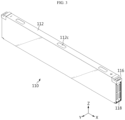
- FIG. 1 is a diagram illustrating a battery assembly 100 according to an embodiment of the present disclosure.
- FIG. 2 is an exploded view illustrating the battery assembly 100 shown in FIG. 1 .
- the battery assembly 100 includes a plurality of cell units 110 and a support structure 120. Depending on the embodiment, the battery assembly 100 may further include a transport structure 130.
- the respective cell units 110 may be configured to include at least one battery cell and to be stacked side by side in the width direction (Y-axis direction). As will be described again below, each cell unit 110 may include at least one battery cell that is a basic unit of charging and discharging, and a cell cover that partially covers and supports the battery cell.
- the support structure 120 is configured to support the plurality of cell units 110 to maintain the stacked state of the plurality of cell units 110.
- the support structure 120 may include a coupling portion configured to be coupled to a transport structure used to transport the plurality of cell units.
- the support structure 120 may include side walls 122 and integrated end covers 124.
- the side walls 122 and the integrated end covers 124 may be disposed along the lateral perimeter of the plurality of cell units 110 stacked on each other.
- the support structure 120 may include a pair of side walls 122 and a pair of integrated end covers 124, respectively.
- the side walls 122 may be configured such that each of them is disposed at both ends of the plurality of cell units 110 in the width direction (Y-axis direction) or stacking direction of the plurality of cell units 110, thereby supporting the plurality of cell units 110.
- a first side wall may be disposed adjacent to a first cell unit located at the outermost on one side of the plurality of cell units 110, and a second side wall may be disposed adjacent to a second cell unit located at the outermost on the other side of the plurality of cell units 110.
- the side walls 122 together with the integrated end covers 124 to be described later, bring the plurality of cell units 110 into close contact with each other to form a single cell unit block capable of being handled simultaneously.
- the side walls 122 may evenly distribute the pressure applied to the plurality of cell units 110 throughout the cell units 110.
- the side walls 122 may be made of a metal material including aluminum or stainless steel or may be made of a material obtained by a combination of metal and polymer synthetic resin through insert molding.
- Each of the integrated end covers 124 may be disposed at both ends of the plurality of cell units 110 in the longitudinal direction (X-axis direction) of the plurality of cell units 110.
- the integrated end cover 124 may be configured to have one end connected to the first side wall and the other end connected to the second side wall so as to cover all openings of two or more of the cell covers of the plurality of cell units 110.
- the side wall 122 may include connection portions 122a provided at both ends thereof to be connected to one end or the other end of the integrated end cover 124.
- the integrated end cover 124 may include a main body portion that covers the openings of the plurality of cell units 110 and a corresponding connection portion 124a extending from the main body portion and connected to the connection portion 122a of the side wall 122.
- the integrated end cover 124 may have vent holes 124b through which gas generated from the battery cells of the cell unit vents, which are formed at respective portions of the integrated end cover 124 corresponding to the openings of the plurality of cell units 110.
- the integrated end cover 124 may include a support portion 124c extending from the main body portion toward the lower end of the plurality of cell units 110 so as to support the lower end of the plurality of cell units 110.
- This integrated end cover 124 may be made of a metal material including aluminum or stainless steel or polymer synthetic resin, or may be made of a material obtained by a combination of metal and polymer synthetic resin through insert molding.
- the integrated end cover 124 supporting the cell units and integrally covering the openings of the cell units is applied to the battery assembly 100, a unit end cover applied to each cell unit may be omitted, thereby simplifying the manufacturing process thereof.
- the transport structure 130 has at least one handle and is configured to be detachably mounted to the support structure 120.
- the transport structure 130 mounted to the support structure 120 may be configured to be located at the upper end of the plurality of cell units 110.
- each side wall 122 included in the support structure 120 may include a coupling portion 112b provided at the upper end thereof so as to be detachably coupled to a portion of the transport structure 130.
- the transport structure 130 may be coupled to the coupling portion 112b of a corresponding side wall 122 in various ways of enabling easy coupling and separation.
- This transport structure 130 may be configured to be held by an operator carrying the battery assembly 100 or connected to a predetermined transport device that lifts and transports the battery assembly 100.
- the transport structure 130 may be made of a metal material, a polymer synthetic resin, or a combination of these materials with a certain strength.
- the transport structure 130 may be detached and removed from the battery assembly 100 after the transport or installation of the battery assembly 100 is completed.
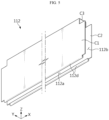
- FIG. 3 is a diagram illustrating a cell unit 110 of a battery assembly according to an embodiment of the present disclosure.
- the cell unit 110 may include a cell cover 112 that partially covers and supports at least one battery cell to maintain the same in an upright state.
- the cell cover 112 may have vent portions 112c provided at various positions to vent gas in an intended direction.
- the vent portion 112c may be configured to form the outer surface of the cell cover 112 and rupture by gas from the battery cell located inside the cell unit 110.
- the vent portion 112c may be provided by forming notches or grooves in various shapes on the top of the cell cover 112.
- FIG. 4 is an exploded view illustrating the cell unit 110 shown in FIG. 3 .
- the cell unit 110 may include at least one battery cell 200 and a cell cover 112.
- the battery cell 200 corresponds to the most fundamental secondary battery capable of being charged and discharged, and may be manufactured by storing an electrode assembly and electrolyte material inside a case and sealing the case.
- the electrode assembly may be manufactured by interposing a separator between the positive electrode and the negative electrode.
- This battery cell 200 may be configured as a pouch-type secondary battery having a predetermined length and height.
- an electrode lead 202 electrically connected to the electrode assembly may be provided at both ends of the battery cell 200 in the longitudinal direction (X-axis direction).
- the cell cover 112 may be configured to partially cover and support at least one battery cell 200 to maintain the same in an upright state.
- the cell cover 112 may be configured to partially cover and support three battery cells stacked on each other to maintain the battery cells in an upright state.
- the cell cover 112 may have a slot 112a into which at least one battery cell 200 is inserted and an opening 122b through which the electrode lead 202 of at least one battery cell 200 inserted into the slot 112a is exposed and may be configured to cover at least one battery cell 200 inserted into the slot 112a.
- the cell cover 112 may include at least one vent portion 112c for venting gas from at least one battery cell 200 inserted into the slot 112a.
- the height L1 of the cell cover 112 (or the depth of the slot 112a) may be configured to be greater than the height L2 of the battery cell 200 in an upright state.
- the free space produced inside the slot 112a of the cell cover 112 into which the battery cell 200 is inserted may be used as a gas venting passage.
- the number of battery cells covered by the cell cover 112 may vary depending on the scale of the cell cover 112.
- the cell unit 110 may further include a bus bar 114 electrically connected to the electrode lead 202 of the battery cell 200 inserted into the cell cover 112 and a bus bar frame 116 disposed in the opening 122b of the cell cover 112 and supporting the bus bar 114.
- the cell unit 110 may further include an insulating cover 118 that is disposed between the bus bar frame 116 and the integrated end cover 124 so as to prevent short circuit of the bus bar 114.
- This insulating cover 118 may be made of polymer synthetic resin with insulating properties.
- FIG. 5 is a diagram illustrating the cell cover 112 of the cell unit shown in FIG. 4 .
- the cell cover 112 may be configured in an "n" shape or a "u” shape surrounding three sides of the at least one battery cell.
- the cell cover 112 may include a first cover portion C1 covering one side of at least one battery cell, a second cover portion C2 covering the other side of the at least one battery cell, and a third cover portion C3 that connects the cover portion C1 and the second cover portion C2 and covers an upper edge portion of the at least one battery cell.
- a slot 112a into which the at least one battery cell is inserted and an opening 122b through which an electrode lead of the at least one battery cell inserted into the slot 112a is exposed may be provided between the first cover portion C1 and the second cover portion C2.
- the vent portion 112c for venting gas described above may be provided in the third cover portion C3 of the cell cover 112.
- the cell cover 112 may further include blocking portions 112d provided at the entrance of the slot 112a to block removal of the battery cell inserted into the slot 112a.
- the blocking portions 112d may be configured to protrude from the ends of the first cover portion C1 and the second cover portion C2 toward the entrance of the slot 112a, respectively.
- This cell cover 112 may be integrally formed.
- the cell cover 112 may be manufactured through a sheet metal process or an injection process.
- the cell cover 112 in a simplified structure may be made of a metal material with higher rigidity than the battery cell case, thereby protecting the battery cell covered by the cell cover from external shock or vibration.
- the cell unit 110 may further include a clamping member configured to clamp the cell cover 112.
- the clamping member may be configured to clamp the cell cover 112 into which at least one battery cell is inserted so as to prevent the space between the first cover portion C1 and the second cover portion C2 of the cell cover 112 from opening or prevent the battery cell inserted into the cell cover 112 from being separated from the cell cover 112.
- This clamping member may be configured as a tape or made of a metal material in a band shape.
- FIG. 6 is an enlarged view illustrating area A1 in FIG. 1 .
- the side wall 122 and the integrated end cover 124 included in the support structure 120 of the battery assembly 100 may be connected to each other so as to support a plurality of cell units 110.
- the connection portion 122a of the side wall 122 may have an insertion groove into which the corresponding connection portion 124a of the integrated end cover 124 is inserted.
- connection portion 124a of the integrated end cover 124 may be inserted into the insertion groove provided in the connection portion 122a of the side wall 122 and then fixed to the connection portion 122a of the side wall 122 by a fastening member S1 such as a screw or bolt.
- the support portion 124c of the integrated end cover 124 may be configured to extend from the main body portion of the integrated end cover 124 toward the lower end of the plurality of cell units 110 to support the lower end of the plurality of cell units 110.
- the support portion 124c of the integrated end cover 124 may be configured to support the bus bar frame of the cell unit 110 described above.
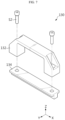
- FIG. 7 is an exploded view illustrating the transport structure 130 of the battery assembly shown in FIG. 1 .
- the transport structure 130 may be configured to be detachably mounted to the support structure 120 described above.
- the transport structure 130 may include at least one handle 132 and a coupling frame 134 that supports the handle 132 and is detachably coupled to the support structure 120.
- the handle 132 may be configured to enable the operator to hold the battery assembly or connection to a transport device.
- the coupling frame 134 may be configured to support the handle 132 so as to prevent deformation of the handle 132.
- the coupling frame 134 may be coupled to the coupling portion 112b provided on the side wall 122 of the support structure 120 in a manner of facilitating coupling and separation.
- the coupling frame 134 may be coupled to the coupling portion 112b of the side wall 122 by a simple fastening member S2 such as a screw or bolt.
- the transport structure 130 may be detached and removed from the support structure 120 after the transport or installation of the battery assembly 100 is completed.
- FIG. 8 is a diagram illustrating a battery assembly 100' according to another embodiment of the present disclosure.
- FIG. 9 is a diagram illustrating a state in which a transport structure 130' is separated from the battery assembly shown in FIG. 8
- the battery assembly 100' includes a plurality of cell units 110, a support structure 120', and a transport structure 130'.
- the battery assembly 100' will be described based on differences from the battery assembly 100 described with reference to FIGS. 1 to 7 .
- the support structure 120' is configured to support a plurality of cell units 110 to maintain the stacked state of the plurality of cell units 110.
- the support structure 120' may include side walls 122, integrated end covers 124, and support bands 126.
- the side walls 122 and the integrated end covers 124 may be disposed along the lateral perimeter of the plurality of cell units 110 stacked on each other.
- the support structure 120' may include a pair of side walls 122 and a pair of integrated end covers 124, respectively.
- the side walls 122 may be configured such that each of them is disposed at both ends of the plurality of cell units 110 in the width direction (Y-axis direction) or stacking direction of the plurality of cell units 110, thereby supporting the plurality of cell units 110.
- a first side wall may be disposed adjacent to a first cell unit located at the outermost on one side of the plurality of cell units 110, and a second side wall may be disposed adjacent to a second cell unit located at the outermost on the other side of the plurality of cell units 110.
- the side walls 122 together with the integrated end covers 124 to be described later, bring the plurality of cell units 110 into close contact with each other to form a single cell unit block capable of being handled simultaneously.
- the side walls 122 may evenly distribute the pressure applied to the plurality of cell units 110 throughout the cell units 110.
- Each of the integrated end covers 124 may be disposed at both ends of the plurality of cell units 110 in the longitudinal direction (X-axis direction) of the plurality of cell units 110.
- the integrated end cover 124 may be configured to have one end connected to the first side wall and the other end connected to the second side wall so as to cover all openings of two or more of the cell covers of the plurality of cell units 110.
- the support band 126 may be configured to have one end in close contact with the first side wall of the pair of side walls 122 and the other end in close contact with the second side wall thereof, thereby supporting the plurality of cell units 110.
- the transport structure 130' has at least one handle 132 and is configured to be detachably mounted to the support structure 120'.
- the transport structure 130' mounted to the support structure 120' may be configured to be located at the upper end of the plurality of cell units 110.
- the support band 126 of the support structure 120' may include a coupling portion 126a provided at both ends thereof so as to be detachably coupled to the transport structure 130'.
- the coupling portion 126a of the support band 126 and the transport structure 130' may be coupled in various ways of enabling easy coupling and separation.
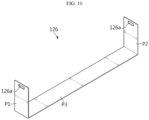
- FIG. 10 is a diagram illustrating the support band 126 of the battery assembly shown in FIG. 8 .
- the support band 126 may have one end P1 in close contact with a first side wall located on one side of the plurality of cell units 110, the other end P2 in close contact with a second side wall located on the other side of the plurality of cell units 110, and a central portion P3 that connects one end P1 and the other end P2 and supports the lower end of the plurality of cell units 110.
- coupling portions 126a may be provided at both ends P1 and P2 of the support band 126, respectively, so as to be detachably connected to the transport structure 130'.
- the transport structure 130' may be detachably mounted to the support structure 120' so as to be held by an operator carrying the battery assembly 100' or connected to a predetermined transport device that lifts and transfers the battery assembly 100'.
- the transport structure 130' may include at least one handle 132 and a coupling frame 134' that supports the handle 132 and is detachably coupled to the support structure 120'.
- the handle 132 may be configured to facilitate the operator to hold the battery assembly or connection with a transport device.
- the coupling frame 134' may be coupled to at least one handle 132 to support the handle 132 and may be configured to be coupled to the support structure 120' in a manner of facilitating coupling and separation.
- the coupling frame 134' may include a main frame 134a to which at least one handle 132 is coupled and a subframe 134b having one end coupled to the main frame 134a and the other end detachably coupled to the support structure 120'.
- a corresponding coupling portion 134c which is detachably coupled to the coupling portion 126a of the support band 126, may be provided at the other end of the subframe 134b.
- the coupling portion 126a of the support band 126 may include a coupling hole
- the corresponding coupling portion 134c of the subframe 134b may include a hook that is inserted and coupled into the coupling hole of the coupling portion 126a.
- the transport structure 130' may include a link unit 136 that is linked to a transport device for transporting the battery assembly 100'.
- the link unit 136 may be configured in a ring structure to be linked to a ring or hook of the corresponding transport device.
- the transport structure 130' may be detached and removed from the battery assembly 100' after the transport or installation of the battery assembly 100' is completed.
- FIG. 11 is a diagram illustrating a battery assembly 100" according to another embodiment of the present disclosure.
- FIG. 12 is a diagram illustrating a state in which a transport structure 130" is separated from the battery assembly shown in FIG. 11 .
- the battery assembly 100" includes a plurality of cell units 110, a support structure 120, and a transport structure 130".
- the battery assembly 100 will be described based on differences from the battery assembly 100 described with reference to FIGS. 1 to 7 .
- the support structure 120 is configured to support a plurality of cell units 110 to maintain the stacked state of the plurality of cell units 110.
- the support structure 120 may include side walls 122 and integrated end covers 124.
- the side walls 122 and the integrated end covers 124 may be disposed along the lateral perimeter of the plurality of cell units 110 stacked on each other.
- the support structure 120 may include a pair of side walls 122 and a pair of integrated end covers 124, respectively.
- the side walls 122 may be configured such that each of them is disposed at both ends of the plurality of cell units 110 in the width direction (Y-axis direction) or stacking direction of the plurality of cell units 110, thereby supporting the plurality of cell units 110.
- a first side wall may be disposed adjacent to a first cell unit located at the outermost on one side of the plurality of cell units 110, and a second side wall may be disposed adjacent to a second cell unit located at the outermost on the other side of the plurality of cell units 110.
- Each of the integrated end covers 124 may be disposed at both ends of the plurality of cell units 110 in the longitudinal direction (X-axis direction) of the plurality of cell units 110.
- the integrated end cover 124 may be configured to have one end connected to the first side wall and the other end connected to the second side wall so as to cover all openings of two or more of the cell covers of the plurality of cell units 110.
- the transport structure 130" has at least one handle 132 and is configured to be detachably mounted to the support structure 120.
- the transport structure 130" mounted to the support structure 120 may be configured to be located at the upper end of the plurality of cell units 110.
- This transport structure 130" may be detachably mounted to the support structure 120 so as to be held by an operator transporting the battery assembly 100" or connected to a predetermined transport device that lifts and transports the battery assembly 100".
- the transport structure 130" may include at least one handle 132 and a coupling frame 134" that supports the handle 132 and is detachably coupled to the support structure 120.
- the handle 132 may be configured to facilitate the operator to hold the battery assembly or connection with a transport device.
- the coupling frame 134" may be coupled to at least one handle 132 to support the handle 132 and may be configured to be coupled to the support structure 120 in a manner of facilitating coupling and separation.
- the coupling frame 134" may include a main frame 134a to which at least one handle 132 is coupled and a subframe 134b having one end coupled to the main frame 134a and the other end detachably coupled to the support structure 120.
- the subframe 134d may also be referred to as a bracket.
- This subframe 134b may be coupled to the side wall 122 or the integrated end cover 124 of the support structure 120 by fastening members such as hooks, screws, or bolts.
- the transport structure 130" may include a link unit 136 that is linked to a transport device that transports the battery assembly 100".
- the link unit 136 may be configured in a ring structure to be linked to a ring or hook of the corresponding transport device.
- the transport structure 130" may be detached and removed from the battery assembly 100" after the transport or installation of the battery assembly 100" is completed.
- the battery assemblies 100, 100', and 100" according to the various embodiments described above may be scaled up by increasing the number of cell units 110, respectively.
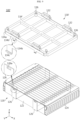
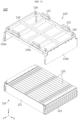
- FIG. 13 is a diagram illustrating a battery pack 10 according to an embodiment of the present disclosure.
- the battery pack 10 may include at least one battery assembly 100 according to an embodiment of the present disclosure, and a pack case 12 and 14 for accommodating the battery assembly 100. Although it is illustrated in FIG. 13 that the battery pack 10 includes the battery assembly 100 related to FIGS. 1 to 7 , the battery pack 10 may also include the battery assembly 100' or 100" according to other embodiments of the present disclosure, replacing the battery assembly 100 or along with battery assembly 100.
- the pack case 12 and 14 may include a pack tray 12 that accommodates a plurality of battery assemblies 100, and a pack lid 14 that covers the upper opening of the pack tray 12.
- the pack tray 12 may have an accommodation room 12a where the battery assembly 100 is directly seated without a separate case. To this end, the pack tray 12 may include cross beams 12b that divide its internal space into a plurality of accommodation rooms.
- a seating groove into which the support band 130 of the battery assembly 100 is inserted so as to be seated thereon may be provided on the wall surface and bottom surface of the accommodation room 12a where the battery assembly 100' is accommodated.
- the transport structure 130 mounted to the battery assembly 100 may be detached and removed.
- the battery pack 10 may further include a control module 16.
- This control module 16 may include a BMS (Battery Management System) that manages charging and discharging operations, SOC (state-of-charge), SOH (state-of-health), etc. of the battery cells included in the battery assembly, and may be installed in the internal space of the pack case 12 and 14.
- BMS Battery Management System
- SOC state-of-charge
- SOH state-of-health
- the battery pack 10 may further include a switching unit 18.
- This switching unit 18 may be configured to control electrical connection between the battery pack 10 and an external circuit.
- the switching unit 18 may optionally include a current sensor, a power relay, a fuse, and the like.
- a method of manufacturing a battery pack according to an embodiment of the present disclosure may include a cell unit manufacturing step, a cell unit block manufacturing step, a transport structure mounting step, a battery assembly seating step, and a transport structure removal step.
- At least one battery cell 200 is inserted into the slot of the cell cover 112 to configure the cell unit 110.
- the support structure 120 including a pair of side walls 122 and a pair of integrated end covers 130 is coupled to a plurality of cell units 110 to support the plurality of cell units 110, thereby configuring a cell unit block.
- the transport structure 130 is detachably mounted to the support structure 120 to configure a battery assembly 100.
- the battery assembly 100 is transported by an operator or a predetermined transport device and placed in the corresponding accommodation room of the pack tray 12.
- the transport structure 130 mounted to the support structure 120 of the battery assembly 100 is detached and removed, and the pack lid 14 is coupled to the pack tray 12, closing the opening of the pack tray 12.
- the transport structure capable of being mounted and detached may be coupled to the cell unit block, thereby facilitating the handling and installation of the battery cells mounted to the battery pack.
- the handle units coupled to the cell unit block may be separated and removed, thereby simplifying and lightening the structures required for installation of the battery cell and reducing manufacturing costs.
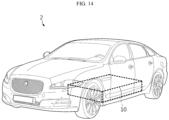
- FIG. 14 is a diagram illustrating a vehicle 2 according to an embodiment of the present disclosure.
- the vehicle 2 may include one or more battery assemblies 100, 100', and 100" according to various embodiments described above or battery packs 10 including the battery assemblies 100, 100', and 100".
- the battery assemblies 100, 100', and 100" or the battery packs 10 provided in the vehicle 2 may provide electrical energy required for various operations of the vehicle 2.
- the battery assembly according to the present disclosure may be applied to a battery pack used in various electrical devices or electrical systems other than vehicles, and may also be applied to a battery module that is accommodated in such a battery pack or the rack of an ESS (Energy Storage System) using a separate case.
- ESS Electronicgy Storage System
- multiple battery cells may be configured as a single battery assembly capable of being handled simultaneously by a simplified support structure, thereby facilitating handling of the battery cells and reducing the overall weight and volume of an electrical device including the multiple battery cells, and increasing the energy density of the electrical device.
- the battery assembly may include a transport structure with a handle, which is detachable after installation of the battery assembly, thereby facilitating handling, transportation, and installation of the battery assembly, simplifying and lightening the electrical device to which the battery assembly is mounted, and increasing manufacturing efficiency.
- multiple battery cells are partially covered by a cell cover in a simplified structure and directly mounted in a case of a corresponding electrical device, instead of being accommodated in a separate case and then reinstalled into the case of the electrical device, it is possible to further reduce the overall weight and volume of the electrical device, further improve the energy density of the battery pack, prevent damage to the battery cells, which is caused during the process of installing the multiple battery cells directly in the case and using the same, and facilitate the swelling control of the battery cells and the design of gas venting paths.
Landscapes
- Chemical & Material Sciences (AREA)
- Chemical Kinetics & Catalysis (AREA)
- Electrochemistry (AREA)
- General Chemical & Material Sciences (AREA)
- Engineering & Computer Science (AREA)
- Aviation & Aerospace Engineering (AREA)
- Battery Mounting, Suspending (AREA)
- Gas Exhaust Devices For Batteries (AREA)
- Connection Of Batteries Or Terminals (AREA)
Abstract
Description
- The present application claims priority to
Korean Patent Application Nos. 10-2022-0089871 10-2022-0089905 10-2022-0089906 10-2022-0089909 filed on July 20, 2022 Korean Patent Application No. 10-2023-0055792 filed on April 27, 2023 - The present disclosure relates to a battery assembly, and a battery pack and a vehicle including the same and, more specifically, relates to a battery assembly applicable to a battery pack manufactured by a CTP (cell-to-pack) method, and a battery pack and a vehicle including the same.
- In general, secondary batteries refer to batteries capable of being repeatedly charged and discharged, such as lithium-ion batteries, lithium polymer batteries, nickel-cadmium batteries, nickel-hydrogen batteries, nickel-zinc batteries, and the like. The output voltage of a battery cell, which is a basic unit of charging and discharging of the secondary batteries, is approximately 2.5V to 4.2V.
- Recently, secondary batteries have been applied to devices that require high output voltage and a large amount of charging capacity, such as electric vehicles or ESSs (Energy Storage Systems), and accordingly, a battery pack, which is manufactured in a manner of configuring a battery module by connecting a plurality of battery cells in series or parallel and reconnecting multiple battery modules configured above in series or parallel, has been widely used.
- However, as disclosed in
Korean Patent Publication No. 10-2379227 Korean Unexamined Patent Publication No. 10-2022-0052183 - On the other hand, if the existing CTP (cell-to-pack) method of mounting multiple battery cells directly into the battery pack case is applied to increase the energy density of the battery pack, it is difficult to handle the multiple battery cells simultaneously, and there is a risk of damage to the battery cells in the process of mounting the same. Moreover, in the existing CTP method, since structures for mounting the battery cells are arranged redundantly inside the case, there are problems of deteriorating the effect of reducing the weight and volume of the battery pack and increasing manufacturing costs.
- The present disclosure has been designed to solve the problems of the related art, and therefore one aspect of the present disclosure provides a battery assembly capable of reducing the overall weight and volume of an electrical device including a plurality of battery cells and increasing the energy density of the electrical device, and a battery pack and a vehicle including such a battery assembly.
- Another aspect of the present disclosure provides a battery assembly capable of preventing damage to a plurality of battery cells, which is caused during mounting and using the battery cells in a case, and facilitating handling and installation of the battery cells, and a battery pack and a vehicle including such a battery assembly.
- Another aspect of the present disclosure provides a battery assembly capable of reducing manufacturing costs by simplifying and lightening the structures required for installation of the battery cells, and a battery pack and a vehicle including such a battery assembly.
- In one aspect of the present disclosure, there is provided a battery assembly including: a plurality of stacked cell units each including at least one battery cell; and a support structure configured to support the plurality of cell units and maintain a stacked state of the plurality of cell units, wherein the support structure includes coupling portion configured to be coupled to a transport structure used to transport the plurality of cell units.
- In an embodiment, each of the plurality of cell units may further include a cell cover having a slot into which the at least one battery cell is inserted and an opening through which an electrode lead of the at least one battery cell inserted into the slot is exposed, and covering the at least one battery cell inserted into the slot.
- In an embodiment, the cell cover may further include at least one vent portion configured to vent gas from the at least one battery cell inserted into the slot.
- In an embodiment, each of the plurality of cell units may further include: a bus bar electrically connected to the electrode lead; and a bus bar frame disposed at the opening of the cell cover and supporting the bus bar.
- In an embodiment, the support structure may include: a first side wall disposed adjacent to a first cell unit located at the outermost on one side of the plurality of cell units; a second side wall disposed adjacent to a second cell unit located at the outermost on the other side of the plurality of cell units; and an integrated end cover having one end connected to the first side wall and the other end connected to the second side wall and configured to cover all openings of two or more of the cell covers of the plurality of cell units.
- In an embodiment, the integrated end cover may include: a main body portion configured to cover the openings; and a support portion extending from the main body portion toward the lower end of the plurality of cell units to support the lower end of the plurality of cell units, and the transport structure coupled to the coupling portion of the support structure may be configured to be located at the upper end of the plurality of cell units.
- In an embodiment, the integrated end cover has vent holes for venting gas, which are provided at respective portions of the integrated end cover corresponding to the openings.
- In an embodiment, the support structure may further include a support band having one end in close contact with the first side wall and the other end in close contact with the second side wall so as to support the plurality of cell units.
- In an embodiment, the coupling portion of the support structure may be configured to be provided at both ends of the support band and to be detachably coupled to the transport structure.
- In an embodiment, the transport structure may have at least one handle and may be configured to be coupled to the coupling portion of the support structure.
- In an embodiment, the transport structure may include a coupling frame coupled to the at least one handle to support the at least one handle, and detachably coupled to the coupling portion of the support structure.
- In an embodiment, the coupling frame may include: a main frame to which the at least one handle is coupled; and a subframe having one end coupled to the main frame and the other end detachably coupled to the coupling portion of the support structure.
- In an embodiment, the at least one battery cell may be configured as a pouch-type secondary battery.
- A battery pack according to another aspect of the present disclosure includes the battery assembly according to any one of the embodiments described above.
- A vehicle according to another aspect of the present disclosure includes the battery assembly according to any one of the embodiments described above.
- According to the present disclosure, multiple battery cells may be configured as a single battery assembly capable of being handled simultaneously by a simplified support structure, thereby facilitating handling of the battery cells and reducing the overall weight and volume of an electrical device including the multiple battery cells, and increasing the energy density of the electrical device.
- In addition, the support structure may include a coupling portion configured to be coupled to a transport structure used to transport the plurality of cell units, thereby facilitating handling, transport, and mounting of the battery assembly and increasing manufacturing efficiency.
- In addition, since the transport structure is configured to be attachable to and detachable from the support structure, a battery pack or electrical device on which the battery assembly is mounted is able to be simplified and lightened.
- In addition, since multiple battery cells are partially covered by a cell cover in a simplified structure and directly mounted in a case of a corresponding electrical device, instead of being accommodated in a separate case and then reinstalled into the case of the electrical device, it is possible to further reduce the overall weight and volume of the electrical device, further improve the energy density of the battery pack, prevent damage to the battery cells, which is caused during the process of installing the multiple battery cells directly in the case and using the same, and facilitate the swelling control of the battery cells and the design of gas venting paths.
- Furthermore, those skilled in the art to which the present disclosure pertains will be able to clearly understand from the following description that various embodiments according to the present disclosure are able to solve various technical problems not mentioned above.
-
-
FIG. 1 is a diagram illustrating a battery assembly according to an embodiment of the present disclosure. -
FIG. 2 is an exploded view illustrating the battery assembly shown inFIG. 1 . -
FIG. 3 is a diagram illustrating a cell unit of a battery assembly according to an embodiment of the present disclosure. -
FIG. 4 is an exploded view illustrating the cell unit shown inFIG. 3 . -
FIG. 5 is a diagram illustrating a cell cover of the cell unit shown inFIG. 4 . -
FIG. 6 is an enlarged view illustrating area A1 inFIG. 1 . -
FIG. 7 is an exploded view illustrating a transport structure of the battery assembly shown inFIG. 1 . -
FIG. 8 is a diagram illustrating a battery assembly according to another embodiment of the present disclosure. -
FIG. 9 is a diagram illustrating a state in which a transport structure is separated from the battery assembly shown inFIG. 8 . -
FIG. 10 is a diagram illustrating a support band of the battery assembly shown inFIG. 8 . -
FIG. 11 is a diagram illustrating a battery assembly according to another embodiment of the present disclosure. -
FIG. 12 is a diagram illustrating a state in which a transport structure is separated from the battery assembly shown inFIG. 11 . -
FIG. 13 is a diagram illustrating a battery pack according to an embodiment of the present disclosure. -
FIG. 14 is a diagram illustrating a vehicle according to an embodiment of the present disclosure. - Hereinafter, embodiments of the present disclosure will be described in detail with reference to the accompanying drawings in order to clarify technical solutions corresponding to the technical problems of the present disclosure. However, in describing the present disclosure, a description of related known technology, which may obscure the subject matter of the present disclosure, may be omitted. In addition, the terms used in this specification are defined in consideration of the functions in the present disclosure and may vary depending on the intention of the designer, manufacturer, etc. or custom thereof. Therefore, definitions of the terms described below should be made based on the description throughout this specification.
- For reference, in this specification, terms indicating directions are based on the components shown in the attached drawings and are relative terms that may change depending on the postures or positions of the actual components.
-
FIG. 1 is a diagram illustrating abattery assembly 100 according to an embodiment of the present disclosure.FIG. 2 is an exploded view illustrating thebattery assembly 100 shown inFIG. 1 . - As shown in
FIGS. 1 and2 , thebattery assembly 100 according to an embodiment of the present disclosure includes a plurality ofcell units 110 and asupport structure 120. Depending on the embodiment, thebattery assembly 100 may further include atransport structure 130. - The
respective cell units 110 may be configured to include at least one battery cell and to be stacked side by side in the width direction (Y-axis direction). As will be described again below, eachcell unit 110 may include at least one battery cell that is a basic unit of charging and discharging, and a cell cover that partially covers and supports the battery cell. - The
support structure 120 is configured to support the plurality ofcell units 110 to maintain the stacked state of the plurality ofcell units 110. In addition, thesupport structure 120 may include a coupling portion configured to be coupled to a transport structure used to transport the plurality of cell units. - In an embodiment, the
support structure 120 may includeside walls 122 and integrated end covers 124. Theside walls 122 and the integrated end covers 124 may be disposed along the lateral perimeter of the plurality ofcell units 110 stacked on each other. - In addition, in an embodiment, the
support structure 120 may include a pair ofside walls 122 and a pair of integrated end covers 124, respectively. - In this case, the
side walls 122 may be configured such that each of them is disposed at both ends of the plurality ofcell units 110 in the width direction (Y-axis direction) or stacking direction of the plurality ofcell units 110, thereby supporting the plurality ofcell units 110. - That is, among the pair of side walls, a first side wall may be disposed adjacent to a first cell unit located at the outermost on one side of the plurality of
cell units 110, and a second side wall may be disposed adjacent to a second cell unit located at the outermost on the other side of the plurality ofcell units 110. - The
side walls 122, together with the integrated end covers 124 to be described later, bring the plurality ofcell units 110 into close contact with each other to form a single cell unit block capable of being handled simultaneously. In this case, theside walls 122 may evenly distribute the pressure applied to the plurality ofcell units 110 throughout thecell units 110. - The
side walls 122 may be made of a metal material including aluminum or stainless steel or may be made of a material obtained by a combination of metal and polymer synthetic resin through insert molding. - Each of the integrated end covers 124 may be disposed at both ends of the plurality of
cell units 110 in the longitudinal direction (X-axis direction) of the plurality ofcell units 110. In addition, theintegrated end cover 124 may be configured to have one end connected to the first side wall and the other end connected to the second side wall so as to cover all openings of two or more of the cell covers of the plurality ofcell units 110. - To this end, the
side wall 122 may includeconnection portions 122a provided at both ends thereof to be connected to one end or the other end of theintegrated end cover 124. Corresponding thereto, theintegrated end cover 124 may include a main body portion that covers the openings of the plurality ofcell units 110 and acorresponding connection portion 124a extending from the main body portion and connected to theconnection portion 122a of theside wall 122. - In an embodiment, the
integrated end cover 124 may havevent holes 124b through which gas generated from the battery cells of the cell unit vents, which are formed at respective portions of theintegrated end cover 124 corresponding to the openings of the plurality ofcell units 110. - In addition, as shown in
FIG. 2 , theintegrated end cover 124 may include asupport portion 124c extending from the main body portion toward the lower end of the plurality ofcell units 110 so as to support the lower end of the plurality ofcell units 110. Thisintegrated end cover 124 may be made of a metal material including aluminum or stainless steel or polymer synthetic resin, or may be made of a material obtained by a combination of metal and polymer synthetic resin through insert molding. - As described above, since the
integrated end cover 124 supporting the cell units and integrally covering the openings of the cell units is applied to thebattery assembly 100, a unit end cover applied to each cell unit may be omitted, thereby simplifying the manufacturing process thereof. - The
transport structure 130 has at least one handle and is configured to be detachably mounted to thesupport structure 120. Thetransport structure 130 mounted to thesupport structure 120 may be configured to be located at the upper end of the plurality ofcell units 110. - To this end, each
side wall 122 included in thesupport structure 120 may include acoupling portion 112b provided at the upper end thereof so as to be detachably coupled to a portion of thetransport structure 130. In this case, thetransport structure 130 may be coupled to thecoupling portion 112b of acorresponding side wall 122 in various ways of enabling easy coupling and separation. - This
transport structure 130 may be configured to be held by an operator carrying thebattery assembly 100 or connected to a predetermined transport device that lifts and transports thebattery assembly 100. In addition, thetransport structure 130 may be made of a metal material, a polymer synthetic resin, or a combination of these materials with a certain strength. - As will be described again below, the
transport structure 130 may be detached and removed from thebattery assembly 100 after the transport or installation of thebattery assembly 100 is completed. -
FIG. 3 is a diagram illustrating acell unit 110 of a battery assembly according to an embodiment of the present disclosure. - As shown in
FIG. 3 , thecell unit 110 may include acell cover 112 that partially covers and supports at least one battery cell to maintain the same in an upright state. - The
cell cover 112 may havevent portions 112c provided at various positions to vent gas in an intended direction. Thevent portion 112c may be configured to form the outer surface of thecell cover 112 and rupture by gas from the battery cell located inside thecell unit 110. For example, thevent portion 112c may be provided by forming notches or grooves in various shapes on the top of thecell cover 112. -
FIG. 4 is an exploded view illustrating thecell unit 110 shown inFIG. 3 . - As shown in
FIG. 4 , thecell unit 110 may include at least one battery cell 200 and acell cover 112. - The battery cell 200 corresponds to the most fundamental secondary battery capable of being charged and discharged, and may be manufactured by storing an electrode assembly and electrolyte material inside a case and sealing the case. The electrode assembly may be manufactured by interposing a separator between the positive electrode and the negative electrode.
- This battery cell 200 may be configured as a pouch-type secondary battery having a predetermined length and height. In addition, an
electrode lead 202 electrically connected to the electrode assembly may be provided at both ends of the battery cell 200 in the longitudinal direction (X-axis direction). - The
cell cover 112 may be configured to partially cover and support at least one battery cell 200 to maintain the same in an upright state. - For example, as shown in
FIG. 4 , thecell cover 112 may be configured to partially cover and support three battery cells stacked on each other to maintain the battery cells in an upright state. - To this end, the
cell cover 112 may have aslot 112a into which at least one battery cell 200 is inserted and anopening 122b through which theelectrode lead 202 of at least one battery cell 200 inserted into theslot 112a is exposed and may be configured to cover at least one battery cell 200 inserted into theslot 112a. - In addition, as described above, the
cell cover 112 may include at least onevent portion 112c for venting gas from at least one battery cell 200 inserted into theslot 112a. - The height L1 of the cell cover 112 (or the depth of the
slot 112a) may be configured to be greater than the height L2 of the battery cell 200 in an upright state. As a result, the free space produced inside theslot 112a of thecell cover 112 into which the battery cell 200 is inserted may be used as a gas venting passage. - Although it is illustrated in
FIG. 4 that three battery cells are covered by onecell cover 112, the number of battery cells covered by thecell cover 112 may vary depending on the scale of thecell cover 112. - In an embodiment, the
cell unit 110 may further include abus bar 114 electrically connected to theelectrode lead 202 of the battery cell 200 inserted into thecell cover 112 and abus bar frame 116 disposed in theopening 122b of thecell cover 112 and supporting thebus bar 114. - In addition, the
cell unit 110 may further include an insulatingcover 118 that is disposed between thebus bar frame 116 and theintegrated end cover 124 so as to prevent short circuit of thebus bar 114. This insulatingcover 118 may be made of polymer synthetic resin with insulating properties. -
FIG. 5 is a diagram illustrating thecell cover 112 of the cell unit shown inFIG. 4 . - As shown in
FIG. 5 , for example, thecell cover 112 may be configured in an "n" shape or a "u" shape surrounding three sides of the at least one battery cell. - The
cell cover 112 may include a first cover portion C1 covering one side of at least one battery cell, a second cover portion C2 covering the other side of the at least one battery cell, and a third cover portion C3 that connects the cover portion C1 and the second cover portion C2 and covers an upper edge portion of the at least one battery cell. - A
slot 112a into which the at least one battery cell is inserted and anopening 122b through which an electrode lead of the at least one battery cell inserted into theslot 112a is exposed may be provided between the first cover portion C1 and the second cover portion C2. In addition, thevent portion 112c for venting gas described above may be provided in the third cover portion C3 of thecell cover 112. - In an embodiment, the
cell cover 112 may further include blockingportions 112d provided at the entrance of theslot 112a to block removal of the battery cell inserted into theslot 112a. The blockingportions 112d may be configured to protrude from the ends of the first cover portion C1 and the second cover portion C2 toward the entrance of theslot 112a, respectively. - This
cell cover 112 may be integrally formed. In this case, thecell cover 112 may be manufactured through a sheet metal process or an injection process. - As described above, the
cell cover 112 in a simplified structure may be made of a metal material with higher rigidity than the battery cell case, thereby protecting the battery cell covered by the cell cover from external shock or vibration. - Although not shown in
FIGS. 3 to 5 , thecell unit 110 may further include a clamping member configured to clamp thecell cover 112. In this case, the clamping member may be configured to clamp thecell cover 112 into which at least one battery cell is inserted so as to prevent the space between the first cover portion C1 and the second cover portion C2 of thecell cover 112 from opening or prevent the battery cell inserted into thecell cover 112 from being separated from thecell cover 112. This clamping member may be configured as a tape or made of a metal material in a band shape. -
FIG. 6 is an enlarged view illustrating area A1 inFIG. 1 . - As shown in
FIG. 6 , theside wall 122 and theintegrated end cover 124 included in thesupport structure 120 of thebattery assembly 100 may be connected to each other so as to support a plurality ofcell units 110. To this end, theconnection portion 122a of theside wall 122 may have an insertion groove into which thecorresponding connection portion 124a of theintegrated end cover 124 is inserted. - The
corresponding connection portion 124a of theintegrated end cover 124 may be inserted into the insertion groove provided in theconnection portion 122a of theside wall 122 and then fixed to theconnection portion 122a of theside wall 122 by a fastening member S1 such as a screw or bolt. - In addition, the
support portion 124c of theintegrated end cover 124 may be configured to extend from the main body portion of theintegrated end cover 124 toward the lower end of the plurality ofcell units 110 to support the lower end of the plurality ofcell units 110. In this case, thesupport portion 124c of theintegrated end cover 124 may be configured to support the bus bar frame of thecell unit 110 described above. -
FIG. 7 is an exploded view illustrating thetransport structure 130 of the battery assembly shown inFIG. 1 . - As shown in
FIG. 7 , thetransport structure 130 may be configured to be detachably mounted to thesupport structure 120 described above. - To this end, the
transport structure 130 may include at least onehandle 132 and acoupling frame 134 that supports thehandle 132 and is detachably coupled to thesupport structure 120. - The
handle 132 may be configured to enable the operator to hold the battery assembly or connection to a transport device. - The
coupling frame 134 may be configured to support thehandle 132 so as to prevent deformation of thehandle 132. In addition, thecoupling frame 134 may be coupled to thecoupling portion 112b provided on theside wall 122 of thesupport structure 120 in a manner of facilitating coupling and separation. For example, thecoupling frame 134 may be coupled to thecoupling portion 112b of theside wall 122 by a simple fastening member S2 such as a screw or bolt. - As mentioned above, the
transport structure 130 may be detached and removed from thesupport structure 120 after the transport or installation of thebattery assembly 100 is completed. -
FIG. 8 is a diagram illustrating a battery assembly 100' according to another embodiment of the present disclosure. -
FIG. 9 is a diagram illustrating a state in which a transport structure 130' is separated from the battery assembly shown inFIG. 8 - As shown in
FIGS. 8 and9 , the battery assembly 100' according to another embodiment of the present disclosure includes a plurality ofcell units 110, a support structure 120', and a transport structure 130'. - Hereinafter, the battery assembly 100' will be described based on differences from the
battery assembly 100 described with reference toFIGS. 1 to 7 . - The support structure 120' is configured to support a plurality of
cell units 110 to maintain the stacked state of the plurality ofcell units 110. To this end, the support structure 120' may includeside walls 122, integrated end covers 124, andsupport bands 126. - The
side walls 122 and the integrated end covers 124 may be disposed along the lateral perimeter of the plurality ofcell units 110 stacked on each other. To this end, the support structure 120' may include a pair ofside walls 122 and a pair of integrated end covers 124, respectively. - In this case, the
side walls 122 may be configured such that each of them is disposed at both ends of the plurality ofcell units 110 in the width direction (Y-axis direction) or stacking direction of the plurality ofcell units 110, thereby supporting the plurality ofcell units 110. - That is, among the pair of
side walls 122, a first side wall may be disposed adjacent to a first cell unit located at the outermost on one side of the plurality ofcell units 110, and a second side wall may be disposed adjacent to a second cell unit located at the outermost on the other side of the plurality ofcell units 110. - The
side walls 122, together with the integrated end covers 124 to be described later, bring the plurality ofcell units 110 into close contact with each other to form a single cell unit block capable of being handled simultaneously. In this case, theside walls 122 may evenly distribute the pressure applied to the plurality ofcell units 110 throughout thecell units 110. - Each of the integrated end covers 124 may be disposed at both ends of the plurality of
cell units 110 in the longitudinal direction (X-axis direction) of the plurality ofcell units 110. In addition, theintegrated end cover 124 may be configured to have one end connected to the first side wall and the other end connected to the second side wall so as to cover all openings of two or more of the cell covers of the plurality ofcell units 110. - The
support band 126 may be configured to have one end in close contact with the first side wall of the pair ofside walls 122 and the other end in close contact with the second side wall thereof, thereby supporting the plurality ofcell units 110. - The transport structure 130' has at least one
handle 132 and is configured to be detachably mounted to the support structure 120'. The transport structure 130' mounted to the support structure 120' may be configured to be located at the upper end of the plurality ofcell units 110. - To this end, the
support band 126 of the support structure 120' may include acoupling portion 126a provided at both ends thereof so as to be detachably coupled to the transport structure 130'. In this case, thecoupling portion 126a of thesupport band 126 and the transport structure 130' may be coupled in various ways of enabling easy coupling and separation. -
FIG. 10 is a diagram illustrating thesupport band 126 of the battery assembly shown inFIG. 8 . - As shown in
FIG. 10 , thesupport band 126 may have one end P1 in close contact with a first side wall located on one side of the plurality ofcell units 110, the other end P2 in close contact with a second side wall located on the other side of the plurality ofcell units 110, and a central portion P3 that connects one end P1 and the other end P2 and supports the lower end of the plurality ofcell units 110. - In addition,
coupling portions 126a may be provided at both ends P1 and P2 of thesupport band 126, respectively, so as to be detachably connected to the transport structure 130'. - Referring back to
FIGS. 8 and9 , the transport structure 130' may be detachably mounted to the support structure 120' so as to be held by an operator carrying the battery assembly 100' or connected to a predetermined transport device that lifts and transfers the battery assembly 100'. - To this end, the transport structure 130' may include at least one
handle 132 and a coupling frame 134' that supports thehandle 132 and is detachably coupled to the support structure 120'. - The
handle 132 may be configured to facilitate the operator to hold the battery assembly or connection with a transport device. - The coupling frame 134' may be coupled to at least one
handle 132 to support thehandle 132 and may be configured to be coupled to the support structure 120' in a manner of facilitating coupling and separation. - To this end, the coupling frame 134' may include a
main frame 134a to which at least onehandle 132 is coupled and asubframe 134b having one end coupled to themain frame 134a and the other end detachably coupled to the support structure 120'. In this case, a correspondingcoupling portion 134c, which is detachably coupled to thecoupling portion 126a of thesupport band 126, may be provided at the other end of thesubframe 134b. - For example, the
coupling portion 126a of thesupport band 126 may include a coupling hole, and the correspondingcoupling portion 134c of thesubframe 134b may include a hook that is inserted and coupled into the coupling hole of thecoupling portion 126a. - In an embodiment, the transport structure 130' may include a
link unit 136 that is linked to a transport device for transporting the battery assembly 100'. In this case, thelink unit 136 may be configured in a ring structure to be linked to a ring or hook of the corresponding transport device. - As mentioned above, the transport structure 130' may be detached and removed from the battery assembly 100' after the transport or installation of the battery assembly 100' is completed.
-
FIG. 11 is a diagram illustrating abattery assembly 100" according to another embodiment of the present disclosure.FIG. 12 is a diagram illustrating a state in which atransport structure 130" is separated from the battery assembly shown inFIG. 11 . - Referring to
FIGS. 11 and12 , thebattery assembly 100" according to another embodiment of the present disclosure includes a plurality ofcell units 110, asupport structure 120, and atransport structure 130". - Hereinafter, the
battery assembly 100" will be described based on differences from thebattery assembly 100 described with reference toFIGS. 1 to 7 . - The
support structure 120 is configured to support a plurality ofcell units 110 to maintain the stacked state of the plurality ofcell units 110. To this end, thesupport structure 120 may includeside walls 122 and integrated end covers 124. - The
side walls 122 and the integrated end covers 124 may be disposed along the lateral perimeter of the plurality ofcell units 110 stacked on each other. To this end, thesupport structure 120 may include a pair ofside walls 122 and a pair of integrated end covers 124, respectively. - In this case, the
side walls 122 may be configured such that each of them is disposed at both ends of the plurality ofcell units 110 in the width direction (Y-axis direction) or stacking direction of the plurality ofcell units 110, thereby supporting the plurality ofcell units 110. - That is, among the pair of
side walls 122, a first side wall may be disposed adjacent to a first cell unit located at the outermost on one side of the plurality ofcell units 110, and a second side wall may be disposed adjacent to a second cell unit located at the outermost on the other side of the plurality ofcell units 110. - Each of the integrated end covers 124 may be disposed at both ends of the plurality of
cell units 110 in the longitudinal direction (X-axis direction) of the plurality ofcell units 110. In addition, theintegrated end cover 124 may be configured to have one end connected to the first side wall and the other end connected to the second side wall so as to cover all openings of two or more of the cell covers of the plurality ofcell units 110. - The
transport structure 130" has at least onehandle 132 and is configured to be detachably mounted to thesupport structure 120. Thetransport structure 130" mounted to thesupport structure 120 may be configured to be located at the upper end of the plurality ofcell units 110. - This
transport structure 130" may be detachably mounted to thesupport structure 120 so as to be held by an operator transporting thebattery assembly 100" or connected to a predetermined transport device that lifts and transports thebattery assembly 100". - To this end, the
transport structure 130" may include at least onehandle 132 and acoupling frame 134" that supports thehandle 132 and is detachably coupled to thesupport structure 120. - The
handle 132 may be configured to facilitate the operator to hold the battery assembly or connection with a transport device. - The
coupling frame 134" may be coupled to at least onehandle 132 to support thehandle 132 and may be configured to be coupled to thesupport structure 120 in a manner of facilitating coupling and separation. - To this end, the
coupling frame 134" may include amain frame 134a to which at least onehandle 132 is coupled and asubframe 134b having one end coupled to themain frame 134a and the other end detachably coupled to thesupport structure 120. In this case, thesubframe 134d may also be referred to as a bracket. - This
subframe 134b may be coupled to theside wall 122 or theintegrated end cover 124 of thesupport structure 120 by fastening members such as hooks, screws, or bolts. - In an embodiment, the
transport structure 130" may include alink unit 136 that is linked to a transport device that transports thebattery assembly 100". In this case, thelink unit 136 may be configured in a ring structure to be linked to a ring or hook of the corresponding transport device. - As mentioned above, the
transport structure 130" may be detached and removed from thebattery assembly 100" after the transport or installation of thebattery assembly 100" is completed. - The
battery assemblies cell units 110, respectively. -
FIG. 13 is a diagram illustrating abattery pack 10 according to an embodiment of the present disclosure. - As shown in
FIG. 13 , thebattery pack 10 may include at least onebattery assembly 100 according to an embodiment of the present disclosure, and apack case battery assembly 100. Although it is illustrated inFIG. 13 that thebattery pack 10 includes thebattery assembly 100 related toFIGS. 1 to 7 , thebattery pack 10 may also include thebattery assembly 100' or 100" according to other embodiments of the present disclosure, replacing thebattery assembly 100 or along withbattery assembly 100. - The
pack case pack tray 12 that accommodates a plurality ofbattery assemblies 100, and apack lid 14 that covers the upper opening of thepack tray 12. - The
pack tray 12 may have anaccommodation room 12a where thebattery assembly 100 is directly seated without a separate case. To this end, thepack tray 12 may includecross beams 12b that divide its internal space into a plurality of accommodation rooms. - Meanwhile, in the case where the battery assembly 100' related to
FIGS. 8 to 10 is accommodated in thepack tray 12, a seating groove into which thesupport band 130 of thebattery assembly 100 is inserted so as to be seated thereon may be provided on the wall surface and bottom surface of theaccommodation room 12a where the battery assembly 100' is accommodated. - Meanwhile, when the
battery assembly 100 is seated in the corresponding accommodation room of thepack tray 12, thetransport structure 130 mounted to thebattery assembly 100 may be detached and removed. - In an embodiment, the
battery pack 10 may further include acontrol module 16. Thiscontrol module 16 may include a BMS (Battery Management System) that manages charging and discharging operations, SOC (state-of-charge), SOH (state-of-health), etc. of the battery cells included in the battery assembly, and may be installed in the internal space of thepack case - In addition, the
battery pack 10 may further include aswitching unit 18. This switchingunit 18 may be configured to control electrical connection between thebattery pack 10 and an external circuit. To this end, the switchingunit 18 may optionally include a current sensor, a power relay, a fuse, and the like. - Hereinafter, a method of manufacturing a battery pack according to an embodiment of the present disclosure will be described.
- A method of manufacturing a battery pack according to an embodiment of the present disclosure may include a cell unit manufacturing step, a cell unit block manufacturing step, a transport structure mounting step, a battery assembly seating step, and a transport structure removal step.
- First, in the cell unit manufacturing step, as described above, at least one battery cell 200 is inserted into the slot of the
cell cover 112 to configure thecell unit 110. - Next, in the cell unit block manufacturing step, the
support structure 120 including a pair ofside walls 122 and a pair of integrated end covers 130 is coupled to a plurality ofcell units 110 to support the plurality ofcell units 110, thereby configuring a cell unit block. - Next, in the transport structure mounting step, the
transport structure 130 is detachably mounted to thesupport structure 120 to configure abattery assembly 100. - Next, in the battery assembly seating step, the
battery assembly 100 is transported by an operator or a predetermined transport device and placed in the corresponding accommodation room of thepack tray 12. - Next, in the transport structure removal step, the
transport structure 130 mounted to thesupport structure 120 of thebattery assembly 100 is detached and removed, and thepack lid 14 is coupled to thepack tray 12, closing the opening of thepack tray 12. - As described above, the transport structure capable of being mounted and detached may be coupled to the cell unit block, thereby facilitating the handling and installation of the battery cells mounted to the battery pack. In addition, after the cell unit block is seated in the
pack case 12, the handle units coupled to the cell unit block may be separated and removed, thereby simplifying and lightening the structures required for installation of the battery cell and reducing manufacturing costs. -
FIG. 14 is a diagram illustrating avehicle 2 according to an embodiment of the present disclosure. - As shown in
FIG. 14 , thevehicle 2 according to an embodiment of the present disclosure may include one ormore battery assemblies battery assemblies - As described above, the
battery assemblies vehicle 2 may provide electrical energy required for various operations of thevehicle 2. - For reference, the battery assembly according to the present disclosure may be applied to a battery pack used in various electrical devices or electrical systems other than vehicles, and may also be applied to a battery module that is accommodated in such a battery pack or the rack of an ESS (Energy Storage System) using a separate case.
- As described above, according to the present disclosure, multiple battery cells may be configured as a single battery assembly capable of being handled simultaneously by a simplified support structure, thereby facilitating handling of the battery cells and reducing the overall weight and volume of an electrical device including the multiple battery cells, and increasing the energy density of the electrical device.
- In addition, the battery assembly may include a transport structure with a handle, which is detachable after installation of the battery assembly, thereby facilitating handling, transportation, and installation of the battery assembly, simplifying and lightening the electrical device to which the battery assembly is mounted, and increasing manufacturing efficiency.
- In addition, since multiple battery cells are partially covered by a cell cover in a simplified structure and directly mounted in a case of a corresponding electrical device, instead of being accommodated in a separate case and then reinstalled into the case of the electrical device, it is possible to further reduce the overall weight and volume of the electrical device, further improve the energy density of the battery pack, prevent damage to the battery cells, which is caused during the process of installing the multiple battery cells directly in the case and using the same, and facilitate the swelling control of the battery cells and the design of gas venting paths.
- Furthermore, it goes without saying that the embodiments according to the present disclosure are able to solve various technical problems other than those mentioned in this specification in the relevant technical field as well as related technical fields.
- So far, the present disclosure has been described with reference to specific embodiments. However, those skilled in the art will clearly understand that various modified embodiments may be implemented within the technical scope of the present disclosure. Therefore, the previously disclosed embodiments should be considered as those intended to describe the present disclosure, instead of those intended to limit the present disclosure. In other words, the true scope of the technical idea of the present disclosure is shown in the claims, and all differences within the scope equivalent thereto should be construed as being included in the present disclosure.
Claims (15)
- A battery assembly comprising:a plurality of stacked cell units each comprising at least one battery cell; anda support structure configured to support the plurality of cell units and maintain a stacked state of the plurality of cell units,wherein the support structure comprises coupling portion configured to be coupled to a transport structure used to transport the plurality of cell units.
- The battery assembly according to claim 1,wherein each of the plurality of cell units further comprisesa cell cover having a slot into which the at least one battery cell is inserted and an opening through which an electrode lead of the at least one battery cell inserted into the slot is exposed, and covering the at least one battery cell inserted into the slot.
- The battery assembly according to claim 2,wherein the cell cover further comprisesat least one vent portion configured to vent gas from the at least one battery cell inserted into the slot.
- The battery assembly according to claim 2,
wherein each of the plurality of cell units further comprises:a bus bar electrically connected to the electrode lead; anda bus bar frame disposed at the opening of the cell cover and supporting the bus bar. - The battery assembly according to claim 2,
wherein the support structure comprises:a first side wall disposed adjacent to a first cell unit located at the outermost on one side of the plurality of cell units;a second side wall disposed adjacent to a second cell unit located at the outermost on the other side of the plurality of cell units; andan integrated end cover having one end connected to the first side wall and the other end connected to the second side wall and configured to cover all openings of two or more of the cell covers of the plurality of cell units. - The battery assembly according to claim 5,
wherein the integrated end cover comprises:a main body portion configured to cover the openings; anda support portion extending from the main body portion toward the lower end of the plurality of cell units to support the lower end of the plurality of cell units, andwherein the transport structure coupled to the coupling portion of the support structure is configured to be located at the upper end of the plurality of cell units. - The battery assembly according to claim 5,
wherein the integrated end cover has vent holes for venting gas at respective portions of the integrated end cover corresponding to the openings. - The battery assembly according to claim 5,wherein the support structure further comprisesa support band having one end in close contact with the first side wall and the other end in close contact with the second side wall so as to support the plurality of cell units.
- The battery assembly according to claim 8,
wherein the coupling portion of the support structure is configured to be provided at both ends of the support band and to be detachably coupled to the transport structure. - The battery assembly according to claim 1,
wherein the transport structure has at least one handle and is configured to be coupled to the coupling portion of the support structure. - The battery assembly according to claim 10,wherein the transport structure comprisesa coupling frame coupled to the at least one handle to support the at least one handle, and detachably coupled to the coupling portion of the support structure.
- The battery assembly according to claim 11,
wherein the coupling frame comprises:a main frame to which the at least one handle is coupled; anda subframe having one end coupled to the main frame and the other end detachably coupled to the coupling portion of the support structure. - The battery assembly according to claim 1,
wherein the at least one battery cell is configured as a pouch-type secondary battery. - A battery pack comprising the battery assembly according to any one of claims 1 to 13.
- A vehicle comprising the battery assembly according to any one of claims 1 to 13.
Applications Claiming Priority (6)
| Application Number | Priority Date | Filing Date | Title |
|---|---|---|---|
| KR20220089906 | 2022-07-20 | ||
| KR20220089909 | 2022-07-20 | ||
| KR20220089871 | 2022-07-20 | ||
| KR20220089905 | 2022-07-20 | ||
| KR1020230055792A KR20240012285A (en) | 2022-07-20 | 2023-04-27 | Battery assembly and battery pack and vehicle including same |
| PCT/KR2023/009984 WO2024019420A1 (en) | 2022-07-20 | 2023-07-12 | Battery assembly, and battery pack and vehicle which comprise same |
Publications (2)
| Publication Number | Publication Date |
|---|---|
| EP4383428A1 true EP4383428A1 (en) | 2024-06-12 |
| EP4383428A4 EP4383428A4 (en) | 2025-06-18 |
Family
ID=89618038
Family Applications (1)
| Application Number | Title | Priority Date | Filing Date |
|---|---|---|---|
| EP23843270.2A Pending EP4383428A4 (en) | 2022-07-20 | 2023-07-12 | BATTERY ARRANGEMENT AS WELL AS BATTERY PACK AND VEHICLE THEREOF |
Country Status (4)
| Country | Link |
|---|---|
| US (1) | US20250202017A1 (en) |
| EP (1) | EP4383428A4 (en) |
| JP (1) | JP7755728B2 (en) |
| WO (1) | WO2024019420A1 (en) |
Family Cites Families (17)
| Publication number | Priority date | Publication date | Assignee | Title |
|---|---|---|---|---|
| JP3426445B2 (en) * | 1996-09-13 | 2003-07-14 | 本田技研工業株式会社 | Battery, battery hanging jig, and their combination |
| KR100892047B1 (en) * | 2006-09-18 | 2009-04-07 | 주식회사 엘지화학 | Battery Modules and Medium and Large Battery Packs |
| US9472797B2 (en) * | 2011-05-25 | 2016-10-18 | Samsung Sdi Co., Ltd. | Battery pack |
| JP2016066538A (en) * | 2014-09-25 | 2016-04-28 | 株式会社豊田自動織機 | Battery module |
| JP6376273B2 (en) | 2015-02-16 | 2018-08-22 | 三洋電機株式会社 | Power supply |
| KR20190134756A (en) * | 2017-04-14 | 2019-12-04 | 세키스이가가쿠 고교가부시키가이샤 | Battery Module and Battery Unit |
| KR102379227B1 (en) | 2018-12-26 | 2022-03-24 | 주식회사 엘지에너지솔루션 | Battery module, battery pack comprising the battery module and vehicle comprising the battery pack |
| KR102829076B1 (en) * | 2020-03-19 | 2025-07-02 | 주식회사 엘지에너지솔루션 | Battery pack with structure of improved convenience for carrying and assembling and improved safety, and Energy storage system comprising the same |
| KR20220052183A (en) | 2020-10-20 | 2022-04-27 | 현대자동차주식회사 | Battery module and battery pack comprising the same |
| WO2022126841A1 (en) | 2020-12-14 | 2022-06-23 | 天津市捷威动力工业有限公司 | Battery module capable of delaying thermal runaway and vehicle using same |
| KR102478542B1 (en) | 2020-12-22 | 2022-12-16 | (주)데크 | Fence for illumination insertion with button |
| KR102845665B1 (en) | 2020-12-22 | 2025-08-14 | 삼성전자 주식회사 | Electronic device for providing digital id information and method thereof |
| KR102478526B1 (en) | 2020-12-22 | 2022-12-19 | (주)데크 | Fence for illumination insertion with roller |
| KR102478543B1 (en) | 2020-12-22 | 2022-12-16 | (주)데크 | Fence for illumination insertion with bracket |
| KR102603388B1 (en) | 2021-10-19 | 2023-11-16 | 한남대학교 산학협력단 | The bus luggage compartment that uses the conveyor belt |
| KR102860574B1 (en) * | 2021-11-19 | 2025-09-15 | 주식회사 엘지에너지솔루션 | Battery module and battery pack including the same |
| KR20240012314A (en) * | 2022-07-20 | 2024-01-29 | 주식회사 엘지에너지솔루션 | Battery pack and vehicle including same |
-
2023
- 2023-07-12 EP EP23843270.2A patent/EP4383428A4/en active Pending
- 2023-07-12 JP JP2024517547A patent/JP7755728B2/en active Active
- 2023-07-12 WO PCT/KR2023/009984 patent/WO2024019420A1/en not_active Ceased
- 2023-07-12 US US18/700,178 patent/US20250202017A1/en active Pending
Also Published As
| Publication number | Publication date |
|---|---|
| WO2024019420A1 (en) | 2024-01-25 |
| JP7755728B2 (en) | 2025-10-16 |
| EP4383428A4 (en) | 2025-06-18 |
| JP2024531807A (en) | 2024-08-29 |
| US20250202017A1 (en) | 2025-06-19 |
Similar Documents
| Publication | Publication Date | Title |
|---|---|---|
| EP3331058B1 (en) | Electrical box for battery pack and battery pack structure using same | |
| US20260005383A1 (en) | Battery module, and battery pack and vehicle including same | |
| KR20240012285A (en) | Battery assembly and battery pack and vehicle including same | |
| US20250167387A1 (en) | Battery Pack and Vehicle Including Same | |
| JP7693101B2 (en) | Battery pack and automobile including same | |
| KR102824432B1 (en) | Battery module and battery pack including the same | |
| KR20240086512A (en) | Battery cell, and battery pack and vehicle including same | |
| KR20240012294A (en) | Battery pack and vehicle including the same | |
| EP4383428A1 (en) | Battery assembly, and battery pack and vehicle which comprise same | |
| KR102926474B1 (en) | Battery pack and vehicle including same | |
| EP4418434B1 (en) | Battery module, and battery pack and vehicle including same | |
| EP4456285A1 (en) | Logical cell, secondary battery module, and secondary battery pack comprising same | |
| EP4567995A1 (en) | Battery pack and vehicle including same | |
| CN117999694A (en) | Battery assembly, battery pack and vehicle including the battery assembly | |
| EP4425662A1 (en) | Battery pack and device comprising same | |
| EP4404363A1 (en) | Battery cell, and battery pack and vehicle including same | |
| EP4391188B1 (en) | Battery pack and vehicle including the same | |
| EP4708508A1 (en) | Battery pack and vehicle including same | |
| KR20240012293A (en) | Battery pack and device including same | |
| KR20240030986A (en) | Battery pack and vehicle including same | |
| EP4550554A1 (en) | Battery module with reinforced safety | |
| KR20240012282A (en) | Battery pack and vehicle including same | |
| CN121925748A (en) | Battery module, battery pack including the same, and vehicle | |
| KR20250168926A (en) | Battery pack and vehicle including same | |
| CN117941149A (en) | Battery pack and vehicle including the same |
Legal Events
| Date | Code | Title | Description |
|---|---|---|---|
| STAA | Information on the status of an ep patent application or granted ep patent |
Free format text: STATUS: THE INTERNATIONAL PUBLICATION HAS BEEN MADE |
|
| PUAI | Public reference made under article 153(3) epc to a published international application that has entered the european phase |
Free format text: ORIGINAL CODE: 0009012 |
|
| STAA | Information on the status of an ep patent application or granted ep patent |
Free format text: STATUS: REQUEST FOR EXAMINATION WAS MADE |
|
| 17P | Request for examination filed |
Effective date: 20240304 |
|
| AK | Designated contracting states |
Kind code of ref document: A1 Designated state(s): AL AT BE BG CH CY CZ DE DK EE ES FI FR GB GR HR HU IE IS IT LI LT LU LV MC ME MK MT NL NO PL PT RO RS SE SI SK SM TR |
|
| A4 | Supplementary search report drawn up and despatched |
Effective date: 20250515 |
|
| RIC1 | Information provided on ipc code assigned before grant |
Ipc: H01M 50/105 20210101ALI20250512BHEP Ipc: H01M 50/264 20210101ALI20250512BHEP Ipc: H01M 50/244 20210101ALI20250512BHEP Ipc: H01M 50/15 20210101ALI20250512BHEP Ipc: H01M 50/358 20210101ALI20250512BHEP Ipc: H01M 50/211 20210101ALI20250512BHEP Ipc: H01M 50/30 20210101ALI20250512BHEP Ipc: H01M 50/502 20210101ALI20250512BHEP Ipc: H01M 50/256 20210101AFI20250512BHEP |
|
| DAV | Request for validation of the european patent (deleted) | ||
| DAX | Request for extension of the european patent (deleted) | ||
| RIC1 | Information provided on ipc code assigned before grant |
Ipc: H01M 50/256 20210101AFI20260106BHEP Ipc: H01M 50/502 20210101ALI20260106BHEP Ipc: H01M 50/30 20210101ALI20260106BHEP Ipc: H01M 50/211 20210101ALI20260106BHEP Ipc: H01M 50/358 20210101ALI20260106BHEP Ipc: H01M 50/15 20210101ALI20260106BHEP Ipc: H01M 50/244 20210101ALI20260106BHEP Ipc: H01M 50/264 20210101ALI20260106BHEP Ipc: H01M 50/105 20210101ALI20260106BHEP |
|
| GRAP | Despatch of communication of intention to grant a patent |
Free format text: ORIGINAL CODE: EPIDOSNIGR1 |
|
| STAA | Information on the status of an ep patent application or granted ep patent |
Free format text: STATUS: GRANT OF PATENT IS INTENDED |