EP4382879A1 - Test method, test apparatus, test system and storage medium - Google Patents
Test method, test apparatus, test system and storage medium Download PDFInfo
- Publication number
- EP4382879A1 EP4382879A1 EP23734129.2A EP23734129A EP4382879A1 EP 4382879 A1 EP4382879 A1 EP 4382879A1 EP 23734129 A EP23734129 A EP 23734129A EP 4382879 A1 EP4382879 A1 EP 4382879A1
- Authority
- EP
- European Patent Office
- Prior art keywords
- concentration
- signal
- gas
- alarm
- test
- Prior art date
- Legal status (The legal status is an assumption and is not a legal conclusion. Google has not performed a legal analysis and makes no representation as to the accuracy of the status listed.)
- Granted
Links
Images


Classifications
-
- G—PHYSICS
- G01—MEASURING; TESTING
- G01M—TESTING STATIC OR DYNAMIC BALANCE OF MACHINES OR STRUCTURES; TESTING OF STRUCTURES OR APPARATUS, NOT OTHERWISE PROVIDED FOR
- G01M3/00—Investigating fluid-tightness of structures
- G01M3/02—Investigating fluid-tightness of structures by using fluid or vacuum
- G01M3/04—Investigating fluid-tightness of structures by using fluid or vacuum by detecting the presence of fluid at the leakage point
-
- G—PHYSICS
- G01—MEASURING; TESTING
- G01M—TESTING STATIC OR DYNAMIC BALANCE OF MACHINES OR STRUCTURES; TESTING OF STRUCTURES OR APPARATUS, NOT OTHERWISE PROVIDED FOR
- G01M3/00—Investigating fluid-tightness of structures
- G01M3/02—Investigating fluid-tightness of structures by using fluid or vacuum
- G01M3/04—Investigating fluid-tightness of structures by using fluid or vacuum by detecting the presence of fluid at the leakage point
- G01M3/20—Investigating fluid-tightness of structures by using fluid or vacuum by detecting the presence of fluid at the leakage point using special tracer materials, e.g. dye, fluorescent material, radioactive material
-
- H—ELECTRICITY
- H01—ELECTRIC ELEMENTS
- H01M—PROCESSES OR MEANS, e.g. BATTERIES, FOR THE DIRECT CONVERSION OF CHEMICAL ENERGY INTO ELECTRICAL ENERGY
- H01M10/00—Secondary cells; Manufacture thereof
- H01M10/42—Methods or arrangements for servicing or maintenance of secondary cells or secondary half-cells
- H01M10/4228—Leak testing of cells or batteries
-
- H—ELECTRICITY
- H01—ELECTRIC ELEMENTS
- H01M—PROCESSES OR MEANS, e.g. BATTERIES, FOR THE DIRECT CONVERSION OF CHEMICAL ENERGY INTO ELECTRICAL ENERGY
- H01M10/00—Secondary cells; Manufacture thereof
- H01M10/42—Methods or arrangements for servicing or maintenance of secondary cells or secondary half-cells
- H01M10/4285—Testing apparatus
-
- H—ELECTRICITY
- H01—ELECTRIC ELEMENTS
- H01M—PROCESSES OR MEANS, e.g. BATTERIES, FOR THE DIRECT CONVERSION OF CHEMICAL ENERGY INTO ELECTRICAL ENERGY
- H01M10/00—Secondary cells; Manufacture thereof
- H01M10/42—Methods or arrangements for servicing or maintenance of secondary cells or secondary half-cells
- H01M10/48—Accumulators combined with arrangements for measuring, testing or indicating the condition of cells, e.g. the level or density of the electrolyte
-
- Y—GENERAL TAGGING OF NEW TECHNOLOGICAL DEVELOPMENTS; GENERAL TAGGING OF CROSS-SECTIONAL TECHNOLOGIES SPANNING OVER SEVERAL SECTIONS OF THE IPC; TECHNICAL SUBJECTS COVERED BY FORMER USPC CROSS-REFERENCE ART COLLECTIONS [XRACs] AND DIGESTS
- Y02—TECHNOLOGIES OR APPLICATIONS FOR MITIGATION OR ADAPTATION AGAINST CLIMATE CHANGE
- Y02E—REDUCTION OF GREENHOUSE GAS [GHG] EMISSIONS, RELATED TO ENERGY GENERATION, TRANSMISSION OR DISTRIBUTION
- Y02E60/00—Enabling technologies; Technologies with a potential or indirect contribution to GHG emissions mitigation
- Y02E60/10—Energy storage using batteries
Definitions
- This application relates to the field of battery technologies, and in particular, to a test method, a test apparatus, a test system, and a storage medium.
- Embodiments of this application provide a test method, a test apparatus, a test system, and a storage medium, so as to solve the technical problem of how the leakage of a battery cell is detected.
- the test method of the embodiments of this application is used for battery cells.
- the test method includes:
- the concentration of the predetermined gas in the test box is monitored using the gas sensor disposed on the test box, and the concentration exceedance signal is sent when the gas concentration is higher than the concentration threshold. In this way, it is possible to determine, based on the gas concentration, whether the battery cell has a leakage failure.
- the determining a gas concentration of a predetermined gas in the test box based on the CAN signal includes:
- the gas concentration of the predetermined gas can be determined more accurately based on the internal data of the gas sensor.
- the determining the gas concentration of the predetermined gas based on the internal data includes:
- the alarm bit flag can be used to determine whether the gas concentration exceeds the concentration threshold.
- the test method includes: modifying the alarm bit flag from 0 to 1 if the gas concentration measured by the gas sensor is higher than the concentration threshold within a predetermined duration.
- the sending a concentration exceedance signal when the gas concentration is higher than a concentration threshold includes: when the gas concentration is higher than the concentration threshold, controlling a switch to close so as to cause a control circuit to send a boolean signal, and using the boolean signal as the concentration exceedance signal.
- the test method further includes: sending an alarm signal based on the concentration exceedance signal, where the alarm signal is used for causing an alarm apparatus to give an alarm.
- the alarm apparatus gives an alarm based on the alarm signal and can notify the relevant personnel of the leakage of the battery cell in a timely manner.
- the sending an alarm signal based on the concentration exceedance signal includes: loading position information of the gas sensor from the concentration exceedance signal to form the alarm signal, and sending the alarm signal.
- the alarm signal has the position information of the gas sensor, such that a position of the battery cell in which the leakage occurs can be determined based on a position of the sensor, thereby facilitating subsequent timely processing.
- the concentration of the predetermined gas in the test box is monitored using the gas sensor disposed on the test box, and the concentration exceedance signal is sent when the gas concentration is higher than the concentration threshold, such that it is possible to determine, based on the gas concentration, whether the battery cell has a leakage failure.
- the concentration of the predetermined gas in the test box is monitored using the gas sensor disposed on the test box, and the concentration exceedance signal is sent when the gas concentration is higher than the concentration threshold, such that it is possible to determine, based on the gas concentration, whether the battery cell has a leakage failure.
- the communication module is further configured to: read internal data of the gas sensor based on the CAN signal, and determine the gas concentration of the predetermined gas based on the internal data.
- the gas concentration of the predetermined gas can be determined more accurately based on the internal data of the gas sensor.
- the communication module is further configured to: obtain an alarm bit flag of the internal data; under the condition that the alarm bit flag is 1, determine that the gas concentration of the predetermined gas is higher than the concentration threshold; and under the condition that the alarm bit flag is 0, determine that the gas concentration of the predetermined gas is lower than or equal to the concentration threshold.
- the alarm bit flag can be used to determine whether the gas concentration exceeds the concentration threshold.
- the gas sensor is configured to modify the alarm bit flag from 0 to 1 if the gas concentration measured is higher than the concentration threshold within a predetermined duration.
- the communication module is configured to: control a switch of the control circuit board to close when the gas concentration is higher than the concentration threshold so as to cause a control circuit to send a boolean signal, and use the boolean signal as the concentration exceedance signal.
- control circuit board further includes an output module, where the output module is configured to send an alarm signal based on the concentration exceedance signal; and the test system further includes an alarm controller, where the alarm controller is configured to control, based on the alarm signal, an alarm apparatus to give an alarm.
- the alarm apparatus gives an alarm based on the alarm signal and can notify the relevant personnel of the leakage of the battery cell in a timely manner.
- the output module is further configured to: load position information of the gas sensor from the concentration exceedance signal to form the alarm signal, and send the alarm signal.
- the alarm signal has the position information of the gas sensor, such that a position of the battery cell in which the leakage occurs can be determined based on a position of the sensor, thereby facilitating subsequent timely processing.
- the gas sensor is disposed on a side of the test box and located above a height midline of the side.
- the gas sensor is subject to less interference, with more accurate measurement results.
- a non-volatile computer-readable storage medium for computer executable instructions is provided.
- the computer executable instructions when being executed by one or more processors, cause the processor(s) to execute the test method according to any one of the foregoing embodiments.
- the term "and/or" is only an associative relationship for describing associated objects, indicating that three relationships may be present.
- a and/or B may indicate the following three cases: presence of only A, presence of both A and B, and presence of only B.
- the character "/" in this specification generally indicates an "or" relationship between contextually associated objects.
- the term “multiple” means more than two (inclusive).
- a plurality of groups means more than two (inclusive) groups
- a plurality of pieces means more than two (inclusive) pieces.
- the terms “mount”, “connect”, “join”, and “fasten” should be understood in their general senses. For example, they may refer to a fixed connection, a detachable connection, or an integral connection, may refer to a mechanical connection or electrical connection, and may refer to a direct connection, an indirect connection via an intermediate medium, or an interaction between two elements. Persons of ordinary skill in the art can understand specific meanings of these terms in this application as appropriate to specific situations.
- Traction batteries have been not only used in energy storage power supply systems such as hydroelectric power plants, thermal power plants, wind power plants, and solar power plants, but also widely used in many other fields including electric transportation tools such as electric bicycles, electric motorcycles, and electric vehicles, military equipment, and aerospace. With continuous expansion of application fields of traction batteries, market demands for the traction batteries are also expanding.
- battery cells are prone to failure or suffer from leakage caused by corrosion and rupture of the housing. Under the condition that a battery cell suffers from leakage, moisture easily enters the battery cell, which makes the battery cell have the risk of thermal runaway.
- the voltage, SOC, insulation value, and the like of the battery cell are normal within a short period of time, so it is difficult to detect whether the battery cell has leakage occurred by using these parameters such as voltage in a timely and effective manner.
- For a battery cell being tested in a chamber it is even more difficult to effectively detect whether the battery cell has leaked in the chamber. As a result, the leakage of the battery cell cannot be detected in a timely manner.
- an electrolyte in the battery is typically a carbonate liquid, which is reductive in nature.
- the battery cell produces hydrocarbons, CO, and other reducing gases during the working cycle. Once the battery cell suffers from leakage, the volatiles of the electrolyte leak along with the gas-producing components, which causes a concentration of substances with reducing properties in the air to rise.
- the applicant solves the problem that the leakage of the battery cell is difficult to detect, by providing a gas sensor on the chamber, detecting the concentration of reducing gases in the test box through the gas sensor, and thus determining whether the leakage of battery cells occurs according to the concentration of reducing gases detected.
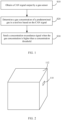
- FIG. 1 is a schematic flowchart of a test method according to an embodiment of this application.
- FIG. 2 is a schematic three-dimensional view of a test box according to an embodiment of this application.
- the test method of the embodiments of this application is used for battery cells.
- the test method includes the following steps.
- the battery cell may be used for electric apparatuses that use a battery as a power source or various energy storage systems that use a battery as an energy storage element.
- the electric apparatus may be but is not limited to a mobile phone, a tablet, a laptop computer, an electric toy, an electric tool, an electric bicycle, an electric car, a ship, or a spacecraft.
- Each battery cell may be a secondary battery or a primary battery, a lithium-sulfur battery, a sodium-ion battery, or a magnesium-ion battery, without being limited thereto.
- the battery cell may be cylindrical, flat, cuboid, or of other shapes.
- the gas sensor 110 may use a semiconductor sensor, where the semiconductor sensor includes metal oxides or semiconductor oxide crystals.
- the semiconductor sensor works as follows: after the semiconductor sensor is preheated, the semiconductor sensor can absorb oxygen in the air on the crystal surface, and active electrons on the crystal surface are transferred to the oxygen adsorbed, thus leaving positive charge in a space charge layer of the crystals. In this way, the crystals form a potential barrier that hinders the flow of electrons.
- a reducing gas is present around the gas sensor 110, the reducing gas reacts with the negatively charged oxygen atoms on the crystal surface, resulting in a decrease in the density of oxygen on the crystal surface. Therefore, a barrier height in the crystal boundary of the crystal decreases, and the decrease in the barrier height induces a decrease in the resistance of the sensor, generating a distinct electrical signal.
- the gas sensor 110 may be a sensor in other types, for example, the gas sensor 110 is a sensor such as an electrochemical sensor.
- the CAN signal is a form of signal output by the gas sensor 110, and the CAN signal may include information such as a data generation time of the gas sensor 110. Based on the CAN signal, information detected from the gas sensor 110 can be obtained.
- the test box 112 may also be called a chamber, which is an apparatus that can adjust the internal environment of the box.
- the temperature inside the test box 112 can be adjusted up or down.
- the temperature inside the test box 112 can be adjusted up by passing hot air into the test box 112.
- the density of gas inside the test box 112 can be adjusted up or down.
- the gas inside the test box 112 may be extracted by an extractor fan, thereby causing the density of gas inside the test box 112 to decrease.
- the gas sensor 110 can be mounted on a wall of the test box 112. Specifically, a through-hole can be opened in the wall of the test box 112, and then the gas sensor 110 can be mounted at the through-hole and partially extend into the test box 112, such that the gas sensor 110 can effectively detect the predetermined gas in the test box 112.
- the predetermined gas may be a reducing gas
- the reducing gas is, for example, a gas such as carbon monoxide and hydrocarbons.
- the gas sensor 110 can detect the reducing gas.
- the gas concentration of the predetermined gas can be determined based on the CAN signal output by the gas sensor 110. It should be noted that the determining the gas concentration of the predetermined gas may be determining a specific value of the gas concentration, or may be determining a range of the gas concentration.
- the gas concentration may be determined to be equal to 15 ppm or may be determined to be greater than 15 ppm, where ppm (parts per million) is the number of units of volume of the predetermined gas per million units of the total volume of gas in the test box 112.
- the concentration threshold is a critical value for determining whether a battery cell suffers from leakage.
- the concentration threshold may be obtained based on experimentation.
- the concentration threshold is 50 ppm.
- the concentration exceedance signal is sent when the gas concentration is greater than 50 ppm.
- the concentration exceedance signal may be an analog signal or a digital signal.
- the concentration exceedance signal is a high level signal. Therefore, based on the concentration exceedance signal, it can be accurately determined that the gas concentration of the predetermined gas in the test box 112 exceeds the standard, and thus the leakage of the battery cell can be determined.
- the concentration of the predetermined gas in the test box 112 is monitored using the gas sensor 110 disposed on the test box 112, and the concentration exceedance signal is sent when the gas concentration is higher than the concentration threshold. In this way, it is possible to determine, based on the gas concentration, whether the battery cell has a leakage failure.
- the determining (S20) a gas concentration of a predetermined gas in the test box 112 based on the CAN signal includes the following steps.
- the CAN signal may not be able to directly load information about the gas concentration, meaning that after the CAN signal is analyzed, the information about the gas concentration may not be directly obtained. Therefore, based on the CAN signal, the internal data cached by the gas sensor 110 can be read directly such that the gas concentration of the predetermined gas can be obtained based on the internal data of the gas sensor 110.
- the CAN signal has an address of the gas concentration cached, by which the internal data of the gas sensor 110 can be read quickly to determine the gas concentration of the predetermined gas.
- the gas concentration of the predetermined gas can be determined more accurately based on the internal data of the gas sensor 110.
- the determining (S22) the gas concentration of the predetermined gas based on the internal data includes the following steps.
- the alarm bit is a data storage bit indicating whether an event has occurred.
- the alarm bit is used to indicate a relationship between the gas concentration of the predetermined gas and the concentration threshold.
- An alarm bit flag may be represented by 0 or 1, such that an external device can easily read the alarm bit flag.
- the gas concentration of the predetermined gas is higher than the concentration threshold; and under the condition that the alarm bit flag is 0, the gas concentration of the predetermined gas is lower than or equal to the concentration threshold. In this way, by reading the alarm bit flag, it is possible to determine whether the gas concentration exceeds the concentration threshold, and then determine whether the concentration exceedance signal is sent.
- the setting of the alarm bit makes the data of the sensor easier to be analyzed for the external device when the external device reads the data, thus making the test method of this embodiment of this application easy to implement.
- the test method includes: modifying the alarm bit flag from 0 to 1 if the gas concentration measured by the gas sensor 110 is higher than the concentration threshold within a predetermined duration.
- the predetermined duration is a duration for determining whether a leakage occurs in a single battery during the test.
- the predetermined duration may be determined based on experimentation. For example, the predetermined duration may be 20 minutes. In this way, limiting the measuring time can accurately determine whether the battery cell has leakage.
- start point of the predetermined duration may be a time point at which the test box 112 just starts working or may be any time point after the test box 112 works; and the end point of the predetermined duration is a time point that is counted from the start point and that reaches the predetermined duration.
- the predetermined duration may be multiple according to a start point of timing.
- the start point of a first predetermined duration is the 1st minute, and the end point thereof is the 20th minute; and the start point of a second predetermined duration is the 2nd minute, and the end point thereof is the 21st minute.
- the alarm bit flag is modified from 0 to 1 provided that the gas concentration measured is higher than the concentration threshold within any one predetermined duration.
- the sending (S30) a concentration exceedance signal when the gas concentration is higher than a concentration threshold includes: when the gas concentration is higher than the concentration threshold, controlling a switch to close so as to cause a control circuit to send a boolean signal, and using the boolean signal as the concentration exceedance signal.
- the switch is a device that controls the on-off of the circuit, and the switch may be a component such as a relay switch and a transistor switch.
- the control circuit is a circuit that includes a switch and that can generate electrical signals. When the switch is closed, the control circuit can be in a working state and can generate an electrical signal, and when the switch is opened, the control circuit can be in a non-working state and cannot generate an electrical signal.
- the signal formed by the control circuit according to the closed or open state of the switch is the boolean signal.
- the boolean signal is similar to a pulse signal, and the boolean signal is an intermittent signal rather than a continuous signal.
- controlling the state of the switch can cause the control circuit to send a boolean signal, and then, using the boolean signal as the concentration exceedance signal makes the signal less difficult to analyze, which is conductive to subsequent processing of the concentration exceedance signal. Simpler processing makes the test method of this embodiment of this application easier to implement.
- the test method further includes the following step.
- the alarm signal is a control signal that causes the alarm apparatus 114 to give an alarm.
- the alarm apparatus 114 may give an alarm based on the control signal.
- the alarm signal may be in different types and/or different levels so as to indicate the risk of leakage of the battery cell.
- the alarm apparatus 114 may give a light alarm and represent different levels of abnormality according to different color levels such as red, orange, yellow, and green.
- the alarm apparatus 114 can also be caused to give different tones or audios to present different levels of abnormality on the basis of color, or to present different levels of abnormality individually.
- the levels of abnormality are distinguished by alarm length, tone, or pitch. This embodiment of this application does not limit the alarm mode.
- the alarm apparatus 114 can include a speaker, a display, and an indicator.
- the alarm apparatus 114 can give an audible alarm;
- the alarm apparatus 114 is a display, the alarm apparatus 114 can give an alarm such as an image; and
- the alarm apparatus 114 is an indicator, the alarm apparatus 114 can give a light alarm.
- the alarm apparatus 114 alerts according to the alarm signal, which can realize the early warning of a battery cell leakage event in a timely manner, can enable the relevant personnel to learn the problem of the leakage of the battery cell in a timely manner, and can facilitate the processing of test data (for example, the leakage time) so as to solve the problem of the leakage of the battery cell in a timely manner.
- the sending (S40) an alarm signal based on the concentration exceedance signal includes: loading position information of the gas sensor 110 from the concentration exceedance signal to form the alarm signal, and sending the alarm signal.
- multiple battery cells may be tested at the same time.
- there are multiple test boxes 112 and one battery cell may be placed within one test box 112, such that one test box 112 can test one battery cell.
- each temperature measurement test box 112 is provided with at least one gas sensor 110, there are multiple gas sensors 110.
- the multiple gas sensors 110 can be connected to the same controller.
- the multiple gas sensors 110 may be coded, and different codes correspond to different communication protocols on the controller, such that the gas sensors 110 at different positions can be identified by analyzing the communication protocols, and positions of the gas sensors 110 and the test box 112 can be easily located so as to deal with a failed battery cell in a timely manner.
- the alarm signal has the position information of the gas sensor 110, such that a position of the battery cell in which the leakage occurs can be determined based on a position of the sensor, thereby facilitating subsequent timely processing.
- the test system 116 of this embodiment of this application includes a gas sensor 110 and a control circuit board 118, where the gas sensor 110 is disposed on a test box 112, and a battery cell is placed in the test box 112.
- the control circuit board 118 includes a communication module 120, and the communication module 120 is connected to the gas sensor 110 and configured to: obtain a CAN signal output by the gas sensor 110, determine a gas concentration of a predetermined gas in the test box 112 based on the CAN signal, and send a concentration exceedance signal when the gas concentration is higher than a concentration threshold.
- control circuit board 118 is an integrated circuit board formed on the basis of a printed circuit board, on which electrical components such as a processing device and a control device are arranged so as to implement a predetermined function.
- the communication module is a circuit on the control circuit board 118 to implement a specific function, where the circuit herein includes a loop formed by connecting different components.
- the communication module may include a microcontroller unit (Microcontroller Unit, MCU), where the microcontroller unit can perform signal processing, for example, analysis of signals such as a CAN signal. Therefore, the communication module 120 of the control circuit board 118 can receive the CAN signal output by the gas sensor 110, process the CAN signal, for example, analyzing, and then send the concentration exceedance signal.
- MCU microcontroller Unit
- the concentration of the predetermined gas in the test box 112 is monitored using the gas sensor 110 disposed on the test box 112, and the concentration exceedance signal is sent when the gas concentration is higher than the concentration threshold. In this way, it is possible to determine, based on the gas concentration, whether the battery cell has a leakage failure.
- the communication module 120 is further configured to: read internal data of the gas sensor 110 based on the CAN signal, and determine the gas concentration of the predetermined gas based on the internal data.
- the gas concentration of the predetermined gas can be determined more accurately based on the internal data of the gas sensor 110.
- the communication module 120 is further configured to: obtain an alarm bit flag of the internal data; under the condition that the alarm bit flag is 1, determine that the gas concentration of the predetermined gas is higher than the concentration threshold; and under the condition that the alarm bit flag is 0, determine that the gas concentration of the predetermined gas is lower than or equal to the concentration threshold.
- the alarm bit flag makes the data of the sensor easier to be analyzed for the external device when the external device reads the data, thus making the test method of this embodiment of this application easy to implement.
- the gas sensor 110 is configured to modify the alarm bit flag from 0 to 1 if the gas concentration measured is higher than the concentration threshold within a predetermined duration.
- the communication module 120 is configured to: when the gas concentration is higher than the concentration threshold, control a switch of the control circuit board 118 to close so as to cause a control circuit to send a boolean signal, and use the boolean signal as the concentration exceedance signal.
- controlling the state of the switch can cause the control circuit to send a boolean signal, and then, using the boolean signal as the concentration exceedance signal makes the signal less difficult to analyze, which is conductive to subsequent processing of the concentration exceedance signal. Simpler processing makes the test method of this embodiment of this application easier to implement.
- the control circuit may be part of the circuit of the communication module 120, or the communication module 120 includes the control circuit.
- control circuit board 118 further includes an output module 122, where the output module 122 is configured to send an alarm signal based on the concentration exceedance signal.
- the test system 116 further includes an alarm controller 124, where the alarm controller 124 is configured to control, based on the alarm signal, an alarm apparatus 114 to give an alarm.
- the output module 122 is a circuit on the control circuit board 118 to implement a specific function, and the output module 122 has a function of analyzing the concentration exceedance signal.
- the concentration exceedance signal output by the communication module 120 may be a boolean signal, and the boolean signal may be obtained by the output module 122, causing the output module 122 to output an alarm signal based on the boolean signal.
- the alarm controller 124 is, for example, a microprocessor, and the alarm controller 124 can send instructions, thereby causing the alarm apparatus 114 to work according to the instructions sent by the alarm controller 124.
- the alarm apparatus 114 gives an alarm based on the alarm signal and can notify the relevant personnel of the leakage of the battery cell in a timely manner.
- the output module 122 is further configured to: load position information of the gas sensor 110 from the concentration exceedance signal to form the alarm signal, and send the alarm signal.
- the number of test boxes 112 may be multiple, and one test box 112 is correspondingly provided with one gas sensor 110; and on such basis, each gas sensor 110 may be connected to one communication module 120, and each communication module 120 may be connected to one output module 122.
- the gas sensor 110 and the output module 122 may have a one-to-one correspondence.
- the position information of the gas sensor 110 may be pre-stored in the output module 122.
- the output module 122 has an encoder through which the gas sensor 110 can be encoded to form the position information of the gas sensor 110. After the output module 122 receives the concentration exceedance signal, the output module 122 may perform processing on the position information of the gas sensor 110 added in the concentration exceedance signal and form an alarm signal.
- the alarm signal has the position information of the gas sensor 110, and the alarm controller 124 can control the alarm apparatus 114 to send, based on the alarm signal, alarm information, for example, a position of a battery cell failed.
- the alarm signal has the position information of the gas sensor 110, such that a position of the battery cell in which the leakage occurs can be determined based on a position of the sensor, which is convenient for the on-site personnel to deal with the failed battery cell in a timely manner so as to avoid risks such as explosion.
- each control circuit board 118 including one communication module 120 and one output module 122.
- the number of communication modules 120 and the number of output modules 122 on each control circuit board 118 may not be the same, but in multiple control circuit boards 118, the total number of communication modules 120 is the same as the total number of output modules 122, and one communication module 120 is connected to one corresponding output module 122.
- the gas sensor 110 is disposed on a side of the test box 112 and located above a height midline of the side of the test box 112.
- the temperature inside the test box 112 can be changed by circulating air in the test box 112, for example, hot air can be passed into the test box 112 to cause the temperature inside the test box 112 to increase.
- An air opening of the test box 112 is generally located in the lower part of the front and rear panels of the test box 112. In such a way, within the test box 112, the fluidity of the gas in the lower space of the test box 112 is relatively large, the fluidity of the gas in the upper space of the test box 112 is relatively small, and a reducing gas generally tends to be located in the upper space of the test box 112.
- the side of the test box 112 is relative to the front and back sides and the top and bottom sides of the test box 112, the side of the test box 112 connects the top and bottom sides and the front and back sides of the test box 112, and the height midline of the side is a line that divides the side into equal heights in the height direction.
- the gas is located above the height midline of the side, meaning that the height midline passes through the gas sensor 110 or the gas sensor 110 deviates from the height midline.
- the gas sensor 110 has a length, width, and height of 76.8 mm ⁇ 38 mm ⁇ 19.5 mm, and the gas sensor 110 can be mounted on the side of the test box 112 at a distance of about 10 cm from the top.
- test method of the foregoing embodiment is applicable to the test system 116 of this application, and for other unexpanded parts of the test system 116 of this embodiment of this application, reference is made to the corresponding parts of the foregoing test method. Details are not repeated herein.
- the test apparatus 126 of this embodiment of this application includes an obtaining module 128, a determining module 130, and a sending module 132.
- the obtaining module 128 is configured to obtain a CAN signal output by a gas sensor 110, where the gas sensor 110 is disposed on a test box 112, and a battery cell is placed in the test box 112;
- the determining module 130 is configured to determine a gas concentration of a predetermined gas in the test box 112 based on the CAN signal;
- the sending module 132 is configured to send a concentration exceedance signal when the gas concentration is higher than a concentration threshold.
- the concentration of the predetermined gas in the test box 112 is monitored using the gas sensor 110 disposed on the test box 112, and the concentration exceedance signal is sent when the gas concentration is higher than the concentration threshold. In this way, it is possible to determine, based on the gas concentration, whether the battery cell has a leakage failure.
- the determining module 130 is further configured to: read internal data of the gas sensor 110 based on the CAN signal, and determine the gas concentration of the predetermined gas based on the internal data.
- the gas concentration of the predetermined gas can be determined more accurately based on the internal data of the gas sensor 110.
- the determining module 130 is further configured to: obtain an alarm bit flag of the internal data; under the condition that the alarm bit flag is 1, determine that the gas concentration of the predetermined gas is higher than the concentration threshold; and under the condition that the alarm bit flag is 0, determine that the gas concentration of the predetermined gas is lower than or equal to the concentration threshold.
- the alarm bit flag can be used to determine whether the gas concentration exceeds the concentration threshold.
- the determining module 132 is configured to: when the gas concentration is higher than the concentration threshold, control a switch of the control circuit board 118 to close so as to cause a control circuit to send a boolean signal, and use the boolean signal as the concentration exceedance signal.
- the sending module 132 is configured to send an alarm signal based on the concentration exceedance signal, where the alarm signal is used to cause the alarm apparatus 114 to give an alarm. In this way, the alarm apparatus 114 gives an alarm based on the alarm signal and can notify the relevant personnel of the leakage of the battery cell in a timely manner.
- the sending module 132 is further configured to: load position information of the gas sensor 110 from the concentration exceedance signal to form the alarm signal, and send the alarm signal.
- the alarm signal has the position information of the gas sensor 110, such that a position of the battery cell in which the leakage occurs can be determined based on a position of the sensor, thereby facilitating subsequent timely processing.
- test method of the foregoing embodiment is applicable to the test apparatus 126 of this application, and for other unexpanded parts of the test apparatus 126 of this embodiment of this application, reference is made to the corresponding parts of the foregoing test method. Details are not repeated herein.
- a non-volatile computer-readable storage medium for computer executable instructions is provided.
- the computer executable instructions when being executed by one or more processors, cause the processor(s) to execute the test method according to any one of the foregoing embodiments.
- a "computer-readable medium” may be any apparatus that can contain, store, communicate, transfer, or transmit a program for use in or in conjunction with the instruction execution system, apparatus, or device.
- the computer-readable medium includes the following: an electrically connected portion with one or more wiring (electronic apparatus), a portable computer disk cartridge (magnetic apparatus), a random access memory (RAM), a read-only memory (ROM), an erasable editable read-only memory (EPROM or flash memory), a fiber optic apparatus, and a portable compact disc read-only memory (CDROM).
- the computer-readable medium may even be a paper on which the program may be printed or other suitable medium, because the program may be obtained electronically, for example, through optical scanning of the paper or other medium, followed by editing, decoding, or, if necessary, processing in other suitable ways, and then the program is stored in a computer memory.
- function units in the embodiments of this application may be integrated into one processing module, or each of the units may exist alone physically, or two or more units may be integrated into one module.
- the integrated module may be implemented in a form of hardware, or may be implemented in a form of a software functional module.
- the integrated module may also be stored in a computer-readable storage medium.
- the storage medium mentioned above may be a read-only memory, a disk, a compact disc, or the like.
Landscapes
- Engineering & Computer Science (AREA)
- Manufacturing & Machinery (AREA)
- Chemical & Material Sciences (AREA)
- Chemical Kinetics & Catalysis (AREA)
- Electrochemistry (AREA)
- General Chemical & Material Sciences (AREA)
- Physics & Mathematics (AREA)
- General Physics & Mathematics (AREA)
- Emergency Alarm Devices (AREA)
Abstract
Description
- This application claims priority and interest to Patent Application No.
202211281900.9 filed with the China National Intellectual Property Administration on October 19, 2022 - This application relates to the field of battery technologies, and in particular, to a test method, a test apparatus, a test system, and a storage medium.
- Energy saving and emission reduction are crucial to the sustainable development of the automobile industry. Electric vehicles, with their advantages in energy conservation and emission reduction, have become an important part of sustainable development of the automobile industry. For electric vehicles, battery technology is an important factor in connection with their development. During tests in the battery research and development stage, battery cells are prone to failure or suffer from leakage caused by corrosion and rupture of the housing. When a battery cell suffers from leakage, moisture easily enters the battery cell, leaving the battery cell at risk of thermal runaway. Therefore, how the leakage of a battery cell is detected has become a technical problem to be solved.
- Embodiments of this application provide a test method, a test apparatus, a test system, and a storage medium, so as to solve the technical problem of how the leakage of a battery cell is detected.
- The test method of the embodiments of this application is used for battery cells. The test method includes:
- obtaining a CAN signal output by a gas sensor, where the gas sensor is disposed on a test box, and a battery cell is placed in the test box;
- determining a gas concentration of a predetermined gas in the test box based on the CAN signal; and
- sending a concentration exceedance signal when the gas concentration is higher than a concentration threshold.
- In the test method of the embodiments of this application, the concentration of the predetermined gas in the test box is monitored using the gas sensor disposed on the test box, and the concentration exceedance signal is sent when the gas concentration is higher than the concentration threshold. In this way, it is possible to determine, based on the gas concentration, whether the battery cell has a leakage failure.
- In some embodiments, the determining a gas concentration of a predetermined gas in the test box based on the CAN signal includes:
- reading internal data of the gas sensor based on the CAN signal; and
- determining the gas concentration of the predetermined gas based on the internal data.
- In this way, the gas concentration of the predetermined gas can be determined more accurately based on the internal data of the gas sensor.
- In some embodiments, the determining the gas concentration of the predetermined gas based on the internal data includes:
- obtaining an alarm bit flag of the internal data;
- under the condition that the alarm bit flag is 1, determining that the gas concentration of the predetermined gas is higher than the concentration threshold; and
- under the condition that the alarm bit flag is 0, determining that the gas concentration of the predetermined gas is lower than or equal to the concentration threshold.
- In this way, the alarm bit flag can be used to determine whether the gas concentration exceeds the concentration threshold.
- In some embodiments, the test method includes:
modifying the alarm bit flag from 0 to 1 if the gas concentration measured by the gas sensor is higher than the concentration threshold within a predetermined duration. - In this way, limiting the measuring time can accurately determine whether the battery cell has leakage.
- In some embodiments, the sending a concentration exceedance signal when the gas concentration is higher than a concentration threshold includes:
when the gas concentration is higher than the concentration threshold, controlling a switch to close so as to cause a control circuit to send a boolean signal, and using the boolean signal as the concentration exceedance signal. - In this way, using the boolean signal as the concentration exceedance signal facilitates subsequent processing of the concentration exceedance signal and simplifies the processing.
- In some embodiments, the test method further includes:
sending an alarm signal based on the concentration exceedance signal, where the alarm signal is used for causing an alarm apparatus to give an alarm. - In this way, the alarm apparatus gives an alarm based on the alarm signal and can notify the relevant personnel of the leakage of the battery cell in a timely manner.
- In some embodiments, the sending an alarm signal based on the concentration exceedance signal includes:
loading position information of the gas sensor from the concentration exceedance signal to form the alarm signal, and sending the alarm signal. - In this way, the alarm signal has the position information of the gas sensor, such that a position of the battery cell in which the leakage occurs can be determined based on a position of the sensor, thereby facilitating subsequent timely processing.
- The test apparatus of the embodiments of this application includes:
- an obtaining module, configured to obtain a CAN signal output by a gas sensor, where the gas sensor is disposed on a test box, and a battery cell is placed in the test box;
- a determining module, configured to determine a gas concentration of a predetermined gas in the test box based on the CAN signal; and
- a sending module, configured to send a concentration exceedance signal when the gas concentration is higher than a concentration threshold.
- In the test apparatus of the embodiments of this application, the concentration of the predetermined gas in the test box is monitored using the gas sensor disposed on the test box, and the concentration exceedance signal is sent when the gas concentration is higher than the concentration threshold, such that it is possible to determine, based on the gas concentration, whether the battery cell has a leakage failure.
- The test system of the embodiments of this application includes:
- a gas sensor, where the gas sensor is disposed on a test box, and a battery cell is placed in the test box; and
- a control circuit board, where the control circuit board includes a communication module, and the communication module is connected to the gas sensor and configured to: obtain a CAN signal output by the gas sensor, determine a gas concentration of a predetermined gas in the test box based on the CAN signal, and send a concentration exceedance signal when the gas concentration is higher than a concentration threshold.
- In the test system of the embodiments of this application, the concentration of the predetermined gas in the test box is monitored using the gas sensor disposed on the test box, and the concentration exceedance signal is sent when the gas concentration is higher than the concentration threshold, such that it is possible to determine, based on the gas concentration, whether the battery cell has a leakage failure.
- In some embodiments, the communication module is further configured to: read internal data of the gas sensor based on the CAN signal, and determine the gas concentration of the predetermined gas based on the internal data.
- In this way, the gas concentration of the predetermined gas can be determined more accurately based on the internal data of the gas sensor.
- In some embodiments, the communication module is further configured to: obtain an alarm bit flag of the internal data; under the condition that the alarm bit flag is 1, determine that the gas concentration of the predetermined gas is higher than the concentration threshold; and under the condition that the alarm bit flag is 0, determine that the gas concentration of the predetermined gas is lower than or equal to the concentration threshold.
- In this way, the alarm bit flag can be used to determine whether the gas concentration exceeds the concentration threshold.
- In some embodiments, the gas sensor is configured to modify the alarm bit flag from 0 to 1 if the gas concentration measured is higher than the concentration threshold within a predetermined duration.
- In this way, limiting the measuring time can accurately determine whether the battery cell has leakage.
- In some embodiments, the communication module is configured to: control a switch of the control circuit board to close when the gas concentration is higher than the concentration threshold so as to cause a control circuit to send a boolean signal, and use the boolean signal as the concentration exceedance signal.
- In this way, using the boolean signal as the concentration exceedance signal facilitates subsequent processing of the concentration exceedance signal and simplifies the processing.
- In some embodiments, the control circuit board further includes an output module, where the output module is configured to send an alarm signal based on the concentration exceedance signal; and
the test system further includes an alarm controller, where the alarm controller is configured to control, based on the alarm signal, an alarm apparatus to give an alarm. - In this way, the alarm apparatus gives an alarm based on the alarm signal and can notify the relevant personnel of the leakage of the battery cell in a timely manner.
- In some embodiments, the output module is further configured to: load position information of the gas sensor from the concentration exceedance signal to form the alarm signal, and send the alarm signal.
- In this way, the alarm signal has the position information of the gas sensor, such that a position of the battery cell in which the leakage occurs can be determined based on a position of the sensor, thereby facilitating subsequent timely processing.
- In some embodiments, the gas sensor is disposed on a side of the test box and located above a height midline of the side.
- In this way, the gas sensor is subject to less interference, with more accurate measurement results.
- A non-volatile computer-readable storage medium for computer executable instructions is provided. The computer executable instructions, when being executed by one or more processors, cause the processor(s) to execute the test method according to any one of the foregoing embodiments.
- For additional aspects and advantages of this application, some will be given in the following description, and some will become apparent in the following description or will be understood in the practice of this application.
- The above and/or additional aspects and advantages of this application will become obvious and easy to understand from the description of the embodiments with reference to the following drawings.
-
FIG. 1 is a schematic flowchart of a test method according to an embodiment of this application; -
FIG. 2 is a three-dimensional view of a test box according to an embodiment of this application; -
FIG. 3 is a schematic flowchart of a test method according to an embodiment of this application; -
FIG. 4 is a schematic flowchart of a test method according to an embodiment of this application; -
FIG. 5 is a schematic flowchart of a test method according to an embodiment of this application; -
FIG. 6 is a schematic diagram of a structure of a test system according to an embodiment of this application; and -
FIG. 7 is a schematic diagram of a module of a test apparatus according to an embodiment of this application. - The following describes in detail the embodiments of technical solutions of this application with reference to the accompanying drawings. The following embodiments are merely intended for a clearer description of the technical solutions of this application and therefore are used as just examples which do not constitute any limitations on the protection scope of this application.
- Unless otherwise defined, all technical and scientific terms used herein shall have the same meanings as commonly understood by those skilled in the art to which this application relates. The terms used herein are intended to merely describe the specific embodiments rather than to limit this application. The terms "include", "comprise", and "have" and any other variations thereof in the specification, claims and brief description of drawings of this application are intended to cover non-exclusive inclusions.
- In the description of the embodiments of this application, the terms "first", "second" and the like are merely intended to distinguish between different objects, and shall not be understood as any indication or implication of relative importance or any implicit indication of the number, sequence or primary-secondary relationship of the technical features indicated. In the description of this application, "a plurality of" means at least two unless otherwise specifically stated.
- In this specification, reference to "embodiment" means that specific features, structures or characteristics described with reference to the embodiment may be incorporated in at least one embodiment of this application. The word "embodiment" appearing in various places in the specification does not necessarily refer to the same embodiment or an independent or alternative embodiment that is exclusive of other embodiments. It is explicitly or implicitly understood by persons skilled in the art that the embodiments described herein may be combined with other embodiments.
- In the description of the embodiments of this application, the term "and/or" is only an associative relationship for describing associated objects, indicating that three relationships may be present. For example, A and/or B may indicate the following three cases: presence of only A, presence of both A and B, and presence of only B. In addition, the character "/" in this specification generally indicates an "or" relationship between contextually associated objects.
- In the description of the embodiments of this application, the term "multiple" means more than two (inclusive). Similarly, "a plurality of groups" means more than two (inclusive) groups, and "a plurality of pieces" means more than two (inclusive) pieces.
- In the description of the embodiments of this application, unless otherwise specified and defined explicitly, the terms "mount", "connect", "join", and "fasten" should be understood in their general senses. For example, they may refer to a fixed connection, a detachable connection, or an integral connection, may refer to a mechanical connection or electrical connection, and may refer to a direct connection, an indirect connection via an intermediate medium, or an interaction between two elements. Persons of ordinary skill in the art can understand specific meanings of these terms in this application as appropriate to specific situations.
- Currently, from a perspective of the market development, application of traction batteries is being more extensive. Traction batteries have been not only used in energy storage power supply systems such as hydroelectric power plants, thermal power plants, wind power plants, and solar power plants, but also widely used in many other fields including electric transportation tools such as electric bicycles, electric motorcycles, and electric vehicles, military equipment, and aerospace. With continuous expansion of application fields of traction batteries, market demands for the traction batteries are also expanding.
- During tests in the battery research and development stage, battery cells are prone to failure or suffer from leakage caused by corrosion and rupture of the housing. Under the condition that a battery cell suffers from leakage, moisture easily enters the battery cell, which makes the battery cell have the risk of thermal runaway. However, when the battery cell has slight leakage occurred, the voltage, SOC, insulation value, and the like of the battery cell are normal within a short period of time, so it is difficult to detect whether the battery cell has leakage occurred by using these parameters such as voltage in a timely and effective manner. For a battery cell being tested in a chamber, it is even more difficult to effectively detect whether the battery cell has leaked in the chamber. As a result, the leakage of the battery cell cannot be detected in a timely manner.
- In order to solve the foregoing problems, the applicant has found through research that an electrolyte in the battery is typically a carbonate liquid, which is reductive in nature. In addition, the battery cell produces hydrocarbons, CO, and other reducing gases during the working cycle. Once the battery cell suffers from leakage, the volatiles of the electrolyte leak along with the gas-producing components, which causes a concentration of substances with reducing properties in the air to rise.
- Based on this consideration, the applicant solves the problem that the leakage of the battery cell is difficult to detect, by providing a gas sensor on the chamber, detecting the concentration of reducing gases in the test box through the gas sensor, and thus determining whether the leakage of battery cells occurs according to the concentration of reducing gases detected.
- Referring to
FIG. 1 and 2, FIG. 1 is a schematic flowchart of a test method according to an embodiment of this application.FIG. 2 is a schematic three-dimensional view of a test box according to an embodiment of this application. - The test method of the embodiments of this application is used for battery cells. The test method includes the following steps.
-
S 10. Obtain a CAN signal output by agas sensor 110, where thegas sensor 110 is disposed on atest box 112, and a battery cell is placed in thetest box 112. - S20. Determine a gas concentration of a predetermined gas in the
test box 112 based on the CAN signal. - S30. Send a concentration exceedance signal when the gas concentration is higher than a concentration threshold.
- Specifically, the battery cell may be used for electric apparatuses that use a battery as a power source or various energy storage systems that use a battery as an energy storage element. The electric apparatus may be but is not limited to a mobile phone, a tablet, a laptop computer, an electric toy, an electric tool, an electric bicycle, an electric car, a ship, or a spacecraft. Each battery cell may be a secondary battery or a primary battery, a lithium-sulfur battery, a sodium-ion battery, or a magnesium-ion battery, without being limited thereto. The battery cell may be cylindrical, flat, cuboid, or of other shapes.
- The
gas sensor 110 may use a semiconductor sensor, where the semiconductor sensor includes metal oxides or semiconductor oxide crystals. In an example, the semiconductor sensor works as follows: after the semiconductor sensor is preheated, the semiconductor sensor can absorb oxygen in the air on the crystal surface, and active electrons on the crystal surface are transferred to the oxygen adsorbed, thus leaving positive charge in a space charge layer of the crystals. In this way, the crystals form a potential barrier that hinders the flow of electrons. When a reducing gas is present around thegas sensor 110, the reducing gas reacts with the negatively charged oxygen atoms on the crystal surface, resulting in a decrease in the density of oxygen on the crystal surface. Therefore, a barrier height in the crystal boundary of the crystal decreases, and the decrease in the barrier height induces a decrease in the resistance of the sensor, generating a distinct electrical signal. - Certainly, the
gas sensor 110 may be a sensor in other types, for example, thegas sensor 110 is a sensor such as an electrochemical sensor. - The CAN signal is a form of signal output by the
gas sensor 110, and the CAN signal may include information such as a data generation time of thegas sensor 110. Based on the CAN signal, information detected from thegas sensor 110 can be obtained. - In this embodiment of this application, the
test box 112 may also be called a chamber, which is an apparatus that can adjust the internal environment of the box. For example, the temperature inside thetest box 112 can be adjusted up or down. For example, the temperature inside thetest box 112 can be adjusted up by passing hot air into thetest box 112. Alternatively, the density of gas inside thetest box 112 can be adjusted up or down. For example, the gas inside thetest box 112 may be extracted by an extractor fan, thereby causing the density of gas inside thetest box 112 to decrease. - The
gas sensor 110 can be mounted on a wall of thetest box 112. Specifically, a through-hole can be opened in the wall of thetest box 112, and then thegas sensor 110 can be mounted at the through-hole and partially extend into thetest box 112, such that thegas sensor 110 can effectively detect the predetermined gas in thetest box 112. - In step S20, the predetermined gas may be a reducing gas, and the reducing gas is, for example, a gas such as carbon monoxide and hydrocarbons. As discussed above, when the
gas sensor 110 is a semiconductor sensor, thegas sensor 110 can detect the reducing gas. In this way, the gas concentration of the predetermined gas can be determined based on the CAN signal output by thegas sensor 110. It should be noted that the determining the gas concentration of the predetermined gas may be determining a specific value of the gas concentration, or may be determining a range of the gas concentration. For example, the gas concentration may be determined to be equal to 15 ppm or may be determined to be greater than 15 ppm, where ppm (parts per million) is the number of units of volume of the predetermined gas per million units of the total volume of gas in thetest box 112. - In step S30, the concentration threshold is a critical value for determining whether a battery cell suffers from leakage. The concentration threshold may be obtained based on experimentation. For example, the concentration threshold is 50 ppm. In other words, the concentration exceedance signal is sent when the gas concentration is greater than 50 ppm.
- The concentration exceedance signal may be an analog signal or a digital signal. For example, the concentration exceedance signal is a high level signal. Therefore, based on the concentration exceedance signal, it can be accurately determined that the gas concentration of the predetermined gas in the
test box 112 exceeds the standard, and thus the leakage of the battery cell can be determined. - To sum up, in the test method of this embodiment of this application, the concentration of the predetermined gas in the
test box 112 is monitored using thegas sensor 110 disposed on thetest box 112, and the concentration exceedance signal is sent when the gas concentration is higher than the concentration threshold. In this way, it is possible to determine, based on the gas concentration, whether the battery cell has a leakage failure. - Referring to
FIG. 3 , in some embodiments, the determining (S20) a gas concentration of a predetermined gas in thetest box 112 based on the CAN signal includes the following steps. - S21. Read internal data of the
gas sensor 110 based on the CAN signal. - S22. Determine the gas concentration of the predetermined gas based on the internal data.
- Specifically, based on a protocol for the CAN signal, the CAN signal may not be able to directly load information about the gas concentration, meaning that after the CAN signal is analyzed, the information about the gas concentration may not be directly obtained. Therefore, based on the CAN signal, the internal data cached by the
gas sensor 110 can be read directly such that the gas concentration of the predetermined gas can be obtained based on the internal data of thegas sensor 110. - For example, the CAN signal has an address of the gas concentration cached, by which the internal data of the
gas sensor 110 can be read quickly to determine the gas concentration of the predetermined gas. In this way, the gas concentration of the predetermined gas can be determined more accurately based on the internal data of thegas sensor 110. - Referring to
FIG. 4 , in some embodiments, the determining (S22) the gas concentration of the predetermined gas based on the internal data includes the following steps. - S221. Obtain an alarm bit flag of the internal data.
- S222. Under the condition that the alarm bit flag is 1, determine that the gas concentration of the predetermined gas is higher than the concentration threshold.
- S223. Under the condition that the alarm bit flag is 0, determine that the gas concentration of the predetermined gas is lower than or equal to the concentration threshold.
- Specifically, the alarm bit is a data storage bit indicating whether an event has occurred. In this embodiment of this application, the alarm bit is used to indicate a relationship between the gas concentration of the predetermined gas and the concentration threshold. An alarm bit flag may be represented by 0 or 1, such that an external device can easily read the alarm bit flag. In some embodiments, under the condition that the alarm bit flag is 1, the gas concentration of the predetermined gas is higher than the concentration threshold; and under the condition that the alarm bit flag is 0, the gas concentration of the predetermined gas is lower than or equal to the concentration threshold. In this way, by reading the alarm bit flag, it is possible to determine whether the gas concentration exceeds the concentration threshold, and then determine whether the concentration exceedance signal is sent. The setting of the alarm bit makes the data of the sensor easier to be analyzed for the external device when the external device reads the data, thus making the test method of this embodiment of this application easy to implement.
- In some embodiments, the test method includes:
modifying the alarm bit flag from 0 to 1 if the gas concentration measured by thegas sensor 110 is higher than the concentration threshold within a predetermined duration. - Specifically, the predetermined duration is a duration for determining whether a leakage occurs in a single battery during the test. The predetermined duration may be determined based on experimentation. For example, the predetermined duration may be 20 minutes. In this way, limiting the measuring time can accurately determine whether the battery cell has leakage.
- It should be noted that the start point of the predetermined duration may be a time point at which the
test box 112 just starts working or may be any time point after thetest box 112 works; and the end point of the predetermined duration is a time point that is counted from the start point and that reaches the predetermined duration. - Therefore, the predetermined duration may be multiple according to a start point of timing. For example, the start point of a first predetermined duration is the 1st minute, and the end point thereof is the 20th minute; and the start point of a second predetermined duration is the 2nd minute, and the end point thereof is the 21st minute.
- Therefore, the alarm bit flag is modified from 0 to 1 provided that the gas concentration measured is higher than the concentration threshold within any one predetermined duration.
- In some embodiments, the sending (S30) a concentration exceedance signal when the gas concentration is higher than a concentration threshold includes:
when the gas concentration is higher than the concentration threshold, controlling a switch to close so as to cause a control circuit to send a boolean signal, and using the boolean signal as the concentration exceedance signal. - Specifically, the switch is a device that controls the on-off of the circuit, and the switch may be a component such as a relay switch and a transistor switch. This application does not limit the specific type of the switch. The control circuit is a circuit that includes a switch and that can generate electrical signals. When the switch is closed, the control circuit can be in a working state and can generate an electrical signal, and when the switch is opened, the control circuit can be in a non-working state and cannot generate an electrical signal. The signal formed by the control circuit according to the closed or open state of the switch is the boolean signal. The boolean signal is similar to a pulse signal, and the boolean signal is an intermittent signal rather than a continuous signal.
- Therefore, controlling the state of the switch can cause the control circuit to send a boolean signal, and then, using the boolean signal as the concentration exceedance signal makes the signal less difficult to analyze, which is conductive to subsequent processing of the concentration exceedance signal. Simpler processing makes the test method of this embodiment of this application easier to implement.
- Referring to
FIG. 5 , in some embodiments, the test method further includes the following step. - S40. Send an alarm signal based on the concentration exceedance signal, where the alarm signal is used for causing an alarm apparatus 114 (as shown in
FIG. 6 ) to give an alarm. - Specifically, the alarm signal is a control signal that causes the
alarm apparatus 114 to give an alarm. In other words, thealarm apparatus 114 may give an alarm based on the control signal. The alarm signal may be in different types and/or different levels so as to indicate the risk of leakage of the battery cell. For example, thealarm apparatus 114 may give a light alarm and represent different levels of abnormality according to different color levels such as red, orange, yellow, and green. Certainly, in addition to color, thealarm apparatus 114 can also be caused to give different tones or audios to present different levels of abnormality on the basis of color, or to present different levels of abnormality individually. For example, the levels of abnormality are distinguished by alarm length, tone, or pitch. This embodiment of this application does not limit the alarm mode. - The
alarm apparatus 114 can include a speaker, a display, and an indicator. When thealarm apparatus 114 is a speaker, thealarm apparatus 114 can give an audible alarm; when thealarm apparatus 114 is a display, thealarm apparatus 114 can give an alarm such as an image; and when thealarm apparatus 114 is an indicator, thealarm apparatus 114 can give a light alarm. In this way, thealarm apparatus 114 alerts according to the alarm signal, which can realize the early warning of a battery cell leakage event in a timely manner, can enable the relevant personnel to learn the problem of the leakage of the battery cell in a timely manner, and can facilitate the processing of test data (for example, the leakage time) so as to solve the problem of the leakage of the battery cell in a timely manner. - In some embodiments, the sending (S40) an alarm signal based on the concentration exceedance signal includes:
loading position information of thegas sensor 110 from the concentration exceedance signal to form the alarm signal, and sending the alarm signal. - Specifically, in the testing of battery cells, multiple battery cells may be tested at the same time. For example, there are
multiple test boxes 112, and one battery cell may be placed within onetest box 112, such that onetest box 112 can test one battery cell. Because each temperaturemeasurement test box 112 is provided with at least onegas sensor 110, there aremultiple gas sensors 110. - In order to facilitate the management of data obtained from the measurement of the
multiple gas sensors 110, themultiple gas sensors 110 can be connected to the same controller. In order to distinguish among thegas sensors 110, themultiple gas sensors 110 may be coded, and different codes correspond to different communication protocols on the controller, such that thegas sensors 110 at different positions can be identified by analyzing the communication protocols, and positions of thegas sensors 110 and thetest box 112 can be easily located so as to deal with a failed battery cell in a timely manner. - Therefore, the alarm signal has the position information of the
gas sensor 110, such that a position of the battery cell in which the leakage occurs can be determined based on a position of the sensor, thereby facilitating subsequent timely processing. - Referring to
FIG. 6 , this application further provides atest system 116. Thetest system 116 of this embodiment of this application includes agas sensor 110 and acontrol circuit board 118, where thegas sensor 110 is disposed on atest box 112, and a battery cell is placed in thetest box 112. Thecontrol circuit board 118 includes acommunication module 120, and thecommunication module 120 is connected to thegas sensor 110 and configured to: obtain a CAN signal output by thegas sensor 110, determine a gas concentration of a predetermined gas in thetest box 112 based on the CAN signal, and send a concentration exceedance signal when the gas concentration is higher than a concentration threshold. - Specifically, the
control circuit board 118 is an integrated circuit board formed on the basis of a printed circuit board, on which electrical components such as a processing device and a control device are arranged so as to implement a predetermined function. The communication module is a circuit on thecontrol circuit board 118 to implement a specific function, where the circuit herein includes a loop formed by connecting different components. The communication module may include a microcontroller unit (Microcontroller Unit, MCU), where the microcontroller unit can perform signal processing, for example, analysis of signals such as a CAN signal. Therefore, thecommunication module 120 of thecontrol circuit board 118 can receive the CAN signal output by thegas sensor 110, process the CAN signal, for example, analyzing, and then send the concentration exceedance signal. - In conclusion, in the
test system 116 of this embodiment of this application, the concentration of the predetermined gas in thetest box 112 is monitored using thegas sensor 110 disposed on thetest box 112, and the concentration exceedance signal is sent when the gas concentration is higher than the concentration threshold. In this way, it is possible to determine, based on the gas concentration, whether the battery cell has a leakage failure. - In some embodiments, the
communication module 120 is further configured to: read internal data of thegas sensor 110 based on the CAN signal, and determine the gas concentration of the predetermined gas based on the internal data. - In this way, the gas concentration of the predetermined gas can be determined more accurately based on the internal data of the
gas sensor 110. - In some embodiments, the
communication module 120 is further configured to: obtain an alarm bit flag of the internal data; under the condition that the alarm bit flag is 1, determine that the gas concentration of the predetermined gas is higher than the concentration threshold; and under the condition that the alarm bit flag is 0, determine that the gas concentration of the predetermined gas is lower than or equal to the concentration threshold. - In this way, by reading the alarm bit flag, it is possible to determine whether the gas concentration exceeds the concentration threshold, and then determine whether the concentration exceedance signal is sent. The setting of the alarm bit makes the data of the sensor easier to be analyzed for the external device when the external device reads the data, thus making the test method of this embodiment of this application easy to implement.
- In some embodiments, the
gas sensor 110 is configured to modify the alarm bit flag from 0 to 1 if the gas concentration measured is higher than the concentration threshold within a predetermined duration. - In this way, limiting the measuring time can accurately determine whether the battery cell has leakage.
- In some embodiments, the
communication module 120 is configured to: when the gas concentration is higher than the concentration threshold, control a switch of thecontrol circuit board 118 to close so as to cause a control circuit to send a boolean signal, and use the boolean signal as the concentration exceedance signal. - Therefore, controlling the state of the switch can cause the control circuit to send a boolean signal, and then, using the boolean signal as the concentration exceedance signal makes the signal less difficult to analyze, which is conductive to subsequent processing of the concentration exceedance signal. Simpler processing makes the test method of this embodiment of this application easier to implement. It should be noted that the control circuit may be part of the circuit of the
communication module 120, or thecommunication module 120 includes the control circuit. - Referring to
FIG. 6 , in some embodiments, thecontrol circuit board 118 further includes anoutput module 122, where theoutput module 122 is configured to send an alarm signal based on the concentration exceedance signal. - The
test system 116 further includes analarm controller 124, where thealarm controller 124 is configured to control, based on the alarm signal, analarm apparatus 114 to give an alarm. - Specifically, the
output module 122 is a circuit on thecontrol circuit board 118 to implement a specific function, and theoutput module 122 has a function of analyzing the concentration exceedance signal. As discussed above, the concentration exceedance signal output by thecommunication module 120 may be a boolean signal, and the boolean signal may be obtained by theoutput module 122, causing theoutput module 122 to output an alarm signal based on the boolean signal. - The
alarm controller 124 is, for example, a microprocessor, and thealarm controller 124 can send instructions, thereby causing thealarm apparatus 114 to work according to the instructions sent by thealarm controller 124. - In this way, the
alarm apparatus 114 gives an alarm based on the alarm signal and can notify the relevant personnel of the leakage of the battery cell in a timely manner. - In some embodiments, the
output module 122 is further configured to: load position information of thegas sensor 110 from the concentration exceedance signal to form the alarm signal, and send the alarm signal. - Specifically, as discussed above, the number of
test boxes 112 may be multiple, and onetest box 112 is correspondingly provided with onegas sensor 110; and on such basis, eachgas sensor 110 may be connected to onecommunication module 120, and eachcommunication module 120 may be connected to oneoutput module 122. In other words, thegas sensor 110 and theoutput module 122 may have a one-to-one correspondence. The position information of thegas sensor 110 may be pre-stored in theoutput module 122. For example, theoutput module 122 has an encoder through which thegas sensor 110 can be encoded to form the position information of thegas sensor 110. After theoutput module 122 receives the concentration exceedance signal, theoutput module 122 may perform processing on the position information of thegas sensor 110 added in the concentration exceedance signal and form an alarm signal. It can be understood that, at this point, the alarm signal has the position information of thegas sensor 110, and thealarm controller 124 can control thealarm apparatus 114 to send, based on the alarm signal, alarm information, for example, a position of a battery cell failed. - In this way, the alarm signal has the position information of the
gas sensor 110, such that a position of the battery cell in which the leakage occurs can be determined based on a position of the sensor, which is convenient for the on-site personnel to deal with the failed battery cell in a timely manner so as to avoid risks such as explosion. - It should be noted that there are multiple
control circuit boards 118, with eachcontrol circuit board 118 including onecommunication module 120 and oneoutput module 122. Alternatively, there may be onecontrol circuit board 118, where onecontrol circuit board 118 includesmultiple communication modules 120 andmultiple output modules 122, and thecommunication modules 120 and theoutput modules 122 can be connected in a one-to-one correspondence. Certainly, in the case of multiplecontrol circuit boards 118, the number ofcommunication modules 120 and the number ofoutput modules 122 on eachcontrol circuit board 118 may not be the same, but in multiplecontrol circuit boards 118, the total number ofcommunication modules 120 is the same as the total number ofoutput modules 122, and onecommunication module 120 is connected to onecorresponding output module 122. - In some embodiments, the
gas sensor 110 is disposed on a side of thetest box 112 and located above a height midline of the side of thetest box 112. - Generally, the temperature inside the
test box 112 can be changed by circulating air in thetest box 112, for example, hot air can be passed into thetest box 112 to cause the temperature inside thetest box 112 to increase. An air opening of thetest box 112 is generally located in the lower part of the front and rear panels of thetest box 112. In such a way, within thetest box 112, the fluidity of the gas in the lower space of thetest box 112 is relatively large, the fluidity of the gas in the upper space of thetest box 112 is relatively small, and a reducing gas generally tends to be located in the upper space of thetest box 112. - The side of the
test box 112 is relative to the front and back sides and the top and bottom sides of thetest box 112, the side of thetest box 112 connects the top and bottom sides and the front and back sides of thetest box 112, and the height midline of the side is a line that divides the side into equal heights in the height direction. The gas is located above the height midline of the side, meaning that the height midline passes through thegas sensor 110 or thegas sensor 110 deviates from the height midline. - Thus, disposing the
gas sensor 110 above the height midline of the side of thetest box 112 results in less interference to thegas sensor 110 and more accurate measurement results. - In an example, the
gas sensor 110 has a length, width, and height of 76.8 mm×38 mm×19.5 mm, and thegas sensor 110 can be mounted on the side of thetest box 112 at a distance of about 10 cm from the top. - It should be noted that the explanation description of the test method of the foregoing embodiment is applicable to the
test system 116 of this application, and for other unexpanded parts of thetest system 116 of this embodiment of this application, reference is made to the corresponding parts of the foregoing test method. Details are not repeated herein. - Referring to
FIG. 7 , thetest apparatus 126 of this embodiment of this application includes an obtainingmodule 128, a determiningmodule 130, and a sending module 132. The obtainingmodule 128 is configured to obtain a CAN signal output by agas sensor 110, where thegas sensor 110 is disposed on atest box 112, and a battery cell is placed in thetest box 112; the determiningmodule 130 is configured to determine a gas concentration of a predetermined gas in thetest box 112 based on the CAN signal; and the sending module 132 is configured to send a concentration exceedance signal when the gas concentration is higher than a concentration threshold. - In the
test apparatus 126 of this embodiment of this application, the concentration of the predetermined gas in thetest box 112 is monitored using thegas sensor 110 disposed on thetest box 112, and the concentration exceedance signal is sent when the gas concentration is higher than the concentration threshold. In this way, it is possible to determine, based on the gas concentration, whether the battery cell has a leakage failure. - In some embodiments, the determining
module 130 is further configured to: read internal data of thegas sensor 110 based on the CAN signal, and determine the gas concentration of the predetermined gas based on the internal data. - In this way, the gas concentration of the predetermined gas can be determined more accurately based on the internal data of the
gas sensor 110. - In some embodiments, the determining
module 130 is further configured to: obtain an alarm bit flag of the internal data; under the condition that the alarm bit flag is 1, determine that the gas concentration of the predetermined gas is higher than the concentration threshold; and under the condition that the alarm bit flag is 0, determine that the gas concentration of the predetermined gas is lower than or equal to the concentration threshold. - In this way, the alarm bit flag can be used to determine whether the gas concentration exceeds the concentration threshold.
- In some embodiments, the determining module 132 is configured to: when the gas concentration is higher than the concentration threshold, control a switch of the
control circuit board 118 to close so as to cause a control circuit to send a boolean signal, and use the boolean signal as the concentration exceedance signal. - In this way, using the boolean signal as the concentration exceedance signal facilitates subsequent processing of the concentration exceedance signal and simplifies the processing.
- In some embodiments, the sending module 132 is configured to send an alarm signal based on the concentration exceedance signal, where the alarm signal is used to cause the
alarm apparatus 114 to give an alarm. In this way, thealarm apparatus 114 gives an alarm based on the alarm signal and can notify the relevant personnel of the leakage of the battery cell in a timely manner. - In some embodiments, the sending module 132 is further configured to: load position information of the
gas sensor 110 from the concentration exceedance signal to form the alarm signal, and send the alarm signal. - In this way, the alarm signal has the position information of the
gas sensor 110, such that a position of the battery cell in which the leakage occurs can be determined based on a position of the sensor, thereby facilitating subsequent timely processing. - It should be noted that the explanation description of the test method of the foregoing embodiment is applicable to the
test apparatus 126 of this application, and for other unexpanded parts of thetest apparatus 126 of this embodiment of this application, reference is made to the corresponding parts of the foregoing test method. Details are not repeated herein. - A non-volatile computer-readable storage medium for computer executable instructions is provided. The computer executable instructions, when being executed by one or more processors, cause the processor(s) to execute the test method according to any one of the foregoing embodiments.
- In the description of this specification, reference to the description of the terms "an embodiment", "some embodiments", "an example of the embodiment", "an example", "a specific example", or "some examples" means that particular features, structures, materials or characteristics described in connection with the embodiments or examples are included in at least one embodiment or example of this application. In this specification, descriptions of examples of the above terms do not necessarily refer to the same embodiment or example. Furthermore, the particular features, structures, materials, or characteristics described may be combined in a suitable manner in any one or more embodiments or examples.
- Any process or method in the flowcharts or described in other manners in this specification may be understood to denote a module, segment, or portion of code that includes one or more executable instructions for implementing steps of a specified logical function or process. The scope of the preferred implementations of this application includes additional implementations in which functions may be performed not in the order shown or discussed, but at substantially the same time or in reverse order depending on the involved functions. This should be understood by those skilled in the art to which the embodiments of this application relate.
- The logic and/or steps represented in the flowchart or otherwise described herein, for example, may be considered to be a definitive list of executable instructions for implementing the logical functions, which may be specifically implemented in any computer-readable medium for use by, or in combination with, an instruction execution system, apparatus, or device (for example, a computer-based system, a system including a processing module, or other systems that can obtain instructions from an instruction execution system, apparatus, or device and execute the instructions). For the purposes of this specification, a "computer-readable medium" may be any apparatus that can contain, store, communicate, transfer, or transmit a program for use in or in conjunction with the instruction execution system, apparatus, or device. More specific examples of the computer-readable medium (a non-exhaustive list) include the following: an electrically connected portion with one or more wiring (electronic apparatus), a portable computer disk cartridge (magnetic apparatus), a random access memory (RAM), a read-only memory (ROM), an erasable editable read-only memory (EPROM or flash memory), a fiber optic apparatus, and a portable compact disc read-only memory (CDROM). Alternatively, the computer-readable medium may even be a paper on which the program may be printed or other suitable medium, because the program may be obtained electronically, for example, through optical scanning of the paper or other medium, followed by editing, decoding, or, if necessary, processing in other suitable ways, and then the program is stored in a computer memory.
- It should be understood that the parts of the embodiments of this application can be implemented by hardware, software, firmware, or a combination thereof. In the foregoing embodiments, multiple steps or methods may be implemented by software or firmware stored in memory and executed by a suitable instruction execution system. For example, if implemented by hardware, as in another embodiment, they may be implemented by any one of the following techniques known in the art or by a combination thereof: a discrete logic circuit with a logic gate circuit for implementing the logic function on data signals, an application-specific integrated circuit with a suitable combination of logic gate circuits, a programmable gate array (PGA), a field programmable gate array (FPGA), and the like.
- Persons of ordinary skill in the art can understand that all or some of the steps of the foregoing method embodiment can be completed by a program to instruct relevant hardware, where the program may be stored in a computer-readable storage medium, and when the program is executed, one of or a combination of the steps of the method embodiment are included.
- In addition, function units in the embodiments of this application may be integrated into one processing module, or each of the units may exist alone physically, or two or more units may be integrated into one module. The integrated module may be implemented in a form of hardware, or may be implemented in a form of a software functional module. When the integrated module is implemented in the form of a software functional module and sold or used as an independent product, the integrated module may also be stored in a computer-readable storage medium. The storage medium mentioned above may be a read-only memory, a disk, a compact disc, or the like.
- In conclusion, it should be noted that the foregoing embodiments are for description of the technical solutions of this application only rather than for limiting this application. Although this application has been described in detail with reference to the foregoing embodiments, persons of ordinary skill in the art should appreciate that they can still make modifications to the technical solutions described in the embodiments or make equivalent replacements to some or all technical features thereof without departing from the scope of the technical solutions of the embodiments of this application. All such modifications and equivalent replacements shall fall within the scope of claims and specification of this application. In particular, as long as there is no structural conflict, the various technical features mentioned in the embodiments can be combined in any manner. This application is not limited to the specific embodiments disclosed in this specification but includes all technical solutions falling within the scope of the claims.
Claims (17)
- A test method used for battery cells, characterized in that the test method comprises:obtaining a CAN signal output by a gas sensor, wherein the gas sensor is disposed on a test box, and a battery cell is placed in the test box;determining a gas concentration of a predetermined gas in the test box based on the CAN signal; andsending a concentration exceedance signal when the gas concentration is higher than a concentration threshold.
- The test method according to claim 1, characterized in that the determining a gas concentration of a predetermined gas in the test box based on the CAN signal comprises:reading internal data of the gas sensor based on the CAN signal; anddetermining the gas concentration of the predetermined gas based on the internal data.
- The test method according to claim 2, characterized in that the determining the gas concentration of the predetermined gas based on the internal data comprises:obtaining an alarm bit flag of the internal data;under the condition that the alarm bit flag is 1, determining that the gas concentration of the predetermined gas is higher than the concentration threshold; andunder the condition that the alarm bit flag is 0, determining that the gas concentration of the predetermined gas is lower than or equal to the concentration threshold.
- The test method according to claim 3, characterized in that the test method comprises:
modifying the alarm bit flag from 0 to 1 if the gas concentration measured by the gas sensor is higher than the concentration threshold within a predetermined duration. - The test method according to claim 1, characterized in that the sending a concentration exceedance signal when the gas concentration is higher than a concentration threshold comprises:
when the gas concentration is higher than the concentration threshold, controlling a switch to close so as to cause a control circuit to send a boolean signal, and using the boolean signal as the concentration exceedance signal. - The test method according to claim 1, characterized in that the test method further comprises:
sending an alarm signal based on the concentration exceedance signal, wherein the alarm signal is used for causing an alarm apparatus to give an alarm. - The test method according to claim 6, characterized in that the sending an alarm signal based on the concentration exceedance signal comprises:
loading position information of the gas sensor from the concentration exceedance signal to form the alarm signal, and sending the alarm signal. - A test apparatus, characterized by comprising:an obtaining module, configured to obtain a CAN signal output by a gas sensor, wherein the gas sensor is disposed on a test box, and a battery cell is placed in the test box;a determining module, configured to determine a gas concentration of a predetermined gas in the test box based on the CAN signal; anda sending module, configured to send a concentration exceedance signal when the gas concentration is higher than a concentration threshold.
- A test system, characterized by comprising:a gas sensor, wherein the gas sensor is disposed on a test box, and a battery cell is placed in the test box; anda control circuit board, wherein the control circuit board comprises a communication module, and the communication module is connected to the gas sensor and configured to: obtain a CAN signal output by the gas sensor, determine a gas concentration of a predetermined gas in the test box based on the CAN signal, and send a concentration exceedance signal when the gas concentration is higher than a concentration threshold.
- The test system according to claim 9, characterized in that the communication module is further configured to: read internal data of the gas sensor based on the CAN signal, and determine the gas concentration of the predetermined gas based on the internal data.
- The test system according to claim 10, characterized in that the communication module is further configured to: obtain an alarm bit flag of the internal data; under the condition that the alarm bit flag is 1, determine that the gas concentration of the predetermined gas is higher than the concentration threshold; and under the condition that the alarm bit flag is 0, determine that the gas concentration of the predetermined gas is lower than or equal to the concentration threshold.
- The test system according to claim 11, characterized in that the gas sensor is configured to modify the alarm bit flag from 0 to 1 if the gas concentration measured is higher than the concentration threshold within a predetermined duration.
- The test system according to claim 11, characterized in that the communication module is configured to: when the gas concentration is higher than the concentration threshold, control a switch of the control circuit board to close so as to cause a control circuit to send a boolean signal, and use the boolean signal as the concentration exceedance signal.
- The test system according to claim 9, characterized in that the control circuit board further comprises an output module, wherein the output module is configured to send an alarm signal based on the concentration exceedance signal; and
the test system further comprises an alarm controller, wherein the alarm controller is configured to control, based on the alarm signal, an alarm apparatus to give an alarm. - The test system according to claim 14, characterized in that the output module is further configured to: load position information of the gas sensor from the concentration exceedance signal to form the alarm signal, and send the alarm signal.
- The test system according to claim 9, characterized in that the gas sensor is disposed on a side of the test box and located above a height midline of the side.
- A non-volatile computer-readable storage medium for computer executable instructions, characterized in that the computer executable instructions, when being executed by one or more processors, cause the processor(s) to execute the test method according to any one of claims 1 to 7.
Applications Claiming Priority (2)
| Application Number | Priority Date | Filing Date | Title |
|---|---|---|---|
| CN202211281900.9A CN115808267A (en) | 2022-10-19 | 2022-10-19 | Test method, test device, test system and storage medium |
| PCT/CN2023/082923 WO2024082542A1 (en) | 2022-10-19 | 2023-03-21 | Test method, test apparatus, test system and storage medium |
Publications (3)
| Publication Number | Publication Date |
|---|---|
| EP4382879A1 true EP4382879A1 (en) | 2024-06-12 |
| EP4382879A4 EP4382879A4 (en) | 2024-11-20 |
| EP4382879B1 EP4382879B1 (en) | 2025-11-12 |
Family
ID=85482780
Family Applications (1)
| Application Number | Title | Priority Date | Filing Date |
|---|---|---|---|
| EP23734129.2A Active EP4382879B1 (en) | 2022-10-19 | 2023-03-21 | Test method, test apparatus, test system and storage medium |
Country Status (5)
| Country | Link |
|---|---|
| US (1) | US20240230451A9 (en) |
| EP (1) | EP4382879B1 (en) |
| CN (1) | CN115808267A (en) |
| PL (1) | PL4382879T3 (en) |
| WO (1) | WO2024082542A1 (en) |
Families Citing this family (2)
| Publication number | Priority date | Publication date | Assignee | Title |
|---|---|---|---|---|
| CN115808267A (en) * | 2022-10-19 | 2023-03-17 | 宁德时代新能源科技股份有限公司 | Test method, test device, test system and storage medium |
| CN118936786B (en) * | 2024-10-10 | 2025-04-04 | 宁德时代新能源科技股份有限公司 | Battery leakage detection method, detection device, battery and energy storage system |
Family Cites Families (28)
| Publication number | Priority date | Publication date | Assignee | Title |
|---|---|---|---|---|
| US5034725A (en) * | 1990-07-11 | 1991-07-23 | Sorensen Thomas C | Semiconductor gas sensor having linearized indications |
| JP5440452B2 (en) * | 2010-08-31 | 2014-03-12 | スズキ株式会社 | Fuel cell system |
| US8796993B2 (en) * | 2011-09-12 | 2014-08-05 | Southwest Electronic Energy Corporation | Historical analysis of battery cells for determining state of health |
| CN104677949A (en) * | 2013-11-28 | 2015-06-03 | 海洋王(东莞)照明科技有限公司 | Concentration detecting alarming circuit for gas in battery |
| JP6069570B1 (en) * | 2016-09-14 | 2017-02-01 | 環境電子株式会社 | Automatic water quality monitoring device |
| CN107469257A (en) * | 2016-11-04 | 2017-12-15 | 安徽中科中涣防务装备技术有限公司 | A kind of vehicle battery box early warning fire extinguishing system and method |
| US10775263B2 (en) * | 2017-07-31 | 2020-09-15 | Nio Usa, Inc. | Systems and methods for diagnosing seal integrity in a battery |
| CN109387341A (en) * | 2017-08-09 | 2019-02-26 | 中国石油化工股份有限公司 | The combined type gas leakage monitor alarm device and method monitored based on gas concentration and physical quantity |
| CN107680355A (en) * | 2017-09-14 | 2018-02-09 | 柳成荫 | Disaster prevention method, gas alarm, server and computer-readable medium |
| CN107959066B (en) * | 2017-11-20 | 2020-02-21 | 北京长城华冠汽车技术开发有限公司 | Liquid leakage control system and control method for power battery box of electric automobile |
| CN108258345A (en) * | 2018-03-20 | 2018-07-06 | 华霆(合肥)动力技术有限公司 | Battery coolant leakage detection apparatus, battery cooling system and vehicle |
| CN208522055U (en) * | 2018-08-23 | 2019-02-19 | 北京新能源汽车股份有限公司 | Power battery box early warning extinguishing device and electric automobile |
| CN109345782A (en) * | 2018-09-29 | 2019-02-15 | 四川博能燃气股份有限公司 | A kind of indoor fuel gas leakage alarms system and its alarm and leak point positioning method |
| EP3895232A1 (en) * | 2018-12-14 | 2021-10-20 | Koninklijke Philips N.V. | System to improve safety and reliability of a lithium-ion (li-ion) battery pack |
| KR102051809B1 (en) * | 2019-09-06 | 2019-12-04 | 인셀(주) | Battery Protection apparatus and Method Using Gas Sensors |
| CN110988714A (en) * | 2019-11-11 | 2020-04-10 | 天津大学 | Lithium battery fire hazard comprehensive testing system and method |
| WO2021106615A1 (en) * | 2019-11-28 | 2021-06-03 | ソニーグループ株式会社 | Gas detection method and information processing device |
| KR102789812B1 (en) * | 2020-09-14 | 2025-03-31 | 주식회사 엘지에너지솔루션 | Battery monitoring apparatus, battery monitoring method, battery pack and electirc vehicle |
| CN114267158A (en) * | 2020-09-16 | 2022-04-01 | 上海古北电子技术工程有限公司 | Alarm system and method based on chemical industry |
| CN112763912A (en) * | 2020-12-25 | 2021-05-07 | 上海汉测智能科技有限公司 | Intelligent hydrogen fuel cell test system and control method |
| CN115117470A (en) * | 2021-03-22 | 2022-09-27 | 广州汽车集团股份有限公司 | Battery cell damage detection method and system in battery pack and electric vehicle |
| CN214706023U (en) * | 2021-03-22 | 2021-11-12 | 广州汽车集团股份有限公司 | Battery monomer damage detection system and electric automobile in battery package |
| JP7176032B2 (en) * | 2021-03-26 | 2022-11-21 | 本田技研工業株式会社 | fuel cell system |
| CN113176512A (en) * | 2021-03-29 | 2021-07-27 | 国网江苏省电力有限公司南京供电分公司 | Based on C2H4Lithium ion battery overcharge fault diagnosis method and system with variable rate |
| US11469473B1 (en) * | 2021-09-20 | 2022-10-11 | Beta Air, Llc | Systems and methods for redundant electric power for an electric aircraft |
| US12469893B2 (en) * | 2021-11-09 | 2025-11-11 | GM Global Technology Operations LLC | In-situ gas detection and monitoring of battery cells during formation and intended use |
| CN115009026B (en) * | 2022-06-17 | 2025-08-15 | 华霆(合肥)动力技术有限公司 | Equipment state detection method and device |
| CN115808267A (en) * | 2022-10-19 | 2023-03-17 | 宁德时代新能源科技股份有限公司 | Test method, test device, test system and storage medium |
-
2022
- 2022-10-19 CN CN202211281900.9A patent/CN115808267A/en active Pending
-
2023
- 2023-03-21 PL PL23734129.2T patent/PL4382879T3/en unknown
- 2023-03-21 WO PCT/CN2023/082923 patent/WO2024082542A1/en not_active Ceased
- 2023-03-21 EP EP23734129.2A patent/EP4382879B1/en active Active
- 2023-07-03 US US18/346,498 patent/US20240230451A9/en active Pending
Also Published As
| Publication number | Publication date |
|---|---|
| US20240230451A9 (en) | 2024-07-11 |
| CN115808267A (en) | 2023-03-17 |
| EP4382879A4 (en) | 2024-11-20 |
| WO2024082542A1 (en) | 2024-04-25 |
| PL4382879T3 (en) | 2026-04-27 |
| US20240133764A1 (en) | 2024-04-25 |
| EP4382879B1 (en) | 2025-11-12 |
Similar Documents
| Publication | Publication Date | Title |
|---|---|---|
| US20240230451A9 (en) | Test method, test apparatus, test system, and storage medium | |
| Shi et al. | Hydrogen gas diffusion behavior and detector installation optimization of lithium ion battery energy-storage cabin | |
| CN116829966A (en) | Device and method for detecting abnormal cells in battery pack | |
| CN110595704B (en) | Leakage detection method and system for energy storage battery | |
| CN115020836B (en) | Battery cell early warning method, device, system, equipment, medium and program product | |
| CN104820200A (en) | Battery management system function check platform with self-checking function, self-checking method, and check method | |
| CN108519558A (en) | Detection method for lithium separation of power battery, controller and automobile | |
| KR20220048371A (en) | Apparatus and method for diagnosing battery | |
| KR102872094B1 (en) | System and method for verifying thermal propagation design of battery pack | |
| US20240053283A1 (en) | Battery wetting state detection method and apparatus, device, system, and medium | |
| JP4865897B1 (en) | Battery system | |
| CN120322342A (en) | Battery monitoring system and method for monitoring battery status | |
| EP4465025A1 (en) | Monitoring device and operating method therefor | |
| CN118936786B (en) | Battery leakage detection method, detection device, battery and energy storage system | |
| US11959972B2 (en) | Battery diagnosing apparatus and method | |
| CN207051458U (en) | A kind of cell degradation detection means | |
| CN118738625A (en) | Thermal runaway warning device, thermal runaway warning system and thermal runaway warning method | |
| CN113720965A (en) | System and method for judging thermal runaway of energy storage battery through gas detection and monitoring | |
| CN207817174U (en) | A kind of battery modules test system | |
| CN212872812U (en) | BTU automatic calibration test equipment | |
| JP3380895B2 (en) | How to prevent defective battery production | |
| CN219891379U (en) | Pole plate short circuit tester of lithium thionyl chloride battery | |
| CN120048091B (en) | Lithium battery thermal runaway fire detection and fire sensitivity test method and system | |
| CN219278079U (en) | A single cell storage device | |
| KR20250174359A (en) | Early diagnosis device and early diagnosis method for battery foil breakage |
Legal Events
| Date | Code | Title | Description |
|---|---|---|---|
| STAA | Information on the status of an ep patent application or granted ep patent |
Free format text: STATUS: UNKNOWN |
|
| STAA | Information on the status of an ep patent application or granted ep patent |
Free format text: STATUS: THE INTERNATIONAL PUBLICATION HAS BEEN MADE |
|
| PUAI | Public reference made under article 153(3) epc to a published international application that has entered the european phase |
Free format text: ORIGINAL CODE: 0009012 |
|
| STAA | Information on the status of an ep patent application or granted ep patent |
Free format text: STATUS: REQUEST FOR EXAMINATION WAS MADE |
|
| 17P | Request for examination filed |
Effective date: 20230705 |
|
| AK | Designated contracting states |
Kind code of ref document: A1 Designated state(s): AL AT BE BG CH CY CZ DE DK EE ES FI FR GB GR HR HU IE IS IT LI LT LU LV MC ME MK MT NL NO PL PT RO RS SE SI SK SM TR |
|
| RAP1 | Party data changed (applicant data changed or rights of an application transferred) |
Owner name: CONTEMPORARY AMPEREX TECHNOLOGY(HONG KONG) LIMITED |
|
| REG | Reference to a national code |
Ref country code: DE Ref legal event code: R079 Free format text: PREVIOUS MAIN CLASS: G01M0003020000 Ipc: G01M0003200000 Ref country code: DE Ref legal event code: R079 Ref document number: 602023008587 Country of ref document: DE Free format text: PREVIOUS MAIN CLASS: G01M0003020000 Ipc: G01M0003200000 |
|
| A4 | Supplementary search report drawn up and despatched |
Effective date: 20241017 |
|
| RIC1 | Information provided on ipc code assigned before grant |
Ipc: H01M 10/48 20060101ALI20241011BHEP Ipc: H01M 10/42 20060101ALI20241011BHEP Ipc: G01M 3/20 20060101AFI20241011BHEP |
|
| GRAP | Despatch of communication of intention to grant a patent |
Free format text: ORIGINAL CODE: EPIDOSNIGR1 |
|
| STAA | Information on the status of an ep patent application or granted ep patent |
Free format text: STATUS: GRANT OF PATENT IS INTENDED |
|
| DAV | Request for validation of the european patent (deleted) | ||
| DAX | Request for extension of the european patent (deleted) | ||
| INTG | Intention to grant announced |
Effective date: 20250722 |
|
| GRAS | Grant fee paid |
Free format text: ORIGINAL CODE: EPIDOSNIGR3 |
|
| GRAA | (expected) grant |
Free format text: ORIGINAL CODE: 0009210 |
|
| STAA | Information on the status of an ep patent application or granted ep patent |
Free format text: STATUS: THE PATENT HAS BEEN GRANTED |
|
| AK | Designated contracting states |
Kind code of ref document: B1 Designated state(s): AL AT BE BG CH CY CZ DE DK EE ES FI FR GB GR HR HU IE IS IT LI LT LU LV MC ME MK MT NL NO PL PT RO RS SE SI SK SM TR |
|
| REG | Reference to a national code |
Ref country code: CH Ref legal event code: F10 Free format text: ST27 STATUS EVENT CODE: U-0-0-F10-F00 (AS PROVIDED BY THE NATIONAL OFFICE) Effective date: 20251112 Ref country code: GB Ref legal event code: FG4D |
|
| REG | Reference to a national code |
Ref country code: IE Ref legal event code: FG4D |
|
| REG | Reference to a national code |
Ref country code: DE Ref legal event code: R096 Ref document number: 602023008587 Country of ref document: DE |
|
| P01 | Opt-out of the competence of the unified patent court (upc) registered |
Free format text: CASE NUMBER: UPC_APP_0003307_4382879/2026 Effective date: 20260129 |
|
| REG | Reference to a national code |
Ref country code: NL Ref legal event code: MP Effective date: 20251112 |
|
| PG25 | Lapsed in a contracting state [announced via postgrant information from national office to epo] |
Ref country code: ES Free format text: LAPSE BECAUSE OF FAILURE TO SUBMIT A TRANSLATION OF THE DESCRIPTION OR TO PAY THE FEE WITHIN THE PRESCRIBED TIME-LIMIT Effective date: 20251112 |
|
| REG | Reference to a national code |
Ref country code: LT Ref legal event code: MG9D |
|
| PGFP | Annual fee paid to national office [announced via postgrant information from national office to epo] |
Ref country code: NO Payment date: 20260324 Year of fee payment: 4 Ref country code: DE Payment date: 20260324 Year of fee payment: 4 |
|
| PG25 | Lapsed in a contracting state [announced via postgrant information from national office to epo] |
Ref country code: FI Free format text: LAPSE BECAUSE OF FAILURE TO SUBMIT A TRANSLATION OF THE DESCRIPTION OR TO PAY THE FEE WITHIN THE PRESCRIBED TIME-LIMIT Effective date: 20251112 Ref country code: HR Free format text: LAPSE BECAUSE OF FAILURE TO SUBMIT A TRANSLATION OF THE DESCRIPTION OR TO PAY THE FEE WITHIN THE PRESCRIBED TIME-LIMIT Effective date: 20251112 Ref country code: AT Free format text: LAPSE BECAUSE OF FAILURE TO SUBMIT A TRANSLATION OF THE DESCRIPTION OR TO PAY THE FEE WITHIN THE PRESCRIBED TIME-LIMIT Effective date: 20251112 |
|
| PGFP | Annual fee paid to national office [announced via postgrant information from national office to epo] |
Ref country code: AT Payment date: 20260301 Year of fee payment: 4 |
|
| REG | Reference to a national code |
Ref country code: AT Ref legal event code: MK05 Ref document number: 1857093 Country of ref document: AT Kind code of ref document: T Effective date: 20251112 |
|
| PG25 | Lapsed in a contracting state [announced via postgrant information from national office to epo] |
Ref country code: NL Free format text: LAPSE BECAUSE OF FAILURE TO SUBMIT A TRANSLATION OF THE DESCRIPTION OR TO PAY THE FEE WITHIN THE PRESCRIBED TIME-LIMIT Effective date: 20251112 |
|
| PGFP | Annual fee paid to national office [announced via postgrant information from national office to epo] |
Ref country code: HU Payment date: 20260316 Year of fee payment: 4 |
|
| PG25 | Lapsed in a contracting state [announced via postgrant information from national office to epo] |
Ref country code: RS Free format text: LAPSE BECAUSE OF FAILURE TO SUBMIT A TRANSLATION OF THE DESCRIPTION OR TO PAY THE FEE WITHIN THE PRESCRIBED TIME-LIMIT Effective date: 20260212 |
|
| PG25 | Lapsed in a contracting state [announced via postgrant information from national office to epo] |
Ref country code: IS Free format text: LAPSE BECAUSE OF FAILURE TO SUBMIT A TRANSLATION OF THE DESCRIPTION OR TO PAY THE FEE WITHIN THE PRESCRIBED TIME-LIMIT Effective date: 20260312 |
|
| PGFP | Annual fee paid to national office [announced via postgrant information from national office to epo] |
Ref country code: FR Payment date: 20260330 Year of fee payment: 4 |
|
| PG25 | Lapsed in a contracting state [announced via postgrant information from national office to epo] |
Ref country code: PT Free format text: LAPSE BECAUSE OF FAILURE TO SUBMIT A TRANSLATION OF THE DESCRIPTION OR TO PAY THE FEE WITHIN THE PRESCRIBED TIME-LIMIT Effective date: 20260312 |
|
| PG25 | Lapsed in a contracting state [announced via postgrant information from national office to epo] |
Ref country code: LV Free format text: LAPSE BECAUSE OF FAILURE TO SUBMIT A TRANSLATION OF THE DESCRIPTION OR TO PAY THE FEE WITHIN THE PRESCRIBED TIME-LIMIT Effective date: 20251112 |