EP4382480A1 - Procédé de production de sous-phosphure de bore b12p2 - Google Patents
Procédé de production de sous-phosphure de bore b12p2 Download PDFInfo
- Publication number
- EP4382480A1 EP4382480A1 EP22211529.7A EP22211529A EP4382480A1 EP 4382480 A1 EP4382480 A1 EP 4382480A1 EP 22211529 A EP22211529 A EP 22211529A EP 4382480 A1 EP4382480 A1 EP 4382480A1
- Authority
- EP
- European Patent Office
- Prior art keywords
- reactor
- boron
- mixture
- subphosphide
- advantageously
- Prior art date
- Legal status (The legal status is an assumption and is not a legal conclusion. Google has not performed a legal analysis and makes no representation as to the accuracy of the status listed.)
- Withdrawn
Links
- 229910052796 boron Inorganic materials 0.000 title claims abstract description 67
- ZOXJGFHDIHLPTG-UHFFFAOYSA-N Boron Chemical compound [B] ZOXJGFHDIHLPTG-UHFFFAOYSA-N 0.000 title claims abstract description 66
- 238000004519 manufacturing process Methods 0.000 title claims description 11
- 238000000034 method Methods 0.000 claims abstract description 73
- 230000008569 process Effects 0.000 claims abstract description 55
- 238000006243 chemical reaction Methods 0.000 claims abstract description 52
- 239000000843 powder Substances 0.000 claims abstract description 46
- 239000003153 chemical reaction reagent Substances 0.000 claims abstract description 40
- 230000015572 biosynthetic process Effects 0.000 claims abstract description 29
- 238000003786 synthesis reaction Methods 0.000 claims abstract description 29
- 238000002156 mixing Methods 0.000 claims abstract description 9
- 230000000977 initiatory effect Effects 0.000 claims abstract description 5
- 239000000203 mixture Substances 0.000 claims description 42
- 239000011777 magnesium Substances 0.000 claims description 39
- FYYHWMGAXLPEAU-UHFFFAOYSA-N Magnesium Chemical compound [Mg] FYYHWMGAXLPEAU-UHFFFAOYSA-N 0.000 claims description 34
- 229910052749 magnesium Inorganic materials 0.000 claims description 28
- 239000000463 material Substances 0.000 claims description 24
- FFBGYFUYJVKRNV-UHFFFAOYSA-N boranylidynephosphane Chemical compound P#B FFBGYFUYJVKRNV-UHFFFAOYSA-N 0.000 claims description 19
- 238000011049 filling Methods 0.000 claims description 19
- FAPWRFPIFSIZLT-UHFFFAOYSA-M Sodium chloride Chemical compound [Na+].[Cl-] FAPWRFPIFSIZLT-UHFFFAOYSA-M 0.000 claims description 16
- 239000000395 magnesium oxide Substances 0.000 claims description 15
- 238000010438 heat treatment Methods 0.000 claims description 13
- PZKRHHZKOQZHIO-UHFFFAOYSA-N [B].[B].[Mg] Chemical compound [B].[B].[Mg] PZKRHHZKOQZHIO-UHFFFAOYSA-N 0.000 claims description 12
- 239000008240 homogeneous mixture Substances 0.000 claims description 12
- 229910000149 boron phosphate Inorganic materials 0.000 claims description 10
- 239000000376 reactant Substances 0.000 claims description 9
- YZYDPPZYDIRSJT-UHFFFAOYSA-K boron phosphate Chemical compound [B+3].[O-]P([O-])([O-])=O YZYDPPZYDIRSJT-UHFFFAOYSA-K 0.000 claims description 8
- 238000009413 insulation Methods 0.000 claims description 8
- 239000002245 particle Substances 0.000 claims description 8
- 239000011780 sodium chloride Substances 0.000 claims description 8
- VEXZGXHMUGYJMC-UHFFFAOYSA-N Hydrochloric acid Chemical compound Cl VEXZGXHMUGYJMC-UHFFFAOYSA-N 0.000 claims description 7
- 238000001816 cooling Methods 0.000 claims description 7
- WFKWXMTUELFFGS-UHFFFAOYSA-N tungsten Chemical compound [W] WFKWXMTUELFFGS-UHFFFAOYSA-N 0.000 claims description 7
- 239000010937 tungsten Substances 0.000 claims description 7
- 229910052721 tungsten Inorganic materials 0.000 claims description 7
- 238000002386 leaching Methods 0.000 claims description 6
- OAICVXFJPJFONN-UHFFFAOYSA-N Phosphorus Chemical compound [P] OAICVXFJPJFONN-UHFFFAOYSA-N 0.000 claims description 5
- 150000003839 salts Chemical class 0.000 claims description 5
- 238000005245 sintering Methods 0.000 claims description 5
- 229920001187 thermosetting polymer Polymers 0.000 claims description 5
- OYPRJOBELJOOCE-UHFFFAOYSA-N Calcium Chemical compound [Ca] OYPRJOBELJOOCE-UHFFFAOYSA-N 0.000 claims description 4
- NBIIXXVUZAFLBC-UHFFFAOYSA-N Phosphoric acid Chemical compound OP(O)(O)=O NBIIXXVUZAFLBC-UHFFFAOYSA-N 0.000 claims description 4
- 229910052791 calcium Inorganic materials 0.000 claims description 4
- 239000011575 calcium Substances 0.000 claims description 4
- 238000005056 compaction Methods 0.000 claims description 4
- 239000004020 conductor Substances 0.000 claims description 4
- 238000000227 grinding Methods 0.000 claims description 4
- 239000012212 insulator Substances 0.000 claims description 4
- -1 magnesium or calcium Chemical class 0.000 claims description 4
- 239000011574 phosphorus Substances 0.000 claims description 4
- 229910052698 phosphorus Inorganic materials 0.000 claims description 4
- 229920005989 resin Polymers 0.000 claims description 4
- 239000011347 resin Substances 0.000 claims description 4
- 238000005406 washing Methods 0.000 claims description 4
- 239000004695 Polyether sulfone Substances 0.000 claims description 3
- 239000002253 acid Substances 0.000 claims description 3
- QZPSXPBJTPJTSZ-UHFFFAOYSA-N aqua regia Chemical compound Cl.O[N+]([O-])=O QZPSXPBJTPJTSZ-UHFFFAOYSA-N 0.000 claims description 3
- 238000005520 cutting process Methods 0.000 claims description 3
- 238000005553 drilling Methods 0.000 claims description 3
- 239000000945 filler Substances 0.000 claims description 3
- 238000003754 machining Methods 0.000 claims description 3
- 229920006393 polyether sulfone Polymers 0.000 claims description 3
- 239000002904 solvent Substances 0.000 claims description 3
- 238000005491 wire drawing Methods 0.000 claims description 3
- 229910019142 PO4 Inorganic materials 0.000 claims description 2
- 239000011358 absorbing material Substances 0.000 claims description 2
- 150000007513 acids Chemical class 0.000 claims description 2
- 229910052784 alkaline earth metal Inorganic materials 0.000 claims description 2
- 150000001342 alkaline earth metals Chemical class 0.000 claims description 2
- 229910000147 aluminium phosphate Inorganic materials 0.000 claims description 2
- KGBXLFKZBHKPEV-UHFFFAOYSA-N boric acid Chemical compound OB(O)O KGBXLFKZBHKPEV-UHFFFAOYSA-N 0.000 claims description 2
- 239000004327 boric acid Substances 0.000 claims description 2
- 239000000919 ceramic Substances 0.000 claims description 2
- 150000001875 compounds Chemical class 0.000 claims description 2
- 238000003780 insertion Methods 0.000 claims description 2
- 230000037431 insertion Effects 0.000 claims description 2
- 238000005065 mining Methods 0.000 claims description 2
- 239000011253 protective coating Substances 0.000 claims description 2
- 238000003828 vacuum filtration Methods 0.000 claims description 2
- CPLXHLVBOLITMK-UHFFFAOYSA-N Magnesium oxide Chemical compound [Mg]=O CPLXHLVBOLITMK-UHFFFAOYSA-N 0.000 description 23
- 239000000126 substance Substances 0.000 description 7
- UONOETXJSWQNOL-UHFFFAOYSA-N tungsten carbide Chemical compound [W+]#[C-] UONOETXJSWQNOL-UHFFFAOYSA-N 0.000 description 7
- 239000000047 product Substances 0.000 description 6
- 239000012535 impurity Substances 0.000 description 5
- 239000011810 insulating material Substances 0.000 description 5
- 230000009467 reduction Effects 0.000 description 5
- XKRFYHLGVUSROY-UHFFFAOYSA-N Argon Chemical compound [Ar] XKRFYHLGVUSROY-UHFFFAOYSA-N 0.000 description 4
- 229910052580 B4C Inorganic materials 0.000 description 4
- 238000009835 boiling Methods 0.000 description 4
- INAHAJYZKVIDIZ-UHFFFAOYSA-N boron carbide Chemical compound B12B3B4C32B41 INAHAJYZKVIDIZ-UHFFFAOYSA-N 0.000 description 4
- 239000011541 reaction mixture Substances 0.000 description 4
- 239000004576 sand Substances 0.000 description 4
- 238000003991 Rietveld refinement Methods 0.000 description 3
- 238000004458 analytical method Methods 0.000 description 3
- 239000010941 cobalt Substances 0.000 description 3
- 229910017052 cobalt Inorganic materials 0.000 description 3
- GUTLYIVDDKVIGB-UHFFFAOYSA-N cobalt atom Chemical compound [Co] GUTLYIVDDKVIGB-UHFFFAOYSA-N 0.000 description 3
- 238000005265 energy consumption Methods 0.000 description 3
- 239000007787 solid Substances 0.000 description 3
- 230000002194 synthesizing effect Effects 0.000 description 3
- 229910052786 argon Inorganic materials 0.000 description 2
- 239000012298 atmosphere Substances 0.000 description 2
- 238000005049 combustion synthesis Methods 0.000 description 2
- 230000006378 damage Effects 0.000 description 2
- 239000000428 dust Substances 0.000 description 2
- 230000000694 effects Effects 0.000 description 2
- 230000004927 fusion Effects 0.000 description 2
- AXZKOIWUVFPNLO-UHFFFAOYSA-N magnesium;oxygen(2-) Chemical compound [O-2].[Mg+2] AXZKOIWUVFPNLO-UHFFFAOYSA-N 0.000 description 2
- 238000004377 microelectronic Methods 0.000 description 2
- 239000011707 mineral Substances 0.000 description 2
- 230000002093 peripheral effect Effects 0.000 description 2
- 230000037452 priming Effects 0.000 description 2
- 238000004626 scanning electron microscopy Methods 0.000 description 2
- HBMJWWWQQXIZIP-UHFFFAOYSA-N silicon carbide Chemical compound [Si+]#[C-] HBMJWWWQQXIZIP-UHFFFAOYSA-N 0.000 description 2
- 229910010271 silicon carbide Inorganic materials 0.000 description 2
- 239000000758 substrate Substances 0.000 description 2
- UFHFLCQGNIYNRP-UHFFFAOYSA-N Hydrogen Chemical compound [H][H] UFHFLCQGNIYNRP-UHFFFAOYSA-N 0.000 description 1
- 206010061218 Inflammation Diseases 0.000 description 1
- 206010028980 Neoplasm Diseases 0.000 description 1
- 208000028571 Occupational disease Diseases 0.000 description 1
- 229910000831 Steel Inorganic materials 0.000 description 1
- 238000002441 X-ray diffraction Methods 0.000 description 1
- 238000010521 absorption reaction Methods 0.000 description 1
- 239000012300 argon atmosphere Substances 0.000 description 1
- 239000011230 binding agent Substances 0.000 description 1
- 150000001638 boron Chemical class 0.000 description 1
- 239000006227 byproduct Substances 0.000 description 1
- 238000004364 calculation method Methods 0.000 description 1
- 229910010293 ceramic material Inorganic materials 0.000 description 1
- 230000008859 change Effects 0.000 description 1
- 229910052729 chemical element Inorganic materials 0.000 description 1
- 239000007795 chemical reaction product Substances 0.000 description 1
- 239000003638 chemical reducing agent Substances 0.000 description 1
- 239000003795 chemical substances by application Substances 0.000 description 1
- 238000005229 chemical vapour deposition Methods 0.000 description 1
- 230000001684 chronic effect Effects 0.000 description 1
- 238000000576 coating method Methods 0.000 description 1
- 238000010276 construction Methods 0.000 description 1
- 238000007796 conventional method Methods 0.000 description 1
- 239000013078 crystal Substances 0.000 description 1
- 239000012153 distilled water Substances 0.000 description 1
- 238000002003 electron diffraction Methods 0.000 description 1
- 238000005516 engineering process Methods 0.000 description 1
- 238000000407 epitaxy Methods 0.000 description 1
- 239000012467 final product Substances 0.000 description 1
- 239000007789 gas Substances 0.000 description 1
- 239000011521 glass Substances 0.000 description 1
- 230000017525 heat dissipation Effects 0.000 description 1
- 239000013529 heat transfer fluid Substances 0.000 description 1
- 239000001257 hydrogen Substances 0.000 description 1
- 229910052739 hydrogen Inorganic materials 0.000 description 1
- 230000006872 improvement Effects 0.000 description 1
- 230000006698 induction Effects 0.000 description 1
- 230000004054 inflammatory process Effects 0.000 description 1
- 229910052500 inorganic mineral Inorganic materials 0.000 description 1
- 239000011872 intimate mixture Substances 0.000 description 1
- 238000003760 magnetic stirring Methods 0.000 description 1
- 238000002844 melting Methods 0.000 description 1
- 230000008018 melting Effects 0.000 description 1
- 229910052751 metal Inorganic materials 0.000 description 1
- 239000002184 metal Substances 0.000 description 1
- 150000001247 metal acetylides Chemical class 0.000 description 1
- 238000013508 migration Methods 0.000 description 1
- 230000005012 migration Effects 0.000 description 1
- 238000003801 milling Methods 0.000 description 1
- 230000000877 morphologic effect Effects 0.000 description 1
- 150000004767 nitrides Chemical class 0.000 description 1
- 238000007254 oxidation reaction Methods 0.000 description 1
- 230000036961 partial effect Effects 0.000 description 1
- 230000007170 pathology Effects 0.000 description 1
- 239000010452 phosphate Substances 0.000 description 1
- NBIIXXVUZAFLBC-UHFFFAOYSA-K phosphate Chemical compound [O-]P([O-])([O-])=O NBIIXXVUZAFLBC-UHFFFAOYSA-K 0.000 description 1
- WCUXLLCKKVVCTQ-UHFFFAOYSA-M potassium chloride Inorganic materials [Cl-].[K+] WCUXLLCKKVVCTQ-UHFFFAOYSA-M 0.000 description 1
- 239000001103 potassium chloride Substances 0.000 description 1
- 239000002243 precursor Substances 0.000 description 1
- 238000012545 processing Methods 0.000 description 1
- 230000001737 promoting effect Effects 0.000 description 1
- 238000000746 purification Methods 0.000 description 1
- 238000006479 redox reaction Methods 0.000 description 1
- 230000003014 reinforcing effect Effects 0.000 description 1
- 230000000241 respiratory effect Effects 0.000 description 1
- 208000023504 respiratory system disease Diseases 0.000 description 1
- 230000000717 retained effect Effects 0.000 description 1
- 238000012552 review Methods 0.000 description 1
- 239000004065 semiconductor Substances 0.000 description 1
- 229910021332 silicide Inorganic materials 0.000 description 1
- 229910052710 silicon Inorganic materials 0.000 description 1
- 239000010703 silicon Substances 0.000 description 1
- 238000004088 simulation Methods 0.000 description 1
- 208000017520 skin disease Diseases 0.000 description 1
- 229910001575 sodium mineral Inorganic materials 0.000 description 1
- 230000003068 static effect Effects 0.000 description 1
- 239000010959 steel Substances 0.000 description 1
- 238000012731 temporal analysis Methods 0.000 description 1
- 238000005979 thermal decomposition reaction Methods 0.000 description 1
- 230000008646 thermal stress Effects 0.000 description 1
- 230000000930 thermomechanical effect Effects 0.000 description 1
- 231100000701 toxic element Toxicity 0.000 description 1
- MTPVUVINMAGMJL-UHFFFAOYSA-N trimethyl(1,1,2,2,2-pentafluoroethyl)silane Chemical compound C[Si](C)(C)C(F)(F)C(F)(F)F MTPVUVINMAGMJL-UHFFFAOYSA-N 0.000 description 1
- 230000036967 uncompetitive effect Effects 0.000 description 1
- XLYOFNOQVPJJNP-UHFFFAOYSA-N water Chemical compound O XLYOFNOQVPJJNP-UHFFFAOYSA-N 0.000 description 1
Images


Classifications
-
- C—CHEMISTRY; METALLURGY
- C01—INORGANIC CHEMISTRY
- C01B—NON-METALLIC ELEMENTS; COMPOUNDS THEREOF; METALLOIDS OR COMPOUNDS THEREOF NOT COVERED BY SUBCLASS C01C
- C01B25/00—Phosphorus; Compounds thereof
- C01B25/08—Other phosphides
- C01B25/082—Other phosphides of boron, aluminium, gallium or indium
- C01B25/084—Other phosphides of boron, aluminium, gallium or indium of boron
-
- F—MECHANICAL ENGINEERING; LIGHTING; HEATING; WEAPONS; BLASTING
- F41—WEAPONS
- F41H—ARMOUR; ARMOURED TURRETS; ARMOURED OR ARMED VEHICLES; MEANS OF ATTACK OR DEFENCE, e.g. CAMOUFLAGE, IN GENERAL
- F41H5/00—Armour; Armour plates
- F41H5/02—Plate construction
- F41H5/04—Plate construction composed of more than one layer
- F41H5/0414—Layered armour containing ceramic material
-
- F—MECHANICAL ENGINEERING; LIGHTING; HEATING; WEAPONS; BLASTING
- F42—AMMUNITION; BLASTING
- F42B—EXPLOSIVE CHARGES, e.g. FOR BLASTING, FIREWORKS, AMMUNITION
- F42B12/00—Projectiles, missiles or mines characterised by the warhead, the intended effect, or the material
- F42B12/02—Projectiles, missiles or mines characterised by the warhead, the intended effect, or the material characterised by the warhead or the intended effect
- F42B12/04—Projectiles, missiles or mines characterised by the warhead, the intended effect, or the material characterised by the warhead or the intended effect of armour-piercing type
- F42B12/06—Projectiles, missiles or mines characterised by the warhead, the intended effect, or the material characterised by the warhead or the intended effect of armour-piercing type with hard or heavy core; Kinetic energy penetrators
-
- C—CHEMISTRY; METALLURGY
- C01—INORGANIC CHEMISTRY
- C01P—INDEXING SCHEME RELATING TO STRUCTURAL AND PHYSICAL ASPECTS OF SOLID INORGANIC COMPOUNDS
- C01P2004/00—Particle morphology
- C01P2004/10—Particle morphology extending in one dimension, e.g. needle-like
- C01P2004/12—Particle morphology extending in one dimension, e.g. needle-like with a cylindrical shape
-
- C—CHEMISTRY; METALLURGY
- C01—INORGANIC CHEMISTRY
- C01P—INDEXING SCHEME RELATING TO STRUCTURAL AND PHYSICAL ASPECTS OF SOLID INORGANIC COMPOUNDS
- C01P2004/00—Particle morphology
- C01P2004/60—Particles characterised by their size
-
- C—CHEMISTRY; METALLURGY
- C01—INORGANIC CHEMISTRY
- C01P—INDEXING SCHEME RELATING TO STRUCTURAL AND PHYSICAL ASPECTS OF SOLID INORGANIC COMPOUNDS
- C01P2004/00—Particle morphology
- C01P2004/60—Particles characterised by their size
- C01P2004/62—Submicrometer sized, i.e. from 0.1-1 micrometer
-
- C—CHEMISTRY; METALLURGY
- C01—INORGANIC CHEMISTRY
- C01P—INDEXING SCHEME RELATING TO STRUCTURAL AND PHYSICAL ASPECTS OF SOLID INORGANIC COMPOUNDS
- C01P2004/00—Particle morphology
- C01P2004/60—Particles characterised by their size
- C01P2004/64—Nanometer sized, i.e. from 1-100 nanometer
-
- C—CHEMISTRY; METALLURGY
- C09—DYES; PAINTS; POLISHES; NATURAL RESINS; ADHESIVES; COMPOSITIONS NOT OTHERWISE PROVIDED FOR; APPLICATIONS OF MATERIALS NOT OTHERWISE PROVIDED FOR
- C09K—MATERIALS FOR MISCELLANEOUS APPLICATIONS, NOT PROVIDED FOR ELSEWHERE
- C09K3/00—Materials not provided for elsewhere
- C09K3/14—Anti-slip materials; Abrasives
-
- F—MECHANICAL ENGINEERING; LIGHTING; HEATING; WEAPONS; BLASTING
- F41—WEAPONS
- F41H—ARMOUR; ARMOURED TURRETS; ARMOURED OR ARMED VEHICLES; MEANS OF ATTACK OR DEFENCE, e.g. CAMOUFLAGE, IN GENERAL
- F41H1/00—Personal protection gear
Definitions
- the invention relates to the production of boron B 12 P 2 subphosphide, which has interesting mechanical, thermal and electronic properties.
- the boron sub-phosphide B 12 P 2 has in particular high hardness values, low densities, high compressive strength, and also has a very high melting temperature, of the order of 2400 K.
- the boron phosphide B 12 P 2 is often seen as an impurity in processes which essentially aim to produce boron phosphide BP.
- the boron sub-phosphide is deposited on a substrate, for example made of silicon or silicon carbide.
- a substrate for example made of silicon or silicon carbide.
- the document US2004005768 (Hersee, 2005 ) describes growth by epitaxy of boron subphosphide on a silicon carbide substrate, by chemical vapor deposition.
- the sub-boron phosphide B 12 P 2 is obtained by thermal decomposition of boron phosphide BP, at a temperature of more than 1500 K, in a reducing atmosphere.
- the document Slack et al. (Melt growth and properties of B6P crystals, Journal of the Physics and Chemistry of Solids 1983, vol.44, no.10, pp. 1009-13, 10.1016/0022-3697(83)90151-8 ) describes the production of boron sub-phosphide, with a composition very close to B 12 P 2 , by heating boron phosphide BP at a temperature of 1250°C for 11 hours, under a flow of hydrogen.
- the boron subphosphide is obtained by direct synthesis, from a boron powder and a phosphorus powder.
- the document Yang et al. (Synthesis and cell refinement for icosahedral boron phosphide B12P2, 10.1017/s0885715600014949 ) describes a process of this type, the mixture of the two powders being heated by induction at 1400°C for one hour, under an argon pressure of 50 bar (750 psi).
- An SHS type reaction consists of an intimate mixture of reagents, generally in the form of powders, followed by compaction at high pressure, the reaction then being initiated by a sudden and local supply of energy, in the open air. The reaction, strongly exothermic, propagates until the reactants are completely consumed.
- SHS process subcategories can be identified, see for example Morsi (The diversity of combustion synthesis processing: a review, J Mater Sci 2012, 10.10071s10853.011-5926-5 ) .
- Mukhanov et al. propose two syntheses of boron subphosphide B 12 P 2 by an SHS process under an argon atmosphere from 'a compacted element of reagents.
- a first synthesis is carried out from a mixture of a B 12 P 2 O 23 glass and magnesium, under argon, according to the following reaction: B 12 P 2 O 23 + 23 Mg ⁇ B 12 P 2 + 23 MgO the reaction temperature being greater than 1300 K.
- a second synthesis is a reduction of boron phosphate, according to the following reaction: 2BPO 4 + 5MgB 2 + 3Mg ⁇ B 12 P 2 + 8MgO.
- US 2017203965 describes a process for producing boron phosphide BP comprising a step of mixing boron phosphate BPO 4 and metallic magnesium, a step of compacting the mixture at a pressure of the order of 20,000 psi (137 MPa), and a inflammation stage by applying an energy supply, using a heated fuse wire, the compaction making it possible to reduce the formation of impurities such as the sub-phosphide B 12 P 2 .
- boron subphosphide B 12 P 2 The synthesis processes of the state of the art for the production of boron subphosphide B 12 P 2 have numerous drawbacks.
- the processes for synthesizing boron sub-phosphides are slow, expensive, complicated, dangerous (use of toxic elements), with low yield, the boron sub-phosphide B 12 P 2 obtained having a low purity.
- the invention aims to overcome the drawbacks of the processes of the prior art, by proposing the synthesis of boron subphosphide B 12 P 2 in large volume, at lower cost, with low energy consumption.
- the invention proposes a simple, safe and rapid solution for producing B 12 P 2 subphosphide with inexpensive reagents easily available in large quantities.
- a process for producing boron subphosphide B 12 P 2 by self-propagated synthesis comprising a step of mixing reagents, in the form of powders, followed by a step of initiating an exothermic reaction, the exothermic reaction being carried out in a closed enclosure.
- the hermetic closure of the reactor prevents the gaseous magnesium from escaping out of the reactor at the time of the reaction, and allows thermal confinement by avoiding contact with air, to make it possible to obtain high purity of B 12 P 2 at less greater than 80%, or even advantageously greater than 90%.
- the enclosure in which the exothermic reaction is carried out forms a closed reactor, avoiding oxidation reactions.
- the reactants include phosphoric acid, boric acid and magnesium, the exothermic reaction being according to reaction equation (2) 12 H 3 BO 3 + 2 H 3 PO 4 ⁇ B 12 P 2 O 23 + 21 H 2 O then B 12 P 2 O 23 + 23 Mg ⁇ B 12 P 2 + 23 MgO (2)
- the reactants include boron phosphate, magnesium and magnesium diboride, the exothermic reaction being according to reaction equation (1) 2 BPO 4 + 3 Mg + 5 MgB 2 ⁇ B 12 P 2 + 8 MgO (1).
- the enclosure in which the exothermic reaction is carried out forms a closed reactor, preventing the escape of vapors, in particular magnesium vapors in the air, out of the enclosure.
- the boiling temperature of magnesium, of the order of 1363 K, is much lower than the temperatures of the exothermic reaction, of the order of 2000 K.
- the magnesium is in excess in the mixture of reagents, compared to the stoichiometry of equation (1) or equation (2).
- magnesium is in excess of 22% in the reactant mixture, relative to the stoichiometry of equation (1).
- the magnesium diboride is in excess in the mixture of reagents, compared to the stoichiometry of equation (1).
- the excess of magnesium in the mixture of reactants ensures a complete reduction of the reactants, and also makes it possible to control the final temperature of the reaction, by the introduction of an additional thermal capacity and high latent heats of fusion and especially from boiling magnesium.
- the step of homogeneous mixing of the reagents is carried out by means of a two-dimensional powder mixer or a three-dimensional dynamic powder mixer, such as a mixer capable of ensuring rotational movements, translational movements and movements of inversion to a mixing container, for example for a period of more than 1 hour, advantageously more than 10 hours.
- a mixer is for example of the type sold under the Turbula ® brand.
- the priming step includes heating a resistive element.
- the resistive element is for example a tungsten filament.
- the tungsten filament has a diameter of around a hundred microns and a length of a few centimeters.
- the method comprises a step of placing a thermally insulating material between the mixture of powder reagents and the wall of the closed enclosure.
- the thermal insulating material is advantageously chemically inert, for example a sodium chloride powder, or another salt such as KCl or MgO, or mineral sand.
- the insulating material is in powder form.
- the method comprises a step of cooling the enclosure forming the reactor, the enclosure being kept closed until the end of cooling. Cooling is for example ensured by a circulation of heat transfer fluid.
- the process comprises a step of extracting the product of the exothermic reaction, the product extracted from the reactor being subjected to grinding and washing, the washing advantageously comprising leaching.
- the powder resulting from the grinding of the product of the exothermic reaction is placed in a bath of hydrochloric acid, the solution obtained then being subjected to vacuum filtration, for example with nanometric filters, chosen in particular for their acid resistance, such as Millipore-MF polyethersulfone filters.
- the washing includes leaching with aqua regia.
- the mixture of powder reagents is not compacted before the priming step.
- the filling of the mixture of powdered reagents into the reactor is advantageously carried out without compaction.
- the filling rate in the reactor corresponding to the ratio between the volume of the sample and the volume of the reactor, is greater than 25%.
- the exothermic reaction is carried out without solvent.
- the reactor has a volume making it possible to produce masses of boron subphosphide greater than 50g, advantageously greater than 100g, and even more advantageously greater than 500g.
- the filling step includes the insertion of an intermediate wall maintained in the internal space of the reactor, the time of filling with the insulator of the space located between the interior side walls of the reactor and the intermediate wall, then the time of filling with the reagent mixture of the central volume of the reactor defined by the interior space of the reactor surrounded by the intermediate wall up to a given height in the reactor.
- boron subphosphide obtained by a process as presented above, as hard material in machining or cutting tools, wire drawing dies, protective coatings against wear, structural work tools in construction, mines or quarries, drilling tools, armor-piercing ammunition, bullet-proof vests.
- the process advantageously uses a closed reactor, non-compacted reagents and leaching, to produce boron subphosphide B 12 P 2 on a large scale and at low cost.
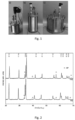
- figure 1 three closed reactors are shown, making it possible to contain quantities of reagents sufficient to synthesize 50g, 100g and 500g of powders, respectively.
- B 12 P 2 The process for synthesizing boron subphosphide B 12 P 2 is based on highly exothermic reactions between solid or gaseous reagents, in the absence of solvent, these redox reactions being as follows 2 BPO 4 + 3 Mg + 5 MgB 2 ⁇ B 12 P 2 + 8 MgO Or 12 H 3 BO 3 + 2 H 3 PO 4 ⁇ B 12 P 2 O 23 + 21 H 2 O Then B 12 P 2 O 23 + 23 Mg ⁇ B 12 P 2 + 23 MgO
- calcium is used instead of magnesium.
- the reactive mixture uses boron phosphate BPO 4 and magnesium diboride MgB 2 as sources of boron and phosphorus, and magnesium Mg as the main reductant.
- magnesium diboride MgB 2 also contributes to this role.
- the reaction is extremely exothermic, with a final temperature that can exceed 2000 K, which is well beyond the boiling point of magnesium.
- the magnesium is advantageously in excess in the mixture.
- This excess magnesium also makes it possible to control the final temperature of the reaction, by introducing an additional heat capacity and high latent heats of fusion and especially of boiling of magnesium.
- the magnesium diboride MgB 2 is advantageously in excess in the mixture, so as to be able to limit the quantity of boron phosphide BP present as a by-product, in the final powders of boron phosphide B 12 P 2 .
- FIG 2 presents the RX diffractograms of the boron sub-phosphide powder B 12 P 2 obtained for batches of 50g and 100g in the intermediate reactor with a capacity of 100g represented in figure 1 .
- a Rietveld refinement of the diffractograms was carried out, using the MAUD ( Material Analysis Using Diffraction ) software on these two batches of powders.
- Rietveld refinement is presented for example by Stephens (Uniting electron crystallography and powder diffraction, 2012, 10.1007/978-94-007-5580-2_2 ) .
- Rietveld refinement is a method for global simulation of X-ray diffraction patterns on polycrystalline samples, this method being implemented in different software such as FullProf, Jana2006 and MAUD.
- the MAUD software was developed by Luca Lutterotti ( L. Lutterotti et al. MAUD: a friendly Java program for material analysis using diffraction. IUCr: Newsletter of the CPD, 21:14-15, 1999 ).
- the powders consist of boron phosphide B 12 P 2 at 97.441% and boron phosphide BP as an impurity at 2.559%.
- the rhombohedral structure is observed for the different diffractograms, with a space group R-3m.
- a very small number of particles have micron sizes, with a faceted rod type morphology.
- boron B 12 P 2 sub-phosphide particles have sizes which vary from 50 to 500 nm, with slightly rounded icosahedral shapes.
- the steps of a process will now be described in more detail.
- the powders are first weighed, then homogenized in a blender for 24 hours.
- the mixer can be with a rotating tank (cube, rotating drum, double cone), or a convective mixer comprising a fixed tank and a rotating mobile inside the tank, a fluidized bed mixer or a static mixer .
- the mixer is of the complex movement type, ensuring rotational, translational and inversion movement to a mixing container, the movements being pulsating.
- the mixer is for example of the type marketed under the brand Turbula ® by the company Willy Bachofen AG.
- a presentation of Turbula mixers is offered by Mayer-Laigle (Dynamic study and effect of change of scale for several particle systems in Turbula® mixer, thesis 2012 ).
- This mixer allows you to obtain a very high quality final mixture.
- the powders are then placed in the reactor, surrounded in all directions by insulating walls, ensuring thermal and chemical insulation with the exterior walls of the reactor.
- the insulating wall is for example formed by a powder material, such as sodium chloride or mineral sand.
- this thermal insulating wall must be chosen to limit the rate of cooling of the sample, which advantageously increases the purity of the product by reducing the quantity of BP, and to allow a more gradual evacuation of the heat and thus avoid excessive heating of the reactor walls which could harm their integrity.
- THE figures 4 to 12 illustrate an implementation of filling a reactor.
- a heating element 10 such as a resistive filament is placed in the lower part of the reactor.
- the resistive filament 10 is for example a tungsten filament.
- the tungsten filament has a diameter of around a hundred microns and a length of a few centimeters.
- the two ends of the filament are each connected to a pad 11 mounted on the base 12 of the reactor, with an interior wall 12a in contact with the thermal insulator.
- the interior wall 13 of the reactor is placed on the base 12.
- the interior wall 13 is a cylinder of revolution, the axis of slenderness of which is perpendicular to the base 12 of the reactor.
- the internal wall is in the form of a profiled part of square or polygonal cross section.
- the wall 13 is shown in partial section, in the figures 5 to 11 .
- the interior wall 13 is for example fitted or fitted onto the base 12 of the reactor.
- an internal volume of the reactor is defined laterally by this internal wall 13 and by the base 12 of the reactor. This volume is open at the top, allowing the reactor to be filled.
- the resistive filament is placed in this internal volume.
- an insulating wall 14a is placed at the bottom of the internal volume of the reactor.
- this insulating wall 14a is formed of a powder of a thermally and chemically inert insulating material, for example a salt powder such as sodium chloride or another salt, KCI or MgO, making it possible to confine the thermal during the reaction and to avoid during the highly exothermic reaction, the migration of chemical elements from the walls of the reactor towards the homogeneous mixture of reagents, making it possible to obtain a high purity of the product obtained B 12 P 2 .
- the insulating wall 14a is thus easily placed in the internal space of the reactor, below the resistive filament 10.
- an intermediate wall 15 is inserted and maintained in the internal space of the reactor, this internal wall separating a peripheral annular volume 16 from a central volume 17.
- the intermediate wall is in the form of a cylindrical part of revolution, for example a steel cylinder, such as a strip. It must not damage the heating element 10 when it is inserted and must have openings or others to allow the filament to pass through.
- an insulating wall 14b is formed in the peripheral annular space 16, advantageously by filling this annular space with a powder of insulating and chemically inert material.
- This powder is advantageously the same as that which formed the insulating wall 14a in the lower part of the reactor R.
- the reactive powder mixture is placed in the central volume 17 of the reactor. This mixture of reactive powder is in contact with the resistive filament 10.
- an insulating wall 14c is formed in the upper part of the reactor.
- this insulating wall 14c is formed by an insulating and chemically inert powder, in particular that used to form the insulating wall 14a in the lower part of the reactor ( Figure 6 ), or that used to form the side insulating wall 14b of the reactor ( figure 8 ), for example powdered salt or sand.
- the insulating powder is placed in the reactor until the reactor is completely filled.
- the reactor is hermetically closed, allowing confinement of the homogeneous mixture of reagents, thermally isolated and from the ambient atmosphere in the reactor.
- the reactor comprises a lower flange forming the base 12 of the reactor and an upper flange forming the cover 18 of the reactor, reinforcing rods 19 connecting the two flanges.
- the reaction is initiated, once the reactor is hermetically closed, advantageously by a heating element, such as a heating fuse filament, for example a tungsten filament positioned within the reactive mixture.
- a heating element such as a heating fuse filament, for example a tungsten filament positioned within the reactive mixture.
- the tungsten filament has, for example, a diameter of around a hundred microns and a length of a few centimeters, and is heated by the Joule effect.
- the reactor is then kept closed until the sample has finished cooling, then it is extracted, crushed and leached to dissolve the sodium chloride NaCI and the magnesium oxide MgO.
- the powders obtained are placed in a bath of 2M hydrochloric acid, at 110°C, with magnetic stirring for 1 hour, in order to dissolve the magnesium oxide MgO and the sodium chloride NaCl.
- the solution is then filtered under vacuum, for example using 220 nm Millipore-MF ® polyethersulfone filters chosen in particular for their resistance to acids.
- This operation is advantageously repeated twice successively.
- a final leaching is carried out using aqua regia, with an HNO 3 /HCl ratio of 1/3 to eliminate the last impurities.
- the final product is then washed several times with distilled water to remove residues present on the surface of the powders.
- the excess of magnesium diboride MgB 2 advantageously makes it possible to reduce the quantity of boron phosphide BP produced, while providing a slight improvement in the reducing power of the reaction mixture.
- the overall volume of the reactor and the ratio between the volume of the sample and the mass of the reaction mixture determine the ratio between the volume of the sample and the volume of the reactor, i.e. the filling rate of the reactor in reaction mixture.
- the place occupied by the sample in the reactor has a significant impact on the final purity of the product.
- the purity of the boron subphosphide B 12 P 2 in a reactor with a capacity of 50g is thus 86%, and this purity increases to 98% in the intermediate reactor with a capacity of 100g.
- the main and only impurity in the subboron phosphide B 12 P 2 is boron phosphide BP.
- the reactor has an internal diameter of 10 cm and a height of 20 cm, the total internal volume of the reactor being 1570 cm 3 .
- the powder occupies a volume in the reactor of between 180 cm 3 and 350 cm 3 . These volumes correspond to cylinders with a diameter of 5 cm and a height of between 9 and 18 cm.
- the reagent powder is not compressed to facilitate the initiation of the reaction.
- the reagent powder has a low possibility of expansion, so that the different precursors remain in contact during the propagation of the reaction, which allows a more complete synthesis.
- the entire reactor is filled, the part not occupied by the reaction mixture containing an insulating material, for example sodium chloride or sand.
- an insulating material for example sodium chloride or sand.
- the process is safe, practical, rapid and inexpensive, with simple implementation and ease of scaling, for the production of boron subphosphide B 12 P 2 .
- the process allows the synthesis of a material with high added value, using inexpensive reagents and an easy-to-implement device.
- the process also requires little labor, making it possible to reduce its cost.
- the process allows, through the use of SHS reaction in a confined space (closed reactors), to carry out syntheses of quantities of B 12 P 2 powders of up to 100g, from uncompacted reagents.
- the yield is remarkably very high, around 80%.
- the purity is also extremely high, around 97%.
- the process is fast and has very low energy consumption.
- the invention thus allows the synthesis of boron subphosphide B 12 P 2 , in large volume, at lower cost, with low energy consumption.
- the process allows production of this boron sub-phosphide B 12 P 2 in large volume, the sub-phosphide having very high hardness, remarkable chemical and thermal stability, the sub-phosphide being refractory, a wide gap semiconductor, and having thermoelectric power with a high figure of merit at high temperatures.
- the boron subphosphide obtained by the process according to the invention is advantageously used as a hard material, as an alternative to tungsten carbide.
- tungsten carbide CW is very expensive, and occurs from the elements at very high temperatures, between 1700 K and 2300 K.
- CW tungsten carbide is done by the addition of a binder, cobalt.
- a binder cobalt.
- Chronic exposure to cobalt dust associated with tungsten carbide leads to occupational, skin, respiratory and tumor diseases (see for example Robert (Temporal analysis of exposures and French occupational pathologies linked to cobalt and hard metal dust, from the end of the 1990s to 2020, pharmacy thesis, 2021 ).
- the boron sub-phosphide B 12 P 2 has properties much superior to tungsten carbide (harder, more resistant to chemical or thermal attacks) and the process according to the invention is much less expensive than that allowing the synthesis of tungsten carbide CW.
- binder-free sintering of boron subphosphides is possible, suggesting possibilities for binder-free sintering at low pressure by conventional methods.
- the boron sub-phosphide B 12 P 2 obtained (hardness -35 GPa, comparable to commercial c-BN) advantageously finds many uses, today reserved for tungsten carbide (or c-BN), such as tools for machining and cutting (saws, drills, reamers, guide bushes, milling cutters, lathe tools, punches), wire drawing or compacting dies, wear protection coatings (for the blades of engine turbines aircraft, gas power plants, metallurgical furnaces), structural tools (public works, land leveling, drilling tool heads, mining and quarrying, tunnel boring machines), but also pen balls, armor-piercing ammunition, bullet-proof vests.
- tungsten carbide or c-BN
- tools for machining and cutting saws, drills, reamers, guide bushes, milling cutters, lathe tools, punches
- wire drawing or compacting dies wear protection coatings (for the blades of engine turbines aircraft, gas power plants, metallurgical furnaces)
- structural tools public works, land
- the boron sub-phosphide obtained by the process according to the invention is advantageously used as a heat-conducting material, for example in integrated circuits.
- thermophysical characteristics such as hard materials such as boron subphosphide B 12 P 2 .
- the boron subphosphide obtained by the process according to the invention is advantageously used as a thermoelectric material at high temperature.
- boron subphosphide B 12 P 2 can have important applications as a high temperature thermoelectric material.
- the boron subphosphide obtained by the process according to the invention is advantageously used as a filler in a thermosetting resin.
- thermosetting resins make it possible to reinforce their thermomechanical and chemical resistance.
- thermosetting materials are of growing interest for their remarkable properties: very good mechanical strength, as well as good resistance to chemicals (non-reactive materials) and heat.
- the boron subphosphide obtained by the process according to the invention is advantageously used in the nuclear field, due to its high neutron absorption cross section, as an alternative to boron or boron carbide.
- Pure boron is difficult to produce in specific forms (e.g. for control rods in nuclear power plants), so it is usually substituted in these applications with boron carbide, offering a high concentration of boron atoms. in a solid, refractory form and resistant to chemical attack.
Landscapes
- Chemical & Material Sciences (AREA)
- Engineering & Computer Science (AREA)
- General Engineering & Computer Science (AREA)
- Organic Chemistry (AREA)
- Combustion & Propulsion (AREA)
- Ceramic Engineering (AREA)
- Inorganic Chemistry (AREA)
- Superconductors And Manufacturing Methods Therefor (AREA)
- Carbon And Carbon Compounds (AREA)
Abstract
Procédé de production de sous phosphure de bore B<sub>12</sub>P<sub>2</sub> par synthèse auto-propagée, le procédé comprenant une étape de mélange de réactifs, sous forme de poudres, suivi d'une étape d'amorçage d'une réaction exothermique, la réaction exothermique étant effectuée dans une enceinte fermée.
Description
- L'invention a trait à la production de sous phosphure de bore B12P2, qui présente des propriétés mécaniques, thermiques et électroniques intéressantes.
- Le sous phosphure de bore B12P2 présente notamment des valeurs de dureté élevées, des masses volumiques faibles, une grande résistance à la compression, et a en outre une température de fusion très élevée, de l'ordre de 2400 K.
- Le sous phosphure de bore B12P2 est souvent vu comme une impureté dans les procédés qui visent essentiellement à réaliser du phosphure de bore BP.
- Néanmoins, divers procédés ont été proposés, dans l'art antérieur, pour la synthèse de sous phosphure de bore B12P2.
- Selon un premier type de synthèse, le sous phosphure de bore est déposé sur un substrat, par exemple en silicium ou en carbure de silicium. Le document
US2004005768 (Hersee, 2005 ) décrit une croissance par épitaxie de sous phosphure de bore sur un substrat en carbure de silicium, par dépôt chimique en phase vapeur. - Selon un deuxième type de synthèse, le sous phosphure de bore B12P2 est obtenu par décomposition thermique du phosphure de bore BP, à une température de plus de 1500 K, en atmosphère réductrice. Le document Slack et al. (Melt growth and properties of B6P crystals, Journal of the Physics and Chemistry of Solids 1983, vol.44, no.10, pp. 1009-13, 10.1016/0022-3697(83)90151-8 ) décrit la production de sous phosphure de bore, de composition très proche de B12P2, par chauffage de phosphure de bore BP à une température de 1250°C pendant 11 heures, sous un flux d'hydrogène.
- Selon un troisième type de synthèse, le sous phosphure de bore est obtenu par synthèse directe, à partir d'une poudre de bore et d'une poudre de phosphore. Le document Yang et al. (Synthesis and cell refinement for icosahedral boron phosphide B12P2, 10.1017/s0885715600014949) décrit un procédé de ce type, le mélange des deux poudres étant chauffé par induction à 1400°C pendant une heure, sous une pression d'argon de 50 bar (750 psi).
- Il a par ailleurs été proposé de produire du sous phosphure de bore B12P2 par un procédé de type SHS (Self-propagating High-temperature Synthesis), parfois dénommé synthèse par combustion ou synthèse auto-propagée.
- Les procédés SHS ont été proposés pour la production de différents matériaux céramiques (borures, siliciures, oxydes, nitrures, carbures, en particulier carbure de titane) ou de matériaux intermétalliques.
- Une réaction de type SHS consiste en un mélange intime de réactifs, généralement sous forme de poudres, suivi d'une compaction à haute pression, la réaction étant ensuite amorcée par un apport brutal et local d'énergie, à l'air libre. La réaction, fortement exothermique, se propage jusqu'à consommation complète des réactifs.
- Les principes des procédés SHS sont présentés dans l'ouvrage de Tavadze et al. (Production of advanced materials by methods of self-propagating high-temperature synthesis, Springer, 2013 ). Des sous catégories de procédé SHS peuvent être identifiées, voir par exemple Morsi (The diversity of combustion synthesis processing : a review, J Mater Sci 2012, 10.10071s10853.011-5926-5).
- Mukhanov et al. (Self-propagating high-temperature synthesis of boron subphosphide B12P2 , Journal of Superhard Materials 36, 2014, 10.3103/S1063457614010031) proposent deux synthèses de sous phosphure de bore B12P2 par un procédé SHS sous atmosphère argon à partir d'un élément compacté de réactifs.
- Une première synthèse est effectuée à partir d'un mélange d'un verre B12P2O23 et de magnésium, sous argon, selon la réaction suivante :
B12P2O23 + 23 Mg → B12P2 + 23 MgO
la température de réaction étant supérieure à 1300 K. - Une deuxième synthèse est une réduction de phosphate de bore, selon la réaction suivante :
2BPO4 + 5MgB2 + 3Mg → B12P2 + 8MgO.
-
US 2017203965 décrit un procédé de production de phosphure de bore BP comprenant une étape de mélange de phosphate de bore BPO4 et de magnésium métallique, une étape de compaction du mélange à une pression de l'ordre de 20 000 psi (137 MPa), et une étape d'inflammation en appliquant un apport d'énergie, à l'aide d'un fil fusible chauffé, la compaction permettant de réduire la formation d'impuretés telles que le sous phosphure B12P2. - Les procédés de synthèse de l'état de la technique pour la production de sous phosphure de bore B12P2 présentent de nombreux inconvénients. Les procédés de synthèse des sous phosphures de bore sont lents, chers, compliqués, dangereux (utilisation d'éléments toxiques), à faible rendement, le sous phosphure de bore B12P2 obtenu présentant une pureté faible.
- L'utilisation de traitements thermiques longs et à haute température est très énergivore, polluant et dangereux, rendant de tels procédés peu compétitifs économiquement.
- Les durées et difficultés de mises en œuvre des méthodes de synthèse du sous phosphure de bore Bi2P2 sont telles que, malgré ses propriétés mécaniques, thermiques et électroniques intéressantes, le sous phosphure de bore B12P2 est encore peu utilisé dans l'industrie.
- L'invention vise à pallier les inconvénients des procédés de l'art antérieur, en proposant la synthèse de sous phosphure de bore B12P2 en grand volume, à moindre coût, avec une faible consommation énergétique.
- L'invention propose une solution de production de sous phosphure de B12P2 simple, sûre et rapide avec des réactifs peu chers et disponibles facilement en grande quantité.
- A ces fins, il est proposé, selon un premier aspect, un procédé de production de sous phosphure de bore B12P2 par synthèse auto-propagée, le procédé comprenant une étape de mélange de réactifs, sous forme de poudres, suivi d'une étape d'amorçage d'une réaction exothermique, la réaction exothermique étant effectuée dans une enceinte fermée.
- Avantageusement, le procédé de production de sous phosphure de bore B12P2 par synthèse auto-propagée à haute température, avantageusement supérieure à 1800K, comprend :
- - une étape de mélange homogène de réactifs, sous forme de poudres, comprenant au moins
- un métal alcalino-terreux tel que du magnésium ou du calcium, et
- un composé comprenant du bore B et du phosphore P, tel que du
- phosphate de bore BPO4 ou B12P2O23
- - une étape de remplissage d'un réacteur par le mélange homogène de réactifs, le réacteur comprenant au moins un élément chauffant et une couche d'isolant thermique sur une paroi intérieure du fond du réacteur et une couche d'isolant thermique sur une ou des parois intérieures latérales, l'isolant thermique étant inerte chimiquement et étant destiné à entourer le mélange homogène de réactifs lors de la réaction, et à le séparer des parois du réacteur,
- - une étape de recouvrement de la partie supérieure du mélange homogène de réactifs par une couche d'isolant thermique chimiquement inerte,
- - une étape de fermeture hermétique du réacteur,
- - une étape d'amorçage d'une réaction exothermique dans le mélange homogène de réactifs, par le déclenchement de l'élément chauffant,
- - une étape de réaction exothermique à haute température qui s'auto-propage dans l'ensemble du mélange de réactifs du réacteur pour obtenir le sous phosphure de bore B12P2.
- La fermeture hermétique du réacteur empêche le magnésium gazeux de s'échapper hors du réacteur au moment de la réaction, et permet le confinement thermique en évitant le contact avec l'air, pour permettre d'obtenir une grande pureté du B12P2 au moins supérieure à 80%, voire avantageusement supérieure à 90%.
- Lors de la réaction exothermique, des températures de l'ordre de 2000K peuvent être atteintes localement. L'enceinte dans laquelle est effectuée la réaction exothermique forme un réacteur fermé, évitant les réactions d'oxydation.
- Dans certaines mises en œuvre, les réactifs comprennent de l'acide phosphorique, de l'acide borique et du magnésium, la réaction exothermique étant selon l'équation de réaction (2)
12 H3BO3 + 2 H3PO4 → B12P2O23 + 21 H2O puis
B12P2O23 + 23 Mg → B12P2 + 23 MgO (2)
- Dans d'autres mises en œuvre, les réactifs comprennent du phosphate de bore, du magnésium et du diborure de magnésium, la réaction exothermique étant selon l'équation de réaction (1)
2 BPO4 + 3 Mg + 5 MgB2 → B12P2 + 8 MgO (1).
- L'enceinte dans laquelle est effectuée la réaction exothermique forme un réacteur fermé, évitant la fuite de vapeurs, en particulier de vapeurs de magnésium dans l'air, hors de l'enceinte. La température d'ébullition du magnésium, de l'ordre de 1363 K est bien inférieure aux températures de la réaction exothermique, de l'ordre de 2000 K.
- Avantageusement, le magnésium est en excès dans le mélange des réactifs, par rapport à la stœchiométrie de l'équation (1) ou de l'équation (2). Dans certaines mises en œuvre, le magnésium est en excès de 22% dans le mélange des réactifs, par rapport à la stœchiométrie de l'équation (1).
- Avantageusement, le diborure de magnésium est en excès dans le mélange des réactifs, par rapport à la stœchiométrie de l'équation (1). L'excès de magnésium dans le mélange des réactifs permet d'assurer une réduction complète des réactifs, et permet également de contrôler la température finale de la réaction, par l'introduction d'une capacité thermique additionnelle et de fortes chaleurs latentes de fusion et surtout d'ébullition du magnésium.
- Avantageusement, l'étape de mélange homogène des réactifs est effectuée au moyen d'un mélangeur bidimensionnel de poudres ou un mélangeur dynamique tridimensionnel de poudres, tel qu'un mélangeur apte à assurer des mouvements de rotation, des mouvements de translation et des mouvements d'inversion à un récipient de mélange, par exemple pendant une durée supérieure à 1 heure, avantageusement supérieure à 10 heures. Un tel mélangeur est par exemple du type commercialisé sous la marque Turbula®.
- Dans certaines mises en œuvre, l'étape d'amorçage comprend la chauffe d'un élément résistif. L'élément résistif est par exemple un filament de tungstène. Dans des mises en œuvre particulières, le filament de tungstène présente un diamètre d'une centaine de microns et une longueur de quelques centimètres.
- Avantageusement, le procédé comprend une étape de mise en place d'un matériau isolant thermiquement entre le mélange de réactifs en poudre et la paroi de l'enceinte fermée. Le matériau isolant thermique est avantageusement inerte chimiquement, par exemple une poudre de chlorure de sodium, ou un autre sel tel que KCl ou MgO, ou sable minéral. Avantageusement, le matériau isolant est sous forme de poudre.
- Avantageusement, le procédé comprend une étape de refroidissement de l'enceinte formant le réacteur, l'enceinte étant maintenue fermée jusqu'à la fin du refroidissement. Le refroidissement est par exemple assuré par une circulation de fluide caloporteur.
- Le procédé comprend une étape d'extraction du produit de la réaction exothermique, le produit extrait du réacteur étant soumis à un broyage et un lavage, le lavage comprenant avantageusement une lixiviation. Dans certaines mises en œuvre, la poudre issue du broyage du produit de la réaction exothermique est placée dans un bain d'acide chlorhydrique, la solution obtenue étant ensuite soumise à une filtration sous vide, par exemple avec des filtres nanométriques, choisis notamment pour leur résistance aux acides, tels que des filtres en polyéthersulfone Millipore-MF.
- Dans des mises en œuvre particulières, le lavage comprend une lixiviation à l'eau régale.
- Avantageusement, le mélange des réactifs en poudre n'est pas compacté avant l'étape d'amorçage. En d'autres termes, le remplissage du mélange des réactifs en poudre dans le réacteur est avantageusement réalisé sans compactage.
- Avantageusement, le taux de remplissage dans le réacteur, correspondant au rapport entre le volume de l'échantillon et le volume du réacteur, est supérieur à 25%.
- Dans certaines mises en œuvre, le procédé est tel que :
- le taux de remplissage est supérieur à 25%, et
- l'excès de magnésium est entre 10% et 50%, avantageusement entre 20% et 25%, avantageusement avec un excès de diborure de magnésium jusqu'à 20%,
- Avantageusement, la réaction exothermique est effectuée sans solvant. Avantageusement, le réacteur présente un volume permettant de réaliser des masses de sous phosphure de bore supérieures à 50g, avantageusement supérieures à 100g, et encore plus avantageusement supérieures à 500g.
- Avantageusement, l'étape de remplissage comporte l'insertion d'une paroi intercalaire maintenue dans l'espace interne du réacteur, le temps du remplissage par l'isolant de l'espace situé entre les parois intérieurs latérales du réacteur et la paroi intercalaire, puis le temps du remplissage par le mélange de réactif du volume central du réacteur défini par l'espace intérieur du réacteur entouré par la paroi intercalaire jusqu'à une hauteur donnée dans le réacteur.
- L'invention se rapporte, selon un deuxième aspect, à un sous phosphure de bore B12P2 obtenu selon le procédé présenté ci-dessus, le sous phosphure de bore B12P2 obtenu comportant :
- des particules de B12P2 ont des tailles qui varient de 50 à 500 nm avec des formes icosaédriques arrondies,
- des particules de B12P2 de tailles microniques avec une morphologie de type « bâtonnets facettés », par exemple d'une longueur comprise entre 1 et 10 microns.
- Avantageusement, il est proposé un mélange comprenant uniquement :
- du sous phosphure de bore B12P2 tel que présenté ci-dessous, et
- du phosphure de bore BP,
- Il est proposé, selon un troisième aspect, l'utilisation du sous phosphure de bore obtenu par un procédé tel que présenté ci-dessus, comme matériau dur dans les outils d'usinage ou de coupe, les filières de tréfilage, les revêtements de protection contre l'usure, les outils de gros œuvre du bâtiment, des mines ou des carrières, les outils de forage, les munitions perce-blindage, les gilets pare-balles.
- Il est proposé, selon un quatrième aspect, l'utilisation du sous phosphure de bore obtenu par un procédé tel que présenté ci-dessus, comme matériau conducteur de chaleur ou matériau thermoélectrique.
- Il est proposé, selon un cinquième aspect, l'utilisation du sous phosphure de bore obtenu par un procédé tel que présenté ci-dessus, comme charge dans une résine thermodurcissable.
- Il est proposé, selon un autre aspect, l'utilisation du sous phosphure de bore obtenu par un procédé tel que présenté ci-dessus, comme matériau absorbant de neutrons.
- Il est proposé, selon un autre aspect, l'utilisation du sous phosphure de bore obtenu par un procédé tel que présenté ci-dessus, comme matériau en poudre pour la fabrication par frittage d'une céramique pour le blindage.
- D'autres objets et avantages de l'invention apparaîtront à la lumière de la description de modes de réalisation, faite ci-après en référence aux dessins annexés dans lesquels :
- la
figure 1 est une vue externe de trois réacteurs fermés ayant des capacités respectives de 50g, 100g et 500g, pour la synthèse de sous phosphure de bore B12P2; - la
figure 2 est un diffractogramme d'une poudre de sous phosphure de bore B12P2 obtenue dans un réacteur fermé d'une capacité de 100g tel que représenté enfigure 1 ; - la
figure 3 sont deux images de microscopie électronique à balayage d'une poudre de sous phosphure de bore B12P2 obtenue dans un réacteur fermé d'une capacité de 100g tel que représenté enfigure 1 ; - les
figures 4 à 12 sont des vues des étapes de remplissage d'un réacteur, selon une mise en œuvre. - Le procédé utilise avantageusement un réacteur fermé, des réactifs non-compactés et une lixiviation, pour produire à grande échelle et à bas coût du sous phosphure de bore B12P2.
- En
figure 1 sont représentés trois réacteurs fermés, permettant de contenir des quantités de réactifs suffisantes pour synthétiser 50g, 100g et 500g de poudres, respectivement. - Le procédé de synthèse de sous phosphure de bore B12P2 repose sur des réactions fortement exothermiques entre réactifs solides ou gazeux, en l'absence de solvant, ces réactions d'oxydo-réduction étant les suivantes
2 BPO4 + 3 Mg + 5 MgB2 → B12P2 + 8 MgO
ou
12 H3BO3 + 2 H3PO4 → B12P2O23 + 21 H2O
puis
B12P2O23 + 23 Mg → B12P2 + 23 MgO
- Dans d'autres mises en œuvre, du calcium est utilisé en lieu et place du magnésium.
- Pour des raisons de simplicité, nous ne présentons ici que les résultats concernant le sous phosphure de bore B12P2 synthétisé en utilisant la réaction
2 BPO4 + 3 Mg + 5 MgB2 → B12P2 + 8 MgO.
- Le mélange réactif utilise le phosphate de bore BPO4 et le diborure de magnésium MgB2 comme sources de bore et de phosphore, et le magnésium Mg comme réducteur principal.
- Il est à noter que le diborure de magnésium MgB2 contribue également à ce rôle.
- La réaction est extrêmement exothermique, avec une température finale qui peut dépasser les 2000 K, ce qui est bien au-delà de la température d'ébullition du magnésium.
- Afin d'assurer une réduction complète des réactifs, le magnésium est avantageusement en excès dans le mélange.
- Cet excès de magnésium permet également de contrôler la température finale de la réaction, par l'introduction d'une capacité thermique additionnelle et de fortes chaleurs latentes de fusion et surtout d'ébullition du magnésium.
- Par ailleurs, le diborure de magnésium MgB2 est avantageusement en excès dans le mélange, de manière à pouvoir limiter la quantité de phosphure de bore BP présent en tant que sous-produit, dans les poudres finales de sous phosphure de bore B12P2.
- Ces conditions expérimentales ont permis d'éliminer entièrement le phosphate de bore BPO4, et le rendement final de la réaction est de 80%. Avantageusement, un calcul de la température adiabatique est effectué, en utilisant les bases de données du NIST (National Institute of Standards and Technology) des différents produits des réactions.
- La
figure 2 présente les diffractogrammes RX de la poudre de sous phosphure de bore B12P2 obtenue pour des lots de 50g et 100g dans le réacteur intermédiaire d'une capacité de 100g représenté enfigure 1 . Un affinement de Rietveld des diffractogrammes a été réalisé, en utilisant le logiciel MAUD (Material Analysis Using Diffraction) sur ces deux lots de poudres. - L'affinement de Rietveld est présenté par exemple par Stephens (Uniting electron crystallography and powder diffraction, 2012, 10.1007/978-94-007-5580-2_2). L'affinement de Rietveld est une méthode de simulation globale des diagrammes de diffraction des rayons X sur des échantillons polycristallins, cette méthode étant implantée dans différents logiciels tels que FullProf, Jana2006 et MAUD. Le logiciel MAUD a été développé par Luca Lutterotti (L. Lutterotti et al. MAUD: a friendly Java program for material analysis using diffraction. IUCr: Newsletter of the CPD, 21:14-15, 1999 ).
- Les poudres sont constituées de sous phosphure de bore B12P2 à 97,441% et de phosphure de bore BP comme impureté à 2,559%.
- La structure rhomboédrique est observée pour les différents diffractogrammes, avec un groupe d'espace R-3m. Les paramètres de mailles du sous phosphure de bore B12P2 sont a = 6,01025 Å et c = 11,90010 Å dans la maille hexagonale.
- La
figure 3 présente l'analyse morphologique des poudres obtenues, par microscopie électronique à balayage. - On observe deux populations de particules distinctes.
- Un très faible nombre de particules possède des tailles microniques, avec une morphologie de type bâtonnets facettés.
- Pour le reste, la grande majorité des particules de sous phosphure de bore B12P2 ont des tailles qui varient de 50 à 500 nm, avec des formes icosaédriques légèrement arrondies.
- Les étapes d'un procédé vont maintenant être décrites plus en détail. Les poudres sont tout d'abord pesées, puis sont homogénéisées dans un mélangeur pendant 24 heures.
- Le mélangeur peut être à cuve tournante (en cube, à tambour tournant, à double cône), ou encore un mélangeur convectif comprenant une cuve fixe et un mobile tournant à l'intérieur de la cuve, un mélangeur à lit fluidisé ou un mélangeur statique.
- Avantageusement, le mélangeur est de type à mouvement complexe, assurant un mouvement de rotation, de translation et d'inversion à un récipient de mélange, les mouvements étant pulsatoires.
- Le mélangeur est par exemple du type commercialisé sous la marque Turbula® par la société Willy Bachofen AG. Une présentation des mélangeurs Turbula est proposée par Mayer-Laigle (Etude dynamique et effet du changement d'échelle pour plusieurs systèmes particulaires en mélangeur Turbula®, thèse 2012 ).
- Ce mélangeur permet l'obtention d'un mélange final de très grande qualité.
- Les poudres sont ensuite placées dans le réacteur, entourées dans toutes les directions par des parois isolantes, assurant l'isolation thermique et chimique avec les parois extérieures du réacteur.
- La paroi isolante est par exemple formée par un matériau en poudre, tel que chlorure de sodium ou un sable minéral.
- L'épaisseur de cette paroi isolante thermique doit être choisie pour limiter la vitesse de refroidissement de l'échantillon, ce qui avantageusement augmente la pureté du produit en diminuant la quantité de BP, et pour permettre une évacuation plus progressive de la chaleur et ainsi éviter un échauffement excessif des parois du réacteur qui pourrait nuire à leur intégrité.
- Elle est par exemple comprise entre 2 et 3 cm, pour une longueur transversale caractéristique du mélange homogène des réactifs comprise entre 4 et 6 cm et une hauteur caractéristique comprise entre 10 et 16 cm.
- Les
figures 4 à 12 illustrent une mise en œuvre du remplissage d'un réacteur. - Dans une première étape, représentée en
figure 4 , un élément chauffant 10 tel qu'un filament résistif est placé en partie inférieure du réacteur. Le filament résistif 10 est par exemple un filament de tungstène. A titre indicatif, le filament de tungstène présente un diamètre d'une centaine de microns et une longueur de quelques centimètres. Les deux extrémités du filament sont connectées chacune à un plot 11 monté sur la base 12 du réacteur, avec une paroi intérieure 12a en contact avec l'isolant thermique. - Dans une deuxième étape, représentée en
figure 5 , la paroi intérieure 13 du réacteur est mise en place sur la base 12. Dans la réalisation représentée, la paroi intérieure 13 est un cylindre de révolution, dont l'axe d'élancement est perpendiculaire à la base 12 du réacteur. Dans d'autres mises en œuvre, la paroi interne se présente sous la forme d'une pièce profilée de section transversale carrée ou polygonale. Afin de faciliter la compréhension, la paroi 13 est représentée en coupe partielle, dans lesfigures 5 à 11 . La paroi intérieure 13 est par exemple emboitée ou emmanchée sur la base 12 du réacteur. Lorsque la paroi intérieure 13 est en place, un volume interne au réacteur est défini latéralement par cette paroi interne 13 et par la base 12 du réacteur. Ce volume est ouvert en partie supérieure, permettant le remplissage du réacteur. Le filament résistif est placé dans ce volume interne. - Dans une troisième étape, représentée en
figure 6 , une paroi isolante 14a est placée dans le fond du volume interne du réacteur. - Avantageusement, cette paroi isolante 14a est formée d'une poudre d'un matériau isolant thermiquement et chimiquement inerte, par exemple une poudre de sel tel que du chlorure de sodium ou un autre sel, du KCI ou du MgO, permettant de confiner la thermique lors de la réaction et d'éviter lors de la réaction fortement exothermique, la migration d'éléments chimiques des parois du réacteur vers le mélange homogène de réactifs, permettant d'obtenir une grande pureté du produit obtenu B12P2 . La paroi isolante 14a est ainsi facilement placée dans l'espace interne du réacteur, en dessous du filament résistif 10.
- Dans une quatrième étape, représentée en
figure 7 , une paroi intercalaire 15 est insérée et maintenue dans l'espace interne du réacteur, cette paroi interne séparant un volume annulaire périphérique 16 d'un volume central 17. Dans la mise en œuvre représentée, la paroi intercalaire se présente sous la forme d'une pièce de révolution cylindrique, par exemple un cylindre en acier, tel qu'un feuillard. Elle ne doit pas abimer l'élément chauffant 10 lors de son insertion et doit présenter des ouvertures ou autres pour laisser passer le filament. - Dans une cinquième étape, représentée en
figure 8 , une paroi isolante 14b est formée dans l'espace annulaire périphérique 16, avantageusement par remplissage de cet espace annulaire d'une poudre de matériau isolant et chimiquement inerte. Cette poudre est avantageusement la même que celle ayant formé la paroi isolante 14a en partie basse du réacteur R. - Dans une sixième étape, représentée en
figure 9 , le mélange de poudre réactive est placé dans le volume central 17 du réacteur. Ce mélange de poudre réactive est en contact avec le filament résistif 10. - Dans une septième étape, représentée en
figure 10 , la paroi intercalaire 15 est retirée. - Dans une huitième étape, représentée en
figure 11 , une paroi isolante 14c est formée en partie haute du réacteur. Avantageusement, cette paroi isolante 14c est formée par une poudre isolante et chimiquement inerte, en particulier celle ayant servi à former la paroi isolante 14a en partie basse du réacteur (figure 6 ), ou celle ayant servi à former la paroi isolante latérale 14b du réacteur (figure 8 ), par exemple une poudre de sel, ou de sable. La poudre isolante est placée dans le réacteur jusqu'à remplissage complet du réacteur. - Dans une neuvième étape, représentée en
figure 12 , le réacteur est hermétiquement fermé, permettant un confinement du mélange homogène de réactifs, isolé thermiquement et de l'atmosphère ambiante au réacteur. Avantageusement, le réacteur comprend un flasque inférieur formant la base 12 du réacteur et un flasque supérieur formant le couvercle 18 du réacteur, des tiges 19 de renfort reliant les deux flasques. - La réaction est amorcée, une fois le réacteur hermétiquement fermé, avantageusement par un élément chauffant, tel qu'un filament fusible chauffant, par exemple un filament de tungstène positionné au sein du mélange réactif. Le filament de tungstène présente par exemple un diamètre d'une centaine de microns, et une longueur de quelques centimètres, et est chauffé par effet Joule.
- Une fois amorcée, la réaction est complète au bout de quelques secondes.
- Le réacteur est alors maintenu fermé jusqu'à la fin du refroidissement de l'échantillon, puis celui-ci est extrait, broyé et lixivié pour dissoudre le chlorure de sodium NaCI et l'oxyde de magnésium MgO.
- Dans une mise en œuvre avantageuse, les poudres obtenues sont placées dans un bain d'acide chlorhydrique 2M, à 110°C, sous agitation magnétique pendant 1h, afin de dissoudre l'oxyde de magnésium MgO et le chlorure de sodium NaCl.
- La solution est ensuite filtrée sous vide, par exemple en utilisant des filtres en polyéthersulfone Millipore-MF® de 220 nm choisis notamment pour leur résistance aux acides.
- Cette opération est avantageusement répétée deux fois successivement.
- Avantageusement, on effectue une dernière lixiviation à l'aide d'eau régale, avec un rapport HNO3/HCl de 1/3 pour éliminer les dernières impuretés.
- Le produit final est ensuite lavé plusieurs fois avec de l'eau distillée, afin d'éliminer les résidus présents à la surface des poudres.
- Enfin, les poudres sont séchées dans une étuve.
- Plusieurs paramètres influent sur le rendement de la réaction, et une étude paramétrique a été réalisée, avec pour objectifs d'obtenir la réaction la plus complète possible, en réduisant au maximum la phase d'oxyde (BPO4) et en favorisant la formation de sous phosphure de bore B12P2 par rapport à celle du phosphure de bore BP.
- L'excès de magnésium Mg, permet avantageusement une meilleure réduction de la phase d'oxydes.
- L'excès de diborure de magnésium MgB2 permet avantageusement de réduire la quantité de phosphure de bore BP produite, tout en apportant une légère amélioration au pouvoir réducteur du mélange réactionnel. Le volume global du réacteur et le rapport entre le volume de l'échantillon et la masse du mélange réactionnel déterminent le rapport entre le volume de l'échantillon et le volume du réacteur, c'est-à-dire le taux de remplissage du réacteur en mélange réactionnel.
- Avantageusement :
- le taux de remplissage supérieur à 25%, et
- l'excès de magnésium est entre 10% et 50%, avantageusement entre 20% et 25%, permettant une réduction complète de l'oxyde BPO4. En plus de cet excès de magnésium, avantageusement il peut y voir un excès de diborure de magnésium jusqu'à 20%, permettant d'ajuster au plus près le rapport stœchiométrique B:P de 6:1.
- Il a été constaté qu'un excès de 22% de magnésium Mg, sans excès de diborure de magnésium MgB2, a permis d'atteindre un rendement approchant les 80%.
- La place qu'occupe l'échantillon dans le réacteur a un impact non négligeable sur la pureté finale du produit.
- La pureté du sous phosphure de bore B12P2 dans un réacteur de capacité 50g est ainsi de 86%, et cette pureté passe à 98% dans le réacteur intermédiaire d'une capacité de 100g. Dans les deux cas, l'impureté principale et unique dans le sous phosphure de bore B12P2 est le phosphure de bore BP.
- Avantageusement, le réacteur présente un diamètre intérieur de 10 cm et une hauteur de 20 cm, le volume interne total du réacteur étant de 1570 cm3.
- Avantageusement, la poudre occupe dans le réacteur un volume compris entre 180 cm3 et 350 cm3. Ces volumes correspondent à des cylindres d'un diamètre de 5 cm ayant une hauteur comprise entre 9 et 18 cm. Avantageusement, la poudre de réactifs n'est pas compressée pour faciliter l'amorçage de la réaction.
- Avantageusement, la poudre de réactifs présente une faible possibilité d'expansion, afin que les différents précurseurs restent en contact lors de la propagation de la réaction, ce qui permet une synthèse plus complète.
- Avantageusement, l'ensemble du réacteur est rempli, la partie non occupée par le mélange réactionnel contenant un matériau isolant, par exemple du chlorure de sodium ou du sable.
- De cette manière, la chaleur résiduelle est conservée plus longtemps, ce qui favorise les phénomènes d'auto-purification et favorise grandement la synthèse de sous phosphure de bore B12P2 par rapport à celle de phosphure de bore BP.
- Le procédé selon l'invention présente de nombreux avantages.
- Le procédé est sûr, pratique, rapide et peu coûteux, avec une mise en œuvre simple et une facilité de mise à l'échelle, pour la production de sous phosphure de bore B12P2.
- Le procédé permet la synthèse d'un matériau à forte valeur ajoutée, en utilisant des réactifs peu coûteux et un dispositif facile à mettre en œuvre.
- Le procédé ne nécessite par ailleurs que peu de main d'œuvre, permettant d'en réduire le coût.
- Le procédé permet, par l'utilisation de réaction SHS en espace confiné (réacteurs fermés), de réaliser des synthèses de quantités de poudres B12P2 pouvant atteindre 100g, à partir de réactifs non compactés.
- Le rendement est remarquablement très élevé, de l'ordre de 80%.
- La pureté est également extrêmement élevée, de l'ordre de 97%.
- Le procédé est rapide et présente une très faible consommation énergétique. L'invention permet ainsi la synthèse de sous phosphure de bore B12P2, en grand volume, à moindre coût, avec une faible consommation énergétique.
- L'utilisation de ce matériau aux propriétés mécaniques exceptionnelles était jusqu'à présent peu développée, précisément du fait de l'absence de possibilité de synthèse à grande échelle avec un bon potentiel économique.
- Le procédé permet une production de ce sous phosphure de bore B12P2 en grand volume, le sous phosphure présentant une très grande dureté, une remarquable stabilité chimique et thermique, le sous phosphure étant réfractaire, semi-conducteur à large gap, et présentant un pouvoir thermoélectrique à haut facteur de mérite à haute température.
- Le sous phosphure de bore obtenu par le procédé selon l'invention est avantageusement utilisé comme matériau dur, en alternative au carbure de tungstène.
- La synthèse du carbure de tungstène CW est très coûteuse, et se produit à partir des éléments à des températures très élevées, entre 1700 K et 2300 K.
- De plus, le frittage du carbure de tungstène CW se fait par l'adjonction d'un liant, le cobalt. L'exposition chronique aux poussières de cobalt associées au carbure de tungstène entraîne des maladies professionnelles, cutanées, respiratoires et tumorales (voir par exemple Robert (Analyse temporelle des expositions et des pathologies professionnelles françaises liées au cobalt et aux poussières de métaux durs, de la fin des années 1990 à 2020, thèse de pharmacie, 2021 ).
- Le sous phosphure de bore B12P2 a des propriétés bien supérieures au carbure de tungstène (plus dur, plus résistant aux agressions chimiques ou thermiques) et le procédé selon l'invention est bien moins coûteux que celui permettant la synthèse du carbure de tungstène CW.
- De plus, le frittage sans liant des sous phosphures de bore est possible, suggérant des possibilités de frittage sans liant à faible pression par des méthodes conventionnelles.
- Le sous phosphure de bore B12P2 obtenu (dureté -35 GPa, comparable au c-BN commercial) trouve avantageusement de nombreux usages, aujourd'hui réservés au carbure de tungstène (ou au c-BN), tels que les outils d'usinage et de coupe (scies, forets, alésoirs, canons de guidage, fraises, outils de tour, poinçons), les filières de tréfilage ou de compactage, des revêtements de protection d'usure (pour les aubes des turbines des moteurs d'avion, des centrales à gaz, des fours métallurgiques), des outils de gros œuvre (travaux publics, aplanissement de terrain, têtes d'outils de forage, exploitation des mines et des carrières, tunneliers), mais aussi des billes de stylos, des munitions perce-blindages, des gilets pare-balles.
- Le sous phosphure de bore obtenu par le procédé selon l'invention est avantageusement utilisé comme matériau conducteur de chaleur, par exemple dans les circuits intégrés.
- En effet, avec l'accroissement constant de la densité de puissance des composants microélectroniques, la sollicitation thermique de ces composants augmente de manière exponentielle.
- Avec des densités de chaleur importantes, la dissipation thermique exige des matériaux possédant des caractéristiques thermophysiques remarquables, de type des matériaux durs comme le sous phosphure de bore B12P2.
- Le sous phosphure de bore obtenu par le procédé selon l'invention est avantageusement utilisé comme matériau thermoélectrique à haute température.
- Dans le domaine de la microélectronique, il est possible de doper le sous phosphure de bore B12P2 de type p ou n, et donc de réaliser des diodes fonctionnant en environnements agressifs (chimique, thermique ou mécanique) ou encore pour l'électronique de puissance.
- Aussi, le sous phosphure de bore B12P2 peut avoir des applications importantes comme matériau thermoélectrique à haute température.
- Le sous phosphure de bore obtenu par le procédé selon l'invention est avantageusement utilisé comme charge dans une résine thermodurcissable.
- L'ajout d'un matériau dur, léger, conducteur thermique dans des résines thermodurcissables permet d'en renforcer les résistances thermomécaniques et chimiques.
- Ces matériaux thermodurcissables revêtent un intérêt croissant pour leurs propriétés remarquables : très bonne tenue mécanique, ainsi qu'une bonne résistance aux produits chimiques (matériaux non réactifs) et à la chaleur.
- Le sous phosphure de bore obtenu par le procédé selon l'invention est avantageusement utilisé dans le domaine nucléaire, en raison de sa section efficace d'absorption neutronique élevée, en alternative au bore ou au carbure de bore.
- Le bore pur est difficile à produire dans des formes spécifiques (par exemple pour les barres de contrôle dans les centrales nucléaires), c'est pourquoi on lui substitue généralement dans ces applications le carbure de bore, offrant une forte concentration d'atomes de bore dans une forme solide, réfractaire et résistant aux agressions chimiques.
- Néanmoins, la production de carbure de bore B4C se fait à très haute température et est relativement complexe.
- Aussi la simplicité de synthèse à bas coût du sous phosphure de bore B12P2 pourrait permettre de promouvoir ce matériau dans des applications nucléaires, et de remplacer ainsi le carbure de bore B4C dans certains cas particuliers.
Claims (24)
- Procédé de production de sous phosphure de bore B12P2 par synthèse auto-propagée à haute température, le procédé comprenant :- une étape de mélange homogène de réactifs, sous forme de poudres, comprenant au moins :✔ un métal alcalino-terreux tel que du magnésium ou du calcium, et✔ un composé comprenant du bore B et du phosphore P, tel que du phosphate de bore BPO4 ou B12P2O23- une étape de remplissage d'un réacteur (R) par le mélange (M) homogène de réactifs,le réacteur comprenant au moins :✔ un élément chauffant (10) ,✔ une couche d'isolant thermique(14a) sur une paroi intérieure du fond du réacteur (12a) et une couche d'isolant (14b) sur une ou des parois intérieures latérales (13), l'isolant thermique étant inerte chimiquement et étant destiné à entourer le mélange (M) homogène de réactifs lors de la réaction et à le séparer des parois du réacteur (12a, 13),- une étape de recouvrement de la partie supérieure du mélange (M) homogène de réactifs par une couche d'isolant thermique chimiquement inerte (14c),- une étape de fermeture hermétique du réacteur,- une étape d'amorçage d'une réaction exothermique dans le mélange (M) homogène de réactifs, par le déclenchement de l'élément chauffant (10),- une étape de réaction exothermique à haute température qui s'auto-propage dans l'ensemble du mélange (M) de réactifs du réacteur R pour obtenir le sous phosphure de bore B12P2.
- Procédé selon la revendication 1, caractérisé en ce que le mélange homogène (M) de réactif est réalisé par un mélangeur bi-dimensionnel de poudres ou un mélangeur tri-dimensionnel de poudres, tel qu'un mélangeur apte à assurer des mouvements de rotation, des mouvements de translation et des mouvements d'inversion à un récipient de mélange, par exemple pendant une durée supérieure à 1 heure, avantageusement supérieure à 10 heures.
- Procédé selon l'une des revendications 1 à 2, caractérisé en ce que le remplissage du mélange des réactifs en poudre dans le réacteur (R) est réalisé sans compactage.
- Procédé selon l'une des revendications 1 à 3, caractérisé en ce que le taux de remplissage dans le réacteur (R) correspondant au rapport entre le volume de l'échantillon et le volume du réacteur (R) est supérieur à 25%.
- Procédé selon l'une quelconque des revendications 1 à 4, caractérisé en ce que les réactifs comprennent de l'acide phosphorique, de l'acide borique et du magnésium, la réaction exothermique étant selon l'équation de réaction (2)
12 H3BO3 + 2 H3PO4 → B12P2O23 + 21 H2O
puis
B12P2O23 + 23 Mg → B12P2 + 23 MgO (2)
- Procédé selon l'une quelconque des revendications 1 à 4, caractérisé en ce que les réactifs comprennent du phosphate de bore, du magnésium et du diborure de magnésium, la réaction exothermique étant selon l'équation de réaction (1)
2 BPO4 + 3 Mg + 5 MgB2 → B12P2 + 8 MgO (1).
- Procédé selon l'une quelconque des revendications 5 ou 6, caractérisé en ce que le magnésium est en excès dans le mélange des réactifs, par rapport à la stœchiométrie de l'équation (1) ou de l'équation (2).
- Procédé selon l'une quelconque des revendications 6 ou 7, caractérisé en ce que le diborure de magnésium est en excès dans le mélange des réactifs, par rapport à la stœchiométrie de l'équation (1).
- Procédé selon l'une quelconque des revendications 6 à 8, caractérisé en ce que :- le taux de remplissage supérieur à 25%, et- l'excès de magnésium entre 10% et 50%, avantageusement entre 20% et 25%, avantageusement avec un excès de diborure de magnésium jusqu'à 20%,permettent d'obtenir des températures supérieures à 1500°C dans tout le mélange de réactifs lors de l'étape de réaction exothermique auto-propagée,afin d'avoir une pureté du mélange supérieure à 80% de B12P2, avantageusement supérieure à 95% de B12P2.
- Procédé selon l'une quelconque des revendications 1 à 9, caractérisé en ce que l'élément chauffant (10) est un élément résistif, tel qu'un filament de tungstène.
- Procédé selon l'une quelconque des revendications 1 à 10, caractérisé en ce que le matériau isolant thermiquement et inerte chimiquement est du chlorure de sodium ou un autre sel tel que KCI, ou du MgO.
- Procédé selon l'une quelconque des revendications 1 à 11, caractérisé en ce que le procédé comprend une étape de refroidissement du réacteur (R), maintenu fermé jusqu'à la fin du refroidissement.
- Procédé selon l'une quelconque des revendications 1 à 12, caractérisé en ce qu'il comprend une étape d'extraction du produit de la réaction exothermique, le produit extrait du réacteur (R) étant soumis à un broyage et un lavage qui comprend une lixiviation, par exemple une lixiviation à l'eau régale.
- Procédé selon la revendication 13, caractérisé en ce que la poudre issue du broyage du produit de la réaction exothermique est placée dans un bain d'acide chlorhydrique, la solution obtenue étant ensuite soumise à une filtration sous vide, par exemple avec des filtres nanométriques choisis notamment pour leur résistance aux acides, tels que les filtres en polyéthersulfone Millipore-MF®.
- Procédé selon l'une quelconque des revendications 1 à 14, caractérisé en ce que la réaction exothermique est effectuée sans solvant.
- Procédé selon l'une quelconque des revendications 1 à 15, caractérisé en ce que le réacteur (R) présente un volume permettant de réaliser des masses de B12P2 supérieures à 50g, avantageusement supérieures à 100g, avantageusement supérieures à 500g.
- Procédé selon l'une quelconque des revendications 1 à 16, caractérisé en ce que l'étape de remplissage comporte l'insertion d'une paroi intercalaire (15) maintenue dans l'espace interne du réacteur (R), le temps du remplissage par l'isolant de l'espace situé entre les parois intérieurs latérales du réacteur (R) et la paroi intercalaire (15), puis le temps du remplissage par le mélange de réactif du volume central (17) du réacteur (R) défini par l'espace intérieur du réacteur (R) entouré par la paroi intercalaire (15) jusqu'à une hauteur donnée dans le réacteur (R).
- Sous phosphure de bore B12P2 obtenu selon le procédé défini par l'une des revendications 1 à 17, caractérisé en ce que le B12P2 obtenu comporte :- des particules de B12P2 ont des tailles qui varient de 50 à 500 nm avec des formes icosaédriques arrondies,- des particules de B12P2 de tailles microniques avec une morphologie de type « bâtonnets facettés ».
- Mélange comprenant uniquement :- du sous phosphure de bore B12P2 de la revendication 18, et- du phosphure de bore BP,avec une pureté du mélange en sous phosphure de bore B12P2 supérieure à 90%, avantageusement supérieure à 95%, avantageusement supérieure à 98%.
- Utilisation du sous phosphure de bore B12P2 obtenu par un procédé selon l'une quelconque des revendications 1 à 17, comme matériau dur dans les outils d'usinage ou de coupe, les filières de tréfilage, les revêtements de protection contre l'usure, les outils de gros œuvre du bâtiment, des mines ou des carrières, les outils de forage, les munitions perce-blindage, les gilets pare-balles.
- Utilisation du sous phosphure de bore B12P2 obtenu par un procédé selon l'une quelconque des revendications 1 à 17, comme matériau conducteur de chaleur ou matériau thermoélectrique.
- Utilisation du sous phosphure de bore B12P2 obtenu par un procédé selon l'une quelconque des revendications 1 à 17, comme charge dans une résine thermodurcissable.
- Utilisation du sous phosphure de bore B12P2 obtenu par un procédé selon l'une quelconque des revendications 1 à 17, comme matériau absorbant de neutrons.
- Utilisation du sous phosphure de bore B12P2 obtenu par un procédé selon l'une quelconque des revendications 1 à 17, comme matériau en poudre pour la fabrication par frittage d'une céramique pour le blindage.
Priority Applications (4)
| Application Number | Priority Date | Filing Date | Title |
|---|---|---|---|
| EP22211529.7A EP4382480A1 (fr) | 2022-12-05 | 2022-12-05 | Procédé de production de sous-phosphure de bore b12p2 |
| PCT/EP2023/082737 WO2024120833A1 (fr) | 2022-12-05 | 2023-11-22 | Procédé de production de sous-phosphure de bore b12p2 en shs |
| CN202380084029.XA CN120826367A (zh) | 2022-12-05 | 2023-11-22 | 用于在shs中生产次磷化硼b12p2的方法 |
| EP23809638.2A EP4630367A1 (fr) | 2022-12-05 | 2023-11-22 | PROCÉDÉ DE PRODUCTION DE SOUS-PHOSPHURE DE BORE B12 P2 en SHS |
Applications Claiming Priority (1)
| Application Number | Priority Date | Filing Date | Title |
|---|---|---|---|
| EP22211529.7A EP4382480A1 (fr) | 2022-12-05 | 2022-12-05 | Procédé de production de sous-phosphure de bore b12p2 |
Publications (1)
| Publication Number | Publication Date |
|---|---|
| EP4382480A1 true EP4382480A1 (fr) | 2024-06-12 |
Family
ID=84421560
Family Applications (2)
| Application Number | Title | Priority Date | Filing Date |
|---|---|---|---|
| EP22211529.7A Withdrawn EP4382480A1 (fr) | 2022-12-05 | 2022-12-05 | Procédé de production de sous-phosphure de bore b12p2 |
| EP23809638.2A Pending EP4630367A1 (fr) | 2022-12-05 | 2023-11-22 | PROCÉDÉ DE PRODUCTION DE SOUS-PHOSPHURE DE BORE B12 P2 en SHS |
Family Applications After (1)
| Application Number | Title | Priority Date | Filing Date |
|---|---|---|---|
| EP23809638.2A Pending EP4630367A1 (fr) | 2022-12-05 | 2023-11-22 | PROCÉDÉ DE PRODUCTION DE SOUS-PHOSPHURE DE BORE B12 P2 en SHS |
Country Status (3)
| Country | Link |
|---|---|
| EP (2) | EP4382480A1 (fr) |
| CN (1) | CN120826367A (fr) |
| WO (1) | WO2024120833A1 (fr) |
Citations (3)
| Publication number | Priority date | Publication date | Assignee | Title |
|---|---|---|---|---|
| US20040005768A1 (en) | 2001-04-09 | 2004-01-08 | Hersee Stephen D. | Method of making an icosahedral boride structure |
| US20170203965A1 (en) | 2016-01-19 | 2017-07-20 | U.S. Government as Represented by the Secretary of of the Army | High-yield synthesis of nanostructured boron phosphide by a pyrotechnic method |
| US10519039B2 (en) * | 2015-05-20 | 2019-12-31 | Universite Pierre Et Marie Curie (Paris 6) | Mechanochemical process for the production of BP, B12P2 and mixtures thereof, in particular as nanopowders |
-
2022
- 2022-12-05 EP EP22211529.7A patent/EP4382480A1/fr not_active Withdrawn
-
2023
- 2023-11-22 CN CN202380084029.XA patent/CN120826367A/zh active Pending
- 2023-11-22 EP EP23809638.2A patent/EP4630367A1/fr active Pending
- 2023-11-22 WO PCT/EP2023/082737 patent/WO2024120833A1/fr not_active Ceased
Patent Citations (3)
| Publication number | Priority date | Publication date | Assignee | Title |
|---|---|---|---|---|
| US20040005768A1 (en) | 2001-04-09 | 2004-01-08 | Hersee Stephen D. | Method of making an icosahedral boride structure |
| US10519039B2 (en) * | 2015-05-20 | 2019-12-31 | Universite Pierre Et Marie Curie (Paris 6) | Mechanochemical process for the production of BP, B12P2 and mixtures thereof, in particular as nanopowders |
| US20170203965A1 (en) | 2016-01-19 | 2017-07-20 | U.S. Government as Represented by the Secretary of of the Army | High-yield synthesis of nanostructured boron phosphide by a pyrotechnic method |
Non-Patent Citations (9)
| Title |
|---|
| L. LUTTEROTTI ET AL.: "MAUD: a friendly Java program for material analysis using diffraction", IUCR: NEWSLETTER OF THE CPD, vol. 21, 1999, pages 14 - 15 |
| MAYER-LAIGLE: "thèse", 2012, article "Etude dynamique et effet du changement d'échelle pour plusieurs systèmes particulaires en mélangeur Turbula0" |
| MORSI: "The diversity of combustion synthesis processing : a review", J MATER SCI, 2012 |
| MUKHANOV: "Self-propagating high-temperature synthesis of boron subphosphide B12P2", JOURNAL OF SUPERHARD MATERIALS, vol. 36, 2014, XP055228717, DOI: 10.3103/S1063457614010031 |
| SLACK ET AL.: "Melt growth and properties of B P crystals", JOURNAL OF THE PHYSICS AND CHEMISTRY OF SOLIDS, vol. 44, no. 10, 1983, pages 1009 - 13, XP024582383, DOI: 10.1016/0022-3697(83)90151-8 |
| STEPHENS, UNITING ÉLECTRON CRYSTALLOGRAPHY AND POWDER DIFFRACTION, 2012 |
| TAVADZE ET AL.: "Production of advanced materials by methods of self-propagating high-temperature synthesis", 2013, SPRINGER |
| V. A. MUKHANOV ET AL: "Self-propagating high-temperature synthesis of boron subphosphide B12P2", JOURNAL OF SUPERHARD MATERIALS, vol. 36, no. 1, 1 January 2014 (2014-01-01), US, pages 18 - 22, XP055228717, ISSN: 1063-4576, DOI: 10.3103/S1063457614010031 * |
| YANG ET AL., SYNTHESIS AND CELL REFINEMENT FOR ICOSAHEDRAL BORON PHOSPHIDE B P |
Also Published As
| Publication number | Publication date |
|---|---|
| CN120826367A (zh) | 2025-10-21 |
| EP4630367A1 (fr) | 2025-10-15 |
| WO2024120833A1 (fr) | 2024-06-13 |
Similar Documents
| Publication | Publication Date | Title |
|---|---|---|
| CN103459752B (zh) | 形成多晶复合片的方法、切割元件和钻地工具 | |
| CN107109542B (zh) | 用于生产低氮、基本上不含氮化物的铬和含有铬加铌的镍基合金的方法以及所得铬和镍基合金 | |
| US8728382B2 (en) | Forming a polycrystalline ceramic in multiple sintering phases | |
| JP5629920B2 (ja) | アルミニウム・マグネシウム・ケイ素複合材料及びその製造方法、並びに該複合材料を用いた熱電変換材料、熱電変換素子、及び熱電変換モジュール | |
| KR101858799B1 (ko) | 순수한 탄소 제조 공정, 그 조성물 및 방법 | |
| US10221629B2 (en) | Polycrystalline super hard construction and a method for making same | |
| WO2014068138A1 (fr) | Structure polycristalline extra-dure et procédé pour produire cette structure | |
| US20150284827A1 (en) | Polycrystalline super hard construction and a method for making same | |
| MX2012012469A (es) | Metodo para formar compactos policristalinos. | |
| Dong et al. | Fabrication of intermetallic NiAl by self-propagating high-temperature synthesis reaction using aluminium nanopowder under high pressure | |
| WO2018209229A1 (fr) | Procédés de mise en forme de substrats de support pour éléments de coupe, et éléments de coupe associés, procédés de formation d'éléments de coupe, et outils de forage de terrain | |
| JP6342916B2 (ja) | Al/TiCナノコンポジット材料を製造する方法 | |
| GB2484814A (en) | A method of forming a polycrystalline diamond material | |
| EP4630367A1 (fr) | PROCÉDÉ DE PRODUCTION DE SOUS-PHOSPHURE DE BORE B12 P2 en SHS | |
| GB2515580A (en) | Superhard constructions & methods of making same | |
| GB2510465A (en) | Super-hard polycrystalline diamond material | |
| JP7441441B2 (ja) | 焼結ダイヤモンド電極素材 | |
| US20150259987A1 (en) | Polycrystalline super hard construction and a method for making same | |
| CN108039485B (zh) | 泡沫状硅粉与其制备方法以及应用其的锂离子电池 | |
| RU2586140C1 (ru) | Химический способ получения искусственных алмазов | |
| JP2007117989A (ja) | 水素貯蔵材料及びその製造方法 | |
| EP2763808B1 (fr) | Procédé de traitement d'un corps composite | |
| Chanadee et al. | Influence of Ar Pressure on Product Characteristics of Self-Propagating High-Temperature Synthesis from WO3/B2O3/Al Reactant System | |
| Sanin et al. | The effect of microgravity on the composition of SHS products of the mixture NiO+ Ni+ Al+ WC | |
| JP5000253B2 (ja) | 円環状フッ化金属多結晶体 |
Legal Events
| Date | Code | Title | Description |
|---|---|---|---|
| PUAI | Public reference made under article 153(3) epc to a published international application that has entered the european phase |
Free format text: ORIGINAL CODE: 0009012 |
|
| STAA | Information on the status of an ep patent application or granted ep patent |
Free format text: STATUS: THE APPLICATION HAS BEEN PUBLISHED |
|
| AK | Designated contracting states |
Kind code of ref document: A1 Designated state(s): AL AT BE BG CH CY CZ DE DK EE ES FI FR GB GR HR HU IE IS IT LI LT LU LV MC ME MK MT NL NO PL PT RO RS SE SI SK SM TR |
|
| STAA | Information on the status of an ep patent application or granted ep patent |
Free format text: STATUS: THE APPLICATION IS DEEMED TO BE WITHDRAWN |
|
| 18D | Application deemed to be withdrawn |
Effective date: 20241213 |