EP4382478A1 - Hydride ion conductor - Google Patents
Hydride ion conductor Download PDFInfo
- Publication number
- EP4382478A1 EP4382478A1 EP22852919.4A EP22852919A EP4382478A1 EP 4382478 A1 EP4382478 A1 EP 4382478A1 EP 22852919 A EP22852919 A EP 22852919A EP 4382478 A1 EP4382478 A1 EP 4382478A1
- Authority
- EP
- European Patent Office
- Prior art keywords
- hydride ion
- sample
- ion conductor
- mgh
- conductivity
- Prior art date
- Legal status (The legal status is an assumption and is not a legal conclusion. Google has not performed a legal analysis and makes no representation as to the accuracy of the status listed.)
- Pending
Links
Images



Classifications
-
- H—ELECTRICITY
- H01—ELECTRIC ELEMENTS
- H01M—PROCESSES OR MEANS, e.g. BATTERIES, FOR THE DIRECT CONVERSION OF CHEMICAL ENERGY INTO ELECTRICAL ENERGY
- H01M10/00—Secondary cells; Manufacture thereof
- H01M10/05—Accumulators with non-aqueous electrolyte
- H01M10/056—Accumulators with non-aqueous electrolyte characterised by the materials used as electrolytes, e.g. mixed inorganic/organic electrolytes
- H01M10/0561—Accumulators with non-aqueous electrolyte characterised by the materials used as electrolytes, e.g. mixed inorganic/organic electrolytes the electrolyte being constituted of inorganic materials only
- H01M10/0562—Solid materials
-
- C—CHEMISTRY; METALLURGY
- C01—INORGANIC CHEMISTRY
- C01B—NON-METALLIC ELEMENTS; COMPOUNDS THEREOF; METALLOIDS OR COMPOUNDS THEREOF NOT COVERED BY SUBCLASS C01C
- C01B6/00—Hydrides of metals including fully or partially hydrided metals, alloys or intermetallic compounds ; Compounds containing at least one metal-hydrogen bond, e.g. (GeH3)2S, SiH GeH; Monoborane or diborane; Addition complexes thereof
- C01B6/24—Hydrides containing at least two metals; Addition complexes thereof
-
- C—CHEMISTRY; METALLURGY
- C01—INORGANIC CHEMISTRY
- C01B—NON-METALLIC ELEMENTS; COMPOUNDS THEREOF; METALLOIDS OR COMPOUNDS THEREOF NOT COVERED BY SUBCLASS C01C
- C01B6/00—Hydrides of metals including fully or partially hydrided metals, alloys or intermetallic compounds ; Compounds containing at least one metal-hydrogen bond, e.g. (GeH3)2S, SiH GeH; Monoborane or diborane; Addition complexes thereof
- C01B6/04—Hydrides of alkali metals, alkaline earth metals, beryllium or magnesium; Addition complexes thereof
-
- H—ELECTRICITY
- H01—ELECTRIC ELEMENTS
- H01B—CABLES; CONDUCTORS; INSULATORS; SELECTION OF MATERIALS FOR THEIR CONDUCTIVE, INSULATING OR DIELECTRIC PROPERTIES
- H01B1/00—Conductors or conductive bodies characterised by the conductive materials; Selection of materials as conductors
- H01B1/06—Conductors or conductive bodies characterised by the conductive materials; Selection of materials as conductors mainly consisting of other non-metallic substances
-
- C—CHEMISTRY; METALLURGY
- C01—INORGANIC CHEMISTRY
- C01P—INDEXING SCHEME RELATING TO STRUCTURAL AND PHYSICAL ASPECTS OF SOLID INORGANIC COMPOUNDS
- C01P2002/00—Crystal-structural characteristics
- C01P2002/50—Solid solutions
-
- C—CHEMISTRY; METALLURGY
- C01—INORGANIC CHEMISTRY
- C01P—INDEXING SCHEME RELATING TO STRUCTURAL AND PHYSICAL ASPECTS OF SOLID INORGANIC COMPOUNDS
- C01P2002/00—Crystal-structural characteristics
- C01P2002/70—Crystal-structural characteristics defined by measured X-ray, neutron or electron diffraction data
- C01P2002/72—Crystal-structural characteristics defined by measured X-ray, neutron or electron diffraction data by d-values or two theta-values, e.g. as X-ray diagram
-
- C—CHEMISTRY; METALLURGY
- C01—INORGANIC CHEMISTRY
- C01P—INDEXING SCHEME RELATING TO STRUCTURAL AND PHYSICAL ASPECTS OF SOLID INORGANIC COMPOUNDS
- C01P2002/00—Crystal-structural characteristics
- C01P2002/70—Crystal-structural characteristics defined by measured X-ray, neutron or electron diffraction data
- C01P2002/77—Crystal-structural characteristics defined by measured X-ray, neutron or electron diffraction data by unit-cell parameters, atom positions or structure diagrams
-
- C—CHEMISTRY; METALLURGY
- C01—INORGANIC CHEMISTRY
- C01P—INDEXING SCHEME RELATING TO STRUCTURAL AND PHYSICAL ASPECTS OF SOLID INORGANIC COMPOUNDS
- C01P2002/00—Crystal-structural characteristics
- C01P2002/80—Crystal-structural characteristics defined by measured data other than those specified in group C01P2002/70
- C01P2002/88—Crystal-structural characteristics defined by measured data other than those specified in group C01P2002/70 by thermal analysis data, e.g. TGA, DTA, DSC
-
- C—CHEMISTRY; METALLURGY
- C01—INORGANIC CHEMISTRY
- C01P—INDEXING SCHEME RELATING TO STRUCTURAL AND PHYSICAL ASPECTS OF SOLID INORGANIC COMPOUNDS
- C01P2006/00—Physical properties of inorganic compounds
- C01P2006/40—Electric properties
-
- Y—GENERAL TAGGING OF NEW TECHNOLOGICAL DEVELOPMENTS; GENERAL TAGGING OF CROSS-SECTIONAL TECHNOLOGIES SPANNING OVER SEVERAL SECTIONS OF THE IPC; TECHNICAL SUBJECTS COVERED BY FORMER USPC CROSS-REFERENCE ART COLLECTIONS [XRACs] AND DIGESTS
- Y02—TECHNOLOGIES OR APPLICATIONS FOR MITIGATION OR ADAPTATION AGAINST CLIMATE CHANGE
- Y02E—REDUCTION OF GREENHOUSE GAS [GHG] EMISSIONS, RELATED TO ENERGY GENERATION, TRANSMISSION OR DISTRIBUTION
- Y02E60/00—Enabling technologies; Technologies with a potential or indirect contribution to GHG emissions mitigation
- Y02E60/10—Energy storage using batteries
Definitions
- the present invention relates to a hydride ion conductor.
- a hydride ion (H - ) composed of a hydrogen atom and two electrons is lighter than a lithium ion, has many characteristics, such as having an ionic radius similar to that of a fluoride ion (F - ), and is an electrochemically attractive charge carrier.
- new energy devices may be achieved when hydride ion conductors are used as ion conductors in place of conventional protons (H + ) and lithium ions (Li + ) in electrochemical devices such as fuel cells and secondary cells.
- H + protons
- Li + lithium ions
- Non-Patent Documents 1 and 2, for example Some hydride ion conductors exhibiting high ion conductivity have been reported (Non-Patent Documents 1 and 2, for example).
- the present invention has been made in view of such a background, and it is an object of the present invention to provide a hydride ion conductor having higher ion conductivity.
- a hydride ion conductor represented by a general formula: Ba 2-x-m A x Mg 1-y-n B y H 6-x-y-2m-2n (1),
- a hydride ion conductor having an (NH 4 )SiF 6- type structure.
- a hydride ion conductor satisfying:
- a hydride ion conductor having higher ion conductivity can be provided.
- One embodiment of the present invention provides a hydride ion conductor represented by a general formula: Ba 2-x-m A x Mg 1-y-n B y H 6-x-y-2m-2n (1),
- one embodiment of the present invention provides a hydride ion conductor having an (NH 4 )SiF 6- type structure.
- the hydride ion conductor according to one embodiment of the present invention is, for example, Ba 2 MgH 6 or Ba 1.9 K 0.1 MgH 5.9 .
- Each of these compounds has a crystal structure of an (NH 4 )SiF 6- type structure.
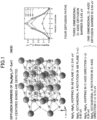
- FIG. 1 schematically illustrates the crystal structure of Ba 2 MgH 6 , which is one kind of hydride ion conductor according to one embodiment of the present invention.
- the largest atom is a Ba atom
- the next largest atom is a Mg atom
- the smallest atom is a hydrogen atom
- FIG. 1 illustrates the migration energy along each diffusion path of hydrogen (H) atoms assumed in the crystal structure of Ba 2 MgH 6 .
- nudged elastic band calculations obtained by using VASP indicated that the migration energy of H atoms was the smallest in the case (IV). However, in any of the cases, it was found that the migration energy of H atoms in the Ba 2 MgH 6 crystal lattice was approximately 0.45 eV at the maximum, which was a sufficiently small value.
- FIG. 2 illustrates the temperature dependence of the conductivity of the hydride ion conductor according to one embodiment of the present invention.
- the horizontal axis represents 1000 times the reciprocal (1/T) of a temperature T
- the vertical axis represents conductivity ⁇ (logarithmic representation).
- (i) indicates conductivity characteristics of Ba 2 MgH 6 according to one embodiment of the present invention.
- (ii) and (iii) indicate conductivity characteristics of a hydride ion conductor (LaHO) described in Non-Patent Document 1 and conductivity characteristics of a hydride ion conductor (BaH 2 ) described in Non-Patent Document 2, respectively.
- Ba 2 MgH 6 has good ion conductivity that is superior to those of the conventional LaHO hydride ion conductor and BaH 2 hydride ion conductor in a temperature range of approximately 350°C to approximately 500°C.
- a sparsely-dotted region is a region called "Norby gap", and it has been reported that proton (H + ) conduction is difficult to occur in this region (for details, see Solid State Ionics 125 1-11 (1999 )).
- X 1000 times the reciprocal of a temperature T(K)
- Y represents a common logarithm (log( ⁇ )) of conductivity (S/cm).
- the hydride ion conductor according to one embodiment of the present invention has a characteristic in that the conductivity belongs to a region indicated by diagonal lines in FIG. 2 .
- one embodiment of the present invention provides a hydride ion conductor satisfying:
- X preferably satisfies 1.3 ⁇ X ⁇ 1.5.
- the hydride ion conductor according to one embodiment of the present invention may have conductivity of 5 ⁇ 10 -2 S/cm or more in the Norby gap region.
- the hydride ion conductor according to one embodiment of the present invention preferably has conductivity of 1 ⁇ 10 -1 S/cm or more in the Norby gap region.
- the hydride ion conductor according to one embodiment of the present invention exhibits significantly high ion conductivity in a predetermined temperature range, as compared to the conventional hydride ion conductors.
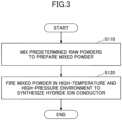
- FIG. 3 schematically illustrates the flow of the method of manufacturing a hydride ion conductor according to one embodiment of the present invention.
- the method of manufacturing a hydride ion conductor according to one embodiment of the present invention includes:
- the hydride ion conductor according to one embodiment of the present invention is highly reactive, and thus the steps are performed in an argon environment.
- the raw materials may include hydrides of metals, that is, BaH 2 , AH, MgH 2 , and BH (where A and B are each selected from at least one or more of the group costing of Li, Na, K, Rb, and Cs, and B may be the same as or different from A),
- the hydride ion conductor is Ba 2 MgH 6
- BaH 2 and MgH 2 may be used as the raw materials.
- the raw materials may be sufficiently mixed by using a ball mill or the like.
- a mixed powder is fired in a high-temperature and high-pressure environment to synthesize the hydride ion conductor.
- a cubic-anvil high-pressure apparatus may be used for the synthesis.
- a cubic cell called a pyrophyllite cell is used, and the interior of the pyrophyllite cell is filled with the mixed powder. Then, an ultrahigh hydrostatic pressure is generated by the cubic-anvil high-pressure apparatus, and as a result, the six faces of the pyrophyllite cell disposed inside the cubic-anvil high-pressure apparatus can be isotropically pressurized.
- the pressure applied to the pyrophyllite cell is, for example, in the range of 2 GPa to 6 GPa.
- the firing temperature is, for example, in the range of 700°C to 1000°C.
- the hydride ion conductor having high ion conductivity as described above can be manufactured.
- the above-described manufacturing method is merely an example, and the hydride ion conductor according to one embodiment of the present invention may be manufactured by a different manufacturing method.
- Hydride ion conductor samples were produced by the following method. In addition, characteristics of the produced samples were evaluated.
- the samples for evaluation were produced by the following method.
- the average particle size of the BaH 2 powder was 10 ⁇ m, and the average particle size of the MgH 2 powder was 10 pm. Further, BaH 2 :MgH 2 was 2:1 (molar ratio). That is, the target composition of the mixed powder was Ba 2 MgH 6 , which was the stoichiometric ratio.
- the obtained mixed powder was loaded into a planetary ball mill, and then pulverized and mixed at room temperature.
- the rotation speed was 200 rpm, and the treatment time was 12 hours.
- a sample B was prepared by the same method as the sample A.
- the average particle size of the KH powder was 10 pm. Further, BaH 2 :MgH 2 :KH was 1.9:1:0.1 (molar ratio). That is, the target composition of the mixed powder was Ba 1.9 K 0.1 MgH 5.9 .
- a benchtop X-ray diffraction analyzer (MiniFlex600 manufactured by Rigaku Corporation) was used to evaluate the crystal phases of the sample A and the sample B.
- the sample A and the sample B were molded to produce molded bodies each having a diameter of approximately 6 mm and a thickness of approximately 2 mm.
- Gold electrodes were brought into contact with the bottom surfaces of both the molded bodies, and alternating current impedance measurement was performed by using an atmosphere-controlled measurement cell.
- VSP-300 manufactured by Bio-Logic
- a measurement frequency was in the range of 1 Hz to 7 MHz
- an applied alternating voltage was in the range of 50 mV to 500 mV.
- the measurement was performed in a hydrogen atmosphere.
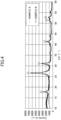
- FIG. 4 illustrates the X-ray diffraction analysis results of the sample A and the sample B.
- peaks indicated by "o" correspond to peaks of the Ba 2 MgH 6 crystal phase.
- the main phase was the Ba 2 MgH 6 phase in each of the samples.
- the width of the diffraction peak of the sample B is narrower than that of the sample A, and the crystallinity of the sample B is higher than that of the sample A.
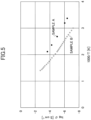
- FIG. 5 illustrates the results of conductivity obtained by performing the alternating current impedance measurement at each temperature.
- sample A exhibited high conductivity in the temperature range from room temperature to 200°C. Thus, the measurement was not performed at a temperature higher than 200°C.
- sample C A sample (hereinafter referred to as a "sample C") for evaluation was produced by the following method.
- BaH 2 powder and MgH 2 powder were weighed such that the molar ratio of BaH 2 :MgH 2 was 2:1.1, and then pulverized and mixed in a mortar for twenty minutes to prepare a mixed powder.
- the obtained mixed powder was compacted and enclosed in the boron nitride tube. Further, this tube was placed in the pyrophyllite cell, and the cubic-anvil high-pressure apparatus was used to fire the mixed powder.
- the mixed powder was fired for 30 minutes under firing conditions of 5 GPa and 900°C.
- X-ray diffraction analysis of the sample C was performed by using beamline BL19B2 of a synchrotron radiation facility "SPring-8" (wavelength: 0.5 ⁇ .)
- the measurement was performed on the sample enclosed in a quartz glass capillary having an inner diameter of 0. 1 mm in an argon atmosphere in a temperature range from room temperature to 500°C. Specifically, after the X-ray diffraction analysis was performed at room temperature, the sample was heated to a predetermined temperature, and the same measurement was performed on the sample. This was repeated up to 500°C.
- the sample C was polished in an argon atmosphere to obtain a cylindrical sample having a diameter of approximately 4 mm and a thickness of 1 mm.
- a gold electrode was brought into contact with the bottom surface of the obtained sample, and alternating current impedance measurement was performed by using the atmosphere-controlled measurement cell.
- VSP-300 manufactured by Bio-Logic
- a measurement frequency was in the range of 1 Hz to 7 MHz
- an applied alternating voltage was in the range of 50 mV to 500 mV.
- the measurement was performed in a hydrogen atmosphere.
- the conductivity was calculated from the measurement results (cole-cole-plot).
- FIG. 6 collectively illustrates the X-ray diffraction analysis results of the sample C at respective temperatures.
- peaks indicated by "o" correspond to peaks of the Ba 2 MgH 6 crystal phase.
- the main phase in the sample C was the Ba 2 MgH 6 phase at each of the measurement temperatures.
- FIG. 7 illustrates the above-described X-ray diffraction analysis results ( FIG. 4 ) again. However, in addition to the measurement results of the sample A and the sample B, FIG. 7 also illustrates the measurement results of the sample C at room temperature, obtained by using the benchtop X-ray diffraction analyzer (MiniFlex600 manufactured by Rigaku Corporation).
Landscapes
- Chemical & Material Sciences (AREA)
- Organic Chemistry (AREA)
- Inorganic Chemistry (AREA)
- Physics & Mathematics (AREA)
- Geology (AREA)
- General Life Sciences & Earth Sciences (AREA)
- Life Sciences & Earth Sciences (AREA)
- Condensed Matter Physics & Semiconductors (AREA)
- General Physics & Mathematics (AREA)
- Engineering & Computer Science (AREA)
- Manufacturing & Machinery (AREA)
- Chemical Kinetics & Catalysis (AREA)
- Electrochemistry (AREA)
- General Chemical & Material Sciences (AREA)
- Conductive Materials (AREA)
Abstract
Description
- The present invention relates to a hydride ion conductor.
- A hydride ion (H-) composed of a hydrogen atom and two electrons is lighter than a lithium ion, has many characteristics, such as having an ionic radius similar to that of a fluoride ion (F-), and is an electrochemically attractive charge carrier.
- For example, new energy devices may be achieved when hydride ion conductors are used as ion conductors in place of conventional protons (H+) and lithium ions (Li+) in electrochemical devices such as fuel cells and secondary cells.
- Some hydride ion conductors exhibiting high ion conductivity have been reported (
Non-Patent Documents -
- Non-Patent Document 1: Keiga Fukui, et al., "Characteristic fast H- ion conduction in oxygen-substituted lanthanum hysride", nature communications, (2019)10:2578
- Non-Patent Document 2: Maarten C. Verbraeken, et al., "High H- ionic conductivity in bariumu hydride", nature materials, vol.14, p.95-p.100, January, 2015
- In order to apply hydride ion conductors to electrochemical devices, high hydride ion conductivity is required. In this respect, it is considered that conventional hydride ion conductors are still insufficient.
- The present invention has been made in view of such a background, and it is an object of the present invention to provide a hydride ion conductor having higher ion conductivity.
- According to the present invention, provided is a hydride ion conductor represented by a general formula:
Ba2-x-mAxMg1-y-nByH6-x-y-2m-2n (1),
- wherein A and B are each selected from at least one or more of the group consisting of Li, Na, K, Rb, and Cs, and
- 0 ≤ x ≤ 1, 0 ≤ y ≤ 1, 0 ≤ m ≤ 0.2, and 0 ≤ n ≤ 0.2, excluding a case where x = y = m = n = 0.
- Further, according to the present invention, provided is a hydride ion conductor having
an (NH4)SiF6-type structure. - Further, according to the present invention, provided is a hydride ion conductor satisfying:
- (a)

- (b)

- According to the present invention, a hydride ion conductor having higher ion conductivity can be provided.
-
- [
FIG. 1] FIG. 1 is a drawing schematically illustrating a crystal structure of a hydride ion conductor (Ba2MgH6) according to one embodiment of the present invention; - [
FIG. 2] FIG. 2 is a graph illustrating, together with the temperature dependence of conventional hydride ion conductor, the temperature dependence of the conductivity of the hydride ion conductor (Ba2MgH6) according to one embodiment of the present invention; - [
FIG. 3] FIG. 3 is a drawing schematically illustrating the flow of a method of manufacturing a hydride ion conductor according to one embodiment of the present invention; - [
FIG. 4] FIG. 4 is a drawing illustrating the X-ray diffraction analysis results of hydride ion conductors (a sample A and a sample B) according to one embodiment of the present invention; - [
FIG. 5] FIG. 5 is a graph illustrating the measurement results of conductivity of the hydride ion conductors (the sample A and the sample B) according to one embodiment of the present invention; - [
FIG. 6] FIG. 6 is a drawing collectively illustrating the X-ray diffraction analysis results of a hydride ion conductor (a sample C) according to one embodiment of the present invention at respective temperatures; and - [
FIG. 7] FIG. 7 is a drawing collectively illustrating the X-ray diffraction analysis results of the hydride ion conductors (the sample A to the sample C) according to the one embodiment of the present invention. - In the following, one embodiment of the present invention will be described with reference to the drawings.
- One embodiment of the present invention provides a hydride ion conductor represented by a general formula:
Ba2-x-mAxMg1-y-nByH6-x-y-2m-2n (1),
- wherein A and B are each selected from at least one or more of the group consisting of Li, Na, K, Rb, and Cs, and
- 0 ≤ x ≤ 1, 0 ≤ y ≤ 1, 0 ≤ m ≤ 0.2, and 0 ≤ n ≤ 0.2, excluding a case where x = y = m = n = 0.
- Further, one embodiment of the present invention provides a hydride ion conductor having
an (NH4)SiF6-type structure. - The hydride ion conductor according to one embodiment of the present invention is, for example, Ba2MgH6 or Ba1.9K0.1MgH5.9. Each of these compounds has a crystal structure of an (NH4)SiF6-type structure.
-
FIG. 1 schematically illustrates the crystal structure of Ba2MgH6, which is one kind of hydride ion conductor according to one embodiment of the present invention. - In
FIG. 1 , the largest atom is a Ba atom, the next largest atom is a Mg atom, and the smallest atom is a hydrogen atom. - Further, the right side of
FIG. 1 illustrates the migration energy along each diffusion path of hydrogen (H) atoms assumed in the crystal structure of Ba2MgH6. - In the crystal structure of Ba2MgH6, as diffusion paths of H atoms, the following four are conceivable:
- (I) MgH6-MgH6 hopping in the ab plane (i-iii path);
- (II) MgH6 octahedral H rotation in the ab plane (i-iv path);
- (III) MgH6-MgH6 hopping in the c-axis direction (i-ii path); and
- (IV) MgH6 octahedral H rotation in the c-axis direction (i-v path).
- As illustrated on the right side in
FIG. 1 , nudged elastic band calculations obtained by using VASP indicated that the migration energy of H atoms was the smallest in the case (IV). However, in any of the cases, it was found that the migration energy of H atoms in the Ba2MgH6 crystal lattice was approximately 0.45 eV at the maximum, which was a sufficiently small value. - As described, in the crystal structure of Ba2MgH6, the migration barriers of H atoms are sufficiently small, and thus it is expected that Ba2MgH6 exhibits significantly high hydride ion conductivity.
-
FIG. 2 illustrates the temperature dependence of the conductivity of the hydride ion conductor according to one embodiment of the present invention. - In
FIG. 2 , the horizontal axis represents 1000 times the reciprocal (1/T) of a temperature T, and the vertical axis represents conductivity σ (logarithmic representation). InFIG. 2 , (i) indicates conductivity characteristics of Ba2MgH6 according to one embodiment of the present invention. Further, (ii) and (iii) indicate conductivity characteristics of a hydride ion conductor (LaHO) described inNon-Patent Document 1 and conductivity characteristics of a hydride ion conductor (BaH2) described inNon-Patent Document 2, respectively. - From
FIG. 2 , it can be seen that Ba2MgH6 has good ion conductivity that is superior to those of the conventional LaHO hydride ion conductor and BaH2 hydride ion conductor in a temperature range of approximately 350°C to approximately 500°C. - Note that from the above-described considerations, it is expected that Ba2MgH6 conduction is due to hydride ion conduction.
- In
FIG. 2 , a sparsely-dotted region is a region called "Norby gap", and it has been reported that proton (H+) conduction is difficult to occur in this region (for details, see Solid State Ionics 125 1-11 (1999)). - A boundary L1 on the left side of this Norby gap region is represented by the following formula:

- In this formula, X represents 1000 times the reciprocal of a temperature T(K), and Y represents a common logarithm (log(σ)) of conductivity (S/cm).
- The hydride ion conductor according to one embodiment of the present invention has a characteristic in that the conductivity belongs to a region indicated by diagonal lines in
FIG. 2 . - Accordingly, one embodiment of the present invention provides a hydride ion conductor satisfying:
- (a)

- (b)

- In particular, X preferably satisfies 1.3 < X < 1.5.
- The hydride ion conductor according to one embodiment of the present invention may have conductivity of 5 × 10⁻² S/cm or more in the Norby gap region. The hydride ion conductor according to one embodiment of the present invention preferably has conductivity of 1 × 10⁻¹ S/cm or more in the Norby gap region.
- As described, the hydride ion conductor according to one embodiment of the present invention exhibits significantly high ion conductivity in a predetermined temperature range, as compared to the conventional hydride ion conductors.
- Therefore, it is expected that an electrochemical device having good characteristics can be achieved when the hydride ion conductor according to one embodiment of the present invention is used.
- In the following, a method of manufacturing a hydride ion conductor according to one embodiment of the present invention will be briefly described with reference to
FIG. 3 . -
FIG. 3 schematically illustrates the flow of the method of manufacturing a hydride ion conductor according to one embodiment of the present invention. - As illustrated in
FIG. 3 , the method of manufacturing a hydride ion conductor according to one embodiment of the present invention includes: - (i) a step of mixing predetermined raw powders to prepare a mixed powder (step S110); and
- (ii) a step of firing the mixed powder in a high-temperature and high-pressure environment to synthesize a hydride ion conductor (step S120).
- Note that the hydride ion conductor according to one embodiment of the present invention is highly reactive, and thus the steps are performed in an argon environment.
- Each of the steps will be described below.
- First, powders as raw materials are prepared.
- The raw materials may include hydrides of metals, that is, BaH2, AH, MgH2, and BH (where A and B are each selected from at least one or more of the group costing of Li, Na, K, Rb, and Cs, and B may be the same as or different from A),
- For example, if the hydride ion conductor is Ba2MgH6, BaH2 and MgH2 may be used as the raw materials.
- The raw materials may be sufficiently mixed by using a ball mill or the like.
- Next, a mixed powder is fired in a high-temperature and high-pressure environment to synthesize the hydride ion conductor.
- A cubic-anvil high-pressure apparatus may be used for the synthesis.
- When this apparatus is used, a cubic cell called a pyrophyllite cell is used, and the interior of the pyrophyllite cell is filled with the mixed powder. Then, an ultrahigh hydrostatic pressure is generated by the cubic-anvil high-pressure apparatus, and as a result, the six faces of the pyrophyllite cell disposed inside the cubic-anvil high-pressure apparatus can be isotropically pressurized.
- The pressure applied to the pyrophyllite cell is, for example, in the range of 2 GPa to 6 GPa.
- The firing temperature is, for example, in the range of 700°C to 1000°C.
- With the above-described steps, the hydride ion conductor having high ion conductivity as described above can be manufactured.
- Note that the above-described manufacturing method is merely an example, and the hydride ion conductor according to one embodiment of the present invention may be manufactured by a different manufacturing method.
- Next, examples of the present invention will be described.
- Hydride ion conductor samples were produced by the following method. In addition, characteristics of the produced samples were evaluated.
- The samples for evaluation were produced by the following method.
- In an Ar atmosphere, 1.827 g of BaH2 powder (manufactured by Sigma Aldrich) and 0.173 g of MgH2 powder (manufactured by Sigma Aldrich) were weighed to prepare a mixed powder.
- The average particle size of the BaH2 powder was 10 µm, and the average particle size of the MgH2 powder was 10 pm. Further, BaH2:MgH2 was 2:1 (molar ratio). That is, the target composition of the mixed powder was Ba2MgH6, which was the stoichiometric ratio.
- The obtained mixed powder was loaded into a planetary ball mill, and then pulverized and mixed at room temperature. The rotation speed was 200 rpm, and the treatment time was 12 hours.
- In this manner, a sample A was produced.
- A sample B was prepared by the same method as the sample A.
- However, in the sample B, 1.794 g of BaH2 powder (manufactured by Sigma Aldrich), 0.178 g of MgH2 powder (manufactured by Sigma Aldrich), and 0.027 g of KH powder (manufactured by Sigma Aldrich) were used as raw materials.
- The average particle size of the KH powder was 10 pm. Further, BaH2:MgH2:KH was 1.9:1:0.1 (molar ratio). That is, the target composition of the mixed powder was Ba1.9K0.1MgH5.9.
- A benchtop X-ray diffraction analyzer (MiniFlex600 manufactured by Rigaku Corporation) was used to evaluate the crystal phases of the sample A and the sample B.
- The sample A and the sample B were molded to produce molded bodies each having a diameter of approximately 6 mm and a thickness of approximately 2 mm. Gold electrodes were brought into contact with the bottom surfaces of both the molded bodies, and alternating current impedance measurement was performed by using an atmosphere-controlled measurement cell.
- As a measurement device, VSP-300 (manufactured by Bio-Logic) was used. A measurement frequency was in the range of 1 Hz to 7 MHz, and an applied alternating voltage was in the range of 50 mV to 500 mV. The measurement was performed in a hydrogen atmosphere.
-
FIG. 4 illustrates the X-ray diffraction analysis results of the sample A and the sample B. InFIG. 4 , peaks indicated by "o" correspond to peaks of the Ba2MgH6 crystal phase. - From
FIG. 4 , it was confirmed that the main phase was the Ba2MgH6 phase in each of the samples. In addition, it was confirmed that the width of the diffraction peak of the sample B is narrower than that of the sample A, and the crystallinity of the sample B is higher than that of the sample A. -
FIG. 5 illustrates the results of conductivity obtained by performing the alternating current impedance measurement at each temperature. - From
FIG. 5 , it was found that, in each of the samples, the logarithm of conductivity changed linearly with respect to the reciprocal of temperature and the ion conduction mechanism followed the Arrhenius equation. - In the sample B, Ba2+ ions were replaced with K+ ions, and hydrogen deficiency was actively introduced. The sample A exhibited higher conductivity than that of the sample B in a temperature range from room temperature to 200°C. In addition,
FIG. 4 indicates that the crystallinity of the sample A is lower than the crystallinity of the sample B. Accordingly, it is conceivable that in the sample A, Schottky defects of one Ba atom and two H atoms or one Mg atom and two H atoms were generated, that is, an ion conductor of the formula (1), free of A and B, where x = y = 0, and m ≠ 0 or n ≠ 0 was obtained. - Note that the sample A exhibited high conductivity in the temperature range from room temperature to 200°C. Thus, the measurement was not performed at a temperature higher than 200°C.
- A sample (hereinafter referred to as a "sample C") for evaluation was produced by the following method.
- BaH2 powder and MgH2 powder were weighed such that the molar ratio of BaH2:MgH2 was 2:1.1, and then pulverized and mixed in a mortar for twenty minutes to prepare a mixed powder.
- The reason why the content of Mg in the mixed powder was slightly excessive was to avoid compositional deviation of a finally obtained sample due to reaction with a boron nitride tube used later.
- Next, the obtained mixed powder was compacted and enclosed in the boron nitride tube. Further, this tube was placed in the pyrophyllite cell, and the cubic-anvil high-pressure apparatus was used to fire the mixed powder.
- The mixed powder was fired for 30 minutes under firing conditions of 5 GPa and 900°C.
- In this manner, the sample C was obtained.
- X-ray diffraction analysis of the sample C was performed by using beamline BL19B2 of a synchrotron radiation facility "SPring-8" (wavelength: 0.5 Å.)
- The measurement was performed on the sample enclosed in a quartz glass capillary having an inner diameter of 0. 1 mm in an argon atmosphere in a temperature range from room temperature to 500°C. Specifically, after the X-ray diffraction analysis was performed at room temperature, the sample was heated to a predetermined temperature, and the same measurement was performed on the sample. This was repeated up to 500°C.
- The sample C was polished in an argon atmosphere to obtain a cylindrical sample having a diameter of approximately 4 mm and a thickness of 1 mm.
- A gold electrode was brought into contact with the bottom surface of the obtained sample, and alternating current impedance measurement was performed by using the atmosphere-controlled measurement cell.
- As a measurement device, VSP-300 (manufactured by Bio-Logic) was used. A measurement frequency was in the range of 1 Hz to 7 MHz, and an applied alternating voltage was in the range of 50 mV to 500 mV. The measurement was performed in a hydrogen atmosphere. The conductivity was calculated from the measurement results (cole-cole-plot).
-
FIG. 6 collectively illustrates the X-ray diffraction analysis results of the sample C at respective temperatures. InFIG. 6 , peaks indicated by "o" correspond to peaks of the Ba2MgH6 crystal phase. - From
FIG. 6 , it was found that the main phase in the sample C was the Ba2MgH6 phase at each of the measurement temperatures. - Note that as the temperature of the sample C increased, peaks, indicated by Δ, of a phase other than the main phase appeared. These peaks correspond to peaks of the BaH2 phase.
- In addition, the series of results indicate that the positions at which the peaks of the main phase appear tends to be shifted to a lower angle side as the temperature increases. This tendency corresponds to the behavior of the crystal lattice that expands as the temperature increases.
-
FIG. 7 illustrates the above-described X-ray diffraction analysis results (FIG. 4 ) again. However, in addition to the measurement results of the sample A and the sample B,FIG. 7 also illustrates the measurement results of the sample C at room temperature, obtained by using the benchtop X-ray diffraction analyzer (MiniFlex600 manufactured by Rigaku Corporation). - From the comparison between the sample A (or the sample B) and the sample C, it was found that the peaks of Ba2MgH6, which is the main phase, were sharper and a half-width was smaller in the sample C. This indicates that Mg2MgH6 with higher crystallinity is formed in the sample C.
- The relationship between temperature and ion conductivity obtained in the sample C is depicted in (i) of
FIG. 2 described above. - From
FIG. 2 , it was found that in the sample C, the conductivity in a high temperature range was in the Norby gap region and significantly high conductivity was obtained. In particular, high conductivity exceeding 10-1 S/cm was obtained at around 450°C. - To the extent understood by the applicant, hydride ion conductors having such high conductivity at around 450°C have not been recognized to date.
- Note that, from
FIG. 2 , it was found that the conductivity of the sample C was significantly increased from a temperature range that exceeds approximately 350°C. - From the results of the synchrotron radiation XRD at the various temperatures indicated in
FIG. 6 , precipitation of the BaH2 phase (Δ) can be confirmed at 370°C or more. Because the Ba2MgH6 phase is not decomposed despite the precipitation of BaH2, it is expected that Ba deficiency and H deficiency are introduced into Ba2MgH6. As a result of Rietveld analysis of the synchrotron radiation XRD results, it was confirmed that Ba deficiency corresponding to the mass fraction of the precipitated BaH2 was generated in the Ba2MgH6 phase at 370°C or more. It is conceivable that in the sample C, H deficiency was introduced by removal of BaH2 as a result of an increase in temperature, rather than by introduction of a different element. That is, Ba2-x-mAxMg1-y-nByH6-x-y-2m-2n (x = y = n = 0) was produced. - From the above considerations, it is conceivable that the conductivity of the sample C jumped at approximately 350°C and high ion conductivity was obtained.
- This application is based on and claims priority to
Japanese Patent Application No. 2021-130270, filed on August 6, 2021
Claims (5)
- A hydride ion conductor represented by a general formula:
Ba2-x-mAxMg1-y-nByH6-x-y-2m-2n (1),
wherein A and B are each selected from at least one or more of the group consisting of Li, Na, K, Rb, and Cs, and0 ≤ x ≤ 1, 0 ≤ y ≤ 1, 0 ≤ m ≤ 0.2, and 0 ≤ n ≤ 0.2, excluding a case where x = y = m = n = 0. - The hydride ion conductor according to claim 1, wherein said B is different from said A.
- A hydride ion conductor having
an (NH4)SiF6-type structure. - A hydride ion conductor satisfying:(a)
 (b)wherein X represents 1,000 times a reciprocal of a temperature T(K), and Y represents a common logarithm (log(σ)) of conductivity (S/cm) of the hydride ion conductor.
- The hydride ion conductor according to any one of claims 1 to 4, wherein the general formula is Ba2MgH6 or Ba1.9K0.1MgH5.9.
Applications Claiming Priority (2)
| Application Number | Priority Date | Filing Date | Title |
|---|---|---|---|
| JP2021130270 | 2021-08-06 | ||
| PCT/JP2022/028954 WO2023013496A1 (en) | 2021-08-06 | 2022-07-27 | Hydride ion conductor |
Publications (2)
| Publication Number | Publication Date |
|---|---|
| EP4382478A1 true EP4382478A1 (en) | 2024-06-12 |
| EP4382478A4 EP4382478A4 (en) | 2025-07-23 |
Family
ID=85154469
Family Applications (1)
| Application Number | Title | Priority Date | Filing Date |
|---|---|---|---|
| EP22852919.4A Pending EP4382478A4 (en) | 2021-08-06 | 2022-07-27 | HYDRIDION CONDUCTORS |
Country Status (5)
| Country | Link |
|---|---|
| US (1) | US20240166512A1 (en) |
| EP (1) | EP4382478A4 (en) |
| JP (1) | JPWO2023013496A1 (en) |
| CN (1) | CN117836237A (en) |
| WO (1) | WO2023013496A1 (en) |
Family Cites Families (6)
| Publication number | Priority date | Publication date | Assignee | Title |
|---|---|---|---|---|
| US7662357B2 (en) * | 2002-04-19 | 2010-02-16 | Japan Science And Technology Agency | Hydrogen-containing electrically conductive inorganic compound |
| JP4166641B2 (en) * | 2003-08-27 | 2008-10-15 | 独立行政法人科学技術振興機構 | Proton / electron mixed conductor and its production method and application |
| JP5540179B2 (en) * | 2010-03-26 | 2014-07-02 | 国立大学法人東京工業大学 | Hydride ion conductor and method for producing the same |
| CN102530872B (en) * | 2010-12-08 | 2013-06-12 | 中国科学院金属研究所 | Multi-metal ammonia borane compound hydrogen storage material and preparation and composite hydrogen release method thereof |
| JP7067731B2 (en) * | 2015-11-24 | 2022-05-16 | 国立大学法人東京工業大学 | Hydride ion conductor and its manufacturing method |
| JP2021130270A (en) | 2020-02-20 | 2021-09-09 | キヤノン株式会社 | Inkjet recording method |
-
2022
- 2022-07-27 CN CN202280053812.5A patent/CN117836237A/en active Pending
- 2022-07-27 JP JP2023540284A patent/JPWO2023013496A1/ja active Pending
- 2022-07-27 WO PCT/JP2022/028954 patent/WO2023013496A1/en not_active Ceased
- 2022-07-27 EP EP22852919.4A patent/EP4382478A4/en active Pending
-
2024
- 2024-01-30 US US18/427,080 patent/US20240166512A1/en active Pending
Also Published As
| Publication number | Publication date |
|---|---|
| EP4382478A4 (en) | 2025-07-23 |
| US20240166512A1 (en) | 2024-05-23 |
| CN117836237A (en) | 2024-04-05 |
| WO2023013496A1 (en) | 2023-02-09 |
| JPWO2023013496A1 (en) | 2023-02-09 |
Similar Documents
| Publication | Publication Date | Title |
|---|---|---|
| Li et al. | Highly stable and encapsulation-microstructural cathode derived by self-pressurization behavior in Na-halides-based all-solid-state batteries | |
| Zhang et al. | (Electro) chemical expansion during cycling: monitoring the pressure changes in operating solid-state lithium batteries | |
| EP3505500B1 (en) | Sulfide solid electrolyte | |
| Zhang et al. | Mitigating the Jahn-Teller distortion driven by the spin-orbit coupling of lithium manganate cathode | |
| EP3429016B1 (en) | Sulfide solid electrolyte | |
| Höltschi et al. | Study of graphite cycling in sulfide solid electrolytes | |
| Cheng et al. | O2− substituted Li-richened Li2ZrCl6 lattice towards superionic conductivity | |
| Nowroozi et al. | Insights on the behavior of conversion-based anode materials for fluoride ion batteries by testing against an intercalation-based reference cathode | |
| Jin et al. | Sn (salen)-derived SnS nanoparticles embedded in N-doped carbon for high performance lithium-ion battery anodes | |
| EP3843192A1 (en) | Ionic conductor containing high-temperature phase of licb9h10, method for manufacturing same, and solid electrolyte for all-solid-state battery containing said ion conductor | |
| Lai et al. | Effects of strontium oxide on synthesis and performance of monocrystalline ultrahigh-Ni layered cathode materials for Li-ion batteries | |
| Gao et al. | Improving Fast‐Charging Capability of High‐Voltage Spinel LiNi0. 5Mn1. 5O4 Cathode under Long‐Term Cyclability through Co‐Doping Strategy | |
| Yi et al. | Ga-doped Ca 12 Al 14 O 33 mayenite oxide ion conductors: synthesis, defects, and electrical properties | |
| Hao et al. | Multiple-cation doped LaCl3-based chloride solid-state electrolyte compatible with lithium metal | |
| Liu et al. | Li3InCl6 electrolyte with high voltage compatibility for Ni-rich layered oxide cathodes-based all-solid-state batteries | |
| Timusheva et al. | Chemical compatibility at the interface of garnet-type Ga-LLZO solid electrolyte and high-energy Li-rich layered oxide cathode for all-solid-state batteries | |
| Deng et al. | Synthesis and interfacial engineering of nitride–halide electrolytes in all-solid-state Li batteries | |
| Ye et al. | An ionically conductive and compressible sulfochloride solid-state electrolyte for stable all-solid-state lithium-based batteries | |
| Hu et al. | Aliovalent sulfur-substitution regulated highly amorphous Li2ZrCl6 solid electrolytes for all-solid-state lithium metal batteries | |
| EP4382478A1 (en) | Hydride ion conductor | |
| Hirose et al. | A trade-off between migration and association energies for hydride-ion conductivity in the SrLiH 3–CaLiH 3–NaLiH 2 system | |
| Yang et al. | Sintering Temperature Effects on Na3Zr2Si2PO12 Solid Electrolytes for Na All-Solid Battery Applications | |
| US20260100411A1 (en) | Sodium-deficient chloride-based sodium solid electrolyte | |
| EP4571786A1 (en) | Ion conductive substance, electrolyte, and battery | |
| Yamada et al. | Direct solid-state synthesis and large-capacity anode operation of Li 3− x Fe x N |
Legal Events
| Date | Code | Title | Description |
|---|---|---|---|
| STAA | Information on the status of an ep patent application or granted ep patent |
Free format text: STATUS: THE INTERNATIONAL PUBLICATION HAS BEEN MADE |
|
| PUAI | Public reference made under article 153(3) epc to a published international application that has entered the european phase |
Free format text: ORIGINAL CODE: 0009012 |
|
| STAA | Information on the status of an ep patent application or granted ep patent |
Free format text: STATUS: REQUEST FOR EXAMINATION WAS MADE |
|
| 17P | Request for examination filed |
Effective date: 20240201 |
|
| AK | Designated contracting states |
Kind code of ref document: A1 Designated state(s): AL AT BE BG CH CY CZ DE DK EE ES FI FR GB GR HR HU IE IS IT LI LT LU LV MC MK MT NL NO PL PT RO RS SE SI SK SM TR |
|
| DAV | Request for validation of the european patent (deleted) | ||
| DAX | Request for extension of the european patent (deleted) | ||
| A4 | Supplementary search report drawn up and despatched |
Effective date: 20250624 |
|
| RIC1 | Information provided on ipc code assigned before grant |
Ipc: C01B 6/04 20060101AFI20250617BHEP Ipc: C04B 35/00 20060101ALI20250617BHEP Ipc: H01M 10/0562 20100101ALI20250617BHEP Ipc: H01B 1/06 20060101ALI20250617BHEP |