EP4382057A1 - Vorrichtung zum zuführen von operationsmaterial in ein endoskopisches operationsgebiet bzw. zum entfernen von operationsmaterial aus einem endoskopischen operationsgebiet - Google Patents
Vorrichtung zum zuführen von operationsmaterial in ein endoskopisches operationsgebiet bzw. zum entfernen von operationsmaterial aus einem endoskopischen operationsgebiet Download PDFInfo
- Publication number
- EP4382057A1 EP4382057A1 EP23214572.2A EP23214572A EP4382057A1 EP 4382057 A1 EP4382057 A1 EP 4382057A1 EP 23214572 A EP23214572 A EP 23214572A EP 4382057 A1 EP4382057 A1 EP 4382057A1
- Authority
- EP
- European Patent Office
- Prior art keywords
- medical instrument
- surgical
- material container
- trocar
- area
- Prior art date
- Legal status (The legal status is an assumption and is not a legal conclusion. Google has not performed a legal analysis and makes no representation as to the accuracy of the status listed.)
- Pending
Links
- 239000000463 material Substances 0.000 title claims abstract description 126
- 230000008878 coupling Effects 0.000 claims description 12
- 238000010168 coupling process Methods 0.000 claims description 12
- 238000005859 coupling reaction Methods 0.000 claims description 12
- 238000011109 contamination Methods 0.000 description 4
- 238000000034 method Methods 0.000 description 2
- 239000003356 suture material Substances 0.000 description 2
- 238000005452 bending Methods 0.000 description 1
- 239000002775 capsule Substances 0.000 description 1
- 238000002674 endoscopic surgery Methods 0.000 description 1
- 238000004519 manufacturing process Methods 0.000 description 1
Images

Classifications
-
- A—HUMAN NECESSITIES
- A61—MEDICAL OR VETERINARY SCIENCE; HYGIENE
- A61B—DIAGNOSIS; SURGERY; IDENTIFICATION
- A61B17/00—Surgical instruments, devices or methods
- A61B17/34—Trocars; Puncturing needles
-
- A—HUMAN NECESSITIES
- A61—MEDICAL OR VETERINARY SCIENCE; HYGIENE
- A61B—DIAGNOSIS; SURGERY; IDENTIFICATION
- A61B17/00—Surgical instruments, devices or methods
- A61B17/34—Trocars; Puncturing needles
- A61B17/3417—Details of tips or shafts, e.g. grooves, expandable, bendable; Multiple coaxial sliding cannulas, e.g. for dilating
- A61B17/3421—Cannulas
- A61B17/3423—Access ports, e.g. toroid shape introducers for instruments or hands
-
- A—HUMAN NECESSITIES
- A61—MEDICAL OR VETERINARY SCIENCE; HYGIENE
- A61B—DIAGNOSIS; SURGERY; IDENTIFICATION
- A61B1/00—Instruments for performing medical examinations of the interior of cavities or tubes of the body by visual or photographical inspection, e.g. endoscopes; Illuminating arrangements therefor
- A61B1/00147—Holding or positioning arrangements
- A61B1/00154—Holding or positioning arrangements using guiding arrangements for insertion
-
- A—HUMAN NECESSITIES
- A61—MEDICAL OR VETERINARY SCIENCE; HYGIENE
- A61B—DIAGNOSIS; SURGERY; IDENTIFICATION
- A61B10/00—Instruments for taking body samples for diagnostic purposes; Other methods or instruments for diagnosis, e.g. for vaccination diagnosis, sex determination or ovulation-period determination; Throat striking implements
- A61B10/0096—Casings for storing test samples
-
- A—HUMAN NECESSITIES
- A61—MEDICAL OR VETERINARY SCIENCE; HYGIENE
- A61B—DIAGNOSIS; SURGERY; IDENTIFICATION
- A61B10/00—Instruments for taking body samples for diagnostic purposes; Other methods or instruments for diagnosis, e.g. for vaccination diagnosis, sex determination or ovulation-period determination; Throat striking implements
- A61B10/02—Instruments for taking cell samples or for biopsy
- A61B10/04—Endoscopic instruments, e.g. catheter-type instruments
-
- A—HUMAN NECESSITIES
- A61—MEDICAL OR VETERINARY SCIENCE; HYGIENE
- A61B—DIAGNOSIS; SURGERY; IDENTIFICATION
- A61B34/00—Computer-aided surgery; Manipulators or robots specially adapted for use in surgery
- A61B34/25—User interfaces for surgical systems
-
- A—HUMAN NECESSITIES
- A61—MEDICAL OR VETERINARY SCIENCE; HYGIENE
- A61B—DIAGNOSIS; SURGERY; IDENTIFICATION
- A61B1/00—Instruments for performing medical examinations of the interior of cavities or tubes of the body by visual or photographical inspection, e.g. endoscopes; Illuminating arrangements therefor
- A61B1/012—Instruments for performing medical examinations of the interior of cavities or tubes of the body by visual or photographical inspection, e.g. endoscopes; Illuminating arrangements therefor characterised by internal passages or accessories therefor
- A61B1/015—Control of fluid supply or evacuation
-
- A—HUMAN NECESSITIES
- A61—MEDICAL OR VETERINARY SCIENCE; HYGIENE
- A61B—DIAGNOSIS; SURGERY; IDENTIFICATION
- A61B17/00—Surgical instruments, devices or methods
- A61B17/04—Surgical instruments, devices or methods for suturing wounds; Holders or packages for needles or suture materials
- A61B17/06—Needles ; Sutures; Needle-suture combinations; Holders or packages for needles or suture materials
- A61B17/06114—Packages or dispensers for needles or sutures
- A61B17/06119—Packages or dispensers for needles or sutures of cylindrical shape
-
- A—HUMAN NECESSITIES
- A61—MEDICAL OR VETERINARY SCIENCE; HYGIENE
- A61B—DIAGNOSIS; SURGERY; IDENTIFICATION
- A61B10/00—Instruments for taking body samples for diagnostic purposes; Other methods or instruments for diagnosis, e.g. for vaccination diagnosis, sex determination or ovulation-period determination; Throat striking implements
- A61B10/02—Instruments for taking cell samples or for biopsy
- A61B2010/0208—Biopsy devices with actuators, e.g. with triggered spring mechanisms
-
- A—HUMAN NECESSITIES
- A61—MEDICAL OR VETERINARY SCIENCE; HYGIENE
- A61B—DIAGNOSIS; SURGERY; IDENTIFICATION
- A61B10/00—Instruments for taking body samples for diagnostic purposes; Other methods or instruments for diagnosis, e.g. for vaccination diagnosis, sex determination or ovulation-period determination; Throat striking implements
- A61B10/02—Instruments for taking cell samples or for biopsy
- A61B2010/0225—Instruments for taking cell samples or for biopsy for taking multiple samples
-
- A—HUMAN NECESSITIES
- A61—MEDICAL OR VETERINARY SCIENCE; HYGIENE
- A61B—DIAGNOSIS; SURGERY; IDENTIFICATION
- A61B10/00—Instruments for taking body samples for diagnostic purposes; Other methods or instruments for diagnosis, e.g. for vaccination diagnosis, sex determination or ovulation-period determination; Throat striking implements
- A61B10/02—Instruments for taking cell samples or for biopsy
- A61B10/04—Endoscopic instruments, e.g. catheter-type instruments
- A61B2010/045—Needles
-
- A—HUMAN NECESSITIES
- A61—MEDICAL OR VETERINARY SCIENCE; HYGIENE
- A61B—DIAGNOSIS; SURGERY; IDENTIFICATION
- A61B17/00—Surgical instruments, devices or methods
- A61B17/00234—Surgical instruments, devices or methods for minimally invasive surgery
- A61B2017/00292—Surgical instruments, devices or methods for minimally invasive surgery mounted on or guided by flexible, e.g. catheter-like, means
- A61B2017/00296—Surgical instruments, devices or methods for minimally invasive surgery mounted on or guided by flexible, e.g. catheter-like, means mounted on an endoscope
-
- A—HUMAN NECESSITIES
- A61—MEDICAL OR VETERINARY SCIENCE; HYGIENE
- A61B—DIAGNOSIS; SURGERY; IDENTIFICATION
- A61B17/00—Surgical instruments, devices or methods
- A61B17/00234—Surgical instruments, devices or methods for minimally invasive surgery
- A61B2017/00362—Packages or dispensers for MIS instruments
-
- A—HUMAN NECESSITIES
- A61—MEDICAL OR VETERINARY SCIENCE; HYGIENE
- A61B—DIAGNOSIS; SURGERY; IDENTIFICATION
- A61B17/00—Surgical instruments, devices or methods
- A61B2017/00367—Details of actuation of instruments, e.g. relations between pushing buttons, or the like, and activation of the tool, working tip, or the like
- A61B2017/00398—Details of actuation of instruments, e.g. relations between pushing buttons, or the like, and activation of the tool, working tip, or the like using powered actuators, e.g. stepper motors, solenoids
-
- A—HUMAN NECESSITIES
- A61—MEDICAL OR VETERINARY SCIENCE; HYGIENE
- A61B—DIAGNOSIS; SURGERY; IDENTIFICATION
- A61B17/00—Surgical instruments, devices or methods
- A61B2017/00477—Coupling
-
- A—HUMAN NECESSITIES
- A61—MEDICAL OR VETERINARY SCIENCE; HYGIENE
- A61B—DIAGNOSIS; SURGERY; IDENTIFICATION
- A61B17/00—Surgical instruments, devices or methods
- A61B2017/00681—Aspects not otherwise provided for
- A61B2017/00738—Aspects not otherwise provided for part of the tool being offset with respect to a main axis, e.g. for better view for the surgeon
Definitions
- the invention relates to a device for supplying surgical material into an endoscopic surgical area or for removing surgical material from an endoscopic surgical area, with a trocar and a medical instrument that can be inserted into the surgical area through the trocar.
- surgical material such as suture material
- surgical material such as tissue samples
- the invention is based on the object of creating a device for supplying surgical material into an endoscopic surgical area or for removing surgical material from an endoscopic surgical area, which enables safe supply and removal of surgical material while being easy to handle.
- the solution to this problem is characterized according to the invention by a loadable magazine arranged at the proximal end of the trocar for receiving material containers that can be introduced into or removed from the surgical area through the trocar by means of the medical instrument.
- the device according to the invention makes it possible to safely and easily supply and remove a wide variety of surgical materials from the surgical area using just one medical instrument.
- the material containers are filled with the appropriate surgical material outside the patient's body and then introduced into the surgical area through the trocar using a medical instrument.
- tissue samples for example, can be removed from the surgical area using the trocar via an empty material container introduced into the surgical area using the medical instrument.
- the material containers are stored in a magazine arranged at the proximal end of the trocar, so that empty material containers and material containers filled with different surgical materials are always available and ready for use and can be fed to the surgical area using the medical instrument.
- the device according to the invention it is possible to return a material container to the magazine and introduce another material container into the surgical area at any time without changing the medical instrument.
- the magazine is designed as a drum that can rotate around the longitudinal axis of the trocar.
- the use of such a revolving magazine is particularly space-saving and easy to handle.
- An alternative embodiment of the invention proposes that the magazine is designed as a slide that can be moved transversely to the longitudinal axis of the trocar.
- the magazine for holding the material containers can advantageously be driven by a motor, which ensures that the required material container can be allocated quickly and in the correct position.
- each material container can be secured to a distal instrument tip of the medical instrument using a locking mechanism.
- the design of the coupling system as a locking mechanism represents a connection that is simple to manufacture and also safe to handle.
- the invention proposes that the locking mechanism consists of a locking element arranged on the distal instrument tip of the medical instrument and a corresponding locking receptacle on the material container.
- the two corresponding components, locking element and locking receptacle ensure a secure coupling between the distal instrument tip of the medical instrument and the material container to be introduced into the surgical area.
- the invention proposes that the locking element arranged on the distal instrument tip of the medical instrument can be rotated about the longitudinal axis of the medical instrument.
- the rotatability of the locking element can facilitate a quick and secure coupling with the locking receptacle of the material container.
- each material container can be fixed to the distal instrument tip of the medical instrument by means of a magnetic coupling system.
- each material container has a closable opening for filling and/or emptying the material container.
- the opening of the material container is advantageously opened and closed using the medical instrument that can be coupled to the material container, so that no further medical instrument is required to open the material container introduced into the surgical area.
- the distal instrument tip of the medical instrument which can be coupled to the material container, can be bent relative to the longitudinal axis of the medical instrument via at least one joint. Due to the ability of the distal instrument tip of the medical instrument, which can be fitted with the material container, to be bent, the surgical material located in the material container can also be fed into and removed from small cavities.
- the invention proposes that the distal instrument tip of the medical instrument that can be coupled to the material container is designed to be rotatable about the longitudinal axis of the medical instrument. This can further improve the possibility of feeding the surgical material in a precise position.
- the device according to the invention can be coupled to a medical telemanipulation robot.
- the invention proposes that the device can be coupled with manually operated medical instruments
- the illustration Fig.1 shows a device 1 for supplying surgical material into an endoscopic surgical area or for removing surgical material from an endoscopic surgical area.
- the device 1 is coupled to a medical telemanipulation robot 2.
- the device 1 essentially consists of a trocar 3, a loadable magazine 5 arranged at the proximal end 4 of the trocar 3 for receiving material containers 6 and a medical instrument 7, with the aid of which the material containers 6 can be introduced through the trocar 3 into the operating area or removed therefrom.
- the medical instrument 7 has a distal instrument tip 8 which can be angled relative to the longitudinal axis 10 of the medical instrument 7 via at least one joint 9.
- the magazine 5 arranged at the proximal end 4 of the trocar 3 for receiving the material containers 6 is designed as a drum 12 that can be rotated about the longitudinal axis 11 of the trocar 3, as shown by the arrows in the figures Fig. 4 and Fig. 5 can be seen.
- the magazine 5 which is designed as a drum 12, several receiving compartments 13 are designed to each accommodate a material container 6.
- the material containers 6 themselves are designed as hollow cylindrical capsules, in the outer surfaces of which an opening 15 is formed that can be closed by a flap 14, through which the container space 16 of each material container 6 can be filled and emptied again.
- the opening 15 is advantageously opened and closed by means of the flap 14 via the medical instrument 7.
- the material containers 6 that can be inserted into the compartments 13 of the magazine 5 can already be filled with the necessary surgical material, such as needles pre-assembled with suture material, or they can be empty if, for example, tissue samples from the surgical area are to be taken out of the patient's body for further examination.
- the use of the material containers 6 has the advantage that material containers 6 that have been filled at the factory can be loaded into the magazine 5 without contamination.
- the use of the material container 6 is also advantageous when taking tissue, as contamination and/or loss of the tissue sample can no longer occur.
- the distal end of the instrument tip 8 on the one hand and the proximal end of a material container 6 can be coupled together.
- the coupling of the material container 6 and the instrument tip 8 takes place via a locking mechanism 17, which consists of a locking element 18 arranged on the distal instrument tip 8 of the medical instrument 7 and a corresponding locking receptacle 19 on the material container 6.
- the locking element 18 is T-shaped.
- the Fig.5 The locking receptacles 19 of the material containers 6 shown are designed as gap-shaped openings into which the T-shaped locking element 18 can be inserted.
- the locking element 18 arranged on the distal instrument tip 8 of the medical instrument 7 is rotatable about the longitudinal axis 10 of the medical instrument 7 in order to facilitate a quick and secure coupling with the locking receptacle 19 of the material container 6.
- the rotatability of the locking element 18 can be used to adjust the flap 14 of the material container 6 between a position that opens the opening 15 in the material container 6 and a position that closes the opening 15.
- FIG. 1 and 2 show the device 1 in a starting position in which the medical instrument 7 is arranged on the proximal side in extension of the trocar 3 outside the trocar 3 and the receiving compartments 13 of the magazine 5 designed as a drum 12 rotatable about the longitudinal axis 11 of the trocar 3 are equipped with filled and/or empty material containers 6.
- the material container 6 required for introduction into the surgical area is brought into the coupling position in which the required material container 6 is arranged in extension of the longitudinal axis 11 of the trocar 6 in front of the distal instrument tip 8 of the medical instrument 7.
- the medical instrument 7 is then displaced in the direction of the longitudinal axis 10 of the medical instrument 7 in the distal direction towards the trocar 3 until the locking element 18 of the instrument tip 8 engages in the locking receptacle 19 of the material container 6 and the medical instrument 7 and the material container 6 are thus coupled to one another via the locking mechanism 17.
- the medical instrument 7 is now inserted through the trocar 6 into the surgical area in the patient's body with the instrument tip 8 equipped with the material container 6 on the distal side.
- the surgical material in the material container 6 can also be fed into and removed from small cavities.
- the distal instrument tip 8 of the medical instrument 7, which is equipped with the material container 6, can also be rotated about the longitudinal axis 10 of the medical instrument 7 in order to further improve the possibility of feeding the surgical material in a precise position.
- the flap 14 closing the opening 15 of the material container 6 is opened, for example by rotating the locking element 18 about the longitudinal axis 10 of the medical instrument 7, so that the surgical material stored in the container space 16 can be removed by means of another medical instrument (not shown) introduced into the surgical area via another access or, in the case of an empty material container 6, the container space 16 can be filled with a tissue sample, for example.
- the opening 15 of the material container 6 is closed again via the flap 14 and the material container 6 is removed from the operating area and the patient's body by retracting the medical instrument 7 through the trocar 6 in a proximal direction until the material container 6 is stored again in the receiving compartment 13 of the magazine 5.
- the drum 12 of the magazine 5 is rotated again about the longitudinal axis 11 of the trocar 6 until the new material container 6 required for introduction into the surgical area is in the coupling position in which this material container 6 is in the extension of the longitudinal axis 11 of the trocar 6 is arranged in front of the distal instrument tip 8 of the medical instrument 7.
- the rotation of the magazine 5 is motorized, in particular when the device 1 is coupled to a medical telemanipulation robot 2, which ensures rapid and precise provision of the material container 6 required in each case.
- the illustration Fig.8 shows an alternative embodiment for the design of the magazine 5 used to hold the material containers 6.
- the magazine 5 in this embodiment is designed as a slide 20 that can be moved in the direction of the arrow transversely to the longitudinal axis 11 of the trocar 3.
- the invention relates to a device 1 for supplying surgical material to an endoscopic surgical area or for removing surgical material from an endoscopic surgical area, with a trocar 3 and a medical instrument that can be inserted into the surgical area through the trocar 3.
- a device 1 for supplying surgical material to an endoscopic surgical area or for removing surgical material from an endoscopic surgical area, which enables surgical material to be supplied and removed safely while being easy to handle, is characterized according to the invention by a loadable magazine 5 arranged at the proximal end 4 of the trocar 3 for receiving material containers 6, which can be inserted into or removed from the surgical area through the trocar 3 by means of the medical instrument 7.
Landscapes
- Health & Medical Sciences (AREA)
- Life Sciences & Earth Sciences (AREA)
- Surgery (AREA)
- Engineering & Computer Science (AREA)
- Molecular Biology (AREA)
- Public Health (AREA)
- Veterinary Medicine (AREA)
- Biomedical Technology (AREA)
- Heart & Thoracic Surgery (AREA)
- Medical Informatics (AREA)
- General Health & Medical Sciences (AREA)
- Animal Behavior & Ethology (AREA)
- Nuclear Medicine, Radiotherapy & Molecular Imaging (AREA)
- Pathology (AREA)
- Radiology & Medical Imaging (AREA)
- Human Computer Interaction (AREA)
- Robotics (AREA)
- Physics & Mathematics (AREA)
- Biophysics (AREA)
- Optics & Photonics (AREA)
- Surgical Instruments (AREA)
- Endoscopes (AREA)
Abstract
Description
- Die Erfindung betrifft eine Vorrichtung zum Zuführen von Operationsmaterial in ein endoskopisches Operationsgebiet bzw. zum Entfernen von Operationsmaterial aus einem endoskopischen Operationsgebiet, mit einem Trokar sowie einem durch den Trokar in das Operationsgebiet einführbaren medizinischen Instrument.
- Während einer endoskopischen Operation ist es immer wieder erforderlich, Operationsmaterial, wie beispielsweise Nahtmaterial, in das Operationsgebiet einzuführen sowie Operationsmaterial, wie beispielsweise Gewebeproben, aus dem Operationsgebiet zu entfernen. In der Praxis erfolgt das Zuführen und Entnehmen von Operationsmaterial mittels eines medizinischen Instruments, beispielsweise einer Zange, das durch einen Trokar in das Operationsgebiet eingeführt bzw. aus diesem entfernt wird.
- Diese Vorgehensweise zum Einbringen und Entfernen von Operationsmaterial hat sich in der endoskopischen Chirurgie zwar durchaus bewährt, jedoch bedarf es je nach Operationsmaterial spezieller medizinischer Instrumente, um dieses in das Operationsgebiet einzuführen bzw. aus diesem zu entfernen, und darüber hinaus kann es bei der Verwendung größerer Trokare zu Insufflationsverlusten über diese Trokare kommen. Beim Ausbringen von Gewebeproben aus dem Operationsgebiet kann es zu Kontamination und / oder dem Verlust der Gewebeprobe kommen.
- Davon ausgehend liegt der Erfindung die Aufgabe zugrunde, eine Vorrichtung zum Zuführen von Operationsmaterial in ein endoskopisches Operationsgebiet bzw. zum Entfernen von Operationsmaterial aus einem endoskopischen Operationsgebiet zu schaffen, die bei einfacher Handhabung ein sicheres Zuführen und Entfernen von Operationsmaterial ermöglicht.
- Die Lösung dieser Aufgabenstellung ist erfindungsgemäß gekennzeichnet durch ein am proximalen Ende des Trokars angeordnetes beladbares Magazin zur Aufnahme von Material-Containern, die mittels des medizinischen Instruments durch den Trokar in das Operationsgebiet einführbar bzw. aus diesem entfernbar sind.
- Mit der erfindungsgemäßen Vorrichtung ist es möglich, unterschiedlichste Operationsmaterialien sicher und einfach mittels nur eines medizinischen Instruments dem Operationsgebiet zuzuführen bzw. aus diesem zu entfernen. Die Material-Container werden außerhalb des Patientenkörpers mit dem entsprechenden Operationsmaterial bestückt und dann mittels eines medizinischen Instruments durch den Trokar in das Operationsgebiet eingeführt. Ebenso können beispielsweise Gewebeproben über einen leer in das Operationsgebiet eingeführten Material-Container mittels des medizinischen Instruments durch den Trokar aus dem Operationsgebiet entfernt werden.
- Um die Vorrichtung besonders flexibel auszugestalten, sind die Material-Container in einem am proximalen Ende des Trokars angeordneten Magazin gelagert, so dass leere und auch mit unterschiedlichen Operationsmaterialien bestückte Material-Container jederzeit einsatzbereit zur Verfügung stehen und mittels des medizinischen Instruments dem Operationsgebiet zugeführt werden können. Mit der erfindungsgemäßen Vorrichtung ist es ohne das medizinische Instrument zu wechseln jederzeit möglich, einen Material-Container in das Magazin zurückzubringen und einen anderen Material-Container in das Operationsgebiet einzubringen.
- Gemäß einer bevorzugten Ausführungsform der Erfindung wird vorgeschlagen, dass das Magazin als um die Längsachse des Trokars drehbare Trommel ausgebildet ist. Die Verwendung eines derartigen Revolvermagazins ist besonders platzsparend und leicht zu handhaben.
- Mit einer alternativen Ausführungsform der Erfindung wird vorgeschlagen, dass das Magazin als quer zur Längsachse des Trokars verschiebbarer Schlitten ausgebildet ist.
- Das Magazin zur Aufnahme der Material-Container ist erfindungsgemäß vorteilhafterweise motorisch antreibbar, wodurch ein schnelles und lagegerechtes Zuordnen des erforderlichen Material-Containers gewährleistet wird.
- Um den jeweiligen Material-Container mittels des medizinischen Instruments durch den Trokar in das Operationsgebiet einführen zu können, wird gemäß einer praktischen Ausführungsform der Erfindung vorgeschlagen, dass jeder Material-Container mittels eines Rastmechanismus an einer distalen Instrumentenspitze des medizinischen Instruments festlegbar ist. Die Ausbildung des Kopplungssystems als Rastmechanismus stellt eine fertigungstechnisch einfache und darüber hinaus sicher zu handhabende Verbindung dar.
- Zur Ausbildung des Rastmechanismus wird mit der Erfindung vorgeschlagen, dass der Rastmechanismus aus einem an der distalen Instrumentenspitze des medizinischen Instruments angeordneten Rastelement und einer korrespondierenden Rastaufnahme am Material-Container besteht. Über die beiden miteinander korrespondierenden Bauteile Rastelement und Rastaufnahme erfolgt eine sichere Kopplung zwischen der distalen Instrumentenspitze des medizinischen Instruments und dem in das Operationsgebiet einzuführenden Material-Container.
- Weiterhin wird mit der Erfindung vorgeschlagen, dass das an der distalen Instrumentenspitze des medizinischen Instruments angeordnete Rastelement um die Längsachse des medizinischen Instruments drehbar ist. Durch die Verdrehbarkeit des Rastelements kann eine schnelle und sichere Kopplung mit der Rastaufnahme des Material-Containers erleichtert werden.
- Mit einer alternativen erfindungsgemäßen Ausführungsform zur Ausbildung des Kopplungssystem zwischen dem Material-Container einerseits und der distalen Instrumentenspitze des medizinischen Instruments andererseits wird vorgeschlagen, dass jeder Material-Container mittels eines magnetischen Kopplungssystems an der distalen Instrumentenspitze des medizinischen Instruments festlegbar ist.
- Um das Operationsmaterial sicher und kontaminationsfrei in das Operationsgebiet einführen zu können bzw. aus diesem entfernen zu können, wird mit der Erfindung vorgeschlagen, dass jeder Material-Container eine verschließbare Öffnung zum Befüllen und / oder Entleeren des Material-Containers aufweist. Das Öffnen und Schließen der Öffnung des Material-Containers erfolgt erfindungsgemäß vorteilhafterweise über das mit dem Material-Container koppelbare medizinische Instrument, so dass es keines weiteren medizinischen Instruments bedarf, um den in das Operationsgebiet eingeführten Material-Container zu öffnen.
- Gemäß einer bevorzugten Ausführungsform der Erfindung wird vorgeschlagen, dass die mit dem Material-Container koppelbare distale Instrumentenspitze des medizinischen Instruments über mindestens ein Gelenk gegenüber der Längsachse des medizinischen Instruments abwinkelbar ist. Durch die Abwinkelbarkeit der mit dem Material-Container bestückbaren distalen Instrumentenspitze des medizinischen Instruments kann das in dem Material-Container befindliche Operationsmaterial auch in kleinen Cavitäten angereicht und entnommen werden.
- Alternativ oder zusätzlich zur Abwinklung der mit dem Material-Container koppelbaren distalen Instrumentenspitze des medizinischen Instruments wird mit der Erfindung vorgeschlagen, dass die mit dem Material-Container koppelbare distale Instrumentenspitze des medizinischen Instruments um die Längsachse des medizinischen Instruments rotierbar ausgebildet ist. Hierdurch kann die Möglichkeit der lagegenauen Zuführung des Operationsmaterials noch weiter verbessert werden.
- Gemäß einer praktischen Ausführungsform der Erfindung wird vorgeschlagen, dass das die erfindungsgemäße Vorrichtung mit einem medizinischen Telemanipulationsroboter koppelbar ist.
- Alternativ wird mit der Erfindung vorgeschlagen, dass das die Vorrichtung mit manuell bedienbaren medizinischen Instrumenten koppelbar ist
- Weitere Merkmale und Vorteile der Erfindung ergeben sich anhand der zugehörigen Zeichnungen, in denen zwei Ausführungsbeispiele einer erfindungsgemäßen Vorrichtung zum Zuführen von Operationsmaterial in ein endoskopisches Operationsgebiet nur beispielhaft dargestellt sind, ohne die Erfindung auf diese Ausführungsbeispiele zu beschränken. Es versteht sich, dass die vorstehend genannten und die nachstehend noch zu erläuternden Merkmale nicht nur in der jeweils angegebenen Kombination, sondern auch in anderen Kombinationen oder in Alleinstellung verwendbar sind, ohne den Rahmen der vorliegenden Erfindung zu verlassen.
- In den Zeichnungen zeigt:
- Fig. 1
- eine perspektivische Draufsicht auf eine erste Ausführungsform einer erfindungsgemäßen Vorrichtung zum Zuführen von Operationsmaterial in ein endoskopisches Operationsgebiet bzw. zum Entfernen von Operationsmaterial aus einem endoskopischen Operationsgebiet,
- Fig. 2
- eine Seitenansicht der Darstellung gemäß
Fig. 1 , - Fig. 3
- einen teilweisen Längsschnitt durch Darstellung gemäß
Fig. 2 , - Fig. 4
- einen vergrößerte Ansicht des Details IV gemäß
Fig. 1 , - Fig. 5
- eine Rückansicht der Darstellung gemäß
Fig. 4 , - Fig. 6
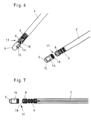
- zwei unterschiedliche perspektivische Ansichten des medizinischen Instruments sowie eines Material-Containers,
- Fig. 7
- einen Längsschnitt durch das medizinische Instrument sowie einen Material-Container gemäß
Fig. 6 und - Fig. 8
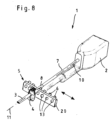
- eine perspektivische Draufsicht gemäß
Fig. 1 , jedoch eine zweite Ausführungsform einer erfindungsgemäßen Vorrichtung darstellend. - Die Abbildung
Fig. 1 zeigt eine Vorrichtung 1 zum Zuführen von Operationsmaterial in ein endoskopisches Operationsgebiet bzw. zum Entfernen von Operationsmaterial aus einem endoskopischen Operationsgebiet. Bei der inFig. 1 dargestellten Ausführungsform ist die Vorrichtung 1 mit einem medizinischen Telemanipulationsroboter 2 gekoppelt. - Alternativ ist es selbstverständlich auch möglich, die nachfolgend genauer beschriebene Vorrichtung 1 mit weiteren manuell bedienbaren medizinischen Instrumenten zu koppeln.
- Die Vorrichtung 1 besteht im Wesentlichen aus einem Trokar 3, einem am proximalen Ende 4 des Trokars 3 angeordneten beladbaren Magazin 5 zur Aufnahme von Material-Containern 6 sowie einem medizinischen Instrument 7, mit Hilfe dessen Material-Container 6 durch den Trokar 3 in das Operationsgebiet einführbar bzw. aus diesem entfernbar sind.
- Wie insbesondere aus den Abbildungen
Fig. 6 und 7 ersichtlich, weist das medizinische Instrument 7 eine distale Instrumentenspitze 8 auf, die über mindestens ein Gelenk 9 gegenüber der Längsachse 10 des medizinischen Instruments 7 abwinkelbar ist. - Bei der in den Abbildungen
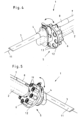
Fig. 1 bis Fig. 5 dargestellten ersten Ausführungsform der Vorrichtung 1 ist das am proximalen Ende 4 des Trokars 3 angeordnete Magazin 5 zur Aufnahme der Material-Container 6 als um die Längsachse 11 des Trokars 3 drehbare Trommel 12 ausgebildet, wie dies den Pfeilen in den AbbildungenFig. 4 und Fig. 5 zu entnehmen ist. - In dem als Trommel 12 ausgebildeten Magazin 5 sind mehrere Aufnahmefächer 13 zur Aufnahme jeweils eines Material-Containers 6 ausgebildet. Die Material-Container 6 selber sind als hohle zylindrische Kapseln ausgebildet, in deren Mantelflächen eine über eine Klappe 14 verschließbare Öffnung 15 ausgebildet ist, über die der Containerraum 16 eines jeden Material-Containers 6 befüllbar und wieder entleerbar ist. Das Öffnen und Schließen der Öffnung 15 mittels der Klappe 14 erfolgt vorteilhafterweise über das medizinische Instrument 7.
- Die in die Aufnahmefächer 13 des Magazins 5 einsetzbaren Material-Container 6 können je nach Einsatz- bzw. Verwendungszweck bereits mit notwendigem Operationsmaterial, wie beispielsweise mit Nahtmaterial vorkonfektionierte Nadeln, bestückt sein oder aber auch leer sein, wenn beispielsweise Gewebeproben aus dem Operationsgebiet zu weiteren Untersuchungen aus dem Körper des Patienten nach außen ausgeführt werden sollen. Die Verwendung der Material-Container 6 hat den Vorteil, dass ab Werk bestückte Material-Container 6 ohne Kontamination in das Magazin 5 geladen werden können. Auch bei der Gewebeentnahme ist die Verwendung des Material-Containers 6 vorteilhaft, da es nicht mehr zu einer Kontamination und / oder dem Verlust der Gewebeprobe kommen kann.
- Zum Einführen eines Material-Containers 6 durch den Trokar 3 in das Operationsgebiet sind das distale Ende der Instrumentenspitze 8 einerseits und das proximale Ende eines Material-Containers 6 miteinander koppelbar.
- Bei der in den Abbildungen
Fig. 5 bis Fig. 7 dargestellten Ausführungsform erfolgt das Koppeln von Material-Container 6 und Instrumentenspitze 8 über einen Rastmechanismus 17, der aus einem an der distalen Instrumentenspitze 8 des medizinischen Instruments 7 angeordneten Rastelement 18 und einer korrespondierenden Rastaufnahme 19 am Material-Container 6 besteht. Wie insbesondere aus der AbbildungFig. 7 ersichtlich, ist das Rastelement 18 T-förmig ausgebildet. Die inFig. 5 dargestellten Rastaufnahmen 19 der Material-Container 6 sind als spaltförmige Öffnungen ausgebildet, in die das T-förmige Rastelement 18 einsetzbar ist. - Vorteilhafterweise ist das an der distalen Instrumentenspitze 8 des medizinischen Instruments 7 angeordnete Rastelement 18 um die Längsachse 10 des medizinischen Instruments 7 drehbar, um eine schnelle und sichere Kopplung mit der Rastaufnahme 19 des Material-Containers 6 zu erleichtern. Darüber hinaus kann die Drehbarkeit des Rastelements 18 dazu verwende werden, die Klappe 14 des Material-Containers 6 zwischen einer die Öffnung 15 im Material-Container 6 öffnenden und einer die Öffnung 15 verschließenden Position zu verstellen.
- Alternativ zu der dargestellten Kopplung zwischen den Material-Containern 6 einerseits und der distalen Instrumentenspitze 8 des medizinischen Instruments 7 andererseits mittels des Rastmechanismus 17, ist es auch möglich, beispielsweise ein magnetisches Kopplungssystem zur Verbindung der beiden Bauteile vorzusehen.
- Nachfolgend wird anhand der Abbildungen
Fig. 1 bis Fig. 7 die Verwendung der Vorrichtung 1 beschrieben. - Die Abbildungen
Fig. 1 und 2 zeigen die Vorrichtung 1 in einer Ausgangsstellung, in der das medizinische Instrument 7 proximalseitig in Verlängerung des Trokars 3 außerhalb des Trokars 3 angeordnet ist und die Aufnahmefächer 13 des als um die Längsachse 11 des Trokars 3 drehbare Trommel 12 ausgebildeten Magazins 5 mit befüllten und / oder leeren Material-Containern 6 bestückt sind. - Durch Rotation der Trommel 12 um die Längsachse 11 des Trokars 3 wird der zum Einführen in das Operationsgebiet benötigte Material-Container 6 in die Koppelstellung gebracht, in der der benötigte Material-Container 6 in Verlängerung der Längsachse 11 des Trokars 6 vor der distalen Instrumentenspitze 8 des medizinischen Instruments 7 angeordnet ist.
- Anschließend wird das medizinische Instrument 7 in Richtung der Längsachse 10 des medizinischen Instruments 7 in distale Richtung hin zum Trokar 3 verschoben, bis das Rastelement 18 der Instrumentenspitze 8 in die Rastaufnehme 19 des Material-Containers 6 eingreift und so das medizinische Instrument 7 und der Material-Container 6 über den Rastmechanismus 17 miteinander gekoppelt sind.
- Zum Einführen des Material-Containers 6 in das Operationsgebiet wird nun das medizinische Instrument 7 mit der distalseitig mit dem Material-Container 6 bestückte Instrumentenspitze 8 voran durch den Trokar 6 in das Operationsgebiet im Körper des Patienten eingeführt.
- Durch die Abwinkelbarkeit der mit dem Material-Container 6 bestückten distalen Instrumentenspitze 8 des medizinischen Instruments 7 gegenüber der Längsachse 10 des medizinischen Instruments 7 mittels des Gelenks 9 kann das in dem Material-Container 6 befindliche Operationsmaterial auch in kleinen Cavitäten angereicht und entnommen werden. Vorteilhafterweise ist die mit dem Material-Container 6 bestückte distale Instrumentenspitze 8 des medizinischen Instruments 7 zusätzlich um die Längsachse 10 des medizinischen Instruments 7 drehbar, um die Möglichkeit der lagegenauen Zuführung des Operationsmaterials noch weiter zu verbessern.
- Am Verwendungspunkt im Operationsgebiet angekommen, wird die die Öffnung 15 des Material-Containers 6 verschließende Klappe 14, beispielsweise durch Drehen des Rastelements 18 um die Längsachse 10 des medizinischen Instruments 7 geöffnet, so dass das im Containerraum 16 gelagerte Operationsmaterial mittels eines nicht dargestellten, über einen anderen Zugang in das Operationsgebiet eingeführten weiteren medizinischen Instruments entnommen werden kann bzw. im Falle eines leeren Material-Containers 6 der Containerraum 16 beispielsweise mit einer Gewebeprobe befüllt werden kann.
- Nach erfolgtem Entleeren oder Befüllen des Containerraums 16 des Material-Containers 6 im Operationsgebiet, wird die Öffnung 15 des Material-Containers 6 wieder über die Klappe 14 verschlossen und der Material-Container 6 durch Zurückziehen des medizinischen Instruments 7 durch den Trokar 6 nach proximal wieder aus dem Operationsgebiet und dem Körper des Patienten entfernt, bis der Material-Container 6 wieder im Aufnahmefach 13 des Magazins 5 gelagert ist.
- Nachfolgend wird der Rastmechanismus 17, über den der Material-Container 6 und die Instrumentenspitze 8 des medizinischen Instruments 7 miteinander gekoppelt sind, gelöst und das medizinische Instrument 7 in Richtung seiner Längsachse 10 weiter nach proximal gezogen, bis das distalseitige Rastelement 18 der Instrumentenspitze 8 außer Eingriff mit der Rastaufnahme 19 des Material-Containers 6 tritt.
- Soll nun ein anderer Material-Container 6 in das Operationsgebiet eingeführt werden, wird die Trommel 12 des Magazins 5 erneut um die Längsachse 11 des Trokars 6 gedreht, bis der neue, zum Einführen in das Operationsgebiet benötigte Material-Container 6 sich in der Koppelstellung befindet, in der dieser Material-Container 6 in Verlängerung der Längsachse 11 des Trokars 6 vor der distalen Instrumentenspitze 8 des medizinischen Instruments 7 angeordnet ist.
- Das Drehen des Magazins 5 erfolgt insbesondere bei der Kopplung der Vorrichtung 1 mit einem medizinischen Telemanipulationsroboter 2 motorisch, wodurch eine schnelle und präzise Bereitstellung des jeweils benötigten Material-Containers 6 gewährleistet wird.
- Durch die Anordnung der Material-Container 6 in einem mit mehreren Material-Containern 6 bestückbaren Magazin 5 ist es auf einfache Art und Weise möglich, Operationsmaterial sicher und schnell in ein Operationsgebiet einführen bzw. aus diesem wieder entfernen zu können.
- Die Abbildung
Fig. 8 zeigt eine alternative Ausführungsform zur Ausbildung des zur Aufnahme der Material-Container 6 dienenden Magazins 5. Wie aus der Abbildung ersichtlich, ist das Magazin 5 bei dieser Ausführungsform als in Richtung des Pfeils quer zur Längsachse 11 des Trokars 3 verschiebbarer Schlitten 20 ausgebildet. - Die Funktionsweise der Vorrichtung 1 mit dem als Schlitten 20 ausgebildeten Magazin 5 entspricht ansonsten der zuvor anhand der mit der drehbaren Trommel 12 ausgestatteten Vorrichtung 1 beschriebenen Vorgehensweise.
- In den Zeichnungen ist ein Ausführungsbeispiel der Erfindung dargestellt. Die Zeichnungen, die Beschreibung und die Ansprüche enthalten zahlreiche Merkmale in Kombination. Es versteht sich, dass die genannten Merkmale nicht nur in der jeweils angegebenen Kombination, sondern auch in anderen Kombinationen oder in Alleinstellung verwendbar sind, ohne den Rahmen der vorliegenden Erfindung zu verlassen. Die Erfindung betrifft eine Vorrichtung 1 zum Zuführen von Operationsmaterial in ein endoskopisches Operationsgebiet bzw. zum Entfernen von Operationsmaterial aus einem endoskopischen Operationsgebiet, mit einem Trokar 3 sowie einem durch den Trokar 3 in das Operationsgebiet einführbaren medizinischen Instrument. Eine Vorrichtung 1 zum Zuführen von Operationsmaterial in ein endoskopisches Operationsgebiet bzw. zum Entfernen von Operationsmaterial aus einem endoskopischen Operationsgebiet, die bei einfacher Handhabung ein sicheres Zuführen und Entfernen von Operationsmaterial ermöglicht, ist erfindungsgemäß gekennzeichnet durch ein am proximalen Ende 4 des Trokars 3 angeordnetes beladbares Magazin 5 zur Aufnahme von Material-Containern 6, die mittels des medizinischen Instruments 7 durch den Trokar 3 in das Operationsgebiet einführbar bzw. aus diesem entfernbar sind.
-
- 1
- Vorrichtung
- 2
- medizinischer Telemanipulationsroboter
- 3
- Trokar
- 4
- proximales Ende (Trokar)
- 5
- Magazin
- 6
- Material-Container
- 7
- medizinisches Instrument
- 8
- Instrumentenspitze
- 9
- Gelenk
- 10
- Längsachse (medizinisches Instrument)
- 11
- Längsachse (Trokar)
- 12
- Trommel
- 13
- Aufnahmefach
- 14
- Klappe
- 15
- Öffnung
- 16
- Containerraum
- 17
- Rastmechanismus
- 18
- Rastelement
- 19
- Rastaufnahme
- 20
- Schlitten
Claims (14)
- Vorrichtung (1) zum Zuführen von Operationsmaterial in ein endoskopisches Operationsgebiet bzw. zum Entfernen von Operationsmaterial aus einem endoskopischen Operationsgebiet, mit einem Trokar (3) sowie einem durch den Trokar (3) in das Operationsgebiet einführbaren medizinischen Instrument (7),
gekennzeichnet durch
ein am proximalen Ende (4) des Trokars (3) angeordnetes beladbares Magazin (5) zur Aufnahme von Material-Containern (6), die mittels des medizinischen Instruments (7) durch den Trokar (3) in das Operationsgebiet einführbar bzw. aus diesem entfernbar sind. - Vorrichtung (1) nach Anspruch 1, dadurch gekennzeichnet, dass das Magazin (5) als um die Längsachse (11) des Trokars (3) drehbare Trommel (12) ausgebildet ist.
- Vorrichtung (1) nach Anspruch 1, dadurch gekennzeichnet, dass das Magazin (5) als quer zur Längsachse (11) des Trokars (3) verschiebbarer Schlitten (20) ausgebildet ist.
- Vorrichtung (1) nach einem der Ansprüche 1 bis 3, dadurch gekennzeichnet, dass das Magazin (5) motorisch antreibbar ist.
- Vorrichtung (1) nach einem der Ansprüche 1 bis 4, dadurch gekennzeichnet, dass jeder Material-Container (6) mittels eines Rastmechanismus (17) an einer distalen Instrumentenspitze (8) des medizinischen Instruments (7) festlegbar ist.
- Vorrichtung (1) nach Anspruch 5, dadurch gekennzeichnet, dass der Rastmechanismus (17) aus einem an der distalen Instrumentenspitze (8) des medizinischen Instruments (7) angeordneten Rastelement (18) und einer korrespondierenden Rastaufnahme (19) am Material-Container (6) besteht.
- Vorrichtung (1) nach Anspruch 6, dadurch gekennzeichnet, dass das an der distalen Instrumentenspitze (8) des medizinischen Instruments (7) angeordnete Rastelement (18) um die Längsachse (10) des medizinischen Instruments (7) drehbar ist.
- Vorrichtung (1) nach einem der Ansprüche 1 bis 4, dadurch gekennzeichnet, dass jeder Material-Container (6) mittels eines magnetischen Kopplungssystems an der distalen Instrumentenspitze (8) des medizinischen Instruments (7) festlegbar ist.
- Vorrichtung (1) nach einem der Ansprüche 1 bis 8, dadurch gekennzeichnet, dass jeder Material-Container (6) eine verschließbare Öffnung (15) zum Befüllen und / oder Entleeren des Material-Containers (6) aufweist.
- Vorrichtung (1) nach Anspruch 9, dadurch gekennzeichnet, dass das Öffnen und Schließen der Öffnung (15) des Material-Containers (6) über das mit dem Material-Container (6) koppelbare medizinische Instrument (7) erfolgt.
- Vorrichtung (1) nach einem der Ansprüche 1 bis 10, dadurch gekennzeichnet, dass die mit dem Material-Container (6) koppelbare distale Instrumentenspitze (8) des medizinischen Instruments (7) über mindestens ein Gelenk (9) gegenüber der Längsachse (10) des medizinischen Instruments (7) abwinkelbar ist.
- Vorrichtung (1) nach einem der Ansprüche 1 bis 11, dadurch gekennzeichnet, dass die mit dem Material-Container (6) koppelbare distale Instrumentenspitze (8) des medizinischen Instruments (7) um die Längsachse (10) des medizinischen Instruments (7) rotierbar ausgebildet ist.
- Vorrichtung (1) nach einem der Ansprüche 1 bis 12, dadurch gekennzeichnet, dass das die Vorrichtung (1) mit einem medizinischen Telemanipulationsroboter (2) koppelbar ist.
- Vorrichtung (1) nach einem der Ansprüche 1 bis 12, dadurch gekennzeichnet, dass das die Vorrichtung (1) mit manuell bedienbaren medizinischen Instrumenten koppelbar ist.
Applications Claiming Priority (1)
| Application Number | Priority Date | Filing Date | Title |
|---|---|---|---|
| DE102022132716.7A DE102022132716A1 (de) | 2022-12-08 | 2022-12-08 | Vorrichtung zum Zuführen von Operationsmaterial in ein endoskopisches Operationsgebiet bzw. zum Entfernen von Operationsmaterial aus einem endoskopischen Operationsgebiet |
Publications (1)
| Publication Number | Publication Date |
|---|---|
| EP4382057A1 true EP4382057A1 (de) | 2024-06-12 |
Family
ID=89122105
Family Applications (1)
| Application Number | Title | Priority Date | Filing Date |
|---|---|---|---|
| EP23214572.2A Pending EP4382057A1 (de) | 2022-12-08 | 2023-12-06 | Vorrichtung zum zuführen von operationsmaterial in ein endoskopisches operationsgebiet bzw. zum entfernen von operationsmaterial aus einem endoskopischen operationsgebiet |
Country Status (3)
| Country | Link |
|---|---|
| US (1) | US20240188988A1 (de) |
| EP (1) | EP4382057A1 (de) |
| DE (1) | DE102022132716A1 (de) |
Families Citing this family (1)
| Publication number | Priority date | Publication date | Assignee | Title |
|---|---|---|---|---|
| US20240063988A1 (en) * | 2022-08-21 | 2024-02-22 | Qualcomm Incorporated | Rate matching for channel aware tone reservation |
Citations (4)
| Publication number | Priority date | Publication date | Assignee | Title |
|---|---|---|---|---|
| DE102009025013A1 (de) * | 2009-06-16 | 2010-12-30 | Fraunhofer-Gesellschaft zur Förderung der angewandten Forschung e.V. | Automatisiertes Instrumentenwechselsystem für die minimal-invasive Chirurgie |
| US20110118756A1 (en) * | 1998-02-24 | 2011-05-19 | Hansen Medical, Inc. | Interchangeable surgical instrument |
| DE102013224754A1 (de) * | 2013-12-03 | 2015-06-03 | Richard Wolf Gmbh | Operationsroboter |
| US20160213363A1 (en) * | 2013-08-22 | 2016-07-28 | Martin Knight | Surgical apparatus comprising magazine |
Family Cites Families (9)
| Publication number | Priority date | Publication date | Assignee | Title |
|---|---|---|---|---|
| US7297142B2 (en) * | 1998-02-24 | 2007-11-20 | Hansen Medical, Inc. | Interchangeable surgical instrument |
| US9060770B2 (en) * | 2003-05-20 | 2015-06-23 | Ethicon Endo-Surgery, Inc. | Robotically-driven surgical instrument with E-beam driver |
| CN104688327B (zh) * | 2006-06-13 | 2017-06-09 | 直观外科手术操作公司 | 微创手术系统 |
| AU2011265232B2 (en) * | 2010-06-11 | 2015-01-22 | Ethicon Llc | Suture delivery tools for endoscopic and robot-assisted surgery and methods |
| DE102016105907A1 (de) * | 2016-03-31 | 2017-10-05 | Tuebingen Scientific Medical Gmbh | Chirurgisches Roboter-Instrumenten-System |
| US20200253639A1 (en) * | 2017-10-23 | 2020-08-13 | Claria Medical, Inc. | Systems and methods for tissue capture and removal |
| JP7184929B2 (ja) * | 2018-06-08 | 2022-12-06 | デビコー・メディカル・プロダクツ・インコーポレイテッド | 組織除去中の選択的な生検サンプルの可視化を可能にする装置 |
| US12023065B2 (en) * | 2019-09-03 | 2024-07-02 | Covidien Lp | Bi-stable spring-latch connector for ultrasonic surgical instruments |
| WO2021225922A1 (en) * | 2020-05-08 | 2021-11-11 | Covidien Lp | Surgical robotic systems |
-
2022
- 2022-12-08 DE DE102022132716.7A patent/DE102022132716A1/de active Pending
-
2023
- 2023-12-06 EP EP23214572.2A patent/EP4382057A1/de active Pending
- 2023-12-06 US US18/530,931 patent/US20240188988A1/en active Pending
Patent Citations (4)
| Publication number | Priority date | Publication date | Assignee | Title |
|---|---|---|---|---|
| US20110118756A1 (en) * | 1998-02-24 | 2011-05-19 | Hansen Medical, Inc. | Interchangeable surgical instrument |
| DE102009025013A1 (de) * | 2009-06-16 | 2010-12-30 | Fraunhofer-Gesellschaft zur Förderung der angewandten Forschung e.V. | Automatisiertes Instrumentenwechselsystem für die minimal-invasive Chirurgie |
| US20160213363A1 (en) * | 2013-08-22 | 2016-07-28 | Martin Knight | Surgical apparatus comprising magazine |
| DE102013224754A1 (de) * | 2013-12-03 | 2015-06-03 | Richard Wolf Gmbh | Operationsroboter |
Also Published As
| Publication number | Publication date |
|---|---|
| US20240188988A1 (en) | 2024-06-13 |
| DE102022132716A1 (de) | 2024-06-13 |
Similar Documents
| Publication | Publication Date | Title |
|---|---|---|
| EP1897505B1 (de) | Medizinisches Instrument | |
| EP0432560B1 (de) | Instrumentensatz zum Verschliessen von Hohlorganen und Wunden | |
| DE69729231T2 (de) | Durchlass für den Thorax | |
| EP1156746B1 (de) | Instrument zum schneiden von biologischem und insbesondere menschlichem gewebe | |
| DE69324272T2 (de) | Endoskopisches chirurgisches Klammerinstrument mit drehbarer und rotierbarer Klammerpatrone | |
| DE60211044T2 (de) | Einbrinbare chirurgische Klammer mit einer Zufuhr-/Entnahmevorrichtung und Bedienelement | |
| DE69211882T2 (de) | Endoskopisches Klammerinstrument und Mechanismus zur Herniereparatur | |
| EP2563283A1 (de) | Wirbelsäulenimplantat und werkzeug hierfür | |
| DE102009014525A1 (de) | Medizinisches Instrument zum Schaffen eines Zugangs für einen minimalinvasiven Eingriff | |
| DE20016423U1 (de) | Endoskopisch einsetzbares Klammernahtgerät | |
| EP2279708A1 (de) | Behälter für ein medizinisches Instrument oder Implantat, insbesondere ein dentalmedizinisches Instrument oder ein Dentalimplantat | |
| EP1721583A2 (de) | Implantat zum Einsetzen zwischen Wirbelkörper sowie Operationsinstrument zum Betätigen des Implantats | |
| EP0263096A1 (de) | Vorrichtung und Verfahren zur Entnahme von Flüssigkeiten, Gewebe. | |
| DE19955592A1 (de) | Gewebe-Exzisions- und -Schneidevorrichtung und dazugehöriger Forzeps | |
| DE102011018692A1 (de) | Wirbelsäulenimplantat, Werkzeug hierfür und Verfahren zur Distraktion des Wirbelsäulenimplantats | |
| DE4403567A1 (de) | Vorrichtung zur Durchführung endoskopischer Operationen mittels einer intra- und/oder extrakorporalen Hülle | |
| DE102009060377A1 (de) | Trokarhülse | |
| EP0499243A1 (de) | Extraktionsbeutel für die endoskopische Chirurgie | |
| DE102022132716A1 (de) | Vorrichtung zum Zuführen von Operationsmaterial in ein endoskopisches Operationsgebiet bzw. zum Entfernen von Operationsmaterial aus einem endoskopischen Operationsgebiet | |
| DE4120329A1 (de) | Gewebestanze | |
| EP1637066B1 (de) | Spreizbares medizinisches Instrument für endoskopische Eingriffe | |
| DE602004013450T2 (de) | Greifglied für biomezidinische Nadel | |
| DE9109909U1 (de) | Operationsinstrument | |
| DE102013224754A1 (de) | Operationsroboter | |
| EP3589222A1 (de) | Biopsienadelführung mit zweistufiger fixierung |
Legal Events
| Date | Code | Title | Description |
|---|---|---|---|
| PUAI | Public reference made under article 153(3) epc to a published international application that has entered the european phase |
Free format text: ORIGINAL CODE: 0009012 |
|
| STAA | Information on the status of an ep patent application or granted ep patent |
Free format text: STATUS: THE APPLICATION HAS BEEN PUBLISHED |
|
| AK | Designated contracting states |
Kind code of ref document: A1 Designated state(s): AL AT BE BG CH CY CZ DE DK EE ES FI FR GB GR HR HU IE IS IT LI LT LU LV MC ME MK MT NL NO PL PT RO RS SE SI SK SM TR |
|
| STAA | Information on the status of an ep patent application or granted ep patent |
Free format text: STATUS: REQUEST FOR EXAMINATION WAS MADE |
|
| 17P | Request for examination filed |
Effective date: 20241029 |
|
| RBV | Designated contracting states (corrected) |
Designated state(s): AL AT BE BG CH CY CZ DE DK EE ES FI FR GB GR HR HU IE IS IT LI LT LU LV MC ME MK MT NL NO PL PT RO RS SE SI SK SM TR |
|
| P01 | Opt-out of the competence of the unified patent court (upc) registered |
Free format text: CASE NUMBER: APP_59429/2024 Effective date: 20241031 |